Knowledge Creating Theory: Past, Present, and Beyond Der Chao Chen Graduate School of Knowledge Science Japan Advanced Institute of Science and Technology 2007
Outline Background Emergence of knowledge creating theory SECI Model Knowledge spiral Leading the knowledge creating process Knowledge assets The Firm as an dialectic entity Strategy-as-distributed phronesis Discussions
Background Knowledge becomes one of production endowments in today’s economic development. Reengineering, downsizing cannot improve competitiveness of Western countries. Prosperity of Japan economy before the “lost decade” (1991-2000) attracted people to find out the success secret of its growth.
Emergence of knowledge creating theory Back to 1986, new product development models derived from Japanese companies (Takeuchi & Nonaka, 1986). Middle-up-down management model was proposed (Nonaka, 1988) to emphasize the role of middle managers in the organization.
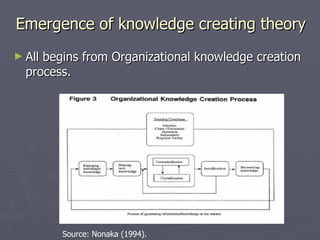
Emergence of knowledge creating theory All begins from Organizational knowledge creation process. Source: Nonaka (1994).
Emergence of knowledge creating theory Philosophy Western: tacit /explicit knowledge (Polanyi), epistemology (how to know), ontology (what one exists for), etc. Japan: Ba (Nishida), oneness of humanity and nature, oneness of body and mind, and oneness of self and other. Organization theory  Information processing perspective, Organizational communication and coordination, and  Leadership.
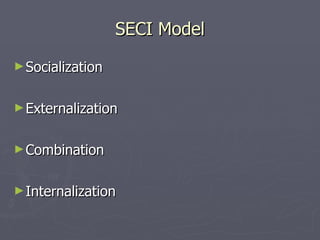
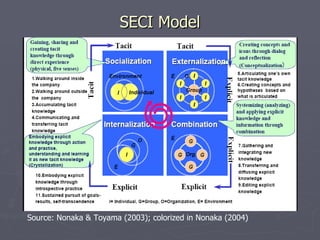
SECI Model Socialization Externalization Combination Internalization
SECI Model Source: Nonaka & Toyama (2003); colorized in Nonaka (2004)
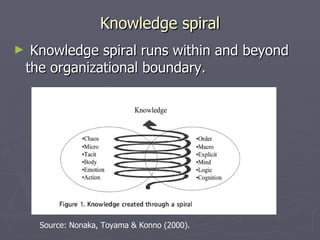
Knowledge spiral Knowledge spiral runs within and beyond the organizational boundary. Source: Nonaka, Toyama & Konno (2000).
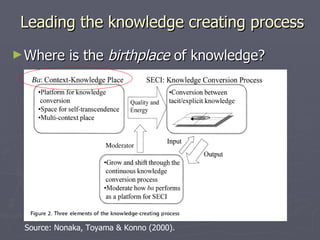
Leading the knowledge creating process Where is the  birthplace  of knowledge? Source: Nonaka, Toyama & Konno (2000).
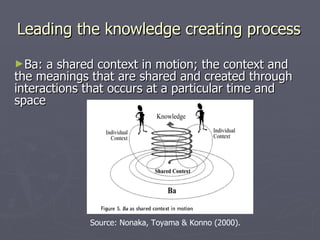
Leading the knowledge creating process Ba: a shared context in motion; the context and the meanings that are shared and created through interactions that occurs at a particular time and space Source: Nonaka, Toyama & Konno (2000).
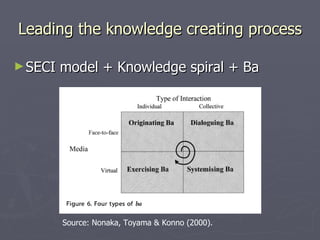
Leading the knowledge creating process SECI model + Knowledge spiral + Ba Source: Nonaka, Toyama & Konno (2000).
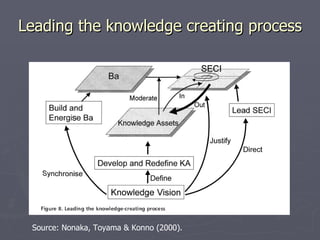
Leading the knowledge creating process Source: Nonaka, Toyama & Konno (2000).
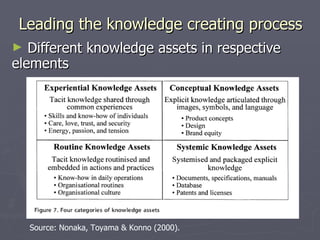
Leading the knowledge creating process Different knowledge assets in respective elements  Source: Nonaka, Toyama & Konno (2000).
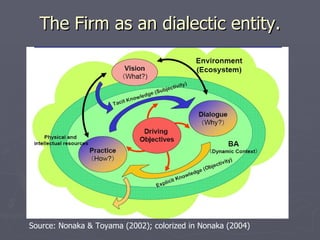
The Firm as an dialectic entity. Source: Nonaka & Toyama (2002); colorized in Nonaka (2004)
The theory of knowledge-creating firm Subjectivity: tacit knowledge Objective: explicit knowledge Synthesis: achieved through dialectical thinking and action.
Strategy-as-distributed phronesis Phronesis as  “ experiential knowledge to make context-specific decisions based on one’s value and ethics (high quality tacit knowledge)”  The role of top executives/ founders. The [XX] way, e.g. IBM, HP, Toyota, Honda, Canon, etc.
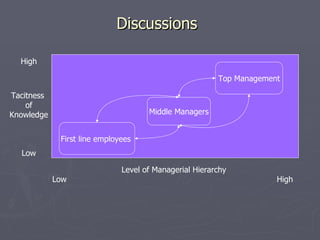
Discussions   Level of Managerial Hierarchy Low   High Middle Managers Top Management First line employees  High Tacitness  of Knowledge Low
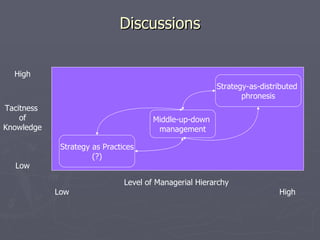
Discussions Level of Managerial Hierarchy Low   High High Tacitness  of Knowledge Low Middle-up-down  management Strategy-as-distributed  phronesis Strategy as Practices (?)
Discussions The role of top level executive leadership has emphasized and expanded in the development of knowledge creating theory.  While  strategy-as-practice approach  is a new emerging agenda, the role of first line employees and how they work to create, share, and transfer knowledge/routines would be an new direction.
Discussions Knowledge creating theory is an knowledge based theory that… Combine philosophic arguments in the business context and knowledge in the field of managerial and organizational studies, supported by cases of Japanese firms.
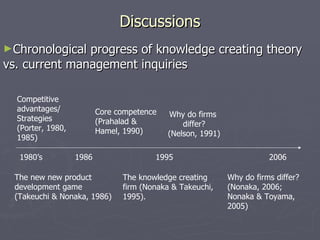
Discussions Chronological progress of knowledge creating theory vs. current management inquiries The knowledge creating firm (Nonaka & Takeuchi, 1995).  Why do firms differ? (Nonaka, 2006;  Nonaka & Toyama, 2005) 1980’s  2006 1995 Why do firms  differ? (Nelson, 1991) The new new product  development game (Takeuchi & Nonaka, 1986) Competitive advantages/ Strategies (Porter, 1980, 1985) Core competence (Prahalad & Hamel, 1990) 1986
Discussions Back to the basic- Why do firms differ? How to differentiate your firm from competitors and lead the competitive pace? To industry community, how to learn from the field for creating knowledge is more critical than developing philosophical, abstract dialogue and arguments.
Discussions Questions industry community may interest, such as  Could organizational knowledge be well identified, developed, and maintained in different contexts, such as in the different level of hierarchy, SME, and different industries? How to transfer organizational knowledge into real profit? How to establish or identify of phronesis in start ups or SMEs?
Thanks for Your Time and Comments Der Chao Chen [email_address] ®  All rights of cited figures and tables belong to their original owners

Knowledge Creation Theory: Past, Present, and Beyond

  • 1.
    Knowledge Creating Theory:Past, Present, and Beyond Der Chao Chen Graduate School of Knowledge Science Japan Advanced Institute of Science and Technology 2007
  • 2.
    Outline Background Emergenceof knowledge creating theory SECI Model Knowledge spiral Leading the knowledge creating process Knowledge assets The Firm as an dialectic entity Strategy-as-distributed phronesis Discussions
  • 3.
    Background Knowledge becomesone of production endowments in today’s economic development. Reengineering, downsizing cannot improve competitiveness of Western countries. Prosperity of Japan economy before the “lost decade” (1991-2000) attracted people to find out the success secret of its growth.
  • 4.
    Emergence of knowledgecreating theory Back to 1986, new product development models derived from Japanese companies (Takeuchi & Nonaka, 1986). Middle-up-down management model was proposed (Nonaka, 1988) to emphasize the role of middle managers in the organization.
  • 5.
    Emergence of knowledgecreating theory All begins from Organizational knowledge creation process. Source: Nonaka (1994).
  • 6.
    Emergence of knowledgecreating theory Philosophy Western: tacit /explicit knowledge (Polanyi), epistemology (how to know), ontology (what one exists for), etc. Japan: Ba (Nishida), oneness of humanity and nature, oneness of body and mind, and oneness of self and other. Organization theory Information processing perspective, Organizational communication and coordination, and Leadership.
  • 7.
    SECI Model SocializationExternalization Combination Internalization
  • 8.
    SECI Model Source:Nonaka & Toyama (2003); colorized in Nonaka (2004)
  • 9.
    Knowledge spiral Knowledgespiral runs within and beyond the organizational boundary. Source: Nonaka, Toyama & Konno (2000).
  • 10.
    Leading the knowledgecreating process Where is the birthplace of knowledge? Source: Nonaka, Toyama & Konno (2000).
  • 11.
    Leading the knowledgecreating process Ba: a shared context in motion; the context and the meanings that are shared and created through interactions that occurs at a particular time and space Source: Nonaka, Toyama & Konno (2000).
  • 12.
    Leading the knowledgecreating process SECI model + Knowledge spiral + Ba Source: Nonaka, Toyama & Konno (2000).
  • 13.
    Leading the knowledgecreating process Source: Nonaka, Toyama & Konno (2000).
  • 14.
    Leading the knowledgecreating process Different knowledge assets in respective elements Source: Nonaka, Toyama & Konno (2000).
  • 15.
    The Firm asan dialectic entity. Source: Nonaka & Toyama (2002); colorized in Nonaka (2004)
  • 16.
    The theory ofknowledge-creating firm Subjectivity: tacit knowledge Objective: explicit knowledge Synthesis: achieved through dialectical thinking and action.
  • 17.
    Strategy-as-distributed phronesis Phronesisas “ experiential knowledge to make context-specific decisions based on one’s value and ethics (high quality tacit knowledge)” The role of top executives/ founders. The [XX] way, e.g. IBM, HP, Toyota, Honda, Canon, etc.
  • 18.
    Discussions Level of Managerial Hierarchy Low High Middle Managers Top Management First line employees High Tacitness of Knowledge Low
  • 19.
    Discussions Level ofManagerial Hierarchy Low High High Tacitness of Knowledge Low Middle-up-down management Strategy-as-distributed phronesis Strategy as Practices (?)
  • 20.
    Discussions The roleof top level executive leadership has emphasized and expanded in the development of knowledge creating theory. While strategy-as-practice approach is a new emerging agenda, the role of first line employees and how they work to create, share, and transfer knowledge/routines would be an new direction.
  • 21.
    Discussions Knowledge creatingtheory is an knowledge based theory that… Combine philosophic arguments in the business context and knowledge in the field of managerial and organizational studies, supported by cases of Japanese firms.
  • 22.
    Discussions Chronological progressof knowledge creating theory vs. current management inquiries The knowledge creating firm (Nonaka & Takeuchi, 1995). Why do firms differ? (Nonaka, 2006; Nonaka & Toyama, 2005) 1980’s 2006 1995 Why do firms differ? (Nelson, 1991) The new new product development game (Takeuchi & Nonaka, 1986) Competitive advantages/ Strategies (Porter, 1980, 1985) Core competence (Prahalad & Hamel, 1990) 1986
  • 23.
    Discussions Back tothe basic- Why do firms differ? How to differentiate your firm from competitors and lead the competitive pace? To industry community, how to learn from the field for creating knowledge is more critical than developing philosophical, abstract dialogue and arguments.
  • 24.
    Discussions Questions industrycommunity may interest, such as Could organizational knowledge be well identified, developed, and maintained in different contexts, such as in the different level of hierarchy, SME, and different industries? How to transfer organizational knowledge into real profit? How to establish or identify of phronesis in start ups or SMEs?
  • 25.
    Thanks for YourTime and Comments Der Chao Chen [email_address] ® All rights of cited figures and tables belong to their original owners