Knowledge Representation
 using First-Order Logic
Domain
• Domain is a section of the knowledge
  representation.
     - The Kinship domain
     - Mathematical sets
     - Assertions and queries in first order logic
     - The Wumpus World
Kinship domain
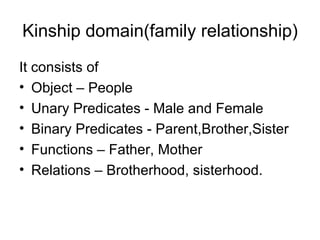
Kinship domain(family relationship)
It consists of
• Object – People
• Unary Predicates - Male and Female
• Binary Predicates - Parent,Brother,Sister
• Functions – Father, Mother
• Relations – Brotherhood, sisterhood.
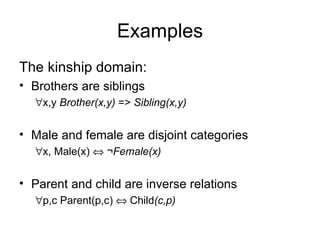
Examples
The kinship domain:
• Brothers are siblings
  ∀x,y Brother(x,y) => Sibling(x,y)


• Male and female are disjoint categories
  ∀x, Male(x) ⇔ ¬Female(x)


• Parent and child are inverse relations
  ∀p,c Parent(p,c) ⇔ Child(c,p)
Mathematical sets
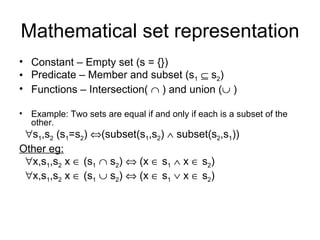
Mathematical set representation
• Constant – Empty set (s = {})
• Predicate – Member and subset (s1 ⊆ s2)
• Functions – Intersection( ∩ ) and union (∪ )

•   Example: Two sets are equal if and only if each is a subset of the
    other.
 ∀s1,s2 (s1=s2) ⇔(subset(s1,s2) ∧ subset(s2,s1))
Other eg:
 ∀x,s1,s2 x ∈ (s1 ∩ s2) ⇔ (x ∈ s1 ∧ x ∈ s2)
 ∀x,s1,s2 x ∈ (s1 ∪ s2) ⇔ (x ∈ s1 ∨ x ∈ s2)
Assertions and Queries in
     first-order logic
Assertions
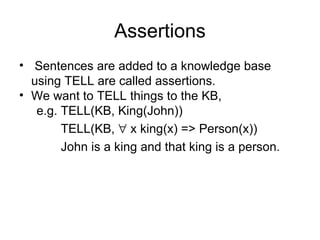
• Sentences are added to a knowledge base
  using TELL are called assertions.
• We want to TELL things to the KB,
   e.g. TELL(KB, King(John))
        TELL(KB, ∀ x king(x) => Person(x))
        John is a king and that king is a person.
Queries
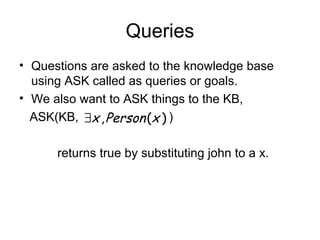
• Questions are asked to the knowledge base
  using ASK called as queries or goals.
• We also want to ASK things to the KB,
  ASK(KB, ∃x , Person (x ) )

      returns true by substituting john to a x.
Wumpus world
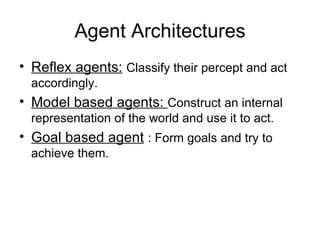
Agent Architectures
• Reflex agents: Classify their percept and act
  accordingly.
• Model based agents: Construct an internal
  representation of the world and use it to act.
• Goal based agent : Form goals and try to
  achieve them.
FOL Version of Wumpus World
• Typical percept sentence:
  Percept([Stench,Breeze,Glitter,None,None],3)

• In this sentence:
  Percept - predicate
  Stench, Breeze and glitter – Constants
  3 – Integer to represent time

• Actions:
  Turn Right), Turn Left), Forward, Shoot, Grab, Release,
  Climb
Cont..,
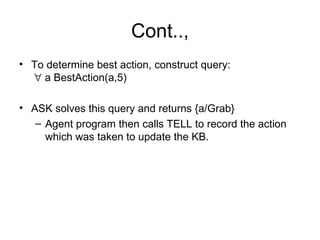
• To determine best action, construct query:
  ∀ a BestAction(a,5)

• ASK solves this query and returns {a/Grab}
   – Agent program then calls TELL to record the action
     which was taken to update the KB.
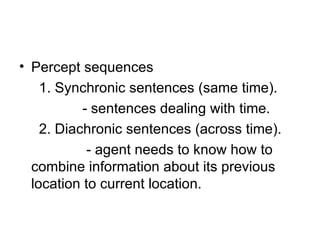
• Percept sequences
    1. Synchronic sentences (same time).
           - sentences dealing with time.
    2. Diachronic sentences (across time).
            - agent needs to know how to
  combine information about its previous
  location to current location.
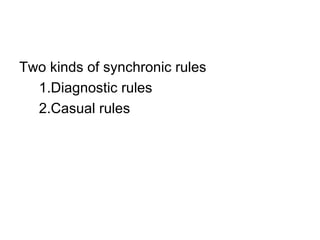
Two kinds of synchronic rules
  1.Diagnostic rules
  2.Casual rules
Deducing hidden properties
• Squares are breezy near a pit:
  – Diagnostic rule---infer cause from effect
     ∀s Breezy(s) ⇔ ∃ r Adjacent(r,s) ∧ Pit(r)


  – Causal rule---infer effect from cause
  ∀r Pit(r) ⇒ [∀s Adjacent(r,s) ⇒ Breezy(s)]
Knowledge engineering in
         FOL
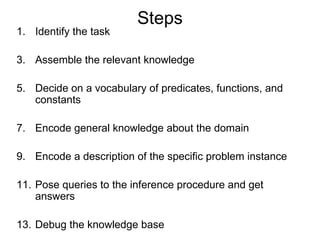
Steps
1. Identify the task

3. Assemble the relevant knowledge

5. Decide on a vocabulary of predicates, functions, and
   constants

7. Encode general knowledge about the domain

9. Encode a description of the specific problem instance

11. Pose queries to the inference procedure and get
    answers

13. Debug the knowledge base
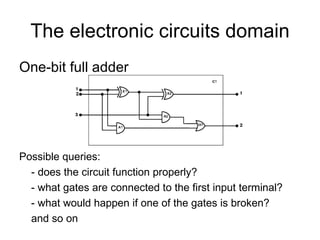
The electronic circuits domain
One-bit full adder


Possible queries:
  - does the circuit function properly?
  - what gates are connected to the first input terminal?
  - what would happen if one of the gates is broken?
  and so on
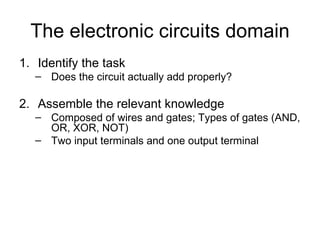
The electronic circuits domain
1. Identify the task
   – Does the circuit actually add properly?

2. Assemble the relevant knowledge
   – Composed of wires and gates; Types of gates (AND,
     OR, XOR, NOT)
   – Two input terminals and one output terminal
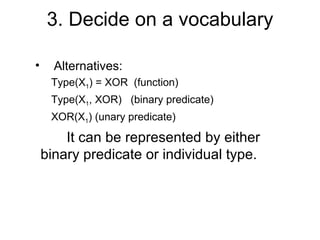
3. Decide on a vocabulary

•     Alternatives:
     Type(X1) = XOR (function)
     Type(X1, XOR) (binary predicate)
     XOR(X1) (unary predicate)

        It can be represented by either
    binary predicate or individual type.
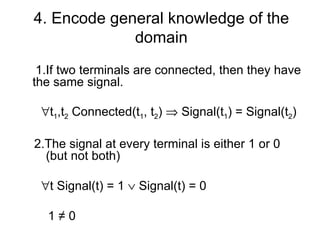
4. Encode general knowledge of the
             domain
 1.If two terminals are connected, then they have
the same signal.

 ∀t1,t2 Connected(t1, t2) ⇒ Signal(t1) = Signal(t2)

2.The signal at every terminal is either 1 or 0
  (but not both)

 ∀t Signal(t) = 1 ∨ Signal(t) = 0

  1≠0
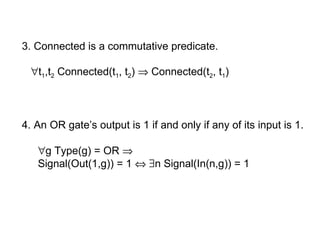
3. Connected is a commutative predicate.

  ∀t1,t2 Connected(t1, t2) ⇒ Connected(t2, t1)


4. An OR gate’s output is 1 if and only if any of its input is 1.

   ∀g Type(g) = OR ⇒
   Signal(Out(1,g)) = 1 ⇔ ∃n Signal(In(n,g)) = 1
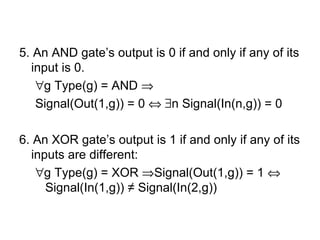
5. An AND gate’s output is 0 if and only if any of its
  input is 0.
   ∀g Type(g) = AND ⇒
   Signal(Out(1,g)) = 0 ⇔ ∃n Signal(In(n,g)) = 0

6. An XOR gate’s output is 1 if and only if any of its
  inputs are different:
   ∀g Type(g) = XOR ⇒Signal(Out(1,g)) = 1 ⇔
     Signal(In(1,g)) ≠ Signal(In(2,g))
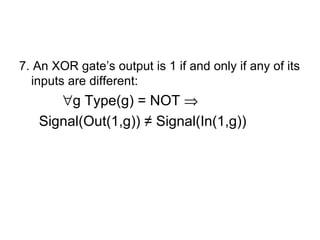
7. An XOR gate’s output is 1 if and only if any of its
  inputs are different:
      ∀g Type(g) = NOT ⇒
   Signal(Out(1,g)) ≠ Signal(In(1,g))
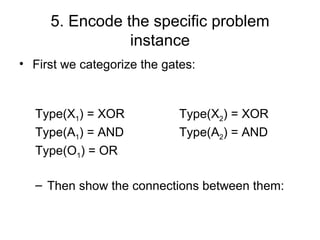
5. Encode the specific problem
                instance
• First we categorize the gates:


  Type(X1) = XOR             Type(X2) = XOR
  Type(A1) = AND             Type(A2) = AND
  Type(O1) = OR

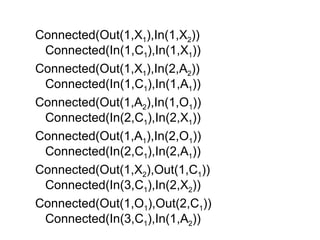
  – Then show the connections between them:
Connected(Out(1,X1),In(1,X2))
 Connected(In(1,C1),In(1,X1))
Connected(Out(1,X1),In(2,A2))
 Connected(In(1,C1),In(1,A1))
Connected(Out(1,A2),In(1,O1))
 Connected(In(2,C1),In(2,X1))
Connected(Out(1,A1),In(2,O1))
 Connected(In(2,C1),In(2,A1))
Connected(Out(1,X2),Out(1,C1))
 Connected(In(3,C1),In(2,X2))
Connected(Out(1,O1),Out(2,C1))
 Connected(In(3,C1),In(1,A2))
6. Pose queries to the inference
   procedure and get answers


     For the given query the inference
procedure operate on the problem
specific facts and derive the answers.
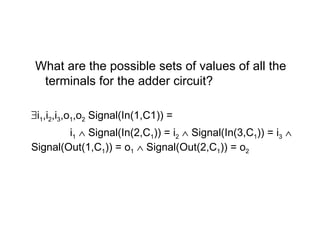
What are the possible sets of values of all the
 terminals for the adder circuit?

∃i1,i2,i3,o1,o2 Signal(In(1,C1)) =
        i1 ∧ Signal(In(2,C1)) = i2 ∧ Signal(In(3,C1)) = i3 ∧
Signal(Out(1,C1)) = o1 ∧ Signal(Out(2,C1)) = o2
7. Debug the knowledge base

• For the given query, if the result is not a
  user expected one then KB is updated
  with relevant axioms.
• The KB is checked with different
  constraints.eg:prove any output for the
  circuit i.e.,0 or 1.

Knowledge engg using & in fol

  • 1.
  • 2.
    Domain • Domain isa section of the knowledge representation. - The Kinship domain - Mathematical sets - Assertions and queries in first order logic - The Wumpus World
  • 3.
  • 4.
    Kinship domain(family relationship) Itconsists of • Object – People • Unary Predicates - Male and Female • Binary Predicates - Parent,Brother,Sister • Functions – Father, Mother • Relations – Brotherhood, sisterhood.
  • 5.
    Examples The kinship domain: •Brothers are siblings ∀x,y Brother(x,y) => Sibling(x,y) • Male and female are disjoint categories ∀x, Male(x) ⇔ ¬Female(x) • Parent and child are inverse relations ∀p,c Parent(p,c) ⇔ Child(c,p)
  • 6.
  • 7.
    Mathematical set representation •Constant – Empty set (s = {}) • Predicate – Member and subset (s1 ⊆ s2) • Functions – Intersection( ∩ ) and union (∪ ) • Example: Two sets are equal if and only if each is a subset of the other. ∀s1,s2 (s1=s2) ⇔(subset(s1,s2) ∧ subset(s2,s1)) Other eg: ∀x,s1,s2 x ∈ (s1 ∩ s2) ⇔ (x ∈ s1 ∧ x ∈ s2) ∀x,s1,s2 x ∈ (s1 ∪ s2) ⇔ (x ∈ s1 ∨ x ∈ s2)
  • 8.
    Assertions and Queriesin first-order logic
  • 9.
    Assertions • Sentences areadded to a knowledge base using TELL are called assertions. • We want to TELL things to the KB, e.g. TELL(KB, King(John)) TELL(KB, ∀ x king(x) => Person(x)) John is a king and that king is a person.
  • 10.
    Queries • Questions areasked to the knowledge base using ASK called as queries or goals. • We also want to ASK things to the KB, ASK(KB, ∃x , Person (x ) ) returns true by substituting john to a x.
  • 11.
  • 12.
    Agent Architectures • Reflexagents: Classify their percept and act accordingly. • Model based agents: Construct an internal representation of the world and use it to act. • Goal based agent : Form goals and try to achieve them.
  • 13.
    FOL Version ofWumpus World • Typical percept sentence: Percept([Stench,Breeze,Glitter,None,None],3) • In this sentence: Percept - predicate Stench, Breeze and glitter – Constants 3 – Integer to represent time • Actions: Turn Right), Turn Left), Forward, Shoot, Grab, Release, Climb
  • 14.
    Cont.., • To determinebest action, construct query: ∀ a BestAction(a,5) • ASK solves this query and returns {a/Grab} – Agent program then calls TELL to record the action which was taken to update the KB.
  • 15.
    • Percept sequences 1. Synchronic sentences (same time). - sentences dealing with time. 2. Diachronic sentences (across time). - agent needs to know how to combine information about its previous location to current location.
  • 16.
    Two kinds ofsynchronic rules 1.Diagnostic rules 2.Casual rules
  • 17.
    Deducing hidden properties •Squares are breezy near a pit: – Diagnostic rule---infer cause from effect ∀s Breezy(s) ⇔ ∃ r Adjacent(r,s) ∧ Pit(r) – Causal rule---infer effect from cause ∀r Pit(r) ⇒ [∀s Adjacent(r,s) ⇒ Breezy(s)]
  • 18.
  • 19.
    Steps 1. Identify thetask 3. Assemble the relevant knowledge 5. Decide on a vocabulary of predicates, functions, and constants 7. Encode general knowledge about the domain 9. Encode a description of the specific problem instance 11. Pose queries to the inference procedure and get answers 13. Debug the knowledge base
  • 20.
    The electronic circuitsdomain One-bit full adder Possible queries: - does the circuit function properly? - what gates are connected to the first input terminal? - what would happen if one of the gates is broken? and so on
  • 21.
    The electronic circuitsdomain 1. Identify the task – Does the circuit actually add properly? 2. Assemble the relevant knowledge – Composed of wires and gates; Types of gates (AND, OR, XOR, NOT) – Two input terminals and one output terminal
  • 22.
    3. Decide ona vocabulary • Alternatives: Type(X1) = XOR (function) Type(X1, XOR) (binary predicate) XOR(X1) (unary predicate) It can be represented by either binary predicate or individual type.
  • 23.
    4. Encode generalknowledge of the domain 1.If two terminals are connected, then they have the same signal. ∀t1,t2 Connected(t1, t2) ⇒ Signal(t1) = Signal(t2) 2.The signal at every terminal is either 1 or 0 (but not both) ∀t Signal(t) = 1 ∨ Signal(t) = 0 1≠0
  • 24.
    3. Connected isa commutative predicate. ∀t1,t2 Connected(t1, t2) ⇒ Connected(t2, t1) 4. An OR gate’s output is 1 if and only if any of its input is 1. ∀g Type(g) = OR ⇒ Signal(Out(1,g)) = 1 ⇔ ∃n Signal(In(n,g)) = 1
  • 25.
    5. An ANDgate’s output is 0 if and only if any of its input is 0. ∀g Type(g) = AND ⇒ Signal(Out(1,g)) = 0 ⇔ ∃n Signal(In(n,g)) = 0 6. An XOR gate’s output is 1 if and only if any of its inputs are different: ∀g Type(g) = XOR ⇒Signal(Out(1,g)) = 1 ⇔ Signal(In(1,g)) ≠ Signal(In(2,g))
  • 26.
    7. An XORgate’s output is 1 if and only if any of its inputs are different: ∀g Type(g) = NOT ⇒ Signal(Out(1,g)) ≠ Signal(In(1,g))
  • 27.
    5. Encode thespecific problem instance • First we categorize the gates: Type(X1) = XOR Type(X2) = XOR Type(A1) = AND Type(A2) = AND Type(O1) = OR – Then show the connections between them:
  • 28.
    Connected(Out(1,X1),In(1,X2)) Connected(In(1,C1),In(1,X1)) Connected(Out(1,X1),In(2,A2)) Connected(In(1,C1),In(1,A1)) Connected(Out(1,A2),In(1,O1)) Connected(In(2,C1),In(2,X1)) Connected(Out(1,A1),In(2,O1)) Connected(In(2,C1),In(2,A1)) Connected(Out(1,X2),Out(1,C1)) Connected(In(3,C1),In(2,X2)) Connected(Out(1,O1),Out(2,C1)) Connected(In(3,C1),In(1,A2))
  • 29.
    6. Pose queriesto the inference procedure and get answers For the given query the inference procedure operate on the problem specific facts and derive the answers.
  • 30.
    What are thepossible sets of values of all the terminals for the adder circuit? ∃i1,i2,i3,o1,o2 Signal(In(1,C1)) = i1 ∧ Signal(In(2,C1)) = i2 ∧ Signal(In(3,C1)) = i3 ∧ Signal(Out(1,C1)) = o1 ∧ Signal(Out(2,C1)) = o2
  • 31.
    7. Debug theknowledge base • For the given query, if the result is not a user expected one then KB is updated with relevant axioms. • The KB is checked with different constraints.eg:prove any output for the circuit i.e.,0 or 1.