Systemic
fluoridation
Topical fluoride therapy
- Dentifrices
- Mouth rinses
- Fluoridated gel
1-Self – applied fluoride
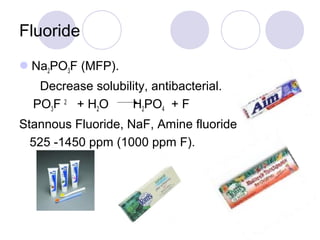
Fluoride
Na2PO3F (MFP).
Decrease solubility, antibacterial.
PO3F 2
+ H2O H2PO4 + F
Stannous Fluoride, NaF, Amine fluoride
525 -1450 ppm (1000 ppm F).
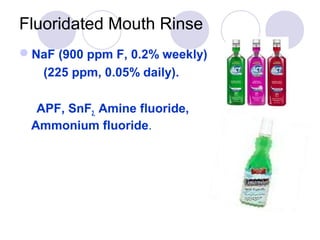
Fluoridated Mouth Rinse
NaF (900 ppm F, 0.2% weekly)
(225 ppm, 0.05% daily).
APF, SnF2, Amine fluoride,
Ammonium fluoride.
Professionally Applied Fluoride
Sodium fluoride NaF
Bibby 1942, Knutson tech
Stannous Fluoride SnF2
Muhler et al 1950, 8%, 10 %, pH=2.1.
Ca10(PO4)6(OH)2 + 19 SnF2
10 CaF2 + 6Sn3F3PO4 + SnO.H2O
tinfluorophospate hydrated tinoxide
Stannous Fluoride
Not stable, metallic taste, staining.
Prevention, Remineralization,
desensitizing, antibacterial.
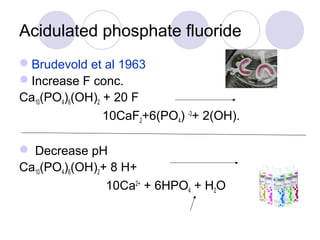
Acidulated phosphate fluoride
Brudevold et al 1963
Increase F conc.
Ca10(PO4)6(OH)2 + 20 F
10CaF2+6(PO4) -3
+ 2(OH).
 Decrease pH
Ca10(PO4)6(OH)2+ 8 H+
10Ca2+
+ 6HPO4 + H2O
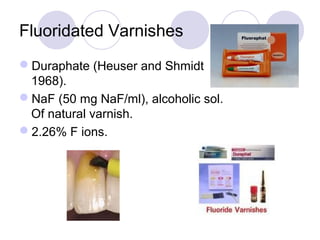
Fluoridated Varnishes
Duraphate (Heuser and Shmidt
1968).
NaF (50 mg NaF/ml), alcoholic sol.
Of natural varnish.
2.26% F ions.
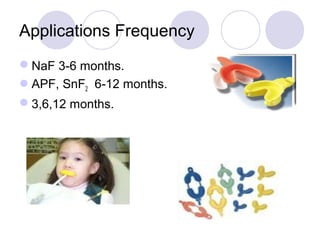
Applications Frequency
NaF 3-6 months.
APF, SnF2 6-12 months.
3,6,12 months.
Fluoridated Gel
APF 0.5% F
NaF 1%
 SnF2 0.4%
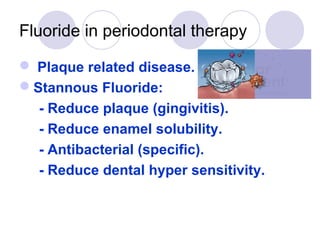
Fluoride in periodontal therapy
 Plaque related disease.
Stannous Fluoride:
- Reduce plaque (gingivitis).
- Reduce enamel solubility.
- Antibacterial (specific).
- Reduce dental hyper sensitivity.
Types of Patients
Type I : (periodontally healthy patient)
Treatments:
1- Decrease of dental sensitivity.
2- Reduce plaque volume and age.
3- Reduce deleterious effects of pathogen.
4- Increase retention of fluoride in dental
plaque.
Long term high conc. Of fluoride (dentifrices,
mouth rinses, gels)
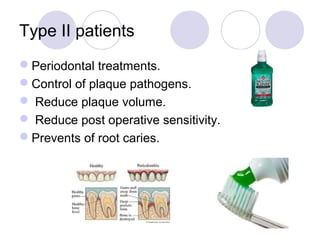
Type II patients
Periodontal treatments.
Control of plaque pathogens.
 Reduce plaque volume.
 Reduce post operative sensitivity.
Prevents of root caries.
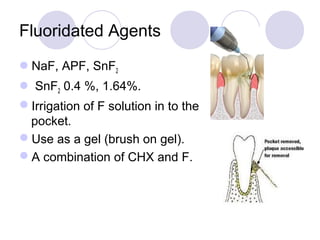
Fluoridated Agents
NaF, APF, SnF2
 SnF2 0.4 %, 1.64%.
Irrigation of F solution in to the
pocket.
Use as a gel (brush on gel).
A combination of CHX and F.

K_Lec. 4-5-prevention