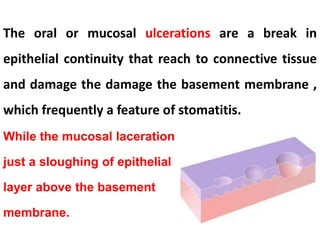
The oral or mucosal ulcerations are a break in
epithelial continuity that reach to connective tissue
and damage the damage the basement membrane ,
which frequently a feature of stomatitis.
While the mucosal laceration
just a sloughing of epithelial
layer above the basement
membrane.
Oral Ulcerations
1. Vesiculo-bullous diseases
A. Infective
B. Non-infective
2. Ulcerations without preceding vesiculation
A. Infective
B. Non-infective
Infective
• Primary herpetic stomatitis
• Herpes labialis
• Herpes zoster and chickenpox
• Hand-foot-and-mouth disease
Non-infective
• Pemphigus vulgaris
• Mucous membrane pemphigoid
• Linear IgA disease
• Dermatitis herpetiformis
• Bullous erythema multiforme
Infective
• Cytomegalovirus-associated ulceration
• Some acute specific fevers
• Tuberculosis
• Syphilis
Non-infective
• Traumatic
• Aphthous stomatitis
• Behçet’s disease
• HIV-associated mucosal ulcers
• Lichen planus
• Lupus erythematosus
• Chronic ulcerative stomatitis
• Eosinophilic ulceration
• Wegener’s granulomatosis
• Some mucosal drug reactions
• Carcinoma
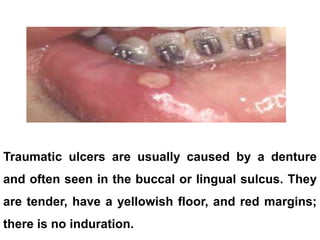
Traumatic ulcers are usually caused by a denture
and often seen in the buccal or lingual sulcus. They
are tender, have a yellowish floor, and red margins;
there is no induration.
The traumatic ulcers
(1) Physical trauma (sharp edge
and thermal trauma)
(2) Factitious ulceration (self
inflected ulcer)
(3) Chemical trauma
Recurrent aphthae constitute the most
common oral mucosal disease and affect 10-25
% of the population, but many cases are mild
and accepted with little complaint. The term is
from from Greek: αφθα aphtha meaning
"mouth ulcer".
RAS is a common condition, restricted
to the mouth, that typically starts in
childhood or teenager as recurrent small,
round, or ovoid ulcers with circumscribed
margins, erythematous haloes, and yellow
or gray floors.
A positive family history of similar
ulcers is common, and the natural
history is typically of resolution in
the third or fourth decade of life.
The etiology of recurrent aphthae is unclear. There
is no evidence that they are a form of auto-immune
disease in any accepted sense, and it is uncertain whether
many of the reported immunological abnormalities are
cause or effect.
However, in a minority of patients there is a clear
association with hematological deficiencies. The latter in
turn may be secondary to small-intestine disease or other
cause of malabsorption.
The old and recent theory that more accepted in the
practice and foundation of this disease are ……….
The RAS is an allergy of oral mucosa to specitic
allergen found in some
1…….food
2…….beverages
3…….chewing gum
4…….dentifrices (mainly hypersensitivity to sodium
lauryl sulphate found in many brands of toothpaste).
Pathogenesis of RAS
The hypersensitivity start with Ag-Ab complex under
the oral mucosa which provoke the inflammatory reaction
that destroy the lining mucosa and form the ulcer. So the
patient felt with prodromal symptoms of pruritic
sensation and do friction to this site of redness before
ulcer to appear.
Types of recurrent aphthae ulcers
(clinically)
1. Minor aphthae ulcers are most common type affects the non-
keratinised mucosa such as labial and buccal mucosa, floor of the
mouth, and lingual mucosa.
2. Major aphthae ulcer is uncommon type, frequently several
centimeter in diameter, and mimic a malignant ulcer, affected the
masticatory mucosa.
3. Herpetiform aphthae ulcers are uncommon type, affect the non-
keratinised mucosa.
Possible etiological factors for recurrent aphthae
1- Genetic Factors
2- Exaggerated response to trauma
3- Infections
4- Immunological abnormalities
5- Gastrointestinal diseases
6- Haematological deficiencies
7- Hormonal factors
8- Stress
9- HIV infection
10- Non-smoking
Diagnosis and treatment of RAU
K-oral.m-Oral ulcerations

K-oral.m-Oral ulcerations

  • 1.
    The oral ormucosal ulcerations are a break in epithelial continuity that reach to connective tissue and damage the damage the basement membrane , which frequently a feature of stomatitis. While the mucosal laceration just a sloughing of epithelial layer above the basement membrane.
  • 2.
    Oral Ulcerations 1. Vesiculo-bullousdiseases A. Infective B. Non-infective 2. Ulcerations without preceding vesiculation A. Infective B. Non-infective
  • 3.
    Infective • Primary herpeticstomatitis • Herpes labialis • Herpes zoster and chickenpox • Hand-foot-and-mouth disease
  • 4.
    Non-infective • Pemphigus vulgaris •Mucous membrane pemphigoid • Linear IgA disease • Dermatitis herpetiformis • Bullous erythema multiforme
  • 5.
    Infective • Cytomegalovirus-associated ulceration •Some acute specific fevers • Tuberculosis • Syphilis
  • 6.
    Non-infective • Traumatic • Aphthousstomatitis • Behçet’s disease • HIV-associated mucosal ulcers • Lichen planus • Lupus erythematosus • Chronic ulcerative stomatitis • Eosinophilic ulceration • Wegener’s granulomatosis • Some mucosal drug reactions • Carcinoma
  • 7.
    Traumatic ulcers areusually caused by a denture and often seen in the buccal or lingual sulcus. They are tender, have a yellowish floor, and red margins; there is no induration.
  • 8.
    The traumatic ulcers (1)Physical trauma (sharp edge and thermal trauma) (2) Factitious ulceration (self inflected ulcer) (3) Chemical trauma
  • 11.
    Recurrent aphthae constitutethe most common oral mucosal disease and affect 10-25 % of the population, but many cases are mild and accepted with little complaint. The term is from from Greek: αφθα aphtha meaning "mouth ulcer".
  • 12.
    RAS is acommon condition, restricted to the mouth, that typically starts in childhood or teenager as recurrent small, round, or ovoid ulcers with circumscribed margins, erythematous haloes, and yellow or gray floors.
  • 13.
    A positive familyhistory of similar ulcers is common, and the natural history is typically of resolution in the third or fourth decade of life.
  • 14.
    The etiology ofrecurrent aphthae is unclear. There is no evidence that they are a form of auto-immune disease in any accepted sense, and it is uncertain whether many of the reported immunological abnormalities are cause or effect. However, in a minority of patients there is a clear association with hematological deficiencies. The latter in turn may be secondary to small-intestine disease or other cause of malabsorption.
  • 15.
    The old andrecent theory that more accepted in the practice and foundation of this disease are ………. The RAS is an allergy of oral mucosa to specitic allergen found in some 1…….food 2…….beverages 3…….chewing gum 4…….dentifrices (mainly hypersensitivity to sodium lauryl sulphate found in many brands of toothpaste).
  • 16.
    Pathogenesis of RAS Thehypersensitivity start with Ag-Ab complex under the oral mucosa which provoke the inflammatory reaction that destroy the lining mucosa and form the ulcer. So the patient felt with prodromal symptoms of pruritic sensation and do friction to this site of redness before ulcer to appear.
  • 17.
    Types of recurrentaphthae ulcers (clinically) 1. Minor aphthae ulcers are most common type affects the non- keratinised mucosa such as labial and buccal mucosa, floor of the mouth, and lingual mucosa. 2. Major aphthae ulcer is uncommon type, frequently several centimeter in diameter, and mimic a malignant ulcer, affected the masticatory mucosa. 3. Herpetiform aphthae ulcers are uncommon type, affect the non- keratinised mucosa.
  • 22.
    Possible etiological factorsfor recurrent aphthae 1- Genetic Factors 2- Exaggerated response to trauma 3- Infections 4- Immunological abnormalities 5- Gastrointestinal diseases 6- Haematological deficiencies 7- Hormonal factors 8- Stress 9- HIV infection 10- Non-smoking
  • 23.