OROFACIAL NEURALGIES AND NEUROPATHIC PAIN
The International Association for the Study of Pain's
widely used definition states: "Pain is an unpleasant
sensory and emotional experience associated with actual
or potential tissue damage, or described in terms of such
damage."
Pain is the most common symptom
for which patients seek help.
Approximately 40% of the British
population only visit a dentist for
pain relief.
Orofacial Pain
1- Diseases of teeth and/or supporting tissues
2- Oral mucosal diseases.
3- Diseases of the jaw.
4- Pain in edentulous patient.
5- Postoperative pain.
6- Pain triggered by mastication.
7- Referred pain.
8- Neurological diseases.
9- Psychogenic (atypical) facial pain.
Diseases of teeth and/or supporting
tissues
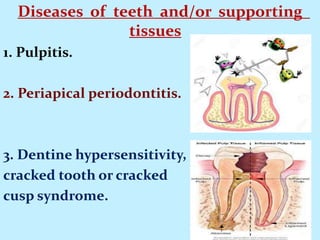
1. Pulpitis.
2. Periapical periodontitis.
3. Dentine hypersensitivity,
cracked tooth or cracked
cusp syndrome.
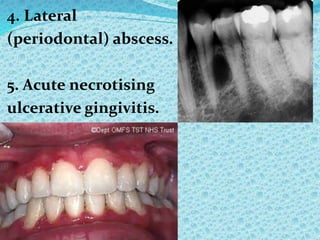
4. Lateral
(periodontal) abscess.
5. Acute necrotising
ulcerative gingivitis.
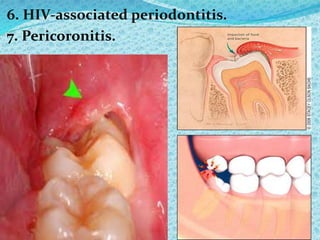
6. HIV-associated periodontitis.
7. Pericoronitis.
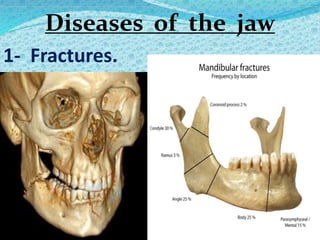
Diseases of the jaw
1- Fractures.
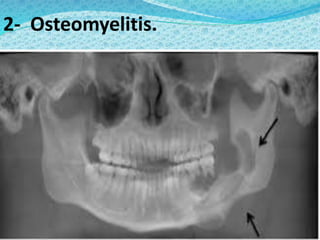
2- Osteomyelitis.
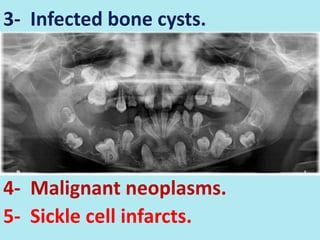
3- Infected bone cysts.
4- Malignant neoplasms.
5- Sickle cell infarcts.
Pain in the edentulous patient
1- Denture trauma (such as traumatic ulcers).
2- Excessive vertical dimension ( such as TMJ
dysfunction syndrome ).
3- Diseases of the denture-bearing mucosa
(such as denture induced candidiasis).
4- Diseases of the jaws (such as residual cyst).
5- Teeth or roots erupting under a denture.
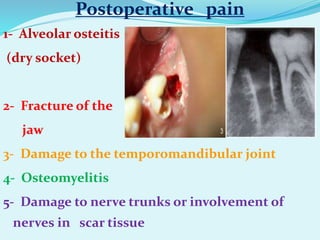
Postoperative pain
1- Alveolar osteitis
(dry socket)
2- Fracture of the
jaw
3- Damage to the temporomandibular joint
4- Osteomyelitis
5- Damage to nerve trunks or involvement of
nerves in scar tissue
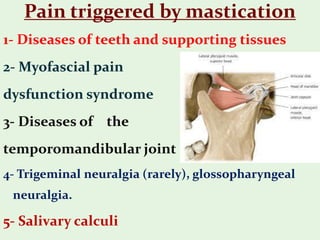
Pain triggered by mastication
1- Diseases of teeth and supporting tissues
2- Myofascial pain
dysfunction syndrome
3- Diseases of the
temporomandibular joint
4- Trigeminal neuralgia (rarely), glossopharyngeal
neuralgia.
5- Salivary calculi
7- Pain from extraoral diseases
(referred pain)
Antral disease can cause pain
felt in the upper teeth but a
radiograph and clinical diagnosis
should provide the diagnosis
Salivary gland and ear diseases
typically cause preauricular pain.
They may simulate temporomandibular joint
symptoms but are rarely mistaken for dental
problems.
8- Neurological diseases
1. Trigeminal neuralgia
2. Glossopharyngeal neuralgia
3. Multiple sclerosis
4. Herpes zoster
5. Postherpetic neuralgia
6. Migrainous neuralgia
7. Intracranial tumours
8. Bell's palsy
 Trigeminal neuralgia
The typical features are elderly patients are affected.
The pain is paroxysmal, i.e. severe, sharp and stabbing in
character, but lasts only seconds or minutes
The severity of the pain may also make the patient
depressed.
During an attack the patient's face is often distorted with
anguish, while between attacks the patient may appear
apprehensive at the thought of recurrence.
Stimuli to an area (trigger zone) within the distribution of
the trigeminal nerve can provoke an attack.
 Common stimuli are touching, draughts of cold air, or
teeth brushing. Occasionally, masticatory effort induces
the pain.
 Either the second or third division of the trigeminal
nerve is usually first affected, but pain soon involves
both. The first division is rarely affected and pain does
not spread to the opposite side.
 Diagnosis, should be readily made from the features
described, with the absence of objective sensory loss
and absence of any detectable organic cause.
Treatment
In the absence of disease, teeth should not be arbitrarily
extracted, as this only adds to the patient's misfortunes.
The most effective drugs are anticonvulsants,
particularly carbamazepine and to a lesser extent
phenytoin. Carbamazepine, with or without phenytoin,
will usually relieve the pain, at least for a time.
Abolition of the pain of T. N. by giving anticonvulsant,
such as carbamazepine, also helps to confirm the
diagnosis.
Carbamazepine ( l00mg/day gradually raised if
necessary to 800mg/day ), must be given long-
term (essentially prophylactically) to reduce the
frequency and severity of attacks.
A few patients are unresponsive to
carbamazepine or cannot tolerate the side-
effects.
If drug treatment fails, the final resort is
surgery. The simplest option is cryotherapy to
the trigeminal nerve or, if this fails, cryotherapy
at the base of the skull.
If these fail, microvascular decompression of the
trigeminal ganglion may be required.
 Glossopharyngeal neuralgia
 This rare condition is characterised by pain similar to
that of T. N. but felt in the base of the tongue and faces
on one side.
 It may also radiate deeply into the ear. The pain is sharp,
lancinating and transient.
 The pain is typically triggered by swallowing, chewing,
or coughing.
 It may be so severe that patients may be frightened to
swallow their saliva and try to keep the mouth and
tongue as completely immobile as possible.
 Glossopharyngeal neuralgia sometimes responds to
carbamazepine, but less often than T. N. .
Once an organic cause has been excluded, surgical
treatment may be needed. However, like trigeminal
neuralgia, there can be spontaneous remissions,
sometimes for years.
Paraesthesia and Dysaesthesia of the lip
Paraesthesia of the lip can be caused by
osteomyelitis or fracture of the jaw. Very
occasionally it results from neurological disease.
Prolonged anaesthesia or paraesthesia of the lip
can occasionally follow inferior dental blocks,
possibly as a result of damage to the nerve by the
needle.
A jaw tumour causing pain or paraesthesia
strongly suggests malignancy.
Herpes zoster affecting the trigeminal nerve
can leave residual disturbances of
sensation.
Disturbances of sensation of the face and
other regions can be caused by multiple
sclerosis.
Tetany is the result of hypocalcaemic states
and causes heightened neuromuscular
excitability together with minor disorders
of sensation such as paraesthesia of the lip.
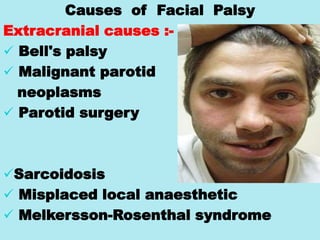
Causes of Facial Palsy
Extracranial causes :-
 Bell's palsy
 Malignant parotid
neoplasms
 Parotid surgery
Sarcoidosis
 Misplaced local anaesthetic
 Melkersson-Rosenthal syndrome
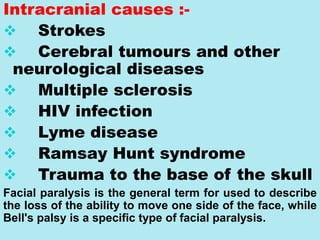
Intracranial causes :-
 Strokes
 Cerebral tumours and other
neurological diseases
 Multiple sclerosis
 HIV infection
 Lyme disease
 Ramsay Hunt syndrome
 Trauma to the base of the skull
Facial paralysis is the general term for used to describe
the loss of the ability to move one side of the face, while
Bell's palsy is a specific type of facial paralysis.
Bell's palsy is a common cause of
facial paralysis. It probably results from
compression of the facial nerve in its
canal as a result of inflammation and
swelling. A viral infection, particularly
herpes simplex, is suspected as the
cause.
pain in the jaw sometimes precedes
the paralysis or there may be numbness
in the side of the tongue.
Function of the facial nerve is tested by
asking the patient to perform facial movements.
When asked to close the eyes, the lids on the
affected side cannot be brought together but
the eyeball rolls up normally, since the
oculomotor nerves are unaffected.
When the patient is asked to smile, the
corner of the mouth on the affected side is not
pulled upwards and the normal lines of
expression are absent.
The wrinkling round the eyes
which accompanies smiling is also not
seen on the affected side and the eye
remains staring.
This is a lower motor neurone
lesion unlike the upper motor neurone
lesion seen, for example, after a
stroke.
The majority of patients recover fully or
partially without treatment. At least 10% of
patients with Bell's palsy are unhappy about
the final outcome because of permanent
disfigurement or other complications.
Full recovery is usual in patients with
an incomplete palsy seen within a week of
onset, but more than half of those with a
complete lesion fail to recover completely.
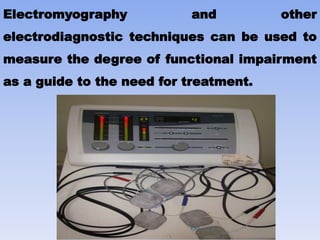
Electromyography and other
electrodiagnostic techniques can be used to
measure the degree of functional impairment
as a guide to the need for treatment.
Prednisolone, by mouth ( 20 mg
four times a day ) may be given for 5-10
days and then tapered off over the
following 4 days, and may be effective
if given within 24 hours of the onset.
The addition of acyclovir appears to
produce more reliable results and also
suggests a role for a herpes virus.

K-oral,m-Show of-orofacial-pain

  • 1.
    OROFACIAL NEURALGIES ANDNEUROPATHIC PAIN The International Association for the Study of Pain's widely used definition states: "Pain is an unpleasant sensory and emotional experience associated with actual or potential tissue damage, or described in terms of such damage." Pain is the most common symptom for which patients seek help. Approximately 40% of the British population only visit a dentist for pain relief.
  • 2.
    Orofacial Pain 1- Diseasesof teeth and/or supporting tissues 2- Oral mucosal diseases. 3- Diseases of the jaw. 4- Pain in edentulous patient. 5- Postoperative pain. 6- Pain triggered by mastication. 7- Referred pain. 8- Neurological diseases. 9- Psychogenic (atypical) facial pain.
  • 3.
    Diseases of teethand/or supporting tissues 1. Pulpitis. 2. Periapical periodontitis. 3. Dentine hypersensitivity, cracked tooth or cracked cusp syndrome.
  • 4.
    4. Lateral (periodontal) abscess. 5.Acute necrotising ulcerative gingivitis.
  • 5.
  • 6.
    Diseases of thejaw 1- Fractures.
  • 7.
  • 8.
    3- Infected bonecysts. 4- Malignant neoplasms. 5- Sickle cell infarcts.
  • 9.
    Pain in theedentulous patient 1- Denture trauma (such as traumatic ulcers). 2- Excessive vertical dimension ( such as TMJ dysfunction syndrome ). 3- Diseases of the denture-bearing mucosa (such as denture induced candidiasis). 4- Diseases of the jaws (such as residual cyst). 5- Teeth or roots erupting under a denture.
  • 10.
    Postoperative pain 1- Alveolarosteitis (dry socket) 2- Fracture of the jaw 3- Damage to the temporomandibular joint 4- Osteomyelitis 5- Damage to nerve trunks or involvement of nerves in scar tissue
  • 11.
    Pain triggered bymastication 1- Diseases of teeth and supporting tissues 2- Myofascial pain dysfunction syndrome 3- Diseases of the temporomandibular joint 4- Trigeminal neuralgia (rarely), glossopharyngeal neuralgia. 5- Salivary calculi
  • 12.
    7- Pain fromextraoral diseases (referred pain) Antral disease can cause pain felt in the upper teeth but a radiograph and clinical diagnosis should provide the diagnosis Salivary gland and ear diseases typically cause preauricular pain. They may simulate temporomandibular joint symptoms but are rarely mistaken for dental problems.
  • 13.
    8- Neurological diseases 1.Trigeminal neuralgia 2. Glossopharyngeal neuralgia 3. Multiple sclerosis 4. Herpes zoster 5. Postherpetic neuralgia 6. Migrainous neuralgia 7. Intracranial tumours 8. Bell's palsy
  • 14.
     Trigeminal neuralgia Thetypical features are elderly patients are affected. The pain is paroxysmal, i.e. severe, sharp and stabbing in character, but lasts only seconds or minutes The severity of the pain may also make the patient depressed. During an attack the patient's face is often distorted with anguish, while between attacks the patient may appear apprehensive at the thought of recurrence. Stimuli to an area (trigger zone) within the distribution of the trigeminal nerve can provoke an attack.
  • 15.
     Common stimuliare touching, draughts of cold air, or teeth brushing. Occasionally, masticatory effort induces the pain.  Either the second or third division of the trigeminal nerve is usually first affected, but pain soon involves both. The first division is rarely affected and pain does not spread to the opposite side.  Diagnosis, should be readily made from the features described, with the absence of objective sensory loss and absence of any detectable organic cause.
  • 16.
    Treatment In the absenceof disease, teeth should not be arbitrarily extracted, as this only adds to the patient's misfortunes. The most effective drugs are anticonvulsants, particularly carbamazepine and to a lesser extent phenytoin. Carbamazepine, with or without phenytoin, will usually relieve the pain, at least for a time. Abolition of the pain of T. N. by giving anticonvulsant, such as carbamazepine, also helps to confirm the diagnosis.
  • 17.
    Carbamazepine ( l00mg/daygradually raised if necessary to 800mg/day ), must be given long- term (essentially prophylactically) to reduce the frequency and severity of attacks. A few patients are unresponsive to carbamazepine or cannot tolerate the side- effects. If drug treatment fails, the final resort is surgery. The simplest option is cryotherapy to the trigeminal nerve or, if this fails, cryotherapy at the base of the skull. If these fail, microvascular decompression of the trigeminal ganglion may be required.
  • 18.
     Glossopharyngeal neuralgia This rare condition is characterised by pain similar to that of T. N. but felt in the base of the tongue and faces on one side.  It may also radiate deeply into the ear. The pain is sharp, lancinating and transient.  The pain is typically triggered by swallowing, chewing, or coughing.  It may be so severe that patients may be frightened to swallow their saliva and try to keep the mouth and tongue as completely immobile as possible.  Glossopharyngeal neuralgia sometimes responds to carbamazepine, but less often than T. N. .
  • 19.
    Once an organiccause has been excluded, surgical treatment may be needed. However, like trigeminal neuralgia, there can be spontaneous remissions, sometimes for years. Paraesthesia and Dysaesthesia of the lip Paraesthesia of the lip can be caused by osteomyelitis or fracture of the jaw. Very occasionally it results from neurological disease. Prolonged anaesthesia or paraesthesia of the lip can occasionally follow inferior dental blocks, possibly as a result of damage to the nerve by the needle.
  • 20.
    A jaw tumourcausing pain or paraesthesia strongly suggests malignancy. Herpes zoster affecting the trigeminal nerve can leave residual disturbances of sensation. Disturbances of sensation of the face and other regions can be caused by multiple sclerosis. Tetany is the result of hypocalcaemic states and causes heightened neuromuscular excitability together with minor disorders of sensation such as paraesthesia of the lip.
  • 21.
    Causes of FacialPalsy Extracranial causes :-  Bell's palsy  Malignant parotid neoplasms  Parotid surgery Sarcoidosis  Misplaced local anaesthetic  Melkersson-Rosenthal syndrome
  • 22.
    Intracranial causes :- Strokes  Cerebral tumours and other neurological diseases  Multiple sclerosis  HIV infection  Lyme disease  Ramsay Hunt syndrome  Trauma to the base of the skull Facial paralysis is the general term for used to describe the loss of the ability to move one side of the face, while Bell's palsy is a specific type of facial paralysis.
  • 23.
    Bell's palsy isa common cause of facial paralysis. It probably results from compression of the facial nerve in its canal as a result of inflammation and swelling. A viral infection, particularly herpes simplex, is suspected as the cause. pain in the jaw sometimes precedes the paralysis or there may be numbness in the side of the tongue.
  • 24.
    Function of thefacial nerve is tested by asking the patient to perform facial movements. When asked to close the eyes, the lids on the affected side cannot be brought together but the eyeball rolls up normally, since the oculomotor nerves are unaffected. When the patient is asked to smile, the corner of the mouth on the affected side is not pulled upwards and the normal lines of expression are absent.
  • 25.
    The wrinkling roundthe eyes which accompanies smiling is also not seen on the affected side and the eye remains staring. This is a lower motor neurone lesion unlike the upper motor neurone lesion seen, for example, after a stroke.
  • 26.
    The majority ofpatients recover fully or partially without treatment. At least 10% of patients with Bell's palsy are unhappy about the final outcome because of permanent disfigurement or other complications. Full recovery is usual in patients with an incomplete palsy seen within a week of onset, but more than half of those with a complete lesion fail to recover completely.
  • 27.
    Electromyography and other electrodiagnostictechniques can be used to measure the degree of functional impairment as a guide to the need for treatment.
  • 28.
    Prednisolone, by mouth( 20 mg four times a day ) may be given for 5-10 days and then tapered off over the following 4 days, and may be effective if given within 24 hours of the onset. The addition of acyclovir appears to produce more reliable results and also suggests a role for a herpes virus.