DEPARTMENT OF PREVENTIVE &
PEDIATRIC DENTISTRY
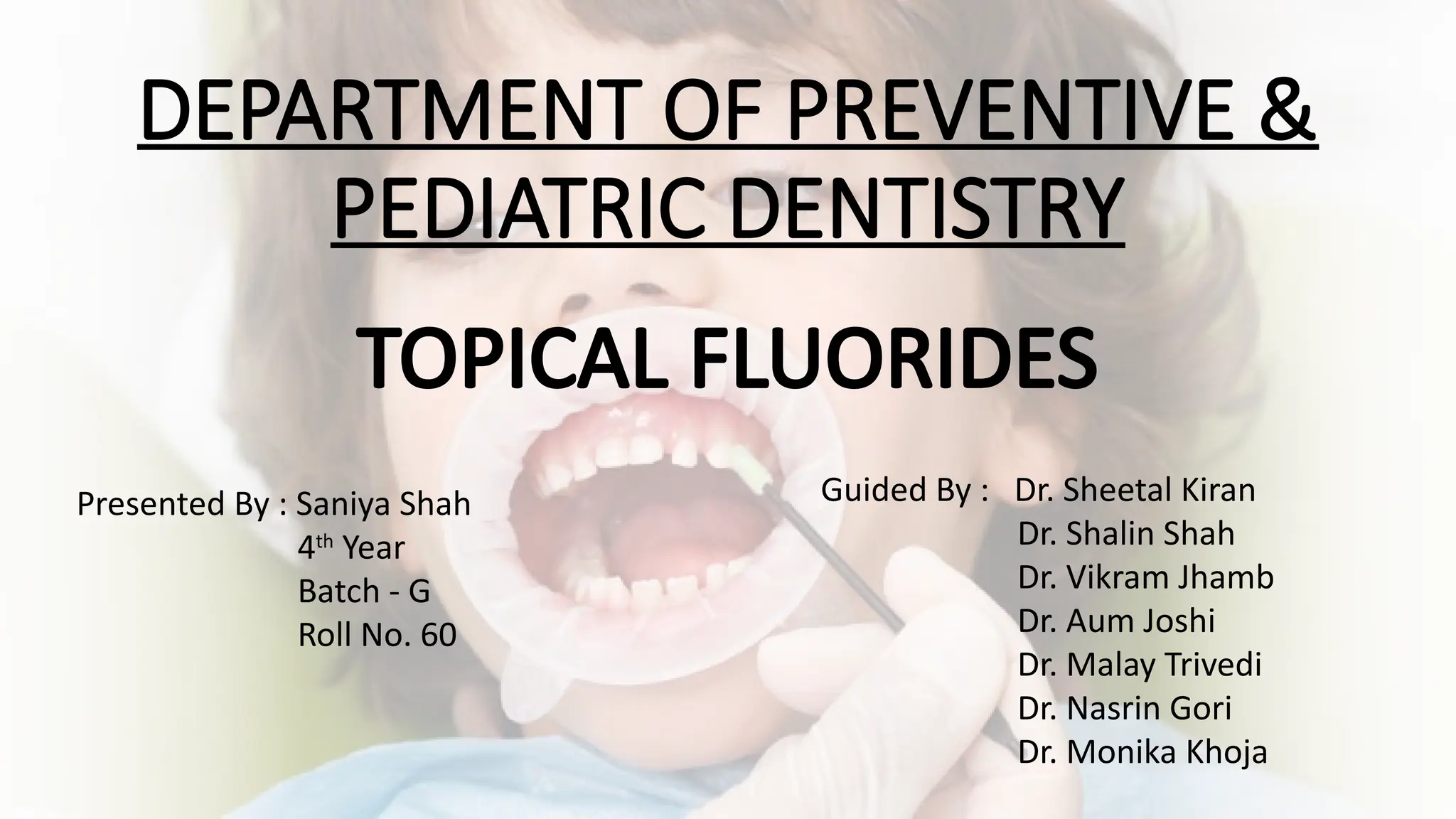
TOPICAL FLUORIDES
Guided By : Dr. Sheetal Kiran
Dr. Shalin Shah
Dr. Vikram Jhamb
Dr. Aum Joshi
Dr. Malay Trivedi
Dr. Nasrin Gori
Dr. Monika Khoja
Presented By : Saniya Shah
4th
Year
Batch - G
Roll No. 60
CONTENTS
• Introduction
• History of fluorides
• Fluoride delivery method
• Topical fluoride
Professionally applied
Self applied
• Conclusion
INTRODUCTION
• Fluorine is a member of the halogen family and is the most
electronegative and reactive of all the elements.
• Its atomic weight is 19 and atomic number is 9.
• In nature it occur in the form of fluorspar, fluorappatite and cryolite.
• The word fluorine is derived from the latin term ‘fluor’ meaning to flow.
• It occurs in natural water resources and the influence the mineralization of
teeth.
• Its selective action on the hard tissues of the body attributes significantaly
to prevention and control of dental caries.
History of fluorides
• 1901 Dr Fredrick McKay of Colorado, USA observed apparently permanent stain on
the teeth of many of his patients: commonly known as “Colorado stains” by the local
inhabitants. McKay at this stage failed to relate this stain with any factor and named
it as “mottled enamel”
• 1908 Dr McKay presented a case at the annual meeting of State Dental Association
in Boulder and found that the condition was not confined to Colorado but extended
to other towns as well
• 1912 Dr McKay came across an article written by Dr JM Eager (1902), a US Marine
Hospital surgeon who reported that a high proportion of Italian residents in Naples
had brown stains on their teeth known as “denti di Chiaie”
• 1916 McKay and Black conducted a survey over 6,873 individuals in 26
communities in USA reporting that an unknown factor possibly present in
domestic water during the period of tooth calcification may be the cause of
mottled enamel
• 1918 McKay observed that individuals reared up in Britton since 1898 had
mottling, whereas all those who had passed through childhood before had
normal teeth. Thus, it was concluded by McKay that some mysterious element
in water supply was the causative agent for mottled enamel
• 1934 Dean conducted the famous “Shoe Leather Survey” and established that
concentration of fluoride in drinking water was directly correlated to the
severity of fluorosed enamel. Dean also developed a standard classification of
mottling and an index to quantify it mottling index
• 1942 Dean finally concluded that at 1-ppm of fluoride in drinking water
near maximal reduction of caries experience, i.e. 60% was achieved and
only “sporadic instances” of the mildest form of dental fluorosis of no
practical or esthetic significance were observed
• 1945 First community level water fluoridation program started in Grand
Rapids, USA
• 1950s Water fluoridation started in the United States in the states of
Florida, Illinois, California (1952), Ohio (1955), and Missouri (1957)
• 1964 The WHO and the Pan American Health Organization endorsed the
practice of water fluoridation
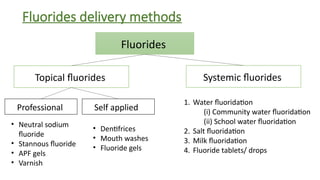
Fluorides delivery methods
Fluorides
Topical fluorides Systemic fluorides
Professional Self applied
• Neutral sodium
fluoride
• Stannous fluoride
• APF gels
• Varnish
• Dentifrices
• Mouth washes
• Fluoride gels
1. Water fluoridation
(i) Community water fluoridation
(ii) School water fluoridation
2. Salt fluoridation
3. Milk fluoridation
4. Fluoride tablets/ drops
Topical fluorides
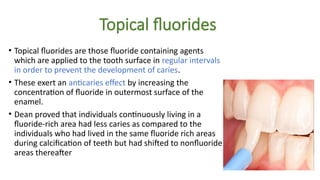
• Topical fluorides are those fluoride containing agents
which are applied to the tooth surface in regular intervals
in order to prevent the development of caries.
• These exert an anticaries effect by increasing the
concentration of fluoride in outermost surface of the
enamel.
• Dean proved that individuals continuously living in a
fluoride-rich area had less caries as compared to the
individuals who had lived in the same fluoride rich areas
during calcification of teeth but had shifted to nonfluoride
areas thereafter
• In 1941, began the era of topical fluorides when the first clinical study
of NaF was carried out by Bibby using a 0.1% NaF solution.
• Subsequently, over the years, various other topical fluoride agents have
been evolved which in sequential order are
SnF2 (1947)
APF (1963)
Na MPP (1963)
Amine fluoride (1965)
Varnish-containing fluoride (1968)
Indications
• Caries active individuals
• Children shortly after period of tooth eruption
• Those who take medication that decreases salivary flow or have received
radiation to head and neck
• After periodontal surgery when roots of teeth have been exposed
• Patients with fixed or removable prosthesis and after placement or
replacement of restorations
• Patients with an eating disorder or who are undergoing a change in lifestyle
which may affect eating or oral hygiene habits conductive to good oral
health
• Mentally and physically challenged individuals
Professionally applied fluoride
• Topically fluoride application by a dentist, dental hygienist or any
dental auxillary has become an established Caries-preventive
procedure in the dental history.
• The fluoride may be used in an aqueous solution, a viscous gel, a
prophylactic paste or as a dental varnish and can be applied using
the paint on technique or the tray technique.
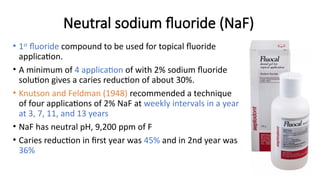
Neutral sodium fluoride (NaF)
• 1st
fluoride compound to be used for topical fluoride
application.
• A minimum of 4 application of with 2% sodium fluoride
solution gives a caries reduction of about 30%.
• Knutson and Feldman (1948) recommended a technique
of four applications of 2% NaF at weekly intervals in a year
at 3, 7, 11, and 13 years
• NaF has neutral pH, 9,200 ppm of F
• Caries reduction in first year was 45% and in 2nd year was
36%
Methods of preparation of 2% NaF :
• About 20% NaF solution can be prepared by dissolving 20 g of NaF
powder in 1 L of distilled water in a plastic bottle
• It is essential to store fluoride in plastic bottles because if stored in glass
containers, the fluoride ion of solution can react with silica of glass
forming SiF2 , thus reducing the availability of free active fluoride for
anticaries action.
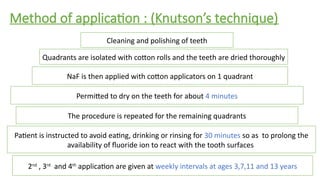
Method of application : (Knutson’s technique)
Cleaning and polishing of teeth
Quadrants are isolated with cotton rolls and the teeth are dried thoroughly
NaF is then applied with cotton applicators on 1 quadrant
Permitted to dry on the teeth for about 4 minutes
Patient is instructed to avoid eating, drinking or rinsing for 30 minutes so as to prolong the
availability of fluoride ion to react with the tooth surfaces
2nd
, 3rd
and 4th
application are given at weekly intervals at ages 3,7,11 and 13 years
The procedure is repeated for the remaining quadrants
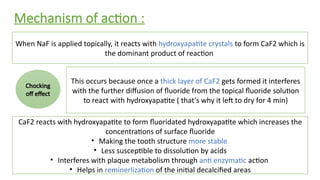
Mechanism of action :
When NaF is applied topically, it reacts with hydroxyapatite crystals to form CaF2 which is
the dominant product of reaction
This occurs because once a thick layer of CaF2 gets formed it interferes
with the further diffusion of fluoride from the topical fluoride solution
to react with hydroxyapatite ( that’s why it left to dry for 4 min)
CaF2 reacts with hydroxyapatite to form fluoridated hydroxyapatite which increases the
concentrations of surface fluoride
• Making the tooth structure more stable
• Less susceptible to dissolution by acids
• Interferes with plaque metabolism through anti enzymatic action
• Helps in reminerlization of the initial decalcified areas
Chocking
off effect
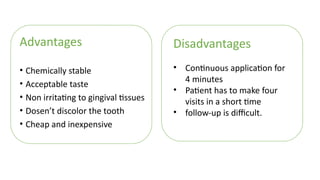
Advantages
• Chemically stable
• Acceptable taste
• Non irritating to gingival tissues
• Dosen’t discolor the tooth
• Cheap and inexpensive
Disadvantages
• Continuous application for
4 minutes
• Patient has to make four
visits in a short time
• follow-up is difficult.
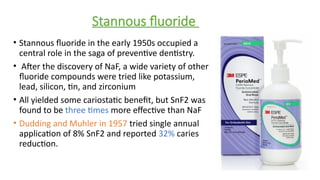
Stannous fluoride
• Stannous fluoride in the early 1950s occupied a
central role in the saga of preventive dentistry.
• After the discovery of NaF, a wide variety of other
fluoride compounds were tried like potassium,
lead, silicon, tin, and zirconium
• All yielded some cariostatic benefit, but SnF2 was
found to be three times more effective than NaF
• Dudding and Muhler in 1957 tried single annual
application of 8% SnF2 and reported 32% caries
reduction.
Method of Preparation
• Stannous fluoride solution has to be freshly prepared before use each
time (stannous form of tin gets oxidized to stannic form, thus making the
SnF2 inactive for anticaries action), as it has no shelf life
• For convenient preparation number “o”, gelatin capsules are priorly filled
with 0.8 g powdered SnF2 and are stored in airtight plastic containers.
Just before application, the content of one capsule is dissolved in 10 mL
of distilled water in a plastic container, and the solution thus prepared is
shaken briefly. The solution is then applied immediately
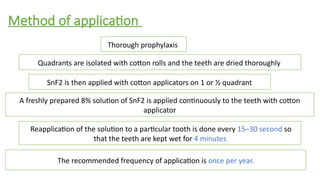
Method of application
Thorough prophylaxis
Quadrants are isolated with cotton rolls and the teeth are dried thoroughly
SnF2 is then applied with cotton applicators on 1 or ½ quadrant
A freshly prepared 8% solution of SnF2 is applied continuously to the teeth with cotton
applicator
The recommended frequency of application is once per year.
Reapplication of the solution to a particular tooth is done every 15–30 second so
that the teeth are kept wet for 4 minutes
Mechanism of action :
SnF2 reacts with hydroxyapatite in addition with fluoride and
forms a new crystalline products – stannous trifluorophosphate
Rapid penetration of tin and fluoride in 30 secs therefore
reapplication after 15-30 secs are needed
In addition to stannous trifluorophosphate 3 more additional
products are formed, viz. stannous hydroxyphosphate , calcium
fluoride and calcium trifluorostannate
Disadvantages
• Should be prepared freshly
• Low pH
• Metallic taste due to stannous hydroxyl phosphate
• Causes gingival irritation
• Produces discoloration of teeth
• Causes staining on margins of restorations
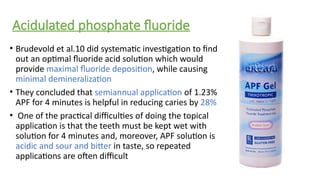
Acidulated phosphate fluoride
• Brudevold et al.10 did systematic investigation to find
out an optimal fluoride acid solution which would
provide maximal fluoride deposition, while causing
minimal demineralization
• They concluded that semiannual application of 1.23%
APF for 4 minutes is helpful in reducing caries by 28%
• One of the practical difficulties of doing the topical
application is that the teeth must be kept wet with
solution for 4 minutes and, moreover, APF solution is
acidic and sour and bitter in taste, so repeated
applications are often difficult
Method of preparation
• It is prepared by dissolving 20 g of NaF in 1 L of 0.1 M phosphoric
acid. To this, 50% hydrofluoride acid is added to adjust the pH at 3.0
and F concentrations at 1.23%
• For the preparation of APF gel, a gelling agent like Methylcellulose or
Hydroxyethyl cellulose is to be added to the solution and the pH is to
be adjusted between 4 and 5.
Method of application
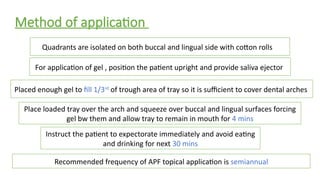
Quadrants are isolated on both buccal and lingual side with cotton rolls
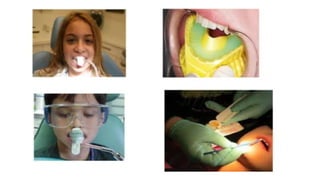
For application of gel , position the patient upright and provide saliva ejector
Placed enough gel to fill 1/3rd
of trough area of tray so it is sufficient to cover dental arches
Instruct the patient to expectorate immediately and avoid eating
and drinking for next 30 mins
Recommended frequency of APF topical application is semiannual
Place loaded tray over the arch and squeeze over buccal and lingual surfaces forcing
gel bw them and allow tray to remain in mouth for 4 mins
Mechanism of action :
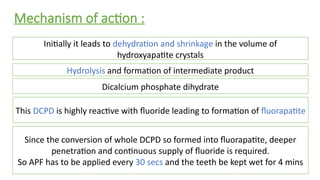
Initially it leads to dehydration and shrinkage in the volume of
hydroxyapatite crystals
Hydrolysis and formation of intermediate product
This DCPD is highly reactive with fluoride leading to formation of fluorapatite
Dicalcium phosphate dihydrate
Since the conversion of whole DCPD so formed into fluorapatite, deeper
penetration and continuous supply of fluoride is required.
So APF has to be applied every 30 secs and the teeth be kept wet for 4 mins
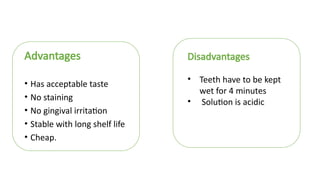
Advantages
• Has acceptable taste
• No staining
• No gingival irritation
• Stable with long shelf life
• Cheap.
Disadvantages
• Teeth have to be kept
wet for 4 minutes
• Solution is acidic
NEWER TOPICAL FLUORIDES
Amine Fluoride
• In 1945, Muhlemann of the University of Zurich first studied effects of
AMF
• Amine fluoride is superior to inorganic fluorides in reducing enamel
solubility because of chemical protection by fluoride and
physicochemical protection by organic portion
• They are also surface active because they hold fluoride on enamel
surface for longer time.
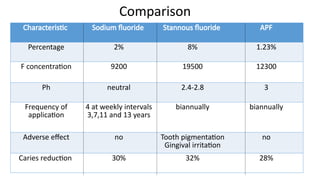
Characteristic Sodium fluoride Stannous fluoride APF
Percentage 2% 8% 1.23%
F concentration 9200 19500 12300
Ph neutral 2.4-2.8 3
Frequency of
application
4 at weekly intervals
3,7,11 and 13 years
biannually biannually
Adverse effect no Tooth pigmentation
Gingival irritation
no
Caries reduction 30% 32% 28%
Comparison
Fluoride varnish
• The cariostatic effect of topical fluoride agents has generally been related
to their ability to deposit fluoride in the enamel and also their depth of
penetration
• To enhance the caries inhibitory property of topical fluorides,
experiments were carried out by developing methods for prolonging the
contact of fluoride solutions with tooth enamel leading not only to
deeper penetration but also a more permanently bound form of fluoride
• To achieve prolonged fluoride action in mouth, Schmidt in 1964
developed a new coating method in which the teeth were coated with a
lacquer containing fluoride called F-lacquer, which released fluoride ions
to the dental enamel in high concentrations for several hours in the moist
atmosphere of the mouth.
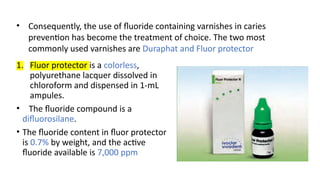
1. Fluor protector is a colorless,
polyurethane lacquer dissolved in
chloroform and dispensed in 1-mL
ampules.
• The fluoride compound is a
difluorosilane.
• The fluoride content in fluor protector
is 0.7% by weight, and the active
fluoride available is 7,000 ppm
• Consequently, the use of fluoride containing varnishes in caries
prevention has become the treatment of choice. The two most
commonly used varnishes are Duraphat and Fluor protector
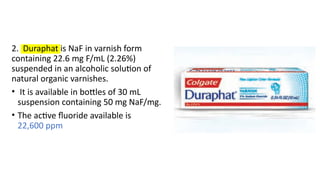
2. Duraphat is NaF in varnish form
containing 22.6 mg F/mL (2.26%)
suspended in an alcoholic solution of
natural organic varnishes.
• It is available in bottles of 30 mL
suspension containing 50 mg NaF/mg.
• The active fluoride available is
22,600 ppm
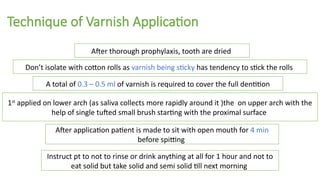
Technique of Varnish Application
After thorough prophylaxis, tooth are dried
Don’t isolate with cotton rolls as varnish being sticky has tendency to stick the rolls
A total of 0.3 – 0.5 ml of varnish is required to cover the full dentition
1st
applied on lower arch (as saliva collects more rapidly around it )the on upper arch with the
help of single tufted small brush starting with the proximal surface
After application patient is made to sit with open mouth for 4 min
before spitting
Instruct pt to not to rinse or drink anything at all for 1 hour and not to
eat solid but take solid and semi solid till next morning
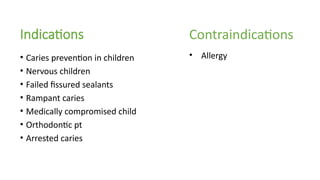
Indications
• Caries prevention in children
• Nervous children
• Failed fissured sealants
• Rampant caries
• Medically compromised child
• Orthodontic pt
• Arrested caries
Contraindications
• Allergy
Advantages
• Sets rapidly after application and adheres to tooth
• Saliva promotes setting of varnish
• Gagging or swallowing can be avoided as no use of tray and
application time is short
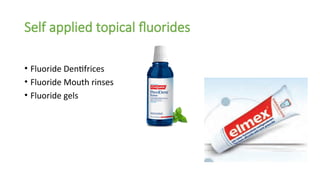
Self applied topical fluorides
• Fluoride Dentifrices
• Fluoride Mouth rinses
• Fluoride gels
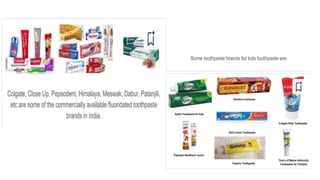
Fluoridated Dentifrices
• Fluoride dentifrices have been proven to be effective anticaries agents
since 1955.
• The most commonly evaluated fluoride dentifrices are NaF and
stannous fluoride and more recently the sodium MFP and amine
fluoride, are also being used
• For young children till 4 yrs of age - non fluoridated and non abrasive
toothpaste
• After 6 yrs – fluoridated toothpaste
• Amount – pea sized
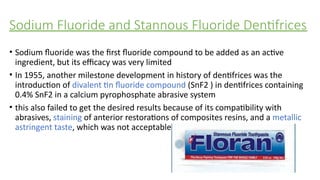
Sodium Fluoride and Stannous Fluoride Dentifrices
• Sodium fluoride was the first fluoride compound to be added as an active
ingredient, but its efficacy was very limited
• In 1955, another milestone development in history of dentifrices was the
introduction of divalent tin fluoride compound (SnF2 ) in dentifrices containing
0.4% SnF2 in a calcium pyrophosphate abrasive system
• this also failed to get the desired results because of its compatibility with
abrasives, staining of anterior restorations of composites resins, and a metallic
astringent taste, which was not acceptable
Amine Fluoride Dentifrices
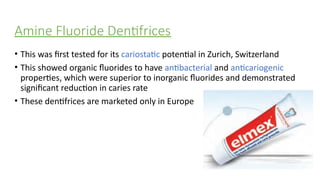
• This was first tested for its cariostatic potential in Zurich, Switzerland
• This showed organic fluorides to have antibacterial and anticariogenic
properties, which were superior to inorganic fluorides and demonstrated
significant reduction in caries rate
• These dentifrices are marketed only in Europe
Advantages
• neutral pH
• greater stability to oxidation and hydrolysis
• longer shelf life
• increased availability of fluoride
• no staining of teeth
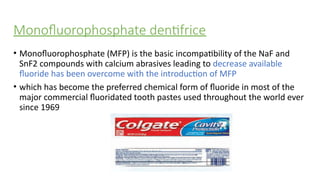
Monofluorophosphate dentifrice
• Monofluorophosphate (MFP) is the basic incompatibility of the NaF and
SnF2 compounds with calcium abrasives leading to decrease available
fluoride has been overcome with the introduction of MFP
• which has become the preferred chemical form of fluoride in most of the
major commercial fluoridated tooth pastes used throughout the world ever
since 1969
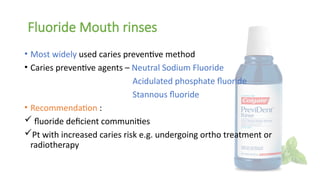
Fluoride Mouth rinses
• Most widely used caries preventive method
• Caries preventive agents – Neutral Sodium Fluoride
Acidulated phosphate fluoride
Stannous fluoride
• Recommendation :
 fluoride deficient communities
Pt with increased caries risk e.g. undergoing ortho treatment or
radiotherapy
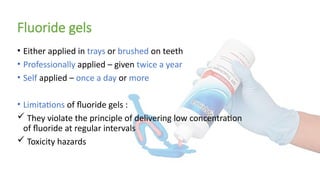
Fluoride gels
• Either applied in trays or brushed on teeth
• Professionally applied – given twice a year
• Self applied – once a day or more
• Limitations of fluoride gels :
 They violate the principle of delivering low concentration
of fluoride at regular intervals
 Toxicity hazards
Conclusion
• Fluoridation is universally accepted by the dentists and other medical
professionals as being useful in preventing tooth decay
• They can be used in areas where there are no central water supplies,
where the fluoride concentration of well water is low.
Thank you !!

Topical fluoride used in Pediatric dentistry

  • 1.
    DEPARTMENT OF PREVENTIVE& PEDIATRIC DENTISTRY TOPICAL FLUORIDES Guided By : Dr. Sheetal Kiran Dr. Shalin Shah Dr. Vikram Jhamb Dr. Aum Joshi Dr. Malay Trivedi Dr. Nasrin Gori Dr. Monika Khoja Presented By : Saniya Shah 4th Year Batch - G Roll No. 60
  • 2.
    CONTENTS • Introduction • Historyof fluorides • Fluoride delivery method • Topical fluoride Professionally applied Self applied • Conclusion
  • 3.
    INTRODUCTION • Fluorine isa member of the halogen family and is the most electronegative and reactive of all the elements. • Its atomic weight is 19 and atomic number is 9. • In nature it occur in the form of fluorspar, fluorappatite and cryolite. • The word fluorine is derived from the latin term ‘fluor’ meaning to flow. • It occurs in natural water resources and the influence the mineralization of teeth. • Its selective action on the hard tissues of the body attributes significantaly to prevention and control of dental caries.
  • 4.
    History of fluorides •1901 Dr Fredrick McKay of Colorado, USA observed apparently permanent stain on the teeth of many of his patients: commonly known as “Colorado stains” by the local inhabitants. McKay at this stage failed to relate this stain with any factor and named it as “mottled enamel” • 1908 Dr McKay presented a case at the annual meeting of State Dental Association in Boulder and found that the condition was not confined to Colorado but extended to other towns as well • 1912 Dr McKay came across an article written by Dr JM Eager (1902), a US Marine Hospital surgeon who reported that a high proportion of Italian residents in Naples had brown stains on their teeth known as “denti di Chiaie”
  • 5.
    • 1916 McKayand Black conducted a survey over 6,873 individuals in 26 communities in USA reporting that an unknown factor possibly present in domestic water during the period of tooth calcification may be the cause of mottled enamel • 1918 McKay observed that individuals reared up in Britton since 1898 had mottling, whereas all those who had passed through childhood before had normal teeth. Thus, it was concluded by McKay that some mysterious element in water supply was the causative agent for mottled enamel • 1934 Dean conducted the famous “Shoe Leather Survey” and established that concentration of fluoride in drinking water was directly correlated to the severity of fluorosed enamel. Dean also developed a standard classification of mottling and an index to quantify it mottling index
  • 6.
    • 1942 Deanfinally concluded that at 1-ppm of fluoride in drinking water near maximal reduction of caries experience, i.e. 60% was achieved and only “sporadic instances” of the mildest form of dental fluorosis of no practical or esthetic significance were observed • 1945 First community level water fluoridation program started in Grand Rapids, USA • 1950s Water fluoridation started in the United States in the states of Florida, Illinois, California (1952), Ohio (1955), and Missouri (1957) • 1964 The WHO and the Pan American Health Organization endorsed the practice of water fluoridation
  • 7.
    Fluorides delivery methods Fluorides Topicalfluorides Systemic fluorides Professional Self applied • Neutral sodium fluoride • Stannous fluoride • APF gels • Varnish • Dentifrices • Mouth washes • Fluoride gels 1. Water fluoridation (i) Community water fluoridation (ii) School water fluoridation 2. Salt fluoridation 3. Milk fluoridation 4. Fluoride tablets/ drops
  • 8.
    Topical fluorides • Topicalfluorides are those fluoride containing agents which are applied to the tooth surface in regular intervals in order to prevent the development of caries. • These exert an anticaries effect by increasing the concentration of fluoride in outermost surface of the enamel. • Dean proved that individuals continuously living in a fluoride-rich area had less caries as compared to the individuals who had lived in the same fluoride rich areas during calcification of teeth but had shifted to nonfluoride areas thereafter
  • 9.
    • In 1941,began the era of topical fluorides when the first clinical study of NaF was carried out by Bibby using a 0.1% NaF solution. • Subsequently, over the years, various other topical fluoride agents have been evolved which in sequential order are SnF2 (1947) APF (1963) Na MPP (1963) Amine fluoride (1965) Varnish-containing fluoride (1968)
  • 10.
    Indications • Caries activeindividuals • Children shortly after period of tooth eruption • Those who take medication that decreases salivary flow or have received radiation to head and neck • After periodontal surgery when roots of teeth have been exposed • Patients with fixed or removable prosthesis and after placement or replacement of restorations • Patients with an eating disorder or who are undergoing a change in lifestyle which may affect eating or oral hygiene habits conductive to good oral health • Mentally and physically challenged individuals
  • 11.
    Professionally applied fluoride •Topically fluoride application by a dentist, dental hygienist or any dental auxillary has become an established Caries-preventive procedure in the dental history. • The fluoride may be used in an aqueous solution, a viscous gel, a prophylactic paste or as a dental varnish and can be applied using the paint on technique or the tray technique.
  • 12.
    Neutral sodium fluoride(NaF) • 1st fluoride compound to be used for topical fluoride application. • A minimum of 4 application of with 2% sodium fluoride solution gives a caries reduction of about 30%. • Knutson and Feldman (1948) recommended a technique of four applications of 2% NaF at weekly intervals in a year at 3, 7, 11, and 13 years • NaF has neutral pH, 9,200 ppm of F • Caries reduction in first year was 45% and in 2nd year was 36%
  • 14.
    Methods of preparationof 2% NaF : • About 20% NaF solution can be prepared by dissolving 20 g of NaF powder in 1 L of distilled water in a plastic bottle • It is essential to store fluoride in plastic bottles because if stored in glass containers, the fluoride ion of solution can react with silica of glass forming SiF2 , thus reducing the availability of free active fluoride for anticaries action.
  • 15.
    Method of application: (Knutson’s technique) Cleaning and polishing of teeth Quadrants are isolated with cotton rolls and the teeth are dried thoroughly NaF is then applied with cotton applicators on 1 quadrant Permitted to dry on the teeth for about 4 minutes Patient is instructed to avoid eating, drinking or rinsing for 30 minutes so as to prolong the availability of fluoride ion to react with the tooth surfaces 2nd , 3rd and 4th application are given at weekly intervals at ages 3,7,11 and 13 years The procedure is repeated for the remaining quadrants
  • 16.
    Mechanism of action: When NaF is applied topically, it reacts with hydroxyapatite crystals to form CaF2 which is the dominant product of reaction This occurs because once a thick layer of CaF2 gets formed it interferes with the further diffusion of fluoride from the topical fluoride solution to react with hydroxyapatite ( that’s why it left to dry for 4 min) CaF2 reacts with hydroxyapatite to form fluoridated hydroxyapatite which increases the concentrations of surface fluoride • Making the tooth structure more stable • Less susceptible to dissolution by acids • Interferes with plaque metabolism through anti enzymatic action • Helps in reminerlization of the initial decalcified areas Chocking off effect
  • 17.
    Advantages • Chemically stable •Acceptable taste • Non irritating to gingival tissues • Dosen’t discolor the tooth • Cheap and inexpensive Disadvantages • Continuous application for 4 minutes • Patient has to make four visits in a short time • follow-up is difficult.
  • 18.
    Stannous fluoride • Stannousfluoride in the early 1950s occupied a central role in the saga of preventive dentistry. • After the discovery of NaF, a wide variety of other fluoride compounds were tried like potassium, lead, silicon, tin, and zirconium • All yielded some cariostatic benefit, but SnF2 was found to be three times more effective than NaF • Dudding and Muhler in 1957 tried single annual application of 8% SnF2 and reported 32% caries reduction.
  • 19.
    Method of Preparation •Stannous fluoride solution has to be freshly prepared before use each time (stannous form of tin gets oxidized to stannic form, thus making the SnF2 inactive for anticaries action), as it has no shelf life • For convenient preparation number “o”, gelatin capsules are priorly filled with 0.8 g powdered SnF2 and are stored in airtight plastic containers. Just before application, the content of one capsule is dissolved in 10 mL of distilled water in a plastic container, and the solution thus prepared is shaken briefly. The solution is then applied immediately
  • 20.
    Method of application Thoroughprophylaxis Quadrants are isolated with cotton rolls and the teeth are dried thoroughly SnF2 is then applied with cotton applicators on 1 or ½ quadrant A freshly prepared 8% solution of SnF2 is applied continuously to the teeth with cotton applicator The recommended frequency of application is once per year. Reapplication of the solution to a particular tooth is done every 15–30 second so that the teeth are kept wet for 4 minutes
  • 21.
    Mechanism of action: SnF2 reacts with hydroxyapatite in addition with fluoride and forms a new crystalline products – stannous trifluorophosphate Rapid penetration of tin and fluoride in 30 secs therefore reapplication after 15-30 secs are needed In addition to stannous trifluorophosphate 3 more additional products are formed, viz. stannous hydroxyphosphate , calcium fluoride and calcium trifluorostannate
  • 22.
    Disadvantages • Should beprepared freshly • Low pH • Metallic taste due to stannous hydroxyl phosphate • Causes gingival irritation • Produces discoloration of teeth • Causes staining on margins of restorations
  • 23.
    Acidulated phosphate fluoride •Brudevold et al.10 did systematic investigation to find out an optimal fluoride acid solution which would provide maximal fluoride deposition, while causing minimal demineralization • They concluded that semiannual application of 1.23% APF for 4 minutes is helpful in reducing caries by 28% • One of the practical difficulties of doing the topical application is that the teeth must be kept wet with solution for 4 minutes and, moreover, APF solution is acidic and sour and bitter in taste, so repeated applications are often difficult
  • 24.
    Method of preparation •It is prepared by dissolving 20 g of NaF in 1 L of 0.1 M phosphoric acid. To this, 50% hydrofluoride acid is added to adjust the pH at 3.0 and F concentrations at 1.23% • For the preparation of APF gel, a gelling agent like Methylcellulose or Hydroxyethyl cellulose is to be added to the solution and the pH is to be adjusted between 4 and 5.
  • 25.
    Method of application Quadrantsare isolated on both buccal and lingual side with cotton rolls For application of gel , position the patient upright and provide saliva ejector Placed enough gel to fill 1/3rd of trough area of tray so it is sufficient to cover dental arches Instruct the patient to expectorate immediately and avoid eating and drinking for next 30 mins Recommended frequency of APF topical application is semiannual Place loaded tray over the arch and squeeze over buccal and lingual surfaces forcing gel bw them and allow tray to remain in mouth for 4 mins
  • 27.
    Mechanism of action: Initially it leads to dehydration and shrinkage in the volume of hydroxyapatite crystals Hydrolysis and formation of intermediate product This DCPD is highly reactive with fluoride leading to formation of fluorapatite Dicalcium phosphate dihydrate Since the conversion of whole DCPD so formed into fluorapatite, deeper penetration and continuous supply of fluoride is required. So APF has to be applied every 30 secs and the teeth be kept wet for 4 mins
  • 28.
    Advantages • Has acceptabletaste • No staining • No gingival irritation • Stable with long shelf life • Cheap. Disadvantages • Teeth have to be kept wet for 4 minutes • Solution is acidic
  • 29.
    NEWER TOPICAL FLUORIDES AmineFluoride • In 1945, Muhlemann of the University of Zurich first studied effects of AMF • Amine fluoride is superior to inorganic fluorides in reducing enamel solubility because of chemical protection by fluoride and physicochemical protection by organic portion • They are also surface active because they hold fluoride on enamel surface for longer time.
  • 30.
    Characteristic Sodium fluorideStannous fluoride APF Percentage 2% 8% 1.23% F concentration 9200 19500 12300 Ph neutral 2.4-2.8 3 Frequency of application 4 at weekly intervals 3,7,11 and 13 years biannually biannually Adverse effect no Tooth pigmentation Gingival irritation no Caries reduction 30% 32% 28% Comparison
  • 31.
    Fluoride varnish • Thecariostatic effect of topical fluoride agents has generally been related to their ability to deposit fluoride in the enamel and also their depth of penetration • To enhance the caries inhibitory property of topical fluorides, experiments were carried out by developing methods for prolonging the contact of fluoride solutions with tooth enamel leading not only to deeper penetration but also a more permanently bound form of fluoride • To achieve prolonged fluoride action in mouth, Schmidt in 1964 developed a new coating method in which the teeth were coated with a lacquer containing fluoride called F-lacquer, which released fluoride ions to the dental enamel in high concentrations for several hours in the moist atmosphere of the mouth.
  • 32.
    1. Fluor protectoris a colorless, polyurethane lacquer dissolved in chloroform and dispensed in 1-mL ampules. • The fluoride compound is a difluorosilane. • The fluoride content in fluor protector is 0.7% by weight, and the active fluoride available is 7,000 ppm • Consequently, the use of fluoride containing varnishes in caries prevention has become the treatment of choice. The two most commonly used varnishes are Duraphat and Fluor protector
  • 33.
    2. Duraphat isNaF in varnish form containing 22.6 mg F/mL (2.26%) suspended in an alcoholic solution of natural organic varnishes. • It is available in bottles of 30 mL suspension containing 50 mg NaF/mg. • The active fluoride available is 22,600 ppm
  • 34.
    Technique of VarnishApplication After thorough prophylaxis, tooth are dried Don’t isolate with cotton rolls as varnish being sticky has tendency to stick the rolls A total of 0.3 – 0.5 ml of varnish is required to cover the full dentition 1st applied on lower arch (as saliva collects more rapidly around it )the on upper arch with the help of single tufted small brush starting with the proximal surface After application patient is made to sit with open mouth for 4 min before spitting Instruct pt to not to rinse or drink anything at all for 1 hour and not to eat solid but take solid and semi solid till next morning
  • 35.
    Indications • Caries preventionin children • Nervous children • Failed fissured sealants • Rampant caries • Medically compromised child • Orthodontic pt • Arrested caries Contraindications • Allergy
  • 36.
    Advantages • Sets rapidlyafter application and adheres to tooth • Saliva promotes setting of varnish • Gagging or swallowing can be avoided as no use of tray and application time is short
  • 37.
    Self applied topicalfluorides • Fluoride Dentifrices • Fluoride Mouth rinses • Fluoride gels
  • 38.
    Fluoridated Dentifrices • Fluoridedentifrices have been proven to be effective anticaries agents since 1955. • The most commonly evaluated fluoride dentifrices are NaF and stannous fluoride and more recently the sodium MFP and amine fluoride, are also being used • For young children till 4 yrs of age - non fluoridated and non abrasive toothpaste • After 6 yrs – fluoridated toothpaste • Amount – pea sized
  • 39.
    Sodium Fluoride andStannous Fluoride Dentifrices • Sodium fluoride was the first fluoride compound to be added as an active ingredient, but its efficacy was very limited • In 1955, another milestone development in history of dentifrices was the introduction of divalent tin fluoride compound (SnF2 ) in dentifrices containing 0.4% SnF2 in a calcium pyrophosphate abrasive system • this also failed to get the desired results because of its compatibility with abrasives, staining of anterior restorations of composites resins, and a metallic astringent taste, which was not acceptable
  • 40.
    Amine Fluoride Dentifrices •This was first tested for its cariostatic potential in Zurich, Switzerland • This showed organic fluorides to have antibacterial and anticariogenic properties, which were superior to inorganic fluorides and demonstrated significant reduction in caries rate • These dentifrices are marketed only in Europe
  • 41.
    Advantages • neutral pH •greater stability to oxidation and hydrolysis • longer shelf life • increased availability of fluoride • no staining of teeth
  • 42.
    Monofluorophosphate dentifrice • Monofluorophosphate(MFP) is the basic incompatibility of the NaF and SnF2 compounds with calcium abrasives leading to decrease available fluoride has been overcome with the introduction of MFP • which has become the preferred chemical form of fluoride in most of the major commercial fluoridated tooth pastes used throughout the world ever since 1969
  • 44.
    Fluoride Mouth rinses •Most widely used caries preventive method • Caries preventive agents – Neutral Sodium Fluoride Acidulated phosphate fluoride Stannous fluoride • Recommendation :  fluoride deficient communities Pt with increased caries risk e.g. undergoing ortho treatment or radiotherapy
  • 45.
    Fluoride gels • Eitherapplied in trays or brushed on teeth • Professionally applied – given twice a year • Self applied – once a day or more • Limitations of fluoride gels :  They violate the principle of delivering low concentration of fluoride at regular intervals  Toxicity hazards
  • 46.
    Conclusion • Fluoridation isuniversally accepted by the dentists and other medical professionals as being useful in preventing tooth decay • They can be used in areas where there are no central water supplies, where the fluoride concentration of well water is low.
  • 47.