COLLEGE OF ENGINEERING AND TECHNOLOGY , AKOLA
Sant Gadge Baba Amravati University, Amravati
[2015-2016]
DEPARTMENT OF MECHANICAL ENGINEERING
Presented By…
Nivrati A. Malve
Guided By..
Prof. Y. P. Tidke
Contents
 Introduction
 History of KERS
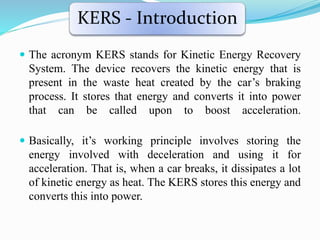
 KERS working schematics
 Elements of KERS
 Types KERS
 Graphs
 Advantages
 Disadvantages
 Applications
 Conclusion
 References
KERS - Introduction
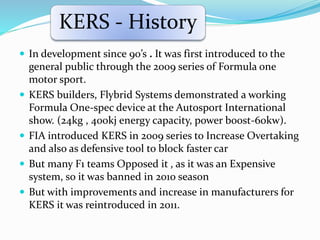
 The acronym KERS stands for Kinetic Energy Recovery
System. The device recovers the kinetic energy that is
present in the waste heat created by the car’s braking
process. It stores that energy and converts it into power
that can be called upon to boost acceleration.
 Basically, it’s working principle involves storing the
energy involved with deceleration and using it for
acceleration. That is, when a car breaks, it dissipates a lot
of kinetic energy as heat. The KERS stores this energy and
converts this into power.
KERS - History
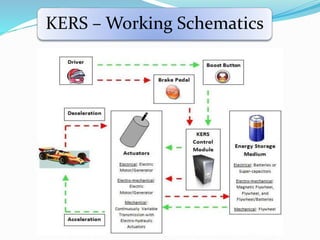
 In development since 90’s . It was first introduced to the
general public through the 2009 series of Formula one
motor sport.
 KERS builders, Flybrid Systems demonstrated a working
Formula One-spec device at the Autosport International
show. (24kg , 400kj energy capacity, power boost-60kw).
 FIA introduced KERS in 2009 series to Increase Overtaking
and also as defensive tool to block faster car
 But many F1 teams Opposed it , as it was an Expensive
system, so it was banned in 2010 season
 But with improvements and increase in manufacturers for
KERS it was reintroduced in 2011.
KERS – Working Schematics
Basic Elements of KERS
In essence a KERS systems is simple, you need a
component for generating the power, one for storing it
and another to control it all. Thus KERS systems have
three main components:
1. The MGU (Motor/Generator Unit)
2. The PCU (Power Control Unit)
3. The batteries/flywheel. (Power Storage Unit)
Basic Elements of KERS
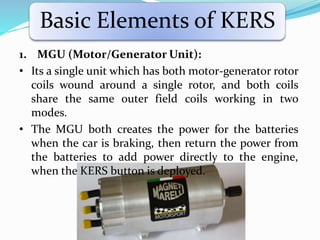
1. MGU (Motor/Generator Unit):
• Its a single unit which has both motor-generator rotor
coils wound around a single rotor, and both coils
share the same outer field coils working in two
modes.
• The MGU both creates the power for the batteries
when the car is braking, then return the power from
the batteries to add power directly to the engine,
when the KERS button is deployed.
Basic Elements of KERS
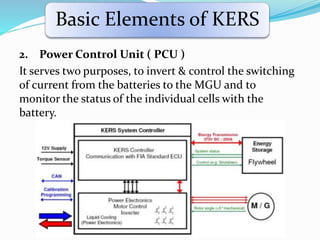
2. Power Control Unit ( PCU )
It serves two purposes, to invert & control the switching
of current from the batteries to the MGU and to
monitor the status of the individual cells with the
battery.
Basic Elements of KERS
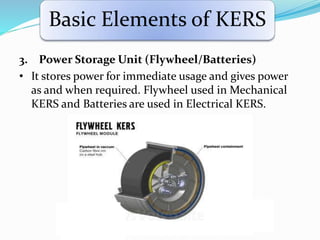
3. Power Storage Unit (Flywheel/Batteries)
• It stores power for immediate usage and gives power
as and when required. Flywheel used in Mechanical
KERS and Batteries are used in Electrical KERS.
Types of KERS
The KERS can be divided in the way they convert the
energy and how that energy is stored within the vehicle.
Depending on this, KERS has three types:
1. Mechanical Kinetic Energy Recovery System
2. Electrical Kinetic Energy Recovery System
3. Hydraulic kinetic energy recovery system
Mechanical KERS
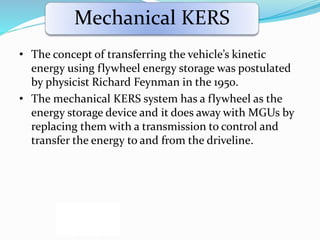
• The concept of transferring the vehicle’s kinetic
energy using flywheel energy storage was postulated
by physicist Richard Feynman in the 1950.
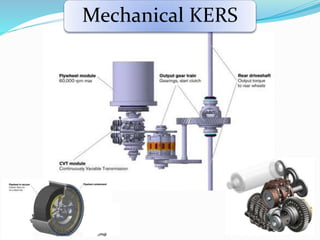
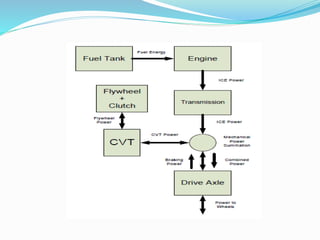
• The mechanical KERS system has a flywheel as the
energy storage device and it does away with MGUs by
replacing them with a transmission to control and
transfer the energy to and from the driveline.
Mechanical KERS
Electrical KERS
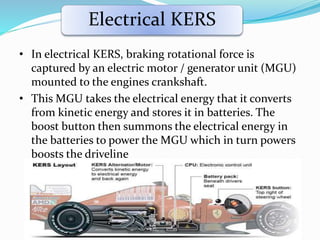
• In electrical KERS, braking rotational force is
captured by an electric motor / generator unit (MGU)
mounted to the engines crankshaft.
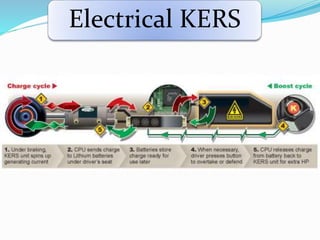
• This MGU takes the electrical energy that it converts
from kinetic energy and stores it in batteries. The
boost button then summons the electrical energy in
the batteries to power the MGU which in turn powers
boosts the driveline
Electrical KERS
Advantages of Mechanical KERS Over
Electrical KERS
• In electrical KERS , energy has to be converted twice ,
where as in Mechanical no need of conversion. Hence
electrical energy conversion efficiency is 31- 34 %
where as in mechanical KERS its 70%
• Lithium-ion batteries take 1-2 hours to charge
completely due to low specific power hence not good
for F1 , so they use Super Capacitor.
• Chemical batteries heat up during charging process
and could cause the batteries to lose energy over the
cycle or worse even explode.
• Energy lose in Electrical KERS is more , Whereas not
so much in Mechanical KERS
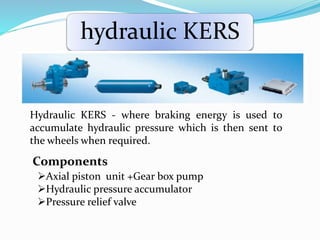
hydraulic KERS
Axial piston unit +Gear box pump
Hydraulic pressure accumulator
Pressure relief valve
Hydraulic KERS - where braking energy is used to
accumulate hydraulic pressure which is then sent to
the wheels when required.
Components
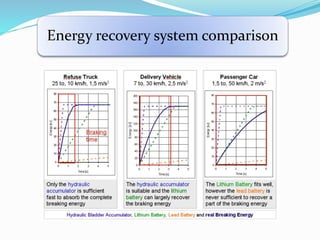
Energy recovery system comparison
KERS in Road Cars
• Transport Buses in Sverdon, Switzerland (1950)
• Honda Civic Hybrid(2002)
• Ford Escape Hybrid(2005)
• Jaguar XF sedan
• Porsche 918 RSR variant concept car (2011)
• Hybrid car: mahindra e-20,Maruti ciaz.
• Flywheel kers in BICYCLE
Advantages of KERS
• Reduced CO2 Emissions/Pollutants
• Enhanced Performance
• Environmentally Sound
• High power capability
• Light weight and small size with Long system life
• Completely Safe and a Truly Green Solution
• High efficiency Storage and Recovery
Limitations of KERS
• Only one KERS for car which has only one braking
system.
• 60 kw is the maximum input and output power of the
KERS system.
• The energy recovery system is functional only when
the car is moving.
• The recovery system must be controlled by the same
electronic control unit.
• If in case the KERS is connected between the
differential and the wheel the torque applied to each
wheel must be same.
• It is very costly. Engineers are trying hard to make it
more cost effective.
Conclusion
• It’s a technology for the present and the future
because it’s environment-friendly, reduces emissions,
increases efficiency and is highly customizable and
modifiable. Adoption of a KERS may permit
regenerative braking and engine downsizing as a
means of improving efficiency and hence reducing
fuel consumption and CO2 emissions.
• The KERS have major areas of development in power
density, life, simplicity, effectiveness and first and
foremost the costs of the device. Applications are
being considered for small, mass-production
passenger cars, as well as luxury cars and Trucks.
References
• International journal of scientific and engineering research
Volume 5, Issue 1, January- 2014 ISSN 2229-5518
• Automotive Engineering International Online, “Volvo
Spins Up Flywheel Technology Research,”
http://www.sae.org/mags/aei/9924, June 19, 2011
• WikiPedia/Kers
• Barr, A., Veshagh, A. Fuel Economy and Performance
Comparison of Alternative Mechanical Hybrid Powertrain
Configurations. SAE 2008 International. Number 2008-01-
0083.
• http://www.oxbridgewriters.com/essays/engineerin/kers.ph
p
Queries….
Thank you……
Have a nice day……

Kinetic energy recovery system ppt

  • 1.
    COLLEGE OF ENGINEERINGAND TECHNOLOGY , AKOLA Sant Gadge Baba Amravati University, Amravati [2015-2016] DEPARTMENT OF MECHANICAL ENGINEERING Presented By… Nivrati A. Malve Guided By.. Prof. Y. P. Tidke
  • 2.
    Contents  Introduction  Historyof KERS  KERS working schematics  Elements of KERS  Types KERS  Graphs  Advantages  Disadvantages  Applications  Conclusion  References
  • 3.
    KERS - Introduction The acronym KERS stands for Kinetic Energy Recovery System. The device recovers the kinetic energy that is present in the waste heat created by the car’s braking process. It stores that energy and converts it into power that can be called upon to boost acceleration.  Basically, it’s working principle involves storing the energy involved with deceleration and using it for acceleration. That is, when a car breaks, it dissipates a lot of kinetic energy as heat. The KERS stores this energy and converts this into power.
  • 4.
    KERS - History In development since 90’s . It was first introduced to the general public through the 2009 series of Formula one motor sport.  KERS builders, Flybrid Systems demonstrated a working Formula One-spec device at the Autosport International show. (24kg , 400kj energy capacity, power boost-60kw).  FIA introduced KERS in 2009 series to Increase Overtaking and also as defensive tool to block faster car  But many F1 teams Opposed it , as it was an Expensive system, so it was banned in 2010 season  But with improvements and increase in manufacturers for KERS it was reintroduced in 2011.
  • 5.
    KERS – WorkingSchematics
  • 6.
    Basic Elements ofKERS In essence a KERS systems is simple, you need a component for generating the power, one for storing it and another to control it all. Thus KERS systems have three main components: 1. The MGU (Motor/Generator Unit) 2. The PCU (Power Control Unit) 3. The batteries/flywheel. (Power Storage Unit)
  • 7.
    Basic Elements ofKERS 1. MGU (Motor/Generator Unit): • Its a single unit which has both motor-generator rotor coils wound around a single rotor, and both coils share the same outer field coils working in two modes. • The MGU both creates the power for the batteries when the car is braking, then return the power from the batteries to add power directly to the engine, when the KERS button is deployed.
  • 8.
    Basic Elements ofKERS 2. Power Control Unit ( PCU ) It serves two purposes, to invert & control the switching of current from the batteries to the MGU and to monitor the status of the individual cells with the battery.
  • 9.
    Basic Elements ofKERS 3. Power Storage Unit (Flywheel/Batteries) • It stores power for immediate usage and gives power as and when required. Flywheel used in Mechanical KERS and Batteries are used in Electrical KERS.
  • 10.
    Types of KERS TheKERS can be divided in the way they convert the energy and how that energy is stored within the vehicle. Depending on this, KERS has three types: 1. Mechanical Kinetic Energy Recovery System 2. Electrical Kinetic Energy Recovery System 3. Hydraulic kinetic energy recovery system
  • 11.
    Mechanical KERS • Theconcept of transferring the vehicle’s kinetic energy using flywheel energy storage was postulated by physicist Richard Feynman in the 1950. • The mechanical KERS system has a flywheel as the energy storage device and it does away with MGUs by replacing them with a transmission to control and transfer the energy to and from the driveline.
  • 12.
  • 14.
    Electrical KERS • Inelectrical KERS, braking rotational force is captured by an electric motor / generator unit (MGU) mounted to the engines crankshaft. • This MGU takes the electrical energy that it converts from kinetic energy and stores it in batteries. The boost button then summons the electrical energy in the batteries to power the MGU which in turn powers boosts the driveline
  • 15.
  • 16.
    Advantages of MechanicalKERS Over Electrical KERS • In electrical KERS , energy has to be converted twice , where as in Mechanical no need of conversion. Hence electrical energy conversion efficiency is 31- 34 % where as in mechanical KERS its 70% • Lithium-ion batteries take 1-2 hours to charge completely due to low specific power hence not good for F1 , so they use Super Capacitor. • Chemical batteries heat up during charging process and could cause the batteries to lose energy over the cycle or worse even explode. • Energy lose in Electrical KERS is more , Whereas not so much in Mechanical KERS
  • 17.
    hydraulic KERS Axial pistonunit +Gear box pump Hydraulic pressure accumulator Pressure relief valve Hydraulic KERS - where braking energy is used to accumulate hydraulic pressure which is then sent to the wheels when required. Components
  • 18.
  • 19.
    KERS in RoadCars • Transport Buses in Sverdon, Switzerland (1950) • Honda Civic Hybrid(2002) • Ford Escape Hybrid(2005) • Jaguar XF sedan • Porsche 918 RSR variant concept car (2011) • Hybrid car: mahindra e-20,Maruti ciaz. • Flywheel kers in BICYCLE
  • 20.
    Advantages of KERS •Reduced CO2 Emissions/Pollutants • Enhanced Performance • Environmentally Sound • High power capability • Light weight and small size with Long system life • Completely Safe and a Truly Green Solution • High efficiency Storage and Recovery
  • 21.
    Limitations of KERS •Only one KERS for car which has only one braking system. • 60 kw is the maximum input and output power of the KERS system. • The energy recovery system is functional only when the car is moving. • The recovery system must be controlled by the same electronic control unit. • If in case the KERS is connected between the differential and the wheel the torque applied to each wheel must be same. • It is very costly. Engineers are trying hard to make it more cost effective.
  • 22.
    Conclusion • It’s atechnology for the present and the future because it’s environment-friendly, reduces emissions, increases efficiency and is highly customizable and modifiable. Adoption of a KERS may permit regenerative braking and engine downsizing as a means of improving efficiency and hence reducing fuel consumption and CO2 emissions. • The KERS have major areas of development in power density, life, simplicity, effectiveness and first and foremost the costs of the device. Applications are being considered for small, mass-production passenger cars, as well as luxury cars and Trucks.
  • 23.
    References • International journalof scientific and engineering research Volume 5, Issue 1, January- 2014 ISSN 2229-5518 • Automotive Engineering International Online, “Volvo Spins Up Flywheel Technology Research,” http://www.sae.org/mags/aei/9924, June 19, 2011 • WikiPedia/Kers • Barr, A., Veshagh, A. Fuel Economy and Performance Comparison of Alternative Mechanical Hybrid Powertrain Configurations. SAE 2008 International. Number 2008-01- 0083. • http://www.oxbridgewriters.com/essays/engineerin/kers.ph p
  • 24.
  • 25.
    Thank you…… Have anice day……