Hand Shake ManagementHand Shake Management
Umar Hayat Kanju
BB-09-88
Table of ContentsTable of Contents
Why do we shake hands?
What your handshake says about you?
Types of bad handshakes?
Different handshakes in different cultures
Perfect handshake in corporate sector
What to do before shaking hands?
Importance of handshake in an interview
Buddies handshake
Conclusion
Born of Handshake
We can never know for certain where
the handshake originated or why people
started doing it.
The most widely accepted theory is that
hand shaking originated in medieval
Europe where knights would extend their
hand to other knights in order to show
that they had no weapons hidden or
concealed behind their back.
People of all races, shapes, sizes and
status use the handshake as a way to
greet a person, make an agreement or
say goodbye.
For some people a handshake is just a
useless formality but to others it is a
massive indication of a person’s
depth of character,
trustworthiness
and strength.
When you shake hands with a person
you are doing much more than saying
“hello”. You are saying “this is who I
am“
If you are a business person your
handshake can be the maker or
breaker of a big contract or deal.
If you are a doctor or health care
provider your handshake can fill a
patient with confidence and trust.
It is extremely important for all
people, regardless of your race or
way of life, to learn how to shake
hands with meaning.
Types of Bad HandshakeTypes of Bad Handshake
Bad handshakes leave bad first
impressions.. Here are the "bad
handshakes" and tips about how to
correct them.
1.1. "I am dominant"
Placing your palm downward when offering
your hand to someone is a way of showing
dominance. By placing your palm
downward, you force the other person to
place his palm up, which is a submissive
position. In everyday situations it should be
avoided.
2.2. "Bone Crusher"
 Handshake grip should be no
harder than the strength that
you would use to hold a door
handle.
 In addition, you should match your grip
to the person you are
shaking hands with.
 Elderly people require a looser grip.
 If you are ever stuck in a bone-crushing
handshake, the best thing to do is make a
comment such as "wow, that's quite
the grip you've got there".
 In most cases the person will back off.
3.3. "Limp Fish"
A limp handshake signals to
the other person that you
are :
nervous
uncertain,
or uninvolved.
If you are unsure whether
your handshake is limp, ask
to practice with a few friends
until you get your grip right.
4.4. "Just Fingers"
Even worse than the limp handshake is the
one in which you only shake the other
person's fingers.
In order to avoid his situation, be sure that
the webbed part of your hands between
your forefinger and thumb are touching
before you grasp the other person's hand.
5.5. "The Double-Hander"
Although there are instances where a
double-handed handshake is appropriate, if
used with someone that you have just met
it can seem overly personal or intimate.
Unless you are a politician or a
grandmother, it is probably best to reserve
the double-handed handshake for close
friends.
6.6. "The Long Handshake"
Long after the introductions are over and if
the other person is still pumping your hand
up and down then this is wrong.
The ideal handshake lasts 2-3 seconds and
does not go on longer than the verbal
introduction.
Any longer, and it can seem like you are
just holding hands.
7.7. "Without Eye Contact"
Have you ever shaken hands with someone
who wouldn't look you in the eye? You
probably wondered what they had to hide.
This shows that a person is hesitant to
meet people.
So If your lack of eye contact is due to
social anxiety, practice looking at a spot
between the eyes, so that you at least give
the appearance of meeting the other
person's gaze.
8.8. "Too Close"
Similar to the dominant handshake and the
bone crusher, the "too close" handshake
involves the other person coming in very
close to you to shake hands, or pulling you
in close as you are shaking hands. In either
case, the closeness of the handshake is
likely to make you feel uncomfortable.
Simply take a step back. Unless the other
person has you in a vice grip, you should be
able to reclaim your personal space.
Different ways of
greeting in different
cultures
In Japan, people greet each
other by bowing. A bow
ranges from a small nod of
the head to a long, 90
degree bend at the waist.
It is also common to bow
to express thanks, to
apologize, to make a request
or to ask someone a favor.
Shaking hands is uncommon
among the Japanese, but again,
exceptions are made for
foreigners.
In Saudi Arabia people first
shake hands firmly and kiss on
the cheeks if required which
shows that people know each
other.
Hong Kong (older Chinese): clasp hands
together at throat level and nod
India: palms together as though praying and
bend or nod, called namaste
Korea: a slight bow and
handshake (right hand in one or
both hands)
Sri Lanka: place palms together
under chin and bow slightly
Thailand: place palms together,
elbows down, and bow head
slightly, called “Wai”
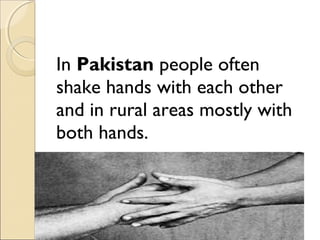
In Pakistan people often
shake hands with each other
and in rural areas mostly with
both hands.
Perfect handshake
in Corporate
sector
1. Start with eye contact and a smile. 
A great handshake isn't just about a
physical gesture, it is about connecting with
the other person. The best way to do that
is with your face and your eyes make sure
that you should have a smile on your face
and a good eye contact with the other
person.
2. Go for the thumb.
Keep your hand open and make sure your
handshake will be a hand shake, not a finger
or palm shake. This means getting the joint
of your thumb (the lower joint - the tissue
between your thumb to your forefinger)
nestled into the joint of their thumb. This
allows you to truly have a full handshake.
3. Firm, not strong.
A good handshake is firm but not
overpowering. doesn't feel like a dead fish.
Always make your grip firm, but make
adjustments based on the firmness of the
other person's grip.
4. Up and down, not back and forth. 
A good handshake has a nice up and down
motion, not a back and forth one. Again,
adjust the motion to what seems natural
and comfortable to the other person.
5. Adjust duration. 
Some people prefer a long handshake,
others prefer them much shorter. Observe
the other person and adjust the duration
to the situation, how well you know the
person, and what seems comfortable to
them. Generally 2-3 seconds is the right
time.
6. One Hand is Better than Two
Avoid the urge to handshake with two
hands. It is always better in business
introductions to use only one hand – your
right hand – for the shake. The use of two
hands with strangers is seen as too
personal. In fact, a two-handed shake is
called the “politician’s shake,” because it
appears artificially friendly when used on
people you barely know.
What To Do Before
Handshaking???
How Can I Ensure My
Hands Are "Shakable?" 
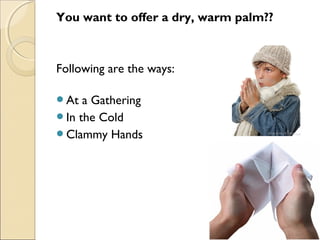
You want to offer a dry, warm palm??
Following are the ways:
At a Gathering
In the Cold
Clammy Hands
HyperhidrosisHyperhidrosis
Shake hands at an equal level
Covering Your Mistakes:
Shaking a Sweaty Hand
Importance Of Handshake In Interview:
Many a times we ignore this part and focus so
much on the other aspects of an interview
that we feel so confident that we are going to
make it, then we actually become over-
confident. this over confidence influences this
aspect to an extent that the interviewer gets
to know that we are over-confident and then
the result is rejection.
The first contact that a candidate has with
an interviewer is when he enters the room
and shakes hand with the interviewer. This
is the beginning of non-verbal
communication that the interviewee will
have with the interviewer.
If your handshake is not appropriate then
you have lost the first battle and the
interviewer gets a chance to make an
impression about you. Throughout the
remaining part of the interview, the
questions that are being put to you and the
way your responses are being judged is
decided primarily by this first impression.
Handshake for Continuing
relationship
Briefly exploring
Grasping
Failing: Failing to offer a handshake could
seriously damage and hope for positive
continuing relationship
Buddies Hand Shake:
A variety of ways to meet and greet
your friends in public from the
conventional to the extreme.
Conclusion:
A handshake is more than a simple
gesture. It is a simple gesture which
builds connections and can leave an
impression of a person. Practicing good
handshake.
Practice Makes Perfect 
To see how your handshake comes across, try
it out on a few friends, and ask for their
feedback on your timing, grip and technique.
Then, practice until you get it right!
Questions Answers Session

Handshake managment

  • 1.
    Hand Shake ManagementHandShake Management
  • 2.
  • 3.
    Table of ContentsTableof Contents Why do we shake hands? What your handshake says about you? Types of bad handshakes? Different handshakes in different cultures Perfect handshake in corporate sector What to do before shaking hands? Importance of handshake in an interview Buddies handshake Conclusion
  • 4.
  • 6.
    We can neverknow for certain where the handshake originated or why people started doing it. The most widely accepted theory is that hand shaking originated in medieval Europe where knights would extend their hand to other knights in order to show that they had no weapons hidden or concealed behind their back. People of all races, shapes, sizes and status use the handshake as a way to greet a person, make an agreement or say goodbye.
  • 7.
    For some peoplea handshake is just a useless formality but to others it is a massive indication of a person’s depth of character, trustworthiness and strength. When you shake hands with a person you are doing much more than saying “hello”. You are saying “this is who I am“
  • 8.
    If you area business person your handshake can be the maker or breaker of a big contract or deal. If you are a doctor or health care provider your handshake can fill a patient with confidence and trust. It is extremely important for all people, regardless of your race or way of life, to learn how to shake hands with meaning.
  • 9.
    Types of BadHandshakeTypes of Bad Handshake Bad handshakes leave bad first impressions.. Here are the "bad handshakes" and tips about how to correct them.
  • 10.
    1.1. "I amdominant" Placing your palm downward when offering your hand to someone is a way of showing dominance. By placing your palm downward, you force the other person to place his palm up, which is a submissive position. In everyday situations it should be avoided.
  • 11.
    2.2. "Bone Crusher" Handshake grip should be no harder than the strength that you would use to hold a door handle.  In addition, you should match your grip to the person you are shaking hands with.  Elderly people require a looser grip.  If you are ever stuck in a bone-crushing handshake, the best thing to do is make a comment such as "wow, that's quite the grip you've got there".  In most cases the person will back off.
  • 12.
    3.3. "Limp Fish" Alimp handshake signals to the other person that you are : nervous uncertain, or uninvolved. If you are unsure whether your handshake is limp, ask to practice with a few friends until you get your grip right.
  • 13.
    4.4. "Just Fingers" Evenworse than the limp handshake is the one in which you only shake the other person's fingers. In order to avoid his situation, be sure that the webbed part of your hands between your forefinger and thumb are touching before you grasp the other person's hand.
  • 14.
    5.5. "The Double-Hander" Althoughthere are instances where a double-handed handshake is appropriate, if used with someone that you have just met it can seem overly personal or intimate. Unless you are a politician or a grandmother, it is probably best to reserve the double-handed handshake for close friends.
  • 15.
    6.6. "The LongHandshake" Long after the introductions are over and if the other person is still pumping your hand up and down then this is wrong. The ideal handshake lasts 2-3 seconds and does not go on longer than the verbal introduction. Any longer, and it can seem like you are just holding hands.
  • 17.
    7.7. "Without EyeContact" Have you ever shaken hands with someone who wouldn't look you in the eye? You probably wondered what they had to hide. This shows that a person is hesitant to meet people. So If your lack of eye contact is due to social anxiety, practice looking at a spot between the eyes, so that you at least give the appearance of meeting the other person's gaze.
  • 18.
    8.8. "Too Close" Similarto the dominant handshake and the bone crusher, the "too close" handshake involves the other person coming in very close to you to shake hands, or pulling you in close as you are shaking hands. In either case, the closeness of the handshake is likely to make you feel uncomfortable. Simply take a step back. Unless the other person has you in a vice grip, you should be able to reclaim your personal space.
  • 19.
    Different ways of greetingin different cultures
  • 20.
    In Japan, people greeteach other by bowing. A bow ranges from a small nod of the head to a long, 90 degree bend at the waist. It is also common to bow to express thanks, to apologize, to make a request or to ask someone a favor. Shaking hands is uncommon among the Japanese, but again, exceptions are made for foreigners.
  • 21.
    In Saudi Arabiapeople first shake hands firmly and kiss on the cheeks if required which shows that people know each other.
  • 22.
    Hong Kong (olderChinese): clasp hands together at throat level and nod India: palms together as though praying and bend or nod, called namaste
  • 23.
    Korea: a slight bowand handshake (right hand in one or both hands) Sri Lanka: place palms together under chin and bow slightly Thailand: place palms together, elbows down, and bow head slightly, called “Wai”
  • 24.
    In Pakistan peopleoften shake hands with each other and in rural areas mostly with both hands.
  • 25.
  • 26.
    1. Start with eyecontact and a smile.  A great handshake isn't just about a physical gesture, it is about connecting with the other person. The best way to do that is with your face and your eyes make sure that you should have a smile on your face and a good eye contact with the other person.
  • 27.
    2. Go for thethumb. Keep your hand open and make sure your handshake will be a hand shake, not a finger or palm shake. This means getting the joint of your thumb (the lower joint - the tissue between your thumb to your forefinger) nestled into the joint of their thumb. This allows you to truly have a full handshake.
  • 28.
    3. Firm, not strong. Agood handshake is firm but not overpowering. doesn't feel like a dead fish. Always make your grip firm, but make adjustments based on the firmness of the other person's grip.
  • 29.
    4. Up and down,not back and forth.  A good handshake has a nice up and down motion, not a back and forth one. Again, adjust the motion to what seems natural and comfortable to the other person.
  • 30.
    5. Adjust duration.  Some peopleprefer a long handshake, others prefer them much shorter. Observe the other person and adjust the duration to the situation, how well you know the person, and what seems comfortable to them. Generally 2-3 seconds is the right time.
  • 31.
    6. One Handis Better than Two Avoid the urge to handshake with two hands. It is always better in business introductions to use only one hand – your right hand – for the shake. The use of two hands with strangers is seen as too personal. In fact, a two-handed shake is called the “politician’s shake,” because it appears artificially friendly when used on people you barely know.
  • 32.
    What To DoBefore Handshaking???
  • 33.
    How Can IEnsure My Hands Are "Shakable?" 
  • 34.
    You want tooffer a dry, warm palm?? Following are the ways: At a Gathering In the Cold Clammy Hands
  • 35.
  • 36.
    Shake hands atan equal level
  • 37.
  • 38.
  • 39.
    Importance Of HandshakeIn Interview: Many a times we ignore this part and focus so much on the other aspects of an interview that we feel so confident that we are going to make it, then we actually become over- confident. this over confidence influences this aspect to an extent that the interviewer gets to know that we are over-confident and then the result is rejection.
  • 40.
    The first contactthat a candidate has with an interviewer is when he enters the room and shakes hand with the interviewer. This is the beginning of non-verbal communication that the interviewee will have with the interviewer.
  • 41.
    If your handshakeis not appropriate then you have lost the first battle and the interviewer gets a chance to make an impression about you. Throughout the remaining part of the interview, the questions that are being put to you and the way your responses are being judged is decided primarily by this first impression.
  • 42.
    Handshake for Continuing relationship Brieflyexploring Grasping Failing: Failing to offer a handshake could seriously damage and hope for positive continuing relationship
  • 43.
    Buddies Hand Shake: Avariety of ways to meet and greet your friends in public from the conventional to the extreme.
  • 45.
    Conclusion: A handshake ismore than a simple gesture. It is a simple gesture which builds connections and can leave an impression of a person. Practicing good handshake. Practice Makes Perfect  To see how your handshake comes across, try it out on a few friends, and ask for their feedback on your timing, grip and technique. Then, practice until you get it right!
  • 46.