Related concepts
Enthalpy of neutralisation, calorimetry, heat capacity.
Principle
When a strong acid is neutralised with a strong base in dilute
solution, the same amount of heat is always released. If the reac-
tion takes place under isobaric conditions, this heat is known as
the enthalpy of neutralisation. The chemical reaction which gen-
erates this heat is the reaction of protons and hydroxyl ions to
form undissociated water. It therefore correlates to the enthalpy
of formation of water from these ions.
Tasks
1. Measure the temperature change during the neutralisation of
a dilute potassium hydroxide solution with dilute hydrochlo-
ric acid.
2. Calculate the enthalpy of neutralisation.
Equipment
Cobra3 Basic-Unit 12150.00 1
Power supply 12 V/2 A 12151.99 1
Data cable, RS232 14602.00 1
Temperature measuring module Pt 100 12102.00 1
Software Cobra 3 Temperature 14503.61 1
Temperature probe Pt 100 11759.01 1
Calorimeter, transparent 04402.00 1
Delivery pipette, 50 ml 04402.10 1
Pipettor 36592.00 1
Rubber bulb, double 39287.00 1
Pinchcock, w = 15 mm 43631.15 1
Heating coil with sockets 04450.00 1
Work and power meter 13715.93 1
Universal power supply 13500.93 1
Connection cable, l = 500 mm, black 07361.05 4
Magnetic heating stirrer 35720.93 1
Magnetic stirrer bar, l = 30 mm, oval 35680.04 1
Separator for magnetic bars 35680.03 1
Support rod, l = 500 mm, M10 thread 02022.20 1
Right angle clamp 37697.00 2
Universal clamp 37715.00 2
Laboratory balance
with data output, 800/1600/3200 g 48803.93 1
Volumetric flask, 500 ml 36551.00 2
Glass beaker, 100 ml, tall 36002.00 1
Glass beaker, 600 ml, tall 36006.00 1
Pasteur pipettes 36590.00 1
Rubber bulbs 39275.03 1
Stop watch, digital, 1/100 s 03071.01 1
Wash bottle, 500 ml 33931.00 1
Potassium hydroxide for 1 l
of 1 M solution, ampoule 31425.00 1
Hydrochloric acid for 1 l
of 1 M solution, ampoule 30271.00 1
Water, distilled, 5 l 31246.81 1
PC, Windows® 95 or higher
PHYWE series of publications • Laboratory Experiments • Chemistry • © PHYWE SYSTEME GMBH & Co. KG • D-37070 Göttingen P3020811 1
LEC
02.08
Determination of the enthalpy of neutralisation
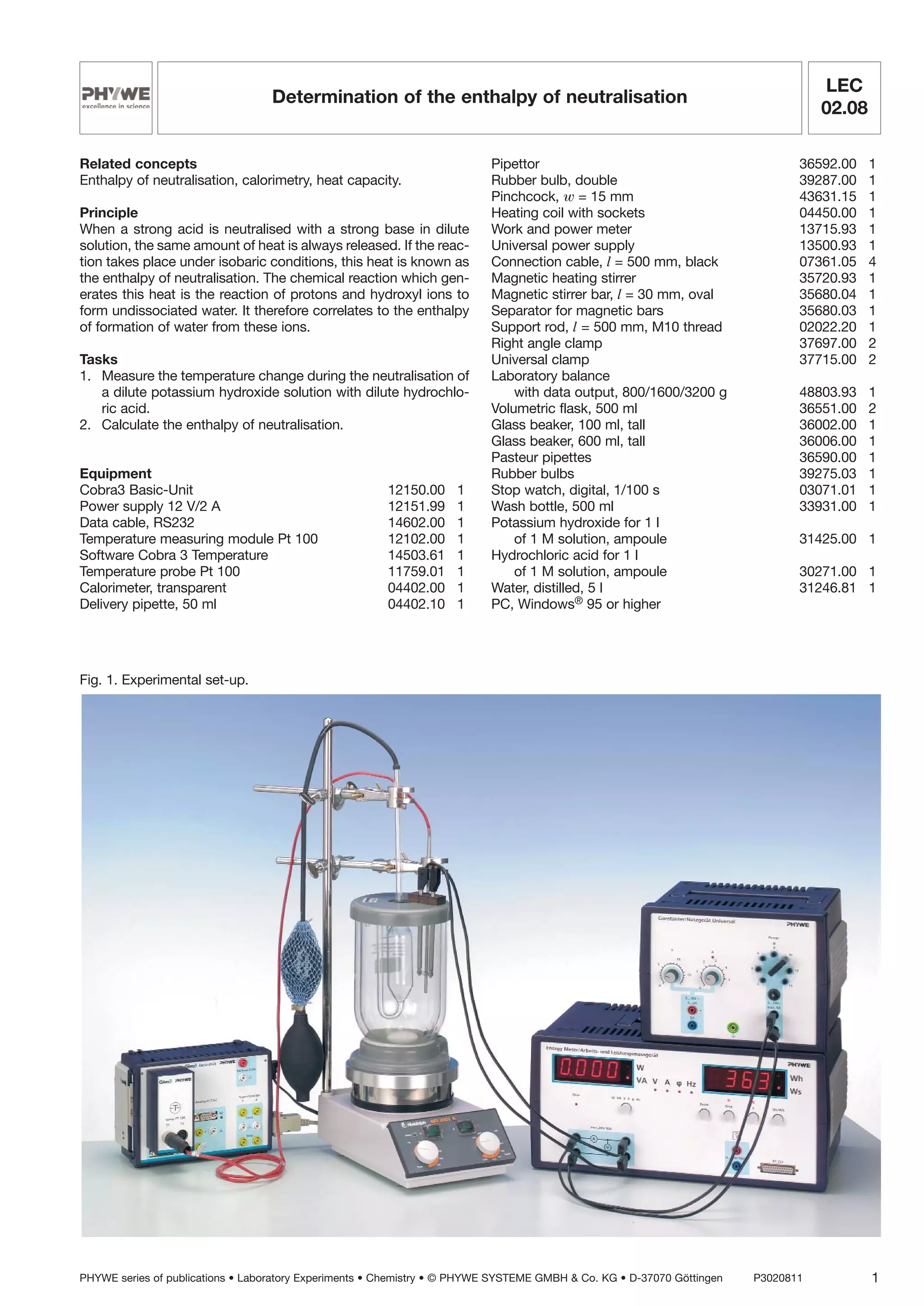
Fig. 1. Experimental set-up.
Set-up and procedure
Set up the experiment as shown in Fig. 1 but for the time being
do not connect the heating coil to the work and power meter.
Prepare the potassium hydroxide solution required (cKOH =
2 mol/l) by dissolving one ampoule of potassium hydroxide for
1 l of 1 M solution in a 500 ml volumetric flask and topping off
with water to the calibration mark. Proceed in a similar fashion
with a second 500 ml volumetric flask using 1 ampoule of
hydrochloric acid for 1 l of 1 M solution to produce hydrochloric
acid of the same concentration (cHCl = 2 mol/l).
Connect the temperature probe to T1 of the measuring module.
Call up the Measure programme in Windows and enter
<Temperature> as measuring instrument. Set the measuring
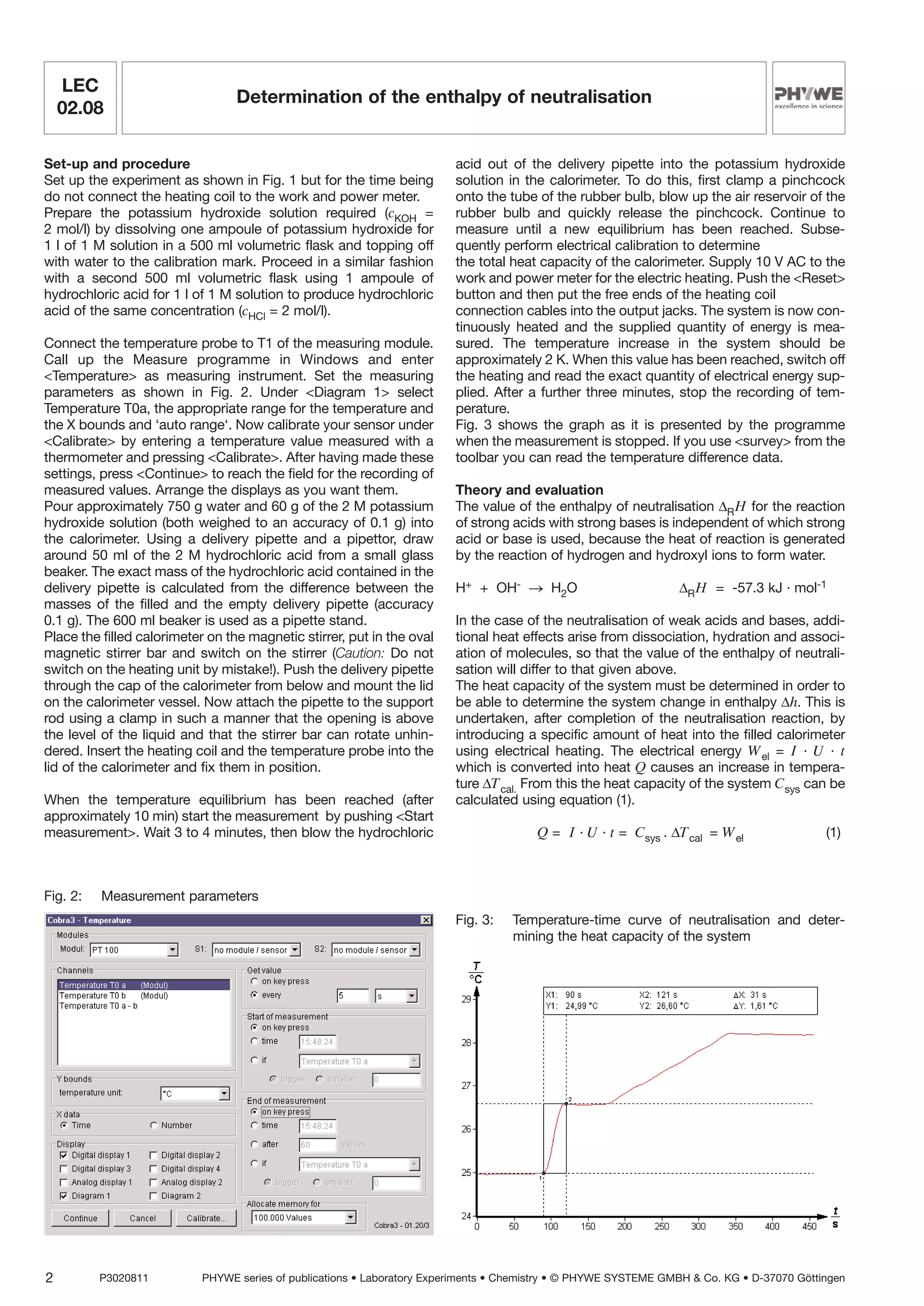
parameters as shown in Fig. 2. Under <Diagram 1> select
Temperature T0a, the appropriate range for the temperature and
the X bounds and ‘auto range‘. Now calibrate your sensor under
<Calibrate> by entering a temperature value measured with a
thermometer and pressing <Calibrate>. After having made these
settings, press <Continue> to reach the field for the recording of
measured values. Arrange the displays as you want them.
Pour approximately 750 g water and 60 g of the 2 M potassium
hydroxide solution (both weighed to an accuracy of 0.1 g) into
the calorimeter. Using a delivery pipette and a pipettor, draw
around 50 ml of the 2 M hydrochloric acid from a small glass
beaker. The exact mass of the hydrochloric acid contained in the
delivery pipette is calculated from the difference between the
masses of the filled and the empty delivery pipette (accuracy
0.1 g). The 600 ml beaker is used as a pipette stand.
Place the filled calorimeter on the magnetic stirrer, put in the oval
magnetic stirrer bar and switch on the stirrer (Caution: Do not
switch on the heating unit by mistake!). Push the delivery pipette
through the cap of the calorimeter from below and mount the lid
on the calorimeter vessel. Now attach the pipette to the support
rod using a clamp in such a manner that the opening is above
the level of the liquid and that the stirrer bar can rotate unhin-
dered. Insert the heating coil and the temperature probe into the
lid of the calorimeter and fix them in position.
When the temperature equilibrium has been reached (after
approximately 10 min) start the measurement by pushing <Start
measurement>. Wait 3 to 4 minutes, then blow the hydrochloric
acid out of the delivery pipette into the potassium hydroxide
solution in the calorimeter. To do this, first clamp a pinchcock
onto the tube of the rubber bulb, blow up the air reservoir of the
rubber bulb and quickly release the pinchcock. Continue to
measure until a new equilibrium has been reached. Subse-
quently perform electrical calibration to determine
the total heat capacity of the calorimeter. Supply 10 V AC to the
work and power meter for the electric heating. Push the <Reset>
button and then put the free ends of the heating coil
connection cables into the output jacks. The system is now con-
tinuously heated and the supplied quantity of energy is mea-
sured. The temperature increase in the system should be
approximately 2 K. When this value has been reached, switch off
the heating and read the exact quantity of electrical energy sup-
plied. After a further three minutes, stop the recording of tem-
perature.
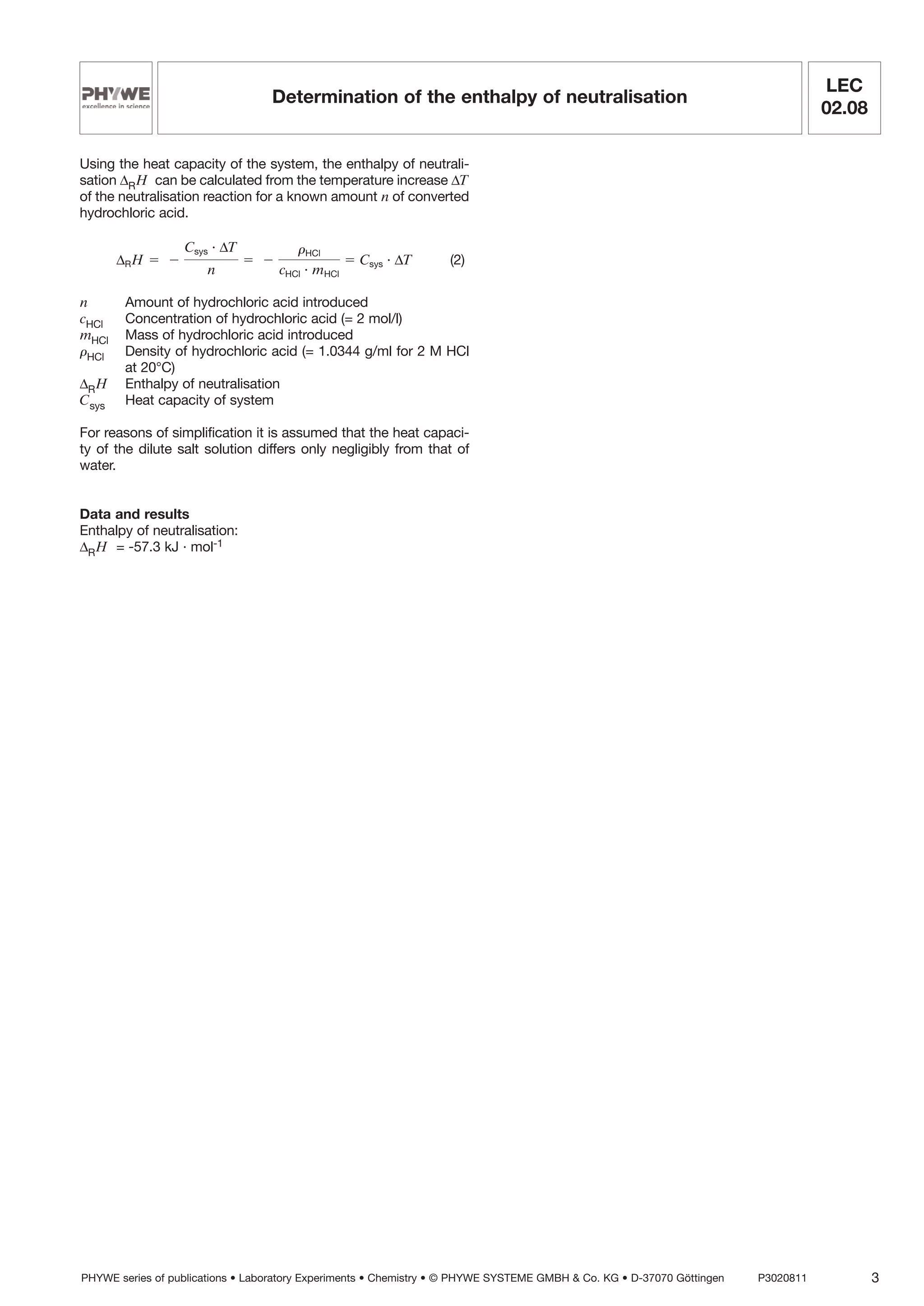
Fig. 3 shows the graph as it is presented by the programme
when the measurement is stopped. If you use <survey> from the
toolbar you can read the temperature difference data.
Theory and evaluation
The value of the enthalpy of neutralisation ∆RH for the reaction
of strong acids with strong bases is independent of which strong
acid or base is used, because the heat of reaction is generated
by the reaction of hydrogen and hydroxyl ions to form water.
H+ + OH- S H2O ∆RH = -57.3 kJ · mol-1
In the case of the neutralisation of weak acids and bases, addi-
tional heat effects arise from dissociation, hydration and associ-
ation of molecules, so that the value of the enthalpy of neutrali-
sation will differ to that given above.
The heat capacity of the system must be determined in order to
be able to determine the system change in enthalpy ∆h. This is
undertaken, after completion of the neutralisation reaction, by
introducing a specific amount of heat into the filled calorimeter
using electrical heating. The electrical energy Wel = I · U · t
which is converted into heat Q causes an increase in tempera-
ture ∆Tcal. From this the heat capacity of the system Csys can be
calculated using equation (1).
Q = I · U · t = Csys . ∆Tcal = Wel (1)
PHYWE series of publications • Laboratory Experiments • Chemistry • © PHYWE SYSTEME GMBH & Co. KG • D-37070 GöttingenP30208112
LEC
02.08
Determination of the enthalpy of neutralisation
Fig. 2: Measurement parameters
Fig. 3: Temperature-time curve of neutralisation and deter-
mining the heat capacity of the system
Using the heat capacity of the system, the enthalpy of neutrali-
sation ∆RH can be calculated from the temperature increase ∆T
of the neutralisation reaction for a known amount n of converted
hydrochloric acid.
(2)
n Amount of hydrochloric acid introduced
cHCl Concentration of hydrochloric acid (= 2 mol/l)
mHCl Mass of hydrochloric acid introduced
rHCl Density of hydrochloric acid (= 1.0344 g/ml for 2 M HCl
at 20°C)
∆RH Enthalpy of neutralisation
Csys Heat capacity of system
For reasons of simplification it is assumed that the heat capaci-
ty of the dilute salt solution differs only negligibly from that of
water.
Data and results
Enthalpy of neutralisation:
∆RH = -57.3 kJ · mol-1
∆RH ϭ Ϫ
Csys · ∆T
n
ϭ Ϫ
rHCl
cHCl · mHCl
ϭ Csys · ∆T
PHYWE series of publications • Laboratory Experiments • Chemistry • © PHYWE SYSTEME GMBH & Co. KG • D-37070 Göttingen P3020811 3
LEC
02.08
Determination of the enthalpy of neutralisation
PHYWE series of publications • Laboratory Experiments • Chemistry • © PHYWE SYSTEME GMBH & Co. KG • D-37070 GöttingenP30208114
LEC
02.08
Determination of the enthalpy of neutralisation

Determination of the enthalpy of neutralisation

  • 1.
    Related concepts Enthalpy ofneutralisation, calorimetry, heat capacity. Principle When a strong acid is neutralised with a strong base in dilute solution, the same amount of heat is always released. If the reac- tion takes place under isobaric conditions, this heat is known as the enthalpy of neutralisation. The chemical reaction which gen- erates this heat is the reaction of protons and hydroxyl ions to form undissociated water. It therefore correlates to the enthalpy of formation of water from these ions. Tasks 1. Measure the temperature change during the neutralisation of a dilute potassium hydroxide solution with dilute hydrochlo- ric acid. 2. Calculate the enthalpy of neutralisation. Equipment Cobra3 Basic-Unit 12150.00 1 Power supply 12 V/2 A 12151.99 1 Data cable, RS232 14602.00 1 Temperature measuring module Pt 100 12102.00 1 Software Cobra 3 Temperature 14503.61 1 Temperature probe Pt 100 11759.01 1 Calorimeter, transparent 04402.00 1 Delivery pipette, 50 ml 04402.10 1 Pipettor 36592.00 1 Rubber bulb, double 39287.00 1 Pinchcock, w = 15 mm 43631.15 1 Heating coil with sockets 04450.00 1 Work and power meter 13715.93 1 Universal power supply 13500.93 1 Connection cable, l = 500 mm, black 07361.05 4 Magnetic heating stirrer 35720.93 1 Magnetic stirrer bar, l = 30 mm, oval 35680.04 1 Separator for magnetic bars 35680.03 1 Support rod, l = 500 mm, M10 thread 02022.20 1 Right angle clamp 37697.00 2 Universal clamp 37715.00 2 Laboratory balance with data output, 800/1600/3200 g 48803.93 1 Volumetric flask, 500 ml 36551.00 2 Glass beaker, 100 ml, tall 36002.00 1 Glass beaker, 600 ml, tall 36006.00 1 Pasteur pipettes 36590.00 1 Rubber bulbs 39275.03 1 Stop watch, digital, 1/100 s 03071.01 1 Wash bottle, 500 ml 33931.00 1 Potassium hydroxide for 1 l of 1 M solution, ampoule 31425.00 1 Hydrochloric acid for 1 l of 1 M solution, ampoule 30271.00 1 Water, distilled, 5 l 31246.81 1 PC, Windows® 95 or higher PHYWE series of publications • Laboratory Experiments • Chemistry • © PHYWE SYSTEME GMBH & Co. KG • D-37070 Göttingen P3020811 1 LEC 02.08 Determination of the enthalpy of neutralisation Fig. 1. Experimental set-up.
  • 2.
    Set-up and procedure Setup the experiment as shown in Fig. 1 but for the time being do not connect the heating coil to the work and power meter. Prepare the potassium hydroxide solution required (cKOH = 2 mol/l) by dissolving one ampoule of potassium hydroxide for 1 l of 1 M solution in a 500 ml volumetric flask and topping off with water to the calibration mark. Proceed in a similar fashion with a second 500 ml volumetric flask using 1 ampoule of hydrochloric acid for 1 l of 1 M solution to produce hydrochloric acid of the same concentration (cHCl = 2 mol/l). Connect the temperature probe to T1 of the measuring module. Call up the Measure programme in Windows and enter <Temperature> as measuring instrument. Set the measuring parameters as shown in Fig. 2. Under <Diagram 1> select Temperature T0a, the appropriate range for the temperature and the X bounds and ‘auto range‘. Now calibrate your sensor under <Calibrate> by entering a temperature value measured with a thermometer and pressing <Calibrate>. After having made these settings, press <Continue> to reach the field for the recording of measured values. Arrange the displays as you want them. Pour approximately 750 g water and 60 g of the 2 M potassium hydroxide solution (both weighed to an accuracy of 0.1 g) into the calorimeter. Using a delivery pipette and a pipettor, draw around 50 ml of the 2 M hydrochloric acid from a small glass beaker. The exact mass of the hydrochloric acid contained in the delivery pipette is calculated from the difference between the masses of the filled and the empty delivery pipette (accuracy 0.1 g). The 600 ml beaker is used as a pipette stand. Place the filled calorimeter on the magnetic stirrer, put in the oval magnetic stirrer bar and switch on the stirrer (Caution: Do not switch on the heating unit by mistake!). Push the delivery pipette through the cap of the calorimeter from below and mount the lid on the calorimeter vessel. Now attach the pipette to the support rod using a clamp in such a manner that the opening is above the level of the liquid and that the stirrer bar can rotate unhin- dered. Insert the heating coil and the temperature probe into the lid of the calorimeter and fix them in position. When the temperature equilibrium has been reached (after approximately 10 min) start the measurement by pushing <Start measurement>. Wait 3 to 4 minutes, then blow the hydrochloric acid out of the delivery pipette into the potassium hydroxide solution in the calorimeter. To do this, first clamp a pinchcock onto the tube of the rubber bulb, blow up the air reservoir of the rubber bulb and quickly release the pinchcock. Continue to measure until a new equilibrium has been reached. Subse- quently perform electrical calibration to determine the total heat capacity of the calorimeter. Supply 10 V AC to the work and power meter for the electric heating. Push the <Reset> button and then put the free ends of the heating coil connection cables into the output jacks. The system is now con- tinuously heated and the supplied quantity of energy is mea- sured. The temperature increase in the system should be approximately 2 K. When this value has been reached, switch off the heating and read the exact quantity of electrical energy sup- plied. After a further three minutes, stop the recording of tem- perature. Fig. 3 shows the graph as it is presented by the programme when the measurement is stopped. If you use <survey> from the toolbar you can read the temperature difference data. Theory and evaluation The value of the enthalpy of neutralisation ∆RH for the reaction of strong acids with strong bases is independent of which strong acid or base is used, because the heat of reaction is generated by the reaction of hydrogen and hydroxyl ions to form water. H+ + OH- S H2O ∆RH = -57.3 kJ · mol-1 In the case of the neutralisation of weak acids and bases, addi- tional heat effects arise from dissociation, hydration and associ- ation of molecules, so that the value of the enthalpy of neutrali- sation will differ to that given above. The heat capacity of the system must be determined in order to be able to determine the system change in enthalpy ∆h. This is undertaken, after completion of the neutralisation reaction, by introducing a specific amount of heat into the filled calorimeter using electrical heating. The electrical energy Wel = I · U · t which is converted into heat Q causes an increase in tempera- ture ∆Tcal. From this the heat capacity of the system Csys can be calculated using equation (1). Q = I · U · t = Csys . ∆Tcal = Wel (1) PHYWE series of publications • Laboratory Experiments • Chemistry • © PHYWE SYSTEME GMBH & Co. KG • D-37070 GöttingenP30208112 LEC 02.08 Determination of the enthalpy of neutralisation Fig. 2: Measurement parameters Fig. 3: Temperature-time curve of neutralisation and deter- mining the heat capacity of the system
  • 3.
    Using the heatcapacity of the system, the enthalpy of neutrali- sation ∆RH can be calculated from the temperature increase ∆T of the neutralisation reaction for a known amount n of converted hydrochloric acid. (2) n Amount of hydrochloric acid introduced cHCl Concentration of hydrochloric acid (= 2 mol/l) mHCl Mass of hydrochloric acid introduced rHCl Density of hydrochloric acid (= 1.0344 g/ml for 2 M HCl at 20°C) ∆RH Enthalpy of neutralisation Csys Heat capacity of system For reasons of simplification it is assumed that the heat capaci- ty of the dilute salt solution differs only negligibly from that of water. Data and results Enthalpy of neutralisation: ∆RH = -57.3 kJ · mol-1 ∆RH ϭ Ϫ Csys · ∆T n ϭ Ϫ rHCl cHCl · mHCl ϭ Csys · ∆T PHYWE series of publications • Laboratory Experiments • Chemistry • © PHYWE SYSTEME GMBH & Co. KG • D-37070 Göttingen P3020811 3 LEC 02.08 Determination of the enthalpy of neutralisation
  • 4.
    PHYWE series ofpublications • Laboratory Experiments • Chemistry • © PHYWE SYSTEME GMBH & Co. KG • D-37070 GöttingenP30208114 LEC 02.08 Determination of the enthalpy of neutralisation