Trends in Recoverable Manure Nutrients
Noel Gollehon USDA - NRCS
Robert Kellogg (retired, USDA – NRCS)
David Moffitt (retired, USDA – NRCS)
Presentation for SWCS Annual Conference
Lombard, Illinois
July 28, 2014
Goals of Presentation
• Provide some basic, fundamental information
about livestock and manure nutrient production
– At the National level and
– Distribution across the Nation
• Look at the trends over a 25-year history
(1982-2007) to see the changes in
– Where animals are located.
– Quantities of manure produced
– Quantities of nutrients in the manure.
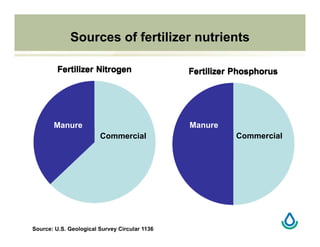
Sources of fertilizer nutrients
Manure Manure
Commercial Commercial
Source: U.S. Geological Survey Circular 1136
Background
• Nutrients added to the environment are a
significant portion of the agricultural water
quality discussion.
– Manure is not everywhere, but where animals occur
the levels can be significant.
• Provisions to improve manure management are
a component to almost every water quality
improvement plan in animal production areas.
• EPA as a part of the National Pollutant Discharge
Elimination System (NPDES), regulates a subset of
Animal Feeding Operations (AFOs) termed CAFOs
(Concentrated Animal Feeding Operations).
Data and Methods
• Data
– Individual producer responses from the 1982–2007
Census of Agriculture data collection efforts
– Data aggregated to protect individual responses
– Start with 2.2 million farm observations
• Methods
– Consistent approach over time, adjusted for
technological change
– Approach built on methods used in Kellogg et al.,
2000 and Gollehon et al., 2001 reports
Estimation Approach
1. Number of animals reported by producers on the
Census form, both inventory and sales.
2. Engineering coefficients (ASABE) of manure and
manure nutrients produced by weight class of animals.
3. Using animal data and common production practices
estimate the quantity of manure and manure nutrients
produced by AFO, AFO-CAFO, and non-AFO farms.
4. Estimate the potential to utilize manure produced on
the farm, based on the uptake of nutrients for on-farm
crop production.
5. Estimate the potential to utilize manure produced in the
county based on the uptake of nutrients for crop
production.
6. Summarize for farm, county, HUC-6, State, and Nation
Findings
• Approach produces a lot of numbers!
• Present some of the National-scale information today.
• Present only the Nitrogen information. Matching
Phosphorus is calculated but time today is short.
• Additional information is in the report under development
on this effort. It is at the review stage.
• To prevent disclosure of individual farmer information,
not all information used in calculations will be available.
• Please contact me if you would like to be notified when
the report is publically available.
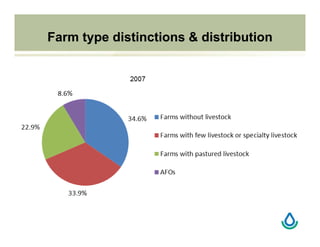
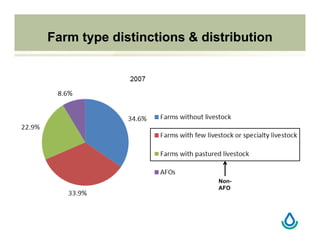
Farm type distinctions & distribution
Non-
AFO
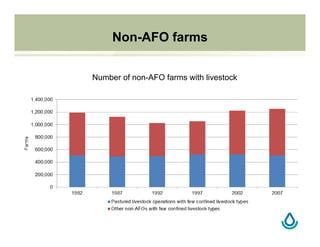
Non-AFO farms
Number of non-AFO farms with livestock
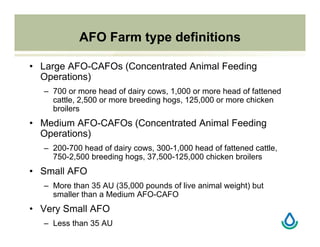
AFO Farm type definitions
• Large AFO-CAFOs (Concentrated Animal Feeding
Operations)
– 700 or more head of dairy cows, 1,000 or more head of fattened
cattle, 2,500 or more breeding hogs, 125,000 or more chicken
broilers
• Medium AFO-CAFOs (Concentrated Animal Feeding
Operations)
– 200-700 head of dairy cows, 300-1,000 head of fattened cattle,
750-2,500 breeding hogs, 37,500-125,000 chicken broilers
• Small AFO
– More than 35 AU (35,000 pounds of live animal weight) but
smaller than a Medium AFO-CAFO
• Very Small AFO
– Less than 35 AU
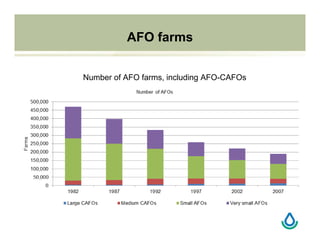
AFO farms
Number of AFO farms, including AFO-CAFOs
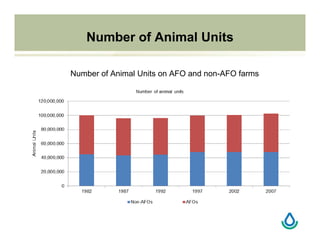
Number of Animal Units
Number of Animal Units on AFO and non-AFO farms
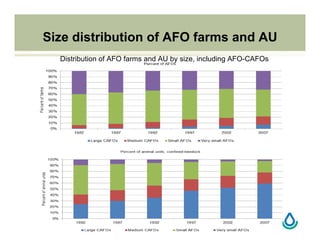
Distribution of AFO farms and AU by size, including AFO-CAFOs
Size distribution of AFO farms and AU
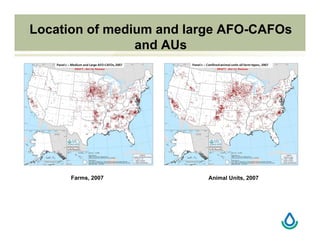
Location of medium and large AFO-CAFOs
and AUs
Farms, 2007 Animal Units, 2007
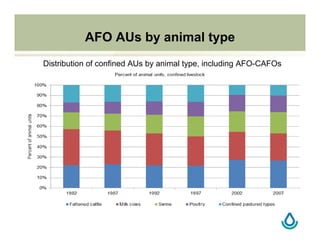
AFO AUs by animal type
Distribution of confined AUs by animal type, including AFO-CAFOs
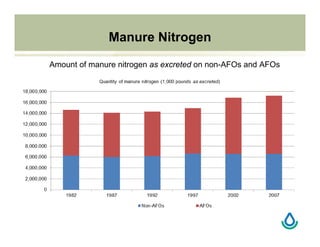
Amount of manure nitrogen as excreted on non-AFOs and AFOs
Manure Nitrogen
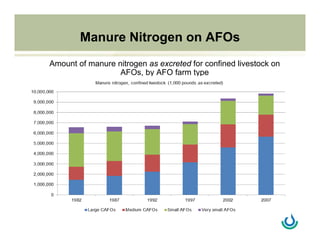
Manure Nitrogen on AFOs
Amount of manure nitrogen as excreted for confined livestock on
AFOs, by AFO farm type
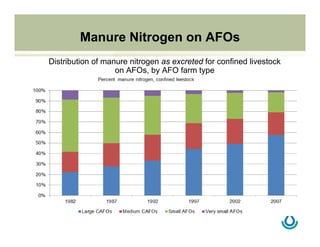
Manure Nitrogen on AFOs
Distribution of manure nitrogen as excreted for confined livestock
on AFOs, by AFO farm type
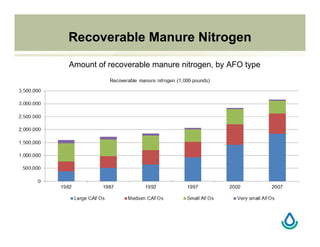
Amount of recoverable manure nitrogen, by AFO type
Recoverable Manure Nitrogen
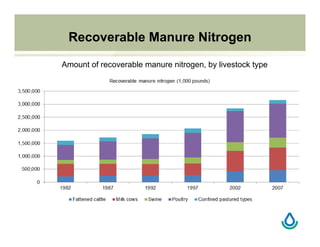
Amount of recoverable manure nitrogen, by livestock type
Recoverable Manure Nitrogen
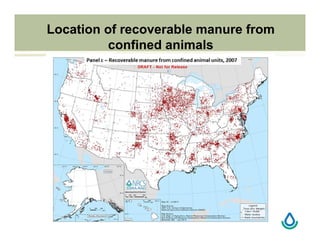
Location of recoverable manure from
confined animals
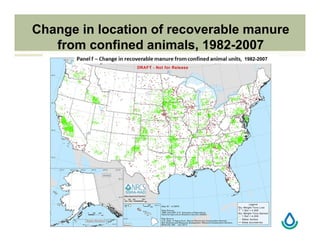
Change in location of recoverable manure
from confined animals, 1982-2007
1982-2007
Non-Recoverable Manure
• Report estimates non-recoverable manure nitrogen
– Distributes non-recoverable into 6 types
– Estimate 31% of non recoverable is lost from AFOs during
manure treatment, storage, collection, and transfer.
– Estimate 30% of non recoverable is lost from non-AFOs.
– Remaining 39% of non recoverable is lost to volatilization and a
the non-recoverable fraction of manure on AFOs (cannot collect
it all)
• Report also estimates non-recoverable manure
phosphorus
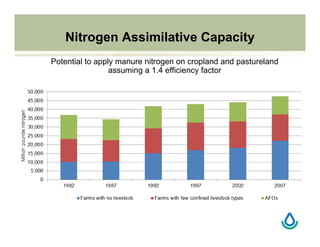
Nitrogen Assimilative Capacity
Potential to apply manure nitrogen on cropland and pastureland
assuming a 1.4 efficiency factor
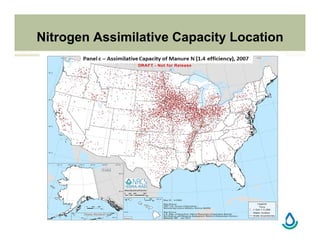
Nitrogen Assimilative Capacity Location
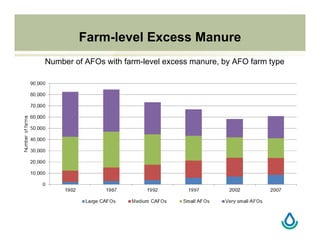
Farm-level Excess Manure
Number of AFOs with farm-level excess manure, by AFO farm type
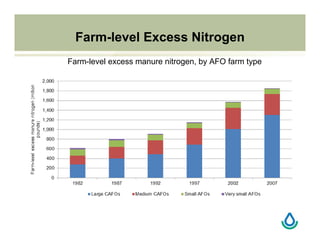
Farm-level Excess Nitrogen
Farm-level excess manure nitrogen, by AFO farm type
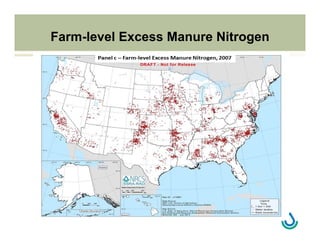
Farm-level Excess Manure Nitrogen
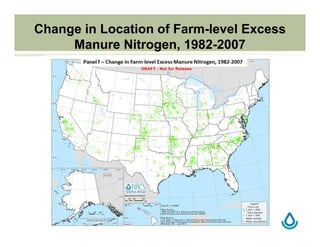
Change in Location of Farm-level Excess
Manure Nitrogen, 1982-2007
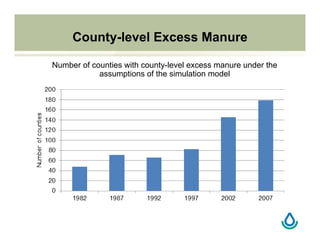
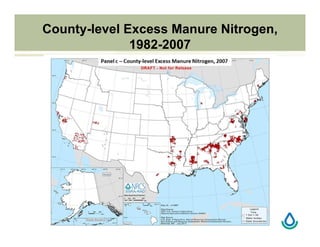
County-level Excess Manure
Number of counties with county-level excess manure under the
assumptions of the simulation model
County-level Excess Manure Nitrogen,
1982-2007
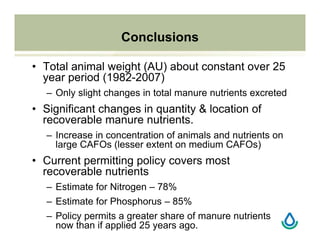
Conclusions
• Total animal weight (AU) about constant over 25
year period (1982-2007)
– Only slight changes in total manure nutrients excreted
• Significant changes in quantity & location of
recoverable manure nutrients.
– Increase in concentration of animals and nutrients on
large CAFOs (lesser extent on medium CAFOs)
• Current permitting policy covers most
recoverable nutrients
– Estimate for Nitrogen – 78%
– Estimate for Phosphorus – 85%
– Policy permits a greater share of manure nutrients
now than if applied 25 years ago.
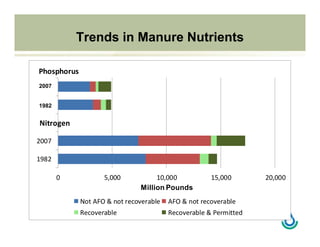
0 5,000 10,000 15,000 20,000
1982
2007
19822
20072
Million Pounds
Phosphorus
Not AFO & not recoverable AFO & not recoverable
Recoverable Recoverable & Permitted
Nitrogen
Trends in Manure Nutrients
2007
1982
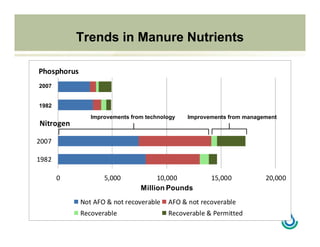
0 5,000 10,000 15,000 20,000
1982
2007
19822
20072
Million Pounds
Phosphorus
Not AFO & not recoverable AFO & not recoverable
Recoverable Recoverable & Permitted
Nitrogen
Trends in Manure Nutrients
Improvements from technology Improvements from management
2007
1982
Thank you!
Noel Gollehon
Noel.Gollehon@wdc.usda.gov
301-504-1763
USDA – NRCS
The U.S. Department of Agriculture (USDA) prohibits discrimination against its
customers, employees, and applicants for employment on the bases of race, color,
national origin, age, disability, sex, gender identity, religion, reprisal, and where
applicable, political beliefs, marital status, familial or parental status, sexual orientation,
or all or part of an individual's income is derived from any public assistance program, or
protected genetic information in employment or in any program or activity conducted or
funded by the Department. (Not all prohibited bases will apply to all programs and/or
employment activities.)
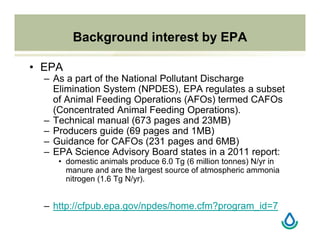
Background interest by EPA
• EPA
– As a part of the National Pollutant Discharge
Elimination System (NPDES), EPA regulates a subset
of Animal Feeding Operations (AFOs) termed CAFOs
(Concentrated Animal Feeding Operations).
– Technical manual (673 pages and 23MB)
– Producers guide (69 pages and 1MB)
– Guidance for CAFOs (231 pages and 6MB)
– EPA Science Advisory Board states in a 2011 report:
• domestic animals produce 6.0 Tg (6 million tonnes) N/yr in
manure and are the largest source of atmospheric ammonia
nitrogen (1.6 Tg N/yr).
– http://cfpub.epa.gov/npdes/home.cfm?program_id=7
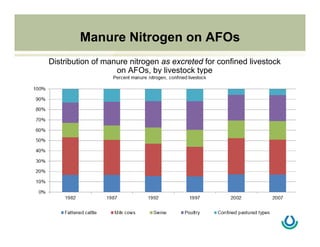
Manure Nitrogen on AFOs
Distribution of manure nitrogen as excreted for confined livestock
on AFOs, by livestock type
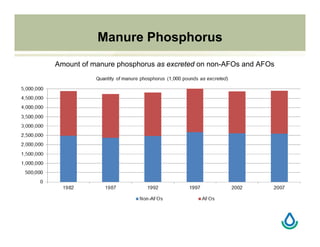
Amount of manure phosphorus as excreted on non-AFOs and AFOs
Manure Phosphorus
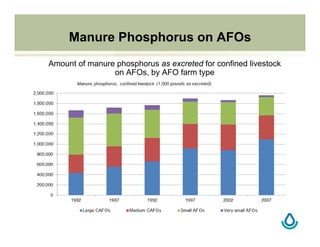
Manure Phosphorus on AFOs
Amount of manure phosphorus as excreted for confined livestock
on AFOs, by AFO farm type
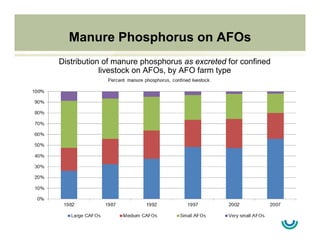
Manure Phosphorus on AFOs
Distribution of manure phosphorus as excreted for confined
livestock on AFOs, by AFO farm type
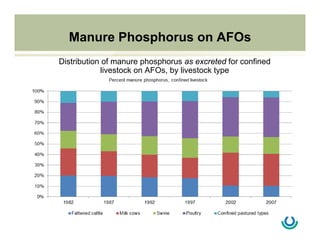
Manure Phosphorus on AFOs
Distribution of manure phosphorus as excreted for confined
livestock on AFOs, by livestock type
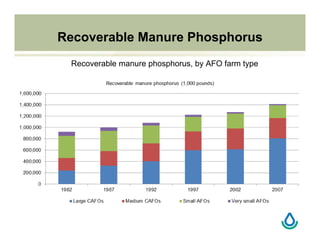
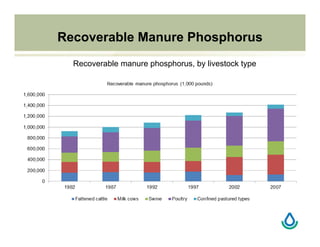
Recoverable Manure Phosphorus
Recoverable manure phosphorus, by AFO farm type
Recoverable Manure Phosphorus
Recoverable manure phosphorus, by livestock type
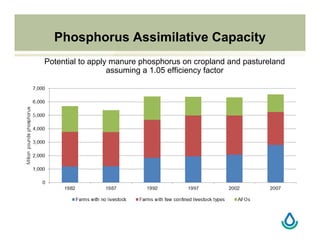
Phosphorus Assimilative Capacity
Potential to apply manure phosphorus on cropland and pastureland
assuming a 1.05 efficiency factor

Trends in recoverable manure nutrients

  • 1.
    Trends in RecoverableManure Nutrients Noel Gollehon USDA - NRCS Robert Kellogg (retired, USDA – NRCS) David Moffitt (retired, USDA – NRCS) Presentation for SWCS Annual Conference Lombard, Illinois July 28, 2014
  • 2.
    Goals of Presentation •Provide some basic, fundamental information about livestock and manure nutrient production – At the National level and – Distribution across the Nation • Look at the trends over a 25-year history (1982-2007) to see the changes in – Where animals are located. – Quantities of manure produced – Quantities of nutrients in the manure.
  • 3.
    Sources of fertilizernutrients Manure Manure Commercial Commercial Source: U.S. Geological Survey Circular 1136
  • 4.
    Background • Nutrients addedto the environment are a significant portion of the agricultural water quality discussion. – Manure is not everywhere, but where animals occur the levels can be significant. • Provisions to improve manure management are a component to almost every water quality improvement plan in animal production areas. • EPA as a part of the National Pollutant Discharge Elimination System (NPDES), regulates a subset of Animal Feeding Operations (AFOs) termed CAFOs (Concentrated Animal Feeding Operations).
  • 5.
    Data and Methods •Data – Individual producer responses from the 1982–2007 Census of Agriculture data collection efforts – Data aggregated to protect individual responses – Start with 2.2 million farm observations • Methods – Consistent approach over time, adjusted for technological change – Approach built on methods used in Kellogg et al., 2000 and Gollehon et al., 2001 reports
  • 6.
    Estimation Approach 1. Numberof animals reported by producers on the Census form, both inventory and sales. 2. Engineering coefficients (ASABE) of manure and manure nutrients produced by weight class of animals. 3. Using animal data and common production practices estimate the quantity of manure and manure nutrients produced by AFO, AFO-CAFO, and non-AFO farms. 4. Estimate the potential to utilize manure produced on the farm, based on the uptake of nutrients for on-farm crop production. 5. Estimate the potential to utilize manure produced in the county based on the uptake of nutrients for crop production. 6. Summarize for farm, county, HUC-6, State, and Nation
  • 7.
    Findings • Approach producesa lot of numbers! • Present some of the National-scale information today. • Present only the Nitrogen information. Matching Phosphorus is calculated but time today is short. • Additional information is in the report under development on this effort. It is at the review stage. • To prevent disclosure of individual farmer information, not all information used in calculations will be available. • Please contact me if you would like to be notified when the report is publically available.
  • 8.
    Farm type distinctions& distribution
  • 9.
    Farm type distinctions& distribution Non- AFO
  • 10.
    Non-AFO farms Number ofnon-AFO farms with livestock
  • 11.
    AFO Farm typedefinitions • Large AFO-CAFOs (Concentrated Animal Feeding Operations) – 700 or more head of dairy cows, 1,000 or more head of fattened cattle, 2,500 or more breeding hogs, 125,000 or more chicken broilers • Medium AFO-CAFOs (Concentrated Animal Feeding Operations) – 200-700 head of dairy cows, 300-1,000 head of fattened cattle, 750-2,500 breeding hogs, 37,500-125,000 chicken broilers • Small AFO – More than 35 AU (35,000 pounds of live animal weight) but smaller than a Medium AFO-CAFO • Very Small AFO – Less than 35 AU
  • 12.
    AFO farms Number ofAFO farms, including AFO-CAFOs
  • 13.
    Number of AnimalUnits Number of Animal Units on AFO and non-AFO farms
  • 14.
    Distribution of AFOfarms and AU by size, including AFO-CAFOs Size distribution of AFO farms and AU
  • 15.
    Location of mediumand large AFO-CAFOs and AUs Farms, 2007 Animal Units, 2007
  • 16.
    AFO AUs byanimal type Distribution of confined AUs by animal type, including AFO-CAFOs
  • 17.
    Amount of manurenitrogen as excreted on non-AFOs and AFOs Manure Nitrogen
  • 18.
    Manure Nitrogen onAFOs Amount of manure nitrogen as excreted for confined livestock on AFOs, by AFO farm type
  • 19.
    Manure Nitrogen onAFOs Distribution of manure nitrogen as excreted for confined livestock on AFOs, by AFO farm type
  • 20.
    Amount of recoverablemanure nitrogen, by AFO type Recoverable Manure Nitrogen
  • 21.
    Amount of recoverablemanure nitrogen, by livestock type Recoverable Manure Nitrogen
  • 22.
    Location of recoverablemanure from confined animals
  • 23.
    Change in locationof recoverable manure from confined animals, 1982-2007 1982-2007
  • 24.
    Non-Recoverable Manure • Reportestimates non-recoverable manure nitrogen – Distributes non-recoverable into 6 types – Estimate 31% of non recoverable is lost from AFOs during manure treatment, storage, collection, and transfer. – Estimate 30% of non recoverable is lost from non-AFOs. – Remaining 39% of non recoverable is lost to volatilization and a the non-recoverable fraction of manure on AFOs (cannot collect it all) • Report also estimates non-recoverable manure phosphorus
  • 25.
    Nitrogen Assimilative Capacity Potentialto apply manure nitrogen on cropland and pastureland assuming a 1.4 efficiency factor
  • 26.
  • 27.
    Farm-level Excess Manure Numberof AFOs with farm-level excess manure, by AFO farm type
  • 28.
    Farm-level Excess Nitrogen Farm-levelexcess manure nitrogen, by AFO farm type
  • 29.
  • 30.
    Change in Locationof Farm-level Excess Manure Nitrogen, 1982-2007
  • 31.
    County-level Excess Manure Numberof counties with county-level excess manure under the assumptions of the simulation model
  • 32.
    County-level Excess ManureNitrogen, 1982-2007
  • 33.
    Conclusions • Total animalweight (AU) about constant over 25 year period (1982-2007) – Only slight changes in total manure nutrients excreted • Significant changes in quantity & location of recoverable manure nutrients. – Increase in concentration of animals and nutrients on large CAFOs (lesser extent on medium CAFOs) • Current permitting policy covers most recoverable nutrients – Estimate for Nitrogen – 78% – Estimate for Phosphorus – 85% – Policy permits a greater share of manure nutrients now than if applied 25 years ago.
  • 34.
    0 5,000 10,00015,000 20,000 1982 2007 19822 20072 Million Pounds Phosphorus Not AFO & not recoverable AFO & not recoverable Recoverable Recoverable & Permitted Nitrogen Trends in Manure Nutrients 2007 1982
  • 35.
    0 5,000 10,00015,000 20,000 1982 2007 19822 20072 Million Pounds Phosphorus Not AFO & not recoverable AFO & not recoverable Recoverable Recoverable & Permitted Nitrogen Trends in Manure Nutrients Improvements from technology Improvements from management 2007 1982
  • 36.
    Thank you! Noel Gollehon Noel.Gollehon@wdc.usda.gov 301-504-1763 USDA– NRCS The U.S. Department of Agriculture (USDA) prohibits discrimination against its customers, employees, and applicants for employment on the bases of race, color, national origin, age, disability, sex, gender identity, religion, reprisal, and where applicable, political beliefs, marital status, familial or parental status, sexual orientation, or all or part of an individual's income is derived from any public assistance program, or protected genetic information in employment or in any program or activity conducted or funded by the Department. (Not all prohibited bases will apply to all programs and/or employment activities.)
  • 37.
    Background interest byEPA • EPA – As a part of the National Pollutant Discharge Elimination System (NPDES), EPA regulates a subset of Animal Feeding Operations (AFOs) termed CAFOs (Concentrated Animal Feeding Operations). – Technical manual (673 pages and 23MB) – Producers guide (69 pages and 1MB) – Guidance for CAFOs (231 pages and 6MB) – EPA Science Advisory Board states in a 2011 report: • domestic animals produce 6.0 Tg (6 million tonnes) N/yr in manure and are the largest source of atmospheric ammonia nitrogen (1.6 Tg N/yr). – http://cfpub.epa.gov/npdes/home.cfm?program_id=7
  • 38.
    Manure Nitrogen onAFOs Distribution of manure nitrogen as excreted for confined livestock on AFOs, by livestock type
  • 39.
    Amount of manurephosphorus as excreted on non-AFOs and AFOs Manure Phosphorus
  • 40.
    Manure Phosphorus onAFOs Amount of manure phosphorus as excreted for confined livestock on AFOs, by AFO farm type
  • 41.
    Manure Phosphorus onAFOs Distribution of manure phosphorus as excreted for confined livestock on AFOs, by AFO farm type
  • 42.
    Manure Phosphorus onAFOs Distribution of manure phosphorus as excreted for confined livestock on AFOs, by livestock type
  • 43.
    Recoverable Manure Phosphorus Recoverablemanure phosphorus, by AFO farm type
  • 44.
    Recoverable Manure Phosphorus Recoverablemanure phosphorus, by livestock type
  • 45.
    Phosphorus Assimilative Capacity Potentialto apply manure phosphorus on cropland and pastureland assuming a 1.05 efficiency factor