












KICKSTARTING
DESIGN THINKING
Davide ‘Folletto’ Casali
UX Redirector Advisor
NIGHT.EU
F E L L O W
@Folletto
WHY DESIGN?
PART I
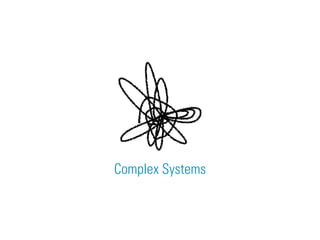
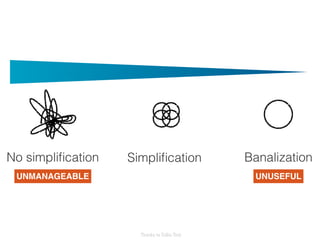
Complex Systems
No simplification BanalizationSimplification
Thanks to Tullio Tinti
UNMANAGEABLE UNUSEFUL
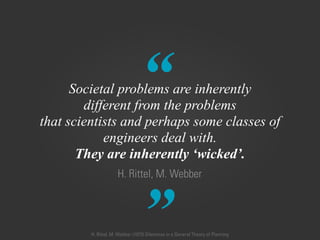
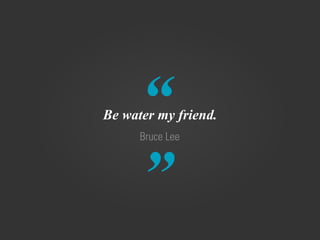
“
”
H. Rittel, M. Webber
Societal problems are inherently
different from the problems 

that scientists and perhaps some classes of
engineers deal with.
They are inherently ‘wicked’.
H. Rittel, M. Webber (1973) Dilemmas in a General Theory of Planning
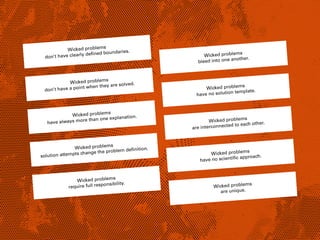
Wicked problems
don’t have clearly defined boundaries.
Wicked problems
don’t have a point when they are solved.
Wicked problems
have always more than one explanation.
Wicked problems
solution attempts change the problem definition.
Wicked problems
require full responsibility.
Wicked problems
bleed into one another.
Wicked problems
have no solution template.
Wicked problems
are interconnected to each other.
Wicked problems
have no scientific approach.
Wicked problems
are unique.
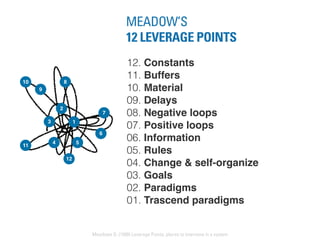
12. Constants
11. Buffers
10. Material
09. Delays
08. Negative loops
07. Positive loops
06. Information
05. Rules
04. Change & self-organize
03. Goals
02. Paradigms
01. Trascend paradigms
Meadows D. (1999) Leverage Points, places to intervene in a system
10
2
8
7
13
11
4
12
5
6
9
MEADOW’S
12 LEVERAGE POINTS
FOUNDATION OF
DESIGN THINKING
PART II
“
”
John Chris Jones, Design Method
Designers are forever bound to treat as real
that which exists only in an imagined
future and have to specify ways in which
the foreseen thing can be made to exist.
Humans
Solution First vs ProblemISSUE
No real understanding
Too close to the problemISSUE
No view of context
“
”
Manifesto Ibridi
Keeping up with global complexity
demands a conscious understanding of our
cognitive, psychological, physiological
peculiarities, and of their limits.
Open → Close
ISSUE Opening without closing
No Focus, No Goal
ISSUE Closing too soon
Bias, Prejudice
“
”
Dave Gray
The most enlightening moments came
from understanding and applying
the Open – Explore – Close phases.
Iterate
ISSUE Iteration of one
Not really a loop
ISSUE Iterate without vision
Not going anywhere
“
”
Bruce Lee
Be water my friend.
Incremental + Radical
Innovation
ISSUE Fear of jumping
No real change
ISSUE People resistance to change
Expect and manage
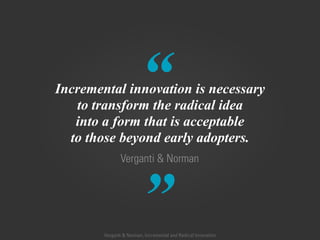
“
”
Verganti & Norman
Incremental innovation is necessary
to transform the radical idea
into a form that is acceptable
to those beyond early adopters.
Verganti & Norman, Incremental and Radical Innovation
Experiment
ISSUE Fear of failure
Failure is intrinsic
ISSUE Failing without learning
Learn and build up
“
”
Sarah Soule
Design thinking stresses the need
to rapidly prototype the solution
so that the designers can get feedback
as quickly as possible.
DESIGN THINKING
PART III
“
”
Tim Brown, IDEO
Design thinking is a human-centered
approach to innovation that draws from the
designer's toolkit to integrate the needs of
people, the possibilities of technology, and
the requirements for business success.
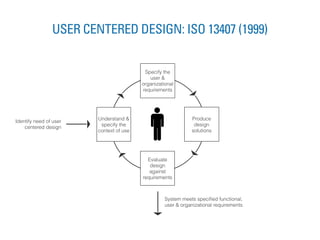
Understand &
specify the
context of use
Specify the
user &
organizational
requirements
Produce
design
solutions
Evaluate
design
against
requirements
Identify need of user
centered design
System meets specified functional,
user & organizational requirements
USER CENTERED DESIGN: ISO 13407 (1999)
Stephanie Gioia (2011) http://www.visualmba.info.
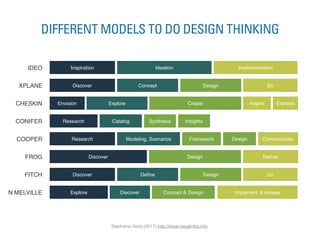
XPLANE Discover Concept DoDesign
CHESKIN Envision Explore InspireCreate Express
CONIFER Research Catalog Synthesis Insights
COOPER Research Modeling, Scenarios DesignFramework Communicate
IDEO Inspiration Ideation Implementation
FROG Discover Design Deliver
FITCH Discover Define DoDesign
N MELVILLE Explore Discover Implement & AssessConcept & Design
DIFFERENT MODELS TO DO DESIGN THINKING
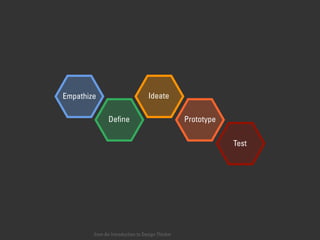
from An Introduction to Design Thinkin
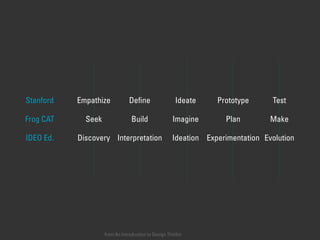
Empathize Define Ideate Prototype TestStanford
Seek Build Imagine Plan MakeFrog CAT
Discovery Interpretation Ideation Experimentation EvolutionIDEO Ed.
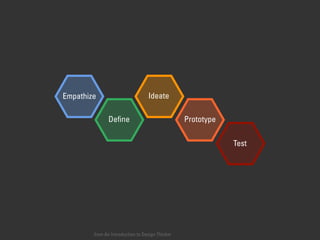
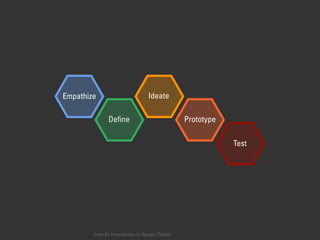
Empathize
Define
Ideate
Prototype
Test
from An Introduction to Design Thinkin
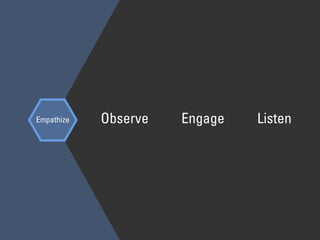
Empathize Observe Engage Listen
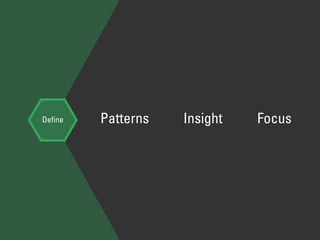
Define Patterns Insight Focus
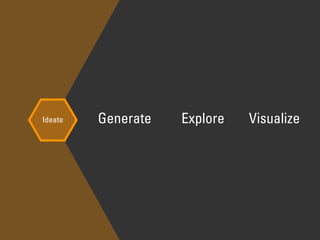
Ideate Generate Explore Visualize
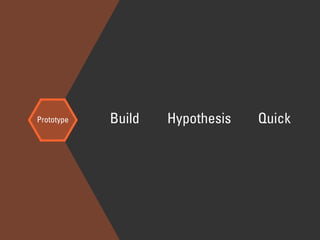
Prototype Build Hypothesis Quick
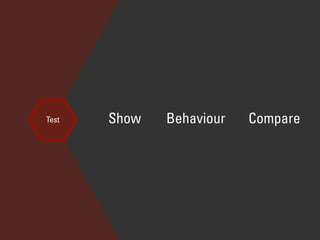
Test Show Behaviour Compare
DESIGN THINKING
SPEED RUN
PART IV
“
”
Confucio
I hear and I forget.
I see and I remember.
I do and I understand.
THIS IS A SPEED RUN
There are many more kinds of
activities that can be done.
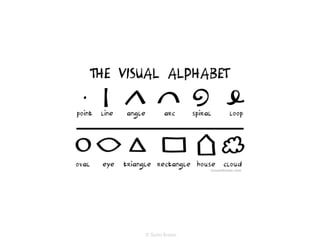
© Sunni Brown
from An Introduction to Design Thinkin
Empathize
Define
Ideate
Prototype
Test
Form a team
Pick a challenge
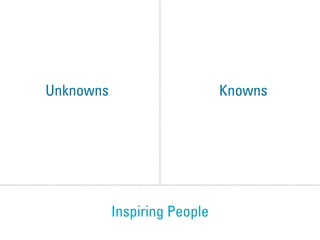
Empathize Un/Knowns
Unknowns Knowns
Inspiring People
Empathize Speak To
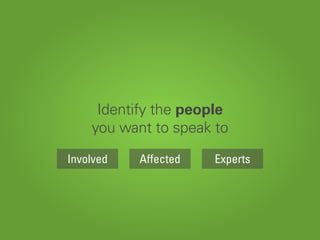
Identify the people
you want to speak to
AffectedInvolved Experts
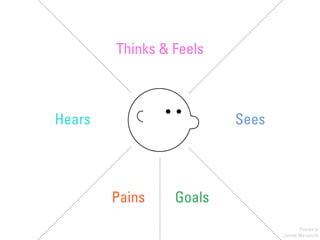
Define Empathy Map
Hears Sees
Thinks & Feels
Pains Goals
Thanks to
James Macanufo
Ideate Generate Ideas
10’ individually · alone · no speaking
share ideas
vote ideas
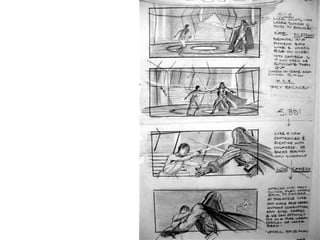
Prototype Storyboarding
create a storyboard
Test Try with another team
find another team,
and share your storyboard
show and tell
WRAP UP
PART V
from An Introduction to Design Thinkin
Empathize
Define
Ideate
Prototype
Test
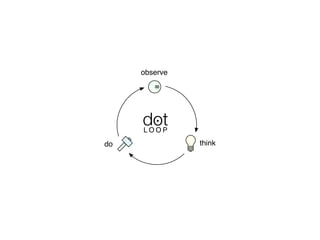
do
observe
think
dotL O O P
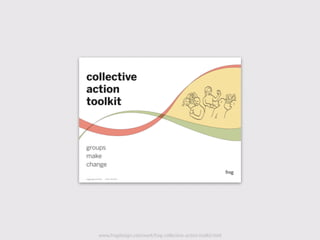
www.frogdesign.com/work/frog-collective-action-toolkit.html
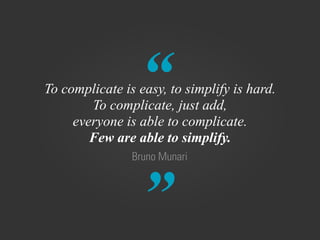
“
”
Bruno Munari
To complicate is easy, to simplify is hard.
To complicate, just add,
everyone is able to complicate.
Few are able to simplify.
Thanks.
@Folletto
INTENSEMINIMALISM.COM

Kickastart