Science Communication 2.0: changing University
    attitude through Science research groups


Ingrid AZNAR, Cristina VALENTÍ and Miquel DURAN

 Unit for Communication of Science, University of Girona
             comunicacio.recerca@udg.edu


 Ingrid Aznar @ingridaznar
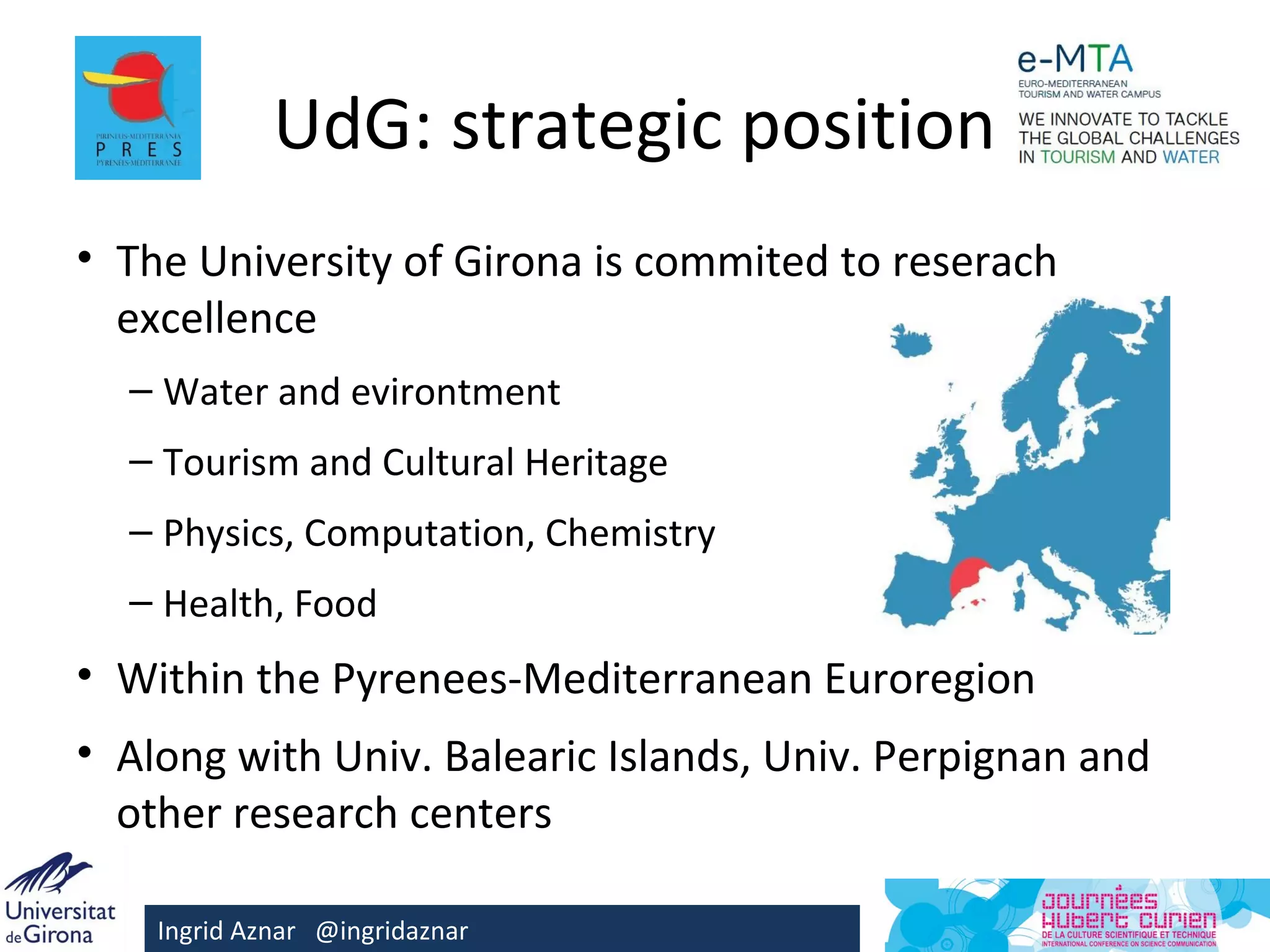
UdG: strategic position
• The University of Girona is commited to reserach
  excellence
  – Water and evirontment
  – Tourism and Cultural Heritage
  – Physics, Computation, Chemistry
  – Health, Food
• Within the Pyrenees-Mediterranean Euroregion
• Along with Univ. Balearic Islands, Univ. Perpignan and
  other research centers

    Ingrid Aznar @ingridaznar
Indeed, ther is a quadruple level in branding
               and reputation
• Institutional / university level
• Departmental / Research Institute level
• Research Group level
• Personal level


• Different brands
• Reputation hindered by current economic downturn


    Ingrid Aznar @ingridaznar
About us: UdGUCC: Activities on promotion and
    dissemination of science and research
 • Children’s University
 • One week Research Campus for 16 yo students
 • Two week Reserach campus for 17 yo students,
   including research work
 • Congress CRACS – preuniversity research
 • Outreach: Researchers’ Night, Science Week,
   Science Fair, FIRST Lego League, etc.
 UdGUCC: Unit for Communication of Science

     Ingrid Aznar @ingridaznar
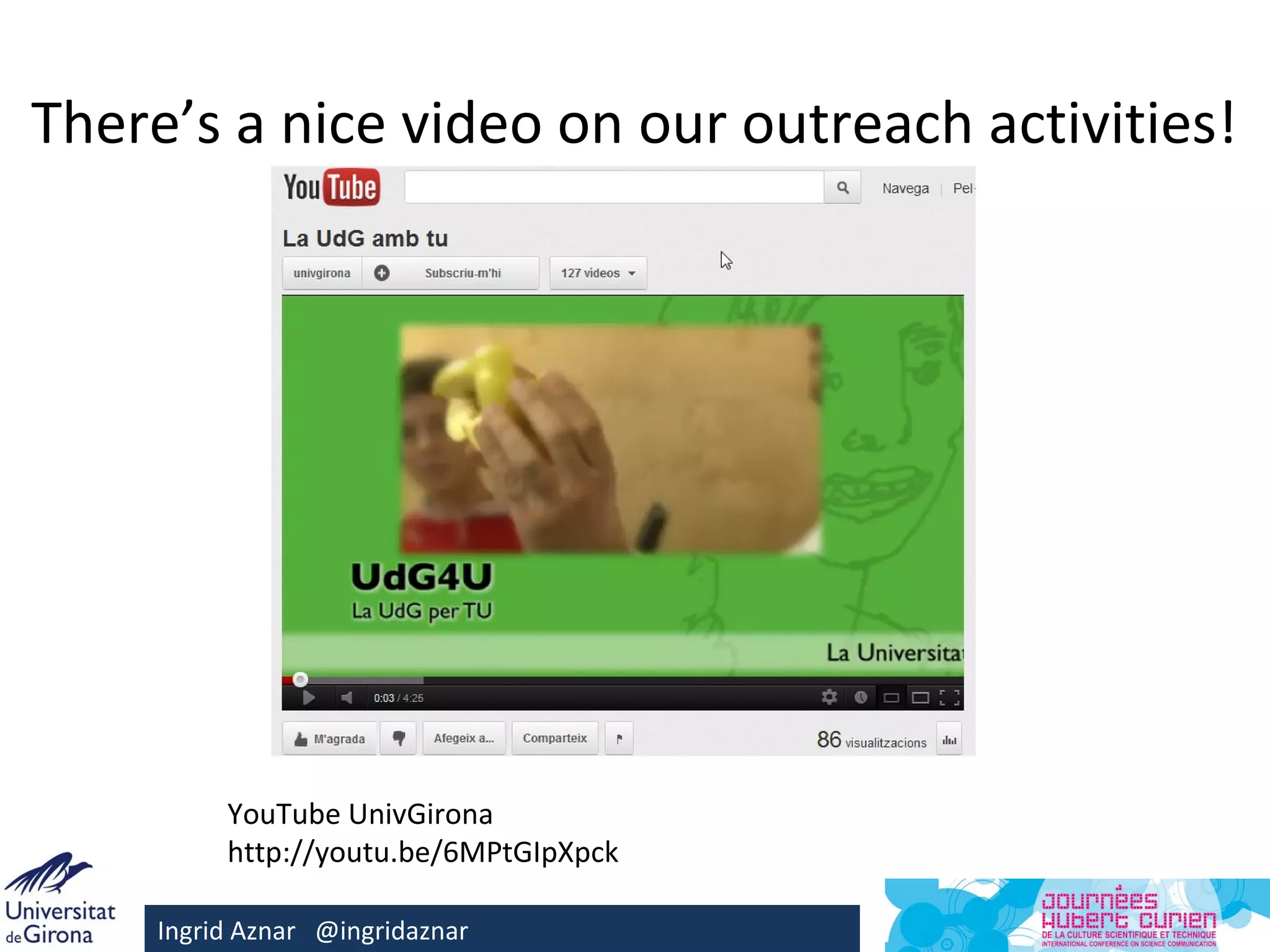
There’s a nice video on our outreach activities!


          YouTube UnivGirona
          http://youtu.be/6MPtGIpXpck

     Ingrid Aznar @ingridaznar
Reorganization of UdG communication team

• We have reorganized completely the communication team,
  merging former marketing, press relations, public relations
  and science communication teams.
• This has lead to increased performance, great coordination,
  and multitarget possibilities, while exploring new ways of
  communicating research and science, like augmented reality,
  geopositioning and especially multimedia tools.
• Fast, direct and active connections with Mass Media and
  Internet-related information channels


    Ingrid Aznar @ingridaznar
Science Communication 2.0
• Communicating Research – 4 levels at least
  – Refereed Papers
  – Communications in General Science Journals
  – Dissemination of Science and Research
  – Talking to young people
• Different formats:
  – Classical article
  – Video (YouTube Generation)
  – Website / mobile / Social (the newest generation)
• Socialization through facebook, twitter, flickr, instagram, youtube,
  tumblr, pinterest and any other system that may appear right today

     Ingrid Aznar @ingridaznar
UdG has its twitter accounts – and now what?

• What about twitter? Main immediacy communication
  channel
• Double monolingual
  – @UnivGirona – mainly in Catalan
  – @UdGGlobal – English-only
• Used mainly by adults, but students entering UdG on
  2012/13 show an increased use
• Very useful for events – hashtags as key curating
  procedure

    Ingrid Aznar @ingridaznar
But we also have facebook, youtube, flickr,
                   etc etc
• We believe that our website shoud be our
  main asset
• Facebook and other social networks are used
  to amplify our website, to engage in
  conversations and to share content
• The Web 2.0 Culture spreads fast amont
  students, but not so much among researchers
  (I don’t have time for that)

   Ingrid Aznar @ingridaznar
The complex language issue
• Local language – Catalan – used primarily all over the
  University of Girona
• Language of Research, strategic: English
• Another official, opportunity language: Spanish
• Language of Geostrategic Opportunity: French
• Other Languages of Opportunity and field-related (Italian,
  German, Russian, Chinese, Japanese, Arabic)
• Thus – 4 main languages
• Difficult to cope with and handle!

    Ingrid Aznar @ingridaznar
Do research groups communicate?

• The 3 worlds (individual, group and center)
  communicate differently!
• Everythink depends too much on individual
  attitudes.
• The Web 2.0 Culture is an attitude!
• The current economic difficulties prevent
  enthousiastic involvement in communication,
  e.g. in Science Outreach activities

   Ingrid Aznar @ingridaznar
What about researchers?
• Almost no one communicates his/her current
  research
• Some communicate key aspects of their
  academic/research life
• Much easiers if related to Social Science
• Hard Science is difficult to communicate
• Struggle in Humanities: yet thinking in a move
  toward Digital Humanities
   Ingrid Aznar @ingridaznar
What about academic units (departaments
              and institutes)
• Departments, even though they gather most
  part of research force, are too focused on
  teaching. Communication of research is scarce
• Research Institutes communicate slightly
  better, but few of them use English ans their
  primary language
• Use of English and amount of communications
  is related to Internationalitzation

   Ingrid Aznar @ingridaznar
So how can we help research from the
                    UdGUCC?
• We help to communicate Ph.D. dissertations
• We provide research news
  – Papers published
  – Discoveries, Patents, Technology transfer
  – Academic Meetings
  – Prizes, Honours, etc.
• Montly University Magazine (“Engega”) with many articles on reserach activity.
• Collaboration with Administrative Research Office
• Connection with Press Office
• But researchers are still too concentrades in the Future (e.g. FP7 calls for funding) that in
  explaining the Past
• We provide formation of the use of Web 2.0 Tools
• And most important: we try to leverage a positive attitude towards communication of
  research


       Ingrid Aznar @ingridaznar
Some ideas to take away
• Web 2.0, Social Networking, Communicating Research – is just an attitude
• There is a paramount task yet in involving and motivating (good) researchers, research
  groups and academic units in communicating (well!) Research and Science.
• Dissemination of Research and Public Outreach is hindered by current issues.
• There is a high pressure (Publish of Perish, Transfer or Die, etc.) that does not free time
  enough to get involved in Public Outreach and Dissemination activities
• A proper system of Rewards could be established to catalyze and promote Science and
  Research communication.
• Thank you very much for your attention!


       Ingrid Aznar @ingridaznar

Science Communication 2.0: changing University attitude through Science research groups

  • 1.
    Science Communication 2.0:changing University attitude through Science research groups Ingrid AZNAR, Cristina VALENTÍ and Miquel DURAN Unit for Communication of Science, University of Girona comunicacio.recerca@udg.edu Ingrid Aznar @ingridaznar
  • 2.
    UdG: strategic position •The University of Girona is commited to reserach excellence – Water and evirontment – Tourism and Cultural Heritage – Physics, Computation, Chemistry – Health, Food • Within the Pyrenees-Mediterranean Euroregion • Along with Univ. Balearic Islands, Univ. Perpignan and other research centers Ingrid Aznar @ingridaznar
  • 3.
    Indeed, ther isa quadruple level in branding and reputation • Institutional / university level • Departmental / Research Institute level • Research Group level • Personal level • Different brands • Reputation hindered by current economic downturn Ingrid Aznar @ingridaznar
  • 4.
    About us: UdGUCC:Activities on promotion and dissemination of science and research • Children’s University • One week Research Campus for 16 yo students • Two week Reserach campus for 17 yo students, including research work • Congress CRACS – preuniversity research • Outreach: Researchers’ Night, Science Week, Science Fair, FIRST Lego League, etc. UdGUCC: Unit for Communication of Science Ingrid Aznar @ingridaznar
  • 5.
    There’s a nicevideo on our outreach activities! YouTube UnivGirona http://youtu.be/6MPtGIpXpck Ingrid Aznar @ingridaznar
  • 6.
    Reorganization of UdGcommunication team • We have reorganized completely the communication team, merging former marketing, press relations, public relations and science communication teams. • This has lead to increased performance, great coordination, and multitarget possibilities, while exploring new ways of communicating research and science, like augmented reality, geopositioning and especially multimedia tools. • Fast, direct and active connections with Mass Media and Internet-related information channels Ingrid Aznar @ingridaznar
  • 7.
    Science Communication 2.0 •Communicating Research – 4 levels at least – Refereed Papers – Communications in General Science Journals – Dissemination of Science and Research – Talking to young people • Different formats: – Classical article – Video (YouTube Generation) – Website / mobile / Social (the newest generation) • Socialization through facebook, twitter, flickr, instagram, youtube, tumblr, pinterest and any other system that may appear right today Ingrid Aznar @ingridaznar
  • 8.
    UdG has itstwitter accounts – and now what? • What about twitter? Main immediacy communication channel • Double monolingual – @UnivGirona – mainly in Catalan – @UdGGlobal – English-only • Used mainly by adults, but students entering UdG on 2012/13 show an increased use • Very useful for events – hashtags as key curating procedure Ingrid Aznar @ingridaznar
  • 9.
    But we alsohave facebook, youtube, flickr, etc etc • We believe that our website shoud be our main asset • Facebook and other social networks are used to amplify our website, to engage in conversations and to share content • The Web 2.0 Culture spreads fast amont students, but not so much among researchers (I don’t have time for that) Ingrid Aznar @ingridaznar
  • 10.
    The complex languageissue • Local language – Catalan – used primarily all over the University of Girona • Language of Research, strategic: English • Another official, opportunity language: Spanish • Language of Geostrategic Opportunity: French • Other Languages of Opportunity and field-related (Italian, German, Russian, Chinese, Japanese, Arabic) • Thus – 4 main languages • Difficult to cope with and handle! Ingrid Aznar @ingridaznar
  • 11.
    Do research groupscommunicate? • The 3 worlds (individual, group and center) communicate differently! • Everythink depends too much on individual attitudes. • The Web 2.0 Culture is an attitude! • The current economic difficulties prevent enthousiastic involvement in communication, e.g. in Science Outreach activities Ingrid Aznar @ingridaznar
  • 12.
    What about researchers? •Almost no one communicates his/her current research • Some communicate key aspects of their academic/research life • Much easiers if related to Social Science • Hard Science is difficult to communicate • Struggle in Humanities: yet thinking in a move toward Digital Humanities Ingrid Aznar @ingridaznar
  • 13.
    What about academicunits (departaments and institutes) • Departments, even though they gather most part of research force, are too focused on teaching. Communication of research is scarce • Research Institutes communicate slightly better, but few of them use English ans their primary language • Use of English and amount of communications is related to Internationalitzation Ingrid Aznar @ingridaznar
  • 14.
    So how canwe help research from the UdGUCC? • We help to communicate Ph.D. dissertations • We provide research news – Papers published – Discoveries, Patents, Technology transfer – Academic Meetings – Prizes, Honours, etc. • Montly University Magazine (“Engega”) with many articles on reserach activity. • Collaboration with Administrative Research Office • Connection with Press Office • But researchers are still too concentrades in the Future (e.g. FP7 calls for funding) that in explaining the Past • We provide formation of the use of Web 2.0 Tools • And most important: we try to leverage a positive attitude towards communication of research Ingrid Aznar @ingridaznar
  • 15.
    Some ideas totake away • Web 2.0, Social Networking, Communicating Research – is just an attitude • There is a paramount task yet in involving and motivating (good) researchers, research groups and academic units in communicating (well!) Research and Science. • Dissemination of Research and Public Outreach is hindered by current issues. • There is a high pressure (Publish of Perish, Transfer or Die, etc.) that does not free time enough to get involved in Public Outreach and Dissemination activities • A proper system of Rewards could be established to catalyze and promote Science and Research communication. • Thank you very much for your attention! Ingrid Aznar @ingridaznar