Wong, Sherwin  Calara, Grace anne  Ramonida, Anthony  Garcia, Cyruz Jetrix Rambuyon, John Rhysby  KFC Kentucky Fried Chicken Organizational Review 1
Front Page ………………………………………………………………………………….1 Table of Content  …………………………………........…………………………………..2 Vision and Mission of the Organization  ………………………………..…………..……. 3 Background of the Organization or the Establishment  ……………………….…...………4 Organizational Chart ………………………………………...………………………….….5 Organizational Design ……………………………………………………………………...6 S.W.O.T. Analysis ………………….………………………………………………………7 2 TABLE OF CONTENT
Vision  To be the leading integrated food services group in the ASEAN region delivering consistent  quality products and excellent customer-focused service.  Mission   To maximize profitability, improve shareholder value and deliver sustainable growth year after  Year.  3 VISION AND MISSION
History/ Background of Establishment  Since its inception, KFC has evolved through several different organizational changes. These  changes were brought about due to the changes of ownership that followed since Colonel Sanders first sold KFC in 1964. In 1964, KFC was sold to a small group of investors that  eventually took it public. Heublein, Inc, purchased KFC in 1971 and was highly involved in the  day to day operations. R.J. Reynolds then acquired Heublein in 1982. R.J. took a more laid back  approach and allowed business as usual at KFC. Finally, in 1986, KFC was acquired by PepsiCo,  which was trying to grow its quick serve restaurant segment. PepsiCo presently runs Taco Bell,  Pizza Hut, and KFC. The PepsiCo management style and corporate culture was significantly different from that of KFC.  PepsiCo has a consumer product orientation. PepsiCo found that the marketing of fast food was  very similar to the marketing of its soft drinks and snack foods. PepsiCo reorganized itself in  1985. It divested non-compatible units and organized along three lines: soft drinks, snack foods  and restaurants. PepsiCo Worldwide Restaurants was created to create synergism between its restaurant companies.  By the end of 1994, KFC was operating 4,258 restaurants in 68 foreign countries. KFC is the  largest chicken restaurant and the third largest quick service chain in the world. Due to market saturation in  the United States, international expansion will be critical to increased profitability and growth.  4
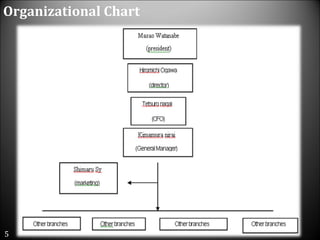
Organizational Chart 5
Organizational Structure  KFC adapted their traditional structure of their outlets that other food chains following.  There is one General manager, the outlet is leaded by the manager and assisted by two assistant managers, and one shift in charge that supervise the performance of counter workers and kitchen workers.  Another strategy of KFC is currently working with is to improve operating efficiencies. This in turn can directly impact the operating profit of the firm. In 1989, KFC centered on elimination of  overhead costs and increased efficiency. This reorganization was in the U.S. operations and  included a revision of KFC's crew training programs and operating standards. They emphasized  customer service, cleaner restaurants, faster and friendlier service, and continued high-quality products.  In 1992, KFC continued with another reorganization in its middle management ranks. They  eliminated 250 of the 1500 management positions at corporate and gave the responsibilities to restaurant franchises and marketing managers  6
Structuring The organization is currently structured with two divisions under PepsiCo. David Novak is president of KFC. John Hill is Chief Financial Officer and Colin Moore is the head of Marketing. Peter Waller is head of franchising while Olden Lee is head of Human Resources. KFC is part of the two PepsiCo divisions, which are PepsiCo Worldwide Restaurants and PepsiCo Restaurants International. Both of these divisions of PepsiCo are based in Dallas. Another strategy of KFC is currently working with is to improve operating efficiencies.
7
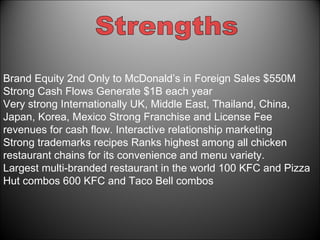
Brand Equity 2nd Only to McDonald’s in Foreign Sales $550M Strong Cash Flows Generate $1B each year Very strong Internationally UK, Middle East, Thailand, China, Japan, Korea, Mexico Strong Franchise and License Fee revenues for cash flow. Interactive relationship marketing Strong trademarks recipes Ranks highest among all chicken restaurant chains for its convenience and menu variety. Largest multi-branded restaurant in the world 100 KFC and Pizza Hut combos 600 KFC and Taco Bell combos Strengths
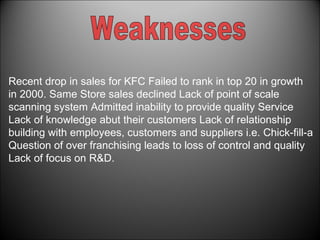
Recent drop in sales for KFC Failed to rank in top 20 in growth in 2000. Same Store sales declined Lack of point of scale scanning system Admitted inability to provide quality Service Lack of knowledge abut their customers Lack of relationship building with employees, customers and suppliers i.e. Chick-fill-a Question of over franchising leads to loss of control and quality Lack of focus on R&D. Weaknesses
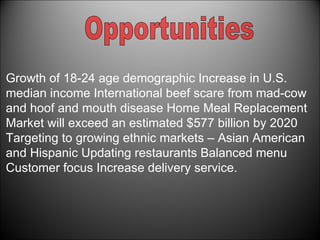
Growth of 18-24 age demographic Increase in U.S. median income International beef scare from mad-cow and hoof and mouth disease Home Meal Replacement Market will exceed an estimated $577 billion by 2020 Targeting to growing ethnic markets – Asian American and Hispanic Updating restaurants Balanced menu Customer focus Increase delivery service. Opportunities
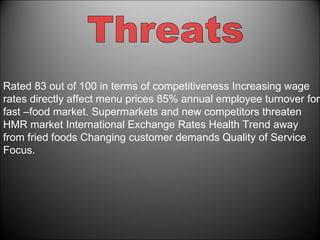
Rated 83 out of 100 in terms of competitiveness Increasing wage rates directly affect menu prices 85% annual employee turnover for fast –food market. Supermarkets and new competitors threaten HMR market International Exchange Rates Health Trend away from fried foods Changing customer demands Quality of Service Focus. Threats
"I REMAIN RONAN"

KFC - Project in HBO

  • 1.
    Wong, Sherwin Calara, Grace anne Ramonida, Anthony Garcia, Cyruz Jetrix Rambuyon, John Rhysby KFC Kentucky Fried Chicken Organizational Review 1
  • 2.
    Front Page ………………………………………………………………………………….1Table of Content …………………………………........…………………………………..2 Vision and Mission of the Organization ………………………………..…………..……. 3 Background of the Organization or the Establishment ……………………….…...………4 Organizational Chart ………………………………………...………………………….….5 Organizational Design ……………………………………………………………………...6 S.W.O.T. Analysis ………………….………………………………………………………7 2 TABLE OF CONTENT
  • 3.
    Vision Tobe the leading integrated food services group in the ASEAN region delivering consistent quality products and excellent customer-focused service. Mission To maximize profitability, improve shareholder value and deliver sustainable growth year after Year. 3 VISION AND MISSION
  • 4.
    History/ Background ofEstablishment Since its inception, KFC has evolved through several different organizational changes. These changes were brought about due to the changes of ownership that followed since Colonel Sanders first sold KFC in 1964. In 1964, KFC was sold to a small group of investors that eventually took it public. Heublein, Inc, purchased KFC in 1971 and was highly involved in the day to day operations. R.J. Reynolds then acquired Heublein in 1982. R.J. took a more laid back approach and allowed business as usual at KFC. Finally, in 1986, KFC was acquired by PepsiCo, which was trying to grow its quick serve restaurant segment. PepsiCo presently runs Taco Bell, Pizza Hut, and KFC. The PepsiCo management style and corporate culture was significantly different from that of KFC. PepsiCo has a consumer product orientation. PepsiCo found that the marketing of fast food was very similar to the marketing of its soft drinks and snack foods. PepsiCo reorganized itself in 1985. It divested non-compatible units and organized along three lines: soft drinks, snack foods and restaurants. PepsiCo Worldwide Restaurants was created to create synergism between its restaurant companies. By the end of 1994, KFC was operating 4,258 restaurants in 68 foreign countries. KFC is the largest chicken restaurant and the third largest quick service chain in the world. Due to market saturation in the United States, international expansion will be critical to increased profitability and growth. 4
  • 5.
  • 6.
    Organizational Structure KFC adapted their traditional structure of their outlets that other food chains following. There is one General manager, the outlet is leaded by the manager and assisted by two assistant managers, and one shift in charge that supervise the performance of counter workers and kitchen workers. Another strategy of KFC is currently working with is to improve operating efficiencies. This in turn can directly impact the operating profit of the firm. In 1989, KFC centered on elimination of overhead costs and increased efficiency. This reorganization was in the U.S. operations and included a revision of KFC's crew training programs and operating standards. They emphasized customer service, cleaner restaurants, faster and friendlier service, and continued high-quality products. In 1992, KFC continued with another reorganization in its middle management ranks. They eliminated 250 of the 1500 management positions at corporate and gave the responsibilities to restaurant franchises and marketing managers 6
  • 7.
    Structuring The organizationis currently structured with two divisions under PepsiCo. David Novak is president of KFC. John Hill is Chief Financial Officer and Colin Moore is the head of Marketing. Peter Waller is head of franchising while Olden Lee is head of Human Resources. KFC is part of the two PepsiCo divisions, which are PepsiCo Worldwide Restaurants and PepsiCo Restaurants International. Both of these divisions of PepsiCo are based in Dallas. Another strategy of KFC is currently working with is to improve operating efficiencies.
  • 8.
  • 9.
    Brand Equity 2ndOnly to McDonald’s in Foreign Sales $550M Strong Cash Flows Generate $1B each year Very strong Internationally UK, Middle East, Thailand, China, Japan, Korea, Mexico Strong Franchise and License Fee revenues for cash flow. Interactive relationship marketing Strong trademarks recipes Ranks highest among all chicken restaurant chains for its convenience and menu variety. Largest multi-branded restaurant in the world 100 KFC and Pizza Hut combos 600 KFC and Taco Bell combos Strengths
  • 10.
    Recent drop insales for KFC Failed to rank in top 20 in growth in 2000. Same Store sales declined Lack of point of scale scanning system Admitted inability to provide quality Service Lack of knowledge abut their customers Lack of relationship building with employees, customers and suppliers i.e. Chick-fill-a Question of over franchising leads to loss of control and quality Lack of focus on R&D. Weaknesses
  • 11.
    Growth of 18-24age demographic Increase in U.S. median income International beef scare from mad-cow and hoof and mouth disease Home Meal Replacement Market will exceed an estimated $577 billion by 2020 Targeting to growing ethnic markets – Asian American and Hispanic Updating restaurants Balanced menu Customer focus Increase delivery service. Opportunities
  • 12.
    Rated 83 outof 100 in terms of competitiveness Increasing wage rates directly affect menu prices 85% annual employee turnover for fast –food market. Supermarkets and new competitors threaten HMR market International Exchange Rates Health Trend away from fried foods Changing customer demands Quality of Service Focus. Threats
  • 13.