PRESENTED BY:
MEHAK BHARDWAJ
MANISH MALHOTRA
SWATI RAWAT
KULPREET KAUR
CONTENTS
Environment Analysis: Mehak
Value Chain Analysis: Manish
Ansoff Matrix: Manish
BCG Matrix: Swati
STP: Swati
Impact of consumer behaviour on brand’s strategy: Swati
Product’s Strategy: Kulpreet
Brand’s positioning strategies:Kulpreet
PLC: Mehak
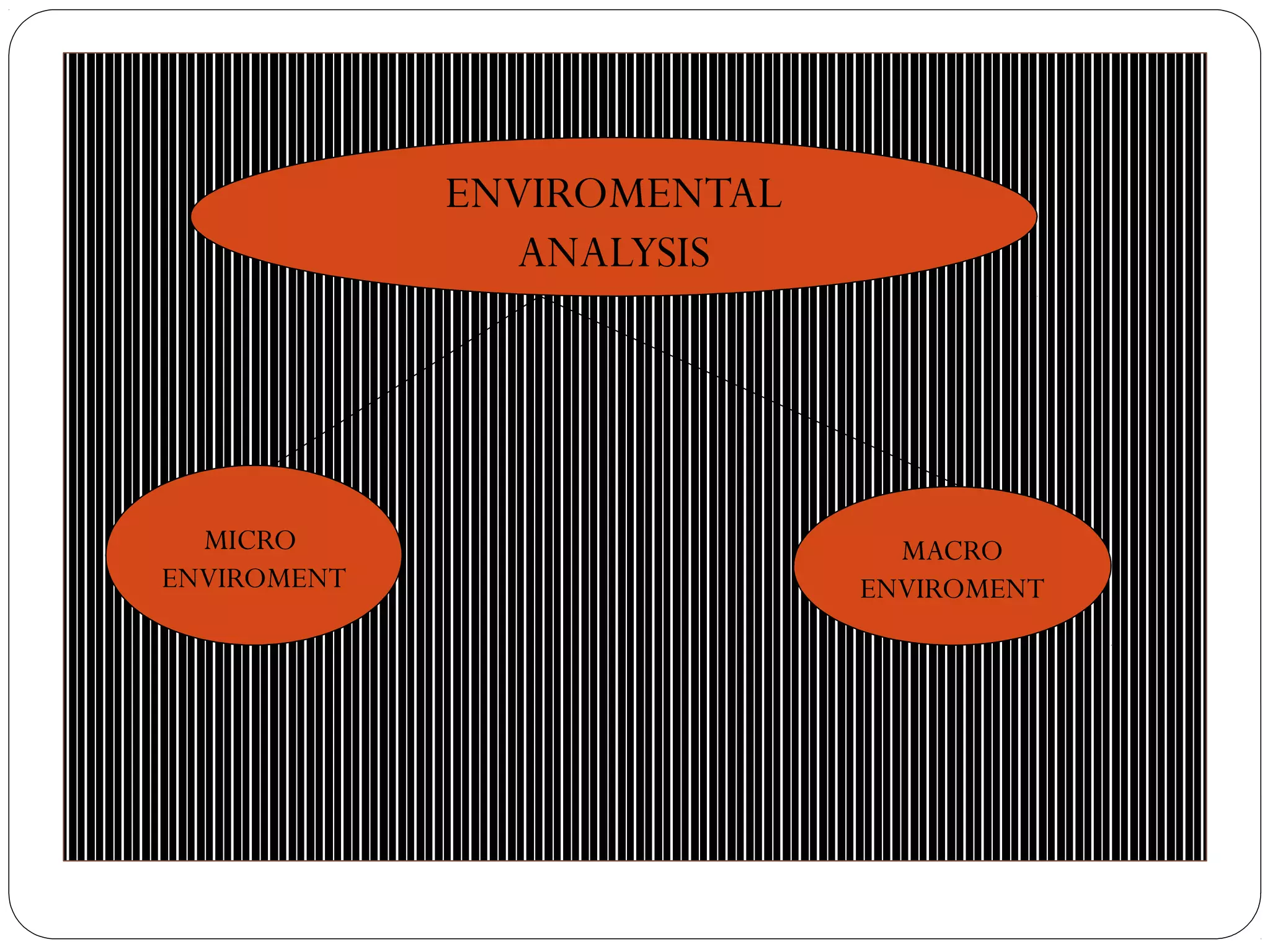
ENVIROMENTAL
ANALYSIS

MICRO
ENVIROMENT

MACRO
ENVIROMENT
MICRO ENVIROMENT:

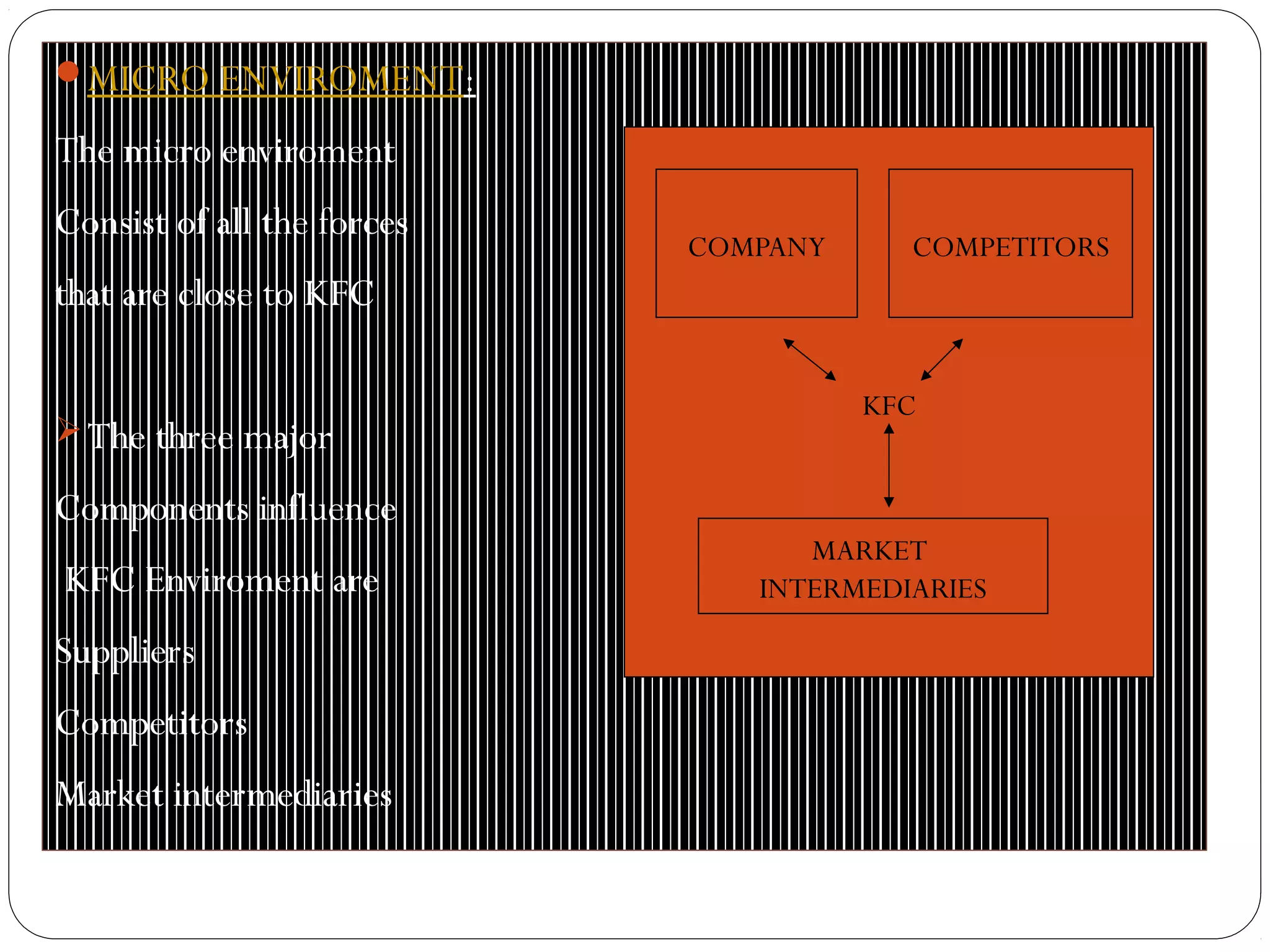
The micro enviroment
Consist of all the forces

COMPANY

COMPETITORS

that are close to KFC
 The three major

KFC

Components influence
KFC Enviroment are
Suppliers
Competitors
Market intermediaries

MARKET
INTERMEDIARIES
SUPPLIERS :

> Suppliers are those people who are responsible for

supplying necessary inputs to the organization and ensure the
smooth flow of production.
COMPETITORS :

> Competitors can be called the close rivals and in order to

survive the competition one has to keep a close look in the
market and formulate its policies and strategies as such to face
the competition
MARKETING INTERMEDIARIES :

> Marketing intermediaries aid the company in promoting,

selling and distribution of the goods and services to its final
users. Therefore, marketing intermediaries are vital link
between the business and the consumers.
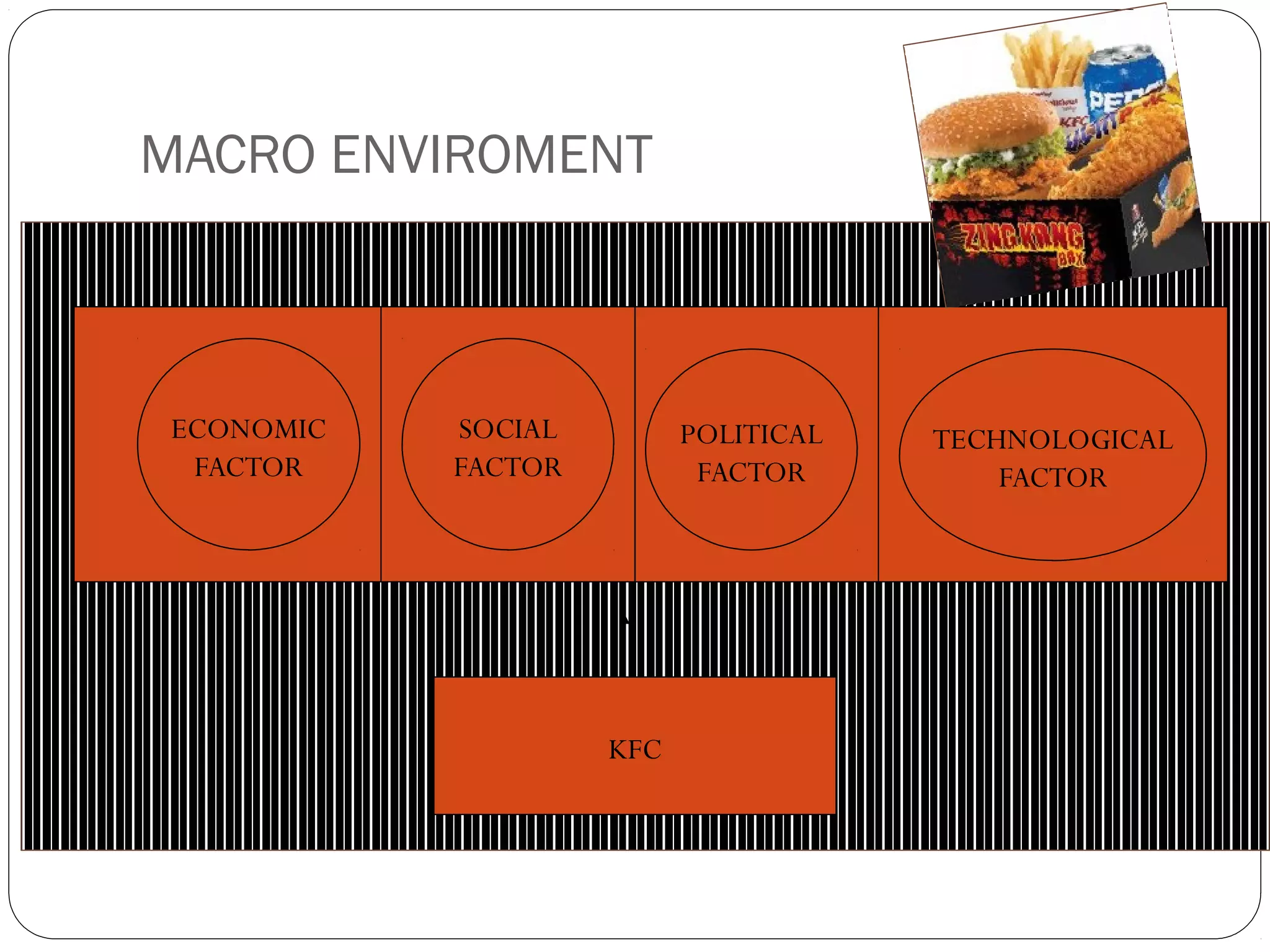
MACRO ENVIROMENT

ECONOMIC
FACTOR

SOCIAL
FACTOR

POLITICAL
FACTOR

KFC

TECHNOLOGICAL
FACTOR
ECONOMIC FACTORS :

>Economic factors includes economic conditions and
economic policies that together constitutes the economic
environment. These includes growth rate, inflation, restrictive
trade practices etc. Which have a considerable impact on the
business.
SOCIAL FACTORS :

>Social factors includes the society as a whole alongside its
preferences and priorities like the buying and consumption
pattern, beliefs of people their purchasing power, educational
background etc.
POLITICAL FACTORS :

>The political factors are related to the management of
public affairs and their impact on the business. It is important
to  have a political stability to maintain stability in the trade.
TECHNOLOGICAL FACTORS :

>Latest technologies helps in improving the marketability
of the product plus makes it more consumer friendly.
Therefore, it is important for a business to keep a pace with
the changing technologies in order to survive in the long run
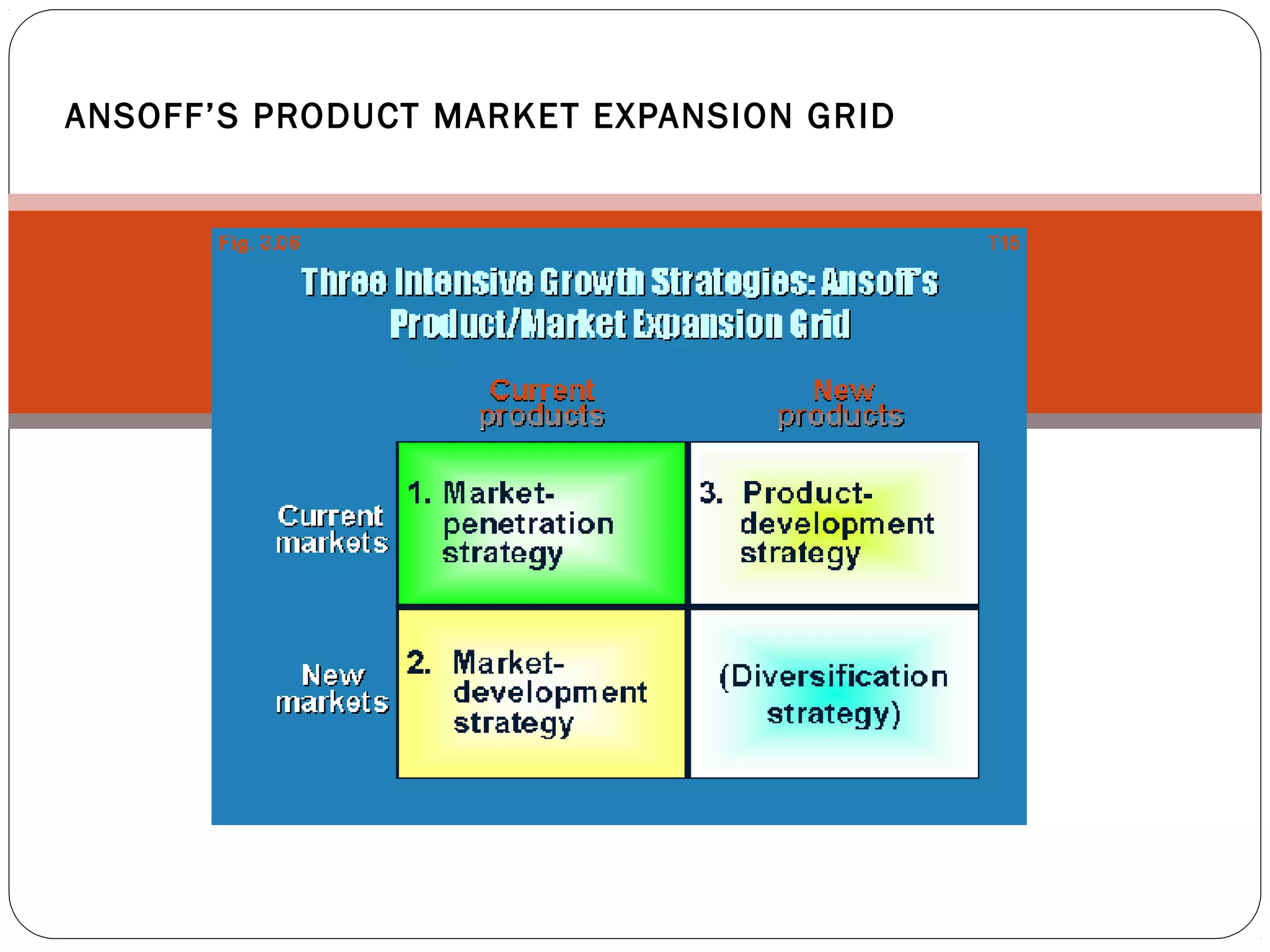
ANSOFF’S PRODUCT MARKET EXPANSION GRID
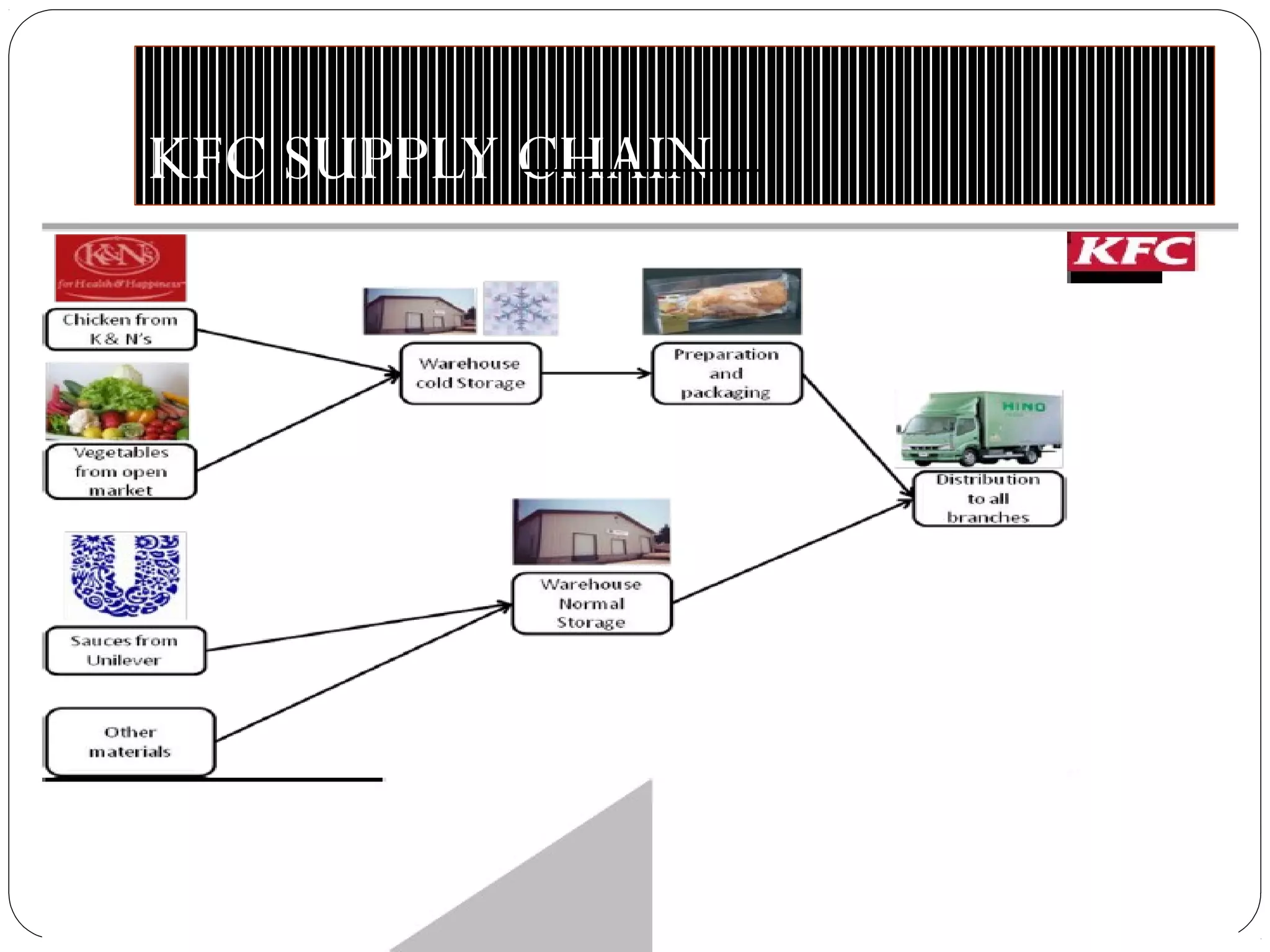
KFC SUPPLY CHAIN
 

SUPPLY CHAIN MANAGEMENT
 
KFC has a very simple supply chain. As the operations are on a relatively small scale, all theoperations are
performed by the company (i.e. Cupola) itself. The supply chain process can besummed up as a 3 step process:
Step 1:

Raw materials procured from various suppliers and stored at two warehouses; the
normal-storageand the cold-storage. Details are discussed later.
Step 2:

All product preparation is done at the branch except for the marination of chicken and sold tocustomers at the
branch itself or delivered at the desired locations.
Step 3:

Warehouses replenish each branch according to their requirement (usually three times a week)using company’s
own vehicles and drivers upon the request of the branch manage
STORAGE AND INVENTORY MANAGEMENT
Chicken

Inventory of chicken is for 15 days. The storage area for chicken is not in
the warehouse itself  but in a separate cold storage area built right beside
the warehouse in each region.Before marinating, the chicken is stored in an
organized form in six separate cold storage rooms whose area is around 45
to 50 square feet, having a height of around 7 feet. The chicken is stored in
the same baskets which it comes in and stays there till its turn for
marinating . Marination is done in a separate room in the same cold storage
facility where the chicken is firstwashed and mixed with the herbs and
spices it needs. The mixture is fed into a machine knownas‘Tumbler’
which marinates it. After this is done the chicken is re packed into
labeled clear storage room again in organised form.
QUALITY ASSURANCE BY KFC
 
There are multiple ways by which KFC assures the quality of
its products. Some of the oneswhich were disclosed to us were:
Surprise visits to branches
Planned visits to branches
Rigorous raw material inspection
Customer feedback 
SEGMENTATION

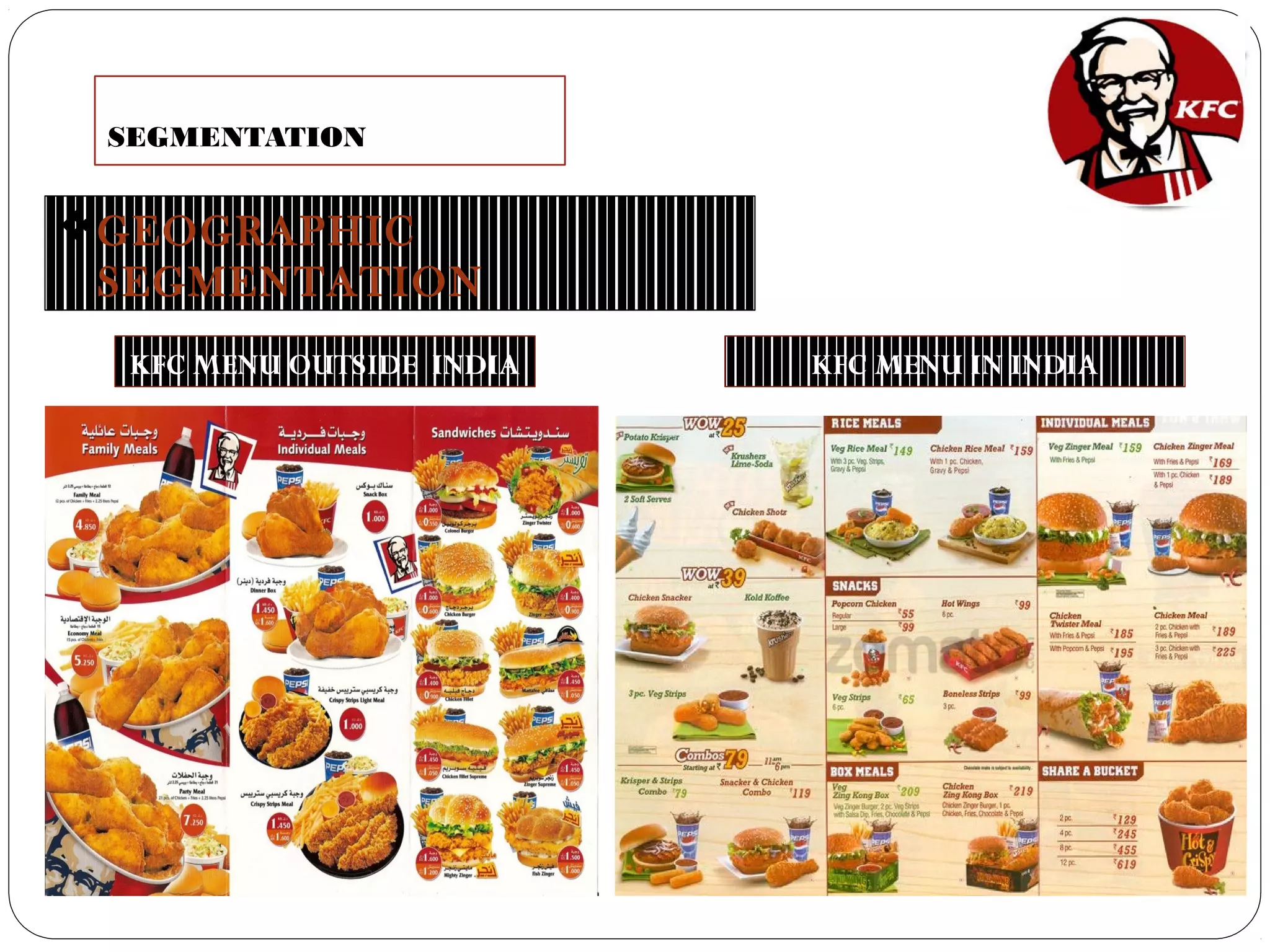
GEOGRAPHIC
SEGMENTATION
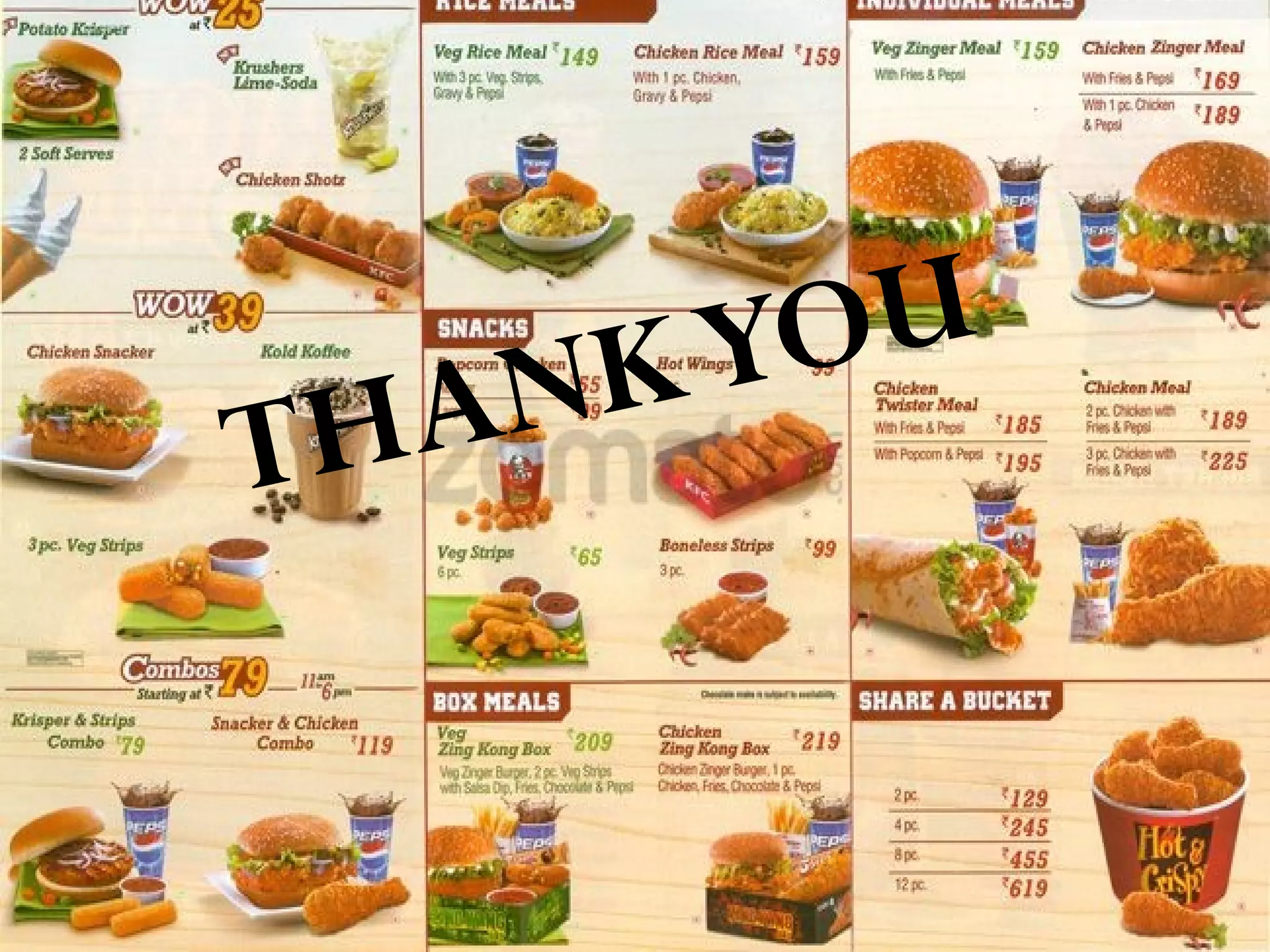
KFC MENU OUTSIDE INDIA

KFC MENU IN INDIA
SEGMENTATION
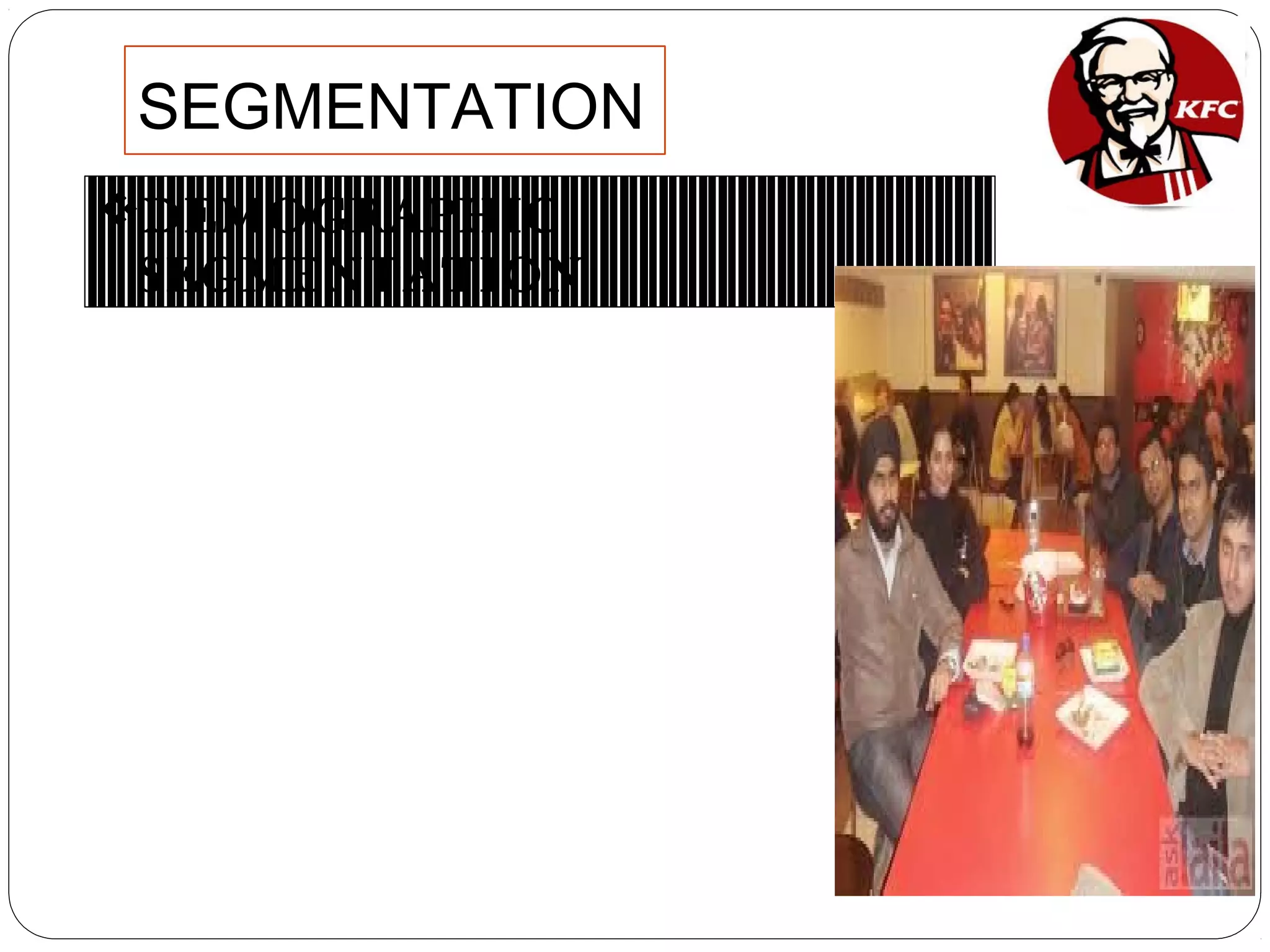
DEMOGRAPHIC
SEGMENTATION:
SEGMENTATION
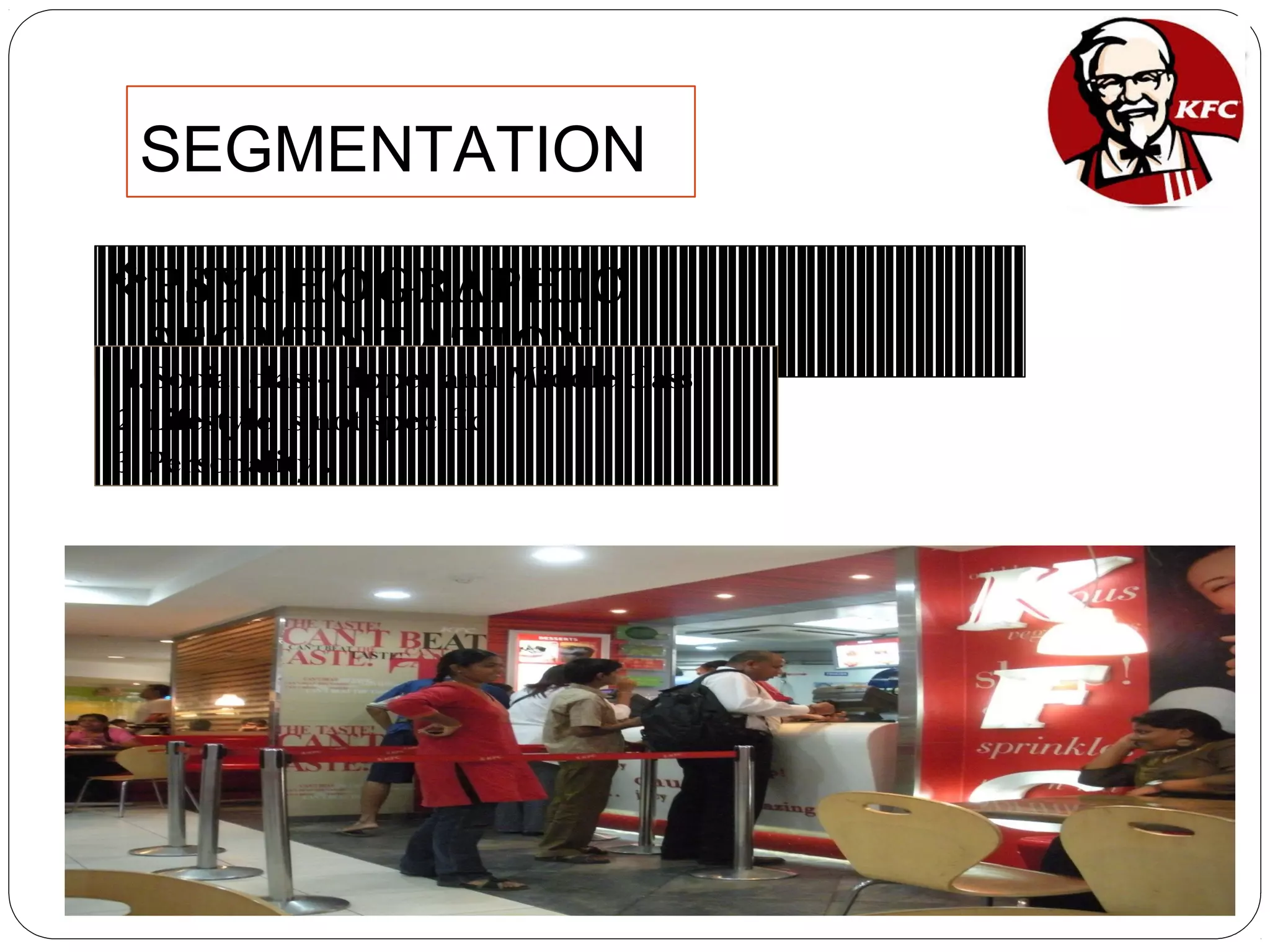
PSYCHOGRAPHIC
SEGMENTATION

 1. Social class- Upper and Middle class.

2. Lifestyle is not specific.
3. Personality .
SEGMENTATION
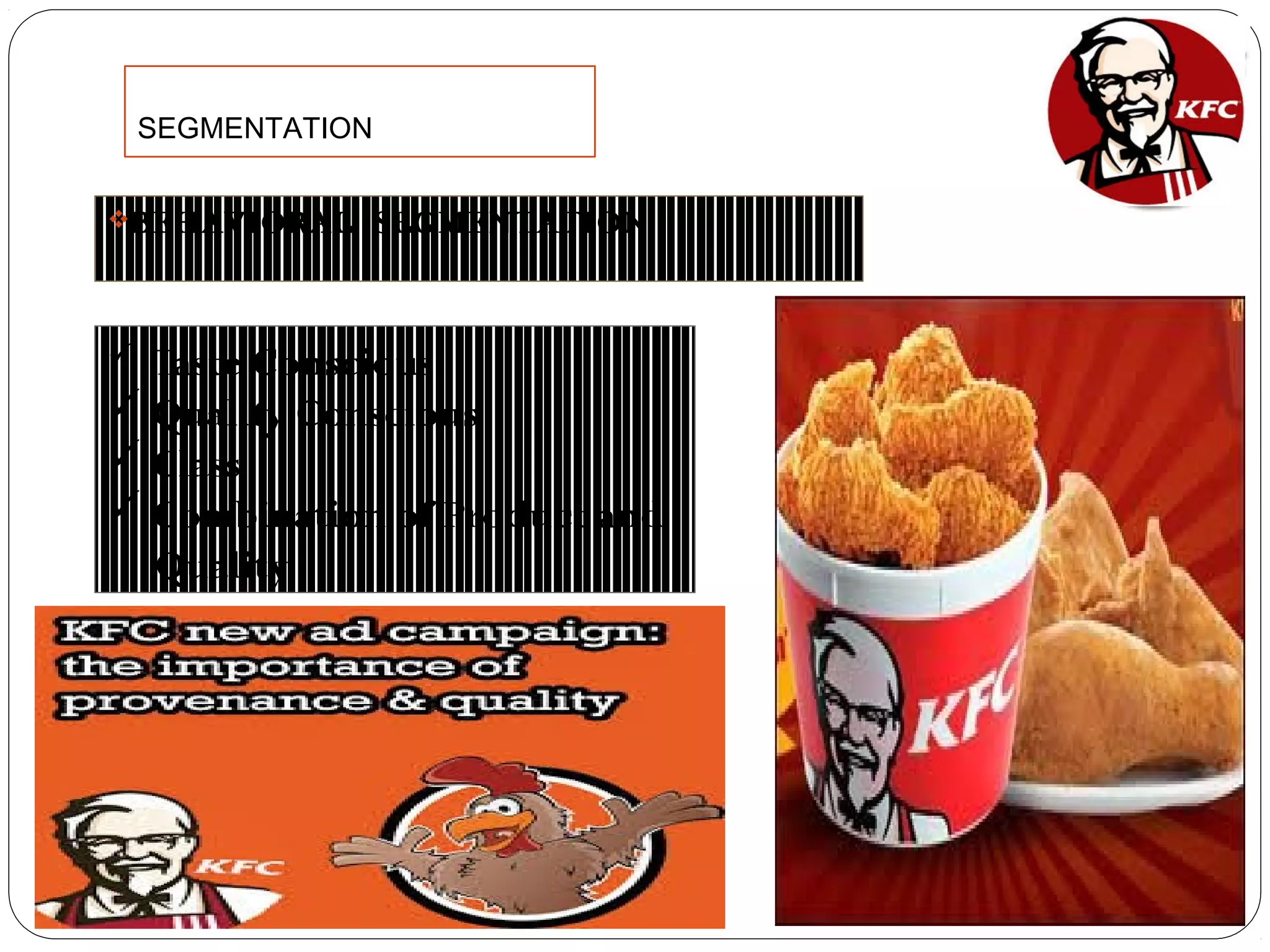
BEHAVIORAL SEGMENTATION

Taste Conscious
 Quality Conscious 
 Class
 Combination of Product and
Quality

TARGET MARKET

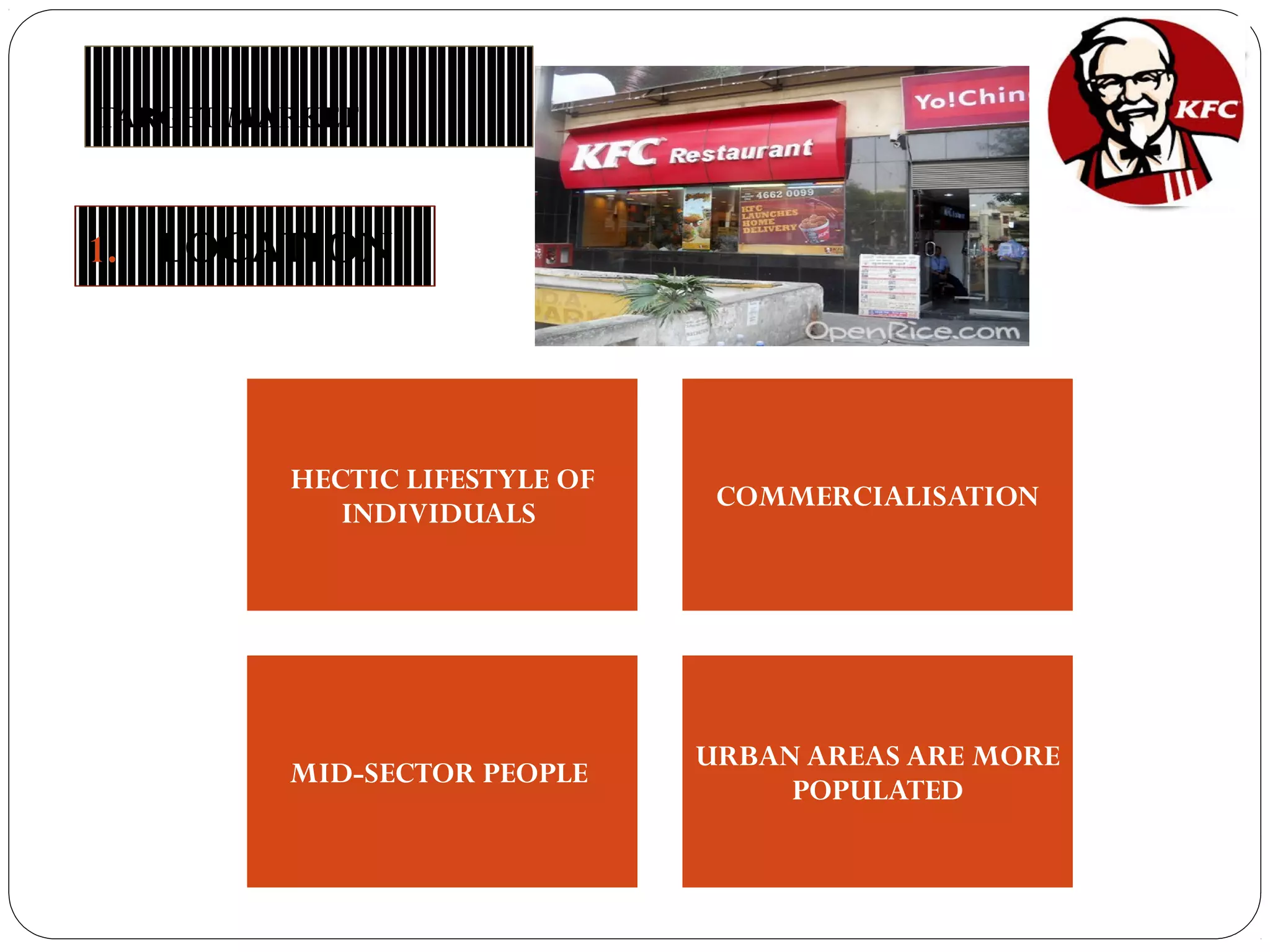
1. LOCATION

HECTIC LIFESTYLE OF
INDIVIDUALS

COMMERCIALISATION

MID-SECTOR PEOPLE

URBAN AREAS ARE MORE
POPULATED
TARGET MARKET
2. PLACEMENT OF OUTLETS

•
•

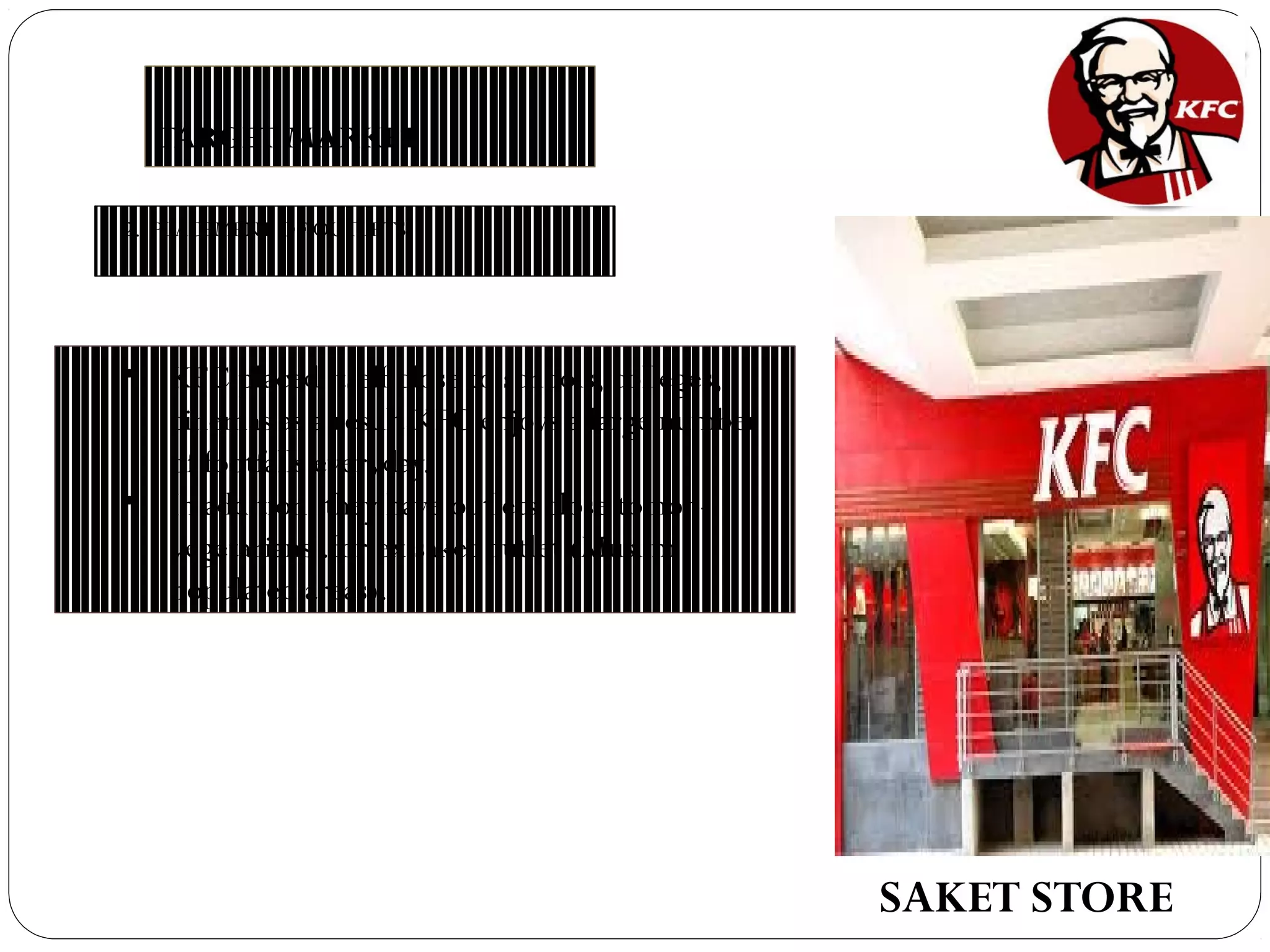
KFC placed itself close to schools, colleges,
cinemas as a result KFC enjoys a large number
of footfalls everyday.
In addition, they have outlets close to nonvegetarians .for ex saket outlet (Muslim
populated areas).

SAKET STORE
INDIAN MARKET

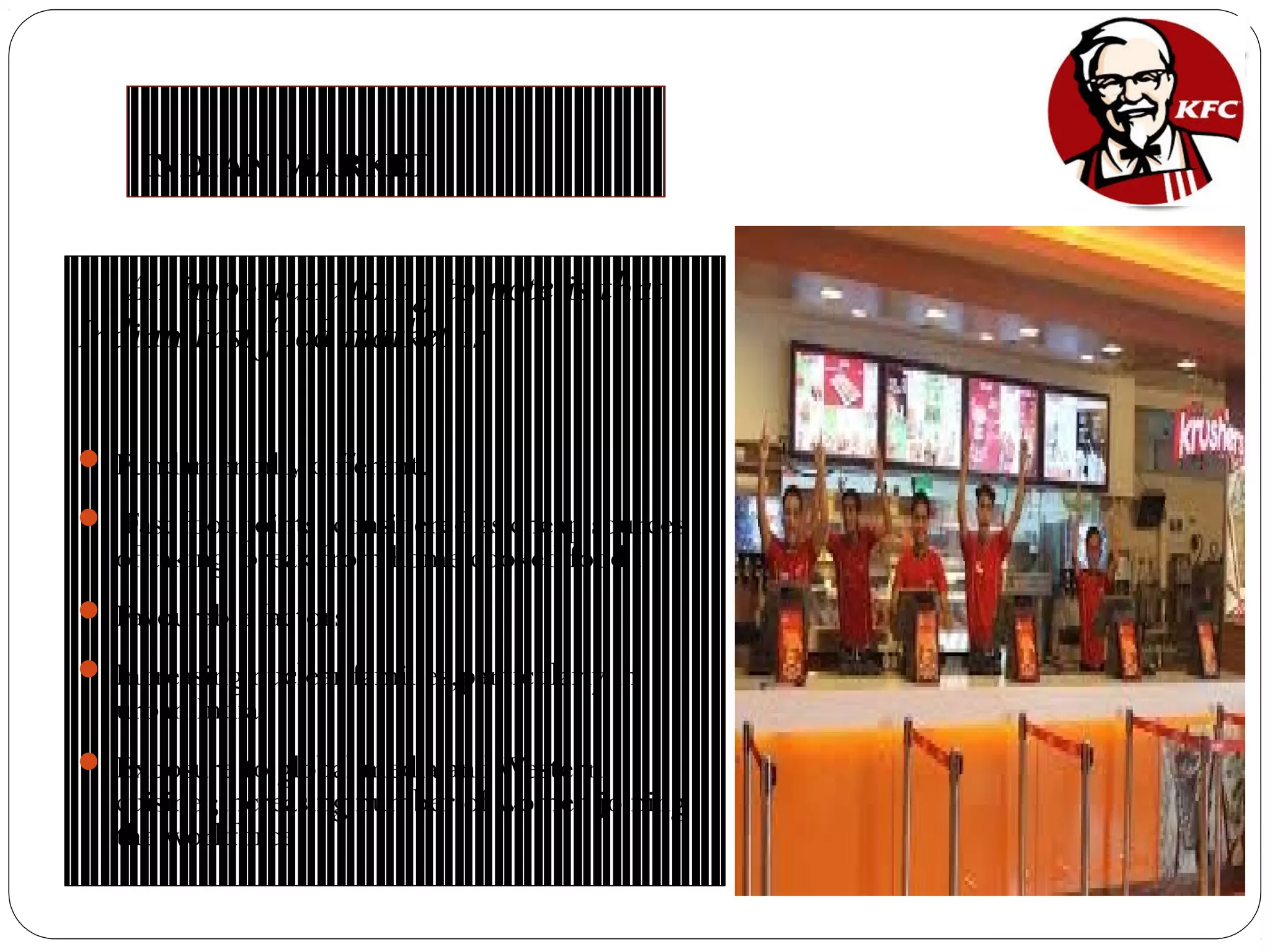
An important thing to note is that
Indian Fast food market is
 Fundamentally different.
 Fast food joints: considered as cheap sources

of taking break from home cooked food .

 Favourable factors:
 Increasing nuclear families,particularly in

urban India

 Exposure to global media and Western

cuisine ;increasing number of women joining
the workforce
POSITIONING
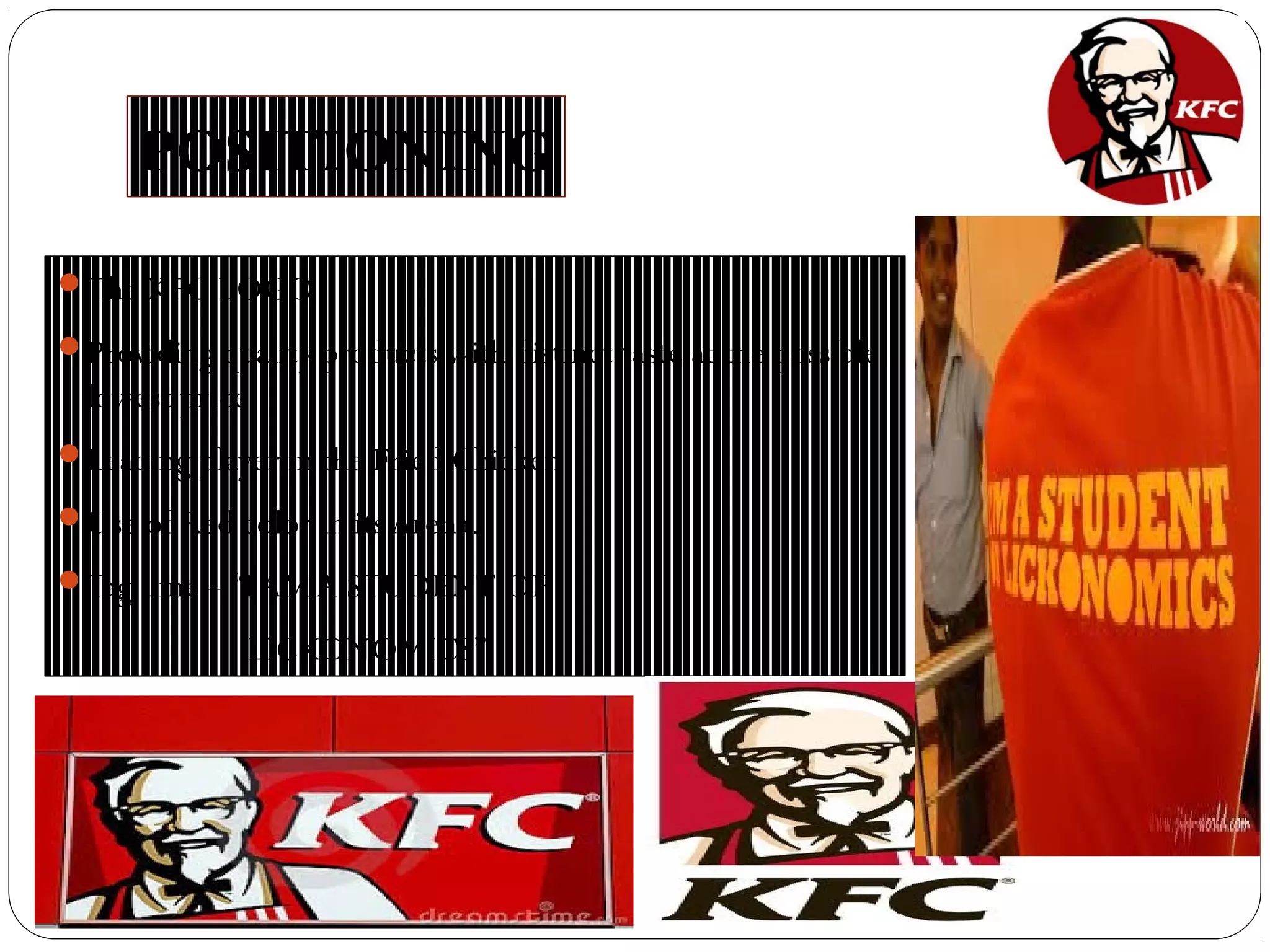
The KFC LOGO
Providing quality products with distinct taste at the possible

lowest price.
Leading player in the Fried Chicken.
Use of Red color in its Arena.
Tag Line – “I AM A STUDENT OF

LICKONOMICS”
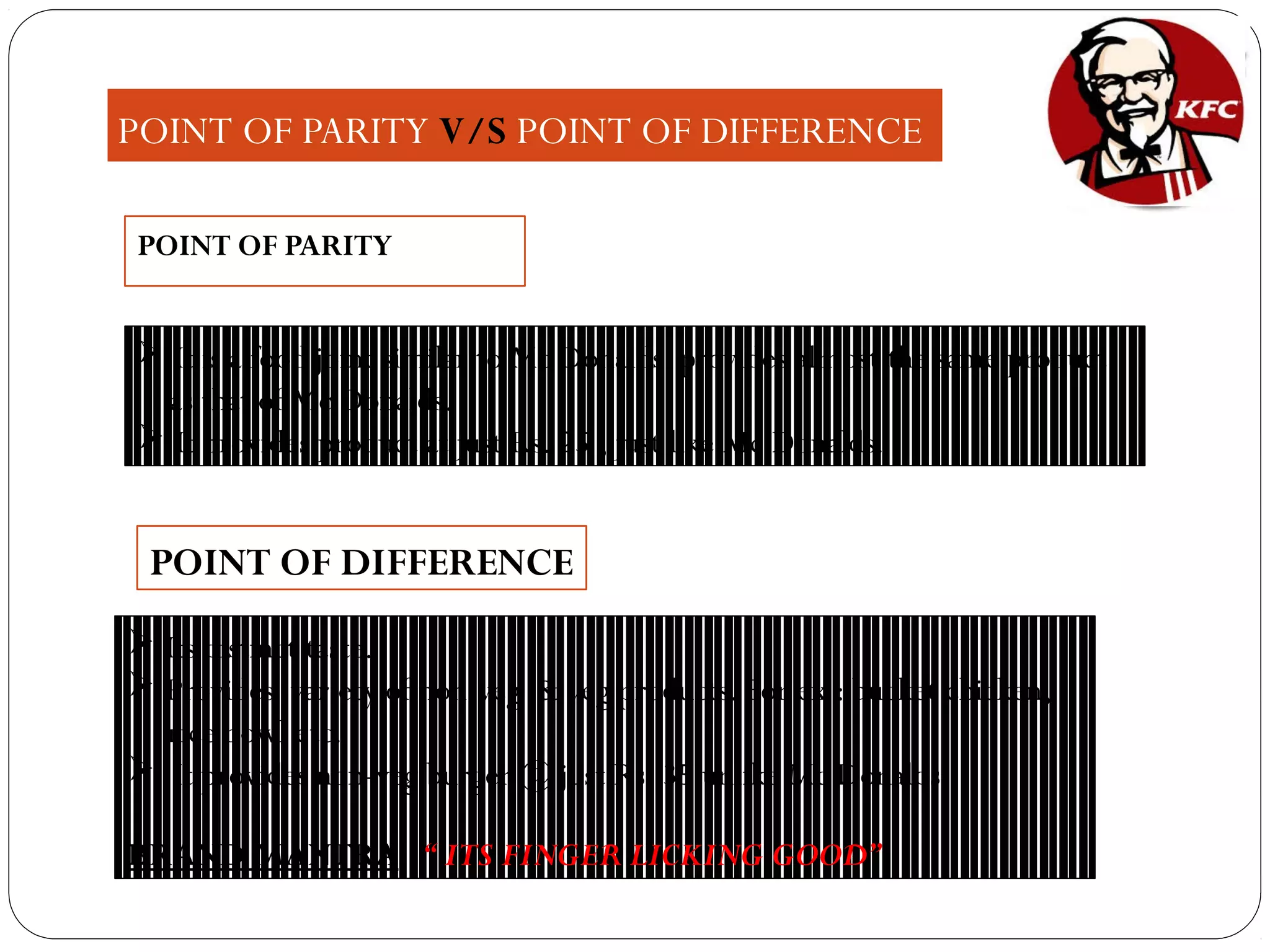
POINT OF PARITY V/S POINT OF DIFFERENCE
POINT OF PARITY
 It is a food joint similar to Mc Donalds, provides almost the same product

as that of Mc Donalds.
 It provides product at just Rs. 25 , just like Mc Donalds.

POINT OF DIFFERENCE
 Its distinct taste.
 Provides variety of non-veg & veg products. For ex : bucket chicken,
rice bowl etc.
 It provides non-veg burger @ just Rs. 35 unlike Mc Donalds
BRAND MANTRA: “ ITS FINGER LICKING GOOD”
IMPACT OF CONSUMER BEHAVIOUR ON
BRAND’S STRATEGY

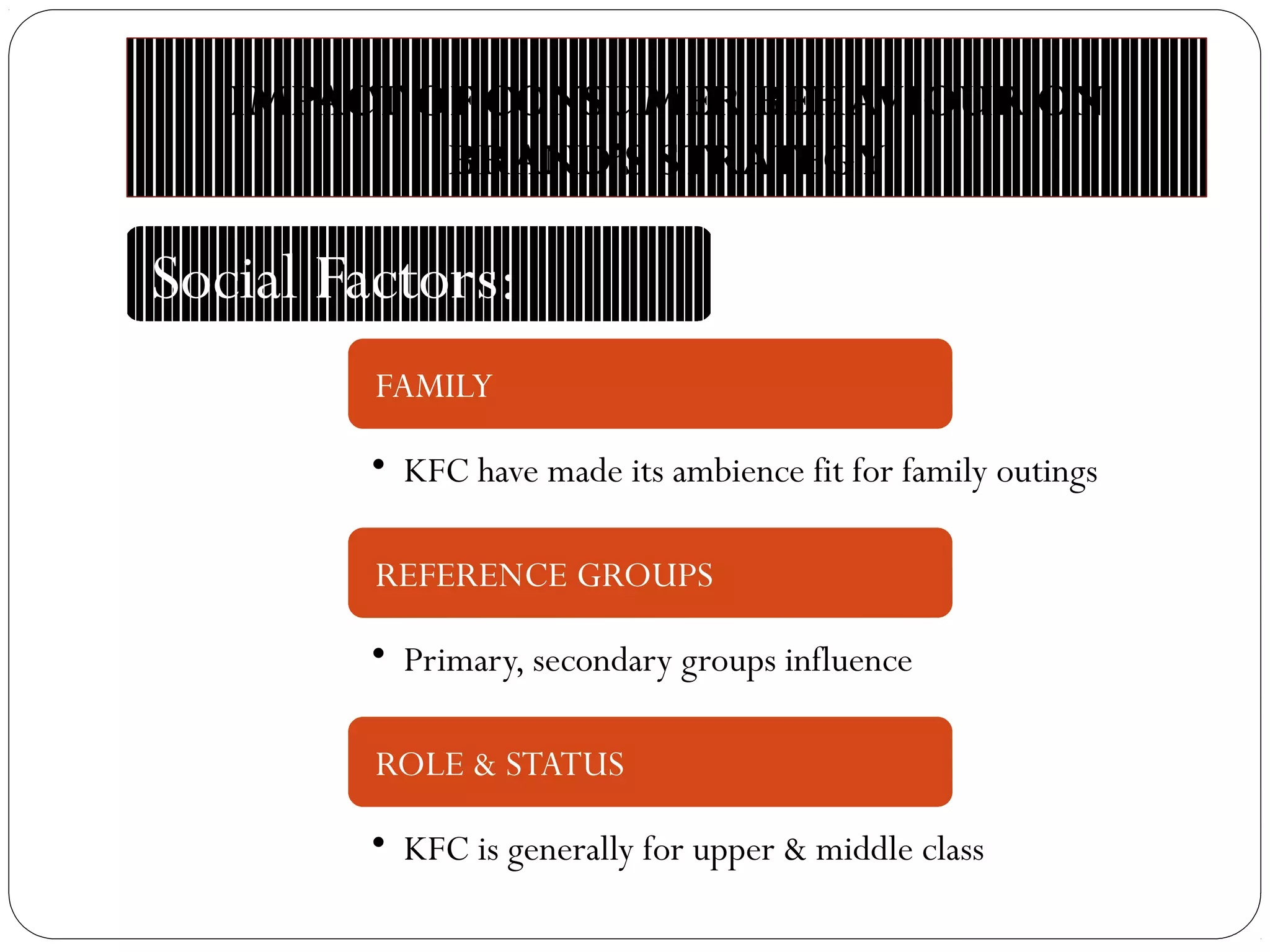
Social Factors:
FAMILY
• KFC have made its ambience fit for family outings
REFERENCE GROUPS
• Primary, secondary groups influence
ROLE & STATUS
• KFC is generally for upper & middle class
IMPACT OF CONSUMER BEHAVIOUR ON
BRAND’S STRATEGY

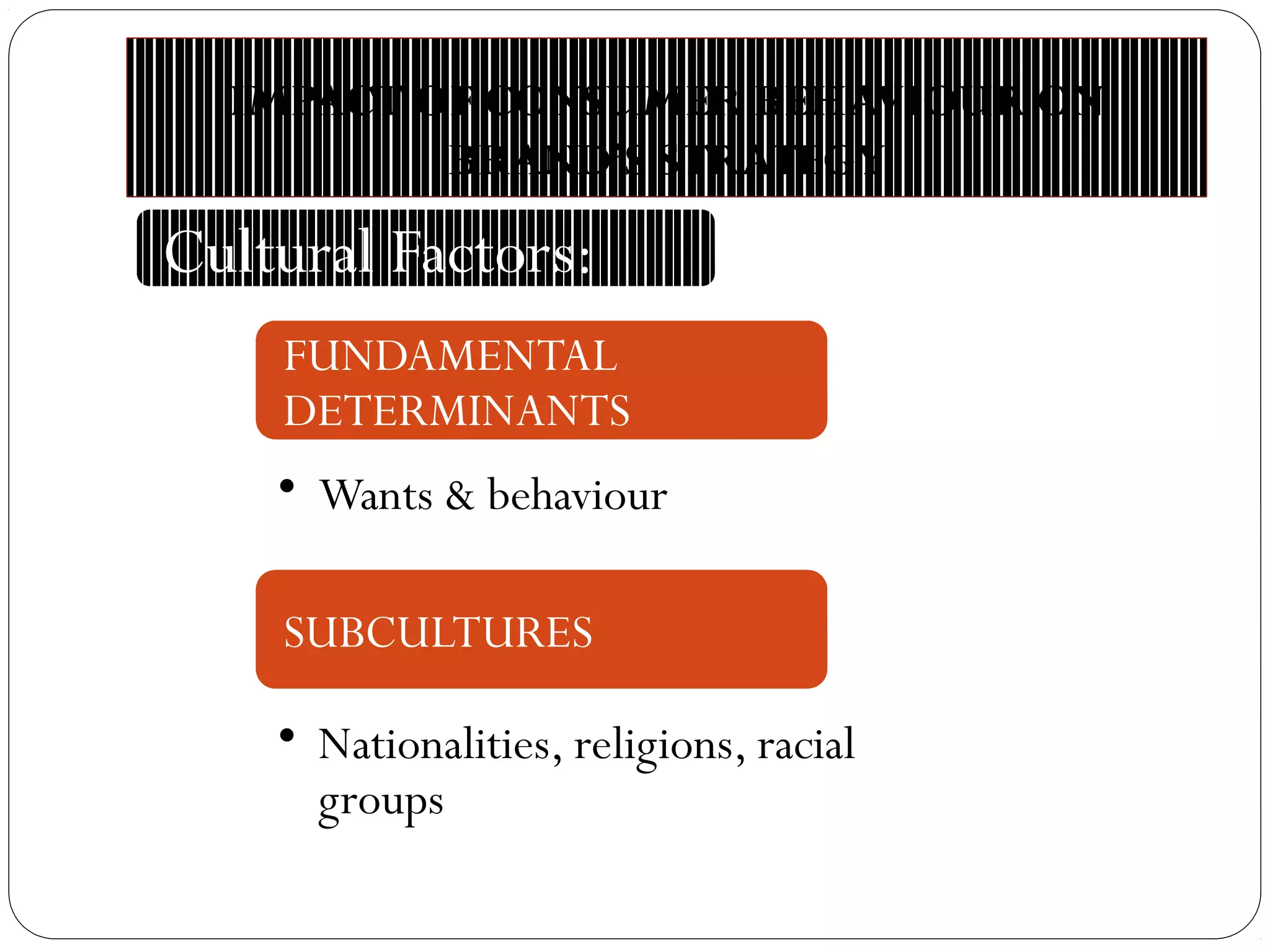
Cultural Factors:
FUNDAMENTAL
DETERMINANTS
• Wants & behaviour
SUBCULTURES
• Nationalities, religions, racial
groups
IMPACT OF CONSUMER BEHAVIOUR ON
BRAND’S STRATEGY

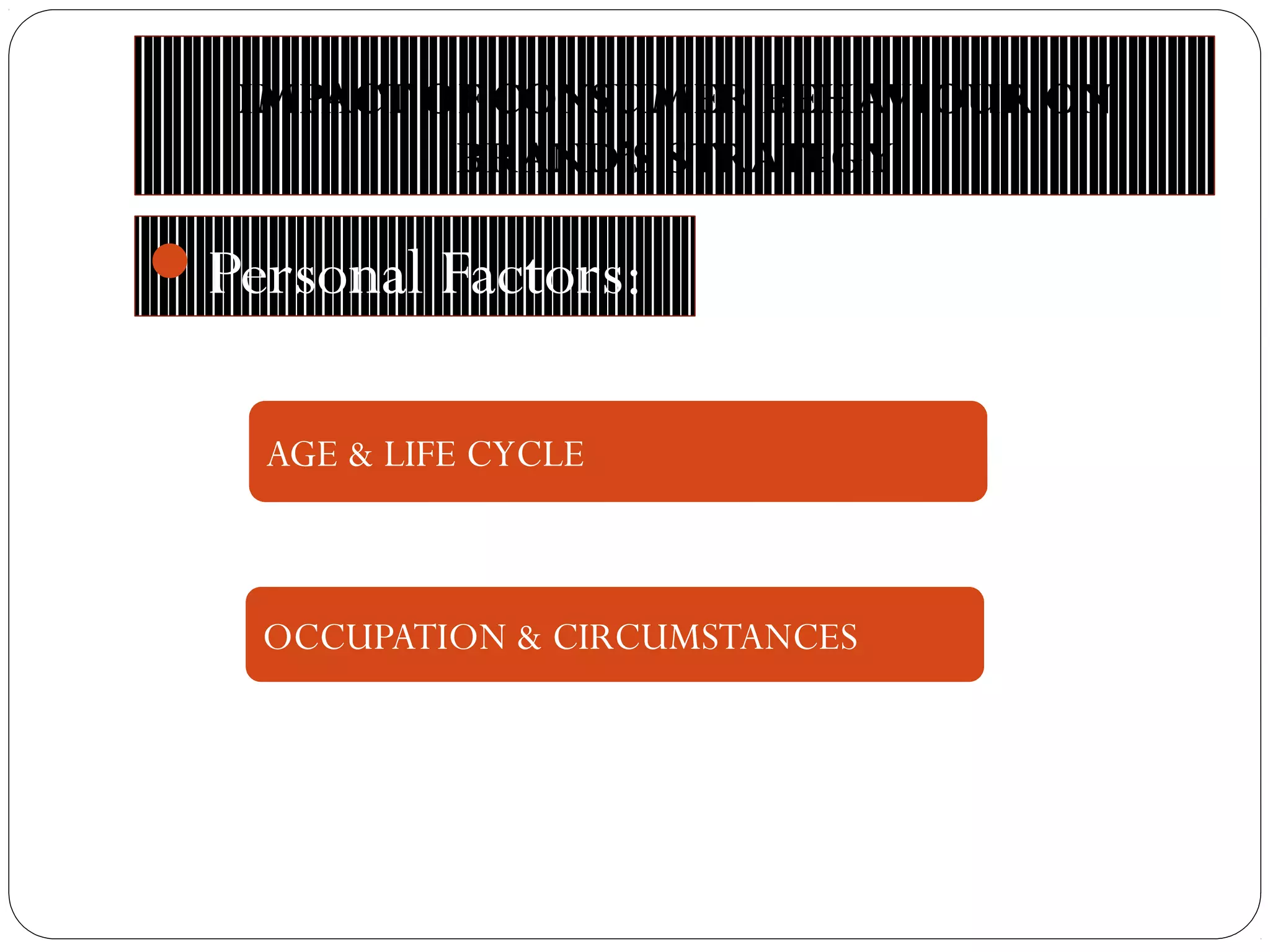
Personal Factors:
AGE & LIFE CYCLE

OCCUPATION & CIRCUMSTANCES
PRODUCT STRATEGY
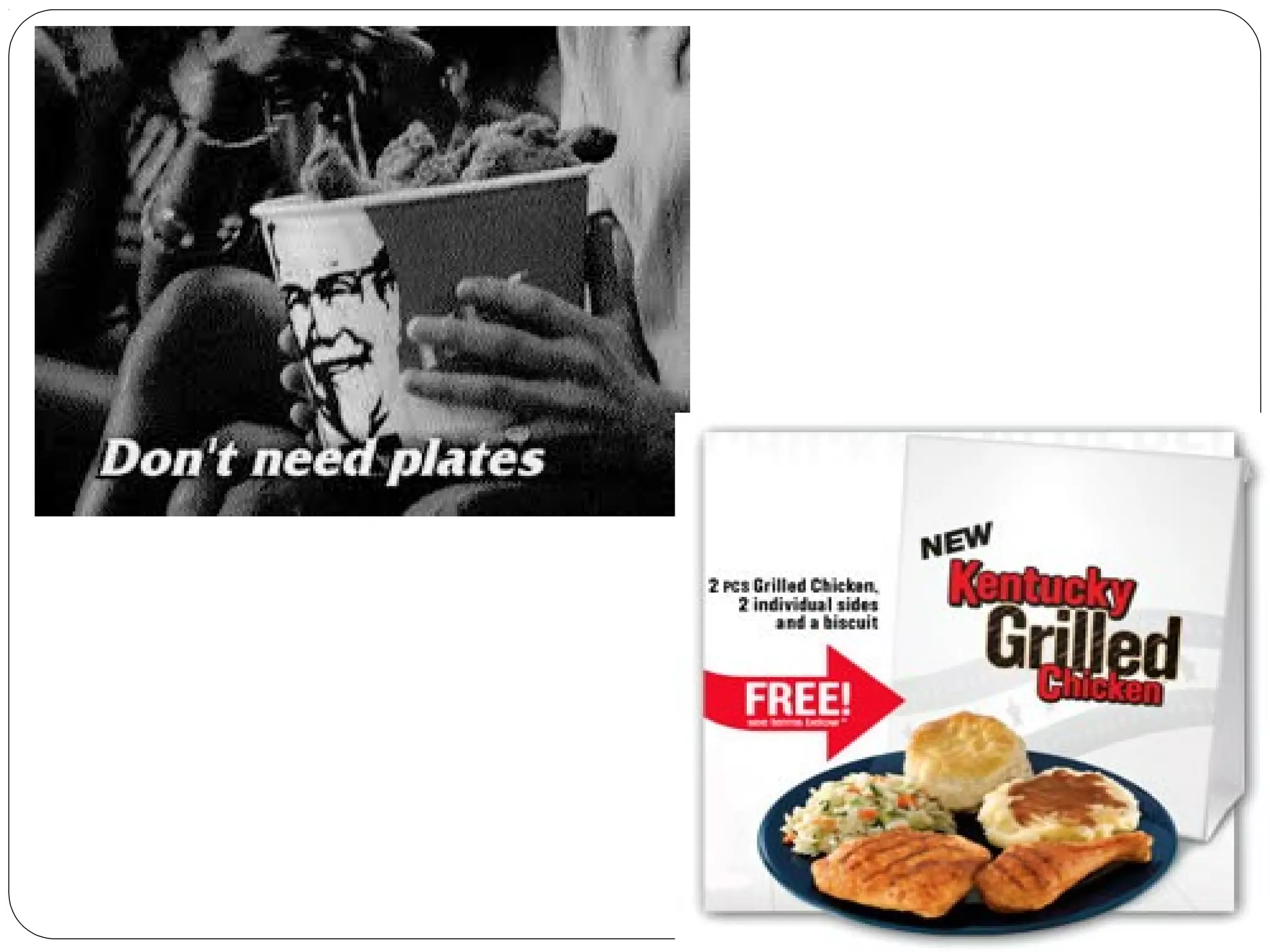
Competes on several basis incl.product,cost,franchising.
Secret recipe of 11 herbs & spices.
Hire professionals for product development.
100% pure pcs of chicken
Trained cooks prepare it fresh throughout the day at every

restaurant.
Use of sunflower oil.
Successful salt reduction programme
Provide quality assurance…
POSITIONING OF KFC
USP of kfc is life tastes better with kfc.
Unique taste of product.
It isn’t only fried chicken but also self service & customer

satisfaction.
Designed for various groups of customers .
New menu is focusing on taste & health.
KEY SUCCESSFUL FACTORS…
Taste
Cleanliness
Quality
Service
Satisfying customer needs
Product innovation
Pricing
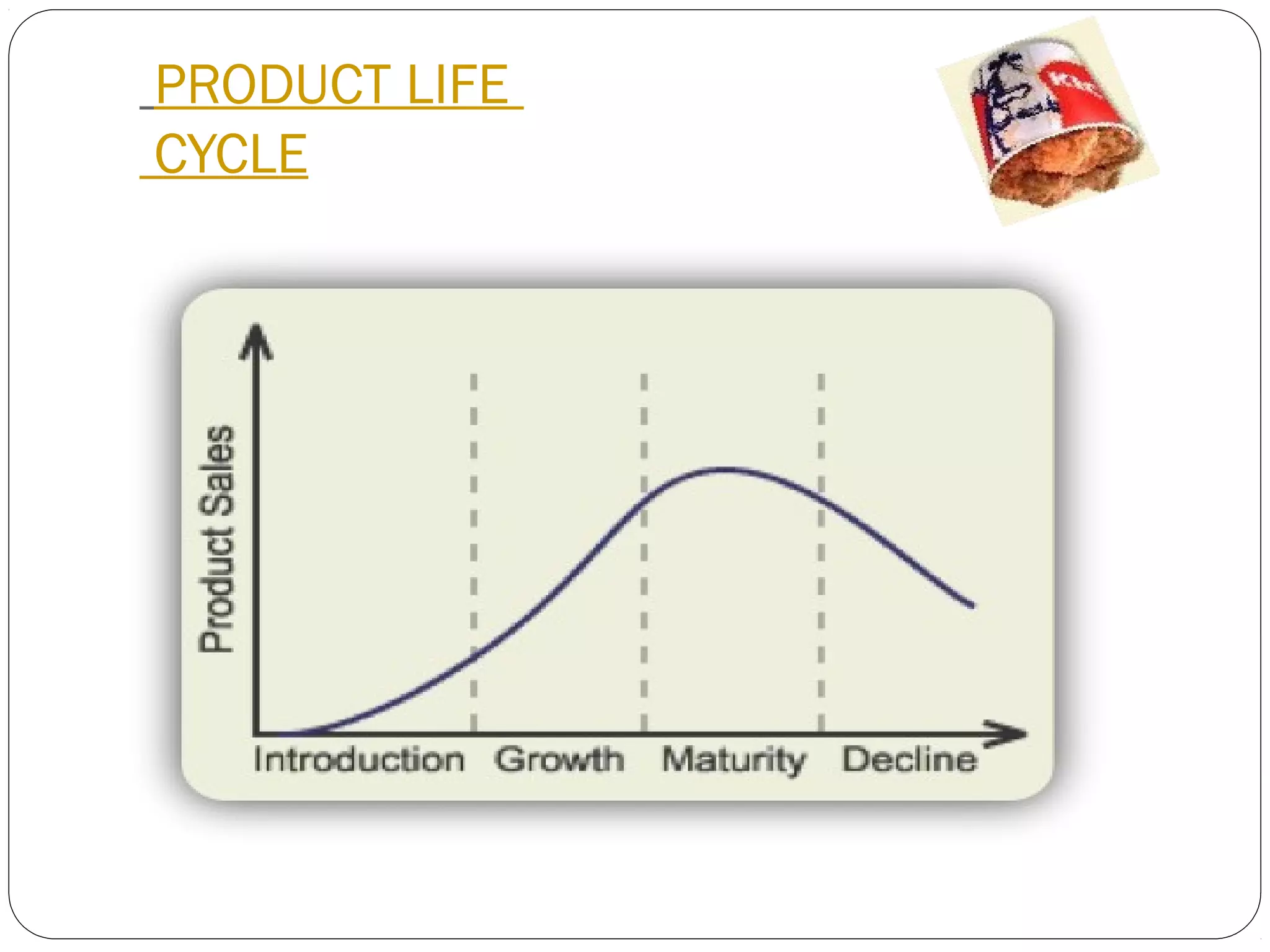
PRODUCT LIFE
CYCLE
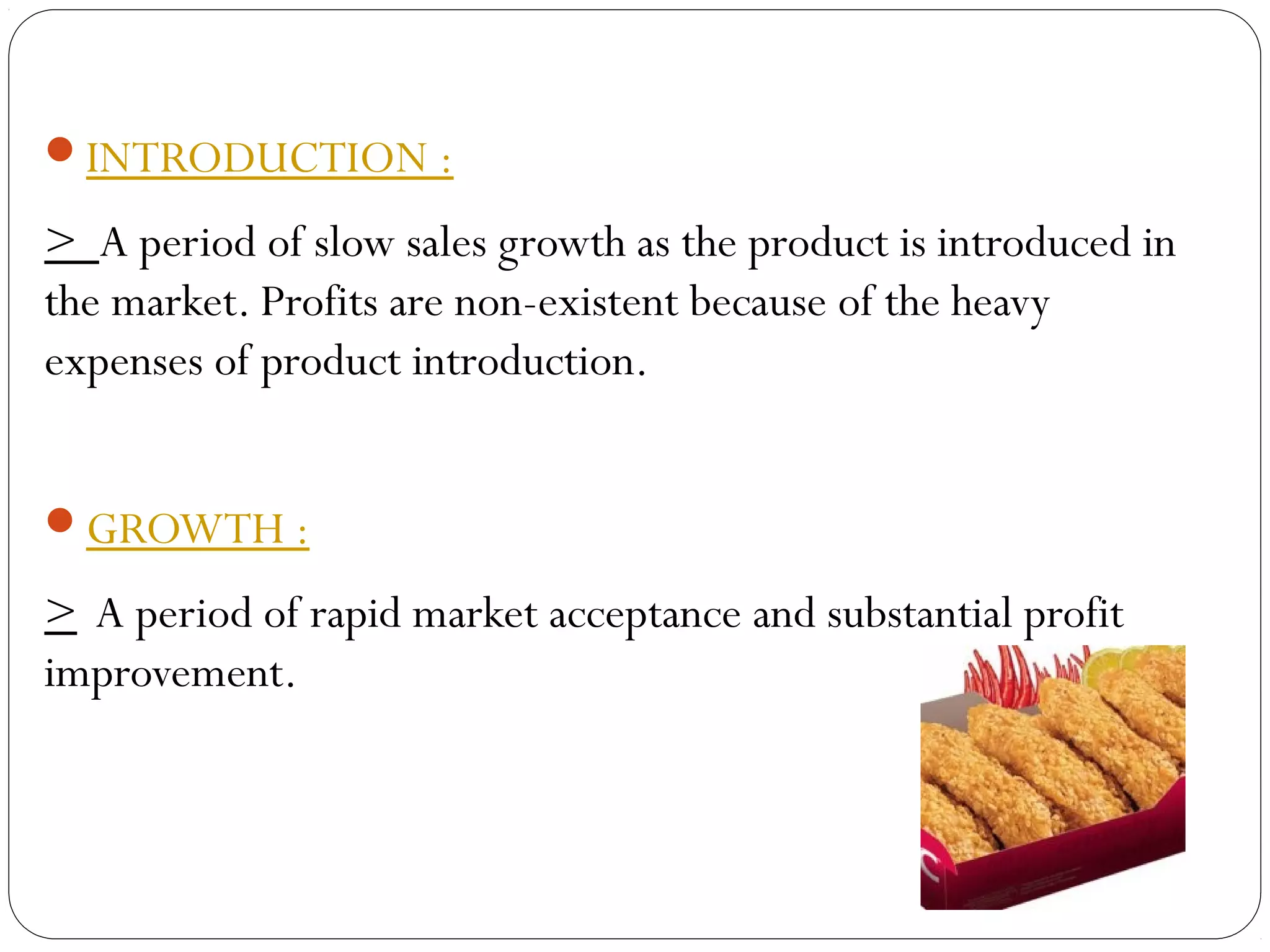
INTRODUCTION :

> A period of slow sales growth as the product is introduced in
the market. Profits are non-existent because of the heavy
expenses of product introduction.
GROWTH :

> A period of rapid market acceptance and substantial profit
improvement.
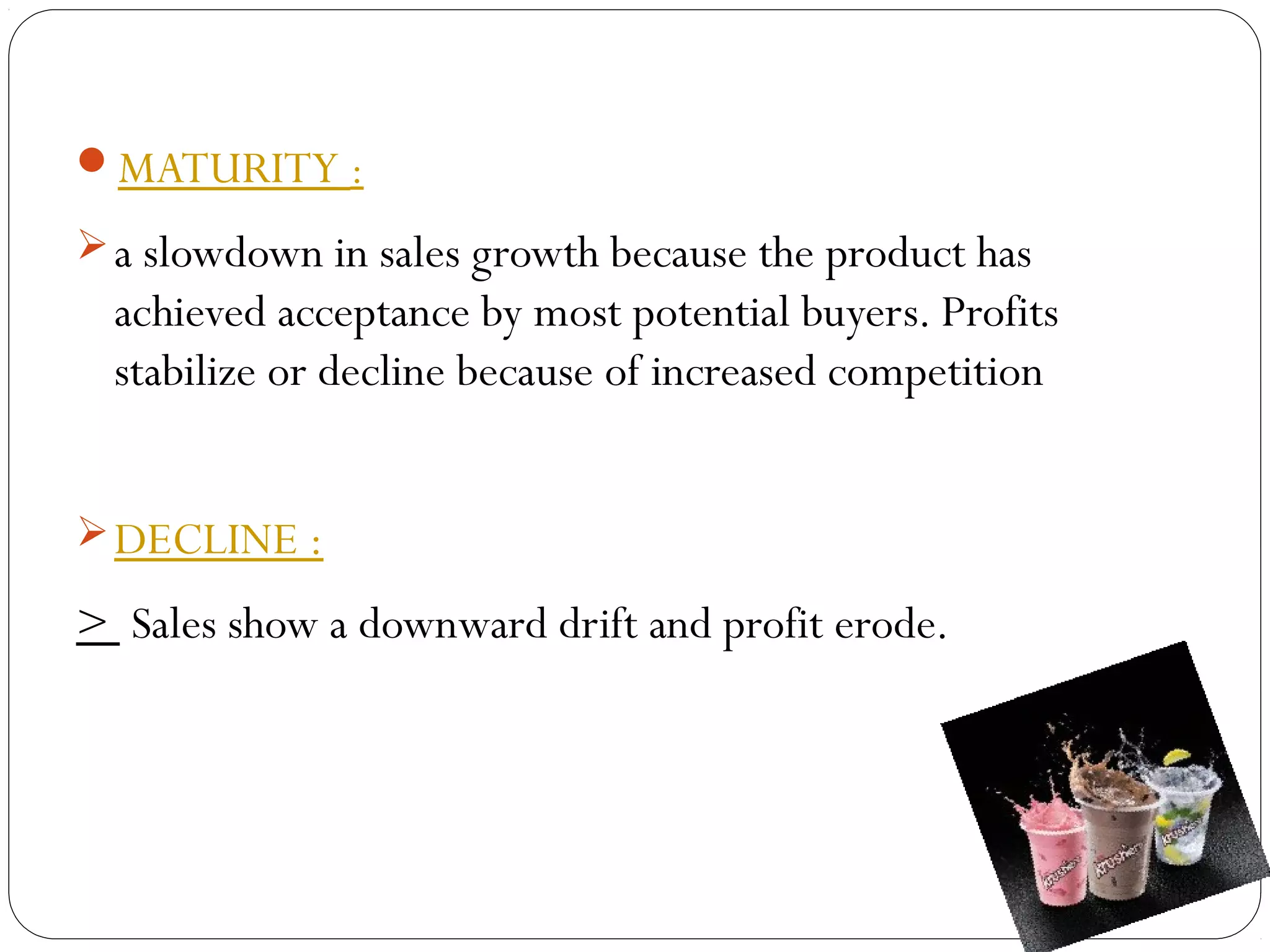
MATURITY :
 a slowdown in sales growth because the product has

achieved acceptance by most potential buyers. Profits
stabilize or decline because of increased competition
 DECLINE :

> Sales show a downward drift and profit erode.
TH

OU
KY
AN

KFC : STP, BCG MATRIX, ENVIROMENT ANALYSIS, SUPPLY CHAIN,PRODUCT STRATEGY

  • 1.
    PRESENTED BY: MEHAK BHARDWAJ MANISHMALHOTRA SWATI RAWAT KULPREET KAUR
  • 2.
    CONTENTS Environment Analysis: Mehak ValueChain Analysis: Manish Ansoff Matrix: Manish BCG Matrix: Swati STP: Swati Impact of consumer behaviour on brand’s strategy: Swati Product’s Strategy: Kulpreet Brand’s positioning strategies:Kulpreet PLC: Mehak
  • 4.
  • 5.
    MICRO ENVIROMENT: The microenviroment Consist of all the forces COMPANY COMPETITORS that are close to KFC  The three major KFC Components influence KFC Enviroment are Suppliers Competitors Market intermediaries MARKET INTERMEDIARIES
  • 6.
    SUPPLIERS : > Suppliersare those people who are responsible for supplying necessary inputs to the organization and ensure the smooth flow of production. COMPETITORS : > Competitors can be called the close rivals and in order to survive the competition one has to keep a close look in the market and formulate its policies and strategies as such to face the competition
  • 7.
    MARKETING INTERMEDIARIES : >Marketing intermediaries aid the company in promoting, selling and distribution of the goods and services to its final users. Therefore, marketing intermediaries are vital link between the business and the consumers.
  • 8.
  • 9.
    ECONOMIC FACTORS : >Economicfactors includes economic conditions and economic policies that together constitutes the economic environment. These includes growth rate, inflation, restrictive trade practices etc. Which have a considerable impact on the business. SOCIAL FACTORS : >Social factors includes the society as a whole alongside its preferences and priorities like the buying and consumption pattern, beliefs of people their purchasing power, educational background etc.
  • 10.
    POLITICAL FACTORS : >Thepolitical factors are related to the management of public affairs and their impact on the business. It is important to  have a political stability to maintain stability in the trade. TECHNOLOGICAL FACTORS : >Latest technologies helps in improving the marketability of the product plus makes it more consumer friendly. Therefore, it is important for a business to keep a pace with the changing technologies in order to survive in the long run
  • 11.
  • 12.
  • 13.
      SUPPLY CHAIN MANAGEMENT   KFChas a very simple supply chain. As the operations are on a relatively small scale, all theoperations are performed by the company (i.e. Cupola) itself. The supply chain process can besummed up as a 3 step process: Step 1: Raw materials procured from various suppliers and stored at two warehouses; the normal-storageand the cold-storage. Details are discussed later. Step 2: All product preparation is done at the branch except for the marination of chicken and sold tocustomers at the branch itself or delivered at the desired locations. Step 3: Warehouses replenish each branch according to their requirement (usually three times a week)using company’s own vehicles and drivers upon the request of the branch manage
  • 14.
    STORAGE AND INVENTORYMANAGEMENT Chicken Inventory of chicken is for 15 days. The storage area for chicken is not in the warehouse itself  but in a separate cold storage area built right beside the warehouse in each region.Before marinating, the chicken is stored in an organized form in six separate cold storage rooms whose area is around 45 to 50 square feet, having a height of around 7 feet. The chicken is stored in the same baskets which it comes in and stays there till its turn for marinating . Marination is done in a separate room in the same cold storage facility where the chicken is firstwashed and mixed with the herbs and spices it needs. The mixture is fed into a machine knownas‘Tumbler’ which marinates it. After this is done the chicken is re packed into labeled clear storage room again in organised form.
  • 15.
    QUALITY ASSURANCE BYKFC   There are multiple ways by which KFC assures the quality of its products. Some of the oneswhich were disclosed to us were: Surprise visits to branches Planned visits to branches Rigorous raw material inspection Customer feedback 
  • 17.
  • 18.
  • 19.
    SEGMENTATION PSYCHOGRAPHIC SEGMENTATION  1. Social class-Upper and Middle class. 2. Lifestyle is not specific. 3. Personality .
  • 20.
    SEGMENTATION BEHAVIORAL SEGMENTATION Taste Conscious Quality Conscious   Class  Combination of Product and Quality 
  • 21.
    TARGET MARKET 1. LOCATION HECTICLIFESTYLE OF INDIVIDUALS COMMERCIALISATION MID-SECTOR PEOPLE URBAN AREAS ARE MORE POPULATED
  • 22.
    TARGET MARKET 2. PLACEMENTOF OUTLETS • • KFC placed itself close to schools, colleges, cinemas as a result KFC enjoys a large number of footfalls everyday. In addition, they have outlets close to nonvegetarians .for ex saket outlet (Muslim populated areas). SAKET STORE
  • 23.
    INDIAN MARKET An importantthing to note is that Indian Fast food market is  Fundamentally different.  Fast food joints: considered as cheap sources of taking break from home cooked food .  Favourable factors:  Increasing nuclear families,particularly in urban India  Exposure to global media and Western cuisine ;increasing number of women joining the workforce
  • 24.
    POSITIONING The KFC LOGO Providingquality products with distinct taste at the possible lowest price. Leading player in the Fried Chicken. Use of Red color in its Arena. Tag Line – “I AM A STUDENT OF LICKONOMICS”
  • 25.
    POINT OF PARITYV/S POINT OF DIFFERENCE POINT OF PARITY  It is a food joint similar to Mc Donalds, provides almost the same product as that of Mc Donalds.  It provides product at just Rs. 25 , just like Mc Donalds. POINT OF DIFFERENCE  Its distinct taste.  Provides variety of non-veg & veg products. For ex : bucket chicken, rice bowl etc.  It provides non-veg burger @ just Rs. 35 unlike Mc Donalds BRAND MANTRA: “ ITS FINGER LICKING GOOD”
  • 26.
    IMPACT OF CONSUMERBEHAVIOUR ON BRAND’S STRATEGY Social Factors: FAMILY • KFC have made its ambience fit for family outings REFERENCE GROUPS • Primary, secondary groups influence ROLE & STATUS • KFC is generally for upper & middle class
  • 27.
    IMPACT OF CONSUMERBEHAVIOUR ON BRAND’S STRATEGY Cultural Factors: FUNDAMENTAL DETERMINANTS • Wants & behaviour SUBCULTURES • Nationalities, religions, racial groups
  • 28.
    IMPACT OF CONSUMERBEHAVIOUR ON BRAND’S STRATEGY Personal Factors: AGE & LIFE CYCLE OCCUPATION & CIRCUMSTANCES
  • 29.
    PRODUCT STRATEGY Competes onseveral basis incl.product,cost,franchising. Secret recipe of 11 herbs & spices. Hire professionals for product development. 100% pure pcs of chicken Trained cooks prepare it fresh throughout the day at every restaurant.
  • 30.
    Use of sunfloweroil. Successful salt reduction programme Provide quality assurance…
  • 32.
    POSITIONING OF KFC USPof kfc is life tastes better with kfc. Unique taste of product. It isn’t only fried chicken but also self service & customer satisfaction. Designed for various groups of customers . New menu is focusing on taste & health.
  • 33.
  • 34.
  • 35.
    INTRODUCTION : > Aperiod of slow sales growth as the product is introduced in the market. Profits are non-existent because of the heavy expenses of product introduction. GROWTH : > A period of rapid market acceptance and substantial profit improvement.
  • 36.
    MATURITY :  aslowdown in sales growth because the product has achieved acceptance by most potential buyers. Profits stabilize or decline because of increased competition  DECLINE : > Sales show a downward drift and profit erode.
  • 37.