Student’s Name: Sem Meng Eang
ID: #03058 (BA-22M)
Key Terms
Chap1
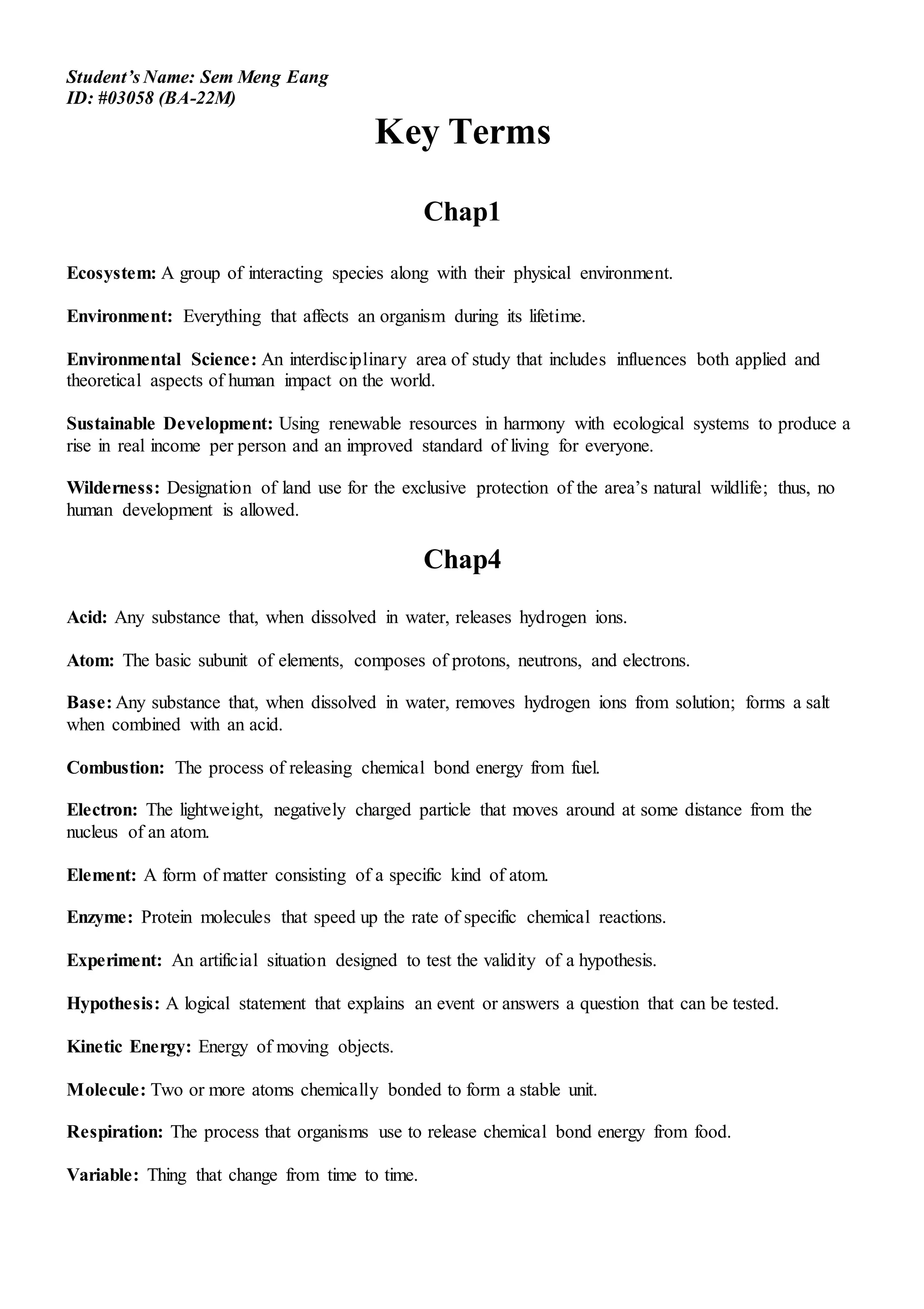
Ecosystem: A group of interacting species along with their physical environment.
Environment: Everything that affects an organism during its lifetime.
Environmental Science: An interdisciplinary area of study that includes influences both applied and
theoretical aspects of human impact on the world.
Sustainable Development: Using renewable resources in harmony with ecological systems to produce a
rise in real income per person and an improved standard of living for everyone.
Wilderness: Designation of land use for the exclusive protection of the area’s natural wildlife; thus, no
human development is allowed.
Chap4
Acid: Any substance that, when dissolved in water, releases hydrogen ions.
Atom: The basic subunit of elements, composes of protons, neutrons, and electrons.
Base: Any substance that, when dissolved in water, removes hydrogen ions from solution; forms a salt
when combined with an acid.
Combustion: The process of releasing chemical bond energy from fuel.
Electron: The lightweight, negatively charged particle that moves around at some distance from the
nucleus of an atom.
Element: A form of matter consisting of a specific kind of atom.
Enzyme: Protein molecules that speed up the rate of specific chemical reactions.
Experiment: An artificial situation designed to test the validity of a hypothesis.
Hypothesis: A logical statement that explains an event or answers a question that can be tested.
Kinetic Energy: Energy of moving objects.
Molecule: Two or more atoms chemically bonded to form a stable unit.
Respiration: The process that organisms use to release chemical bond energy from food.
Variable: Thing that change from time to time.
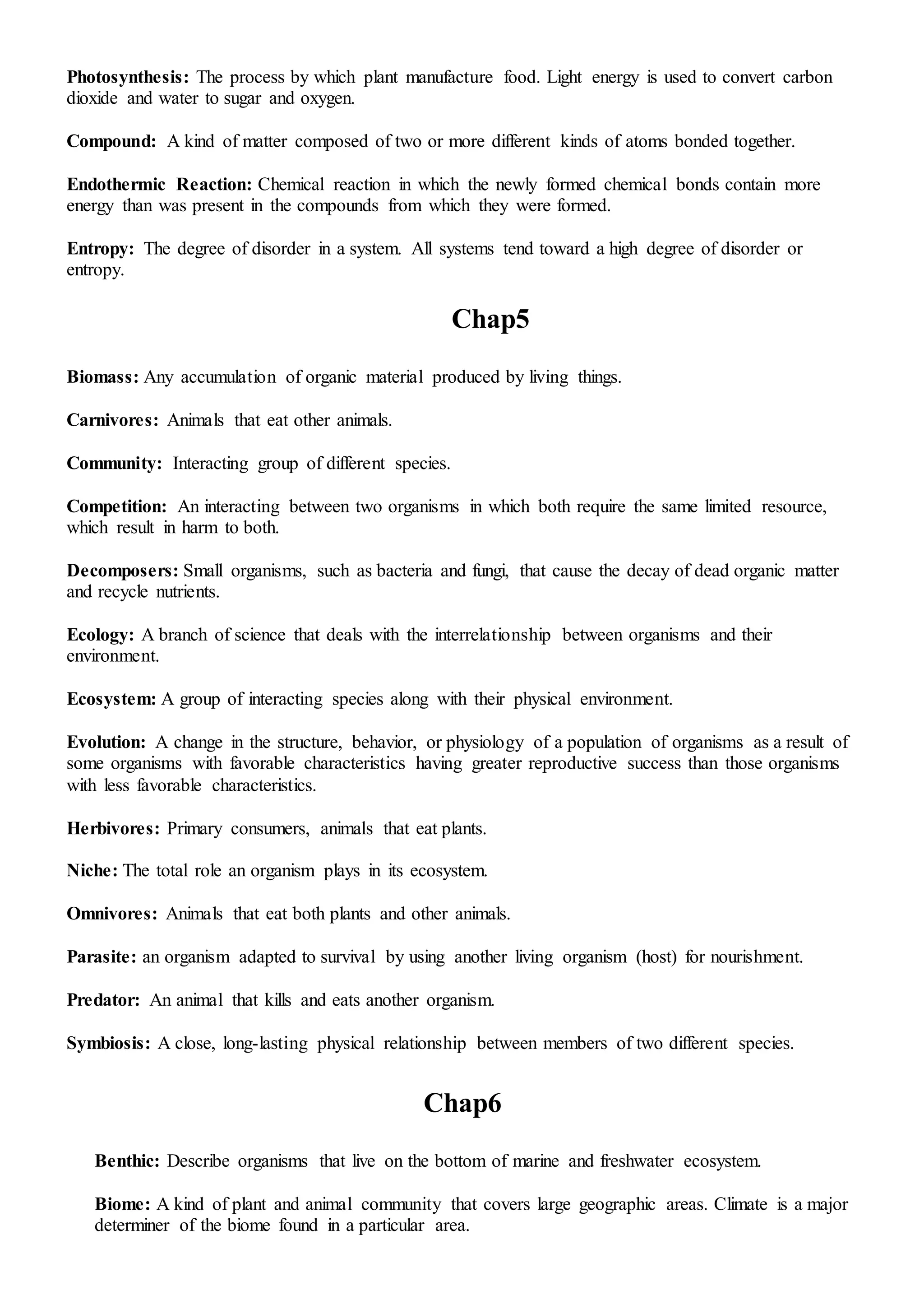
Photosynthesis: The process by which plant manufacture food. Light energy is used to convert carbon
dioxide and water to sugar and oxygen.
Compound: A kind of matter composed of two or more different kinds of atoms bonded together.
Endothermic Reaction: Chemical reaction in which the newly formed chemical bonds contain more
energy than was present in the compounds from which they were formed.
Entropy: The degree of disorder in a system. All systems tend toward a high degree of disorder or
entropy.
Chap5
Biomass: Any accumulation of organic material produced by living things.
Carnivores: Animals that eat other animals.
Community: Interacting group of different species.
Competition: An interacting between two organisms in which both require the same limited resource,
which result in harm to both.
Decomposers: Small organisms, such as bacteria and fungi, that cause the decay of dead organic matter
and recycle nutrients.
Ecology: A branch of science that deals with the interrelationship between organisms and their
environment.
Ecosystem: A group of interacting species along with their physical environment.
Evolution: A change in the structure, behavior, or physiology of a population of organisms as a result of
some organisms with favorable characteristics having greater reproductive success than those organisms
with less favorable characteristics.
Herbivores: Primary consumers, animals that eat plants.
Niche: The total role an organism plays in its ecosystem.
Omnivores: Animals that eat both plants and other animals.
Parasite: an organism adapted to survival by using another living organism (host) for nourishment.
Predator: An animal that kills and eats another organism.
Symbiosis: A close, long-lasting physical relationship between members of two different species.
Chap6
Benthic: Describe organisms that live on the bottom of marine and freshwater ecosystem.
Biome: A kind of plant and animal community that covers large geographic areas. Climate is a major
determiner of the biome found in a particular area.
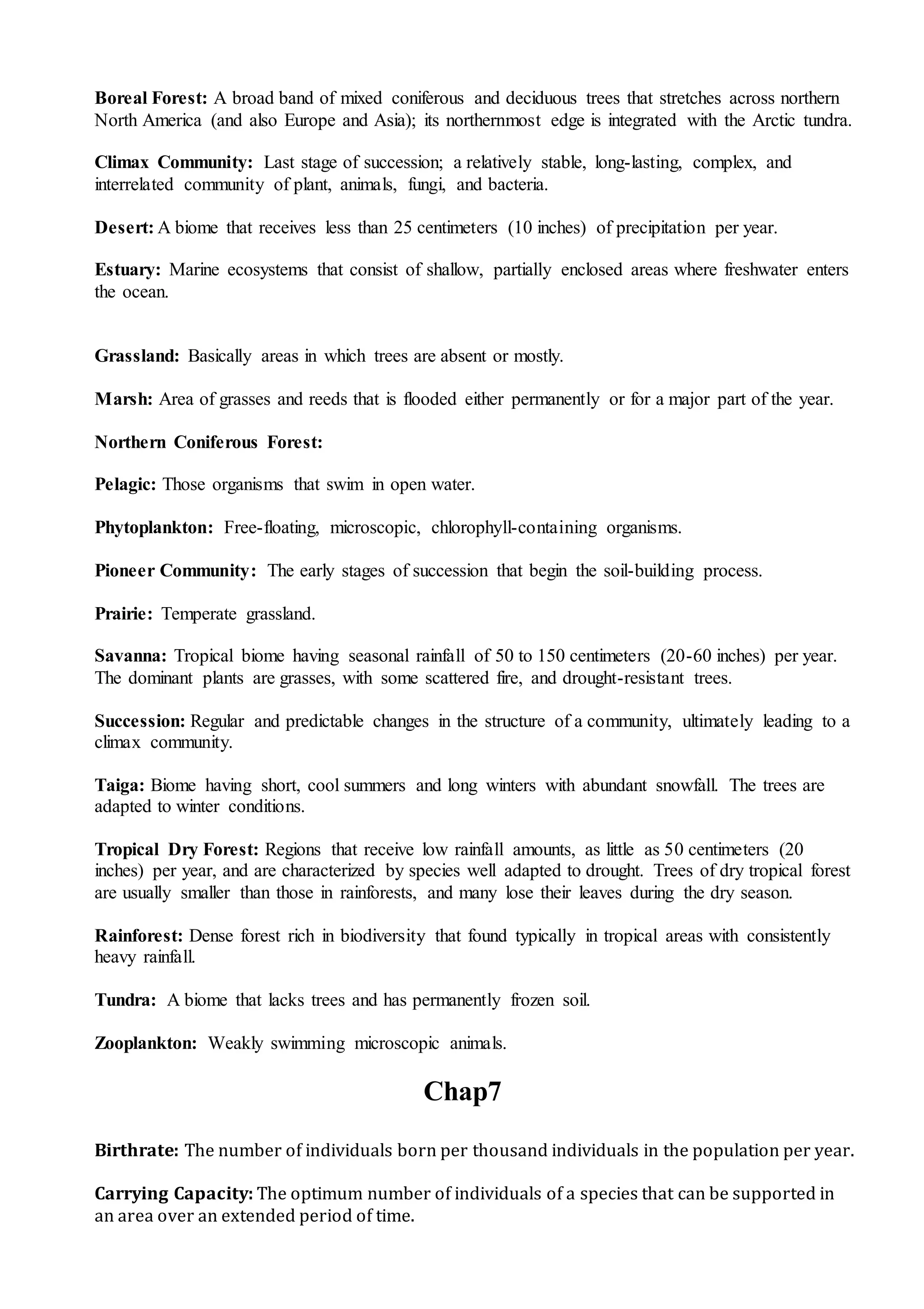
Boreal Forest: A broad band of mixed coniferous and deciduous trees that stretches across northern
North America (and also Europe and Asia); its northernmost edge is integrated with the Arctic tundra.
Climax Community: Last stage of succession; a relatively stable, long-lasting, complex, and
interrelated community of plant, animals, fungi, and bacteria.
Desert: A biome that receives less than 25 centimeters (10 inches) of precipitation per year.
Estuary: Marine ecosystems that consist of shallow, partially enclosed areas where freshwater enters
the ocean.
Grassland: Basically areas in which trees are absent or mostly.
Marsh: Area of grasses and reeds that is flooded either permanently or for a major part of the year.
Northern Coniferous Forest:
Pelagic: Those organisms that swim in open water.
Phytoplankton: Free-floating, microscopic, chlorophyll-containing organisms.
Pioneer Community: The early stages of succession that begin the soil-building process.
Prairie: Temperate grassland.
Savanna: Tropical biome having seasonal rainfall of 50 to 150 centimeters (20-60 inches) per year.
The dominant plants are grasses, with some scattered fire, and drought-resistant trees.
Succession: Regular and predictable changes in the structure of a community, ultimately leading to a
climax community.
Taiga: Biome having short, cool summers and long winters with abundant snowfall. The trees are
adapted to winter conditions.
Tropical Dry Forest: Regions that receive low rainfall amounts, as little as 50 centimeters (20
inches) per year, and are characterized by species well adapted to drought. Trees of dry tropical forest
are usually smaller than those in rainforests, and many lose their leaves during the dry season.
Rainforest: Dense forest rich in biodiversity that found typically in tropical areas with consistently
heavy rainfall.
Tundra: A biome that lacks trees and has permanently frozen soil.
Zooplankton: Weakly swimming microscopic animals.
Chap7
Birthrate: The number of individuals born per thousand individuals in the population per year.
Carrying Capacity: The optimum number of individuals of a species that can be supported in
an area over an extended period of time.
Death Rate: The number of deaths per thousand individuals in the population per year.
Density-dependent Limiting Factor: Those limiting factors that become more severe as the
size of the population increases.
Density-independent Limiting Factor: Those limiting factors that are not affected by
population size.
Dispersal: Migration of organisms from a concentrated population into areas with lower
population densities.
Emigration: Movement out of an area that was once one’s place of residence.
Immigration: Movement into an area where one has not previously to combust.
Growth Rate: The amount of increase that a specific variable has gained within a specific
period and context.
Demographic Transition: The hypothesis that economies proceed through a series of stages,
beginning with growing populations with high birth and death rates and low economic
development and ending with stable populations with low birth and death rates and high
economic development.
Demography: The study of human populations, their characteristics, and their changes.
Gross National Income: An index that measures the total goods and services generated within
a country as well as income earned by citizens of the country who are living in other countries.
Population Density: A measure of how close organisms are to one another, generally
expressed as the number of organisms per unit area.
Standard of Living: The necessities and luxuries essential to a level of existence that is
customary within a society.
Less-developed Country: Countries of the world that typically have a per capita income of less
than US $5000.
More-developed Country: Countries of the world that typically have a per capita income that
exceeds US $10,000; Europe, Canada, United States, Australia, New Zealand, and Japan.
Total Fertility Rate: The number of children born per woman per lifetime.

Key terms

  • 1.
    Student’s Name: SemMeng Eang ID: #03058 (BA-22M) Key Terms Chap1 Ecosystem: A group of interacting species along with their physical environment. Environment: Everything that affects an organism during its lifetime. Environmental Science: An interdisciplinary area of study that includes influences both applied and theoretical aspects of human impact on the world. Sustainable Development: Using renewable resources in harmony with ecological systems to produce a rise in real income per person and an improved standard of living for everyone. Wilderness: Designation of land use for the exclusive protection of the area’s natural wildlife; thus, no human development is allowed. Chap4 Acid: Any substance that, when dissolved in water, releases hydrogen ions. Atom: The basic subunit of elements, composes of protons, neutrons, and electrons. Base: Any substance that, when dissolved in water, removes hydrogen ions from solution; forms a salt when combined with an acid. Combustion: The process of releasing chemical bond energy from fuel. Electron: The lightweight, negatively charged particle that moves around at some distance from the nucleus of an atom. Element: A form of matter consisting of a specific kind of atom. Enzyme: Protein molecules that speed up the rate of specific chemical reactions. Experiment: An artificial situation designed to test the validity of a hypothesis. Hypothesis: A logical statement that explains an event or answers a question that can be tested. Kinetic Energy: Energy of moving objects. Molecule: Two or more atoms chemically bonded to form a stable unit. Respiration: The process that organisms use to release chemical bond energy from food. Variable: Thing that change from time to time.
  • 2.
    Photosynthesis: The processby which plant manufacture food. Light energy is used to convert carbon dioxide and water to sugar and oxygen. Compound: A kind of matter composed of two or more different kinds of atoms bonded together. Endothermic Reaction: Chemical reaction in which the newly formed chemical bonds contain more energy than was present in the compounds from which they were formed. Entropy: The degree of disorder in a system. All systems tend toward a high degree of disorder or entropy. Chap5 Biomass: Any accumulation of organic material produced by living things. Carnivores: Animals that eat other animals. Community: Interacting group of different species. Competition: An interacting between two organisms in which both require the same limited resource, which result in harm to both. Decomposers: Small organisms, such as bacteria and fungi, that cause the decay of dead organic matter and recycle nutrients. Ecology: A branch of science that deals with the interrelationship between organisms and their environment. Ecosystem: A group of interacting species along with their physical environment. Evolution: A change in the structure, behavior, or physiology of a population of organisms as a result of some organisms with favorable characteristics having greater reproductive success than those organisms with less favorable characteristics. Herbivores: Primary consumers, animals that eat plants. Niche: The total role an organism plays in its ecosystem. Omnivores: Animals that eat both plants and other animals. Parasite: an organism adapted to survival by using another living organism (host) for nourishment. Predator: An animal that kills and eats another organism. Symbiosis: A close, long-lasting physical relationship between members of two different species. Chap6 Benthic: Describe organisms that live on the bottom of marine and freshwater ecosystem. Biome: A kind of plant and animal community that covers large geographic areas. Climate is a major determiner of the biome found in a particular area.
  • 3.
    Boreal Forest: Abroad band of mixed coniferous and deciduous trees that stretches across northern North America (and also Europe and Asia); its northernmost edge is integrated with the Arctic tundra. Climax Community: Last stage of succession; a relatively stable, long-lasting, complex, and interrelated community of plant, animals, fungi, and bacteria. Desert: A biome that receives less than 25 centimeters (10 inches) of precipitation per year. Estuary: Marine ecosystems that consist of shallow, partially enclosed areas where freshwater enters the ocean. Grassland: Basically areas in which trees are absent or mostly. Marsh: Area of grasses and reeds that is flooded either permanently or for a major part of the year. Northern Coniferous Forest: Pelagic: Those organisms that swim in open water. Phytoplankton: Free-floating, microscopic, chlorophyll-containing organisms. Pioneer Community: The early stages of succession that begin the soil-building process. Prairie: Temperate grassland. Savanna: Tropical biome having seasonal rainfall of 50 to 150 centimeters (20-60 inches) per year. The dominant plants are grasses, with some scattered fire, and drought-resistant trees. Succession: Regular and predictable changes in the structure of a community, ultimately leading to a climax community. Taiga: Biome having short, cool summers and long winters with abundant snowfall. The trees are adapted to winter conditions. Tropical Dry Forest: Regions that receive low rainfall amounts, as little as 50 centimeters (20 inches) per year, and are characterized by species well adapted to drought. Trees of dry tropical forest are usually smaller than those in rainforests, and many lose their leaves during the dry season. Rainforest: Dense forest rich in biodiversity that found typically in tropical areas with consistently heavy rainfall. Tundra: A biome that lacks trees and has permanently frozen soil. Zooplankton: Weakly swimming microscopic animals. Chap7 Birthrate: The number of individuals born per thousand individuals in the population per year. Carrying Capacity: The optimum number of individuals of a species that can be supported in an area over an extended period of time.
  • 4.
    Death Rate: Thenumber of deaths per thousand individuals in the population per year. Density-dependent Limiting Factor: Those limiting factors that become more severe as the size of the population increases. Density-independent Limiting Factor: Those limiting factors that are not affected by population size. Dispersal: Migration of organisms from a concentrated population into areas with lower population densities. Emigration: Movement out of an area that was once one’s place of residence. Immigration: Movement into an area where one has not previously to combust. Growth Rate: The amount of increase that a specific variable has gained within a specific period and context. Demographic Transition: The hypothesis that economies proceed through a series of stages, beginning with growing populations with high birth and death rates and low economic development and ending with stable populations with low birth and death rates and high economic development. Demography: The study of human populations, their characteristics, and their changes. Gross National Income: An index that measures the total goods and services generated within a country as well as income earned by citizens of the country who are living in other countries. Population Density: A measure of how close organisms are to one another, generally expressed as the number of organisms per unit area. Standard of Living: The necessities and luxuries essential to a level of existence that is customary within a society. Less-developed Country: Countries of the world that typically have a per capita income of less than US $5000. More-developed Country: Countries of the world that typically have a per capita income that exceeds US $10,000; Europe, Canada, United States, Australia, New Zealand, and Japan. Total Fertility Rate: The number of children born per woman per lifetime.