Student’s Name: Sem Meng Eang
ID: #03058 (BA-22M)
Review Questions Chap 6
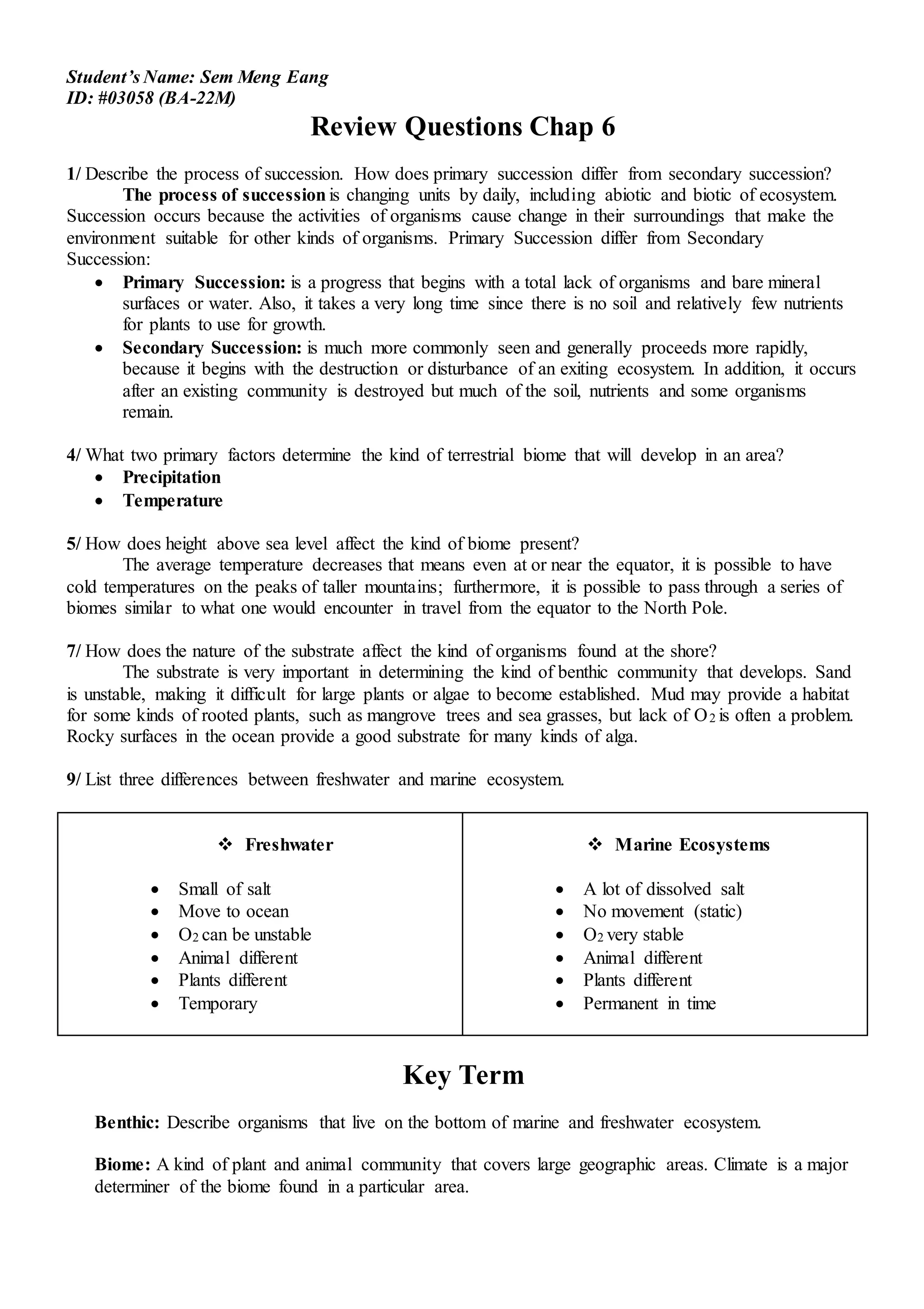
1/ Describe the process of succession. How does primary succession differ from secondary succession?
The process of succession is changing units by daily, including abiotic and biotic of ecosystem.
Succession occurs because the activities of organisms cause change in their surroundings that make the
environment suitable for other kinds of organisms. Primary Succession differ from Secondary
Succession:
 Primary Succession: is a progress that begins with a total lack of organisms and bare mineral
surfaces or water. Also, it takes a very long time since there is no soil and relatively few nutrients
for plants to use for growth.
 Secondary Succession: is much more commonly seen and generally proceeds more rapidly,
because it begins with the destruction or disturbance of an exiting ecosystem. In addition, it occurs
after an existing community is destroyed but much of the soil, nutrients and some organisms
remain.
4/ What two primary factors determine the kind of terrestrial biome that will develop in an area?
 Precipitation
 Temperature
5/ How does height above sea level affect the kind of biome present?
The average temperature decreases that means even at or near the equator, it is possible to have
cold temperatures on the peaks of taller mountains; furthermore, it is possible to pass through a series of
biomes similar to what one would encounter in travel from the equator to the North Pole.
7/ How does the nature of the substrate affect the kind of organisms found at the shore?
The substrate is very important in determining the kind of benthic community that develops. Sand
is unstable, making it difficult for large plants or algae to become established. Mud may provide a habitat
for some kinds of rooted plants, such as mangrove trees and sea grasses, but lack of O2 is often a problem.
Rocky surfaces in the ocean provide a good substrate for many kinds of alga.
9/ List three differences between freshwater and marine ecosystem.
 Freshwater
 Small of salt
 Move to ocean
 O2 can be unstable
 Animal different
 Plants different
 Temporary
 Marine Ecosystems
 A lot of dissolved salt
 No movement (static)
 O2 very stable
 Animal different
 Plants different
 Permanent in time
Key Term
Benthic: Describe organisms that live on the bottom of marine and freshwater ecosystem.
Biome: A kind of plant and animal community that covers large geographic areas. Climate is a major
determiner of the biome found in a particular area.
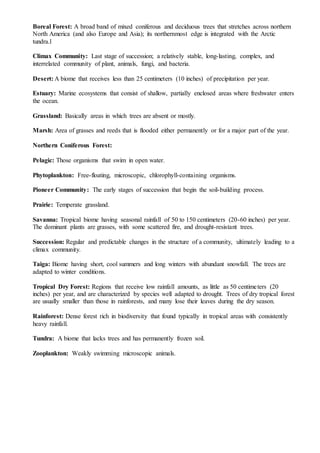
Boreal Forest: A broad band of mixed coniferous and deciduous trees that stretches across northern
North America (and also Europe and Asia); its northernmost edge is integrated with the Arctic
tundra.l
Climax Community: Last stage of succession; a relatively stable, long-lasting, complex, and
interrelated community of plant, animals, fungi, and bacteria.
Desert: A biome that receives less than 25 centimeters (10 inches) of precipitation per year.
Estuary: Marine ecosystems that consist of shallow, partially enclosed areas where freshwater enters
the ocean.
Grassland: Basically areas in which trees are absent or mostly.
Marsh: Area of grasses and reeds that is flooded either permanently or for a major part of the year.
Northern Coniferous Forest:
Pelagic: Those organisms that swim in open water.
Phytoplankton: Free-floating, microscopic, chlorophyll-containing organisms.
Pioneer Community: The early stages of succession that begin the soil-building process.
Prairie: Temperate grassland.
Savanna: Tropical biome having seasonal rainfall of 50 to 150 centimeters (20-60 inches) per year.
The dominant plants are grasses, with some scattered fire, and drought-resistant trees.
Succession: Regular and predictable changes in the structure of a community, ultimately leading to a
climax community.
Taiga: Biome having short, cool summers and long winters with abundant snowfall. The trees are
adapted to winter conditions.
Tropical Dry Forest: Regions that receive low rainfall amounts, as little as 50 centimeters (20
inches) per year, and are characterized by species well adapted to drought. Trees of dry tropical forest
are usually smaller than those in rainforests, and many lose their leaves during the dry season.
Rainforest: Dense forest rich in biodiversity that found typically in tropical areas with consistently
heavy rainfall.
Tundra: A biome that lacks trees and has permanently frozen soil.
Zooplankton: Weakly swimming microscopic animals.

Review question chap6

  • 1.
    Student’s Name: SemMeng Eang ID: #03058 (BA-22M) Review Questions Chap 6 1/ Describe the process of succession. How does primary succession differ from secondary succession? The process of succession is changing units by daily, including abiotic and biotic of ecosystem. Succession occurs because the activities of organisms cause change in their surroundings that make the environment suitable for other kinds of organisms. Primary Succession differ from Secondary Succession:  Primary Succession: is a progress that begins with a total lack of organisms and bare mineral surfaces or water. Also, it takes a very long time since there is no soil and relatively few nutrients for plants to use for growth.  Secondary Succession: is much more commonly seen and generally proceeds more rapidly, because it begins with the destruction or disturbance of an exiting ecosystem. In addition, it occurs after an existing community is destroyed but much of the soil, nutrients and some organisms remain. 4/ What two primary factors determine the kind of terrestrial biome that will develop in an area?  Precipitation  Temperature 5/ How does height above sea level affect the kind of biome present? The average temperature decreases that means even at or near the equator, it is possible to have cold temperatures on the peaks of taller mountains; furthermore, it is possible to pass through a series of biomes similar to what one would encounter in travel from the equator to the North Pole. 7/ How does the nature of the substrate affect the kind of organisms found at the shore? The substrate is very important in determining the kind of benthic community that develops. Sand is unstable, making it difficult for large plants or algae to become established. Mud may provide a habitat for some kinds of rooted plants, such as mangrove trees and sea grasses, but lack of O2 is often a problem. Rocky surfaces in the ocean provide a good substrate for many kinds of alga. 9/ List three differences between freshwater and marine ecosystem.  Freshwater  Small of salt  Move to ocean  O2 can be unstable  Animal different  Plants different  Temporary  Marine Ecosystems  A lot of dissolved salt  No movement (static)  O2 very stable  Animal different  Plants different  Permanent in time Key Term Benthic: Describe organisms that live on the bottom of marine and freshwater ecosystem. Biome: A kind of plant and animal community that covers large geographic areas. Climate is a major determiner of the biome found in a particular area.
  • 2.
    Boreal Forest: Abroad band of mixed coniferous and deciduous trees that stretches across northern North America (and also Europe and Asia); its northernmost edge is integrated with the Arctic tundra.l Climax Community: Last stage of succession; a relatively stable, long-lasting, complex, and interrelated community of plant, animals, fungi, and bacteria. Desert: A biome that receives less than 25 centimeters (10 inches) of precipitation per year. Estuary: Marine ecosystems that consist of shallow, partially enclosed areas where freshwater enters the ocean. Grassland: Basically areas in which trees are absent or mostly. Marsh: Area of grasses and reeds that is flooded either permanently or for a major part of the year. Northern Coniferous Forest: Pelagic: Those organisms that swim in open water. Phytoplankton: Free-floating, microscopic, chlorophyll-containing organisms. Pioneer Community: The early stages of succession that begin the soil-building process. Prairie: Temperate grassland. Savanna: Tropical biome having seasonal rainfall of 50 to 150 centimeters (20-60 inches) per year. The dominant plants are grasses, with some scattered fire, and drought-resistant trees. Succession: Regular and predictable changes in the structure of a community, ultimately leading to a climax community. Taiga: Biome having short, cool summers and long winters with abundant snowfall. The trees are adapted to winter conditions. Tropical Dry Forest: Regions that receive low rainfall amounts, as little as 50 centimeters (20 inches) per year, and are characterized by species well adapted to drought. Trees of dry tropical forest are usually smaller than those in rainforests, and many lose their leaves during the dry season. Rainforest: Dense forest rich in biodiversity that found typically in tropical areas with consistently heavy rainfall. Tundra: A biome that lacks trees and has permanently frozen soil. Zooplankton: Weakly swimming microscopic animals.