Key notes
on
GST
registration
(in light of report of Joint Committee on Business processes)
Need of registration under proposed GST regime
• To collect GST from customers
• To claim any input tax credit of GST paid
• Annual Turnover crosses threshold at national level
• To any inter-state supply
• To make payment of GST under reverse charge
• All UN bodies seeking to claim refund of taxes paid by them
• Input Service Distributor (ISD) for distributing credit
• Government authorities / PSUs not making outwards supplies
but making inter-state purchases
• In enforcement cases, authorities may grant suo-moto
• All existing registered persons
Registration application
• Application must be filed within 30 days from the date of
dealer’s liability for obtaining such registration
• Effective date of registration would be the date of application
i.e. whether the application has been filed within prescribed
time limit or otherwise
• The taxpayer would be eligible for ITC from the date of
application; if application filed within 30 days otherwise
from the date of registration
• Separate registration for each State
• Maximum 35 registration in each state [ 1-9 , A-Z]
• Separate registration for each sagment [ as defined in AS-17]
Casual dealers
• A supplier who is not registered on regular basis
• Desires to conduct business in a State for a limited period
• Have to obtain registration in that State for that limited
period
• Shall not be allowed to opt for composition scheme
• Supplier would be eligible to claim ITC on purchases
• Period of registration would be mentioned in the registration
certificate
• Has to disclose estimated turnover over registration form
• Has to deposit estimated tax in form of two demand draft,
One for SGST and other for CGST [ Bank gurantee ]
• Which would be returned to the taxpayer after he has
discharged his final liability
Non-resident Supplier
• A Non-resident Supplier is a person who, in the course
of business, makes an intra-state supply of goods or
services or both, but is not a resident in the state in
which he has applied for registration, but is already
registered in any other state. Since the Non-Resident
Supplier is already registered in another State, there
would be an easy way of registering such entities in
the State in which registration is applied as Non-
Resident Supplier. The provisions applicable on casual
dealers may apply to them except that no security
deposit or advance tax collection may be made in their
case
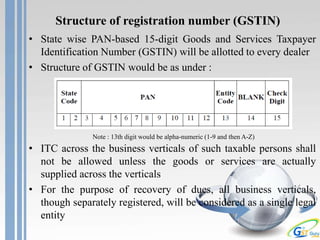
Structure of registration number (GSTIN)
• State wise PAN-based 15-digit Goods and Services Taxpayer
Identification Number (GSTIN) will be allotted to every dealer
• Structure of GSTIN would be as under :
Note : 13th digit would be alpha-numeric (1-9 and then A-Z)
• ITC across the business verticals of such taxable persons shall
not be allowed unless the goods or services are actually
supplied across the verticals
• For the purpose of recovery of dues, all business verticals,
though separately registered, will be considered as a single legal
entity
Compounding scheme
• Dealers below the Compounding ceiling will be provided with an
option of availing the Compounding scheme i.e. they can pay the tax
at Compounding rate (to be specified) without entering the credit
chain
• Taxpayer not under Compounding scheme may opt for Compounding
scheme, if eligible, only from the beginning of the next Financial Year
• Compounding dealer may be allowed to switch over to Normal
scheme even during the year if they so want, with a condition that
they cannot switch over to Compounding scheme again during the
same financial year
• Existing taxpayer under the Compounding scheme upon crossing the
Compounding threshold will be switched over to the Normal scheme
automatically from the day following the day of crossing the
Compounding threshold
Procedure for obtaining Registration
• Taxable persons shall interact with tax authorities through a
common portal called GST Common Portal that would be set up
by Goods and Services Tax Network (GSTN)
• Registration form has been designed and is annexed as Annexure-
III
• A new applicant would be allowed to apply for registration
without prior enrollment
 PAN would be pre-requisite ( even for individual of north east and
Government departments)
 Process is more or less same; as in DVAT
 Online verification of PAN would be in addition; as in MCA21
 Application for registration in more than one State
 Taxpayer can also approach to TRP or FC
 Real-time PAN validation with CBDT portal, Adhaar No. validation
with UIDAI, CIN (Company Identification) with MCA would be done
 Option to sign the submitted application using valid digital signatures
Procedure for obtaining Registration
• The application form will be passed on by GST portal to the IT system of
the concerned State/ Central tax authorities for onward submission to
appropriate jurisdictional officer
• The Centre / State authorities would forward the application to
jurisdictional officers; who shall examine uploaded documents
• Jurisdictional officers has to respond back to the common portal within 3
common working days; else system will issue registration certificate
automatically
• If during the process of verification, one of the authorities raises some
query or notices some error, GST Common Portal will communicate to the
applicant and simultaneously to the other authority
• Application has to respond within 7 days
• Authority has to respond within 7 working days
• If either of the two authorities (Centre or State) refuses to grant registration,
the registration will not be granted, but refusal should be through speaking
order
• Appeal can filed refusal against the order
• System would maintain risk profile; factors would be like Aadhar
number……………..
Migration of existing registrants
• The number of fields in the registration of State VAT and CBEC
system; varies from 50 to 107
• whereas GST Registration Form has 120 fields.
• Thus there is a gap of 13 to 70 fields, meaning that data will have
to be collected from the taxpayers
• States do not have scanned copies of supporting documents for
all the registrations
• GSTIN will be generated on the basis of existing data; where
PAN has been validated. Along with a password the GSTIN will
be sent to respective State Tax Authorities
• State tax authorities will communicate the GSTIN/password to
taxpayers, with instruction to log on the GST portal and fill up
the remaining data along with supporting documents
Thank You
D-32; East of Kailash; New Delhi – 110065
E-mail : gaurav@gstguru.com
Mobile : 9818949966

Key notes on gst registration

  • 1.
    Key notes on GST registration (in lightof report of Joint Committee on Business processes)
  • 2.
    Need of registrationunder proposed GST regime • To collect GST from customers • To claim any input tax credit of GST paid • Annual Turnover crosses threshold at national level • To any inter-state supply • To make payment of GST under reverse charge • All UN bodies seeking to claim refund of taxes paid by them • Input Service Distributor (ISD) for distributing credit • Government authorities / PSUs not making outwards supplies but making inter-state purchases • In enforcement cases, authorities may grant suo-moto • All existing registered persons
  • 3.
    Registration application • Applicationmust be filed within 30 days from the date of dealer’s liability for obtaining such registration • Effective date of registration would be the date of application i.e. whether the application has been filed within prescribed time limit or otherwise • The taxpayer would be eligible for ITC from the date of application; if application filed within 30 days otherwise from the date of registration • Separate registration for each State • Maximum 35 registration in each state [ 1-9 , A-Z] • Separate registration for each sagment [ as defined in AS-17]
  • 4.
    Casual dealers • Asupplier who is not registered on regular basis • Desires to conduct business in a State for a limited period • Have to obtain registration in that State for that limited period • Shall not be allowed to opt for composition scheme • Supplier would be eligible to claim ITC on purchases • Period of registration would be mentioned in the registration certificate • Has to disclose estimated turnover over registration form • Has to deposit estimated tax in form of two demand draft, One for SGST and other for CGST [ Bank gurantee ] • Which would be returned to the taxpayer after he has discharged his final liability
  • 5.
    Non-resident Supplier • ANon-resident Supplier is a person who, in the course of business, makes an intra-state supply of goods or services or both, but is not a resident in the state in which he has applied for registration, but is already registered in any other state. Since the Non-Resident Supplier is already registered in another State, there would be an easy way of registering such entities in the State in which registration is applied as Non- Resident Supplier. The provisions applicable on casual dealers may apply to them except that no security deposit or advance tax collection may be made in their case
  • 6.
    Structure of registrationnumber (GSTIN) • State wise PAN-based 15-digit Goods and Services Taxpayer Identification Number (GSTIN) will be allotted to every dealer • Structure of GSTIN would be as under : Note : 13th digit would be alpha-numeric (1-9 and then A-Z) • ITC across the business verticals of such taxable persons shall not be allowed unless the goods or services are actually supplied across the verticals • For the purpose of recovery of dues, all business verticals, though separately registered, will be considered as a single legal entity
  • 7.
    Compounding scheme • Dealersbelow the Compounding ceiling will be provided with an option of availing the Compounding scheme i.e. they can pay the tax at Compounding rate (to be specified) without entering the credit chain • Taxpayer not under Compounding scheme may opt for Compounding scheme, if eligible, only from the beginning of the next Financial Year • Compounding dealer may be allowed to switch over to Normal scheme even during the year if they so want, with a condition that they cannot switch over to Compounding scheme again during the same financial year • Existing taxpayer under the Compounding scheme upon crossing the Compounding threshold will be switched over to the Normal scheme automatically from the day following the day of crossing the Compounding threshold
  • 8.
    Procedure for obtainingRegistration • Taxable persons shall interact with tax authorities through a common portal called GST Common Portal that would be set up by Goods and Services Tax Network (GSTN) • Registration form has been designed and is annexed as Annexure- III • A new applicant would be allowed to apply for registration without prior enrollment  PAN would be pre-requisite ( even for individual of north east and Government departments)  Process is more or less same; as in DVAT  Online verification of PAN would be in addition; as in MCA21  Application for registration in more than one State  Taxpayer can also approach to TRP or FC  Real-time PAN validation with CBDT portal, Adhaar No. validation with UIDAI, CIN (Company Identification) with MCA would be done  Option to sign the submitted application using valid digital signatures
  • 9.
    Procedure for obtainingRegistration • The application form will be passed on by GST portal to the IT system of the concerned State/ Central tax authorities for onward submission to appropriate jurisdictional officer • The Centre / State authorities would forward the application to jurisdictional officers; who shall examine uploaded documents • Jurisdictional officers has to respond back to the common portal within 3 common working days; else system will issue registration certificate automatically • If during the process of verification, one of the authorities raises some query or notices some error, GST Common Portal will communicate to the applicant and simultaneously to the other authority • Application has to respond within 7 days • Authority has to respond within 7 working days • If either of the two authorities (Centre or State) refuses to grant registration, the registration will not be granted, but refusal should be through speaking order • Appeal can filed refusal against the order • System would maintain risk profile; factors would be like Aadhar number……………..
  • 10.
    Migration of existingregistrants • The number of fields in the registration of State VAT and CBEC system; varies from 50 to 107 • whereas GST Registration Form has 120 fields. • Thus there is a gap of 13 to 70 fields, meaning that data will have to be collected from the taxpayers • States do not have scanned copies of supporting documents for all the registrations • GSTIN will be generated on the basis of existing data; where PAN has been validated. Along with a password the GSTIN will be sent to respective State Tax Authorities • State tax authorities will communicate the GSTIN/password to taxpayers, with instruction to log on the GST portal and fill up the remaining data along with supporting documents
  • 11.
    Thank You D-32; Eastof Kailash; New Delhi – 110065 E-mail : gaurav@gstguru.com Mobile : 9818949966