Demand & Recovery
Disclaimer 2
The information cited in this presentation has been drawn from various sources (including
study material prepared by The Institute of Cost Accountants of India and The Institute of
Chartered Accountants of India). While every efforts have been made to keep the
information in this presentation error free, no responsibility for any typographical or clerical
error which may have crept in while compiling the information provided can be taken.
The presentation has been prepared to provide an overview of the applicable law pertaining
to the subject matter. For detailed insight and for better understanding, its is advised to refer
to relevant provisions in the Act and the related rules & notifications.
Background 3
• Though the focus of GST and its compliance is largely based on self-assessment and
voluntary payment of tax, there are bound to be cases relating to non-payment/ delayed
payment of tax or wrong availment of Input Tax Credit or erroneous refunds.
• The factors leading to such ‘non-compliance’ can be ranging from misunderstanding of
legal provisions, certain disputes and even wilful default.
• It is, thus, an important task at the hands of the tax authorities to verify, scrutinise, audit
and review of returns and records and to ensure proper and time-bound raising demand
and recovery of tax dues, if any.
• Whilst levy of tax is mandated by law under GST, its recovery is an important
administrative function under law.
• In a broader sense, demand of tax before its recovery is more humane touch to the
process, ultimately aimed at proper recovery of tax for larger social good.
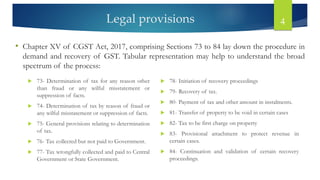
Legal provisions
 73- Determination of tax for any reason other
than fraud or any wilful misstatement or
suppression of facts.
 74- Determination of tax by reason of fraud or
any wilful misstatement or suppression of facts.
 75- General provisions relating to determination
of tax.
 76- Tax collected but not paid to Government.
 77- Tax wrongfully collected and paid to Central
Government or State Government.
 78- Initiation of recovery proceedings
 79- Recovery of tax.
 80- Payment of tax and other amount in instalments.
 81- Transfer of property to be void in certain cases
 82- Tax to be first charge on property
 83- Provisional attachment to protect revenue in
certain cases.
 84- Continuation and validation of certain recovery
proceedings.
4
• Chapter XV of CGST Act, 2017, comprising Sections 73 to 84 lay down the procedure in
demand and recovery of GST. Tabular representation may help to understand the broad
spectrum of the process:
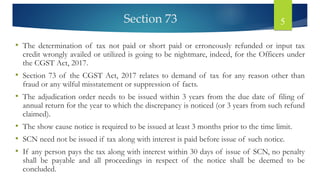
Section 73 5
• The determination of tax not paid or short paid or erroneously refunded or input tax
credit wrongly availed or utilized is going to be nightmare, indeed, for the Officers under
the CGST Act, 2017.
• Section 73 of the CGST Act, 2017 relates to demand of tax for any reason other than
fraud or any wilful misstatement or suppression of facts.
• The adjudication order needs to be issued within 3 years from the due date of filing of
annual return for the year to which the discrepancy is noticed (or 3 years from such refund
claimed).
• The show cause notice is required to be issued at least 3 months prior to the time limit.
• SCN need not be issued if tax along with interest is paid before issue of such notice.
• If any person pays the tax along with interest within 30 days of issue of SCN, no penalty
shall be payable and all proceedings in respect of the notice shall be deemed to be
concluded.
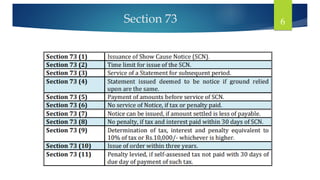
Section 73 6
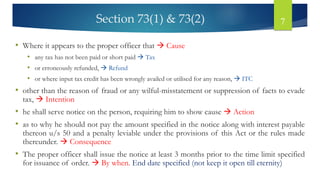
Section 73(1) & 73(2) 7
• Where it appears to the proper officer that → Cause
• any tax has not been paid or short paid → Tax
• or erroneously refunded, → Refund
• or where input tax credit has been wrongly availed or utilised for any reason, → ITC
• other than the reason of fraud or any wilful-misstatement or suppression of facts to evade
tax, → Intention
• he shall serve notice on the person, requiring him to show cause → Action
• as to why he should not pay the amount specified in the notice along with interest payable
thereon u/s 50 and a penalty leviable under the provisions of this Act or the rules made
thereunder. → Consequence
• The proper officer shall issue the notice at least 3 months prior to the time limit specified
for issuance of order. → By when. End date specified (not keep it open till eternity)
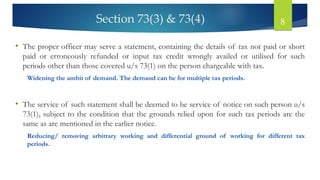
Section 73(3) & 73(4) 8
• The proper officer may serve a statement, containing the details of tax not paid or short
paid or erroneously refunded or input tax credit wrongly availed or utilised for such
periods other than those covered u/s 73(1) on the person chargeable with tax.
Widening the ambit of demand. The demand can be for multiple tax periods.
• The service of such statement shall be deemed to be service of notice on such person u/s
73(1), subject to the condition that the grounds relied upon for such tax periods are the
same as are mentioned in the earlier notice.
Reducing/ removing arbitrary working and differential ground of working for different tax
periods.
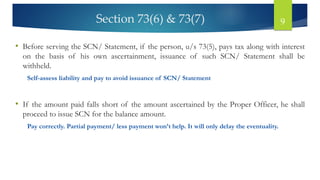
Section 73(6) & 73(7) 9
• Before serving the SCN/ Statement, if the person, u/s 73(5), pays tax along with interest
on the basis of his own ascertainment, issuance of such SCN/ Statement shall be
withheld.
Self-assess liability and pay to avoid issuance of SCN/ Statement
• If the amount paid falls short of the amount ascertained by the Proper Officer, he shall
proceed to issue SCN for the balance amount.
Pay correctly. Partial payment/ less payment won’t help. It will only delay the eventuality.
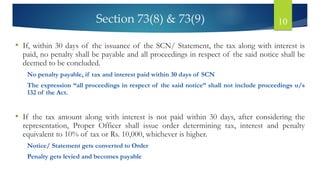
Section 73(8) & 73(9) 10
• If, within 30 days of the issuance of the SCN/ Statement, the tax along with interest is
paid, no penalty shall be payable and all proceedings in respect of the said notice shall be
deemed to be concluded.
No penalty payable, if tax and interest paid within 30 days of SCN
The expression “all proceedings in respect of the said notice” shall not include proceedings u/s
132 of the Act.
• If the tax amount along with interest is not paid within 30 days, after considering the
representation, Proper Officer shall issue order determining tax, interest and penalty
equivalent to 10% of tax or Rs. 10,000, whichever is higher.
Notice/ Statement gets converted to Order
Penalty gets levied and becomes payable
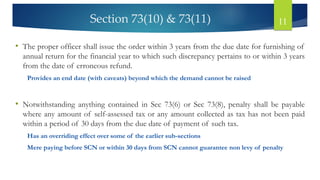
Section 73(10) & 73(11) 11
• The proper officer shall issue the order within 3 years from the due date for furnishing of
annual return for the financial year to which such discrepancy pertains to or within 3 years
from the date of erroneous refund.
Provides an end date (with caveats) beyond which the demand cannot be raised
• Notwithstanding anything contained in Sec 73(6) or Sec 73(8), penalty shall be payable
where any amount of self-assessed tax or any amount collected as tax has not been paid
within a period of 30 days from the due date of payment of such tax.
Has an overriding effect over some of the earlier sub-sections
Mere paying before SCN or within 30 days from SCN cannot guarantee non levy of penalty
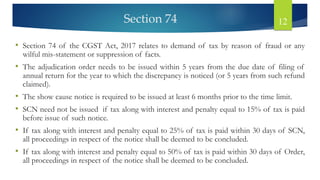
Section 74 12
• Section 74 of the CGST Act, 2017 relates to demand of tax by reason of fraud or any
wilful mis-statement or suppression of facts.
• The adjudication order needs to be issued within 5 years from the due date of filing of
annual return for the year to which the discrepancy is noticed (or 5 years from such refund
claimed).
• The show cause notice is required to be issued at least 6 months prior to the time limit.
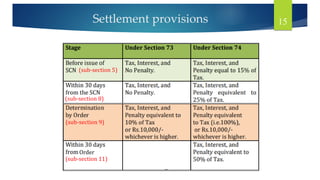
• SCN need not be issued if tax along with interest and penalty equal to 15% of tax is paid
before issue of such notice.
• If tax along with interest and penalty equal to 25% of tax is paid within 30 days of SCN,
all proceedings in respect of the notice shall be deemed to be concluded.
• If tax along with interest and penalty equal to 50% of tax is paid within 30 days of Order,
all proceedings in respect of the notice shall be deemed to be concluded.
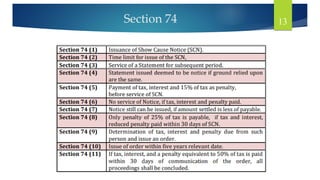
Section 74 13
Section 74(1) & Sec 74(2) 14
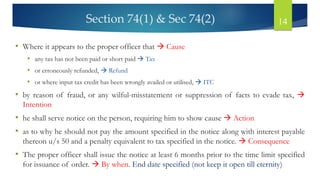
• Where it appears to the proper officer that → Cause
• any tax has not been paid or short paid → Tax
• or erroneously refunded, → Refund
• or where input tax credit has been wrongly availed or utilised, → ITC
• by reason of fraud, or any wilful-misstatement or suppression of facts to evade tax, →
Intention
• he shall serve notice on the person, requiring him to show cause → Action
• as to why he should not pay the amount specified in the notice along with interest payable
thereon u/s 50 and a penalty equivalent to tax specified in the notice. → Consequence
• The proper officer shall issue the notice at least 6 months prior to the time limit specified
for issuance of order. → By when. End date specified (not keep it open till eternity)
Settlement provisions 15
Order
(sub-section 5)
(sub-section 8)
(sub-section 9)
(sub-section 11)
Some explanations 16
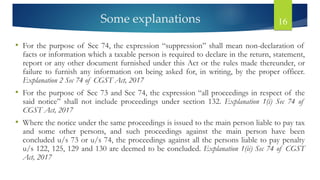
• For the purpose of Sec 74, the expression “suppression” shall mean non-declaration of
facts or information which a taxable person is required to declare in the return, statement,
report or any other document furnished under this Act or the rules made thereunder, or
failure to furnish any information on being asked for, in writing, by the proper officer.
Explanation 2 Sec 74 of CGST Act, 2017
• For the purpose of Sec 73 and Sec 74, the expression “all proceedings in respect of the
said notice” shall not include proceedings under section 132. Explanation 1(i) Sec 74 of
CGST Act, 2017
• Where the notice under the same proceedings is issued to the main person liable to pay tax
and some other persons, and such proceedings against the main person have been
concluded u/s 73 or u/s 74, the proceedings against all the persons liable to pay penalty
u/s 122, 125, 129 and 130 are deemed to be concluded. Explanation 1(ii) Sec 74 of CGST
Act, 2017
General provisions - Sec 75 17
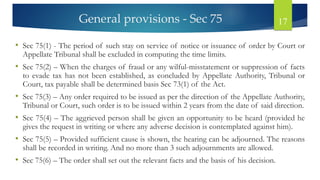
• Sec 75(1) - The period of such stay on service of notice or issuance of order by Court or
Appellate Tribunal shall be excluded in computing the time limits.
• Sec 75(2) – When the charges of fraud or any wilful-misstatement or suppression of facts
to evade tax has not been established, as concluded by Appellate Authority, Tribunal or
Court, tax payable shall be determined basis Sec 73(1) of the Act.
• Sec 75(3) – Any order required to be issued as per the direction of the Appellate Authority,
Tribunal or Court, such order is to be issued within 2 years from the date of said direction.
• Sec 75(4) – The aggrieved person shall be given an opportunity to be heard (provided he
gives the request in writing or where any adverse decision is contemplated against him).
• Sec 75(5) – Provided sufficient cause is shown, the hearing can be adjourned. The reasons
shall be recorded in writing. And no more than 3 such adjournments are allowed.
• Sec 75(6) – The order shall set out the relevant facts and the basis of his decision.
General provisions - Sec 75 18
• Sec 75(7) - The amount of tax, interest and penalty in the order shall not be in excess of the
amount specified in the notice. No demand shall be confirmed on the grounds other than the
grounds specified in the notice.
• Sec 75(8) –Where the Appellate Authority, Tribunal or court modifies the amount of tax, the
amount of interest and penalty shall stand modified accordingly.
• Sec 75(9) - Interest shall be payable whether or not specified in the order determining the tax
liability.
• Sec 75(10) - Adjudication proceedings are deemed concluded, if the order is not issued within the
time limit.
• Sec 75(11) – Matters pending between two higher authorities, the period shall be excluded while
calculating the time limit.
• Sec 75(12) - No separate notice needed for recovery of unpaid self-assessed tax and interest
thereon.
• Sec 75(13) –No penalty for the same act or omission shall be imposed on the same person under
any other provision of this Act.
Tax collected by not paid - Sec 76 19
• Any amount collected as tax from customers “representing it as tax” and not paid to the
Government, shall forthwith be paid to account of the Government regardless of whether
the supplies were taxable or not.
• The Proper Officer is authorised to serve show cause notice for the amount so collected
but not deposited and why penalty, equivalent to the tax amount should not be imposed.
• Determination of the amount payable shall be done after considering the representation
by the said person. The defaulter shall be given an opportunity to be heard provided the
request is received in writing from such person.
• The defaulter shall be liable for payment of interest as provided u/s 50 from the date such
amount was collected till the date of payment to the exchequer.
Tax collected by not paid - Sec 76 20
• Order needs to be issued within 1 year from the date of issuance of such notice.
• Where the issuance of order is stayed by an order of the Court or Appellate Tribunal, the
period of such stay shall be excluded in computing the period of one year.
• The order shall set out the relevant facts and the basis of the decision.
• After adjusting the amount paid, if any surplus is left, such surplus shall either be credited
to the Fund or refunded to the person who has borne the incidence of such amount.
• Provisions of Section 76 has overriding authority over any order or direction by any
Appellate Authority, Tribunal or Court under this Act or any other law in force.
Applicable Forms and Instructions 21
• Form GST DRC-01 – Summary of the SCN and the demand raised.
• Form GST DRC-02 – Statement along with the summary issued.
• Form GST DRC-01A (Part A) – Communication of details of tax, interest and penalty as
ascertained. This is issued prior to SCN and is optional.
• Form GST DRC-01A (Part B) – Partial payment or filing of any submissions against the
proposed liability as provided in Form GST DRC-01A (Part A)
• Form GST DRC-03 – Intimation of payment made by the person (self ascertained, prior
to SCN or within 30 days of SCN).
• Form GST DRC-04 – Acknowledgement of payment made vide form GST DRC-03
Applicable Forms and Instructions 22
• Form GST DRC-05 – Conclusion of the proceedings in respect of SCN.
• Form GST DRC-06 – Representation by the person against Form GST DRC-01
• Form GST DRC-07 – Summary of the Order issued. This is treated as a notice for
recovery
• Form GST DRC-08 – Summary of the Rectification of Order or Withdrawal of Order
uploaded in the system by the Proper Officer.
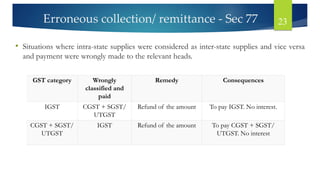
Erroneous collection/ remittance - Sec 77 23
• Situations where intra-state supplies were considered as inter-state supplies and vice versa
and payment were wrongly made to the relevant heads.
GST category Wrongly
classified and
paid
Remedy Consequences
IGST CGST + SGST/
UTGST
Refund of the amount To pay IGST. No interest.
CGST + SGST/
UTGST
IGST Refund of the amount To pay CGST + SGST/
UTGST. No interest
Recovery proceedings – Sec 78 24
• Any amount payable in pursuance of an order shall be paid by such person within a period
of 3 months from the date of service of order failing which recovery proceedings shall be
initiated.
• Proper officer, in the interest of revenue, may, for reasons to be recorded in writing,
require the taxable person to make the payment within such period less than a period of 3
months, as may be specified by him.
• Form GST DRC-07A – Recovery of dues remaining unpaid. Demand of the Order to be
posted in Part II in form GST PMT-01 (Electronic Liability Register).
• Form GST DRC-08A –In case the order is rectified, modified, quashed, reviewed, revised
or if the recovery is made, summary is uploaded. Part II of form GST PMT-01 is updated
accordingly.
Recovery of Tax – Sec 79 25
Various modes of recovery of amount payable
• Deducting the money so payable (refund, drawback etc.) to such person which may be
under his control or in the control of other specified officers.
• The order is issued in form GST DRC-09.
• Detaining and selling any goods belonging to such person which may be under his control
or in the control of other specified officers.
• The Proper Officer to sell such goods as per the process laid out in Rule 144 of CGST Rules, 2017
Process of Auction – Rule 144 26
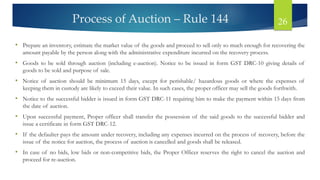
• Prepare an inventory, estimate the market value of the goods and proceed to sell only so much enough for recovering the
amount payable by the person along with the administrative expenditure incurred on the recovery process.
• Goods to be sold through auction (including e-auction). Notice to be issued in form GST DRC-10 giving details of
goods to be sold and purpose of sale.
• Notice of auction should be minimum 15 days, except for perishable/ hazardous goods or where the expenses of
keeping them in custody are likely to exceed their value. In such cases, the proper officer may sell the goods forthwith.
• Notice to the successful bidder is issued in form GST DRC-11 requiring him to make the payment within 15 days from
the date of auction.
• Upon successful payment, Proper officer shall transfer the possession of the said goods to the successful bidder and
issue a certificate in form GST DRC-12.
• If the defaulter pays the amount under recovery, including any expenses incurred on the process of recovery, before the
issue of the notice for auction, the process of auction is cancelled and goods shall be released.
• In case of no bids, low bids or non-competitive bids, the Proper Officer reserves the right to cancel the auction and
proceed for re-auction.
Recovery of Tax – Sec 79 27
Various modes of recovery of amount payable
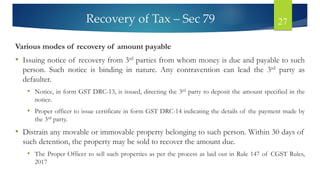
• Issuing notice of recovery from 3rd parties from whom money is due and payable to such
person. Such notice is binding in nature. Any contravention can lead the 3rd party as
defaulter.
• Notice, in form GST DRC-13, is issued, directing the 3rd party to deposit the amount specified in the
notice.
• Proper officer to issue certificate in form GST DRC-14 indicating the details of the payment made by
the 3rd party.
• Distrain any movable or immovable property belonging to such person. Within 30 days of
such detention, the property may be sold to recover the amount due.
• The Proper Officer to sell such properties as per the process as laid out in Rule 147 of CGST Rules,
2017
Process of Auction – Rule 147 28
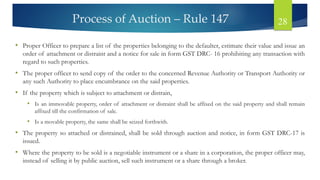
• Proper Officer to prepare a list of the properties belonging to the defaulter, estimate their value and issue an
order of attachment or distraint and a notice for sale in form GST DRC- 16 prohibiting any transaction with
regard to such properties.
• The proper officer to send copy of the order to the concerned Revenue Authority or Transport Authority or
any such Authority to place encumbrance on the said properties.
• If the property which is subject to attachment or distrain,
• Is an immovable property, order of attachment or distraint shall be affixed on the said property and shall remain
affixed till the confirmation of sale.
• Is a movable property, the same shall be seized forthwith.
• The property so attached or distrained, shall be sold through auction and notice, in form GST DRC-17 is
issued.
• Where the property to be sold is a negotiable instrument or a share in a corporation, the proper officer may,
instead of selling it by public auction, sell such instrument or a share through a broker.
Process of Auction – Rule 147 29
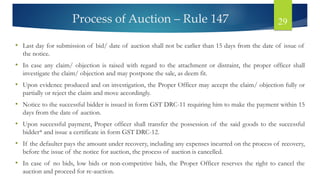
• Last day for submission of bid/ date of auction shall not be earlier than 15 days from the date of issue of
the notice.
• In case any claim/ objection is raised with regard to the attachment or distraint, the proper officer shall
investigate the claim/ objection and may postpone the sale, as deem fit.
• Upon evidence produced and on investigation, the Proper Officer may accept the claim/ objection fully or
partially or reject the claim and move accordingly.
• Notice to the successful bidder is issued in form GST DRC-11 requiring him to make the payment within 15
days from the date of auction.
• Upon successful payment, Proper officer shall transfer the possession of the said goods to the successful
bidder* and issue a certificate in form GST DRC-12.
• If the defaulter pays the amount under recovery, including any expenses incurred on the process of recovery,
before the issue of the notice for auction, the process of auction is cancelled.
• In case of no bids, low bids or non-competitive bids, the Proper Officer reserves the right to cancel the
auction and proceed for re-auction.
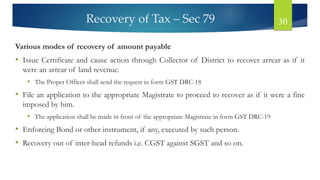
Recovery of Tax – Sec 79 30
Various modes of recovery of amount payable
• Issue Certificate and cause action through Collector of District to recover arrear as if it
were an arrear of land revenue.
• The Proper Officer shall send the request in form GST DRC-18
• File an application to the appropriate Magistrate to proceed to recover as if it were a fine
imposed by him.
• The application shall be made in front of the appropriate Magistrate in form GST DRC-19
• Enforcing Bond or other instrument, if any, executed by such person.
• Recovery out of inter-head refunds i.e. CGST against SGST and so on.
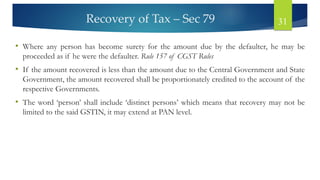
Recovery of Tax – Sec 79 31
• Where any person has become surety for the amount due by the defaulter, he may be
proceeded as if he were the defaulter. Rule 157 of CGST Rules
• If the amount recovered is less than the amount due to the Central Government and State
Government, the amount recovered shall be proportionately credited to the account of the
respective Governments.
• The word ‘person’ shall include ‘distinct persons’ which means that recovery may not be
limited to the said GSTIN, it may extend at PAN level.
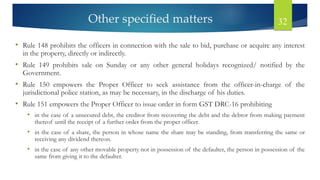
Other specified matters 32
• Rule 148 prohibits the officers in connection with the sale to bid, purchase or acquire any interest
in the property, directly or indirectly.
• Rule 149 prohibits sale on Sunday or any other general holidays recognized/ notified by the
Government.
• Rule 150 empowers the Proper Officer to seek assistance from the officer-in-charge of the
jurisdictional police station, as may be necessary, in the discharge of his duties.
• Rule 151 empowers the Proper Officer to issue order in form GST DRC-16 prohibiting
• in the case of a unsecured debt, the creditor from recovering the debt and the debtor from making payment
thereof until the receipt of a further order from the proper officer.
• in the case of a share, the person in whose name the share may be standing, from transferring the same or
receiving any dividend thereon.
• in the case of any other movable property not in possession of the defaulter, the person in possession of the
same from giving it to the defaulter.
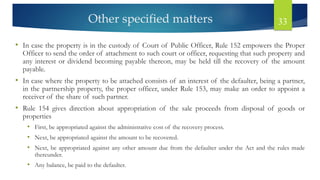
Other specified matters 33
• In case the property is in the custody of Court of Public Officer, Rule 152 empowers the Proper
Officer to send the order of attachment to such court or officer, requesting that such property and
any interest or dividend becoming payable thereon, may be held till the recovery of the amount
payable.
• In case where the property to be attached consists of an interest of the defaulter, being a partner,
in the partnership property, the proper officer, under Rule 153, may make an order to appoint a
receiver of the share of such partner.
• Rule 154 gives direction about appropriation of the sale proceeds from disposal of goods or
properties
• First, be appropriated against the administrative cost of the recovery process.
• Next, be appropriated against the amount to be recovered.
• Next, be appropriated against any other amount due from the defaulter under the Act and the rules made
thereunder.
• Any balance, be paid to the defaulter.
Payment in instalments – Sec 80 34
• Taxable person can apply, in form GST DRC-20, for deferment of payment of dues or payment
of dues in instalments (except dues in relation to self-assessed liability in return).
• The Commissioner may, for reasons to be recorded in writing, extend the time for payment or
allow payment of any amount due in monthly instalments not exceeding 24, subject to payment of
interest u/s 50.
• The Commissioner, while passing the order in form GST DRC-21, may impose conditions, as
deem fit.
• The said facility is not allowed if,
• the person has already defaulted on the payment of any amount under the Act and the recovery process is on
• the person has not been allowed to make payment in instalments in the preceding financial year under the Act
• the amount for which instalment facility is sought is less than Rs. 25,000
• If there is a default in payment of any one instalment on its due date, the whole outstanding
balance payable on such date shall become due and payable forthwith and shall, without any
further notice being served on the person, be liable for recovery.
Sec 81 & Sec 82 35
• After any amount has become due from him, if the person creates a charge on or parts
with the property belonging to him with the intention of defrauding the Government
revenue, such charge or transfer shall be void as against any claim in respect of any tax or
any other sum payable by the said person.
• The above act shall not be considered void if,
• Made for adequate consideration in good faith
• Without notice of the pendency of the proceedings.
• Without notice of such tax is payable
• With previous permission of the Proper Officer.
• Any amount payable to the Government shall be a first charge on the property of such
person (save as otherwise provided in the Insolvency and Bankruptcy Code, 2016).
Provisional Attachment – Sec 83 36
• During pendency of proceedings related to some Assessment, Summary Assessments,
Inspection, Search, Seizure, Demand or Recovery, if the Commissioner is of the opinion
that for the purpose of protecting the interest of the Government revenue, he may, by
order in form GST DRC-22, attach provisionally any property, including bank account,
belonging to the taxable person in such manner as may be prescribed.
• If the property attached is of perishable or hazardous nature, and if the taxable person
pays an amount equivalent to the market price of such property or the amount that is or
may become payable by the taxable person, whichever is lower, then such property shall be
released forthwith, by an order in form GST DRC-23, on proof of payment.
• If, after issue of Form GST DRC-03, the person fails to make the payment, the
Commissioner may dispose of the said property and adjust the proceeds with the dues.
• The person has 7 days to file objection to the attachment order issued.
Provisional Attachment – Sec 83 37
• The Commissioner may, after affording an opportunity of being heard to the person filing
the objection, release the said property by an order in form GST DRC-23.
• Every such provisional attachment shall cease to have effect after the expiry of a period of
1 year from the date of the order made.
Recovery proceedings – Sec 84 38
• Where any notice of demand in respect Government dues is served upon any person and any
appeal or revision application is filed or any other proceedings is initiated in respect of such
Government dues, then
• In case the dues are enhanced in appeal, revision or any other proceedings, the Commissioner shall serve
upon the person another notice of demand in respect of the amount by which such Government dues are
enhanced.
• In case the dues are reduced in appeal, revision or any other proceedings, it shall not be necessary for the
Commissioner to serve upon the person fresh notice of demand. The intimation shall be given to the person
and the concerned authority.
• Any proceedings, as being undertaken prior to issue of fresh notice or intimation, shall continue as they were
prior to issue of such notice or intimation. This fresh notice/ intimation shall have no major bearing on the
existing recovery proceedings which can continue from the stage at which such proceedings stood
immediately before such disposal.
• The order for the reduction or enhancement of any demand shall be issued in form GST DRC- 25
Thank You
Manmohan Daga
Daga & Associates
9804199500
mmdaga@hotmail.com

GST - Demand & Recovery

  • 1.
  • 2.
    Disclaimer 2 The informationcited in this presentation has been drawn from various sources (including study material prepared by The Institute of Cost Accountants of India and The Institute of Chartered Accountants of India). While every efforts have been made to keep the information in this presentation error free, no responsibility for any typographical or clerical error which may have crept in while compiling the information provided can be taken. The presentation has been prepared to provide an overview of the applicable law pertaining to the subject matter. For detailed insight and for better understanding, its is advised to refer to relevant provisions in the Act and the related rules & notifications.
  • 3.
    Background 3 • Thoughthe focus of GST and its compliance is largely based on self-assessment and voluntary payment of tax, there are bound to be cases relating to non-payment/ delayed payment of tax or wrong availment of Input Tax Credit or erroneous refunds. • The factors leading to such ‘non-compliance’ can be ranging from misunderstanding of legal provisions, certain disputes and even wilful default. • It is, thus, an important task at the hands of the tax authorities to verify, scrutinise, audit and review of returns and records and to ensure proper and time-bound raising demand and recovery of tax dues, if any. • Whilst levy of tax is mandated by law under GST, its recovery is an important administrative function under law. • In a broader sense, demand of tax before its recovery is more humane touch to the process, ultimately aimed at proper recovery of tax for larger social good.
  • 4.
    Legal provisions  73-Determination of tax for any reason other than fraud or any wilful misstatement or suppression of facts.  74- Determination of tax by reason of fraud or any wilful misstatement or suppression of facts.  75- General provisions relating to determination of tax.  76- Tax collected but not paid to Government.  77- Tax wrongfully collected and paid to Central Government or State Government.  78- Initiation of recovery proceedings  79- Recovery of tax.  80- Payment of tax and other amount in instalments.  81- Transfer of property to be void in certain cases  82- Tax to be first charge on property  83- Provisional attachment to protect revenue in certain cases.  84- Continuation and validation of certain recovery proceedings. 4 • Chapter XV of CGST Act, 2017, comprising Sections 73 to 84 lay down the procedure in demand and recovery of GST. Tabular representation may help to understand the broad spectrum of the process:
  • 5.
    Section 73 5 •The determination of tax not paid or short paid or erroneously refunded or input tax credit wrongly availed or utilized is going to be nightmare, indeed, for the Officers under the CGST Act, 2017. • Section 73 of the CGST Act, 2017 relates to demand of tax for any reason other than fraud or any wilful misstatement or suppression of facts. • The adjudication order needs to be issued within 3 years from the due date of filing of annual return for the year to which the discrepancy is noticed (or 3 years from such refund claimed). • The show cause notice is required to be issued at least 3 months prior to the time limit. • SCN need not be issued if tax along with interest is paid before issue of such notice. • If any person pays the tax along with interest within 30 days of issue of SCN, no penalty shall be payable and all proceedings in respect of the notice shall be deemed to be concluded.
  • 6.
  • 7.
    Section 73(1) &73(2) 7 • Where it appears to the proper officer that → Cause • any tax has not been paid or short paid → Tax • or erroneously refunded, → Refund • or where input tax credit has been wrongly availed or utilised for any reason, → ITC • other than the reason of fraud or any wilful-misstatement or suppression of facts to evade tax, → Intention • he shall serve notice on the person, requiring him to show cause → Action • as to why he should not pay the amount specified in the notice along with interest payable thereon u/s 50 and a penalty leviable under the provisions of this Act or the rules made thereunder. → Consequence • The proper officer shall issue the notice at least 3 months prior to the time limit specified for issuance of order. → By when. End date specified (not keep it open till eternity)
  • 8.
    Section 73(3) &73(4) 8 • The proper officer may serve a statement, containing the details of tax not paid or short paid or erroneously refunded or input tax credit wrongly availed or utilised for such periods other than those covered u/s 73(1) on the person chargeable with tax. Widening the ambit of demand. The demand can be for multiple tax periods. • The service of such statement shall be deemed to be service of notice on such person u/s 73(1), subject to the condition that the grounds relied upon for such tax periods are the same as are mentioned in the earlier notice. Reducing/ removing arbitrary working and differential ground of working for different tax periods.
  • 9.
    Section 73(6) &73(7) 9 • Before serving the SCN/ Statement, if the person, u/s 73(5), pays tax along with interest on the basis of his own ascertainment, issuance of such SCN/ Statement shall be withheld. Self-assess liability and pay to avoid issuance of SCN/ Statement • If the amount paid falls short of the amount ascertained by the Proper Officer, he shall proceed to issue SCN for the balance amount. Pay correctly. Partial payment/ less payment won’t help. It will only delay the eventuality.
  • 10.
    Section 73(8) &73(9) 10 • If, within 30 days of the issuance of the SCN/ Statement, the tax along with interest is paid, no penalty shall be payable and all proceedings in respect of the said notice shall be deemed to be concluded. No penalty payable, if tax and interest paid within 30 days of SCN The expression “all proceedings in respect of the said notice” shall not include proceedings u/s 132 of the Act. • If the tax amount along with interest is not paid within 30 days, after considering the representation, Proper Officer shall issue order determining tax, interest and penalty equivalent to 10% of tax or Rs. 10,000, whichever is higher. Notice/ Statement gets converted to Order Penalty gets levied and becomes payable
  • 11.
    Section 73(10) &73(11) 11 • The proper officer shall issue the order within 3 years from the due date for furnishing of annual return for the financial year to which such discrepancy pertains to or within 3 years from the date of erroneous refund. Provides an end date (with caveats) beyond which the demand cannot be raised • Notwithstanding anything contained in Sec 73(6) or Sec 73(8), penalty shall be payable where any amount of self-assessed tax or any amount collected as tax has not been paid within a period of 30 days from the due date of payment of such tax. Has an overriding effect over some of the earlier sub-sections Mere paying before SCN or within 30 days from SCN cannot guarantee non levy of penalty
  • 12.
    Section 74 12 •Section 74 of the CGST Act, 2017 relates to demand of tax by reason of fraud or any wilful mis-statement or suppression of facts. • The adjudication order needs to be issued within 5 years from the due date of filing of annual return for the year to which the discrepancy is noticed (or 5 years from such refund claimed). • The show cause notice is required to be issued at least 6 months prior to the time limit. • SCN need not be issued if tax along with interest and penalty equal to 15% of tax is paid before issue of such notice. • If tax along with interest and penalty equal to 25% of tax is paid within 30 days of SCN, all proceedings in respect of the notice shall be deemed to be concluded. • If tax along with interest and penalty equal to 50% of tax is paid within 30 days of Order, all proceedings in respect of the notice shall be deemed to be concluded.
  • 13.
  • 14.
    Section 74(1) &Sec 74(2) 14 • Where it appears to the proper officer that → Cause • any tax has not been paid or short paid → Tax • or erroneously refunded, → Refund • or where input tax credit has been wrongly availed or utilised, → ITC • by reason of fraud, or any wilful-misstatement or suppression of facts to evade tax, → Intention • he shall serve notice on the person, requiring him to show cause → Action • as to why he should not pay the amount specified in the notice along with interest payable thereon u/s 50 and a penalty equivalent to tax specified in the notice. → Consequence • The proper officer shall issue the notice at least 6 months prior to the time limit specified for issuance of order. → By when. End date specified (not keep it open till eternity)
  • 15.
    Settlement provisions 15 Order (sub-section5) (sub-section 8) (sub-section 9) (sub-section 11)
  • 16.
    Some explanations 16 •For the purpose of Sec 74, the expression “suppression” shall mean non-declaration of facts or information which a taxable person is required to declare in the return, statement, report or any other document furnished under this Act or the rules made thereunder, or failure to furnish any information on being asked for, in writing, by the proper officer. Explanation 2 Sec 74 of CGST Act, 2017 • For the purpose of Sec 73 and Sec 74, the expression “all proceedings in respect of the said notice” shall not include proceedings under section 132. Explanation 1(i) Sec 74 of CGST Act, 2017 • Where the notice under the same proceedings is issued to the main person liable to pay tax and some other persons, and such proceedings against the main person have been concluded u/s 73 or u/s 74, the proceedings against all the persons liable to pay penalty u/s 122, 125, 129 and 130 are deemed to be concluded. Explanation 1(ii) Sec 74 of CGST Act, 2017
  • 17.
    General provisions -Sec 75 17 • Sec 75(1) - The period of such stay on service of notice or issuance of order by Court or Appellate Tribunal shall be excluded in computing the time limits. • Sec 75(2) – When the charges of fraud or any wilful-misstatement or suppression of facts to evade tax has not been established, as concluded by Appellate Authority, Tribunal or Court, tax payable shall be determined basis Sec 73(1) of the Act. • Sec 75(3) – Any order required to be issued as per the direction of the Appellate Authority, Tribunal or Court, such order is to be issued within 2 years from the date of said direction. • Sec 75(4) – The aggrieved person shall be given an opportunity to be heard (provided he gives the request in writing or where any adverse decision is contemplated against him). • Sec 75(5) – Provided sufficient cause is shown, the hearing can be adjourned. The reasons shall be recorded in writing. And no more than 3 such adjournments are allowed. • Sec 75(6) – The order shall set out the relevant facts and the basis of his decision.
  • 18.
    General provisions -Sec 75 18 • Sec 75(7) - The amount of tax, interest and penalty in the order shall not be in excess of the amount specified in the notice. No demand shall be confirmed on the grounds other than the grounds specified in the notice. • Sec 75(8) –Where the Appellate Authority, Tribunal or court modifies the amount of tax, the amount of interest and penalty shall stand modified accordingly. • Sec 75(9) - Interest shall be payable whether or not specified in the order determining the tax liability. • Sec 75(10) - Adjudication proceedings are deemed concluded, if the order is not issued within the time limit. • Sec 75(11) – Matters pending between two higher authorities, the period shall be excluded while calculating the time limit. • Sec 75(12) - No separate notice needed for recovery of unpaid self-assessed tax and interest thereon. • Sec 75(13) –No penalty for the same act or omission shall be imposed on the same person under any other provision of this Act.
  • 19.
    Tax collected bynot paid - Sec 76 19 • Any amount collected as tax from customers “representing it as tax” and not paid to the Government, shall forthwith be paid to account of the Government regardless of whether the supplies were taxable or not. • The Proper Officer is authorised to serve show cause notice for the amount so collected but not deposited and why penalty, equivalent to the tax amount should not be imposed. • Determination of the amount payable shall be done after considering the representation by the said person. The defaulter shall be given an opportunity to be heard provided the request is received in writing from such person. • The defaulter shall be liable for payment of interest as provided u/s 50 from the date such amount was collected till the date of payment to the exchequer.
  • 20.
    Tax collected bynot paid - Sec 76 20 • Order needs to be issued within 1 year from the date of issuance of such notice. • Where the issuance of order is stayed by an order of the Court or Appellate Tribunal, the period of such stay shall be excluded in computing the period of one year. • The order shall set out the relevant facts and the basis of the decision. • After adjusting the amount paid, if any surplus is left, such surplus shall either be credited to the Fund or refunded to the person who has borne the incidence of such amount. • Provisions of Section 76 has overriding authority over any order or direction by any Appellate Authority, Tribunal or Court under this Act or any other law in force.
  • 21.
    Applicable Forms andInstructions 21 • Form GST DRC-01 – Summary of the SCN and the demand raised. • Form GST DRC-02 – Statement along with the summary issued. • Form GST DRC-01A (Part A) – Communication of details of tax, interest and penalty as ascertained. This is issued prior to SCN and is optional. • Form GST DRC-01A (Part B) – Partial payment or filing of any submissions against the proposed liability as provided in Form GST DRC-01A (Part A) • Form GST DRC-03 – Intimation of payment made by the person (self ascertained, prior to SCN or within 30 days of SCN). • Form GST DRC-04 – Acknowledgement of payment made vide form GST DRC-03
  • 22.
    Applicable Forms andInstructions 22 • Form GST DRC-05 – Conclusion of the proceedings in respect of SCN. • Form GST DRC-06 – Representation by the person against Form GST DRC-01 • Form GST DRC-07 – Summary of the Order issued. This is treated as a notice for recovery • Form GST DRC-08 – Summary of the Rectification of Order or Withdrawal of Order uploaded in the system by the Proper Officer.
  • 23.
    Erroneous collection/ remittance- Sec 77 23 • Situations where intra-state supplies were considered as inter-state supplies and vice versa and payment were wrongly made to the relevant heads. GST category Wrongly classified and paid Remedy Consequences IGST CGST + SGST/ UTGST Refund of the amount To pay IGST. No interest. CGST + SGST/ UTGST IGST Refund of the amount To pay CGST + SGST/ UTGST. No interest
  • 24.
    Recovery proceedings –Sec 78 24 • Any amount payable in pursuance of an order shall be paid by such person within a period of 3 months from the date of service of order failing which recovery proceedings shall be initiated. • Proper officer, in the interest of revenue, may, for reasons to be recorded in writing, require the taxable person to make the payment within such period less than a period of 3 months, as may be specified by him. • Form GST DRC-07A – Recovery of dues remaining unpaid. Demand of the Order to be posted in Part II in form GST PMT-01 (Electronic Liability Register). • Form GST DRC-08A –In case the order is rectified, modified, quashed, reviewed, revised or if the recovery is made, summary is uploaded. Part II of form GST PMT-01 is updated accordingly.
  • 25.
    Recovery of Tax– Sec 79 25 Various modes of recovery of amount payable • Deducting the money so payable (refund, drawback etc.) to such person which may be under his control or in the control of other specified officers. • The order is issued in form GST DRC-09. • Detaining and selling any goods belonging to such person which may be under his control or in the control of other specified officers. • The Proper Officer to sell such goods as per the process laid out in Rule 144 of CGST Rules, 2017
  • 26.
    Process of Auction– Rule 144 26 • Prepare an inventory, estimate the market value of the goods and proceed to sell only so much enough for recovering the amount payable by the person along with the administrative expenditure incurred on the recovery process. • Goods to be sold through auction (including e-auction). Notice to be issued in form GST DRC-10 giving details of goods to be sold and purpose of sale. • Notice of auction should be minimum 15 days, except for perishable/ hazardous goods or where the expenses of keeping them in custody are likely to exceed their value. In such cases, the proper officer may sell the goods forthwith. • Notice to the successful bidder is issued in form GST DRC-11 requiring him to make the payment within 15 days from the date of auction. • Upon successful payment, Proper officer shall transfer the possession of the said goods to the successful bidder and issue a certificate in form GST DRC-12. • If the defaulter pays the amount under recovery, including any expenses incurred on the process of recovery, before the issue of the notice for auction, the process of auction is cancelled and goods shall be released. • In case of no bids, low bids or non-competitive bids, the Proper Officer reserves the right to cancel the auction and proceed for re-auction.
  • 27.
    Recovery of Tax– Sec 79 27 Various modes of recovery of amount payable • Issuing notice of recovery from 3rd parties from whom money is due and payable to such person. Such notice is binding in nature. Any contravention can lead the 3rd party as defaulter. • Notice, in form GST DRC-13, is issued, directing the 3rd party to deposit the amount specified in the notice. • Proper officer to issue certificate in form GST DRC-14 indicating the details of the payment made by the 3rd party. • Distrain any movable or immovable property belonging to such person. Within 30 days of such detention, the property may be sold to recover the amount due. • The Proper Officer to sell such properties as per the process as laid out in Rule 147 of CGST Rules, 2017
  • 28.
    Process of Auction– Rule 147 28 • Proper Officer to prepare a list of the properties belonging to the defaulter, estimate their value and issue an order of attachment or distraint and a notice for sale in form GST DRC- 16 prohibiting any transaction with regard to such properties. • The proper officer to send copy of the order to the concerned Revenue Authority or Transport Authority or any such Authority to place encumbrance on the said properties. • If the property which is subject to attachment or distrain, • Is an immovable property, order of attachment or distraint shall be affixed on the said property and shall remain affixed till the confirmation of sale. • Is a movable property, the same shall be seized forthwith. • The property so attached or distrained, shall be sold through auction and notice, in form GST DRC-17 is issued. • Where the property to be sold is a negotiable instrument or a share in a corporation, the proper officer may, instead of selling it by public auction, sell such instrument or a share through a broker.
  • 29.
    Process of Auction– Rule 147 29 • Last day for submission of bid/ date of auction shall not be earlier than 15 days from the date of issue of the notice. • In case any claim/ objection is raised with regard to the attachment or distraint, the proper officer shall investigate the claim/ objection and may postpone the sale, as deem fit. • Upon evidence produced and on investigation, the Proper Officer may accept the claim/ objection fully or partially or reject the claim and move accordingly. • Notice to the successful bidder is issued in form GST DRC-11 requiring him to make the payment within 15 days from the date of auction. • Upon successful payment, Proper officer shall transfer the possession of the said goods to the successful bidder* and issue a certificate in form GST DRC-12. • If the defaulter pays the amount under recovery, including any expenses incurred on the process of recovery, before the issue of the notice for auction, the process of auction is cancelled. • In case of no bids, low bids or non-competitive bids, the Proper Officer reserves the right to cancel the auction and proceed for re-auction.
  • 30.
    Recovery of Tax– Sec 79 30 Various modes of recovery of amount payable • Issue Certificate and cause action through Collector of District to recover arrear as if it were an arrear of land revenue. • The Proper Officer shall send the request in form GST DRC-18 • File an application to the appropriate Magistrate to proceed to recover as if it were a fine imposed by him. • The application shall be made in front of the appropriate Magistrate in form GST DRC-19 • Enforcing Bond or other instrument, if any, executed by such person. • Recovery out of inter-head refunds i.e. CGST against SGST and so on.
  • 31.
    Recovery of Tax– Sec 79 31 • Where any person has become surety for the amount due by the defaulter, he may be proceeded as if he were the defaulter. Rule 157 of CGST Rules • If the amount recovered is less than the amount due to the Central Government and State Government, the amount recovered shall be proportionately credited to the account of the respective Governments. • The word ‘person’ shall include ‘distinct persons’ which means that recovery may not be limited to the said GSTIN, it may extend at PAN level.
  • 32.
    Other specified matters32 • Rule 148 prohibits the officers in connection with the sale to bid, purchase or acquire any interest in the property, directly or indirectly. • Rule 149 prohibits sale on Sunday or any other general holidays recognized/ notified by the Government. • Rule 150 empowers the Proper Officer to seek assistance from the officer-in-charge of the jurisdictional police station, as may be necessary, in the discharge of his duties. • Rule 151 empowers the Proper Officer to issue order in form GST DRC-16 prohibiting • in the case of a unsecured debt, the creditor from recovering the debt and the debtor from making payment thereof until the receipt of a further order from the proper officer. • in the case of a share, the person in whose name the share may be standing, from transferring the same or receiving any dividend thereon. • in the case of any other movable property not in possession of the defaulter, the person in possession of the same from giving it to the defaulter.
  • 33.
    Other specified matters33 • In case the property is in the custody of Court of Public Officer, Rule 152 empowers the Proper Officer to send the order of attachment to such court or officer, requesting that such property and any interest or dividend becoming payable thereon, may be held till the recovery of the amount payable. • In case where the property to be attached consists of an interest of the defaulter, being a partner, in the partnership property, the proper officer, under Rule 153, may make an order to appoint a receiver of the share of such partner. • Rule 154 gives direction about appropriation of the sale proceeds from disposal of goods or properties • First, be appropriated against the administrative cost of the recovery process. • Next, be appropriated against the amount to be recovered. • Next, be appropriated against any other amount due from the defaulter under the Act and the rules made thereunder. • Any balance, be paid to the defaulter.
  • 34.
    Payment in instalments– Sec 80 34 • Taxable person can apply, in form GST DRC-20, for deferment of payment of dues or payment of dues in instalments (except dues in relation to self-assessed liability in return). • The Commissioner may, for reasons to be recorded in writing, extend the time for payment or allow payment of any amount due in monthly instalments not exceeding 24, subject to payment of interest u/s 50. • The Commissioner, while passing the order in form GST DRC-21, may impose conditions, as deem fit. • The said facility is not allowed if, • the person has already defaulted on the payment of any amount under the Act and the recovery process is on • the person has not been allowed to make payment in instalments in the preceding financial year under the Act • the amount for which instalment facility is sought is less than Rs. 25,000 • If there is a default in payment of any one instalment on its due date, the whole outstanding balance payable on such date shall become due and payable forthwith and shall, without any further notice being served on the person, be liable for recovery.
  • 35.
    Sec 81 &Sec 82 35 • After any amount has become due from him, if the person creates a charge on or parts with the property belonging to him with the intention of defrauding the Government revenue, such charge or transfer shall be void as against any claim in respect of any tax or any other sum payable by the said person. • The above act shall not be considered void if, • Made for adequate consideration in good faith • Without notice of the pendency of the proceedings. • Without notice of such tax is payable • With previous permission of the Proper Officer. • Any amount payable to the Government shall be a first charge on the property of such person (save as otherwise provided in the Insolvency and Bankruptcy Code, 2016).
  • 36.
    Provisional Attachment –Sec 83 36 • During pendency of proceedings related to some Assessment, Summary Assessments, Inspection, Search, Seizure, Demand or Recovery, if the Commissioner is of the opinion that for the purpose of protecting the interest of the Government revenue, he may, by order in form GST DRC-22, attach provisionally any property, including bank account, belonging to the taxable person in such manner as may be prescribed. • If the property attached is of perishable or hazardous nature, and if the taxable person pays an amount equivalent to the market price of such property or the amount that is or may become payable by the taxable person, whichever is lower, then such property shall be released forthwith, by an order in form GST DRC-23, on proof of payment. • If, after issue of Form GST DRC-03, the person fails to make the payment, the Commissioner may dispose of the said property and adjust the proceeds with the dues. • The person has 7 days to file objection to the attachment order issued.
  • 37.
    Provisional Attachment –Sec 83 37 • The Commissioner may, after affording an opportunity of being heard to the person filing the objection, release the said property by an order in form GST DRC-23. • Every such provisional attachment shall cease to have effect after the expiry of a period of 1 year from the date of the order made.
  • 38.
    Recovery proceedings –Sec 84 38 • Where any notice of demand in respect Government dues is served upon any person and any appeal or revision application is filed or any other proceedings is initiated in respect of such Government dues, then • In case the dues are enhanced in appeal, revision or any other proceedings, the Commissioner shall serve upon the person another notice of demand in respect of the amount by which such Government dues are enhanced. • In case the dues are reduced in appeal, revision or any other proceedings, it shall not be necessary for the Commissioner to serve upon the person fresh notice of demand. The intimation shall be given to the person and the concerned authority. • Any proceedings, as being undertaken prior to issue of fresh notice or intimation, shall continue as they were prior to issue of such notice or intimation. This fresh notice/ intimation shall have no major bearing on the existing recovery proceedings which can continue from the stage at which such proceedings stood immediately before such disposal. • The order for the reduction or enhancement of any demand shall be issued in form GST DRC- 25
  • 39.
    Thank You Manmohan Daga Daga& Associates 9804199500 mmdaga@hotmail.com