Ketamine Therapy
in Psychiatry,
Current Clinical Perspectives
Dr. Ahmed Albehairy,M.D
Psychiatry consultant
Armed Forces Center for Psychiatry Care , Taif , KSA
Ketamine – chemical structure
- A chiral phencyclidine derivatives introduced in the 1956.
- C13H16ClNO
- Dissociative anaesthesia.
- Racemic mixture:
•Esketamine (S(+)-isomer)
•Arketamine (R(−)-isomer)
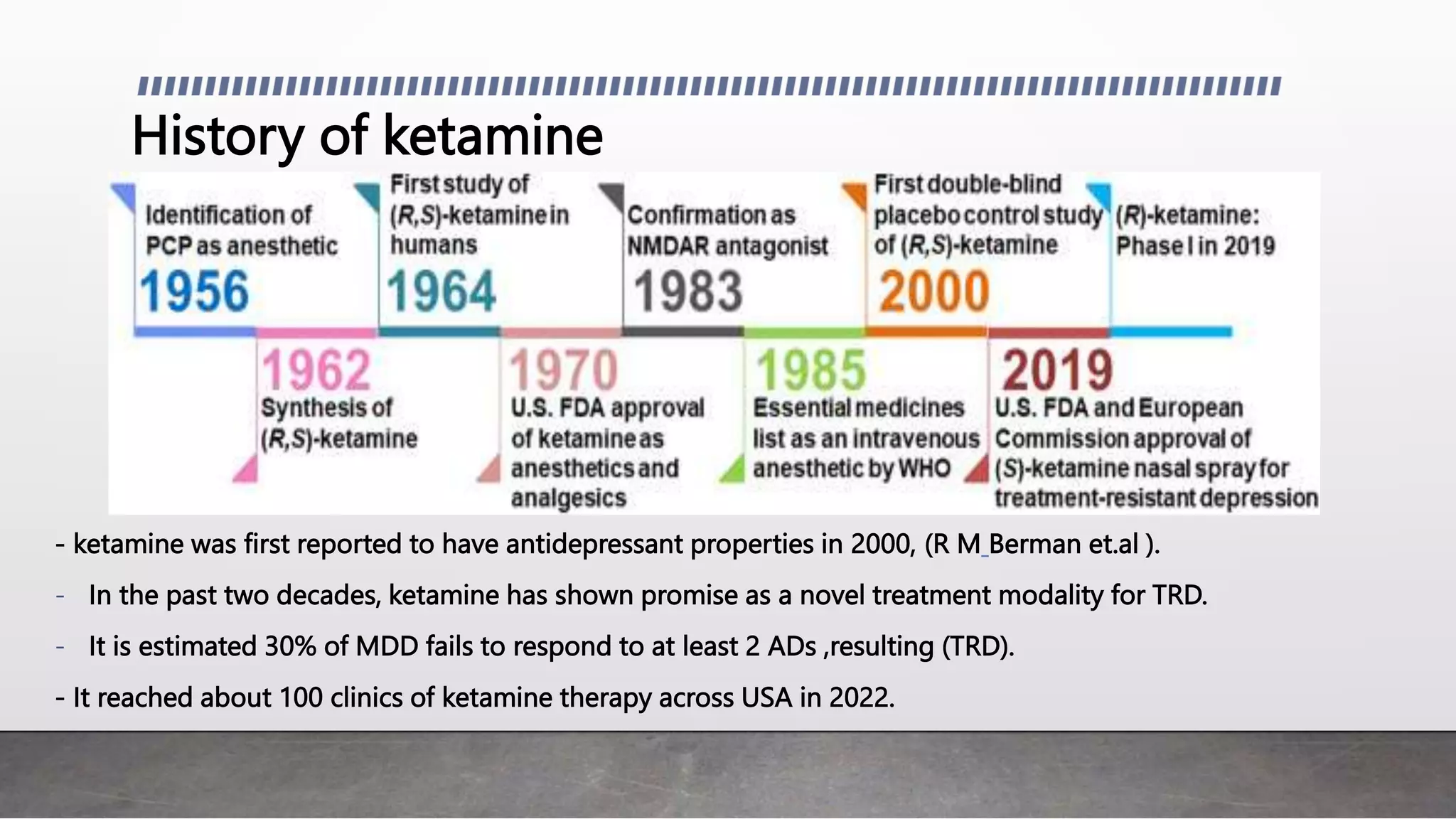
History of ketamine
- ketamine was first reported to have antidepressant properties in 2000, (R M Berman et.al ).
- In the past two decades, ketamine has shown promise as a novel treatment modality for TRD.
- It is estimated 30% of MDD fails to respond to at least 2 ADs ,resulting (TRD).
- It reached about 100 clinics of ketamine therapy across USA in 2022.
Dose-related Effects of Ketamine
- Anaesthetics effect : 2- 4.5/kg I.V
- Analgesic and sedative effect :0.5- 1 mg /kg I.V
- Subanaesthetics effect : 0.2 – 0.8 mg/kg I.V
Mechanisms of Action of Ketamine
- Modulate glutamatergic system. Increase protein synthesis, (eEF2K) .
- Regulate signaling pathways mTOR, TrKB, 5H2A IN PFA, CA1.
- Stimulate BDNF expression.
- Normalize brain connectivity, (the triple network model of
dysfunction) DMN (Default mood network) , salience (SAL) , and
central executive (CEN) networks.
- Induce synaptogenesis .
- Induce neuroplasticity. AMPA r activity is required for activation of
downstream neuroplasticity-related signaling pathways,
- Acute ketamine administration leads to increased dopamine levels
in the frontal cortex, in the striatum and in the nucleus accumbens
in rodents.
- ketamine’s acute antidepressant effect requires opioid system
activation. The dissociative effects of ketamine are not mediated by
the opioid system,
Implications of Mechanisms of Action of Ketamine
• Rapid antidepressant effect is in around 2hrs to 24hrs.
• Continuous and late ADs effects shows for 1 wk. 1st dose and even the drug has been
eliminated from the body ( ketamine induced signaling cascade).
• Network level optimization.
• Anti inflammatory effect.
• Increased diversity of the brain . ( induced mindfulness, transformation, KAP)
• Disrupt habitual cognitive activity. ( obsessions , and ruminations) ,
Effectiveness of ketamine (racemic) infusion therapy
- After single dose in TRD , it shows 65-71% stable response in depression sx.
- After single dose of ketamine in TRD , significant depressive sx improvement
rapidly in 2hrs and extends to 3-4 days.
- After single dose of ketamine add on ADs in TRD , significant depressive sx
improvement rapidly in 2hrs and extends to 7 days.
- After single dose : 60% of the patients are free of suicidal ideas for 1wk duration.
- Patients had at least a 50% improvement in MADRS scores after repeated
infusions (2-3 t/wk) in a duration of 6 wks.
Effectiveness of Intranasal Esketamine
• Fixed dose 56mg for 28 days , the patients shows 54.1% response rate .
• Fixed dose 56mg for 28 days , the patients shows 36 % remission rate .
• Stable remitters who remained on nasal esketamine were 50% less likely to
relapse than those randomized to placebo.(17.7wks)
• Stable responders who remained on nasal esketamine were 70% less likely to
relapse than those randomized to placebo.(17.7wks)
• Response ≥ 50% on MADRS from baseline.
• Remission : MADRS total score ≤ 12
• STAR*D LEVEL 3 : RESPONSE 17%, Remission =14%
Safety of ketamine therapy
• Esketamine shows through 48 wks. ,only 10% of the patients have S.E, which dropped
them from the study.
• Ketamine infusion therapy for 3months maintenance therapy showed declined over
time (14wks ) up to half of the score of dissociation scale.
• Compared with pre-dose values, mean systolic and diastolic blood pressure increased
by ~10 mm Hg at 30 min.
• The most common adverse events were nausea, dizziness and blurred vision.
• 90% of the patients reported improved social functioning and/or work functioning
during maintenance treatment.
• NNT<10 for efficacy outcomes suggests potential benefit of Esketamine+AD for both
acute and maintenance use. VS,NNT=22 in Treatment of SSRI-Resistant Depression.
• After single dose of ketamine , NNT rapid effect =5.2
Safety of ketamine therapy , adverse effect:
• 33% dizziness
• 27% dissociation
• 25% nausea
• 25% headache
• 19% Viral upper respiratory tract
• 17% sleepiness
• 12% change of taste
• 9% raised BP …..if more than 180/115 with antihypertensive , stop the session.
• 5% urinary symptoms
• Laryngospasm , rare.
Management of common adverse effects :
• Anxiety treated by SSRI or buspar.
• Dissociation , restlessness: reassurance , preset education and preparation , short
acting BZD.
• Vulnerable patient for psychosis can be treated prophylactically by clozapine.
• Nausea , vomiting : Diphenhydramine, ONDANSETRON
• Headache: clonidine
• Blurring of vision : eye shades for 80 min max.
ROUTES OF ADMINISTRATION
- Hypersensitivity reactions occurred in ~ 12%.
- Vial of ketamine Hcl is valid for 21 days , to be stored out of light, and stored at 20-25 °C.
Dosing of ketamine in TRD
Dosing Schedule of Ketamine, racemic
- 0.5 mg /kg infused over 40 minutes.
- 1mg /kg, used frequently , no evidence of superiority TRD.
- Upper dose limit not well established.
- Literatures support 2-3 sessions over 1st 2 wks.
- Up to 4- 6 session then reassess the effect .
- On empirical practice continued treatment by tapered periods,
Still no available published data to support continued practice in IVI
Dosing Schedule of Esketamine
REMS (Risk Evaluation and Mitigation Strategies)
EMS (Emergency Medical Services)
Patients suitability for ketamine therapy
Potential clinical markers for response of AD of
ketamine :
Better response to ketamine with
• normal sleep homeostasis and circadian rhythm.
• high BMI
• 1st degree family history of ethanol abuse .
• negative history of suicide attempt
• rapid response to first infusion
Ketamine Divergence
Ketamine interactions
• Ketamine is N-demethylated into norketamine, mainly by cytochrome P450 (CYP) 2C9,
CYP2B6 and CYP3A4 in the liver, and then excreted by the kidneys .
• Aripiprazole , zolpidem, BZD, pregabalin, diphenylhydramine and serteraline may
increase side effects such as dizziness, drowsiness, confusion and decrease
concentration.
• More than 8 mg /day of diazepam predicted lack response for ketamine therapy .
• Lamotrigine decreases the efficiency of ketamine. Common practice to have 12 hrs.
between taking lamotrigine and the start of infusion . Permitted previous dose of
lamotrigine is 200mg.
• Ketamine and fluoxetine was significantly better than fluoxetine alone.
Ketamine interactions
• Ketamine as an anaesthetic does not enhance the efficacy of ECT.
• Lithium and ketamine has no better antidepressant response effect.
• rTMS and rapamycin ( antitumor immunosuppressive ), D- Cycloserine enhance the long
acting effect of ketamine therapy .
• Guanfacine improves the working memory deficit adverse effect of ketamine .
• Cannabinoids, alcohol counter act the action of ketamine .
• Mg, riluzol extend the effect of single dose.
• Dissociation is not related to better response
KETAMINE ASSISTED PSYCHOTHERAPY
• In low doses, ketamine can serve as a supportive adjunct to psychotherapy, as it
provides an opportunity for the temporary softening of the psychological defenses,
allowing for deeper self reflection and psychotherapeutic processing.
• In moderate doses, ketamine has psychedelic effects, which have been shown to
facilitate profound transpersonal experiences. These types of experiences can help
people in a variety of ways, offering important clarity and insight into one’s struggles,
adding a spiritual dimension to ongoing therapeutic work, and facilitating a sense of
meaning and interconnectedness.
Future indications : Future researches:
- PTSD
- OCD
- OPIATE AND COCAINE USE DISORDERS.
- EATING DISORDERS.
- AGITATION.
- GAD
• recognize the longer-term efficacy and
safety of ketamine infusions.
• Ketamine abuse .
• Oral Esketamine
• Arketamine .
• Clarification of opiate role in ketamine.
• Code of ethics and practice , especially for
psychotherapy related to ketamine.
REFERENCES :
• PROTOCOL FOR THR ADMINISTRATION OF KETAMINE FOR TREATMENT OF RESISTANT DEPRESSION , OXFORD
MEDICAL SCHOOL, 2016
• A Consensus Statement on the Use of Ketamine in the Treatment of Mood Disorders, Gerard Sanacora, MD, PhD;
Mark A. Frye, MD; William M Schatzberg, MD; Paul Summergrad, MD; Charles B. Nemeroff,MD, PhD; for the American
Psychiatric Association (APA) Council of Research Task Force on Novel Biomarkers and Treatments, JAMA
Psychiatry.doi:10.1001/jamapsychiatry.2017.0080 Published online March 1, 2017 cDonald, MD; Sanjay J. Mathew,
MD; Mason S. Turner, MD; Alan F.
• The Canadian Network for Mood and Anxiety Treatments (CANMAT) Task Force Recommendations for the Use of
Racemic Ketamine in Adults with Major Depressive Disorder: Recommandations Du Groupe De Travail Du Réseau
Canadien Pour Les Traitements De L'humeur Et De L'anxiété (Canmat) Concernant L'utilisation De La Kétamine
Racémique Chez Les Adultes Souffrant De Trouble Dépressif Majeur: Jennifer Swainson , Alexander McGirr , Pierre
Blier ,et.al, 2021, CANAD PSYCH Feb;66(2):113-125. 2020 Nov 11
THANK YOU

Ketamine Therapy in psychiatry

  • 1.
    Ketamine Therapy in Psychiatry, CurrentClinical Perspectives Dr. Ahmed Albehairy,M.D Psychiatry consultant Armed Forces Center for Psychiatry Care , Taif , KSA
  • 2.
    Ketamine – chemicalstructure - A chiral phencyclidine derivatives introduced in the 1956. - C13H16ClNO - Dissociative anaesthesia. - Racemic mixture: •Esketamine (S(+)-isomer) •Arketamine (R(−)-isomer)
  • 3.
    History of ketamine -ketamine was first reported to have antidepressant properties in 2000, (R M Berman et.al ). - In the past two decades, ketamine has shown promise as a novel treatment modality for TRD. - It is estimated 30% of MDD fails to respond to at least 2 ADs ,resulting (TRD). - It reached about 100 clinics of ketamine therapy across USA in 2022.
  • 4.
    Dose-related Effects ofKetamine - Anaesthetics effect : 2- 4.5/kg I.V - Analgesic and sedative effect :0.5- 1 mg /kg I.V - Subanaesthetics effect : 0.2 – 0.8 mg/kg I.V
  • 5.
    Mechanisms of Actionof Ketamine - Modulate glutamatergic system. Increase protein synthesis, (eEF2K) . - Regulate signaling pathways mTOR, TrKB, 5H2A IN PFA, CA1. - Stimulate BDNF expression. - Normalize brain connectivity, (the triple network model of dysfunction) DMN (Default mood network) , salience (SAL) , and central executive (CEN) networks. - Induce synaptogenesis . - Induce neuroplasticity. AMPA r activity is required for activation of downstream neuroplasticity-related signaling pathways, - Acute ketamine administration leads to increased dopamine levels in the frontal cortex, in the striatum and in the nucleus accumbens in rodents. - ketamine’s acute antidepressant effect requires opioid system activation. The dissociative effects of ketamine are not mediated by the opioid system,
  • 6.
    Implications of Mechanismsof Action of Ketamine • Rapid antidepressant effect is in around 2hrs to 24hrs. • Continuous and late ADs effects shows for 1 wk. 1st dose and even the drug has been eliminated from the body ( ketamine induced signaling cascade). • Network level optimization. • Anti inflammatory effect. • Increased diversity of the brain . ( induced mindfulness, transformation, KAP) • Disrupt habitual cognitive activity. ( obsessions , and ruminations) ,
  • 8.
    Effectiveness of ketamine(racemic) infusion therapy - After single dose in TRD , it shows 65-71% stable response in depression sx. - After single dose of ketamine in TRD , significant depressive sx improvement rapidly in 2hrs and extends to 3-4 days. - After single dose of ketamine add on ADs in TRD , significant depressive sx improvement rapidly in 2hrs and extends to 7 days. - After single dose : 60% of the patients are free of suicidal ideas for 1wk duration. - Patients had at least a 50% improvement in MADRS scores after repeated infusions (2-3 t/wk) in a duration of 6 wks.
  • 9.
    Effectiveness of IntranasalEsketamine • Fixed dose 56mg for 28 days , the patients shows 54.1% response rate . • Fixed dose 56mg for 28 days , the patients shows 36 % remission rate . • Stable remitters who remained on nasal esketamine were 50% less likely to relapse than those randomized to placebo.(17.7wks) • Stable responders who remained on nasal esketamine were 70% less likely to relapse than those randomized to placebo.(17.7wks) • Response ≥ 50% on MADRS from baseline. • Remission : MADRS total score ≤ 12 • STAR*D LEVEL 3 : RESPONSE 17%, Remission =14%
  • 10.
    Safety of ketaminetherapy • Esketamine shows through 48 wks. ,only 10% of the patients have S.E, which dropped them from the study. • Ketamine infusion therapy for 3months maintenance therapy showed declined over time (14wks ) up to half of the score of dissociation scale. • Compared with pre-dose values, mean systolic and diastolic blood pressure increased by ~10 mm Hg at 30 min. • The most common adverse events were nausea, dizziness and blurred vision. • 90% of the patients reported improved social functioning and/or work functioning during maintenance treatment. • NNT<10 for efficacy outcomes suggests potential benefit of Esketamine+AD for both acute and maintenance use. VS,NNT=22 in Treatment of SSRI-Resistant Depression. • After single dose of ketamine , NNT rapid effect =5.2
  • 11.
    Safety of ketaminetherapy , adverse effect: • 33% dizziness • 27% dissociation • 25% nausea • 25% headache • 19% Viral upper respiratory tract • 17% sleepiness • 12% change of taste • 9% raised BP …..if more than 180/115 with antihypertensive , stop the session. • 5% urinary symptoms • Laryngospasm , rare.
  • 12.
    Management of commonadverse effects : • Anxiety treated by SSRI or buspar. • Dissociation , restlessness: reassurance , preset education and preparation , short acting BZD. • Vulnerable patient for psychosis can be treated prophylactically by clozapine. • Nausea , vomiting : Diphenhydramine, ONDANSETRON • Headache: clonidine • Blurring of vision : eye shades for 80 min max.
  • 13.
    ROUTES OF ADMINISTRATION -Hypersensitivity reactions occurred in ~ 12%. - Vial of ketamine Hcl is valid for 21 days , to be stored out of light, and stored at 20-25 °C.
  • 14.
  • 15.
    Dosing Schedule ofKetamine, racemic - 0.5 mg /kg infused over 40 minutes. - 1mg /kg, used frequently , no evidence of superiority TRD. - Upper dose limit not well established. - Literatures support 2-3 sessions over 1st 2 wks. - Up to 4- 6 session then reassess the effect . - On empirical practice continued treatment by tapered periods, Still no available published data to support continued practice in IVI
  • 16.
  • 18.
    REMS (Risk Evaluationand Mitigation Strategies) EMS (Emergency Medical Services)
  • 19.
    Patients suitability forketamine therapy
  • 20.
    Potential clinical markersfor response of AD of ketamine : Better response to ketamine with • normal sleep homeostasis and circadian rhythm. • high BMI • 1st degree family history of ethanol abuse . • negative history of suicide attempt • rapid response to first infusion
  • 21.
  • 22.
    Ketamine interactions • Ketamineis N-demethylated into norketamine, mainly by cytochrome P450 (CYP) 2C9, CYP2B6 and CYP3A4 in the liver, and then excreted by the kidneys . • Aripiprazole , zolpidem, BZD, pregabalin, diphenylhydramine and serteraline may increase side effects such as dizziness, drowsiness, confusion and decrease concentration. • More than 8 mg /day of diazepam predicted lack response for ketamine therapy . • Lamotrigine decreases the efficiency of ketamine. Common practice to have 12 hrs. between taking lamotrigine and the start of infusion . Permitted previous dose of lamotrigine is 200mg. • Ketamine and fluoxetine was significantly better than fluoxetine alone.
  • 23.
    Ketamine interactions • Ketamineas an anaesthetic does not enhance the efficacy of ECT. • Lithium and ketamine has no better antidepressant response effect. • rTMS and rapamycin ( antitumor immunosuppressive ), D- Cycloserine enhance the long acting effect of ketamine therapy . • Guanfacine improves the working memory deficit adverse effect of ketamine . • Cannabinoids, alcohol counter act the action of ketamine . • Mg, riluzol extend the effect of single dose. • Dissociation is not related to better response
  • 26.
    KETAMINE ASSISTED PSYCHOTHERAPY •In low doses, ketamine can serve as a supportive adjunct to psychotherapy, as it provides an opportunity for the temporary softening of the psychological defenses, allowing for deeper self reflection and psychotherapeutic processing. • In moderate doses, ketamine has psychedelic effects, which have been shown to facilitate profound transpersonal experiences. These types of experiences can help people in a variety of ways, offering important clarity and insight into one’s struggles, adding a spiritual dimension to ongoing therapeutic work, and facilitating a sense of meaning and interconnectedness.
  • 27.
    Future indications :Future researches: - PTSD - OCD - OPIATE AND COCAINE USE DISORDERS. - EATING DISORDERS. - AGITATION. - GAD • recognize the longer-term efficacy and safety of ketamine infusions. • Ketamine abuse . • Oral Esketamine • Arketamine . • Clarification of opiate role in ketamine. • Code of ethics and practice , especially for psychotherapy related to ketamine.
  • 28.
    REFERENCES : • PROTOCOLFOR THR ADMINISTRATION OF KETAMINE FOR TREATMENT OF RESISTANT DEPRESSION , OXFORD MEDICAL SCHOOL, 2016 • A Consensus Statement on the Use of Ketamine in the Treatment of Mood Disorders, Gerard Sanacora, MD, PhD; Mark A. Frye, MD; William M Schatzberg, MD; Paul Summergrad, MD; Charles B. Nemeroff,MD, PhD; for the American Psychiatric Association (APA) Council of Research Task Force on Novel Biomarkers and Treatments, JAMA Psychiatry.doi:10.1001/jamapsychiatry.2017.0080 Published online March 1, 2017 cDonald, MD; Sanjay J. Mathew, MD; Mason S. Turner, MD; Alan F. • The Canadian Network for Mood and Anxiety Treatments (CANMAT) Task Force Recommendations for the Use of Racemic Ketamine in Adults with Major Depressive Disorder: Recommandations Du Groupe De Travail Du Réseau Canadien Pour Les Traitements De L'humeur Et De L'anxiété (Canmat) Concernant L'utilisation De La Kétamine Racémique Chez Les Adultes Souffrant De Trouble Dépressif Majeur: Jennifer Swainson , Alexander McGirr , Pierre Blier ,et.al, 2021, CANAD PSYCH Feb;66(2):113-125. 2020 Nov 11
  • 29.