Newer Pharmacotherapies for
Major Depressive Disorder
PMH 682 Psychopharmacology
Dr. Hamilton and Mr. Kyle Phillips
Objectives
• Identify the issue of Major Depressive Disorder.
• Discuss the two types of psychedelics:
• Ketamine and Exketamine
• Psilocybin
• Review their history and mechanism of action, side effect and
cost
• Reflect on possible future psychedelics drugs to treat
depression
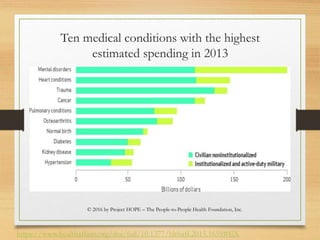
Ten medical conditions with the highest
estimated spending in 2013
© 2016 by Project HOPE – The People-to-People Health Foundation, Inc.
https://www.healthaffairs.org/doi/full/10.1377/hlthaff.2015.1659#EX
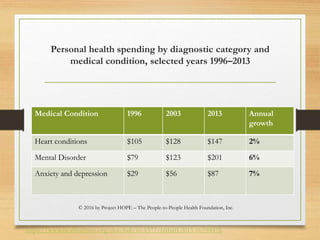
Personal health spending by diagnostic category and
medical condition, selected years 1996–2013
Medical Condition 1996 2003 2013 Annual
growth
Heart conditions $105 $128 $147 2%
Mental Disorder $79 $123 $201 6%
Anxiety and depression $29 $56 $87 7%
https://www.healthaffairs.org/doi/full/10.1377/hlthaff.2015.1659#EX
© 2016 by Project HOPE – The People-to-People Health Foundation, Inc.
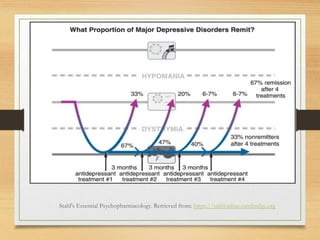
Major Depressive Disorder
Stahl's Essential Psychopharmacology. Retrieved from: https://stahlonline.cambridge.org
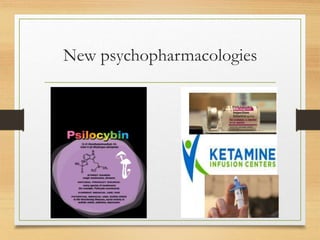
New psychopharmacologies
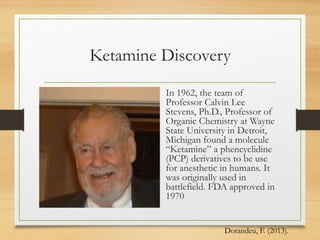
Ketamine Discovery
In 1962, the team of
Professor Calvin Lee
Stevens, Ph.D., Professor of
Organic Chemistry at Wayne
State University in Detroit,
Michigan found a molecule
“Ketamine” a phencyclidine
(PCP) derivatives to be use
for anesthetic in humans. It
was originally used in
battlefield. FDA approved in
1970
Dorandeu, F. (2013).
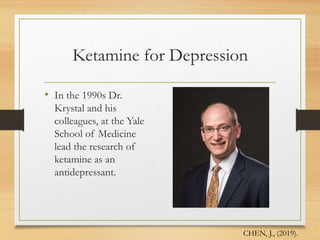
Ketamine for Depression
• In the 1990s Dr.
Krystal and his
colleagues, at the Yale
School of Medicine
lead the research of
ketamine as an
antidepressant.
CHEN, J., (2019).
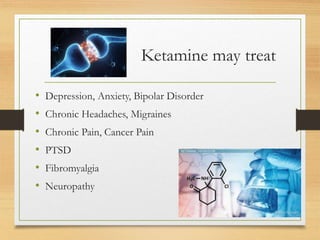
Ketamine may treat
• Depression, Anxiety, Bipolar Disorder
• Chronic Headaches, Migraines
• Chronic Pain, Cancer Pain
• PTSD
• Fibromyalgia
• Neuropathy
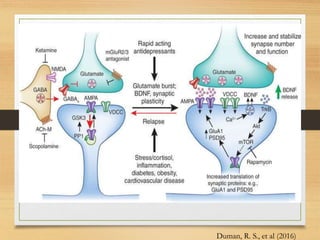
Duman, R. S., et al (2016)
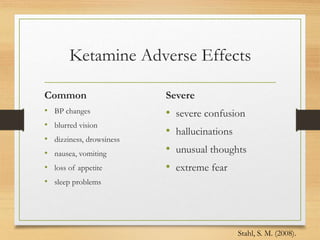
Ketamine Adverse Effects
Common
• BP changes
• blurred vision
• dizziness, drowsiness
• nausea, vomiting
• loss of appetite
• sleep problems
Severe
• severe confusion
• hallucinations
• unusual thoughts
• extreme fear
Stahl, S. M. (2008).
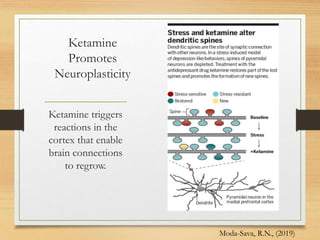
Ketamine
Promotes
Neuroplasticity
Ketamine triggers
reactions in the
cortex that enable
brain connections
to regrow.
Moda-Sava, R.N., (2019)
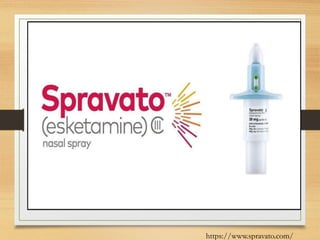
https://www.spravato.com/
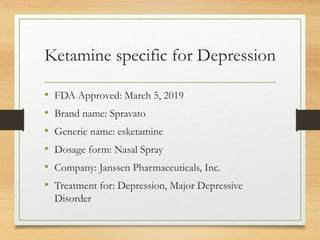
Ketamine specific for Depression
• FDA Approved: March 5, 2019
• Brand name: Spravato
• Generic name: esketamine
• Dosage form: Nasal Spray
• Company: Janssen Pharmaceuticals, Inc.
• Treatment for: Depression, Major Depressive
Disorder
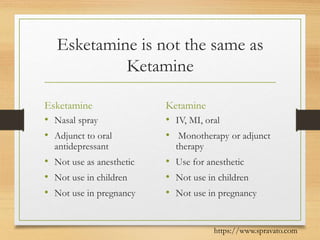
Esketamine is not the same as
Ketamine
Esketamine
• Nasal spray
• Adjunct to oral
antidepressant
• Not use as anesthetic
• Not use in children
• Not use in pregnancy
Ketamine
• IV, MI, oral
• Monotherapy or adjunct
therapy
• Use for anesthetic
• Not use in children
• Not use in pregnancy
https://www.spravato.com
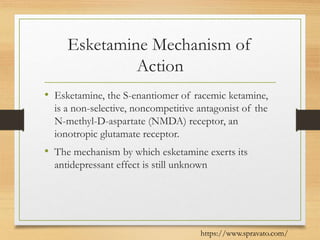
Esketamine Mechanism of
Action
• Esketamine, the S-enantiomer of racemic ketamine,
is a non-selective, noncompetitive antagonist of the
N-methyl-D-aspartate (NMDA) receptor, an
ionotropic glutamate receptor.
• The mechanism by which esketamine exerts its
antidepressant effect is still unknown
https://www.spravato.com/
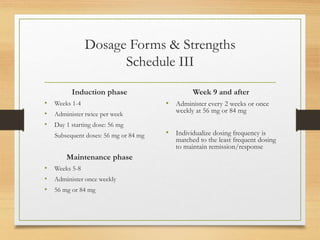
Dosage Forms & Strengths
Schedule III
Induction phase
• Weeks 1-4
• Administer twice per week
• Day 1 starting dose: 56 mg
Subsequent doses: 56 mg or 84 mg
Maintenance phase
• Weeks 5-8
• Administer once weekly
• 56 mg or 84 mg
Week 9 and after
• Administer every 2 weeks or once
weekly at 56 mg or 84 mg
• Individualize dosing frequency is
matched to the least frequent dosing
to maintain remission/response
Who qualify for Spravato
• In the Spravato clinical trials, treatment-resistant depression was
defined as adults who are currently struggling with major depressive
disorder and have not responded adequately to at least two different
antidepressants of adequate dose and duration in the current episode.
• The provider enroll the patient in the SPRAVATO Risk Evaluation
Mitigation Strategy (REMS) Program.
• Referral to Spravato center
https://www.spravato.com/
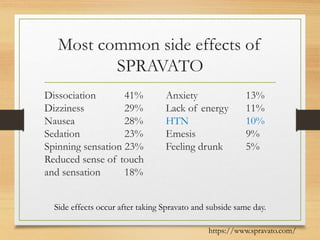
Most common side effects of
SPRAVATO
Dissociation 41%
Dizziness 29%
Nausea 28%
Sedation 23%
Spinning sensation 23%
Reduced sense of touch
and sensation 18%
Anxiety 13%
Lack of energy 11%
HTN 10%
Emesis 9%
Feeling drunk 5%
https://www.spravato.com/
Side effects occur after taking Spravato and subside same day.
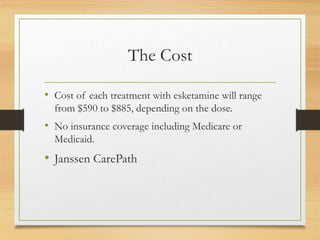
The Cost
• Cost of each treatment with esketamine will range
from $590 to $885, depending on the dose.
• No insurance coverage including Medicare or
Medicaid.
• Janssen CarePath
Psychedelics
Discovery of Psilocybin
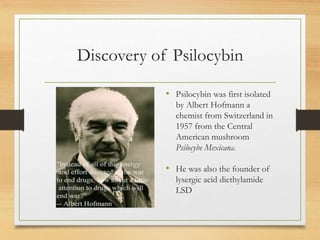
• Psilocybin was first isolated
by Albert Hofmann a
chemist from Switzerland in
1957 from the Central
American mushroom
Psilocybe Mexicana.
• He was also the founder of
lysergic acid diethylamide
LSD
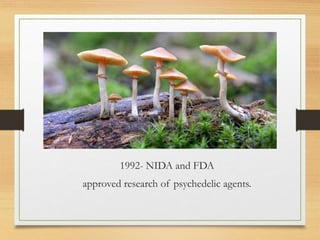
1992- NIDA and FDA
approved research of psychedelic agents.
Safety of Psychedelics
Daniel, J., Haberman, M. (2018).
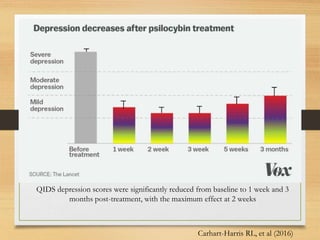
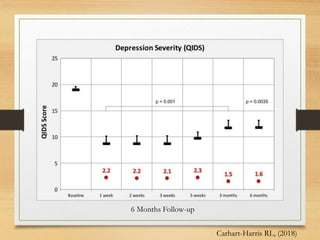
QIDS depression scores were significantly reduced from baseline to 1 week and 3
months post-treatment, with the maximum effect at 2 weeks
Carhart-Harris RL, et al (2016)
6 Months Follow-up
Carhart-Harris RL, (2018)
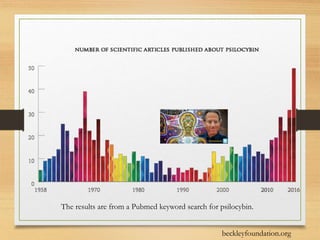
The results are from a Pubmed keyword search for psilocybin.
beckleyfoundation.org
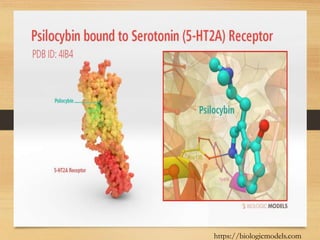
https://biologicmodels.com
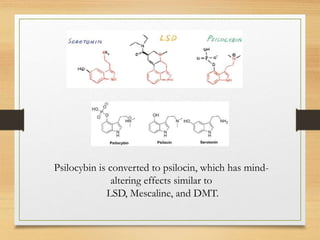
Psilocybin is converted to psilocin, which has mind-
altering effects similar to
LSD, Mescaline, and DMT.
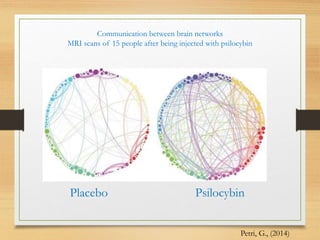
Placebo Psilocybin
Communication between brain networks
MRI scans of 15 people after being injected with psilocybin
Petri, G., (2014)
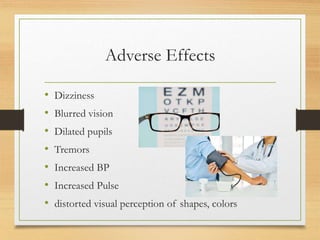
Adverse Effects
• Dizziness
• Blurred vision
• Dilated pupils
• Tremors
• Increased BP
• Increased Pulse
• distorted visual perception of shapes, colors
In August 2018 The US Food and
Drug Administration (FDA) has
granted Breakthrough Therapy
designation to psilocybin-assisted
therapy from Compass Pathways for
patients with treatment-resistant
depression (TRD)
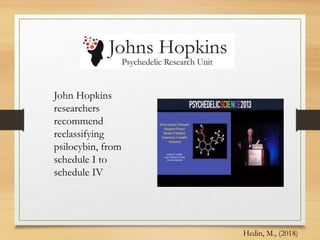
John Hopkins
researchers
recommend
reclassifying
psilocybin, from
schedule I to
schedule IV
Hedin, M., (2018)
Decriminalize
Psilocybin
• Denver, Colorado vote pass
in May 2019
• Oakland, California, on June
4, 2019
• Oregon will present the
vote in 2020
• Lawmaker in Iowa
introduced similar measures
in February 2019
References
Carhart-Harris RL, Bolstridge M, Rucker J, Day CM, Erritzoe D, Kaelen M, Bloomfield M, Rickard JA, Forbes B, Feilding A, Taylor D,
Pilling S, Curran VH, Nutt DJ (2016). Psilocybin with psychological support for treatment-resistant depression: an open-label
feasibility study.. Lancet Psychiatry., 3(7):619-27.
Charles R., (2016). Mental Disorders Top The List Of The Most Costly Conditions In The United States: $201 Billion. Health Affairs.
Retrieve from: https://www.healthaffairs.org/doi/full/10.1377/hlthaff.2015.1659#EX
Chen, J., (2019). How New Ketamine Drug Helps with Depression. Retrieved from: https://www.yalemedicine.org/stories/ketamine-
depression/
Daniel, J., Haberman, M. (2017). Clinical potential of psilocybin as a treatment for mental health conditions. The Mental Health Clinician,
7(1), 24–28.
Dorandeu F. (2013). Happy 50th anniversary ketamine. CNS neuroscience & therapeutics, 19(6), 369.
References
Duman, R.S., Aghajanian, G.K., Sanacora G., Krystal J.H. (2016). Synaptic plasticity and depression: new insights from stress and rapid-
acting antidepressants. Nature medicine, 22(3), 238–249.
Hedin, M., (2018). Hopkins researchers recommend reclassifying psilocybin, the drug in 'magic' mushrooms, from schedule I to schedule
IV. https://hub.jhu.edu/2018/09/26/psilocybin-scheduling-magic-mushrooms/
Kennedy, M., (2019). Oakland City Council Effectively Decriminalizes Psychedelic Mushrooms. National Public Radio. Retrieved from:
https://www.npr.org/2019/06/05/730061916/oakland-city-council-effectively-decriminalizes-psychedelic-mushrooms
Moda-Sava, R.N., Murdock, M.H., Parekh, P.K., Fetcho, R.N., Huang, B.S., Huynh, T.N., Witztum, J., Shaver, D.C., Rosentha,l D.L.,
Always, E.J., Lopez, K., Meng, Y., Nellissen, L., Grosenick, L., Milner, T.A., Deisseroth, K., Bito, H., Kasai, H., Liston, C.,
(2019). Sustained rescue of prefrontal circuit dysfunction by antidepressant-induced spine formation. Science, 12, 364 (6436).
Psychedelic Research Timeline. Retrieved from: https://beckleyfoundation.org
References
Petri, G., Expert P., Turkheimer, F., Carhart-Harris, R., Nutt D., Hellyer, P. J., Vaccarino, F., (2014). Homological
scaffolds of brain functional networks. Journal of The Royal Society; Interface, 11, 101.
Stahl S.M., (2013). Stahl’s Essential Psychopharmacology (4th ed). New York, NY: Cambridge University Press. Retrieve from:
https://stahlonline.cambridge.org/essential_4th
Stahl, S. M. (2008). Essential Psychopharmacology Online. Retrieved from
https://stahlonline.cambridge.org/prescribers_guide.jsf

Hallucinogens

  • 1.
    Newer Pharmacotherapies for MajorDepressive Disorder PMH 682 Psychopharmacology Dr. Hamilton and Mr. Kyle Phillips
  • 2.
    Objectives • Identify theissue of Major Depressive Disorder. • Discuss the two types of psychedelics: • Ketamine and Exketamine • Psilocybin • Review their history and mechanism of action, side effect and cost • Reflect on possible future psychedelics drugs to treat depression
  • 3.
    Ten medical conditionswith the highest estimated spending in 2013 © 2016 by Project HOPE – The People-to-People Health Foundation, Inc. https://www.healthaffairs.org/doi/full/10.1377/hlthaff.2015.1659#EX
  • 4.
    Personal health spendingby diagnostic category and medical condition, selected years 1996–2013 Medical Condition 1996 2003 2013 Annual growth Heart conditions $105 $128 $147 2% Mental Disorder $79 $123 $201 6% Anxiety and depression $29 $56 $87 7% https://www.healthaffairs.org/doi/full/10.1377/hlthaff.2015.1659#EX © 2016 by Project HOPE – The People-to-People Health Foundation, Inc.
  • 5.
  • 6.
    Stahl's Essential Psychopharmacology.Retrieved from: https://stahlonline.cambridge.org
  • 7.
  • 9.
    Ketamine Discovery In 1962,the team of Professor Calvin Lee Stevens, Ph.D., Professor of Organic Chemistry at Wayne State University in Detroit, Michigan found a molecule “Ketamine” a phencyclidine (PCP) derivatives to be use for anesthetic in humans. It was originally used in battlefield. FDA approved in 1970 Dorandeu, F. (2013).
  • 10.
    Ketamine for Depression •In the 1990s Dr. Krystal and his colleagues, at the Yale School of Medicine lead the research of ketamine as an antidepressant. CHEN, J., (2019).
  • 11.
    Ketamine may treat •Depression, Anxiety, Bipolar Disorder • Chronic Headaches, Migraines • Chronic Pain, Cancer Pain • PTSD • Fibromyalgia • Neuropathy
  • 12.
    Duman, R. S.,et al (2016)
  • 13.
    Ketamine Adverse Effects Common •BP changes • blurred vision • dizziness, drowsiness • nausea, vomiting • loss of appetite • sleep problems Severe • severe confusion • hallucinations • unusual thoughts • extreme fear Stahl, S. M. (2008).
  • 14.
    Ketamine Promotes Neuroplasticity Ketamine triggers reactions inthe cortex that enable brain connections to regrow. Moda-Sava, R.N., (2019)
  • 16.
  • 17.
    Ketamine specific forDepression • FDA Approved: March 5, 2019 • Brand name: Spravato • Generic name: esketamine • Dosage form: Nasal Spray • Company: Janssen Pharmaceuticals, Inc. • Treatment for: Depression, Major Depressive Disorder
  • 18.
    Esketamine is notthe same as Ketamine Esketamine • Nasal spray • Adjunct to oral antidepressant • Not use as anesthetic • Not use in children • Not use in pregnancy Ketamine • IV, MI, oral • Monotherapy or adjunct therapy • Use for anesthetic • Not use in children • Not use in pregnancy https://www.spravato.com
  • 19.
    Esketamine Mechanism of Action •Esketamine, the S-enantiomer of racemic ketamine, is a non-selective, noncompetitive antagonist of the N-methyl-D-aspartate (NMDA) receptor, an ionotropic glutamate receptor. • The mechanism by which esketamine exerts its antidepressant effect is still unknown https://www.spravato.com/
  • 20.
    Dosage Forms &Strengths Schedule III Induction phase • Weeks 1-4 • Administer twice per week • Day 1 starting dose: 56 mg Subsequent doses: 56 mg or 84 mg Maintenance phase • Weeks 5-8 • Administer once weekly • 56 mg or 84 mg Week 9 and after • Administer every 2 weeks or once weekly at 56 mg or 84 mg • Individualize dosing frequency is matched to the least frequent dosing to maintain remission/response
  • 21.
    Who qualify forSpravato • In the Spravato clinical trials, treatment-resistant depression was defined as adults who are currently struggling with major depressive disorder and have not responded adequately to at least two different antidepressants of adequate dose and duration in the current episode. • The provider enroll the patient in the SPRAVATO Risk Evaluation Mitigation Strategy (REMS) Program. • Referral to Spravato center https://www.spravato.com/
  • 22.
    Most common sideeffects of SPRAVATO Dissociation 41% Dizziness 29% Nausea 28% Sedation 23% Spinning sensation 23% Reduced sense of touch and sensation 18% Anxiety 13% Lack of energy 11% HTN 10% Emesis 9% Feeling drunk 5% https://www.spravato.com/ Side effects occur after taking Spravato and subside same day.
  • 23.
    The Cost • Costof each treatment with esketamine will range from $590 to $885, depending on the dose. • No insurance coverage including Medicare or Medicaid. • Janssen CarePath
  • 24.
  • 25.
    Discovery of Psilocybin •Psilocybin was first isolated by Albert Hofmann a chemist from Switzerland in 1957 from the Central American mushroom Psilocybe Mexicana. • He was also the founder of lysergic acid diethylamide LSD
  • 26.
    1992- NIDA andFDA approved research of psychedelic agents.
  • 27.
    Safety of Psychedelics Daniel,J., Haberman, M. (2018).
  • 28.
    QIDS depression scoreswere significantly reduced from baseline to 1 week and 3 months post-treatment, with the maximum effect at 2 weeks Carhart-Harris RL, et al (2016)
  • 29.
  • 30.
    The results arefrom a Pubmed keyword search for psilocybin. beckleyfoundation.org
  • 31.
  • 32.
    Psilocybin is convertedto psilocin, which has mind- altering effects similar to LSD, Mescaline, and DMT.
  • 33.
    Placebo Psilocybin Communication betweenbrain networks MRI scans of 15 people after being injected with psilocybin Petri, G., (2014)
  • 34.
    Adverse Effects • Dizziness •Blurred vision • Dilated pupils • Tremors • Increased BP • Increased Pulse • distorted visual perception of shapes, colors
  • 36.
    In August 2018The US Food and Drug Administration (FDA) has granted Breakthrough Therapy designation to psilocybin-assisted therapy from Compass Pathways for patients with treatment-resistant depression (TRD)
  • 37.
  • 38.
    Decriminalize Psilocybin • Denver, Coloradovote pass in May 2019 • Oakland, California, on June 4, 2019 • Oregon will present the vote in 2020 • Lawmaker in Iowa introduced similar measures in February 2019
  • 40.
    References Carhart-Harris RL, BolstridgeM, Rucker J, Day CM, Erritzoe D, Kaelen M, Bloomfield M, Rickard JA, Forbes B, Feilding A, Taylor D, Pilling S, Curran VH, Nutt DJ (2016). Psilocybin with psychological support for treatment-resistant depression: an open-label feasibility study.. Lancet Psychiatry., 3(7):619-27. Charles R., (2016). Mental Disorders Top The List Of The Most Costly Conditions In The United States: $201 Billion. Health Affairs. Retrieve from: https://www.healthaffairs.org/doi/full/10.1377/hlthaff.2015.1659#EX Chen, J., (2019). How New Ketamine Drug Helps with Depression. Retrieved from: https://www.yalemedicine.org/stories/ketamine- depression/ Daniel, J., Haberman, M. (2017). Clinical potential of psilocybin as a treatment for mental health conditions. The Mental Health Clinician, 7(1), 24–28. Dorandeu F. (2013). Happy 50th anniversary ketamine. CNS neuroscience & therapeutics, 19(6), 369.
  • 41.
    References Duman, R.S., Aghajanian,G.K., Sanacora G., Krystal J.H. (2016). Synaptic plasticity and depression: new insights from stress and rapid- acting antidepressants. Nature medicine, 22(3), 238–249. Hedin, M., (2018). Hopkins researchers recommend reclassifying psilocybin, the drug in 'magic' mushrooms, from schedule I to schedule IV. https://hub.jhu.edu/2018/09/26/psilocybin-scheduling-magic-mushrooms/ Kennedy, M., (2019). Oakland City Council Effectively Decriminalizes Psychedelic Mushrooms. National Public Radio. Retrieved from: https://www.npr.org/2019/06/05/730061916/oakland-city-council-effectively-decriminalizes-psychedelic-mushrooms Moda-Sava, R.N., Murdock, M.H., Parekh, P.K., Fetcho, R.N., Huang, B.S., Huynh, T.N., Witztum, J., Shaver, D.C., Rosentha,l D.L., Always, E.J., Lopez, K., Meng, Y., Nellissen, L., Grosenick, L., Milner, T.A., Deisseroth, K., Bito, H., Kasai, H., Liston, C., (2019). Sustained rescue of prefrontal circuit dysfunction by antidepressant-induced spine formation. Science, 12, 364 (6436). Psychedelic Research Timeline. Retrieved from: https://beckleyfoundation.org
  • 42.
    References Petri, G., ExpertP., Turkheimer, F., Carhart-Harris, R., Nutt D., Hellyer, P. J., Vaccarino, F., (2014). Homological scaffolds of brain functional networks. Journal of The Royal Society; Interface, 11, 101. Stahl S.M., (2013). Stahl’s Essential Psychopharmacology (4th ed). New York, NY: Cambridge University Press. Retrieve from: https://stahlonline.cambridge.org/essential_4th Stahl, S. M. (2008). Essential Psychopharmacology Online. Retrieved from https://stahlonline.cambridge.org/prescribers_guide.jsf

Editor's Notes

  • #17 Ketamine has a different mechanism of action and may provide relief and improve symptoms in severe cases and  where other treatments have failed.  Research shows that it can be beneficial in many different patients: