
Dr. Ahmed Albehairy, M.D
Psychiatry Consultant
CME, Psychopharmacology, SchizophreniaBy Daniel C. Javitt, MD, PhD
Glutamate and Schizophrenia:
From Theory to Treatment
Implications
 Decrease NMDA receptors by, say, 40%, and you
might get psychosis; decrease them by 70%, and
you have catatonia. In “knockout mice” without
NMDA receptors at all, even the most basic life
functions are impossible. . . .
—Susannah Cahalan, Brain on Fire: My Month of
Madness
Schizophrenia was first described over 100
years ago. Sixty years ago, the first effective
medication for schizophrenia, chlorpromazine,
was discovered by fortunate clinical observation.
Shortly thereafter, the antipsychotic effects of
chlorpromazine were attributed to its ability to
block dopamine D2 receptors, and the dopamine
model of schizophrenia was born. For the past
60 years, compounds developed based on
dopamine models.
Since the discovery the dopamine model of
schizophrenia was born, treatment options for
schizophrenia remain limited. Even among
patients who respond to medications, negative
symptoms and cognitive deficits frequently persist
and contribute to long-term disability.
The neuropsychological studies show
impairments across a range of neurocognitive
functions.
An alternative conceptual
approach for schizophrenia .
Focuses on dysfunction of brain glutamate systems,
particularly involving N-methyl-D-aspartate (NMDA)-
type glutamate receptors.
NMDA receptor–based theories originated more than
20 years ago. Since then, these models have led to
new approaches to the conceptualization of
schizophrenia, along with potential new measures for
assessing risk in individuals who show early
symptoms. Attempts to translate glutamate theories
into effective pharmacological treatments are ongoing
and may require new techniques, such as
neuromodulation.
Glutamate-based models of
schizophrenia .
Similar to the dopamine theory, glutamate-based theories of
schizophrenia are also based on a chance clinical event.
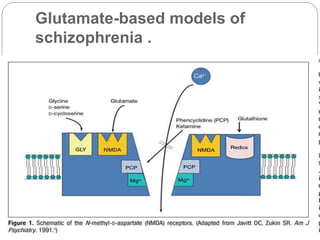
Approximately 25 years ago, it was shown that
phencyclidine (PCP) and ketamine compounds produce their
effects ( symptoms and cognitive deficits in healthy
volunteers that closely resembled those of schizophrenia)
by blocking neurotransmission at NMDA-type glutamate
receptors , giving rise to current glutamatergic theories.
NMDA receptors are also regulated by brain levels of
glycine, d-serine, and glutathione. Disturbances in brain
concentrations of these compounds and of genes related to
their synthesis may therefore all contribute to schizophrenia
Glutamate-based models of
schizophrenia .
Glutamate-based models of
schizophrenia .
It appears that there is more than a single
cause of NMDA receptor dysfunction among
individuals. Instead, threshold models may be
critical, such that for each individual the sum of
genetic and environmental factors determines
whether NMDA receptor function will fall below a
critical level.
In schizophrenia, psychosis may emerge once
the level of NMDA receptor function drops by
about 20%, with increasing symptom severity
thereafter
Dopamine-glutamate
interaction
A specific contribution of the NMDA model is to help
explain why dopaminergic hyperactivity
develops in schizophrenia and why some patients
fail to show improvement of positive symptoms
even when treated with antipsychotics.
Dopamine levels in the brain can be detected by
positron emission tomography and, as predicted by
dopamine models, elevations in brain dopamine
levels correlate with response to
antipsychotics. Nevertheless, the reasons for the
increased dopamine synthesis and release in
schizophrenia remain unknown. ??????
Dopamine-glutamate
interaction
dopaminergic dysfunction may be due to :
- genetically determined abnormalities of dopamine
synthesis or degradation enzymes.
- NMDA receptor dysfunction leads to failures in
the regulation of the dopamine system within the
striatum. In support of this possibility, dopamine
abnormalities similar to those observed in
schizophrenia can also be induced by NMDA
blockers such as ketamine.
Dopamine-glutamate
interaction
More recently, it has been suggested that patients
who fail to respond to antipsychotic treatment
have baseline disturbances in glutamatergic, but
not dopaminergic, function.
Thus, in those patients, there is no dopaminergic
excess that can be reversed. Nevertheless, such
patients still show psychotic symptoms, which
suggests that disturbances in both the glutamate
and dopamine systems may contribute to the
development of positive symptoms, both in
schizophrenia and in other psychotic disorders.
Where in the brain is
schizophrenia?
Dopamine is found only in limited brain regions,
such as the frontostriatal and limbic regions.
Glutamate and NMDA receptors are widely
distributed throughout the brain, leading to a
concept of “whole brain” dysfunction that involves
not only the prefrontal and limbic brain regions
but also nontraditional regions, such as the
auditory and visual cortices.
Where in the brain is
schizophrenia?
The differences between glutamate and
dopamine models are most clear-cut with regard
to sensory brain regions, such as the primary
auditory and visual cortices (These regions
contain relatively little dopamine ).
NMDA receptor antagonists such as ketamine
induce mismatch negativity (MMN) deficits in
healthy volunteers, //agents that influence
dopamine neither induce nor reverse impairments
in MMN//, reinforcing the concept that the
strongest predictors of schizophrenia may
reside outside the dopamine system.
***MMN refers to the mismatch response in electroencephalography (EEG);
MMF or MMNM refer to the mismatch response in
Where in the brain is
schizophrenia?
MMN has become one of the best-established
biomarkers in schizophrenia research.
Consistent with MMN results, the tone matching findings
showed dramatic deficits in patients with
schizophrenia.
Specifically, healthy individuals have the ability to detect
about a 3% difference between tones presented about a
second apart—approximately corresponding to the
difference between a white and black note on a piano. In
contrast, individuals with schizophrenia and especially with
poor-outcome forms of the illness required about a 20%
difference—roughly the difference between a C and an E;
some patients required differences of an octave (100%) or
more.
More recent studies investigated the relationship between
Where in the brain is
schizophrenia?
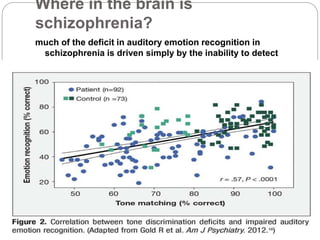
much of the deficit in auditory emotion recognition in
schizophrenia is driven simply by the inability to detect
tonal variations.
Where in the brain is
schizophrenia?
Similarly, patients are markedly impaired in
detecting sarcasm, again because of the inability
to process the change in intonation used to
convey information.
Patients who speak tonal languages, such as
Mandarin Chinese, have deficits in discriminating
words that differ only in tonality (eg, “ya” which
may mean either tooth or duck, depending on
intonation).
As with impairments in social cognition, such
deficits also correlate strongly with impaired
vocational function
Where in the brain is
schizophrenia?
Glutamate-related deficits are, of course, not
confined to the auditory system, and deficits in
other brain regions contribute to the distributed
pattern of cognitive dysfunction that is observed
in schizophrenia.
These deficits may represent key bottlenecks in
preventing individuals with schizophrenia from
returning to premorbid levels of functioning.
Where in the brain is
schizophrenia?
Recent research has identified anti-NMDA receptor
antibodies in patients who could receive a diagnosis
of schizophrenia but who nevertheless recover when
treated with specific immunological therapies.
It is likely that such antibodies affect only a small
percentage of patients with schizophrenia
(probably no more than 1% to 2%).
The fact that compromising NMDA receptors can re-
create a pattern that closely resembles schizophrenia
suggests that NMDA-based models may be critical to
the development of new antipsychotic treatments.
Pharmacological implications
Glutamate-based research on schizophrenia has
provided new insights into the causes of schizophrenia
and a new understanding of the pathways, from basic
brain dysfunction to clinical symptoms.
NMDA receptors contain binding sites for glycine, d-
serine, and glutathione.
2 attempts to develop glutamate theories into
widespread treatments have been unsuccessful.
(Pomaglumetad, a presynaptic glutamate modulator
being developed by Eli Lilly, failed in late-stage clinical
trials in 2012,/// Similarly, bitopertin, a glycine reuptake
inhibitor being developed by Roche, recently failed in
Pharmacological implications
Currently, the reasons for the lack of efficacy of these
advance stage projects remain unknown. One
possibility is that glutamatergic dysfunction during the
prodromal and early first-episode period leads to
irreversible atrophy of key brain structures.
Early intervention, especially during the prodromal
period, may be needed to prevent, rather than
reverse, potentially irreversible changes in brain
function.
Transcranial direct current stimulation suggest that
regionally targeted NMDA neuromodulatory
treatments may provide an important alternative to
pharmacotherapy for recalcitrant symptoms of
schizophrenia.
THANK YOU

Glutamate and schizophrenia

  • 1.
    Dr. Ahmed Albehairy,M.D Psychiatry Consultant CME, Psychopharmacology, SchizophreniaBy Daniel C. Javitt, MD, PhD Glutamate and Schizophrenia: From Theory to Treatment Implications
  • 2.
     Decrease NMDAreceptors by, say, 40%, and you might get psychosis; decrease them by 70%, and you have catatonia. In “knockout mice” without NMDA receptors at all, even the most basic life functions are impossible. . . . —Susannah Cahalan, Brain on Fire: My Month of Madness
  • 3.
    Schizophrenia was firstdescribed over 100 years ago. Sixty years ago, the first effective medication for schizophrenia, chlorpromazine, was discovered by fortunate clinical observation. Shortly thereafter, the antipsychotic effects of chlorpromazine were attributed to its ability to block dopamine D2 receptors, and the dopamine model of schizophrenia was born. For the past 60 years, compounds developed based on dopamine models.
  • 4.
    Since the discoverythe dopamine model of schizophrenia was born, treatment options for schizophrenia remain limited. Even among patients who respond to medications, negative symptoms and cognitive deficits frequently persist and contribute to long-term disability. The neuropsychological studies show impairments across a range of neurocognitive functions.
  • 5.
    An alternative conceptual approachfor schizophrenia . Focuses on dysfunction of brain glutamate systems, particularly involving N-methyl-D-aspartate (NMDA)- type glutamate receptors. NMDA receptor–based theories originated more than 20 years ago. Since then, these models have led to new approaches to the conceptualization of schizophrenia, along with potential new measures for assessing risk in individuals who show early symptoms. Attempts to translate glutamate theories into effective pharmacological treatments are ongoing and may require new techniques, such as neuromodulation.
  • 6.
    Glutamate-based models of schizophrenia. Similar to the dopamine theory, glutamate-based theories of schizophrenia are also based on a chance clinical event. Approximately 25 years ago, it was shown that phencyclidine (PCP) and ketamine compounds produce their effects ( symptoms and cognitive deficits in healthy volunteers that closely resembled those of schizophrenia) by blocking neurotransmission at NMDA-type glutamate receptors , giving rise to current glutamatergic theories. NMDA receptors are also regulated by brain levels of glycine, d-serine, and glutathione. Disturbances in brain concentrations of these compounds and of genes related to their synthesis may therefore all contribute to schizophrenia
  • 7.
  • 8.
    Glutamate-based models of schizophrenia. It appears that there is more than a single cause of NMDA receptor dysfunction among individuals. Instead, threshold models may be critical, such that for each individual the sum of genetic and environmental factors determines whether NMDA receptor function will fall below a critical level. In schizophrenia, psychosis may emerge once the level of NMDA receptor function drops by about 20%, with increasing symptom severity thereafter
  • 9.
    Dopamine-glutamate interaction A specific contributionof the NMDA model is to help explain why dopaminergic hyperactivity develops in schizophrenia and why some patients fail to show improvement of positive symptoms even when treated with antipsychotics. Dopamine levels in the brain can be detected by positron emission tomography and, as predicted by dopamine models, elevations in brain dopamine levels correlate with response to antipsychotics. Nevertheless, the reasons for the increased dopamine synthesis and release in schizophrenia remain unknown. ??????
  • 10.
    Dopamine-glutamate interaction dopaminergic dysfunction maybe due to : - genetically determined abnormalities of dopamine synthesis or degradation enzymes. - NMDA receptor dysfunction leads to failures in the regulation of the dopamine system within the striatum. In support of this possibility, dopamine abnormalities similar to those observed in schizophrenia can also be induced by NMDA blockers such as ketamine.
  • 11.
    Dopamine-glutamate interaction More recently, ithas been suggested that patients who fail to respond to antipsychotic treatment have baseline disturbances in glutamatergic, but not dopaminergic, function. Thus, in those patients, there is no dopaminergic excess that can be reversed. Nevertheless, such patients still show psychotic symptoms, which suggests that disturbances in both the glutamate and dopamine systems may contribute to the development of positive symptoms, both in schizophrenia and in other psychotic disorders.
  • 12.
    Where in thebrain is schizophrenia? Dopamine is found only in limited brain regions, such as the frontostriatal and limbic regions. Glutamate and NMDA receptors are widely distributed throughout the brain, leading to a concept of “whole brain” dysfunction that involves not only the prefrontal and limbic brain regions but also nontraditional regions, such as the auditory and visual cortices.
  • 13.
    Where in thebrain is schizophrenia? The differences between glutamate and dopamine models are most clear-cut with regard to sensory brain regions, such as the primary auditory and visual cortices (These regions contain relatively little dopamine ). NMDA receptor antagonists such as ketamine induce mismatch negativity (MMN) deficits in healthy volunteers, //agents that influence dopamine neither induce nor reverse impairments in MMN//, reinforcing the concept that the strongest predictors of schizophrenia may reside outside the dopamine system. ***MMN refers to the mismatch response in electroencephalography (EEG); MMF or MMNM refer to the mismatch response in
  • 14.
    Where in thebrain is schizophrenia? MMN has become one of the best-established biomarkers in schizophrenia research. Consistent with MMN results, the tone matching findings showed dramatic deficits in patients with schizophrenia. Specifically, healthy individuals have the ability to detect about a 3% difference between tones presented about a second apart—approximately corresponding to the difference between a white and black note on a piano. In contrast, individuals with schizophrenia and especially with poor-outcome forms of the illness required about a 20% difference—roughly the difference between a C and an E; some patients required differences of an octave (100%) or more. More recent studies investigated the relationship between
  • 15.
    Where in thebrain is schizophrenia? much of the deficit in auditory emotion recognition in schizophrenia is driven simply by the inability to detect tonal variations.
  • 16.
    Where in thebrain is schizophrenia? Similarly, patients are markedly impaired in detecting sarcasm, again because of the inability to process the change in intonation used to convey information. Patients who speak tonal languages, such as Mandarin Chinese, have deficits in discriminating words that differ only in tonality (eg, “ya” which may mean either tooth or duck, depending on intonation). As with impairments in social cognition, such deficits also correlate strongly with impaired vocational function
  • 17.
    Where in thebrain is schizophrenia? Glutamate-related deficits are, of course, not confined to the auditory system, and deficits in other brain regions contribute to the distributed pattern of cognitive dysfunction that is observed in schizophrenia. These deficits may represent key bottlenecks in preventing individuals with schizophrenia from returning to premorbid levels of functioning.
  • 18.
    Where in thebrain is schizophrenia?
  • 19.
    Recent research hasidentified anti-NMDA receptor antibodies in patients who could receive a diagnosis of schizophrenia but who nevertheless recover when treated with specific immunological therapies. It is likely that such antibodies affect only a small percentage of patients with schizophrenia (probably no more than 1% to 2%). The fact that compromising NMDA receptors can re- create a pattern that closely resembles schizophrenia suggests that NMDA-based models may be critical to the development of new antipsychotic treatments.
  • 20.
    Pharmacological implications Glutamate-based researchon schizophrenia has provided new insights into the causes of schizophrenia and a new understanding of the pathways, from basic brain dysfunction to clinical symptoms. NMDA receptors contain binding sites for glycine, d- serine, and glutathione. 2 attempts to develop glutamate theories into widespread treatments have been unsuccessful. (Pomaglumetad, a presynaptic glutamate modulator being developed by Eli Lilly, failed in late-stage clinical trials in 2012,/// Similarly, bitopertin, a glycine reuptake inhibitor being developed by Roche, recently failed in
  • 21.
    Pharmacological implications Currently, thereasons for the lack of efficacy of these advance stage projects remain unknown. One possibility is that glutamatergic dysfunction during the prodromal and early first-episode period leads to irreversible atrophy of key brain structures. Early intervention, especially during the prodromal period, may be needed to prevent, rather than reverse, potentially irreversible changes in brain function. Transcranial direct current stimulation suggest that regionally targeted NMDA neuromodulatory treatments may provide an important alternative to pharmacotherapy for recalcitrant symptoms of schizophrenia.
  • 22.