STAR*D
Sequenced Treatment Alternatives To Relieve Depression
-Dr.maithri[1st yr pg psychiatry]
Moderator-Dr.Sai kiran Pasupula
Assistant Professor
INTRODUCTION
STAR*D, funded in 1998, 7-year trial, $35 million, multi-
center, prospective, sequentially randomized controlled trial
of outpatients who had non-psychotic unipolar depression.
14 regional research centers across the USA, over 120
physicians with 23 psychiatry and 18 primary care facilities
used.
Funded by National Institute of Mental Health;
National Coordinating Center at Southwestern Medical
Center, Dallas and Data Coordinating Center at Pittsburgh.
RATIONALE
• Major depressive disorder is a common, usually recurrent,
and often chronic disorder.
• MDD causes substantial disability
• Actual acceptability, clinical benefit, and side effect burden
of treatment in community populations is not well known.
• It remains unclear how to help depressed persons who
respond to treatment but do not attain full remission.
AIMS & OBJECTIVES
Primary Objectives:
• To determine the comparative effectiveness of different
treatment options for MDD.
• Evaluate the comparative effectiveness of these treatments
when they are used to either augment the previous treatment
or as new treatments for participants without a satisfactory
response to an initial SSRI medication.
• To correlate clinical outcomes – symptom profile,
functioning, side effect burden, quality of life, and
participant satisfaction.
Secondary objectives:
• To determine the incidence, nature, and timing of relapses
(< 6 months after remission) or recurrences (> 6 months
after remission) during follow-up.
• To relate the clinical outcomes to the treatment costs and
feasibility.
RESEARCH DESIGN & METHODS
• Patient selection
– Inclusion Criteria
– Exclusion Criteria
• Study centres
• Clinical Research Staff
• Randomization
• Assessments
• Statistical Analysis
Inclusion criteria:
• Age range: 18–75 years.
• Around 4000 Outpatients with non-psychotic MDD.
• A score of >14 on the HAM-D.
• Outpatients for whom antidepressant treatment is deemed
appropriate by the treating clinician.
• Participants with suicidal ideation are eligible, as long as
outpatient treatment is deemed safe by the clinician.
• Participants who have comorbid General Medical
Conditions are also eligible.
Exclusion criteria:
• Non-response or intolerability in the current major
depressive episode to one or more treatments.
• Lifetime history of Bipolar disorder, Schizophrenia,
Schizoaffective disorder, or MDD with Psychotic features.
• Primary diagnosis of anorexia nervosa, bulimia nervosa,
or Obsessive-Compulsive disorder.
• Participants who are likely to require hospitalization
within six months from study entry.
• Substance dependence disorders who require inpatient
detoxification.
• Participants with concurrent psychiatric or medical
conditions that are relative or absolute contraindications to
the use of more than one treatment option within the
protocol.
Study Centre:
• 23 psychiatry and 18 primary care centres covering various
geographical distribution across USA.
Randomization:
Equipoise stratified randomization.
• Developed to allow the greatest number of patients to
contribute data and comparison.
• Clinician defines a list of specific study treatments that are
acceptable and are of rough parity called “equipoise
stratum”.
• Assignment to e-stratum depends on patient’s
characteristics, tolerability to side-effects, response to
treatment or individual preferences.
• Finally, ES design randomly assigns each patient to a
specific option within that patient’s e-stratum.
• Advantages: Recruitment open to most patients, Efficient
recruitment process, and Adaptation to patient and clinician
preferences.
Level 2A
Level 2
Level 3
Level 4
Level 1
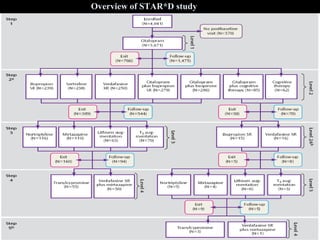
STAR*D Treatment Algorithm
• Initial treatment: Citalopram
• Switch to Bup[SR] / Ven[ER] / Sert / CT
• Augment with Bup[SR] / Bus / CT
• Only for those receiving CT, Switch to Bup /
Ven if exiting level 2
• Switch to Mirt / Nortryp
• Augment with Lithium / T3
• Switch to Tranylcypromine / Mirt + Ven[ER]
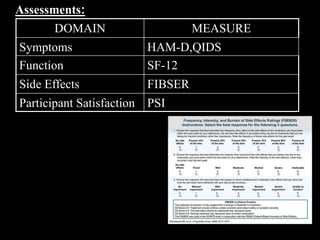
Assessments:
DOMAIN MEASURE
Symptoms HAM-D,QIDS
Function SF-12
Side Effects FIBSER
Participant Satisfaction PSI
• Assessments will be done at weeks 0, 2, 4, 6, 9, and 12 in
clinic visits.
• Psychotherapy visits are to be twice a week for weeks 1- 4,
then once a week for 8 weeks.
• Follow-up research outcomes assessments conducted every
3 months for a period of 12 months.
Statistical Analysis:
• Chi-square tests for association,
• Logistic regression,
• Analysis of variance (ANOVA), and
• Analysis of covariance (ANCOVA) were utilized to test the
hypothesis.
Overview of STAR*D study
RESULTS
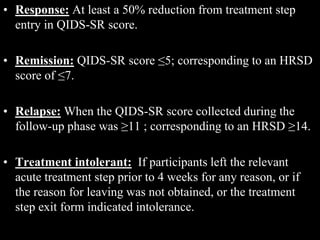
• Response: At least a 50% reduction from treatment step
entry in QIDS-SR score.
• Remission: QIDS-SR score ≤5; corresponding to an HRSD
score of ≤7.
• Relapse: When the QIDS-SR score collected during the
follow-up phase was ≥11 ; corresponding to an HRSD ≥14.
• Treatment intolerant: If participants left the relevant
acute treatment step prior to 4 weeks for any reason, or if
the reason for leaving was not obtained, or the treatment
step exit form indicated intolerance.
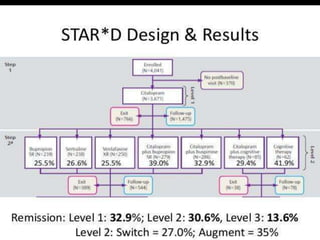
LEVEL 1:
• Outcomes from level 1 were reported in January 2006.
• About 30% of patients achieved the goal of remission of
symptoms.
• Mean dose of citalopram was 41.8 mg, and mean duration
of treatment was 47 days.
• Higher rates of remission were associated with: female,
caucasian, higher education level, marriage or cohabitation,
employed, insured, shorter current episode, and fewer
concurrent general medical or psychiatric disorders.
• 33.5% of those reaching remission in level 1 were
subsequently relapsed during the follow-up period.
• Thus, for some 70% of patients, citalopram alone is
insufficient to sustain long-term remission.
(Trivedi & Rush et al.,Am J Psychiatry 2006;163:28–40.)
LEVEL 2 :
• Results were published in March 2006.
• Intolerance to one SSRI (citalopram) did not predict
intolerance to another SSRI (sertraline).
• In the augmentation phase, approximately 30% of patients
treated with either bupropion-SR or buspirone in addition to
their citalopram achieved remission.
• Long-term relapse rates for level 2 responders totaled an
alarming 47.4%.
• The rate was higher for patients who improved, but did not
achieve remission.
(Trivedi & Fava et al., N Engl J Med 2006;354:1243–52.)
LEVEL 3:
• Results were published for the switching phase and
augmentation phase of the study.
• 15.9% of lithium-treated patients and 24.7% of T3 treated
patients achieved remission.
• Authors favored T3 treatment over lithium, because of
advantages in effectiveness and tolerability, and lack of
need for blood level monitoring.
(Fava & Rush et al., Am J Psychiatry 2006;163:1161–72.)
• Switch phase of level 3 treatment studied given either
mirtazapine or nortriptyline.
• Remission rates did not differ significantly for these two
medications.
• 12.3% for mirtazapine and 19.8% for nortriptyline.
• There was no difference in tolerability or adverse events.
• Authors suggest there may be only limited utility to three
sequential monotherapies for depression treatment.
(Fava & Rush et al., Am J Psychiatry 2006;163:1161–72.)
LEVEL 4:
• Evaluated additional treatment options, MAOI or
combination therapy.
• Participants showed minimal improvement from their level
1 baseline scores.
• The comorbidity burden was high, 64.2% of entrants having
at least one general medical condition.
• 76% had at least one additional Axis I comorbid condition,
and over 19% had at least four.
• The overall remission rate was 13.0%, but 50% of these
remitters subsequently relapsed.
• Patients taking the MAOI tranylcypromine were more likely
to exit the study because of side effects.
• More tolerable side effect burden and the lack of dietary
interactions favor combination therapy with venlafaxine-XR
and mirtazapine for highly treatment-resistant depression
patients.
(McGrath & Stewart et al., Am J Psychiatry 2006;163:1531–41.)
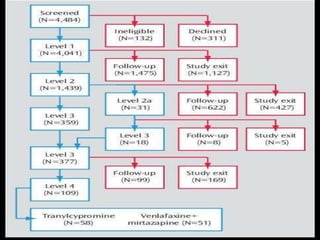
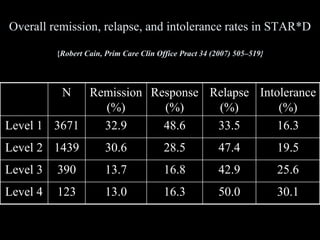
Overall remission, relapse, and intolerance rates in STAR*D
{Robert Cain, Prim Care Clin Office Pract 34 (2007) 505–519}
N Remission
(%)
Response
(%)
Relapse
(%)
Intolerance
(%)
Level 1 3671 32.9 48.6 33.5 16.3
Level 2 1439 30.6 28.5 47.4 19.5
Level 3 390 13.7 16.8 42.9 25.6
Level 4 123 13.0 16.3 50.0 30.1
Acute and Longer-Term Outcomes in Depressed
Outpatients Requiring One or Several Treatment Steps:
A STAR*D Report.
(Rush & Trivedi et al., Am J Psychiatry 2006; 163:1905-1917.)
Conclusions
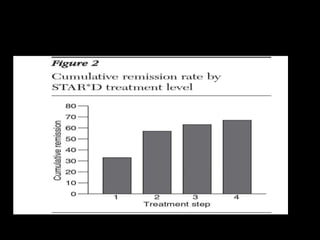
• After two treatment steps, over 50% of patients achieve
remission if they stay in treatment (36.8% step 1 plus 30.6%
of the remaining 63.2% of patients).
• The theoretical cumulative remission rate after four acute
treatment steps was 67%.
• Greater illness burden (i.e., depression chronicity,
psychiatric or general medical comorbidity) was
characteristic of those who required more treatment steps.
• Chances of subsequent remission are much lower.
• At entry into the follow-up phase, remission, as opposed to
improvement without remission, was associated with a
better prognosis.
• Poor outcomes in participants who require more treatment
steps independent of whether or not they were in remission
at entry into the follow-up phase.
• Studies to identify the best multi-step treatment sequences
for individual patients and the development of more broadly
effective treatments are needed.
CRITIQUE
Strengths:
• Large sample size, multi-center, well funded project.
• Inclusion of patients from both primary care and tertiary
centers.
• Patient is an active participant in the decision process,
mimicking real-world clinical decision-making.
• Broad inclusion criteria ensured a real-world patient
population.
• It is the ‘‘real world’’ focus that makes STAR*D a
landmark study.
Limitations:
• Lack of placebo controls make it difficult to account for
nonspecific treatment effects, which have been substantial
in depression studies.
• Use of a single agent (citalopram) at level 1 limits the
generalization, what about the role of other antidepressants
which are potential first line drugs.
• The STAR*D protocols were not blinded to patients or
clinicians, fostering inherent participant and observer bias.
• The number of participants in Level 3 & 4 are small, results
cannot be generalized.
• Excluded severe depression with psychotic symptoms or
suicidality requiring hospitalization.
• No mention on role of Electro convulsive therapy.
Star d revised final

Star d revised final

  • 1.
    STAR*D Sequenced Treatment AlternativesTo Relieve Depression -Dr.maithri[1st yr pg psychiatry] Moderator-Dr.Sai kiran Pasupula Assistant Professor
  • 2.
  • 3.
    STAR*D, funded in1998, 7-year trial, $35 million, multi- center, prospective, sequentially randomized controlled trial of outpatients who had non-psychotic unipolar depression. 14 regional research centers across the USA, over 120 physicians with 23 psychiatry and 18 primary care facilities used. Funded by National Institute of Mental Health; National Coordinating Center at Southwestern Medical Center, Dallas and Data Coordinating Center at Pittsburgh.
  • 4.
  • 5.
    • Major depressivedisorder is a common, usually recurrent, and often chronic disorder. • MDD causes substantial disability • Actual acceptability, clinical benefit, and side effect burden of treatment in community populations is not well known. • It remains unclear how to help depressed persons who respond to treatment but do not attain full remission.
  • 6.
  • 7.
    Primary Objectives: • Todetermine the comparative effectiveness of different treatment options for MDD. • Evaluate the comparative effectiveness of these treatments when they are used to either augment the previous treatment or as new treatments for participants without a satisfactory response to an initial SSRI medication. • To correlate clinical outcomes – symptom profile, functioning, side effect burden, quality of life, and participant satisfaction.
  • 8.
    Secondary objectives: • Todetermine the incidence, nature, and timing of relapses (< 6 months after remission) or recurrences (> 6 months after remission) during follow-up. • To relate the clinical outcomes to the treatment costs and feasibility.
  • 9.
  • 10.
    • Patient selection –Inclusion Criteria – Exclusion Criteria • Study centres • Clinical Research Staff • Randomization • Assessments • Statistical Analysis
  • 11.
    Inclusion criteria: • Agerange: 18–75 years. • Around 4000 Outpatients with non-psychotic MDD. • A score of >14 on the HAM-D. • Outpatients for whom antidepressant treatment is deemed appropriate by the treating clinician. • Participants with suicidal ideation are eligible, as long as outpatient treatment is deemed safe by the clinician. • Participants who have comorbid General Medical Conditions are also eligible.
  • 12.
    Exclusion criteria: • Non-responseor intolerability in the current major depressive episode to one or more treatments. • Lifetime history of Bipolar disorder, Schizophrenia, Schizoaffective disorder, or MDD with Psychotic features. • Primary diagnosis of anorexia nervosa, bulimia nervosa, or Obsessive-Compulsive disorder. • Participants who are likely to require hospitalization within six months from study entry. • Substance dependence disorders who require inpatient detoxification.
  • 13.
    • Participants withconcurrent psychiatric or medical conditions that are relative or absolute contraindications to the use of more than one treatment option within the protocol.
  • 14.
    Study Centre: • 23psychiatry and 18 primary care centres covering various geographical distribution across USA.
  • 15.
    Randomization: Equipoise stratified randomization. •Developed to allow the greatest number of patients to contribute data and comparison. • Clinician defines a list of specific study treatments that are acceptable and are of rough parity called “equipoise stratum”. • Assignment to e-stratum depends on patient’s characteristics, tolerability to side-effects, response to treatment or individual preferences.
  • 16.
    • Finally, ESdesign randomly assigns each patient to a specific option within that patient’s e-stratum. • Advantages: Recruitment open to most patients, Efficient recruitment process, and Adaptation to patient and clinician preferences.
  • 17.
    Level 2A Level 2 Level3 Level 4 Level 1 STAR*D Treatment Algorithm • Initial treatment: Citalopram • Switch to Bup[SR] / Ven[ER] / Sert / CT • Augment with Bup[SR] / Bus / CT • Only for those receiving CT, Switch to Bup / Ven if exiting level 2 • Switch to Mirt / Nortryp • Augment with Lithium / T3 • Switch to Tranylcypromine / Mirt + Ven[ER]
  • 18.
    Assessments: DOMAIN MEASURE Symptoms HAM-D,QIDS FunctionSF-12 Side Effects FIBSER Participant Satisfaction PSI
  • 19.
    • Assessments willbe done at weeks 0, 2, 4, 6, 9, and 12 in clinic visits. • Psychotherapy visits are to be twice a week for weeks 1- 4, then once a week for 8 weeks. • Follow-up research outcomes assessments conducted every 3 months for a period of 12 months.
  • 20.
    Statistical Analysis: • Chi-squaretests for association, • Logistic regression, • Analysis of variance (ANOVA), and • Analysis of covariance (ANCOVA) were utilized to test the hypothesis.
  • 21.
  • 23.
  • 24.
    • Response: Atleast a 50% reduction from treatment step entry in QIDS-SR score. • Remission: QIDS-SR score ≤5; corresponding to an HRSD score of ≤7. • Relapse: When the QIDS-SR score collected during the follow-up phase was ≥11 ; corresponding to an HRSD ≥14. • Treatment intolerant: If participants left the relevant acute treatment step prior to 4 weeks for any reason, or if the reason for leaving was not obtained, or the treatment step exit form indicated intolerance.
  • 26.
    LEVEL 1: • Outcomesfrom level 1 were reported in January 2006. • About 30% of patients achieved the goal of remission of symptoms. • Mean dose of citalopram was 41.8 mg, and mean duration of treatment was 47 days. • Higher rates of remission were associated with: female, caucasian, higher education level, marriage or cohabitation, employed, insured, shorter current episode, and fewer concurrent general medical or psychiatric disorders.
  • 27.
    • 33.5% ofthose reaching remission in level 1 were subsequently relapsed during the follow-up period. • Thus, for some 70% of patients, citalopram alone is insufficient to sustain long-term remission. (Trivedi & Rush et al.,Am J Psychiatry 2006;163:28–40.)
  • 28.
    LEVEL 2 : •Results were published in March 2006. • Intolerance to one SSRI (citalopram) did not predict intolerance to another SSRI (sertraline). • In the augmentation phase, approximately 30% of patients treated with either bupropion-SR or buspirone in addition to their citalopram achieved remission. • Long-term relapse rates for level 2 responders totaled an alarming 47.4%. • The rate was higher for patients who improved, but did not achieve remission. (Trivedi & Fava et al., N Engl J Med 2006;354:1243–52.)
  • 29.
    LEVEL 3: • Resultswere published for the switching phase and augmentation phase of the study. • 15.9% of lithium-treated patients and 24.7% of T3 treated patients achieved remission. • Authors favored T3 treatment over lithium, because of advantages in effectiveness and tolerability, and lack of need for blood level monitoring. (Fava & Rush et al., Am J Psychiatry 2006;163:1161–72.)
  • 30.
    • Switch phaseof level 3 treatment studied given either mirtazapine or nortriptyline. • Remission rates did not differ significantly for these two medications. • 12.3% for mirtazapine and 19.8% for nortriptyline. • There was no difference in tolerability or adverse events. • Authors suggest there may be only limited utility to three sequential monotherapies for depression treatment. (Fava & Rush et al., Am J Psychiatry 2006;163:1161–72.)
  • 31.
    LEVEL 4: • Evaluatedadditional treatment options, MAOI or combination therapy. • Participants showed minimal improvement from their level 1 baseline scores. • The comorbidity burden was high, 64.2% of entrants having at least one general medical condition. • 76% had at least one additional Axis I comorbid condition, and over 19% had at least four. • The overall remission rate was 13.0%, but 50% of these remitters subsequently relapsed.
  • 32.
    • Patients takingthe MAOI tranylcypromine were more likely to exit the study because of side effects. • More tolerable side effect burden and the lack of dietary interactions favor combination therapy with venlafaxine-XR and mirtazapine for highly treatment-resistant depression patients. (McGrath & Stewart et al., Am J Psychiatry 2006;163:1531–41.)
  • 33.
    Overall remission, relapse,and intolerance rates in STAR*D {Robert Cain, Prim Care Clin Office Pract 34 (2007) 505–519} N Remission (%) Response (%) Relapse (%) Intolerance (%) Level 1 3671 32.9 48.6 33.5 16.3 Level 2 1439 30.6 28.5 47.4 19.5 Level 3 390 13.7 16.8 42.9 25.6 Level 4 123 13.0 16.3 50.0 30.1
  • 35.
    Acute and Longer-TermOutcomes in Depressed Outpatients Requiring One or Several Treatment Steps: A STAR*D Report. (Rush & Trivedi et al., Am J Psychiatry 2006; 163:1905-1917.) Conclusions • After two treatment steps, over 50% of patients achieve remission if they stay in treatment (36.8% step 1 plus 30.6% of the remaining 63.2% of patients). • The theoretical cumulative remission rate after four acute treatment steps was 67%. • Greater illness burden (i.e., depression chronicity, psychiatric or general medical comorbidity) was characteristic of those who required more treatment steps.
  • 36.
    • Chances ofsubsequent remission are much lower. • At entry into the follow-up phase, remission, as opposed to improvement without remission, was associated with a better prognosis. • Poor outcomes in participants who require more treatment steps independent of whether or not they were in remission at entry into the follow-up phase. • Studies to identify the best multi-step treatment sequences for individual patients and the development of more broadly effective treatments are needed.
  • 37.
  • 38.
    Strengths: • Large samplesize, multi-center, well funded project. • Inclusion of patients from both primary care and tertiary centers. • Patient is an active participant in the decision process, mimicking real-world clinical decision-making. • Broad inclusion criteria ensured a real-world patient population. • It is the ‘‘real world’’ focus that makes STAR*D a landmark study.
  • 39.
    Limitations: • Lack ofplacebo controls make it difficult to account for nonspecific treatment effects, which have been substantial in depression studies. • Use of a single agent (citalopram) at level 1 limits the generalization, what about the role of other antidepressants which are potential first line drugs. • The STAR*D protocols were not blinded to patients or clinicians, fostering inherent participant and observer bias. • The number of participants in Level 3 & 4 are small, results cannot be generalized.
  • 40.
    • Excluded severedepression with psychotic symptoms or suicidality requiring hospitalization. • No mention on role of Electro convulsive therapy.