Introduction to
Ketamine-Assisted Psychotherapy
COPYRIGHT 2021
.
Eric Sienknecht, PsyD
Veronika Gold, LMFT
Ethical Considerations for Training
of all Ketamine Providers
❖ Potential of Psychedelic Experience (OBE, NDE)
❖ Regressed States - Suggestibility
❖ Abreactions
❖ Sensitivity to Dosing
❖ Vulnerability and Potential Enhancement of Trust
❖ Porosity (heightened sensitivity to set and setting)
❖ Kriya Published Ketamine Ethical Guidelines
Journal of Psychedelic Psychiatry (Vol 2, Issue 4, Dec 2020, pgs 19-23)
KETAMINE
Ketamine’s Signature 1/2
❖ Rapid onset, Rapid metabolism & Excellent safety profile
❖ Dose-related access/flexibilityfor therapeutic process – Psycholytic & Psychedelic
❖ Reduction/Eliminationof external stimuli and sensations & heightening of internal visual
experience (Float Tanks can simulatedissociativeeffects of ketamine)
❖ Preservation of the observer self -observing ego - witnessing self
❖ Outsideof bounded time and space – differentlevels and depth of altered state experience,
biographical and transpersonalexperiences
Ketamine’s Signature 2/2
❖ Spaciousness of mind, Freedom of mind, Sense of movement and music essential in the
experience
❖ Reductionof verbal thinking and processing and connection to symbolicrealm of
experience
❖ Reductionin negative, obsessive, and self-referential thinking
❖ Experience of surrender, formlessness,love, interconnectedness,humility,awe, gratitude
and union with Divine Love, Divine Mind
❖ NDE, OBE, Archetypal Experiences/Encounters
❖ Navigating the range of ecstatic to challenging experiences
Rick Doblin
Stanislav and Christina Grof
Julane Andries and Phil Wolfson
Raquel Bennett
Annie and Michael Mithoefer
Shamanic Roots
Tito la Rosa Maria Sabina Don Jose Campos
Paradigms of treatment
❖Medical – neuro-bio-chemical model
❖Psychological
❖Transpersonal
❖Shamanic
Raquel Bennett, PsyD
Medical
Setting
Ketamine Assisted Psychotherapy
vs
Ketamine Treatment
Treatment room at Polaris Insight Center
Treatment room at IV infusion clinic
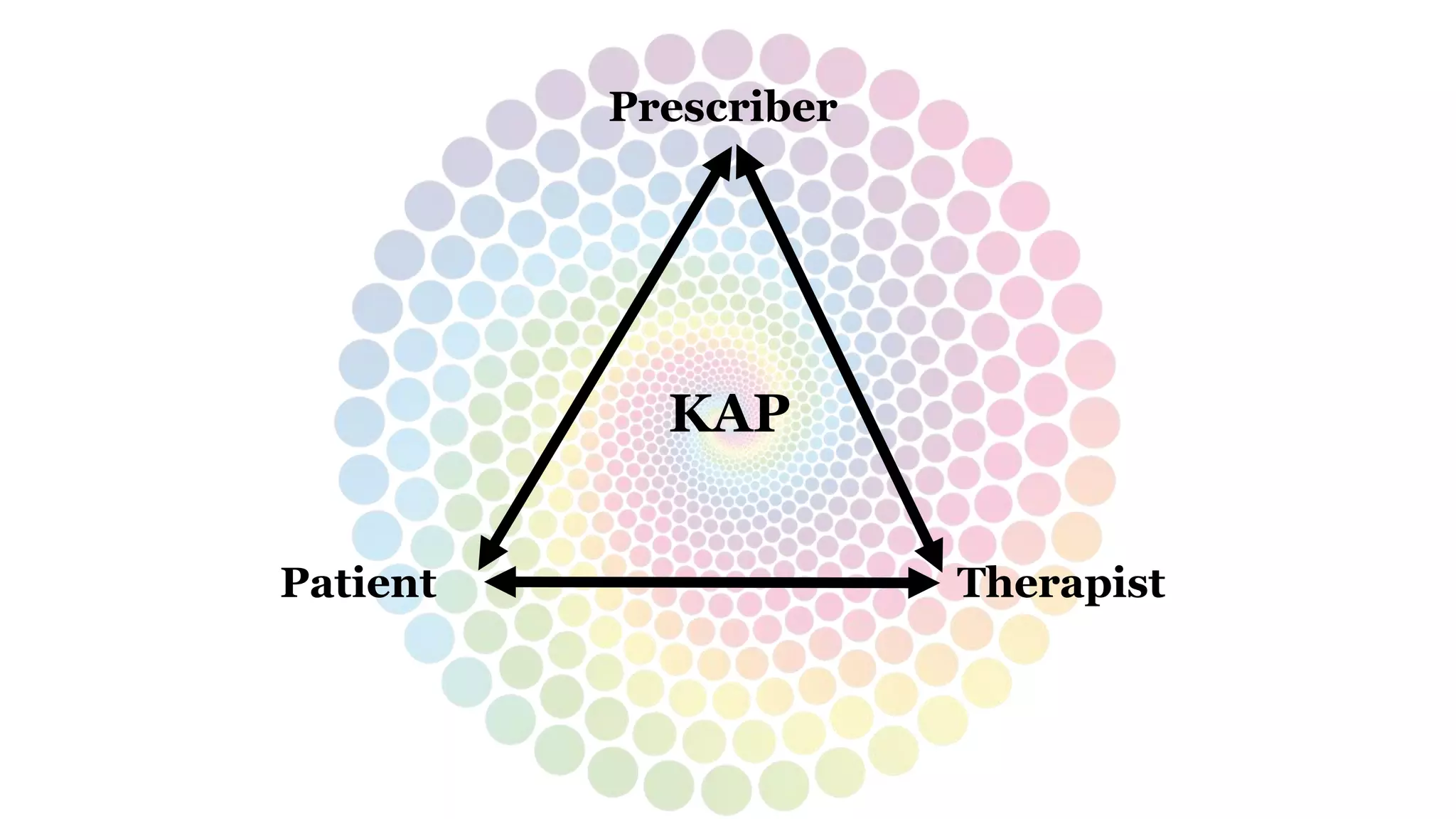
KAP
Prescriber
Patient Therapist
Psychotherapeutic Model
❖Therapeutic relationship as primary container -
physician and medicine support the psychotherapy
❖Emphasis on Set, Setting, Music, Interpersonal
Connection
❖Preparation and Integration built into treatment
plan
❖3-hour sessions allow for plenty of time to process
material
❖Non-Ordinary States of Consciousness are held as
crucial for healing and seen as meaningful
Therapy approaches with
KAP
❖Relational Therapy
❖Somatic Therapies – Relational Somatic
Therapy, Hakomi, Somatic Experiencing,
Organic Intelligence, Sensory-motor Therapy
❖Internal Family Systems
❖Acceptance and Commitment Therapy
❖Cognitive Behavioral Therapy, Dialectical
Behavioral Therapy
❖Eye Movement Desensitization and
Reprocessing Therapy
❖Emotionally Focused Therapy
Set & Setting
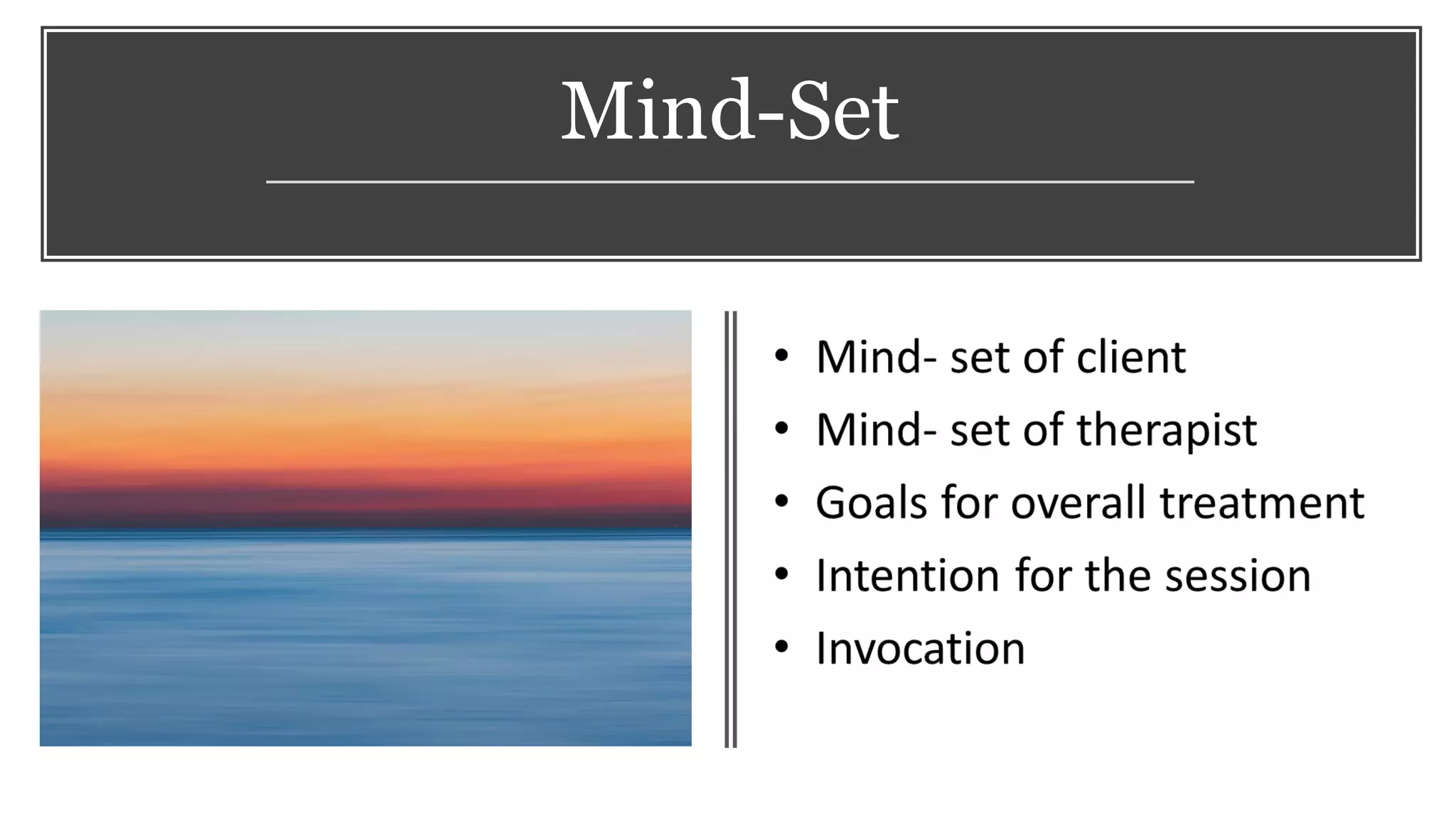
Mind-Set
Polaris Insight Center
Activation of
and
Trust in
the
Inner
Healing
Intelligence
Experiential
Learning
Stanislav Grof
❖ Biographical
❖ Perinatal
❖ Collective/Mythological
❖ Archetypal
❖ Mystical/Causal
- Based on work with LSD and
other holotropicstates
Typologies of
NOSC
Chris Bache
❖ Personal/Biographical
❖ Collective
❖ Archetypal
❖ Oneness/CausalRealm
❖ Diamond Luminosity
-Based on work with LSD
Eli Kolp
❖ Out of Body experience
❖ Near to Death Experience
❖ Ego Dissolution
Transformational experience
- Based on work with Ketamine
Sacredness of the Journey
Treatment
Indications
for KAP
• Treatment Resistant
Depression
• Anxiety
• PTSD
• OCD
• “stuck in therapy”
• Gray areas: addiction and
suicidality
INTAKE
SCREENING
INTEGRATION
PREPARATION
assessment
KAP SESSION
(set and setting)
OVERVIEW OF KAP PROTOCOL
Importance of
Preparation
❖Informed Consent
❖Set and Setting
❖Role of Music
❖Role of Touch
❖Guiding Principles of the Approach
❖Expectations and possible experiences
❖Cartography of the mind
❖Support system
❖Regulation techniques
Medical Intake
and Screening
❖Collaborative - Physician,
Therapist, & Patient
❖ Review medical history and
medications and screen for
contraindications
❖Education about safety of
ketamine and drug interactions
❖Answer patient’s questions
Psychological Intake
and Screening
• Developmental/TraumaHx
• Psych Treatment Hx, Dxs, risks
• Hx SA, Use of psychedelics
• Religious/SpiritualHx
• Current support system
• Psychoeducationaround KAP
• Address questions aboutKAP
and Consent Forms
• ROIs for outsideproviders
• Prep for first KAP session,if time
Psychological Intake
and Screening
Psychological Testing:
❖PHQ-9
❖GAD-7
❖PCL-5
---------
❖ACE
❖Resilience
❖Change of State (after treatment)
❖MEQ, EDI (after treatment)
Sublingual Lozenges
and Troches
• Office relationshipwith KoshlandPharmacy
• Introduces patients to KAP while minimizing
medical invasiveness
• Allows for at-homeuse in some patients
• Empowers patients in their own healing
• Can be used in conjunctionwith IM administration
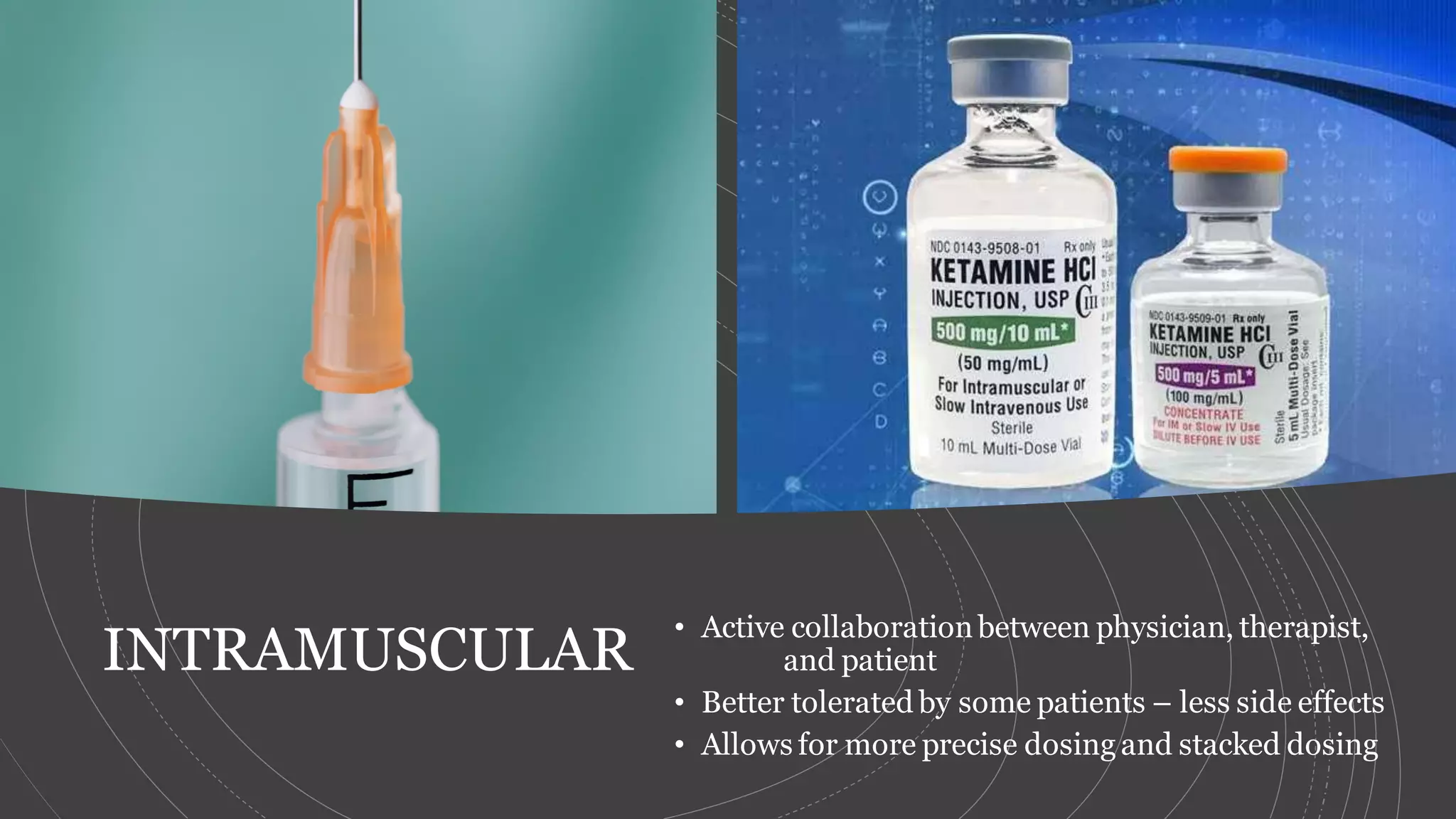
INTRAMUSCULAR
• Active collaborationbetween physician, therapist,
and patient
• Better tolerated by some patients – less side effects
• Allows for more precise dosing and stacked dosing
Dosing Strategy
❖Low dose: 0.25 mg – 0.5 mg/kg
❖Moderatedose: 0.5 mg – 1.2 mg/kg
❖High dose: 1.2 mg – 2.0 mg/kg
Treatment Approaches
Low Dose
• EmpathogenicExperience- Trance-like
state
• Psycholytic Therapy
• Allows for ongoing communication
• Induces mild dissociation,mildly
anesthetic, yet present and relaxed state
• Generallylow-risk; low side effects
Moderate to High Dose
• Out of Body Experience (OBE)
• Near-DeathExperience (NDE)
• Ego-Dissolving Transcendental experience
• Moderateto profound dissociative
sedation, may be like high dose classical
psychedelics
• Potential for side effects; not suitable for all
clients
Empathogenic Experience
KETAMINE RISKS
and SIDE EFFECTS
❖Nausea and Vomiting
❖Transientincrease in BP and heart rate
❖Dizziness, disorientation,blurred vision,
headache,dry mouth
❖Increaseor decrease in energy (fatigueor
restlessness)(rare)
❖Neurotoxicity-only in chronic and high
doseusage
❖Potential for tolerance& abuse and
dependence
❖Urethral cystitis and bladderpain with
chronic and long-term use
❖Non-compliance
Addiction
❖Ketamine can be
psychologically addictive
❖No evidence of physical
dependence, but withdrawal is
possible
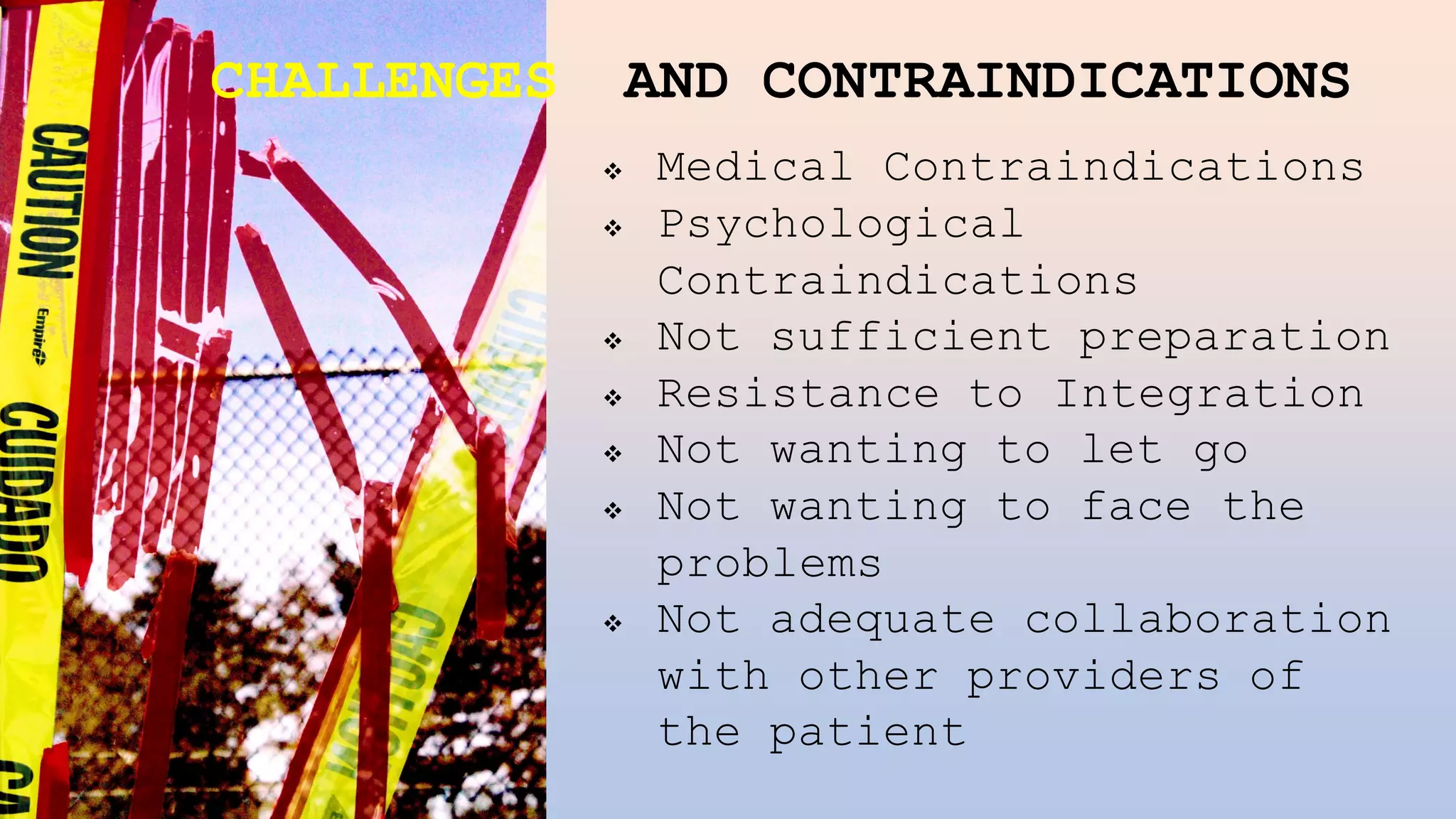
CHALLENGES AND CONTRAINDICATIONS
❖ Medical Contraindications
❖ Psychological
Contraindications
❖ Not sufficient preparation
❖ Resistance to Integration
❖ Not wanting to let go
❖ Not wanting to face the
problems
❖ Not adequate collaboration
with other providers of
the patient
Transference and Countertransference
Challenges and Opportunities
AMPLIFY
REDUCE
NON-LINEAR
POROSITY/SUGGESTIBILITY
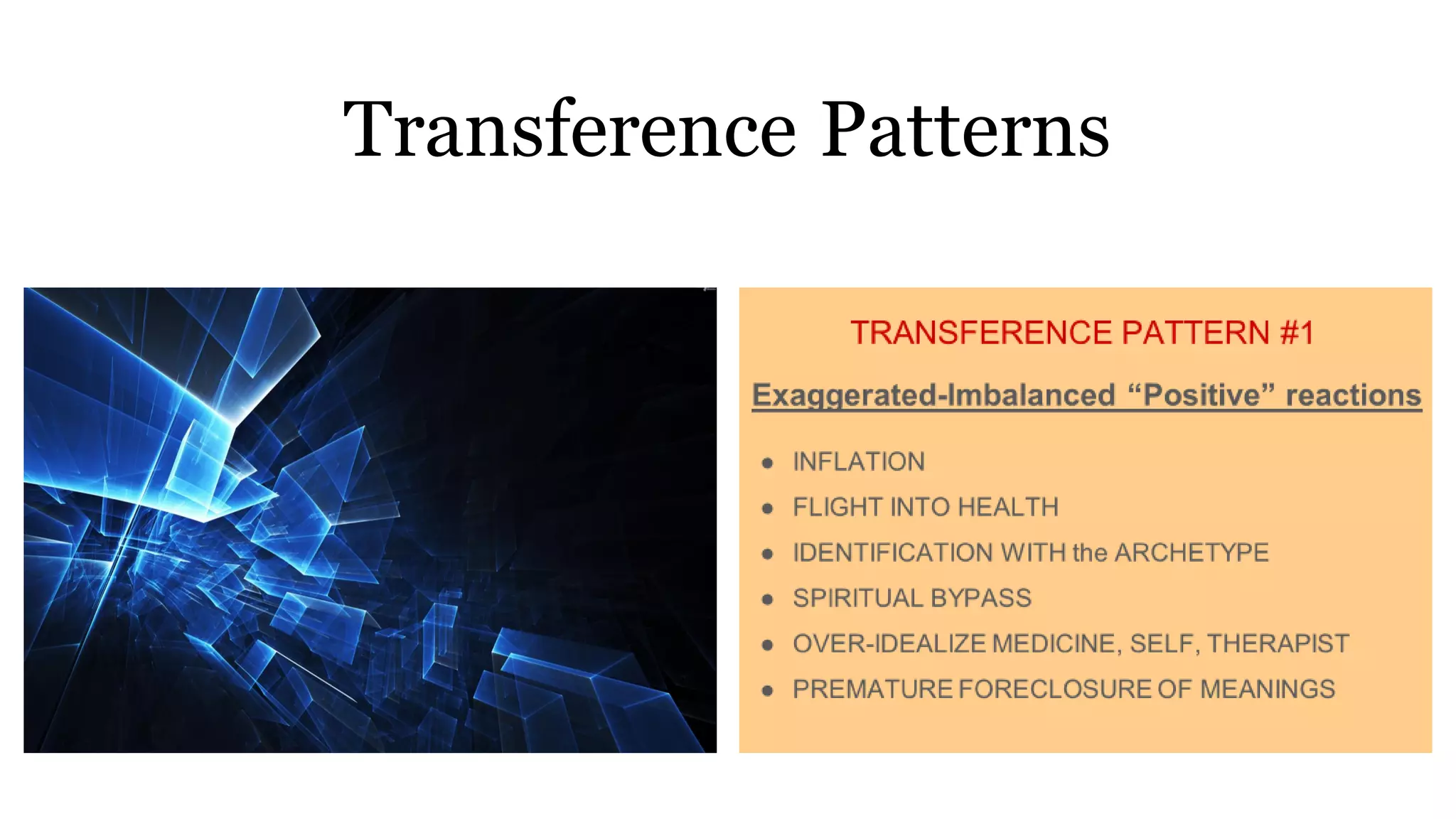
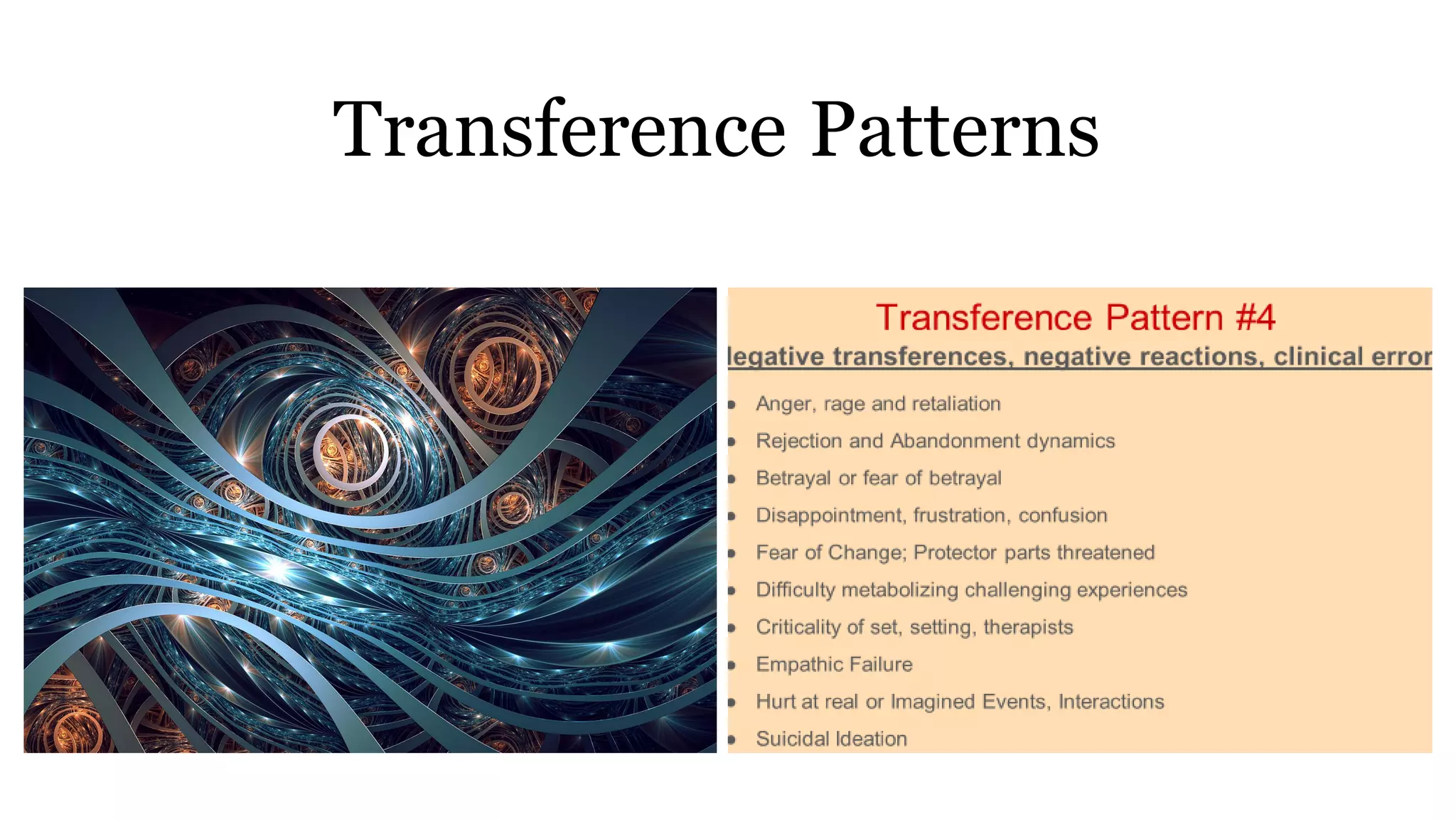
Transference Patterns
Integration
MAJOR GOALS OF KAP INTEGRATION (1)
Safety/stabilization: Smooth re-entry, prevention, ongoing monitoring
Attachment: Relationshipcontinuity and repair & deepen collaboration
Enhanced self-monitoring: Observing ego, neutrality,disentanglement
Debriefing: Emotionalprocessing,meaning-making, releasing,grieving
Resolving: Pathogenicbeliefs and conflicts among parts of the self
Durability: Accrual of benefit & consolidationof gains
MAJOR GOALS of INTEGRATION (2)
Dedicated application of newfound wisdom; support behavior
changes
Understanding challenging experiences: psychological &
archetypal/spiritual
Effective use of transference and countertransference experience
Coping with changes in identity and worldview and social system
Process traumatic memories & meanings, and navigate spiritual
emergency
Improved navigation of interpersonal challenges and intimacy
Integration Challenges
Katzman & Schwartz, Kriya
2019
Rapid Relapse
Zig-zagging
The Therapeutic Bends
“Dropping the Ball” / Insufficient Follow-up
Spiritual Bypass
Flight into Health
Survivor Guilt
Unearthing Unanticipated Feelings and Memories
Negative Transference/Negative Therapeutic Reaction/Clinical Error
Challenging Transpersonal/ArchetypalExperiences
“Splitting” the Clinical Team
Prevention of Enacting Premature Life Changes/Decisions
POLARIS
INSIGHT CENTER
SAN FRANCISCO
Ketamine-Assisted
Psychotherapy, Training
& Consultation
www.polarisinsight.com
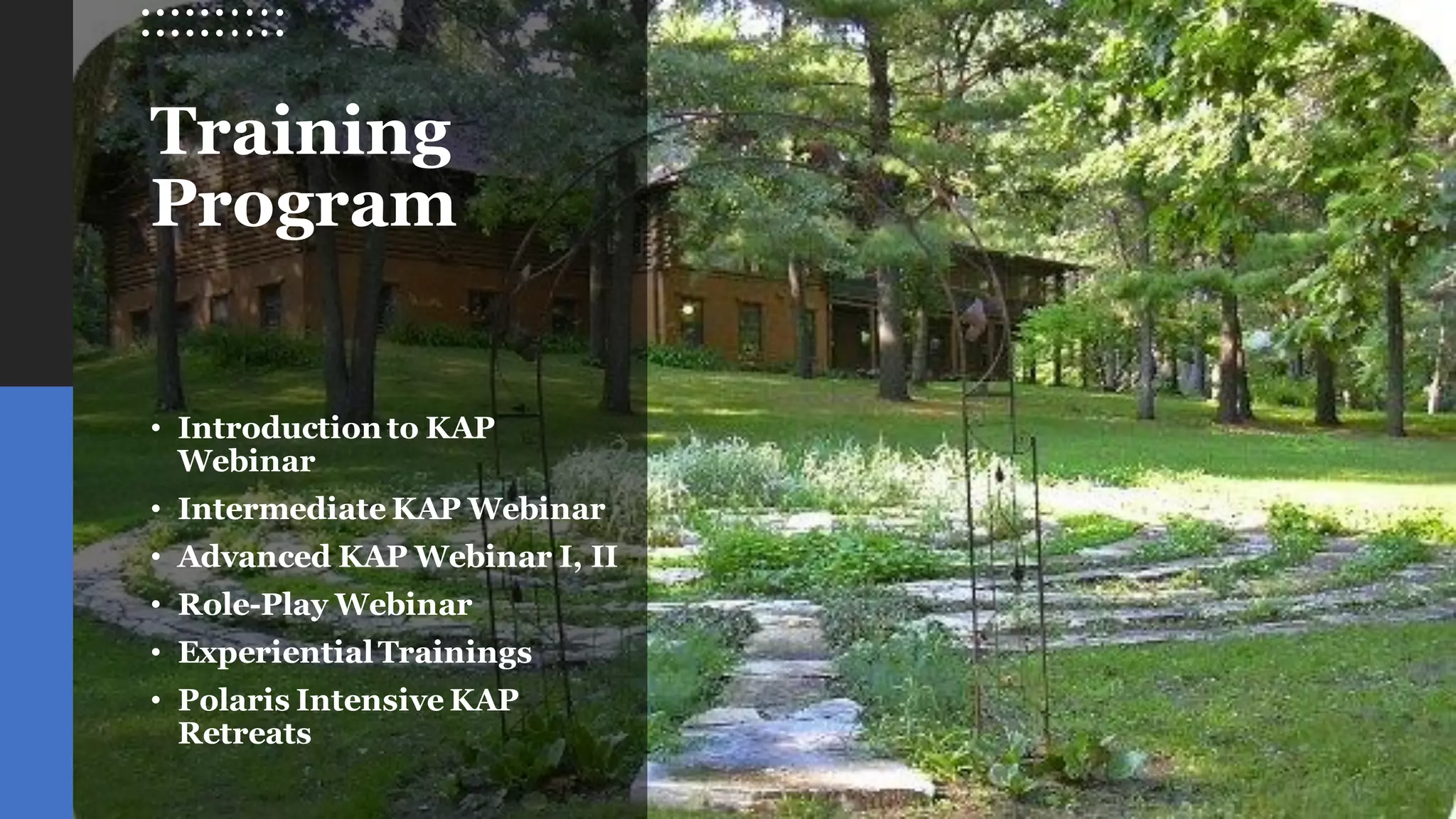
Training
Program
• Introduction to KAP
Webinar
• Intermediate KAP Webinar
• Advanced KAP Webinar I, II
• Role-Play Webinar
• ExperientialTrainings
• Polaris Intensive KAP
Retreats
Polaris Insight Center
4257 18th St.
San Francisco, CA 94114
415.800.7083
polarisinsight.com
info@polarisinsight.com
harvey@polarisinsight.com
veronika@polarisinsight.com
THANK YOU

Introduciton to KAP

  • 1.
    Introduction to Ketamine-Assisted Psychotherapy COPYRIGHT2021 . Eric Sienknecht, PsyD Veronika Gold, LMFT
  • 2.
    Ethical Considerations forTraining of all Ketamine Providers ❖ Potential of Psychedelic Experience (OBE, NDE) ❖ Regressed States - Suggestibility ❖ Abreactions ❖ Sensitivity to Dosing ❖ Vulnerability and Potential Enhancement of Trust ❖ Porosity (heightened sensitivity to set and setting) ❖ Kriya Published Ketamine Ethical Guidelines Journal of Psychedelic Psychiatry (Vol 2, Issue 4, Dec 2020, pgs 19-23)
  • 3.
  • 5.
    Ketamine’s Signature 1/2 ❖Rapid onset, Rapid metabolism & Excellent safety profile ❖ Dose-related access/flexibilityfor therapeutic process – Psycholytic & Psychedelic ❖ Reduction/Eliminationof external stimuli and sensations & heightening of internal visual experience (Float Tanks can simulatedissociativeeffects of ketamine) ❖ Preservation of the observer self -observing ego - witnessing self ❖ Outsideof bounded time and space – differentlevels and depth of altered state experience, biographical and transpersonalexperiences
  • 6.
    Ketamine’s Signature 2/2 ❖Spaciousness of mind, Freedom of mind, Sense of movement and music essential in the experience ❖ Reductionof verbal thinking and processing and connection to symbolicrealm of experience ❖ Reductionin negative, obsessive, and self-referential thinking ❖ Experience of surrender, formlessness,love, interconnectedness,humility,awe, gratitude and union with Divine Love, Divine Mind ❖ NDE, OBE, Archetypal Experiences/Encounters ❖ Navigating the range of ecstatic to challenging experiences
  • 8.
    Rick Doblin Stanislav andChristina Grof Julane Andries and Phil Wolfson Raquel Bennett Annie and Michael Mithoefer
  • 9.
    Shamanic Roots Tito laRosa Maria Sabina Don Jose Campos
  • 10.
    Paradigms of treatment ❖Medical– neuro-bio-chemical model ❖Psychological ❖Transpersonal ❖Shamanic Raquel Bennett, PsyD
  • 11.
  • 12.
    Ketamine Assisted Psychotherapy vs KetamineTreatment Treatment room at Polaris Insight Center Treatment room at IV infusion clinic
  • 13.
  • 14.
    Psychotherapeutic Model ❖Therapeutic relationshipas primary container - physician and medicine support the psychotherapy ❖Emphasis on Set, Setting, Music, Interpersonal Connection ❖Preparation and Integration built into treatment plan ❖3-hour sessions allow for plenty of time to process material ❖Non-Ordinary States of Consciousness are held as crucial for healing and seen as meaningful
  • 15.
    Therapy approaches with KAP ❖RelationalTherapy ❖Somatic Therapies – Relational Somatic Therapy, Hakomi, Somatic Experiencing, Organic Intelligence, Sensory-motor Therapy ❖Internal Family Systems ❖Acceptance and Commitment Therapy ❖Cognitive Behavioral Therapy, Dialectical Behavioral Therapy ❖Eye Movement Desensitization and Reprocessing Therapy ❖Emotionally Focused Therapy
  • 16.
  • 17.
  • 19.
  • 21.
  • 22.
  • 23.
    Stanislav Grof ❖ Biographical ❖Perinatal ❖ Collective/Mythological ❖ Archetypal ❖ Mystical/Causal - Based on work with LSD and other holotropicstates Typologies of NOSC Chris Bache ❖ Personal/Biographical ❖ Collective ❖ Archetypal ❖ Oneness/CausalRealm ❖ Diamond Luminosity -Based on work with LSD Eli Kolp ❖ Out of Body experience ❖ Near to Death Experience ❖ Ego Dissolution Transformational experience - Based on work with Ketamine
  • 24.
  • 25.
    Treatment Indications for KAP • TreatmentResistant Depression • Anxiety • PTSD • OCD • “stuck in therapy” • Gray areas: addiction and suicidality
  • 26.
  • 27.
    Importance of Preparation ❖Informed Consent ❖Setand Setting ❖Role of Music ❖Role of Touch ❖Guiding Principles of the Approach ❖Expectations and possible experiences ❖Cartography of the mind ❖Support system ❖Regulation techniques
  • 28.
    Medical Intake and Screening ❖Collaborative- Physician, Therapist, & Patient ❖ Review medical history and medications and screen for contraindications ❖Education about safety of ketamine and drug interactions ❖Answer patient’s questions
  • 29.
    Psychological Intake and Screening •Developmental/TraumaHx • Psych Treatment Hx, Dxs, risks • Hx SA, Use of psychedelics • Religious/SpiritualHx • Current support system • Psychoeducationaround KAP • Address questions aboutKAP and Consent Forms • ROIs for outsideproviders • Prep for first KAP session,if time
  • 30.
    Psychological Intake and Screening PsychologicalTesting: ❖PHQ-9 ❖GAD-7 ❖PCL-5 --------- ❖ACE ❖Resilience ❖Change of State (after treatment) ❖MEQ, EDI (after treatment)
  • 31.
    Sublingual Lozenges and Troches •Office relationshipwith KoshlandPharmacy • Introduces patients to KAP while minimizing medical invasiveness • Allows for at-homeuse in some patients • Empowers patients in their own healing • Can be used in conjunctionwith IM administration
  • 32.
    INTRAMUSCULAR • Active collaborationbetweenphysician, therapist, and patient • Better tolerated by some patients – less side effects • Allows for more precise dosing and stacked dosing
  • 33.
    Dosing Strategy ❖Low dose:0.25 mg – 0.5 mg/kg ❖Moderatedose: 0.5 mg – 1.2 mg/kg ❖High dose: 1.2 mg – 2.0 mg/kg
  • 34.
    Treatment Approaches Low Dose •EmpathogenicExperience- Trance-like state • Psycholytic Therapy • Allows for ongoing communication • Induces mild dissociation,mildly anesthetic, yet present and relaxed state • Generallylow-risk; low side effects Moderate to High Dose • Out of Body Experience (OBE) • Near-DeathExperience (NDE) • Ego-Dissolving Transcendental experience • Moderateto profound dissociative sedation, may be like high dose classical psychedelics • Potential for side effects; not suitable for all clients
  • 35.
  • 36.
    KETAMINE RISKS and SIDEEFFECTS ❖Nausea and Vomiting ❖Transientincrease in BP and heart rate ❖Dizziness, disorientation,blurred vision, headache,dry mouth ❖Increaseor decrease in energy (fatigueor restlessness)(rare) ❖Neurotoxicity-only in chronic and high doseusage ❖Potential for tolerance& abuse and dependence ❖Urethral cystitis and bladderpain with chronic and long-term use ❖Non-compliance
  • 37.
    Addiction ❖Ketamine can be psychologicallyaddictive ❖No evidence of physical dependence, but withdrawal is possible
  • 38.
    CHALLENGES AND CONTRAINDICATIONS ❖Medical Contraindications ❖ Psychological Contraindications ❖ Not sufficient preparation ❖ Resistance to Integration ❖ Not wanting to let go ❖ Not wanting to face the problems ❖ Not adequate collaboration with other providers of the patient
  • 39.
    Transference and Countertransference Challengesand Opportunities AMPLIFY REDUCE NON-LINEAR POROSITY/SUGGESTIBILITY
  • 40.
  • 41.
  • 42.
  • 43.
    MAJOR GOALS OFKAP INTEGRATION (1) Safety/stabilization: Smooth re-entry, prevention, ongoing monitoring Attachment: Relationshipcontinuity and repair & deepen collaboration Enhanced self-monitoring: Observing ego, neutrality,disentanglement Debriefing: Emotionalprocessing,meaning-making, releasing,grieving Resolving: Pathogenicbeliefs and conflicts among parts of the self Durability: Accrual of benefit & consolidationof gains
  • 44.
    MAJOR GOALS ofINTEGRATION (2) Dedicated application of newfound wisdom; support behavior changes Understanding challenging experiences: psychological & archetypal/spiritual Effective use of transference and countertransference experience Coping with changes in identity and worldview and social system Process traumatic memories & meanings, and navigate spiritual emergency Improved navigation of interpersonal challenges and intimacy
  • 45.
    Integration Challenges Katzman &Schwartz, Kriya 2019 Rapid Relapse Zig-zagging The Therapeutic Bends “Dropping the Ball” / Insufficient Follow-up Spiritual Bypass Flight into Health Survivor Guilt Unearthing Unanticipated Feelings and Memories Negative Transference/Negative Therapeutic Reaction/Clinical Error Challenging Transpersonal/ArchetypalExperiences “Splitting” the Clinical Team Prevention of Enacting Premature Life Changes/Decisions
  • 46.
    POLARIS INSIGHT CENTER SAN FRANCISCO Ketamine-Assisted Psychotherapy,Training & Consultation www.polarisinsight.com
  • 47.
    Training Program • Introduction toKAP Webinar • Intermediate KAP Webinar • Advanced KAP Webinar I, II • Role-Play Webinar • ExperientialTrainings • Polaris Intensive KAP Retreats
  • 48.
    Polaris Insight Center 425718th St. San Francisco, CA 94114 415.800.7083 polarisinsight.com info@polarisinsight.com harvey@polarisinsight.com veronika@polarisinsight.com THANK YOU