



KERING
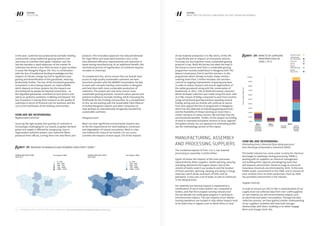
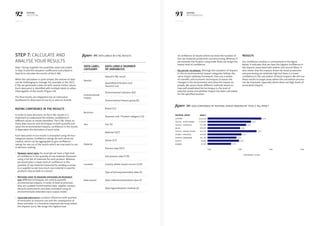
ENVIRONMENTAL
PROFIT & LOSS
(E P&L)
METHODOLOGY & 2013 GROUP RESULTS
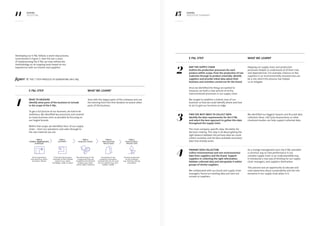
Executive summary	 page 06
An INtroduction to the e p&L	 page 18
Responding to a changing business environment	 page 19
What is ‘natural capital’?	 page 19
What is an E P&L?	 page 21
What is the scope of our E P&L?	 page 23
The rise of Natural Capital Accounting and
how our E P&L fits in	 page 24
How have we involved others?	 page 26
How the E P&L creates value for Kering	 page 26
What are the results an
what do they mean for Kering?	 page 28
Group results	 page 29
Analysing our results	 page 32
methodology	 page 46
Kering’s 7 Step Process to Developing an E P&L	 page 53
Step 1: Decide what to measure	 page 53
Step 2: Map the supply chain	 page 53
Step 3: Identify priority data	 page 55
Step 4: Collect primary data	 page 60
Step 5: Collect secondary data	 page 61
Step 6: Determine valuation	 page 62
Step 7: Calculate and analyse
your results	 page 92
glossary	 page 96
Business, and society more broadly, relies on natural resources and ecosystem services to
function. To be successful and to thrive we need to ensure that the natural systems upon
which we depend also thrive. However, historically business has not integrated the ‘cost’ of
degradation of these natural systems as they are seen as externalities. This needs to change
given the realities confronting us as natural resources decline and the impacts of climate
change increase. At Kering, we take the view that business needs to recognise its reliance on
natural capital. Doing so will lead to new environmentally responsible approaches, which is
not only good for the environment and for society, but for business itself. In response, Kering
developed the Environmental Profit and Loss Account (E P&L) – an innovative tool to help
identify and account for the value of natural capital to its business. We have implemented
an E P&L analysis across all our brands’ supply chains to measure our environmental
footprint, and highlight environmental risks and business opportunities across our supply
chains to support a more resilient business model. As a result, we will be better positioned
to respond to environmental challenges that affect the growth of our business now and
in the future.
In the spirit of collaboration we are open-sourcing the E P&L methodology. We are sharing
our experience to catalyse others, in both the private and public sectors, to identify
and manage their impacts on natural capital. Furthermore, through sharing the E P&L
methodology, offering transparency on our own Group-wide results, and contributing
our lessons learned, we aim to influence and support the international movement
towards corporate natural capital accounting and the development of a globally accepted
methodology. As such, we are contributing to the Natural Capital Coalition’s work developing
the Natural Capital Protocol.
The way forward in our industry, and beyond, is to build robust and resilient businesses that
deliver financial, social and environmental value through innovative approaches, integrating
natural capital into business.
François-Henri Pinault
CEO and Chairman, Kering
“THE WAY FORWARD IS TO BUILD ROBUST AND
RESILIENT BUSINESSES THAT DELIVER FINANCIAL,
SOCIAL AND ENVIRONMENTAL VALUE.”
07 KERING
EXECUTIVE SUMMARY
Executive
summary
What is the E P&L?
The E P&L is a pioneering tool to help businesses
manage their relationship with the natural environment.
All businesses rely on natural capital to deliver their
products and services. However, as a result of their
activities, businesses also impact the environment
through their use of land and natural resources and
their emissions to air, discharges to water and waste.
We developed the E P&L to help measure and understand
our impact on natural capital across our supply chain,
from raw materials to the delivery of products to our
customers. We hope sharing this approach will help other
companies to also better manage their impacts and
dependencies on natural capital.
The E P&L is presented in monetary terms to help us:
–– Translate environmental impact into a language
business understands;
–– 	Compare between different types of impact and
locations which are not normally comparable; and,
–– 	Facilitate comparison between brands and
business units.
The results are not related to Kering’s financial results,
past present or future, and do not represent a financial
liability or cost to Kering. Rather they are a new way
of estimating the cost to society of the changes in the
environment as a result of our business activities and
those of the whole of our supply chain. In contrast to
financial accounting there are currently no established
and agreed standards for estimating this value.
The E P&L is a tool designed to measure and monitor the
costs of environmental changes associated with business.
It is based on economic analysis that estimates societal
costs of environmental impacts. It is not intended to
represent a forward looking statement or any financial
obligation for Kering of any kind.
While these costs are not currently borne by business, we
believe as a responsible business that we should minimise
our negative impact on natural capital and find ways to
enhance and support natural capital. The understanding
we gain from our E P&L analysis enables us to do this, and
importantly, it enables us to better manage risks such as
future availability of resources essential for our products,
and for the success of our business.
08 09KERING
2013 E P&L
KERING
EXECUTIVE SUMMARY
Why we developed
the E P&L
Since the pioneering work we did with PUMA in 2011 when
we published the first-ever E P&L for PUMA’s 2010 results,
Kering, supported by its brands and PwC, has further
developed the E P&L methodology, enabling it to better
support key decisions across the brands.
The E P&L represents a new way of thinking about
our business. It highlights areas where we can deploy
solutions that are likely to reduce the impact of our
existing sourcing and manufacturing processes.
It also informs how we innovate using new materials,
technologies and sourcing solutions. It helps us
understand:
1. The most significant drivers of our impacts:
The E P&L deepens our understanding of the relative
significance of different types of impacts, as well as
the drivers of those impacts. Quantifying and valuing
all impacts in monetary terms enables trade-offs to be
considered across types of impact, locations, materials,
processes, products and technologies.
2. The full spectrum of our offices, retail operations
and supply chain: As part of the E P&L we have
surveyed over 1,000 of our key suppliers, across
5 continents, from product assembly through to
raw material producers, including silk farms, textile
factories, sheep farms and tanneries. Working together
with our suppliers to manage environmental challenges
has also strengthened our relationships with
key suppliers.
3. The impact of every day decisions: Transparent
and readily understandable presentation of impacts
has driven a broader understanding across different
functions within the Group and provided visibility of
how decisions made in one area of the business can
have far reaching consequences. This has helped Kering
to understand and respond to the drivers of change in
our supply chain, including fluctuations in raw material
quality and availability.
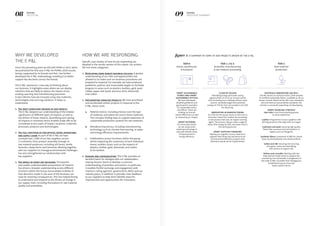
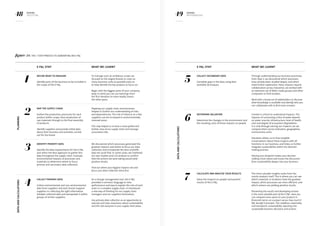
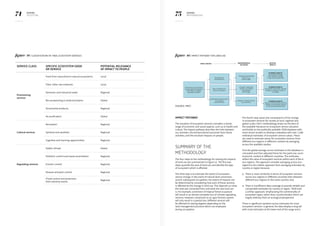
TIER 0:
Stores, warehouses
& transport
Smart Sustainable
Stores and Smart
Sustainable Offices
We have developed
detailed guidelines and
good practice examples
for sustainable stores
and offices. These are
helping our brands
realise efficiencies as well
as improving our impact.
Smart metering
For some pilot stores,
we are using smart
metering technology to
precisely identify areas
of improvement in
energy efficiency.
Clean by Design
Identifying energy and water saving
opportunities at 25 of our Group’s textile
mills (including Gucci, Bottega Veneta, Saint
Laurent, and Balenciaga) with potential
savings of 25% for fuel consumption and 10%
for electricity.
Innovation in manufacturing
As a first for the luxury sector, in 2013 Gucci
launched “metal free” leather by innovating
a new process that uses an organic tanning
agent. The process reduces water usage by
about 30%, energy by 20%, and saves time in
the tanning process.
Smart supplier financing
Helping our suppliers access national or
regional level financing mechanisms for
environmental efficiency projects that
otherwise would not be implemented.
Materials Innovation Lab (MIL)
The MIL boasts an archive of over 1,500 samples
of certified sustainable fabrics, available to all our
Group’s brands. Rated via the MIL’s own evaluation
tool and external sustainability standards, the
archive is constantly expanding and developing.
Smart Sourcing Strategy
Idea Labs: Cross brand working groups
to share experience.
Leather: Programme to trace suppliers with
farming practices that align with our target.
Cashmere and wool: Sourcing high quality
fibres that conserves local ecosystems in
regions such as Patagonia.
Synthetic fibres: Investment in R&D for closed
loop recycled polyester and cellulose fibres.
Cotton and silk: Securing new sourcing
of organic cotton and identifying
new sources of organic silk.
Python and crocodile: Working with the
International Trade Centre to support the
monitoring and sustainable management of
the trade in Nile crocodiles from Madagascar.
Established sources from low
impact python farms.
TIER 1, 2 & 3:
Assembly, manufacturing
& raw material processing
TIER 4:
Raw material
production
Figure 1: A summary of some of our projects driven by the E P&LHow we are responding
Specific case studies of how we are responding are
detailed in the results section of this report. Our actions
fall into three categories:
1. Developing more robust business policies: A greater
understanding of our risks and opportunities has
allowed us to make sure our business procedures are
prepared to respond. For example, we have produced
guidelines, policies and measurable targets to facilitate
progress in areas such as plastics, leathers, gold, wool,
rubber, paper and wood, precious skins, diamonds,
and cotton.
2. Implementing targeted projects: We have prioritised
and accelerated certain projects in response to the
E P&L, these cover:
a. Material choices, including choices over the type
of materials and where we source these materials.
This includes finding ways to support expansion of
sustainable production systems for raw materials.
b. Manufacturing process, including manufacturing
technology such as chrome-free tanning, or water
and energy efficiency improvements.
c. Collaboration across functions within the group,
whilst respecting the autonomy of each individual
brand, enables issues such as the impacts of
plastics, leather, gold, diamonds, and cotton
to be tackled.
3. Sharing and communicating: The E P&L provides an
excellent basis for dialogue with our stakeholders,
sharing lessons learnt to develop a common
understanding of priorities and actions. In particular
it enables fruitful exchange and engagement with
investors, rating agencies, governments, NGOs and our
industry peers. In addition, it provides clear feedback
to our suppliers to help them identify areas for
improvement and opportunities for innovation.
10 11KERING
2013 E P&L
KERING
EXECUTIVE SUMMARY
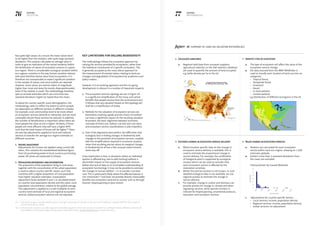
AIR
POLLUTION
TIER 0:
STORES WAREHOUSE
OFFICES
TIER 2:
MANUFACTURING
TIER 3:
RAW MATERIAL
PROCESSING
TIER 4:
RAW MATERIAL
PRODUCTION
TOTAL IN
MILLIONS
TOTAL:
8%
€64,5
35%
€272,2
27%
€209,9
5%
€37,0
11%
€83,2
14%
€106,2
7%
€56,0
13%
€100,0
4%
€33,70
26%
€197.6
50%
€385,7
100%
€773,0
TIER 1:
ASSEMBLY
GREENHOUSE
GAS EMISSIONS
LAND USE
WASTE
WATER
CONSUMPTION
WATER
POLLUTION
1 — Some minor areas of our business are excluded from the scope of the E PL. Together these represent less than 1% of our total product
revenue; however, the impacts associated with mining precious stones are being further researched. We also exclude licenced products.
In 2013, Kering consisted of 21 brands.
2 — Additionally, PwC’s methodologies for valuing the environmental impacts are currently the only proprietary valuation methodologies
that are recommended by the NCPs independent Methodology Review Panel. PwC’s valuation methodologies can be found at:
www.pwc.co.uk/naturalcapital
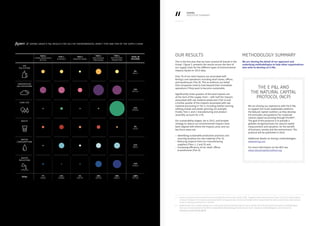
Figure 2: Kering Group E PL results for 2013 by environmental impact type and tier of the supply chain
Methodology summary
We are sharing the detail of our approach and
underlying methodologies to help other organisations
who wish to develop an E PL.
The E PL and
the Natural Capital
Protocol (NCP)
We are sharing our experience with the E PL
to support the multi-stakeholder platform,
the Natural Capital Coalition, as they develop
the principles and guidance for corporate
natural capital accounting through the NCP2
.
The goal of this protocol is to provide a
globally recognised basis for natural capital
measurement and valuation, for the benefit
of business, society and the environment. The
protocol will be published in 2016.
Additional details on Kering’s methodologies:
www.kering.com
For more information on the NCP see:
www.naturalcapitalcoalition.org
Our results
This is the first year that we have covered all brands in the
Group1
. Figure 2, presents the results across the tiers of
our supply chain for the different types of environmental
impacts based on 2013 data.
Only 7% of our total impacts are associated with
Kering’s core operations including retail stores, offices,
and warehouses (Tier 0). This re-enforces our belief
that companies need to look beyond their immediate
operations if they want to become sustainable.
Significantly, three quarters of the total impacts are
at the start of the supply chain – with half the impacts
associated with raw material production (Tier 4) and
a further quarter of the impacts associated with raw
material processing in Tier 3, including leather tanning,
refining metals and textile spinning, for example.
Finally, Tiers 1 and 2 manufacturing and product
assembly, account for 17%.
Our sustainability targets, set in 2012, and broader
strategy to reduce our environmental impacts have
been aligned with where the impacts arise, and our
key focus areas are:
–– Identifying sustainable production practices and
sourcing locations for raw materials (Tier 4);
–– 	Reducing impacts from our manufacturing
suppliers (Tiers 1, 2 and 3); and,
–– 	Increasing efficiency of our retail, offices
 warehouses (Tier 0).
12 13KERING
2013 E PL
KERING
EXECUTIVE SUMMARY
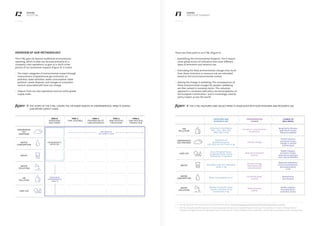
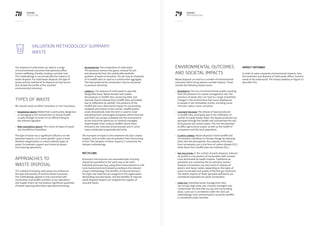
Figure 3: The scope of the E PL covers the six major groups of environmental impacts across
our entire supply chain
Figure 4: The E PL measures and values impacts associated with our emissions and resource use
Overview of our methodology
The E PL goes far beyond traditional environmental
reporting, which to date has focused primarily on a
company’s own operations, to give us a much richer
picture of our businesses impacts (Figure 3). It covers:
–– The major categories of environmental impact through
measurement of greenhouse gas emissions, air
pollution, water pollution, water consumption, water
pollution, waste disposal, and changes in ecosystem
services associated with land use change.
–– 	Impacts from our own operations and our entire global
supply chain.
There are three parts to an E PL (Figure 4):
–– Quantifying the environmental footprint. The 6 impact
areas group across 62 indicators that cover different
types of emissions and resource use.
–– 	Estimating the likely environmental changes that result
from these emissions or resource use are estimated
based on the local environmental context.
–– 	Valuing the change in wellbeing. The consequences of
these environmental changes for people’s wellbeing
are then valued in monetary terms. This valuation
approach is consistent with policy recommendations of
the European Commission3
, and is increasingly used by
policy makers across the world4
.
3 — See for example; The economics of environmental policy: http://ec.europa.eu/environment/enveco/economics_policy/
4 — See for example; Quelle évaluation économique pour les services écosystémiques rendus par les prairies en France métropolitaine?
Ministère de l’Agriculture, de l’agroalimentaire et de la Forêt, Centre d’étude et de prospective, Service de la statistique et de la prospective
Emissions of pollutants
(PM2.5, PM10, NOx, SOx,
VOCs, NH3) in kg
Increase in concentration
of pollution
Climate change
Reduced ecosystem
services
Climate change,
disamenity and
contamination
Increasing water
scarcity
Reduced water
quality
Respiratory disease,
agricultural losses,
reduced visability
Health impacts,
economic losses,
change in natural
environment
Health impacts,
economic losses,
reduced recreational
and cultural benefits
Reduced enjoyment
of local environment,
decontamination
costs
Malnutrition
and disease
Health impacts,
eutrophication,
economic losses
Emissions of
greenhouse gases
(CO2, N2O, CH4, CFC’s etc) in kg
Area of tropical forest,
temperate forest, inland
wetland etc in hectares
Hazardous and non-hazardous
waste in kg
Water consumption in m3
Release of specific heavy
metals, nutrients, toxic
compounds in kg
EMISSIONS AND
RESOURCE USE
CHANGE IN
WELLBEING
ENVIRONMENTAL
CHANGE
AIR
POLLUTION
GREENHOUSE
GAS EMISIONS
LAND USE
WASTE
WATER
CONSUMPTION
WATER
POLLUTION
ENVIRONMENTAL
REPORTING
TIER 0:
OPERATIONS
AND STORES
TIER 2:
PREPARATION OF
SUBCOMPONENTS
TIER 3:
RAW MATERIAL
PROCESSING
TIER 4:
RAW MATERIAL
PRODUCTION
TIER 1:
FINAL ASSEMBLY
GREENHOUSE
GAS
EMISSIONS
WATER
CONSUMPTION
WASTE
WATER
POLLUTION
AIR
POLLUTON
LAND USE
ADDITIONAL
ENVIRONMENTAL
IMPACTS
UPSTREAM IN
THE SUPPLY CHAIN
14 15KERING
2013 E PL
KERING
EXECUTIVE SUMMARY
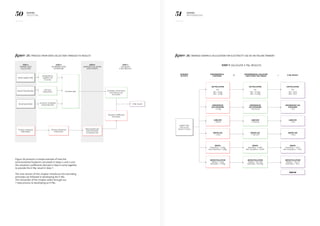
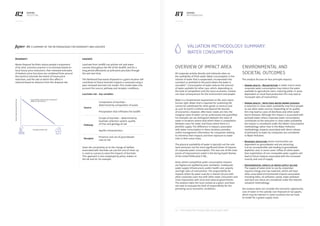
Developing our E PL follows a seven step process,
summarised in Figure 5. Over the last 4 years
of implementing the E PL we have refined the
methodology on an ongoing basis based on our
experiences with our brands and suppliers.
FigURE 5: The 7 Step process to generating an E PL
E PL Step WHAT WE learnt
1 What to measure
Identify what parts of the business to include
in the scope of the E PL.
To get a full picture of our business, we had to be
ambitious. We identified key processes and covered
as many business units as possible by focusing on
our largest brands.
Within that scope, we identified ‘tiers’ of our supply
chain – from our operations and sales through to
the raw materials we use.
Start with the largest parts of the company and use
the learning from this first iteration to assess other
parts of the business.
TIER 0:
STORES, WAREHOUSES
 OFFICES
Direct operations
and retail (e.g. office,
transport, stores)
Primary production
of raw materials
(e.g. farming, mining,
extraction)
Final manufacturing or
assembly of the finished
product (e.g. shoes,
handbags, ready-to-wear)
Manufacturing of sub-
components that are
needed for the finished
product (e.g. heels,
woven fabric, buttons)
Processing of raw
materials to produce
material that can be used
by our industry (e.g. yarn,
leather, metal)
TIER 2:
MANUFACTURING
TIER 3:
RAW MATERIAL
PROCESSING
TIER 4:
RAW MATERIAL
PRODUCTION
TIER 1:
ASSEMBLY
E PL Step WHAT WE learnt
2 Map the supply chain
Outline the production processes for each
product within scope, from the production of raw
materials through to product assembly. Identify
suppliers and provide initial data about their
business and activities carried out for the brand.
Once we identified the things we wanted to
measure, we built a clear picture of all the
interconnected processes in our supply chain.
We sought to establish a holistic view of our
business so that we could identify where and how
to act to give our business an edge.
Mapping our supply chain and production
processes helped us understand all of their risks
and dependencies. For example, reliance on few
suppliers in an environmentally stressed area can
be a risk, which this process has helped
us to mitigate.
3 Find the best ways to collect data
Identify the data requirements for the E PL
and select the best approach to gather this data
throughout the supply chain.
The more company-specific data, the better for
decision-making. This step is all about getting the
right balance between the primary data we could
collect ourselves and the best available secondary
data that already exists.
We identified our biggest impacts and focused data
collection there. Life Cycle Assessments or other
chartered studies can help support collected data.
4 Primary data collection
Collect environmental and non-environmental
data from suppliers and the brand. Support
suppliers in collecting the right information.
Validate collected data and extrapolate it within
groups of similar suppliers.
We collaborated with our brand and supply chain
managers, found our existing data and sent out
surveys to suppliers.
As a change management tool, the E PL provided
a common way to view performance in our
complex supply chain in an understandable way.
It introduced a new way of thinking for our supply
chain managers, and suppliers themselves.
This process was an opportunity to educate and
raise awareness about sustainability and the role
everyone in our supply chain plays in it.
16 KERING
2013 E PL
E PL Step WHAT WE learnt
5 Secondary data collection
Complete gaps in the data using best
available techniques.
Not everything we needed was available within the
company. Thankfully, there is a growing body of
external data sources, of particular use for us was
Life Cycle Assessment analysis.
Through understanding our business processes,
we discovered which ones had available data and
which needed further exploration. Many issues span
industries and require cross-collaboration, so we
worked with an extensive set of NGOs, trade groups
and other companies to find answers.
Work with a broad set of stakeholders to discover
what knowledge is available and identify who to
collaborate with to find more answers.
6 Valuation
Determine the changes in the environment that
result from environmental changes and the
resulting costs of these impacts on people.
This step transformed our impact data into a profit
and loss analysis.
By deciding upon a valuation mechanism, the
data began to reveal the consequence of the
resources used and the emissions created. This
required ‘coefficients’ – a number that enables
the conversion of the data on our impact, into a
‘valuation’ of the impact of that on people and their
wellbeing.
Monetising our environmental impact into familiar
business language helped to move the discussion
deeper into our organisation.
The local context where the resources are sourced
or emissions released is so important. For example,
a litre of water consumed in Australia has a very
different impact versus a litre in India. A kilogram
of air pollutant released in an urban area versus a
rural area. A hectare of land used in a tropical forest
versus a grassland.
7 Calculation
Value the impacts on people and present results
of the E PL.
We discovered a great deal along the way as we
worked through the previous six steps, but the real
value came when we gathered our results together
and saw the big picture.
Presenting the results and developing actions is the
more valuable part of the E PL. We could compare
the impact of projects in financial terms to how
much E PL benefit it provides. This redefines
materiality and transforms sustainability reporting
into sustainable business decisions and actions.
18 19KERING
2013 E PL
KERING
AN INTRODUCTION TO THE E PL
An
introduction
to the
EPL
Responding to a changing
business environment
The context within which business is operating is
changing. Population growth, increasing middle
classes, climate change and resource scarcity, alongside
technological innovation is driving business models
to adapt.
Within our own industry there is increased consumer
awareness of sustainability issues, a tightening of
regulation and growing competition for diminishing
resources. The Environmental Profit  Loss (E PL)
is a tool to help us better understand and respond
to these changes.
Kering’s sustainability strategy encompasses economic,
social and environmental issues. This report considers
only our work on the environmental impacts of our
business through the E PL.
What is ‘natural capital’?
Natural capital is “the stock of natural ecosystems on
Earth including air, land, soil, biodiversity and geological
resources. This stock underpins our economy and
society by producing value for people, both directly
and indirectly”.5
Every year natural systems produce an estimated
$72 trillion6
worth of ‘free’ goods and services that
underpin our economy. For example, the provision of
food and fibre, natural flood control and maintenance
of a stable climate within which our businesses can
operate. As these goods and services are not typically
bought and sold in markets, they are not included in
company financial statements, and as a result company
dependencies on natural capital are often poorly
managed.
Furthermore, companies affect the supply of these
benefits to society through their impacts on natural
capital. These impacts are often termed ‘externalities’
when the company does not compensate (directly or
indirectly through regulation) those affected.
Kering does not own or control significant stocks
of natural capital, but we benefit from the ecosystem
goods and services they provide. Therefore we are
interested in how our activities impact these stocks.“It is my conviction that
sustainable business is
smart business. It gives us
an opportunity to create
value while helping to
make a better world.”
François-Henri Pinault
5 — The Natural Capital Coalition — www.naturalcapitalcoalition.org/why-natural-capital/natural-capital.html
6 — Costanza et al., 2014. Changes in the global value of ecosystem services. Global Environmental Change
20 21KERING
2013 E PL
KERING
AN INTRODUCTION TO THE E PL
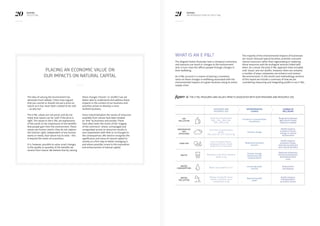
Figure 6: The E PL measures and values impacts associated with our emissions and resource use
Emissions of pollutants
(PM2.5, PM10, NOx, SOx,
VOCs, NH3) in kg
Increase in concentration
of pollution
Climate change
Reduced ecosystem
services
Climate change,
disamenity and
contamination
Increasing water
scarcity
Reduced quality
water
Respiratory disease,
agricultural losses,
reduced visability
Health impacts,
economic losses,
change in natural
environment
Health impacts,
economic losses,
reduced recreational
and cultural benefits
Reduced enjoyment
of local environment,
decontamination
costs
Malnutrition
and disease
Health impacts,
eutrophication,
economic losses
Emissions of greenhouse
gases
(CO2, N2O, CH4, CFC’s etc) in kg
Area of tropical forest,
temperate forest, inland
wetland etc in hectares
Hazardous and non-hazardous
waste in kg
Water consumption in m3
Release of specific heavy
metals, nutrients, toxic
compounds in kg
EMISSIONS AND
RESOURCE USE
CHANGE IN
WELLBEING
ENVIRONMENTAL
CHANGE
AIR
POLLUTION
GREENHOUSE
GAS
EMISSIONS
LAND USE
WASTE
WATER
CONSUMPTION
WATER
POLLUTION
What is an E PL?
The diagram below illustrates how a company’s emissions
and resource use result in changes to the environment
and, in turn, how this affects people through changes in
their wellbeing.
An E PL account is a means of placing a monetary
value on these changes in wellbeing associated with the
environmental impacts of a given business along its entire
supply chain.
The majority of the environmental impacts of businesses
are ‘losses’ because typical business activities consume
natural resources rather than regenerating or replacing
those resources and the ecological services linked with
them. As a result, the prior E PL approach have included
only ‘losses’ and not ‘profits’. However, there are certainly
a number of ways companies can enhance and restore
the environment. In the results and methodology sections
of this report we include a summary of how we are
considering measuring and integrating profits in our E PL.
The idea of valuing the environment has
attracted much debate. Critics have argued
that you cannot or should not put a price on
nature as it has never been created to be sold
– so why try?
The E PL values are not prices and do not
imply that nature can be ‘sold’ if the price is
right. The values in the E PL are expressions
of the worth or the importance of the benefits
that people gain from the environment. These
values are human centric; they do not capture
the intrinsic right, independent of any human
wants or needs, that nature has to exist – this
is beyond the realm of economics.
It is, however, possible to value small changes
in the quality or quantity of the benefits we
receive from nature. We believe that by valuing
these changes (“losses” or “profits”) we are
better able to understand and address these
impacts in the context of our business and
prioritise action to develop a more
resilient business.
Since industrialisation the stocks of resources
available from nature have been treated
as “free” by business and society. These
have often been the victim of the “tragedy
of the commons” where, unmanaged and
unregulated access to resources results in
over exploitation with little or no thought to
the consequences. We need to recognise the
significance and value of natural capital to
society as a first step to better managing it,
and where possible, invest in the restoration
and enhancement of natural capital.
Placing an economic value on
our impacts on natural capital
23 KERING
AN INTRODUCTION TO THE E PL
How could natural capital
externalities be internalised in
company finances?
In 2008, UN estimates put the cost of (just)
environmental externalities at 11% of global
GDP.7
That means that every year there
is a cost to society of $6.6 trillion due to
environmental losses and damage. Consumers
are increasingly attuned to these negative
externalities, and are increasingly able to
make their voices heard. As a result, these
changes in wellbeing could result in an indirect
financial impact on a company as the costs of
the externalities are forced to be internalised.
While we do not believe these costs are
going to be internalised completely anytime
soon, we do see an increasing trend towards
internalisation. This can happen in a number
of ways, including:
1.	 Voluntary action: Companies undertake
voluntary action to reduce their
externalities. This may be in response
to stakeholder pressure, as part of their
competitive positioning, to seize market
opportunities, to save costs or to manage
risk. This may impose upfront costs on the
business, in terms of CAPEX for example, but
often leads to cost savings or other benefits
for the business e.g. enhanced reputation or
better relationships with stakeholders.
2.	 Regulation and legal action: Regulation
can be imposed restricting firms ability to
use the services that nature provides or
else raise the cost of doing so. Examples
include restrictions on use or outright bans
(e.g. conservation areas, trade restrictions,
CFCs phase out), establishment of tradable
permit markets (e.g. sulphur dioxide in the
US) and imposition of taxes (e.g. packaging
taxes). Legal action such as fines and
penalties for environmental incidents
can be significant.
3.	 Market forces: Increasing competition
for scarce resources, the effects of
environmental degradation on agricultural
production, and changes in market
structures and business models, can all
impact on the demand for and changes in
cost of raw materials, energy and water, and
on demand for a company’s products.
4.	 Changing operating environment: Rapid
urbanisation, pressure on infrastructure,
changing social structures and heightened
community expectations can make
setting up new operations trickier, and
force changes to existing operations to
retain a license to operate. Environmental
degradation and increasing frequency of
extreme events can cause disruption to
operations, imposing some of the costs
of environmental decline onto company
balance sheets and income statements.
5.	 Stakeholder actions and relationships:
Stakeholders may take specific action to
change a company’s social or environmental
practices (e.g. NGO campaigns). Or the
company’s approach to social and
environmental factors may over time
detract from the quality of its relationships
with key stakeholders such as customers,
employees and suppliers leading to reduced
demand and revenue, increased costs and
lower productivity.
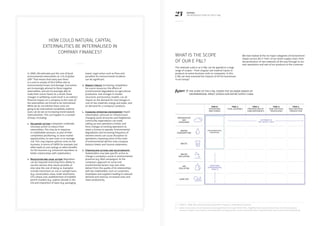
What is the scope
of our E PL?
The methods used in an E PL can be applied to a large
range of scopes – from singular raw material inputs or
products to entire business units or companies. In this
E PL we have assessed the impacts of all the businesses
in our Group.8
We have looked at the six major categories of environment
impact across the 5 ‘Tiers’ of our entire supply chain, from
the production of raw materials all the way through to our
own operations and sale of our products to the customer.
Figure 7: The scope of the E PL covers the six major groups of
environmental impact across our entire supply chain
7 — UNEP FI, 2008, Why environmental externalities matter to institutional investors
8 — Some minor areas of our business are excluded from the scope of the E PL. Together these represent less than 1% of total product
revenue, however, the impacts associated with mining precious stones are being further researched. We also exclude licenced products.
ENVIRONMENTAL
REPORTING
TIER 0:
OPERATIONS
AND STORES
TIER 2:
PREPARATION OF
SUBCOMPONENTS
TIER 3:
RAW MATERIAL
PROCESSING
TIER 4:
RAW MATERIAL
PRODUCTION
TIER 1:
FINAL ASSEMBLY
GREENHOUSE
GAS
EMISSIONS
WATER
CONSUMPTION
WASTE
WATER
POLLUTION
AIR
POLLUTON
LAND USE
ADDITIONAL
ENVIRONMENTAL
IMPACTS
UPSTREAM IN
THE SUPPLY CHAIN
24 KERING
2013 E PL
The rise of Natural
Capital Accounting and
how our E PL fits in
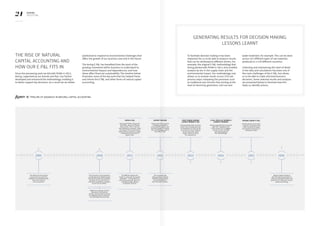
Since the pioneering work we did with PUMA in 2011,
Kering, supported by our brands and PwC, has further
developed and enhanced the methodology, enabling it
to better support key decisions. As a result we are better
positioned to respond to environmental challenges that
affect the growth of our business now and in the future.
The Kering E PL has benefited from the work of the
growing movement within business to understand its
environmental impacts and dependencies, and how
these affect financial sustainability. The timeline below
illustrates some of the key work that has helped frame
and inform the E PL and other forms of natural capital
accounting.
Figure 8: Timeline of advances in Natural Capital Accounting
To facilitate decision making it has been
important for us to be able to produce results
that can be attributed to different drivers. For
example, the original E PL methodology that
Kering piloted with PUMA in 2011 only enabled
analysis by tier in the supply chain and the
environmental impact. Our methodology now
allows us to analyse results across 578 sub-
process steps comparing the processes such
as traditional and chrome-free tanning at the
level of electricity generation, fuel use and
water treatment, for example. This can be done
across 107 different types of raw materials
produced in a 129 different countries.
Collecting and maintaining this level of detail
in the data and calculations has been one of
the main challenges of the E PL, but allows
us to be able to make informed business
decisions. Some selected results and analyses
are presented below to illustrate how this
helps us identify actions.
Generating results for decision making:
lessons learnt
2001 2010 2011 2012 2013 2014 2015 2016
The Economics of Ecosystems
and Biodiversity (TEEB) project
was the first time the economic
benefits of the environment
had been quantified, valuing it
at over US $2 trillion.
The WBCSD releases the
Guide to Corporate Ecosystem
Valuation – a framework for
improving corporate decision-
making through valuing
ecosystem services.
PUMA E PL
Kering and PUMA, release the
first EPL, based on PUMA’s
2010 results. This is the first
ever attempt to measure, value
and report the environmental
externalities caused by a major
corporation and its entire
supply chain.
Expert Review
Kering convened a group
of leading academics,
sustainability experts and
business people to review
the methodology used in
the PUMA E PL.
First major Kering
luxury brand E PL
Kering worked with one of its
major luxury brands and PwC
to complete an E PL for the
luxury brand, while building
on the outcomes of the
expert review to refine
the approaches.
E PL for 6 of Kering’s
largest brands
Kering, supported by its brands
and PwC, implement the
E PL across 6 of its biggest
brands, further refining
and industrialising
the methodology.
KERING GROUP E PL
Kering releases this report
– the most comprehensive
E PL (in terms of scope
and depth) produced by a
company to date.
The corporate-led
Valuing Natural Capital
initiative announced at
the United Nations’
Rio+20 Earth Summit.
Natural Capital Protocol
The NCP will be published in
2016, providing principles and
guidance for corporate natural
capital accounting.
The Millenium Ecosystem
assessment was the first
attempt to comprehensively
assess the state of
our ecosystems.
Wealth Accounting and the
Valuation of Ecosystem
Services partnership launched
to integrate natural resources
into development planning.
26 KERING
2013 E PL
How have we involved
others?
The development of our E PL over the last few years has
been led by Kering, with the support of our brands and
PwC, but has involved valuable input from a huge range
of sustainability experts from within academia and
business. For example, through their contribution to the
Kering E PL Expert Review of our initial methodologies
in 2012 and another expert group reviewed our proposed
methods for accounting for Profits in 2014.9
Kering and PwC are also using their experience and lessons
learned from the E PL to support the multi-stakeholder
platform, the Natural Capital Coalition to develop the
Natural Capital Protocol. This aims to provide a globally
recognised basis for natural capital accounting and we
hope sharing our experience will help other companies to
take a similar approach. Kering have also been asked to
share learnings with other businesses, governments
and institutions.
How the E PL createS
value for Kering
The E PL creates value for Kering by enabling us to:
1.	 Develop more robust business procedures: A greater
understanding of our risks and opportunities has
allowed us to make sure our business procedures are
prepared to respond. For example, we have produced
guidelines, policies and measurable targets to facilitate
action across the business in terms of efficiency of
manufacturing processes and identification of more
sustainable sourcing of raw materials including, but not
limited to, gold, cotton, leather, plastics.
2.	 Implement targeted projects: We have prioritised
and accelerated initiatives in response to the E PL,
that include a focus on the following:
a.	 Material choices, including choices over the
type of materials and where we source these
materials from.
b.	 Manufacturing process, identifying ways of
enhancing manufacturing efficiency through
innovative approaches and technologies such
as chrome-free tanning.
c.	 Collaboration across functions within the group,
whilst respecting the autonomy of each individual
brand, enables issues such as the impacts of
plastics, leather, gold, diamonds, and cotton
to be tackled.
3.	 Share and communicate more effectively: The E PL
enables a dialogue with many stakeholders including
investors, rating agencies, governments, NGOs and our
industry peers. Through sharing learnings we are able
to develop a common understanding on priorities and
actions. We have been engaged by and collaborated
with investors, rating agencies, governments, NGOs and
our industry peers on the E PL.
The results of our E PL are detailed below alongside
some case studies demonstrating how the lessons learnt
from the E PL are helping us to respond in these ways.
9 — Summary documents for both reviews are available on www.kering.com
28 29KERING
2013 E PL
KERING
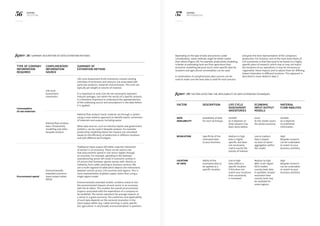
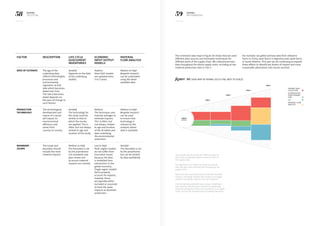
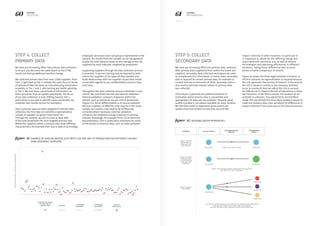
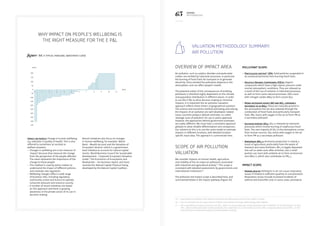
WHAT ARE THE RESULTS AND WHAT DO THEY MEAN FOR KERING?
Group results
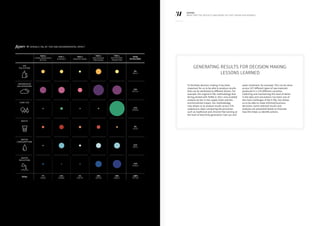
The E PL shows that, across the Kering Group and our
entire supply chain, our overall environmental impact in
2013 is estimated to be €773 million.10
Figure 9 shows
how our impacts are distributed across the tiers and types
of environmental impact.
Only 7% of our total impacts are associated with Kering’s
operations including retail stores, offices, transport
and warehouses (Tier 0). This re-enforces our belief
that companies need to look beyond their immediate
operations if they want to become sustainable.
Significantly, three quarters of the total impacts are at
the start of the supply chain – with half the impacts
associated with raw material production (Tier 4) and
a further quarter of the impacts associated with raw
material processing in Tier 3, including leather tanning,
refining metals and textile spinning, for example. Finally,
Tiers 1 and 2, manufacturing and product assembly,
account for just over 15%.
WHAT ARE
THE RESULTS
AND WHAT TO
THEY MEAN
FOR KERING?
10 — This value is not directly comparable to the original 2010 PUMA E PL. We have invested in continually improving the underlying methods,
approaches and data. Starting with an expert review of the original E PL methodology, Kering, supported by our brands and PwC, has
further developed the E PL, enabling it to better support key decisions across the brands. For example, we shifted the focus to primary
data from our suppliers and brands and to ensure that the results are directly actionable.
11 — Some other companies have published E PLs but the methodologies are not sufficiently similar in terms of quantification or valuation to
allow comparison.
12 — This estimate is calculated using the EU’s World Input-Output Database (WIOD) and Kering’s global spend data, taking into account its
pattern of Sports and Lifestyle and Luxury operations. While this multi-regional input-output approach is significantly less detailed than the
analysis undertaken by Kering, it is only intended to give an approximate picture of the ‘average’ impacts for a typical business with a similar
business model to Kering. The same valuation methodologies are used in both analysis. For further information on WIOD see: Timmer, M. P.,
Dietzenbacher, E., Los, B., Stehrer, R. and de Vries, G. J. (2015), “An Illustrated User Guide to the World Input–Output Database: The Case of Global
Automotive Production”, Review of International Economics. (DOI: 10.1111/roie.12178)
Putting our results
into context
The results do not represent a financial liability or cost
to Kering. Rather they represent a new way of estimating
the cost to society of changes in the environment as
a result of our activities and those of the whole of our
supply chain. In contrast to financial accounting there are
currently no established and globally accepted standards
and methodology for estimating this value.
There are also no other published analyses by companies
that can be used as a comparator for our results11
, which
can make it difficult to put them into context. However,
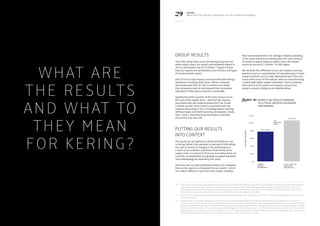
PwC has estimated that if an average company operating
in the same industries as Kering spent the same amount
of money in typical industry supply chains the impact
would be around €1.1 billion12
or 40% higher.
We attribute this difference to our raw material sourcing
practices and our concentration of manufacturing in lower
impact locations such as Italy, Switzerland and France for
luxury while much of the industry relies on manufacturing
in areas with higher impact intensities. There is however
still much to do to reduce our impacts, some of our
projects aimed at doing so are detailed below.
Figure 10: Kering E PL results compared
TO a typical industry equivalent
performance
eplimpact(million€)
€1,200
€1,000
€800
€600
€400
€200
€0
CURRENT
KERRING
PERFORMANCE
Typical industry
equivalent
performance
€1.1 billion
€773 million
40%
increased
impact
30 31KERING
2013 E PL
KERING
WHAT ARE THE RESULTS AND WHAT DO THEY MEAN FOR KERING?
Figure 9: Kering E PL by tier and environmental impact
AIR
POLLUTION
TIER 0:
STORES WAREHOUSE
OFFICES
TIER 2:
MANUFACTURING
TIER 3:
RAW MATERIAL
PROCESSING
TIER 4:
RAW MATERIAL
PRODUCTION
TOTAL
IN MILLIONS:
TOTAL:
TIER 1:
ASSEMBLY
GREENHOUSE
GAS EMISSIONS
LAND USE
WASTE
WATER
CONSUMPTION
WATER
POLLUTION
8%
€64,5
35%
€272,2
27%
€209,9
5%
€37,0
11%
€83,2
14%
€106,2
7%
€56,0
13%
€100,0
4%
€33,70
26%
€197.6
50%
€385,7
100%
€773,0
To facilitate decision making it has been
important for us to be able to produce results
that can be attributed to different drivers. For
example, the original E PL methodology that
Kering piloted with PUMA in 2011 only enabled
analysis by tier in the supply chain and the
environmental impact. Our methodology
now allows us to analyse results across 578
subprocess steps comparing the processes
such as traditional and chrome-free tanning at
the level of electricity generation, fuel use and
water treatment, for example. This can be done
across 107 different types of raw materials
produced in a 129 different countries.
Collecting and maintaining this level of detail
in the data and calculations has been one of
the main challenges of the E PL, but allows
us to be able to make informed business
decisions. Some selected results and
analyses are presented below to illustrate
how this helps us identify actions.
Generating results for decision making:
lessons learnED
32 33KERING
2013 E PL
KERING
WHAT ARE THE RESULTS AND WHAT DO THEY MEAN FOR KERING?
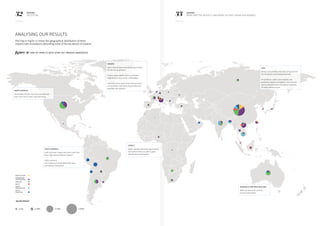
Figure 11: Map of impacts with some key drivers annotated
Analysing our results
The map in Figure 11 shows the geographical distribution of these
impacts with annotations describing some of the key drivers of impacts.
Europe
Italy is the primary manufacturing location
for the luxury division.
France, Spain, Netherlands and Serbia
important as sources for calf leather.
Switzerland has gold metal refining and is
an important manufacturing location for
jewellery and watches.
North America
US provides leather and cotton production
and is the site of some manufacturing.
Africa
Metal and gemstone mining in South
and Central Africa as well as goat
leather from North Africa.
Asia
China is the primary manufacturing location
for the Sports and Lifestyle Division.
Air pollution, water consumption and
pollution impacts are higher in Asia due to
worse ambient levels of pollution and lack
of water infrastructure.
Australia and New Zealand
Both are important sources
of wool and leather.
South America
Gold and other metals from Peru and Chile
have high water pollution impacts.
GHGS and land
use impacts are associated with wool
and leather production.
VALUED RESULT
€ 50M € 100M € 150M € 200M
AIR POLLUTION	
GREENHOUSE
GAS EMISSIONS	
LAND USE	
WASTE	
WATER
CONSUMPTION	
WATER
POLLUTION
34 35KERING
2013 E PL
KERING
WHAT ARE THE RESULTS AND WHAT DO THEY MEAN FOR KERING?
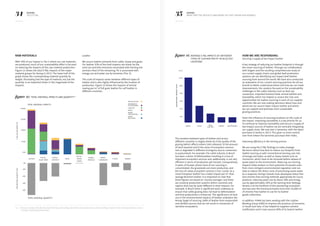
Raw materials
With 50% of our impact in Tier 4 where our raw materials
are produced, much of our sustainability effort is focused
on reducing the impacts of this raw material production.
Figure 12 shows the total E PL impacts of the major
material groups for Kering in 2013. The lower half of the
graph shows the corresponding material quantity by
weight, illustrating that the type of material, not just the
quantity, is an important driver in the magnitude of the
impacts.
Leather
We source leather primarily from cattle, sheep and goats.
For leather, 93% of the total impacts are driven by the
land use and GHG emissions associated with farming the
animals. Most of the remaining 7% is associated with
energy use and water use by tanneries (Tier 3).
The scale of impacts varies between different types of
leather and is also highly influenced by the location of
production. Figure 13 shows the impacts of animal
rearing per m2
of full grain leather for calf leather in
different countries.
Figure 12: TOtal material Impacts and quantity14
14 — Precious stones includes diamond mining and cutting, and other coloured precious stone cutting. Impacts from coloured precious stone
mining is still being researched.
RAWMATERIALQUANTITY(KG)EPLVALUEDIMPACT(€)
LEATHER
TEXTILE -
PLANT FIBRE
TEXTILE -
ANIMAL
FIBERS
TEXTILE -
SYNTHETIC
STONES -
PRECIOUS
PAPER /
CARDBOARD
PLASTIC RUBBERMETAL
TOTAL MATERIAL IMPACTS
TOTAL MATERIAL QUANTITY
0M
10M
20M
30M
40M
€200M
€150M
€100M
€50M
€0M
Figure 13: Average E PL impacts of different
types of leather per m2
IN SELECTED
LOCATIONS
The variation between types of leather and across
different countries is largely driven by i) the quality of the
grazing (which affects enteric GHG releases), ii) the amount
of land required and ii) the value of ecosystem services
lost or degraded in different ecoregions due to conversion
to pastureland. For example, the cattle industry in Brazil
has been a driver of deforestation resulting in a loss of
important ecosystem services and, additionally, is not very
efficient in terms of production per hectare. Comparatively,
in parts of Europe, where most of our sourcing is
concentrated, the grasslands are more productive, and
the loss of native ecosystem services is less ‘costly’. As a
result European leather has a lower impact per m2
than
average Brazilian leather. It is important to note that
these figures are based on ‘country averages’ and there
are certainly production systems within countries and
regions that may be quite different in their impacts. For
example, in Brazil there is significant work underway to
ensure that cattle grazing does not lead to deforestation
and that productivity is enhanced. The significance of land
use in the environmental impacts of leather underpins the
Kering Target of sourcing 100% of leather from responsible
and verified sources that do not result in conversion of
sensitive ecosystems.
How we are responding:
Securing a supply of low impact leather
A key strategy of reducing our leather footprint is through
the smart sourcing of leather. Through our collaboration
with Origem and the resulting comprehensive study of
our current supply chains and global beef production
systems, we are identifying low-impact beef leather
sourcing from around the world. We have also conducted
an evaluation of our current sourcing practices for all our
brands to better understand where and how we can make
improvements. Our analysis focused on the sustainability
challenges in the cattle industry such as land use
conversion, imported livestock feed, animal welfare and
traceability, which has helped us assess the risks and
opportunities for leather sourcing in each of our supplier
countries. We are now making decisions about how and
where we can source lower impact leather and where
we can support and promote more sustainable
grazing practices.
Given the influence of sourcing locations on the scale of
the impact, improving traceability is a key priority for us.
To continue to improve traceability and secure a supply of
low impact sources of leather we are vertically integrating
our supply chain. We now own 4 tanneries, with the latest
purchase in Serbia in 2013. This gives us more control
over from where the tanneries purchase their hides.
Improving efficiency in the tanning process
We are using the E PL findings to make strategic
decisions about how best to reduce our footprint from
leather tanning as well. Conventional tanning uses lots
of energy and water, as well as heavy metals such as
chromium, which have to be removed before release of
waste water to the environment. Reducing our tanning
impacts helps protect us from potential increased costs
from more stringent environmental regulation and can
help to reduce the direct costs of processing waste water.
As a response, Kering’s brands have developed metal-free
and chrome-free tanning methods appropriate for luxury
products, reducing water use by about 30% and energy
use by approximately 20% at the tanning level. Bottega
Veneta is at the forefront of this pioneering innovation
and last year the brand purchased more than 54,000 m2
of chrome-free leather to use for its leather
goods collections.
In addition, PUMA has been working with the Leather
Working Group (LWG) to improve the practices of tanneries
in South East Asia. It has helped its suppliers achieve
certification and it now sources 90% of its bovine leather
BRAZIL CHINA NETHERLANDS
NEW
ZEALAND
FRANCE
Leatherimpactintensity(€/m2
)
€140
€120
€100
€80
€60
€40
€20
AIR POLLUTION	
GREENHOUSE
GAS EMISSIONS	
LAND USE	
WASTE	
WATER
CONSUMPTION	
WATER
POLLUTION
36 37KERING
2013 E PL
KERING
WHAT ARE THE RESULTS AND WHAT DO THEY MEAN FOR KERING?
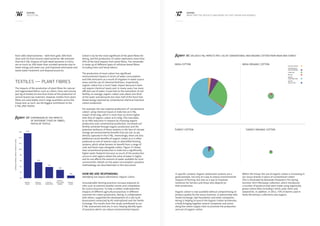
Cotton is by far the most significant of the plant fibres for
Kering, and the production of cotton represents more than
95% of the total impacts from plant fibres. The remainder
is made up of different types of cellulose-based fibres
including linen and hemp fabrics.
The production of most cotton has significant
environmental impacts in terms of water consumption
and GHG emissions as a result of irrigation in water scarce
areas and the use of chemical fertilizers. Importantly,
organic cotton has a much lower impact because it does
not require chemical inputs and, in many cases, has more
efficient use of water, in part due to the restoration of soil
fertility, on average, organic cotton uses about one third
of the water and demands less than half of the fossil fuel
based energy required by conventional chemical intensive
cotton production.
For example, the raw material production of ‘conventional
cotton’ using chemical inputs in India has an E PL
impact of €6.3/kg, which is more than six times higher
than that of organic cotton at €1.0/kg. This translates
to an 80% reduction in impacts by choosing organic
production over conventional production. Increased soil
fertility achieved through organic production and the
potential resilience of these systems in the face of climate
change are environmental benefits that are not, as yet,
directly captured in the E PL. Interestingly, there are also
additional social benefits of organic cotton as it is often
produced as one of several crops in diversified farming
systems, which allow farmers to benefit from a range of
cash and food crops alongside cotton. Figure 15 shows
how conventional production in India has a significantly
higher water footprint because so much of the production
occurs in arid regions where the value of water is higher
and its use affects the amount of water available for local
communities. Details on the water consumption valuation
methodology are described later in this document.
How we are responding:
Identifying low impact alternatives: Organic Cotton
Unsustainable farming practices increase exposure to
risks such as extreme weather events and competition
for scarce resources. To help us better understand the
impacts of different agricultural practices in different
countries for cotton production, Kering, in collaboration
with others, supported the development of a Life Cycle
Assessment conducted by PE International and the Textile
Exchange. The results from this study contributed to our
E PL assessment and are, in turn, helping identify types
of practices which can reduce environmental impacts
Figure 14: Comparison of the impactS
of different types of fibres,
PER KG OF TEXTILE
from LWG rated tanneries – 66% from gold, 30% from
silver and 4% from bronze rated tanneries. We estimate
that the E PL impacts of Gold rated tanneries in China
are as much as 30% lower than unrated tanneries due to
lower energy and water use, and improved solid waste and
waste water treatment and disposal practices.
Textiles — Plant fibres
The impacts of the production of plant fibres for natural
and regenerated fabrics such as cotton, linen and viscose
(per kg of textile) are less than those of the production of
animal-based raw materials. However, textiles from plant
fibres are used widely and in large quantities across the
Group and, as such, are the biggest contributor to the
E PL after leather.
TEXTILE -
WOOL
TEXTILE -
COTTON
TEXTILE -
LINEN
TEXTILE -
POLYESTER
TEXTILE -
CELLULOSE
BASED
Averagematerialimpactintensity(€/kg)
€16
€14
€12
€10
€8
€6
€4
€2
€0
15.48
5.52
3.79
2.86
0.88 in specific contexts. Organic production systems are a
good example, not only of a way to reduce environmental
impacts of farming, but also as a way to improves
resilience for farmers and those who depend on
their production.
Organic cotton is now available without compromising on
product quality for the luxury business. In partnership with
Textile Exchange, CA Foundation and other companies,
Kering is helping to launch the Organic Cotton Accelerator,
a body bringing together several companies and actors
along the cotton supply chain to promote the production
and use of organic cotton.
Within the Group, the use of organic cotton is increasing in
our luxury brands in place of conventional cotton.
This is illustrated by Alexander McQueen’s Pre Spring
Summer 2015 Menswear collection, which introduced
a number of products that were made using organically
grown cotton fibre including t-shirts, polo shirts and
sweatshirts. In addition, in 2014, 73% of denim used in
Stella McCartney’s collections was organic.
Figure 15: Valued E PL impacts PER 1 kg of conventional and organic cotton from India and Turkey
INDIA COTTON
TURKEY COTTON
INDIA ORGANIC COTTON
TURKEY ORGANIC COTTON
AIR POLLUTION	
GREENHOUSE
GAS EMISSIONS	
LAND USE	
WASTE	
WATER
CONSUMPTION	
WATER
POLLUTION
38 39KERING
2013 E PL
KERING
WHAT ARE THE RESULTS AND WHAT DO THEY MEAN FOR KERING?
TEXTILE -
POLYESTER
TEXTILE -
POLYESTER -
RECYCLED
€1.40
€1.20
€1.00
€0.80
€0.60
€0.40
€0.20
€0.00
Synthetic fibres
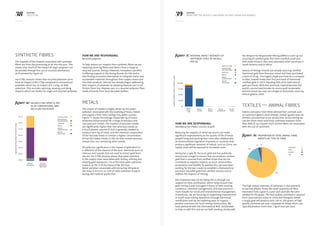
The majority of the impacts associated with synthetic
fibres are from the processing of oil into the yarn. This
means that much of the impact of virgin polyester can
be avoided through the use of recycled alternatives,
as illustrated by Figure 16.
Our E PL analysis shows that recycled polyester yarns
have an impact of €0.17/kg compared to conventional
polyester which has an impact of € 1.4/kg, an 89%
reduction. This excludes spinning, weaving and dying
impacts which are similar for virgin and recycled polyester.
Figure 16: Valued E PL impacts PER
kg of conventional and
recycled polyester
How we are responding:
Recycled polyester
To help reduce our impacts from synthetic fibres we are
exploring sourcing fibres and fabrics from a range of
recycled sources. Kering’s Materials Innovation Lab (MIL)
is offering support to the Kering Brands for this and is
also finding innovative alternatives to integrate these new
sustainable materials throughout their supply chains and
into their products. Volcom has already begun addressing
their impacts of polyester by adopting Repreve yarn in its
Frickin Chine line. Repreve yarn is a recycled polyester fiber
made primarily from recycled water bottles.
Metals
The impact of metals is largely driven by the water
pollution associated with the leaching of heavy metals
and organics from mine tailings into water courses.
Figure 17 shows the average impact per kg of metal
extracted and processed for a range of precious and
non-precious metals. The impacts of precious metals
are significantly higher than non-precious metals as
a much greater volume of rock is generally needed to
produce each kg of metal, and the chemical composition
of the leachate tends to contain a higher concentration
of harmful heavy metals in the ore that contain precious
metals than ore containing other metals.
Of particular significance is the impact of gold which is
a reflection of the impacts of the toxic chemicals such as
mercury and cyanide that are used to extract gold from
the ore. Our E PL analysis shows that water pollution
in the supply chain associated with mining, refining and
alloying gold represents 7 % of the total water pollution
impacts at Tier 3 of the Group E PL (€2.5m).
Water pollution associated with extracting the gold at
the mine is €15.1m, or 23% of water pollution impacts
during raw material production.
Averagematerialimpactintensity(€/kg)
AIR POLLUTION	
GREENHOUSE
GAS EMISSIONS	
LAND USE	
WASTE	
WATER
CONSUMPTION	
WATER
POLLUTION	
AIR POLLUTION	
GREENHOUSE
GAS EMISSIONS	
LAND USE	
WASTE	
WATER
CONSUMPTION	
WATER
POLLUTION	
Figure 17: Material impact intensity of
different types of metals,
per kg
How we are responding:
Identifying low impact sources of gold
Reducing the impacts of metal we source can make
significant improvements to the quality of life of those
people living and working near mine sites. Additionally,
as environmental regulation improves in countries that
produce significant amounts of metals, such as China, our
supply chain will be exposed to increased costs.
Kering has a specific focus on gold and has publically
announced a target to ensure that our products contain
gold that is sourced from verified mines that do not
contribute to negative impacts on local communities,
ecosystems and wildlife. To address this, we have been
working for the last 3 years to establish a framework to
purchase traceable gold from verified sources and to
address the impacts of mining.
One important way we are doing this is through our
support of mine certification, which helps ensure that
gold mining is well managed in terms of both working
conditions, chemical management, and best practices –
more broadly for social and environmental management.
In particular, we are focusing on supporting improvement
in small-scale mining operations through Fairmined
certification and we are exploring ways to support
positive outcomes for local mining communities. We
have partnered with the international NGO, Solidaridad,
to help us with this and we are both working closely with
The high impact intensity of cashmere is due primarily
to two key drivers: firstly the small quantities of fibre
harvested from a goat in a year and secondly the land
needed for the goats. The best quality cashmere is sourced
from mountainous areas in China and Mongolia, where
a single goat will produce only 150 to 250 grams of high
quality cashmere per year, compared to sheep which can
typically produce more than 7 kg of wool per year.
the Alliance for Responsible Mining (ARM) to scale up our
sourcing of certified gold, first from certified small and
mid-sized mines in Peru and ultimately other countries in
South America and in Africa.
Several of Kering’s brands are already sourcing certified
Fairmined gold from Peruvian mines and have purchased
a total of 55 kg - the largest single purchase by a company
to date. Sowind made their first purchase of Fairmined
certified gold in 2014, equaling 10% of its total annual
gold purchases. With this purchase, Sowind became the
world’s second watchmaker to source gold sustainably
and the brand has now set a target of exclusively sourcing
ethical gold by 2020.
Textiles — Animal fibres
Fabrics and yarns from fibres derived from animals such
as cashmere (goats), wool (sheep), mohair (goats) and silk
(moths) are essential to our production. Across Kering we
use ten times more wool than cashmere however more
than 80% of our impacts from animal fibres are associated
with the use of cashmere.
Figure 18: Proportion of TOTAL animal fibre
impacts by type of fibre
Averagematerialimpactintensity(€/kg)
METAL -
GOLD -
18kt
METAL -
SILVER
METAL -
STEEL
METAL -
BRASS
METAL -
ALUMINIUM
€10,000
€7,500
€5,000
€2,500
€0
81%
15%
2% 2%
CASHMERE	
WOOL	
MOHAIR	
SILK
40 41KERING
2013 E PL
KERING
WHAT ARE THE RESULTS AND WHAT DO THEY MEAN FOR KERING?
products. This innovative approach has reduced demand
for virgin fibres and associated business costs. It has
also delivered efficiency improvements and reduction in
waste during manufacturing. As an additional benefit, this
mechanical process of regeneration of cashmere requires
no water or chemicals.
To complement this, and to ensure that our brands have
access to high quality sustainable cashmere, we have
launched a project with the Wildlife Conservation Society
to work with nomadic herding communities in Mongolia
and help them with more sustainable production of
cashmere. The project will, over time, ensure more
sustainable grazing practices, conserve native species and
preserve traditional nomadic herding, while improving the
livelihoods for the herding communities. As a complement
to this, we are working with the Sustainable Fibre Alliance
including Mongolian experts and other companies to
help develop an internationally recognised standard for
sustainable cashmere.
Patagonia wool
Wool can have significant environmental impacts due
to the the requirements for land leading to conversion
and degradation of natural ecosystems. Wool is a key
raw material for many of our brands. For our luxury
activities the impacts of wool equal 11% of the impacts
Figure 19: Increase in mongolia goat numbers over forty years12
12 — Global Agriculture and Food Securities Programme http://www.gafspfund.org/gafspmapcountry/mng
In the past, cashmere was produced by nomadic herding
communities using traditional grazing systems over
vast areas to maintain their goats. However, over the
last two decades a rapid expansion of the market for
cashmere has driven a four-fold increase in goat numbers
in areas like Mongolia (Figure 19). This, in combination
with the loss of traditional herding knowledge and the
impacts of climate change has led to significant over-
grazing and desertification of the grasslands, reducing
productivity further. The loss of the functional grassland
ecosystems is also having impacts on native wildlife,
which depend on these systems but the impacts are
also being felt by people far beyond Central Asia – as
the degraded grasslands contribute to dust storms and
add to air pollution problems in Beijing and beyond. The
loss of pasture is having direct impacts on the quality of
cashmere in terms of financial cost for business and the
cost to the livelihoods of the herding communities.
How are we responding:
Regenerated cashmere
Sourcing the right quality and quantity of cashmere is
increasingly challenging for our brands as global demand
grows and supply is affected by overgrazing. Gucci’s
regenerated cashmere project uses cashmere fibres
produced from offcuts, turning them into new fibres and
MONGOLIAN GOAT HERD
SIZE 1971
MONGOLIAN GOAT HERD
SIZE 2010
0 - 250
250 - 500
500 - 750
750 - 1000
1000 - 1250
No of goats ’000s
0 - 250
250 - 500
500 - 750
750 - 1000
1000 - 1250
No of goats ’000s
of raw material production in E PL terms, of this 8%
is specifically due to impacts on ecosystem services.
Focusing our sourcing from more sustainable grazing
practices is key. Stella McCartney has taken the lead in
the Group to source wool from a sustainable grazing
programme recently established in Patagonia with The
Nature Conservancy, Ovis XI and the ranchers. In this
programme, which already includes sheep ranches
covering more than 1 million hectares, the ranchers
commit to ongoing improvement of grazing practices
in order to reduce impacts and ensure regeneration of
the native grasslands along with the conservation of
biodiversity. In 2014, 23% of Stella McCartney’s Autumn/
Winter knitwear collection was made using this wool, with
an E PL impact of €8/kg compared to wool from ranches
using conventional grazing practices equaling around
€28/kg. Kering and our brands will continue to source
from and support the Ovis XI programme in Patagonia,
which has the objective of improving grazing practices
and the feasibility of sheep ranching on more than 4
million hectares of sheep ranches. We estimate that the
environmental benefits, ‘Profits’, of this project are €20/kg
of wool in improved ecosystem services to local, regional
and global society. For our approach to estimating profits
see the methodology section of this report.
Manufacturing, assembly
and processing suppliers
The combined impacts of Tiers 1 to 3, raw material
processing to assembly, is €329 million.
Figure 20 shows the impacts of the main processes
represented by these suppliers. Textile spinning, weaving
and dying represents the largest impact, due to the
volume of textile used in our products and the location
of these activities. Spinning, weaving and dying is energy
intensive, which drives emissions of GHGs and air
pollutants. It also uses a lot of water, as well as chemicals
in the dying process.
Our relatively low tanning impacts is explained by a
combination of much lower leather use, compared to
textiles, and that the European tanning industry over
the last decade has made good progress in tackling its
environmental impacts. The vast majority of our leather
tanning operations are located in Italy, where impacts tend
to be lower than in regions such as North Africa or Asia.
How we are responding:
Eliminating toxics chemicals from dying processes
Zero Discharge of Hazardous Chemicals (ZDHC)
The textile industry has come under scrutiny for chemical
discharges to waterways during processing. PUMA is
working with its suppliers on chemical management
and building their capacity and designing tools that
will measure and monitor chemical usage to ensure all
hazardous chemicals are eliminated by 2020. To this end,
PUMA’s public commitment to the ZDHC and to remove all
toxic residues from its entire production chain by 2020
has provided a benchmark in the industry.
Supplier training
In order to ensure our 2013 E PL is representative of our
supply chain we collected data from over 1,000 suppliers
on raw material use and environmental outputs such
as electricity and water consumption. Through the data
collection process, we have gained a better understanding
of our suppliers‘ activities and have built stronger
relationships with them, enabling us to better engage
them and change mind-sets.
Figure 20: Impacts of suppliers
main processes in
Tiers 1 to 3
EPLValuedImpact(€)
TIER 1:
PRODUCT
ASSEMBLY,
FINISHING
PACKAGING
TIER 2:
CUTTING
€100M
€90M
€80M
€70M
€60M
€50M
€40M
€30M
€20M
€10M
€0M
LEATHER
TANNING
TEXTILE
SPINNING,
WEAVING
DYEING
TIER 3:
AIR POLLUTION	
GREENHOUSE
GAS EMISSIONS	
LAND USE	
WASTE	
WATER
CONSUMPTION	
WATER
POLLUTION
42 43KERING
2013 E PL
KERING
WHAT ARE THE RESULTS AND WHAT DO THEY MEAN FOR KERING?
Clean by Design
The spinning, weaving and dyeing of textiles is one of the
most significant areas of water and energy use in textile
supply chains. As regulatory requirements become stricter,
the potential for non-compliance in supply chains and
associated costs increases. Consequently, we are working
to find solutions for improving the efficiency of the textile
mills we work with.
We are doing this through the Clean By Design
programme, a collaboration with the Natural Resources
Defense Council (NRDC). The programme was developed
by NRDC for Asian textile mills but through working with
Kering, it has expanded into the luxury supply chains in
Italy. It focuses on promoting best practices in water and
energy management and through close collaboration
with the textile mills themselves, low cost opportunities
are identified that save water, energy, fuel, and electricity
with little upfront investment and no risk to product
delivery times, price, or quality. These opportunities have
led to a reduction in water use of up to 5%, and up to 30%
reduction in energy use and GHG emissions, and all within
a return on the initial low investment of eight months.
Balenciaga is testing the Clean by Design programme with
its key suppliers for its own business, and the programme
is being expanded across Kering and implemented in
twenty-five Italian textile mills that are supplying most of
the textiles to our brands. As such, this programme will be
leveraging additional significant savings into the future.
We also have programmes addressing tanning, discussed
above under Leather.
Focus on offices,
retail operations and
warehouses
The total impact of our offices, retail operations, transport
and warehouses in 2013 was €56 million. Of this, €16
million is associated with Kering owned sites, €12
million from wholesale and €8 million from transport.
The remaining impacts relate to the supply chain
associated with these activities. GHGs and air pollution are
consistently the highest impact areas, which is driven by
electricity consumption relating mainly to heating, lighting
and air conditioning.
For example, the Group’s brands hold regular training
sessions to discuss with their suppliers the key
sustainability projects (including the E PL) and to raise
their awareness. In 2014, Gucci conducted nine outreach
meetings involving more than 420 suppliers, and Bottega
Veneta hosted more than 85 suppliers at its Montebello
Vicentino site. In addition, PUMA organised roundtables
with nearly 290 direct and indirect suppliers in Turkey,
India, Indonesia, Vietnam, Cambodia, China, Argentina and
Bangladesh on sustainability issues.
Driving efficiency improvements
Through the data collection with our suppliers we have
identified significant opportunities for sharing best
practices and technologies. For example, Figure 21 shows
the range in electricity intensity for tanning and spinning,
weaving and dying suppliers. We would expect to see some
differences between suppliers of different sizes, producing
different materials and finishes. However, we can see that
the difference between the most and least energy efficient
is significant, presenting us with an important opportunity
to help bring the lowest performing suppliers up to the
level of the highest.
Figure 21: Average electricity intensity of
suppliers for one brand
ELECTRICITY KWH/UNIT OF PRODUCTION SPINNING, WEAVING AND DYEING
0.20 0.230.03
AVERAGEMore
efficient
Less
efficient
ELECTRICITY KWH/ UNIT OF PRODUCTION TANNING
0.08 0.110.04
AVERAGEMore
efficient
Less
efficient
Figure 22: Total Impacts of Kering owned stores,
offices and warehouses, and non-
Kering owned wholesale stores
and operations
EPLValuedResult(€)
energy procurement management. The project has
generated tangible energy savings and cost reductions for
the Group, and there are plans to expand the initiative to
new countries in 2015.
Smart meters in stores
In an effort to realise energy efficiencies the flagship Paris
stores of Bottega Veneta, Saint Laurent, Balenciaga, Stella
McCartney, Boucheron and PUMA have implemented
sub-metering of different types of energy consumption
(for example, lighting, air conditioning) to closely monitor
consumption. The initial analysis of energy consumption
monitored in real time at points of sale has highlighted
the most energy-intensive items and areas and identified
store management best practices to optimise both energy
performance and comfort. The study has identified a
potential 5% to 20% reduction in energy costs, depending
on the site, which can be implemented immediately
without changing existing equipment.
Smart Sustainable Store
To support and guide improved environmental
management in our own operations, we created the
‘Smart Sustainable Store’ guidebook, which sets out
environmental best practices in the Group’s retail
locations. One clear way to improve energy efficiency is
to replace conventional lighting with LED lighting and our
brands are doing this across retail and office locations
globally. We are also investing in onsite production of
renewable energy at our facilities (offices and warehouses)
through solar panels. As an example of annual savings,
through these solar panels our brands have generated
savings of €203,000 and 384 tonnes of avoided
GHG emissions.How we are responding:
Pooled purchasing of electricity from renewable
energy sources
The proportion of renewable energy used by the Group
has grown from 15.4% in 2013 to 22.3% in 2014. This is
a significant movement as the use of renewable energy
will reduce GHG emissions at each site. For example, the
proportion of green electricity used by Girard-Perregaux
and JEAN RICHARD rose to 84% of total requirements.
In 2012, a system for closer monitoring of energy
consumption was introduced, and 464 sites in Europe and
the US have now signed up to the project. The programme
focuses on streamlining the energy procurement process
by pooling and consolidating energy consumption,
increasing the use of renewable energy and centralising
€13M
€12M
€11M
€10M
€9M
€8M
€7M
€6M
€5M
€4M
€3M
€2M
€1M
€0M
OFFICES WHOLESALESTORES TRANSPORT WAREHOUSE
AIR POLLUTION	
GREENHOUSE
GAS EMISSIONS	
LAND USE	
WASTE	
WATER
CONSUMPTION	
WATER
POLLUTION
44 KERING
2013 E PL
Pilot study on
product use and disposal
While the main scope of our E PL focuses on
the supply chain, we have been investigating
impacts of product use and disposal at the
end of its life. Stella McCartney has led a pilot
project considering the consumer care and
end of life impacts of seven products in the
UK. Survey responses from over 1,300 luxury
fashion customers were used to identify
behaviour trends, such as frequency of use,
whether products were dry cleaned or washed
at home and frequency of ironing or steaming.
Figure 23 shows the impacts per product.
These represent the total impacts across the
entire life of the product. Overall use and end
of life impacts represented a fairly significant
amount of total E PL impacts for Stella
McCartney ready-to-wear, and much lower
impacts for bags and shoes. This difference is
due to the higher frequency of cleaning, drying
and ironing or steaming for clothing products.
Further research and development will require
a broader industry effort to better identify
consumer behaviour patterns and provide
more detailed analysis.
How we are responding:
Stella McCartney recently launched their
Clevercare Campaign with the Nordic Fashion
Association and HM. Clevercare is a simple
reminder to consider the environment when
washing and caring for your garments. Helping
customers to care for their products in a way
that both maximises the product life while
reducing environmental impacts.
Figure 23: Preliminary results for product use and disposal impacts per
individual product
Valuedimpact(€)
€ 3.50
€ 3.00
€ 2.50
€ 2.00
€ 1.50
€ 1.00
€ 0.50
€ 0.00
BAG DRESS SHOES
TAILORED
JACKET
JEANS
JUMPER/
SWEATER
SILK
BLOUSE
IRONING AND
STEAMING	
DRYING	
DISPOSAL	
CLEANING
46 47KERING
2013 E PL
KERING
METHODOLOGY
METHODology
Kering’s 7 Step Process
Kering’s initial pilot with PUMA’s 2011 E PL was the
first example of a company measuring and valuing the
environmental impacts of its operations and entire supply
chain. Over the last four years Kering and our brands,
supported by PwC, have built on this to enable the E PL
to be used as a business management tool. This chapter
provides an overview of the methodology for this E PL,
demonstrating how our advances in the methodology
enable the types of decision making demonstrated earlier
in this document.
Following the publication of our pilot E PL with PUMA,
Kering convened a group of experts from academia
and business with experience in the methodologies
underpinning the E PL to identify areas for improvement.
For example, the inclusion of water pollution as a sixth
impact area was raised during the discussions. The
findings from this Expert Review are published on our
website and the methodologies underpinning this E
PL respond to these. We understand the importance of
incorporating a range of views from leading thinkers in
their fields and continue to engage with experts as we
have progress our thinking.
The E PL is Kering’s approach to natural capital
measurement and valuation. We provide details of our
methodology here in the hope that it can help other
companies find solutions that are appropriate for
their business model. We have also contributed our
methodologies to the Natural Capital Protocol which will
provide guidance on the underlying principles necessary
to conduct these types of assessment.
The development of the E PL followed a seven step
process, summarised in Figure 24. The first three steps
are about planning. The first step sets our business, value
chain and impact scope for the analysis. The second step
maps out our business activities in detail; this is crucial
because it sets the template and level of detail which the
subsequent data collection and analysis must respond
too. The final planning step, three, defines the data
requirements and the strategy for collecting or
estimating data.
The final four steps concern data collection and
estimation, and the subsequent E PL calculations.
Figure 25 shows how these steps come together in the
final calculation of the E PL.
The 7 steps are inter-dependant; any decisions made early
on in the process will affect subsequent steps. Therefore
it is important to anticipate the future implications of
decisions made. Over the last 4 years we have learnt from
our experience and refined our approach in response. In
Figure 24 we identify a few of these key lessons learnt.
48 49KERING
2013 E PL
KERING
METHODOLOGY
E PL Step WHAT WE learnt
PLANNING
1 DECIDE what to measure
Identify parts of the business to be included in
the scope of the E PL.
To manage such an ambitious scope, we
focused on the largest brands to cover as
many business units as possible early on
to help identify the key projects to focus on.
Begin with the biggest parts of your company,
keep in mind you can use learnings from
the first iteration to more readily assess
the other parts.
2 Map the supply chain
Outline the production processes for each
product within scope, from production of
raw materials through to the final assembly
of products.
Identify suppliers and provide initial data
about their business and activities carried
out for the brand.
Mapping our supply chain and processes
helped us further our understanding of risks
and dependencies. The risk of reliance on a few
suppliers can be increased in environmentally
stressed areas.
This step helped us to have a more global and
holistic view of our supply chain and manage
associated risks.
3 Identify priority data
Identify the data requirements for the E PL
and select the best approach to gather this
data throughout the supply chain. Evaluate
environmental impacts of processes and
materials to determine where to focus
primary and secondary data collection.
We discovered which processes generated the
greatest impacts and where to focus our data
collection and incorporate the best scientific
data we could find. In some cases, we chartered
our own studies and LCA analysis to confirm
that the actions we were taking would yield
positive results.
Find out where your biggest impacts are and
focus your data collection there first.
Dataandcalculations
4 Collect primary data
Collect environmental and non-environmental
data from suppliers and each brand. Support
suppliers in collecting the right information.
Validate collected data and extrapolate it within
groups of similar suppliers.
As a change management tool, the E PL
provided a common language to view
performance and way to explain the role of each
actor in a complex supply chain. It introduced
a new way of thinking for our supply chain
managers and our suppliers themselves.
Use primary data collection as an opportunity to
educate and raise awareness about sustainability
and the role everyone in your supply chain plays.
Figure 24: The 7 Step process to generating an E PL
E PL Step WHAT WE learnt
Dataandcalculations
5 Collect secondary data
Complete gaps in the data using best
available techniques.
Through understanding our business processes
from Step 2, we discovered which processes
have already been studied deeply, and which
need further exploration. Many impacts require
collaboration across industries; we worked with
an extensive set of NGOs, trade groups and other
companies to find answers.
Work with a broad set of stakeholders to discover
what knowledge is available and identify who you
can collaborate with to find more answers.
6 Determine valuation
Determine the changes in the environment and
the resulting costs of these impacts on people.
Context is critical to understand impacts. The
impacts of consuming a litre of water depend
on water scarcity, infrastructure, level of health
care and degree of ecosystem degradation.
It is only through valuing our impacts can we
compare them across indicators, geographies,
and business units.
Valuation allows us to have tangible
conversations about these impacts with all
functions in our business, and helps us further
integrate sustainability within the decision
making process.
Valuing your footprint makes your decision
making more robust and moves the discussion
from sustainability deeper into your business.
7 Calculate and analyse your results
Value the impacts on people and present
results of the E PL.
The most valuable insights come from the
results analysis itself. This is where you can see
which materials or locations have the greatest
impact, which processes are more efficient, and
which actions are yielding positive results.
Presenting the results and developing actions
is the more valuable part of the E PL. Here you
can compare euros spent on your projects in
financials terms on a project versus how much E
PL benefit it provides. This redefines materiality
and transforms sustainability reporting into
sustainable business decisions and actions.
50 51KERING
2013 E PL
KERING
METHODOLOGY
Figure 25: Process from data collection through to results
Figure 26 presents a simple example of how the
environmental footprint calculated in Steps 4 and 5 and
the valuation coefficients derived in Step 6 come together
to provide the E PL result in Step 7.
The next section of this chapter introduces the overriding
principles we followed in developing the E PL.
The remainder of the chapter walks through our
7 step process to developing an E PL.
STEP 4
PRIMARY DATA
COLLECTION
STEP 5
SECONDARY DATA
ESTIMATION
STEP 6
Generate valuation
coefficients
STEP 7
Calculate
E PL results
Brand supplier data
Extrapolate to
suppliers not
in survey
Brand materials data Life Cycle
Assessment
Brand spend data
Quantities of emissions
and resource use
by location
E PL results
Valuation coefficients
by location
Primary contextual
information
Primary contextual
information
Value impacts per
unit of emission
or resource use
Economic modelling
using trade data
Combine data
Figure 26: Worked example calculation for electricity use by an Italian tannery
BUSINESS
ACTIVITY
ENVIRONMENTAL
FOOTPRINT X =
STEP 7 Calculate E PL results
ENVIRONMENTAL VALUATION
COEFFICIENT FOR FRANCE E PL RESULT
AIR POLLUTION
e.g.:
NH3 = €1.9kg
NHx = €1.0kg
AIR POLLUTION
e.g.:
NH3 = €0.8
NHx = €0.5
GREENHOUSE
GAS EMISSIONS
= €62/tCO2e
GREENHOUSE GAS
EMISSIONS
= €17
LAND USE
= €320/ha
LAND USE
= €14
WATER USE
= €0.1/m3
WATER USE
= €0.1
WASTE
Hazardous = €38/t
Non-hazardous = €19/t
WASTE
Hazardous = €0.1
Non-hazardous = €0.1
AIR POLLUTION
e.g.:
NH3 = 0.4kg
NHx = 0.5kg
GREENHOUSE
GAS EMISSIONS
= 274kg
LAND USE
= 293m2
WATER USE
= 1.6m3
WASTE
Hazardous = 0.1kg
Non-hazardous = 0.6kg
WATER POLLUTION
Nitrates = 0.2kg
Pesticides = 0.1kg
WATER POLLUTION
Nitrates = €0.7/kg
Pesticides = €0.5/kg
WATER POLLUTION
Nitrates = €0.13
Pesticides = €0.1
€32.53
Leather hide,
from a cow
raised in France
52 53KERING
2013 E PL
KERING
METHODOLOGY
Principles of
developing an E PL
We must have sufficient confidence in the results for them
to influence decision making within our business. Given
the breadth of the scope of the analysis we have needed
to draw on a range of different data sources and methods,
Principle WHAT WE learnt
Completeness Methods should allow us to capture at least 95% of impacts by value.
Completeness should be maintained at each level of the results where they are used
to drive decision making. 95% completeness at the top level does not necessarily allow
comparability at a lower level of granularity, such as comparing impacts of different
materials. It is therefore essential that the completeness criterion is met at each decision
level in the results.
Consistency Common assumptions across different data sources and methods in the results should
be consistent. For example, the same discount rate should be used.
Transparency From each data input we should be able to verify data sources and methods used,
enabling scrutiny and re-performance. This is important to ensure consistency across
third party data inputs.
Best available
approaches
Wherever practical, the data inputs and approaches used should be the best available
to represent each specific impact or process. This includes using primary data wherever
possible, and peer reviewed secondary data and estimation methods elsewhere.
Location specific All data must be specific to a location to allow the context of impacts to be taken
into account.
Data confidence
ratings
All data points should have a data confidence rating based on inputs, calculations
and assumptions to ensure transparency for decision makers.
Reflect impacts
on people
The data should allow estimation of the impacts on people in terms of changes
of welfare.
some pre-existing, some innovations of the E PL. To bring
these approaches together, while maintaining sufficient
confidence in the comparability of their results, we have
developed seven key principles which we use to challenge
the acceptability of each data input or methodological
decision. We will refer back to these principles as we
discuss decisions taken in each of the seven steps below.
Kering’s 7 Step Process
to Developing an E PL
Step 1: Decide what
to measure
The purpose of the scope setting step is to identify what
will be included in the E PL. It defines the needs of the
analysis that follows. Our ambition is to drive decision
making at strategic as well as at an operational level, so we
set the bar high in terms of breadth and depth of scope.
There are three key components of scope
1.	 Business scope: which parts of the business
2.	 Value chain scope: how far back in the supply chain,
or forward to consumers
3.	 Impact scope: which types of environmental impact
Business scope:
–– This 2013 E PL is the first time we have included
almost the entirety of our business in the E PL.
All product lines from 21 brands are included.13
–– In order to make the exercise feasible we did used the
learnings from the larger brands to enable some smaller
brands with similar supply chains to estimate their
results. This also reflects the fact that, for example,
a brand with less than 10 permanent staff does not
have the resources to respond to the results in the
same way as ones with over 1,000. Detailed bespoke
analysis is conducted for product categories
representing 98% of our product revenue.
Value chain scope:
–– We decided to focus on cradle-to-gate (from
the production of raw materials through to the
manufacturing, distribution and sale of our products)
for the main analysis because it is more fully under
our control and we have a greater ability to acquire
reliable data.
–– We are piloting studies on consumer use and disposal
to gain a better understanding of the impacts.
Impact scope:
–– All of the major environmental impact areas (GHGs,
water consumption, water pollution, air pollution,
land use  waste) are included, with 62 sub-
environmental indicators within these areas, such
as Arsenic, Phosphorus, NOx
, SOx
, particulate matter
and hazardous waste.
Step 2: Map the
supply chain
The objective of Step 2 is to make sure that we reflect
the business’ rich understanding of the supply chain in
the structure of the E PL. We do this by defining the key
processes at each stage in the supply chain. This Process
Map represents the template that the E PL results must
respond to and ensures that the detail of the results
mirrors the level at which our business makes decisions.
Figure 27 provides an example of a Process Map. This
example includes six different raw material inputs,
tracing the processes through the supply chain to the
final assembly. Each box represents a major process with
a set of sub-processes that sit within it. The objective
of subsequent data collection and estimation steps
is to ensure that the data provided for each box are
representative of the way we and our suppliers operate.
The processes are grouped into Tiers in order to be able
to compare impacts at different levels of the supply chain
and between different products.
13 — Some minor areas of our business are excluded from the scope of the E PL. Together these represent less than 1% of our total product
revenue, however, the impacts associated with mining precious stones are being further researched. We also exclude licenced products.
54 55KERING
2013 E PL
KERING
METHODOLOGY
Figure 27: Example process map for leather bag production
TIER 4:
RAW MATERIALS
PRODUCTION
Extraction or farming
of raw materials
used in production process
e.g. cotton, metal, animal
Processedmaterials
TIER 3:
BASIC PROCESSED
MATERIALS
Sub-componentsSub-components
Raw materials are processed into
basic processed goods such as yarn,
leather, metal, cork. These are generic
products for industry
Leaves
primary
production
site
Farmoutputs
Processed
materials
TIER 2:
PRODUCTION OF
SUB-COMPONENTS
Material from T3 is processed into
products according to brand specifications.
The outputs of T2 are all the component parts
necessary for final manufacturing or
assembly processes
TIER 1:
ASSEMBLY
Assembly and
manufacturing
of final product
Parts ready
for final
assembly
Timber
production
Metals
mining
METAL
(BUTTONS, HOOKS,
EYES, SNAPS, ZIPS)
TIMBER
(PACKAGING
Silkworm
farming
Cotton
farming
Cattle
breeding
LEATHERSILKWORKCOTTON
POLY MATERIALS
FOR SHOES, BAGS,
BUTTONS, ZIPS, ETC.
Pulp
production
Smelting
Reeling
Ginning
Abattoir
Paper
production
Alloy
production
Spinning
DyeingEmbroidery
Moulding,
stamping,
dyeing
Finishing
Cutting
Weaving
Polymerisation
(poly materials
and nylon)
Oil refining
(poly only)
Waste plastic
processing
Vegetable oil
extraction
Oil extraction
Crops farming
Processing
raw hide to
wet blue
Processing
wet blue
to finished
leather
Paper
cutting
Moulding
Stamping,
casting,
galvanising
Leather
cutting
Finishing
 Assembly and
manufacture of
final bag
Production of
packaging
Combining zip
and tape
Combining zip
and tape
Resourceextraction
Processedmaterials
Sub-components
Leather
assembly/
sewing
Sewing
Note: For buttons,
zips, etc.
Basicyarn
Step 3: Identify
priority data
The objective of Step 3 is to determine the level and
type of data which is required for each of the activities
identified in the Process Map.
The step is split into two parts, the first is to define our
data needs, and the second is to identify the best available
method to gather this data.
Define data needs
It is important to prioritise because although the E PL
covers all processes in our production, it is not possible
to collect primary data for all the supply chain. Specialist
research may be required for some processes, particularly
where they are more removed from Kering-owned
operations.
We first carried out a qualitative assessment of the key
impacts of each process step to:
–– Identify high impact activities;
–– 	Define data needs; and,
–– 	Identify areas we have particular influence
to drive change.
For some processes, like transport, this is very straight
forward, but for more complex processes or technologies
it requires more detailed considerations, for example,
of specialist chemical inputs and impacts. The output
of this step is a detailed data needs assessment matched
against our list of priority processes or materials for more
detailed analysis.
Identify best available method for
obtaining data
With the data requirements set, the second part of this
step is to define the strategy for collecting those data
on each activity.
We use five broad types of data:
–– Primary data from Kering and its brands;
–– 	Primary data from supplier surveys;
–– Secondary data from LCA’s, national and
industry statistics;
–– 	Secondary data from material flow analysis; and,
–– 	Secondary data from economic models.
In order to support business decision-making, we base
the E PL on as much primary, company-specific data
as is realistic and feasible to collect from suppliers and
Kering’s brands. However, it is not feasible or efficient
to collect data from all activities in the supply chain
so it is necessary to fill the gaps with secondary data.
Figure 28 summarises the main types of secondary
data estimation techniques used in our E PL.
56 57KERING
2013 E PL
KERING
METHODOLOGY
Type of company
information
required
Complimentary
information
source
Summary of
estimation method
Consumption
of raw materials
Life cycle
Assessment
inventories
Life Cycle Assessment (LCA) inventories contain existing
estimates of emissions and resource use associated with
particular products, materials and processes. The units are
typically per weight or volume of material.
It is important to note LCAs do not necessarily represent
industry averages, but rather the results of a specific analysis.
It is therefore important to understand the appropriateness
of the underlying source and assumptions in the data before
it is applied.
Material flow analysis
data / Productivity
modelling and other
bespoke analysis
Material flow analysis tracks material use through a system
using a mass-balance approach to identify inputs, conversion
of materials and outputs, including waste.
Other data sources, such as industry reports and government
statistics, can be used in bespoke analysis. For example,
productivity modelling where the impacts are calculated
based on the efficiency of production in different locations
and with different technologies.
Procurement spend
Environmentally
extended economic
input-output tables
(EEIO)
Traditional input-output (IO) tables map the interaction
of sectors in an economy. These can be used to see
how procurement spend in one sector ripples through
an economy. For example, spending in the footwear
manufacturing sector will result in economic activity in
all sectors that footwear spends money with, directly or
indirectly, from cattle ranching to business services. We
use a multi-regional IO table which depicts the interactions
between sectors across 129 countries and regions. This is
more representative of global supply chains than using a
single region model.
Environmentally extended models combine research into
the environmental impacts of each sector in an economy
with the IO tables. This enables the overall environmental
impacts associated with the expenditure of a company to
be modelled. The results represent the average impacts of
a sector in a given economy. The usefulness and applicability
of such data depends on the sectorial resolution in the
input output tables (e.g. ‘cattle ranching’ is quite specific,
but ‘agriculture’ is very broad), and economy(ies) in question.
Figure 28: Summary description of data estimation methods Depending on the type of data and process under
consideration, some methods might be better suited
than others (Figure 29). For example, productivity modelling
is better at estimating land use from agriculture than
economic modelling because much more specific data for
locations and agricultural commodities can be used.
A combination of complimentary data sources can be
used to make sure the best data is used for each process
and gives the best representation of the company’s
production. For instance, one of the main draw-backs of
LCA inventories is that they tend to be based on a highly
specific piece of research, which may or may not match
the locations of our operations. It may be necessary to
‘regionalise’ these impacts and to adjust them for differing
impact intensities in different locations. This approach is
described in more detail in Step 5.
Figure 29: Factors affecting the applicability of data estimation techniques
Factor Description Life Cycle
Assessment
inventories
Economic
input output
models
Material
flow analysis
Data
availability
Availability of data
for each technique.
Variable
As it depends on
what research has
been done before.
Good
As the model covers
the whole economy.
Variable
As it depends
on published
information.
Resolution Specificity of the
estimated data
to your business.
Medium to high
Data is highly
specific, but does
not necessarily
match exactly the
activity of interest.
Low to medium
Data is based
on level of sector
aggregation within
the model.
High
Bespoke research
can be undertaken
to match to your
business activities.
Location
of data
Ability of the
estimated data to
be applied at a
specific location.
Low to high
Data reflects a
specific location.
If this does not
match your locations
then uncertainty
is increased.
Medium to high
With multi-region
EEIO models
country level data
is available. Greater
resolution then
country level may
be available for
some regions.
High
Bespoke research
can be undertaken
to match to your
business activities.
58 59KERING
2013 E PL
KERING
METHODOLOGY
PRIMARY DATA
COLLECTION	
EXTRAPOLATED
FROM PRIMARY
DATA 	
LCA	
MATERIAL FLOW
ANALYSIS	
	
Factor Description Life Cycle
Assessment
inventories
Economic
input output
models
Material
flow analysis
Date of estimate The age of the
underlying data
reflects technologies,
processes and
environmental
regulation at that
date which becomes
dated over time.
The rate it becomes
dated depends on
the pace of change in
such factors.
Variable
Depends on the date
of the underlying
studies.
Medium
Most EEIO models
are updated every
3 to 5 years.
Medium to High
Bespoke research
can be undertaken
using the latest
available data.
Production
technology
The technological
development and
nature of a sector
will impact its
environmental
efficiency and
varies from
country to country.
Variable
The technology for
the study must be
similar to that to
which the results
are applied. This is
often, but not always,
related to age and
location of the study.
Medium
The technique uses
industry averages to
estimate impacts.
This is often, but
not always, related
to age and location
of the IO tables and
data underlying
the environmental
extensions.
Medium to High
Bespoke research
can be used
to ensure that
technology is
relevant to the
analysis, where
data is available.
Boundary
/scope
The scope and
boundary should
include the most
material impacts.
Medium to High
The boundary is set
by the practitioner.
LCA standards and
peer review aim
to ensure material
impacts are covered.
Low to High
Multi-region models
do not suffer from
truncation issues
because the data
is modelled from
interactions in the
global economy.
Single region models
fail to properly
account for imports,
however, these
are typically either
excluded or assumed
to have the same
impacts as domestic
production.
Variable
The boundary is set
by the practitioner,
but can be limited
by data availability.
The schematic data map in Figure 30 shows how we used
different data sources and estimation techniques for
different parts of the supply chain. We collected primary
data throughout the whole supply chain, including at raw
material production sites in Tier 4.
For example, we gather primary data from silkworm
farms in China, wool farms in Argentina and cattle farms
in South America. This year we are continuing to expand
these efforts to identify key drivers of impact and more
sustainable alternatives (see results section).
Figure 30: Data map of Kering 2013 E PL (not to scale)
The shaded area illustrates the different types of
data used to estimate impacts across the tiers in
the supply chain.
Our operations are wholly converted by primary
data. We also collect primary data throughout the
supply chain.
Data from Life Cycle Assessments and other bespoke
research, including material flow analysis, are largely
used for estimating impacts from raw materials.
Environmentally extended input-output modelling is
only used for estimating the impacts of supporting
industries peripheral to the core activities in our supply
chain, such as the manufacturing of sewing machines.
TIER 0:
KERING
TIER 1
TIER 2
TIER 3
TIER 4
60 61KERING
2013 E PL
KERING
METHODOLOGY
Step 4: Collect
primary data
We have put increasing effort into primary data collection
to ensure any decisions we make based on the E PL
results are driving additional positive change.
We collected primary data from over 1,000 suppliers, from
Tiers 1 right back to Tier 4. Initially the main focus in terms
of volume of data has been on manufacturing and product
assembly in Tier 1 and 2, and tanning and textile spinning
in Tier 3. We now have a good body of information on
these processes that we update periodically. The focus
of our data collection is now shifting towards Tier 4,
particularly as we seek to identify more sustainable raw
materials (see results section for examples).
Once a process step has been targeted for primary data
collection, the first step is to identify a representative
sample of suppliers to gather information for.
Through this sample, we aim to cover at least 80%
of the total production for each targeted process step.
Where the suppliers within a process step show differing
characteristics, for example their size or type of technology
employed, we ensure each sub group is represented in the
sample. The results from the sample can be extrapolated
to give the total impacts based on the average across the
suppliers for each indicator, weighted by production.
Supporting suppliers through the data collection process
is essential. In person training may be required to both
inform the suppliers of the types of data needed, and
build relationships with the suppliers to put their minds
at rest with regards to any confidentiality concerns they
may have.
Throughout the data collection process validation is also
critical. We used both internal and external validation.
Internal validation compares responses within the
sample, such as electricity use per unit of production
(Figure 31). Some differentiation is of course expected
because suppliers of different sizes may be in the same
sample, but outliers may need to be verified and
corrected where necessary. External validation
compares the weighted average response to existing
industry knowledge, for example from LCA or technical
documentation. This is particularly important for some
of the harder to measure data, such as water pollution.
Figure 31: Example of data validation: Electricity use per unit of production for different LEATHER
SHOE ASSESMBLY suppliers
AVERAGE
+1 standard
deviation
-1 standard
deviation
SUPPLIER ELECTRICITY
USE PER UNIT OF
PRODUCTION Data to
investigate
Supplierelectricityuseperunitproduction
Step 5: Collect
secondary data
We have put increasing effort into primary data collection
After primary data is gathered from within the brand and
suppliers, secondary data collection techniques are used
to complement this information. In some cases, secondary
data is required to convert primary data, for example to
convert fuel use to emissions of GHGS. Secondary data is
also used to estimate impacts where no primary data
was collected.
LCA analysis is generally the preferred method of
estimation where primary data is unavailable and
appropriate LCA data sets are available. However, good
quality LCA data is not always available for every location.
We therefore need to regionalise good quality LCA
studies from one location to take into account the
Figure 32: Regionalisation approaches
impact intensity of other locations. In particular it
is important to adjust for the differing energy mix
associated with electricity use, as well as diverse
technologies and operating efficiencies in different
locations. Taking these differences into account
allows reliable comparison of results.
Figure 32 shows the three regionalisation scenarios. In
the first scenario, no regionalisation is required because
the LCA represents the country of interest. In the second,
the LCA is based in country A, but company activities
occur in country B; here we adjust the LCA to account
for differences in impact intensity of operations in these
two locations. In the third scenario, the location of our
activities is unknown. Two adjustments are therefore
made; first we identify the most likely locations based on
trade and industry data, then we adjust for differences in
impact intensity in the same way as the second scenario.
SCENARIO
IMPACT COUNTRY
KNOWN AND LCA
AVAILABLE FOR
THAT COUNTRY
IMPACT COUNTRY
KNOWN BUT NO
LCA INFORMATION
AVAILABLE FOR
COUNTRY B
IMPACT COUNTRY
NOT KNOWN
REGIONALISATION
PROCESS
REGIONALISED
IMPACT
LCA CALCULATED
COUNTRY A
COUNTRY A
COUNTRY A
COUNTRY A
COUNTRY B
COUNTRY C
COUNTRY D
COUNTRY E
IMPACT DOES NOT CHANGE
IMPACT ADJUSTED BY RELATIVE INTENSITIES THE RELEVANT
SECTOR IN THE TWO COUNTRIES
LOCATION OF IMPACT BASED ON THE COUNTRY THE MATERIAL WAS PURCHASED
FROM AND THE TRADE THAT FLOWS FROM THE COUNTRY.
THE SIZE OF IMPACTS ARE ADJUSTED FOR RELATIVE INTENSITIES
62 KERING
2013 E PL
For the land use impacts of agricultural raw material
production, it is important to reflect the different
production practices in different locations. Rather than
adjusting LCA data using input-output intensities bespoke
research was undertaken into the production practices
in each location. Using material flow analysis techniques
we can look at the productivity of different locations for
specific raw materials.
Finally, in order to capture the total impacts of our supply
chain we use environmentally-extended input-output
analysis to capture any peripheral activities which are
outside of the scope of the primary data collection or the
LCA data. For example, these impacts include the capital
expenditure of manufacturing activities on machinery, or
the supporting activities of estate agents and consultants.
Step 6: Determine
valuation
Introduction to valuing environmental impacts
Economic valuation of impacts is at the heart of the
E PL. Step 5 quantifies the scale of emissions and
resource use, but it is only through the valuation that
we gain an understanding of the consequences of these
emissions and the use of resources. For example, a tonne
of air pollution emitted in an urban setting will have a
much greater impact than a tonne emitted in a rural
setting because of higher ambient levels and population
density. The valuation takes into account the context to
first estimate the likely changes in the environment,
then identify how these changes affect people, and
finally, to value the associated changes in terms of
people’s wellbeing.
The output of these three stages in the calculation is a
‘coefficient’ which describes the likely change in people’s
wellbeing in the event of an emission or unit of resource
use in a given location. The box on the opposite page
discusses why valuation of wellbeing is the appropriate
type of value for use in the E PL. Valuation coefficients
are specific to a type of emission or resource use in a
specific context and location, and are expressed in euros
per unit of emission or resource use (€/kg, €/m3
, €/ha etc).
This section presents a summary of the methodologies,
developed by PwC, and used to value the indicators
behind each of the 6 impact areas. More details on each
approach, including discussion on key assumptions and
sensitivity analysis can be found in the full methodology
papers available on PwC’s website.14
14 — www.pwc.co.uk/naturalcapital
Why impact on people’s wellbeing is
the right measure for the E PL
The objective of the E PL is to understand
the impact on people’s wellbeing as a result
of changes in the environment resulting from
business activities and express these impacts
in monetary terms.
Here we present a brief summary of some
alternative value perspectives and describe
why impact on people’s wellbeing is the right
measure for the E PL.
Market price: Paid by the business, e.g. carbon
tax, water consumption permit price
–– Most environmental impacts are non-market
and so market prices are not available to
provide values.
–– 	The market price does not consider how the
emissions affect people and does not reflect
the scale of ‘impact’ on people.
–– 	The price set in the environmental markets
that do exist (e.g. carbon prices in the EU
Emission Trading Scheme, Figure 33) is often
driven by political factors rather than supply
and demand for environmental goods
and services.
–– Market changes and price fluctuations make
comparison hard.
Cost of abatement: Private cost of reducing
impacts, e.g. cost of reducing air pollution
by changing fuel type
–– Abatement costs do not consider how the
emissions affect people and therefore do not
reflect the scale of ‘impact’ on people.
–– 	The costs of abatement depend on the
existing technology installed and the
options for improvements, as such they are
different for different businesses, or parts
of a business, and over time. Comparison is
therefore difficult as shown in Figure 34,
a typical marginal abatement curve.
In Figure 34 each box represents a different
abatement option. The overall level of
abatement is given by the horizontal axis
and the abatement cost at any given level
of abatement is represented by the vertical
height of each box. Abatement options which
create financial savings as well as reductions
in emissions are shown below the horizontal
axis, while expenditure is required to achieve
reductions for boxes above the line.
Figure 33: EU Allowance carbon price over time
EUROPERALLOWANCE
16/12/2009 16/12/2010 16/12/2011 16/12/2012
€25
€20
€15
€10
€5
€0
65 KERING
METHODOLOGY
Impact on people: Change in human wellbeing,
e.g. reduction in quality of health. This is also
referred to sometimes as societal or
welfare valuation.
–– 	Changes in wellbeing are a true measure of
‘impact’ because they measure the change
from the perspective of the people affected.
The value represents the importance of the
change to those people.
–– 	This method is used by policy makers to
understand the impact of different policies,
and motivate new regulation.
–– Wellbeing changes reflect a wide range
of business risks, including regulatory,
community unrest and licence to operate,
consumer pressure and resource scarcity.
–– A number of recent initiatives are based
on this approach and there is growing
awareness in the private sector of its use in
decision making.
Recent initiatives also focus on changes
in human wellbeing, for example: ‘World
Bank - Wealth Account and the Valuation of
Ecosystem Services’ which is a government
level initiative to account for natural capital
stocks; ‘World Business Council for Sustainable
Development - Corporate Ecosystem Valuation
Guide’; ‘The Economics of Ecosystems and
Biodiversity – For business report’; and most
recently the ‘Natural Capital Protocol’ being
developed by the Natural Capital Coalition.
Figure 34: A typical marginal abatement curve
€/tCO2
200
150
100
50
0
-50
-100
-150
-200
-250
-300
-350
-400
-450
0
|
1
|
2
|
3
|
4
|
5
|
6
|
7
|
8
|
9
|
10
|
11
MtCO2
Why impact on people’s wellbeing is
the right measure for the E PL
Overview of impact area
Air pollution, such as sulphur dioxides and particulate
matter, are emitted by industrial processes, in particular
the burning of fossil fuels for transport or to generate
electricity. Once emitted the pollutants disperse in the
atmosphere, and can affect people’s health.
The potential extent of the consequences of emitting
pollutants is therefore highly dependent on the climate
and population distribution in different places. In order
to use the E PL to drive decision making to minimise
impacts, it is important the air pollution valuation
approach reflects these drivers of geographical variation.
The science and economics behind estimating and valuing
the impacts of air pollution are well-developed. Indeed
many countries produce default estimates, so called
‘damage costs of pollution’, for use in policy appraisal.
However, the approaches behind government estimates
are subtly different. We must have a consistent approach
globally to allow reliable differentiation and comparison.
Our solution to this is to use the same model to estimate
impacts in different locations, with detailed location
specific input data. The approach is summarised here.
Scope of air pollution
valuation
We consider impacts on human health, agriculture
and visibility of the six major air pollutants associated
with industrial and agricultural activity.15
This scope is
consistent with detailed assessments by governments and
international institutions16
.
The pollutant and impact scope is described here, and
summarised below in the impact pathway (Figure 35).
Pollutant scope:
–– Particulate matter17
(PM): Solid particles suspended in
air, produced primarily from burning fossil fuels.
–– Volatile Organic Compounds (VOCs): Organic
compounds which have a high vapour pressure under
normal atmospheric conditions. They are released as
a result of the use of solvents in industrial processes,
as well as from some natural processes. VOCs react
with nitrogen oxides (NOx) to form ozone (O3).
–– Mono-nitrogen oxides (NO and NO2, commonly
referred to as NOx): These are naturally present in
the atmosphere but are also released through the
combustion of fossil fuels and particularly transport
fuels. NOx reacts with oxygen in the air to form PM as
a secondary pollutant.
–– Sulphur dioxide (SO2): SO2 is released by industrial
processes which involve burning of sulphurous fossil
fuels. The vast majority of SO2 in the atmosphere comes
from human sources. SO2 reacts with oxygen in the air
to form PM as a secondary pollutant.
–– Ammonium (NH4+): Ammonia production is mainly a
result of agriculture, particularly from the waste of
livestock and some fertilisers. NH3 is largely deposited
into soil or water soon after emission, but a small
portion can react with ambient air to form ammonium
ions (NH4+), which also contributes to PM2.5.
Impact scope:
–– Human health: Pollutants in air can cause respiratory
issues if inhaled in sufficient quantity or concentration.
Respiratory issues include increased incidents of
asthma and bronchitis and, in some cases, premature
15 —Specialised air pollution from waste incineration are addressed as part of the impact of waste.
16 —See, for example, the EU study: ExternE, (2005). Externalities of Energy: Methodology 2005 Update.
17 — PM is classified according to particle size: PM10
refers to coarse particulate matter (particles with a diameter of 10 micrometres or less);
PM2.5 refers to fine particulate matter (particles with a diameter of 2.5 micrometres or less). PM10 is expressed exclusive of PM2.5 in this
document (and associated analyses) to avoid double counting.
Valuation methodology summary:
Air pollution
66 67KERING
2013 E PL
KERING
METHODOLOGY
mortality from cardiovascular and pulmonary diseases
and lung cancer. Of the impacts covered our priority
focus is on health; ExternE18
, a major EU Commission
project, notes that this is “by far the largest part of
the total impacts”, similarly a comprehensive US
study19
found health impacts to be 94.5% of the
total. The methods for agriculture and visibility are
commensurately more basic.
–– Visibility: Air pollutants, particularly PM and O3,
contribute to reduced visibility through the formation
of smog. Reduced visibility affects various forms of
navigation and also reduces people’s enjoyment of
recreational sites and the neighbourhoods where they
live (i.e. creates disamenity).
–– Agriculture: Changes in the atmospheric concentration
of certain gases can negatively impact the growth of
crops leading to reduced yields. Acid rain can damage
crops directly and can also acidify soils with impacts on
future growth.
Limitations of scope
–– 	Forests and timber, built environment, and other
ecosystem services: These impacts are considered
immaterial relative to the impacts described above.
Together, they represent less than 0.5% of the total
societal cost in Muller and Mendelsohn’s
(2007) analysis20
.
–– 	Chemical deposition in soil and water: Ammonia
(NH3) has a short lifetime in the atmosphere and most
(by weight) is quickly deposited. While this process can
have localised impacts on areas close to the emissions
source, the impacts are small compared to impacts
on health.
–– Carbon monoxide: CO is a toxic gas which, if inhaled in
sufficient quantities, can be fatal. It can have societal
impacts via inhalation indoors and outdoors and
through its contribution to O3
formation. However,
we exclude it from our methodology on two counts:
a.	 CO is particularly dangerous in indoor
environments, which are outside the scope of
this E PL. Indoor air quality would be considered
as part of employee working conditions when
evaluating the social impacts of a business.
b.	 The close relationships between CO, NOx, and
VOC pathways to O3
formation make it difficult
to avoid double counting of secondary impacts.
Reflecting this, CO is excluded from Muller and
Mendelsohn’s21
analysis in the US, UK Defra’s22
AIR POLLUTION damage cost methodology,
and the EU’s ExternE analyses.
Impact pathway
The impact pathway describes the links between
our activities, the environmental outcomes from
those activities, and the resultant societal impacts.
18 — ExternE, (2005). Externalities of Energy: Methodology 2005 Update.
19 —Muller and Mendelsohn (2007) “Measuring the damages of air pollution in the United States.”
20 —Our category ‘built environment’ is equivalent to Muller and Mendelsohn’s (2007) category ‘man-made materials’.
21 — Muller and Mendelsohn (2007) “Measuring the damages of air pollution in the United States.”
22 —https://www.gov.uk/government/uploads/system/uploads/attachment_data/file/182390/air-quality-damage-cost-guidance.pdf
Figure 35: impact pathway for air pollution
Air
Emissions
IMPACT DRIVER ENVIRONMENTAL
OUTCOMES
REDUCED AIR QUALITY
SOCIETAL
IMPACTS
HUMAN HEALTH:
Increases in respiratory or cardiac illness
and premature deaths attributable to
decreased air quality
VISABILITY:
Costs for shipping and aviation as
well as reductions in the recreation
and residential amenity value
AGRICULTURE:
Change in crop yield attributable to change
in air quality and acid rain
FORESTS AND TIMBER:
Changes in growth of forests and
plantations attributable to changes
in air quality and acid rain
MAN-MADE MATERIALS:
The loss of material due
to increased corrosion
OTHER ECOSYSTEM SERVICES:
Damage to ecosystem associated
with air pollution and knock-on
societal imapcts
Other pollutant
concentrations
SO2 emissions SO2 concentration
PM2.5 and PM10
emissions
PM2.5 and PM10
concentration
NH3 emissions
NOx
emissions
VOCs emissions
CO and other emissions
O3 concentrations
KEY
PRIMARY POLLUTANT
PATHWAY
OUT OF SCOPE OF
THIS ANALYSIS
SECONDARY POLLUTANT
PATHWAY
(Source: PwC)
68 69KERING
2013 E PL
KERING
METHODOLOGY
Summary of the
methodology
Each of the impact pathways has a different valuation
approach which supports it. Here we focus on the health
impacts of PM, NOx, SO2, and NH3, as these are the most
significant impacts.
Health impacts of PM, NOx, SO2, and NH3
There are four steps to our analysis, summarised
in Figure 36.
A key innovation of this approach is the tailored
application of an air pollution dispersion model to
calculate how pollutants move and concentrations
change in any given location. The model we use is a
meso-scale three-layer forward trajectory Lagrangian
Puff-transport model.23
Meteorological and demographic data are input for the
specific emission sources to represent the local context .
This approach represents a significant improvement over
simpler benefit transfers previously used in corporate
environmental accounting because it allows us to
explicitly address the spatial aspects of air pollution to
be explicitly addressed. Crucially, it enables the generation
of credible localised estimates based on local conditions
and demographics that better reflect our supply chain
locations and are fit for comparative decision making.
Figure 36 summarises the approach.
23 —The ability to generate estimates that are representative of the precise location is limited by the availability of nearby weather monitoring
stations. There are more than 20,000 globally, but the distribution is not even globally, with significantly fewer in Africa. Where either the
location of the emissions is uncertain or there is not a sufficiently close weather station, we use an average across several locations.
1.	 Specify characteristics of emissions location
a.	 Identify source of emissions and set a
standardised dispersion grid around location
b.	 Plot population density in grid
c.	 Source 6 hourly weather data for the year,
including wind speed, temperature and air
mixing height above ground
Paris showing emission source:
3.	 Estimate contribution to health issues
a.	 The dispersion model combined with the
population distribution tells us how many people
are likely to be exposed, and to what level
of pollution
b.	 Dose response functions, derived from medical
research, indicate the incremental likelihood that
the exposed population will suffer health issues as
a result of the emissions
Dose Response:
2.	 Run dispersion model to estimate change
in concentration
a.	 We use a dispersion model to estimate how
pollutants move in air
b.	 This takes into account detailed weather data from
nearby weather monitoring stations
Dispersion of pollutants in air
4.	 Run dispersion model to estimate change in
concentration
a.	 In order to ascribe a value to the health impacts of
air pollution we draw on the work of governments
and institutions such as the OECD
b.	 Policy makers must value health in order to
prioritise public spending and there is an
established method to do so
c.	 The underlying values are based on people’s
willingness to trade off financial gains with an
incremental level of risk to their health
Figure 36: Summary of air pollution valuation methodology
LINEAR
FUNCTION
FUNCTION WITH
THRESHOLD
DOSE
PNONLINEAR
FUNCTION
70 71KERING
2013 E PL
KERING
METHODOLOGY
Overview of impact area
Greenhouse gas emissions (GHGs) are atmospheric
compounds that absorb and re-emit infrared radiation
emitted by the Earth’s surface, the atmosphere and
clouds. This property causes the greenhouse effect, where
heat is trapped within the Earth’s surface-troposphere
system. According to the Intergovernmental Panel on
Climate Change’s (IPCC) Fifth Assessment Report on
Climate Change24
, there is ‘high agreement and much
evidence’ that global GHG emissions will continue to grow
over the next few decades. Under a range of scenarios, the
IPCC’s Fifth Assessment Report projects that the increase
in global surface temperatures will be between 2.6 and 4.8
degrees Celsius by the end of the 21st
century. The physical
impacts (and resultant societal impacts) of this climate
change are diverse, from sea level rise and extreme
temperatures, to implications for food and water security
and patterns of disease.
Scope of GHG valuation
The methodology considers the contribution of our
current GHG emissions to the continuing trend of a
changing climate, including the six principal classes
of GHGs:
Carbon dioxide (CO2
): Produced primarily from burning
fossil fuels for electricity, heat and transportation
Methane (CH4
): Released from agricultural livestock,
natural gas, and some waste management practices
Nitrous oxide (N2
O): Mainly produced from the use
of nitrogen fertilisers in agriculture
Sulphur hexafluoride (SF6
): The major sources include
leakage from electricity transmission, and the magnesium
smelting process. Sulphur hexafluoride has a global
warming potential 23,000 times that of CO2
Valuation methodology summary:
Greenhouse gases
Hydrofluorocarbons (HFCs): HFC emissions occur in the
manufacture and usage of refrigeration, air-conditioning
and aerosols
Perfluorocarbons (PFCs): Released mainly through
aluminium production
Impact pathway
The impact pathway in Figure 37 describes the links
between greenhouse gas emissions, the environmental
outcomes from those activities, and the resultant societal
impacts, including impacts to health, the economy and
the built environment.
Summary of the
methodology
The approach draws on the best of existing scientific and
economic literature to derive an estimate of the societal
costs associated with climate change.
The core of the methodology revolves around identifying
an appropriate estimate for the societal cost of carbon.
To do this the average across existing studies, selected
based on a set of predefined criteria is used.
Over the last fifty years there has been a huge advance
in the understanding of the contribution of current
emissions to current and future changes in climate,
as well as the types of changes that will occur, and
the economic costs (and benefits) associated with
these changes. As a result there has been a significant
convergence of estimates. However, there are still some
points of difference between estimates. Some of these
differences are due to uncertainties in the underlying data
and models, while others are points of methodological or
moral judgement.
24 —https://www.ipcc.ch/report/ar5/
25 — Ramsey, F. (1928) ‘A Mathematical Theory of Saving’
Corporate
Activities
Shifting climate patterns
Sea level rises
Increasing extreme
weather events
Rising mean
temperatures
Increasing
concentrations
of atmospheric
GHGs
IMPACT DRIVER ENVIRONMENTAL
OUTCOMES
SOCIETAL
IMPACTS
HUMAN HEALTH:
Malnutrition due to increasing
frequency of droughts and floods,
reduced agricultural output, spread
of disease and heat related deaths
BUILT ENVIRONMENT:
Damage from extreme weather
events and interesting adaptation
costs due to shifting patterns
of climate
ECONOMIC DISRUPTION:
Economic loses caused byproduction
and supply disruptions, particularly
for manufacturing and
agricultural supply chains
AGRICULTURE AND TIMBER:
Crop losses; changes in
growth and yields
DESERTIFICATION:
Loses of productive and
habitable land
OTHER ECOSYSTEM SERVICES:
Widespread changes affecting biodiversity
and many associated ecosystem services
GHG emissions:
CO2
CH2
N2O
HFCs
PFCs
SF6
Other GHGs
Figure 37: Impact pathway for greenhouse gases
The choice of discount rate is the most significant point
of judgement affecting the societal cost of carbon (SCC).
A societal discount rate (SDR) describes relative societal
preferences for consumption at different points in time.
It allows the aggregation of costs and benefits accruing
over time and across generations. Economists and
governments tend to use a SDR rather than a market
one, in order to reflect society as a whole and to account
for the existence of market imperfections. The broad
academic consensus is to use a rate defined by the
Ramsey model25
:
s is the societal discount rate. ρ is the pure rate of time
preference: how much we prefer to receive a given amount
of money now rather than in the future. μ is the elasticity
of marginal utility with respect to income: how much we
value additional income depending on the level of income
we have. g is the annual growth in per capita consumption.
The approach restricts SCC estimates to those with a
pure rate of time preference of 0%, thereby placing equal
value on the welfare of current and future generations.
We consider this ethically defensible and aligned with
notions of inter-generational equity commonly found
in the climate change literature. Figure 38 summarises
the approach and criteria used to select the studies.
(Source: PwC)
72 73KERING
2013 E PL
KERING
METHODOLOGY
Figure 38: Summary of GHG valuation methodology
1.	 Meta-analysis of literature
a.	 Extensive literature review to identify primary
estimates of SCC
3.	 Normalisation of SCC sub-set to express in
common units and year
The selected SCC estimates are normalised in 4 steps:
a.	 Estimates are weighted to account for the fact
that some studies have multiple estimates
b.	 Estimates are inflation-adjusted to 2013
c.	 Growth rates are applied to account for the fact
that the real SCC rises over time as the stock of
GHGs increases and the worst impacts of climate
change get closer. The IPCC suggests a range of
2-4% increase per year for this growth rate,
the E PL uses 3% per year
d.	 Convert units so that estimates are expressed
in $tCO2
e
2.	 Run dispersion model to estimate change in
concentration
a.	 A subset of SCC estimates was selected from
the overall population based on quality and
consistency criteria:
–– Quality of study: Peer reviewed studies selected
–– Discount rate: Selected estimates with a Pure
Rate of Time Preference of 0%
–– Treatment of outliers: Estimates excluded if
greater than three standard deviations from
the mean
–– Age of study: Ten most recent studies that
meet our criteria. This ensures our SCC reflects
prevailing thinking, but also takes into account a
diversity of views about underlying assumptions
4.	 Run dispersion model to estimate change in
concentration
a.	 Once the subset of SCC estimates have been
normalised, we calculate central estimates by
taking the arithmetic mean and median of the
selected SCC estimates
b.	 The mean has been applied as it takes more
account of very high estimates derived from
potentially catastrophic climate scenarios and
therefore reflects a more precautionary approach
to potential climate change impacts
COASTAL PROJECTION
LOSS OF DRYLAND
ENERGY
(HEATING/COOLING)
HEAT STRESS
LOSS OF WETLAND
REGIONAL COSTS
INVESTMENT
AGRICULTURE
WATER
VARIABILITY
(DROUGHT, FLOODS,
STORMS)
ECOSYSTEM COLLAPSE
BIODIVERSITY
LOSS OF LIFE
SECONDARY
SOCIAL EFFECTS
COMPARATIVE
ADVANTAGE AND
MARKET STRUCTURES
SIGNIFICANT LOSS OF
LAND AND RESOURCES
NON-MARGINAL LOSSES
HIGHER ORDER
SOCIAL EFFECTS
REGIONAL COLLAPSE
IRREVERSIBLE LOSSES
REGIONAL COLLAPSE
MARKET
SYSTEMCHANGE
NON-MARKET
BOUNDEDRISKS
SOCIALLY CONTINGENT
PROJECTION
MOST STUDIES SOME STUDIES NO STUDIES
Overview of impact area
Natural land areas and ecosystems, often rich with
biodiversity, provide essential services to society including
regulation of climate, provisioning of materials for food,
medicine and construction, regeneration of soil, water
filtration and offering a source of cultural and spiritual
enrichment. The Millennium Ecosystem Assessment26
estimated that 63% of these ecosystem services are
already degraded with important social and economic
implications for current and future generations. A
subsequent analysis requested by the G8+5 environment
ministers, The Economics of Ecosystems and Biodiversity
(TEEB), estimated that the economic cost imposed by
degradation and loss of biodiversity and ecosystem
services each year is between $2 and 4.5 trillion27
.
The flow of ecosystem services from natural land areas are
provided to society every year and, as the extent of natural
land areas decreases, so the annual flow of ecosystem
services is reduced. The impact of the conversion of a
natural area is therefore felt every year, until a time when
the area is restored so that it can provide again the full
array of ecosystem services.
Scope of LAND USE
valuation
The E PL methodology aims to estimate the economic
value of lost ecosystem services associated with the
conversion and occupation of land. These economic
values are associated with the benefits society gains from
ecosystems, such as climate regulation, bioprospecting,
food and fuel as well as recreation, cultural experiences or
education. Option values that reflect potential future use
values are also considered.
Ecosystem service scope
Figure 39 presents the classification of different
ecosystem services which can be affected by the
conversion and occupation of land used in our analysis.
It is the change in value to society of these services from
different types of natural ecosystems (and subsequent
land use practices) that this methodology values.
The methodology only explicitly values final ecosystem
goods and services (Figure 39), as the inclusion of
supporting and intermediary services would lead to
double counting. The value of supporting and intermediary
services is captured through their contribution to final
ecosystem goods and services. For example, the benefits
of nutrient cycling in soils is captured by the productivity
of those soils and provisioning of food and fibre. This is in
line with the methodological recommendations of CICES28
.
Timing of conversion is an important consideration for
this methodology because many natural areas were
converted long ago, and have changed uses and ownership
many times since while others may have been converted
partially or fully more recently. To deal with this in the
E PL, we estimate the ecosystem service reduction in
the current year, relative to its natural state, and assign
the reduction in value to the current occupant of the
land, irrespective of whether that occupant was directly
responsible for the conversion of the land.
This approach was chosen because:
1.	 It reflects the flow of impacts which are created as
a result of occupation, and are dependent on the
management practices which the current occupier
chooses to employ (even if others are responsible for
the pre-conditions).
2.	 It incentivises current land occupiers to minimise
the loss of ecosystem services, for example through
sustainable land management practices.
3.	 It avoids making highly uncertain assumptions as to the
future extent of lost ecosystem services or the date of
past conversions.
Valuation methodology summary:
Land use and biodiversity
26 —Millennium Ecosystem Assessment (2005)
27 — The Economics of Ecosystems and Biodiversity (TEEB) (2008), Cost of Policy Inaction Report, $2-$4.5 trillion is the present value of net ecosystem
service losses from land based ecosystems caused in 2008 and continuing for 50 years, based on discount rates ranging from 1-4%.
28 — Common International Classification of Ecosystem Services (2013)
74 75KERING
2013 E PL
KERING
METHODOLOGY
Service Class Specific ecosystem good
or service
Potential relevance
of impact to people
Provisioning
services
Food from natural/semi-natural ecosystems Local
Fibre, other raw materials Local
Domestic and industrial water Regional
Bio-prospecting  medicinal plants Global
Ornamental products Regional
Air purification Global
Cultural services
Recreation Regional
Spiritual and aesthetic Regional
Cognitive and learning opportunities Regional
Regulating services
Stable climate Global
Pollution control and waste assimilation Regional
Erosion control Regional
Disease and pest control Regional
Flood control and protection
from extreme events
Regional
Figure 39: Classification of final ecosystem services Figure 40: Impact pathway for land use
Impact pathway
The valuation of ecosystem services considers a broad
range of economic and social aspects, such as to health and
culture. The impact pathway describes the links between
our activities, the environmental outcomes from those
activities, and the resultant impacts on people.
Summary of the
methodology
The four steps to the methodology for valuing the impacts
of land use are summarised in Figure 41. The first two
steps quantify the area of land use and identify the type
of ecosystem which is affected.
The third step is to estimate the extent of ecosystem
service change. In the event of natural land conversion,
and its subsequent occupation, the extent of impacts can
be determined by considering how each of these services
is affected by the change in land use. This depends on what
the land was converted from and what the new land use
is. For example, conversion of tropical forest to pasture
will result in an almost complete loss of climate regulating
services. However, conversion to an agro-forestry system
will only result in a partial loss. Different services will
be affected to varying degrees depending on the
land management practices which are employed
during occupation.
New conversions of
natural ecosystems
Change in regulating
services, e.g. carbon
sequestration
and storage
ECONOMIC IMPACTS:
E.g. altered assimilation capacity
leading to changes in water or
air quality
Occupation of
converted land
Change in provisioning
services e.g.
timber supply
ECONOMIC IMPACTS:
E.g. property damage
from flooding; changes
in agricultural production
Restoration/ enhancement
of previously
converted land
Change in cultural services,
e.g. recreation
ECONOMIC IMPACTS:
Impacts on biodiversity resulting
changes to recreational services
or educational opportunities
IMPACT DRIVER ENVIRONMENTAL
OUTCOMES
SOCIETAL
IMPACTS
Production of and demand
for raw materials, footprint
of buildings, ecological
restoration activities
The fourth step values the consequence of the change
in ecosystem services for society at local, regional and
global scales. PwC’s methodology draws on the best of
the available literature on ecosystem service valuation
and builds on the publically available TEEB database with
more recent studies to develop a database with over 1,500
individual estimates of ecosystem service values. These
are used to estimate values for ecosystem services from
different eco-regions in different contexts by averaging
across the available studies.
First the global average across estimates in the database is
calculated and then adjusted these for the particular socio-
economic context in different countries. The estimates
reflect the value of ecosystem services within each of the 6
eco-regions. The approach consider averaging across eco-
regions to be a better approach than averaging estimates by
country or region because:
1.	 There is more similarity in terms of ecosystem services
across eco-regions in different countries than between
different eco-regions in the same country; and,
2.	 There is insufficient data coverage to provide reliable and
comparable estimates by country or region. TEEB took
a similar approach, emphasising the commonality of
ecosystem types, rather than country borders which are
largely arbitrary from an ecological perspective.
There is significant variation across estimates for most
ecosystem services. In general, the data display a long tail
with most estimates at the lower end of the range and a
(Source: PwC)
76 77KERING
2013 E PL
KERING
METHODOLOGY
few quite high values. As a result, the mean values tend
to be higher than the medians, with quite large standard
deviations. This analysis calculates an average value in
order to give an indication of the central tendency within
the distribution of values of ecosystem services in a given
eco-region. There is considerable ecological variation within
eco-regions, variation in the way human societies interact
with (and therefore derive value from) ecosystems. It is
therefore not unreasonable to expect significant variation
in the sample of values, and most outliers are retained.
However, some values are several orders of magnitude
higher than most and skew the results disproportionately
(even if the median is used). The methodology therefore
opts to exclude estimates which are more than two
standard deviations higher (or lower) than the mean.
To adjust for country specific socio-demographics, the
methodology seeks to reflect the extent to which people
are dependent on different services in different contexts.
For example, rural communities tend to be more reliant
on ecosystem services (directly or indirectly), and are more
vulnerable should those services be reduced. In addition,
the number of beneficiaries is important; where there are
more people the value at risk is higher. Similarly, if those
people are more affluent, they will have a higher WTP,
such that the total impact of losses will be higher.29
There
are two key adjustments applied to local and national
services to transfer the average eco-region estimates to
different countries:
1.	 Income adjustment
Adjustments for income are applied using current GNI
ratios. This converts the standardised database figure
from US purchasing power to local currency purchasing
power. All values are expressed in $/ha/yr.
2.	 Population dependency and distribution
The proportion of the population living in rural areas,
together with the concentration of the urban population
is used to adjust country-specific values, such that
countries with a higher proportion of rural population
have higher valuation estimates. A population
adjustment factor between 0 and 1 is calculated based
on country-level population density and the urban-rural
population concentration, relative to the global average.
This adjustment is applied as a scale multiplier to each
country-level estimate of local and regional ecosystem
services. Global ecosystem services are not adjusted.
Key limitations for valuing biodiversity
The methodology follows the ecosystem approach by
valuing the services provided by ecosystems, rather than
the individual constituents of a specific ecosystem. This
is generally accepted as the most robust approach to
the measurement of societal values relating to land use
changes and degradation of ecosystems by academics and
policy makers.
However, it is an evolving approach and this on-going
development is relevant in a number of important respects:
1.	 The ecosystem services typology set out in Figure 39
is a significant simplification of the many, and varied,
benefits that people receive from the environment and
it follows that any valuation based on this typology will
itself be a simplification of reality.
2.	 Methods for the valuation of ecosystem services are
themselves evolving rapidly and the choice of method
can have a significant impact on the resulting valuation.
At present, the basic alignment between economic
concepts of direct use, indirect use and non-use value,
and ecosystem service classifications is also imperfect.
3.	 Even if the alignment were perfect, the difficulties that
ecologists face in linking changes in biodiversity with
changes in the provision of ecosystem services, coupled
with the simplifications required in economic analysis,
mean that ascribing precise values to marginal changes
in biodiversity (in all but a few unusual cases) remains
some way off.
A key implication is that, in situations where an individual
species is affected (e.g. due to wild hunting) without a
discernible impact on the supply of ecosystem services
(either due lack of data or an incomplete understanding of
ecosystem functioning), it may not be possible to estimate
the changes in human welfare – i.e. to ascribe a societal
cost. This is particularly likely where the affected species is
not ‘charismatic’30
and does not provide directly measurable
benefits (via ecosystem services) to society, such as through
tourism, bioprospecting or pest control.
29 —The total change in societal welfare given a change in provision of services is the sum of all individual marginal WTP for the change in
service (Samuelson, 1954).
30 —A charismatic species is usually large and noticeable organism which acts as icon or symbol for a defined habitat. Different cultures will
have different charismatic species of particular meaning to them. www.wwf.panda.org accessed Feb 2014.
Figure 41: Summary of land use valuation methodology
1.	 Calculate land area
a.	 Regional yield data from surveyed suppliers,
agricultural statistics or the FAO statistics database
are used to quantify the amount of land occupied.
e.g Cattle density per ha in the US
3.	 Estimate change in ecosystem service delivery
a.	 Where location specific data on the change in
ecosystem service delivery is available, this is
used to estimate the proportional change in
service delivery. For example, the certification
of Patagonia wool is supported by ecological
surveys which can be used to consider how
each ecosystem service is affected by the
restoration activities.
b.	 Where the precise location is not known, or such
detailed ecological data is not available, we use
regional proxies to estimate the change in
service delivery.
c.	 For example, change in carbon and biomass can
provide proxies for change in climate and other
regulating services, while species richness is
relevant for bioprospecting, ornamental products,
education and recreation services.
2.	 Identify type of ecosystem
a.	 The type of ecosystem will affect the value of the
ecosystem service change
b.	 GIS data sourced from the WWF Wildfinder is
used to classify each location of land use into six
categories:
–– Tropical forest
–– Temperate forest
–– Grassland
–– Desert
–– In-land wetland
–– Coastal wetland
e.g Distribution of different ecoregions in the US
4.	 Value change in ecosystem services
a.	 Medians are calculated for each ecosystem
service within each eco-region, drawing on 1,500
estimates globally
b.	 Outliers more than 2 standard deviations from
the mean are excluded
Food provision by Coastal Wetlands
c.	 Adjustments for country specific factors:
–– Local services: income, population density
–– Regional services: income, population density
–– Global services: no adjustment
60
50
40
30
20
10
0
VALUE PER HECTARE
DATAFREQUENCY
1,000
5,000
10,000
15,000
20,000
25,000
78 79KERING
2013 E PL
KERING
METHODOLOGY
Valuation methodology summary:
WASTE
The disposal of solid waste can lead to a range
of environmental outcomes that adversely affect
human wellbeing, thereby carrying a societal cost.
This methodology is concerned with the impacts of
waste disposal. For solid waste disposal, the type of
waste and the method of its disposal are key factors
that dictate the profile of the resultant
environmental outcomes.
Types of waste
We classify waste as either hazardous or non-hazardous:
–– 	Hazardous waste: Waste that is particularly dangerous
or damaging to the environment or human health,
usually through inclusion on an official listing by
the relevant regulator.
–– 	Non-hazardous waste: This covers all types of waste
not classified as hazardous.
The type of waste has a significant influence on the
potential impacts, so in some specific cases a more
detailed categorisation is used to identify types of
waste, for example, organic and chemical wastes
from tanning operations.
Approaches to
waste disposal
The method of treating solid waste also influences
the type and severity of environmental outcomes.
The methodology applied is only concerned with
incineration and landfill activities as our operations
and supply chains do not produce significant quantities
of waste requiring alternative specialist processing.
–– Incineration: The combustion of solid waste.
This produces various flue gases, residual fly ash,
and disamenity from the undesirable aesthetic
qualities of waste incinerators. Fly ash may be disposed
of in landfill sites or used as a construction aggregate.
The heat produced by incineration may be recovered
to produce electricity.
–– Landfill: The disposal of solid waste in specially
designated areas. Waste (except inert waste)
decomposes in landfill sites, producing GHGs and
leachate (liquid released from landfill sites, principally
due to infiltration by rainfall). The presence of the
landfill also has a disamenity impact for surrounding
residents and visitors to the vicinity. Landfill quality
varies dramatically. Here the term is used to cover
everything from unmanaged dumpsites where leachate
and GHGs can escape unabated into the environment
at one end of the spectrum, to carefully managed,
impermeably lined, sanitary landfills where these
emissions are collected and processed, and in some
cases combusted to generate electricity.
The transport of waste to the treatment site also creates
impacts, such as GHGs and air pollution from the burning
of fuel. The valuation of these impacts is covered by the
relevant methodology.
Recycling
Emissions and resource use associated with recycling
should be quantified in the same way as for other
industrial processes (e.g. using direct measurement or Life
Cycle Assessment) and valued according to the relevant
impact methodology. The benefits of reduced demand
for virgin raw materials are assigned to the organisation
demanding recycled inputs, and the benefits of reduced
waste disposal impacts are assigned the supplier of
recycled inputs.
Environmental outcomes
and societal impacts
Waste disposal can lead to a number of environmental
outcomes which bring adverse societal impacts. These
include the following impact areas:
–– Disamenity: The loss of environmental quality resulting
from the presence of a waste management site. The
presence of waste sites can lead to a range of aesthetic
changes in the environment that cause displeasure
to people in the immediate vicinity, including visual
intrusion, odour, noise, and pests.
–– Leachate release: The release of liquid produced
in landfill sites, principally due to the infiltration of
rainfall. As waste breaks down, the liquids produced can
percolate through the landfill and contaminate the soil,
local ground and surface water. This has the potential
to affect agricultural output, as well as the health of
ecosystems and the local population.
–– Climate change: Waste disposal in both landfill and
incineration contribute to climate change by releasing
GHGs into the atmosphere; the majority of the GHGs
from incinerators are in the form of carbon dioxide (CO2
)
while those from landfill sites are methane (CH4
).
–– Air pollution: In the context of waste disposal, reduced
air quality is a by-product of incineration with societal
costs dominated by health impacts. Traditional air
pollutants are covered by the air pollution section,
however incineration can also result in releases of
dioxins and heavy metals, depending on the types of
waste incinerated and quality of the flue gas treatment.
The health impacts of these specialist pollutants are
considered separately for waste incineration.
–– Land use: Individual waste management sites
can occupy large areas and, if poorly managed, may
contaminate the land they occupy and surrounding
areas. Land use is considered under the land use
methodology; land contamination caused by landfills
is considered under leachate.
Impact pathway
In order to value corporate environmental impacts, how
the treatment and disposal of solid waste affects humans
needs to be understood. The impact pathway in Figure 42
describes this.
80 81KERING
2013 E PL
KERING
METHODOLOGY
Figure 42: impact pathway for SOLID WASTE DISPOSAL
Solid
waste
disposal
Non-hazardous
waste
Hazardous
waste
Incineration
Dioxins and heavy
metal emissions
to air
Human health:
Toxic and carcinogenic effects
Noise, odour, pests,
visual intrusion
Disamenity:
Reduced landscape quality
Other emissions
to air
See methodology
air emissions
GHG emissions
(net of energy
recovery)
Climate change See methodology
Greenhouse gases
Leachate release
Human health:
Impacts from polluted water sources
Agriculture:
Effects of soil and water contamination
Other ecosystem services:
Services lost
Contamination of
soil and water
Land use See methodology
Land use
Conversion of
natural areas
Fly Ash
Landfill
Open
dump sites
Specialist
processing
See each specific methodology
Various Various
Ocean waste and persistent plastics
cause a range of disamenity and
ecosystem impacts
Littering Various
See each specific methodologyVarious
Activity of
the waste
management
sector
Recycling
Corporate
activities
IMPACT DRIVERS
ENVIRONMENTAL
OUTCOMES
SOCIETAL
IMPACTS
WASTE TYPE
TREATMENT
APPROACH
KEY
IMPACT PATHWAY
OUT OF SCOPE
CONSIDERED IN OTHER
PwC METHODOLOGY
PAPER
(Source: PwC)
Summary of the
methodology
For GHGs and most air pollution outcomes, waste disposal
is an intermediate step; these impacts are valued as
per their specific methodologies. Here disamenity from
landfills and incinerators, leachate risk associated with
landfills and dioxins and heavy metal emissions from
incinerators are considered. Each impact pathway must be
considered separately.
Disamenity
Disamenity impacts are evaluated in one step using a
hedonic pricing model which uses price information
from the housing market to measure the implicit value
of the disamenity associated with living near a waste
management site. This assumes that the displeasure
generated by waste disposal sites is reflected in the
reduced price people pay for housing nearby. PwC
developed a multivariate hedonic transfer function based
on a meta-analysis of hedonic pricing studies from the
academic literature. This function is used to estimate
willingness to pay (WTP) (to avoid disamenity) based on
local average house prices, household density and the
housing market discount rate. Societal cost of disamenity
is then expressed in terms of the estimated per tonne of
waste based on site lifetime and waste flow data.
Leachate
There are a number of variables which influence the
likelihood of occurrence and consequent severity of
leachate. These can be split by source, pathway, and
receptor:
–– Source: This refers to the amount and composition of
the waste. Although the classification and composition
of hazardous waste varies, as a general rule it is more
likely to result in leachate that is directly harmful
to human health, than non-hazardous waste. Non-
hazardous waste can also cause impacts, particularly
associated with elevated concentrations of nitrates and
other organics which can result in eutrophication of
waterways. However, the severity of leachate impacts
from non-hazardous waste is generally significantly
lower than those associated with hazardous wastes.
–– Pathway: This refers to how the leachate escapes
the landfill and enters into surrounding systems. The
presence of an impermeable liner is the biggest single
factor in whether leachate impacts occur at landfill sites,
but the permeability of the soil, depth of aquifers and
distance to waterways are also relevant.
–– 	Receptor: This relates to the way in which leachate
is likely to result in specific societal impacts. For
example, the presence of groundwater used by human
or livestock populations, or proximity to sensitive
ecosystems are relevant factors.
Ideally, as in other areas, this methodology would apply a
specific impact pathway approach, identifying the causal
link between disposal of waste and the different impacts
of leachate – including to health via drinking water and
agriculture via groundwater. However, there is no credible
generalisable approach to do this because the occurrence
of leachate is highly site specific, and typically occurs over
a prolonged period with a range of impacts over this time.
Given the practical difficulties in identifying causal links
between the specific end point impacts of leachate and
the disposal of waste, a risk-based approach is typically
used in the literature.
This methodology does likewise, calculating a risk
adjusted estimate of the social cost of leachate, with the
aid of a hazard risk model which assesses the likelihood
of leachate impacts resulting from a given landfill site
and the likely severity of impacts should leachate occur.
The risk factor generated by the model is applied to a cost
estimate which reflects the impacts associated with a
worst case scenario.
Dioxins and heavy metals
The potential scale of dioxins and heavy metals released
to air as a result of incineration of different types of waste
is highly dependent on the technology used to treat
flue gas. The methodology uses levels of regulation to
scale the likely emissions in different locations, applying
incineration emission factors from industry literature.
Dose-response functions provide an estimate of the
number of health impacts, including incidence of cancer
and lost intelligence quotient points of the affected
populations. These are valued in the same way as other
health impacts using WTP values from the literature.
82 83KERING
2013 E PL
KERING
METHODOLOGY
Disamenity
Waste disposal facilities reduce people’s enjoyment
of an area. Common practice is to estimate based on
local house price reductions. Peer reviewed estimates
of hedonic price functions are combined from around
the world to estimate the extent of house price
reduction, and the rate at which this affect is
reduced based on distance from the disposal site.
Leachate
Leachate from landfill can pollute soil and water
courses throughout the life of the landfill, and for a
long period afterwards as pollutants peculate through
the soil over time.
The likelihood that waste disposed in a given location will
contribute to future leachate impacts is assessed using a
peer reviewed leachate risk model. This model takes into
account the source, pathway and receptor conditions.
Leachate risk - key variables
Given the uncertainty as to the change of welfare
associated with leachate, we use the cost of clean-up
is used as a proxy to value the impacts of leachate.
This approach is also employed by policy makers in
the UK and US, for example.
Figure 43: a summary of the methodologies for disamenity and leachate
Source
Composition of leachate –
determined by composition of waste
Precipitation that infiltrates the landfill
Pathway
Escape of leachate – determined by
leachate collection system, quality
of liner and geology of site
Aquifer characteristics
Receptor
Presence and use of groundwater
near to site
HOUSE PRICE REDUCTION IS GREATEST
NEAR TO THE FACILITY
REDUCTIONINHOUSEPRICE(%)
DISTANCE FROM SITE
Overview of impact area
All corporate activity directly and indirectly relies on
the availability of fresh water. Water consumption is the
volume of water that is evaporated, incorporated into
a product or polluted to the point where the water is
unusable31
. Consumption of water reduces the amount
of water available for other uses, which, depending on
the level of competition and the socio-economic context,
can have consequences for the environment and people.
Water is a fundamental requirement to life, and a basic
human right. Water that is required for sustaining life
cannot be substituted for other goods or services and
as such its worth is infinite and beyond the bounds
of economics. However, after basic needs are met, the
marginal value of water can be understood and quantified.
For example, we can distinguish between the value of
water in locations where (and when) there is competition
between users for water and those where there is a
plentiful supply. The difference in impacts associated
with water consumption in these locations provides
useful management information for companies seeking
to minimise their impacts and their exposure to water
risks in their value chain.
The physical availability of water is typically not the sole
(and moreover not the most significant) driver of impacts
of corporate water consumption. This was one of the main
points of improvement noted in the Kering Expert Review
of the initial PUMA pilot E PL.
Areas where competitive water consumption impacts
are highest are typified by poor sanitation, inadequate
water supply infrastructure, public health care, poverty
and high rates of malnutrition. The responsibility for
impacts driven by water scarcity is shared not just with
other corporate users but with other water consumers and
most importantly with local and national governments.
The analysis takes the local context as a given, and does
not seek to evaluate the level of responsibility for the
prevailing socio-economic conditions.
Environmental and
societal outcomes
The analysis focuses on four principle impacts:
–– Human health - Malnutrition: In water scarce areas
corporate water consumption may reduce the water
available to agricultural users, reducing yields. In areas
dependent on local food production this may lead to
increased rates of malnutrition.
–– Human health - Infectious water-borne diseases:
A reduction in clean water availability may force people
to use other water sources. Depending on its quality,
this may lead to cases of diarrhoea and other water-
borne diseases. Although this impact is associated with
polluted water, where corporate water consumption
contributes to the reduction in clean water availability
the impact is considered under this Water Consumption
methodology rather than in the Water Pollution
methodology. Impacts associated with direct release
of pollutants to water by companies are considered
in Water Pollution.
–– Resource depletion: Some communities are
dependent on groundwater and are extracting
it at an unsustainable rate leading to groundwater
depletion and, in some cases, inflow of saline water.
Over exploitation of non-renewable water supplies will
lead to future impacts associated with the increased
scarcity and cost of supply.
–– Environmental impacts of water supply sector:
The supply of water prior to use by corporates
requires energy and raw materials, which will have
other associated environmental impacts associated,
including GHGs, air pollution, waste, water pollution
and land use; these are considered under the relevant
valuation methodology.
Our analysis does not consider the economic opportunity
cost of water or the subsidy cost imposed on tax payers,
which may be relevant in some locations but are hard
to model for a global supply chain.
Valuation methodology summary:
Water consumption
31 —This includes ‘blue’ and ‘grey’ water, but not ‘green’ water.
84 85KERING
2013 E PL
KERING
METHODOLOGY
Impact pathway
The impact pathway in Figure 43 describes how
consumption of water leads to impacts on people.
Figure 43: Impact pathway for water consumption
Water
consumption
Activity in the water supply
sector
Reduced water availability
for food production
MALNUTRITION:
Reduced food availability
increases malnutrition
Depleted stock of
ground water
RESOURCE COST:
Increased cost of the supply of water
for future generations
GHGs, other air pollutants,
waste, land use, water pollution
and water consumption
Various, based on specific
valuation methodology
Reduced water available
for provision of
ecosystem services
ECOSYSTEM SERVICES:
Lost ecosystem services, including waste
assimilation and recreation
Reduced water availability
for domestic users, forcing them to use
alternative
unsafe sources
WATER BORNE DISEASE:
Cases of both fatal and non-fatal diarrhoeal
and other infectious disease increase
IMPACT DRIVER ENVIRONMENTAL
OUTCOMES
SOCIETAL
IMPACTS
KEY
IN SCOPE
OUT OF SCOPE
(Source: PwC)
Summary of the
methodology
Malnutrition
The reduction in the available fresh water for agriculture
is calculated at the watershed level, considering the
volume of corporate water consumption, the level of
water stress in the specified watershed (Figure 44) and
the water requirements for agricultural productivity.
Disability-Adjusted Life Years (DALYs) values are
used to estimate the welfare impacts per m3
of
water consumption.
Impacts tend to be focused in areas with high competition
for water and where local populations are dependent
on local agricultural production. Where both of these
conditions are not present, impacts tend to
be insignificant.
Water-borne disease
In countries with poor water infrastructure and where
corporate water use reduces the clean water available
for others, people may be driven to consume dirty water
resulting in health impacts including diarrhoea and other
water-borne infectious diseases.
To estimate the impacts we first use an econometric
model to explain the variation in the observed prevalence
of water-borne disease. The objective of the econometric
analysis is to identify the extent to which a change in clean
water availability for domestic use (drinking, cooking,
washing, sanitation, for example) would influence the
prevalence of water-borne disease. The results of the
analysis are therefore used to predict how water-borne
disease would reduce if the portion of corporate water
use that deprives other users of water was reallocated
to domestic users.
Our model is set up using publically available country-level
data. However, the relationships that we estimate can
be applied at more geographically specific level if data
is available.
Quantile regression analysis32
is used to explain the
variation in the observed DALYs per capita rate associated
with water-borne infectious diseases. Diarrhoea and other
infectious diseases are considered in separate regressions.
The explanatory variables used are selected to explain
the socio-economic drivers of water-borne disease, they
are: domestic water withdrawal, health expenditure,
prevalence of undernourishment, government
effectiveness and the water stress level.
The derived relationship is used to predict the fall in
prevalence of water-borne disease if the quantity of water
which corporates deprive domestic users of (based on
the Water Stress Index (WSI) were to be reallocated to
domestic users. The resultant change in DALYs per capita
is valued and allocated across the total corporate water
use to give a welfare impact per m3
.
Resource cost
In many areas of the world, groundwater resources are
being used at an unsustainable rate. The extent of future
impacts will depend on whether infrastructure is put in
place to access alternative supplies. PwC’s approach draws
on the available data on depletion timescales to estimate
the future shortfall in supply. Given the uncertainty
over future impacts, replacement costs in the form of
desalinisation and transportation costs, are used as a
proxy for the societal impacts.
32 —Quantile regressions allow for unequal (asymmetrical) variation in the data due to complex interactions between the factors in the system
Koenker et al. (2000). Quantile regressions order data in the response variable (in our case prevalence of water-borne disease) and weight the
deviations for data (countries) around the chosen quantile more than deviations in other quantiles. The weighting allows the relationship which
better fits a subset of the data to be identified, without splitting the data into small groups which would reduce the power of the estimation.
This is particularly attractive because the strength of different factors influencing the prevalence of water-borne disease varies across different
countries. Using the results of our Quantile regression we can group countries with similar rates of water-borne diseases and apply the most
appropriate relationship giving us a more specific estimate of impacts in any given location.
86 87KERING
2013 E PL
KERING
METHODOLOGY
Malnutrition
–– Malnutrition DALYs associated with the reduction
in available fresh water for agriculture is, at the
watershed level.
–– 	Takes into account the volume of corporate water
consumption, the level of water stress in the
specified watershed and the water requirements
for agricultural productivity.
–– 	DALYs are valued to estimate the welfare impacts
per m3
of water consumption.
Global WSI
Resource costs
–– Groundwater depletion rate is calculated and time
to depletion estimated
–– Contribution of current unsustainable groundwater
extraction are calculated based on future
replacement costs
–– Desalinisation and transportation costs are used
as a proxy for wellbeing values
Groundwater depletion of major aquifers33
Disease
–– An econometric approach is taken to assess the
influence of corporate water consumption on the
prevalence of water-related disease in different
countries. Quantile regression analysis is used to explain
the variation in the observed DALYs per capita rate
associated with water-borne infectious diseases.
–– Separate regression relationships are derived for three
groups of countries based on the level of water-borne
disease. This allows the results to better match the
differing country conditions.
–– Results of the regression are used to predict the
reduction in disease if corporate water use was
reallocated to domestic users.
0-no water stress (blue) to 1 – extreme water stress (red)
Figure 43: Summary of water consumption methodology
33 —Aeschback and Gleeson, 2012. Regional strategies for the accelerating global problem of groundwater depletion.
Overview of impact area
Water pollution is on the rise globally despite
improvements in some sectors and regions. Pollution and
degradation of water bodies can adversely affect human
wellbeing, and therefore carries a societal cost.
The impacts of water pollution are principally local
or regional and highly dependent on the physical
environment and the presence of local populations.
For example, the change in concentration of arsenic
following a release depends on the size of the water
body and flow rate. The extent of its subsequent
impact on people depends on the likelihood that
local populations will come into contact with the
polluted water.
Our analysis of water pollution focuses on the human
health impacts of toxic releases and nutrient pollution
leading to ecosystem degradation and eutrophication.
Nutrient pollutants
Nitrogen (N) and phosphorus (P): Both are basic building
blocks of plant and animal proteins, which in elevated
concentrations can cause a range of negative effects
including algal blooms leading to a lack of available
oxygen in the water, eutrophication. Emissions of
nitrogen and phosphorous are widely recognised
to be the most significant industrial and agricultural
causes of eutrophication impacts.
Toxic pollutants
Selected toxic substances: Both organic and inorganic
substances, including heavy metals and chemical
compounds which may persist or cause undesirable
change in the natural environment, bioaccumulate in
the food web, and cause adverse effects to human health.
For toxic pollutants, prioritising specific pollutants to
consider is more complex as there are a diverse range
of different chemicals used by industry. For example, to
estimate volume of water pollutants released by fabric
dying activities we base our analysis on China’s Institute of
Public and Environmental Affairs database which includes
data on over 780 different chemicals.
The severity of the potential impacts resulting from
discharges of these specific pollutants is equally diverse.
For example, the effective dose of Mercury that results
in an impact for half the exposed population (ED50) for
cancer through inhalation is 1.36 kg/lifetime compared
to 0.062 kg/lifetime for Arsenic, while some heavy metals
have no proven cancer effects through inhalation.
To value the impacts of water pollutants, it is preferable to
consider the effects of each specific pollutant. For heavy
metals, which are by far the most significant group of toxic
pollutants, 12 individual heavy metals are considered
separately. However, this is not practical for organic
chemicals, and in many cases the toxicology science is not
sufficient to do so. To address this indicators are grouped
based on the available data on their toxicology and use
28 indicator pollutants to estimate their impacts.
Environmental and
societal outcomes
The discharge of pollutants to water bodies increases
the concentration in the water body, directly reducing
water quality and causing secondary phenomena such as
eutrophication. These changes can adversely affect people
in several ways:
–– Human health impacts: The build-up of toxins in
the human body due to prolonged ingestion of
contaminated water or food can cause acute illness,
cancer and a host of other conditions.
–– Impaired recreation value: The nutrient enrichment
of waters can cause excessive macrophyte growth
leading to eutrophication. This can affect the
recreational use of the water body due to health
impacts from toxic blooms, water congestion from
excessive vegetative growth, unfavourable appearance,
and/or unpleasant odours.
–– 	Property values: Eutrophication of water bodies can
affect the potential sale value of local property. The
literature suggests that leisure and residential property
can be devalued by as much as 20% as a result of
consistently poor physical water quality.
Valuation methodology summary:
Water Pollution
88 89KERING
2013 E PL
KERING
METHODOLOGY
Corporate
activities
Discharges
to water
Inorganic
Contaminted
potable water
Contaminated
plants
Algae growth
Contaminated livestock
HUMAN HEALTH:
Increases in illness and premature deaths
attributable to decreased water quality
RECREATION:
Loss in recreation attributable to decreased water
quality
PROPERTY VALUES:
Changes in property values attributable
to decreased water quality
FISHSTOCK:
Changes in fish yield do decreased
water quality
Contaminated
primary consumers
Contaminated secondary
consumers (fish)
Organic
Nutrients
GHGs, other air pollution, water use,
water pollution, waste and land use See specific methodology
Activity of the
wastewater
treatment sector
LIVESTOCK:
Changes in meat yield attributable to decreased
water quality
OTHER ECOSYSTEM SERVICES:
Loss of regulating and supporting services
attributable to decreased water quality
Thermal
pollution
Sewage
AGRICULTURE:
Changes in crop yield attributable to decreased
water quality
REDUCED WATER QUALITY
IMPACT DRIVER ENVIRONMENTAL
OUTCOMES
SOCIETAL
IMPACTS
KEY
IN SCOPE
PARTIALLY IN SCOPE
(INDIRECTLY CAPTURED IN WTP)
OUT OF SCOPE
IN SCOPE, IMPACTS REPORTED
UNDEROTHER IMPACT AREAS
Figure 46: Impact pathway for water pollution
(Source: PwC)
–– Fish stocks: Eutrophication reduces the oxygen
content of water, and can lead to economic losses
due to decreased fish yield and changes in species
composition. Annual losses to the commercial fishing
and shellfish industry from nutrient pollution –
attributable to lower yields from oxygen-starved waters
and fluctuations in consumer confidence of tainted
seafood – are estimated in the United States to be over
$40 million annually34
.
–– Livestock: Changes in the toxic concentration of certain
chemicals in water consumed by livestock can result in
reduced production, quality and safety of meat.
–– Agriculture: Changes in the toxic concentration of
certain chemicals in irrigated water can negatively
impact the growth of crops, leading to reduced yields.
–– 	Other ecosystem services: Reduced water quality due
to build-up of toxins or nutrients in an ecosystem can
lead to the loss of regulating and supporting services.
–– Environmental impacts of wastewater treatment
sector: Treatment of wastewater is associated with
additional environmental impacts including GHGs,
air pollution and waste.
Impact pathway
In order to value corporate environmental impacts,
we need to understand how the emissions result
in changes in wellbeing; the impact pathway in
Figure 46 describes this.
Summary of the
methodology
Toxic pollutants
In order to evaluate the impacts of toxic water pollution
on people, the pollutant’s movement through the
environment, humans’ exposure to the pollutant,
and the human health outcomes are modelled using
USEtox35
. Among the model options, it offers the largest
substance coverage with more than 1,250 substances, and
reflects more up to date knowledge and data than other
approaches. It was specifically designed to determine the
fate, exposure and effects of toxic substances. Additionally,
it has the ability to consider spatial differences with the
addition of location specific parameters.
USEtox has been adopted for regulatory assessments,
for example by the European Union’s EUSES in 2004 and
for persistence screening calculations, as recommended
by bodies such as the OECD. This model is also already
widely used in Life Cycle Impact Assessment (LCIA) and
was recommended by the United Nations Environment
Program (UNEP) and the Society of Environmental
Toxicology and Chemistry (SETAC). It was developed by a
team of researchers from the Task Force on Toxic Impacts
under the UNEP-SETAC Life Cycle Initiative to include the
best elements of other LCA models.
PwC have built on the USEtox model in two relevant ways:
increasing geographic specificity using local or country-
level data and limiting the model to only addressing
emissions to water (to avoid double-counting with our
other valuation methodologies e.g., air pollution). These
modifications do not change any of the underlying
calculations of the model but do allow it to reflect
the different contexts of our supply chains to allow
comparison and facilitate decision making.
34 —This includes ‘blue’ and ‘grey’ water, but not ‘green’ water.
35 — Rosenbaum et al., 2011.USEtox - The UNEP-SETAC toxicity model: Recommended characterisation factors for human toxicity and freshwater
ecotoxicity in life cycle impact assessment
90 91KERING
2013 E PL
KERING
METHODOLOGY
The output of the model is an estimate of the number
of health impacts, expressed in DALYs. DALYs are
typically used by health economists and policy makers
to understand the relative severity of health conditions.
Monetary values are applied to those DALY totals based
on WTP estimates.
Nutrient pollution
Nutrient pollution leads to increased algal growth which
causes eutrophication and a range of knock-on effects
for human wellbeing. Only phosphorous (P) emissions
to freshwater are considered, but both nitrate (N) and P
emissions for marine water are considered, as per the
limiting nutrient theory37
.
To determine the eutrophication potential of P in
freshwater, we use Helmes’ fate factors based on
advection, retention and water use, derived for a
0.5° x 0.5° grid globally.
No equivalent models to Hermes’ are available for
modelling eutrophication potentials in marine water.
In the absence of a detailed model, a simplification
is applied to assess eutrophication in marine water.
One kg of P has seven times more eutrophying potential
than one kg N in marine water. These weights were used
for assessing the eutrophication potential of nutrients
to marine waters. The resulting contribution
to eutrophication is valued based on academic studies of
the WTP of people to avoid the effects of eutrophication.
Figure 47: Helmes’ fate factors describe the potential for P releases to
freshwater to contribute to eutrophication36
36 —Helmes et al. 2012
37 — In different environments algal growth is limited by different nutrients. If more of the limiting nutrient is introduced into the system, this will
promote an increase in growth. However, an introduction of other, non-limiting, nutrients will have no effect on growth.
Figure 48: summary of methodology for water pollution
Toxic effects on health
–– USEtox model is used to estimate the effects of
pollutant ingestion via contaminated drinking water
and bioaccumulation in foodstuffs
–– 	The EU approved model combines chemical fate and
exposure modelling to first estimate the movement
of each chemical emitted through water, soil and
air, taking into consideration the persistence of the
chemical in the environment.
–– 	The output of the model is incidents of health
outcomes measured in DALYs, which we value using
the WTP estimates from the OECD.
Eutrophication
–– Excess nutrients in fresh (phosphorus) and sea
(nitrates and phosphorus) water result in algae
blooms, affecting ecosystems, fishing and recreation.
–– The eutrophication potential is calculated using
Helmes’ fate factors taking into account regional
parameters
–– Estimates of the WTP for improved water quality are
used to estimate wellbeing impacts
–– Benefit transfer of WTP estimates adjusting for
income and preference differences
5 Value impacts
on health
1 Quantify
emissions
2 Persistence and
concentration
3 Estimate human health
exposure
4 Calculate health outcomes
Regional parameters:
Fresh vs sea emissions, volume and flow, temp and rain
Population parameters:
Diet composition and access to treated water
Chemical parameters:
Solubility, degradation rates, bioaccumulation and does
response function
USEtox
92 93KERING
2013 E PL
KERING
METHODOLOGY
Step 7: Calculate and
analyse your results
Step 7 brings together the quantities data (calculated
in Step 5) and the valuation coefficients (calculated in
Step 6) to calculate the results of the E PL.
While the calculation is quite simple, the volume of data
can be challenging to manage. For example, in the 2013
E PL we generated a data set with several million values.
Each data point is identified with multiple labels to allow
interrogation of the results (Figure 49).
The final results are integrated into an interactive
dashboard to allow ease of use by us and our brands.
Rating confidence in the results
In order to base decisions on the E PL results it is
important to understand the relative confidence in
different values or trends identified. The E PL draws on
many data sources and techniques to both quantify and
value the environmental impacts; confidence in the results
is dependent the derivation of each value.
Each data point in our results is evaluated using the four
categories below. Confidence ratings for each value are
created, which can be aggregated to give confidence
ratings for any cut of the results which we may want to use
in decision making.
–– Primary input data: For example we have a high level
of confidence in the quantity of raw material measured
using a full bill of materials for each product. Whereas
we would place a lower level of confidence in the
quantity of raw material measured by sending a survey
to a supplier to ask how much raw material is used for
products they provide to a brand.
–– Methods used to measure emissions or resource
use: Different techniques are used to quantify
environmental impacts. In order of level of precision
they are: audited environmental data, supplier surveys,
lifecycle assessments and data estimated using an
environmentally extended input output model.
–– Location specificity: Location influences both quantity
of emissions or resource use and the consequence of
these activities. It is therefore important we know where
the impacts occur. We assign the highest level
Data label
category
Data labels (number
of variables)
Results
Valued E PL result
Quantified emissions and
resource use
Environmental
impact
Environmental indicator (62)
Environmental impact group (6)
Business
Brand (21)
Business unit / Product category (15)
Tier Tier (5)
Material
Material (107)
Sector (57)
Process step (207)
Sub process step (578)
Location Country where impact occurs (129)
Data source
Type of primary/secondary data (5)
Data collection/estimation year (2)
Data regionalisation method (3)
Figure 49: Data labels in E PL results
Figure 50: Data confidence by material group, ordered by total E PL impact
of confidence to results where we know the location of
the raw materials production and processing. Whereas if
we estimate the location using trade flows we assign the
lowest level of confidence.
–– Valuation technique: Although the valuation of impacts
in the six environmental impact categories follows the
same impact pathway framework, they use a variety
of scientific and economic techniques to assess the
changes in the environment and value the impact on
people. We assess these different methods based on
how well established the technique is, the level of
external review and whether impact has been calculated
for the specified location.
Results
Our confidence analysis is summarised in the figure
below. It indicates that we have the highest confidence in
the impacts associated with leather and animal fibres. It
also shows that the impacts driven by metal production
and processing are relatively high but there is a lower
confidence in the calculation of those impacts. We will use
these results to target areas where the calculation process
can be improved, especially where there are high levels of
associated impacts.
|
1.00
|
2.00
|
3.00
|
4.00
2.06
2.02
1.76
2.41
2.11
2.25
1.94
2.75
2.59
IMPACT
€193.4M
€136.9M
€71.0M
€69.1M
€45.7M
€28.0M
€11.3M
€9.8M
€3.1M
MATERIAL GROUP
LEATHER
TEXTILE - PLANT FIBERS
TEXTILE - SYNTHETIC
METAL
TEXTILE - ANIMAL FIBERS
STONES - PRECIOUS
PAPER  CARDBOARD
PLASTIC
RUBBER
Confidence score
Accounting for Profits
in the E PL
To date the E PL has been focused primarily
on the negative impacts of our business on the
environment, however there are many ways
we can work with our supply chain to deliver
benefits for the environment and society -
‘profits’. We set out a method to account for
profits in the E PL in a paper, reviewed by
external experts, which will soon be made
available on our website.
An E PL presents the gross environmental
impacts of the business. These impacts are
measured against environmental `baseline’
that is estimated as the level of environmental
quality (emissions, resource availability, and
delivery of ecosystem services) in the absence
of the company’s activities. Put another way
the E PL measures the environmental impacts
of the business relative to a scenario where the
business did not exist at all.
An overall net profit could only be achieved if
the business can demonstrate improvements
over and above what would have occurred
if the business activities had no detrimental
impact.
Where the business takes actions to
reduce it’s environmental impacts - in an
EPL context - this shows up as “reduced
losses“. These reductions can be achieved
by improving production practices so that
they regenerate ecosystems and restore
ecosystem services rather than degrade
them.. These improvements will be implicit
within the change in E PL results, but can
also be highlighted explicitly, either through
year on year change for the overall E PL, or
for a specific project with a separate baseline
identified. For example, Kering is supporting
the sustainable production of wool through
implementation of the OVISXI  TNC GRASS
Protocol standard. This involves improved
grazing practices on the native grasslands of
Patagonia such that the native biodiversity is
enhanced and not continuously degraded.
The baseline scenario of wool production
without regenerative practices results in
an impact of €28 per kg of wool, but with
improved grazing practices the value of
restoration of ecosystem services is estimated
at €20 per kg, so that there is a residual
impact of production of €8kg. Overall this
can be seen a `profit’ resulting from the
promotion of better production practices with
a total of €30,000 in 2013 resulting from our
involvement in the project. As we increasingly
replacing raw materials such as wool produced
under ‘conventional’ production practices
with materials production through more
sustainable production we are seeing these
profits increase significantly.
Other improvements may occur outside of the
supply chain. For example, carbon offsets, or
indirect benefits where a company’s actions
indirectly reduce the impacts of another
business. The E PL accounting methodology
does not allow for improvements outside of
the supply chain to be netted off from the
overall E PL, so we highlight these
profits seperately.
In 2013 Kering purchased more than 123,000
tonnes of carbon offsets representing
E PL GHG benefits of €7.7 million in avoided
emissions and we have estimated the
additional ecosystem service co-benefits
are valued at a further €0.5 million.
Figure 51: Profits generated by sourcing Patagonia wool relative to baseline
level of impact prior to restoration of the grasslands
EPLIMPACTOFWOOL(€/kg)
30
25
20
15
10
5
0
PRIOR TO
RESTORATION
POST
RESTORATION
PROFIT
97 KERING
GLOSSARY96 KERING
2013 E PL
GLOSSARY
Core impacts
The impacts associated with processes described in the
Process Map. These are the processes that are associated
with materials and components that are in the finished
product. Core impacts do not include other supporting
peripheral processes. For example, impacts of tanning
leather are core, but impacts of producing chemicals used
in tanning are peripheral.
Ecosystem services
The flow of benefits provided by natural capital to people.
Environmental footprint
The emissions and resource use quantified in
biophysical terms.
Environmental Profit and Loss
The E PL is a pioneering tool to help businesses manage
their relationship with the natural environment. The E PL
is a means of measuring and valuing the environmental
impacts of a business across its entire value chain.
Environmental impact
The consequences of changes in the environment on
people’s wellbeing as a result of a company’s activities.
Environmentally extended input-output model
Environmentally extended models combine research into
the environmental impacts of each sector in an economy
with the economic input-output tables. This enables
the overall environmental impacts associated with the
expenditure of a company to be modelled.
Externalities
A change in someone’s wellbeing without their agreement
or compensation. The economic costs or benefits
associated with externalities are not accounted for
in a company’s financial balance sheet.
Extrapolation
The process by which impacts from a sample of surveyed
suppliers are scaled up to represent the impacts of other
suppliers carrying out the same activities.
Impact area
The six types of environmental impact considered in the
E PL (Air Emissions, GHGs, Land Use, Solid Waste, Water
Consumption and Water Pollution).
Impact intensity
The valued E PL impact per unit of material, or per unit
of production.
Indicator – The specific emission or resource use that is
measured and valued. For example, emissions of arsenic
to water or nitric oxides to air. In this E PL there are 62
indicators considered across all impact areas.
Input-output model
Models which use input-output tables to analyse the
economics effects of activity in an economy. Input
output tables map the economic interaction of sectors
in an economy. These models can be used to see how
procurement spend in one sector ripples through
an economy.
Internalisation
The process through which businesses start facing
financial costs associated with their externalities.
Life-cycle assessment
A framework through which the environmental emissions
and resource use relating to a specific product or process
can be estimated.
Life cycle assessment inventories
Results of previously completed LCA studies are published
through databases, or inventories.
Losses
Environmental degradation and negative environmental
impacts. E.g. conversion of natural ecosystems, or
emissions of air pollutants.
Material flow analysis
Material flow analysis tracks material use through a
system using a mass-balance approach to identify inputs,
conversion of materials and outputs, including waste.
Monetary value
In this report monetary value refers to the value of
changes in people’s welfare as a result of environmental
change, as calculated in the E PL. These values are
not related to financial results and do not represent a
financial liability or cost. Rather they are a new way of
estimating the importance or worth of the changes in the
environment as a result of business activities.
Natural capital
The stock of natural ecosystems on Earth, including, air,
land, soil, biodiversity and geological resources. This stock
underpins our economy and society by producing value for
people, both directly and indirectly.
98 KERING
2013 E PL
Natural Capital Coalition
A global, multi stakeholder open source platform for
supporting the development of methods for natural
capital valuation by business.
Natural capital accounting
Accounting for and valuing the natural capital stocks and
flows relied upon and/or impacted on by a business.
Natural Capital Protocol
The Protocol aims to transform the way business operates
through understanding and incorporating their impacts
and dependencies on natural capital. It will be published
in 2016 and will provide clear guidance on how companies
can measure and value different types of impacts
and dependencies for different business applications.
Kering and PwC are both playing an active role in the
development of the Protocol.
Peripheral impacts
The impacts associated with activities in the supply chain
which support production, but do not directly deal with
the materials or components that are in the final product.
For example, the production of chemicals used in tanning
is peripheral, but the tanning process itself is core.
Process Map
A detailed schematic of all the core processes in
a supply chain.
Profits
Environmental improvement and positive environmental
impacts. For example, the restauration of natural
ecosystems, or a reduction in air pollutants.
Regionalisation
The process to adjust data to reflect the scale of impacts
in the location or likely location of production.
Societal cost of carbon
An estimate of the cost of climate change to
peoples’ welfare.
Societal discount rate
The rate at which our current society would be willing
to trade present costs and benefits for future costs and
benefits.
Tier
A segment of the supply chain, representing a group of
processes. The supply chain is split into 5 Tiers from the
production of raw materials through to retail, offices and
warehouses.
Valuation coefficient
An economic value used to express the consequences on
peoples welfare of emissions or resource use in a given
location.
Kering – Société anonyme (a French corporation)
with a share capital of €505,065,960
Registered office: 10 avenue Hoche 75381 Paris Cedex 08
552 075 020 RCS Paris
Tel.: +33 1 45 64 61 00
Fax: +33 1 45 64 60 00
May 2015
www.kering.com/en/sustainability
The Environmental Profit  Loss (E PL) issued
by KERING is the product of a methodology
developed by KERING to measure the impact
of an economic activity on the environment,
applying financial metrics. The E PL is one
among other manifestations of KERING’s
commitment to protect the environment and
leadership in sustainability. As such, KERING
aims to share the methodology and tool
hereby published with the general business
community so as to make sure they will be
improved and benefit to other actors in their
own efforts to minimise the impact of their
own industrial and economic activities on
the environment.
Because of its nature the E PL cannot achieve
the accuracy of financial results nor can it
be subjected to financial audits. For any
financial information about KERING, readers
should refer to KERING’s Reference Document
(document de reference) and other published
information (regulated information disclosed
as such).
As a result, the E PL in no way reflects nor has
any impact on KERING’s past, present or future
financial performance. In particular, the E PL
does not create any liabilities, implied costs
or any rights to offset any amounts contained
therein, nor does it trigger any provisions and
neither does it result in any off balance
sheet commitments.
Finally, KERING makes no express or implied
warranty or representation in relation
to any information or data contained in
the E PL. Therefore, none of KERING or
its representatives will have any liability
whatsoever in negligence or otherwise for
any loss however arising from any use of the
E PL or its contents or otherwise arising in
connection with this presentation or any other
information or material comprised in
or derived from the E PL.
Disclaimer
Kering Environmental Profit & Loss (E P&L)

Kering Environmental Profit & Loss (E P&L)

  • 2.
    KERING ENVIRONMENTAL PROFIT & LOSS (EP&L) METHODOLOGY & 2013 GROUP RESULTS Executive summary page 06 An INtroduction to the e p&L page 18 Responding to a changing business environment page 19 What is ‘natural capital’? page 19 What is an E P&L? page 21 What is the scope of our E P&L? page 23 The rise of Natural Capital Accounting and how our E P&L fits in page 24 How have we involved others? page 26 How the E P&L creates value for Kering page 26 What are the results an what do they mean for Kering? page 28 Group results page 29 Analysing our results page 32 methodology page 46 Kering’s 7 Step Process to Developing an E P&L page 53 Step 1: Decide what to measure page 53 Step 2: Map the supply chain page 53 Step 3: Identify priority data page 55 Step 4: Collect primary data page 60 Step 5: Collect secondary data page 61 Step 6: Determine valuation page 62 Step 7: Calculate and analyse your results page 92 glossary page 96
  • 3.
    Business, and societymore broadly, relies on natural resources and ecosystem services to function. To be successful and to thrive we need to ensure that the natural systems upon which we depend also thrive. However, historically business has not integrated the ‘cost’ of degradation of these natural systems as they are seen as externalities. This needs to change given the realities confronting us as natural resources decline and the impacts of climate change increase. At Kering, we take the view that business needs to recognise its reliance on natural capital. Doing so will lead to new environmentally responsible approaches, which is not only good for the environment and for society, but for business itself. In response, Kering developed the Environmental Profit and Loss Account (E P&L) – an innovative tool to help identify and account for the value of natural capital to its business. We have implemented an E P&L analysis across all our brands’ supply chains to measure our environmental footprint, and highlight environmental risks and business opportunities across our supply chains to support a more resilient business model. As a result, we will be better positioned to respond to environmental challenges that affect the growth of our business now and in the future. In the spirit of collaboration we are open-sourcing the E P&L methodology. We are sharing our experience to catalyse others, in both the private and public sectors, to identify and manage their impacts on natural capital. Furthermore, through sharing the E P&L methodology, offering transparency on our own Group-wide results, and contributing our lessons learned, we aim to influence and support the international movement towards corporate natural capital accounting and the development of a globally accepted methodology. As such, we are contributing to the Natural Capital Coalition’s work developing the Natural Capital Protocol. The way forward in our industry, and beyond, is to build robust and resilient businesses that deliver financial, social and environmental value through innovative approaches, integrating natural capital into business. François-Henri Pinault CEO and Chairman, Kering “THE WAY FORWARD IS TO BUILD ROBUST AND RESILIENT BUSINESSES THAT DELIVER FINANCIAL, SOCIAL AND ENVIRONMENTAL VALUE.”
  • 4.
    07 KERING EXECUTIVE SUMMARY Executive summary Whatis the E P&L? The E P&L is a pioneering tool to help businesses manage their relationship with the natural environment. All businesses rely on natural capital to deliver their products and services. However, as a result of their activities, businesses also impact the environment through their use of land and natural resources and their emissions to air, discharges to water and waste. We developed the E P&L to help measure and understand our impact on natural capital across our supply chain, from raw materials to the delivery of products to our customers. We hope sharing this approach will help other companies to also better manage their impacts and dependencies on natural capital. The E P&L is presented in monetary terms to help us: –– Translate environmental impact into a language business understands; –– Compare between different types of impact and locations which are not normally comparable; and, –– Facilitate comparison between brands and business units. The results are not related to Kering’s financial results, past present or future, and do not represent a financial liability or cost to Kering. Rather they are a new way of estimating the cost to society of the changes in the environment as a result of our business activities and those of the whole of our supply chain. In contrast to financial accounting there are currently no established and agreed standards for estimating this value. The E P&L is a tool designed to measure and monitor the costs of environmental changes associated with business. It is based on economic analysis that estimates societal costs of environmental impacts. It is not intended to represent a forward looking statement or any financial obligation for Kering of any kind. While these costs are not currently borne by business, we believe as a responsible business that we should minimise our negative impact on natural capital and find ways to enhance and support natural capital. The understanding we gain from our E P&L analysis enables us to do this, and importantly, it enables us to better manage risks such as future availability of resources essential for our products, and for the success of our business.
  • 5.
    08 09KERING 2013 EP&L KERING EXECUTIVE SUMMARY Why we developed the E P&L Since the pioneering work we did with PUMA in 2011 when we published the first-ever E P&L for PUMA’s 2010 results, Kering, supported by its brands and PwC, has further developed the E P&L methodology, enabling it to better support key decisions across the brands. The E P&L represents a new way of thinking about our business. It highlights areas where we can deploy solutions that are likely to reduce the impact of our existing sourcing and manufacturing processes. It also informs how we innovate using new materials, technologies and sourcing solutions. It helps us understand: 1. The most significant drivers of our impacts: The E P&L deepens our understanding of the relative significance of different types of impacts, as well as the drivers of those impacts. Quantifying and valuing all impacts in monetary terms enables trade-offs to be considered across types of impact, locations, materials, processes, products and technologies. 2. The full spectrum of our offices, retail operations and supply chain: As part of the E P&L we have surveyed over 1,000 of our key suppliers, across 5 continents, from product assembly through to raw material producers, including silk farms, textile factories, sheep farms and tanneries. Working together with our suppliers to manage environmental challenges has also strengthened our relationships with key suppliers. 3. The impact of every day decisions: Transparent and readily understandable presentation of impacts has driven a broader understanding across different functions within the Group and provided visibility of how decisions made in one area of the business can have far reaching consequences. This has helped Kering to understand and respond to the drivers of change in our supply chain, including fluctuations in raw material quality and availability. TIER 0: Stores, warehouses & transport Smart Sustainable Stores and Smart Sustainable Offices We have developed detailed guidelines and good practice examples for sustainable stores and offices. These are helping our brands realise efficiencies as well as improving our impact. Smart metering For some pilot stores, we are using smart metering technology to precisely identify areas of improvement in energy efficiency. Clean by Design Identifying energy and water saving opportunities at 25 of our Group’s textile mills (including Gucci, Bottega Veneta, Saint Laurent, and Balenciaga) with potential savings of 25% for fuel consumption and 10% for electricity. Innovation in manufacturing As a first for the luxury sector, in 2013 Gucci launched “metal free” leather by innovating a new process that uses an organic tanning agent. The process reduces water usage by about 30%, energy by 20%, and saves time in the tanning process. Smart supplier financing Helping our suppliers access national or regional level financing mechanisms for environmental efficiency projects that otherwise would not be implemented. Materials Innovation Lab (MIL) The MIL boasts an archive of over 1,500 samples of certified sustainable fabrics, available to all our Group’s brands. Rated via the MIL’s own evaluation tool and external sustainability standards, the archive is constantly expanding and developing. Smart Sourcing Strategy Idea Labs: Cross brand working groups to share experience. Leather: Programme to trace suppliers with farming practices that align with our target. Cashmere and wool: Sourcing high quality fibres that conserves local ecosystems in regions such as Patagonia. Synthetic fibres: Investment in R&D for closed loop recycled polyester and cellulose fibres. Cotton and silk: Securing new sourcing of organic cotton and identifying new sources of organic silk. Python and crocodile: Working with the International Trade Centre to support the monitoring and sustainable management of the trade in Nile crocodiles from Madagascar. Established sources from low impact python farms. TIER 1, 2 & 3: Assembly, manufacturing & raw material processing TIER 4: Raw material production Figure 1: A summary of some of our projects driven by the E P&LHow we are responding Specific case studies of how we are responding are detailed in the results section of this report. Our actions fall into three categories: 1. Developing more robust business policies: A greater understanding of our risks and opportunities has allowed us to make sure our business procedures are prepared to respond. For example, we have produced guidelines, policies and measurable targets to facilitate progress in areas such as plastics, leathers, gold, wool, rubber, paper and wood, precious skins, diamonds, and cotton. 2. Implementing targeted projects: We have prioritised and accelerated certain projects in response to the E P&L, these cover: a. Material choices, including choices over the type of materials and where we source these materials. This includes finding ways to support expansion of sustainable production systems for raw materials. b. Manufacturing process, including manufacturing technology such as chrome-free tanning, or water and energy efficiency improvements. c. Collaboration across functions within the group, whilst respecting the autonomy of each individual brand, enables issues such as the impacts of plastics, leather, gold, diamonds, and cotton to be tackled. 3. Sharing and communicating: The E P&L provides an excellent basis for dialogue with our stakeholders, sharing lessons learnt to develop a common understanding of priorities and actions. In particular it enables fruitful exchange and engagement with investors, rating agencies, governments, NGOs and our industry peers. In addition, it provides clear feedback to our suppliers to help them identify areas for improvement and opportunities for innovation.
  • 6.
    10 11KERING 2013 EP&L KERING EXECUTIVE SUMMARY AIR POLLUTION TIER 0: STORES WAREHOUSE OFFICES TIER 2: MANUFACTURING TIER 3: RAW MATERIAL PROCESSING TIER 4: RAW MATERIAL PRODUCTION TOTAL IN MILLIONS TOTAL: 8% €64,5 35% €272,2 27% €209,9 5% €37,0 11% €83,2 14% €106,2 7% €56,0 13% €100,0 4% €33,70 26% €197.6 50% €385,7 100% €773,0 TIER 1: ASSEMBLY GREENHOUSE GAS EMISSIONS LAND USE WASTE WATER CONSUMPTION WATER POLLUTION 1 — Some minor areas of our business are excluded from the scope of the E PL. Together these represent less than 1% of our total product revenue; however, the impacts associated with mining precious stones are being further researched. We also exclude licenced products. In 2013, Kering consisted of 21 brands. 2 — Additionally, PwC’s methodologies for valuing the environmental impacts are currently the only proprietary valuation methodologies that are recommended by the NCPs independent Methodology Review Panel. PwC’s valuation methodologies can be found at: www.pwc.co.uk/naturalcapital Figure 2: Kering Group E PL results for 2013 by environmental impact type and tier of the supply chain Methodology summary We are sharing the detail of our approach and underlying methodologies to help other organisations who wish to develop an E PL. The E PL and the Natural Capital Protocol (NCP) We are sharing our experience with the E PL to support the multi-stakeholder platform, the Natural Capital Coalition, as they develop the principles and guidance for corporate natural capital accounting through the NCP2 . The goal of this protocol is to provide a globally recognised basis for natural capital measurement and valuation, for the benefit of business, society and the environment. The protocol will be published in 2016. Additional details on Kering’s methodologies: www.kering.com For more information on the NCP see: www.naturalcapitalcoalition.org Our results This is the first year that we have covered all brands in the Group1 . Figure 2, presents the results across the tiers of our supply chain for the different types of environmental impacts based on 2013 data. Only 7% of our total impacts are associated with Kering’s core operations including retail stores, offices, and warehouses (Tier 0). This re-enforces our belief that companies need to look beyond their immediate operations if they want to become sustainable. Significantly, three quarters of the total impacts are at the start of the supply chain – with half the impacts associated with raw material production (Tier 4) and a further quarter of the impacts associated with raw material processing in Tier 3, including leather tanning, refining metals and textile spinning, for example. Finally, Tiers 1 and 2 manufacturing and product assembly, account for 17%. Our sustainability targets, set in 2012, and broader strategy to reduce our environmental impacts have been aligned with where the impacts arise, and our key focus areas are: –– Identifying sustainable production practices and sourcing locations for raw materials (Tier 4); –– Reducing impacts from our manufacturing suppliers (Tiers 1, 2 and 3); and, –– Increasing efficiency of our retail, offices warehouses (Tier 0).
  • 7.
    12 13KERING 2013 EPL KERING EXECUTIVE SUMMARY Figure 3: The scope of the E PL covers the six major groups of environmental impacts across our entire supply chain Figure 4: The E PL measures and values impacts associated with our emissions and resource use Overview of our methodology The E PL goes far beyond traditional environmental reporting, which to date has focused primarily on a company’s own operations, to give us a much richer picture of our businesses impacts (Figure 3). It covers: –– The major categories of environmental impact through measurement of greenhouse gas emissions, air pollution, water pollution, water consumption, water pollution, waste disposal, and changes in ecosystem services associated with land use change. –– Impacts from our own operations and our entire global supply chain. There are three parts to an E PL (Figure 4): –– Quantifying the environmental footprint. The 6 impact areas group across 62 indicators that cover different types of emissions and resource use. –– Estimating the likely environmental changes that result from these emissions or resource use are estimated based on the local environmental context. –– Valuing the change in wellbeing. The consequences of these environmental changes for people’s wellbeing are then valued in monetary terms. This valuation approach is consistent with policy recommendations of the European Commission3 , and is increasingly used by policy makers across the world4 . 3 — See for example; The economics of environmental policy: http://ec.europa.eu/environment/enveco/economics_policy/ 4 — See for example; Quelle évaluation économique pour les services écosystémiques rendus par les prairies en France métropolitaine? Ministère de l’Agriculture, de l’agroalimentaire et de la Forêt, Centre d’étude et de prospective, Service de la statistique et de la prospective Emissions of pollutants (PM2.5, PM10, NOx, SOx, VOCs, NH3) in kg Increase in concentration of pollution Climate change Reduced ecosystem services Climate change, disamenity and contamination Increasing water scarcity Reduced water quality Respiratory disease, agricultural losses, reduced visability Health impacts, economic losses, change in natural environment Health impacts, economic losses, reduced recreational and cultural benefits Reduced enjoyment of local environment, decontamination costs Malnutrition and disease Health impacts, eutrophication, economic losses Emissions of greenhouse gases (CO2, N2O, CH4, CFC’s etc) in kg Area of tropical forest, temperate forest, inland wetland etc in hectares Hazardous and non-hazardous waste in kg Water consumption in m3 Release of specific heavy metals, nutrients, toxic compounds in kg EMISSIONS AND RESOURCE USE CHANGE IN WELLBEING ENVIRONMENTAL CHANGE AIR POLLUTION GREENHOUSE GAS EMISIONS LAND USE WASTE WATER CONSUMPTION WATER POLLUTION ENVIRONMENTAL REPORTING TIER 0: OPERATIONS AND STORES TIER 2: PREPARATION OF SUBCOMPONENTS TIER 3: RAW MATERIAL PROCESSING TIER 4: RAW MATERIAL PRODUCTION TIER 1: FINAL ASSEMBLY GREENHOUSE GAS EMISSIONS WATER CONSUMPTION WASTE WATER POLLUTION AIR POLLUTON LAND USE ADDITIONAL ENVIRONMENTAL IMPACTS UPSTREAM IN THE SUPPLY CHAIN
  • 8.
    14 15KERING 2013 EPL KERING EXECUTIVE SUMMARY Developing our E PL follows a seven step process, summarised in Figure 5. Over the last 4 years of implementing the E PL we have refined the methodology on an ongoing basis based on our experiences with our brands and suppliers. FigURE 5: The 7 Step process to generating an E PL E PL Step WHAT WE learnt 1 What to measure Identify what parts of the business to include in the scope of the E PL. To get a full picture of our business, we had to be ambitious. We identified key processes and covered as many business units as possible by focusing on our largest brands. Within that scope, we identified ‘tiers’ of our supply chain – from our operations and sales through to the raw materials we use. Start with the largest parts of the company and use the learning from this first iteration to assess other parts of the business. TIER 0: STORES, WAREHOUSES OFFICES Direct operations and retail (e.g. office, transport, stores) Primary production of raw materials (e.g. farming, mining, extraction) Final manufacturing or assembly of the finished product (e.g. shoes, handbags, ready-to-wear) Manufacturing of sub- components that are needed for the finished product (e.g. heels, woven fabric, buttons) Processing of raw materials to produce material that can be used by our industry (e.g. yarn, leather, metal) TIER 2: MANUFACTURING TIER 3: RAW MATERIAL PROCESSING TIER 4: RAW MATERIAL PRODUCTION TIER 1: ASSEMBLY E PL Step WHAT WE learnt 2 Map the supply chain Outline the production processes for each product within scope, from the production of raw materials through to product assembly. Identify suppliers and provide initial data about their business and activities carried out for the brand. Once we identified the things we wanted to measure, we built a clear picture of all the interconnected processes in our supply chain. We sought to establish a holistic view of our business so that we could identify where and how to act to give our business an edge. Mapping our supply chain and production processes helped us understand all of their risks and dependencies. For example, reliance on few suppliers in an environmentally stressed area can be a risk, which this process has helped us to mitigate. 3 Find the best ways to collect data Identify the data requirements for the E PL and select the best approach to gather this data throughout the supply chain. The more company-specific data, the better for decision-making. This step is all about getting the right balance between the primary data we could collect ourselves and the best available secondary data that already exists. We identified our biggest impacts and focused data collection there. Life Cycle Assessments or other chartered studies can help support collected data. 4 Primary data collection Collect environmental and non-environmental data from suppliers and the brand. Support suppliers in collecting the right information. Validate collected data and extrapolate it within groups of similar suppliers. We collaborated with our brand and supply chain managers, found our existing data and sent out surveys to suppliers. As a change management tool, the E PL provided a common way to view performance in our complex supply chain in an understandable way. It introduced a new way of thinking for our supply chain managers, and suppliers themselves. This process was an opportunity to educate and raise awareness about sustainability and the role everyone in our supply chain plays in it.
  • 9.
    16 KERING 2013 EPL E PL Step WHAT WE learnt 5 Secondary data collection Complete gaps in the data using best available techniques. Not everything we needed was available within the company. Thankfully, there is a growing body of external data sources, of particular use for us was Life Cycle Assessment analysis. Through understanding our business processes, we discovered which ones had available data and which needed further exploration. Many issues span industries and require cross-collaboration, so we worked with an extensive set of NGOs, trade groups and other companies to find answers. Work with a broad set of stakeholders to discover what knowledge is available and identify who to collaborate with to find more answers. 6 Valuation Determine the changes in the environment that result from environmental changes and the resulting costs of these impacts on people. This step transformed our impact data into a profit and loss analysis. By deciding upon a valuation mechanism, the data began to reveal the consequence of the resources used and the emissions created. This required ‘coefficients’ – a number that enables the conversion of the data on our impact, into a ‘valuation’ of the impact of that on people and their wellbeing. Monetising our environmental impact into familiar business language helped to move the discussion deeper into our organisation. The local context where the resources are sourced or emissions released is so important. For example, a litre of water consumed in Australia has a very different impact versus a litre in India. A kilogram of air pollutant released in an urban area versus a rural area. A hectare of land used in a tropical forest versus a grassland. 7 Calculation Value the impacts on people and present results of the E PL. We discovered a great deal along the way as we worked through the previous six steps, but the real value came when we gathered our results together and saw the big picture. Presenting the results and developing actions is the more valuable part of the E PL. We could compare the impact of projects in financial terms to how much E PL benefit it provides. This redefines materiality and transforms sustainability reporting into sustainable business decisions and actions.
  • 10.
    18 19KERING 2013 EPL KERING AN INTRODUCTION TO THE E PL An introduction to the EPL Responding to a changing business environment The context within which business is operating is changing. Population growth, increasing middle classes, climate change and resource scarcity, alongside technological innovation is driving business models to adapt. Within our own industry there is increased consumer awareness of sustainability issues, a tightening of regulation and growing competition for diminishing resources. The Environmental Profit Loss (E PL) is a tool to help us better understand and respond to these changes. Kering’s sustainability strategy encompasses economic, social and environmental issues. This report considers only our work on the environmental impacts of our business through the E PL. What is ‘natural capital’? Natural capital is “the stock of natural ecosystems on Earth including air, land, soil, biodiversity and geological resources. This stock underpins our economy and society by producing value for people, both directly and indirectly”.5 Every year natural systems produce an estimated $72 trillion6 worth of ‘free’ goods and services that underpin our economy. For example, the provision of food and fibre, natural flood control and maintenance of a stable climate within which our businesses can operate. As these goods and services are not typically bought and sold in markets, they are not included in company financial statements, and as a result company dependencies on natural capital are often poorly managed. Furthermore, companies affect the supply of these benefits to society through their impacts on natural capital. These impacts are often termed ‘externalities’ when the company does not compensate (directly or indirectly through regulation) those affected. Kering does not own or control significant stocks of natural capital, but we benefit from the ecosystem goods and services they provide. Therefore we are interested in how our activities impact these stocks.“It is my conviction that sustainable business is smart business. It gives us an opportunity to create value while helping to make a better world.” François-Henri Pinault 5 — The Natural Capital Coalition — www.naturalcapitalcoalition.org/why-natural-capital/natural-capital.html 6 — Costanza et al., 2014. Changes in the global value of ecosystem services. Global Environmental Change
  • 11.
    20 21KERING 2013 EPL KERING AN INTRODUCTION TO THE E PL Figure 6: The E PL measures and values impacts associated with our emissions and resource use Emissions of pollutants (PM2.5, PM10, NOx, SOx, VOCs, NH3) in kg Increase in concentration of pollution Climate change Reduced ecosystem services Climate change, disamenity and contamination Increasing water scarcity Reduced quality water Respiratory disease, agricultural losses, reduced visability Health impacts, economic losses, change in natural environment Health impacts, economic losses, reduced recreational and cultural benefits Reduced enjoyment of local environment, decontamination costs Malnutrition and disease Health impacts, eutrophication, economic losses Emissions of greenhouse gases (CO2, N2O, CH4, CFC’s etc) in kg Area of tropical forest, temperate forest, inland wetland etc in hectares Hazardous and non-hazardous waste in kg Water consumption in m3 Release of specific heavy metals, nutrients, toxic compounds in kg EMISSIONS AND RESOURCE USE CHANGE IN WELLBEING ENVIRONMENTAL CHANGE AIR POLLUTION GREENHOUSE GAS EMISSIONS LAND USE WASTE WATER CONSUMPTION WATER POLLUTION What is an E PL? The diagram below illustrates how a company’s emissions and resource use result in changes to the environment and, in turn, how this affects people through changes in their wellbeing. An E PL account is a means of placing a monetary value on these changes in wellbeing associated with the environmental impacts of a given business along its entire supply chain. The majority of the environmental impacts of businesses are ‘losses’ because typical business activities consume natural resources rather than regenerating or replacing those resources and the ecological services linked with them. As a result, the prior E PL approach have included only ‘losses’ and not ‘profits’. However, there are certainly a number of ways companies can enhance and restore the environment. In the results and methodology sections of this report we include a summary of how we are considering measuring and integrating profits in our E PL. The idea of valuing the environment has attracted much debate. Critics have argued that you cannot or should not put a price on nature as it has never been created to be sold – so why try? The E PL values are not prices and do not imply that nature can be ‘sold’ if the price is right. The values in the E PL are expressions of the worth or the importance of the benefits that people gain from the environment. These values are human centric; they do not capture the intrinsic right, independent of any human wants or needs, that nature has to exist – this is beyond the realm of economics. It is, however, possible to value small changes in the quality or quantity of the benefits we receive from nature. We believe that by valuing these changes (“losses” or “profits”) we are better able to understand and address these impacts in the context of our business and prioritise action to develop a more resilient business. Since industrialisation the stocks of resources available from nature have been treated as “free” by business and society. These have often been the victim of the “tragedy of the commons” where, unmanaged and unregulated access to resources results in over exploitation with little or no thought to the consequences. We need to recognise the significance and value of natural capital to society as a first step to better managing it, and where possible, invest in the restoration and enhancement of natural capital. Placing an economic value on our impacts on natural capital
  • 12.
    23 KERING AN INTRODUCTIONTO THE E PL How could natural capital externalities be internalised in company finances? In 2008, UN estimates put the cost of (just) environmental externalities at 11% of global GDP.7 That means that every year there is a cost to society of $6.6 trillion due to environmental losses and damage. Consumers are increasingly attuned to these negative externalities, and are increasingly able to make their voices heard. As a result, these changes in wellbeing could result in an indirect financial impact on a company as the costs of the externalities are forced to be internalised. While we do not believe these costs are going to be internalised completely anytime soon, we do see an increasing trend towards internalisation. This can happen in a number of ways, including: 1. Voluntary action: Companies undertake voluntary action to reduce their externalities. This may be in response to stakeholder pressure, as part of their competitive positioning, to seize market opportunities, to save costs or to manage risk. This may impose upfront costs on the business, in terms of CAPEX for example, but often leads to cost savings or other benefits for the business e.g. enhanced reputation or better relationships with stakeholders. 2. Regulation and legal action: Regulation can be imposed restricting firms ability to use the services that nature provides or else raise the cost of doing so. Examples include restrictions on use or outright bans (e.g. conservation areas, trade restrictions, CFCs phase out), establishment of tradable permit markets (e.g. sulphur dioxide in the US) and imposition of taxes (e.g. packaging taxes). Legal action such as fines and penalties for environmental incidents can be significant. 3. Market forces: Increasing competition for scarce resources, the effects of environmental degradation on agricultural production, and changes in market structures and business models, can all impact on the demand for and changes in cost of raw materials, energy and water, and on demand for a company’s products. 4. Changing operating environment: Rapid urbanisation, pressure on infrastructure, changing social structures and heightened community expectations can make setting up new operations trickier, and force changes to existing operations to retain a license to operate. Environmental degradation and increasing frequency of extreme events can cause disruption to operations, imposing some of the costs of environmental decline onto company balance sheets and income statements. 5. Stakeholder actions and relationships: Stakeholders may take specific action to change a company’s social or environmental practices (e.g. NGO campaigns). Or the company’s approach to social and environmental factors may over time detract from the quality of its relationships with key stakeholders such as customers, employees and suppliers leading to reduced demand and revenue, increased costs and lower productivity. What is the scope of our E PL? The methods used in an E PL can be applied to a large range of scopes – from singular raw material inputs or products to entire business units or companies. In this E PL we have assessed the impacts of all the businesses in our Group.8 We have looked at the six major categories of environment impact across the 5 ‘Tiers’ of our entire supply chain, from the production of raw materials all the way through to our own operations and sale of our products to the customer. Figure 7: The scope of the E PL covers the six major groups of environmental impact across our entire supply chain 7 — UNEP FI, 2008, Why environmental externalities matter to institutional investors 8 — Some minor areas of our business are excluded from the scope of the E PL. Together these represent less than 1% of total product revenue, however, the impacts associated with mining precious stones are being further researched. We also exclude licenced products. ENVIRONMENTAL REPORTING TIER 0: OPERATIONS AND STORES TIER 2: PREPARATION OF SUBCOMPONENTS TIER 3: RAW MATERIAL PROCESSING TIER 4: RAW MATERIAL PRODUCTION TIER 1: FINAL ASSEMBLY GREENHOUSE GAS EMISSIONS WATER CONSUMPTION WASTE WATER POLLUTION AIR POLLUTON LAND USE ADDITIONAL ENVIRONMENTAL IMPACTS UPSTREAM IN THE SUPPLY CHAIN
  • 13.
    24 KERING 2013 EPL The rise of Natural Capital Accounting and how our E PL fits in Since the pioneering work we did with PUMA in 2011, Kering, supported by our brands and PwC, has further developed and enhanced the methodology, enabling it to better support key decisions. As a result we are better positioned to respond to environmental challenges that affect the growth of our business now and in the future. The Kering E PL has benefited from the work of the growing movement within business to understand its environmental impacts and dependencies, and how these affect financial sustainability. The timeline below illustrates some of the key work that has helped frame and inform the E PL and other forms of natural capital accounting. Figure 8: Timeline of advances in Natural Capital Accounting To facilitate decision making it has been important for us to be able to produce results that can be attributed to different drivers. For example, the original E PL methodology that Kering piloted with PUMA in 2011 only enabled analysis by tier in the supply chain and the environmental impact. Our methodology now allows us to analyse results across 578 sub- process steps comparing the processes such as traditional and chrome-free tanning at the level of electricity generation, fuel use and water treatment, for example. This can be done across 107 different types of raw materials produced in a 129 different countries. Collecting and maintaining this level of detail in the data and calculations has been one of the main challenges of the E PL, but allows us to be able to make informed business decisions. Some selected results and analyses are presented below to illustrate how this helps us identify actions. Generating results for decision making: lessons learnt 2001 2010 2011 2012 2013 2014 2015 2016 The Economics of Ecosystems and Biodiversity (TEEB) project was the first time the economic benefits of the environment had been quantified, valuing it at over US $2 trillion. The WBCSD releases the Guide to Corporate Ecosystem Valuation – a framework for improving corporate decision- making through valuing ecosystem services. PUMA E PL Kering and PUMA, release the first EPL, based on PUMA’s 2010 results. This is the first ever attempt to measure, value and report the environmental externalities caused by a major corporation and its entire supply chain. Expert Review Kering convened a group of leading academics, sustainability experts and business people to review the methodology used in the PUMA E PL. First major Kering luxury brand E PL Kering worked with one of its major luxury brands and PwC to complete an E PL for the luxury brand, while building on the outcomes of the expert review to refine the approaches. E PL for 6 of Kering’s largest brands Kering, supported by its brands and PwC, implement the E PL across 6 of its biggest brands, further refining and industrialising the methodology. KERING GROUP E PL Kering releases this report – the most comprehensive E PL (in terms of scope and depth) produced by a company to date. The corporate-led Valuing Natural Capital initiative announced at the United Nations’ Rio+20 Earth Summit. Natural Capital Protocol The NCP will be published in 2016, providing principles and guidance for corporate natural capital accounting. The Millenium Ecosystem assessment was the first attempt to comprehensively assess the state of our ecosystems. Wealth Accounting and the Valuation of Ecosystem Services partnership launched to integrate natural resources into development planning.
  • 14.
    26 KERING 2013 EPL How have we involved others? The development of our E PL over the last few years has been led by Kering, with the support of our brands and PwC, but has involved valuable input from a huge range of sustainability experts from within academia and business. For example, through their contribution to the Kering E PL Expert Review of our initial methodologies in 2012 and another expert group reviewed our proposed methods for accounting for Profits in 2014.9 Kering and PwC are also using their experience and lessons learned from the E PL to support the multi-stakeholder platform, the Natural Capital Coalition to develop the Natural Capital Protocol. This aims to provide a globally recognised basis for natural capital accounting and we hope sharing our experience will help other companies to take a similar approach. Kering have also been asked to share learnings with other businesses, governments and institutions. How the E PL createS value for Kering The E PL creates value for Kering by enabling us to: 1. Develop more robust business procedures: A greater understanding of our risks and opportunities has allowed us to make sure our business procedures are prepared to respond. For example, we have produced guidelines, policies and measurable targets to facilitate action across the business in terms of efficiency of manufacturing processes and identification of more sustainable sourcing of raw materials including, but not limited to, gold, cotton, leather, plastics. 2. Implement targeted projects: We have prioritised and accelerated initiatives in response to the E PL, that include a focus on the following: a. Material choices, including choices over the type of materials and where we source these materials from. b. Manufacturing process, identifying ways of enhancing manufacturing efficiency through innovative approaches and technologies such as chrome-free tanning. c. Collaboration across functions within the group, whilst respecting the autonomy of each individual brand, enables issues such as the impacts of plastics, leather, gold, diamonds, and cotton to be tackled. 3. Share and communicate more effectively: The E PL enables a dialogue with many stakeholders including investors, rating agencies, governments, NGOs and our industry peers. Through sharing learnings we are able to develop a common understanding on priorities and actions. We have been engaged by and collaborated with investors, rating agencies, governments, NGOs and our industry peers on the E PL. The results of our E PL are detailed below alongside some case studies demonstrating how the lessons learnt from the E PL are helping us to respond in these ways. 9 — Summary documents for both reviews are available on www.kering.com
  • 15.
    28 29KERING 2013 EPL KERING WHAT ARE THE RESULTS AND WHAT DO THEY MEAN FOR KERING? Group results The E PL shows that, across the Kering Group and our entire supply chain, our overall environmental impact in 2013 is estimated to be €773 million.10 Figure 9 shows how our impacts are distributed across the tiers and types of environmental impact. Only 7% of our total impacts are associated with Kering’s operations including retail stores, offices, transport and warehouses (Tier 0). This re-enforces our belief that companies need to look beyond their immediate operations if they want to become sustainable. Significantly, three quarters of the total impacts are at the start of the supply chain – with half the impacts associated with raw material production (Tier 4) and a further quarter of the impacts associated with raw material processing in Tier 3, including leather tanning, refining metals and textile spinning, for example. Finally, Tiers 1 and 2, manufacturing and product assembly, account for just over 15%. WHAT ARE THE RESULTS AND WHAT TO THEY MEAN FOR KERING? 10 — This value is not directly comparable to the original 2010 PUMA E PL. We have invested in continually improving the underlying methods, approaches and data. Starting with an expert review of the original E PL methodology, Kering, supported by our brands and PwC, has further developed the E PL, enabling it to better support key decisions across the brands. For example, we shifted the focus to primary data from our suppliers and brands and to ensure that the results are directly actionable. 11 — Some other companies have published E PLs but the methodologies are not sufficiently similar in terms of quantification or valuation to allow comparison. 12 — This estimate is calculated using the EU’s World Input-Output Database (WIOD) and Kering’s global spend data, taking into account its pattern of Sports and Lifestyle and Luxury operations. While this multi-regional input-output approach is significantly less detailed than the analysis undertaken by Kering, it is only intended to give an approximate picture of the ‘average’ impacts for a typical business with a similar business model to Kering. The same valuation methodologies are used in both analysis. For further information on WIOD see: Timmer, M. P., Dietzenbacher, E., Los, B., Stehrer, R. and de Vries, G. J. (2015), “An Illustrated User Guide to the World Input–Output Database: The Case of Global Automotive Production”, Review of International Economics. (DOI: 10.1111/roie.12178) Putting our results into context The results do not represent a financial liability or cost to Kering. Rather they represent a new way of estimating the cost to society of changes in the environment as a result of our activities and those of the whole of our supply chain. In contrast to financial accounting there are currently no established and globally accepted standards and methodology for estimating this value. There are also no other published analyses by companies that can be used as a comparator for our results11 , which can make it difficult to put them into context. However, PwC has estimated that if an average company operating in the same industries as Kering spent the same amount of money in typical industry supply chains the impact would be around €1.1 billion12 or 40% higher. We attribute this difference to our raw material sourcing practices and our concentration of manufacturing in lower impact locations such as Italy, Switzerland and France for luxury while much of the industry relies on manufacturing in areas with higher impact intensities. There is however still much to do to reduce our impacts, some of our projects aimed at doing so are detailed below. Figure 10: Kering E PL results compared TO a typical industry equivalent performance eplimpact(million€) €1,200 €1,000 €800 €600 €400 €200 €0 CURRENT KERRING PERFORMANCE Typical industry equivalent performance €1.1 billion €773 million 40% increased impact
  • 16.
    30 31KERING 2013 EPL KERING WHAT ARE THE RESULTS AND WHAT DO THEY MEAN FOR KERING? Figure 9: Kering E PL by tier and environmental impact AIR POLLUTION TIER 0: STORES WAREHOUSE OFFICES TIER 2: MANUFACTURING TIER 3: RAW MATERIAL PROCESSING TIER 4: RAW MATERIAL PRODUCTION TOTAL IN MILLIONS: TOTAL: TIER 1: ASSEMBLY GREENHOUSE GAS EMISSIONS LAND USE WASTE WATER CONSUMPTION WATER POLLUTION 8% €64,5 35% €272,2 27% €209,9 5% €37,0 11% €83,2 14% €106,2 7% €56,0 13% €100,0 4% €33,70 26% €197.6 50% €385,7 100% €773,0 To facilitate decision making it has been important for us to be able to produce results that can be attributed to different drivers. For example, the original E PL methodology that Kering piloted with PUMA in 2011 only enabled analysis by tier in the supply chain and the environmental impact. Our methodology now allows us to analyse results across 578 subprocess steps comparing the processes such as traditional and chrome-free tanning at the level of electricity generation, fuel use and water treatment, for example. This can be done across 107 different types of raw materials produced in a 129 different countries. Collecting and maintaining this level of detail in the data and calculations has been one of the main challenges of the E PL, but allows us to be able to make informed business decisions. Some selected results and analyses are presented below to illustrate how this helps us identify actions. Generating results for decision making: lessons learnED
  • 17.
    32 33KERING 2013 EPL KERING WHAT ARE THE RESULTS AND WHAT DO THEY MEAN FOR KERING? Figure 11: Map of impacts with some key drivers annotated Analysing our results The map in Figure 11 shows the geographical distribution of these impacts with annotations describing some of the key drivers of impacts. Europe Italy is the primary manufacturing location for the luxury division. France, Spain, Netherlands and Serbia important as sources for calf leather. Switzerland has gold metal refining and is an important manufacturing location for jewellery and watches. North America US provides leather and cotton production and is the site of some manufacturing. Africa Metal and gemstone mining in South and Central Africa as well as goat leather from North Africa. Asia China is the primary manufacturing location for the Sports and Lifestyle Division. Air pollution, water consumption and pollution impacts are higher in Asia due to worse ambient levels of pollution and lack of water infrastructure. Australia and New Zealand Both are important sources of wool and leather. South America Gold and other metals from Peru and Chile have high water pollution impacts. GHGS and land use impacts are associated with wool and leather production. VALUED RESULT € 50M € 100M € 150M € 200M AIR POLLUTION GREENHOUSE GAS EMISSIONS LAND USE WASTE WATER CONSUMPTION WATER POLLUTION
  • 18.
    34 35KERING 2013 EPL KERING WHAT ARE THE RESULTS AND WHAT DO THEY MEAN FOR KERING? Raw materials With 50% of our impact in Tier 4 where our raw materials are produced, much of our sustainability effort is focused on reducing the impacts of this raw material production. Figure 12 shows the total E PL impacts of the major material groups for Kering in 2013. The lower half of the graph shows the corresponding material quantity by weight, illustrating that the type of material, not just the quantity, is an important driver in the magnitude of the impacts. Leather We source leather primarily from cattle, sheep and goats. For leather, 93% of the total impacts are driven by the land use and GHG emissions associated with farming the animals. Most of the remaining 7% is associated with energy use and water use by tanneries (Tier 3). The scale of impacts varies between different types of leather and is also highly influenced by the location of production. Figure 13 shows the impacts of animal rearing per m2 of full grain leather for calf leather in different countries. Figure 12: TOtal material Impacts and quantity14 14 — Precious stones includes diamond mining and cutting, and other coloured precious stone cutting. Impacts from coloured precious stone mining is still being researched. RAWMATERIALQUANTITY(KG)EPLVALUEDIMPACT(€) LEATHER TEXTILE - PLANT FIBRE TEXTILE - ANIMAL FIBERS TEXTILE - SYNTHETIC STONES - PRECIOUS PAPER / CARDBOARD PLASTIC RUBBERMETAL TOTAL MATERIAL IMPACTS TOTAL MATERIAL QUANTITY 0M 10M 20M 30M 40M €200M €150M €100M €50M €0M Figure 13: Average E PL impacts of different types of leather per m2 IN SELECTED LOCATIONS The variation between types of leather and across different countries is largely driven by i) the quality of the grazing (which affects enteric GHG releases), ii) the amount of land required and ii) the value of ecosystem services lost or degraded in different ecoregions due to conversion to pastureland. For example, the cattle industry in Brazil has been a driver of deforestation resulting in a loss of important ecosystem services and, additionally, is not very efficient in terms of production per hectare. Comparatively, in parts of Europe, where most of our sourcing is concentrated, the grasslands are more productive, and the loss of native ecosystem services is less ‘costly’. As a result European leather has a lower impact per m2 than average Brazilian leather. It is important to note that these figures are based on ‘country averages’ and there are certainly production systems within countries and regions that may be quite different in their impacts. For example, in Brazil there is significant work underway to ensure that cattle grazing does not lead to deforestation and that productivity is enhanced. The significance of land use in the environmental impacts of leather underpins the Kering Target of sourcing 100% of leather from responsible and verified sources that do not result in conversion of sensitive ecosystems. How we are responding: Securing a supply of low impact leather A key strategy of reducing our leather footprint is through the smart sourcing of leather. Through our collaboration with Origem and the resulting comprehensive study of our current supply chains and global beef production systems, we are identifying low-impact beef leather sourcing from around the world. We have also conducted an evaluation of our current sourcing practices for all our brands to better understand where and how we can make improvements. Our analysis focused on the sustainability challenges in the cattle industry such as land use conversion, imported livestock feed, animal welfare and traceability, which has helped us assess the risks and opportunities for leather sourcing in each of our supplier countries. We are now making decisions about how and where we can source lower impact leather and where we can support and promote more sustainable grazing practices. Given the influence of sourcing locations on the scale of the impact, improving traceability is a key priority for us. To continue to improve traceability and secure a supply of low impact sources of leather we are vertically integrating our supply chain. We now own 4 tanneries, with the latest purchase in Serbia in 2013. This gives us more control over from where the tanneries purchase their hides. Improving efficiency in the tanning process We are using the E PL findings to make strategic decisions about how best to reduce our footprint from leather tanning as well. Conventional tanning uses lots of energy and water, as well as heavy metals such as chromium, which have to be removed before release of waste water to the environment. Reducing our tanning impacts helps protect us from potential increased costs from more stringent environmental regulation and can help to reduce the direct costs of processing waste water. As a response, Kering’s brands have developed metal-free and chrome-free tanning methods appropriate for luxury products, reducing water use by about 30% and energy use by approximately 20% at the tanning level. Bottega Veneta is at the forefront of this pioneering innovation and last year the brand purchased more than 54,000 m2 of chrome-free leather to use for its leather goods collections. In addition, PUMA has been working with the Leather Working Group (LWG) to improve the practices of tanneries in South East Asia. It has helped its suppliers achieve certification and it now sources 90% of its bovine leather BRAZIL CHINA NETHERLANDS NEW ZEALAND FRANCE Leatherimpactintensity(€/m2 ) €140 €120 €100 €80 €60 €40 €20 AIR POLLUTION GREENHOUSE GAS EMISSIONS LAND USE WASTE WATER CONSUMPTION WATER POLLUTION
  • 19.
    36 37KERING 2013 EPL KERING WHAT ARE THE RESULTS AND WHAT DO THEY MEAN FOR KERING? Cotton is by far the most significant of the plant fibres for Kering, and the production of cotton represents more than 95% of the total impacts from plant fibres. The remainder is made up of different types of cellulose-based fibres including linen and hemp fabrics. The production of most cotton has significant environmental impacts in terms of water consumption and GHG emissions as a result of irrigation in water scarce areas and the use of chemical fertilizers. Importantly, organic cotton has a much lower impact because it does not require chemical inputs and, in many cases, has more efficient use of water, in part due to the restoration of soil fertility, on average, organic cotton uses about one third of the water and demands less than half of the fossil fuel based energy required by conventional chemical intensive cotton production. For example, the raw material production of ‘conventional cotton’ using chemical inputs in India has an E PL impact of €6.3/kg, which is more than six times higher than that of organic cotton at €1.0/kg. This translates to an 80% reduction in impacts by choosing organic production over conventional production. Increased soil fertility achieved through organic production and the potential resilience of these systems in the face of climate change are environmental benefits that are not, as yet, directly captured in the E PL. Interestingly, there are also additional social benefits of organic cotton as it is often produced as one of several crops in diversified farming systems, which allow farmers to benefit from a range of cash and food crops alongside cotton. Figure 15 shows how conventional production in India has a significantly higher water footprint because so much of the production occurs in arid regions where the value of water is higher and its use affects the amount of water available for local communities. Details on the water consumption valuation methodology are described later in this document. How we are responding: Identifying low impact alternatives: Organic Cotton Unsustainable farming practices increase exposure to risks such as extreme weather events and competition for scarce resources. To help us better understand the impacts of different agricultural practices in different countries for cotton production, Kering, in collaboration with others, supported the development of a Life Cycle Assessment conducted by PE International and the Textile Exchange. The results from this study contributed to our E PL assessment and are, in turn, helping identify types of practices which can reduce environmental impacts Figure 14: Comparison of the impactS of different types of fibres, PER KG OF TEXTILE from LWG rated tanneries – 66% from gold, 30% from silver and 4% from bronze rated tanneries. We estimate that the E PL impacts of Gold rated tanneries in China are as much as 30% lower than unrated tanneries due to lower energy and water use, and improved solid waste and waste water treatment and disposal practices. Textiles — Plant fibres The impacts of the production of plant fibres for natural and regenerated fabrics such as cotton, linen and viscose (per kg of textile) are less than those of the production of animal-based raw materials. However, textiles from plant fibres are used widely and in large quantities across the Group and, as such, are the biggest contributor to the E PL after leather. TEXTILE - WOOL TEXTILE - COTTON TEXTILE - LINEN TEXTILE - POLYESTER TEXTILE - CELLULOSE BASED Averagematerialimpactintensity(€/kg) €16 €14 €12 €10 €8 €6 €4 €2 €0 15.48 5.52 3.79 2.86 0.88 in specific contexts. Organic production systems are a good example, not only of a way to reduce environmental impacts of farming, but also as a way to improves resilience for farmers and those who depend on their production. Organic cotton is now available without compromising on product quality for the luxury business. In partnership with Textile Exchange, CA Foundation and other companies, Kering is helping to launch the Organic Cotton Accelerator, a body bringing together several companies and actors along the cotton supply chain to promote the production and use of organic cotton. Within the Group, the use of organic cotton is increasing in our luxury brands in place of conventional cotton. This is illustrated by Alexander McQueen’s Pre Spring Summer 2015 Menswear collection, which introduced a number of products that were made using organically grown cotton fibre including t-shirts, polo shirts and sweatshirts. In addition, in 2014, 73% of denim used in Stella McCartney’s collections was organic. Figure 15: Valued E PL impacts PER 1 kg of conventional and organic cotton from India and Turkey INDIA COTTON TURKEY COTTON INDIA ORGANIC COTTON TURKEY ORGANIC COTTON AIR POLLUTION GREENHOUSE GAS EMISSIONS LAND USE WASTE WATER CONSUMPTION WATER POLLUTION
  • 20.
    38 39KERING 2013 EPL KERING WHAT ARE THE RESULTS AND WHAT DO THEY MEAN FOR KERING? TEXTILE - POLYESTER TEXTILE - POLYESTER - RECYCLED €1.40 €1.20 €1.00 €0.80 €0.60 €0.40 €0.20 €0.00 Synthetic fibres The majority of the impacts associated with synthetic fibres are from the processing of oil into the yarn. This means that much of the impact of virgin polyester can be avoided through the use of recycled alternatives, as illustrated by Figure 16. Our E PL analysis shows that recycled polyester yarns have an impact of €0.17/kg compared to conventional polyester which has an impact of € 1.4/kg, an 89% reduction. This excludes spinning, weaving and dying impacts which are similar for virgin and recycled polyester. Figure 16: Valued E PL impacts PER kg of conventional and recycled polyester How we are responding: Recycled polyester To help reduce our impacts from synthetic fibres we are exploring sourcing fibres and fabrics from a range of recycled sources. Kering’s Materials Innovation Lab (MIL) is offering support to the Kering Brands for this and is also finding innovative alternatives to integrate these new sustainable materials throughout their supply chains and into their products. Volcom has already begun addressing their impacts of polyester by adopting Repreve yarn in its Frickin Chine line. Repreve yarn is a recycled polyester fiber made primarily from recycled water bottles. Metals The impact of metals is largely driven by the water pollution associated with the leaching of heavy metals and organics from mine tailings into water courses. Figure 17 shows the average impact per kg of metal extracted and processed for a range of precious and non-precious metals. The impacts of precious metals are significantly higher than non-precious metals as a much greater volume of rock is generally needed to produce each kg of metal, and the chemical composition of the leachate tends to contain a higher concentration of harmful heavy metals in the ore that contain precious metals than ore containing other metals. Of particular significance is the impact of gold which is a reflection of the impacts of the toxic chemicals such as mercury and cyanide that are used to extract gold from the ore. Our E PL analysis shows that water pollution in the supply chain associated with mining, refining and alloying gold represents 7 % of the total water pollution impacts at Tier 3 of the Group E PL (€2.5m). Water pollution associated with extracting the gold at the mine is €15.1m, or 23% of water pollution impacts during raw material production. Averagematerialimpactintensity(€/kg) AIR POLLUTION GREENHOUSE GAS EMISSIONS LAND USE WASTE WATER CONSUMPTION WATER POLLUTION AIR POLLUTION GREENHOUSE GAS EMISSIONS LAND USE WASTE WATER CONSUMPTION WATER POLLUTION Figure 17: Material impact intensity of different types of metals, per kg How we are responding: Identifying low impact sources of gold Reducing the impacts of metal we source can make significant improvements to the quality of life of those people living and working near mine sites. Additionally, as environmental regulation improves in countries that produce significant amounts of metals, such as China, our supply chain will be exposed to increased costs. Kering has a specific focus on gold and has publically announced a target to ensure that our products contain gold that is sourced from verified mines that do not contribute to negative impacts on local communities, ecosystems and wildlife. To address this, we have been working for the last 3 years to establish a framework to purchase traceable gold from verified sources and to address the impacts of mining. One important way we are doing this is through our support of mine certification, which helps ensure that gold mining is well managed in terms of both working conditions, chemical management, and best practices – more broadly for social and environmental management. In particular, we are focusing on supporting improvement in small-scale mining operations through Fairmined certification and we are exploring ways to support positive outcomes for local mining communities. We have partnered with the international NGO, Solidaridad, to help us with this and we are both working closely with The high impact intensity of cashmere is due primarily to two key drivers: firstly the small quantities of fibre harvested from a goat in a year and secondly the land needed for the goats. The best quality cashmere is sourced from mountainous areas in China and Mongolia, where a single goat will produce only 150 to 250 grams of high quality cashmere per year, compared to sheep which can typically produce more than 7 kg of wool per year. the Alliance for Responsible Mining (ARM) to scale up our sourcing of certified gold, first from certified small and mid-sized mines in Peru and ultimately other countries in South America and in Africa. Several of Kering’s brands are already sourcing certified Fairmined gold from Peruvian mines and have purchased a total of 55 kg - the largest single purchase by a company to date. Sowind made their first purchase of Fairmined certified gold in 2014, equaling 10% of its total annual gold purchases. With this purchase, Sowind became the world’s second watchmaker to source gold sustainably and the brand has now set a target of exclusively sourcing ethical gold by 2020. Textiles — Animal fibres Fabrics and yarns from fibres derived from animals such as cashmere (goats), wool (sheep), mohair (goats) and silk (moths) are essential to our production. Across Kering we use ten times more wool than cashmere however more than 80% of our impacts from animal fibres are associated with the use of cashmere. Figure 18: Proportion of TOTAL animal fibre impacts by type of fibre Averagematerialimpactintensity(€/kg) METAL - GOLD - 18kt METAL - SILVER METAL - STEEL METAL - BRASS METAL - ALUMINIUM €10,000 €7,500 €5,000 €2,500 €0 81% 15% 2% 2% CASHMERE WOOL MOHAIR SILK
  • 21.
    40 41KERING 2013 EPL KERING WHAT ARE THE RESULTS AND WHAT DO THEY MEAN FOR KERING? products. This innovative approach has reduced demand for virgin fibres and associated business costs. It has also delivered efficiency improvements and reduction in waste during manufacturing. As an additional benefit, this mechanical process of regeneration of cashmere requires no water or chemicals. To complement this, and to ensure that our brands have access to high quality sustainable cashmere, we have launched a project with the Wildlife Conservation Society to work with nomadic herding communities in Mongolia and help them with more sustainable production of cashmere. The project will, over time, ensure more sustainable grazing practices, conserve native species and preserve traditional nomadic herding, while improving the livelihoods for the herding communities. As a complement to this, we are working with the Sustainable Fibre Alliance including Mongolian experts and other companies to help develop an internationally recognised standard for sustainable cashmere. Patagonia wool Wool can have significant environmental impacts due to the the requirements for land leading to conversion and degradation of natural ecosystems. Wool is a key raw material for many of our brands. For our luxury activities the impacts of wool equal 11% of the impacts Figure 19: Increase in mongolia goat numbers over forty years12 12 — Global Agriculture and Food Securities Programme http://www.gafspfund.org/gafspmapcountry/mng In the past, cashmere was produced by nomadic herding communities using traditional grazing systems over vast areas to maintain their goats. However, over the last two decades a rapid expansion of the market for cashmere has driven a four-fold increase in goat numbers in areas like Mongolia (Figure 19). This, in combination with the loss of traditional herding knowledge and the impacts of climate change has led to significant over- grazing and desertification of the grasslands, reducing productivity further. The loss of the functional grassland ecosystems is also having impacts on native wildlife, which depend on these systems but the impacts are also being felt by people far beyond Central Asia – as the degraded grasslands contribute to dust storms and add to air pollution problems in Beijing and beyond. The loss of pasture is having direct impacts on the quality of cashmere in terms of financial cost for business and the cost to the livelihoods of the herding communities. How are we responding: Regenerated cashmere Sourcing the right quality and quantity of cashmere is increasingly challenging for our brands as global demand grows and supply is affected by overgrazing. Gucci’s regenerated cashmere project uses cashmere fibres produced from offcuts, turning them into new fibres and MONGOLIAN GOAT HERD SIZE 1971 MONGOLIAN GOAT HERD SIZE 2010 0 - 250 250 - 500 500 - 750 750 - 1000 1000 - 1250 No of goats ’000s 0 - 250 250 - 500 500 - 750 750 - 1000 1000 - 1250 No of goats ’000s of raw material production in E PL terms, of this 8% is specifically due to impacts on ecosystem services. Focusing our sourcing from more sustainable grazing practices is key. Stella McCartney has taken the lead in the Group to source wool from a sustainable grazing programme recently established in Patagonia with The Nature Conservancy, Ovis XI and the ranchers. In this programme, which already includes sheep ranches covering more than 1 million hectares, the ranchers commit to ongoing improvement of grazing practices in order to reduce impacts and ensure regeneration of the native grasslands along with the conservation of biodiversity. In 2014, 23% of Stella McCartney’s Autumn/ Winter knitwear collection was made using this wool, with an E PL impact of €8/kg compared to wool from ranches using conventional grazing practices equaling around €28/kg. Kering and our brands will continue to source from and support the Ovis XI programme in Patagonia, which has the objective of improving grazing practices and the feasibility of sheep ranching on more than 4 million hectares of sheep ranches. We estimate that the environmental benefits, ‘Profits’, of this project are €20/kg of wool in improved ecosystem services to local, regional and global society. For our approach to estimating profits see the methodology section of this report. Manufacturing, assembly and processing suppliers The combined impacts of Tiers 1 to 3, raw material processing to assembly, is €329 million. Figure 20 shows the impacts of the main processes represented by these suppliers. Textile spinning, weaving and dying represents the largest impact, due to the volume of textile used in our products and the location of these activities. Spinning, weaving and dying is energy intensive, which drives emissions of GHGs and air pollutants. It also uses a lot of water, as well as chemicals in the dying process. Our relatively low tanning impacts is explained by a combination of much lower leather use, compared to textiles, and that the European tanning industry over the last decade has made good progress in tackling its environmental impacts. The vast majority of our leather tanning operations are located in Italy, where impacts tend to be lower than in regions such as North Africa or Asia. How we are responding: Eliminating toxics chemicals from dying processes Zero Discharge of Hazardous Chemicals (ZDHC) The textile industry has come under scrutiny for chemical discharges to waterways during processing. PUMA is working with its suppliers on chemical management and building their capacity and designing tools that will measure and monitor chemical usage to ensure all hazardous chemicals are eliminated by 2020. To this end, PUMA’s public commitment to the ZDHC and to remove all toxic residues from its entire production chain by 2020 has provided a benchmark in the industry. Supplier training In order to ensure our 2013 E PL is representative of our supply chain we collected data from over 1,000 suppliers on raw material use and environmental outputs such as electricity and water consumption. Through the data collection process, we have gained a better understanding of our suppliers‘ activities and have built stronger relationships with them, enabling us to better engage them and change mind-sets. Figure 20: Impacts of suppliers main processes in Tiers 1 to 3 EPLValuedImpact(€) TIER 1: PRODUCT ASSEMBLY, FINISHING PACKAGING TIER 2: CUTTING €100M €90M €80M €70M €60M €50M €40M €30M €20M €10M €0M LEATHER TANNING TEXTILE SPINNING, WEAVING DYEING TIER 3: AIR POLLUTION GREENHOUSE GAS EMISSIONS LAND USE WASTE WATER CONSUMPTION WATER POLLUTION
  • 22.
    42 43KERING 2013 EPL KERING WHAT ARE THE RESULTS AND WHAT DO THEY MEAN FOR KERING? Clean by Design The spinning, weaving and dyeing of textiles is one of the most significant areas of water and energy use in textile supply chains. As regulatory requirements become stricter, the potential for non-compliance in supply chains and associated costs increases. Consequently, we are working to find solutions for improving the efficiency of the textile mills we work with. We are doing this through the Clean By Design programme, a collaboration with the Natural Resources Defense Council (NRDC). The programme was developed by NRDC for Asian textile mills but through working with Kering, it has expanded into the luxury supply chains in Italy. It focuses on promoting best practices in water and energy management and through close collaboration with the textile mills themselves, low cost opportunities are identified that save water, energy, fuel, and electricity with little upfront investment and no risk to product delivery times, price, or quality. These opportunities have led to a reduction in water use of up to 5%, and up to 30% reduction in energy use and GHG emissions, and all within a return on the initial low investment of eight months. Balenciaga is testing the Clean by Design programme with its key suppliers for its own business, and the programme is being expanded across Kering and implemented in twenty-five Italian textile mills that are supplying most of the textiles to our brands. As such, this programme will be leveraging additional significant savings into the future. We also have programmes addressing tanning, discussed above under Leather. Focus on offices, retail operations and warehouses The total impact of our offices, retail operations, transport and warehouses in 2013 was €56 million. Of this, €16 million is associated with Kering owned sites, €12 million from wholesale and €8 million from transport. The remaining impacts relate to the supply chain associated with these activities. GHGs and air pollution are consistently the highest impact areas, which is driven by electricity consumption relating mainly to heating, lighting and air conditioning. For example, the Group’s brands hold regular training sessions to discuss with their suppliers the key sustainability projects (including the E PL) and to raise their awareness. In 2014, Gucci conducted nine outreach meetings involving more than 420 suppliers, and Bottega Veneta hosted more than 85 suppliers at its Montebello Vicentino site. In addition, PUMA organised roundtables with nearly 290 direct and indirect suppliers in Turkey, India, Indonesia, Vietnam, Cambodia, China, Argentina and Bangladesh on sustainability issues. Driving efficiency improvements Through the data collection with our suppliers we have identified significant opportunities for sharing best practices and technologies. For example, Figure 21 shows the range in electricity intensity for tanning and spinning, weaving and dying suppliers. We would expect to see some differences between suppliers of different sizes, producing different materials and finishes. However, we can see that the difference between the most and least energy efficient is significant, presenting us with an important opportunity to help bring the lowest performing suppliers up to the level of the highest. Figure 21: Average electricity intensity of suppliers for one brand ELECTRICITY KWH/UNIT OF PRODUCTION SPINNING, WEAVING AND DYEING 0.20 0.230.03 AVERAGEMore efficient Less efficient ELECTRICITY KWH/ UNIT OF PRODUCTION TANNING 0.08 0.110.04 AVERAGEMore efficient Less efficient Figure 22: Total Impacts of Kering owned stores, offices and warehouses, and non- Kering owned wholesale stores and operations EPLValuedResult(€) energy procurement management. The project has generated tangible energy savings and cost reductions for the Group, and there are plans to expand the initiative to new countries in 2015. Smart meters in stores In an effort to realise energy efficiencies the flagship Paris stores of Bottega Veneta, Saint Laurent, Balenciaga, Stella McCartney, Boucheron and PUMA have implemented sub-metering of different types of energy consumption (for example, lighting, air conditioning) to closely monitor consumption. The initial analysis of energy consumption monitored in real time at points of sale has highlighted the most energy-intensive items and areas and identified store management best practices to optimise both energy performance and comfort. The study has identified a potential 5% to 20% reduction in energy costs, depending on the site, which can be implemented immediately without changing existing equipment. Smart Sustainable Store To support and guide improved environmental management in our own operations, we created the ‘Smart Sustainable Store’ guidebook, which sets out environmental best practices in the Group’s retail locations. One clear way to improve energy efficiency is to replace conventional lighting with LED lighting and our brands are doing this across retail and office locations globally. We are also investing in onsite production of renewable energy at our facilities (offices and warehouses) through solar panels. As an example of annual savings, through these solar panels our brands have generated savings of €203,000 and 384 tonnes of avoided GHG emissions.How we are responding: Pooled purchasing of electricity from renewable energy sources The proportion of renewable energy used by the Group has grown from 15.4% in 2013 to 22.3% in 2014. This is a significant movement as the use of renewable energy will reduce GHG emissions at each site. For example, the proportion of green electricity used by Girard-Perregaux and JEAN RICHARD rose to 84% of total requirements. In 2012, a system for closer monitoring of energy consumption was introduced, and 464 sites in Europe and the US have now signed up to the project. The programme focuses on streamlining the energy procurement process by pooling and consolidating energy consumption, increasing the use of renewable energy and centralising €13M €12M €11M €10M €9M €8M €7M €6M €5M €4M €3M €2M €1M €0M OFFICES WHOLESALESTORES TRANSPORT WAREHOUSE AIR POLLUTION GREENHOUSE GAS EMISSIONS LAND USE WASTE WATER CONSUMPTION WATER POLLUTION
  • 23.
    44 KERING 2013 EPL Pilot study on product use and disposal While the main scope of our E PL focuses on the supply chain, we have been investigating impacts of product use and disposal at the end of its life. Stella McCartney has led a pilot project considering the consumer care and end of life impacts of seven products in the UK. Survey responses from over 1,300 luxury fashion customers were used to identify behaviour trends, such as frequency of use, whether products were dry cleaned or washed at home and frequency of ironing or steaming. Figure 23 shows the impacts per product. These represent the total impacts across the entire life of the product. Overall use and end of life impacts represented a fairly significant amount of total E PL impacts for Stella McCartney ready-to-wear, and much lower impacts for bags and shoes. This difference is due to the higher frequency of cleaning, drying and ironing or steaming for clothing products. Further research and development will require a broader industry effort to better identify consumer behaviour patterns and provide more detailed analysis. How we are responding: Stella McCartney recently launched their Clevercare Campaign with the Nordic Fashion Association and HM. Clevercare is a simple reminder to consider the environment when washing and caring for your garments. Helping customers to care for their products in a way that both maximises the product life while reducing environmental impacts. Figure 23: Preliminary results for product use and disposal impacts per individual product Valuedimpact(€) € 3.50 € 3.00 € 2.50 € 2.00 € 1.50 € 1.00 € 0.50 € 0.00 BAG DRESS SHOES TAILORED JACKET JEANS JUMPER/ SWEATER SILK BLOUSE IRONING AND STEAMING DRYING DISPOSAL CLEANING
  • 24.
    46 47KERING 2013 EPL KERING METHODOLOGY METHODology Kering’s 7 Step Process Kering’s initial pilot with PUMA’s 2011 E PL was the first example of a company measuring and valuing the environmental impacts of its operations and entire supply chain. Over the last four years Kering and our brands, supported by PwC, have built on this to enable the E PL to be used as a business management tool. This chapter provides an overview of the methodology for this E PL, demonstrating how our advances in the methodology enable the types of decision making demonstrated earlier in this document. Following the publication of our pilot E PL with PUMA, Kering convened a group of experts from academia and business with experience in the methodologies underpinning the E PL to identify areas for improvement. For example, the inclusion of water pollution as a sixth impact area was raised during the discussions. The findings from this Expert Review are published on our website and the methodologies underpinning this E PL respond to these. We understand the importance of incorporating a range of views from leading thinkers in their fields and continue to engage with experts as we have progress our thinking. The E PL is Kering’s approach to natural capital measurement and valuation. We provide details of our methodology here in the hope that it can help other companies find solutions that are appropriate for their business model. We have also contributed our methodologies to the Natural Capital Protocol which will provide guidance on the underlying principles necessary to conduct these types of assessment. The development of the E PL followed a seven step process, summarised in Figure 24. The first three steps are about planning. The first step sets our business, value chain and impact scope for the analysis. The second step maps out our business activities in detail; this is crucial because it sets the template and level of detail which the subsequent data collection and analysis must respond too. The final planning step, three, defines the data requirements and the strategy for collecting or estimating data. The final four steps concern data collection and estimation, and the subsequent E PL calculations. Figure 25 shows how these steps come together in the final calculation of the E PL. The 7 steps are inter-dependant; any decisions made early on in the process will affect subsequent steps. Therefore it is important to anticipate the future implications of decisions made. Over the last 4 years we have learnt from our experience and refined our approach in response. In Figure 24 we identify a few of these key lessons learnt.
  • 25.
    48 49KERING 2013 EPL KERING METHODOLOGY E PL Step WHAT WE learnt PLANNING 1 DECIDE what to measure Identify parts of the business to be included in the scope of the E PL. To manage such an ambitious scope, we focused on the largest brands to cover as many business units as possible early on to help identify the key projects to focus on. Begin with the biggest parts of your company, keep in mind you can use learnings from the first iteration to more readily assess the other parts. 2 Map the supply chain Outline the production processes for each product within scope, from production of raw materials through to the final assembly of products. Identify suppliers and provide initial data about their business and activities carried out for the brand. Mapping our supply chain and processes helped us further our understanding of risks and dependencies. The risk of reliance on a few suppliers can be increased in environmentally stressed areas. This step helped us to have a more global and holistic view of our supply chain and manage associated risks. 3 Identify priority data Identify the data requirements for the E PL and select the best approach to gather this data throughout the supply chain. Evaluate environmental impacts of processes and materials to determine where to focus primary and secondary data collection. We discovered which processes generated the greatest impacts and where to focus our data collection and incorporate the best scientific data we could find. In some cases, we chartered our own studies and LCA analysis to confirm that the actions we were taking would yield positive results. Find out where your biggest impacts are and focus your data collection there first. Dataandcalculations 4 Collect primary data Collect environmental and non-environmental data from suppliers and each brand. Support suppliers in collecting the right information. Validate collected data and extrapolate it within groups of similar suppliers. As a change management tool, the E PL provided a common language to view performance and way to explain the role of each actor in a complex supply chain. It introduced a new way of thinking for our supply chain managers and our suppliers themselves. Use primary data collection as an opportunity to educate and raise awareness about sustainability and the role everyone in your supply chain plays. Figure 24: The 7 Step process to generating an E PL E PL Step WHAT WE learnt Dataandcalculations 5 Collect secondary data Complete gaps in the data using best available techniques. Through understanding our business processes from Step 2, we discovered which processes have already been studied deeply, and which need further exploration. Many impacts require collaboration across industries; we worked with an extensive set of NGOs, trade groups and other companies to find answers. Work with a broad set of stakeholders to discover what knowledge is available and identify who you can collaborate with to find more answers. 6 Determine valuation Determine the changes in the environment and the resulting costs of these impacts on people. Context is critical to understand impacts. The impacts of consuming a litre of water depend on water scarcity, infrastructure, level of health care and degree of ecosystem degradation. It is only through valuing our impacts can we compare them across indicators, geographies, and business units. Valuation allows us to have tangible conversations about these impacts with all functions in our business, and helps us further integrate sustainability within the decision making process. Valuing your footprint makes your decision making more robust and moves the discussion from sustainability deeper into your business. 7 Calculate and analyse your results Value the impacts on people and present results of the E PL. The most valuable insights come from the results analysis itself. This is where you can see which materials or locations have the greatest impact, which processes are more efficient, and which actions are yielding positive results. Presenting the results and developing actions is the more valuable part of the E PL. Here you can compare euros spent on your projects in financials terms on a project versus how much E PL benefit it provides. This redefines materiality and transforms sustainability reporting into sustainable business decisions and actions.
  • 26.
    50 51KERING 2013 EPL KERING METHODOLOGY Figure 25: Process from data collection through to results Figure 26 presents a simple example of how the environmental footprint calculated in Steps 4 and 5 and the valuation coefficients derived in Step 6 come together to provide the E PL result in Step 7. The next section of this chapter introduces the overriding principles we followed in developing the E PL. The remainder of the chapter walks through our 7 step process to developing an E PL. STEP 4 PRIMARY DATA COLLECTION STEP 5 SECONDARY DATA ESTIMATION STEP 6 Generate valuation coefficients STEP 7 Calculate E PL results Brand supplier data Extrapolate to suppliers not in survey Brand materials data Life Cycle Assessment Brand spend data Quantities of emissions and resource use by location E PL results Valuation coefficients by location Primary contextual information Primary contextual information Value impacts per unit of emission or resource use Economic modelling using trade data Combine data Figure 26: Worked example calculation for electricity use by an Italian tannery BUSINESS ACTIVITY ENVIRONMENTAL FOOTPRINT X = STEP 7 Calculate E PL results ENVIRONMENTAL VALUATION COEFFICIENT FOR FRANCE E PL RESULT AIR POLLUTION e.g.: NH3 = €1.9kg NHx = €1.0kg AIR POLLUTION e.g.: NH3 = €0.8 NHx = €0.5 GREENHOUSE GAS EMISSIONS = €62/tCO2e GREENHOUSE GAS EMISSIONS = €17 LAND USE = €320/ha LAND USE = €14 WATER USE = €0.1/m3 WATER USE = €0.1 WASTE Hazardous = €38/t Non-hazardous = €19/t WASTE Hazardous = €0.1 Non-hazardous = €0.1 AIR POLLUTION e.g.: NH3 = 0.4kg NHx = 0.5kg GREENHOUSE GAS EMISSIONS = 274kg LAND USE = 293m2 WATER USE = 1.6m3 WASTE Hazardous = 0.1kg Non-hazardous = 0.6kg WATER POLLUTION Nitrates = 0.2kg Pesticides = 0.1kg WATER POLLUTION Nitrates = €0.7/kg Pesticides = €0.5/kg WATER POLLUTION Nitrates = €0.13 Pesticides = €0.1 €32.53 Leather hide, from a cow raised in France
  • 27.
    52 53KERING 2013 EPL KERING METHODOLOGY Principles of developing an E PL We must have sufficient confidence in the results for them to influence decision making within our business. Given the breadth of the scope of the analysis we have needed to draw on a range of different data sources and methods, Principle WHAT WE learnt Completeness Methods should allow us to capture at least 95% of impacts by value. Completeness should be maintained at each level of the results where they are used to drive decision making. 95% completeness at the top level does not necessarily allow comparability at a lower level of granularity, such as comparing impacts of different materials. It is therefore essential that the completeness criterion is met at each decision level in the results. Consistency Common assumptions across different data sources and methods in the results should be consistent. For example, the same discount rate should be used. Transparency From each data input we should be able to verify data sources and methods used, enabling scrutiny and re-performance. This is important to ensure consistency across third party data inputs. Best available approaches Wherever practical, the data inputs and approaches used should be the best available to represent each specific impact or process. This includes using primary data wherever possible, and peer reviewed secondary data and estimation methods elsewhere. Location specific All data must be specific to a location to allow the context of impacts to be taken into account. Data confidence ratings All data points should have a data confidence rating based on inputs, calculations and assumptions to ensure transparency for decision makers. Reflect impacts on people The data should allow estimation of the impacts on people in terms of changes of welfare. some pre-existing, some innovations of the E PL. To bring these approaches together, while maintaining sufficient confidence in the comparability of their results, we have developed seven key principles which we use to challenge the acceptability of each data input or methodological decision. We will refer back to these principles as we discuss decisions taken in each of the seven steps below. Kering’s 7 Step Process to Developing an E PL Step 1: Decide what to measure The purpose of the scope setting step is to identify what will be included in the E PL. It defines the needs of the analysis that follows. Our ambition is to drive decision making at strategic as well as at an operational level, so we set the bar high in terms of breadth and depth of scope. There are three key components of scope 1. Business scope: which parts of the business 2. Value chain scope: how far back in the supply chain, or forward to consumers 3. Impact scope: which types of environmental impact Business scope: –– This 2013 E PL is the first time we have included almost the entirety of our business in the E PL. All product lines from 21 brands are included.13 –– In order to make the exercise feasible we did used the learnings from the larger brands to enable some smaller brands with similar supply chains to estimate their results. This also reflects the fact that, for example, a brand with less than 10 permanent staff does not have the resources to respond to the results in the same way as ones with over 1,000. Detailed bespoke analysis is conducted for product categories representing 98% of our product revenue. Value chain scope: –– We decided to focus on cradle-to-gate (from the production of raw materials through to the manufacturing, distribution and sale of our products) for the main analysis because it is more fully under our control and we have a greater ability to acquire reliable data. –– We are piloting studies on consumer use and disposal to gain a better understanding of the impacts. Impact scope: –– All of the major environmental impact areas (GHGs, water consumption, water pollution, air pollution, land use waste) are included, with 62 sub- environmental indicators within these areas, such as Arsenic, Phosphorus, NOx , SOx , particulate matter and hazardous waste. Step 2: Map the supply chain The objective of Step 2 is to make sure that we reflect the business’ rich understanding of the supply chain in the structure of the E PL. We do this by defining the key processes at each stage in the supply chain. This Process Map represents the template that the E PL results must respond to and ensures that the detail of the results mirrors the level at which our business makes decisions. Figure 27 provides an example of a Process Map. This example includes six different raw material inputs, tracing the processes through the supply chain to the final assembly. Each box represents a major process with a set of sub-processes that sit within it. The objective of subsequent data collection and estimation steps is to ensure that the data provided for each box are representative of the way we and our suppliers operate. The processes are grouped into Tiers in order to be able to compare impacts at different levels of the supply chain and between different products. 13 — Some minor areas of our business are excluded from the scope of the E PL. Together these represent less than 1% of our total product revenue, however, the impacts associated with mining precious stones are being further researched. We also exclude licenced products.
  • 28.
    54 55KERING 2013 EPL KERING METHODOLOGY Figure 27: Example process map for leather bag production TIER 4: RAW MATERIALS PRODUCTION Extraction or farming of raw materials used in production process e.g. cotton, metal, animal Processedmaterials TIER 3: BASIC PROCESSED MATERIALS Sub-componentsSub-components Raw materials are processed into basic processed goods such as yarn, leather, metal, cork. These are generic products for industry Leaves primary production site Farmoutputs Processed materials TIER 2: PRODUCTION OF SUB-COMPONENTS Material from T3 is processed into products according to brand specifications. The outputs of T2 are all the component parts necessary for final manufacturing or assembly processes TIER 1: ASSEMBLY Assembly and manufacturing of final product Parts ready for final assembly Timber production Metals mining METAL (BUTTONS, HOOKS, EYES, SNAPS, ZIPS) TIMBER (PACKAGING Silkworm farming Cotton farming Cattle breeding LEATHERSILKWORKCOTTON POLY MATERIALS FOR SHOES, BAGS, BUTTONS, ZIPS, ETC. Pulp production Smelting Reeling Ginning Abattoir Paper production Alloy production Spinning DyeingEmbroidery Moulding, stamping, dyeing Finishing Cutting Weaving Polymerisation (poly materials and nylon) Oil refining (poly only) Waste plastic processing Vegetable oil extraction Oil extraction Crops farming Processing raw hide to wet blue Processing wet blue to finished leather Paper cutting Moulding Stamping, casting, galvanising Leather cutting Finishing Assembly and manufacture of final bag Production of packaging Combining zip and tape Combining zip and tape Resourceextraction Processedmaterials Sub-components Leather assembly/ sewing Sewing Note: For buttons, zips, etc. Basicyarn Step 3: Identify priority data The objective of Step 3 is to determine the level and type of data which is required for each of the activities identified in the Process Map. The step is split into two parts, the first is to define our data needs, and the second is to identify the best available method to gather this data. Define data needs It is important to prioritise because although the E PL covers all processes in our production, it is not possible to collect primary data for all the supply chain. Specialist research may be required for some processes, particularly where they are more removed from Kering-owned operations. We first carried out a qualitative assessment of the key impacts of each process step to: –– Identify high impact activities; –– Define data needs; and, –– Identify areas we have particular influence to drive change. For some processes, like transport, this is very straight forward, but for more complex processes or technologies it requires more detailed considerations, for example, of specialist chemical inputs and impacts. The output of this step is a detailed data needs assessment matched against our list of priority processes or materials for more detailed analysis. Identify best available method for obtaining data With the data requirements set, the second part of this step is to define the strategy for collecting those data on each activity. We use five broad types of data: –– Primary data from Kering and its brands; –– Primary data from supplier surveys; –– Secondary data from LCA’s, national and industry statistics; –– Secondary data from material flow analysis; and, –– Secondary data from economic models. In order to support business decision-making, we base the E PL on as much primary, company-specific data as is realistic and feasible to collect from suppliers and Kering’s brands. However, it is not feasible or efficient to collect data from all activities in the supply chain so it is necessary to fill the gaps with secondary data. Figure 28 summarises the main types of secondary data estimation techniques used in our E PL.
  • 29.
    56 57KERING 2013 EPL KERING METHODOLOGY Type of company information required Complimentary information source Summary of estimation method Consumption of raw materials Life cycle Assessment inventories Life Cycle Assessment (LCA) inventories contain existing estimates of emissions and resource use associated with particular products, materials and processes. The units are typically per weight or volume of material. It is important to note LCAs do not necessarily represent industry averages, but rather the results of a specific analysis. It is therefore important to understand the appropriateness of the underlying source and assumptions in the data before it is applied. Material flow analysis data / Productivity modelling and other bespoke analysis Material flow analysis tracks material use through a system using a mass-balance approach to identify inputs, conversion of materials and outputs, including waste. Other data sources, such as industry reports and government statistics, can be used in bespoke analysis. For example, productivity modelling where the impacts are calculated based on the efficiency of production in different locations and with different technologies. Procurement spend Environmentally extended economic input-output tables (EEIO) Traditional input-output (IO) tables map the interaction of sectors in an economy. These can be used to see how procurement spend in one sector ripples through an economy. For example, spending in the footwear manufacturing sector will result in economic activity in all sectors that footwear spends money with, directly or indirectly, from cattle ranching to business services. We use a multi-regional IO table which depicts the interactions between sectors across 129 countries and regions. This is more representative of global supply chains than using a single region model. Environmentally extended models combine research into the environmental impacts of each sector in an economy with the IO tables. This enables the overall environmental impacts associated with the expenditure of a company to be modelled. The results represent the average impacts of a sector in a given economy. The usefulness and applicability of such data depends on the sectorial resolution in the input output tables (e.g. ‘cattle ranching’ is quite specific, but ‘agriculture’ is very broad), and economy(ies) in question. Figure 28: Summary description of data estimation methods Depending on the type of data and process under consideration, some methods might be better suited than others (Figure 29). For example, productivity modelling is better at estimating land use from agriculture than economic modelling because much more specific data for locations and agricultural commodities can be used. A combination of complimentary data sources can be used to make sure the best data is used for each process and gives the best representation of the company’s production. For instance, one of the main draw-backs of LCA inventories is that they tend to be based on a highly specific piece of research, which may or may not match the locations of our operations. It may be necessary to ‘regionalise’ these impacts and to adjust them for differing impact intensities in different locations. This approach is described in more detail in Step 5. Figure 29: Factors affecting the applicability of data estimation techniques Factor Description Life Cycle Assessment inventories Economic input output models Material flow analysis Data availability Availability of data for each technique. Variable As it depends on what research has been done before. Good As the model covers the whole economy. Variable As it depends on published information. Resolution Specificity of the estimated data to your business. Medium to high Data is highly specific, but does not necessarily match exactly the activity of interest. Low to medium Data is based on level of sector aggregation within the model. High Bespoke research can be undertaken to match to your business activities. Location of data Ability of the estimated data to be applied at a specific location. Low to high Data reflects a specific location. If this does not match your locations then uncertainty is increased. Medium to high With multi-region EEIO models country level data is available. Greater resolution then country level may be available for some regions. High Bespoke research can be undertaken to match to your business activities.
  • 30.
    58 59KERING 2013 EPL KERING METHODOLOGY PRIMARY DATA COLLECTION EXTRAPOLATED FROM PRIMARY DATA LCA MATERIAL FLOW ANALYSIS Factor Description Life Cycle Assessment inventories Economic input output models Material flow analysis Date of estimate The age of the underlying data reflects technologies, processes and environmental regulation at that date which becomes dated over time. The rate it becomes dated depends on the pace of change in such factors. Variable Depends on the date of the underlying studies. Medium Most EEIO models are updated every 3 to 5 years. Medium to High Bespoke research can be undertaken using the latest available data. Production technology The technological development and nature of a sector will impact its environmental efficiency and varies from country to country. Variable The technology for the study must be similar to that to which the results are applied. This is often, but not always, related to age and location of the study. Medium The technique uses industry averages to estimate impacts. This is often, but not always, related to age and location of the IO tables and data underlying the environmental extensions. Medium to High Bespoke research can be used to ensure that technology is relevant to the analysis, where data is available. Boundary /scope The scope and boundary should include the most material impacts. Medium to High The boundary is set by the practitioner. LCA standards and peer review aim to ensure material impacts are covered. Low to High Multi-region models do not suffer from truncation issues because the data is modelled from interactions in the global economy. Single region models fail to properly account for imports, however, these are typically either excluded or assumed to have the same impacts as domestic production. Variable The boundary is set by the practitioner, but can be limited by data availability. The schematic data map in Figure 30 shows how we used different data sources and estimation techniques for different parts of the supply chain. We collected primary data throughout the whole supply chain, including at raw material production sites in Tier 4. For example, we gather primary data from silkworm farms in China, wool farms in Argentina and cattle farms in South America. This year we are continuing to expand these efforts to identify key drivers of impact and more sustainable alternatives (see results section). Figure 30: Data map of Kering 2013 E PL (not to scale) The shaded area illustrates the different types of data used to estimate impacts across the tiers in the supply chain. Our operations are wholly converted by primary data. We also collect primary data throughout the supply chain. Data from Life Cycle Assessments and other bespoke research, including material flow analysis, are largely used for estimating impacts from raw materials. Environmentally extended input-output modelling is only used for estimating the impacts of supporting industries peripheral to the core activities in our supply chain, such as the manufacturing of sewing machines. TIER 0: KERING TIER 1 TIER 2 TIER 3 TIER 4
  • 31.
    60 61KERING 2013 EPL KERING METHODOLOGY Step 4: Collect primary data We have put increasing effort into primary data collection to ensure any decisions we make based on the E PL results are driving additional positive change. We collected primary data from over 1,000 suppliers, from Tiers 1 right back to Tier 4. Initially the main focus in terms of volume of data has been on manufacturing and product assembly in Tier 1 and 2, and tanning and textile spinning in Tier 3. We now have a good body of information on these processes that we update periodically. The focus of our data collection is now shifting towards Tier 4, particularly as we seek to identify more sustainable raw materials (see results section for examples). Once a process step has been targeted for primary data collection, the first step is to identify a representative sample of suppliers to gather information for. Through this sample, we aim to cover at least 80% of the total production for each targeted process step. Where the suppliers within a process step show differing characteristics, for example their size or type of technology employed, we ensure each sub group is represented in the sample. The results from the sample can be extrapolated to give the total impacts based on the average across the suppliers for each indicator, weighted by production. Supporting suppliers through the data collection process is essential. In person training may be required to both inform the suppliers of the types of data needed, and build relationships with the suppliers to put their minds at rest with regards to any confidentiality concerns they may have. Throughout the data collection process validation is also critical. We used both internal and external validation. Internal validation compares responses within the sample, such as electricity use per unit of production (Figure 31). Some differentiation is of course expected because suppliers of different sizes may be in the same sample, but outliers may need to be verified and corrected where necessary. External validation compares the weighted average response to existing industry knowledge, for example from LCA or technical documentation. This is particularly important for some of the harder to measure data, such as water pollution. Figure 31: Example of data validation: Electricity use per unit of production for different LEATHER SHOE ASSESMBLY suppliers AVERAGE +1 standard deviation -1 standard deviation SUPPLIER ELECTRICITY USE PER UNIT OF PRODUCTION Data to investigate Supplierelectricityuseperunitproduction Step 5: Collect secondary data We have put increasing effort into primary data collection After primary data is gathered from within the brand and suppliers, secondary data collection techniques are used to complement this information. In some cases, secondary data is required to convert primary data, for example to convert fuel use to emissions of GHGS. Secondary data is also used to estimate impacts where no primary data was collected. LCA analysis is generally the preferred method of estimation where primary data is unavailable and appropriate LCA data sets are available. However, good quality LCA data is not always available for every location. We therefore need to regionalise good quality LCA studies from one location to take into account the Figure 32: Regionalisation approaches impact intensity of other locations. In particular it is important to adjust for the differing energy mix associated with electricity use, as well as diverse technologies and operating efficiencies in different locations. Taking these differences into account allows reliable comparison of results. Figure 32 shows the three regionalisation scenarios. In the first scenario, no regionalisation is required because the LCA represents the country of interest. In the second, the LCA is based in country A, but company activities occur in country B; here we adjust the LCA to account for differences in impact intensity of operations in these two locations. In the third scenario, the location of our activities is unknown. Two adjustments are therefore made; first we identify the most likely locations based on trade and industry data, then we adjust for differences in impact intensity in the same way as the second scenario. SCENARIO IMPACT COUNTRY KNOWN AND LCA AVAILABLE FOR THAT COUNTRY IMPACT COUNTRY KNOWN BUT NO LCA INFORMATION AVAILABLE FOR COUNTRY B IMPACT COUNTRY NOT KNOWN REGIONALISATION PROCESS REGIONALISED IMPACT LCA CALCULATED COUNTRY A COUNTRY A COUNTRY A COUNTRY A COUNTRY B COUNTRY C COUNTRY D COUNTRY E IMPACT DOES NOT CHANGE IMPACT ADJUSTED BY RELATIVE INTENSITIES THE RELEVANT SECTOR IN THE TWO COUNTRIES LOCATION OF IMPACT BASED ON THE COUNTRY THE MATERIAL WAS PURCHASED FROM AND THE TRADE THAT FLOWS FROM THE COUNTRY. THE SIZE OF IMPACTS ARE ADJUSTED FOR RELATIVE INTENSITIES
  • 32.
    62 KERING 2013 EPL For the land use impacts of agricultural raw material production, it is important to reflect the different production practices in different locations. Rather than adjusting LCA data using input-output intensities bespoke research was undertaken into the production practices in each location. Using material flow analysis techniques we can look at the productivity of different locations for specific raw materials. Finally, in order to capture the total impacts of our supply chain we use environmentally-extended input-output analysis to capture any peripheral activities which are outside of the scope of the primary data collection or the LCA data. For example, these impacts include the capital expenditure of manufacturing activities on machinery, or the supporting activities of estate agents and consultants. Step 6: Determine valuation Introduction to valuing environmental impacts Economic valuation of impacts is at the heart of the E PL. Step 5 quantifies the scale of emissions and resource use, but it is only through the valuation that we gain an understanding of the consequences of these emissions and the use of resources. For example, a tonne of air pollution emitted in an urban setting will have a much greater impact than a tonne emitted in a rural setting because of higher ambient levels and population density. The valuation takes into account the context to first estimate the likely changes in the environment, then identify how these changes affect people, and finally, to value the associated changes in terms of people’s wellbeing. The output of these three stages in the calculation is a ‘coefficient’ which describes the likely change in people’s wellbeing in the event of an emission or unit of resource use in a given location. The box on the opposite page discusses why valuation of wellbeing is the appropriate type of value for use in the E PL. Valuation coefficients are specific to a type of emission or resource use in a specific context and location, and are expressed in euros per unit of emission or resource use (€/kg, €/m3 , €/ha etc). This section presents a summary of the methodologies, developed by PwC, and used to value the indicators behind each of the 6 impact areas. More details on each approach, including discussion on key assumptions and sensitivity analysis can be found in the full methodology papers available on PwC’s website.14 14 — www.pwc.co.uk/naturalcapital Why impact on people’s wellbeing is the right measure for the E PL The objective of the E PL is to understand the impact on people’s wellbeing as a result of changes in the environment resulting from business activities and express these impacts in monetary terms. Here we present a brief summary of some alternative value perspectives and describe why impact on people’s wellbeing is the right measure for the E PL. Market price: Paid by the business, e.g. carbon tax, water consumption permit price –– Most environmental impacts are non-market and so market prices are not available to provide values. –– The market price does not consider how the emissions affect people and does not reflect the scale of ‘impact’ on people. –– The price set in the environmental markets that do exist (e.g. carbon prices in the EU Emission Trading Scheme, Figure 33) is often driven by political factors rather than supply and demand for environmental goods and services. –– Market changes and price fluctuations make comparison hard. Cost of abatement: Private cost of reducing impacts, e.g. cost of reducing air pollution by changing fuel type –– Abatement costs do not consider how the emissions affect people and therefore do not reflect the scale of ‘impact’ on people. –– The costs of abatement depend on the existing technology installed and the options for improvements, as such they are different for different businesses, or parts of a business, and over time. Comparison is therefore difficult as shown in Figure 34, a typical marginal abatement curve. In Figure 34 each box represents a different abatement option. The overall level of abatement is given by the horizontal axis and the abatement cost at any given level of abatement is represented by the vertical height of each box. Abatement options which create financial savings as well as reductions in emissions are shown below the horizontal axis, while expenditure is required to achieve reductions for boxes above the line. Figure 33: EU Allowance carbon price over time EUROPERALLOWANCE 16/12/2009 16/12/2010 16/12/2011 16/12/2012 €25 €20 €15 €10 €5 €0
  • 33.
    65 KERING METHODOLOGY Impact onpeople: Change in human wellbeing, e.g. reduction in quality of health. This is also referred to sometimes as societal or welfare valuation. –– Changes in wellbeing are a true measure of ‘impact’ because they measure the change from the perspective of the people affected. The value represents the importance of the change to those people. –– This method is used by policy makers to understand the impact of different policies, and motivate new regulation. –– Wellbeing changes reflect a wide range of business risks, including regulatory, community unrest and licence to operate, consumer pressure and resource scarcity. –– A number of recent initiatives are based on this approach and there is growing awareness in the private sector of its use in decision making. Recent initiatives also focus on changes in human wellbeing, for example: ‘World Bank - Wealth Account and the Valuation of Ecosystem Services’ which is a government level initiative to account for natural capital stocks; ‘World Business Council for Sustainable Development - Corporate Ecosystem Valuation Guide’; ‘The Economics of Ecosystems and Biodiversity – For business report’; and most recently the ‘Natural Capital Protocol’ being developed by the Natural Capital Coalition. Figure 34: A typical marginal abatement curve €/tCO2 200 150 100 50 0 -50 -100 -150 -200 -250 -300 -350 -400 -450 0 | 1 | 2 | 3 | 4 | 5 | 6 | 7 | 8 | 9 | 10 | 11 MtCO2 Why impact on people’s wellbeing is the right measure for the E PL Overview of impact area Air pollution, such as sulphur dioxides and particulate matter, are emitted by industrial processes, in particular the burning of fossil fuels for transport or to generate electricity. Once emitted the pollutants disperse in the atmosphere, and can affect people’s health. The potential extent of the consequences of emitting pollutants is therefore highly dependent on the climate and population distribution in different places. In order to use the E PL to drive decision making to minimise impacts, it is important the air pollution valuation approach reflects these drivers of geographical variation. The science and economics behind estimating and valuing the impacts of air pollution are well-developed. Indeed many countries produce default estimates, so called ‘damage costs of pollution’, for use in policy appraisal. However, the approaches behind government estimates are subtly different. We must have a consistent approach globally to allow reliable differentiation and comparison. Our solution to this is to use the same model to estimate impacts in different locations, with detailed location specific input data. The approach is summarised here. Scope of air pollution valuation We consider impacts on human health, agriculture and visibility of the six major air pollutants associated with industrial and agricultural activity.15 This scope is consistent with detailed assessments by governments and international institutions16 . The pollutant and impact scope is described here, and summarised below in the impact pathway (Figure 35). Pollutant scope: –– Particulate matter17 (PM): Solid particles suspended in air, produced primarily from burning fossil fuels. –– Volatile Organic Compounds (VOCs): Organic compounds which have a high vapour pressure under normal atmospheric conditions. They are released as a result of the use of solvents in industrial processes, as well as from some natural processes. VOCs react with nitrogen oxides (NOx) to form ozone (O3). –– Mono-nitrogen oxides (NO and NO2, commonly referred to as NOx): These are naturally present in the atmosphere but are also released through the combustion of fossil fuels and particularly transport fuels. NOx reacts with oxygen in the air to form PM as a secondary pollutant. –– Sulphur dioxide (SO2): SO2 is released by industrial processes which involve burning of sulphurous fossil fuels. The vast majority of SO2 in the atmosphere comes from human sources. SO2 reacts with oxygen in the air to form PM as a secondary pollutant. –– Ammonium (NH4+): Ammonia production is mainly a result of agriculture, particularly from the waste of livestock and some fertilisers. NH3 is largely deposited into soil or water soon after emission, but a small portion can react with ambient air to form ammonium ions (NH4+), which also contributes to PM2.5. Impact scope: –– Human health: Pollutants in air can cause respiratory issues if inhaled in sufficient quantity or concentration. Respiratory issues include increased incidents of asthma and bronchitis and, in some cases, premature 15 —Specialised air pollution from waste incineration are addressed as part of the impact of waste. 16 —See, for example, the EU study: ExternE, (2005). Externalities of Energy: Methodology 2005 Update. 17 — PM is classified according to particle size: PM10 refers to coarse particulate matter (particles with a diameter of 10 micrometres or less); PM2.5 refers to fine particulate matter (particles with a diameter of 2.5 micrometres or less). PM10 is expressed exclusive of PM2.5 in this document (and associated analyses) to avoid double counting. Valuation methodology summary: Air pollution
  • 34.
    66 67KERING 2013 EPL KERING METHODOLOGY mortality from cardiovascular and pulmonary diseases and lung cancer. Of the impacts covered our priority focus is on health; ExternE18 , a major EU Commission project, notes that this is “by far the largest part of the total impacts”, similarly a comprehensive US study19 found health impacts to be 94.5% of the total. The methods for agriculture and visibility are commensurately more basic. –– Visibility: Air pollutants, particularly PM and O3, contribute to reduced visibility through the formation of smog. Reduced visibility affects various forms of navigation and also reduces people’s enjoyment of recreational sites and the neighbourhoods where they live (i.e. creates disamenity). –– Agriculture: Changes in the atmospheric concentration of certain gases can negatively impact the growth of crops leading to reduced yields. Acid rain can damage crops directly and can also acidify soils with impacts on future growth. Limitations of scope –– Forests and timber, built environment, and other ecosystem services: These impacts are considered immaterial relative to the impacts described above. Together, they represent less than 0.5% of the total societal cost in Muller and Mendelsohn’s (2007) analysis20 . –– Chemical deposition in soil and water: Ammonia (NH3) has a short lifetime in the atmosphere and most (by weight) is quickly deposited. While this process can have localised impacts on areas close to the emissions source, the impacts are small compared to impacts on health. –– Carbon monoxide: CO is a toxic gas which, if inhaled in sufficient quantities, can be fatal. It can have societal impacts via inhalation indoors and outdoors and through its contribution to O3 formation. However, we exclude it from our methodology on two counts: a. CO is particularly dangerous in indoor environments, which are outside the scope of this E PL. Indoor air quality would be considered as part of employee working conditions when evaluating the social impacts of a business. b. The close relationships between CO, NOx, and VOC pathways to O3 formation make it difficult to avoid double counting of secondary impacts. Reflecting this, CO is excluded from Muller and Mendelsohn’s21 analysis in the US, UK Defra’s22 AIR POLLUTION damage cost methodology, and the EU’s ExternE analyses. Impact pathway The impact pathway describes the links between our activities, the environmental outcomes from those activities, and the resultant societal impacts. 18 — ExternE, (2005). Externalities of Energy: Methodology 2005 Update. 19 —Muller and Mendelsohn (2007) “Measuring the damages of air pollution in the United States.” 20 —Our category ‘built environment’ is equivalent to Muller and Mendelsohn’s (2007) category ‘man-made materials’. 21 — Muller and Mendelsohn (2007) “Measuring the damages of air pollution in the United States.” 22 —https://www.gov.uk/government/uploads/system/uploads/attachment_data/file/182390/air-quality-damage-cost-guidance.pdf Figure 35: impact pathway for air pollution Air Emissions IMPACT DRIVER ENVIRONMENTAL OUTCOMES REDUCED AIR QUALITY SOCIETAL IMPACTS HUMAN HEALTH: Increases in respiratory or cardiac illness and premature deaths attributable to decreased air quality VISABILITY: Costs for shipping and aviation as well as reductions in the recreation and residential amenity value AGRICULTURE: Change in crop yield attributable to change in air quality and acid rain FORESTS AND TIMBER: Changes in growth of forests and plantations attributable to changes in air quality and acid rain MAN-MADE MATERIALS: The loss of material due to increased corrosion OTHER ECOSYSTEM SERVICES: Damage to ecosystem associated with air pollution and knock-on societal imapcts Other pollutant concentrations SO2 emissions SO2 concentration PM2.5 and PM10 emissions PM2.5 and PM10 concentration NH3 emissions NOx emissions VOCs emissions CO and other emissions O3 concentrations KEY PRIMARY POLLUTANT PATHWAY OUT OF SCOPE OF THIS ANALYSIS SECONDARY POLLUTANT PATHWAY (Source: PwC)
  • 35.
    68 69KERING 2013 EPL KERING METHODOLOGY Summary of the methodology Each of the impact pathways has a different valuation approach which supports it. Here we focus on the health impacts of PM, NOx, SO2, and NH3, as these are the most significant impacts. Health impacts of PM, NOx, SO2, and NH3 There are four steps to our analysis, summarised in Figure 36. A key innovation of this approach is the tailored application of an air pollution dispersion model to calculate how pollutants move and concentrations change in any given location. The model we use is a meso-scale three-layer forward trajectory Lagrangian Puff-transport model.23 Meteorological and demographic data are input for the specific emission sources to represent the local context . This approach represents a significant improvement over simpler benefit transfers previously used in corporate environmental accounting because it allows us to explicitly address the spatial aspects of air pollution to be explicitly addressed. Crucially, it enables the generation of credible localised estimates based on local conditions and demographics that better reflect our supply chain locations and are fit for comparative decision making. Figure 36 summarises the approach. 23 —The ability to generate estimates that are representative of the precise location is limited by the availability of nearby weather monitoring stations. There are more than 20,000 globally, but the distribution is not even globally, with significantly fewer in Africa. Where either the location of the emissions is uncertain or there is not a sufficiently close weather station, we use an average across several locations. 1. Specify characteristics of emissions location a. Identify source of emissions and set a standardised dispersion grid around location b. Plot population density in grid c. Source 6 hourly weather data for the year, including wind speed, temperature and air mixing height above ground Paris showing emission source: 3. Estimate contribution to health issues a. The dispersion model combined with the population distribution tells us how many people are likely to be exposed, and to what level of pollution b. Dose response functions, derived from medical research, indicate the incremental likelihood that the exposed population will suffer health issues as a result of the emissions Dose Response: 2. Run dispersion model to estimate change in concentration a. We use a dispersion model to estimate how pollutants move in air b. This takes into account detailed weather data from nearby weather monitoring stations Dispersion of pollutants in air 4. Run dispersion model to estimate change in concentration a. In order to ascribe a value to the health impacts of air pollution we draw on the work of governments and institutions such as the OECD b. Policy makers must value health in order to prioritise public spending and there is an established method to do so c. The underlying values are based on people’s willingness to trade off financial gains with an incremental level of risk to their health Figure 36: Summary of air pollution valuation methodology LINEAR FUNCTION FUNCTION WITH THRESHOLD DOSE PNONLINEAR FUNCTION
  • 36.
    70 71KERING 2013 EPL KERING METHODOLOGY Overview of impact area Greenhouse gas emissions (GHGs) are atmospheric compounds that absorb and re-emit infrared radiation emitted by the Earth’s surface, the atmosphere and clouds. This property causes the greenhouse effect, where heat is trapped within the Earth’s surface-troposphere system. According to the Intergovernmental Panel on Climate Change’s (IPCC) Fifth Assessment Report on Climate Change24 , there is ‘high agreement and much evidence’ that global GHG emissions will continue to grow over the next few decades. Under a range of scenarios, the IPCC’s Fifth Assessment Report projects that the increase in global surface temperatures will be between 2.6 and 4.8 degrees Celsius by the end of the 21st century. The physical impacts (and resultant societal impacts) of this climate change are diverse, from sea level rise and extreme temperatures, to implications for food and water security and patterns of disease. Scope of GHG valuation The methodology considers the contribution of our current GHG emissions to the continuing trend of a changing climate, including the six principal classes of GHGs: Carbon dioxide (CO2 ): Produced primarily from burning fossil fuels for electricity, heat and transportation Methane (CH4 ): Released from agricultural livestock, natural gas, and some waste management practices Nitrous oxide (N2 O): Mainly produced from the use of nitrogen fertilisers in agriculture Sulphur hexafluoride (SF6 ): The major sources include leakage from electricity transmission, and the magnesium smelting process. Sulphur hexafluoride has a global warming potential 23,000 times that of CO2 Valuation methodology summary: Greenhouse gases Hydrofluorocarbons (HFCs): HFC emissions occur in the manufacture and usage of refrigeration, air-conditioning and aerosols Perfluorocarbons (PFCs): Released mainly through aluminium production Impact pathway The impact pathway in Figure 37 describes the links between greenhouse gas emissions, the environmental outcomes from those activities, and the resultant societal impacts, including impacts to health, the economy and the built environment. Summary of the methodology The approach draws on the best of existing scientific and economic literature to derive an estimate of the societal costs associated with climate change. The core of the methodology revolves around identifying an appropriate estimate for the societal cost of carbon. To do this the average across existing studies, selected based on a set of predefined criteria is used. Over the last fifty years there has been a huge advance in the understanding of the contribution of current emissions to current and future changes in climate, as well as the types of changes that will occur, and the economic costs (and benefits) associated with these changes. As a result there has been a significant convergence of estimates. However, there are still some points of difference between estimates. Some of these differences are due to uncertainties in the underlying data and models, while others are points of methodological or moral judgement. 24 —https://www.ipcc.ch/report/ar5/ 25 — Ramsey, F. (1928) ‘A Mathematical Theory of Saving’ Corporate Activities Shifting climate patterns Sea level rises Increasing extreme weather events Rising mean temperatures Increasing concentrations of atmospheric GHGs IMPACT DRIVER ENVIRONMENTAL OUTCOMES SOCIETAL IMPACTS HUMAN HEALTH: Malnutrition due to increasing frequency of droughts and floods, reduced agricultural output, spread of disease and heat related deaths BUILT ENVIRONMENT: Damage from extreme weather events and interesting adaptation costs due to shifting patterns of climate ECONOMIC DISRUPTION: Economic loses caused byproduction and supply disruptions, particularly for manufacturing and agricultural supply chains AGRICULTURE AND TIMBER: Crop losses; changes in growth and yields DESERTIFICATION: Loses of productive and habitable land OTHER ECOSYSTEM SERVICES: Widespread changes affecting biodiversity and many associated ecosystem services GHG emissions: CO2 CH2 N2O HFCs PFCs SF6 Other GHGs Figure 37: Impact pathway for greenhouse gases The choice of discount rate is the most significant point of judgement affecting the societal cost of carbon (SCC). A societal discount rate (SDR) describes relative societal preferences for consumption at different points in time. It allows the aggregation of costs and benefits accruing over time and across generations. Economists and governments tend to use a SDR rather than a market one, in order to reflect society as a whole and to account for the existence of market imperfections. The broad academic consensus is to use a rate defined by the Ramsey model25 : s is the societal discount rate. ρ is the pure rate of time preference: how much we prefer to receive a given amount of money now rather than in the future. μ is the elasticity of marginal utility with respect to income: how much we value additional income depending on the level of income we have. g is the annual growth in per capita consumption. The approach restricts SCC estimates to those with a pure rate of time preference of 0%, thereby placing equal value on the welfare of current and future generations. We consider this ethically defensible and aligned with notions of inter-generational equity commonly found in the climate change literature. Figure 38 summarises the approach and criteria used to select the studies. (Source: PwC)
  • 37.
    72 73KERING 2013 EPL KERING METHODOLOGY Figure 38: Summary of GHG valuation methodology 1. Meta-analysis of literature a. Extensive literature review to identify primary estimates of SCC 3. Normalisation of SCC sub-set to express in common units and year The selected SCC estimates are normalised in 4 steps: a. Estimates are weighted to account for the fact that some studies have multiple estimates b. Estimates are inflation-adjusted to 2013 c. Growth rates are applied to account for the fact that the real SCC rises over time as the stock of GHGs increases and the worst impacts of climate change get closer. The IPCC suggests a range of 2-4% increase per year for this growth rate, the E PL uses 3% per year d. Convert units so that estimates are expressed in $tCO2 e 2. Run dispersion model to estimate change in concentration a. A subset of SCC estimates was selected from the overall population based on quality and consistency criteria: –– Quality of study: Peer reviewed studies selected –– Discount rate: Selected estimates with a Pure Rate of Time Preference of 0% –– Treatment of outliers: Estimates excluded if greater than three standard deviations from the mean –– Age of study: Ten most recent studies that meet our criteria. This ensures our SCC reflects prevailing thinking, but also takes into account a diversity of views about underlying assumptions 4. Run dispersion model to estimate change in concentration a. Once the subset of SCC estimates have been normalised, we calculate central estimates by taking the arithmetic mean and median of the selected SCC estimates b. The mean has been applied as it takes more account of very high estimates derived from potentially catastrophic climate scenarios and therefore reflects a more precautionary approach to potential climate change impacts COASTAL PROJECTION LOSS OF DRYLAND ENERGY (HEATING/COOLING) HEAT STRESS LOSS OF WETLAND REGIONAL COSTS INVESTMENT AGRICULTURE WATER VARIABILITY (DROUGHT, FLOODS, STORMS) ECOSYSTEM COLLAPSE BIODIVERSITY LOSS OF LIFE SECONDARY SOCIAL EFFECTS COMPARATIVE ADVANTAGE AND MARKET STRUCTURES SIGNIFICANT LOSS OF LAND AND RESOURCES NON-MARGINAL LOSSES HIGHER ORDER SOCIAL EFFECTS REGIONAL COLLAPSE IRREVERSIBLE LOSSES REGIONAL COLLAPSE MARKET SYSTEMCHANGE NON-MARKET BOUNDEDRISKS SOCIALLY CONTINGENT PROJECTION MOST STUDIES SOME STUDIES NO STUDIES Overview of impact area Natural land areas and ecosystems, often rich with biodiversity, provide essential services to society including regulation of climate, provisioning of materials for food, medicine and construction, regeneration of soil, water filtration and offering a source of cultural and spiritual enrichment. The Millennium Ecosystem Assessment26 estimated that 63% of these ecosystem services are already degraded with important social and economic implications for current and future generations. A subsequent analysis requested by the G8+5 environment ministers, The Economics of Ecosystems and Biodiversity (TEEB), estimated that the economic cost imposed by degradation and loss of biodiversity and ecosystem services each year is between $2 and 4.5 trillion27 . The flow of ecosystem services from natural land areas are provided to society every year and, as the extent of natural land areas decreases, so the annual flow of ecosystem services is reduced. The impact of the conversion of a natural area is therefore felt every year, until a time when the area is restored so that it can provide again the full array of ecosystem services. Scope of LAND USE valuation The E PL methodology aims to estimate the economic value of lost ecosystem services associated with the conversion and occupation of land. These economic values are associated with the benefits society gains from ecosystems, such as climate regulation, bioprospecting, food and fuel as well as recreation, cultural experiences or education. Option values that reflect potential future use values are also considered. Ecosystem service scope Figure 39 presents the classification of different ecosystem services which can be affected by the conversion and occupation of land used in our analysis. It is the change in value to society of these services from different types of natural ecosystems (and subsequent land use practices) that this methodology values. The methodology only explicitly values final ecosystem goods and services (Figure 39), as the inclusion of supporting and intermediary services would lead to double counting. The value of supporting and intermediary services is captured through their contribution to final ecosystem goods and services. For example, the benefits of nutrient cycling in soils is captured by the productivity of those soils and provisioning of food and fibre. This is in line with the methodological recommendations of CICES28 . Timing of conversion is an important consideration for this methodology because many natural areas were converted long ago, and have changed uses and ownership many times since while others may have been converted partially or fully more recently. To deal with this in the E PL, we estimate the ecosystem service reduction in the current year, relative to its natural state, and assign the reduction in value to the current occupant of the land, irrespective of whether that occupant was directly responsible for the conversion of the land. This approach was chosen because: 1. It reflects the flow of impacts which are created as a result of occupation, and are dependent on the management practices which the current occupier chooses to employ (even if others are responsible for the pre-conditions). 2. It incentivises current land occupiers to minimise the loss of ecosystem services, for example through sustainable land management practices. 3. It avoids making highly uncertain assumptions as to the future extent of lost ecosystem services or the date of past conversions. Valuation methodology summary: Land use and biodiversity 26 —Millennium Ecosystem Assessment (2005) 27 — The Economics of Ecosystems and Biodiversity (TEEB) (2008), Cost of Policy Inaction Report, $2-$4.5 trillion is the present value of net ecosystem service losses from land based ecosystems caused in 2008 and continuing for 50 years, based on discount rates ranging from 1-4%. 28 — Common International Classification of Ecosystem Services (2013)
  • 38.
    74 75KERING 2013 EPL KERING METHODOLOGY Service Class Specific ecosystem good or service Potential relevance of impact to people Provisioning services Food from natural/semi-natural ecosystems Local Fibre, other raw materials Local Domestic and industrial water Regional Bio-prospecting medicinal plants Global Ornamental products Regional Air purification Global Cultural services Recreation Regional Spiritual and aesthetic Regional Cognitive and learning opportunities Regional Regulating services Stable climate Global Pollution control and waste assimilation Regional Erosion control Regional Disease and pest control Regional Flood control and protection from extreme events Regional Figure 39: Classification of final ecosystem services Figure 40: Impact pathway for land use Impact pathway The valuation of ecosystem services considers a broad range of economic and social aspects, such as to health and culture. The impact pathway describes the links between our activities, the environmental outcomes from those activities, and the resultant impacts on people. Summary of the methodology The four steps to the methodology for valuing the impacts of land use are summarised in Figure 41. The first two steps quantify the area of land use and identify the type of ecosystem which is affected. The third step is to estimate the extent of ecosystem service change. In the event of natural land conversion, and its subsequent occupation, the extent of impacts can be determined by considering how each of these services is affected by the change in land use. This depends on what the land was converted from and what the new land use is. For example, conversion of tropical forest to pasture will result in an almost complete loss of climate regulating services. However, conversion to an agro-forestry system will only result in a partial loss. Different services will be affected to varying degrees depending on the land management practices which are employed during occupation. New conversions of natural ecosystems Change in regulating services, e.g. carbon sequestration and storage ECONOMIC IMPACTS: E.g. altered assimilation capacity leading to changes in water or air quality Occupation of converted land Change in provisioning services e.g. timber supply ECONOMIC IMPACTS: E.g. property damage from flooding; changes in agricultural production Restoration/ enhancement of previously converted land Change in cultural services, e.g. recreation ECONOMIC IMPACTS: Impacts on biodiversity resulting changes to recreational services or educational opportunities IMPACT DRIVER ENVIRONMENTAL OUTCOMES SOCIETAL IMPACTS Production of and demand for raw materials, footprint of buildings, ecological restoration activities The fourth step values the consequence of the change in ecosystem services for society at local, regional and global scales. PwC’s methodology draws on the best of the available literature on ecosystem service valuation and builds on the publically available TEEB database with more recent studies to develop a database with over 1,500 individual estimates of ecosystem service values. These are used to estimate values for ecosystem services from different eco-regions in different contexts by averaging across the available studies. First the global average across estimates in the database is calculated and then adjusted these for the particular socio- economic context in different countries. The estimates reflect the value of ecosystem services within each of the 6 eco-regions. The approach consider averaging across eco- regions to be a better approach than averaging estimates by country or region because: 1. There is more similarity in terms of ecosystem services across eco-regions in different countries than between different eco-regions in the same country; and, 2. There is insufficient data coverage to provide reliable and comparable estimates by country or region. TEEB took a similar approach, emphasising the commonality of ecosystem types, rather than country borders which are largely arbitrary from an ecological perspective. There is significant variation across estimates for most ecosystem services. In general, the data display a long tail with most estimates at the lower end of the range and a (Source: PwC)
  • 39.
    76 77KERING 2013 EPL KERING METHODOLOGY few quite high values. As a result, the mean values tend to be higher than the medians, with quite large standard deviations. This analysis calculates an average value in order to give an indication of the central tendency within the distribution of values of ecosystem services in a given eco-region. There is considerable ecological variation within eco-regions, variation in the way human societies interact with (and therefore derive value from) ecosystems. It is therefore not unreasonable to expect significant variation in the sample of values, and most outliers are retained. However, some values are several orders of magnitude higher than most and skew the results disproportionately (even if the median is used). The methodology therefore opts to exclude estimates which are more than two standard deviations higher (or lower) than the mean. To adjust for country specific socio-demographics, the methodology seeks to reflect the extent to which people are dependent on different services in different contexts. For example, rural communities tend to be more reliant on ecosystem services (directly or indirectly), and are more vulnerable should those services be reduced. In addition, the number of beneficiaries is important; where there are more people the value at risk is higher. Similarly, if those people are more affluent, they will have a higher WTP, such that the total impact of losses will be higher.29 There are two key adjustments applied to local and national services to transfer the average eco-region estimates to different countries: 1. Income adjustment Adjustments for income are applied using current GNI ratios. This converts the standardised database figure from US purchasing power to local currency purchasing power. All values are expressed in $/ha/yr. 2. Population dependency and distribution The proportion of the population living in rural areas, together with the concentration of the urban population is used to adjust country-specific values, such that countries with a higher proportion of rural population have higher valuation estimates. A population adjustment factor between 0 and 1 is calculated based on country-level population density and the urban-rural population concentration, relative to the global average. This adjustment is applied as a scale multiplier to each country-level estimate of local and regional ecosystem services. Global ecosystem services are not adjusted. Key limitations for valuing biodiversity The methodology follows the ecosystem approach by valuing the services provided by ecosystems, rather than the individual constituents of a specific ecosystem. This is generally accepted as the most robust approach to the measurement of societal values relating to land use changes and degradation of ecosystems by academics and policy makers. However, it is an evolving approach and this on-going development is relevant in a number of important respects: 1. The ecosystem services typology set out in Figure 39 is a significant simplification of the many, and varied, benefits that people receive from the environment and it follows that any valuation based on this typology will itself be a simplification of reality. 2. Methods for the valuation of ecosystem services are themselves evolving rapidly and the choice of method can have a significant impact on the resulting valuation. At present, the basic alignment between economic concepts of direct use, indirect use and non-use value, and ecosystem service classifications is also imperfect. 3. Even if the alignment were perfect, the difficulties that ecologists face in linking changes in biodiversity with changes in the provision of ecosystem services, coupled with the simplifications required in economic analysis, mean that ascribing precise values to marginal changes in biodiversity (in all but a few unusual cases) remains some way off. A key implication is that, in situations where an individual species is affected (e.g. due to wild hunting) without a discernible impact on the supply of ecosystem services (either due lack of data or an incomplete understanding of ecosystem functioning), it may not be possible to estimate the changes in human welfare – i.e. to ascribe a societal cost. This is particularly likely where the affected species is not ‘charismatic’30 and does not provide directly measurable benefits (via ecosystem services) to society, such as through tourism, bioprospecting or pest control. 29 —The total change in societal welfare given a change in provision of services is the sum of all individual marginal WTP for the change in service (Samuelson, 1954). 30 —A charismatic species is usually large and noticeable organism which acts as icon or symbol for a defined habitat. Different cultures will have different charismatic species of particular meaning to them. www.wwf.panda.org accessed Feb 2014. Figure 41: Summary of land use valuation methodology 1. Calculate land area a. Regional yield data from surveyed suppliers, agricultural statistics or the FAO statistics database are used to quantify the amount of land occupied. e.g Cattle density per ha in the US 3. Estimate change in ecosystem service delivery a. Where location specific data on the change in ecosystem service delivery is available, this is used to estimate the proportional change in service delivery. For example, the certification of Patagonia wool is supported by ecological surveys which can be used to consider how each ecosystem service is affected by the restoration activities. b. Where the precise location is not known, or such detailed ecological data is not available, we use regional proxies to estimate the change in service delivery. c. For example, change in carbon and biomass can provide proxies for change in climate and other regulating services, while species richness is relevant for bioprospecting, ornamental products, education and recreation services. 2. Identify type of ecosystem a. The type of ecosystem will affect the value of the ecosystem service change b. GIS data sourced from the WWF Wildfinder is used to classify each location of land use into six categories: –– Tropical forest –– Temperate forest –– Grassland –– Desert –– In-land wetland –– Coastal wetland e.g Distribution of different ecoregions in the US 4. Value change in ecosystem services a. Medians are calculated for each ecosystem service within each eco-region, drawing on 1,500 estimates globally b. Outliers more than 2 standard deviations from the mean are excluded Food provision by Coastal Wetlands c. Adjustments for country specific factors: –– Local services: income, population density –– Regional services: income, population density –– Global services: no adjustment 60 50 40 30 20 10 0 VALUE PER HECTARE DATAFREQUENCY 1,000 5,000 10,000 15,000 20,000 25,000
  • 40.
    78 79KERING 2013 EPL KERING METHODOLOGY Valuation methodology summary: WASTE The disposal of solid waste can lead to a range of environmental outcomes that adversely affect human wellbeing, thereby carrying a societal cost. This methodology is concerned with the impacts of waste disposal. For solid waste disposal, the type of waste and the method of its disposal are key factors that dictate the profile of the resultant environmental outcomes. Types of waste We classify waste as either hazardous or non-hazardous: –– Hazardous waste: Waste that is particularly dangerous or damaging to the environment or human health, usually through inclusion on an official listing by the relevant regulator. –– Non-hazardous waste: This covers all types of waste not classified as hazardous. The type of waste has a significant influence on the potential impacts, so in some specific cases a more detailed categorisation is used to identify types of waste, for example, organic and chemical wastes from tanning operations. Approaches to waste disposal The method of treating solid waste also influences the type and severity of environmental outcomes. The methodology applied is only concerned with incineration and landfill activities as our operations and supply chains do not produce significant quantities of waste requiring alternative specialist processing. –– Incineration: The combustion of solid waste. This produces various flue gases, residual fly ash, and disamenity from the undesirable aesthetic qualities of waste incinerators. Fly ash may be disposed of in landfill sites or used as a construction aggregate. The heat produced by incineration may be recovered to produce electricity. –– Landfill: The disposal of solid waste in specially designated areas. Waste (except inert waste) decomposes in landfill sites, producing GHGs and leachate (liquid released from landfill sites, principally due to infiltration by rainfall). The presence of the landfill also has a disamenity impact for surrounding residents and visitors to the vicinity. Landfill quality varies dramatically. Here the term is used to cover everything from unmanaged dumpsites where leachate and GHGs can escape unabated into the environment at one end of the spectrum, to carefully managed, impermeably lined, sanitary landfills where these emissions are collected and processed, and in some cases combusted to generate electricity. The transport of waste to the treatment site also creates impacts, such as GHGs and air pollution from the burning of fuel. The valuation of these impacts is covered by the relevant methodology. Recycling Emissions and resource use associated with recycling should be quantified in the same way as for other industrial processes (e.g. using direct measurement or Life Cycle Assessment) and valued according to the relevant impact methodology. The benefits of reduced demand for virgin raw materials are assigned to the organisation demanding recycled inputs, and the benefits of reduced waste disposal impacts are assigned the supplier of recycled inputs. Environmental outcomes and societal impacts Waste disposal can lead to a number of environmental outcomes which bring adverse societal impacts. These include the following impact areas: –– Disamenity: The loss of environmental quality resulting from the presence of a waste management site. The presence of waste sites can lead to a range of aesthetic changes in the environment that cause displeasure to people in the immediate vicinity, including visual intrusion, odour, noise, and pests. –– Leachate release: The release of liquid produced in landfill sites, principally due to the infiltration of rainfall. As waste breaks down, the liquids produced can percolate through the landfill and contaminate the soil, local ground and surface water. This has the potential to affect agricultural output, as well as the health of ecosystems and the local population. –– Climate change: Waste disposal in both landfill and incineration contribute to climate change by releasing GHGs into the atmosphere; the majority of the GHGs from incinerators are in the form of carbon dioxide (CO2 ) while those from landfill sites are methane (CH4 ). –– Air pollution: In the context of waste disposal, reduced air quality is a by-product of incineration with societal costs dominated by health impacts. Traditional air pollutants are covered by the air pollution section, however incineration can also result in releases of dioxins and heavy metals, depending on the types of waste incinerated and quality of the flue gas treatment. The health impacts of these specialist pollutants are considered separately for waste incineration. –– Land use: Individual waste management sites can occupy large areas and, if poorly managed, may contaminate the land they occupy and surrounding areas. Land use is considered under the land use methodology; land contamination caused by landfills is considered under leachate. Impact pathway In order to value corporate environmental impacts, how the treatment and disposal of solid waste affects humans needs to be understood. The impact pathway in Figure 42 describes this.
  • 41.
    80 81KERING 2013 EPL KERING METHODOLOGY Figure 42: impact pathway for SOLID WASTE DISPOSAL Solid waste disposal Non-hazardous waste Hazardous waste Incineration Dioxins and heavy metal emissions to air Human health: Toxic and carcinogenic effects Noise, odour, pests, visual intrusion Disamenity: Reduced landscape quality Other emissions to air See methodology air emissions GHG emissions (net of energy recovery) Climate change See methodology Greenhouse gases Leachate release Human health: Impacts from polluted water sources Agriculture: Effects of soil and water contamination Other ecosystem services: Services lost Contamination of soil and water Land use See methodology Land use Conversion of natural areas Fly Ash Landfill Open dump sites Specialist processing See each specific methodology Various Various Ocean waste and persistent plastics cause a range of disamenity and ecosystem impacts Littering Various See each specific methodologyVarious Activity of the waste management sector Recycling Corporate activities IMPACT DRIVERS ENVIRONMENTAL OUTCOMES SOCIETAL IMPACTS WASTE TYPE TREATMENT APPROACH KEY IMPACT PATHWAY OUT OF SCOPE CONSIDERED IN OTHER PwC METHODOLOGY PAPER (Source: PwC) Summary of the methodology For GHGs and most air pollution outcomes, waste disposal is an intermediate step; these impacts are valued as per their specific methodologies. Here disamenity from landfills and incinerators, leachate risk associated with landfills and dioxins and heavy metal emissions from incinerators are considered. Each impact pathway must be considered separately. Disamenity Disamenity impacts are evaluated in one step using a hedonic pricing model which uses price information from the housing market to measure the implicit value of the disamenity associated with living near a waste management site. This assumes that the displeasure generated by waste disposal sites is reflected in the reduced price people pay for housing nearby. PwC developed a multivariate hedonic transfer function based on a meta-analysis of hedonic pricing studies from the academic literature. This function is used to estimate willingness to pay (WTP) (to avoid disamenity) based on local average house prices, household density and the housing market discount rate. Societal cost of disamenity is then expressed in terms of the estimated per tonne of waste based on site lifetime and waste flow data. Leachate There are a number of variables which influence the likelihood of occurrence and consequent severity of leachate. These can be split by source, pathway, and receptor: –– Source: This refers to the amount and composition of the waste. Although the classification and composition of hazardous waste varies, as a general rule it is more likely to result in leachate that is directly harmful to human health, than non-hazardous waste. Non- hazardous waste can also cause impacts, particularly associated with elevated concentrations of nitrates and other organics which can result in eutrophication of waterways. However, the severity of leachate impacts from non-hazardous waste is generally significantly lower than those associated with hazardous wastes. –– Pathway: This refers to how the leachate escapes the landfill and enters into surrounding systems. The presence of an impermeable liner is the biggest single factor in whether leachate impacts occur at landfill sites, but the permeability of the soil, depth of aquifers and distance to waterways are also relevant. –– Receptor: This relates to the way in which leachate is likely to result in specific societal impacts. For example, the presence of groundwater used by human or livestock populations, or proximity to sensitive ecosystems are relevant factors. Ideally, as in other areas, this methodology would apply a specific impact pathway approach, identifying the causal link between disposal of waste and the different impacts of leachate – including to health via drinking water and agriculture via groundwater. However, there is no credible generalisable approach to do this because the occurrence of leachate is highly site specific, and typically occurs over a prolonged period with a range of impacts over this time. Given the practical difficulties in identifying causal links between the specific end point impacts of leachate and the disposal of waste, a risk-based approach is typically used in the literature. This methodology does likewise, calculating a risk adjusted estimate of the social cost of leachate, with the aid of a hazard risk model which assesses the likelihood of leachate impacts resulting from a given landfill site and the likely severity of impacts should leachate occur. The risk factor generated by the model is applied to a cost estimate which reflects the impacts associated with a worst case scenario. Dioxins and heavy metals The potential scale of dioxins and heavy metals released to air as a result of incineration of different types of waste is highly dependent on the technology used to treat flue gas. The methodology uses levels of regulation to scale the likely emissions in different locations, applying incineration emission factors from industry literature. Dose-response functions provide an estimate of the number of health impacts, including incidence of cancer and lost intelligence quotient points of the affected populations. These are valued in the same way as other health impacts using WTP values from the literature.
  • 42.
    82 83KERING 2013 EPL KERING METHODOLOGY Disamenity Waste disposal facilities reduce people’s enjoyment of an area. Common practice is to estimate based on local house price reductions. Peer reviewed estimates of hedonic price functions are combined from around the world to estimate the extent of house price reduction, and the rate at which this affect is reduced based on distance from the disposal site. Leachate Leachate from landfill can pollute soil and water courses throughout the life of the landfill, and for a long period afterwards as pollutants peculate through the soil over time. The likelihood that waste disposed in a given location will contribute to future leachate impacts is assessed using a peer reviewed leachate risk model. This model takes into account the source, pathway and receptor conditions. Leachate risk - key variables Given the uncertainty as to the change of welfare associated with leachate, we use the cost of clean-up is used as a proxy to value the impacts of leachate. This approach is also employed by policy makers in the UK and US, for example. Figure 43: a summary of the methodologies for disamenity and leachate Source Composition of leachate – determined by composition of waste Precipitation that infiltrates the landfill Pathway Escape of leachate – determined by leachate collection system, quality of liner and geology of site Aquifer characteristics Receptor Presence and use of groundwater near to site HOUSE PRICE REDUCTION IS GREATEST NEAR TO THE FACILITY REDUCTIONINHOUSEPRICE(%) DISTANCE FROM SITE Overview of impact area All corporate activity directly and indirectly relies on the availability of fresh water. Water consumption is the volume of water that is evaporated, incorporated into a product or polluted to the point where the water is unusable31 . Consumption of water reduces the amount of water available for other uses, which, depending on the level of competition and the socio-economic context, can have consequences for the environment and people. Water is a fundamental requirement to life, and a basic human right. Water that is required for sustaining life cannot be substituted for other goods or services and as such its worth is infinite and beyond the bounds of economics. However, after basic needs are met, the marginal value of water can be understood and quantified. For example, we can distinguish between the value of water in locations where (and when) there is competition between users for water and those where there is a plentiful supply. The difference in impacts associated with water consumption in these locations provides useful management information for companies seeking to minimise their impacts and their exposure to water risks in their value chain. The physical availability of water is typically not the sole (and moreover not the most significant) driver of impacts of corporate water consumption. This was one of the main points of improvement noted in the Kering Expert Review of the initial PUMA pilot E PL. Areas where competitive water consumption impacts are highest are typified by poor sanitation, inadequate water supply infrastructure, public health care, poverty and high rates of malnutrition. The responsibility for impacts driven by water scarcity is shared not just with other corporate users but with other water consumers and most importantly with local and national governments. The analysis takes the local context as a given, and does not seek to evaluate the level of responsibility for the prevailing socio-economic conditions. Environmental and societal outcomes The analysis focuses on four principle impacts: –– Human health - Malnutrition: In water scarce areas corporate water consumption may reduce the water available to agricultural users, reducing yields. In areas dependent on local food production this may lead to increased rates of malnutrition. –– Human health - Infectious water-borne diseases: A reduction in clean water availability may force people to use other water sources. Depending on its quality, this may lead to cases of diarrhoea and other water- borne diseases. Although this impact is associated with polluted water, where corporate water consumption contributes to the reduction in clean water availability the impact is considered under this Water Consumption methodology rather than in the Water Pollution methodology. Impacts associated with direct release of pollutants to water by companies are considered in Water Pollution. –– Resource depletion: Some communities are dependent on groundwater and are extracting it at an unsustainable rate leading to groundwater depletion and, in some cases, inflow of saline water. Over exploitation of non-renewable water supplies will lead to future impacts associated with the increased scarcity and cost of supply. –– Environmental impacts of water supply sector: The supply of water prior to use by corporates requires energy and raw materials, which will have other associated environmental impacts associated, including GHGs, air pollution, waste, water pollution and land use; these are considered under the relevant valuation methodology. Our analysis does not consider the economic opportunity cost of water or the subsidy cost imposed on tax payers, which may be relevant in some locations but are hard to model for a global supply chain. Valuation methodology summary: Water consumption 31 —This includes ‘blue’ and ‘grey’ water, but not ‘green’ water.
  • 43.
    84 85KERING 2013 EPL KERING METHODOLOGY Impact pathway The impact pathway in Figure 43 describes how consumption of water leads to impacts on people. Figure 43: Impact pathway for water consumption Water consumption Activity in the water supply sector Reduced water availability for food production MALNUTRITION: Reduced food availability increases malnutrition Depleted stock of ground water RESOURCE COST: Increased cost of the supply of water for future generations GHGs, other air pollutants, waste, land use, water pollution and water consumption Various, based on specific valuation methodology Reduced water available for provision of ecosystem services ECOSYSTEM SERVICES: Lost ecosystem services, including waste assimilation and recreation Reduced water availability for domestic users, forcing them to use alternative unsafe sources WATER BORNE DISEASE: Cases of both fatal and non-fatal diarrhoeal and other infectious disease increase IMPACT DRIVER ENVIRONMENTAL OUTCOMES SOCIETAL IMPACTS KEY IN SCOPE OUT OF SCOPE (Source: PwC) Summary of the methodology Malnutrition The reduction in the available fresh water for agriculture is calculated at the watershed level, considering the volume of corporate water consumption, the level of water stress in the specified watershed (Figure 44) and the water requirements for agricultural productivity. Disability-Adjusted Life Years (DALYs) values are used to estimate the welfare impacts per m3 of water consumption. Impacts tend to be focused in areas with high competition for water and where local populations are dependent on local agricultural production. Where both of these conditions are not present, impacts tend to be insignificant. Water-borne disease In countries with poor water infrastructure and where corporate water use reduces the clean water available for others, people may be driven to consume dirty water resulting in health impacts including diarrhoea and other water-borne infectious diseases. To estimate the impacts we first use an econometric model to explain the variation in the observed prevalence of water-borne disease. The objective of the econometric analysis is to identify the extent to which a change in clean water availability for domestic use (drinking, cooking, washing, sanitation, for example) would influence the prevalence of water-borne disease. The results of the analysis are therefore used to predict how water-borne disease would reduce if the portion of corporate water use that deprives other users of water was reallocated to domestic users. Our model is set up using publically available country-level data. However, the relationships that we estimate can be applied at more geographically specific level if data is available. Quantile regression analysis32 is used to explain the variation in the observed DALYs per capita rate associated with water-borne infectious diseases. Diarrhoea and other infectious diseases are considered in separate regressions. The explanatory variables used are selected to explain the socio-economic drivers of water-borne disease, they are: domestic water withdrawal, health expenditure, prevalence of undernourishment, government effectiveness and the water stress level. The derived relationship is used to predict the fall in prevalence of water-borne disease if the quantity of water which corporates deprive domestic users of (based on the Water Stress Index (WSI) were to be reallocated to domestic users. The resultant change in DALYs per capita is valued and allocated across the total corporate water use to give a welfare impact per m3 . Resource cost In many areas of the world, groundwater resources are being used at an unsustainable rate. The extent of future impacts will depend on whether infrastructure is put in place to access alternative supplies. PwC’s approach draws on the available data on depletion timescales to estimate the future shortfall in supply. Given the uncertainty over future impacts, replacement costs in the form of desalinisation and transportation costs, are used as a proxy for the societal impacts. 32 —Quantile regressions allow for unequal (asymmetrical) variation in the data due to complex interactions between the factors in the system Koenker et al. (2000). Quantile regressions order data in the response variable (in our case prevalence of water-borne disease) and weight the deviations for data (countries) around the chosen quantile more than deviations in other quantiles. The weighting allows the relationship which better fits a subset of the data to be identified, without splitting the data into small groups which would reduce the power of the estimation. This is particularly attractive because the strength of different factors influencing the prevalence of water-borne disease varies across different countries. Using the results of our Quantile regression we can group countries with similar rates of water-borne diseases and apply the most appropriate relationship giving us a more specific estimate of impacts in any given location.
  • 44.
    86 87KERING 2013 EPL KERING METHODOLOGY Malnutrition –– Malnutrition DALYs associated with the reduction in available fresh water for agriculture is, at the watershed level. –– Takes into account the volume of corporate water consumption, the level of water stress in the specified watershed and the water requirements for agricultural productivity. –– DALYs are valued to estimate the welfare impacts per m3 of water consumption. Global WSI Resource costs –– Groundwater depletion rate is calculated and time to depletion estimated –– Contribution of current unsustainable groundwater extraction are calculated based on future replacement costs –– Desalinisation and transportation costs are used as a proxy for wellbeing values Groundwater depletion of major aquifers33 Disease –– An econometric approach is taken to assess the influence of corporate water consumption on the prevalence of water-related disease in different countries. Quantile regression analysis is used to explain the variation in the observed DALYs per capita rate associated with water-borne infectious diseases. –– Separate regression relationships are derived for three groups of countries based on the level of water-borne disease. This allows the results to better match the differing country conditions. –– Results of the regression are used to predict the reduction in disease if corporate water use was reallocated to domestic users. 0-no water stress (blue) to 1 – extreme water stress (red) Figure 43: Summary of water consumption methodology 33 —Aeschback and Gleeson, 2012. Regional strategies for the accelerating global problem of groundwater depletion. Overview of impact area Water pollution is on the rise globally despite improvements in some sectors and regions. Pollution and degradation of water bodies can adversely affect human wellbeing, and therefore carries a societal cost. The impacts of water pollution are principally local or regional and highly dependent on the physical environment and the presence of local populations. For example, the change in concentration of arsenic following a release depends on the size of the water body and flow rate. The extent of its subsequent impact on people depends on the likelihood that local populations will come into contact with the polluted water. Our analysis of water pollution focuses on the human health impacts of toxic releases and nutrient pollution leading to ecosystem degradation and eutrophication. Nutrient pollutants Nitrogen (N) and phosphorus (P): Both are basic building blocks of plant and animal proteins, which in elevated concentrations can cause a range of negative effects including algal blooms leading to a lack of available oxygen in the water, eutrophication. Emissions of nitrogen and phosphorous are widely recognised to be the most significant industrial and agricultural causes of eutrophication impacts. Toxic pollutants Selected toxic substances: Both organic and inorganic substances, including heavy metals and chemical compounds which may persist or cause undesirable change in the natural environment, bioaccumulate in the food web, and cause adverse effects to human health. For toxic pollutants, prioritising specific pollutants to consider is more complex as there are a diverse range of different chemicals used by industry. For example, to estimate volume of water pollutants released by fabric dying activities we base our analysis on China’s Institute of Public and Environmental Affairs database which includes data on over 780 different chemicals. The severity of the potential impacts resulting from discharges of these specific pollutants is equally diverse. For example, the effective dose of Mercury that results in an impact for half the exposed population (ED50) for cancer through inhalation is 1.36 kg/lifetime compared to 0.062 kg/lifetime for Arsenic, while some heavy metals have no proven cancer effects through inhalation. To value the impacts of water pollutants, it is preferable to consider the effects of each specific pollutant. For heavy metals, which are by far the most significant group of toxic pollutants, 12 individual heavy metals are considered separately. However, this is not practical for organic chemicals, and in many cases the toxicology science is not sufficient to do so. To address this indicators are grouped based on the available data on their toxicology and use 28 indicator pollutants to estimate their impacts. Environmental and societal outcomes The discharge of pollutants to water bodies increases the concentration in the water body, directly reducing water quality and causing secondary phenomena such as eutrophication. These changes can adversely affect people in several ways: –– Human health impacts: The build-up of toxins in the human body due to prolonged ingestion of contaminated water or food can cause acute illness, cancer and a host of other conditions. –– Impaired recreation value: The nutrient enrichment of waters can cause excessive macrophyte growth leading to eutrophication. This can affect the recreational use of the water body due to health impacts from toxic blooms, water congestion from excessive vegetative growth, unfavourable appearance, and/or unpleasant odours. –– Property values: Eutrophication of water bodies can affect the potential sale value of local property. The literature suggests that leisure and residential property can be devalued by as much as 20% as a result of consistently poor physical water quality. Valuation methodology summary: Water Pollution
  • 45.
    88 89KERING 2013 EPL KERING METHODOLOGY Corporate activities Discharges to water Inorganic Contaminted potable water Contaminated plants Algae growth Contaminated livestock HUMAN HEALTH: Increases in illness and premature deaths attributable to decreased water quality RECREATION: Loss in recreation attributable to decreased water quality PROPERTY VALUES: Changes in property values attributable to decreased water quality FISHSTOCK: Changes in fish yield do decreased water quality Contaminated primary consumers Contaminated secondary consumers (fish) Organic Nutrients GHGs, other air pollution, water use, water pollution, waste and land use See specific methodology Activity of the wastewater treatment sector LIVESTOCK: Changes in meat yield attributable to decreased water quality OTHER ECOSYSTEM SERVICES: Loss of regulating and supporting services attributable to decreased water quality Thermal pollution Sewage AGRICULTURE: Changes in crop yield attributable to decreased water quality REDUCED WATER QUALITY IMPACT DRIVER ENVIRONMENTAL OUTCOMES SOCIETAL IMPACTS KEY IN SCOPE PARTIALLY IN SCOPE (INDIRECTLY CAPTURED IN WTP) OUT OF SCOPE IN SCOPE, IMPACTS REPORTED UNDEROTHER IMPACT AREAS Figure 46: Impact pathway for water pollution (Source: PwC) –– Fish stocks: Eutrophication reduces the oxygen content of water, and can lead to economic losses due to decreased fish yield and changes in species composition. Annual losses to the commercial fishing and shellfish industry from nutrient pollution – attributable to lower yields from oxygen-starved waters and fluctuations in consumer confidence of tainted seafood – are estimated in the United States to be over $40 million annually34 . –– Livestock: Changes in the toxic concentration of certain chemicals in water consumed by livestock can result in reduced production, quality and safety of meat. –– Agriculture: Changes in the toxic concentration of certain chemicals in irrigated water can negatively impact the growth of crops, leading to reduced yields. –– Other ecosystem services: Reduced water quality due to build-up of toxins or nutrients in an ecosystem can lead to the loss of regulating and supporting services. –– Environmental impacts of wastewater treatment sector: Treatment of wastewater is associated with additional environmental impacts including GHGs, air pollution and waste. Impact pathway In order to value corporate environmental impacts, we need to understand how the emissions result in changes in wellbeing; the impact pathway in Figure 46 describes this. Summary of the methodology Toxic pollutants In order to evaluate the impacts of toxic water pollution on people, the pollutant’s movement through the environment, humans’ exposure to the pollutant, and the human health outcomes are modelled using USEtox35 . Among the model options, it offers the largest substance coverage with more than 1,250 substances, and reflects more up to date knowledge and data than other approaches. It was specifically designed to determine the fate, exposure and effects of toxic substances. Additionally, it has the ability to consider spatial differences with the addition of location specific parameters. USEtox has been adopted for regulatory assessments, for example by the European Union’s EUSES in 2004 and for persistence screening calculations, as recommended by bodies such as the OECD. This model is also already widely used in Life Cycle Impact Assessment (LCIA) and was recommended by the United Nations Environment Program (UNEP) and the Society of Environmental Toxicology and Chemistry (SETAC). It was developed by a team of researchers from the Task Force on Toxic Impacts under the UNEP-SETAC Life Cycle Initiative to include the best elements of other LCA models. PwC have built on the USEtox model in two relevant ways: increasing geographic specificity using local or country- level data and limiting the model to only addressing emissions to water (to avoid double-counting with our other valuation methodologies e.g., air pollution). These modifications do not change any of the underlying calculations of the model but do allow it to reflect the different contexts of our supply chains to allow comparison and facilitate decision making. 34 —This includes ‘blue’ and ‘grey’ water, but not ‘green’ water. 35 — Rosenbaum et al., 2011.USEtox - The UNEP-SETAC toxicity model: Recommended characterisation factors for human toxicity and freshwater ecotoxicity in life cycle impact assessment
  • 46.
    90 91KERING 2013 EPL KERING METHODOLOGY The output of the model is an estimate of the number of health impacts, expressed in DALYs. DALYs are typically used by health economists and policy makers to understand the relative severity of health conditions. Monetary values are applied to those DALY totals based on WTP estimates. Nutrient pollution Nutrient pollution leads to increased algal growth which causes eutrophication and a range of knock-on effects for human wellbeing. Only phosphorous (P) emissions to freshwater are considered, but both nitrate (N) and P emissions for marine water are considered, as per the limiting nutrient theory37 . To determine the eutrophication potential of P in freshwater, we use Helmes’ fate factors based on advection, retention and water use, derived for a 0.5° x 0.5° grid globally. No equivalent models to Hermes’ are available for modelling eutrophication potentials in marine water. In the absence of a detailed model, a simplification is applied to assess eutrophication in marine water. One kg of P has seven times more eutrophying potential than one kg N in marine water. These weights were used for assessing the eutrophication potential of nutrients to marine waters. The resulting contribution to eutrophication is valued based on academic studies of the WTP of people to avoid the effects of eutrophication. Figure 47: Helmes’ fate factors describe the potential for P releases to freshwater to contribute to eutrophication36 36 —Helmes et al. 2012 37 — In different environments algal growth is limited by different nutrients. If more of the limiting nutrient is introduced into the system, this will promote an increase in growth. However, an introduction of other, non-limiting, nutrients will have no effect on growth. Figure 48: summary of methodology for water pollution Toxic effects on health –– USEtox model is used to estimate the effects of pollutant ingestion via contaminated drinking water and bioaccumulation in foodstuffs –– The EU approved model combines chemical fate and exposure modelling to first estimate the movement of each chemical emitted through water, soil and air, taking into consideration the persistence of the chemical in the environment. –– The output of the model is incidents of health outcomes measured in DALYs, which we value using the WTP estimates from the OECD. Eutrophication –– Excess nutrients in fresh (phosphorus) and sea (nitrates and phosphorus) water result in algae blooms, affecting ecosystems, fishing and recreation. –– The eutrophication potential is calculated using Helmes’ fate factors taking into account regional parameters –– Estimates of the WTP for improved water quality are used to estimate wellbeing impacts –– Benefit transfer of WTP estimates adjusting for income and preference differences 5 Value impacts on health 1 Quantify emissions 2 Persistence and concentration 3 Estimate human health exposure 4 Calculate health outcomes Regional parameters: Fresh vs sea emissions, volume and flow, temp and rain Population parameters: Diet composition and access to treated water Chemical parameters: Solubility, degradation rates, bioaccumulation and does response function USEtox
  • 47.
    92 93KERING 2013 EPL KERING METHODOLOGY Step 7: Calculate and analyse your results Step 7 brings together the quantities data (calculated in Step 5) and the valuation coefficients (calculated in Step 6) to calculate the results of the E PL. While the calculation is quite simple, the volume of data can be challenging to manage. For example, in the 2013 E PL we generated a data set with several million values. Each data point is identified with multiple labels to allow interrogation of the results (Figure 49). The final results are integrated into an interactive dashboard to allow ease of use by us and our brands. Rating confidence in the results In order to base decisions on the E PL results it is important to understand the relative confidence in different values or trends identified. The E PL draws on many data sources and techniques to both quantify and value the environmental impacts; confidence in the results is dependent the derivation of each value. Each data point in our results is evaluated using the four categories below. Confidence ratings for each value are created, which can be aggregated to give confidence ratings for any cut of the results which we may want to use in decision making. –– Primary input data: For example we have a high level of confidence in the quantity of raw material measured using a full bill of materials for each product. Whereas we would place a lower level of confidence in the quantity of raw material measured by sending a survey to a supplier to ask how much raw material is used for products they provide to a brand. –– Methods used to measure emissions or resource use: Different techniques are used to quantify environmental impacts. In order of level of precision they are: audited environmental data, supplier surveys, lifecycle assessments and data estimated using an environmentally extended input output model. –– Location specificity: Location influences both quantity of emissions or resource use and the consequence of these activities. It is therefore important we know where the impacts occur. We assign the highest level Data label category Data labels (number of variables) Results Valued E PL result Quantified emissions and resource use Environmental impact Environmental indicator (62) Environmental impact group (6) Business Brand (21) Business unit / Product category (15) Tier Tier (5) Material Material (107) Sector (57) Process step (207) Sub process step (578) Location Country where impact occurs (129) Data source Type of primary/secondary data (5) Data collection/estimation year (2) Data regionalisation method (3) Figure 49: Data labels in E PL results Figure 50: Data confidence by material group, ordered by total E PL impact of confidence to results where we know the location of the raw materials production and processing. Whereas if we estimate the location using trade flows we assign the lowest level of confidence. –– Valuation technique: Although the valuation of impacts in the six environmental impact categories follows the same impact pathway framework, they use a variety of scientific and economic techniques to assess the changes in the environment and value the impact on people. We assess these different methods based on how well established the technique is, the level of external review and whether impact has been calculated for the specified location. Results Our confidence analysis is summarised in the figure below. It indicates that we have the highest confidence in the impacts associated with leather and animal fibres. It also shows that the impacts driven by metal production and processing are relatively high but there is a lower confidence in the calculation of those impacts. We will use these results to target areas where the calculation process can be improved, especially where there are high levels of associated impacts. | 1.00 | 2.00 | 3.00 | 4.00 2.06 2.02 1.76 2.41 2.11 2.25 1.94 2.75 2.59 IMPACT €193.4M €136.9M €71.0M €69.1M €45.7M €28.0M €11.3M €9.8M €3.1M MATERIAL GROUP LEATHER TEXTILE - PLANT FIBERS TEXTILE - SYNTHETIC METAL TEXTILE - ANIMAL FIBERS STONES - PRECIOUS PAPER CARDBOARD PLASTIC RUBBER Confidence score
  • 48.
    Accounting for Profits inthe E PL To date the E PL has been focused primarily on the negative impacts of our business on the environment, however there are many ways we can work with our supply chain to deliver benefits for the environment and society - ‘profits’. We set out a method to account for profits in the E PL in a paper, reviewed by external experts, which will soon be made available on our website. An E PL presents the gross environmental impacts of the business. These impacts are measured against environmental `baseline’ that is estimated as the level of environmental quality (emissions, resource availability, and delivery of ecosystem services) in the absence of the company’s activities. Put another way the E PL measures the environmental impacts of the business relative to a scenario where the business did not exist at all. An overall net profit could only be achieved if the business can demonstrate improvements over and above what would have occurred if the business activities had no detrimental impact. Where the business takes actions to reduce it’s environmental impacts - in an EPL context - this shows up as “reduced losses“. These reductions can be achieved by improving production practices so that they regenerate ecosystems and restore ecosystem services rather than degrade them.. These improvements will be implicit within the change in E PL results, but can also be highlighted explicitly, either through year on year change for the overall E PL, or for a specific project with a separate baseline identified. For example, Kering is supporting the sustainable production of wool through implementation of the OVISXI TNC GRASS Protocol standard. This involves improved grazing practices on the native grasslands of Patagonia such that the native biodiversity is enhanced and not continuously degraded. The baseline scenario of wool production without regenerative practices results in an impact of €28 per kg of wool, but with improved grazing practices the value of restoration of ecosystem services is estimated at €20 per kg, so that there is a residual impact of production of €8kg. Overall this can be seen a `profit’ resulting from the promotion of better production practices with a total of €30,000 in 2013 resulting from our involvement in the project. As we increasingly replacing raw materials such as wool produced under ‘conventional’ production practices with materials production through more sustainable production we are seeing these profits increase significantly. Other improvements may occur outside of the supply chain. For example, carbon offsets, or indirect benefits where a company’s actions indirectly reduce the impacts of another business. The E PL accounting methodology does not allow for improvements outside of the supply chain to be netted off from the overall E PL, so we highlight these profits seperately. In 2013 Kering purchased more than 123,000 tonnes of carbon offsets representing E PL GHG benefits of €7.7 million in avoided emissions and we have estimated the additional ecosystem service co-benefits are valued at a further €0.5 million. Figure 51: Profits generated by sourcing Patagonia wool relative to baseline level of impact prior to restoration of the grasslands EPLIMPACTOFWOOL(€/kg) 30 25 20 15 10 5 0 PRIOR TO RESTORATION POST RESTORATION PROFIT
  • 49.
    97 KERING GLOSSARY96 KERING 2013E PL GLOSSARY Core impacts The impacts associated with processes described in the Process Map. These are the processes that are associated with materials and components that are in the finished product. Core impacts do not include other supporting peripheral processes. For example, impacts of tanning leather are core, but impacts of producing chemicals used in tanning are peripheral. Ecosystem services The flow of benefits provided by natural capital to people. Environmental footprint The emissions and resource use quantified in biophysical terms. Environmental Profit and Loss The E PL is a pioneering tool to help businesses manage their relationship with the natural environment. The E PL is a means of measuring and valuing the environmental impacts of a business across its entire value chain. Environmental impact The consequences of changes in the environment on people’s wellbeing as a result of a company’s activities. Environmentally extended input-output model Environmentally extended models combine research into the environmental impacts of each sector in an economy with the economic input-output tables. This enables the overall environmental impacts associated with the expenditure of a company to be modelled. Externalities A change in someone’s wellbeing without their agreement or compensation. The economic costs or benefits associated with externalities are not accounted for in a company’s financial balance sheet. Extrapolation The process by which impacts from a sample of surveyed suppliers are scaled up to represent the impacts of other suppliers carrying out the same activities. Impact area The six types of environmental impact considered in the E PL (Air Emissions, GHGs, Land Use, Solid Waste, Water Consumption and Water Pollution). Impact intensity The valued E PL impact per unit of material, or per unit of production. Indicator – The specific emission or resource use that is measured and valued. For example, emissions of arsenic to water or nitric oxides to air. In this E PL there are 62 indicators considered across all impact areas. Input-output model Models which use input-output tables to analyse the economics effects of activity in an economy. Input output tables map the economic interaction of sectors in an economy. These models can be used to see how procurement spend in one sector ripples through an economy. Internalisation The process through which businesses start facing financial costs associated with their externalities. Life-cycle assessment A framework through which the environmental emissions and resource use relating to a specific product or process can be estimated. Life cycle assessment inventories Results of previously completed LCA studies are published through databases, or inventories. Losses Environmental degradation and negative environmental impacts. E.g. conversion of natural ecosystems, or emissions of air pollutants. Material flow analysis Material flow analysis tracks material use through a system using a mass-balance approach to identify inputs, conversion of materials and outputs, including waste. Monetary value In this report monetary value refers to the value of changes in people’s welfare as a result of environmental change, as calculated in the E PL. These values are not related to financial results and do not represent a financial liability or cost. Rather they are a new way of estimating the importance or worth of the changes in the environment as a result of business activities. Natural capital The stock of natural ecosystems on Earth, including, air, land, soil, biodiversity and geological resources. This stock underpins our economy and society by producing value for people, both directly and indirectly.
  • 50.
    98 KERING 2013 EPL Natural Capital Coalition A global, multi stakeholder open source platform for supporting the development of methods for natural capital valuation by business. Natural capital accounting Accounting for and valuing the natural capital stocks and flows relied upon and/or impacted on by a business. Natural Capital Protocol The Protocol aims to transform the way business operates through understanding and incorporating their impacts and dependencies on natural capital. It will be published in 2016 and will provide clear guidance on how companies can measure and value different types of impacts and dependencies for different business applications. Kering and PwC are both playing an active role in the development of the Protocol. Peripheral impacts The impacts associated with activities in the supply chain which support production, but do not directly deal with the materials or components that are in the final product. For example, the production of chemicals used in tanning is peripheral, but the tanning process itself is core. Process Map A detailed schematic of all the core processes in a supply chain. Profits Environmental improvement and positive environmental impacts. For example, the restauration of natural ecosystems, or a reduction in air pollutants. Regionalisation The process to adjust data to reflect the scale of impacts in the location or likely location of production. Societal cost of carbon An estimate of the cost of climate change to peoples’ welfare. Societal discount rate The rate at which our current society would be willing to trade present costs and benefits for future costs and benefits. Tier A segment of the supply chain, representing a group of processes. The supply chain is split into 5 Tiers from the production of raw materials through to retail, offices and warehouses. Valuation coefficient An economic value used to express the consequences on peoples welfare of emissions or resource use in a given location.
  • 51.
    Kering – Sociétéanonyme (a French corporation) with a share capital of €505,065,960 Registered office: 10 avenue Hoche 75381 Paris Cedex 08 552 075 020 RCS Paris Tel.: +33 1 45 64 61 00 Fax: +33 1 45 64 60 00 May 2015 www.kering.com/en/sustainability The Environmental Profit Loss (E PL) issued by KERING is the product of a methodology developed by KERING to measure the impact of an economic activity on the environment, applying financial metrics. The E PL is one among other manifestations of KERING’s commitment to protect the environment and leadership in sustainability. As such, KERING aims to share the methodology and tool hereby published with the general business community so as to make sure they will be improved and benefit to other actors in their own efforts to minimise the impact of their own industrial and economic activities on the environment. Because of its nature the E PL cannot achieve the accuracy of financial results nor can it be subjected to financial audits. For any financial information about KERING, readers should refer to KERING’s Reference Document (document de reference) and other published information (regulated information disclosed as such). As a result, the E PL in no way reflects nor has any impact on KERING’s past, present or future financial performance. In particular, the E PL does not create any liabilities, implied costs or any rights to offset any amounts contained therein, nor does it trigger any provisions and neither does it result in any off balance sheet commitments. Finally, KERING makes no express or implied warranty or representation in relation to any information or data contained in the E PL. Therefore, none of KERING or its representatives will have any liability whatsoever in negligence or otherwise for any loss however arising from any use of the E PL or its contents or otherwise arising in connection with this presentation or any other information or material comprised in or derived from the E PL. Disclaimer