Climate action and profitability 
CDP S&P 500 Climate Change Report 2014 
On behalf of 767 investors representing US$92 trillion in assets 
A report by CDP North America
In memory of 
Edward Robert Roehrig 
1958–2014 
Vice President 
Global Real Estate and Sustainability 
IntercontinentalExchange/ii 
NYSE
01 
Contents 
02 Meg Whitman Chairman, President, and CEO, HP 
03 Paul Simpson Chief Executive Officer, CDP 
04 Executive summary 
07 Trends in CDP S&P 500 data 
10 Anatomy of CDP disclosure scores and performance bands 
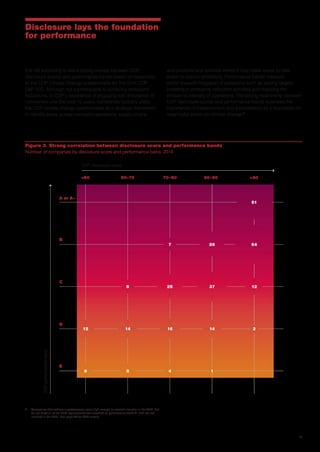
13 Disclosure lays the foundation for performance 
15 The financial implications of CDP data 
18 Corporate profitability: Why we focus on ROE 
20 Size matters: The largest take the lead 
24 Examples by industry group 
28 More stable earnings and stronger dividend growth 
29 CDP performance leaders exhibit attractive value attributes 
30 Valuation: Is climate leadership priced in? 
31 Conclusion: Why link between CDP and ROE matters 
32 Kevin Parker CEO, Sustainable Insight Capital Management 
33 CDLI and CPLI 
36 2014 leadership criteria 
37 Pathways to leadership 
40 Glossary and appendix 
41 Glossary 
42 Appendix I Scores, emissions, and company detail by sector 
49 Appendix II Non-responding companies 
51 Appendix III Other responding companies 
52 Appendix IV Investor members 
55 Appendix V Investor signatories 
Important Notice 
The contents of this report may be used by anyone providing acknowledgement is given to CDP. This does not represent a license to repackage or resell any of the data reported to CDP and presented in this report. If 
you intend to repackage or resell any of the contents of this report, you need to obtain express permission from CDP before doing so. 
CDP has prepared the data and analysis in this report based on responses to the CDP 2014 climate change information request. No representation or warranty (express or implied) is given by CDP as to the accuracy 
or completeness of the information and opinions contained in this report. You should not act upon the information contained in this publication without obtaining specific professional advice. To the extent permitted 
by law, CDP do not accept or assume any liability, responsibility or duty of care for any consequences of you or anyone else acting, or refraining to act, in reliance on the information contained in this report or for any 
decision based on it. 
CDP North America, Inc, is a not–for-profit organization with 501(c)3 charitable status in the US. 
© 2014 CDP. All rights reserved.
Meg Whitman 
Chairman, President, and CEO, HP 
At HP, our people and technology help solve 
society’s toughest challenges. Climate 
change is one of the most serious issues the 
world is confronting today. The toll it takes 
on the planet and humans—through changes 
in temperature, rising sea levels, extreme 
weather, and other phenomena—can no 
longer be ignored. 
That’s why it is so important for companies, governments, and 
non-governmental organizations (NGOs) to address the root 
causes of climate change. This will require new ways of doing 
business, including developing long-term strategies to drive the 
low-carbon economy and collaborating on best practices for 
reducing greenhouse gas (GHG) emissions across industries. It 
also demands greater accountability, which is why CDP’s work 
to drive transparency around climate change issues and deliver 
compelling environmental data analysis is so critical. 
We believe the information technology (IT) industry is uniquely 
02 
positioned to help lower carbon emissions across every 
sector. One way is by inventing more sustainable technol-ogies 
to replace outdated, inefficient processes and 
behaviors. In fact, technology has already helped 
reengineer entire industries with new solutions 
that use much less energy and have a sub-stantially 
smaller carbon footprint. 
But we need to do even more to 
reduce the environmental impact 
of technology itself, while 
addressing the growing 
demands of businesses 
and consumers. For 
example, today 
By integrating 
sustainability 
across the 
entire value chain, 
companies can capture 
return on capital today and 
build leadership and business 
value for their future. 
mankind produces more data in two days than in all of human 
history up to 2003. Supporting that growth in data requires more 
data centers, which requires more energy. How much energy? 
Today, the public cloud alone uses more energy than the entire 
country of Japan. It may soon require more energy than we can 
even produce. This is simply not sustainable. 
We need to think differently about the technology that powers 
our life and work—creating solutions that go beyond incremental 
efficiency improvements. At HP, we’re looking ahead and thinking 
about how we can revolutionize the energy economics of the data 
center. Innovations like HP Moonshot servers, which consume up 
to 89 percent less energy, use 80 percent less space, and cost 
77 percent less than a traditional server environment, and the HP 
Apollo 8000 System, a liquid-cooled supercomputer, can help 
organizations eliminate up to 3,800 tons of carbon dioxide waste 
from data centers per year. We must create solutions that are 
orders of magnitude faster, that use the optimal amount of energy 
for the task, and that are built at a fraction of the size—just as HP 
is doing with its latest innovation, The Machine, which will redefine 
how we think about computing in this big data era. 
But technology is only part of the equation. For companies to 
make a sustainable impact and achieve long-term business 
value, they must work to lower carbon emissions across their 
entire value chain. This means being transparent in tracking and 
reporting GHG emissions, an approach that allows companies 
to measure progress, make necessary course corrections, and 
promote broader accountability. 
At HP, we have systematically analyzed our carbon footprint and 
taken action to reduce our GHG emissions across operations, 
supply chain, and products. For example, we were the first major 
IT company to publish and verify our complete carbon footprint. In 
2013, we became the first IT company to publish a supply chain 
GHG emissions reduction goal—a 20 percent decrease in first-tier 
manufacturing and product transportation-related GHG emissions 
intensity by 2020, compared with 2010. We have now set a new 
goal to reduce the emissions intensity of our product portfolio by 
40 percent by 2020 from a 2010 baseline. This initiative will help 
us and our customers reduce our carbon impacts. 
By integrating sustainability across the entire value chain, compa-nies 
can capture return on capital today and build leadership and 
business value for their future. These investments help compa-nies 
create a competitive advantage, build stability, and provide 
assurances to stakeholders that they are well positioned for the 
challenges of the 21st century. 
As we celebrate our 75th anniversary, our focus on sustainability 
is as strong as ever and is a critical part of HP’s growth strategy. 
We’re pleased to be partnering with CDP, governments, NGOs, 
our customers, and others in the IT industry to build a healthier 
world for everyone.
03 
Investor engagement on these issues is 
increasing. In the US a record number of share-holder 
resolutions in the 2014 proxy season led 20 
international corporations to commit to reduce green-house 
gas emissions or sustainably source palm oil. 
As mainstream investors begin to recognize the real value at 
risk, we are seeing more action from some of the 767 investors 
who request disclosure through CDP. The Norwegian pension 
fund, Norges Bank, with assets worth $260 billion, expects com-panies 
to show strategies for climate change risk mitigation and 
water management, and have divested from both timber and palm 
oil companies that did not meet their standards. 
There is growing momentum on the policy front with President 
Obama’s announcement of new federal rules to limit greenhouse 
gases in the US. In the EU, some 6,000 companies will be 
required to disclose on specific environmental, social and 
governance criteria as part of their mainstream reporting to 
investors. In China over 20,000 companies will be required to 
report their greenhouse gas emissions to the government. 
There is a palpable sea change in approach by companies driven 
by a growing recognition that there is a cost associated with the 
carbon they emit. Measurement, transparency and accountability 
drives positive change in the world of business and investment. 
Our experience working with over 4,500 companies shows the 
multitude of benefits for companies that report their environmental 
impacts, unveiling risks and previously unseen opportunities. 
We are standing at a juncture in history. With the prospect of 
a global climate deal coming from the United Nations process, 
governments, cities, the private sector and civil society have a 
great opportunity to take bold actions and build momentum in the 
run up to the Paris 2015 meeting. The decisions we make today 
can lead us to a profitable and secure future. A future that we can 
all be proud of. 
Paul Simpson 
Chief Executive Officer, CDP 
The global economy has bounced back 
from crisis and a cautious optimism is 
beginning to pervade the markets. As we 
embrace recovery we must remember that 
greenhouse gas emissions continue to rise 
and we face steep financial risk if we do 
not mitigate them. 
The unprecedented environmental challenges that we confront 
today—reducing greenhouse gas emissions, safeguarding water 
resources and preventing the destruction of forests—are also 
economic problems. One irrefutable fact is filtering through 
to companies and investors: the bottom line is at risk from 
environmental crisis. 
The impact of climate events on economies around the world has 
increasingly been splashed across headlines in the last year, with 
the worst winter in 30 years suffered by the USA costing billions of 
dollars. Australia has experienced its hottest two years on record, 
and the UK has had its wettest winter for hundreds of years 
costing the insurance industry over a billion pounds. Over three-quarters 
of companies reporting to CDP this year have disclosed 
a physical risk from climate change. Investing in climate change– 
related resilience planning has become crucial for all corporations. 
1 www.un.org/climatechange/towards-a-climate-agreement/ 
One irrefutable fact is filtering 
through to companies and 
investors: the bottom 
line is at risk from 
environmental 
crisis.
For each of the past nine years, the world’s largest investors 
have tasked CDP with administering their request for climate 
change disclosure to S&P 500 companies. This authority 
granted by capital markets participants representing trillions 
of dollars in assets makes CDP unique among environmental 
non-governmental organizations. Investors rely on CDP to 
communicate to corporations on their behalf, to identify the critical 
elements of climate change governance, risk management and 
emissions accounting, and to provide comprehensive data to 
integrate into their investment research and decision-making. 
In this report, we answer the number one 
question US investors ask CDP about 
climate change data—“is there evidence 
of a link to financial performance?”—with a 
resounding yes. 
Our analysis shows that, on climate change management, 
S&P 500 industry leaders:2 
^^generate superior profitability: ROE3 18% higher than 
04 
low scoring peers and 67% higher than non-responders; 
^^with more stability: 50% lower volatility of earnings over 
the past decade than low scoring peers; 
^^grow dividends to shareholders: 21% stronger than low 
scoring peers; and 
^^exhibit value attributes attractive to equity investors. 
2 In this report, we refer to industry leaders as S&P 500 companies with 2014 CDP disclosure 
scores and/or CDP performance bands that rank in the first quartile versus peers by GICS 
Industry Group, where: 
Q1 = first quartile (top 25% of responding companies by industry group); 
Q2 = second quartile; 
Q3 = third quartile; 
Q4 = fourth quartile (bottom 25% of responding companies by industry group); and 
Non-responders include: declined to participate; no response; provided information but did not 
answer questionnaire to CDP in 2014. 
By featuring the investment implications of climate change 
management for the first time in our ninth annual S&P 500 report, 
we hope to shine a light on the link between strong climate 
change management and measures of financial performance and, 
at the very least, to put to rest the common misconception that 
taking action on climate change exacts a cost to profitability. Our 
data shows the opposite. 
This report presents the progress achieved by 70%4 of S&P 500 
companies in integrating climate change risk management into 
strategic planning, taking action towards emissions reductions 
and demonstrating a long-term view of how to best manage the 
assets of shareholders. 
Investors seek out companies with superior management quality 
that efficiently allocate capital and maximize operating profitability. 
Quality is often measured in terms of financial outcomes, including 
return on equity, earnings stability and dividend growth. Our 
analysis suggests that climate change leadership is another 
strong reflection of superior management quality; thus, we 
observe correlations with these financial measures. However, we 
are careful to caveat that correlation does not imply causation. 
Rather, we believe that S&P 500 companies are compelled to 
act on climate change in defense of their superior profitability 
and market valuation consistent with their fiduciary obligation to 
shareholders. 
3 Return on Equity (ROE) = net income less preferred dividends, divided by average total common 
equity (three-year average, 2011-2013). 
4 Analysis in this report is based on the 337 company responses received by the deadline of June 
28, 2014. The response rate of 70% (348 companies) is based on time of printing. 
Executive summary
05 
S&P 500 INDUSTRY LEADERS: 
67% higher ROE 
than non-responders 
50% lower volatility 
of earnings over the past decade 
than low-scoring peers 
18% higher ROE 
than low-scoring peers ( ) 
21% stronger than 
low-scoring 
peers 
Generate superior profitability 
Enjoy more stability 
Exhibit value attributes 
attractive to equity 
investors 
Grow dividends to shareholders
06 
CSX is committed to investing in the safe, reliable, 
environmentally friendly rail network of the future to 
continue to drive profitable growth and shareholder 
value creation. One such opportunity, intermodal 
transportation, capitalizes on the environmental 
efficiency of freight rail, which is four times more fuel-efficient 
than trucks, and significantly reduces emissions 
and highway congestion. Investing in intermodal means 
investing in future growth and shareholder returns, as 
more people demand more things that must be moved 
in the most responsible way possible. Those shipments 
now represent 40 percent of CSX’s portfolio by volume, 
with an estimated 9 million additional loads in the Eastern 
US that have the potential to shift from truck to rail. 
To capitalize on that growth opportunity, CSX 
spearheaded the National Gateway project—an $850 
million public-private partnership with state and federal 
partners to better connect ports with consumption 
centers by expanding the intermodal capacity of key 
corridors on the CSX network. CSX’s broad coverage 
of Eastern markets and unique strategy, combining a 
hub-and-spoke model with the traditional intermodal 
corridor strategy, effectively reaches nearly two-thirds of 
American consumers. 
CSX’s commitment to sustainable growth includes 
aggressive maeasurement and transparency for 
shareholders and employees alike. CDP is an important 
avenue for communicating about CSX’s sustainability 
strategy, progress against important goals, and 
leadership in the area of environmentally responsible 
growth. CDP helps CSX continue to be how 
tomorrow moves. 
Fredrik Eliasson 
Executive Vice President and 
Chief Financial Officer, 
CSX Corporation
07 
Trends 
in CDP 
S&P 500 
data
Since 2003, CDP has requested annual climate change 
disclosures from the world’s largest companies on behalf of 
its investor signatories. The CDP climate change questionnaire 
focuses on governance, risks & opportunities, and greenhouse 
gas (GHG) emissions accounting.5 CDP began scoring 
company responses to its questionnaire in 2007 to provide 
a gauge of the transparency of climate change information 
disseminated to the market. Participating companies receive a 
CDP disclosure score (from 0 to 100) and performance band 
(from A to E). The disclosure score reflects the transparency 
of information provided on emissions measurement; climate-related 
08 
initiatives; risks & opportunities to the business; and 
external verification and assurance based solely on the 
information disclosed in the CDP response.6 Companies who 
score in the top 10% are included in an annual index known as 
the Climate Disclosure Leadership Index (CDLI). 
The bar for admission to the CDLI 
continues to rise: CDP disclosure scores 
for the CDLI have narrowed considerably 
over the past 7 years from a minimum 
score of 61 in 2008 to 97 in 2014. 
Since 2011, CDP has also assigned a performance band from 
A to E to companies scoring above 50 on disclosure scores. 
CDP performance bands assess the level of action, as reported 
by the company, on climate change mitigation, adaptation and 
transparency. Its intent is to highlight positive climate action as 
demonstrated by a company’s CDP response. 
Figure 1. The bar for admission to the Climate 
Disclosure Leadership Index (CDLI) continues to rise 
Maximum and minimum CDLI scores, 2008–2014 
5 For details of the 2014 CDP Climate Change information request, please visit: 
https://www.cdp.net/CDP%20Questionaire%20Documents/CDP-climate-change-infor-mation- 
request-2014.pdf 
6 For details of the 2014 CDP Climate Change scoring methodology, please visit: 
https://www.cdp.net/Documents/Guidance/2014/CDP-2014-Climate-Change-Scor-ing- 
Methodology.pdf 
Maximum CDLI 
99 99 
96 96 
2008 2009 2010 2011 2012 2013 2014 
332 
350 339 343 342 348 
Number of S&P500 responses 
321 
Minimum 
CDLI 
A company must earn a 
disclosure score within 
the top 10% of the S&P 
500 sample to be placed 
on the CDLI 
98 
80 
82 
86 
88 
94 
97 
98.5 
61 
91 
74 
80 
83 
92 
100 100 
97 
Mean 
Trends in CDP data
09 
Our company’s core value of integrity drives our commitment to 
being an industry leader in sustainability. It’s important to us because 
we know it’s important to our shareholders, our customers, our 
employees and the communities where we operate. 
It’s also good for business. One tangible example of our commitment 
includes the Principal Green Property Fund I, a closed-end fund 
managed by our real estate division. We launched our first Green Fund 
in 2008, which invested specifically in US properties for purposes of 
achieving LEED or ENERGY STAR certification. We intend to continue 
to develop new investment strategies and products that encourage 
sustainability and achieve such standards. 
Participating in the CDP process has strengthened our company’s 
sustainability program overall. It’s also allowed us to provide current 
and potential investors and others with detailed information about our 
sustainability goals and results. 
Larry Zimpleman, Chairman, President and CEO 
The Principal Financial Group 
The Principal is undergoing a 
$400 million, multi-year renovation 
of its 2+ million square foot 
campus in Des Moines, Iowa. The 
environmentally friendly renovations 
involve plans to reduce both 
indoor and outdoor water use, 
recycle more than 90 percent of all 
construction debris and conserve 
energy. One highlight of our energy 
conservation strategies involves 
using LED lighting throughout the 
entire campus, including in the 
skywalks between buildings (as 
shown above).
Anatomy of CDP disclosure 
scores and performance bands 
10 
23% 
Emissions methodology 
and Scope 1/2 data 
15% 
Opportunities 
15% 
Risks 
9% 
Emissions 
performance 
and trading 
8% 
Targets and 
initiatives 
6% 
Scope 1&2 
verification 
10% 
Scope 3 
14% 
Governance, 
strategy and 
communi-cations 
How the disclosure score is calcaulated 
Disclosure points earned 
Disclosure points available 
100 Disclosure score % 
0 to 100 
>50% disclosure = scored for performance 
<50% disclosure = not scored for performance 
Relative weight of elements in determining the disclosure score 
The disclosure score assesses the completeness and quality of a 
company’s response. Its purpose is to provide a summary of the 
extent to which companies have answered CDP’s questions in a 
structured format. A high disclosure score signals that a company 
provided comprehensive information about the measurement and 
management of its carbon footprint, its climate change strategy 
and risk management processes and outcomes.
11 
Relative weight of elements in determining the performance bands 
27% 
Governance, strategy 
and communications 
22% 
Emissions 
performance 
and trading 
19% 
Targets and 
initiatives 
12% 
Scope 1&2 
verification 
5% 
Opportu-nities 
10% 
Scope 3 
5% 
Risks 
How the performance score is calcaulated 
Performance points earned 
Performance points available 
100 Performance score % Performance band 
A to E 
The performance score 
assesses the level of action, 
as reported by the company, 
on climate change mitigation, 
adaptation and transparency. 
Its intent is to highlight positive 
climate action as demonstrated 
by a company’s CDP 
response. A high performance 
score signals that a company 
is measuring, verifying and 
managing its carbon footprint, 
through actions such as setting 
and meeting carbon reduction 
targets and implementing 
programs to reduce emissions 
in both its direct operations 
and supply chain.
Figure 2. CDP performance bands for the S&P 500 have improved dramatically over the past three years 
CDP performance bands, 2011–2014 
12 
2014 
2013 
2012 
2011 
48% 
scored above 
average in 2014 
A 
A– 
B 
C 
D 
E 
30% 
scored above 
average in 2011 
CDP performance bands for the S&P 500 have 
improved dramatically over the past three years. 
Whereas in 2011, just 30% of S&P 500 companies achieved high 
performance bands of A, A– or B, that percentage increased 
to nearly half, at 48%, in 2014. Moreover, the improvement in 
performance occurred during the same period that CDP markedly 
increased the minimum point percentage thresholds for achieving 
each CDP performance band: for an A or A–, from 71 to 86, for 
a B from 51 to 61, for a C from 31 to 41, and for D from 16 to 21. 
Companies achieving a performance band of A are included in 
CDP’s annual Climate Performance Leadership Index (CPLI).7 
7 Companies that achieve a performance score high enough to warrant inclusion in the CPLI, but 
do not meet all of the CPLI requirements are classified as performance band A– and are not 
included in the CPLI. See page XX for CPLI criteria.
13 
Disclosure lays the foundation 
for performance 
It is not surprising to see a strong overlap between CDP 
disclosure scores and performance bands based on responses 
to the CDP Climate Change questionnaire for the 2014 CDP 
S&P 500. Although not a prerequisite to achieving emissions 
reductions, in CDP’s experience of engaging with thousands of 
companies over the past 15 years, companies typically utilize 
the CDP climate change questionnaire as a strategic framework 
to identify areas across company operations, supply chains 
Figure 3. Strong correlation between disclosure score and performance bands 
Number of companies by disclosure score and performance band, 2014 
CDP disclosure score 
CDP performance band 
<60 60–70 70–80 80–90 
A or A– 
B 
C 
D 
E 
>90 
51 
64 
12 
2 
26 
37 
14 
1 
7 
25 
16 
4 
8 
14 
8 
12 
6 
and products and services where it may make sense to take 
action to reduce emissions. Performance bands measure 
action towards mitigation of emissions such as setting targets, 
investing in emissions reduction activities and reducing the 
emissions intensity of operations. The strong relationship between 
CDP disclosure scores and performance bands illustrates the 
importance of measurement and transparency as a foundation for 
meaningful action on climate change.8 
8 Companies that achieve a performance score high enough to warrant inclusion in the CPLI, but 
do not meet all of the CPLI requirements are classified as performance band A– and are not 
included in the CPLI. See page XX for CPLI criteria.
14 
At IFF, our sustainability strategy is 
aligned with our overall long-term business 
strategy. We make better business decisions 
by evaluating the financial, environmental and 
social implications of the triple bottom line. 
This means we are taking into consideration 
what matters most to our shareholders, 
customers, employees and the millions of 
consumers whose lives we touch daily. As 
more investors place effective sustainability 
strategy in their investing decision criteria, 
IFF believes that aligning with CDP responds 
to those investment needs. CDP provides a 
valuable framework to benchmark our efforts 
and supports the communication of our 
carbon management initiatives. 
As sustainability is becoming increasingly 
more embedded in our business practices 
and personal behaviors, we are committed 
to achieving or exceeding our 2020 goals of 
reducing water, waste and GHG emissions 
by 25% and energy use by 20%, as well 
as increasing our use of renewable energy. 
Our eco-efficiency initiatives allow us to use 
less energy and water and reduce waste 
and carbon emissions, while improving our 
processes and enabling the production 
of high quality, innovative products that 
people love. 
Kevin C. Berryman 
Executive Vice President 
and Chief Financial Officer 
International Flavors & Fragrances Inc.
15 
The financial 
implications 
of CDP data
In this report, we offer investors our analysis of the financial 
implications of CDP data based on the relationship between 
corporate climate change management, disclosure and 
performance alongside measures of corporate profitability and 
equity valuation.9 We summarize trends in CDP data and illustrate 
examples of the financial links to climate change leadership. Our 
analysis of the 2014 CDP S&P 500 2014 data is consistent with 
our findings globally in 201310—industry leadership on climate 
change is linked to financial measures of corporate profitability. 
CDP’s role as secretariat to 767 investors 
At its core, CDP serves as a vehicle between capital, represented 
by 767 investors with $92 trillion in assets, and corporations, 
who issue equity and debt securities to investors to fund their 
operations. These operations, whether in oil production, electricity 
generation, financial services, technology or manufacturing, 
rely on natural capital, such as energy and water, and impact 
our environment, including greenhouse gas emissions to the 
atmosphere. This has only become more important in 2014 and 
investors are becoming more aware than ever of the necessity 
of high-quality information on how companies are mitigating 
the risks from climate change—risks which in many cases were 
exacerbated by extraordinary weather events across multiple 
geographies, including extreme drought in California and 
devastating typhoons in the Philippines. 
Sustainable growth of a lower-carbon economy 
Investors access CDP data through a variety of means, including 
through more than 7.5 million downloads from Bloomberg 
terminals annually. CDP provides the capital markets with this 
critical environmental data infrastructure to enable informed 
investment analysis. The challenges presented by climate 
change and natural resource scarcity are beyond what any single 
government can confront alone. CDP therefore leverages the 
power of the markets to allocate capital to power the sustainable 
growth of a lower-carbon economy. 
The definition of a lower-carbon economy is straightforward—to 
maximize gross domestic product (GDP) and job growth while 
minimizing carbon emissions and detrimental impacts to the 
atmosphere. But how can sustainable growth be defined as 
it relates to large capitalization companies in the S&P 500? 
Investment professionals rely on a financial definition11 to estimate 
the rate of corporate growth: 
Sustainable growth = return on equity × reinvestment, 
where return on equity (ROE) is the key determinant of long-term 
value creation, given it encapsulates company profit margins, 
asset turnover, and debt to equity ratios. The question we 
16 
address in the pages that follow is whether companies can take 
action towards achieving a lower carbon economy while also 
generating sustainable growth. 
We compare 2014 CDP S&P 500 disclosure and performance12 
versus industry peers across a number of financial measures of 
management quality, including return on equity, earnings stability, 
and dividend growth. Our analysis focuses on peer-relative CDP 
disclosure and performance scores to assess industry leadership 
on climate change.13 We percentile rank each score on a peer-relative 
basis and sort it into quartiles by GICS14 Level II Industry 
Group (where first quartile (Q1) = highest CDP score, fourth 
quartile (Q4) = lowest CDP score, and NR = no response). 
Superior-quality management 
We find that US corporate leaders on climate change 
management, as measured by S&P 500 peer-relative CDP 
disclosure and performance, have generated superior return on 
equity, more resilient earnings, and stronger dividend growth than 
their peers. At a minimum, CDP data suggests that there is no 
penalty to corporate profitability for establishing climate change 
reporting, governance and management systems and taking 
action on climate change. 
We do not suggest a causal relationship between present day 
leadership on a long-term issue such as climate change and 
short-term financial performance based on the data available. 
However, we do believe it is rational to posit that extraordinarily 
profitable companies are likely engaging on climate change in 
defense of their industry-leading ROE. By integrating climate 
change risk management into strategic planning, responding to 
CDP and taking action towards emissions reductions, companies 
are simply demonstrating a long-term view of how to best manage 
the assets of shareholders. Our analysis serves only to hold a 
mirror up to companies, and that has revealed a third variable is 
present—superior-quality management reflected through higher 
CDP scores and higher financial performance. 
The financial implications 
of CDP data 
At a minimum, CDP data suggests 
that there is no penalty to corporate 
profitability for establishing climate 
change reporting, governance and 
management systems and taking 
action on climate change.
17 
Figure 4. CDP investor signatories and assets 2003–2014 
35 
$4.5 trillion 
in assets 
767 
Climate change 
signatories 
573 
Water 
240 
Forest 
2003 
2014 
$92 
trillion 
in assets 
$60 
trillion 
in assets 
$15 
trillion 
in assets 
Climate 
change 
signatories 
9 All data is sourced from CDP and 
Bloomberg, unless otherwise noted. 
10 Kahn, B. and Fox, M. “Linking Climate 
Engagement to Financial Performance: 
An Investor’s Perspective.” (September 
23, 2013). http://www.sicm.com/docs/ 
CDP_SICM_VF_page.pdf 
11 Higgins, Robert (1977): How much growth 
can a firm afford?, Financial Management 6 
(3) p. 7–16. 
12 For details of the 2014 CDP Climate 
Change scoring methodology, please 
visit: https://www.cdp.net/Documents/ 
Guidance/2014/CDP-2014-Cli-mate- 
Change-Scoring-Methodology.pdf 
13 In this report, we refer to industry leaders 
as S&P 500 companies with 2014 CDP 
disclosure scores and/or CDP performance 
bands that rank in the first quartile versus 
peers by GICS Industry Group, where: 
Q1 = first quartile (top 25% of responding 
companies by industry group); 
Q2 = second quartile; 
Q3 = third quartile; 
Q4 = fourth quartile (bottom 25% of 
responding companies by industry group); 
and 
Non-responders include: declined to par-ticipate; 
no response; provided information 
but did not answer questionnaire to CDP 
in 2014. 
14 Global Industry Classification Standard 
updated as of February 28, 2014: https:// 
us.spindices.com/search/?Content- 
Type=GICSMaps
Corporate profitability: 
Why we focus on ROE 
One of the most universally applicable measures of management 
quality and corporate profitability is return on equity (“ROE”), the 
ratio of net income to shareholder’s equity.15 When management 
earns a high ROE, the company increases the equity investment 
of shareholders. In the simplest terms, ROE measures how 
many cents of profit management can produce for every $1 of 
shareholder’s equity. Over the long-term, the markets reward 
high-quality management that maximizes returns on shareholders 
equity with gains in stock price. 
S&P 500 industry leaders on 2014 CDP disclosure 
and performance generate significantly higher return 
on equity than peers 
Given the emphasis investors place on maximizing corporate 
profits, it is notable that CDP industry leaders generate higher 
18 
ROE (Fig. 2). Q1 industry leaders on 2014 CDP disclosure stand 
out versus peers with average ROE of 25.7%—which is 18.4% 
higher than Q4 industry laggards at 21.8% ROE. 
And performance matters—the gap in profitability widens when 
we analyze CDP performance figures where Q1 industry leaders 
generate average ROE of 25.7%—which is 27.2% higher than Q4 
industry laggards at 20.2%. Also significant is that Q1 industry 
leaders on both CDP disclosure and performance generate 67% 
higher ROE than the lower level of profitability generated by non-responding 
companies at 15.4%. 
The data suggests that US corporate climate change 
management, as measured by CDP disclosure and performance 
versus industry peers, reflects higher-quality management, as 
measured by return on equity. 
Figure 5. Q1 industry leaders outperform industry laggards and non-responding companies by a significant 
margin. Higher CDP score is associated with higher ROE. 
Q1 25.7% 
Q2 
Q3 
Q4 
Non-responders 
24.5% 
24.6% 
19.4% 
CDP disclosure 
CDP performance 
CDP disclosure 
CDP performance 
CDP disclosure 
CDP performance 
CDP disclosure 
CDP performance 
20.8% 
21.8% 
20.2% 
15.4% 
25.7% 
Return on equity 
Laggards Leaders 
15 Vick, T. “Picking Stocks the Buffett Way,” AAII Journal, April 2001 http://www.aaii.com/journal/article/picking-stocks-the-buffett-way-understanding-return-on-equity
19 
The primary test of managerial 
economic performance is the 
achievement of a high earnings rate 
on equity capital employed. 
—Warren Buffet 
1979 Berkshire Hathaway annual report 
Q1 industry disclosure leaders’ ROE is 
18.4% higher than the ROE of Q4 industry 
laggards. 
Q1 industry performance leaders’ ROE is 
27.2% higher than the ROE of Q4 industry 
laggards. 
Q1 industry leaders generate 67% higher 
ROE than non-responding companies.
In 2006, CDP sent its climate change questionnaire to the 
S&P 500 for the first time, targeting the largest companies in 
corporate America. At the time, the consensus feedback from 
investor signatories indicated that large-cap companies were the 
most appropriate CDP sample given the significant resources 
at their disposal to address climate change in their operations. 
Eight years later, the largest of the large-caps are leading their 
industries. Companies that rank in the top quartile versus industry 
group peers (e.g., Q1 in Figure 6) are more than 66% more 
valuable at $62.5 billion average market capitalization versus the 
S&P 500 average of $37.6 bn. Note that both non-responders 
to CDP ($22.4 billion) and Q4 laggards by industry group ($26.8 
billion) are considerably smaller in relative terms. Examples of the 
largest companies by market capitalization (>$100 billion) with Q1 
CDP disclosure scores in 2014 include Apple, Microsoft, Johnson 
& Johnson, Walmart and Wells Fargo (per Figure 5). 
Companies that rank in the top 
quartile versus industry group peers 
are more than 66% more valuable 
versus the S&P 500 average. 
Figure 6. Q1 industry leaders on CDP disclosure are larger by market capitalization 
Non-responders 
22.4 billion 
20 
Top 
performers 
(Q1) 
$62.5 billion 
Q2 
$47.6 billion 
Q4 
$26.8 billion 
Q3 
$41.9 billion 
Average market 
capitalization, 
$billion 
Mega-caps over $100 billion that 
score Q1 versus industry group on 
CDP disclosure, and their market 
capitalization 
Apple Inc. $612 billion 
Microsoft Corporation $370 billion 
Johnson & Johnson $290 billion 
Wells Fargo and Company $267 billion 
Wal-Mart Stores, Inc. $245 billion 
Chevron Corporation $244 billion 
JPMorgan Chase & Co. $223 billion 
Pfizer Inc. $186 billion 
Bank of America $168 billion 
Philip Morris International $133 billion 
Cisco Systems, Inc. $127 billion 
The Home Depot, Inc. $125 billion 
Size matters: 
The largest take the lead
21 
Over the long term, Apple is making a 
conscious decision to be more transparent and 
expansive in its sustainability efforts, including those 
directly related to climate change, as we believe it’s 
a significant problem that may affect our operations, 
suppliers, partners and customers, and we are taking 
action to address it. 
—Apple Inc. 
Our environmental 
commitment will support our 
business growth, promote a 
greener global economy and 
address climate change while 
helping our clients meet their 
own sustainability objectives. 
This will contribute to our 
top-line growth and position 
us to capitalize on the longer 
term opportunities that exist. 
All this should serve to give us 
a strategic advantage in our 
industry and deliver long term 
value for our shareholders. 
—Bank of America 
Our goal to eliminate 20 million metric tons of 
GHG emissions from our global supply chain by the 
end of 2015 is purposely aggressive. Seizing the 
opportunity to leverage our size and scale to positively 
impact the world requires innovation. In our supply 
chain and in the products we sell, to date, we’ve 
eliminated more than 7.575 mmt of GHG emissions. 
—Wal-Mart Stores, Inc. 
Consideration of GHG 
issues are integrated into 
Chevron’s strategy, business 
planning and risk management 
tools and processes. We 
consider carbon costs when 
forecasting long-range supply, 
demand and energy prices, 
and we thoroughly assess 
a range of potential future 
policy and economic growth 
outcomes. These analyses 
affect our investment decisions 
and capital project approvals 
worldwide. 
—Chevron Corporation 
Results of our progress towards our Healthy 
Future 2015 goals have not only positively impacted 
the environment but also have resulted in competitive 
advantage by reducing our operating costs. For exam-ple, 
as a result of investing in various projects in 2012 
that increase energy efficiency and solar photovoltaic 
capacity, we achieved estimated cost avoidance of 
approximately $3 million in 2013 alone. 
— 
Johnson & Johnson 
Climate change and sustainability are key 
components of The Home Depot’s business strategy. 
We have aligned our strategy of controlled profitable 
growth with net impact reduction creating the model 
of a dual “value-driven” company, both in shareholder 
value and in resource conscience values. 
— 
The Home Depot
Further, companies that rank in the top quartile versus industry 
group peers (e.g., Q1 in figure 7 below) not only account for 29% 
of market capitalization of the S&P 500, but also hit above their 
weight in proportion of net income at 33% and dividends at 32%. 
The financial weight of CDP leaders is not easily dismissed— 
these 
are astounding figures for just 87 companies (17.4% by number) of 
the S&P 500. 
When we disaggregate the data by sector, we note that the 
correlation between CDP disclosure scores and ROE is highest 
in traditionally defensive sectors16 that are characterized by 
Figure 7. Q1 industry leaders account for a significant portion of market cap, earnings and dividends 
22 
Q1 
Q2 
Q3 
Q4 
Non-respondents 
21% 
12% 
20% 
14% 
18% 21% 
13% 
19% 
Market 
capitalization 
Net income 
22% 
12% 
22% 
12% 
Dividends 
paid 
33% 
29% 
32% 
predictable cash flow generation and low market betas17 below 
0.8 (where 1 = beta of the market). The correlation coefficient 
between 2014 CDP disclosure scores and ROE exceeds 20% in 
consumer staples and health care. 
The lower the sector beta, the higher relationship between CDP 
disclosure scores and ROE. A notable exception is the utilities 
sector, which has the lowest dispersion of returns given the highly 
regulated nature of ROE in the US, which is capped by state. 
Utilities are a notable outlier given the sector accounts for the 
largest proportion (29%) of global emissions reported to CDP.18 
16 A defensive sector refers to a 
section of the economy charac-terized 
by stable earnings, reliable 
dividends and low correlation to 
economic activity. 
17 Beta (b) is a measure of a stock or 
portfolio that describes the correlat-ed 
volatility of an asset in relation 
to the volatility of the benchmark 
that the asset is being compared to 
where 1 = beta of the market. 
18 CDP Carbon Action: “Lower 
emissions, higher ROI: the rewards 
of low carbon investment.” (2013). 
Page 6. https://www.cdp.net/ 
CDPResults/Carbon-action-re-port- 
2013.pdf
23 
HCP’s commitment to sustainability not only reduces our 
environmental impact, but also creates shareholder value through 
return on investment, or ROI. Recently, for example, we implemented 
an HVAC efficiency project at our Callan Road Life Science building 
in San Diego, California. This project is projected to reduce energy at 
this facility by an estimated 116 MWh annually, which would decrease 
our greenhouse gas emissions by 35 CO2e tonnes. Based on a 15% 
efficiency premium cost for equipment and estimated annual savings, 
the projected ROI for this project is 17.9%. 
Investors are increasingly interested in sustainability initiatives, and 
several years ago, HCP adopted sustainability as a core value. We 
believe our commitment to sustainability, including responding to CDP 
provides us with a competitive advantage over those peers that have 
yet to incorporate climate change initiatives into their overall business 
strategy. HCP continues to strive to produce efficient, sustainable 
results for our investors and other stakeholders. 
Timothy M. Schoen 
Executive Vice President and Chief Financial Officer 
HCP, Inc. 
Soledad Life Science Building 
San Diego, California 
LEED Platinum certified
In addition to the broad relationship between CDP disclosure, 
performance and ROE across the S&P 500, there are also 
discernible correlations at the company level in many industry 
groups. Four industry groups stand out—Health Care Equipment, 
Real Estate, Transportation and Consumer Durables & Apparel. 
For example, ROE is correlated to disclosure in Health Care 
Equipment and Real Estate, where services firm CBRE Group 
24 
scores in the first quartile on both disclosure and performance 
and has average industry-leading ROE of 22%. 
The link between ROE and CDP performance is most apparent 
in Transportation and Consumer Durables & Apparel, where VF 
Corp scores highest on CDP performance (Fig. 8). 
Health care equipment 
ROE 
BDX 
CDP disclosure score 
BAX 
ABT 
UNH 
MDT 
ESRX 
30 
25 
20 
15 
10 
5 
0 
20 40 60 80 100 
35 
COV 
AET 
PDCO 
DGX 
CI 
HUM 
XRAY 
ZMH CAH 
SYK 
WLP 
CERN 
VAR 
We are currently 
developing a modified capital 
investment strategy to include 
a relaxed ROI criteria for 
projects with energy savings 
or increased renewable 
energy. This framework will 
also likely incorporate the 
total cost of ownership for 
capital equipment. To date, 
this opportunity has been 
managed by implementing 
projects with significant 
energy/water/waste savings, 
which has contributed to 
approximately $25 million in 
costs savings since 2008. 
In 2013, we implemented 
several projects that will have 
approximately $5.6 million in 
annual savings. 
—Becton, Dickinson 
and Co. 
Examples by industry group 
Figure 8. CDP scores vs. ROE in select industry groups
25 
HAR 
SPG 
CBG 
VTR 
KIM 
HCP HST 
NKE HAS 
VFC 
Real estate 
Transportation 
ROE 
(using FFO) 
25 
20 
15 
10 
PCL 
Consumer durables and apparel 
ROE 
ROE 
0 
75 80 85 90 95 100 
5 
CDP disclosure score 
CDP performance (percentile) 
50 
40 
30 
20 
10 
0 
0% 20% 40% 60% 80% 100% 
30 
20 
10 
0 
CDP performance (percentile) 
0% 20% 40% 60% 80% 100% 
UPS 
UNP CSX NSC 
LUV 
R 
HCN 
PLD 
WY 
AVG 
FDX 
DAL 
EXPD 
NWL 
MAT 
WHR 
CBRE’s Sustainability Programs Group 
assists CBRE clients in navigating the 
LEED rating system by embedding long-term, 
sustainable best practices at both 
the individual building and portfolio level. 
Through this program, nearly 60,648 metric 
tonnes of CO2 emissions were avoided 
annually from 2009 to 2012. 
—CBRE Group, Inc. 
We think long-term about our 
investments in energy efficiency and have 
recently forecasted our energy use through 
2020. By doing this, we understand the 
implications of our energy use on costs and 
emissions of greenhouse gases and can 
act appropriately invest our capital and set 
goals to reduce these impacts (2.2a). 
– VF Corporation 
The direct and indirect consumption of 
fossil fuels and the emission of greenhouse 
gases are strongly correlated to global eco-nomic 
activity. When the economy grows, 
UPS’s environmental impact increases due 
to greater demand for business and en-vironmental 
efficiencies UPS provides to 
others. UPS continually seeks to reduce the 
strength of this correlation, so that energy 
costs (and associated impacts on UPS prof-its 
and the global environment) do not rise in 
line with UPS shipping volume. —UPS
26 
We have a customer-driven sustainability 
strategy. Customers expect us to help mitigate, if not 
eliminate, issues like congestion, pollution and traffic 
accidents, among others. If we expect our industry 
to continue to thrive, we must provide solutions. 
This extends to how we build our products and 
how we engage with the world around us. When it 
comes to sustainability, we pursue outcomes that 
create value for both GM and our customers. This 
has led to expanded use of renewable energy, a ‘zero 
waste’ mindset and other initiatives that have sharply 
reduced our energy intensity, resource consumption 
and greenhouse gas emissions worldwide. 
Our CDP ranking shows that we’re measuring and 
pulling insight from our energy and carbon data to 
capitalize on opportunities for greater efficiency. It 
reinforces our stewardship and sustainability goals. 
Responding to CDP helps us communicate to the 
financial community that we’re prepared for changing 
market demands and emissions regulation. Effectively 
managing our carbon within our vehicles and facilities 
and sharing it publically is good for our customers, 
shareholders, the planet and our bottom line. 
Mary T. Barra 
Chief Executive Officer 
General Motors Company
27 
Figure 9. Companies with supranormal returns (>80%), and their CDP scores 
CDP leaders who scored in Quartile 1 or 2 
Philip Morris International Food, beverage & tobacco 96 (Q1) A (Q1) 
Mead Johnson Nutrition Company Food, beverage & tobacco 92 (Q2) B (Q2) 
Lockheed Martin Capital goods 98 (Q1) A (Q1) 
Colgate Palmolive Company Household & personal products 94 (Q1) B (Q2) 
Pitney Bowes Inc. Commercial & professional services 89 (Q2) B (Q1) 
Boeing Company Capital goods 97 (Q1) B (Q1) 
Non-leaders 
Moody’s Corporation Diversified financials 24 (Q4) n/a (Q4) 
Alliance Data Systems Software & services responded late 
Western Union Co Software & services 20 (Q4) n/a (Q4) 
Wynn Resorts, Liimited Consumer services declined to participate 
Linear Technology Corp. Semiconductors & 65 (Q3) D (Q3) 
Note that at the industry group level, the S&P 500 sample size 
may be too small to draw specific conclusions, but the results 
could be explained by characteristics that differ from the broader 
sector. This suggests that further sector-by-sector analyses 
would benefit from larger sample sizes, such as expanding the 
CDP questionnaire in the United States to the S&P 1500 or 
Russell 1000. 
Supranormal returns, where company ROE is more than two 
standard deviations from the mean, are observed in a small 
number of companies in the S&P 500. Twelve companies 
generated three-year average ROE exceeding 80% from 2011 to 
2013—quadruple the S&P 500 median of 20%. Half of these (six 
of 12) scored above average (Q1 or Q2) on both CDP disclosure 
and performance (Fig. 9). Further, only one company, Wynn 
Resorts Limited, declined to participate. 
Disclosure Performance 
score band 3-year ROE 
223% 
It stands to reason that companies with this type of financial 
performance have the resources to lead on climate engagement. 
For example, Mead Johnson Nutrition company has implemented 
a Green Vision strategy and has committed to reducing GHG 
emissions by 35%, reducing energy use by 35%, reducing water 
usage by 45% and reducing waste to landfill to 60%. Lockheed 
Martin assessed more than 40 environmental, social and 
governance (ESG) issues and evaluated the impacts on their value 
chain, prioritizing reducing greenhouse gas emissions and energy 
use. Larger companies with outstanding financial performance 
have recognized the need to act and engage on climate change 
and have integrated these risks into their business strategies. 
semiconductor equipment 
Altria Group, Inc. Food, beverage & tobacco 85 (Q3) B (Q3) 
460% 
418% 
255% 
101% 
96% 
85% 
169% 
116% 
112% 
108% 
107% 
Companies only receive a performance band if they earn more than 50% of disclosure points. For the purpose of analysis, companies without a performance band are included in Q4.
More stable earnings and 
stronger dividend growth 
One of the hallmarks of high-quality companies is earnings 
resilience over economic cycles. Consistent with our observation 
of higher ROE generated, we also observe a higher degree 
of earnings stability over the past decade by companies with 
industry-leading CDP disclosure scores. Between 2004 and 
2013, Q1 industry leaders on CDP disclosure measured a 50% 
lower coefficient of variation,18 a statistical measure of annual 
earnings volatility, where lower is better (more stable) and higher is 
more volatile. Figure 10 illustrates the increased earnings stability 
of each quartile of CDP disclosure scores by industry group 
where Q1 industry leaders on climate change management have 
generated more resilient earnings than Q4 industry peers. 
28 
We also observe that Q1 industry leaders on CDP disclosure 
scores delivered stronger dividend growth19 averaging 19.8% to 
investors from 2010 to 2013 (Fig. 11). This compares favorably 
to lower scoring Q4 peers at 13.8%. The ability of companies to 
grow dividends to shareholders can be viewed as another strong 
reflection of management quality. Taken in tandem, the increased 
earnings stability and stronger dividend growth of Q1 industry 
leaders on CDP disclosure supports the link between ROE and 
profitability. 
0.31 
Q1 
Earnings stability (coefficient of variation), 2004–13 
0.42 
Q2 
0.49 
Q3 
0.63 
Q4 
CDP disclosure score by industry quartile, 2014 
19.8% 19.8% 
16.3% 
13.8% 
Q4 Q3 Q2 Q1 
Dividend growth, % 
CDP disclosure score by industry quintile, 2014 
Figure 10. Earning stability by industry quartile of 
2014 CDP disclosure scores (inverse of coefficient 
of variation), 2004–2013 
Figure 11. Dividend per share growth by industry 
quartile of 2014 CDP disclosure scores (3-year CAGR, 
2010–2013) 
18 Earnings stability refers to the coefficient of variation of annual operating income calculated as the ratio of the standard deviation relative to the mean (ten-year stdev and mean, 2004-2013), where 
lower is better (more stable) and higher is more volatile. We excluded Financials and Automobiles in this calculation due to the extreme volatility and negative earnings during the 2008 financial crisis 
and subsequent recovery. 
19 Dividend growth calculated as the compound annual growth rate in dividend per share (three-year CAGR, 2010-2013).
29 
Q1 
Median earnings yield, bps 
Median growth, bps 
Figure 12. Factor exposures (basis points) by industry quartile of CDP 
performance scores, as of December 31, 2013 
Q4 
0.05 
–0.15 
0.13 
–0.02 
Q2 
0.05 
–0.09 
0.11 
Q3 
–0.24 
Investors divide benchmarks such as the S&P 500 into growth and value 
based on company financial characteristics and assess portfolios with 
respect to trade-offs in risk and return trade-offs based on these (and 
other) factors. In the evaluation of companies from a portfolio perspective, 
it is necessary to understand the factor exposures that contribute to each 
company’s risk and return attributions. 
Our attribution analysis in figure 12 shows growth and value factor exposures 
by industry quartile of 2014 CDP performance. Value signals a company’s 
market returns sensitivity to earnings yield. Growth describes a company’s 
market returns sensitivity to earnings growth. 
Each quartile of CDP performance by industry group exhibit different 
combinations of growth and value attributes. Q1 industry leaders on climate 
change performance tend to exhibit value factors while Q4 industry laggards 
and non-respondents tend to be more growth oriented with negative 
value attributes. 
The value orientation of industry leaders on climate change performance 
is consistent with our observations of higher return on equity, more stable 
earnings, and stronger dividend growth. This confirms our earlier view that 
the leading companies are shifting their business strategy towards a low-carbon 
economy. 
CDP performance leaders 
exhibit attractive value 
attributes 
Source: MSCI Barra
Valuation: Is climate 
leadership priced in? 
The market opportunity for investors who incorporate corporate 
climate change leadership into their evaluation of companies 
may be significant over time. Our analysis supports the widely 
held view that climate change leadership does not appear to 
be appropriately priced by the equity markets.20 We observe no 
discernible market premium ascribed to companies that lead on 
2014 CDP disclosure and/or performance scores. We analyzed 
traditional valuation measures including earnings yield (E/P), price-to- 
30 
book (P/B), dividend yield and cash flow yield (CF/P) for the 
S&P 500. No clear pattern emerges from the data by quartile or 
simply sorting companies into those above and below average by 
industry group. 
Above average 
Below average 
Non-respondents 
Above average 
Below average 
Non-respondents 
Above average 
Below average 
Non-respondents 
Above average 
Below average 
Non-respondents 
Earnings 
yield 
Price-to- 
book 
Dividends 
yield 
Cash flow 
yield 
4.4% 
2.1% 
4.5% 
7.1% 
4.2% 
2.3% 
4.7% 
7.6% 
3.8% 
4.3% 
6.1% 
2.0% 
Those scoring above average on CDP performance trade at a 
4% discount on earnings yield at 4.4% versus companies below 
average at 4.2%. The difference in P/B ratios (4.5× versus 4.7×), 
dividend yields (2.1% versus 2.3%) and cash flow yields (7.1% 
versus 7.6%) are not statistically significant. While there is no clear 
pattern in the data to suggest that the equity markets “value” 
CDP disclosure and performance, we believe this presents 
an opportunity for investors who integrate climate change 
performance in their analysis of US companies as the market has 
yet to price climate change leadership. 
Figure 13. Valuation by earnings yield, price-to-book, dividend yield and cash flow yield, trailing 12 months 
20 Prices in this report as of 1 August 2014. 
The focus on energy efficiency and GHG 
emissions reductions reduces Praxair’s risk 
from higher energy costs, and is a significant 
contributor to our operational and financial results 
and Praxair’s industry leading operating margin 
and return on capital. 
—Praxair, Inc.
31 
As representatives from all nations gather in New York for the 
September 2014 United Nations Climate Summit, we believe it is 
critical to emphasize that America’s largest and most profitable 
listed companies are taking leadership on climate change in 
defense of their profitability. 
CDP data for the 2014 S&P 500 suggests a link between strong 
management of climate change and profitability. S&P 500 industry 
leaders on CDP disclosure have generated 67% higher return 
on equity with 50% more earnings stability and 21% stronger 
dividend growth than lower-scoring peers. That the markets have 
yet to price climate change leadership presents an opportunity for 
long-term investors who integrate CDP data in their evaluation of 
companies today. 
Given the failure of government regulators to enact binding climate 
change legislation in the US to date, S&P 500 companies operate 
in a regulatory vacuum. The fact that 70% choose to voluntarily 
disclose their carbon emissions, climate change governance and 
actions to reduce emissions is noteworthy. But it is not enough. If 
we are to avert the effects of dangerous climate change, a step-change 
in the size and scope of emissions reductions is needed 
as we approach the scientific consensus point of no return at 450 
parts per million. 
It is our hope that evidence linking leadership on CDP disclosure 
and performance to financial measures of profitability attractive 
to investors will help equip out nation’s corporate leaders with a 
financial argument to confront cynics and motivate companies to 
take meaningful action on climate change. 
Conclusion: Why link between 
CDP and ROE matters 
We believe that our climate change efforts 
and transparency improve our bankability and 
are attractive for investors and customers. At the 
same time, we benefit from growing expertise on 
climate change issues and the widening of our 
product portfolio, as well as from an improved risk 
management approach. Unum’s commitment to 
social and environmental responsibility and good 
reputation as a proactive and responsible player 
has positioned us advantageously among our 
competitors. 
—Unum Group 
Successful execution of a credible 
sustainability and climate change strategy 
can both improve a company’s operating 
performance (e.g., by reducing costs) and 
increase stakeholder trust in the company’s 
governance and brand. We believe that we 
have an opportunity to enhance the company’s 
reputation and brand among key constituencies 
(such as investors, customers, employees, civil 
society, and host communities) and thus to create 
greater long-term value for our owners. 
—Comerica Incorporated
Kevin Parker 
CEO, Sustainable Insight Capital Management 
Climate change data is of vital importance to the mainstream 
investor. The CDP S&P 500 Climate Change Report 2014 
is a reflection of transparent and proactive management of 
climate change risks by corporate managers. The report results 
continue to confirm a shift on the part of enlightened corporate 
managers— 
disclosing climate change management strategies 
and demonstrating industry leading performance on climate 
matters is associated with leading financial performance including 
superior return on equity, more resilient cash flow generation and 
stronger dividend growth than peers. Investors should take note 
that the debate has squarely moved from the moral to the material 
and should reward climate leaders with higher valuation multiples. 
However, markets may be inefficient and currently may not be 
accurately pricing securities to reflect the growing pressures 
businesses are experiencing. Hence the inconclusive results of 
the valuation premiums revealed in the analysis, where leaders 
have no real valuation premium over laggards—despite the 
superior financial accounting performance. 
32 
Investors should take note that 
the debate has squarely moved from 
the moral to the material and should 
reward climate leaders with higher 
valuation multiples. 
This year’s report is a strong step forward in demonstrating 
climate leadership by incorporating both CDP disclosure and 
performance scoring measurements. This enables investors to 
continue to refine their views on corporate actions around climate 
change. Actions such as energy efficiency investments, usage of 
renewable power and supply chain management are all examples 
of how companies are investing, reducing greenhouse gas 
emissions and realizing strong returns on their investments. It is 
not surprising that these actions are also associated with strong 
financial performance. 
Our continued commitment to fostering the re-pricing of climate 
risk is bolstered by the efforts of the CDP. The data collected 
by CDP provides investors critical inputs into their investment 
process, including alpha signals as well as risk factors. We urge 
companies to continue to improve their CDP disclosure and 
performance on climate change and investors will continue to 
evaluate these businesses with this information in mind.
33 
CDLI and CPLI
Disclosure leaders 
Climate Disclosure Leadership Index 
Company Score 
34 
Both 
indices 
Years on S&P 
500 CDLI 
Consumer discretionary 
Best Buy Co., Inc. 98  
General Motors Company 100 New 
TJX Companies, Inc. 98  
Twenty-First Century Fox 99  
Wyndham Worldwide Corporation 97  
Consumer staples 
Constellation Brands, Inc. 97 New 
Estée Lauder Companies Inc. 98  
Wal-Mart Stores, Inc. 98  
Energy 
Hess Corporation 100  
Spectra Energy Corp 100  
Financials 
Allstate Corporation 97  
Bank of America 100  
BNY Mellon 100  
CBRE Group, Inc. 99  
Goldman Sachs Group Inc. 98  
HCP, Inc. 97  
Host Hotels & Resorts, Inc. 98 New 
JP Morgan Chase & Co. 97  
Kimco Realty 98 New 
Legg Mason, Inc. 99  
Marsh & McLennan Companies, Inc. 98  
Morgan Stanley 99  
Northern Trust 97 New 
Principal Financial Group, Inc. 99 New 
Simon Property Group 98  
Unum Group 99  
Wells Fargo & Company 97  
Health care 
Bristol-Myers Squibb 98  
Johnson & Johnson 99  
UnitedHealth Group Inc. 99  
Company Score 
Both 
indices 
Years on S&P 
500 CDLI 
Industrials 
Boeing Company 97  
CSX Corporation 98  
Eaton Corporation 97  
Lockheed Martin Corporation 98  
Norfolk Southern Corp. 98 New 
Northrop Grumman Corp 98  
Raytheon Company 97  
Stanley Black & Decker, Inc. 100 New 
Union Pacific Corporation 99  
UPS 100  
Waste Management, Inc. 97 New 
Information technology 
Adobe Systems, Inc. 99  
Akamai Technologies Inc 97  
Apple Inc. 99  
Autodesk, Inc. 100  
Cisco Systems, Inc. 100  
EMC Corporation 100  
Hewlett-Packard 100  
Juniper Networks 99  
Microsoft Corporation 99  
Motorola Solutions 98 New 
NetApp Inc. 97 New 
Symantec Corporation 97  
Materials 
Air Products & Chemicals, Inc. 99  
International Flavors and Fragrances Inc. 97 New 
Praxair, Inc. 100  
Sealed Air Corp. 97 New 
Sigma-Aldrich Corporation 99   
The Mosaic Company 99  
Utilities 
Entergy Corporation 99  
Exelon Corporation 100  
Pepco Holdings, Inc. 100  
Sempra Energy 98 
35 
Performance leaders 
Climate Performance Leadership Index 
Company 
Both 
indices 
Years 
on CPLI* 
Consumer discretionary 
DIRECTV New 
General Motors Company New 
Johnson Controls  
Wyndham Worldwide Corporation New 
Consumer staples 
CVS Health Corp New 
Philip Morris International  
Wal-Mart Stores, Inc. New 
Energy 
Spectra Energy Corp  
Financials 
Bank of America  
BNY Mellon  
Comerica Incorporated  
Goldman Sachs Group Inc.  
Host Hotels & Resorts, Inc.  
Principal Financial Group, Inc.  
Simon Property Group New 
The Hartford Financial Services Group, Inc.  
Wells Fargo & Company  
Company 
Both 
indices 
Years 
on CPLI* 
Industrials 
CSX Corporation  
Lockheed Martin Corporation  
Northrop Grumman Corp.  
Stanley Black & Decker, Inc.  
Information technology 
Accenture New 
Adobe Systems, Inc.  
Akamai Technologies Inc New 
Apple Inc. New 
Autodesk, Inc.  
Cisco Systems, Inc.  
Google Inc. New 
Hewlett-Packard  
Juniper Networks, Inc. New 
Microsoft Corporation  
Materials 
The Mosaic Company  
Utilities 
Entergy Corporation  
Pepco Holdings, Inc.  
* From 2010 to 2014. In 2010, CDP had a different methodology for scoring performance. However, performance leaders for that year are included in this total.
2014 leadership criteria 
Each year, company responses are 
analyzed and scored against two parallel 
scoring schemes: performance and 
disclosure. 
The performance score assesses the level of action, as reported 
by the company, on climate change mitigation, adaptation and 
transparency. Its intent is to highlight positive climate action 
as demonstrated by a company’s CDP response. A high 
performance score signals that a company is measuring, verifying 
and managing its carbon footprint, through actions such as 
setting and meeting carbon reduction targets and implementing 
programs to reduce emissions in both its direct operations and 
supply chain. 
36 
The disclosure score assesses the completeness and quality of a 
company’s response. Its purpose is to provide a summary of the 
extent to which companies have answered CDP’s questions in a 
structured format. A high disclosure score signals that a company 
provided comprehensive information about the measurement and 
management of its carbon footprint, its climate change strategy 
and risk management processes and outcomes. 
The Climate Performance Leadership Index (CPLI) and the Climate 
Disclosure Leadership Index (CDLI) capture the highest-scoring 
companies on performance and disclosure, respectively. Public 
scores are available on the CDP website and in CDP reports, 
through Bloomberg terminals, Google Finance and Deutsche 
Boerse’s website. 
What are the CPLI and CDLI 
criteria? 
To enter the CPLI (Performance Band A), 
a company must: 
• Make its response public and submit via CDP’s Online 
Response System 
• Attain a performance score greater than 85 
• Score maximum performance points on question 
12.1a (absolute emissions performance) for GHG 
reductions due to emission reduction actions over the 
past year (4% or above in 2014) 
• Disclose gross global Scope 1 and Scope 2 figures 
• Score maximum performance points for verification of 
Scope 1 and Scope 2 emissions 
• CDP reserves the right to exclude any company from 
the CPLI if there is anything in its response or other 
publicly available information that calls into question its 
suitability for inclusion. 
Note: Companies that achieve a performance score high enough to 
warrant inclusion in the CPLI, but do not meet all of the other CPLI 
requirements are classed as Performance Band A– but are not included 
in the CPLI. 
To enter the CDLI, a company must: 
• Make its response public and submit via CDP’s Online 
Response System 
• Achieve a score within the top 10% of the total 
regional sample population* 
* Note: while it is usually 10%, in some regions the CDLI cut-off may be 
based on another criteria, please see local reports for confirmation. 
How are the CPLI and CDLI used 
by investors? 
Good performance and disclosure scores are used by 
investors as a proxy of strong corporate climate change 
management or climate change performance. 
Investors identify and then engage with companies to 
encourage them to improve their score. The ‘Aiming 
for A’ initiative which was initiated by CCLA Investment 
Management is driven by a coalition of UK asset owners 
and mutual fund managers. They are asking major 
UK-listed utilities and extractives companies to aim for 
inclusion in the CPLI. This may involve filing supportive 
shareholder resolutions for Annual General Meetings 
occurring after September 2014. 
Investors are also using CDP scores for creation of 
financial products. For example, Nedbank in South Africa 
developed the Nedbank Green Index. Disclosure scores 
are used for selecting stocks and performance scores for 
assigning weight. 
For further information on the CDLI and the CPLI and 
how scores are determined, please visit www.cdp.net/ 
guidance.
37 
Pathways to 
leadership
Pathways to climate change 
leadership 
38 
35% more likely to engage 
with suppliers 
29% more likely to engage 
145% more likely 
to verify Scope 3 
emissions 
with the value chain 
100% more likely to 
verify Scope 2 emissions 
1 
2 
3 
4 
5 
6 
7 
GOVERNANCE 
Strong governance sets the foundation for climate leadership. Board-level direct responsibility, 
combined with the integration of climate change into companies’ business strategies, indicates that 
leading companies are aware of climate issues and the strategic importance they represent at every 
level of decision making. Leaders that provide employees with monetary incentives for managing 
climate-related issues drive this point home by directly linking climate objectives to business objectives. 
RISK MANAGEMENT PROCEDURES 
Strong risk management is a product of strong governance. Implementing robust risk 
management procedures helps leaders identify, evaluate and monitor potential climate 
change risks and opportunities. Leaders consider risks and opportunities over a longer time 
horizon (3 years or greater), have more frequent monitoring (annually or more frequently), and 
close the loop by reporting the results back up to the board. 
OPPORTUNITIES 
Through robust risk and opportunity management, leading companies can discover climate 
change opportunities that have the potential to generate a substantive positive shift in 
business operations, revenue and expenditure. Leaders are able to identify opportunities that 
can be realized in the short term (3 years or less) and can have a substantial impact for the 
company, with a virtually certain or very high likelihood of having that impact realized. 
TARGETS AND EMISSIONS REDUCTION ACTIVITIES 
Emissions reduction targets generate corporate incentives for climate action at every level 
of operations. Leaders are setting absolute reduction targets, investing significant amounts 
in activities to achieve those targets and realizing tangible monetary savings and 
meaningful emissions reductions. 
VERIFICATION 
Verification ensures high-quality emissions accounting. The verification process involves 
reviewing data collection and calculation procedures, allowing leaders to add value to their 
reporting and increase stakeholder confidence through the verification of all three scopes 
of emissions: direct, indirect and value chain. 
ENGAGEMENT 
Value-chain engagement encourages corporations to think beyond corporate boundaries. 
By evaluating impacts outside of direct operations, leading companies engage with actors 
at every level of the value chain including suppliers, customers and other partners. 
REPORTING 
Disclosing climate change management information in public communications demonstrates 
a clear commitment to transparency. Leaders take this commitment one step further by 
integrating climate and GHG performance information into mainstream financial reporting for 
investors to consider as part of their management and value proposition.
39 
more likely to have 
published their climate change 
response information in mainstream 
financial reports 
71% more likely 
to have an absolute 
emissions reduction 
target 
12% more likely to have board responsibility for climate change 
9% more likely to provide monetary incentives 
for management of climate change issues 
12% more likely to integrate climate 
change into business strategy 
54% more likely to report climate change risks 
and opportunities to the board 
15% more likely to monitor climate risks 
and opportunities annually and semiannually 
51% more likely to consider 
risks long-term into the future 
25% more likely to realize opportunities soon 
16% more likely to realize important opportunities 
(those of high and medium-high magnitude) 
RISK MANAGEMENT 
10% more likely to realize opportunities that are 
very likely or virtually certain to happen 
64% 35% 
145% 
84% more 
likely to verify 
Scope 1 
emissions 
12% 
GOVERNANCE 33% more likely to have an emissions reduction target 
LEADERS ARE… 
…THAN THE S&P 500 AVERAGE 
ENGAGEMENT 
REPORTING 
OPPORTUNITIES 
TARGETS & ERA 
VERIFICATION 
What climate 
change leaders do 
differently 
9% 
12% 
54% 
15% 
51% 
25% 
16% 
10% 
33% 
71% 
84% 
100% 
29% 
64%
40 
To solve some of the world’s 
most challenging problems, scientists, 
engineers and analysts continue to push the 
boundaries of performance – yet at the same 
time, scaling today’s systems to ExaFLOPS 
would consume roughly the output of Hoover 
Dam and take up the space of 30 football 
fields.¹ Simply put, this is unsustainable, 
so HP has reinvented high-performance 
computing (HPC) to change the performance 
space and power equation. 
The HP Apollo Family delivers breakthroughs 
in rack-scale performance, power and 
cooling in less space to find answers faster, 
in a more sustainable way than ever before. 
HP is building long-term value by providing 
our customers with systems that enable new 
heights of performance, while drastically 
lowering costs of ownership and minimizing 
the overall carbon footprint. 
So while HP customers are changing the 
world with their research and work, they 
can reduce their impact on the planet by 
reducing energy use. Our customers can 
even take it one step further, as HP has done 
with the National Renewable Energy Lab 
(NREL), where we recycle the energy to heat 
the facilities, and even melt the ice on the 
walkways. 
Mark Potter 
CTO, HP Enterprise Group 
1 According to the DOE Office of Science 2010 report, The 
Opportunities and Challenges of Exascale Computing
41 
Glossary 
and appendix
42
43 
Beta (b)—A measure of a stock or portfolio that describes the 
correlated volatility of an asset in relation to the volatility of the 
benchmark that the asset is being compared to where 1=the 
market beta. 
Capital expenditure—Funds used by a company to purchase, 
maintain or upgrade physical assets such as real property (land), 
plant (buildings) or equipment. 
Cash flow from operations—The funds generated by a 
company’s normal business activities (e.g., excludes sales of 
assets or investments and financing efforts), reflecting actual cash 
inflows and outflows related to revenue generation. 
Cash flow yield—Cash flow from operations per share / stock 
price (or market value per share). The inverse of the P/CF ratio 
allows comparison of companies that have negative cash flow 
which would normally make the P/CF ratio insignificant. 
CO²e—Carbon dioxide equivalent. 
Coefficient of variation—Measures the dispersion of data 
points around the mean and is used to standardize sets of data 
to make them comparable despite differences in their absolute 
values—the higher the coefficient of variation, the more variation 
there is in the data. The coefficient of variation is calculated by 
dividing the standard deviation of the data set by the mean. 
Correlation—A relationship between variables which implies 
they are associated in some manner—this does not equate to 
cause and effect. Positive correlation means that when one 
variable increases the other one tends to increase. Negative 
(inverse) correlation means that when one variable increases the 
other tends to fall. 
Correlation coefficient (r)—Measure of the strength and 
direction of a linear relationship. The value of r is always between 
negative one and positive one (–1 < r < +1). 
Defensive industry—An industry whose revenue generation 
is less exposed to business cycles and is therefore seen as more 
stable, or defensive, by investors, including health care, utilities, 
telecoms, and consumer staples. 
Dividend growth—Dividends are payments made by a 
company to its shareholders, generally on a quarterly basis, but 
they can be paid annually or randomly as well. Dividend growth 
is the year-over-year change in the total annual dividend paid to 
shareholders. 
Dividend yield—Annual dividend per share / stock price (or 
market value per share). If dividends are paid quarterly, the annual 
dividend amount is based on the most recent quarterly dividend 
annualized. 
Earnings stability—Volatility of cash flow refers to the 
coefficient of variation of annual income from operations 
calculated as the ratio of the standard deviation relative to the 
mean (ten-year stdev and mean, 2004–2013). 
Earnings yield—EPS (i.e. earnings per share) / stock price 
(or market value per share). The inverse of the P/E ratio allows 
comparison of companies that have negative earnings which 
would normally make the P/E ratio insignificant. 
GICS Level II Industry Group—The Global Industry 
Classification Standard (GICS) is a standardized industry 
classification system used by the financial community. It has four 
levels of detail: 10 sectors, 24 industry groups, 68 industries, and 
154 sub-industries. 
Market capitalization—Total market value of a company’s 
equity. 
Price-to-book value (P/B)—Stock price (or market value per 
share) / book value of equity per share. 
Price-to-cash flow (P/CF)—Stock price (or market value per 
share)/cash flow per share. 
Return on equity (ROE)—(Net income – preferred dividends)/ 
average total common equity. 
Scope 1 emissions—All greenhouse gas (GHG) emissions 
that are directly from sources that are owned or controlled by the 
reporting entity. 
Scope 2 emissions—All indirect greenhouse gas (GHG) 
emissions from the consumption of purchased electricity, heat 
or steam. Indirect GHG emissions are a consequence of the 
activities of the reporting entity, but occur at sources owned or 
controlled by another entity. 
Scope 3 emissions—Other indirect emissions, such as the 
extraction and production of purchased materials and fuels, 
transport-related activities in vehicles not owned or controlled by 
the reporting entity, electricity-related activities (e.g. T&D losses) 
not covered in Scope 2, outsourced activities, waste disposal, etc. 
Sustainability reporting—Reporting of environmental, 
social and governance (ESG) factors and metrics, the risks and 
opportunities they create for a business, the company’s strategic 
plan for managing the risks and capitalizing on the opportunities, 
and its successes and failures in the execution of that strategy. 
Sustainable investing—Integration of environmental, social 
and governance (ESG) factors into standard investment analysis. 
Third-party verification and assurance—Audit and 
verification by a competent and independent organization that 
uses a standardized set of terms and methods. 
Valuation premium—Refers to the excess value that investors 
assign to a company relative to its peer group, reflected in higher 
multiples (e.g., P/E, P/B, EV/EBITDA, etc.). 
Glossary
Appendix I 
Scores, emissions, and company detail by sector 
Legend 
44 
Company Ticker 
2014 
score 
2013 
score 
Scope 1 
emissions 
Scope 2 
emissions 
Target(s) 
reported 
Verification/ 
assurance 
Consumer discretionary 
 Best Buy Co., Inc. BBY 98 A– 98 A 216,634 496,043 abs  
Carnival Corporation CCL 75 C 83 C 10,551,667 65,769 int  
CBS Corp. CBS 41 24 — — 
D.R. Horton, Inc. DHI AQL NR Answered questionnaire late 
Darden Restaurants, Inc. DRI 89 B 74 C 376,313 722,810 int 
 
Delphi Automotive Plc DLPH 77 C 78 C 72,603 579,592 int 
 DIRECTV DTV 93 A 91 B 101,236 94,584 abs  
Expedia, Inc. EXPE 62 E 63 E Response not public 
Family Dollar Stores, Inc. FDO 87 D 75 D Response not public 
Ford Motor Company F 81 D 72 C 1,482,020 3,340,267 int 
Gap Inc. GPS 79 B 77 B 24,449 396,992 abs 
  General Motors Company GM 100 A 100 A– 2,802,461 5,613,573 abs int  
Goodyear Tire & Rubber Company GT 74 C 78 B 1,226,653 1,895,713 int 
H&R Block Inc HRB 26 27 — — 
Harman International Industries Inc HAR 78 C 72 D 2,830 43,517 int 
Hasbro, Inc. HAS 73 B 81 B 7,347 16,904 abs  
International Game Technology IGT AQL NR Answered questionnaire late 
Interpublic Group of Companies, Inc. IPG 28 21 Response not public 
 Johnson Controls JCI 94 A 94 A– 862,617 1,443,211 abs int  
Kohl’s Corporation KSS 76 C 81 B 35,580 832,431 abs 
L Brands, Inc. LB 79 D 80 B 25,642 293,683  
Leggett & Platt, Inc. LEG 20 22 Response not public 
Lowe’s Companies, Inc. LOW 85 D 85 D 335,731 2,623,838 
Macy’s, Inc. M 33 23 — — 
Marriott International, Inc. MAR 85 C 81 B 665,155 2,800,632 int 
Mattel, Inc. MAT 75 C 56 D 14,824 189,652 int 
McDonald’s Corporation MCD 85 C 71 D 216,206 1,674,777 int 
Newell Rubbermaid Inc. NWL 50 E 57 D 25,863 285,207 int 
News Corp NWS 96 B × 30,848 224,333 abs int  
NIKE Inc. NKE 80 C 70 D Response not public 
Nordstrom, Inc. JWN 84 C 88 C Response not public 
Omnicom Group Inc. OMC 59 E 59 D 65,592 85,625 
Scripps Networks Interactive Inc. SNI 64 D 16 — 15,404 
Staples, Inc. SPLS 85 C 74 C 115,040 34,400 abs 
Starbucks Corporation SBUX 94 B 86 C 253,844 830,879 int  
Starwood Hotels & Resorts Worldwide, Inc HOT 96 B 85 B 529,023 2,419,440 int  
Target Corporation TGT 89 C 91 B 704,580 2,456,557 int  
The Home Depot, Inc. HD 93 A– 99 A– 321,370 2,385,384 abs int  
Tiffany & Co. TIF 94 C 91 C 2,670 43,866 abs  
Time Warner Inc. TWX 63 E AQL 17,383 242,119 
 TJX Companies, Inc. TJX 98 B 98 B 83,059 696,943 int  
 Twenty-First Century Fox FOX 99 B 97 A– 48,365 158,120 abs int  
VF Corporation VFC 90 B 87 B 84,702 178,783 int  
Viacom Inc. VIAB 76 D 60 D Response not public 
Walt Disney Company DIS 65 C 78 C 866,639 911,387 abs 
Whirlpool Corporation WHR 58 D 53 D 210,850 570,743 
  Wyndham Worldwide Corporation WYN 97 A 84 B 103,690 326,119 int  
Yum! Brands, Inc. YUM 95 B 92 B 82,543 2,757,423 abs  
 CDLI leader 
 CPLI leader 
AQL answered questionnaire late 
DP declined to participate 
IN provided information, but 
did not answer questionnaire 
NR no response 
— information not available 
× company was not on S&P 500 
Targets 
abs absolute 
int intensity 
Verification/assurance 
 Scope 1 
 Scope 2 
 Scope 2
45 
Appendix I 
Scores, emissions, and company detail by sector 
Company Ticker 
2014 
score 
2013 
score 
Scope 1 
emissions 
Scope 2 
emissions 
Target(s) 
reported 
Verification/ 
assurance 
Consumer staples 
Altria Group, Inc. MO 85 B 75 C 275,499 225,277 abs  
Archer Daniels Midland ADM 68 C NR 14,832,646 2,820,056 int 
Avon Products, Inc. AVP 83 D 86 B 63,452 85,055 abs 
Brown-Forman Corporation BF/B 93 A– 93 A 100,378 67,634 abs  
Campbell Soup Company CPB 79 C 79 B 406,476 362,763 abs int 
Clorox Company CLX 84 B 82 B 73,740 242,641 abs int  
Coca-Cola Enterprises, Inc. CCE 94 B 90 A- 112,225 82,356 abs int  
Colgate Palmolive Company CL 94 B 99 B 232,712 438,018 int  
ConAgra Foods, Inc. CAG 93 B 91 B 1,071,303 1,089,063 int  
 Constellation Brands, Inc. STZ 97 B 85 B 139,130 52,833 int  
 CVS Health Corp CVS 95 A 92 B 193,100 1,466,000 int  
Dr Pepper Snapple Group Inc DPS 85 B 88 B 249,446 160,649 int  
 Estée Lauder Companies Inc. EL 98 A– 96 A 33,242 57,789 int  
General Mills Inc. GIS 80 B 78 B 291,606 771,157 int  
Hormel Foods HRL 74 C 68 D 919,287 594,055 abs int 
Kellogg Company K 94 B 84 B 579,557 710,498 int  
Kimberly-Clark Corporation KMB 69 C 72 C 2,266,653 2,856,488 abs  
Kraft Foods KRFT 90 B 81 B 478,276 663,394 int  
Kroger KR 60 D 53 D 2,189,672 4,147,863 
McCormick & Company, Incorporated MKC 84 C 83 C 23,391 63,855 int 
Mead Johnson Nutrition Company MJN 92 B 85 B 50,152 117,669 int  
Molson Coors Brewing Company TAP 96 B 97 A- 206,749 123,415 int  
Mondelez International Inc MDLZ 87 B 91 B 1,080,025 988,185 int  
PepsiCo, Inc. PEP 90 B 94 B 3,823,000 1,958,000 abs  
 Philip Morris International PM 96 A 97 B 420,207 408,200 abs int  
Procter & Gamble Company PG 70 D 47 2,767,000 2,971,000 int 
Reynolds American Inc. RAI 64 C 70 B 109,535 167,019 abs  
Safeway Inc. SWY 74 B 72 C 1,583,621 1,990,754 abs 
Sysco Corporation SYY 80 D 66 C 782,856 336,832 int 
The Coca-Cola Company KO 83 B 90 A- 2,231,744 1,067,512 abs int  
The Hershey Company HSY 81 C 82 B 114,033 257,327 int  
The J.M. Smucker Company SJM 85 C 88 B 148,316 219,597 int  
Walgreen Company WAG 87 C 86 C 272,878 2,244,737 int 
  Wal-Mart Stores, Inc. WMT 98 A 94 A- 6,501,715 14,933,422 abs int  
Whole Foods Market, Inc. WFM 61 D 62 C 336,988 418,458 
Energy 
Anadarko Petroleum Corporation APC 79 C 75 C 14,478,082 875,805  
Apache Corporation APA 75 C 70 C 8,400,000 1,500,000 
Baker Hughes Incorporated BHI 89 B 90 B 436,000 374,000 int  
Chevron Corporation CVX 95 A- 97 A- 56,911,049 4,660,000 abs  
ConocoPhillips COP 89 B 83 B 25,761,226 1,625,188 abs int  
CONSOL Energy Inc. CNX 78 D 78 C 8,202,551 7,295,894  
Devon Energy Corporation DVN 82 B 86 B 7,644,606 991,054 int  
Ensco International Incorporated ESV AQL NR Answered questionnaire late 
EOG Resources, Inc. EOG 34 AQL 5,786,809 - 
Exxon Mobil Corporation XOM 76 C 80 B 134,000,000 14,000,000   
Halliburton Company HAL 58 D 65 D 2,625,754 252,699 int 
 Hess Corporation HES 100 B 97 B 6,023,190 508,448 abs int  
Marathon Oil Corporation MRO AQL NR Answered questionnaire late 
Newfield Exploration Co NFX 92 D 84 C 671,843 34,536 
Noble Energy, Inc. NBL 81 C 76 C 2,912,516 31,653 
Occidental Petroleum Corporation OXY 62 E 61 E 12,500,000 5,200,000 
Schlumberger Limited SLB 84 C 83 C 1,790,000 430,000 int 
  Spectra Energy Corp SE 100 A 98 A 8,571,123 640,063 abs int 
Appendix I 
Scores, emissions, and company detail by sector 
46 
Company Ticker 
2014 
score 
2013 
score 
Scope 1 
emissions 
Scope 2 
emissions 
Target(s) 
reported 
Verification/ 
assurance 
Financials 
Ace Ltd. ACE 93 B 93 A 13,747 40,702 int  
AFLAC Incorporated AFL 87 B 85 B 3,133 17,791 abs int  
 Allstate Corporation ALL 97 B 96 B 49,296 139,755 abs  
American Express AXP 86 C 87 C 24,187 138,913 abs 
American International Group, Inc. AIG 62 D 62 D — — 
Ameriprise Financial, Inc. AMP 2 0 — — 
Aon plc AON AQL 65 C Answered questionnaire late 
Assurant, Inc. AIZ AQL 43 Answered questionnaire late 
AvalonBay Communities AVB 75 D DP 38,088 43,444 
  Bank of America BAC 100 A 98 A 112,964 1,335,434 abs  
BlackRock BLK 87 D 79 C Response not public 
  BNY Mellon BK 100 A 100 A 9,917 206,479 abs  
Capital One Financial COF 79 C 71 C 16,829 232,703 abs  
 CBRE Group, Inc. CBG 99 B 98 C 24,596 30,731 abs  
Charles Schwab Corporation SCHW 67 D 55 E Response not public 
Cincinnati Financial Corporation CINF 77 C 71 C 17,274 18,315 
Citigroup Inc. C 94 B 95 B 37,602 950,239 abs  
 Comerica Incorporated CMA 93 A 94 A 8,019 67,820 abs  
Fifth Third Bancorp FITB 95 C 86 D 16,714 101,350  
Franklin Resources, Inc. BEN 92 C 86 C 8,852 28,429 
Genworth Financial, Inc. GNW 77 E 71 D 368 12,989 
  Goldman Sachs Group Inc. GS 98 A 98 A 11,323 248,886 abs  
 HCP, Inc. HCP 97 B 97 A- 29,325 223,136 abs int  
Health Care REIT, Inc. HCN 87 C 88 D 5,983 145,923  
  Host Hotels & Resorts, Inc. HST 98 A 93 A 130,778 459,278 int  
Huntington Bancshares Incorporated HBAN 85 D 69 C 11,064 76,370  
Invesco Ltd IVZ 60 D 65 D 19,855 3,061 
 JPMorgan Chase & Co. JPM 97 B 91 B 85,950 1,092,558 abs  
KeyCorp KEY 80 B 96 A 14,583 70,125 abs  
 Kimco Realty KIM 98 B 83 C 3,948 66,944 abs  
 Legg Mason, Inc. LM 99 B 97 B 510 4,411 abs  
Lincoln National Corporation LNC 87 D IN 3,715 15,219 
M&T Bank Corporation MTB 66 D 69 D Response not public 
 Marsh & McLennan Companies, Inc. MMC 98 B 98 B 6,068 103,031 abs  
McGraw Hill Financial Inc. MHFI 94 B 95 B 17,029 47,192 abs  
MetLife, Inc. MET 99 B 92 A- Response not public 
Moody’s Corporation MCO 24 21 — — 
 Morgan Stanley MS 99 B 96 A 30,446 308,966 int  
NASDAQ OMX Group, Inc. NDAQ 38 56 D Response not public 
 Northern Trust NTRS 97 C 94 B 3,143 51,241  
Plum Creek Timber Co. Inc. PCL 84 B 93 B 38,436 110,332 int  
PNC Financial Services Group, Inc. PNC 86 B 89 B 46,582 377,036 abs  
  Principal Financial Group, Inc. PFG 99 A 95 A 5,751 55,132 abs  
Prologis PLD 86 C 83 B 2,262 5,574 abs  
Prudential Financial, Inc. PRU 73 C 63 C 6,053 67,254 abs int 
  Simon Property Group SPG 98 A 98 B 30,756 451,318 abs  
State Street Corporation STT 95 C 87 C 9,858 110,101 int  
T. Rowe Price TROW 89 C 81 C 850 34,493  
The Chubb Corporation CB 84 D 52 D 1,473 10,499 
 The Hartford Financial Services Group, Inc. HIG 92 A 94 A 23,099 51,265 abs  
The Travelers Companies, Inc. TRV 72 D 63 C 35,804 46,278 abs 
U.S. Bancorp USB 90 D 78 C 44,076 356,061 
 Unum Group UNM 99 B 97 A 8,424 35,166 abs  
Ventas Inc VTR 92 B 85 C 80,731 316,403 abs  
  Wells Fargo & Company WFC 97 A 96 A 104,062 1,272,278 abs  
Weyerhaeuser Company WY 81 C 79 B 1,400,501 1,270,871 abs  
XL Group plc XL 76 E 44 Response not public
47 
Appendix I 
Scores, emissions, and company detail by sector 
Company Ticker 
2014 
score 
2013 
score 
Scope 1 
emissions 
Scope 2 
emissions 
Target(s) 
reported 
Verification/ 
assurance 
Health care 
Abbott Laboratories ABT 93 B 84 B 471,000 520,000 abs int  
AbbVie Inc ABBV 83 C 76 B 320,263 3,444,304 int  
Actavis plc. ACT 93 B 88 C Response not public 
Aetna Inc. AET 74 E 61 D 6,036 83,088 
Agilent Technologies Inc. A 77 D 94 B 14,400 116,800  
Allergan, Inc. AGN 90 B 91 B 49,828 55,049 abs int  
Amgen, Inc. AMGN 64 C 76 B 125,898 262,716 abs 
Baxter International Inc. BAX 78 C 82 B 347,000 468,000 int  
Becton, Dickinson and Co. BDX 92 B 69 B 74,416 248,319 int 
Biogen Idec Inc. BIIB 81 C 92 B 49,378 41,376 int  
Boston Scientific Corporation BSX 46 44 31,000 96,000 abs 
 Bristol-Myers Squibb BMY 98 B 96 B 280,214 231,380 abs  
Cardinal Health Inc. CAH 75 E 71 D 152,645 223,178 
Celgene Corporation CELG 85 B 80 C 8,206 9,711  
Cerner Corp CERN 21 NR Response not public 
Cigna CI 86 B 59 C 13,730 71,690 abs 
Covidien Ltd. COV 78 C 70 C 94,549 248,423 int 
DENTSPLY International Inc. XRAY 80 E NR 3,783 87,970 
Eli Lilly & Co. LLY 85 B 86 B 474,244 1,129,156 int  
Express Scripts Holding Company ESRX 65 D DP 49 10,104 
Hospira, Inc. HSP 58 E 50 E 86,330 460,280 int 
Humana Inc. HUM 92 B 83 B 17,543 130,808 abs  
 Johnson & Johnson JNJ 99 B 98 A- 350,722 846,469 abs  
Life Technologies Corp. LIFE SA 81 B See parent company—Thermo Fisher Scientific Inc. 
Medtronic, Inc. MDT 81 D 61 D 29,182 172,728 int 
Merck & Co., Inc. MRK 88 B 87 B 1,051,600 808,700 abs  
Patterson Companies, Inc. PDCO 67 E 53 E Response not public 
PerkinElmer, Inc. PKI 54 D 62 D 18,226 26,126 abs 
Pfizer Inc. PFE 92 B 91 B 959,865 705,558 abs  
Quest Diagnostics Incorporated DGX 83 C 59 D 83,828 175,501 
Stryker Corporation SYK 52 E 53 E Response not public 
Tenet Healthcare Corporation THC 29 19 — — 
Thermo Fisher Scientific Inc. TMO 58 D 75 D 61,496 286,315 
 UnitedHealth Group Inc UNH 99 B 98 B 8,089 101,309 int  
Varian Medical Systems Inc VAR 89 C 84 C 32,449 21,312 int 
Waters Corporation WAT 71 D 75 C 18,164 21,445 int 
WellPoint, Inc. WLP 65 D 57 C 7,854 107,884 abs 
Zimmer Holdings, Inc. ZMH 58 E 62 E 8,622 54,166 
Legend 
 CDLI leader 
 CPLI leader 
AQL answered questionnaire late 
DP declined to participate 
IN provided information, but 
did not answer questionnaire 
NR no response 
SA see another response, included 
under parent company 
— information not available 
× company was not on S&P 500 
Targets 
abs absolute 
int intensity 
Verification/assurance 
 Scope 1 
 Scope 2 
 Scope 2
Appendix I 
Scores, emissions, and company detail by sector 
Legend 
48 
Company Ticker 
2014 
score 
2013 
score 
Scope 1 
emissions 
Scope 2 
emissions 
Target(s) 
reported 
Verification/ 
assurance 
Industrials 
3M Company MMM 82 C 70 D 4,550,000 2,230,000 
ADT Corporation ADT 6 DP Response not public 
 Boeing Company BA 97 B 96 A- 610,000 1,026,000 abs  
C.H. Robinson Worldwide, Inc. CHRW 48 30 Response not public 
  CSX Corporation CSX 98 A 95 A 5,251,734 313,226 int  
Cummins Inc. CMI 91 B 91 B 269,130 530,453 int  
Danaher Corporation DHR 12 12 Response not public 
Deere & Company DE 81 C 79 C 460,808 1,073,059 int  
Delta Air Lines DAL 93 B 89 B 32,137,796 340,440 abs int  
Dover Corporation DOV 89 C 79 C 124,310 255,431 int 
Dun & Bradstreet Corporation DNB 86 D NR Response not public 
 Eaton Corporation ETN 97 A- 100 A- 112,000 663,300 abs int  
Emerson Electric Co. EMR 17 10 199,710 724,189 
Expeditors International of Washington EXPD 78 C 72 C 6,787 42,202 int 
Fastenal Company FAST 28 DP - - 
FedEx Corporation FDX 90 B 80 B 13,928,770 970,652 int  
Fluor Corporation FLR 66 E 48 12,219 54,106 
General Electric Company GE 73 D 72 C 1,946,000 3,031,000 abs 
Honeywell International Inc. HON 81 C 74 B 4,346,781 1,760,651 int  
Illinois Tool Works, Inc. ITW 82 D 79 C Response not public 
Ingersoll-Rand Co. Ltd. IR 93 B 80 B 401,920 280,840 int  
Iron Mountain Inc. IRM 82 C 82 B 144,570 140,198 abs 
Jacobs Engineering Group Inc. JEC 73 D 66 D 4,130 5,717 abs 
L-3 Communications Holdings, Inc. LLL 1 DP - - 
  Lockheed Martin Corporation LMT 98 A 91 A 241,148 866,684 abs  
Masco Corporation MAS 76 B 68 C 124,217 205,344 int  
 Norfolk Southern Corp. NSC 98 B 90 B 5,088,315 260,792 int  
  Northrop Grumman Corp NOC 98 A 99 A 148,470 460,577 int  
PACCAR Inc PCAR 94 B IN Response not public 
Pall Corporation PLL 68 C 61 C 26,521 1,062,912 int 
Parker-Hannifin Corporation PH 82 B 88 B 79,420 547,481 int 
Pitney Bowes Inc. PBI 89 B 70 D 29,150 46,973  
 Raytheon Company RTN 97 B 98 A 102,999 424,108 abs  
Republic Services, Inc. RSG 93 C NR 15,822,235 240,778  
Robert Half International Inc. RHI 11 4 Response not public 
Rockwell Automation ROK 72 D 71 C 38,880 105,120 abs int 
Rockwell Collins, Inc. COL 65 D 66 C 18,100 120,300 abs 
Ryder System, Inc. R 96 B 92 B 642,001 110,257 abs int  
Snap-On Inc SNA 60 E 53 E Response not public 
Southwest Airlines Co. LUV 89 B 93 B 17,949,278 47,680 int  
  Stanley Black & Decker, Inc. SWK 100 A 94 A 100,165 250,497 int  
Textron Inc. TXT 70 D 57 B 127,564 470,442 int 
Tyco International TYC 65 D 48 243,850 99,643 int 
 Union Pacific Corporation UNP 99 B 98 B 11,580,950 373,886 int  
United Technologies Corporation UTX 72 C 87 B 955,785 1,160,197 abs  
 UPS UPS 100 A- 99 A- 11,770,000 828,000 int  
W.W. Grainger, Inc. GWW 91 B 93 B 43,481 102,787 int  
 Waste Management, Inc. WM 97 A- 89 B 19,895,052 236,977 abs int  
Xylem Inc XYL 88 C 72 D 35,553 40,397 int 
 CDLI leader 
 CPLI leader 
AQL answered questionnaire late 
DP declined to participate 
IN provided information, but 
did not answer questionnaire 
NR no response 
— information not available 
× company was not on S&P 500 
Targets 
abs absolute 
int intensity 
Verification/assurance 
 Scope 1 
 Scope 2 
 Scope 2
49 
Appendix I 
Scores, emissions, and company detail by sector 
Company Ticker 
2014 
score 
2013 
score 
Scope 1 
emissions 
Scope 2 
emissions 
Target(s) 
reported 
Verification/ 
assurance 
Information technology 
 Accenture ACN 94 A 92 B 32,155 232,988 int  
  Adobe Systems, Inc. ADBE 99 A 97 A 10,571 32,486 abs  
  Akamai Technologies Inc AKAM 97 A 84 B 502 103,122 int  
Alliance Data Systems ADS AQL NR Answered questionnaire late 
Altera Corp. ALTR 93 B 57 D 3,158 10,451 abs int 
Analog Devices, Inc. ADI 88 B 88 B Response not public 
  Apple Inc. AAPL 99 A NR 30,393 91,505 abs  
Applied Materials Inc. AMAT 72 D AQL 46,358 146,917 
  Autodesk, Inc. ADSK 100 A 99 A 2,480 1,970 abs int  
Automatic Data Processing, Inc. ADP 87 C 83 C 14,200 131,600 abs 
Broadcom Corporation BRCM 94 B 92 B 3,546 56,453 int  
CA Technologies CA 90 C 90 B 12,757 57,698 abs  
  Cisco Systems, Inc. CSCO 100 A 100 A 55,811 666,393 abs  
Cognizant Technology Solutions Corp. CTSH 71 D 64 C 22,632 170,435 int 
Computer Sciences Corporation (CSC) CSC 77 C 82 B Response not public 
Corning Incorporated GLW 50 D 54 D 347,157 1,087,184  
eBay Inc. EBAY 87 D 75 D 28,090 222,892 int 
 EMC Corporation EMC 100 A- 97 A 46,404 401,500 abs int  
F5 Networks, Inc. FFIV 52 E 48 Response not public 
Fidelity National Information Services FIS AQL DP Answered questionnaire late 
First Solar Inc FSLR 87 C 77 C 10,708 311,605 int 
Fiserv, Inc. FISV 15 14 Response not public 
 Google Inc. GOOG 94 A 93 B 41,373 1,245,253 int  
  Hewlett-Packard HPQ 100 A 99 A 207,900 1,587,100 abs int  
Intel Corporation INTC 79 B 85 B 756,280 936,448 abs int  
International Business Machines (IBM) IBM 81 B 86 B 514,464 1,978,594 abs  
Intuit Inc. INTU 82 D 85 B 5,464 31,122 abs 
Jabil Circuit, Inc. JBL 74 D 82 C 37,723 848,937 int 
  Juniper Networks, Inc. JNPR 99 A 81 B 4,081 94,822 abs int  
KLA-Tencor Corporation KLAC 47 AQL Response not public 
Linear Technology Corp. LLTC 65 D 49 Response not public 
MasterCard Incorporated MA 41 43 3,042 34,456 
Microchip Technology MCHP 63 C 76 B 182,382 169,666 abs 
Micron Technology, Inc. MU 34 34 812,125 1,260,619 
  Microsoft Corporation MSFT 99 A 96 A 39,665 1,277,364 abs  
 Motorola Solutions MSI 98 B 74 B 27,426 159,543 abs  
 NetApp Inc. NTAP 97 C 87 C 6,170 128,757  
NVIDIA Corporation NVDA 92 C 87 B 2,743 48,659 int  
Oracle Corporation ORCL 95 C 79 C 14,764 426,026 int 
QUALCOMM Inc. QCOM 64 D 56 D 65,935 121,098 
Red Hat Inc RHT AQL NR Answered questionnaire late 
salesforce.com CRM 84 C 90 C 6,095 48,447  
SanDisk Corporation SNDK 79 B 82 B 4,130 128,409 int  
Seagate Technology LLC STX 89 C 74 D 310,159 982,858 abs  
 Symantec Corporation SYMC 97 C 98 B 8,511 152,932  
TE Connectivity TEL 68 D 64 C 209,246 479,201 int 
Teradata Corp. TDC 45 45 642 21,854 int 
Texas Instruments Incorporated TXN 59 D 64 D 938,159 1,388,729 int 
Total System Services (TSYS) TSS 37 19 Response not public 
Visa V 65 E 61 D 7,560 73,153 
Western Digital Corp WDC 54 D 56 D 35,565 1,048,582 int 
Western Union Co WU 20 IN - - 
Xerox Corporation XRX 95 A- 77 B 123,718 144,781 abs 
Xilinx Inc XLNX 56 D 46 Response not public 
Yahoo! Inc. YHOO 95 B 91 B 9,123 317,446 abs int 
Appendix I 
Scores, emissions, and company detail by sector 
Legend 
50 
Company Ticker 
2014 
score 
2013 
score 
Scope 1 
emissions 
Scope 2 
emissions 
Target(s) 
reported 
Verification/ 
assurance 
Materials 
 Air Products & Chemicals, Inc. APD 99 A- 99 B 14,972,268 10,853,989 int  
Alcoa Inc. AA 93 B 87 B 28,227,078 15,134,829 int  
Avery Dennison Corporation AVY 87 C 85 C 156,755 319,408 int 
Ball Corporation BLL 93 B 78 B 360,628 898,432 int  
Bemis Company BMS 77 C 59 C 228,280 596,604 int 
Cliffs Natural Resources Inc CLF 59 D 72 C 6,026,261 3,287,159 
E.I. du Pont de Nemours and Company DD 93 B 96 A 13,561,008 4,944,363 abs  
Eastman Chemical Company EMN 47 47 6,190,000 760,000 int 
Ecolab Inc. ECL 96 B 98 A 396,424 233,406 int  
Freeport-McMoRan Copper & Gold Inc. FCX 85 C 86 C 5,859,810 4,321,572  
 International Flavors & Fragrances Inc. IFF 97 A- 89 B 108,277 128,552 int  
International Paper Company IP 79 B 74 C 10,100,000 5,660,000 abs  
MeadWestvaco Corp. MWV 96 B 98 B 2,777,007 577,642 abs int  
Monsanto Company MON 76 D 70 D 1,450,000 565,000 
Newmont Mining Corporation NEM 85 C 92 B 4,402,780 1,205,633 abs  
Owens-Illinois OI 56 D 31 4,703,000 1,673,000 int 
PPG Industries, Inc. PPG 53 D 60 D 1,122,000 943,000 int 
 Praxair, Inc. PX 100 A- 98 B 6,152,000 11,883,000 abs int  
 Sealed Air Corp. SEE 97 A- 59 D 221,528 468,877 abs int  
Sherwin-Williams Company SHW 78 C 72 C 263,324 273,240 int 
 Sigma-Aldrich Corporation SIAL 99 A- 97 B 61,877 162,395 abs int  
The Dow Chemical Company DOW 85 B 90 B 27,730,000 7,570,000 abs int  
  The Mosaic Company MOS 99 A 97 A 2,793,949 1,616,303 abs int  
United States Steel Corporation X 85 B 78 B 41,433,617 5,025,063 abs  
Telecommunications services 
AT&T Inc. T 94 B 96 B 1,007,224 8,103,246 abs int  
CenturyLink CTL 71 C 66 D 274,783 2,069,135 abs int  
Verizon Communications Inc. VZ 94 B 84 B 438,414 5,047,406 int  
Windstream Corporation WIN 8 8 — — 
Utilities 
Ameren Corporation AEE 87 C 80 B 32,978,295 70,179 abs  
American Electric Power Company, Inc. AEP 86 C 68 D 120,807,200 107,200 abs 
CMS Energy Corporation CMS 92 C 93 C 17,308,533 92,724 abs int  
Consolidated Edison, Inc. ED 86 B 89 B 3,361,491 1,193,349 abs 
DTE Energy Company DTE AQL 82 C Answered questionnaire late 
Duke Energy Corporation DUK 72 C 67 C 124,592,000 — abs int  
  Entergy Corporation ETR 99 A 100 A 34,214,242 891,922 abs  
 Exelon Corporation EXC 100 A- 98 A 18,696,695 6,269,876 abs  
Integrys Energy Group, Inc. TEG 46 32 10,895,037 — abs 
NiSource Inc. NI 64 C 50 D 19,146,240 307,278 
Northeast Utilities NU 76 C 79 B 1,962,008 634,665 abs  
NRG Energy Inc NRG 74 C 86 B 76,721,124 1,237,050 abs int  
Oneok Inc. OKE 49 3 Response not public 
  Pepco Holdings, Inc. POM 100 A 94 A 217,588 1,185,540 abs  
PG&E Corporation PCG 95 B 93 B 4,105,291 1,262,066 abs  
Pinnacle West Capital Corporation PNW 52 D 48 14,227,295 18,466 abs int 
 Sempra Energy SRE 98 A- 97 B 7,552,996 267,767 abs int  
The AES Corporation AES 85 C 66 C 75,170,100 167,902 abs  
Wisconsin Energy Corporation WEC 63 E 64 D 21,924,000 506,000  
Xcel Energy Inc. XEL 94 B 91 B 52,178,081 863,130 abs  
 CDLI leader 
 CPLI leader 
AQL answered questionnaire late 
DP declined to participate 
IN provided information, but 
did not answer questionnaire 
NR no response 
— information not available 
× company was not on S&P 500 
Targets 
abs absolute 
int intensity 
Verification/assurance 
 Scope 1 
 Scope 2 
 Scope 2
51 
Appendix II 
Non-responding companies 
Declined to participate 
Company Ticker 
Consumer discretionary 
AutoNation, Inc. AN 
Bed Bath & Beyond Inc. BBBY 
BorgWarner BWA 
Chipotle Mexican Grill CMG 
Comcast Corporation CMCSA 
Discovery Communications, Inc. DISCA 
Gannett Co., Inc. GCI 
Graham Holdings Company GHC 
Lennar Corporation LEN 
Mohawk Industries, Inc. MHK 
O’Reilly Automotive ORLY 
Petsmart, Inc. PETM 
Polo Ralph Lauren Corporation RL 
Ross Stores Inc ROST 
Time Warner Cable Inc. TWC 
Wynn Resorts, Limited WYNN 
Consumer staples 
Beam Inc BEAM 
Costco Wholesale Corporation COST 
Lorillard Inc. LO 
Tyson Foods, Inc. TSN 
Energy 
EQT Corporation EQT 
FMC Technologies FTI 
Kinder Morgan Inc. KMI 
Marathon Petroleum MPC 
Murphy Oil Corporation MUR 
Noble Corporation NE 
Peabody Energy Corporation BTU 
QEP Resources QEP 
Rowan Companies Inc RDC 
Tesoro Corporation TSO 
Valero Energy Corporation VLO 
Financials 
American Tower Corp. AMT 
Discover Financial Services DFS 
Loews Corporation L 
Macerich Co. MAC 
Regions Financial Corporation RF 
Zions Bancorporation ZION 
Company Ticker 
Health care 
AmerisourceBergen Corp. ABC 
DaVita Inc. DVA 
Forest Laboratories, Inc. FRX 
Gilead Sciences, Inc. GILD 
McKesson Corporation MCK 
Perrigo Co. PRGO 
Regeneron Pharmaceuticals, Inc. REGN 
St. Jude Medical, Inc. STJ 
Zoetis Inc ZTS 
Industrials 
Allegion Plc ALLE 
Ametek, Inc. AME 
Caterpillar Inc. CAT 
Equifax Inc. EFX 
Flowserve Corporation FLS 
Quanta Services Inc PWR 
Information technology 
Citrix Systems CTXS 
Lam Research Corp. LRCX 
LSI Corporation LSI 
Materials 
Allegheny Technologies Incorporated ATI 
LyondellBasell Industries Cl A DLY 
Nucor Corporation NUE 
Utilities 
CenterPoint Energy, Inc. CNP 
Dominion Resources, Inc. D 
Edison International EIX 
FirstEnergy Corporation FE 
PPL Corporation PPL 
TECO Energy, Inc. TE 
The Southern Company SO 
Provided information, but did 
not answer questionnaire 
Energy 
Denbury Resources Inc DNR
Appendix II 
Non-responding companies 
No response 
Company Ticker 
Consumer discretionary 
Amazon.com Inc. AMZN 
AutoZone, Inc. AZO 
Cablevision Systems Corporation CVC 
CarMax Inc. KMX 
Coach, Inc. COH 
Dollar General Corporation DG 
Dollar Tree Inc DLTR 
Fossil, Inc. FOSL 
GameStop Corp. GME 
Garmin Ltd GRMN 
Genuine Parts Company GPC 
Harley-Davidson, Inc. HOG 
Michael Kors Holdings Ltd KORS 
Netflix, Inc. NFLX 
Pulte Homes Inc PHM 
PVH Corp PVH 
The Priceline Group Inc PCLN 
Tripadvisor Inc TRIP 
Urban Outfitters, Inc. URBN 
Consumer staples 
Monster Beverage Corporation MNST 
Energy 
Cabot Oil & Gas Corporation COG 
Cameron International Corporation CAM 
Chesapeake Energy Corporation CHK 
Diamond Offshore Drilling DO 
Helmerich & Payne HP 
Nabors Industries Ltd. NBR 
National Oilwell Varco, Inc. NOV 
Phillips 66 PSX 
Pioneer Natural Resources PXD 
Range Resources Corp. RRC 
Southwestern Energy SWN 
Transocean Ltd. RIGN 
Williams Companies, Inc. WMB 
Wpx Energy WPX 
Financials 
Apartment Investment and Management Co. AIV 
BB&T Corporation BBT 
Berkshire Hathaway BRK/B 
Boston Properties BXP 
CME Group Inc. CME 
E TRADE Financial Corporation ETFC 
Equity Residential EQR 
General Growth Properties GGP 
Hudson City Bancorp, Inc. HCBK 
IntercontinentalExchange Inc ICE 
Leucadia National Corp. LUK 
52 
Company Ticker 
Financials 
People’s United Financial, Inc PBCT 
Progressive Corporation PGR 
Public Storage PSA 
SLM Corporation SLM 
SunTrust Banks, Inc. STI 
Torchmark Corporation TMK 
Vornado Realty Trust VNO 
Health care 
Alexion Pharmaceuticals ALXN 
Carefusion Corp CFN 
CR Bard Inc BCR 
Edwards Lifesciences Corp EW 
Intuitive Surgical Inc. ISRG 
Laboratory Corporation of America Holdings LH 
Mylan Inc. MYL 
Vertex Pharmaceuticals Inc VRTX 
Industrials 
Cintas Corporation CTAS 
General Dynamics Corporation GD 
Joy Global Inc JOY 
Kansas City Southern KSU 
Nielsen Holdings NLSN 
Pentair, Inc. PNR 
Precision Castparts Corp. PCP 
Roper Industries Inc ROP 
Stericycle Inc. SRCL 
Information technology 
Amphenol Corporation APH 
Electronic Arts Inc. EA 
Facebook FB 
FLIR Systems FLIR 
Harris Corporation HRS 
Paychex, Inc. PAYX 
Verisign Inc. VRSN 
Materials 
Airgas ARG 
CF Industries Holdings, Inc. CF 
FMC Corp FMC 
Vulcan Materials Company VMC 
Telecommunications services 
Crown Castle International Corp CCI 
Frontier Communications Corp FTR 
Utilities 
AGL Resources GAS 
NextEra Energy, Inc. NEE 
Public Service Enterprise Group Inc. PEG 
SCANA Corporation SCG
53 
Appendix III 
Other responding companies 
CDP would like to recognize all US-based, non-S&P 500* companies that 
used CDP’s climate change questionnaire to manage their carbon and 
energy impacts this year. CDP also acknowledges those organizations 
whose vital information was provided to investors through another 
company’s submission. The majority of these disclosures are publicly 
available at www.cdp.net. 
Abercrombie & Fitch Co. 
Actiontec Electronics 
Advanced Micro Devices, Inc 
Alliant Energy Corporation 
American Airlines Group Inc 
American Water Works 
Amtrak 
AptarGroup 
Ashland Inc. 
Bel Fuse Inc. 
Bernhardt Design a Division of Bernhardt 
Furniture Company 
Bernhardt Residential a Division of Bernhardt 
Furniture Company 
Bernhardt Transportation a Division of Bernhardt 
Furniture Company 
BROADRIDGE FINANCIAL SOLUTIONS INC 
Bunge 
Cabot Corporation 
Caesars Entertainment 
Cal Development 
Cargill 
Chicken of the Sea Intl 
Compatico 
Compuware Corp. 
CoreLogic, Inc. 
Covanta Energy Corporation 
Crane Co. 
Cypress Semiconductor Corporation 
Dean Foods Company 
Dell Inc. 
Dunkin’ Brands Group 
DW Morgan, LLC 
Eastman Kodak Company 
Ecova, Inc. 
Ernst & Young LLP (USA) 
Fairchild Semiconductor 
Flextronics International 
Future Electronics 
GRANT THORNTON 
Hanesbrands Inc. 
Herman Miller 
Hillshire Brands Company 
Humanscale Corporation 
Hyatt Hotels 
Idacorp Inc 
Informatica Corporation 
Integrated Device Technology, Inc. 
Interface, Inc. 
International Rectifier 
Itron, Inc. 
jcpenney 
JDS Uniphase Corp. 
Keurig Green Mountain 
KNOLL INC 
Las Vegas Sands Corporation 
Layne Christensen Company 
Level 3 Communications, Inc. 
Levi Strauss & Co. 
Lexmark International, Inc. 
ManpowerGroup 
Markel Corporation 
Mars 
Marvell Technology Group, Ltd. 
MGM Resorts International 
ModusLink Corporation 
Molex Incorporated 
Motorola Mobility 
Navistar International Corporation 
Office Depot, Inc. 
OFS Brands 
OGE Energy Corporation 
Ormat Technologies Inc 
Outerwall 
Owens Corning 
Pericom Semiconductor Corp. 
PRESTIGE MAINTENANCE USA 
PrimeAsia Leather Company 
QLogic Corp. 
Royal Caribbean Cruises Ltd 
S.C. Johnson & Son, Inc. 
Sanyo Denki America Inc 
Silicon Laboratories 
Smithfield Foods, Inc. 
Sonoco Products Company 
Spansion Inc. 
Sprint Nextel Corporation 
Steelcase 
SunGard 
SunPower Corporation 
Syniverse 
Teradyne Inc. 
Terex Corporation 
The Hertz Corporation 
Trans-Expedite Inc. 
TRW Automotive Holdings Corp 
Unisys Corporation 
United Industries 
Valspar Corporation 
Visteon 
VWR International LLC 
Wesco International 
WhiteWave Foods 
World Resources Institute (WRI) 
* The S&P 500 list of companies covered in the main body of this report was taken on January 2, 2014. Non-S&P 500 companies are not eligible for ranking on the CDLI or CPLI.
722 
4.5 10 21 31 41 57 55 64 71 92 
54 
CDP works with investors globally to advance the investment 
opportunities and reduce the risks posed by climate change by asking over 
5,000 of the world’s largest companies to report their climate strategies, 
GHG emissions and energy use through CDP’s standardized format. To 
learn more about CDP’s member offering and becoming a member, please 
contact us or visit www.cdp.net/en-US/WhatWeDo/. 
Where are the signatory investors located?* 
200 
North 
America 
366 
Europe 
70 Latin America 
& Caribbean 
70 Asia 
CDP investor base continues to grow* Investors by type 
64 Australia & 
New Zealand 
15 Africa 
312 Asset managers 
256 Asset owners 
152 Banks 
38 Insurance 
27 Other 
78 87 
’03 ’04 ’05 ’06 ’07 ’08 ’09 ’10 ’11 ’12 ’13 
’14 
CDP investor 
signatory assets 
in US$ trillions 
767 
655 
551 
534 
475 
385 
315 
225 
155 
95 
35 
CDP investor 
signatories 
* There were 767 investor signatories on 1st February 2014 when the official CDP climate change letter was sent to companies, however some investors 
joined after this date and are only reflected in the ‘geographical’ and ‘type’ breakdown. 
CDP investor members 2014 
ABRAPP—Associação Brasileira das Entidades 
Fechadas de Previdência Complementar 
AEGON N.V. 
ATP Group 
Aviva plc 
Aviva Investors 
Bank of America Merrill Lynch 
Bendigo & Adelaide Bank Limited 
BlackRock 
Boston Common Asset Management, LLC 
BP Investment Management Limited 
California Public Employees’ 
Retirement System 
California State Teachers’ Retirement System 
Calvert Investment Management, Inc. 
Capricorn Investment Group, LLC 
Catholic Super 
CCLA Investment Management Ltd 
ClearBridge Investments 
DEXUS Property Group 
Fachesf 
Fapes 
Fundação Itaú Unibanco 
Generation Investment Management 
Goldman Sachs Group Inc. 
Henderson Global Investors 
HSBC Holdings plc 
Infraprev 
KLP 
Legg Mason Global Asset Management 
London Pensions Fund Authority 
Mobimo Holding AG 
Mongeral Aegon Seguros e Previdência S/A 
Morgan Stanley 
National Australia Bank Limited 
Neuberger Berman 
Nordea Investment Management 
Norges Bank Investment Management 
NEI Investments 
Petros 
PFA Pension 
Previ 
Real Grandeza 
Robeco 
RobecoSAM AG 
Rockefeller Asset Management, Sustainability 
& Impact Investing Group 
Royal Bank of Canada 
Royal Bank of Scotland Group 
Sampension KP Livsforsikring A/S 
Schroders 
Scottish Widows Investment Partnership 
SEB AB 
Serpros 
Sistel 
Sompo Japan Nipponkoa Holdings, Inc 
Standard Chartered 
TD Asset Management 
The Wellcome Trust 
Appendix IV 
Investor memebers
55 
Appendix V 
Investor signatories 
767 financial institutions with assets 
of US$92 trillion were signatories 
to the CDP 2014 climate change 
information request dated 
February 1, 2014. 
3Sisters Sustainable Management LLC 
Aberdeen Asset Managers 
Aberdeen Immobilien KAG mbH 
ABRAPP—Associação Brasileira das 
Entidades Fechadas de Previdência 
Complementar 
Achmea NV 
Active Earth Investment Management 
Acuity Investment Management 
Addenda Capital Inc. 
Advanced Investment Partners 
AEGON N.V. 
AEGON-INDUSTRIAL Fund Management 
Co., Ltd 
AIG Asset Management 
AK Asset Management Inc. 
Akbank T.A.Ş. 
Alberta Investment Management 
Corporation (AIMCo) 
Alberta Teachers Retirement Fund Board 
Alcyone Finance 
AllenbridgeEpic Investment Advisers 
Limited 
Alliance Trust PLC 
Allianz Elementar Versicherungs-AG 
Allianz Global Investors 
Kapitalanlagegesellschaft mbH 
Allianz Group 
Altira Group 
Amalgamated Bank 
Amlin plc 
AMP Capital Investors 
AmpegaGerling Investment GmbH 
Amundi AM 
ANBIMA—Associação Brasileira das 
Entidades dos Mercados Financeiro e de 
Capitais 
Antera Gestão de Recursos S.A. 
APG 
Appleseed Fund 
AQEX LLC 
Aquila Capital 
Arisaig Partners Asia Pte Ltd 
Arjuna Capital 
Arkx Investment Management 
Arma Portföy Yönetimi A.Ş. 
Armstrong Asset Management 
As You Sow 
ASM Administradora de Recursos S.A. 
ASN Bank 
Assicurazioni Generali Spa 
ATI Asset Management 
Atlantic Asset Management Pty Ltd 
ATP Group 
Australia and New Zealand Banking Group 
Australian Ethical Investment 
AustralianSuper 
Avaron Asset Management AS 
Aviva Investors 
Aviva plc 
AXA Group 
BAE Systems Pension Funds Investment 
Management Ltd 
Baillie Gifford & Co. 
BaltCap 
Banca Monte dei Paschi di Siena Group 
Banco Bradesco S/A 
Banco Comercial Português S.A. 
Banco de Credito del Peru BCP 
Banco de Galicia y Buenos Aires S.A. 
Banco do Brasil Previdência 
Banco do Brasil S/A 
Banco Espírito Santo, SA 
Banco Nacional de Desenvolvimento 
Econômico e Social—BNDES 
Banco Popular Español 
Banco Sabadell, S.A. 
Banco Santander 
Banesprev—Fundo Banespa de Seguridade 
Social 
Banesto 
Banif, SA 
Bank Handlowy w Warszawie S.A. 
Bank Leumi Le Israel 
Bank of America Merrill Lynch 
Bank of Montreal 
Bank Vontobel AG 
Bankhaus Schelhammer & Schattera 
Kapitalanlagegesellschaft m.b.H. 
BANKIA S.A. 
Bankinter 
bankmecu 
Banque Degroof 
Banque Libano-Française 
Barclays 
Basellandschaftliche Kantonalbank 
BASF Sociedade de Previdência 
Complementar 
Basler Kantonalbank 
Bâtirente 
Baumann and Partners S.A. 
Bayern LB 
BayernInvest Kapitalanlagegesellschaft 
mbH 
BBC Pension Trust Ltd. 
BBVA 
BC Investment Management Corporation 
Bedfordshire Pension Fund 
Beetle Capital 
BEFIMMO SA 
Bendigo & Adelaide Bank Limited 
Bentall Kennedy 
Berenberg Bank 
Berti Investments 
BioFinance Administração de Recursos de 
Terceiros Ltda 
BlackRock 
Blom Bank SAL 
Blumenthal Foundation 
BNP Paribas Investment Partners 
BNY Mellon 
BNY Mellon Service Kapitalanlage 
Gesellschaft 
Boardwalk Capital Management 
Boston Common Asset Management, LLC 
BP Investment Management Limited 
Brasilprev Seguros e Previdência S/A. 
Breckenridge Capital Advisors 
British Airways Pension Investment 
Management Limited 
British Coal Staff Superannuation Scheme 
Brown Advisory 
BSW Wealth Partners 
BT Financial Group 
BT Investment Management 
Busan Bank 
CAAT Pension Plan 
Cadiz Holdings Limited 
CAI Corporate Assets International AG 
Caisse de dépôt et placement du Québec 
Caisse des Dépôts 
Caixa de Previdência dos Funcionários do 
Banco do Nordeste do Brasil (CAPEF) 
Caixa Econômica Federal 
Caixa Geral de Depósitos 
CaixaBank, S.A 
California Public Employees’ Retirement 
System 
California State Teachers’ Retirement 
System 
California State Treasurer 
Calvert Investment Management, Inc. 
Canada Pension Plan Investment Board 
Canadian Imperial Bank of Commerce 
(CIBC) 
Canadian Labour Congress Staff Pension 
Fund 
CAPESESP 
Capital Innovations, LLC 
Capricorn Investment Group, LLC 
CareSuper 
Carmignac Gestion 
CASER PENSIONES 
Cathay Financial Holding 
Catherine Donnelly Foundation 
Catholic Super 
CBF Church of England Funds 
CBRE 
Cbus Superannuation Fund 
CCLA Investment Management Ltd 
Cedrus Asset Management 
Celeste Funds Management Limited 
Central Finance Board of the Methodist 
Church 
Ceres 
CERES—Fundação de Seguridade Social
Appendix V 
Investor signatories 
Challenger 
Change Investment Management 
Christian Brothers Investment Services 
Christian Super 
Christopher Reynolds Foundation 
Church Commissioners for England 
Church of England Pensions Board 
CI Mutual Funds’ Signature Global Advisors 
City Developments Limited 
Clean Yield Asset Management 
ClearBridge Investments 
Climate Change Capital Group Ltd 
CM-CIC Asset Management 
Colonial First State Global Asset 
Management Limited 
Comerica Incorporated 
COMGEST 
Commerzbank AG 
CommInsure 
Commonwealth Bank of Australia 
Commonwealth Superannuation 
Corporation 
Compton Foundation 
Concordia Versicherungs-Gesellschaft a.G. 
Confluence Capital Management LLC 
Connecticut Retirement Plans and Trust 
Funds 
Conser Invest 
Co-operative Financial Services (CFS) 
Crayna Capital, LLC. 
Credit Agricole 
Credit Suisse 
CTBC Financial Holding Co., Ltd. 
Daesung Capital Management 
Daiwa Asset Management Co. Ltd. 
Daiwa Securities Group Inc. 
Dalton Nicol Reid 
Dana Investment Advisors 
Danske Bank Group 
de Pury Pictet Turrettini & Cie S.A. 
DekaBank Deutsche Girozentrale 
Delta Lloyd Asset Management 
Demeter Partners 
Desjardins Group 
Deutsche Asset Management 
Investmentgesellschaft mbH 
Deutsche Bank AG 
Deutsche Postbank AG 
Development Bank of Japan Inc. 
Development Bank of the Philippines (DBP) 
Dexia Asset Management 
DEXUS Property Group 
DGB Financial Group 
DIP 
DLM INVISTA ASSET MANAGEMENT S/A 
DNB ASA 
Domini Social Investments LLC 
Dongbu Insurance 
Doughty Hanson & Co. 
DWS Investment GmbH 
DZ Bank 
E.Sun Financial Holding Co 
Earth Capital Partners LLP 
56 
East Capital AB 
East Sussex Pension Fund 
Ecclesiastical Investment Management Ltd. 
Ecofi Investissements—Groupe Credit 
Cooperatif 
Edward W. Hazen Foundation 
EEA Group Ltd 
Eika Kapitalforvaltning AS 
Eko 
Elan Capital Partners 
Element Investment Managers 
ELETRA—Fundação Celg de Seguros e 
Previdência 
Environment Agency Active Pension fund 
Environmental Investment Services Asia 
Limited 
Epworth Investment Management 
Equilibrium Capital Group 
equinet Bank AG 
Erik Penser Fondkommission 
Erste Asset Management 
Erste Group Bank 
Essex Investment Management Company, 
LLC 
ESSSuper 
Ethos Foundation 
Etica Sgr 
Eureka Funds Management 
Eurizon Capital SGR 
Evangelical Lutheran Church in Canada 
Pension Plan for Clergy and Lay Workers 
Evangelical Lutheran Foundation of Eastern 
Canada 
Evangelisch-Luth. Kirche in Bayern 
Evli Bank Plc 
F&C Investments 
FACEB—FUNDAÇÃO DE PREVIDÊNCIA 
DOS EMPREGADOS DA CEB 
FAELCE—Fundacao Coelce de Seguridade 
Social 
FAPERS- Fundação Assistencial e 
Previdenciária da Extensão Rural do Rio 
Grande do Sul 
FASERN—Fundação COSERN de 
Previdência Complementar 
Federal Finance 
Fédéris Gestion d’Actifs 
FIDURA Capital Consult GmbH 
FIM Asset Management Ltd 
FIM Services 
Finance S.A. 
Financiere de l’Echiquier 
FIPECq—Fundação de Previdência 
Complementar dos Empregados e 
Servidores da FINEP, do IPEA, do CNPq 
FIRA.—Banco de Mexico 
First Affirmative Financial Network 
First Bank 
First State Investments 
First State Super 
First Swedish National Pension Fund (AP1) 
Firstrand Group Limited 
Five Oceans Asset Management 
Folketrygdfondet 
Folksam 
Fondaction CSN 
Fondation de Luxembourg 
Fondazione Cariplo 
Fondo Pensione Gruppo Intesa Sanpaolo— 
FAPA 
Fonds de Réserve pour les Retraites—FRR 
Forluz—Fundação Forluminas de 
Seguridade Social—FORLUZ 
Forma Futura Invest AG 
Fourth Swedish National Pension Fund, 
(AP4) 
FRANKFURT-TRUST Investment- 
Gesellschaft mbH 
Friends Fiduciary Corporation 
Fubon Financial Holdings 
Fukoku Capital Management Inc 
FUNCEF—Fundação dos Economiários 
Federais 
Fundação AMPLA de Seguridade Social— 
Brasiletros 
Fundação Atlântico de Seguridade Social 
Fundação Attilio Francisco Xavier Fontana 
Fundação Banrisul de Seguridade Social 
Fundação BRDE de Previdência 
Complementar—ISBRE 
Fundação Chesf de Assistência e 
Seguridade Social—Fachesf 
Fundação Corsan—dos Funcionários da 
Companhia Riograndense de Saneamento 
Fundação de Assistência e Previdência 
Social do BNDES—FAPES 
FUNDAÇÃO ELETROBRÁS DE 
SEGURIDADE SOCIAL—ELETROS 
Fundação Itaipu BR—de Previdência e 
Assistência Social 
FUNDAÇÃO ITAUBANCO 
Fundação Itaúsa Industrial 
Fundação Promon de Previdência Social 
Fundação Rede Ferroviaria de Seguridade 
Social—Refer 
FUNDAÇÃO SANEPAR DE PREVIDÊNCIA E 
ASSISTÊNCIA SOCIAL—FUSAN 
Fundação Sistel de Seguridade Social 
(Sistel) 
Fundação Vale do Rio Doce de Seguridade 
Social—VALIA 
FUNDIÁGUA—FUNDAÇÃO DE 
PREVIDENCIA COMPLEMENTAR DA 
CAESB 
Futuregrowth Asset Management 
GameChange Capital LLC 
Garanti Bank 
GEAP Fundação de Seguridade Social 
Gemway Assets 
General Equity Group AG 
Generali Deutschland Holding AG 
Generation Investment Management 
Genus Capital Management 
German Equity Trust AG 
Gjensidige Forsikring ASA 
Global Forestry Capital SARL 
Globalance Bank Ltd 
GLS Gemeinschaftsbank eG 
Goldman Sachs Group Inc. 
GOOD GROWTH INSTITUT für globale 
Vermögensentwicklung mbH 
Good Super
57 
Appendix V 
Investor signatories 
Governance for Owners 
Government Employees Pension Fund 
(“GEPF”), Republic of South Africa 
GPT Group 
Greater Manchester Pension Fund 
Green Cay Asset Management 
Green Century Capital Management 
GROUPAMA EMEKLİLİK A.Ş. 
GROUPAMA SİGORTA A.Ş. 
Groupe Crédit Coopératif 
Groupe Investissement Responsable Inc. 
GROUPE OFI AM 
Grupo Financiero Banorte SAB de CV 
Grupo Santander Brasil 
Gruppo Bancario Credito Valtellinese 
Guardians of New Zealand Superannuation 
Hang Seng Bank 
Hanwha Asset Management Company 
Harbour Asset Management 
Harrington Investments, Inc 
Harvard Management Company, Inc. 
Hauck & Aufhäuser Asset Management 
GmbH 
Hazel Capital LLP 
HDFC Bank Ltd. 
Healthcare of Ontario Pension Plan 
(HOOPP) 
Heart of England Baptist Association 
Helaba Invest Kapitalanlagegesellschaft 
mbH 
Henderson Global Investors 
Hermes Fund Managers—BUT Hermes 
EOS for Carbon Action 
HESTA Super 
HIP Investor 
Holden & Partners 
HSBC Global Asset Management 
(Deutschland) GmbH 
HSBC Holdings plc 
HSBC INKA Internationale 
Kapitalanlagegesellschaft mbH 
HUMANIS 
Hyundai Marine & Fire Insurance Co., Ltd 
Hyundai Securities Co., Ltd. 
IBK Securities 
IDBI Bank Ltd. 
Illinois State Board of Investment 
Ilmarinen Mutual Pension Insurance 
Company 
Imofundos, S.A 
Impax Asset Management 
IndusInd Bank Ltd. 
Industrial Alliance Insurance and Financial 
Services Inc. 
Industrial Bank (A) 
Industrial Bank of Korea 
Industrial Development Corporation 
Industry Funds Management 
Inflection Point Capital Management 
Inflection Point Partners 
Infrastructure Development Finance 
Company 
ING Group N.V. 
Insight Investment Management (Global) Ltd 
Instituto Infraero de Seguridade Social— 
INFRAPREV 
Instituto Sebrae De Seguridade Social— 
SEBRAEPREV 
Insurance Australia Group 
Integre Wealth Management of Raymond 
James 
Interfaith Center on Corporate 
Responsibility 
IntReal KAG 
Investec Asset Management 
Investing for Good CIC Ltd 
Investor Environmental Health Network 
Irish Life Investment Managers 
Itau Asset Management 
Itaú Unibanco Holding S A 
Janus Capital Group Inc. 
Jarislowsky Fraser Limited 
Jessie Smith Noyes Foundation 
Jesuits in Britain 
JMEPS Trustees Limited 
JOHNSON & JOHNSON SOCIEDADE 
PREVIDENCIARIA 
JPMorgan Chase & Co. 
Jubitz Family Foundation 
Jupiter Asset Management 
Kagiso Asset Management 
Kaiser Ritter Partner Privatbank AG 
KB Kookmin Bank 
KBC Asset Management 
KBC Group 
KCPS Private Wealth Management 
KDB Asset Management Co. Ltd 
KDB Daewoo Securities 
Kendall Sustainable Infrastructure, LLC 
Kepler Cheuvreux 
KEPLER-FONDS KAG 
Keva 
KeyCorp 
KfW Bankengruppe 
Killik & Co LLP 
Kiwi Income Property Trust 
Kleinwort Benson Investors 
KlimaINVEST 
KLP 
Korea Investment Management Co., Ltd. 
Korea Technology Finance Corporation 
(KOTEC) 
KPA Pension 
La Banque Postale Asset Management 
La Financière Responsable 
La Francaise AM 
Lampe Asset Management GmbH 
Landsorganisationen i Sverige 
LaSalle Investment Management 
LBBW—Landesbank Baden-Württemberg 
LBBW Asset Management 
Investmentgesellschaft mbH 
LD Lønmodtagernes Dyrtidsfond 
Legal and General Investment Management 
Legg Mason Global Asset Management 
LGT Group 
LGT Group Foundation 
LIG Insurance 
Light Green Advisors, LLC 
Living Planet Fund Management Company 
S.A. 
Lloyds Banking Group 
Local Authority Pension Fund Forum 
Local Government Super 
Logos portföy Yönetimi A.Ş. 
London Pensions Fund Authority 
Lothian Pension Fund 
LUCRF Super 
Lutheran Council of Great Britain 
Macquarie Group Limited 
MagNet Magyar Közösségi Bank Zrt. 
MainFirst Bank AG 
Making Dreams a Reality Financial Planning 
Malakoff Médéric 
MAMA Sustainable Incubation AG 
Man 
Mandarine Gestion 
MAPFRE 
Maple-Brown Abbott 
Marc J. Lane Investment Management, Inc. 
Maryknoll Sisters 
Maryland State Treasurer 
Matrix Asset Management 
MATRIX GROUP LTD 
McLean Budden 
MEAG MUNICH ERGO AssetManagement 
GmbH 
Mediobanca 
Meeschaert Gestion Privée 
Meiji Yasuda Life Insurance Company 
Mendesprev Sociedade Previdenciária 
Merck Family Fund 
Mercy Investment Services, Inc. 
Mergence Investment Managers 
MetallRente GmbH 
Metrus—Instituto de Seguridade Social 
Metzler Asset Management Gmbh 
MFS Investment Management 
Midas International Asset Management, Ltd. 
Miller/Howard Investments, Inc. 
Mirae Asset Global Investments 
Mirae Asset Securities Co., Ltd. 
Mirova 
Mirvac Group Ltd 
Missionary Oblates of Mary Immaculate 
Mistra, Foundation for Strategic 
Environmental Research 
Mitsubishi UFJ Financial Group 
Mitsui Sumitomo Insurance Co.,Ltd 
Mizuho Financial Group, Inc. 
MN 
Mobimo Holding AG 
Momentum Manager of Managers (Pty) 
Limited 
Momentum Manager of Managers (Pty) Ltd 
Monega Kapitalanlagegesellschaft mbH 
Mongeral Aegon Seguros e Previdência S/A 
Morgan Stanley 
Mountain Cleantech AG 
MTAA Superannuation Fund 
Munich Re
Mutual Insurance Company Pension-Fennia 
Nanuk Asset Management 
Natcan Investment Management 
Nathan Cummings Foundation, The 
National Australia Bank Limited 
National Bank of Canada 
NATIONAL BANK OF GREECE S.A. 
National Grid Electricity Group of the 
Electricity Supply Pension Scheme 
National Grid UK Pension Scheme 
National Pensions Reserve Fund of Ireland 
National Union of Public and General 
Employees (NUPGE) 
Nativus Sustainable Investments 
NATIXIS 
Natural Investments LLC 
Nedbank Limited 
Needmor Fund 
NEI Investments 
Nelson Capital Management, LLC 
Nest Sammelstiftung 
Neuberger Berman 
New Alternatives Fund Inc. 
New Amsterdam Partners LLC 
New Forests 
New Mexico State Treasurer 
New Resource Bank 
New York City Employees Retirement 
System 
New York City Teachers Retirement System 
New York State Common Retirement Fund 
(NYSCRF) 
Newground Social Investment 
Newton Investment Management Limited 
NGS Super 
NH-CA Asset Management Company 
Nikko Asset Management Co., Ltd. 
Nipponkoa Insurance Company, Ltd 
Nissay Asset Management Corporation 
NORD/LB Kapitalanlagegesellschaft AG 
Nordea Investment Management 
Norfolk Pension Fund 
Norges Bank Investment Management 
North Carolina Retirement System 
Northern Ireland Local Government Officers’ 
Superannuation Committee (NILGOSC) 
NORTHERN STAR GROUP 
Northern Trust 
NorthStar Asset Management, Inc 
Northward Capital Pty Ltd 
Nykredit 
OceanRock Investments 
Oddo & Cie 
oeco capital Lebensversicherung AG 
ÖKOWORLD 
Old Mutual plc 
OMERS Administration Corporation 
Ontario Pension Board 
Ontario Teachers’ Pension Plan 
OP Fund Management Company Ltd 
Oppenheim & Co. Limited 
Oppenheim Fonds Trust GmbH 
Opplysningsvesenets fond (The Norwegian 
Church Endowment) 
58 
OPTrust 
Oregon State Treasurer 
Orion Energy Systems 
Osmosis Investment Management 
Panahpur 
Park Foundation 
Parnassus Investments 
Pax World Funds 
Pensioenfonds Vervoer 
Pension Denmark 
Pension Fund for Danish Lawyers and 
Economists 
Pension Protection Fund 
People’s Choice Credit Union 
Perpetual 
PETROS—The Fundação Petrobras de 
Seguridade Social 
PFA Pension 
PGGM Vermogensbeheer 
Phillips, Hager & North Investment 
Management 
PhiTrust Active Investors 
Pictet Asset Management SA 
Pinstripe Management GmbH 
Pioneer Investments 
PIRAEUS BANK 
PKA 
Pluris Sustainable Investments SA 
PNC Financial Services Group, Inc. 
Pohjola Asset Management Ltd 
Polden-Puckham Charitable Foundation 
Portfolio 21 
Porto Seguro S.A. 
POSTALIS—Instituto de Seguridade Social 
dos Correios e Telégrafos 
Power Finance Corporation Limited 
PREVHAB PREVIDÊNCIA 
COMPLEMENTAR 
PREVI Caixa de Previdência dos 
Funcionários do Banco do Brasil 
PREVIG Sociedade de Previdência 
Complementar 
Prius Partners 
Progressive Asset Management, Inc. 
Prologis 
Provinzial Rheinland Holding 
Prudential Investment Management 
Prudential Plc 
Psagot Investment House Ltd 
Public Sector Pension Investment Board 
Q Capital Partners Co. Ltd 
QBE Insurance Group 
Quilter Cheviot Asset Management 
Quotient Investors 
Rabobank 
Raiffeisen Fund Management Hungary Ltd. 
Raiffeisen Kapitalanlage-Gesellschaft 
m.b.H. 
Raiffeisen Schweiz Genossenschaft 
Rathbones / Rathbone Greenbank 
Investments 
RCM (Allianz Global Investors) 
Real Grandeza Fundação de Previdência e 
Assistência Social 
REI Super 
Reliance Capital Limited 
Representative Body of the Church in Wales 
Resolution 
Resona Bank, Limited 
Reynders McVeigh Capital Management 
River Twice Capital Advisors, LLC 
Robeco 
RobecoSAM AG 
Robert & Patricia Switzer Foundation 
Rockefeller Asset Management, 
Sustainability & Impact Investing Group 
Rose Foundation for Communities and the 
Environment 
Rothschild & Cie Gestion Group 
Royal Bank of Canada 
Royal Bank of Scotland Group 
Royal London Asset Management 
RPMI Railpen Investments 
RREEF Investment GmbH 
Russell Investments 
Sampension KP Livsforsikring A/S 
Samsung Asset Management Co., Ltd. 
Samsung Fire & Marine Insurance Co.,Ltd., 
Samsung Securities 
Samsunglife Insurance 
Sanlam Life Insurance Ltd 
Santa Fé Portfolios Ltda 
Santam 
Sarasin & Cie AG 
Sarasin & Partners 
SAS Trustee Corporation 
Sauren Finanzdienstleistungen GmbH & 
Co. KG 
Schroders 
Scotiabank 
Scottish Widows Investment Partnership 
SEB 
Second Swedish National Pension Fund 
(AP2) 
Şekerbank T.A.Ş. 
Seligson & Co Fund Management Plc 
Sentinel Investments 
SERPROS—Fundo Multipatrocinado 
Service Employees International Union 
Pension Fund 
Servite Friars 
Seventh Swedish National Pension Fund 
(AP7) 
Shinhan Bank 
Shinhan BNP Paribas Investment Trust 
Management Co., Ltd 
Shinkin Asset Management Co., Ltd 
Siemens Kapitalanlagegesellschaft mbH 
Signet Capital Management Ltd 
Sisters of St Francis of Philadelphia 
Sisters of St. Dominic 
Skandia 
Smith Pierce, LLC 
SNS Asset Management 
Social(k) 
Sociedade de Previdencia Complementar 
da Dataprev—Prevdata 
Società reale mutua di assicurazioni 
Socrates Fund Management 
Appendix V 
Investor signatories
59 
Solaris Investment Management Limited 
Sompo Japan Nipponkoa Holdings, Inc 
Sonen Capital 
Sopher Investment Management 
Soprise! Impact Fund 
SouthPeak Investment Management 
SPF Beheer bv 
Spring Water Asset Management 
Sprucegrove Investment Management Ltd 
Standard Chartered 
Standard Chartered Korea Limited 
Standard Life Investments 
Standish Mellon Asset Management 
State Bank of India 
State Board of Administration (SBA) of 
Florida 
State Street Corporation 
StatewideSuper 
Stockland 
Storebrand ASA 
Strathclyde Pension Fund 
Stratus Group 
Sumitomo Mitsui Financial Group 
Sumitomo Mitsui Trust Holdings, Inc. 
Sun Life Financial 
Superfund Asset Management GmbH 
SURA Peru (AFP Integra, Seguros SURA, 
Fondos SURA, Hipotecaria SURA) 
SUSI Partners AG 
Sustainable Capital 
Sustainable Development Capital 
Sustainable Insight Capital Management 
Svenska kyrkan 
Svenska kyrkans pensionskassa 
Swedbank AB 
Swedish Pensions Agency 
Swift Foundation 
Swiss Re 
Swisscanto Asset Management AG 
Sycomore Asset Management 
Syntrus Achmea Asset Management 
T. Rowe Price 
T. SINAİ KALKINMA BANKASI A.Ş. 
Tata Capital Limited 
TD Asset Management (TD Asset 
Management Inc. and TDAM USA Inc.) 
Teachers Insurance and Annuity 
Association—College Retirement Equities 
Fund 
Telluride Association 
Telstra Super 
Tempis Asset Management Co. Ltd 
Terra Global Capital, LLC 
TerraVerde Capital Management LLC 
TfL Pension Fund 
The ASB Community Trust 
The Brainerd Foundation 
The Bullitt Foundation 
The Central Church Fund of Finland 
The Children’s Investment Fund 
Management (UK) LLP 
The Collins Foundation 
The Co-operative Asset Management 
The Co-operators Group Ltd 
The Council of Lutheran Churches 
The Daly Foundation 
The Environmental Investment Partnership 
LLP 
The Hartford Financial Services Group 
The Joseph Rowntree Charitable Trust 
The Korea Teachers Pension (KTP) 
The New School 
The Oppenheimer Group 
The Pension Plan For Employees of the 
Public Service Alliance of Canada 
The Pinch Group 
The Presbyterian Church in Canada 
The Russell Family Foundation 
The Sandy River Charitable Foundation 
The Shiga Bank, Ltd. 
The Sisters of St. Ann 
The Sustainability Group at the Loring, 
Wolcott & Coolidge Office 
The United Church of Canada—General 
Council 
The University of Edinburgh Endowment 
Fund 
The Wellcome Trust 
Third Swedish National Pension Fund (AP3) 
Threadneedle Asset Management 
TOBAM 
Tokio Marine Holdings, Inc 
Toronto Atmospheric Fund 
Trillium Asset Management, LLC 
Triodos Investment Management 
Tri-State Coalition for Responsible 
Investment 
Trust Waikato 
Trusteam Finance 
Trustees of Donations to the Protestant 
Episcopal Church 
Tryg 
Turner Investments 
UBS 
UniCredit SpA 
Union Asset Management Holding AG 
Union Investment Privatfonds GmbH 
Unione di Banche Italiane S.c.p.a. 
Unionen 
Unipension Fondsmaeglerselskab A/S 
UNISONS Staff Pension Scheme 
UniSuper 
Unitarian Universalist Association 
United Church Funds 
United Nations Foundation 
Unity College 
Unity Trust Bank 
Universities Superannuation Scheme (USS) 
Van Lanschot 
Vancity Group of Companies 
VCH Vermögensverwaltung AG 
Ventas, Inc. 
Veris Wealth Partners 
Veritas Investment Trust GmbH 
Vermont State Treasurer 
Vexiom Capital Group, Inc. 
VicSuper 
Victorian Funds Management Corporation 
VietNam Holding Ltd. 
Vinva Investment Management 
VOIGT & COLL. GMBH 
VOLKSBANK INVESTMENTS 
Walden Asset Management 
WARBURG—HENDERSON 
Kapitalanlagegesellschaft für Immobilien 
mbH 
WARBURG INVEST 
KAPITALANLAGEGESELLSCHAFT MBH 
Water Asset Management, LLC 
Wells Fargo & Company 
Wespath Investment Management 
West Midlands Pension Fund 
West Yorkshire Pension Fund 
Westfield Capital Management Company, 
LP 
WestLB Mellon Asset Management 
(WMAM) 
Westpac Banking Corporation 
WHEB Asset Management 
White Owl Capital AG 
Wisconsin, Iowa, & Minnesota Coalition for 
Responsible Investment 
Woori Bank 
Woori Investment & Securities Co., Ltd. 
YES BANK Ltd. 
York University Pension Fund 
Youville Provident Fund Inc. 
Zegora Investment Management 
Zevin Asset Management, LLC 
Zürcher Kantonalbank 
Appendix V 
Investor signatories
60
Global Scoring and Sustainability BPO Partner 
Gold Sponsors 
CDP North America Strategic Partner 
Silver Sponsors 
®
Report managers 
Maxfield Weiss 
Senior Manager 
Disclosure Services 
maxfield.weiss@cdp.net 
Ateli Iyalla 
Manager 
Disclosure Services 
ateli.iyalla@cdp.net 
Communications 
Zoe Tcholak-Antitch 
Communications 
CDP North America 
zoe.antitch@cdp.net 
CDP contacts 
Paul Simpson 
Chief Executive Officer 
CDP 
Paula DiPerna 
Special Advisor 
CDP North America 
Andrea Tenorio 
VP Disclosure Services 
CDP North America 
Chris Fowle 
VP Investor Initiatives 
CDP North America 
CDP North America 
132 Crosby Street, 8th Floor 
New York, NY 10012 
Tel: +1 212 378 2086 
info.northamerica@cdp.net 
www.cdp.net/USA 
Global Implementation Partner CDP North America Strategic Partner 
Report author 
Marc Fox 
Snow Fox LLC 
For access to a database of public responses for analysis, 
benchmarking and learning best practices, please contact 
info.northamerica@cdp.net. 
This report is available for download from www.cdp.net. 
stellar design Our sincere thanks are extended to the following: 
Advisors 
Jane Ambachtscheer 
Marc Fox 
Mark Fulton 
Jon Johnson 
Bob Litterman 
Bill Thomas 
CDP North America 
Board of Directors 
Joyce Haboucha 
Zoe Tcholak-Antitch 
Martin Whittaker 
Martin Wise 
stellar design 
visual truth 
stellar design visualising truth stellar visualizing truth 
stellar design 
visualizing truth stellar design visualising truth 
Design 
t h e s te l l a rd e s i g n.c om 
stellar design 
information | graphics | truth 
stellar design 
visualizing truth 
design 
stellar 
stellar 
Stellar Design 
STELLAR 
Stellar STELLAR

#CDP Climate Action and Profitability

  • 1.
    Climate action andprofitability CDP S&P 500 Climate Change Report 2014 On behalf of 767 investors representing US$92 trillion in assets A report by CDP North America
  • 2.
    In memory of Edward Robert Roehrig 1958–2014 Vice President Global Real Estate and Sustainability IntercontinentalExchange/ii NYSE
  • 3.
    01 Contents 02Meg Whitman Chairman, President, and CEO, HP 03 Paul Simpson Chief Executive Officer, CDP 04 Executive summary 07 Trends in CDP S&P 500 data 10 Anatomy of CDP disclosure scores and performance bands 13 Disclosure lays the foundation for performance 15 The financial implications of CDP data 18 Corporate profitability: Why we focus on ROE 20 Size matters: The largest take the lead 24 Examples by industry group 28 More stable earnings and stronger dividend growth 29 CDP performance leaders exhibit attractive value attributes 30 Valuation: Is climate leadership priced in? 31 Conclusion: Why link between CDP and ROE matters 32 Kevin Parker CEO, Sustainable Insight Capital Management 33 CDLI and CPLI 36 2014 leadership criteria 37 Pathways to leadership 40 Glossary and appendix 41 Glossary 42 Appendix I Scores, emissions, and company detail by sector 49 Appendix II Non-responding companies 51 Appendix III Other responding companies 52 Appendix IV Investor members 55 Appendix V Investor signatories Important Notice The contents of this report may be used by anyone providing acknowledgement is given to CDP. This does not represent a license to repackage or resell any of the data reported to CDP and presented in this report. If you intend to repackage or resell any of the contents of this report, you need to obtain express permission from CDP before doing so. CDP has prepared the data and analysis in this report based on responses to the CDP 2014 climate change information request. No representation or warranty (express or implied) is given by CDP as to the accuracy or completeness of the information and opinions contained in this report. You should not act upon the information contained in this publication without obtaining specific professional advice. To the extent permitted by law, CDP do not accept or assume any liability, responsibility or duty of care for any consequences of you or anyone else acting, or refraining to act, in reliance on the information contained in this report or for any decision based on it. CDP North America, Inc, is a not–for-profit organization with 501(c)3 charitable status in the US. © 2014 CDP. All rights reserved.
  • 4.
    Meg Whitman Chairman,President, and CEO, HP At HP, our people and technology help solve society’s toughest challenges. Climate change is one of the most serious issues the world is confronting today. The toll it takes on the planet and humans—through changes in temperature, rising sea levels, extreme weather, and other phenomena—can no longer be ignored. That’s why it is so important for companies, governments, and non-governmental organizations (NGOs) to address the root causes of climate change. This will require new ways of doing business, including developing long-term strategies to drive the low-carbon economy and collaborating on best practices for reducing greenhouse gas (GHG) emissions across industries. It also demands greater accountability, which is why CDP’s work to drive transparency around climate change issues and deliver compelling environmental data analysis is so critical. We believe the information technology (IT) industry is uniquely 02 positioned to help lower carbon emissions across every sector. One way is by inventing more sustainable technol-ogies to replace outdated, inefficient processes and behaviors. In fact, technology has already helped reengineer entire industries with new solutions that use much less energy and have a sub-stantially smaller carbon footprint. But we need to do even more to reduce the environmental impact of technology itself, while addressing the growing demands of businesses and consumers. For example, today By integrating sustainability across the entire value chain, companies can capture return on capital today and build leadership and business value for their future. mankind produces more data in two days than in all of human history up to 2003. Supporting that growth in data requires more data centers, which requires more energy. How much energy? Today, the public cloud alone uses more energy than the entire country of Japan. It may soon require more energy than we can even produce. This is simply not sustainable. We need to think differently about the technology that powers our life and work—creating solutions that go beyond incremental efficiency improvements. At HP, we’re looking ahead and thinking about how we can revolutionize the energy economics of the data center. Innovations like HP Moonshot servers, which consume up to 89 percent less energy, use 80 percent less space, and cost 77 percent less than a traditional server environment, and the HP Apollo 8000 System, a liquid-cooled supercomputer, can help organizations eliminate up to 3,800 tons of carbon dioxide waste from data centers per year. We must create solutions that are orders of magnitude faster, that use the optimal amount of energy for the task, and that are built at a fraction of the size—just as HP is doing with its latest innovation, The Machine, which will redefine how we think about computing in this big data era. But technology is only part of the equation. For companies to make a sustainable impact and achieve long-term business value, they must work to lower carbon emissions across their entire value chain. This means being transparent in tracking and reporting GHG emissions, an approach that allows companies to measure progress, make necessary course corrections, and promote broader accountability. At HP, we have systematically analyzed our carbon footprint and taken action to reduce our GHG emissions across operations, supply chain, and products. For example, we were the first major IT company to publish and verify our complete carbon footprint. In 2013, we became the first IT company to publish a supply chain GHG emissions reduction goal—a 20 percent decrease in first-tier manufacturing and product transportation-related GHG emissions intensity by 2020, compared with 2010. We have now set a new goal to reduce the emissions intensity of our product portfolio by 40 percent by 2020 from a 2010 baseline. This initiative will help us and our customers reduce our carbon impacts. By integrating sustainability across the entire value chain, compa-nies can capture return on capital today and build leadership and business value for their future. These investments help compa-nies create a competitive advantage, build stability, and provide assurances to stakeholders that they are well positioned for the challenges of the 21st century. As we celebrate our 75th anniversary, our focus on sustainability is as strong as ever and is a critical part of HP’s growth strategy. We’re pleased to be partnering with CDP, governments, NGOs, our customers, and others in the IT industry to build a healthier world for everyone.
  • 5.
    03 Investor engagementon these issues is increasing. In the US a record number of share-holder resolutions in the 2014 proxy season led 20 international corporations to commit to reduce green-house gas emissions or sustainably source palm oil. As mainstream investors begin to recognize the real value at risk, we are seeing more action from some of the 767 investors who request disclosure through CDP. The Norwegian pension fund, Norges Bank, with assets worth $260 billion, expects com-panies to show strategies for climate change risk mitigation and water management, and have divested from both timber and palm oil companies that did not meet their standards. There is growing momentum on the policy front with President Obama’s announcement of new federal rules to limit greenhouse gases in the US. In the EU, some 6,000 companies will be required to disclose on specific environmental, social and governance criteria as part of their mainstream reporting to investors. In China over 20,000 companies will be required to report their greenhouse gas emissions to the government. There is a palpable sea change in approach by companies driven by a growing recognition that there is a cost associated with the carbon they emit. Measurement, transparency and accountability drives positive change in the world of business and investment. Our experience working with over 4,500 companies shows the multitude of benefits for companies that report their environmental impacts, unveiling risks and previously unseen opportunities. We are standing at a juncture in history. With the prospect of a global climate deal coming from the United Nations process, governments, cities, the private sector and civil society have a great opportunity to take bold actions and build momentum in the run up to the Paris 2015 meeting. The decisions we make today can lead us to a profitable and secure future. A future that we can all be proud of. Paul Simpson Chief Executive Officer, CDP The global economy has bounced back from crisis and a cautious optimism is beginning to pervade the markets. As we embrace recovery we must remember that greenhouse gas emissions continue to rise and we face steep financial risk if we do not mitigate them. The unprecedented environmental challenges that we confront today—reducing greenhouse gas emissions, safeguarding water resources and preventing the destruction of forests—are also economic problems. One irrefutable fact is filtering through to companies and investors: the bottom line is at risk from environmental crisis. The impact of climate events on economies around the world has increasingly been splashed across headlines in the last year, with the worst winter in 30 years suffered by the USA costing billions of dollars. Australia has experienced its hottest two years on record, and the UK has had its wettest winter for hundreds of years costing the insurance industry over a billion pounds. Over three-quarters of companies reporting to CDP this year have disclosed a physical risk from climate change. Investing in climate change– related resilience planning has become crucial for all corporations. 1 www.un.org/climatechange/towards-a-climate-agreement/ One irrefutable fact is filtering through to companies and investors: the bottom line is at risk from environmental crisis.
  • 6.
    For each ofthe past nine years, the world’s largest investors have tasked CDP with administering their request for climate change disclosure to S&P 500 companies. This authority granted by capital markets participants representing trillions of dollars in assets makes CDP unique among environmental non-governmental organizations. Investors rely on CDP to communicate to corporations on their behalf, to identify the critical elements of climate change governance, risk management and emissions accounting, and to provide comprehensive data to integrate into their investment research and decision-making. In this report, we answer the number one question US investors ask CDP about climate change data—“is there evidence of a link to financial performance?”—with a resounding yes. Our analysis shows that, on climate change management, S&P 500 industry leaders:2 ^^generate superior profitability: ROE3 18% higher than 04 low scoring peers and 67% higher than non-responders; ^^with more stability: 50% lower volatility of earnings over the past decade than low scoring peers; ^^grow dividends to shareholders: 21% stronger than low scoring peers; and ^^exhibit value attributes attractive to equity investors. 2 In this report, we refer to industry leaders as S&P 500 companies with 2014 CDP disclosure scores and/or CDP performance bands that rank in the first quartile versus peers by GICS Industry Group, where: Q1 = first quartile (top 25% of responding companies by industry group); Q2 = second quartile; Q3 = third quartile; Q4 = fourth quartile (bottom 25% of responding companies by industry group); and Non-responders include: declined to participate; no response; provided information but did not answer questionnaire to CDP in 2014. By featuring the investment implications of climate change management for the first time in our ninth annual S&P 500 report, we hope to shine a light on the link between strong climate change management and measures of financial performance and, at the very least, to put to rest the common misconception that taking action on climate change exacts a cost to profitability. Our data shows the opposite. This report presents the progress achieved by 70%4 of S&P 500 companies in integrating climate change risk management into strategic planning, taking action towards emissions reductions and demonstrating a long-term view of how to best manage the assets of shareholders. Investors seek out companies with superior management quality that efficiently allocate capital and maximize operating profitability. Quality is often measured in terms of financial outcomes, including return on equity, earnings stability and dividend growth. Our analysis suggests that climate change leadership is another strong reflection of superior management quality; thus, we observe correlations with these financial measures. However, we are careful to caveat that correlation does not imply causation. Rather, we believe that S&P 500 companies are compelled to act on climate change in defense of their superior profitability and market valuation consistent with their fiduciary obligation to shareholders. 3 Return on Equity (ROE) = net income less preferred dividends, divided by average total common equity (three-year average, 2011-2013). 4 Analysis in this report is based on the 337 company responses received by the deadline of June 28, 2014. The response rate of 70% (348 companies) is based on time of printing. Executive summary
  • 7.
    05 S&P 500INDUSTRY LEADERS: 67% higher ROE than non-responders 50% lower volatility of earnings over the past decade than low-scoring peers 18% higher ROE than low-scoring peers ( ) 21% stronger than low-scoring peers Generate superior profitability Enjoy more stability Exhibit value attributes attractive to equity investors Grow dividends to shareholders
  • 8.
    06 CSX iscommitted to investing in the safe, reliable, environmentally friendly rail network of the future to continue to drive profitable growth and shareholder value creation. One such opportunity, intermodal transportation, capitalizes on the environmental efficiency of freight rail, which is four times more fuel-efficient than trucks, and significantly reduces emissions and highway congestion. Investing in intermodal means investing in future growth and shareholder returns, as more people demand more things that must be moved in the most responsible way possible. Those shipments now represent 40 percent of CSX’s portfolio by volume, with an estimated 9 million additional loads in the Eastern US that have the potential to shift from truck to rail. To capitalize on that growth opportunity, CSX spearheaded the National Gateway project—an $850 million public-private partnership with state and federal partners to better connect ports with consumption centers by expanding the intermodal capacity of key corridors on the CSX network. CSX’s broad coverage of Eastern markets and unique strategy, combining a hub-and-spoke model with the traditional intermodal corridor strategy, effectively reaches nearly two-thirds of American consumers. CSX’s commitment to sustainable growth includes aggressive maeasurement and transparency for shareholders and employees alike. CDP is an important avenue for communicating about CSX’s sustainability strategy, progress against important goals, and leadership in the area of environmentally responsible growth. CDP helps CSX continue to be how tomorrow moves. Fredrik Eliasson Executive Vice President and Chief Financial Officer, CSX Corporation
  • 9.
    07 Trends inCDP S&P 500 data
  • 10.
    Since 2003, CDPhas requested annual climate change disclosures from the world’s largest companies on behalf of its investor signatories. The CDP climate change questionnaire focuses on governance, risks & opportunities, and greenhouse gas (GHG) emissions accounting.5 CDP began scoring company responses to its questionnaire in 2007 to provide a gauge of the transparency of climate change information disseminated to the market. Participating companies receive a CDP disclosure score (from 0 to 100) and performance band (from A to E). The disclosure score reflects the transparency of information provided on emissions measurement; climate-related 08 initiatives; risks & opportunities to the business; and external verification and assurance based solely on the information disclosed in the CDP response.6 Companies who score in the top 10% are included in an annual index known as the Climate Disclosure Leadership Index (CDLI). The bar for admission to the CDLI continues to rise: CDP disclosure scores for the CDLI have narrowed considerably over the past 7 years from a minimum score of 61 in 2008 to 97 in 2014. Since 2011, CDP has also assigned a performance band from A to E to companies scoring above 50 on disclosure scores. CDP performance bands assess the level of action, as reported by the company, on climate change mitigation, adaptation and transparency. Its intent is to highlight positive climate action as demonstrated by a company’s CDP response. Figure 1. The bar for admission to the Climate Disclosure Leadership Index (CDLI) continues to rise Maximum and minimum CDLI scores, 2008–2014 5 For details of the 2014 CDP Climate Change information request, please visit: https://www.cdp.net/CDP%20Questionaire%20Documents/CDP-climate-change-infor-mation- request-2014.pdf 6 For details of the 2014 CDP Climate Change scoring methodology, please visit: https://www.cdp.net/Documents/Guidance/2014/CDP-2014-Climate-Change-Scor-ing- Methodology.pdf Maximum CDLI 99 99 96 96 2008 2009 2010 2011 2012 2013 2014 332 350 339 343 342 348 Number of S&P500 responses 321 Minimum CDLI A company must earn a disclosure score within the top 10% of the S&P 500 sample to be placed on the CDLI 98 80 82 86 88 94 97 98.5 61 91 74 80 83 92 100 100 97 Mean Trends in CDP data
  • 11.
    09 Our company’score value of integrity drives our commitment to being an industry leader in sustainability. It’s important to us because we know it’s important to our shareholders, our customers, our employees and the communities where we operate. It’s also good for business. One tangible example of our commitment includes the Principal Green Property Fund I, a closed-end fund managed by our real estate division. We launched our first Green Fund in 2008, which invested specifically in US properties for purposes of achieving LEED or ENERGY STAR certification. We intend to continue to develop new investment strategies and products that encourage sustainability and achieve such standards. Participating in the CDP process has strengthened our company’s sustainability program overall. It’s also allowed us to provide current and potential investors and others with detailed information about our sustainability goals and results. Larry Zimpleman, Chairman, President and CEO The Principal Financial Group The Principal is undergoing a $400 million, multi-year renovation of its 2+ million square foot campus in Des Moines, Iowa. The environmentally friendly renovations involve plans to reduce both indoor and outdoor water use, recycle more than 90 percent of all construction debris and conserve energy. One highlight of our energy conservation strategies involves using LED lighting throughout the entire campus, including in the skywalks between buildings (as shown above).
  • 12.
    Anatomy of CDPdisclosure scores and performance bands 10 23% Emissions methodology and Scope 1/2 data 15% Opportunities 15% Risks 9% Emissions performance and trading 8% Targets and initiatives 6% Scope 1&2 verification 10% Scope 3 14% Governance, strategy and communi-cations How the disclosure score is calcaulated Disclosure points earned Disclosure points available 100 Disclosure score % 0 to 100 >50% disclosure = scored for performance <50% disclosure = not scored for performance Relative weight of elements in determining the disclosure score The disclosure score assesses the completeness and quality of a company’s response. Its purpose is to provide a summary of the extent to which companies have answered CDP’s questions in a structured format. A high disclosure score signals that a company provided comprehensive information about the measurement and management of its carbon footprint, its climate change strategy and risk management processes and outcomes.
  • 13.
    11 Relative weightof elements in determining the performance bands 27% Governance, strategy and communications 22% Emissions performance and trading 19% Targets and initiatives 12% Scope 1&2 verification 5% Opportu-nities 10% Scope 3 5% Risks How the performance score is calcaulated Performance points earned Performance points available 100 Performance score % Performance band A to E The performance score assesses the level of action, as reported by the company, on climate change mitigation, adaptation and transparency. Its intent is to highlight positive climate action as demonstrated by a company’s CDP response. A high performance score signals that a company is measuring, verifying and managing its carbon footprint, through actions such as setting and meeting carbon reduction targets and implementing programs to reduce emissions in both its direct operations and supply chain.
  • 14.
    Figure 2. CDPperformance bands for the S&P 500 have improved dramatically over the past three years CDP performance bands, 2011–2014 12 2014 2013 2012 2011 48% scored above average in 2014 A A– B C D E 30% scored above average in 2011 CDP performance bands for the S&P 500 have improved dramatically over the past three years. Whereas in 2011, just 30% of S&P 500 companies achieved high performance bands of A, A– or B, that percentage increased to nearly half, at 48%, in 2014. Moreover, the improvement in performance occurred during the same period that CDP markedly increased the minimum point percentage thresholds for achieving each CDP performance band: for an A or A–, from 71 to 86, for a B from 51 to 61, for a C from 31 to 41, and for D from 16 to 21. Companies achieving a performance band of A are included in CDP’s annual Climate Performance Leadership Index (CPLI).7 7 Companies that achieve a performance score high enough to warrant inclusion in the CPLI, but do not meet all of the CPLI requirements are classified as performance band A– and are not included in the CPLI. See page XX for CPLI criteria.
  • 15.
    13 Disclosure laysthe foundation for performance It is not surprising to see a strong overlap between CDP disclosure scores and performance bands based on responses to the CDP Climate Change questionnaire for the 2014 CDP S&P 500. Although not a prerequisite to achieving emissions reductions, in CDP’s experience of engaging with thousands of companies over the past 15 years, companies typically utilize the CDP climate change questionnaire as a strategic framework to identify areas across company operations, supply chains Figure 3. Strong correlation between disclosure score and performance bands Number of companies by disclosure score and performance band, 2014 CDP disclosure score CDP performance band <60 60–70 70–80 80–90 A or A– B C D E >90 51 64 12 2 26 37 14 1 7 25 16 4 8 14 8 12 6 and products and services where it may make sense to take action to reduce emissions. Performance bands measure action towards mitigation of emissions such as setting targets, investing in emissions reduction activities and reducing the emissions intensity of operations. The strong relationship between CDP disclosure scores and performance bands illustrates the importance of measurement and transparency as a foundation for meaningful action on climate change.8 8 Companies that achieve a performance score high enough to warrant inclusion in the CPLI, but do not meet all of the CPLI requirements are classified as performance band A– and are not included in the CPLI. See page XX for CPLI criteria.
  • 16.
    14 At IFF,our sustainability strategy is aligned with our overall long-term business strategy. We make better business decisions by evaluating the financial, environmental and social implications of the triple bottom line. This means we are taking into consideration what matters most to our shareholders, customers, employees and the millions of consumers whose lives we touch daily. As more investors place effective sustainability strategy in their investing decision criteria, IFF believes that aligning with CDP responds to those investment needs. CDP provides a valuable framework to benchmark our efforts and supports the communication of our carbon management initiatives. As sustainability is becoming increasingly more embedded in our business practices and personal behaviors, we are committed to achieving or exceeding our 2020 goals of reducing water, waste and GHG emissions by 25% and energy use by 20%, as well as increasing our use of renewable energy. Our eco-efficiency initiatives allow us to use less energy and water and reduce waste and carbon emissions, while improving our processes and enabling the production of high quality, innovative products that people love. Kevin C. Berryman Executive Vice President and Chief Financial Officer International Flavors & Fragrances Inc.
  • 17.
    15 The financial implications of CDP data
  • 18.
    In this report,we offer investors our analysis of the financial implications of CDP data based on the relationship between corporate climate change management, disclosure and performance alongside measures of corporate profitability and equity valuation.9 We summarize trends in CDP data and illustrate examples of the financial links to climate change leadership. Our analysis of the 2014 CDP S&P 500 2014 data is consistent with our findings globally in 201310—industry leadership on climate change is linked to financial measures of corporate profitability. CDP’s role as secretariat to 767 investors At its core, CDP serves as a vehicle between capital, represented by 767 investors with $92 trillion in assets, and corporations, who issue equity and debt securities to investors to fund their operations. These operations, whether in oil production, electricity generation, financial services, technology or manufacturing, rely on natural capital, such as energy and water, and impact our environment, including greenhouse gas emissions to the atmosphere. This has only become more important in 2014 and investors are becoming more aware than ever of the necessity of high-quality information on how companies are mitigating the risks from climate change—risks which in many cases were exacerbated by extraordinary weather events across multiple geographies, including extreme drought in California and devastating typhoons in the Philippines. Sustainable growth of a lower-carbon economy Investors access CDP data through a variety of means, including through more than 7.5 million downloads from Bloomberg terminals annually. CDP provides the capital markets with this critical environmental data infrastructure to enable informed investment analysis. The challenges presented by climate change and natural resource scarcity are beyond what any single government can confront alone. CDP therefore leverages the power of the markets to allocate capital to power the sustainable growth of a lower-carbon economy. The definition of a lower-carbon economy is straightforward—to maximize gross domestic product (GDP) and job growth while minimizing carbon emissions and detrimental impacts to the atmosphere. But how can sustainable growth be defined as it relates to large capitalization companies in the S&P 500? Investment professionals rely on a financial definition11 to estimate the rate of corporate growth: Sustainable growth = return on equity × reinvestment, where return on equity (ROE) is the key determinant of long-term value creation, given it encapsulates company profit margins, asset turnover, and debt to equity ratios. The question we 16 address in the pages that follow is whether companies can take action towards achieving a lower carbon economy while also generating sustainable growth. We compare 2014 CDP S&P 500 disclosure and performance12 versus industry peers across a number of financial measures of management quality, including return on equity, earnings stability, and dividend growth. Our analysis focuses on peer-relative CDP disclosure and performance scores to assess industry leadership on climate change.13 We percentile rank each score on a peer-relative basis and sort it into quartiles by GICS14 Level II Industry Group (where first quartile (Q1) = highest CDP score, fourth quartile (Q4) = lowest CDP score, and NR = no response). Superior-quality management We find that US corporate leaders on climate change management, as measured by S&P 500 peer-relative CDP disclosure and performance, have generated superior return on equity, more resilient earnings, and stronger dividend growth than their peers. At a minimum, CDP data suggests that there is no penalty to corporate profitability for establishing climate change reporting, governance and management systems and taking action on climate change. We do not suggest a causal relationship between present day leadership on a long-term issue such as climate change and short-term financial performance based on the data available. However, we do believe it is rational to posit that extraordinarily profitable companies are likely engaging on climate change in defense of their industry-leading ROE. By integrating climate change risk management into strategic planning, responding to CDP and taking action towards emissions reductions, companies are simply demonstrating a long-term view of how to best manage the assets of shareholders. Our analysis serves only to hold a mirror up to companies, and that has revealed a third variable is present—superior-quality management reflected through higher CDP scores and higher financial performance. The financial implications of CDP data At a minimum, CDP data suggests that there is no penalty to corporate profitability for establishing climate change reporting, governance and management systems and taking action on climate change.
  • 19.
    17 Figure 4.CDP investor signatories and assets 2003–2014 35 $4.5 trillion in assets 767 Climate change signatories 573 Water 240 Forest 2003 2014 $92 trillion in assets $60 trillion in assets $15 trillion in assets Climate change signatories 9 All data is sourced from CDP and Bloomberg, unless otherwise noted. 10 Kahn, B. and Fox, M. “Linking Climate Engagement to Financial Performance: An Investor’s Perspective.” (September 23, 2013). http://www.sicm.com/docs/ CDP_SICM_VF_page.pdf 11 Higgins, Robert (1977): How much growth can a firm afford?, Financial Management 6 (3) p. 7–16. 12 For details of the 2014 CDP Climate Change scoring methodology, please visit: https://www.cdp.net/Documents/ Guidance/2014/CDP-2014-Cli-mate- Change-Scoring-Methodology.pdf 13 In this report, we refer to industry leaders as S&P 500 companies with 2014 CDP disclosure scores and/or CDP performance bands that rank in the first quartile versus peers by GICS Industry Group, where: Q1 = first quartile (top 25% of responding companies by industry group); Q2 = second quartile; Q3 = third quartile; Q4 = fourth quartile (bottom 25% of responding companies by industry group); and Non-responders include: declined to par-ticipate; no response; provided information but did not answer questionnaire to CDP in 2014. 14 Global Industry Classification Standard updated as of February 28, 2014: https:// us.spindices.com/search/?Content- Type=GICSMaps
  • 20.
    Corporate profitability: Whywe focus on ROE One of the most universally applicable measures of management quality and corporate profitability is return on equity (“ROE”), the ratio of net income to shareholder’s equity.15 When management earns a high ROE, the company increases the equity investment of shareholders. In the simplest terms, ROE measures how many cents of profit management can produce for every $1 of shareholder’s equity. Over the long-term, the markets reward high-quality management that maximizes returns on shareholders equity with gains in stock price. S&P 500 industry leaders on 2014 CDP disclosure and performance generate significantly higher return on equity than peers Given the emphasis investors place on maximizing corporate profits, it is notable that CDP industry leaders generate higher 18 ROE (Fig. 2). Q1 industry leaders on 2014 CDP disclosure stand out versus peers with average ROE of 25.7%—which is 18.4% higher than Q4 industry laggards at 21.8% ROE. And performance matters—the gap in profitability widens when we analyze CDP performance figures where Q1 industry leaders generate average ROE of 25.7%—which is 27.2% higher than Q4 industry laggards at 20.2%. Also significant is that Q1 industry leaders on both CDP disclosure and performance generate 67% higher ROE than the lower level of profitability generated by non-responding companies at 15.4%. The data suggests that US corporate climate change management, as measured by CDP disclosure and performance versus industry peers, reflects higher-quality management, as measured by return on equity. Figure 5. Q1 industry leaders outperform industry laggards and non-responding companies by a significant margin. Higher CDP score is associated with higher ROE. Q1 25.7% Q2 Q3 Q4 Non-responders 24.5% 24.6% 19.4% CDP disclosure CDP performance CDP disclosure CDP performance CDP disclosure CDP performance CDP disclosure CDP performance 20.8% 21.8% 20.2% 15.4% 25.7% Return on equity Laggards Leaders 15 Vick, T. “Picking Stocks the Buffett Way,” AAII Journal, April 2001 http://www.aaii.com/journal/article/picking-stocks-the-buffett-way-understanding-return-on-equity
  • 21.
    19 The primarytest of managerial economic performance is the achievement of a high earnings rate on equity capital employed. —Warren Buffet 1979 Berkshire Hathaway annual report Q1 industry disclosure leaders’ ROE is 18.4% higher than the ROE of Q4 industry laggards. Q1 industry performance leaders’ ROE is 27.2% higher than the ROE of Q4 industry laggards. Q1 industry leaders generate 67% higher ROE than non-responding companies.
  • 22.
    In 2006, CDPsent its climate change questionnaire to the S&P 500 for the first time, targeting the largest companies in corporate America. At the time, the consensus feedback from investor signatories indicated that large-cap companies were the most appropriate CDP sample given the significant resources at their disposal to address climate change in their operations. Eight years later, the largest of the large-caps are leading their industries. Companies that rank in the top quartile versus industry group peers (e.g., Q1 in Figure 6) are more than 66% more valuable at $62.5 billion average market capitalization versus the S&P 500 average of $37.6 bn. Note that both non-responders to CDP ($22.4 billion) and Q4 laggards by industry group ($26.8 billion) are considerably smaller in relative terms. Examples of the largest companies by market capitalization (>$100 billion) with Q1 CDP disclosure scores in 2014 include Apple, Microsoft, Johnson & Johnson, Walmart and Wells Fargo (per Figure 5). Companies that rank in the top quartile versus industry group peers are more than 66% more valuable versus the S&P 500 average. Figure 6. Q1 industry leaders on CDP disclosure are larger by market capitalization Non-responders 22.4 billion 20 Top performers (Q1) $62.5 billion Q2 $47.6 billion Q4 $26.8 billion Q3 $41.9 billion Average market capitalization, $billion Mega-caps over $100 billion that score Q1 versus industry group on CDP disclosure, and their market capitalization Apple Inc. $612 billion Microsoft Corporation $370 billion Johnson & Johnson $290 billion Wells Fargo and Company $267 billion Wal-Mart Stores, Inc. $245 billion Chevron Corporation $244 billion JPMorgan Chase & Co. $223 billion Pfizer Inc. $186 billion Bank of America $168 billion Philip Morris International $133 billion Cisco Systems, Inc. $127 billion The Home Depot, Inc. $125 billion Size matters: The largest take the lead
  • 23.
    21 Over thelong term, Apple is making a conscious decision to be more transparent and expansive in its sustainability efforts, including those directly related to climate change, as we believe it’s a significant problem that may affect our operations, suppliers, partners and customers, and we are taking action to address it. —Apple Inc. Our environmental commitment will support our business growth, promote a greener global economy and address climate change while helping our clients meet their own sustainability objectives. This will contribute to our top-line growth and position us to capitalize on the longer term opportunities that exist. All this should serve to give us a strategic advantage in our industry and deliver long term value for our shareholders. —Bank of America Our goal to eliminate 20 million metric tons of GHG emissions from our global supply chain by the end of 2015 is purposely aggressive. Seizing the opportunity to leverage our size and scale to positively impact the world requires innovation. In our supply chain and in the products we sell, to date, we’ve eliminated more than 7.575 mmt of GHG emissions. —Wal-Mart Stores, Inc. Consideration of GHG issues are integrated into Chevron’s strategy, business planning and risk management tools and processes. We consider carbon costs when forecasting long-range supply, demand and energy prices, and we thoroughly assess a range of potential future policy and economic growth outcomes. These analyses affect our investment decisions and capital project approvals worldwide. —Chevron Corporation Results of our progress towards our Healthy Future 2015 goals have not only positively impacted the environment but also have resulted in competitive advantage by reducing our operating costs. For exam-ple, as a result of investing in various projects in 2012 that increase energy efficiency and solar photovoltaic capacity, we achieved estimated cost avoidance of approximately $3 million in 2013 alone. — Johnson & Johnson Climate change and sustainability are key components of The Home Depot’s business strategy. We have aligned our strategy of controlled profitable growth with net impact reduction creating the model of a dual “value-driven” company, both in shareholder value and in resource conscience values. — The Home Depot
  • 24.
    Further, companies thatrank in the top quartile versus industry group peers (e.g., Q1 in figure 7 below) not only account for 29% of market capitalization of the S&P 500, but also hit above their weight in proportion of net income at 33% and dividends at 32%. The financial weight of CDP leaders is not easily dismissed— these are astounding figures for just 87 companies (17.4% by number) of the S&P 500. When we disaggregate the data by sector, we note that the correlation between CDP disclosure scores and ROE is highest in traditionally defensive sectors16 that are characterized by Figure 7. Q1 industry leaders account for a significant portion of market cap, earnings and dividends 22 Q1 Q2 Q3 Q4 Non-respondents 21% 12% 20% 14% 18% 21% 13% 19% Market capitalization Net income 22% 12% 22% 12% Dividends paid 33% 29% 32% predictable cash flow generation and low market betas17 below 0.8 (where 1 = beta of the market). The correlation coefficient between 2014 CDP disclosure scores and ROE exceeds 20% in consumer staples and health care. The lower the sector beta, the higher relationship between CDP disclosure scores and ROE. A notable exception is the utilities sector, which has the lowest dispersion of returns given the highly regulated nature of ROE in the US, which is capped by state. Utilities are a notable outlier given the sector accounts for the largest proportion (29%) of global emissions reported to CDP.18 16 A defensive sector refers to a section of the economy charac-terized by stable earnings, reliable dividends and low correlation to economic activity. 17 Beta (b) is a measure of a stock or portfolio that describes the correlat-ed volatility of an asset in relation to the volatility of the benchmark that the asset is being compared to where 1 = beta of the market. 18 CDP Carbon Action: “Lower emissions, higher ROI: the rewards of low carbon investment.” (2013). Page 6. https://www.cdp.net/ CDPResults/Carbon-action-re-port- 2013.pdf
  • 25.
    23 HCP’s commitmentto sustainability not only reduces our environmental impact, but also creates shareholder value through return on investment, or ROI. Recently, for example, we implemented an HVAC efficiency project at our Callan Road Life Science building in San Diego, California. This project is projected to reduce energy at this facility by an estimated 116 MWh annually, which would decrease our greenhouse gas emissions by 35 CO2e tonnes. Based on a 15% efficiency premium cost for equipment and estimated annual savings, the projected ROI for this project is 17.9%. Investors are increasingly interested in sustainability initiatives, and several years ago, HCP adopted sustainability as a core value. We believe our commitment to sustainability, including responding to CDP provides us with a competitive advantage over those peers that have yet to incorporate climate change initiatives into their overall business strategy. HCP continues to strive to produce efficient, sustainable results for our investors and other stakeholders. Timothy M. Schoen Executive Vice President and Chief Financial Officer HCP, Inc. Soledad Life Science Building San Diego, California LEED Platinum certified
  • 26.
    In addition tothe broad relationship between CDP disclosure, performance and ROE across the S&P 500, there are also discernible correlations at the company level in many industry groups. Four industry groups stand out—Health Care Equipment, Real Estate, Transportation and Consumer Durables & Apparel. For example, ROE is correlated to disclosure in Health Care Equipment and Real Estate, where services firm CBRE Group 24 scores in the first quartile on both disclosure and performance and has average industry-leading ROE of 22%. The link between ROE and CDP performance is most apparent in Transportation and Consumer Durables & Apparel, where VF Corp scores highest on CDP performance (Fig. 8). Health care equipment ROE BDX CDP disclosure score BAX ABT UNH MDT ESRX 30 25 20 15 10 5 0 20 40 60 80 100 35 COV AET PDCO DGX CI HUM XRAY ZMH CAH SYK WLP CERN VAR We are currently developing a modified capital investment strategy to include a relaxed ROI criteria for projects with energy savings or increased renewable energy. This framework will also likely incorporate the total cost of ownership for capital equipment. To date, this opportunity has been managed by implementing projects with significant energy/water/waste savings, which has contributed to approximately $25 million in costs savings since 2008. In 2013, we implemented several projects that will have approximately $5.6 million in annual savings. —Becton, Dickinson and Co. Examples by industry group Figure 8. CDP scores vs. ROE in select industry groups
  • 27.
    25 HAR SPG CBG VTR KIM HCP HST NKE HAS VFC Real estate Transportation ROE (using FFO) 25 20 15 10 PCL Consumer durables and apparel ROE ROE 0 75 80 85 90 95 100 5 CDP disclosure score CDP performance (percentile) 50 40 30 20 10 0 0% 20% 40% 60% 80% 100% 30 20 10 0 CDP performance (percentile) 0% 20% 40% 60% 80% 100% UPS UNP CSX NSC LUV R HCN PLD WY AVG FDX DAL EXPD NWL MAT WHR CBRE’s Sustainability Programs Group assists CBRE clients in navigating the LEED rating system by embedding long-term, sustainable best practices at both the individual building and portfolio level. Through this program, nearly 60,648 metric tonnes of CO2 emissions were avoided annually from 2009 to 2012. —CBRE Group, Inc. We think long-term about our investments in energy efficiency and have recently forecasted our energy use through 2020. By doing this, we understand the implications of our energy use on costs and emissions of greenhouse gases and can act appropriately invest our capital and set goals to reduce these impacts (2.2a). – VF Corporation The direct and indirect consumption of fossil fuels and the emission of greenhouse gases are strongly correlated to global eco-nomic activity. When the economy grows, UPS’s environmental impact increases due to greater demand for business and en-vironmental efficiencies UPS provides to others. UPS continually seeks to reduce the strength of this correlation, so that energy costs (and associated impacts on UPS prof-its and the global environment) do not rise in line with UPS shipping volume. —UPS
  • 28.
    26 We havea customer-driven sustainability strategy. Customers expect us to help mitigate, if not eliminate, issues like congestion, pollution and traffic accidents, among others. If we expect our industry to continue to thrive, we must provide solutions. This extends to how we build our products and how we engage with the world around us. When it comes to sustainability, we pursue outcomes that create value for both GM and our customers. This has led to expanded use of renewable energy, a ‘zero waste’ mindset and other initiatives that have sharply reduced our energy intensity, resource consumption and greenhouse gas emissions worldwide. Our CDP ranking shows that we’re measuring and pulling insight from our energy and carbon data to capitalize on opportunities for greater efficiency. It reinforces our stewardship and sustainability goals. Responding to CDP helps us communicate to the financial community that we’re prepared for changing market demands and emissions regulation. Effectively managing our carbon within our vehicles and facilities and sharing it publically is good for our customers, shareholders, the planet and our bottom line. Mary T. Barra Chief Executive Officer General Motors Company
  • 29.
    27 Figure 9.Companies with supranormal returns (>80%), and their CDP scores CDP leaders who scored in Quartile 1 or 2 Philip Morris International Food, beverage & tobacco 96 (Q1) A (Q1) Mead Johnson Nutrition Company Food, beverage & tobacco 92 (Q2) B (Q2) Lockheed Martin Capital goods 98 (Q1) A (Q1) Colgate Palmolive Company Household & personal products 94 (Q1) B (Q2) Pitney Bowes Inc. Commercial & professional services 89 (Q2) B (Q1) Boeing Company Capital goods 97 (Q1) B (Q1) Non-leaders Moody’s Corporation Diversified financials 24 (Q4) n/a (Q4) Alliance Data Systems Software & services responded late Western Union Co Software & services 20 (Q4) n/a (Q4) Wynn Resorts, Liimited Consumer services declined to participate Linear Technology Corp. Semiconductors & 65 (Q3) D (Q3) Note that at the industry group level, the S&P 500 sample size may be too small to draw specific conclusions, but the results could be explained by characteristics that differ from the broader sector. This suggests that further sector-by-sector analyses would benefit from larger sample sizes, such as expanding the CDP questionnaire in the United States to the S&P 1500 or Russell 1000. Supranormal returns, where company ROE is more than two standard deviations from the mean, are observed in a small number of companies in the S&P 500. Twelve companies generated three-year average ROE exceeding 80% from 2011 to 2013—quadruple the S&P 500 median of 20%. Half of these (six of 12) scored above average (Q1 or Q2) on both CDP disclosure and performance (Fig. 9). Further, only one company, Wynn Resorts Limited, declined to participate. Disclosure Performance score band 3-year ROE 223% It stands to reason that companies with this type of financial performance have the resources to lead on climate engagement. For example, Mead Johnson Nutrition company has implemented a Green Vision strategy and has committed to reducing GHG emissions by 35%, reducing energy use by 35%, reducing water usage by 45% and reducing waste to landfill to 60%. Lockheed Martin assessed more than 40 environmental, social and governance (ESG) issues and evaluated the impacts on their value chain, prioritizing reducing greenhouse gas emissions and energy use. Larger companies with outstanding financial performance have recognized the need to act and engage on climate change and have integrated these risks into their business strategies. semiconductor equipment Altria Group, Inc. Food, beverage & tobacco 85 (Q3) B (Q3) 460% 418% 255% 101% 96% 85% 169% 116% 112% 108% 107% Companies only receive a performance band if they earn more than 50% of disclosure points. For the purpose of analysis, companies without a performance band are included in Q4.
  • 30.
    More stable earningsand stronger dividend growth One of the hallmarks of high-quality companies is earnings resilience over economic cycles. Consistent with our observation of higher ROE generated, we also observe a higher degree of earnings stability over the past decade by companies with industry-leading CDP disclosure scores. Between 2004 and 2013, Q1 industry leaders on CDP disclosure measured a 50% lower coefficient of variation,18 a statistical measure of annual earnings volatility, where lower is better (more stable) and higher is more volatile. Figure 10 illustrates the increased earnings stability of each quartile of CDP disclosure scores by industry group where Q1 industry leaders on climate change management have generated more resilient earnings than Q4 industry peers. 28 We also observe that Q1 industry leaders on CDP disclosure scores delivered stronger dividend growth19 averaging 19.8% to investors from 2010 to 2013 (Fig. 11). This compares favorably to lower scoring Q4 peers at 13.8%. The ability of companies to grow dividends to shareholders can be viewed as another strong reflection of management quality. Taken in tandem, the increased earnings stability and stronger dividend growth of Q1 industry leaders on CDP disclosure supports the link between ROE and profitability. 0.31 Q1 Earnings stability (coefficient of variation), 2004–13 0.42 Q2 0.49 Q3 0.63 Q4 CDP disclosure score by industry quartile, 2014 19.8% 19.8% 16.3% 13.8% Q4 Q3 Q2 Q1 Dividend growth, % CDP disclosure score by industry quintile, 2014 Figure 10. Earning stability by industry quartile of 2014 CDP disclosure scores (inverse of coefficient of variation), 2004–2013 Figure 11. Dividend per share growth by industry quartile of 2014 CDP disclosure scores (3-year CAGR, 2010–2013) 18 Earnings stability refers to the coefficient of variation of annual operating income calculated as the ratio of the standard deviation relative to the mean (ten-year stdev and mean, 2004-2013), where lower is better (more stable) and higher is more volatile. We excluded Financials and Automobiles in this calculation due to the extreme volatility and negative earnings during the 2008 financial crisis and subsequent recovery. 19 Dividend growth calculated as the compound annual growth rate in dividend per share (three-year CAGR, 2010-2013).
  • 31.
    29 Q1 Medianearnings yield, bps Median growth, bps Figure 12. Factor exposures (basis points) by industry quartile of CDP performance scores, as of December 31, 2013 Q4 0.05 –0.15 0.13 –0.02 Q2 0.05 –0.09 0.11 Q3 –0.24 Investors divide benchmarks such as the S&P 500 into growth and value based on company financial characteristics and assess portfolios with respect to trade-offs in risk and return trade-offs based on these (and other) factors. In the evaluation of companies from a portfolio perspective, it is necessary to understand the factor exposures that contribute to each company’s risk and return attributions. Our attribution analysis in figure 12 shows growth and value factor exposures by industry quartile of 2014 CDP performance. Value signals a company’s market returns sensitivity to earnings yield. Growth describes a company’s market returns sensitivity to earnings growth. Each quartile of CDP performance by industry group exhibit different combinations of growth and value attributes. Q1 industry leaders on climate change performance tend to exhibit value factors while Q4 industry laggards and non-respondents tend to be more growth oriented with negative value attributes. The value orientation of industry leaders on climate change performance is consistent with our observations of higher return on equity, more stable earnings, and stronger dividend growth. This confirms our earlier view that the leading companies are shifting their business strategy towards a low-carbon economy. CDP performance leaders exhibit attractive value attributes Source: MSCI Barra
  • 32.
    Valuation: Is climate leadership priced in? The market opportunity for investors who incorporate corporate climate change leadership into their evaluation of companies may be significant over time. Our analysis supports the widely held view that climate change leadership does not appear to be appropriately priced by the equity markets.20 We observe no discernible market premium ascribed to companies that lead on 2014 CDP disclosure and/or performance scores. We analyzed traditional valuation measures including earnings yield (E/P), price-to- 30 book (P/B), dividend yield and cash flow yield (CF/P) for the S&P 500. No clear pattern emerges from the data by quartile or simply sorting companies into those above and below average by industry group. Above average Below average Non-respondents Above average Below average Non-respondents Above average Below average Non-respondents Above average Below average Non-respondents Earnings yield Price-to- book Dividends yield Cash flow yield 4.4% 2.1% 4.5% 7.1% 4.2% 2.3% 4.7% 7.6% 3.8% 4.3% 6.1% 2.0% Those scoring above average on CDP performance trade at a 4% discount on earnings yield at 4.4% versus companies below average at 4.2%. The difference in P/B ratios (4.5× versus 4.7×), dividend yields (2.1% versus 2.3%) and cash flow yields (7.1% versus 7.6%) are not statistically significant. While there is no clear pattern in the data to suggest that the equity markets “value” CDP disclosure and performance, we believe this presents an opportunity for investors who integrate climate change performance in their analysis of US companies as the market has yet to price climate change leadership. Figure 13. Valuation by earnings yield, price-to-book, dividend yield and cash flow yield, trailing 12 months 20 Prices in this report as of 1 August 2014. The focus on energy efficiency and GHG emissions reductions reduces Praxair’s risk from higher energy costs, and is a significant contributor to our operational and financial results and Praxair’s industry leading operating margin and return on capital. —Praxair, Inc.
  • 33.
    31 As representativesfrom all nations gather in New York for the September 2014 United Nations Climate Summit, we believe it is critical to emphasize that America’s largest and most profitable listed companies are taking leadership on climate change in defense of their profitability. CDP data for the 2014 S&P 500 suggests a link between strong management of climate change and profitability. S&P 500 industry leaders on CDP disclosure have generated 67% higher return on equity with 50% more earnings stability and 21% stronger dividend growth than lower-scoring peers. That the markets have yet to price climate change leadership presents an opportunity for long-term investors who integrate CDP data in their evaluation of companies today. Given the failure of government regulators to enact binding climate change legislation in the US to date, S&P 500 companies operate in a regulatory vacuum. The fact that 70% choose to voluntarily disclose their carbon emissions, climate change governance and actions to reduce emissions is noteworthy. But it is not enough. If we are to avert the effects of dangerous climate change, a step-change in the size and scope of emissions reductions is needed as we approach the scientific consensus point of no return at 450 parts per million. It is our hope that evidence linking leadership on CDP disclosure and performance to financial measures of profitability attractive to investors will help equip out nation’s corporate leaders with a financial argument to confront cynics and motivate companies to take meaningful action on climate change. Conclusion: Why link between CDP and ROE matters We believe that our climate change efforts and transparency improve our bankability and are attractive for investors and customers. At the same time, we benefit from growing expertise on climate change issues and the widening of our product portfolio, as well as from an improved risk management approach. Unum’s commitment to social and environmental responsibility and good reputation as a proactive and responsible player has positioned us advantageously among our competitors. —Unum Group Successful execution of a credible sustainability and climate change strategy can both improve a company’s operating performance (e.g., by reducing costs) and increase stakeholder trust in the company’s governance and brand. We believe that we have an opportunity to enhance the company’s reputation and brand among key constituencies (such as investors, customers, employees, civil society, and host communities) and thus to create greater long-term value for our owners. —Comerica Incorporated
  • 34.
    Kevin Parker CEO,Sustainable Insight Capital Management Climate change data is of vital importance to the mainstream investor. The CDP S&P 500 Climate Change Report 2014 is a reflection of transparent and proactive management of climate change risks by corporate managers. The report results continue to confirm a shift on the part of enlightened corporate managers— disclosing climate change management strategies and demonstrating industry leading performance on climate matters is associated with leading financial performance including superior return on equity, more resilient cash flow generation and stronger dividend growth than peers. Investors should take note that the debate has squarely moved from the moral to the material and should reward climate leaders with higher valuation multiples. However, markets may be inefficient and currently may not be accurately pricing securities to reflect the growing pressures businesses are experiencing. Hence the inconclusive results of the valuation premiums revealed in the analysis, where leaders have no real valuation premium over laggards—despite the superior financial accounting performance. 32 Investors should take note that the debate has squarely moved from the moral to the material and should reward climate leaders with higher valuation multiples. This year’s report is a strong step forward in demonstrating climate leadership by incorporating both CDP disclosure and performance scoring measurements. This enables investors to continue to refine their views on corporate actions around climate change. Actions such as energy efficiency investments, usage of renewable power and supply chain management are all examples of how companies are investing, reducing greenhouse gas emissions and realizing strong returns on their investments. It is not surprising that these actions are also associated with strong financial performance. Our continued commitment to fostering the re-pricing of climate risk is bolstered by the efforts of the CDP. The data collected by CDP provides investors critical inputs into their investment process, including alpha signals as well as risk factors. We urge companies to continue to improve their CDP disclosure and performance on climate change and investors will continue to evaluate these businesses with this information in mind.
  • 35.
  • 36.
    Disclosure leaders ClimateDisclosure Leadership Index Company Score 34 Both indices Years on S&P 500 CDLI Consumer discretionary Best Buy Co., Inc. 98  General Motors Company 100 New TJX Companies, Inc. 98  Twenty-First Century Fox 99  Wyndham Worldwide Corporation 97  Consumer staples Constellation Brands, Inc. 97 New Estée Lauder Companies Inc. 98  Wal-Mart Stores, Inc. 98  Energy Hess Corporation 100  Spectra Energy Corp 100  Financials Allstate Corporation 97  Bank of America 100  BNY Mellon 100  CBRE Group, Inc. 99  Goldman Sachs Group Inc. 98  HCP, Inc. 97  Host Hotels & Resorts, Inc. 98 New JP Morgan Chase & Co. 97  Kimco Realty 98 New Legg Mason, Inc. 99  Marsh & McLennan Companies, Inc. 98  Morgan Stanley 99  Northern Trust 97 New Principal Financial Group, Inc. 99 New Simon Property Group 98  Unum Group 99  Wells Fargo & Company 97  Health care Bristol-Myers Squibb 98  Johnson & Johnson 99  UnitedHealth Group Inc. 99  Company Score Both indices Years on S&P 500 CDLI Industrials Boeing Company 97  CSX Corporation 98  Eaton Corporation 97  Lockheed Martin Corporation 98  Norfolk Southern Corp. 98 New Northrop Grumman Corp 98  Raytheon Company 97  Stanley Black & Decker, Inc. 100 New Union Pacific Corporation 99  UPS 100  Waste Management, Inc. 97 New Information technology Adobe Systems, Inc. 99  Akamai Technologies Inc 97  Apple Inc. 99  Autodesk, Inc. 100  Cisco Systems, Inc. 100  EMC Corporation 100  Hewlett-Packard 100  Juniper Networks 99  Microsoft Corporation 99  Motorola Solutions 98 New NetApp Inc. 97 New Symantec Corporation 97  Materials Air Products & Chemicals, Inc. 99  International Flavors and Fragrances Inc. 97 New Praxair, Inc. 100  Sealed Air Corp. 97 New Sigma-Aldrich Corporation 99   The Mosaic Company 99  Utilities Entergy Corporation 99  Exelon Corporation 100  Pepco Holdings, Inc. 100  Sempra Energy 98 
  • 37.
    35 Performance leaders Climate Performance Leadership Index Company Both indices Years on CPLI* Consumer discretionary DIRECTV New General Motors Company New Johnson Controls  Wyndham Worldwide Corporation New Consumer staples CVS Health Corp New Philip Morris International  Wal-Mart Stores, Inc. New Energy Spectra Energy Corp  Financials Bank of America  BNY Mellon  Comerica Incorporated  Goldman Sachs Group Inc.  Host Hotels & Resorts, Inc.  Principal Financial Group, Inc.  Simon Property Group New The Hartford Financial Services Group, Inc.  Wells Fargo & Company  Company Both indices Years on CPLI* Industrials CSX Corporation  Lockheed Martin Corporation  Northrop Grumman Corp.  Stanley Black & Decker, Inc.  Information technology Accenture New Adobe Systems, Inc.  Akamai Technologies Inc New Apple Inc. New Autodesk, Inc.  Cisco Systems, Inc.  Google Inc. New Hewlett-Packard  Juniper Networks, Inc. New Microsoft Corporation  Materials The Mosaic Company  Utilities Entergy Corporation  Pepco Holdings, Inc.  * From 2010 to 2014. In 2010, CDP had a different methodology for scoring performance. However, performance leaders for that year are included in this total.
  • 38.
    2014 leadership criteria Each year, company responses are analyzed and scored against two parallel scoring schemes: performance and disclosure. The performance score assesses the level of action, as reported by the company, on climate change mitigation, adaptation and transparency. Its intent is to highlight positive climate action as demonstrated by a company’s CDP response. A high performance score signals that a company is measuring, verifying and managing its carbon footprint, through actions such as setting and meeting carbon reduction targets and implementing programs to reduce emissions in both its direct operations and supply chain. 36 The disclosure score assesses the completeness and quality of a company’s response. Its purpose is to provide a summary of the extent to which companies have answered CDP’s questions in a structured format. A high disclosure score signals that a company provided comprehensive information about the measurement and management of its carbon footprint, its climate change strategy and risk management processes and outcomes. The Climate Performance Leadership Index (CPLI) and the Climate Disclosure Leadership Index (CDLI) capture the highest-scoring companies on performance and disclosure, respectively. Public scores are available on the CDP website and in CDP reports, through Bloomberg terminals, Google Finance and Deutsche Boerse’s website. What are the CPLI and CDLI criteria? To enter the CPLI (Performance Band A), a company must: • Make its response public and submit via CDP’s Online Response System • Attain a performance score greater than 85 • Score maximum performance points on question 12.1a (absolute emissions performance) for GHG reductions due to emission reduction actions over the past year (4% or above in 2014) • Disclose gross global Scope 1 and Scope 2 figures • Score maximum performance points for verification of Scope 1 and Scope 2 emissions • CDP reserves the right to exclude any company from the CPLI if there is anything in its response or other publicly available information that calls into question its suitability for inclusion. Note: Companies that achieve a performance score high enough to warrant inclusion in the CPLI, but do not meet all of the other CPLI requirements are classed as Performance Band A– but are not included in the CPLI. To enter the CDLI, a company must: • Make its response public and submit via CDP’s Online Response System • Achieve a score within the top 10% of the total regional sample population* * Note: while it is usually 10%, in some regions the CDLI cut-off may be based on another criteria, please see local reports for confirmation. How are the CPLI and CDLI used by investors? Good performance and disclosure scores are used by investors as a proxy of strong corporate climate change management or climate change performance. Investors identify and then engage with companies to encourage them to improve their score. The ‘Aiming for A’ initiative which was initiated by CCLA Investment Management is driven by a coalition of UK asset owners and mutual fund managers. They are asking major UK-listed utilities and extractives companies to aim for inclusion in the CPLI. This may involve filing supportive shareholder resolutions for Annual General Meetings occurring after September 2014. Investors are also using CDP scores for creation of financial products. For example, Nedbank in South Africa developed the Nedbank Green Index. Disclosure scores are used for selecting stocks and performance scores for assigning weight. For further information on the CDLI and the CPLI and how scores are determined, please visit www.cdp.net/ guidance.
  • 39.
    37 Pathways to leadership
  • 40.
    Pathways to climatechange leadership 38 35% more likely to engage with suppliers 29% more likely to engage 145% more likely to verify Scope 3 emissions with the value chain 100% more likely to verify Scope 2 emissions 1 2 3 4 5 6 7 GOVERNANCE Strong governance sets the foundation for climate leadership. Board-level direct responsibility, combined with the integration of climate change into companies’ business strategies, indicates that leading companies are aware of climate issues and the strategic importance they represent at every level of decision making. Leaders that provide employees with monetary incentives for managing climate-related issues drive this point home by directly linking climate objectives to business objectives. RISK MANAGEMENT PROCEDURES Strong risk management is a product of strong governance. Implementing robust risk management procedures helps leaders identify, evaluate and monitor potential climate change risks and opportunities. Leaders consider risks and opportunities over a longer time horizon (3 years or greater), have more frequent monitoring (annually or more frequently), and close the loop by reporting the results back up to the board. OPPORTUNITIES Through robust risk and opportunity management, leading companies can discover climate change opportunities that have the potential to generate a substantive positive shift in business operations, revenue and expenditure. Leaders are able to identify opportunities that can be realized in the short term (3 years or less) and can have a substantial impact for the company, with a virtually certain or very high likelihood of having that impact realized. TARGETS AND EMISSIONS REDUCTION ACTIVITIES Emissions reduction targets generate corporate incentives for climate action at every level of operations. Leaders are setting absolute reduction targets, investing significant amounts in activities to achieve those targets and realizing tangible monetary savings and meaningful emissions reductions. VERIFICATION Verification ensures high-quality emissions accounting. The verification process involves reviewing data collection and calculation procedures, allowing leaders to add value to their reporting and increase stakeholder confidence through the verification of all three scopes of emissions: direct, indirect and value chain. ENGAGEMENT Value-chain engagement encourages corporations to think beyond corporate boundaries. By evaluating impacts outside of direct operations, leading companies engage with actors at every level of the value chain including suppliers, customers and other partners. REPORTING Disclosing climate change management information in public communications demonstrates a clear commitment to transparency. Leaders take this commitment one step further by integrating climate and GHG performance information into mainstream financial reporting for investors to consider as part of their management and value proposition.
  • 41.
    39 more likelyto have published their climate change response information in mainstream financial reports 71% more likely to have an absolute emissions reduction target 12% more likely to have board responsibility for climate change 9% more likely to provide monetary incentives for management of climate change issues 12% more likely to integrate climate change into business strategy 54% more likely to report climate change risks and opportunities to the board 15% more likely to monitor climate risks and opportunities annually and semiannually 51% more likely to consider risks long-term into the future 25% more likely to realize opportunities soon 16% more likely to realize important opportunities (those of high and medium-high magnitude) RISK MANAGEMENT 10% more likely to realize opportunities that are very likely or virtually certain to happen 64% 35% 145% 84% more likely to verify Scope 1 emissions 12% GOVERNANCE 33% more likely to have an emissions reduction target LEADERS ARE… …THAN THE S&P 500 AVERAGE ENGAGEMENT REPORTING OPPORTUNITIES TARGETS & ERA VERIFICATION What climate change leaders do differently 9% 12% 54% 15% 51% 25% 16% 10% 33% 71% 84% 100% 29% 64%
  • 42.
    40 To solvesome of the world’s most challenging problems, scientists, engineers and analysts continue to push the boundaries of performance – yet at the same time, scaling today’s systems to ExaFLOPS would consume roughly the output of Hoover Dam and take up the space of 30 football fields.¹ Simply put, this is unsustainable, so HP has reinvented high-performance computing (HPC) to change the performance space and power equation. The HP Apollo Family delivers breakthroughs in rack-scale performance, power and cooling in less space to find answers faster, in a more sustainable way than ever before. HP is building long-term value by providing our customers with systems that enable new heights of performance, while drastically lowering costs of ownership and minimizing the overall carbon footprint. So while HP customers are changing the world with their research and work, they can reduce their impact on the planet by reducing energy use. Our customers can even take it one step further, as HP has done with the National Renewable Energy Lab (NREL), where we recycle the energy to heat the facilities, and even melt the ice on the walkways. Mark Potter CTO, HP Enterprise Group 1 According to the DOE Office of Science 2010 report, The Opportunities and Challenges of Exascale Computing
  • 43.
  • 44.
  • 45.
    43 Beta (b)—Ameasure of a stock or portfolio that describes the correlated volatility of an asset in relation to the volatility of the benchmark that the asset is being compared to where 1=the market beta. Capital expenditure—Funds used by a company to purchase, maintain or upgrade physical assets such as real property (land), plant (buildings) or equipment. Cash flow from operations—The funds generated by a company’s normal business activities (e.g., excludes sales of assets or investments and financing efforts), reflecting actual cash inflows and outflows related to revenue generation. Cash flow yield—Cash flow from operations per share / stock price (or market value per share). The inverse of the P/CF ratio allows comparison of companies that have negative cash flow which would normally make the P/CF ratio insignificant. CO²e—Carbon dioxide equivalent. Coefficient of variation—Measures the dispersion of data points around the mean and is used to standardize sets of data to make them comparable despite differences in their absolute values—the higher the coefficient of variation, the more variation there is in the data. The coefficient of variation is calculated by dividing the standard deviation of the data set by the mean. Correlation—A relationship between variables which implies they are associated in some manner—this does not equate to cause and effect. Positive correlation means that when one variable increases the other one tends to increase. Negative (inverse) correlation means that when one variable increases the other tends to fall. Correlation coefficient (r)—Measure of the strength and direction of a linear relationship. The value of r is always between negative one and positive one (–1 < r < +1). Defensive industry—An industry whose revenue generation is less exposed to business cycles and is therefore seen as more stable, or defensive, by investors, including health care, utilities, telecoms, and consumer staples. Dividend growth—Dividends are payments made by a company to its shareholders, generally on a quarterly basis, but they can be paid annually or randomly as well. Dividend growth is the year-over-year change in the total annual dividend paid to shareholders. Dividend yield—Annual dividend per share / stock price (or market value per share). If dividends are paid quarterly, the annual dividend amount is based on the most recent quarterly dividend annualized. Earnings stability—Volatility of cash flow refers to the coefficient of variation of annual income from operations calculated as the ratio of the standard deviation relative to the mean (ten-year stdev and mean, 2004–2013). Earnings yield—EPS (i.e. earnings per share) / stock price (or market value per share). The inverse of the P/E ratio allows comparison of companies that have negative earnings which would normally make the P/E ratio insignificant. GICS Level II Industry Group—The Global Industry Classification Standard (GICS) is a standardized industry classification system used by the financial community. It has four levels of detail: 10 sectors, 24 industry groups, 68 industries, and 154 sub-industries. Market capitalization—Total market value of a company’s equity. Price-to-book value (P/B)—Stock price (or market value per share) / book value of equity per share. Price-to-cash flow (P/CF)—Stock price (or market value per share)/cash flow per share. Return on equity (ROE)—(Net income – preferred dividends)/ average total common equity. Scope 1 emissions—All greenhouse gas (GHG) emissions that are directly from sources that are owned or controlled by the reporting entity. Scope 2 emissions—All indirect greenhouse gas (GHG) emissions from the consumption of purchased electricity, heat or steam. Indirect GHG emissions are a consequence of the activities of the reporting entity, but occur at sources owned or controlled by another entity. Scope 3 emissions—Other indirect emissions, such as the extraction and production of purchased materials and fuels, transport-related activities in vehicles not owned or controlled by the reporting entity, electricity-related activities (e.g. T&D losses) not covered in Scope 2, outsourced activities, waste disposal, etc. Sustainability reporting—Reporting of environmental, social and governance (ESG) factors and metrics, the risks and opportunities they create for a business, the company’s strategic plan for managing the risks and capitalizing on the opportunities, and its successes and failures in the execution of that strategy. Sustainable investing—Integration of environmental, social and governance (ESG) factors into standard investment analysis. Third-party verification and assurance—Audit and verification by a competent and independent organization that uses a standardized set of terms and methods. Valuation premium—Refers to the excess value that investors assign to a company relative to its peer group, reflected in higher multiples (e.g., P/E, P/B, EV/EBITDA, etc.). Glossary
  • 46.
    Appendix I Scores,emissions, and company detail by sector Legend 44 Company Ticker 2014 score 2013 score Scope 1 emissions Scope 2 emissions Target(s) reported Verification/ assurance Consumer discretionary  Best Buy Co., Inc. BBY 98 A– 98 A 216,634 496,043 abs  Carnival Corporation CCL 75 C 83 C 10,551,667 65,769 int  CBS Corp. CBS 41 24 — — D.R. Horton, Inc. DHI AQL NR Answered questionnaire late Darden Restaurants, Inc. DRI 89 B 74 C 376,313 722,810 int  Delphi Automotive Plc DLPH 77 C 78 C 72,603 579,592 int  DIRECTV DTV 93 A 91 B 101,236 94,584 abs  Expedia, Inc. EXPE 62 E 63 E Response not public Family Dollar Stores, Inc. FDO 87 D 75 D Response not public Ford Motor Company F 81 D 72 C 1,482,020 3,340,267 int Gap Inc. GPS 79 B 77 B 24,449 396,992 abs   General Motors Company GM 100 A 100 A– 2,802,461 5,613,573 abs int  Goodyear Tire & Rubber Company GT 74 C 78 B 1,226,653 1,895,713 int H&R Block Inc HRB 26 27 — — Harman International Industries Inc HAR 78 C 72 D 2,830 43,517 int Hasbro, Inc. HAS 73 B 81 B 7,347 16,904 abs  International Game Technology IGT AQL NR Answered questionnaire late Interpublic Group of Companies, Inc. IPG 28 21 Response not public  Johnson Controls JCI 94 A 94 A– 862,617 1,443,211 abs int  Kohl’s Corporation KSS 76 C 81 B 35,580 832,431 abs L Brands, Inc. LB 79 D 80 B 25,642 293,683  Leggett & Platt, Inc. LEG 20 22 Response not public Lowe’s Companies, Inc. LOW 85 D 85 D 335,731 2,623,838 Macy’s, Inc. M 33 23 — — Marriott International, Inc. MAR 85 C 81 B 665,155 2,800,632 int Mattel, Inc. MAT 75 C 56 D 14,824 189,652 int McDonald’s Corporation MCD 85 C 71 D 216,206 1,674,777 int Newell Rubbermaid Inc. NWL 50 E 57 D 25,863 285,207 int News Corp NWS 96 B × 30,848 224,333 abs int  NIKE Inc. NKE 80 C 70 D Response not public Nordstrom, Inc. JWN 84 C 88 C Response not public Omnicom Group Inc. OMC 59 E 59 D 65,592 85,625 Scripps Networks Interactive Inc. SNI 64 D 16 — 15,404 Staples, Inc. SPLS 85 C 74 C 115,040 34,400 abs Starbucks Corporation SBUX 94 B 86 C 253,844 830,879 int  Starwood Hotels & Resorts Worldwide, Inc HOT 96 B 85 B 529,023 2,419,440 int  Target Corporation TGT 89 C 91 B 704,580 2,456,557 int  The Home Depot, Inc. HD 93 A– 99 A– 321,370 2,385,384 abs int  Tiffany & Co. TIF 94 C 91 C 2,670 43,866 abs  Time Warner Inc. TWX 63 E AQL 17,383 242,119  TJX Companies, Inc. TJX 98 B 98 B 83,059 696,943 int   Twenty-First Century Fox FOX 99 B 97 A– 48,365 158,120 abs int  VF Corporation VFC 90 B 87 B 84,702 178,783 int  Viacom Inc. VIAB 76 D 60 D Response not public Walt Disney Company DIS 65 C 78 C 866,639 911,387 abs Whirlpool Corporation WHR 58 D 53 D 210,850 570,743   Wyndham Worldwide Corporation WYN 97 A 84 B 103,690 326,119 int  Yum! Brands, Inc. YUM 95 B 92 B 82,543 2,757,423 abs   CDLI leader  CPLI leader AQL answered questionnaire late DP declined to participate IN provided information, but did not answer questionnaire NR no response — information not available × company was not on S&P 500 Targets abs absolute int intensity Verification/assurance  Scope 1  Scope 2  Scope 2
  • 47.
    45 Appendix I Scores, emissions, and company detail by sector Company Ticker 2014 score 2013 score Scope 1 emissions Scope 2 emissions Target(s) reported Verification/ assurance Consumer staples Altria Group, Inc. MO 85 B 75 C 275,499 225,277 abs  Archer Daniels Midland ADM 68 C NR 14,832,646 2,820,056 int Avon Products, Inc. AVP 83 D 86 B 63,452 85,055 abs Brown-Forman Corporation BF/B 93 A– 93 A 100,378 67,634 abs  Campbell Soup Company CPB 79 C 79 B 406,476 362,763 abs int Clorox Company CLX 84 B 82 B 73,740 242,641 abs int  Coca-Cola Enterprises, Inc. CCE 94 B 90 A- 112,225 82,356 abs int  Colgate Palmolive Company CL 94 B 99 B 232,712 438,018 int  ConAgra Foods, Inc. CAG 93 B 91 B 1,071,303 1,089,063 int   Constellation Brands, Inc. STZ 97 B 85 B 139,130 52,833 int   CVS Health Corp CVS 95 A 92 B 193,100 1,466,000 int  Dr Pepper Snapple Group Inc DPS 85 B 88 B 249,446 160,649 int   Estée Lauder Companies Inc. EL 98 A– 96 A 33,242 57,789 int  General Mills Inc. GIS 80 B 78 B 291,606 771,157 int  Hormel Foods HRL 74 C 68 D 919,287 594,055 abs int Kellogg Company K 94 B 84 B 579,557 710,498 int  Kimberly-Clark Corporation KMB 69 C 72 C 2,266,653 2,856,488 abs  Kraft Foods KRFT 90 B 81 B 478,276 663,394 int  Kroger KR 60 D 53 D 2,189,672 4,147,863 McCormick & Company, Incorporated MKC 84 C 83 C 23,391 63,855 int Mead Johnson Nutrition Company MJN 92 B 85 B 50,152 117,669 int  Molson Coors Brewing Company TAP 96 B 97 A- 206,749 123,415 int  Mondelez International Inc MDLZ 87 B 91 B 1,080,025 988,185 int  PepsiCo, Inc. PEP 90 B 94 B 3,823,000 1,958,000 abs   Philip Morris International PM 96 A 97 B 420,207 408,200 abs int  Procter & Gamble Company PG 70 D 47 2,767,000 2,971,000 int Reynolds American Inc. RAI 64 C 70 B 109,535 167,019 abs  Safeway Inc. SWY 74 B 72 C 1,583,621 1,990,754 abs Sysco Corporation SYY 80 D 66 C 782,856 336,832 int The Coca-Cola Company KO 83 B 90 A- 2,231,744 1,067,512 abs int  The Hershey Company HSY 81 C 82 B 114,033 257,327 int  The J.M. Smucker Company SJM 85 C 88 B 148,316 219,597 int  Walgreen Company WAG 87 C 86 C 272,878 2,244,737 int   Wal-Mart Stores, Inc. WMT 98 A 94 A- 6,501,715 14,933,422 abs int  Whole Foods Market, Inc. WFM 61 D 62 C 336,988 418,458 Energy Anadarko Petroleum Corporation APC 79 C 75 C 14,478,082 875,805  Apache Corporation APA 75 C 70 C 8,400,000 1,500,000 Baker Hughes Incorporated BHI 89 B 90 B 436,000 374,000 int  Chevron Corporation CVX 95 A- 97 A- 56,911,049 4,660,000 abs  ConocoPhillips COP 89 B 83 B 25,761,226 1,625,188 abs int  CONSOL Energy Inc. CNX 78 D 78 C 8,202,551 7,295,894  Devon Energy Corporation DVN 82 B 86 B 7,644,606 991,054 int  Ensco International Incorporated ESV AQL NR Answered questionnaire late EOG Resources, Inc. EOG 34 AQL 5,786,809 - Exxon Mobil Corporation XOM 76 C 80 B 134,000,000 14,000,000   Halliburton Company HAL 58 D 65 D 2,625,754 252,699 int  Hess Corporation HES 100 B 97 B 6,023,190 508,448 abs int  Marathon Oil Corporation MRO AQL NR Answered questionnaire late Newfield Exploration Co NFX 92 D 84 C 671,843 34,536 Noble Energy, Inc. NBL 81 C 76 C 2,912,516 31,653 Occidental Petroleum Corporation OXY 62 E 61 E 12,500,000 5,200,000 Schlumberger Limited SLB 84 C 83 C 1,790,000 430,000 int   Spectra Energy Corp SE 100 A 98 A 8,571,123 640,063 abs int 
  • 48.
    Appendix I Scores,emissions, and company detail by sector 46 Company Ticker 2014 score 2013 score Scope 1 emissions Scope 2 emissions Target(s) reported Verification/ assurance Financials Ace Ltd. ACE 93 B 93 A 13,747 40,702 int  AFLAC Incorporated AFL 87 B 85 B 3,133 17,791 abs int   Allstate Corporation ALL 97 B 96 B 49,296 139,755 abs  American Express AXP 86 C 87 C 24,187 138,913 abs American International Group, Inc. AIG 62 D 62 D — — Ameriprise Financial, Inc. AMP 2 0 — — Aon plc AON AQL 65 C Answered questionnaire late Assurant, Inc. AIZ AQL 43 Answered questionnaire late AvalonBay Communities AVB 75 D DP 38,088 43,444   Bank of America BAC 100 A 98 A 112,964 1,335,434 abs  BlackRock BLK 87 D 79 C Response not public   BNY Mellon BK 100 A 100 A 9,917 206,479 abs  Capital One Financial COF 79 C 71 C 16,829 232,703 abs   CBRE Group, Inc. CBG 99 B 98 C 24,596 30,731 abs  Charles Schwab Corporation SCHW 67 D 55 E Response not public Cincinnati Financial Corporation CINF 77 C 71 C 17,274 18,315 Citigroup Inc. C 94 B 95 B 37,602 950,239 abs   Comerica Incorporated CMA 93 A 94 A 8,019 67,820 abs  Fifth Third Bancorp FITB 95 C 86 D 16,714 101,350  Franklin Resources, Inc. BEN 92 C 86 C 8,852 28,429 Genworth Financial, Inc. GNW 77 E 71 D 368 12,989   Goldman Sachs Group Inc. GS 98 A 98 A 11,323 248,886 abs   HCP, Inc. HCP 97 B 97 A- 29,325 223,136 abs int  Health Care REIT, Inc. HCN 87 C 88 D 5,983 145,923    Host Hotels & Resorts, Inc. HST 98 A 93 A 130,778 459,278 int  Huntington Bancshares Incorporated HBAN 85 D 69 C 11,064 76,370  Invesco Ltd IVZ 60 D 65 D 19,855 3,061  JPMorgan Chase & Co. JPM 97 B 91 B 85,950 1,092,558 abs  KeyCorp KEY 80 B 96 A 14,583 70,125 abs   Kimco Realty KIM 98 B 83 C 3,948 66,944 abs   Legg Mason, Inc. LM 99 B 97 B 510 4,411 abs  Lincoln National Corporation LNC 87 D IN 3,715 15,219 M&T Bank Corporation MTB 66 D 69 D Response not public  Marsh & McLennan Companies, Inc. MMC 98 B 98 B 6,068 103,031 abs  McGraw Hill Financial Inc. MHFI 94 B 95 B 17,029 47,192 abs  MetLife, Inc. MET 99 B 92 A- Response not public Moody’s Corporation MCO 24 21 — —  Morgan Stanley MS 99 B 96 A 30,446 308,966 int  NASDAQ OMX Group, Inc. NDAQ 38 56 D Response not public  Northern Trust NTRS 97 C 94 B 3,143 51,241  Plum Creek Timber Co. Inc. PCL 84 B 93 B 38,436 110,332 int  PNC Financial Services Group, Inc. PNC 86 B 89 B 46,582 377,036 abs    Principal Financial Group, Inc. PFG 99 A 95 A 5,751 55,132 abs  Prologis PLD 86 C 83 B 2,262 5,574 abs  Prudential Financial, Inc. PRU 73 C 63 C 6,053 67,254 abs int   Simon Property Group SPG 98 A 98 B 30,756 451,318 abs  State Street Corporation STT 95 C 87 C 9,858 110,101 int  T. Rowe Price TROW 89 C 81 C 850 34,493  The Chubb Corporation CB 84 D 52 D 1,473 10,499  The Hartford Financial Services Group, Inc. HIG 92 A 94 A 23,099 51,265 abs  The Travelers Companies, Inc. TRV 72 D 63 C 35,804 46,278 abs U.S. Bancorp USB 90 D 78 C 44,076 356,061  Unum Group UNM 99 B 97 A 8,424 35,166 abs  Ventas Inc VTR 92 B 85 C 80,731 316,403 abs    Wells Fargo & Company WFC 97 A 96 A 104,062 1,272,278 abs  Weyerhaeuser Company WY 81 C 79 B 1,400,501 1,270,871 abs  XL Group plc XL 76 E 44 Response not public
  • 49.
    47 Appendix I Scores, emissions, and company detail by sector Company Ticker 2014 score 2013 score Scope 1 emissions Scope 2 emissions Target(s) reported Verification/ assurance Health care Abbott Laboratories ABT 93 B 84 B 471,000 520,000 abs int  AbbVie Inc ABBV 83 C 76 B 320,263 3,444,304 int  Actavis plc. ACT 93 B 88 C Response not public Aetna Inc. AET 74 E 61 D 6,036 83,088 Agilent Technologies Inc. A 77 D 94 B 14,400 116,800  Allergan, Inc. AGN 90 B 91 B 49,828 55,049 abs int  Amgen, Inc. AMGN 64 C 76 B 125,898 262,716 abs Baxter International Inc. BAX 78 C 82 B 347,000 468,000 int  Becton, Dickinson and Co. BDX 92 B 69 B 74,416 248,319 int Biogen Idec Inc. BIIB 81 C 92 B 49,378 41,376 int  Boston Scientific Corporation BSX 46 44 31,000 96,000 abs  Bristol-Myers Squibb BMY 98 B 96 B 280,214 231,380 abs  Cardinal Health Inc. CAH 75 E 71 D 152,645 223,178 Celgene Corporation CELG 85 B 80 C 8,206 9,711  Cerner Corp CERN 21 NR Response not public Cigna CI 86 B 59 C 13,730 71,690 abs Covidien Ltd. COV 78 C 70 C 94,549 248,423 int DENTSPLY International Inc. XRAY 80 E NR 3,783 87,970 Eli Lilly & Co. LLY 85 B 86 B 474,244 1,129,156 int  Express Scripts Holding Company ESRX 65 D DP 49 10,104 Hospira, Inc. HSP 58 E 50 E 86,330 460,280 int Humana Inc. HUM 92 B 83 B 17,543 130,808 abs   Johnson & Johnson JNJ 99 B 98 A- 350,722 846,469 abs  Life Technologies Corp. LIFE SA 81 B See parent company—Thermo Fisher Scientific Inc. Medtronic, Inc. MDT 81 D 61 D 29,182 172,728 int Merck & Co., Inc. MRK 88 B 87 B 1,051,600 808,700 abs  Patterson Companies, Inc. PDCO 67 E 53 E Response not public PerkinElmer, Inc. PKI 54 D 62 D 18,226 26,126 abs Pfizer Inc. PFE 92 B 91 B 959,865 705,558 abs  Quest Diagnostics Incorporated DGX 83 C 59 D 83,828 175,501 Stryker Corporation SYK 52 E 53 E Response not public Tenet Healthcare Corporation THC 29 19 — — Thermo Fisher Scientific Inc. TMO 58 D 75 D 61,496 286,315  UnitedHealth Group Inc UNH 99 B 98 B 8,089 101,309 int  Varian Medical Systems Inc VAR 89 C 84 C 32,449 21,312 int Waters Corporation WAT 71 D 75 C 18,164 21,445 int WellPoint, Inc. WLP 65 D 57 C 7,854 107,884 abs Zimmer Holdings, Inc. ZMH 58 E 62 E 8,622 54,166 Legend  CDLI leader  CPLI leader AQL answered questionnaire late DP declined to participate IN provided information, but did not answer questionnaire NR no response SA see another response, included under parent company — information not available × company was not on S&P 500 Targets abs absolute int intensity Verification/assurance  Scope 1  Scope 2  Scope 2
  • 50.
    Appendix I Scores,emissions, and company detail by sector Legend 48 Company Ticker 2014 score 2013 score Scope 1 emissions Scope 2 emissions Target(s) reported Verification/ assurance Industrials 3M Company MMM 82 C 70 D 4,550,000 2,230,000 ADT Corporation ADT 6 DP Response not public  Boeing Company BA 97 B 96 A- 610,000 1,026,000 abs  C.H. Robinson Worldwide, Inc. CHRW 48 30 Response not public   CSX Corporation CSX 98 A 95 A 5,251,734 313,226 int  Cummins Inc. CMI 91 B 91 B 269,130 530,453 int  Danaher Corporation DHR 12 12 Response not public Deere & Company DE 81 C 79 C 460,808 1,073,059 int  Delta Air Lines DAL 93 B 89 B 32,137,796 340,440 abs int  Dover Corporation DOV 89 C 79 C 124,310 255,431 int Dun & Bradstreet Corporation DNB 86 D NR Response not public  Eaton Corporation ETN 97 A- 100 A- 112,000 663,300 abs int  Emerson Electric Co. EMR 17 10 199,710 724,189 Expeditors International of Washington EXPD 78 C 72 C 6,787 42,202 int Fastenal Company FAST 28 DP - - FedEx Corporation FDX 90 B 80 B 13,928,770 970,652 int  Fluor Corporation FLR 66 E 48 12,219 54,106 General Electric Company GE 73 D 72 C 1,946,000 3,031,000 abs Honeywell International Inc. HON 81 C 74 B 4,346,781 1,760,651 int  Illinois Tool Works, Inc. ITW 82 D 79 C Response not public Ingersoll-Rand Co. Ltd. IR 93 B 80 B 401,920 280,840 int  Iron Mountain Inc. IRM 82 C 82 B 144,570 140,198 abs Jacobs Engineering Group Inc. JEC 73 D 66 D 4,130 5,717 abs L-3 Communications Holdings, Inc. LLL 1 DP - -   Lockheed Martin Corporation LMT 98 A 91 A 241,148 866,684 abs  Masco Corporation MAS 76 B 68 C 124,217 205,344 int   Norfolk Southern Corp. NSC 98 B 90 B 5,088,315 260,792 int    Northrop Grumman Corp NOC 98 A 99 A 148,470 460,577 int  PACCAR Inc PCAR 94 B IN Response not public Pall Corporation PLL 68 C 61 C 26,521 1,062,912 int Parker-Hannifin Corporation PH 82 B 88 B 79,420 547,481 int Pitney Bowes Inc. PBI 89 B 70 D 29,150 46,973   Raytheon Company RTN 97 B 98 A 102,999 424,108 abs  Republic Services, Inc. RSG 93 C NR 15,822,235 240,778  Robert Half International Inc. RHI 11 4 Response not public Rockwell Automation ROK 72 D 71 C 38,880 105,120 abs int Rockwell Collins, Inc. COL 65 D 66 C 18,100 120,300 abs Ryder System, Inc. R 96 B 92 B 642,001 110,257 abs int  Snap-On Inc SNA 60 E 53 E Response not public Southwest Airlines Co. LUV 89 B 93 B 17,949,278 47,680 int    Stanley Black & Decker, Inc. SWK 100 A 94 A 100,165 250,497 int  Textron Inc. TXT 70 D 57 B 127,564 470,442 int Tyco International TYC 65 D 48 243,850 99,643 int  Union Pacific Corporation UNP 99 B 98 B 11,580,950 373,886 int  United Technologies Corporation UTX 72 C 87 B 955,785 1,160,197 abs   UPS UPS 100 A- 99 A- 11,770,000 828,000 int  W.W. Grainger, Inc. GWW 91 B 93 B 43,481 102,787 int   Waste Management, Inc. WM 97 A- 89 B 19,895,052 236,977 abs int  Xylem Inc XYL 88 C 72 D 35,553 40,397 int  CDLI leader  CPLI leader AQL answered questionnaire late DP declined to participate IN provided information, but did not answer questionnaire NR no response — information not available × company was not on S&P 500 Targets abs absolute int intensity Verification/assurance  Scope 1  Scope 2  Scope 2
  • 51.
    49 Appendix I Scores, emissions, and company detail by sector Company Ticker 2014 score 2013 score Scope 1 emissions Scope 2 emissions Target(s) reported Verification/ assurance Information technology  Accenture ACN 94 A 92 B 32,155 232,988 int    Adobe Systems, Inc. ADBE 99 A 97 A 10,571 32,486 abs    Akamai Technologies Inc AKAM 97 A 84 B 502 103,122 int  Alliance Data Systems ADS AQL NR Answered questionnaire late Altera Corp. ALTR 93 B 57 D 3,158 10,451 abs int Analog Devices, Inc. ADI 88 B 88 B Response not public   Apple Inc. AAPL 99 A NR 30,393 91,505 abs  Applied Materials Inc. AMAT 72 D AQL 46,358 146,917   Autodesk, Inc. ADSK 100 A 99 A 2,480 1,970 abs int  Automatic Data Processing, Inc. ADP 87 C 83 C 14,200 131,600 abs Broadcom Corporation BRCM 94 B 92 B 3,546 56,453 int  CA Technologies CA 90 C 90 B 12,757 57,698 abs    Cisco Systems, Inc. CSCO 100 A 100 A 55,811 666,393 abs  Cognizant Technology Solutions Corp. CTSH 71 D 64 C 22,632 170,435 int Computer Sciences Corporation (CSC) CSC 77 C 82 B Response not public Corning Incorporated GLW 50 D 54 D 347,157 1,087,184  eBay Inc. EBAY 87 D 75 D 28,090 222,892 int  EMC Corporation EMC 100 A- 97 A 46,404 401,500 abs int  F5 Networks, Inc. FFIV 52 E 48 Response not public Fidelity National Information Services FIS AQL DP Answered questionnaire late First Solar Inc FSLR 87 C 77 C 10,708 311,605 int Fiserv, Inc. FISV 15 14 Response not public  Google Inc. GOOG 94 A 93 B 41,373 1,245,253 int    Hewlett-Packard HPQ 100 A 99 A 207,900 1,587,100 abs int  Intel Corporation INTC 79 B 85 B 756,280 936,448 abs int  International Business Machines (IBM) IBM 81 B 86 B 514,464 1,978,594 abs  Intuit Inc. INTU 82 D 85 B 5,464 31,122 abs Jabil Circuit, Inc. JBL 74 D 82 C 37,723 848,937 int   Juniper Networks, Inc. JNPR 99 A 81 B 4,081 94,822 abs int  KLA-Tencor Corporation KLAC 47 AQL Response not public Linear Technology Corp. LLTC 65 D 49 Response not public MasterCard Incorporated MA 41 43 3,042 34,456 Microchip Technology MCHP 63 C 76 B 182,382 169,666 abs Micron Technology, Inc. MU 34 34 812,125 1,260,619   Microsoft Corporation MSFT 99 A 96 A 39,665 1,277,364 abs   Motorola Solutions MSI 98 B 74 B 27,426 159,543 abs   NetApp Inc. NTAP 97 C 87 C 6,170 128,757  NVIDIA Corporation NVDA 92 C 87 B 2,743 48,659 int  Oracle Corporation ORCL 95 C 79 C 14,764 426,026 int QUALCOMM Inc. QCOM 64 D 56 D 65,935 121,098 Red Hat Inc RHT AQL NR Answered questionnaire late salesforce.com CRM 84 C 90 C 6,095 48,447  SanDisk Corporation SNDK 79 B 82 B 4,130 128,409 int  Seagate Technology LLC STX 89 C 74 D 310,159 982,858 abs   Symantec Corporation SYMC 97 C 98 B 8,511 152,932  TE Connectivity TEL 68 D 64 C 209,246 479,201 int Teradata Corp. TDC 45 45 642 21,854 int Texas Instruments Incorporated TXN 59 D 64 D 938,159 1,388,729 int Total System Services (TSYS) TSS 37 19 Response not public Visa V 65 E 61 D 7,560 73,153 Western Digital Corp WDC 54 D 56 D 35,565 1,048,582 int Western Union Co WU 20 IN - - Xerox Corporation XRX 95 A- 77 B 123,718 144,781 abs Xilinx Inc XLNX 56 D 46 Response not public Yahoo! Inc. YHOO 95 B 91 B 9,123 317,446 abs int 
  • 52.
    Appendix I Scores,emissions, and company detail by sector Legend 50 Company Ticker 2014 score 2013 score Scope 1 emissions Scope 2 emissions Target(s) reported Verification/ assurance Materials  Air Products & Chemicals, Inc. APD 99 A- 99 B 14,972,268 10,853,989 int  Alcoa Inc. AA 93 B 87 B 28,227,078 15,134,829 int  Avery Dennison Corporation AVY 87 C 85 C 156,755 319,408 int Ball Corporation BLL 93 B 78 B 360,628 898,432 int  Bemis Company BMS 77 C 59 C 228,280 596,604 int Cliffs Natural Resources Inc CLF 59 D 72 C 6,026,261 3,287,159 E.I. du Pont de Nemours and Company DD 93 B 96 A 13,561,008 4,944,363 abs  Eastman Chemical Company EMN 47 47 6,190,000 760,000 int Ecolab Inc. ECL 96 B 98 A 396,424 233,406 int  Freeport-McMoRan Copper & Gold Inc. FCX 85 C 86 C 5,859,810 4,321,572   International Flavors & Fragrances Inc. IFF 97 A- 89 B 108,277 128,552 int  International Paper Company IP 79 B 74 C 10,100,000 5,660,000 abs  MeadWestvaco Corp. MWV 96 B 98 B 2,777,007 577,642 abs int  Monsanto Company MON 76 D 70 D 1,450,000 565,000 Newmont Mining Corporation NEM 85 C 92 B 4,402,780 1,205,633 abs  Owens-Illinois OI 56 D 31 4,703,000 1,673,000 int PPG Industries, Inc. PPG 53 D 60 D 1,122,000 943,000 int  Praxair, Inc. PX 100 A- 98 B 6,152,000 11,883,000 abs int   Sealed Air Corp. SEE 97 A- 59 D 221,528 468,877 abs int  Sherwin-Williams Company SHW 78 C 72 C 263,324 273,240 int  Sigma-Aldrich Corporation SIAL 99 A- 97 B 61,877 162,395 abs int  The Dow Chemical Company DOW 85 B 90 B 27,730,000 7,570,000 abs int    The Mosaic Company MOS 99 A 97 A 2,793,949 1,616,303 abs int  United States Steel Corporation X 85 B 78 B 41,433,617 5,025,063 abs  Telecommunications services AT&T Inc. T 94 B 96 B 1,007,224 8,103,246 abs int  CenturyLink CTL 71 C 66 D 274,783 2,069,135 abs int  Verizon Communications Inc. VZ 94 B 84 B 438,414 5,047,406 int  Windstream Corporation WIN 8 8 — — Utilities Ameren Corporation AEE 87 C 80 B 32,978,295 70,179 abs  American Electric Power Company, Inc. AEP 86 C 68 D 120,807,200 107,200 abs CMS Energy Corporation CMS 92 C 93 C 17,308,533 92,724 abs int  Consolidated Edison, Inc. ED 86 B 89 B 3,361,491 1,193,349 abs DTE Energy Company DTE AQL 82 C Answered questionnaire late Duke Energy Corporation DUK 72 C 67 C 124,592,000 — abs int    Entergy Corporation ETR 99 A 100 A 34,214,242 891,922 abs   Exelon Corporation EXC 100 A- 98 A 18,696,695 6,269,876 abs  Integrys Energy Group, Inc. TEG 46 32 10,895,037 — abs NiSource Inc. NI 64 C 50 D 19,146,240 307,278 Northeast Utilities NU 76 C 79 B 1,962,008 634,665 abs  NRG Energy Inc NRG 74 C 86 B 76,721,124 1,237,050 abs int  Oneok Inc. OKE 49 3 Response not public   Pepco Holdings, Inc. POM 100 A 94 A 217,588 1,185,540 abs  PG&E Corporation PCG 95 B 93 B 4,105,291 1,262,066 abs  Pinnacle West Capital Corporation PNW 52 D 48 14,227,295 18,466 abs int  Sempra Energy SRE 98 A- 97 B 7,552,996 267,767 abs int  The AES Corporation AES 85 C 66 C 75,170,100 167,902 abs  Wisconsin Energy Corporation WEC 63 E 64 D 21,924,000 506,000  Xcel Energy Inc. XEL 94 B 91 B 52,178,081 863,130 abs   CDLI leader  CPLI leader AQL answered questionnaire late DP declined to participate IN provided information, but did not answer questionnaire NR no response — information not available × company was not on S&P 500 Targets abs absolute int intensity Verification/assurance  Scope 1  Scope 2  Scope 2
  • 53.
    51 Appendix II Non-responding companies Declined to participate Company Ticker Consumer discretionary AutoNation, Inc. AN Bed Bath & Beyond Inc. BBBY BorgWarner BWA Chipotle Mexican Grill CMG Comcast Corporation CMCSA Discovery Communications, Inc. DISCA Gannett Co., Inc. GCI Graham Holdings Company GHC Lennar Corporation LEN Mohawk Industries, Inc. MHK O’Reilly Automotive ORLY Petsmart, Inc. PETM Polo Ralph Lauren Corporation RL Ross Stores Inc ROST Time Warner Cable Inc. TWC Wynn Resorts, Limited WYNN Consumer staples Beam Inc BEAM Costco Wholesale Corporation COST Lorillard Inc. LO Tyson Foods, Inc. TSN Energy EQT Corporation EQT FMC Technologies FTI Kinder Morgan Inc. KMI Marathon Petroleum MPC Murphy Oil Corporation MUR Noble Corporation NE Peabody Energy Corporation BTU QEP Resources QEP Rowan Companies Inc RDC Tesoro Corporation TSO Valero Energy Corporation VLO Financials American Tower Corp. AMT Discover Financial Services DFS Loews Corporation L Macerich Co. MAC Regions Financial Corporation RF Zions Bancorporation ZION Company Ticker Health care AmerisourceBergen Corp. ABC DaVita Inc. DVA Forest Laboratories, Inc. FRX Gilead Sciences, Inc. GILD McKesson Corporation MCK Perrigo Co. PRGO Regeneron Pharmaceuticals, Inc. REGN St. Jude Medical, Inc. STJ Zoetis Inc ZTS Industrials Allegion Plc ALLE Ametek, Inc. AME Caterpillar Inc. CAT Equifax Inc. EFX Flowserve Corporation FLS Quanta Services Inc PWR Information technology Citrix Systems CTXS Lam Research Corp. LRCX LSI Corporation LSI Materials Allegheny Technologies Incorporated ATI LyondellBasell Industries Cl A DLY Nucor Corporation NUE Utilities CenterPoint Energy, Inc. CNP Dominion Resources, Inc. D Edison International EIX FirstEnergy Corporation FE PPL Corporation PPL TECO Energy, Inc. TE The Southern Company SO Provided information, but did not answer questionnaire Energy Denbury Resources Inc DNR
  • 54.
    Appendix II Non-respondingcompanies No response Company Ticker Consumer discretionary Amazon.com Inc. AMZN AutoZone, Inc. AZO Cablevision Systems Corporation CVC CarMax Inc. KMX Coach, Inc. COH Dollar General Corporation DG Dollar Tree Inc DLTR Fossil, Inc. FOSL GameStop Corp. GME Garmin Ltd GRMN Genuine Parts Company GPC Harley-Davidson, Inc. HOG Michael Kors Holdings Ltd KORS Netflix, Inc. NFLX Pulte Homes Inc PHM PVH Corp PVH The Priceline Group Inc PCLN Tripadvisor Inc TRIP Urban Outfitters, Inc. URBN Consumer staples Monster Beverage Corporation MNST Energy Cabot Oil & Gas Corporation COG Cameron International Corporation CAM Chesapeake Energy Corporation CHK Diamond Offshore Drilling DO Helmerich & Payne HP Nabors Industries Ltd. NBR National Oilwell Varco, Inc. NOV Phillips 66 PSX Pioneer Natural Resources PXD Range Resources Corp. RRC Southwestern Energy SWN Transocean Ltd. RIGN Williams Companies, Inc. WMB Wpx Energy WPX Financials Apartment Investment and Management Co. AIV BB&T Corporation BBT Berkshire Hathaway BRK/B Boston Properties BXP CME Group Inc. CME E TRADE Financial Corporation ETFC Equity Residential EQR General Growth Properties GGP Hudson City Bancorp, Inc. HCBK IntercontinentalExchange Inc ICE Leucadia National Corp. LUK 52 Company Ticker Financials People’s United Financial, Inc PBCT Progressive Corporation PGR Public Storage PSA SLM Corporation SLM SunTrust Banks, Inc. STI Torchmark Corporation TMK Vornado Realty Trust VNO Health care Alexion Pharmaceuticals ALXN Carefusion Corp CFN CR Bard Inc BCR Edwards Lifesciences Corp EW Intuitive Surgical Inc. ISRG Laboratory Corporation of America Holdings LH Mylan Inc. MYL Vertex Pharmaceuticals Inc VRTX Industrials Cintas Corporation CTAS General Dynamics Corporation GD Joy Global Inc JOY Kansas City Southern KSU Nielsen Holdings NLSN Pentair, Inc. PNR Precision Castparts Corp. PCP Roper Industries Inc ROP Stericycle Inc. SRCL Information technology Amphenol Corporation APH Electronic Arts Inc. EA Facebook FB FLIR Systems FLIR Harris Corporation HRS Paychex, Inc. PAYX Verisign Inc. VRSN Materials Airgas ARG CF Industries Holdings, Inc. CF FMC Corp FMC Vulcan Materials Company VMC Telecommunications services Crown Castle International Corp CCI Frontier Communications Corp FTR Utilities AGL Resources GAS NextEra Energy, Inc. NEE Public Service Enterprise Group Inc. PEG SCANA Corporation SCG
  • 55.
    53 Appendix III Other responding companies CDP would like to recognize all US-based, non-S&P 500* companies that used CDP’s climate change questionnaire to manage their carbon and energy impacts this year. CDP also acknowledges those organizations whose vital information was provided to investors through another company’s submission. The majority of these disclosures are publicly available at www.cdp.net. Abercrombie & Fitch Co. Actiontec Electronics Advanced Micro Devices, Inc Alliant Energy Corporation American Airlines Group Inc American Water Works Amtrak AptarGroup Ashland Inc. Bel Fuse Inc. Bernhardt Design a Division of Bernhardt Furniture Company Bernhardt Residential a Division of Bernhardt Furniture Company Bernhardt Transportation a Division of Bernhardt Furniture Company BROADRIDGE FINANCIAL SOLUTIONS INC Bunge Cabot Corporation Caesars Entertainment Cal Development Cargill Chicken of the Sea Intl Compatico Compuware Corp. CoreLogic, Inc. Covanta Energy Corporation Crane Co. Cypress Semiconductor Corporation Dean Foods Company Dell Inc. Dunkin’ Brands Group DW Morgan, LLC Eastman Kodak Company Ecova, Inc. Ernst & Young LLP (USA) Fairchild Semiconductor Flextronics International Future Electronics GRANT THORNTON Hanesbrands Inc. Herman Miller Hillshire Brands Company Humanscale Corporation Hyatt Hotels Idacorp Inc Informatica Corporation Integrated Device Technology, Inc. Interface, Inc. International Rectifier Itron, Inc. jcpenney JDS Uniphase Corp. Keurig Green Mountain KNOLL INC Las Vegas Sands Corporation Layne Christensen Company Level 3 Communications, Inc. Levi Strauss & Co. Lexmark International, Inc. ManpowerGroup Markel Corporation Mars Marvell Technology Group, Ltd. MGM Resorts International ModusLink Corporation Molex Incorporated Motorola Mobility Navistar International Corporation Office Depot, Inc. OFS Brands OGE Energy Corporation Ormat Technologies Inc Outerwall Owens Corning Pericom Semiconductor Corp. PRESTIGE MAINTENANCE USA PrimeAsia Leather Company QLogic Corp. Royal Caribbean Cruises Ltd S.C. Johnson & Son, Inc. Sanyo Denki America Inc Silicon Laboratories Smithfield Foods, Inc. Sonoco Products Company Spansion Inc. Sprint Nextel Corporation Steelcase SunGard SunPower Corporation Syniverse Teradyne Inc. Terex Corporation The Hertz Corporation Trans-Expedite Inc. TRW Automotive Holdings Corp Unisys Corporation United Industries Valspar Corporation Visteon VWR International LLC Wesco International WhiteWave Foods World Resources Institute (WRI) * The S&P 500 list of companies covered in the main body of this report was taken on January 2, 2014. Non-S&P 500 companies are not eligible for ranking on the CDLI or CPLI.
  • 56.
    722 4.5 1021 31 41 57 55 64 71 92 54 CDP works with investors globally to advance the investment opportunities and reduce the risks posed by climate change by asking over 5,000 of the world’s largest companies to report their climate strategies, GHG emissions and energy use through CDP’s standardized format. To learn more about CDP’s member offering and becoming a member, please contact us or visit www.cdp.net/en-US/WhatWeDo/. Where are the signatory investors located?* 200 North America 366 Europe 70 Latin America & Caribbean 70 Asia CDP investor base continues to grow* Investors by type 64 Australia & New Zealand 15 Africa 312 Asset managers 256 Asset owners 152 Banks 38 Insurance 27 Other 78 87 ’03 ’04 ’05 ’06 ’07 ’08 ’09 ’10 ’11 ’12 ’13 ’14 CDP investor signatory assets in US$ trillions 767 655 551 534 475 385 315 225 155 95 35 CDP investor signatories * There were 767 investor signatories on 1st February 2014 when the official CDP climate change letter was sent to companies, however some investors joined after this date and are only reflected in the ‘geographical’ and ‘type’ breakdown. CDP investor members 2014 ABRAPP—Associação Brasileira das Entidades Fechadas de Previdência Complementar AEGON N.V. ATP Group Aviva plc Aviva Investors Bank of America Merrill Lynch Bendigo & Adelaide Bank Limited BlackRock Boston Common Asset Management, LLC BP Investment Management Limited California Public Employees’ Retirement System California State Teachers’ Retirement System Calvert Investment Management, Inc. Capricorn Investment Group, LLC Catholic Super CCLA Investment Management Ltd ClearBridge Investments DEXUS Property Group Fachesf Fapes Fundação Itaú Unibanco Generation Investment Management Goldman Sachs Group Inc. Henderson Global Investors HSBC Holdings plc Infraprev KLP Legg Mason Global Asset Management London Pensions Fund Authority Mobimo Holding AG Mongeral Aegon Seguros e Previdência S/A Morgan Stanley National Australia Bank Limited Neuberger Berman Nordea Investment Management Norges Bank Investment Management NEI Investments Petros PFA Pension Previ Real Grandeza Robeco RobecoSAM AG Rockefeller Asset Management, Sustainability & Impact Investing Group Royal Bank of Canada Royal Bank of Scotland Group Sampension KP Livsforsikring A/S Schroders Scottish Widows Investment Partnership SEB AB Serpros Sistel Sompo Japan Nipponkoa Holdings, Inc Standard Chartered TD Asset Management The Wellcome Trust Appendix IV Investor memebers
  • 57.
    55 Appendix V Investor signatories 767 financial institutions with assets of US$92 trillion were signatories to the CDP 2014 climate change information request dated February 1, 2014. 3Sisters Sustainable Management LLC Aberdeen Asset Managers Aberdeen Immobilien KAG mbH ABRAPP—Associação Brasileira das Entidades Fechadas de Previdência Complementar Achmea NV Active Earth Investment Management Acuity Investment Management Addenda Capital Inc. Advanced Investment Partners AEGON N.V. AEGON-INDUSTRIAL Fund Management Co., Ltd AIG Asset Management AK Asset Management Inc. Akbank T.A.Ş. Alberta Investment Management Corporation (AIMCo) Alberta Teachers Retirement Fund Board Alcyone Finance AllenbridgeEpic Investment Advisers Limited Alliance Trust PLC Allianz Elementar Versicherungs-AG Allianz Global Investors Kapitalanlagegesellschaft mbH Allianz Group Altira Group Amalgamated Bank Amlin plc AMP Capital Investors AmpegaGerling Investment GmbH Amundi AM ANBIMA—Associação Brasileira das Entidades dos Mercados Financeiro e de Capitais Antera Gestão de Recursos S.A. APG Appleseed Fund AQEX LLC Aquila Capital Arisaig Partners Asia Pte Ltd Arjuna Capital Arkx Investment Management Arma Portföy Yönetimi A.Ş. Armstrong Asset Management As You Sow ASM Administradora de Recursos S.A. ASN Bank Assicurazioni Generali Spa ATI Asset Management Atlantic Asset Management Pty Ltd ATP Group Australia and New Zealand Banking Group Australian Ethical Investment AustralianSuper Avaron Asset Management AS Aviva Investors Aviva plc AXA Group BAE Systems Pension Funds Investment Management Ltd Baillie Gifford & Co. BaltCap Banca Monte dei Paschi di Siena Group Banco Bradesco S/A Banco Comercial Português S.A. Banco de Credito del Peru BCP Banco de Galicia y Buenos Aires S.A. Banco do Brasil Previdência Banco do Brasil S/A Banco Espírito Santo, SA Banco Nacional de Desenvolvimento Econômico e Social—BNDES Banco Popular Español Banco Sabadell, S.A. Banco Santander Banesprev—Fundo Banespa de Seguridade Social Banesto Banif, SA Bank Handlowy w Warszawie S.A. Bank Leumi Le Israel Bank of America Merrill Lynch Bank of Montreal Bank Vontobel AG Bankhaus Schelhammer & Schattera Kapitalanlagegesellschaft m.b.H. BANKIA S.A. Bankinter bankmecu Banque Degroof Banque Libano-Française Barclays Basellandschaftliche Kantonalbank BASF Sociedade de Previdência Complementar Basler Kantonalbank Bâtirente Baumann and Partners S.A. Bayern LB BayernInvest Kapitalanlagegesellschaft mbH BBC Pension Trust Ltd. BBVA BC Investment Management Corporation Bedfordshire Pension Fund Beetle Capital BEFIMMO SA Bendigo & Adelaide Bank Limited Bentall Kennedy Berenberg Bank Berti Investments BioFinance Administração de Recursos de Terceiros Ltda BlackRock Blom Bank SAL Blumenthal Foundation BNP Paribas Investment Partners BNY Mellon BNY Mellon Service Kapitalanlage Gesellschaft Boardwalk Capital Management Boston Common Asset Management, LLC BP Investment Management Limited Brasilprev Seguros e Previdência S/A. Breckenridge Capital Advisors British Airways Pension Investment Management Limited British Coal Staff Superannuation Scheme Brown Advisory BSW Wealth Partners BT Financial Group BT Investment Management Busan Bank CAAT Pension Plan Cadiz Holdings Limited CAI Corporate Assets International AG Caisse de dépôt et placement du Québec Caisse des Dépôts Caixa de Previdência dos Funcionários do Banco do Nordeste do Brasil (CAPEF) Caixa Econômica Federal Caixa Geral de Depósitos CaixaBank, S.A California Public Employees’ Retirement System California State Teachers’ Retirement System California State Treasurer Calvert Investment Management, Inc. Canada Pension Plan Investment Board Canadian Imperial Bank of Commerce (CIBC) Canadian Labour Congress Staff Pension Fund CAPESESP Capital Innovations, LLC Capricorn Investment Group, LLC CareSuper Carmignac Gestion CASER PENSIONES Cathay Financial Holding Catherine Donnelly Foundation Catholic Super CBF Church of England Funds CBRE Cbus Superannuation Fund CCLA Investment Management Ltd Cedrus Asset Management Celeste Funds Management Limited Central Finance Board of the Methodist Church Ceres CERES—Fundação de Seguridade Social
  • 58.
    Appendix V Investorsignatories Challenger Change Investment Management Christian Brothers Investment Services Christian Super Christopher Reynolds Foundation Church Commissioners for England Church of England Pensions Board CI Mutual Funds’ Signature Global Advisors City Developments Limited Clean Yield Asset Management ClearBridge Investments Climate Change Capital Group Ltd CM-CIC Asset Management Colonial First State Global Asset Management Limited Comerica Incorporated COMGEST Commerzbank AG CommInsure Commonwealth Bank of Australia Commonwealth Superannuation Corporation Compton Foundation Concordia Versicherungs-Gesellschaft a.G. Confluence Capital Management LLC Connecticut Retirement Plans and Trust Funds Conser Invest Co-operative Financial Services (CFS) Crayna Capital, LLC. Credit Agricole Credit Suisse CTBC Financial Holding Co., Ltd. Daesung Capital Management Daiwa Asset Management Co. Ltd. Daiwa Securities Group Inc. Dalton Nicol Reid Dana Investment Advisors Danske Bank Group de Pury Pictet Turrettini & Cie S.A. DekaBank Deutsche Girozentrale Delta Lloyd Asset Management Demeter Partners Desjardins Group Deutsche Asset Management Investmentgesellschaft mbH Deutsche Bank AG Deutsche Postbank AG Development Bank of Japan Inc. Development Bank of the Philippines (DBP) Dexia Asset Management DEXUS Property Group DGB Financial Group DIP DLM INVISTA ASSET MANAGEMENT S/A DNB ASA Domini Social Investments LLC Dongbu Insurance Doughty Hanson & Co. DWS Investment GmbH DZ Bank E.Sun Financial Holding Co Earth Capital Partners LLP 56 East Capital AB East Sussex Pension Fund Ecclesiastical Investment Management Ltd. Ecofi Investissements—Groupe Credit Cooperatif Edward W. Hazen Foundation EEA Group Ltd Eika Kapitalforvaltning AS Eko Elan Capital Partners Element Investment Managers ELETRA—Fundação Celg de Seguros e Previdência Environment Agency Active Pension fund Environmental Investment Services Asia Limited Epworth Investment Management Equilibrium Capital Group equinet Bank AG Erik Penser Fondkommission Erste Asset Management Erste Group Bank Essex Investment Management Company, LLC ESSSuper Ethos Foundation Etica Sgr Eureka Funds Management Eurizon Capital SGR Evangelical Lutheran Church in Canada Pension Plan for Clergy and Lay Workers Evangelical Lutheran Foundation of Eastern Canada Evangelisch-Luth. Kirche in Bayern Evli Bank Plc F&C Investments FACEB—FUNDAÇÃO DE PREVIDÊNCIA DOS EMPREGADOS DA CEB FAELCE—Fundacao Coelce de Seguridade Social FAPERS- Fundação Assistencial e Previdenciária da Extensão Rural do Rio Grande do Sul FASERN—Fundação COSERN de Previdência Complementar Federal Finance Fédéris Gestion d’Actifs FIDURA Capital Consult GmbH FIM Asset Management Ltd FIM Services Finance S.A. Financiere de l’Echiquier FIPECq—Fundação de Previdência Complementar dos Empregados e Servidores da FINEP, do IPEA, do CNPq FIRA.—Banco de Mexico First Affirmative Financial Network First Bank First State Investments First State Super First Swedish National Pension Fund (AP1) Firstrand Group Limited Five Oceans Asset Management Folketrygdfondet Folksam Fondaction CSN Fondation de Luxembourg Fondazione Cariplo Fondo Pensione Gruppo Intesa Sanpaolo— FAPA Fonds de Réserve pour les Retraites—FRR Forluz—Fundação Forluminas de Seguridade Social—FORLUZ Forma Futura Invest AG Fourth Swedish National Pension Fund, (AP4) FRANKFURT-TRUST Investment- Gesellschaft mbH Friends Fiduciary Corporation Fubon Financial Holdings Fukoku Capital Management Inc FUNCEF—Fundação dos Economiários Federais Fundação AMPLA de Seguridade Social— Brasiletros Fundação Atlântico de Seguridade Social Fundação Attilio Francisco Xavier Fontana Fundação Banrisul de Seguridade Social Fundação BRDE de Previdência Complementar—ISBRE Fundação Chesf de Assistência e Seguridade Social—Fachesf Fundação Corsan—dos Funcionários da Companhia Riograndense de Saneamento Fundação de Assistência e Previdência Social do BNDES—FAPES FUNDAÇÃO ELETROBRÁS DE SEGURIDADE SOCIAL—ELETROS Fundação Itaipu BR—de Previdência e Assistência Social FUNDAÇÃO ITAUBANCO Fundação Itaúsa Industrial Fundação Promon de Previdência Social Fundação Rede Ferroviaria de Seguridade Social—Refer FUNDAÇÃO SANEPAR DE PREVIDÊNCIA E ASSISTÊNCIA SOCIAL—FUSAN Fundação Sistel de Seguridade Social (Sistel) Fundação Vale do Rio Doce de Seguridade Social—VALIA FUNDIÁGUA—FUNDAÇÃO DE PREVIDENCIA COMPLEMENTAR DA CAESB Futuregrowth Asset Management GameChange Capital LLC Garanti Bank GEAP Fundação de Seguridade Social Gemway Assets General Equity Group AG Generali Deutschland Holding AG Generation Investment Management Genus Capital Management German Equity Trust AG Gjensidige Forsikring ASA Global Forestry Capital SARL Globalance Bank Ltd GLS Gemeinschaftsbank eG Goldman Sachs Group Inc. GOOD GROWTH INSTITUT für globale Vermögensentwicklung mbH Good Super
  • 59.
    57 Appendix V Investor signatories Governance for Owners Government Employees Pension Fund (“GEPF”), Republic of South Africa GPT Group Greater Manchester Pension Fund Green Cay Asset Management Green Century Capital Management GROUPAMA EMEKLİLİK A.Ş. GROUPAMA SİGORTA A.Ş. Groupe Crédit Coopératif Groupe Investissement Responsable Inc. GROUPE OFI AM Grupo Financiero Banorte SAB de CV Grupo Santander Brasil Gruppo Bancario Credito Valtellinese Guardians of New Zealand Superannuation Hang Seng Bank Hanwha Asset Management Company Harbour Asset Management Harrington Investments, Inc Harvard Management Company, Inc. Hauck & Aufhäuser Asset Management GmbH Hazel Capital LLP HDFC Bank Ltd. Healthcare of Ontario Pension Plan (HOOPP) Heart of England Baptist Association Helaba Invest Kapitalanlagegesellschaft mbH Henderson Global Investors Hermes Fund Managers—BUT Hermes EOS for Carbon Action HESTA Super HIP Investor Holden & Partners HSBC Global Asset Management (Deutschland) GmbH HSBC Holdings plc HSBC INKA Internationale Kapitalanlagegesellschaft mbH HUMANIS Hyundai Marine & Fire Insurance Co., Ltd Hyundai Securities Co., Ltd. IBK Securities IDBI Bank Ltd. Illinois State Board of Investment Ilmarinen Mutual Pension Insurance Company Imofundos, S.A Impax Asset Management IndusInd Bank Ltd. Industrial Alliance Insurance and Financial Services Inc. Industrial Bank (A) Industrial Bank of Korea Industrial Development Corporation Industry Funds Management Inflection Point Capital Management Inflection Point Partners Infrastructure Development Finance Company ING Group N.V. Insight Investment Management (Global) Ltd Instituto Infraero de Seguridade Social— INFRAPREV Instituto Sebrae De Seguridade Social— SEBRAEPREV Insurance Australia Group Integre Wealth Management of Raymond James Interfaith Center on Corporate Responsibility IntReal KAG Investec Asset Management Investing for Good CIC Ltd Investor Environmental Health Network Irish Life Investment Managers Itau Asset Management Itaú Unibanco Holding S A Janus Capital Group Inc. Jarislowsky Fraser Limited Jessie Smith Noyes Foundation Jesuits in Britain JMEPS Trustees Limited JOHNSON & JOHNSON SOCIEDADE PREVIDENCIARIA JPMorgan Chase & Co. Jubitz Family Foundation Jupiter Asset Management Kagiso Asset Management Kaiser Ritter Partner Privatbank AG KB Kookmin Bank KBC Asset Management KBC Group KCPS Private Wealth Management KDB Asset Management Co. Ltd KDB Daewoo Securities Kendall Sustainable Infrastructure, LLC Kepler Cheuvreux KEPLER-FONDS KAG Keva KeyCorp KfW Bankengruppe Killik & Co LLP Kiwi Income Property Trust Kleinwort Benson Investors KlimaINVEST KLP Korea Investment Management Co., Ltd. Korea Technology Finance Corporation (KOTEC) KPA Pension La Banque Postale Asset Management La Financière Responsable La Francaise AM Lampe Asset Management GmbH Landsorganisationen i Sverige LaSalle Investment Management LBBW—Landesbank Baden-Württemberg LBBW Asset Management Investmentgesellschaft mbH LD Lønmodtagernes Dyrtidsfond Legal and General Investment Management Legg Mason Global Asset Management LGT Group LGT Group Foundation LIG Insurance Light Green Advisors, LLC Living Planet Fund Management Company S.A. Lloyds Banking Group Local Authority Pension Fund Forum Local Government Super Logos portföy Yönetimi A.Ş. London Pensions Fund Authority Lothian Pension Fund LUCRF Super Lutheran Council of Great Britain Macquarie Group Limited MagNet Magyar Közösségi Bank Zrt. MainFirst Bank AG Making Dreams a Reality Financial Planning Malakoff Médéric MAMA Sustainable Incubation AG Man Mandarine Gestion MAPFRE Maple-Brown Abbott Marc J. Lane Investment Management, Inc. Maryknoll Sisters Maryland State Treasurer Matrix Asset Management MATRIX GROUP LTD McLean Budden MEAG MUNICH ERGO AssetManagement GmbH Mediobanca Meeschaert Gestion Privée Meiji Yasuda Life Insurance Company Mendesprev Sociedade Previdenciária Merck Family Fund Mercy Investment Services, Inc. Mergence Investment Managers MetallRente GmbH Metrus—Instituto de Seguridade Social Metzler Asset Management Gmbh MFS Investment Management Midas International Asset Management, Ltd. Miller/Howard Investments, Inc. Mirae Asset Global Investments Mirae Asset Securities Co., Ltd. Mirova Mirvac Group Ltd Missionary Oblates of Mary Immaculate Mistra, Foundation for Strategic Environmental Research Mitsubishi UFJ Financial Group Mitsui Sumitomo Insurance Co.,Ltd Mizuho Financial Group, Inc. MN Mobimo Holding AG Momentum Manager of Managers (Pty) Limited Momentum Manager of Managers (Pty) Ltd Monega Kapitalanlagegesellschaft mbH Mongeral Aegon Seguros e Previdência S/A Morgan Stanley Mountain Cleantech AG MTAA Superannuation Fund Munich Re
  • 60.
    Mutual Insurance CompanyPension-Fennia Nanuk Asset Management Natcan Investment Management Nathan Cummings Foundation, The National Australia Bank Limited National Bank of Canada NATIONAL BANK OF GREECE S.A. National Grid Electricity Group of the Electricity Supply Pension Scheme National Grid UK Pension Scheme National Pensions Reserve Fund of Ireland National Union of Public and General Employees (NUPGE) Nativus Sustainable Investments NATIXIS Natural Investments LLC Nedbank Limited Needmor Fund NEI Investments Nelson Capital Management, LLC Nest Sammelstiftung Neuberger Berman New Alternatives Fund Inc. New Amsterdam Partners LLC New Forests New Mexico State Treasurer New Resource Bank New York City Employees Retirement System New York City Teachers Retirement System New York State Common Retirement Fund (NYSCRF) Newground Social Investment Newton Investment Management Limited NGS Super NH-CA Asset Management Company Nikko Asset Management Co., Ltd. Nipponkoa Insurance Company, Ltd Nissay Asset Management Corporation NORD/LB Kapitalanlagegesellschaft AG Nordea Investment Management Norfolk Pension Fund Norges Bank Investment Management North Carolina Retirement System Northern Ireland Local Government Officers’ Superannuation Committee (NILGOSC) NORTHERN STAR GROUP Northern Trust NorthStar Asset Management, Inc Northward Capital Pty Ltd Nykredit OceanRock Investments Oddo & Cie oeco capital Lebensversicherung AG ÖKOWORLD Old Mutual plc OMERS Administration Corporation Ontario Pension Board Ontario Teachers’ Pension Plan OP Fund Management Company Ltd Oppenheim & Co. Limited Oppenheim Fonds Trust GmbH Opplysningsvesenets fond (The Norwegian Church Endowment) 58 OPTrust Oregon State Treasurer Orion Energy Systems Osmosis Investment Management Panahpur Park Foundation Parnassus Investments Pax World Funds Pensioenfonds Vervoer Pension Denmark Pension Fund for Danish Lawyers and Economists Pension Protection Fund People’s Choice Credit Union Perpetual PETROS—The Fundação Petrobras de Seguridade Social PFA Pension PGGM Vermogensbeheer Phillips, Hager & North Investment Management PhiTrust Active Investors Pictet Asset Management SA Pinstripe Management GmbH Pioneer Investments PIRAEUS BANK PKA Pluris Sustainable Investments SA PNC Financial Services Group, Inc. Pohjola Asset Management Ltd Polden-Puckham Charitable Foundation Portfolio 21 Porto Seguro S.A. POSTALIS—Instituto de Seguridade Social dos Correios e Telégrafos Power Finance Corporation Limited PREVHAB PREVIDÊNCIA COMPLEMENTAR PREVI Caixa de Previdência dos Funcionários do Banco do Brasil PREVIG Sociedade de Previdência Complementar Prius Partners Progressive Asset Management, Inc. Prologis Provinzial Rheinland Holding Prudential Investment Management Prudential Plc Psagot Investment House Ltd Public Sector Pension Investment Board Q Capital Partners Co. Ltd QBE Insurance Group Quilter Cheviot Asset Management Quotient Investors Rabobank Raiffeisen Fund Management Hungary Ltd. Raiffeisen Kapitalanlage-Gesellschaft m.b.H. Raiffeisen Schweiz Genossenschaft Rathbones / Rathbone Greenbank Investments RCM (Allianz Global Investors) Real Grandeza Fundação de Previdência e Assistência Social REI Super Reliance Capital Limited Representative Body of the Church in Wales Resolution Resona Bank, Limited Reynders McVeigh Capital Management River Twice Capital Advisors, LLC Robeco RobecoSAM AG Robert & Patricia Switzer Foundation Rockefeller Asset Management, Sustainability & Impact Investing Group Rose Foundation for Communities and the Environment Rothschild & Cie Gestion Group Royal Bank of Canada Royal Bank of Scotland Group Royal London Asset Management RPMI Railpen Investments RREEF Investment GmbH Russell Investments Sampension KP Livsforsikring A/S Samsung Asset Management Co., Ltd. Samsung Fire & Marine Insurance Co.,Ltd., Samsung Securities Samsunglife Insurance Sanlam Life Insurance Ltd Santa Fé Portfolios Ltda Santam Sarasin & Cie AG Sarasin & Partners SAS Trustee Corporation Sauren Finanzdienstleistungen GmbH & Co. KG Schroders Scotiabank Scottish Widows Investment Partnership SEB Second Swedish National Pension Fund (AP2) Şekerbank T.A.Ş. Seligson & Co Fund Management Plc Sentinel Investments SERPROS—Fundo Multipatrocinado Service Employees International Union Pension Fund Servite Friars Seventh Swedish National Pension Fund (AP7) Shinhan Bank Shinhan BNP Paribas Investment Trust Management Co., Ltd Shinkin Asset Management Co., Ltd Siemens Kapitalanlagegesellschaft mbH Signet Capital Management Ltd Sisters of St Francis of Philadelphia Sisters of St. Dominic Skandia Smith Pierce, LLC SNS Asset Management Social(k) Sociedade de Previdencia Complementar da Dataprev—Prevdata Società reale mutua di assicurazioni Socrates Fund Management Appendix V Investor signatories
  • 61.
    59 Solaris InvestmentManagement Limited Sompo Japan Nipponkoa Holdings, Inc Sonen Capital Sopher Investment Management Soprise! Impact Fund SouthPeak Investment Management SPF Beheer bv Spring Water Asset Management Sprucegrove Investment Management Ltd Standard Chartered Standard Chartered Korea Limited Standard Life Investments Standish Mellon Asset Management State Bank of India State Board of Administration (SBA) of Florida State Street Corporation StatewideSuper Stockland Storebrand ASA Strathclyde Pension Fund Stratus Group Sumitomo Mitsui Financial Group Sumitomo Mitsui Trust Holdings, Inc. Sun Life Financial Superfund Asset Management GmbH SURA Peru (AFP Integra, Seguros SURA, Fondos SURA, Hipotecaria SURA) SUSI Partners AG Sustainable Capital Sustainable Development Capital Sustainable Insight Capital Management Svenska kyrkan Svenska kyrkans pensionskassa Swedbank AB Swedish Pensions Agency Swift Foundation Swiss Re Swisscanto Asset Management AG Sycomore Asset Management Syntrus Achmea Asset Management T. Rowe Price T. SINAİ KALKINMA BANKASI A.Ş. Tata Capital Limited TD Asset Management (TD Asset Management Inc. and TDAM USA Inc.) Teachers Insurance and Annuity Association—College Retirement Equities Fund Telluride Association Telstra Super Tempis Asset Management Co. Ltd Terra Global Capital, LLC TerraVerde Capital Management LLC TfL Pension Fund The ASB Community Trust The Brainerd Foundation The Bullitt Foundation The Central Church Fund of Finland The Children’s Investment Fund Management (UK) LLP The Collins Foundation The Co-operative Asset Management The Co-operators Group Ltd The Council of Lutheran Churches The Daly Foundation The Environmental Investment Partnership LLP The Hartford Financial Services Group The Joseph Rowntree Charitable Trust The Korea Teachers Pension (KTP) The New School The Oppenheimer Group The Pension Plan For Employees of the Public Service Alliance of Canada The Pinch Group The Presbyterian Church in Canada The Russell Family Foundation The Sandy River Charitable Foundation The Shiga Bank, Ltd. The Sisters of St. Ann The Sustainability Group at the Loring, Wolcott & Coolidge Office The United Church of Canada—General Council The University of Edinburgh Endowment Fund The Wellcome Trust Third Swedish National Pension Fund (AP3) Threadneedle Asset Management TOBAM Tokio Marine Holdings, Inc Toronto Atmospheric Fund Trillium Asset Management, LLC Triodos Investment Management Tri-State Coalition for Responsible Investment Trust Waikato Trusteam Finance Trustees of Donations to the Protestant Episcopal Church Tryg Turner Investments UBS UniCredit SpA Union Asset Management Holding AG Union Investment Privatfonds GmbH Unione di Banche Italiane S.c.p.a. Unionen Unipension Fondsmaeglerselskab A/S UNISONS Staff Pension Scheme UniSuper Unitarian Universalist Association United Church Funds United Nations Foundation Unity College Unity Trust Bank Universities Superannuation Scheme (USS) Van Lanschot Vancity Group of Companies VCH Vermögensverwaltung AG Ventas, Inc. Veris Wealth Partners Veritas Investment Trust GmbH Vermont State Treasurer Vexiom Capital Group, Inc. VicSuper Victorian Funds Management Corporation VietNam Holding Ltd. Vinva Investment Management VOIGT & COLL. GMBH VOLKSBANK INVESTMENTS Walden Asset Management WARBURG—HENDERSON Kapitalanlagegesellschaft für Immobilien mbH WARBURG INVEST KAPITALANLAGEGESELLSCHAFT MBH Water Asset Management, LLC Wells Fargo & Company Wespath Investment Management West Midlands Pension Fund West Yorkshire Pension Fund Westfield Capital Management Company, LP WestLB Mellon Asset Management (WMAM) Westpac Banking Corporation WHEB Asset Management White Owl Capital AG Wisconsin, Iowa, & Minnesota Coalition for Responsible Investment Woori Bank Woori Investment & Securities Co., Ltd. YES BANK Ltd. York University Pension Fund Youville Provident Fund Inc. Zegora Investment Management Zevin Asset Management, LLC Zürcher Kantonalbank Appendix V Investor signatories
  • 62.
  • 63.
    Global Scoring andSustainability BPO Partner Gold Sponsors CDP North America Strategic Partner Silver Sponsors ®
  • 64.
    Report managers MaxfieldWeiss Senior Manager Disclosure Services maxfield.weiss@cdp.net Ateli Iyalla Manager Disclosure Services ateli.iyalla@cdp.net Communications Zoe Tcholak-Antitch Communications CDP North America zoe.antitch@cdp.net CDP contacts Paul Simpson Chief Executive Officer CDP Paula DiPerna Special Advisor CDP North America Andrea Tenorio VP Disclosure Services CDP North America Chris Fowle VP Investor Initiatives CDP North America CDP North America 132 Crosby Street, 8th Floor New York, NY 10012 Tel: +1 212 378 2086 info.northamerica@cdp.net www.cdp.net/USA Global Implementation Partner CDP North America Strategic Partner Report author Marc Fox Snow Fox LLC For access to a database of public responses for analysis, benchmarking and learning best practices, please contact info.northamerica@cdp.net. This report is available for download from www.cdp.net. stellar design Our sincere thanks are extended to the following: Advisors Jane Ambachtscheer Marc Fox Mark Fulton Jon Johnson Bob Litterman Bill Thomas CDP North America Board of Directors Joyce Haboucha Zoe Tcholak-Antitch Martin Whittaker Martin Wise stellar design visual truth stellar design visualising truth stellar visualizing truth stellar design visualizing truth stellar design visualising truth Design t h e s te l l a rd e s i g n.c om stellar design information | graphics | truth stellar design visualizing truth design stellar stellar Stellar Design STELLAR Stellar STELLAR