Forward Osmosis Membranes for
Water Purification
Ken He
Advisor: Dr. Haiqing Lin
Mentor: Junyi Liu
Department of Chemical and Biological Engineering
SUNY at Buffalo
12/11/2015
2
Outline
1. Introduction
2. Experimental Work
3. Result and Discussion
4. Conclusions
3
1.1 Introduction of Forward Osmosis
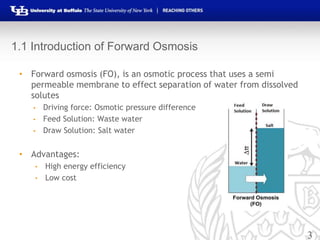
• Forward osmosis (FO), is an osmotic process that uses a semi
permeable membrane to effect separation of water from dissolved
solutes
• Driving force: Osmotic pressure difference
• Feed Solution: Waste water
• Draw Solution: Salt water
• Advantages:
• High energy efficiency
• Low cost
4
1.2 Introduction of FO Membrane
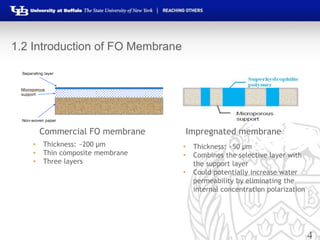
Commercial FO membrane Impregnated membrane
• Thickness: ~200 μm
• Thin composite membrane
• Three layers
• Thickness: ~50 μm
• Combines the selective layer with
the support layer
• Could potentially increase water
permeability by eliminating the
internal concentration polarization
5
1.3 Theoretical Models for Water Transport in Membranes
1. 𝐽 𝑊 = 𝐴 𝑊∆𝜋 =
𝑃 𝑊
𝑙
𝑉 𝑊
𝑅 𝑔 𝑇
(𝜋 𝐷 − 𝜋 𝐹)
𝐽 𝑊, water flux (L/m2 hour or LMH) 𝑉 𝑊, molar volume of water (18 cm3/mol)
𝐴 𝑊, water permeance (LMH/bar) 𝑅 𝑔, gas constant (83.1 cm3 bar/mol K)
∆𝜋, osmotic pressure difference across the membrane (bar) 𝑇, temperature (K)
𝑃 𝑊, water permeability (cm2/s)
𝑙, membrane thickness (cm)
2. 𝐽𝑆 = 𝐵 𝐶𝑆,𝐷 − 𝐶𝑆,𝐹 =
𝑃 𝑆
𝑙
(𝐶𝑆,𝐷 − 𝐶𝑆,𝐹)
𝐽𝑆, salt flux (g/m2 hour or gMH)
𝐵, salt permeance in the membrane (cm/s)
𝑃𝑆, salt permeability (cm2/s)
𝐶𝑆,𝐷, salt concentration in the draw solution (g/cm3)
𝐶𝑆,𝐹, salt concentration in the feed solution (g/cm3)
6
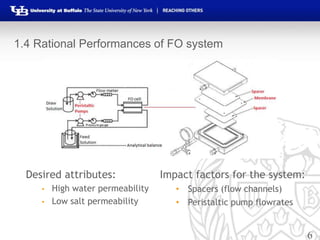
1.4 Rational Performances of FO system
Desired attributes:
• High water permeability
• Low salt permeability
Impact factors for the system:
• Spacers (flow channels)
• Peristaltic pump flowrates
7
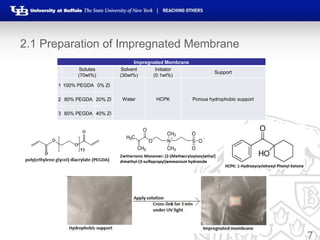
2.1 Preparation of Impregnated Membrane
Impregnated Membrane
Solutes
(70wt%)
Solvent
(30wt%)
Initiator
(0.1wt%)
Support
1 100% PEGDA 0% ZI
Water HCPK Porous hydrophobic support2 80% PEGDA 20% ZI
3 60% PEGDA 40% ZI
8
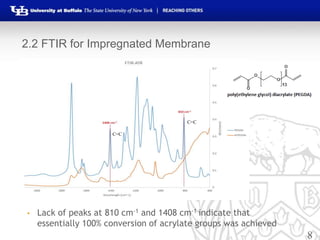
2.2 FTIR for Impregnated Membrane
• Lack of peaks at 810 cm-1 and 1408 cm-1 indicate that
essentially 100% conversion of acrylate groups was achieved
C=C
C=C
9
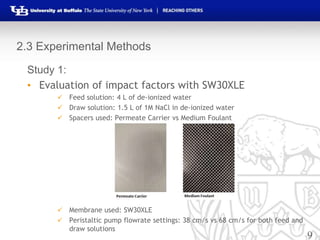
2.3 Experimental Methods
Study 1:
• Evaluation of impact factors with SW30XLE
 Feed solution: 4 L of de-ionized water
 Draw solution: 1.5 L of 1M NaCl in de-ionized water
 Spacers used: Permeate Carrier vs Medium Foulant
 Membrane used: SW30XLE
 Peristaltic pump flowrate settings: 38 cm/s vs 68 cm/s for both feed and
draw solutions
10
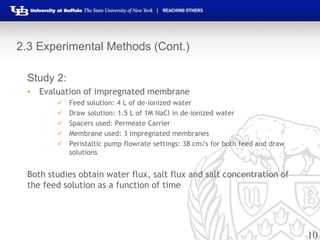
2.3 Experimental Methods (Cont.)
Study 2:
• Evaluation of impregnated membrane
 Feed solution: 4 L of de-ionized water
 Draw solution: 1.5 L of 1M NaCl in de-ionized water
 Spacers used: Permeate Carrier
 Membrane used: 3 impregnated membranes
 Peristaltic pump flowrate settings: 38 cm/s for both feed and draw
solutions
Both studies obtain water flux, salt flux and salt concentration of
the feed solution as a function of time
11
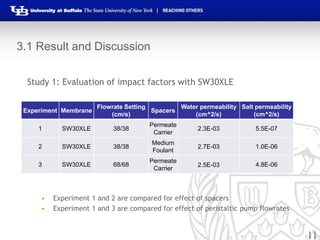
3.1 Result and Discussion
Study 1: Evaluation of impact factors with SW30XLE
• Experiment 1 and 2 are compared for effect of spacers
• Experiment 1 and 3 are compared for effect of peristaltic pump flowrates
Experiment Membrane
Flowrate Setting
(cm/s)
Spacers
Water permeability
(cm^2/s)
Salt permeability
(cm^2/s)
1 SW30XLE 38/38
Permeate
Carrier
2.3E-03 5.5E-07
2 SW30XLE 38/38
Medium
Foulant
2.7E-03 1.0E-06
3 SW30XLE 68/68
Permeate
Carrier
2.5E-03 4.8E-06
12
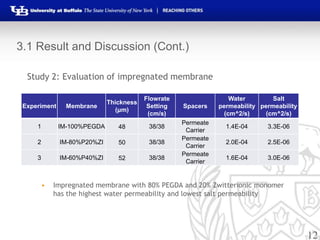
3.1 Result and Discussion (Cont.)
Study 2: Evaluation of impregnated membrane
• Impregnated membrane with 80% PEGDA and 20% Zwitterionic monomer
has the highest water permeability and lowest salt permeability
Experiment Membrane
Thickness
(μm)
Flowrate
Setting
(cm/s)
Spacers
Water
permeability
(cm^2/s)
Salt
permeability
(cm^2/s)
1 IM-100%PEGDA 48 38/38
Permeate
Carrier
1.4E-04 3.3E-06
2 IM-80%P20%ZI 50 38/38
Permeate
Carrier
2.0E-04 2.5E-06
3 IM-60%P40%ZI 52 38/38
Permeate
Carrier
1.6E-04 3.0E-06
13
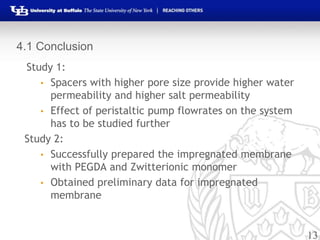
4.1 Conclusion
Study 1:
• Spacers with higher pore size provide higher water
permeability and higher salt permeability
• Effect of peristaltic pump flowrates on the system
has to be studied further
Study 2:
• Successfully prepared the impregnated membrane
with PEGDA and Zwitterionic monomer
• Obtained preliminary data for impregnated
membrane
Questions?

UndergradResearch_Presentation

  • 1.
    Forward Osmosis Membranesfor Water Purification Ken He Advisor: Dr. Haiqing Lin Mentor: Junyi Liu Department of Chemical and Biological Engineering SUNY at Buffalo 12/11/2015
  • 2.
    2 Outline 1. Introduction 2. ExperimentalWork 3. Result and Discussion 4. Conclusions
  • 3.
    3 1.1 Introduction ofForward Osmosis • Forward osmosis (FO), is an osmotic process that uses a semi permeable membrane to effect separation of water from dissolved solutes • Driving force: Osmotic pressure difference • Feed Solution: Waste water • Draw Solution: Salt water • Advantages: • High energy efficiency • Low cost
  • 4.
    4 1.2 Introduction ofFO Membrane Commercial FO membrane Impregnated membrane • Thickness: ~200 μm • Thin composite membrane • Three layers • Thickness: ~50 μm • Combines the selective layer with the support layer • Could potentially increase water permeability by eliminating the internal concentration polarization
  • 5.
    5 1.3 Theoretical Modelsfor Water Transport in Membranes 1. 𝐽 𝑊 = 𝐴 𝑊∆𝜋 = 𝑃 𝑊 𝑙 𝑉 𝑊 𝑅 𝑔 𝑇 (𝜋 𝐷 − 𝜋 𝐹) 𝐽 𝑊, water flux (L/m2 hour or LMH) 𝑉 𝑊, molar volume of water (18 cm3/mol) 𝐴 𝑊, water permeance (LMH/bar) 𝑅 𝑔, gas constant (83.1 cm3 bar/mol K) ∆𝜋, osmotic pressure difference across the membrane (bar) 𝑇, temperature (K) 𝑃 𝑊, water permeability (cm2/s) 𝑙, membrane thickness (cm) 2. 𝐽𝑆 = 𝐵 𝐶𝑆,𝐷 − 𝐶𝑆,𝐹 = 𝑃 𝑆 𝑙 (𝐶𝑆,𝐷 − 𝐶𝑆,𝐹) 𝐽𝑆, salt flux (g/m2 hour or gMH) 𝐵, salt permeance in the membrane (cm/s) 𝑃𝑆, salt permeability (cm2/s) 𝐶𝑆,𝐷, salt concentration in the draw solution (g/cm3) 𝐶𝑆,𝐹, salt concentration in the feed solution (g/cm3)
  • 6.
    6 1.4 Rational Performancesof FO system Desired attributes: • High water permeability • Low salt permeability Impact factors for the system: • Spacers (flow channels) • Peristaltic pump flowrates
  • 7.
    7 2.1 Preparation ofImpregnated Membrane Impregnated Membrane Solutes (70wt%) Solvent (30wt%) Initiator (0.1wt%) Support 1 100% PEGDA 0% ZI Water HCPK Porous hydrophobic support2 80% PEGDA 20% ZI 3 60% PEGDA 40% ZI
  • 8.
    8 2.2 FTIR forImpregnated Membrane • Lack of peaks at 810 cm-1 and 1408 cm-1 indicate that essentially 100% conversion of acrylate groups was achieved C=C C=C
  • 9.
    9 2.3 Experimental Methods Study1: • Evaluation of impact factors with SW30XLE  Feed solution: 4 L of de-ionized water  Draw solution: 1.5 L of 1M NaCl in de-ionized water  Spacers used: Permeate Carrier vs Medium Foulant  Membrane used: SW30XLE  Peristaltic pump flowrate settings: 38 cm/s vs 68 cm/s for both feed and draw solutions
  • 10.
    10 2.3 Experimental Methods(Cont.) Study 2: • Evaluation of impregnated membrane  Feed solution: 4 L of de-ionized water  Draw solution: 1.5 L of 1M NaCl in de-ionized water  Spacers used: Permeate Carrier  Membrane used: 3 impregnated membranes  Peristaltic pump flowrate settings: 38 cm/s for both feed and draw solutions Both studies obtain water flux, salt flux and salt concentration of the feed solution as a function of time
  • 11.
    11 3.1 Result andDiscussion Study 1: Evaluation of impact factors with SW30XLE • Experiment 1 and 2 are compared for effect of spacers • Experiment 1 and 3 are compared for effect of peristaltic pump flowrates Experiment Membrane Flowrate Setting (cm/s) Spacers Water permeability (cm^2/s) Salt permeability (cm^2/s) 1 SW30XLE 38/38 Permeate Carrier 2.3E-03 5.5E-07 2 SW30XLE 38/38 Medium Foulant 2.7E-03 1.0E-06 3 SW30XLE 68/68 Permeate Carrier 2.5E-03 4.8E-06
  • 12.
    12 3.1 Result andDiscussion (Cont.) Study 2: Evaluation of impregnated membrane • Impregnated membrane with 80% PEGDA and 20% Zwitterionic monomer has the highest water permeability and lowest salt permeability Experiment Membrane Thickness (μm) Flowrate Setting (cm/s) Spacers Water permeability (cm^2/s) Salt permeability (cm^2/s) 1 IM-100%PEGDA 48 38/38 Permeate Carrier 1.4E-04 3.3E-06 2 IM-80%P20%ZI 50 38/38 Permeate Carrier 2.0E-04 2.5E-06 3 IM-60%P40%ZI 52 38/38 Permeate Carrier 1.6E-04 3.0E-06
  • 13.
    13 4.1 Conclusion Study 1: •Spacers with higher pore size provide higher water permeability and higher salt permeability • Effect of peristaltic pump flowrates on the system has to be studied further Study 2: • Successfully prepared the impregnated membrane with PEGDA and Zwitterionic monomer • Obtained preliminary data for impregnated membrane
  • 14.