Kelvin Stott PhD
Pharma R&D Portfolio Strategy, Risk & Decision Consultant

March 2012


                                                        ©KelvinStott2012
Risk & uncertainty are closely related, but slightly
different concepts
Both risk and uncertainty are:
   Based on current lack of certainty in a potential
   fact, event, outcome, or scenario, etc.
   Defined by probabilities or probability distributions
   Include both upside and downside potential
   Subjective: they both depend on who knows what
Differences
   Unlike uncertainty, risk involves exposure to impact:
   potential consequences that matter to a subject
   Hence, risk is even more subjective: depends on how
   much the potential consequences matter, to whom
Definitions will follow, after more background…
                                                     ©KelvinStott2012
Known knowns (no risk/uncertainty)
   Facts, outcomes or scenarios that we know with absolute
   certainty, based on deterministic processes
Unknown knowns
   Certain facts that others know but we don’t
   Based on information asymmetry or poor communication
Known unknowns
   Potential facts, outcomes, scenarios that we are aware of,
   but don’t yet know with any certainty
   Based on stochastic processes and known probability laws
Unknown unknowns
   Potential facts, outcomes or scenarios that we are not yet
   aware of, have not even considered
   Often rare and extreme events or outliers (“black swans”),
   not considered due to lack of experience/imagination
                                                       ©KelvinStott2012
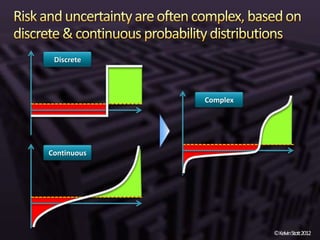
Discrete
   Based on uncertainty in discrete variables
   No intermediate outcomes or scenarios
   E.g., succeed/fail, true/false, event/no event, etc.
   Defined by discrete probabilities
Continuous
   Based on uncertainty in continuous variables
   Intermediate scenarios/outcomes are possible
   E.g., sales, costs, time, market share, etc.
   Defined by continuous probability distributions
Complex
   Combination of discrete & continuous uncertainty
   Most real-life cases fall into this category
                                                      ©KelvinStott2012
Discrete


             Complex


Continuous


                       ©KelvinStott2012
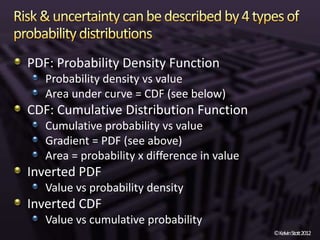
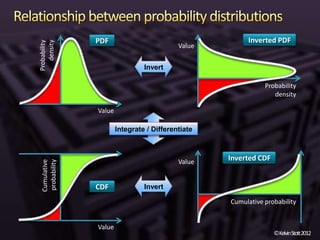
PDF: Probability Density Function
   Probability density vs value
   Area under curve = CDF (see below)
CDF: Cumulative Distribution Function
   Cumulative probability vs value
   Gradient = PDF (see above)
   Area = probability x difference in value
Inverted PDF
   Value vs probability density
Inverted CDF
   Value vs cumulative probability
                                              ©KelvinStott2012
PDF                                      Inverted PDF
   density
Probability                                Value


                                Invert

                                                              Probability
                                                                 density

               Value

                       Integrate / Differentiate


                                           Value   Inverted CDF
 Cumulative
 probability


               CDF              Invert

                                                   Cumulative probability


               Value
                                                                  ©KelvinStott2012
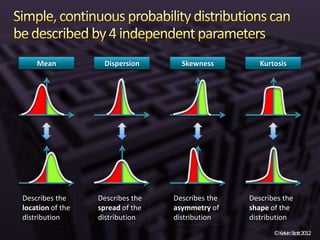
Mean           Dispersion       Skewness         Kurtosis


Describes the     Describes the   Describes the   Describes the
location of the   spread of the   asymmetry of    shape of the
distribution      distribution    distribution    distribution
                                                         ©KelvinStott2012
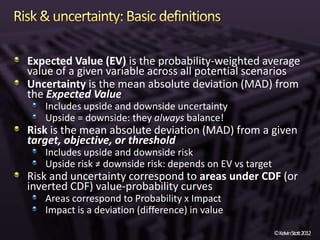
Expected Value (EV) is the probability-weighted average
value of a given variable across all potential scenarios
Uncertainty is the mean absolute deviation (MAD) from
the Expected Value
   Includes upside and downside uncertainty
   Upside = downside: they always balance!
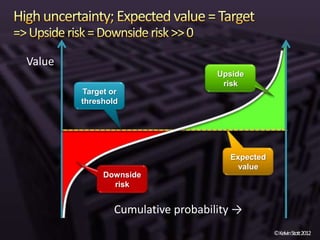
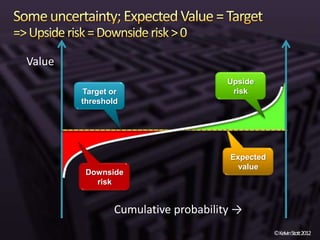
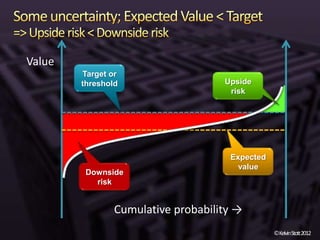
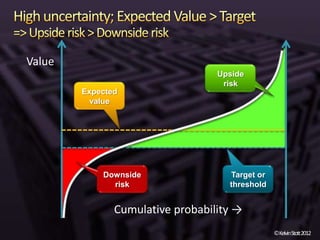
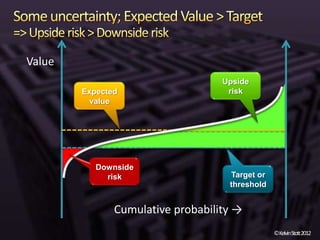
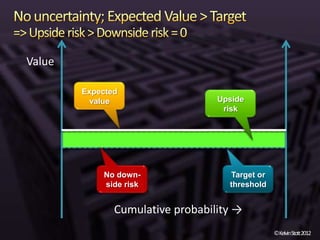
Risk is the mean absolute deviation (MAD) from a given
target, objective, or threshold
   Includes upside and downside risk
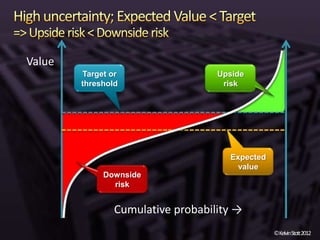
   Upside risk ≠ downside risk: depends on EV vs target
Risk and uncertainty correspond to areas under CDF (or
inverted CDF) value-probability curves
   Areas correspond to Probability x Impact
   Impact is a deviation (difference) in value

                                                          ©KelvinStott2012
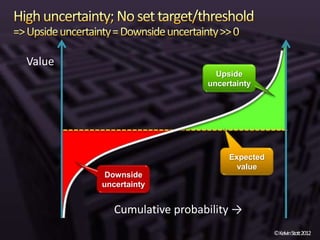
Value
                              Upside
                            uncertainty


                                 Expected
                                   value
         Downside
        uncertainty


           Cumulative probability →
                                            ©KelvinStott2012
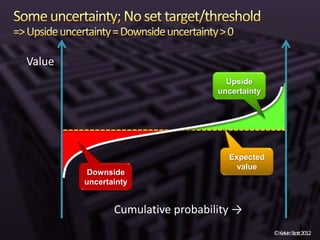
Value
                                    Upside
                                  uncertainty


                                    Expected
                                      value
         Downside
        uncertainty


               Cumulative probability →
                                                ©KelvinStott2012
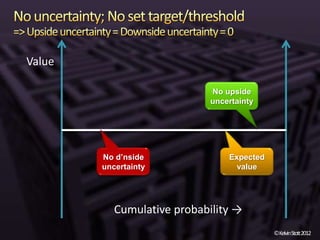
Value

                            No upside
                            uncertainty


        No d’nside              Expected
        uncertainty               value


           Cumulative probability →
                                           ©KelvinStott2012
Value
                                   Upside
                                    risk
        Target or
        threshold


                                     Expected
                                       value
             Downside
               risk


                Cumulative probability →
                                                ©KelvinStott2012
Value
                                     Upside
        Target or                     risk
        threshold


                                     Expected
                                       value
         Downside
           risk


                Cumulative probability →
                                                ©KelvinStott2012
Value

        Target or                 No upside
        threshold                    risk


             No down-                 Expected
             side risk                  value


                Cumulative probability →
                                                 ©KelvinStott2012
Value
        Target or                  Upside
        threshold                   risk


                                     Expected
                                       value
             Downside
               risk


                Cumulative probability →
                                                ©KelvinStott2012
Value
        Target or
        threshold                   Upside
                                     risk


                                     Expected
                                       value
         Downside
           risk


                Cumulative probability →
                                                ©KelvinStott2012
Value
        Target or                 No upside
        threshold                    risk


             Downside                 Expected
               risk                     value


                Cumulative probability →
                                                 ©KelvinStott2012
Value
                                  Upside
                                   risk
        Expected
          value


            Downside                Target or
              risk                  threshold


               Cumulative probability →
                                                ©KelvinStott2012
Value
                                   Upside
        Expected                    risk
          value


           Downside
             risk                   Target or
                                    threshold


               Cumulative probability →
                                                ©KelvinStott2012
Value

        Expected
          value                   Upside
                                   risk


            No down-                Target or
            side risk               threshold


               Cumulative probability →
                                                ©KelvinStott2012
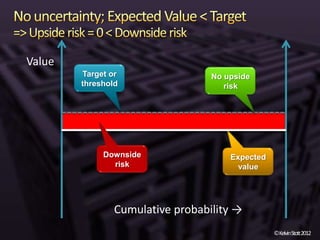
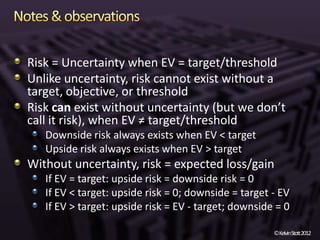
Risk = Uncertainty when EV = target/threshold
Unlike uncertainty, risk cannot exist without a
target, objective, or threshold
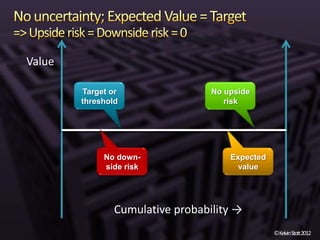
Risk can exist without uncertainty (but we don’t
call it risk), when EV ≠ target/threshold
   Downside risk always exists when EV < target
   Upside risk always exists when EV > target
Without uncertainty, risk = expected loss/gain
   If EV = target: upside risk = downside risk = 0
   If EV < target: upside risk = 0; downside = target - EV
   If EV > target: upside risk = EV - target; downside = 0

                                                      ©KelvinStott2012
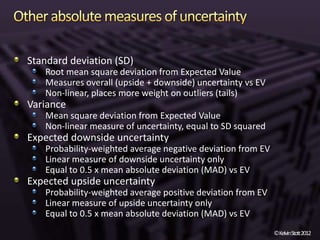
Standard deviation (SD)
   Root mean square deviation from Expected Value
   Measures overall (upside + downside) uncertainty vs EV
   Non-linear, places more weight on outliers (tails)
Variance
   Mean square deviation from Expected Value
   Non-linear measure of uncertainty, equal to SD squared
Expected downside uncertainty
   Probability-weighted average negative deviation from EV
   Linear measure of downside uncertainty only
   Equal to 0.5 x mean absolute deviation (MAD) vs EV
Expected upside uncertainty
   Probability-weighted average positive deviation from EV
   Linear measure of upside uncertainty only
   Equal to 0.5 x mean absolute deviation (MAD) vs EV
                                                             ©KelvinStott2012
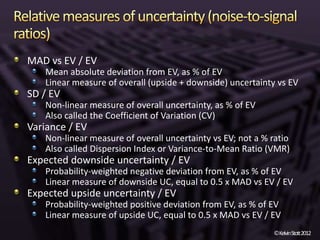
MAD vs EV / EV
   Mean absolute deviation from EV, as % of EV
   Linear measure of overall (upside + downside) uncertainty vs EV
SD / EV
   Non-linear measure of overall uncertainty, as % of EV
   Also called the Coefficient of Variation (CV)
Variance / EV
   Non-linear measure of overall uncertainty vs EV; not a % ratio
   Also called Dispersion Index or Variance-to-Mean Ratio (VMR)
Expected downside uncertainty / EV
   Probability-weighted negative deviation from EV, as % of EV
   Linear measure of downside UC, equal to 0.5 x MAD vs EV / EV
Expected upside uncertainty / EV
   Probability-weighted positive deviation from EV, as % of EV
   Linear measure of upside UC, equal to 0.5 x MAD vs EV / EV
                                                            ©KelvinStott2012
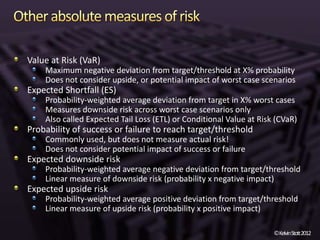
Value at Risk (VaR)
    Maximum negative deviation from target/threshold at X% probability
    Does not consider upside, or potential impact of worst case scenarios
Expected Shortfall (ES)
    Probability-weighted average deviation from target in X% worst cases
    Measures downside risk across worst case scenarios only
    Also called Expected Tail Loss (ETL) or Conditional Value at Risk (CVaR)
Probability of success or failure to reach target/threshold
    Commonly used, but does not measure actual risk!
    Does not consider potential impact of success or failure
Expected downside risk
    Probability-weighted average negative deviation from target/threshold
    Linear measure of downside risk (probability x negative impact)
Expected upside risk
    Probability-weighted average positive deviation from target/threshold
    Linear measure of upside risk (probability x positive impact)

                                                                     ©KelvinStott2012
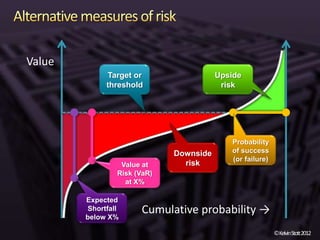
Value
             Target or                  Upside
             threshold                   risk


                                           Probability
                             Downside      of success
                                           (or failure)
                 Value at      risk
                Risk (VaR)
                  at X%

        Expected
        Shortfall
        below X%
                      Cumulative probability →
                                                          ©KelvinStott2012
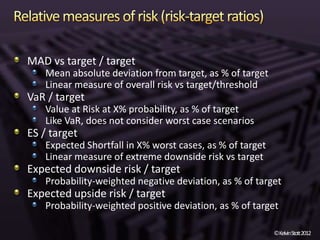
MAD vs target / target
   Mean absolute deviation from target, as % of target
   Linear measure of overall risk vs target/threshold
VaR / target
   Value at Risk at X% probability, as % of target
   Like VaR, does not consider worst case scenarios
ES / target
   Expected Shortfall in X% worst cases, as % of target
   Linear measure of extreme downside risk vs target
Expected downside risk / target
   Probability-weighted negative deviation, as % of target
Expected upside risk / target
   Probability-weighted positive deviation, as % of target

                                                          ©KelvinStott2012
Risk and uncertainty are based on lack of certainty
in a potential fact, event, outcome, or scenario
They include both upside & downside components
and are described by probability distributions
Uncertainty is measured relative to expected value
Risk is measured relative to a set
target/threshold, with potential consequences that
matter (impact)
They can be measured in many ways, but the best
measures are based on probability-weighted
average deviation in value (probability x
impact), corresponding to areas under a CDF curve
                                                ©KelvinStott2012
Think and reflect
Click a link to share this presentation
   Linkedin
   Google+
   Facebook
   Twitter
   E-mail
Visit or join our Linkedin discussion group
   Big Ideas in Pharma R&D Productivity & Project / Portfolio Mgt
Contact or connect with me
   kelvin.stott@gmail.com
   Kelvin Stott on Linkedin


                                                                    ©KelvinStott2012
kelvin.stott@gmail.com
www.linkedin.com/in/kelvinstott

                                  ©KelvinStott2012

Understanding Risk & Uncertainty

  • 1.
    Kelvin Stott PhD PharmaR&D Portfolio Strategy, Risk & Decision Consultant March 2012 ©KelvinStott2012
  • 2.
    Risk & uncertaintyare closely related, but slightly different concepts Both risk and uncertainty are: Based on current lack of certainty in a potential fact, event, outcome, or scenario, etc. Defined by probabilities or probability distributions Include both upside and downside potential Subjective: they both depend on who knows what Differences Unlike uncertainty, risk involves exposure to impact: potential consequences that matter to a subject Hence, risk is even more subjective: depends on how much the potential consequences matter, to whom Definitions will follow, after more background… ©KelvinStott2012
  • 3.
    Known knowns (norisk/uncertainty) Facts, outcomes or scenarios that we know with absolute certainty, based on deterministic processes Unknown knowns Certain facts that others know but we don’t Based on information asymmetry or poor communication Known unknowns Potential facts, outcomes, scenarios that we are aware of, but don’t yet know with any certainty Based on stochastic processes and known probability laws Unknown unknowns Potential facts, outcomes or scenarios that we are not yet aware of, have not even considered Often rare and extreme events or outliers (“black swans”), not considered due to lack of experience/imagination ©KelvinStott2012
  • 4.
    Discrete Based on uncertainty in discrete variables No intermediate outcomes or scenarios E.g., succeed/fail, true/false, event/no event, etc. Defined by discrete probabilities Continuous Based on uncertainty in continuous variables Intermediate scenarios/outcomes are possible E.g., sales, costs, time, market share, etc. Defined by continuous probability distributions Complex Combination of discrete & continuous uncertainty Most real-life cases fall into this category ©KelvinStott2012
  • 5.
    Discrete Complex Continuous ©KelvinStott2012
  • 6.
    PDF: Probability DensityFunction Probability density vs value Area under curve = CDF (see below) CDF: Cumulative Distribution Function Cumulative probability vs value Gradient = PDF (see above) Area = probability x difference in value Inverted PDF Value vs probability density Inverted CDF Value vs cumulative probability ©KelvinStott2012
  • 7.
    PDF Inverted PDF density Probability Value Invert Probability density Value Integrate / Differentiate Value Inverted CDF Cumulative probability CDF Invert Cumulative probability Value ©KelvinStott2012
  • 8.
    Mean Dispersion Skewness Kurtosis Describes the Describes the Describes the Describes the location of the spread of the asymmetry of shape of the distribution distribution distribution distribution ©KelvinStott2012
  • 9.
    Expected Value (EV)is the probability-weighted average value of a given variable across all potential scenarios Uncertainty is the mean absolute deviation (MAD) from the Expected Value Includes upside and downside uncertainty Upside = downside: they always balance! Risk is the mean absolute deviation (MAD) from a given target, objective, or threshold Includes upside and downside risk Upside risk ≠ downside risk: depends on EV vs target Risk and uncertainty correspond to areas under CDF (or inverted CDF) value-probability curves Areas correspond to Probability x Impact Impact is a deviation (difference) in value ©KelvinStott2012
  • 10.
    Value Upside uncertainty Expected value Downside uncertainty Cumulative probability → ©KelvinStott2012
  • 11.
    Value Upside uncertainty Expected value Downside uncertainty Cumulative probability → ©KelvinStott2012
  • 12.
    Value No upside uncertainty No d’nside Expected uncertainty value Cumulative probability → ©KelvinStott2012
  • 13.
    Value Upside risk Target or threshold Expected value Downside risk Cumulative probability → ©KelvinStott2012
  • 14.
    Value Upside Target or risk threshold Expected value Downside risk Cumulative probability → ©KelvinStott2012
  • 15.
    Value Target or No upside threshold risk No down- Expected side risk value Cumulative probability → ©KelvinStott2012
  • 16.
    Value Target or Upside threshold risk Expected value Downside risk Cumulative probability → ©KelvinStott2012
  • 17.
    Value Target or threshold Upside risk Expected value Downside risk Cumulative probability → ©KelvinStott2012
  • 18.
    Value Target or No upside threshold risk Downside Expected risk value Cumulative probability → ©KelvinStott2012
  • 19.
    Value Upside risk Expected value Downside Target or risk threshold Cumulative probability → ©KelvinStott2012
  • 20.
    Value Upside Expected risk value Downside risk Target or threshold Cumulative probability → ©KelvinStott2012
  • 21.
    Value Expected value Upside risk No down- Target or side risk threshold Cumulative probability → ©KelvinStott2012
  • 22.
    Risk = Uncertaintywhen EV = target/threshold Unlike uncertainty, risk cannot exist without a target, objective, or threshold Risk can exist without uncertainty (but we don’t call it risk), when EV ≠ target/threshold Downside risk always exists when EV < target Upside risk always exists when EV > target Without uncertainty, risk = expected loss/gain If EV = target: upside risk = downside risk = 0 If EV < target: upside risk = 0; downside = target - EV If EV > target: upside risk = EV - target; downside = 0 ©KelvinStott2012
  • 23.
    Standard deviation (SD) Root mean square deviation from Expected Value Measures overall (upside + downside) uncertainty vs EV Non-linear, places more weight on outliers (tails) Variance Mean square deviation from Expected Value Non-linear measure of uncertainty, equal to SD squared Expected downside uncertainty Probability-weighted average negative deviation from EV Linear measure of downside uncertainty only Equal to 0.5 x mean absolute deviation (MAD) vs EV Expected upside uncertainty Probability-weighted average positive deviation from EV Linear measure of upside uncertainty only Equal to 0.5 x mean absolute deviation (MAD) vs EV ©KelvinStott2012
  • 24.
    MAD vs EV/ EV Mean absolute deviation from EV, as % of EV Linear measure of overall (upside + downside) uncertainty vs EV SD / EV Non-linear measure of overall uncertainty, as % of EV Also called the Coefficient of Variation (CV) Variance / EV Non-linear measure of overall uncertainty vs EV; not a % ratio Also called Dispersion Index or Variance-to-Mean Ratio (VMR) Expected downside uncertainty / EV Probability-weighted negative deviation from EV, as % of EV Linear measure of downside UC, equal to 0.5 x MAD vs EV / EV Expected upside uncertainty / EV Probability-weighted positive deviation from EV, as % of EV Linear measure of upside UC, equal to 0.5 x MAD vs EV / EV ©KelvinStott2012
  • 25.
    Value at Risk(VaR) Maximum negative deviation from target/threshold at X% probability Does not consider upside, or potential impact of worst case scenarios Expected Shortfall (ES) Probability-weighted average deviation from target in X% worst cases Measures downside risk across worst case scenarios only Also called Expected Tail Loss (ETL) or Conditional Value at Risk (CVaR) Probability of success or failure to reach target/threshold Commonly used, but does not measure actual risk! Does not consider potential impact of success or failure Expected downside risk Probability-weighted average negative deviation from target/threshold Linear measure of downside risk (probability x negative impact) Expected upside risk Probability-weighted average positive deviation from target/threshold Linear measure of upside risk (probability x positive impact) ©KelvinStott2012
  • 26.
    Value Target or Upside threshold risk Probability Downside of success (or failure) Value at risk Risk (VaR) at X% Expected Shortfall below X% Cumulative probability → ©KelvinStott2012
  • 27.
    MAD vs target/ target Mean absolute deviation from target, as % of target Linear measure of overall risk vs target/threshold VaR / target Value at Risk at X% probability, as % of target Like VaR, does not consider worst case scenarios ES / target Expected Shortfall in X% worst cases, as % of target Linear measure of extreme downside risk vs target Expected downside risk / target Probability-weighted negative deviation, as % of target Expected upside risk / target Probability-weighted positive deviation, as % of target ©KelvinStott2012
  • 28.
    Risk and uncertaintyare based on lack of certainty in a potential fact, event, outcome, or scenario They include both upside & downside components and are described by probability distributions Uncertainty is measured relative to expected value Risk is measured relative to a set target/threshold, with potential consequences that matter (impact) They can be measured in many ways, but the best measures are based on probability-weighted average deviation in value (probability x impact), corresponding to areas under a CDF curve ©KelvinStott2012
  • 29.
    Think and reflect Clicka link to share this presentation Linkedin Google+ Facebook Twitter E-mail Visit or join our Linkedin discussion group Big Ideas in Pharma R&D Productivity & Project / Portfolio Mgt Contact or connect with me kelvin.stott@gmail.com Kelvin Stott on Linkedin ©KelvinStott2012
  • 30.