June 26, 2013June 26, 2013
Presented by Rob SchererPresented by Rob Scherer
Construction Financial ManagementConstruction Financial Management
““Boot Camp”Boot Camp”
Workshop #6Workshop #6
www.teamtag.net
TAG supports and strengthens your company’s accounting department
and management with outsourced bookkeeping, controller, and CFO
services.
Whether you are a CFO who could use a quality controller once a week,
a controller who needs bookkeeping assistance, or an office manager
looking for higher level finance and accounting oversight, TAG can fill
the need.
From sales to implementation, training to consulting, TAG’s team of
certified consultants work to improve your efficiency and reporting
capabilities with the best accounting software for the building industry.
TAG is an Authorized Reseller with a team of Certified Consultants for
Sage Timberline Office, Sage Master Builder and Contractor V.
Beyond the Numbers…Beyond the Numbers…
TAG provides valued financial and business resources &
counsel for companies and individuals on the move.
January 30, 2013 - Understanding Your Construction
Financial Statements
February 27, 2013 - Job Costing & Accounting
March 27, 2013 – Banking & Bonding Management
April 24, 2013 – Tracking your Field Production
May 29, 2013 – Best Practices in Construction
Accounting Software
June 26, 2013 – Construction Financial Management
Boot Camp
Purpose:Purpose:
The overall purpose of today’s workshop is a reviewThe overall purpose of today’s workshop is a review
and continuation of the overall role of theand continuation of the overall role of the
construction controller.construction controller.
Overall Role of a Controller:Overall Role of a Controller:
• Manage / Oversee the day-to-dayManage / Oversee the day-to-day
transactional activities within the accountingtransactional activities within the accounting
departmentdepartment
• Ensure accurate job and division levelEnsure accurate job and division level
costingcosting
• Produce accurate internal financialProduce accurate internal financial
statements / reporting for managementstatements / reporting for management
Overall Role of a Controller:Overall Role of a Controller:
• Collaborate with management in creating /Collaborate with management in creating /
producing regular management reporting andproducing regular management reporting and
forecastingforecasting
• Provide accounting / financial leadership andProvide accounting / financial leadership and
support in working with outside professionalssupport in working with outside professionals
of the companyof the company
• Collaborate with management in softwareCollaborate with management in software
and IT solutions for the companyand IT solutions for the company
Review: Construction Financial Management Statements:Review: Construction Financial Management Statements:
A Balance Sheet is a snapshot of the company’sA Balance Sheet is a snapshot of the company’s
Assets and Liabilities valued as of a specific date.Assets and Liabilities valued as of a specific date.
Current Assets
Cash
Accounts Receivable - Trade
Accounts Receivable - Retention
Costs in Excess of Billings (under billings)
Prepaid Expenses
Review: Construction Financial Management Statements:Review: Construction Financial Management Statements:
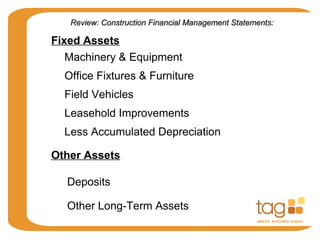
Fixed Assets
Machinery & Equipment
Office Fixtures & Furniture
Field Vehicles
Leasehold Improvements
Less Accumulated Depreciation
Other Assets
Deposits
Other Long-Term Assets
Review: Construction Financial Management Statements:Review: Construction Financial Management Statements:
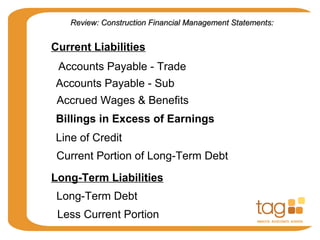
Current Liabilities
Accounts Payable - Trade
Accounts Payable - Sub
Accrued Wages & Benefits
Line of Credit
Current Portion of Long-Term Debt
Billings in Excess of Earnings
Long-Term Liabilities
Long-Term Debt
Less Current Portion
Review: Construction Financial Management Statements:Review: Construction Financial Management Statements:
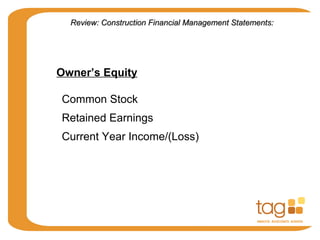
Owner’s Equity
Common Stock
Current Year Income/(Loss)
Retained Earnings
Review: Construction Financial Management Statements:Review: Construction Financial Management Statements:
An Income Statement provides a measure of the
operating performance of a company for some
particular period of time.
Review: Construction Financial Management Statements:Review: Construction Financial Management Statements:
Direct Job Costs - Material
Direct Job Costs - Labor
Direct Job Costs – Sub’s
Direct Job Costs - General
Direct Job Costs - Equipment
Indirect Field Costs
Billings and Revenue
General & Administrative
Other (Interest Income/Expenses)
Review: Construction Financial Management Statements:Review: Construction Financial Management Statements:
A Work in Progress is an overview of the
company’s job activity for the current fiscal year.
A Contractor’s WIP calculates the percentage
completion of each job, and provides the under-
and overbillings totals entered on the Balance
Sheet.
It should also reconcile to revenues and costs on
the income statement.
Review: How to use your WIP Report:Review: How to use your WIP Report:
4 Key Components:
•Current contract value (with change orders)
•Current estimated contract cost (with change
orders)
•Job-to-date costs
•Job-to-date billings
Basic Information From WIP
Costs & Earnings in Excess of Billings (Asset)
Billings in Excess of Costs & Earnings
(Liability)
Comparison of Open & Closed Jobs
Backlog of Work
Gross Profit Analysis by Job
Underbillings “Flag”
Comparison of Jobs by Location, Estimator,
Project Manager, Division, Type, etc.
Current Ratio
Gross Margin % Trends
Indirect Field Cost as a % of Overall Field Cost
Backlog in Months
Cash
Working Capital
Underbillings as compared to Overbillings
Key Performance Indicators
Review:Review:
Keys to Accounting:Keys to Accounting:
There are a few keys to accounting that can help toThere are a few keys to accounting that can help to
provide an accurate and relevant accounting systemprovide an accurate and relevant accounting system
such as:such as:
KISS (Keep it Simple Stupid!)KISS (Keep it Simple Stupid!)
Cash Is KingCash Is King
Billings are MoneyBillings are Money
Accounts Payable ProcessAccounts Payable Process
Payroll ProcessingPayroll Processing
Reconcile and ReviewReconcile and Review
KISS (Keep it Simple Stupid!)KISS (Keep it Simple Stupid!)::
There is no need to overcomplicate the process. If you don’tThere is no need to overcomplicate the process. If you don’t
understand how it’s working, you won’t understand what it’s tellingunderstand how it’s working, you won’t understand what it’s telling
you. Keeping this in mind may also keep the cost to produce theyou. Keeping this in mind may also keep the cost to produce the
information much more manageable. An inexpensive system suchinformation much more manageable. An inexpensive system such
as QuickBooks may accomplish the objective instead of a moreas QuickBooks may accomplish the objective instead of a more
powerful and expensive program.powerful and expensive program.
Cash is King:Cash is King:
Accounting for the money received and the money spent willAccounting for the money received and the money spent will
accomplish the major portion of the process. Reconciling the bankaccomplish the major portion of the process. Reconciling the bank
account activity to the accounting records on a monthly basis willaccount activity to the accounting records on a monthly basis will
help to ensure that all cash activity has been captured.help to ensure that all cash activity has been captured.
Billings are Money:Billings are Money:
Timely and accurate billing is the key step to creating cash. BillingTimely and accurate billing is the key step to creating cash. Billing
should be done on a regular basis and the collection ofshould be done on a regular basis and the collection of
those billings should be closely monitored.those billings should be closely monitored.
Accounts Payable Process:Accounts Payable Process:
Nobody likes to pay out money, however the worst part is payingNobody likes to pay out money, however the worst part is paying
bills you didn’t think you owed (like taxes). Payables that are notbills you didn’t think you owed (like taxes). Payables that are not
processed timely and accurately will result in: billings beingprocessed timely and accurately will result in: billings being
processed late; planning and budgeting will be useless; andprocessed late; planning and budgeting will be useless; and
unwanted surprises that persist.unwanted surprises that persist.
Payroll Processing:Payroll Processing:
Determine how payroll time will be collected, whetherDetermine how payroll time will be collected, whether
manually, using a time card or electronically, using variousmanually, using a time card or electronically, using various
mobile time collection technology.mobile time collection technology.
For accurate job costing, payroll must be entered with job andFor accurate job costing, payroll must be entered with job and
cost code detail. With this information you will be able to runcost code detail. With this information you will be able to run
various labor production reports.various labor production reports.
Reconcile and Review:Reconcile and Review:
Cash, investments, accounts receivable, accounts payable, creditCash, investments, accounts receivable, accounts payable, credit
card liabilities, and other significant balance sheet accounts shouldcard liabilities, and other significant balance sheet accounts should
be reconciled to a third party statement on a monthly basis. Thebe reconciled to a third party statement on a monthly basis. The
activity in these accounts and the overall financial statementsactivity in these accounts and the overall financial statements
should be reviewed on a monthly basis for reasonableness andshould be reviewed on a monthly basis for reasonableness and
used as a basis for planning and for making business decisions.used as a basis for planning and for making business decisions.
Collections & Cash ManagementCollections & Cash Management
Collections:Collections:
•To collect the $ that you are dueTo collect the $ that you are due
•Be aware of, and protect your ‘lien’ rightsBe aware of, and protect your ‘lien’ rights
Cash Management:Cash Management:
•Discuss the various issues which affect cash flowDiscuss the various issues which affect cash flow
•Ways which you can maximize and/or anticipate your cashWays which you can maximize and/or anticipate your cash
levels.levels.
Collections & Cash ManagementCollections & Cash Management
Contractor Payment RemediesContractor Payment Remedies
Ways for Contractors to Protect Payment Rights:Ways for Contractors to Protect Payment Rights:
A.A. Private WorksPrivate Works
• Mechanic’s lienMechanic’s lien
• Bonded stop noticeBonded stop notice
• Payment bondPayment bond
B. State & Local Public WorkB. State & Local Public Work
•Stop noticeStop notice
•Payment bondPayment bond
Collections Discussion:Collections Discussion:
•Set ground rulesSet ground rules
•Enforce your ‘lien’ rightsEnforce your ‘lien’ rights
•Be aware of your contract termsBe aware of your contract terms
•Focus on the first billing of each new projectFocus on the first billing of each new project
•Use your attorneyUse your attorney
•File a lien – even if you don’t have lien rightsFile a lien – even if you don’t have lien rights
•Follow-upFollow-up
•Make collections and cash a priorityMake collections and cash a priority
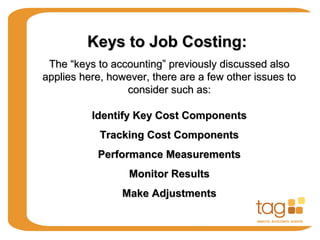
Keys to Job Costing:Keys to Job Costing:
The “keys to accounting” previously discussed alsoThe “keys to accounting” previously discussed also
applies here, however, there are a few other issues toapplies here, however, there are a few other issues to
consider such as:consider such as:
Identify Key Cost ComponentsIdentify Key Cost Components
Tracking Cost ComponentsTracking Cost Components
Performance MeasurementsPerformance Measurements
Monitor ResultsMonitor Results
Make AdjustmentsMake Adjustments
Identify Key Cost Components:Identify Key Cost Components:
Labor, materials, equipment, subcontractor costs are the typicalLabor, materials, equipment, subcontractor costs are the typical
components of job costs. Identify any other significant costs thatcomponents of job costs. Identify any other significant costs that
relate to your contract performance. These would typically be therelate to your contract performance. These would typically be the
same costs you estimate in the bid process.same costs you estimate in the bid process.
Tracking Cost Components:Tracking Cost Components:
Determine a method to track the costs by job keeping in mind theDetermine a method to track the costs by job keeping in mind the
keys to accounting discussed above. Consideration should be givenkeys to accounting discussed above. Consideration should be given
to the accounting system in place and its ability to generate and/orto the accounting system in place and its ability to generate and/or
track cost flows. Include bid and revised estimates within the jobtrack cost flows. Include bid and revised estimates within the job
cost system.cost system.
Performance Measurements:Performance Measurements:
When designing the system, consideration should be given toWhen designing the system, consideration should be given to
including performance criteria within the job cost system. Itemsincluding performance criteria within the job cost system. Items
such as pounds/yards, etc.; per man hours; material per squaresuch as pounds/yards, etc.; per man hours; material per square
foot, etc. These performance measurements may provide you withfoot, etc. These performance measurements may provide you with
additional information as to job performance outside the typical costadditional information as to job performance outside the typical cost
informationinformation..
Let’s review some common reports used to trackLet’s review some common reports used to track
Performance Measurements of the corePerformance Measurements of the core
components of Job Cost.components of Job Cost.
Monitor Results:Monitor Results:
Review the results on the job to assist in evaluating performance,Review the results on the job to assist in evaluating performance,
as well as assist in estimating future bids and making businessas well as assist in estimating future bids and making business
decisions.decisions.
Make Adjustments:Make Adjustments:
As the business and/or the jobs change, the job cost system mayAs the business and/or the jobs change, the job cost system may
need to be modified to meet the new changes. If you’re monitoringneed to be modified to meet the new changes. If you’re monitoring
the results on a regular basis, the adjustments needed should comethe results on a regular basis, the adjustments needed should come
to lightto light
Accounting & Job Costing-Accounting & Job Costing-
Rule of Thumb Strategy:Rule of Thumb Strategy:
1.1. Keep the accounting and job cost process simple.Keep the accounting and job cost process simple.
2.2. The information produced should be relevant andThe information produced should be relevant and
understandable.understandable.
3.3. Review and use the information to make individualsReview and use the information to make individuals
accountable and to make business decision.accountable and to make business decision.
4.4. Accounting and job costing are not the answers butAccounting and job costing are not the answers but
they can assist in getting you the answers.they can assist in getting you the answers.
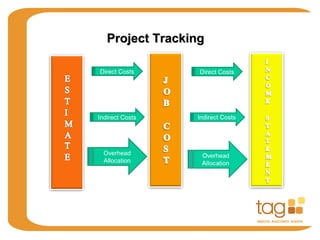
Project TrackingProject Tracking
Direct Costs
Indirect Costs
Direct Costs
Overhead
Allocation
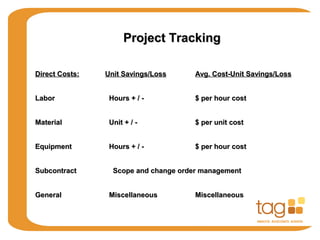
Project TrackingProject Tracking
Direct Costs:Direct Costs: Unit Savings/LossUnit Savings/Loss Avg. Cost-Unit Savings/LossAvg. Cost-Unit Savings/Loss
LaborLabor Hours + / -Hours + / - $ per hour cost$ per hour cost
MaterialMaterial Unit + / -Unit + / - $ per unit cost$ per unit cost
EquipmentEquipment Hours + / -Hours + / - $ per hour cost$ per hour cost
SubcontractSubcontract Scope and change order managementScope and change order management
GeneralGeneral MiscellaneousMiscellaneous MiscellaneousMiscellaneous
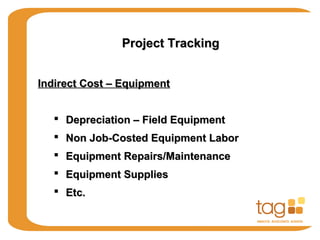
Project TrackingProject Tracking
Indirect Cost – EquipmentIndirect Cost – Equipment
 Depreciation – Field EquipmentDepreciation – Field Equipment
 Non Job-Costed Equipment LaborNon Job-Costed Equipment Labor
 Equipment Repairs/MaintenanceEquipment Repairs/Maintenance
 Equipment SuppliesEquipment Supplies
 Etc.Etc.
Project TrackingProject Tracking
Indirect Cost – LaborIndirect Cost – Labor
 Depreciation – Field VehiclesDepreciation – Field Vehicles
 Safety ExpenseSafety Expense
 Non Job-Costed Supervision PayrollNon Job-Costed Supervision Payroll
 Repairs/Maintenance – Field VehiclesRepairs/Maintenance – Field Vehicles
 Small ToolsSmall Tools
 Gas/Oil/Etc. – Field VehiclesGas/Oil/Etc. – Field Vehicles
 Cell Phones – Field PersonnelCell Phones – Field Personnel
 Etc.Etc.
Project TrackingProject Tracking
Indirect Cost – MaterialIndirect Cost – Material
 Depreciation – Shop EquipmentDepreciation – Shop Equipment
 Shop SuppliesShop Supplies
 Shop LaborShop Labor
 FreightFreight
 Small ToolsSmall Tools
 UtilitiesUtilities
 Etc.Etc.
Banking and BondingBanking and Bonding
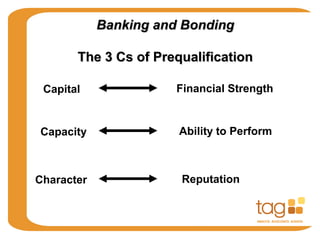
The 3 Cs of PrequalificationThe 3 Cs of Prequalification
Capital Financial Strength
Capacity Ability to Perform
Character Reputation
Financial StrengthFinancial Strength
• Detailed Financial
Statements
• Contract Schedules
• Accounting/Cost
Records
• Profitability Trends
• Cash Flow
Projections
• Credit References
• Bank Line of Credit
• Personal &
Corporate Assets
Capacity to PerformCapacity to Perform
• Track Record & History of Company
• Trade References
• Organizational Structure & Reporting
• Resumes of the Contractor & Key Personnel
• Tools & Equipment
• Business Continuation Plans
• Analysis of Past, Current & Future Projects
CharacterCharacter
Organizational and owner reputation for fair
Dealing with project owners, subcontractors,
suppliers, lenders and other creditors, as well
as general reputation within the industry.
Construction Accounting SoftwareConstruction Accounting Software
Key Components ConsiderationsKey Components Considerations
• EstimatingEstimating
– What level of detail do you need for your estimates?
– Do you need an Excel spreadsheet or a multi-tiered database?
– Are you bidding at a GC, subcontractor or mixed level?
– What type of work are you bidding? (e.g. Private, Public, Government)
– Do you need to keep track of historical data for future estimates?
• Project ManagementProject Management
– Do you need to track costs related to bidding and preconstruction?
– Do you need to track correspondence during the life of a bid and/or job?
– Do you need to track compliance items?
– What type of reporting is required by operations?
– Does operations need access to this information in the field?
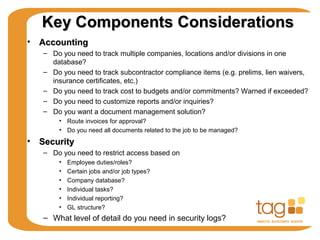
Key Components ConsiderationsKey Components Considerations
• AccountingAccounting
– Do you need to track multiple companies, locations and/or divisions in one
database?
– Do you need to track subcontractor compliance items (e.g. prelims, lien waivers,
insurance certificates, etc.)
– Do you need to track cost to budgets and/or commitments? Warned if exceeded?
– Do you need to customize reports and/or inquiries?
– Do you want a document management solution?
• Route invoices for approval?
• Do you need all documents related to the job to be managed?
• SecuritySecurity
– Do you need to restrict access based on
• Employee duties/roles?
• Certain jobs and/or job types?
• Company database?
• Individual tasks?
• Individual reporting?
• GL structure?
– What level of detail do you need in security logs?
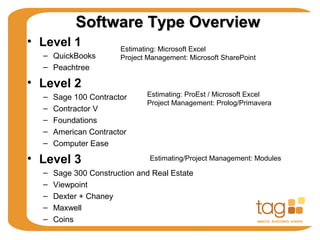
Software Type OverviewSoftware Type Overview
• Level 1
– QuickBooks
– Peachtree
• Level 2
– Sage 100 Contractor
– Contractor V
– Foundations
– American Contractor
– Computer Ease
• Level 3
– Sage 300 Construction and Real Estate
– Viewpoint
– Dexter + Chaney
– Maxwell
– Coins
Estimating: Microsoft Excel
Project Management: Microsoft SharePoint
Estimating: ProEst / Microsoft Excel
Project Management: Prolog/Primavera
Estimating/Project Management: Modules
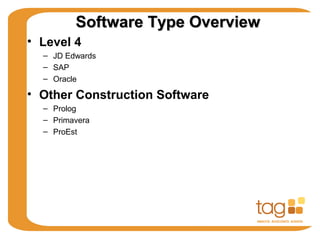
Software Type OverviewSoftware Type Overview
• Level 4
– JD Edwards
– SAP
– Oracle
• Other Construction Software
– Prolog
– Primavera
– ProEst
Q & A?

Construction Financial Management Boot Camp

  • 1.
    June 26, 2013June26, 2013 Presented by Rob SchererPresented by Rob Scherer Construction Financial ManagementConstruction Financial Management ““Boot Camp”Boot Camp” Workshop #6Workshop #6 www.teamtag.net
  • 2.
    TAG supports andstrengthens your company’s accounting department and management with outsourced bookkeeping, controller, and CFO services. Whether you are a CFO who could use a quality controller once a week, a controller who needs bookkeeping assistance, or an office manager looking for higher level finance and accounting oversight, TAG can fill the need. From sales to implementation, training to consulting, TAG’s team of certified consultants work to improve your efficiency and reporting capabilities with the best accounting software for the building industry. TAG is an Authorized Reseller with a team of Certified Consultants for Sage Timberline Office, Sage Master Builder and Contractor V. Beyond the Numbers…Beyond the Numbers… TAG provides valued financial and business resources & counsel for companies and individuals on the move.
  • 3.
    January 30, 2013- Understanding Your Construction Financial Statements February 27, 2013 - Job Costing & Accounting March 27, 2013 – Banking & Bonding Management April 24, 2013 – Tracking your Field Production May 29, 2013 – Best Practices in Construction Accounting Software June 26, 2013 – Construction Financial Management Boot Camp
  • 4.
    Purpose:Purpose: The overall purposeof today’s workshop is a reviewThe overall purpose of today’s workshop is a review and continuation of the overall role of theand continuation of the overall role of the construction controller.construction controller.
  • 5.
    Overall Role ofa Controller:Overall Role of a Controller: • Manage / Oversee the day-to-dayManage / Oversee the day-to-day transactional activities within the accountingtransactional activities within the accounting departmentdepartment • Ensure accurate job and division levelEnsure accurate job and division level costingcosting • Produce accurate internal financialProduce accurate internal financial statements / reporting for managementstatements / reporting for management
  • 6.
    Overall Role ofa Controller:Overall Role of a Controller: • Collaborate with management in creating /Collaborate with management in creating / producing regular management reporting andproducing regular management reporting and forecastingforecasting • Provide accounting / financial leadership andProvide accounting / financial leadership and support in working with outside professionalssupport in working with outside professionals of the companyof the company • Collaborate with management in softwareCollaborate with management in software and IT solutions for the companyand IT solutions for the company
  • 7.
    Review: Construction FinancialManagement Statements:Review: Construction Financial Management Statements: A Balance Sheet is a snapshot of the company’sA Balance Sheet is a snapshot of the company’s Assets and Liabilities valued as of a specific date.Assets and Liabilities valued as of a specific date.
  • 8.
    Current Assets Cash Accounts Receivable- Trade Accounts Receivable - Retention Costs in Excess of Billings (under billings) Prepaid Expenses Review: Construction Financial Management Statements:Review: Construction Financial Management Statements:
  • 9.
    Fixed Assets Machinery &Equipment Office Fixtures & Furniture Field Vehicles Leasehold Improvements Less Accumulated Depreciation Other Assets Deposits Other Long-Term Assets Review: Construction Financial Management Statements:Review: Construction Financial Management Statements:
  • 10.
    Current Liabilities Accounts Payable- Trade Accounts Payable - Sub Accrued Wages & Benefits Line of Credit Current Portion of Long-Term Debt Billings in Excess of Earnings Long-Term Liabilities Long-Term Debt Less Current Portion Review: Construction Financial Management Statements:Review: Construction Financial Management Statements:
  • 11.
    Owner’s Equity Common Stock CurrentYear Income/(Loss) Retained Earnings Review: Construction Financial Management Statements:Review: Construction Financial Management Statements:
  • 12.
    An Income Statementprovides a measure of the operating performance of a company for some particular period of time. Review: Construction Financial Management Statements:Review: Construction Financial Management Statements:
  • 13.
    Direct Job Costs- Material Direct Job Costs - Labor Direct Job Costs – Sub’s Direct Job Costs - General Direct Job Costs - Equipment Indirect Field Costs Billings and Revenue General & Administrative Other (Interest Income/Expenses) Review: Construction Financial Management Statements:Review: Construction Financial Management Statements:
  • 14.
    A Work inProgress is an overview of the company’s job activity for the current fiscal year. A Contractor’s WIP calculates the percentage completion of each job, and provides the under- and overbillings totals entered on the Balance Sheet. It should also reconcile to revenues and costs on the income statement. Review: How to use your WIP Report:Review: How to use your WIP Report:
  • 15.
    Review: How touse your WIP Report:Review: How to use your WIP Report: 4 Key Components: •Current contract value (with change orders) •Current estimated contract cost (with change orders) •Job-to-date costs •Job-to-date billings
  • 16.
    Basic Information FromWIP Costs & Earnings in Excess of Billings (Asset) Billings in Excess of Costs & Earnings (Liability) Comparison of Open & Closed Jobs Backlog of Work Gross Profit Analysis by Job Underbillings “Flag” Comparison of Jobs by Location, Estimator, Project Manager, Division, Type, etc.
  • 17.
    Current Ratio Gross Margin% Trends Indirect Field Cost as a % of Overall Field Cost Backlog in Months Cash Working Capital Underbillings as compared to Overbillings Key Performance Indicators
  • 18.
    Review:Review: Keys to Accounting:Keysto Accounting: There are a few keys to accounting that can help toThere are a few keys to accounting that can help to provide an accurate and relevant accounting systemprovide an accurate and relevant accounting system such as:such as: KISS (Keep it Simple Stupid!)KISS (Keep it Simple Stupid!) Cash Is KingCash Is King Billings are MoneyBillings are Money Accounts Payable ProcessAccounts Payable Process Payroll ProcessingPayroll Processing Reconcile and ReviewReconcile and Review
  • 19.
    KISS (Keep itSimple Stupid!)KISS (Keep it Simple Stupid!):: There is no need to overcomplicate the process. If you don’tThere is no need to overcomplicate the process. If you don’t understand how it’s working, you won’t understand what it’s tellingunderstand how it’s working, you won’t understand what it’s telling you. Keeping this in mind may also keep the cost to produce theyou. Keeping this in mind may also keep the cost to produce the information much more manageable. An inexpensive system suchinformation much more manageable. An inexpensive system such as QuickBooks may accomplish the objective instead of a moreas QuickBooks may accomplish the objective instead of a more powerful and expensive program.powerful and expensive program. Cash is King:Cash is King: Accounting for the money received and the money spent willAccounting for the money received and the money spent will accomplish the major portion of the process. Reconciling the bankaccomplish the major portion of the process. Reconciling the bank account activity to the accounting records on a monthly basis willaccount activity to the accounting records on a monthly basis will help to ensure that all cash activity has been captured.help to ensure that all cash activity has been captured.
  • 20.
    Billings are Money:Billingsare Money: Timely and accurate billing is the key step to creating cash. BillingTimely and accurate billing is the key step to creating cash. Billing should be done on a regular basis and the collection ofshould be done on a regular basis and the collection of those billings should be closely monitored.those billings should be closely monitored. Accounts Payable Process:Accounts Payable Process: Nobody likes to pay out money, however the worst part is payingNobody likes to pay out money, however the worst part is paying bills you didn’t think you owed (like taxes). Payables that are notbills you didn’t think you owed (like taxes). Payables that are not processed timely and accurately will result in: billings beingprocessed timely and accurately will result in: billings being processed late; planning and budgeting will be useless; andprocessed late; planning and budgeting will be useless; and unwanted surprises that persist.unwanted surprises that persist.
  • 21.
    Payroll Processing:Payroll Processing: Determinehow payroll time will be collected, whetherDetermine how payroll time will be collected, whether manually, using a time card or electronically, using variousmanually, using a time card or electronically, using various mobile time collection technology.mobile time collection technology. For accurate job costing, payroll must be entered with job andFor accurate job costing, payroll must be entered with job and cost code detail. With this information you will be able to runcost code detail. With this information you will be able to run various labor production reports.various labor production reports. Reconcile and Review:Reconcile and Review: Cash, investments, accounts receivable, accounts payable, creditCash, investments, accounts receivable, accounts payable, credit card liabilities, and other significant balance sheet accounts shouldcard liabilities, and other significant balance sheet accounts should be reconciled to a third party statement on a monthly basis. Thebe reconciled to a third party statement on a monthly basis. The activity in these accounts and the overall financial statementsactivity in these accounts and the overall financial statements should be reviewed on a monthly basis for reasonableness andshould be reviewed on a monthly basis for reasonableness and used as a basis for planning and for making business decisions.used as a basis for planning and for making business decisions.
  • 22.
    Collections & CashManagementCollections & Cash Management Collections:Collections: •To collect the $ that you are dueTo collect the $ that you are due •Be aware of, and protect your ‘lien’ rightsBe aware of, and protect your ‘lien’ rights Cash Management:Cash Management: •Discuss the various issues which affect cash flowDiscuss the various issues which affect cash flow •Ways which you can maximize and/or anticipate your cashWays which you can maximize and/or anticipate your cash levels.levels.
  • 23.
    Collections & CashManagementCollections & Cash Management Contractor Payment RemediesContractor Payment Remedies Ways for Contractors to Protect Payment Rights:Ways for Contractors to Protect Payment Rights: A.A. Private WorksPrivate Works • Mechanic’s lienMechanic’s lien • Bonded stop noticeBonded stop notice • Payment bondPayment bond B. State & Local Public WorkB. State & Local Public Work •Stop noticeStop notice •Payment bondPayment bond
  • 24.
    Collections Discussion:Collections Discussion: •Setground rulesSet ground rules •Enforce your ‘lien’ rightsEnforce your ‘lien’ rights •Be aware of your contract termsBe aware of your contract terms •Focus on the first billing of each new projectFocus on the first billing of each new project •Use your attorneyUse your attorney •File a lien – even if you don’t have lien rightsFile a lien – even if you don’t have lien rights •Follow-upFollow-up •Make collections and cash a priorityMake collections and cash a priority
  • 25.
    Keys to JobCosting:Keys to Job Costing: The “keys to accounting” previously discussed alsoThe “keys to accounting” previously discussed also applies here, however, there are a few other issues toapplies here, however, there are a few other issues to consider such as:consider such as: Identify Key Cost ComponentsIdentify Key Cost Components Tracking Cost ComponentsTracking Cost Components Performance MeasurementsPerformance Measurements Monitor ResultsMonitor Results Make AdjustmentsMake Adjustments
  • 26.
    Identify Key CostComponents:Identify Key Cost Components: Labor, materials, equipment, subcontractor costs are the typicalLabor, materials, equipment, subcontractor costs are the typical components of job costs. Identify any other significant costs thatcomponents of job costs. Identify any other significant costs that relate to your contract performance. These would typically be therelate to your contract performance. These would typically be the same costs you estimate in the bid process.same costs you estimate in the bid process. Tracking Cost Components:Tracking Cost Components: Determine a method to track the costs by job keeping in mind theDetermine a method to track the costs by job keeping in mind the keys to accounting discussed above. Consideration should be givenkeys to accounting discussed above. Consideration should be given to the accounting system in place and its ability to generate and/orto the accounting system in place and its ability to generate and/or track cost flows. Include bid and revised estimates within the jobtrack cost flows. Include bid and revised estimates within the job cost system.cost system.
  • 27.
    Performance Measurements:Performance Measurements: Whendesigning the system, consideration should be given toWhen designing the system, consideration should be given to including performance criteria within the job cost system. Itemsincluding performance criteria within the job cost system. Items such as pounds/yards, etc.; per man hours; material per squaresuch as pounds/yards, etc.; per man hours; material per square foot, etc. These performance measurements may provide you withfoot, etc. These performance measurements may provide you with additional information as to job performance outside the typical costadditional information as to job performance outside the typical cost informationinformation.. Let’s review some common reports used to trackLet’s review some common reports used to track Performance Measurements of the corePerformance Measurements of the core components of Job Cost.components of Job Cost.
  • 28.
    Monitor Results:Monitor Results: Reviewthe results on the job to assist in evaluating performance,Review the results on the job to assist in evaluating performance, as well as assist in estimating future bids and making businessas well as assist in estimating future bids and making business decisions.decisions. Make Adjustments:Make Adjustments: As the business and/or the jobs change, the job cost system mayAs the business and/or the jobs change, the job cost system may need to be modified to meet the new changes. If you’re monitoringneed to be modified to meet the new changes. If you’re monitoring the results on a regular basis, the adjustments needed should comethe results on a regular basis, the adjustments needed should come to lightto light
  • 29.
    Accounting & JobCosting-Accounting & Job Costing- Rule of Thumb Strategy:Rule of Thumb Strategy: 1.1. Keep the accounting and job cost process simple.Keep the accounting and job cost process simple. 2.2. The information produced should be relevant andThe information produced should be relevant and understandable.understandable. 3.3. Review and use the information to make individualsReview and use the information to make individuals accountable and to make business decision.accountable and to make business decision. 4.4. Accounting and job costing are not the answers butAccounting and job costing are not the answers but they can assist in getting you the answers.they can assist in getting you the answers.
  • 30.
    Project TrackingProject Tracking DirectCosts Indirect Costs Direct Costs Overhead Allocation
  • 31.
    Project TrackingProject Tracking DirectCosts:Direct Costs: Unit Savings/LossUnit Savings/Loss Avg. Cost-Unit Savings/LossAvg. Cost-Unit Savings/Loss LaborLabor Hours + / -Hours + / - $ per hour cost$ per hour cost MaterialMaterial Unit + / -Unit + / - $ per unit cost$ per unit cost EquipmentEquipment Hours + / -Hours + / - $ per hour cost$ per hour cost SubcontractSubcontract Scope and change order managementScope and change order management GeneralGeneral MiscellaneousMiscellaneous MiscellaneousMiscellaneous
  • 32.
    Project TrackingProject Tracking IndirectCost – EquipmentIndirect Cost – Equipment  Depreciation – Field EquipmentDepreciation – Field Equipment  Non Job-Costed Equipment LaborNon Job-Costed Equipment Labor  Equipment Repairs/MaintenanceEquipment Repairs/Maintenance  Equipment SuppliesEquipment Supplies  Etc.Etc.
  • 33.
    Project TrackingProject Tracking IndirectCost – LaborIndirect Cost – Labor  Depreciation – Field VehiclesDepreciation – Field Vehicles  Safety ExpenseSafety Expense  Non Job-Costed Supervision PayrollNon Job-Costed Supervision Payroll  Repairs/Maintenance – Field VehiclesRepairs/Maintenance – Field Vehicles  Small ToolsSmall Tools  Gas/Oil/Etc. – Field VehiclesGas/Oil/Etc. – Field Vehicles  Cell Phones – Field PersonnelCell Phones – Field Personnel  Etc.Etc.
  • 34.
    Project TrackingProject Tracking IndirectCost – MaterialIndirect Cost – Material  Depreciation – Shop EquipmentDepreciation – Shop Equipment  Shop SuppliesShop Supplies  Shop LaborShop Labor  FreightFreight  Small ToolsSmall Tools  UtilitiesUtilities  Etc.Etc.
  • 35.
    Banking and BondingBankingand Bonding The 3 Cs of PrequalificationThe 3 Cs of Prequalification Capital Financial Strength Capacity Ability to Perform Character Reputation
  • 36.
    Financial StrengthFinancial Strength •Detailed Financial Statements • Contract Schedules • Accounting/Cost Records • Profitability Trends • Cash Flow Projections • Credit References • Bank Line of Credit • Personal & Corporate Assets
  • 37.
    Capacity to PerformCapacityto Perform • Track Record & History of Company • Trade References • Organizational Structure & Reporting • Resumes of the Contractor & Key Personnel • Tools & Equipment • Business Continuation Plans • Analysis of Past, Current & Future Projects
  • 38.
    CharacterCharacter Organizational and ownerreputation for fair Dealing with project owners, subcontractors, suppliers, lenders and other creditors, as well as general reputation within the industry.
  • 39.
    Construction Accounting SoftwareConstructionAccounting Software Key Components ConsiderationsKey Components Considerations • EstimatingEstimating – What level of detail do you need for your estimates? – Do you need an Excel spreadsheet or a multi-tiered database? – Are you bidding at a GC, subcontractor or mixed level? – What type of work are you bidding? (e.g. Private, Public, Government) – Do you need to keep track of historical data for future estimates? • Project ManagementProject Management – Do you need to track costs related to bidding and preconstruction? – Do you need to track correspondence during the life of a bid and/or job? – Do you need to track compliance items? – What type of reporting is required by operations? – Does operations need access to this information in the field?
  • 40.
    Key Components ConsiderationsKeyComponents Considerations • AccountingAccounting – Do you need to track multiple companies, locations and/or divisions in one database? – Do you need to track subcontractor compliance items (e.g. prelims, lien waivers, insurance certificates, etc.) – Do you need to track cost to budgets and/or commitments? Warned if exceeded? – Do you need to customize reports and/or inquiries? – Do you want a document management solution? • Route invoices for approval? • Do you need all documents related to the job to be managed? • SecuritySecurity – Do you need to restrict access based on • Employee duties/roles? • Certain jobs and/or job types? • Company database? • Individual tasks? • Individual reporting? • GL structure? – What level of detail do you need in security logs?
  • 41.
    Software Type OverviewSoftwareType Overview • Level 1 – QuickBooks – Peachtree • Level 2 – Sage 100 Contractor – Contractor V – Foundations – American Contractor – Computer Ease • Level 3 – Sage 300 Construction and Real Estate – Viewpoint – Dexter + Chaney – Maxwell – Coins Estimating: Microsoft Excel Project Management: Microsoft SharePoint Estimating: ProEst / Microsoft Excel Project Management: Prolog/Primavera Estimating/Project Management: Modules
  • 42.
    Software Type OverviewSoftwareType Overview • Level 4 – JD Edwards – SAP – Oracle • Other Construction Software – Prolog – Primavera – ProEst
  • 43.