CHAPTER 6:
      INTEGRATING MARKETING
COMMUNICATIONS TO BUILD BRAND EQUITY


            Kevin Lane Keller
          Tuck School of Business
            Dartmouth College


                                    6.1
Overview
   Marketing communications are the means by which
    firms attempt to inform, persuade, and remind
    consumers—directly or indirectly—about the
    brands they sell.


                                        6.2
The New Media Environment
   Traditional advertising media such as TV, radio,
    magazines, and newspapers seem to be losing
    their grip on consumers.
   Marketers pour $18 billion into Internet
    advertising in 2005. While Web advertising
    jumped 20% during this time, spending for TV
    ads remained flat.


                                        6.3
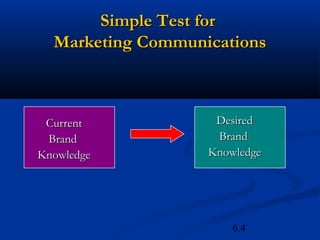
Simple Test for
  Marketing Communications


 Current            Desired
 Brand              Brand
Knowledge          Knowledge


                       6.4
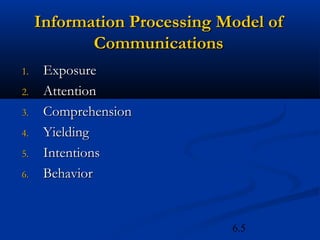
Information Processing Model of
            Communications
1.    Exposure
2.    Attention
3.    Comprehension
4.    Yielding
5.    Intentions
6.    Behavior


                             6.5
Marketing Communications Options
   Advertising
   Promotions
   Event marketing and sponsorship
   Public relations and publicity
   Personal selling


                                      6.6
Advertising
   A powerful means of creating strong, favorable,
    and unique brand associations and eliciting
    positive judgments and feelings
   Controversial because its specific effects are
    often difficult to quantify and predict
   Nevertheless, a number of studies using very
    different approaches have shown the potential
    power of advertising on brand sales.

                                       6.7
Ideal Ad Campaign
The ideal ad campaign would ensure that:

1.   The right consumer is exposed to the right message at the right place and
     at the right time.
2.   The creative strategy for the advertising causes the consumer to notice and
     attend to the ad but does not distract from the intended message.
3.   The ad properly reflects the consumer’s level of understanding about the
     product and the brand.
4.   The ad correctly positions the brand in terms of desirable and deliverable
     points-of-difference and points-of-parity.
5.   The ad motivates consumers to consider purchase of the brand.
6.   The ad creates strong brand associations to all of these stored
     communication effects so that they can have an effect when consumers are
     considering making a purchase.


                                                            6.8
Category of Advertising
   Television
   Radio
   Print
   Direct response
   Interactive: websites, online ads
   Mobile marketing
   Place advertising:
       Billboards; movies, airlines, and lounges; product placement;
        and point-of-purchase advertising

                                                     6.9
Promotions
   Short-term incentives to encourage trial or usage of a
    product or service
   Marketers can target sales promotions at either the
    trade or end consumers
   Consumer promotions
       Consumer promotions are designed to change the choices,
        quantity, or timing of consumers’ product purchases.
   Trade promotions
       Trade promotions are often financial incentives or discounts
        given to retailers, distributors, and other members of the
        trade to stock, display, and in other ways facilitate the sale of
        a product.

                                                        6.10
Event Marketing and Sponsorship
   Event marketing is public sponsorship of events
    or activities related to sports, art, entertainment,
    or social causes.
   Event sponsorship provides a different kind of
    communication option for marketers. By
    becoming part of a special and personally
    relevant moment in consumers’ lives, sponsors
    can broaden and deepen their relationship with
    their target market.

                                          6.11
Public Relations and Publicity
   Public relations and publicity relate to a variety of
    programs and are designed to promote or
    protect a company’s image or its individual
    products.
   Buzz Marketing
       Occasionally, a product enters the market with little
        fanfare yet is still able to attract a strong customer
        base.


                                                6.12
Personal Selling
   Personal selling is face-to-face interaction with one or
    more prospective purchasers for the purpose of making
    sales
   The keys to better selling
       Rethink training
       Get everyone involved
       Inspire from the top
       Change the motivation
       Forge electronic links
       Talk to your customers
                                             6.13
Integrated Marketing Communications
               (IMC)
   The “voice” of the brand
   A means by which it can establish a dialogue and
    build relationships with consumers
   Allow marketers to inform, persuade, provide
    incentives, and remind consumers directly or
    indirectly
   Can contribute to brand equity by establishing
    the brand in memory and linking strong,
    favorable, and unique associations to it
                                        6.14
Developing IMC Programs
   Mixing communication options
     Evaluate all possible communication options
      available to create knowledge structures according
      to effectiveness criteria as well as cost considerations.
     Different communication options have different
      strengths and can accomplish different objectives.
     Determine the optimal mix


                                                6.15
Evaluating IMC Programs
   Coverage: What proportion of the target audience
    is reached by each communication option
    employed? How much overlap exists among
    options?
   Cost: What is the per capita expense?


                                        6.16
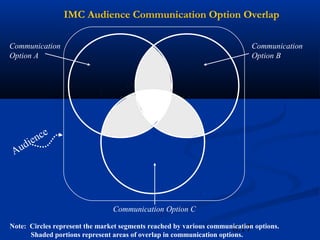
IMC Audience Communication Option Overlap

Communication                                                               Communication
Option A                                                                    Option B


       ie nce
 Aud


                                Communication Option C

                                                                      6.17
Note: Circles represent the market segments reached by various communication options.
      Shaded portions represent areas of overlap in communication options.
Evaluating IMC Programs (cont.)
   Contribution: The collective effect on brand equity
    in terms of
       enhancing depth and breadth of awareness
       improving strength, favorability, and uniqueness of
        brand associations
   Commonality: The extent to which information
    conveyed by different communication options
    share meaning
                                              6.18
Evaluating IMC Programs (cont.)
   Complementarity: The extent to which different
    associations and linkages are emphasized across
    communication options
   Versatility: The extent to which information
    contained in a communication option works
    with different types of consumers
        Different communications history
        Different market segments


                                            6.19
Marketing Communication Guidelines
   Be analytical: Use frameworks of consumer
    behavior and managerial decision making to
    develop well-reasoned communication programs
   Be curious: Fully understand consumers by using
    all forms of research and always be thinking of
    how you can create added value for consumers
   Be single-minded: Focus message on well-defined
    target markets (less can be more)
   Be integrative: Reinforce your message through
    consistency and cuing across all communications

                                       6.20
Marketing Communication Guidelines
             (Cont.)
   Be creative: State your message in a unique fashion;
    use alternative promotions and media to create
    favorable, strong, and unique brand associations
   Be observant: Monitor competition, customers,
    channel members, and employees through tracking
    studies
   Be realistic: Understand the complexities involved
    in marketing communications
   Be patient: Take a long-term view of communi-
    cation effectiveness to build and manage brand
    equity
                                          6.21

Keller sbm3 06

  • 1.
    CHAPTER 6: INTEGRATING MARKETING COMMUNICATIONS TO BUILD BRAND EQUITY Kevin Lane Keller Tuck School of Business Dartmouth College 6.1
  • 2.
    Overview  Marketing communications are the means by which firms attempt to inform, persuade, and remind consumers—directly or indirectly—about the brands they sell. 6.2
  • 3.
    The New MediaEnvironment  Traditional advertising media such as TV, radio, magazines, and newspapers seem to be losing their grip on consumers.  Marketers pour $18 billion into Internet advertising in 2005. While Web advertising jumped 20% during this time, spending for TV ads remained flat. 6.3
  • 4.
    Simple Test for Marketing Communications Current Desired Brand Brand Knowledge Knowledge 6.4
  • 5.
    Information Processing Modelof Communications 1. Exposure 2. Attention 3. Comprehension 4. Yielding 5. Intentions 6. Behavior 6.5
  • 6.
    Marketing Communications Options  Advertising  Promotions  Event marketing and sponsorship  Public relations and publicity  Personal selling 6.6
  • 7.
    Advertising  A powerful means of creating strong, favorable, and unique brand associations and eliciting positive judgments and feelings  Controversial because its specific effects are often difficult to quantify and predict  Nevertheless, a number of studies using very different approaches have shown the potential power of advertising on brand sales. 6.7
  • 8.
    Ideal Ad Campaign Theideal ad campaign would ensure that: 1. The right consumer is exposed to the right message at the right place and at the right time. 2. The creative strategy for the advertising causes the consumer to notice and attend to the ad but does not distract from the intended message. 3. The ad properly reflects the consumer’s level of understanding about the product and the brand. 4. The ad correctly positions the brand in terms of desirable and deliverable points-of-difference and points-of-parity. 5. The ad motivates consumers to consider purchase of the brand. 6. The ad creates strong brand associations to all of these stored communication effects so that they can have an effect when consumers are considering making a purchase. 6.8
  • 9.
    Category of Advertising  Television  Radio  Print  Direct response  Interactive: websites, online ads  Mobile marketing  Place advertising:  Billboards; movies, airlines, and lounges; product placement; and point-of-purchase advertising 6.9
  • 10.
    Promotions  Short-term incentives to encourage trial or usage of a product or service  Marketers can target sales promotions at either the trade or end consumers  Consumer promotions  Consumer promotions are designed to change the choices, quantity, or timing of consumers’ product purchases.  Trade promotions  Trade promotions are often financial incentives or discounts given to retailers, distributors, and other members of the trade to stock, display, and in other ways facilitate the sale of a product. 6.10
  • 11.
    Event Marketing andSponsorship  Event marketing is public sponsorship of events or activities related to sports, art, entertainment, or social causes.  Event sponsorship provides a different kind of communication option for marketers. By becoming part of a special and personally relevant moment in consumers’ lives, sponsors can broaden and deepen their relationship with their target market. 6.11
  • 12.
    Public Relations andPublicity  Public relations and publicity relate to a variety of programs and are designed to promote or protect a company’s image or its individual products.  Buzz Marketing  Occasionally, a product enters the market with little fanfare yet is still able to attract a strong customer base. 6.12
  • 13.
    Personal Selling  Personal selling is face-to-face interaction with one or more prospective purchasers for the purpose of making sales  The keys to better selling  Rethink training  Get everyone involved  Inspire from the top  Change the motivation  Forge electronic links  Talk to your customers 6.13
  • 14.
    Integrated Marketing Communications (IMC)  The “voice” of the brand  A means by which it can establish a dialogue and build relationships with consumers  Allow marketers to inform, persuade, provide incentives, and remind consumers directly or indirectly  Can contribute to brand equity by establishing the brand in memory and linking strong, favorable, and unique associations to it 6.14
  • 15.
    Developing IMC Programs  Mixing communication options  Evaluate all possible communication options available to create knowledge structures according to effectiveness criteria as well as cost considerations.  Different communication options have different strengths and can accomplish different objectives.  Determine the optimal mix 6.15
  • 16.
    Evaluating IMC Programs  Coverage: What proportion of the target audience is reached by each communication option employed? How much overlap exists among options?  Cost: What is the per capita expense? 6.16
  • 17.
    IMC Audience CommunicationOption Overlap Communication Communication Option A Option B ie nce Aud Communication Option C 6.17 Note: Circles represent the market segments reached by various communication options. Shaded portions represent areas of overlap in communication options.
  • 18.
    Evaluating IMC Programs(cont.)  Contribution: The collective effect on brand equity in terms of  enhancing depth and breadth of awareness  improving strength, favorability, and uniqueness of brand associations  Commonality: The extent to which information conveyed by different communication options share meaning 6.18
  • 19.
    Evaluating IMC Programs(cont.)  Complementarity: The extent to which different associations and linkages are emphasized across communication options  Versatility: The extent to which information contained in a communication option works with different types of consumers  Different communications history  Different market segments 6.19
  • 20.
    Marketing Communication Guidelines  Be analytical: Use frameworks of consumer behavior and managerial decision making to develop well-reasoned communication programs  Be curious: Fully understand consumers by using all forms of research and always be thinking of how you can create added value for consumers  Be single-minded: Focus message on well-defined target markets (less can be more)  Be integrative: Reinforce your message through consistency and cuing across all communications 6.20
  • 21.
    Marketing Communication Guidelines (Cont.)  Be creative: State your message in a unique fashion; use alternative promotions and media to create favorable, strong, and unique brand associations  Be observant: Monitor competition, customers, channel members, and employees through tracking studies  Be realistic: Understand the complexities involved in marketing communications  Be patient: Take a long-term view of communi- cation effectiveness to build and manage brand equity 6.21

Editor's Notes