Tectonic event / location: Kashmir Earthquake, Pakistan, 10/8/05

         Level of development                                Associated hazards
                                               Landslide
Pakistan – LEDC                                Rockfall
India - NIC                                    Seiches
                                               (A seiche is the sloshing of a closed body of water
                                               from earthquake shaking, e.g lake, swimming pool)

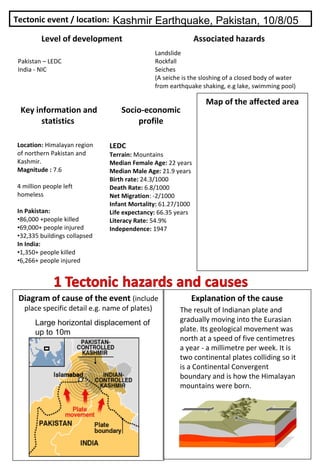
                                                                 Map of the affected area
 Key information and              Socio-economic
       statistics                     profile

Location: Himalayan region    LEDC
of northern Pakistan and      Terrain: Mountains
Kashmir.                      Median Female Age: 22 years
Magnitude : 7.6               Median Male Age: 21.9 years
                              Birth rate: 24.3/1000
4 million people left         Death Rate: 6.8/1000
homeless                      Net Migration: -2/1000
                              Infant Mortality: 61.27/1000
In Pakistan:                  Life expectancy: 66.35 years
•86,000 +people killed        Literacy Rate: 54.9%
•69,000+ people injured       Independence: 1947
•32,335 buildings collapsed
In India:
•1,350+ people killed
•6,266+ people injured


 Diagram of cause of the event (include                     Explanation of the cause
  place specific detail e.g. name of plates)            The result of Indianan plate and
      Large horizontal displacement of                  gradually moving into the Eurasian
      up to 10m                                         plate. Its geological movement was
                                                        north at a speed of five centimetres
                                                        a year - a millimetre per week. It is
                                                        two continental plates colliding so it
                                                        is a Continental Convergent
                                                        boundary and is how the Himalayan
                                                        mountains were born.
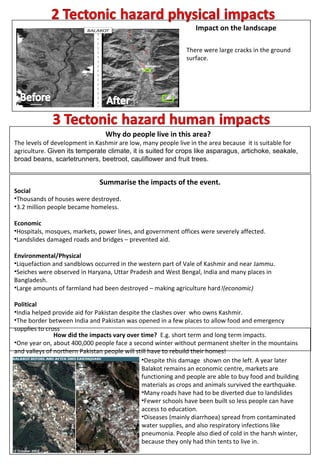
Impact on the landscape

                                                              There were large cracks in the ground
                                                              surface.


                                 Why do people live in this area?
The levels of development in Kashmir are low, many people live in the area because it is suitable for
agriculture. Given its temperate climate, it is suited for crops like asparagus, artichoke, seakale,
broad beans, scarletrunners, beetroot, cauliflower and fruit trees.


                              Summarise the impacts of the event.
Social
•Thousands of houses were destroyed.
•3.2 million people became homeless.

Economic
•Hospitals, mosques, markets, power lines, and government offices were severely affected.
•Landslides damaged roads and bridges – prevented aid.

Environmental/Physical
•Liquefaction and sandblows occurred in the western part of Vale of Kashmir and near Jammu.
•Seiches were observed in Haryana, Uttar Pradesh and West Bengal, India and many places in
Bangladesh.
•Large amounts of farmland had been destroyed – making agriculture hard!(economic)

Political
•India helped provide aid for Pakistan despite the clashes over who owns Kashmir.
•The border between India and Pakistan was opened in a few places to allow food and emergency
supplies to cross
               How did the impacts vary over time? E.g. short term and long term impacts.
•One year on, about 400,000 people face a second winter without permanent shelter in the mountains
and valleys of northern Pakistan people will still have to rebuild their homes!
                                               •Despite this damage shown on the left. A year later
                                               Balakot remains an economic centre, markets are
                                               functioning and people are able to buy food and building
                                               materials as crops and animals survived the earthquake.
                                               •Many roads have had to be diverted due to landslides
                                               •Fewer schools have been built so less people can have
                                               access to education.
                                               •Diseases (mainly diarrhoea) spread from contaminated
                                               water supplies, and also respiratory infections like
                                               pneumonia. People also died of cold in the harsh winter,
                                               because they only had thin tents to live in.
What are the different ways people have attempted to cope...?
      Before the event                       During the event                      After the event
•They did not do anything              •As Saturday is a normal school     •It took days before the army
before the event despite               day in the region, most students    would reach any cut-off areas
knowing the area was prone to          were at school Many were            but when they did they helped
earthquakes .                          buried under collapsed school       save trapped people.
•No governmental scheme or             buildings due to poor               •Without any shelter, infants
evacuation procedure was               infrastructure.                     and elders contracted
placed into action .                   •Local people started trying to     pneumonia when downpours
•Houses were concrete, wood            rescue those who were trapped.      soaked their bedding.
and corrugated iron.                                                       •The Pakistani government and
•High density of buildings and                                             the UN are encouraging people
people in all towns and villages.                                          to rebuild their homes so they
                                                                           are more resistant to
                                                                           earthquakes
                                                                           •Living in temporary tents and
                                                                           shelters.
                                                                           •Live of aid from foreign
                                                                           countries.
                                                                           •Foreign aid provided medical
                                                                           care to help look after the
                                                                           injured.
                                    Analyse the response to the event


Immediate responses to the event were local people trying to rescue those who were trapped. Political
matters were put aside as the borders between India and Pakistan were opened to allow the Indian Red
cross to distribute 21 500 blankets, 300 kitchen sets, and medical supplies but also to allow food
through. The army and emergency services arrived to help dig people out. Helicopters from the military
were used to take the injured to first aid centres on flatter ground. Tents were given out by charities like
Muslim Aid and the Pakistani and Indian armies. Pakistan Airways carried emergency food and supplies
from other countries for free. Military hospitals were opened for civilian casualties. Rescue and medical
teams arrived from other countries (e.g.Russia and the UK) to try to find survivors and treat the injured.
The longer term responses so the Recovery section, would have been the re-established water supplies
and the rebuilding of homes. They will also have to rebuild schools and train teachers to counsel the
children who are in shock. Sanitation will also need to be rebuilt, and building laws may be tightened so
that less damage is caused less time!


            Sources / References (e.g. textbooks, journals, documentary, internet)
http://news.bbc.co.uk/1/hi/world/south_asia/5392908.stm
A2 Phillip Allen Textbook
http://www.jugaa.com/new%20EERI%20File.pdf
http://www.cas.umt.edu/geography/documents/MRD_Hamilton_Halvorson_2007.pdf
http://fds.oup.com/www.oup.com/pdf/oxed/geog.GCSE_SB_01.pdf
http://www.himalayanclub.org/journal/the-great-himalayan-earthquakes/
http://www.youtube.com/watch?v=ZWThsBBMJlM
http://pre-drp.org/about-2/disaster-management-cycle

Kashmir earthquake 2005

  • 1.
    Tectonic event /location: Kashmir Earthquake, Pakistan, 10/8/05 Level of development Associated hazards Landslide Pakistan – LEDC Rockfall India - NIC Seiches (A seiche is the sloshing of a closed body of water from earthquake shaking, e.g lake, swimming pool) Map of the affected area Key information and Socio-economic statistics profile Location: Himalayan region LEDC of northern Pakistan and Terrain: Mountains Kashmir. Median Female Age: 22 years Magnitude : 7.6 Median Male Age: 21.9 years Birth rate: 24.3/1000 4 million people left Death Rate: 6.8/1000 homeless Net Migration: -2/1000 Infant Mortality: 61.27/1000 In Pakistan: Life expectancy: 66.35 years •86,000 +people killed Literacy Rate: 54.9% •69,000+ people injured Independence: 1947 •32,335 buildings collapsed In India: •1,350+ people killed •6,266+ people injured Diagram of cause of the event (include Explanation of the cause place specific detail e.g. name of plates) The result of Indianan plate and Large horizontal displacement of gradually moving into the Eurasian up to 10m plate. Its geological movement was north at a speed of five centimetres a year - a millimetre per week. It is two continental plates colliding so it is a Continental Convergent boundary and is how the Himalayan mountains were born.
  • 2.
    Impact on thelandscape There were large cracks in the ground surface. Why do people live in this area? The levels of development in Kashmir are low, many people live in the area because it is suitable for agriculture. Given its temperate climate, it is suited for crops like asparagus, artichoke, seakale, broad beans, scarletrunners, beetroot, cauliflower and fruit trees. Summarise the impacts of the event. Social •Thousands of houses were destroyed. •3.2 million people became homeless. Economic •Hospitals, mosques, markets, power lines, and government offices were severely affected. •Landslides damaged roads and bridges – prevented aid. Environmental/Physical •Liquefaction and sandblows occurred in the western part of Vale of Kashmir and near Jammu. •Seiches were observed in Haryana, Uttar Pradesh and West Bengal, India and many places in Bangladesh. •Large amounts of farmland had been destroyed – making agriculture hard!(economic) Political •India helped provide aid for Pakistan despite the clashes over who owns Kashmir. •The border between India and Pakistan was opened in a few places to allow food and emergency supplies to cross How did the impacts vary over time? E.g. short term and long term impacts. •One year on, about 400,000 people face a second winter without permanent shelter in the mountains and valleys of northern Pakistan people will still have to rebuild their homes! •Despite this damage shown on the left. A year later Balakot remains an economic centre, markets are functioning and people are able to buy food and building materials as crops and animals survived the earthquake. •Many roads have had to be diverted due to landslides •Fewer schools have been built so less people can have access to education. •Diseases (mainly diarrhoea) spread from contaminated water supplies, and also respiratory infections like pneumonia. People also died of cold in the harsh winter, because they only had thin tents to live in.
  • 3.
    What are thedifferent ways people have attempted to cope...? Before the event During the event After the event •They did not do anything •As Saturday is a normal school •It took days before the army before the event despite day in the region, most students would reach any cut-off areas knowing the area was prone to were at school Many were but when they did they helped earthquakes . buried under collapsed school save trapped people. •No governmental scheme or buildings due to poor •Without any shelter, infants evacuation procedure was infrastructure. and elders contracted placed into action . •Local people started trying to pneumonia when downpours •Houses were concrete, wood rescue those who were trapped. soaked their bedding. and corrugated iron. •The Pakistani government and •High density of buildings and the UN are encouraging people people in all towns and villages. to rebuild their homes so they are more resistant to earthquakes •Living in temporary tents and shelters. •Live of aid from foreign countries. •Foreign aid provided medical care to help look after the injured. Analyse the response to the event Immediate responses to the event were local people trying to rescue those who were trapped. Political matters were put aside as the borders between India and Pakistan were opened to allow the Indian Red cross to distribute 21 500 blankets, 300 kitchen sets, and medical supplies but also to allow food through. The army and emergency services arrived to help dig people out. Helicopters from the military were used to take the injured to first aid centres on flatter ground. Tents were given out by charities like Muslim Aid and the Pakistani and Indian armies. Pakistan Airways carried emergency food and supplies from other countries for free. Military hospitals were opened for civilian casualties. Rescue and medical teams arrived from other countries (e.g.Russia and the UK) to try to find survivors and treat the injured. The longer term responses so the Recovery section, would have been the re-established water supplies and the rebuilding of homes. They will also have to rebuild schools and train teachers to counsel the children who are in shock. Sanitation will also need to be rebuilt, and building laws may be tightened so that less damage is caused less time! Sources / References (e.g. textbooks, journals, documentary, internet) http://news.bbc.co.uk/1/hi/world/south_asia/5392908.stm A2 Phillip Allen Textbook http://www.jugaa.com/new%20EERI%20File.pdf http://www.cas.umt.edu/geography/documents/MRD_Hamilton_Halvorson_2007.pdf http://fds.oup.com/www.oup.com/pdf/oxed/geog.GCSE_SB_01.pdf http://www.himalayanclub.org/journal/the-great-himalayan-earthquakes/ http://www.youtube.com/watch?v=ZWThsBBMJlM http://pre-drp.org/about-2/disaster-management-cycle