1
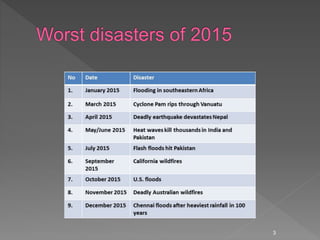
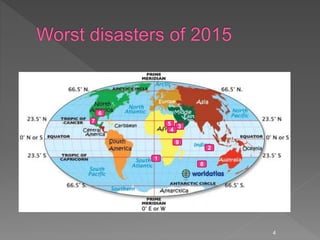
 Worst Disasters of 2015
 Nepal Earthquake
 About the Earthquake
 Causes of the Earthquake
 Impact of the Earthquake on the Country’s Economy
 Causalities
 Impact of the Earthquake on Heritage Sites
 Most Vulnerable Groups (Women, Aged and Children)
 Disaster Mitigation Response in Nepal
 Do’s and Don’ts during an Earthquake
 Role of citizens in handling the aftermath
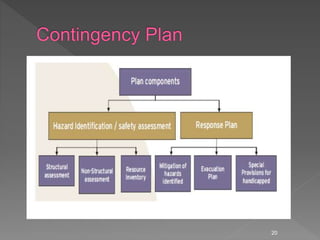
 Contingency Plan
 My Role in the Contingency Plan
2
3
4
1
2
3
4
5
6
7
8
9
5
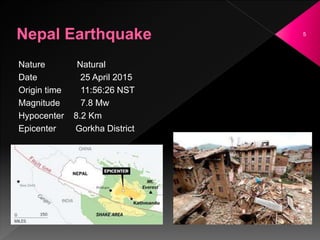
Nature Natural
Date 25 April 2015
Origin time 11:56:26 NST
Magnitude 7.8 Mw
Hypocenter 8.2 Km
Epicenter Gorkha District
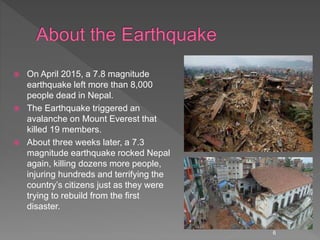
 On April 2015, a 7.8 magnitude
earthquake left more than 8,000
people dead in Nepal.
 The Earthquake triggered an
avalanche on Mount Everest that
killed 19 members.
 About three weeks later, a 7.3
magnitude earthquake rocked Nepal
again, killing dozens more people,
injuring hundreds and terrifying the
country’s citizens just as they were
trying to rebuild from the first
disaster.
6
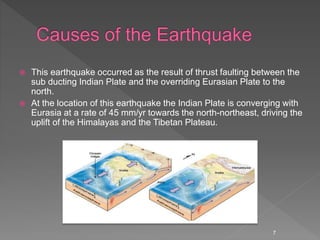
 This earthquake occurred as the result of thrust faulting between the
sub ducting Indian Plate and the overriding Eurasian Plate to the
north.
 At the location of this earthquake the Indian Plate is converging with
Eurasia at a rate of 45 mm/yr towards the north-northeast, driving the
uplift of the Himalayas and the Tibetan Plateau.
7
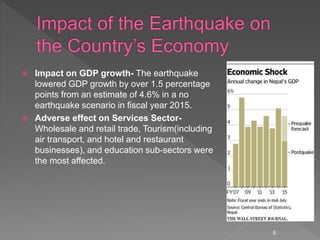
 Impact on GDP growth- The earthquake
lowered GDP growth by over 1.5 percentage
points from an estimate of 4.6% in a no
earthquake scenario in fiscal year 2015.
 Adverse effect on Services Sector-
Wholesale and retail trade, Tourism(including
air transport, and hotel and restaurant
businesses), and education sub-sectors were
the most affected.
8
 Impact on Per Capita Income, poverty-
› The income shock from the earthquake pushed an additional
700,000-982,000 people below the poverty line.
› The income shock felt through the loss of income- generating
opportunities and livelihoods including death and injuries to
primary wage earners and the loss of housing, productive
assets such as assorted household items.
› Multidimensional poverty due to affected water and sanitation
services, disruption of schools and health services, damaged
local infrastructure such as roads, bridges, health posts, and
schools for access to labor and commodity markets, and for
accumulation of human capital (especially those of children).
9
 Nepal- The earthquake killed more than 8,800 in Nepal and
injured nearly three times as many. The rural death toll may have
been minimized by the fact that most villagers were outdoors
working when the quake hit.
 India- A total of 78 deaths were reported in India - including 58 in
Bihar, 16 in Uttar Pradesh, 3 in West Bengal and 1 in Rajasthan.
 China- 27 dead and 4 missing, all from the Tibet Autonomous
Region.
 Bangladesh- 4 dead.
 Avalanches on Mount Everest- This earthquake
caused avalanches on Mount Everest. At least 19 died, with at
least 120 others injured or missing.[90]
10
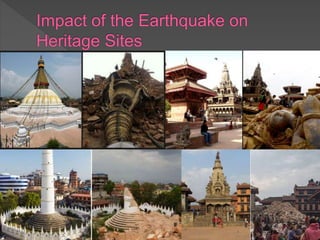
 Several of the churches in the Kathmandu valley were destroyed.
As Saturday is the principal day of Christian worship in Nepal, 500
people were reported to have died in the collapses.
 Several temples on Kathmandu Durbar Square, a UNESCO World
Heritage Site, collapsed, as did the Dharahara tower, built in 1832;
the collapse of the latter structure killed atleast 180
people, Manakamana Temple in Gorkha, previously damaged in
an earlier quake, tilted several inches further. The northern side
of Janaki Mandir in Janakpur was reported to have been, damaged.
Several temples, including Kasthamandap, Panchtale temple, the
top levels of the nine-story Basantapur Durbar, the Dasa Avtar
temple and two dewals located behind the Shiva Parvati temple
were demolished by the quake.
 Some other monuments including the Taleju Bhawani Temple
partially collapsed.
11
12
 Nearly 1 million children living in areas severely affected by the
earthquake and tremors in Nepal.
 Both women and babies were most susceptible to injuries. The
harsh living conditions that follow a disaster like this, with unsafe
food and insecure and temporary shelters, affect them
disproportionately, especially young children under-five.
 Many aged people are left alone to survive as their family and
houses have been destroyed in the disaster.
 After the April earthquake, it was reported that more Nepali women
and girls were being trafficked in promise of good jobs to the Middle
East.
13
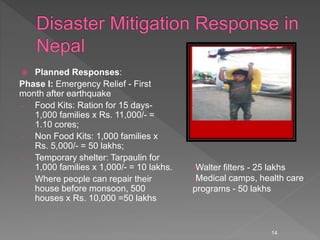
 Planned Responses:
Phase I: Emergency Relief - First
month after earthquake
- Food Kits: Ration for 15 days-
1,000 families x Rs. 11,000/- =
1.10 cores;
- Non Food Kits: 1,000 families x
Rs. 5,000/- = 50 lakhs;
- Temporary shelter: Tarpaulin for
1,000 families x 1,000/- = 10 lakhs.
- Where people can repair their
house before monsoon, 500
houses x Rs. 10,000 =50 lakhs
14
-Walter filters - 25 lakhs
-Medical camps, health care
programs - 50 lakhs
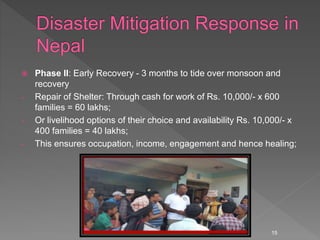
 Phase II: Early Recovery - 3 months to tide over monsoon and
recovery
- Repair of Shelter: Through cash for work of Rs. 10,000/- x 600
families = 60 lakhs;
- Or livelihood options of their choice and availability Rs. 10,000/- x
400 families = 40 lakhs;
- This ensures occupation, income, engagement and hence healing;
15
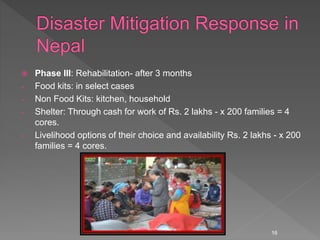
 Phase III: Rehabilitation- after 3 months
- Food kits: in select cases
- Non Food Kits: kitchen, household
- Shelter: Through cash for work of Rs. 2 lakhs - x 200 families = 4
cores.
- Livelihood options of their choice and availability Rs. 2 lakhs - x 200
families = 4 cores.
16
17
 Donate money, not stuff. Sending relief packages to disaster areas
results in piles of boxes that are impossible to sort through, and
usually don’t contain what they actually need. Do your research for
which aid organizations suit your needs: Doctors Without
Borders and the International Red Cross both have appeals to
donate directly to Nepal relief.
 Volunteer your time mapping the disaster areas. Good maps are
essential to disaster response, particularly for dealing with how to
get around after road damage.
 Be careful to spread good information.
18
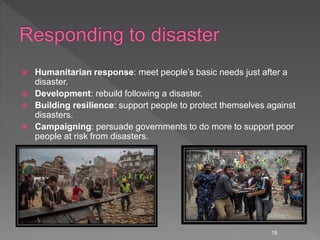
 Humanitarian response: meet people’s basic needs just after a
disaster.
 Development: rebuild following a disaster.
 Building resilience: support people to protect themselves against
disasters.
 Campaigning: persuade governments to do more to support poor
people at risk from disasters.
19
20
• Inform the authorities when disaster strikes
• Gather the people, try to keep them calm and start shifting
them to safer places
• Council people and prevent the spread of rumors
• Give special attention to children, women and elderly
• Help the medical staff to provide relief to the patients, and
report any diseases in the post-disaster period
• Report to police in case there is a tendency for any
disruption of law and order
• Help the local authorities in the distribution of relief
material
21

Nepal Earthquake - April 2015

  • 1.
  • 2.
     Worst Disastersof 2015  Nepal Earthquake  About the Earthquake  Causes of the Earthquake  Impact of the Earthquake on the Country’s Economy  Causalities  Impact of the Earthquake on Heritage Sites  Most Vulnerable Groups (Women, Aged and Children)  Disaster Mitigation Response in Nepal  Do’s and Don’ts during an Earthquake  Role of citizens in handling the aftermath  Contingency Plan  My Role in the Contingency Plan 2
  • 3.
  • 4.
  • 5.
    5 Nature Natural Date 25April 2015 Origin time 11:56:26 NST Magnitude 7.8 Mw Hypocenter 8.2 Km Epicenter Gorkha District
  • 6.
     On April2015, a 7.8 magnitude earthquake left more than 8,000 people dead in Nepal.  The Earthquake triggered an avalanche on Mount Everest that killed 19 members.  About three weeks later, a 7.3 magnitude earthquake rocked Nepal again, killing dozens more people, injuring hundreds and terrifying the country’s citizens just as they were trying to rebuild from the first disaster. 6
  • 7.
     This earthquakeoccurred as the result of thrust faulting between the sub ducting Indian Plate and the overriding Eurasian Plate to the north.  At the location of this earthquake the Indian Plate is converging with Eurasia at a rate of 45 mm/yr towards the north-northeast, driving the uplift of the Himalayas and the Tibetan Plateau. 7
  • 8.
     Impact onGDP growth- The earthquake lowered GDP growth by over 1.5 percentage points from an estimate of 4.6% in a no earthquake scenario in fiscal year 2015.  Adverse effect on Services Sector- Wholesale and retail trade, Tourism(including air transport, and hotel and restaurant businesses), and education sub-sectors were the most affected. 8
  • 9.
     Impact onPer Capita Income, poverty- › The income shock from the earthquake pushed an additional 700,000-982,000 people below the poverty line. › The income shock felt through the loss of income- generating opportunities and livelihoods including death and injuries to primary wage earners and the loss of housing, productive assets such as assorted household items. › Multidimensional poverty due to affected water and sanitation services, disruption of schools and health services, damaged local infrastructure such as roads, bridges, health posts, and schools for access to labor and commodity markets, and for accumulation of human capital (especially those of children). 9
  • 10.
     Nepal- Theearthquake killed more than 8,800 in Nepal and injured nearly three times as many. The rural death toll may have been minimized by the fact that most villagers were outdoors working when the quake hit.  India- A total of 78 deaths were reported in India - including 58 in Bihar, 16 in Uttar Pradesh, 3 in West Bengal and 1 in Rajasthan.  China- 27 dead and 4 missing, all from the Tibet Autonomous Region.  Bangladesh- 4 dead.  Avalanches on Mount Everest- This earthquake caused avalanches on Mount Everest. At least 19 died, with at least 120 others injured or missing.[90] 10
  • 11.
     Several ofthe churches in the Kathmandu valley were destroyed. As Saturday is the principal day of Christian worship in Nepal, 500 people were reported to have died in the collapses.  Several temples on Kathmandu Durbar Square, a UNESCO World Heritage Site, collapsed, as did the Dharahara tower, built in 1832; the collapse of the latter structure killed atleast 180 people, Manakamana Temple in Gorkha, previously damaged in an earlier quake, tilted several inches further. The northern side of Janaki Mandir in Janakpur was reported to have been, damaged. Several temples, including Kasthamandap, Panchtale temple, the top levels of the nine-story Basantapur Durbar, the Dasa Avtar temple and two dewals located behind the Shiva Parvati temple were demolished by the quake.  Some other monuments including the Taleju Bhawani Temple partially collapsed. 11
  • 12.
  • 13.
     Nearly 1million children living in areas severely affected by the earthquake and tremors in Nepal.  Both women and babies were most susceptible to injuries. The harsh living conditions that follow a disaster like this, with unsafe food and insecure and temporary shelters, affect them disproportionately, especially young children under-five.  Many aged people are left alone to survive as their family and houses have been destroyed in the disaster.  After the April earthquake, it was reported that more Nepali women and girls were being trafficked in promise of good jobs to the Middle East. 13
  • 14.
     Planned Responses: PhaseI: Emergency Relief - First month after earthquake - Food Kits: Ration for 15 days- 1,000 families x Rs. 11,000/- = 1.10 cores; - Non Food Kits: 1,000 families x Rs. 5,000/- = 50 lakhs; - Temporary shelter: Tarpaulin for 1,000 families x 1,000/- = 10 lakhs. - Where people can repair their house before monsoon, 500 houses x Rs. 10,000 =50 lakhs 14 -Walter filters - 25 lakhs -Medical camps, health care programs - 50 lakhs
  • 15.
     Phase II:Early Recovery - 3 months to tide over monsoon and recovery - Repair of Shelter: Through cash for work of Rs. 10,000/- x 600 families = 60 lakhs; - Or livelihood options of their choice and availability Rs. 10,000/- x 400 families = 40 lakhs; - This ensures occupation, income, engagement and hence healing; 15
  • 16.
     Phase III:Rehabilitation- after 3 months - Food kits: in select cases - Non Food Kits: kitchen, household - Shelter: Through cash for work of Rs. 2 lakhs - x 200 families = 4 cores. - Livelihood options of their choice and availability Rs. 2 lakhs - x 200 families = 4 cores. 16
  • 17.
  • 18.
     Donate money,not stuff. Sending relief packages to disaster areas results in piles of boxes that are impossible to sort through, and usually don’t contain what they actually need. Do your research for which aid organizations suit your needs: Doctors Without Borders and the International Red Cross both have appeals to donate directly to Nepal relief.  Volunteer your time mapping the disaster areas. Good maps are essential to disaster response, particularly for dealing with how to get around after road damage.  Be careful to spread good information. 18
  • 19.
     Humanitarian response:meet people’s basic needs just after a disaster.  Development: rebuild following a disaster.  Building resilience: support people to protect themselves against disasters.  Campaigning: persuade governments to do more to support poor people at risk from disasters. 19
  • 20.
  • 21.
    • Inform theauthorities when disaster strikes • Gather the people, try to keep them calm and start shifting them to safer places • Council people and prevent the spread of rumors • Give special attention to children, women and elderly • Help the medical staff to provide relief to the patients, and report any diseases in the post-disaster period • Report to police in case there is a tendency for any disruption of law and order • Help the local authorities in the distribution of relief material 21