​Real time customer interactions
​right time, right place, right channel
​28th April 2015
​Karel Jaborník
2
What really matters ?
© 2014 Teradata
There are only two sources of competitive advantage:
The ability to learn more about our customers faster than the
competition
and
the ability to turn that learning into action faster than the competition.
(Jack Welch, former CEO General Electric)
3
Most companies have the same or similar strategy
• What is unique about your business ?
– Your data is one of the few assets you own that is different to the competition
– Integrate it, Exploit it and Use it or lose out
• Logically, you must become a data driven company to survive and
compete
© 2014 Teradata
4
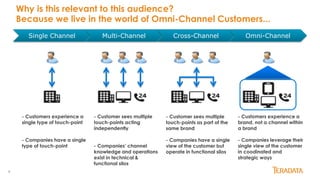
Why is this relevant to this audience?
Because we live in the world of Omni-Channel Customers...
Single Channel Multi-Channel Cross-Channel Omni-Channel
- Customers experience a
single type of touch-point
- Companies have a single
type of touch-point
- Customer sees multiple
touch-points acting
independently
- Companies’ channel
knowledge and operations
exist in technical &
functional silos
- Customer sees multiple
touch-points as part of the
same brand
- Companies have a single
view of the customer but
operate in functional silos
- Customers experience a
brand, not a channel within
a brand
- Companies leverage their
single view of the customer
in coodinated and
strategic ways
5
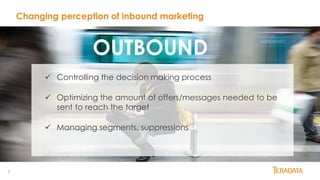
Changing perception of inbound marketing
OUTBOUND
 Controlling the decision making process
 Optimizing the amount of offers/messages needed to be
sent to reach the target
 Managing segments, suppressions
6
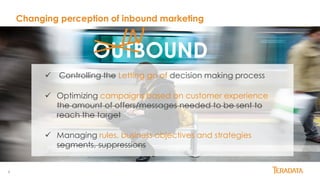
Changing perception of inbound marketing
OUTBOUND
IN
 Controlling the Letting go of decision making process
 Optimizing campaigns based on customer experience
the amount of offers/messages needed to be sent to
reach the target
 Managing rules, business objectives and strategies
segments, suppressions
7
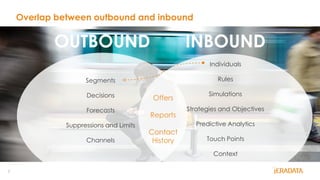
Overlap between outbound and inbound
OUTBOUND INBOUND
Offers
Reports
Contact
History
Segments
Decisions
Forecasts
Suppressions and Limits
Channels
Individuals
Rules
Simulations
Strategies and Objectives
Predictive Analytics
Touch Points
Context
8
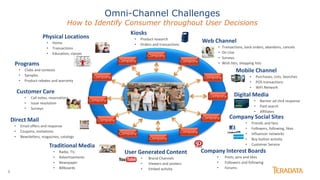
Omni-Channel Challenges
How to Identify Consumer throughout User Decisions
Kiosks
• Product research
• Orders and transactions
Company Interest Boards
• Posts, pins and likes
• Followers and following
• Forums
User Generated Content
• Brand Channels
• Viewers and posters
• Embed activity
Physical Locations
• Home
• Transactions
• Education, classes
Direct Mail
• Email offers and response
• Coupons, invitations
• Newsletters, magazines, catalogs
Digital Media
• Banner ad click response
• Paid search
• Affiliates
Traditional Media
• Radio, TV,
• Advertisements
• Newspaper
• Billboards
Programs
• Clubs and contests
• Samples
• Product rebates and warranty
Company Social Sites
• Friends and fans
• Followers, following, likes
• Influencer networks
• Buy button activity
• Customer Service
Customer Care
• Call notes, reservations
• Issue resolution
• Surveys
Web Channel
• Transactions, back orders, abandons, cancels
• On Line
• Surveys
• Wish lists, shopping lists
Mobile Channel
• Purchases, Lists, Searches
• POS transactions
• WiFi Network
Company
Company
Company
Company
Company
Company
Company
Company
Company
Company
Company
Company
9
• The Internet enables you but it
also causes serious challenges
• You need to understand how
customers behave online, in
detail before forming a strategy
• You need to act in real-time
when you know what the right
decision is - and keep learning….
• You need a Data Driven, Omni-
channel strategy
• Customers choose when, where
and how to contact you - you
don’t get to choose anymore…
• You need to be ready when they
call, email and visit (online and in
a shop)
What does that mean for you ?
10
Why adopt an Omni-Channel Strategy ?
• The Brand, Product and Service is just not enough anymore
• Omni-channel is ‘table stakes,’ if you don’t do it then you don’t get to
play
• Your existing competitors are already investing…
• Your new competitors are too…
• Customers know this and take advantage
© 2014 Teradata
11
Why Real-Time ?
Our view
• You may only get one chance to influence a customer when they
decide to interact with you so:
– You had better be ready and intelligent with your response
– When you are it had better be relevant and timely
– It needs to form part of a cohesive, omni-channel, integrated communication
strategy
- Covering both inbound and outbound
- Covering all channels
– Whatever offer you make should not conflict with other messaging or offers
that may automatically be sent out just after the inbound interaction
• In summary, you need to be ahead of the competition otherwise
customers will move their business
12
The «Objective» view on Real Time marketing & Customer Experience
The Analyst view
Marketing campaigns are dead. Why?
Because people despise and distrust push-
style marketing methods that interrupt or
intercept them —
49% of consumers don't trust digital ads;
38% don't trust emails;
36% don't trust information in branded apps.
What consumers want is genuine value from
their interactions with brands, but most
marketers fail to deliver it.
#Forrester 2014
McKinsey
Up to 10 times responserates
Sources: https://www.forrester.com/Forresters+Forum+For+Marketing+Leaders/-/E-EVE6359
13
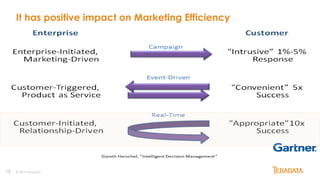
It has positive impact on Marketing Efficiency
© 2014 Teradata
14
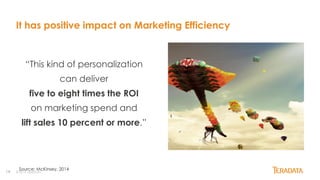
“This kind of personalization
can deliver
five to eight times the ROI
on marketing spend and
lift sales 10 percent or more.”
© 2014 Teradata
It has positive impact on Marketing Efficiency
Source: McKinsey, 2014
15
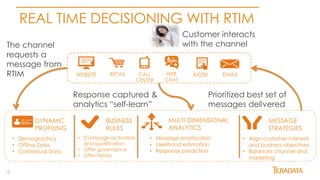
REAL TIME DECISIONING WITH RTIM
WEBSITE RETAIL CALL
CENTER
WEB
CHAT
KIOSK EMAIL
DYNAMIC
PROFILING
BUSINESS
RULES
MULTI-DIMENSIONAL
ANALYTICS
MESSAGE
STRATEGIES
• Demographics
• Offline Data
• Contextual Data
• Campaign activation
and qualification
• Offer governance
• Offer history
• Message prioritization
• Likelihood estimation
• Response prediction
• Align customer interests
and business objectives
• Balances channel and
marketing
Customer interacts
with the channelThe channel
requests a
message from
RTIM
Response captured &
analytics “self-learn”
Prioritized best set of
messages delivered
16
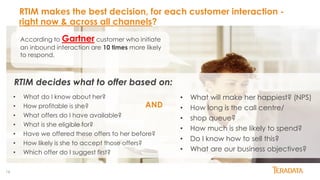
RTIM makes the best decision, for each customer interaction -
right now & across all channels?
According to Gartner customer who initiate
an inbound interaction are 10 times more likely
to respond.
• What do I know about her?
• How profitable is she?
• What offers do I have available?
• What is she eligible for?
• Have we offered these offers to her before?
• How likely is she to accept those offers?
• Which offer do I suggest first?
RTIM decides what to offer based on:
• What will make her happiest? (NPS)
• How long is the call centre/
• shop queue?
• How much is she likely to spend?
• Do I know how to sell this?
• What are our business objectives?
AND
17
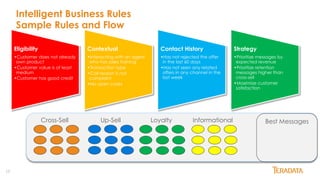
Intelligent Business Rules
Sample Rules and Flow
Eligibility
•Customer does not already
own product
•Customer value is at least
medium
•Customer has good credit
Contextual
•Interacting with an agent
who has sales training
•Transaction type
•Call reason is not
complaint
•No open cases
Contact History
•Has not rejected the offer
in the last 60 days
•Has not seen any related
offers in any channel in the
last week
Strategy
•Prioritize messages by
expected revenue
•Prioritize retention
messages higher than
cross-sell
•Maximize customer
satisfaction
Cross-Sell Best MessagesLoyaltyUp-Sell Informational
18
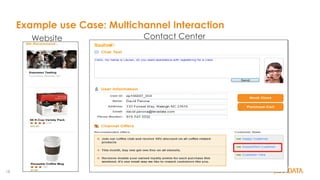
Example use Case: Multichannel Interaction
Website Contact Center
19
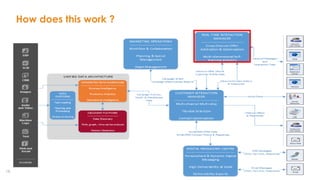
How does this work ?
20
Expect the unexpected
© 2014 Teradata

Karel jabornik teradata real-time-interaction_mngmt

  • 1.
    ​Real time customerinteractions ​right time, right place, right channel ​28th April 2015 ​Karel Jaborník
  • 2.
    2 What really matters? © 2014 Teradata There are only two sources of competitive advantage: The ability to learn more about our customers faster than the competition and the ability to turn that learning into action faster than the competition. (Jack Welch, former CEO General Electric)
  • 3.
    3 Most companies havethe same or similar strategy • What is unique about your business ? – Your data is one of the few assets you own that is different to the competition – Integrate it, Exploit it and Use it or lose out • Logically, you must become a data driven company to survive and compete © 2014 Teradata
  • 4.
    4 Why is thisrelevant to this audience? Because we live in the world of Omni-Channel Customers... Single Channel Multi-Channel Cross-Channel Omni-Channel - Customers experience a single type of touch-point - Companies have a single type of touch-point - Customer sees multiple touch-points acting independently - Companies’ channel knowledge and operations exist in technical & functional silos - Customer sees multiple touch-points as part of the same brand - Companies have a single view of the customer but operate in functional silos - Customers experience a brand, not a channel within a brand - Companies leverage their single view of the customer in coodinated and strategic ways
  • 5.
    5 Changing perception ofinbound marketing OUTBOUND  Controlling the decision making process  Optimizing the amount of offers/messages needed to be sent to reach the target  Managing segments, suppressions
  • 6.
    6 Changing perception ofinbound marketing OUTBOUND IN  Controlling the Letting go of decision making process  Optimizing campaigns based on customer experience the amount of offers/messages needed to be sent to reach the target  Managing rules, business objectives and strategies segments, suppressions
  • 7.
    7 Overlap between outboundand inbound OUTBOUND INBOUND Offers Reports Contact History Segments Decisions Forecasts Suppressions and Limits Channels Individuals Rules Simulations Strategies and Objectives Predictive Analytics Touch Points Context
  • 8.
    8 Omni-Channel Challenges How toIdentify Consumer throughout User Decisions Kiosks • Product research • Orders and transactions Company Interest Boards • Posts, pins and likes • Followers and following • Forums User Generated Content • Brand Channels • Viewers and posters • Embed activity Physical Locations • Home • Transactions • Education, classes Direct Mail • Email offers and response • Coupons, invitations • Newsletters, magazines, catalogs Digital Media • Banner ad click response • Paid search • Affiliates Traditional Media • Radio, TV, • Advertisements • Newspaper • Billboards Programs • Clubs and contests • Samples • Product rebates and warranty Company Social Sites • Friends and fans • Followers, following, likes • Influencer networks • Buy button activity • Customer Service Customer Care • Call notes, reservations • Issue resolution • Surveys Web Channel • Transactions, back orders, abandons, cancels • On Line • Surveys • Wish lists, shopping lists Mobile Channel • Purchases, Lists, Searches • POS transactions • WiFi Network Company Company Company Company Company Company Company Company Company Company Company Company
  • 9.
    9 • The Internetenables you but it also causes serious challenges • You need to understand how customers behave online, in detail before forming a strategy • You need to act in real-time when you know what the right decision is - and keep learning…. • You need a Data Driven, Omni- channel strategy • Customers choose when, where and how to contact you - you don’t get to choose anymore… • You need to be ready when they call, email and visit (online and in a shop) What does that mean for you ?
  • 10.
    10 Why adopt anOmni-Channel Strategy ? • The Brand, Product and Service is just not enough anymore • Omni-channel is ‘table stakes,’ if you don’t do it then you don’t get to play • Your existing competitors are already investing… • Your new competitors are too… • Customers know this and take advantage © 2014 Teradata
  • 11.
    11 Why Real-Time ? Ourview • You may only get one chance to influence a customer when they decide to interact with you so: – You had better be ready and intelligent with your response – When you are it had better be relevant and timely – It needs to form part of a cohesive, omni-channel, integrated communication strategy - Covering both inbound and outbound - Covering all channels – Whatever offer you make should not conflict with other messaging or offers that may automatically be sent out just after the inbound interaction • In summary, you need to be ahead of the competition otherwise customers will move their business
  • 12.
    12 The «Objective» viewon Real Time marketing & Customer Experience The Analyst view Marketing campaigns are dead. Why? Because people despise and distrust push- style marketing methods that interrupt or intercept them — 49% of consumers don't trust digital ads; 38% don't trust emails; 36% don't trust information in branded apps. What consumers want is genuine value from their interactions with brands, but most marketers fail to deliver it. #Forrester 2014 McKinsey Up to 10 times responserates Sources: https://www.forrester.com/Forresters+Forum+For+Marketing+Leaders/-/E-EVE6359
  • 13.
    13 It has positiveimpact on Marketing Efficiency © 2014 Teradata
  • 14.
    14 “This kind ofpersonalization can deliver five to eight times the ROI on marketing spend and lift sales 10 percent or more.” © 2014 Teradata It has positive impact on Marketing Efficiency Source: McKinsey, 2014
  • 15.
    15 REAL TIME DECISIONINGWITH RTIM WEBSITE RETAIL CALL CENTER WEB CHAT KIOSK EMAIL DYNAMIC PROFILING BUSINESS RULES MULTI-DIMENSIONAL ANALYTICS MESSAGE STRATEGIES • Demographics • Offline Data • Contextual Data • Campaign activation and qualification • Offer governance • Offer history • Message prioritization • Likelihood estimation • Response prediction • Align customer interests and business objectives • Balances channel and marketing Customer interacts with the channelThe channel requests a message from RTIM Response captured & analytics “self-learn” Prioritized best set of messages delivered
  • 16.
    16 RTIM makes thebest decision, for each customer interaction - right now & across all channels? According to Gartner customer who initiate an inbound interaction are 10 times more likely to respond. • What do I know about her? • How profitable is she? • What offers do I have available? • What is she eligible for? • Have we offered these offers to her before? • How likely is she to accept those offers? • Which offer do I suggest first? RTIM decides what to offer based on: • What will make her happiest? (NPS) • How long is the call centre/ • shop queue? • How much is she likely to spend? • Do I know how to sell this? • What are our business objectives? AND
  • 17.
    17 Intelligent Business Rules SampleRules and Flow Eligibility •Customer does not already own product •Customer value is at least medium •Customer has good credit Contextual •Interacting with an agent who has sales training •Transaction type •Call reason is not complaint •No open cases Contact History •Has not rejected the offer in the last 60 days •Has not seen any related offers in any channel in the last week Strategy •Prioritize messages by expected revenue •Prioritize retention messages higher than cross-sell •Maximize customer satisfaction Cross-Sell Best MessagesLoyaltyUp-Sell Informational
  • 18.
    18 Example use Case:Multichannel Interaction Website Contact Center
  • 19.
  • 20.