How to personalize your approach
in the era of consumer privacy
CLIENTELINGWITHOUT
CREEPINESS
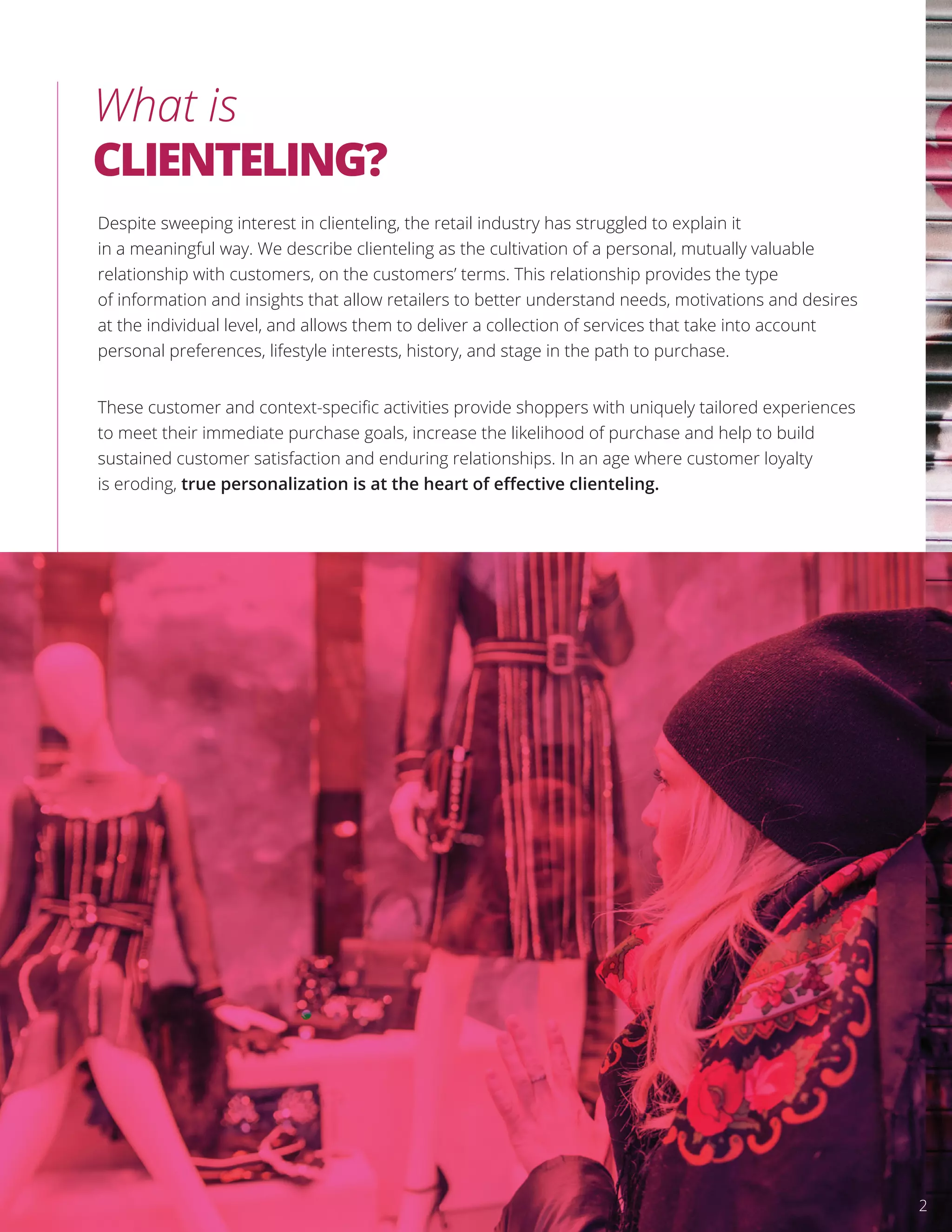
Despite sweeping interest in clienteling, the retail industry has struggled to explain it
in a meaningful way. We describe clienteling as the cultivation of a personal, mutually valuable
relationship with customers, on the customers’ terms. This relationship provides the type
of information and insights that allow retailers to better understand needs, motivations and desires
at the individual level, and allows them to deliver a collection of services that take into account
personal preferences, lifestyle interests, history, and stage in the path to purchase.
These customer and context-specific activities provide shoppers with uniquely tailored experiences
to meet their immediate purchase goals, increase the likelihood of purchase and help to build
sustained customer satisfaction and enduring relationships. In an age where customer loyalty
is eroding, true personalization is at the heart of effective clienteling.
What is
CLIENTELING?
2
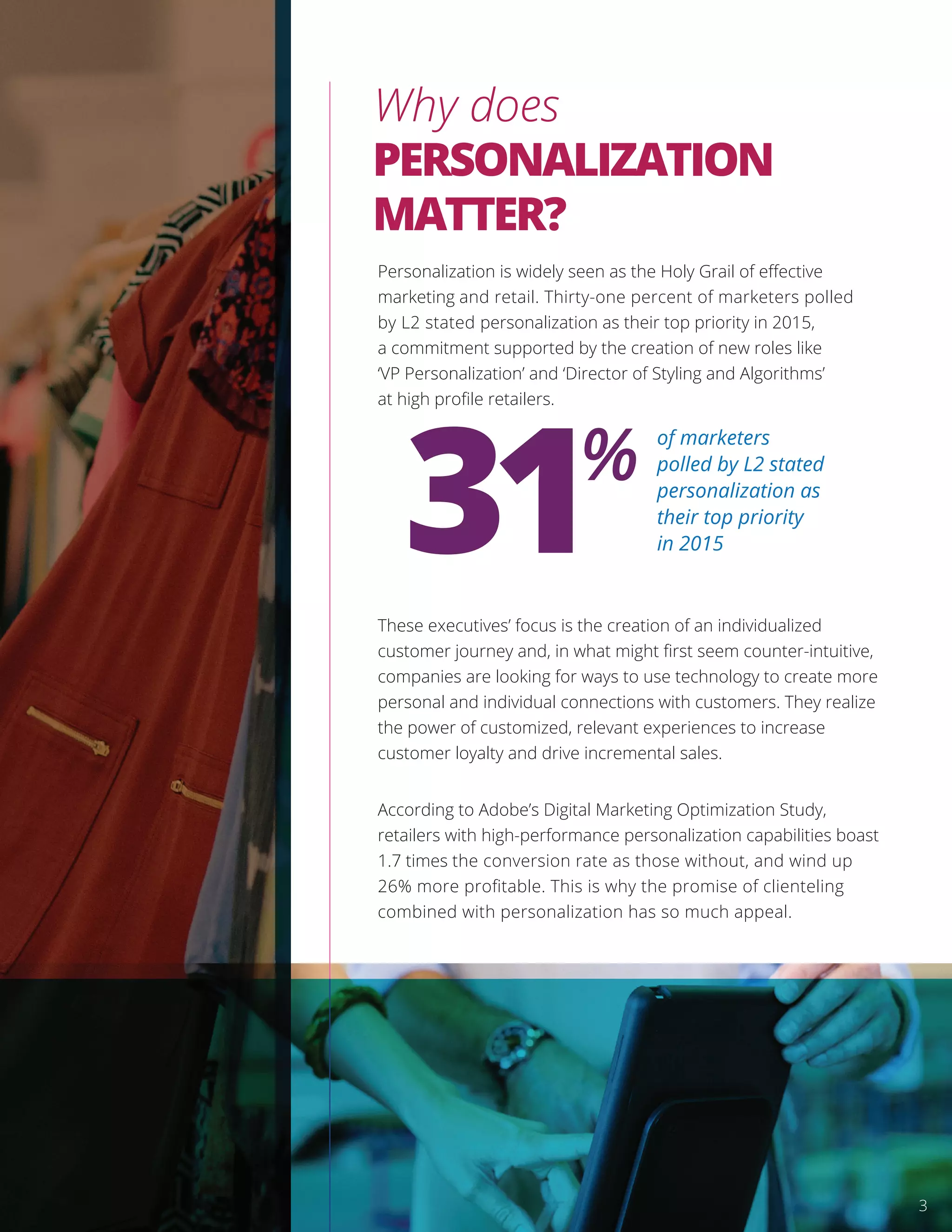
Personalization is widely seen as the Holy Grail of effective
marketing and retail. Thirty-one percent of marketers polled
by L2 stated personalization as their top priority in 2015,
a commitment supported by the creation of new roles like
‘VP Personalization’ and ‘Director of Styling and Algorithms’
at high profile retailers.
These executives’ focus is the creation of an individualized
customer journey and, in what might first seem counter-intuitive,
companies are looking for ways to use technology to create more
personal and individual connections with customers. They realize
the power of customized, relevant experiences to increase
customer loyalty and drive incremental sales.
According to Adobe’s Digital Marketing Optimization Study,
retailers with high-performance personalization capabilities boast
1.7 times the conversion rate as those without, and wind up
26% more profitable. This is why the promise of clienteling
combined with personalization has so much appeal.
Why does
PERSONALIZATION
MATTER?
31% of marketers
polled by L2 stated
personalization as
their top priority
in 2015
3
What are the
CHALLENGES?
THESE CHALLENGES BECOME EVEN MORE
COMPLEX WHEN WE CONSIDER THAT:
• People don’t like being “sold to” aggressively - the majority of shoppers
prefer to consult their own devices or kiosks instead of talking
to a sales associate [Deloitte, The Digital Divide 2013]
• Shoppers have concerns about privacy and identity theft,
and are hesitant to share personal information without a clear benefit
• In some parts of the world, particularly Europe and Canada,
government regulations are becoming more and more strict about
the collection and use of customer data
A standard tool to power all of the elements that make up effective clienteling does not exist.
To think of all the capabilities needed to deliver effective clienteling, it helps to think of the skills
and knowledge possessed by the trusted shopkeepers of yesteryear, or the most exclusive personal
shoppers of today: a clear understanding of an individual’s personal tastes, styles and preferences;
familiarity with the people in their family and other important connections; knowledge of important
personal milestones; an understanding of the best ways and times to reach someone; the skill to make
personal recommendations based on the combination of all these factors … and a personal touch
that makes each customer feel valued as a unique individual. This is a tall order for any system,
and is unlikely to be found in any single “out of the box” package. Although there may be some
common components in a baseline platform, retailers can’t rely on a commoditized tool to create
unique experiences. Clienteling tools need to be tailored to both the customer’s taste
and to the retailer’s unique brand.
Given what it takes to provide a truly personal and customized shopping experience, shoppers who
want to remain anonymous provide another challenge. This is especially true in a brick and mortar
setting, where retailers do not have immediate access to the transaction and search history typically
available with an online purchase.
4
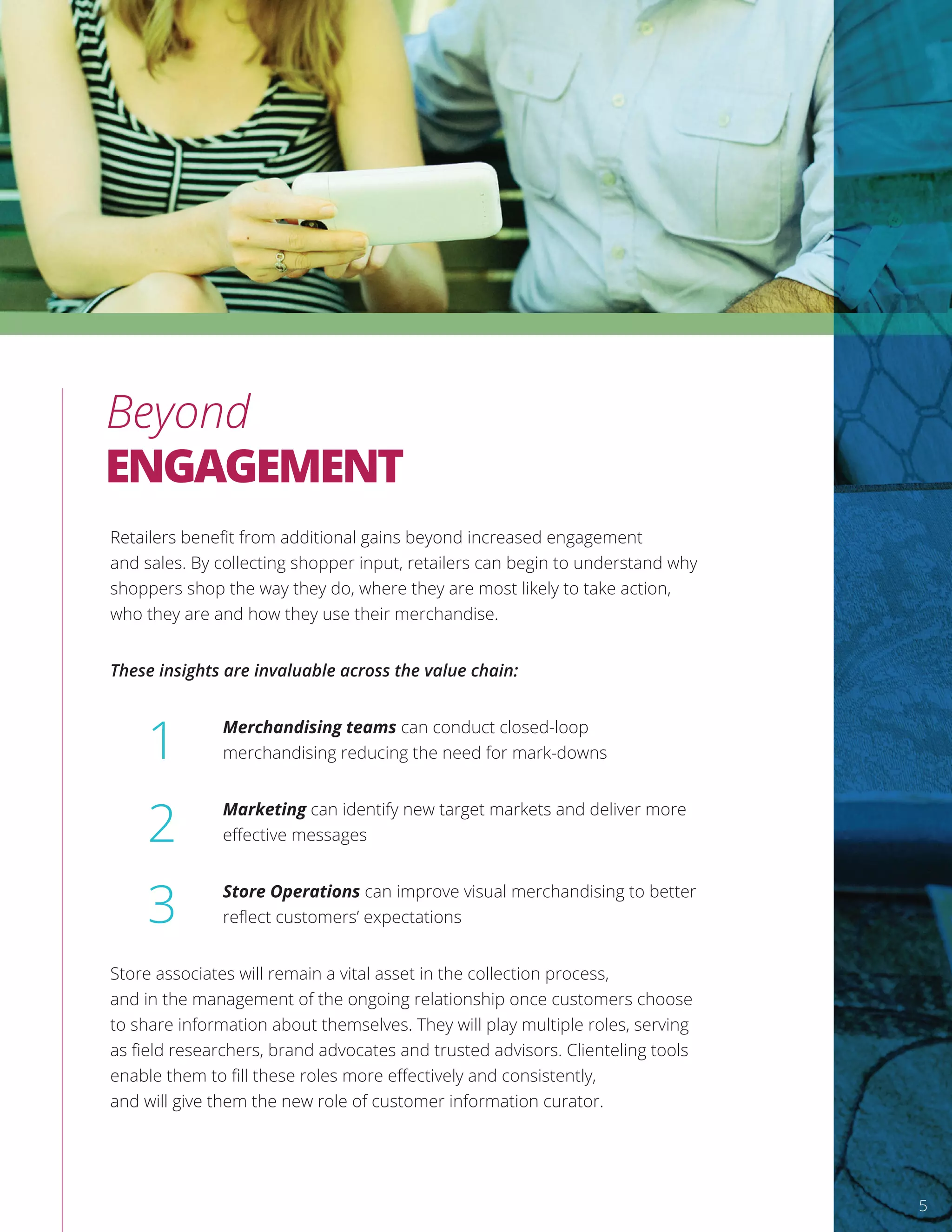
Retailers benefit from additional gains beyond increased engagement
and sales. By collecting shopper input, retailers can begin to understand why
shoppers shop the way they do, where they are most likely to take action,
who they are and how they use their merchandise.
These insights are invaluable across the value chain:
Merchandising teams can conduct closed-loop
merchandising reducing the need for mark-downs
Marketing can identify new target markets and deliver more
effective messages
Store Operations can improve visual merchandising to better
reflect customers’ expectations
Store associates will remain a vital asset in the collection process,
and in the management of the ongoing relationship once customers choose
to share information about themselves. They will play multiple roles, serving
as field researchers, brand advocates and trusted advisors. Clienteling tools
enable them to fill these roles more effectively and consistently,
and will give them the new role of customer information curator.
1
2
3
Beyond
ENGAGEMENT
5
What does it take
TOSUCCEED?
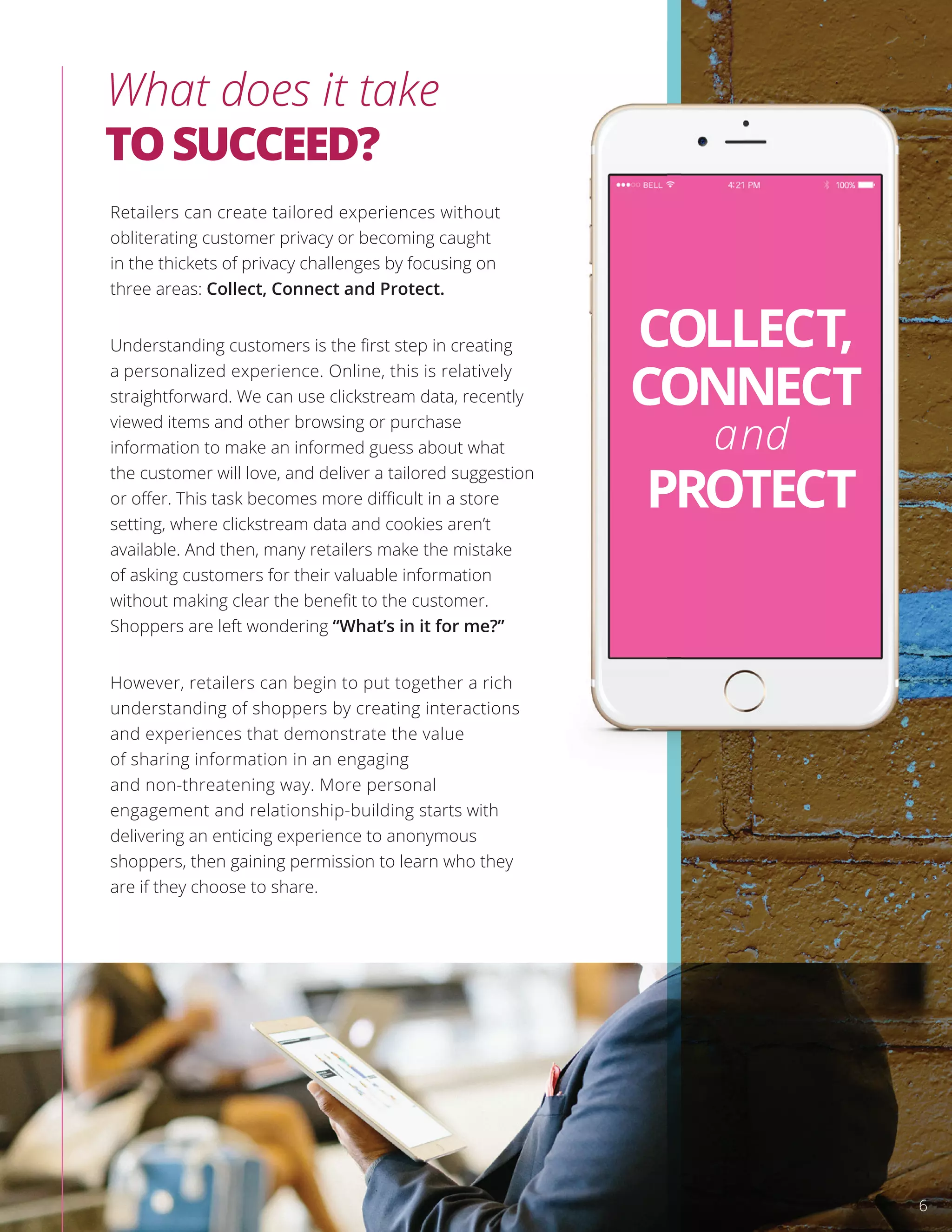
Retailers can create tailored experiences without
obliterating customer privacy or becoming caught
in the thickets of privacy challenges by focusing on
three areas: Collect, Connect and Protect.
Understanding customers is the first step in creating
a personalized experience. Online, this is relatively
straightforward. We can use clickstream data, recently
viewed items and other browsing or purchase
information to make an informed guess about what
the customer will love, and deliver a tailored suggestion
or offer. This task becomes more difficult in a store
setting, where clickstream data and cookies aren’t
available. And then, many retailers make the mistake
of asking customers for their valuable information
without making clear the benefit to the customer.
Shoppers are left wondering “What’s in it for me?”
However, retailers can begin to put together a rich
understanding of shoppers by creating interactions
and experiences that demonstrate the value
of sharing information in an engaging
and non-threatening way. More personal
engagement and relationship-building starts with
delivering an enticing experience to anonymous
shoppers, then gaining permission to learn who they
are if they choose to share.
the customer will love, and deliver a tailored suggestion
COLLECT,
CONNECT
and
PROTECT
6
Collect Insights to
DELIVERPERSONALIZEDSERVICE
COLLECT
CONNECT
PROTECT
Consider a typical store visit. Shoppers enter a physical or online store with a goal in mind.
They might just want to browse, or be hell-bent on finding the right brown leather jacket,
or be in desperate need of information to complete their latest home renovation project.
In a physical store, a sales associate typically greets the shopper and offers to help.
Already, the sales associate gains a few valuable pieces of information – the shopper’s objective,
the customer’s physical attributes and, in the case of clothing, an indication of the shopper’s
personal style. Without knowing the identity of the shopper, the sales associate can begin
to provide valuable assistance to achieve that shopper’s objective based on their merchandise
and customer knowledge. This is a prime example of capitalizing on contextual information,
without personally identifiable data, to deliver a personalized experience.
In effect, this is manual, in-the-moment, anonymous analytics.
Clienteling tools with personalization software that mimic the role of a personal shopper are
a powerful way to provide a personal touch to a store visit. Consider how this might work
in the context of shopping for clothes, one of the most personal shopping missions.
The tools could take any number of forms, depending on the retailer’s context. For example
customers could assist themselves by taking a brief interactive quiz on a smart mirror or tablet,
or a sales associate could take them through an app on their mobile phone to generate the best
suggestions for the customer’s body type.
By demonstrating how input is directly used to help the customer meet his or her needs,
the retailer encourages the customer to provide more information. By sharing information
on what styles they like, what specific items they find attractive and where they might want to wear
it, customers can get more refined recommendations of clothing that might work for them.
Retailers in turn can use this information to suggest not only individual items, but also
combinations or complete outfits. Now, in addition to providing a value-added service
for the customer, the sales associate is empowered and the retailer may also have an opportunity
to increase the overall transaction value for that interaction.
7
OPPORTUNITIES FOR
INTERACTION BASED INPUT
Self Service In Store
Customers could use smart mirrors, tablets and other connected devices
to volunteer information for personalized suggestions. For example, a simple style
quiz could generate the best items to try on and have them sent into the fitting
room or a do it yourself project generator could make recommendations
on fixtures and fittings for a room renovation project.
Assisted Selling In Store
Store associates could use devices containing attribute information on all
the products in inventory to capture customer preferences and requirements
to make more targeted solutions. Augmenting the associates’ product knowledge
and combining it with additional insights volunteered by the customer would allow
them to be more effective personal advisors.
Shopping Online
Customers could complete a quick online quiz to help define what their
immediate needs in order to present the best information, e.g., whether they
are shopping for an individual sofa or furnishing their entire living room.
Rather than providing generic recommendations, this is about catering
to individual shopping scenarios.
Mobile
Mobile devices could be used to provide customers with access to relevant
information that is not available at that point in time for the customer.
e.g. bringing up digital wardrobe of clothes a customer already owns when they
are in-store, or matching store items when they are at home. Providing access
to past purchases creates the additional context that provides a better informed
perspective from which to shop.
8
Connect to Deliver
APERSONALIZEDEXPERIENCE
Effective clienteling solutions move beyond collecting and sharing information. A well-designed
solution is designed to be practical and enjoyable for both associates and customers, in order
to create and reinforce a deep brand connection. The information that is captured must be used
in ways that help to reinforce the brand relationship. It is not enough to know a customer’s tastes,
history and habits. This information must be acted on in a way that seems natural
and unobtrusive if a retailer wants to earn the right to be a customer’s trusted advisor.
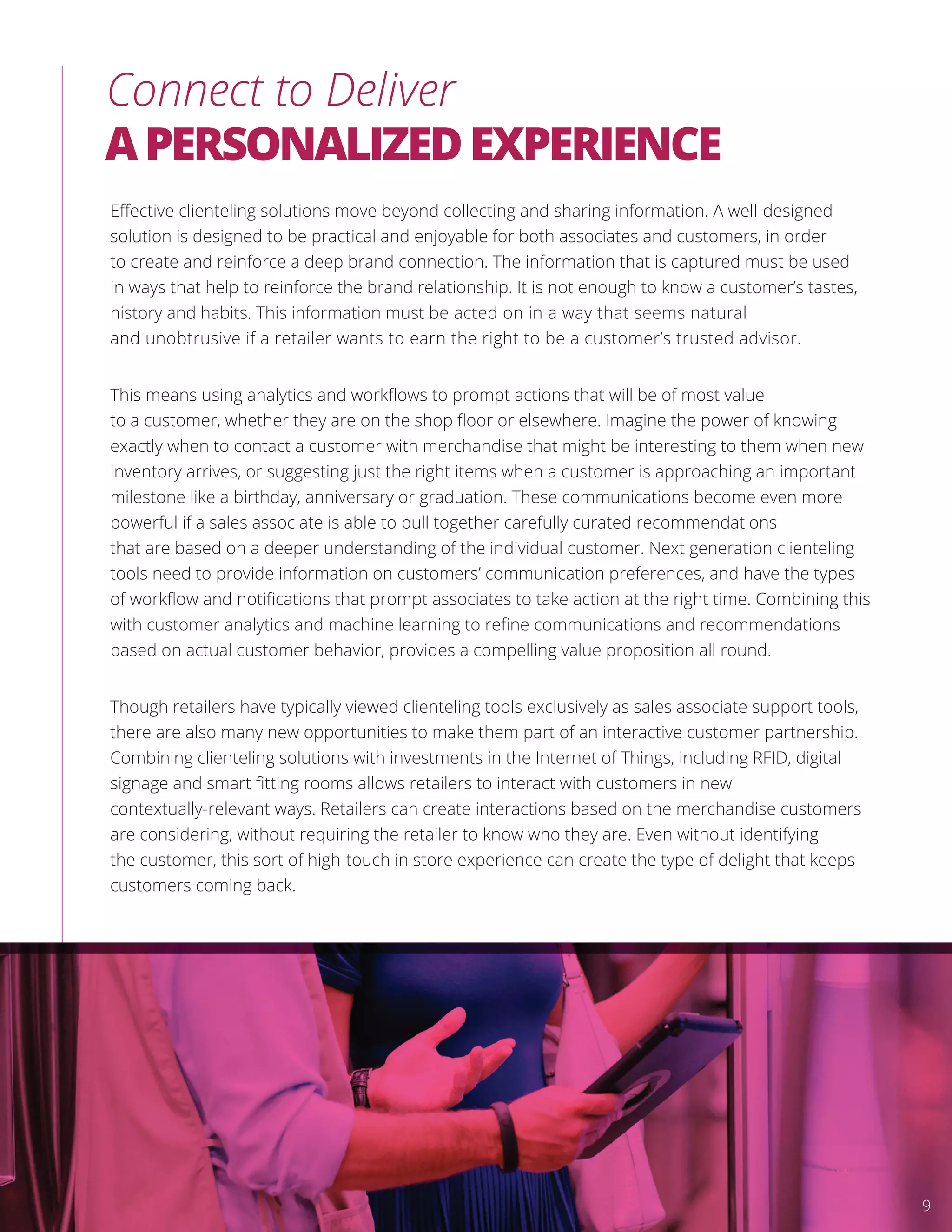
This means using analytics and workflows to prompt actions that will be of most value
to a customer, whether they are on the shop floor or elsewhere. Imagine the power of knowing
exactly when to contact a customer with merchandise that might be interesting to them when new
inventory arrives, or suggesting just the right items when a customer is approaching an important
milestone like a birthday, anniversary or graduation. These communications become even more
powerful if a sales associate is able to pull together carefully curated recommendations
that are based on a deeper understanding of the individual customer. Next generation clienteling
tools need to provide information on customers’ communication preferences, and have the types
of workflow and notifications that prompt associates to take action at the right time. Combining this
with customer analytics and machine learning to refine communications and recommendations
based on actual customer behavior, provides a compelling value proposition all round.
Though retailers have typically viewed clienteling tools exclusively as sales associate support tools,
there are also many new opportunities to make them part of an interactive customer partnership.
Combining clienteling solutions with investments in the Internet of Things, including RFID, digital
signage and smart fitting rooms allows retailers to interact with customers in new
contextually-relevant ways. Retailers can create interactions based on the merchandise customers
are considering, without requiring the retailer to know who they are. Even without identifying
the customer, this sort of high-touch in store experience can create the type of delight that keeps
customers coming back.
9
Gamification is a great way to encourage use – this can create an enjoyable experience
that meets customers where they are and guides them down a path that entices them
to engage with the retailer. The experience should be designed to convert anonymous
(and potentially suspicious) shoppers into trusting customers, by encouraging them to identify
themselves and provide additional information along the way in exchange
for additional benefits at each step.
Connecting through the effective use of next generation clienteling solutions can help
to build loyalty in several interesting ways:
Letting customers design their own journey. Almost half of all shoppers prefer
self-service over speaking to associates. Give both customers and associates
the right tools across devices to allow shoppers to experience the brand on their
own terms. They might want to linger and do extensive research online
and in store, or checkout as quickly as possible. Either way, brands must cater
to highly individualized shopping preferences.
Determining what customers value most and rewarding them with uniquely
personal rewards tailored to their interests. If someone is always first in line
for the new seasonal collections, why not provide her with invitations to sneak
previews? If she defines her personal style as urban trendy, how about a pair
of tickets to the latest hot club opening?
Demonstrating continuous value based on the information a customer shares,
making interactions, recommendations and offers increasingly relevant.
Developing an integrated, contextual view of the customer provides a logical way
to embed the right behavioral cues and triggers to encourage desired behavior
and increase conversion. Once customers see that the information they provide
is used to deliver a visibly more personalized shopping experience,
they are more willing to share more information.
1
2
3
10
1
4
5
6
7
8
2
3
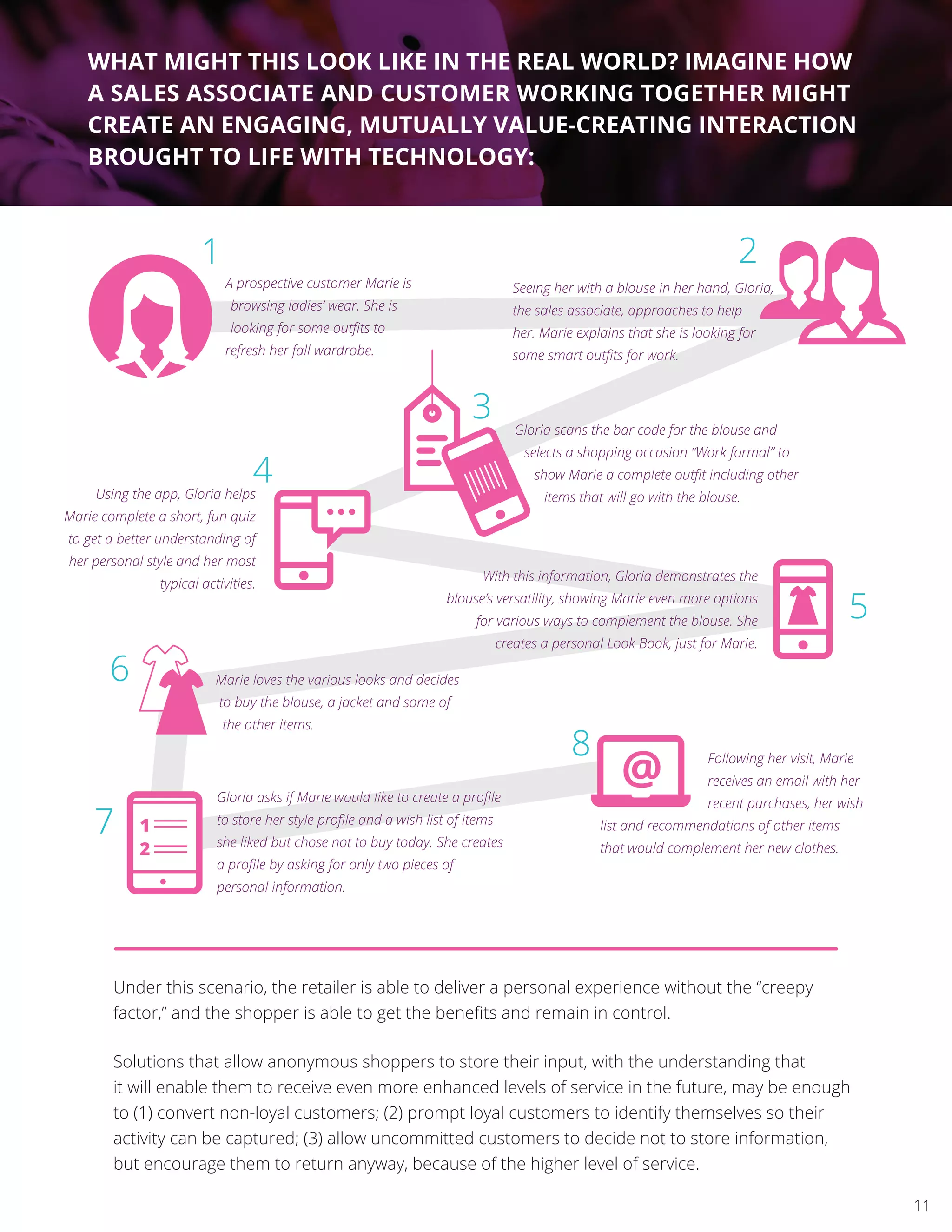
WHAT MIGHT THIS LOOK LIKE IN THE REAL WORLD? IMAGINE HOW
A SALES ASSOCIATE AND CUSTOMER WORKING TOGETHER MIGHT
CREATE AN ENGAGING, MUTUALLY VALUE-CREATING INTERACTION
BROUGHT TO LIFE WITH TECHNOLOGY:
Under this scenario, the retailer is able to deliver a personal experience without the “creepy
factor,” and the shopper is able to get the benefits and remain in control.
Solutions that allow anonymous shoppers to store their input, with the understanding that
it will enable them to receive even more enhanced levels of service in the future, may be enough
to (1) convert non-loyal customers; (2) prompt loyal customers to identify themselves so their
activity can be captured; (3) allow uncommitted customers to decide not to store information,
but encourage them to return anyway, because of the higher level of service.
A prospective customer Marie is
browsing ladies’ wear. She is
looking for some outfits to
refresh her fall wardrobe.
Seeing her with a blouse in her hand, Gloria,
the sales associate, approaches to help
her. Marie explains that she is looking for
some smart outfits for work.
Gloria scans the bar code for the blouse and
selects a shopping occasion “Work formal” to
show Marie a complete outfit including other
items that will go with the blouse.Using the app, Gloria helps
Marie complete a short, fun quiz
to get a better understanding of
her personal style and her most
typical activities.
With this information, Gloria demonstrates the
blouse’s versatility, showing Marie even more options
for various ways to complement the blouse. She
creates a personal Look Book, just for Marie.
Marie loves the various looks and decides
to buy the blouse, a jacket and some of
the other items.
Gloria asks if Marie would like to create a profile
to store her style profile and a wish list of items
she liked but chose not to buy today. She creates
a profile by asking for only two pieces of
personal information.
Following her visit, Marie
receives an email with her
recent purchases, her wish
list and recommendations of other items
that would complement her new clothes.
11
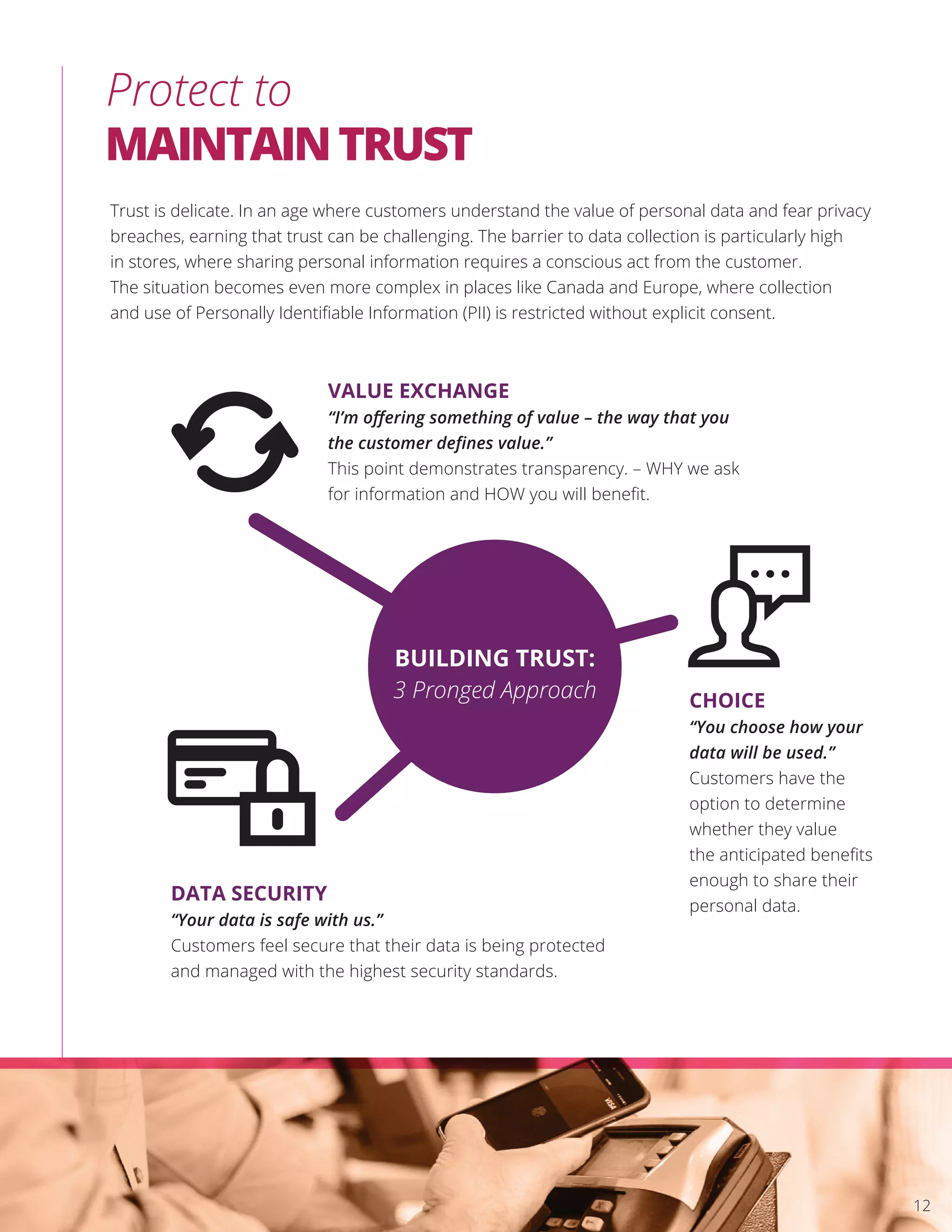
VALUE EXCHANGE
“I’m offering something of value – the way that you
the customer defines value.”
This point demonstrates transparency. – WHY we ask
for information and HOW you will benefit.
CHOICE
“You choose how your
data will be used.”
Customers have the
option to determine
whether they value
the anticipated benefits
enough to share their
personal data.
DATA SECURITY
“Your data is safe with us.”
Customers feel secure that their data is being protected
and managed with the highest security standards.
Protect to
MAINTAINTRUST
Trust is delicate. In an age where customers understand the value of personal data and fear privacy
breaches, earning that trust can be challenging. The barrier to data collection is particularly high
in stores, where sharing personal information requires a conscious act from the customer.
The situation becomes even more complex in places like Canada and Europe, where collection
and use of Personally Identifiable Information (PII) is restricted without explicit consent.
BUILDING TRUST:
3 Pronged Approach
12
Retailers must find approaches to personalization that work for both known and unknown
customers. Engagement-based shopping solutions that can store a customer’s profile toward
the end of the Interaction, help gain shoppers’ trust by first delivering value, e.g. personalized
recommendations tailored to the input they provide. This also puts the power in the customers’
hands. They get to decide whether, when and how to share information. At each stage
of the process, they can determine how much information they are willing to share.
Collecting data in these ways is valuable for getting customers to consent to collection
and future use of their data.
Of other critical importance is to be scrupulous in the protection of customer data. With one
spectacular data breach after another making news, customers have every right to be concerned.
Appropriate levels of encryption and security are the obvious first step. Another option
is for retailers to collect just the information that is relevant and useful for specific transactions,
and design that into their business and technology solutions.
Explaining how data will be used in plain English goes a long way too. For example, a retailer could
explain that it is asking for a customer’s children’s date of birth in order to make better age
appropriate recommendations of toys or clothes, which will evolve over time as the child grows up.
Or remember that search for the perfect leather jacket? Customers may even be willing to share
something as personal as their body shape or personal style if they can actually see that it results
in different recommendations for the type of jacket that best suits them.
And finally, skip the legalese. Shoppers want to know in plain terms what an organization
will do with their data.
13
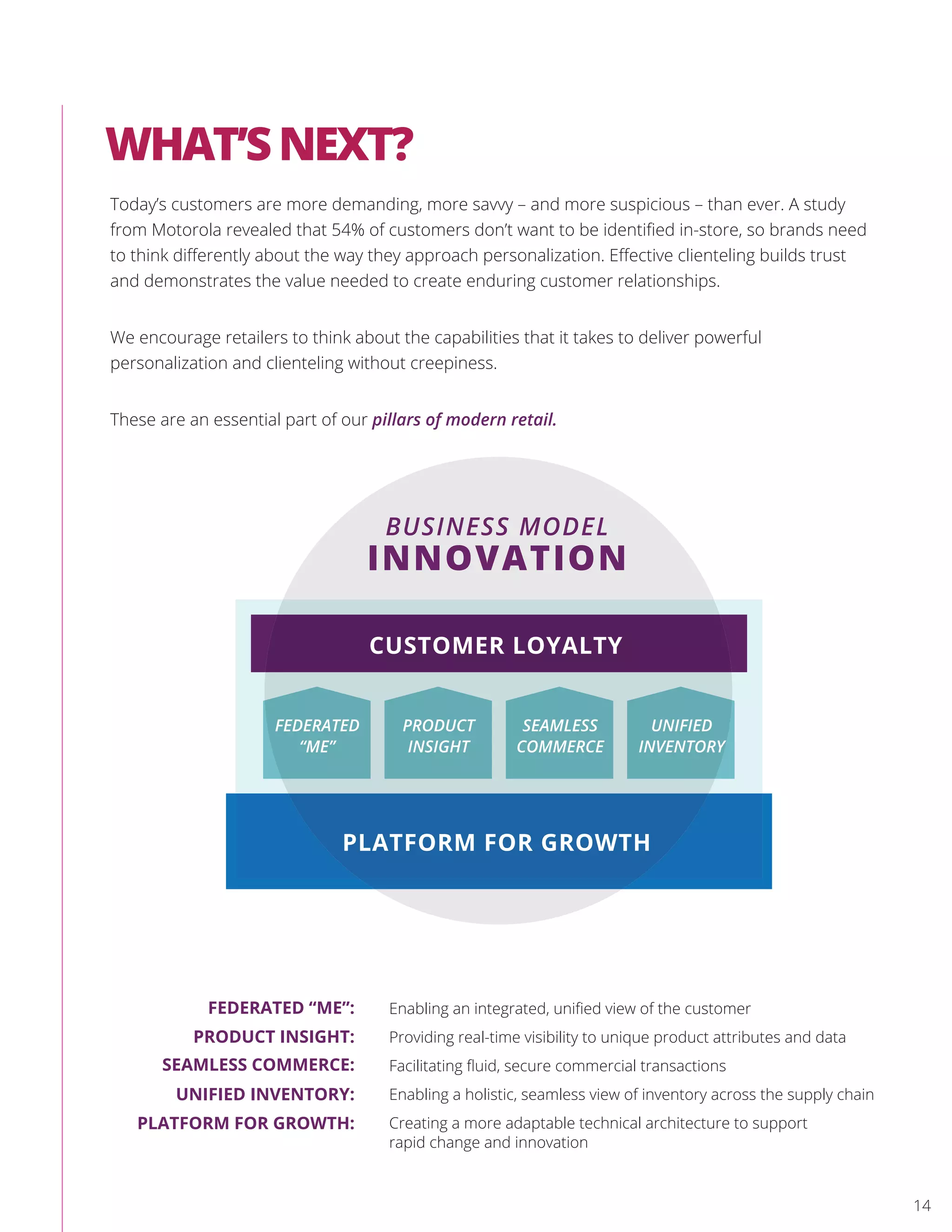
Today’s customers are more demanding, more savvy – and more suspicious – than ever. A study
from Motorola revealed that 54% of customers don’t want to be identified in-store, so brands need
to think differently about the way they approach personalization. Effective clienteling builds trust
and demonstrates the value needed to create enduring customer relationships.
We encourage retailers to think about the capabilities that it takes to deliver powerful
personalization and clienteling without creepiness.
These are an essential part of our pillars of modern retail.
Enabling an integrated, unified view of the customer
Providing real-time visibility to unique product attributes and data
Facilitating fluid, secure commercial transactions
Enabling a holistic, seamless view of inventory across the supply chain
Creating a more adaptable technical architecture to support
rapid change and innovation
FEDERATED “ME”:
PRODUCT INSIGHT:
SEAMLESS COMMERCE:
UNIFIED INVENTORY:
PLATFORM FOR GROWTH:
BUSINESS MODEL
INNOVATION
PLATFORM FOR GROWTH
FEDERATED
“ME”
PRODUCT
INSIGHT
SEAMLESS
COMMERCE
UNIFIED
INVENTORY
CUSTOMER LOYALTY
WHAT’SNEXT?
14
ABOUT
the authors
Dianne Inniss
Customer Experience and Innovation Strategist,
ThoughtWorks Retail
Dianne is a member of the ThoughtWorks North America Retail team. She partners with
clients to design meaningful customer experiences and deliver digitally-enabled solutions
that create shared value for retailers and their customers. By helping clients to craft
solutions that integrate front and back end-technologies, and embed the necessary
process and organizational design changes, she positions them to generate customer delight, drive sustainable
growth and increase profitability.
ABOUT
ThoughtWorks is rethinking retail. We take a customer-centric approach in delivering digital business
transformation and unique unified customer experiences. Our retail team accelerates ideas to outcomes,
driving differentiation to boost your brand. We use agile and lean principles to better leverage technology
as part of business strategies that help retailers respond faster to market conditions,
ensuring rapid time-to-value.
ABOUT SHOPTELLIGENCE
Shoptelligence is a Unified Commerce personalization engine offering dynamic ensemble recommendations
using artificial intelligence, enriched product data and consumer engagement. Empowering consumers
and sales associates alike, Shoptelligence just jolted the shopping journey with a sophisticated “digital smart
shopping assistant” in the cloud enabling retailers to now personalize the shopping experience
without getting too personal.
Copyright © 2015 ThoughtWorks, Inc. All rights reserved
Laura Khoury
CEO, Shoptelligence
Laura is a versatile and seasoned business strategy and analytics leader whose
primary focus is coupling deep business acumen with advanced data and analytics
and innovative technologies to deliver new growth opportunities. She brings over 15
years of experience in retail strategy and technology helping large companies improve
customer facing processes, design B2B and B2C applications incorporating analytical
engines to enhanced customer loyalty and grow profitability.
LET’S CONNECT
Contact us at retail@thoughtworks.com to learn more about how you can deliver differentiated customer
experiences in ways that are both personal and practical.

Clienteling Without Creepiness_Spring 2016

  • 1.
    How to personalizeyour approach in the era of consumer privacy CLIENTELINGWITHOUT CREEPINESS
  • 2.
    Despite sweeping interestin clienteling, the retail industry has struggled to explain it in a meaningful way. We describe clienteling as the cultivation of a personal, mutually valuable relationship with customers, on the customers’ terms. This relationship provides the type of information and insights that allow retailers to better understand needs, motivations and desires at the individual level, and allows them to deliver a collection of services that take into account personal preferences, lifestyle interests, history, and stage in the path to purchase. These customer and context-specific activities provide shoppers with uniquely tailored experiences to meet their immediate purchase goals, increase the likelihood of purchase and help to build sustained customer satisfaction and enduring relationships. In an age where customer loyalty is eroding, true personalization is at the heart of effective clienteling. What is CLIENTELING? 2
  • 3.
    Personalization is widelyseen as the Holy Grail of effective marketing and retail. Thirty-one percent of marketers polled by L2 stated personalization as their top priority in 2015, a commitment supported by the creation of new roles like ‘VP Personalization’ and ‘Director of Styling and Algorithms’ at high profile retailers. These executives’ focus is the creation of an individualized customer journey and, in what might first seem counter-intuitive, companies are looking for ways to use technology to create more personal and individual connections with customers. They realize the power of customized, relevant experiences to increase customer loyalty and drive incremental sales. According to Adobe’s Digital Marketing Optimization Study, retailers with high-performance personalization capabilities boast 1.7 times the conversion rate as those without, and wind up 26% more profitable. This is why the promise of clienteling combined with personalization has so much appeal. Why does PERSONALIZATION MATTER? 31% of marketers polled by L2 stated personalization as their top priority in 2015 3
  • 4.
    What are the CHALLENGES? THESECHALLENGES BECOME EVEN MORE COMPLEX WHEN WE CONSIDER THAT: • People don’t like being “sold to” aggressively - the majority of shoppers prefer to consult their own devices or kiosks instead of talking to a sales associate [Deloitte, The Digital Divide 2013] • Shoppers have concerns about privacy and identity theft, and are hesitant to share personal information without a clear benefit • In some parts of the world, particularly Europe and Canada, government regulations are becoming more and more strict about the collection and use of customer data A standard tool to power all of the elements that make up effective clienteling does not exist. To think of all the capabilities needed to deliver effective clienteling, it helps to think of the skills and knowledge possessed by the trusted shopkeepers of yesteryear, or the most exclusive personal shoppers of today: a clear understanding of an individual’s personal tastes, styles and preferences; familiarity with the people in their family and other important connections; knowledge of important personal milestones; an understanding of the best ways and times to reach someone; the skill to make personal recommendations based on the combination of all these factors … and a personal touch that makes each customer feel valued as a unique individual. This is a tall order for any system, and is unlikely to be found in any single “out of the box” package. Although there may be some common components in a baseline platform, retailers can’t rely on a commoditized tool to create unique experiences. Clienteling tools need to be tailored to both the customer’s taste and to the retailer’s unique brand. Given what it takes to provide a truly personal and customized shopping experience, shoppers who want to remain anonymous provide another challenge. This is especially true in a brick and mortar setting, where retailers do not have immediate access to the transaction and search history typically available with an online purchase. 4
  • 5.
    Retailers benefit fromadditional gains beyond increased engagement and sales. By collecting shopper input, retailers can begin to understand why shoppers shop the way they do, where they are most likely to take action, who they are and how they use their merchandise. These insights are invaluable across the value chain: Merchandising teams can conduct closed-loop merchandising reducing the need for mark-downs Marketing can identify new target markets and deliver more effective messages Store Operations can improve visual merchandising to better reflect customers’ expectations Store associates will remain a vital asset in the collection process, and in the management of the ongoing relationship once customers choose to share information about themselves. They will play multiple roles, serving as field researchers, brand advocates and trusted advisors. Clienteling tools enable them to fill these roles more effectively and consistently, and will give them the new role of customer information curator. 1 2 3 Beyond ENGAGEMENT 5
  • 6.
    What does ittake TOSUCCEED? Retailers can create tailored experiences without obliterating customer privacy or becoming caught in the thickets of privacy challenges by focusing on three areas: Collect, Connect and Protect. Understanding customers is the first step in creating a personalized experience. Online, this is relatively straightforward. We can use clickstream data, recently viewed items and other browsing or purchase information to make an informed guess about what the customer will love, and deliver a tailored suggestion or offer. This task becomes more difficult in a store setting, where clickstream data and cookies aren’t available. And then, many retailers make the mistake of asking customers for their valuable information without making clear the benefit to the customer. Shoppers are left wondering “What’s in it for me?” However, retailers can begin to put together a rich understanding of shoppers by creating interactions and experiences that demonstrate the value of sharing information in an engaging and non-threatening way. More personal engagement and relationship-building starts with delivering an enticing experience to anonymous shoppers, then gaining permission to learn who they are if they choose to share. the customer will love, and deliver a tailored suggestion COLLECT, CONNECT and PROTECT 6
  • 7.
    Collect Insights to DELIVERPERSONALIZEDSERVICE COLLECT CONNECT PROTECT Considera typical store visit. Shoppers enter a physical or online store with a goal in mind. They might just want to browse, or be hell-bent on finding the right brown leather jacket, or be in desperate need of information to complete their latest home renovation project. In a physical store, a sales associate typically greets the shopper and offers to help. Already, the sales associate gains a few valuable pieces of information – the shopper’s objective, the customer’s physical attributes and, in the case of clothing, an indication of the shopper’s personal style. Without knowing the identity of the shopper, the sales associate can begin to provide valuable assistance to achieve that shopper’s objective based on their merchandise and customer knowledge. This is a prime example of capitalizing on contextual information, without personally identifiable data, to deliver a personalized experience. In effect, this is manual, in-the-moment, anonymous analytics. Clienteling tools with personalization software that mimic the role of a personal shopper are a powerful way to provide a personal touch to a store visit. Consider how this might work in the context of shopping for clothes, one of the most personal shopping missions. The tools could take any number of forms, depending on the retailer’s context. For example customers could assist themselves by taking a brief interactive quiz on a smart mirror or tablet, or a sales associate could take them through an app on their mobile phone to generate the best suggestions for the customer’s body type. By demonstrating how input is directly used to help the customer meet his or her needs, the retailer encourages the customer to provide more information. By sharing information on what styles they like, what specific items they find attractive and where they might want to wear it, customers can get more refined recommendations of clothing that might work for them. Retailers in turn can use this information to suggest not only individual items, but also combinations or complete outfits. Now, in addition to providing a value-added service for the customer, the sales associate is empowered and the retailer may also have an opportunity to increase the overall transaction value for that interaction. 7
  • 8.
    OPPORTUNITIES FOR INTERACTION BASEDINPUT Self Service In Store Customers could use smart mirrors, tablets and other connected devices to volunteer information for personalized suggestions. For example, a simple style quiz could generate the best items to try on and have them sent into the fitting room or a do it yourself project generator could make recommendations on fixtures and fittings for a room renovation project. Assisted Selling In Store Store associates could use devices containing attribute information on all the products in inventory to capture customer preferences and requirements to make more targeted solutions. Augmenting the associates’ product knowledge and combining it with additional insights volunteered by the customer would allow them to be more effective personal advisors. Shopping Online Customers could complete a quick online quiz to help define what their immediate needs in order to present the best information, e.g., whether they are shopping for an individual sofa or furnishing their entire living room. Rather than providing generic recommendations, this is about catering to individual shopping scenarios. Mobile Mobile devices could be used to provide customers with access to relevant information that is not available at that point in time for the customer. e.g. bringing up digital wardrobe of clothes a customer already owns when they are in-store, or matching store items when they are at home. Providing access to past purchases creates the additional context that provides a better informed perspective from which to shop. 8
  • 9.
    Connect to Deliver APERSONALIZEDEXPERIENCE Effectiveclienteling solutions move beyond collecting and sharing information. A well-designed solution is designed to be practical and enjoyable for both associates and customers, in order to create and reinforce a deep brand connection. The information that is captured must be used in ways that help to reinforce the brand relationship. It is not enough to know a customer’s tastes, history and habits. This information must be acted on in a way that seems natural and unobtrusive if a retailer wants to earn the right to be a customer’s trusted advisor. This means using analytics and workflows to prompt actions that will be of most value to a customer, whether they are on the shop floor or elsewhere. Imagine the power of knowing exactly when to contact a customer with merchandise that might be interesting to them when new inventory arrives, or suggesting just the right items when a customer is approaching an important milestone like a birthday, anniversary or graduation. These communications become even more powerful if a sales associate is able to pull together carefully curated recommendations that are based on a deeper understanding of the individual customer. Next generation clienteling tools need to provide information on customers’ communication preferences, and have the types of workflow and notifications that prompt associates to take action at the right time. Combining this with customer analytics and machine learning to refine communications and recommendations based on actual customer behavior, provides a compelling value proposition all round. Though retailers have typically viewed clienteling tools exclusively as sales associate support tools, there are also many new opportunities to make them part of an interactive customer partnership. Combining clienteling solutions with investments in the Internet of Things, including RFID, digital signage and smart fitting rooms allows retailers to interact with customers in new contextually-relevant ways. Retailers can create interactions based on the merchandise customers are considering, without requiring the retailer to know who they are. Even without identifying the customer, this sort of high-touch in store experience can create the type of delight that keeps customers coming back. 9
  • 10.
    Gamification is agreat way to encourage use – this can create an enjoyable experience that meets customers where they are and guides them down a path that entices them to engage with the retailer. The experience should be designed to convert anonymous (and potentially suspicious) shoppers into trusting customers, by encouraging them to identify themselves and provide additional information along the way in exchange for additional benefits at each step. Connecting through the effective use of next generation clienteling solutions can help to build loyalty in several interesting ways: Letting customers design their own journey. Almost half of all shoppers prefer self-service over speaking to associates. Give both customers and associates the right tools across devices to allow shoppers to experience the brand on their own terms. They might want to linger and do extensive research online and in store, or checkout as quickly as possible. Either way, brands must cater to highly individualized shopping preferences. Determining what customers value most and rewarding them with uniquely personal rewards tailored to their interests. If someone is always first in line for the new seasonal collections, why not provide her with invitations to sneak previews? If she defines her personal style as urban trendy, how about a pair of tickets to the latest hot club opening? Demonstrating continuous value based on the information a customer shares, making interactions, recommendations and offers increasingly relevant. Developing an integrated, contextual view of the customer provides a logical way to embed the right behavioral cues and triggers to encourage desired behavior and increase conversion. Once customers see that the information they provide is used to deliver a visibly more personalized shopping experience, they are more willing to share more information. 1 2 3 10
  • 11.
    1 4 5 6 7 8 2 3 WHAT MIGHT THISLOOK LIKE IN THE REAL WORLD? IMAGINE HOW A SALES ASSOCIATE AND CUSTOMER WORKING TOGETHER MIGHT CREATE AN ENGAGING, MUTUALLY VALUE-CREATING INTERACTION BROUGHT TO LIFE WITH TECHNOLOGY: Under this scenario, the retailer is able to deliver a personal experience without the “creepy factor,” and the shopper is able to get the benefits and remain in control. Solutions that allow anonymous shoppers to store their input, with the understanding that it will enable them to receive even more enhanced levels of service in the future, may be enough to (1) convert non-loyal customers; (2) prompt loyal customers to identify themselves so their activity can be captured; (3) allow uncommitted customers to decide not to store information, but encourage them to return anyway, because of the higher level of service. A prospective customer Marie is browsing ladies’ wear. She is looking for some outfits to refresh her fall wardrobe. Seeing her with a blouse in her hand, Gloria, the sales associate, approaches to help her. Marie explains that she is looking for some smart outfits for work. Gloria scans the bar code for the blouse and selects a shopping occasion “Work formal” to show Marie a complete outfit including other items that will go with the blouse.Using the app, Gloria helps Marie complete a short, fun quiz to get a better understanding of her personal style and her most typical activities. With this information, Gloria demonstrates the blouse’s versatility, showing Marie even more options for various ways to complement the blouse. She creates a personal Look Book, just for Marie. Marie loves the various looks and decides to buy the blouse, a jacket and some of the other items. Gloria asks if Marie would like to create a profile to store her style profile and a wish list of items she liked but chose not to buy today. She creates a profile by asking for only two pieces of personal information. Following her visit, Marie receives an email with her recent purchases, her wish list and recommendations of other items that would complement her new clothes. 11
  • 12.
    VALUE EXCHANGE “I’m offeringsomething of value – the way that you the customer defines value.” This point demonstrates transparency. – WHY we ask for information and HOW you will benefit. CHOICE “You choose how your data will be used.” Customers have the option to determine whether they value the anticipated benefits enough to share their personal data. DATA SECURITY “Your data is safe with us.” Customers feel secure that their data is being protected and managed with the highest security standards. Protect to MAINTAINTRUST Trust is delicate. In an age where customers understand the value of personal data and fear privacy breaches, earning that trust can be challenging. The barrier to data collection is particularly high in stores, where sharing personal information requires a conscious act from the customer. The situation becomes even more complex in places like Canada and Europe, where collection and use of Personally Identifiable Information (PII) is restricted without explicit consent. BUILDING TRUST: 3 Pronged Approach 12
  • 13.
    Retailers must findapproaches to personalization that work for both known and unknown customers. Engagement-based shopping solutions that can store a customer’s profile toward the end of the Interaction, help gain shoppers’ trust by first delivering value, e.g. personalized recommendations tailored to the input they provide. This also puts the power in the customers’ hands. They get to decide whether, when and how to share information. At each stage of the process, they can determine how much information they are willing to share. Collecting data in these ways is valuable for getting customers to consent to collection and future use of their data. Of other critical importance is to be scrupulous in the protection of customer data. With one spectacular data breach after another making news, customers have every right to be concerned. Appropriate levels of encryption and security are the obvious first step. Another option is for retailers to collect just the information that is relevant and useful for specific transactions, and design that into their business and technology solutions. Explaining how data will be used in plain English goes a long way too. For example, a retailer could explain that it is asking for a customer’s children’s date of birth in order to make better age appropriate recommendations of toys or clothes, which will evolve over time as the child grows up. Or remember that search for the perfect leather jacket? Customers may even be willing to share something as personal as their body shape or personal style if they can actually see that it results in different recommendations for the type of jacket that best suits them. And finally, skip the legalese. Shoppers want to know in plain terms what an organization will do with their data. 13
  • 14.
    Today’s customers aremore demanding, more savvy – and more suspicious – than ever. A study from Motorola revealed that 54% of customers don’t want to be identified in-store, so brands need to think differently about the way they approach personalization. Effective clienteling builds trust and demonstrates the value needed to create enduring customer relationships. We encourage retailers to think about the capabilities that it takes to deliver powerful personalization and clienteling without creepiness. These are an essential part of our pillars of modern retail. Enabling an integrated, unified view of the customer Providing real-time visibility to unique product attributes and data Facilitating fluid, secure commercial transactions Enabling a holistic, seamless view of inventory across the supply chain Creating a more adaptable technical architecture to support rapid change and innovation FEDERATED “ME”: PRODUCT INSIGHT: SEAMLESS COMMERCE: UNIFIED INVENTORY: PLATFORM FOR GROWTH: BUSINESS MODEL INNOVATION PLATFORM FOR GROWTH FEDERATED “ME” PRODUCT INSIGHT SEAMLESS COMMERCE UNIFIED INVENTORY CUSTOMER LOYALTY WHAT’SNEXT? 14
  • 15.
    ABOUT the authors Dianne Inniss CustomerExperience and Innovation Strategist, ThoughtWorks Retail Dianne is a member of the ThoughtWorks North America Retail team. She partners with clients to design meaningful customer experiences and deliver digitally-enabled solutions that create shared value for retailers and their customers. By helping clients to craft solutions that integrate front and back end-technologies, and embed the necessary process and organizational design changes, she positions them to generate customer delight, drive sustainable growth and increase profitability. ABOUT ThoughtWorks is rethinking retail. We take a customer-centric approach in delivering digital business transformation and unique unified customer experiences. Our retail team accelerates ideas to outcomes, driving differentiation to boost your brand. We use agile and lean principles to better leverage technology as part of business strategies that help retailers respond faster to market conditions, ensuring rapid time-to-value. ABOUT SHOPTELLIGENCE Shoptelligence is a Unified Commerce personalization engine offering dynamic ensemble recommendations using artificial intelligence, enriched product data and consumer engagement. Empowering consumers and sales associates alike, Shoptelligence just jolted the shopping journey with a sophisticated “digital smart shopping assistant” in the cloud enabling retailers to now personalize the shopping experience without getting too personal. Copyright © 2015 ThoughtWorks, Inc. All rights reserved Laura Khoury CEO, Shoptelligence Laura is a versatile and seasoned business strategy and analytics leader whose primary focus is coupling deep business acumen with advanced data and analytics and innovative technologies to deliver new growth opportunities. She brings over 15 years of experience in retail strategy and technology helping large companies improve customer facing processes, design B2B and B2C applications incorporating analytical engines to enhanced customer loyalty and grow profitability. LET’S CONNECT Contact us at retail@thoughtworks.com to learn more about how you can deliver differentiated customer experiences in ways that are both personal and practical.