Kantian Ethics
OUR FOURTH OBJECTIVE ETHICAL THEORY
Kantian Ethics
• This theory was founded by Immanuel Kant (1724-1804) and obviously
named after him.
• It is a Deontological theory.
• Recall this means duty-based theory, as opposed to a Consequentialist theory.
• Kantian Ethics is considered the prime example of this type of theory.
• Jeremy Bentham and Immanuel Kant were developing their theories at
nearly the same time but they did not know about each other.
• Kant didn’t know anything about Utilitarianism.
• Bentham didn’t know anything about Kantian Ethics.
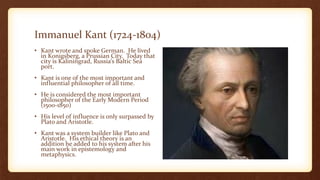
Immanuel Kant (1724-1804)
• Kant wrote and spoke German. He lived
in Konigsberg, a Prussian City. Today that
city is Kaliningrad, Russia’s Baltic Sea
port.
• Kant is one of the most important and
influential philosopher of all time.
• He is considered the most important
philosopher of the Early Modern Period
(1500-1850)
• His level of influence is only surpassed by
Plato and Aristotle.
• Kant was a system builder like Plato and
Aristotle. His ethical theory is an
addition he added to his system after his
main work in epistemology and
metaphysics.
Kant’s Academic Works
• Kant did not start his academic career as a philosopher.
• He was, what we would call today, an astrophysicist.
• His main achievements in this field were being the first to figure out how the sun came
to be (a collapsing cloud of nebula gas under great pressure) and the first to speculate
that there might be intelligent life on planets orbiting other stars since they were
probably suns like our own.
• He referred to himself as a natural philosopher (scientist)
• He became a metaphysical philosopher at age 50 when he read the work of
the philosopher David Hume, which challenged Kant’s world view.
• Kant has several very important books.
• The most important being the Critique of Pure Reason (1781). It has little to do with
ethics, but it is one of the most important philosophy books of all time.
The Foundation of an Ethical Theory
• His key works in ethics include:
• Critique of Practical Reason (1788)
• Groundwork of the Metaphysics of Moral (1785)
• Goal: Kant wanted to create an ethics that is fully rational.
• Other ethical theories before him were rational to a degree but Kant wanted his theory
to be fully rational with no compromises.
• Secondary goal: To make this ethical theory as fully compatible with
Christianity as possible.
• This wasn’t because Kant was deeply religious (he wasn’t). It was because he believed
everyone had to be ethical for the system to work including people with little
education. Most of the people around him were Christian. He wanted them to be able
to easily convert to his theory without having them perform tremendous feats of
mental gymnastics in order to do so.
• This goal is only secondary. If the Christian compatibility part conflicts with the first
goal, then the Christian part must go.
Ultimate Good
• Kant believe that the Ultimate Good was the Good Will.
• Kant doesn’t believe it is happiness because he believes doing the right thing will often
make people unable. It is hard to be a good person.
• The Ultimate Good is something that is good without qualification. It is good by
definition and in its own right.
• Happiness might be good but it is qualified. It is only good if it promotes the right
actions. So, it cannot be the ultimate good.
• What is the Good Will?
• Kant argued in earlier works that your mind allows you to experience reality.
• Rationality is also part of your mind. Thus, we have to focus on how the mind works
for a moment.
• Kant claimed your conscious mind is a series of faculties that perform specific jobs.
• Kant listed over a dozen of these faculties.
• However, to understand the Good Will we only need to discuss three of them.
The Good Will
• Three key faculties of mind:
• Will = this faculty gives you desires (i.e. things you wish to do or pursue).
• Examples: I desire chocolate ice cream, I desire to get a good grade in this course, I desire to
stop reading this dull PowerPoint presentation.
• Judgment = this faculty allows you to choose between competing desires.
• Sometimes you cannot accomplish all your desires together. You must choose.
• Notice if you put the first two faculties together you get “free will”.
• Choosing between options is usually considered the definition of metaphysically free action.
• Kant has built free will directly into the ultimate Good. He calls it “autonomy”.
• Rationality = this faculty gives you good reasons to choose some desires over other
desires.
• You sometimes can misuse your free will and make poor choices.
• Rationality helps you to make the right choices.
The Good Will
• By definition, the Good Will is the use of your free will always in conjunction
with rationality.
• You choose (free will) to do the right thing for the right reasons (rationality).
• Kant has connected rationality directly with the ultimate good.
• Recall his primary goal.
• Therefore, by definition any immoral action is always irrational.
• You used your free will in an irrational way.
• This also means that all moral actions are always rational.
• According to Kant, God is good because he has a perfected Good Will.
• God always chooses to do the right thing for the right reasons.
• You sometimes choose to ignore rationality and this leads to irrational/immoral
decisions.
Imperatives
• An imperative is a necessary command.
• Kant argues that there are two types of imperatives but only one concerns ethics.
• Hypothetical Imperatives = A goal or purpose you give to yourself. However,
failure to follow through on the things necessary to achieve that goal will only
harm the achieving of the goal.
• You give yourself these imperatives all the time.
• Your hungry and want to have a turkey sandwich for lunch.
• You want to watch the whole 1st season of Dexter over summer break.
• However, if you fail to do these things, you really have only harmed the goal and nothing
else.
• You just will eat something else for lunch or finish Dexter later.
• Hypothetical Imperatives really do not concern ethics.
The Categorical Imperative
• Categorical Imperative = A goal or purpose you give to yourself. However,
failure to follow through will cause harm to yourself or to others.
• It is still a goal you give to yourself, but it now involves harm to others.
• Recall that morality is about resolving conflict that could or did cause harm.
• This imperative deals with ethics.
• Example: You accidently threw away your roommates favorite snack. You promise her
that you will replace it by going to the store tomorrow. You made a promise to resolve
the harm caused. If you don’t keep your promise you have caused harm to your
roommate.
• Kant claims that the Categorical Imperative (C.I.) is the main principle of his
ethical theory.
• But, it doesn’t tell you how to act?
• Right, this is just a definition of what it means to be a main principle in an ethical
theory. It is not the statement of the principle itself.
The Categorical Imperative (C.I.)
• If the C.I. is the main principle of Kantian Ethics, Kant has shown the
source of morality.
• It comes from within in you. (A goal you give to yourself).
• You may wonder how this theory is objective if morality is sourced from within
each of us.
• It is objective because Kant argues are minds work the same way.
• We can’t know if there truly is a universal moral law outside of our minds, but we
can use rationality to figure out what would be compatible with it, if there was
such a law.
• Kant has a famous quote: “I continue to be astounded by the starry skies above me
and the moral law within me.”
• For Kant, ethics really is all about using your rational decision making ability in the
correct way.
Formulation of the C.I.
• Kant believes there are four different formulations of the C.I.
• He means there are four different ways to write the C.I..
• Each formulation is logically equivalent to the others.
• Example: 2+2, 3+1, IV are all equivalent to 4.
• We are going to look at only the first two formulations.
• The principle of universalizability.
• The principle of humanity/respect.
Principle of Universalizability
• “One should always choose the maxim of his or her action that could
also be willed a universal moral law.”
• In order to understand this formulation of the C.I., we need to figure
out what a “maxim” is and understand what it means to “will a
universal moral law.”
• Maxim is not about maximizing like in Utilitarianism.
• A maxim is a principle of action you give to yourself.
• It is the action you want to take and your reason for wanting to take that action.
• Example: Recall from the Utilitarianism lecture the car accident case. The last alternative
action was to do nothing. I mentioned there were many reasons to do nothing. Each new
reason with this action would be a different maxim.
Principle of Universalizability
• “could also be willed a universal moral law”
• This is a 2-step rationality test.
• Step 1: Ask yourself: “Is my maxim logically contradictory?”
• If “yes” then do not act on this maxim because it is irrational and thus immoral.
• A contradictory maxim might say something like this: I want to save the woman’s life in the burning
car so I will stand here and do nothing. That is contradictory.
• If “no” then proceed to step 2.
• Step 2: Ask yourself: “If everyone used my maxim in a similar situation could
civilization survive or even be better?”
• If “no” then do not act on this maxim. It is not compatible with the existence of a universal moral law.
• If “yes” then it is morally permissible to act on this maxim because it is consistent with the existence of
a universal moral law.
• The maxim could be made into a universal moral law with no logical problem (it can be universalized).
Principle of Universalizability
• Won’t most maxims pass step 2?
• No, Kant argues very few maxims will pass this test.
• Kant’s example: Imagine you own an ice cream shop and a man comes in and wants a
single scoop cone. It costs $3.75. He hands you a five dollar bill. You form two maxims.
• 1) I will give back the correct change to keep my customers happy.
• 2) I will give back the correct change because it is was the customer is truly owed.
• Kant says that only maxim (2) will pass this test.
• If everyone gave back money based on customer happiness alone, then what would happen if it was a young
child or a person with dementia? Would they still be happy they got ice cream and not care about the change?
It seems they would still be happy.
• If everyone did this in all situations, then we could never trust each other. We would always be paying
attention to the change we got back.
• Civilization requires some level of trust (as we are now experiencing first hand with COVID-19).
Principle of Universalizability
• Kant argues that if you have two or more maxims that pass this test, then you can
choose which one to do. This allows for supererogatory actions (i.e. heroic actions
that are above and beyond what is necessary).
• Note: Utilitarianism has no such actions. You have only one right action in any
situation.
• However, many times there will only be one maxim that ends up being morally
permissible. In such a case, you must act on that maxim.
• Kant calls this type of maxim your duty.
• Doing your duty means doing the right thing for the right reasons and knowing it
was the right reasons.
• Only actions done from duty (in Kant’s sense) deserve moral praise.
Principle of Universalizability
• Surprisingly, Kant argues that there are some actions that no matter the
reason you give to justify them (maxim), they will always end up failing
the rationality test in the principle of universalizability.
• This entails that these actions will always be wrong.
• Not intrinsically wrong, but wrong because any maxim we build from them could
never be made compatible with a universal moral law.
• Examples: murder, rape, stealing, cheating, lying, and promise-breaking.
• These actions are always wrong according to Kant because any reason given to
justify them will never be strong enough to pass the test in the principle of
universalizability.
• So, Kant argues that is always wrong to tell a lie even to save someone’s life.
• A rather extreme position.
Principle of Humanity/Respect
• Notice that the name of the Principle of Universalizability was descriptive. It
told use how this formulation of the C.I. worked.
• Could my maxim be universalized into a moral law?
• Kant intended the same type of descriptive name with the next formulation:
The principle of Humanity.
• However, his use of “humanity” here is archaic. Most philosophers use the word
“respect” because this is what Kant really means by “humanity.”
• Think of it more like the word “humane”.
• Kant intended this formulation for people who needed quick guidance and
did not have the ability to rationally go through the principle of
universalizability.
• However, he thinks both formulations of the C.I. are logically equivalent.
• They will always give you the same moral advice.
Principle of Humanity/Respect
• This principle is negative unlike the first formulation was positive.
• It tells you what not to do, unlike the first which told you what you should do.
• “One should never treat a being with moral worth as a mere means but
always as an end-in-itself.”
• In order to understand this principle we need to know what “a being
with moral worth” is and what “an end-in-itself” is.
• An “end-in-itself” is a being that has goals and purposes and knows it (an end).
• A lion has goals and purpose, but it is not aware it has goals and purposes.
• The only being that is aware of its own goals are rational beings.
• A “being with moral worth” is a being that is capable of having the Good Will.
• Thus, a being that has free will (autonomy) and is rational.
Principle of Humanity/Respect
• If we were to reword this principle with these definitions in mind it
would probably read something like this:
• One should never treat a rational being as a mere means to your own ends, but you
should always treat them as if they had their own goals and purposes and wished
to pursue them.
• In other words, this is the opposite of the old saying “the ends justify
the means.” Kant is arguing that this is false.
• In this new version, the phrasing might seem a bit familiar to you.
• One should never treat a rational being, like yourself, in a way that you would not
want to be treated because you both have goals and purposes.
• In other words, treat each other with respect.
Principle of Humanity/Respect
• The principle of humanity/respect is a version of the Golden Rule.
• Golden Rule: Treat others in the way you wish to be treated.
• Kant gets this from Christianity. Jesus offers the Golden Rule in the parable of Good Samaritan.
• Recall Kant’s secondary goal.
• The reason Kant does not just use the Golden Rule directly is because he thinks it has
two weaknesses that betray its spirit.
• 1) It does not tell you how to treat yourself.
• Or as we say in philosophy, it provides no advice on self-regarding actions.
• This leads to the second problem.
• 2) It would allow a masochist to be a sadist.
• A masochist is someone who gets pleasure from having pain inflicted upon them.
• A sadist is someone who gets pleasure from inflicting pain on others.
• Notice that the Golden Rule would allow this. A masochist likes pain, so he can inflict that pain on others.
• Kant thinks this is absurd. Thus, he rewrites the Golden Rule to overcome these issues.
Principle of Humanity/Respect
• In the principle of Humanity/Respect you are a being with moral worth
and an end-in-itself.
• You must treat your own self with respect just like any other being with moral
worth.
• So, Kant version does tell you how to treat yourself.
• This also now entails that there are two more actions that will always
be immoral.
• Suicide (you are treating your own self as a mere means to end your pain.)
• Selling yourself into slavery (again, you are treating yourself and a mere means to
someone else’s ends.)
• This also entails that slavery itself is immoral.
How Does Kantian Ethics Resolve Ethical Conflict?
• If you recall from the Utilitarianism lecture the case with the guerillas
in the jungle who are going to kill the 20 villagers.
• In this case Kant would say you should take no action because killing
one village to save the other’s lives is to use that person as a mere
means to everyone’s ends.
• You would not be treating that one person with respect.
• You would be a murderer.
• What you should do is tell the guerillas that you can take no action and
that you hope they will not kill the villagers.
• If they do then they will be murderers twenty times over and you will blame them
morally for their heinous actions.
Kantian Ethical Decision-Making
• Notice how fast the principle of humanity/respect gives you that decision even in this difficult
ethical dilemma.
• Kant argues you should practice using the principle of universalizability when you can and have
time.
• It will hone your reasoning skills.
• However, when you are in a rush or don’t have time to think things through, then you should use the
principle of humanity/respect.
• Note that it says you should never use someone as “mere” means. This is because you use people as a
means all the time and you can’t avoid it.
• Like going to a fast food restaurant.
• You use the people behind the counter as means to get your food.
• But, since you pay the company that employs them then you are probably not using them as a mere means.
• This might not be the case though if the company is not paying them enough.
• Think of how little the people who make most of your clothes and shoes get paid. Kant may argue that you are indeed
using these people as a mere means. Thus, you are acting immorally.
Objections
• Kant came up with this one himself and tried to respond to it.
• 1) The Conflict of Duties
• Sometimes, Kant argued, that you can be morally obligated to two or more things that
cannot be accomplished together (i.e. if you do one, the others are impossible to
complete).
• Example: You are in Amsterdam in 1942 while the Nazi’s are in control. A Jewish family
comes to you and asks to hide in your attic as the Germans are looking to send them to the
concentration camps. You promise to hide them and keep them safe. However, two weeks
later the German secret police show up and ask if you are hiding any Jews.
• Kant says you cannot break your promises (if you never intended to keep it, then you
were wrong the moment you made the promise).
• Kant also says you cannot tell a lie.
• No matter if you lie to the secret police or break your promise, it seems you are wrong.
• What should you do?
Conflict of Duties
• Most people would choose to lie in this case because the harm to the secret police by lying seems
minimal. They may never even realize they were lied to. However, the harm caused by breaking
your promise seems extreme. The Jews will be killed in the concentration camps and you probably
will be joining them for hiding them in the first place.
• Kant is going to make the same decision, but he cannot do so for the reasons above.
• The reasons listed above take into account the consequences of the actions.
• Kantian ethics does not judge the consequences. It only judges the intentions and reasons
behind the actions.
• Kant doesn’t like being morally obligated to do impossible things because it seems irrational.
Kant’s response is to just choose one and consider it your true duty and dismiss the others
as not being your true duties.
So, Kant would say there is nothing immoral about a person in the above case who breaks
their promise.
However, Kant does argue that you can use practical (non-ethical) reasons to help you
make your choice. (This is like sneaking consequences in the back door!)
Perfect vs Imperfect Duties
• 2) Kant realized there was another issue: You can be morally obligated to do
things that you are not capable of achieving in a human lifetime.
• This is again a problem because it seems irrational.
• Kant argues there are two types of duties: perfect and imperfect.
• A perfect duty is one that can be achieved in a finite (limited) amount of time and with
a finite amount of resources.
• You promise your roommate to buy the snack you threw out.
• You buy the snack and give it your roommate, then your duty is complete.
• An imperfect duty is one that cannot be achieved in a finite amount of time with a
finite amount of resources.
• Kant thinks there are only two of these imperfect duties:
• Try to make others happy. (yes, Kant thinks you are morally obligated to try to make other people
happy)
• Work on your own moral perfection.
• Don’t reverse them. Also, notice you could never achieve these in a human lifespan, if ever.
Perfect vs Imperfect Duties
• Kant argues that you should work on these imperfect duties when you
have free time.
• You do not always have to do them, or you will starve to death and get
no sleep.
• The test, Kant says, is that if you think at the end of your days if you
have been a good moral person you must ask the following:
• If you have followed all your perfect duties without fail, did you also try to spend
some time making others happy or trying to become a better person?
• If you answer “no”, then Kant says you must judge yourself as immoral even if you
followed all the perfect duties.
• In other words, maybe we should be trying to help each other and spend time with
each other instead of surfing the internet or playing video games all day.
Scope of the Moral Community Problem
• Recall that Kant argues that only beings that are capable of using the Good Will have
moral worth.
• In other words, beings that are capable of rationality (along with having free will or as Kant calls
it: autonomy).
• So, only rational beings have moral worth.
• 3) Some argue that Kantian Ethics excludes a lot of beings from the moral community
• Examples: infants and young children (we don’t think you are capable of abstract reasoning until
around the age of 12 or so). This is why we don’t charge toddlers with assault for hitting other
children.
• Other examples: the severely cognitively impaired either by birth, accident, disease, or old age.
• Also, non-humans are excluded.
• Kant seems to argue that the above beings, because they are not capable of making rational
decisions, do not have any moral worth.
• However, most don’t think it is okay to eat infants or throw a dementia patient in the trash can.
Scope of the Moral Community Problem
• Kant thought everything in his theories had to be perfectly symmetrical.
• He could not conceive that you could possibly have moral obligations to beings that could not
have moral obligations toward you because they were incapable of moral reasoning.
• For Kant, you have moral obligations to beings because they also have moral obligations toward
you.
• The point of this objection is that some think Kant’s view unjustly excludes way too
many beings from the moral community.
• Kant does offer a partial reply.
• He says that you should not harm non-human animals but not because they have moral worth.
• He says you shouldn’t harm them because it may make you more likely to harm beings with moral
worth in the future. (This is merely a practical point not an ethical one).
• So, it is not morally wrong to harm animals, it just is an impractical move on your part.
• If you don’t care about animals pain, then you won’t care about adult human’s pain either.
• It seems Kant is right on this point, as one defining feature of many serial killers is that as children they
would often harm animals.
Bumbling Bianca
• 4) Bumbling Bianca Example:
• Bumbling Bianca is a woman that knows Kantian Ethics better than Kant himself.
She always runs the principle of universalizability to figure out which maxim is
morally permissible. When she has some choice, she will always choose the
maxim that goes over and above what she must do.
• However, Bianca always ends up bungling her implementation of her
good deeds. She ends up by pure accident always producing disastrous
results.
• Example: She goes out to help an elderly person across a busy street, but she slips
on the medium and pushes this person into traffic. She is hit and killed by a bus
and the bus flips trying to miss her and everyone on the bus is killed. Bianca’s
good deed has become a disaster! The elderly woman would have been fine
without Bianca’s “help”.
Bumbling Bianca
• A Kantian Ethicist would judge Bianca as being a moral saint. She
always intended to do the right thing for the right reasons without fail.
The consequences do not matter in Kantian Ethics, so they play no role
in judging Bianca here.
• If you recall the Mean Mark example from the Utilitarianism lecture, a
Kantian Ethicist would judge him as totally immoral because he always
intends to cause great harm to people which would never pass the test
in the principle of universalizability.
• It is the exact opposite for Utilitarians. They would judge Bumbling
Bianca as immoral because of her disastrous consequences and Mean
Mark as perfectly moral because of is great consequences.
Kantian Ethics vs Utilitarianism
• Even though these two theories seem to offer very different moral
advice and work in very different ways, this is only true on the
extremes.
• Most of the time Utilitarianism is going to say murder is wrong just like
in Kantian Ethics. It is also going say lying and promise breaking is
usually wrong. It is only in odd and extreme cases where you can really
see the differences.
• The main reason this is true is because both theories have a very similar
base. They both judge actions based on a single universal ethical
principle.
• For Kant: the Categorical Imperative (in two versions)
• For Utilitarians: the Principle of Utility.
Kantian Ethics vs Utilitarianism
• Yes, one theory judges intentions and reasons, while the other judges the
consequences that are produced.
• You may wonder why we don’t create a theory that takes both intentions and
consequences into account.
• The reason is simple: we have not been able to create an ethical theory that handles
both issues with a single ethical principle.
• You do not want two fundamental ethical principles in your theory.
• This would lead to a guide to action problem if they offered competing moral advice.
• Since neither Bentham nor Kant knew about each other’s work, they did not
think that someone would choose the other direction to prioritize.
Kantian Ethics vs Utilitarianism
• Bentham and Kant both realized they couldn’t get a theory that
handled both issues. So, they needed to make a decision about which
one was truly the most important one for ethics: intentions or
consequences.
• Bentham and Mill chose to prioritize consequences and Kant chose to
prioritize the intentions.
• They didn’t know they should defend this decision, since they didn’t
think any other philosopher would disagree on this point.
• You may still think this is a weakness with both theories since it really
does seem like both intentions and consequences are important.
Kantian Ethics vs Utilitarianism
• The key is to realize that you can’t jump between these theories when it is
convenient for you to do so.
• You can’t be a duty-based rule follower until the moment the consequences
become brutal and you instantly become a consequentialist. That is as
irrational as changing back-and-forth between theories of gravity every day.
• These are objective theories of ethics, only one can be right at most.
• If you jump between them at your convivence, then you are definitely wrong.
• This weakness has led to some philosophers to conclude that maybe this
single principle-based ethics is the wrong approach.
• (Next time we will look at Social Contract Theory which takes a very different kind of
approach to ethics).

Kantian Ethics (Philosophy)!!!!!!!!!!!!!!!!

  • 1.
    Kantian Ethics OUR FOURTHOBJECTIVE ETHICAL THEORY
  • 2.
    Kantian Ethics • Thistheory was founded by Immanuel Kant (1724-1804) and obviously named after him. • It is a Deontological theory. • Recall this means duty-based theory, as opposed to a Consequentialist theory. • Kantian Ethics is considered the prime example of this type of theory. • Jeremy Bentham and Immanuel Kant were developing their theories at nearly the same time but they did not know about each other. • Kant didn’t know anything about Utilitarianism. • Bentham didn’t know anything about Kantian Ethics.
  • 3.
    Immanuel Kant (1724-1804) •Kant wrote and spoke German. He lived in Konigsberg, a Prussian City. Today that city is Kaliningrad, Russia’s Baltic Sea port. • Kant is one of the most important and influential philosopher of all time. • He is considered the most important philosopher of the Early Modern Period (1500-1850) • His level of influence is only surpassed by Plato and Aristotle. • Kant was a system builder like Plato and Aristotle. His ethical theory is an addition he added to his system after his main work in epistemology and metaphysics.
  • 4.
    Kant’s Academic Works •Kant did not start his academic career as a philosopher. • He was, what we would call today, an astrophysicist. • His main achievements in this field were being the first to figure out how the sun came to be (a collapsing cloud of nebula gas under great pressure) and the first to speculate that there might be intelligent life on planets orbiting other stars since they were probably suns like our own. • He referred to himself as a natural philosopher (scientist) • He became a metaphysical philosopher at age 50 when he read the work of the philosopher David Hume, which challenged Kant’s world view. • Kant has several very important books. • The most important being the Critique of Pure Reason (1781). It has little to do with ethics, but it is one of the most important philosophy books of all time.
  • 5.
    The Foundation ofan Ethical Theory • His key works in ethics include: • Critique of Practical Reason (1788) • Groundwork of the Metaphysics of Moral (1785) • Goal: Kant wanted to create an ethics that is fully rational. • Other ethical theories before him were rational to a degree but Kant wanted his theory to be fully rational with no compromises. • Secondary goal: To make this ethical theory as fully compatible with Christianity as possible. • This wasn’t because Kant was deeply religious (he wasn’t). It was because he believed everyone had to be ethical for the system to work including people with little education. Most of the people around him were Christian. He wanted them to be able to easily convert to his theory without having them perform tremendous feats of mental gymnastics in order to do so. • This goal is only secondary. If the Christian compatibility part conflicts with the first goal, then the Christian part must go.
  • 6.
    Ultimate Good • Kantbelieve that the Ultimate Good was the Good Will. • Kant doesn’t believe it is happiness because he believes doing the right thing will often make people unable. It is hard to be a good person. • The Ultimate Good is something that is good without qualification. It is good by definition and in its own right. • Happiness might be good but it is qualified. It is only good if it promotes the right actions. So, it cannot be the ultimate good. • What is the Good Will? • Kant argued in earlier works that your mind allows you to experience reality. • Rationality is also part of your mind. Thus, we have to focus on how the mind works for a moment. • Kant claimed your conscious mind is a series of faculties that perform specific jobs. • Kant listed over a dozen of these faculties. • However, to understand the Good Will we only need to discuss three of them.
  • 7.
    The Good Will •Three key faculties of mind: • Will = this faculty gives you desires (i.e. things you wish to do or pursue). • Examples: I desire chocolate ice cream, I desire to get a good grade in this course, I desire to stop reading this dull PowerPoint presentation. • Judgment = this faculty allows you to choose between competing desires. • Sometimes you cannot accomplish all your desires together. You must choose. • Notice if you put the first two faculties together you get “free will”. • Choosing between options is usually considered the definition of metaphysically free action. • Kant has built free will directly into the ultimate Good. He calls it “autonomy”. • Rationality = this faculty gives you good reasons to choose some desires over other desires. • You sometimes can misuse your free will and make poor choices. • Rationality helps you to make the right choices.
  • 8.
    The Good Will •By definition, the Good Will is the use of your free will always in conjunction with rationality. • You choose (free will) to do the right thing for the right reasons (rationality). • Kant has connected rationality directly with the ultimate good. • Recall his primary goal. • Therefore, by definition any immoral action is always irrational. • You used your free will in an irrational way. • This also means that all moral actions are always rational. • According to Kant, God is good because he has a perfected Good Will. • God always chooses to do the right thing for the right reasons. • You sometimes choose to ignore rationality and this leads to irrational/immoral decisions.
  • 9.
    Imperatives • An imperativeis a necessary command. • Kant argues that there are two types of imperatives but only one concerns ethics. • Hypothetical Imperatives = A goal or purpose you give to yourself. However, failure to follow through on the things necessary to achieve that goal will only harm the achieving of the goal. • You give yourself these imperatives all the time. • Your hungry and want to have a turkey sandwich for lunch. • You want to watch the whole 1st season of Dexter over summer break. • However, if you fail to do these things, you really have only harmed the goal and nothing else. • You just will eat something else for lunch or finish Dexter later. • Hypothetical Imperatives really do not concern ethics.
  • 10.
    The Categorical Imperative •Categorical Imperative = A goal or purpose you give to yourself. However, failure to follow through will cause harm to yourself or to others. • It is still a goal you give to yourself, but it now involves harm to others. • Recall that morality is about resolving conflict that could or did cause harm. • This imperative deals with ethics. • Example: You accidently threw away your roommates favorite snack. You promise her that you will replace it by going to the store tomorrow. You made a promise to resolve the harm caused. If you don’t keep your promise you have caused harm to your roommate. • Kant claims that the Categorical Imperative (C.I.) is the main principle of his ethical theory. • But, it doesn’t tell you how to act? • Right, this is just a definition of what it means to be a main principle in an ethical theory. It is not the statement of the principle itself.
  • 11.
    The Categorical Imperative(C.I.) • If the C.I. is the main principle of Kantian Ethics, Kant has shown the source of morality. • It comes from within in you. (A goal you give to yourself). • You may wonder how this theory is objective if morality is sourced from within each of us. • It is objective because Kant argues are minds work the same way. • We can’t know if there truly is a universal moral law outside of our minds, but we can use rationality to figure out what would be compatible with it, if there was such a law. • Kant has a famous quote: “I continue to be astounded by the starry skies above me and the moral law within me.” • For Kant, ethics really is all about using your rational decision making ability in the correct way.
  • 12.
    Formulation of theC.I. • Kant believes there are four different formulations of the C.I. • He means there are four different ways to write the C.I.. • Each formulation is logically equivalent to the others. • Example: 2+2, 3+1, IV are all equivalent to 4. • We are going to look at only the first two formulations. • The principle of universalizability. • The principle of humanity/respect.
  • 13.
    Principle of Universalizability •“One should always choose the maxim of his or her action that could also be willed a universal moral law.” • In order to understand this formulation of the C.I., we need to figure out what a “maxim” is and understand what it means to “will a universal moral law.” • Maxim is not about maximizing like in Utilitarianism. • A maxim is a principle of action you give to yourself. • It is the action you want to take and your reason for wanting to take that action. • Example: Recall from the Utilitarianism lecture the car accident case. The last alternative action was to do nothing. I mentioned there were many reasons to do nothing. Each new reason with this action would be a different maxim.
  • 14.
    Principle of Universalizability •“could also be willed a universal moral law” • This is a 2-step rationality test. • Step 1: Ask yourself: “Is my maxim logically contradictory?” • If “yes” then do not act on this maxim because it is irrational and thus immoral. • A contradictory maxim might say something like this: I want to save the woman’s life in the burning car so I will stand here and do nothing. That is contradictory. • If “no” then proceed to step 2. • Step 2: Ask yourself: “If everyone used my maxim in a similar situation could civilization survive or even be better?” • If “no” then do not act on this maxim. It is not compatible with the existence of a universal moral law. • If “yes” then it is morally permissible to act on this maxim because it is consistent with the existence of a universal moral law. • The maxim could be made into a universal moral law with no logical problem (it can be universalized).
  • 15.
    Principle of Universalizability •Won’t most maxims pass step 2? • No, Kant argues very few maxims will pass this test. • Kant’s example: Imagine you own an ice cream shop and a man comes in and wants a single scoop cone. It costs $3.75. He hands you a five dollar bill. You form two maxims. • 1) I will give back the correct change to keep my customers happy. • 2) I will give back the correct change because it is was the customer is truly owed. • Kant says that only maxim (2) will pass this test. • If everyone gave back money based on customer happiness alone, then what would happen if it was a young child or a person with dementia? Would they still be happy they got ice cream and not care about the change? It seems they would still be happy. • If everyone did this in all situations, then we could never trust each other. We would always be paying attention to the change we got back. • Civilization requires some level of trust (as we are now experiencing first hand with COVID-19).
  • 16.
    Principle of Universalizability •Kant argues that if you have two or more maxims that pass this test, then you can choose which one to do. This allows for supererogatory actions (i.e. heroic actions that are above and beyond what is necessary). • Note: Utilitarianism has no such actions. You have only one right action in any situation. • However, many times there will only be one maxim that ends up being morally permissible. In such a case, you must act on that maxim. • Kant calls this type of maxim your duty. • Doing your duty means doing the right thing for the right reasons and knowing it was the right reasons. • Only actions done from duty (in Kant’s sense) deserve moral praise.
  • 17.
    Principle of Universalizability •Surprisingly, Kant argues that there are some actions that no matter the reason you give to justify them (maxim), they will always end up failing the rationality test in the principle of universalizability. • This entails that these actions will always be wrong. • Not intrinsically wrong, but wrong because any maxim we build from them could never be made compatible with a universal moral law. • Examples: murder, rape, stealing, cheating, lying, and promise-breaking. • These actions are always wrong according to Kant because any reason given to justify them will never be strong enough to pass the test in the principle of universalizability. • So, Kant argues that is always wrong to tell a lie even to save someone’s life. • A rather extreme position.
  • 18.
    Principle of Humanity/Respect •Notice that the name of the Principle of Universalizability was descriptive. It told use how this formulation of the C.I. worked. • Could my maxim be universalized into a moral law? • Kant intended the same type of descriptive name with the next formulation: The principle of Humanity. • However, his use of “humanity” here is archaic. Most philosophers use the word “respect” because this is what Kant really means by “humanity.” • Think of it more like the word “humane”. • Kant intended this formulation for people who needed quick guidance and did not have the ability to rationally go through the principle of universalizability. • However, he thinks both formulations of the C.I. are logically equivalent. • They will always give you the same moral advice.
  • 19.
    Principle of Humanity/Respect •This principle is negative unlike the first formulation was positive. • It tells you what not to do, unlike the first which told you what you should do. • “One should never treat a being with moral worth as a mere means but always as an end-in-itself.” • In order to understand this principle we need to know what “a being with moral worth” is and what “an end-in-itself” is. • An “end-in-itself” is a being that has goals and purposes and knows it (an end). • A lion has goals and purpose, but it is not aware it has goals and purposes. • The only being that is aware of its own goals are rational beings. • A “being with moral worth” is a being that is capable of having the Good Will. • Thus, a being that has free will (autonomy) and is rational.
  • 20.
    Principle of Humanity/Respect •If we were to reword this principle with these definitions in mind it would probably read something like this: • One should never treat a rational being as a mere means to your own ends, but you should always treat them as if they had their own goals and purposes and wished to pursue them. • In other words, this is the opposite of the old saying “the ends justify the means.” Kant is arguing that this is false. • In this new version, the phrasing might seem a bit familiar to you. • One should never treat a rational being, like yourself, in a way that you would not want to be treated because you both have goals and purposes. • In other words, treat each other with respect.
  • 21.
    Principle of Humanity/Respect •The principle of humanity/respect is a version of the Golden Rule. • Golden Rule: Treat others in the way you wish to be treated. • Kant gets this from Christianity. Jesus offers the Golden Rule in the parable of Good Samaritan. • Recall Kant’s secondary goal. • The reason Kant does not just use the Golden Rule directly is because he thinks it has two weaknesses that betray its spirit. • 1) It does not tell you how to treat yourself. • Or as we say in philosophy, it provides no advice on self-regarding actions. • This leads to the second problem. • 2) It would allow a masochist to be a sadist. • A masochist is someone who gets pleasure from having pain inflicted upon them. • A sadist is someone who gets pleasure from inflicting pain on others. • Notice that the Golden Rule would allow this. A masochist likes pain, so he can inflict that pain on others. • Kant thinks this is absurd. Thus, he rewrites the Golden Rule to overcome these issues.
  • 22.
    Principle of Humanity/Respect •In the principle of Humanity/Respect you are a being with moral worth and an end-in-itself. • You must treat your own self with respect just like any other being with moral worth. • So, Kant version does tell you how to treat yourself. • This also now entails that there are two more actions that will always be immoral. • Suicide (you are treating your own self as a mere means to end your pain.) • Selling yourself into slavery (again, you are treating yourself and a mere means to someone else’s ends.) • This also entails that slavery itself is immoral.
  • 23.
    How Does KantianEthics Resolve Ethical Conflict? • If you recall from the Utilitarianism lecture the case with the guerillas in the jungle who are going to kill the 20 villagers. • In this case Kant would say you should take no action because killing one village to save the other’s lives is to use that person as a mere means to everyone’s ends. • You would not be treating that one person with respect. • You would be a murderer. • What you should do is tell the guerillas that you can take no action and that you hope they will not kill the villagers. • If they do then they will be murderers twenty times over and you will blame them morally for their heinous actions.
  • 24.
    Kantian Ethical Decision-Making •Notice how fast the principle of humanity/respect gives you that decision even in this difficult ethical dilemma. • Kant argues you should practice using the principle of universalizability when you can and have time. • It will hone your reasoning skills. • However, when you are in a rush or don’t have time to think things through, then you should use the principle of humanity/respect. • Note that it says you should never use someone as “mere” means. This is because you use people as a means all the time and you can’t avoid it. • Like going to a fast food restaurant. • You use the people behind the counter as means to get your food. • But, since you pay the company that employs them then you are probably not using them as a mere means. • This might not be the case though if the company is not paying them enough. • Think of how little the people who make most of your clothes and shoes get paid. Kant may argue that you are indeed using these people as a mere means. Thus, you are acting immorally.
  • 25.
    Objections • Kant cameup with this one himself and tried to respond to it. • 1) The Conflict of Duties • Sometimes, Kant argued, that you can be morally obligated to two or more things that cannot be accomplished together (i.e. if you do one, the others are impossible to complete). • Example: You are in Amsterdam in 1942 while the Nazi’s are in control. A Jewish family comes to you and asks to hide in your attic as the Germans are looking to send them to the concentration camps. You promise to hide them and keep them safe. However, two weeks later the German secret police show up and ask if you are hiding any Jews. • Kant says you cannot break your promises (if you never intended to keep it, then you were wrong the moment you made the promise). • Kant also says you cannot tell a lie. • No matter if you lie to the secret police or break your promise, it seems you are wrong. • What should you do?
  • 26.
    Conflict of Duties •Most people would choose to lie in this case because the harm to the secret police by lying seems minimal. They may never even realize they were lied to. However, the harm caused by breaking your promise seems extreme. The Jews will be killed in the concentration camps and you probably will be joining them for hiding them in the first place. • Kant is going to make the same decision, but he cannot do so for the reasons above. • The reasons listed above take into account the consequences of the actions. • Kantian ethics does not judge the consequences. It only judges the intentions and reasons behind the actions. • Kant doesn’t like being morally obligated to do impossible things because it seems irrational. Kant’s response is to just choose one and consider it your true duty and dismiss the others as not being your true duties. So, Kant would say there is nothing immoral about a person in the above case who breaks their promise. However, Kant does argue that you can use practical (non-ethical) reasons to help you make your choice. (This is like sneaking consequences in the back door!)
  • 27.
    Perfect vs ImperfectDuties • 2) Kant realized there was another issue: You can be morally obligated to do things that you are not capable of achieving in a human lifetime. • This is again a problem because it seems irrational. • Kant argues there are two types of duties: perfect and imperfect. • A perfect duty is one that can be achieved in a finite (limited) amount of time and with a finite amount of resources. • You promise your roommate to buy the snack you threw out. • You buy the snack and give it your roommate, then your duty is complete. • An imperfect duty is one that cannot be achieved in a finite amount of time with a finite amount of resources. • Kant thinks there are only two of these imperfect duties: • Try to make others happy. (yes, Kant thinks you are morally obligated to try to make other people happy) • Work on your own moral perfection. • Don’t reverse them. Also, notice you could never achieve these in a human lifespan, if ever.
  • 28.
    Perfect vs ImperfectDuties • Kant argues that you should work on these imperfect duties when you have free time. • You do not always have to do them, or you will starve to death and get no sleep. • The test, Kant says, is that if you think at the end of your days if you have been a good moral person you must ask the following: • If you have followed all your perfect duties without fail, did you also try to spend some time making others happy or trying to become a better person? • If you answer “no”, then Kant says you must judge yourself as immoral even if you followed all the perfect duties. • In other words, maybe we should be trying to help each other and spend time with each other instead of surfing the internet or playing video games all day.
  • 29.
    Scope of theMoral Community Problem • Recall that Kant argues that only beings that are capable of using the Good Will have moral worth. • In other words, beings that are capable of rationality (along with having free will or as Kant calls it: autonomy). • So, only rational beings have moral worth. • 3) Some argue that Kantian Ethics excludes a lot of beings from the moral community • Examples: infants and young children (we don’t think you are capable of abstract reasoning until around the age of 12 or so). This is why we don’t charge toddlers with assault for hitting other children. • Other examples: the severely cognitively impaired either by birth, accident, disease, or old age. • Also, non-humans are excluded. • Kant seems to argue that the above beings, because they are not capable of making rational decisions, do not have any moral worth. • However, most don’t think it is okay to eat infants or throw a dementia patient in the trash can.
  • 30.
    Scope of theMoral Community Problem • Kant thought everything in his theories had to be perfectly symmetrical. • He could not conceive that you could possibly have moral obligations to beings that could not have moral obligations toward you because they were incapable of moral reasoning. • For Kant, you have moral obligations to beings because they also have moral obligations toward you. • The point of this objection is that some think Kant’s view unjustly excludes way too many beings from the moral community. • Kant does offer a partial reply. • He says that you should not harm non-human animals but not because they have moral worth. • He says you shouldn’t harm them because it may make you more likely to harm beings with moral worth in the future. (This is merely a practical point not an ethical one). • So, it is not morally wrong to harm animals, it just is an impractical move on your part. • If you don’t care about animals pain, then you won’t care about adult human’s pain either. • It seems Kant is right on this point, as one defining feature of many serial killers is that as children they would often harm animals.
  • 31.
    Bumbling Bianca • 4)Bumbling Bianca Example: • Bumbling Bianca is a woman that knows Kantian Ethics better than Kant himself. She always runs the principle of universalizability to figure out which maxim is morally permissible. When she has some choice, she will always choose the maxim that goes over and above what she must do. • However, Bianca always ends up bungling her implementation of her good deeds. She ends up by pure accident always producing disastrous results. • Example: She goes out to help an elderly person across a busy street, but she slips on the medium and pushes this person into traffic. She is hit and killed by a bus and the bus flips trying to miss her and everyone on the bus is killed. Bianca’s good deed has become a disaster! The elderly woman would have been fine without Bianca’s “help”.
  • 32.
    Bumbling Bianca • AKantian Ethicist would judge Bianca as being a moral saint. She always intended to do the right thing for the right reasons without fail. The consequences do not matter in Kantian Ethics, so they play no role in judging Bianca here. • If you recall the Mean Mark example from the Utilitarianism lecture, a Kantian Ethicist would judge him as totally immoral because he always intends to cause great harm to people which would never pass the test in the principle of universalizability. • It is the exact opposite for Utilitarians. They would judge Bumbling Bianca as immoral because of her disastrous consequences and Mean Mark as perfectly moral because of is great consequences.
  • 33.
    Kantian Ethics vsUtilitarianism • Even though these two theories seem to offer very different moral advice and work in very different ways, this is only true on the extremes. • Most of the time Utilitarianism is going to say murder is wrong just like in Kantian Ethics. It is also going say lying and promise breaking is usually wrong. It is only in odd and extreme cases where you can really see the differences. • The main reason this is true is because both theories have a very similar base. They both judge actions based on a single universal ethical principle. • For Kant: the Categorical Imperative (in two versions) • For Utilitarians: the Principle of Utility.
  • 34.
    Kantian Ethics vsUtilitarianism • Yes, one theory judges intentions and reasons, while the other judges the consequences that are produced. • You may wonder why we don’t create a theory that takes both intentions and consequences into account. • The reason is simple: we have not been able to create an ethical theory that handles both issues with a single ethical principle. • You do not want two fundamental ethical principles in your theory. • This would lead to a guide to action problem if they offered competing moral advice. • Since neither Bentham nor Kant knew about each other’s work, they did not think that someone would choose the other direction to prioritize.
  • 35.
    Kantian Ethics vsUtilitarianism • Bentham and Kant both realized they couldn’t get a theory that handled both issues. So, they needed to make a decision about which one was truly the most important one for ethics: intentions or consequences. • Bentham and Mill chose to prioritize consequences and Kant chose to prioritize the intentions. • They didn’t know they should defend this decision, since they didn’t think any other philosopher would disagree on this point. • You may still think this is a weakness with both theories since it really does seem like both intentions and consequences are important.
  • 36.
    Kantian Ethics vsUtilitarianism • The key is to realize that you can’t jump between these theories when it is convenient for you to do so. • You can’t be a duty-based rule follower until the moment the consequences become brutal and you instantly become a consequentialist. That is as irrational as changing back-and-forth between theories of gravity every day. • These are objective theories of ethics, only one can be right at most. • If you jump between them at your convivence, then you are definitely wrong. • This weakness has led to some philosophers to conclude that maybe this single principle-based ethics is the wrong approach. • (Next time we will look at Social Contract Theory which takes a very different kind of approach to ethics).