HUM 4229
Society, Ethics and Technology
Introduction to Ethics: Ethical Theories
Hemayet Hossain Soikat
Department of EEE
Ahsanullah University of Science and Technology
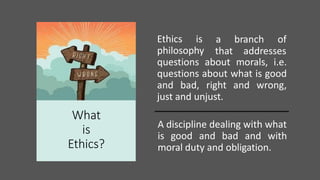
Ethics is
philosophy
a branch of
that addresses
questions about morals, i.e.
questions about what is good
and bad, right and wrong,
just and unjust.
What
is
Ethics?
A discipline dealing with what
is good and bad and with
moral duty and obligation.
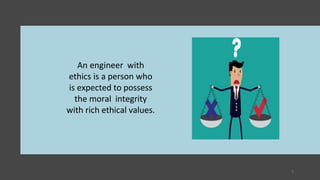
An engineer with
ethics is a person who
is expected to possess
the moral integrity
with rich ethical values.
3
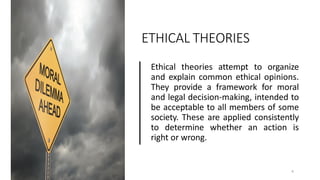
Ethical theories attempt to organize
and explain common ethical opinions.
They provide a framework for moral
and legal decision-making, intended to
be acceptable to all members of some
society. These are applied consistently
to determine whether an action is
right or wrong.
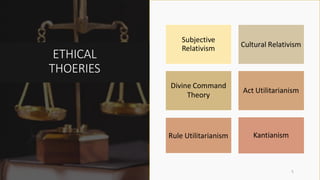
ETHICAL THEORIES
4
Subjective
Relativism Cultural Relativism
Divine Command
Theory
Act Utilitarianism
Rule Utilitarianism Kantianism
ETHICAL
THOERIES
5
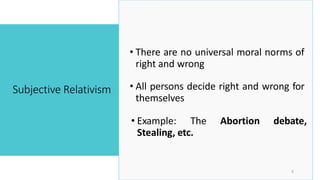
• There are no universal moral norms of
right and wrong
Subjective Relativism
6
• All persons decide right and wrong for
themselves
• Example: The Abortion debate,
Stealing, etc.
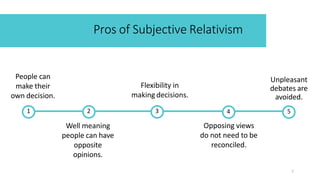
Unpleasant
debates are
avoided.
Pros of Subjective Relativism
1 3 5
4
7
2
People can
make their
own decision.
Well meaning
people can have
opposite
opinions.
Flexibility in
making decisions.
Opposing views
do not need to be
reconciled.
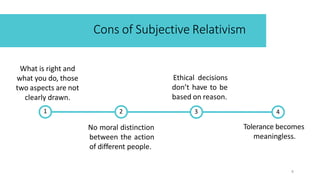
Cons of Subjective Relativism
3
8
2
What is right and
what you do, those
two aspects are not
clearly drawn.
1
No moral distinction
between the action
of different people.
4
Tolerance becomes
meaningless.
Ethical decisions
don’t have to be
based on reason.
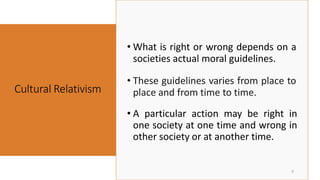
• These guidelines varies from place to
place and from time to time.
Cultural Relativism
9
• A particular action may be right in
one society at one time and wrong in
other society or at another time.
• What is right or wrong depends on a
societies actual moral guidelines.
2
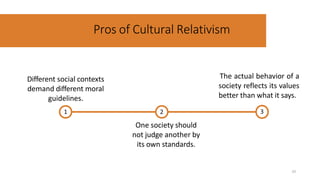
Pros of Cultural Relativism
3
10
Different social contexts
demand different moral
guidelines.
1
One society should
not judge another by
its own standards.
The actual behavior of a
society reflects its values
better than what it says.
3 4
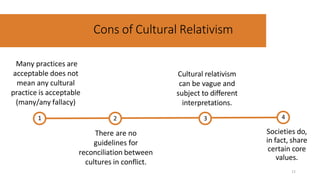
Societies do,
in fact, share
certain core
values.
2
Many practices are
acceptable does not
mean any cultural
practice is acceptable
(many/any fallacy)
1
There are no
guidelines for
reconciliation between
cultures in conflict.
Cons of Cultural Relativism
11
Cultural relativism
can be vague and
subject to different
interpretations.
• Holy books reveals god’s will, should be
used as decision making guides.
Divine Command Theory
12
• Good actions:
those aligned with God’s will.
• Bad actions:
those contrary to God’s will.
We owe obedience to
God, our creator.
1 2 3
13
Pros of Divine Command Theory
God is all good and
all knowing.
God is the
ultimate authority.
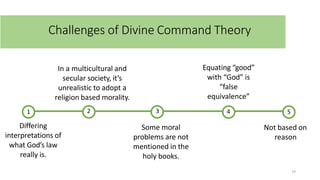
Challenges of Divine Command Theory
1 3 5
4
14
2
Differing
interpretations of
what God’s law
really is.
In a multicultural and
secular society, it’s
unrealistic to adopt a
religion based morality.
Some moral
problems are not
mentioned in the
holy books.
Equating “good”
with “God” is
“false
equivalence”
Not based on
reason
Utilitarianism
15
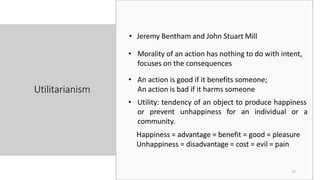
• Jeremy Bentham and John Stuart Mill
• Morality of an action has nothing to do with intent,
focuses on the consequences
• An action is good if it benefits someone;
An action is bad if it harms someone
• Utility: tendency of an object to produce happiness
or prevent unhappiness for an individual or a
community.
Happiness = advantage = benefit = good = pleasure
Unhappiness = disadvantage = cost = evil = pain
Act Utilitarianism
16
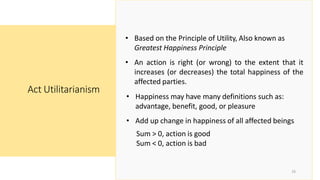
• Based on the Principle of Utility, Also known as
Greatest Happiness Principle
• An action is right (or wrong) to the extent that it
increases (or decreases) the total happiness of the
affected parties.
• Happiness may have many definitions such as:
advantage, benefit, good, or pleasure
• Add up change in happiness of all affected beings
Sum > 0, action is good
Sum < 0, action is bad
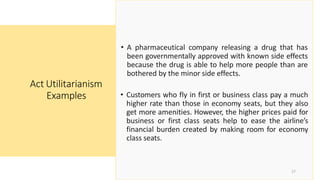
• A pharmaceutical company releasing a drug that has
been governmentally approved with known side effects
because the drug is able to help more people than are
bothered by the minor side effects.
• Customers who fly in first or business class pay a much
higher rate than those in economy seats, but they also
get more amenities. However, the higher prices paid for
business or first class seats help to ease the airline’s
financial burden created by making room for economy
class seats.
Act Utilitarianism
Examples
17
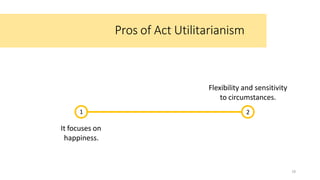
Pros of Act Utilitarianism
It focuses on
happiness.
Flexibility and sensitivity
to circumstances.
1
18
2
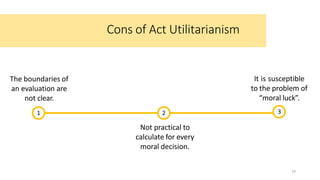
Cons of Act Utilitarianism
The boundaries of
an evaluation are
not clear.
.
Not practical to
calculate for every
moral decision.
1
19
3
2
It is susceptible
to the problem of
“moral luck”.
• State may replace a curvy stretch of highway
• New highway segment 1 mile shorter
• 150 houses would have to be removed
• Some wildlife habitat would be destroyed
HIGHWAY ROUTE
SCENERIO
20
Costs
• $20 million to compensate homeowners
• $10 million to construct new highway
• Lost wildlife habitat worth $1 million
Benefits
• $39 million savings in automobile driving costs
Conclusion????
21
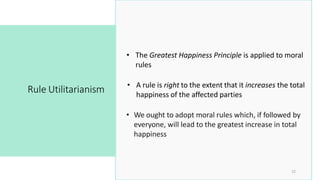
• We ought to adopt moral rules which, if followed by
everyone, will lead to the greatest increase in total
happiness
Rule Utilitarianism
22
• A rule is right to the extent that it increases the total
happiness of the affected parties
• The Greatest Happiness Principle is applied to moral
rules
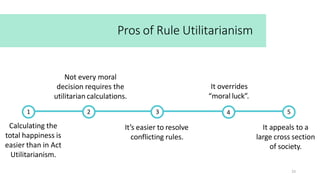
Pros of Rule Utilitarianism
1 3 5
4
23
2
Calculating the
total happiness is
easier than in Act
Utilitarianism.
Not every moral
decision requires the
utilitarian calculations.
It’s easier to resolve
conflicting rules.
It overrides
“moral luck”.
It appeals to a
large cross section
of society.
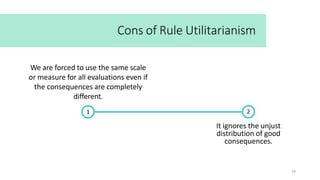
It ignores the unjust
distribution of good
consequences.
Cons of Rule Utilitarianism
1
24
2
We are forced to use the same scale
or measure for all evaluations even if
the consequences are completely
different.
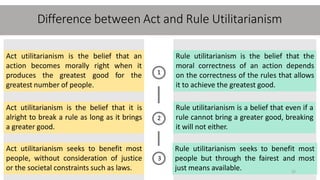
Difference between Act and Rule Utilitarianism
1
2
Act utilitarianism is the belief that an
action becomes morally right when it
produces the greatest good for the
greatest number of people.
Rule utilitarianism is the belief that the
moral correctness of an action depends
on the correctness of the rules that allows
it to achieve the greatest good.
Act utilitarianism is the belief that it is
alright to break a rule as long as it brings
a greater good.
Rule utilitarianism is a belief that even if a
rule cannot bring a greater good, breaking
it will not either.
Rule utilitarianism seeks to benefit most
people but through the fairest and most
just means available.
Act utilitarianism seeks to benefit most
people, without consideration of justice
or the societal constraints such as laws.
3
25
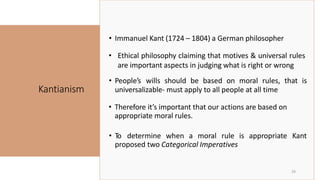
Kantianism
26
• People’s wills should be based on moral rules, that is
universalizable- must apply to all people at all time
• Immanuel Kant (1724 – 1804) a German philosopher
• Ethical philosophy claiming that motives & universal rules
are important aspects in judging what is right or wrong
• Therefore it’s important that our actions are based on
appropriate moral rules.
• To determine when a moral rule is appropriate Kant
proposed two Categorical Imperatives
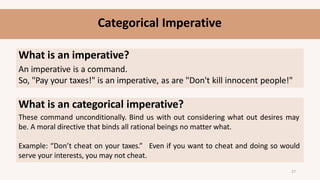
Categorical Imperative
What is an imperative?
An imperative is a command.
So, "Pay your taxes!" is an imperative, as are "Don't kill innocent people!"
What is an categorical imperative?
These command unconditionally. Bind us with out considering what out desires may
be. A moral directive that binds all rational beings no matter what.
Example: “Don’t cheat on your taxes.” Even if you want to cheat and doing so would
serve your interests, you may not cheat.
27
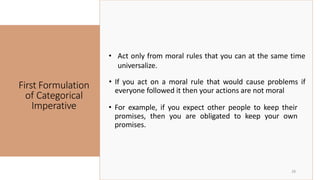
First Formulation
of Categorical
Imperative
28
• Act only from moral rules that you can at the same time
universalize.
• For example, if you expect other people to keep their
promises, then you are obligated to keep your own
promises.
• If you act on a moral rule that would cause problems if
everyone followed it then your actions are not moral
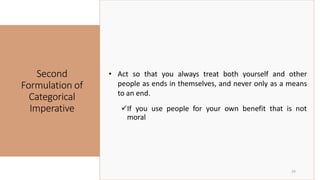
Second
Formulation of
Categorical
Imperative
29
• Act so that you always treat both yourself and other
people as ends in themselves, and never only as a means
to an end.
✓If you use people for your own benefit that is not
moral
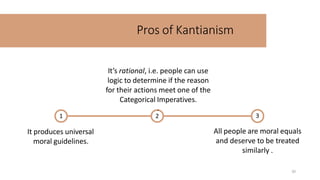
Pros of Kantianism
It produces universal
moral guidelines.
All people are moral equals
and deserve to be treated
similarly .
1
It’s rational, i.e. people can use
logic to determine if the reason
for their actions meet one of the
Categorical Imperatives.
.
2 3
30
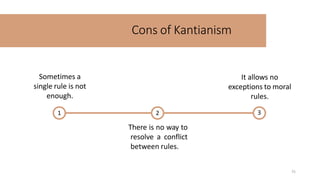
Cons of Kantianism
Sometimes a
single rule is not
enough.
There is no way to
resolve a conflict
between rules.
It allows no
exceptions to moral
rules.
1
31
3
2
PLAGIARISM
SCENERIO • Carla
• Single mother
• Works full time
• Takes two evening courses/semester
• History class
• Requires more work than normal
• Carla earning an “A” on all work so far
•Carla doesn’t have time to write final
report
•Carla purchases report and submits it
as her own work
Kantian Evaluation
Using First and Second Formulation???
32
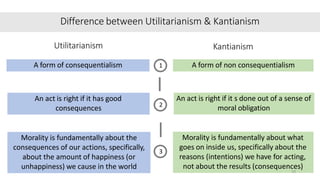
Difference between Utilitarianism & Kantianism
1
2
A form of non consequentialism
A form of consequentialism
An act is right if it s done out of a sense of
moral obligation
An act is right if it has good
consequences
Morality is fundamentally about the
consequences of our actions, specifically,
about the amount of happiness (or
unhappiness) we cause in the world
Morality is fundamentally about what
goes on inside us, specifically about the
reasons (intentions) we have for acting,
not about the results (consequences)
3
Kantianism
Utilitarianism
33

Chapter 5_Introduction to Ethics - Ethical Theories.pdf

  • 1.
    HUM 4229 Society, Ethicsand Technology Introduction to Ethics: Ethical Theories Hemayet Hossain Soikat Department of EEE Ahsanullah University of Science and Technology
  • 2.
    Ethics is philosophy a branchof that addresses questions about morals, i.e. questions about what is good and bad, right and wrong, just and unjust. What is Ethics? A discipline dealing with what is good and bad and with moral duty and obligation.
  • 3.
    An engineer with ethicsis a person who is expected to possess the moral integrity with rich ethical values. 3
  • 4.
    Ethical theories attemptto organize and explain common ethical opinions. They provide a framework for moral and legal decision-making, intended to be acceptable to all members of some society. These are applied consistently to determine whether an action is right or wrong. ETHICAL THEORIES 4
  • 5.
    Subjective Relativism Cultural Relativism DivineCommand Theory Act Utilitarianism Rule Utilitarianism Kantianism ETHICAL THOERIES 5
  • 6.
    • There areno universal moral norms of right and wrong Subjective Relativism 6 • All persons decide right and wrong for themselves • Example: The Abortion debate, Stealing, etc.
  • 7.
    Unpleasant debates are avoided. Pros ofSubjective Relativism 1 3 5 4 7 2 People can make their own decision. Well meaning people can have opposite opinions. Flexibility in making decisions. Opposing views do not need to be reconciled.
  • 8.
    Cons of SubjectiveRelativism 3 8 2 What is right and what you do, those two aspects are not clearly drawn. 1 No moral distinction between the action of different people. 4 Tolerance becomes meaningless. Ethical decisions don’t have to be based on reason.
  • 9.
    • These guidelinesvaries from place to place and from time to time. Cultural Relativism 9 • A particular action may be right in one society at one time and wrong in other society or at another time. • What is right or wrong depends on a societies actual moral guidelines.
  • 10.
    2 Pros of CulturalRelativism 3 10 Different social contexts demand different moral guidelines. 1 One society should not judge another by its own standards. The actual behavior of a society reflects its values better than what it says.
  • 11.
    3 4 Societies do, infact, share certain core values. 2 Many practices are acceptable does not mean any cultural practice is acceptable (many/any fallacy) 1 There are no guidelines for reconciliation between cultures in conflict. Cons of Cultural Relativism 11 Cultural relativism can be vague and subject to different interpretations.
  • 12.
    • Holy booksreveals god’s will, should be used as decision making guides. Divine Command Theory 12 • Good actions: those aligned with God’s will. • Bad actions: those contrary to God’s will.
  • 13.
    We owe obedienceto God, our creator. 1 2 3 13 Pros of Divine Command Theory God is all good and all knowing. God is the ultimate authority.
  • 14.
    Challenges of DivineCommand Theory 1 3 5 4 14 2 Differing interpretations of what God’s law really is. In a multicultural and secular society, it’s unrealistic to adopt a religion based morality. Some moral problems are not mentioned in the holy books. Equating “good” with “God” is “false equivalence” Not based on reason
  • 15.
    Utilitarianism 15 • Jeremy Benthamand John Stuart Mill • Morality of an action has nothing to do with intent, focuses on the consequences • An action is good if it benefits someone; An action is bad if it harms someone • Utility: tendency of an object to produce happiness or prevent unhappiness for an individual or a community. Happiness = advantage = benefit = good = pleasure Unhappiness = disadvantage = cost = evil = pain
  • 16.
    Act Utilitarianism 16 • Basedon the Principle of Utility, Also known as Greatest Happiness Principle • An action is right (or wrong) to the extent that it increases (or decreases) the total happiness of the affected parties. • Happiness may have many definitions such as: advantage, benefit, good, or pleasure • Add up change in happiness of all affected beings Sum > 0, action is good Sum < 0, action is bad
  • 17.
    • A pharmaceuticalcompany releasing a drug that has been governmentally approved with known side effects because the drug is able to help more people than are bothered by the minor side effects. • Customers who fly in first or business class pay a much higher rate than those in economy seats, but they also get more amenities. However, the higher prices paid for business or first class seats help to ease the airline’s financial burden created by making room for economy class seats. Act Utilitarianism Examples 17
  • 18.
    Pros of ActUtilitarianism It focuses on happiness. Flexibility and sensitivity to circumstances. 1 18 2
  • 19.
    Cons of ActUtilitarianism The boundaries of an evaluation are not clear. . Not practical to calculate for every moral decision. 1 19 3 2 It is susceptible to the problem of “moral luck”.
  • 20.
    • State mayreplace a curvy stretch of highway • New highway segment 1 mile shorter • 150 houses would have to be removed • Some wildlife habitat would be destroyed HIGHWAY ROUTE SCENERIO 20 Costs • $20 million to compensate homeowners • $10 million to construct new highway • Lost wildlife habitat worth $1 million Benefits • $39 million savings in automobile driving costs Conclusion????
  • 21.
  • 22.
    • We oughtto adopt moral rules which, if followed by everyone, will lead to the greatest increase in total happiness Rule Utilitarianism 22 • A rule is right to the extent that it increases the total happiness of the affected parties • The Greatest Happiness Principle is applied to moral rules
  • 23.
    Pros of RuleUtilitarianism 1 3 5 4 23 2 Calculating the total happiness is easier than in Act Utilitarianism. Not every moral decision requires the utilitarian calculations. It’s easier to resolve conflicting rules. It overrides “moral luck”. It appeals to a large cross section of society.
  • 24.
    It ignores theunjust distribution of good consequences. Cons of Rule Utilitarianism 1 24 2 We are forced to use the same scale or measure for all evaluations even if the consequences are completely different.
  • 25.
    Difference between Actand Rule Utilitarianism 1 2 Act utilitarianism is the belief that an action becomes morally right when it produces the greatest good for the greatest number of people. Rule utilitarianism is the belief that the moral correctness of an action depends on the correctness of the rules that allows it to achieve the greatest good. Act utilitarianism is the belief that it is alright to break a rule as long as it brings a greater good. Rule utilitarianism is a belief that even if a rule cannot bring a greater good, breaking it will not either. Rule utilitarianism seeks to benefit most people but through the fairest and most just means available. Act utilitarianism seeks to benefit most people, without consideration of justice or the societal constraints such as laws. 3 25
  • 26.
    Kantianism 26 • People’s willsshould be based on moral rules, that is universalizable- must apply to all people at all time • Immanuel Kant (1724 – 1804) a German philosopher • Ethical philosophy claiming that motives & universal rules are important aspects in judging what is right or wrong • Therefore it’s important that our actions are based on appropriate moral rules. • To determine when a moral rule is appropriate Kant proposed two Categorical Imperatives
  • 27.
    Categorical Imperative What isan imperative? An imperative is a command. So, "Pay your taxes!" is an imperative, as are "Don't kill innocent people!" What is an categorical imperative? These command unconditionally. Bind us with out considering what out desires may be. A moral directive that binds all rational beings no matter what. Example: “Don’t cheat on your taxes.” Even if you want to cheat and doing so would serve your interests, you may not cheat. 27
  • 28.
    First Formulation of Categorical Imperative 28 •Act only from moral rules that you can at the same time universalize. • For example, if you expect other people to keep their promises, then you are obligated to keep your own promises. • If you act on a moral rule that would cause problems if everyone followed it then your actions are not moral
  • 29.
    Second Formulation of Categorical Imperative 29 • Actso that you always treat both yourself and other people as ends in themselves, and never only as a means to an end. ✓If you use people for your own benefit that is not moral
  • 30.
    Pros of Kantianism Itproduces universal moral guidelines. All people are moral equals and deserve to be treated similarly . 1 It’s rational, i.e. people can use logic to determine if the reason for their actions meet one of the Categorical Imperatives. . 2 3 30
  • 31.
    Cons of Kantianism Sometimesa single rule is not enough. There is no way to resolve a conflict between rules. It allows no exceptions to moral rules. 1 31 3 2
  • 32.
    PLAGIARISM SCENERIO • Carla •Single mother • Works full time • Takes two evening courses/semester • History class • Requires more work than normal • Carla earning an “A” on all work so far •Carla doesn’t have time to write final report •Carla purchases report and submits it as her own work Kantian Evaluation Using First and Second Formulation??? 32
  • 33.
    Difference between Utilitarianism& Kantianism 1 2 A form of non consequentialism A form of consequentialism An act is right if it s done out of a sense of moral obligation An act is right if it has good consequences Morality is fundamentally about the consequences of our actions, specifically, about the amount of happiness (or unhappiness) we cause in the world Morality is fundamentally about what goes on inside us, specifically about the reasons (intentions) we have for acting, not about the results (consequences) 3 Kantianism Utilitarianism 33