MORAL
What is


          R E LAT I V I S M ?
  Examining the Claims of Moral Relativism


                                     www.confidentchristians.org
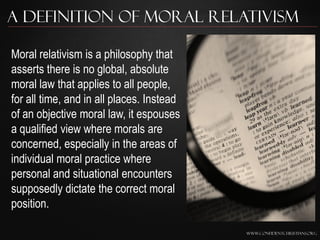
A Definition of Moral Relativism

Moral relativism is a philosophy that
asserts there is no global, absolute
moral law that applies to all people,
for all time, and in all places. Instead
of an objective moral law, it espouses
a qualified view where morals are
concerned, especially in the areas of
individual moral practice where
personal and situational encounters
supposedly dictate the correct moral
position.

                                           www.confidentchristians.org
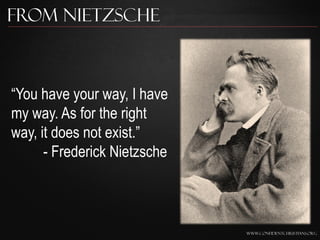
From Nietzsche


“You have your way, I have
my way. As for the right
way, it does not exist.”
      - Frederick Nietzsche


                              www.confidentchristians.org
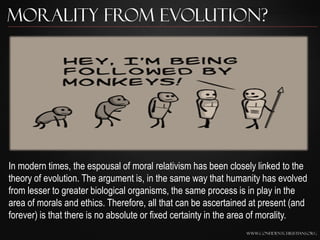
Morality from Evolution?


In modern times, the espousal of moral relativism has been closely linked to the
theory of evolution. The argument is, in the same way that humanity has evolved
from lesser to greater biological organisms, the same process is in play in the
area of morals and ethics. Therefore, all that can be ascertained at present (and
forever) is that there is no absolute or fixed certainty in the area of morality.
                                                                www.confidentchristians.org
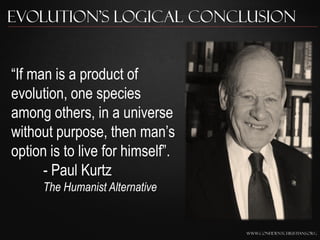
Evolution’s Logical Conclusion


“If man is a product of
evolution, one species
among others, in a universe
without purpose, then man‟s
option is to live for himself”.
      - Paul Kurtz
      The Humanist Alternative


                                  www.confidentchristians.org
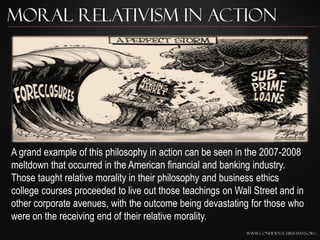
Moral Relativism In Action


A grand example of this philosophy in action can be seen in the 2007-2008
meltdown that occurred in the American financial and banking industry.
Those taught relative morality in their philosophy and business ethics
college courses proceeded to live out those teachings on Wall Street and in
other corporate avenues, with the outcome being devastating for those who
were on the receiving end of their relative morality.
                                                            www.confidentchristians.org
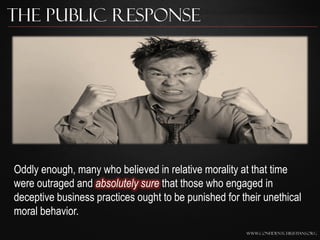
The Public Response


Oddly enough, many who believed in relative morality at that time
were outraged and absolutely sure that those who engaged in
deceptive business practices ought to be punished for their unethical
moral behavior.
                                                       www.confidentchristians.org
An Important Truth Revealed


Moral relativists have a rather dim view of moral
relativism when it negatively impacts them.
                                         www.confidentchristians.org
An Important Truth Revealed

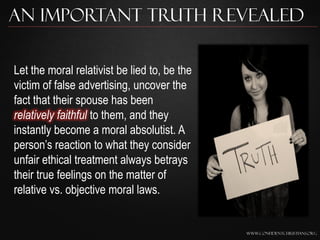
Let the moral relativist be lied to, be the
victim of false advertising, uncover the
fact that their spouse has been
relatively faithful to them, and they
instantly become a moral absolutist. A
person‟s reaction to what they consider
unfair ethical treatment always betrays
their true feelings on the matter of
relative vs. objective moral laws.


                                              www.confidentchristians.org
www.confidentchristians.org
The Important Question
The problem for the moral relativist (who is most times a secular humanist
that rejects God) is they have no good answer to the two-part question:


     Is there anything wrong with anything?
                   (and why?)
                                                            www.confidentchristians.org
Answering the Question

Two things are necessary to answer the
question:

1. An unchanging standard that can be
   turned to
2. An absolute authority that has the right to
   impose moral obligation

Absent these two things, morals/ethics simply
becomes emotive. Rape, for example, can
never be deemed wrong; the strongest
statement that can be made about rape is “I
don‟t like it.”

                                                 www.confidentchristians.org
Available Options for Moral Relativists


The only options available to the secular humanist where
a standard and authority are concerned are: (1) the
natural universe; (2) culture; (3) the individual.
                                            www.confidentchristians.org
Morals from the Universe?


The natural universe isn‟t an option as amoral matter cannot
produce moral beings nor prescribe moral behavior.

                                                  www.confidentchristians.org
Morals from Culture?

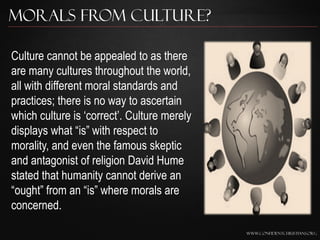
Culture cannot be appealed to as there
are many cultures throughout the world,
all with different moral standards and
practices; there is no way to ascertain
which culture is „correct‟. Culture merely
displays what “is” with respect to
morality, and even the famous skeptic
and antagonist of religion David Hume
stated that humanity cannot derive an
“ought” from an “is” where morals are
concerned.

                                             www.confidentchristians.org
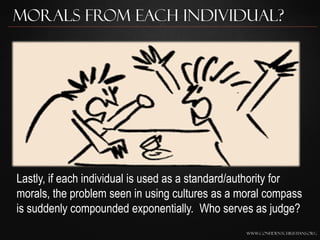
Morals from Each Individual?


Lastly, if each individual is used as a standard/authority for
morals, the problem seen in using cultures as a moral compass
is suddenly compounded exponentially. Who serves as judge?
                                                 www.confidentchristians.org
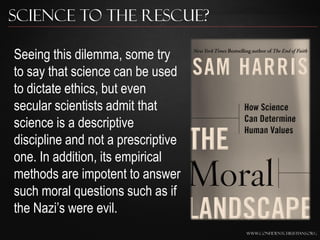
Science to the Rescue?

Seeing this dilemma, some try
to say that science can be used
to dictate ethics, but even
secular scientists admit that
science is a descriptive
discipline and not a prescriptive
one. In addition, its empirical
methods are impotent to answer
such moral questions such as if
the Nazi‟s were evil.
                                    www.confidentchristians.org
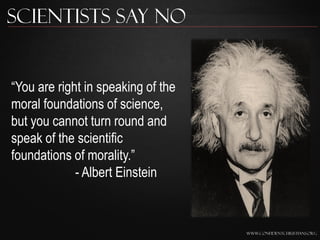
Scientists Say No


“You are right in speaking of the
moral foundations of science,
but you cannot turn round and
speak of the scientific
foundations of morality.”
             - Albert Einstein


                                    www.confidentchristians.org
Nowhere to Turn


In the end, the moral relativist has no satisfying answer in his/her attempt to
respond to the question of if there is anything wrong with anything, and why.
There is no standard to turn to and no authority to recognize and respect.

                                                             www.confidentchristians.org
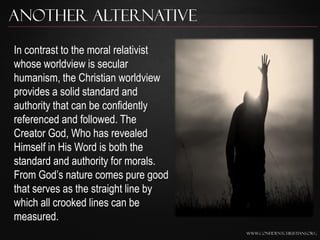
Another Alternative

In contrast to the moral relativist
whose worldview is secular
humanism, the Christian worldview
provides a solid standard and
authority that can be confidently
referenced and followed. The
Creator God, Who has revealed
Himself in His Word is both the
standard and authority for morals.
From God‟s nature comes pure good
that serves as the straight line by
which all crooked lines can be
measured.
                                      www.confidentchristians.org
Moral Grounding in Transcendence


God‟s image has been impressed upon humanity (cf. Gen. 1:26-27)
so that human beings instinctively know God‟s moral law and what is
right and wrong (cf. Rom. 2:14-15). People don‟t have to believe in
God to know His moral law, but in denying Him, they lose the ability to
ground an objective moral law in something than transcends the
physical universe. Without that transcendent God, as Dostoevsky
famously observed, everything is permissible.
                                                       www.confidentchristians.org
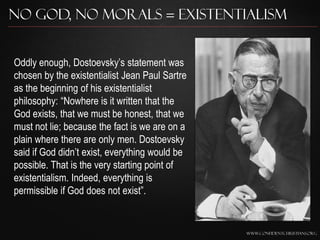
No God, No Morals = Existentialism


Oddly enough, Dostoevsky‟s statement was
chosen by the existentialist Jean Paul Sartre
as the beginning of his existentialist
philosophy: “Nowhere is it written that the
God exists, that we must be honest, that we
must not lie; because the fact is we are on a
plain where there are only men. Dostoevsky
said if God didn‟t exist, everything would be
possible. That is the very starting point of
existentialism. Indeed, everything is
permissible if God does not exist”.


                                                www.confidentchristians.org
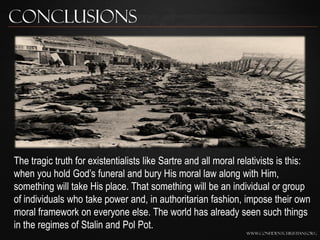
Conclusions


The tragic truth for existentialists like Sartre and all moral relativists is this:
when you hold God‟s funeral and bury His moral law along with Him,
something will take His place. That something will be an individual or group
of individuals who take power and, in authoritarian fashion, impose their own
moral framework on everyone else. The world has already seen such things
in the regimes of Stalin and Pol Pot.
                                                                 www.confidentchristians.org
Conclusions


The far better course of action is
to thankfully acknowledge God
as the true source of good and
His objective moral law, which
God established only for the well
being of His creation.


                                     www.confidentchristians.org
For More Information


          www.confidentchristians.org
                                        www.confidentchristians.org
MORAL
What is


          R E LAT I V I S M ?
  Examining the Claims of Moral Relativism


                                     www.confidentchristians.org

What is Moral Relativism?

  • 1.
    MORAL What is R E LAT I V I S M ? Examining the Claims of Moral Relativism www.confidentchristians.org
  • 2.
    A Definition ofMoral Relativism Moral relativism is a philosophy that asserts there is no global, absolute moral law that applies to all people, for all time, and in all places. Instead of an objective moral law, it espouses a qualified view where morals are concerned, especially in the areas of individual moral practice where personal and situational encounters supposedly dictate the correct moral position. www.confidentchristians.org
  • 3.
    From Nietzsche “You haveyour way, I have my way. As for the right way, it does not exist.” - Frederick Nietzsche www.confidentchristians.org
  • 4.
    Morality from Evolution? Inmodern times, the espousal of moral relativism has been closely linked to the theory of evolution. The argument is, in the same way that humanity has evolved from lesser to greater biological organisms, the same process is in play in the area of morals and ethics. Therefore, all that can be ascertained at present (and forever) is that there is no absolute or fixed certainty in the area of morality. www.confidentchristians.org
  • 5.
    Evolution’s Logical Conclusion “Ifman is a product of evolution, one species among others, in a universe without purpose, then man‟s option is to live for himself”. - Paul Kurtz The Humanist Alternative www.confidentchristians.org
  • 6.
    Moral Relativism InAction A grand example of this philosophy in action can be seen in the 2007-2008 meltdown that occurred in the American financial and banking industry. Those taught relative morality in their philosophy and business ethics college courses proceeded to live out those teachings on Wall Street and in other corporate avenues, with the outcome being devastating for those who were on the receiving end of their relative morality. www.confidentchristians.org
  • 7.
    The Public Response Oddlyenough, many who believed in relative morality at that time were outraged and absolutely sure that those who engaged in deceptive business practices ought to be punished for their unethical moral behavior. www.confidentchristians.org
  • 8.
    An Important TruthRevealed Moral relativists have a rather dim view of moral relativism when it negatively impacts them. www.confidentchristians.org
  • 9.
    An Important TruthRevealed Let the moral relativist be lied to, be the victim of false advertising, uncover the fact that their spouse has been relatively faithful to them, and they instantly become a moral absolutist. A person‟s reaction to what they consider unfair ethical treatment always betrays their true feelings on the matter of relative vs. objective moral laws. www.confidentchristians.org
  • 10.
  • 11.
    The Important Question Theproblem for the moral relativist (who is most times a secular humanist that rejects God) is they have no good answer to the two-part question: Is there anything wrong with anything? (and why?) www.confidentchristians.org
  • 12.
    Answering the Question Twothings are necessary to answer the question: 1. An unchanging standard that can be turned to 2. An absolute authority that has the right to impose moral obligation Absent these two things, morals/ethics simply becomes emotive. Rape, for example, can never be deemed wrong; the strongest statement that can be made about rape is “I don‟t like it.” www.confidentchristians.org
  • 13.
    Available Options forMoral Relativists The only options available to the secular humanist where a standard and authority are concerned are: (1) the natural universe; (2) culture; (3) the individual. www.confidentchristians.org
  • 14.
    Morals from theUniverse? The natural universe isn‟t an option as amoral matter cannot produce moral beings nor prescribe moral behavior. www.confidentchristians.org
  • 15.
    Morals from Culture? Culturecannot be appealed to as there are many cultures throughout the world, all with different moral standards and practices; there is no way to ascertain which culture is „correct‟. Culture merely displays what “is” with respect to morality, and even the famous skeptic and antagonist of religion David Hume stated that humanity cannot derive an “ought” from an “is” where morals are concerned. www.confidentchristians.org
  • 16.
    Morals from EachIndividual? Lastly, if each individual is used as a standard/authority for morals, the problem seen in using cultures as a moral compass is suddenly compounded exponentially. Who serves as judge? www.confidentchristians.org
  • 17.
    Science to theRescue? Seeing this dilemma, some try to say that science can be used to dictate ethics, but even secular scientists admit that science is a descriptive discipline and not a prescriptive one. In addition, its empirical methods are impotent to answer such moral questions such as if the Nazi‟s were evil. www.confidentchristians.org
  • 18.
    Scientists Say No “Youare right in speaking of the moral foundations of science, but you cannot turn round and speak of the scientific foundations of morality.” - Albert Einstein www.confidentchristians.org
  • 19.
    Nowhere to Turn Inthe end, the moral relativist has no satisfying answer in his/her attempt to respond to the question of if there is anything wrong with anything, and why. There is no standard to turn to and no authority to recognize and respect. www.confidentchristians.org
  • 20.
    Another Alternative In contrastto the moral relativist whose worldview is secular humanism, the Christian worldview provides a solid standard and authority that can be confidently referenced and followed. The Creator God, Who has revealed Himself in His Word is both the standard and authority for morals. From God‟s nature comes pure good that serves as the straight line by which all crooked lines can be measured. www.confidentchristians.org
  • 21.
    Moral Grounding inTranscendence God‟s image has been impressed upon humanity (cf. Gen. 1:26-27) so that human beings instinctively know God‟s moral law and what is right and wrong (cf. Rom. 2:14-15). People don‟t have to believe in God to know His moral law, but in denying Him, they lose the ability to ground an objective moral law in something than transcends the physical universe. Without that transcendent God, as Dostoevsky famously observed, everything is permissible. www.confidentchristians.org
  • 22.
    No God, NoMorals = Existentialism Oddly enough, Dostoevsky‟s statement was chosen by the existentialist Jean Paul Sartre as the beginning of his existentialist philosophy: “Nowhere is it written that the God exists, that we must be honest, that we must not lie; because the fact is we are on a plain where there are only men. Dostoevsky said if God didn‟t exist, everything would be possible. That is the very starting point of existentialism. Indeed, everything is permissible if God does not exist”. www.confidentchristians.org
  • 23.
    Conclusions The tragic truthfor existentialists like Sartre and all moral relativists is this: when you hold God‟s funeral and bury His moral law along with Him, something will take His place. That something will be an individual or group of individuals who take power and, in authoritarian fashion, impose their own moral framework on everyone else. The world has already seen such things in the regimes of Stalin and Pol Pot. www.confidentchristians.org
  • 24.
    Conclusions The far bettercourse of action is to thankfully acknowledge God as the true source of good and His objective moral law, which God established only for the well being of His creation. www.confidentchristians.org
  • 25.
    For More Information www.confidentchristians.org www.confidentchristians.org
  • 26.
    MORAL What is R E LAT I V I S M ? Examining the Claims of Moral Relativism www.confidentchristians.org