CQE EXAM
PREPARATION COURSE
Part 1
Management and Leadership
By :
Eng : Hosam Abd El-Galeil
Chapter 1 A. Quality Philosophies and Foundations
Chapter 2 B. The Quality Management System
Chapter 3 C. ASQ Code of Ethics for Professional Conduct
Chapter 4 D. Leadership Principles and Techniques
Chapter 5 E. Facilitation Principles and Techniques
Chapter 6 F. Communication Skills
Chapter 7 G. Customer Relations
Chapter 8 H. Supplier Management
Chapter 9 I. Overcoming Barriers to Quality Improvement
Content
Objective :
Chapter 7
G. Customer Relations
Analyze (Analysis Level)
Break down information into its constituent parts and recognize their
relationship to one another and how they are organized; identify sublevel
factors or salient data from a complex scenario.
3
So let's be crisp in our
understanding and contextual
use for customer.
I also want to distinguish the
term consumer (or end
consumer) from a paying
customer.
Customer, Client or Consumer
Customer:
A customer (also known as a client, buyer, or purchaser) is the recipient of
a good, service, product, or idea, obtained from a seller, vendor, or supplier for
a monetary or other valuable consideration.
Client:
A customer or client, a recipient of goods and services in return for money or
other valuable consideration.
Consumer:
The end user or the product or service.
4
A need is a consumer's desire for a product's or service's specific benefit,
whether that be functional or emotional.
 A want is the desire for products or services that are not necessary, but
which consumers wish for.
CUSTOMER NEEDS AND WANTS
5
The quality engineer’s job (either manufacturing or service based) is to help
the organization see that the customers are their reason for existence,
versus the other way around.
This goes beyond just collecting a sample of information (surveys, focus
group meetings, plant visits, and so on).
The quality engineer’s job
The real question for the quality
engineer should be … ?!!
“What do my customers think after using the
product or service for some period of time in
actual real-world settings, and what are they
telling other people about my organization?”
6
A four-stage model for evaluation
devised by Kirkpatrick (1998)
7
= QFD
HIN SHITSU
Quality
Features
Attributes
Qualities
KI NO TEN KAI
Deployment
Diffusion
Development
Evolution
Function
Mechanization
Quality Function Deployment
“Customer Driven Product / Process Development”
QFD from the Japanese
8
1. Quality function deployment.
An overall concept that provides a means of translating customer requirements
into the appropriate technical requirements for each stage of product
development and production (that is, marketing strategies, planning, product
design and engineering, prototype evaluation, production process
development, production, and sales).
2. The voice of the customer (VOC).
The customers’ requirements expressed in their own terms.
3. Counterpart characteristics.
An expression of the customer’s voice in technical language that specifies customer-
required quality.
4. Product quality deployment.
Activities needed to translate the voice of the customer into counterpart
characteristics.
5. Deployment of the quality function.
Activities needed to assure that customer-required quality is achieved; the
assignment of specific quality responsibilities to specific departments.
6. Quality tables.
A series of matrices used to translate the voice of the customer into final product
control characteristics.
The six key terms associated with QFD (Sullivan 1986) are:
9
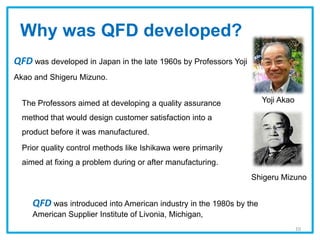
Why was QFD developed?
QFD was developed in Japan in the late 1960s by Professors Yoji
Akao and Shigeru Mizuno.
The Professors aimed at developing a quality assurance
method that would design customer satisfaction into a
product before it was manufactured.
Prior quality control methods like Ishikawa were primarily
aimed at fixing a problem during or after manufacturing.
Yoji Akao
Shigeru Mizuno
QFD was introduced into American industry in the 1980s by the
American Supplier Institute of Livonia, Michigan,
10
Excitement
Needs
Performance
Needs
Basic
Needs
Satisfied
Customer
Dissatisfied
Customer
Don’t Have
Don’t Do
Included
Do Well


Excitement
Needs
Performance
Needs
Basic
Needs
Satisfied
Customer
Dissatisfied
Customer
Don’t Have
Don’t Do
Included
Do Well


• UNEXPECTED,
PLEASANT SURPRISES
• 3M CALLS THEM
CUSTOMER DELIGHTS
Spoken
Measurable
Range of Fulfillment
Unspoken
Taken For granted
Basic
Spoken If Not Met
QFD focuses on
Performance
Needs and unmet
Basic Needs
RECOGNIZE 1) The Impact of Needs on the Customer
2) That Customer Needs Change With Time
3) The impact of Communication of Customer Wants Throughout
the Organization
Where does QFD fit? KANO MODEL
(Of Quality/Features)
11
Strategic Issues - Technical Tools - Cultural Change
Six Sigma / TQM
Quality Improvement Tools
QFD
- Planning Tool
- Customer Driven
- Proactive
- Cross Functional Teams
• Taguchi Methods
• FMEA’s
• Fault Tree Analysis
• Cause-Effect Diagram
• Pareto
• Benchmarking
• SPC
• Check Sheets
- Monitor
- Continuous Improvement
- Hold the “Gains”
Where does QFD fit?
12
Customer Requirements
Company Measures
Part Characteristics (Design)
Manufacturing Process
Production Requirements
(Day to Day Operations)
QFD Overview
Converted to
Converted to
Converted to
Converted to
13
1. Product objectives based on customer requirements are not
misinterpreted at subsequent stages.
2. Particular marketing strategies or sales points do not become lost
or blurred during the translation process from marketing through
planning and on to execution.
3. Important production control points are not overlooked.
4. Efficiency is increased because misinterpretations are minimized.
QFD as a planning technique has brought
significant benefits:
15
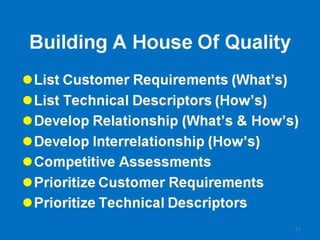
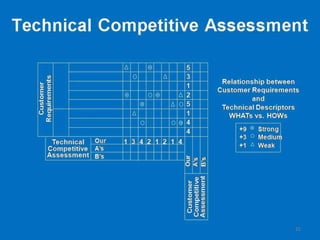
16
17
18
19
20
21
22
23
24
25
26
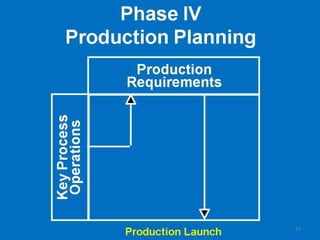
The Four Phases of QFD
27
28
29
30
31
32
33
Deploying the VOC
Technical
Requirements
Customer
Requirements
Product
Requirements
Technical
Requirements
Process
Requirements
Product
Requirements
Control
Requirements
Process
Requirements
34
35
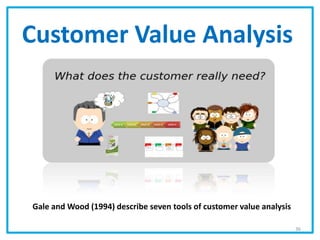
Customer Value Analysis
Gale and Wood (1994) describe seven tools of customer value analysis
36
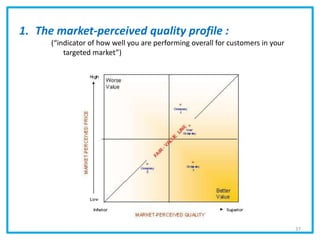
1. The market-perceived quality profile :
(“indicator of how well you are performing overall for customers in your
targeted market”)
37
2. The market-perceived price profile :
(a weighted indicator of how customers perceive different competitors’
performance on given price attributes)
38
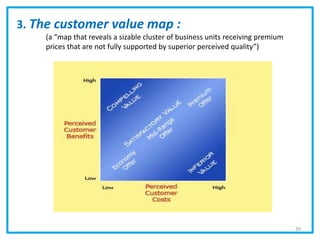
3. The customer value map :
(a “map that reveals a sizable cluster of business units receiving premium
prices that are not fully supported by superior perceived quality”)
39
4. The won/lost analysis :
(an analysis of those factors that won or lost the sale)
40
5. The head-to-head area chart of customer value
(a “chart of customer value displaying where you are doing well and where you do
worse against a single competitor”)
41
6. The key events timeline
(a chronological list of the events which changed the market’s perception of
performance on each quality attribute, yours and your competitor’s)
42
7. A what/who matrix
(“a method for tracking who is responsible for the actions that will make success in
customer value possible”)
43
Table illustrate different perspectives on what the customer
considers important
44
CUSTOMER-DRIVEN QUALITY
The two types of customer-driven quality, reactive and planned, are proving to be
successful in improving quality but still do not guarantee customer satisfaction
(Foster 1998)
Reactive customer-driven quality (RCDQ) :
Responds to customer requirements after the fact.
Planned customer-driven quality :
Is anticipatory and proactive in that it assesses customer needs and seeks
methods for satisfying those needs before the fact.
Planned customer-driven quality is best accomplished using some form
of strategic quality planning (SQP).
45
With any given effort to become a customer-
driven company, an organization needs to
study what they do and how they look to
their customers.
One list of top 10 key characteristics of
customer-focused companies
46
1.Total consumer experience :
 The ability to look at the customer from all angles of how the
organization’s products and services are experienced in the real world.
 Look for every possible point of contact with the customer to collect
information on what is happening in the field.
47
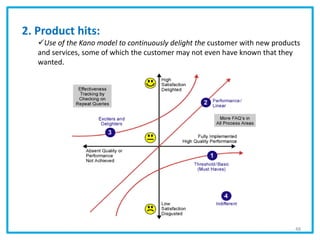
2. Product hits:
Use of the Kano model to continuously delight the customer with new products
and services, some of which the customer may not even have known that they
wanted.
48
3. Consumer loyalty:
Building a sustained momentum over time to the point where the customer
will only use your product or service, even waiting, if necessary, to get the “real
thing.”
49
4. Retailing and distribution
Creating a win–win–win for your organization, distributors, and customers.
Your distribution system is a customer as well.
50
5. Brand process:
The creation of recognized products or services that are sought after in the
marketplace.
51
6. Logistics:
 Providing just-in-time and just what is needed/wanted in the marketplace at
point of usage.
52
7. Build to demand:
Creating a lean process that is capable of rapid changeovers to give the
customers the needed products and services as they want them (just in time).
This process has to be built into the entire system from suppliers, through
production to the ultimate customer.
53
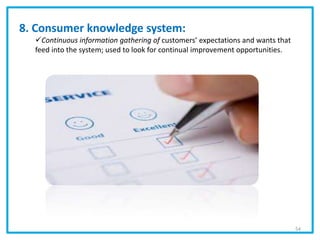
8. Consumer knowledge system:
Continuous information gathering of customers’ expectations and wants that
feed into the system; used to look for continual improvement opportunities.
54
9. E-commerce:
Becoming interactive, offering distribution, selling, and constant communication
with customers online.
55
10. Growth:
 Continually improving with faster service, better value, and higher quality to create
a culture that uses creativity and innovations to improve customer satisfaction.
56
To summarize this chapter:
 There is no sure way to always satisfy or delight customers because we
cannot talk to every individual customer that we have and because
customers are constantly changing their minds about what they need or
expect.
 So we must find ways to continuously talk with many customers using
the techniques we can.
With today’s technology this should become easier, but will the quality
engineer be able to ensure that the information received is good
enough to make sound predictions?
The challenge is to keep the process both simple and informative.
57
C Q E Exam Prep. Course
STUDY GROUP
www.facebook.com/groups/1458356601047218/
www.facebook.com/ASQCQE
www.youtube.com/QualityInitiative
Cqe preparation | customer relations

Cqe preparation | customer relations

  • 1.
    CQE EXAM PREPARATION COURSE Part1 Management and Leadership By : Eng : Hosam Abd El-Galeil
  • 2.
    Chapter 1 A.Quality Philosophies and Foundations Chapter 2 B. The Quality Management System Chapter 3 C. ASQ Code of Ethics for Professional Conduct Chapter 4 D. Leadership Principles and Techniques Chapter 5 E. Facilitation Principles and Techniques Chapter 6 F. Communication Skills Chapter 7 G. Customer Relations Chapter 8 H. Supplier Management Chapter 9 I. Overcoming Barriers to Quality Improvement Content
  • 3.
    Objective : Chapter 7 G.Customer Relations Analyze (Analysis Level) Break down information into its constituent parts and recognize their relationship to one another and how they are organized; identify sublevel factors or salient data from a complex scenario. 3
  • 4.
    So let's becrisp in our understanding and contextual use for customer. I also want to distinguish the term consumer (or end consumer) from a paying customer. Customer, Client or Consumer Customer: A customer (also known as a client, buyer, or purchaser) is the recipient of a good, service, product, or idea, obtained from a seller, vendor, or supplier for a monetary or other valuable consideration. Client: A customer or client, a recipient of goods and services in return for money or other valuable consideration. Consumer: The end user or the product or service. 4
  • 5.
    A need isa consumer's desire for a product's or service's specific benefit, whether that be functional or emotional.  A want is the desire for products or services that are not necessary, but which consumers wish for. CUSTOMER NEEDS AND WANTS 5
  • 6.
    The quality engineer’sjob (either manufacturing or service based) is to help the organization see that the customers are their reason for existence, versus the other way around. This goes beyond just collecting a sample of information (surveys, focus group meetings, plant visits, and so on). The quality engineer’s job The real question for the quality engineer should be … ?!! “What do my customers think after using the product or service for some period of time in actual real-world settings, and what are they telling other people about my organization?” 6
  • 7.
    A four-stage modelfor evaluation devised by Kirkpatrick (1998) 7
  • 8.
    = QFD HIN SHITSU Quality Features Attributes Qualities KINO TEN KAI Deployment Diffusion Development Evolution Function Mechanization Quality Function Deployment “Customer Driven Product / Process Development” QFD from the Japanese 8
  • 9.
    1. Quality functiondeployment. An overall concept that provides a means of translating customer requirements into the appropriate technical requirements for each stage of product development and production (that is, marketing strategies, planning, product design and engineering, prototype evaluation, production process development, production, and sales). 2. The voice of the customer (VOC). The customers’ requirements expressed in their own terms. 3. Counterpart characteristics. An expression of the customer’s voice in technical language that specifies customer- required quality. 4. Product quality deployment. Activities needed to translate the voice of the customer into counterpart characteristics. 5. Deployment of the quality function. Activities needed to assure that customer-required quality is achieved; the assignment of specific quality responsibilities to specific departments. 6. Quality tables. A series of matrices used to translate the voice of the customer into final product control characteristics. The six key terms associated with QFD (Sullivan 1986) are: 9
  • 10.
    Why was QFDdeveloped? QFD was developed in Japan in the late 1960s by Professors Yoji Akao and Shigeru Mizuno. The Professors aimed at developing a quality assurance method that would design customer satisfaction into a product before it was manufactured. Prior quality control methods like Ishikawa were primarily aimed at fixing a problem during or after manufacturing. Yoji Akao Shigeru Mizuno QFD was introduced into American industry in the 1980s by the American Supplier Institute of Livonia, Michigan, 10
  • 11.
    Excitement Needs Performance Needs Basic Needs Satisfied Customer Dissatisfied Customer Don’t Have Don’t Do Included DoWell   Excitement Needs Performance Needs Basic Needs Satisfied Customer Dissatisfied Customer Don’t Have Don’t Do Included Do Well   • UNEXPECTED, PLEASANT SURPRISES • 3M CALLS THEM CUSTOMER DELIGHTS Spoken Measurable Range of Fulfillment Unspoken Taken For granted Basic Spoken If Not Met QFD focuses on Performance Needs and unmet Basic Needs RECOGNIZE 1) The Impact of Needs on the Customer 2) That Customer Needs Change With Time 3) The impact of Communication of Customer Wants Throughout the Organization Where does QFD fit? KANO MODEL (Of Quality/Features) 11
  • 12.
    Strategic Issues -Technical Tools - Cultural Change Six Sigma / TQM Quality Improvement Tools QFD - Planning Tool - Customer Driven - Proactive - Cross Functional Teams • Taguchi Methods • FMEA’s • Fault Tree Analysis • Cause-Effect Diagram • Pareto • Benchmarking • SPC • Check Sheets - Monitor - Continuous Improvement - Hold the “Gains” Where does QFD fit? 12
  • 13.
    Customer Requirements Company Measures PartCharacteristics (Design) Manufacturing Process Production Requirements (Day to Day Operations) QFD Overview Converted to Converted to Converted to Converted to 13
  • 14.
    1. Product objectivesbased on customer requirements are not misinterpreted at subsequent stages. 2. Particular marketing strategies or sales points do not become lost or blurred during the translation process from marketing through planning and on to execution. 3. Important production control points are not overlooked. 4. Efficiency is increased because misinterpretations are minimized. QFD as a planning technique has brought significant benefits: 15
  • 15.
  • 16.
  • 17.
  • 18.
  • 19.
  • 20.
  • 21.
  • 22.
  • 23.
  • 24.
  • 25.
  • 26.
    The Four Phasesof QFD 27
  • 27.
  • 28.
  • 29.
  • 30.
  • 31.
  • 32.
  • 33.
  • 34.
  • 35.
    Customer Value Analysis Galeand Wood (1994) describe seven tools of customer value analysis 36
  • 36.
    1. The market-perceivedquality profile : (“indicator of how well you are performing overall for customers in your targeted market”) 37
  • 37.
    2. The market-perceivedprice profile : (a weighted indicator of how customers perceive different competitors’ performance on given price attributes) 38
  • 38.
    3. The customervalue map : (a “map that reveals a sizable cluster of business units receiving premium prices that are not fully supported by superior perceived quality”) 39
  • 39.
    4. The won/lostanalysis : (an analysis of those factors that won or lost the sale) 40
  • 40.
    5. The head-to-headarea chart of customer value (a “chart of customer value displaying where you are doing well and where you do worse against a single competitor”) 41
  • 41.
    6. The keyevents timeline (a chronological list of the events which changed the market’s perception of performance on each quality attribute, yours and your competitor’s) 42
  • 42.
    7. A what/whomatrix (“a method for tracking who is responsible for the actions that will make success in customer value possible”) 43
  • 43.
    Table illustrate differentperspectives on what the customer considers important 44
  • 44.
    CUSTOMER-DRIVEN QUALITY The twotypes of customer-driven quality, reactive and planned, are proving to be successful in improving quality but still do not guarantee customer satisfaction (Foster 1998) Reactive customer-driven quality (RCDQ) : Responds to customer requirements after the fact. Planned customer-driven quality : Is anticipatory and proactive in that it assesses customer needs and seeks methods for satisfying those needs before the fact. Planned customer-driven quality is best accomplished using some form of strategic quality planning (SQP). 45
  • 45.
    With any giveneffort to become a customer- driven company, an organization needs to study what they do and how they look to their customers. One list of top 10 key characteristics of customer-focused companies 46
  • 46.
    1.Total consumer experience:  The ability to look at the customer from all angles of how the organization’s products and services are experienced in the real world.  Look for every possible point of contact with the customer to collect information on what is happening in the field. 47
  • 47.
    2. Product hits: Useof the Kano model to continuously delight the customer with new products and services, some of which the customer may not even have known that they wanted. 48
  • 48.
    3. Consumer loyalty: Buildinga sustained momentum over time to the point where the customer will only use your product or service, even waiting, if necessary, to get the “real thing.” 49
  • 49.
    4. Retailing anddistribution Creating a win–win–win for your organization, distributors, and customers. Your distribution system is a customer as well. 50
  • 50.
    5. Brand process: Thecreation of recognized products or services that are sought after in the marketplace. 51
  • 51.
    6. Logistics:  Providingjust-in-time and just what is needed/wanted in the marketplace at point of usage. 52
  • 52.
    7. Build todemand: Creating a lean process that is capable of rapid changeovers to give the customers the needed products and services as they want them (just in time). This process has to be built into the entire system from suppliers, through production to the ultimate customer. 53
  • 53.
    8. Consumer knowledgesystem: Continuous information gathering of customers’ expectations and wants that feed into the system; used to look for continual improvement opportunities. 54
  • 54.
    9. E-commerce: Becoming interactive,offering distribution, selling, and constant communication with customers online. 55
  • 55.
    10. Growth:  Continuallyimproving with faster service, better value, and higher quality to create a culture that uses creativity and innovations to improve customer satisfaction. 56
  • 56.
    To summarize thischapter:  There is no sure way to always satisfy or delight customers because we cannot talk to every individual customer that we have and because customers are constantly changing their minds about what they need or expect.  So we must find ways to continuously talk with many customers using the techniques we can. With today’s technology this should become easier, but will the quality engineer be able to ensure that the information received is good enough to make sound predictions? The challenge is to keep the process both simple and informative. 57
  • 57.
    C Q EExam Prep. Course STUDY GROUP www.facebook.com/groups/1458356601047218/
  • 58.