STATIK
SYSTEMS THINKING
APPROACH TO
INTRODUCE KANBAN
Un enfoque exploratorio y
colaborativo para implementar
Kanban
Agile-Barcelona
THE FACILITATOR
JAVIER CASTILLO
AGILE COACH
Accenture Digital
PURPOSE
Copyright © 2019 Accenture. All rights reserved.
AGREEMENTS
1. PARTICIPATEACTIVELY
2. CHALLENGEASSUMPTIONS
3. SHAREPERSPECTIVES
4. MUTEELECTRONICSCopyright © 2019 Accenture. All rights reserved.
INTRODUCTION
• WHAT IS KANBAN?
• WHAT IS STATIK?
Copyright © 2019 Accenture. All rights reserved.
WHATIS
KANBAN?
Copyright © 2019 Accenture. All rights reserved.
WHATIS
KANBAN?
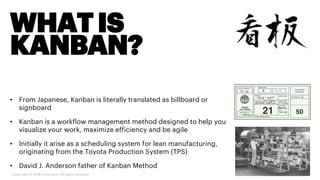
• From Japanese, Kanban is literally translated as billboard or
signboard
• Kanban is a workflow management method designed to help you
visualize your work, maximize efficiency and be agile
• Initially it arise as a scheduling system for lean manufacturing,
originating from the Toyota Production System (TPS)
• David J. Anderson father of Kanban Method
Copyright © 2019 Accenture. All rights reserved.
WHATIS
KANBAN?
CORE PRINCIPLES
1. Start With What You Do Now
2. Agree to Pursue Incremental, Evolutionary Change
3. Respect the Current Process, Roles & Responsibilities
4. Encourage Acts of Leadership at All Levels
Copyright © 2019 Accenture. All rights reserved.
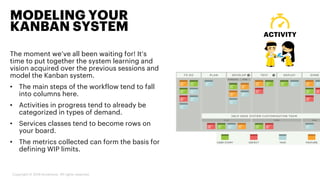
WHATIS
KANBAN?
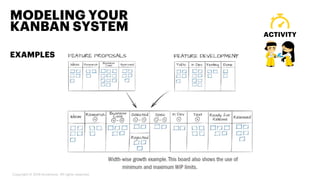
KANBAN PRACTICES
1. Visualize Work
2. Limit Work in Progress Process (WIP)
3. Focus on Flow
4. Continuous improvement
Copyright © 2019 Accenture. All rights reserved.
WHATIS
STATIK?
Copyright © 2019 Accenture. All rights reserved.
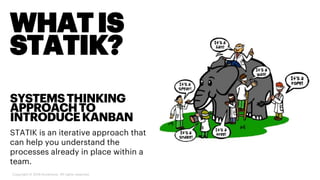
WHATIS
STATIK?
SYSTEMSTHINKING
APPROACHTO
INTRODUCEKANBAN
STATIK is an iterative approach that
can help you understand the
processes already in place within a
team.
Copyright © 2019 Accenture. All rights reserved.
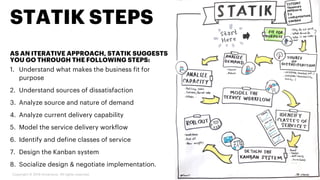
AS AN ITERATIVE APPROACH, STATIK SUGGESTS
YOU GO THROUGH THE FOLLOWING STEPS:
1. Understand what makes the business fit for
purpose
2. Understand sources of dissatisfaction
3. Analyze source and nature of demand
4. Analyze current delivery capability
5. Model the service delivery workflow
6. Identify and define classes of service
7. Design the Kanban system
8. Socialize design & negotiate implementation.
STATIK STEPS
Copyright © 2019 Accenture. All rights reserved.
UNDERSTANDING
FIT FOR PURPOSE
• WHAT IS YOUR
TEAM PURPOSE?
Copyright © 2019 Accenture. All rights reserved.
WHATISYOUR
PURPOSE?
Copyright © 2019 Accenture. All rights reserved.
DEFINING
THE TEAM
PURPOSE
STATEMENT
ACTIVITY
Copyright © 2019 Accenture. All rights reserved.
Time: 20-30 minutes
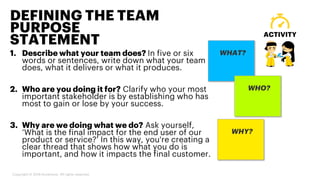
1. Describe what your team does? In five or six
words or sentences, write down what your team
does, what it delivers or what it produces.
2. Who are you doing it for? Clarify who your most
important stakeholder is by establishing who has
most to gain or lose by your success.
3. Why are we doing what we do? Ask yourself,
‘What is the final impact for the end user of our
product or service?’ In this way, you're creating a
clear thread that shows how what you do is
important, and how it impacts the final customer.
DEFINING THE TEAM
PURPOSE
STATEMENT
ACTIVITY
Copyright © 2019 Accenture. All rights reserved.
WHAT?
WHO?
WHY?
ACTIVITY
Copyright © 2019 Accenture. All rights reserved.
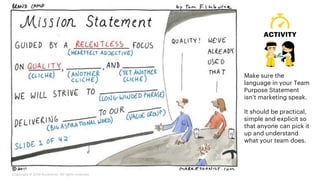
Make sure the
language in your Team
Purpose Statement
isn’t marketing speak.
It should be practical,
simple and explicit so
that anyone can pick it
up and understand
what your team does.
ELEVATOR
PITCH
ACTIVITY
Copyright © 2019 Accenture. All rights reserved.
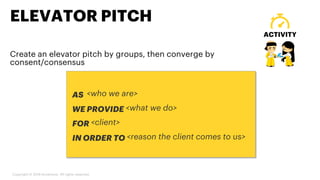
Time: 10-15 minutes
Create an elevator pitch by groups, then converge by
consent/consensus
ELEVATOR PITCH
ACTIVITY
Copyright © 2019 Accenture. All rights reserved.
AS <who we are>
WE PROVIDE <what we do>
FOR <client>
IN ORDER TO <reason the client comes to us>
UNDERSTANDING
THE SOURCE OF
DISSATISFACTION
• STAKEHOLDERS
• SOURCES OF
DISSATISFACTION
Copyright © 2019 Accenture. All rights reserved.
IDENTIFYING
STAKEHOLDERS
ACTIVITY
Copyright © 2019 Accenture. All rights reserved.
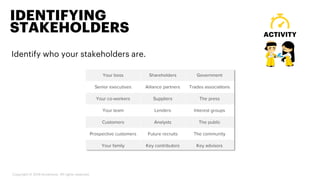
Time: 30-40 minutes
Identify who your stakeholders are.
IDENTIFYING
STAKEHOLDERS ACTIVITY
Copyright © 2019 Accenture. All rights reserved.
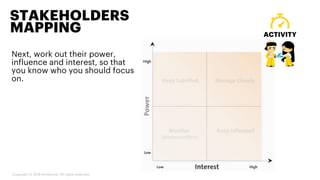
Next, work out their power,
influence and interest, so that
you know who you should focus
on.
STAKEHOLDERS
MAPPING ACTIVITY
Copyright © 2019 Accenture. All rights reserved.
SOURCES OF
DISSATISFACTION
ACTIVITY
Copyright © 2019 Accenture. All rights reserved.
Time: 30-40 minutes
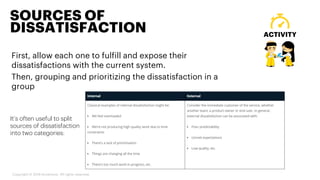
First, allow each one to fulfill and expose their
dissatisfactions with the current system.
Then, grouping and prioritizing the dissatisfaction in a
group
SOURCES OF
DISSATISFACTION ACTIVITY
Copyright © 2019 Accenture. All rights reserved.
It’s often useful to split
sources of dissatisfaction
into two categories:
ANALYZE SOURCE
AND NATURE OF
DEMAND AND
DELIVERY
CAPABILITY
• WORK ITEM TYPES
• DEMAND AND
DELIVERY CAPABILY
Copyright © 2019 Accenture. All rights reserved.
IDENTIFYING
WORK ITEM
TYPES
ACTIVITY
Copyright © 2019 Accenture. All rights reserved.
Time: 30-40 minutes
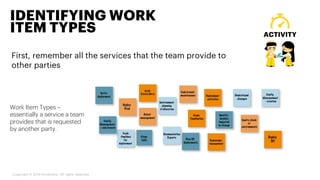
First, remember all the services that the team provide to
other parties
IDENTIFYING WORK
ITEM TYPES ACTIVITY
Copyright © 2019 Accenture. All rights reserved.
Work Item Types –
essentially a service a team
provides that is requested
by another party.
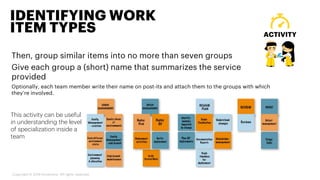
Then, group similar items into no more than seven groups
Give each group a (short) name that summarizes the service
provided
Optionally, each team member write their name on post-its and attach them to the groups with which
they’re involved.
IDENTIFYING WORK
ITEM TYPES ACTIVITY
Copyright © 2019 Accenture. All rights reserved.
This activity can be useful
in understanding the level
of specialization inside a
team
ANALYSING
DEMAND
AND
DELIVERY
CAPABILITY
ACTIVITY
Copyright © 2019 Accenture. All rights reserved.
Time: 30-40 minutes
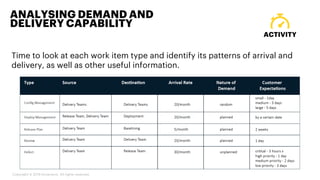
Time to look at each work item type and identify its patterns of arrival and
delivery, as well as other useful information.
ANALYSING DEMAND AND
DELIVERY CAPABILITY
ACTIVITY
Copyright © 2019 Accenture. All rights reserved.
MODELLING THE
SERVICE
DELIVERY
WORKFLOW
• MODELING
WORKFLOW
• CLASSES OF SERVICE
Copyright © 2019 Accenture. All rights reserved.
DRAW YOUR
WORKFLOWS
ACTIVITY
Copyright © 2019 Accenture. All rights reserved.
Time: 40-50 minutes
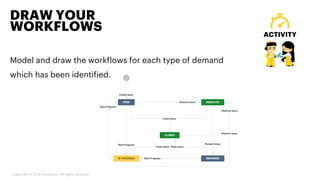
Model and draw the workflows for each type of demand
which has been identified.
DRAW YOUR
WORKFLOWS ACTIVITY
Copyright © 2019 Accenture. All rights reserved.
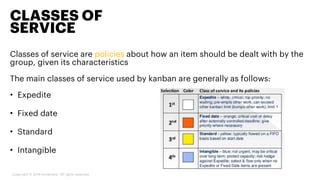
Classes of service are policies about how an item should be dealt with by the
group, given its characteristics
The main classes of service used by kanban are generally as follows:
• Expedite
• Fixed date
• Standard
• Intangible
CLASSES OF
SERVICE
Copyright © 2019 Accenture. All rights reserved.
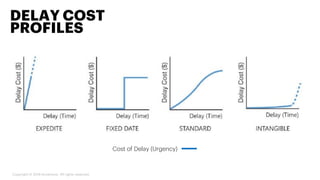
DELAY COST
PROFILES
Copyright © 2019 Accenture. All rights reserved.
Cost of Delay (Urgency)
IDENTIFYING
CLASSES OF
SERVICE
ACTIVITY
Copyright © 2019 Accenture. All rights reserved.
Time: 15-20 minutes
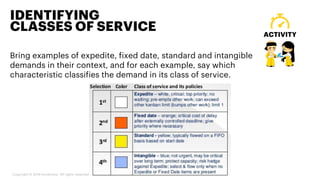
Bring examples of expedite, fixed date, standard and intangible
demands in their context, and for each example, say which
characteristic classifies the demand in its class of service.
IDENTIFYING
CLASSES OF SERVICE ACTIVITY
Copyright © 2019 Accenture. All rights reserved.
DESIGNING THE
KANBAN SYSTEM
• KANBAN BOARD
• KANBAN CARD
• KANBAN SYSTEM
Copyright © 2019 Accenture. All rights reserved.
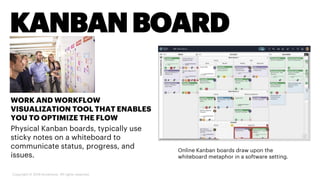
KANBANBOARD
WORK AND WORKFLOW
VISUALIZATION TOOL THAT ENABLES
YOU TO OPTIMIZE THE FLOW
Physical Kanban boards, typically use
sticky notes on a whiteboard to
communicate status, progress, and
issues.
Copyright © 2019 Accenture. All rights reserved.
Online Kanban boards draw upon the
whiteboard metaphor in a software setting.
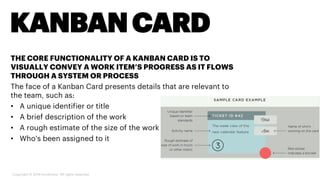
KANBANCARD
THE CORE FUNCTIONALITY OF A KANBAN CARD IS TO
VISUALLY CONVEY A WORK ITEM’S PROGRESS AS IT FLOWS
THROUGH A SYSTEM OR PROCESS
The face of a Kanban Card presents details that are relevant to
the team, such as:
• A unique identifier or title
• A brief description of the work
• A rough estimate of the size of the work
• Who's been assigned to it
Copyright © 2019 Accenture. All rights reserved.
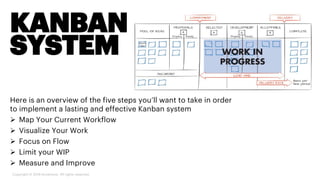
KANBAN
SYSTEM
Here is an overview of the five steps you’ll want to take in order
to implement a lasting and effective Kanban system
➢ Map Your Current Workflow
➢ Visualize Your Work
➢ Focus on Flow
➢ Limit your WIP
➢ Measure and Improve
Copyright © 2019 Accenture. All rights reserved.
MODELING
YOUR
KANBAN
SYSTEM
ACTIVITY
Copyright © 2019 Accenture. All rights reserved.
Time: 60-90 minutes
The moment we’ve all been waiting for! It’s
time to put together the system learning and
vision acquired over the previous sessions and
model the Kanban system.
• The main steps of the workflow tend to fall
into columns here.
• Activities in progress tend to already be
categorized in types of demand.
• Services classes tend to become rows on
your board.
• The metrics collected can form the basis for
defining WIP limits.
MODELING YOUR
KANBAN SYSTEM ACTIVITY
Copyright © 2019 Accenture. All rights reserved.
At this point, it’s useful to have a checklist of the elements
likely to be included, for example:
MODELING YOUR
KANBAN SYSTEM ACTIVITY
Copyright © 2019 Accenture. All rights reserved.
❑ Board design
❑ Workflow states
❑ Types of work
❑ Swimlanes
❑ Classes of service
❑ WIP limits
❑ Explicit policies
❑ Ticket design
❑ Commitment and
delivery points
❑ Legends
❑ Metrics
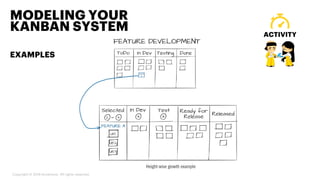
EXAMPLES
MODELING YOUR
KANBAN SYSTEM ACTIVITY
Copyright © 2019 Accenture. All rights reserved.
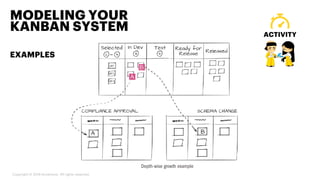
EXAMPLES
MODELING YOUR
KANBAN SYSTEM ACTIVITY
Copyright © 2019 Accenture. All rights reserved.
EXAMPLES
MODELING YOUR
KANBAN SYSTEM ACTIVITY
Copyright © 2019 Accenture. All rights reserved.
REFERENCES
START COACHING NEW TEAMS WITH STATIK
https://elabor8.com.au/start-coaching-new-
teams-with-statik/
WHAT IS STATIK? TIPS ON HOW TO APPLY THE
KANBAN METHOD!
https://knowledge21.com/blog/statik-applying-
kanban-method/
KANBAN ROADMAP
https://resources.leankit.com/guides/kanban-
roadmap
ESSENTIAL KANBAN: CONDENSED GUIDE
https://leankanban.com/guide/
31 PRACTICAL KANBAN BOARD EXAMPLES
https://kanbanize.com/kanban-
resources/kanban-software/kanban-board-
examples/
THANKS!
Héctor Javier Castillo Suazo
Agile Coach
Accenture Spain - Barcelona
h.castillo.suazo@accenture.com
hjaviercs
@hjavixcs
Agile-Barcelona
https://holaluz.workable.com
Current Openings - Holaluz

STATIK (Systems Thinking Approach to Introduce Kanban) Workshop Meetup

  • 1.
    STATIK SYSTEMS THINKING APPROACH TO INTRODUCEKANBAN Un enfoque exploratorio y colaborativo para implementar Kanban Agile-Barcelona
  • 2.
  • 3.
    PURPOSE Copyright © 2019Accenture. All rights reserved.
  • 4.
    AGREEMENTS 1. PARTICIPATEACTIVELY 2. CHALLENGEASSUMPTIONS 3.SHAREPERSPECTIVES 4. MUTEELECTRONICSCopyright © 2019 Accenture. All rights reserved.
  • 5.
    INTRODUCTION • WHAT ISKANBAN? • WHAT IS STATIK? Copyright © 2019 Accenture. All rights reserved.
  • 6.
    WHATIS KANBAN? Copyright © 2019Accenture. All rights reserved.
  • 7.
    WHATIS KANBAN? • From Japanese,Kanban is literally translated as billboard or signboard • Kanban is a workflow management method designed to help you visualize your work, maximize efficiency and be agile • Initially it arise as a scheduling system for lean manufacturing, originating from the Toyota Production System (TPS) • David J. Anderson father of Kanban Method Copyright © 2019 Accenture. All rights reserved.
  • 8.
    WHATIS KANBAN? CORE PRINCIPLES 1. StartWith What You Do Now 2. Agree to Pursue Incremental, Evolutionary Change 3. Respect the Current Process, Roles & Responsibilities 4. Encourage Acts of Leadership at All Levels Copyright © 2019 Accenture. All rights reserved.
  • 9.
    WHATIS KANBAN? KANBAN PRACTICES 1. VisualizeWork 2. Limit Work in Progress Process (WIP) 3. Focus on Flow 4. Continuous improvement Copyright © 2019 Accenture. All rights reserved.
  • 10.
    WHATIS STATIK? Copyright © 2019Accenture. All rights reserved.
  • 11.
    WHATIS STATIK? SYSTEMSTHINKING APPROACHTO INTRODUCEKANBAN STATIK is aniterative approach that can help you understand the processes already in place within a team. Copyright © 2019 Accenture. All rights reserved.
  • 12.
    AS AN ITERATIVEAPPROACH, STATIK SUGGESTS YOU GO THROUGH THE FOLLOWING STEPS: 1. Understand what makes the business fit for purpose 2. Understand sources of dissatisfaction 3. Analyze source and nature of demand 4. Analyze current delivery capability 5. Model the service delivery workflow 6. Identify and define classes of service 7. Design the Kanban system 8. Socialize design & negotiate implementation. STATIK STEPS Copyright © 2019 Accenture. All rights reserved.
  • 13.
    UNDERSTANDING FIT FOR PURPOSE •WHAT IS YOUR TEAM PURPOSE? Copyright © 2019 Accenture. All rights reserved.
  • 14.
    WHATISYOUR PURPOSE? Copyright © 2019Accenture. All rights reserved.
  • 15.
    DEFINING THE TEAM PURPOSE STATEMENT ACTIVITY Copyright ©2019 Accenture. All rights reserved. Time: 20-30 minutes
  • 16.
    1. Describe whatyour team does? In five or six words or sentences, write down what your team does, what it delivers or what it produces. 2. Who are you doing it for? Clarify who your most important stakeholder is by establishing who has most to gain or lose by your success. 3. Why are we doing what we do? Ask yourself, ‘What is the final impact for the end user of our product or service?’ In this way, you're creating a clear thread that shows how what you do is important, and how it impacts the final customer. DEFINING THE TEAM PURPOSE STATEMENT ACTIVITY Copyright © 2019 Accenture. All rights reserved. WHAT? WHO? WHY?
  • 17.
    ACTIVITY Copyright © 2019Accenture. All rights reserved. Make sure the language in your Team Purpose Statement isn’t marketing speak. It should be practical, simple and explicit so that anyone can pick it up and understand what your team does.
  • 18.
    ELEVATOR PITCH ACTIVITY Copyright © 2019Accenture. All rights reserved. Time: 10-15 minutes
  • 19.
    Create an elevatorpitch by groups, then converge by consent/consensus ELEVATOR PITCH ACTIVITY Copyright © 2019 Accenture. All rights reserved. AS <who we are> WE PROVIDE <what we do> FOR <client> IN ORDER TO <reason the client comes to us>
  • 20.
    UNDERSTANDING THE SOURCE OF DISSATISFACTION •STAKEHOLDERS • SOURCES OF DISSATISFACTION Copyright © 2019 Accenture. All rights reserved.
  • 21.
    IDENTIFYING STAKEHOLDERS ACTIVITY Copyright © 2019Accenture. All rights reserved. Time: 30-40 minutes
  • 22.
    Identify who yourstakeholders are. IDENTIFYING STAKEHOLDERS ACTIVITY Copyright © 2019 Accenture. All rights reserved.
  • 23.
    Next, work outtheir power, influence and interest, so that you know who you should focus on. STAKEHOLDERS MAPPING ACTIVITY Copyright © 2019 Accenture. All rights reserved.
  • 24.
    SOURCES OF DISSATISFACTION ACTIVITY Copyright ©2019 Accenture. All rights reserved. Time: 30-40 minutes
  • 25.
    First, allow eachone to fulfill and expose their dissatisfactions with the current system. Then, grouping and prioritizing the dissatisfaction in a group SOURCES OF DISSATISFACTION ACTIVITY Copyright © 2019 Accenture. All rights reserved. It’s often useful to split sources of dissatisfaction into two categories:
  • 26.
    ANALYZE SOURCE AND NATUREOF DEMAND AND DELIVERY CAPABILITY • WORK ITEM TYPES • DEMAND AND DELIVERY CAPABILY Copyright © 2019 Accenture. All rights reserved.
  • 27.
    IDENTIFYING WORK ITEM TYPES ACTIVITY Copyright ©2019 Accenture. All rights reserved. Time: 30-40 minutes
  • 28.
    First, remember allthe services that the team provide to other parties IDENTIFYING WORK ITEM TYPES ACTIVITY Copyright © 2019 Accenture. All rights reserved. Work Item Types – essentially a service a team provides that is requested by another party.
  • 29.
    Then, group similaritems into no more than seven groups Give each group a (short) name that summarizes the service provided Optionally, each team member write their name on post-its and attach them to the groups with which they’re involved. IDENTIFYING WORK ITEM TYPES ACTIVITY Copyright © 2019 Accenture. All rights reserved. This activity can be useful in understanding the level of specialization inside a team
  • 30.
    ANALYSING DEMAND AND DELIVERY CAPABILITY ACTIVITY Copyright © 2019Accenture. All rights reserved. Time: 30-40 minutes
  • 31.
    Time to lookat each work item type and identify its patterns of arrival and delivery, as well as other useful information. ANALYSING DEMAND AND DELIVERY CAPABILITY ACTIVITY Copyright © 2019 Accenture. All rights reserved.
  • 32.
    MODELLING THE SERVICE DELIVERY WORKFLOW • MODELING WORKFLOW •CLASSES OF SERVICE Copyright © 2019 Accenture. All rights reserved.
  • 33.
    DRAW YOUR WORKFLOWS ACTIVITY Copyright ©2019 Accenture. All rights reserved. Time: 40-50 minutes
  • 34.
    Model and drawthe workflows for each type of demand which has been identified. DRAW YOUR WORKFLOWS ACTIVITY Copyright © 2019 Accenture. All rights reserved.
  • 35.
    Classes of serviceare policies about how an item should be dealt with by the group, given its characteristics The main classes of service used by kanban are generally as follows: • Expedite • Fixed date • Standard • Intangible CLASSES OF SERVICE Copyright © 2019 Accenture. All rights reserved.
  • 36.
    DELAY COST PROFILES Copyright ©2019 Accenture. All rights reserved. Cost of Delay (Urgency)
  • 37.
    IDENTIFYING CLASSES OF SERVICE ACTIVITY Copyright ©2019 Accenture. All rights reserved. Time: 15-20 minutes
  • 38.
    Bring examples ofexpedite, fixed date, standard and intangible demands in their context, and for each example, say which characteristic classifies the demand in its class of service. IDENTIFYING CLASSES OF SERVICE ACTIVITY Copyright © 2019 Accenture. All rights reserved.
  • 39.
    DESIGNING THE KANBAN SYSTEM •KANBAN BOARD • KANBAN CARD • KANBAN SYSTEM Copyright © 2019 Accenture. All rights reserved.
  • 40.
    KANBANBOARD WORK AND WORKFLOW VISUALIZATIONTOOL THAT ENABLES YOU TO OPTIMIZE THE FLOW Physical Kanban boards, typically use sticky notes on a whiteboard to communicate status, progress, and issues. Copyright © 2019 Accenture. All rights reserved. Online Kanban boards draw upon the whiteboard metaphor in a software setting.
  • 41.
    KANBANCARD THE CORE FUNCTIONALITYOF A KANBAN CARD IS TO VISUALLY CONVEY A WORK ITEM’S PROGRESS AS IT FLOWS THROUGH A SYSTEM OR PROCESS The face of a Kanban Card presents details that are relevant to the team, such as: • A unique identifier or title • A brief description of the work • A rough estimate of the size of the work • Who's been assigned to it Copyright © 2019 Accenture. All rights reserved.
  • 42.
    KANBAN SYSTEM Here is anoverview of the five steps you’ll want to take in order to implement a lasting and effective Kanban system ➢ Map Your Current Workflow ➢ Visualize Your Work ➢ Focus on Flow ➢ Limit your WIP ➢ Measure and Improve Copyright © 2019 Accenture. All rights reserved.
  • 43.
    MODELING YOUR KANBAN SYSTEM ACTIVITY Copyright © 2019Accenture. All rights reserved. Time: 60-90 minutes
  • 44.
    The moment we’veall been waiting for! It’s time to put together the system learning and vision acquired over the previous sessions and model the Kanban system. • The main steps of the workflow tend to fall into columns here. • Activities in progress tend to already be categorized in types of demand. • Services classes tend to become rows on your board. • The metrics collected can form the basis for defining WIP limits. MODELING YOUR KANBAN SYSTEM ACTIVITY Copyright © 2019 Accenture. All rights reserved.
  • 45.
    At this point,it’s useful to have a checklist of the elements likely to be included, for example: MODELING YOUR KANBAN SYSTEM ACTIVITY Copyright © 2019 Accenture. All rights reserved. ❑ Board design ❑ Workflow states ❑ Types of work ❑ Swimlanes ❑ Classes of service ❑ WIP limits ❑ Explicit policies ❑ Ticket design ❑ Commitment and delivery points ❑ Legends ❑ Metrics
  • 46.
    EXAMPLES MODELING YOUR KANBAN SYSTEMACTIVITY Copyright © 2019 Accenture. All rights reserved.
  • 47.
    EXAMPLES MODELING YOUR KANBAN SYSTEMACTIVITY Copyright © 2019 Accenture. All rights reserved.
  • 48.
    EXAMPLES MODELING YOUR KANBAN SYSTEMACTIVITY Copyright © 2019 Accenture. All rights reserved.
  • 49.
    REFERENCES START COACHING NEWTEAMS WITH STATIK https://elabor8.com.au/start-coaching-new- teams-with-statik/ WHAT IS STATIK? TIPS ON HOW TO APPLY THE KANBAN METHOD! https://knowledge21.com/blog/statik-applying- kanban-method/ KANBAN ROADMAP https://resources.leankit.com/guides/kanban- roadmap ESSENTIAL KANBAN: CONDENSED GUIDE https://leankanban.com/guide/ 31 PRACTICAL KANBAN BOARD EXAMPLES https://kanbanize.com/kanban- resources/kanban-software/kanban-board- examples/
  • 50.
    THANKS! Héctor Javier CastilloSuazo Agile Coach Accenture Spain - Barcelona h.castillo.suazo@accenture.com hjaviercs @hjavixcs Agile-Barcelona https://holaluz.workable.com Current Openings - Holaluz