Kafka for beginner
Yousun Jeong (jerryjung@sk.com)
February 16, 2017
What is kafka
• Kafka™ is used for building real-time data
pipelines and streaming apps. It is horizontally
scalable, fault-tolerant, wicked fast, and runs in
production in thousands of companies.
2
Concept
• Kafka is run as a cluster on one or more servers.
• The Kafka cluster stores streams of records in
categories called topics.
• Each record consists of a key, a value, and a
timestamp.
3
Core API
4
Core API
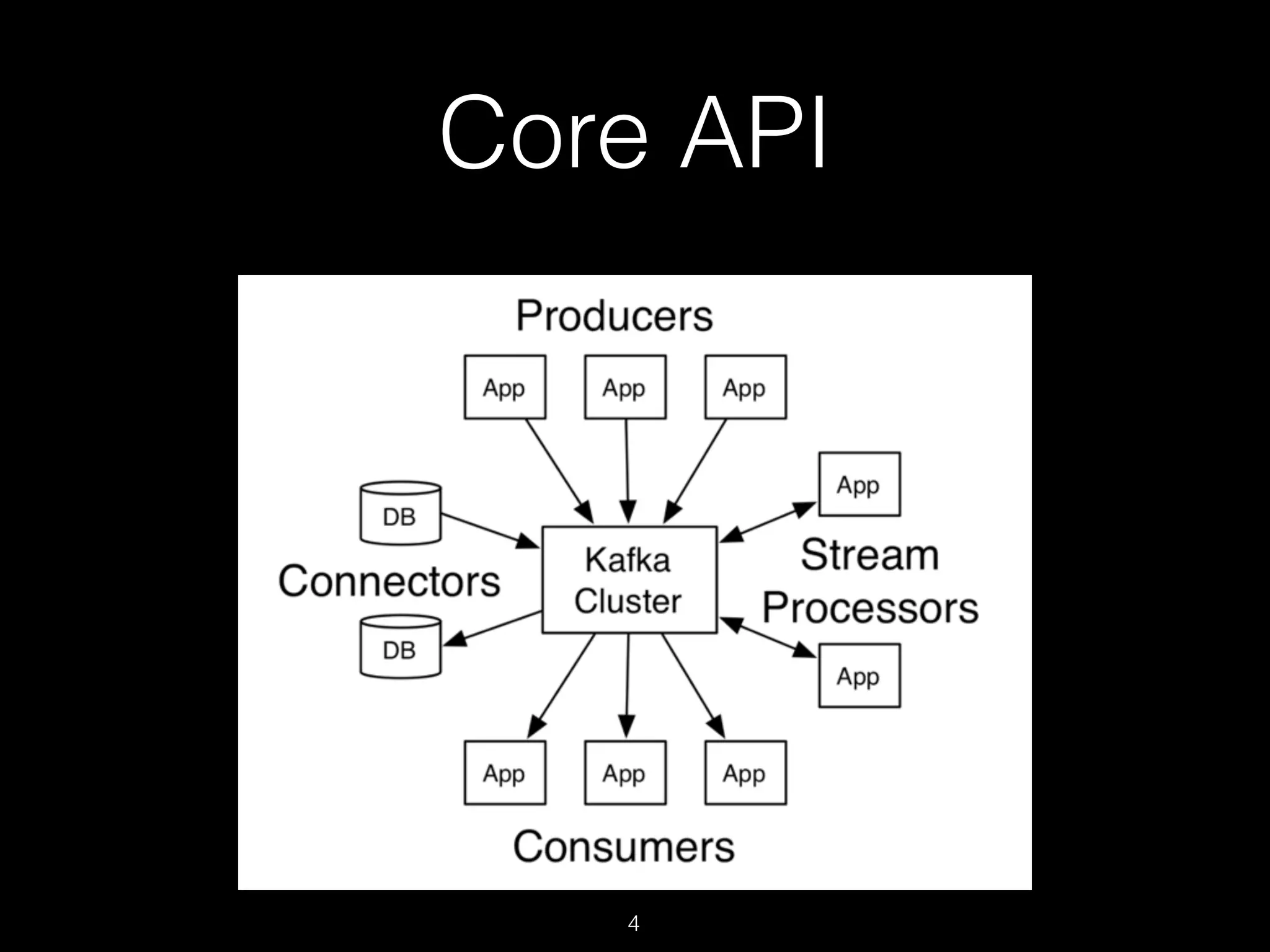
• Producer API allows an application to publish a stream records to
one or more Kafka topics.
• Consumer API allows an application to subscribe to one or more
topics and process the stream of records produced to them.
• Streams API allows an application to act as a stream processor,
consuming an input stream from one or more topics and producing
an output stream to one or more output topics, effectively
transforming the input streams to output streams
• Connector API allows building and running reusable producers or
consumers that connect Kafka topics to existing applications or
data systems. For example, a connector to a relational database
might capture every change to a table.
5
Terminology
• Topics and Logs
• Topic is a category or feed name to which
records are published.
• Topics in Kafka are always multi-subscriber;
that is, a topic can have zero, one, or many
consumers that subscribe to the data written
to it.
6
• Each partition is an ordered, immutable sequence of records that
is continually appended to—a structured commit log.
• The records in the partitions are each assigned a sequential id
number called the offset that uniquely identifies each record within
the partition.
Terminology
7
Terminology
• The Kafka cluster retains all published records—
whether or not they have been consumed—
using a configurable retention period.
8
Distribution
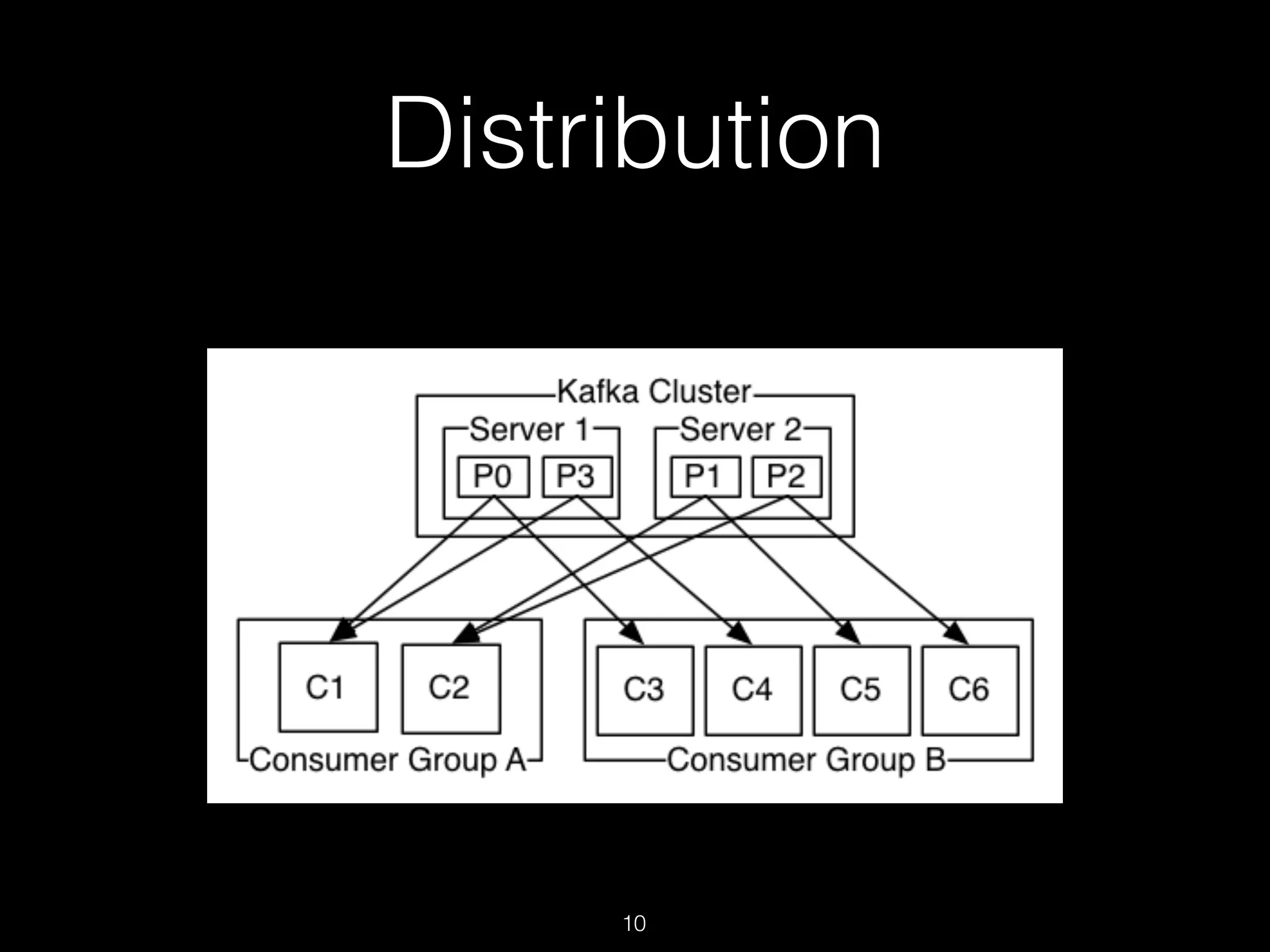
• The partitions of the log are distributed over the
servers in the Kafka cluster with each server
handling data and requests for a share of the
partitions.
• Each partition is replicated across a
configurable number of servers for fault
tolerance.
9
Distribution
10
Guarantees
• Messages sent by a producer to a particular topic
partition will be appended in the order they are sent.
That is, if a record M1 is sent by the same producer as
a record M2, and M1 is sent first, then M1 will have a
lower offset than M2 and appear earlier in the log.
• A consumer instance sees records in the order they
are stored in the log.
• For a topic with replication factor N, we will tolerate up
to N-1 server failures without losing any records
committed to the log.
11
Kafka as a …
• Messaging System
• Messaging traditionally has two models: queuing and publish-subscribe. In a
queue, a pool of consumers may read from a server and each record goes to
one of them; in publish-subscribe the record is broadcast to all consumers.
• Storage System
• Any message queue that allows publishing messages decoupled from
consuming them is effectively acting as a storage system for the in-flight
messages.
• Stream Processing
• In Kafka a stream processor is anything that takes continual streams of data
from input topics, performs some processing on this input, and produces
continual streams of data to output topics.
12
The End

Kafka for begginer

  • 1.
    Kafka for beginner YousunJeong (jerryjung@sk.com) February 16, 2017
  • 2.
    What is kafka •Kafka™ is used for building real-time data pipelines and streaming apps. It is horizontally scalable, fault-tolerant, wicked fast, and runs in production in thousands of companies. 2
  • 3.
    Concept • Kafka isrun as a cluster on one or more servers. • The Kafka cluster stores streams of records in categories called topics. • Each record consists of a key, a value, and a timestamp. 3
  • 4.
  • 5.
    Core API • ProducerAPI allows an application to publish a stream records to one or more Kafka topics. • Consumer API allows an application to subscribe to one or more topics and process the stream of records produced to them. • Streams API allows an application to act as a stream processor, consuming an input stream from one or more topics and producing an output stream to one or more output topics, effectively transforming the input streams to output streams • Connector API allows building and running reusable producers or consumers that connect Kafka topics to existing applications or data systems. For example, a connector to a relational database might capture every change to a table. 5
  • 6.
    Terminology • Topics andLogs • Topic is a category or feed name to which records are published. • Topics in Kafka are always multi-subscriber; that is, a topic can have zero, one, or many consumers that subscribe to the data written to it. 6
  • 7.
    • Each partitionis an ordered, immutable sequence of records that is continually appended to—a structured commit log. • The records in the partitions are each assigned a sequential id number called the offset that uniquely identifies each record within the partition. Terminology 7
  • 8.
    Terminology • The Kafkacluster retains all published records— whether or not they have been consumed— using a configurable retention period. 8
  • 9.
    Distribution • The partitionsof the log are distributed over the servers in the Kafka cluster with each server handling data and requests for a share of the partitions. • Each partition is replicated across a configurable number of servers for fault tolerance. 9
  • 10.
  • 11.
    Guarantees • Messages sentby a producer to a particular topic partition will be appended in the order they are sent. That is, if a record M1 is sent by the same producer as a record M2, and M1 is sent first, then M1 will have a lower offset than M2 and appear earlier in the log. • A consumer instance sees records in the order they are stored in the log. • For a topic with replication factor N, we will tolerate up to N-1 server failures without losing any records committed to the log. 11
  • 12.
    Kafka as a… • Messaging System • Messaging traditionally has two models: queuing and publish-subscribe. In a queue, a pool of consumers may read from a server and each record goes to one of them; in publish-subscribe the record is broadcast to all consumers. • Storage System • Any message queue that allows publishing messages decoupled from consuming them is effectively acting as a storage system for the in-flight messages. • Stream Processing • In Kafka a stream processor is anything that takes continual streams of data from input topics, performs some processing on this input, and produces continual streams of data to output topics. 12
  • 13.