International Research Journal of Engineering and Technology (IRJET) e-ISSN: 2395-0056
Volume: 05 Issue: 03 | Mar-2018 www.irjet.net p-ISSN: 2395-0072
© 2018, IRJET | Impact Factor value: 6.171 | ISO 9001:2008 Certified Journal | Page 3216
Dynamic Analysis of the Front and Rear Suspension System of an All-
Terrain Vehicle
Khan Noor Mohammad1, Vatsal Singh2, Nihar Ranjan Das3, Prajwal Nayak4, B.R. Patil5
1,2,3,4 Student, Department of Mechanical Engineering, MIT Academy Of Engineering, Maharashtra, India
5 Assistant Professor, Department of Mechanical Engineering, MIT Academy Of Engineering, Maharashtra, India
---------------------------------------------------------------------***---------------------------------------------------------------------
Abstract - Suspension system plays an important role in
handling of the vehicle. This paper deals with the design and
analysis of the parts used in the suspension system of an ATV
in front and in rear. The purpose behind the design of this
suspension system is to control camber and toe (based on
iterations) with maximum damping and minimum wheelbase
and track width change. This study summarizes in brief the
design parameters, targets and considerationsfollowedforthe
fabrication and assembly of the system. The suspensionsystem
plays an important role in stability of the vehicle in static and
dynamic conditions.
Key Words: Isolation of masses, Double Wishbone,
Multi-point, Force Interaction, Spring tuning, Material
selection and analysis.
1. INTRODUCTION
Suspension system is an important part of vehicle which
provides comfort, control and safety to the passengers. It
allows vehicle to travel over rough surfaces with minimum
up-and-down body movement. Suspension is defined as
isolation of twomasseshence while designing suspension, a
balanced design should be provided in order to carry out
functions like road holding, load carrying and passenger
comfort. It consists of arms, damper, spring, joints, tire,
knuckle and hub. it is necessary to design a suspension
system that can handle the roughest of terrain and endure
extreme force conditions without affecting the vehicle’s
stability and at the same time also provide a smooth ride to
the driver.so it has been decided to go for the double
wishbone in front and h-arm in rear with a dual rate spring
system, so that it can sustain the design load and give
excellent comfort and control over the off-road, providing
safety to the driver.
1.1 Front suspension system- Double Wishbone
The designing of ATV’s is considered under front steering
conditions. As the front wheels need to steer in every
condition, Double wishbone assembly isoneofbetteroption.
It consists of two V- shape link. Suspension deals with
restriction of degree of freedom. In double wishbone
assembly each wishbone link restricts two Degrees of
Freedom and one tie rod which controls one Degree of
Freedom in all by double wishbone assembly fiveDegreesOf
Freedom is restrained.
It provides a large amount of room for adjustment. Allows
decent tire camber control resulting in enhanced handling
characteristics, has high strength and rigidity. If an impact
occurs and the suspension suffers damage it is unlikely that
all the components will need replacing. Finally, it permits a
low unsprung weight for the vehicle as only a small portion
of the linkage weights are unsprung.
Dual unequal length A-arm were used as they provide
optimum camber curves in wheel travel and the shorter
upper arm helps to induce a camber curve which maintains
maximum contact patch during wheel travel. During rolling
motion the inner wheel undergoes droop while the outer
wheel goesthrough bumpmotion. This increasesthecontact
patches in the respective wheels which is very important in
any off road vehicle. This was achieved by short long arm
geometry.
1.2 Rear suspension system- H-Arm Suspension
In consideration of front steering condition, the rear
wheels should have high toe and camber control. The Rear
Wheel Drive in an ATV has more weight in rear part. So it is
necessary to have the linkage which should provide Toe and
Camber control with load bearing capacity. H arm and
camber link is nothing but multi point suspension, where H
arm provides restraining of four Degrees of Freedom with
camber link which restricts one Degree of Freedom in all
five Degrees Of Freedom restricted by H- arm with camber
link.
H arm is nothing but link of shape ‘H’, where two
mountings are on chassis and two are on knuckle. The H-
arm has unique structure which provides zero steer
condition in dynamic condition. The large space availability
for damper mounting gives advantage in suspension. It
provides low unsprung weight which is very essential for
any suspension system.
International Research Journal of Engineering and Technology (IRJET) e-ISSN: 2395-0056
Volume: 05 Issue: 03 | Mar-2018 www.irjet.net p-ISSN: 2395-0072
© 2018, IRJET | Impact Factor value: 6.171 | ISO 9001:2008 Certified Journal | Page 3217
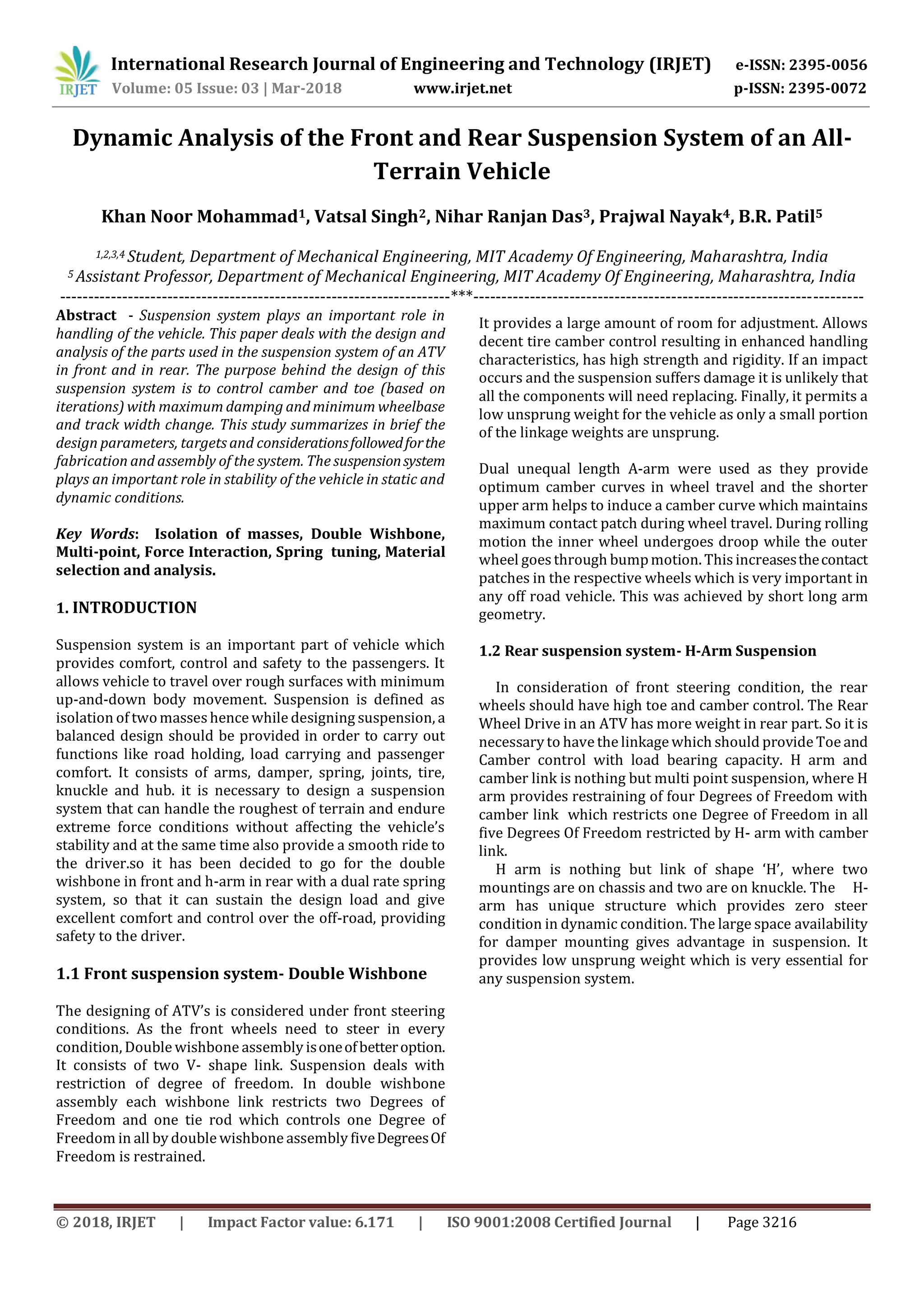
2. Design Procedures
Chart1: Design methodology
2.1 Design Considerations
Table 1: Vehicle specifications
Parameter Front Rear
Ground
Clearance(mm)
350 300
Track
Width(inch)
49 46
Wheelbase(inch) 57.07
Tire 23*7*10
The tire dimensions decided was 23*7*10 for the
better traction, ease of assembly of component, low
unsprung mass and the rim is offset by 1.5 inches and
uniform bolt dimensions for interchangeability.
The arms were decided to keep as long as possible for the
stability of the vehicle and minimize the variations in
geometry. The length of the upperarmswasdecidedthrough
geometry modeling, shorter upper arm meant negative
camber in bump travel and optimum roll-cambercoefficient.
The design of suspension beginswithconsideringsome
important factors. The requirement for a good suspension
system is to select good dampers, types of suspension
system considering which is best suited for the current
chassis design and steering system.
2.3 Force Analysis
There are three forces acting on the vehicle.
1. Momentum on the rear and frontal axle due to load
transfer from the inner to the external wheel during the
curve (cornering forces).
2. Longitudinal forces (braking and driving torque).
3. Vertical force due random obstacles.
3. Suspension Geometry
It refersto varioustypes, arrangementsof suspension arms.
Different geometries produce different types of motion and
can be used according to the need of purpose. Various
geometries could be used for same purpose. The lotus
software made it possible to select the effective geometry
3.1 Front Suspension Consideration
The front part of the suspension has to also deal
with steering characteristics to maintain the control of the
vehicle during the dynamic conditions.
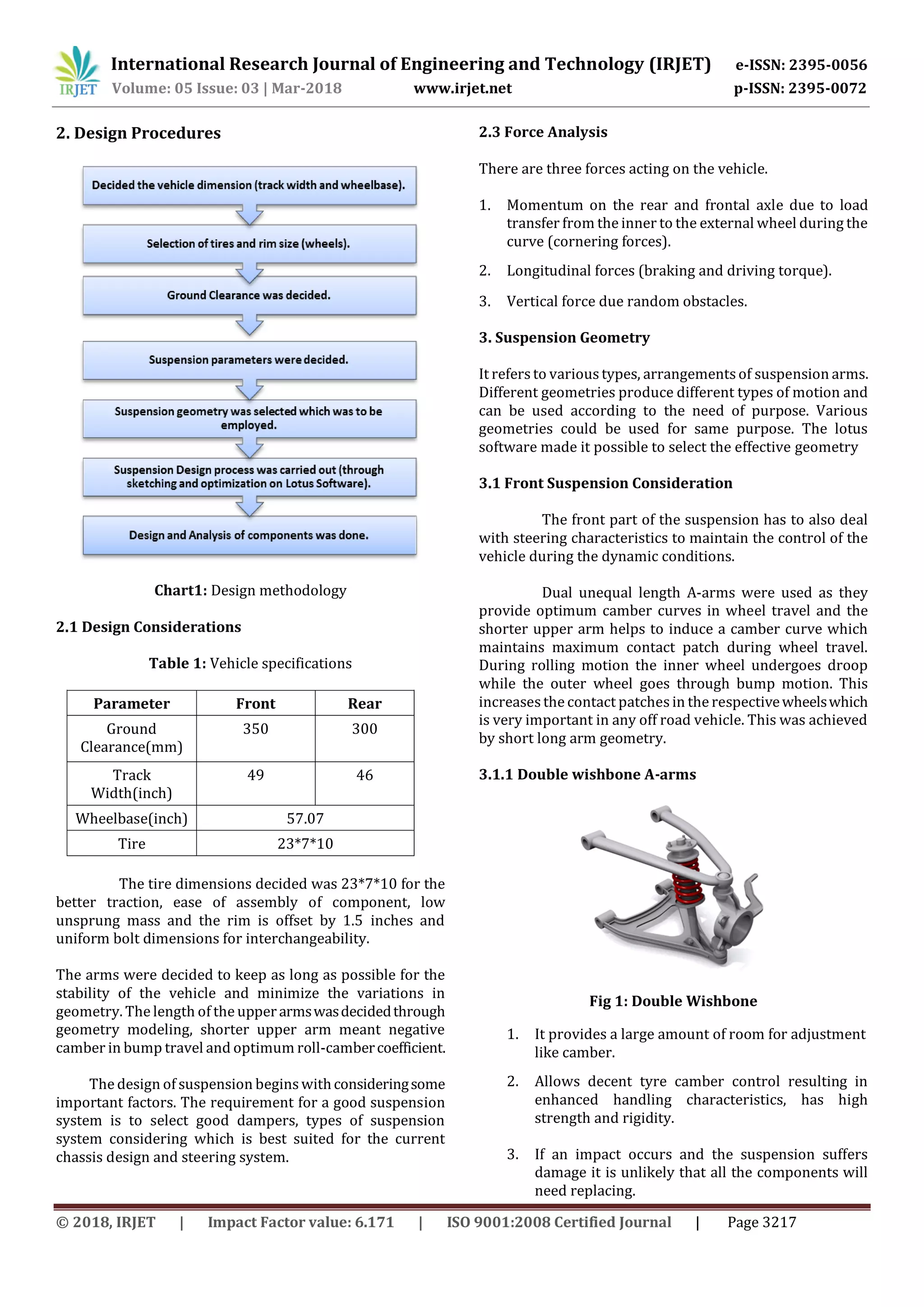
Dual unequal length A-arms were used as they
provide optimum camber curves in wheel travel and the
shorter upper arm helps to induce a camber curve which
maintains maximum contact patch during wheel travel.
During rolling motion the inner wheel undergoes droop
while the outer wheel goes through bump motion. This
increasesthe contact patchesin the respectivewheelswhich
is very important in any off road vehicle. This was achieved
by short long arm geometry.
3.1.1 Double wishbone A-arms
Fig 1: Double Wishbone
1. It provides a large amount of room for adjustment
like camber.
2. Allows decent tyre camber control resulting in
enhanced handling characteristics, has high
strength and rigidity.
3. If an impact occurs and the suspension suffers
damage it is unlikely that all the components will
need replacing.
International Research Journal of Engineering and Technology (IRJET) e-ISSN: 2395-0056
Volume: 05 Issue: 03 | Mar-2018 www.irjet.net p-ISSN: 2395-0072
© 2018, IRJET | Impact Factor value: 6.171 | ISO 9001:2008 Certified Journal | Page 3218
4. It permits a low unsprung weight for the vehicle
as only a small portion of the linkage weights are
unsprung.
3.1.2 Material selection
Material consideration for the wishbone becomes the
most primary need for design and fabrication. The strength
of the material should be well enough to withstand all the
loads acting on it in dynamic conditions. The material
selection also depends on number of factors such as carbon
content, material properties, availability and the most
important parameter is the cost.
Table 2: Properties
Properties AISI1018 AISI1040 AISI4130
Carbon Content (%) 0.18 0.40 0.30
Tensile Strength (MPa) 440 620 700
Yield Strength (MPa) 370 415 600
Hardness (BHN) 126 201 217
Cost (Rs/metre) 325 425 600
The material chosen for A-arms was AISI 4130 due to
its good tensile strength.
3.1.3 Joints selections
We select the following joints as we get the required degree
of freedom and availability.
Table 3: Degree of freedom in joints
Joint type Reasons (degree of freedom)
Ball joint 27
Heim joint 13
4. Rear suspension system:
In rear suspension design optimum Camber gain and
minimalistic toe gain were main design considerations.Since
most of the weight of the body is in the rear the suspension
had to be designed to keep camber curve to provide max
traction in different rolling situations. Lateral and cornering
forces were taken into consideration while designing the
components for rear.
Table 5: suspension specification in Rear
Parameter bump droop
Wheel travel (mm) 125 60
Ground clearance(mm) 300
By using the torsion bar in the rear reduces the chances of
vehicle to rollover. This also helpsin inducing oversteer and
which again helps in taking tighter turns by reducing the
turning radius. The suspension geometry was setup in way
such that the migration of the roll Centre was minimum at
the rear thus inducing stability in the heavy rear part of the
vehicle.
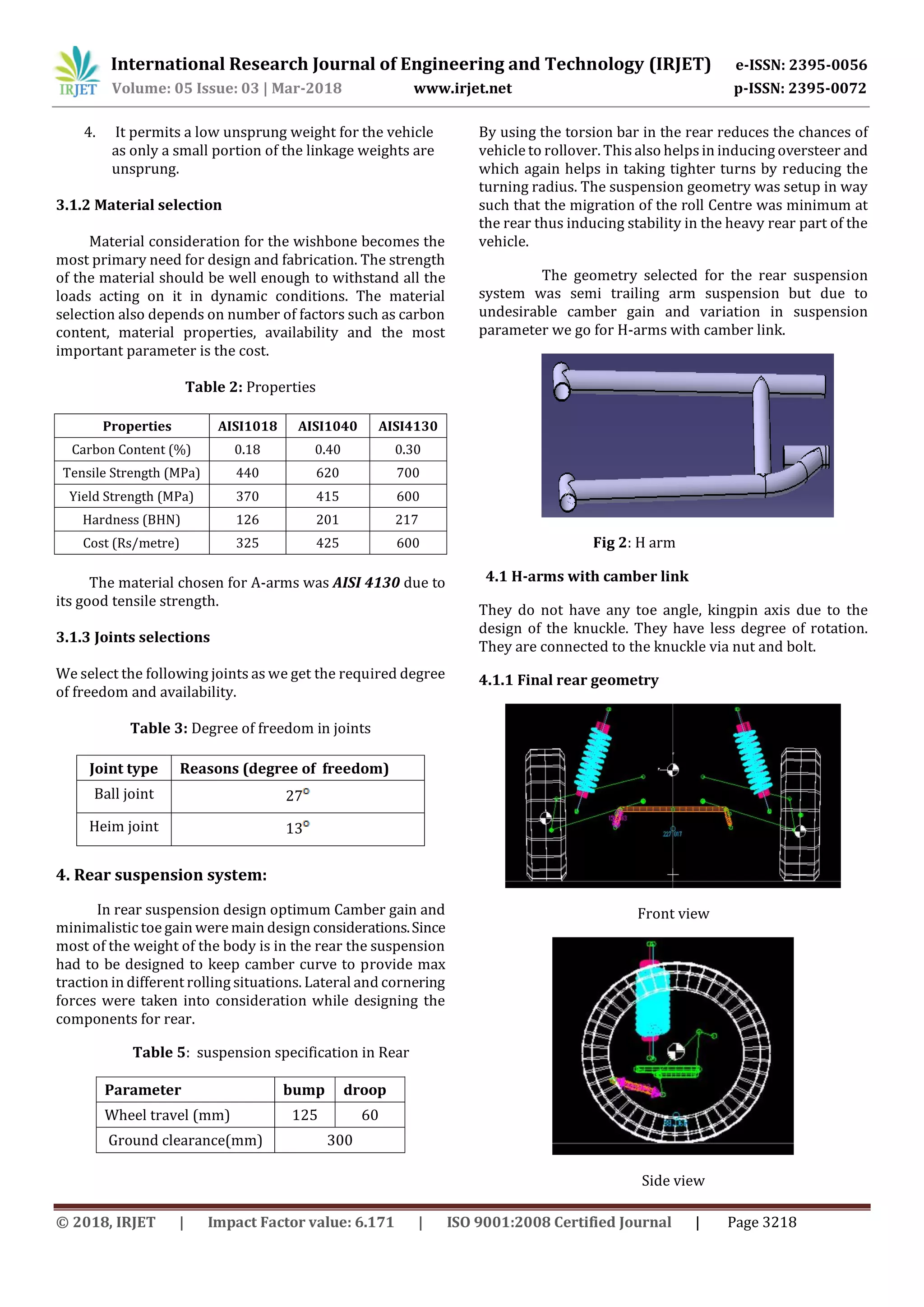
The geometry selected for the rear suspension
system was semi trailing arm suspension but due to
undesirable camber gain and variation in suspension
parameter we go for H-arms with camber link.
Fig 2: H arm
4.1 H-arms with camber link
They do not have any toe angle, kingpin axis due to the
design of the knuckle. They have less degree of rotation.
They are connected to the knuckle via nut and bolt.
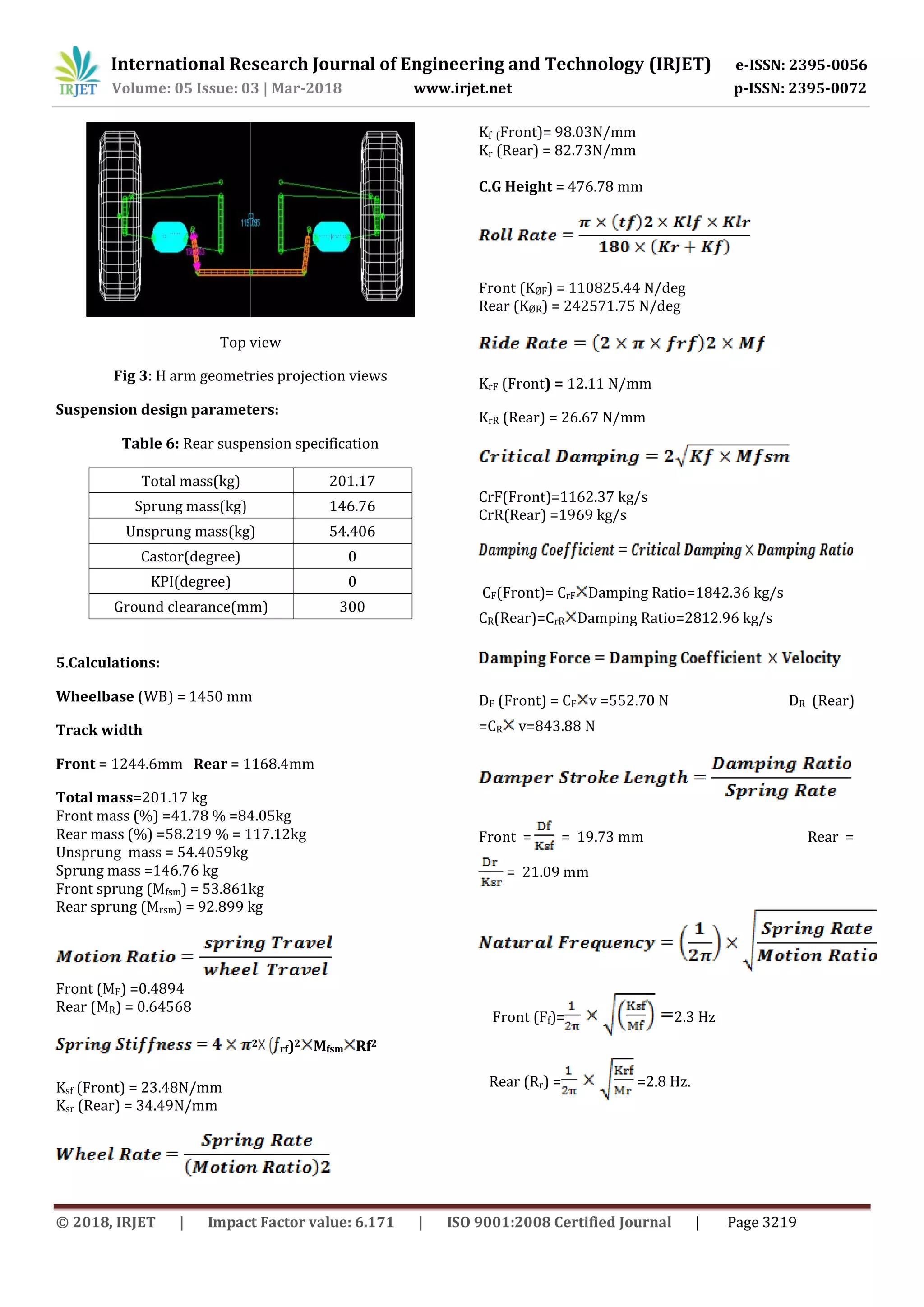
4.1.1 Final rear geometry
Front view
Side view
International Research Journal of Engineering and Technology (IRJET) e-ISSN: 2395-0056
Volume: 05 Issue: 03 | Mar-2018 www.irjet.net p-ISSN: 2395-0072
© 2018, IRJET | Impact Factor value: 6.171 | ISO 9001:2008 Certified Journal | Page 3219
Top view
Fig 3: H arm geometries projection views
Suspension design parameters:
Table 6: Rear suspension specification
Total mass(kg) 201.17
Sprung mass(kg) 146.76
Unsprung mass(kg) 54.406
Castor(degree) 0
KPI(degree) 0
Ground clearance(mm) 300
5.Calculations:
Wheelbase (WB) = 1450 mm
Track width
Front = 1244.6mm Rear = 1168.4mm
Total mass=201.17 kg
Front mass (%) =41.78 % =84.05kg
Rear mass (%) =58.219 % = 117.12kg
Unsprung mass = 54.4059kg
Sprung mass =146.76 kg
Front sprung (Mfsm) = 53.861kg
Rear sprung (Mrsm) = 92.899 kg
Front (MF) =0.4894
Rear (MR) = 0.64568
2
rf)2 Mfsm Rf2
Ksf (Front) = 23.48N/mm
Ksr (Rear) = 34.49N/mm
Kf (Front)= 98.03N/mm
Kr (Rear) = 82.73N/mm
C.G Height = 476.78 mm
Front (KØF) = 110825.44 N/deg
Rear (KØR) = 242571.75 N/deg
KrF (Front) = 12.11 N/mm
KrR (Rear) = 26.67 N/mm
CrF(Front)=1162.37 kg/s
CrR(Rear) =1969 kg/s
CF(Front)= CrF Damping Ratio=1842.36 kg/s
CR(Rear)=CrR Damping Ratio=2812.96 kg/s
DF (Front) = CF v =552.70 N DR (Rear)
=CR v=843.88 N
Front = = 19.73 mm Rear =
= 21.09 mm
Front (Ff)= 2.3 Hz
Rear (Rr) = =2.8 Hz.
International Research Journal of Engineering and Technology (IRJET) e-ISSN: 2395-0056
Volume: 05 Issue: 03 | Mar-2018 www.irjet.net p-ISSN: 2395-0072
© 2018, IRJET | Impact Factor value: 6.171 | ISO 9001:2008 Certified Journal | Page 3220
6. Damper selection:
By doing market survey and our design requirement
following are consider for the comparisons
Table 7: availability of Damper and specifications
Parameter AFCO 16
series
AFCO16
series
King
shocks
Travel(inches) 6 6 5.5
Adjustment single double single
Weight(kg) 1.34 2.30 1.5
Cost (per piece) 30000 45000 30000
Out of the above comparison we select the AFCO16 series
single adjustable strut for the low weight required travel.
7. Springs
A mechanical spring is an elastic body which has
primary function is to deflect under load and return to its
original shape when load is removed. Spring undergoes
different types of forces like twist, pull, stretch, etc.
In vehicle suspension system, helical compression
spring is one of the primary elastic members. They attach
vehicle body with wheel elastically and smooth out shocks
which are received from wheel. Spring rate indicates energy
absorption capacity. The fatigue failure of the suspension
spring in a variety of ways Raw materials defect, surface
imperfections, improper heat treatment, corrosion and
decarburization are generally recognized causes of fatigue
failure of suspension spring.
7.1 Parameters:
7.1.1 Selection of spring end
For the compression, spring hastendency to take load along
the axis and flat surface. So, we selected the squared and
ground end.
7.1.2 Material selection for spring
Any of the below material can be used for spring but it is
good to prefer the alloy steel of chromo vanadium ASTM
A231 because of high impact and shock absorbing capacity
along with high temperature sustainability but due to
unavailability of the chromo vanadiummaterial in India and
high cost we go for the IS4454 grade 2 cold drawn steel
wire spring material.
7.2 Concept of dual rate spring
In this arrangement two or more springs of different
stiffness are arranged in series. This method gives better
performance rather than a single spring. Let assumewetake
the two springs of different stiffness
One is less stiff say k1 and another is stiffer say K2.
And the relation between the total stiffnessand thisstiffness
is
1/total stiffness (k) =1/k1+1/k2
Total force (f) =f1=f2
Total deflection of spring (δ) =δ1+δ2
7.3 Calculations:
Properties of IS4454 grade 2 cold drawn steel:
Minimum tensile strength=1290 Mpa
Modulus of rigidity (G) = 73000 Mpa
Factor of safety=1.5
Allowable tensile strength=1290 N/mm
Allowable shear stress=0.6*1290=774/FOS=516 N/mm
Required travel of spring (front & rear) =6 inches
Spring stiffness
Front (Ksf) =23.4818 N/mm
Rear (Ksr) = 34.485N/mm
As it is decided to use 2 springs in series because we get the
linear graph between loads vs. deflection.
So that equivalent stiffness (K) is given by,
56N/mm
Front equivalent springs constants
K1=35N/mm
K2=68.56N/mm
Rear equivalent spring constant
K1=55N/mm
K2=90.01N/mm
Spring dimensions
Front spring design
Damper Characteristics Rear
AFCO 16 series (travel)(inch) 6
Damper Stroke(mm) 21.09
Damping (N) 843.88
International Research Journal of Engineering and Technology (IRJET) e-ISSN: 2395-0056
Volume: 05 Issue: 03 | Mar-2018 www.irjet.net p-ISSN: 2395-0072
© 2018, IRJET | Impact Factor value: 6.171 | ISO 9001:2008 Certified Journal | Page 3221
Spring 1
Wire diameter (mm) =9
Mean coil diameter (mm) =59
Number of turns =8
Total no of turns = 10
Spring index =6.55
Free length (mm) =210
Solid length (mm) =90
Pitch (mm) =24
Travel 1 (mm) =120
K1 = 36.5N/mm
Spring 2
Wire diameter (mm) =8
Mean coil diameter (mm) =57
Spring index =7.12
Number of turns =3
Total no of turns = 5
Free length (mm) =70
Solid length (mm) =40
Pitch (mm) =18
Travel 2 (mm) =30
K2=68.9N/mm
Total travel (T) =travel 1+travel2
=120+30=150mm
=5.9 inch
Rear spring design
Wire diameter (mm) =9
Mean coil diameter (mm) =56
Spring index =6.22
Number of turns =6
Total no of turns = 8
Free length (mm) =180
Solid length (mm) =72
Pitch (mm) =27
Travel (mm) =108
K1=55N/mm
Wire diameter (mm) =9
Mean coil diameter (mm) =59
Spring index =6.55
Number of turns =3
Total no of turns = 5
Free length (mm) =87
Solid length (mm) =45
Pitch (mm) =23
Travel (mm) =42
K2=97.2 N/m
Total travel=travel 1+travel2
=108+42=150mm
=5.9 inch
Calculations:
Number of turns (n) =8.4=8
Free length (Lf) =Pn+2d
210=P*8+2*9
P=24mm
Checking in Torsional shear stress
Considering static failure
Let ks static shear stress factor
ks=1.07
Static shear stress=
=882.02N/mm
Now, by considering curvature effect
Kw= +
= +
=1.231
Shear stressinduced considering curvature effectisgivenby
International Research Journal of Engineering and Technology (IRJET) e-ISSN: 2395-0056
Volume: 05 Issue: 03 | Mar-2018 www.irjet.net p-ISSN: 2395-0072
© 2018, IRJET | Impact Factor value: 6.171 | ISO 9001:2008 Certified Journal | Page 3222
=1014n/mm
Checking for buckling for both ends fixed spring
3.6
So the buckling is not occurs in spring.
8. Rear wheel hub:
Which would be the force acting on the hub when
vehicle travels from a bump? Considering the above
parameters analysis has been carried out and maximumvon
mises stress as well as maximum deformation has been
calculated.
8.1 Mesh and refinement:
Fig 4: mesh refinement
8.2 Parameters applied:
Fig 5: Force/Moment on Hub
8.3 Stress:
Fig 6: Stress Analysis
8.4 Deformation:
Fig 7: Deformation chart
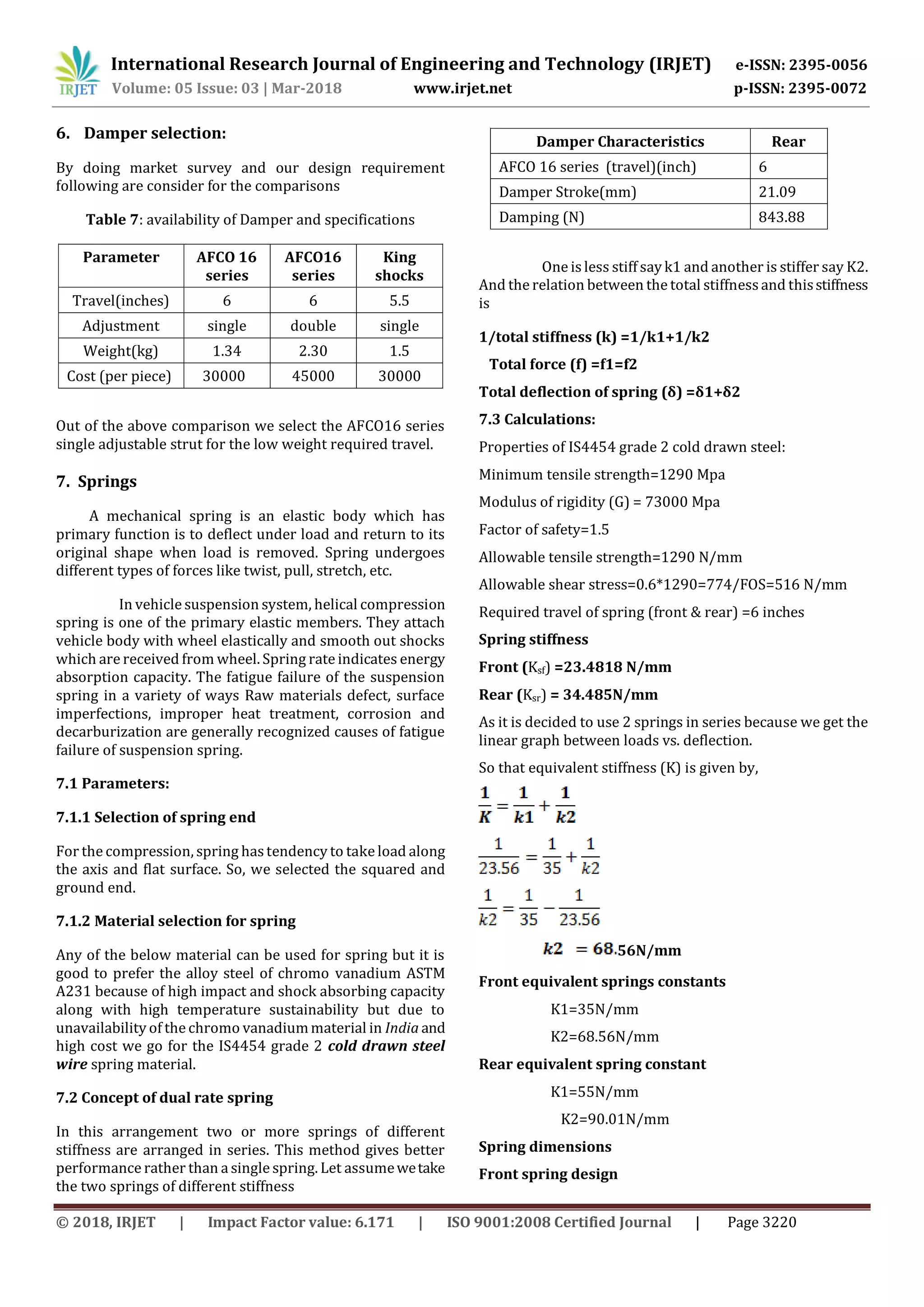
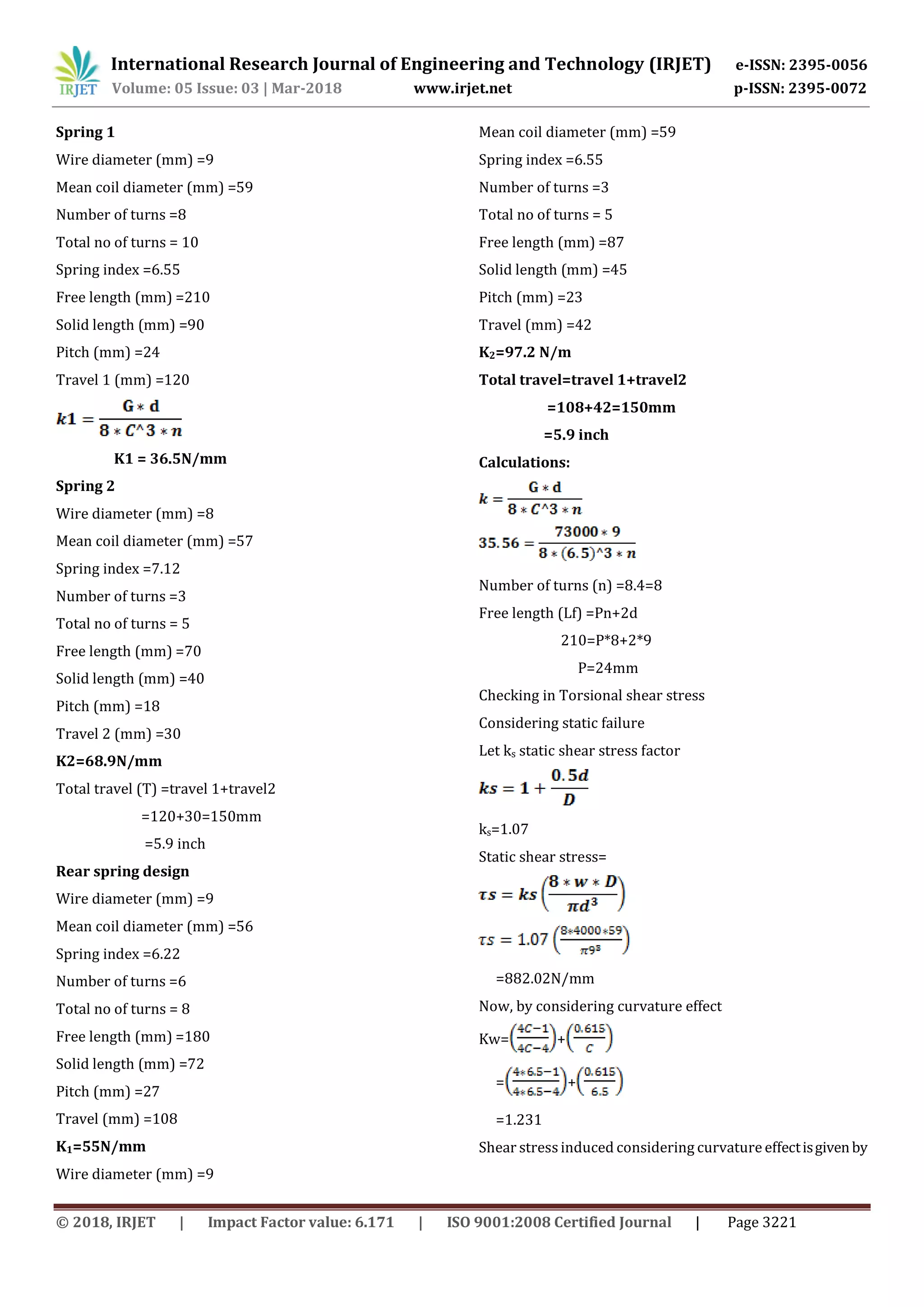
After carrying out analysis the maximum stress occurring is
about 237.04 MPa and the deformation was about
0.3861mm with FOS 2.12
We also performed fatigue analysis and the life obtained for
the component was about 1x10⁸ cycles which was beyond
the safety limits and hence the design was safe against the
fatigue loading.
Fig 8: fatigue analysis
International Research Journal of Engineering and Technology (IRJET) e-ISSN: 2395-0056
Volume: 05 Issue: 03 | Mar-2018 www.irjet.net p-ISSN: 2395-0072
© 2018, IRJET | Impact Factor value: 6.171 | ISO 9001:2008 Certified Journal | Page 3223
9. Rear knuckle:
Fig 9: Force/Moment application
9.1 Stress:
Fig 10: Stress Analysis
9.2 Deformation:
Fig 11: Deformation Analysis
9.3 Result:
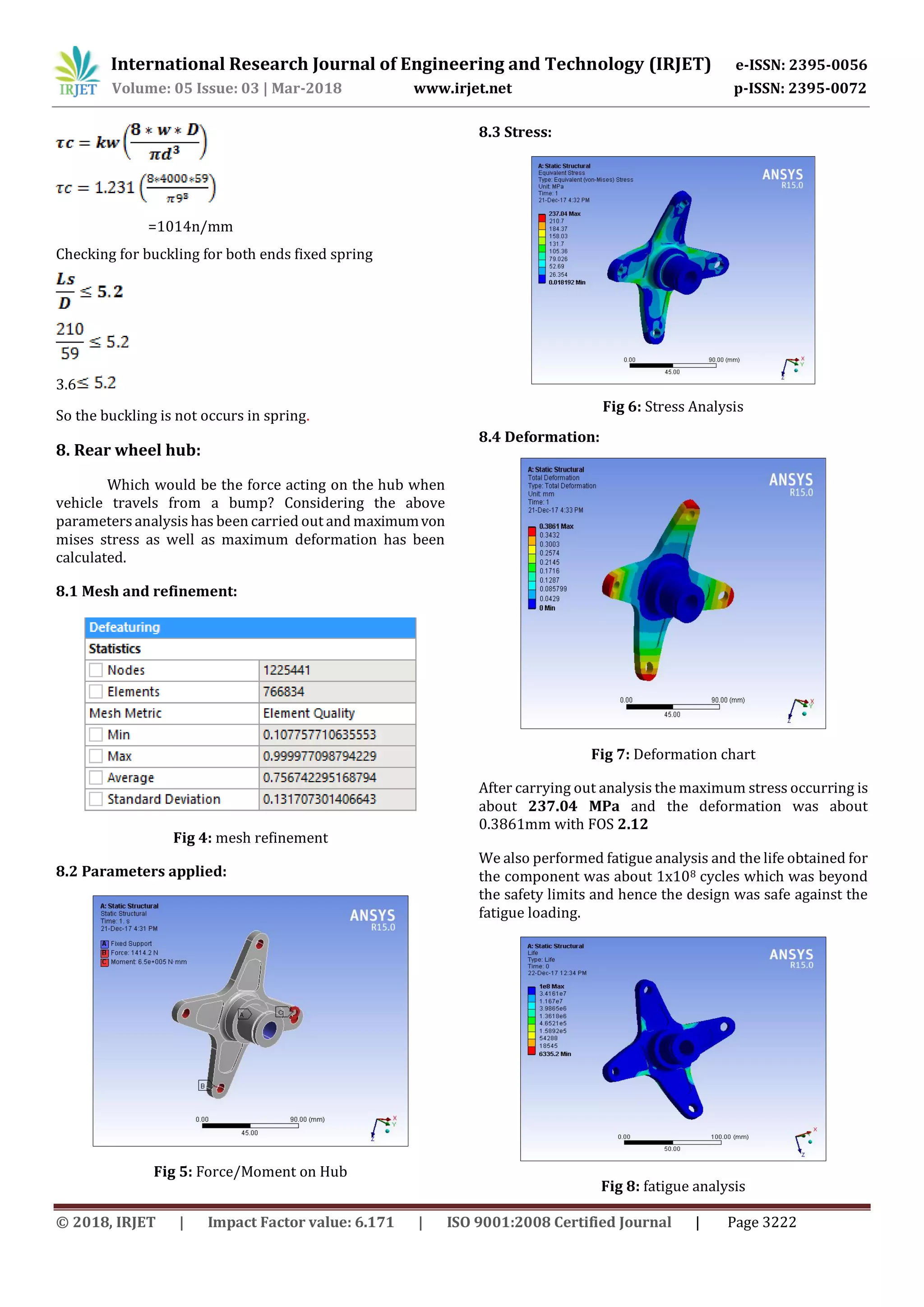
Maximum stress occurring in knuckle is 381.56Mpa and
deformation is 0.71 having FOS 1.59.
10. Rear H arm
Upper suspension arm is connected to the upper mounting
of the knuckle it is also analyzed under the force of 2804N
laterally and 2600 N on upward direction.
10.1 Parameters applied
Fig 12: Force/Moment application
10.2 Stress
Fig 13: Stress Analysis
10.3 Deformation
Fig 14: Deformation Analysis
International Research Journal of Engineering and Technology (IRJET) e-ISSN: 2395-0056
Volume: 05 Issue: 03 | Mar-2018 www.irjet.net p-ISSN: 2395-0072
© 2018, IRJET | Impact Factor value: 6.171 | ISO 9001:2008 Certified Journal | Page 3224
10.4 Result
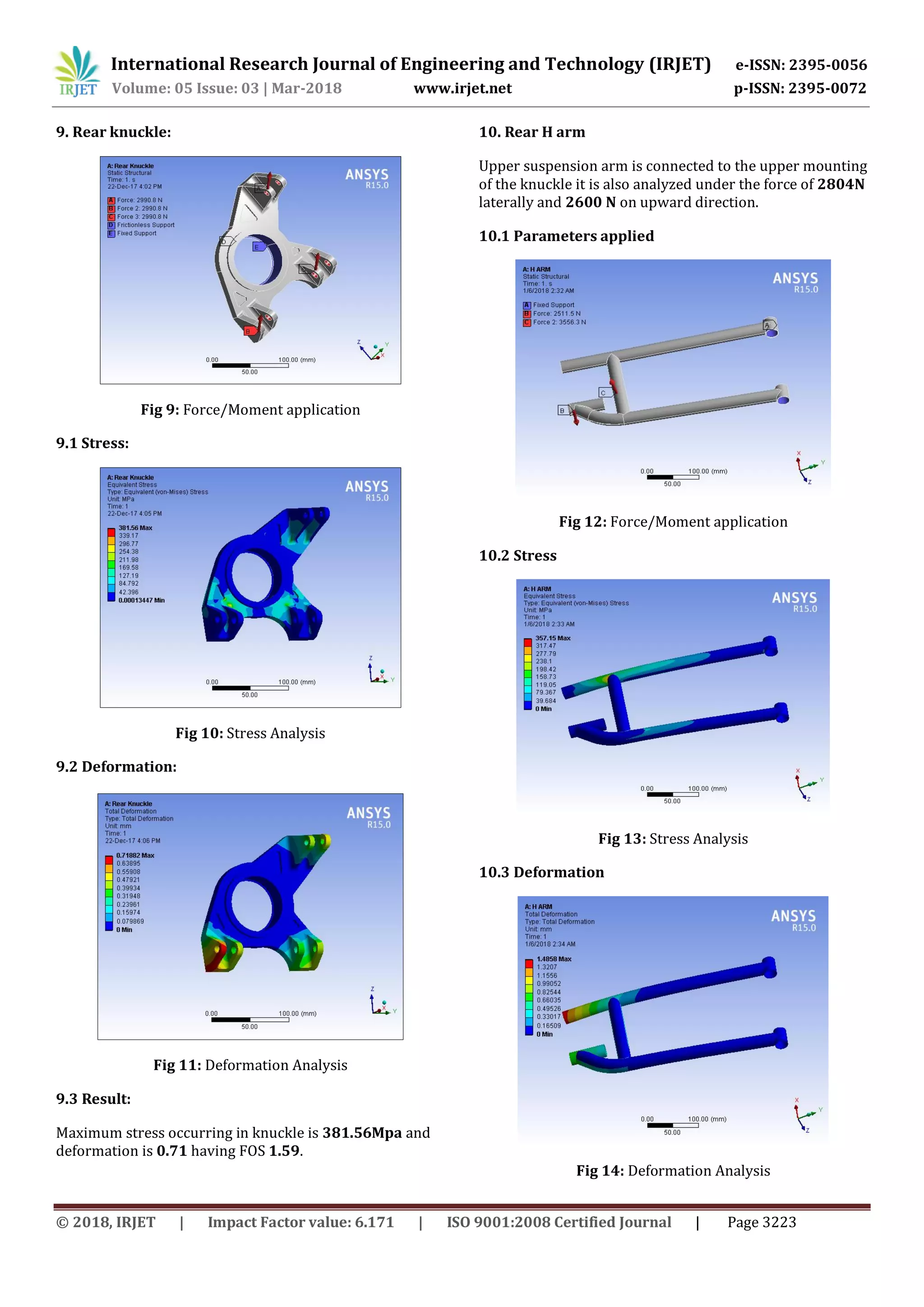
The max stress that acts on the arms is about 357.15MPa
and max deformation is about 1.4858mm.
11. CONCLUSION
Suspension Deals with three C’s comfort, contact, control.
The agenda for designing the suspension wasto enhancethe
dynamic stability of an ATV. The Front and Rear geometries
were designed by using Lotus software with the help of
CatiaV5 and analysis was carried out by the software‘Ansys’.
The suspension parameters like Ground clearances,
Wheelbase, Track width and other dynamic parameter such
as Camber gain, toe gain etc. kept optimum so as to get
minimum force interaction with the tire. Thus with Double
Wishbone and H-arm linkage system the ATV was designed
and analyzed successfully.
12. REFERENCES
[1] RACE CAR VEHICLE DYNAMICS- Milliken and Milliken
[2] GILLIPSIE’S FUNDAMENTAL OF VEHICLE DYNAMICS
[3] TUNE TO WIN- Carroll Smith
[4] LOTUS – To design Suspension geometry
[5] ANSYS- To analyse the forces on the components.

IRJET- Dynamic Analysis of the Front and Rear Suspension System of an All-Terrain Vehicle

  • 1.
    International Research Journalof Engineering and Technology (IRJET) e-ISSN: 2395-0056 Volume: 05 Issue: 03 | Mar-2018 www.irjet.net p-ISSN: 2395-0072 © 2018, IRJET | Impact Factor value: 6.171 | ISO 9001:2008 Certified Journal | Page 3216 Dynamic Analysis of the Front and Rear Suspension System of an All- Terrain Vehicle Khan Noor Mohammad1, Vatsal Singh2, Nihar Ranjan Das3, Prajwal Nayak4, B.R. Patil5 1,2,3,4 Student, Department of Mechanical Engineering, MIT Academy Of Engineering, Maharashtra, India 5 Assistant Professor, Department of Mechanical Engineering, MIT Academy Of Engineering, Maharashtra, India ---------------------------------------------------------------------***--------------------------------------------------------------------- Abstract - Suspension system plays an important role in handling of the vehicle. This paper deals with the design and analysis of the parts used in the suspension system of an ATV in front and in rear. The purpose behind the design of this suspension system is to control camber and toe (based on iterations) with maximum damping and minimum wheelbase and track width change. This study summarizes in brief the design parameters, targets and considerationsfollowedforthe fabrication and assembly of the system. The suspensionsystem plays an important role in stability of the vehicle in static and dynamic conditions. Key Words: Isolation of masses, Double Wishbone, Multi-point, Force Interaction, Spring tuning, Material selection and analysis. 1. INTRODUCTION Suspension system is an important part of vehicle which provides comfort, control and safety to the passengers. It allows vehicle to travel over rough surfaces with minimum up-and-down body movement. Suspension is defined as isolation of twomasseshence while designing suspension, a balanced design should be provided in order to carry out functions like road holding, load carrying and passenger comfort. It consists of arms, damper, spring, joints, tire, knuckle and hub. it is necessary to design a suspension system that can handle the roughest of terrain and endure extreme force conditions without affecting the vehicle’s stability and at the same time also provide a smooth ride to the driver.so it has been decided to go for the double wishbone in front and h-arm in rear with a dual rate spring system, so that it can sustain the design load and give excellent comfort and control over the off-road, providing safety to the driver. 1.1 Front suspension system- Double Wishbone The designing of ATV’s is considered under front steering conditions. As the front wheels need to steer in every condition, Double wishbone assembly isoneofbetteroption. It consists of two V- shape link. Suspension deals with restriction of degree of freedom. In double wishbone assembly each wishbone link restricts two Degrees of Freedom and one tie rod which controls one Degree of Freedom in all by double wishbone assembly fiveDegreesOf Freedom is restrained. It provides a large amount of room for adjustment. Allows decent tire camber control resulting in enhanced handling characteristics, has high strength and rigidity. If an impact occurs and the suspension suffers damage it is unlikely that all the components will need replacing. Finally, it permits a low unsprung weight for the vehicle as only a small portion of the linkage weights are unsprung. Dual unequal length A-arm were used as they provide optimum camber curves in wheel travel and the shorter upper arm helps to induce a camber curve which maintains maximum contact patch during wheel travel. During rolling motion the inner wheel undergoes droop while the outer wheel goesthrough bumpmotion. This increasesthecontact patches in the respective wheels which is very important in any off road vehicle. This was achieved by short long arm geometry. 1.2 Rear suspension system- H-Arm Suspension In consideration of front steering condition, the rear wheels should have high toe and camber control. The Rear Wheel Drive in an ATV has more weight in rear part. So it is necessary to have the linkage which should provide Toe and Camber control with load bearing capacity. H arm and camber link is nothing but multi point suspension, where H arm provides restraining of four Degrees of Freedom with camber link which restricts one Degree of Freedom in all five Degrees Of Freedom restricted by H- arm with camber link. H arm is nothing but link of shape ‘H’, where two mountings are on chassis and two are on knuckle. The H- arm has unique structure which provides zero steer condition in dynamic condition. The large space availability for damper mounting gives advantage in suspension. It provides low unsprung weight which is very essential for any suspension system.
  • 2.
    International Research Journalof Engineering and Technology (IRJET) e-ISSN: 2395-0056 Volume: 05 Issue: 03 | Mar-2018 www.irjet.net p-ISSN: 2395-0072 © 2018, IRJET | Impact Factor value: 6.171 | ISO 9001:2008 Certified Journal | Page 3217 2. Design Procedures Chart1: Design methodology 2.1 Design Considerations Table 1: Vehicle specifications Parameter Front Rear Ground Clearance(mm) 350 300 Track Width(inch) 49 46 Wheelbase(inch) 57.07 Tire 23*7*10 The tire dimensions decided was 23*7*10 for the better traction, ease of assembly of component, low unsprung mass and the rim is offset by 1.5 inches and uniform bolt dimensions for interchangeability. The arms were decided to keep as long as possible for the stability of the vehicle and minimize the variations in geometry. The length of the upperarmswasdecidedthrough geometry modeling, shorter upper arm meant negative camber in bump travel and optimum roll-cambercoefficient. The design of suspension beginswithconsideringsome important factors. The requirement for a good suspension system is to select good dampers, types of suspension system considering which is best suited for the current chassis design and steering system. 2.3 Force Analysis There are three forces acting on the vehicle. 1. Momentum on the rear and frontal axle due to load transfer from the inner to the external wheel during the curve (cornering forces). 2. Longitudinal forces (braking and driving torque). 3. Vertical force due random obstacles. 3. Suspension Geometry It refersto varioustypes, arrangementsof suspension arms. Different geometries produce different types of motion and can be used according to the need of purpose. Various geometries could be used for same purpose. The lotus software made it possible to select the effective geometry 3.1 Front Suspension Consideration The front part of the suspension has to also deal with steering characteristics to maintain the control of the vehicle during the dynamic conditions. Dual unequal length A-arms were used as they provide optimum camber curves in wheel travel and the shorter upper arm helps to induce a camber curve which maintains maximum contact patch during wheel travel. During rolling motion the inner wheel undergoes droop while the outer wheel goes through bump motion. This increasesthe contact patchesin the respectivewheelswhich is very important in any off road vehicle. This was achieved by short long arm geometry. 3.1.1 Double wishbone A-arms Fig 1: Double Wishbone 1. It provides a large amount of room for adjustment like camber. 2. Allows decent tyre camber control resulting in enhanced handling characteristics, has high strength and rigidity. 3. If an impact occurs and the suspension suffers damage it is unlikely that all the components will need replacing.
  • 3.
    International Research Journalof Engineering and Technology (IRJET) e-ISSN: 2395-0056 Volume: 05 Issue: 03 | Mar-2018 www.irjet.net p-ISSN: 2395-0072 © 2018, IRJET | Impact Factor value: 6.171 | ISO 9001:2008 Certified Journal | Page 3218 4. It permits a low unsprung weight for the vehicle as only a small portion of the linkage weights are unsprung. 3.1.2 Material selection Material consideration for the wishbone becomes the most primary need for design and fabrication. The strength of the material should be well enough to withstand all the loads acting on it in dynamic conditions. The material selection also depends on number of factors such as carbon content, material properties, availability and the most important parameter is the cost. Table 2: Properties Properties AISI1018 AISI1040 AISI4130 Carbon Content (%) 0.18 0.40 0.30 Tensile Strength (MPa) 440 620 700 Yield Strength (MPa) 370 415 600 Hardness (BHN) 126 201 217 Cost (Rs/metre) 325 425 600 The material chosen for A-arms was AISI 4130 due to its good tensile strength. 3.1.3 Joints selections We select the following joints as we get the required degree of freedom and availability. Table 3: Degree of freedom in joints Joint type Reasons (degree of freedom) Ball joint 27 Heim joint 13 4. Rear suspension system: In rear suspension design optimum Camber gain and minimalistic toe gain were main design considerations.Since most of the weight of the body is in the rear the suspension had to be designed to keep camber curve to provide max traction in different rolling situations. Lateral and cornering forces were taken into consideration while designing the components for rear. Table 5: suspension specification in Rear Parameter bump droop Wheel travel (mm) 125 60 Ground clearance(mm) 300 By using the torsion bar in the rear reduces the chances of vehicle to rollover. This also helpsin inducing oversteer and which again helps in taking tighter turns by reducing the turning radius. The suspension geometry was setup in way such that the migration of the roll Centre was minimum at the rear thus inducing stability in the heavy rear part of the vehicle. The geometry selected for the rear suspension system was semi trailing arm suspension but due to undesirable camber gain and variation in suspension parameter we go for H-arms with camber link. Fig 2: H arm 4.1 H-arms with camber link They do not have any toe angle, kingpin axis due to the design of the knuckle. They have less degree of rotation. They are connected to the knuckle via nut and bolt. 4.1.1 Final rear geometry Front view Side view
  • 4.
    International Research Journalof Engineering and Technology (IRJET) e-ISSN: 2395-0056 Volume: 05 Issue: 03 | Mar-2018 www.irjet.net p-ISSN: 2395-0072 © 2018, IRJET | Impact Factor value: 6.171 | ISO 9001:2008 Certified Journal | Page 3219 Top view Fig 3: H arm geometries projection views Suspension design parameters: Table 6: Rear suspension specification Total mass(kg) 201.17 Sprung mass(kg) 146.76 Unsprung mass(kg) 54.406 Castor(degree) 0 KPI(degree) 0 Ground clearance(mm) 300 5.Calculations: Wheelbase (WB) = 1450 mm Track width Front = 1244.6mm Rear = 1168.4mm Total mass=201.17 kg Front mass (%) =41.78 % =84.05kg Rear mass (%) =58.219 % = 117.12kg Unsprung mass = 54.4059kg Sprung mass =146.76 kg Front sprung (Mfsm) = 53.861kg Rear sprung (Mrsm) = 92.899 kg Front (MF) =0.4894 Rear (MR) = 0.64568 2 rf)2 Mfsm Rf2 Ksf (Front) = 23.48N/mm Ksr (Rear) = 34.49N/mm Kf (Front)= 98.03N/mm Kr (Rear) = 82.73N/mm C.G Height = 476.78 mm Front (KØF) = 110825.44 N/deg Rear (KØR) = 242571.75 N/deg KrF (Front) = 12.11 N/mm KrR (Rear) = 26.67 N/mm CrF(Front)=1162.37 kg/s CrR(Rear) =1969 kg/s CF(Front)= CrF Damping Ratio=1842.36 kg/s CR(Rear)=CrR Damping Ratio=2812.96 kg/s DF (Front) = CF v =552.70 N DR (Rear) =CR v=843.88 N Front = = 19.73 mm Rear = = 21.09 mm Front (Ff)= 2.3 Hz Rear (Rr) = =2.8 Hz.
  • 5.
    International Research Journalof Engineering and Technology (IRJET) e-ISSN: 2395-0056 Volume: 05 Issue: 03 | Mar-2018 www.irjet.net p-ISSN: 2395-0072 © 2018, IRJET | Impact Factor value: 6.171 | ISO 9001:2008 Certified Journal | Page 3220 6. Damper selection: By doing market survey and our design requirement following are consider for the comparisons Table 7: availability of Damper and specifications Parameter AFCO 16 series AFCO16 series King shocks Travel(inches) 6 6 5.5 Adjustment single double single Weight(kg) 1.34 2.30 1.5 Cost (per piece) 30000 45000 30000 Out of the above comparison we select the AFCO16 series single adjustable strut for the low weight required travel. 7. Springs A mechanical spring is an elastic body which has primary function is to deflect under load and return to its original shape when load is removed. Spring undergoes different types of forces like twist, pull, stretch, etc. In vehicle suspension system, helical compression spring is one of the primary elastic members. They attach vehicle body with wheel elastically and smooth out shocks which are received from wheel. Spring rate indicates energy absorption capacity. The fatigue failure of the suspension spring in a variety of ways Raw materials defect, surface imperfections, improper heat treatment, corrosion and decarburization are generally recognized causes of fatigue failure of suspension spring. 7.1 Parameters: 7.1.1 Selection of spring end For the compression, spring hastendency to take load along the axis and flat surface. So, we selected the squared and ground end. 7.1.2 Material selection for spring Any of the below material can be used for spring but it is good to prefer the alloy steel of chromo vanadium ASTM A231 because of high impact and shock absorbing capacity along with high temperature sustainability but due to unavailability of the chromo vanadiummaterial in India and high cost we go for the IS4454 grade 2 cold drawn steel wire spring material. 7.2 Concept of dual rate spring In this arrangement two or more springs of different stiffness are arranged in series. This method gives better performance rather than a single spring. Let assumewetake the two springs of different stiffness One is less stiff say k1 and another is stiffer say K2. And the relation between the total stiffnessand thisstiffness is 1/total stiffness (k) =1/k1+1/k2 Total force (f) =f1=f2 Total deflection of spring (δ) =δ1+δ2 7.3 Calculations: Properties of IS4454 grade 2 cold drawn steel: Minimum tensile strength=1290 Mpa Modulus of rigidity (G) = 73000 Mpa Factor of safety=1.5 Allowable tensile strength=1290 N/mm Allowable shear stress=0.6*1290=774/FOS=516 N/mm Required travel of spring (front & rear) =6 inches Spring stiffness Front (Ksf) =23.4818 N/mm Rear (Ksr) = 34.485N/mm As it is decided to use 2 springs in series because we get the linear graph between loads vs. deflection. So that equivalent stiffness (K) is given by, 56N/mm Front equivalent springs constants K1=35N/mm K2=68.56N/mm Rear equivalent spring constant K1=55N/mm K2=90.01N/mm Spring dimensions Front spring design Damper Characteristics Rear AFCO 16 series (travel)(inch) 6 Damper Stroke(mm) 21.09 Damping (N) 843.88
  • 6.
    International Research Journalof Engineering and Technology (IRJET) e-ISSN: 2395-0056 Volume: 05 Issue: 03 | Mar-2018 www.irjet.net p-ISSN: 2395-0072 © 2018, IRJET | Impact Factor value: 6.171 | ISO 9001:2008 Certified Journal | Page 3221 Spring 1 Wire diameter (mm) =9 Mean coil diameter (mm) =59 Number of turns =8 Total no of turns = 10 Spring index =6.55 Free length (mm) =210 Solid length (mm) =90 Pitch (mm) =24 Travel 1 (mm) =120 K1 = 36.5N/mm Spring 2 Wire diameter (mm) =8 Mean coil diameter (mm) =57 Spring index =7.12 Number of turns =3 Total no of turns = 5 Free length (mm) =70 Solid length (mm) =40 Pitch (mm) =18 Travel 2 (mm) =30 K2=68.9N/mm Total travel (T) =travel 1+travel2 =120+30=150mm =5.9 inch Rear spring design Wire diameter (mm) =9 Mean coil diameter (mm) =56 Spring index =6.22 Number of turns =6 Total no of turns = 8 Free length (mm) =180 Solid length (mm) =72 Pitch (mm) =27 Travel (mm) =108 K1=55N/mm Wire diameter (mm) =9 Mean coil diameter (mm) =59 Spring index =6.55 Number of turns =3 Total no of turns = 5 Free length (mm) =87 Solid length (mm) =45 Pitch (mm) =23 Travel (mm) =42 K2=97.2 N/m Total travel=travel 1+travel2 =108+42=150mm =5.9 inch Calculations: Number of turns (n) =8.4=8 Free length (Lf) =Pn+2d 210=P*8+2*9 P=24mm Checking in Torsional shear stress Considering static failure Let ks static shear stress factor ks=1.07 Static shear stress= =882.02N/mm Now, by considering curvature effect Kw= + = + =1.231 Shear stressinduced considering curvature effectisgivenby
  • 7.
    International Research Journalof Engineering and Technology (IRJET) e-ISSN: 2395-0056 Volume: 05 Issue: 03 | Mar-2018 www.irjet.net p-ISSN: 2395-0072 © 2018, IRJET | Impact Factor value: 6.171 | ISO 9001:2008 Certified Journal | Page 3222 =1014n/mm Checking for buckling for both ends fixed spring 3.6 So the buckling is not occurs in spring. 8. Rear wheel hub: Which would be the force acting on the hub when vehicle travels from a bump? Considering the above parameters analysis has been carried out and maximumvon mises stress as well as maximum deformation has been calculated. 8.1 Mesh and refinement: Fig 4: mesh refinement 8.2 Parameters applied: Fig 5: Force/Moment on Hub 8.3 Stress: Fig 6: Stress Analysis 8.4 Deformation: Fig 7: Deformation chart After carrying out analysis the maximum stress occurring is about 237.04 MPa and the deformation was about 0.3861mm with FOS 2.12 We also performed fatigue analysis and the life obtained for the component was about 1x10⁸ cycles which was beyond the safety limits and hence the design was safe against the fatigue loading. Fig 8: fatigue analysis
  • 8.
    International Research Journalof Engineering and Technology (IRJET) e-ISSN: 2395-0056 Volume: 05 Issue: 03 | Mar-2018 www.irjet.net p-ISSN: 2395-0072 © 2018, IRJET | Impact Factor value: 6.171 | ISO 9001:2008 Certified Journal | Page 3223 9. Rear knuckle: Fig 9: Force/Moment application 9.1 Stress: Fig 10: Stress Analysis 9.2 Deformation: Fig 11: Deformation Analysis 9.3 Result: Maximum stress occurring in knuckle is 381.56Mpa and deformation is 0.71 having FOS 1.59. 10. Rear H arm Upper suspension arm is connected to the upper mounting of the knuckle it is also analyzed under the force of 2804N laterally and 2600 N on upward direction. 10.1 Parameters applied Fig 12: Force/Moment application 10.2 Stress Fig 13: Stress Analysis 10.3 Deformation Fig 14: Deformation Analysis
  • 9.
    International Research Journalof Engineering and Technology (IRJET) e-ISSN: 2395-0056 Volume: 05 Issue: 03 | Mar-2018 www.irjet.net p-ISSN: 2395-0072 © 2018, IRJET | Impact Factor value: 6.171 | ISO 9001:2008 Certified Journal | Page 3224 10.4 Result The max stress that acts on the arms is about 357.15MPa and max deformation is about 1.4858mm. 11. CONCLUSION Suspension Deals with three C’s comfort, contact, control. The agenda for designing the suspension wasto enhancethe dynamic stability of an ATV. The Front and Rear geometries were designed by using Lotus software with the help of CatiaV5 and analysis was carried out by the software‘Ansys’. The suspension parameters like Ground clearances, Wheelbase, Track width and other dynamic parameter such as Camber gain, toe gain etc. kept optimum so as to get minimum force interaction with the tire. Thus with Double Wishbone and H-arm linkage system the ATV was designed and analyzed successfully. 12. REFERENCES [1] RACE CAR VEHICLE DYNAMICS- Milliken and Milliken [2] GILLIPSIE’S FUNDAMENTAL OF VEHICLE DYNAMICS [3] TUNE TO WIN- Carroll Smith [4] LOTUS – To design Suspension geometry [5] ANSYS- To analyse the forces on the components.