The International Journal Of Engineering And Science (IJES) 
|| Volume || 3 || Issue || 8 || Pages || 60-64 || 2014 || 
ISSN (e): 2319 – 1813 ISSN (p): 2319 – 1805 
www.theijes.com The IJES Page 60 
Present (2014) geochemical and microbial trends of underground water affected by 2012 flooding in nigeria- a case study of oguta area –Niger delta basin of southern Nigeria 1, Onunkwo, A. A, 2, Ibeneme S.I, 3, Obioha Y.E 1, 2, 3, Department of geo sciences federal university of technology owerri ------------------------------------------------------------ABSTRACT--------------------------------------------------------- The study involves the present trends (2014) of Geochemical and microbial parameters of underground water of the areas affected by 2012 flooding in Nigeria with Oguta Areas of Niger Delta Basin of Southern Nigeria as a case study. The work started with the collection of underground water from springs, hand dug wells and water boreholes. Six (6) underground water samples were collected. This involved the examination of the quantity and quality of such parameters as anions, cations and bacterial contents. The equipments used are atomic absorption spectroscopy, flame photometer, ph meter, speaker absorption meter, glass fibre filter, turbimetric and titrimetric methods. Bacterial estimations involved M.P.N technique. The result shows that the concentrations of Ca2+, Na+, K+, HCO3- and suspended solids are satisfactory while Fe2+, turbidity; Cl2-, PO32- are high. The possible health implications of drinking from the underground water source of the regions affected by high iron is the concentration of iron stored in the liver, pancreas and spleens and this can also cause liver and lung problems. Drinking water with high nitrates may cause methemoglobinemia. The presence of coliforms shows the presence of pathogens. This study shows that the 2012 flooding in Nigeria affected the underground water adversely; solutions to the problems were proposed. Keywords: Geochemistry, Nigeria, underground water, flooding, pollution. --------------------------------------------------------------------------------------------------------------------------------------- 
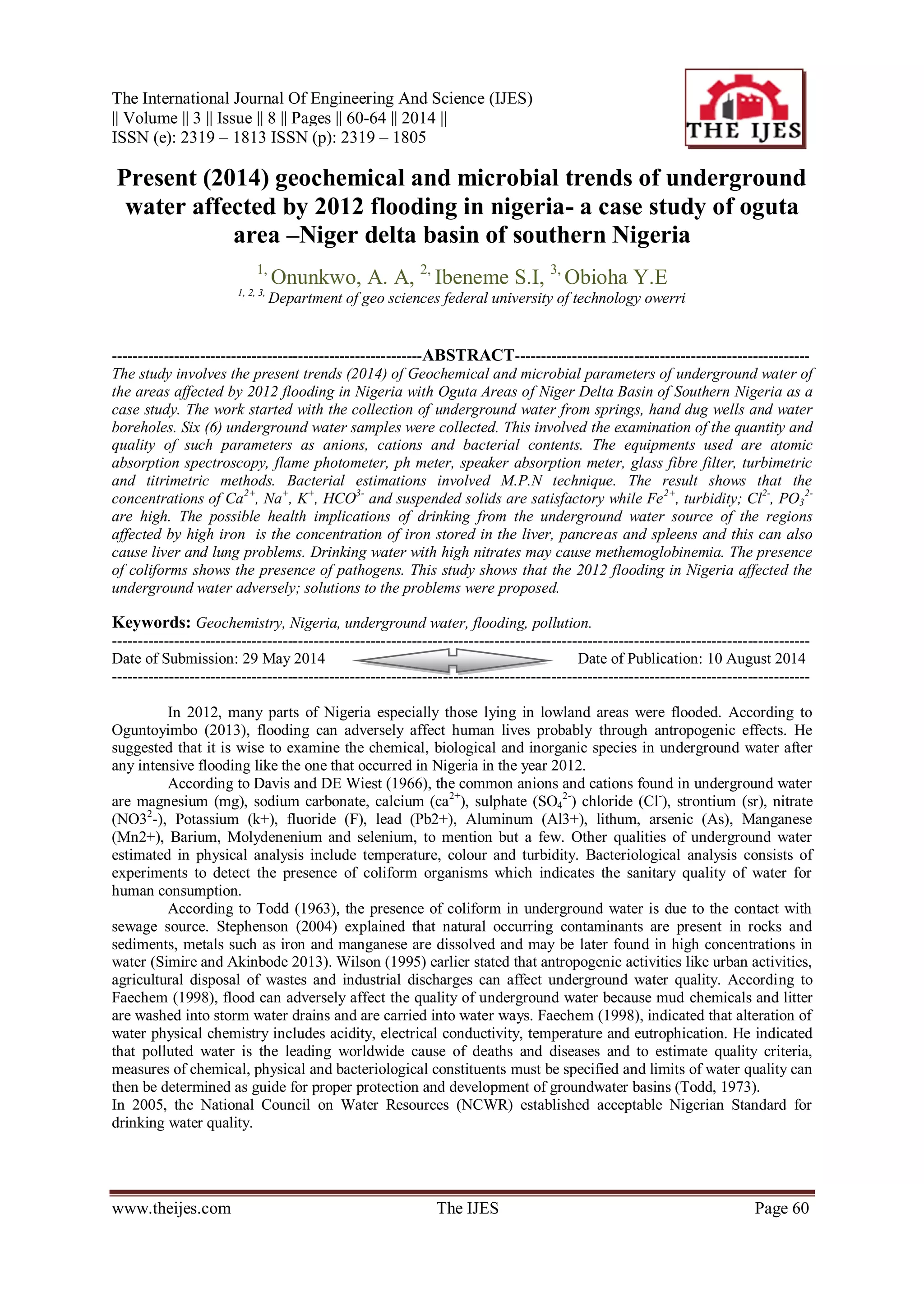
Date of Submission: 29 May 2014 Date of Publication: 10 August 2014 --------------------------------------------------------------------------------------------------------------------------------------- In 2012, many parts of Nigeria especially those lying in lowland areas were flooded. According to Oguntoyimbo (2013), flooding can adversely affect human lives probably through antropogenic effects. He suggested that it is wise to examine the chemical, biological and inorganic species in underground water after any intensive flooding like the one that occurred in Nigeria in the year 2012. According to Davis and DE Wiest (1966), the common anions and cations found in underground water are magnesium (mg), sodium carbonate, calcium (ca2+), sulphate (SO42-) chloride (Cl-), strontium (sr), nitrate (NO32-), Potassium (k+), fluoride (F), lead (Pb2+), Aluminum (Al3+), lithum, arsenic (As), Manganese (Mn2+), Barium, Molydenenium and selenium, to mention but a few. Other qualities of underground water estimated in physical analysis include temperature, colour and turbidity. Bacteriological analysis consists of experiments to detect the presence of coliform organisms which indicates the sanitary quality of water for human consumption. According to Todd (1963), the presence of coliform in underground water is due to the contact with sewage source. Stephenson (2004) explained that natural occurring contaminants are present in rocks and sediments, metals such as iron and manganese are dissolved and may be later found in high concentrations in water (Simire and Akinbode 2013). Wilson (1995) earlier stated that antropogenic activities like urban activities, agricultural disposal of wastes and industrial discharges can affect underground water quality. According to Faechem (1998), flood can adversely affect the quality of underground water because mud chemicals and litter are washed into storm water drains and are carried into water ways. Faechem (1998), indicated that alteration of water physical chemistry includes acidity, electrical conductivity, temperature and eutrophication. He indicated that polluted water is the leading worldwide cause of deaths and diseases and to estimate quality criteria, measures of chemical, physical and bacteriological constituents must be specified and limits of water quality can then be determined as guide for proper protection and development of groundwater basins (Todd, 1973). In 2005, the National Council on Water Resources (NCWR) established acceptable Nigerian Standard for drinking water quality.
Present (2014) geochemical and microbial trends of underground… 
www.theijes.com The IJES Page 61 
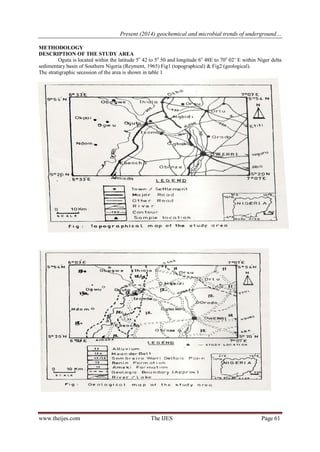
METHODOLOGY DESCRIPTION OF THE STUDY AREA Oguta is located within the latitude 5o 42 to 5o 50 and longitude 6o 48E to 70o 02’ E within Niger delta sedimentary basin of Southern Nigeria (Reyment, 1965) Fig1 (topographical) & Fig2 (geological). 
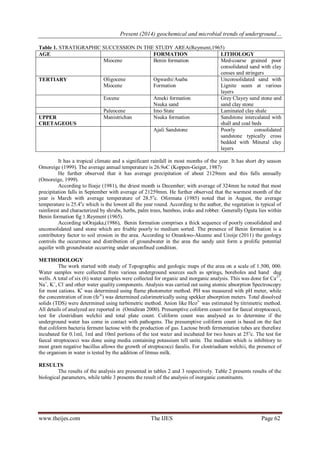
The stratigraphic secession of the area is shown in table 1
Present (2014) geochemical and microbial trends of underground… 
www.theijes.com The IJES Page 62 
Table 1. STRATIGRAPHIC SUCCESSION IN THE STUDY AREA(Reyment,1965) 
AGE 
FORMATION 
LITHOLOGY 
Miocene 
Benin formation 
Med-coarse grained poor consolidated sand with clay censes and stringers 
TERTIARY 
Oligocene Miocene 
Ogwashi/Asaba Formation 
Unconsolidated sand with Lignite seam at various layers 
Eocene 
Ameki formation Nsuka sand 
Grey Clayey sand stone and sand clay stone 
Paleocene 
Imo State 
Laminated clay shale 
UPPER CRETAGEOUS 
Manistrichan 
Nsuka formation 
Sandstone intercalated with shall and coal beds 
Ajali Sandstone 
Poorly consolidated sandstone typically cross bedded with Mineral clay layers 
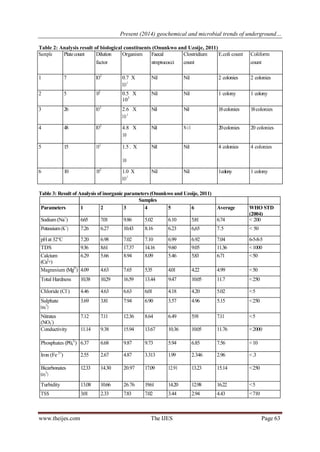
It has a tropical climate and a significant rainfall in most months of the year. It has short dry season Omoreige (1999). The average annual temperature is 26.9oC (Koppen-Geiger, 1987) He further observed that it has average precipitation of about 2129mm and this falls annually (Omoreige, 1999). According to Iloeje (1981), the driest month is December; with average of 324mm he noted that most precipitation falls in September with average of 21259mm. He further observed that the warmest month of the year is March with average temperature of 28.5oc. Oformata (1985) noted that in August, the average temperature is 25.4oc which is the lowest all the year round. According to the author, the vegetation is typical of rainforest and characterized by shrubs, herbs, palm trees, bamboo, iroko and robber. Generally Oguta lies within Benin formation fig 1.Reyment (1965). According toOrajaka,(1986), Benin formation comprises a thick sequence of poorly consolidated and unconsolidated sand stone which are friable poorly to medium sorted. The presence of Benin formation is a contributory factor to soil erosion in the area. According to Onunkwo-Akunne and Uzoije (2011) the geology controls the occurrence and distribution of groundwater in the area the sandy unit form a prolific potential aquifer with groundwater occurring under unconfined condition. METHODOLOGY The work started with study of Topographic and geologic maps of the area on a scale of 1.500, 000. Water samples were collected from various underground sources such as springs, boreholes and hand dug wells. A total of six (6) water samples were collected for organic and inorganic analysis. This was done for Ca2+, Na+, K+, Cl- and other water quality components. Analysis was carried out using atomic absorption Spectroscopy for most cations. Kt was determined using flame photometer method. PH was measured with pH meter, while the concentration of iron (fe3t) was determined calorimetrically using spekker absorption meters. Total dissolved solids (TDS) were determined using turbimetric method. Anion like Hco3- was estimated by titrimetric method. All details of analyzed are reported in (Omidiran 2000). Presumptive coliform count-test for faecal streptococci, test for clostridium welchii and total plate count. Coliform count was analysed as to determine if the underground water has come in contact with pathogens. The presumptive coliform count is based on the fact that coliform bacteria ferment lactose with the production of gas. Lactose broth fermentation tubes are therefore incubated for 0.1ml, 1ml and 10ml portions of the test water and incubated for two hours at 25oc. The test for faecal streptococci was done using media containing potassium tell unite. The medium which is inhibitory to most gram negative bacillus allows the growth of streptococci faealis. For clostriadium welchii, the presence of the organism in water is tested by the addition of litmus milk. RESULTS The results of the analysis are presented in tables 2 and 3 respectively. Table 2 presents results of the biological parameters, while table 3 presents the result of the analysis of inorganic constituents.
Present (2014) geochemical and microbial trends of underground… 
www.theijes.com The IJES Page 63 
Table 2: Analysis result of biological constituents (Onunkwo and Uzoije, 2011) Sample Plate count Dilution Organism Faecal Clostridium E.coli count Coliform factor streptococci count count 1 7 IO-2 0.7 X Nil Nil 2 colonies 2 colonies IO3 2 5 10-2 0.5 X 10³ Nil Nil 1 colony 1 colony 3 26 IO-2 2.6 X X Nil Nil 18 colonies 18 colonies IO3 4 48 IO-2 4.8 X Nil Nil 20 colonies 20 colonies 10 5 15 10-2 1.5 . X Nil Nil 4 colonies 4 colonies 10 6 10 10-2 1.0 X Nil Nil 1 colony 1 colony IO3 
Table 3: Result of Analysis of inorganic parameters (Onunkwo and Uzoije, 2011) Samples Parameters 1 2 3 4 5 6 Average WHO STD (2004) Sodium (Na+) 6.65 7.01 9.86 5.02 6.10 5.81 6.74 
< 200 Potassium (K+) 7.26 6.27 10.43 8.16 6.23 6,65 7.5 
< 50 pH at 32°C 7.20 6.98 7.02 7.10 6.99 6.92 7.04 
6-5-8-5 TDS 9.36 8.61 17.37 14.16 9.60 9.05 11.36 
< 1000 Calcium (Ca2+) 6.29 5.66 8.94 8.09 5.46 5.83 6.71 
< 50 Magnesium (Mg2+) 4.09 4.63 7.65 5.35 4.01 4.22 4.99 
< 50 Total Hardness 10.38 10.29 16.59 13.44 9.47 10.05 11.7 
< 250 Chloride (Cl-) 4.46 4.63 6.63 6.01 4.18 4.20 5.02 
< 5 Sulphate (so42-) 3.69 3.81 7.94 6.90 3.57 4.96 5.15 
< 250 Nitrates (NO3-) 7.12 7.11 12.36 8.64 6.49 5.91 7.11 
< 5 Conductivity 11.14 9.38 15.94 13.67 10.36 10.05 11.76 
< 2000 Phosphates (P042-) 6.37 6.68 9.87 9.73 5.94 6.85 7.56 
< 10 Iron (Fe 2+) 2.55 2.67 4.87 3.313 1.99 2.346 2.96 
< .3 Bicarbonates (co32-) 12.33 14.30 20.97 17.09 12.91 13.23 15.14 
< 250 Turbidity 13.08 10.66 26.76 19.61 14.20 12.98 16.22 
< 5 TSS 3.01 2.33 7.83 7.02 3.44 2.94 4.43 
< 710
Present (2014) geochemical and microbial trends of underground… 
www.theijes.com The IJES Page 64 
The concentration of calcium (Ca2+) sodium (Na+), potassium (K+), Sulphate (SO42-) and by carbonate (HCO3) are satisfactory for underground water. Fe2+ (2.9mg), turbidity (5.02mg), Chloride (7.11mg) and nitracles (7.11mg) are high (WHO2011). The turbidity is high probably due to suspended and colloidal matter washed into the underground water by flood effects. The concentration of Fe3+ may be due to acidic rains underlying bedrock like shale and coal which often contain iron rich pyrite. Nitrate may be due to fertilizer application from agricultural lands (Hamad 2008). The possible health effects of drinking from the underground water source containing iron content is having a high concentration of iron stored in the liver, pancreas and spleen (Oteze 1991). Onunkwo-Akunne and Uzoji (2011) noted that high concentration of iron in the body can cause Liver and lung problems. The high nitrate is probably due to the flood waters washing irrigation areas carrying fertilizers, manures, animal feed lots, municipal wastes and sludge into the underground sources (self and Waskom, 2013). Drinking waters contaminated with nitrates may cause methemoglobinemia – an infant illness characterized by reduced oxygen supply to vital tissues such as the brain (Omidiran 2000). The presence of coliform in underground water source is an indication of faecal contaminations and that there are pathogens in waters which can cause diarrhea, typhoid fever and gastro intestinal distress. It can be seen that the presence of E. coli and clostridium in water makes it unfit (lasin 2011). This poses health risks such as acute renal failure and haemolytic anaemia (Larsen 2012). The analysis of underground water from Oguta area of Niger Delta sedimentary basin of southern Nigeria shows that flooding of 2012 in Nigeria probably affected underground water in those areas due to the fact that those areas were contaminated by microorganisms and inorganic parameters (Avtar et al 2013). The high turbidity of the water can be solved by filtration and distillation, while problems of high iron can be solved by aeration. Presence of any faecal coliform in drinking water causes spread of diseases through faecal transmission. Boil the water to be used for drinking, dry the pots thoroughly before use. Care should be taken to ensure that children do not swallow the water by drinking during bathing. Washing thoroughly with soap after contact with the contaminated water can also help prevent infection. Faecal coliform can be inhibited in growth by treating with chlorine. REFERENCES 
[1]. Avtar et al (2013). Hydro geochemical assessment of ground water quality of Bundelkhand india, using statistical approach. Journal of Environment Vol. 4, issue 2, pp 14-17. 
[2]. Davies and Wiest, D.E (1985) surface water pollutants and its control Macmillian, London pp25. 
[3]. Faechem, E.C (1998). Hydrogeochemical assessment of ground water quality of Bundelkhand india, using electrical approach. Journal of Environment Vol. 5, issue 2, pp 18-25. 
[4]. Hamad S. (2008). S. (2008). Spatial analysis of groundwater level and hydro geochemistry in the south AL Jabal Akhdar area using GIS. An MSC thesis submitted to Salzburg University. 
[5]. Iloeje, N.P. (1981). A new geography of Nigeria (A new revised edition) published in Great Britain by William clowes Beccles ltd London, pp85-120. 
[6]. Koppen-Greiger R.C. (1987) sulphates in drinking waters, quick facts vol13 issues 16 pp25-28. 
[7]. Larsen, G. (2012). Determination of coastal ground and surface water processes and character by use of hydro chemistry and stable isotopes, frazers coast, queens land. A phD thesis submitted to the queensland university technology. 
[8]. Onunkwo,A,A and Uzoije A (2011). Exploratory survey of geochemical aspects of undeground water in Ehime Mbano Area of Nigeria. World rural observations. Vol 3 issue 2. pp 32-38. 
[9]. Ofeze, C (1991) portability of groundwater from Prima group aquifer in the Sokoto basin of Nigeria for mining and geology. pp 21-24. 
[10]. Omidiran P.C (2000). Fundamentals of Geology, 3rd Edition W.B Standards Company, Philadel pp 230-270 
[11]. Oguntoyimbo, J.S (2013). A geography of Nigeria development. Heinemann Education Books (Nig) Ltd pp 65-75. 
[12]. Orajaka, S(1986). Salt water resources of East Central State of Nigeria Journal of mining ad geology vol 7 pp 28. 
[13]. Ofomata, G.E.K (1985). Technical report on feasibility study of erosion vulnerability areas in the eastern part o Nigeria. Ethiope publishing house Benin. pp 45-50 
[14]. Omoroigl, N.C (1999), Survey of Geochemistry of groundwater. Journal of environmental sciences U.S.A pp 89-98 
[15]. Offordile, M.E (1987). Water Resource management and the Nigerian Ground water system. In print in proceedings of delegates conference of the Nigerian academy of sciences pp 23-28. 
[16]. Reyment, R.A, (1965). Aspects of the Geology of Nigeria, Ibadan University press pp 145 
[17]. Stephenson, O.G (2004). The Chemistry of soil, New York Oxford University Press 33-60. 
[18]. Simon, T.R and Akinbode C.N (2013). Analysis of the interaction of lakes and ground water U.S Geological survey pp 45. 
[19]. Self J.R and WASCO R.M (2013), Nitrates in drinking water. Quick facts. Vol II, pp 14-17 
[20]. Todd D.K (1963). Groundwater hydrology. Wiley International Edition pp 33- 43. 
[21]. WHO (2004) (World Health Organization) International Drinking Water Standard 3rd Edition, Geneva. pp 25-30. 
[22]. Wilson, T.C (1995). The distribution and chemical quality of groundwater in northern Nigeria pp 45-60

Present (2014) geochemical and microbial trends of underground water affected by 2012 flooding in nigeria- a case study of oguta area –Niger delta basin of southern Nigeria

  • 1.
    The International JournalOf Engineering And Science (IJES) || Volume || 3 || Issue || 8 || Pages || 60-64 || 2014 || ISSN (e): 2319 – 1813 ISSN (p): 2319 – 1805 www.theijes.com The IJES Page 60 Present (2014) geochemical and microbial trends of underground water affected by 2012 flooding in nigeria- a case study of oguta area –Niger delta basin of southern Nigeria 1, Onunkwo, A. A, 2, Ibeneme S.I, 3, Obioha Y.E 1, 2, 3, Department of geo sciences federal university of technology owerri ------------------------------------------------------------ABSTRACT--------------------------------------------------------- The study involves the present trends (2014) of Geochemical and microbial parameters of underground water of the areas affected by 2012 flooding in Nigeria with Oguta Areas of Niger Delta Basin of Southern Nigeria as a case study. The work started with the collection of underground water from springs, hand dug wells and water boreholes. Six (6) underground water samples were collected. This involved the examination of the quantity and quality of such parameters as anions, cations and bacterial contents. The equipments used are atomic absorption spectroscopy, flame photometer, ph meter, speaker absorption meter, glass fibre filter, turbimetric and titrimetric methods. Bacterial estimations involved M.P.N technique. The result shows that the concentrations of Ca2+, Na+, K+, HCO3- and suspended solids are satisfactory while Fe2+, turbidity; Cl2-, PO32- are high. The possible health implications of drinking from the underground water source of the regions affected by high iron is the concentration of iron stored in the liver, pancreas and spleens and this can also cause liver and lung problems. Drinking water with high nitrates may cause methemoglobinemia. The presence of coliforms shows the presence of pathogens. This study shows that the 2012 flooding in Nigeria affected the underground water adversely; solutions to the problems were proposed. Keywords: Geochemistry, Nigeria, underground water, flooding, pollution. --------------------------------------------------------------------------------------------------------------------------------------- Date of Submission: 29 May 2014 Date of Publication: 10 August 2014 --------------------------------------------------------------------------------------------------------------------------------------- In 2012, many parts of Nigeria especially those lying in lowland areas were flooded. According to Oguntoyimbo (2013), flooding can adversely affect human lives probably through antropogenic effects. He suggested that it is wise to examine the chemical, biological and inorganic species in underground water after any intensive flooding like the one that occurred in Nigeria in the year 2012. According to Davis and DE Wiest (1966), the common anions and cations found in underground water are magnesium (mg), sodium carbonate, calcium (ca2+), sulphate (SO42-) chloride (Cl-), strontium (sr), nitrate (NO32-), Potassium (k+), fluoride (F), lead (Pb2+), Aluminum (Al3+), lithum, arsenic (As), Manganese (Mn2+), Barium, Molydenenium and selenium, to mention but a few. Other qualities of underground water estimated in physical analysis include temperature, colour and turbidity. Bacteriological analysis consists of experiments to detect the presence of coliform organisms which indicates the sanitary quality of water for human consumption. According to Todd (1963), the presence of coliform in underground water is due to the contact with sewage source. Stephenson (2004) explained that natural occurring contaminants are present in rocks and sediments, metals such as iron and manganese are dissolved and may be later found in high concentrations in water (Simire and Akinbode 2013). Wilson (1995) earlier stated that antropogenic activities like urban activities, agricultural disposal of wastes and industrial discharges can affect underground water quality. According to Faechem (1998), flood can adversely affect the quality of underground water because mud chemicals and litter are washed into storm water drains and are carried into water ways. Faechem (1998), indicated that alteration of water physical chemistry includes acidity, electrical conductivity, temperature and eutrophication. He indicated that polluted water is the leading worldwide cause of deaths and diseases and to estimate quality criteria, measures of chemical, physical and bacteriological constituents must be specified and limits of water quality can then be determined as guide for proper protection and development of groundwater basins (Todd, 1973). In 2005, the National Council on Water Resources (NCWR) established acceptable Nigerian Standard for drinking water quality.
  • 2.
    Present (2014) geochemicaland microbial trends of underground… www.theijes.com The IJES Page 61 METHODOLOGY DESCRIPTION OF THE STUDY AREA Oguta is located within the latitude 5o 42 to 5o 50 and longitude 6o 48E to 70o 02’ E within Niger delta sedimentary basin of Southern Nigeria (Reyment, 1965) Fig1 (topographical) & Fig2 (geological). The stratigraphic secession of the area is shown in table 1
  • 3.
    Present (2014) geochemicaland microbial trends of underground… www.theijes.com The IJES Page 62 Table 1. STRATIGRAPHIC SUCCESSION IN THE STUDY AREA(Reyment,1965) AGE FORMATION LITHOLOGY Miocene Benin formation Med-coarse grained poor consolidated sand with clay censes and stringers TERTIARY Oligocene Miocene Ogwashi/Asaba Formation Unconsolidated sand with Lignite seam at various layers Eocene Ameki formation Nsuka sand Grey Clayey sand stone and sand clay stone Paleocene Imo State Laminated clay shale UPPER CRETAGEOUS Manistrichan Nsuka formation Sandstone intercalated with shall and coal beds Ajali Sandstone Poorly consolidated sandstone typically cross bedded with Mineral clay layers It has a tropical climate and a significant rainfall in most months of the year. It has short dry season Omoreige (1999). The average annual temperature is 26.9oC (Koppen-Geiger, 1987) He further observed that it has average precipitation of about 2129mm and this falls annually (Omoreige, 1999). According to Iloeje (1981), the driest month is December; with average of 324mm he noted that most precipitation falls in September with average of 21259mm. He further observed that the warmest month of the year is March with average temperature of 28.5oc. Oformata (1985) noted that in August, the average temperature is 25.4oc which is the lowest all the year round. According to the author, the vegetation is typical of rainforest and characterized by shrubs, herbs, palm trees, bamboo, iroko and robber. Generally Oguta lies within Benin formation fig 1.Reyment (1965). According toOrajaka,(1986), Benin formation comprises a thick sequence of poorly consolidated and unconsolidated sand stone which are friable poorly to medium sorted. The presence of Benin formation is a contributory factor to soil erosion in the area. According to Onunkwo-Akunne and Uzoije (2011) the geology controls the occurrence and distribution of groundwater in the area the sandy unit form a prolific potential aquifer with groundwater occurring under unconfined condition. METHODOLOGY The work started with study of Topographic and geologic maps of the area on a scale of 1.500, 000. Water samples were collected from various underground sources such as springs, boreholes and hand dug wells. A total of six (6) water samples were collected for organic and inorganic analysis. This was done for Ca2+, Na+, K+, Cl- and other water quality components. Analysis was carried out using atomic absorption Spectroscopy for most cations. Kt was determined using flame photometer method. PH was measured with pH meter, while the concentration of iron (fe3t) was determined calorimetrically using spekker absorption meters. Total dissolved solids (TDS) were determined using turbimetric method. Anion like Hco3- was estimated by titrimetric method. All details of analyzed are reported in (Omidiran 2000). Presumptive coliform count-test for faecal streptococci, test for clostridium welchii and total plate count. Coliform count was analysed as to determine if the underground water has come in contact with pathogens. The presumptive coliform count is based on the fact that coliform bacteria ferment lactose with the production of gas. Lactose broth fermentation tubes are therefore incubated for 0.1ml, 1ml and 10ml portions of the test water and incubated for two hours at 25oc. The test for faecal streptococci was done using media containing potassium tell unite. The medium which is inhibitory to most gram negative bacillus allows the growth of streptococci faealis. For clostriadium welchii, the presence of the organism in water is tested by the addition of litmus milk. RESULTS The results of the analysis are presented in tables 2 and 3 respectively. Table 2 presents results of the biological parameters, while table 3 presents the result of the analysis of inorganic constituents.
  • 4.
    Present (2014) geochemicaland microbial trends of underground… www.theijes.com The IJES Page 63 Table 2: Analysis result of biological constituents (Onunkwo and Uzoije, 2011) Sample Plate count Dilution Organism Faecal Clostridium E.coli count Coliform factor streptococci count count 1 7 IO-2 0.7 X Nil Nil 2 colonies 2 colonies IO3 2 5 10-2 0.5 X 10³ Nil Nil 1 colony 1 colony 3 26 IO-2 2.6 X X Nil Nil 18 colonies 18 colonies IO3 4 48 IO-2 4.8 X Nil Nil 20 colonies 20 colonies 10 5 15 10-2 1.5 . X Nil Nil 4 colonies 4 colonies 10 6 10 10-2 1.0 X Nil Nil 1 colony 1 colony IO3 Table 3: Result of Analysis of inorganic parameters (Onunkwo and Uzoije, 2011) Samples Parameters 1 2 3 4 5 6 Average WHO STD (2004) Sodium (Na+) 6.65 7.01 9.86 5.02 6.10 5.81 6.74 < 200 Potassium (K+) 7.26 6.27 10.43 8.16 6.23 6,65 7.5 < 50 pH at 32°C 7.20 6.98 7.02 7.10 6.99 6.92 7.04 6-5-8-5 TDS 9.36 8.61 17.37 14.16 9.60 9.05 11.36 < 1000 Calcium (Ca2+) 6.29 5.66 8.94 8.09 5.46 5.83 6.71 < 50 Magnesium (Mg2+) 4.09 4.63 7.65 5.35 4.01 4.22 4.99 < 50 Total Hardness 10.38 10.29 16.59 13.44 9.47 10.05 11.7 < 250 Chloride (Cl-) 4.46 4.63 6.63 6.01 4.18 4.20 5.02 < 5 Sulphate (so42-) 3.69 3.81 7.94 6.90 3.57 4.96 5.15 < 250 Nitrates (NO3-) 7.12 7.11 12.36 8.64 6.49 5.91 7.11 < 5 Conductivity 11.14 9.38 15.94 13.67 10.36 10.05 11.76 < 2000 Phosphates (P042-) 6.37 6.68 9.87 9.73 5.94 6.85 7.56 < 10 Iron (Fe 2+) 2.55 2.67 4.87 3.313 1.99 2.346 2.96 < .3 Bicarbonates (co32-) 12.33 14.30 20.97 17.09 12.91 13.23 15.14 < 250 Turbidity 13.08 10.66 26.76 19.61 14.20 12.98 16.22 < 5 TSS 3.01 2.33 7.83 7.02 3.44 2.94 4.43 < 710
  • 5.
    Present (2014) geochemicaland microbial trends of underground… www.theijes.com The IJES Page 64 The concentration of calcium (Ca2+) sodium (Na+), potassium (K+), Sulphate (SO42-) and by carbonate (HCO3) are satisfactory for underground water. Fe2+ (2.9mg), turbidity (5.02mg), Chloride (7.11mg) and nitracles (7.11mg) are high (WHO2011). The turbidity is high probably due to suspended and colloidal matter washed into the underground water by flood effects. The concentration of Fe3+ may be due to acidic rains underlying bedrock like shale and coal which often contain iron rich pyrite. Nitrate may be due to fertilizer application from agricultural lands (Hamad 2008). The possible health effects of drinking from the underground water source containing iron content is having a high concentration of iron stored in the liver, pancreas and spleen (Oteze 1991). Onunkwo-Akunne and Uzoji (2011) noted that high concentration of iron in the body can cause Liver and lung problems. The high nitrate is probably due to the flood waters washing irrigation areas carrying fertilizers, manures, animal feed lots, municipal wastes and sludge into the underground sources (self and Waskom, 2013). Drinking waters contaminated with nitrates may cause methemoglobinemia – an infant illness characterized by reduced oxygen supply to vital tissues such as the brain (Omidiran 2000). The presence of coliform in underground water source is an indication of faecal contaminations and that there are pathogens in waters which can cause diarrhea, typhoid fever and gastro intestinal distress. It can be seen that the presence of E. coli and clostridium in water makes it unfit (lasin 2011). This poses health risks such as acute renal failure and haemolytic anaemia (Larsen 2012). The analysis of underground water from Oguta area of Niger Delta sedimentary basin of southern Nigeria shows that flooding of 2012 in Nigeria probably affected underground water in those areas due to the fact that those areas were contaminated by microorganisms and inorganic parameters (Avtar et al 2013). The high turbidity of the water can be solved by filtration and distillation, while problems of high iron can be solved by aeration. Presence of any faecal coliform in drinking water causes spread of diseases through faecal transmission. Boil the water to be used for drinking, dry the pots thoroughly before use. Care should be taken to ensure that children do not swallow the water by drinking during bathing. Washing thoroughly with soap after contact with the contaminated water can also help prevent infection. Faecal coliform can be inhibited in growth by treating with chlorine. REFERENCES [1]. Avtar et al (2013). Hydro geochemical assessment of ground water quality of Bundelkhand india, using statistical approach. Journal of Environment Vol. 4, issue 2, pp 14-17. [2]. Davies and Wiest, D.E (1985) surface water pollutants and its control Macmillian, London pp25. [3]. Faechem, E.C (1998). Hydrogeochemical assessment of ground water quality of Bundelkhand india, using electrical approach. Journal of Environment Vol. 5, issue 2, pp 18-25. [4]. Hamad S. (2008). S. (2008). Spatial analysis of groundwater level and hydro geochemistry in the south AL Jabal Akhdar area using GIS. An MSC thesis submitted to Salzburg University. [5]. Iloeje, N.P. (1981). A new geography of Nigeria (A new revised edition) published in Great Britain by William clowes Beccles ltd London, pp85-120. [6]. Koppen-Greiger R.C. (1987) sulphates in drinking waters, quick facts vol13 issues 16 pp25-28. [7]. Larsen, G. (2012). Determination of coastal ground and surface water processes and character by use of hydro chemistry and stable isotopes, frazers coast, queens land. A phD thesis submitted to the queensland university technology. [8]. Onunkwo,A,A and Uzoije A (2011). Exploratory survey of geochemical aspects of undeground water in Ehime Mbano Area of Nigeria. World rural observations. Vol 3 issue 2. pp 32-38. [9]. Ofeze, C (1991) portability of groundwater from Prima group aquifer in the Sokoto basin of Nigeria for mining and geology. pp 21-24. [10]. Omidiran P.C (2000). Fundamentals of Geology, 3rd Edition W.B Standards Company, Philadel pp 230-270 [11]. Oguntoyimbo, J.S (2013). A geography of Nigeria development. Heinemann Education Books (Nig) Ltd pp 65-75. [12]. Orajaka, S(1986). Salt water resources of East Central State of Nigeria Journal of mining ad geology vol 7 pp 28. [13]. Ofomata, G.E.K (1985). Technical report on feasibility study of erosion vulnerability areas in the eastern part o Nigeria. Ethiope publishing house Benin. pp 45-50 [14]. Omoroigl, N.C (1999), Survey of Geochemistry of groundwater. Journal of environmental sciences U.S.A pp 89-98 [15]. Offordile, M.E (1987). Water Resource management and the Nigerian Ground water system. In print in proceedings of delegates conference of the Nigerian academy of sciences pp 23-28. [16]. Reyment, R.A, (1965). Aspects of the Geology of Nigeria, Ibadan University press pp 145 [17]. Stephenson, O.G (2004). The Chemistry of soil, New York Oxford University Press 33-60. [18]. Simon, T.R and Akinbode C.N (2013). Analysis of the interaction of lakes and ground water U.S Geological survey pp 45. [19]. Self J.R and WASCO R.M (2013), Nitrates in drinking water. Quick facts. Vol II, pp 14-17 [20]. Todd D.K (1963). Groundwater hydrology. Wiley International Edition pp 33- 43. [21]. WHO (2004) (World Health Organization) International Drinking Water Standard 3rd Edition, Geneva. pp 25-30. [22]. Wilson, T.C (1995). The distribution and chemical quality of groundwater in northern Nigeria pp 45-60