The International Journal Of Engineering And Science (IJES)
||Volume||2 ||Issue|| 9 ||Pages|| 58-67||2013||
ISSN(e): 2319 – 1813 ISSN(p): 2319 – 1805
www.theijes.com The IJES Page 58
Hydrogeochemical Analysis of Water Samples From Nworie
River, Owerri Southeastern Nigeria
BY
Nwagbara J.O1
., Ibeneme S.I1
, Dim E.E2
., Iroegbu U.K1
, Selemo A.O.1
Ejiogu B.C. 2
, Onyekuru S.O1
,
1
Geosciences Department Federal University of Technology, Owerri
2
Physics Department Alvan Ikoku Federal College of Education, Owerri
-----------------------------------------------------ABSTRACT-----------------------------------------------------
Nworie river flows through some major parts of Owerri namely, Federal Medical Centre, Alvan Ikoku College
of Education etc. It serves as a source of water for many human activities. Since majority of inhabitants sees it
as a good substitute for drinking water due to the collapse of the Owerri water scheme, attempts are being made
to determine the water quality in order to ascertain its suitability for human consumption and other uses. Water
samples were taken from four different locations along the whole length of the river for physiochemical
analysis. The results indicated that the mean pH, TDS and electrical conductivity values are;6.125, 51.75mg/l
and 103.5 siemens respectively. The concentration of calcium, magnesium, sodium and potassium are 2.05,
0.118, 12.63 and 2.403 respectively while the concentration of zinc, lead, copper, casmium and iron are 0.845,
0.0125, 1.193, 0.056 and 0.575 respectively. The low level of pH implies that the river is acidic. The results of
the mean concentration of metals such as lead, iron, copper and cadmium indicate that the river is unhealthy for
human consumption without treatment.
----------------------------------------------------------------------------------------------------------------------------------------
Date of Submission: 26, August, 2013 Date of Acceptance: 20, September 2013
---------------------------------------------------------------------------------------------------------------------------------------
I. INTRODUCTION
The area of study lies between latitudes 5˚25ʹ – 5˚30ʹN and longitudes 7˚00ʹ – 7˚05ʹE. It covers an area
of 1135 square kilometers; Fig. 1.Pysiographically, the terrain is characterized by two types of landforms; high
undulating ridges and a nearly flat topography. The ridges trend in the N – S direction and have an average
elevation of about 122m above the sea level. Between these ridges is the valley of Nworie river. This river
watershed is subjected to intensive human and industrial activities resulting in the discharge of a wide range of
pollutions. Whenever the public water supply fails, the river further serves as a sources of direct drinking water.
River Nworie flows in the NE – SW direction with average hydraulic gradient between 0.005 and 0.02.Human
activities have started to have negative effects on the river. It has been noticed that the quantity of water in the
river has diminished. Water weeds have covered many parts of the river. Federal Medical Centre and Alvan
Ikoku College of Education are located along the river bank. The waste disposal practiced by inhabitants of
these institutions and other members of the public is through open dump for solid wastes, (Ishaku and ezeigbo
2010). This may lead to eutrophication. Also other macroscopic plants have taken over some parts of the river.
Because of the increase in organic contents in the river and possible decays thereafter, there is reduction in
dissolved oxygen necessary for the survival of the aquatic lives. These plants (both macroscopic and
microscopic) cause the slowing down of the speed of the river which invariably leads to the deposition of water
load (sediments). As this situation continues, there is occurrence of siltation which may eventually lead to the
drying up of the river. Already, fishing activities have stopped along the river by Alvan portion due to the state
of the river.Nworie river takes its sources in Ohii and join Otamiri river at Nekede. Its total length is 9.2km.
This watershed is covered by depleted rain forest vegetation with an annual rainfall of 2500mm. It flows
through the Federal Medical Centre, Owerri (FMC), Alvan Ikoku Federal College of Education (AIFCE) and
Holy Ghost College. All these institutions discharge their untreated waste into Nworie River. Alinnor and Obiji
(2010) already observed some trace metal elements in fish samples from Nworie River.
1.1.GEOLOGICAL SETTING: The study area is underlain by Benin Formation, Fig.1. The Benin
Formation is made up of friable sand with minor intercalation of clay. The sand unit is mostly coarse grain
pebble, poorly sorted and contains less of fine grained sands (Onyeagocha 1980). The lithology is made up of
Hydrogeochemical Analysis Of Water…
www.theijes.com The IJES Page 59
sandstone, sand with few shale intercalations. The shale is grayish brown, sandy to silty and contains some
fingers of lignites. At many places within the study area, this formation is overlain by a considerable thickness
of red earth and subsequences ferrugination of weathered materials. Other structural units such as point bars,
chemical fills, black swamp deposits and Ox-bow fills are identified in Benin Formation. Petrographic studies
on several thin sections by Onyeagocha (1980) show that quartz makes up about 99% of the grains. Benin
Formation conformably overlies the Ogwashi – Asaba Formation.
II. METHODOLOGY
Sample Collection
The samples were collected in small white plastic containers which were rinsed initially with the
particular water to be sampled before final collection were established after a reconnaissance visit to the river
(Omada et. al 2011).
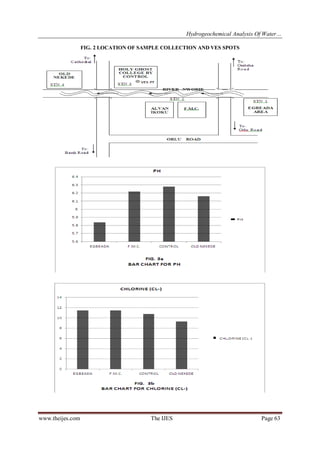
Station 1 was at Egbeada, upper section of the river, close to the river source.
Station 2 was at Alvan Ikoku Federal College of Education / Federal Medical Centre.
Station 3 was close to Holy Ghost College by Control road.
Station 4 was at Old Nekede road almost at the end of the river before joining Otamiri river, Fig 2.
These water samples were collected with plastic containers at these stations, properly labeled and taken to
laboratory for analysis.
Instrumentation
Some of the instruments used for this study included:
i. pH meter
ii. DR 2010 data logging spectrophotometer
iii. Conductivity / TDS meter
iv. ABEM Terrameter SAS 300
III. LABORATORY ANALYSIS
The laboratory tests were carried out to get details about these parameters: pH value, Salinity, Nitrite,
Nitrate, dissolved Oxygen etc. A biological parameter known as “total coliform count” was also tested for;
pH value: was determined with the pH meter.
Salinity:A hand held spectrophotometer was used to obtain the salinity value.
Nitrite and Nitrate:DR 2010 data logging Spectrophotometer was used in the chemical analysis of Nitrite and
Nitrate. Diazotization method was employed for Nitrite while cadmium reduction process was applied for
Nitrate.
Iron, Copper, Manganese, Zinc and Lead:Spectrophotometer instrument was used for the chemical analysis
of these elements but the processes were different for each element.
Dissolved Oxygen: Winkler tetrimetric method which is the most common method for dissolved Oxygen
measurements in waste water, effluent and stream samples was employed.
Total Coliform Count: This parameter was also determined by using the membrane filtration technique.
Conductivity /TDS:These were the last parameters that were determined in the laboratory using the
conductivity/TDS probe inserted in a beaker containing the sample. The results of all these laboratory tests are
presented using bar charts.
IV. VERTICAL ELECTRICAL SOUNDING (VES)
A geophysical study using the Vertical Electrical Sounding (VES) technique was carried out around
Holy Ghost College in order to have a clearer information about the lithologic units within the subsurface at
station 3. The data were acquired using the schlumberger electrode arrangement with a maximum spread of
AB/2 = 100m. The geophysical equipment used was ABEM Terrameter SAS 1000 with a digital readout. The
field data shown in table 2 were analyzed using the Resist computer program. The computer modeled curve is
displayed in Fig 4 while the geoelectric section is shown in Fig 5.
Hydrogeochemical Analysis Of Water…
www.theijes.com The IJES Page 60
V. RESULTS AND DISCUSSION
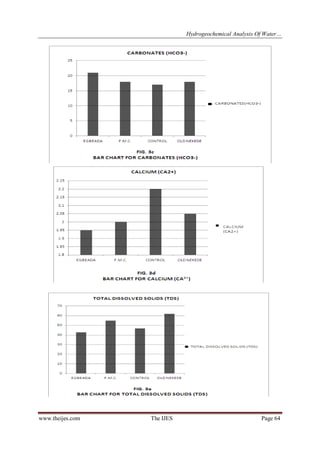
The results of all the tests are shown in Table 1. Bar charts were used to indicate the level of cations
and anions concentration at the different sampling locations. Figures 3a, 3b and 3c display the chart for each
parameter.
pH: The range of measured pH is between 5.84 and 6.28. The water is acidic. All the values obtained are below
the WHO standard. These low pH value (5.84 – 6.28) got from this study may be attributed to the untreated
waste dumped into the river. Akudinobi and Iyiegbu (2008) reported a similar situation in Enugu where
untreated waste thrown into Olobo river made the pH value to be as low as 3.7.
Dissolved O2: Only station 1 (i.e Egbeada) falls below the range of WHO standard. This may be due to the
process of eutophication in the area which enhanced the growth of aquatic vegetation or phytoplankton. Algal
blooms disrupt normal functioning of ecosystem causing variety of problems which include; lack of oxygen
needed for fish and shell fish to survive.
Turbidity:Increase in sediment load adversely affect the biodiversity of most rivers and lakes. This
phenomenon reduces the depth of river thus endangering those aquatic species that require specific depth for
survival. Sediment loaded rivers are murky or clouded. The FMC axis of Nworie river recorded a high level of
turbidity (73 NTU). This could be as a result of the discharge of untreated effluent.
Nitrates and Phosphate: Nitrates normally have four sources namely: natural, waste-materials, crop
agriculture and irrigated agricultural practices (Adelana and Olasehinde 2003, Abimbola et. al., 2002, Marias,
1999, and Fan and Steinberg 1996). Nitrate values decrease from 12.4mg/ℓ at Egbeada station to 3.6mg/ℓ
around FMC and Alvan. Although the levels are within the acceptable limits. Alkalinity also decreases from
22.5mg/ℓ to 14.9mg/ℓ. Some other heavy metals identified in Nworie River include: lead (Pb), Iron (Fe), Zinc
(Zn), Manganese (Mn), Chromium (Cr), Copper (Cu) and Cadmium (Cd). From table 1, the mean value of lead
and iron exceeded the WHO limits. These could be due to illegal dumping of wastes. Alinnor and Obiji (2012)
identified Iron and Manganese from fish Tilapia got from Nworie River. The cations; Calcium (Ca), Magnesium
(Mg) and Aluminum (Al) are all within accepted limits. This indicates that the cationic exchange capability of
Nworie river is functional. These physical parameters also determine the suitability of the water for domestic
and industrial uses. For example water with low pH (acidic water) may cause severe corrosion of metal casing
used for reticulation. In human, it can cause metabolic acidosis.
Geophysical Survey Results: From the computer modeled curve, Fig 4, the geoelectric section was
constructed, (Fig 5). Seven geoelectric layers were identified from the geophysical survey.. Other details about
the geoelectric layers are shown in table 3. One remarkable observation from the geophysical results is a zone
(layers 2, 3 and 4) that has low resistivities. This can be attributed to the presence of mineralized / contaminated
groundwater. There are many cases of domestic boreholes within River Nworie basin that produce low quality
water. The contamination of this river by indiscriminate disposal of refuse into it may be one of the causes as
this river serves as one of the recharge sources to groundwater within this environment.
VI. CONCLUSION
Heavy metals have been identified in the water samples collected from River Nworie. The mean
concentration of Lead and Iron is above the safe limits. Other physiochemical assessment of the water samples
indicates that some parameters did not exceed the safe limits of WHO standard (WHO 2006). The mean pH is
low, this implies that the water is not good for human consumption without treatment. Turbidity increase might
enhance the reduction of depth of the river thus endangering those aquatic species requiring specific depth for
survival.Based on these findings, it is evident that the causes / sources of contamination / pollution are from
agricultural and human activities.
REFEREES
[1] ABIMBOLA A. F., ODUKOYA A.M AND OLATUNJI A.S. (2002): Influence of bedrock on the hydrogeochemical
characteristics of bedrock of groundwater in Northern part of Ibadan metropolis, Water Resources, 13 pp 1 – 6.
[2] ADELANA S.M.A. AND OLASEHINDE P.I. (2003): High nitrate in water supply in Nigeria: Implications for Human Health,
Water Resources, 14, pp 1 – 11.
[3] AKUDINOBI B.E. AND IYIEGBU C. (2008): Urban water security in Nigeria; case studies from Onitsha and Enugu
areas of southeastern Nigeria, Water Resources, 18 pp 17 – 24.
[4] ALINNOR J.E. AND OBIJI I.A. (2012): Assessment of trace metal composition in fish samples from Nworie River, Pak. J.
Nutr., 9, pp 81 – 85.
Hydrogeochemical Analysis Of Water…
www.theijes.com The IJES Page 61
[5] FAN A.M. AND STEINBERG V.E. (1996): Health implications of nitrate and nitrate in drinking water; An update on
methaeomoglobinaemia occurrence and reproductive and developmental toxicology. Regulatory toxicology and pharmacology,
23, Academy Press Inc.
[6] ISHAKU J.M AND EZEIGBO H.I. (2010): Groundwater quality monitoring in Jimeta – Yola area, Northeastern Nigeria, Water
Resources, Vol. 20, No. 2. Pp 1 – 14.
[7] MARAIS S. (1999): Dependency of communities on groundwater for water supply and associated fluoride and nitrate
problems. Paper presented at workshop on fluorides and nitrates in rural water supplies, Mafikeng, 9 – 10 March 1999.
[8] OMADA J.I., OMATOLA D.O. AND OMALI A. (2011): Physico – chemical characteristics of surface and
groundwater in Anyigba and its environs, Kogi State Nigeria, Water Resources, 21, pp 18 – 25.
[9] ONYEAGOCHA A.C. (1980): Petrography and depositional environment of the Benin Formation. Journal of
Mining and Geology, 17 pp 147 – 152.
[10] WORLD HEALTH ORGANIZATION, WHO (2006): Guidelines for drinking water quality criteria, 2nd ed. Vol. 2. Pp 281 –
308. World Health Organization, Geneva.
TABLES
Table 1 Results of the geochemical analyses
Table 2 Field data of the geophysical survey
Table 3 Geoelectric layers derived from computer curve
FIGURES
Fig 1 Geologic map of study area
Fig 2 Location of sample collection and VES spots
Fig 3 Bar chart
Fig 4 Computer modeled curve
Fig 5 Geoelectric section
Hydrogeochemical Analysis Of Water…
www.theijes.com The IJES Page 62
TABLE 2: FIELD DATA OF THE GEOPHYSICAL SURVEY
AB/2 (m) Apparent Resistivity (Ωm)
1 1345
2 1484
2 1460
4 1747
6 1591
6 1677
8 1489
10 1107
10 1190
15 896
20 765
20 814
30 533
40 462
40 482
50 499
60 791
60 576
80 745
100 990
100 1000
TABLE 3: THE GEOELECTRIC LAYERS
Layer Resistivity (Ωm) Depth (m) Probable Lithology
1 1250 1.1 Top Soil
2 2860 2.6 Silty Sand
3 940 11.4 Sand with Fe+
H2O
4 415 15.6 Sand with Fe+
H2O
5 146 26.7 Sand with Fe+
H2O
6 1570 37.8 Sand with Fe+
H2O
7 8000 α Sand with Fresh H2O
Hydrogeochemical Analysis Of Water…
www.theijes.com The IJES Page 63
FIG. 2 LOCATION OF SAMPLE COLLECTION AND VES SPOTS
Hydrogeochemical Analysis Of Water…
www.theijes.com The IJES Page 64
Hydrogeochemical Analysis Of Water…
www.theijes.com The IJES Page 65
Hydrogeochemical Analysis Of Water…
www.theijes.com The IJES Page 66
Hydrogeochemical Analysis Of Water…
www.theijes.com The IJES Page 67

The International Journal of Engineering and Science (The IJES)

  • 1.
    The International JournalOf Engineering And Science (IJES) ||Volume||2 ||Issue|| 9 ||Pages|| 58-67||2013|| ISSN(e): 2319 – 1813 ISSN(p): 2319 – 1805 www.theijes.com The IJES Page 58 Hydrogeochemical Analysis of Water Samples From Nworie River, Owerri Southeastern Nigeria BY Nwagbara J.O1 ., Ibeneme S.I1 , Dim E.E2 ., Iroegbu U.K1 , Selemo A.O.1 Ejiogu B.C. 2 , Onyekuru S.O1 , 1 Geosciences Department Federal University of Technology, Owerri 2 Physics Department Alvan Ikoku Federal College of Education, Owerri -----------------------------------------------------ABSTRACT----------------------------------------------------- Nworie river flows through some major parts of Owerri namely, Federal Medical Centre, Alvan Ikoku College of Education etc. It serves as a source of water for many human activities. Since majority of inhabitants sees it as a good substitute for drinking water due to the collapse of the Owerri water scheme, attempts are being made to determine the water quality in order to ascertain its suitability for human consumption and other uses. Water samples were taken from four different locations along the whole length of the river for physiochemical analysis. The results indicated that the mean pH, TDS and electrical conductivity values are;6.125, 51.75mg/l and 103.5 siemens respectively. The concentration of calcium, magnesium, sodium and potassium are 2.05, 0.118, 12.63 and 2.403 respectively while the concentration of zinc, lead, copper, casmium and iron are 0.845, 0.0125, 1.193, 0.056 and 0.575 respectively. The low level of pH implies that the river is acidic. The results of the mean concentration of metals such as lead, iron, copper and cadmium indicate that the river is unhealthy for human consumption without treatment. ---------------------------------------------------------------------------------------------------------------------------------------- Date of Submission: 26, August, 2013 Date of Acceptance: 20, September 2013 --------------------------------------------------------------------------------------------------------------------------------------- I. INTRODUCTION The area of study lies between latitudes 5˚25ʹ – 5˚30ʹN and longitudes 7˚00ʹ – 7˚05ʹE. It covers an area of 1135 square kilometers; Fig. 1.Pysiographically, the terrain is characterized by two types of landforms; high undulating ridges and a nearly flat topography. The ridges trend in the N – S direction and have an average elevation of about 122m above the sea level. Between these ridges is the valley of Nworie river. This river watershed is subjected to intensive human and industrial activities resulting in the discharge of a wide range of pollutions. Whenever the public water supply fails, the river further serves as a sources of direct drinking water. River Nworie flows in the NE – SW direction with average hydraulic gradient between 0.005 and 0.02.Human activities have started to have negative effects on the river. It has been noticed that the quantity of water in the river has diminished. Water weeds have covered many parts of the river. Federal Medical Centre and Alvan Ikoku College of Education are located along the river bank. The waste disposal practiced by inhabitants of these institutions and other members of the public is through open dump for solid wastes, (Ishaku and ezeigbo 2010). This may lead to eutrophication. Also other macroscopic plants have taken over some parts of the river. Because of the increase in organic contents in the river and possible decays thereafter, there is reduction in dissolved oxygen necessary for the survival of the aquatic lives. These plants (both macroscopic and microscopic) cause the slowing down of the speed of the river which invariably leads to the deposition of water load (sediments). As this situation continues, there is occurrence of siltation which may eventually lead to the drying up of the river. Already, fishing activities have stopped along the river by Alvan portion due to the state of the river.Nworie river takes its sources in Ohii and join Otamiri river at Nekede. Its total length is 9.2km. This watershed is covered by depleted rain forest vegetation with an annual rainfall of 2500mm. It flows through the Federal Medical Centre, Owerri (FMC), Alvan Ikoku Federal College of Education (AIFCE) and Holy Ghost College. All these institutions discharge their untreated waste into Nworie River. Alinnor and Obiji (2010) already observed some trace metal elements in fish samples from Nworie River. 1.1.GEOLOGICAL SETTING: The study area is underlain by Benin Formation, Fig.1. The Benin Formation is made up of friable sand with minor intercalation of clay. The sand unit is mostly coarse grain pebble, poorly sorted and contains less of fine grained sands (Onyeagocha 1980). The lithology is made up of
  • 2.
    Hydrogeochemical Analysis OfWater… www.theijes.com The IJES Page 59 sandstone, sand with few shale intercalations. The shale is grayish brown, sandy to silty and contains some fingers of lignites. At many places within the study area, this formation is overlain by a considerable thickness of red earth and subsequences ferrugination of weathered materials. Other structural units such as point bars, chemical fills, black swamp deposits and Ox-bow fills are identified in Benin Formation. Petrographic studies on several thin sections by Onyeagocha (1980) show that quartz makes up about 99% of the grains. Benin Formation conformably overlies the Ogwashi – Asaba Formation. II. METHODOLOGY Sample Collection The samples were collected in small white plastic containers which were rinsed initially with the particular water to be sampled before final collection were established after a reconnaissance visit to the river (Omada et. al 2011). Station 1 was at Egbeada, upper section of the river, close to the river source. Station 2 was at Alvan Ikoku Federal College of Education / Federal Medical Centre. Station 3 was close to Holy Ghost College by Control road. Station 4 was at Old Nekede road almost at the end of the river before joining Otamiri river, Fig 2. These water samples were collected with plastic containers at these stations, properly labeled and taken to laboratory for analysis. Instrumentation Some of the instruments used for this study included: i. pH meter ii. DR 2010 data logging spectrophotometer iii. Conductivity / TDS meter iv. ABEM Terrameter SAS 300 III. LABORATORY ANALYSIS The laboratory tests were carried out to get details about these parameters: pH value, Salinity, Nitrite, Nitrate, dissolved Oxygen etc. A biological parameter known as “total coliform count” was also tested for; pH value: was determined with the pH meter. Salinity:A hand held spectrophotometer was used to obtain the salinity value. Nitrite and Nitrate:DR 2010 data logging Spectrophotometer was used in the chemical analysis of Nitrite and Nitrate. Diazotization method was employed for Nitrite while cadmium reduction process was applied for Nitrate. Iron, Copper, Manganese, Zinc and Lead:Spectrophotometer instrument was used for the chemical analysis of these elements but the processes were different for each element. Dissolved Oxygen: Winkler tetrimetric method which is the most common method for dissolved Oxygen measurements in waste water, effluent and stream samples was employed. Total Coliform Count: This parameter was also determined by using the membrane filtration technique. Conductivity /TDS:These were the last parameters that were determined in the laboratory using the conductivity/TDS probe inserted in a beaker containing the sample. The results of all these laboratory tests are presented using bar charts. IV. VERTICAL ELECTRICAL SOUNDING (VES) A geophysical study using the Vertical Electrical Sounding (VES) technique was carried out around Holy Ghost College in order to have a clearer information about the lithologic units within the subsurface at station 3. The data were acquired using the schlumberger electrode arrangement with a maximum spread of AB/2 = 100m. The geophysical equipment used was ABEM Terrameter SAS 1000 with a digital readout. The field data shown in table 2 were analyzed using the Resist computer program. The computer modeled curve is displayed in Fig 4 while the geoelectric section is shown in Fig 5.
  • 3.
    Hydrogeochemical Analysis OfWater… www.theijes.com The IJES Page 60 V. RESULTS AND DISCUSSION The results of all the tests are shown in Table 1. Bar charts were used to indicate the level of cations and anions concentration at the different sampling locations. Figures 3a, 3b and 3c display the chart for each parameter. pH: The range of measured pH is between 5.84 and 6.28. The water is acidic. All the values obtained are below the WHO standard. These low pH value (5.84 – 6.28) got from this study may be attributed to the untreated waste dumped into the river. Akudinobi and Iyiegbu (2008) reported a similar situation in Enugu where untreated waste thrown into Olobo river made the pH value to be as low as 3.7. Dissolved O2: Only station 1 (i.e Egbeada) falls below the range of WHO standard. This may be due to the process of eutophication in the area which enhanced the growth of aquatic vegetation or phytoplankton. Algal blooms disrupt normal functioning of ecosystem causing variety of problems which include; lack of oxygen needed for fish and shell fish to survive. Turbidity:Increase in sediment load adversely affect the biodiversity of most rivers and lakes. This phenomenon reduces the depth of river thus endangering those aquatic species that require specific depth for survival. Sediment loaded rivers are murky or clouded. The FMC axis of Nworie river recorded a high level of turbidity (73 NTU). This could be as a result of the discharge of untreated effluent. Nitrates and Phosphate: Nitrates normally have four sources namely: natural, waste-materials, crop agriculture and irrigated agricultural practices (Adelana and Olasehinde 2003, Abimbola et. al., 2002, Marias, 1999, and Fan and Steinberg 1996). Nitrate values decrease from 12.4mg/ℓ at Egbeada station to 3.6mg/ℓ around FMC and Alvan. Although the levels are within the acceptable limits. Alkalinity also decreases from 22.5mg/ℓ to 14.9mg/ℓ. Some other heavy metals identified in Nworie River include: lead (Pb), Iron (Fe), Zinc (Zn), Manganese (Mn), Chromium (Cr), Copper (Cu) and Cadmium (Cd). From table 1, the mean value of lead and iron exceeded the WHO limits. These could be due to illegal dumping of wastes. Alinnor and Obiji (2012) identified Iron and Manganese from fish Tilapia got from Nworie River. The cations; Calcium (Ca), Magnesium (Mg) and Aluminum (Al) are all within accepted limits. This indicates that the cationic exchange capability of Nworie river is functional. These physical parameters also determine the suitability of the water for domestic and industrial uses. For example water with low pH (acidic water) may cause severe corrosion of metal casing used for reticulation. In human, it can cause metabolic acidosis. Geophysical Survey Results: From the computer modeled curve, Fig 4, the geoelectric section was constructed, (Fig 5). Seven geoelectric layers were identified from the geophysical survey.. Other details about the geoelectric layers are shown in table 3. One remarkable observation from the geophysical results is a zone (layers 2, 3 and 4) that has low resistivities. This can be attributed to the presence of mineralized / contaminated groundwater. There are many cases of domestic boreholes within River Nworie basin that produce low quality water. The contamination of this river by indiscriminate disposal of refuse into it may be one of the causes as this river serves as one of the recharge sources to groundwater within this environment. VI. CONCLUSION Heavy metals have been identified in the water samples collected from River Nworie. The mean concentration of Lead and Iron is above the safe limits. Other physiochemical assessment of the water samples indicates that some parameters did not exceed the safe limits of WHO standard (WHO 2006). The mean pH is low, this implies that the water is not good for human consumption without treatment. Turbidity increase might enhance the reduction of depth of the river thus endangering those aquatic species requiring specific depth for survival.Based on these findings, it is evident that the causes / sources of contamination / pollution are from agricultural and human activities. REFEREES [1] ABIMBOLA A. F., ODUKOYA A.M AND OLATUNJI A.S. (2002): Influence of bedrock on the hydrogeochemical characteristics of bedrock of groundwater in Northern part of Ibadan metropolis, Water Resources, 13 pp 1 – 6. [2] ADELANA S.M.A. AND OLASEHINDE P.I. (2003): High nitrate in water supply in Nigeria: Implications for Human Health, Water Resources, 14, pp 1 – 11. [3] AKUDINOBI B.E. AND IYIEGBU C. (2008): Urban water security in Nigeria; case studies from Onitsha and Enugu areas of southeastern Nigeria, Water Resources, 18 pp 17 – 24. [4] ALINNOR J.E. AND OBIJI I.A. (2012): Assessment of trace metal composition in fish samples from Nworie River, Pak. J. Nutr., 9, pp 81 – 85.
  • 4.
    Hydrogeochemical Analysis OfWater… www.theijes.com The IJES Page 61 [5] FAN A.M. AND STEINBERG V.E. (1996): Health implications of nitrate and nitrate in drinking water; An update on methaeomoglobinaemia occurrence and reproductive and developmental toxicology. Regulatory toxicology and pharmacology, 23, Academy Press Inc. [6] ISHAKU J.M AND EZEIGBO H.I. (2010): Groundwater quality monitoring in Jimeta – Yola area, Northeastern Nigeria, Water Resources, Vol. 20, No. 2. Pp 1 – 14. [7] MARAIS S. (1999): Dependency of communities on groundwater for water supply and associated fluoride and nitrate problems. Paper presented at workshop on fluorides and nitrates in rural water supplies, Mafikeng, 9 – 10 March 1999. [8] OMADA J.I., OMATOLA D.O. AND OMALI A. (2011): Physico – chemical characteristics of surface and groundwater in Anyigba and its environs, Kogi State Nigeria, Water Resources, 21, pp 18 – 25. [9] ONYEAGOCHA A.C. (1980): Petrography and depositional environment of the Benin Formation. Journal of Mining and Geology, 17 pp 147 – 152. [10] WORLD HEALTH ORGANIZATION, WHO (2006): Guidelines for drinking water quality criteria, 2nd ed. Vol. 2. Pp 281 – 308. World Health Organization, Geneva. TABLES Table 1 Results of the geochemical analyses Table 2 Field data of the geophysical survey Table 3 Geoelectric layers derived from computer curve FIGURES Fig 1 Geologic map of study area Fig 2 Location of sample collection and VES spots Fig 3 Bar chart Fig 4 Computer modeled curve Fig 5 Geoelectric section
  • 5.
    Hydrogeochemical Analysis OfWater… www.theijes.com The IJES Page 62 TABLE 2: FIELD DATA OF THE GEOPHYSICAL SURVEY AB/2 (m) Apparent Resistivity (Ωm) 1 1345 2 1484 2 1460 4 1747 6 1591 6 1677 8 1489 10 1107 10 1190 15 896 20 765 20 814 30 533 40 462 40 482 50 499 60 791 60 576 80 745 100 990 100 1000 TABLE 3: THE GEOELECTRIC LAYERS Layer Resistivity (Ωm) Depth (m) Probable Lithology 1 1250 1.1 Top Soil 2 2860 2.6 Silty Sand 3 940 11.4 Sand with Fe+ H2O 4 415 15.6 Sand with Fe+ H2O 5 146 26.7 Sand with Fe+ H2O 6 1570 37.8 Sand with Fe+ H2O 7 8000 α Sand with Fresh H2O
  • 6.
    Hydrogeochemical Analysis OfWater… www.theijes.com The IJES Page 63 FIG. 2 LOCATION OF SAMPLE COLLECTION AND VES SPOTS
  • 7.
    Hydrogeochemical Analysis OfWater… www.theijes.com The IJES Page 64
  • 8.
    Hydrogeochemical Analysis OfWater… www.theijes.com The IJES Page 65
  • 9.
    Hydrogeochemical Analysis OfWater… www.theijes.com The IJES Page 66
  • 10.
    Hydrogeochemical Analysis OfWater… www.theijes.com The IJES Page 67