K-Nearest Neighbour
Algorithm
Dr.Divya K.S
AP, Kristujayanti college , BAngalore
Introduction
• K-Nearest Neighbour is one of the simplest Machine Learning algorithms based on Supervised
Learning technique.
• K-NN algorithm assumes the similarity between the new case/data and available cases and put the new
case into the category that is most similar to the available categories.
• K-NN algorithm stores all the available data and classifies a new data point based on the similarity.
This means when new data appears then it can be easily classified into a well suite category by using
K- NN algorithm.
• K-NN algorithm can be used for Regression as well as for Classification but mostly it is used for the
Classification problems.
• K-NN is a non-parametric algorithm, which means it does not make any assumption on underlying
data.
• It is also called a lazy learner algorithm because it does not learn from the training set immediately
instead it stores the dataset and at the time of classification, it performs an action on the dataset.
• KNN algorithm at the training phase just stores the dataset and when it gets new data, then it classifies
that data into a category that is much similar to the new data.
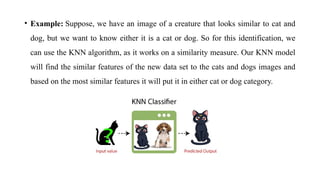
• Example: Suppose, we have an image of a creature that looks similar to cat and
dog, but we want to know either it is a cat or dog. So for this identification, we
can use the KNN algorithm, as it works on a similarity measure. Our KNN model
will find the similar features of the new data set to the cats and dogs images and
based on the most similar features it will put it in either cat or dog category.
Why do we need a K-NN Algorithm?
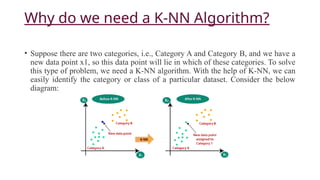
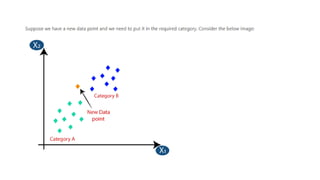
• Suppose there are two categories, i.e., Category A and Category B, and we have a
new data point x1, so this data point will lie in which of these categories. To solve
this type of problem, we need a K-NN algorithm. With the help of K-NN, we can
easily identify the category or class of a particular dataset. Consider the below
diagram:
How does K-NN work?
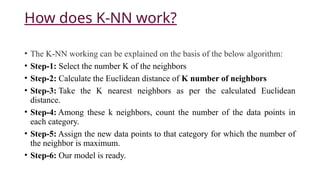
• The K-NN working can be explained on the basis of the below algorithm:
• Step-1: Select the number K of the neighbors
• Step-2: Calculate the Euclidean distance of K number of neighbors
• Step-3: Take the K nearest neighbors as per the calculated Euclidean
distance.
• Step-4: Among these k neighbors, count the number of the data points in
each category.
• Step-5: Assign the new data points to that category for which the number of
the neighbor is maximum.
• Step-6: Our model is ready.
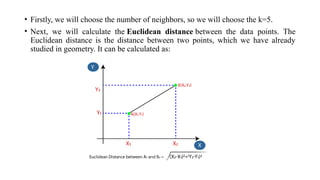
• Firstly, we will choose the number of neighbors, so we will choose the k=5.
• Next, we will calculate the Euclidean distance between the data points. The
Euclidean distance is the distance between two points, which we have already
studied in geometry. It can be calculated as:
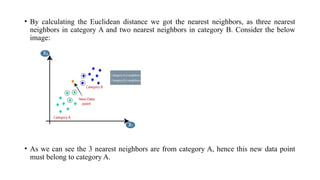
• By calculating the Euclidean distance we got the nearest neighbors, as three nearest
neighbors in category A and two nearest neighbors in category B. Consider the below
image:
• As we can see the 3 nearest neighbors are from category A, hence this new data point
must belong to category A.
How to select the value of K in the K-NN Algorithm?
• There is no particular way to determine the best value for "K", so we need to try
some values to find the best out of them. The most preferred value for K is 5.
• A very low value for K such as K=1 or K=2, can be noisy and lead to the effects
of outliers in the model.
• Large values for K are good, but it may find some difficulties.
How kNN works
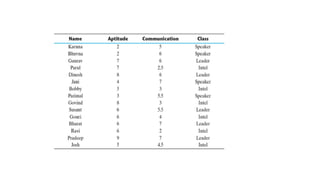
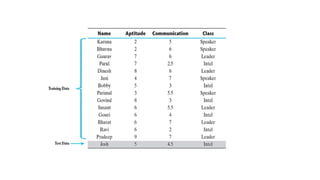
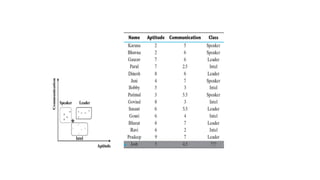
• Let us consider a very simple Student data set as depicted in Figure.
• It consists of 15 students studying in a class. Each of the students has been
assigned a score on a scale of 10 on two performance parameters – ‘Aptitude’ and
‘Communication’.
• Also, a class value is assigned to each student based on the following criteria:
• 1. Students having good communication skills as well as a good level of aptitude
have been classified as ‘Leader’
• 2. Students having good communication skills but not so good level of aptitude
have been classified as ‘Speaker’
• 3. Students having not so good communication skill but a good level of aptitude
have been classified as ‘Intel’
• As we have already seen, while building a classification model, a part of the labelled input data
is retained as test data.
• The remaining portion of the input data is used to train the model – hence known as training
data.
• The motivation to retain a part of the data as test data is to evaluate the performance of the
model.
• As we have seen, the performance of the classification model is measured by the number of
correct classifications made by the model when applied to an unknown data set.
• However, it is not possible during model testing to know the actual label value of an unknown
data. Therefore, the test data, which is a part of the labelled input data, is used for this purpose.
• If the class value predicted for most of the test data elements matches with the actual class
value that they have, then we say that the classification model possesses a good accuracy.
• In context of the Student data set, to keep the things simple, we assume one data element of the
input data set as the test data.
• As depicted in Figure, the record of the student named Josh is assumed to be the test data. Now
that we have the training data and test data identified, we can start with the modelling.
• As we have already discussed, in the kNN algorithm, the class label of the test
data elements is decided by the class label of the training data elements which are
neighbouring, i.e. similar in nature.
• But there are two challenges:
• 1. What is the basis of this similarity or when can we say that two data elements
are similar?
• 2. How many similar elements should be considered for deciding the class label of
each test data element?
• To answer the first question, though there are many measures of similarity, the
most common approach adopted by kNN to measure similarity between two data
elements is Euclidean distance.
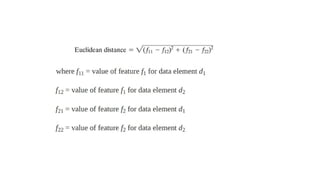
• Considering a very simple data set having two features (say f and f ), Euclidean
distance between two data elements d and d can be measured by
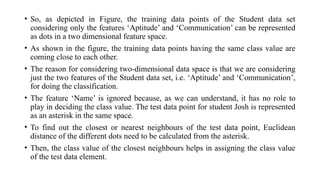
• So, as depicted in Figure, the training data points of the Student data set
considering only the features ‘Aptitude’ and ‘Communication’ can be represented
as dots in a two dimensional feature space.
• As shown in the figure, the training data points having the same class value are
coming close to each other.
• The reason for considering two-dimensional data space is that we are considering
just the two features of the Student data set, i.e. ‘Aptitude’ and ‘Communication’,
for doing the classification.
• The feature ‘Name’ is ignored because, as we can understand, it has no role to
play in deciding the class value. The test data point for student Josh is represented
as an asterisk in the same space.
• To find out the closest or nearest neighbours of the test data point, Euclidean
distance of the different dots need to be calculated from the asterisk.
• Then, the class value of the closest neighbours helps in assigning the class value
of the test data element.
• Now, let us try to find the answer to the second question, i.e. how many similar
elements should be considered.
• The answer lies in the value of ‘k’ which is a user-defined parameter given as an
input to the algorithm. In the kNN algorithm, the value of ‘k’ indicates the number
of neighbours that need to be considered.
• For example, if the value of k is 3, only three nearest neighbours or three training
data elements closest to the test data element are considered.
• Out of the three data elements, the class which is predominant is considered as
the class label to be assigned to the test data.
• In case the value of k is 1, only the closest training data element is considered.
The class label of that data element is directly assigned to the test data element.
• Let us now try to find out the outcome of the algorithm for the Student data set we have.
In other words, we want to see what class value kNN will assign for the test data for
student Josh.
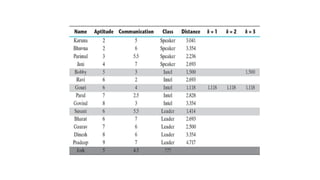
• Again, let us refer back to above Figure. As is evident, when the value of k is taken as 1,
only one training data point needs to be considered.
• The training record for student Gouri comes as the closest one to test record of Josh,
with a distance value of 1.118. Gouri has class value ‘Intel’. So, the test data point is
also assigned a class label value ‘Intel’.
• When the value of k is assumed as 3, the closest neighbours of Josh in the training data
set are Gouri, Susant, and Bobby with distances being 1.118, 1.414, and 1.5,
respectively.
• Gouri and Bobby have class value ‘Intel’, while Susant has class value ‘Leader’. In this
case, the class value of Josh is decided by majority voting.
• Because the class value of ‘Intel’ is formed by the majority of the neighbours, the class
value of Josh is assigned as ‘Intel’. This same process can be extended for any value of k
• But it is often a tricky decision to decide the value of k. The reasons are as follows:
If the value of k is very large (in the extreme case equal to the total number of records in
the training data), the class label of the majority class of the training data set will be
assigned to the test data regardless of the class labels of the neighbours nearest to the test
data.
If the value of k is very small (in the extreme case equal to 1), the class value of a noisy
data or outlier in the training data set which is the nearest neighbour to the test data will be
assigned to the test data.
• The best k value is somewhere between these two extremes.
• Few strategies, highlighted below, are adopted by machine learning practitioners to arrive
at a value for k.
One common practice is to set k equal to the square root of the number of training records.
An alternative approach is to test several k values on a variety of test data sets and choose
the one that delivers the best performance.
Another interesting approach is to choose a larger value of k, but apply a weighted voting
process in which the vote of close neighbours is considered more influential than the vote
of distant neighbours.
kNN Algorithm
• Input: Training data set, test data set (or data points), value of ‘k’ (i.e. number of
nearest neighbours to be considered)
• Steps:
• Do for all test data points
• Calculate the distance (usually Euclidean distance) of the test data point from
the different training data points. Find the closest ‘k’ training data points, i.e.
training data points whose distances are least from the test data point.
• If k = 1
• Then assign class label of the training data point to the test data point
• Else
• Whichever class label is predominantly present in the training data points,
assign that class label to the test data point
• End do
Why the kNN algorithm is called a lazy learner?
• We have seen that eager learners follow the general steps of machine learning, i.e.
perform an abstraction of the information obtained from the input data and then
follow it through by a generalization step.
• However, as we have seen in the case of the kNN algorithm, these steps are
completely skipped. It stores the training data and directly applies the philosophy
of nearest neighbourhood finding to arrive at the classification.
• So, for kNN, there is no learning happening in the real sense. Therefore, kNN falls
under the category of lazy learner.
Strengths of the kNN algorithm
• Extremely simple algorithm – easy to understand
• Very effective in certain situations, e.g. for recommender system design
• Very fast or almost no time required for the training phase
Weaknesses of the kNN algorithm
• Does not learn anything in the real sense. Classification is done completely on the
basis of the training data. So, it has a heavy reliance on the training data. If the
training data does not represent the problem domain comprehensively, the
algorithm fails to make an effective classification.
• Because there is no model trained in real sense and the classification is done
completely on the basis of the training data, the classification process is very slow.
• Also, a large amount of computational space is required to load the training data
for classification.
Application of the kNN algorithm
• One of the most popular areas in machine learning where the kNN algorithm is
widely adopted is recommender systems. As we know, recommender systems
recommend users different items which are similar to a particular item that the
user seems to like.
• The liking pattern may be revealed from past purchases or browsing history and
the similar items are identified using the kNN algorithm. Another area where there
is widespread adoption of kNN is searching documents/ contents similar to a
given document/content.
• This is a core area under information retrieval and is known as concept search.

K- Nearest Neighbour Algorithm.pptx

  • 1.
    K-Nearest Neighbour Algorithm Dr.Divya K.S AP,Kristujayanti college , BAngalore
  • 2.
    Introduction • K-Nearest Neighbouris one of the simplest Machine Learning algorithms based on Supervised Learning technique. • K-NN algorithm assumes the similarity between the new case/data and available cases and put the new case into the category that is most similar to the available categories. • K-NN algorithm stores all the available data and classifies a new data point based on the similarity. This means when new data appears then it can be easily classified into a well suite category by using K- NN algorithm. • K-NN algorithm can be used for Regression as well as for Classification but mostly it is used for the Classification problems. • K-NN is a non-parametric algorithm, which means it does not make any assumption on underlying data. • It is also called a lazy learner algorithm because it does not learn from the training set immediately instead it stores the dataset and at the time of classification, it performs an action on the dataset. • KNN algorithm at the training phase just stores the dataset and when it gets new data, then it classifies that data into a category that is much similar to the new data.
  • 3.
    • Example: Suppose,we have an image of a creature that looks similar to cat and dog, but we want to know either it is a cat or dog. So for this identification, we can use the KNN algorithm, as it works on a similarity measure. Our KNN model will find the similar features of the new data set to the cats and dogs images and based on the most similar features it will put it in either cat or dog category.
  • 4.
    Why do weneed a K-NN Algorithm? • Suppose there are two categories, i.e., Category A and Category B, and we have a new data point x1, so this data point will lie in which of these categories. To solve this type of problem, we need a K-NN algorithm. With the help of K-NN, we can easily identify the category or class of a particular dataset. Consider the below diagram:
  • 5.
    How does K-NNwork? • The K-NN working can be explained on the basis of the below algorithm: • Step-1: Select the number K of the neighbors • Step-2: Calculate the Euclidean distance of K number of neighbors • Step-3: Take the K nearest neighbors as per the calculated Euclidean distance. • Step-4: Among these k neighbors, count the number of the data points in each category. • Step-5: Assign the new data points to that category for which the number of the neighbor is maximum. • Step-6: Our model is ready.
  • 7.
    • Firstly, wewill choose the number of neighbors, so we will choose the k=5. • Next, we will calculate the Euclidean distance between the data points. The Euclidean distance is the distance between two points, which we have already studied in geometry. It can be calculated as:
  • 8.
    • By calculatingthe Euclidean distance we got the nearest neighbors, as three nearest neighbors in category A and two nearest neighbors in category B. Consider the below image: • As we can see the 3 nearest neighbors are from category A, hence this new data point must belong to category A.
  • 9.
    How to selectthe value of K in the K-NN Algorithm? • There is no particular way to determine the best value for "K", so we need to try some values to find the best out of them. The most preferred value for K is 5. • A very low value for K such as K=1 or K=2, can be noisy and lead to the effects of outliers in the model. • Large values for K are good, but it may find some difficulties.
  • 10.
    How kNN works •Let us consider a very simple Student data set as depicted in Figure. • It consists of 15 students studying in a class. Each of the students has been assigned a score on a scale of 10 on two performance parameters – ‘Aptitude’ and ‘Communication’. • Also, a class value is assigned to each student based on the following criteria: • 1. Students having good communication skills as well as a good level of aptitude have been classified as ‘Leader’ • 2. Students having good communication skills but not so good level of aptitude have been classified as ‘Speaker’ • 3. Students having not so good communication skill but a good level of aptitude have been classified as ‘Intel’
  • 12.
    • As wehave already seen, while building a classification model, a part of the labelled input data is retained as test data. • The remaining portion of the input data is used to train the model – hence known as training data. • The motivation to retain a part of the data as test data is to evaluate the performance of the model. • As we have seen, the performance of the classification model is measured by the number of correct classifications made by the model when applied to an unknown data set. • However, it is not possible during model testing to know the actual label value of an unknown data. Therefore, the test data, which is a part of the labelled input data, is used for this purpose. • If the class value predicted for most of the test data elements matches with the actual class value that they have, then we say that the classification model possesses a good accuracy. • In context of the Student data set, to keep the things simple, we assume one data element of the input data set as the test data. • As depicted in Figure, the record of the student named Josh is assumed to be the test data. Now that we have the training data and test data identified, we can start with the modelling.
  • 14.
    • As wehave already discussed, in the kNN algorithm, the class label of the test data elements is decided by the class label of the training data elements which are neighbouring, i.e. similar in nature. • But there are two challenges: • 1. What is the basis of this similarity or when can we say that two data elements are similar? • 2. How many similar elements should be considered for deciding the class label of each test data element? • To answer the first question, though there are many measures of similarity, the most common approach adopted by kNN to measure similarity between two data elements is Euclidean distance. • Considering a very simple data set having two features (say f and f ), Euclidean distance between two data elements d and d can be measured by
  • 16.
    • So, asdepicted in Figure, the training data points of the Student data set considering only the features ‘Aptitude’ and ‘Communication’ can be represented as dots in a two dimensional feature space. • As shown in the figure, the training data points having the same class value are coming close to each other. • The reason for considering two-dimensional data space is that we are considering just the two features of the Student data set, i.e. ‘Aptitude’ and ‘Communication’, for doing the classification. • The feature ‘Name’ is ignored because, as we can understand, it has no role to play in deciding the class value. The test data point for student Josh is represented as an asterisk in the same space. • To find out the closest or nearest neighbours of the test data point, Euclidean distance of the different dots need to be calculated from the asterisk. • Then, the class value of the closest neighbours helps in assigning the class value of the test data element.
  • 18.
    • Now, letus try to find the answer to the second question, i.e. how many similar elements should be considered. • The answer lies in the value of ‘k’ which is a user-defined parameter given as an input to the algorithm. In the kNN algorithm, the value of ‘k’ indicates the number of neighbours that need to be considered. • For example, if the value of k is 3, only three nearest neighbours or three training data elements closest to the test data element are considered. • Out of the three data elements, the class which is predominant is considered as the class label to be assigned to the test data. • In case the value of k is 1, only the closest training data element is considered. The class label of that data element is directly assigned to the test data element.
  • 20.
    • Let usnow try to find out the outcome of the algorithm for the Student data set we have. In other words, we want to see what class value kNN will assign for the test data for student Josh. • Again, let us refer back to above Figure. As is evident, when the value of k is taken as 1, only one training data point needs to be considered. • The training record for student Gouri comes as the closest one to test record of Josh, with a distance value of 1.118. Gouri has class value ‘Intel’. So, the test data point is also assigned a class label value ‘Intel’. • When the value of k is assumed as 3, the closest neighbours of Josh in the training data set are Gouri, Susant, and Bobby with distances being 1.118, 1.414, and 1.5, respectively. • Gouri and Bobby have class value ‘Intel’, while Susant has class value ‘Leader’. In this case, the class value of Josh is decided by majority voting. • Because the class value of ‘Intel’ is formed by the majority of the neighbours, the class value of Josh is assigned as ‘Intel’. This same process can be extended for any value of k
  • 21.
    • But itis often a tricky decision to decide the value of k. The reasons are as follows: If the value of k is very large (in the extreme case equal to the total number of records in the training data), the class label of the majority class of the training data set will be assigned to the test data regardless of the class labels of the neighbours nearest to the test data. If the value of k is very small (in the extreme case equal to 1), the class value of a noisy data or outlier in the training data set which is the nearest neighbour to the test data will be assigned to the test data. • The best k value is somewhere between these two extremes. • Few strategies, highlighted below, are adopted by machine learning practitioners to arrive at a value for k. One common practice is to set k equal to the square root of the number of training records. An alternative approach is to test several k values on a variety of test data sets and choose the one that delivers the best performance. Another interesting approach is to choose a larger value of k, but apply a weighted voting process in which the vote of close neighbours is considered more influential than the vote of distant neighbours.
  • 22.
    kNN Algorithm • Input:Training data set, test data set (or data points), value of ‘k’ (i.e. number of nearest neighbours to be considered) • Steps: • Do for all test data points • Calculate the distance (usually Euclidean distance) of the test data point from the different training data points. Find the closest ‘k’ training data points, i.e. training data points whose distances are least from the test data point. • If k = 1 • Then assign class label of the training data point to the test data point • Else • Whichever class label is predominantly present in the training data points, assign that class label to the test data point • End do
  • 23.
    Why the kNNalgorithm is called a lazy learner? • We have seen that eager learners follow the general steps of machine learning, i.e. perform an abstraction of the information obtained from the input data and then follow it through by a generalization step. • However, as we have seen in the case of the kNN algorithm, these steps are completely skipped. It stores the training data and directly applies the philosophy of nearest neighbourhood finding to arrive at the classification. • So, for kNN, there is no learning happening in the real sense. Therefore, kNN falls under the category of lazy learner.
  • 24.
    Strengths of thekNN algorithm • Extremely simple algorithm – easy to understand • Very effective in certain situations, e.g. for recommender system design • Very fast or almost no time required for the training phase Weaknesses of the kNN algorithm • Does not learn anything in the real sense. Classification is done completely on the basis of the training data. So, it has a heavy reliance on the training data. If the training data does not represent the problem domain comprehensively, the algorithm fails to make an effective classification. • Because there is no model trained in real sense and the classification is done completely on the basis of the training data, the classification process is very slow. • Also, a large amount of computational space is required to load the training data for classification.
  • 25.
    Application of thekNN algorithm • One of the most popular areas in machine learning where the kNN algorithm is widely adopted is recommender systems. As we know, recommender systems recommend users different items which are similar to a particular item that the user seems to like. • The liking pattern may be revealed from past purchases or browsing history and the similar items are identified using the kNN algorithm. Another area where there is widespread adoption of kNN is searching documents/ contents similar to a given document/content. • This is a core area under information retrieval and is known as concept search.