D
EPED
C
O
PY
Mga Bumuo ng Patnubay ng Guro
Edukasyong Pangkatawan
Punong Tagapamahala: Jenny Jalandoni Bendal
Konsultant: Salve A. Favila, PhD
Mga Tagasuri ng Nilalaman: Lordinio A.Vergara, Jo-ann G.Grecia, at 			
			Rachelle U. Peneyra
Mga Manunulat: Grace M. Forniz , Ruby TN Jimeno,	Sonny F. Menese Jr.,			
	 	 Teresita T. Evangelista,	 Genia V.Santos PhD, Julia B. Sabas, 		
			Rhodora B.Peña, at Amphy B. Ampong 					
Mga Tagasuri ng Wika: Norbert C. Lartec, PhD, Jane K. Lartec, PhD, at
Crisencia G. Saludez
Mga Gumuhit ng Larawan: Gerardo G. Lacdao, Joselito P. Loresto, Niles S. Arguelles,
Elvin Neal B. Bersamira, at Jason O. Villena
Naglayout: Mark Anthony E. Jalandoni at Mickey C. Acorda
Edukasyong Pangkalusugan
Punong Tagapamahala: Marilou E. Marta R. Benisano, M.A.P.A.
Konsultant: Evelina M. Vicencio, PhD
Mga Tagasuri ng Nilalaman: Rhodora Formento at Cristina Sagum
Mga Tagapag-ambag: Mila Taño, Maria Teresita Garcia-Aguilar, Juvy B. Nitura EdD,
at Marie Fe B. Estilloso
Mga Manunulat: Mark Kenneth Camiling, Minerva David, Aidena Nuesca, Reyette 		
			 Paunan, Jennifer Quinto, at Giselle Ramos
Tagasuri ng Wika: Michael De la Cerna
Mga Gumuhit ng Larawan: Roland Allan Nalazon at Sharlyn Sanclaria
Naglayout: Ester Daso at Mickey C. Acorda
 
Department of Education-Instructional Materials Council Secretariat (DepEd-IMCS)
OfficeAddress:	 5th Floor Mabini Building, DepEd Complex
		 MeralcoAvenue, Pasig City
		Philippines 1600
Telefax:		 (02) 634-1054, 634-1072
E-mailAddress:	 imcsetd@yahoo.com
Edukasyong Pangkatawan at Pangkalusugan – Ikaapat na Baitang
Patnubay ng Guro
Unang Edisyon 2015			
Inilathala ng Kagawaran ng Edukasyon
Kalihim: Br.ArminA. Luistro FSC
Pangalawang Kalihim: Dina S.Ocampo, PhD
Isinasaad ng Batas Republika 8293, seksiyon 176 na “Hindi maaaring magkaroon ng karapatang-
ari (sipi) sa anumang akda ang Pamahalaan ng Pilipinas. Gayunman, kailangan muna ang pahintulot ng
ahensiya o tanggapan ng pamahalaan na naghanda ng akda kung ito’y pagkakakitaan. Kabilang sa mga
maaaring gawin ng nasabing ahensiya o tanggapan ay ang pagtakda ng kaukulang bayad.”
Ang mga akda (kuwento, seleksiyon, tula, awit, larawan, ngalan ng produkto o brand names,
tatak o trademarks, palabas sa telebisyon, pelikula, atbp.) na ginamit sa aklat na ito ay sa nagtataglay ng
karapatang-ari ng mga iyon. Pinagtibay ng isang kasunduan ng Kagawaran ng Edukasyon at Filipinas
Copyright Licensing Society (FILCOLS), Inc. na ang FILCOLS ang kakatawan sa paghiling ng kaukulang
pahintulot sa nagmamay-ari ng mga akdang hiniram at ginamit dito. Pinagsumikapang matunton upang
makuha ang pahintulot sa paggamit ng materyales. Hindi inaangkin ng mga tagapaglathala at mga may-
akda ang karapatang-aring iyon.
Tanging mga institusyon at kompanyang nakipagkontrata sa FILCOLS at yaong nakasaad
lamang sa kasunduan, ang maaaring kumopya mula dito sa Kagamitan ng Mag-aaral. Ang hindi
nakipagkontrata sa FILCOLS ay dapat, kung ninanais makakopya, makipag-ugnay nang tuwiran sa mga
tagapaglathala at sa mga may-akda.
	 Maaaring	tumawag	sa	FILCOLS	sa	telepono		blg.	(02)	439-2204	o	mag-email		sa	filcols@gmail.
com ang mga may-akda at tagapaglathala.
All rights reserved. No part of this material may be reproduced or transmitted in any form or by any means -
electronic or mechanical including photocopying – without written permission from the DepEd Central Office. First Edition, 2015.
D
EPED
C
O
PY
iii
Pambungad
				Edukasyong Pangkatawan	
	 Ang Patnubay ng Guro na ito ng Ikaapat na Baitang ng Edukasyong
Pangkatawanaynilalaanparasainyongmgaguronamagtuturoomangangasiwa
ng asignaturang ito. Ang patnubay na ito ay pinapaunlad upang makatulong
sa pagsasakatuparan ang kurikulum ng Ikaapat na Baitang at makapaglaan
ng sapat na competencies sa pagtuturo ng asignatura. Sa pamamagitan ng
patnubay na ito tiyak na magiging panatag sa pagtugon ng mga ninanais na
pamantayan o standards na siyang nakasaad sa kurikulum.
Edukasyong Pangkalusugan
Magandang Buhay mga Guro!
	 Ang aklat na ito ay naglalayong makapag-ambag ng mahahalagang
kaalaman, at kasanayan sa asignaturang Edukasyong Pangkalusugan para
sa ikaapat na baitang, batay sa kasalukuyang balangkas ng kurikulum ng
Kagawaran ng Edukasyon na nakapaloob sa kompetensiya ng K to 12 Health
Curriculum Guide ng K to 12 Enhanced Basic Education Program.
	 Ang pagkakaroon ng maayos at malusog na pangangatawan ay mai-
tuturing na isang kayamanan kung kaya mahalagang maituro at maipaunawa
sa bawat mag-aaral ang kahalagahan nang pagkakaroon ng wastong nutri-
syon upang maging wasto, balanse, at ligtas sa mga sakit. Matiyak na may
kaalaman ang bawat mag-aaral upang maiwasan ang mga posibleng sakit na
makukuha sa mga hindi ligtas na pagkain.
	
	 Gayundin, dapat maituro nang maayos ang tamang paggamit ng gamot
at kung kailan nararapat na gamitin, upang hindi malagay sa kapahamakan
ang kalusugan ng mga bata.
	
	 Sa pabago-bagong panahon dahil sa tinatawag nating Global Warming
na may malaking epekto sa ating klima, kinakailangang maihanda ang bawat
mag-aaral sa kanilang murang edad, ang dapat gawin sa oras ng sakuna upa-
ng mailigtas nila ang kanilang sarili at posibleng makapagligtas rin ng ibang
buhay.
	 Tungkulin ng guro na bigyang pansin ang mga mahahalagang puntos
sa bawat aralin upang matulungan at magabayan ang mga mag-aaral tungo sa
kanilang pagkatuto.
All rights reserved. No part of this material may be reproduced or transmitted in any form or by any means -
electronic or mechanical including photocopying – without written permission from the DepEd Central Office. First Edition, 2015.
D
EPED
C
O
PY
vi
Edukasyong Pangkalusugan
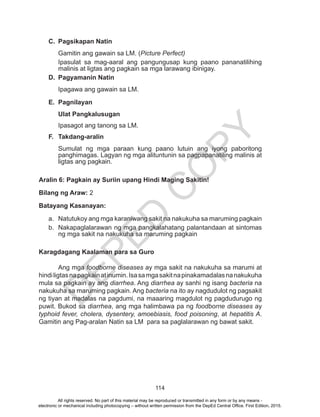
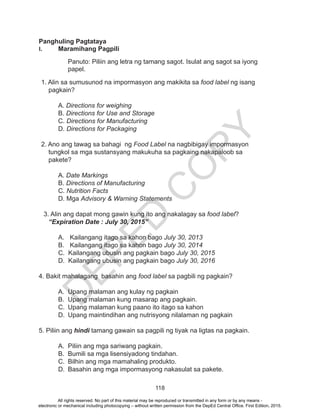
YUNIT I KAHALAGAHAN NG PAGBABASA NG FOOD LABEL
Aralin 1 Sustansiyang Sukat at Sapat.................................................. 98
Aralin 2 Suriin ang Pagkain, Bago Kainin............................................104
Aralin 3 Basahin Bago Kainin at Inumin...............................................106
Aralin 4 Ating Alamin at Unawain.........................................................108
Aralin 5 Pagkain Tiyaking Tama at
Ligtas Bago Kainin..................................................................111
Aralin 6 Pagkain ay Suriin upang Hindi Maging Sakitin.......................114
Pahina
TALAAN NG MGA NILALAMAN
All rights reserved. No part of this material may be reproduced or transmitted in any form or by any means -
electronic or mechanical including photocopying – without written permission from the DepEd Central Office. First Edition, 2015.
D
EPED
C
O
PY
Republic of the Philippines
Department of Education
DepEd Complex, Meralco Avenue
Pasig City
December 2013
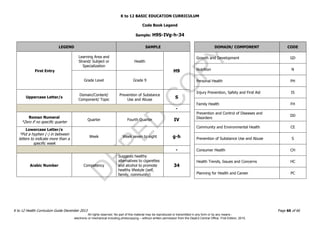
K to 12 Curriculum Guide
HEALTH
(Grade 1 to Grade 10)
All rights reserved. No part of this material may be reproduced or transmitted in any form or by any means -
electronic or mechanical including photocopying – without written permission from the DepEd Central Office. First Edition, 2015.
D
EPED
C
O
PY
K to 12 BASIC EDUCATION CURRICULUM
K to 12 Health Curriculum Guide December 2013 Page 2 of 66
CONCEPTUAL FRAMEWORK
The Kindergarten to Grade 12 (“K to 12”) Health curriculum aims to assist the Filipino learner in attaining, sustaining and promoting life-long health and wellness.
The learning experience through the program provides opportunities for the development of health literacy competencies among students and to enhance their over-all well-
being.
Health Education from Kindergarten to Grade 10 focuses on the physical, mental, emotional, as well as the social, moral and spiritual dimensions of holistic health. It
enables the learners to acquire essential knowledge, attitudes, and skills that are necessary to promote good nutrition; to prevent and control diseases; to prevent substance
misuse and abuse; to reduce health-related risk behaviors; to prevent and control injuries with the end-view of maintaining and improving personal, family, community, as
well as global health.
Health Education emphasizes the development of positive heath attitudes and relevant skills in order to achieve a good quality of living. Thus, the focus on skills
development is explicitly demonstrated in the primary grade levels. Meanwhile, a comprehensive body of knowledge is provided in the upper year levels to serve as a
foundation in developing desirable health attitudes, habits and practices.
In order to facilitate the development of health literacy competencies, the teacher is highly encouraged to use developmentally-appropriate learner-centered teaching
approaches. This includes scaffolding on student experience and prior learning; utilizing culture-responsive scenarios and materials; incorporating arts, and music in imparting
health messages; engaging learners in meaningful games and cooperative learning activities; and using life skills and value-based strategies particularly in discussing
sensitive topics such as substance abuse and sexuality. The teacher is also advised to use differentiated instruction in order to cater to the learners’ various needs and
abilities.
All rights reserved. No part of this material may be reproduced or transmitted in any form or by any means -
electronic or mechanical including photocopying – without written permission from the DepEd Central Office. First Edition, 2015.
D
EPED
C
O
PY
K to 12 BASIC EDUCATION CURRICULUM
K to 12 Health Curriculum Guide December 2013 Page 3 of 66
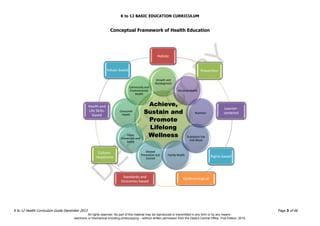
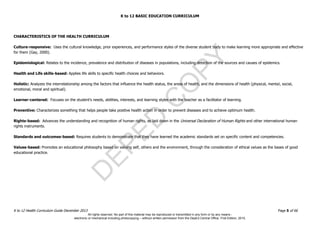
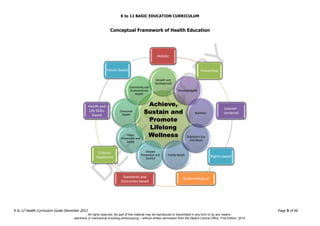
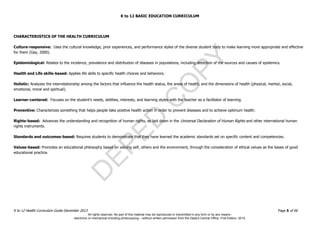
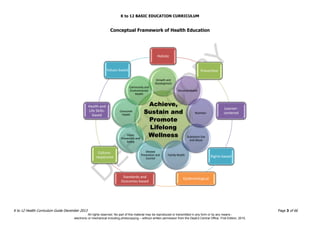
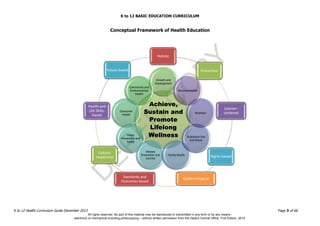
Achieve,
Sustain and
Promote
Lifelong
Wellness
Growth and
Development
Community and
Environmental
Health
Consumer
Health
Injury
Prevention and
Safety
Disease
Prevention and
Conrtol
Family Health
Substance Use
and Abuse
Nutrition
Personal Health
Holistic
Preventive
Learner-
centered
Rights-based
EpidemiologicalStandards and
Outcomes-based
Culture-
responsive
Health and
Life Skills-
based
Values-based
Conceptual Framework of Health Education
All rights reserved. No part of this material may be reproduced or transmitted in any form or by any means -
electronic or mechanical including photocopying – without written permission from the DepEd Central Office. First Edition, 2015.
D
EPED
C
O
PY
K to 12 BASIC EDUCATION CURRICULUM
K to 12 Health Curriculum Guide December 2013 Page 4 of 66
HEALTH CONTENT AREAS
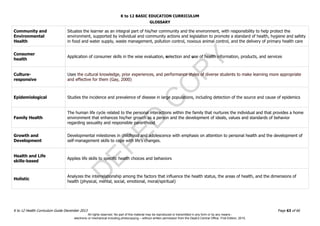
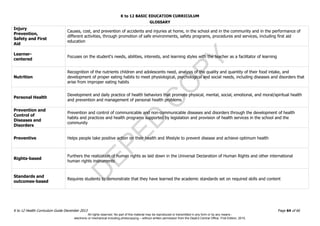
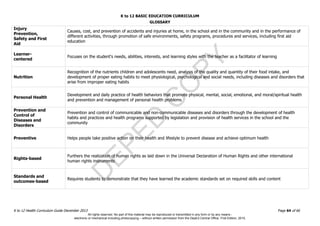
Injury Prevention, Safety and First Aid: Discusses the causes, costs, and prevention of accidents and injuries while performing various activities at home, in school or in
the community. Prevention can be done through the promotion of safe environments, the development of safety programs, procedures and services, which includes first aid
education and disaster preparedness programs.
Community and Environmental Health: Situates the learner as an integral part of the community and the environment, with a great responsibility of protecting the
environment, with the support of individual and community actions and legislation promoting a standard of health, hygiene and safety in food and water supply, waste
management, pollution control, pest control, as well as the delivery of primary health care.
Consumer Health: Focuses on the application of consumer knowledge and skills in the effective evaluation, selection and use of health information, products, and services.
Family Health: Covers information on the human life cycle and also on family dynamics that influence an individual’s development of ideals, values and standards of
behavior with regard to sexuality and responsible parenthood.
Growth and Development: Emphasizes developmental milestones and health concerns during puberty and adolescence with focus on personal health and the
development of self-management skills to cope with life’s changes.
Nutrition: Addresses the importance of eating healthy and establishing good eating habits especially for children and adolescents as a way to enhance health and prevent
diseases.
Personal Health: Comprises personal health habits and practices that promote physical, mental, social, emotional, and moral-spiritual health and prevent or manage
personal health issues and concerns.
Prevention and Control of Diseases and Disorders: Involves the prevention and control of both communicable and non-communicable diseases and disorders through
the development of health habits and practices and the adoption of health programs supported by legislation with provisions on school and community health services.
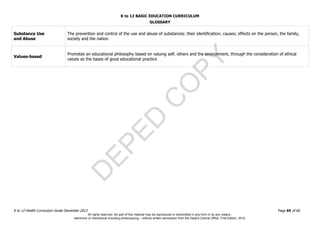
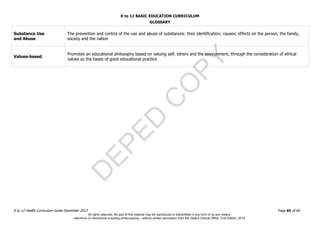
Substance Use and Abuse: Highlights the prevention and control of the use, misuse, and abuse of substances and drugs by providing comprehensive information on the
nature of abused substances, the negative impact of substance abuse on the individual, family and society in general; and the importance of learning and using resistance
skills to protect oneself from drug risk-taking behaviors.
All rights reserved. No part of this material may be reproduced or transmitted in any form or by any means -
electronic or mechanical including photocopying – without written permission from the DepEd Central Office. First Edition, 2015.
D
EPED
C
O
PY
K to 12 BASIC EDUCATION CURRICULUM
K to 12 Health Curriculum Guide December 2013 Page 5 of 66
CHARACTERISTICS OF THE HEALTH CURRICULUM
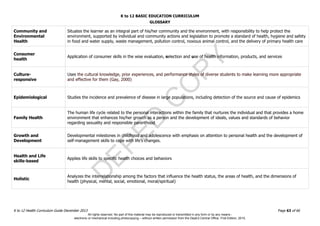
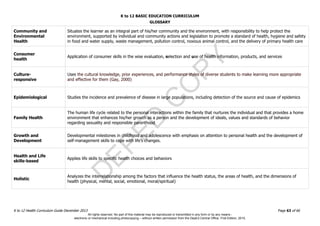
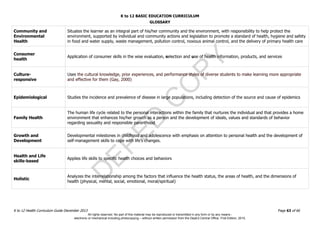
Culture-responsive: Uses the cultural knowledge, prior experiences, and performance styles of the diverse student body to make learning more appropriate and effective
for them (Gay, 2000).
Epidemiological: Relates to the incidence, prevalence and distribution of diseases in populations, including detection of the sources and causes of epidemics.
Health and Life skills-based: Applies life skills to specific health choices and behaviors.
Holistic: Analyzes the interrelationship among the factors that influence the health status, the areas of health, and the dimensions of health (physical, mental, social,
emotional, moral and spiritual).
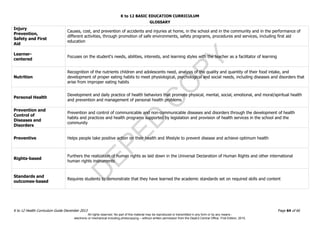
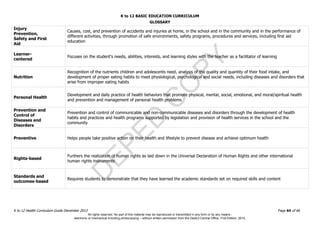
Learner-centered: Focuses on the student's needs, abilities, interests, and learning styles with the teacher as a facilitator of learning.
Preventive: Characterizes something that helps people take positive health action in order to prevent diseases and to achieve optimum health.
Rights-based: Advances the understanding and recognition of human rights, as laid down in the Universal Declaration of Human Rights and other international human
rights instruments.
Standards and outcomes-based: Requires students to demonstrate that they have learned the academic standards set on specific content and competencies.
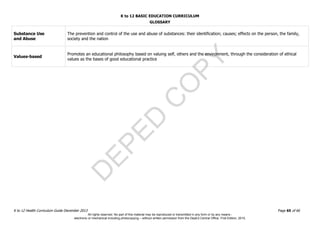
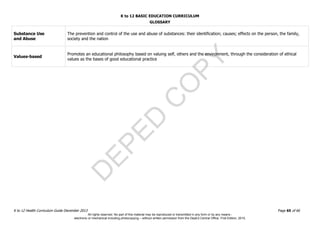
Values-based: Promotes an educational philosophy based on valuing self, others and the environment, through the consideration of ethical values as the bases of good
educational practice.
All rights reserved. No part of this material may be reproduced or transmitted in any form or by any means -
electronic or mechanical including photocopying – without written permission from the DepEd Central Office. First Edition, 2015.
D
EPED
C
O
PY
K to 12 BASIC EDUCATION CURRICULUM
K to 12 Health Curriculum Guide December 2013 Page 6 of 66
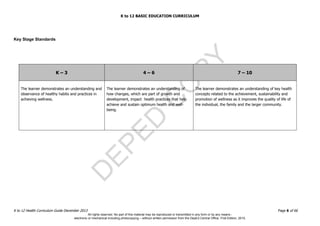
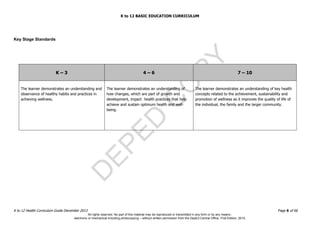
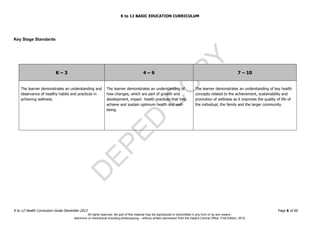
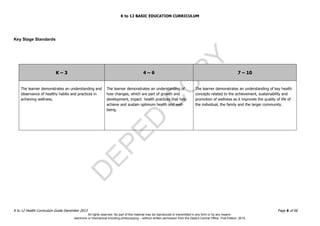
Key Stage Standards
K – 3 4 – 6 7 – 10
The learner demonstrates an understanding and
observance of healthy habits and practices in
achieving wellness.
The learner demonstrates an understanding of
how changes, which are part of growth and
development, impact health practices that help
achieve and sustain optimum health and well-
being.
The learner demonstrates an understanding of key health
concepts related to the achievement, sustainability and
promotion of wellness as it improves the quality of life of
the individual, the family and the larger community.
All rights reserved. No part of this material may be reproduced or transmitted in any form or by any means -
electronic or mechanical including photocopying – without written permission from the DepEd Central Office. First Edition, 2015.
D
EPED
C
O
PY
K to 12 BASIC EDUCATION CURRICULUM
K to 12 Health Curriculum Guide December 2013 Page 7 of 66
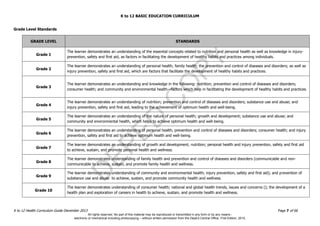
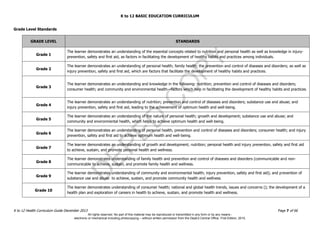
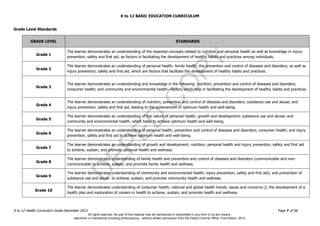
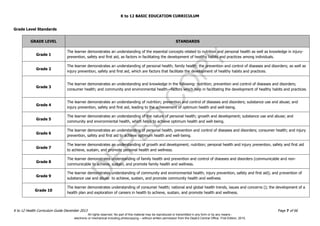
Grade Level Standards
GRADE LEVEL STANDARDS
Grade 1
The learner demonstrates an understanding of the essential concepts related to nutrition and personal health as well as knowledge in injury-
prevention, safety and first aid, as factors in facilitating the development of healthy habits and practices among individuals.
Grade 2
The learner demonstrates an understanding of personal health; family health; the prevention and control of diseases and disorders; as well as
injury prevention, safety and first aid, which are factors that facilitate the development of healthy habits and practices.
Grade 3
The learner demonstrates an understanding and knowledge in the following: nutrition; prevention and control of diseases and disorders;
consumer health; and community and environmental health—factors which help in facilitating the development of healthy habits and practices.
Grade 4
The learner demonstrates an understanding of nutrition; prevention and control of diseases and disorders; substance use and abuse; and
injury prevention, safety and first aid, leading to the achievement of optimum health and well-being.
Grade 5
The learner demonstrates an understanding of the nature of personal health; growth and development; substance use and abuse; and
community and environmental health, which helps to achieve optimum health and well-being.
Grade 6
The learner demonstrates an understanding of personal health, prevention and control of diseases and disorders; consumer health; and injury
prevention, safety and first aid to achieve optimum health and well-being.
Grade 7
The learner demonstrates an understanding of growth and development; nutrition; personal health and injury prevention, safety and first aid
to achieve, sustain, and promote personal health and wellness.
Grade 8
The learner demonstrates understanding of family health and prevention and control of diseases and disorders (communicable and non-
communicable to achieve, sustain, and promote family health and wellness.
Grade 9
The learner demonstrates understanding of community and environmental health; injury prevention, safety and first aid); and prevention of
substance use and abuse to achieve, sustain, and promote community health and wellness
Grade 10
The learner demonstrates understanding of consumer health; national and global health trends, issues and concerns (); the development of a
health plan and exploration of careers in health to achieve, sustain, and promote health and wellness.
All rights reserved. No part of this material may be reproduced or transmitted in any form or by any means -
electronic or mechanical including photocopying – without written permission from the DepEd Central Office. First Edition, 2015.
D
EPED
C
O
PY
K to 12 BASIC EDUCATION CURRICULUM
K to 12 Health Curriculum Guide December 2013 Page 8 of 66
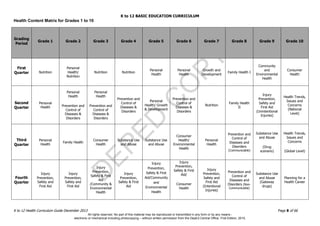
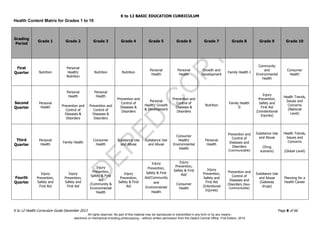
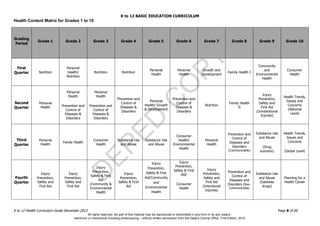
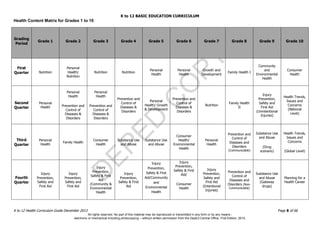
Health Content Matrix for Grades 1 to 10
Grading
Period
Grade 1 Grade 2 Grade 3 Grade 4 Grade 5 Grade 6 Grade 7 Grade 8 Grade 9 Grade 10
First
Quarter Nutrition
Personal
Health/
Nutrition
Nutrition Nutrition
Personal
Health
Personal
Health
Growth and
Development
Family Health I
Community
and
Environmental
Health
Consumer
Health
Second
Quarter
Personal
Health
Personal
Health
Prevention and
Control of
Diseases &
Disorders
Personal
Health
Prevention and
Control of
Diseases &
Disorders
Prevention and
Control of
Diseases &
Disorders
Personal
Health/ Growth
& Development
Prevention and
Control of
Diseases &
Disorders
Nutrition
Family Health
II
Injury
Prevention,
Safety and
First Aid
(Unintentional
Injuries)
Health Trends,
Issues and
Concerns
(National
Level)
Third
Quarter
Personal
Health
Family Health
Consumer
Health
Substance Use
and Abuse
Substance Use
and Abuse
Consumer
Health/
Environmental
Health
Personal
Health
Prevention and
Control of
Diseases and
Disorders
(Communicable)
Substance Use
and Abuse
(Drug
scenario)
Health Trends,
Issues and
Concerns
(Global Level)
Fourth
Quarter
Injury
Prevention,
Safety and
First Aid
Injury
Prevention,
Safety and
First Aid
Injury
Prevention,
Safety & First
Aid
/Community &
Environmental
Health
Injury
Prevention,
Safety & First
Aid
Injury
Prevention,
Safety & First
Aid/Community
and
Environmental
Health
Injury
Prevention,
Safety & First
Aid/
Consumer
Health
Injury
Prevention,
Safety and
First Aid
(Intentional
Injuries)
Prevention and
Control of
Diseases and
Disorders (Non-
Communicable)
Substance Use
and Abuse
(Gateway
drugs)
Planning for a
Health Career
All rights reserved. No part of this material may be reproduced or transmitted in any form or by any means -
electronic or mechanical including photocopying – without written permission from the DepEd Central Office. First Edition, 2015.
D
EPED
C
O
PY
K to 12 BASIC EDUCATION CURRICULUM
K to 12 Health Curriculum Guide December 2013 Page 9 of 66
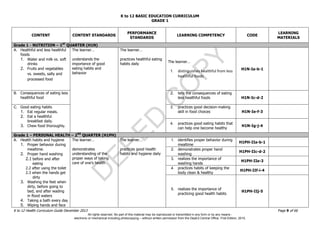
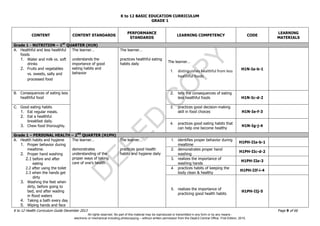
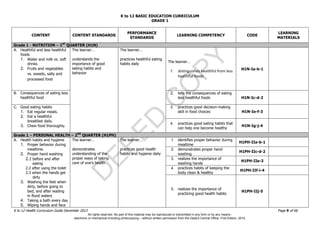
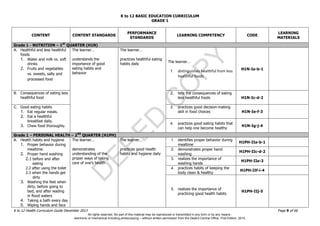
GRADE 1
CONTENT CONTENT STANDARDS
PERFORMANCE
STANDARDS
LEARNING COMPETENCY CODE
LEARNING
MATERIALS
Grade 1 - NUTRITION – 1ST
QUARTER (H1N)
A. Healthful and less healthful
foods
1. Water and milk vs. soft
drinks
2. Fruits and vegetables
vs. sweets, salty and
processed food
The learner…
understands the
importance of good
eating habits and
behavior
The learner…
practices healthful eating
habits daily
The learner…
1. distinguishes healthful from less
healthful foods
H1N-Ia-b-1
B. Consequences of eating less
healthful food
2. tells the consequences of eating
less healthful foods H1N-Ic-d-2
C. Good eating habits
1. Eat regular meals.
2. Eat a healthful
breakfast daily.
3. Chew food thoroughly.
3. practices good decision-making
skill in food choices H1N-Ie-f-3
4. practices good eating habits that
can help one become healthy
H1N-Ig-j-4
Grade 1 – PERSONAL HEALTH – 2ND
QUARTER (H1PH)
A. Health habits and hygiene
1. Proper behavior during
mealtime.
2. Proper hand washing
2.1 before and after
eating
2.2 after using the toilet
2.3 when the hands get
dirty
3. Washing the feet when
dirty, before going to
bed, and after wading
in flood waters
4. Taking a bath every day
5. Wiping hands and face
The learner…
demonstrates
understanding of the
proper ways of taking
care of one’s health
The learner…
practices good health
habits and hygiene daily
1. identifies proper behavior during
mealtime
H1PH-IIa-b-1
2. demonstrates proper hand
washing
H1PH-IIc-d-2
3. realizes the importance of
washing hands
H1PH-IIe-3
4. practices habits of keeping the
body clean & healthy
H1PH-IIf-i-4
5. realizes the importance of
practicing good health habits
H1PH-IIj-5
All rights reserved. No part of this material may be reproduced or transmitted in any form or by any means -
electronic or mechanical including photocopying – without written permission from the DepEd Central Office. First Edition, 2015.
D
EPED
C
O
PY
K to 12 BASIC EDUCATION CURRICULUM
K to 12 Health Curriculum Guide December 2013 Page 10 of 66
CONTENT CONTENT STANDARDS
PERFORMANCE
STANDARDS
LEARNING COMPETENCY CODE
LEARNING
MATERIALS
with a clean
handkerchief
6. Covering cough and
sneeze with clean
handkerchief or tissue
paper when coughing
or sneezing
7. Coughing or sneezing
into the crook of the
elbow rather than the
hand
8. Wearing clean clothes
appropriate to the
activity
9. Having enough rest and
sleep
10. Maintaining good
posture
11. Engaging in physical
activity
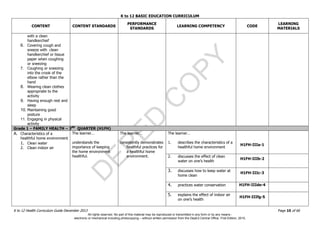
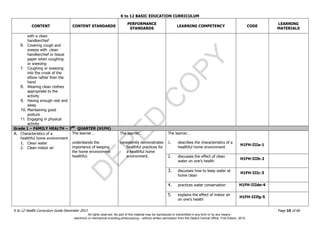
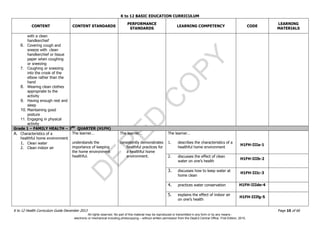
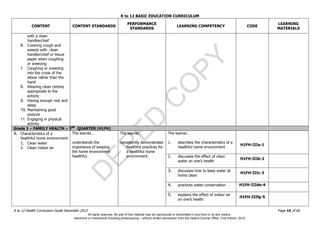
Grade 1 – FAMILY HEALTH – 3RD
QUARTER (H1FH)
A. Characteristics of a
healthful home environment
1. Clean water
2. Clean indoor air
The learner…
understands the
importance of keeping
the home environment
healthful.
The learner…
consistently demonstrates
healthful practices for
a healthful home
environment.
The learner…
1. describes the characteristics of a
healthful home environment
H1FH-IIIa-1
2. discusses the effect of clean
water on one’s health
H1FH-IIIb-2
3. discusses how to keep water at
home clean
H1FH-IIIc-3
4. practices water conservation H1FH-IIIde-4
5. explains the effect of indoor air
on one’s health
H1FH-IIIfg-5
All rights reserved. No part of this material may be reproduced or transmitted in any form or by any means -
electronic or mechanical including photocopying – without written permission from the DepEd Central Office. First Edition, 2015.
D
EPED
C
O
PY
K to 12 BASIC EDUCATION CURRICULUM
K to 12 Health Curriculum Guide December 2013 Page 11 of 66
CONTENT CONTENT STANDARDS
PERFORMANCE
STANDARDS
LEARNING COMPETENCY CODE
LEARNING
MATERIALS
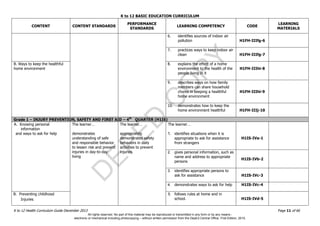
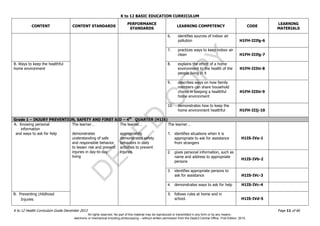
6. identifies sources of indoor air
pollution H1FH-IIIfg-6
7. practices ways to keep indoor air
clean H1FH-IIIfg-7
B. Ways to keep the healthful
home environment
8. explains the effect of a home
environment to the health of the
people living in it
H1FH-IIIhi-8
9. describes ways on how family
members can share household
chores in keeping a healthful
home environment
H1FH-IIIhi-9
10. demonstrates how to keep the
home environment healthful H1FH-IIIj-10
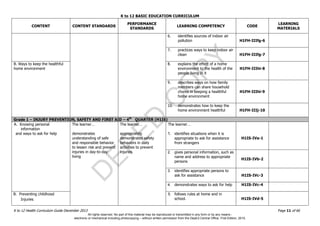
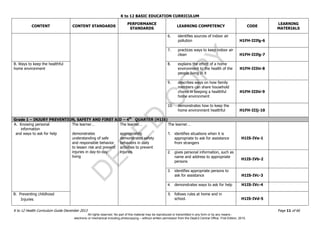
Grade 1 – INJURY PREVENTION, SAFETY AND FIRST AID – 4th
QUARTER (H1IS)
A. Knowing personal
information
and ways to ask for help
The learner…
demonstrates
understanding of safe
and responsible behavior
to lessen risk and prevent
injuries in day-to-day
living
The learner…
appropriately
demonstrates safety
behaviors in daily
activities to prevent
injuries
The learner…
1. identifies situations when it is
appropriate to ask for assistance
from strangers
H1IS-IVa-1
2. gives personal information, such as
name and address to appropriate
persons
H1IS-IVb-2
3. identifies appropriate persons to
ask for assistance H1IS-IVc-3
4. demonstrates ways to ask for help H1IS-IVc-4
B. Preventing childhood
Injuries
5. follows rules at home and in
school. H1IS-IVd-5
All rights reserved. No part of this material may be reproduced or transmitted in any form or by any means -
electronic or mechanical including photocopying – without written permission from the DepEd Central Office. First Edition, 2015.
D
EPED
C
O
PY
K to 12 BASIC EDUCATION CURRICULUM
K to 12 Health Curriculum Guide December 2013 Page 12 of 66
CONTENT CONTENT STANDARDS
PERFORMANCE
STANDARDS
LEARNING COMPETENCY CODE
LEARNING
MATERIALS
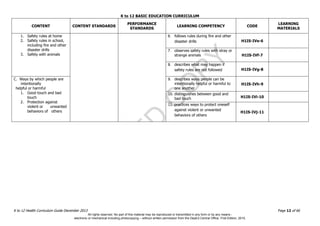
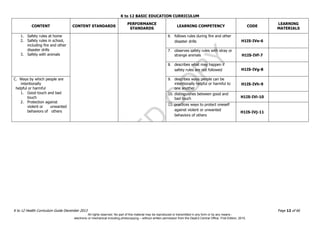
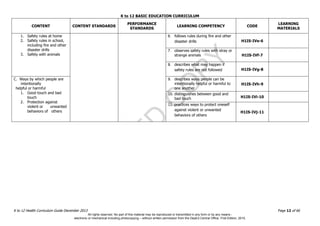
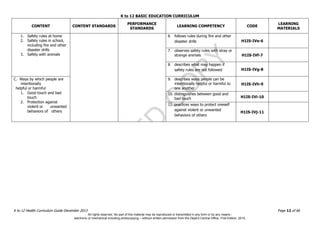
1. Safety rules at home
2. Safety rules in school,
including fire and other
disaster drills
3. Safety with animals
6. follows rules during fire and other
disaster drills H1IS-IVe-6
7. observes safety rules with stray or
strange animals H1IS-IVf-7
8. describes what may happen if
safety rules are not followed H1IS-IVg-8
C. Ways by which people are
intentionally
helpful or harmful
1. Good touch and bad
touch
2. Protection against
violent or unwanted
behaviors of others
9. describes ways people can be
intentionally helpful or harmful to
one another
H1IS-IVh-9
10. distinguishes between good and
bad touch H1IS-IVi-10
11. practices ways to protect oneself
against violent or unwanted
behaviors of others
H1IS-IVj-11
All rights reserved. No part of this material may be reproduced or transmitted in any form or by any means -
electronic or mechanical including photocopying – without written permission from the DepEd Central Office. First Edition, 2015.
D
EPED
C
O
PY
K to 12 BASIC EDUCATION CURRICULUM
K to 12 Health Curriculum Guide December 2013 Page 13 of 66
GRADE 2
CONTENT CONTENT STANDARDS
PERFORMANCE
STANDARDS
LEARNING COMPETENCY CODE
LEARNING
MATERIALS
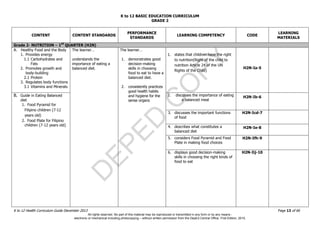
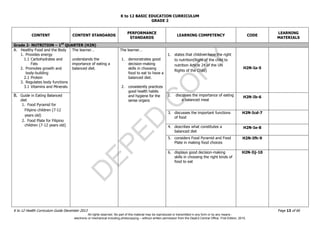
Grade 2- NUTRITION – 1ST
QUARTER (H2N)
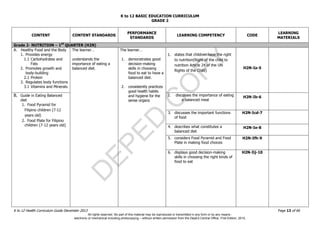
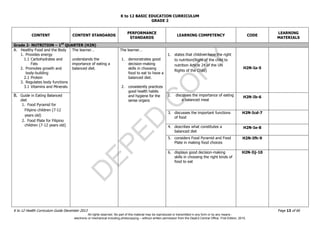
A. Healthy Food and the Body
1. Provides energy
1.1 Carbohydrates and
Fats
2. Promotes growth and
body-building
2.1 Protein
3. Regulates body functions
3.1 Vitamins and Minerals
The learner…
understands the
importance of eating a
balanced diet.
The learner…
1. demonstrates good
decision-making
skills in choosing
food to eat to have a
balanced diet.
2. consistently practices
good health habits
and hygiene for the
sense organs
1. states that children have the right
to nutrition(Right of the child to
nutrition Article 24 of the UN
Rights of the Child)
H2N-Ia-5
B. Guide in Eating Balanced
diet
1. Food Pyramid for
Filipino children (7-12
years old)
2. Food Plate for Filipino
children (7-12 years old)
2. discusses the importance of eating
a balanced meal
H2N-Ib-6
3. discusses the important functions
of food
H2N-Icd-7
4. describes what constitutes a
balanced diet
H2N-Ie-8
5. considers Food Pyramid and Food
Plate in making food choices
H2N-Ifh-9
6. displays good decision-making
skills in choosing the right kinds of
food to eat
H2N-Iij-10
All rights reserved. No part of this material may be reproduced or transmitted in any form or by any means -
electronic or mechanical including photocopying – without written permission from the DepEd Central Office. First Edition, 2015.
D
EPED
C
O
PY
K to 12 BASIC EDUCATION CURRICULUM
K to 12 Health Curriculum Guide December 2013 Page 14 of 66
CONTENT CONTENT STANDARDS
PERFORMANCE
STANDARDS
LEARNING COMPETENCY CODE
LEARNING
MATERIALS
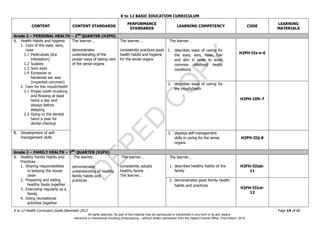
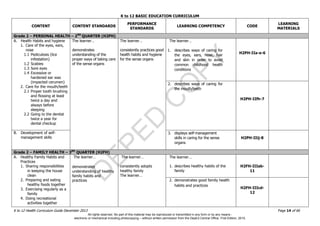
Grade 2 – PERSONAL HEALTH – 2ND
QUARTER (H2PH)
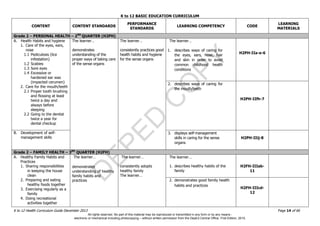
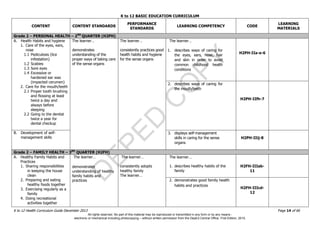
A. Health Habits and hygiene
1. Care of the eyes, ears,
nose
1.1 Pediculosis (lice
infestation)
1.2 Scabies
1.3 Sore eyes
1.4 Excessive or
hardened ear was
(impacted cerumen)
2. Care for the mouth/teeth
2.1 Proper tooth brushing
and flossing at least
twice a day and
always before
sleeping
2.2 Going to the dentist
twice a year for
dental checkup
The learner…
demonstrates
understanding of the
proper ways of taking care
of the sense organs
The learner…
consistently practices good
health habits and hygiene
for the sense organs
The learner…
1. describes ways of caring for
the eyes, ears, nose, hair
and skin in order to avoid
common childhood health
conditions
H2PH-IIa-e-6
2. describes ways of caring for
the mouth/teeth
H2PH-IIfh-7
B. Development of self-
management skills
3. displays self-management
skills in caring for the sense
organs
H2PH-IIij-8
Grade 2 – FAMILY HEALTH – 3RD
QUARTER (H2FH)
A. Healthy Family Habits and
Practices
1. Sharing responsibilities
in keeping the house
clean
2. Preparing and eating
healthy foods together
3. Exercising regularly as a
family
4. Doing recreational
activities together
The learner…
demonstrates
understanding of healthy
family habits and
practices
The learner…
consistently adopts
healthy family
The learner…
The learner…
1. describes healthy habits of the
family
H2FH-IIIab-
11
2. demonstrates good family health
habits and practices
H2FH-IIIcd-
12
All rights reserved. No part of this material may be reproduced or transmitted in any form or by any means -
electronic or mechanical including photocopying – without written permission from the DepEd Central Office. First Edition, 2015.
D
EPED
C
O
PY
K to 12 BASIC EDUCATION CURRICULUM
K to 12 Health Curriculum Guide December 2013 Page 15 of 66
CONTENT CONTENT STANDARDS
PERFORMANCE
STANDARDS
LEARNING COMPETENCY CODE
LEARNING
MATERIALS
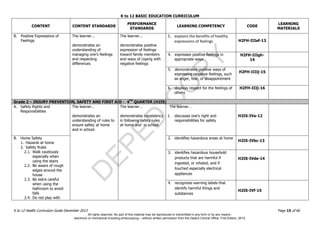
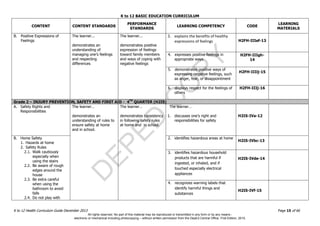
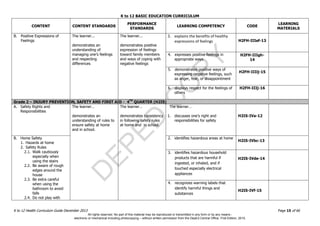
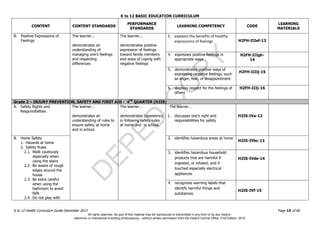
B. Positive Expressions of
Feelings
The learner...
demonstrates an
understanding of
managing one’s feelings
and respecting
differences
The learner...
demonstrates positive
expression of feelings
toward family members
and ways of coping with
negative feelings
3. explains the benefits of healthy
expressions of feelings H2FH-IIIef-13
4. expresses positive feelings in
appropriate ways
H2FH-IIIgh-
14
5. demonstrates positive ways of
expressing negative feelings, such
as anger, fear, or disappointment
H2FH-IIIij-15
6. displays respect for the feelings of
others
H2FH-IIIj-16
Grade 2 – INJURY PREVENTION, SAFETY AND FIRST AID - 4TH
QUARTER (H2IS)
A. Safety Rights and
Responsibilities
The learner…
demonstrates an
understanding of rules to
ensure safety at home
and in school.
The learner…
demonstrates consistency
in following safety rules
at home and in school.
The learner…
1. discusses one’s right and
responsibilities for safety
H2IS-IVa-12
B. Home Safety
1. Hazards at home
2. Safety Rules
2.1. Walk cautiously
especially when
using the stairs
2.2. Be aware of rough
edges around the
house
2.3. Be extra careful
when using the
bathroom to avoid
falls
2.4. Do not play with
2. identifies hazardous areas at home
H2IS-IVbc-13
3. identifies hazardous household
products that are harmful if
ingested, or inhaled, and if
touched especially electrical
appliances
H2IS-IVde-14
4. recognizes warning labels that
identify harmful things and
substances
H2IS-IVf-15
All rights reserved. No part of this material may be reproduced or transmitted in any form or by any means -
electronic or mechanical including photocopying – without written permission from the DepEd Central Office. First Edition, 2015.
D
EPED
C
O
PY
K to 12 BASIC EDUCATION CURRICULUM
K to 12 Health Curriculum Guide December 2013 Page 16 of 66
CONTENT CONTENT STANDARDS
PERFORMANCE
STANDARDS
LEARNING COMPETENCY CODE
LEARNING
MATERIALS
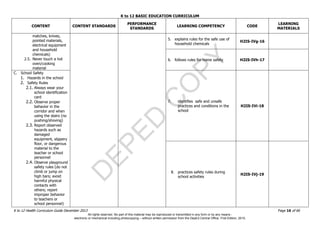
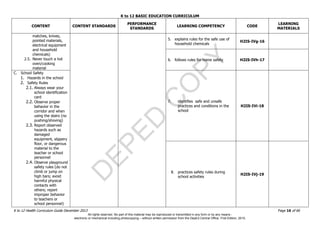
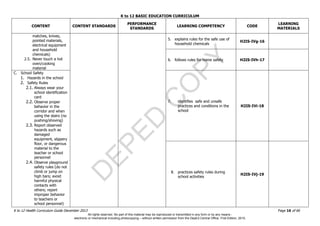
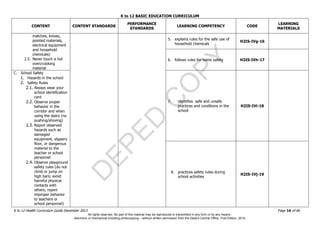
matches, knives,
pointed materials,
electrical equipment
and household
chemicals)
2.5. Never touch a hot
oven/cooking
material
5. explains rules for the safe use of
household chemicals
H2IS-IVg-16
6. follows rules for home safety H2IS-IVh-17
C. School Safety
1. Hazards in the school
2. Safety Rules
2.1. Always wear your
school identification
card
2.2. Observe proper
behavior in the
corridor and when
using the stairs (no
pushing/shoving)
2.3. Report observed
hazards such as
damaged
equipment, slippery
floor, or dangerous
material to the
teacher or school
personnel
2.4. Observe playground
safety rules (do not
climb or jump on
high bars; avoid
harmful physical
contacts with
others; report
improper behavior
to teachers or
school personnel)
7. identifies safe and unsafe
practices and conditions in the
school
H2IS-IVi-18
8. practices safety rules during
school activities
H2IS-IVj-19
All rights reserved. No part of this material may be reproduced or transmitted in any form or by any means -
electronic or mechanical including photocopying – without written permission from the DepEd Central Office. First Edition, 2015.
D
EPED
C
O
PY
K to 12 BASIC EDUCATION CURRICULUM
K to 12 Health Curriculum Guide December 2013 Page 17 of 66
GRADE 3
CONTENT
CONTENT
STANDARDS
PERFORMANCE
STANDARDS
LEARNING COMPETENCY CODE
LEARNING
MATERIALS
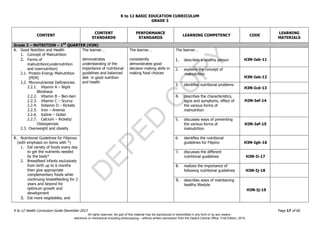
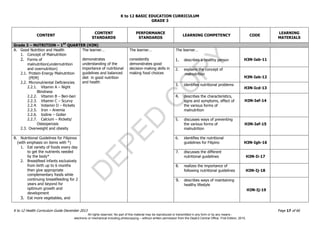
Grade 3 – NUTRITION – 1ST
QUARTER (H3N)
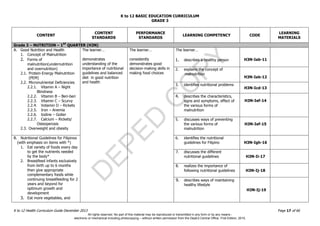
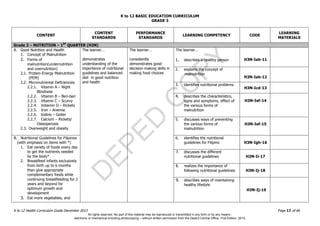
A. Good Nutrition and Health
1. Concept of Malnutrition
2. Forms of
malnutrition(undernutrition
and overnutrition)
2.1. Protein-Energy Malnutrition
(PEM)
2.2. Micronutriental Deficiencies
2.2.1. Vitamin A – Night
Blindness
2.2.2. Vitamin B – Beri-beri
2.2.3. Vitamin C – Scurvy
2.2.4. Votamin D – Rickets
2.2.5. Iron – Anemia
2.2.6. Iodine – Goiter
2.2.7. Calcium – Rickets/
Osteoperosis
2.3. Overweight and obesity
The learner…
demonstrates
understanding of the
importance of nutritional
guidelines and balanced
diet in good nutrition
and health
The learner…
consistently
demonstrates good
decision-making skills in
making food choices
The learner…
1. describes a healthy person H3N-Iab-11
2. explains the concept of
malnutrition
H3N-Iab-12
3. identifies nutritional problems
H3N-Icd-13
4. describes the characteristics,
signs and symptoms, effect of
the various forms of
malnutrition
H3N-Ief-14
5. discusses ways of preventing
the various forms of
malnutrition
H3N-Ief-15
B. Nutritional Guidelines for Filipinos
(with emphasis on items with *)
1. Eat variety of foods every day
to get the nutrients needed
by the body*
2. Breastfeed infants exclusively
from birth up to 6 months
then give appropriate
complementary foods while
continuing breastfeeding for 2
years and beyond for
optimum growth and
development
3. Eat more vegetables, and
6. identifies the nutritional
guidelines for Filipino H3N-Igh-16
7. discusses the different
nutritional guidelines H3N-Ii-17
8. realizes the importance of
following nutritional guidelines H3N-Ij-18
9. describes ways of maintaining
healthy lifestyle
H3N-Ij-19
All rights reserved. No part of this material may be reproduced or transmitted in any form or by any means -
electronic or mechanical including photocopying – without written permission from the DepEd Central Office. First Edition, 2015.
D
EPED
C
O
PY
K to 12 BASIC EDUCATION CURRICULUM
K to 12 Health Curriculum Guide December 2013 Page 18 of 66
CONTENT
CONTENT
STANDARDS
PERFORMANCE
STANDARDS
LEARNING COMPETENCY CODE
LEARNING
MATERIALS
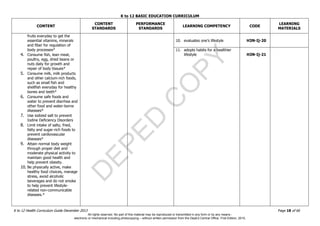
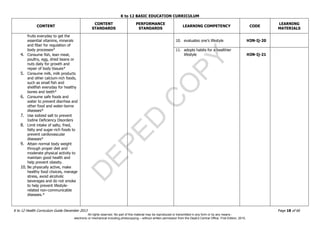
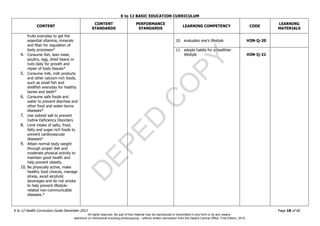
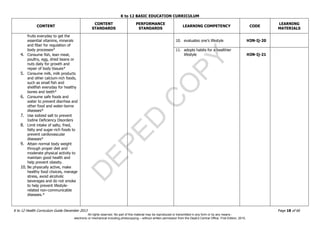
fruits everyday to get the
essential vitamins, minerals
and fiber for regulation of
body processes*
4. Consume fish, lean meat,
poultry, egg, dried beans or
nuts daily for growth and
repair of body tissues*
5. Consume milk, milk products
and other calcium-rich foods,
such as small fish and
shellfish everyday for healthy
bones and teeth*
6. Consume safe foods and
water to prevent diarrhea and
other food and water-borne
diseases*
7. Use iodized salt to prevent
Iodine Deficiency Disorders
8. Limit intake of salty, fried,
fatty and sugar-rich foods to
prevent cardiovascular
diseases*
9. Attain normal body weight
through proper diet and
moderate physical activity to
maintain good health and
help prevent obesity.
10. Be physically active, make
healthy food choices, manage
stress, avoid alcoholic
beverages and do not smoke
to help prevent lifestyle-
related non-communicable
diseases.*
10. evaluates one’s lifestyle H3N-Ij-20
11. adopts habits for a healthier
lifestyle H3N-Ij-21
All rights reserved. No part of this material may be reproduced or transmitted in any form or by any means -
electronic or mechanical including photocopying – without written permission from the DepEd Central Office. First Edition, 2015.
D
EPED
C
O
PY
K to 12 BASIC EDUCATION CURRICULUM
K to 12 Health Curriculum Guide December 2013 Page 19 of 66
CONTENT
CONTENT
STANDARDS
PERFORMANCE
STANDARDS
LEARNING COMPETENCY CODE
LEARNING
MATERIALS
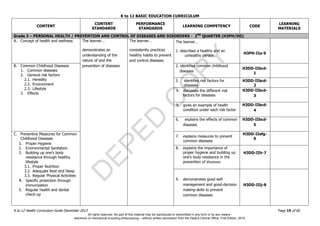
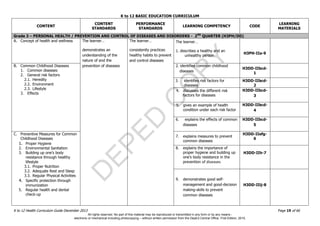
Grade 3 – PERSONAL HEALTH / PREVENTION AND CONTROL OF DISEASES AND DISORDERS - 2ND
QUARTER (H3PH/DD)
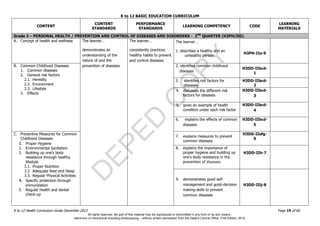
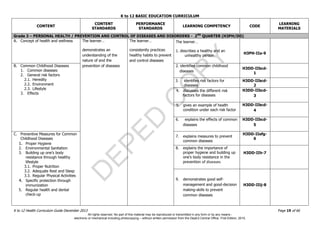
A. Concept of health and wellness The learner…
demonstrates an
understanding of the
nature of and the
prevention of diseases
The learner…
consistently practices
healthy habits to prevent
and control diseases
The learner…
1. describes a healthy and an
unhealthy person
H3PH-IIa-9
B. Common Childhood Diseases
1. Common diseases
2. General risk factors
2.1. Heredity
2.2. Environment
2.3. Lifestyle
3. Effects
2. identifies common childhood
diseases
H3DD-IIbcd-
1
3. identifies risk factors for
diseases
H3DD-IIbcd-
2
4. discusses the different risk
factors for diseases
H3DD-IIbcd-
3
5. gives an example of health
condition under each risk factor
H3DD-IIbcd-
4
6. explains the effects of common
diseases
H3DD-IIbcd-
5
C. Preventive Measures for Common
Childhood Diseases
1. Proper Hygiene
2. Environmental Sanitation
3. Building up one’s body
resistance through healthy
lifestyle
3.1. Proper Nutrition
3.2. Adequate Rest and Sleep
3.3. Regular Physical Activities
4. Specific protection through
immunization
5. Regular health and dental
check-up
7. explains measures to prevent
common diseases
H3DD-IIefg-
6
8. explains the importance of
proper hygiene and building up
one's body resistance in the
prevention of diseases
H3DD-IIh-7
9. demonstrates good self-
management and good-decision
making-skills to prevent
common diseases
H3DD-IIij-8
All rights reserved. No part of this material may be reproduced or transmitted in any form or by any means -
electronic or mechanical including photocopying – without written permission from the DepEd Central Office. First Edition, 2015.
D
EPED
C
O
PY
K to 12 BASIC EDUCATION CURRICULUM
K to 12 Health Curriculum Guide December 2013 Page 20 of 66
CONTENT
CONTENT
STANDARDS
PERFORMANCE
STANDARDS
LEARNING COMPETENCY CODE
LEARNING
MATERIALS
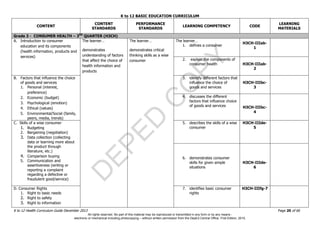
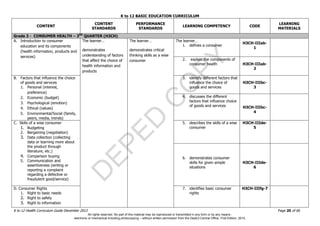
Grade 3 - CONSUMER HEALTH – 3RD
QUARTER (H3CH)
A. Introduction to consumer
education and its components
(health information, products and
services)
The learner…
demonstrates
understanding of factors
that affect the choice of
health information and
products
The learner…
demonstrates critical
thinking skills as a wise
consumer
The learner…
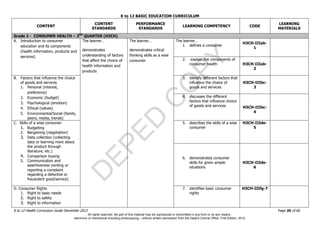
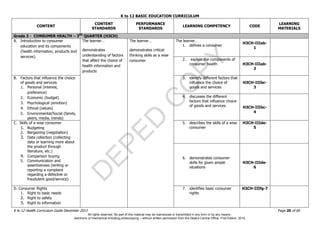
1. defines a consumer
H3CH-IIIab-
1
2. explain the components of
consumer health H3CH-IIIab-
2
B. Factors that influence the choice
of goods and services
1. Personal (interest,
preference)
2. Economic (budget)
3. Psychological (emotion)
4. Ethical (values)
5. Environmental/Social (family,
peers, media, trends)
3. identify different factors that
influence the choice of
goods and services
H3CH-IIIbc-
3
4. discusses the different
factors that influence choice
of goods and services H3CH-IIIbc-
4
C. Skills of a wise consumer
1. Budgeting
2. Bargaining (negotiation)
3. Data collection (collecting
data or learning more about
the product through
literature, etc.)
4. Comparison buying
5. Communication and
assertiveness (writing or
reporting a complaint
regarding a defective or
fraudulent good/service)
5. describes the skills of a wise
consumer
H3CH-IIIde-
5
6. demonstrates consumer
skills for given simple
situations
H3CH-IIIde-
6
D. Consumer Rights
1. Right to basic needs
2. Right to safety
3. Right to information
7. identifies basic consumer
rights
H3CH-IIIfg-7
All rights reserved. No part of this material may be reproduced or transmitted in any form or by any means -
electronic or mechanical including photocopying – without written permission from the DepEd Central Office. First Edition, 2015.
D
EPED
C
O
PY
K to 12 BASIC EDUCATION CURRICULUM
K to 12 Health Curriculum Guide December 2013 Page 21 of 66
CONTENT
CONTENT
STANDARDS
PERFORMANCE
STANDARDS
LEARNING COMPETENCY CODE
LEARNING
MATERIALS
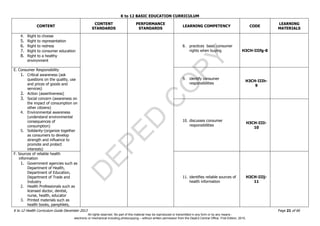
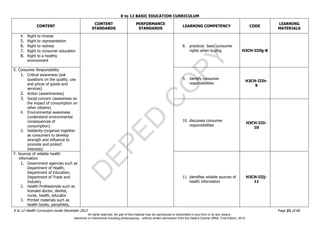
4. Right to choose
5. Right to representation
6. Right to redress
7. Right to consumer education
8. Right to a healthy
environment
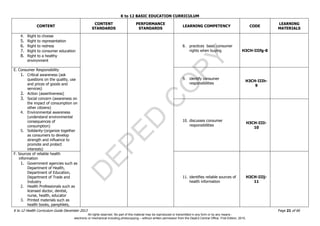
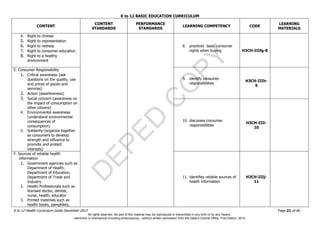
8. practices basic consumer
rights when buying H3CH-IIIfg-8
E. Consumer Responsibility
1. Critical awareness (ask
questions on the quality, use
and prices of goods and
services)
2. Action (assertiveness)
3. Social concern (awareness on
the impact of consumption on
other citizens)
4. Environmental awareness
(understand environmental
consequences of
consumption)
5. Solidarity-(organize together
as consumers to develop
strength and influence to
promote and protect
interests)
9. identify consumer
responsibilities
H3CH-IIIh-
9
10. discusses consumer
responsibilities
H3CH-IIIi-
10
F. Sources of reliable health
information
1. Government agencies such as
Department of Health,
Department of Education,
Department of Trade and
Industry
2. Health Professionals such as
licensed doctor, dentist,
nurse, health, educator
3. Printed materials such as
health books, pamphlets,
11. identifies reliable sources of
health information
H3CH-IIIj-
11
All rights reserved. No part of this material may be reproduced or transmitted in any form or by any means -
electronic or mechanical including photocopying – without written permission from the DepEd Central Office. First Edition, 2015.
D
EPED
C
O
PY
K to 12 BASIC EDUCATION CURRICULUM
K to 12 Health Curriculum Guide December 2013 Page 22 of 66
CONTENT
CONTENT
STANDARDS
PERFORMANCE
STANDARDS
LEARNING COMPETENCY CODE
LEARNING
MATERIALS
brochures, and magazines
produced by health
professionals or legitimate
health institutions
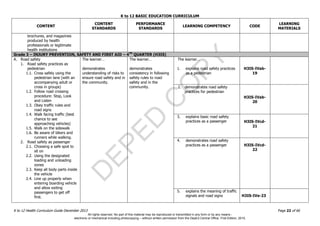
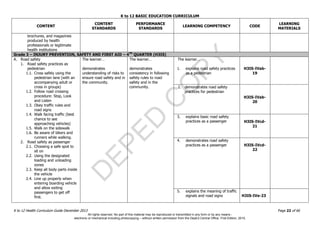
Grade 3 – INJURY PREVENTION, SAFETY AND FIRST AID – 4TH
QUARTER (H3IS)
A. Road safety
1. Road safety practices as
pedestrian
1.1. Cross safely using the
pedestrian lane (with an
accompanying adult or
cross in groups)
1.2. Follow road crossing
procedure: Stop, Look
and Listen
1.3. Obey traffic rules and
road signs
1.4. Walk facing traffic (best
chance to see
approaching vehicles)
1.5. Walk on the sidewalk
1.6. Be aware of bikers and
runners while walking.
2. Road safety as passenger
2.1. Choosing a safe spot to
sit on
2.2. Using the designated
loading and unloading
zones
2.3. Keep all body parts inside
the vehicle
2.4. Line up properly when
entering boarding vehicle
and allow exiting
passengers to get off
first.
The learner…
demonstrates
understanding of risks to
ensure road safety and in
the community.
The learner…
demonstrates
consistency in following
safety rules to road
safety and in the
community.
The learner…
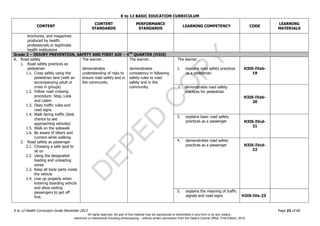
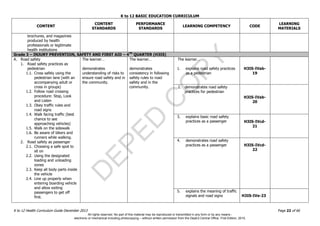
1. explains road safety practices
as a pedestrian
H3IS-IVab-
19
2. demonstrates road safety
practices for pedestrian
H3IS-IVab-
20
3. explains basic road safety
practices as a passenger H3IS-IVcd-
21
4. demonstrates road safety
practices as a passenger H3IS-IVcd-
22
5. explains the meaning of traffic
signals and road signs H3IS-IVe-23
All rights reserved. No part of this material may be reproduced or transmitted in any form or by any means -
electronic or mechanical including photocopying – without written permission from the DepEd Central Office. First Edition, 2015.
D
EPED
C
O
PY
K to 12 BASIC EDUCATION CURRICULUM
K to 12 Health Curriculum Guide December 2013 Page 23 of 66
CONTENT
CONTENT
STANDARDS
PERFORMANCE
STANDARDS
LEARNING COMPETENCY CODE
LEARNING
MATERIALS
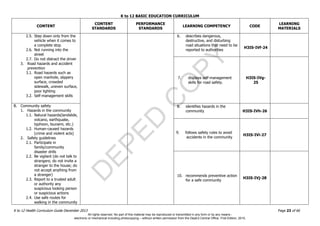
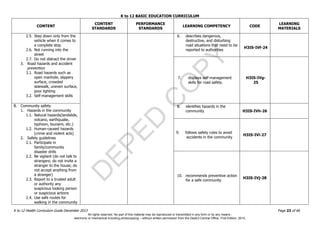
2.5. Step down only from the
vehicle when it comes to
a complete stop
2.6. Not running into the
street
2.7. Do not distract the driver
3. Road hazards and accident
prevention
3.1. Road hazards such as
open manhole, slippery
surface, crowded
sidewalk, uneven surface,
poor lighting
3.2. Self-management skills
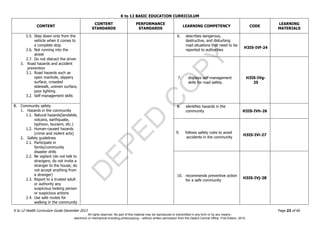
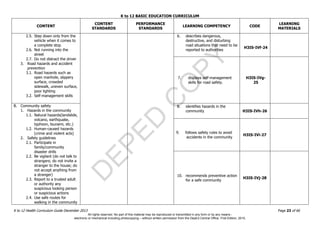
6. describes dangerous,
destructive, and disturbing
road situations that need to be
reported to authorities
H3IS-IVf-24
7. displays self-management
skills for road safety.
H3IS-IVg-
25
B. Community safety
1. Hazards in the community
1.1. Natural hazards(landslide,
volcano, earthquake,
typhoon, tsunami, etc.)
1.2. Human-caused hazards
(crime and violent acts)
2. Safety guidelines
2.1. Participate in
family/community
disaster drills
2.2. Be vigilant (do not talk to
strangers; do not invite a
stranger to the house; do
not accept anything from
a stranger)
2.3. Report to a trusted adult
or authority any
suspicious looking person
or suspicious actions
2.4. Use safe routes for
walking in the community
8. identifies hazards in the
community H3IS-IVh-26
9. follows safety rules to avoid
accidents in the community
H3IS-IVi-27
10. recommends preventive action
for a safe community
H3IS-IVj-28
All rights reserved. No part of this material may be reproduced or transmitted in any form or by any means -
electronic or mechanical including photocopying – without written permission from the DepEd Central Office. First Edition, 2015.
D
EPED
C
O
PY
K to 12 BASIC EDUCATION CURRICULUM
K to 12 Health Curriculum Guide December 2013 Page 24 of 66
CONTENT
CONTENT
STANDARDS
PERFORMANCE
STANDARDS
LEARNING COMPETENCY CODE
LEARNING
MATERIALS
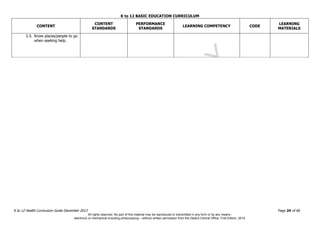
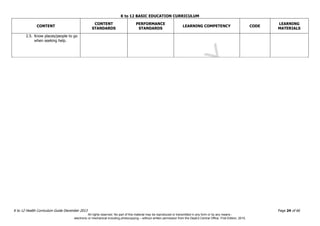
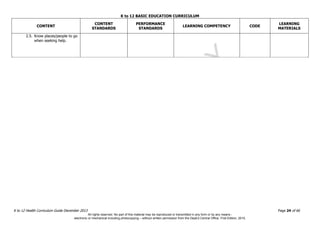
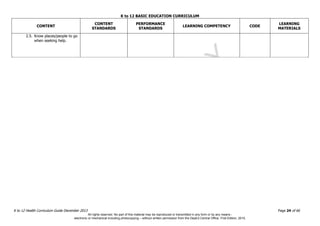
2.5. Know places/people to go
when seeking help.
All rights reserved. No part of this material may be reproduced or transmitted in any form or by any means -
electronic or mechanical including photocopying – without written permission from the DepEd Central Office. First Edition, 2015.
D
EPED
C
O
PY
K to 12 BASIC EDUCATION CURRICULUM
K to 12 Health Curriculum Guide December 2013 Page 25 of 66
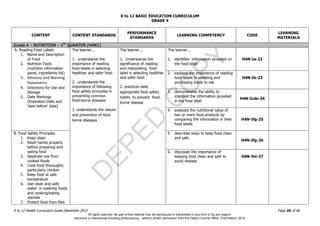
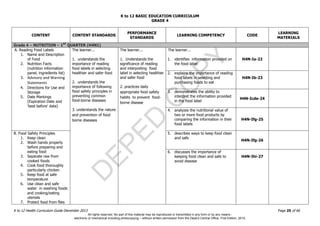
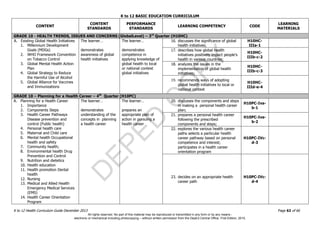
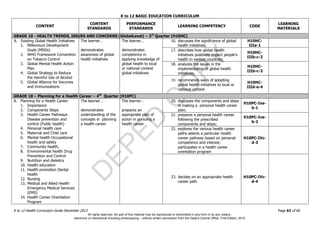
GRADE 4
CONTENT CONTENT STANDARDS
PERFORMANCE
STANDARDS
LEARNING COMPETENCY CODE
LEARNING
MATERIALS
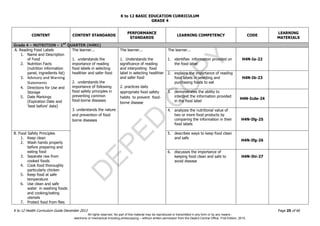
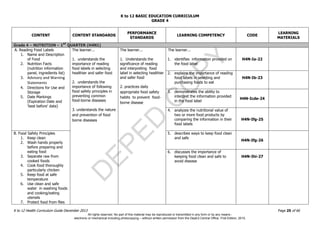
Grade 4 – NUTRITION – 1ST
QUARTER (H4N1)
A. Reading Food Labels
1. Name and Description
of Food
2. Nutrition Facts
(nutrition information
panel, ingredients list)
3. Advisory and Warning
Statements
4. Directions for Use and
Storage
5. Date Markings
(Expiration Date and
‘best before’ date)
The learner...
1. understands the
importance of reading
food labels in selecting
healthier and safer food
2. understands the
importance of following
food safety principles in
preventing common
food-borne diseases
3. understands the nature
and prevention of food
borne diseases
The learner...
1. Understands the
significance of reading
and interpreting food
label in selecting healthier
and safer food
2. practices daily
appropriate food safety
habits to prevent food-
borne disease
The learner...
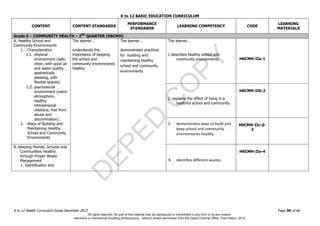
1. identifies information provided on
the food label
H4N-Ia-22
2. explains the importance of reading
food labels in selecting and
purchasing foods to eat
H4N-Ib-23
3. demonstrates the ability to
interpret the information provided
in the food label
H4N-Icde-24
4. analyzes the nutritional value of
two or more food products by
comparing the information in their
food labels
H4N-Ifg-25
B. Food Safety Principles
1. Keep clean
2. Wash hands properly
before preparing and
eating food
3. Separate raw from
cooked foods
4. Cook food thoroughly
particularly chicken
5. Keep food at safe
temperature
6. Use clean and safe
water in washing foods
and cooking/eating
utensils
7. Protect food from flies
5. describes ways to keep food clean
and safe
H4N-Ifg-26
6. discusses the importance of
keeping food clean and safe to
avoid disease
H4N-Ihi-27
All rights reserved. No part of this material may be reproduced or transmitted in any form or by any means -
electronic or mechanical including photocopying – without written permission from the DepEd Central Office. First Edition, 2015.
D
EPED
C
O
PY
K to 12 BASIC EDUCATION CURRICULUM
K to 12 Health Curriculum Guide December 2013 Page 26 of 66
CONTENT CONTENT STANDARDS
PERFORMANCE
STANDARDS
LEARNING COMPETENCY CODE
LEARNING
MATERIALS
and pests that can
transmit disease
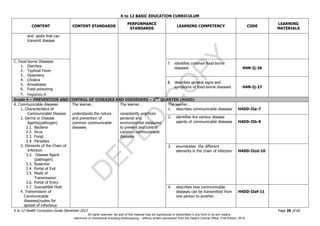
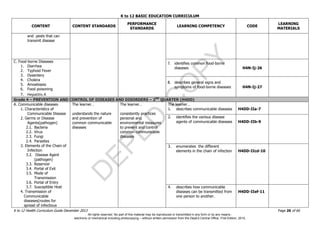
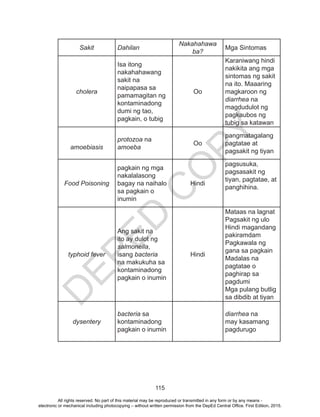
C. Food-borne Diseases
1. Diarrhea
2. Typhoid Fever
3. Dysentery
4. Cholera
5. Amoebiasis
6. Food poisoning
7. Hepatitis A
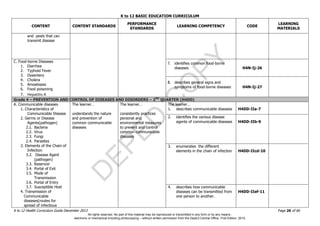
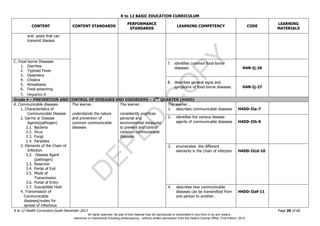
7. identifies common food-borne
diseases H4N-Ij-26
8. describes general signs and
symptoms of food-borne diseases H4N-Ij-27
Grade 4 – PREVENTION AND CONTROL OF DISEASES AND DISORDERS – 2ND
QUARTER (H4DD)
A. Communicable diseases
1. Characteristics of
Communicable Disease
2. Germs or Disease
Agents(pathogen)
2.1. Bacteria
2.2. Virus
2.3. Fungi
2.4. Parasites
3. Elements of the Chain of
Infection
3.2. Disease Agent
(pathogen)
3.3. Reservoir
3.4. Portal of Exit
3.5. Mode of
Transmission
3.6. Portal of Entry
3.7. Susceptible Host
4. Transmission of
Communicable
diseases(routes for
spread of infectious
The learner…
understands the nature
and prevention of
common communicable
diseases
The learner…
consistently practices
personal and
environmental measures
to prevent and control
common communicable
diseases
The learner…
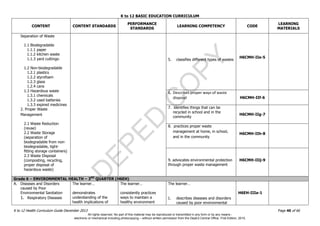
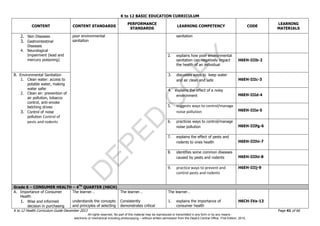
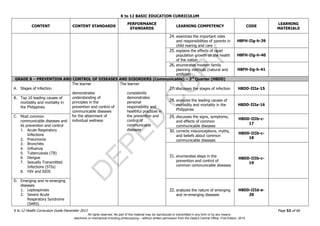
1. describes communicable diseases H4DD-IIa-7
2. identifies the various disease
agents of communicable diseases H4DD-IIb-9
3. enumerates the different
elements in the chain of infection H4DD-IIcd-10
4. describes how communicable
diseases can be transmitted from
one person to another.
H4DD-IIef-11
All rights reserved. No part of this material may be reproduced or transmitted in any form or by any means -
electronic or mechanical including photocopying – without written permission from the DepEd Central Office. First Edition, 2015.
D
EPED
C
O
PY
K to 12 BASIC EDUCATION CURRICULUM
K to 12 Health Curriculum Guide December 2013 Page 27 of 66
CONTENT CONTENT STANDARDS
PERFORMANCE
STANDARDS
LEARNING COMPETENCY CODE
LEARNING
MATERIALS
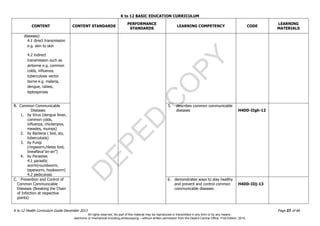
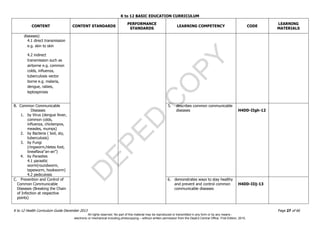
diseases)
4.1 direct transmission
e.g. skin to skin
4.2 indirect
transmission such as
airborne e.g. common
colds, influenza,
tuberculosis vector
borne e.g. malaria,
dengue, rabies,
leptospirosis
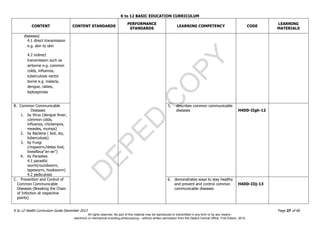
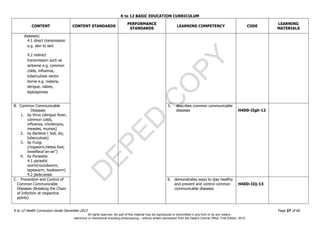
B. Common Communicable
Diseases
1. by Virus (dengue fever,
common colds,
influenza, chickenpox,
measles, mumps)
2. by Bacteria ( boil, sty,
tuberculosis)
3. by Fungi
(ringworm,hletes foot,
tineaflava“an-an”)
4. by Parasites
4.1 parasitic
worm(roundworm,
tapeworm, hookworm)
4.2 pediculosis
5. describes common communicable
diseases H4DD-IIgh-12
C. Prevention and Control of
Common Communicable
Diseases (Breaking the Chain
of Infection at respective
points)
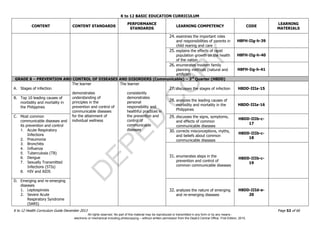
6. demonstrates ways to stay healthy
and prevent and control common
communicable diseases
H4DD-IIij-13
All rights reserved. No part of this material may be reproduced or transmitted in any form or by any means -
electronic or mechanical including photocopying – without written permission from the DepEd Central Office. First Edition, 2015.
D
EPED
C
O
PY
K to 12 BASIC EDUCATION CURRICULUM
K to 12 Health Curriculum Guide December 2013 Page 28 of 66
CONTENT CONTENT STANDARDS
PERFORMANCE
STANDARDS
LEARNING COMPETENCY CODE
LEARNING
MATERIALS
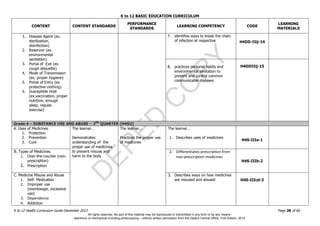
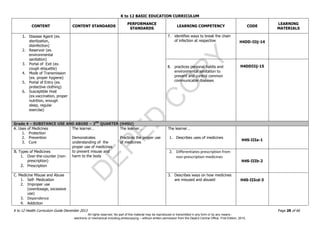
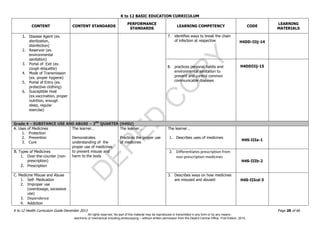
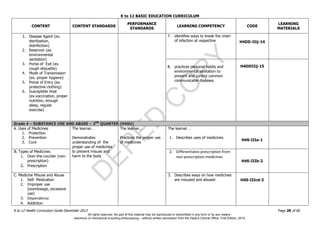
1. Disease Agent (ex.
sterilization,
disinfection)
2. Reservoir (ex.
environmental
sanitation)
3. Portal of Exit (ex.
cough etiquette)
4. Mode of Transmission
(ex. proper hygiene)
5. Portal of Entry (ex.
protective clothing)
6. Susceptible Host
(ex.vaccination, proper
nutrition, enough
sleep, regular
exercise)
7. identifies ways to break the chain
of infection at respective H4DD-IIij-14
8. practices personal habits and
environmental sanitation to
prevent and control common
communicable diseases
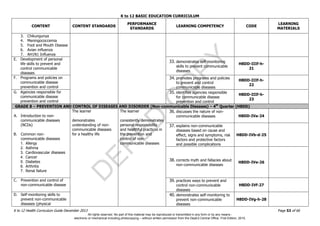
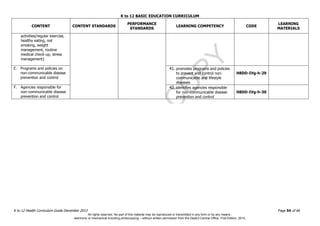
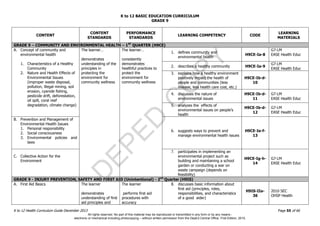
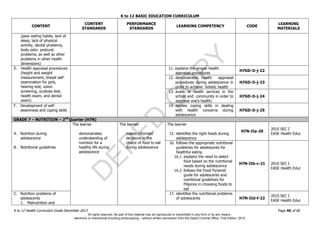
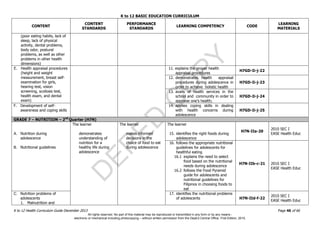
H4DDIIij-15
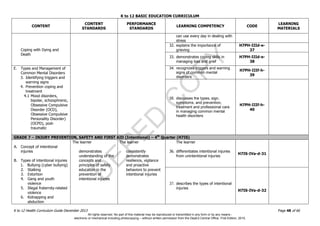
Grade 4 – SUBSTANCE USE AND ABUSE – 3RD
QUARTER (H4SU)
A. Uses of Medicines
1. Protection
2. Prevention
3. Cure
The learner…
Demonstrates
understanding of the
proper use of medicines
to prevent misuse and
harm to the body
The learner…
Practices the proper use
of medicines
The learner…
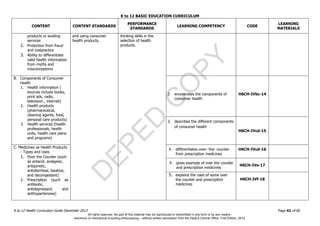
1. Describes uses of medicines
H4S-IIIa-1
B. Types of Medicines
1. Over-the-counter (non-
prescription)
2. Prescription
2. Differentiates prescription from
non-prescription medicines
H4S-IIIb-2
C. Medicine Misuse and Abuse
1. Self- Medication
2. Improper use
(overdosage, excessive
use)
3. Dependence
4. Addiction
3. Describes ways on how medicines
are misused and abused H4S-IIIcd-3
All rights reserved. No part of this material may be reproduced or transmitted in any form or by any means -
electronic or mechanical including photocopying – without written permission from the DepEd Central Office. First Edition, 2015.
D
EPED
C
O
PY
K to 12 BASIC EDUCATION CURRICULUM
K to 12 Health Curriculum Guide December 2013 Page 29 of 66
CONTENT CONTENT STANDARDS
PERFORMANCE
STANDARDS
LEARNING COMPETENCY CODE
LEARNING
MATERIALS
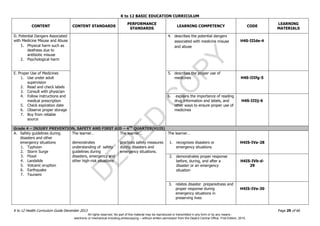
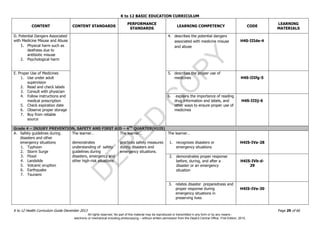
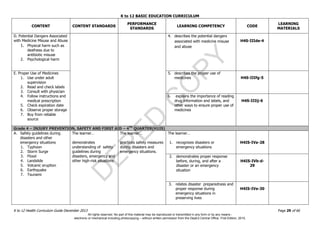
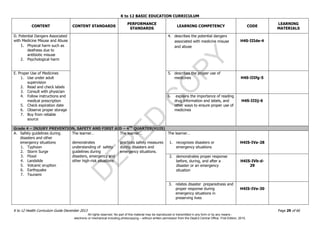
D. Potential Dangers Associated
with Medicine Misuse and Abuse
1. Physical harm such as
deafness due to
antibiotic misuse
2. Psychological harm
4. describes the potential dangers
associated with medicine misuse
and abuse
H4S-IIIde-4
E. Proper Use of Medicines
1. Use under adult
supervision
2. Read and check labels
3. Consult with physician
4. Follow instructions and
medical prescription
5. Check expiration date
6. Observe proper storage
7. Buy from reliable
source
5. describes the proper use of
medicines H4S-IIIfg-5
6. explains the importance of reading
drug information and labels, and
other ways to ensure proper use of
medicines
H4S-IIIij-6
Grade 4 – INJURY PREVENTION, SAFETY AND FIRST AID – 4TH
QUARTER(H1IS)
A. Safety guidelines during
disasters and other
emergency situations
1. Typhoon
2. Storm Surge
3. Flood
4. Landslide
5. Volcanic eruption
6. Earthquake
7. Tsunami
The learner…
demonstrates
understanding of safety
guidelines during
disasters, emergency and
other high-risk situations
The learner…
practices safety measures
during disasters and
emergency situations.
The learner…
1. recognizes disasters or
emergency situations
H4IS-IVa-28
2. demonstrates proper response
before, during, and after a
disaster or an emergency
situation
H4IS-IVb-d-
29
3. relates disaster preparedness and
proper response during
emergency situations in
preserving lives
H4IS-IVe-30
All rights reserved. No part of this material may be reproduced or transmitted in any form or by any means -
electronic or mechanical including photocopying – without written permission from the DepEd Central Office. First Edition, 2015.
D
EPED
C
O
PY
K to 12 BASIC EDUCATION CURRICULUM
K to 12 Health Curriculum Guide December 2013 Page 30 of 66
CONTENT CONTENT STANDARDS
PERFORMANCE
STANDARDS
LEARNING COMPETENCY CODE
LEARNING
MATERIALS
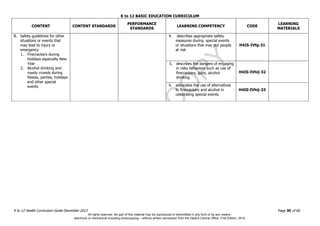
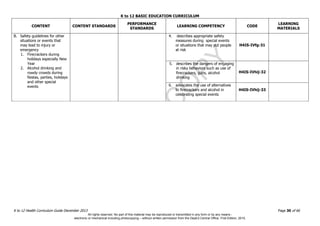
B. Safety guidelines for other
situations or events that
may lead to injury or
emergency
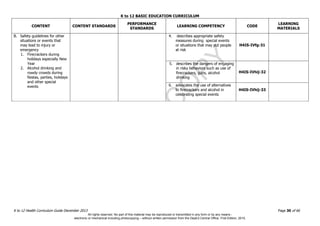
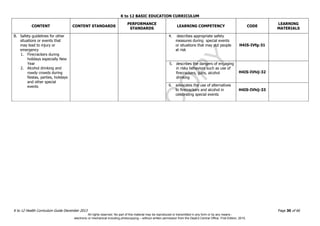
1. Firecrackers during
holidays especially New
Year
2. Alcohol drinking and
rowdy crowds during
fiestas, parties, holidays
and other special
events
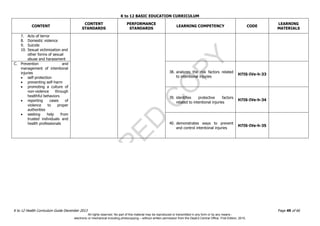
4. describes appropriate safety
measures during special events
or situations that may put people
at risk
H4IS-IVfg-31
5. describes the dangers of engaging
in risky behaviors such as use of
firecrackers, guns, alcohol
drinking
H4IS-IVhij-32
6. advocates the use of alternatives
to firecrackers and alcohol in
celebrating special events
H4IS-IVhij-33
All rights reserved. No part of this material may be reproduced or transmitted in any form or by any means -
electronic or mechanical including photocopying – without written permission from the DepEd Central Office. First Edition, 2015.
D
EPED
C
O
PY
K to 12 BASIC EDUCATION CURRICULUM
K to 12 Health Curriculum Guide December 2013 Page 31 of 66
GRADE 5
CONTENT
CONTENT
STANDARDS
PERFORMANCE
STANDARDS
LEARNING COMPETENCY CODE
LEARNING
MATERIALS
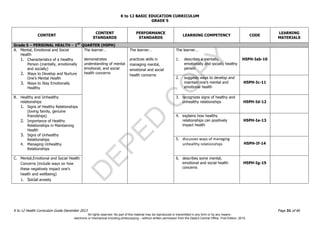
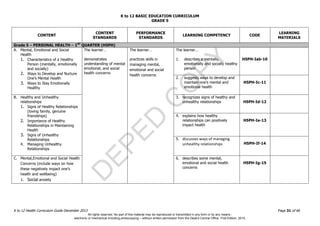
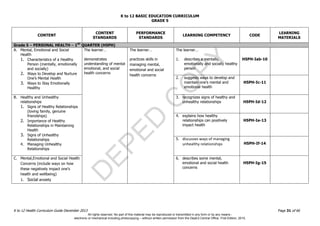
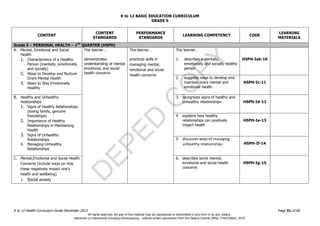
Grade 5 – PERSONAL HEALTH – 1ST
QUARTER (H5PH)
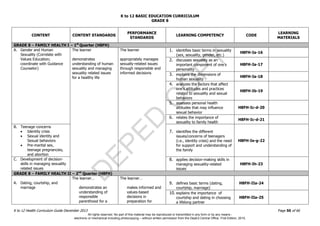
A. Mental, Emotional and Social
Health
1. Characteristics of a Healthy
Person (mentally, emotionally
and socially)
2. Ways to Develop and Nurture
One’s Mental Health
3. Ways to Stay Emotionally
Healthy
The learner…
demonstrates
understanding of mental
emotional, and social
health concerns
The learner…
practices skills in
managing mental,
emotional and social
health concerns
The learner…
1. describes a mentally,
emotionally and socially healthy
person
H5PH-Iab-10
2. suggests ways to develop and
maintain one’s mental and
emotional health
H5PH-Ic-11
B. Healthy and Unhealthy
relationships
1. Signs of Healthy Relationships
(loving family, genuine
friendships)
2. Importance of Healthy
Relationships in Maintaining
Health
3. Signs of Unhealthy
Relationships
4. Managing Unhealthy
Relationships
3. recognizes signs of healthy and
unhealthy relationships H5PH-Id-12
4. explains how healthy
relationships can positively
impact health
H5PH-Ie-13
5. discusses ways of managing
unhealthy relationships H5PH-If-14
C. Mental,Emotional and Social Health
Concerns (include ways on how
these negatively impact one’s
health and wellbeing)
1. Social anxiety
6. describes some mental,
emotional and social health
concerns
H5PH-Ig-15
All rights reserved. No part of this material may be reproduced or transmitted in any form or by any means -
electronic or mechanical including photocopying – without written permission from the DepEd Central Office. First Edition, 2015.
D
EPED
C
O
PY
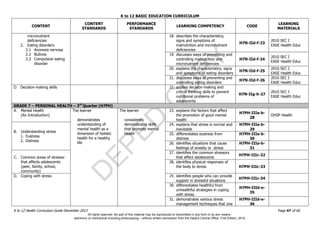
K to 12 BASIC EDUCATION CURRICULUM
K to 12 Health Curriculum Guide December 2013 Page 32 of 66
CONTENT
CONTENT
STANDARDS
PERFORMANCE
STANDARDS
LEARNING COMPETENCY CODE
LEARNING
MATERIALS
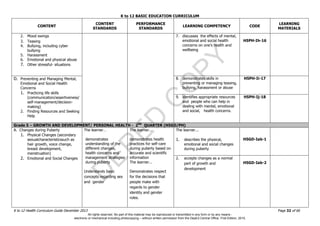
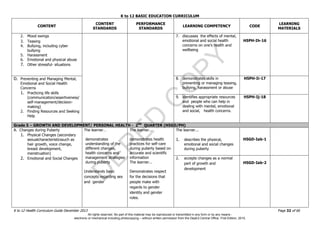
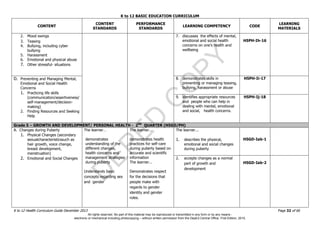
2. Mood swings
3. Teasing
4. Bullying, including cyber
bullying
5. Harassment
6. Emotional and physical abuse
7. Other stressful- situations
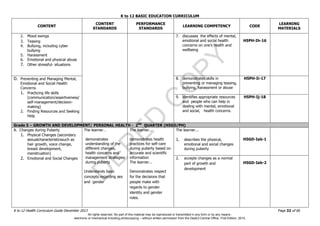
7. discusses the effects of mental,
emotional and social health
concerns on one’s health and
wellbeing
H5PH-Ih-16
D. Preventing and Managing Mental,
Emotional and Social Health
Concerns
1. Practicing life skills
(communication/assertiveness/
self-management/decision-
making)
2. Finding Resources and Seeking
Help
8. demonstrates skills in
preventing or managing teasing,
bullying, harassment or abuse
H5PH-Ii-17
9. identifies appropriate resources
and people who can help in
dealing with mental, emotional
and social, health concerns.
H5PH-Ij-18
Grade 5 – GROWTH AND DEVELOPMENT/ PERSONAL HEALTH - 2ND
QUARTER (H5GD/PH)
A. Changes during Puberty
1. Physical Changes (secondary
sexualcharacteristicssuch as
hair growth, voice change,
breast development,
menstruation)
2. Emotional and Social Changes
The learner…
demonstrates
understanding of the
different changes,
health concerns and
management strategies
during puberty
Understands basic
concepts regarding sex
and gender
The learner...
demonstrates health
practices for self-care
during puberty based on
accurate and scientific
information
The learner...
Demonstrates respect
for the decisions that
people make with
regards to gender
identity and gender
roles.
The learner...
1. describes the physical,
emotional and social changes
during puberty
H5GD-Iab-1
2. accepts changes as a normal
part of growth and
development
H5GD-Iab-2
All rights reserved. No part of this material may be reproduced or transmitted in any form or by any means -
electronic or mechanical including photocopying – without written permission from the DepEd Central Office. First Edition, 2015.
D
EPED
C
O
PY
K to 12 BASIC EDUCATION CURRICULUM
K to 12 Health Curriculum Guide December 2013 Page 33 of 66
CONTENT
CONTENT
STANDARDS
PERFORMANCE
STANDARDS
LEARNING COMPETENCY CODE
LEARNING
MATERIALS
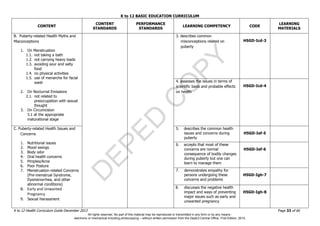
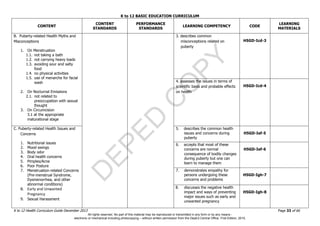
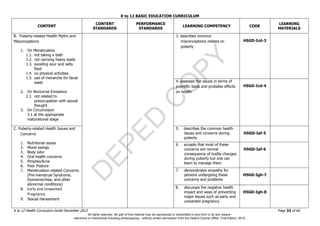
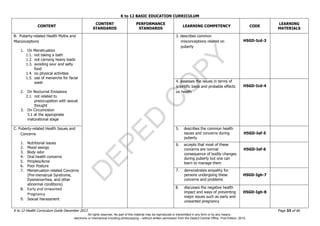
B. Puberty-related Health Myths and
Misconceptions
1. On Menstruation
1.1. not taking a bath
1.2. not carrying heavy loads
1.3. avoiding sour and salty
food
1.4. no physical activities
1.5. use of menarche for facial
wash
2. On Nocturnal Emissions
2.1. not related to
preoccupation with sexual
thought
3. On Circumcision
3.1 at the appropriate
maturational stage
3. describes common
misconceptions related on
puberty
H5GD-Icd-3
4. assesses the issues in terms of
scientific basis and probable effects
on health
H5GD-Icd-4
C. Puberty-related Health Issues and
Concerns
1. Nutritional issues
2. Mood swings
3. Body odor
4. Oral health concerns
5. Pimples/Acne
6. Poor Posture
7. Menstruation-related Concerns
(Pre-menstrual Syndrome,
Dysmenorrhea, and other
abnormal conditions)
8. Early and Unwanted
Pregnancy
9. Sexual Harassment
5. describes the common health
issues and concerns during
puberty
H5GD-Ief-5
6. accepts that most of these
concerns are normal
consequence of bodily changes
during puberty but one can
learn to manage them
H5GD-Ief-6
7. demonstrates empathy for
persons undergoing these
concerns and problems
H5GD-Igh-7
8. discusses the negative health
impact and ways of preventing
major issues such as early and
unwanted pregnancy
H5GD-Igh-8
All rights reserved. No part of this material may be reproduced or transmitted in any form or by any means -
electronic or mechanical including photocopying – without written permission from the DepEd Central Office. First Edition, 2015.
D
EPED
C
O
PY
K to 12 BASIC EDUCATION CURRICULUM
K to 12 Health Curriculum Guide December 2013 Page 34 of 66
CONTENT
CONTENT
STANDARDS
PERFORMANCE
STANDARDS
LEARNING COMPETENCY CODE
LEARNING
MATERIALS
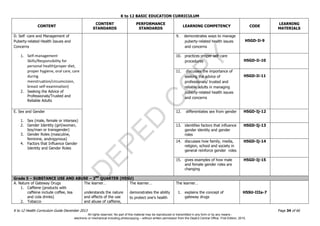
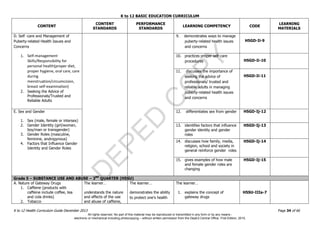
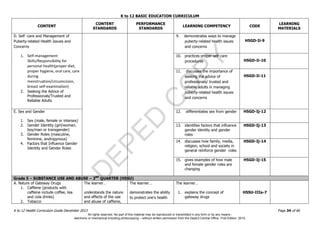
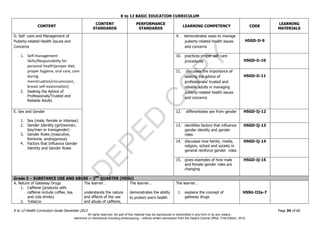
D. Self -care and Management of
Puberty-related Health Issues and
Concerns
1. Self-management
Skills/Responsibility for
personal health(proper diet,
proper hygiene, oral care, care
during
menstruation/circumcision,
breast self-examination)
2. Seeking the Advice of
Professionals/Trusted and
Reliable Adults
9. demonstrates ways to manage
puberty-related health issues
and concerns
H5GD-Ii-9
10. practices proper self-care
procedures H5GD-Ii-10
11. discusses the importance of
seeking the advice of
professionals/ trusted and
reliable adults in managing
puberty-related health issues
and concerns
H5GD-Ii-11
E. Sex and Gender
1. Sex (male, female or intersex)
2. Gender Identity (girl/woman,
boy/man or transgender)
3. Gender Roles (masculine,
feminine, androgynous)
4. Factors that Influence Gender
Identity and Gender Roles
12. differentiates sex from gender H5GD-Ij-12
13. identifies factors that influence
gender identity and gender
roles
H5GD-Ij-13
14. discusses how family, media,
religion, school and society in
general reinforce gender roles
H5GD-Ij-14
15. gives examples of how male
and female gender roles are
changing
H5GD-Ij-15
Grade 5 – SUBSTANCE USE AND ABUSE – 3RD
QUARTER (H5SU)
A. Nature of Gateway Drugs
1. Caffeine (products with
caffeine include coffee, tea
and cola drinks)
2. Tobacco
The learner…
understands the nature
and effects of the use
and abuse of caffeine,
The learner…
demonstrates the ability
to protect one’s health
The learner…
1. explains the concept of
gateway drugs
H5SU-IIIa-7
All rights reserved. No part of this material may be reproduced or transmitted in any form or by any means -
electronic or mechanical including photocopying – without written permission from the DepEd Central Office. First Edition, 2015.
D
EPED
C
O
PY
K to 12 BASIC EDUCATION CURRICULUM
K to 12 Health Curriculum Guide December 2013 Page 35 of 66
CONTENT
CONTENT
STANDARDS
PERFORMANCE
STANDARDS
LEARNING COMPETENCY CODE
LEARNING
MATERIALS
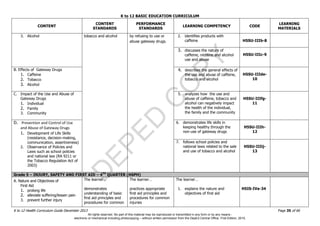
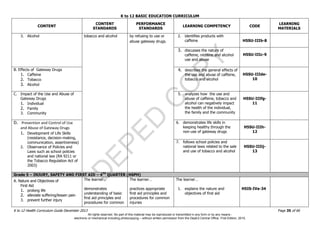
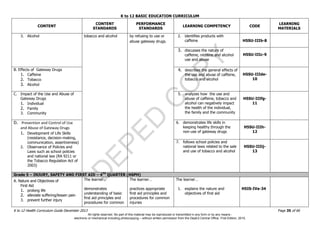
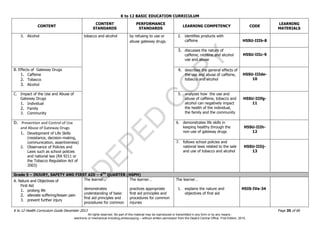
3. Alcohol tobacco and alcohol by refusing to use or
abuse gateway drugs.
2. identifies products with
caffeine H5SU-IIIb-8
3. discusses the nature of
caffeine, nicotine and alcohol
use and abuse
H5SU-IIIc-9
B. Effects of Gateway Drugs
1. Caffeine
2. Tobacco
3. Alcohol
4. describes the general effects of
the use and abuse of caffeine,
tobacco and alcohol
H5SU-IIIde-
10
C. Impact of the Use and Abuse of
Gateway Drugs
1. Individual
2. Family
3. Community
5. analyzes how the use and
abuse of caffeine, tobacco and
alcohol can negatively impact
the health of the individual,
the family and the community
H5SU-IIIfg-
11
D. Prevention and Control of Use
and Abuse of Gateway Drugs
1. Development of Life Skills
(resistance, decision-making,
communication, assertiveness)
2. Observance of Policies and
Laws such as school policies
and national law (RA 9211 or
the Tobacco Regulation Act of
2003)
6. demonstrates life skills in
keeping healthy through the
non-use of gateway drugs
H5SU-IIIh-
12
7. follows school policies and
national laws related to the sale
and use of tobacco and alcohol
H5SU-IIIij-
13
Grade 5 – INJURY, SAFETY AND FIRST AID – 4TH
QUARTER (H6PH)
A. Nature and Objectives of
First Aid
1. prolong life
2. alleviate suffering/lessen pain
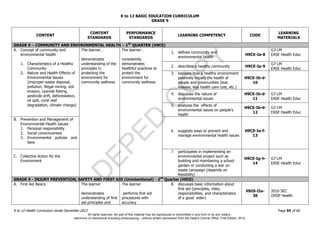
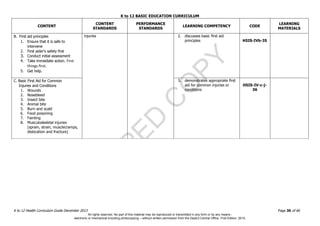
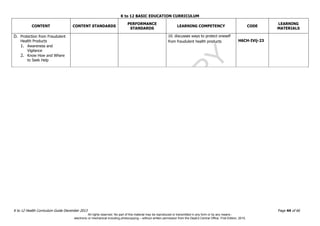
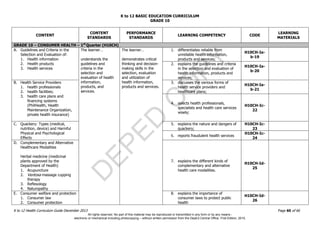
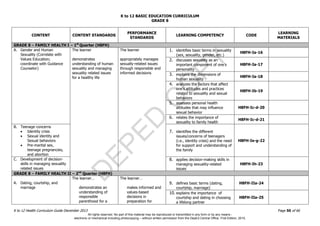
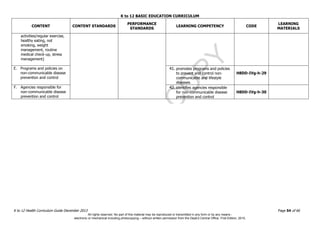
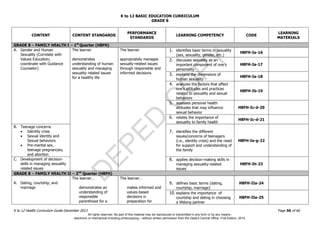
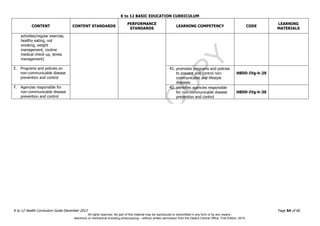
3. prevent further injury
The learner…
demonstrates
understanding of basic
first aid principles and
procedures for common
The learner…
practices appropriate
first aid principles and
procedures for common
injuries
The learner…
1. explains the nature and
objectives of first aid
H5IS-IVa-34
All rights reserved. No part of this material may be reproduced or transmitted in any form or by any means -
electronic or mechanical including photocopying – without written permission from the DepEd Central Office. First Edition, 2015.
D
EPED
C
O
PY
K to 12 BASIC EDUCATION CURRICULUM
K to 12 Health Curriculum Guide December 2013 Page 36 of 66
CONTENT
CONTENT
STANDARDS
PERFORMANCE
STANDARDS
LEARNING COMPETENCY CODE
LEARNING
MATERIALS
B. First aid principles
1. Ensure that it is safe to
intervene
2. First aider’s safety first
3. Conduct initial assessment
4. Take immediate action. First
things first.
5. Get help.
injuries 2. discusses basic first aid
principles H5IS-IVb-35
C. Basic First Aid for Common
Injuries and Conditions
1. Wounds
2. Nosebleed
3. Insect bite
4. Animal bite
5. Burn and scald
6. Food poisoning
7. Fainting
8. Musculoskeletal injuries
(sprain, strain, musclecramps,
dislocation and fracture)
3. demonstrates appropriate first
aid for common injuries or
conditions
H5IS-IV-c-j-
36
All rights reserved. No part of this material may be reproduced or transmitted in any form or by any means -
electronic or mechanical including photocopying – without written permission from the DepEd Central Office. First Edition, 2015.
D
EPED
C
O
PY
K to 12 BASIC EDUCATION CURRICULUM
K to 12 Health Curriculum Guide December 2013 Page 37 of 66
GRADE 6
CONTENT CONTENT STANDARDS
PERFORMANCE
STANDARDS
LEARNING COMPETENCY CODE
LEARNING
MATERIALS
Grade 6 – PERSONAL HEALTH – 1ST
QUARTER (H6PH)
A. Personal Health -Issues and
Concerns
1. height and
weight(stunted growth,
underweight,
overweight, obesity)
2. hearing (impacted
cerumen, swimmer’s
ear, otitis media)
3. vision
4. (astigmatism, myopia,
hyperopia,xerophthalmi
a, strabismus)
5. skin, hair andand nail
6. (sunburn, dandruff
,corns, blisters and
calluses, ingrown
toenails)
7. posture and spine
disorders (scoliosis,
lordosis, kyphosis)
8. oral/dental problems
(cavities, gingivitis,
periodontitis,
malocclusion, halitosis)
The learner…
Demonstrates
understanding of
personal health issues
and concerns and the
importance of health
appraisal procedures and
community resources in
preventing or managing
them
The learner…
practices self-
management skills to
prevent and control
personal health issues
and concerns
The learner…
1. describes personal health issues and
concerns
H6PH-Iab-18
All rights reserved. No part of this material may be reproduced or transmitted in any form or by any means -
electronic or mechanical including photocopying – without written permission from the DepEd Central Office. First Edition, 2015.
D
EPED
C
O
PY
K to 12 BASIC EDUCATION CURRICULUM
K to 12 Health Curriculum Guide December 2013 Page 38 of 66
CONTENT CONTENT STANDARDS
PERFORMANCE
STANDARDS
LEARNING COMPETENCY CODE
LEARNING
MATERIALS
B. Prevention and
Management of Personal
Health Issues and Concerns
1. Developing Self-
management Skills
(proper nutrition, proper
hygiene, regular physical
activity, enough rest and
sleep, good posture, oral
care)
2. Undergoing Health
Appraisal Procedures
(height and weight
measurement, breast
self-examination for
girls, hearing test,
vision screening,
scoliosis test and health
and dental
examinations)
3. Utilizing School and
Community Health
Resources
3.1. Medical Professionals /
Practitioners (doctor,
dentist, nurse)
3.2. Health Facilities
3.3. School Clinic
3.4. Barangay Health
Station/Rural Health
Unit
2. demonstrates self-management
skills
H6PH-Iab-19
3. discusses health appraisal
procedures during puberty
H6PH-Ic-20
4. explains the importance of
undergoing health appraisal
procedures
H6PH-Id-f-21
5. regularly undergoes health
appraisal procedures
H6PH-Id-f-22
6. identifies community health
resources and facilities that may
be utilized to address a variety of
personal health issues and
concerns
H6PH-Igh-23
7. avails of health services in the
school and in the community
H6PH-Igh-24
8. promotes the use of health
resources and facilities in the
school and in the community
H6PH-Igh-25
All rights reserved. No part of this material may be reproduced or transmitted in any form or by any means -
electronic or mechanical including photocopying – without written permission from the DepEd Central Office. First Edition, 2015.
D
EPED
C
O
PY
K to 12 BASIC EDUCATION CURRICULUM
K to 12 Health Curriculum Guide December 2013 Page 39 of 66
CONTENT CONTENT STANDARDS
PERFORMANCE
STANDARDS
LEARNING COMPETENCY CODE
LEARNING
MATERIALS
Grade 6 – COMMUNITY HEALTH – 2ND
QUARTER (H6CMH)
A. Healthy School and
Community Environments
1. Characteristics
1.1. physical
environment (safe,
clean, with good air
and water quality,
aesthetically
pleasing, with
flexible spaces)
1.2. psychosocial
environment (warm
atmosphere,
healthy
interpersonal
relations, free from
abuse and
discrimination)
2. Ways of Building and
Maintaining Healthy
School and Community
Environments
The learner…
understands the
importance of keeping
the school and
community environments
healthy.
The learner…
demonstrates practices
for building and
maintaining healthy
school and community
environments
The learner…
1.describes healthy school and
community environments H6CMH-IIa-1
2. explains the effect of living in a
healthful school and community
H6CMH-IIb-2
3. demonstrates ways to build and
keep school and community
environments healthy
H6CMH-IIc-d-
3
B. Keeping Homes, Schools and
Communities Healthy
through Proper Waste
Management
1. Identification and
4. identifies different wastes
H6CMH-IIe-4
All rights reserved. No part of this material may be reproduced or transmitted in any form or by any means -
electronic or mechanical including photocopying – without written permission from the DepEd Central Office. First Edition, 2015.
D
EPED
C
O
PY
K to 12 BASIC EDUCATION CURRICULUM
K to 12 Health Curriculum Guide December 2013 Page 40 of 66
CONTENT CONTENT STANDARDS
PERFORMANCE
STANDARDS
LEARNING COMPETENCY CODE
LEARNING
MATERIALS
Separation of Waste
1.1 Biodegradable
1.1.1 paper
1.1.2 kitchen waste
1.1.3 yard cuttings-
1.2 Non-biodegradable
1.2.1 plastics
1.2.2 styrofoam
1.2.3 glass
1.2.4 cans
1.3 Hazardous waste
1.3.1 chemicals
1.3.2 used batteries
1.3.3 expired medicines
2. Proper Waste
Management
2.1 Waste Reduction
(reuse)
2.2 Waste Storage
(separation of
biodegradable from non-
biodegradable, tight-
fitting storage containers)
2.3 Waste Disposal
(composting, recycling,
proper disposal of
hazardous waste)
5. classifies different types of wastes
H6CMH-IIe-5
6. Describes proper ways of waste
disposal H6CMH-IIf-6
7. identifies things that can be
recycled in school and in the
community
H6CMH-IIg-7
8. practices proper waste
management at home, in school,
and in the community
H6CMH-IIh-8
9. advocates environmental protection
through proper waste management
H6CMH-IIij-9
Grade 6 – ENVIRONMENTAL HEALTH – 3RD
QUARTER (H6EH)
A. Diseases and Disorders
caused by Poor
Environmental Sanitation
1. Respiratory Diseases
The learner…
demonstrates
understanding of the
health implications of
The learner…
consistently practices
ways to maintain a
healthy environment
The learner…
1. describes diseases and disorders
caused by poor environmental
H6EH-IIIa-1
All rights reserved. No part of this material may be reproduced or transmitted in any form or by any means -
electronic or mechanical including photocopying – without written permission from the DepEd Central Office. First Edition, 2015.
D
EPED
C
O
PY
K to 12 BASIC EDUCATION CURRICULUM
K to 12 Health Curriculum Guide December 2013 Page 41 of 66
CONTENT CONTENT STANDARDS
PERFORMANCE
STANDARDS
LEARNING COMPETENCY CODE
LEARNING
MATERIALS
2. Skin Diseases
3. Gastrointestinal
Diseases
4. Neurological
Impairment (lead and
mercury poisoning)
poor environmental
sanitation
sanitation
2. explains how poor environmental
sanitation can negatively impact
the health of an individual
H6EH-IIIb-2
B. Environmental Sanitation
1. Clean water: access to
potable water, making
water safer
2. Clean air: prevention of
air pollution, tobacco
control, anti-smoke
belching drives
3. Control of noise
pollution Control of
pests and rodents
3. discusses ways to keep water
and air clean and safe H6EH-IIIc-3
4. explains the effect of a noisy
environment H6EH-IIId-4
5. suggests ways to control/manage
noise pollution H6EH-IIIe-5
6. practices ways to control/manage
noise pollution H6EH-IIIfg-6
7. explains the effect of pests and
rodents to ones health H6EH-IIIhi-7
8. identifies some common diseases
caused by pests and rodents H6EH-IIIhi-8
9. practice ways to prevent and
control pests and rodents
H6EH-IIIj-9
Grade 6 – CONSUMER HEALTH – 4TH
QUARTER (H6CH)
A. Importance of Consumer
Health
1. Wise and informed
decision in purchasing
The learner…
understands the concepts
and principles of selecting
The learner…
Consistently
demonstrates critical
The learner…
1. explains the importance of
consumer health
H6CH-IVa-13
All rights reserved. No part of this material may be reproduced or transmitted in any form or by any means -
electronic or mechanical including photocopying – without written permission from the DepEd Central Office. First Edition, 2015.
D
EPED
C
O
PY
K to 12 BASIC EDUCATION CURRICULUM
K to 12 Health Curriculum Guide December 2013 Page 42 of 66
CONTENT CONTENT STANDARDS
PERFORMANCE
STANDARDS
LEARNING COMPETENCY CODE
LEARNING
MATERIALS
products or availing
services
2. Protection from fraud
and malpractice
3. Ability to differentiate
valid health information
from myths and
misconceptions
and using consumer
health products.
thinking skills in the
selection of health
products.
B. Components of Consumer
health
1. Health information (
sources include books,
print ads, radio,
television , internet)
2. Health products
(pharmaceutical,
cleaning agents, food,
personal care products)
3. Health services (health
professionals, health
units, health care plans
and programs)
2. enumerates the components of
consumer health
H6CH-IVbc-14
3. describes the different components
of consumer health
H6CH-IVcd-15
C. Medicines as Health Products
: Types and Uses
1. Over the Counter (such
as antacid, analgesic,
antipyretic,
antidiarrheal, laxative,
and decongestant)
2. Prescription (such as
antibiotic,
antidepressant, and
antihypertensive)
4. differentiates over- the- counter
from prescription medicines
H6CH-IVcd-16
4. gives example of over the counter
and prescription medicines
H6CH-IVe-17
5. explains the uses of some over
the counter and prescription
medicines
H6CH-IVf-18
All rights reserved. No part of this material may be reproduced or transmitted in any form or by any means -
electronic or mechanical including photocopying – without written permission from the DepEd Central Office. First Edition, 2015.
D
EPED
C
O
PY
K to 12 BASIC EDUCATION CURRICULUM
K to 12 Health Curriculum Guide December 2013 Page 43 of 66
CONTENT CONTENT STANDARDS
PERFORMANCE
STANDARDS
LEARNING COMPETENCY CODE
LEARNING
MATERIALS
D. Evaluating Health Products
1. Ask questions (What is
the motive of the ad?
What is misleading
about the ad?)
2. Identify the propaganda
techniques used
(testimonial, reward,
bandwagon, scientific,
novelty, humor, fear,
plain folks, snob,
glittering generality,
slogan, false image, and
others)
3. Read packaging and
label
6. identifies the common
propaganda techniques used in
advertising
H6CH-IVg-19
7. Identifies the common propaganda
techniques used in advertising
H6CH-IVg-20
8. analyzes packaging and labels of
health products
H6CH-IVh-21
C. Use the modified DECIDE
Model in the Selection and
Purchase of Health Products
D-etermine the
essential product to
purchase.
E-xplore the
alternatives.
C-Consider the
consequences of each
option
I- Identify the factors
that you consider
important
D- Decide what to buy.
E- Evaluate your
decision.
9. practices good decision making
skills in the selection of health
products.
H6CH-IVh-22
All rights reserved. No part of this material may be reproduced or transmitted in any form or by any means -
electronic or mechanical including photocopying – without written permission from the DepEd Central Office. First Edition, 2015.
D
EPED
C
O
PY
K to 12 BASIC EDUCATION CURRICULUM
K to 12 Health Curriculum Guide December 2013 Page 44 of 66
CONTENT CONTENT STANDARDS
PERFORMANCE
STANDARDS
LEARNING COMPETENCY CODE
LEARNING
MATERIALS
D. Protection from Fraudulent
Health Products
1. Awareness and
Vigilance
2. Know How and Where
to Seek Help
10. discusses ways to protect oneself
from fraudulent health products H6CH-IVij-23
All rights reserved. No part of this material may be reproduced or transmitted in any form or by any means -
electronic or mechanical including photocopying – without written permission from the DepEd Central Office. First Edition, 2015.
D
EPED
C
O
PY
K to 12 BASIC EDUCATION CURRICULUM
K to 12 Health Curriculum Guide December 2013 Page 45 of 66
GRADE 7
CONTENT
CONTENT
STANDARDS
PERFORMANCE
STANDARDS
LEARNING COMPETENCY CODE
LEARNING
MATERIALS
GRADE 7 - GROWTH AND DEVELOPMENT – 1st
Quarter (H7GD)
A. Holistic health
The learner…
demonstrates
understanding of holistic
health and its
management of health
concerns, the growth and
development of
adolescents and how to
manage its challenges.
The learner…
appropriately manages
concerns and challenges
during adolescence to
achieve holistic health.
The learner…
1. discusses the concept of holistic
health
H7GD-Ia-12
OHSP in Health
2010 SEC
2. explains the dimensions of holistic
health (physical, mental/
intellectual, emotional, social, and
moral-spiritual);
H7GD-Ib-13
OHSP in Health
2010 SEC
3. analyzes the interplay among the
health dimensions in developing
holistic health;
H7GD-Ib-14
OHSP in Health
2010 SEC
4. practices health habits to achieve
holistic health;
H7GD-Ic-15
OHSP in Health
2010 SEC
B. Stages of growth and
development
(infancy to old age)
5. describes developmental milestones
as one grow
H7GD-Id-e-16
OHSP in Health
2010 SEC
C. Changes in the health
dimensions during
adolescence
6. recognizes that changes in different
health dimensions are normal
during adolescence;
H7GD-Id-e-17
OHSP in Health
2010 SEC
7. describes changes in different
aspects of growth that happen to
boys and girls during adolescence;
H7GD-Id-e-18
OHSP in Health
2010 SEC
8. recognizes that changes in different
dimensions are normal during
adolescence’
H7GD-If-h-19
OHSP in Health
2010 SEC
9. explains that the pattern of change
during adolescence is similar but
the pace of growth and
development is unique for each
adolescent;
H7GD-If-h-20
D. Management of health
concerns during
adolescence
10. identifies health concerns during
adolescence H7GD-Ii-j-21
All rights reserved. No part of this material may be reproduced or transmitted in any form or by any means -
electronic or mechanical including photocopying – without written permission from the DepEd Central Office. First Edition, 2015.
D
EPED
C
O
PY
K to 12 BASIC EDUCATION CURRICULUM
K to 12 Health Curriculum Guide December 2013 Page 46 of 66
CONTENT
CONTENT
STANDARDS
PERFORMANCE
STANDARDS
LEARNING COMPETENCY CODE
LEARNING
MATERIALS
(poor eating habits, lack of
sleep, lack of physical
activity, dental problems,
body odor, postural
problems, as well as other
problems in other health
dimensions)
E. Health appraisal procedures
(height and weight
measurement, breast self-
examination for girls,
hearing test, vision
screening, scoliosis test,
health exam, and dental
exam)
11. explains the proper health
appraisal procedures
H7GD-Ii-j-22
12. demonstrates health appraisal
procedures during adolescence in
order to achieve holistic health
H7GD-Ii-j-23
13. avails of health services in the
school and community in order to
appraise one’s health;
H7GD-Ii-j-24
F. Development of self-
awareness and coping skills
14. applies coping skills in dealing
with health concerns during
adolescence
H7GD-Ii-j-25
GRADE 7 – NUTRITION – 2nd
Quarter (H7N)
A. Nutrition during
adolescence
B. Nutritional guidelines
The learner
demonstrates
understanding of
nutrition for a
healthy life during
adolescence
The learner
makes informed
decisions in the
choice of food to eat
during adolescence
The learner
15. identifies the right foods during
adolescence
H7N-IIa-20
2010 SEC I
EASE Health Educ
16. follows the appropriate nutritional
guidelines for adolescents for
healthful eating
16.1 explains the need to select
food based on the nutritional
needs during adolescence
16.2 follows the Food Pyramid
guide for adolescents and
nutritional guidelines for
Filipinos in choosing foods to
eat
H7N-IIb-c-21 2010 SEC I
EASE Health Educ
C. Nutrition problems of
adolescents
1. Malnutrition and
17. identifies the nutritional problems
of adolescents H7N-IId-f-22
2010 SEC I
EASE Health Educ
All rights reserved. No part of this material may be reproduced or transmitted in any form or by any means -
electronic or mechanical including photocopying – without written permission from the DepEd Central Office. First Edition, 2015.
D
EPED
C
O
PY
K to 12 BASIC EDUCATION CURRICULUM
K to 12 Health Curriculum Guide December 2013 Page 47 of 66
CONTENT
CONTENT
STANDARDS
PERFORMANCE
STANDARDS
LEARNING COMPETENCY CODE
LEARNING
MATERIALS
micronutrient
deficiencies
2. Eating disorders
2.1 Anorexia nervosa
2.2 Bulimia
2.3 Compulsive eating
disorder
18. describes the characteristics,
signs and symptoms of
malnutrition and micronutrient
deficiencies
H7N-IId-f-23
2010 SEC I
EASE Health Educ
19. discusses ways of preventing and
controlling malnutrition and
micronutrient deficiencies
H7N-IId-f-24
2010 SEC I
EASE Health Educ
20. explains the characteristics, signs
and symptoms of eating disorders
H7N-IId-f-25
2010 SEC I
EASE Health Educ
21. discusses ways of preventing and
controlling eating disorders
H7N-IId-f-26
2010 SEC I
EASE Health Educ
D. Decision-making skills 22. applies decision-making and
critical thinking skills to prevent
nutritional problems of
adolescents
H7N-IIg-h-27
2010 SEC I
EASE Health Educ
GRADE 7 – PERSONAL HEALTH – 3rd
Quarter (H7PH)
A. Mental Health
(An Introduction)
The learner
demonstrates
understanding of
mental health as a
dimension of holistic
health for a healthy
life
The learner
consistently
demonstrates skills
that promote mental
health
23. explains the factors that affect
the promotion of good mental
health
H7PH-IIIa-b-
28
OHSP Health
B. Understanding stress
1. Eustress
2. Distress
24. explains that stress is normal and
inevitable
H7PH-IIIa-b-
29
25. differentiates eustress from
distress
H7PH-IIIa-b-
30
26. identifies situations that cause
feelings of anxiety or stress
H7PH-IIIa-b-
31
C. Common areas of stressor
that affects adolescents
(peer, family, school,
community)
27. identifies the common stressors
that affect adolescents
H7PH-IIIc-32
28. identifies physical responses of
the body to stress H7PH-IIIc-33
D. Coping with stress 29. identifies people who can provide
support in stressful situations
H7PH-IIIc-34
30. differentiates healthful from
unhealthful strategies in coping
with stress
H7PH-IIId-e-
35
31. demonstrates various stress
management techniques that one
H7PH-IIId-e-
36
All rights reserved. No part of this material may be reproduced or transmitted in any form or by any means -
electronic or mechanical including photocopying – without written permission from the DepEd Central Office. First Edition, 2015.
D
EPED
C
O
PY
K to 12 BASIC EDUCATION CURRICULUM
K to 12 Health Curriculum Guide December 2013 Page 48 of 66
CONTENT
CONTENT
STANDARDS
PERFORMANCE
STANDARDS
LEARNING COMPETENCY CODE
LEARNING
MATERIALS
Coping with Dying and
Death
can use every day in dealing with
stress
32. explains the importance of
grieving
H7PH-IIId-e-
37
33. demonstrates coping skills in
managing loss and grief
H7PH-IIId-e-
38
E. Types and Management of
Common Mental Disorders
3. Identifying triggers and
warning signs
4. Prevention coping and
treatment
4.1 Mood disorders,
bipolar, schizophrenic,
Obsessive Compulsive
Disorder (OCD),
Obsessive Compulsive
Personality Disorder)
(OCPD), post-
traumatic
34. recognizes triggers and warning
signs of common mental
disorders
H7PH-IIIf-h-
39
35. discusses the types, sign,
symptoms, and prevention,
treatment and professional care
in managing common mental
health disorders
H7PH-IIIf-h-
40
GRADE 7 – INJURY PREVENTION, SAFETY AND FIRST AID (Intentional) – 4th
Quarter (H7IS)
A. Concept of intentional
injuries
B. Types of intentional injuries
1. Bullying (cyber bullying)
2. Stalking
3. Extortion
4. Gang and youth
violence
5. Illegal fraternity-related
violence
6. Kidnapping and
abduction
The learner
demonstrates
understanding of the
concepts and
principles of safety
education in the
prevention of
intentional injuries
The learner
consistently
demonstrates
resilience, vigilance
and proactive
behaviors to prevent
intentional injuries
The learner
36. differentiates intentional injuries
from unintentional injuries
H7IS-IVa-d-31
37. describes the types of intentional
injuries
H7IS-IVa-d-32
All rights reserved. No part of this material may be reproduced or transmitted in any form or by any means -
electronic or mechanical including photocopying – without written permission from the DepEd Central Office. First Edition, 2015.
D
EPED
C
O
PY
K to 12 BASIC EDUCATION CURRICULUM
K to 12 Health Curriculum Guide December 2013 Page 49 of 66
CONTENT
CONTENT
STANDARDS
PERFORMANCE
STANDARDS
LEARNING COMPETENCY CODE
LEARNING
MATERIALS
7. Acts of terror
8. Domestic violence
9. Suicide
10. Sexual victimization and
other forms of sexual
abuse and harassment
C. Prevention and
management of intentional
injuries
 self-protection
 preventing self-harm
 promoting a culture of
non-violence through
healthful behaviors
 reporting cases of
violence to proper
authorities
 seeking help from
trusted individuals and
health professionals
38. analyzes the risk factors related
to intentional injuries
H7IS-IVe-h-33
39. identifies protective factors
related to intentional injuries
H7IS-IVe-h-34
40. demonstrates ways to prevent
and control intentional injuries
H7IS-IVe-h-35
All rights reserved. No part of this material may be reproduced or transmitted in any form or by any means -
electronic or mechanical including photocopying – without written permission from the DepEd Central Office. First Edition, 2015.
D
EPED
C
O
PY
K to 12 BASIC EDUCATION CURRICULUM
K to 12 Health Curriculum Guide December 2013 Page 50 of 66
GRADE 8
CONTENT CONTENT STANDARDS
PERFORMANCE
STANDARDS
LEARNING COMPETENCY CODE
LEARNING
MATERIALS
GRADE 8 – FAMILY HEALTH I – 1st
Quarter (H8FH)
A. Gender and Human
Sexuality (Correlate with
Values Education;
coordinate with Guidance
Counselor)
The learner
demonstrates
understanding of human
sexuality and managing
sexuality related issues
for a healthy life
The learner
appropriately manages
sexually-related issues
through responsible and
informed decisions
1. identifies basic terms in sexuality
(sex, sexuality, gender, etc.)
H8FH-Ia-16
2. discusses sexuality as an
important component of one’s
personality
H8FH-Ia-17
3. explains the dimensions of
human sexuality
H8FH-Ia-18
4. analyzes the factors that affect
one’s attitudes and practices
related to sexuality and sexual
behaviors
H8FH-Ib-19
5. assesses personal health
attitudes that may influence
sexual behavior
H8FH-Ic-d-20
6. relates the importance of
sexuality to family health
H8FH-Ic-d-21
B. Teenage concerns
 Identity crisis
 Sexual identity and
Sexual behaviors
 Pre-marital sex,
teenage pregnancies,
and abortion
7. identifies the different
issues/concerns of teenagers
(i.e., identity crisis) and the need
for support and understanding of
the family
H8FH-Ie-g-22
C. Development of decision-
skills in managing sexuality
related issues
8. applies decision-making skills in
managing sexuality-related
issues
H8FH-Ih-23
GRADE 8 – FAMILY HEALTH II – 2nd
Quarter (H8FH)
A. Dating, courtship, and
marriage
The learner…
demonstrates an
understanding of
responsible
parenthood for a
The learner…
makes informed and
values-based
decisions in
preparation for
9. defines basic terms (dating,
courtship, marriage)
H8FH-IIa-24
10. explains the importance of
courtship and dating in choosing
a lifelong partner
H8FH-IIa-25
All rights reserved. No part of this material may be reproduced or transmitted in any form or by any means -
electronic or mechanical including photocopying – without written permission from the DepEd Central Office. First Edition, 2015.
D
EPED
C
O
PY
K to 12 BASIC EDUCATION CURRICULUM
K to 12 Health Curriculum Guide December 2013 Page 51 of 66
CONTENT CONTENT STANDARDS
PERFORMANCE
STANDARDS
LEARNING COMPETENCY CODE
LEARNING
MATERIALS
B. Maternal Health concerns
1. Pre-pregnancy
(blighted ovary, ectopic
pregnancy, polycystic
ovary, myoma)
2. During pregnancy
(pre-eclampsia,
placenta previa,
gestational, diabetes,)
3. Post pregnancy
(post-partum disorder,
sepsis
healthy family life responsible
parenthood
11. identifies marital practices and
setup across cultures H8FH-IIa-26
12. analyzes behaviors that promote
healthy relationship in marriage
and family life
H8FH-IIa-27
13. describes the factors that
contribute to a successful
marriage
H8FH-IIb-28
14. discusses various maternal
health concerns (pre-during-post
pregnancy)
H8FH-IIc-d-29
15. discusses pregnancy-related
concerns
H8FH-IIc-d-30
16. explains the importance of
maternal nutrition during
pregnancy
H8FH-IIe-f-31
17. discusses the importance of
newborn screening, and the
APGAR scoring system for
newborns
H8FH-IIe-f-32
18. explains the importance of
prenatal care and post natal care
H8FH-IIe-f-33
19. discusses the essential newborn
protocol (Unang Yakap) and
initiation of breastfeeding
H8FH-IIe-f-34
20. enumerates the advantages of
breastfeeding for both mother
and child
H8FH-IIe-f-35
21. recognizes the importance of
immunization in protecting
children’s health
H8FH-IIe-f-36
C. Responsible parenthood 22. analyzes the importance of
responsible parenthood
H8FH-IIg-h-37
23. explains the effects of family size
on family health
H8FH-IIg-h-38
All rights reserved. No part of this material may be reproduced or transmitted in any form or by any means -
electronic or mechanical including photocopying – without written permission from the DepEd Central Office. First Edition, 2015.
D
EPED
C
O
PY
K to 12 BASIC EDUCATION CURRICULUM
K to 12 Health Curriculum Guide December 2013 Page 52 of 66
CONTENT CONTENT STANDARDS
PERFORMANCE
STANDARDS
LEARNING COMPETENCY CODE
LEARNING
MATERIALS
24. examines the important roles
and responsibilities of parents in
child rearing and care
H8FH-IIg-h-39
25. explains the effects of rapid
population growth on the health
of the nation
H8FH-IIg-h-40
26. enumerates modern family
planning methods (natural and
artificial)
H8FH-Iig-h-41
GRADE 8 – PREVENTION AND CONTROL OF DISEASES AND DISORDERS (Communicable) – 3rd
Quarter (H8DD)
A. Stages of infection
The learner
demonstrates
understanding of
principles in the
prevention and control of
communicable diseases
for the attainment of
individual wellness
The learner
consistently
demonstrates
personal
responsibility and
healthful practices in
the prevention and
control of
communicable
diseases
27. discusses the stages of infection H8DD-IIIa-15
B. Top 10 leading causes of
morbidity and mortality in
the Philippines
28. analyzes the leading causes of
morbidity and mortality in the
Philippines
H8DD-IIIa-16
C. Most common
communicable diseases and
its prevention and control
1. Acute Respiratory
Infections
2. Pneumonia
3. Bronchitis
4. Influenza
5. Tuberculosis (TB)
6. Dengue
7. Sexually Transmitted
Infections (STIs)
8. HIV and AIDS
29. discusses the signs, symptoms,
and effects of common
communicable diseases
H8DD-IIIb-c-
17
30. corrects misconceptions, myths,
and beliefs about common
communicable diseases
H8DD-IIIb-c-
18
31. enumerates steps in the
prevention and control of
common communicable diseases
H8DD-IIIb-c-
19
D. Emerging and re-emerging
diseases
1. Leptospirosis
2. Severe Acute
Respiratory Syndrome
(SARS)
32. analyzes the nature of emerging
and re-emerging diseases
H8DD-IIId-e-
20
All rights reserved. No part of this material may be reproduced or transmitted in any form or by any means -
electronic or mechanical including photocopying – without written permission from the DepEd Central Office. First Edition, 2015.
D
EPED
C
O
PY
K to 12 BASIC EDUCATION CURRICULUM
K to 12 Health Curriculum Guide December 2013 Page 53 of 66
CONTENT CONTENT STANDARDS
PERFORMANCE
STANDARDS
LEARNING COMPETENCY CODE
LEARNING
MATERIALS
3. Chikungunya
4. Meningococcemia
5. Foot and Mouth Disease
6. Avian influenza
7. AH1N1 Influenza
E. Development of personal
life skills to prevent and
control communicable
diseases
33. demonstrates self-monitoring
skills to prevent communicable
diseases
H8DD-IIIf-h-
21
F. Programs and policies on
communicable disease
prevention and control
34. promotes programs and policies
to prevent and control
communicable diseases
H8DD-IIIf-h-
22
G. Agencies responsible for
communicable disease
prevention and control
35. identifies agencies responsible
for communicable disease
prevention and control
H8DD-IIIf-h-
23
GRADE 8 – PREVENTION AND CONTROL OF DISEASES AND DISORDER (Non-communicable Diseases) – 4th
Quarter (H8DD)
A. Introduction to non-
communicable diseases
(NCDs)
B. Common non-
communicable diseases
1. Allergy
2. Asthma
3. Cardiovascular diseases
4. Cancer
5. Diabetes
6. Arthritis
7. Renal failure
The learner
demonstrates
understanding of non-
communicable diseases
for a healthy life
The learner
consistently demonstrates
personal responsibility
and healthful practices in
the prevention and
control of non-
communicable diseases
36. discusses the nature of non-
communicable diseases H8DD-IVa-24
37. explains non-communicable
diseases based on cause and
effect, signs and symptoms, risk
factors and protective factors
and possible complications
H8DD-IVb-d-25
38. corrects myth and fallacies about
non-communicable diseases
H8DD-IVe-26
C. Prevention and control of
non-communicable disease
39. practices ways to prevent and
control non-communicable
diseases
H8DD-IVf-27
D. Self-monitoring skills to
prevent non-communicable
diseases (physical
40. demonstrates self-monitoring to
prevent non-communicable
diseases
H8DD-IVg-h-28
All rights reserved. No part of this material may be reproduced or transmitted in any form or by any means -
electronic or mechanical including photocopying – without written permission from the DepEd Central Office. First Edition, 2015.
D
EPED
C
O
PY
K to 12 BASIC EDUCATION CURRICULUM
K to 12 Health Curriculum Guide December 2013 Page 54 of 66
CONTENT CONTENT STANDARDS
PERFORMANCE
STANDARDS
LEARNING COMPETENCY CODE
LEARNING
MATERIALS
activities/regular exercise,
healthy eating, not
smoking, weight
management, routine
medical check-up, stress
management)
E. Programs and policies on
non-communicable disease
prevention and control
41. promotes programs and policies
to prevent and control non-
communicable and lifestyle
diseases
H8DD-IVg-h-29
F. Agencies responsible for
non-communicable disease
prevention and control
42. identifies agencies responsible
for non-communicable disease
prevention and control
H8DD-IVg-h-30
All rights reserved. No part of this material may be reproduced or transmitted in any form or by any means -
electronic or mechanical including photocopying – without written permission from the DepEd Central Office. First Edition, 2015.
D
EPED
C
O
PY
K to 12 BASIC EDUCATION CURRICULUM
K to 12 Health Curriculum Guide December 2013 Page 55 of 66
GRADE 9
CONTENT
CONTENT
STANDARDS
PERFORMANCE
STANDARDS
LEARNING COMPETENCY CODE
LEARNING
MATERIALS
GRADE 9 – COMMUNITY AND ENVIRONMENTAL HEALTH – 1ST
QUARTER (H9CE)
A. Concept of community and
environmental health
1. Characteristics of a Healthy
Community
2. Nature and Health Effects of
Environmental Issues
(improper waste disposal,
pollution, illegal mining, soil
erosion, cyanide fishing,
pesticide drift, deforestation,
oil spill, coral reef
degradation, climate change)
The learner…
demonstrates
understanding of the
principles in
protecting the
environment for
community wellness
The learner…
consistently
demonstrates
healthful practices to
protect the
environment for
community wellness
1. defines community and
environmental health
H9CE-Ia-8
G7-LM
EASE Health Educ
2. describes a healthy community H9CE-Ia-9
G7-LM
EASE Health Educ
3. explains how a healthy environment
positively impact the health of
people and communities (less
disease, less health care cost, etc.)
H9CE-Ib-d-
10
4. discusses the nature of
environmental issues
H9CE-Ib-d-
11
G7-LM
EASE Health Educ
5. analyzes the effects of
environmental issues on people’s
health
H9CE-Ib-d-
12
G7-LM
EASE Health Educ
B. Prevention and Management of
Environmental Health Issues
1. Personal responsibility
2. Social consciousness
3. Environmental policies and
laws
6. suggests ways to prevent and
manage environmental health issues
H9CE-Ie-f-
13
C. Collective Action for the
Environment
7. participates in implementing an
environmental project such as
building and maintaining a school
garden or conducting a war on
waste campaign (depends on
feasibility)
H9CE-Ig-h-
14
G7-LM
EASE Health Educ
GRADE 9 - INJURY PREVENTION, SAFETY AND FIRST AID (Unintentional) - 2nd
Quarter (H9IS)
A. First Aid Basics The learner
demonstrates
understanding of first
aid principles and
The learner
performs first aid
procedures with
accuracy
8. discusses basic information about
first aid (principles, roles,
responsibilities, and characteristics
of a good aider)
H9IS-IIa-
36
2010 SEC
OHSP Health
All rights reserved. No part of this material may be reproduced or transmitted in any form or by any means -
electronic or mechanical including photocopying – without written permission from the DepEd Central Office. First Edition, 2015.
D
EPED
C
O
PY
K to 12 BASIC EDUCATION CURRICULUM
K to 12 Health Curriculum Guide December 2013 Page 56 of 66
CONTENT
CONTENT
STANDARDS
PERFORMANCE
STANDARDS
LEARNING COMPETENCY CODE
LEARNING
MATERIALS
B. First Aid Guidelines and
Procedures
Survey the scene
1. Do primary survey of the
victim (check for vital signs,
assess CAB (Circulation,
Airway, Breathing)
2. Ask for help.
3. Do secondary survey of the
victim (head-to-toe survey)
procedures 9. demonstrates the conduct of
primary and secondary survey of
the victim (CAB)
H9IS-IIb-
37
2010 SEC
OHSP Health
10. assesses emergency situation for
unintentional injuries
H9IS-IIb-
38
C. Use of Dressing and Bandages
(alternatives include clean cloth
or, handkerchief)
1. Principles of Wound Dressing
(careful handling, large
enough to cover the wound,
should fit snugly and not cut
off circulation)
2. Bandaging Techniques (for
the head; forehead; ear,
cheek and jaw; burned hand;
sprained ankle; and dislocated
arm)
11. discusses the function of dressing
and bandages
H9IS-IIc.d-
39
12. explains the principles of wound
dressing
H9IS-IIc.d-
40
2010 SEC
OHSP Health
13. demonstrates appropriate
bandaging techniques for
unintentional injuries
H9IS-IIc.d-
41
2010 SEC
D. Transporting the Victim (drag
and carry techniques)
1. One-person carry ankle drag,
pack strap carry, blanket pull)
2. Two-person carry (two-
handed seat, four-handed
seat, chair carry )
3. Three man carry
14. demonstrates proper techniques in
carrying and transporting the victim
of unintentional injuries
H9IS-IIe.f-
42
2010 SEC
OHSP Health
E. First aid for common
unintentional injuries and medical
emergencies
1. musculoskeletal injuries
15. demonstrates proper first aid
procedures for common
unintentional injuries
H9IS-IIg.h-
43
2010 SEC
OHSP Health
All rights reserved. No part of this material may be reproduced or transmitted in any form or by any means -
electronic or mechanical including photocopying – without written permission from the DepEd Central Office. First Edition, 2015.
D
EPED
C
O
PY
K to 12 BASIC EDUCATION CURRICULUM
K to 12 Health Curriculum Guide December 2013 Page 57 of 66
CONTENT
CONTENT
STANDARDS
PERFORMANCE
STANDARDS
LEARNING COMPETENCY CODE
LEARNING
MATERIALS
(sprain, strain, fracture,
dislocation)
2. bleeding
3. burn (superficial, partial and
full-thickness)
4.
5. heat emergencies (heat
exhaustion, heat stroke)
6. bleeding
7. poisoning
8. choking
9. drowning
10. heart attack
11. electrocution
GRADE 9 - PREVENTION OF SUBSTANCE USE AND ABUSE(Drug Scenario) – 3rd
Quarter (H9S)
A. Drug Scenario in the Philippines The learner
demonstrates
understanding of the
dangers of substance
use and abuse on the
individual, family and
community
The learner
shares responsibility
with community
members through
participation in
collective action to
prevent and control
substance use and
abuse
16. describes the drug scenario in the
Philippines
H9S-IIIa-
14
B. Factors that influence substance
use and abuse
17. explains the concept of substance
use, misuse, abuse and
dependence,
H9S-IIIa-
15
18. discusses risk and protective factors
in substance use, and abuse
H9S-IIIb-
16
C. Drugs/Substances of abuse
1. Stimulants
2. Depressants
3. Narcotics
4. Hallucinogen
5. Inhalants
19. analyzes situations for the use and
non-use of psychoactive substances
H9S-IIIb-
17
20. identifies the types of
drugs/substances of abuse
H9S-IIIc-18
D. Harmful effects of drugs on the
body
1. Short-term
2. Long-term
21. corrects myths and misconceptions
about substance use and abuse
H9S-IIId-
19
EASE Health Educ
III
22. recognizes warning signs of
substance use and abuse discusses
the harmful short- and long-term
effects of substance use and abuse
on the body
H9S-IIId-
20
All rights reserved. No part of this material may be reproduced or transmitted in any form or by any means -
electronic or mechanical including photocopying – without written permission from the DepEd Central Office. First Edition, 2015.
D
EPED
C
O
PY
K to 12 BASIC EDUCATION CURRICULUM
K to 12 Health Curriculum Guide December 2013 Page 58 of 66
CONTENT
CONTENT
STANDARDS
PERFORMANCE
STANDARDS
LEARNING COMPETENCY CODE
LEARNING
MATERIALS
23. discusses the harmful effects of
substance use and abuse on the
individual, family, school, and
community
H9S-IIIe-f-
21
24. explains the health, socio-cultural,
psychological, legal, and economic
dimensions of substance use and
abuse
H9S-IIIe-f-
22
E. Prevention and control of
substance use and abuse
25. discusses strategies in the
prevention and control of substance
use and abuse
H9S-IIIe-f-
23
26. applies decision-making and
resistance skills to prevent
substance use and abuse
H9S-IIIg-h-
24
27. suggests healthy alternatives to
substance use and abuse
H9S-IIIg-h-
25
GRADE 9 - PREVENTION OF SUBSTANCE USE AND ABUSE (GATEWAY DRUGS: CIGARETTE AND ALCOHOL) – 4th
Quarter (H9S)
A. Gateway Drugs
1. Cigarettes
2. Alcohol
The learner
demonstrates
understanding of
factors that influence
cigarette and alcohol
use and strategies
for prevention and
control
The learner
demonstrates personal
responsibility in the
prevention of cigarette
and alcohol use
through the promotion
of a healthy lifestyle
28. discusses gateway drugs H9S-IVa-27
B. Protective and Risk Factors in the
Use of Cigarettes and Alcohol
29. identifies reasons why people
smoke cigarettes
H9S-IVa-28
30. analyzes the negative health impact
of cigarette smoking
30.1 describes the harmful short-
and long-term effects of
cigarette smoking on the
different parts of the body
30.2 discusses the dangers of
mainstream, second hand and
third hand smoke;
30.3 explain the impact of cigarette
smoking on the family,
environment, and community
H9S-IVb-c-
29
31. identifies reasons for drinking and
for not drinking alcohol
H9S-IVd-30
All rights reserved. No part of this material may be reproduced or transmitted in any form or by any means -
electronic or mechanical including photocopying – without written permission from the DepEd Central Office. First Edition, 2015.
D
EPED
C
O
PY
K to 12 BASIC EDUCATION CURRICULUM
K to 12 Health Curriculum Guide December 2013 Page 59 of 66
CONTENT
CONTENT
STANDARDS
PERFORMANCE
STANDARDS
LEARNING COMPETENCY CODE
LEARNING
MATERIALS
32. analyzes the negative health impact
of drinking alcohol
32.1 describes the harmful short-
and long-term effects of
drinking alcohol
32.2 interprets blood alcohol
concentration (BAC) in terms
of physiological changes in the
body
H9S-IVe-f-
31
33. explains the impact of drinking
alcohol on the family, and
community
H9S-IVg-h-
32
C. Prevention, and Control of
Gateway Drugs
34. discusses strategies in the
prevention and control of cigarette
smoking and drinking alcoholic
beverages
34.1 apply resistance skills in
situations related to cigarette
and alcohol use
34.2 follows policies and laws in the
family, school and community
related to cigarette and alcohol
use
H9S-IVg-h-
33
35. suggests healthy alternatives to
cigarettes and alcohol to promote
healthy lifestyle (self, family,
community)
H9S-IVg-h-
34
All rights reserved. No part of this material may be reproduced or transmitted in any form or by any means -
electronic or mechanical including photocopying – without written permission from the DepEd Central Office. First Edition, 2015.
D
EPED
C
O
PY
K to 12 BASIC EDUCATION CURRICULUM
K to 12 Health Curriculum Guide December 2013 Page 60 of 66
GRADE 10
CONTENT
CONTENT
STANDARDS
PERFORMANCE
STANDARDS
LEARNING COMPETENCY CODE
LEARNING
MATERIALS
GRADE 10 – CONSUMER HEALTH – 1st
Quarter (H10CH)
A. Guidelines and Criteria in the
Selection and Evaluation of:
1. Health information
2. Health products
3. Health services
The learner…
understands the
guidelines and
criteria in the
selection and
evaluation of health
information,
products, and
services.
The learner…
demonstrates critical
thinking and decision-
making skills in the
selection, evaluation
and utilization of
health information,
products and services.
1. differentiates reliable from
unreliable health information,
products and services;
H10CH-Ia-
b-19
2. explains the guidelines and criteria
in the selection and evaluation of
health information, products and
services;
H10CH-Ia-
b-20
B. Health Service Providers
1. health professionals
2. health facilities;
3. health care plans and
financing systems
(PhilHealth, Health
Maintenance Organization,
private health insurance)
3. discusses the various forms of
health service providers and
healthcare plans;
H10CH-Ia-
b-21
4. selects health professionals,
specialists and health care services
wisely;
H10CH-Ic-
22
C. Quackery: Types (medical,
nutrition, device) and Harmful
Physical and Psychological
Effects
5. explains the nature and dangers of
quackery;
H10CH-Ic-
23
6. reports fraudulent health services
H10CH-Ic-
24
D. Complementary and Alternative
Healthcare Modalities
Herbal medicine (medicinal
plants approved by the
Department of Health)
1. Acupuncture
2. Ventosa massage cupping
therapy
3. Reflexology
4. Naturopathy
7. explains the different kinds of
complementary and alternative
health care modalities.
H10CH-Id-
25
E. Consumer welfare and protection
1. Consumer law
2. Consumer protection
8. explains the importance of
consumer laws to protect public
health
H10CH-Id-
26
All rights reserved. No part of this material may be reproduced or transmitted in any form or by any means -
electronic or mechanical including photocopying – without written permission from the DepEd Central Office. First Edition, 2015.
D
EPED
C
O
PY
K to 12 BASIC EDUCATION CURRICULUM
K to 12 Health Curriculum Guide December 2013 Page 61 of 66
CONTENT
CONTENT
STANDARDS
PERFORMANCE
STANDARDS
LEARNING COMPETENCY CODE
LEARNING
MATERIALS
agencies and organizations 9. identifies national and international
government agencies and private
organizations that implement
programs for consumer protection
H10CH-Ie-
f-27
10. participates in programs for
consumer welfare and protection
H10CH-Ig-
h-28
GRADE 10 – HEALTH TRENDS, ISSUES AND CONCERNS (National Level) – 2nd
Quarter (H10HC)
A. Existing National Laws Related to
Health Trends, Issues, and
Concerns
1. Responsible Parenthood and
Reproductive Health
Act(RA10354) ,
2. Tobacco Regulation Act of
2003 (RA 9211)
3. Comprehensive Dangerous
Drugs Act of 2002 (RA 9165)
4. Consumer Act (RA 7394)
5. National Environmental
Awareness and Education
Act of 2008 (RA
9512)Traditional and
Alternative Medicine Act of
1997 (RA 8423)
6. Philippine AIDS Prevention
and Control Act of 1998 (RA
8504)
7. National Blood Services Act
of 1994 (RA 7719)
8. Seat Belts Use Act of 1999
(RA 8750)
9. Cybercrime Prevention Act of
2012 (RA 10175)
10. Anti-Pornography Act (RA
9775)
The learner
demonstrates
understanding of
current health trends,
issues and concerns
in the local, regional,
and national, levels
The learner
consistently
demonstrates critical
thinking skills in
exploring local,
regional and national
health trends, issues,
and concerns
11. discusses the existing health related
laws;
H10HC-IIa-
1
12. explains the significance of the
existing health related laws in
safeguarding people’s health;
H10HC-IIb-
2
13. follows existing health related laws
H10HC-IIc-
d-3
14. critically analyzes the impact of
current health trends, issues, and
concerns
H10HC-IIc-
d-4
15. recommends ways of managing
health issues, trends and concerns
H10HC-IIe-
g-5
All rights reserved. No part of this material may be reproduced or transmitted in any form or by any means -
electronic or mechanical including photocopying – without written permission from the DepEd Central Office. First Edition, 2015.
D
EPED
C
O
PY
K to 12 BASIC EDUCATION CURRICULUM
K to 12 Health Curriculum Guide December 2013 Page 62 of 66
CONTENT
CONTENT
STANDARDS
PERFORMANCE
STANDARDS
LEARNING COMPETENCY CODE
LEARNING
MATERIALS
GRADE 10 - HEALTH TRENDS, ISSUES AND CONCERNS (GlobalLevel) – 3rd
Quarter (H10HC)
A. Existing Global Health Initiatives
1. Millennium Development
Goals (MDGs)
2. WHO Framework Convention
on Tobacco Control
3. Global Mental Health Action
Plan
4. Global Strategy to Reduce
the Harmful Use of Alcohol
5. Global Alliance for Vaccines
and Immunizations
The learner…
demonstrates
awareness of global
health initiatives
The learner…
demonstrates
competence in
applying knowledge of
global health to local
or national context
global initiatives
16. discusses the significance of global
health initiatives;
H10HC-
IIIa-1
17. describes how global health
initiatives positively impact people’s
health in various countries;
H10HC-
IIIb-c-2
18. analyzes the issues in the
implementation of global health
initiatives;
H10HC-
IIIb-c-3
19. recommends ways of adopting
global health initiatives to local or
national context
H10HC-
IIId-e-4
GRADE 10 – Planning for a Health Career – 4th
Quarter (H10PC)
A. Planning for a Health Career
1. Importance
2. Components Steps
3. Health Career Pathways
Disease prevention and
control (Public health)
4. Personal health care
5. Maternal and Child care
6. Mental health Occupational
health and safety
7. Community health;
8. Environmental health Drug
Prevention and Control
9. Nutrition and dietetics
10. Health education
11. Health promotion Dental
health
12. Nursing
13. Medical and Allied Health
Emergency Medical Services
(EMS)
14. Health Career Orientation
Program
The learner…
demonstrates
understanding of the
concepts in planning
a health career
The learner…
prepares an
appropriate plan of
action in pursuing a
health career
20. discusses the components and steps
in making a personal health career
plan;
H10PC-Iva-
b-1
21. prepares a personal health career
following the prescribed
components and steps;
H10PC-Iva-
b-2
22. explores the various health career
paths selects a particular health
career pathway based on personal
competence and interest;
participates in a health career
orientation program
H10PC-IVc-
d-3
23. decides on an appropriate health
career path
H10PC-IVc-
d-4
All rights reserved. No part of this material may be reproduced or transmitted in any form or by any means -
electronic or mechanical including photocopying – without written permission from the DepEd Central Office. First Edition, 2015.
D
EPED
C
O
PY
K to 12 BASIC EDUCATION CURRICULUM
K to 12 Health Curriculum Guide December 2013 Page 63 of 66
GLOSSARY
Community and
Environmental
Health
Situates the learner as an integral part of his/her community and the environment, with responsibility to help protect the
environment, supported by individual and community actions and legislation to promote a standard of health, hygiene and safety
in food and water supply, waste management, pollution control, noxious animal control, and the delivery of primary health care
Consumer
health
Application of consumer skills in the wise evaluation, selection and use of health information, products, and services
Culture-
responsive
Uses the cultural knowledge, prior experiences, and performance styles of diverse students to make learning more appropriate
and effective for them (Gay, 2000)
Epidemiological Studies the incidence and prevalence of disease in large populations, including detection of the source and cause of epidemics
Family Health
The human life cycle related to the personal interactions within the family that nurtures the individual and that provides a home
environment that enhances his/her growth as a person and the development of ideals, values and standards of behavior
regarding sexuality and responsible parenthood
Growth and
Development
Developmental milestones in childhood and adolescence with emphasis on attention to personal health and the development of
self-management skills to cope with life’s changes.
Health and Life
skills-based
Applies life skills to specific health choices and behaviors
Holistic
Analyzes the interrelationship among the factors that influence the health status, the areas of health, and the dimensions of
health (physical, mental, social, emotional, moral/spiritual)
All rights reserved. No part of this material may be reproduced or transmitted in any form or by any means -
electronic or mechanical including photocopying – without written permission from the DepEd Central Office. First Edition, 2015.
D
EPED
C
O
PY
K to 12 BASIC EDUCATION CURRICULUM
K to 12 Health Curriculum Guide December 2013 Page 64 of 66
GLOSSARY
Injury
Prevention,
Safety and First
Aid
Causes, cost, and prevention of accidents and injuries at home, in the school and in the community and in the performance of
different activities, through promotion of safe environments, safety programs, procedures and services, including first aid
education
Learner-
centered
Focuses on the student's needs, abilities, interests, and learning styles with the teacher as a facilitator of learning
Nutrition
Recognition of the nutrients children and adolescents need, analysis of the quality and quantity of their food intake, and
development of proper eating habits to meet physiological, psychological and social needs, including diseases and disorders that
arise from improper eating habits
Personal Health
Development and daily practice of health behaviors that promote physical, mental, social, emotional, and moral/spiritual health
and prevention and management of personal health problems
Prevention and
Control of
Diseases and
Disorders
Prevention and control of communicable and non-communicable diseases and disorders through the development of health
habits and practices and health programs supported by legislation and provision of health services in the school and the
community
Preventive Helps people take positive action on their health and lifestyle to prevent disease and achieve optimum health
Rights-based
Furthers the realization of human rights as laid down in the Universal Declaration of Human Rights and other international
human rights instruments
Standards and
outcomes-based
Requires students to demonstrate that they have learned the academic standards set on required skills and content
All rights reserved. No part of this material may be reproduced or transmitted in any form or by any means -
electronic or mechanical including photocopying – without written permission from the DepEd Central Office. First Edition, 2015.
D
EPED
C
O
PY
K to 12 BASIC EDUCATION CURRICULUM
K to 12 Health Curriculum Guide December 2013 Page 65 of 66
GLOSSARY
Substance Use
and Abuse
The prevention and control of the use and abuse of substances: their identification; causes; effects on the person, the family,
society and the nation
Values-based
Promotes an educational philosophy based on valuing self, others and the environment, through the consideration of ethical
values as the bases of good educational practice
All rights reserved. No part of this material may be reproduced or transmitted in any form or by any means -
electronic or mechanical including photocopying – without written permission from the DepEd Central Office. First Edition, 2015.
D
EPED
C
O
PY
K to 12 BASIC EDUCATION CURRICULUM
K to 12 Health Curriculum Guide December 2013 Page 66 of 66
Code Book Legend
Sample: H9S-IVg-h-34
LEGEND SAMPLE
First Entry
Learning Area and
Strand/ Subject or
Specialization
Health
H9
Grade Level Grade 9
Uppercase Letter/s
Domain/Content/
Component/ Topic
Prevention of Substance
Use and Abuse
S
-
Roman Numeral
*Zero if no specific quarter
Quarter Fourth Quarter IV
Lowercase Letter/s
*Put a hyphen (-) in between
letters to indicate more than a
specific week
Week Week seven to eight g-h
-
Arabic Number Competency
Suggests healthy
alternatives to cigarettes
and alcohol to promote
healthy lifestyle (self,
family, community)
34
DOMAIN/ COMPONENT CODE
Growth and Development GD
Nutrition N
Personal Health PH
Injury Prevention, Safety and First Aid IS
Family Health FH
Prevention and Control of Diseases and
Disorders
DD
Community and Environmental Health CE
Prevention of Substance Use and Abuse S
Consumer Health CH
Health Trends, Issues and Concerns HC
Planning for Health and Career PC
All rights reserved. No part of this material may be reproduced or transmitted in any form or by any means -
electronic or mechanical including photocopying – without written permission from the DepEd Central Office. First Edition, 2015.
D
EPED
C
O
PY
89
Edukasyong
Pangkalusugan
All rights reserved. No part of this material may be reproduced or transmitted in any form or by any means -
electronic or mechanical including photocopying – without written permission from the DepEd Central Office. First Edition, 2015.
D
EPED
C
O
PY
91
HEALTH GRADE 4
PATNUBAY NG GURO
YUNIT I
All rights reserved. No part of this material may be reproduced or transmitted in any form or by any means -
electronic or mechanical including photocopying – without written permission from the DepEd Central Office. First Edition, 2015.
D
EPED
C
O
PY
92
YUNIT I
PAGKAING LIGTAS AT TAMA
Pamantayang Pangnilalaman Pamantayang Pagganap
	 Nauunawaan ng mga
mag-aaral ang kahalagahan ng
pagbabasa ng food labels sa
pagpili ng mas masustansiya
at mas ligtas na pagkain,
nauunawaan ang kahalagahan ng
pagsunod sa mga pamantayan sa
pagpapanatili ng malinis at ligtas
na pagkain, at nauunawaan ang
katangian at pag-iwas sa mga
sakit na nakukuha sa maruming
pagkain.
	 Nauunawaan ng mga
mag-aaral ang kahalagahan
ng pagbabasa at pagsusuri ng
food labels sa pagpili ng mas
masustansiya at mas ligtas
na pagkain, at nagsasagawa
ng pang-araw-araw at angkop
na gawi upang makaiwas sa
mga sakit na nakukuha sa
maruming pagkain.
BATAYANG KASANAYAN:
a.	 Natutukoy ang mga impormasyong nakikita sa food label
b.	 Naipaliliwanag ang kahalagahan ng pagbabasa ng mga food label sa
pagpili at pagbili ng mga pagkain
c.	 Nakapagpapakita ng kakayahang bigyang pakahulugan ang mga im-
pormasyong nakikita sa food label
d.	 Nasusuri ang halagang pangnutrisyon ng dalawa o higit pang produk-
tong pagkain sa pamamagitan ng paghahambing ng mga impormasyon
sa food label
e.	 Nakapaglalarawan ng mga paraan upang mapanatiling malinis at ligtas
ang pagkain
f.	 Natatalakay ang kahalagahan ng pagpapanatili ng malinis at ligtas na
pagkain upang makaiwas sa sakit
g.	 Natutukoy ang mga karaniwang sakit na nakukuha sa maruming pagka-
in gamit
h.	 Nakapaglalarawan ng mga pangkalahatang palantandaan o sintomas
ng mga sakit na nakukuha sa maruming pagkain
All rights reserved. No part of this material may be reproduced or transmitted in any form or by any means -
electronic or mechanical including photocopying – without written permission from the DepEd Central Office. First Edition, 2015.
D
EPED
C
O
PY
93
I.	 Maramihang Pagpili
Panuto: Piliin ang letra ng tamang sagot. Isulat ang sagot sa iyong
papel.
1.	 Ano ang tawag sa mga impormasyong makikita sa pakete ng pagkain?
A.	 Food Web
B.	 Food Labels
C.	 Food Groups
D.	 Nutrition Facts
2.	 Alin ang HINDI makikita sa pakete ng pagkain?
A.	 Date Markings
B.	 Nutrition Facts
C.	 Ways of preparing
D.	 Warning Statement
3.	 Bakit mahalagang basahin ang impormasyon sa Food Labels?
A.	 Upang malaman ang lasa.
B.	 Upang malaman natin kung kailan ito ginawa.
C.	 Upang malaman ang tamang oras kung kailan kakainin.
D.	 Upang malaman kung kailan masisira, ginawa at mga nutrisyong
makukuha rito.
4.	 Bakit mahalagang itago ang tirang pagkain pagkatapos kainin?
A.	 Upang maging masarap
B.	 Upang maging malamig.
C.	 Upang kainin sa susunod na araw
D.	 Upang hindi masira at magapangan ng insekto.
5.	 Aling sakit ang makukuha sa maruming pagkain?
A.	 Cholera
B.	 Diabetes
C.	 High blood
D.	 Asthma
All rights reserved. No part of this material may be reproduced or transmitted in any form or by any means -
electronic or mechanical including photocopying – without written permission from the DepEd Central Office. First Edition, 2015.
D
EPED
C
O
PY
94
Para sa bilang 6, pag-aralan ang impormasyon sa kahon.
6.	 Gamit ang guhit: Alin ang mas angkop na bilhin?
A.	 B.				 C.	 	
7.	 Alin ang maaaring magdulot ng food-borne diseases?
A.	 Pagkaing panis
B.	 Pagkaing malinis
C.	 Pagkaing may takip
D.	 Pagkaing hinuhugasan bago lutuin
8.	 Tingnan ang mga larawan sa kahon. Alin ang nagpapakita ng tamang
paghahanda ng pagkain?
9.	 Alin ang HINDI dapat gawin upang makaiwas sa mga sakit na dulot ng
maruming pagkain?
A.	 Kumain ng naaayon sa Food pyramid
B.	 Uminom ng gatas sa umaga at sa gabi
C.	 Kumain ng prutas at gulay araw-araw
D.	 Kumain sa mga karinderya sa lansangan
A. B. C. D.
All rights reserved. No part of this material may be reproduced or transmitted in any form or by any means -
electronic or mechanical including photocopying – without written permission from the DepEd Central Office. First Edition, 2015.
D
EPED
C
O
PY
95
10.	 Alin sa mga sumusunod ang HINDI tamang gawain sa mga pinamil-
ing prutas, gulay at karne galing sa palengke.
A.	 Hugasan bago hiwain ang mga gulay.
B.	 Hiwain bago hugasan ang mga gulay.
C.	 Hugasan ang karne bago ilagay sa freezer.
D.	 Hugasan ang mga prutas bago kumain.
II.	 Tama o Mali
Panuto: Basahin ang bawat pangungusap sa ibaba. Lagyan ng (T)
ang mga pangungusap na totoo at lagyan naman ng (M) ang pan-
gungusap na hindi totoo.
Isulat ang sagot sa patlang.
_________1	 Tiyaking malinis ang pagkain upang makaiwas sa sakit.
_________2	 Isa sa sintomas ng Hepatitis A ang pagkahilo.
_________3	Ang Diarrhea ay makukuha sa malinis na pagkain.
_________4	Ang Sodium ay maaaring pagkunan ng enerhiya sa ka-
tawan.
_________5	 Mainam na basahin ang Food Label ng isang pagkain
bago ito bilhin.
_________6	 Nagdudulot ng maraming sakit ang maruming tubig at
pagkain.
_________7	 Ang pagkain na maraming Cholesterol ay nakabubuti sa
katawan.
_________8	Ang Expiration Date ay isa sa mga impormasyong maki-
kita sa Food Label.
_________9	Ang Typhoid Fever ay dulot ng salmonella na nakukuha
sa kontaminadong pagkain.
_________10	 Ang malubhang pananakit ng tiyan ay maaaring maging
sanhi ng biglaang pagkamatay.
	1.	TAMA			6. TAMA
	 2.	 TAMA			 7. MALI
	3.	MALI			8. TAMA
	4.	MALI			9. TAMA
	5.	TAMA			10. TAMA
All rights reserved. No part of this material may be reproduced or transmitted in any form or by any means -
electronic or mechanical including photocopying – without written permission from the DepEd Central Office. First Edition, 2015.
D
EPED
C
O
PY
96
III.	 Wastong Pagkakasunod-sunod
Panuto: Basahin ang pangungusap at ayusin ayon sa wastong
pagkakasunod-sunod nito.
Gamitin ang mga letrang A-E para sa pagtatanda.
1.	A
2.	B
3.	E
4.	C
5.	D
Takdang Aralin
Panuto: Sabihin sa mga mag-aaral na magdala ng paboritong pagkain 	
		 o inuming binibili mo sa tindahan. Maaaring pakete na lamang 	
		 ang dalhin.
Mga tamang gawain sa paghahanda ng ulam:
________1. Maghugas ng kamay.
________2. Hugasan ang mga sangkap at kagamitan
na gagamitin.
________3. Ilagay ang nilutong pagkain sa malinis na
lalagyan.
________4. Hiwain ang karne at iba pang mga
sangkap sa pagkain.
________5. Lutuing mabuti ang karne.
All rights reserved. No part of this material may be reproduced or transmitted in any form or by any means -
electronic or mechanical including photocopying – without written permission from the DepEd Central Office. First Edition, 2015.
D
EPED
C
O
PY
97
Ang wastong nutrisyon ay kailangan para sa maayos na paglaki at
pag-unlad. Ang pagkain ay isa sa pangunahing pinagkukunan ng sustansiya
para sa katawan. Ang wasto, balanse, at ligtas na pagkain ay nakatutulong
upang matiyak ang wastong nutrisyon para sa ating kalusugan.
Sa yunit na ito ay tatalakayin ang kahalagahan ng pagbabasa ng Food
Label upang matiyak ang tamang sustansiya, sukat at kaligtasan ng pagkain.
Mauunawaan din dito ang kahalagahan ng pagsusuri at pagpapanatiling malin-
is at ligtas ang pagkain upang maiwasan ang sakit na dala ng marumi at hindi
ligtas na pagkain.
All rights reserved. No part of this material may be reproduced or transmitted in any form or by any means -
electronic or mechanical including photocopying – without written permission from the DepEd Central Office. First Edition, 2015.
D
EPED
C
O
PY
98
I. Mga Aralin
Aralin 1: “Sustansiyang Sukat at Sapat”
Bilang ng Araw: 2
Unang araw:
Batayang Kasanayan
a.	 Natutukoy ang mga impormasyong nakikita sa food label
b.	 Nasusuri ang mga nutrition facts sa food labels
c.	 Nasusuri ang halagang pangnutrisyon ng dalawa o higit pang produk-
tong pagkain sa pamamagitan ng paghahambing ng mga impormasyon
sa food label
Karagdagang Kaalaman para sa Guro
	 Ang mga pakete ng pagkain ay nagbibigay ng mga impormasyon sa
mga mamimili. Ang ilan sa mga ito ay ang mga sumusunod:
A.	 Pangalan at Paglalarawan ng Pagkain
•	 Pangalan ng produkto
•	 Uri
•	 Timbang
•	 Lugar ng manufacturing
B.	 Nutrition Fact
Ang Nutrition Facts ay nagbibigay ng mga impormasyon tungkol sa mga
sumusunod:
C.	 Serving Size / Serving Per Container
Ang Serving Size ay iminungkahing dami ng serving na dapat kainin.
Ang Serving Per Container ay bilang ng angkop na sukat sa loob ng isang
pakete.
D.	 Calories
Ang Calories ay sukat ng enerhiyang maaaring makuha mula sa
pagkaing nasa loob ng pakete.
All rights reserved. No part of this material may be reproduced or transmitted in any form or by any means -
electronic or mechanical including photocopying – without written permission from the DepEd Central Office. First Edition, 2015.
D
EPED
C
O
PY
99
E.	 Fat at Cholesterol
Ang mga fats ay maaaring pagkuhanan ng enerhiya ng katawan.
-	 Ang unsaturated fats ay isang uri ng fats na makukuha sa mga gulay
at nagdudulot ng mabuti sa ating katawan.
-	 Ang saturated fats ay makukuha sa mga karne, itlog, at gata. Ito ay
nagpapataas ng kolesterol sa dugo na maaaring magdulot ng masa-
mang epekto sa katawan kung mapararami.
-	 trans-fat ay ang pinakamapanganib sa katawan kung kakainin.
Pinapababa ng trans-fat ang HDL at pinapataas ang LDL. Makukuha
natin ito sa labis na pagkain ng junk foods, biscuit, instant noodles at
pag-inom ng kape. Magdudulot ito ng mga problema sa puso.
-	 Ang Cholesterol ay isang matabang sustansiya na kailangan ng ating
katawan upang gumana ito. Ito ay ginagawa sa atay at matatagpuan
sa mga pagkaing galing sa mga hayop, gaya ng karne, itlog, mga
produktong gatas, mantikilya, at mantika at nakatutulong sa maayos na
pagdumi. High Density Lipoproteins (HDL): Dinadala ng “mabuting”
cholesterol na ito ang mga sobrang cholesterol sa inyong dugo pabalik
sa inyong atay upang mailabas ito ng inyong katawan. Low Density
Lipoproteins (LDL): Ang “masamang” cholesterol na ito sa inyong
dugo ay dumarami sa inyong mga ugat o daluyan ng dugo. Maaari itong
magdulot ng paninikip ng mga ugat, na nagpapahirap sa pagdaloy ng
dugo.
F.	 Sodium
Ang sodium ay nakatutulong sa nerve impulse transmission, fluid bal-
ance, at acid-base balance ng katawan. Ito ay makukuha sa karne ng
hayop, itlog, gatas, asin, at MSG. Ngunit kung maraming sodium sa
katawan, maaaring magdulot ito ng mataas na presyon.
G.	 Carbohydrates
Ang carbohydrates ay pangunahing pinagkukuhanan ng enerhiya sa
katawan. Makukuha ito sa pagkain ng cereal, tinapay, pasta, kanin,
prutas, gulay, gatas, asukal, at sweets. Ang dietary fiber ay isang uri ng
carbohydrates na tumutulong sa pagpapanatiling malusog ang digestive
system. Ang sugar ay uri ng carbohydrates na nagdudulot ng mabilis at
panandaliang enerhiya para sa katawan. Ang pagkakaroon ng mataas
ng sukat ng carbohydrates ay maaaring magdulot ng malnutrisyon
(obesity) at mataas na presyon.
All rights reserved. No part of this material may be reproduced or transmitted in any form or by any means -
electronic or mechanical including photocopying – without written permission from the DepEd Central Office. First Edition, 2015.
D
EPED
C
O
PY
100
H.	 Protein
Ang proteins ay maaari ring pagkuhanan ng enerhiya para sa katawan.
Maaaring makuha ito mula sa mga karne ng hayop, gatas, beans, atbp.
Maliban dito, tumutulong din ang proteins sa pagsasaayos ng mga ka-
lamnan (muscles) at mga selyula (cells).
I.	 Vitamins at Minerals
Ang vitamins at minerals ay tumutulong sa pagpapanatiling maayos
ang mga proseso sa loob ng ating katawan. Ang pagkaing gulay at mga
prutas na may iba’t ibang kulay ang pinakamainam na pinanggagalin-
gan ng vitamins at minerals. Narito ang ilan sa mga ito:
Vitamin Mga pagkain at
paraan
Mabuting Dulot Sa Katawan
A atay, gatas, keso,
mga berdeng gulay.
pagsasaayos ng mga buto
pagbuti ng paningin
D sikat ng araw at gatas pagpapalakas ng buto
E plant oils, mga gulay
na madahon, mani,
mga buto (seeds)
Pagpapanatiling malusog ang
kutis.
Paglaban sa mga toxins sa
katawan
K Mga berdeng gulay mahalaga para sa clotting ng
dugo.
B karne, atay, mani,
grains
paggawa ng enerhiya ng katawan
pagtunaw ng pagkain
pagsasaayos ng mga selyula
C citrus fruits, mga
berdeng gulay, bell
peppers, kamatis
pagpapalakas ng Immune System
para sa pag-iwas sa sakit
All rights reserved. No part of this material may be reproduced or transmitted in any form or by any means -
electronic or mechanical including photocopying – without written permission from the DepEd Central Office. First Edition, 2015.
D
EPED
C
O
PY
101
Mineral Mga pagkain at paraan Mabuting Dulot Sa Katawan
Calcium gatas, itlog, at sikat ng
araw
pagbuo at pagpapanatiling
malusog ang mga buto at
ngipin
pagsasaayos ng mga
daluyan ng dugo at kalamnan
(muscles)
Phosporus patatas, mani, isda, karne pagbuo at pagpapanatiling
malusog ang mga buto at
kalamnan
Potassium saging at gulay pagpapanatili ng balanse ng
likido sa katawan
pagpapanatiling malusog ang
puso
Iron karne, atay, peas, beans,
grains, itlog, at isda.
parte ng pulang selyula sa
dugo / red blood cells
pagtulong sa pagsipsip ng
sustansiya mula sa pagkain
Zinc mga lamang-dagat, grains,
atay
pagpapanatiling malusog ang
utak
Iodine halamang-dagat, paggamit
ng iodized salt, at
pagkaing-dagat
pagtulong sa pagsipsip ng
sustansiya sa pagkain
pagpapanatili ng balanse ng
thyroid hormone
J.	Mga Advisory at Warning Statements
-	 pahayag para sa ilang mga pagkain o sangkap na maaaring maging
sanhi ng panganib sa kalusugan para sa mga mamimili. Ang pagkain ay
dapat na magkaroon ng isang babala na pahayag kapag ang mga tao
ay maaaring hindi alam ng isang malubhang panganib sa kalusugan na
ibinebenta ng isang pagkain o ng isang sangkap.
K.	Mga Directions for Use at Storage
-	 ay nangangailangan ng alinman sa mga direksiyon para sa paggamit o
mga direksyon para sa imbakan ng pagkain, upang maisama sa label,
na kung saan para sa mga kadahilanang pangkalusugan at kaligtasan,
ang mga consumer ay dapat na malaman kung papaano ito gagamitin.
All rights reserved. No part of this material may be reproduced or transmitted in any form or by any means -
electronic or mechanical including photocopying – without written permission from the DepEd Central Office. First Edition, 2015.
D
EPED
C
O
PY
102
L.	Mga Date Markings
•	 Expiration Date- ay tumutukoy sa petsa kung kailan hindi mo na
maaaring kainin o inumin ang produkto. Maaaring ito ay sira o
panis na. Ang pagkain ng sira o panis na ay mapanganib sa ating
kalusugan.
•	 Best Before Date - ay tumutukoy sa huling araw na ang pagkain
o inumin ay nasa pinakasariwa at pinakamagandang kalidad nito.
Maaaring magsimula nang masira o mapanis ang pagkain o inumin
sa mga araw na lilipas matapos ang Best Before Date.
Pamamaraan
A. Pag-usapan Natin
1.	 Pangkatin ang klase na may tiglilimang miyembro sa bawat grupo.
2.	Magtakda ng mga bilang isa (1) hanggang lima (5) sa bawat
miyembro.
3.	 Ipalabas ang mga dalang paboritong pagkain o inumin o ang larawan
nito.
4.	 Bigyan ng tatlumpung (30) segundo ang bawat miyembro upang
magbahagi ng kaniyang paboritong pagkain o inumin sa kanyang
grupo.
5.	Magbigay ng hudyat (pagpapatunog ng bell o ng tambourine,
pagpalakpak, atbp.) sa pagtatapos ng tatlumpung (30) segundo.
6.	 Itanong ang mga sumusunod sa pagtatapos ng gawain:
a.	 Ano ang pagkaing dala mo?
b.	 Bakit mo ito naging paborito?
c.	 Ano ang pagkakaiba ng mga pagkain o inuming iyong dinala?
d.	 Ano ang pagkakahalintulad ng mga ito? (Inaasahang sagot: ang
mga ito ay nasa loob ng isang pakete)
B.	 Pag-aralan Natin
1.	 Ipalabas sa mga mag-aaral ang mga paboritong pagkain at inumin.
2.	 Magtawag ng mga mag-aaral upang sumuri ng kaniyang pagkaing
nakalagay sa pakete.
All rights reserved. No part of this material may be reproduced or transmitted in any form or by any means -
electronic or mechanical including photocopying – without written permission from the DepEd Central Office. First Edition, 2015.
D
EPED
C
O
PY
103
3.	 Itanong at talakayin ang mga sumusunod:
•	 Ano ang napansin ninyo sa mga pagkain at inuming inyong
dinala?
•	 Bakit kailangang may mga nakalimbag sa pakete ng pagkain/
inumin?
•	 Ipatago muna sa mga mag-aaral ang paboritong pagkain at
inumin.
4.	 Igayak ang mga mag-aaral sa larawan ng Nutrition Facts sa Pag-
aralan sa LM.
5.	 Talakayin ang bawat bahagi ng Nutrition Facts. Gamitin bilang gabay
ang mga sumusunod na tanong:
a.	 Para saan ang Serving Size at Serving Per Container?
b.	 Ano ang naibibigay ng Calories sa ating katawan?
c.	 Ano ang pagkakaiba ng Saturated at Trans Fat?
d.	 Ano ang dulot ng pagkaing mayroon o mataas ang Cholesterol?
e.	 Ano ang dulot ng pagkaing may Protein, Carbohydrates, Vitamins,
at Minerals?
C.	 Pagsikapan Natin
Ipasagot ang Gawain sa LM.
D.	 Pagyamanin Natin
1.	 Ipalabas muli sa mga mag-aaral ang kanilang paboritong pagkain at
inumin.
2.	 Ipasagot ang gawain sa LM.
3.	 Pagparisin ang mga mag-aaral. Sabihing paghambingin ang kanilang
dalang mga paboritong pagkain. Ibigay ang gabay sa pagbabahagi.
Bigyan sila ng limang (5) minuto para sa gawain.
a.	 Ipaguhit ang pagkaing dala.
b.	 Pagkataposaytumawagngdalawangmag-aaralnamagbabahagi
nga kanilang iginuhit.
All rights reserved. No part of this material may be reproduced or transmitted in any form or by any means -
electronic or mechanical including photocopying – without written permission from the DepEd Central Office. First Edition, 2015.
D
EPED
C
O
PY
104
c.	Itanong:
•	 Ano ang una mong titingnan sa pakete ng pagkain/inumin na
iyong bibilhin?
•	 Ano-anong sustansiya ang makukuha rito?
•	 Gaano kahalaga ang pagbabasa ng Nutrition Facts?
Magtawag ng mag-aaral at isa-isa silang papuntahin sa harap para bumunot
ng pagkaing nasa kahon at ipasabi kung anong pagkain ito at ang sustansi-
yang makukuha.
E.	 Pagnilayan Natin
Ulat Pangkalusugan
Ipapuno sa mga mag-aaral ang pangungusap sa LM.
Aralin 2: “Suriin ang Pagkain, Bago Kainin!”
Bilang ng Araw: 1
Batayang Kasanayan
a.	 Natutukoy ang mga impormasyong nakikita sa food label
b.	 Nabibigyang halaga ang date markings at advisory statements sa food
labels at
c.	Nakapagpapakita ng kakayahang bigyangpakahulugan ang mga
impormasyong nakikita sa food label
Karagdagang Kaalaman para sa Guro
	 Mahalagang malaman ang Date Markings na nakasaad sa pakete ng
pagkain o inumin. Ang Expiration Date ay nagsasabi ng petsa kung kailan hindi
na maaaring ikonsumo ang laman ng pakete dahil maaaring sira o panis na
ang ilan sa mga sangkap nito. Ang Best Before Date naman ay nagsasaad
ng petsa kung hanggang kailan ang pagkain o inumin ay nasa pinakamagan-
dang kalidad nito. Ang paglipas ng mga araw matapos ng Best Before Date ay
maaari nang magdulot ng pagkasira o pagkapanis ng nilalaman ng pakete na
maaaring mapanganib sa kalusugan.
	 Ang mga Advisory at Warning Statements ay nagsasaad ng mga babala
tulad ng pagkakaroon ng mga sangkap na maaaring magdulot ng allergens,
o kung mapaparami ng kain ay maaaring magdulot ng masamang epekto sa
katawan.
All rights reserved. No part of this material may be reproduced or transmitted in any form or by any means -
electronic or mechanical including photocopying – without written permission from the DepEd Central Office. First Edition, 2015.
D
EPED
C
O
PY
105
Pamamaraan
A.	 Pag-usapan Natin
1.	 Ipakita ang larawan sa LM.
2.	 Ipabasa ang talata sa mga mag-aaral. (Maaaring sa paraan ng tahi-
mik na pagbabasa, pagtatakda ng piling mag-aaral, pagtatakda ng
mga grupo para sa palitang pagbasa, at iba pa.)
3.	 Ipasara ang modyul at itanong:
a.	 Bakit kaya sumakit ang kaniyang tiyan? (Maaaring sagot: dahil
sira/panis na ang gatas o si Abdul ay lactose intolerant, isang
kondisyon sa katawan kung saan nahihirapan ang katawang
i-proseso ang lactose na karaniwang nasa mga produktong ga-
tas (nagreresulta rin ito ng pagsakit ng tiyan at madalasang pag-
dudumi)
b.	 Ano ang dapat na ginawa muna ni Abdul bago ininom ang
gatas?
c.	Ipasalaysay.
B.	 Pag-aralan Natin
Kagamitan: karton ng gatas (walang laman at may malinaw na limbag
ng expiration date), pakete ng pagkaing may Best Before Date, larawan
ng mga pagkaing may Advisory at Warning Statements
1.	 Ipakita ang karton ng gatas.
2.	Itanong:
a.	 Paano mo malalaman kung ang inumin o pagkain ay sira o panis
na?
b.	 Sa anong bahagi ng pakete mo ito makikita?
c.	 Ano ang tawag dito?
3.	 Ipaliwanag ang kahalagahan ng Expiration Date.
4.	 Ilabas ang isa pang pakete ng pagkain. Ipahanap sa isang mag-
aaral ang Expiration Date ng pagkain.
5.	Itanong:
a.	 Maliban sa Expiration Date, ano pang petsa ang nakasaad sa
pakete?
b.	 Ano ang ibig sabihin ng Best Before Date?
c.	 Maliban sa Expiration Date, Best Before Date, at Nutrition Facts,
ano-ano pang mga impormasyon ang naipakikita sa pakete ng
pagkain? (Inaasahang sagot: mga sangkap)
All rights reserved. No part of this material may be reproduced or transmitted in any form or by any means -
electronic or mechanical including photocopying – without written permission from the DepEd Central Office. First Edition, 2015.
D
EPED
C
O
PY
106
6.	 Magpakita ng larawan ng pakete ng pagkaing may Advisory o Warn-
ing Statements.
7.	 Talakayin ang kahulugan nito.
C.	 Pagsikapan Natin
Ipasagot ang Gawain sa LM.
D.	 Pagyamanin Natin
1.	 Pangkatin ang klase sa 3-4 na miyembro.
2.	 Ipasuri ang mga pagkain at inuming ipinakita ng guro.
3.	 Ipasulat sa talaan ang makikitang impormasyon dito.
4.	Ipaliwanag.
E.	 Pagnilayan Natin
Panatang Pangkalusugan
1.	 Ipapuno ang pangungusap sa LM.
2.	 Tumawag ng mga mag-aaral para ibahagi ang kanilang panata.
Aralin 3: Basahin Bago Kainin at Inumin
Bilang ng Araw: 1
Batayang Kasanayan
a.	Natutukoy ang kahalagahan ng pagsunod sa tamang paggamit at
pag-iimbak ng pagkain
b.	 Nakapaglalarawan ng mga paraan upang mapanatiling malinis at ligtas
ang pagkain.
c.	 Naipaliliwanag ang kahalagahan ng pagbasa ng food label
Karagdagang Kaalaman para sa Guro
	Ang Directions for Use and Storage ay nagsasaad ng impormasyon
kung paano mapapananatili ang pagiging sariwa ng isang pagkain. Isinasaad
din dito kung ano ang angkop na lalagyan o lagayan ng pagkain upang hindi ito
masira. Maaari ding makita rito ang mga wasto at tamang paraan sa paggamit
ng pagkain o produkto. Karaniwan itong makikita sa likod ng pakete.
Pamamaraan
A.	 Pag-usapan Natin
1.	 Ipakita ang larawan sa LM. Hikayatin ang buong klase na basahin
ang sitwasyon sa ilalim ng larawan.
2.	 Simulan ang pagbabahagi. Itanong:
a.	 Ano ang nangyari sa tinapay?
b.	 Ano ang dapat tingnan bago bumili ng tinapay at mantikilya?
All rights reserved. No part of this material may be reproduced or transmitted in any form or by any means -
electronic or mechanical including photocopying – without written permission from the DepEd Central Office. First Edition, 2015.
D
EPED
C
O
PY
107
c.	 Paano natin malalaman kung ang isang pagkain ay may ganitong
impormasyon?
B.	 Pag-aralan Natin
Kagamitan: pakete ng mantikilya at karton ng gatas.
1.	 Ipakita ang pakete ng mantikilya. Magtawag ng mag-aaral upang
hanapin kung mayroon itong impormasyon tungkol sa pagtatabi.
2.	 Sabihin na ang tawag sa ganitong impormasyong makikita sa pakete
ng pagkain ay “Directions For Use and Storage”.
3.	 Ilabas ang karton ng gatas at bote ng juice at ipahanap sa mga mag-
aaral ang “Directions For Use and Storage”.
4.	Itanong: “Ano-ano pang pagkain ang sa tingin ninyo ay may
“Directions for Use and Storage”?”
5.	 Magpakita ng larawan ng gamot. Itanong:
a.	 Ano ang kadalasang ginagawa ng iyong magulang bago ipainom
sa iyo ang likidong gamot? (inaasahang sagot: inaalog ang bote)
b.	 Bakit kaya ito dapat gawin?
c.	 Ano ang kahalagahan ng pagsunod sa “Directions for Use and
Storage?”
d.	 Ano ang maaaring mangyari kung hindi ito susundin?
C.	 Pagsikapan Natin
Ipasagot ang gawain sa LM.
D.	 Pagyamanin Natin
1.	Pangkatin ang mga mag-aaral sa mga grupong may tatlo (3)
hanggang apat (4) na miyembro. Bigyan ng kani-kaniyang gawain
ang bawat miyembro.
Miyembro 1: lider / tagapag-ulat
Miyembro 2: tagapagpatahimik / tagakuha ng kagamitan
Miyembro 3: kalihim
Miyembro 4: tagaguhit
2.	 Ipaliwanag ang gawain sa LM.
3.	 Italaga ang mga sumusunod na pagkain sa bawat grupo.
	 Bumuo ng grupong may 3-4 na miyembro.
Miyembro 1: lider / tagapag-ulat
Miyembro 2: tagapagpatahimik/tagakuha ng kagamitan
Miyembro 3: tagatala/kalihim
Miyembro 4: tagaguhit
•	 Ang bawat grupo ay may sampung (10) minuto lamang upang mag-
usap at gumuhit.
All rights reserved. No part of this material may be reproduced or transmitted in any form or by any means -
electronic or mechanical including photocopying – without written permission from the DepEd Central Office. First Edition, 2015.
D
EPED
C
O
PY
108
•	 Mayroon lamang isang (1) minuto upang magbahagi sa klase ng kanil-
ang iginuhit na larawan at ang pagpapaliwanag kung paano ito kaka-
inin o gagamitin at ang tamang paraan ng pag-iimbak/storage.
•	 Ang napiling lider ang bubunot sa “draw lots”
•	 Bigyan ng sampung (10) minuto ang mga grupo upang mag-usap at
gumuhit.
-	 gumuhit ng ice cream
-	 kahon ng mga itlog
-	 bote ng palaman
-	 bote ng skimmed milk
-	 prutas at gulay
•	 karne at isda (kung may nalalabing oras) Bigyan ang bawat grupo
ng isang (1) minuto upang ibahagi sa klase ang kanilang iginuhit na
larawan at ang pagpapaliwanag kung paano ito kakainin o gagamitin at
ang tamang paraan ng storage.
•	 (Kung wala ng nalalabing oras) Kunin ang mga gawaing papel para sa
pagwawasto.
E.	 Pagnilayan Natin
Ulat Pangkalusugan
Ipasuri ang guhit at magpabuo ng paglalagom sa pahina ___.
Aralin 4: Ating Alamin at Unawain
Bilang ng Araw: 1
Batayang Kasanayan
a.	 Natutukoy ang mga impormasyong nakikita sa food label
b.	 Naipaliliwanag ang kahalagahan ng pagbabasa ng mga food label sa
pagpili at pagbili ng mga pagkain
c.	 Nakapagpapakita ng kakayahang bigyang pakahulugan ang mga im-
pormasyong nakikita sa food label
Karagdagang Kaalaman para sa Guro
	 Mahalaga ang pagbabasa ng mga food label dahil naglalaman ito ng
impormasyon upang:
a.	 malaman ang tatak, uri, at manufacturer ng pagkain (kung sakaling ito
ay may depekto or sira, malalaman ang pangalan ng kompanya at lugar
kung saan ito ginawa);
b.	 maintindihan ang nutrisyong nilalaman ng pagkain (para sa wasto at
balanced diet);
c.	 makuha ang babala tungkol sa nilalaman ng pagkain (tulad ng mga al-
lergens na maaaring magdulot ng reaksyon sa katawan);
All rights reserved. No part of this material may be reproduced or transmitted in any form or by any means -
electronic or mechanical including photocopying – without written permission from the DepEd Central Office. First Edition, 2015.
D
EPED
C
O
PY
109
d.	 malaman kung paano mapapanatiling sariwa ang pagkain (at hindi agad
masira at mapanis); at
e.	 makakuha ng impormasyong maaaring ihambing sa iba pang food labels
para sa mas wais na pamimili.
Pamamaraan
A.	 Pag-usapan Natin
1.	 Pangkatin ang klase sa mga grupong may limang (5) miyembro.
Magtakda ng mga bilang isa (1) hanggang lima (5) sa miyembro ng
grupo.
2.	 Gamitin ang larawan sa LM.
3.	 Pangkatan ang mag-aaral sa tiglimang miyembro.
4.	 Magpabilang ng 1-5 at pagsasama-samahin ang mga bilang 1, 2, 3,
4, at 5.
Gawain:
-	 Paano nagagamit ang mga guhit para sa pag-unawa ng food
labels?
-	 Ano-ano ang maaaring mangyari sa iyo kung hindi ito
binabasa?
5.	 Magbigay ng hudyat sa pagsisimula ng gawain. Bigyan ang bawat
miyembro ng isang (1) minuto para sumagot. Magbigay muli ng
hudyat sa pagtatapos ng oras at pagpapasa ng papel sa susunod na
miyembro.
6.	 Iwasto ang mga sagot ng mga mag-aaral. Tumawag ng mga mag-
aaral para ibahagi ang kanilang sagot.
7.	Itanong:
a.	 Ano-ano ang maaaring mangyari sa inyo kung hindi ito binabasa?
B.	 Pag-aralan Natin
1.	 Gamitin ang mga larawan sa LM para sa pagtalakay ng mga posi-
bleng panganib ng hindi wastong pagbabasa ng food labels.
2.	 Ipahula sa mga mag-aaral ang larawan at ipasulat ang sagot sa loob
ng kahon.
Kasagutan at mga puntos para sa diskusyon:
a.	 Pagsakit ng tiyan/
pagsusuka/pag-
kakasakit
Kung makakakain ng sirang pagkain
(expired), maaaring magsuka, sumakit ang
tiyan, o makakuha ng mga mikrobyo at
magkasakit.
All rights reserved. No part of this material may be reproduced or transmitted in any form or by any means -
electronic or mechanical including photocopying – without written permission from the DepEd Central Office. First Edition, 2015.
D
EPED
C
O
PY
110
b.	 Pagkakaroon ng
allergic reaction
May mga pagkaing naglalaman ng
allergens o mga mikrobyong maaaring
magdulot ng allergies tulad ng
paghahatsing, pangangati, hirap sa
paghinga, pagkahilo, at iba pa.
c.	 Pagpayat o pag-
taba dahil sa
maling nutrisyon
Maaaring makakuha ng maling nutrisyon
ang taong hindi nagbabasa ng food labels
– ang anumang kulang o sobra ay masama
sa katawan. Makukuha ang tamang sukat
ng pagkain sa pamamagitan ng pagbabasa
ng Nutrition Facts.
d.	 Pagkapanis ng
pagkain
Kung hindi sa wastong lugar nakalagay
ang pagkain, maaari itong masira agad.
Samantala, maaari namang mapanatili ang
pagkasariwa at pagkamasustansiya ng
pagkain kung ito ay maitatabi nang wasto at
tama.
e.	 Pagsasayang ng
pera
Kung makabibili ng pagkaing sira at panis
na, maaaring mag-aksaya lamang ng pera.
Ipasagot ang Kaya Natin sa LM.
C.	 Pagsikapan Natin
Gamitin ang gawain sa LM. (Tama ba o Mali)
Sagutan: Isulat ang mga sagot sa mga tanong sa iyong kuwaderno.
Susi sa Pagwawasto:
1.	TAMA
2.	MALI
3.	TAMA
4.	MALI
5.	TAMA
6.	TAMA
7.	TAMA
8.	TAMA
9.	MALI
10.	TAMA
All rights reserved. No part of this material may be reproduced or transmitted in any form or by any means -
electronic or mechanical including photocopying – without written permission from the DepEd Central Office. First Edition, 2015.
D
EPED
C
O
PY
111
D.	 Pagyamanin Natin
Gamitin ang gawain sa LM. (slogan)
1.	 Magbigay ng panuto para sa pagsasanay ng slogan.
2.	 Maglagay ng rubrik para sa pagtataya ng slogan.
E.	 Pagnilayan Natin
Panatang Pangkalusugan
Ipapuno ang pangungusap sa LM.
Aralin 5: Pagkain Tiyaking Tama at Ligtas Bago Kainin
		(Food-Borne Diseases)
Bilang ng Araw: 1
Batayang Kasanayan:
a.	 Nakapaglalarawan ng mga paraan upang mapanatiling malinis at ligtas
ang pagkain
b.	 Natatalakay ang kahalagahan ng pagpapanatiling malinis at ligtas ang
pagkain upang makaiwas sa sakit
Karagdagang Kaalaman para sa Guro
	Ang Food Safety Principles ay naglalaman ng mga alituntunin upang
mapanatiling malinis at ligtas ang pagkain. Basahin ang kuwento sa Pag-aralan
Natin.
Pamamaraan:
A.	 Pag-usapan Natin
1.	 Gamitin ang gawain sa LM. (Food Bingo)
2.	 Bigyan ng limang (5) minuto ang mga mag-aaral upang lumibot at
mangalap ng mga pirma sa Food Bingo. Magbigay ng hudyat sa
pagtatapos ng oras. Pabalikin sa upuan ang mga mag-aaral.
3.	Magsarbey kung sino-sino ang mga nakatapos. Hikayatin silang
magbahagi ng mga pirmang kanilang nakuha.
4.	Itanong:
a.	 Tungkol saan ang mga tanong sa Food Bingo?
b.	 Ano-ano ang mga dapat tandaan sa paghahanda ng pagkain
bago at pagkatapos kumain? (Inaasahang sagot: maghugas ng
kamay)
c.	 Paano ang tamang paghugas ng kamay?
All rights reserved. No part of this material may be reproduced or transmitted in any form or by any means -
electronic or mechanical including photocopying – without written permission from the DepEd Central Office. First Edition, 2015.
D
EPED
C
O
PY
112
5.	Tumawag ng mag-aaral upang ipakita ang paraan ng tamang
paghuhugas ng kamay. Hikayatin ang mga mag-aaral na sabayan
ang natawag na mag-aaral.
Paraan ng Wastong Paghuhugas ng Kamay:
•	 Hugasan ang mga kamay, sabunin at kuskusing mabuti.
•	 Ibuka ang mga daliri at kuskusin ang likod ng kamay.
•	 Maingat na kuskusin ang pagitan ng mga kuko at daliri.
•	 Hugasan ang pagitan ng mga daliri.
•	 Banlawan ang kamay at hugasang isa-isa ang mga daliri.
•	 Huwag kalimutang hugasan ang pulso.
•	 Pagkatapos maghugas at magsabon, punasan ng malinis na tuwalya
at patuyuing maigi.
Itanong: “Maliban sa paghuhugas ng kamay, ano-ano pa ang mga
dapat tandaan sa paghahanda ng pagkain at bago kumain?”
B.	 Pag-aralan Natin
Kagamitan: larawan ng isang tatay, karne ng baka/baboy/manok, isda,
lutong-ulam
1.	 Ibigay ang sitwasyon:
Kasama mo ang iyong tatay papunta sa palengke. Kayo ay mamimili
ng uulamin para sa tanghalian. Ano kaya ang masarap na ulam?
Itanong:
Ano ang mga dapat malaman sa pagbili ng mga produkto?
Ano ang unang titingnan bago bumili?
2.	 Tumawag ng ilang mag-aaral para magbahagi ng kanilang paboritong
ulam.
3.	 Ipagpatuloy ang kuwento.
Ngayong nakabili na kayo ni Tatay ng ____ (napiling ulam), maaari
na kayong umuwi. Pagdating sa bahay, ano ang unang gagawin
para sa paghahanda ng ulam?
(Maghugas muna ng kamay.)
Iyan! Malinis na ang mga kamay! Maaari na niyong simulan ang
paghahanda. Tulungan mo si Tatay. Ano ang susunod na gagawin?
(Ihiwalay ang sariwa sa lutong pagkain. Hugasan ang karne gamit
ang malinis na tubig mula sa gripo. Huwag gumamit ng sabon.)
Tinanong ka ni Tatay, “Bakit dapat hugasan ang karne bago iluto?”
All rights reserved. No part of this material may be reproduced or transmitted in any form or by any means -
electronic or mechanical including photocopying – without written permission from the DepEd Central Office. First Edition, 2015.
D
EPED
C
O
PY
113
(Hinuhugasan ang karne upang maalis ang mga dumi na maaaring
nakuha nito sa palengke.)
Sa wakas! Maaari na kayong magluto ni Tatay.Ano-ano ang kailangan
sa pagluluto?
(Siguraduhing malinis ang kagamitang pangkusina tulad ng kawali,
sandok, at iba pa. Kailangan ang pagkakaroon ng dalawang uri ng
sangkalan, para sa mga meat products at isa para sa mga gulay
upang maiwasan ang “cross-contamination” sa paghahanda ng
pagkain.)
Itay hihiwain ko na po ba ang karne at gulay?
(Kailangan ang pagkakaroon ng dalawang uri ng sangkalan, iba para
sa mga meat products at iba para sa mga gulay upang maiwasan
ang “cross-contamination” sa paghahanda ng pagkain.)
Hayaan mong si Tatay ang magluto.Iabot mo ang mga kailangan
niya. Nagtanong muli si Tatay, “Matagal ba dapat lutuin ang karne?”
(Lutuin ang karne sa loob ng 45 minuto, lalo na ang manok, upang
mamatay ang mga mikrobyong maaaring nasa loob ng katawan nito
(tulad ng salmonella, atbp.) o kaya’y hintaying lumambot ang karne.
Sa kabilang banda, hindi naman maaari na sobrang patagalin ang
pagluluto dahil ang pagkain ng sunog na pagkain ay masama rin sa
katawan. Ang mga gulay na sariwa ay maaaring i-halfcooked na at
ang mga dahon nama’y blanched lamang.)
Sa wakas! Luto na ang ulam! Wow kakain na kami! Oops! Ano nga
ulit ang dapat gawin bago kumain?
(Maghugas ng kamay.)
(Dumighay) Excuse Me! Ang sarap! Naku may natira pang pagkain.
Itatapon ko na kaya ito? Saan ko ilalagay?
(Maaaring takpan ang pagkain upang hindi dapuan ng mga insekto
na maaaring magdala ng mga mikrobyong nagdudulot ng sakit. Kung
ito ay hindi na mainit, maaaring ilagay sa loob ng refrigerator/cooler
para hindi mapanis. Kung ilalagay sa refrigerator/cooler habang
mainit pa, maaari itong magtubig (moist) na magiging dahilan ng
pagkapanis.)
1.	Itanong:
a.	 Tungkol saan ang kuwento?
b.	 Ano-ano ang iyong natutuhan mula rito?
All rights reserved. No part of this material may be reproduced or transmitted in any form or by any means -
electronic or mechanical including photocopying – without written permission from the DepEd Central Office. First Edition, 2015.
D
EPED
C
O
PY
114
C.	 Pagsikapan Natin
Gamitin ang gawain sa LM. (Picture Perfect)
Ipasulat sa mag-aaral ang pangungusap kung paano pananatilihing
malinis at ligtas ang pagkain sa mga larawang ibinigay.
D.	 Pagyamanin Natin
Ipagawa ang gawain sa LM.
E.	Pagnilayan
Ulat Pangkalusugan
Ipasagot ang tanong sa LM.
F.	 Takdang-aralin
Sumulat ng mga paraan kung paano lutuin ang iyong paboritong
panghimagas. Lagyan ng mga alituntunin sa pagpapanatiling malinis at
ligtas ang pagkain.
Aralin 6: Pagkain ay Suriin upang Hindi Maging Sakitin!
Bilang ng Araw: 2
Batayang Kasanayan:
a.	 Natutukoy ang mga karaniwang sakit na nakukuha sa maruming pagkain
b.	 Nakapaglalarawan ng mga pangkalahatang palantandaan at sintomas
ng mga sakit na nakukuha sa maruming pagkain
Karagdagang Kaalaman para sa Guro
	 Ang mga foodborne diseases ay mga sakit na nakukuha sa marumi at
hindiligtasnapagkainatinumin.Isasamgasakitnapinakamadalasnanakukuha
mula sa pagkain ay ang diarrhea. Ang diarrhea ay sanhi ng isang bacteria na
nakukuha sa maruming pagkain. Ang bacteria na ito ay nagdudulot ng pagsakit
ng tiyan at madalas na pagdumi, na maaaring magdulot ng pagdudurugo ng
puwit. Bukod sa diarrhea, ang mga halimbawa pa ng foodborne diseases ay
typhoid fever, cholera, dysentery, amoebiasis, food poisoning, at hepatitis A.
Gamitin ang Pag-aralan Natin sa LM para sa paglalarawan ng bawat sakit.
All rights reserved. No part of this material may be reproduced or transmitted in any form or by any means -
electronic or mechanical including photocopying – without written permission from the DepEd Central Office. First Edition, 2015.
D
EPED
C
O
PY
115
Sakit Dahilan
Nakahahawa
ba?
Mga Sintomas
cholera
Isa itong
nakahahawang
sakit na
naipapasa sa
pamamagitan ng
kontaminadong
dumi ng tao,
pagkain, o tubig
Oo
Karaniwang hindi
nakikita ang mga
sintomas ng sakit
na ito. Maaaring
magkaroon ng
diarrhea na
magdudulot ng
pagkaubos ng
tubig sa katawan
amoebiasis
protozoa na
amoeba
Oo
pangmatagalang
pagtatae at
pagsakit ng tiyan
Food Poisoning
pagkain ng mga
nakalalasong
bagay na naihalo
sa pagkain o
inumin
Hindi
pagsusuka,
pagsasakit ng
tiyan, pagtatae, at
panghihina.
typhoid fever
Ang sakit na
ito ay dulot ng
salmonella,
isang bacteria
na makukuha sa
kontaminadong
pagkain o inumin
Hindi
Mataas na lagnat
Pagsakit ng ulo
Hindi magandang
pakiramdam
Pagkawala ng
gana sa pagkain
Madalas na
pagtatae o
paghirap sa
pagdumi
Mga pulang butlig
sa dibdib at tiyan
dysentery
bacteria sa
kontaminadong
pagkain o inumin
diarrhea na
may kasamang
pagdurugo
All rights reserved. No part of this material may be reproduced or transmitted in any form or by any means -
electronic or mechanical including photocopying – without written permission from the DepEd Central Office. First Edition, 2015.
D
EPED
C
O
PY
116
hepatitis A
Ang sakit na
ito ay ang
pamamaga ng
atay. Nakukuha
ito mula sa isang
virus mula sa
kontaminadong
pagkain o tubig
Hindi
Pagkahilo
Pagsusuka
Pagsakit ng tiyan
sa kanang itaas
na bahagi
Pagkakaroon ng
lagnat
Pagkawala ng
gana sa pagkain
Pagkakaroon ng
madilaw na ihi
Pagkakaroon
ng matamlay na
kulay ng dumi
Pamamaraan
A.	 Pag-usapan Natin
Gamitin ang balita sa LM. Hayaang magbasa nang salitan ang mga
mag-aaral. Ang unang pangungusap ay ipabasa sa unang linya ng
upuan, ikalawa para sa ikalawang linya…
Itanong:
-	 Ano ang nakasaad sa balitang pangkalusugan?
-	 Ano-ano ang mga paraang inirekomenda upang
mapanatiling ligtas ang pagkain
Gawin sa pangalawang araw:
B. Pag-aralan Natin
1.	Ipakita ang Disease Code. Ipaliwanag na huhulaan ng mga bata
ang pangalan ng sakit sa pamamagitan ng pagtatapat ng numero
sa letra. (Hanapin Mo Ako)
All rights reserved. No part of this material may be reproduced or transmitted in any form or by any means -
electronic or mechanical including photocopying – without written permission from the DepEd Central Office. First Edition, 2015.
D
EPED
C
O
PY
117
2.	 Ipakita ang unang pangalan ng sakit na tatalakayin. Gamitin ang
Karagdagang Kaalaman para sa Guro bilang gabay sa diskusyon.
3.	 Pangunahan ang paglalagom. Itanong:
a.	 Ano-ano muli ang mga sakit na makukuha sa marumi at hindi
ligtas na pagkain at inumin?
b.	 Ano-ano ang dapat nating gawin upang makaiwas sa mga ito?
C. Pagsikapan Natin
Ipagawa ang Gawain sa LM.
D. Pagyamanin Natin
Tumawag ng limang mag-aaral ang ipasagot ang gawain sa LM.
E. Pagnilayan Natin
Ulat Pangkalusugan
Ipagawa ang gawain sa LM.
1.	Pangkatin ang mga mag-aaral sa mga grupong may apat (4)
hanggang limang (5) miyembro at magtalaga ng lider.
2.	 Ang bawat grupo ay gagawa ng isang poster na nagpapakita kung
paano makaiwas sa mga sakit na dulot ng marumi at hindi ligtas na
pagkain.
3.	 Ipaliwanag ang rubric para sa pagwawasto.
Nilalaman 5
Pagkamalikhain 3
Kalinisan 2
Kabuuan 10 puntos
All rights reserved. No part of this material may be reproduced or transmitted in any form or by any means -
electronic or mechanical including photocopying – without written permission from the DepEd Central Office. First Edition, 2015.
D
EPED
C
O
PY
118
Panghuling Pagtataya
I. 	 Maramihang Pagpili
Panuto: Piliin ang letra ng tamang sagot. Isulat ang sagot sa iyong
papel.
1. Alin sa sumusunod na impormasyon ang makikita sa food label ng isang
pagkain?
A. Directions for weighing
B. Directions for Use and Storage
C. Directions for Manufacturing
D. Directions for Packaging
2. Ano ang tawag sa bahagi ng Food Label na nagbibigay impormasyon
tungkol sa mga sustansyang makukuha sa pagkaing nakapaloob sa
pakete?
	A. Date Markings
	B. Directions of Manufacturing
	C. Nutrition Facts
	 D. Mga Advisory & Warning Statements
3. Alin ang dapat mong gawin kung ito ang nakalagay sa food label?
“Expiration Date : July 30, 2015”
A.	 Kailangang itago sa kahon bago July 30, 2013
B.	 Kailangang itago sa kahon bago July 30, 2014
	 C. Kailangang ubusin ang pagkain bago July 30, 2015
	 D. Kailangang ubusin ang pagkain bago July 30, 2016
4. Bakit mahalagang basahin ang food label sa pagbili ng pagkain?
A.	 Upang malaman ang kulay ng pagkain
B.	 Upang malaman kung masarap ang pagkain.
C.	 Upang malaman kung paano ito itago sa kahon
D.	 Upang maintindihan ang nutrisyong nilalaman ng pagkain
5. Piliin ang hindi tamang gawain sa pagpili ng tiyak na ligtas na pagkain.
A.	 Piliin ang mga sariwang pagkain.
B.	 Bumili sa mga lisensiyadong tindahan.
C.	 Bilhin ang mga mamahaling produkto.
D.	 Basahin ang mga impormasyong nakasulat sa pakete.
All rights reserved. No part of this material may be reproduced or transmitted in any form or by any means -
electronic or mechanical including photocopying – without written permission from the DepEd Central Office. First Edition, 2015.
D
EPED
C
O
PY
119
6. Alin ang tama sa mga sumusunod na pangungusap?
	 A. Ilagay agad sa refrigerator ang biniling karne at isda
	 B. Hugasan ang mga gulay bago ilagay sa refrigerator.
	 C. Balutin ng tela ang mga biniling gulay.
	 D. Itago ang mga biniling prutas sa karton.
7. Paano mapananatiling malinis ang pagkain?
A.	 Lagyan ng takip ang natirang pagkain.
B.	 Pabayaan lang sa mesa ang pagkain.
C.	 Mag-ispray ng insecticide upang hindi dapuan ng insekto.
D.	 Maglagay ng flower vase sa mesa upang hindi dapuan ng langaw.
Para sa bilang 8-10
Suriin ang larawan :
	
8. Anong bahagi ng food label ang nagbibigay ng pangunahing enerhiya?
	A. Carbohydrates B. Fat	 C. Protein	 D. Vitamin A
9. Ito ang sustansiyang nagpapalakas ng kalamnan?
	A. Carbohydrates B. Fat	 C. Protein	 D. Vitamin A
10. Gamit pa rin ang larawan, ilang porsiyento (%) ng enerhiya ang ibibigay
ng bawat sukat/serving ang makukuha dito?
A.	 39%		 B. 40%		 C. 41%		 D. 42%
All rights reserved. No part of this material may be reproduced or transmitted in any form or by any means -
electronic or mechanical including photocopying – without written permission from the DepEd Central Office. First Edition, 2015.
D
EPED
C
O
PY
120
II.	 Crossword
Mga Tanong:
PAHALANG PABABA
3. Ito ang sukat ng sustansiyang
maaaring pagkuhanan ng
enerhiya.
4. Ito ang pangkalahatang tawag
sa mga sakit na nakukuha sa
marumi at hindi ligtas na pagkain
at inumin.
8. Ito ang tawag sa bitaminang
nagsasaayos ng mga buto at
nagpapalinaw sa paningin.
9. Ito ang pangkalahatang tawag
sa mga sakit na nakukuha sa
marumi at hindi ligtas na pagkain
at inumin.
1. Ito ang tawag sa mga
impormasyong makikita sa
pagkain.
2. Pinakamapanganib na Fat sa
katawan.
5. Ang sakit na ito ay ang
pamamaga ng atay.
6. Sakit sa tiyan na nakukuha sa
pag-inom ng maruming tubig.
7. Ito ay sakit na sanhi ng isang
bacteria na nakukuha sa
maruming pagkain.
10. Ito’y nakahahawang sakit na
naipapasa sa pamamagitan ng
kontaminadong dumi ng tao,
pagkain, o tubig.
III. Pagpapaliwanag
Ipaliwanag ang kahalagahan ng malinis at ligtas na pagkain.
(5 puntos)
______________________________________________________________
______________________________________________________________
______________________________________________________________
_____________________________________________________________.
All rights reserved. No part of this material may be reproduced or transmitted in any form or by any means -
electronic or mechanical including photocopying – without written permission from the DepEd Central Office. First Edition, 2015.
D
EPED
C
O
PY
121
SUSI SA PAGWAWASTO
I. Maramihang Pagpili
1. C
2. C
3. C
4. D
5. C
6. B
7. A
8. A
9. C
10. D
II. CROSSWORD
1.	 Food Label
2.	 Transfat
3.	 Total Fat
4.	 Food-borne Disease
5.	 Hepatitis A
6.	Diarrhea
7.	 Cholera
8.	 Bitamina A
9.	 Sodium
10.	 Salmonella
III. Sanggunian
Donatelle, R. (2006). Access to Health. (9thed.). San Francisco: Pearson 	
Education, Inc.
Galvez Tan, J., et al. (2009). The Health Curriculum in Philippine Basic 	
Education Volume 2: A resource book on Health for teachers. Manila:
UNESCO, National Commission of the Philippines.
Kapoor, Pradeep. (2011). 101 Health Problems of Children: A practical 	
guide for parents. New Delhi: Rupa Publications India Pvt. Ltd.
	
World Health Organization.(2014). cholera and dysentery. Retrieved 	
from: www.who.int
All rights reserved. No part of this material may be reproduced or transmitted in any form or by any means -
electronic or mechanical including photocopying – without written permission from the DepEd Central Office. First Edition, 2015.
D
EPED
C
O
PY
Mga Bumuo ng Patnubay ng Guro
Edukasyong Pangkatawan
Punong Tagapamahala: Jenny Jalandoni Bendal
Konsultant: Salve A. Favila, PhD
Mga Tagasuri ng Nilalaman: Lordinio A.Vergara, Jo-ann G.Grecia, at 			
			Rachelle U. Peneyra
Mga Manunulat: Grace M. Forniz , Ruby TN Jimeno,	Sonny F. Menese Jr.,			
	 	 Teresita T. Evangelista,	 Genia V.Santos PhD, Julia B. Sabas, 		
			Rhodora B.Peña, at Amphy B. Ampong 					
Mga Tagasuri ng Wika: Norbert C. Lartec, PhD, Jane K. Lartec, PhD, at
Crisencia G. Saludez
Mga Gumuhit ng Larawan: Gerardo G. Lacdao, Joselito P. Loresto, Niles S. Arguelles,
Elvin Neal B. Bersamira, at Jason O. Villena
Naglayout: Mark Anthony E. Jalandoni at Mickey C. Acorda
Edukasyong Pangkalusugan
Punong Tagapamahala: Marilou E. Marta R. Benisano, M.A.P.A.
Konsultant: Evelina M. Vicencio, PhD
Mga Tagasuri ng Nilalaman: Rhodora Formento at Cristina Sagum
Mga Tagapag-ambag: Mila Taño, Maria Teresita Garcia-Aguilar, Juvy B. Nitura EdD,
at Marie Fe B. Estilloso
Mga Manunulat: Mark Kenneth Camiling, Minerva David, Aidena Nuesca, Reyette 		
			 Paunan, Jennifer Quinto, at Giselle Ramos
Tagasuri ng Wika: Michael De la Cerna
Mga Gumuhit ng Larawan: Roland Allan Nalazon at Sharlyn Sanclaria
Naglayout: Ester Daso at Mickey C. Acorda
 
Department of Education-Instructional Materials Council Secretariat (DepEd-IMCS)
OfficeAddress:	 5th Floor Mabini Building, DepEd Complex
		 MeralcoAvenue, Pasig City
		Philippines 1600
Telefax:		 (02) 634-1054, 634-1072
E-mailAddress:	 imcsetd@yahoo.com
Edukasyong Pangkatawan at Pangkalusugan – Ikaapat na Baitang
Patnubay ng Guro
Unang Edisyon 2015			
Inilathala ng Kagawaran ng Edukasyon
Kalihim: Br.ArminA. Luistro FSC
Pangalawang Kalihim: Dina S.Ocampo, PhD
Isinasaad ng Batas Republika 8293, seksiyon 176 na “Hindi maaaring magkaroon ng karapatang-
ari (sipi) sa anumang akda ang Pamahalaan ng Pilipinas. Gayunman, kailangan muna ang pahintulot ng
ahensiya o tanggapan ng pamahalaan na naghanda ng akda kung ito’y pagkakakitaan. Kabilang sa mga
maaaring gawin ng nasabing ahensiya o tanggapan ay ang pagtakda ng kaukulang bayad.”
Ang mga akda (kuwento, seleksiyon, tula, awit, larawan, ngalan ng produkto o brand names,
tatak o trademarks, palabas sa telebisyon, pelikula, atbp.) na ginamit sa aklat na ito ay sa nagtataglay ng
karapatang-ari ng mga iyon. Pinagtibay ng isang kasunduan ng Kagawaran ng Edukasyon at Filipinas
Copyright Licensing Society (FILCOLS), Inc. na ang FILCOLS ang kakatawan sa paghiling ng kaukulang
pahintulot sa nagmamay-ari ng mga akdang hiniram at ginamit dito. Pinagsumikapang matunton upang
makuha ang pahintulot sa paggamit ng materyales. Hindi inaangkin ng mga tagapaglathala at mga may-
akda ang karapatang-aring iyon.
Tanging mga institusyon at kompanyang nakipagkontrata sa FILCOLS at yaong nakasaad
lamang sa kasunduan, ang maaaring kumopya mula dito sa Kagamitan ng Mag-aaral. Ang hindi
nakipagkontrata sa FILCOLS ay dapat, kung ninanais makakopya, makipag-ugnay nang tuwiran sa mga
tagapaglathala at sa mga may-akda.
	 Maaaring	tumawag	sa	FILCOLS	sa	telepono		blg.	(02)	439-2204	o	mag-email		sa	filcols@gmail.
com ang mga may-akda at tagapaglathala.
All rights reserved. No part of this material may be reproduced or transmitted in any form or by any means -
electronic or mechanical including photocopying – without written permission from the DepEd Central Office. First Edition, 2015.
D
EPED
C
O
PY
iii
Pambungad
				Edukasyong Pangkatawan	
	 Ang Patnubay ng Guro na ito ng Ikaapat na Baitang ng Edukasyong
Pangkatawanaynilalaanparasainyongmgaguronamagtuturoomangangasiwa
ng asignaturang ito. Ang patnubay na ito ay pinapaunlad upang makatulong
sa pagsasakatuparan ang kurikulum ng Ikaapat na Baitang at makapaglaan
ng sapat na competencies sa pagtuturo ng asignatura. Sa pamamagitan ng
patnubay na ito tiyak na magiging panatag sa pagtugon ng mga ninanais na
pamantayan o standards na siyang nakasaad sa kurikulum.
Edukasyong Pangkalusugan
Magandang Buhay mga Guro!
	 Ang aklat na ito ay naglalayong makapag-ambag ng mahahalagang
kaalaman, at kasanayan sa asignaturang Edukasyong Pangkalusugan para
sa ikaapat na baitang, batay sa kasalukuyang balangkas ng kurikulum ng
Kagawaran ng Edukasyon na nakapaloob sa kompetensiya ng K to 12 Health
Curriculum Guide ng K to 12 Enhanced Basic Education Program.
	 Ang pagkakaroon ng maayos at malusog na pangangatawan ay mai-
tuturing na isang kayamanan kung kaya mahalagang maituro at maipaunawa
sa bawat mag-aaral ang kahalagahan nang pagkakaroon ng wastong nutri-
syon upang maging wasto, balanse, at ligtas sa mga sakit. Matiyak na may
kaalaman ang bawat mag-aaral upang maiwasan ang mga posibleng sakit na
makukuha sa mga hindi ligtas na pagkain.
	
	 Gayundin, dapat maituro nang maayos ang tamang paggamit ng gamot
at kung kailan nararapat na gamitin, upang hindi malagay sa kapahamakan
ang kalusugan ng mga bata.
	
	 Sa pabago-bagong panahon dahil sa tinatawag nating Global Warming
na may malaking epekto sa ating klima, kinakailangang maihanda ang bawat
mag-aaral sa kanilang murang edad, ang dapat gawin sa oras ng sakuna upa-
ng mailigtas nila ang kanilang sarili at posibleng makapagligtas rin ng ibang
buhay.
	 Tungkulin ng guro na bigyang pansin ang mga mahahalagang puntos
sa bawat aralin upang matulungan at magabayan ang mga mag-aaral tungo sa
kanilang pagkatuto.
All rights reserved. No part of this material may be reproduced or transmitted in any form or by any means -
electronic or mechanical including photocopying – without written permission from the DepEd Central Office. First Edition, 2015.
D
EPED
C
O
PY
vi
Edukasyong Pangkalusugan
YUNIT II
Aralin 1 Mga Nakahahawang Sakit,
Mabilis Kumapit.......................................................................130
Aralin 2 Mikrobyong Maliliit, Nakasasakit.............................................138
Pahina
TALAAN NG MGA NILALAMAN
Aralin 3 Daloy ng Impeksiyon, Mabilis ang Aksiyon.............................140
Aralin 4 Pag-iwas ay Gawin upang Di-maging Sakitin.........................142
All rights reserved. No part of this material may be reproduced or transmitted in any form or by any means -
electronic or mechanical including photocopying – without written permission from the DepEd Central Office. First Edition, 2015.
D
EPED
C
O
PY
Republic of the Philippines
Department of Education
DepEd Complex, Meralco Avenue
Pasig City
December 2013
K to 12 Curriculum Guide
HEALTH
(Grade 1 to Grade 10)
All rights reserved. No part of this material may be reproduced or transmitted in any form or by any means -
electronic or mechanical including photocopying – without written permission from the DepEd Central Office. First Edition, 2015.
D
EPED
C
O
PY
K to 12 BASIC EDUCATION CURRICULUM
K to 12 Health Curriculum Guide December 2013 Page 2 of 66
CONCEPTUAL FRAMEWORK
The Kindergarten to Grade 12 (“K to 12”) Health curriculum aims to assist the Filipino learner in attaining, sustaining and promoting life-long health and wellness.
The learning experience through the program provides opportunities for the development of health literacy competencies among students and to enhance their over-all well-
being.
Health Education from Kindergarten to Grade 10 focuses on the physical, mental, emotional, as well as the social, moral and spiritual dimensions of holistic health. It
enables the learners to acquire essential knowledge, attitudes, and skills that are necessary to promote good nutrition; to prevent and control diseases; to prevent substance
misuse and abuse; to reduce health-related risk behaviors; to prevent and control injuries with the end-view of maintaining and improving personal, family, community, as
well as global health.
Health Education emphasizes the development of positive heath attitudes and relevant skills in order to achieve a good quality of living. Thus, the focus on skills
development is explicitly demonstrated in the primary grade levels. Meanwhile, a comprehensive body of knowledge is provided in the upper year levels to serve as a
foundation in developing desirable health attitudes, habits and practices.
In order to facilitate the development of health literacy competencies, the teacher is highly encouraged to use developmentally-appropriate learner-centered teaching
approaches. This includes scaffolding on student experience and prior learning; utilizing culture-responsive scenarios and materials; incorporating arts, and music in imparting
health messages; engaging learners in meaningful games and cooperative learning activities; and using life skills and value-based strategies particularly in discussing
sensitive topics such as substance abuse and sexuality. The teacher is also advised to use differentiated instruction in order to cater to the learners’ various needs and
abilities.
All rights reserved. No part of this material may be reproduced or transmitted in any form or by any means -
electronic or mechanical including photocopying – without written permission from the DepEd Central Office. First Edition, 2015.
D
EPED
C
O
PY
K to 12 BASIC EDUCATION CURRICULUM
K to 12 Health Curriculum Guide December 2013 Page 3 of 66
Achieve,
Sustain and
Promote
Lifelong
Wellness
Growth and
Development
Community and
Environmental
Health
Consumer
Health
Injury
Prevention and
Safety
Disease
Prevention and
Conrtol
Family Health
Substance Use
and Abuse
Nutrition
Personal Health
Holistic
Preventive
Learner-
centered
Rights-based
EpidemiologicalStandards and
Outcomes-based
Culture-
responsive
Health and
Life Skills-
based
Values-based
Conceptual Framework of Health Education
All rights reserved. No part of this material may be reproduced or transmitted in any form or by any means -
electronic or mechanical including photocopying – without written permission from the DepEd Central Office. First Edition, 2015.
D
EPED
C
O
PY
K to 12 BASIC EDUCATION CURRICULUM
K to 12 Health Curriculum Guide December 2013 Page 4 of 66
HEALTH CONTENT AREAS
Injury Prevention, Safety and First Aid: Discusses the causes, costs, and prevention of accidents and injuries while performing various activities at home, in school or in
the community. Prevention can be done through the promotion of safe environments, the development of safety programs, procedures and services, which includes first aid
education and disaster preparedness programs.
Community and Environmental Health: Situates the learner as an integral part of the community and the environment, with a great responsibility of protecting the
environment, with the support of individual and community actions and legislation promoting a standard of health, hygiene and safety in food and water supply, waste
management, pollution control, pest control, as well as the delivery of primary health care.
Consumer Health: Focuses on the application of consumer knowledge and skills in the effective evaluation, selection and use of health information, products, and services.
Family Health: Covers information on the human life cycle and also on family dynamics that influence an individual’s development of ideals, values and standards of
behavior with regard to sexuality and responsible parenthood.
Growth and Development: Emphasizes developmental milestones and health concerns during puberty and adolescence with focus on personal health and the
development of self-management skills to cope with life’s changes.
Nutrition: Addresses the importance of eating healthy and establishing good eating habits especially for children and adolescents as a way to enhance health and prevent
diseases.
Personal Health: Comprises personal health habits and practices that promote physical, mental, social, emotional, and moral-spiritual health and prevent or manage
personal health issues and concerns.
Prevention and Control of Diseases and Disorders: Involves the prevention and control of both communicable and non-communicable diseases and disorders through
the development of health habits and practices and the adoption of health programs supported by legislation with provisions on school and community health services.
Substance Use and Abuse: Highlights the prevention and control of the use, misuse, and abuse of substances and drugs by providing comprehensive information on the
nature of abused substances, the negative impact of substance abuse on the individual, family and society in general; and the importance of learning and using resistance
skills to protect oneself from drug risk-taking behaviors.
All rights reserved. No part of this material may be reproduced or transmitted in any form or by any means -
electronic or mechanical including photocopying – without written permission from the DepEd Central Office. First Edition, 2015.
D
EPED
C
O
PY
K to 12 BASIC EDUCATION CURRICULUM
K to 12 Health Curriculum Guide December 2013 Page 5 of 66
CHARACTERISTICS OF THE HEALTH CURRICULUM
Culture-responsive: Uses the cultural knowledge, prior experiences, and performance styles of the diverse student body to make learning more appropriate and effective
for them (Gay, 2000).
Epidemiological: Relates to the incidence, prevalence and distribution of diseases in populations, including detection of the sources and causes of epidemics.
Health and Life skills-based: Applies life skills to specific health choices and behaviors.
Holistic: Analyzes the interrelationship among the factors that influence the health status, the areas of health, and the dimensions of health (physical, mental, social,
emotional, moral and spiritual).
Learner-centered: Focuses on the student's needs, abilities, interests, and learning styles with the teacher as a facilitator of learning.
Preventive: Characterizes something that helps people take positive health action in order to prevent diseases and to achieve optimum health.
Rights-based: Advances the understanding and recognition of human rights, as laid down in the Universal Declaration of Human Rights and other international human
rights instruments.
Standards and outcomes-based: Requires students to demonstrate that they have learned the academic standards set on specific content and competencies.
Values-based: Promotes an educational philosophy based on valuing self, others and the environment, through the consideration of ethical values as the bases of good
educational practice.
All rights reserved. No part of this material may be reproduced or transmitted in any form or by any means -
electronic or mechanical including photocopying – without written permission from the DepEd Central Office. First Edition, 2015.
D
EPED
C
O
PY
K to 12 BASIC EDUCATION CURRICULUM
K to 12 Health Curriculum Guide December 2013 Page 6 of 66
Key Stage Standards
K – 3 4 – 6 7 – 10
The learner demonstrates an understanding and
observance of healthy habits and practices in
achieving wellness.
The learner demonstrates an understanding of
how changes, which are part of growth and
development, impact health practices that help
achieve and sustain optimum health and well-
being.
The learner demonstrates an understanding of key health
concepts related to the achievement, sustainability and
promotion of wellness as it improves the quality of life of
the individual, the family and the larger community.
All rights reserved. No part of this material may be reproduced or transmitted in any form or by any means -
electronic or mechanical including photocopying – without written permission from the DepEd Central Office. First Edition, 2015.
D
EPED
C
O
PY
K to 12 BASIC EDUCATION CURRICULUM
K to 12 Health Curriculum Guide December 2013 Page 7 of 66
Grade Level Standards
GRADE LEVEL STANDARDS
Grade 1
The learner demonstrates an understanding of the essential concepts related to nutrition and personal health as well as knowledge in injury-
prevention, safety and first aid, as factors in facilitating the development of healthy habits and practices among individuals.
Grade 2
The learner demonstrates an understanding of personal health; family health; the prevention and control of diseases and disorders; as well as
injury prevention, safety and first aid, which are factors that facilitate the development of healthy habits and practices.
Grade 3
The learner demonstrates an understanding and knowledge in the following: nutrition; prevention and control of diseases and disorders;
consumer health; and community and environmental health—factors which help in facilitating the development of healthy habits and practices.
Grade 4
The learner demonstrates an understanding of nutrition; prevention and control of diseases and disorders; substance use and abuse; and
injury prevention, safety and first aid, leading to the achievement of optimum health and well-being.
Grade 5
The learner demonstrates an understanding of the nature of personal health; growth and development; substance use and abuse; and
community and environmental health, which helps to achieve optimum health and well-being.
Grade 6
The learner demonstrates an understanding of personal health, prevention and control of diseases and disorders; consumer health; and injury
prevention, safety and first aid to achieve optimum health and well-being.
Grade 7
The learner demonstrates an understanding of growth and development; nutrition; personal health and injury prevention, safety and first aid
to achieve, sustain, and promote personal health and wellness.
Grade 8
The learner demonstrates understanding of family health and prevention and control of diseases and disorders (communicable and non-
communicable to achieve, sustain, and promote family health and wellness.
Grade 9
The learner demonstrates understanding of community and environmental health; injury prevention, safety and first aid); and prevention of
substance use and abuse to achieve, sustain, and promote community health and wellness
Grade 10
The learner demonstrates understanding of consumer health; national and global health trends, issues and concerns (); the development of a
health plan and exploration of careers in health to achieve, sustain, and promote health and wellness.
All rights reserved. No part of this material may be reproduced or transmitted in any form or by any means -
electronic or mechanical including photocopying – without written permission from the DepEd Central Office. First Edition, 2015.
D
EPED
C
O
PY
K to 12 BASIC EDUCATION CURRICULUM
K to 12 Health Curriculum Guide December 2013 Page 8 of 66
Health Content Matrix for Grades 1 to 10
Grading
Period
Grade 1 Grade 2 Grade 3 Grade 4 Grade 5 Grade 6 Grade 7 Grade 8 Grade 9 Grade 10
First
Quarter Nutrition
Personal
Health/
Nutrition
Nutrition Nutrition
Personal
Health
Personal
Health
Growth and
Development
Family Health I
Community
and
Environmental
Health
Consumer
Health
Second
Quarter
Personal
Health
Personal
Health
Prevention and
Control of
Diseases &
Disorders
Personal
Health
Prevention and
Control of
Diseases &
Disorders
Prevention and
Control of
Diseases &
Disorders
Personal
Health/ Growth
& Development
Prevention and
Control of
Diseases &
Disorders
Nutrition
Family Health
II
Injury
Prevention,
Safety and
First Aid
(Unintentional
Injuries)
Health Trends,
Issues and
Concerns
(National
Level)
Third
Quarter
Personal
Health
Family Health
Consumer
Health
Substance Use
and Abuse
Substance Use
and Abuse
Consumer
Health/
Environmental
Health
Personal
Health
Prevention and
Control of
Diseases and
Disorders
(Communicable)
Substance Use
and Abuse
(Drug
scenario)
Health Trends,
Issues and
Concerns
(Global Level)
Fourth
Quarter
Injury
Prevention,
Safety and
First Aid
Injury
Prevention,
Safety and
First Aid
Injury
Prevention,
Safety & First
Aid
/Community &
Environmental
Health
Injury
Prevention,
Safety & First
Aid
Injury
Prevention,
Safety & First
Aid/Community
and
Environmental
Health
Injury
Prevention,
Safety & First
Aid/
Consumer
Health
Injury
Prevention,
Safety and
First Aid
(Intentional
Injuries)
Prevention and
Control of
Diseases and
Disorders (Non-
Communicable)
Substance Use
and Abuse
(Gateway
drugs)
Planning for a
Health Career
All rights reserved. No part of this material may be reproduced or transmitted in any form or by any means -
electronic or mechanical including photocopying – without written permission from the DepEd Central Office. First Edition, 2015.
D
EPED
C
O
PY
K to 12 BASIC EDUCATION CURRICULUM
K to 12 Health Curriculum Guide December 2013 Page 9 of 66
GRADE 1
CONTENT CONTENT STANDARDS
PERFORMANCE
STANDARDS
LEARNING COMPETENCY CODE
LEARNING
MATERIALS
Grade 1 - NUTRITION – 1ST
QUARTER (H1N)
A. Healthful and less healthful
foods
1. Water and milk vs. soft
drinks
2. Fruits and vegetables
vs. sweets, salty and
processed food
The learner…
understands the
importance of good
eating habits and
behavior
The learner…
practices healthful eating
habits daily
The learner…
1. distinguishes healthful from less
healthful foods
H1N-Ia-b-1
B. Consequences of eating less
healthful food
2. tells the consequences of eating
less healthful foods H1N-Ic-d-2
C. Good eating habits
1. Eat regular meals.
2. Eat a healthful
breakfast daily.
3. Chew food thoroughly.
3. practices good decision-making
skill in food choices H1N-Ie-f-3
4. practices good eating habits that
can help one become healthy
H1N-Ig-j-4
Grade 1 – PERSONAL HEALTH – 2ND
QUARTER (H1PH)
A. Health habits and hygiene
1. Proper behavior during
mealtime.
2. Proper hand washing
2.1 before and after
eating
2.2 after using the toilet
2.3 when the hands get
dirty
3. Washing the feet when
dirty, before going to
bed, and after wading
in flood waters
4. Taking a bath every day
5. Wiping hands and face
The learner…
demonstrates
understanding of the
proper ways of taking
care of one’s health
The learner…
practices good health
habits and hygiene daily
1. identifies proper behavior during
mealtime
H1PH-IIa-b-1
2. demonstrates proper hand
washing
H1PH-IIc-d-2
3. realizes the importance of
washing hands
H1PH-IIe-3
4. practices habits of keeping the
body clean & healthy
H1PH-IIf-i-4
5. realizes the importance of
practicing good health habits
H1PH-IIj-5
All rights reserved. No part of this material may be reproduced or transmitted in any form or by any means -
electronic or mechanical including photocopying – without written permission from the DepEd Central Office. First Edition, 2015.
D
EPED
C
O
PY
K to 12 BASIC EDUCATION CURRICULUM
K to 12 Health Curriculum Guide December 2013 Page 10 of 66
CONTENT CONTENT STANDARDS
PERFORMANCE
STANDARDS
LEARNING COMPETENCY CODE
LEARNING
MATERIALS
with a clean
handkerchief
6. Covering cough and
sneeze with clean
handkerchief or tissue
paper when coughing
or sneezing
7. Coughing or sneezing
into the crook of the
elbow rather than the
hand
8. Wearing clean clothes
appropriate to the
activity
9. Having enough rest and
sleep
10. Maintaining good
posture
11. Engaging in physical
activity
Grade 1 – FAMILY HEALTH – 3RD
QUARTER (H1FH)
A. Characteristics of a
healthful home environment
1. Clean water
2. Clean indoor air
The learner…
understands the
importance of keeping
the home environment
healthful.
The learner…
consistently demonstrates
healthful practices for
a healthful home
environment.
The learner…
1. describes the characteristics of a
healthful home environment
H1FH-IIIa-1
2. discusses the effect of clean
water on one’s health
H1FH-IIIb-2
3. discusses how to keep water at
home clean
H1FH-IIIc-3
4. practices water conservation H1FH-IIIde-4
5. explains the effect of indoor air
on one’s health
H1FH-IIIfg-5
All rights reserved. No part of this material may be reproduced or transmitted in any form or by any means -
electronic or mechanical including photocopying – without written permission from the DepEd Central Office. First Edition, 2015.
D
EPED
C
O
PY
K to 12 BASIC EDUCATION CURRICULUM
K to 12 Health Curriculum Guide December 2013 Page 11 of 66
CONTENT CONTENT STANDARDS
PERFORMANCE
STANDARDS
LEARNING COMPETENCY CODE
LEARNING
MATERIALS
6. identifies sources of indoor air
pollution H1FH-IIIfg-6
7. practices ways to keep indoor air
clean H1FH-IIIfg-7
B. Ways to keep the healthful
home environment
8. explains the effect of a home
environment to the health of the
people living in it
H1FH-IIIhi-8
9. describes ways on how family
members can share household
chores in keeping a healthful
home environment
H1FH-IIIhi-9
10. demonstrates how to keep the
home environment healthful H1FH-IIIj-10
Grade 1 – INJURY PREVENTION, SAFETY AND FIRST AID – 4th
QUARTER (H1IS)
A. Knowing personal
information
and ways to ask for help
The learner…
demonstrates
understanding of safe
and responsible behavior
to lessen risk and prevent
injuries in day-to-day
living
The learner…
appropriately
demonstrates safety
behaviors in daily
activities to prevent
injuries
The learner…
1. identifies situations when it is
appropriate to ask for assistance
from strangers
H1IS-IVa-1
2. gives personal information, such as
name and address to appropriate
persons
H1IS-IVb-2
3. identifies appropriate persons to
ask for assistance H1IS-IVc-3
4. demonstrates ways to ask for help H1IS-IVc-4
B. Preventing childhood
Injuries
5. follows rules at home and in
school. H1IS-IVd-5
All rights reserved. No part of this material may be reproduced or transmitted in any form or by any means -
electronic or mechanical including photocopying – without written permission from the DepEd Central Office. First Edition, 2015.
D
EPED
C
O
PY
K to 12 BASIC EDUCATION CURRICULUM
K to 12 Health Curriculum Guide December 2013 Page 12 of 66
CONTENT CONTENT STANDARDS
PERFORMANCE
STANDARDS
LEARNING COMPETENCY CODE
LEARNING
MATERIALS
1. Safety rules at home
2. Safety rules in school,
including fire and other
disaster drills
3. Safety with animals
6. follows rules during fire and other
disaster drills H1IS-IVe-6
7. observes safety rules with stray or
strange animals H1IS-IVf-7
8. describes what may happen if
safety rules are not followed H1IS-IVg-8
C. Ways by which people are
intentionally
helpful or harmful
1. Good touch and bad
touch
2. Protection against
violent or unwanted
behaviors of others
9. describes ways people can be
intentionally helpful or harmful to
one another
H1IS-IVh-9
10. distinguishes between good and
bad touch H1IS-IVi-10
11. practices ways to protect oneself
against violent or unwanted
behaviors of others
H1IS-IVj-11
All rights reserved. No part of this material may be reproduced or transmitted in any form or by any means -
electronic or mechanical including photocopying – without written permission from the DepEd Central Office. First Edition, 2015.
D
EPED
C
O
PY
K to 12 BASIC EDUCATION CURRICULUM
K to 12 Health Curriculum Guide December 2013 Page 13 of 66
GRADE 2
CONTENT CONTENT STANDARDS
PERFORMANCE
STANDARDS
LEARNING COMPETENCY CODE
LEARNING
MATERIALS
Grade 2- NUTRITION – 1ST
QUARTER (H2N)
A. Healthy Food and the Body
1. Provides energy
1.1 Carbohydrates and
Fats
2. Promotes growth and
body-building
2.1 Protein
3. Regulates body functions
3.1 Vitamins and Minerals
The learner…
understands the
importance of eating a
balanced diet.
The learner…
1. demonstrates good
decision-making
skills in choosing
food to eat to have a
balanced diet.
2. consistently practices
good health habits
and hygiene for the
sense organs
1. states that children have the right
to nutrition(Right of the child to
nutrition Article 24 of the UN
Rights of the Child)
H2N-Ia-5
B. Guide in Eating Balanced
diet
1. Food Pyramid for
Filipino children (7-12
years old)
2. Food Plate for Filipino
children (7-12 years old)
2. discusses the importance of eating
a balanced meal
H2N-Ib-6
3. discusses the important functions
of food
H2N-Icd-7
4. describes what constitutes a
balanced diet
H2N-Ie-8
5. considers Food Pyramid and Food
Plate in making food choices
H2N-Ifh-9
6. displays good decision-making
skills in choosing the right kinds of
food to eat
H2N-Iij-10
All rights reserved. No part of this material may be reproduced or transmitted in any form or by any means -
electronic or mechanical including photocopying – without written permission from the DepEd Central Office. First Edition, 2015.
D
EPED
C
O
PY
K to 12 BASIC EDUCATION CURRICULUM
K to 12 Health Curriculum Guide December 2013 Page 14 of 66
CONTENT CONTENT STANDARDS
PERFORMANCE
STANDARDS
LEARNING COMPETENCY CODE
LEARNING
MATERIALS
Grade 2 – PERSONAL HEALTH – 2ND
QUARTER (H2PH)
A. Health Habits and hygiene
1. Care of the eyes, ears,
nose
1.1 Pediculosis (lice
infestation)
1.2 Scabies
1.3 Sore eyes
1.4 Excessive or
hardened ear was
(impacted cerumen)
2. Care for the mouth/teeth
2.1 Proper tooth brushing
and flossing at least
twice a day and
always before
sleeping
2.2 Going to the dentist
twice a year for
dental checkup
The learner…
demonstrates
understanding of the
proper ways of taking care
of the sense organs
The learner…
consistently practices good
health habits and hygiene
for the sense organs
The learner…
1. describes ways of caring for
the eyes, ears, nose, hair
and skin in order to avoid
common childhood health
conditions
H2PH-IIa-e-6
2. describes ways of caring for
the mouth/teeth
H2PH-IIfh-7
B. Development of self-
management skills
3. displays self-management
skills in caring for the sense
organs
H2PH-IIij-8
Grade 2 – FAMILY HEALTH – 3RD
QUARTER (H2FH)
A. Healthy Family Habits and
Practices
1. Sharing responsibilities
in keeping the house
clean
2. Preparing and eating
healthy foods together
3. Exercising regularly as a
family
4. Doing recreational
activities together
The learner…
demonstrates
understanding of healthy
family habits and
practices
The learner…
consistently adopts
healthy family
The learner…
The learner…
1. describes healthy habits of the
family
H2FH-IIIab-
11
2. demonstrates good family health
habits and practices
H2FH-IIIcd-
12
All rights reserved. No part of this material may be reproduced or transmitted in any form or by any means -
electronic or mechanical including photocopying – without written permission from the DepEd Central Office. First Edition, 2015.
D
EPED
C
O
PY
K to 12 BASIC EDUCATION CURRICULUM
K to 12 Health Curriculum Guide December 2013 Page 15 of 66
CONTENT CONTENT STANDARDS
PERFORMANCE
STANDARDS
LEARNING COMPETENCY CODE
LEARNING
MATERIALS
B. Positive Expressions of
Feelings
The learner...
demonstrates an
understanding of
managing one’s feelings
and respecting
differences
The learner...
demonstrates positive
expression of feelings
toward family members
and ways of coping with
negative feelings
3. explains the benefits of healthy
expressions of feelings H2FH-IIIef-13
4. expresses positive feelings in
appropriate ways
H2FH-IIIgh-
14
5. demonstrates positive ways of
expressing negative feelings, such
as anger, fear, or disappointment
H2FH-IIIij-15
6. displays respect for the feelings of
others
H2FH-IIIj-16
Grade 2 – INJURY PREVENTION, SAFETY AND FIRST AID - 4TH
QUARTER (H2IS)
A. Safety Rights and
Responsibilities
The learner…
demonstrates an
understanding of rules to
ensure safety at home
and in school.
The learner…
demonstrates consistency
in following safety rules
at home and in school.
The learner…
1. discusses one’s right and
responsibilities for safety
H2IS-IVa-12
B. Home Safety
1. Hazards at home
2. Safety Rules
2.1. Walk cautiously
especially when
using the stairs
2.2. Be aware of rough
edges around the
house
2.3. Be extra careful
when using the
bathroom to avoid
falls
2.4. Do not play with
2. identifies hazardous areas at home
H2IS-IVbc-13
3. identifies hazardous household
products that are harmful if
ingested, or inhaled, and if
touched especially electrical
appliances
H2IS-IVde-14
4. recognizes warning labels that
identify harmful things and
substances
H2IS-IVf-15
All rights reserved. No part of this material may be reproduced or transmitted in any form or by any means -
electronic or mechanical including photocopying – without written permission from the DepEd Central Office. First Edition, 2015.
D
EPED
C
O
PY
K to 12 BASIC EDUCATION CURRICULUM
K to 12 Health Curriculum Guide December 2013 Page 16 of 66
CONTENT CONTENT STANDARDS
PERFORMANCE
STANDARDS
LEARNING COMPETENCY CODE
LEARNING
MATERIALS
matches, knives,
pointed materials,
electrical equipment
and household
chemicals)
2.5. Never touch a hot
oven/cooking
material
5. explains rules for the safe use of
household chemicals
H2IS-IVg-16
6. follows rules for home safety H2IS-IVh-17
C. School Safety
1. Hazards in the school
2. Safety Rules
2.1. Always wear your
school identification
card
2.2. Observe proper
behavior in the
corridor and when
using the stairs (no
pushing/shoving)
2.3. Report observed
hazards such as
damaged
equipment, slippery
floor, or dangerous
material to the
teacher or school
personnel
2.4. Observe playground
safety rules (do not
climb or jump on
high bars; avoid
harmful physical
contacts with
others; report
improper behavior
to teachers or
school personnel)
7. identifies safe and unsafe
practices and conditions in the
school
H2IS-IVi-18
8. practices safety rules during
school activities
H2IS-IVj-19
All rights reserved. No part of this material may be reproduced or transmitted in any form or by any means -
electronic or mechanical including photocopying – without written permission from the DepEd Central Office. First Edition, 2015.
D
EPED
C
O
PY
K to 12 BASIC EDUCATION CURRICULUM
K to 12 Health Curriculum Guide December 2013 Page 17 of 66
GRADE 3
CONTENT
CONTENT
STANDARDS
PERFORMANCE
STANDARDS
LEARNING COMPETENCY CODE
LEARNING
MATERIALS
Grade 3 – NUTRITION – 1ST
QUARTER (H3N)
A. Good Nutrition and Health
1. Concept of Malnutrition
2. Forms of
malnutrition(undernutrition
and overnutrition)
2.1. Protein-Energy Malnutrition
(PEM)
2.2. Micronutriental Deficiencies
2.2.1. Vitamin A – Night
Blindness
2.2.2. Vitamin B – Beri-beri
2.2.3. Vitamin C – Scurvy
2.2.4. Votamin D – Rickets
2.2.5. Iron – Anemia
2.2.6. Iodine – Goiter
2.2.7. Calcium – Rickets/
Osteoperosis
2.3. Overweight and obesity
The learner…
demonstrates
understanding of the
importance of nutritional
guidelines and balanced
diet in good nutrition
and health
The learner…
consistently
demonstrates good
decision-making skills in
making food choices
The learner…
1. describes a healthy person H3N-Iab-11
2. explains the concept of
malnutrition
H3N-Iab-12
3. identifies nutritional problems
H3N-Icd-13
4. describes the characteristics,
signs and symptoms, effect of
the various forms of
malnutrition
H3N-Ief-14
5. discusses ways of preventing
the various forms of
malnutrition
H3N-Ief-15
B. Nutritional Guidelines for Filipinos
(with emphasis on items with *)
1. Eat variety of foods every day
to get the nutrients needed
by the body*
2. Breastfeed infants exclusively
from birth up to 6 months
then give appropriate
complementary foods while
continuing breastfeeding for 2
years and beyond for
optimum growth and
development
3. Eat more vegetables, and
6. identifies the nutritional
guidelines for Filipino H3N-Igh-16
7. discusses the different
nutritional guidelines H3N-Ii-17
8. realizes the importance of
following nutritional guidelines H3N-Ij-18
9. describes ways of maintaining
healthy lifestyle
H3N-Ij-19
All rights reserved. No part of this material may be reproduced or transmitted in any form or by any means -
electronic or mechanical including photocopying – without written permission from the DepEd Central Office. First Edition, 2015.
D
EPED
C
O
PY
K to 12 BASIC EDUCATION CURRICULUM
K to 12 Health Curriculum Guide December 2013 Page 18 of 66
CONTENT
CONTENT
STANDARDS
PERFORMANCE
STANDARDS
LEARNING COMPETENCY CODE
LEARNING
MATERIALS
fruits everyday to get the
essential vitamins, minerals
and fiber for regulation of
body processes*
4. Consume fish, lean meat,
poultry, egg, dried beans or
nuts daily for growth and
repair of body tissues*
5. Consume milk, milk products
and other calcium-rich foods,
such as small fish and
shellfish everyday for healthy
bones and teeth*
6. Consume safe foods and
water to prevent diarrhea and
other food and water-borne
diseases*
7. Use iodized salt to prevent
Iodine Deficiency Disorders
8. Limit intake of salty, fried,
fatty and sugar-rich foods to
prevent cardiovascular
diseases*
9. Attain normal body weight
through proper diet and
moderate physical activity to
maintain good health and
help prevent obesity.
10. Be physically active, make
healthy food choices, manage
stress, avoid alcoholic
beverages and do not smoke
to help prevent lifestyle-
related non-communicable
diseases.*
10. evaluates one’s lifestyle H3N-Ij-20
11. adopts habits for a healthier
lifestyle H3N-Ij-21
All rights reserved. No part of this material may be reproduced or transmitted in any form or by any means -
electronic or mechanical including photocopying – without written permission from the DepEd Central Office. First Edition, 2015.
D
EPED
C
O
PY
K to 12 BASIC EDUCATION CURRICULUM
K to 12 Health Curriculum Guide December 2013 Page 19 of 66
CONTENT
CONTENT
STANDARDS
PERFORMANCE
STANDARDS
LEARNING COMPETENCY CODE
LEARNING
MATERIALS
Grade 3 – PERSONAL HEALTH / PREVENTION AND CONTROL OF DISEASES AND DISORDERS - 2ND
QUARTER (H3PH/DD)
A. Concept of health and wellness The learner…
demonstrates an
understanding of the
nature of and the
prevention of diseases
The learner…
consistently practices
healthy habits to prevent
and control diseases
The learner…
1. describes a healthy and an
unhealthy person
H3PH-IIa-9
B. Common Childhood Diseases
1. Common diseases
2. General risk factors
2.1. Heredity
2.2. Environment
2.3. Lifestyle
3. Effects
2. identifies common childhood
diseases
H3DD-IIbcd-
1
3. identifies risk factors for
diseases
H3DD-IIbcd-
2
4. discusses the different risk
factors for diseases
H3DD-IIbcd-
3
5. gives an example of health
condition under each risk factor
H3DD-IIbcd-
4
6. explains the effects of common
diseases
H3DD-IIbcd-
5
C. Preventive Measures for Common
Childhood Diseases
1. Proper Hygiene
2. Environmental Sanitation
3. Building up one’s body
resistance through healthy
lifestyle
3.1. Proper Nutrition
3.2. Adequate Rest and Sleep
3.3. Regular Physical Activities
4. Specific protection through
immunization
5. Regular health and dental
check-up
7. explains measures to prevent
common diseases
H3DD-IIefg-
6
8. explains the importance of
proper hygiene and building up
one's body resistance in the
prevention of diseases
H3DD-IIh-7
9. demonstrates good self-
management and good-decision
making-skills to prevent
common diseases
H3DD-IIij-8
All rights reserved. No part of this material may be reproduced or transmitted in any form or by any means -
electronic or mechanical including photocopying – without written permission from the DepEd Central Office. First Edition, 2015.
D
EPED
C
O
PY
K to 12 BASIC EDUCATION CURRICULUM
K to 12 Health Curriculum Guide December 2013 Page 20 of 66
CONTENT
CONTENT
STANDARDS
PERFORMANCE
STANDARDS
LEARNING COMPETENCY CODE
LEARNING
MATERIALS
Grade 3 - CONSUMER HEALTH – 3RD
QUARTER (H3CH)
A. Introduction to consumer
education and its components
(health information, products and
services)
The learner…
demonstrates
understanding of factors
that affect the choice of
health information and
products
The learner…
demonstrates critical
thinking skills as a wise
consumer
The learner…
1. defines a consumer
H3CH-IIIab-
1
2. explain the components of
consumer health H3CH-IIIab-
2
B. Factors that influence the choice
of goods and services
1. Personal (interest,
preference)
2. Economic (budget)
3. Psychological (emotion)
4. Ethical (values)
5. Environmental/Social (family,
peers, media, trends)
3. identify different factors that
influence the choice of
goods and services
H3CH-IIIbc-
3
4. discusses the different
factors that influence choice
of goods and services H3CH-IIIbc-
4
C. Skills of a wise consumer
1. Budgeting
2. Bargaining (negotiation)
3. Data collection (collecting
data or learning more about
the product through
literature, etc.)
4. Comparison buying
5. Communication and
assertiveness (writing or
reporting a complaint
regarding a defective or
fraudulent good/service)
5. describes the skills of a wise
consumer
H3CH-IIIde-
5
6. demonstrates consumer
skills for given simple
situations
H3CH-IIIde-
6
D. Consumer Rights
1. Right to basic needs
2. Right to safety
3. Right to information
7. identifies basic consumer
rights
H3CH-IIIfg-7
All rights reserved. No part of this material may be reproduced or transmitted in any form or by any means -
electronic or mechanical including photocopying – without written permission from the DepEd Central Office. First Edition, 2015.
D
EPED
C
O
PY
K to 12 BASIC EDUCATION CURRICULUM
K to 12 Health Curriculum Guide December 2013 Page 21 of 66
CONTENT
CONTENT
STANDARDS
PERFORMANCE
STANDARDS
LEARNING COMPETENCY CODE
LEARNING
MATERIALS
4. Right to choose
5. Right to representation
6. Right to redress
7. Right to consumer education
8. Right to a healthy
environment
8. practices basic consumer
rights when buying H3CH-IIIfg-8
E. Consumer Responsibility
1. Critical awareness (ask
questions on the quality, use
and prices of goods and
services)
2. Action (assertiveness)
3. Social concern (awareness on
the impact of consumption on
other citizens)
4. Environmental awareness
(understand environmental
consequences of
consumption)
5. Solidarity-(organize together
as consumers to develop
strength and influence to
promote and protect
interests)
9. identify consumer
responsibilities
H3CH-IIIh-
9
10. discusses consumer
responsibilities
H3CH-IIIi-
10
F. Sources of reliable health
information
1. Government agencies such as
Department of Health,
Department of Education,
Department of Trade and
Industry
2. Health Professionals such as
licensed doctor, dentist,
nurse, health, educator
3. Printed materials such as
health books, pamphlets,
11. identifies reliable sources of
health information
H3CH-IIIj-
11
All rights reserved. No part of this material may be reproduced or transmitted in any form or by any means -
electronic or mechanical including photocopying – without written permission from the DepEd Central Office. First Edition, 2015.
D
EPED
C
O
PY
K to 12 BASIC EDUCATION CURRICULUM
K to 12 Health Curriculum Guide December 2013 Page 22 of 66
CONTENT
CONTENT
STANDARDS
PERFORMANCE
STANDARDS
LEARNING COMPETENCY CODE
LEARNING
MATERIALS
brochures, and magazines
produced by health
professionals or legitimate
health institutions
Grade 3 – INJURY PREVENTION, SAFETY AND FIRST AID – 4TH
QUARTER (H3IS)
A. Road safety
1. Road safety practices as
pedestrian
1.1. Cross safely using the
pedestrian lane (with an
accompanying adult or
cross in groups)
1.2. Follow road crossing
procedure: Stop, Look
and Listen
1.3. Obey traffic rules and
road signs
1.4. Walk facing traffic (best
chance to see
approaching vehicles)
1.5. Walk on the sidewalk
1.6. Be aware of bikers and
runners while walking.
2. Road safety as passenger
2.1. Choosing a safe spot to
sit on
2.2. Using the designated
loading and unloading
zones
2.3. Keep all body parts inside
the vehicle
2.4. Line up properly when
entering boarding vehicle
and allow exiting
passengers to get off
first.
The learner…
demonstrates
understanding of risks to
ensure road safety and in
the community.
The learner…
demonstrates
consistency in following
safety rules to road
safety and in the
community.
The learner…
1. explains road safety practices
as a pedestrian
H3IS-IVab-
19
2. demonstrates road safety
practices for pedestrian
H3IS-IVab-
20
3. explains basic road safety
practices as a passenger H3IS-IVcd-
21
4. demonstrates road safety
practices as a passenger H3IS-IVcd-
22
5. explains the meaning of traffic
signals and road signs H3IS-IVe-23
All rights reserved. No part of this material may be reproduced or transmitted in any form or by any means -
electronic or mechanical including photocopying – without written permission from the DepEd Central Office. First Edition, 2015.
D
EPED
C
O
PY
K to 12 BASIC EDUCATION CURRICULUM
K to 12 Health Curriculum Guide December 2013 Page 23 of 66
CONTENT
CONTENT
STANDARDS
PERFORMANCE
STANDARDS
LEARNING COMPETENCY CODE
LEARNING
MATERIALS
2.5. Step down only from the
vehicle when it comes to
a complete stop
2.6. Not running into the
street
2.7. Do not distract the driver
3. Road hazards and accident
prevention
3.1. Road hazards such as
open manhole, slippery
surface, crowded
sidewalk, uneven surface,
poor lighting
3.2. Self-management skills
6. describes dangerous,
destructive, and disturbing
road situations that need to be
reported to authorities
H3IS-IVf-24
7. displays self-management
skills for road safety.
H3IS-IVg-
25
B. Community safety
1. Hazards in the community
1.1. Natural hazards(landslide,
volcano, earthquake,
typhoon, tsunami, etc.)
1.2. Human-caused hazards
(crime and violent acts)
2. Safety guidelines
2.1. Participate in
family/community
disaster drills
2.2. Be vigilant (do not talk to
strangers; do not invite a
stranger to the house; do
not accept anything from
a stranger)
2.3. Report to a trusted adult
or authority any
suspicious looking person
or suspicious actions
2.4. Use safe routes for
walking in the community
8. identifies hazards in the
community H3IS-IVh-26
9. follows safety rules to avoid
accidents in the community
H3IS-IVi-27
10. recommends preventive action
for a safe community
H3IS-IVj-28
All rights reserved. No part of this material may be reproduced or transmitted in any form or by any means -
electronic or mechanical including photocopying – without written permission from the DepEd Central Office. First Edition, 2015.
D
EPED
C
O
PY
K to 12 BASIC EDUCATION CURRICULUM
K to 12 Health Curriculum Guide December 2013 Page 24 of 66
CONTENT
CONTENT
STANDARDS
PERFORMANCE
STANDARDS
LEARNING COMPETENCY CODE
LEARNING
MATERIALS
2.5. Know places/people to go
when seeking help.
All rights reserved. No part of this material may be reproduced or transmitted in any form or by any means -
electronic or mechanical including photocopying – without written permission from the DepEd Central Office. First Edition, 2015.
D
EPED
C
O
PY
K to 12 BASIC EDUCATION CURRICULUM
K to 12 Health Curriculum Guide December 2013 Page 25 of 66
GRADE 4
CONTENT CONTENT STANDARDS
PERFORMANCE
STANDARDS
LEARNING COMPETENCY CODE
LEARNING
MATERIALS
Grade 4 – NUTRITION – 1ST
QUARTER (H4N1)
A. Reading Food Labels
1. Name and Description
of Food
2. Nutrition Facts
(nutrition information
panel, ingredients list)
3. Advisory and Warning
Statements
4. Directions for Use and
Storage
5. Date Markings
(Expiration Date and
‘best before’ date)
The learner...
1. understands the
importance of reading
food labels in selecting
healthier and safer food
2. understands the
importance of following
food safety principles in
preventing common
food-borne diseases
3. understands the nature
and prevention of food
borne diseases
The learner...
1. Understands the
significance of reading
and interpreting food
label in selecting healthier
and safer food
2. practices daily
appropriate food safety
habits to prevent food-
borne disease
The learner...
1. identifies information provided on
the food label
H4N-Ia-22
2. explains the importance of reading
food labels in selecting and
purchasing foods to eat
H4N-Ib-23
3. demonstrates the ability to
interpret the information provided
in the food label
H4N-Icde-24
4. analyzes the nutritional value of
two or more food products by
comparing the information in their
food labels
H4N-Ifg-25
B. Food Safety Principles
1. Keep clean
2. Wash hands properly
before preparing and
eating food
3. Separate raw from
cooked foods
4. Cook food thoroughly
particularly chicken
5. Keep food at safe
temperature
6. Use clean and safe
water in washing foods
and cooking/eating
utensils
7. Protect food from flies
5. describes ways to keep food clean
and safe
H4N-Ifg-26
6. discusses the importance of
keeping food clean and safe to
avoid disease
H4N-Ihi-27
All rights reserved. No part of this material may be reproduced or transmitted in any form or by any means -
electronic or mechanical including photocopying – without written permission from the DepEd Central Office. First Edition, 2015.
D
EPED
C
O
PY
K to 12 BASIC EDUCATION CURRICULUM
K to 12 Health Curriculum Guide December 2013 Page 26 of 66
CONTENT CONTENT STANDARDS
PERFORMANCE
STANDARDS
LEARNING COMPETENCY CODE
LEARNING
MATERIALS
and pests that can
transmit disease
C. Food-borne Diseases
1. Diarrhea
2. Typhoid Fever
3. Dysentery
4. Cholera
5. Amoebiasis
6. Food poisoning
7. Hepatitis A
7. identifies common food-borne
diseases H4N-Ij-26
8. describes general signs and
symptoms of food-borne diseases H4N-Ij-27
Grade 4 – PREVENTION AND CONTROL OF DISEASES AND DISORDERS – 2ND
QUARTER (H4DD)
A. Communicable diseases
1. Characteristics of
Communicable Disease
2. Germs or Disease
Agents(pathogen)
2.1. Bacteria
2.2. Virus
2.3. Fungi
2.4. Parasites
3. Elements of the Chain of
Infection
3.2. Disease Agent
(pathogen)
3.3. Reservoir
3.4. Portal of Exit
3.5. Mode of
Transmission
3.6. Portal of Entry
3.7. Susceptible Host
4. Transmission of
Communicable
diseases(routes for
spread of infectious
The learner…
understands the nature
and prevention of
common communicable
diseases
The learner…
consistently practices
personal and
environmental measures
to prevent and control
common communicable
diseases
The learner…
1. describes communicable diseases H4DD-IIa-7
2. identifies the various disease
agents of communicable diseases H4DD-IIb-9
3. enumerates the different
elements in the chain of infection H4DD-IIcd-10
4. describes how communicable
diseases can be transmitted from
one person to another.
H4DD-IIef-11
All rights reserved. No part of this material may be reproduced or transmitted in any form or by any means -
electronic or mechanical including photocopying – without written permission from the DepEd Central Office. First Edition, 2015.
D
EPED
C
O
PY
K to 12 BASIC EDUCATION CURRICULUM
K to 12 Health Curriculum Guide December 2013 Page 27 of 66
CONTENT CONTENT STANDARDS
PERFORMANCE
STANDARDS
LEARNING COMPETENCY CODE
LEARNING
MATERIALS
diseases)
4.1 direct transmission
e.g. skin to skin
4.2 indirect
transmission such as
airborne e.g. common
colds, influenza,
tuberculosis vector
borne e.g. malaria,
dengue, rabies,
leptospirosis
B. Common Communicable
Diseases
1. by Virus (dengue fever,
common colds,
influenza, chickenpox,
measles, mumps)
2. by Bacteria ( boil, sty,
tuberculosis)
3. by Fungi
(ringworm,hletes foot,
tineaflava“an-an”)
4. by Parasites
4.1 parasitic
worm(roundworm,
tapeworm, hookworm)
4.2 pediculosis
5. describes common communicable
diseases H4DD-IIgh-12
C. Prevention and Control of
Common Communicable
Diseases (Breaking the Chain
of Infection at respective
points)
6. demonstrates ways to stay healthy
and prevent and control common
communicable diseases
H4DD-IIij-13
All rights reserved. No part of this material may be reproduced or transmitted in any form or by any means -
electronic or mechanical including photocopying – without written permission from the DepEd Central Office. First Edition, 2015.
D
EPED
C
O
PY
K to 12 BASIC EDUCATION CURRICULUM
K to 12 Health Curriculum Guide December 2013 Page 28 of 66
CONTENT CONTENT STANDARDS
PERFORMANCE
STANDARDS
LEARNING COMPETENCY CODE
LEARNING
MATERIALS
1. Disease Agent (ex.
sterilization,
disinfection)
2. Reservoir (ex.
environmental
sanitation)
3. Portal of Exit (ex.
cough etiquette)
4. Mode of Transmission
(ex. proper hygiene)
5. Portal of Entry (ex.
protective clothing)
6. Susceptible Host
(ex.vaccination, proper
nutrition, enough
sleep, regular
exercise)
7. identifies ways to break the chain
of infection at respective H4DD-IIij-14
8. practices personal habits and
environmental sanitation to
prevent and control common
communicable diseases
H4DDIIij-15
Grade 4 – SUBSTANCE USE AND ABUSE – 3RD
QUARTER (H4SU)
A. Uses of Medicines
1. Protection
2. Prevention
3. Cure
The learner…
Demonstrates
understanding of the
proper use of medicines
to prevent misuse and
harm to the body
The learner…
Practices the proper use
of medicines
The learner…
1. Describes uses of medicines
H4S-IIIa-1
B. Types of Medicines
1. Over-the-counter (non-
prescription)
2. Prescription
2. Differentiates prescription from
non-prescription medicines
H4S-IIIb-2
C. Medicine Misuse and Abuse
1. Self- Medication
2. Improper use
(overdosage, excessive
use)
3. Dependence
4. Addiction
3. Describes ways on how medicines
are misused and abused H4S-IIIcd-3
All rights reserved. No part of this material may be reproduced or transmitted in any form or by any means -
electronic or mechanical including photocopying – without written permission from the DepEd Central Office. First Edition, 2015.
D
EPED
C
O
PY
K to 12 BASIC EDUCATION CURRICULUM
K to 12 Health Curriculum Guide December 2013 Page 29 of 66
CONTENT CONTENT STANDARDS
PERFORMANCE
STANDARDS
LEARNING COMPETENCY CODE
LEARNING
MATERIALS
D. Potential Dangers Associated
with Medicine Misuse and Abuse
1. Physical harm such as
deafness due to
antibiotic misuse
2. Psychological harm
4. describes the potential dangers
associated with medicine misuse
and abuse
H4S-IIIde-4
E. Proper Use of Medicines
1. Use under adult
supervision
2. Read and check labels
3. Consult with physician
4. Follow instructions and
medical prescription
5. Check expiration date
6. Observe proper storage
7. Buy from reliable
source
5. describes the proper use of
medicines H4S-IIIfg-5
6. explains the importance of reading
drug information and labels, and
other ways to ensure proper use of
medicines
H4S-IIIij-6
Grade 4 – INJURY PREVENTION, SAFETY AND FIRST AID – 4TH
QUARTER(H1IS)
A. Safety guidelines during
disasters and other
emergency situations
1. Typhoon
2. Storm Surge
3. Flood
4. Landslide
5. Volcanic eruption
6. Earthquake
7. Tsunami
The learner…
demonstrates
understanding of safety
guidelines during
disasters, emergency and
other high-risk situations
The learner…
practices safety measures
during disasters and
emergency situations.
The learner…
1. recognizes disasters or
emergency situations
H4IS-IVa-28
2. demonstrates proper response
before, during, and after a
disaster or an emergency
situation
H4IS-IVb-d-
29
3. relates disaster preparedness and
proper response during
emergency situations in
preserving lives
H4IS-IVe-30
All rights reserved. No part of this material may be reproduced or transmitted in any form or by any means -
electronic or mechanical including photocopying – without written permission from the DepEd Central Office. First Edition, 2015.
D
EPED
C
O
PY
K to 12 BASIC EDUCATION CURRICULUM
K to 12 Health Curriculum Guide December 2013 Page 30 of 66
CONTENT CONTENT STANDARDS
PERFORMANCE
STANDARDS
LEARNING COMPETENCY CODE
LEARNING
MATERIALS
B. Safety guidelines for other
situations or events that
may lead to injury or
emergency
1. Firecrackers during
holidays especially New
Year
2. Alcohol drinking and
rowdy crowds during
fiestas, parties, holidays
and other special
events
4. describes appropriate safety
measures during special events
or situations that may put people
at risk
H4IS-IVfg-31
5. describes the dangers of engaging
in risky behaviors such as use of
firecrackers, guns, alcohol
drinking
H4IS-IVhij-32
6. advocates the use of alternatives
to firecrackers and alcohol in
celebrating special events
H4IS-IVhij-33
All rights reserved. No part of this material may be reproduced or transmitted in any form or by any means -
electronic or mechanical including photocopying – without written permission from the DepEd Central Office. First Edition, 2015.
D
EPED
C
O
PY
K to 12 BASIC EDUCATION CURRICULUM
K to 12 Health Curriculum Guide December 2013 Page 31 of 66
GRADE 5
CONTENT
CONTENT
STANDARDS
PERFORMANCE
STANDARDS
LEARNING COMPETENCY CODE
LEARNING
MATERIALS
Grade 5 – PERSONAL HEALTH – 1ST
QUARTER (H5PH)
A. Mental, Emotional and Social
Health
1. Characteristics of a Healthy
Person (mentally, emotionally
and socially)
2. Ways to Develop and Nurture
One’s Mental Health
3. Ways to Stay Emotionally
Healthy
The learner…
demonstrates
understanding of mental
emotional, and social
health concerns
The learner…
practices skills in
managing mental,
emotional and social
health concerns
The learner…
1. describes a mentally,
emotionally and socially healthy
person
H5PH-Iab-10
2. suggests ways to develop and
maintain one’s mental and
emotional health
H5PH-Ic-11
B. Healthy and Unhealthy
relationships
1. Signs of Healthy Relationships
(loving family, genuine
friendships)
2. Importance of Healthy
Relationships in Maintaining
Health
3. Signs of Unhealthy
Relationships
4. Managing Unhealthy
Relationships
3. recognizes signs of healthy and
unhealthy relationships H5PH-Id-12
4. explains how healthy
relationships can positively
impact health
H5PH-Ie-13
5. discusses ways of managing
unhealthy relationships H5PH-If-14
C. Mental,Emotional and Social Health
Concerns (include ways on how
these negatively impact one’s
health and wellbeing)
1. Social anxiety
6. describes some mental,
emotional and social health
concerns
H5PH-Ig-15
All rights reserved. No part of this material may be reproduced or transmitted in any form or by any means -
electronic or mechanical including photocopying – without written permission from the DepEd Central Office. First Edition, 2015.
D
EPED
C
O
PY
K to 12 BASIC EDUCATION CURRICULUM
K to 12 Health Curriculum Guide December 2013 Page 32 of 66
CONTENT
CONTENT
STANDARDS
PERFORMANCE
STANDARDS
LEARNING COMPETENCY CODE
LEARNING
MATERIALS
2. Mood swings
3. Teasing
4. Bullying, including cyber
bullying
5. Harassment
6. Emotional and physical abuse
7. Other stressful- situations
7. discusses the effects of mental,
emotional and social health
concerns on one’s health and
wellbeing
H5PH-Ih-16
D. Preventing and Managing Mental,
Emotional and Social Health
Concerns
1. Practicing life skills
(communication/assertiveness/
self-management/decision-
making)
2. Finding Resources and Seeking
Help
8. demonstrates skills in
preventing or managing teasing,
bullying, harassment or abuse
H5PH-Ii-17
9. identifies appropriate resources
and people who can help in
dealing with mental, emotional
and social, health concerns.
H5PH-Ij-18
Grade 5 – GROWTH AND DEVELOPMENT/ PERSONAL HEALTH - 2ND
QUARTER (H5GD/PH)
A. Changes during Puberty
1. Physical Changes (secondary
sexualcharacteristicssuch as
hair growth, voice change,
breast development,
menstruation)
2. Emotional and Social Changes
The learner…
demonstrates
understanding of the
different changes,
health concerns and
management strategies
during puberty
Understands basic
concepts regarding sex
and gender
The learner...
demonstrates health
practices for self-care
during puberty based on
accurate and scientific
information
The learner...
Demonstrates respect
for the decisions that
people make with
regards to gender
identity and gender
roles.
The learner...
1. describes the physical,
emotional and social changes
during puberty
H5GD-Iab-1
2. accepts changes as a normal
part of growth and
development
H5GD-Iab-2
All rights reserved. No part of this material may be reproduced or transmitted in any form or by any means -
electronic or mechanical including photocopying – without written permission from the DepEd Central Office. First Edition, 2015.
D
EPED
C
O
PY
K to 12 BASIC EDUCATION CURRICULUM
K to 12 Health Curriculum Guide December 2013 Page 33 of 66
CONTENT
CONTENT
STANDARDS
PERFORMANCE
STANDARDS
LEARNING COMPETENCY CODE
LEARNING
MATERIALS
B. Puberty-related Health Myths and
Misconceptions
1. On Menstruation
1.1. not taking a bath
1.2. not carrying heavy loads
1.3. avoiding sour and salty
food
1.4. no physical activities
1.5. use of menarche for facial
wash
2. On Nocturnal Emissions
2.1. not related to
preoccupation with sexual
thought
3. On Circumcision
3.1 at the appropriate
maturational stage
3. describes common
misconceptions related on
puberty
H5GD-Icd-3
4. assesses the issues in terms of
scientific basis and probable effects
on health
H5GD-Icd-4
C. Puberty-related Health Issues and
Concerns
1. Nutritional issues
2. Mood swings
3. Body odor
4. Oral health concerns
5. Pimples/Acne
6. Poor Posture
7. Menstruation-related Concerns
(Pre-menstrual Syndrome,
Dysmenorrhea, and other
abnormal conditions)
8. Early and Unwanted
Pregnancy
9. Sexual Harassment
5. describes the common health
issues and concerns during
puberty
H5GD-Ief-5
6. accepts that most of these
concerns are normal
consequence of bodily changes
during puberty but one can
learn to manage them
H5GD-Ief-6
7. demonstrates empathy for
persons undergoing these
concerns and problems
H5GD-Igh-7
8. discusses the negative health
impact and ways of preventing
major issues such as early and
unwanted pregnancy
H5GD-Igh-8
All rights reserved. No part of this material may be reproduced or transmitted in any form or by any means -
electronic or mechanical including photocopying – without written permission from the DepEd Central Office. First Edition, 2015.
D
EPED
C
O
PY
K to 12 BASIC EDUCATION CURRICULUM
K to 12 Health Curriculum Guide December 2013 Page 34 of 66
CONTENT
CONTENT
STANDARDS
PERFORMANCE
STANDARDS
LEARNING COMPETENCY CODE
LEARNING
MATERIALS
D. Self -care and Management of
Puberty-related Health Issues and
Concerns
1. Self-management
Skills/Responsibility for
personal health(proper diet,
proper hygiene, oral care, care
during
menstruation/circumcision,
breast self-examination)
2. Seeking the Advice of
Professionals/Trusted and
Reliable Adults
9. demonstrates ways to manage
puberty-related health issues
and concerns
H5GD-Ii-9
10. practices proper self-care
procedures H5GD-Ii-10
11. discusses the importance of
seeking the advice of
professionals/ trusted and
reliable adults in managing
puberty-related health issues
and concerns
H5GD-Ii-11
E. Sex and Gender
1. Sex (male, female or intersex)
2. Gender Identity (girl/woman,
boy/man or transgender)
3. Gender Roles (masculine,
feminine, androgynous)
4. Factors that Influence Gender
Identity and Gender Roles
12. differentiates sex from gender H5GD-Ij-12
13. identifies factors that influence
gender identity and gender
roles
H5GD-Ij-13
14. discusses how family, media,
religion, school and society in
general reinforce gender roles
H5GD-Ij-14
15. gives examples of how male
and female gender roles are
changing
H5GD-Ij-15
Grade 5 – SUBSTANCE USE AND ABUSE – 3RD
QUARTER (H5SU)
A. Nature of Gateway Drugs
1. Caffeine (products with
caffeine include coffee, tea
and cola drinks)
2. Tobacco
The learner…
understands the nature
and effects of the use
and abuse of caffeine,
The learner…
demonstrates the ability
to protect one’s health
The learner…
1. explains the concept of
gateway drugs
H5SU-IIIa-7
All rights reserved. No part of this material may be reproduced or transmitted in any form or by any means -
electronic or mechanical including photocopying – without written permission from the DepEd Central Office. First Edition, 2015.
D
EPED
C
O
PY
K to 12 BASIC EDUCATION CURRICULUM
K to 12 Health Curriculum Guide December 2013 Page 35 of 66
CONTENT
CONTENT
STANDARDS
PERFORMANCE
STANDARDS
LEARNING COMPETENCY CODE
LEARNING
MATERIALS
3. Alcohol tobacco and alcohol by refusing to use or
abuse gateway drugs.
2. identifies products with
caffeine H5SU-IIIb-8
3. discusses the nature of
caffeine, nicotine and alcohol
use and abuse
H5SU-IIIc-9
B. Effects of Gateway Drugs
1. Caffeine
2. Tobacco
3. Alcohol
4. describes the general effects of
the use and abuse of caffeine,
tobacco and alcohol
H5SU-IIIde-
10
C. Impact of the Use and Abuse of
Gateway Drugs
1. Individual
2. Family
3. Community
5. analyzes how the use and
abuse of caffeine, tobacco and
alcohol can negatively impact
the health of the individual,
the family and the community
H5SU-IIIfg-
11
D. Prevention and Control of Use
and Abuse of Gateway Drugs
1. Development of Life Skills
(resistance, decision-making,
communication, assertiveness)
2. Observance of Policies and
Laws such as school policies
and national law (RA 9211 or
the Tobacco Regulation Act of
2003)
6. demonstrates life skills in
keeping healthy through the
non-use of gateway drugs
H5SU-IIIh-
12
7. follows school policies and
national laws related to the sale
and use of tobacco and alcohol
H5SU-IIIij-
13
Grade 5 – INJURY, SAFETY AND FIRST AID – 4TH
QUARTER (H6PH)
A. Nature and Objectives of
First Aid
1. prolong life
2. alleviate suffering/lessen pain
3. prevent further injury
The learner…
demonstrates
understanding of basic
first aid principles and
procedures for common
The learner…
practices appropriate
first aid principles and
procedures for common
injuries
The learner…
1. explains the nature and
objectives of first aid
H5IS-IVa-34
All rights reserved. No part of this material may be reproduced or transmitted in any form or by any means -
electronic or mechanical including photocopying – without written permission from the DepEd Central Office. First Edition, 2015.
D
EPED
C
O
PY
K to 12 BASIC EDUCATION CURRICULUM
K to 12 Health Curriculum Guide December 2013 Page 36 of 66
CONTENT
CONTENT
STANDARDS
PERFORMANCE
STANDARDS
LEARNING COMPETENCY CODE
LEARNING
MATERIALS
B. First aid principles
1. Ensure that it is safe to
intervene
2. First aider’s safety first
3. Conduct initial assessment
4. Take immediate action. First
things first.
5. Get help.
injuries 2. discusses basic first aid
principles H5IS-IVb-35
C. Basic First Aid for Common
Injuries and Conditions
1. Wounds
2. Nosebleed
3. Insect bite
4. Animal bite
5. Burn and scald
6. Food poisoning
7. Fainting
8. Musculoskeletal injuries
(sprain, strain, musclecramps,
dislocation and fracture)
3. demonstrates appropriate first
aid for common injuries or
conditions
H5IS-IV-c-j-
36
All rights reserved. No part of this material may be reproduced or transmitted in any form or by any means -
electronic or mechanical including photocopying – without written permission from the DepEd Central Office. First Edition, 2015.
D
EPED
C
O
PY
K to 12 BASIC EDUCATION CURRICULUM
K to 12 Health Curriculum Guide December 2013 Page 37 of 66
GRADE 6
CONTENT CONTENT STANDARDS
PERFORMANCE
STANDARDS
LEARNING COMPETENCY CODE
LEARNING
MATERIALS
Grade 6 – PERSONAL HEALTH – 1ST
QUARTER (H6PH)
A. Personal Health -Issues and
Concerns
1. height and
weight(stunted growth,
underweight,
overweight, obesity)
2. hearing (impacted
cerumen, swimmer’s
ear, otitis media)
3. vision
4. (astigmatism, myopia,
hyperopia,xerophthalmi
a, strabismus)
5. skin, hair andand nail
6. (sunburn, dandruff
,corns, blisters and
calluses, ingrown
toenails)
7. posture and spine
disorders (scoliosis,
lordosis, kyphosis)
8. oral/dental problems
(cavities, gingivitis,
periodontitis,
malocclusion, halitosis)
The learner…
Demonstrates
understanding of
personal health issues
and concerns and the
importance of health
appraisal procedures and
community resources in
preventing or managing
them
The learner…
practices self-
management skills to
prevent and control
personal health issues
and concerns
The learner…
1. describes personal health issues and
concerns
H6PH-Iab-18
All rights reserved. No part of this material may be reproduced or transmitted in any form or by any means -
electronic or mechanical including photocopying – without written permission from the DepEd Central Office. First Edition, 2015.
D
EPED
C
O
PY
K to 12 BASIC EDUCATION CURRICULUM
K to 12 Health Curriculum Guide December 2013 Page 38 of 66
CONTENT CONTENT STANDARDS
PERFORMANCE
STANDARDS
LEARNING COMPETENCY CODE
LEARNING
MATERIALS
B. Prevention and
Management of Personal
Health Issues and Concerns
1. Developing Self-
management Skills
(proper nutrition, proper
hygiene, regular physical
activity, enough rest and
sleep, good posture, oral
care)
2. Undergoing Health
Appraisal Procedures
(height and weight
measurement, breast
self-examination for
girls, hearing test,
vision screening,
scoliosis test and health
and dental
examinations)
3. Utilizing School and
Community Health
Resources
3.1. Medical Professionals /
Practitioners (doctor,
dentist, nurse)
3.2. Health Facilities
3.3. School Clinic
3.4. Barangay Health
Station/Rural Health
Unit
2. demonstrates self-management
skills
H6PH-Iab-19
3. discusses health appraisal
procedures during puberty
H6PH-Ic-20
4. explains the importance of
undergoing health appraisal
procedures
H6PH-Id-f-21
5. regularly undergoes health
appraisal procedures
H6PH-Id-f-22
6. identifies community health
resources and facilities that may
be utilized to address a variety of
personal health issues and
concerns
H6PH-Igh-23
7. avails of health services in the
school and in the community
H6PH-Igh-24
8. promotes the use of health
resources and facilities in the
school and in the community
H6PH-Igh-25
All rights reserved. No part of this material may be reproduced or transmitted in any form or by any means -
electronic or mechanical including photocopying – without written permission from the DepEd Central Office. First Edition, 2015.
D
EPED
C
O
PY
K to 12 BASIC EDUCATION CURRICULUM
K to 12 Health Curriculum Guide December 2013 Page 39 of 66
CONTENT CONTENT STANDARDS
PERFORMANCE
STANDARDS
LEARNING COMPETENCY CODE
LEARNING
MATERIALS
Grade 6 – COMMUNITY HEALTH – 2ND
QUARTER (H6CMH)
A. Healthy School and
Community Environments
1. Characteristics
1.1. physical
environment (safe,
clean, with good air
and water quality,
aesthetically
pleasing, with
flexible spaces)
1.2. psychosocial
environment (warm
atmosphere,
healthy
interpersonal
relations, free from
abuse and
discrimination)
2. Ways of Building and
Maintaining Healthy
School and Community
Environments
The learner…
understands the
importance of keeping
the school and
community environments
healthy.
The learner…
demonstrates practices
for building and
maintaining healthy
school and community
environments
The learner…
1.describes healthy school and
community environments H6CMH-IIa-1
2. explains the effect of living in a
healthful school and community
H6CMH-IIb-2
3. demonstrates ways to build and
keep school and community
environments healthy
H6CMH-IIc-d-
3
B. Keeping Homes, Schools and
Communities Healthy
through Proper Waste
Management
1. Identification and
4. identifies different wastes
H6CMH-IIe-4
All rights reserved. No part of this material may be reproduced or transmitted in any form or by any means -
electronic or mechanical including photocopying – without written permission from the DepEd Central Office. First Edition, 2015.
D
EPED
C
O
PY
K to 12 BASIC EDUCATION CURRICULUM
K to 12 Health Curriculum Guide December 2013 Page 40 of 66
CONTENT CONTENT STANDARDS
PERFORMANCE
STANDARDS
LEARNING COMPETENCY CODE
LEARNING
MATERIALS
Separation of Waste
1.1 Biodegradable
1.1.1 paper
1.1.2 kitchen waste
1.1.3 yard cuttings-
1.2 Non-biodegradable
1.2.1 plastics
1.2.2 styrofoam
1.2.3 glass
1.2.4 cans
1.3 Hazardous waste
1.3.1 chemicals
1.3.2 used batteries
1.3.3 expired medicines
2. Proper Waste
Management
2.1 Waste Reduction
(reuse)
2.2 Waste Storage
(separation of
biodegradable from non-
biodegradable, tight-
fitting storage containers)
2.3 Waste Disposal
(composting, recycling,
proper disposal of
hazardous waste)
5. classifies different types of wastes
H6CMH-IIe-5
6. Describes proper ways of waste
disposal H6CMH-IIf-6
7. identifies things that can be
recycled in school and in the
community
H6CMH-IIg-7
8. practices proper waste
management at home, in school,
and in the community
H6CMH-IIh-8
9. advocates environmental protection
through proper waste management
H6CMH-IIij-9
Grade 6 – ENVIRONMENTAL HEALTH – 3RD
QUARTER (H6EH)
A. Diseases and Disorders
caused by Poor
Environmental Sanitation
1. Respiratory Diseases
The learner…
demonstrates
understanding of the
health implications of
The learner…
consistently practices
ways to maintain a
healthy environment
The learner…
1. describes diseases and disorders
caused by poor environmental
H6EH-IIIa-1
All rights reserved. No part of this material may be reproduced or transmitted in any form or by any means -
electronic or mechanical including photocopying – without written permission from the DepEd Central Office. First Edition, 2015.
D
EPED
C
O
PY
K to 12 BASIC EDUCATION CURRICULUM
K to 12 Health Curriculum Guide December 2013 Page 41 of 66
CONTENT CONTENT STANDARDS
PERFORMANCE
STANDARDS
LEARNING COMPETENCY CODE
LEARNING
MATERIALS
2. Skin Diseases
3. Gastrointestinal
Diseases
4. Neurological
Impairment (lead and
mercury poisoning)
poor environmental
sanitation
sanitation
2. explains how poor environmental
sanitation can negatively impact
the health of an individual
H6EH-IIIb-2
B. Environmental Sanitation
1. Clean water: access to
potable water, making
water safer
2. Clean air: prevention of
air pollution, tobacco
control, anti-smoke
belching drives
3. Control of noise
pollution Control of
pests and rodents
3. discusses ways to keep water
and air clean and safe H6EH-IIIc-3
4. explains the effect of a noisy
environment H6EH-IIId-4
5. suggests ways to control/manage
noise pollution H6EH-IIIe-5
6. practices ways to control/manage
noise pollution H6EH-IIIfg-6
7. explains the effect of pests and
rodents to ones health H6EH-IIIhi-7
8. identifies some common diseases
caused by pests and rodents H6EH-IIIhi-8
9. practice ways to prevent and
control pests and rodents
H6EH-IIIj-9
Grade 6 – CONSUMER HEALTH – 4TH
QUARTER (H6CH)
A. Importance of Consumer
Health
1. Wise and informed
decision in purchasing
The learner…
understands the concepts
and principles of selecting
The learner…
Consistently
demonstrates critical
The learner…
1. explains the importance of
consumer health
H6CH-IVa-13
All rights reserved. No part of this material may be reproduced or transmitted in any form or by any means -
electronic or mechanical including photocopying – without written permission from the DepEd Central Office. First Edition, 2015.
D
EPED
C
O
PY
K to 12 BASIC EDUCATION CURRICULUM
K to 12 Health Curriculum Guide December 2013 Page 42 of 66
CONTENT CONTENT STANDARDS
PERFORMANCE
STANDARDS
LEARNING COMPETENCY CODE
LEARNING
MATERIALS
products or availing
services
2. Protection from fraud
and malpractice
3. Ability to differentiate
valid health information
from myths and
misconceptions
and using consumer
health products.
thinking skills in the
selection of health
products.
B. Components of Consumer
health
1. Health information (
sources include books,
print ads, radio,
television , internet)
2. Health products
(pharmaceutical,
cleaning agents, food,
personal care products)
3. Health services (health
professionals, health
units, health care plans
and programs)
2. enumerates the components of
consumer health
H6CH-IVbc-14
3. describes the different components
of consumer health
H6CH-IVcd-15
C. Medicines as Health Products
: Types and Uses
1. Over the Counter (such
as antacid, analgesic,
antipyretic,
antidiarrheal, laxative,
and decongestant)
2. Prescription (such as
antibiotic,
antidepressant, and
antihypertensive)
4. differentiates over- the- counter
from prescription medicines
H6CH-IVcd-16
4. gives example of over the counter
and prescription medicines
H6CH-IVe-17
5. explains the uses of some over
the counter and prescription
medicines
H6CH-IVf-18
All rights reserved. No part of this material may be reproduced or transmitted in any form or by any means -
electronic or mechanical including photocopying – without written permission from the DepEd Central Office. First Edition, 2015.
D
EPED
C
O
PY
K to 12 BASIC EDUCATION CURRICULUM
K to 12 Health Curriculum Guide December 2013 Page 43 of 66
CONTENT CONTENT STANDARDS
PERFORMANCE
STANDARDS
LEARNING COMPETENCY CODE
LEARNING
MATERIALS
D. Evaluating Health Products
1. Ask questions (What is
the motive of the ad?
What is misleading
about the ad?)
2. Identify the propaganda
techniques used
(testimonial, reward,
bandwagon, scientific,
novelty, humor, fear,
plain folks, snob,
glittering generality,
slogan, false image, and
others)
3. Read packaging and
label
6. identifies the common
propaganda techniques used in
advertising
H6CH-IVg-19
7. Identifies the common propaganda
techniques used in advertising
H6CH-IVg-20
8. analyzes packaging and labels of
health products
H6CH-IVh-21
C. Use the modified DECIDE
Model in the Selection and
Purchase of Health Products
D-etermine the
essential product to
purchase.
E-xplore the
alternatives.
C-Consider the
consequences of each
option
I- Identify the factors
that you consider
important
D- Decide what to buy.
E- Evaluate your
decision.
9. practices good decision making
skills in the selection of health
products.
H6CH-IVh-22
All rights reserved. No part of this material may be reproduced or transmitted in any form or by any means -
electronic or mechanical including photocopying – without written permission from the DepEd Central Office. First Edition, 2015.
D
EPED
C
O
PY
K to 12 BASIC EDUCATION CURRICULUM
K to 12 Health Curriculum Guide December 2013 Page 44 of 66
CONTENT CONTENT STANDARDS
PERFORMANCE
STANDARDS
LEARNING COMPETENCY CODE
LEARNING
MATERIALS
D. Protection from Fraudulent
Health Products
1. Awareness and
Vigilance
2. Know How and Where
to Seek Help
10. discusses ways to protect oneself
from fraudulent health products H6CH-IVij-23
All rights reserved. No part of this material may be reproduced or transmitted in any form or by any means -
electronic or mechanical including photocopying – without written permission from the DepEd Central Office. First Edition, 2015.
D
EPED
C
O
PY
K to 12 BASIC EDUCATION CURRICULUM
K to 12 Health Curriculum Guide December 2013 Page 45 of 66
GRADE 7
CONTENT
CONTENT
STANDARDS
PERFORMANCE
STANDARDS
LEARNING COMPETENCY CODE
LEARNING
MATERIALS
GRADE 7 - GROWTH AND DEVELOPMENT – 1st
Quarter (H7GD)
A. Holistic health
The learner…
demonstrates
understanding of holistic
health and its
management of health
concerns, the growth and
development of
adolescents and how to
manage its challenges.
The learner…
appropriately manages
concerns and challenges
during adolescence to
achieve holistic health.
The learner…
1. discusses the concept of holistic
health
H7GD-Ia-12
OHSP in Health
2010 SEC
2. explains the dimensions of holistic
health (physical, mental/
intellectual, emotional, social, and
moral-spiritual);
H7GD-Ib-13
OHSP in Health
2010 SEC
3. analyzes the interplay among the
health dimensions in developing
holistic health;
H7GD-Ib-14
OHSP in Health
2010 SEC
4. practices health habits to achieve
holistic health;
H7GD-Ic-15
OHSP in Health
2010 SEC
B. Stages of growth and
development
(infancy to old age)
5. describes developmental milestones
as one grow
H7GD-Id-e-16
OHSP in Health
2010 SEC
C. Changes in the health
dimensions during
adolescence
6. recognizes that changes in different
health dimensions are normal
during adolescence;
H7GD-Id-e-17
OHSP in Health
2010 SEC
7. describes changes in different
aspects of growth that happen to
boys and girls during adolescence;
H7GD-Id-e-18
OHSP in Health
2010 SEC
8. recognizes that changes in different
dimensions are normal during
adolescence’
H7GD-If-h-19
OHSP in Health
2010 SEC
9. explains that the pattern of change
during adolescence is similar but
the pace of growth and
development is unique for each
adolescent;
H7GD-If-h-20
D. Management of health
concerns during
adolescence
10. identifies health concerns during
adolescence H7GD-Ii-j-21
All rights reserved. No part of this material may be reproduced or transmitted in any form or by any means -
electronic or mechanical including photocopying – without written permission from the DepEd Central Office. First Edition, 2015.
D
EPED
C
O
PY
K to 12 BASIC EDUCATION CURRICULUM
K to 12 Health Curriculum Guide December 2013 Page 46 of 66
CONTENT
CONTENT
STANDARDS
PERFORMANCE
STANDARDS
LEARNING COMPETENCY CODE
LEARNING
MATERIALS
(poor eating habits, lack of
sleep, lack of physical
activity, dental problems,
body odor, postural
problems, as well as other
problems in other health
dimensions)
E. Health appraisal procedures
(height and weight
measurement, breast self-
examination for girls,
hearing test, vision
screening, scoliosis test,
health exam, and dental
exam)
11. explains the proper health
appraisal procedures
H7GD-Ii-j-22
12. demonstrates health appraisal
procedures during adolescence in
order to achieve holistic health
H7GD-Ii-j-23
13. avails of health services in the
school and community in order to
appraise one’s health;
H7GD-Ii-j-24
F. Development of self-
awareness and coping skills
14. applies coping skills in dealing
with health concerns during
adolescence
H7GD-Ii-j-25
GRADE 7 – NUTRITION – 2nd
Quarter (H7N)
A. Nutrition during
adolescence
B. Nutritional guidelines
The learner
demonstrates
understanding of
nutrition for a
healthy life during
adolescence
The learner
makes informed
decisions in the
choice of food to eat
during adolescence
The learner
15. identifies the right foods during
adolescence
H7N-IIa-20
2010 SEC I
EASE Health Educ
16. follows the appropriate nutritional
guidelines for adolescents for
healthful eating
16.1 explains the need to select
food based on the nutritional
needs during adolescence
16.2 follows the Food Pyramid
guide for adolescents and
nutritional guidelines for
Filipinos in choosing foods to
eat
H7N-IIb-c-21 2010 SEC I
EASE Health Educ
C. Nutrition problems of
adolescents
1. Malnutrition and
17. identifies the nutritional problems
of adolescents H7N-IId-f-22
2010 SEC I
EASE Health Educ
All rights reserved. No part of this material may be reproduced or transmitted in any form or by any means -
electronic or mechanical including photocopying – without written permission from the DepEd Central Office. First Edition, 2015.
D
EPED
C
O
PY
K to 12 BASIC EDUCATION CURRICULUM
K to 12 Health Curriculum Guide December 2013 Page 47 of 66
CONTENT
CONTENT
STANDARDS
PERFORMANCE
STANDARDS
LEARNING COMPETENCY CODE
LEARNING
MATERIALS
micronutrient
deficiencies
2. Eating disorders
2.1 Anorexia nervosa
2.2 Bulimia
2.3 Compulsive eating
disorder
18. describes the characteristics,
signs and symptoms of
malnutrition and micronutrient
deficiencies
H7N-IId-f-23
2010 SEC I
EASE Health Educ
19. discusses ways of preventing and
controlling malnutrition and
micronutrient deficiencies
H7N-IId-f-24
2010 SEC I
EASE Health Educ
20. explains the characteristics, signs
and symptoms of eating disorders
H7N-IId-f-25
2010 SEC I
EASE Health Educ
21. discusses ways of preventing and
controlling eating disorders
H7N-IId-f-26
2010 SEC I
EASE Health Educ
D. Decision-making skills 22. applies decision-making and
critical thinking skills to prevent
nutritional problems of
adolescents
H7N-IIg-h-27
2010 SEC I
EASE Health Educ
GRADE 7 – PERSONAL HEALTH – 3rd
Quarter (H7PH)
A. Mental Health
(An Introduction)
The learner
demonstrates
understanding of
mental health as a
dimension of holistic
health for a healthy
life
The learner
consistently
demonstrates skills
that promote mental
health
23. explains the factors that affect
the promotion of good mental
health
H7PH-IIIa-b-
28
OHSP Health
B. Understanding stress
1. Eustress
2. Distress
24. explains that stress is normal and
inevitable
H7PH-IIIa-b-
29
25. differentiates eustress from
distress
H7PH-IIIa-b-
30
26. identifies situations that cause
feelings of anxiety or stress
H7PH-IIIa-b-
31
C. Common areas of stressor
that affects adolescents
(peer, family, school,
community)
27. identifies the common stressors
that affect adolescents
H7PH-IIIc-32
28. identifies physical responses of
the body to stress H7PH-IIIc-33
D. Coping with stress 29. identifies people who can provide
support in stressful situations
H7PH-IIIc-34
30. differentiates healthful from
unhealthful strategies in coping
with stress
H7PH-IIId-e-
35
31. demonstrates various stress
management techniques that one
H7PH-IIId-e-
36
All rights reserved. No part of this material may be reproduced or transmitted in any form or by any means -
electronic or mechanical including photocopying – without written permission from the DepEd Central Office. First Edition, 2015.
D
EPED
C
O
PY
K to 12 BASIC EDUCATION CURRICULUM
K to 12 Health Curriculum Guide December 2013 Page 48 of 66
CONTENT
CONTENT
STANDARDS
PERFORMANCE
STANDARDS
LEARNING COMPETENCY CODE
LEARNING
MATERIALS
Coping with Dying and
Death
can use every day in dealing with
stress
32. explains the importance of
grieving
H7PH-IIId-e-
37
33. demonstrates coping skills in
managing loss and grief
H7PH-IIId-e-
38
E. Types and Management of
Common Mental Disorders
3. Identifying triggers and
warning signs
4. Prevention coping and
treatment
4.1 Mood disorders,
bipolar, schizophrenic,
Obsessive Compulsive
Disorder (OCD),
Obsessive Compulsive
Personality Disorder)
(OCPD), post-
traumatic
34. recognizes triggers and warning
signs of common mental
disorders
H7PH-IIIf-h-
39
35. discusses the types, sign,
symptoms, and prevention,
treatment and professional care
in managing common mental
health disorders
H7PH-IIIf-h-
40
GRADE 7 – INJURY PREVENTION, SAFETY AND FIRST AID (Intentional) – 4th
Quarter (H7IS)
A. Concept of intentional
injuries
B. Types of intentional injuries
1. Bullying (cyber bullying)
2. Stalking
3. Extortion
4. Gang and youth
violence
5. Illegal fraternity-related
violence
6. Kidnapping and
abduction
The learner
demonstrates
understanding of the
concepts and
principles of safety
education in the
prevention of
intentional injuries
The learner
consistently
demonstrates
resilience, vigilance
and proactive
behaviors to prevent
intentional injuries
The learner
36. differentiates intentional injuries
from unintentional injuries
H7IS-IVa-d-31
37. describes the types of intentional
injuries
H7IS-IVa-d-32
All rights reserved. No part of this material may be reproduced or transmitted in any form or by any means -
electronic or mechanical including photocopying – without written permission from the DepEd Central Office. First Edition, 2015.
D
EPED
C
O
PY
K to 12 BASIC EDUCATION CURRICULUM
K to 12 Health Curriculum Guide December 2013 Page 49 of 66
CONTENT
CONTENT
STANDARDS
PERFORMANCE
STANDARDS
LEARNING COMPETENCY CODE
LEARNING
MATERIALS
7. Acts of terror
8. Domestic violence
9. Suicide
10. Sexual victimization and
other forms of sexual
abuse and harassment
C. Prevention and
management of intentional
injuries
 self-protection
 preventing self-harm
 promoting a culture of
non-violence through
healthful behaviors
 reporting cases of
violence to proper
authorities
 seeking help from
trusted individuals and
health professionals
38. analyzes the risk factors related
to intentional injuries
H7IS-IVe-h-33
39. identifies protective factors
related to intentional injuries
H7IS-IVe-h-34
40. demonstrates ways to prevent
and control intentional injuries
H7IS-IVe-h-35
All rights reserved. No part of this material may be reproduced or transmitted in any form or by any means -
electronic or mechanical including photocopying – without written permission from the DepEd Central Office. First Edition, 2015.
D
EPED
C
O
PY
K to 12 BASIC EDUCATION CURRICULUM
K to 12 Health Curriculum Guide December 2013 Page 50 of 66
GRADE 8
CONTENT CONTENT STANDARDS
PERFORMANCE
STANDARDS
LEARNING COMPETENCY CODE
LEARNING
MATERIALS
GRADE 8 – FAMILY HEALTH I – 1st
Quarter (H8FH)
A. Gender and Human
Sexuality (Correlate with
Values Education;
coordinate with Guidance
Counselor)
The learner
demonstrates
understanding of human
sexuality and managing
sexuality related issues
for a healthy life
The learner
appropriately manages
sexually-related issues
through responsible and
informed decisions
1. identifies basic terms in sexuality
(sex, sexuality, gender, etc.)
H8FH-Ia-16
2. discusses sexuality as an
important component of one’s
personality
H8FH-Ia-17
3. explains the dimensions of
human sexuality
H8FH-Ia-18
4. analyzes the factors that affect
one’s attitudes and practices
related to sexuality and sexual
behaviors
H8FH-Ib-19
5. assesses personal health
attitudes that may influence
sexual behavior
H8FH-Ic-d-20
6. relates the importance of
sexuality to family health
H8FH-Ic-d-21
B. Teenage concerns
 Identity crisis
 Sexual identity and
Sexual behaviors
 Pre-marital sex,
teenage pregnancies,
and abortion
7. identifies the different
issues/concerns of teenagers
(i.e., identity crisis) and the need
for support and understanding of
the family
H8FH-Ie-g-22
C. Development of decision-
skills in managing sexuality
related issues
8. applies decision-making skills in
managing sexuality-related
issues
H8FH-Ih-23
GRADE 8 – FAMILY HEALTH II – 2nd
Quarter (H8FH)
A. Dating, courtship, and
marriage
The learner…
demonstrates an
understanding of
responsible
parenthood for a
The learner…
makes informed and
values-based
decisions in
preparation for
9. defines basic terms (dating,
courtship, marriage)
H8FH-IIa-24
10. explains the importance of
courtship and dating in choosing
a lifelong partner
H8FH-IIa-25
All rights reserved. No part of this material may be reproduced or transmitted in any form or by any means -
electronic or mechanical including photocopying – without written permission from the DepEd Central Office. First Edition, 2015.
D
EPED
C
O
PY
K to 12 BASIC EDUCATION CURRICULUM
K to 12 Health Curriculum Guide December 2013 Page 51 of 66
CONTENT CONTENT STANDARDS
PERFORMANCE
STANDARDS
LEARNING COMPETENCY CODE
LEARNING
MATERIALS
B. Maternal Health concerns
1. Pre-pregnancy
(blighted ovary, ectopic
pregnancy, polycystic
ovary, myoma)
2. During pregnancy
(pre-eclampsia,
placenta previa,
gestational, diabetes,)
3. Post pregnancy
(post-partum disorder,
sepsis
healthy family life responsible
parenthood
11. identifies marital practices and
setup across cultures H8FH-IIa-26
12. analyzes behaviors that promote
healthy relationship in marriage
and family life
H8FH-IIa-27
13. describes the factors that
contribute to a successful
marriage
H8FH-IIb-28
14. discusses various maternal
health concerns (pre-during-post
pregnancy)
H8FH-IIc-d-29
15. discusses pregnancy-related
concerns
H8FH-IIc-d-30
16. explains the importance of
maternal nutrition during
pregnancy
H8FH-IIe-f-31
17. discusses the importance of
newborn screening, and the
APGAR scoring system for
newborns
H8FH-IIe-f-32
18. explains the importance of
prenatal care and post natal care
H8FH-IIe-f-33
19. discusses the essential newborn
protocol (Unang Yakap) and
initiation of breastfeeding
H8FH-IIe-f-34
20. enumerates the advantages of
breastfeeding for both mother
and child
H8FH-IIe-f-35
21. recognizes the importance of
immunization in protecting
children’s health
H8FH-IIe-f-36
C. Responsible parenthood 22. analyzes the importance of
responsible parenthood
H8FH-IIg-h-37
23. explains the effects of family size
on family health
H8FH-IIg-h-38
All rights reserved. No part of this material may be reproduced or transmitted in any form or by any means -
electronic or mechanical including photocopying – without written permission from the DepEd Central Office. First Edition, 2015.
D
EPED
C
O
PY
K to 12 BASIC EDUCATION CURRICULUM
K to 12 Health Curriculum Guide December 2013 Page 52 of 66
CONTENT CONTENT STANDARDS
PERFORMANCE
STANDARDS
LEARNING COMPETENCY CODE
LEARNING
MATERIALS
24. examines the important roles
and responsibilities of parents in
child rearing and care
H8FH-IIg-h-39
25. explains the effects of rapid
population growth on the health
of the nation
H8FH-IIg-h-40
26. enumerates modern family
planning methods (natural and
artificial)
H8FH-Iig-h-41
GRADE 8 – PREVENTION AND CONTROL OF DISEASES AND DISORDERS (Communicable) – 3rd
Quarter (H8DD)
A. Stages of infection
The learner
demonstrates
understanding of
principles in the
prevention and control of
communicable diseases
for the attainment of
individual wellness
The learner
consistently
demonstrates
personal
responsibility and
healthful practices in
the prevention and
control of
communicable
diseases
27. discusses the stages of infection H8DD-IIIa-15
B. Top 10 leading causes of
morbidity and mortality in
the Philippines
28. analyzes the leading causes of
morbidity and mortality in the
Philippines
H8DD-IIIa-16
C. Most common
communicable diseases and
its prevention and control
1. Acute Respiratory
Infections
2. Pneumonia
3. Bronchitis
4. Influenza
5. Tuberculosis (TB)
6. Dengue
7. Sexually Transmitted
Infections (STIs)
8. HIV and AIDS
29. discusses the signs, symptoms,
and effects of common
communicable diseases
H8DD-IIIb-c-
17
30. corrects misconceptions, myths,
and beliefs about common
communicable diseases
H8DD-IIIb-c-
18
31. enumerates steps in the
prevention and control of
common communicable diseases
H8DD-IIIb-c-
19
D. Emerging and re-emerging
diseases
1. Leptospirosis
2. Severe Acute
Respiratory Syndrome
(SARS)
32. analyzes the nature of emerging
and re-emerging diseases
H8DD-IIId-e-
20
All rights reserved. No part of this material may be reproduced or transmitted in any form or by any means -
electronic or mechanical including photocopying – without written permission from the DepEd Central Office. First Edition, 2015.
D
EPED
C
O
PY
K to 12 BASIC EDUCATION CURRICULUM
K to 12 Health Curriculum Guide December 2013 Page 53 of 66
CONTENT CONTENT STANDARDS
PERFORMANCE
STANDARDS
LEARNING COMPETENCY CODE
LEARNING
MATERIALS
3. Chikungunya
4. Meningococcemia
5. Foot and Mouth Disease
6. Avian influenza
7. AH1N1 Influenza
E. Development of personal
life skills to prevent and
control communicable
diseases
33. demonstrates self-monitoring
skills to prevent communicable
diseases
H8DD-IIIf-h-
21
F. Programs and policies on
communicable disease
prevention and control
34. promotes programs and policies
to prevent and control
communicable diseases
H8DD-IIIf-h-
22
G. Agencies responsible for
communicable disease
prevention and control
35. identifies agencies responsible
for communicable disease
prevention and control
H8DD-IIIf-h-
23
GRADE 8 – PREVENTION AND CONTROL OF DISEASES AND DISORDER (Non-communicable Diseases) – 4th
Quarter (H8DD)
A. Introduction to non-
communicable diseases
(NCDs)
B. Common non-
communicable diseases
1. Allergy
2. Asthma
3. Cardiovascular diseases
4. Cancer
5. Diabetes
6. Arthritis
7. Renal failure
The learner
demonstrates
understanding of non-
communicable diseases
for a healthy life
The learner
consistently demonstrates
personal responsibility
and healthful practices in
the prevention and
control of non-
communicable diseases
36. discusses the nature of non-
communicable diseases H8DD-IVa-24
37. explains non-communicable
diseases based on cause and
effect, signs and symptoms, risk
factors and protective factors
and possible complications
H8DD-IVb-d-25
38. corrects myth and fallacies about
non-communicable diseases
H8DD-IVe-26
C. Prevention and control of
non-communicable disease
39. practices ways to prevent and
control non-communicable
diseases
H8DD-IVf-27
D. Self-monitoring skills to
prevent non-communicable
diseases (physical
40. demonstrates self-monitoring to
prevent non-communicable
diseases
H8DD-IVg-h-28
All rights reserved. No part of this material may be reproduced or transmitted in any form or by any means -
electronic or mechanical including photocopying – without written permission from the DepEd Central Office. First Edition, 2015.
D
EPED
C
O
PY
K to 12 BASIC EDUCATION CURRICULUM
K to 12 Health Curriculum Guide December 2013 Page 54 of 66
CONTENT CONTENT STANDARDS
PERFORMANCE
STANDARDS
LEARNING COMPETENCY CODE
LEARNING
MATERIALS
activities/regular exercise,
healthy eating, not
smoking, weight
management, routine
medical check-up, stress
management)
E. Programs and policies on
non-communicable disease
prevention and control
41. promotes programs and policies
to prevent and control non-
communicable and lifestyle
diseases
H8DD-IVg-h-29
F. Agencies responsible for
non-communicable disease
prevention and control
42. identifies agencies responsible
for non-communicable disease
prevention and control
H8DD-IVg-h-30
All rights reserved. No part of this material may be reproduced or transmitted in any form or by any means -
electronic or mechanical including photocopying – without written permission from the DepEd Central Office. First Edition, 2015.
D
EPED
C
O
PY
K to 12 BASIC EDUCATION CURRICULUM
K to 12 Health Curriculum Guide December 2013 Page 55 of 66
GRADE 9
CONTENT
CONTENT
STANDARDS
PERFORMANCE
STANDARDS
LEARNING COMPETENCY CODE
LEARNING
MATERIALS
GRADE 9 – COMMUNITY AND ENVIRONMENTAL HEALTH – 1ST
QUARTER (H9CE)
A. Concept of community and
environmental health
1. Characteristics of a Healthy
Community
2. Nature and Health Effects of
Environmental Issues
(improper waste disposal,
pollution, illegal mining, soil
erosion, cyanide fishing,
pesticide drift, deforestation,
oil spill, coral reef
degradation, climate change)
The learner…
demonstrates
understanding of the
principles in
protecting the
environment for
community wellness
The learner…
consistently
demonstrates
healthful practices to
protect the
environment for
community wellness
1. defines community and
environmental health
H9CE-Ia-8
G7-LM
EASE Health Educ
2. describes a healthy community H9CE-Ia-9
G7-LM
EASE Health Educ
3. explains how a healthy environment
positively impact the health of
people and communities (less
disease, less health care cost, etc.)
H9CE-Ib-d-
10
4. discusses the nature of
environmental issues
H9CE-Ib-d-
11
G7-LM
EASE Health Educ
5. analyzes the effects of
environmental issues on people’s
health
H9CE-Ib-d-
12
G7-LM
EASE Health Educ
B. Prevention and Management of
Environmental Health Issues
1. Personal responsibility
2. Social consciousness
3. Environmental policies and
laws
6. suggests ways to prevent and
manage environmental health issues
H9CE-Ie-f-
13
C. Collective Action for the
Environment
7. participates in implementing an
environmental project such as
building and maintaining a school
garden or conducting a war on
waste campaign (depends on
feasibility)
H9CE-Ig-h-
14
G7-LM
EASE Health Educ
GRADE 9 - INJURY PREVENTION, SAFETY AND FIRST AID (Unintentional) - 2nd
Quarter (H9IS)
A. First Aid Basics The learner
demonstrates
understanding of first
aid principles and
The learner
performs first aid
procedures with
accuracy
8. discusses basic information about
first aid (principles, roles,
responsibilities, and characteristics
of a good aider)
H9IS-IIa-
36
2010 SEC
OHSP Health
All rights reserved. No part of this material may be reproduced or transmitted in any form or by any means -
electronic or mechanical including photocopying – without written permission from the DepEd Central Office. First Edition, 2015.
D
EPED
C
O
PY
K to 12 BASIC EDUCATION CURRICULUM
K to 12 Health Curriculum Guide December 2013 Page 56 of 66
CONTENT
CONTENT
STANDARDS
PERFORMANCE
STANDARDS
LEARNING COMPETENCY CODE
LEARNING
MATERIALS
B. First Aid Guidelines and
Procedures
Survey the scene
1. Do primary survey of the
victim (check for vital signs,
assess CAB (Circulation,
Airway, Breathing)
2. Ask for help.
3. Do secondary survey of the
victim (head-to-toe survey)
procedures 9. demonstrates the conduct of
primary and secondary survey of
the victim (CAB)
H9IS-IIb-
37
2010 SEC
OHSP Health
10. assesses emergency situation for
unintentional injuries
H9IS-IIb-
38
C. Use of Dressing and Bandages
(alternatives include clean cloth
or, handkerchief)
1. Principles of Wound Dressing
(careful handling, large
enough to cover the wound,
should fit snugly and not cut
off circulation)
2. Bandaging Techniques (for
the head; forehead; ear,
cheek and jaw; burned hand;
sprained ankle; and dislocated
arm)
11. discusses the function of dressing
and bandages
H9IS-IIc.d-
39
12. explains the principles of wound
dressing
H9IS-IIc.d-
40
2010 SEC
OHSP Health
13. demonstrates appropriate
bandaging techniques for
unintentional injuries
H9IS-IIc.d-
41
2010 SEC
D. Transporting the Victim (drag
and carry techniques)
1. One-person carry ankle drag,
pack strap carry, blanket pull)
2. Two-person carry (two-
handed seat, four-handed
seat, chair carry )
3. Three man carry
14. demonstrates proper techniques in
carrying and transporting the victim
of unintentional injuries
H9IS-IIe.f-
42
2010 SEC
OHSP Health
E. First aid for common
unintentional injuries and medical
emergencies
1. musculoskeletal injuries
15. demonstrates proper first aid
procedures for common
unintentional injuries
H9IS-IIg.h-
43
2010 SEC
OHSP Health
All rights reserved. No part of this material may be reproduced or transmitted in any form or by any means -
electronic or mechanical including photocopying – without written permission from the DepEd Central Office. First Edition, 2015.
D
EPED
C
O
PY
K to 12 BASIC EDUCATION CURRICULUM
K to 12 Health Curriculum Guide December 2013 Page 57 of 66
CONTENT
CONTENT
STANDARDS
PERFORMANCE
STANDARDS
LEARNING COMPETENCY CODE
LEARNING
MATERIALS
(sprain, strain, fracture,
dislocation)
2. bleeding
3. burn (superficial, partial and
full-thickness)
4.
5. heat emergencies (heat
exhaustion, heat stroke)
6. bleeding
7. poisoning
8. choking
9. drowning
10. heart attack
11. electrocution
GRADE 9 - PREVENTION OF SUBSTANCE USE AND ABUSE(Drug Scenario) – 3rd
Quarter (H9S)
A. Drug Scenario in the Philippines The learner
demonstrates
understanding of the
dangers of substance
use and abuse on the
individual, family and
community
The learner
shares responsibility
with community
members through
participation in
collective action to
prevent and control
substance use and
abuse
16. describes the drug scenario in the
Philippines
H9S-IIIa-
14
B. Factors that influence substance
use and abuse
17. explains the concept of substance
use, misuse, abuse and
dependence,
H9S-IIIa-
15
18. discusses risk and protective factors
in substance use, and abuse
H9S-IIIb-
16
C. Drugs/Substances of abuse
1. Stimulants
2. Depressants
3. Narcotics
4. Hallucinogen
5. Inhalants
19. analyzes situations for the use and
non-use of psychoactive substances
H9S-IIIb-
17
20. identifies the types of
drugs/substances of abuse
H9S-IIIc-18
D. Harmful effects of drugs on the
body
1. Short-term
2. Long-term
21. corrects myths and misconceptions
about substance use and abuse
H9S-IIId-
19
EASE Health Educ
III
22. recognizes warning signs of
substance use and abuse discusses
the harmful short- and long-term
effects of substance use and abuse
on the body
H9S-IIId-
20
All rights reserved. No part of this material may be reproduced or transmitted in any form or by any means -
electronic or mechanical including photocopying – without written permission from the DepEd Central Office. First Edition, 2015.
D
EPED
C
O
PY
K to 12 BASIC EDUCATION CURRICULUM
K to 12 Health Curriculum Guide December 2013 Page 58 of 66
CONTENT
CONTENT
STANDARDS
PERFORMANCE
STANDARDS
LEARNING COMPETENCY CODE
LEARNING
MATERIALS
23. discusses the harmful effects of
substance use and abuse on the
individual, family, school, and
community
H9S-IIIe-f-
21
24. explains the health, socio-cultural,
psychological, legal, and economic
dimensions of substance use and
abuse
H9S-IIIe-f-
22
E. Prevention and control of
substance use and abuse
25. discusses strategies in the
prevention and control of substance
use and abuse
H9S-IIIe-f-
23
26. applies decision-making and
resistance skills to prevent
substance use and abuse
H9S-IIIg-h-
24
27. suggests healthy alternatives to
substance use and abuse
H9S-IIIg-h-
25
GRADE 9 - PREVENTION OF SUBSTANCE USE AND ABUSE (GATEWAY DRUGS: CIGARETTE AND ALCOHOL) – 4th
Quarter (H9S)
A. Gateway Drugs
1. Cigarettes
2. Alcohol
The learner
demonstrates
understanding of
factors that influence
cigarette and alcohol
use and strategies
for prevention and
control
The learner
demonstrates personal
responsibility in the
prevention of cigarette
and alcohol use
through the promotion
of a healthy lifestyle
28. discusses gateway drugs H9S-IVa-27
B. Protective and Risk Factors in the
Use of Cigarettes and Alcohol
29. identifies reasons why people
smoke cigarettes
H9S-IVa-28
30. analyzes the negative health impact
of cigarette smoking
30.1 describes the harmful short-
and long-term effects of
cigarette smoking on the
different parts of the body
30.2 discusses the dangers of
mainstream, second hand and
third hand smoke;
30.3 explain the impact of cigarette
smoking on the family,
environment, and community
H9S-IVb-c-
29
31. identifies reasons for drinking and
for not drinking alcohol
H9S-IVd-30
All rights reserved. No part of this material may be reproduced or transmitted in any form or by any means -
electronic or mechanical including photocopying – without written permission from the DepEd Central Office. First Edition, 2015.
D
EPED
C
O
PY
K to 12 BASIC EDUCATION CURRICULUM
K to 12 Health Curriculum Guide December 2013 Page 59 of 66
CONTENT
CONTENT
STANDARDS
PERFORMANCE
STANDARDS
LEARNING COMPETENCY CODE
LEARNING
MATERIALS
32. analyzes the negative health impact
of drinking alcohol
32.1 describes the harmful short-
and long-term effects of
drinking alcohol
32.2 interprets blood alcohol
concentration (BAC) in terms
of physiological changes in the
body
H9S-IVe-f-
31
33. explains the impact of drinking
alcohol on the family, and
community
H9S-IVg-h-
32
C. Prevention, and Control of
Gateway Drugs
34. discusses strategies in the
prevention and control of cigarette
smoking and drinking alcoholic
beverages
34.1 apply resistance skills in
situations related to cigarette
and alcohol use
34.2 follows policies and laws in the
family, school and community
related to cigarette and alcohol
use
H9S-IVg-h-
33
35. suggests healthy alternatives to
cigarettes and alcohol to promote
healthy lifestyle (self, family,
community)
H9S-IVg-h-
34
All rights reserved. No part of this material may be reproduced or transmitted in any form or by any means -
electronic or mechanical including photocopying – without written permission from the DepEd Central Office. First Edition, 2015.
D
EPED
C
O
PY
K to 12 BASIC EDUCATION CURRICULUM
K to 12 Health Curriculum Guide December 2013 Page 60 of 66
GRADE 10
CONTENT
CONTENT
STANDARDS
PERFORMANCE
STANDARDS
LEARNING COMPETENCY CODE
LEARNING
MATERIALS
GRADE 10 – CONSUMER HEALTH – 1st
Quarter (H10CH)
A. Guidelines and Criteria in the
Selection and Evaluation of:
1. Health information
2. Health products
3. Health services
The learner…
understands the
guidelines and
criteria in the
selection and
evaluation of health
information,
products, and
services.
The learner…
demonstrates critical
thinking and decision-
making skills in the
selection, evaluation
and utilization of
health information,
products and services.
1. differentiates reliable from
unreliable health information,
products and services;
H10CH-Ia-
b-19
2. explains the guidelines and criteria
in the selection and evaluation of
health information, products and
services;
H10CH-Ia-
b-20
B. Health Service Providers
1. health professionals
2. health facilities;
3. health care plans and
financing systems
(PhilHealth, Health
Maintenance Organization,
private health insurance)
3. discusses the various forms of
health service providers and
healthcare plans;
H10CH-Ia-
b-21
4. selects health professionals,
specialists and health care services
wisely;
H10CH-Ic-
22
C. Quackery: Types (medical,
nutrition, device) and Harmful
Physical and Psychological
Effects
5. explains the nature and dangers of
quackery;
H10CH-Ic-
23
6. reports fraudulent health services
H10CH-Ic-
24
D. Complementary and Alternative
Healthcare Modalities
Herbal medicine (medicinal
plants approved by the
Department of Health)
1. Acupuncture
2. Ventosa massage cupping
therapy
3. Reflexology
4. Naturopathy
7. explains the different kinds of
complementary and alternative
health care modalities.
H10CH-Id-
25
E. Consumer welfare and protection
1. Consumer law
2. Consumer protection
8. explains the importance of
consumer laws to protect public
health
H10CH-Id-
26
All rights reserved. No part of this material may be reproduced or transmitted in any form or by any means -
electronic or mechanical including photocopying – without written permission from the DepEd Central Office. First Edition, 2015.
D
EPED
C
O
PY
K to 12 BASIC EDUCATION CURRICULUM
K to 12 Health Curriculum Guide December 2013 Page 61 of 66
CONTENT
CONTENT
STANDARDS
PERFORMANCE
STANDARDS
LEARNING COMPETENCY CODE
LEARNING
MATERIALS
agencies and organizations 9. identifies national and international
government agencies and private
organizations that implement
programs for consumer protection
H10CH-Ie-
f-27
10. participates in programs for
consumer welfare and protection
H10CH-Ig-
h-28
GRADE 10 – HEALTH TRENDS, ISSUES AND CONCERNS (National Level) – 2nd
Quarter (H10HC)
A. Existing National Laws Related to
Health Trends, Issues, and
Concerns
1. Responsible Parenthood and
Reproductive Health
Act(RA10354) ,
2. Tobacco Regulation Act of
2003 (RA 9211)
3. Comprehensive Dangerous
Drugs Act of 2002 (RA 9165)
4. Consumer Act (RA 7394)
5. National Environmental
Awareness and Education
Act of 2008 (RA
9512)Traditional and
Alternative Medicine Act of
1997 (RA 8423)
6. Philippine AIDS Prevention
and Control Act of 1998 (RA
8504)
7. National Blood Services Act
of 1994 (RA 7719)
8. Seat Belts Use Act of 1999
(RA 8750)
9. Cybercrime Prevention Act of
2012 (RA 10175)
10. Anti-Pornography Act (RA
9775)
The learner
demonstrates
understanding of
current health trends,
issues and concerns
in the local, regional,
and national, levels
The learner
consistently
demonstrates critical
thinking skills in
exploring local,
regional and national
health trends, issues,
and concerns
11. discusses the existing health related
laws;
H10HC-IIa-
1
12. explains the significance of the
existing health related laws in
safeguarding people’s health;
H10HC-IIb-
2
13. follows existing health related laws
H10HC-IIc-
d-3
14. critically analyzes the impact of
current health trends, issues, and
concerns
H10HC-IIc-
d-4
15. recommends ways of managing
health issues, trends and concerns
H10HC-IIe-
g-5
All rights reserved. No part of this material may be reproduced or transmitted in any form or by any means -
electronic or mechanical including photocopying – without written permission from the DepEd Central Office. First Edition, 2015.
D
EPED
C
O
PY
K to 12 BASIC EDUCATION CURRICULUM
K to 12 Health Curriculum Guide December 2013 Page 62 of 66
CONTENT
CONTENT
STANDARDS
PERFORMANCE
STANDARDS
LEARNING COMPETENCY CODE
LEARNING
MATERIALS
GRADE 10 - HEALTH TRENDS, ISSUES AND CONCERNS (GlobalLevel) – 3rd
Quarter (H10HC)
A. Existing Global Health Initiatives
1. Millennium Development
Goals (MDGs)
2. WHO Framework Convention
on Tobacco Control
3. Global Mental Health Action
Plan
4. Global Strategy to Reduce
the Harmful Use of Alcohol
5. Global Alliance for Vaccines
and Immunizations
The learner…
demonstrates
awareness of global
health initiatives
The learner…
demonstrates
competence in
applying knowledge of
global health to local
or national context
global initiatives
16. discusses the significance of global
health initiatives;
H10HC-
IIIa-1
17. describes how global health
initiatives positively impact people’s
health in various countries;
H10HC-
IIIb-c-2
18. analyzes the issues in the
implementation of global health
initiatives;
H10HC-
IIIb-c-3
19. recommends ways of adopting
global health initiatives to local or
national context
H10HC-
IIId-e-4
GRADE 10 – Planning for a Health Career – 4th
Quarter (H10PC)
A. Planning for a Health Career
1. Importance
2. Components Steps
3. Health Career Pathways
Disease prevention and
control (Public health)
4. Personal health care
5. Maternal and Child care
6. Mental health Occupational
health and safety
7. Community health;
8. Environmental health Drug
Prevention and Control
9. Nutrition and dietetics
10. Health education
11. Health promotion Dental
health
12. Nursing
13. Medical and Allied Health
Emergency Medical Services
(EMS)
14. Health Career Orientation
Program
The learner…
demonstrates
understanding of the
concepts in planning
a health career
The learner…
prepares an
appropriate plan of
action in pursuing a
health career
20. discusses the components and steps
in making a personal health career
plan;
H10PC-Iva-
b-1
21. prepares a personal health career
following the prescribed
components and steps;
H10PC-Iva-
b-2
22. explores the various health career
paths selects a particular health
career pathway based on personal
competence and interest;
participates in a health career
orientation program
H10PC-IVc-
d-3
23. decides on an appropriate health
career path
H10PC-IVc-
d-4
All rights reserved. No part of this material may be reproduced or transmitted in any form or by any means -
electronic or mechanical including photocopying – without written permission from the DepEd Central Office. First Edition, 2015.
D
EPED
C
O
PY
K to 12 BASIC EDUCATION CURRICULUM
K to 12 Health Curriculum Guide December 2013 Page 63 of 66
GLOSSARY
Community and
Environmental
Health
Situates the learner as an integral part of his/her community and the environment, with responsibility to help protect the
environment, supported by individual and community actions and legislation to promote a standard of health, hygiene and safety
in food and water supply, waste management, pollution control, noxious animal control, and the delivery of primary health care
Consumer
health
Application of consumer skills in the wise evaluation, selection and use of health information, products, and services
Culture-
responsive
Uses the cultural knowledge, prior experiences, and performance styles of diverse students to make learning more appropriate
and effective for them (Gay, 2000)
Epidemiological Studies the incidence and prevalence of disease in large populations, including detection of the source and cause of epidemics
Family Health
The human life cycle related to the personal interactions within the family that nurtures the individual and that provides a home
environment that enhances his/her growth as a person and the development of ideals, values and standards of behavior
regarding sexuality and responsible parenthood
Growth and
Development
Developmental milestones in childhood and adolescence with emphasis on attention to personal health and the development of
self-management skills to cope with life’s changes.
Health and Life
skills-based
Applies life skills to specific health choices and behaviors
Holistic
Analyzes the interrelationship among the factors that influence the health status, the areas of health, and the dimensions of
health (physical, mental, social, emotional, moral/spiritual)
All rights reserved. No part of this material may be reproduced or transmitted in any form or by any means -
electronic or mechanical including photocopying – without written permission from the DepEd Central Office. First Edition, 2015.
D
EPED
C
O
PY
K to 12 BASIC EDUCATION CURRICULUM
K to 12 Health Curriculum Guide December 2013 Page 64 of 66
GLOSSARY
Injury
Prevention,
Safety and First
Aid
Causes, cost, and prevention of accidents and injuries at home, in the school and in the community and in the performance of
different activities, through promotion of safe environments, safety programs, procedures and services, including first aid
education
Learner-
centered
Focuses on the student's needs, abilities, interests, and learning styles with the teacher as a facilitator of learning
Nutrition
Recognition of the nutrients children and adolescents need, analysis of the quality and quantity of their food intake, and
development of proper eating habits to meet physiological, psychological and social needs, including diseases and disorders that
arise from improper eating habits
Personal Health
Development and daily practice of health behaviors that promote physical, mental, social, emotional, and moral/spiritual health
and prevention and management of personal health problems
Prevention and
Control of
Diseases and
Disorders
Prevention and control of communicable and non-communicable diseases and disorders through the development of health
habits and practices and health programs supported by legislation and provision of health services in the school and the
community
Preventive Helps people take positive action on their health and lifestyle to prevent disease and achieve optimum health
Rights-based
Furthers the realization of human rights as laid down in the Universal Declaration of Human Rights and other international
human rights instruments
Standards and
outcomes-based
Requires students to demonstrate that they have learned the academic standards set on required skills and content
All rights reserved. No part of this material may be reproduced or transmitted in any form or by any means -
electronic or mechanical including photocopying – without written permission from the DepEd Central Office. First Edition, 2015.
D
EPED
C
O
PY
K to 12 BASIC EDUCATION CURRICULUM
K to 12 Health Curriculum Guide December 2013 Page 65 of 66
GLOSSARY
Substance Use
and Abuse
The prevention and control of the use and abuse of substances: their identification; causes; effects on the person, the family,
society and the nation
Values-based
Promotes an educational philosophy based on valuing self, others and the environment, through the consideration of ethical
values as the bases of good educational practice
All rights reserved. No part of this material may be reproduced or transmitted in any form or by any means -
electronic or mechanical including photocopying – without written permission from the DepEd Central Office. First Edition, 2015.
D
EPED
C
O
PY
K to 12 BASIC EDUCATION CURRICULUM
K to 12 Health Curriculum Guide December 2013 Page 66 of 66
Code Book Legend
Sample: H9S-IVg-h-34
LEGEND SAMPLE
First Entry
Learning Area and
Strand/ Subject or
Specialization
Health
H9
Grade Level Grade 9
Uppercase Letter/s
Domain/Content/
Component/ Topic
Prevention of Substance
Use and Abuse
S
-
Roman Numeral
*Zero if no specific quarter
Quarter Fourth Quarter IV
Lowercase Letter/s
*Put a hyphen (-) in between
letters to indicate more than a
specific week
Week Week seven to eight g-h
-
Arabic Number Competency
Suggests healthy
alternatives to cigarettes
and alcohol to promote
healthy lifestyle (self,
family, community)
34
DOMAIN/ COMPONENT CODE
Growth and Development GD
Nutrition N
Personal Health PH
Injury Prevention, Safety and First Aid IS
Family Health FH
Prevention and Control of Diseases and
Disorders
DD
Community and Environmental Health CE
Prevention of Substance Use and Abuse S
Consumer Health CH
Health Trends, Issues and Concerns HC
Planning for Health and Career PC
All rights reserved. No part of this material may be reproduced or transmitted in any form or by any means -
electronic or mechanical including photocopying – without written permission from the DepEd Central Office. First Edition, 2015.
D
EPED
C
O
PY
89
Edukasyong
Pangkalusugan
All rights reserved. No part of this material may be reproduced or transmitted in any form or by any means -
electronic or mechanical including photocopying – without written permission from the DepEd Central Office. First Edition, 2015.
D
EPED
C
O
PY
123
HEALTH GRADE IV
PATNUBAY NG GURO
YUNIT II
All rights reserved. No part of this material may be reproduced or transmitted in any form or by any means -
electronic or mechanical including photocopying – without written permission from the DepEd Central Office. First Edition, 2015.
D
EPED
C
O
PY
125
YUNIT II
SAKIT AT KARAMDAMAN,
ATING IWASAN
BATAYANG KASANAYAN
a.	 Nailalarawan ang mga nakahahawang sakit
b.	 Naiisa-isa ang iba’t ibang elemento o sangkap ng chain of infection
(kadena na impeksiyon)
c.		Nailalarawan kung papaano naipapasa o naisasalin ang mga nakaha-
hawang sakit mula sa isang tao sa ibang tao
d.	 Nailalarawan ang mga nakahahawang mga sakit
e.	Naipakikita ang mga pamamaraan kung papaano mapananatiling
malusog ang katawan at pagsugpo sa karaniwang nakahahawang sakit
Pamantayang Pangnilalaman Pamantayan sa Pagganap
Nauunawaan ng mag-aaral ang
katangian, pag-iwas, at pagsugpo
sa mga karaniwang nakahahawang
sakit.
Naisasabuhay ang pansarili at
pangkapaligirang hakbangin sa
pag-iwas at pagsugpo ng mga
karaniwang nakahahawang sakit.
All rights reserved. No part of this material may be reproduced or transmitted in any form or by any means -
electronic or mechanical including photocopying – without written permission from the DepEd Central Office. First Edition, 2015.
D
EPED
C
O
PY
126
Subukin Natin
Lagyan ng tsek () ang 	 kung nagpapakita ng magandang gawaing
pangkalusugan at ekis (x) kung hindi.
		 1. Araw-araw na paliligo
2. Pagtulog ng “late” tuwing gabi-gabi
3. Kawalan ng pang-araw-araw na pisikal na gawain
4. Pagkain ng balanse at masustansiya
5. Pagbisita sa doktor kung kinakailangan lamang
Piliin ang letra ng tamang sagot at isulat sa iyong sagutang papel.
6. Alin ang maaaring dahilan ng pagkakasakit ng isang tao?
	 A. Regular na pagpapabakuna	
	 B. Paghuhugas ng kamay		
C. Pagtulog nang sapat
D. Paghina ng resistensiya
7. Alin ang dapat gawin sa kamag-anak na may sakit?
	 A. Subuan siya ng pagkain.		
	 B. Iabot sa bintana ang kaniyang pagkain.
C. Gumamit ng mask kung lalapitan siya.
D. Komunsulta sa manggagamot para sa pag-aalaga ng maysakit.
	
8. Ano ang dapat gawin ng isang taong may sakit?
	 A. Magtago sa kaniyang silid
	 B. Makihalubilo sa ibang may sakit
	 C. Kumain, matulog, at manood ng TV
	 D. Mamahinga at sundin ang payo ng doktor
9. May ubo’t sipon ang iyong kaklase. Ano ang dapat mong gawin upang 		
hindi ka mahawa?
	 A. Pahiramin siya ng panyo.
B. Payuhan siyang umuwi na.
C. Magtakip ng ilong at bibig kapag kausap siya.
D. Sabihan siyang lumipat ng upuang malayo sa iyo.
	
All rights reserved. No part of this material may be reproduced or transmitted in any form or by any means -
electronic or mechanical including photocopying – without written permission from the DepEd Central Office. First Edition, 2015.
D
EPED
C
O
PY
127
10. Alin ang sanhi ng dengue?
	A. Virus na dala ng lamok	
	 B. Ihi ng dagang sumama sa tubig	
C. Kontaminadong pagkain
D. Bacteria na nagmumula sa bulate
11. Anong sakit ang may impeksiyon sa atay?
	 A. Alipunga 				 C. Pulmonya
B. Hepatitis				D. Tuberculosis
12. Anong sakit ang maaaring makuha sa ihi ng daga na sumasama sa tubig?
A. Amoebiasis			 C. Leptospirosis
B. Hepatitis				D. Tuberculosis
13. Ito ay impeksiyon ng tubong dinadaanan ng hangin sa paghinga.
	 A. Pigsa				 C. Sakit sa balat
	B. Ubo				D. Sipon
14. Alin ang maaaring maging tagapagdala ng Amoebiasis?
	 A. bulate		 B. daga		 C. lamok	 D. kuto
15. Lumusong si Ana sa tubig baha noong nakaraang bagyo. Anong sakit sa
balat ang nakuha ni Ana dahil sa pagkababad sa baha?
	 A. alipunga		 B. an-an		 C. buni	 D. eksema
16. Alin ang tagapagdala ng sakit na Leptospirosis?
	 A. daga		 B. dugo	 	 C. tuwalya	 D. heringgilya
17. Anong uri ng karamdaman sa bahagi ng katawan ang may pamamaga?
	 A. ubo			 B. sipon		 C. pigsa	 D. alipunga
All rights reserved. No part of this material may be reproduced or transmitted in any form or by any means -
electronic or mechanical including photocopying – without written permission from the DepEd Central Office. First Edition, 2015.
D
EPED
C
O
PY
128
18. Nakita mong nilalangaw at walang takip ang iyong basurahan, ano ang
iyong gagawin?
	 A. sisigaan ito			 C. hindi papansinin
	 B. tatakpan ko ito			 D. patatakpan ko sa ate ko		
19. Niyaya ang iyong kapatid ng kaniyang mga kaibigang magtampisaw sa baha.	
Ano ang iyong gagawin?
	 A. Sasawayin ko sila.
B. Hindi ko sila papansinin.
	 C. Isusumbong ko sila sa aking Nanay.
D. Sasama ako sa kanila upang bantayan sila.	
20. Alin ang dapat mong ugaliin upang hindi magkasakit?
	 A. Pagligo ng dalawang beses isang linggo.
	 B. Pagkain ng masasarap at matatamis
	 C. Paghuhugas ng kamay
	 D. Pagtulog maghapon
21. Aling gawain ang mabuti sa kalusugan?
	 A. Pag-inom ng tubig mula sa gripo
	 B. Pagpapakulo ng tubig bago inumin
	 C. Pagkonsulta sa doktor kung malala na ang sakit
	 D. Hindi paghuhugas ng kamay bago at pagkatapos kumain
22. Aling gawain ang makatutulong sa pagpapanatili ng mabuting kalusugan?
	 A. pagligo kung kailan lamang ibig
	 B. paglilinis ng katawan at pagligo araw-araw
C. pagsesepilyo ng tatlong beses sa isang linggo
D. pagpapalit ng damit panloob tuwing ikalawang araw
23. Alin ang pinakaangkop na kahulugan ng kalusugan?
A. Ang kalusugan ay pagkakaroon ng maayos na katawan.
B. Ang kalusugan ay pagkakaroon ng maayos na tahanan.	
	 C. Ang kalusugan ay pagkakaroon ng maayos na pagkain.
D. Ang kalusugan ay pagkakaroon ng maayos na kayamanan.
All rights reserved. No part of this material may be reproduced or transmitted in any form or by any means -
electronic or mechanical including photocopying – without written permission from the DepEd Central Office. First Edition, 2015.
D
EPED
C
O
PY
129
24. Ano ang kahalagahan ng pagkonsulta sa doktor?
	 A. nasusuri ang kalagayan ng kalusugan
	 B. nareresetahan ng gamot na dapat inumin
	 C. naipaliliwanag ang iba’t ibang karamdaman
	 D. nasasabi sa pasyente na ang kanser ay maiiwasan
25. Alin ang nagpapakita ng pakikiisa sa pagpapanatili ng kalinisan sa 	 	
pamayanan?
A. Paglilinis ng tahanan			 C. Paglilinis ng bakuran
B. Wastong pagtatapon ng basura 	 D. Paglilinis ng katawan
Susi sa Pagwawasto
1.	/				21. B
2.	X				22. B
3.	X				23. A
4.	/				24. A
5.	X				25. B
6.	D.
7.	D.
8.	D.
9.	C.
10.	A.
11.	B.
12.	C.
13.	B.
14.	A.
15.	A.
16.	A.
17.	C.
18.	B.
19.	A.
20.	C.
All rights reserved. No part of this material may be reproduced or transmitted in any form or by any means -
electronic or mechanical including photocopying – without written permission from the DepEd Central Office. First Edition, 2015.
D
EPED
C
O
PY
130
Aralin 1: Mga Nakahahawang Sakit, Mabilis Kumapit
Bilang ng Araw : 1
Batayang Kasanayan
a.	 Nailalarawan ang mga nakahahawang sakit
Kaalaman para sa Guro
	 Ang sakit ay hindi normal na kalagayan ng kalusugan ng isang tao. Ito
ay maaaring sanhi ng hindi maayos na kondisyon ng mga selyula o parte ng
katawan. Maaari din itong sanhi ng mga mikrobyong nagdudulot ng sakit.
	 Ang dalawang uri ng sakit ay mga nakahahawang sakit at di-
nakahahawang sakit. Ang hindi nakahahawang sakit ay hindi naisasalin mula
sa isang tao papunta sa ibang tao. Maaaring makuha ito mula sa nakagawian at
maling paraan ng pamumuhay (lifestyle). Sa kabilang dako, ang nakahahawang
sakit ay naipapasa ng isang tao, hayop o bagay sa ibang tao kung kaya’t kilala
rin ito bilang “Lifestyle” disease.
	 Ilang halimbawa ng hindi nakahahawang sakit ay asthma, alzheimer’s,
appendicitis, cancer, cystic fibrosis, ear infection, epilepsy, diabetis, ulcer,
stroke, sakit sa puso, at daluyan ng dugo.
	 Ang nakahahawang sakit ay nagmumula sa mga mikrobyo o pathogens
na pumapasok at sumisira sa mga selyula (cells) ng katawan. Nangangailangan
ito ng dagliang pagsugpo at masusing pag-iingat upang maiwasan ang
paglaganap nito.
Ang nakahahawang sakit ay malaking suliraning pangkalusugan ng
maraming tao sa iba’t ibang panig ng mundo, lalo na sa papaunlad na bansang
gaya ng Pilipinas.
	 Ang halimbawa ng mga nakahahawang sakit ay sipon, ubo, trangkaso,
tuberculosis, pulmonya, hepatitis o sakit sa atay, at ilang sakit sa balat.
All rights reserved. No part of this material may be reproduced or transmitted in any form or by any means -
electronic or mechanical including photocopying – without written permission from the DepEd Central Office. First Edition, 2015.
D
EPED
C
O
PY
131
Mga Sakit na Dala ng Virus
Sakit Pagsalin ng Sakit
Mga Palatandaan
(Signs)/Sintomas
(symptoms)
Pag-iwas at
Pagsugpo
Sipon
(Common
Colds) virus
- Pumapasok ang
virus sa ilong sa
pamamagitan ng
paglanghap, pag-
ubo, pagbahing,
direktang kontak
sa mga gamit na
kontaminadong
virus ng sipon.
- Baradong ilong
- Hirap na paghinga
pangangati at
pamamaga ng
lalamunan
- Hirap lumunok ng
pagkain sinat at
lagnat
- Uminom ng
8-12 baso ng
tubig.
- Kusang
nilalabanan ng
naturalesa ng
bata (immune
system) ang
virus at
nawawalaitosa
loobng isang
linggo.
- Dapat na
tandaan na
ang sipon
ay maaaring
palatandaan ng
iba pang sakit.
Iiwas ang bata
sa usok (mula
sa sigarilyo,
sasakyan)
Ubo (Cough)
(pneumonia)
- Sanhi ng bacteria.
Impeksiyon
ito ng tubong
dinadaanan ng
hangin sa
paghinga
(respiratory tract)
- Ubong mahigpit
na tila kahol-aso
Malat na boses
dahil sa
pamamaga ng
vocal cords.
- Tunog na
magaralgal pag
humihinga
lagnat
- Ilayo sa usok
- Dagdagan
ng gatas o
maligamgam
na tubig para
marelax ang
vocal cords at
lumuwag ang
plema.
All rights reserved. No part of this material may be reproduced or transmitted in any form or by any means -
electronic or mechanical including photocopying – without written permission from the DepEd Central Office. First Edition, 2015.
D
EPED
C
O
PY
132
Trangkaso
(influenza)
- Impeksiyon ng
sistemang
paghinga
(respiratory
system) na sanhi
ng Hemophilus
influenza virus
- Nasasagap
ang virus mula
sa droplets na
lumalabas sa
bibig o ilong ng
isang taong may
trangkaso kung
siya’y nakikipag-
usap, umuubo,
sumisinga, o
humahatsing.
- Pangangalumata
- Lagnat na -
- Giniginaw
- Sakit ng ulo,
kalamnan, at mga
kasu-kasuan.
- Pagod
- Masakit na
lalamunan (sore
throat)
- Baradong ilong o
tumutulong uhog.
- Umiwas/lumayo
sa mga taong
may trangkaso
- Dagdagan ang
tubig o juice na
iniinom
-Pagpapabakuna
All rights reserved. No part of this material may be reproduced or transmitted in any form or by any means -
electronic or mechanical including photocopying – without written permission from the DepEd Central Office. First Edition, 2015.
D
EPED
C
O
PY
133
Tuberkulosis
(TB)
- Isang impeksiyon
na sanhi ng
mikrobyong
Myobacterium
tuberculosis.
- Nahahawa ang
isang bata kung
malalanghap
niya ang
droplets mula
sa isang taong
may TB kung
siya ay
nagsasalita,
umuubo, o
bumabahin.
- Primary complex
ang tawag dito
sa simula at di pa
gaanong delikado.
- Madaling
mapagod
- Walang ganang
kumain
- Pagbaba ng
timbang
- Pag-ubo na may
kasamang plema
at dugo
- Nilalagnat at
giniginaw sa
hapon
- Lumalaki ang
kulani sa leeg
lymph nodes
- Ipasuri
ang mga
kasambahay
para malaman
nang maaga
kung mayroon
silang TB.
- Pagkakaroon
ng tamang
nutrisyon at
ehersisyo.
- Magtakip ng
bibig at ilong
kung may
kausap na
taong inuubo
- Ihiwalay ang
kagamitan ng
taong may TB
- Paarawan ang
mga kagamitan
ng kasamang
may sakit
- Magpa-X-ray
minsan man
lang sa isang
taon
Pulmonya
(Pneumonia)
- Sakit na
nakaaapekto sa
baga
- virus, bacteria, o
fungi
- Hirap sa paghinga
- Kulang ng
oksiheno (oxygen)
sa katawan
-Pagpapabakuna
-Wastong
nutrisyon
-Kalinisan
sa sarili at
kapaligiran
All rights reserved. No part of this material may be reproduced or transmitted in any form or by any means -
electronic or mechanical including photocopying – without written permission from the DepEd Central Office. First Edition, 2015.
D
EPED
C
O
PY
134
(Hepatitis A)
sakit sa atay
- Isang matinding
impeksiyon sa atay
sanhi ng virus na
maaaring makuha
sa maruming
pagkain o inuming
tubig.
- Paninilaw ng balat
at puti ng mata
- Pananamlay
- Kulay putik na
dumi
- Nagsususuka
- Nilalagnat
- Giniginaw
- Pagsakit ng ulo
- Pagsakit ng tiyan
- Tiyaking malinis
ang kinakain
- Sanaying
maghugas
ng kamay
bago kumain
o humawak
ng pagkain
at matapos
gumamit ng
banyo
- Sumangguni
sa doktor
sa sandaling
maghinalang
may Hepatitis A
- Sapat na
pahinga
- Tamang
nutrisyon
- Magpabakuna
Sakit sa Balat
(Dermatitis)
- Sanhi ng mga
bacteria, fungi
- Pamamantal o
pamamaga ng
balat
- Namumula
- Nangangati
- Maaaring
magkaroon ng
pantal o sugat
kapag hindi
naagapan
- Maging malinis
sa lahat ng oras
All rights reserved. No part of this material may be reproduced or transmitted in any form or by any means -
electronic or mechanical including photocopying – without written permission from the DepEd Central Office. First Edition, 2015.
D
EPED
C
O
PY
135
Dengue
Fever
- Impeksiyon dahil
sa kagat ng lamok
na may dalang
dengue virus
- Mukhang
nanlalata at
may matinding
dinaramdam
- May lumilitaw
na skin rash pag
bumaba ang
lagnat
- Biglaang tumataas
ang lagnat
- Nananakit ang
kalamnan at
kasukasuan
- Maglagay ng
pambugaw ng
lamok
- Gumamit ng
kulambo kapag
natutulog
- Maglinis ng
bahay at paligid
araw-araw, lalo
na sa mga
lugar na
madilim.
- Alisin ang
nakaimbak
na tubig na
pinamumugaran
ng lamok.
Leptospirosis
- Bacteria na
pumapasok sa
balat o sugat
mula sa tubig-baha
o basang lupa o
halaman kung
saan may ihi ng
daga
- Nilalagnat
- Pananakit ng
kalamnan at kasu-
kasuan
- Pananakit ng ulo
- Iwasang maligo
o magtampisaw
sa tubig-baha o
maruming tubig
- Gumamit ng
bota kung hindi
maiiwasan ang
baha
- Kumunsulta
sa doktor kung
nakararanas ng
mga sintomas
na nabanggit
Source: Iwas-Sakit Mula, Delos, Reyes, D. , 2008, Makati City
Naisasalin ang nakahahawang sakit sa ibang mga tao ng alinman sa
maysakit o nagiging tagadala ng sakit tulad ng insekto, hayop, hangin, tubig,
at maging sa pagkain. Ilang halimbawa nito ang hindi tamang pagtatapon ng
basura na kumakalat sa kapaligiran at nilalangaw, iniipis, at dinadaga. Kung
ang mga langaw rito ay dumapo sa pagkain, magdadala ito ng mikrobyo na
magpapahina sa ating katawan.
All rights reserved. No part of this material may be reproduced or transmitted in any form or by any means -
electronic or mechanical including photocopying – without written permission from the DepEd Central Office. First Edition, 2015.
D
EPED
C
O
PY
136
Kung minsan naman, ang tao ang may makapaminsalang mikrobyo sa
kaniyang katawan. Ito ay maaaring maisalin sa iba kapag siya ay umuubo,
dumudura, o ang kaniyang ginagamit na kasangkapan ay nagagamit ng iba.
Iba’t ibang katangian ng nakahahawang sakit:
•	 Nagdudulot ng impeksiyong sanhi ng pathogens o mikrobyo
(infectious)
•	 Naipapasa/Nakahahawa) (contagious)
•	 Maaaring makamatay o makabalda (disable)
•	 Maaaring maging sanhi ng pandemic
•	 Maaaring maging sanhi ng epidemic.
•	 Maaaring masugpo sa pamamagitan ng intervention
(bakuna, balanseng pagkain, regular na ehersisyo, pahinga,
at sapat na tulog, at iba pa.)
•	 Karaniwan sa mga sanggol at bata
Pamamaraan
A.	 Pag-usapan Natin
	 Mapa ng Konsepto
1.	 Ipagawa sa mga bata ang Mapa ng Konsepto sa LM.
2.	 Dugtungan ang nasa kahon sa LM upang mabuo ang konsepto.
B.	 Pag-aralan Natin
Ipabasa ang talata sa LM.
Itanong:
	 Ano ang sakit?
	 Ano ang sanhi ng sakit?
	 Paano nakukuha ang sanhi ng sakit?
C.	 Pagsikapan Natin
Ipagawa ang Pasa-Pasa
Kagamitan: bola, hand lotion, glitter
1.	 Tumawag ng lima hanggang anim na mag-aaral at patayuin sila nang
pabilog sa harap ng klase.
All rights reserved. No part of this material may be reproduced or transmitted in any form or by any means -
electronic or mechanical including photocopying – without written permission from the DepEd Central Office. First Edition, 2015.
D
EPED
C
O
PY
137
2.	 Ipapasa ang bolang may glitters habang inaawit ang “Tayo ay Mag-
sama-sama”. Tono: “The More We Get Together.”
Tayo ay Magsama-Sama
Tayo ay magsama-sama, magsama, magsama
Tayo ay magsama-sama, magsama tayo
Kay lungkot ng buhay
Kung wala kang kasama
Tayo ay magsama-sama, magsama tayo
	 3. Itanong: Ano ang nangyari sa glitters sa bola?
4. Ipaliwanag ang kaugnayan ng nakahahawang sakit sa nangyari sa
glitters.
(Inaasahang kaugnayan: madaling makahawa o kumalat ang sakit).
D.	 Pagyamanin Natin
Ipagawa ang Word Association sa LM.
Maglista ng mga salitang naiuugnay mo sa mga sakit at karamdaman
na nasa loob ng kahon.
Ipagawa ang Kaya Natin sa LM.
Magbigay ng tatlong halimbawa ng nakahahawang sakit, sintomas, at
kung papaano makaiiwas dito. Isulat sa kahon ang iyong sagot.
E.	 Pagnilayan Natin
	Itanong: Ano ang gagawin mo upang makaiwas sa nakahahawang
sakit?
Isulat ang sagot sa loob ng Star graphic organizer.
F.	 Takdang-aralin
	 Magpagupit ng balita sa pahayagan o maaaring mula sa internet
upang maghanap ng balita tungkol sa sakit na nakahahawa.
All rights reserved. No part of this material may be reproduced or transmitted in any form or by any means -
electronic or mechanical including photocopying – without written permission from the DepEd Central Office. First Edition, 2015.
D
EPED
C
O
PY
138
Aralin 2: Mikrobyong Maliliit, Nakasasakit
Bilang ng Araw : 1
Batayang Kasanayan
a.	Naiisa-isa ang iba’t ibang elemento o sangkap ng chain of infection
(kadena na impeksiyon)
b.	Nailalarawan kung papaano naipapasa o naisasalin ang mga naka-
hahawang sakit mula sa isang tao sa ibang tao
Kaalaman para sa Guro
May tatlong mahalagang elemento ang pagkalat ng nakahahawang
sakit at karamdaman. Ito ay ang susceptible host o tao, sanhi ng mga mikrobyo
(pathogens), at ang kapaligiran.
1. Susceptible Host o sinumang tao ay maaaring kapitan ng pathogen
o mikrobyo. Kung malusog ang isang tao, hindi siya madaling dapuan ng sakit.
Samantala, madaling kapitan ng nakahahawang sakit ang isang taong mahi-
na ang resistensiya; katulad ng mga bata at matanda.
2. Mikrobyo (Pathogens) ay mga mikrobyong nagdudulot ng sakit tulad
ng virus, bakterya, fungi at parasite. Sa sobrang liit, ang mga ito ay makikita
lamang sa pamamagitan ng mikroskopyo. May iba’t ibang hugis, sukat, at anyo
ang mikrobyo. Ito ay sanhi ng pagkakasakit ng isang tao.
Ang mga Uri ng Mikrobyo (Pathogens) ay:
a.	 Virus – pinakamaliit na mikrobyo na makikita lamang sa pamam-
agitan ng mikroskopyo. Nagiging sanhi nito ang ubo, trangkaso,
tigdas, beke, at bulutong-tubig.
b.	 Bacteria – mas malaki ito kaysa sa virus at nabubuhay kasama
ng hangin, tubig, at lupa. Nagiging sanhi nito ang tuberculosis,
ubong may tunog, at diphtheria.
c.	 Fungi – tila halamang mikrobyo na nabubuhay at mabilis dumami
sa madidilim at mamasa-masang lugar. Nagiging sanhi nito ang
alipunga at iba pang sakit sa balat.
d.	Bulate (Parasitic Worms) - pinakamalaking pathogen na
nabubuhay sa intestinal walls at nakikipag agawan sa sustansya
para sa katawan. Ang ascaris, tapeworm at roundworm ay mga
halimbawa nito.
All rights reserved. No part of this material may be reproduced or transmitted in any form or by any means -
electronic or mechanical including photocopying – without written permission from the DepEd Central Office. First Edition, 2015.
D
EPED
C
O
PY
139
3.	 Kapaligiran ay isang elemento sa pagkalat ng mikrobyo na maaaring
sumasama sa himpapawid at hangin kaya ito ay airborne at tubig
(waterborne).
Pamamaraan
A.	 Pag-usapan Natin
Picture, Picture
Ipasuri ang ang larawan at sagutin ang mga tanong sa LM.
Tanong:
1.	 Batay sa mga larawan, ano ano ang maaaring dahilan ng
pagkakasakit ng isang tao?
2.	 Ano-ano ang mga nakahahawang sakit ang maaaring makuha
sa nasa larawan? Ipaliwanag ang sagot.
3.	 Kung ikaw ang nasa sitwasyon sa larawan, ano ang iyong
gagawin upang makaiwas sa nakahahawang sakit?
B.	 Pag-aralan Natin
Ipabasa ang talata sa LM.
	 Pag –aralan ang tsart sa LM.
C.	 Pagsikapan Natin
Ayusin ang mga ginulong titik sa LM.
Sagot: MIKROBYO		 BAKTERYA
	 SABON		 TUBIG
	 SAKIT
		Ipagawa ang Pathogens Kilalanin sa LM.
Bumuo ng Slogan sa LM.
D.	 Pagyamanin Natin
		Bumuo ng graphic organizer flow chart sa LM.
		 Gumawa ng dayalogo sa LM.
Rubrics
5 pts – (90–100%) - Naipahayag sa dayalog ang tamang dahilan ng pag-
kakasakit ng tao. Naisulat nang malinis ang dayalog.
3 pts – (70–80%) - Hindi malinaw na naipahayag ang tamang dahilan ng
	 pagkakasakit ng tao. Hindi gaanong malinis naisulat
	 ang dayalogo.
1 pt – (50-60%) - Hindi nakatapos sa pagsulat ng dayalog. Maraming
	 bura (erasure) ang pagkakasulat ng dayalogo.
All rights reserved. No part of this material may be reproduced or transmitted in any form or by any means -
electronic or mechanical including photocopying – without written permission from the DepEd Central Office. First Edition, 2015.
D
EPED
C
O
PY
140
E.	 Pagnilayan Natin
	 Ipasagot ang Pagnilayan Natin sa LM.
F.	 Takdang-aralin
	Magpasama sa iyong magulang at bumisita sa Rural Health Unit na
malapit sa inyo at kapanayamin ang isa sa mga Health workers. Itanong
ang sumusunod:
1.	 Anong nakahahawang sakit ang naranasan na sa inyong pamayanan?
2.	 Kailan ito nangyari?
3.	 Ano-ano ang sanhi nito?
4.	 Papaano ito sinugpo?
5.	 Ano-ano ang maipapayo ninyo sa mga mamamayan upang maiwasan
ang epidemya ng nakahahawang sakit?
Aralin 3: Daloy ng Impeksiyon, Mabilis ang Aksiyon
Bilang ng Araw : 2
Batayang Kasanayan
a.	 Nailalarawan ang pagdaloy ng mga nakahahawang mga sakit sa
pamamagitan ng chain of infection
Karagdagang Kaalaman para sa Guro
Sangkap ng Kadena ng Impeksiyon:
A.	 Causative/Infectious Agents (anumang microorganism na nagiging sanhi
ng sakit)
B.	 Reservoir or Source – Lugar kung saan nananahan at nagpaparami ang
mga causative agents. Ito ay maaaring tao, hayop, tubig, lupa, pagkain,
tuwalya, pinggan, kutsara, tinidor, at iba pa.
C.	 Mode of Exit – Ito ang mga labasan ng microorganism . Halimbawa nito ay
sa bibig ng isang tao kung saan tumatalsik ang laway habang nagsasalita,
naghahatsing o nagbabahing, o umuubo. Ang sipon, dumi, at dugo ay
halimbawa rin.
D.	 Mode of Transmission – Ito ang paraan ng pagsasalin o paglilipat ng
All rights reserved. No part of this material may be reproduced or transmitted in any form or by any means -
electronic or mechanical including photocopying – without written permission from the DepEd Central Office. First Edition, 2015.
D
EPED
C
O
PY
141
tapagdala (causative agent) sa ibang tao sa pamamagitan ng droplets,
airborne, foodborne, vectorborne, at bloodborne. Maaaring maisalin sa
tuwiran (direct) o di-tuwirang (indirect) pakikipag- ugnayan gaya ng lamok,
heringgilya, at paggamit ng personal na gamit.
E.	 Mode of Entry – Daanan ito ng microorganism sa katawan ng ibang tao.
Maaaring ito ay sa pamamagitan ng pagkalanghap, sa balat o sugat,
at pakikipagtalik. Kung ikaw ay may sugat, maging mas maingat dahil
maaaring sa sugat mo magdaan ang microorganism.
F.	 Bagong Tirahan (Host) – sinumang immune na o exposed at mahina ang
resistensiya ay madaling kapitan ng sakit gaya ng mga bata at matatanda.
Pamamaraan
A.	 Pag-usapan Natin
Ipasuri ang dayalogo sa LM.
Sagutin ang mga sumusunod na tanong sa LM.
Ipasuri ang Picture Analysis sa LM.
Sagutin ang mga sumusunod na tanong sa LM.
B.	 Pag-aralan Natin
Ipabasa ang talata tungkol sa kadena ng impeksiyon sa LM.
C.	 Pagsikapan Natin
Ipagawa ang Mikrobyo, Kilalanin Mo sa LM.
Kagamitan:
•	 Tsart ng bacteria, katangian, sakit na dulot, at hugis ng bawat
isa.
•	 clay
Pamamaraan:
1. Pag-aralan ang tsart ng germs.
2. Imolde gamit ang clay ang napili mong gayahing
mikrobyo mula sa tsart.
3. Ibahagi sa klase ang iyong ginawa.
Maaaring humanap ng kagrupo upang maipakita ang katangian
ng napiling mikrobyo at kung paano ito dumadaloy sa kadena
ng impeksiyon.
All rights reserved. No part of this material may be reproduced or transmitted in any form or by any means -
electronic or mechanical including photocopying – without written permission from the DepEd Central Office. First Edition, 2015.
D
EPED
C
O
PY
142
D.	 Pagyamanin Natin
	 Ipagawa ang Mikrobyong Palipat-lipat sa LM.	
	 Ipasagot ang Tama o Mali sa LM.
E.	 Pagnilayan Natin
	 Sagutin ang tanong at Ipasulat sa scroll sa LM.
F.	 Takdang Aralin
	 Magpasulat ng isang sanaysay ukol sa pag-iwas sa nakahahawang
sakit.
Aralin 4: Pag-iwas ay Gawin upang Di-maging Sakitin
Bilang ng Araw: 3
Batayang Kasanayan
a.	 Naipakikita ang mga pamamaraan kung paano mapananatiling
malusog ang katawan at pagsugpo sa karaniwang nakahahawang
sakit
Karagdagang Kaalaman para sa Guro
Mahalagang pag-aralan kung paano maiiwasan at masusugpo ang
pagkalat ng nakahahawang sakit.
Mga dapat tandaan upang makaiwas sa nakahahawang sakit:
	 A. Paraan upang manatiling malusog
	1. Ugaliin ang wastong pag-ubo at pagbahing.
	 2. Ugaliin ang palagiang paghuhugas ng kamay.
	 3. Ugaliin ang paggamit ng guwantes kapag hahawak ng body
	 fluid gaya ng dugo, ihi, laway, sipon.
	 4. Ugaliing linisan ang mga kontaminadong lugar at kagamitan
	 5. Ugaliin ang pagpapabakuna sa oras.
	 6. Ugaliin ang pagkain ng balanse, regular na pag-eehersisyo, at
	 pagkakaroon ng sapat na tulog at pahinga.
7. Ugaliin ang pagkonsulta sa doktor kung kinakailangan.
All rights reserved. No part of this material may be reproduced or transmitted in any form or by any means -
electronic or mechanical including photocopying – without written permission from the DepEd Central Office. First Edition, 2015.
D
EPED
C
O
PY
143
B. Batas/Ordinansa na ipinaiiral para sa kalusugan ng mamamayan
		1. Wastong pagtatapon ng basura at dumi
		 2. Pagpapagawa ng malinis na palikuran
		 3. Pagbabawal ng mga alagang hayop sa daan
		 4. Pagsusuring pangkalusugan ng mga nagsisipagtinda at
naghahanda ng pagkain gaya, ng kusinera at serbidora
Pamamaraan
A.	 Pag-usapan Natin
Ipagawa ang acting-acting sa LM.
Ipapantomina ang sumusunod:
a.	Pag-ubo
b.	 Nagkakamot ng braso
c.	 Paghuhugas ng kamay
d.	 Pagbahing o paghatsing
e.	 Pagwawalis ng bakuran
Itanong:
1.	 Ano ang ipinakita sa bawat pantomime?
2.	 Paano makaiiwas sa bawat sakit?
3.	 Bakit kailangang umiwas sa pagkakasakit?
Basahin at sagutin ang Kadenang Lagot sa LM.
•	 Paano natin masusugpo ang pagkalat ng nakahahawang
sakit?
B.	 Pag-aralan Natin
	 	 Ipasuri ang Sagutin mo ako sa LM.
		 Basahin at pag–aralan ang mensahe ng tula sa LM.
		 Basahin at pag–aralan ang iba’t ibang paraan upang mapanatiling
		 malusog ang katawan sa LM.
All rights reserved. No part of this material may be reproduced or transmitted in any form or by any means -
electronic or mechanical including photocopying – without written permission from the DepEd Central Office. First Edition, 2015.
D
EPED
C
O
PY
144
C.	 Pagsikapan Natin
		Ipagawa sa LM.
A.	Brain storming sa Checklist Pangkalusugan	
B.Picture Analysis: Alin ang Naiba?
C.	Health Flash Notice
D.	Booklet ng Nakahahawang Sakit
E.	Accordion ng Pagsugpo ng Nakahahawang Sakit.
F.	Survey para sa Kalinisang Pangkalusugan sa Pamayanan
Paalala: Maaari lamang pumili ng angkop na gawain.
D.	 Pagyamanin Natin
Basahin at sagutin ang mga tanong sa LM.
1.	 Bakit mahalaga ang palagiang paghuhugas ng mga kamay?
2.	 Ano-ano ang wastong paraan ng paghuhugas ng kamay?
3.	 Ano ang iyong gagawin kung walang tubig at sabon upang
mahugasan ang iyong mga kamay
Ipagawa ang Kaya natin sa LM.
		Panuto: Magtala ng limang paraan sa pag-iwas o pagsugpo ng
nakahahawang sakit.
		1. _________________________________________________
		2. _________________________________________________
	
		3. _________________________________________________
		4. _________________________________________________
		5. _________________________________________________
All rights reserved. No part of this material may be reproduced or transmitted in any form or by any means -
electronic or mechanical including photocopying – without written permission from the DepEd Central Office. First Edition, 2015.
D
EPED
C
O
PY
145
E.	 Pagnilayan Natin
Ipasagot at Ipasulat sa Organizer
“Ipaliwanag kung bakit kailangang ipaalam sa magulang, guro o nars ng
paaralan na ikaw ay nakararamdam ng mga sintomas ng isang sakit?”
F.	 Takdang-aralin
Kasama ng iyong buong pamilya, pag-usapan kung ano-ano ang mga ma-
gagandang gawin kung paano makaiiwas o masusugpo ang nakahaha-
wang sakit o karamdaman. Pumili ng isa sa mga napag-usapan at igawa
ito ng poster o slogan.
Pagtulung-tulungan ito ng buong pamilya.
Sa likod ng inyong nagawa, ipasagot ito sa iyong mga magulang.
Komento ng magulang sa gawain:
	 ______________________________________________________
__	________________________________________________________
__________________________________________________________
_________________________
All rights reserved. No part of this material may be reproduced or transmitted in any form or by any means -
electronic or mechanical including photocopying – without written permission from the DepEd Central Office. First Edition, 2015.
D
EPED
C
O
PY
146
Panghuling Pagtataya
I. Hanapin sa Hanay Y ang organismong inilalarawan sa Hanay X.
Isulat ang letra ng tamang sagot sa iyong papel.
HANAY X						HANAY Y
1. Organismong nagdudulot ng sakit				 A. Bacteria
2. Pinakamalaking organismong nagdudulot			 B. Fungi
ng sakit at umaagaw sa sustansiya sa			 C. Mikrobyo
katawan.								 D. Parasito
3. Pinakamaliit, magaan at pinakamabilis na			 E. Protozoa
organismong nagdudulot ng sakit				 F. Salmonella
4. Organismong nabubuhay at dumarami sa		
mga mamasa-masa at madidilim na lugar
5. Organismong nagdudulot ng sakit na karaniwang
humahalo sa hangin, lupa, at mga pagkain
II. Piliin ang letra ng tamang sagot at isulat sa iyong sagutang papel.
6. Pag-aralan ang diagram.
	 Ano ang nawawala sa chain of infection?
A. circuit of transmission		 C. mode of transmission
	 B. transmission line			 D. transmission connection
7. Alin ang halimbawa ng infectious agent?
	 A. Tao		 B. Dugo	 C. Kamay		 D. Bakterya
Infectious Agent
Suceptible Host
Portal of Entry
Reservoir
Portal of Exit
All rights reserved. No part of this material may be reproduced or transmitted in any form or by any means -
electronic or mechanical including photocopying – without written permission from the DepEd Central Office. First Edition, 2015.
D
EPED
C
O
PY
147
8. Ito ang lugar kung saan nagpaparami ang mikrobyo.
Anong elemento ng kadena ng impeksiyon ang tinutukoy nito?
	A. Infectious agent			 C. Portal of exit
	 B. Portal of entry			 D. Reservoir
9. Alin ang madaling panirahan ng mga mikrobyo?
	 A. malinis na pangangatawan
	 B. mabangong damit		
C. mabahong prutas
D. maruming gamit	
	
10. Anong sakit ang maaaring makahawa at kumalat sa pamamagitan ng
respiratory droplet?
	A. Leptospirosis	 B. Dengue		 C. Pigsa	 D. Sipon
11. Sa paanong paraan kumakalat ang sakit na trangkaso, tuberculosis, at
SARS?
A. Hangin		 B. Pagkain		 C. Tubig	 D. Hayop
12. Anong hayop ang nagdadala ng dengue?
	 A. Daga		 B. Ipis			 C. Lamok	 D. Langaw
13. Alin sa sumusunod ang HINDI halimbawa ng portals of entry and exit?
	 A. Sugat sa balat		 C. Pakikipaglaro
	 B. Paghinga		 	 D. Pagsubo ng pagkain
14. Paano masusugpo ang kadena ng impeksiyon?
	 A. Lumayo sa kapuwa tao
	 B. Parating manatili sa loob ng bahay
	 C. Manirahan malayo sa mga kapitbahay
	 D. Magtakip ng ilong at bibig kapag magbabahing
All rights reserved. No part of this material may be reproduced or transmitted in any form or by any means -
electronic or mechanical including photocopying – without written permission from the DepEd Central Office. First Edition, 2015.
D
EPED
C
O
PY
148
15. Alin ang dapat isagawa upang makaiwas sa sakit?
	 A. Iwasang makisalamuha sa ibang tao.
	 B. Lagyan ng screen ang mga bintana ng bahay.
C. Payuhan ang may sakit na manirahan na lamang sa ospital.
D. Ugaliing maghugas ng kamay bago at pagkatapos
gumamit ng palikuran.
16. Alin ang HINDI nagpapakita ng pag-iingat sa pagkakaroon ng sakit?
	 A. Pagpapabakuna
	 B. Pagsalo sa kinakain ng may sakit
	 C. Paggamit ng mask at gloves kapag nag-aalaga ng may sakit
	 D. Pagkonsulta nang regular sa doktor
17. Nabalitaan mong natrangkaso ang iyong kaibigan, ano ang iyong gagawin?
	 A. Aalagaan ko siya
	 B. Dadalawin ko siya at yayakapin
	 C. Sasabihan ko siyang magpagaling nang husto bago pumasok
D. Sasabihan ko siyang huwag na niya akong lalapitan pagpasok niya
sa paaralan
18. Napansin mong maraming langaw, ipis, at daga sa basurahang malapit sa
inyong bahay, ano ang iyong gagawin?
	 A. Magpapaskil ako ng babalang “BAWAL ANG MAGTAPON DITO!”
	 B. Gagamit ako ng insect spray at panlason sa daga
C. Palilinisan ko ito sa aking mga kapatid
	 D. Magkukunwaring hindi ito napansin
19. Napansin mong ang ulam na nakahain ay dinapuan ng maraming langaw,
ano ang iyong gagawin?
	 A. Ipakakain ko ito sa aso
	 B. Iinitin ko ito bago ko ito ulamin
	 C. Ibibigay ko ito sa aming kapitbahay
D. Aalisin ko ang mga itlog ng langaw bago ko ito ulamin
All rights reserved. No part of this material may be reproduced or transmitted in any form or by any means -
electronic or mechanical including photocopying – without written permission from the DepEd Central Office. First Edition, 2015.
D
EPED
C
O
PY
149
20. Nakahilera malapit sa inyong paaralan ang tindahan ng barbecue, isaw,
tainga, fishball, kikiam, at squid balls na walang takip. Anong sakit ang
maaaring makuha sa mga pagkain dito?
	A. Dengue	B. Hepatitis	 C. Trangkaso	 D. Leptospirosis
21. Alin ang dapat mong gawin kung may katabi kang walang patid ang pag-
ubo na walang takip ang bibig at ilong?
A. Aalis sa tabi ng umuubo		 C. Pahihiramin siya ng panyo
B. Patatakpan ko ang bibig niya	 D. Itutulak siya palayo sa akin
22. Ano ang dahilan ng paghahawa-hawa ng sakit sa balat?
A. Pakikipaglaro sa kapuwa bata	
B. Pakikipagsayawan sa ibang bata	
C. Pakikipag-away sa ibang bata
D. Paggamit ng damit at sabon ng iba
23. Ang leptospirosis ay madaling makuha ng isang tao kung siya ay may
________.
A. Ubo		 B. Sipon		 C. Lagnat		 D. Sugat
24. Aling sakit ang HINDI tuwirang naihahawa ng tao sa ibang tao?
A. Alipunga		B. Bulutong		C. Rabies		 D. Ubo
25.Maiiwasanangpaglaganapngdenguesaisangpamayanansapamamagitan
ng ________.
A. Pagkain ng masustansiyang pagkain
B. Paglilinis ng mga kanal at paligid
C. Pagdidilig ng mga halaman
D. Pagsusunog ng plastik
All rights reserved. No part of this material may be reproduced or transmitted in any form or by any means -
electronic or mechanical including photocopying – without written permission from the DepEd Central Office. First Edition, 2015.
D
EPED
C
O
PY
150
SUSI SA PAGWAWASTO
1. C			11.A			21. B
2. D			12. C			22. A
3. F			13. A			23. D
4. B			14. D			24. A
5. A			15. D			25. B
6. C			 16. B
7. D			17.D
8. D			 18. B
9. D			19. A
10 .D			 20. B
Sanggunian:
	 Iwas-Sakit Mula , Delos, Reyes, D. , 2008, Makati City
	 www.com.yuna.92.us/home/showdocument?id=7815
	 Communicable diseases and Reporting Requirements
	 Yung Country Public Health Services District, Benito Lopez,
		Epidemiologist
	 Our World of MAPEH, Copiaco, et.al, 2013, Quezon City, Philippines
	 Mississippi Comprehensive Health Framework Disease Control and 	
		Prevention Manual
	 K to 12 Health Video Presentation of Dr. Vicencio, Health Consultant
All rights reserved. No part of this material may be reproduced or transmitted in any form or by any means -
electronic or mechanical including photocopying – without written permission from the DepEd Central Office. First Edition, 2015.
D
EPED
C
O
PY
Mga Bumuo ng Patnubay ng Guro
Edukasyong Pangkatawan
Punong Tagapamahala: Jenny Jalandoni Bendal
Konsultant: Salve A. Favila, PhD
Mga Tagasuri ng Nilalaman: Lordinio A.Vergara, Jo-ann G.Grecia, at 			
			Rachelle U. Peneyra
Mga Manunulat: Grace M. Forniz , Ruby TN Jimeno,	Sonny F. Menese Jr.,			
	 	 Teresita T. Evangelista,	 Genia V.Santos PhD, Julia B. Sabas, 		
			Rhodora B.Peña, at Amphy B. Ampong 					
Mga Tagasuri ng Wika: Norbert C. Lartec, PhD, Jane K. Lartec, PhD, at
Crisencia G. Saludez
Mga Gumuhit ng Larawan: Gerardo G. Lacdao, Joselito P. Loresto, Niles S. Arguelles,
Elvin Neal B. Bersamira, at Jason O. Villena
Naglayout: Mark Anthony E. Jalandoni at Mickey C. Acorda
Edukasyong Pangkalusugan
Punong Tagapamahala: Marilou E. Marta R. Benisano, M.A.P.A.
Konsultant: Evelina M. Vicencio, PhD
Mga Tagasuri ng Nilalaman: Rhodora Formento at Cristina Sagum
Mga Tagapag-ambag: Mila Taño, Maria Teresita Garcia-Aguilar, Juvy B. Nitura EdD,
at Marie Fe B. Estilloso
Mga Manunulat: Mark Kenneth Camiling, Minerva David, Aidena Nuesca, Reyette 		
			 Paunan, Jennifer Quinto, at Giselle Ramos
Tagasuri ng Wika: Michael De la Cerna
Mga Gumuhit ng Larawan: Roland Allan Nalazon at Sharlyn Sanclaria
Naglayout: Ester Daso at Mickey C. Acorda
 
Department of Education-Instructional Materials Council Secretariat (DepEd-IMCS)
OfficeAddress:	 5th Floor Mabini Building, DepEd Complex
		 MeralcoAvenue, Pasig City
		Philippines 1600
Telefax:		 (02) 634-1054, 634-1072
E-mailAddress:	 imcsetd@yahoo.com
Edukasyong Pangkatawan at Pangkalusugan – Ikaapat na Baitang
Patnubay ng Guro
Unang Edisyon 2015			
Inilathala ng Kagawaran ng Edukasyon
Kalihim: Br.ArminA. Luistro FSC
Pangalawang Kalihim: Dina S.Ocampo, PhD
Isinasaad ng Batas Republika 8293, seksiyon 176 na “Hindi maaaring magkaroon ng karapatang-
ari (sipi) sa anumang akda ang Pamahalaan ng Pilipinas. Gayunman, kailangan muna ang pahintulot ng
ahensiya o tanggapan ng pamahalaan na naghanda ng akda kung ito’y pagkakakitaan. Kabilang sa mga
maaaring gawin ng nasabing ahensiya o tanggapan ay ang pagtakda ng kaukulang bayad.”
Ang mga akda (kuwento, seleksiyon, tula, awit, larawan, ngalan ng produkto o brand names,
tatak o trademarks, palabas sa telebisyon, pelikula, atbp.) na ginamit sa aklat na ito ay sa nagtataglay ng
karapatang-ari ng mga iyon. Pinagtibay ng isang kasunduan ng Kagawaran ng Edukasyon at Filipinas
Copyright Licensing Society (FILCOLS), Inc. na ang FILCOLS ang kakatawan sa paghiling ng kaukulang
pahintulot sa nagmamay-ari ng mga akdang hiniram at ginamit dito. Pinagsumikapang matunton upang
makuha ang pahintulot sa paggamit ng materyales. Hindi inaangkin ng mga tagapaglathala at mga may-
akda ang karapatang-aring iyon.
Tanging mga institusyon at kompanyang nakipagkontrata sa FILCOLS at yaong nakasaad
lamang sa kasunduan, ang maaaring kumopya mula dito sa Kagamitan ng Mag-aaral. Ang hindi
nakipagkontrata sa FILCOLS ay dapat, kung ninanais makakopya, makipag-ugnay nang tuwiran sa mga
tagapaglathala at sa mga may-akda.
	 Maaaring	tumawag	sa	FILCOLS	sa	telepono		blg.	(02)	439-2204	o	mag-email		sa	filcols@gmail.
com ang mga may-akda at tagapaglathala.
All rights reserved. No part of this material may be reproduced or transmitted in any form or by any means -
electronic or mechanical including photocopying – without written permission from the DepEd Central Office. First Edition, 2015.
D
EPED
C
O
PY
iii
Pambungad
				Edukasyong Pangkatawan	
	 Ang Patnubay ng Guro na ito ng Ikaapat na Baitang ng Edukasyong
Pangkatawanaynilalaanparasainyongmgaguronamagtuturoomangangasiwa
ng asignaturang ito. Ang patnubay na ito ay pinapaunlad upang makatulong
sa pagsasakatuparan ang kurikulum ng Ikaapat na Baitang at makapaglaan
ng sapat na competencies sa pagtuturo ng asignatura. Sa pamamagitan ng
patnubay na ito tiyak na magiging panatag sa pagtugon ng mga ninanais na
pamantayan o standards na siyang nakasaad sa kurikulum.
Edukasyong Pangkalusugan
Magandang Buhay mga Guro!
	 Ang aklat na ito ay naglalayong makapag-ambag ng mahahalagang
kaalaman, at kasanayan sa asignaturang Edukasyong Pangkalusugan para
sa ikaapat na baitang, batay sa kasalukuyang balangkas ng kurikulum ng
Kagawaran ng Edukasyon na nakapaloob sa kompetensiya ng K to 12 Health
Curriculum Guide ng K to 12 Enhanced Basic Education Program.
	 Ang pagkakaroon ng maayos at malusog na pangangatawan ay mai-
tuturing na isang kayamanan kung kaya mahalagang maituro at maipaunawa
sa bawat mag-aaral ang kahalagahan nang pagkakaroon ng wastong nutri-
syon upang maging wasto, balanse, at ligtas sa mga sakit. Matiyak na may
kaalaman ang bawat mag-aaral upang maiwasan ang mga posibleng sakit na
makukuha sa mga hindi ligtas na pagkain.
	
	 Gayundin, dapat maituro nang maayos ang tamang paggamit ng gamot
at kung kailan nararapat na gamitin, upang hindi malagay sa kapahamakan
ang kalusugan ng mga bata.
	
	 Sa pabago-bagong panahon dahil sa tinatawag nating Global Warming
na may malaking epekto sa ating klima, kinakailangang maihanda ang bawat
mag-aaral sa kanilang murang edad, ang dapat gawin sa oras ng sakuna upa-
ng mailigtas nila ang kanilang sarili at posibleng makapagligtas rin ng ibang
buhay.
	 Tungkulin ng guro na bigyang pansin ang mga mahahalagang puntos
sa bawat aralin upang matulungan at magabayan ang mga mag-aaral tungo sa
kanilang pagkatuto.
All rights reserved. No part of this material may be reproduced or transmitted in any form or by any means -
electronic or mechanical including photocopying – without written permission from the DepEd Central Office. First Edition, 2015.
D
EPED
C
O
PY
iv
TALAAN NG MGA NILALAMAN
YUNIT III
Aralin 1 Tamang Gamit, Iwas Sakit......................................................158
Aralin 2 Gamot na Iba’t Iba, Sa Botika Naroon Sila.............................160
Aralin 3 Maling Paggamit, Hatid ay Panganib......................................163
Aralin 4 Gamot Huwag Abusuhin Upang
Sakit Hindi Danasin.................................................................167
Aralin 5 Laging Ligtas: Pag-iwas Sa Panganib ng
Pag-abuso at Maling Paggamit ng Gamot..............................172
Aralin 6 Sa Oras ng Karamdaman,
Wastong Preskripsyon ang Kailangan....................................176
Aralin 7 Paliwanag Mo, Kailangan Ko!.................................................178
Aralin 8 Walang Bisa ‘Yan....................................................................181
Pahina
Edukasyong Pangkalusugan
All rights reserved. No part of this material may be reproduced or transmitted in any form or by any means -
electronic or mechanical including photocopying – without written permission from the DepEd Central Office. First Edition, 2015.
D
EPED
C
O
PY
Republic of the Philippines
Department of Education
DepEd Complex, Meralco Avenue
Pasig City
December 2013
K to 12 Curriculum Guide
HEALTH
(Grade 1 to Grade 10)
All rights reserved. No part of this material may be reproduced or transmitted in any form or by any means -
electronic or mechanical including photocopying – without written permission from the DepEd Central Office. First Edition, 2015.
D
EPED
C
O
PY
K to 12 BASIC EDUCATION CURRICULUM
K to 12 Health Curriculum Guide December 2013 Page 2 of 66
CONCEPTUAL FRAMEWORK
The Kindergarten to Grade 12 (“K to 12”) Health curriculum aims to assist the Filipino learner in attaining, sustaining and promoting life-long health and wellness.
The learning experience through the program provides opportunities for the development of health literacy competencies among students and to enhance their over-all well-
being.
Health Education from Kindergarten to Grade 10 focuses on the physical, mental, emotional, as well as the social, moral and spiritual dimensions of holistic health. It
enables the learners to acquire essential knowledge, attitudes, and skills that are necessary to promote good nutrition; to prevent and control diseases; to prevent substance
misuse and abuse; to reduce health-related risk behaviors; to prevent and control injuries with the end-view of maintaining and improving personal, family, community, as
well as global health.
Health Education emphasizes the development of positive heath attitudes and relevant skills in order to achieve a good quality of living. Thus, the focus on skills
development is explicitly demonstrated in the primary grade levels. Meanwhile, a comprehensive body of knowledge is provided in the upper year levels to serve as a
foundation in developing desirable health attitudes, habits and practices.
In order to facilitate the development of health literacy competencies, the teacher is highly encouraged to use developmentally-appropriate learner-centered teaching
approaches. This includes scaffolding on student experience and prior learning; utilizing culture-responsive scenarios and materials; incorporating arts, and music in imparting
health messages; engaging learners in meaningful games and cooperative learning activities; and using life skills and value-based strategies particularly in discussing
sensitive topics such as substance abuse and sexuality. The teacher is also advised to use differentiated instruction in order to cater to the learners’ various needs and
abilities.
All rights reserved. No part of this material may be reproduced or transmitted in any form or by any means -
electronic or mechanical including photocopying – without written permission from the DepEd Central Office. First Edition, 2015.
D
EPED
C
O
PY
K to 12 BASIC EDUCATION CURRICULUM
K to 12 Health Curriculum Guide December 2013 Page 3 of 66
Achieve,
Sustain and
Promote
Lifelong
Wellness
Growth and
Development
Community and
Environmental
Health
Consumer
Health
Injury
Prevention and
Safety
Disease
Prevention and
Conrtol
Family Health
Substance Use
and Abuse
Nutrition
Personal Health
Holistic
Preventive
Learner-
centered
Rights-based
EpidemiologicalStandards and
Outcomes-based
Culture-
responsive
Health and
Life Skills-
based
Values-based
Conceptual Framework of Health Education
All rights reserved. No part of this material may be reproduced or transmitted in any form or by any means -
electronic or mechanical including photocopying – without written permission from the DepEd Central Office. First Edition, 2015.
D
EPED
C
O
PY
K to 12 BASIC EDUCATION CURRICULUM
K to 12 Health Curriculum Guide December 2013 Page 4 of 66
HEALTH CONTENT AREAS
Injury Prevention, Safety and First Aid: Discusses the causes, costs, and prevention of accidents and injuries while performing various activities at home, in school or in
the community. Prevention can be done through the promotion of safe environments, the development of safety programs, procedures and services, which includes first aid
education and disaster preparedness programs.
Community and Environmental Health: Situates the learner as an integral part of the community and the environment, with a great responsibility of protecting the
environment, with the support of individual and community actions and legislation promoting a standard of health, hygiene and safety in food and water supply, waste
management, pollution control, pest control, as well as the delivery of primary health care.
Consumer Health: Focuses on the application of consumer knowledge and skills in the effective evaluation, selection and use of health information, products, and services.
Family Health: Covers information on the human life cycle and also on family dynamics that influence an individual’s development of ideals, values and standards of
behavior with regard to sexuality and responsible parenthood.
Growth and Development: Emphasizes developmental milestones and health concerns during puberty and adolescence with focus on personal health and the
development of self-management skills to cope with life’s changes.
Nutrition: Addresses the importance of eating healthy and establishing good eating habits especially for children and adolescents as a way to enhance health and prevent
diseases.
Personal Health: Comprises personal health habits and practices that promote physical, mental, social, emotional, and moral-spiritual health and prevent or manage
personal health issues and concerns.
Prevention and Control of Diseases and Disorders: Involves the prevention and control of both communicable and non-communicable diseases and disorders through
the development of health habits and practices and the adoption of health programs supported by legislation with provisions on school and community health services.
Substance Use and Abuse: Highlights the prevention and control of the use, misuse, and abuse of substances and drugs by providing comprehensive information on the
nature of abused substances, the negative impact of substance abuse on the individual, family and society in general; and the importance of learning and using resistance
skills to protect oneself from drug risk-taking behaviors.
All rights reserved. No part of this material may be reproduced or transmitted in any form or by any means -
electronic or mechanical including photocopying – without written permission from the DepEd Central Office. First Edition, 2015.
D
EPED
C
O
PY
K to 12 BASIC EDUCATION CURRICULUM
K to 12 Health Curriculum Guide December 2013 Page 5 of 66
CHARACTERISTICS OF THE HEALTH CURRICULUM
Culture-responsive: Uses the cultural knowledge, prior experiences, and performance styles of the diverse student body to make learning more appropriate and effective
for them (Gay, 2000).
Epidemiological: Relates to the incidence, prevalence and distribution of diseases in populations, including detection of the sources and causes of epidemics.
Health and Life skills-based: Applies life skills to specific health choices and behaviors.
Holistic: Analyzes the interrelationship among the factors that influence the health status, the areas of health, and the dimensions of health (physical, mental, social,
emotional, moral and spiritual).
Learner-centered: Focuses on the student's needs, abilities, interests, and learning styles with the teacher as a facilitator of learning.
Preventive: Characterizes something that helps people take positive health action in order to prevent diseases and to achieve optimum health.
Rights-based: Advances the understanding and recognition of human rights, as laid down in the Universal Declaration of Human Rights and other international human
rights instruments.
Standards and outcomes-based: Requires students to demonstrate that they have learned the academic standards set on specific content and competencies.
Values-based: Promotes an educational philosophy based on valuing self, others and the environment, through the consideration of ethical values as the bases of good
educational practice.
All rights reserved. No part of this material may be reproduced or transmitted in any form or by any means -
electronic or mechanical including photocopying – without written permission from the DepEd Central Office. First Edition, 2015.
D
EPED
C
O
PY
K to 12 BASIC EDUCATION CURRICULUM
K to 12 Health Curriculum Guide December 2013 Page 6 of 66
Key Stage Standards
K – 3 4 – 6 7 – 10
The learner demonstrates an understanding and
observance of healthy habits and practices in
achieving wellness.
The learner demonstrates an understanding of
how changes, which are part of growth and
development, impact health practices that help
achieve and sustain optimum health and well-
being.
The learner demonstrates an understanding of key health
concepts related to the achievement, sustainability and
promotion of wellness as it improves the quality of life of
the individual, the family and the larger community.
All rights reserved. No part of this material may be reproduced or transmitted in any form or by any means -
electronic or mechanical including photocopying – without written permission from the DepEd Central Office. First Edition, 2015.
D
EPED
C
O
PY
K to 12 BASIC EDUCATION CURRICULUM
K to 12 Health Curriculum Guide December 2013 Page 7 of 66
Grade Level Standards
GRADE LEVEL STANDARDS
Grade 1
The learner demonstrates an understanding of the essential concepts related to nutrition and personal health as well as knowledge in injury-
prevention, safety and first aid, as factors in facilitating the development of healthy habits and practices among individuals.
Grade 2
The learner demonstrates an understanding of personal health; family health; the prevention and control of diseases and disorders; as well as
injury prevention, safety and first aid, which are factors that facilitate the development of healthy habits and practices.
Grade 3
The learner demonstrates an understanding and knowledge in the following: nutrition; prevention and control of diseases and disorders;
consumer health; and community and environmental health—factors which help in facilitating the development of healthy habits and practices.
Grade 4
The learner demonstrates an understanding of nutrition; prevention and control of diseases and disorders; substance use and abuse; and
injury prevention, safety and first aid, leading to the achievement of optimum health and well-being.
Grade 5
The learner demonstrates an understanding of the nature of personal health; growth and development; substance use and abuse; and
community and environmental health, which helps to achieve optimum health and well-being.
Grade 6
The learner demonstrates an understanding of personal health, prevention and control of diseases and disorders; consumer health; and injury
prevention, safety and first aid to achieve optimum health and well-being.
Grade 7
The learner demonstrates an understanding of growth and development; nutrition; personal health and injury prevention, safety and first aid
to achieve, sustain, and promote personal health and wellness.
Grade 8
The learner demonstrates understanding of family health and prevention and control of diseases and disorders (communicable and non-
communicable to achieve, sustain, and promote family health and wellness.
Grade 9
The learner demonstrates understanding of community and environmental health; injury prevention, safety and first aid); and prevention of
substance use and abuse to achieve, sustain, and promote community health and wellness
Grade 10
The learner demonstrates understanding of consumer health; national and global health trends, issues and concerns (); the development of a
health plan and exploration of careers in health to achieve, sustain, and promote health and wellness.
All rights reserved. No part of this material may be reproduced or transmitted in any form or by any means -
electronic or mechanical including photocopying – without written permission from the DepEd Central Office. First Edition, 2015.
D
EPED
C
O
PY
K to 12 BASIC EDUCATION CURRICULUM
K to 12 Health Curriculum Guide December 2013 Page 8 of 66
Health Content Matrix for Grades 1 to 10
Grading
Period
Grade 1 Grade 2 Grade 3 Grade 4 Grade 5 Grade 6 Grade 7 Grade 8 Grade 9 Grade 10
First
Quarter Nutrition
Personal
Health/
Nutrition
Nutrition Nutrition
Personal
Health
Personal
Health
Growth and
Development
Family Health I
Community
and
Environmental
Health
Consumer
Health
Second
Quarter
Personal
Health
Personal
Health
Prevention and
Control of
Diseases &
Disorders
Personal
Health
Prevention and
Control of
Diseases &
Disorders
Prevention and
Control of
Diseases &
Disorders
Personal
Health/ Growth
& Development
Prevention and
Control of
Diseases &
Disorders
Nutrition
Family Health
II
Injury
Prevention,
Safety and
First Aid
(Unintentional
Injuries)
Health Trends,
Issues and
Concerns
(National
Level)
Third
Quarter
Personal
Health
Family Health
Consumer
Health
Substance Use
and Abuse
Substance Use
and Abuse
Consumer
Health/
Environmental
Health
Personal
Health
Prevention and
Control of
Diseases and
Disorders
(Communicable)
Substance Use
and Abuse
(Drug
scenario)
Health Trends,
Issues and
Concerns
(Global Level)
Fourth
Quarter
Injury
Prevention,
Safety and
First Aid
Injury
Prevention,
Safety and
First Aid
Injury
Prevention,
Safety & First
Aid
/Community &
Environmental
Health
Injury
Prevention,
Safety & First
Aid
Injury
Prevention,
Safety & First
Aid/Community
and
Environmental
Health
Injury
Prevention,
Safety & First
Aid/
Consumer
Health
Injury
Prevention,
Safety and
First Aid
(Intentional
Injuries)
Prevention and
Control of
Diseases and
Disorders (Non-
Communicable)
Substance Use
and Abuse
(Gateway
drugs)
Planning for a
Health Career
All rights reserved. No part of this material may be reproduced or transmitted in any form or by any means -
electronic or mechanical including photocopying – without written permission from the DepEd Central Office. First Edition, 2015.
D
EPED
C
O
PY
K to 12 BASIC EDUCATION CURRICULUM
K to 12 Health Curriculum Guide December 2013 Page 9 of 66
GRADE 1
CONTENT CONTENT STANDARDS
PERFORMANCE
STANDARDS
LEARNING COMPETENCY CODE
LEARNING
MATERIALS
Grade 1 - NUTRITION – 1ST
QUARTER (H1N)
A. Healthful and less healthful
foods
1. Water and milk vs. soft
drinks
2. Fruits and vegetables
vs. sweets, salty and
processed food
The learner…
understands the
importance of good
eating habits and
behavior
The learner…
practices healthful eating
habits daily
The learner…
1. distinguishes healthful from less
healthful foods
H1N-Ia-b-1
B. Consequences of eating less
healthful food
2. tells the consequences of eating
less healthful foods H1N-Ic-d-2
C. Good eating habits
1. Eat regular meals.
2. Eat a healthful
breakfast daily.
3. Chew food thoroughly.
3. practices good decision-making
skill in food choices H1N-Ie-f-3
4. practices good eating habits that
can help one become healthy
H1N-Ig-j-4
Grade 1 – PERSONAL HEALTH – 2ND
QUARTER (H1PH)
A. Health habits and hygiene
1. Proper behavior during
mealtime.
2. Proper hand washing
2.1 before and after
eating
2.2 after using the toilet
2.3 when the hands get
dirty
3. Washing the feet when
dirty, before going to
bed, and after wading
in flood waters
4. Taking a bath every day
5. Wiping hands and face
The learner…
demonstrates
understanding of the
proper ways of taking
care of one’s health
The learner…
practices good health
habits and hygiene daily
1. identifies proper behavior during
mealtime
H1PH-IIa-b-1
2. demonstrates proper hand
washing
H1PH-IIc-d-2
3. realizes the importance of
washing hands
H1PH-IIe-3
4. practices habits of keeping the
body clean & healthy
H1PH-IIf-i-4
5. realizes the importance of
practicing good health habits
H1PH-IIj-5
All rights reserved. No part of this material may be reproduced or transmitted in any form or by any means -
electronic or mechanical including photocopying – without written permission from the DepEd Central Office. First Edition, 2015.
D
EPED
C
O
PY
K to 12 BASIC EDUCATION CURRICULUM
K to 12 Health Curriculum Guide December 2013 Page 10 of 66
CONTENT CONTENT STANDARDS
PERFORMANCE
STANDARDS
LEARNING COMPETENCY CODE
LEARNING
MATERIALS
with a clean
handkerchief
6. Covering cough and
sneeze with clean
handkerchief or tissue
paper when coughing
or sneezing
7. Coughing or sneezing
into the crook of the
elbow rather than the
hand
8. Wearing clean clothes
appropriate to the
activity
9. Having enough rest and
sleep
10. Maintaining good
posture
11. Engaging in physical
activity
Grade 1 – FAMILY HEALTH – 3RD
QUARTER (H1FH)
A. Characteristics of a
healthful home environment
1. Clean water
2. Clean indoor air
The learner…
understands the
importance of keeping
the home environment
healthful.
The learner…
consistently demonstrates
healthful practices for
a healthful home
environment.
The learner…
1. describes the characteristics of a
healthful home environment
H1FH-IIIa-1
2. discusses the effect of clean
water on one’s health
H1FH-IIIb-2
3. discusses how to keep water at
home clean
H1FH-IIIc-3
4. practices water conservation H1FH-IIIde-4
5. explains the effect of indoor air
on one’s health
H1FH-IIIfg-5
All rights reserved. No part of this material may be reproduced or transmitted in any form or by any means -
electronic or mechanical including photocopying – without written permission from the DepEd Central Office. First Edition, 2015.
D
EPED
C
O
PY
K to 12 BASIC EDUCATION CURRICULUM
K to 12 Health Curriculum Guide December 2013 Page 11 of 66
CONTENT CONTENT STANDARDS
PERFORMANCE
STANDARDS
LEARNING COMPETENCY CODE
LEARNING
MATERIALS
6. identifies sources of indoor air
pollution H1FH-IIIfg-6
7. practices ways to keep indoor air
clean H1FH-IIIfg-7
B. Ways to keep the healthful
home environment
8. explains the effect of a home
environment to the health of the
people living in it
H1FH-IIIhi-8
9. describes ways on how family
members can share household
chores in keeping a healthful
home environment
H1FH-IIIhi-9
10. demonstrates how to keep the
home environment healthful H1FH-IIIj-10
Grade 1 – INJURY PREVENTION, SAFETY AND FIRST AID – 4th
QUARTER (H1IS)
A. Knowing personal
information
and ways to ask for help
The learner…
demonstrates
understanding of safe
and responsible behavior
to lessen risk and prevent
injuries in day-to-day
living
The learner…
appropriately
demonstrates safety
behaviors in daily
activities to prevent
injuries
The learner…
1. identifies situations when it is
appropriate to ask for assistance
from strangers
H1IS-IVa-1
2. gives personal information, such as
name and address to appropriate
persons
H1IS-IVb-2
3. identifies appropriate persons to
ask for assistance H1IS-IVc-3
4. demonstrates ways to ask for help H1IS-IVc-4
B. Preventing childhood
Injuries
5. follows rules at home and in
school. H1IS-IVd-5
All rights reserved. No part of this material may be reproduced or transmitted in any form or by any means -
electronic or mechanical including photocopying – without written permission from the DepEd Central Office. First Edition, 2015.
D
EPED
C
O
PY
K to 12 BASIC EDUCATION CURRICULUM
K to 12 Health Curriculum Guide December 2013 Page 12 of 66
CONTENT CONTENT STANDARDS
PERFORMANCE
STANDARDS
LEARNING COMPETENCY CODE
LEARNING
MATERIALS
1. Safety rules at home
2. Safety rules in school,
including fire and other
disaster drills
3. Safety with animals
6. follows rules during fire and other
disaster drills H1IS-IVe-6
7. observes safety rules with stray or
strange animals H1IS-IVf-7
8. describes what may happen if
safety rules are not followed H1IS-IVg-8
C. Ways by which people are
intentionally
helpful or harmful
1. Good touch and bad
touch
2. Protection against
violent or unwanted
behaviors of others
9. describes ways people can be
intentionally helpful or harmful to
one another
H1IS-IVh-9
10. distinguishes between good and
bad touch H1IS-IVi-10
11. practices ways to protect oneself
against violent or unwanted
behaviors of others
H1IS-IVj-11
All rights reserved. No part of this material may be reproduced or transmitted in any form or by any means -
electronic or mechanical including photocopying – without written permission from the DepEd Central Office. First Edition, 2015.
D
EPED
C
O
PY
K to 12 BASIC EDUCATION CURRICULUM
K to 12 Health Curriculum Guide December 2013 Page 13 of 66
GRADE 2
CONTENT CONTENT STANDARDS
PERFORMANCE
STANDARDS
LEARNING COMPETENCY CODE
LEARNING
MATERIALS
Grade 2- NUTRITION – 1ST
QUARTER (H2N)
A. Healthy Food and the Body
1. Provides energy
1.1 Carbohydrates and
Fats
2. Promotes growth and
body-building
2.1 Protein
3. Regulates body functions
3.1 Vitamins and Minerals
The learner…
understands the
importance of eating a
balanced diet.
The learner…
1. demonstrates good
decision-making
skills in choosing
food to eat to have a
balanced diet.
2. consistently practices
good health habits
and hygiene for the
sense organs
1. states that children have the right
to nutrition(Right of the child to
nutrition Article 24 of the UN
Rights of the Child)
H2N-Ia-5
B. Guide in Eating Balanced
diet
1. Food Pyramid for
Filipino children (7-12
years old)
2. Food Plate for Filipino
children (7-12 years old)
2. discusses the importance of eating
a balanced meal
H2N-Ib-6
3. discusses the important functions
of food
H2N-Icd-7
4. describes what constitutes a
balanced diet
H2N-Ie-8
5. considers Food Pyramid and Food
Plate in making food choices
H2N-Ifh-9
6. displays good decision-making
skills in choosing the right kinds of
food to eat
H2N-Iij-10
All rights reserved. No part of this material may be reproduced or transmitted in any form or by any means -
electronic or mechanical including photocopying – without written permission from the DepEd Central Office. First Edition, 2015.
D
EPED
C
O
PY
K to 12 BASIC EDUCATION CURRICULUM
K to 12 Health Curriculum Guide December 2013 Page 14 of 66
CONTENT CONTENT STANDARDS
PERFORMANCE
STANDARDS
LEARNING COMPETENCY CODE
LEARNING
MATERIALS
Grade 2 – PERSONAL HEALTH – 2ND
QUARTER (H2PH)
A. Health Habits and hygiene
1. Care of the eyes, ears,
nose
1.1 Pediculosis (lice
infestation)
1.2 Scabies
1.3 Sore eyes
1.4 Excessive or
hardened ear was
(impacted cerumen)
2. Care for the mouth/teeth
2.1 Proper tooth brushing
and flossing at least
twice a day and
always before
sleeping
2.2 Going to the dentist
twice a year for
dental checkup
The learner…
demonstrates
understanding of the
proper ways of taking care
of the sense organs
The learner…
consistently practices good
health habits and hygiene
for the sense organs
The learner…
1. describes ways of caring for
the eyes, ears, nose, hair
and skin in order to avoid
common childhood health
conditions
H2PH-IIa-e-6
2. describes ways of caring for
the mouth/teeth
H2PH-IIfh-7
B. Development of self-
management skills
3. displays self-management
skills in caring for the sense
organs
H2PH-IIij-8
Grade 2 – FAMILY HEALTH – 3RD
QUARTER (H2FH)
A. Healthy Family Habits and
Practices
1. Sharing responsibilities
in keeping the house
clean
2. Preparing and eating
healthy foods together
3. Exercising regularly as a
family
4. Doing recreational
activities together
The learner…
demonstrates
understanding of healthy
family habits and
practices
The learner…
consistently adopts
healthy family
The learner…
The learner…
1. describes healthy habits of the
family
H2FH-IIIab-
11
2. demonstrates good family health
habits and practices
H2FH-IIIcd-
12
All rights reserved. No part of this material may be reproduced or transmitted in any form or by any means -
electronic or mechanical including photocopying – without written permission from the DepEd Central Office. First Edition, 2015.
D
EPED
C
O
PY
K to 12 BASIC EDUCATION CURRICULUM
K to 12 Health Curriculum Guide December 2013 Page 15 of 66
CONTENT CONTENT STANDARDS
PERFORMANCE
STANDARDS
LEARNING COMPETENCY CODE
LEARNING
MATERIALS
B. Positive Expressions of
Feelings
The learner...
demonstrates an
understanding of
managing one’s feelings
and respecting
differences
The learner...
demonstrates positive
expression of feelings
toward family members
and ways of coping with
negative feelings
3. explains the benefits of healthy
expressions of feelings H2FH-IIIef-13
4. expresses positive feelings in
appropriate ways
H2FH-IIIgh-
14
5. demonstrates positive ways of
expressing negative feelings, such
as anger, fear, or disappointment
H2FH-IIIij-15
6. displays respect for the feelings of
others
H2FH-IIIj-16
Grade 2 – INJURY PREVENTION, SAFETY AND FIRST AID - 4TH
QUARTER (H2IS)
A. Safety Rights and
Responsibilities
The learner…
demonstrates an
understanding of rules to
ensure safety at home
and in school.
The learner…
demonstrates consistency
in following safety rules
at home and in school.
The learner…
1. discusses one’s right and
responsibilities for safety
H2IS-IVa-12
B. Home Safety
1. Hazards at home
2. Safety Rules
2.1. Walk cautiously
especially when
using the stairs
2.2. Be aware of rough
edges around the
house
2.3. Be extra careful
when using the
bathroom to avoid
falls
2.4. Do not play with
2. identifies hazardous areas at home
H2IS-IVbc-13
3. identifies hazardous household
products that are harmful if
ingested, or inhaled, and if
touched especially electrical
appliances
H2IS-IVde-14
4. recognizes warning labels that
identify harmful things and
substances
H2IS-IVf-15
All rights reserved. No part of this material may be reproduced or transmitted in any form or by any means -
electronic or mechanical including photocopying – without written permission from the DepEd Central Office. First Edition, 2015.
D
EPED
C
O
PY
K to 12 BASIC EDUCATION CURRICULUM
K to 12 Health Curriculum Guide December 2013 Page 16 of 66
CONTENT CONTENT STANDARDS
PERFORMANCE
STANDARDS
LEARNING COMPETENCY CODE
LEARNING
MATERIALS
matches, knives,
pointed materials,
electrical equipment
and household
chemicals)
2.5. Never touch a hot
oven/cooking
material
5. explains rules for the safe use of
household chemicals
H2IS-IVg-16
6. follows rules for home safety H2IS-IVh-17
C. School Safety
1. Hazards in the school
2. Safety Rules
2.1. Always wear your
school identification
card
2.2. Observe proper
behavior in the
corridor and when
using the stairs (no
pushing/shoving)
2.3. Report observed
hazards such as
damaged
equipment, slippery
floor, or dangerous
material to the
teacher or school
personnel
2.4. Observe playground
safety rules (do not
climb or jump on
high bars; avoid
harmful physical
contacts with
others; report
improper behavior
to teachers or
school personnel)
7. identifies safe and unsafe
practices and conditions in the
school
H2IS-IVi-18
8. practices safety rules during
school activities
H2IS-IVj-19
All rights reserved. No part of this material may be reproduced or transmitted in any form or by any means -
electronic or mechanical including photocopying – without written permission from the DepEd Central Office. First Edition, 2015.
D
EPED
C
O
PY
K to 12 BASIC EDUCATION CURRICULUM
K to 12 Health Curriculum Guide December 2013 Page 17 of 66
GRADE 3
CONTENT
CONTENT
STANDARDS
PERFORMANCE
STANDARDS
LEARNING COMPETENCY CODE
LEARNING
MATERIALS
Grade 3 – NUTRITION – 1ST
QUARTER (H3N)
A. Good Nutrition and Health
1. Concept of Malnutrition
2. Forms of
malnutrition(undernutrition
and overnutrition)
2.1. Protein-Energy Malnutrition
(PEM)
2.2. Micronutriental Deficiencies
2.2.1. Vitamin A – Night
Blindness
2.2.2. Vitamin B – Beri-beri
2.2.3. Vitamin C – Scurvy
2.2.4. Votamin D – Rickets
2.2.5. Iron – Anemia
2.2.6. Iodine – Goiter
2.2.7. Calcium – Rickets/
Osteoperosis
2.3. Overweight and obesity
The learner…
demonstrates
understanding of the
importance of nutritional
guidelines and balanced
diet in good nutrition
and health
The learner…
consistently
demonstrates good
decision-making skills in
making food choices
The learner…
1. describes a healthy person H3N-Iab-11
2. explains the concept of
malnutrition
H3N-Iab-12
3. identifies nutritional problems
H3N-Icd-13
4. describes the characteristics,
signs and symptoms, effect of
the various forms of
malnutrition
H3N-Ief-14
5. discusses ways of preventing
the various forms of
malnutrition
H3N-Ief-15
B. Nutritional Guidelines for Filipinos
(with emphasis on items with *)
1. Eat variety of foods every day
to get the nutrients needed
by the body*
2. Breastfeed infants exclusively
from birth up to 6 months
then give appropriate
complementary foods while
continuing breastfeeding for 2
years and beyond for
optimum growth and
development
3. Eat more vegetables, and
6. identifies the nutritional
guidelines for Filipino H3N-Igh-16
7. discusses the different
nutritional guidelines H3N-Ii-17
8. realizes the importance of
following nutritional guidelines H3N-Ij-18
9. describes ways of maintaining
healthy lifestyle
H3N-Ij-19
All rights reserved. No part of this material may be reproduced or transmitted in any form or by any means -
electronic or mechanical including photocopying – without written permission from the DepEd Central Office. First Edition, 2015.
D
EPED
C
O
PY
K to 12 BASIC EDUCATION CURRICULUM
K to 12 Health Curriculum Guide December 2013 Page 18 of 66
CONTENT
CONTENT
STANDARDS
PERFORMANCE
STANDARDS
LEARNING COMPETENCY CODE
LEARNING
MATERIALS
fruits everyday to get the
essential vitamins, minerals
and fiber for regulation of
body processes*
4. Consume fish, lean meat,
poultry, egg, dried beans or
nuts daily for growth and
repair of body tissues*
5. Consume milk, milk products
and other calcium-rich foods,
such as small fish and
shellfish everyday for healthy
bones and teeth*
6. Consume safe foods and
water to prevent diarrhea and
other food and water-borne
diseases*
7. Use iodized salt to prevent
Iodine Deficiency Disorders
8. Limit intake of salty, fried,
fatty and sugar-rich foods to
prevent cardiovascular
diseases*
9. Attain normal body weight
through proper diet and
moderate physical activity to
maintain good health and
help prevent obesity.
10. Be physically active, make
healthy food choices, manage
stress, avoid alcoholic
beverages and do not smoke
to help prevent lifestyle-
related non-communicable
diseases.*
10. evaluates one’s lifestyle H3N-Ij-20
11. adopts habits for a healthier
lifestyle H3N-Ij-21
All rights reserved. No part of this material may be reproduced or transmitted in any form or by any means -
electronic or mechanical including photocopying – without written permission from the DepEd Central Office. First Edition, 2015.
D
EPED
C
O
PY
K to 12 BASIC EDUCATION CURRICULUM
K to 12 Health Curriculum Guide December 2013 Page 19 of 66
CONTENT
CONTENT
STANDARDS
PERFORMANCE
STANDARDS
LEARNING COMPETENCY CODE
LEARNING
MATERIALS
Grade 3 – PERSONAL HEALTH / PREVENTION AND CONTROL OF DISEASES AND DISORDERS - 2ND
QUARTER (H3PH/DD)
A. Concept of health and wellness The learner…
demonstrates an
understanding of the
nature of and the
prevention of diseases
The learner…
consistently practices
healthy habits to prevent
and control diseases
The learner…
1. describes a healthy and an
unhealthy person
H3PH-IIa-9
B. Common Childhood Diseases
1. Common diseases
2. General risk factors
2.1. Heredity
2.2. Environment
2.3. Lifestyle
3. Effects
2. identifies common childhood
diseases
H3DD-IIbcd-
1
3. identifies risk factors for
diseases
H3DD-IIbcd-
2
4. discusses the different risk
factors for diseases
H3DD-IIbcd-
3
5. gives an example of health
condition under each risk factor
H3DD-IIbcd-
4
6. explains the effects of common
diseases
H3DD-IIbcd-
5
C. Preventive Measures for Common
Childhood Diseases
1. Proper Hygiene
2. Environmental Sanitation
3. Building up one’s body
resistance through healthy
lifestyle
3.1. Proper Nutrition
3.2. Adequate Rest and Sleep
3.3. Regular Physical Activities
4. Specific protection through
immunization
5. Regular health and dental
check-up
7. explains measures to prevent
common diseases
H3DD-IIefg-
6
8. explains the importance of
proper hygiene and building up
one's body resistance in the
prevention of diseases
H3DD-IIh-7
9. demonstrates good self-
management and good-decision
making-skills to prevent
common diseases
H3DD-IIij-8
All rights reserved. No part of this material may be reproduced or transmitted in any form or by any means -
electronic or mechanical including photocopying – without written permission from the DepEd Central Office. First Edition, 2015.
D
EPED
C
O
PY
K to 12 BASIC EDUCATION CURRICULUM
K to 12 Health Curriculum Guide December 2013 Page 20 of 66
CONTENT
CONTENT
STANDARDS
PERFORMANCE
STANDARDS
LEARNING COMPETENCY CODE
LEARNING
MATERIALS
Grade 3 - CONSUMER HEALTH – 3RD
QUARTER (H3CH)
A. Introduction to consumer
education and its components
(health information, products and
services)
The learner…
demonstrates
understanding of factors
that affect the choice of
health information and
products
The learner…
demonstrates critical
thinking skills as a wise
consumer
The learner…
1. defines a consumer
H3CH-IIIab-
1
2. explain the components of
consumer health H3CH-IIIab-
2
B. Factors that influence the choice
of goods and services
1. Personal (interest,
preference)
2. Economic (budget)
3. Psychological (emotion)
4. Ethical (values)
5. Environmental/Social (family,
peers, media, trends)
3. identify different factors that
influence the choice of
goods and services
H3CH-IIIbc-
3
4. discusses the different
factors that influence choice
of goods and services H3CH-IIIbc-
4
C. Skills of a wise consumer
1. Budgeting
2. Bargaining (negotiation)
3. Data collection (collecting
data or learning more about
the product through
literature, etc.)
4. Comparison buying
5. Communication and
assertiveness (writing or
reporting a complaint
regarding a defective or
fraudulent good/service)
5. describes the skills of a wise
consumer
H3CH-IIIde-
5
6. demonstrates consumer
skills for given simple
situations
H3CH-IIIde-
6
D. Consumer Rights
1. Right to basic needs
2. Right to safety
3. Right to information
7. identifies basic consumer
rights
H3CH-IIIfg-7
All rights reserved. No part of this material may be reproduced or transmitted in any form or by any means -
electronic or mechanical including photocopying – without written permission from the DepEd Central Office. First Edition, 2015.
D
EPED
C
O
PY
K to 12 BASIC EDUCATION CURRICULUM
K to 12 Health Curriculum Guide December 2013 Page 21 of 66
CONTENT
CONTENT
STANDARDS
PERFORMANCE
STANDARDS
LEARNING COMPETENCY CODE
LEARNING
MATERIALS
4. Right to choose
5. Right to representation
6. Right to redress
7. Right to consumer education
8. Right to a healthy
environment
8. practices basic consumer
rights when buying H3CH-IIIfg-8
E. Consumer Responsibility
1. Critical awareness (ask
questions on the quality, use
and prices of goods and
services)
2. Action (assertiveness)
3. Social concern (awareness on
the impact of consumption on
other citizens)
4. Environmental awareness
(understand environmental
consequences of
consumption)
5. Solidarity-(organize together
as consumers to develop
strength and influence to
promote and protect
interests)
9. identify consumer
responsibilities
H3CH-IIIh-
9
10. discusses consumer
responsibilities
H3CH-IIIi-
10
F. Sources of reliable health
information
1. Government agencies such as
Department of Health,
Department of Education,
Department of Trade and
Industry
2. Health Professionals such as
licensed doctor, dentist,
nurse, health, educator
3. Printed materials such as
health books, pamphlets,
11. identifies reliable sources of
health information
H3CH-IIIj-
11
All rights reserved. No part of this material may be reproduced or transmitted in any form or by any means -
electronic or mechanical including photocopying – without written permission from the DepEd Central Office. First Edition, 2015.
D
EPED
C
O
PY
K to 12 BASIC EDUCATION CURRICULUM
K to 12 Health Curriculum Guide December 2013 Page 22 of 66
CONTENT
CONTENT
STANDARDS
PERFORMANCE
STANDARDS
LEARNING COMPETENCY CODE
LEARNING
MATERIALS
brochures, and magazines
produced by health
professionals or legitimate
health institutions
Grade 3 – INJURY PREVENTION, SAFETY AND FIRST AID – 4TH
QUARTER (H3IS)
A. Road safety
1. Road safety practices as
pedestrian
1.1. Cross safely using the
pedestrian lane (with an
accompanying adult or
cross in groups)
1.2. Follow road crossing
procedure: Stop, Look
and Listen
1.3. Obey traffic rules and
road signs
1.4. Walk facing traffic (best
chance to see
approaching vehicles)
1.5. Walk on the sidewalk
1.6. Be aware of bikers and
runners while walking.
2. Road safety as passenger
2.1. Choosing a safe spot to
sit on
2.2. Using the designated
loading and unloading
zones
2.3. Keep all body parts inside
the vehicle
2.4. Line up properly when
entering boarding vehicle
and allow exiting
passengers to get off
first.
The learner…
demonstrates
understanding of risks to
ensure road safety and in
the community.
The learner…
demonstrates
consistency in following
safety rules to road
safety and in the
community.
The learner…
1. explains road safety practices
as a pedestrian
H3IS-IVab-
19
2. demonstrates road safety
practices for pedestrian
H3IS-IVab-
20
3. explains basic road safety
practices as a passenger H3IS-IVcd-
21
4. demonstrates road safety
practices as a passenger H3IS-IVcd-
22
5. explains the meaning of traffic
signals and road signs H3IS-IVe-23
All rights reserved. No part of this material may be reproduced or transmitted in any form or by any means -
electronic or mechanical including photocopying – without written permission from the DepEd Central Office. First Edition, 2015.
D
EPED
C
O
PY
K to 12 BASIC EDUCATION CURRICULUM
K to 12 Health Curriculum Guide December 2013 Page 23 of 66
CONTENT
CONTENT
STANDARDS
PERFORMANCE
STANDARDS
LEARNING COMPETENCY CODE
LEARNING
MATERIALS
2.5. Step down only from the
vehicle when it comes to
a complete stop
2.6. Not running into the
street
2.7. Do not distract the driver
3. Road hazards and accident
prevention
3.1. Road hazards such as
open manhole, slippery
surface, crowded
sidewalk, uneven surface,
poor lighting
3.2. Self-management skills
6. describes dangerous,
destructive, and disturbing
road situations that need to be
reported to authorities
H3IS-IVf-24
7. displays self-management
skills for road safety.
H3IS-IVg-
25
B. Community safety
1. Hazards in the community
1.1. Natural hazards(landslide,
volcano, earthquake,
typhoon, tsunami, etc.)
1.2. Human-caused hazards
(crime and violent acts)
2. Safety guidelines
2.1. Participate in
family/community
disaster drills
2.2. Be vigilant (do not talk to
strangers; do not invite a
stranger to the house; do
not accept anything from
a stranger)
2.3. Report to a trusted adult
or authority any
suspicious looking person
or suspicious actions
2.4. Use safe routes for
walking in the community
8. identifies hazards in the
community H3IS-IVh-26
9. follows safety rules to avoid
accidents in the community
H3IS-IVi-27
10. recommends preventive action
for a safe community
H3IS-IVj-28
All rights reserved. No part of this material may be reproduced or transmitted in any form or by any means -
electronic or mechanical including photocopying – without written permission from the DepEd Central Office. First Edition, 2015.
D
EPED
C
O
PY
K to 12 BASIC EDUCATION CURRICULUM
K to 12 Health Curriculum Guide December 2013 Page 24 of 66
CONTENT
CONTENT
STANDARDS
PERFORMANCE
STANDARDS
LEARNING COMPETENCY CODE
LEARNING
MATERIALS
2.5. Know places/people to go
when seeking help.
All rights reserved. No part of this material may be reproduced or transmitted in any form or by any means -
electronic or mechanical including photocopying – without written permission from the DepEd Central Office. First Edition, 2015.
D
EPED
C
O
PY
K to 12 BASIC EDUCATION CURRICULUM
K to 12 Health Curriculum Guide December 2013 Page 25 of 66
GRADE 4
CONTENT CONTENT STANDARDS
PERFORMANCE
STANDARDS
LEARNING COMPETENCY CODE
LEARNING
MATERIALS
Grade 4 – NUTRITION – 1ST
QUARTER (H4N1)
A. Reading Food Labels
1. Name and Description
of Food
2. Nutrition Facts
(nutrition information
panel, ingredients list)
3. Advisory and Warning
Statements
4. Directions for Use and
Storage
5. Date Markings
(Expiration Date and
‘best before’ date)
The learner...
1. understands the
importance of reading
food labels in selecting
healthier and safer food
2. understands the
importance of following
food safety principles in
preventing common
food-borne diseases
3. understands the nature
and prevention of food
borne diseases
The learner...
1. Understands the
significance of reading
and interpreting food
label in selecting healthier
and safer food
2. practices daily
appropriate food safety
habits to prevent food-
borne disease
The learner...
1. identifies information provided on
the food label
H4N-Ia-22
2. explains the importance of reading
food labels in selecting and
purchasing foods to eat
H4N-Ib-23
3. demonstrates the ability to
interpret the information provided
in the food label
H4N-Icde-24
4. analyzes the nutritional value of
two or more food products by
comparing the information in their
food labels
H4N-Ifg-25
B. Food Safety Principles
1. Keep clean
2. Wash hands properly
before preparing and
eating food
3. Separate raw from
cooked foods
4. Cook food thoroughly
particularly chicken
5. Keep food at safe
temperature
6. Use clean and safe
water in washing foods
and cooking/eating
utensils
7. Protect food from flies
5. describes ways to keep food clean
and safe
H4N-Ifg-26
6. discusses the importance of
keeping food clean and safe to
avoid disease
H4N-Ihi-27
All rights reserved. No part of this material may be reproduced or transmitted in any form or by any means -
electronic or mechanical including photocopying – without written permission from the DepEd Central Office. First Edition, 2015.
D
EPED
C
O
PY
K to 12 BASIC EDUCATION CURRICULUM
K to 12 Health Curriculum Guide December 2013 Page 26 of 66
CONTENT CONTENT STANDARDS
PERFORMANCE
STANDARDS
LEARNING COMPETENCY CODE
LEARNING
MATERIALS
and pests that can
transmit disease
C. Food-borne Diseases
1. Diarrhea
2. Typhoid Fever
3. Dysentery
4. Cholera
5. Amoebiasis
6. Food poisoning
7. Hepatitis A
7. identifies common food-borne
diseases H4N-Ij-26
8. describes general signs and
symptoms of food-borne diseases H4N-Ij-27
Grade 4 – PREVENTION AND CONTROL OF DISEASES AND DISORDERS – 2ND
QUARTER (H4DD)
A. Communicable diseases
1. Characteristics of
Communicable Disease
2. Germs or Disease
Agents(pathogen)
2.1. Bacteria
2.2. Virus
2.3. Fungi
2.4. Parasites
3. Elements of the Chain of
Infection
3.2. Disease Agent
(pathogen)
3.3. Reservoir
3.4. Portal of Exit
3.5. Mode of
Transmission
3.6. Portal of Entry
3.7. Susceptible Host
4. Transmission of
Communicable
diseases(routes for
spread of infectious
The learner…
understands the nature
and prevention of
common communicable
diseases
The learner…
consistently practices
personal and
environmental measures
to prevent and control
common communicable
diseases
The learner…
1. describes communicable diseases H4DD-IIa-7
2. identifies the various disease
agents of communicable diseases H4DD-IIb-9
3. enumerates the different
elements in the chain of infection H4DD-IIcd-10
4. describes how communicable
diseases can be transmitted from
one person to another.
H4DD-IIef-11
All rights reserved. No part of this material may be reproduced or transmitted in any form or by any means -
electronic or mechanical including photocopying – without written permission from the DepEd Central Office. First Edition, 2015.
D
EPED
C
O
PY
K to 12 BASIC EDUCATION CURRICULUM
K to 12 Health Curriculum Guide December 2013 Page 27 of 66
CONTENT CONTENT STANDARDS
PERFORMANCE
STANDARDS
LEARNING COMPETENCY CODE
LEARNING
MATERIALS
diseases)
4.1 direct transmission
e.g. skin to skin
4.2 indirect
transmission such as
airborne e.g. common
colds, influenza,
tuberculosis vector
borne e.g. malaria,
dengue, rabies,
leptospirosis
B. Common Communicable
Diseases
1. by Virus (dengue fever,
common colds,
influenza, chickenpox,
measles, mumps)
2. by Bacteria ( boil, sty,
tuberculosis)
3. by Fungi
(ringworm,hletes foot,
tineaflava“an-an”)
4. by Parasites
4.1 parasitic
worm(roundworm,
tapeworm, hookworm)
4.2 pediculosis
5. describes common communicable
diseases H4DD-IIgh-12
C. Prevention and Control of
Common Communicable
Diseases (Breaking the Chain
of Infection at respective
points)
6. demonstrates ways to stay healthy
and prevent and control common
communicable diseases
H4DD-IIij-13
All rights reserved. No part of this material may be reproduced or transmitted in any form or by any means -
electronic or mechanical including photocopying – without written permission from the DepEd Central Office. First Edition, 2015.
D
EPED
C
O
PY
K to 12 BASIC EDUCATION CURRICULUM
K to 12 Health Curriculum Guide December 2013 Page 28 of 66
CONTENT CONTENT STANDARDS
PERFORMANCE
STANDARDS
LEARNING COMPETENCY CODE
LEARNING
MATERIALS
1. Disease Agent (ex.
sterilization,
disinfection)
2. Reservoir (ex.
environmental
sanitation)
3. Portal of Exit (ex.
cough etiquette)
4. Mode of Transmission
(ex. proper hygiene)
5. Portal of Entry (ex.
protective clothing)
6. Susceptible Host
(ex.vaccination, proper
nutrition, enough
sleep, regular
exercise)
7. identifies ways to break the chain
of infection at respective H4DD-IIij-14
8. practices personal habits and
environmental sanitation to
prevent and control common
communicable diseases
H4DDIIij-15
Grade 4 – SUBSTANCE USE AND ABUSE – 3RD
QUARTER (H4SU)
A. Uses of Medicines
1. Protection
2. Prevention
3. Cure
The learner…
Demonstrates
understanding of the
proper use of medicines
to prevent misuse and
harm to the body
The learner…
Practices the proper use
of medicines
The learner…
1. Describes uses of medicines
H4S-IIIa-1
B. Types of Medicines
1. Over-the-counter (non-
prescription)
2. Prescription
2. Differentiates prescription from
non-prescription medicines
H4S-IIIb-2
C. Medicine Misuse and Abuse
1. Self- Medication
2. Improper use
(overdosage, excessive
use)
3. Dependence
4. Addiction
3. Describes ways on how medicines
are misused and abused H4S-IIIcd-3
All rights reserved. No part of this material may be reproduced or transmitted in any form or by any means -
electronic or mechanical including photocopying – without written permission from the DepEd Central Office. First Edition, 2015.
D
EPED
C
O
PY
K to 12 BASIC EDUCATION CURRICULUM
K to 12 Health Curriculum Guide December 2013 Page 29 of 66
CONTENT CONTENT STANDARDS
PERFORMANCE
STANDARDS
LEARNING COMPETENCY CODE
LEARNING
MATERIALS
D. Potential Dangers Associated
with Medicine Misuse and Abuse
1. Physical harm such as
deafness due to
antibiotic misuse
2. Psychological harm
4. describes the potential dangers
associated with medicine misuse
and abuse
H4S-IIIde-4
E. Proper Use of Medicines
1. Use under adult
supervision
2. Read and check labels
3. Consult with physician
4. Follow instructions and
medical prescription
5. Check expiration date
6. Observe proper storage
7. Buy from reliable
source
5. describes the proper use of
medicines H4S-IIIfg-5
6. explains the importance of reading
drug information and labels, and
other ways to ensure proper use of
medicines
H4S-IIIij-6
Grade 4 – INJURY PREVENTION, SAFETY AND FIRST AID – 4TH
QUARTER(H1IS)
A. Safety guidelines during
disasters and other
emergency situations
1. Typhoon
2. Storm Surge
3. Flood
4. Landslide
5. Volcanic eruption
6. Earthquake
7. Tsunami
The learner…
demonstrates
understanding of safety
guidelines during
disasters, emergency and
other high-risk situations
The learner…
practices safety measures
during disasters and
emergency situations.
The learner…
1. recognizes disasters or
emergency situations
H4IS-IVa-28
2. demonstrates proper response
before, during, and after a
disaster or an emergency
situation
H4IS-IVb-d-
29
3. relates disaster preparedness and
proper response during
emergency situations in
preserving lives
H4IS-IVe-30
All rights reserved. No part of this material may be reproduced or transmitted in any form or by any means -
electronic or mechanical including photocopying – without written permission from the DepEd Central Office. First Edition, 2015.
D
EPED
C
O
PY
K to 12 BASIC EDUCATION CURRICULUM
K to 12 Health Curriculum Guide December 2013 Page 30 of 66
CONTENT CONTENT STANDARDS
PERFORMANCE
STANDARDS
LEARNING COMPETENCY CODE
LEARNING
MATERIALS
B. Safety guidelines for other
situations or events that
may lead to injury or
emergency
1. Firecrackers during
holidays especially New
Year
2. Alcohol drinking and
rowdy crowds during
fiestas, parties, holidays
and other special
events
4. describes appropriate safety
measures during special events
or situations that may put people
at risk
H4IS-IVfg-31
5. describes the dangers of engaging
in risky behaviors such as use of
firecrackers, guns, alcohol
drinking
H4IS-IVhij-32
6. advocates the use of alternatives
to firecrackers and alcohol in
celebrating special events
H4IS-IVhij-33
All rights reserved. No part of this material may be reproduced or transmitted in any form or by any means -
electronic or mechanical including photocopying – without written permission from the DepEd Central Office. First Edition, 2015.
D
EPED
C
O
PY
K to 12 BASIC EDUCATION CURRICULUM
K to 12 Health Curriculum Guide December 2013 Page 31 of 66
GRADE 5
CONTENT
CONTENT
STANDARDS
PERFORMANCE
STANDARDS
LEARNING COMPETENCY CODE
LEARNING
MATERIALS
Grade 5 – PERSONAL HEALTH – 1ST
QUARTER (H5PH)
A. Mental, Emotional and Social
Health
1. Characteristics of a Healthy
Person (mentally, emotionally
and socially)
2. Ways to Develop and Nurture
One’s Mental Health
3. Ways to Stay Emotionally
Healthy
The learner…
demonstrates
understanding of mental
emotional, and social
health concerns
The learner…
practices skills in
managing mental,
emotional and social
health concerns
The learner…
1. describes a mentally,
emotionally and socially healthy
person
H5PH-Iab-10
2. suggests ways to develop and
maintain one’s mental and
emotional health
H5PH-Ic-11
B. Healthy and Unhealthy
relationships
1. Signs of Healthy Relationships
(loving family, genuine
friendships)
2. Importance of Healthy
Relationships in Maintaining
Health
3. Signs of Unhealthy
Relationships
4. Managing Unhealthy
Relationships
3. recognizes signs of healthy and
unhealthy relationships H5PH-Id-12
4. explains how healthy
relationships can positively
impact health
H5PH-Ie-13
5. discusses ways of managing
unhealthy relationships H5PH-If-14
C. Mental,Emotional and Social Health
Concerns (include ways on how
these negatively impact one’s
health and wellbeing)
1. Social anxiety
6. describes some mental,
emotional and social health
concerns
H5PH-Ig-15
All rights reserved. No part of this material may be reproduced or transmitted in any form or by any means -
electronic or mechanical including photocopying – without written permission from the DepEd Central Office. First Edition, 2015.
D
EPED
C
O
PY
K to 12 BASIC EDUCATION CURRICULUM
K to 12 Health Curriculum Guide December 2013 Page 32 of 66
CONTENT
CONTENT
STANDARDS
PERFORMANCE
STANDARDS
LEARNING COMPETENCY CODE
LEARNING
MATERIALS
2. Mood swings
3. Teasing
4. Bullying, including cyber
bullying
5. Harassment
6. Emotional and physical abuse
7. Other stressful- situations
7. discusses the effects of mental,
emotional and social health
concerns on one’s health and
wellbeing
H5PH-Ih-16
D. Preventing and Managing Mental,
Emotional and Social Health
Concerns
1. Practicing life skills
(communication/assertiveness/
self-management/decision-
making)
2. Finding Resources and Seeking
Help
8. demonstrates skills in
preventing or managing teasing,
bullying, harassment or abuse
H5PH-Ii-17
9. identifies appropriate resources
and people who can help in
dealing with mental, emotional
and social, health concerns.
H5PH-Ij-18
Grade 5 – GROWTH AND DEVELOPMENT/ PERSONAL HEALTH - 2ND
QUARTER (H5GD/PH)
A. Changes during Puberty
1. Physical Changes (secondary
sexualcharacteristicssuch as
hair growth, voice change,
breast development,
menstruation)
2. Emotional and Social Changes
The learner…
demonstrates
understanding of the
different changes,
health concerns and
management strategies
during puberty
Understands basic
concepts regarding sex
and gender
The learner...
demonstrates health
practices for self-care
during puberty based on
accurate and scientific
information
The learner...
Demonstrates respect
for the decisions that
people make with
regards to gender
identity and gender
roles.
The learner...
1. describes the physical,
emotional and social changes
during puberty
H5GD-Iab-1
2. accepts changes as a normal
part of growth and
development
H5GD-Iab-2
All rights reserved. No part of this material may be reproduced or transmitted in any form or by any means -
electronic or mechanical including photocopying – without written permission from the DepEd Central Office. First Edition, 2015.
D
EPED
C
O
PY
K to 12 BASIC EDUCATION CURRICULUM
K to 12 Health Curriculum Guide December 2013 Page 33 of 66
CONTENT
CONTENT
STANDARDS
PERFORMANCE
STANDARDS
LEARNING COMPETENCY CODE
LEARNING
MATERIALS
B. Puberty-related Health Myths and
Misconceptions
1. On Menstruation
1.1. not taking a bath
1.2. not carrying heavy loads
1.3. avoiding sour and salty
food
1.4. no physical activities
1.5. use of menarche for facial
wash
2. On Nocturnal Emissions
2.1. not related to
preoccupation with sexual
thought
3. On Circumcision
3.1 at the appropriate
maturational stage
3. describes common
misconceptions related on
puberty
H5GD-Icd-3
4. assesses the issues in terms of
scientific basis and probable effects
on health
H5GD-Icd-4
C. Puberty-related Health Issues and
Concerns
1. Nutritional issues
2. Mood swings
3. Body odor
4. Oral health concerns
5. Pimples/Acne
6. Poor Posture
7. Menstruation-related Concerns
(Pre-menstrual Syndrome,
Dysmenorrhea, and other
abnormal conditions)
8. Early and Unwanted
Pregnancy
9. Sexual Harassment
5. describes the common health
issues and concerns during
puberty
H5GD-Ief-5
6. accepts that most of these
concerns are normal
consequence of bodily changes
during puberty but one can
learn to manage them
H5GD-Ief-6
7. demonstrates empathy for
persons undergoing these
concerns and problems
H5GD-Igh-7
8. discusses the negative health
impact and ways of preventing
major issues such as early and
unwanted pregnancy
H5GD-Igh-8
All rights reserved. No part of this material may be reproduced or transmitted in any form or by any means -
electronic or mechanical including photocopying – without written permission from the DepEd Central Office. First Edition, 2015.
D
EPED
C
O
PY
K to 12 BASIC EDUCATION CURRICULUM
K to 12 Health Curriculum Guide December 2013 Page 34 of 66
CONTENT
CONTENT
STANDARDS
PERFORMANCE
STANDARDS
LEARNING COMPETENCY CODE
LEARNING
MATERIALS
D. Self -care and Management of
Puberty-related Health Issues and
Concerns
1. Self-management
Skills/Responsibility for
personal health(proper diet,
proper hygiene, oral care, care
during
menstruation/circumcision,
breast self-examination)
2. Seeking the Advice of
Professionals/Trusted and
Reliable Adults
9. demonstrates ways to manage
puberty-related health issues
and concerns
H5GD-Ii-9
10. practices proper self-care
procedures H5GD-Ii-10
11. discusses the importance of
seeking the advice of
professionals/ trusted and
reliable adults in managing
puberty-related health issues
and concerns
H5GD-Ii-11
E. Sex and Gender
1. Sex (male, female or intersex)
2. Gender Identity (girl/woman,
boy/man or transgender)
3. Gender Roles (masculine,
feminine, androgynous)
4. Factors that Influence Gender
Identity and Gender Roles
12. differentiates sex from gender H5GD-Ij-12
13. identifies factors that influence
gender identity and gender
roles
H5GD-Ij-13
14. discusses how family, media,
religion, school and society in
general reinforce gender roles
H5GD-Ij-14
15. gives examples of how male
and female gender roles are
changing
H5GD-Ij-15
Grade 5 – SUBSTANCE USE AND ABUSE – 3RD
QUARTER (H5SU)
A. Nature of Gateway Drugs
1. Caffeine (products with
caffeine include coffee, tea
and cola drinks)
2. Tobacco
The learner…
understands the nature
and effects of the use
and abuse of caffeine,
The learner…
demonstrates the ability
to protect one’s health
The learner…
1. explains the concept of
gateway drugs
H5SU-IIIa-7
All rights reserved. No part of this material may be reproduced or transmitted in any form or by any means -
electronic or mechanical including photocopying – without written permission from the DepEd Central Office. First Edition, 2015.
D
EPED
C
O
PY
K to 12 BASIC EDUCATION CURRICULUM
K to 12 Health Curriculum Guide December 2013 Page 35 of 66
CONTENT
CONTENT
STANDARDS
PERFORMANCE
STANDARDS
LEARNING COMPETENCY CODE
LEARNING
MATERIALS
3. Alcohol tobacco and alcohol by refusing to use or
abuse gateway drugs.
2. identifies products with
caffeine H5SU-IIIb-8
3. discusses the nature of
caffeine, nicotine and alcohol
use and abuse
H5SU-IIIc-9
B. Effects of Gateway Drugs
1. Caffeine
2. Tobacco
3. Alcohol
4. describes the general effects of
the use and abuse of caffeine,
tobacco and alcohol
H5SU-IIIde-
10
C. Impact of the Use and Abuse of
Gateway Drugs
1. Individual
2. Family
3. Community
5. analyzes how the use and
abuse of caffeine, tobacco and
alcohol can negatively impact
the health of the individual,
the family and the community
H5SU-IIIfg-
11
D. Prevention and Control of Use
and Abuse of Gateway Drugs
1. Development of Life Skills
(resistance, decision-making,
communication, assertiveness)
2. Observance of Policies and
Laws such as school policies
and national law (RA 9211 or
the Tobacco Regulation Act of
2003)
6. demonstrates life skills in
keeping healthy through the
non-use of gateway drugs
H5SU-IIIh-
12
7. follows school policies and
national laws related to the sale
and use of tobacco and alcohol
H5SU-IIIij-
13
Grade 5 – INJURY, SAFETY AND FIRST AID – 4TH
QUARTER (H6PH)
A. Nature and Objectives of
First Aid
1. prolong life
2. alleviate suffering/lessen pain
3. prevent further injury
The learner…
demonstrates
understanding of basic
first aid principles and
procedures for common
The learner…
practices appropriate
first aid principles and
procedures for common
injuries
The learner…
1. explains the nature and
objectives of first aid
H5IS-IVa-34
All rights reserved. No part of this material may be reproduced or transmitted in any form or by any means -
electronic or mechanical including photocopying – without written permission from the DepEd Central Office. First Edition, 2015.
D
EPED
C
O
PY
K to 12 BASIC EDUCATION CURRICULUM
K to 12 Health Curriculum Guide December 2013 Page 36 of 66
CONTENT
CONTENT
STANDARDS
PERFORMANCE
STANDARDS
LEARNING COMPETENCY CODE
LEARNING
MATERIALS
B. First aid principles
1. Ensure that it is safe to
intervene
2. First aider’s safety first
3. Conduct initial assessment
4. Take immediate action. First
things first.
5. Get help.
injuries 2. discusses basic first aid
principles H5IS-IVb-35
C. Basic First Aid for Common
Injuries and Conditions
1. Wounds
2. Nosebleed
3. Insect bite
4. Animal bite
5. Burn and scald
6. Food poisoning
7. Fainting
8. Musculoskeletal injuries
(sprain, strain, musclecramps,
dislocation and fracture)
3. demonstrates appropriate first
aid for common injuries or
conditions
H5IS-IV-c-j-
36
All rights reserved. No part of this material may be reproduced or transmitted in any form or by any means -
electronic or mechanical including photocopying – without written permission from the DepEd Central Office. First Edition, 2015.
D
EPED
C
O
PY
K to 12 BASIC EDUCATION CURRICULUM
K to 12 Health Curriculum Guide December 2013 Page 37 of 66
GRADE 6
CONTENT CONTENT STANDARDS
PERFORMANCE
STANDARDS
LEARNING COMPETENCY CODE
LEARNING
MATERIALS
Grade 6 – PERSONAL HEALTH – 1ST
QUARTER (H6PH)
A. Personal Health -Issues and
Concerns
1. height and
weight(stunted growth,
underweight,
overweight, obesity)
2. hearing (impacted
cerumen, swimmer’s
ear, otitis media)
3. vision
4. (astigmatism, myopia,
hyperopia,xerophthalmi
a, strabismus)
5. skin, hair andand nail
6. (sunburn, dandruff
,corns, blisters and
calluses, ingrown
toenails)
7. posture and spine
disorders (scoliosis,
lordosis, kyphosis)
8. oral/dental problems
(cavities, gingivitis,
periodontitis,
malocclusion, halitosis)
The learner…
Demonstrates
understanding of
personal health issues
and concerns and the
importance of health
appraisal procedures and
community resources in
preventing or managing
them
The learner…
practices self-
management skills to
prevent and control
personal health issues
and concerns
The learner…
1. describes personal health issues and
concerns
H6PH-Iab-18
All rights reserved. No part of this material may be reproduced or transmitted in any form or by any means -
electronic or mechanical including photocopying – without written permission from the DepEd Central Office. First Edition, 2015.
D
EPED
C
O
PY
K to 12 BASIC EDUCATION CURRICULUM
K to 12 Health Curriculum Guide December 2013 Page 38 of 66
CONTENT CONTENT STANDARDS
PERFORMANCE
STANDARDS
LEARNING COMPETENCY CODE
LEARNING
MATERIALS
B. Prevention and
Management of Personal
Health Issues and Concerns
1. Developing Self-
management Skills
(proper nutrition, proper
hygiene, regular physical
activity, enough rest and
sleep, good posture, oral
care)
2. Undergoing Health
Appraisal Procedures
(height and weight
measurement, breast
self-examination for
girls, hearing test,
vision screening,
scoliosis test and health
and dental
examinations)
3. Utilizing School and
Community Health
Resources
3.1. Medical Professionals /
Practitioners (doctor,
dentist, nurse)
3.2. Health Facilities
3.3. School Clinic
3.4. Barangay Health
Station/Rural Health
Unit
2. demonstrates self-management
skills
H6PH-Iab-19
3. discusses health appraisal
procedures during puberty
H6PH-Ic-20
4. explains the importance of
undergoing health appraisal
procedures
H6PH-Id-f-21
5. regularly undergoes health
appraisal procedures
H6PH-Id-f-22
6. identifies community health
resources and facilities that may
be utilized to address a variety of
personal health issues and
concerns
H6PH-Igh-23
7. avails of health services in the
school and in the community
H6PH-Igh-24
8. promotes the use of health
resources and facilities in the
school and in the community
H6PH-Igh-25
All rights reserved. No part of this material may be reproduced or transmitted in any form or by any means -
electronic or mechanical including photocopying – without written permission from the DepEd Central Office. First Edition, 2015.
D
EPED
C
O
PY
K to 12 BASIC EDUCATION CURRICULUM
K to 12 Health Curriculum Guide December 2013 Page 39 of 66
CONTENT CONTENT STANDARDS
PERFORMANCE
STANDARDS
LEARNING COMPETENCY CODE
LEARNING
MATERIALS
Grade 6 – COMMUNITY HEALTH – 2ND
QUARTER (H6CMH)
A. Healthy School and
Community Environments
1. Characteristics
1.1. physical
environment (safe,
clean, with good air
and water quality,
aesthetically
pleasing, with
flexible spaces)
1.2. psychosocial
environment (warm
atmosphere,
healthy
interpersonal
relations, free from
abuse and
discrimination)
2. Ways of Building and
Maintaining Healthy
School and Community
Environments
The learner…
understands the
importance of keeping
the school and
community environments
healthy.
The learner…
demonstrates practices
for building and
maintaining healthy
school and community
environments
The learner…
1.describes healthy school and
community environments H6CMH-IIa-1
2. explains the effect of living in a
healthful school and community
H6CMH-IIb-2
3. demonstrates ways to build and
keep school and community
environments healthy
H6CMH-IIc-d-
3
B. Keeping Homes, Schools and
Communities Healthy
through Proper Waste
Management
1. Identification and
4. identifies different wastes
H6CMH-IIe-4
All rights reserved. No part of this material may be reproduced or transmitted in any form or by any means -
electronic or mechanical including photocopying – without written permission from the DepEd Central Office. First Edition, 2015.
D
EPED
C
O
PY
K to 12 BASIC EDUCATION CURRICULUM
K to 12 Health Curriculum Guide December 2013 Page 40 of 66
CONTENT CONTENT STANDARDS
PERFORMANCE
STANDARDS
LEARNING COMPETENCY CODE
LEARNING
MATERIALS
Separation of Waste
1.1 Biodegradable
1.1.1 paper
1.1.2 kitchen waste
1.1.3 yard cuttings-
1.2 Non-biodegradable
1.2.1 plastics
1.2.2 styrofoam
1.2.3 glass
1.2.4 cans
1.3 Hazardous waste
1.3.1 chemicals
1.3.2 used batteries
1.3.3 expired medicines
2. Proper Waste
Management
2.1 Waste Reduction
(reuse)
2.2 Waste Storage
(separation of
biodegradable from non-
biodegradable, tight-
fitting storage containers)
2.3 Waste Disposal
(composting, recycling,
proper disposal of
hazardous waste)
5. classifies different types of wastes
H6CMH-IIe-5
6. Describes proper ways of waste
disposal H6CMH-IIf-6
7. identifies things that can be
recycled in school and in the
community
H6CMH-IIg-7
8. practices proper waste
management at home, in school,
and in the community
H6CMH-IIh-8
9. advocates environmental protection
through proper waste management
H6CMH-IIij-9
Grade 6 – ENVIRONMENTAL HEALTH – 3RD
QUARTER (H6EH)
A. Diseases and Disorders
caused by Poor
Environmental Sanitation
1. Respiratory Diseases
The learner…
demonstrates
understanding of the
health implications of
The learner…
consistently practices
ways to maintain a
healthy environment
The learner…
1. describes diseases and disorders
caused by poor environmental
H6EH-IIIa-1
All rights reserved. No part of this material may be reproduced or transmitted in any form or by any means -
electronic or mechanical including photocopying – without written permission from the DepEd Central Office. First Edition, 2015.
D
EPED
C
O
PY
K to 12 BASIC EDUCATION CURRICULUM
K to 12 Health Curriculum Guide December 2013 Page 41 of 66
CONTENT CONTENT STANDARDS
PERFORMANCE
STANDARDS
LEARNING COMPETENCY CODE
LEARNING
MATERIALS
2. Skin Diseases
3. Gastrointestinal
Diseases
4. Neurological
Impairment (lead and
mercury poisoning)
poor environmental
sanitation
sanitation
2. explains how poor environmental
sanitation can negatively impact
the health of an individual
H6EH-IIIb-2
B. Environmental Sanitation
1. Clean water: access to
potable water, making
water safer
2. Clean air: prevention of
air pollution, tobacco
control, anti-smoke
belching drives
3. Control of noise
pollution Control of
pests and rodents
3. discusses ways to keep water
and air clean and safe H6EH-IIIc-3
4. explains the effect of a noisy
environment H6EH-IIId-4
5. suggests ways to control/manage
noise pollution H6EH-IIIe-5
6. practices ways to control/manage
noise pollution H6EH-IIIfg-6
7. explains the effect of pests and
rodents to ones health H6EH-IIIhi-7
8. identifies some common diseases
caused by pests and rodents H6EH-IIIhi-8
9. practice ways to prevent and
control pests and rodents
H6EH-IIIj-9
Grade 6 – CONSUMER HEALTH – 4TH
QUARTER (H6CH)
A. Importance of Consumer
Health
1. Wise and informed
decision in purchasing
The learner…
understands the concepts
and principles of selecting
The learner…
Consistently
demonstrates critical
The learner…
1. explains the importance of
consumer health
H6CH-IVa-13
All rights reserved. No part of this material may be reproduced or transmitted in any form or by any means -
electronic or mechanical including photocopying – without written permission from the DepEd Central Office. First Edition, 2015.
D
EPED
C
O
PY
K to 12 BASIC EDUCATION CURRICULUM
K to 12 Health Curriculum Guide December 2013 Page 42 of 66
CONTENT CONTENT STANDARDS
PERFORMANCE
STANDARDS
LEARNING COMPETENCY CODE
LEARNING
MATERIALS
products or availing
services
2. Protection from fraud
and malpractice
3. Ability to differentiate
valid health information
from myths and
misconceptions
and using consumer
health products.
thinking skills in the
selection of health
products.
B. Components of Consumer
health
1. Health information (
sources include books,
print ads, radio,
television , internet)
2. Health products
(pharmaceutical,
cleaning agents, food,
personal care products)
3. Health services (health
professionals, health
units, health care plans
and programs)
2. enumerates the components of
consumer health
H6CH-IVbc-14
3. describes the different components
of consumer health
H6CH-IVcd-15
C. Medicines as Health Products
: Types and Uses
1. Over the Counter (such
as antacid, analgesic,
antipyretic,
antidiarrheal, laxative,
and decongestant)
2. Prescription (such as
antibiotic,
antidepressant, and
antihypertensive)
4. differentiates over- the- counter
from prescription medicines
H6CH-IVcd-16
4. gives example of over the counter
and prescription medicines
H6CH-IVe-17
5. explains the uses of some over
the counter and prescription
medicines
H6CH-IVf-18
All rights reserved. No part of this material may be reproduced or transmitted in any form or by any means -
electronic or mechanical including photocopying – without written permission from the DepEd Central Office. First Edition, 2015.
D
EPED
C
O
PY
K to 12 BASIC EDUCATION CURRICULUM
K to 12 Health Curriculum Guide December 2013 Page 43 of 66
CONTENT CONTENT STANDARDS
PERFORMANCE
STANDARDS
LEARNING COMPETENCY CODE
LEARNING
MATERIALS
D. Evaluating Health Products
1. Ask questions (What is
the motive of the ad?
What is misleading
about the ad?)
2. Identify the propaganda
techniques used
(testimonial, reward,
bandwagon, scientific,
novelty, humor, fear,
plain folks, snob,
glittering generality,
slogan, false image, and
others)
3. Read packaging and
label
6. identifies the common
propaganda techniques used in
advertising
H6CH-IVg-19
7. Identifies the common propaganda
techniques used in advertising
H6CH-IVg-20
8. analyzes packaging and labels of
health products
H6CH-IVh-21
C. Use the modified DECIDE
Model in the Selection and
Purchase of Health Products
D-etermine the
essential product to
purchase.
E-xplore the
alternatives.
C-Consider the
consequences of each
option
I- Identify the factors
that you consider
important
D- Decide what to buy.
E- Evaluate your
decision.
9. practices good decision making
skills in the selection of health
products.
H6CH-IVh-22
All rights reserved. No part of this material may be reproduced or transmitted in any form or by any means -
electronic or mechanical including photocopying – without written permission from the DepEd Central Office. First Edition, 2015.
D
EPED
C
O
PY
K to 12 BASIC EDUCATION CURRICULUM
K to 12 Health Curriculum Guide December 2013 Page 44 of 66
CONTENT CONTENT STANDARDS
PERFORMANCE
STANDARDS
LEARNING COMPETENCY CODE
LEARNING
MATERIALS
D. Protection from Fraudulent
Health Products
1. Awareness and
Vigilance
2. Know How and Where
to Seek Help
10. discusses ways to protect oneself
from fraudulent health products H6CH-IVij-23
All rights reserved. No part of this material may be reproduced or transmitted in any form or by any means -
electronic or mechanical including photocopying – without written permission from the DepEd Central Office. First Edition, 2015.
D
EPED
C
O
PY
K to 12 BASIC EDUCATION CURRICULUM
K to 12 Health Curriculum Guide December 2013 Page 45 of 66
GRADE 7
CONTENT
CONTENT
STANDARDS
PERFORMANCE
STANDARDS
LEARNING COMPETENCY CODE
LEARNING
MATERIALS
GRADE 7 - GROWTH AND DEVELOPMENT – 1st
Quarter (H7GD)
A. Holistic health
The learner…
demonstrates
understanding of holistic
health and its
management of health
concerns, the growth and
development of
adolescents and how to
manage its challenges.
The learner…
appropriately manages
concerns and challenges
during adolescence to
achieve holistic health.
The learner…
1. discusses the concept of holistic
health
H7GD-Ia-12
OHSP in Health
2010 SEC
2. explains the dimensions of holistic
health (physical, mental/
intellectual, emotional, social, and
moral-spiritual);
H7GD-Ib-13
OHSP in Health
2010 SEC
3. analyzes the interplay among the
health dimensions in developing
holistic health;
H7GD-Ib-14
OHSP in Health
2010 SEC
4. practices health habits to achieve
holistic health;
H7GD-Ic-15
OHSP in Health
2010 SEC
B. Stages of growth and
development
(infancy to old age)
5. describes developmental milestones
as one grow
H7GD-Id-e-16
OHSP in Health
2010 SEC
C. Changes in the health
dimensions during
adolescence
6. recognizes that changes in different
health dimensions are normal
during adolescence;
H7GD-Id-e-17
OHSP in Health
2010 SEC
7. describes changes in different
aspects of growth that happen to
boys and girls during adolescence;
H7GD-Id-e-18
OHSP in Health
2010 SEC
8. recognizes that changes in different
dimensions are normal during
adolescence’
H7GD-If-h-19
OHSP in Health
2010 SEC
9. explains that the pattern of change
during adolescence is similar but
the pace of growth and
development is unique for each
adolescent;
H7GD-If-h-20
D. Management of health
concerns during
adolescence
10. identifies health concerns during
adolescence H7GD-Ii-j-21
All rights reserved. No part of this material may be reproduced or transmitted in any form or by any means -
electronic or mechanical including photocopying – without written permission from the DepEd Central Office. First Edition, 2015.
D
EPED
C
O
PY
K to 12 BASIC EDUCATION CURRICULUM
K to 12 Health Curriculum Guide December 2013 Page 46 of 66
CONTENT
CONTENT
STANDARDS
PERFORMANCE
STANDARDS
LEARNING COMPETENCY CODE
LEARNING
MATERIALS
(poor eating habits, lack of
sleep, lack of physical
activity, dental problems,
body odor, postural
problems, as well as other
problems in other health
dimensions)
E. Health appraisal procedures
(height and weight
measurement, breast self-
examination for girls,
hearing test, vision
screening, scoliosis test,
health exam, and dental
exam)
11. explains the proper health
appraisal procedures
H7GD-Ii-j-22
12. demonstrates health appraisal
procedures during adolescence in
order to achieve holistic health
H7GD-Ii-j-23
13. avails of health services in the
school and community in order to
appraise one’s health;
H7GD-Ii-j-24
F. Development of self-
awareness and coping skills
14. applies coping skills in dealing
with health concerns during
adolescence
H7GD-Ii-j-25
GRADE 7 – NUTRITION – 2nd
Quarter (H7N)
A. Nutrition during
adolescence
B. Nutritional guidelines
The learner
demonstrates
understanding of
nutrition for a
healthy life during
adolescence
The learner
makes informed
decisions in the
choice of food to eat
during adolescence
The learner
15. identifies the right foods during
adolescence
H7N-IIa-20
2010 SEC I
EASE Health Educ
16. follows the appropriate nutritional
guidelines for adolescents for
healthful eating
16.1 explains the need to select
food based on the nutritional
needs during adolescence
16.2 follows the Food Pyramid
guide for adolescents and
nutritional guidelines for
Filipinos in choosing foods to
eat
H7N-IIb-c-21 2010 SEC I
EASE Health Educ
C. Nutrition problems of
adolescents
1. Malnutrition and
17. identifies the nutritional problems
of adolescents H7N-IId-f-22
2010 SEC I
EASE Health Educ
All rights reserved. No part of this material may be reproduced or transmitted in any form or by any means -
electronic or mechanical including photocopying – without written permission from the DepEd Central Office. First Edition, 2015.
D
EPED
C
O
PY
K to 12 BASIC EDUCATION CURRICULUM
K to 12 Health Curriculum Guide December 2013 Page 47 of 66
CONTENT
CONTENT
STANDARDS
PERFORMANCE
STANDARDS
LEARNING COMPETENCY CODE
LEARNING
MATERIALS
micronutrient
deficiencies
2. Eating disorders
2.1 Anorexia nervosa
2.2 Bulimia
2.3 Compulsive eating
disorder
18. describes the characteristics,
signs and symptoms of
malnutrition and micronutrient
deficiencies
H7N-IId-f-23
2010 SEC I
EASE Health Educ
19. discusses ways of preventing and
controlling malnutrition and
micronutrient deficiencies
H7N-IId-f-24
2010 SEC I
EASE Health Educ
20. explains the characteristics, signs
and symptoms of eating disorders
H7N-IId-f-25
2010 SEC I
EASE Health Educ
21. discusses ways of preventing and
controlling eating disorders
H7N-IId-f-26
2010 SEC I
EASE Health Educ
D. Decision-making skills 22. applies decision-making and
critical thinking skills to prevent
nutritional problems of
adolescents
H7N-IIg-h-27
2010 SEC I
EASE Health Educ
GRADE 7 – PERSONAL HEALTH – 3rd
Quarter (H7PH)
A. Mental Health
(An Introduction)
The learner
demonstrates
understanding of
mental health as a
dimension of holistic
health for a healthy
life
The learner
consistently
demonstrates skills
that promote mental
health
23. explains the factors that affect
the promotion of good mental
health
H7PH-IIIa-b-
28
OHSP Health
B. Understanding stress
1. Eustress
2. Distress
24. explains that stress is normal and
inevitable
H7PH-IIIa-b-
29
25. differentiates eustress from
distress
H7PH-IIIa-b-
30
26. identifies situations that cause
feelings of anxiety or stress
H7PH-IIIa-b-
31
C. Common areas of stressor
that affects adolescents
(peer, family, school,
community)
27. identifies the common stressors
that affect adolescents
H7PH-IIIc-32
28. identifies physical responses of
the body to stress H7PH-IIIc-33
D. Coping with stress 29. identifies people who can provide
support in stressful situations
H7PH-IIIc-34
30. differentiates healthful from
unhealthful strategies in coping
with stress
H7PH-IIId-e-
35
31. demonstrates various stress
management techniques that one
H7PH-IIId-e-
36
All rights reserved. No part of this material may be reproduced or transmitted in any form or by any means -
electronic or mechanical including photocopying – without written permission from the DepEd Central Office. First Edition, 2015.
D
EPED
C
O
PY
K to 12 BASIC EDUCATION CURRICULUM
K to 12 Health Curriculum Guide December 2013 Page 48 of 66
CONTENT
CONTENT
STANDARDS
PERFORMANCE
STANDARDS
LEARNING COMPETENCY CODE
LEARNING
MATERIALS
Coping with Dying and
Death
can use every day in dealing with
stress
32. explains the importance of
grieving
H7PH-IIId-e-
37
33. demonstrates coping skills in
managing loss and grief
H7PH-IIId-e-
38
E. Types and Management of
Common Mental Disorders
3. Identifying triggers and
warning signs
4. Prevention coping and
treatment
4.1 Mood disorders,
bipolar, schizophrenic,
Obsessive Compulsive
Disorder (OCD),
Obsessive Compulsive
Personality Disorder)
(OCPD), post-
traumatic
34. recognizes triggers and warning
signs of common mental
disorders
H7PH-IIIf-h-
39
35. discusses the types, sign,
symptoms, and prevention,
treatment and professional care
in managing common mental
health disorders
H7PH-IIIf-h-
40
GRADE 7 – INJURY PREVENTION, SAFETY AND FIRST AID (Intentional) – 4th
Quarter (H7IS)
A. Concept of intentional
injuries
B. Types of intentional injuries
1. Bullying (cyber bullying)
2. Stalking
3. Extortion
4. Gang and youth
violence
5. Illegal fraternity-related
violence
6. Kidnapping and
abduction
The learner
demonstrates
understanding of the
concepts and
principles of safety
education in the
prevention of
intentional injuries
The learner
consistently
demonstrates
resilience, vigilance
and proactive
behaviors to prevent
intentional injuries
The learner
36. differentiates intentional injuries
from unintentional injuries
H7IS-IVa-d-31
37. describes the types of intentional
injuries
H7IS-IVa-d-32
All rights reserved. No part of this material may be reproduced or transmitted in any form or by any means -
electronic or mechanical including photocopying – without written permission from the DepEd Central Office. First Edition, 2015.
D
EPED
C
O
PY
K to 12 BASIC EDUCATION CURRICULUM
K to 12 Health Curriculum Guide December 2013 Page 49 of 66
CONTENT
CONTENT
STANDARDS
PERFORMANCE
STANDARDS
LEARNING COMPETENCY CODE
LEARNING
MATERIALS
7. Acts of terror
8. Domestic violence
9. Suicide
10. Sexual victimization and
other forms of sexual
abuse and harassment
C. Prevention and
management of intentional
injuries
 self-protection
 preventing self-harm
 promoting a culture of
non-violence through
healthful behaviors
 reporting cases of
violence to proper
authorities
 seeking help from
trusted individuals and
health professionals
38. analyzes the risk factors related
to intentional injuries
H7IS-IVe-h-33
39. identifies protective factors
related to intentional injuries
H7IS-IVe-h-34
40. demonstrates ways to prevent
and control intentional injuries
H7IS-IVe-h-35
All rights reserved. No part of this material may be reproduced or transmitted in any form or by any means -
electronic or mechanical including photocopying – without written permission from the DepEd Central Office. First Edition, 2015.
D
EPED
C
O
PY
K to 12 BASIC EDUCATION CURRICULUM
K to 12 Health Curriculum Guide December 2013 Page 50 of 66
GRADE 8
CONTENT CONTENT STANDARDS
PERFORMANCE
STANDARDS
LEARNING COMPETENCY CODE
LEARNING
MATERIALS
GRADE 8 – FAMILY HEALTH I – 1st
Quarter (H8FH)
A. Gender and Human
Sexuality (Correlate with
Values Education;
coordinate with Guidance
Counselor)
The learner
demonstrates
understanding of human
sexuality and managing
sexuality related issues
for a healthy life
The learner
appropriately manages
sexually-related issues
through responsible and
informed decisions
1. identifies basic terms in sexuality
(sex, sexuality, gender, etc.)
H8FH-Ia-16
2. discusses sexuality as an
important component of one’s
personality
H8FH-Ia-17
3. explains the dimensions of
human sexuality
H8FH-Ia-18
4. analyzes the factors that affect
one’s attitudes and practices
related to sexuality and sexual
behaviors
H8FH-Ib-19
5. assesses personal health
attitudes that may influence
sexual behavior
H8FH-Ic-d-20
6. relates the importance of
sexuality to family health
H8FH-Ic-d-21
B. Teenage concerns
 Identity crisis
 Sexual identity and
Sexual behaviors
 Pre-marital sex,
teenage pregnancies,
and abortion
7. identifies the different
issues/concerns of teenagers
(i.e., identity crisis) and the need
for support and understanding of
the family
H8FH-Ie-g-22
C. Development of decision-
skills in managing sexuality
related issues
8. applies decision-making skills in
managing sexuality-related
issues
H8FH-Ih-23
GRADE 8 – FAMILY HEALTH II – 2nd
Quarter (H8FH)
A. Dating, courtship, and
marriage
The learner…
demonstrates an
understanding of
responsible
parenthood for a
The learner…
makes informed and
values-based
decisions in
preparation for
9. defines basic terms (dating,
courtship, marriage)
H8FH-IIa-24
10. explains the importance of
courtship and dating in choosing
a lifelong partner
H8FH-IIa-25
All rights reserved. No part of this material may be reproduced or transmitted in any form or by any means -
electronic or mechanical including photocopying – without written permission from the DepEd Central Office. First Edition, 2015.
D
EPED
C
O
PY
K to 12 BASIC EDUCATION CURRICULUM
K to 12 Health Curriculum Guide December 2013 Page 51 of 66
CONTENT CONTENT STANDARDS
PERFORMANCE
STANDARDS
LEARNING COMPETENCY CODE
LEARNING
MATERIALS
B. Maternal Health concerns
1. Pre-pregnancy
(blighted ovary, ectopic
pregnancy, polycystic
ovary, myoma)
2. During pregnancy
(pre-eclampsia,
placenta previa,
gestational, diabetes,)
3. Post pregnancy
(post-partum disorder,
sepsis
healthy family life responsible
parenthood
11. identifies marital practices and
setup across cultures H8FH-IIa-26
12. analyzes behaviors that promote
healthy relationship in marriage
and family life
H8FH-IIa-27
13. describes the factors that
contribute to a successful
marriage
H8FH-IIb-28
14. discusses various maternal
health concerns (pre-during-post
pregnancy)
H8FH-IIc-d-29
15. discusses pregnancy-related
concerns
H8FH-IIc-d-30
16. explains the importance of
maternal nutrition during
pregnancy
H8FH-IIe-f-31
17. discusses the importance of
newborn screening, and the
APGAR scoring system for
newborns
H8FH-IIe-f-32
18. explains the importance of
prenatal care and post natal care
H8FH-IIe-f-33
19. discusses the essential newborn
protocol (Unang Yakap) and
initiation of breastfeeding
H8FH-IIe-f-34
20. enumerates the advantages of
breastfeeding for both mother
and child
H8FH-IIe-f-35
21. recognizes the importance of
immunization in protecting
children’s health
H8FH-IIe-f-36
C. Responsible parenthood 22. analyzes the importance of
responsible parenthood
H8FH-IIg-h-37
23. explains the effects of family size
on family health
H8FH-IIg-h-38
All rights reserved. No part of this material may be reproduced or transmitted in any form or by any means -
electronic or mechanical including photocopying – without written permission from the DepEd Central Office. First Edition, 2015.
D
EPED
C
O
PY
K to 12 BASIC EDUCATION CURRICULUM
K to 12 Health Curriculum Guide December 2013 Page 52 of 66
CONTENT CONTENT STANDARDS
PERFORMANCE
STANDARDS
LEARNING COMPETENCY CODE
LEARNING
MATERIALS
24. examines the important roles
and responsibilities of parents in
child rearing and care
H8FH-IIg-h-39
25. explains the effects of rapid
population growth on the health
of the nation
H8FH-IIg-h-40
26. enumerates modern family
planning methods (natural and
artificial)
H8FH-Iig-h-41
GRADE 8 – PREVENTION AND CONTROL OF DISEASES AND DISORDERS (Communicable) – 3rd
Quarter (H8DD)
A. Stages of infection
The learner
demonstrates
understanding of
principles in the
prevention and control of
communicable diseases
for the attainment of
individual wellness
The learner
consistently
demonstrates
personal
responsibility and
healthful practices in
the prevention and
control of
communicable
diseases
27. discusses the stages of infection H8DD-IIIa-15
B. Top 10 leading causes of
morbidity and mortality in
the Philippines
28. analyzes the leading causes of
morbidity and mortality in the
Philippines
H8DD-IIIa-16
C. Most common
communicable diseases and
its prevention and control
1. Acute Respiratory
Infections
2. Pneumonia
3. Bronchitis
4. Influenza
5. Tuberculosis (TB)
6. Dengue
7. Sexually Transmitted
Infections (STIs)
8. HIV and AIDS
29. discusses the signs, symptoms,
and effects of common
communicable diseases
H8DD-IIIb-c-
17
30. corrects misconceptions, myths,
and beliefs about common
communicable diseases
H8DD-IIIb-c-
18
31. enumerates steps in the
prevention and control of
common communicable diseases
H8DD-IIIb-c-
19
D. Emerging and re-emerging
diseases
1. Leptospirosis
2. Severe Acute
Respiratory Syndrome
(SARS)
32. analyzes the nature of emerging
and re-emerging diseases
H8DD-IIId-e-
20
All rights reserved. No part of this material may be reproduced or transmitted in any form or by any means -
electronic or mechanical including photocopying – without written permission from the DepEd Central Office. First Edition, 2015.
D
EPED
C
O
PY
K to 12 BASIC EDUCATION CURRICULUM
K to 12 Health Curriculum Guide December 2013 Page 53 of 66
CONTENT CONTENT STANDARDS
PERFORMANCE
STANDARDS
LEARNING COMPETENCY CODE
LEARNING
MATERIALS
3. Chikungunya
4. Meningococcemia
5. Foot and Mouth Disease
6. Avian influenza
7. AH1N1 Influenza
E. Development of personal
life skills to prevent and
control communicable
diseases
33. demonstrates self-monitoring
skills to prevent communicable
diseases
H8DD-IIIf-h-
21
F. Programs and policies on
communicable disease
prevention and control
34. promotes programs and policies
to prevent and control
communicable diseases
H8DD-IIIf-h-
22
G. Agencies responsible for
communicable disease
prevention and control
35. identifies agencies responsible
for communicable disease
prevention and control
H8DD-IIIf-h-
23
GRADE 8 – PREVENTION AND CONTROL OF DISEASES AND DISORDER (Non-communicable Diseases) – 4th
Quarter (H8DD)
A. Introduction to non-
communicable diseases
(NCDs)
B. Common non-
communicable diseases
1. Allergy
2. Asthma
3. Cardiovascular diseases
4. Cancer
5. Diabetes
6. Arthritis
7. Renal failure
The learner
demonstrates
understanding of non-
communicable diseases
for a healthy life
The learner
consistently demonstrates
personal responsibility
and healthful practices in
the prevention and
control of non-
communicable diseases
36. discusses the nature of non-
communicable diseases H8DD-IVa-24
37. explains non-communicable
diseases based on cause and
effect, signs and symptoms, risk
factors and protective factors
and possible complications
H8DD-IVb-d-25
38. corrects myth and fallacies about
non-communicable diseases
H8DD-IVe-26
C. Prevention and control of
non-communicable disease
39. practices ways to prevent and
control non-communicable
diseases
H8DD-IVf-27
D. Self-monitoring skills to
prevent non-communicable
diseases (physical
40. demonstrates self-monitoring to
prevent non-communicable
diseases
H8DD-IVg-h-28
All rights reserved. No part of this material may be reproduced or transmitted in any form or by any means -
electronic or mechanical including photocopying – without written permission from the DepEd Central Office. First Edition, 2015.
D
EPED
C
O
PY
K to 12 BASIC EDUCATION CURRICULUM
K to 12 Health Curriculum Guide December 2013 Page 54 of 66
CONTENT CONTENT STANDARDS
PERFORMANCE
STANDARDS
LEARNING COMPETENCY CODE
LEARNING
MATERIALS
activities/regular exercise,
healthy eating, not
smoking, weight
management, routine
medical check-up, stress
management)
E. Programs and policies on
non-communicable disease
prevention and control
41. promotes programs and policies
to prevent and control non-
communicable and lifestyle
diseases
H8DD-IVg-h-29
F. Agencies responsible for
non-communicable disease
prevention and control
42. identifies agencies responsible
for non-communicable disease
prevention and control
H8DD-IVg-h-30
All rights reserved. No part of this material may be reproduced or transmitted in any form or by any means -
electronic or mechanical including photocopying – without written permission from the DepEd Central Office. First Edition, 2015.
D
EPED
C
O
PY
K to 12 BASIC EDUCATION CURRICULUM
K to 12 Health Curriculum Guide December 2013 Page 55 of 66
GRADE 9
CONTENT
CONTENT
STANDARDS
PERFORMANCE
STANDARDS
LEARNING COMPETENCY CODE
LEARNING
MATERIALS
GRADE 9 – COMMUNITY AND ENVIRONMENTAL HEALTH – 1ST
QUARTER (H9CE)
A. Concept of community and
environmental health
1. Characteristics of a Healthy
Community
2. Nature and Health Effects of
Environmental Issues
(improper waste disposal,
pollution, illegal mining, soil
erosion, cyanide fishing,
pesticide drift, deforestation,
oil spill, coral reef
degradation, climate change)
The learner…
demonstrates
understanding of the
principles in
protecting the
environment for
community wellness
The learner…
consistently
demonstrates
healthful practices to
protect the
environment for
community wellness
1. defines community and
environmental health
H9CE-Ia-8
G7-LM
EASE Health Educ
2. describes a healthy community H9CE-Ia-9
G7-LM
EASE Health Educ
3. explains how a healthy environment
positively impact the health of
people and communities (less
disease, less health care cost, etc.)
H9CE-Ib-d-
10
4. discusses the nature of
environmental issues
H9CE-Ib-d-
11
G7-LM
EASE Health Educ
5. analyzes the effects of
environmental issues on people’s
health
H9CE-Ib-d-
12
G7-LM
EASE Health Educ
B. Prevention and Management of
Environmental Health Issues
1. Personal responsibility
2. Social consciousness
3. Environmental policies and
laws
6. suggests ways to prevent and
manage environmental health issues
H9CE-Ie-f-
13
C. Collective Action for the
Environment
7. participates in implementing an
environmental project such as
building and maintaining a school
garden or conducting a war on
waste campaign (depends on
feasibility)
H9CE-Ig-h-
14
G7-LM
EASE Health Educ
GRADE 9 - INJURY PREVENTION, SAFETY AND FIRST AID (Unintentional) - 2nd
Quarter (H9IS)
A. First Aid Basics The learner
demonstrates
understanding of first
aid principles and
The learner
performs first aid
procedures with
accuracy
8. discusses basic information about
first aid (principles, roles,
responsibilities, and characteristics
of a good aider)
H9IS-IIa-
36
2010 SEC
OHSP Health
All rights reserved. No part of this material may be reproduced or transmitted in any form or by any means -
electronic or mechanical including photocopying – without written permission from the DepEd Central Office. First Edition, 2015.
D
EPED
C
O
PY
K to 12 BASIC EDUCATION CURRICULUM
K to 12 Health Curriculum Guide December 2013 Page 56 of 66
CONTENT
CONTENT
STANDARDS
PERFORMANCE
STANDARDS
LEARNING COMPETENCY CODE
LEARNING
MATERIALS
B. First Aid Guidelines and
Procedures
Survey the scene
1. Do primary survey of the
victim (check for vital signs,
assess CAB (Circulation,
Airway, Breathing)
2. Ask for help.
3. Do secondary survey of the
victim (head-to-toe survey)
procedures 9. demonstrates the conduct of
primary and secondary survey of
the victim (CAB)
H9IS-IIb-
37
2010 SEC
OHSP Health
10. assesses emergency situation for
unintentional injuries
H9IS-IIb-
38
C. Use of Dressing and Bandages
(alternatives include clean cloth
or, handkerchief)
1. Principles of Wound Dressing
(careful handling, large
enough to cover the wound,
should fit snugly and not cut
off circulation)
2. Bandaging Techniques (for
the head; forehead; ear,
cheek and jaw; burned hand;
sprained ankle; and dislocated
arm)
11. discusses the function of dressing
and bandages
H9IS-IIc.d-
39
12. explains the principles of wound
dressing
H9IS-IIc.d-
40
2010 SEC
OHSP Health
13. demonstrates appropriate
bandaging techniques for
unintentional injuries
H9IS-IIc.d-
41
2010 SEC
D. Transporting the Victim (drag
and carry techniques)
1. One-person carry ankle drag,
pack strap carry, blanket pull)
2. Two-person carry (two-
handed seat, four-handed
seat, chair carry )
3. Three man carry
14. demonstrates proper techniques in
carrying and transporting the victim
of unintentional injuries
H9IS-IIe.f-
42
2010 SEC
OHSP Health
E. First aid for common
unintentional injuries and medical
emergencies
1. musculoskeletal injuries
15. demonstrates proper first aid
procedures for common
unintentional injuries
H9IS-IIg.h-
43
2010 SEC
OHSP Health
All rights reserved. No part of this material may be reproduced or transmitted in any form or by any means -
electronic or mechanical including photocopying – without written permission from the DepEd Central Office. First Edition, 2015.
D
EPED
C
O
PY
K to 12 BASIC EDUCATION CURRICULUM
K to 12 Health Curriculum Guide December 2013 Page 57 of 66
CONTENT
CONTENT
STANDARDS
PERFORMANCE
STANDARDS
LEARNING COMPETENCY CODE
LEARNING
MATERIALS
(sprain, strain, fracture,
dislocation)
2. bleeding
3. burn (superficial, partial and
full-thickness)
4.
5. heat emergencies (heat
exhaustion, heat stroke)
6. bleeding
7. poisoning
8. choking
9. drowning
10. heart attack
11. electrocution
GRADE 9 - PREVENTION OF SUBSTANCE USE AND ABUSE(Drug Scenario) – 3rd
Quarter (H9S)
A. Drug Scenario in the Philippines The learner
demonstrates
understanding of the
dangers of substance
use and abuse on the
individual, family and
community
The learner
shares responsibility
with community
members through
participation in
collective action to
prevent and control
substance use and
abuse
16. describes the drug scenario in the
Philippines
H9S-IIIa-
14
B. Factors that influence substance
use and abuse
17. explains the concept of substance
use, misuse, abuse and
dependence,
H9S-IIIa-
15
18. discusses risk and protective factors
in substance use, and abuse
H9S-IIIb-
16
C. Drugs/Substances of abuse
1. Stimulants
2. Depressants
3. Narcotics
4. Hallucinogen
5. Inhalants
19. analyzes situations for the use and
non-use of psychoactive substances
H9S-IIIb-
17
20. identifies the types of
drugs/substances of abuse
H9S-IIIc-18
D. Harmful effects of drugs on the
body
1. Short-term
2. Long-term
21. corrects myths and misconceptions
about substance use and abuse
H9S-IIId-
19
EASE Health Educ
III
22. recognizes warning signs of
substance use and abuse discusses
the harmful short- and long-term
effects of substance use and abuse
on the body
H9S-IIId-
20
All rights reserved. No part of this material may be reproduced or transmitted in any form or by any means -
electronic or mechanical including photocopying – without written permission from the DepEd Central Office. First Edition, 2015.
D
EPED
C
O
PY
K to 12 BASIC EDUCATION CURRICULUM
K to 12 Health Curriculum Guide December 2013 Page 58 of 66
CONTENT
CONTENT
STANDARDS
PERFORMANCE
STANDARDS
LEARNING COMPETENCY CODE
LEARNING
MATERIALS
23. discusses the harmful effects of
substance use and abuse on the
individual, family, school, and
community
H9S-IIIe-f-
21
24. explains the health, socio-cultural,
psychological, legal, and economic
dimensions of substance use and
abuse
H9S-IIIe-f-
22
E. Prevention and control of
substance use and abuse
25. discusses strategies in the
prevention and control of substance
use and abuse
H9S-IIIe-f-
23
26. applies decision-making and
resistance skills to prevent
substance use and abuse
H9S-IIIg-h-
24
27. suggests healthy alternatives to
substance use and abuse
H9S-IIIg-h-
25
GRADE 9 - PREVENTION OF SUBSTANCE USE AND ABUSE (GATEWAY DRUGS: CIGARETTE AND ALCOHOL) – 4th
Quarter (H9S)
A. Gateway Drugs
1. Cigarettes
2. Alcohol
The learner
demonstrates
understanding of
factors that influence
cigarette and alcohol
use and strategies
for prevention and
control
The learner
demonstrates personal
responsibility in the
prevention of cigarette
and alcohol use
through the promotion
of a healthy lifestyle
28. discusses gateway drugs H9S-IVa-27
B. Protective and Risk Factors in the
Use of Cigarettes and Alcohol
29. identifies reasons why people
smoke cigarettes
H9S-IVa-28
30. analyzes the negative health impact
of cigarette smoking
30.1 describes the harmful short-
and long-term effects of
cigarette smoking on the
different parts of the body
30.2 discusses the dangers of
mainstream, second hand and
third hand smoke;
30.3 explain the impact of cigarette
smoking on the family,
environment, and community
H9S-IVb-c-
29
31. identifies reasons for drinking and
for not drinking alcohol
H9S-IVd-30
All rights reserved. No part of this material may be reproduced or transmitted in any form or by any means -
electronic or mechanical including photocopying – without written permission from the DepEd Central Office. First Edition, 2015.
D
EPED
C
O
PY
K to 12 BASIC EDUCATION CURRICULUM
K to 12 Health Curriculum Guide December 2013 Page 59 of 66
CONTENT
CONTENT
STANDARDS
PERFORMANCE
STANDARDS
LEARNING COMPETENCY CODE
LEARNING
MATERIALS
32. analyzes the negative health impact
of drinking alcohol
32.1 describes the harmful short-
and long-term effects of
drinking alcohol
32.2 interprets blood alcohol
concentration (BAC) in terms
of physiological changes in the
body
H9S-IVe-f-
31
33. explains the impact of drinking
alcohol on the family, and
community
H9S-IVg-h-
32
C. Prevention, and Control of
Gateway Drugs
34. discusses strategies in the
prevention and control of cigarette
smoking and drinking alcoholic
beverages
34.1 apply resistance skills in
situations related to cigarette
and alcohol use
34.2 follows policies and laws in the
family, school and community
related to cigarette and alcohol
use
H9S-IVg-h-
33
35. suggests healthy alternatives to
cigarettes and alcohol to promote
healthy lifestyle (self, family,
community)
H9S-IVg-h-
34
All rights reserved. No part of this material may be reproduced or transmitted in any form or by any means -
electronic or mechanical including photocopying – without written permission from the DepEd Central Office. First Edition, 2015.
D
EPED
C
O
PY
K to 12 BASIC EDUCATION CURRICULUM
K to 12 Health Curriculum Guide December 2013 Page 60 of 66
GRADE 10
CONTENT
CONTENT
STANDARDS
PERFORMANCE
STANDARDS
LEARNING COMPETENCY CODE
LEARNING
MATERIALS
GRADE 10 – CONSUMER HEALTH – 1st
Quarter (H10CH)
A. Guidelines and Criteria in the
Selection and Evaluation of:
1. Health information
2. Health products
3. Health services
The learner…
understands the
guidelines and
criteria in the
selection and
evaluation of health
information,
products, and
services.
The learner…
demonstrates critical
thinking and decision-
making skills in the
selection, evaluation
and utilization of
health information,
products and services.
1. differentiates reliable from
unreliable health information,
products and services;
H10CH-Ia-
b-19
2. explains the guidelines and criteria
in the selection and evaluation of
health information, products and
services;
H10CH-Ia-
b-20
B. Health Service Providers
1. health professionals
2. health facilities;
3. health care plans and
financing systems
(PhilHealth, Health
Maintenance Organization,
private health insurance)
3. discusses the various forms of
health service providers and
healthcare plans;
H10CH-Ia-
b-21
4. selects health professionals,
specialists and health care services
wisely;
H10CH-Ic-
22
C. Quackery: Types (medical,
nutrition, device) and Harmful
Physical and Psychological
Effects
5. explains the nature and dangers of
quackery;
H10CH-Ic-
23
6. reports fraudulent health services
H10CH-Ic-
24
D. Complementary and Alternative
Healthcare Modalities
Herbal medicine (medicinal
plants approved by the
Department of Health)
1. Acupuncture
2. Ventosa massage cupping
therapy
3. Reflexology
4. Naturopathy
7. explains the different kinds of
complementary and alternative
health care modalities.
H10CH-Id-
25
E. Consumer welfare and protection
1. Consumer law
2. Consumer protection
8. explains the importance of
consumer laws to protect public
health
H10CH-Id-
26
All rights reserved. No part of this material may be reproduced or transmitted in any form or by any means -
electronic or mechanical including photocopying – without written permission from the DepEd Central Office. First Edition, 2015.
D
EPED
C
O
PY
K to 12 BASIC EDUCATION CURRICULUM
K to 12 Health Curriculum Guide December 2013 Page 61 of 66
CONTENT
CONTENT
STANDARDS
PERFORMANCE
STANDARDS
LEARNING COMPETENCY CODE
LEARNING
MATERIALS
agencies and organizations 9. identifies national and international
government agencies and private
organizations that implement
programs for consumer protection
H10CH-Ie-
f-27
10. participates in programs for
consumer welfare and protection
H10CH-Ig-
h-28
GRADE 10 – HEALTH TRENDS, ISSUES AND CONCERNS (National Level) – 2nd
Quarter (H10HC)
A. Existing National Laws Related to
Health Trends, Issues, and
Concerns
1. Responsible Parenthood and
Reproductive Health
Act(RA10354) ,
2. Tobacco Regulation Act of
2003 (RA 9211)
3. Comprehensive Dangerous
Drugs Act of 2002 (RA 9165)
4. Consumer Act (RA 7394)
5. National Environmental
Awareness and Education
Act of 2008 (RA
9512)Traditional and
Alternative Medicine Act of
1997 (RA 8423)
6. Philippine AIDS Prevention
and Control Act of 1998 (RA
8504)
7. National Blood Services Act
of 1994 (RA 7719)
8. Seat Belts Use Act of 1999
(RA 8750)
9. Cybercrime Prevention Act of
2012 (RA 10175)
10. Anti-Pornography Act (RA
9775)
The learner
demonstrates
understanding of
current health trends,
issues and concerns
in the local, regional,
and national, levels
The learner
consistently
demonstrates critical
thinking skills in
exploring local,
regional and national
health trends, issues,
and concerns
11. discusses the existing health related
laws;
H10HC-IIa-
1
12. explains the significance of the
existing health related laws in
safeguarding people’s health;
H10HC-IIb-
2
13. follows existing health related laws
H10HC-IIc-
d-3
14. critically analyzes the impact of
current health trends, issues, and
concerns
H10HC-IIc-
d-4
15. recommends ways of managing
health issues, trends and concerns
H10HC-IIe-
g-5
All rights reserved. No part of this material may be reproduced or transmitted in any form or by any means -
electronic or mechanical including photocopying – without written permission from the DepEd Central Office. First Edition, 2015.
D
EPED
C
O
PY
K to 12 BASIC EDUCATION CURRICULUM
K to 12 Health Curriculum Guide December 2013 Page 62 of 66
CONTENT
CONTENT
STANDARDS
PERFORMANCE
STANDARDS
LEARNING COMPETENCY CODE
LEARNING
MATERIALS
GRADE 10 - HEALTH TRENDS, ISSUES AND CONCERNS (GlobalLevel) – 3rd
Quarter (H10HC)
A. Existing Global Health Initiatives
1. Millennium Development
Goals (MDGs)
2. WHO Framework Convention
on Tobacco Control
3. Global Mental Health Action
Plan
4. Global Strategy to Reduce
the Harmful Use of Alcohol
5. Global Alliance for Vaccines
and Immunizations
The learner…
demonstrates
awareness of global
health initiatives
The learner…
demonstrates
competence in
applying knowledge of
global health to local
or national context
global initiatives
16. discusses the significance of global
health initiatives;
H10HC-
IIIa-1
17. describes how global health
initiatives positively impact people’s
health in various countries;
H10HC-
IIIb-c-2
18. analyzes the issues in the
implementation of global health
initiatives;
H10HC-
IIIb-c-3
19. recommends ways of adopting
global health initiatives to local or
national context
H10HC-
IIId-e-4
GRADE 10 – Planning for a Health Career – 4th
Quarter (H10PC)
A. Planning for a Health Career
1. Importance
2. Components Steps
3. Health Career Pathways
Disease prevention and
control (Public health)
4. Personal health care
5. Maternal and Child care
6. Mental health Occupational
health and safety
7. Community health;
8. Environmental health Drug
Prevention and Control
9. Nutrition and dietetics
10. Health education
11. Health promotion Dental
health
12. Nursing
13. Medical and Allied Health
Emergency Medical Services
(EMS)
14. Health Career Orientation
Program
The learner…
demonstrates
understanding of the
concepts in planning
a health career
The learner…
prepares an
appropriate plan of
action in pursuing a
health career
20. discusses the components and steps
in making a personal health career
plan;
H10PC-Iva-
b-1
21. prepares a personal health career
following the prescribed
components and steps;
H10PC-Iva-
b-2
22. explores the various health career
paths selects a particular health
career pathway based on personal
competence and interest;
participates in a health career
orientation program
H10PC-IVc-
d-3
23. decides on an appropriate health
career path
H10PC-IVc-
d-4
All rights reserved. No part of this material may be reproduced or transmitted in any form or by any means -
electronic or mechanical including photocopying – without written permission from the DepEd Central Office. First Edition, 2015.
D
EPED
C
O
PY
K to 12 BASIC EDUCATION CURRICULUM
K to 12 Health Curriculum Guide December 2013 Page 63 of 66
GLOSSARY
Community and
Environmental
Health
Situates the learner as an integral part of his/her community and the environment, with responsibility to help protect the
environment, supported by individual and community actions and legislation to promote a standard of health, hygiene and safety
in food and water supply, waste management, pollution control, noxious animal control, and the delivery of primary health care
Consumer
health
Application of consumer skills in the wise evaluation, selection and use of health information, products, and services
Culture-
responsive
Uses the cultural knowledge, prior experiences, and performance styles of diverse students to make learning more appropriate
and effective for them (Gay, 2000)
Epidemiological Studies the incidence and prevalence of disease in large populations, including detection of the source and cause of epidemics
Family Health
The human life cycle related to the personal interactions within the family that nurtures the individual and that provides a home
environment that enhances his/her growth as a person and the development of ideals, values and standards of behavior
regarding sexuality and responsible parenthood
Growth and
Development
Developmental milestones in childhood and adolescence with emphasis on attention to personal health and the development of
self-management skills to cope with life’s changes.
Health and Life
skills-based
Applies life skills to specific health choices and behaviors
Holistic
Analyzes the interrelationship among the factors that influence the health status, the areas of health, and the dimensions of
health (physical, mental, social, emotional, moral/spiritual)
All rights reserved. No part of this material may be reproduced or transmitted in any form or by any means -
electronic or mechanical including photocopying – without written permission from the DepEd Central Office. First Edition, 2015.
D
EPED
C
O
PY
K to 12 BASIC EDUCATION CURRICULUM
K to 12 Health Curriculum Guide December 2013 Page 64 of 66
GLOSSARY
Injury
Prevention,
Safety and First
Aid
Causes, cost, and prevention of accidents and injuries at home, in the school and in the community and in the performance of
different activities, through promotion of safe environments, safety programs, procedures and services, including first aid
education
Learner-
centered
Focuses on the student's needs, abilities, interests, and learning styles with the teacher as a facilitator of learning
Nutrition
Recognition of the nutrients children and adolescents need, analysis of the quality and quantity of their food intake, and
development of proper eating habits to meet physiological, psychological and social needs, including diseases and disorders that
arise from improper eating habits
Personal Health
Development and daily practice of health behaviors that promote physical, mental, social, emotional, and moral/spiritual health
and prevention and management of personal health problems
Prevention and
Control of
Diseases and
Disorders
Prevention and control of communicable and non-communicable diseases and disorders through the development of health
habits and practices and health programs supported by legislation and provision of health services in the school and the
community
Preventive Helps people take positive action on their health and lifestyle to prevent disease and achieve optimum health
Rights-based
Furthers the realization of human rights as laid down in the Universal Declaration of Human Rights and other international
human rights instruments
Standards and
outcomes-based
Requires students to demonstrate that they have learned the academic standards set on required skills and content
All rights reserved. No part of this material may be reproduced or transmitted in any form or by any means -
electronic or mechanical including photocopying – without written permission from the DepEd Central Office. First Edition, 2015.
D
EPED
C
O
PY
K to 12 BASIC EDUCATION CURRICULUM
K to 12 Health Curriculum Guide December 2013 Page 65 of 66
GLOSSARY
Substance Use
and Abuse
The prevention and control of the use and abuse of substances: their identification; causes; effects on the person, the family,
society and the nation
Values-based
Promotes an educational philosophy based on valuing self, others and the environment, through the consideration of ethical
values as the bases of good educational practice
All rights reserved. No part of this material may be reproduced or transmitted in any form or by any means -
electronic or mechanical including photocopying – without written permission from the DepEd Central Office. First Edition, 2015.
D
EPED
C
O
PY
K to 12 BASIC EDUCATION CURRICULUM
K to 12 Health Curriculum Guide December 2013 Page 66 of 66
Code Book Legend
Sample: H9S-IVg-h-34
LEGEND SAMPLE
First Entry
Learning Area and
Strand/ Subject or
Specialization
Health
H9
Grade Level Grade 9
Uppercase Letter/s
Domain/Content/
Component/ Topic
Prevention of Substance
Use and Abuse
S
-
Roman Numeral
*Zero if no specific quarter
Quarter Fourth Quarter IV
Lowercase Letter/s
*Put a hyphen (-) in between
letters to indicate more than a
specific week
Week Week seven to eight g-h
-
Arabic Number Competency
Suggests healthy
alternatives to cigarettes
and alcohol to promote
healthy lifestyle (self,
family, community)
34
DOMAIN/ COMPONENT CODE
Growth and Development GD
Nutrition N
Personal Health PH
Injury Prevention, Safety and First Aid IS
Family Health FH
Prevention and Control of Diseases and
Disorders
DD
Community and Environmental Health CE
Prevention of Substance Use and Abuse S
Consumer Health CH
Health Trends, Issues and Concerns HC
Planning for Health and Career PC
All rights reserved. No part of this material may be reproduced or transmitted in any form or by any means -
electronic or mechanical including photocopying – without written permission from the DepEd Central Office. First Edition, 2015.
D
EPED
C
O
PY
89
Edukasyong
Pangkalusugan
All rights reserved. No part of this material may be reproduced or transmitted in any form or by any means -
electronic or mechanical including photocopying – without written permission from the DepEd Central Office. First Edition, 2015.
D
EPED
C
O
PY
151
HEALTH GRADE IV
PATNUBAY NG GURO
YUNIT III
All rights reserved. No part of this material may be reproduced or transmitted in any form or by any means -
electronic or mechanical including photocopying – without written permission from the DepEd Central Office. First Edition, 2015.
D
EPED
C
O
PY
153
YUNIT III
GAMOT AY GAMITIN, HUWAG ABUSUHIN
Pamantayang Pangnilalaman Pamantayang Pangganap
Naipakikita ang pag-unawa sa
pagsusulong ng kaligtasan sa
paggamit ng gamot para maiwasan
ang masamang epekto/masamang
dulot nito sa ating katawan.
Naisasabuhay/naisasagawa ang
wastong paggamit ng gamot.
BATAYANG KASANAYAN
a.	 Natutukoy ang iba’t ibang gamit ng gamot sa medisina
b.	 Nakikilala ang pagkakaiba ng inireseta at hindi iniresetang gamot at
ang wastong paggamit nito
c.	 Nailalarawan ang mga maling paggamit at pag-abuso sa gamot
d.	 Nailalarawan ang maaaring maging panganib sa maling paggamit ng
gamot
e.	 Nasasabi ang kahalagahan ng pagpapatingin sa doktor
f.	 Nailalarawan ang tamang paraan ng paggamit ng gamot.
g.	 Naisasagawa ang mga tamang paraan ng paggamit ng gamot
h.	 Naipaliliwanag ang kahalagahan ng pagbabasa ng impormasyon at
ang mga nakasulat sa pakete ng gamot (medicine label) at iba pang
paraan upang makasiguro na tama ang paggamit ng gamot
i.	 Nasusunod ang mga tamang paraan ng paggamit ng gamot
j.	 Naipaliliwanag ang kahalagahan sa pagsunod sa wastong paraan ng
paggamit ng gamot
All rights reserved. No part of this material may be reproduced or transmitted in any form or by any means -
electronic or mechanical including photocopying – without written permission from the DepEd Central Office. First Edition, 2015.
D
EPED
C
O
PY
154
Subukin Natin
I.	 Maramihang Pagpili (Multiple choice)
Panuto: Piliin ang letra ng tamang sagot. Isulat ang sagot sa inyong papel.
1. Ano ang mabuting dulot ng bitamina sa atin?
	 A. Galak at saya			
	 B. Mataas na grado	
	 C. Lungkot at ligaya			
	 D. Lakas ng katawan
2. Ilang beses nang nagpabalik-balik si Karim sa palikuran upang
dumumi at nanghihina na siya. Alin ang maaari niyang inuming gamot
upang maibsan ito?
	 A. Analgesic	
B. Mucolytic	
C. Stimulant	
D. Anti-diarrhea
3. Alin sa mga sumusunod ang magiging epekto ng gamot kung ito
ay ginagamit at iniinom nang tama?
	 A. Kagalakan
	 B. Katalinuhan
	 C. Nalulunasan ang sakit
	 D. Sama ng loob at lumbay sa buhay
4. Anong uri ng gamot ang nabibili sa botika kahit walang reseta?
	A. Addictive
	 B. Prescribed
	 C. Preventive
	 D. Over the counter
5. Alin sa mga gamot na ito ang maaaring mabili nang walang
reseta?
	A. Sedative
	B. Antibiotics	
	C. Paracetamol
	D. Antidepressant
All rights reserved. No part of this material may be reproduced or transmitted in any form or by any means -
electronic or mechanical including photocopying – without written permission from the DepEd Central Office. First Edition, 2015.
D
EPED
C
O
PY
155
6. Ano ang tawag sa dokumento na ibinibigay ng doktor kung saan nakasulat
ang mga tagubilin sa wastong pag-inom o paggamit, wastong sukat, at
dalas ng paggamit ng gamot?
	 A. Reseta	
	 B. Eteketa		
	 C. Listahan		
	 D. Rekomendasyon
7. Hindi na matiis ni Jun ang sobrang sakit ng kaniyang ngipin.
Kumuha siya ng gamot mula sa kanilang medicine cabinet. Ininom niya
ang gamot na katulad ng ibinigay ng tatay niya minsang sumakit ang
kaniyang ngipin. Ano ang hindi tamang gawi sa pag-inom ng gamot?
	 A. Paggamot sa sarili
	 B. Pagiging matipid sa gamot 	
	 C. Pagiging marunong sa pag-inom
	 D. Pag-inom ng gamot na may reseta
8. Kumonsulta si Maria sa doktor. Masakit ang kaniyang ulo. Alin
sa sumusunod ang gamot na nireseta sa kaniya?
	A. Analgesic		
	B. Antihistamine
	C. Anti-allergy
	D. Anti-diarrhea
	
9. Alin ang tumutukoy sa masamang dulot ng pag-abuso, hindi paggamit ng
gamot sa wastong paraan na nakaaapekto sa normal na pag-iisip?
	A. Malungkutin				
	B. Dependency		
	C. Pagkalulong			
	 D. Masayahin
10. Niresetahan si Peter ng gamot na antibiotic dahil sa kaniyang tonsillitis
at pinayuhan siyang inumin ito sa loob ng isang linggo ngunit ito’y hindi
niya ininom sa tamang oras kaya nakaramdam siya ng iba’t ibang
sintomas. Ano kaya ang maaari niyang maramdaman sa hindi wastong
paggamit at pag-inom ng gamot?
	 A. Nanunuyo ang balat
	 B. Sumasakit ang ngipin
	 C. Naninilaw ang mga mata
	 D. Pagkabingi at pagsusuka nanunuyo ang balat
All rights reserved. No part of this material may be reproduced or transmitted in any form or by any means -
electronic or mechanical including photocopying – without written permission from the DepEd Central Office. First Edition, 2015.
D
EPED
C
O
PY
156
11. Alin ang hindi tamang hakbang sa pag-inom ng gamot?
A.	 Bumili ng gamot sa pinagkakatiwalaang botika.
B.	 Ilagay ang gamot sa lalagyan pagkatapos gamitin.
C.	 Inumin ang gamot kahit walang preskripsiyon ng doktor.
D.	 Gamitin ang gamot na may gabay ang nakababatang kapatid.
12. Alin ang hindi nakikita sa pakete ng gamot?
A.	 Paano inumin ang gamot
B.	 Gaano karami ang iinumin
C.	 Pirma ng doktor na nagbigay ng gamot
D.	 Gaano kadalas inumin ang ang gamot
13. Sino ang maaaring gumabay sa bata sa pag-inom ng gamot?
A.	 Kaklase at guro
B.	 Magulang at nars
C.	 Tindera at kapatid
D.	 Magulang at parmasya
14. Ano ang naidudulot ng hindi tama at hindi saktong oras ng pag-inom ng
gamot?
A.	 Paglakas ng immune system
B.	 Paghina ng immune system
C.	 Paglakas ng nervous system
D.	 Paghina ng nervous system
15. Si Marta ay uminom ng gamot ngunit hindi niya sinunod ang payo ng
doktor at sobra-sobra ang pag-inom niya nito. Nararamdaman niyang
lumalabo ang kaniyang paningin. Ano nagiging epekto ng sobrang
pag-inom ng gamot?
A.	pagkabingi
B.	pagkabulag
C.	pagkahilo
D.	pagkalumpo
II. TAMA O MALI
Panuto: Tukuyin kung Tama o Mali ang pangungusap. Kung tama isulat ang
salitang TAMA at kung mali isulat ang salitang MALI sa patlang.
________ 16. Dalawang araw nang pabalik-balik ang lagnat ni Riza. 		
		 Kumonsulta siya sa doktor bago uminom ng 				
		 gamot.
________ 17. Si Marie ay uminom ng sobrang antibiotic upang labanan 		
	 	 ang sakit na dumapo sa katawan.
All rights reserved. No part of this material may be reproduced or transmitted in any form or by any means -
electronic or mechanical including photocopying – without written permission from the DepEd Central Office. First Edition, 2015.
D
EPED
C
O
PY
157
_________18.Tiningnan at sinuri ni Leo ang pakete ng gamot bago 		
	 	 ininom para sa kaniyang sakit ng ulo.		
_________19. Ilagay kahit saan ang gamot pagkatapos gamitin.
_________20. Mahalagang huwag nang tignan ang nilalaman ng label ng 		
	 gamot.
_________21. Bumili ng gamot sa tindahang malapit sa inyong bahay 		
	 kung ito ay may reseta.
_________22. Ang pakete ng gamot ay nagsasaad kung gaano karami 		
	 ang dapat inumin.
_________23. Ilagay ang gamot sa naaabot ng mga bata.
_________24. Bumili ng gamot na kaiba sa inireseta ng doktor upang 		
	 maka mura sa presyo.
_________25. Inumin ang gamot sa itinakdang oras.
Susi Sa Pagwawasto
	 1. D			 18. TAMA
	 2. D			 19. MALI
	 3. C			 20. MALI
	 4. D			 21. MALI
	 5. C			 22. TAMA
	 6. A			 23. MALI
	 7. A			 24. MALI
	 8. A			 25. TAMA
	 9. C
	 10. C
	 11. C
	 12. C
	 13. B
	 14. B
	 15. A
	 16. TAMA
	 17. MALI
All rights reserved. No part of this material may be reproduced or transmitted in any form or by any means -
electronic or mechanical including photocopying – without written permission from the DepEd Central Office. First Edition, 2015.
D
EPED
C
O
PY
158
	
	 Mapalad tayong nabubuhay sa isang panahon kung saan madaling
makakuha ng iba’t ibang gamot na kailangan natin. Gayumpaman, ang
paggamit ng gamot ay may kaakibat na responsibilidad. Kinakailangang tama
ang paggamit ng gamot upang makatulong ito sa ating kalusugan sa halip na
maging panganib.
Sa yunit na ito, malalaman ang wastong paraan ng pag-inom ng gamot.
Ang pagkakaiba ng gamot na nangangailangan ng reseta ng doktor at gamot
na di nangangailangan ng reseta upang gamutin ang iba’t ibang uri ng sakit at
karamdaman. Tatalakayin din dito ang mga paraan kung paano maiiwasang
maabuso ang paggamit ng gamot at makatutulong na maunawaan ang
kahalagahan ng preskripsiyon at paggamot sa may karamdaman.
All rights reserved. No part of this material may be reproduced or transmitted in any form or by any means -
electronic or mechanical including photocopying – without written permission from the DepEd Central Office. First Edition, 2015.
D
EPED
C
O
PY
159
Aralin 1: Tamang Gamit, Iwas Sakit
Bilang ng Araw: 1
Batayang Kasanayan
		
a.	 Natutukoy ang iba’t ibang gamit ng gamot sa medisina
•	 Pangangalaga sa katawan
•	 Pag-iwas sa sakit
•	 Lunas sa sakit
Kaalaman para sa Guro:
			
Droga – anumang sustansiya maliban sa pagkain o tubig na maaaring
inumin o ipainom, kainin o upang baguhin, panatilihin, o kontrolin ang 	
pisikal, mental, at emosyonal na kalagayan ng taong uminom nito. Kabilang 	
dito ang mga gamot na iniinom natin kung may sakit tayo, gaya ng paracetamol
(para sa sakit ng ulo), antibiotics (para sa impeksiyong dulot ng bacteria, at
pagtatae), antipyretics (para sa lagnat), at iba pang katulad.
Retrived from: http://eskwelanaga.files.wordpress.com/2011/02/
		
	Analgesic at Anti-inflammatory - gamot para sa sakit ng ulo o kirot ng
katawan at pamamaga. Kung may bata sa bahay, bumili rin ng paracetamol
syrup para sa bata at paracetamol drops para sa naman sanggol.
	Mefenamic acid - isang uri ng analgesic para sa matinding kirot ng
katawan. Inumin ang mefenamic acid pagkatapos kumain para hindi humapdi
ang tiyan. Umiwas lang sa matagalang pag-inom nito (lampas sa ilang linggo)
dahil puwede itong makaapekto sa ating bato.
	Antibiotic - madalas ibigay sa mga sumusunod na karamdaman: nam-
amagang tonsils, ubong madilaw ang plema, impeksiyon sa ihi (UTI), at mal-
aking pigsa o pamamaga ng gilagid. Para sa sari-saring impeksiyon, madalas
ireseta ng mga doktor ang antibiotic.
	 Antihistamine - gamot para sa pangangati ng katawan o allergy.
	 Antitussive - gamot para maibsan at masugpo ang pag-ubo.
	Antacid - iniinom para maiwasan na di matunawan at pangangasim ng 	
		 sikmura.
	Antidiarrheals - gamot para sa pagtatae.	
All rights reserved. No part of this material may be reproduced or transmitted in any form or by any means -
electronic or mechanical including photocopying – without written permission from the DepEd Central Office. First Edition, 2015.
D
EPED
C
O
PY
160
	Vitamins at minerals - nagbibigay ng karagdagang nutrisyon sa
				 katawan
Retrieved from http://health.wikipilipinas.org/index.php,
http://tl.answers.com/Q/
Pamamaraan
A. Pag- usapan Natin
	 Ipakita ang medicine cabinet sa mga bata.
	 Tawagin ang mga bata at isa-isahin ang laman nito.
	Talakayin:	
Ano ang nakikita sa loob ng kabinet?
Nasa aling bahagi ng kabinet ang mga gamot na maaaring inumin? Alin
ang maaaring panlinis o pamahid lamang? Kilala ba ninyo ang mga
gamot na ito?
Kailan kayo umiinom o gumagamit nito?
(Hikayatin ng mga bata upang magbahagi sa kanilang mga karanasan
sa pag-inom ng gamot.)
		
B. Pag-aralan Natin
1. Balikan ang mga gamot na galing sa medicine cabinet.
Ano-ano ang mga gamot na ating iniinom?
Bakit tayo umiinom ng gamot?
2. Ipabasa ang “Kilalanin si Kapitan Kapsula” sa LM. Sagutin ang mga
tanong.
3. Ipaliwanag ang kahulugan ng droga sa LM.
	
C. Pagsikapan Natin
1. Ipabasa ang islogan Tama Ba Ako at ipadugtong ang larawang
nagpapakita ng suporta sa kaisipang nakapaloob dito.
D. Pagyamanin Natin
1.	 Ipagawa ang Gawain Ano Kaya sa LM.
2.	 Heto ang mga plaskard na nakakalat sa sahig. Nakasulat ang mga
karaniwang sakit na nararanasan.
Paghudyat ko ng GO mag-unahan kayong lumapit o tapakan ang sa
sakit na naranasan ninyo kailan lang.
3.	 Pipili ang guro ng isang batang magbibigay ng kaniyang karanasan
sa karamdamang ito sa bawat sakit.
All rights reserved. No part of this material may be reproduced or transmitted in any form or by any means -
electronic or mechanical including photocopying – without written permission from the DepEd Central Office. First Edition, 2015.
D
EPED
C
O
PY
161
4.	 Itanong: Kailan tayo umiinom nito?
Bakit kailangan nating uminom ng gamot?
Ano-ano ang mga karaniwang gamot ng ating iniinom o ginagamit?
Anong pagbabago ang nagagawa ng gamot sa ating katawan?
5.	 Ipabasa ang nakasulat sa organizer sa LM.			
E. Pagnilayan Natin
1. Ipagawa ang Gawain sa Kompletuhin Mo Ito.
Kompletuhin ang kaisapang nasa scroll graphic organizer upang
makabuo ng isang malinaw na mensahe sa LM.
2. Ipasadula ang gawain sa Mam Sir Ano ang Dapat Bibilhin?
F. Takdang-aralin
Gumawa ng sariling islogan na nagpapakita kung bakit kailangan nating
uminom ng mga gamot.
Aralin 2: Gamot na Iba’t Iba, Sa Botika Naroon Sila
Bilang ng Araw: 1
Batayang Kasanayan	
1. Nakikilala ang pagkakaiba ng inireseta at hindi iniresetang gamot at
ang wastong paggamit nito
		 a. mga gamot na hindi na nangangailangan ng reseta ng doktor
				(Over-the-counter)
		 b. mga gamot na nangangailangan ng reseta ng doktor
				 (Prescription)
Karagdagang Kaalaman para sa Guro
	Ang reseta  ay isang dokumentong bahagi ng pangangalagang pang-
kalusugan. Dito isinusulat ng isang doktor o iba pang mga kawaning medikal
na binigyan ng kapangyarihan ng batas ang mga instruksiyon para sa kanilang
mga pasyente.
Retrieved from http://health.wikipilipinas.org/index.php/WikiHealth
Kadalasan, sa mga reseta nakalagay ang mga gamot na dapat inumin 	
ng pasyente. Habang tumatagal, nilalagay na rin sa reseta ang iba pang mga
kailangang isagawa sa pasyente para manumbalik sa kalusugan. Halimbawa 	
rito ang mga pagsusuring tulad sa dugo, pagkuha ng presyon, tibok ng puso,
All rights reserved. No part of this material may be reproduced or transmitted in any form or by any means -
electronic or mechanical including photocopying – without written permission from the DepEd Central Office. First Edition, 2015.
D
EPED
C
O
PY
162
at x-ray. May pananagutan sa batas ang mga doktor na nagsusulat ng
reseta dahil ito ang nagpapatunay na siya ay nangangalaga ng kalusugan ng
nireresetahang pasyente.
Nakapaloob sa Seksiyon 30 hanggang 38 ng Batas Republika 5921 o
ang tinaguriang Batas Parmasyutiko ang mga panuntunan para sa mga
parmasyutiko lalo na sa kung paano nila pangangalagaan ang mga resetang
ibinigay sa kanila.
Bawat botika ay kailangang may mangangasiwang parmasyutikong
kikilatis sa mga resetang dinala rito.	
Ayon naman sa Batas Republika 6675 o ang Generics Act ng 1988,
kailangang bigyang-diin ng mga parmasyutiko ang kahalagahan ng generic
name ng gamot sa brand name nito. Samakatwid, sa inscription dapat nakalagay
ang akmang generic name sa brand name. Kailangan din na ito ay malinaw na
nakasulat sa print at hindi cursive na sulat-kamay.
Retrieved from http://health.wikipilipinas.org/index.php/
		
	Ang over-the-counter (OTC) o mga gamot na nabibili nang hindi na
nangangailangan ng reseta ng doktor. Nabibili itong deretso mula sa counter
ng mga botika at pati na rin sa mga tindahan. Hindi mo kailangan ng reseta
mula sa doktor upang uminom ng over-the-counter na gamot. Dahil dito, iniisip
ng mga tao na walang panganib ang pag-inom ng mga naturang gamot. Ngunit,
ang mga gamot na ito ay maaaring maging sanhi ng iba pang problema tulad
ng taluhiyang (allergy).
	 Kapag bumibili ng gamot na OTC, dapat basahin at sundin ang mga
tuntuning nakatatak sa etiketa pagkabili ng produkto. Mapanganib isipin na
pare-pareho palagi ang dami ng kinakailangang inumin.
Retrieved from http://eskwelanaga.files.wordpress.com/2011/02/
Galvez Tan, J.Z., et al. (2009) The Health Curriculum in Philippine Basic Education.
Manila: UNACOM.
	
Pamamaraan
A. Pag-usapan Natin
	
	 1. Ano-ano ang mga gamit ng gamot na ating natalakay?
		 Magbigay nga kayo ng mga uri ng gamot na ito.
		 Itatala ng guro ang mga sagot ng mga bata.
		 Saan natin nabibili ang nga gamot na ito?
All rights reserved. No part of this material may be reproduced or transmitted in any form or by any means -
electronic or mechanical including photocopying – without written permission from the DepEd Central Office. First Edition, 2015.
D
EPED
C
O
PY
163
	 2. Ipakita ang larawan sa LM.
	 3. Ipasagot ang mga tanong na nababasa sa LM.
Ano ang napansin ninyo sa pagkakaiba ng dalawang bumibili
ng gamot sa parmasya?
	 4. Ipabasa ang nasa loob ng scroll organizer.
		
	 B. Pag-aralan Natin
1. Ipaliwanag ang Alamin Natin.
2. Balikan ang listahan ng mga gamot na iyong isinulat sa pisara.
3. Mula sa karanasan ng mga bata sa pagbili ng gamot, banggitin na
ang mga gamot ay may iba’t ibang uri at gamit nito. Ipaliwanag
ang gamit ng analgesic, atihistamine, at antibiotic at iba pa.
	 C. Pagsikapan Natin
a. Ipabasa ang tula sa mga bata sa Alin ang Nararapat Sa’yo
Ano ang dalawang uri ng gamot?
Saan natin nabibili ang mga gamot na ito?
Paano sila nagkakaiba?	
b. Ipakita ang halimbawa ng reseta sa Dapat Sundin Mo Ito sa
mga bata. Ano-ano ang mga detalyeng nakapaloob sa isang
reseta?
1. Pangalan ng doktor
2. Gamot
3. Oras ng pag inom/kailan iinumin
4. Sukat ng iinuming gamot
5. Petsa ng pagbalik
c. Pangkatin ang klase at bigyan ng mga lumang reseta ang 	
bawat grupo. Ipaliwanag ang kanilang gagawin. LM.
d. Bakit kailangan ang reseta? Ano ang dapat gawin sa resetang
ibinibigay ng doktor?
D. Pagyamanin Natin
1. Ipagawa sa mga bata ang gawain sa
“Tseklist ng Paggamit Ng Gamot” sa LM.
2. Ipagawa ang gawain sa Kaya Natin sa LM.
All rights reserved. No part of this material may be reproduced or transmitted in any form or by any means -
electronic or mechanical including photocopying – without written permission from the DepEd Central Office. First Edition, 2015.
D
EPED
C
O
PY
164
E. Pagnilayan Natin
1. Alam mo ba na alinmang uri ng gamot may reseta man o wala,
ay kailangang pangunahing isaalang-alang ang pagsunod ng
tamang pag-inom?
2. Ipasagot ang mga tanong sa scroll up graphic organizer sa LM p
_____.
F. Takdang-aralin
Magpatulong sa magulang at tingnan ang mga gamot sa inyong
bahay. Ilista ang mga gamot na nakikita roon. Lagyan ng tsek ang hanay
kung ito ay gamot na inirereseta o gamot na di-inirereseta.
Gamot
Walang
Reseta
May Reseta
1.
2.
3.
4.
5.
Aralin 3: Maling Paggamit, Hatid ay Panganib
	
Bilang ng Araw: 1
Batayang Kasanayan
	
	 a. Nailalarawan ang mga maling paggamit at pang-aabuso sa gamot
•	Paggamot sa sarili
•	 Maling paggamit ng gamot (overdose, excessive use)
Karagdagang Kaalaman para sa Guro
		
	 Ang maling paggamit ng gamot ang nagdudulot ng masamang 	
epekto sa kalusugan. Ilan sa mga halimbawa ng maling paggamit ng gamot ay:
All rights reserved. No part of this material may be reproduced or transmitted in any form or by any means -
electronic or mechanical including photocopying – without written permission from the DepEd Central Office. First Edition, 2015.
D
EPED
C
O
PY
165
1.	 Paggamot sa Sarili
	 Huwag gamutin ang sarili
	 Ito ang iginiit sa publiko ng Food and Drugs Administration (FDA).
Kasabay nito, nagbabala pa ang FDA na ang self-medication o pagbibigay
ng lunas sa sarili nang hindi kumukonsulta sa doktor ng ilang indibiduwal na 	
dumaranas karamdaman o kondisyong pangkalusugan ay maaaring lalo pang
makasama sa kalusugan, lalo na kung mali ang gamot na ginamit o mali ang
paggamit ng isang indibidwal sa gamot.	
Retrieved from http://health.wikipilipinas.org/index.php/WikiHealth
	 Batay sa Advisory No. 2013-057, sinabi ng FDA na maraming tao ang
nagse-self-medicate gamit ang over-the-counter (OTC) preparation, na ligtas
at epektibo namang gamitin kung tama ang paggamit nito, o ‘di kaya’y ng mga
prescription o ethical medicine, na may Rx symbol sa kanilang label o 	
nangangailangan ng preskripsiyon ng doktor.
	 Gayunman, binigyang-diin pa ng FDA na pinakamainam pa ring 	
humingi ng payo sa mga doktor kung may sakit bago uminom ng gamot upang
matiyak na tama at epektibo ang gamot na iinumin. Maaari ding magtanong
sa mga community at hospital pharmacist na sinanay na magbigay sa mga
pasyente ng counseling sa medisina o magbigay ng payo kung kinakailangang
kumonsulta sa doktor bago uminom ng anumang gamot.
	 Hindi rin dapat na magpadala sa advertisement o product endorsers ng
mga gamot at kumonsulta muna sa mga doktor o pharmacists sa pagdedesisyon
kung anong OTC products o food supplement ang mabuting 	gamitin, lalo na
kung may kasalukuyang iniinom na medikasyon, sumasailalim sa special diet
o medical therapy upang maiwasan ang drug interaction, drug-food interaction
o drug-disease interaction.
	 Palaging basahin ang package inserts ng gamot upang matiyak na ang
mga medisinang gagamitin ay napatunayang ligtas, epektibo at dekalidad tulad
ng mga gamot na rehistrado ng FDA. Dapat ding basahing mabuti ng pasyente
ang mga label ng mga gamot at product information ng mga ito na nagsaad
kung paano ito gamitin o inumin, mga epekto at posibleng side effects nito,
paano imomonitor ang epekto ng gamot, alamin ang posibleng interaction,
precaution at warning ng gamot, at tagal ng paggamit nito.
	 Dapat din tiyakin ng lahat ng mga drug outlet na ang ibebenta nilang
mga gamot at food supplements ay rehistrado sa FDA.
All rights reserved. No part of this material may be reproduced or transmitted in any form or by any means -
electronic or mechanical including photocopying – without written permission from the DepEd Central Office. First Edition, 2015.
D
EPED
C
O
PY
166
2. Improper Use of Medicine. Maling paggamit o pag-inom ng gamot katulad ng:
	
•	 Pag-inom ng di sapat na gamot sa nakareseta, o pag-inom ng mas
madalang o ang pag-inom sa takdang oras.
•	 Pagtigil sa pag-inom ng gamot nang mas maaga. Kahit pa maiklian o
matagalan ay panggagamot, kahit mawala man ang mga sintomas
•	 Sobrang pag-inom ng gamot kaysa sa nakatakdang dami.
•	 Pag-inom ng gamot sa maraming oras kaysa nakatakda.
Retrieved from http://eskwelanaga.files.wordpress.com/2011/02/
Galvez Tan, J.Z., et al. (2009) The Health Curriculum in Philippine Basic
Education.Manila,:UNACOM. 	
Pamamaraan	
		 A. Pag-usapan Natin:
		 a. Ipalaro ang Laro: Bring Me
Ipakita sa mga mag-aaral ang iba’t ibang kaisipang may
kaugnay sa mga gamot na ating iniinom. Mag-unahang
pumunta ang limang bata sa harap at hanapin sa kahon ang
larawan o bagay na naikakabit dito sa LM.
•	 Batayan ng oras ng pag inom (relo)
•	 Sukatan ng gamot na iinumin (kutsara/measuring
cup)
•	 Lugar kung saan bumibili ng gamot (larawan ng botika)
•	 Taong awtorisadong mag reseta ng gamot (doktor)
•	 Dito nakasulat ang tagubilin sa pag-inom ng gamot
(reseta)	
•	 Gamit sa pagkuha ng temperatura ng katawan
(thermometer)
•	 Bigat ng Katawan (timbangan)
		
	 Ano-ano ang mga bagay na ating naidikit sa pisara? Bakit kaya
mahalagang bigyang pansin ang mga ito para sa ating pag-inom ng
gamot?
b.	 Ipagawa sa mga bata ang gawain Alin Kaya? sa LM.
B. Pag-aralan Natin:
a. Itanong: Alam ba ninyo ang maaaring mangyari kapag di
natin sinunod ang mga tagubilin ng doktor sa tamang sukat at
dami ng iniinom na gamot?
b. Ipagawa sa mga bata ang gawain sa Dapat Magbasa Muna
	
All rights reserved. No part of this material may be reproduced or transmitted in any form or by any means -
electronic or mechanical including photocopying – without written permission from the DepEd Central Office. First Edition, 2015.
D
EPED
C
O
PY
167
Saan Nagkamali si Luis
	
	 Masama ang pakiramdam ni Luis nang dumating galing paaralan.
Pagkatapos ng hapunan nagsimula siyang bumahing at may baradong
ilong si Luis. Kinaumagahan, nagising siyang may sinat, sipon, at ubo na.
Nag-iisa siya sa bahay at kailangang uminom siya ng gamot para gumaling
ang karamdaman. Kinuha niya ang gamot sa lagayan. Agad niyang ininom
ang gamot na hindi binabasa ang label.
			 Pagkalipasangisangoras,sahalipnabumabaanglagnat,mawala
ang sipon ay lalo pa itong lumala. Naglitawan din ang maliliit na pantal
sa katawan na may kasamang pangangati. Nang dumating ang kaniyang
nanay nabahala ang ina sa kalagayan ng kaniyang anak. Tinanong niya si
Luis kung anong gamot ang kanyang ininom. Nagulat siya nang makita niya
na ang gamot na ininom ni Luis ay lipas na ng apat na buwan. Nagpasya
si Nanay Daria na dalhin si Luis sa pinakamalapit na pagamutan.
			 Pinayuhan ng doktor ang mag-ina na siguraduhing di pa lipas
ang gamot na iniinom, at laging nasa patnubay ng nakatatanda. Binigyan
ng doktor si Luis ng tamang gamot at dosis ng pag-inom para sa kanyang
karamdaman.
			 c. Talakayin ang talata gamit ang sumusunod na tanong:
				 1. Ano ang naging sakit ni Luis?
				 2. Para saan ang ininom niyang gamot?		
				 3. Ano nangyari sa kaniya?	
				 4. Ano ang mali sa ginawa ni Luis?			
5. Ano sa palagay ninyo ang dapat niyang ginawa?
			 d. Ipasagot ang Paano Kaya? sa LM.
Suriin ang mga larawan at ipasagot ang mga tanong.
			 e. Ipabasa ang Mga Dapat Tandaan sa Pag-inom ng Gamot.
C. Pagsikapan Natin
1. Ipagawa ang Saan Ako Nagkamali? Pagmasdan ang mga
larawan. Pag-aralan ang kanilang mensahe.
2. Isulat sa patlang sa ibaba ang mensaheng gustong ipahatid
ng mga larawan.
D. Pagyamanin Natin
1. Ipagawa ang Kaya Natin. Pagsasadula sa isang kalagayan
na nagpapakita ng maling paggamit ng gamot at ipakita
ang tamang paggamit nito.
All rights reserved. No part of this material may be reproduced or transmitted in any form or by any means -
electronic or mechanical including photocopying – without written permission from the DepEd Central Office. First Edition, 2015.
D
EPED
C
O
PY
168
	 Unang grupo		 : Paggamot sa sarili (self medication)			
Ikalawang grupo		 : Paggamit ng labis sa sukat (overdose)
na kailangan na gamot
	 Ikatlong grupo		 : Pag-inom ng iba’t ibang klase ng gamot sa
parehong sakit.
E. Pagnilayan Natin
1. Maghanap ng kapareha ang mga mag-aaral.
2. Ipagawa ang Gawaing Ikaw at Ako Sundin Natin ‘to
				
F. Takdang-aralin
Gumawa ng isang babala tungkol sa maling pag-inom ng gamot o
pag-abuso sa gamot. Gumamit ng mga patapong karton, etiketa, reseta
o pamphlet ng gamot sa iyong gawain.
Aralin 4: Gamot Huwag Abusuhin, Upang Sakit Hindi Danasin
Bilang Araw: 1
Batayang Kasanayan
	 a. Nailalarawan ang mga maling paggamit at pag-abuso sa gamot
•	 Pagsandig (dependency)
•	 Adiksiyon (addiction)	
Karagdagang Kaalaman para sa Guro:
	 Kapag bumibili ng gamot sa botika, dapat basahin at sundin ang mga
tuntunin na nakatatak sa etiketa pagkabili ng produkto. Mapanganib isipin
na pare-pareho palagi ang dami ng kinakailangang inumin. Tingnan din ang
mga sangkap kung mainam ang mga ito sa paggamot ng isang partikular na
sakit. Mahalagang tandaan na ang mga gamot na over-the-counter (OTC) ay
pumipigil lamang ng sintomas. Hindi ginagamot ng mga ito ang sakit. Ito ang
dahilan kung bakit ginagamit ito upang gamutin ang mga magaang na sakit, tulad ng
sakit ng ulo, sakit sa kalamnan, di-natunawan, diarrhea, lagnat, ubo, sipon, at iba pa.
Ang ibang tao ay nakararanas ng mga masamang epekto mula sa gamot
na OTC kahit ginagamit nila ito nang tama. Ang ibang analgesic ay maaaring
maging sanhi ng ibang allergy. Dapat maging maingat kapag pinapainom ng
All rights reserved. No part of this material may be reproduced or transmitted in any form or by any means -
electronic or mechanical including photocopying – without written permission from the DepEd Central Office. First Edition, 2015.
D
EPED
C
O
PY
169
mga gamot na OTC ang matatanda o mga bata. Ang dami ng pagpapainom
ay mahalaga sa parehong pagkakataon. Sa mga bata, mahirap malaman kung
ang sintomas ay malumanay o malubhang sakit.
Inumin ang gamot ayon sa tamang dami at haba ng panahon. Huwag
pahabain ang araw ng pag-inom ng gamot upang maiwasan ang pagsandig
(dependency) dito. Mabuting malaman ang expiration date ng isang gamot
upang di mabawasan ang bisa nito at maging sanhi ng matagal na paggaling
ng sakit.
Pamamaraan
A. Pag-usapan Natin
1. Balik-aralan ang mga napag-aralan natin tungkol sa paraan sa maling
paggamit ng gamot.
2. Magbigay ng halimbawa na inyong naranasan tungkol maling pag
gamit o pag inom ng gamot.
3. Ipagawa ang Sumunod, Magmasid, Para Iwas Sakuna. Ipakita ang
larawan sa mga bata at itanong ang mga sumusunod:
a.	 Ano-ano ang ginagawa ng mga bata? Mabuti ba ito?
b.	 Paano nila ginagamit ang mga gamot?
B. Pag-aralan Natin
1. Itanong: Alam ba ninyo na ang sobra o labis na pag-inom ng gamot ay
nakapagdudulot ng ibang kondisyon o pagbabago sa utak? Gusto ba
ninyong malaman kung ano-ano ang mga ito?
2. Ipasagot ang gawain sa Bakit ‘Di Makatulog?: Ang Mga Gabi ni
Gabby
3. Ipaliwanag kung paano ginagamit ang droga.
4. Ipagawa ang Gawain na Bawal Ang Sobra sa LM.
	 Gawain-Bakit ‘di Makatulog?: Ang Mga Gabi ni Gabby
			
Ilang gabi na ang nagdaan na di makatulog si Gabby. Dahil sa ganitong
kalagayan, kumukonsulta siya sa doktor. Niresetahan siya ng kanyang doktor
ng gamot na pampatulog. Natapos na ang takdang araw sa pag-inom ng gamot
ngunit gabi gabi na niyang iniinom ito na lingid sa kaalaman ng doktor .
All rights reserved. No part of this material may be reproduced or transmitted in any form or by any means -
electronic or mechanical including photocopying – without written permission from the DepEd Central Office. First Edition, 2015.
D
EPED
C
O
PY
170
Minsang wala siyang nabiling gamot sa botika at wala siyang nainom, di siya
nakatulog sa magdamag. Naging bahagi na ng sistema ng kaniyang katawan
ang gamot na pampatulog at napataas na ang dami ng iniinom. Lumala ang
kanyang karamdaman. Hindi makatulog kung hindi siya makainom ng gamot.
Si Gabby ay dumaranas ng kondisyong pangkalusugan na tinatawag natin
na drug dependency.
1. Bakit pumunta si Gabby sa doktor? Anong gamot ang nireseta sa
kaniya?
2. Ano ang nangyayari kay Gabby kapag hindi siya umiinom ng gamot?
3. Ano ang kaniyang ginawa upang siya ay makatulog?
4. Anong karamdaman ang dinaranas ni Gabby?
Paggamit ng droga – katamtamang paggamit ng mga droga upang baguhin
ang kalagayan ng isang tao. Kung umiinom tayo ng gamot upang pagalingin
ang sakit ng ulo, lagnat, sipon, at iba pang mga karaniwang sakit, itinuturing na
itong paggamit ng droga.
Pag-aabuso ng droga – proseso ng paggamit ng anumang droga sa mga
layuning liban sa mga isinaad na normal na pinaggagamitan nito o sa
pamamaraan o daming labag sa itinatakda para dito.
(http://eskwelanaga.files.wordpress.com/2011/02/nakalululong-na-droga-unang-bah-
agi.pdf)
All rights reserved. No part of this material may be reproduced or transmitted in any form or by any means -
electronic or mechanical including photocopying – without written permission from the DepEd Central Office. First Edition, 2015.
D
EPED
C
O
PY
171
Gawain: Bawal ang Sobra
Si Kap Sirup ba ang Kasagutan?
Usapan:
Adi : 	 Ubo... ubo... ubo... hay ang hirap naman ang ubong ito. Talagang
pinahihirapan ako.
Kap. Sirup: 	 Aba... aba... aba.. Narito ang isang bata, na aking dapat 	 b i -
gyan ng kalinga. Hoy bata! Ako ang iyong kailangan. Gusto mo
bang gamutin kita?
Adi 	 :	 Ha! Sino ka? Ikaw ba ang tutulong sa aking karamdaman?
Kap. Sirup: 	 Ako nga!Ako si Kap. Sirup.Ang lunas sa ubo mong nagpapahirap.
(Pagkalipas ng 10 araw. Magaling na si Adi sa kanyang ubo.)
Adi 	 :	 Kap.Sirupppppppp..nasaan ka na? Kailangan kita. Hindi ako 		
		 mapalagay kapag wala ka!
Kap. Sirup: 	 Adi, magaling ka na. Hindi mo na ako kailangan. Kapag 	
wala ka nang ubo ay dapat di mo na ako iniinom.
Adi :	 (Nanginginig ito......) Brrrrrrrr, brrrrr. Kailangan kita Kap Sirup. Di
ako makagalaw nang normal kapag wala ka.
Kap. Sirup: 	 Iba na ang nangyayari sa katawan moAdi. Di na kita natutulungan.
Nalululong ka na sa akin. Kailangan na kitang iwanan.
All rights reserved. No part of this material may be reproduced or transmitted in any form or by any means -
electronic or mechanical including photocopying – without written permission from the DepEd Central Office. First Edition, 2015.
D
EPED
C
O
PY
172
Tanong:
1. Sino-sino ang nag-uusap sa ating tekstong nabasa?
2. Ano ang sakit ni Adi?
3. Ano ang gamot para sa sakit niya?
4. Ano ang ginawa ni Adi kahit magaling na siya?
5. Bakit patuloy na hinahanap ni Adi si Kap Sirup?
6. Anong kalagayang pangkalusugan ang dinaranas ni Adi?
C. Pagsikapan Natin
a. Pangkatin ang mga bata sa apat.
b. Ibigay ang script sa kuwento ni Kap Syrup at ni Adi.
c. Bigyan ng tatlong minuto ang mga bata para mag-usap at magsanay
kung sino ang gaganap sa dalawang tauhan mula sa kanilang grupo.
d. Bigyan ang mga bata ng tatlong minuto para magpalabas.	
D. Pagyamanin Natin
Gawain A. Laro: Sino Ako?
1.	 Ipagawa ang Sino Ako? sa LM.
•	 Pangkatin ang klase sa dalawa.
•	 Ang isang grupo ay pangalanang Grupo Lulong at ang isa
ay Grupo Pagsandig.
Babasaanggurongkaisipangnaglalarawankungpaanoinaabuso
ang mga gamot. Lahat ng miyembro ng grupo ay tatayo at itataas ang
plakard kung ang kaisipan ay tumutukoy sa kanilang grupo. 			
Pagkatapos bigkasin ng guro ang “Sino Ako”, hudyat ito ng pagtayo ng
lahat ng miyembro. Kapag may isang miyembrong nakaupo, walang
iskor ang maibibigay sa grupo. Ang grupong may pinakamaraming
tamang sagot ay tatanghaling panalo.
2. Ipasagot ang Kaya Natin! Sa LM.
Panuto: Gamit ang larawan, ipabubuo sa mga bata ang isang
kongklusyon kung paano natin inaabuso o di ginagamit nang tama ang
mga gamot.
Ang pag-inom ng gamot ay________________________________________
______________________________________________________________
______________________________________________________________
All rights reserved. No part of this material may be reproduced or transmitted in any form or by any means -
electronic or mechanical including photocopying – without written permission from the DepEd Central Office. First Edition, 2015.
D
EPED
C
O
PY
173
E. Pagnilayan Natin
Ipagawa ang Poster Pangkalusugan sa LM.
Pangkatin ang mga bata at ipapagawa ang poster.
(Paano mo alagaan ang sarili upang iwasan ang pag-aabuso o maling
paggamit ng gamot?)
F. Takdang-aralin
Gumuhit ng isang poster-slogan na naglalarawan ng di-wasto o
pag-abuso sa mga gamot.
Aralin 5: Laging Ligtas: Pag-iwas sa Panganib ng Pag-abuso at Maling
Paggamit ng Gamot!
Bilang ng Araw: 1
Batayang Kasanayan
a.	 Naiisa-isa ang maaaring maging panganib sa maling paggamit ng
gamot.
b.	 Nailalahad ang kahalagahan ng pagpapatingin sa doktor
Karagdagang Kaalaman para sa Guro
	 Ang mga maaaring panganib sa maling paggamit ng gamot ay ang
sumusunod:
1.	 Pisikal na Panganib kagaya ng pagkabingi dahil sa maling paggamit.
Mga Epekto ng Sobrang Paggamit ng Gamot
a.	Pagtatae
b.	 Pananakit ng tiyan
c.	Pagsusuka
d.	 Pagbaba ng puwersa ng dugo
e.	 Pangangapos sa paghinga o mahirap na paghinga
f.	 Taluhiyang Reaksiyon (Allergic Reactions)
- Pamamaga ng labi, mukha, o dila
- Pagkakaroon ng butlig-butlig sa balat
Ang pag-inom ng antibiotic sa mahabang panahon ay nagiging dahilan
ng pagkakaroon ng sakit na kanser at diabetes. Ito rin ay nakapagpapahina
ng immune system laban sa sakit sapagkat sinisira nito ang mga kapaki-
pakinabang o kaibigang bacteria na nagbabantay at lumalaban sa mga
kaaway na bacteria na sumisira sa intestines o lamang-loob ng tao.
All rights reserved. No part of this material may be reproduced or transmitted in any form or by any means -
electronic or mechanical including photocopying – without written permission from the DepEd Central Office. First Edition, 2015.
D
EPED
C
O
PY
174
Ang iba pang gamot na inaabuso ng kabataan ay ang mga sumusunod:
a.	 Guaifenesin – Ito ang aktibong sangkap ng mga gamot sa ubo at
sipon. Ang epekto ng sobrang dami na pag-inom nito ay nakapag-
dudulot ng pagkahilo, pagsususuka at paglabo ng paningin.
b.	 Nagpapaginhawa sa Kirot o Hapdi (Pain Relievers)
	 Ang sobrang paggamit ng mga gamot na ito ang nagiging sanhi
ng sakit sa bato, pagdurugo ng tiyan, at pagkakaroon ng iba’t ibang
sakit sa puso.					
2.	 Sikolohikal na Panganib (Psychological Harm)
	 Ang sobrang pag-inom ng antibiotic ay nagiging dahilan ng pagkapinsala
ng kapaki-pakinabang o kaibigang bacteria sa lamang-loob ng tao ay
nakapagdudulot ng pabigla-biglang pag-atake ng sakit sa pag-iisip.
	 Ang sobrang paggamit ng sangkap sa ubo at sipon na guaifenesin ang
dahilan ng pagkakaiba ng pagbabago ng paningin o pagkilala sa kulay at tunog.
Ito din ang dahilan ng pagkakaroon ng guni-guni hanggang anim na oras.
	 Napakahalaga ang pagpapakonsulta o pagpapatingin sa doktor upang
maiwasan ang pang-aabuso o maling paggamit ng gamot. Iwasan natin ang
paggamit ng reseta ng kapitbahay o kamag-anak para makabili ng gamot sa
parmasya.
Sanggunian:
Galvez Tan, J.Z., et al. (2009) The Health Curriculum in Philippine Basic
Education.Philippines.
Meeks L. (2011) Comprehensive School Health Education 7th ed.
Stepens, E. MD (2011). Effects of Antibiotics Over an Extended Period.
Retrieved from http://www.medicinenet.com
All rights reserved. No part of this material may be reproduced or transmitted in any form or by any means -
electronic or mechanical including photocopying – without written permission from the DepEd Central Office. First Edition, 2015.
D
EPED
C
O
PY
175
Kagamitan: plaskard, tsart, LM
Pamamaraan
A. Pag-usapan Natin
Ang guro ay magpapakita ng isang graphic organizer sa LM.
1. Itanong ang mga sumusunod:
a. Nakakita na ba kayo ng kapsula?
b. Ano kayang mga posibleng mangyayari sa atin kapag uminom
tayo ng gamot kahit hindi kailangan o masobrahan sa paggamit?
Itala natin ang sanhi at bunga ng maling paggamit ng gamot.
2. Ipaliwanag ang antibiotic
May hangganan ang paggamit sa lahat ng gamot lalo na sa mga
antibiotic dahil sa sumusunod:
	 Pagkalason at reaksiyon. Bukod sa pinapatay ang bacteria, nakapipinsala
rin sa katawan ang antibiotic. Maaaring makalason o maging sanhi ito ng
allergy. Maraming namamatay taon-taon dahil gumagamit sila ng antibiotic
na hindi nila kailangan.
	 Pagkasira ng balanse ng katawan. Hindi lahat ng bacteria sa katawan
ay nakapipinsala. Ang iba ay kailangan ng katawan upang normal na
tumakbo ito. Kadalasan, parehong pinapatay ng antibiotic ang masasama
at mabubuting bacteria. Ang mga sanggol na binibigyan ng antibiotic ay
nagkakaroon kung minsan ng impeksiyon sa bibig sanhi ng fungus (agihap)
o sa balat (moniliasis). Nangyayari ito dahil pinapatay ng antibiotic o ang
mga bacteria na pumipigil sa fungus.
	 Hindi na tatablan pag tumagal. Sa katagalan, ang pinakamahalagang
dahilan kung bakit dapat magkaroon ng limitasyon sa paggamit ng antibiotic
ay ito pagkabawas ng bisa nito.
(http://health.wikipilipinas.org/index.php/Kahalagahan_ng_Limitadong_Paggamit_
ng_Antibayotiko)
HALIMBAWA NG GAMOT
SANHI BUNGA
All rights reserved. No part of this material may be reproduced or transmitted in any form or by any means -
electronic or mechanical including photocopying – without written permission from the DepEd Central Office. First Edition, 2015.
D
EPED
C
O
PY
176
B. Pag-aralan Natin
1. Ipabasa ang Dapat Tama Lang komik istrip sa LM sa mga mag-
aaral. (Maaaring sa paraang tahimik na pagbabasa, pagtatakda ng
piling mag-aaral, pagtatakda ng mga grupo para sa pagpapalitang
pagbasa, at iba pa.)
2. Ipasara ang modyul at itanong:
a. Ano ang dahilan at isinugod si Karen sa ospital?
b. Ano ang nangyari kay Karen pagkatapos uminom ng sobrang
dami ng gamot?
c. Bakit kailangan ang reseta ng doktor bago uminom ng gamot?
d. Paano nakaaapekto sa kalusugan ang maling paggamit ng
gamot?
C. Pagsikapan Natin
1. Ipagawa ang Ating Gawin.
Pangkatin sa apat o lima ang klase. Punan ang tsart ng mga 	
	 epekto ng maling paggamit ng gamot sa LM.
2. Ipagawa ang Mahalaga si Dok. Punan ang mga kahon sa LM,	
	 ng kahalagahan ng pagpapakonsulta sa doktor 			
bago uminom ng gamot.
D. Pagyamanin Natin
1. Punan ang Flower Organizer sa LM.
2. Ipagawa ang gawain sa Kaya Natin sa LM.
Mga Sagot: 1. Tama	 2. Mali 3.Mali 4.Tama 5. Mali
E. Pagnilayan Natin
Ipasagot ang gawain sa Tandaan Mo sa LM.		
F. Takdang-aralin/Kasunduan
	Kapanayamin ang iyong kapamilya o kapitbahay. Tanungin kung
naranasan nilang uminom ng gamot ng hindi kumunsulta sa doktor.
Alamin ang naging resulta ng hindi pagpatingin sa doktor bago uminom
ng gamot. Isulat sa iyong Health notebook ang kinalabasan ng iyong
panayam.
All rights reserved. No part of this material may be reproduced or transmitted in any form or by any means -
electronic or mechanical including photocopying – without written permission from the DepEd Central Office. First Edition, 2015.
D
EPED
C
O
PY
177
Aralin 6: Sa Oras ng Karamdaman, Wastong Preskripsiyon ang Kailangan
	
Bilang ng Araw: 1
Batayang Kasanayan
a.	 Nailalahad ang tamang paraan ng paggamit ng gamot
b.	 Naisasagawa ang mga tamang paraan ng paggamit ng gamot
Karagdagang Kaalaman para sa Guro
Mga Tamang Paraan sa Paggamit ng Gamot
1.	 Gamitin ang gamot na may gabay ng responsableng nakatatanda.
2.	 Basahin at suriing mabuti ang nakasulat sa pakete ng gamot (medicine
label).
3.	 Kumunsulta sa doktor bago uminom ng gamot.
4.	 Sundin ang mga panutong nakasaad sa preskripsiyong pangmediko o
medical prescription.
5.	 Tingnan at suriin kung kailan mawawalan ng bisa ang gamot (expiration
date).
6.	 Isaalang-alang ang tamang pag-iimbakan o pagtataguan ng gamot.
7.	 Bumili ng gamot sa mapagkakatiwalaang botika.
Dapat nating sundin ang mga tamang paraan ng paggamit ng gamot
upang maiwasan ang ibat ibang problemang pangkalusugan.
Sanggunian:
Galvez Tan, J.Z. (2009) The Health Curriculum in Philippine Basic Education.
Manila: UNACOM
Meeks L. (2011) Comprehensive School Health Education 7th Edition.
(2011). Medicines correct use. Retrieved from http://www.everybody.co.nz
Kagamitan: aktuwal na preskripsiyon ng doktor, aktuwal na likido, at
	 tabletang gamot
Pamamaraan:
A.	 Pag-usapan Natin
Magpakita sa mag-aaral ng aktuwal na preskripsiyon mula sa
lisensiyadong doktor, likido, at tabletang gamot.
Tanong:
1.	 Bakit kailangan ng preskripsiyon ng doktor bago uminom ng gamot?
2.	 Ano-ano ang mababasa ninyong nakasulat sa pakete ng gamot o
medicine label?
All rights reserved. No part of this material may be reproduced or transmitted in any form or by any means -
electronic or mechanical including photocopying – without written permission from the DepEd Central Office. First Edition, 2015.
D
EPED
C
O
PY
178
B.	 Pag-aralan Natin
Ipabasa ang Mahalaga AngMga‘To atipasagotangmgatanong tungkol
sa diyalogo sa LM.
	Itanong:
1. Ano-ano ang ibinahagi nina Rona, Ben, Belen at Roy sa kanilang
kaklase at guro?
2. Bakit kailangan nating kumonsulta sa doktor bago uminom ng
gamot?
3. Bakit kailangang bumili ng gamot sa mapagkakatiwalaang botika?
4. Nasiyahan ba si Gng. Castro sa mga ibinahagi ng kaniyang mga
mag-aaral? Bakit?
C.	 Pagsikapan Natin
1. Ipagawa ang Ating Sagutin sagutin ang tseklis. Lagyan ng tsek ang
inyong sagot sa LM.
2. Ipagawa ang gawain sa Mahal Kita Kaibigan, sumulat sa iyong
kaibigan upang ipaalam o ipaalala sa kaniya ang tamang paraan ng
	 paggamit ng gamot sa LM.
D.	 Pagyamanin Natin	
1. Ipagawa ang gawain sa Dapat Gawin. Bumuo ng lima o anim na
pangkat.
Punan ang tsart ng mga tamang paraan ng paggamit ng gamot sa
LM.
2. Ipagawa ang gawain sa Kaya Natin!
Ipapili sa kahon ang angkop na salitang bubuo sa diwa ng mga
sumusunod na pangungusap sa LM.
E.	 Pagnilayan Natin
Ipagawa ang Ating Alamin “House Organizer” sa LM.
F.	 Takdang-aralin
Magsaliksik ng iba pang paraan ng wastong paggamit ng gamot.
Isulat sa inyong kuwaderno ang mga nakalap na impormasyon. Maaaring
gumamit ng pananaliksik sa internet, pahayagan, at aklat.
All rights reserved. No part of this material may be reproduced or transmitted in any form or by any means -
electronic or mechanical including photocopying – without written permission from the DepEd Central Office. First Edition, 2015.
D
EPED
C
O
PY
179
Aralin 7: Paliwanag Mo, Kailangan Ko!	
Bilang ng Araw: 1
Batayang Kasanayan
a.	 Naipaliliwanag ang kahalagahan ng pagbabasa ng impormasyon, mga
nakasulat sa pakete ng gamot (medicine label), at iba pang paraan
upang makasiguro na tama ang paggamit ng gamot
b.	 Nasusunod ang mga tamang paraan ng paggamit ng gamot
Karagdagang Kaalaman para sa Guro
Mga Tamang Paraan sa Paggamit ng Gamot
Gamitin ang gamot na may gabay ng nakatatanda.
Sa pag-inom ng gamot ng mga bata, kailangan pa rin ang gabay ng mga
magulang o nakatatanda upang makasiguro na tama ang dami ng gamot na
kanilang iniinom at upang mainom ang gamot sa tamang oras.
Basahin at suriing mabuti ang nakasulat sa pakete ng gamot (medicine
label).
Kinakailangang basahin at suriing mabuti ang nakasulat sa pakete ng
gamot o medicine label bago gamitin ito. Sundin ang mga nakasaad na panuto
upang tamang dami ng gamot ang mainom.
Ang pakete ng gamot o medicine label ay nagsasaad ng sumusunod:
a.	 Gaano karami ang iinumin?
b.	 Gaano kadalas iinumin ang gamot?
c.	 Gaano katagal gamitin ang gamot?
d.	 Paano inumin ito?
e.	 Saan dapat imbakin o itago ang gamot?
Ang pakete o label ng gamot ay nagsasaad din kung dapat kumain bago
inumin ang gamot o inumin ang gamot na walang lamanang tiyan.
All rights reserved. No part of this material may be reproduced or transmitted in any form or by any means -
electronic or mechanical including photocopying – without written permission from the DepEd Central Office. First Edition, 2015.
D
EPED
C
O
PY
180
Kumonsulta sa doktor bago uminom ng gamot.
	 Iwasanguminomnggamotnawalangkonsultasyonmulasalisensiyadong
doktor. Tanungin ang lahat ng gustong malaman tungkol sa gamot na nireseta
sa iyo ng doktor bago lumabas ng klinika. Dapat inumin ang gamot sa itinakdang
oras. Kapag may hindi nainom sa takdang oras, tanungin ang doktor kung ano
ang dapat gawin. Para sa mabilis na paggaling ng karamdaman huwag tumigil
sa pag-inom ng niresetang gamot hangga’t hindi sinasabi ng doktor.
Sundin ang mga panutong nakasaad sa preskripsiyong pangmediko o
medical prescription.
	 Napakahalagang sundin ang preskripsiyon ng doktor upang gumaling
ang karamdaman ng bawat tao. Sundin ang nakasaad kung ilang beses sa
isang araw iinumin ang gamot at ang tamang dami nito.
	 Suriing maigi ang nakasulat sa pakete ng gamot o medicine label.
Siyasatin ang expiration date nito. Karaniwang nakikita ang expiration date
pagkatapos ng manufacturing date ng isang gamot.
	 Nababawasan ang bias ng gamot na lipas na o expired na. Ito ang
nagiging dahilan ng matagal na paggaling mula sa karamdaman at minsan
nagiging sanhi din ng pagkakaroon ng ibang sakit.
Sanggunian:
Galvez Tan, J.Z. (2009) The Health Curriculum in Philippine Basic Education.	
	 Philippines. Publisher
Meeks L. (2011) Comprehensive School Health Education 7th Edition.
(2011). Guide to Proper Medication Use and Storage. Retrieved from
http://www.maximhome.com
Kagamitan: aktuwal na preskripsiyon ng doktor, aktuwal na likido at tabletang
		gamot
All rights reserved. No part of this material may be reproduced or transmitted in any form or by any means -
electronic or mechanical including photocopying – without written permission from the DepEd Central Office. First Edition, 2015.
D
EPED
C
O
PY
181
Pamamaraan:
A. Pag-usapan Natin
	 Pagpapakita ng mga larawan. Tingnan sa LM.
Alin sa mga larawan ang gusto mong tularan? Bakit
B. Pag-aralan Natin
1. Ipabasa ang Bakit Nangyari, unawain ang balita sa pahayagan at ipas-
agot ang mga tanong tungkol dito sa LM.
	 Itanong:
1. Bakit hindi naalis ang pananakit ng tiyan ni Omar sa unang ininom
niyang gamot?
2. Ano ang payo ng Kagawaran ng Kalusugan upang maiwasan ang
nangyari kay Omar?
3. Kung ikaw si Omar, ano ang dapat mong gawin bago uminom ng
gamot?
4. Ano ang epekto ng paginom ng expired na gamot?
C. Pagsikapan Natin
Ipagawa ang Pag-usapan Natin sa LM.
Pangkatin ang klase sa lima o anim na pangkat. Pag-uusapan ng
pangkat ang kahalagahan ng ibang paraan ng paggamit ng gamot.
Itala ang mga ito sa balangkas.
D. Pagyamanin Natin
1. Ipagawa ang Ating Alamin. Pangkatin ang mga bata sa tatlong pangkat.
2. Ipagawa ang Kaya Natin.
Ipapuno ang patlang upang makabuo ng makabuluhang pangungusap
sa LM.
E. Pagnilayan Natin
Ipasagot ang Sundin Si Dok. Ipapuno ang patlang upang makabuo ng
pangungusap sa LM.
F. Takdang-aralin
Gumawa ng poster tungkol sa kahalagahan ng tamang paggamit ng
gamot.
All rights reserved. No part of this material may be reproduced or transmitted in any form or by any means -
electronic or mechanical including photocopying – without written permission from the DepEd Central Office. First Edition, 2015.
D
EPED
C
O
PY
182
Aralin 8: Wala Nang Bisa ‘Yan!
Bilang ng Araw: 1
Batayang Kasanayan
a.	 Naipaliliwanag ang kahalagahan sa pagsunod sa wastong paraan ng
paggamit ng gamot
b.	 Nasusunod ang mga tamang paraan ng paggamit ng gamot
Karagdagang Kaalaman para sa Guro
Mga Tamang Paraan sa Paggamit ng Gamot
Tingnan at suriin kung kailan mawawalan ng bisa ang gamot (expiration
date)
	 Mahalagang tingnan ang nakasulat sa pakete o medicine label kung
kailan mawawalan ng bisa ang gamot (expiration date) upang maiwasan ang
problemang pangkalusugan na maaring mangyari.
Isaalang-alang ang tamang pag-iimbakan o pagtataguan ng gamot.
	 Upang maiwasan ang hindi inaasahang pagkalason dahil sa pag-inom
ng maling gamot, imbakin o itago ang gamot sa lugar na hindi maaabot ng
mga bata. Huwag kalimutang isulat ang pangalan ng gamot. Iwasang ihalo ang
gamot sa mga pamatay insekto at panlinis sa bahay.
	 Mahalagang imbakin o itago ang mga gamot sa tamang lugar at
temperatura upang hindi mawala ang bisa ng gamot. Iwasang imbakin o itago
ang gamot sa tabi ng bintana, sa sasakyan, o sa palikuran.
	 Ang ibang gamot ay kailangang imbakin sa refrigerator ngunit huwag
ilagay sa freezer. Ang ibang gamot naman ay kailangang imbakin sa lugar na
may mataas na temperatura.
Bumili ng gamot sa mapagkakatiwalaang botika.
	 Upang maiwasang makabili ng mga palsipikadong gamot o peke,
iwasang bumili ng gamot sa palengke o tindahan. Kailangang bumili sa
mapagkakatiwalaang botika upang mabigyan ng tamang gamot ayon sa
preskripsiyon ng doktor .
Sanggunian:
Galvez Tan, J.Z. (2009) The Health Curriculum in Philippine Basic Education.	
	 Manila: UNACOM
Meeks L. (2011) Comprehensive School Health Education 7t
h Edition.
(2011). Guide to Proper Medication Use and Storage. Retrieved from
http://www.maximhome.com
Kagamitan: aktuwal na lagayan ng gamot, tsart, cartolina, LM
All rights reserved. No part of this material may be reproduced or transmitted in any form or by any means -
electronic or mechanical including photocopying – without written permission from the DepEd Central Office. First Edition, 2015.
D
EPED
C
O
PY
183
Pamamaraan
A.	 Pag-usapan Natin
Tumawag ng mga bata upang sagutin ang sumusunod na tanong sa LM.
Tanong: Saan ka bumibili ng gamot? Ano ang isinasaalang-alang sa
pagpili ng pagbibilhan ng gamot? Bakit?
B.	 Pag-aralan Natin
1. Ipagawa ang Kalusugan Iingatan. Ipabasa ang tula at ipasagot ang
mga tanong sa LM.
2. Itanong:
a.	 Paano natin mapapangalagaan ang ating kalusugan?
b.	 Bakit kailangan nating suriin ang araw ng pagkawalang-bisa ng
gamot o expiration date?
c.	 Bakit kailangan nating bumili sa botikang mapagkakatiwalaan?
3. Ipagawa ang Gawain sa LM.
C.	 Pagsikapan Natin
Ipasagot ang gawain sa Tama Ba Ako. Ipasagot ang mga tanong sa
LM.
Ipagawa ang gawain sa Pabili Po! Pangkatin sa lima o anim ang buong
klase.
Magpasulat ng patalastas sa ½ cartolina tungkol sa tamang bilihan ng
mga gamot sa LM.
D.	 Pagyamanin Natin
Ipagawa ang gawain sa Kaya Natin.
Pangkatin ang mga bata sa lima. Ipaliliwanag ng mga bata ang
kasabihang: “Kalusugan ay makakamtan sa pagsunod sa paggamit ng
gamot sa tamang paraan.”
E.	 Pagnilayan
Ipagawa ang “Medicine Organizer” sa LM.
F.	 Takdang-aralin
Lumikha ng isang awitin na nagpapahayag ng kahalagahan ng tamang
paggamit ng gamot.
All rights reserved. No part of this material may be reproduced or transmitted in any form or by any means -
electronic or mechanical including photocopying – without written permission from the DepEd Central Office. First Edition, 2015.
D
EPED
C
O
PY
184
Panghuling Pagtataya
I.	 Maramihang Pagpili
Panuto: Piliin ang letra ng tamang sagot. Isulat ang sagot sa iyong
papel.
1.	 Ano ang gagawin mo kapag expired na ang gamot?
A.	 Ilagay sa kahon.
B.	 Ibenta sa kaibigan.
C.	 Ibuhos sa inidoro.
D.	 Itapon sa labas ng bintana.
2.	 Paano natin maiiwasan ang maling pag-inom ng inaakalang
gamot?
A.	 Itapon lahat ng mga gamot sa basurahan.
B.	 Hayaang nakakalat ang mga gamot sa sala.
C.	 Tanggalin ang mga nakasulat sa pakete ng gamot.
D.	 Ihiwalay ang mga gamot sa mga kemikal na panlinis ng bahay o
gamit.
3.	 Kanino ka dapat magpakonsulta kapag ikaw ay may sakit?
A.	Doktor			C. Nanay
B.	 Midwife		 D. Nars
4.	 Ano ang dapat mong ipakita sa parmasya upang makabili ng ga-
mot?
A.	 Sakit sa katawan
B.	 Listahan ng Nanay
C.	 Pangalan ng gamot
D.	 Preskripsiyon ng doktor
5.	 Saan ka dapat bumili ng gamot?
A.	Parmasya
B.	Palengke
C.	 Restaurant
D.	Sari-sari store
6.	 Alin sa mga sumusunod ang hindi karaniwang nararanasan ng
mga bata?
A.	 Ubo at sipon
B.	 Paglilinis ng sugat
C.	 Pagkakaroon ng allergy
D.	 Lagnat at pananakit ng kalamnan
All rights reserved. No part of this material may be reproduced or transmitted in any form or by any means -
electronic or mechanical including photocopying – without written permission from the DepEd Central Office. First Edition, 2015.
D
EPED
C
O
PY
185
7.	 Ano ang ipinaiinom sa atin kung masakit ang iyong ulo?
A.	 Analgesic
B.	 Antibiotic
C.	 Atihestamine
D.	 Penicillin
8.	 Kanino dapat magpakonsulta kapag ikaw ay may karamdaman?
A.	Manggagamot
B.	Nars
C.	Albularyo
D.	Kapitbahay
9.	 Para saan ginagamit ang mga gamot na antihestamine?
A.	 Tuyong ubo
B.	 Sakit sa ngipin
C.	 Sakit sa kalamnan
D.	 pangangati ng kutis
10.	Saan dapat bumili kung ang kailangan mo ay antibiotic?
A.	Botika
B.	Tindahan
C.	Palengke
D.	Kapitbahay
II.	 Tama o Mali
Panuto: Tukuyin kung Tama o Mali ang pangungusap. Kung Tama
isulat ang salita TAMA at kung mali isulat ang salitang MALI bago
ang bilang.
__________1.	 Binabasa nang mabuti ang direksyon at tamang
sukat bago inumin ang gamot.
__________2.	 Binibigay sa kapitbahay ang natirang gamot.
__________3.	 Umiinom si Jose ng antibiotics kapag sumasakit ang ulo 	
		 na hindi nagtanong responsableng nakakatanda.
__________4.	 Gumagamit ng kutsara sa pag-inom ng tabletang gamot.
__________5.	 Hindi na binasa ni Julia ang nakasulat sa pakete
	 ng gamot at uminom siya ng mas marami sa
	 itinakdang gamot upang mabilis ang paggaling.
__________6.	 Gumagamit ng tamang panukat sa pag-inom ng
gamot para di masobrahan ang dosis (dosage).
__________7.	 Bumilibili sa tindahan ng gamot para sa allergy ng
	 walang reseta ng doktor.
__________8.	 Iniinom ang analgesic kapag sumasakit ang ulo.
All rights reserved. No part of this material may be reproduced or transmitted in any form or by any means -
electronic or mechanical including photocopying – without written permission from the DepEd Central Office. First Edition, 2015.
D
EPED
C
O
PY
186
__________9.	 Ang tamang pag-inom ng gamot ay makakaiwas sa
mas malalang karamdaman.
__________10.	 Ang mag-anak na Reyes ay sa mga ekspertong
	 manggagamot lamang dapat nagpapakonsulta.
__________11.	 Uminom ng gamot na naiwan ng kapatid mo noong
isang buwan.
__________12.	 Ang sobra o labis na pag-inom ng gamot ay
nagkapagdudulot ng ibang kondisyon o pagbabago
sa utak.
__________13.	 Uminom ng gamot ng kaibigan mo kapag sumakit
ang ulo.
__________14.	 Bumili ng gamot kahit walang reseta.
__________15.	 Basahin at suriing mabuti ang nakasulat sa pakete ng gamot
(medicine label).
Susi sa Pagwawasto:
I. Maramihang Pagpili
1. D
2. D
3. A
4. D
5. A
6. D
7. A
8. A
9. D
10. A
II. Tama o Mali
	 1. TAMA		 11. MALI
	 2. MALI		 12. TAMA
	 3. MALI		 13. MALI
	 4. MALI		 14. MALI
	 5. MALI		 15. TAMA
	 6. TAMA
	 7. MALI
	 8. TAMA
	 9. TAMA
	 10. TAMA
All rights reserved. No part of this material may be reproduced or transmitted in any form or by any means -
electronic or mechanical including photocopying – without written permission from the DepEd Central Office. First Edition, 2015.
D
EPED
C
O
PY
187
HEALTH GRADE 4
PATNUBAY NG GURO
YUNIT IV
All rights reserved. No part of this material may be reproduced or transmitted in any form or by any means -
electronic or mechanical including photocopying – without written permission from the DepEd Central Office. First Edition, 2015.
D
EPED
C
O
PY
188
All rights reserved. No part of this material may be reproduced or transmitted in any form or by any means -
electronic or mechanical including photocopying – without written permission from the DepEd Central Office. First Edition, 2015.
D
EPED
C
O
PY
189
Yunit IV
SAKUNA AT KALAMIDAD, ATING PAGHANDAAN,
BUHAY AY MAHALAGA, ATING PAG-INGATAN
Pamantayang Pangnilalaman Pamantayang Pagganap
Ang mga mag-aaral ay
inaasahang maipamalas ang
pagkaunawa tungkol sa mga
kaligtasan at pangunang lunas
sa oras ng kalamidad, sakuna, at
kagipitan o mga hindi inaasahang
pangyayari (emergency).
Ang mga mag-aaral ay
inaasahang maisagawa ang
mga wastong paraan sa
batayang pangkaligtasan at
pagbibigay ng pangunang
lunas sa oras ng kalamidad,
sakuna, at kagipitan o mga
hindi inaasahang pangyayari
(emergency).
BATAYANG KASANAYAN
a. Natutukoy ang iba’t ibang uri ng kalamidad, sakuna, at kagipitan o mga
hindi inaasahang pangyayari (emergency)
b. Nakapagpapakita ng mga angkop na tugon bago, tuwing, at pagkatapos
ng isang kalamidad, sakuna, at oras ng kagipitan
c. Naiuugnay ang paghahanda at angkop na tugon sa oras ngkagipitan sa
pagsasalba at pagpapanatili ng buhay.
d. Naisasalarawan ang angkop na batayang pangkaligtasan sa panahon o
sitwasyon na maaaring magdulot ng kapahamakan sa buhay ng tao
e. Naisasalarawan ang maaaring idulot na kapahamakan na bunga ng
mapanganib na gawi at kilos tulad ng paggamit ng paputok, armas, at
pag-inom ng alak
f. Natatangkilik ang paggamit ng alternatibong pamamaraan sa pagdiri-
wang ng iba’t ibang okasyon tulad ng Bagong Taon, pista, at iba pang
espesyal na okasyon
All rights reserved. No part of this material may be reproduced or transmitted in any form or by any means -
electronic or mechanical including photocopying – without written permission from the DepEd Central Office. First Edition, 2015.
D
EPED
C
O
PY
190
Subukin Natin
I. Tama o Mali. Isulat sa sagutang papel ang tsek (/) kung ang GAWAIN ay
Tama at ekis ( X ) naman kung Mali.
1. Masayang naligo ang mga bata sa tubig-baha.
2. Nakinig si Fe sa radyo upang malaman kung walang pasok dahil sa
bagyo.
3. Hindi pinansin ni Mang Alfonso ang mga natumbang puno at sirang
linya sa kanilang lugar.
4. Inilayo ni Dan sa kurtina ang kandilang may sindi.
5. Ipinaskil ni Inay ang numero ng teleponong dapat tawagan sa oras 	
	 ng sakuna.
6. Lasing na nagmaneho ang tsuper.
7. Sumali si Erica sa earthquake drill ng paaralan.
8. Gumamit si Michael ng kawayang kanyon noong BagongTaon.
9. Nanonood ng pailaw sa plasa sina Helen at Julia tuwing pista.
10. Pinagsama-sama ni Repot ang mga basura at itinapon lahat sa 		
	 ilog.
II. Maramihang Pagpili
Basahing mabuti ang mga tanong at piliin ang tamang sagot. Gumamit ng
malaking titik lamang.
______11. Anong ahensiya ang nag-aaral ng panahon at nagbibigay ng
	 signal upang malaman ang lakas at bugso ng hangin dala ng
bagyo?
A.	DOH
B.	DILG
C.	DOST
D.	PAGASA
All rights reserved. No part of this material may be reproduced or transmitted in any form or by any means -
electronic or mechanical including photocopying – without written permission from the DepEd Central Office. First Edition, 2015.
D
EPED
C
O
PY
191
______12. Kapag ang bagyo ay may lakas at bugso ng hangin na umabot 	
	 sa 61-100 kph, nasa anong Signal Bilang ang bagyo?
A.	1
B.	2
C.	3
D.	4
	 	
_______1 3. Anong ahensiya ang nagtatakda kung gaano kalakas ang lindol ?
A.	DILG
B.	MMDA
C.	PAGASA
D.	PHILVOCS
_______14. Alin ang nagdadala ng malakas na buhos ng ulan at may 		
	 bugso ng hangin?
		 A. Lindol
		 B. Bagyo
		C. Tsunami
		D. Storm Surge
______ 15. Sina Mang Raul ay nakatira malapit sa Bulkang Mayon. Ano ang	
	 dapat niyang gawin?
A.	 Mamasyal sa paligid
B.	 Gumawa ng malaking bahay
C.	 Makipag-usap sa kapitbahay
D.	 Alamin ang ligtas na lugar para sa paglikas
______16. Alin ang mapanganib na pagyanig ng lupa na maaaring dahilan 	
	 ng pagbagsak ng malalaking gusali?
A.	Baha
B.	Bagyo
C.	Lindol
D.	Sunog
All rights reserved. No part of this material may be reproduced or transmitted in any form or by any means -
electronic or mechanical including photocopying – without written permission from the DepEd Central Office. First Edition, 2015.
D
EPED
C
O
PY
192
______17. Alin ang isinagawa sa paaralan o gusali upang maiwasan ang 	
	 anumang sakuna kung may lindol?
A.	 Fun run
B.	 Athletic meet
C.	 Earthquake drill
D.	 Nutrition program
______18. Ano ang maaaring gamitin upang mailigtas ang ating buhay sa 	
	 pagbaha?
A.	Karton
B.	Payong
C.	 Malaking bag
D.	 Malaking gallon
______19. May naaamoy kang tagas ng gasul sa bahay. Ano ang nararapat 	
	 mong gawin?
A.	 Sindihan ang kalan
B.	 Isara ang mga bintana
C.	 Isawalang bahala lamang
D.	 Buksan ang bintana at pinto
______20. May nag-aaway na mga lasing na may mga armas o patalim. Ano 	
	 ang iyong gagawin?
A.	 Awatin sila
B.	 Kunan ng litrato
C.	 Lumayo sa kanila
D.	 Tawagin ang kapitbahay
______21. Aksidenteng naputukan ng labentador ang kamay ng iyong 		
	 kalaro. Anong paunang lunas na dapat mong gagawin?
		 A. Balutin
		 B. Hugasan
		 C. Magtago
		D. Sumigaw
All rights reserved. No part of this material may be reproduced or transmitted in any form or by any means -
electronic or mechanical including photocopying – without written permission from the DepEd Central Office. First Edition, 2015.
D
EPED
C
O
PY
193
______22. Biglang nawalan ng koryente sa bahay at nagsindi ka ng kandila. 	
	 Saan mo dapat ilagay ito?
A.	Maliit na lata
B.	Kabinet ng aklat
C.	Malapit sa kurtina
D.	Malambot na upuan
______23. Ang bagyo ay nasa Signal No.1, anong antas ng mag-aaral ang 	
	 otomatikong walang pasok sa paaralan?
A.	Preschool
B.	Kolehiyo
C.	 Mataas na paaralan
D.	 Mababang paaralan
______24. Lumilindol sa sa inyong lugar. Anong ahensiya ng pamahalaan ang 	
	 mabilis na tutugon upang matulungan iligtas ang mga biktima?
		A. Pulis
		B. Barangay
		C. NDRRMC
		 D. Barangay Tanod
______25. Nasa loob ka ng bahay at naabutan ka ng lindol. Ano ang iyong
gagawin?
		 A. Tawagin ang Nanay
		 B. Sumigaw at umiyak
		 C. Tumalon sa bintana
		 D. Sumilong sa matatag na mesa
All rights reserved. No part of this material may be reproduced or transmitted in any form or by any means -
electronic or mechanical including photocopying – without written permission from the DepEd Central Office. First Edition, 2015.
D
EPED
C
O
PY
194
Susi sa Pagwawasto
I. Tama o Mali
		1. X
		 2. ̸̸
		 3. X
		 4. ̸
		5. /
		6. X
		7. /
		8. /
		9. /
		10. X
		
II. Maramihang Pagpili
	11. D
	 12. B
	 13. D
	 14. B
	 15. D
	 16. C
	 17. C
	 18. D
	 19. D
	 20. C
	 21. B
	 22. A
	 23. A
	 24. C
	 25. D
		
	
All rights reserved. No part of this material may be reproduced or transmitted in any form or by any means -
electronic or mechanical including photocopying – without written permission from the DepEd Central Office. First Edition, 2015.
D
EPED
C
O
PY
195
	 Ang mga kalamidad at sakuna tulad ng lindol, bagyo, at pagputok ng
bulkan ay maaring magdulot ng malaking pinsala sa mga ari-arian at maging sa
buhay ng tao. Upang maiwasan ang hindi mabuting epekto at bunga nito, tayo
ay dapat maging handa sa lahat ng oras. Kinakailangang matutuhan natin ang
iba’t ibang paraan ng angkop na pagtugon sa oras ng kagipitan. Ang pagsunod
sa mga alituntunin at batayang pangkaligtasan ay pagtitiyak sa pagpapanatili
at pangangalaga sa ating buhay at ari-arian.
	 Sa mga nakalipas na taon, maraming ari-arian at buhay na ang nasira
at nawala dahil sa walang kahandaan sa sakuna at kalamidad. Nararapat na
ito ay hindi na maulit pa sa pamamagitan ng pag-aaral ukol sa paghahanda sa
mga inaasahan at di-inaasahang sakuna at kalamidad na makapagdudulot ng
pinsala sa ating buhay at ari-arian.
All rights reserved. No part of this material may be reproduced or transmitted in any form or by any means -
electronic or mechanical including photocopying – without written permission from the DepEd Central Office. First Edition, 2015.
D
EPED
C
O
PY
196
Aralin 1: Mga Uri ng Kalamidad sa Aking Komunidad
Bilang ng araw: 2
Batayang Kasanayan
a.	 Natutukoy ang iba’t ibang uri ng kalamidad at sakuna na maaaring
mangyari sa kanilang komunidad.
b.	 Nauunawaan ang epekto ng iba’t ibang uri ng kalamidad 		
sa ari-rian at buhay ng tao.
Karagdagang Kaalaman para sa Guro
	 Ang kalamidad ay pangyayari na sanhi ng mga pagbabago sa
kondisyon ng kalikasan at maaaring magdulot ng pagkawasak o pagkawala
ng mga ari-arian at kapahamakan sa buhay ng tao. Ilan sa mga ito ay
bagyo (pagbugso ng malakas na hangin), storm surge (daluyong ng dagat),
lindol (paggalaw ng lupa), volcanic eruption (pagputok ng bulkan), landslide
(pagguho ng lupa), at baha (pagtaas ng tubig).
BAGYO
	 Ang Pilipinas ay nakararanas ng mahigit kumulang sa 22 bagyo sa
loob ng isang taon. Maaaring ang isang lugar ay madalas na daanan ng mga
bagyong ito. Ang bugso ng hangin, lakas ng pagbuhos ng ulan, at maging ang
dami nito ay lubhang nakapamiminsala. Madalas ang dulot nito ay ang pagtaas
ng naiipong tubig (baha), storm surge, at landslide o pagguho ng lupa.
	 Ito ay kadalasang nabubuo sa karagatan katulad ng Dagat Pasipiko.
Mayroon itong dalawang bahagi: ang eye wall at ang mata ng bagyo. Ang
Philippine Atmospheric Geophysical Astromical Services Administration o
PAGASA ay nagbigay ng signal upang malaman ang lakas o bugso ng hangin
na dulot ng bagyo.
All rights reserved. No part of this material may be reproduced or transmitted in any form or by any means -
electronic or mechanical including photocopying – without written permission from the DepEd Central Office. First Edition, 2015.
D
EPED
C
O
PY
197
	 Signal	 Bugso ng hangin
	 Signal No. 1	 : 	 30-60 kph
	 Signal No. 2	:	 61-100 kph
	 Signal No. 3	:	 101-185 kph
	 Signal No. 4	 : 	 186 pataas
	 Sa pamamagitan ng pagsukat at pagtukoy sa bugso ng hangin ng
isang bagyo, maaaring malaman ang angkop na paghahanda ng mga tao sa
isang lugar.
file:///C:/Users/Acer/Downloads/Typhoons%20in%20the%20Philippines%20(1).pdf
LINDOL
	 Ang lindol o pagyanig ng lupa ay maaaring dulot ng pagsabog ng
bulkan (volcanic earthquake) o paggalaw ng tectonic plates sa ilalim ng lupa
o earth’s crust.
file:///C:/Users/Acer/Downloads/Earthquake-Final.pdf
PAGSABOG NG BULKAN
	 May dalawang uri ang bulkan: aktibo at hindi aktibong bulkan. Ang akti-
bong bulkan ay pumutok o sumabog sa huling 600 na taon. Ang hindi aktibong
bulkan ay natutulog o walang anumang pagsabog o pagbuga ng usok sa loob
ng mahabang panahon subalit hindi ito ngangangahulugang hindi na ito sasab-
og muli. Kung kaya’t mas makabubuting alamin ang panganib na dulot nito
upang maiwasan ang anumang sakunang dulot nito.
file:///C:/Users/Acer/Downloads/BEING%20PREPARED%20MODULE%20(1).pdf
All rights reserved. No part of this material may be reproduced or transmitted in any form or by any means -
electronic or mechanical including photocopying – without written permission from the DepEd Central Office. First Edition, 2015.
D
EPED
C
O
PY
198
Pamamaraan
A.	 Pag-usapan Natin
1.	 Ipaskil ang larawan sa pisara.
2.	 Pangkatin ang mga mag-aaral at bumuo ng grupo sa na may
apat hanggang limang miyembro.
3.	 Gamitin ang gawain sa “Pag-usapan Natin”sa LM.
4.	 Bigyan ng oras ang bawat grupo na ibahagi ang gawain sa
buong klase.
5.	 Ibuod ang mahahalagang saloobin at impormasyon mula sa
pagbabahagi ng bawat pangkat.
6.	 Itanong sa klase ang mga sumusunod:
a.	 Ano-ano ang inyong natutuhan batay sa paglalahad ng
inyong kamag-aaral? (Itala ang sagot sa pisara.)
b.	 Magkakatulad ba ang inyong naisip na salita/kaisipan?
c.	 Bakit ninyo naisip ang salitang ito? Ano ang maaaring
maging epekto ng mga kalamidad na ito sa buhay? sa
ari-arian?
d.	 Paano maging ligtas sa panahon ng kalamidad?
e.	 Naranasan na ba ninyo ang ilan sa mga ito? Tumawag ng
mag-aaral para sa pagbabahagi ng ilang karanasan.
f.	 Ano-ano ang mga uri ng kalamidad ayon sa inyong
paglalahad?
B.	 Pag-aralan Natin
1.	 Bumuo ng tatlong pangkat, magtakda ng isang uri ng
kalamidad o sakuna.
1-	 bagyo, 2-lindol, 3- pagputok ng bulkan
2.	 Bigyan ng bilang ang bawat miyembro ng grupo.
3.	 Gamitin ang gawain sa “Pag-aralan Natin” sa LM.
4.	 Tawagin ang bilang ng pangkat na magbabahagi ng sagot sa
klase.
All rights reserved. No part of this material may be reproduced or transmitted in any form or by any means -
electronic or mechanical including photocopying – without written permission from the DepEd Central Office. First Edition, 2015.
D
EPED
C
O
PY
199
C.	 Pagsikapan Natin
1.	 Hikayatin ang bawat grupo na ibahagi ang gawain sa “Pag-
aralan Natin” sa pamamagitan ng sumusunod:
•	 Dula o role-play
•	 Skit
•	 News report
•	 Awitin o sayaw
•	Pagsasalarawan
2. Ipasagot ang gawain sa “ Matuto Tayo”.
D.	 Pagyamanin Natin
Ipasagot sa mga mag-aaral ang Gawain A at B sa “Kaya Mo 		
	 Yan” sa LM.
Mga Sagot: 1. Bagyo		 4. Lindol
		 2. Landslide	 5. Pagputok ng Bulkan
		 3. Baha
E.	 Pagninilay Pangkalusugan (Reflection)
Bigyan ng oras ang mga mag-aaral na isulat sa notebook
ang kanilang sa loobin sa tanong na “Ano sa mga uri ng sakuna o
kalamidad ang inyong pinakakinatatakutan? Bakit?”
Ipasagot ang Gawain sa LM.
F.	Takdang-aralin
1. Para sa susunod na pagkikita.
2. Pagsaliksikin at pagbasahin ang mga mag-aaral tungkol sa mga
dapat gawin bago, tuwing at pagkatapos ng kalamidad o sakuna
na naiulat sa klase ng bawat grupo.
All rights reserved. No part of this material may be reproduced or transmitted in any form or by any means -
electronic or mechanical including photocopying – without written permission from the DepEd Central Office. First Edition, 2015.
D
EPED
C
O
PY
200
Aralin 2: Sa Panahon ng Kalamidad, Sakuna at Kagipitan
Bilang ng araw: 3
Batayang Kasanayan
a. Nakapagpapakita ng mga angkop at nararapat na tugon bago, tuwing
at pagkatapos ng anumang kalamidad o sakuna, at kagipitan
b. Nakapagbibigay ng mungkahi at paraan upang makaiwas sa hindi
mabuting dulot ng mga sakuna at kalamidad
c. Natutukoy ang mga mabuting maidudulot ng maagap at maagang pa-
ghahanda sa pagdating ng anumang kalamidad o sakuna, at kagipitan
Karagdagang Kaalaman para sa Guro
	 Ang sakuna dulot ng kalamidad ay maaring iwasan sa pamamagitan
ng pagiging laging handa. Ang mga sumusunod ay ilan lamang sa maaaring
gawin upang paghandaan ang dulot na epekto ng iba’t ibang uri ng kalami-
dad.
BAGYO
Bago dumating ang bagyo:
•	 Manood ng balita sa telebisyon o radyo ukol sa papalapit na bagyo.
•	 Iayos at itabi sa ligtas na lugar ang mga importanteng bagay o
papeles.
•	 Mag-imbak ng sapat na dami ng tubig o pagkain.
•	 Siguraduhing kumpleto ang emergency supplies katulad na baterya
ng radyo, at first aid kit
•	 Itsek ang bubong ng bahay at ang mga puno sa bakuran sa posi-
bleng pagbagsak dahil sa malakas na hangin.
All rights reserved. No part of this material may be reproduced or transmitted in any form or by any means -
electronic or mechanical including photocopying – without written permission from the DepEd Central Office. First Edition, 2015.
D
EPED
C
O
PY
201
Sa panahon ng bagyo:
Signal No.1
•	 Makinig sa balita sa radyo o TV ukol sa bagyo.
•	 Walang pasok ang pre-school sa paaralan.
•	 Magdala ng payong, kapote, at bota kung lalabas.
Signal No. 2
•	 Makinig sa balita sa radyo o TV ukol sa bagyo.
•	 Walang pasok sa mababa at mataas na paaralan.
•	 Manatili sa loob ng bahay kung kinakailangan.
•	 Iwasang magbiyahe maging sa daan, dagat, o himpapawid.
•	 Maging alerto at handa sa posibleng pagbaha.
•	 Maghanda kung sakaling kinakailangang lumikas sa mataas at mas
ligtas na lugar.
Signal No. 3
•	 Walang klase sa lahat ng antas ng paaralan maging sa opisina.
•	 Manatili sa loob ng bahay o sa lugar na mas ligtas.
•	 Kung nakatira sa mababang lugar, lumikas sa mas mataas at mas
ligtas na lugar.
•	 Iwasan ang pagpunta malapit sa anumang uri ng anyong tubig.
Signal No. 4
•	 Ipagpaliban ang anumang gawain at manatili sa loob ng bahay.
•	 Lumikas sa mas mataas na lugar sa posibleng pagbaha o land-
slide.
•	 Patibayin ang mga bahagi ng bahay na maaaring maapektuhan.
All rights reserved. No part of this material may be reproduced or transmitted in any form or by any means -
electronic or mechanical including photocopying – without written permission from the DepEd Central Office. First Edition, 2015.
D
EPED
C
O
PY
202
•	 Umantabay sa mga ulat sa mass media.
•	 Putulin ang mga sanga na malapit sa bahay.
•	 Siguraduhing walang nakaharang sa kalsada para sa pagdaan ng
emergency vehicles, at maghanda ng emergency kit.
•	 Kapag bumaha, patayin ang main switch.
Pagkatapos ng bagyo
•	 Kumpunihin ang mga naiwang sira o pinsala sa bahay at bakuran.
•	 Iwasang magtampisaw sa baha ng mahabang oras upang
makaiwas sa sakit.
•	 Ipagbigay alam sa kinauukulan ang anumang pinsala sa linya ng
koryente, tubig, at telepono.
•	 Kung nasa evacuation site, maghintay ng hudyat kung kailan ligtas
nang bumalik sa inyong bahay.
file:///C:/Users/Acer/Downloads/Preparing%20for%20Typhoons.pdf
LINDOL
	 Hindi tulad ng bagyo, ang lindol ay hindi maaaring masabi kung kailan
magaganap. Isaisip na ang tanging magagawang paghahanda sa pagsapit
nito ay ang kaalaman sa kung ano ang dapat gawin kung ito ay nararanasan
na.
	 Ito ay mapanganib dahil sa dulot na sakuna pagkatapos yumanig ang
lupa.Ito ay maaaring magdulot ng pagbagsak ng mga gusali, pagbiyak ng
lupa, sunog, at tsunami. Ang karampatang paghahanda sa mga nasabing
sakuna ay kinakailangang paghandaan upang maiwasan ang pagkawala ng
buhay.
All rights reserved. No part of this material may be reproduced or transmitted in any form or by any means -
electronic or mechanical including photocopying – without written permission from the DepEd Central Office. First Edition, 2015.
D
EPED
C
O
PY
203
Bago ang lindol
•	 Alamin kung may emergency plan ang opisina, paaralan o ang iyong
pinagtatrabahuhan.
•	 Maghanda ng emergency supplies tulad ng sa paghahanda sa bagyo.
•	 Alamin kung nasaan ang electric fuse box sa bahay. Kinakailangan`
itong maisara sa pagsapit ng lindol upang maiwasan ang sunog.
•	 Suriin ang mabibigat na bagay kung ligtas sa pagkakakabit at pagka-
kalagay sa tamang lugar. Iwasang maglagay ng mga bagay na maar-
ing mahulog at magdulot ng malaking panganib.
•	 Magsagawa ng earthquake drill sa paaralan, bahay, at komunidad.
Sa panahon ng lindol
•	 Manatiling kalmado. Maging alerto kung saan man abutan nito.
•	 Kung nasa loob ng isang gusali, tumayo sa isang pader malapit sa
sentro ng gusali. Maghanap ng matatag na maaaring pagsilungan
habang lumilindol.
•	 Kung nasa loob ng sasakyan, ihinto ang sasakyan at hintaying
matapos ang pagyanig.
•	 Kung nasa labas, ilayo ang sarili sa anumang maaaring mahulog o
mabuwal na puno o poste.
Pagkatapos ng lindol
•	 Suriin ang sarili sa anumang sakit o sugat.
•	 Suriin ang linya ng tubig, koryente o gasul sa anumang pagtagas.
Kung may pagtagas sa mga ito, lalo na ang gasul, buksan ang bintana
at lumikas sa ligtas na lugar. Ipagbigay-alam sa kinauukulan ang
pangyayari.
•	 Makinig sa balita sa radyo o tv.
•	 Umiwas sa mga gusaling nasalanta ng lindol.
file:///C:/Users/Acer/Downloads/Earthquake-Final%20(1).pdf
All rights reserved. No part of this material may be reproduced or transmitted in any form or by any means -
electronic or mechanical including photocopying – without written permission from the DepEd Central Office. First Edition, 2015.
D
EPED
C
O
PY
204
PAGPUTOK NG BULKAN
	 Maaaring ang pagputok ng bulkan ay magdulot ng sakuna sa buhay ng
tao. Ngunit maaari rin itong magdulot ng maganda sa kalikasan. Nagbabago
ang anyo at topograpiya ng isang lugar sa pagputok ng bulkan.
Bago pumutok ang bulkan
•	 Tukuyin ang ligtas na lugar para sa paglikas.
•	 Ihanda ang kinakailangan sa paglikas: damit, pagkain, at mahahalag-
ang kagamitan.
•	 Mag-imbak ng kinakailangang pagkain, gamot, at tubig sa panahon ng
paglikas.
•	 Siguraduhing ligtas ang mga hayop.
•	 Alamin ang lugar na maaaring pagdaanan ng lava mula sa bulkan.
Pagkatapos ang pagputok ng bulkan
•	 Maghintay sa hudyat ng mga kinauukulan sa posibleng pagbalik sa
tirahan.
•	 Ayusin at kumpunihin ang pinsala sa bahay at linya ng koryente, tubig,
at telepono.
•	 Pag-aralan kung paano maaaring magamit ang lupa na may halong
mga bato mula sa bulkan.
file:///C:/Users/Acer/Downloads/BEING%20PREPARED%20MODULE%20(1).pdf
All rights reserved. No part of this material may be reproduced or transmitted in any form or by any means -
electronic or mechanical including photocopying – without written permission from the DepEd Central Office. First Edition, 2015.
D
EPED
C
O
PY
205
Pamamaraan
A.	 Pag-usapan Natin
1.	 Magpakita ng halimbawa ng emergency kit sa klase.
2.	 Itanong sa klase ang sumusunod:
•	 Saan kadalasang makikita ito?
•	 Ano ang tawag dito?
•	 Ano kaya ang gamit nito?
3.	 Hatiin ang klase ayon sa kasunduan sa unang pagkikita.
4.	 Ipaguhit ang mga bagay na makikita sa loob ng emergency kit na
nakikita sa “Bag Ko ‘To”.
5.	 Ipasagot sa klase ang gawaing “Ako’y Laging Handa” sa LM.
6.	 Pangkatin ang klase sa tatlo, Pangkat A , Pangkat B, at Pangkat C
at ipasagot ang “Mayroon Akong Ganito”. Ipabahagi nila sa klase
ang nagawa.
Iguguhit ng pangkat A ang mga bagay na maaaring ilagay sa
emergency kit.
Iguguhit ng pangkat B ang mga bagay na hindi dapat ilagay sa
emergency kit.
Iguguhit ng pangkat C ang iba pang mga bagay na hindi nakikita
sa larawan na maaaring ilagay sa emergency kit. Ibahagi ang
nagawa sa klase.
7.	 Itanong ang mga sumusunod:
a.	 Ano-ano ang mga bagay na makikita sa inyong emergency
kit?
All rights reserved. No part of this material may be reproduced or transmitted in any form or by any means -
electronic or mechanical including photocopying – without written permission from the DepEd Central Office. First Edition, 2015.
D
EPED
C
O
PY
206
b.	 Bakit kinakailangang ihanda ang mga bagay na ito?
c.	 Ano-ano pang pamamaraan ang dapat isaalang-alang sa
pag-iwas sa kapahamakang dulot ng iba’t ibang uri ng ka-
lamidad, sakuna, at kagipitan?
d. Ipaliwanag ang emergency kit.
8. Ipagawa sa klase ang gawain sa “Tara Tulong-tulong Tayo”.
Tingnan ang larawan at isulat ang sagot sa loob ng bilog.
Anong nakikita sa larawan?
		 Paano ito nakatutulong sa kalamidad?
		 Isulat sa pisara ang salitang ERT.
Itanong sa klase:
a.	 Ano ang ibig sabihin ng emergency response team?
b.	 Bakit mahalaga ang pagkakaroon ng emergency
response team sa isang komunidad?
c.	 Ano-ano kaya ang tungkulin ng mga miyembro ng
emergency response team?
d.	 Maaari bang maging bahagi ng isang emergency
response team ang kahit na sinong tao? Bakit? Bakit
hindi?
B.	 Pag-aralan Natin
Bigyan ng oras ang mga mag-aaral na basahin ang nilalaman
ng LM tungkol sa paghahanda sa oras ng kalamidad, sakuna, at
kagipitan.
C.	 Pagsikapan Natin
1.	 Ipasagot sa bawat mag-aaral ang “Gawin Natin Ang Tama” sa
LM.
2.	 Ipasagot ang gawain sa “Ikaw, Sila,Tayo: Anong Dapat Gawin”.
All rights reserved. No part of this material may be reproduced or transmitted in any form or by any means -
electronic or mechanical including photocopying – without written permission from the DepEd Central Office. First Edition, 2015.
D
EPED
C
O
PY
207
D.	 Pagyamanin Natin
	 1. Ipasagot ang gawain “Tama at Dapat Ba”?
2. Bumuo ang bawat pangkat ng ERT. Pumili ng isang sakuna o 	
	 kalamidad. Ipakita kung paano tumugon ang kanilang ERT. 		
	 Bigyan ang bawat grupo ng oras upang gawin ang Gawain B.
E.	 Pagnilayan Natin
Ipagawa ang “Tandaan Upang Maging Ligtas”.
Ipasulat sa loob ng kahon ang sagot.
F. Takdang-aralin
Pagsaliksikin sa barangay o paaralan o makipanayam ng kinauukulan
tungkol sa earthquake drill, flood drill, evacuation protocol, at
emergency protocol ng kanilang komunidad o lugar.
All rights reserved. No part of this material may be reproduced or transmitted in any form or by any means -
electronic or mechanical including photocopying – without written permission from the DepEd Central Office. First Edition, 2015.
D
EPED
C
O
PY
208
Aralin 3: Mas Ligtas Kung Laging Handa!
Bilang ng Araw: 1
Batayang Kasanayan
a.	 Naiiuugnay ang paghahanda at angkop na tugon sa oras ng kagipitan
sa pagsagip at pagpapanatili ng buhay; at
b.	 Naisasabuhay ang tamang kamalayang nauukol sa kahalagahan ng
paghahanda at pag-iingat sa pagsagip ng buhay.
Karagdagang Kaalaman para sa Guro
	 Ang Paghahanda ang sagot sa pag-iwas sa anumang sakuna dulot
ng kalamidad. Kung ito ay maisasakatuparan nang epektibo, masasagip ang
pagkapinsala, at pagkawala ng buhay.
	 Kinakailangang tumimo sa isipan ng mga bata ang tamang kamalayan
sa pagiging handa.
	 Mas makabubuting turuan sila ng tamang pag-iisip at kasanayan sa
pagharap sa anumang sakuna.
Pamamaraan
A.	 Pag-usapan Natin
Ipasagot sa klase ang “Pag-usapan Natin” sa LM.
All rights reserved. No part of this material may be reproduced or transmitted in any form or by any means -
electronic or mechanical including photocopying – without written permission from the DepEd Central Office. First Edition, 2015.
D
EPED
C
O
PY
209
B.	 Pag-aralan Natin
1. Tipunin ang mga miyembro ng bawat ERT. Magtalaga ng tagapag-
salita sa bawat pangkat. Bigyan ng panahon na magbahagi ang
bawat pangkat ng kanilang pagninilay ang artikulo sa Pag-aralan
Natin, “Maging Mapanuri, Mapagmatyag”.
2. Ipasagot sa bawat pangkat sa manila paper ang gawain sa
“Mag-ingat Tayo”.
3. Itanong: Paano maiiwasan ang dulot ng ganitong klaseng kalamidad?
C.	 Pagsikapan Natin
A. Pangkatin ang klase ayon sa napagkasunduan. Ipagawa ang
isang poster sa bawat ERT na naghihikayat sa mga tao sa kanil-
ang komunidad na maging handa sa anumang uri ng kalamidad o
sakuna na maaaring maganap sa kanilang pamayanan.
B. Ipagawa ang Gawain A at B sa LM.
D.	 Pagyamanin Natin
Bumuo ng tatlong pangkat. Ipakita ng bawat pangkat sa pamamag-
itan ng infomercial ang kahalagahan ng maagang paghahanda sa anumang
kalamidad at sakuna.
E. Pagnilayan Natin
Ipasagot sa klase ang gawain sa “Kaya Natin ‘To”.
Kompletuhin ang pangungusap sa loob ng talk balloon upang 		
makabuo ng saloobin.
All rights reserved. No part of this material may be reproduced or transmitted in any form or by any means -
electronic or mechanical including photocopying – without written permission from the DepEd Central Office. First Edition, 2015.
D
EPED
C
O
PY
210
F. Takdang-aralin
Sasagutin ang mga tanong. (Magpagabay sa magulang)
1.	 Ano-ano ang mga paghahandang ginagawa ng inyong mag-anak
sa panahon ng kalamidad?
2.	 Anong paghahanda ang ginagawa ng inyong paaralan sa panahon
ng sakuna?
Aralin 4: Piliin ang Tama, Umiwas sa Masama!
Bilang ng Araw ng Pagtuturo: 2
Batayang Kasanayan
a. Nailalahad ang maaaring idulot na kapahamakan na bunga ng
mapanganib na gawi at kilos, tulad ng paggamit ng paputok, armas, at
pag-inom ng alak
b. Naipaliliwanag ang kahalagahan ng pagpili sa mga alternatibong
pamamaraan sa pagdiriwang ng iba’t ibang okasyon
c. Natatangkilik ang paggamit ng alternatibong pamamaraan sa
pagdiriwang ng iba’t ibang okasyon, tulad ng Bagong Taon, pista, at
iba pang espesyal na okasyon.
Karagdagang Kaalaman para sa Guro
Ang sakuna ay hindi lamang maaaring dulot ng kalamidad. Ito rin ay
maaaring idulot ng maling gawi at maling pagpili sa masamang gawain. May
mga pagkakataong ito ay sanhi ng labis na pag-inom ng alak, paggamit ng
paputok o armas, at pakikipag-away sa kapuwa.
All rights reserved. No part of this material may be reproduced or transmitted in any form or by any means -
electronic or mechanical including photocopying – without written permission from the DepEd Central Office. First Edition, 2015.
D
EPED
C
O
PY
211
Pamamaraan
A.	 Pag-usapan Natin
1.	 Itanong sa klase: Anong okasyon ang ipinagdiriwang sa larawan?
Paano nila pinagdiriwang ang mga ito?
2.	 Pangkatin ang klase sa tatlo. Sa bawat pangkat, bigyan ng oras
upang isadula ang mga pagdiriwang na nasa larawan.
Pangkat 1: Bagong Taon
Pangkat 2: Pista
Pangkat 3: Kaarawan
3.	 Itanong sa klase ang sumusunod:
Paano nila ipinagdiriwang ang mga okasyon?
Mabuti ba ang paraan ng pagdiriwang na ginawa nila?
B.	 Pag-aralan Natin
1. Ipasagot sa klase ang nasa larawan sa “Huwag ‘Yan”. Ipagawa
ang Gawain A. Ipasulat ang sagot sa loob ng kahon.
2. Itanong ang sumusunod sa klase.
a.	 Ano ang maaaring epekto ng mga gawing ito?
b.	 Magdudulot ba ito ng kapahamakan sa buhay ng tao?
c.	 Paano natin maiiwasan ang anumang sakunang magiging dulot
ng ganitong mga gawain?
d.	 Ano ang nararapat gawin sa ganitong sitwasyon?
3. Ipasagot sa klase ang Gawain B at C sa LM.
All rights reserved. No part of this material may be reproduced or transmitted in any form or by any means -
electronic or mechanical including photocopying – without written permission from the DepEd Central Office. First Edition, 2015.
D
EPED
C
O
PY
212
C.	 Pagsikapan Natin
1.	 Sagutin ang mga tanong sa “Tayo’y Magsaya Huwag Mamroblema”
2.	 Itanong sa klase ang mga sumusunod:
a.	 Bakit kailangang iwasan ang pag-inom ng alak?
b.	 Bakit kailangang iwasan ang paggamit ng paputok o pagpapap-
utok ng armas sa Bagong Taon?
c.	 Ano ang mas makabubuting gawin sa ganitong okasyon?
d.	 Paano natin mahihikayat ang ibang tao sa ating komunidad na
maging ligtas sa pamamagitan ng pag-iwas sa ganitong ga-
wain?
e.	 Ano-ano ang iba pang pangyayari na maaaring magdulot ng
panganib sa buhay ng tao?
D.	 Pagyamanin Natin
Ipasagot sa klase ang Gawain sa A at B sa LM.
E.	 Pagnilayan Natin
Ipabuo ang pangungusap sa loob ng organizer.
F.	Takdang–aralin
Ipaguhit sa 1/8 illustration board ang maaaring gawin upang
makatulong sa pag-iwas ng sakuna sa pagdiriwang ng okasyon.
All rights reserved. No part of this material may be reproduced or transmitted in any form or by any means -
electronic or mechanical including photocopying – without written permission from the DepEd Central Office. First Edition, 2015.
D
EPED
C
O
PY
213
Panghuling Pagtataya
I. Tama o Mali. Isulat sa sagutang papel ang tsek () kung ang GAWAIN ay
Tama at ekis ( X ) naman kung Mali.
1.	 Hindi pumasok sa paaralan si Arnel dahil nasa Storm Signal No. 4
ang bagyo.
2.	 Umakyat sa mataas na lugar ang mag-anak dahil tumataas ang
tubig-baha.
3. Naligo ang mga bata sa malakas na buhos ng ulan.
4.	 Inilagay ni Pio ang mga balat ng prutas sa basurahang may
nakasulat na nabubulok.
5.	 Sinindihan ng mga bata ang nakitang paputok sa lansangan.
6.	 Pinanood ng mga mag-aaral ang video tungkol sa iba’t
ibang sakuna at kalamidad.
7.	 Nakalagay sa cellphone ni Matet ang mga numero ng
pulisya at bumbero.
8.	 Namili ng malalakas na paputok ang tatay para sa
Bagong Taon.
9.	 Ipinatong ni Ipe ang kandilang may sindi sa mga papel.
10.Tumulong ang kabataan sa paglinis ng plasa
matapos ang pista.
All rights reserved. No part of this material may be reproduced or transmitted in any form or by any means -
electronic or mechanical including photocopying – without written permission from the DepEd Central Office. First Edition, 2015.
D
EPED
C
O
PY
214
II. Maramihang Pagpili
Basahing mabuti ang mga tanong at piliin ang tamang sagot. Isulat ang mal-
aking letra lamang.
11.	Niyaya ka ng mga kaibigan mo na maligo sa tabing dagat kahit may
bagyong paparating. Ano ang gagawin mo?
A.	 Awayin sila.
B.	 Balewalain sila.
C.	 Sumama sa kanila pero di masyadong lalayo.
D.	 Pagsabihan sila na huwag tumuloy dahil mapanganib.
12.	Ito ang pagguho ng lupa dahilan sa pagbaha o pagyanig nito.
A. Kanal
B. Landslide
C. Sink hole
D. Storm surge
13.	Ito ang ahensya ng pamahalaan na nagtatakda kung gaano
kalakas ang lindol.
A. DILG
B. MMDA
C. PAGASA
D. PHILVOCS
14.	Ayon sa balita, may namumuong bagyo sa Pilipinas, ano ang dapat
gawin?
A. Ipagwalang bahala
B. Yayain si Inay na mag-shopping
C. Antabayanan ang susunod na balita tungkol sa bagyo
D. Pumunta sa tabing dagat at matyagan ang galaw ng
alon
15.	Napansin mong may kumikislap sa poste ng koryente at may
lumalabas na usok. Ano ang pinakamabuting gawin?
A. Panoorin lamang ito
B. Ipaalam sa pari ng simbahan
C. Ipagbigay alam sa tanggapan ng koryente
D. Batuhin ang poste ng koryente o buhusan ng tubig
All rights reserved. No part of this material may be reproduced or transmitted in any form or by any means -
electronic or mechanical including photocopying – without written permission from the DepEd Central Office. First Edition, 2015.
D
EPED
C
O
PY
215
16.	Sina Mang Raul ay nakatira malapit sa Bulkang Mayon. Ano ang
dapat nilang gawin ?
A. Mamasyal sa paligid
B. Gumawa ng malaking bahay
C. Makipag-usap sa kapitbahay
D. Tukuyin ang lugar para sa paglikas
17.	May sunog malapit sa inyong bahay, ano ang una mong gagawin?
A. Tawagan ang bombero
B. Lumabas at makiusyuso
C. Ilabas lahat ng mga gamit sa bahay
D. Buhusan ng tubig ang mga kasangkapan
18.	May naaamoy kang tagas ng gasul sa loob ng bahay. Ano ang
HINDI mo dapat gawin?
A. Sindihan ang kalan.
B. Tawagan ang Nanay.
C. Buksan ang bintana ng bahay.
D. Takpan ng basahan ang gasul.
19.	Alin ang DI-NARARAPAT gamitin sa paggawa ng ingay sa
bagong taon?
A. Kawayang kanyon
B. Malaking torotot
C. Maliit na baril
D. Sirang batya
20.	Alin-alin ang laman ng iyong “Emergency Kit”?
A. Bola, pulbo, sapatos
B. Calculator, notebook, ballpen
C. Flashlight, gamot, biscuit, tubig
D. Loom bands, slum book, rubber bonds
All rights reserved. No part of this material may be reproduced or transmitted in any form or by any means -
electronic or mechanical including photocopying – without written permission from the DepEd Central Office. First Edition, 2015.
D
EPED
C
O
PY
216
21.	May nag-aaway na mga lasing na may mga patalim. Ano ang una
mong gagawin?
A. Awatin sila
B. Kunan ng litrato
C. Lumayo sa kanila
D. Tawagin ang kapitbahay
22.	Aksidenteng naputukan ang kamay ng inyong kalaro. Ano ang dapat
mong gawin?
A. Tumakbo at magtago
B. Tumawag ng kapitbahay
C. Balutin ng t-shirt ang sugat.
D. Buhusan ng tubig ang sugat.
23.Napansin mong lasing ang nagmamaneho ng dyip na inyong sina-
sakyan. Ano ang una mong gagawin?
A. Agawin ang manibela
B. Bababa ng sasakyan
C. Awayin ang nagmamaneho
D. Sigawan lahat ng pasahero
24.	 Bumubuga ng usok ang bulkan sa karatig-probinsiya. Maaari itong
maging sanhi ng
A. Biglaang pag-ulan.
B. Malakas na hangn.
C. Pagtaas ng tubig.
D. Pagyanig ng lupa.
25. Ano ang tawag sa walang habas na pagputol ng mga puno sa
kagubatan na isang pangunahing sanhi ng pagbaha at landslide?
A. Bush fire
B. Forest fire
C. Illegal logging
D. Kaingin
All rights reserved. No part of this material may be reproduced or transmitted in any form or by any means -
electronic or mechanical including photocopying – without written permission from the DepEd Central Office. First Edition, 2015.
D
EPED
C
O
PY
217
Susi sa Pagwawasto:
I Tama o Mali				
1.	
2.	
3.	X
4.	
5.	X
6.	
7.	
8.	X
9.	X
10.	
II. Maramihang Pagpili
11. D		
12. B	
13. D	
14. C	
15. C	
16. D	
17. A	
18. A 	
19. C
20. C
21. C
22. D
23. B
24. D
25. C
All rights reserved. No part of this material may be reproduced or transmitted in any form or by any means -
electronic or mechanical including photocopying – without written permission from the DepEd Central Office. First Edition, 2015.
D
EPED
C
O
PY
218
All rights reserved. No part of this material may be reproduced or transmitted in any form or by any means -
electronic or mechanical including photocopying – without written permission from the DepEd Central Office. First Edition, 2015.
D
EPED
C
O
PY
219
All rights reserved. No part of this material may be reproduced or transmitted in any form or by any means -
electronic or mechanical including photocopying – without written permission from the DepEd Central Office. First Edition, 2015.
D
EPED
C
O
PY
Mga Bumuo ng Patnubay ng Guro
Edukasyong Pangkatawan
Punong Tagapamahala: Jenny Jalandoni Bendal
Konsultant: Salve A. Favila, PhD
Mga Tagasuri ng Nilalaman: Lordinio A.Vergara, Jo-ann G.Grecia, at 			
			Rachelle U. Peneyra
Mga Manunulat: Grace M. Forniz , Ruby TN Jimeno,	Sonny F. Menese Jr.,			
	 	 Teresita T. Evangelista,	 Genia V.Santos PhD, Julia B. Sabas, 		
			Rhodora B.Peña, at Amphy B. Ampong 					
Mga Tagasuri ng Wika: Norbert C. Lartec, PhD, Jane K. Lartec, PhD, at
Crisencia G. Saludez
Mga Gumuhit ng Larawan: Gerardo G. Lacdao, Joselito P. Loresto, Niles S. Arguelles,
Elvin Neal B. Bersamira, at Jason O. Villena
Naglayout: Mark Anthony E. Jalandoni at Mickey C. Acorda
Edukasyong Pangkalusugan
Punong Tagapamahala: Marilou E. Marta R. Benisano, M.A.P.A.
Konsultant: Evelina M. Vicencio, PhD
Mga Tagasuri ng Nilalaman: Rhodora Formento at Cristina Sagum
Mga Tagapag-ambag: Mila Taño, Maria Teresita Garcia-Aguilar, Juvy B. Nitura EdD,
at Marie Fe B. Estilloso
Mga Manunulat: Mark Kenneth Camiling, Minerva David, Aidena Nuesca, Reyette 		
			 Paunan, Jennifer Quinto, at Giselle Ramos
Tagasuri ng Wika: Michael De la Cerna
Mga Gumuhit ng Larawan: Roland Allan Nalazon at Sharlyn Sanclaria
Naglayout: Ester Daso at Mickey C. Acorda
 
Department of Education-Instructional Materials Council Secretariat (DepEd-IMCS)
OfficeAddress:	 5th Floor Mabini Building, DepEd Complex
		 MeralcoAvenue, Pasig City
		Philippines 1600
Telefax:		 (02) 634-1054, 634-1072
E-mailAddress:	 imcsetd@yahoo.com
Edukasyong Pangkatawan at Pangkalusugan – Ikaapat na Baitang
Patnubay ng Guro
Unang Edisyon 2015			
Inilathala ng Kagawaran ng Edukasyon
Kalihim: Br.ArminA. Luistro FSC
Pangalawang Kalihim: Dina S.Ocampo, PhD
Isinasaad ng Batas Republika 8293, seksiyon 176 na “Hindi maaaring magkaroon ng karapatang-
ari (sipi) sa anumang akda ang Pamahalaan ng Pilipinas. Gayunman, kailangan muna ang pahintulot ng
ahensiya o tanggapan ng pamahalaan na naghanda ng akda kung ito’y pagkakakitaan. Kabilang sa mga
maaaring gawin ng nasabing ahensiya o tanggapan ay ang pagtakda ng kaukulang bayad.”
Ang mga akda (kuwento, seleksiyon, tula, awit, larawan, ngalan ng produkto o brand names,
tatak o trademarks, palabas sa telebisyon, pelikula, atbp.) na ginamit sa aklat na ito ay sa nagtataglay ng
karapatang-ari ng mga iyon. Pinagtibay ng isang kasunduan ng Kagawaran ng Edukasyon at Filipinas
Copyright Licensing Society (FILCOLS), Inc. na ang FILCOLS ang kakatawan sa paghiling ng kaukulang
pahintulot sa nagmamay-ari ng mga akdang hiniram at ginamit dito. Pinagsumikapang matunton upang
makuha ang pahintulot sa paggamit ng materyales. Hindi inaangkin ng mga tagapaglathala at mga may-
akda ang karapatang-aring iyon.
Tanging mga institusyon at kompanyang nakipagkontrata sa FILCOLS at yaong nakasaad
lamang sa kasunduan, ang maaaring kumopya mula dito sa Kagamitan ng Mag-aaral. Ang hindi
nakipagkontrata sa FILCOLS ay dapat, kung ninanais makakopya, makipag-ugnay nang tuwiran sa mga
tagapaglathala at sa mga may-akda.
	 Maaaring	tumawag	sa	FILCOLS	sa	telepono		blg.	(02)	439-2204	o	mag-email		sa	filcols@gmail.
com ang mga may-akda at tagapaglathala.
All rights reserved. No part of this material may be reproduced or transmitted in any form or by any means -
electronic or mechanical including photocopying – without written permission from the DepEd Central Office. First Edition, 2015.
D
EPED
C
O
PY
iii
Pambungad
				Edukasyong Pangkatawan	
	 Ang Patnubay ng Guro na ito ng Ikaapat na Baitang ng Edukasyong
Pangkatawanaynilalaanparasainyongmgaguronamagtuturoomangangasiwa
ng asignaturang ito. Ang patnubay na ito ay pinapaunlad upang makatulong
sa pagsasakatuparan ang kurikulum ng Ikaapat na Baitang at makapaglaan
ng sapat na competencies sa pagtuturo ng asignatura. Sa pamamagitan ng
patnubay na ito tiyak na magiging panatag sa pagtugon ng mga ninanais na
pamantayan o standards na siyang nakasaad sa kurikulum.
Edukasyong Pangkalusugan
Magandang Buhay mga Guro!
	 Ang aklat na ito ay naglalayong makapag-ambag ng mahahalagang
kaalaman, at kasanayan sa asignaturang Edukasyong Pangkalusugan para
sa ikaapat na baitang, batay sa kasalukuyang balangkas ng kurikulum ng
Kagawaran ng Edukasyon na nakapaloob sa kompetensiya ng K to 12 Health
Curriculum Guide ng K to 12 Enhanced Basic Education Program.
	 Ang pagkakaroon ng maayos at malusog na pangangatawan ay mai-
tuturing na isang kayamanan kung kaya mahalagang maituro at maipaunawa
sa bawat mag-aaral ang kahalagahan nang pagkakaroon ng wastong nutri-
syon upang maging wasto, balanse, at ligtas sa mga sakit. Matiyak na may
kaalaman ang bawat mag-aaral upang maiwasan ang mga posibleng sakit na
makukuha sa mga hindi ligtas na pagkain.
	
	 Gayundin, dapat maituro nang maayos ang tamang paggamit ng gamot
at kung kailan nararapat na gamitin, upang hindi malagay sa kapahamakan
ang kalusugan ng mga bata.
	
	 Sa pabago-bagong panahon dahil sa tinatawag nating Global Warming
na may malaking epekto sa ating klima, kinakailangang maihanda ang bawat
mag-aaral sa kanilang murang edad, ang dapat gawin sa oras ng sakuna upa-
ng mailigtas nila ang kanilang sarili at posibleng makapagligtas rin ng ibang
buhay.
	 Tungkulin ng guro na bigyang pansin ang mga mahahalagang puntos
sa bawat aralin upang matulungan at magabayan ang mga mag-aaral tungo sa
kanilang pagkatuto.
All rights reserved. No part of this material may be reproduced or transmitted in any form or by any means -
electronic or mechanical including photocopying – without written permission from the DepEd Central Office. First Edition, 2015.
D
EPED
C
O
PY
vii
YUNIT IV
Aralin 1 Mga Uri ng Kalamidad
sa Aking Komunidad...............................................................195
Aralin 2 Sa Panahon ng Kalamidad,
Sakuna at Kagipitan................................................................199
Aralin 3 Mas Ligtas Kung Laging Handa..............................................207
Aralin 4 Piliin Ang Tama Umiwas sa Masama!.....................................209
Pahina
TALAAN NG MGA NILALAMAN
Edukasyong Pangkalusugan
All rights reserved. No part of this material may be reproduced or transmitted in any form or by any means -
electronic or mechanical including photocopying – without written permission from the DepEd Central Office. First Edition, 2015.
D
EPED
C
O
PY
Republic of the Philippines
Department of Education
DepEd Complex, Meralco Avenue
Pasig City
December 2013
K to 12 Curriculum Guide
HEALTH
(Grade 1 to Grade 10)
All rights reserved. No part of this material may be reproduced or transmitted in any form or by any means -
electronic or mechanical including photocopying – without written permission from the DepEd Central Office. First Edition, 2015.
D
EPED
C
O
PY
K to 12 BASIC EDUCATION CURRICULUM
K to 12 Health Curriculum Guide December 2013 Page 2 of 66
CONCEPTUAL FRAMEWORK
The Kindergarten to Grade 12 (“K to 12”) Health curriculum aims to assist the Filipino learner in attaining, sustaining and promoting life-long health and wellness.
The learning experience through the program provides opportunities for the development of health literacy competencies among students and to enhance their over-all well-
being.
Health Education from Kindergarten to Grade 10 focuses on the physical, mental, emotional, as well as the social, moral and spiritual dimensions of holistic health. It
enables the learners to acquire essential knowledge, attitudes, and skills that are necessary to promote good nutrition; to prevent and control diseases; to prevent substance
misuse and abuse; to reduce health-related risk behaviors; to prevent and control injuries with the end-view of maintaining and improving personal, family, community, as
well as global health.
Health Education emphasizes the development of positive heath attitudes and relevant skills in order to achieve a good quality of living. Thus, the focus on skills
development is explicitly demonstrated in the primary grade levels. Meanwhile, a comprehensive body of knowledge is provided in the upper year levels to serve as a
foundation in developing desirable health attitudes, habits and practices.
In order to facilitate the development of health literacy competencies, the teacher is highly encouraged to use developmentally-appropriate learner-centered teaching
approaches. This includes scaffolding on student experience and prior learning; utilizing culture-responsive scenarios and materials; incorporating arts, and music in imparting
health messages; engaging learners in meaningful games and cooperative learning activities; and using life skills and value-based strategies particularly in discussing
sensitive topics such as substance abuse and sexuality. The teacher is also advised to use differentiated instruction in order to cater to the learners’ various needs and
abilities.
All rights reserved. No part of this material may be reproduced or transmitted in any form or by any means -
electronic or mechanical including photocopying – without written permission from the DepEd Central Office. First Edition, 2015.
D
EPED
C
O
PY
K to 12 BASIC EDUCATION CURRICULUM
K to 12 Health Curriculum Guide December 2013 Page 3 of 66
Achieve,
Sustain and
Promote
Lifelong
Wellness
Growth and
Development
Community and
Environmental
Health
Consumer
Health
Injury
Prevention and
Safety
Disease
Prevention and
Conrtol
Family Health
Substance Use
and Abuse
Nutrition
Personal Health
Holistic
Preventive
Learner-
centered
Rights-based
EpidemiologicalStandards and
Outcomes-based
Culture-
responsive
Health and
Life Skills-
based
Values-based
Conceptual Framework of Health Education
All rights reserved. No part of this material may be reproduced or transmitted in any form or by any means -
electronic or mechanical including photocopying – without written permission from the DepEd Central Office. First Edition, 2015.
D
EPED
C
O
PY
K to 12 BASIC EDUCATION CURRICULUM
K to 12 Health Curriculum Guide December 2013 Page 4 of 66
HEALTH CONTENT AREAS
Injury Prevention, Safety and First Aid: Discusses the causes, costs, and prevention of accidents and injuries while performing various activities at home, in school or in
the community. Prevention can be done through the promotion of safe environments, the development of safety programs, procedures and services, which includes first aid
education and disaster preparedness programs.
Community and Environmental Health: Situates the learner as an integral part of the community and the environment, with a great responsibility of protecting the
environment, with the support of individual and community actions and legislation promoting a standard of health, hygiene and safety in food and water supply, waste
management, pollution control, pest control, as well as the delivery of primary health care.
Consumer Health: Focuses on the application of consumer knowledge and skills in the effective evaluation, selection and use of health information, products, and services.
Family Health: Covers information on the human life cycle and also on family dynamics that influence an individual’s development of ideals, values and standards of
behavior with regard to sexuality and responsible parenthood.
Growth and Development: Emphasizes developmental milestones and health concerns during puberty and adolescence with focus on personal health and the
development of self-management skills to cope with life’s changes.
Nutrition: Addresses the importance of eating healthy and establishing good eating habits especially for children and adolescents as a way to enhance health and prevent
diseases.
Personal Health: Comprises personal health habits and practices that promote physical, mental, social, emotional, and moral-spiritual health and prevent or manage
personal health issues and concerns.
Prevention and Control of Diseases and Disorders: Involves the prevention and control of both communicable and non-communicable diseases and disorders through
the development of health habits and practices and the adoption of health programs supported by legislation with provisions on school and community health services.
Substance Use and Abuse: Highlights the prevention and control of the use, misuse, and abuse of substances and drugs by providing comprehensive information on the
nature of abused substances, the negative impact of substance abuse on the individual, family and society in general; and the importance of learning and using resistance
skills to protect oneself from drug risk-taking behaviors.
All rights reserved. No part of this material may be reproduced or transmitted in any form or by any means -
electronic or mechanical including photocopying – without written permission from the DepEd Central Office. First Edition, 2015.
D
EPED
C
O
PY
K to 12 BASIC EDUCATION CURRICULUM
K to 12 Health Curriculum Guide December 2013 Page 5 of 66
CHARACTERISTICS OF THE HEALTH CURRICULUM
Culture-responsive: Uses the cultural knowledge, prior experiences, and performance styles of the diverse student body to make learning more appropriate and effective
for them (Gay, 2000).
Epidemiological: Relates to the incidence, prevalence and distribution of diseases in populations, including detection of the sources and causes of epidemics.
Health and Life skills-based: Applies life skills to specific health choices and behaviors.
Holistic: Analyzes the interrelationship among the factors that influence the health status, the areas of health, and the dimensions of health (physical, mental, social,
emotional, moral and spiritual).
Learner-centered: Focuses on the student's needs, abilities, interests, and learning styles with the teacher as a facilitator of learning.
Preventive: Characterizes something that helps people take positive health action in order to prevent diseases and to achieve optimum health.
Rights-based: Advances the understanding and recognition of human rights, as laid down in the Universal Declaration of Human Rights and other international human
rights instruments.
Standards and outcomes-based: Requires students to demonstrate that they have learned the academic standards set on specific content and competencies.
Values-based: Promotes an educational philosophy based on valuing self, others and the environment, through the consideration of ethical values as the bases of good
educational practice.
All rights reserved. No part of this material may be reproduced or transmitted in any form or by any means -
electronic or mechanical including photocopying – without written permission from the DepEd Central Office. First Edition, 2015.
D
EPED
C
O
PY
K to 12 BASIC EDUCATION CURRICULUM
K to 12 Health Curriculum Guide December 2013 Page 6 of 66
Key Stage Standards
K – 3 4 – 6 7 – 10
The learner demonstrates an understanding and
observance of healthy habits and practices in
achieving wellness.
The learner demonstrates an understanding of
how changes, which are part of growth and
development, impact health practices that help
achieve and sustain optimum health and well-
being.
The learner demonstrates an understanding of key health
concepts related to the achievement, sustainability and
promotion of wellness as it improves the quality of life of
the individual, the family and the larger community.
All rights reserved. No part of this material may be reproduced or transmitted in any form or by any means -
electronic or mechanical including photocopying – without written permission from the DepEd Central Office. First Edition, 2015.
D
EPED
C
O
PY
K to 12 BASIC EDUCATION CURRICULUM
K to 12 Health Curriculum Guide December 2013 Page 7 of 66
Grade Level Standards
GRADE LEVEL STANDARDS
Grade 1
The learner demonstrates an understanding of the essential concepts related to nutrition and personal health as well as knowledge in injury-
prevention, safety and first aid, as factors in facilitating the development of healthy habits and practices among individuals.
Grade 2
The learner demonstrates an understanding of personal health; family health; the prevention and control of diseases and disorders; as well as
injury prevention, safety and first aid, which are factors that facilitate the development of healthy habits and practices.
Grade 3
The learner demonstrates an understanding and knowledge in the following: nutrition; prevention and control of diseases and disorders;
consumer health; and community and environmental health—factors which help in facilitating the development of healthy habits and practices.
Grade 4
The learner demonstrates an understanding of nutrition; prevention and control of diseases and disorders; substance use and abuse; and
injury prevention, safety and first aid, leading to the achievement of optimum health and well-being.
Grade 5
The learner demonstrates an understanding of the nature of personal health; growth and development; substance use and abuse; and
community and environmental health, which helps to achieve optimum health and well-being.
Grade 6
The learner demonstrates an understanding of personal health, prevention and control of diseases and disorders; consumer health; and injury
prevention, safety and first aid to achieve optimum health and well-being.
Grade 7
The learner demonstrates an understanding of growth and development; nutrition; personal health and injury prevention, safety and first aid
to achieve, sustain, and promote personal health and wellness.
Grade 8
The learner demonstrates understanding of family health and prevention and control of diseases and disorders (communicable and non-
communicable to achieve, sustain, and promote family health and wellness.
Grade 9
The learner demonstrates understanding of community and environmental health; injury prevention, safety and first aid); and prevention of
substance use and abuse to achieve, sustain, and promote community health and wellness
Grade 10
The learner demonstrates understanding of consumer health; national and global health trends, issues and concerns (); the development of a
health plan and exploration of careers in health to achieve, sustain, and promote health and wellness.
All rights reserved. No part of this material may be reproduced or transmitted in any form or by any means -
electronic or mechanical including photocopying – without written permission from the DepEd Central Office. First Edition, 2015.
D
EPED
C
O
PY
K to 12 BASIC EDUCATION CURRICULUM
K to 12 Health Curriculum Guide December 2013 Page 8 of 66
Health Content Matrix for Grades 1 to 10
Grading
Period
Grade 1 Grade 2 Grade 3 Grade 4 Grade 5 Grade 6 Grade 7 Grade 8 Grade 9 Grade 10
First
Quarter Nutrition
Personal
Health/
Nutrition
Nutrition Nutrition
Personal
Health
Personal
Health
Growth and
Development
Family Health I
Community
and
Environmental
Health
Consumer
Health
Second
Quarter
Personal
Health
Personal
Health
Prevention and
Control of
Diseases &
Disorders
Personal
Health
Prevention and
Control of
Diseases &
Disorders
Prevention and
Control of
Diseases &
Disorders
Personal
Health/ Growth
& Development
Prevention and
Control of
Diseases &
Disorders
Nutrition
Family Health
II
Injury
Prevention,
Safety and
First Aid
(Unintentional
Injuries)
Health Trends,
Issues and
Concerns
(National
Level)
Third
Quarter
Personal
Health
Family Health
Consumer
Health
Substance Use
and Abuse
Substance Use
and Abuse
Consumer
Health/
Environmental
Health
Personal
Health
Prevention and
Control of
Diseases and
Disorders
(Communicable)
Substance Use
and Abuse
(Drug
scenario)
Health Trends,
Issues and
Concerns
(Global Level)
Fourth
Quarter
Injury
Prevention,
Safety and
First Aid
Injury
Prevention,
Safety and
First Aid
Injury
Prevention,
Safety & First
Aid
/Community &
Environmental
Health
Injury
Prevention,
Safety & First
Aid
Injury
Prevention,
Safety & First
Aid/Community
and
Environmental
Health
Injury
Prevention,
Safety & First
Aid/
Consumer
Health
Injury
Prevention,
Safety and
First Aid
(Intentional
Injuries)
Prevention and
Control of
Diseases and
Disorders (Non-
Communicable)
Substance Use
and Abuse
(Gateway
drugs)
Planning for a
Health Career
All rights reserved. No part of this material may be reproduced or transmitted in any form or by any means -
electronic or mechanical including photocopying – without written permission from the DepEd Central Office. First Edition, 2015.
D
EPED
C
O
PY
K to 12 BASIC EDUCATION CURRICULUM
K to 12 Health Curriculum Guide December 2013 Page 9 of 66
GRADE 1
CONTENT CONTENT STANDARDS
PERFORMANCE
STANDARDS
LEARNING COMPETENCY CODE
LEARNING
MATERIALS
Grade 1 - NUTRITION – 1ST
QUARTER (H1N)
A. Healthful and less healthful
foods
1. Water and milk vs. soft
drinks
2. Fruits and vegetables
vs. sweets, salty and
processed food
The learner…
understands the
importance of good
eating habits and
behavior
The learner…
practices healthful eating
habits daily
The learner…
1. distinguishes healthful from less
healthful foods
H1N-Ia-b-1
B. Consequences of eating less
healthful food
2. tells the consequences of eating
less healthful foods H1N-Ic-d-2
C. Good eating habits
1. Eat regular meals.
2. Eat a healthful
breakfast daily.
3. Chew food thoroughly.
3. practices good decision-making
skill in food choices H1N-Ie-f-3
4. practices good eating habits that
can help one become healthy
H1N-Ig-j-4
Grade 1 – PERSONAL HEALTH – 2ND
QUARTER (H1PH)
A. Health habits and hygiene
1. Proper behavior during
mealtime.
2. Proper hand washing
2.1 before and after
eating
2.2 after using the toilet
2.3 when the hands get
dirty
3. Washing the feet when
dirty, before going to
bed, and after wading
in flood waters
4. Taking a bath every day
5. Wiping hands and face
The learner…
demonstrates
understanding of the
proper ways of taking
care of one’s health
The learner…
practices good health
habits and hygiene daily
1. identifies proper behavior during
mealtime
H1PH-IIa-b-1
2. demonstrates proper hand
washing
H1PH-IIc-d-2
3. realizes the importance of
washing hands
H1PH-IIe-3
4. practices habits of keeping the
body clean & healthy
H1PH-IIf-i-4
5. realizes the importance of
practicing good health habits
H1PH-IIj-5
All rights reserved. No part of this material may be reproduced or transmitted in any form or by any means -
electronic or mechanical including photocopying – without written permission from the DepEd Central Office. First Edition, 2015.
D
EPED
C
O
PY
K to 12 BASIC EDUCATION CURRICULUM
K to 12 Health Curriculum Guide December 2013 Page 10 of 66
CONTENT CONTENT STANDARDS
PERFORMANCE
STANDARDS
LEARNING COMPETENCY CODE
LEARNING
MATERIALS
with a clean
handkerchief
6. Covering cough and
sneeze with clean
handkerchief or tissue
paper when coughing
or sneezing
7. Coughing or sneezing
into the crook of the
elbow rather than the
hand
8. Wearing clean clothes
appropriate to the
activity
9. Having enough rest and
sleep
10. Maintaining good
posture
11. Engaging in physical
activity
Grade 1 – FAMILY HEALTH – 3RD
QUARTER (H1FH)
A. Characteristics of a
healthful home environment
1. Clean water
2. Clean indoor air
The learner…
understands the
importance of keeping
the home environment
healthful.
The learner…
consistently demonstrates
healthful practices for
a healthful home
environment.
The learner…
1. describes the characteristics of a
healthful home environment
H1FH-IIIa-1
2. discusses the effect of clean
water on one’s health
H1FH-IIIb-2
3. discusses how to keep water at
home clean
H1FH-IIIc-3
4. practices water conservation H1FH-IIIde-4
5. explains the effect of indoor air
on one’s health
H1FH-IIIfg-5
All rights reserved. No part of this material may be reproduced or transmitted in any form or by any means -
electronic or mechanical including photocopying – without written permission from the DepEd Central Office. First Edition, 2015.
D
EPED
C
O
PY
K to 12 BASIC EDUCATION CURRICULUM
K to 12 Health Curriculum Guide December 2013 Page 11 of 66
CONTENT CONTENT STANDARDS
PERFORMANCE
STANDARDS
LEARNING COMPETENCY CODE
LEARNING
MATERIALS
6. identifies sources of indoor air
pollution H1FH-IIIfg-6
7. practices ways to keep indoor air
clean H1FH-IIIfg-7
B. Ways to keep the healthful
home environment
8. explains the effect of a home
environment to the health of the
people living in it
H1FH-IIIhi-8
9. describes ways on how family
members can share household
chores in keeping a healthful
home environment
H1FH-IIIhi-9
10. demonstrates how to keep the
home environment healthful H1FH-IIIj-10
Grade 1 – INJURY PREVENTION, SAFETY AND FIRST AID – 4th
QUARTER (H1IS)
A. Knowing personal
information
and ways to ask for help
The learner…
demonstrates
understanding of safe
and responsible behavior
to lessen risk and prevent
injuries in day-to-day
living
The learner…
appropriately
demonstrates safety
behaviors in daily
activities to prevent
injuries
The learner…
1. identifies situations when it is
appropriate to ask for assistance
from strangers
H1IS-IVa-1
2. gives personal information, such as
name and address to appropriate
persons
H1IS-IVb-2
3. identifies appropriate persons to
ask for assistance H1IS-IVc-3
4. demonstrates ways to ask for help H1IS-IVc-4
B. Preventing childhood
Injuries
5. follows rules at home and in
school. H1IS-IVd-5
All rights reserved. No part of this material may be reproduced or transmitted in any form or by any means -
electronic or mechanical including photocopying – without written permission from the DepEd Central Office. First Edition, 2015.
D
EPED
C
O
PY
K to 12 BASIC EDUCATION CURRICULUM
K to 12 Health Curriculum Guide December 2013 Page 12 of 66
CONTENT CONTENT STANDARDS
PERFORMANCE
STANDARDS
LEARNING COMPETENCY CODE
LEARNING
MATERIALS
1. Safety rules at home
2. Safety rules in school,
including fire and other
disaster drills
3. Safety with animals
6. follows rules during fire and other
disaster drills H1IS-IVe-6
7. observes safety rules with stray or
strange animals H1IS-IVf-7
8. describes what may happen if
safety rules are not followed H1IS-IVg-8
C. Ways by which people are
intentionally
helpful or harmful
1. Good touch and bad
touch
2. Protection against
violent or unwanted
behaviors of others
9. describes ways people can be
intentionally helpful or harmful to
one another
H1IS-IVh-9
10. distinguishes between good and
bad touch H1IS-IVi-10
11. practices ways to protect oneself
against violent or unwanted
behaviors of others
H1IS-IVj-11
All rights reserved. No part of this material may be reproduced or transmitted in any form or by any means -
electronic or mechanical including photocopying – without written permission from the DepEd Central Office. First Edition, 2015.
D
EPED
C
O
PY
K to 12 BASIC EDUCATION CURRICULUM
K to 12 Health Curriculum Guide December 2013 Page 13 of 66
GRADE 2
CONTENT CONTENT STANDARDS
PERFORMANCE
STANDARDS
LEARNING COMPETENCY CODE
LEARNING
MATERIALS
Grade 2- NUTRITION – 1ST
QUARTER (H2N)
A. Healthy Food and the Body
1. Provides energy
1.1 Carbohydrates and
Fats
2. Promotes growth and
body-building
2.1 Protein
3. Regulates body functions
3.1 Vitamins and Minerals
The learner…
understands the
importance of eating a
balanced diet.
The learner…
1. demonstrates good
decision-making
skills in choosing
food to eat to have a
balanced diet.
2. consistently practices
good health habits
and hygiene for the
sense organs
1. states that children have the right
to nutrition(Right of the child to
nutrition Article 24 of the UN
Rights of the Child)
H2N-Ia-5
B. Guide in Eating Balanced
diet
1. Food Pyramid for
Filipino children (7-12
years old)
2. Food Plate for Filipino
children (7-12 years old)
2. discusses the importance of eating
a balanced meal
H2N-Ib-6
3. discusses the important functions
of food
H2N-Icd-7
4. describes what constitutes a
balanced diet
H2N-Ie-8
5. considers Food Pyramid and Food
Plate in making food choices
H2N-Ifh-9
6. displays good decision-making
skills in choosing the right kinds of
food to eat
H2N-Iij-10
All rights reserved. No part of this material may be reproduced or transmitted in any form or by any means -
electronic or mechanical including photocopying – without written permission from the DepEd Central Office. First Edition, 2015.
D
EPED
C
O
PY
K to 12 BASIC EDUCATION CURRICULUM
K to 12 Health Curriculum Guide December 2013 Page 14 of 66
CONTENT CONTENT STANDARDS
PERFORMANCE
STANDARDS
LEARNING COMPETENCY CODE
LEARNING
MATERIALS
Grade 2 – PERSONAL HEALTH – 2ND
QUARTER (H2PH)
A. Health Habits and hygiene
1. Care of the eyes, ears,
nose
1.1 Pediculosis (lice
infestation)
1.2 Scabies
1.3 Sore eyes
1.4 Excessive or
hardened ear was
(impacted cerumen)
2. Care for the mouth/teeth
2.1 Proper tooth brushing
and flossing at least
twice a day and
always before
sleeping
2.2 Going to the dentist
twice a year for
dental checkup
The learner…
demonstrates
understanding of the
proper ways of taking care
of the sense organs
The learner…
consistently practices good
health habits and hygiene
for the sense organs
The learner…
1. describes ways of caring for
the eyes, ears, nose, hair
and skin in order to avoid
common childhood health
conditions
H2PH-IIa-e-6
2. describes ways of caring for
the mouth/teeth
H2PH-IIfh-7
B. Development of self-
management skills
3. displays self-management
skills in caring for the sense
organs
H2PH-IIij-8
Grade 2 – FAMILY HEALTH – 3RD
QUARTER (H2FH)
A. Healthy Family Habits and
Practices
1. Sharing responsibilities
in keeping the house
clean
2. Preparing and eating
healthy foods together
3. Exercising regularly as a
family
4. Doing recreational
activities together
The learner…
demonstrates
understanding of healthy
family habits and
practices
The learner…
consistently adopts
healthy family
The learner…
The learner…
1. describes healthy habits of the
family
H2FH-IIIab-
11
2. demonstrates good family health
habits and practices
H2FH-IIIcd-
12
All rights reserved. No part of this material may be reproduced or transmitted in any form or by any means -
electronic or mechanical including photocopying – without written permission from the DepEd Central Office. First Edition, 2015.
D
EPED
C
O
PY
K to 12 BASIC EDUCATION CURRICULUM
K to 12 Health Curriculum Guide December 2013 Page 15 of 66
CONTENT CONTENT STANDARDS
PERFORMANCE
STANDARDS
LEARNING COMPETENCY CODE
LEARNING
MATERIALS
B. Positive Expressions of
Feelings
The learner...
demonstrates an
understanding of
managing one’s feelings
and respecting
differences
The learner...
demonstrates positive
expression of feelings
toward family members
and ways of coping with
negative feelings
3. explains the benefits of healthy
expressions of feelings H2FH-IIIef-13
4. expresses positive feelings in
appropriate ways
H2FH-IIIgh-
14
5. demonstrates positive ways of
expressing negative feelings, such
as anger, fear, or disappointment
H2FH-IIIij-15
6. displays respect for the feelings of
others
H2FH-IIIj-16
Grade 2 – INJURY PREVENTION, SAFETY AND FIRST AID - 4TH
QUARTER (H2IS)
A. Safety Rights and
Responsibilities
The learner…
demonstrates an
understanding of rules to
ensure safety at home
and in school.
The learner…
demonstrates consistency
in following safety rules
at home and in school.
The learner…
1. discusses one’s right and
responsibilities for safety
H2IS-IVa-12
B. Home Safety
1. Hazards at home
2. Safety Rules
2.1. Walk cautiously
especially when
using the stairs
2.2. Be aware of rough
edges around the
house
2.3. Be extra careful
when using the
bathroom to avoid
falls
2.4. Do not play with
2. identifies hazardous areas at home
H2IS-IVbc-13
3. identifies hazardous household
products that are harmful if
ingested, or inhaled, and if
touched especially electrical
appliances
H2IS-IVde-14
4. recognizes warning labels that
identify harmful things and
substances
H2IS-IVf-15
All rights reserved. No part of this material may be reproduced or transmitted in any form or by any means -
electronic or mechanical including photocopying – without written permission from the DepEd Central Office. First Edition, 2015.
D
EPED
C
O
PY
K to 12 BASIC EDUCATION CURRICULUM
K to 12 Health Curriculum Guide December 2013 Page 16 of 66
CONTENT CONTENT STANDARDS
PERFORMANCE
STANDARDS
LEARNING COMPETENCY CODE
LEARNING
MATERIALS
matches, knives,
pointed materials,
electrical equipment
and household
chemicals)
2.5. Never touch a hot
oven/cooking
material
5. explains rules for the safe use of
household chemicals
H2IS-IVg-16
6. follows rules for home safety H2IS-IVh-17
C. School Safety
1. Hazards in the school
2. Safety Rules
2.1. Always wear your
school identification
card
2.2. Observe proper
behavior in the
corridor and when
using the stairs (no
pushing/shoving)
2.3. Report observed
hazards such as
damaged
equipment, slippery
floor, or dangerous
material to the
teacher or school
personnel
2.4. Observe playground
safety rules (do not
climb or jump on
high bars; avoid
harmful physical
contacts with
others; report
improper behavior
to teachers or
school personnel)
7. identifies safe and unsafe
practices and conditions in the
school
H2IS-IVi-18
8. practices safety rules during
school activities
H2IS-IVj-19
All rights reserved. No part of this material may be reproduced or transmitted in any form or by any means -
electronic or mechanical including photocopying – without written permission from the DepEd Central Office. First Edition, 2015.
D
EPED
C
O
PY
K to 12 BASIC EDUCATION CURRICULUM
K to 12 Health Curriculum Guide December 2013 Page 17 of 66
GRADE 3
CONTENT
CONTENT
STANDARDS
PERFORMANCE
STANDARDS
LEARNING COMPETENCY CODE
LEARNING
MATERIALS
Grade 3 – NUTRITION – 1ST
QUARTER (H3N)
A. Good Nutrition and Health
1. Concept of Malnutrition
2. Forms of
malnutrition(undernutrition
and overnutrition)
2.1. Protein-Energy Malnutrition
(PEM)
2.2. Micronutriental Deficiencies
2.2.1. Vitamin A – Night
Blindness
2.2.2. Vitamin B – Beri-beri
2.2.3. Vitamin C – Scurvy
2.2.4. Votamin D – Rickets
2.2.5. Iron – Anemia
2.2.6. Iodine – Goiter
2.2.7. Calcium – Rickets/
Osteoperosis
2.3. Overweight and obesity
The learner…
demonstrates
understanding of the
importance of nutritional
guidelines and balanced
diet in good nutrition
and health
The learner…
consistently
demonstrates good
decision-making skills in
making food choices
The learner…
1. describes a healthy person H3N-Iab-11
2. explains the concept of
malnutrition
H3N-Iab-12
3. identifies nutritional problems
H3N-Icd-13
4. describes the characteristics,
signs and symptoms, effect of
the various forms of
malnutrition
H3N-Ief-14
5. discusses ways of preventing
the various forms of
malnutrition
H3N-Ief-15
B. Nutritional Guidelines for Filipinos
(with emphasis on items with *)
1. Eat variety of foods every day
to get the nutrients needed
by the body*
2. Breastfeed infants exclusively
from birth up to 6 months
then give appropriate
complementary foods while
continuing breastfeeding for 2
years and beyond for
optimum growth and
development
3. Eat more vegetables, and
6. identifies the nutritional
guidelines for Filipino H3N-Igh-16
7. discusses the different
nutritional guidelines H3N-Ii-17
8. realizes the importance of
following nutritional guidelines H3N-Ij-18
9. describes ways of maintaining
healthy lifestyle
H3N-Ij-19
All rights reserved. No part of this material may be reproduced or transmitted in any form or by any means -
electronic or mechanical including photocopying – without written permission from the DepEd Central Office. First Edition, 2015.
D
EPED
C
O
PY
K to 12 BASIC EDUCATION CURRICULUM
K to 12 Health Curriculum Guide December 2013 Page 18 of 66
CONTENT
CONTENT
STANDARDS
PERFORMANCE
STANDARDS
LEARNING COMPETENCY CODE
LEARNING
MATERIALS
fruits everyday to get the
essential vitamins, minerals
and fiber for regulation of
body processes*
4. Consume fish, lean meat,
poultry, egg, dried beans or
nuts daily for growth and
repair of body tissues*
5. Consume milk, milk products
and other calcium-rich foods,
such as small fish and
shellfish everyday for healthy
bones and teeth*
6. Consume safe foods and
water to prevent diarrhea and
other food and water-borne
diseases*
7. Use iodized salt to prevent
Iodine Deficiency Disorders
8. Limit intake of salty, fried,
fatty and sugar-rich foods to
prevent cardiovascular
diseases*
9. Attain normal body weight
through proper diet and
moderate physical activity to
maintain good health and
help prevent obesity.
10. Be physically active, make
healthy food choices, manage
stress, avoid alcoholic
beverages and do not smoke
to help prevent lifestyle-
related non-communicable
diseases.*
10. evaluates one’s lifestyle H3N-Ij-20
11. adopts habits for a healthier
lifestyle H3N-Ij-21
All rights reserved. No part of this material may be reproduced or transmitted in any form or by any means -
electronic or mechanical including photocopying – without written permission from the DepEd Central Office. First Edition, 2015.
D
EPED
C
O
PY
K to 12 BASIC EDUCATION CURRICULUM
K to 12 Health Curriculum Guide December 2013 Page 19 of 66
CONTENT
CONTENT
STANDARDS
PERFORMANCE
STANDARDS
LEARNING COMPETENCY CODE
LEARNING
MATERIALS
Grade 3 – PERSONAL HEALTH / PREVENTION AND CONTROL OF DISEASES AND DISORDERS - 2ND
QUARTER (H3PH/DD)
A. Concept of health and wellness The learner…
demonstrates an
understanding of the
nature of and the
prevention of diseases
The learner…
consistently practices
healthy habits to prevent
and control diseases
The learner…
1. describes a healthy and an
unhealthy person
H3PH-IIa-9
B. Common Childhood Diseases
1. Common diseases
2. General risk factors
2.1. Heredity
2.2. Environment
2.3. Lifestyle
3. Effects
2. identifies common childhood
diseases
H3DD-IIbcd-
1
3. identifies risk factors for
diseases
H3DD-IIbcd-
2
4. discusses the different risk
factors for diseases
H3DD-IIbcd-
3
5. gives an example of health
condition under each risk factor
H3DD-IIbcd-
4
6. explains the effects of common
diseases
H3DD-IIbcd-
5
C. Preventive Measures for Common
Childhood Diseases
1. Proper Hygiene
2. Environmental Sanitation
3. Building up one’s body
resistance through healthy
lifestyle
3.1. Proper Nutrition
3.2. Adequate Rest and Sleep
3.3. Regular Physical Activities
4. Specific protection through
immunization
5. Regular health and dental
check-up
7. explains measures to prevent
common diseases
H3DD-IIefg-
6
8. explains the importance of
proper hygiene and building up
one's body resistance in the
prevention of diseases
H3DD-IIh-7
9. demonstrates good self-
management and good-decision
making-skills to prevent
common diseases
H3DD-IIij-8
All rights reserved. No part of this material may be reproduced or transmitted in any form or by any means -
electronic or mechanical including photocopying – without written permission from the DepEd Central Office. First Edition, 2015.
D
EPED
C
O
PY
K to 12 BASIC EDUCATION CURRICULUM
K to 12 Health Curriculum Guide December 2013 Page 20 of 66
CONTENT
CONTENT
STANDARDS
PERFORMANCE
STANDARDS
LEARNING COMPETENCY CODE
LEARNING
MATERIALS
Grade 3 - CONSUMER HEALTH – 3RD
QUARTER (H3CH)
A. Introduction to consumer
education and its components
(health information, products and
services)
The learner…
demonstrates
understanding of factors
that affect the choice of
health information and
products
The learner…
demonstrates critical
thinking skills as a wise
consumer
The learner…
1. defines a consumer
H3CH-IIIab-
1
2. explain the components of
consumer health H3CH-IIIab-
2
B. Factors that influence the choice
of goods and services
1. Personal (interest,
preference)
2. Economic (budget)
3. Psychological (emotion)
4. Ethical (values)
5. Environmental/Social (family,
peers, media, trends)
3. identify different factors that
influence the choice of
goods and services
H3CH-IIIbc-
3
4. discusses the different
factors that influence choice
of goods and services H3CH-IIIbc-
4
C. Skills of a wise consumer
1. Budgeting
2. Bargaining (negotiation)
3. Data collection (collecting
data or learning more about
the product through
literature, etc.)
4. Comparison buying
5. Communication and
assertiveness (writing or
reporting a complaint
regarding a defective or
fraudulent good/service)
5. describes the skills of a wise
consumer
H3CH-IIIde-
5
6. demonstrates consumer
skills for given simple
situations
H3CH-IIIde-
6
D. Consumer Rights
1. Right to basic needs
2. Right to safety
3. Right to information
7. identifies basic consumer
rights
H3CH-IIIfg-7
All rights reserved. No part of this material may be reproduced or transmitted in any form or by any means -
electronic or mechanical including photocopying – without written permission from the DepEd Central Office. First Edition, 2015.
D
EPED
C
O
PY
K to 12 BASIC EDUCATION CURRICULUM
K to 12 Health Curriculum Guide December 2013 Page 21 of 66
CONTENT
CONTENT
STANDARDS
PERFORMANCE
STANDARDS
LEARNING COMPETENCY CODE
LEARNING
MATERIALS
4. Right to choose
5. Right to representation
6. Right to redress
7. Right to consumer education
8. Right to a healthy
environment
8. practices basic consumer
rights when buying H3CH-IIIfg-8
E. Consumer Responsibility
1. Critical awareness (ask
questions on the quality, use
and prices of goods and
services)
2. Action (assertiveness)
3. Social concern (awareness on
the impact of consumption on
other citizens)
4. Environmental awareness
(understand environmental
consequences of
consumption)
5. Solidarity-(organize together
as consumers to develop
strength and influence to
promote and protect
interests)
9. identify consumer
responsibilities
H3CH-IIIh-
9
10. discusses consumer
responsibilities
H3CH-IIIi-
10
F. Sources of reliable health
information
1. Government agencies such as
Department of Health,
Department of Education,
Department of Trade and
Industry
2. Health Professionals such as
licensed doctor, dentist,
nurse, health, educator
3. Printed materials such as
health books, pamphlets,
11. identifies reliable sources of
health information
H3CH-IIIj-
11
All rights reserved. No part of this material may be reproduced or transmitted in any form or by any means -
electronic or mechanical including photocopying – without written permission from the DepEd Central Office. First Edition, 2015.
D
EPED
C
O
PY
K to 12 BASIC EDUCATION CURRICULUM
K to 12 Health Curriculum Guide December 2013 Page 22 of 66
CONTENT
CONTENT
STANDARDS
PERFORMANCE
STANDARDS
LEARNING COMPETENCY CODE
LEARNING
MATERIALS
brochures, and magazines
produced by health
professionals or legitimate
health institutions
Grade 3 – INJURY PREVENTION, SAFETY AND FIRST AID – 4TH
QUARTER (H3IS)
A. Road safety
1. Road safety practices as
pedestrian
1.1. Cross safely using the
pedestrian lane (with an
accompanying adult or
cross in groups)
1.2. Follow road crossing
procedure: Stop, Look
and Listen
1.3. Obey traffic rules and
road signs
1.4. Walk facing traffic (best
chance to see
approaching vehicles)
1.5. Walk on the sidewalk
1.6. Be aware of bikers and
runners while walking.
2. Road safety as passenger
2.1. Choosing a safe spot to
sit on
2.2. Using the designated
loading and unloading
zones
2.3. Keep all body parts inside
the vehicle
2.4. Line up properly when
entering boarding vehicle
and allow exiting
passengers to get off
first.
The learner…
demonstrates
understanding of risks to
ensure road safety and in
the community.
The learner…
demonstrates
consistency in following
safety rules to road
safety and in the
community.
The learner…
1. explains road safety practices
as a pedestrian
H3IS-IVab-
19
2. demonstrates road safety
practices for pedestrian
H3IS-IVab-
20
3. explains basic road safety
practices as a passenger H3IS-IVcd-
21
4. demonstrates road safety
practices as a passenger H3IS-IVcd-
22
5. explains the meaning of traffic
signals and road signs H3IS-IVe-23
All rights reserved. No part of this material may be reproduced or transmitted in any form or by any means -
electronic or mechanical including photocopying – without written permission from the DepEd Central Office. First Edition, 2015.
D
EPED
C
O
PY
K to 12 BASIC EDUCATION CURRICULUM
K to 12 Health Curriculum Guide December 2013 Page 23 of 66
CONTENT
CONTENT
STANDARDS
PERFORMANCE
STANDARDS
LEARNING COMPETENCY CODE
LEARNING
MATERIALS
2.5. Step down only from the
vehicle when it comes to
a complete stop
2.6. Not running into the
street
2.7. Do not distract the driver
3. Road hazards and accident
prevention
3.1. Road hazards such as
open manhole, slippery
surface, crowded
sidewalk, uneven surface,
poor lighting
3.2. Self-management skills
6. describes dangerous,
destructive, and disturbing
road situations that need to be
reported to authorities
H3IS-IVf-24
7. displays self-management
skills for road safety.
H3IS-IVg-
25
B. Community safety
1. Hazards in the community
1.1. Natural hazards(landslide,
volcano, earthquake,
typhoon, tsunami, etc.)
1.2. Human-caused hazards
(crime and violent acts)
2. Safety guidelines
2.1. Participate in
family/community
disaster drills
2.2. Be vigilant (do not talk to
strangers; do not invite a
stranger to the house; do
not accept anything from
a stranger)
2.3. Report to a trusted adult
or authority any
suspicious looking person
or suspicious actions
2.4. Use safe routes for
walking in the community
8. identifies hazards in the
community H3IS-IVh-26
9. follows safety rules to avoid
accidents in the community
H3IS-IVi-27
10. recommends preventive action
for a safe community
H3IS-IVj-28
All rights reserved. No part of this material may be reproduced or transmitted in any form or by any means -
electronic or mechanical including photocopying – without written permission from the DepEd Central Office. First Edition, 2015.
D
EPED
C
O
PY
K to 12 BASIC EDUCATION CURRICULUM
K to 12 Health Curriculum Guide December 2013 Page 24 of 66
CONTENT
CONTENT
STANDARDS
PERFORMANCE
STANDARDS
LEARNING COMPETENCY CODE
LEARNING
MATERIALS
2.5. Know places/people to go
when seeking help.
All rights reserved. No part of this material may be reproduced or transmitted in any form or by any means -
electronic or mechanical including photocopying – without written permission from the DepEd Central Office. First Edition, 2015.
D
EPED
C
O
PY
K to 12 BASIC EDUCATION CURRICULUM
K to 12 Health Curriculum Guide December 2013 Page 25 of 66
GRADE 4
CONTENT CONTENT STANDARDS
PERFORMANCE
STANDARDS
LEARNING COMPETENCY CODE
LEARNING
MATERIALS
Grade 4 – NUTRITION – 1ST
QUARTER (H4N1)
A. Reading Food Labels
1. Name and Description
of Food
2. Nutrition Facts
(nutrition information
panel, ingredients list)
3. Advisory and Warning
Statements
4. Directions for Use and
Storage
5. Date Markings
(Expiration Date and
‘best before’ date)
The learner...
1. understands the
importance of reading
food labels in selecting
healthier and safer food
2. understands the
importance of following
food safety principles in
preventing common
food-borne diseases
3. understands the nature
and prevention of food
borne diseases
The learner...
1. Understands the
significance of reading
and interpreting food
label in selecting healthier
and safer food
2. practices daily
appropriate food safety
habits to prevent food-
borne disease
The learner...
1. identifies information provided on
the food label
H4N-Ia-22
2. explains the importance of reading
food labels in selecting and
purchasing foods to eat
H4N-Ib-23
3. demonstrates the ability to
interpret the information provided
in the food label
H4N-Icde-24
4. analyzes the nutritional value of
two or more food products by
comparing the information in their
food labels
H4N-Ifg-25
B. Food Safety Principles
1. Keep clean
2. Wash hands properly
before preparing and
eating food
3. Separate raw from
cooked foods
4. Cook food thoroughly
particularly chicken
5. Keep food at safe
temperature
6. Use clean and safe
water in washing foods
and cooking/eating
utensils
7. Protect food from flies
5. describes ways to keep food clean
and safe
H4N-Ifg-26
6. discusses the importance of
keeping food clean and safe to
avoid disease
H4N-Ihi-27
All rights reserved. No part of this material may be reproduced or transmitted in any form or by any means -
electronic or mechanical including photocopying – without written permission from the DepEd Central Office. First Edition, 2015.
D
EPED
C
O
PY
K to 12 BASIC EDUCATION CURRICULUM
K to 12 Health Curriculum Guide December 2013 Page 26 of 66
CONTENT CONTENT STANDARDS
PERFORMANCE
STANDARDS
LEARNING COMPETENCY CODE
LEARNING
MATERIALS
and pests that can
transmit disease
C. Food-borne Diseases
1. Diarrhea
2. Typhoid Fever
3. Dysentery
4. Cholera
5. Amoebiasis
6. Food poisoning
7. Hepatitis A
7. identifies common food-borne
diseases H4N-Ij-26
8. describes general signs and
symptoms of food-borne diseases H4N-Ij-27
Grade 4 – PREVENTION AND CONTROL OF DISEASES AND DISORDERS – 2ND
QUARTER (H4DD)
A. Communicable diseases
1. Characteristics of
Communicable Disease
2. Germs or Disease
Agents(pathogen)
2.1. Bacteria
2.2. Virus
2.3. Fungi
2.4. Parasites
3. Elements of the Chain of
Infection
3.2. Disease Agent
(pathogen)
3.3. Reservoir
3.4. Portal of Exit
3.5. Mode of
Transmission
3.6. Portal of Entry
3.7. Susceptible Host
4. Transmission of
Communicable
diseases(routes for
spread of infectious
The learner…
understands the nature
and prevention of
common communicable
diseases
The learner…
consistently practices
personal and
environmental measures
to prevent and control
common communicable
diseases
The learner…
1. describes communicable diseases H4DD-IIa-7
2. identifies the various disease
agents of communicable diseases H4DD-IIb-9
3. enumerates the different
elements in the chain of infection H4DD-IIcd-10
4. describes how communicable
diseases can be transmitted from
one person to another.
H4DD-IIef-11
All rights reserved. No part of this material may be reproduced or transmitted in any form or by any means -
electronic or mechanical including photocopying – without written permission from the DepEd Central Office. First Edition, 2015.
D
EPED
C
O
PY
K to 12 BASIC EDUCATION CURRICULUM
K to 12 Health Curriculum Guide December 2013 Page 27 of 66
CONTENT CONTENT STANDARDS
PERFORMANCE
STANDARDS
LEARNING COMPETENCY CODE
LEARNING
MATERIALS
diseases)
4.1 direct transmission
e.g. skin to skin
4.2 indirect
transmission such as
airborne e.g. common
colds, influenza,
tuberculosis vector
borne e.g. malaria,
dengue, rabies,
leptospirosis
B. Common Communicable
Diseases
1. by Virus (dengue fever,
common colds,
influenza, chickenpox,
measles, mumps)
2. by Bacteria ( boil, sty,
tuberculosis)
3. by Fungi
(ringworm,hletes foot,
tineaflava“an-an”)
4. by Parasites
4.1 parasitic
worm(roundworm,
tapeworm, hookworm)
4.2 pediculosis
5. describes common communicable
diseases H4DD-IIgh-12
C. Prevention and Control of
Common Communicable
Diseases (Breaking the Chain
of Infection at respective
points)
6. demonstrates ways to stay healthy
and prevent and control common
communicable diseases
H4DD-IIij-13
All rights reserved. No part of this material may be reproduced or transmitted in any form or by any means -
electronic or mechanical including photocopying – without written permission from the DepEd Central Office. First Edition, 2015.
D
EPED
C
O
PY
K to 12 BASIC EDUCATION CURRICULUM
K to 12 Health Curriculum Guide December 2013 Page 28 of 66
CONTENT CONTENT STANDARDS
PERFORMANCE
STANDARDS
LEARNING COMPETENCY CODE
LEARNING
MATERIALS
1. Disease Agent (ex.
sterilization,
disinfection)
2. Reservoir (ex.
environmental
sanitation)
3. Portal of Exit (ex.
cough etiquette)
4. Mode of Transmission
(ex. proper hygiene)
5. Portal of Entry (ex.
protective clothing)
6. Susceptible Host
(ex.vaccination, proper
nutrition, enough
sleep, regular
exercise)
7. identifies ways to break the chain
of infection at respective H4DD-IIij-14
8. practices personal habits and
environmental sanitation to
prevent and control common
communicable diseases
H4DDIIij-15
Grade 4 – SUBSTANCE USE AND ABUSE – 3RD
QUARTER (H4SU)
A. Uses of Medicines
1. Protection
2. Prevention
3. Cure
The learner…
Demonstrates
understanding of the
proper use of medicines
to prevent misuse and
harm to the body
The learner…
Practices the proper use
of medicines
The learner…
1. Describes uses of medicines
H4S-IIIa-1
B. Types of Medicines
1. Over-the-counter (non-
prescription)
2. Prescription
2. Differentiates prescription from
non-prescription medicines
H4S-IIIb-2
C. Medicine Misuse and Abuse
1. Self- Medication
2. Improper use
(overdosage, excessive
use)
3. Dependence
4. Addiction
3. Describes ways on how medicines
are misused and abused H4S-IIIcd-3
All rights reserved. No part of this material may be reproduced or transmitted in any form or by any means -
electronic or mechanical including photocopying – without written permission from the DepEd Central Office. First Edition, 2015.
D
EPED
C
O
PY
K to 12 BASIC EDUCATION CURRICULUM
K to 12 Health Curriculum Guide December 2013 Page 29 of 66
CONTENT CONTENT STANDARDS
PERFORMANCE
STANDARDS
LEARNING COMPETENCY CODE
LEARNING
MATERIALS
D. Potential Dangers Associated
with Medicine Misuse and Abuse
1. Physical harm such as
deafness due to
antibiotic misuse
2. Psychological harm
4. describes the potential dangers
associated with medicine misuse
and abuse
H4S-IIIde-4
E. Proper Use of Medicines
1. Use under adult
supervision
2. Read and check labels
3. Consult with physician
4. Follow instructions and
medical prescription
5. Check expiration date
6. Observe proper storage
7. Buy from reliable
source
5. describes the proper use of
medicines H4S-IIIfg-5
6. explains the importance of reading
drug information and labels, and
other ways to ensure proper use of
medicines
H4S-IIIij-6
Grade 4 – INJURY PREVENTION, SAFETY AND FIRST AID – 4TH
QUARTER(H1IS)
A. Safety guidelines during
disasters and other
emergency situations
1. Typhoon
2. Storm Surge
3. Flood
4. Landslide
5. Volcanic eruption
6. Earthquake
7. Tsunami
The learner…
demonstrates
understanding of safety
guidelines during
disasters, emergency and
other high-risk situations
The learner…
practices safety measures
during disasters and
emergency situations.
The learner…
1. recognizes disasters or
emergency situations
H4IS-IVa-28
2. demonstrates proper response
before, during, and after a
disaster or an emergency
situation
H4IS-IVb-d-
29
3. relates disaster preparedness and
proper response during
emergency situations in
preserving lives
H4IS-IVe-30
All rights reserved. No part of this material may be reproduced or transmitted in any form or by any means -
electronic or mechanical including photocopying – without written permission from the DepEd Central Office. First Edition, 2015.
D
EPED
C
O
PY
K to 12 BASIC EDUCATION CURRICULUM
K to 12 Health Curriculum Guide December 2013 Page 30 of 66
CONTENT CONTENT STANDARDS
PERFORMANCE
STANDARDS
LEARNING COMPETENCY CODE
LEARNING
MATERIALS
B. Safety guidelines for other
situations or events that
may lead to injury or
emergency
1. Firecrackers during
holidays especially New
Year
2. Alcohol drinking and
rowdy crowds during
fiestas, parties, holidays
and other special
events
4. describes appropriate safety
measures during special events
or situations that may put people
at risk
H4IS-IVfg-31
5. describes the dangers of engaging
in risky behaviors such as use of
firecrackers, guns, alcohol
drinking
H4IS-IVhij-32
6. advocates the use of alternatives
to firecrackers and alcohol in
celebrating special events
H4IS-IVhij-33
All rights reserved. No part of this material may be reproduced or transmitted in any form or by any means -
electronic or mechanical including photocopying – without written permission from the DepEd Central Office. First Edition, 2015.
D
EPED
C
O
PY
K to 12 BASIC EDUCATION CURRICULUM
K to 12 Health Curriculum Guide December 2013 Page 31 of 66
GRADE 5
CONTENT
CONTENT
STANDARDS
PERFORMANCE
STANDARDS
LEARNING COMPETENCY CODE
LEARNING
MATERIALS
Grade 5 – PERSONAL HEALTH – 1ST
QUARTER (H5PH)
A. Mental, Emotional and Social
Health
1. Characteristics of a Healthy
Person (mentally, emotionally
and socially)
2. Ways to Develop and Nurture
One’s Mental Health
3. Ways to Stay Emotionally
Healthy
The learner…
demonstrates
understanding of mental
emotional, and social
health concerns
The learner…
practices skills in
managing mental,
emotional and social
health concerns
The learner…
1. describes a mentally,
emotionally and socially healthy
person
H5PH-Iab-10
2. suggests ways to develop and
maintain one’s mental and
emotional health
H5PH-Ic-11
B. Healthy and Unhealthy
relationships
1. Signs of Healthy Relationships
(loving family, genuine
friendships)
2. Importance of Healthy
Relationships in Maintaining
Health
3. Signs of Unhealthy
Relationships
4. Managing Unhealthy
Relationships
3. recognizes signs of healthy and
unhealthy relationships H5PH-Id-12
4. explains how healthy
relationships can positively
impact health
H5PH-Ie-13
5. discusses ways of managing
unhealthy relationships H5PH-If-14
C. Mental,Emotional and Social Health
Concerns (include ways on how
these negatively impact one’s
health and wellbeing)
1. Social anxiety
6. describes some mental,
emotional and social health
concerns
H5PH-Ig-15
All rights reserved. No part of this material may be reproduced or transmitted in any form or by any means -
electronic or mechanical including photocopying – without written permission from the DepEd Central Office. First Edition, 2015.
D
EPED
C
O
PY
K to 12 BASIC EDUCATION CURRICULUM
K to 12 Health Curriculum Guide December 2013 Page 32 of 66
CONTENT
CONTENT
STANDARDS
PERFORMANCE
STANDARDS
LEARNING COMPETENCY CODE
LEARNING
MATERIALS
2. Mood swings
3. Teasing
4. Bullying, including cyber
bullying
5. Harassment
6. Emotional and physical abuse
7. Other stressful- situations
7. discusses the effects of mental,
emotional and social health
concerns on one’s health and
wellbeing
H5PH-Ih-16
D. Preventing and Managing Mental,
Emotional and Social Health
Concerns
1. Practicing life skills
(communication/assertiveness/
self-management/decision-
making)
2. Finding Resources and Seeking
Help
8. demonstrates skills in
preventing or managing teasing,
bullying, harassment or abuse
H5PH-Ii-17
9. identifies appropriate resources
and people who can help in
dealing with mental, emotional
and social, health concerns.
H5PH-Ij-18
Grade 5 – GROWTH AND DEVELOPMENT/ PERSONAL HEALTH - 2ND
QUARTER (H5GD/PH)
A. Changes during Puberty
1. Physical Changes (secondary
sexualcharacteristicssuch as
hair growth, voice change,
breast development,
menstruation)
2. Emotional and Social Changes
The learner…
demonstrates
understanding of the
different changes,
health concerns and
management strategies
during puberty
Understands basic
concepts regarding sex
and gender
The learner...
demonstrates health
practices for self-care
during puberty based on
accurate and scientific
information
The learner...
Demonstrates respect
for the decisions that
people make with
regards to gender
identity and gender
roles.
The learner...
1. describes the physical,
emotional and social changes
during puberty
H5GD-Iab-1
2. accepts changes as a normal
part of growth and
development
H5GD-Iab-2
All rights reserved. No part of this material may be reproduced or transmitted in any form or by any means -
electronic or mechanical including photocopying – without written permission from the DepEd Central Office. First Edition, 2015.
D
EPED
C
O
PY
K to 12 BASIC EDUCATION CURRICULUM
K to 12 Health Curriculum Guide December 2013 Page 33 of 66
CONTENT
CONTENT
STANDARDS
PERFORMANCE
STANDARDS
LEARNING COMPETENCY CODE
LEARNING
MATERIALS
B. Puberty-related Health Myths and
Misconceptions
1. On Menstruation
1.1. not taking a bath
1.2. not carrying heavy loads
1.3. avoiding sour and salty
food
1.4. no physical activities
1.5. use of menarche for facial
wash
2. On Nocturnal Emissions
2.1. not related to
preoccupation with sexual
thought
3. On Circumcision
3.1 at the appropriate
maturational stage
3. describes common
misconceptions related on
puberty
H5GD-Icd-3
4. assesses the issues in terms of
scientific basis and probable effects
on health
H5GD-Icd-4
C. Puberty-related Health Issues and
Concerns
1. Nutritional issues
2. Mood swings
3. Body odor
4. Oral health concerns
5. Pimples/Acne
6. Poor Posture
7. Menstruation-related Concerns
(Pre-menstrual Syndrome,
Dysmenorrhea, and other
abnormal conditions)
8. Early and Unwanted
Pregnancy
9. Sexual Harassment
5. describes the common health
issues and concerns during
puberty
H5GD-Ief-5
6. accepts that most of these
concerns are normal
consequence of bodily changes
during puberty but one can
learn to manage them
H5GD-Ief-6
7. demonstrates empathy for
persons undergoing these
concerns and problems
H5GD-Igh-7
8. discusses the negative health
impact and ways of preventing
major issues such as early and
unwanted pregnancy
H5GD-Igh-8
All rights reserved. No part of this material may be reproduced or transmitted in any form or by any means -
electronic or mechanical including photocopying – without written permission from the DepEd Central Office. First Edition, 2015.
D
EPED
C
O
PY
K to 12 BASIC EDUCATION CURRICULUM
K to 12 Health Curriculum Guide December 2013 Page 34 of 66
CONTENT
CONTENT
STANDARDS
PERFORMANCE
STANDARDS
LEARNING COMPETENCY CODE
LEARNING
MATERIALS
D. Self -care and Management of
Puberty-related Health Issues and
Concerns
1. Self-management
Skills/Responsibility for
personal health(proper diet,
proper hygiene, oral care, care
during
menstruation/circumcision,
breast self-examination)
2. Seeking the Advice of
Professionals/Trusted and
Reliable Adults
9. demonstrates ways to manage
puberty-related health issues
and concerns
H5GD-Ii-9
10. practices proper self-care
procedures H5GD-Ii-10
11. discusses the importance of
seeking the advice of
professionals/ trusted and
reliable adults in managing
puberty-related health issues
and concerns
H5GD-Ii-11
E. Sex and Gender
1. Sex (male, female or intersex)
2. Gender Identity (girl/woman,
boy/man or transgender)
3. Gender Roles (masculine,
feminine, androgynous)
4. Factors that Influence Gender
Identity and Gender Roles
12. differentiates sex from gender H5GD-Ij-12
13. identifies factors that influence
gender identity and gender
roles
H5GD-Ij-13
14. discusses how family, media,
religion, school and society in
general reinforce gender roles
H5GD-Ij-14
15. gives examples of how male
and female gender roles are
changing
H5GD-Ij-15
Grade 5 – SUBSTANCE USE AND ABUSE – 3RD
QUARTER (H5SU)
A. Nature of Gateway Drugs
1. Caffeine (products with
caffeine include coffee, tea
and cola drinks)
2. Tobacco
The learner…
understands the nature
and effects of the use
and abuse of caffeine,
The learner…
demonstrates the ability
to protect one’s health
The learner…
1. explains the concept of
gateway drugs
H5SU-IIIa-7
All rights reserved. No part of this material may be reproduced or transmitted in any form or by any means -
electronic or mechanical including photocopying – without written permission from the DepEd Central Office. First Edition, 2015.
D
EPED
C
O
PY
K to 12 BASIC EDUCATION CURRICULUM
K to 12 Health Curriculum Guide December 2013 Page 35 of 66
CONTENT
CONTENT
STANDARDS
PERFORMANCE
STANDARDS
LEARNING COMPETENCY CODE
LEARNING
MATERIALS
3. Alcohol tobacco and alcohol by refusing to use or
abuse gateway drugs.
2. identifies products with
caffeine H5SU-IIIb-8
3. discusses the nature of
caffeine, nicotine and alcohol
use and abuse
H5SU-IIIc-9
B. Effects of Gateway Drugs
1. Caffeine
2. Tobacco
3. Alcohol
4. describes the general effects of
the use and abuse of caffeine,
tobacco and alcohol
H5SU-IIIde-
10
C. Impact of the Use and Abuse of
Gateway Drugs
1. Individual
2. Family
3. Community
5. analyzes how the use and
abuse of caffeine, tobacco and
alcohol can negatively impact
the health of the individual,
the family and the community
H5SU-IIIfg-
11
D. Prevention and Control of Use
and Abuse of Gateway Drugs
1. Development of Life Skills
(resistance, decision-making,
communication, assertiveness)
2. Observance of Policies and
Laws such as school policies
and national law (RA 9211 or
the Tobacco Regulation Act of
2003)
6. demonstrates life skills in
keeping healthy through the
non-use of gateway drugs
H5SU-IIIh-
12
7. follows school policies and
national laws related to the sale
and use of tobacco and alcohol
H5SU-IIIij-
13
Grade 5 – INJURY, SAFETY AND FIRST AID – 4TH
QUARTER (H6PH)
A. Nature and Objectives of
First Aid
1. prolong life
2. alleviate suffering/lessen pain
3. prevent further injury
The learner…
demonstrates
understanding of basic
first aid principles and
procedures for common
The learner…
practices appropriate
first aid principles and
procedures for common
injuries
The learner…
1. explains the nature and
objectives of first aid
H5IS-IVa-34
All rights reserved. No part of this material may be reproduced or transmitted in any form or by any means -
electronic or mechanical including photocopying – without written permission from the DepEd Central Office. First Edition, 2015.
D
EPED
C
O
PY
K to 12 BASIC EDUCATION CURRICULUM
K to 12 Health Curriculum Guide December 2013 Page 36 of 66
CONTENT
CONTENT
STANDARDS
PERFORMANCE
STANDARDS
LEARNING COMPETENCY CODE
LEARNING
MATERIALS
B. First aid principles
1. Ensure that it is safe to
intervene
2. First aider’s safety first
3. Conduct initial assessment
4. Take immediate action. First
things first.
5. Get help.
injuries 2. discusses basic first aid
principles H5IS-IVb-35
C. Basic First Aid for Common
Injuries and Conditions
1. Wounds
2. Nosebleed
3. Insect bite
4. Animal bite
5. Burn and scald
6. Food poisoning
7. Fainting
8. Musculoskeletal injuries
(sprain, strain, musclecramps,
dislocation and fracture)
3. demonstrates appropriate first
aid for common injuries or
conditions
H5IS-IV-c-j-
36
All rights reserved. No part of this material may be reproduced or transmitted in any form or by any means -
electronic or mechanical including photocopying – without written permission from the DepEd Central Office. First Edition, 2015.
D
EPED
C
O
PY
K to 12 BASIC EDUCATION CURRICULUM
K to 12 Health Curriculum Guide December 2013 Page 37 of 66
GRADE 6
CONTENT CONTENT STANDARDS
PERFORMANCE
STANDARDS
LEARNING COMPETENCY CODE
LEARNING
MATERIALS
Grade 6 – PERSONAL HEALTH – 1ST
QUARTER (H6PH)
A. Personal Health -Issues and
Concerns
1. height and
weight(stunted growth,
underweight,
overweight, obesity)
2. hearing (impacted
cerumen, swimmer’s
ear, otitis media)
3. vision
4. (astigmatism, myopia,
hyperopia,xerophthalmi
a, strabismus)
5. skin, hair andand nail
6. (sunburn, dandruff
,corns, blisters and
calluses, ingrown
toenails)
7. posture and spine
disorders (scoliosis,
lordosis, kyphosis)
8. oral/dental problems
(cavities, gingivitis,
periodontitis,
malocclusion, halitosis)
The learner…
Demonstrates
understanding of
personal health issues
and concerns and the
importance of health
appraisal procedures and
community resources in
preventing or managing
them
The learner…
practices self-
management skills to
prevent and control
personal health issues
and concerns
The learner…
1. describes personal health issues and
concerns
H6PH-Iab-18
All rights reserved. No part of this material may be reproduced or transmitted in any form or by any means -
electronic or mechanical including photocopying – without written permission from the DepEd Central Office. First Edition, 2015.
D
EPED
C
O
PY
K to 12 BASIC EDUCATION CURRICULUM
K to 12 Health Curriculum Guide December 2013 Page 38 of 66
CONTENT CONTENT STANDARDS
PERFORMANCE
STANDARDS
LEARNING COMPETENCY CODE
LEARNING
MATERIALS
B. Prevention and
Management of Personal
Health Issues and Concerns
1. Developing Self-
management Skills
(proper nutrition, proper
hygiene, regular physical
activity, enough rest and
sleep, good posture, oral
care)
2. Undergoing Health
Appraisal Procedures
(height and weight
measurement, breast
self-examination for
girls, hearing test,
vision screening,
scoliosis test and health
and dental
examinations)
3. Utilizing School and
Community Health
Resources
3.1. Medical Professionals /
Practitioners (doctor,
dentist, nurse)
3.2. Health Facilities
3.3. School Clinic
3.4. Barangay Health
Station/Rural Health
Unit
2. demonstrates self-management
skills
H6PH-Iab-19
3. discusses health appraisal
procedures during puberty
H6PH-Ic-20
4. explains the importance of
undergoing health appraisal
procedures
H6PH-Id-f-21
5. regularly undergoes health
appraisal procedures
H6PH-Id-f-22
6. identifies community health
resources and facilities that may
be utilized to address a variety of
personal health issues and
concerns
H6PH-Igh-23
7. avails of health services in the
school and in the community
H6PH-Igh-24
8. promotes the use of health
resources and facilities in the
school and in the community
H6PH-Igh-25
All rights reserved. No part of this material may be reproduced or transmitted in any form or by any means -
electronic or mechanical including photocopying – without written permission from the DepEd Central Office. First Edition, 2015.
D
EPED
C
O
PY
K to 12 BASIC EDUCATION CURRICULUM
K to 12 Health Curriculum Guide December 2013 Page 39 of 66
CONTENT CONTENT STANDARDS
PERFORMANCE
STANDARDS
LEARNING COMPETENCY CODE
LEARNING
MATERIALS
Grade 6 – COMMUNITY HEALTH – 2ND
QUARTER (H6CMH)
A. Healthy School and
Community Environments
1. Characteristics
1.1. physical
environment (safe,
clean, with good air
and water quality,
aesthetically
pleasing, with
flexible spaces)
1.2. psychosocial
environment (warm
atmosphere,
healthy
interpersonal
relations, free from
abuse and
discrimination)
2. Ways of Building and
Maintaining Healthy
School and Community
Environments
The learner…
understands the
importance of keeping
the school and
community environments
healthy.
The learner…
demonstrates practices
for building and
maintaining healthy
school and community
environments
The learner…
1.describes healthy school and
community environments H6CMH-IIa-1
2. explains the effect of living in a
healthful school and community
H6CMH-IIb-2
3. demonstrates ways to build and
keep school and community
environments healthy
H6CMH-IIc-d-
3
B. Keeping Homes, Schools and
Communities Healthy
through Proper Waste
Management
1. Identification and
4. identifies different wastes
H6CMH-IIe-4
All rights reserved. No part of this material may be reproduced or transmitted in any form or by any means -
electronic or mechanical including photocopying – without written permission from the DepEd Central Office. First Edition, 2015.
D
EPED
C
O
PY
K to 12 BASIC EDUCATION CURRICULUM
K to 12 Health Curriculum Guide December 2013 Page 40 of 66
CONTENT CONTENT STANDARDS
PERFORMANCE
STANDARDS
LEARNING COMPETENCY CODE
LEARNING
MATERIALS
Separation of Waste
1.1 Biodegradable
1.1.1 paper
1.1.2 kitchen waste
1.1.3 yard cuttings-
1.2 Non-biodegradable
1.2.1 plastics
1.2.2 styrofoam
1.2.3 glass
1.2.4 cans
1.3 Hazardous waste
1.3.1 chemicals
1.3.2 used batteries
1.3.3 expired medicines
2. Proper Waste
Management
2.1 Waste Reduction
(reuse)
2.2 Waste Storage
(separation of
biodegradable from non-
biodegradable, tight-
fitting storage containers)
2.3 Waste Disposal
(composting, recycling,
proper disposal of
hazardous waste)
5. classifies different types of wastes
H6CMH-IIe-5
6. Describes proper ways of waste
disposal H6CMH-IIf-6
7. identifies things that can be
recycled in school and in the
community
H6CMH-IIg-7
8. practices proper waste
management at home, in school,
and in the community
H6CMH-IIh-8
9. advocates environmental protection
through proper waste management
H6CMH-IIij-9
Grade 6 – ENVIRONMENTAL HEALTH – 3RD
QUARTER (H6EH)
A. Diseases and Disorders
caused by Poor
Environmental Sanitation
1. Respiratory Diseases
The learner…
demonstrates
understanding of the
health implications of
The learner…
consistently practices
ways to maintain a
healthy environment
The learner…
1. describes diseases and disorders
caused by poor environmental
H6EH-IIIa-1
All rights reserved. No part of this material may be reproduced or transmitted in any form or by any means -
electronic or mechanical including photocopying – without written permission from the DepEd Central Office. First Edition, 2015.
D
EPED
C
O
PY
K to 12 BASIC EDUCATION CURRICULUM
K to 12 Health Curriculum Guide December 2013 Page 41 of 66
CONTENT CONTENT STANDARDS
PERFORMANCE
STANDARDS
LEARNING COMPETENCY CODE
LEARNING
MATERIALS
2. Skin Diseases
3. Gastrointestinal
Diseases
4. Neurological
Impairment (lead and
mercury poisoning)
poor environmental
sanitation
sanitation
2. explains how poor environmental
sanitation can negatively impact
the health of an individual
H6EH-IIIb-2
B. Environmental Sanitation
1. Clean water: access to
potable water, making
water safer
2. Clean air: prevention of
air pollution, tobacco
control, anti-smoke
belching drives
3. Control of noise
pollution Control of
pests and rodents
3. discusses ways to keep water
and air clean and safe H6EH-IIIc-3
4. explains the effect of a noisy
environment H6EH-IIId-4
5. suggests ways to control/manage
noise pollution H6EH-IIIe-5
6. practices ways to control/manage
noise pollution H6EH-IIIfg-6
7. explains the effect of pests and
rodents to ones health H6EH-IIIhi-7
8. identifies some common diseases
caused by pests and rodents H6EH-IIIhi-8
9. practice ways to prevent and
control pests and rodents
H6EH-IIIj-9
Grade 6 – CONSUMER HEALTH – 4TH
QUARTER (H6CH)
A. Importance of Consumer
Health
1. Wise and informed
decision in purchasing
The learner…
understands the concepts
and principles of selecting
The learner…
Consistently
demonstrates critical
The learner…
1. explains the importance of
consumer health
H6CH-IVa-13
All rights reserved. No part of this material may be reproduced or transmitted in any form or by any means -
electronic or mechanical including photocopying – without written permission from the DepEd Central Office. First Edition, 2015.
D
EPED
C
O
PY
K to 12 BASIC EDUCATION CURRICULUM
K to 12 Health Curriculum Guide December 2013 Page 42 of 66
CONTENT CONTENT STANDARDS
PERFORMANCE
STANDARDS
LEARNING COMPETENCY CODE
LEARNING
MATERIALS
products or availing
services
2. Protection from fraud
and malpractice
3. Ability to differentiate
valid health information
from myths and
misconceptions
and using consumer
health products.
thinking skills in the
selection of health
products.
B. Components of Consumer
health
1. Health information (
sources include books,
print ads, radio,
television , internet)
2. Health products
(pharmaceutical,
cleaning agents, food,
personal care products)
3. Health services (health
professionals, health
units, health care plans
and programs)
2. enumerates the components of
consumer health
H6CH-IVbc-14
3. describes the different components
of consumer health
H6CH-IVcd-15
C. Medicines as Health Products
: Types and Uses
1. Over the Counter (such
as antacid, analgesic,
antipyretic,
antidiarrheal, laxative,
and decongestant)
2. Prescription (such as
antibiotic,
antidepressant, and
antihypertensive)
4. differentiates over- the- counter
from prescription medicines
H6CH-IVcd-16
4. gives example of over the counter
and prescription medicines
H6CH-IVe-17
5. explains the uses of some over
the counter and prescription
medicines
H6CH-IVf-18
All rights reserved. No part of this material may be reproduced or transmitted in any form or by any means -
electronic or mechanical including photocopying – without written permission from the DepEd Central Office. First Edition, 2015.
D
EPED
C
O
PY
K to 12 BASIC EDUCATION CURRICULUM
K to 12 Health Curriculum Guide December 2013 Page 43 of 66
CONTENT CONTENT STANDARDS
PERFORMANCE
STANDARDS
LEARNING COMPETENCY CODE
LEARNING
MATERIALS
D. Evaluating Health Products
1. Ask questions (What is
the motive of the ad?
What is misleading
about the ad?)
2. Identify the propaganda
techniques used
(testimonial, reward,
bandwagon, scientific,
novelty, humor, fear,
plain folks, snob,
glittering generality,
slogan, false image, and
others)
3. Read packaging and
label
6. identifies the common
propaganda techniques used in
advertising
H6CH-IVg-19
7. Identifies the common propaganda
techniques used in advertising
H6CH-IVg-20
8. analyzes packaging and labels of
health products
H6CH-IVh-21
C. Use the modified DECIDE
Model in the Selection and
Purchase of Health Products
D-etermine the
essential product to
purchase.
E-xplore the
alternatives.
C-Consider the
consequences of each
option
I- Identify the factors
that you consider
important
D- Decide what to buy.
E- Evaluate your
decision.
9. practices good decision making
skills in the selection of health
products.
H6CH-IVh-22
All rights reserved. No part of this material may be reproduced or transmitted in any form or by any means -
electronic or mechanical including photocopying – without written permission from the DepEd Central Office. First Edition, 2015.
D
EPED
C
O
PY
K to 12 BASIC EDUCATION CURRICULUM
K to 12 Health Curriculum Guide December 2013 Page 44 of 66
CONTENT CONTENT STANDARDS
PERFORMANCE
STANDARDS
LEARNING COMPETENCY CODE
LEARNING
MATERIALS
D. Protection from Fraudulent
Health Products
1. Awareness and
Vigilance
2. Know How and Where
to Seek Help
10. discusses ways to protect oneself
from fraudulent health products H6CH-IVij-23
All rights reserved. No part of this material may be reproduced or transmitted in any form or by any means -
electronic or mechanical including photocopying – without written permission from the DepEd Central Office. First Edition, 2015.
D
EPED
C
O
PY
K to 12 BASIC EDUCATION CURRICULUM
K to 12 Health Curriculum Guide December 2013 Page 45 of 66
GRADE 7
CONTENT
CONTENT
STANDARDS
PERFORMANCE
STANDARDS
LEARNING COMPETENCY CODE
LEARNING
MATERIALS
GRADE 7 - GROWTH AND DEVELOPMENT – 1st
Quarter (H7GD)
A. Holistic health
The learner…
demonstrates
understanding of holistic
health and its
management of health
concerns, the growth and
development of
adolescents and how to
manage its challenges.
The learner…
appropriately manages
concerns and challenges
during adolescence to
achieve holistic health.
The learner…
1. discusses the concept of holistic
health
H7GD-Ia-12
OHSP in Health
2010 SEC
2. explains the dimensions of holistic
health (physical, mental/
intellectual, emotional, social, and
moral-spiritual);
H7GD-Ib-13
OHSP in Health
2010 SEC
3. analyzes the interplay among the
health dimensions in developing
holistic health;
H7GD-Ib-14
OHSP in Health
2010 SEC
4. practices health habits to achieve
holistic health;
H7GD-Ic-15
OHSP in Health
2010 SEC
B. Stages of growth and
development
(infancy to old age)
5. describes developmental milestones
as one grow
H7GD-Id-e-16
OHSP in Health
2010 SEC
C. Changes in the health
dimensions during
adolescence
6. recognizes that changes in different
health dimensions are normal
during adolescence;
H7GD-Id-e-17
OHSP in Health
2010 SEC
7. describes changes in different
aspects of growth that happen to
boys and girls during adolescence;
H7GD-Id-e-18
OHSP in Health
2010 SEC
8. recognizes that changes in different
dimensions are normal during
adolescence’
H7GD-If-h-19
OHSP in Health
2010 SEC
9. explains that the pattern of change
during adolescence is similar but
the pace of growth and
development is unique for each
adolescent;
H7GD-If-h-20
D. Management of health
concerns during
adolescence
10. identifies health concerns during
adolescence H7GD-Ii-j-21
All rights reserved. No part of this material may be reproduced or transmitted in any form or by any means -
electronic or mechanical including photocopying – without written permission from the DepEd Central Office. First Edition, 2015.
D
EPED
C
O
PY
K to 12 BASIC EDUCATION CURRICULUM
K to 12 Health Curriculum Guide December 2013 Page 46 of 66
CONTENT
CONTENT
STANDARDS
PERFORMANCE
STANDARDS
LEARNING COMPETENCY CODE
LEARNING
MATERIALS
(poor eating habits, lack of
sleep, lack of physical
activity, dental problems,
body odor, postural
problems, as well as other
problems in other health
dimensions)
E. Health appraisal procedures
(height and weight
measurement, breast self-
examination for girls,
hearing test, vision
screening, scoliosis test,
health exam, and dental
exam)
11. explains the proper health
appraisal procedures
H7GD-Ii-j-22
12. demonstrates health appraisal
procedures during adolescence in
order to achieve holistic health
H7GD-Ii-j-23
13. avails of health services in the
school and community in order to
appraise one’s health;
H7GD-Ii-j-24
F. Development of self-
awareness and coping skills
14. applies coping skills in dealing
with health concerns during
adolescence
H7GD-Ii-j-25
GRADE 7 – NUTRITION – 2nd
Quarter (H7N)
A. Nutrition during
adolescence
B. Nutritional guidelines
The learner
demonstrates
understanding of
nutrition for a
healthy life during
adolescence
The learner
makes informed
decisions in the
choice of food to eat
during adolescence
The learner
15. identifies the right foods during
adolescence
H7N-IIa-20
2010 SEC I
EASE Health Educ
16. follows the appropriate nutritional
guidelines for adolescents for
healthful eating
16.1 explains the need to select
food based on the nutritional
needs during adolescence
16.2 follows the Food Pyramid
guide for adolescents and
nutritional guidelines for
Filipinos in choosing foods to
eat
H7N-IIb-c-21 2010 SEC I
EASE Health Educ
C. Nutrition problems of
adolescents
1. Malnutrition and
17. identifies the nutritional problems
of adolescents H7N-IId-f-22
2010 SEC I
EASE Health Educ
All rights reserved. No part of this material may be reproduced or transmitted in any form or by any means -
electronic or mechanical including photocopying – without written permission from the DepEd Central Office. First Edition, 2015.
D
EPED
C
O
PY
K to 12 BASIC EDUCATION CURRICULUM
K to 12 Health Curriculum Guide December 2013 Page 47 of 66
CONTENT
CONTENT
STANDARDS
PERFORMANCE
STANDARDS
LEARNING COMPETENCY CODE
LEARNING
MATERIALS
micronutrient
deficiencies
2. Eating disorders
2.1 Anorexia nervosa
2.2 Bulimia
2.3 Compulsive eating
disorder
18. describes the characteristics,
signs and symptoms of
malnutrition and micronutrient
deficiencies
H7N-IId-f-23
2010 SEC I
EASE Health Educ
19. discusses ways of preventing and
controlling malnutrition and
micronutrient deficiencies
H7N-IId-f-24
2010 SEC I
EASE Health Educ
20. explains the characteristics, signs
and symptoms of eating disorders
H7N-IId-f-25
2010 SEC I
EASE Health Educ
21. discusses ways of preventing and
controlling eating disorders
H7N-IId-f-26
2010 SEC I
EASE Health Educ
D. Decision-making skills 22. applies decision-making and
critical thinking skills to prevent
nutritional problems of
adolescents
H7N-IIg-h-27
2010 SEC I
EASE Health Educ
GRADE 7 – PERSONAL HEALTH – 3rd
Quarter (H7PH)
A. Mental Health
(An Introduction)
The learner
demonstrates
understanding of
mental health as a
dimension of holistic
health for a healthy
life
The learner
consistently
demonstrates skills
that promote mental
health
23. explains the factors that affect
the promotion of good mental
health
H7PH-IIIa-b-
28
OHSP Health
B. Understanding stress
1. Eustress
2. Distress
24. explains that stress is normal and
inevitable
H7PH-IIIa-b-
29
25. differentiates eustress from
distress
H7PH-IIIa-b-
30
26. identifies situations that cause
feelings of anxiety or stress
H7PH-IIIa-b-
31
C. Common areas of stressor
that affects adolescents
(peer, family, school,
community)
27. identifies the common stressors
that affect adolescents
H7PH-IIIc-32
28. identifies physical responses of
the body to stress H7PH-IIIc-33
D. Coping with stress 29. identifies people who can provide
support in stressful situations
H7PH-IIIc-34
30. differentiates healthful from
unhealthful strategies in coping
with stress
H7PH-IIId-e-
35
31. demonstrates various stress
management techniques that one
H7PH-IIId-e-
36
All rights reserved. No part of this material may be reproduced or transmitted in any form or by any means -
electronic or mechanical including photocopying – without written permission from the DepEd Central Office. First Edition, 2015.
D
EPED
C
O
PY
K to 12 BASIC EDUCATION CURRICULUM
K to 12 Health Curriculum Guide December 2013 Page 48 of 66
CONTENT
CONTENT
STANDARDS
PERFORMANCE
STANDARDS
LEARNING COMPETENCY CODE
LEARNING
MATERIALS
Coping with Dying and
Death
can use every day in dealing with
stress
32. explains the importance of
grieving
H7PH-IIId-e-
37
33. demonstrates coping skills in
managing loss and grief
H7PH-IIId-e-
38
E. Types and Management of
Common Mental Disorders
3. Identifying triggers and
warning signs
4. Prevention coping and
treatment
4.1 Mood disorders,
bipolar, schizophrenic,
Obsessive Compulsive
Disorder (OCD),
Obsessive Compulsive
Personality Disorder)
(OCPD), post-
traumatic
34. recognizes triggers and warning
signs of common mental
disorders
H7PH-IIIf-h-
39
35. discusses the types, sign,
symptoms, and prevention,
treatment and professional care
in managing common mental
health disorders
H7PH-IIIf-h-
40
GRADE 7 – INJURY PREVENTION, SAFETY AND FIRST AID (Intentional) – 4th
Quarter (H7IS)
A. Concept of intentional
injuries
B. Types of intentional injuries
1. Bullying (cyber bullying)
2. Stalking
3. Extortion
4. Gang and youth
violence
5. Illegal fraternity-related
violence
6. Kidnapping and
abduction
The learner
demonstrates
understanding of the
concepts and
principles of safety
education in the
prevention of
intentional injuries
The learner
consistently
demonstrates
resilience, vigilance
and proactive
behaviors to prevent
intentional injuries
The learner
36. differentiates intentional injuries
from unintentional injuries
H7IS-IVa-d-31
37. describes the types of intentional
injuries
H7IS-IVa-d-32
All rights reserved. No part of this material may be reproduced or transmitted in any form or by any means -
electronic or mechanical including photocopying – without written permission from the DepEd Central Office. First Edition, 2015.
D
EPED
C
O
PY
K to 12 BASIC EDUCATION CURRICULUM
K to 12 Health Curriculum Guide December 2013 Page 49 of 66
CONTENT
CONTENT
STANDARDS
PERFORMANCE
STANDARDS
LEARNING COMPETENCY CODE
LEARNING
MATERIALS
7. Acts of terror
8. Domestic violence
9. Suicide
10. Sexual victimization and
other forms of sexual
abuse and harassment
C. Prevention and
management of intentional
injuries
 self-protection
 preventing self-harm
 promoting a culture of
non-violence through
healthful behaviors
 reporting cases of
violence to proper
authorities
 seeking help from
trusted individuals and
health professionals
38. analyzes the risk factors related
to intentional injuries
H7IS-IVe-h-33
39. identifies protective factors
related to intentional injuries
H7IS-IVe-h-34
40. demonstrates ways to prevent
and control intentional injuries
H7IS-IVe-h-35
All rights reserved. No part of this material may be reproduced or transmitted in any form or by any means -
electronic or mechanical including photocopying – without written permission from the DepEd Central Office. First Edition, 2015.
D
EPED
C
O
PY
K to 12 BASIC EDUCATION CURRICULUM
K to 12 Health Curriculum Guide December 2013 Page 50 of 66
GRADE 8
CONTENT CONTENT STANDARDS
PERFORMANCE
STANDARDS
LEARNING COMPETENCY CODE
LEARNING
MATERIALS
GRADE 8 – FAMILY HEALTH I – 1st
Quarter (H8FH)
A. Gender and Human
Sexuality (Correlate with
Values Education;
coordinate with Guidance
Counselor)
The learner
demonstrates
understanding of human
sexuality and managing
sexuality related issues
for a healthy life
The learner
appropriately manages
sexually-related issues
through responsible and
informed decisions
1. identifies basic terms in sexuality
(sex, sexuality, gender, etc.)
H8FH-Ia-16
2. discusses sexuality as an
important component of one’s
personality
H8FH-Ia-17
3. explains the dimensions of
human sexuality
H8FH-Ia-18
4. analyzes the factors that affect
one’s attitudes and practices
related to sexuality and sexual
behaviors
H8FH-Ib-19
5. assesses personal health
attitudes that may influence
sexual behavior
H8FH-Ic-d-20
6. relates the importance of
sexuality to family health
H8FH-Ic-d-21
B. Teenage concerns
 Identity crisis
 Sexual identity and
Sexual behaviors
 Pre-marital sex,
teenage pregnancies,
and abortion
7. identifies the different
issues/concerns of teenagers
(i.e., identity crisis) and the need
for support and understanding of
the family
H8FH-Ie-g-22
C. Development of decision-
skills in managing sexuality
related issues
8. applies decision-making skills in
managing sexuality-related
issues
H8FH-Ih-23
GRADE 8 – FAMILY HEALTH II – 2nd
Quarter (H8FH)
A. Dating, courtship, and
marriage
The learner…
demonstrates an
understanding of
responsible
parenthood for a
The learner…
makes informed and
values-based
decisions in
preparation for
9. defines basic terms (dating,
courtship, marriage)
H8FH-IIa-24
10. explains the importance of
courtship and dating in choosing
a lifelong partner
H8FH-IIa-25
All rights reserved. No part of this material may be reproduced or transmitted in any form or by any means -
electronic or mechanical including photocopying – without written permission from the DepEd Central Office. First Edition, 2015.
D
EPED
C
O
PY
K to 12 BASIC EDUCATION CURRICULUM
K to 12 Health Curriculum Guide December 2013 Page 51 of 66
CONTENT CONTENT STANDARDS
PERFORMANCE
STANDARDS
LEARNING COMPETENCY CODE
LEARNING
MATERIALS
B. Maternal Health concerns
1. Pre-pregnancy
(blighted ovary, ectopic
pregnancy, polycystic
ovary, myoma)
2. During pregnancy
(pre-eclampsia,
placenta previa,
gestational, diabetes,)
3. Post pregnancy
(post-partum disorder,
sepsis
healthy family life responsible
parenthood
11. identifies marital practices and
setup across cultures H8FH-IIa-26
12. analyzes behaviors that promote
healthy relationship in marriage
and family life
H8FH-IIa-27
13. describes the factors that
contribute to a successful
marriage
H8FH-IIb-28
14. discusses various maternal
health concerns (pre-during-post
pregnancy)
H8FH-IIc-d-29
15. discusses pregnancy-related
concerns
H8FH-IIc-d-30
16. explains the importance of
maternal nutrition during
pregnancy
H8FH-IIe-f-31
17. discusses the importance of
newborn screening, and the
APGAR scoring system for
newborns
H8FH-IIe-f-32
18. explains the importance of
prenatal care and post natal care
H8FH-IIe-f-33
19. discusses the essential newborn
protocol (Unang Yakap) and
initiation of breastfeeding
H8FH-IIe-f-34
20. enumerates the advantages of
breastfeeding for both mother
and child
H8FH-IIe-f-35
21. recognizes the importance of
immunization in protecting
children’s health
H8FH-IIe-f-36
C. Responsible parenthood 22. analyzes the importance of
responsible parenthood
H8FH-IIg-h-37
23. explains the effects of family size
on family health
H8FH-IIg-h-38
All rights reserved. No part of this material may be reproduced or transmitted in any form or by any means -
electronic or mechanical including photocopying – without written permission from the DepEd Central Office. First Edition, 2015.
D
EPED
C
O
PY
K to 12 BASIC EDUCATION CURRICULUM
K to 12 Health Curriculum Guide December 2013 Page 52 of 66
CONTENT CONTENT STANDARDS
PERFORMANCE
STANDARDS
LEARNING COMPETENCY CODE
LEARNING
MATERIALS
24. examines the important roles
and responsibilities of parents in
child rearing and care
H8FH-IIg-h-39
25. explains the effects of rapid
population growth on the health
of the nation
H8FH-IIg-h-40
26. enumerates modern family
planning methods (natural and
artificial)
H8FH-Iig-h-41
GRADE 8 – PREVENTION AND CONTROL OF DISEASES AND DISORDERS (Communicable) – 3rd
Quarter (H8DD)
A. Stages of infection
The learner
demonstrates
understanding of
principles in the
prevention and control of
communicable diseases
for the attainment of
individual wellness
The learner
consistently
demonstrates
personal
responsibility and
healthful practices in
the prevention and
control of
communicable
diseases
27. discusses the stages of infection H8DD-IIIa-15
B. Top 10 leading causes of
morbidity and mortality in
the Philippines
28. analyzes the leading causes of
morbidity and mortality in the
Philippines
H8DD-IIIa-16
C. Most common
communicable diseases and
its prevention and control
1. Acute Respiratory
Infections
2. Pneumonia
3. Bronchitis
4. Influenza
5. Tuberculosis (TB)
6. Dengue
7. Sexually Transmitted
Infections (STIs)
8. HIV and AIDS
29. discusses the signs, symptoms,
and effects of common
communicable diseases
H8DD-IIIb-c-
17
30. corrects misconceptions, myths,
and beliefs about common
communicable diseases
H8DD-IIIb-c-
18
31. enumerates steps in the
prevention and control of
common communicable diseases
H8DD-IIIb-c-
19
D. Emerging and re-emerging
diseases
1. Leptospirosis
2. Severe Acute
Respiratory Syndrome
(SARS)
32. analyzes the nature of emerging
and re-emerging diseases
H8DD-IIId-e-
20
All rights reserved. No part of this material may be reproduced or transmitted in any form or by any means -
electronic or mechanical including photocopying – without written permission from the DepEd Central Office. First Edition, 2015.
D
EPED
C
O
PY
K to 12 BASIC EDUCATION CURRICULUM
K to 12 Health Curriculum Guide December 2013 Page 53 of 66
CONTENT CONTENT STANDARDS
PERFORMANCE
STANDARDS
LEARNING COMPETENCY CODE
LEARNING
MATERIALS
3. Chikungunya
4. Meningococcemia
5. Foot and Mouth Disease
6. Avian influenza
7. AH1N1 Influenza
E. Development of personal
life skills to prevent and
control communicable
diseases
33. demonstrates self-monitoring
skills to prevent communicable
diseases
H8DD-IIIf-h-
21
F. Programs and policies on
communicable disease
prevention and control
34. promotes programs and policies
to prevent and control
communicable diseases
H8DD-IIIf-h-
22
G. Agencies responsible for
communicable disease
prevention and control
35. identifies agencies responsible
for communicable disease
prevention and control
H8DD-IIIf-h-
23
GRADE 8 – PREVENTION AND CONTROL OF DISEASES AND DISORDER (Non-communicable Diseases) – 4th
Quarter (H8DD)
A. Introduction to non-
communicable diseases
(NCDs)
B. Common non-
communicable diseases
1. Allergy
2. Asthma
3. Cardiovascular diseases
4. Cancer
5. Diabetes
6. Arthritis
7. Renal failure
The learner
demonstrates
understanding of non-
communicable diseases
for a healthy life
The learner
consistently demonstrates
personal responsibility
and healthful practices in
the prevention and
control of non-
communicable diseases
36. discusses the nature of non-
communicable diseases H8DD-IVa-24
37. explains non-communicable
diseases based on cause and
effect, signs and symptoms, risk
factors and protective factors
and possible complications
H8DD-IVb-d-25
38. corrects myth and fallacies about
non-communicable diseases
H8DD-IVe-26
C. Prevention and control of
non-communicable disease
39. practices ways to prevent and
control non-communicable
diseases
H8DD-IVf-27
D. Self-monitoring skills to
prevent non-communicable
diseases (physical
40. demonstrates self-monitoring to
prevent non-communicable
diseases
H8DD-IVg-h-28
All rights reserved. No part of this material may be reproduced or transmitted in any form or by any means -
electronic or mechanical including photocopying – without written permission from the DepEd Central Office. First Edition, 2015.
D
EPED
C
O
PY
K to 12 BASIC EDUCATION CURRICULUM
K to 12 Health Curriculum Guide December 2013 Page 54 of 66
CONTENT CONTENT STANDARDS
PERFORMANCE
STANDARDS
LEARNING COMPETENCY CODE
LEARNING
MATERIALS
activities/regular exercise,
healthy eating, not
smoking, weight
management, routine
medical check-up, stress
management)
E. Programs and policies on
non-communicable disease
prevention and control
41. promotes programs and policies
to prevent and control non-
communicable and lifestyle
diseases
H8DD-IVg-h-29
F. Agencies responsible for
non-communicable disease
prevention and control
42. identifies agencies responsible
for non-communicable disease
prevention and control
H8DD-IVg-h-30
All rights reserved. No part of this material may be reproduced or transmitted in any form or by any means -
electronic or mechanical including photocopying – without written permission from the DepEd Central Office. First Edition, 2015.
D
EPED
C
O
PY
K to 12 BASIC EDUCATION CURRICULUM
K to 12 Health Curriculum Guide December 2013 Page 55 of 66
GRADE 9
CONTENT
CONTENT
STANDARDS
PERFORMANCE
STANDARDS
LEARNING COMPETENCY CODE
LEARNING
MATERIALS
GRADE 9 – COMMUNITY AND ENVIRONMENTAL HEALTH – 1ST
QUARTER (H9CE)
A. Concept of community and
environmental health
1. Characteristics of a Healthy
Community
2. Nature and Health Effects of
Environmental Issues
(improper waste disposal,
pollution, illegal mining, soil
erosion, cyanide fishing,
pesticide drift, deforestation,
oil spill, coral reef
degradation, climate change)
The learner…
demonstrates
understanding of the
principles in
protecting the
environment for
community wellness
The learner…
consistently
demonstrates
healthful practices to
protect the
environment for
community wellness
1. defines community and
environmental health
H9CE-Ia-8
G7-LM
EASE Health Educ
2. describes a healthy community H9CE-Ia-9
G7-LM
EASE Health Educ
3. explains how a healthy environment
positively impact the health of
people and communities (less
disease, less health care cost, etc.)
H9CE-Ib-d-
10
4. discusses the nature of
environmental issues
H9CE-Ib-d-
11
G7-LM
EASE Health Educ
5. analyzes the effects of
environmental issues on people’s
health
H9CE-Ib-d-
12
G7-LM
EASE Health Educ
B. Prevention and Management of
Environmental Health Issues
1. Personal responsibility
2. Social consciousness
3. Environmental policies and
laws
6. suggests ways to prevent and
manage environmental health issues
H9CE-Ie-f-
13
C. Collective Action for the
Environment
7. participates in implementing an
environmental project such as
building and maintaining a school
garden or conducting a war on
waste campaign (depends on
feasibility)
H9CE-Ig-h-
14
G7-LM
EASE Health Educ
GRADE 9 - INJURY PREVENTION, SAFETY AND FIRST AID (Unintentional) - 2nd
Quarter (H9IS)
A. First Aid Basics The learner
demonstrates
understanding of first
aid principles and
The learner
performs first aid
procedures with
accuracy
8. discusses basic information about
first aid (principles, roles,
responsibilities, and characteristics
of a good aider)
H9IS-IIa-
36
2010 SEC
OHSP Health
All rights reserved. No part of this material may be reproduced or transmitted in any form or by any means -
electronic or mechanical including photocopying – without written permission from the DepEd Central Office. First Edition, 2015.
D
EPED
C
O
PY
K to 12 BASIC EDUCATION CURRICULUM
K to 12 Health Curriculum Guide December 2013 Page 56 of 66
CONTENT
CONTENT
STANDARDS
PERFORMANCE
STANDARDS
LEARNING COMPETENCY CODE
LEARNING
MATERIALS
B. First Aid Guidelines and
Procedures
Survey the scene
1. Do primary survey of the
victim (check for vital signs,
assess CAB (Circulation,
Airway, Breathing)
2. Ask for help.
3. Do secondary survey of the
victim (head-to-toe survey)
procedures 9. demonstrates the conduct of
primary and secondary survey of
the victim (CAB)
H9IS-IIb-
37
2010 SEC
OHSP Health
10. assesses emergency situation for
unintentional injuries
H9IS-IIb-
38
C. Use of Dressing and Bandages
(alternatives include clean cloth
or, handkerchief)
1. Principles of Wound Dressing
(careful handling, large
enough to cover the wound,
should fit snugly and not cut
off circulation)
2. Bandaging Techniques (for
the head; forehead; ear,
cheek and jaw; burned hand;
sprained ankle; and dislocated
arm)
11. discusses the function of dressing
and bandages
H9IS-IIc.d-
39
12. explains the principles of wound
dressing
H9IS-IIc.d-
40
2010 SEC
OHSP Health
13. demonstrates appropriate
bandaging techniques for
unintentional injuries
H9IS-IIc.d-
41
2010 SEC
D. Transporting the Victim (drag
and carry techniques)
1. One-person carry ankle drag,
pack strap carry, blanket pull)
2. Two-person carry (two-
handed seat, four-handed
seat, chair carry )
3. Three man carry
14. demonstrates proper techniques in
carrying and transporting the victim
of unintentional injuries
H9IS-IIe.f-
42
2010 SEC
OHSP Health
E. First aid for common
unintentional injuries and medical
emergencies
1. musculoskeletal injuries
15. demonstrates proper first aid
procedures for common
unintentional injuries
H9IS-IIg.h-
43
2010 SEC
OHSP Health
All rights reserved. No part of this material may be reproduced or transmitted in any form or by any means -
electronic or mechanical including photocopying – without written permission from the DepEd Central Office. First Edition, 2015.
D
EPED
C
O
PY
K to 12 BASIC EDUCATION CURRICULUM
K to 12 Health Curriculum Guide December 2013 Page 57 of 66
CONTENT
CONTENT
STANDARDS
PERFORMANCE
STANDARDS
LEARNING COMPETENCY CODE
LEARNING
MATERIALS
(sprain, strain, fracture,
dislocation)
2. bleeding
3. burn (superficial, partial and
full-thickness)
4.
5. heat emergencies (heat
exhaustion, heat stroke)
6. bleeding
7. poisoning
8. choking
9. drowning
10. heart attack
11. electrocution
GRADE 9 - PREVENTION OF SUBSTANCE USE AND ABUSE(Drug Scenario) – 3rd
Quarter (H9S)
A. Drug Scenario in the Philippines The learner
demonstrates
understanding of the
dangers of substance
use and abuse on the
individual, family and
community
The learner
shares responsibility
with community
members through
participation in
collective action to
prevent and control
substance use and
abuse
16. describes the drug scenario in the
Philippines
H9S-IIIa-
14
B. Factors that influence substance
use and abuse
17. explains the concept of substance
use, misuse, abuse and
dependence,
H9S-IIIa-
15
18. discusses risk and protective factors
in substance use, and abuse
H9S-IIIb-
16
C. Drugs/Substances of abuse
1. Stimulants
2. Depressants
3. Narcotics
4. Hallucinogen
5. Inhalants
19. analyzes situations for the use and
non-use of psychoactive substances
H9S-IIIb-
17
20. identifies the types of
drugs/substances of abuse
H9S-IIIc-18
D. Harmful effects of drugs on the
body
1. Short-term
2. Long-term
21. corrects myths and misconceptions
about substance use and abuse
H9S-IIId-
19
EASE Health Educ
III
22. recognizes warning signs of
substance use and abuse discusses
the harmful short- and long-term
effects of substance use and abuse
on the body
H9S-IIId-
20
All rights reserved. No part of this material may be reproduced or transmitted in any form or by any means -
electronic or mechanical including photocopying – without written permission from the DepEd Central Office. First Edition, 2015.
D
EPED
C
O
PY
K to 12 BASIC EDUCATION CURRICULUM
K to 12 Health Curriculum Guide December 2013 Page 58 of 66
CONTENT
CONTENT
STANDARDS
PERFORMANCE
STANDARDS
LEARNING COMPETENCY CODE
LEARNING
MATERIALS
23. discusses the harmful effects of
substance use and abuse on the
individual, family, school, and
community
H9S-IIIe-f-
21
24. explains the health, socio-cultural,
psychological, legal, and economic
dimensions of substance use and
abuse
H9S-IIIe-f-
22
E. Prevention and control of
substance use and abuse
25. discusses strategies in the
prevention and control of substance
use and abuse
H9S-IIIe-f-
23
26. applies decision-making and
resistance skills to prevent
substance use and abuse
H9S-IIIg-h-
24
27. suggests healthy alternatives to
substance use and abuse
H9S-IIIg-h-
25
GRADE 9 - PREVENTION OF SUBSTANCE USE AND ABUSE (GATEWAY DRUGS: CIGARETTE AND ALCOHOL) – 4th
Quarter (H9S)
A. Gateway Drugs
1. Cigarettes
2. Alcohol
The learner
demonstrates
understanding of
factors that influence
cigarette and alcohol
use and strategies
for prevention and
control
The learner
demonstrates personal
responsibility in the
prevention of cigarette
and alcohol use
through the promotion
of a healthy lifestyle
28. discusses gateway drugs H9S-IVa-27
B. Protective and Risk Factors in the
Use of Cigarettes and Alcohol
29. identifies reasons why people
smoke cigarettes
H9S-IVa-28
30. analyzes the negative health impact
of cigarette smoking
30.1 describes the harmful short-
and long-term effects of
cigarette smoking on the
different parts of the body
30.2 discusses the dangers of
mainstream, second hand and
third hand smoke;
30.3 explain the impact of cigarette
smoking on the family,
environment, and community
H9S-IVb-c-
29
31. identifies reasons for drinking and
for not drinking alcohol
H9S-IVd-30
All rights reserved. No part of this material may be reproduced or transmitted in any form or by any means -
electronic or mechanical including photocopying – without written permission from the DepEd Central Office. First Edition, 2015.
D
EPED
C
O
PY
K to 12 BASIC EDUCATION CURRICULUM
K to 12 Health Curriculum Guide December 2013 Page 59 of 66
CONTENT
CONTENT
STANDARDS
PERFORMANCE
STANDARDS
LEARNING COMPETENCY CODE
LEARNING
MATERIALS
32. analyzes the negative health impact
of drinking alcohol
32.1 describes the harmful short-
and long-term effects of
drinking alcohol
32.2 interprets blood alcohol
concentration (BAC) in terms
of physiological changes in the
body
H9S-IVe-f-
31
33. explains the impact of drinking
alcohol on the family, and
community
H9S-IVg-h-
32
C. Prevention, and Control of
Gateway Drugs
34. discusses strategies in the
prevention and control of cigarette
smoking and drinking alcoholic
beverages
34.1 apply resistance skills in
situations related to cigarette
and alcohol use
34.2 follows policies and laws in the
family, school and community
related to cigarette and alcohol
use
H9S-IVg-h-
33
35. suggests healthy alternatives to
cigarettes and alcohol to promote
healthy lifestyle (self, family,
community)
H9S-IVg-h-
34
All rights reserved. No part of this material may be reproduced or transmitted in any form or by any means -
electronic or mechanical including photocopying – without written permission from the DepEd Central Office. First Edition, 2015.
D
EPED
C
O
PY
K to 12 BASIC EDUCATION CURRICULUM
K to 12 Health Curriculum Guide December 2013 Page 60 of 66
GRADE 10
CONTENT
CONTENT
STANDARDS
PERFORMANCE
STANDARDS
LEARNING COMPETENCY CODE
LEARNING
MATERIALS
GRADE 10 – CONSUMER HEALTH – 1st
Quarter (H10CH)
A. Guidelines and Criteria in the
Selection and Evaluation of:
1. Health information
2. Health products
3. Health services
The learner…
understands the
guidelines and
criteria in the
selection and
evaluation of health
information,
products, and
services.
The learner…
demonstrates critical
thinking and decision-
making skills in the
selection, evaluation
and utilization of
health information,
products and services.
1. differentiates reliable from
unreliable health information,
products and services;
H10CH-Ia-
b-19
2. explains the guidelines and criteria
in the selection and evaluation of
health information, products and
services;
H10CH-Ia-
b-20
B. Health Service Providers
1. health professionals
2. health facilities;
3. health care plans and
financing systems
(PhilHealth, Health
Maintenance Organization,
private health insurance)
3. discusses the various forms of
health service providers and
healthcare plans;
H10CH-Ia-
b-21
4. selects health professionals,
specialists and health care services
wisely;
H10CH-Ic-
22
C. Quackery: Types (medical,
nutrition, device) and Harmful
Physical and Psychological
Effects
5. explains the nature and dangers of
quackery;
H10CH-Ic-
23
6. reports fraudulent health services
H10CH-Ic-
24
D. Complementary and Alternative
Healthcare Modalities
Herbal medicine (medicinal
plants approved by the
Department of Health)
1. Acupuncture
2. Ventosa massage cupping
therapy
3. Reflexology
4. Naturopathy
7. explains the different kinds of
complementary and alternative
health care modalities.
H10CH-Id-
25
E. Consumer welfare and protection
1. Consumer law
2. Consumer protection
8. explains the importance of
consumer laws to protect public
health
H10CH-Id-
26
All rights reserved. No part of this material may be reproduced or transmitted in any form or by any means -
electronic or mechanical including photocopying – without written permission from the DepEd Central Office. First Edition, 2015.
D
EPED
C
O
PY
K to 12 BASIC EDUCATION CURRICULUM
K to 12 Health Curriculum Guide December 2013 Page 61 of 66
CONTENT
CONTENT
STANDARDS
PERFORMANCE
STANDARDS
LEARNING COMPETENCY CODE
LEARNING
MATERIALS
agencies and organizations 9. identifies national and international
government agencies and private
organizations that implement
programs for consumer protection
H10CH-Ie-
f-27
10. participates in programs for
consumer welfare and protection
H10CH-Ig-
h-28
GRADE 10 – HEALTH TRENDS, ISSUES AND CONCERNS (National Level) – 2nd
Quarter (H10HC)
A. Existing National Laws Related to
Health Trends, Issues, and
Concerns
1. Responsible Parenthood and
Reproductive Health
Act(RA10354) ,
2. Tobacco Regulation Act of
2003 (RA 9211)
3. Comprehensive Dangerous
Drugs Act of 2002 (RA 9165)
4. Consumer Act (RA 7394)
5. National Environmental
Awareness and Education
Act of 2008 (RA
9512)Traditional and
Alternative Medicine Act of
1997 (RA 8423)
6. Philippine AIDS Prevention
and Control Act of 1998 (RA
8504)
7. National Blood Services Act
of 1994 (RA 7719)
8. Seat Belts Use Act of 1999
(RA 8750)
9. Cybercrime Prevention Act of
2012 (RA 10175)
10. Anti-Pornography Act (RA
9775)
The learner
demonstrates
understanding of
current health trends,
issues and concerns
in the local, regional,
and national, levels
The learner
consistently
demonstrates critical
thinking skills in
exploring local,
regional and national
health trends, issues,
and concerns
11. discusses the existing health related
laws;
H10HC-IIa-
1
12. explains the significance of the
existing health related laws in
safeguarding people’s health;
H10HC-IIb-
2
13. follows existing health related laws
H10HC-IIc-
d-3
14. critically analyzes the impact of
current health trends, issues, and
concerns
H10HC-IIc-
d-4
15. recommends ways of managing
health issues, trends and concerns
H10HC-IIe-
g-5
All rights reserved. No part of this material may be reproduced or transmitted in any form or by any means -
electronic or mechanical including photocopying – without written permission from the DepEd Central Office. First Edition, 2015.
D
EPED
C
O
PY
K to 12 BASIC EDUCATION CURRICULUM
K to 12 Health Curriculum Guide December 2013 Page 62 of 66
CONTENT
CONTENT
STANDARDS
PERFORMANCE
STANDARDS
LEARNING COMPETENCY CODE
LEARNING
MATERIALS
GRADE 10 - HEALTH TRENDS, ISSUES AND CONCERNS (GlobalLevel) – 3rd
Quarter (H10HC)
A. Existing Global Health Initiatives
1. Millennium Development
Goals (MDGs)
2. WHO Framework Convention
on Tobacco Control
3. Global Mental Health Action
Plan
4. Global Strategy to Reduce
the Harmful Use of Alcohol
5. Global Alliance for Vaccines
and Immunizations
The learner…
demonstrates
awareness of global
health initiatives
The learner…
demonstrates
competence in
applying knowledge of
global health to local
or national context
global initiatives
16. discusses the significance of global
health initiatives;
H10HC-
IIIa-1
17. describes how global health
initiatives positively impact people’s
health in various countries;
H10HC-
IIIb-c-2
18. analyzes the issues in the
implementation of global health
initiatives;
H10HC-
IIIb-c-3
19. recommends ways of adopting
global health initiatives to local or
national context
H10HC-
IIId-e-4
GRADE 10 – Planning for a Health Career – 4th
Quarter (H10PC)
A. Planning for a Health Career
1. Importance
2. Components Steps
3. Health Career Pathways
Disease prevention and
control (Public health)
4. Personal health care
5. Maternal and Child care
6. Mental health Occupational
health and safety
7. Community health;
8. Environmental health Drug
Prevention and Control
9. Nutrition and dietetics
10. Health education
11. Health promotion Dental
health
12. Nursing
13. Medical and Allied Health
Emergency Medical Services
(EMS)
14. Health Career Orientation
Program
The learner…
demonstrates
understanding of the
concepts in planning
a health career
The learner…
prepares an
appropriate plan of
action in pursuing a
health career
20. discusses the components and steps
in making a personal health career
plan;
H10PC-Iva-
b-1
21. prepares a personal health career
following the prescribed
components and steps;
H10PC-Iva-
b-2
22. explores the various health career
paths selects a particular health
career pathway based on personal
competence and interest;
participates in a health career
orientation program
H10PC-IVc-
d-3
23. decides on an appropriate health
career path
H10PC-IVc-
d-4
All rights reserved. No part of this material may be reproduced or transmitted in any form or by any means -
electronic or mechanical including photocopying – without written permission from the DepEd Central Office. First Edition, 2015.
D
EPED
C
O
PY
K to 12 BASIC EDUCATION CURRICULUM
K to 12 Health Curriculum Guide December 2013 Page 63 of 66
GLOSSARY
Community and
Environmental
Health
Situates the learner as an integral part of his/her community and the environment, with responsibility to help protect the
environment, supported by individual and community actions and legislation to promote a standard of health, hygiene and safety
in food and water supply, waste management, pollution control, noxious animal control, and the delivery of primary health care
Consumer
health
Application of consumer skills in the wise evaluation, selection and use of health information, products, and services
Culture-
responsive
Uses the cultural knowledge, prior experiences, and performance styles of diverse students to make learning more appropriate
and effective for them (Gay, 2000)
Epidemiological Studies the incidence and prevalence of disease in large populations, including detection of the source and cause of epidemics
Family Health
The human life cycle related to the personal interactions within the family that nurtures the individual and that provides a home
environment that enhances his/her growth as a person and the development of ideals, values and standards of behavior
regarding sexuality and responsible parenthood
Growth and
Development
Developmental milestones in childhood and adolescence with emphasis on attention to personal health and the development of
self-management skills to cope with life’s changes.
Health and Life
skills-based
Applies life skills to specific health choices and behaviors
Holistic
Analyzes the interrelationship among the factors that influence the health status, the areas of health, and the dimensions of
health (physical, mental, social, emotional, moral/spiritual)
All rights reserved. No part of this material may be reproduced or transmitted in any form or by any means -
electronic or mechanical including photocopying – without written permission from the DepEd Central Office. First Edition, 2015.
D
EPED
C
O
PY
K to 12 BASIC EDUCATION CURRICULUM
K to 12 Health Curriculum Guide December 2013 Page 64 of 66
GLOSSARY
Injury
Prevention,
Safety and First
Aid
Causes, cost, and prevention of accidents and injuries at home, in the school and in the community and in the performance of
different activities, through promotion of safe environments, safety programs, procedures and services, including first aid
education
Learner-
centered
Focuses on the student's needs, abilities, interests, and learning styles with the teacher as a facilitator of learning
Nutrition
Recognition of the nutrients children and adolescents need, analysis of the quality and quantity of their food intake, and
development of proper eating habits to meet physiological, psychological and social needs, including diseases and disorders that
arise from improper eating habits
Personal Health
Development and daily practice of health behaviors that promote physical, mental, social, emotional, and moral/spiritual health
and prevention and management of personal health problems
Prevention and
Control of
Diseases and
Disorders
Prevention and control of communicable and non-communicable diseases and disorders through the development of health
habits and practices and health programs supported by legislation and provision of health services in the school and the
community
Preventive Helps people take positive action on their health and lifestyle to prevent disease and achieve optimum health
Rights-based
Furthers the realization of human rights as laid down in the Universal Declaration of Human Rights and other international
human rights instruments
Standards and
outcomes-based
Requires students to demonstrate that they have learned the academic standards set on required skills and content
All rights reserved. No part of this material may be reproduced or transmitted in any form or by any means -
electronic or mechanical including photocopying – without written permission from the DepEd Central Office. First Edition, 2015.
D
EPED
C
O
PY
K to 12 BASIC EDUCATION CURRICULUM
K to 12 Health Curriculum Guide December 2013 Page 65 of 66
GLOSSARY
Substance Use
and Abuse
The prevention and control of the use and abuse of substances: their identification; causes; effects on the person, the family,
society and the nation
Values-based
Promotes an educational philosophy based on valuing self, others and the environment, through the consideration of ethical
values as the bases of good educational practice
All rights reserved. No part of this material may be reproduced or transmitted in any form or by any means -
electronic or mechanical including photocopying – without written permission from the DepEd Central Office. First Edition, 2015.
D
EPED
C
O
PY
K to 12 BASIC EDUCATION CURRICULUM
K to 12 Health Curriculum Guide December 2013 Page 66 of 66
Code Book Legend
Sample: H9S-IVg-h-34
LEGEND SAMPLE
First Entry
Learning Area and
Strand/ Subject or
Specialization
Health
H9
Grade Level Grade 9
Uppercase Letter/s
Domain/Content/
Component/ Topic
Prevention of Substance
Use and Abuse
S
-
Roman Numeral
*Zero if no specific quarter
Quarter Fourth Quarter IV
Lowercase Letter/s
*Put a hyphen (-) in between
letters to indicate more than a
specific week
Week Week seven to eight g-h
-
Arabic Number Competency
Suggests healthy
alternatives to cigarettes
and alcohol to promote
healthy lifestyle (self,
family, community)
34
DOMAIN/ COMPONENT CODE
Growth and Development GD
Nutrition N
Personal Health PH
Injury Prevention, Safety and First Aid IS
Family Health FH
Prevention and Control of Diseases and
Disorders
DD
Community and Environmental Health CE
Prevention of Substance Use and Abuse S
Consumer Health CH
Health Trends, Issues and Concerns HC
Planning for Health and Career PC
All rights reserved. No part of this material may be reproduced or transmitted in any form or by any means -
electronic or mechanical including photocopying – without written permission from the DepEd Central Office. First Edition, 2015.
D
EPED
C
O
PY
89
Edukasyong
Pangkalusugan
All rights reserved. No part of this material may be reproduced or transmitted in any form or by any means -
electronic or mechanical including photocopying – without written permission from the DepEd Central Office. First Edition, 2015.
D
EPED
C
O
PY
187
HEALTH GRADE 4
PATNUBAY NG GURO
YUNIT IV
All rights reserved. No part of this material may be reproduced or transmitted in any form or by any means -
electronic or mechanical including photocopying – without written permission from the DepEd Central Office. First Edition, 2015.
D
EPED
C
O
PY
189
Yunit IV
SAKUNA AT KALAMIDAD, ATING PAGHANDAAN,
BUHAY AY MAHALAGA, ATING PAG-INGATAN
Pamantayang Pangnilalaman Pamantayang Pagganap
Ang mga mag-aaral ay
inaasahang maipamalas ang
pagkaunawa tungkol sa mga
kaligtasan at pangunang lunas
sa oras ng kalamidad, sakuna, at
kagipitan o mga hindi inaasahang
pangyayari (emergency).
Ang mga mag-aaral ay
inaasahang maisagawa ang
mga wastong paraan sa
batayang pangkaligtasan at
pagbibigay ng pangunang
lunas sa oras ng kalamidad,
sakuna, at kagipitan o mga
hindi inaasahang pangyayari
(emergency).
BATAYANG KASANAYAN
a. Natutukoy ang iba’t ibang uri ng kalamidad, sakuna, at kagipitan o mga
hindi inaasahang pangyayari (emergency)
b. Nakapagpapakita ng mga angkop na tugon bago, tuwing, at pagkatapos
ng isang kalamidad, sakuna, at oras ng kagipitan
c. Naiuugnay ang paghahanda at angkop na tugon sa oras ngkagipitan sa
pagsasalba at pagpapanatili ng buhay.
d. Naisasalarawan ang angkop na batayang pangkaligtasan sa panahon o
sitwasyon na maaaring magdulot ng kapahamakan sa buhay ng tao
e. Naisasalarawan ang maaaring idulot na kapahamakan na bunga ng
mapanganib na gawi at kilos tulad ng paggamit ng paputok, armas, at
pag-inom ng alak
f. Natatangkilik ang paggamit ng alternatibong pamamaraan sa pagdiri-
wang ng iba’t ibang okasyon tulad ng Bagong Taon, pista, at iba pang
espesyal na okasyon
All rights reserved. No part of this material may be reproduced or transmitted in any form or by any means -
electronic or mechanical including photocopying – without written permission from the DepEd Central Office. First Edition, 2015.
D
EPED
C
O
PY
190
Subukin Natin
I. Tama o Mali. Isulat sa sagutang papel ang tsek (/) kung ang GAWAIN ay
Tama at ekis ( X ) naman kung Mali.
1. Masayang naligo ang mga bata sa tubig-baha.
2. Nakinig si Fe sa radyo upang malaman kung walang pasok dahil sa
bagyo.
3. Hindi pinansin ni Mang Alfonso ang mga natumbang puno at sirang
linya sa kanilang lugar.
4. Inilayo ni Dan sa kurtina ang kandilang may sindi.
5. Ipinaskil ni Inay ang numero ng teleponong dapat tawagan sa oras 	
	 ng sakuna.
6. Lasing na nagmaneho ang tsuper.
7. Sumali si Erica sa earthquake drill ng paaralan.
8. Gumamit si Michael ng kawayang kanyon noong BagongTaon.
9. Nanonood ng pailaw sa plasa sina Helen at Julia tuwing pista.
10. Pinagsama-sama ni Repot ang mga basura at itinapon lahat sa 		
	 ilog.
II. Maramihang Pagpili
Basahing mabuti ang mga tanong at piliin ang tamang sagot. Gumamit ng
malaking titik lamang.
______11. Anong ahensiya ang nag-aaral ng panahon at nagbibigay ng
	 signal upang malaman ang lakas at bugso ng hangin dala ng
bagyo?
A.	DOH
B.	DILG
C.	DOST
D.	PAGASA
All rights reserved. No part of this material may be reproduced or transmitted in any form or by any means -
electronic or mechanical including photocopying – without written permission from the DepEd Central Office. First Edition, 2015.
D
EPED
C
O
PY
191
______12. Kapag ang bagyo ay may lakas at bugso ng hangin na umabot 	
	 sa 61-100 kph, nasa anong Signal Bilang ang bagyo?
A.	1
B.	2
C.	3
D.	4
	 	
_______1 3. Anong ahensiya ang nagtatakda kung gaano kalakas ang lindol ?
A.	DILG
B.	MMDA
C.	PAGASA
D.	PHILVOCS
_______14. Alin ang nagdadala ng malakas na buhos ng ulan at may 		
	 bugso ng hangin?
		 A. Lindol
		 B. Bagyo
		C. Tsunami
		D. Storm Surge
______ 15. Sina Mang Raul ay nakatira malapit sa Bulkang Mayon. Ano ang	
	 dapat niyang gawin?
A.	 Mamasyal sa paligid
B.	 Gumawa ng malaking bahay
C.	 Makipag-usap sa kapitbahay
D.	 Alamin ang ligtas na lugar para sa paglikas
______16. Alin ang mapanganib na pagyanig ng lupa na maaaring dahilan 	
	 ng pagbagsak ng malalaking gusali?
A.	Baha
B.	Bagyo
C.	Lindol
D.	Sunog
All rights reserved. No part of this material may be reproduced or transmitted in any form or by any means -
electronic or mechanical including photocopying – without written permission from the DepEd Central Office. First Edition, 2015.
D
EPED
C
O
PY
192
______17. Alin ang isinagawa sa paaralan o gusali upang maiwasan ang 	
	 anumang sakuna kung may lindol?
A.	 Fun run
B.	 Athletic meet
C.	 Earthquake drill
D.	 Nutrition program
______18. Ano ang maaaring gamitin upang mailigtas ang ating buhay sa 	
	 pagbaha?
A.	Karton
B.	Payong
C.	 Malaking bag
D.	 Malaking gallon
______19. May naaamoy kang tagas ng gasul sa bahay. Ano ang nararapat 	
	 mong gawin?
A.	 Sindihan ang kalan
B.	 Isara ang mga bintana
C.	 Isawalang bahala lamang
D.	 Buksan ang bintana at pinto
______20. May nag-aaway na mga lasing na may mga armas o patalim. Ano 	
	 ang iyong gagawin?
A.	 Awatin sila
B.	 Kunan ng litrato
C.	 Lumayo sa kanila
D.	 Tawagin ang kapitbahay
______21. Aksidenteng naputukan ng labentador ang kamay ng iyong 		
	 kalaro. Anong paunang lunas na dapat mong gagawin?
		 A. Balutin
		 B. Hugasan
		 C. Magtago
		D. Sumigaw
All rights reserved. No part of this material may be reproduced or transmitted in any form or by any means -
electronic or mechanical including photocopying – without written permission from the DepEd Central Office. First Edition, 2015.
D
EPED
C
O
PY
193
______22. Biglang nawalan ng koryente sa bahay at nagsindi ka ng kandila. 	
	 Saan mo dapat ilagay ito?
A.	Maliit na lata
B.	Kabinet ng aklat
C.	Malapit sa kurtina
D.	Malambot na upuan
______23. Ang bagyo ay nasa Signal No.1, anong antas ng mag-aaral ang 	
	 otomatikong walang pasok sa paaralan?
A.	Preschool
B.	Kolehiyo
C.	 Mataas na paaralan
D.	 Mababang paaralan
______24. Lumilindol sa sa inyong lugar. Anong ahensiya ng pamahalaan ang 	
	 mabilis na tutugon upang matulungan iligtas ang mga biktima?
		A. Pulis
		B. Barangay
		C. NDRRMC
		 D. Barangay Tanod
______25. Nasa loob ka ng bahay at naabutan ka ng lindol. Ano ang iyong
gagawin?
		 A. Tawagin ang Nanay
		 B. Sumigaw at umiyak
		 C. Tumalon sa bintana
		 D. Sumilong sa matatag na mesa
All rights reserved. No part of this material may be reproduced or transmitted in any form or by any means -
electronic or mechanical including photocopying – without written permission from the DepEd Central Office. First Edition, 2015.
D
EPED
C
O
PY
194
Susi sa Pagwawasto
I. Tama o Mali
		1. X
		 2. ̸̸
		 3. X
		 4. ̸
		5. /
		6. X
		7. /
		8. /
		9. /
		10. X
		
II. Maramihang Pagpili
	11. D
	 12. B
	 13. D
	 14. B
	 15. D
	 16. C
	 17. C
	 18. D
	 19. D
	 20. C
	 21. B
	 22. A
	 23. A
	 24. C
	 25. D
		
	
All rights reserved. No part of this material may be reproduced or transmitted in any form or by any means -
electronic or mechanical including photocopying – without written permission from the DepEd Central Office. First Edition, 2015.
D
EPED
C
O
PY
195
	 Ang mga kalamidad at sakuna tulad ng lindol, bagyo, at pagputok ng
bulkan ay maaring magdulot ng malaking pinsala sa mga ari-arian at maging sa
buhay ng tao. Upang maiwasan ang hindi mabuting epekto at bunga nito, tayo
ay dapat maging handa sa lahat ng oras. Kinakailangang matutuhan natin ang
iba’t ibang paraan ng angkop na pagtugon sa oras ng kagipitan. Ang pagsunod
sa mga alituntunin at batayang pangkaligtasan ay pagtitiyak sa pagpapanatili
at pangangalaga sa ating buhay at ari-arian.
	 Sa mga nakalipas na taon, maraming ari-arian at buhay na ang nasira
at nawala dahil sa walang kahandaan sa sakuna at kalamidad. Nararapat na
ito ay hindi na maulit pa sa pamamagitan ng pag-aaral ukol sa paghahanda sa
mga inaasahan at di-inaasahang sakuna at kalamidad na makapagdudulot ng
pinsala sa ating buhay at ari-arian.
All rights reserved. No part of this material may be reproduced or transmitted in any form or by any means -
electronic or mechanical including photocopying – without written permission from the DepEd Central Office. First Edition, 2015.
D
EPED
C
O
PY
196
Aralin 1: Mga Uri ng Kalamidad sa Aking Komunidad
Bilang ng araw: 2
Batayang Kasanayan
a.	 Natutukoy ang iba’t ibang uri ng kalamidad at sakuna na maaaring
mangyari sa kanilang komunidad.
b.	 Nauunawaan ang epekto ng iba’t ibang uri ng kalamidad 		
sa ari-rian at buhay ng tao.
Karagdagang Kaalaman para sa Guro
	 Ang kalamidad ay pangyayari na sanhi ng mga pagbabago sa
kondisyon ng kalikasan at maaaring magdulot ng pagkawasak o pagkawala
ng mga ari-arian at kapahamakan sa buhay ng tao. Ilan sa mga ito ay
bagyo (pagbugso ng malakas na hangin), storm surge (daluyong ng dagat),
lindol (paggalaw ng lupa), volcanic eruption (pagputok ng bulkan), landslide
(pagguho ng lupa), at baha (pagtaas ng tubig).
BAGYO
	 Ang Pilipinas ay nakararanas ng mahigit kumulang sa 22 bagyo sa
loob ng isang taon. Maaaring ang isang lugar ay madalas na daanan ng mga
bagyong ito. Ang bugso ng hangin, lakas ng pagbuhos ng ulan, at maging ang
dami nito ay lubhang nakapamiminsala. Madalas ang dulot nito ay ang pagtaas
ng naiipong tubig (baha), storm surge, at landslide o pagguho ng lupa.
	 Ito ay kadalasang nabubuo sa karagatan katulad ng Dagat Pasipiko.
Mayroon itong dalawang bahagi: ang eye wall at ang mata ng bagyo. Ang
Philippine Atmospheric Geophysical Astromical Services Administration o
PAGASA ay nagbigay ng signal upang malaman ang lakas o bugso ng hangin
na dulot ng bagyo.
All rights reserved. No part of this material may be reproduced or transmitted in any form or by any means -
electronic or mechanical including photocopying – without written permission from the DepEd Central Office. First Edition, 2015.
D
EPED
C
O
PY
197
	 Signal	 Bugso ng hangin
	 Signal No. 1	 : 	 30-60 kph
	 Signal No. 2	:	 61-100 kph
	 Signal No. 3	:	 101-185 kph
	 Signal No. 4	 : 	 186 pataas
	 Sa pamamagitan ng pagsukat at pagtukoy sa bugso ng hangin ng
isang bagyo, maaaring malaman ang angkop na paghahanda ng mga tao sa
isang lugar.
file:///C:/Users/Acer/Downloads/Typhoons%20in%20the%20Philippines%20(1).pdf
LINDOL
	 Ang lindol o pagyanig ng lupa ay maaaring dulot ng pagsabog ng
bulkan (volcanic earthquake) o paggalaw ng tectonic plates sa ilalim ng lupa
o earth’s crust.
file:///C:/Users/Acer/Downloads/Earthquake-Final.pdf
PAGSABOG NG BULKAN
	 May dalawang uri ang bulkan: aktibo at hindi aktibong bulkan. Ang akti-
bong bulkan ay pumutok o sumabog sa huling 600 na taon. Ang hindi aktibong
bulkan ay natutulog o walang anumang pagsabog o pagbuga ng usok sa loob
ng mahabang panahon subalit hindi ito ngangangahulugang hindi na ito sasab-
og muli. Kung kaya’t mas makabubuting alamin ang panganib na dulot nito
upang maiwasan ang anumang sakunang dulot nito.
file:///C:/Users/Acer/Downloads/BEING%20PREPARED%20MODULE%20(1).pdf
All rights reserved. No part of this material may be reproduced or transmitted in any form or by any means -
electronic or mechanical including photocopying – without written permission from the DepEd Central Office. First Edition, 2015.
D
EPED
C
O
PY
198
Pamamaraan
A.	 Pag-usapan Natin
1.	 Ipaskil ang larawan sa pisara.
2.	 Pangkatin ang mga mag-aaral at bumuo ng grupo sa na may
apat hanggang limang miyembro.
3.	 Gamitin ang gawain sa “Pag-usapan Natin”sa LM.
4.	 Bigyan ng oras ang bawat grupo na ibahagi ang gawain sa
buong klase.
5.	 Ibuod ang mahahalagang saloobin at impormasyon mula sa
pagbabahagi ng bawat pangkat.
6.	 Itanong sa klase ang mga sumusunod:
a.	 Ano-ano ang inyong natutuhan batay sa paglalahad ng
inyong kamag-aaral? (Itala ang sagot sa pisara.)
b.	 Magkakatulad ba ang inyong naisip na salita/kaisipan?
c.	 Bakit ninyo naisip ang salitang ito? Ano ang maaaring
maging epekto ng mga kalamidad na ito sa buhay? sa
ari-arian?
d.	 Paano maging ligtas sa panahon ng kalamidad?
e.	 Naranasan na ba ninyo ang ilan sa mga ito? Tumawag ng
mag-aaral para sa pagbabahagi ng ilang karanasan.
f.	 Ano-ano ang mga uri ng kalamidad ayon sa inyong
paglalahad?
B.	 Pag-aralan Natin
1.	 Bumuo ng tatlong pangkat, magtakda ng isang uri ng
kalamidad o sakuna.
1-	 bagyo, 2-lindol, 3- pagputok ng bulkan
2.	 Bigyan ng bilang ang bawat miyembro ng grupo.
3.	 Gamitin ang gawain sa “Pag-aralan Natin” sa LM.
4.	 Tawagin ang bilang ng pangkat na magbabahagi ng sagot sa
klase.
All rights reserved. No part of this material may be reproduced or transmitted in any form or by any means -
electronic or mechanical including photocopying – without written permission from the DepEd Central Office. First Edition, 2015.
D
EPED
C
O
PY
199
C.	 Pagsikapan Natin
1.	 Hikayatin ang bawat grupo na ibahagi ang gawain sa “Pag-
aralan Natin” sa pamamagitan ng sumusunod:
•	 Dula o role-play
•	 Skit
•	 News report
•	 Awitin o sayaw
•	Pagsasalarawan
2. Ipasagot ang gawain sa “ Matuto Tayo”.
D.	 Pagyamanin Natin
Ipasagot sa mga mag-aaral ang Gawain A at B sa “Kaya Mo 		
	 Yan” sa LM.
Mga Sagot: 1. Bagyo		 4. Lindol
		 2. Landslide	 5. Pagputok ng Bulkan
		 3. Baha
E.	 Pagninilay Pangkalusugan (Reflection)
Bigyan ng oras ang mga mag-aaral na isulat sa notebook
ang kanilang sa loobin sa tanong na “Ano sa mga uri ng sakuna o
kalamidad ang inyong pinakakinatatakutan? Bakit?”
Ipasagot ang Gawain sa LM.
F.	Takdang-aralin
1. Para sa susunod na pagkikita.
2. Pagsaliksikin at pagbasahin ang mga mag-aaral tungkol sa mga
dapat gawin bago, tuwing at pagkatapos ng kalamidad o sakuna
na naiulat sa klase ng bawat grupo.
All rights reserved. No part of this material may be reproduced or transmitted in any form or by any means -
electronic or mechanical including photocopying – without written permission from the DepEd Central Office. First Edition, 2015.
D
EPED
C
O
PY
200
Aralin 2: Sa Panahon ng Kalamidad, Sakuna at Kagipitan
Bilang ng araw: 3
Batayang Kasanayan
a. Nakapagpapakita ng mga angkop at nararapat na tugon bago, tuwing
at pagkatapos ng anumang kalamidad o sakuna, at kagipitan
b. Nakapagbibigay ng mungkahi at paraan upang makaiwas sa hindi
mabuting dulot ng mga sakuna at kalamidad
c. Natutukoy ang mga mabuting maidudulot ng maagap at maagang pa-
ghahanda sa pagdating ng anumang kalamidad o sakuna, at kagipitan
Karagdagang Kaalaman para sa Guro
	 Ang sakuna dulot ng kalamidad ay maaring iwasan sa pamamagitan
ng pagiging laging handa. Ang mga sumusunod ay ilan lamang sa maaaring
gawin upang paghandaan ang dulot na epekto ng iba’t ibang uri ng kalami-
dad.
BAGYO
Bago dumating ang bagyo:
•	 Manood ng balita sa telebisyon o radyo ukol sa papalapit na bagyo.
•	 Iayos at itabi sa ligtas na lugar ang mga importanteng bagay o
papeles.
•	 Mag-imbak ng sapat na dami ng tubig o pagkain.
•	 Siguraduhing kumpleto ang emergency supplies katulad na baterya
ng radyo, at first aid kit
•	 Itsek ang bubong ng bahay at ang mga puno sa bakuran sa posi-
bleng pagbagsak dahil sa malakas na hangin.
All rights reserved. No part of this material may be reproduced or transmitted in any form or by any means -
electronic or mechanical including photocopying – without written permission from the DepEd Central Office. First Edition, 2015.
D
EPED
C
O
PY
201
Sa panahon ng bagyo:
Signal No.1
•	 Makinig sa balita sa radyo o TV ukol sa bagyo.
•	 Walang pasok ang pre-school sa paaralan.
•	 Magdala ng payong, kapote, at bota kung lalabas.
Signal No. 2
•	 Makinig sa balita sa radyo o TV ukol sa bagyo.
•	 Walang pasok sa mababa at mataas na paaralan.
•	 Manatili sa loob ng bahay kung kinakailangan.
•	 Iwasang magbiyahe maging sa daan, dagat, o himpapawid.
•	 Maging alerto at handa sa posibleng pagbaha.
•	 Maghanda kung sakaling kinakailangang lumikas sa mataas at mas
ligtas na lugar.
Signal No. 3
•	 Walang klase sa lahat ng antas ng paaralan maging sa opisina.
•	 Manatili sa loob ng bahay o sa lugar na mas ligtas.
•	 Kung nakatira sa mababang lugar, lumikas sa mas mataas at mas
ligtas na lugar.
•	 Iwasan ang pagpunta malapit sa anumang uri ng anyong tubig.
Signal No. 4
•	 Ipagpaliban ang anumang gawain at manatili sa loob ng bahay.
•	 Lumikas sa mas mataas na lugar sa posibleng pagbaha o land-
slide.
•	 Patibayin ang mga bahagi ng bahay na maaaring maapektuhan.
All rights reserved. No part of this material may be reproduced or transmitted in any form or by any means -
electronic or mechanical including photocopying – without written permission from the DepEd Central Office. First Edition, 2015.
D
EPED
C
O
PY
202
•	 Umantabay sa mga ulat sa mass media.
•	 Putulin ang mga sanga na malapit sa bahay.
•	 Siguraduhing walang nakaharang sa kalsada para sa pagdaan ng
emergency vehicles, at maghanda ng emergency kit.
•	 Kapag bumaha, patayin ang main switch.
Pagkatapos ng bagyo
•	 Kumpunihin ang mga naiwang sira o pinsala sa bahay at bakuran.
•	 Iwasang magtampisaw sa baha ng mahabang oras upang
makaiwas sa sakit.
•	 Ipagbigay alam sa kinauukulan ang anumang pinsala sa linya ng
koryente, tubig, at telepono.
•	 Kung nasa evacuation site, maghintay ng hudyat kung kailan ligtas
nang bumalik sa inyong bahay.
file:///C:/Users/Acer/Downloads/Preparing%20for%20Typhoons.pdf
LINDOL
	 Hindi tulad ng bagyo, ang lindol ay hindi maaaring masabi kung kailan
magaganap. Isaisip na ang tanging magagawang paghahanda sa pagsapit
nito ay ang kaalaman sa kung ano ang dapat gawin kung ito ay nararanasan
na.
	 Ito ay mapanganib dahil sa dulot na sakuna pagkatapos yumanig ang
lupa.Ito ay maaaring magdulot ng pagbagsak ng mga gusali, pagbiyak ng
lupa, sunog, at tsunami. Ang karampatang paghahanda sa mga nasabing
sakuna ay kinakailangang paghandaan upang maiwasan ang pagkawala ng
buhay.
All rights reserved. No part of this material may be reproduced or transmitted in any form or by any means -
electronic or mechanical including photocopying – without written permission from the DepEd Central Office. First Edition, 2015.
D
EPED
C
O
PY
203
Bago ang lindol
•	 Alamin kung may emergency plan ang opisina, paaralan o ang iyong
pinagtatrabahuhan.
•	 Maghanda ng emergency supplies tulad ng sa paghahanda sa bagyo.
•	 Alamin kung nasaan ang electric fuse box sa bahay. Kinakailangan`
itong maisara sa pagsapit ng lindol upang maiwasan ang sunog.
•	 Suriin ang mabibigat na bagay kung ligtas sa pagkakakabit at pagka-
kalagay sa tamang lugar. Iwasang maglagay ng mga bagay na maar-
ing mahulog at magdulot ng malaking panganib.
•	 Magsagawa ng earthquake drill sa paaralan, bahay, at komunidad.
Sa panahon ng lindol
•	 Manatiling kalmado. Maging alerto kung saan man abutan nito.
•	 Kung nasa loob ng isang gusali, tumayo sa isang pader malapit sa
sentro ng gusali. Maghanap ng matatag na maaaring pagsilungan
habang lumilindol.
•	 Kung nasa loob ng sasakyan, ihinto ang sasakyan at hintaying
matapos ang pagyanig.
•	 Kung nasa labas, ilayo ang sarili sa anumang maaaring mahulog o
mabuwal na puno o poste.
Pagkatapos ng lindol
•	 Suriin ang sarili sa anumang sakit o sugat.
•	 Suriin ang linya ng tubig, koryente o gasul sa anumang pagtagas.
Kung may pagtagas sa mga ito, lalo na ang gasul, buksan ang bintana
at lumikas sa ligtas na lugar. Ipagbigay-alam sa kinauukulan ang
pangyayari.
•	 Makinig sa balita sa radyo o tv.
•	 Umiwas sa mga gusaling nasalanta ng lindol.
file:///C:/Users/Acer/Downloads/Earthquake-Final%20(1).pdf
All rights reserved. No part of this material may be reproduced or transmitted in any form or by any means -
electronic or mechanical including photocopying – without written permission from the DepEd Central Office. First Edition, 2015.
D
EPED
C
O
PY
204
PAGPUTOK NG BULKAN
	 Maaaring ang pagputok ng bulkan ay magdulot ng sakuna sa buhay ng
tao. Ngunit maaari rin itong magdulot ng maganda sa kalikasan. Nagbabago
ang anyo at topograpiya ng isang lugar sa pagputok ng bulkan.
Bago pumutok ang bulkan
•	 Tukuyin ang ligtas na lugar para sa paglikas.
•	 Ihanda ang kinakailangan sa paglikas: damit, pagkain, at mahahalag-
ang kagamitan.
•	 Mag-imbak ng kinakailangang pagkain, gamot, at tubig sa panahon ng
paglikas.
•	 Siguraduhing ligtas ang mga hayop.
•	 Alamin ang lugar na maaaring pagdaanan ng lava mula sa bulkan.
Pagkatapos ang pagputok ng bulkan
•	 Maghintay sa hudyat ng mga kinauukulan sa posibleng pagbalik sa
tirahan.
•	 Ayusin at kumpunihin ang pinsala sa bahay at linya ng koryente, tubig,
at telepono.
•	 Pag-aralan kung paano maaaring magamit ang lupa na may halong
mga bato mula sa bulkan.
file:///C:/Users/Acer/Downloads/BEING%20PREPARED%20MODULE%20(1).pdf
All rights reserved. No part of this material may be reproduced or transmitted in any form or by any means -
electronic or mechanical including photocopying – without written permission from the DepEd Central Office. First Edition, 2015.
D
EPED
C
O
PY
205
Pamamaraan
A.	 Pag-usapan Natin
1.	 Magpakita ng halimbawa ng emergency kit sa klase.
2.	 Itanong sa klase ang sumusunod:
•	 Saan kadalasang makikita ito?
•	 Ano ang tawag dito?
•	 Ano kaya ang gamit nito?
3.	 Hatiin ang klase ayon sa kasunduan sa unang pagkikita.
4.	 Ipaguhit ang mga bagay na makikita sa loob ng emergency kit na
nakikita sa “Bag Ko ‘To”.
5.	 Ipasagot sa klase ang gawaing “Ako’y Laging Handa” sa LM.
6.	 Pangkatin ang klase sa tatlo, Pangkat A , Pangkat B, at Pangkat C
at ipasagot ang “Mayroon Akong Ganito”. Ipabahagi nila sa klase
ang nagawa.
Iguguhit ng pangkat A ang mga bagay na maaaring ilagay sa
emergency kit.
Iguguhit ng pangkat B ang mga bagay na hindi dapat ilagay sa
emergency kit.
Iguguhit ng pangkat C ang iba pang mga bagay na hindi nakikita
sa larawan na maaaring ilagay sa emergency kit. Ibahagi ang
nagawa sa klase.
7.	 Itanong ang mga sumusunod:
a.	 Ano-ano ang mga bagay na makikita sa inyong emergency
kit?
All rights reserved. No part of this material may be reproduced or transmitted in any form or by any means -
electronic or mechanical including photocopying – without written permission from the DepEd Central Office. First Edition, 2015.
D
EPED
C
O
PY
206
b.	 Bakit kinakailangang ihanda ang mga bagay na ito?
c.	 Ano-ano pang pamamaraan ang dapat isaalang-alang sa
pag-iwas sa kapahamakang dulot ng iba’t ibang uri ng ka-
lamidad, sakuna, at kagipitan?
d. Ipaliwanag ang emergency kit.
8. Ipagawa sa klase ang gawain sa “Tara Tulong-tulong Tayo”.
Tingnan ang larawan at isulat ang sagot sa loob ng bilog.
Anong nakikita sa larawan?
		 Paano ito nakatutulong sa kalamidad?
		 Isulat sa pisara ang salitang ERT.
Itanong sa klase:
a.	 Ano ang ibig sabihin ng emergency response team?
b.	 Bakit mahalaga ang pagkakaroon ng emergency
response team sa isang komunidad?
c.	 Ano-ano kaya ang tungkulin ng mga miyembro ng
emergency response team?
d.	 Maaari bang maging bahagi ng isang emergency
response team ang kahit na sinong tao? Bakit? Bakit
hindi?
B.	 Pag-aralan Natin
Bigyan ng oras ang mga mag-aaral na basahin ang nilalaman
ng LM tungkol sa paghahanda sa oras ng kalamidad, sakuna, at
kagipitan.
C.	 Pagsikapan Natin
1.	 Ipasagot sa bawat mag-aaral ang “Gawin Natin Ang Tama” sa
LM.
2.	 Ipasagot ang gawain sa “Ikaw, Sila,Tayo: Anong Dapat Gawin”.
All rights reserved. No part of this material may be reproduced or transmitted in any form or by any means -
electronic or mechanical including photocopying – without written permission from the DepEd Central Office. First Edition, 2015.
D
EPED
C
O
PY
207
D.	 Pagyamanin Natin
	 1. Ipasagot ang gawain “Tama at Dapat Ba”?
2. Bumuo ang bawat pangkat ng ERT. Pumili ng isang sakuna o 	
	 kalamidad. Ipakita kung paano tumugon ang kanilang ERT. 		
	 Bigyan ang bawat grupo ng oras upang gawin ang Gawain B.
E.	 Pagnilayan Natin
Ipagawa ang “Tandaan Upang Maging Ligtas”.
Ipasulat sa loob ng kahon ang sagot.
F. Takdang-aralin
Pagsaliksikin sa barangay o paaralan o makipanayam ng kinauukulan
tungkol sa earthquake drill, flood drill, evacuation protocol, at
emergency protocol ng kanilang komunidad o lugar.
All rights reserved. No part of this material may be reproduced or transmitted in any form or by any means -
electronic or mechanical including photocopying – without written permission from the DepEd Central Office. First Edition, 2015.
D
EPED
C
O
PY
208
Aralin 3: Mas Ligtas Kung Laging Handa!
Bilang ng Araw: 1
Batayang Kasanayan
a.	 Naiiuugnay ang paghahanda at angkop na tugon sa oras ng kagipitan
sa pagsagip at pagpapanatili ng buhay; at
b.	 Naisasabuhay ang tamang kamalayang nauukol sa kahalagahan ng
paghahanda at pag-iingat sa pagsagip ng buhay.
Karagdagang Kaalaman para sa Guro
	 Ang Paghahanda ang sagot sa pag-iwas sa anumang sakuna dulot
ng kalamidad. Kung ito ay maisasakatuparan nang epektibo, masasagip ang
pagkapinsala, at pagkawala ng buhay.
	 Kinakailangang tumimo sa isipan ng mga bata ang tamang kamalayan
sa pagiging handa.
	 Mas makabubuting turuan sila ng tamang pag-iisip at kasanayan sa
pagharap sa anumang sakuna.
Pamamaraan
A.	 Pag-usapan Natin
Ipasagot sa klase ang “Pag-usapan Natin” sa LM.
All rights reserved. No part of this material may be reproduced or transmitted in any form or by any means -
electronic or mechanical including photocopying – without written permission from the DepEd Central Office. First Edition, 2015.
D
EPED
C
O
PY
209
B.	 Pag-aralan Natin
1. Tipunin ang mga miyembro ng bawat ERT. Magtalaga ng tagapag-
salita sa bawat pangkat. Bigyan ng panahon na magbahagi ang
bawat pangkat ng kanilang pagninilay ang artikulo sa Pag-aralan
Natin, “Maging Mapanuri, Mapagmatyag”.
2. Ipasagot sa bawat pangkat sa manila paper ang gawain sa
“Mag-ingat Tayo”.
3. Itanong: Paano maiiwasan ang dulot ng ganitong klaseng kalamidad?
C.	 Pagsikapan Natin
A. Pangkatin ang klase ayon sa napagkasunduan. Ipagawa ang
isang poster sa bawat ERT na naghihikayat sa mga tao sa kanil-
ang komunidad na maging handa sa anumang uri ng kalamidad o
sakuna na maaaring maganap sa kanilang pamayanan.
B. Ipagawa ang Gawain A at B sa LM.
D.	 Pagyamanin Natin
Bumuo ng tatlong pangkat. Ipakita ng bawat pangkat sa pamamag-
itan ng infomercial ang kahalagahan ng maagang paghahanda sa anumang
kalamidad at sakuna.
E. Pagnilayan Natin
Ipasagot sa klase ang gawain sa “Kaya Natin ‘To”.
Kompletuhin ang pangungusap sa loob ng talk balloon upang 		
makabuo ng saloobin.
All rights reserved. No part of this material may be reproduced or transmitted in any form or by any means -
electronic or mechanical including photocopying – without written permission from the DepEd Central Office. First Edition, 2015.
D
EPED
C
O
PY
210
F. Takdang-aralin
Sasagutin ang mga tanong. (Magpagabay sa magulang)
1.	 Ano-ano ang mga paghahandang ginagawa ng inyong mag-anak
sa panahon ng kalamidad?
2.	 Anong paghahanda ang ginagawa ng inyong paaralan sa panahon
ng sakuna?
Aralin 4: Piliin ang Tama, Umiwas sa Masama!
Bilang ng Araw ng Pagtuturo: 2
Batayang Kasanayan
a. Nailalahad ang maaaring idulot na kapahamakan na bunga ng
mapanganib na gawi at kilos, tulad ng paggamit ng paputok, armas, at
pag-inom ng alak
b. Naipaliliwanag ang kahalagahan ng pagpili sa mga alternatibong
pamamaraan sa pagdiriwang ng iba’t ibang okasyon
c. Natatangkilik ang paggamit ng alternatibong pamamaraan sa
pagdiriwang ng iba’t ibang okasyon, tulad ng Bagong Taon, pista, at
iba pang espesyal na okasyon.
Karagdagang Kaalaman para sa Guro
Ang sakuna ay hindi lamang maaaring dulot ng kalamidad. Ito rin ay
maaaring idulot ng maling gawi at maling pagpili sa masamang gawain. May
mga pagkakataong ito ay sanhi ng labis na pag-inom ng alak, paggamit ng
paputok o armas, at pakikipag-away sa kapuwa.
All rights reserved. No part of this material may be reproduced or transmitted in any form or by any means -
electronic or mechanical including photocopying – without written permission from the DepEd Central Office. First Edition, 2015.
D
EPED
C
O
PY
211
Pamamaraan
A.	 Pag-usapan Natin
1.	 Itanong sa klase: Anong okasyon ang ipinagdiriwang sa larawan?
Paano nila pinagdiriwang ang mga ito?
2.	 Pangkatin ang klase sa tatlo. Sa bawat pangkat, bigyan ng oras
upang isadula ang mga pagdiriwang na nasa larawan.
Pangkat 1: Bagong Taon
Pangkat 2: Pista
Pangkat 3: Kaarawan
3.	 Itanong sa klase ang sumusunod:
Paano nila ipinagdiriwang ang mga okasyon?
Mabuti ba ang paraan ng pagdiriwang na ginawa nila?
B.	 Pag-aralan Natin
1. Ipasagot sa klase ang nasa larawan sa “Huwag ‘Yan”. Ipagawa
ang Gawain A. Ipasulat ang sagot sa loob ng kahon.
2. Itanong ang sumusunod sa klase.
a.	 Ano ang maaaring epekto ng mga gawing ito?
b.	 Magdudulot ba ito ng kapahamakan sa buhay ng tao?
c.	 Paano natin maiiwasan ang anumang sakunang magiging dulot
ng ganitong mga gawain?
d.	 Ano ang nararapat gawin sa ganitong sitwasyon?
3. Ipasagot sa klase ang Gawain B at C sa LM.
All rights reserved. No part of this material may be reproduced or transmitted in any form or by any means -
electronic or mechanical including photocopying – without written permission from the DepEd Central Office. First Edition, 2015.
D
EPED
C
O
PY
212
C.	 Pagsikapan Natin
1.	 Sagutin ang mga tanong sa “Tayo’y Magsaya Huwag Mamroblema”
2.	 Itanong sa klase ang mga sumusunod:
a.	 Bakit kailangang iwasan ang pag-inom ng alak?
b.	 Bakit kailangang iwasan ang paggamit ng paputok o pagpapap-
utok ng armas sa Bagong Taon?
c.	 Ano ang mas makabubuting gawin sa ganitong okasyon?
d.	 Paano natin mahihikayat ang ibang tao sa ating komunidad na
maging ligtas sa pamamagitan ng pag-iwas sa ganitong ga-
wain?
e.	 Ano-ano ang iba pang pangyayari na maaaring magdulot ng
panganib sa buhay ng tao?
D.	 Pagyamanin Natin
Ipasagot sa klase ang Gawain sa A at B sa LM.
E.	 Pagnilayan Natin
Ipabuo ang pangungusap sa loob ng organizer.
F.	Takdang–aralin
Ipaguhit sa 1/8 illustration board ang maaaring gawin upang
makatulong sa pag-iwas ng sakuna sa pagdiriwang ng okasyon.
All rights reserved. No part of this material may be reproduced or transmitted in any form or by any means -
electronic or mechanical including photocopying – without written permission from the DepEd Central Office. First Edition, 2015.
D
EPED
C
O
PY
213
Panghuling Pagtataya
I. Tama o Mali. Isulat sa sagutang papel ang tsek () kung ang GAWAIN ay
Tama at ekis ( X ) naman kung Mali.
1.	 Hindi pumasok sa paaralan si Arnel dahil nasa Storm Signal No. 4
ang bagyo.
2.	 Umakyat sa mataas na lugar ang mag-anak dahil tumataas ang
tubig-baha.
3. Naligo ang mga bata sa malakas na buhos ng ulan.
4.	 Inilagay ni Pio ang mga balat ng prutas sa basurahang may
nakasulat na nabubulok.
5.	 Sinindihan ng mga bata ang nakitang paputok sa lansangan.
6.	 Pinanood ng mga mag-aaral ang video tungkol sa iba’t
ibang sakuna at kalamidad.
7.	 Nakalagay sa cellphone ni Matet ang mga numero ng
pulisya at bumbero.
8.	 Namili ng malalakas na paputok ang tatay para sa
Bagong Taon.
9.	 Ipinatong ni Ipe ang kandilang may sindi sa mga papel.
10.Tumulong ang kabataan sa paglinis ng plasa
matapos ang pista.
All rights reserved. No part of this material may be reproduced or transmitted in any form or by any means -
electronic or mechanical including photocopying – without written permission from the DepEd Central Office. First Edition, 2015.
D
EPED
C
O
PY
214
II. Maramihang Pagpili
Basahing mabuti ang mga tanong at piliin ang tamang sagot. Isulat ang mal-
aking letra lamang.
11.	Niyaya ka ng mga kaibigan mo na maligo sa tabing dagat kahit may
bagyong paparating. Ano ang gagawin mo?
A.	 Awayin sila.
B.	 Balewalain sila.
C.	 Sumama sa kanila pero di masyadong lalayo.
D.	 Pagsabihan sila na huwag tumuloy dahil mapanganib.
12.	Ito ang pagguho ng lupa dahilan sa pagbaha o pagyanig nito.
A. Kanal
B. Landslide
C. Sink hole
D. Storm surge
13.	Ito ang ahensya ng pamahalaan na nagtatakda kung gaano
kalakas ang lindol.
A. DILG
B. MMDA
C. PAGASA
D. PHILVOCS
14.	Ayon sa balita, may namumuong bagyo sa Pilipinas, ano ang dapat
gawin?
A. Ipagwalang bahala
B. Yayain si Inay na mag-shopping
C. Antabayanan ang susunod na balita tungkol sa bagyo
D. Pumunta sa tabing dagat at matyagan ang galaw ng
alon
15.	Napansin mong may kumikislap sa poste ng koryente at may
lumalabas na usok. Ano ang pinakamabuting gawin?
A. Panoorin lamang ito
B. Ipaalam sa pari ng simbahan
C. Ipagbigay alam sa tanggapan ng koryente
D. Batuhin ang poste ng koryente o buhusan ng tubig
All rights reserved. No part of this material may be reproduced or transmitted in any form or by any means -
electronic or mechanical including photocopying – without written permission from the DepEd Central Office. First Edition, 2015.
D
EPED
C
O
PY
215
16.	Sina Mang Raul ay nakatira malapit sa Bulkang Mayon. Ano ang
dapat nilang gawin ?
A. Mamasyal sa paligid
B. Gumawa ng malaking bahay
C. Makipag-usap sa kapitbahay
D. Tukuyin ang lugar para sa paglikas
17.	May sunog malapit sa inyong bahay, ano ang una mong gagawin?
A. Tawagan ang bombero
B. Lumabas at makiusyuso
C. Ilabas lahat ng mga gamit sa bahay
D. Buhusan ng tubig ang mga kasangkapan
18.	May naaamoy kang tagas ng gasul sa loob ng bahay. Ano ang
HINDI mo dapat gawin?
A. Sindihan ang kalan.
B. Tawagan ang Nanay.
C. Buksan ang bintana ng bahay.
D. Takpan ng basahan ang gasul.
19.	Alin ang DI-NARARAPAT gamitin sa paggawa ng ingay sa
bagong taon?
A. Kawayang kanyon
B. Malaking torotot
C. Maliit na baril
D. Sirang batya
20.	Alin-alin ang laman ng iyong “Emergency Kit”?
A. Bola, pulbo, sapatos
B. Calculator, notebook, ballpen
C. Flashlight, gamot, biscuit, tubig
D. Loom bands, slum book, rubber bonds
All rights reserved. No part of this material may be reproduced or transmitted in any form or by any means -
electronic or mechanical including photocopying – without written permission from the DepEd Central Office. First Edition, 2015.
D
EPED
C
O
PY
216
21.	May nag-aaway na mga lasing na may mga patalim. Ano ang una
mong gagawin?
A. Awatin sila
B. Kunan ng litrato
C. Lumayo sa kanila
D. Tawagin ang kapitbahay
22.	Aksidenteng naputukan ang kamay ng inyong kalaro. Ano ang dapat
mong gawin?
A. Tumakbo at magtago
B. Tumawag ng kapitbahay
C. Balutin ng t-shirt ang sugat.
D. Buhusan ng tubig ang sugat.
23.Napansin mong lasing ang nagmamaneho ng dyip na inyong sina-
sakyan. Ano ang una mong gagawin?
A. Agawin ang manibela
B. Bababa ng sasakyan
C. Awayin ang nagmamaneho
D. Sigawan lahat ng pasahero
24.	 Bumubuga ng usok ang bulkan sa karatig-probinsiya. Maaari itong
maging sanhi ng
A. Biglaang pag-ulan.
B. Malakas na hangn.
C. Pagtaas ng tubig.
D. Pagyanig ng lupa.
25. Ano ang tawag sa walang habas na pagputol ng mga puno sa
kagubatan na isang pangunahing sanhi ng pagbaha at landslide?
A. Bush fire
B. Forest fire
C. Illegal logging
D. Kaingin
All rights reserved. No part of this material may be reproduced or transmitted in any form or by any means -
electronic or mechanical including photocopying – without written permission from the DepEd Central Office. First Edition, 2015.
D
EPED
C
O
PY
217
Susi sa Pagwawasto:
I Tama o Mali				
1.	
2.	
3.	X
4.	
5.	X
6.	
7.	
8.	X
9.	X
10.	
II. Maramihang Pagpili
11. D		
12. B	
13. D	
14. C	
15. C	
16. D	
17. A	
18. A 	
19. C
20. C
21. C
22. D
23. B
24. D
25. C
All rights reserved. No part of this material may be reproduced or transmitted in any form or by any means -
electronic or mechanical including photocopying – without written permission from the DepEd Central Office. First Edition, 2015.

K TO 12 GRADE 4 TEACHER’S GUIDE IN HEALTH (Q1-Q4)

  • 2.
    D EPED C O PY Mga Bumuo ngPatnubay ng Guro Edukasyong Pangkatawan Punong Tagapamahala: Jenny Jalandoni Bendal Konsultant: Salve A. Favila, PhD Mga Tagasuri ng Nilalaman: Lordinio A.Vergara, Jo-ann G.Grecia, at Rachelle U. Peneyra Mga Manunulat: Grace M. Forniz , Ruby TN Jimeno, Sonny F. Menese Jr., Teresita T. Evangelista, Genia V.Santos PhD, Julia B. Sabas, Rhodora B.Peña, at Amphy B. Ampong Mga Tagasuri ng Wika: Norbert C. Lartec, PhD, Jane K. Lartec, PhD, at Crisencia G. Saludez Mga Gumuhit ng Larawan: Gerardo G. Lacdao, Joselito P. Loresto, Niles S. Arguelles, Elvin Neal B. Bersamira, at Jason O. Villena Naglayout: Mark Anthony E. Jalandoni at Mickey C. Acorda Edukasyong Pangkalusugan Punong Tagapamahala: Marilou E. Marta R. Benisano, M.A.P.A. Konsultant: Evelina M. Vicencio, PhD Mga Tagasuri ng Nilalaman: Rhodora Formento at Cristina Sagum Mga Tagapag-ambag: Mila Taño, Maria Teresita Garcia-Aguilar, Juvy B. Nitura EdD, at Marie Fe B. Estilloso Mga Manunulat: Mark Kenneth Camiling, Minerva David, Aidena Nuesca, Reyette Paunan, Jennifer Quinto, at Giselle Ramos Tagasuri ng Wika: Michael De la Cerna Mga Gumuhit ng Larawan: Roland Allan Nalazon at Sharlyn Sanclaria Naglayout: Ester Daso at Mickey C. Acorda   Department of Education-Instructional Materials Council Secretariat (DepEd-IMCS) OfficeAddress: 5th Floor Mabini Building, DepEd Complex MeralcoAvenue, Pasig City Philippines 1600 Telefax: (02) 634-1054, 634-1072 E-mailAddress: imcsetd@yahoo.com Edukasyong Pangkatawan at Pangkalusugan – Ikaapat na Baitang Patnubay ng Guro Unang Edisyon 2015 Inilathala ng Kagawaran ng Edukasyon Kalihim: Br.ArminA. Luistro FSC Pangalawang Kalihim: Dina S.Ocampo, PhD Isinasaad ng Batas Republika 8293, seksiyon 176 na “Hindi maaaring magkaroon ng karapatang- ari (sipi) sa anumang akda ang Pamahalaan ng Pilipinas. Gayunman, kailangan muna ang pahintulot ng ahensiya o tanggapan ng pamahalaan na naghanda ng akda kung ito’y pagkakakitaan. Kabilang sa mga maaaring gawin ng nasabing ahensiya o tanggapan ay ang pagtakda ng kaukulang bayad.” Ang mga akda (kuwento, seleksiyon, tula, awit, larawan, ngalan ng produkto o brand names, tatak o trademarks, palabas sa telebisyon, pelikula, atbp.) na ginamit sa aklat na ito ay sa nagtataglay ng karapatang-ari ng mga iyon. Pinagtibay ng isang kasunduan ng Kagawaran ng Edukasyon at Filipinas Copyright Licensing Society (FILCOLS), Inc. na ang FILCOLS ang kakatawan sa paghiling ng kaukulang pahintulot sa nagmamay-ari ng mga akdang hiniram at ginamit dito. Pinagsumikapang matunton upang makuha ang pahintulot sa paggamit ng materyales. Hindi inaangkin ng mga tagapaglathala at mga may- akda ang karapatang-aring iyon. Tanging mga institusyon at kompanyang nakipagkontrata sa FILCOLS at yaong nakasaad lamang sa kasunduan, ang maaaring kumopya mula dito sa Kagamitan ng Mag-aaral. Ang hindi nakipagkontrata sa FILCOLS ay dapat, kung ninanais makakopya, makipag-ugnay nang tuwiran sa mga tagapaglathala at sa mga may-akda. Maaaring tumawag sa FILCOLS sa telepono blg. (02) 439-2204 o mag-email sa filcols@gmail. com ang mga may-akda at tagapaglathala. All rights reserved. No part of this material may be reproduced or transmitted in any form or by any means - electronic or mechanical including photocopying – without written permission from the DepEd Central Office. First Edition, 2015.
  • 3.
    D EPED C O PY iii Pambungad Edukasyong Pangkatawan AngPatnubay ng Guro na ito ng Ikaapat na Baitang ng Edukasyong Pangkatawanaynilalaanparasainyongmgaguronamagtuturoomangangasiwa ng asignaturang ito. Ang patnubay na ito ay pinapaunlad upang makatulong sa pagsasakatuparan ang kurikulum ng Ikaapat na Baitang at makapaglaan ng sapat na competencies sa pagtuturo ng asignatura. Sa pamamagitan ng patnubay na ito tiyak na magiging panatag sa pagtugon ng mga ninanais na pamantayan o standards na siyang nakasaad sa kurikulum. Edukasyong Pangkalusugan Magandang Buhay mga Guro! Ang aklat na ito ay naglalayong makapag-ambag ng mahahalagang kaalaman, at kasanayan sa asignaturang Edukasyong Pangkalusugan para sa ikaapat na baitang, batay sa kasalukuyang balangkas ng kurikulum ng Kagawaran ng Edukasyon na nakapaloob sa kompetensiya ng K to 12 Health Curriculum Guide ng K to 12 Enhanced Basic Education Program. Ang pagkakaroon ng maayos at malusog na pangangatawan ay mai- tuturing na isang kayamanan kung kaya mahalagang maituro at maipaunawa sa bawat mag-aaral ang kahalagahan nang pagkakaroon ng wastong nutri- syon upang maging wasto, balanse, at ligtas sa mga sakit. Matiyak na may kaalaman ang bawat mag-aaral upang maiwasan ang mga posibleng sakit na makukuha sa mga hindi ligtas na pagkain. Gayundin, dapat maituro nang maayos ang tamang paggamit ng gamot at kung kailan nararapat na gamitin, upang hindi malagay sa kapahamakan ang kalusugan ng mga bata. Sa pabago-bagong panahon dahil sa tinatawag nating Global Warming na may malaking epekto sa ating klima, kinakailangang maihanda ang bawat mag-aaral sa kanilang murang edad, ang dapat gawin sa oras ng sakuna upa- ng mailigtas nila ang kanilang sarili at posibleng makapagligtas rin ng ibang buhay. Tungkulin ng guro na bigyang pansin ang mga mahahalagang puntos sa bawat aralin upang matulungan at magabayan ang mga mag-aaral tungo sa kanilang pagkatuto. All rights reserved. No part of this material may be reproduced or transmitted in any form or by any means - electronic or mechanical including photocopying – without written permission from the DepEd Central Office. First Edition, 2015.
  • 4.
    D EPED C O PY vi Edukasyong Pangkalusugan YUNIT IKAHALAGAHAN NG PAGBABASA NG FOOD LABEL Aralin 1 Sustansiyang Sukat at Sapat.................................................. 98 Aralin 2 Suriin ang Pagkain, Bago Kainin............................................104 Aralin 3 Basahin Bago Kainin at Inumin...............................................106 Aralin 4 Ating Alamin at Unawain.........................................................108 Aralin 5 Pagkain Tiyaking Tama at Ligtas Bago Kainin..................................................................111 Aralin 6 Pagkain ay Suriin upang Hindi Maging Sakitin.......................114 Pahina TALAAN NG MGA NILALAMAN All rights reserved. No part of this material may be reproduced or transmitted in any form or by any means - electronic or mechanical including photocopying – without written permission from the DepEd Central Office. First Edition, 2015.
  • 5.
    D EPED C O PY Republic of thePhilippines Department of Education DepEd Complex, Meralco Avenue Pasig City December 2013 K to 12 Curriculum Guide HEALTH (Grade 1 to Grade 10) All rights reserved. No part of this material may be reproduced or transmitted in any form or by any means - electronic or mechanical including photocopying – without written permission from the DepEd Central Office. First Edition, 2015.
  • 6.
    D EPED C O PY K to 12BASIC EDUCATION CURRICULUM K to 12 Health Curriculum Guide December 2013 Page 2 of 66 CONCEPTUAL FRAMEWORK The Kindergarten to Grade 12 (“K to 12”) Health curriculum aims to assist the Filipino learner in attaining, sustaining and promoting life-long health and wellness. The learning experience through the program provides opportunities for the development of health literacy competencies among students and to enhance their over-all well- being. Health Education from Kindergarten to Grade 10 focuses on the physical, mental, emotional, as well as the social, moral and spiritual dimensions of holistic health. It enables the learners to acquire essential knowledge, attitudes, and skills that are necessary to promote good nutrition; to prevent and control diseases; to prevent substance misuse and abuse; to reduce health-related risk behaviors; to prevent and control injuries with the end-view of maintaining and improving personal, family, community, as well as global health. Health Education emphasizes the development of positive heath attitudes and relevant skills in order to achieve a good quality of living. Thus, the focus on skills development is explicitly demonstrated in the primary grade levels. Meanwhile, a comprehensive body of knowledge is provided in the upper year levels to serve as a foundation in developing desirable health attitudes, habits and practices. In order to facilitate the development of health literacy competencies, the teacher is highly encouraged to use developmentally-appropriate learner-centered teaching approaches. This includes scaffolding on student experience and prior learning; utilizing culture-responsive scenarios and materials; incorporating arts, and music in imparting health messages; engaging learners in meaningful games and cooperative learning activities; and using life skills and value-based strategies particularly in discussing sensitive topics such as substance abuse and sexuality. The teacher is also advised to use differentiated instruction in order to cater to the learners’ various needs and abilities. All rights reserved. No part of this material may be reproduced or transmitted in any form or by any means - electronic or mechanical including photocopying – without written permission from the DepEd Central Office. First Edition, 2015.
  • 7.
    D EPED C O PY K to 12BASIC EDUCATION CURRICULUM K to 12 Health Curriculum Guide December 2013 Page 3 of 66 Achieve, Sustain and Promote Lifelong Wellness Growth and Development Community and Environmental Health Consumer Health Injury Prevention and Safety Disease Prevention and Conrtol Family Health Substance Use and Abuse Nutrition Personal Health Holistic Preventive Learner- centered Rights-based EpidemiologicalStandards and Outcomes-based Culture- responsive Health and Life Skills- based Values-based Conceptual Framework of Health Education All rights reserved. No part of this material may be reproduced or transmitted in any form or by any means - electronic or mechanical including photocopying – without written permission from the DepEd Central Office. First Edition, 2015.
  • 8.
    D EPED C O PY K to 12BASIC EDUCATION CURRICULUM K to 12 Health Curriculum Guide December 2013 Page 4 of 66 HEALTH CONTENT AREAS Injury Prevention, Safety and First Aid: Discusses the causes, costs, and prevention of accidents and injuries while performing various activities at home, in school or in the community. Prevention can be done through the promotion of safe environments, the development of safety programs, procedures and services, which includes first aid education and disaster preparedness programs. Community and Environmental Health: Situates the learner as an integral part of the community and the environment, with a great responsibility of protecting the environment, with the support of individual and community actions and legislation promoting a standard of health, hygiene and safety in food and water supply, waste management, pollution control, pest control, as well as the delivery of primary health care. Consumer Health: Focuses on the application of consumer knowledge and skills in the effective evaluation, selection and use of health information, products, and services. Family Health: Covers information on the human life cycle and also on family dynamics that influence an individual’s development of ideals, values and standards of behavior with regard to sexuality and responsible parenthood. Growth and Development: Emphasizes developmental milestones and health concerns during puberty and adolescence with focus on personal health and the development of self-management skills to cope with life’s changes. Nutrition: Addresses the importance of eating healthy and establishing good eating habits especially for children and adolescents as a way to enhance health and prevent diseases. Personal Health: Comprises personal health habits and practices that promote physical, mental, social, emotional, and moral-spiritual health and prevent or manage personal health issues and concerns. Prevention and Control of Diseases and Disorders: Involves the prevention and control of both communicable and non-communicable diseases and disorders through the development of health habits and practices and the adoption of health programs supported by legislation with provisions on school and community health services. Substance Use and Abuse: Highlights the prevention and control of the use, misuse, and abuse of substances and drugs by providing comprehensive information on the nature of abused substances, the negative impact of substance abuse on the individual, family and society in general; and the importance of learning and using resistance skills to protect oneself from drug risk-taking behaviors. All rights reserved. No part of this material may be reproduced or transmitted in any form or by any means - electronic or mechanical including photocopying – without written permission from the DepEd Central Office. First Edition, 2015.
  • 9.
    D EPED C O PY K to 12BASIC EDUCATION CURRICULUM K to 12 Health Curriculum Guide December 2013 Page 5 of 66 CHARACTERISTICS OF THE HEALTH CURRICULUM Culture-responsive: Uses the cultural knowledge, prior experiences, and performance styles of the diverse student body to make learning more appropriate and effective for them (Gay, 2000). Epidemiological: Relates to the incidence, prevalence and distribution of diseases in populations, including detection of the sources and causes of epidemics. Health and Life skills-based: Applies life skills to specific health choices and behaviors. Holistic: Analyzes the interrelationship among the factors that influence the health status, the areas of health, and the dimensions of health (physical, mental, social, emotional, moral and spiritual). Learner-centered: Focuses on the student's needs, abilities, interests, and learning styles with the teacher as a facilitator of learning. Preventive: Characterizes something that helps people take positive health action in order to prevent diseases and to achieve optimum health. Rights-based: Advances the understanding and recognition of human rights, as laid down in the Universal Declaration of Human Rights and other international human rights instruments. Standards and outcomes-based: Requires students to demonstrate that they have learned the academic standards set on specific content and competencies. Values-based: Promotes an educational philosophy based on valuing self, others and the environment, through the consideration of ethical values as the bases of good educational practice. All rights reserved. No part of this material may be reproduced or transmitted in any form or by any means - electronic or mechanical including photocopying – without written permission from the DepEd Central Office. First Edition, 2015.
  • 10.
    D EPED C O PY K to 12BASIC EDUCATION CURRICULUM K to 12 Health Curriculum Guide December 2013 Page 6 of 66 Key Stage Standards K – 3 4 – 6 7 – 10 The learner demonstrates an understanding and observance of healthy habits and practices in achieving wellness. The learner demonstrates an understanding of how changes, which are part of growth and development, impact health practices that help achieve and sustain optimum health and well- being. The learner demonstrates an understanding of key health concepts related to the achievement, sustainability and promotion of wellness as it improves the quality of life of the individual, the family and the larger community. All rights reserved. No part of this material may be reproduced or transmitted in any form or by any means - electronic or mechanical including photocopying – without written permission from the DepEd Central Office. First Edition, 2015.
  • 11.
    D EPED C O PY K to 12BASIC EDUCATION CURRICULUM K to 12 Health Curriculum Guide December 2013 Page 7 of 66 Grade Level Standards GRADE LEVEL STANDARDS Grade 1 The learner demonstrates an understanding of the essential concepts related to nutrition and personal health as well as knowledge in injury- prevention, safety and first aid, as factors in facilitating the development of healthy habits and practices among individuals. Grade 2 The learner demonstrates an understanding of personal health; family health; the prevention and control of diseases and disorders; as well as injury prevention, safety and first aid, which are factors that facilitate the development of healthy habits and practices. Grade 3 The learner demonstrates an understanding and knowledge in the following: nutrition; prevention and control of diseases and disorders; consumer health; and community and environmental health—factors which help in facilitating the development of healthy habits and practices. Grade 4 The learner demonstrates an understanding of nutrition; prevention and control of diseases and disorders; substance use and abuse; and injury prevention, safety and first aid, leading to the achievement of optimum health and well-being. Grade 5 The learner demonstrates an understanding of the nature of personal health; growth and development; substance use and abuse; and community and environmental health, which helps to achieve optimum health and well-being. Grade 6 The learner demonstrates an understanding of personal health, prevention and control of diseases and disorders; consumer health; and injury prevention, safety and first aid to achieve optimum health and well-being. Grade 7 The learner demonstrates an understanding of growth and development; nutrition; personal health and injury prevention, safety and first aid to achieve, sustain, and promote personal health and wellness. Grade 8 The learner demonstrates understanding of family health and prevention and control of diseases and disorders (communicable and non- communicable to achieve, sustain, and promote family health and wellness. Grade 9 The learner demonstrates understanding of community and environmental health; injury prevention, safety and first aid); and prevention of substance use and abuse to achieve, sustain, and promote community health and wellness Grade 10 The learner demonstrates understanding of consumer health; national and global health trends, issues and concerns (); the development of a health plan and exploration of careers in health to achieve, sustain, and promote health and wellness. All rights reserved. No part of this material may be reproduced or transmitted in any form or by any means - electronic or mechanical including photocopying – without written permission from the DepEd Central Office. First Edition, 2015.
  • 12.
    D EPED C O PY K to 12BASIC EDUCATION CURRICULUM K to 12 Health Curriculum Guide December 2013 Page 8 of 66 Health Content Matrix for Grades 1 to 10 Grading Period Grade 1 Grade 2 Grade 3 Grade 4 Grade 5 Grade 6 Grade 7 Grade 8 Grade 9 Grade 10 First Quarter Nutrition Personal Health/ Nutrition Nutrition Nutrition Personal Health Personal Health Growth and Development Family Health I Community and Environmental Health Consumer Health Second Quarter Personal Health Personal Health Prevention and Control of Diseases & Disorders Personal Health Prevention and Control of Diseases & Disorders Prevention and Control of Diseases & Disorders Personal Health/ Growth & Development Prevention and Control of Diseases & Disorders Nutrition Family Health II Injury Prevention, Safety and First Aid (Unintentional Injuries) Health Trends, Issues and Concerns (National Level) Third Quarter Personal Health Family Health Consumer Health Substance Use and Abuse Substance Use and Abuse Consumer Health/ Environmental Health Personal Health Prevention and Control of Diseases and Disorders (Communicable) Substance Use and Abuse (Drug scenario) Health Trends, Issues and Concerns (Global Level) Fourth Quarter Injury Prevention, Safety and First Aid Injury Prevention, Safety and First Aid Injury Prevention, Safety & First Aid /Community & Environmental Health Injury Prevention, Safety & First Aid Injury Prevention, Safety & First Aid/Community and Environmental Health Injury Prevention, Safety & First Aid/ Consumer Health Injury Prevention, Safety and First Aid (Intentional Injuries) Prevention and Control of Diseases and Disorders (Non- Communicable) Substance Use and Abuse (Gateway drugs) Planning for a Health Career All rights reserved. No part of this material may be reproduced or transmitted in any form or by any means - electronic or mechanical including photocopying – without written permission from the DepEd Central Office. First Edition, 2015.
  • 13.
    D EPED C O PY K to 12BASIC EDUCATION CURRICULUM K to 12 Health Curriculum Guide December 2013 Page 9 of 66 GRADE 1 CONTENT CONTENT STANDARDS PERFORMANCE STANDARDS LEARNING COMPETENCY CODE LEARNING MATERIALS Grade 1 - NUTRITION – 1ST QUARTER (H1N) A. Healthful and less healthful foods 1. Water and milk vs. soft drinks 2. Fruits and vegetables vs. sweets, salty and processed food The learner… understands the importance of good eating habits and behavior The learner… practices healthful eating habits daily The learner… 1. distinguishes healthful from less healthful foods H1N-Ia-b-1 B. Consequences of eating less healthful food 2. tells the consequences of eating less healthful foods H1N-Ic-d-2 C. Good eating habits 1. Eat regular meals. 2. Eat a healthful breakfast daily. 3. Chew food thoroughly. 3. practices good decision-making skill in food choices H1N-Ie-f-3 4. practices good eating habits that can help one become healthy H1N-Ig-j-4 Grade 1 – PERSONAL HEALTH – 2ND QUARTER (H1PH) A. Health habits and hygiene 1. Proper behavior during mealtime. 2. Proper hand washing 2.1 before and after eating 2.2 after using the toilet 2.3 when the hands get dirty 3. Washing the feet when dirty, before going to bed, and after wading in flood waters 4. Taking a bath every day 5. Wiping hands and face The learner… demonstrates understanding of the proper ways of taking care of one’s health The learner… practices good health habits and hygiene daily 1. identifies proper behavior during mealtime H1PH-IIa-b-1 2. demonstrates proper hand washing H1PH-IIc-d-2 3. realizes the importance of washing hands H1PH-IIe-3 4. practices habits of keeping the body clean & healthy H1PH-IIf-i-4 5. realizes the importance of practicing good health habits H1PH-IIj-5 All rights reserved. No part of this material may be reproduced or transmitted in any form or by any means - electronic or mechanical including photocopying – without written permission from the DepEd Central Office. First Edition, 2015.
  • 14.
    D EPED C O PY K to 12BASIC EDUCATION CURRICULUM K to 12 Health Curriculum Guide December 2013 Page 10 of 66 CONTENT CONTENT STANDARDS PERFORMANCE STANDARDS LEARNING COMPETENCY CODE LEARNING MATERIALS with a clean handkerchief 6. Covering cough and sneeze with clean handkerchief or tissue paper when coughing or sneezing 7. Coughing or sneezing into the crook of the elbow rather than the hand 8. Wearing clean clothes appropriate to the activity 9. Having enough rest and sleep 10. Maintaining good posture 11. Engaging in physical activity Grade 1 – FAMILY HEALTH – 3RD QUARTER (H1FH) A. Characteristics of a healthful home environment 1. Clean water 2. Clean indoor air The learner… understands the importance of keeping the home environment healthful. The learner… consistently demonstrates healthful practices for a healthful home environment. The learner… 1. describes the characteristics of a healthful home environment H1FH-IIIa-1 2. discusses the effect of clean water on one’s health H1FH-IIIb-2 3. discusses how to keep water at home clean H1FH-IIIc-3 4. practices water conservation H1FH-IIIde-4 5. explains the effect of indoor air on one’s health H1FH-IIIfg-5 All rights reserved. No part of this material may be reproduced or transmitted in any form or by any means - electronic or mechanical including photocopying – without written permission from the DepEd Central Office. First Edition, 2015.
  • 15.
    D EPED C O PY K to 12BASIC EDUCATION CURRICULUM K to 12 Health Curriculum Guide December 2013 Page 11 of 66 CONTENT CONTENT STANDARDS PERFORMANCE STANDARDS LEARNING COMPETENCY CODE LEARNING MATERIALS 6. identifies sources of indoor air pollution H1FH-IIIfg-6 7. practices ways to keep indoor air clean H1FH-IIIfg-7 B. Ways to keep the healthful home environment 8. explains the effect of a home environment to the health of the people living in it H1FH-IIIhi-8 9. describes ways on how family members can share household chores in keeping a healthful home environment H1FH-IIIhi-9 10. demonstrates how to keep the home environment healthful H1FH-IIIj-10 Grade 1 – INJURY PREVENTION, SAFETY AND FIRST AID – 4th QUARTER (H1IS) A. Knowing personal information and ways to ask for help The learner… demonstrates understanding of safe and responsible behavior to lessen risk and prevent injuries in day-to-day living The learner… appropriately demonstrates safety behaviors in daily activities to prevent injuries The learner… 1. identifies situations when it is appropriate to ask for assistance from strangers H1IS-IVa-1 2. gives personal information, such as name and address to appropriate persons H1IS-IVb-2 3. identifies appropriate persons to ask for assistance H1IS-IVc-3 4. demonstrates ways to ask for help H1IS-IVc-4 B. Preventing childhood Injuries 5. follows rules at home and in school. H1IS-IVd-5 All rights reserved. No part of this material may be reproduced or transmitted in any form or by any means - electronic or mechanical including photocopying – without written permission from the DepEd Central Office. First Edition, 2015.
  • 16.
    D EPED C O PY K to 12BASIC EDUCATION CURRICULUM K to 12 Health Curriculum Guide December 2013 Page 12 of 66 CONTENT CONTENT STANDARDS PERFORMANCE STANDARDS LEARNING COMPETENCY CODE LEARNING MATERIALS 1. Safety rules at home 2. Safety rules in school, including fire and other disaster drills 3. Safety with animals 6. follows rules during fire and other disaster drills H1IS-IVe-6 7. observes safety rules with stray or strange animals H1IS-IVf-7 8. describes what may happen if safety rules are not followed H1IS-IVg-8 C. Ways by which people are intentionally helpful or harmful 1. Good touch and bad touch 2. Protection against violent or unwanted behaviors of others 9. describes ways people can be intentionally helpful or harmful to one another H1IS-IVh-9 10. distinguishes between good and bad touch H1IS-IVi-10 11. practices ways to protect oneself against violent or unwanted behaviors of others H1IS-IVj-11 All rights reserved. No part of this material may be reproduced or transmitted in any form or by any means - electronic or mechanical including photocopying – without written permission from the DepEd Central Office. First Edition, 2015.
  • 17.
    D EPED C O PY K to 12BASIC EDUCATION CURRICULUM K to 12 Health Curriculum Guide December 2013 Page 13 of 66 GRADE 2 CONTENT CONTENT STANDARDS PERFORMANCE STANDARDS LEARNING COMPETENCY CODE LEARNING MATERIALS Grade 2- NUTRITION – 1ST QUARTER (H2N) A. Healthy Food and the Body 1. Provides energy 1.1 Carbohydrates and Fats 2. Promotes growth and body-building 2.1 Protein 3. Regulates body functions 3.1 Vitamins and Minerals The learner… understands the importance of eating a balanced diet. The learner… 1. demonstrates good decision-making skills in choosing food to eat to have a balanced diet. 2. consistently practices good health habits and hygiene for the sense organs 1. states that children have the right to nutrition(Right of the child to nutrition Article 24 of the UN Rights of the Child) H2N-Ia-5 B. Guide in Eating Balanced diet 1. Food Pyramid for Filipino children (7-12 years old) 2. Food Plate for Filipino children (7-12 years old) 2. discusses the importance of eating a balanced meal H2N-Ib-6 3. discusses the important functions of food H2N-Icd-7 4. describes what constitutes a balanced diet H2N-Ie-8 5. considers Food Pyramid and Food Plate in making food choices H2N-Ifh-9 6. displays good decision-making skills in choosing the right kinds of food to eat H2N-Iij-10 All rights reserved. No part of this material may be reproduced or transmitted in any form or by any means - electronic or mechanical including photocopying – without written permission from the DepEd Central Office. First Edition, 2015.
  • 18.
    D EPED C O PY K to 12BASIC EDUCATION CURRICULUM K to 12 Health Curriculum Guide December 2013 Page 14 of 66 CONTENT CONTENT STANDARDS PERFORMANCE STANDARDS LEARNING COMPETENCY CODE LEARNING MATERIALS Grade 2 – PERSONAL HEALTH – 2ND QUARTER (H2PH) A. Health Habits and hygiene 1. Care of the eyes, ears, nose 1.1 Pediculosis (lice infestation) 1.2 Scabies 1.3 Sore eyes 1.4 Excessive or hardened ear was (impacted cerumen) 2. Care for the mouth/teeth 2.1 Proper tooth brushing and flossing at least twice a day and always before sleeping 2.2 Going to the dentist twice a year for dental checkup The learner… demonstrates understanding of the proper ways of taking care of the sense organs The learner… consistently practices good health habits and hygiene for the sense organs The learner… 1. describes ways of caring for the eyes, ears, nose, hair and skin in order to avoid common childhood health conditions H2PH-IIa-e-6 2. describes ways of caring for the mouth/teeth H2PH-IIfh-7 B. Development of self- management skills 3. displays self-management skills in caring for the sense organs H2PH-IIij-8 Grade 2 – FAMILY HEALTH – 3RD QUARTER (H2FH) A. Healthy Family Habits and Practices 1. Sharing responsibilities in keeping the house clean 2. Preparing and eating healthy foods together 3. Exercising regularly as a family 4. Doing recreational activities together The learner… demonstrates understanding of healthy family habits and practices The learner… consistently adopts healthy family The learner… The learner… 1. describes healthy habits of the family H2FH-IIIab- 11 2. demonstrates good family health habits and practices H2FH-IIIcd- 12 All rights reserved. No part of this material may be reproduced or transmitted in any form or by any means - electronic or mechanical including photocopying – without written permission from the DepEd Central Office. First Edition, 2015.
  • 19.
    D EPED C O PY K to 12BASIC EDUCATION CURRICULUM K to 12 Health Curriculum Guide December 2013 Page 15 of 66 CONTENT CONTENT STANDARDS PERFORMANCE STANDARDS LEARNING COMPETENCY CODE LEARNING MATERIALS B. Positive Expressions of Feelings The learner... demonstrates an understanding of managing one’s feelings and respecting differences The learner... demonstrates positive expression of feelings toward family members and ways of coping with negative feelings 3. explains the benefits of healthy expressions of feelings H2FH-IIIef-13 4. expresses positive feelings in appropriate ways H2FH-IIIgh- 14 5. demonstrates positive ways of expressing negative feelings, such as anger, fear, or disappointment H2FH-IIIij-15 6. displays respect for the feelings of others H2FH-IIIj-16 Grade 2 – INJURY PREVENTION, SAFETY AND FIRST AID - 4TH QUARTER (H2IS) A. Safety Rights and Responsibilities The learner… demonstrates an understanding of rules to ensure safety at home and in school. The learner… demonstrates consistency in following safety rules at home and in school. The learner… 1. discusses one’s right and responsibilities for safety H2IS-IVa-12 B. Home Safety 1. Hazards at home 2. Safety Rules 2.1. Walk cautiously especially when using the stairs 2.2. Be aware of rough edges around the house 2.3. Be extra careful when using the bathroom to avoid falls 2.4. Do not play with 2. identifies hazardous areas at home H2IS-IVbc-13 3. identifies hazardous household products that are harmful if ingested, or inhaled, and if touched especially electrical appliances H2IS-IVde-14 4. recognizes warning labels that identify harmful things and substances H2IS-IVf-15 All rights reserved. No part of this material may be reproduced or transmitted in any form or by any means - electronic or mechanical including photocopying – without written permission from the DepEd Central Office. First Edition, 2015.
  • 20.
    D EPED C O PY K to 12BASIC EDUCATION CURRICULUM K to 12 Health Curriculum Guide December 2013 Page 16 of 66 CONTENT CONTENT STANDARDS PERFORMANCE STANDARDS LEARNING COMPETENCY CODE LEARNING MATERIALS matches, knives, pointed materials, electrical equipment and household chemicals) 2.5. Never touch a hot oven/cooking material 5. explains rules for the safe use of household chemicals H2IS-IVg-16 6. follows rules for home safety H2IS-IVh-17 C. School Safety 1. Hazards in the school 2. Safety Rules 2.1. Always wear your school identification card 2.2. Observe proper behavior in the corridor and when using the stairs (no pushing/shoving) 2.3. Report observed hazards such as damaged equipment, slippery floor, or dangerous material to the teacher or school personnel 2.4. Observe playground safety rules (do not climb or jump on high bars; avoid harmful physical contacts with others; report improper behavior to teachers or school personnel) 7. identifies safe and unsafe practices and conditions in the school H2IS-IVi-18 8. practices safety rules during school activities H2IS-IVj-19 All rights reserved. No part of this material may be reproduced or transmitted in any form or by any means - electronic or mechanical including photocopying – without written permission from the DepEd Central Office. First Edition, 2015.
  • 21.
    D EPED C O PY K to 12BASIC EDUCATION CURRICULUM K to 12 Health Curriculum Guide December 2013 Page 17 of 66 GRADE 3 CONTENT CONTENT STANDARDS PERFORMANCE STANDARDS LEARNING COMPETENCY CODE LEARNING MATERIALS Grade 3 – NUTRITION – 1ST QUARTER (H3N) A. Good Nutrition and Health 1. Concept of Malnutrition 2. Forms of malnutrition(undernutrition and overnutrition) 2.1. Protein-Energy Malnutrition (PEM) 2.2. Micronutriental Deficiencies 2.2.1. Vitamin A – Night Blindness 2.2.2. Vitamin B – Beri-beri 2.2.3. Vitamin C – Scurvy 2.2.4. Votamin D – Rickets 2.2.5. Iron – Anemia 2.2.6. Iodine – Goiter 2.2.7. Calcium – Rickets/ Osteoperosis 2.3. Overweight and obesity The learner… demonstrates understanding of the importance of nutritional guidelines and balanced diet in good nutrition and health The learner… consistently demonstrates good decision-making skills in making food choices The learner… 1. describes a healthy person H3N-Iab-11 2. explains the concept of malnutrition H3N-Iab-12 3. identifies nutritional problems H3N-Icd-13 4. describes the characteristics, signs and symptoms, effect of the various forms of malnutrition H3N-Ief-14 5. discusses ways of preventing the various forms of malnutrition H3N-Ief-15 B. Nutritional Guidelines for Filipinos (with emphasis on items with *) 1. Eat variety of foods every day to get the nutrients needed by the body* 2. Breastfeed infants exclusively from birth up to 6 months then give appropriate complementary foods while continuing breastfeeding for 2 years and beyond for optimum growth and development 3. Eat more vegetables, and 6. identifies the nutritional guidelines for Filipino H3N-Igh-16 7. discusses the different nutritional guidelines H3N-Ii-17 8. realizes the importance of following nutritional guidelines H3N-Ij-18 9. describes ways of maintaining healthy lifestyle H3N-Ij-19 All rights reserved. No part of this material may be reproduced or transmitted in any form or by any means - electronic or mechanical including photocopying – without written permission from the DepEd Central Office. First Edition, 2015.
  • 22.
    D EPED C O PY K to 12BASIC EDUCATION CURRICULUM K to 12 Health Curriculum Guide December 2013 Page 18 of 66 CONTENT CONTENT STANDARDS PERFORMANCE STANDARDS LEARNING COMPETENCY CODE LEARNING MATERIALS fruits everyday to get the essential vitamins, minerals and fiber for regulation of body processes* 4. Consume fish, lean meat, poultry, egg, dried beans or nuts daily for growth and repair of body tissues* 5. Consume milk, milk products and other calcium-rich foods, such as small fish and shellfish everyday for healthy bones and teeth* 6. Consume safe foods and water to prevent diarrhea and other food and water-borne diseases* 7. Use iodized salt to prevent Iodine Deficiency Disorders 8. Limit intake of salty, fried, fatty and sugar-rich foods to prevent cardiovascular diseases* 9. Attain normal body weight through proper diet and moderate physical activity to maintain good health and help prevent obesity. 10. Be physically active, make healthy food choices, manage stress, avoid alcoholic beverages and do not smoke to help prevent lifestyle- related non-communicable diseases.* 10. evaluates one’s lifestyle H3N-Ij-20 11. adopts habits for a healthier lifestyle H3N-Ij-21 All rights reserved. No part of this material may be reproduced or transmitted in any form or by any means - electronic or mechanical including photocopying – without written permission from the DepEd Central Office. First Edition, 2015.
  • 23.
    D EPED C O PY K to 12BASIC EDUCATION CURRICULUM K to 12 Health Curriculum Guide December 2013 Page 19 of 66 CONTENT CONTENT STANDARDS PERFORMANCE STANDARDS LEARNING COMPETENCY CODE LEARNING MATERIALS Grade 3 – PERSONAL HEALTH / PREVENTION AND CONTROL OF DISEASES AND DISORDERS - 2ND QUARTER (H3PH/DD) A. Concept of health and wellness The learner… demonstrates an understanding of the nature of and the prevention of diseases The learner… consistently practices healthy habits to prevent and control diseases The learner… 1. describes a healthy and an unhealthy person H3PH-IIa-9 B. Common Childhood Diseases 1. Common diseases 2. General risk factors 2.1. Heredity 2.2. Environment 2.3. Lifestyle 3. Effects 2. identifies common childhood diseases H3DD-IIbcd- 1 3. identifies risk factors for diseases H3DD-IIbcd- 2 4. discusses the different risk factors for diseases H3DD-IIbcd- 3 5. gives an example of health condition under each risk factor H3DD-IIbcd- 4 6. explains the effects of common diseases H3DD-IIbcd- 5 C. Preventive Measures for Common Childhood Diseases 1. Proper Hygiene 2. Environmental Sanitation 3. Building up one’s body resistance through healthy lifestyle 3.1. Proper Nutrition 3.2. Adequate Rest and Sleep 3.3. Regular Physical Activities 4. Specific protection through immunization 5. Regular health and dental check-up 7. explains measures to prevent common diseases H3DD-IIefg- 6 8. explains the importance of proper hygiene and building up one's body resistance in the prevention of diseases H3DD-IIh-7 9. demonstrates good self- management and good-decision making-skills to prevent common diseases H3DD-IIij-8 All rights reserved. No part of this material may be reproduced or transmitted in any form or by any means - electronic or mechanical including photocopying – without written permission from the DepEd Central Office. First Edition, 2015.
  • 24.
    D EPED C O PY K to 12BASIC EDUCATION CURRICULUM K to 12 Health Curriculum Guide December 2013 Page 20 of 66 CONTENT CONTENT STANDARDS PERFORMANCE STANDARDS LEARNING COMPETENCY CODE LEARNING MATERIALS Grade 3 - CONSUMER HEALTH – 3RD QUARTER (H3CH) A. Introduction to consumer education and its components (health information, products and services) The learner… demonstrates understanding of factors that affect the choice of health information and products The learner… demonstrates critical thinking skills as a wise consumer The learner… 1. defines a consumer H3CH-IIIab- 1 2. explain the components of consumer health H3CH-IIIab- 2 B. Factors that influence the choice of goods and services 1. Personal (interest, preference) 2. Economic (budget) 3. Psychological (emotion) 4. Ethical (values) 5. Environmental/Social (family, peers, media, trends) 3. identify different factors that influence the choice of goods and services H3CH-IIIbc- 3 4. discusses the different factors that influence choice of goods and services H3CH-IIIbc- 4 C. Skills of a wise consumer 1. Budgeting 2. Bargaining (negotiation) 3. Data collection (collecting data or learning more about the product through literature, etc.) 4. Comparison buying 5. Communication and assertiveness (writing or reporting a complaint regarding a defective or fraudulent good/service) 5. describes the skills of a wise consumer H3CH-IIIde- 5 6. demonstrates consumer skills for given simple situations H3CH-IIIde- 6 D. Consumer Rights 1. Right to basic needs 2. Right to safety 3. Right to information 7. identifies basic consumer rights H3CH-IIIfg-7 All rights reserved. No part of this material may be reproduced or transmitted in any form or by any means - electronic or mechanical including photocopying – without written permission from the DepEd Central Office. First Edition, 2015.
  • 25.
    D EPED C O PY K to 12BASIC EDUCATION CURRICULUM K to 12 Health Curriculum Guide December 2013 Page 21 of 66 CONTENT CONTENT STANDARDS PERFORMANCE STANDARDS LEARNING COMPETENCY CODE LEARNING MATERIALS 4. Right to choose 5. Right to representation 6. Right to redress 7. Right to consumer education 8. Right to a healthy environment 8. practices basic consumer rights when buying H3CH-IIIfg-8 E. Consumer Responsibility 1. Critical awareness (ask questions on the quality, use and prices of goods and services) 2. Action (assertiveness) 3. Social concern (awareness on the impact of consumption on other citizens) 4. Environmental awareness (understand environmental consequences of consumption) 5. Solidarity-(organize together as consumers to develop strength and influence to promote and protect interests) 9. identify consumer responsibilities H3CH-IIIh- 9 10. discusses consumer responsibilities H3CH-IIIi- 10 F. Sources of reliable health information 1. Government agencies such as Department of Health, Department of Education, Department of Trade and Industry 2. Health Professionals such as licensed doctor, dentist, nurse, health, educator 3. Printed materials such as health books, pamphlets, 11. identifies reliable sources of health information H3CH-IIIj- 11 All rights reserved. No part of this material may be reproduced or transmitted in any form or by any means - electronic or mechanical including photocopying – without written permission from the DepEd Central Office. First Edition, 2015.
  • 26.
    D EPED C O PY K to 12BASIC EDUCATION CURRICULUM K to 12 Health Curriculum Guide December 2013 Page 22 of 66 CONTENT CONTENT STANDARDS PERFORMANCE STANDARDS LEARNING COMPETENCY CODE LEARNING MATERIALS brochures, and magazines produced by health professionals or legitimate health institutions Grade 3 – INJURY PREVENTION, SAFETY AND FIRST AID – 4TH QUARTER (H3IS) A. Road safety 1. Road safety practices as pedestrian 1.1. Cross safely using the pedestrian lane (with an accompanying adult or cross in groups) 1.2. Follow road crossing procedure: Stop, Look and Listen 1.3. Obey traffic rules and road signs 1.4. Walk facing traffic (best chance to see approaching vehicles) 1.5. Walk on the sidewalk 1.6. Be aware of bikers and runners while walking. 2. Road safety as passenger 2.1. Choosing a safe spot to sit on 2.2. Using the designated loading and unloading zones 2.3. Keep all body parts inside the vehicle 2.4. Line up properly when entering boarding vehicle and allow exiting passengers to get off first. The learner… demonstrates understanding of risks to ensure road safety and in the community. The learner… demonstrates consistency in following safety rules to road safety and in the community. The learner… 1. explains road safety practices as a pedestrian H3IS-IVab- 19 2. demonstrates road safety practices for pedestrian H3IS-IVab- 20 3. explains basic road safety practices as a passenger H3IS-IVcd- 21 4. demonstrates road safety practices as a passenger H3IS-IVcd- 22 5. explains the meaning of traffic signals and road signs H3IS-IVe-23 All rights reserved. No part of this material may be reproduced or transmitted in any form or by any means - electronic or mechanical including photocopying – without written permission from the DepEd Central Office. First Edition, 2015.
  • 27.
    D EPED C O PY K to 12BASIC EDUCATION CURRICULUM K to 12 Health Curriculum Guide December 2013 Page 23 of 66 CONTENT CONTENT STANDARDS PERFORMANCE STANDARDS LEARNING COMPETENCY CODE LEARNING MATERIALS 2.5. Step down only from the vehicle when it comes to a complete stop 2.6. Not running into the street 2.7. Do not distract the driver 3. Road hazards and accident prevention 3.1. Road hazards such as open manhole, slippery surface, crowded sidewalk, uneven surface, poor lighting 3.2. Self-management skills 6. describes dangerous, destructive, and disturbing road situations that need to be reported to authorities H3IS-IVf-24 7. displays self-management skills for road safety. H3IS-IVg- 25 B. Community safety 1. Hazards in the community 1.1. Natural hazards(landslide, volcano, earthquake, typhoon, tsunami, etc.) 1.2. Human-caused hazards (crime and violent acts) 2. Safety guidelines 2.1. Participate in family/community disaster drills 2.2. Be vigilant (do not talk to strangers; do not invite a stranger to the house; do not accept anything from a stranger) 2.3. Report to a trusted adult or authority any suspicious looking person or suspicious actions 2.4. Use safe routes for walking in the community 8. identifies hazards in the community H3IS-IVh-26 9. follows safety rules to avoid accidents in the community H3IS-IVi-27 10. recommends preventive action for a safe community H3IS-IVj-28 All rights reserved. No part of this material may be reproduced or transmitted in any form or by any means - electronic or mechanical including photocopying – without written permission from the DepEd Central Office. First Edition, 2015.
  • 28.
    D EPED C O PY K to 12BASIC EDUCATION CURRICULUM K to 12 Health Curriculum Guide December 2013 Page 24 of 66 CONTENT CONTENT STANDARDS PERFORMANCE STANDARDS LEARNING COMPETENCY CODE LEARNING MATERIALS 2.5. Know places/people to go when seeking help. All rights reserved. No part of this material may be reproduced or transmitted in any form or by any means - electronic or mechanical including photocopying – without written permission from the DepEd Central Office. First Edition, 2015.
  • 29.
    D EPED C O PY K to 12BASIC EDUCATION CURRICULUM K to 12 Health Curriculum Guide December 2013 Page 25 of 66 GRADE 4 CONTENT CONTENT STANDARDS PERFORMANCE STANDARDS LEARNING COMPETENCY CODE LEARNING MATERIALS Grade 4 – NUTRITION – 1ST QUARTER (H4N1) A. Reading Food Labels 1. Name and Description of Food 2. Nutrition Facts (nutrition information panel, ingredients list) 3. Advisory and Warning Statements 4. Directions for Use and Storage 5. Date Markings (Expiration Date and ‘best before’ date) The learner... 1. understands the importance of reading food labels in selecting healthier and safer food 2. understands the importance of following food safety principles in preventing common food-borne diseases 3. understands the nature and prevention of food borne diseases The learner... 1. Understands the significance of reading and interpreting food label in selecting healthier and safer food 2. practices daily appropriate food safety habits to prevent food- borne disease The learner... 1. identifies information provided on the food label H4N-Ia-22 2. explains the importance of reading food labels in selecting and purchasing foods to eat H4N-Ib-23 3. demonstrates the ability to interpret the information provided in the food label H4N-Icde-24 4. analyzes the nutritional value of two or more food products by comparing the information in their food labels H4N-Ifg-25 B. Food Safety Principles 1. Keep clean 2. Wash hands properly before preparing and eating food 3. Separate raw from cooked foods 4. Cook food thoroughly particularly chicken 5. Keep food at safe temperature 6. Use clean and safe water in washing foods and cooking/eating utensils 7. Protect food from flies 5. describes ways to keep food clean and safe H4N-Ifg-26 6. discusses the importance of keeping food clean and safe to avoid disease H4N-Ihi-27 All rights reserved. No part of this material may be reproduced or transmitted in any form or by any means - electronic or mechanical including photocopying – without written permission from the DepEd Central Office. First Edition, 2015.
  • 30.
    D EPED C O PY K to 12BASIC EDUCATION CURRICULUM K to 12 Health Curriculum Guide December 2013 Page 26 of 66 CONTENT CONTENT STANDARDS PERFORMANCE STANDARDS LEARNING COMPETENCY CODE LEARNING MATERIALS and pests that can transmit disease C. Food-borne Diseases 1. Diarrhea 2. Typhoid Fever 3. Dysentery 4. Cholera 5. Amoebiasis 6. Food poisoning 7. Hepatitis A 7. identifies common food-borne diseases H4N-Ij-26 8. describes general signs and symptoms of food-borne diseases H4N-Ij-27 Grade 4 – PREVENTION AND CONTROL OF DISEASES AND DISORDERS – 2ND QUARTER (H4DD) A. Communicable diseases 1. Characteristics of Communicable Disease 2. Germs or Disease Agents(pathogen) 2.1. Bacteria 2.2. Virus 2.3. Fungi 2.4. Parasites 3. Elements of the Chain of Infection 3.2. Disease Agent (pathogen) 3.3. Reservoir 3.4. Portal of Exit 3.5. Mode of Transmission 3.6. Portal of Entry 3.7. Susceptible Host 4. Transmission of Communicable diseases(routes for spread of infectious The learner… understands the nature and prevention of common communicable diseases The learner… consistently practices personal and environmental measures to prevent and control common communicable diseases The learner… 1. describes communicable diseases H4DD-IIa-7 2. identifies the various disease agents of communicable diseases H4DD-IIb-9 3. enumerates the different elements in the chain of infection H4DD-IIcd-10 4. describes how communicable diseases can be transmitted from one person to another. H4DD-IIef-11 All rights reserved. No part of this material may be reproduced or transmitted in any form or by any means - electronic or mechanical including photocopying – without written permission from the DepEd Central Office. First Edition, 2015.
  • 31.
    D EPED C O PY K to 12BASIC EDUCATION CURRICULUM K to 12 Health Curriculum Guide December 2013 Page 27 of 66 CONTENT CONTENT STANDARDS PERFORMANCE STANDARDS LEARNING COMPETENCY CODE LEARNING MATERIALS diseases) 4.1 direct transmission e.g. skin to skin 4.2 indirect transmission such as airborne e.g. common colds, influenza, tuberculosis vector borne e.g. malaria, dengue, rabies, leptospirosis B. Common Communicable Diseases 1. by Virus (dengue fever, common colds, influenza, chickenpox, measles, mumps) 2. by Bacteria ( boil, sty, tuberculosis) 3. by Fungi (ringworm,hletes foot, tineaflava“an-an”) 4. by Parasites 4.1 parasitic worm(roundworm, tapeworm, hookworm) 4.2 pediculosis 5. describes common communicable diseases H4DD-IIgh-12 C. Prevention and Control of Common Communicable Diseases (Breaking the Chain of Infection at respective points) 6. demonstrates ways to stay healthy and prevent and control common communicable diseases H4DD-IIij-13 All rights reserved. No part of this material may be reproduced or transmitted in any form or by any means - electronic or mechanical including photocopying – without written permission from the DepEd Central Office. First Edition, 2015.
  • 32.
    D EPED C O PY K to 12BASIC EDUCATION CURRICULUM K to 12 Health Curriculum Guide December 2013 Page 28 of 66 CONTENT CONTENT STANDARDS PERFORMANCE STANDARDS LEARNING COMPETENCY CODE LEARNING MATERIALS 1. Disease Agent (ex. sterilization, disinfection) 2. Reservoir (ex. environmental sanitation) 3. Portal of Exit (ex. cough etiquette) 4. Mode of Transmission (ex. proper hygiene) 5. Portal of Entry (ex. protective clothing) 6. Susceptible Host (ex.vaccination, proper nutrition, enough sleep, regular exercise) 7. identifies ways to break the chain of infection at respective H4DD-IIij-14 8. practices personal habits and environmental sanitation to prevent and control common communicable diseases H4DDIIij-15 Grade 4 – SUBSTANCE USE AND ABUSE – 3RD QUARTER (H4SU) A. Uses of Medicines 1. Protection 2. Prevention 3. Cure The learner… Demonstrates understanding of the proper use of medicines to prevent misuse and harm to the body The learner… Practices the proper use of medicines The learner… 1. Describes uses of medicines H4S-IIIa-1 B. Types of Medicines 1. Over-the-counter (non- prescription) 2. Prescription 2. Differentiates prescription from non-prescription medicines H4S-IIIb-2 C. Medicine Misuse and Abuse 1. Self- Medication 2. Improper use (overdosage, excessive use) 3. Dependence 4. Addiction 3. Describes ways on how medicines are misused and abused H4S-IIIcd-3 All rights reserved. No part of this material may be reproduced or transmitted in any form or by any means - electronic or mechanical including photocopying – without written permission from the DepEd Central Office. First Edition, 2015.
  • 33.
    D EPED C O PY K to 12BASIC EDUCATION CURRICULUM K to 12 Health Curriculum Guide December 2013 Page 29 of 66 CONTENT CONTENT STANDARDS PERFORMANCE STANDARDS LEARNING COMPETENCY CODE LEARNING MATERIALS D. Potential Dangers Associated with Medicine Misuse and Abuse 1. Physical harm such as deafness due to antibiotic misuse 2. Psychological harm 4. describes the potential dangers associated with medicine misuse and abuse H4S-IIIde-4 E. Proper Use of Medicines 1. Use under adult supervision 2. Read and check labels 3. Consult with physician 4. Follow instructions and medical prescription 5. Check expiration date 6. Observe proper storage 7. Buy from reliable source 5. describes the proper use of medicines H4S-IIIfg-5 6. explains the importance of reading drug information and labels, and other ways to ensure proper use of medicines H4S-IIIij-6 Grade 4 – INJURY PREVENTION, SAFETY AND FIRST AID – 4TH QUARTER(H1IS) A. Safety guidelines during disasters and other emergency situations 1. Typhoon 2. Storm Surge 3. Flood 4. Landslide 5. Volcanic eruption 6. Earthquake 7. Tsunami The learner… demonstrates understanding of safety guidelines during disasters, emergency and other high-risk situations The learner… practices safety measures during disasters and emergency situations. The learner… 1. recognizes disasters or emergency situations H4IS-IVa-28 2. demonstrates proper response before, during, and after a disaster or an emergency situation H4IS-IVb-d- 29 3. relates disaster preparedness and proper response during emergency situations in preserving lives H4IS-IVe-30 All rights reserved. No part of this material may be reproduced or transmitted in any form or by any means - electronic or mechanical including photocopying – without written permission from the DepEd Central Office. First Edition, 2015.
  • 34.
    D EPED C O PY K to 12BASIC EDUCATION CURRICULUM K to 12 Health Curriculum Guide December 2013 Page 30 of 66 CONTENT CONTENT STANDARDS PERFORMANCE STANDARDS LEARNING COMPETENCY CODE LEARNING MATERIALS B. Safety guidelines for other situations or events that may lead to injury or emergency 1. Firecrackers during holidays especially New Year 2. Alcohol drinking and rowdy crowds during fiestas, parties, holidays and other special events 4. describes appropriate safety measures during special events or situations that may put people at risk H4IS-IVfg-31 5. describes the dangers of engaging in risky behaviors such as use of firecrackers, guns, alcohol drinking H4IS-IVhij-32 6. advocates the use of alternatives to firecrackers and alcohol in celebrating special events H4IS-IVhij-33 All rights reserved. No part of this material may be reproduced or transmitted in any form or by any means - electronic or mechanical including photocopying – without written permission from the DepEd Central Office. First Edition, 2015.
  • 35.
    D EPED C O PY K to 12BASIC EDUCATION CURRICULUM K to 12 Health Curriculum Guide December 2013 Page 31 of 66 GRADE 5 CONTENT CONTENT STANDARDS PERFORMANCE STANDARDS LEARNING COMPETENCY CODE LEARNING MATERIALS Grade 5 – PERSONAL HEALTH – 1ST QUARTER (H5PH) A. Mental, Emotional and Social Health 1. Characteristics of a Healthy Person (mentally, emotionally and socially) 2. Ways to Develop and Nurture One’s Mental Health 3. Ways to Stay Emotionally Healthy The learner… demonstrates understanding of mental emotional, and social health concerns The learner… practices skills in managing mental, emotional and social health concerns The learner… 1. describes a mentally, emotionally and socially healthy person H5PH-Iab-10 2. suggests ways to develop and maintain one’s mental and emotional health H5PH-Ic-11 B. Healthy and Unhealthy relationships 1. Signs of Healthy Relationships (loving family, genuine friendships) 2. Importance of Healthy Relationships in Maintaining Health 3. Signs of Unhealthy Relationships 4. Managing Unhealthy Relationships 3. recognizes signs of healthy and unhealthy relationships H5PH-Id-12 4. explains how healthy relationships can positively impact health H5PH-Ie-13 5. discusses ways of managing unhealthy relationships H5PH-If-14 C. Mental,Emotional and Social Health Concerns (include ways on how these negatively impact one’s health and wellbeing) 1. Social anxiety 6. describes some mental, emotional and social health concerns H5PH-Ig-15 All rights reserved. No part of this material may be reproduced or transmitted in any form or by any means - electronic or mechanical including photocopying – without written permission from the DepEd Central Office. First Edition, 2015.
  • 36.
    D EPED C O PY K to 12BASIC EDUCATION CURRICULUM K to 12 Health Curriculum Guide December 2013 Page 32 of 66 CONTENT CONTENT STANDARDS PERFORMANCE STANDARDS LEARNING COMPETENCY CODE LEARNING MATERIALS 2. Mood swings 3. Teasing 4. Bullying, including cyber bullying 5. Harassment 6. Emotional and physical abuse 7. Other stressful- situations 7. discusses the effects of mental, emotional and social health concerns on one’s health and wellbeing H5PH-Ih-16 D. Preventing and Managing Mental, Emotional and Social Health Concerns 1. Practicing life skills (communication/assertiveness/ self-management/decision- making) 2. Finding Resources and Seeking Help 8. demonstrates skills in preventing or managing teasing, bullying, harassment or abuse H5PH-Ii-17 9. identifies appropriate resources and people who can help in dealing with mental, emotional and social, health concerns. H5PH-Ij-18 Grade 5 – GROWTH AND DEVELOPMENT/ PERSONAL HEALTH - 2ND QUARTER (H5GD/PH) A. Changes during Puberty 1. Physical Changes (secondary sexualcharacteristicssuch as hair growth, voice change, breast development, menstruation) 2. Emotional and Social Changes The learner… demonstrates understanding of the different changes, health concerns and management strategies during puberty Understands basic concepts regarding sex and gender The learner... demonstrates health practices for self-care during puberty based on accurate and scientific information The learner... Demonstrates respect for the decisions that people make with regards to gender identity and gender roles. The learner... 1. describes the physical, emotional and social changes during puberty H5GD-Iab-1 2. accepts changes as a normal part of growth and development H5GD-Iab-2 All rights reserved. No part of this material may be reproduced or transmitted in any form or by any means - electronic or mechanical including photocopying – without written permission from the DepEd Central Office. First Edition, 2015.
  • 37.
    D EPED C O PY K to 12BASIC EDUCATION CURRICULUM K to 12 Health Curriculum Guide December 2013 Page 33 of 66 CONTENT CONTENT STANDARDS PERFORMANCE STANDARDS LEARNING COMPETENCY CODE LEARNING MATERIALS B. Puberty-related Health Myths and Misconceptions 1. On Menstruation 1.1. not taking a bath 1.2. not carrying heavy loads 1.3. avoiding sour and salty food 1.4. no physical activities 1.5. use of menarche for facial wash 2. On Nocturnal Emissions 2.1. not related to preoccupation with sexual thought 3. On Circumcision 3.1 at the appropriate maturational stage 3. describes common misconceptions related on puberty H5GD-Icd-3 4. assesses the issues in terms of scientific basis and probable effects on health H5GD-Icd-4 C. Puberty-related Health Issues and Concerns 1. Nutritional issues 2. Mood swings 3. Body odor 4. Oral health concerns 5. Pimples/Acne 6. Poor Posture 7. Menstruation-related Concerns (Pre-menstrual Syndrome, Dysmenorrhea, and other abnormal conditions) 8. Early and Unwanted Pregnancy 9. Sexual Harassment 5. describes the common health issues and concerns during puberty H5GD-Ief-5 6. accepts that most of these concerns are normal consequence of bodily changes during puberty but one can learn to manage them H5GD-Ief-6 7. demonstrates empathy for persons undergoing these concerns and problems H5GD-Igh-7 8. discusses the negative health impact and ways of preventing major issues such as early and unwanted pregnancy H5GD-Igh-8 All rights reserved. No part of this material may be reproduced or transmitted in any form or by any means - electronic or mechanical including photocopying – without written permission from the DepEd Central Office. First Edition, 2015.
  • 38.
    D EPED C O PY K to 12BASIC EDUCATION CURRICULUM K to 12 Health Curriculum Guide December 2013 Page 34 of 66 CONTENT CONTENT STANDARDS PERFORMANCE STANDARDS LEARNING COMPETENCY CODE LEARNING MATERIALS D. Self -care and Management of Puberty-related Health Issues and Concerns 1. Self-management Skills/Responsibility for personal health(proper diet, proper hygiene, oral care, care during menstruation/circumcision, breast self-examination) 2. Seeking the Advice of Professionals/Trusted and Reliable Adults 9. demonstrates ways to manage puberty-related health issues and concerns H5GD-Ii-9 10. practices proper self-care procedures H5GD-Ii-10 11. discusses the importance of seeking the advice of professionals/ trusted and reliable adults in managing puberty-related health issues and concerns H5GD-Ii-11 E. Sex and Gender 1. Sex (male, female or intersex) 2. Gender Identity (girl/woman, boy/man or transgender) 3. Gender Roles (masculine, feminine, androgynous) 4. Factors that Influence Gender Identity and Gender Roles 12. differentiates sex from gender H5GD-Ij-12 13. identifies factors that influence gender identity and gender roles H5GD-Ij-13 14. discusses how family, media, religion, school and society in general reinforce gender roles H5GD-Ij-14 15. gives examples of how male and female gender roles are changing H5GD-Ij-15 Grade 5 – SUBSTANCE USE AND ABUSE – 3RD QUARTER (H5SU) A. Nature of Gateway Drugs 1. Caffeine (products with caffeine include coffee, tea and cola drinks) 2. Tobacco The learner… understands the nature and effects of the use and abuse of caffeine, The learner… demonstrates the ability to protect one’s health The learner… 1. explains the concept of gateway drugs H5SU-IIIa-7 All rights reserved. No part of this material may be reproduced or transmitted in any form or by any means - electronic or mechanical including photocopying – without written permission from the DepEd Central Office. First Edition, 2015.
  • 39.
    D EPED C O PY K to 12BASIC EDUCATION CURRICULUM K to 12 Health Curriculum Guide December 2013 Page 35 of 66 CONTENT CONTENT STANDARDS PERFORMANCE STANDARDS LEARNING COMPETENCY CODE LEARNING MATERIALS 3. Alcohol tobacco and alcohol by refusing to use or abuse gateway drugs. 2. identifies products with caffeine H5SU-IIIb-8 3. discusses the nature of caffeine, nicotine and alcohol use and abuse H5SU-IIIc-9 B. Effects of Gateway Drugs 1. Caffeine 2. Tobacco 3. Alcohol 4. describes the general effects of the use and abuse of caffeine, tobacco and alcohol H5SU-IIIde- 10 C. Impact of the Use and Abuse of Gateway Drugs 1. Individual 2. Family 3. Community 5. analyzes how the use and abuse of caffeine, tobacco and alcohol can negatively impact the health of the individual, the family and the community H5SU-IIIfg- 11 D. Prevention and Control of Use and Abuse of Gateway Drugs 1. Development of Life Skills (resistance, decision-making, communication, assertiveness) 2. Observance of Policies and Laws such as school policies and national law (RA 9211 or the Tobacco Regulation Act of 2003) 6. demonstrates life skills in keeping healthy through the non-use of gateway drugs H5SU-IIIh- 12 7. follows school policies and national laws related to the sale and use of tobacco and alcohol H5SU-IIIij- 13 Grade 5 – INJURY, SAFETY AND FIRST AID – 4TH QUARTER (H6PH) A. Nature and Objectives of First Aid 1. prolong life 2. alleviate suffering/lessen pain 3. prevent further injury The learner… demonstrates understanding of basic first aid principles and procedures for common The learner… practices appropriate first aid principles and procedures for common injuries The learner… 1. explains the nature and objectives of first aid H5IS-IVa-34 All rights reserved. No part of this material may be reproduced or transmitted in any form or by any means - electronic or mechanical including photocopying – without written permission from the DepEd Central Office. First Edition, 2015.
  • 40.
    D EPED C O PY K to 12BASIC EDUCATION CURRICULUM K to 12 Health Curriculum Guide December 2013 Page 36 of 66 CONTENT CONTENT STANDARDS PERFORMANCE STANDARDS LEARNING COMPETENCY CODE LEARNING MATERIALS B. First aid principles 1. Ensure that it is safe to intervene 2. First aider’s safety first 3. Conduct initial assessment 4. Take immediate action. First things first. 5. Get help. injuries 2. discusses basic first aid principles H5IS-IVb-35 C. Basic First Aid for Common Injuries and Conditions 1. Wounds 2. Nosebleed 3. Insect bite 4. Animal bite 5. Burn and scald 6. Food poisoning 7. Fainting 8. Musculoskeletal injuries (sprain, strain, musclecramps, dislocation and fracture) 3. demonstrates appropriate first aid for common injuries or conditions H5IS-IV-c-j- 36 All rights reserved. No part of this material may be reproduced or transmitted in any form or by any means - electronic or mechanical including photocopying – without written permission from the DepEd Central Office. First Edition, 2015.
  • 41.
    D EPED C O PY K to 12BASIC EDUCATION CURRICULUM K to 12 Health Curriculum Guide December 2013 Page 37 of 66 GRADE 6 CONTENT CONTENT STANDARDS PERFORMANCE STANDARDS LEARNING COMPETENCY CODE LEARNING MATERIALS Grade 6 – PERSONAL HEALTH – 1ST QUARTER (H6PH) A. Personal Health -Issues and Concerns 1. height and weight(stunted growth, underweight, overweight, obesity) 2. hearing (impacted cerumen, swimmer’s ear, otitis media) 3. vision 4. (astigmatism, myopia, hyperopia,xerophthalmi a, strabismus) 5. skin, hair andand nail 6. (sunburn, dandruff ,corns, blisters and calluses, ingrown toenails) 7. posture and spine disorders (scoliosis, lordosis, kyphosis) 8. oral/dental problems (cavities, gingivitis, periodontitis, malocclusion, halitosis) The learner… Demonstrates understanding of personal health issues and concerns and the importance of health appraisal procedures and community resources in preventing or managing them The learner… practices self- management skills to prevent and control personal health issues and concerns The learner… 1. describes personal health issues and concerns H6PH-Iab-18 All rights reserved. No part of this material may be reproduced or transmitted in any form or by any means - electronic or mechanical including photocopying – without written permission from the DepEd Central Office. First Edition, 2015.
  • 42.
    D EPED C O PY K to 12BASIC EDUCATION CURRICULUM K to 12 Health Curriculum Guide December 2013 Page 38 of 66 CONTENT CONTENT STANDARDS PERFORMANCE STANDARDS LEARNING COMPETENCY CODE LEARNING MATERIALS B. Prevention and Management of Personal Health Issues and Concerns 1. Developing Self- management Skills (proper nutrition, proper hygiene, regular physical activity, enough rest and sleep, good posture, oral care) 2. Undergoing Health Appraisal Procedures (height and weight measurement, breast self-examination for girls, hearing test, vision screening, scoliosis test and health and dental examinations) 3. Utilizing School and Community Health Resources 3.1. Medical Professionals / Practitioners (doctor, dentist, nurse) 3.2. Health Facilities 3.3. School Clinic 3.4. Barangay Health Station/Rural Health Unit 2. demonstrates self-management skills H6PH-Iab-19 3. discusses health appraisal procedures during puberty H6PH-Ic-20 4. explains the importance of undergoing health appraisal procedures H6PH-Id-f-21 5. regularly undergoes health appraisal procedures H6PH-Id-f-22 6. identifies community health resources and facilities that may be utilized to address a variety of personal health issues and concerns H6PH-Igh-23 7. avails of health services in the school and in the community H6PH-Igh-24 8. promotes the use of health resources and facilities in the school and in the community H6PH-Igh-25 All rights reserved. No part of this material may be reproduced or transmitted in any form or by any means - electronic or mechanical including photocopying – without written permission from the DepEd Central Office. First Edition, 2015.
  • 43.
    D EPED C O PY K to 12BASIC EDUCATION CURRICULUM K to 12 Health Curriculum Guide December 2013 Page 39 of 66 CONTENT CONTENT STANDARDS PERFORMANCE STANDARDS LEARNING COMPETENCY CODE LEARNING MATERIALS Grade 6 – COMMUNITY HEALTH – 2ND QUARTER (H6CMH) A. Healthy School and Community Environments 1. Characteristics 1.1. physical environment (safe, clean, with good air and water quality, aesthetically pleasing, with flexible spaces) 1.2. psychosocial environment (warm atmosphere, healthy interpersonal relations, free from abuse and discrimination) 2. Ways of Building and Maintaining Healthy School and Community Environments The learner… understands the importance of keeping the school and community environments healthy. The learner… demonstrates practices for building and maintaining healthy school and community environments The learner… 1.describes healthy school and community environments H6CMH-IIa-1 2. explains the effect of living in a healthful school and community H6CMH-IIb-2 3. demonstrates ways to build and keep school and community environments healthy H6CMH-IIc-d- 3 B. Keeping Homes, Schools and Communities Healthy through Proper Waste Management 1. Identification and 4. identifies different wastes H6CMH-IIe-4 All rights reserved. No part of this material may be reproduced or transmitted in any form or by any means - electronic or mechanical including photocopying – without written permission from the DepEd Central Office. First Edition, 2015.
  • 44.
    D EPED C O PY K to 12BASIC EDUCATION CURRICULUM K to 12 Health Curriculum Guide December 2013 Page 40 of 66 CONTENT CONTENT STANDARDS PERFORMANCE STANDARDS LEARNING COMPETENCY CODE LEARNING MATERIALS Separation of Waste 1.1 Biodegradable 1.1.1 paper 1.1.2 kitchen waste 1.1.3 yard cuttings- 1.2 Non-biodegradable 1.2.1 plastics 1.2.2 styrofoam 1.2.3 glass 1.2.4 cans 1.3 Hazardous waste 1.3.1 chemicals 1.3.2 used batteries 1.3.3 expired medicines 2. Proper Waste Management 2.1 Waste Reduction (reuse) 2.2 Waste Storage (separation of biodegradable from non- biodegradable, tight- fitting storage containers) 2.3 Waste Disposal (composting, recycling, proper disposal of hazardous waste) 5. classifies different types of wastes H6CMH-IIe-5 6. Describes proper ways of waste disposal H6CMH-IIf-6 7. identifies things that can be recycled in school and in the community H6CMH-IIg-7 8. practices proper waste management at home, in school, and in the community H6CMH-IIh-8 9. advocates environmental protection through proper waste management H6CMH-IIij-9 Grade 6 – ENVIRONMENTAL HEALTH – 3RD QUARTER (H6EH) A. Diseases and Disorders caused by Poor Environmental Sanitation 1. Respiratory Diseases The learner… demonstrates understanding of the health implications of The learner… consistently practices ways to maintain a healthy environment The learner… 1. describes diseases and disorders caused by poor environmental H6EH-IIIa-1 All rights reserved. No part of this material may be reproduced or transmitted in any form or by any means - electronic or mechanical including photocopying – without written permission from the DepEd Central Office. First Edition, 2015.
  • 45.
    D EPED C O PY K to 12BASIC EDUCATION CURRICULUM K to 12 Health Curriculum Guide December 2013 Page 41 of 66 CONTENT CONTENT STANDARDS PERFORMANCE STANDARDS LEARNING COMPETENCY CODE LEARNING MATERIALS 2. Skin Diseases 3. Gastrointestinal Diseases 4. Neurological Impairment (lead and mercury poisoning) poor environmental sanitation sanitation 2. explains how poor environmental sanitation can negatively impact the health of an individual H6EH-IIIb-2 B. Environmental Sanitation 1. Clean water: access to potable water, making water safer 2. Clean air: prevention of air pollution, tobacco control, anti-smoke belching drives 3. Control of noise pollution Control of pests and rodents 3. discusses ways to keep water and air clean and safe H6EH-IIIc-3 4. explains the effect of a noisy environment H6EH-IIId-4 5. suggests ways to control/manage noise pollution H6EH-IIIe-5 6. practices ways to control/manage noise pollution H6EH-IIIfg-6 7. explains the effect of pests and rodents to ones health H6EH-IIIhi-7 8. identifies some common diseases caused by pests and rodents H6EH-IIIhi-8 9. practice ways to prevent and control pests and rodents H6EH-IIIj-9 Grade 6 – CONSUMER HEALTH – 4TH QUARTER (H6CH) A. Importance of Consumer Health 1. Wise and informed decision in purchasing The learner… understands the concepts and principles of selecting The learner… Consistently demonstrates critical The learner… 1. explains the importance of consumer health H6CH-IVa-13 All rights reserved. No part of this material may be reproduced or transmitted in any form or by any means - electronic or mechanical including photocopying – without written permission from the DepEd Central Office. First Edition, 2015.
  • 46.
    D EPED C O PY K to 12BASIC EDUCATION CURRICULUM K to 12 Health Curriculum Guide December 2013 Page 42 of 66 CONTENT CONTENT STANDARDS PERFORMANCE STANDARDS LEARNING COMPETENCY CODE LEARNING MATERIALS products or availing services 2. Protection from fraud and malpractice 3. Ability to differentiate valid health information from myths and misconceptions and using consumer health products. thinking skills in the selection of health products. B. Components of Consumer health 1. Health information ( sources include books, print ads, radio, television , internet) 2. Health products (pharmaceutical, cleaning agents, food, personal care products) 3. Health services (health professionals, health units, health care plans and programs) 2. enumerates the components of consumer health H6CH-IVbc-14 3. describes the different components of consumer health H6CH-IVcd-15 C. Medicines as Health Products : Types and Uses 1. Over the Counter (such as antacid, analgesic, antipyretic, antidiarrheal, laxative, and decongestant) 2. Prescription (such as antibiotic, antidepressant, and antihypertensive) 4. differentiates over- the- counter from prescription medicines H6CH-IVcd-16 4. gives example of over the counter and prescription medicines H6CH-IVe-17 5. explains the uses of some over the counter and prescription medicines H6CH-IVf-18 All rights reserved. No part of this material may be reproduced or transmitted in any form or by any means - electronic or mechanical including photocopying – without written permission from the DepEd Central Office. First Edition, 2015.
  • 47.
    D EPED C O PY K to 12BASIC EDUCATION CURRICULUM K to 12 Health Curriculum Guide December 2013 Page 43 of 66 CONTENT CONTENT STANDARDS PERFORMANCE STANDARDS LEARNING COMPETENCY CODE LEARNING MATERIALS D. Evaluating Health Products 1. Ask questions (What is the motive of the ad? What is misleading about the ad?) 2. Identify the propaganda techniques used (testimonial, reward, bandwagon, scientific, novelty, humor, fear, plain folks, snob, glittering generality, slogan, false image, and others) 3. Read packaging and label 6. identifies the common propaganda techniques used in advertising H6CH-IVg-19 7. Identifies the common propaganda techniques used in advertising H6CH-IVg-20 8. analyzes packaging and labels of health products H6CH-IVh-21 C. Use the modified DECIDE Model in the Selection and Purchase of Health Products D-etermine the essential product to purchase. E-xplore the alternatives. C-Consider the consequences of each option I- Identify the factors that you consider important D- Decide what to buy. E- Evaluate your decision. 9. practices good decision making skills in the selection of health products. H6CH-IVh-22 All rights reserved. No part of this material may be reproduced or transmitted in any form or by any means - electronic or mechanical including photocopying – without written permission from the DepEd Central Office. First Edition, 2015.
  • 48.
    D EPED C O PY K to 12BASIC EDUCATION CURRICULUM K to 12 Health Curriculum Guide December 2013 Page 44 of 66 CONTENT CONTENT STANDARDS PERFORMANCE STANDARDS LEARNING COMPETENCY CODE LEARNING MATERIALS D. Protection from Fraudulent Health Products 1. Awareness and Vigilance 2. Know How and Where to Seek Help 10. discusses ways to protect oneself from fraudulent health products H6CH-IVij-23 All rights reserved. No part of this material may be reproduced or transmitted in any form or by any means - electronic or mechanical including photocopying – without written permission from the DepEd Central Office. First Edition, 2015.
  • 49.
    D EPED C O PY K to 12BASIC EDUCATION CURRICULUM K to 12 Health Curriculum Guide December 2013 Page 45 of 66 GRADE 7 CONTENT CONTENT STANDARDS PERFORMANCE STANDARDS LEARNING COMPETENCY CODE LEARNING MATERIALS GRADE 7 - GROWTH AND DEVELOPMENT – 1st Quarter (H7GD) A. Holistic health The learner… demonstrates understanding of holistic health and its management of health concerns, the growth and development of adolescents and how to manage its challenges. The learner… appropriately manages concerns and challenges during adolescence to achieve holistic health. The learner… 1. discusses the concept of holistic health H7GD-Ia-12 OHSP in Health 2010 SEC 2. explains the dimensions of holistic health (physical, mental/ intellectual, emotional, social, and moral-spiritual); H7GD-Ib-13 OHSP in Health 2010 SEC 3. analyzes the interplay among the health dimensions in developing holistic health; H7GD-Ib-14 OHSP in Health 2010 SEC 4. practices health habits to achieve holistic health; H7GD-Ic-15 OHSP in Health 2010 SEC B. Stages of growth and development (infancy to old age) 5. describes developmental milestones as one grow H7GD-Id-e-16 OHSP in Health 2010 SEC C. Changes in the health dimensions during adolescence 6. recognizes that changes in different health dimensions are normal during adolescence; H7GD-Id-e-17 OHSP in Health 2010 SEC 7. describes changes in different aspects of growth that happen to boys and girls during adolescence; H7GD-Id-e-18 OHSP in Health 2010 SEC 8. recognizes that changes in different dimensions are normal during adolescence’ H7GD-If-h-19 OHSP in Health 2010 SEC 9. explains that the pattern of change during adolescence is similar but the pace of growth and development is unique for each adolescent; H7GD-If-h-20 D. Management of health concerns during adolescence 10. identifies health concerns during adolescence H7GD-Ii-j-21 All rights reserved. No part of this material may be reproduced or transmitted in any form or by any means - electronic or mechanical including photocopying – without written permission from the DepEd Central Office. First Edition, 2015.
  • 50.
    D EPED C O PY K to 12BASIC EDUCATION CURRICULUM K to 12 Health Curriculum Guide December 2013 Page 46 of 66 CONTENT CONTENT STANDARDS PERFORMANCE STANDARDS LEARNING COMPETENCY CODE LEARNING MATERIALS (poor eating habits, lack of sleep, lack of physical activity, dental problems, body odor, postural problems, as well as other problems in other health dimensions) E. Health appraisal procedures (height and weight measurement, breast self- examination for girls, hearing test, vision screening, scoliosis test, health exam, and dental exam) 11. explains the proper health appraisal procedures H7GD-Ii-j-22 12. demonstrates health appraisal procedures during adolescence in order to achieve holistic health H7GD-Ii-j-23 13. avails of health services in the school and community in order to appraise one’s health; H7GD-Ii-j-24 F. Development of self- awareness and coping skills 14. applies coping skills in dealing with health concerns during adolescence H7GD-Ii-j-25 GRADE 7 – NUTRITION – 2nd Quarter (H7N) A. Nutrition during adolescence B. Nutritional guidelines The learner demonstrates understanding of nutrition for a healthy life during adolescence The learner makes informed decisions in the choice of food to eat during adolescence The learner 15. identifies the right foods during adolescence H7N-IIa-20 2010 SEC I EASE Health Educ 16. follows the appropriate nutritional guidelines for adolescents for healthful eating 16.1 explains the need to select food based on the nutritional needs during adolescence 16.2 follows the Food Pyramid guide for adolescents and nutritional guidelines for Filipinos in choosing foods to eat H7N-IIb-c-21 2010 SEC I EASE Health Educ C. Nutrition problems of adolescents 1. Malnutrition and 17. identifies the nutritional problems of adolescents H7N-IId-f-22 2010 SEC I EASE Health Educ All rights reserved. No part of this material may be reproduced or transmitted in any form or by any means - electronic or mechanical including photocopying – without written permission from the DepEd Central Office. First Edition, 2015.
  • 51.
    D EPED C O PY K to 12BASIC EDUCATION CURRICULUM K to 12 Health Curriculum Guide December 2013 Page 47 of 66 CONTENT CONTENT STANDARDS PERFORMANCE STANDARDS LEARNING COMPETENCY CODE LEARNING MATERIALS micronutrient deficiencies 2. Eating disorders 2.1 Anorexia nervosa 2.2 Bulimia 2.3 Compulsive eating disorder 18. describes the characteristics, signs and symptoms of malnutrition and micronutrient deficiencies H7N-IId-f-23 2010 SEC I EASE Health Educ 19. discusses ways of preventing and controlling malnutrition and micronutrient deficiencies H7N-IId-f-24 2010 SEC I EASE Health Educ 20. explains the characteristics, signs and symptoms of eating disorders H7N-IId-f-25 2010 SEC I EASE Health Educ 21. discusses ways of preventing and controlling eating disorders H7N-IId-f-26 2010 SEC I EASE Health Educ D. Decision-making skills 22. applies decision-making and critical thinking skills to prevent nutritional problems of adolescents H7N-IIg-h-27 2010 SEC I EASE Health Educ GRADE 7 – PERSONAL HEALTH – 3rd Quarter (H7PH) A. Mental Health (An Introduction) The learner demonstrates understanding of mental health as a dimension of holistic health for a healthy life The learner consistently demonstrates skills that promote mental health 23. explains the factors that affect the promotion of good mental health H7PH-IIIa-b- 28 OHSP Health B. Understanding stress 1. Eustress 2. Distress 24. explains that stress is normal and inevitable H7PH-IIIa-b- 29 25. differentiates eustress from distress H7PH-IIIa-b- 30 26. identifies situations that cause feelings of anxiety or stress H7PH-IIIa-b- 31 C. Common areas of stressor that affects adolescents (peer, family, school, community) 27. identifies the common stressors that affect adolescents H7PH-IIIc-32 28. identifies physical responses of the body to stress H7PH-IIIc-33 D. Coping with stress 29. identifies people who can provide support in stressful situations H7PH-IIIc-34 30. differentiates healthful from unhealthful strategies in coping with stress H7PH-IIId-e- 35 31. demonstrates various stress management techniques that one H7PH-IIId-e- 36 All rights reserved. No part of this material may be reproduced or transmitted in any form or by any means - electronic or mechanical including photocopying – without written permission from the DepEd Central Office. First Edition, 2015.
  • 52.
    D EPED C O PY K to 12BASIC EDUCATION CURRICULUM K to 12 Health Curriculum Guide December 2013 Page 48 of 66 CONTENT CONTENT STANDARDS PERFORMANCE STANDARDS LEARNING COMPETENCY CODE LEARNING MATERIALS Coping with Dying and Death can use every day in dealing with stress 32. explains the importance of grieving H7PH-IIId-e- 37 33. demonstrates coping skills in managing loss and grief H7PH-IIId-e- 38 E. Types and Management of Common Mental Disorders 3. Identifying triggers and warning signs 4. Prevention coping and treatment 4.1 Mood disorders, bipolar, schizophrenic, Obsessive Compulsive Disorder (OCD), Obsessive Compulsive Personality Disorder) (OCPD), post- traumatic 34. recognizes triggers and warning signs of common mental disorders H7PH-IIIf-h- 39 35. discusses the types, sign, symptoms, and prevention, treatment and professional care in managing common mental health disorders H7PH-IIIf-h- 40 GRADE 7 – INJURY PREVENTION, SAFETY AND FIRST AID (Intentional) – 4th Quarter (H7IS) A. Concept of intentional injuries B. Types of intentional injuries 1. Bullying (cyber bullying) 2. Stalking 3. Extortion 4. Gang and youth violence 5. Illegal fraternity-related violence 6. Kidnapping and abduction The learner demonstrates understanding of the concepts and principles of safety education in the prevention of intentional injuries The learner consistently demonstrates resilience, vigilance and proactive behaviors to prevent intentional injuries The learner 36. differentiates intentional injuries from unintentional injuries H7IS-IVa-d-31 37. describes the types of intentional injuries H7IS-IVa-d-32 All rights reserved. No part of this material may be reproduced or transmitted in any form or by any means - electronic or mechanical including photocopying – without written permission from the DepEd Central Office. First Edition, 2015.
  • 53.
    D EPED C O PY K to 12BASIC EDUCATION CURRICULUM K to 12 Health Curriculum Guide December 2013 Page 49 of 66 CONTENT CONTENT STANDARDS PERFORMANCE STANDARDS LEARNING COMPETENCY CODE LEARNING MATERIALS 7. Acts of terror 8. Domestic violence 9. Suicide 10. Sexual victimization and other forms of sexual abuse and harassment C. Prevention and management of intentional injuries  self-protection  preventing self-harm  promoting a culture of non-violence through healthful behaviors  reporting cases of violence to proper authorities  seeking help from trusted individuals and health professionals 38. analyzes the risk factors related to intentional injuries H7IS-IVe-h-33 39. identifies protective factors related to intentional injuries H7IS-IVe-h-34 40. demonstrates ways to prevent and control intentional injuries H7IS-IVe-h-35 All rights reserved. No part of this material may be reproduced or transmitted in any form or by any means - electronic or mechanical including photocopying – without written permission from the DepEd Central Office. First Edition, 2015.
  • 54.
    D EPED C O PY K to 12BASIC EDUCATION CURRICULUM K to 12 Health Curriculum Guide December 2013 Page 50 of 66 GRADE 8 CONTENT CONTENT STANDARDS PERFORMANCE STANDARDS LEARNING COMPETENCY CODE LEARNING MATERIALS GRADE 8 – FAMILY HEALTH I – 1st Quarter (H8FH) A. Gender and Human Sexuality (Correlate with Values Education; coordinate with Guidance Counselor) The learner demonstrates understanding of human sexuality and managing sexuality related issues for a healthy life The learner appropriately manages sexually-related issues through responsible and informed decisions 1. identifies basic terms in sexuality (sex, sexuality, gender, etc.) H8FH-Ia-16 2. discusses sexuality as an important component of one’s personality H8FH-Ia-17 3. explains the dimensions of human sexuality H8FH-Ia-18 4. analyzes the factors that affect one’s attitudes and practices related to sexuality and sexual behaviors H8FH-Ib-19 5. assesses personal health attitudes that may influence sexual behavior H8FH-Ic-d-20 6. relates the importance of sexuality to family health H8FH-Ic-d-21 B. Teenage concerns  Identity crisis  Sexual identity and Sexual behaviors  Pre-marital sex, teenage pregnancies, and abortion 7. identifies the different issues/concerns of teenagers (i.e., identity crisis) and the need for support and understanding of the family H8FH-Ie-g-22 C. Development of decision- skills in managing sexuality related issues 8. applies decision-making skills in managing sexuality-related issues H8FH-Ih-23 GRADE 8 – FAMILY HEALTH II – 2nd Quarter (H8FH) A. Dating, courtship, and marriage The learner… demonstrates an understanding of responsible parenthood for a The learner… makes informed and values-based decisions in preparation for 9. defines basic terms (dating, courtship, marriage) H8FH-IIa-24 10. explains the importance of courtship and dating in choosing a lifelong partner H8FH-IIa-25 All rights reserved. No part of this material may be reproduced or transmitted in any form or by any means - electronic or mechanical including photocopying – without written permission from the DepEd Central Office. First Edition, 2015.
  • 55.
    D EPED C O PY K to 12BASIC EDUCATION CURRICULUM K to 12 Health Curriculum Guide December 2013 Page 51 of 66 CONTENT CONTENT STANDARDS PERFORMANCE STANDARDS LEARNING COMPETENCY CODE LEARNING MATERIALS B. Maternal Health concerns 1. Pre-pregnancy (blighted ovary, ectopic pregnancy, polycystic ovary, myoma) 2. During pregnancy (pre-eclampsia, placenta previa, gestational, diabetes,) 3. Post pregnancy (post-partum disorder, sepsis healthy family life responsible parenthood 11. identifies marital practices and setup across cultures H8FH-IIa-26 12. analyzes behaviors that promote healthy relationship in marriage and family life H8FH-IIa-27 13. describes the factors that contribute to a successful marriage H8FH-IIb-28 14. discusses various maternal health concerns (pre-during-post pregnancy) H8FH-IIc-d-29 15. discusses pregnancy-related concerns H8FH-IIc-d-30 16. explains the importance of maternal nutrition during pregnancy H8FH-IIe-f-31 17. discusses the importance of newborn screening, and the APGAR scoring system for newborns H8FH-IIe-f-32 18. explains the importance of prenatal care and post natal care H8FH-IIe-f-33 19. discusses the essential newborn protocol (Unang Yakap) and initiation of breastfeeding H8FH-IIe-f-34 20. enumerates the advantages of breastfeeding for both mother and child H8FH-IIe-f-35 21. recognizes the importance of immunization in protecting children’s health H8FH-IIe-f-36 C. Responsible parenthood 22. analyzes the importance of responsible parenthood H8FH-IIg-h-37 23. explains the effects of family size on family health H8FH-IIg-h-38 All rights reserved. No part of this material may be reproduced or transmitted in any form or by any means - electronic or mechanical including photocopying – without written permission from the DepEd Central Office. First Edition, 2015.
  • 56.
    D EPED C O PY K to 12BASIC EDUCATION CURRICULUM K to 12 Health Curriculum Guide December 2013 Page 52 of 66 CONTENT CONTENT STANDARDS PERFORMANCE STANDARDS LEARNING COMPETENCY CODE LEARNING MATERIALS 24. examines the important roles and responsibilities of parents in child rearing and care H8FH-IIg-h-39 25. explains the effects of rapid population growth on the health of the nation H8FH-IIg-h-40 26. enumerates modern family planning methods (natural and artificial) H8FH-Iig-h-41 GRADE 8 – PREVENTION AND CONTROL OF DISEASES AND DISORDERS (Communicable) – 3rd Quarter (H8DD) A. Stages of infection The learner demonstrates understanding of principles in the prevention and control of communicable diseases for the attainment of individual wellness The learner consistently demonstrates personal responsibility and healthful practices in the prevention and control of communicable diseases 27. discusses the stages of infection H8DD-IIIa-15 B. Top 10 leading causes of morbidity and mortality in the Philippines 28. analyzes the leading causes of morbidity and mortality in the Philippines H8DD-IIIa-16 C. Most common communicable diseases and its prevention and control 1. Acute Respiratory Infections 2. Pneumonia 3. Bronchitis 4. Influenza 5. Tuberculosis (TB) 6. Dengue 7. Sexually Transmitted Infections (STIs) 8. HIV and AIDS 29. discusses the signs, symptoms, and effects of common communicable diseases H8DD-IIIb-c- 17 30. corrects misconceptions, myths, and beliefs about common communicable diseases H8DD-IIIb-c- 18 31. enumerates steps in the prevention and control of common communicable diseases H8DD-IIIb-c- 19 D. Emerging and re-emerging diseases 1. Leptospirosis 2. Severe Acute Respiratory Syndrome (SARS) 32. analyzes the nature of emerging and re-emerging diseases H8DD-IIId-e- 20 All rights reserved. No part of this material may be reproduced or transmitted in any form or by any means - electronic or mechanical including photocopying – without written permission from the DepEd Central Office. First Edition, 2015.
  • 57.
    D EPED C O PY K to 12BASIC EDUCATION CURRICULUM K to 12 Health Curriculum Guide December 2013 Page 53 of 66 CONTENT CONTENT STANDARDS PERFORMANCE STANDARDS LEARNING COMPETENCY CODE LEARNING MATERIALS 3. Chikungunya 4. Meningococcemia 5. Foot and Mouth Disease 6. Avian influenza 7. AH1N1 Influenza E. Development of personal life skills to prevent and control communicable diseases 33. demonstrates self-monitoring skills to prevent communicable diseases H8DD-IIIf-h- 21 F. Programs and policies on communicable disease prevention and control 34. promotes programs and policies to prevent and control communicable diseases H8DD-IIIf-h- 22 G. Agencies responsible for communicable disease prevention and control 35. identifies agencies responsible for communicable disease prevention and control H8DD-IIIf-h- 23 GRADE 8 – PREVENTION AND CONTROL OF DISEASES AND DISORDER (Non-communicable Diseases) – 4th Quarter (H8DD) A. Introduction to non- communicable diseases (NCDs) B. Common non- communicable diseases 1. Allergy 2. Asthma 3. Cardiovascular diseases 4. Cancer 5. Diabetes 6. Arthritis 7. Renal failure The learner demonstrates understanding of non- communicable diseases for a healthy life The learner consistently demonstrates personal responsibility and healthful practices in the prevention and control of non- communicable diseases 36. discusses the nature of non- communicable diseases H8DD-IVa-24 37. explains non-communicable diseases based on cause and effect, signs and symptoms, risk factors and protective factors and possible complications H8DD-IVb-d-25 38. corrects myth and fallacies about non-communicable diseases H8DD-IVe-26 C. Prevention and control of non-communicable disease 39. practices ways to prevent and control non-communicable diseases H8DD-IVf-27 D. Self-monitoring skills to prevent non-communicable diseases (physical 40. demonstrates self-monitoring to prevent non-communicable diseases H8DD-IVg-h-28 All rights reserved. No part of this material may be reproduced or transmitted in any form or by any means - electronic or mechanical including photocopying – without written permission from the DepEd Central Office. First Edition, 2015.
  • 58.
    D EPED C O PY K to 12BASIC EDUCATION CURRICULUM K to 12 Health Curriculum Guide December 2013 Page 54 of 66 CONTENT CONTENT STANDARDS PERFORMANCE STANDARDS LEARNING COMPETENCY CODE LEARNING MATERIALS activities/regular exercise, healthy eating, not smoking, weight management, routine medical check-up, stress management) E. Programs and policies on non-communicable disease prevention and control 41. promotes programs and policies to prevent and control non- communicable and lifestyle diseases H8DD-IVg-h-29 F. Agencies responsible for non-communicable disease prevention and control 42. identifies agencies responsible for non-communicable disease prevention and control H8DD-IVg-h-30 All rights reserved. No part of this material may be reproduced or transmitted in any form or by any means - electronic or mechanical including photocopying – without written permission from the DepEd Central Office. First Edition, 2015.
  • 59.
    D EPED C O PY K to 12BASIC EDUCATION CURRICULUM K to 12 Health Curriculum Guide December 2013 Page 55 of 66 GRADE 9 CONTENT CONTENT STANDARDS PERFORMANCE STANDARDS LEARNING COMPETENCY CODE LEARNING MATERIALS GRADE 9 – COMMUNITY AND ENVIRONMENTAL HEALTH – 1ST QUARTER (H9CE) A. Concept of community and environmental health 1. Characteristics of a Healthy Community 2. Nature and Health Effects of Environmental Issues (improper waste disposal, pollution, illegal mining, soil erosion, cyanide fishing, pesticide drift, deforestation, oil spill, coral reef degradation, climate change) The learner… demonstrates understanding of the principles in protecting the environment for community wellness The learner… consistently demonstrates healthful practices to protect the environment for community wellness 1. defines community and environmental health H9CE-Ia-8 G7-LM EASE Health Educ 2. describes a healthy community H9CE-Ia-9 G7-LM EASE Health Educ 3. explains how a healthy environment positively impact the health of people and communities (less disease, less health care cost, etc.) H9CE-Ib-d- 10 4. discusses the nature of environmental issues H9CE-Ib-d- 11 G7-LM EASE Health Educ 5. analyzes the effects of environmental issues on people’s health H9CE-Ib-d- 12 G7-LM EASE Health Educ B. Prevention and Management of Environmental Health Issues 1. Personal responsibility 2. Social consciousness 3. Environmental policies and laws 6. suggests ways to prevent and manage environmental health issues H9CE-Ie-f- 13 C. Collective Action for the Environment 7. participates in implementing an environmental project such as building and maintaining a school garden or conducting a war on waste campaign (depends on feasibility) H9CE-Ig-h- 14 G7-LM EASE Health Educ GRADE 9 - INJURY PREVENTION, SAFETY AND FIRST AID (Unintentional) - 2nd Quarter (H9IS) A. First Aid Basics The learner demonstrates understanding of first aid principles and The learner performs first aid procedures with accuracy 8. discusses basic information about first aid (principles, roles, responsibilities, and characteristics of a good aider) H9IS-IIa- 36 2010 SEC OHSP Health All rights reserved. No part of this material may be reproduced or transmitted in any form or by any means - electronic or mechanical including photocopying – without written permission from the DepEd Central Office. First Edition, 2015.
  • 60.
    D EPED C O PY K to 12BASIC EDUCATION CURRICULUM K to 12 Health Curriculum Guide December 2013 Page 56 of 66 CONTENT CONTENT STANDARDS PERFORMANCE STANDARDS LEARNING COMPETENCY CODE LEARNING MATERIALS B. First Aid Guidelines and Procedures Survey the scene 1. Do primary survey of the victim (check for vital signs, assess CAB (Circulation, Airway, Breathing) 2. Ask for help. 3. Do secondary survey of the victim (head-to-toe survey) procedures 9. demonstrates the conduct of primary and secondary survey of the victim (CAB) H9IS-IIb- 37 2010 SEC OHSP Health 10. assesses emergency situation for unintentional injuries H9IS-IIb- 38 C. Use of Dressing and Bandages (alternatives include clean cloth or, handkerchief) 1. Principles of Wound Dressing (careful handling, large enough to cover the wound, should fit snugly and not cut off circulation) 2. Bandaging Techniques (for the head; forehead; ear, cheek and jaw; burned hand; sprained ankle; and dislocated arm) 11. discusses the function of dressing and bandages H9IS-IIc.d- 39 12. explains the principles of wound dressing H9IS-IIc.d- 40 2010 SEC OHSP Health 13. demonstrates appropriate bandaging techniques for unintentional injuries H9IS-IIc.d- 41 2010 SEC D. Transporting the Victim (drag and carry techniques) 1. One-person carry ankle drag, pack strap carry, blanket pull) 2. Two-person carry (two- handed seat, four-handed seat, chair carry ) 3. Three man carry 14. demonstrates proper techniques in carrying and transporting the victim of unintentional injuries H9IS-IIe.f- 42 2010 SEC OHSP Health E. First aid for common unintentional injuries and medical emergencies 1. musculoskeletal injuries 15. demonstrates proper first aid procedures for common unintentional injuries H9IS-IIg.h- 43 2010 SEC OHSP Health All rights reserved. No part of this material may be reproduced or transmitted in any form or by any means - electronic or mechanical including photocopying – without written permission from the DepEd Central Office. First Edition, 2015.
  • 61.
    D EPED C O PY K to 12BASIC EDUCATION CURRICULUM K to 12 Health Curriculum Guide December 2013 Page 57 of 66 CONTENT CONTENT STANDARDS PERFORMANCE STANDARDS LEARNING COMPETENCY CODE LEARNING MATERIALS (sprain, strain, fracture, dislocation) 2. bleeding 3. burn (superficial, partial and full-thickness) 4. 5. heat emergencies (heat exhaustion, heat stroke) 6. bleeding 7. poisoning 8. choking 9. drowning 10. heart attack 11. electrocution GRADE 9 - PREVENTION OF SUBSTANCE USE AND ABUSE(Drug Scenario) – 3rd Quarter (H9S) A. Drug Scenario in the Philippines The learner demonstrates understanding of the dangers of substance use and abuse on the individual, family and community The learner shares responsibility with community members through participation in collective action to prevent and control substance use and abuse 16. describes the drug scenario in the Philippines H9S-IIIa- 14 B. Factors that influence substance use and abuse 17. explains the concept of substance use, misuse, abuse and dependence, H9S-IIIa- 15 18. discusses risk and protective factors in substance use, and abuse H9S-IIIb- 16 C. Drugs/Substances of abuse 1. Stimulants 2. Depressants 3. Narcotics 4. Hallucinogen 5. Inhalants 19. analyzes situations for the use and non-use of psychoactive substances H9S-IIIb- 17 20. identifies the types of drugs/substances of abuse H9S-IIIc-18 D. Harmful effects of drugs on the body 1. Short-term 2. Long-term 21. corrects myths and misconceptions about substance use and abuse H9S-IIId- 19 EASE Health Educ III 22. recognizes warning signs of substance use and abuse discusses the harmful short- and long-term effects of substance use and abuse on the body H9S-IIId- 20 All rights reserved. No part of this material may be reproduced or transmitted in any form or by any means - electronic or mechanical including photocopying – without written permission from the DepEd Central Office. First Edition, 2015.
  • 62.
    D EPED C O PY K to 12BASIC EDUCATION CURRICULUM K to 12 Health Curriculum Guide December 2013 Page 58 of 66 CONTENT CONTENT STANDARDS PERFORMANCE STANDARDS LEARNING COMPETENCY CODE LEARNING MATERIALS 23. discusses the harmful effects of substance use and abuse on the individual, family, school, and community H9S-IIIe-f- 21 24. explains the health, socio-cultural, psychological, legal, and economic dimensions of substance use and abuse H9S-IIIe-f- 22 E. Prevention and control of substance use and abuse 25. discusses strategies in the prevention and control of substance use and abuse H9S-IIIe-f- 23 26. applies decision-making and resistance skills to prevent substance use and abuse H9S-IIIg-h- 24 27. suggests healthy alternatives to substance use and abuse H9S-IIIg-h- 25 GRADE 9 - PREVENTION OF SUBSTANCE USE AND ABUSE (GATEWAY DRUGS: CIGARETTE AND ALCOHOL) – 4th Quarter (H9S) A. Gateway Drugs 1. Cigarettes 2. Alcohol The learner demonstrates understanding of factors that influence cigarette and alcohol use and strategies for prevention and control The learner demonstrates personal responsibility in the prevention of cigarette and alcohol use through the promotion of a healthy lifestyle 28. discusses gateway drugs H9S-IVa-27 B. Protective and Risk Factors in the Use of Cigarettes and Alcohol 29. identifies reasons why people smoke cigarettes H9S-IVa-28 30. analyzes the negative health impact of cigarette smoking 30.1 describes the harmful short- and long-term effects of cigarette smoking on the different parts of the body 30.2 discusses the dangers of mainstream, second hand and third hand smoke; 30.3 explain the impact of cigarette smoking on the family, environment, and community H9S-IVb-c- 29 31. identifies reasons for drinking and for not drinking alcohol H9S-IVd-30 All rights reserved. No part of this material may be reproduced or transmitted in any form or by any means - electronic or mechanical including photocopying – without written permission from the DepEd Central Office. First Edition, 2015.
  • 63.
    D EPED C O PY K to 12BASIC EDUCATION CURRICULUM K to 12 Health Curriculum Guide December 2013 Page 59 of 66 CONTENT CONTENT STANDARDS PERFORMANCE STANDARDS LEARNING COMPETENCY CODE LEARNING MATERIALS 32. analyzes the negative health impact of drinking alcohol 32.1 describes the harmful short- and long-term effects of drinking alcohol 32.2 interprets blood alcohol concentration (BAC) in terms of physiological changes in the body H9S-IVe-f- 31 33. explains the impact of drinking alcohol on the family, and community H9S-IVg-h- 32 C. Prevention, and Control of Gateway Drugs 34. discusses strategies in the prevention and control of cigarette smoking and drinking alcoholic beverages 34.1 apply resistance skills in situations related to cigarette and alcohol use 34.2 follows policies and laws in the family, school and community related to cigarette and alcohol use H9S-IVg-h- 33 35. suggests healthy alternatives to cigarettes and alcohol to promote healthy lifestyle (self, family, community) H9S-IVg-h- 34 All rights reserved. No part of this material may be reproduced or transmitted in any form or by any means - electronic or mechanical including photocopying – without written permission from the DepEd Central Office. First Edition, 2015.
  • 64.
    D EPED C O PY K to 12BASIC EDUCATION CURRICULUM K to 12 Health Curriculum Guide December 2013 Page 60 of 66 GRADE 10 CONTENT CONTENT STANDARDS PERFORMANCE STANDARDS LEARNING COMPETENCY CODE LEARNING MATERIALS GRADE 10 – CONSUMER HEALTH – 1st Quarter (H10CH) A. Guidelines and Criteria in the Selection and Evaluation of: 1. Health information 2. Health products 3. Health services The learner… understands the guidelines and criteria in the selection and evaluation of health information, products, and services. The learner… demonstrates critical thinking and decision- making skills in the selection, evaluation and utilization of health information, products and services. 1. differentiates reliable from unreliable health information, products and services; H10CH-Ia- b-19 2. explains the guidelines and criteria in the selection and evaluation of health information, products and services; H10CH-Ia- b-20 B. Health Service Providers 1. health professionals 2. health facilities; 3. health care plans and financing systems (PhilHealth, Health Maintenance Organization, private health insurance) 3. discusses the various forms of health service providers and healthcare plans; H10CH-Ia- b-21 4. selects health professionals, specialists and health care services wisely; H10CH-Ic- 22 C. Quackery: Types (medical, nutrition, device) and Harmful Physical and Psychological Effects 5. explains the nature and dangers of quackery; H10CH-Ic- 23 6. reports fraudulent health services H10CH-Ic- 24 D. Complementary and Alternative Healthcare Modalities Herbal medicine (medicinal plants approved by the Department of Health) 1. Acupuncture 2. Ventosa massage cupping therapy 3. Reflexology 4. Naturopathy 7. explains the different kinds of complementary and alternative health care modalities. H10CH-Id- 25 E. Consumer welfare and protection 1. Consumer law 2. Consumer protection 8. explains the importance of consumer laws to protect public health H10CH-Id- 26 All rights reserved. No part of this material may be reproduced or transmitted in any form or by any means - electronic or mechanical including photocopying – without written permission from the DepEd Central Office. First Edition, 2015.
  • 65.
    D EPED C O PY K to 12BASIC EDUCATION CURRICULUM K to 12 Health Curriculum Guide December 2013 Page 61 of 66 CONTENT CONTENT STANDARDS PERFORMANCE STANDARDS LEARNING COMPETENCY CODE LEARNING MATERIALS agencies and organizations 9. identifies national and international government agencies and private organizations that implement programs for consumer protection H10CH-Ie- f-27 10. participates in programs for consumer welfare and protection H10CH-Ig- h-28 GRADE 10 – HEALTH TRENDS, ISSUES AND CONCERNS (National Level) – 2nd Quarter (H10HC) A. Existing National Laws Related to Health Trends, Issues, and Concerns 1. Responsible Parenthood and Reproductive Health Act(RA10354) , 2. Tobacco Regulation Act of 2003 (RA 9211) 3. Comprehensive Dangerous Drugs Act of 2002 (RA 9165) 4. Consumer Act (RA 7394) 5. National Environmental Awareness and Education Act of 2008 (RA 9512)Traditional and Alternative Medicine Act of 1997 (RA 8423) 6. Philippine AIDS Prevention and Control Act of 1998 (RA 8504) 7. National Blood Services Act of 1994 (RA 7719) 8. Seat Belts Use Act of 1999 (RA 8750) 9. Cybercrime Prevention Act of 2012 (RA 10175) 10. Anti-Pornography Act (RA 9775) The learner demonstrates understanding of current health trends, issues and concerns in the local, regional, and national, levels The learner consistently demonstrates critical thinking skills in exploring local, regional and national health trends, issues, and concerns 11. discusses the existing health related laws; H10HC-IIa- 1 12. explains the significance of the existing health related laws in safeguarding people’s health; H10HC-IIb- 2 13. follows existing health related laws H10HC-IIc- d-3 14. critically analyzes the impact of current health trends, issues, and concerns H10HC-IIc- d-4 15. recommends ways of managing health issues, trends and concerns H10HC-IIe- g-5 All rights reserved. No part of this material may be reproduced or transmitted in any form or by any means - electronic or mechanical including photocopying – without written permission from the DepEd Central Office. First Edition, 2015.
  • 66.
    D EPED C O PY K to 12BASIC EDUCATION CURRICULUM K to 12 Health Curriculum Guide December 2013 Page 62 of 66 CONTENT CONTENT STANDARDS PERFORMANCE STANDARDS LEARNING COMPETENCY CODE LEARNING MATERIALS GRADE 10 - HEALTH TRENDS, ISSUES AND CONCERNS (GlobalLevel) – 3rd Quarter (H10HC) A. Existing Global Health Initiatives 1. Millennium Development Goals (MDGs) 2. WHO Framework Convention on Tobacco Control 3. Global Mental Health Action Plan 4. Global Strategy to Reduce the Harmful Use of Alcohol 5. Global Alliance for Vaccines and Immunizations The learner… demonstrates awareness of global health initiatives The learner… demonstrates competence in applying knowledge of global health to local or national context global initiatives 16. discusses the significance of global health initiatives; H10HC- IIIa-1 17. describes how global health initiatives positively impact people’s health in various countries; H10HC- IIIb-c-2 18. analyzes the issues in the implementation of global health initiatives; H10HC- IIIb-c-3 19. recommends ways of adopting global health initiatives to local or national context H10HC- IIId-e-4 GRADE 10 – Planning for a Health Career – 4th Quarter (H10PC) A. Planning for a Health Career 1. Importance 2. Components Steps 3. Health Career Pathways Disease prevention and control (Public health) 4. Personal health care 5. Maternal and Child care 6. Mental health Occupational health and safety 7. Community health; 8. Environmental health Drug Prevention and Control 9. Nutrition and dietetics 10. Health education 11. Health promotion Dental health 12. Nursing 13. Medical and Allied Health Emergency Medical Services (EMS) 14. Health Career Orientation Program The learner… demonstrates understanding of the concepts in planning a health career The learner… prepares an appropriate plan of action in pursuing a health career 20. discusses the components and steps in making a personal health career plan; H10PC-Iva- b-1 21. prepares a personal health career following the prescribed components and steps; H10PC-Iva- b-2 22. explores the various health career paths selects a particular health career pathway based on personal competence and interest; participates in a health career orientation program H10PC-IVc- d-3 23. decides on an appropriate health career path H10PC-IVc- d-4 All rights reserved. No part of this material may be reproduced or transmitted in any form or by any means - electronic or mechanical including photocopying – without written permission from the DepEd Central Office. First Edition, 2015.
  • 67.
    D EPED C O PY K to 12BASIC EDUCATION CURRICULUM K to 12 Health Curriculum Guide December 2013 Page 63 of 66 GLOSSARY Community and Environmental Health Situates the learner as an integral part of his/her community and the environment, with responsibility to help protect the environment, supported by individual and community actions and legislation to promote a standard of health, hygiene and safety in food and water supply, waste management, pollution control, noxious animal control, and the delivery of primary health care Consumer health Application of consumer skills in the wise evaluation, selection and use of health information, products, and services Culture- responsive Uses the cultural knowledge, prior experiences, and performance styles of diverse students to make learning more appropriate and effective for them (Gay, 2000) Epidemiological Studies the incidence and prevalence of disease in large populations, including detection of the source and cause of epidemics Family Health The human life cycle related to the personal interactions within the family that nurtures the individual and that provides a home environment that enhances his/her growth as a person and the development of ideals, values and standards of behavior regarding sexuality and responsible parenthood Growth and Development Developmental milestones in childhood and adolescence with emphasis on attention to personal health and the development of self-management skills to cope with life’s changes. Health and Life skills-based Applies life skills to specific health choices and behaviors Holistic Analyzes the interrelationship among the factors that influence the health status, the areas of health, and the dimensions of health (physical, mental, social, emotional, moral/spiritual) All rights reserved. No part of this material may be reproduced or transmitted in any form or by any means - electronic or mechanical including photocopying – without written permission from the DepEd Central Office. First Edition, 2015.
  • 68.
    D EPED C O PY K to 12BASIC EDUCATION CURRICULUM K to 12 Health Curriculum Guide December 2013 Page 64 of 66 GLOSSARY Injury Prevention, Safety and First Aid Causes, cost, and prevention of accidents and injuries at home, in the school and in the community and in the performance of different activities, through promotion of safe environments, safety programs, procedures and services, including first aid education Learner- centered Focuses on the student's needs, abilities, interests, and learning styles with the teacher as a facilitator of learning Nutrition Recognition of the nutrients children and adolescents need, analysis of the quality and quantity of their food intake, and development of proper eating habits to meet physiological, psychological and social needs, including diseases and disorders that arise from improper eating habits Personal Health Development and daily practice of health behaviors that promote physical, mental, social, emotional, and moral/spiritual health and prevention and management of personal health problems Prevention and Control of Diseases and Disorders Prevention and control of communicable and non-communicable diseases and disorders through the development of health habits and practices and health programs supported by legislation and provision of health services in the school and the community Preventive Helps people take positive action on their health and lifestyle to prevent disease and achieve optimum health Rights-based Furthers the realization of human rights as laid down in the Universal Declaration of Human Rights and other international human rights instruments Standards and outcomes-based Requires students to demonstrate that they have learned the academic standards set on required skills and content All rights reserved. No part of this material may be reproduced or transmitted in any form or by any means - electronic or mechanical including photocopying – without written permission from the DepEd Central Office. First Edition, 2015.
  • 69.
    D EPED C O PY K to 12BASIC EDUCATION CURRICULUM K to 12 Health Curriculum Guide December 2013 Page 65 of 66 GLOSSARY Substance Use and Abuse The prevention and control of the use and abuse of substances: their identification; causes; effects on the person, the family, society and the nation Values-based Promotes an educational philosophy based on valuing self, others and the environment, through the consideration of ethical values as the bases of good educational practice All rights reserved. No part of this material may be reproduced or transmitted in any form or by any means - electronic or mechanical including photocopying – without written permission from the DepEd Central Office. First Edition, 2015.
  • 70.
    D EPED C O PY K to 12BASIC EDUCATION CURRICULUM K to 12 Health Curriculum Guide December 2013 Page 66 of 66 Code Book Legend Sample: H9S-IVg-h-34 LEGEND SAMPLE First Entry Learning Area and Strand/ Subject or Specialization Health H9 Grade Level Grade 9 Uppercase Letter/s Domain/Content/ Component/ Topic Prevention of Substance Use and Abuse S - Roman Numeral *Zero if no specific quarter Quarter Fourth Quarter IV Lowercase Letter/s *Put a hyphen (-) in between letters to indicate more than a specific week Week Week seven to eight g-h - Arabic Number Competency Suggests healthy alternatives to cigarettes and alcohol to promote healthy lifestyle (self, family, community) 34 DOMAIN/ COMPONENT CODE Growth and Development GD Nutrition N Personal Health PH Injury Prevention, Safety and First Aid IS Family Health FH Prevention and Control of Diseases and Disorders DD Community and Environmental Health CE Prevention of Substance Use and Abuse S Consumer Health CH Health Trends, Issues and Concerns HC Planning for Health and Career PC All rights reserved. No part of this material may be reproduced or transmitted in any form or by any means - electronic or mechanical including photocopying – without written permission from the DepEd Central Office. First Edition, 2015.
  • 71.
    D EPED C O PY 89 Edukasyong Pangkalusugan All rights reserved.No part of this material may be reproduced or transmitted in any form or by any means - electronic or mechanical including photocopying – without written permission from the DepEd Central Office. First Edition, 2015.
  • 72.
    D EPED C O PY 91 HEALTH GRADE 4 PATNUBAYNG GURO YUNIT I All rights reserved. No part of this material may be reproduced or transmitted in any form or by any means - electronic or mechanical including photocopying – without written permission from the DepEd Central Office. First Edition, 2015.
  • 73.
    D EPED C O PY 92 YUNIT I PAGKAING LIGTASAT TAMA Pamantayang Pangnilalaman Pamantayang Pagganap Nauunawaan ng mga mag-aaral ang kahalagahan ng pagbabasa ng food labels sa pagpili ng mas masustansiya at mas ligtas na pagkain, nauunawaan ang kahalagahan ng pagsunod sa mga pamantayan sa pagpapanatili ng malinis at ligtas na pagkain, at nauunawaan ang katangian at pag-iwas sa mga sakit na nakukuha sa maruming pagkain. Nauunawaan ng mga mag-aaral ang kahalagahan ng pagbabasa at pagsusuri ng food labels sa pagpili ng mas masustansiya at mas ligtas na pagkain, at nagsasagawa ng pang-araw-araw at angkop na gawi upang makaiwas sa mga sakit na nakukuha sa maruming pagkain. BATAYANG KASANAYAN: a. Natutukoy ang mga impormasyong nakikita sa food label b. Naipaliliwanag ang kahalagahan ng pagbabasa ng mga food label sa pagpili at pagbili ng mga pagkain c. Nakapagpapakita ng kakayahang bigyang pakahulugan ang mga im- pormasyong nakikita sa food label d. Nasusuri ang halagang pangnutrisyon ng dalawa o higit pang produk- tong pagkain sa pamamagitan ng paghahambing ng mga impormasyon sa food label e. Nakapaglalarawan ng mga paraan upang mapanatiling malinis at ligtas ang pagkain f. Natatalakay ang kahalagahan ng pagpapanatili ng malinis at ligtas na pagkain upang makaiwas sa sakit g. Natutukoy ang mga karaniwang sakit na nakukuha sa maruming pagka- in gamit h. Nakapaglalarawan ng mga pangkalahatang palantandaan o sintomas ng mga sakit na nakukuha sa maruming pagkain All rights reserved. No part of this material may be reproduced or transmitted in any form or by any means - electronic or mechanical including photocopying – without written permission from the DepEd Central Office. First Edition, 2015.
  • 74.
    D EPED C O PY 93 I. Maramihang Pagpili Panuto:Piliin ang letra ng tamang sagot. Isulat ang sagot sa iyong papel. 1. Ano ang tawag sa mga impormasyong makikita sa pakete ng pagkain? A. Food Web B. Food Labels C. Food Groups D. Nutrition Facts 2. Alin ang HINDI makikita sa pakete ng pagkain? A. Date Markings B. Nutrition Facts C. Ways of preparing D. Warning Statement 3. Bakit mahalagang basahin ang impormasyon sa Food Labels? A. Upang malaman ang lasa. B. Upang malaman natin kung kailan ito ginawa. C. Upang malaman ang tamang oras kung kailan kakainin. D. Upang malaman kung kailan masisira, ginawa at mga nutrisyong makukuha rito. 4. Bakit mahalagang itago ang tirang pagkain pagkatapos kainin? A. Upang maging masarap B. Upang maging malamig. C. Upang kainin sa susunod na araw D. Upang hindi masira at magapangan ng insekto. 5. Aling sakit ang makukuha sa maruming pagkain? A. Cholera B. Diabetes C. High blood D. Asthma All rights reserved. No part of this material may be reproduced or transmitted in any form or by any means - electronic or mechanical including photocopying – without written permission from the DepEd Central Office. First Edition, 2015.
  • 75.
    D EPED C O PY 94 Para sa bilang6, pag-aralan ang impormasyon sa kahon. 6. Gamit ang guhit: Alin ang mas angkop na bilhin? A. B. C. 7. Alin ang maaaring magdulot ng food-borne diseases? A. Pagkaing panis B. Pagkaing malinis C. Pagkaing may takip D. Pagkaing hinuhugasan bago lutuin 8. Tingnan ang mga larawan sa kahon. Alin ang nagpapakita ng tamang paghahanda ng pagkain? 9. Alin ang HINDI dapat gawin upang makaiwas sa mga sakit na dulot ng maruming pagkain? A. Kumain ng naaayon sa Food pyramid B. Uminom ng gatas sa umaga at sa gabi C. Kumain ng prutas at gulay araw-araw D. Kumain sa mga karinderya sa lansangan A. B. C. D. All rights reserved. No part of this material may be reproduced or transmitted in any form or by any means - electronic or mechanical including photocopying – without written permission from the DepEd Central Office. First Edition, 2015.
  • 76.
    D EPED C O PY 95 10. Alin samga sumusunod ang HINDI tamang gawain sa mga pinamil- ing prutas, gulay at karne galing sa palengke. A. Hugasan bago hiwain ang mga gulay. B. Hiwain bago hugasan ang mga gulay. C. Hugasan ang karne bago ilagay sa freezer. D. Hugasan ang mga prutas bago kumain. II. Tama o Mali Panuto: Basahin ang bawat pangungusap sa ibaba. Lagyan ng (T) ang mga pangungusap na totoo at lagyan naman ng (M) ang pan- gungusap na hindi totoo. Isulat ang sagot sa patlang. _________1 Tiyaking malinis ang pagkain upang makaiwas sa sakit. _________2 Isa sa sintomas ng Hepatitis A ang pagkahilo. _________3 Ang Diarrhea ay makukuha sa malinis na pagkain. _________4 Ang Sodium ay maaaring pagkunan ng enerhiya sa ka- tawan. _________5 Mainam na basahin ang Food Label ng isang pagkain bago ito bilhin. _________6 Nagdudulot ng maraming sakit ang maruming tubig at pagkain. _________7 Ang pagkain na maraming Cholesterol ay nakabubuti sa katawan. _________8 Ang Expiration Date ay isa sa mga impormasyong maki- kita sa Food Label. _________9 Ang Typhoid Fever ay dulot ng salmonella na nakukuha sa kontaminadong pagkain. _________10 Ang malubhang pananakit ng tiyan ay maaaring maging sanhi ng biglaang pagkamatay. 1. TAMA 6. TAMA 2. TAMA 7. MALI 3. MALI 8. TAMA 4. MALI 9. TAMA 5. TAMA 10. TAMA All rights reserved. No part of this material may be reproduced or transmitted in any form or by any means - electronic or mechanical including photocopying – without written permission from the DepEd Central Office. First Edition, 2015.
  • 77.
    D EPED C O PY 96 III. Wastong Pagkakasunod-sunod Panuto:Basahin ang pangungusap at ayusin ayon sa wastong pagkakasunod-sunod nito. Gamitin ang mga letrang A-E para sa pagtatanda. 1. A 2. B 3. E 4. C 5. D Takdang Aralin Panuto: Sabihin sa mga mag-aaral na magdala ng paboritong pagkain o inuming binibili mo sa tindahan. Maaaring pakete na lamang ang dalhin. Mga tamang gawain sa paghahanda ng ulam: ________1. Maghugas ng kamay. ________2. Hugasan ang mga sangkap at kagamitan na gagamitin. ________3. Ilagay ang nilutong pagkain sa malinis na lalagyan. ________4. Hiwain ang karne at iba pang mga sangkap sa pagkain. ________5. Lutuing mabuti ang karne. All rights reserved. No part of this material may be reproduced or transmitted in any form or by any means - electronic or mechanical including photocopying – without written permission from the DepEd Central Office. First Edition, 2015.
  • 78.
    D EPED C O PY 97 Ang wastong nutrisyonay kailangan para sa maayos na paglaki at pag-unlad. Ang pagkain ay isa sa pangunahing pinagkukunan ng sustansiya para sa katawan. Ang wasto, balanse, at ligtas na pagkain ay nakatutulong upang matiyak ang wastong nutrisyon para sa ating kalusugan. Sa yunit na ito ay tatalakayin ang kahalagahan ng pagbabasa ng Food Label upang matiyak ang tamang sustansiya, sukat at kaligtasan ng pagkain. Mauunawaan din dito ang kahalagahan ng pagsusuri at pagpapanatiling malin- is at ligtas ang pagkain upang maiwasan ang sakit na dala ng marumi at hindi ligtas na pagkain. All rights reserved. No part of this material may be reproduced or transmitted in any form or by any means - electronic or mechanical including photocopying – without written permission from the DepEd Central Office. First Edition, 2015.
  • 79.
    D EPED C O PY 98 I. Mga Aralin Aralin1: “Sustansiyang Sukat at Sapat” Bilang ng Araw: 2 Unang araw: Batayang Kasanayan a. Natutukoy ang mga impormasyong nakikita sa food label b. Nasusuri ang mga nutrition facts sa food labels c. Nasusuri ang halagang pangnutrisyon ng dalawa o higit pang produk- tong pagkain sa pamamagitan ng paghahambing ng mga impormasyon sa food label Karagdagang Kaalaman para sa Guro Ang mga pakete ng pagkain ay nagbibigay ng mga impormasyon sa mga mamimili. Ang ilan sa mga ito ay ang mga sumusunod: A. Pangalan at Paglalarawan ng Pagkain • Pangalan ng produkto • Uri • Timbang • Lugar ng manufacturing B. Nutrition Fact Ang Nutrition Facts ay nagbibigay ng mga impormasyon tungkol sa mga sumusunod: C. Serving Size / Serving Per Container Ang Serving Size ay iminungkahing dami ng serving na dapat kainin. Ang Serving Per Container ay bilang ng angkop na sukat sa loob ng isang pakete. D. Calories Ang Calories ay sukat ng enerhiyang maaaring makuha mula sa pagkaing nasa loob ng pakete. All rights reserved. No part of this material may be reproduced or transmitted in any form or by any means - electronic or mechanical including photocopying – without written permission from the DepEd Central Office. First Edition, 2015.
  • 80.
    D EPED C O PY 99 E. Fat atCholesterol Ang mga fats ay maaaring pagkuhanan ng enerhiya ng katawan. - Ang unsaturated fats ay isang uri ng fats na makukuha sa mga gulay at nagdudulot ng mabuti sa ating katawan. - Ang saturated fats ay makukuha sa mga karne, itlog, at gata. Ito ay nagpapataas ng kolesterol sa dugo na maaaring magdulot ng masa- mang epekto sa katawan kung mapararami. - trans-fat ay ang pinakamapanganib sa katawan kung kakainin. Pinapababa ng trans-fat ang HDL at pinapataas ang LDL. Makukuha natin ito sa labis na pagkain ng junk foods, biscuit, instant noodles at pag-inom ng kape. Magdudulot ito ng mga problema sa puso. - Ang Cholesterol ay isang matabang sustansiya na kailangan ng ating katawan upang gumana ito. Ito ay ginagawa sa atay at matatagpuan sa mga pagkaing galing sa mga hayop, gaya ng karne, itlog, mga produktong gatas, mantikilya, at mantika at nakatutulong sa maayos na pagdumi. High Density Lipoproteins (HDL): Dinadala ng “mabuting” cholesterol na ito ang mga sobrang cholesterol sa inyong dugo pabalik sa inyong atay upang mailabas ito ng inyong katawan. Low Density Lipoproteins (LDL): Ang “masamang” cholesterol na ito sa inyong dugo ay dumarami sa inyong mga ugat o daluyan ng dugo. Maaari itong magdulot ng paninikip ng mga ugat, na nagpapahirap sa pagdaloy ng dugo. F. Sodium Ang sodium ay nakatutulong sa nerve impulse transmission, fluid bal- ance, at acid-base balance ng katawan. Ito ay makukuha sa karne ng hayop, itlog, gatas, asin, at MSG. Ngunit kung maraming sodium sa katawan, maaaring magdulot ito ng mataas na presyon. G. Carbohydrates Ang carbohydrates ay pangunahing pinagkukuhanan ng enerhiya sa katawan. Makukuha ito sa pagkain ng cereal, tinapay, pasta, kanin, prutas, gulay, gatas, asukal, at sweets. Ang dietary fiber ay isang uri ng carbohydrates na tumutulong sa pagpapanatiling malusog ang digestive system. Ang sugar ay uri ng carbohydrates na nagdudulot ng mabilis at panandaliang enerhiya para sa katawan. Ang pagkakaroon ng mataas ng sukat ng carbohydrates ay maaaring magdulot ng malnutrisyon (obesity) at mataas na presyon. All rights reserved. No part of this material may be reproduced or transmitted in any form or by any means - electronic or mechanical including photocopying – without written permission from the DepEd Central Office. First Edition, 2015.
  • 81.
    D EPED C O PY 100 H. Protein Ang proteinsay maaari ring pagkuhanan ng enerhiya para sa katawan. Maaaring makuha ito mula sa mga karne ng hayop, gatas, beans, atbp. Maliban dito, tumutulong din ang proteins sa pagsasaayos ng mga ka- lamnan (muscles) at mga selyula (cells). I. Vitamins at Minerals Ang vitamins at minerals ay tumutulong sa pagpapanatiling maayos ang mga proseso sa loob ng ating katawan. Ang pagkaing gulay at mga prutas na may iba’t ibang kulay ang pinakamainam na pinanggagalin- gan ng vitamins at minerals. Narito ang ilan sa mga ito: Vitamin Mga pagkain at paraan Mabuting Dulot Sa Katawan A atay, gatas, keso, mga berdeng gulay. pagsasaayos ng mga buto pagbuti ng paningin D sikat ng araw at gatas pagpapalakas ng buto E plant oils, mga gulay na madahon, mani, mga buto (seeds) Pagpapanatiling malusog ang kutis. Paglaban sa mga toxins sa katawan K Mga berdeng gulay mahalaga para sa clotting ng dugo. B karne, atay, mani, grains paggawa ng enerhiya ng katawan pagtunaw ng pagkain pagsasaayos ng mga selyula C citrus fruits, mga berdeng gulay, bell peppers, kamatis pagpapalakas ng Immune System para sa pag-iwas sa sakit All rights reserved. No part of this material may be reproduced or transmitted in any form or by any means - electronic or mechanical including photocopying – without written permission from the DepEd Central Office. First Edition, 2015.
  • 82.
    D EPED C O PY 101 Mineral Mga pagkainat paraan Mabuting Dulot Sa Katawan Calcium gatas, itlog, at sikat ng araw pagbuo at pagpapanatiling malusog ang mga buto at ngipin pagsasaayos ng mga daluyan ng dugo at kalamnan (muscles) Phosporus patatas, mani, isda, karne pagbuo at pagpapanatiling malusog ang mga buto at kalamnan Potassium saging at gulay pagpapanatili ng balanse ng likido sa katawan pagpapanatiling malusog ang puso Iron karne, atay, peas, beans, grains, itlog, at isda. parte ng pulang selyula sa dugo / red blood cells pagtulong sa pagsipsip ng sustansiya mula sa pagkain Zinc mga lamang-dagat, grains, atay pagpapanatiling malusog ang utak Iodine halamang-dagat, paggamit ng iodized salt, at pagkaing-dagat pagtulong sa pagsipsip ng sustansiya sa pagkain pagpapanatili ng balanse ng thyroid hormone J. Mga Advisory at Warning Statements - pahayag para sa ilang mga pagkain o sangkap na maaaring maging sanhi ng panganib sa kalusugan para sa mga mamimili. Ang pagkain ay dapat na magkaroon ng isang babala na pahayag kapag ang mga tao ay maaaring hindi alam ng isang malubhang panganib sa kalusugan na ibinebenta ng isang pagkain o ng isang sangkap. K. Mga Directions for Use at Storage - ay nangangailangan ng alinman sa mga direksiyon para sa paggamit o mga direksyon para sa imbakan ng pagkain, upang maisama sa label, na kung saan para sa mga kadahilanang pangkalusugan at kaligtasan, ang mga consumer ay dapat na malaman kung papaano ito gagamitin. All rights reserved. No part of this material may be reproduced or transmitted in any form or by any means - electronic or mechanical including photocopying – without written permission from the DepEd Central Office. First Edition, 2015.
  • 83.
    D EPED C O PY 102 L. Mga Date Markings • Expiration Date- ay tumutukoy sa petsa kung kailan hindi mo na maaaring kainin o inumin ang produkto. Maaaring ito ay sira o panis na. Ang pagkain ng sira o panis na ay mapanganib sa ating kalusugan. • Best Before Date - ay tumutukoy sa huling araw na ang pagkain o inumin ay nasa pinakasariwa at pinakamagandang kalidad nito. Maaaring magsimula nang masira o mapanis ang pagkain o inumin sa mga araw na lilipas matapos ang Best Before Date. Pamamaraan A. Pag-usapan Natin 1. Pangkatin ang klase na may tiglilimang miyembro sa bawat grupo. 2. Magtakda ng mga bilang isa (1) hanggang lima (5) sa bawat miyembro. 3. Ipalabas ang mga dalang paboritong pagkain o inumin o ang larawan nito. 4. Bigyan ng tatlumpung (30) segundo ang bawat miyembro upang magbahagi ng kaniyang paboritong pagkain o inumin sa kanyang grupo. 5. Magbigay ng hudyat (pagpapatunog ng bell o ng tambourine, pagpalakpak, atbp.) sa pagtatapos ng tatlumpung (30) segundo. 6. Itanong ang mga sumusunod sa pagtatapos ng gawain: a. Ano ang pagkaing dala mo? b. Bakit mo ito naging paborito? c. Ano ang pagkakaiba ng mga pagkain o inuming iyong dinala? d. Ano ang pagkakahalintulad ng mga ito? (Inaasahang sagot: ang mga ito ay nasa loob ng isang pakete) B. Pag-aralan Natin 1. Ipalabas sa mga mag-aaral ang mga paboritong pagkain at inumin. 2. Magtawag ng mga mag-aaral upang sumuri ng kaniyang pagkaing nakalagay sa pakete. All rights reserved. No part of this material may be reproduced or transmitted in any form or by any means - electronic or mechanical including photocopying – without written permission from the DepEd Central Office. First Edition, 2015.
  • 84.
    D EPED C O PY 103 3. Itanong attalakayin ang mga sumusunod: • Ano ang napansin ninyo sa mga pagkain at inuming inyong dinala? • Bakit kailangang may mga nakalimbag sa pakete ng pagkain/ inumin? • Ipatago muna sa mga mag-aaral ang paboritong pagkain at inumin. 4. Igayak ang mga mag-aaral sa larawan ng Nutrition Facts sa Pag- aralan sa LM. 5. Talakayin ang bawat bahagi ng Nutrition Facts. Gamitin bilang gabay ang mga sumusunod na tanong: a. Para saan ang Serving Size at Serving Per Container? b. Ano ang naibibigay ng Calories sa ating katawan? c. Ano ang pagkakaiba ng Saturated at Trans Fat? d. Ano ang dulot ng pagkaing mayroon o mataas ang Cholesterol? e. Ano ang dulot ng pagkaing may Protein, Carbohydrates, Vitamins, at Minerals? C. Pagsikapan Natin Ipasagot ang Gawain sa LM. D. Pagyamanin Natin 1. Ipalabas muli sa mga mag-aaral ang kanilang paboritong pagkain at inumin. 2. Ipasagot ang gawain sa LM. 3. Pagparisin ang mga mag-aaral. Sabihing paghambingin ang kanilang dalang mga paboritong pagkain. Ibigay ang gabay sa pagbabahagi. Bigyan sila ng limang (5) minuto para sa gawain. a. Ipaguhit ang pagkaing dala. b. Pagkataposaytumawagngdalawangmag-aaralnamagbabahagi nga kanilang iginuhit. All rights reserved. No part of this material may be reproduced or transmitted in any form or by any means - electronic or mechanical including photocopying – without written permission from the DepEd Central Office. First Edition, 2015.
  • 85.
    D EPED C O PY 104 c. Itanong: • Ano anguna mong titingnan sa pakete ng pagkain/inumin na iyong bibilhin? • Ano-anong sustansiya ang makukuha rito? • Gaano kahalaga ang pagbabasa ng Nutrition Facts? Magtawag ng mag-aaral at isa-isa silang papuntahin sa harap para bumunot ng pagkaing nasa kahon at ipasabi kung anong pagkain ito at ang sustansi- yang makukuha. E. Pagnilayan Natin Ulat Pangkalusugan Ipapuno sa mga mag-aaral ang pangungusap sa LM. Aralin 2: “Suriin ang Pagkain, Bago Kainin!” Bilang ng Araw: 1 Batayang Kasanayan a. Natutukoy ang mga impormasyong nakikita sa food label b. Nabibigyang halaga ang date markings at advisory statements sa food labels at c. Nakapagpapakita ng kakayahang bigyangpakahulugan ang mga impormasyong nakikita sa food label Karagdagang Kaalaman para sa Guro Mahalagang malaman ang Date Markings na nakasaad sa pakete ng pagkain o inumin. Ang Expiration Date ay nagsasabi ng petsa kung kailan hindi na maaaring ikonsumo ang laman ng pakete dahil maaaring sira o panis na ang ilan sa mga sangkap nito. Ang Best Before Date naman ay nagsasaad ng petsa kung hanggang kailan ang pagkain o inumin ay nasa pinakamagan- dang kalidad nito. Ang paglipas ng mga araw matapos ng Best Before Date ay maaari nang magdulot ng pagkasira o pagkapanis ng nilalaman ng pakete na maaaring mapanganib sa kalusugan. Ang mga Advisory at Warning Statements ay nagsasaad ng mga babala tulad ng pagkakaroon ng mga sangkap na maaaring magdulot ng allergens, o kung mapaparami ng kain ay maaaring magdulot ng masamang epekto sa katawan. All rights reserved. No part of this material may be reproduced or transmitted in any form or by any means - electronic or mechanical including photocopying – without written permission from the DepEd Central Office. First Edition, 2015.
  • 86.
    D EPED C O PY 105 Pamamaraan A. Pag-usapan Natin 1. Ipakita ang larawan sa LM. 2. Ipabasa ang talata sa mga mag-aaral. (Maaaring sa paraan ng tahi- mik na pagbabasa, pagtatakda ng piling mag-aaral, pagtatakda ng mga grupo para sa palitang pagbasa, at iba pa.) 3. Ipasara ang modyul at itanong: a. Bakit kaya sumakit ang kaniyang tiyan? (Maaaring sagot: dahil sira/panis na ang gatas o si Abdul ay lactose intolerant, isang kondisyon sa katawan kung saan nahihirapan ang katawang i-proseso ang lactose na karaniwang nasa mga produktong ga- tas (nagreresulta rin ito ng pagsakit ng tiyan at madalasang pag- dudumi) b. Ano ang dapat na ginawa muna ni Abdul bago ininom ang gatas? c. Ipasalaysay. B. Pag-aralan Natin Kagamitan: karton ng gatas (walang laman at may malinaw na limbag ng expiration date), pakete ng pagkaing may Best Before Date, larawan ng mga pagkaing may Advisory at Warning Statements 1. Ipakita ang karton ng gatas. 2. Itanong: a. Paano mo malalaman kung ang inumin o pagkain ay sira o panis na? b. Sa anong bahagi ng pakete mo ito makikita? c. Ano ang tawag dito? 3. Ipaliwanag ang kahalagahan ng Expiration Date. 4. Ilabas ang isa pang pakete ng pagkain. Ipahanap sa isang mag- aaral ang Expiration Date ng pagkain. 5. Itanong: a. Maliban sa Expiration Date, ano pang petsa ang nakasaad sa pakete? b. Ano ang ibig sabihin ng Best Before Date? c. Maliban sa Expiration Date, Best Before Date, at Nutrition Facts, ano-ano pang mga impormasyon ang naipakikita sa pakete ng pagkain? (Inaasahang sagot: mga sangkap) All rights reserved. No part of this material may be reproduced or transmitted in any form or by any means - electronic or mechanical including photocopying – without written permission from the DepEd Central Office. First Edition, 2015.
  • 87.
    D EPED C O PY 106 6. Magpakita nglarawan ng pakete ng pagkaing may Advisory o Warn- ing Statements. 7. Talakayin ang kahulugan nito. C. Pagsikapan Natin Ipasagot ang Gawain sa LM. D. Pagyamanin Natin 1. Pangkatin ang klase sa 3-4 na miyembro. 2. Ipasuri ang mga pagkain at inuming ipinakita ng guro. 3. Ipasulat sa talaan ang makikitang impormasyon dito. 4. Ipaliwanag. E. Pagnilayan Natin Panatang Pangkalusugan 1. Ipapuno ang pangungusap sa LM. 2. Tumawag ng mga mag-aaral para ibahagi ang kanilang panata. Aralin 3: Basahin Bago Kainin at Inumin Bilang ng Araw: 1 Batayang Kasanayan a. Natutukoy ang kahalagahan ng pagsunod sa tamang paggamit at pag-iimbak ng pagkain b. Nakapaglalarawan ng mga paraan upang mapanatiling malinis at ligtas ang pagkain. c. Naipaliliwanag ang kahalagahan ng pagbasa ng food label Karagdagang Kaalaman para sa Guro Ang Directions for Use and Storage ay nagsasaad ng impormasyon kung paano mapapananatili ang pagiging sariwa ng isang pagkain. Isinasaad din dito kung ano ang angkop na lalagyan o lagayan ng pagkain upang hindi ito masira. Maaari ding makita rito ang mga wasto at tamang paraan sa paggamit ng pagkain o produkto. Karaniwan itong makikita sa likod ng pakete. Pamamaraan A. Pag-usapan Natin 1. Ipakita ang larawan sa LM. Hikayatin ang buong klase na basahin ang sitwasyon sa ilalim ng larawan. 2. Simulan ang pagbabahagi. Itanong: a. Ano ang nangyari sa tinapay? b. Ano ang dapat tingnan bago bumili ng tinapay at mantikilya? All rights reserved. No part of this material may be reproduced or transmitted in any form or by any means - electronic or mechanical including photocopying – without written permission from the DepEd Central Office. First Edition, 2015.
  • 88.
    D EPED C O PY 107 c. Paano natinmalalaman kung ang isang pagkain ay may ganitong impormasyon? B. Pag-aralan Natin Kagamitan: pakete ng mantikilya at karton ng gatas. 1. Ipakita ang pakete ng mantikilya. Magtawag ng mag-aaral upang hanapin kung mayroon itong impormasyon tungkol sa pagtatabi. 2. Sabihin na ang tawag sa ganitong impormasyong makikita sa pakete ng pagkain ay “Directions For Use and Storage”. 3. Ilabas ang karton ng gatas at bote ng juice at ipahanap sa mga mag- aaral ang “Directions For Use and Storage”. 4. Itanong: “Ano-ano pang pagkain ang sa tingin ninyo ay may “Directions for Use and Storage”?” 5. Magpakita ng larawan ng gamot. Itanong: a. Ano ang kadalasang ginagawa ng iyong magulang bago ipainom sa iyo ang likidong gamot? (inaasahang sagot: inaalog ang bote) b. Bakit kaya ito dapat gawin? c. Ano ang kahalagahan ng pagsunod sa “Directions for Use and Storage?” d. Ano ang maaaring mangyari kung hindi ito susundin? C. Pagsikapan Natin Ipasagot ang gawain sa LM. D. Pagyamanin Natin 1. Pangkatin ang mga mag-aaral sa mga grupong may tatlo (3) hanggang apat (4) na miyembro. Bigyan ng kani-kaniyang gawain ang bawat miyembro. Miyembro 1: lider / tagapag-ulat Miyembro 2: tagapagpatahimik / tagakuha ng kagamitan Miyembro 3: kalihim Miyembro 4: tagaguhit 2. Ipaliwanag ang gawain sa LM. 3. Italaga ang mga sumusunod na pagkain sa bawat grupo. Bumuo ng grupong may 3-4 na miyembro. Miyembro 1: lider / tagapag-ulat Miyembro 2: tagapagpatahimik/tagakuha ng kagamitan Miyembro 3: tagatala/kalihim Miyembro 4: tagaguhit • Ang bawat grupo ay may sampung (10) minuto lamang upang mag- usap at gumuhit. All rights reserved. No part of this material may be reproduced or transmitted in any form or by any means - electronic or mechanical including photocopying – without written permission from the DepEd Central Office. First Edition, 2015.
  • 89.
    D EPED C O PY 108 • Mayroon lamangisang (1) minuto upang magbahagi sa klase ng kanil- ang iginuhit na larawan at ang pagpapaliwanag kung paano ito kaka- inin o gagamitin at ang tamang paraan ng pag-iimbak/storage. • Ang napiling lider ang bubunot sa “draw lots” • Bigyan ng sampung (10) minuto ang mga grupo upang mag-usap at gumuhit. - gumuhit ng ice cream - kahon ng mga itlog - bote ng palaman - bote ng skimmed milk - prutas at gulay • karne at isda (kung may nalalabing oras) Bigyan ang bawat grupo ng isang (1) minuto upang ibahagi sa klase ang kanilang iginuhit na larawan at ang pagpapaliwanag kung paano ito kakainin o gagamitin at ang tamang paraan ng storage. • (Kung wala ng nalalabing oras) Kunin ang mga gawaing papel para sa pagwawasto. E. Pagnilayan Natin Ulat Pangkalusugan Ipasuri ang guhit at magpabuo ng paglalagom sa pahina ___. Aralin 4: Ating Alamin at Unawain Bilang ng Araw: 1 Batayang Kasanayan a. Natutukoy ang mga impormasyong nakikita sa food label b. Naipaliliwanag ang kahalagahan ng pagbabasa ng mga food label sa pagpili at pagbili ng mga pagkain c. Nakapagpapakita ng kakayahang bigyang pakahulugan ang mga im- pormasyong nakikita sa food label Karagdagang Kaalaman para sa Guro Mahalaga ang pagbabasa ng mga food label dahil naglalaman ito ng impormasyon upang: a. malaman ang tatak, uri, at manufacturer ng pagkain (kung sakaling ito ay may depekto or sira, malalaman ang pangalan ng kompanya at lugar kung saan ito ginawa); b. maintindihan ang nutrisyong nilalaman ng pagkain (para sa wasto at balanced diet); c. makuha ang babala tungkol sa nilalaman ng pagkain (tulad ng mga al- lergens na maaaring magdulot ng reaksyon sa katawan); All rights reserved. No part of this material may be reproduced or transmitted in any form or by any means - electronic or mechanical including photocopying – without written permission from the DepEd Central Office. First Edition, 2015.
  • 90.
    D EPED C O PY 109 d. malaman kungpaano mapapanatiling sariwa ang pagkain (at hindi agad masira at mapanis); at e. makakuha ng impormasyong maaaring ihambing sa iba pang food labels para sa mas wais na pamimili. Pamamaraan A. Pag-usapan Natin 1. Pangkatin ang klase sa mga grupong may limang (5) miyembro. Magtakda ng mga bilang isa (1) hanggang lima (5) sa miyembro ng grupo. 2. Gamitin ang larawan sa LM. 3. Pangkatan ang mag-aaral sa tiglimang miyembro. 4. Magpabilang ng 1-5 at pagsasama-samahin ang mga bilang 1, 2, 3, 4, at 5. Gawain: - Paano nagagamit ang mga guhit para sa pag-unawa ng food labels? - Ano-ano ang maaaring mangyari sa iyo kung hindi ito binabasa? 5. Magbigay ng hudyat sa pagsisimula ng gawain. Bigyan ang bawat miyembro ng isang (1) minuto para sumagot. Magbigay muli ng hudyat sa pagtatapos ng oras at pagpapasa ng papel sa susunod na miyembro. 6. Iwasto ang mga sagot ng mga mag-aaral. Tumawag ng mga mag- aaral para ibahagi ang kanilang sagot. 7. Itanong: a. Ano-ano ang maaaring mangyari sa inyo kung hindi ito binabasa? B. Pag-aralan Natin 1. Gamitin ang mga larawan sa LM para sa pagtalakay ng mga posi- bleng panganib ng hindi wastong pagbabasa ng food labels. 2. Ipahula sa mga mag-aaral ang larawan at ipasulat ang sagot sa loob ng kahon. Kasagutan at mga puntos para sa diskusyon: a. Pagsakit ng tiyan/ pagsusuka/pag- kakasakit Kung makakakain ng sirang pagkain (expired), maaaring magsuka, sumakit ang tiyan, o makakuha ng mga mikrobyo at magkasakit. All rights reserved. No part of this material may be reproduced or transmitted in any form or by any means - electronic or mechanical including photocopying – without written permission from the DepEd Central Office. First Edition, 2015.
  • 91.
    D EPED C O PY 110 b. Pagkakaroon ng allergicreaction May mga pagkaing naglalaman ng allergens o mga mikrobyong maaaring magdulot ng allergies tulad ng paghahatsing, pangangati, hirap sa paghinga, pagkahilo, at iba pa. c. Pagpayat o pag- taba dahil sa maling nutrisyon Maaaring makakuha ng maling nutrisyon ang taong hindi nagbabasa ng food labels – ang anumang kulang o sobra ay masama sa katawan. Makukuha ang tamang sukat ng pagkain sa pamamagitan ng pagbabasa ng Nutrition Facts. d. Pagkapanis ng pagkain Kung hindi sa wastong lugar nakalagay ang pagkain, maaari itong masira agad. Samantala, maaari namang mapanatili ang pagkasariwa at pagkamasustansiya ng pagkain kung ito ay maitatabi nang wasto at tama. e. Pagsasayang ng pera Kung makabibili ng pagkaing sira at panis na, maaaring mag-aksaya lamang ng pera. Ipasagot ang Kaya Natin sa LM. C. Pagsikapan Natin Gamitin ang gawain sa LM. (Tama ba o Mali) Sagutan: Isulat ang mga sagot sa mga tanong sa iyong kuwaderno. Susi sa Pagwawasto: 1. TAMA 2. MALI 3. TAMA 4. MALI 5. TAMA 6. TAMA 7. TAMA 8. TAMA 9. MALI 10. TAMA All rights reserved. No part of this material may be reproduced or transmitted in any form or by any means - electronic or mechanical including photocopying – without written permission from the DepEd Central Office. First Edition, 2015.
  • 92.
    D EPED C O PY 111 D. Pagyamanin Natin Gamitinang gawain sa LM. (slogan) 1. Magbigay ng panuto para sa pagsasanay ng slogan. 2. Maglagay ng rubrik para sa pagtataya ng slogan. E. Pagnilayan Natin Panatang Pangkalusugan Ipapuno ang pangungusap sa LM. Aralin 5: Pagkain Tiyaking Tama at Ligtas Bago Kainin (Food-Borne Diseases) Bilang ng Araw: 1 Batayang Kasanayan: a. Nakapaglalarawan ng mga paraan upang mapanatiling malinis at ligtas ang pagkain b. Natatalakay ang kahalagahan ng pagpapanatiling malinis at ligtas ang pagkain upang makaiwas sa sakit Karagdagang Kaalaman para sa Guro Ang Food Safety Principles ay naglalaman ng mga alituntunin upang mapanatiling malinis at ligtas ang pagkain. Basahin ang kuwento sa Pag-aralan Natin. Pamamaraan: A. Pag-usapan Natin 1. Gamitin ang gawain sa LM. (Food Bingo) 2. Bigyan ng limang (5) minuto ang mga mag-aaral upang lumibot at mangalap ng mga pirma sa Food Bingo. Magbigay ng hudyat sa pagtatapos ng oras. Pabalikin sa upuan ang mga mag-aaral. 3. Magsarbey kung sino-sino ang mga nakatapos. Hikayatin silang magbahagi ng mga pirmang kanilang nakuha. 4. Itanong: a. Tungkol saan ang mga tanong sa Food Bingo? b. Ano-ano ang mga dapat tandaan sa paghahanda ng pagkain bago at pagkatapos kumain? (Inaasahang sagot: maghugas ng kamay) c. Paano ang tamang paghugas ng kamay? All rights reserved. No part of this material may be reproduced or transmitted in any form or by any means - electronic or mechanical including photocopying – without written permission from the DepEd Central Office. First Edition, 2015.
  • 93.
    D EPED C O PY 112 5. Tumawag ng mag-aaralupang ipakita ang paraan ng tamang paghuhugas ng kamay. Hikayatin ang mga mag-aaral na sabayan ang natawag na mag-aaral. Paraan ng Wastong Paghuhugas ng Kamay: • Hugasan ang mga kamay, sabunin at kuskusing mabuti. • Ibuka ang mga daliri at kuskusin ang likod ng kamay. • Maingat na kuskusin ang pagitan ng mga kuko at daliri. • Hugasan ang pagitan ng mga daliri. • Banlawan ang kamay at hugasang isa-isa ang mga daliri. • Huwag kalimutang hugasan ang pulso. • Pagkatapos maghugas at magsabon, punasan ng malinis na tuwalya at patuyuing maigi. Itanong: “Maliban sa paghuhugas ng kamay, ano-ano pa ang mga dapat tandaan sa paghahanda ng pagkain at bago kumain?” B. Pag-aralan Natin Kagamitan: larawan ng isang tatay, karne ng baka/baboy/manok, isda, lutong-ulam 1. Ibigay ang sitwasyon: Kasama mo ang iyong tatay papunta sa palengke. Kayo ay mamimili ng uulamin para sa tanghalian. Ano kaya ang masarap na ulam? Itanong: Ano ang mga dapat malaman sa pagbili ng mga produkto? Ano ang unang titingnan bago bumili? 2. Tumawag ng ilang mag-aaral para magbahagi ng kanilang paboritong ulam. 3. Ipagpatuloy ang kuwento. Ngayong nakabili na kayo ni Tatay ng ____ (napiling ulam), maaari na kayong umuwi. Pagdating sa bahay, ano ang unang gagawin para sa paghahanda ng ulam? (Maghugas muna ng kamay.) Iyan! Malinis na ang mga kamay! Maaari na niyong simulan ang paghahanda. Tulungan mo si Tatay. Ano ang susunod na gagawin? (Ihiwalay ang sariwa sa lutong pagkain. Hugasan ang karne gamit ang malinis na tubig mula sa gripo. Huwag gumamit ng sabon.) Tinanong ka ni Tatay, “Bakit dapat hugasan ang karne bago iluto?” All rights reserved. No part of this material may be reproduced or transmitted in any form or by any means - electronic or mechanical including photocopying – without written permission from the DepEd Central Office. First Edition, 2015.
  • 94.
    D EPED C O PY 113 (Hinuhugasan ang karneupang maalis ang mga dumi na maaaring nakuha nito sa palengke.) Sa wakas! Maaari na kayong magluto ni Tatay.Ano-ano ang kailangan sa pagluluto? (Siguraduhing malinis ang kagamitang pangkusina tulad ng kawali, sandok, at iba pa. Kailangan ang pagkakaroon ng dalawang uri ng sangkalan, para sa mga meat products at isa para sa mga gulay upang maiwasan ang “cross-contamination” sa paghahanda ng pagkain.) Itay hihiwain ko na po ba ang karne at gulay? (Kailangan ang pagkakaroon ng dalawang uri ng sangkalan, iba para sa mga meat products at iba para sa mga gulay upang maiwasan ang “cross-contamination” sa paghahanda ng pagkain.) Hayaan mong si Tatay ang magluto.Iabot mo ang mga kailangan niya. Nagtanong muli si Tatay, “Matagal ba dapat lutuin ang karne?” (Lutuin ang karne sa loob ng 45 minuto, lalo na ang manok, upang mamatay ang mga mikrobyong maaaring nasa loob ng katawan nito (tulad ng salmonella, atbp.) o kaya’y hintaying lumambot ang karne. Sa kabilang banda, hindi naman maaari na sobrang patagalin ang pagluluto dahil ang pagkain ng sunog na pagkain ay masama rin sa katawan. Ang mga gulay na sariwa ay maaaring i-halfcooked na at ang mga dahon nama’y blanched lamang.) Sa wakas! Luto na ang ulam! Wow kakain na kami! Oops! Ano nga ulit ang dapat gawin bago kumain? (Maghugas ng kamay.) (Dumighay) Excuse Me! Ang sarap! Naku may natira pang pagkain. Itatapon ko na kaya ito? Saan ko ilalagay? (Maaaring takpan ang pagkain upang hindi dapuan ng mga insekto na maaaring magdala ng mga mikrobyong nagdudulot ng sakit. Kung ito ay hindi na mainit, maaaring ilagay sa loob ng refrigerator/cooler para hindi mapanis. Kung ilalagay sa refrigerator/cooler habang mainit pa, maaari itong magtubig (moist) na magiging dahilan ng pagkapanis.) 1. Itanong: a. Tungkol saan ang kuwento? b. Ano-ano ang iyong natutuhan mula rito? All rights reserved. No part of this material may be reproduced or transmitted in any form or by any means - electronic or mechanical including photocopying – without written permission from the DepEd Central Office. First Edition, 2015.
  • 95.
    D EPED C O PY 114 C. Pagsikapan Natin Gamitinang gawain sa LM. (Picture Perfect) Ipasulat sa mag-aaral ang pangungusap kung paano pananatilihing malinis at ligtas ang pagkain sa mga larawang ibinigay. D. Pagyamanin Natin Ipagawa ang gawain sa LM. E. Pagnilayan Ulat Pangkalusugan Ipasagot ang tanong sa LM. F. Takdang-aralin Sumulat ng mga paraan kung paano lutuin ang iyong paboritong panghimagas. Lagyan ng mga alituntunin sa pagpapanatiling malinis at ligtas ang pagkain. Aralin 6: Pagkain ay Suriin upang Hindi Maging Sakitin! Bilang ng Araw: 2 Batayang Kasanayan: a. Natutukoy ang mga karaniwang sakit na nakukuha sa maruming pagkain b. Nakapaglalarawan ng mga pangkalahatang palantandaan at sintomas ng mga sakit na nakukuha sa maruming pagkain Karagdagang Kaalaman para sa Guro Ang mga foodborne diseases ay mga sakit na nakukuha sa marumi at hindiligtasnapagkainatinumin.Isasamgasakitnapinakamadalasnanakukuha mula sa pagkain ay ang diarrhea. Ang diarrhea ay sanhi ng isang bacteria na nakukuha sa maruming pagkain. Ang bacteria na ito ay nagdudulot ng pagsakit ng tiyan at madalas na pagdumi, na maaaring magdulot ng pagdudurugo ng puwit. Bukod sa diarrhea, ang mga halimbawa pa ng foodborne diseases ay typhoid fever, cholera, dysentery, amoebiasis, food poisoning, at hepatitis A. Gamitin ang Pag-aralan Natin sa LM para sa paglalarawan ng bawat sakit. All rights reserved. No part of this material may be reproduced or transmitted in any form or by any means - electronic or mechanical including photocopying – without written permission from the DepEd Central Office. First Edition, 2015.
  • 96.
    D EPED C O PY 115 Sakit Dahilan Nakahahawa ba? Mga Sintomas cholera Isaitong nakahahawang sakit na naipapasa sa pamamagitan ng kontaminadong dumi ng tao, pagkain, o tubig Oo Karaniwang hindi nakikita ang mga sintomas ng sakit na ito. Maaaring magkaroon ng diarrhea na magdudulot ng pagkaubos ng tubig sa katawan amoebiasis protozoa na amoeba Oo pangmatagalang pagtatae at pagsakit ng tiyan Food Poisoning pagkain ng mga nakalalasong bagay na naihalo sa pagkain o inumin Hindi pagsusuka, pagsasakit ng tiyan, pagtatae, at panghihina. typhoid fever Ang sakit na ito ay dulot ng salmonella, isang bacteria na makukuha sa kontaminadong pagkain o inumin Hindi Mataas na lagnat Pagsakit ng ulo Hindi magandang pakiramdam Pagkawala ng gana sa pagkain Madalas na pagtatae o paghirap sa pagdumi Mga pulang butlig sa dibdib at tiyan dysentery bacteria sa kontaminadong pagkain o inumin diarrhea na may kasamang pagdurugo All rights reserved. No part of this material may be reproduced or transmitted in any form or by any means - electronic or mechanical including photocopying – without written permission from the DepEd Central Office. First Edition, 2015.
  • 97.
    D EPED C O PY 116 hepatitis A Ang sakitna ito ay ang pamamaga ng atay. Nakukuha ito mula sa isang virus mula sa kontaminadong pagkain o tubig Hindi Pagkahilo Pagsusuka Pagsakit ng tiyan sa kanang itaas na bahagi Pagkakaroon ng lagnat Pagkawala ng gana sa pagkain Pagkakaroon ng madilaw na ihi Pagkakaroon ng matamlay na kulay ng dumi Pamamaraan A. Pag-usapan Natin Gamitin ang balita sa LM. Hayaang magbasa nang salitan ang mga mag-aaral. Ang unang pangungusap ay ipabasa sa unang linya ng upuan, ikalawa para sa ikalawang linya… Itanong: - Ano ang nakasaad sa balitang pangkalusugan? - Ano-ano ang mga paraang inirekomenda upang mapanatiling ligtas ang pagkain Gawin sa pangalawang araw: B. Pag-aralan Natin 1. Ipakita ang Disease Code. Ipaliwanag na huhulaan ng mga bata ang pangalan ng sakit sa pamamagitan ng pagtatapat ng numero sa letra. (Hanapin Mo Ako) All rights reserved. No part of this material may be reproduced or transmitted in any form or by any means - electronic or mechanical including photocopying – without written permission from the DepEd Central Office. First Edition, 2015.
  • 98.
    D EPED C O PY 117 2. Ipakita angunang pangalan ng sakit na tatalakayin. Gamitin ang Karagdagang Kaalaman para sa Guro bilang gabay sa diskusyon. 3. Pangunahan ang paglalagom. Itanong: a. Ano-ano muli ang mga sakit na makukuha sa marumi at hindi ligtas na pagkain at inumin? b. Ano-ano ang dapat nating gawin upang makaiwas sa mga ito? C. Pagsikapan Natin Ipagawa ang Gawain sa LM. D. Pagyamanin Natin Tumawag ng limang mag-aaral ang ipasagot ang gawain sa LM. E. Pagnilayan Natin Ulat Pangkalusugan Ipagawa ang gawain sa LM. 1. Pangkatin ang mga mag-aaral sa mga grupong may apat (4) hanggang limang (5) miyembro at magtalaga ng lider. 2. Ang bawat grupo ay gagawa ng isang poster na nagpapakita kung paano makaiwas sa mga sakit na dulot ng marumi at hindi ligtas na pagkain. 3. Ipaliwanag ang rubric para sa pagwawasto. Nilalaman 5 Pagkamalikhain 3 Kalinisan 2 Kabuuan 10 puntos All rights reserved. No part of this material may be reproduced or transmitted in any form or by any means - electronic or mechanical including photocopying – without written permission from the DepEd Central Office. First Edition, 2015.
  • 99.
    D EPED C O PY 118 Panghuling Pagtataya I. Maramihang Pagpili Panuto: Piliin ang letra ng tamang sagot. Isulat ang sagot sa iyong papel. 1. Alin sa sumusunod na impormasyon ang makikita sa food label ng isang pagkain? A. Directions for weighing B. Directions for Use and Storage C. Directions for Manufacturing D. Directions for Packaging 2. Ano ang tawag sa bahagi ng Food Label na nagbibigay impormasyon tungkol sa mga sustansyang makukuha sa pagkaing nakapaloob sa pakete? A. Date Markings B. Directions of Manufacturing C. Nutrition Facts D. Mga Advisory & Warning Statements 3. Alin ang dapat mong gawin kung ito ang nakalagay sa food label? “Expiration Date : July 30, 2015” A. Kailangang itago sa kahon bago July 30, 2013 B. Kailangang itago sa kahon bago July 30, 2014 C. Kailangang ubusin ang pagkain bago July 30, 2015 D. Kailangang ubusin ang pagkain bago July 30, 2016 4. Bakit mahalagang basahin ang food label sa pagbili ng pagkain? A. Upang malaman ang kulay ng pagkain B. Upang malaman kung masarap ang pagkain. C. Upang malaman kung paano ito itago sa kahon D. Upang maintindihan ang nutrisyong nilalaman ng pagkain 5. Piliin ang hindi tamang gawain sa pagpili ng tiyak na ligtas na pagkain. A. Piliin ang mga sariwang pagkain. B. Bumili sa mga lisensiyadong tindahan. C. Bilhin ang mga mamahaling produkto. D. Basahin ang mga impormasyong nakasulat sa pakete. All rights reserved. No part of this material may be reproduced or transmitted in any form or by any means - electronic or mechanical including photocopying – without written permission from the DepEd Central Office. First Edition, 2015.
  • 100.
    D EPED C O PY 119 6. Alin angtama sa mga sumusunod na pangungusap? A. Ilagay agad sa refrigerator ang biniling karne at isda B. Hugasan ang mga gulay bago ilagay sa refrigerator. C. Balutin ng tela ang mga biniling gulay. D. Itago ang mga biniling prutas sa karton. 7. Paano mapananatiling malinis ang pagkain? A. Lagyan ng takip ang natirang pagkain. B. Pabayaan lang sa mesa ang pagkain. C. Mag-ispray ng insecticide upang hindi dapuan ng insekto. D. Maglagay ng flower vase sa mesa upang hindi dapuan ng langaw. Para sa bilang 8-10 Suriin ang larawan : 8. Anong bahagi ng food label ang nagbibigay ng pangunahing enerhiya? A. Carbohydrates B. Fat C. Protein D. Vitamin A 9. Ito ang sustansiyang nagpapalakas ng kalamnan? A. Carbohydrates B. Fat C. Protein D. Vitamin A 10. Gamit pa rin ang larawan, ilang porsiyento (%) ng enerhiya ang ibibigay ng bawat sukat/serving ang makukuha dito? A. 39% B. 40% C. 41% D. 42% All rights reserved. No part of this material may be reproduced or transmitted in any form or by any means - electronic or mechanical including photocopying – without written permission from the DepEd Central Office. First Edition, 2015.
  • 101.
    D EPED C O PY 120 II. Crossword Mga Tanong: PAHALANGPABABA 3. Ito ang sukat ng sustansiyang maaaring pagkuhanan ng enerhiya. 4. Ito ang pangkalahatang tawag sa mga sakit na nakukuha sa marumi at hindi ligtas na pagkain at inumin. 8. Ito ang tawag sa bitaminang nagsasaayos ng mga buto at nagpapalinaw sa paningin. 9. Ito ang pangkalahatang tawag sa mga sakit na nakukuha sa marumi at hindi ligtas na pagkain at inumin. 1. Ito ang tawag sa mga impormasyong makikita sa pagkain. 2. Pinakamapanganib na Fat sa katawan. 5. Ang sakit na ito ay ang pamamaga ng atay. 6. Sakit sa tiyan na nakukuha sa pag-inom ng maruming tubig. 7. Ito ay sakit na sanhi ng isang bacteria na nakukuha sa maruming pagkain. 10. Ito’y nakahahawang sakit na naipapasa sa pamamagitan ng kontaminadong dumi ng tao, pagkain, o tubig. III. Pagpapaliwanag Ipaliwanag ang kahalagahan ng malinis at ligtas na pagkain. (5 puntos) ______________________________________________________________ ______________________________________________________________ ______________________________________________________________ _____________________________________________________________. All rights reserved. No part of this material may be reproduced or transmitted in any form or by any means - electronic or mechanical including photocopying – without written permission from the DepEd Central Office. First Edition, 2015.
  • 102.
    D EPED C O PY 121 SUSI SA PAGWAWASTO I.Maramihang Pagpili 1. C 2. C 3. C 4. D 5. C 6. B 7. A 8. A 9. C 10. D II. CROSSWORD 1. Food Label 2. Transfat 3. Total Fat 4. Food-borne Disease 5. Hepatitis A 6. Diarrhea 7. Cholera 8. Bitamina A 9. Sodium 10. Salmonella III. Sanggunian Donatelle, R. (2006). Access to Health. (9thed.). San Francisco: Pearson Education, Inc. Galvez Tan, J., et al. (2009). The Health Curriculum in Philippine Basic Education Volume 2: A resource book on Health for teachers. Manila: UNESCO, National Commission of the Philippines. Kapoor, Pradeep. (2011). 101 Health Problems of Children: A practical guide for parents. New Delhi: Rupa Publications India Pvt. Ltd. World Health Organization.(2014). cholera and dysentery. Retrieved from: www.who.int All rights reserved. No part of this material may be reproduced or transmitted in any form or by any means - electronic or mechanical including photocopying – without written permission from the DepEd Central Office. First Edition, 2015.
  • 104.
    D EPED C O PY Mga Bumuo ngPatnubay ng Guro Edukasyong Pangkatawan Punong Tagapamahala: Jenny Jalandoni Bendal Konsultant: Salve A. Favila, PhD Mga Tagasuri ng Nilalaman: Lordinio A.Vergara, Jo-ann G.Grecia, at Rachelle U. Peneyra Mga Manunulat: Grace M. Forniz , Ruby TN Jimeno, Sonny F. Menese Jr., Teresita T. Evangelista, Genia V.Santos PhD, Julia B. Sabas, Rhodora B.Peña, at Amphy B. Ampong Mga Tagasuri ng Wika: Norbert C. Lartec, PhD, Jane K. Lartec, PhD, at Crisencia G. Saludez Mga Gumuhit ng Larawan: Gerardo G. Lacdao, Joselito P. Loresto, Niles S. Arguelles, Elvin Neal B. Bersamira, at Jason O. Villena Naglayout: Mark Anthony E. Jalandoni at Mickey C. Acorda Edukasyong Pangkalusugan Punong Tagapamahala: Marilou E. Marta R. Benisano, M.A.P.A. Konsultant: Evelina M. Vicencio, PhD Mga Tagasuri ng Nilalaman: Rhodora Formento at Cristina Sagum Mga Tagapag-ambag: Mila Taño, Maria Teresita Garcia-Aguilar, Juvy B. Nitura EdD, at Marie Fe B. Estilloso Mga Manunulat: Mark Kenneth Camiling, Minerva David, Aidena Nuesca, Reyette Paunan, Jennifer Quinto, at Giselle Ramos Tagasuri ng Wika: Michael De la Cerna Mga Gumuhit ng Larawan: Roland Allan Nalazon at Sharlyn Sanclaria Naglayout: Ester Daso at Mickey C. Acorda   Department of Education-Instructional Materials Council Secretariat (DepEd-IMCS) OfficeAddress: 5th Floor Mabini Building, DepEd Complex MeralcoAvenue, Pasig City Philippines 1600 Telefax: (02) 634-1054, 634-1072 E-mailAddress: imcsetd@yahoo.com Edukasyong Pangkatawan at Pangkalusugan – Ikaapat na Baitang Patnubay ng Guro Unang Edisyon 2015 Inilathala ng Kagawaran ng Edukasyon Kalihim: Br.ArminA. Luistro FSC Pangalawang Kalihim: Dina S.Ocampo, PhD Isinasaad ng Batas Republika 8293, seksiyon 176 na “Hindi maaaring magkaroon ng karapatang- ari (sipi) sa anumang akda ang Pamahalaan ng Pilipinas. Gayunman, kailangan muna ang pahintulot ng ahensiya o tanggapan ng pamahalaan na naghanda ng akda kung ito’y pagkakakitaan. Kabilang sa mga maaaring gawin ng nasabing ahensiya o tanggapan ay ang pagtakda ng kaukulang bayad.” Ang mga akda (kuwento, seleksiyon, tula, awit, larawan, ngalan ng produkto o brand names, tatak o trademarks, palabas sa telebisyon, pelikula, atbp.) na ginamit sa aklat na ito ay sa nagtataglay ng karapatang-ari ng mga iyon. Pinagtibay ng isang kasunduan ng Kagawaran ng Edukasyon at Filipinas Copyright Licensing Society (FILCOLS), Inc. na ang FILCOLS ang kakatawan sa paghiling ng kaukulang pahintulot sa nagmamay-ari ng mga akdang hiniram at ginamit dito. Pinagsumikapang matunton upang makuha ang pahintulot sa paggamit ng materyales. Hindi inaangkin ng mga tagapaglathala at mga may- akda ang karapatang-aring iyon. Tanging mga institusyon at kompanyang nakipagkontrata sa FILCOLS at yaong nakasaad lamang sa kasunduan, ang maaaring kumopya mula dito sa Kagamitan ng Mag-aaral. Ang hindi nakipagkontrata sa FILCOLS ay dapat, kung ninanais makakopya, makipag-ugnay nang tuwiran sa mga tagapaglathala at sa mga may-akda. Maaaring tumawag sa FILCOLS sa telepono blg. (02) 439-2204 o mag-email sa filcols@gmail. com ang mga may-akda at tagapaglathala. All rights reserved. No part of this material may be reproduced or transmitted in any form or by any means - electronic or mechanical including photocopying – without written permission from the DepEd Central Office. First Edition, 2015.
  • 105.
    D EPED C O PY iii Pambungad Edukasyong Pangkatawan AngPatnubay ng Guro na ito ng Ikaapat na Baitang ng Edukasyong Pangkatawanaynilalaanparasainyongmgaguronamagtuturoomangangasiwa ng asignaturang ito. Ang patnubay na ito ay pinapaunlad upang makatulong sa pagsasakatuparan ang kurikulum ng Ikaapat na Baitang at makapaglaan ng sapat na competencies sa pagtuturo ng asignatura. Sa pamamagitan ng patnubay na ito tiyak na magiging panatag sa pagtugon ng mga ninanais na pamantayan o standards na siyang nakasaad sa kurikulum. Edukasyong Pangkalusugan Magandang Buhay mga Guro! Ang aklat na ito ay naglalayong makapag-ambag ng mahahalagang kaalaman, at kasanayan sa asignaturang Edukasyong Pangkalusugan para sa ikaapat na baitang, batay sa kasalukuyang balangkas ng kurikulum ng Kagawaran ng Edukasyon na nakapaloob sa kompetensiya ng K to 12 Health Curriculum Guide ng K to 12 Enhanced Basic Education Program. Ang pagkakaroon ng maayos at malusog na pangangatawan ay mai- tuturing na isang kayamanan kung kaya mahalagang maituro at maipaunawa sa bawat mag-aaral ang kahalagahan nang pagkakaroon ng wastong nutri- syon upang maging wasto, balanse, at ligtas sa mga sakit. Matiyak na may kaalaman ang bawat mag-aaral upang maiwasan ang mga posibleng sakit na makukuha sa mga hindi ligtas na pagkain. Gayundin, dapat maituro nang maayos ang tamang paggamit ng gamot at kung kailan nararapat na gamitin, upang hindi malagay sa kapahamakan ang kalusugan ng mga bata. Sa pabago-bagong panahon dahil sa tinatawag nating Global Warming na may malaking epekto sa ating klima, kinakailangang maihanda ang bawat mag-aaral sa kanilang murang edad, ang dapat gawin sa oras ng sakuna upa- ng mailigtas nila ang kanilang sarili at posibleng makapagligtas rin ng ibang buhay. Tungkulin ng guro na bigyang pansin ang mga mahahalagang puntos sa bawat aralin upang matulungan at magabayan ang mga mag-aaral tungo sa kanilang pagkatuto. All rights reserved. No part of this material may be reproduced or transmitted in any form or by any means - electronic or mechanical including photocopying – without written permission from the DepEd Central Office. First Edition, 2015.
  • 106.
    D EPED C O PY vi Edukasyong Pangkalusugan YUNIT II Aralin1 Mga Nakahahawang Sakit, Mabilis Kumapit.......................................................................130 Aralin 2 Mikrobyong Maliliit, Nakasasakit.............................................138 Pahina TALAAN NG MGA NILALAMAN Aralin 3 Daloy ng Impeksiyon, Mabilis ang Aksiyon.............................140 Aralin 4 Pag-iwas ay Gawin upang Di-maging Sakitin.........................142 All rights reserved. No part of this material may be reproduced or transmitted in any form or by any means - electronic or mechanical including photocopying – without written permission from the DepEd Central Office. First Edition, 2015.
  • 107.
    D EPED C O PY Republic of thePhilippines Department of Education DepEd Complex, Meralco Avenue Pasig City December 2013 K to 12 Curriculum Guide HEALTH (Grade 1 to Grade 10) All rights reserved. No part of this material may be reproduced or transmitted in any form or by any means - electronic or mechanical including photocopying – without written permission from the DepEd Central Office. First Edition, 2015.
  • 108.
    D EPED C O PY K to 12BASIC EDUCATION CURRICULUM K to 12 Health Curriculum Guide December 2013 Page 2 of 66 CONCEPTUAL FRAMEWORK The Kindergarten to Grade 12 (“K to 12”) Health curriculum aims to assist the Filipino learner in attaining, sustaining and promoting life-long health and wellness. The learning experience through the program provides opportunities for the development of health literacy competencies among students and to enhance their over-all well- being. Health Education from Kindergarten to Grade 10 focuses on the physical, mental, emotional, as well as the social, moral and spiritual dimensions of holistic health. It enables the learners to acquire essential knowledge, attitudes, and skills that are necessary to promote good nutrition; to prevent and control diseases; to prevent substance misuse and abuse; to reduce health-related risk behaviors; to prevent and control injuries with the end-view of maintaining and improving personal, family, community, as well as global health. Health Education emphasizes the development of positive heath attitudes and relevant skills in order to achieve a good quality of living. Thus, the focus on skills development is explicitly demonstrated in the primary grade levels. Meanwhile, a comprehensive body of knowledge is provided in the upper year levels to serve as a foundation in developing desirable health attitudes, habits and practices. In order to facilitate the development of health literacy competencies, the teacher is highly encouraged to use developmentally-appropriate learner-centered teaching approaches. This includes scaffolding on student experience and prior learning; utilizing culture-responsive scenarios and materials; incorporating arts, and music in imparting health messages; engaging learners in meaningful games and cooperative learning activities; and using life skills and value-based strategies particularly in discussing sensitive topics such as substance abuse and sexuality. The teacher is also advised to use differentiated instruction in order to cater to the learners’ various needs and abilities. All rights reserved. No part of this material may be reproduced or transmitted in any form or by any means - electronic or mechanical including photocopying – without written permission from the DepEd Central Office. First Edition, 2015.
  • 109.
    D EPED C O PY K to 12BASIC EDUCATION CURRICULUM K to 12 Health Curriculum Guide December 2013 Page 3 of 66 Achieve, Sustain and Promote Lifelong Wellness Growth and Development Community and Environmental Health Consumer Health Injury Prevention and Safety Disease Prevention and Conrtol Family Health Substance Use and Abuse Nutrition Personal Health Holistic Preventive Learner- centered Rights-based EpidemiologicalStandards and Outcomes-based Culture- responsive Health and Life Skills- based Values-based Conceptual Framework of Health Education All rights reserved. No part of this material may be reproduced or transmitted in any form or by any means - electronic or mechanical including photocopying – without written permission from the DepEd Central Office. First Edition, 2015.
  • 110.
    D EPED C O PY K to 12BASIC EDUCATION CURRICULUM K to 12 Health Curriculum Guide December 2013 Page 4 of 66 HEALTH CONTENT AREAS Injury Prevention, Safety and First Aid: Discusses the causes, costs, and prevention of accidents and injuries while performing various activities at home, in school or in the community. Prevention can be done through the promotion of safe environments, the development of safety programs, procedures and services, which includes first aid education and disaster preparedness programs. Community and Environmental Health: Situates the learner as an integral part of the community and the environment, with a great responsibility of protecting the environment, with the support of individual and community actions and legislation promoting a standard of health, hygiene and safety in food and water supply, waste management, pollution control, pest control, as well as the delivery of primary health care. Consumer Health: Focuses on the application of consumer knowledge and skills in the effective evaluation, selection and use of health information, products, and services. Family Health: Covers information on the human life cycle and also on family dynamics that influence an individual’s development of ideals, values and standards of behavior with regard to sexuality and responsible parenthood. Growth and Development: Emphasizes developmental milestones and health concerns during puberty and adolescence with focus on personal health and the development of self-management skills to cope with life’s changes. Nutrition: Addresses the importance of eating healthy and establishing good eating habits especially for children and adolescents as a way to enhance health and prevent diseases. Personal Health: Comprises personal health habits and practices that promote physical, mental, social, emotional, and moral-spiritual health and prevent or manage personal health issues and concerns. Prevention and Control of Diseases and Disorders: Involves the prevention and control of both communicable and non-communicable diseases and disorders through the development of health habits and practices and the adoption of health programs supported by legislation with provisions on school and community health services. Substance Use and Abuse: Highlights the prevention and control of the use, misuse, and abuse of substances and drugs by providing comprehensive information on the nature of abused substances, the negative impact of substance abuse on the individual, family and society in general; and the importance of learning and using resistance skills to protect oneself from drug risk-taking behaviors. All rights reserved. No part of this material may be reproduced or transmitted in any form or by any means - electronic or mechanical including photocopying – without written permission from the DepEd Central Office. First Edition, 2015.
  • 111.
    D EPED C O PY K to 12BASIC EDUCATION CURRICULUM K to 12 Health Curriculum Guide December 2013 Page 5 of 66 CHARACTERISTICS OF THE HEALTH CURRICULUM Culture-responsive: Uses the cultural knowledge, prior experiences, and performance styles of the diverse student body to make learning more appropriate and effective for them (Gay, 2000). Epidemiological: Relates to the incidence, prevalence and distribution of diseases in populations, including detection of the sources and causes of epidemics. Health and Life skills-based: Applies life skills to specific health choices and behaviors. Holistic: Analyzes the interrelationship among the factors that influence the health status, the areas of health, and the dimensions of health (physical, mental, social, emotional, moral and spiritual). Learner-centered: Focuses on the student's needs, abilities, interests, and learning styles with the teacher as a facilitator of learning. Preventive: Characterizes something that helps people take positive health action in order to prevent diseases and to achieve optimum health. Rights-based: Advances the understanding and recognition of human rights, as laid down in the Universal Declaration of Human Rights and other international human rights instruments. Standards and outcomes-based: Requires students to demonstrate that they have learned the academic standards set on specific content and competencies. Values-based: Promotes an educational philosophy based on valuing self, others and the environment, through the consideration of ethical values as the bases of good educational practice. All rights reserved. No part of this material may be reproduced or transmitted in any form or by any means - electronic or mechanical including photocopying – without written permission from the DepEd Central Office. First Edition, 2015.
  • 112.
    D EPED C O PY K to 12BASIC EDUCATION CURRICULUM K to 12 Health Curriculum Guide December 2013 Page 6 of 66 Key Stage Standards K – 3 4 – 6 7 – 10 The learner demonstrates an understanding and observance of healthy habits and practices in achieving wellness. The learner demonstrates an understanding of how changes, which are part of growth and development, impact health practices that help achieve and sustain optimum health and well- being. The learner demonstrates an understanding of key health concepts related to the achievement, sustainability and promotion of wellness as it improves the quality of life of the individual, the family and the larger community. All rights reserved. No part of this material may be reproduced or transmitted in any form or by any means - electronic or mechanical including photocopying – without written permission from the DepEd Central Office. First Edition, 2015.
  • 113.
    D EPED C O PY K to 12BASIC EDUCATION CURRICULUM K to 12 Health Curriculum Guide December 2013 Page 7 of 66 Grade Level Standards GRADE LEVEL STANDARDS Grade 1 The learner demonstrates an understanding of the essential concepts related to nutrition and personal health as well as knowledge in injury- prevention, safety and first aid, as factors in facilitating the development of healthy habits and practices among individuals. Grade 2 The learner demonstrates an understanding of personal health; family health; the prevention and control of diseases and disorders; as well as injury prevention, safety and first aid, which are factors that facilitate the development of healthy habits and practices. Grade 3 The learner demonstrates an understanding and knowledge in the following: nutrition; prevention and control of diseases and disorders; consumer health; and community and environmental health—factors which help in facilitating the development of healthy habits and practices. Grade 4 The learner demonstrates an understanding of nutrition; prevention and control of diseases and disorders; substance use and abuse; and injury prevention, safety and first aid, leading to the achievement of optimum health and well-being. Grade 5 The learner demonstrates an understanding of the nature of personal health; growth and development; substance use and abuse; and community and environmental health, which helps to achieve optimum health and well-being. Grade 6 The learner demonstrates an understanding of personal health, prevention and control of diseases and disorders; consumer health; and injury prevention, safety and first aid to achieve optimum health and well-being. Grade 7 The learner demonstrates an understanding of growth and development; nutrition; personal health and injury prevention, safety and first aid to achieve, sustain, and promote personal health and wellness. Grade 8 The learner demonstrates understanding of family health and prevention and control of diseases and disorders (communicable and non- communicable to achieve, sustain, and promote family health and wellness. Grade 9 The learner demonstrates understanding of community and environmental health; injury prevention, safety and first aid); and prevention of substance use and abuse to achieve, sustain, and promote community health and wellness Grade 10 The learner demonstrates understanding of consumer health; national and global health trends, issues and concerns (); the development of a health plan and exploration of careers in health to achieve, sustain, and promote health and wellness. All rights reserved. No part of this material may be reproduced or transmitted in any form or by any means - electronic or mechanical including photocopying – without written permission from the DepEd Central Office. First Edition, 2015.
  • 114.
    D EPED C O PY K to 12BASIC EDUCATION CURRICULUM K to 12 Health Curriculum Guide December 2013 Page 8 of 66 Health Content Matrix for Grades 1 to 10 Grading Period Grade 1 Grade 2 Grade 3 Grade 4 Grade 5 Grade 6 Grade 7 Grade 8 Grade 9 Grade 10 First Quarter Nutrition Personal Health/ Nutrition Nutrition Nutrition Personal Health Personal Health Growth and Development Family Health I Community and Environmental Health Consumer Health Second Quarter Personal Health Personal Health Prevention and Control of Diseases & Disorders Personal Health Prevention and Control of Diseases & Disorders Prevention and Control of Diseases & Disorders Personal Health/ Growth & Development Prevention and Control of Diseases & Disorders Nutrition Family Health II Injury Prevention, Safety and First Aid (Unintentional Injuries) Health Trends, Issues and Concerns (National Level) Third Quarter Personal Health Family Health Consumer Health Substance Use and Abuse Substance Use and Abuse Consumer Health/ Environmental Health Personal Health Prevention and Control of Diseases and Disorders (Communicable) Substance Use and Abuse (Drug scenario) Health Trends, Issues and Concerns (Global Level) Fourth Quarter Injury Prevention, Safety and First Aid Injury Prevention, Safety and First Aid Injury Prevention, Safety & First Aid /Community & Environmental Health Injury Prevention, Safety & First Aid Injury Prevention, Safety & First Aid/Community and Environmental Health Injury Prevention, Safety & First Aid/ Consumer Health Injury Prevention, Safety and First Aid (Intentional Injuries) Prevention and Control of Diseases and Disorders (Non- Communicable) Substance Use and Abuse (Gateway drugs) Planning for a Health Career All rights reserved. No part of this material may be reproduced or transmitted in any form or by any means - electronic or mechanical including photocopying – without written permission from the DepEd Central Office. First Edition, 2015.
  • 115.
    D EPED C O PY K to 12BASIC EDUCATION CURRICULUM K to 12 Health Curriculum Guide December 2013 Page 9 of 66 GRADE 1 CONTENT CONTENT STANDARDS PERFORMANCE STANDARDS LEARNING COMPETENCY CODE LEARNING MATERIALS Grade 1 - NUTRITION – 1ST QUARTER (H1N) A. Healthful and less healthful foods 1. Water and milk vs. soft drinks 2. Fruits and vegetables vs. sweets, salty and processed food The learner… understands the importance of good eating habits and behavior The learner… practices healthful eating habits daily The learner… 1. distinguishes healthful from less healthful foods H1N-Ia-b-1 B. Consequences of eating less healthful food 2. tells the consequences of eating less healthful foods H1N-Ic-d-2 C. Good eating habits 1. Eat regular meals. 2. Eat a healthful breakfast daily. 3. Chew food thoroughly. 3. practices good decision-making skill in food choices H1N-Ie-f-3 4. practices good eating habits that can help one become healthy H1N-Ig-j-4 Grade 1 – PERSONAL HEALTH – 2ND QUARTER (H1PH) A. Health habits and hygiene 1. Proper behavior during mealtime. 2. Proper hand washing 2.1 before and after eating 2.2 after using the toilet 2.3 when the hands get dirty 3. Washing the feet when dirty, before going to bed, and after wading in flood waters 4. Taking a bath every day 5. Wiping hands and face The learner… demonstrates understanding of the proper ways of taking care of one’s health The learner… practices good health habits and hygiene daily 1. identifies proper behavior during mealtime H1PH-IIa-b-1 2. demonstrates proper hand washing H1PH-IIc-d-2 3. realizes the importance of washing hands H1PH-IIe-3 4. practices habits of keeping the body clean & healthy H1PH-IIf-i-4 5. realizes the importance of practicing good health habits H1PH-IIj-5 All rights reserved. No part of this material may be reproduced or transmitted in any form or by any means - electronic or mechanical including photocopying – without written permission from the DepEd Central Office. First Edition, 2015.
  • 116.
    D EPED C O PY K to 12BASIC EDUCATION CURRICULUM K to 12 Health Curriculum Guide December 2013 Page 10 of 66 CONTENT CONTENT STANDARDS PERFORMANCE STANDARDS LEARNING COMPETENCY CODE LEARNING MATERIALS with a clean handkerchief 6. Covering cough and sneeze with clean handkerchief or tissue paper when coughing or sneezing 7. Coughing or sneezing into the crook of the elbow rather than the hand 8. Wearing clean clothes appropriate to the activity 9. Having enough rest and sleep 10. Maintaining good posture 11. Engaging in physical activity Grade 1 – FAMILY HEALTH – 3RD QUARTER (H1FH) A. Characteristics of a healthful home environment 1. Clean water 2. Clean indoor air The learner… understands the importance of keeping the home environment healthful. The learner… consistently demonstrates healthful practices for a healthful home environment. The learner… 1. describes the characteristics of a healthful home environment H1FH-IIIa-1 2. discusses the effect of clean water on one’s health H1FH-IIIb-2 3. discusses how to keep water at home clean H1FH-IIIc-3 4. practices water conservation H1FH-IIIde-4 5. explains the effect of indoor air on one’s health H1FH-IIIfg-5 All rights reserved. No part of this material may be reproduced or transmitted in any form or by any means - electronic or mechanical including photocopying – without written permission from the DepEd Central Office. First Edition, 2015.
  • 117.
    D EPED C O PY K to 12BASIC EDUCATION CURRICULUM K to 12 Health Curriculum Guide December 2013 Page 11 of 66 CONTENT CONTENT STANDARDS PERFORMANCE STANDARDS LEARNING COMPETENCY CODE LEARNING MATERIALS 6. identifies sources of indoor air pollution H1FH-IIIfg-6 7. practices ways to keep indoor air clean H1FH-IIIfg-7 B. Ways to keep the healthful home environment 8. explains the effect of a home environment to the health of the people living in it H1FH-IIIhi-8 9. describes ways on how family members can share household chores in keeping a healthful home environment H1FH-IIIhi-9 10. demonstrates how to keep the home environment healthful H1FH-IIIj-10 Grade 1 – INJURY PREVENTION, SAFETY AND FIRST AID – 4th QUARTER (H1IS) A. Knowing personal information and ways to ask for help The learner… demonstrates understanding of safe and responsible behavior to lessen risk and prevent injuries in day-to-day living The learner… appropriately demonstrates safety behaviors in daily activities to prevent injuries The learner… 1. identifies situations when it is appropriate to ask for assistance from strangers H1IS-IVa-1 2. gives personal information, such as name and address to appropriate persons H1IS-IVb-2 3. identifies appropriate persons to ask for assistance H1IS-IVc-3 4. demonstrates ways to ask for help H1IS-IVc-4 B. Preventing childhood Injuries 5. follows rules at home and in school. H1IS-IVd-5 All rights reserved. No part of this material may be reproduced or transmitted in any form or by any means - electronic or mechanical including photocopying – without written permission from the DepEd Central Office. First Edition, 2015.
  • 118.
    D EPED C O PY K to 12BASIC EDUCATION CURRICULUM K to 12 Health Curriculum Guide December 2013 Page 12 of 66 CONTENT CONTENT STANDARDS PERFORMANCE STANDARDS LEARNING COMPETENCY CODE LEARNING MATERIALS 1. Safety rules at home 2. Safety rules in school, including fire and other disaster drills 3. Safety with animals 6. follows rules during fire and other disaster drills H1IS-IVe-6 7. observes safety rules with stray or strange animals H1IS-IVf-7 8. describes what may happen if safety rules are not followed H1IS-IVg-8 C. Ways by which people are intentionally helpful or harmful 1. Good touch and bad touch 2. Protection against violent or unwanted behaviors of others 9. describes ways people can be intentionally helpful or harmful to one another H1IS-IVh-9 10. distinguishes between good and bad touch H1IS-IVi-10 11. practices ways to protect oneself against violent or unwanted behaviors of others H1IS-IVj-11 All rights reserved. No part of this material may be reproduced or transmitted in any form or by any means - electronic or mechanical including photocopying – without written permission from the DepEd Central Office. First Edition, 2015.
  • 119.
    D EPED C O PY K to 12BASIC EDUCATION CURRICULUM K to 12 Health Curriculum Guide December 2013 Page 13 of 66 GRADE 2 CONTENT CONTENT STANDARDS PERFORMANCE STANDARDS LEARNING COMPETENCY CODE LEARNING MATERIALS Grade 2- NUTRITION – 1ST QUARTER (H2N) A. Healthy Food and the Body 1. Provides energy 1.1 Carbohydrates and Fats 2. Promotes growth and body-building 2.1 Protein 3. Regulates body functions 3.1 Vitamins and Minerals The learner… understands the importance of eating a balanced diet. The learner… 1. demonstrates good decision-making skills in choosing food to eat to have a balanced diet. 2. consistently practices good health habits and hygiene for the sense organs 1. states that children have the right to nutrition(Right of the child to nutrition Article 24 of the UN Rights of the Child) H2N-Ia-5 B. Guide in Eating Balanced diet 1. Food Pyramid for Filipino children (7-12 years old) 2. Food Plate for Filipino children (7-12 years old) 2. discusses the importance of eating a balanced meal H2N-Ib-6 3. discusses the important functions of food H2N-Icd-7 4. describes what constitutes a balanced diet H2N-Ie-8 5. considers Food Pyramid and Food Plate in making food choices H2N-Ifh-9 6. displays good decision-making skills in choosing the right kinds of food to eat H2N-Iij-10 All rights reserved. No part of this material may be reproduced or transmitted in any form or by any means - electronic or mechanical including photocopying – without written permission from the DepEd Central Office. First Edition, 2015.
  • 120.
    D EPED C O PY K to 12BASIC EDUCATION CURRICULUM K to 12 Health Curriculum Guide December 2013 Page 14 of 66 CONTENT CONTENT STANDARDS PERFORMANCE STANDARDS LEARNING COMPETENCY CODE LEARNING MATERIALS Grade 2 – PERSONAL HEALTH – 2ND QUARTER (H2PH) A. Health Habits and hygiene 1. Care of the eyes, ears, nose 1.1 Pediculosis (lice infestation) 1.2 Scabies 1.3 Sore eyes 1.4 Excessive or hardened ear was (impacted cerumen) 2. Care for the mouth/teeth 2.1 Proper tooth brushing and flossing at least twice a day and always before sleeping 2.2 Going to the dentist twice a year for dental checkup The learner… demonstrates understanding of the proper ways of taking care of the sense organs The learner… consistently practices good health habits and hygiene for the sense organs The learner… 1. describes ways of caring for the eyes, ears, nose, hair and skin in order to avoid common childhood health conditions H2PH-IIa-e-6 2. describes ways of caring for the mouth/teeth H2PH-IIfh-7 B. Development of self- management skills 3. displays self-management skills in caring for the sense organs H2PH-IIij-8 Grade 2 – FAMILY HEALTH – 3RD QUARTER (H2FH) A. Healthy Family Habits and Practices 1. Sharing responsibilities in keeping the house clean 2. Preparing and eating healthy foods together 3. Exercising regularly as a family 4. Doing recreational activities together The learner… demonstrates understanding of healthy family habits and practices The learner… consistently adopts healthy family The learner… The learner… 1. describes healthy habits of the family H2FH-IIIab- 11 2. demonstrates good family health habits and practices H2FH-IIIcd- 12 All rights reserved. No part of this material may be reproduced or transmitted in any form or by any means - electronic or mechanical including photocopying – without written permission from the DepEd Central Office. First Edition, 2015.
  • 121.
    D EPED C O PY K to 12BASIC EDUCATION CURRICULUM K to 12 Health Curriculum Guide December 2013 Page 15 of 66 CONTENT CONTENT STANDARDS PERFORMANCE STANDARDS LEARNING COMPETENCY CODE LEARNING MATERIALS B. Positive Expressions of Feelings The learner... demonstrates an understanding of managing one’s feelings and respecting differences The learner... demonstrates positive expression of feelings toward family members and ways of coping with negative feelings 3. explains the benefits of healthy expressions of feelings H2FH-IIIef-13 4. expresses positive feelings in appropriate ways H2FH-IIIgh- 14 5. demonstrates positive ways of expressing negative feelings, such as anger, fear, or disappointment H2FH-IIIij-15 6. displays respect for the feelings of others H2FH-IIIj-16 Grade 2 – INJURY PREVENTION, SAFETY AND FIRST AID - 4TH QUARTER (H2IS) A. Safety Rights and Responsibilities The learner… demonstrates an understanding of rules to ensure safety at home and in school. The learner… demonstrates consistency in following safety rules at home and in school. The learner… 1. discusses one’s right and responsibilities for safety H2IS-IVa-12 B. Home Safety 1. Hazards at home 2. Safety Rules 2.1. Walk cautiously especially when using the stairs 2.2. Be aware of rough edges around the house 2.3. Be extra careful when using the bathroom to avoid falls 2.4. Do not play with 2. identifies hazardous areas at home H2IS-IVbc-13 3. identifies hazardous household products that are harmful if ingested, or inhaled, and if touched especially electrical appliances H2IS-IVde-14 4. recognizes warning labels that identify harmful things and substances H2IS-IVf-15 All rights reserved. No part of this material may be reproduced or transmitted in any form or by any means - electronic or mechanical including photocopying – without written permission from the DepEd Central Office. First Edition, 2015.
  • 122.
    D EPED C O PY K to 12BASIC EDUCATION CURRICULUM K to 12 Health Curriculum Guide December 2013 Page 16 of 66 CONTENT CONTENT STANDARDS PERFORMANCE STANDARDS LEARNING COMPETENCY CODE LEARNING MATERIALS matches, knives, pointed materials, electrical equipment and household chemicals) 2.5. Never touch a hot oven/cooking material 5. explains rules for the safe use of household chemicals H2IS-IVg-16 6. follows rules for home safety H2IS-IVh-17 C. School Safety 1. Hazards in the school 2. Safety Rules 2.1. Always wear your school identification card 2.2. Observe proper behavior in the corridor and when using the stairs (no pushing/shoving) 2.3. Report observed hazards such as damaged equipment, slippery floor, or dangerous material to the teacher or school personnel 2.4. Observe playground safety rules (do not climb or jump on high bars; avoid harmful physical contacts with others; report improper behavior to teachers or school personnel) 7. identifies safe and unsafe practices and conditions in the school H2IS-IVi-18 8. practices safety rules during school activities H2IS-IVj-19 All rights reserved. No part of this material may be reproduced or transmitted in any form or by any means - electronic or mechanical including photocopying – without written permission from the DepEd Central Office. First Edition, 2015.
  • 123.
    D EPED C O PY K to 12BASIC EDUCATION CURRICULUM K to 12 Health Curriculum Guide December 2013 Page 17 of 66 GRADE 3 CONTENT CONTENT STANDARDS PERFORMANCE STANDARDS LEARNING COMPETENCY CODE LEARNING MATERIALS Grade 3 – NUTRITION – 1ST QUARTER (H3N) A. Good Nutrition and Health 1. Concept of Malnutrition 2. Forms of malnutrition(undernutrition and overnutrition) 2.1. Protein-Energy Malnutrition (PEM) 2.2. Micronutriental Deficiencies 2.2.1. Vitamin A – Night Blindness 2.2.2. Vitamin B – Beri-beri 2.2.3. Vitamin C – Scurvy 2.2.4. Votamin D – Rickets 2.2.5. Iron – Anemia 2.2.6. Iodine – Goiter 2.2.7. Calcium – Rickets/ Osteoperosis 2.3. Overweight and obesity The learner… demonstrates understanding of the importance of nutritional guidelines and balanced diet in good nutrition and health The learner… consistently demonstrates good decision-making skills in making food choices The learner… 1. describes a healthy person H3N-Iab-11 2. explains the concept of malnutrition H3N-Iab-12 3. identifies nutritional problems H3N-Icd-13 4. describes the characteristics, signs and symptoms, effect of the various forms of malnutrition H3N-Ief-14 5. discusses ways of preventing the various forms of malnutrition H3N-Ief-15 B. Nutritional Guidelines for Filipinos (with emphasis on items with *) 1. Eat variety of foods every day to get the nutrients needed by the body* 2. Breastfeed infants exclusively from birth up to 6 months then give appropriate complementary foods while continuing breastfeeding for 2 years and beyond for optimum growth and development 3. Eat more vegetables, and 6. identifies the nutritional guidelines for Filipino H3N-Igh-16 7. discusses the different nutritional guidelines H3N-Ii-17 8. realizes the importance of following nutritional guidelines H3N-Ij-18 9. describes ways of maintaining healthy lifestyle H3N-Ij-19 All rights reserved. No part of this material may be reproduced or transmitted in any form or by any means - electronic or mechanical including photocopying – without written permission from the DepEd Central Office. First Edition, 2015.
  • 124.
    D EPED C O PY K to 12BASIC EDUCATION CURRICULUM K to 12 Health Curriculum Guide December 2013 Page 18 of 66 CONTENT CONTENT STANDARDS PERFORMANCE STANDARDS LEARNING COMPETENCY CODE LEARNING MATERIALS fruits everyday to get the essential vitamins, minerals and fiber for regulation of body processes* 4. Consume fish, lean meat, poultry, egg, dried beans or nuts daily for growth and repair of body tissues* 5. Consume milk, milk products and other calcium-rich foods, such as small fish and shellfish everyday for healthy bones and teeth* 6. Consume safe foods and water to prevent diarrhea and other food and water-borne diseases* 7. Use iodized salt to prevent Iodine Deficiency Disorders 8. Limit intake of salty, fried, fatty and sugar-rich foods to prevent cardiovascular diseases* 9. Attain normal body weight through proper diet and moderate physical activity to maintain good health and help prevent obesity. 10. Be physically active, make healthy food choices, manage stress, avoid alcoholic beverages and do not smoke to help prevent lifestyle- related non-communicable diseases.* 10. evaluates one’s lifestyle H3N-Ij-20 11. adopts habits for a healthier lifestyle H3N-Ij-21 All rights reserved. No part of this material may be reproduced or transmitted in any form or by any means - electronic or mechanical including photocopying – without written permission from the DepEd Central Office. First Edition, 2015.
  • 125.
    D EPED C O PY K to 12BASIC EDUCATION CURRICULUM K to 12 Health Curriculum Guide December 2013 Page 19 of 66 CONTENT CONTENT STANDARDS PERFORMANCE STANDARDS LEARNING COMPETENCY CODE LEARNING MATERIALS Grade 3 – PERSONAL HEALTH / PREVENTION AND CONTROL OF DISEASES AND DISORDERS - 2ND QUARTER (H3PH/DD) A. Concept of health and wellness The learner… demonstrates an understanding of the nature of and the prevention of diseases The learner… consistently practices healthy habits to prevent and control diseases The learner… 1. describes a healthy and an unhealthy person H3PH-IIa-9 B. Common Childhood Diseases 1. Common diseases 2. General risk factors 2.1. Heredity 2.2. Environment 2.3. Lifestyle 3. Effects 2. identifies common childhood diseases H3DD-IIbcd- 1 3. identifies risk factors for diseases H3DD-IIbcd- 2 4. discusses the different risk factors for diseases H3DD-IIbcd- 3 5. gives an example of health condition under each risk factor H3DD-IIbcd- 4 6. explains the effects of common diseases H3DD-IIbcd- 5 C. Preventive Measures for Common Childhood Diseases 1. Proper Hygiene 2. Environmental Sanitation 3. Building up one’s body resistance through healthy lifestyle 3.1. Proper Nutrition 3.2. Adequate Rest and Sleep 3.3. Regular Physical Activities 4. Specific protection through immunization 5. Regular health and dental check-up 7. explains measures to prevent common diseases H3DD-IIefg- 6 8. explains the importance of proper hygiene and building up one's body resistance in the prevention of diseases H3DD-IIh-7 9. demonstrates good self- management and good-decision making-skills to prevent common diseases H3DD-IIij-8 All rights reserved. No part of this material may be reproduced or transmitted in any form or by any means - electronic or mechanical including photocopying – without written permission from the DepEd Central Office. First Edition, 2015.
  • 126.
    D EPED C O PY K to 12BASIC EDUCATION CURRICULUM K to 12 Health Curriculum Guide December 2013 Page 20 of 66 CONTENT CONTENT STANDARDS PERFORMANCE STANDARDS LEARNING COMPETENCY CODE LEARNING MATERIALS Grade 3 - CONSUMER HEALTH – 3RD QUARTER (H3CH) A. Introduction to consumer education and its components (health information, products and services) The learner… demonstrates understanding of factors that affect the choice of health information and products The learner… demonstrates critical thinking skills as a wise consumer The learner… 1. defines a consumer H3CH-IIIab- 1 2. explain the components of consumer health H3CH-IIIab- 2 B. Factors that influence the choice of goods and services 1. Personal (interest, preference) 2. Economic (budget) 3. Psychological (emotion) 4. Ethical (values) 5. Environmental/Social (family, peers, media, trends) 3. identify different factors that influence the choice of goods and services H3CH-IIIbc- 3 4. discusses the different factors that influence choice of goods and services H3CH-IIIbc- 4 C. Skills of a wise consumer 1. Budgeting 2. Bargaining (negotiation) 3. Data collection (collecting data or learning more about the product through literature, etc.) 4. Comparison buying 5. Communication and assertiveness (writing or reporting a complaint regarding a defective or fraudulent good/service) 5. describes the skills of a wise consumer H3CH-IIIde- 5 6. demonstrates consumer skills for given simple situations H3CH-IIIde- 6 D. Consumer Rights 1. Right to basic needs 2. Right to safety 3. Right to information 7. identifies basic consumer rights H3CH-IIIfg-7 All rights reserved. No part of this material may be reproduced or transmitted in any form or by any means - electronic or mechanical including photocopying – without written permission from the DepEd Central Office. First Edition, 2015.
  • 127.
    D EPED C O PY K to 12BASIC EDUCATION CURRICULUM K to 12 Health Curriculum Guide December 2013 Page 21 of 66 CONTENT CONTENT STANDARDS PERFORMANCE STANDARDS LEARNING COMPETENCY CODE LEARNING MATERIALS 4. Right to choose 5. Right to representation 6. Right to redress 7. Right to consumer education 8. Right to a healthy environment 8. practices basic consumer rights when buying H3CH-IIIfg-8 E. Consumer Responsibility 1. Critical awareness (ask questions on the quality, use and prices of goods and services) 2. Action (assertiveness) 3. Social concern (awareness on the impact of consumption on other citizens) 4. Environmental awareness (understand environmental consequences of consumption) 5. Solidarity-(organize together as consumers to develop strength and influence to promote and protect interests) 9. identify consumer responsibilities H3CH-IIIh- 9 10. discusses consumer responsibilities H3CH-IIIi- 10 F. Sources of reliable health information 1. Government agencies such as Department of Health, Department of Education, Department of Trade and Industry 2. Health Professionals such as licensed doctor, dentist, nurse, health, educator 3. Printed materials such as health books, pamphlets, 11. identifies reliable sources of health information H3CH-IIIj- 11 All rights reserved. No part of this material may be reproduced or transmitted in any form or by any means - electronic or mechanical including photocopying – without written permission from the DepEd Central Office. First Edition, 2015.
  • 128.
    D EPED C O PY K to 12BASIC EDUCATION CURRICULUM K to 12 Health Curriculum Guide December 2013 Page 22 of 66 CONTENT CONTENT STANDARDS PERFORMANCE STANDARDS LEARNING COMPETENCY CODE LEARNING MATERIALS brochures, and magazines produced by health professionals or legitimate health institutions Grade 3 – INJURY PREVENTION, SAFETY AND FIRST AID – 4TH QUARTER (H3IS) A. Road safety 1. Road safety practices as pedestrian 1.1. Cross safely using the pedestrian lane (with an accompanying adult or cross in groups) 1.2. Follow road crossing procedure: Stop, Look and Listen 1.3. Obey traffic rules and road signs 1.4. Walk facing traffic (best chance to see approaching vehicles) 1.5. Walk on the sidewalk 1.6. Be aware of bikers and runners while walking. 2. Road safety as passenger 2.1. Choosing a safe spot to sit on 2.2. Using the designated loading and unloading zones 2.3. Keep all body parts inside the vehicle 2.4. Line up properly when entering boarding vehicle and allow exiting passengers to get off first. The learner… demonstrates understanding of risks to ensure road safety and in the community. The learner… demonstrates consistency in following safety rules to road safety and in the community. The learner… 1. explains road safety practices as a pedestrian H3IS-IVab- 19 2. demonstrates road safety practices for pedestrian H3IS-IVab- 20 3. explains basic road safety practices as a passenger H3IS-IVcd- 21 4. demonstrates road safety practices as a passenger H3IS-IVcd- 22 5. explains the meaning of traffic signals and road signs H3IS-IVe-23 All rights reserved. No part of this material may be reproduced or transmitted in any form or by any means - electronic or mechanical including photocopying – without written permission from the DepEd Central Office. First Edition, 2015.
  • 129.
    D EPED C O PY K to 12BASIC EDUCATION CURRICULUM K to 12 Health Curriculum Guide December 2013 Page 23 of 66 CONTENT CONTENT STANDARDS PERFORMANCE STANDARDS LEARNING COMPETENCY CODE LEARNING MATERIALS 2.5. Step down only from the vehicle when it comes to a complete stop 2.6. Not running into the street 2.7. Do not distract the driver 3. Road hazards and accident prevention 3.1. Road hazards such as open manhole, slippery surface, crowded sidewalk, uneven surface, poor lighting 3.2. Self-management skills 6. describes dangerous, destructive, and disturbing road situations that need to be reported to authorities H3IS-IVf-24 7. displays self-management skills for road safety. H3IS-IVg- 25 B. Community safety 1. Hazards in the community 1.1. Natural hazards(landslide, volcano, earthquake, typhoon, tsunami, etc.) 1.2. Human-caused hazards (crime and violent acts) 2. Safety guidelines 2.1. Participate in family/community disaster drills 2.2. Be vigilant (do not talk to strangers; do not invite a stranger to the house; do not accept anything from a stranger) 2.3. Report to a trusted adult or authority any suspicious looking person or suspicious actions 2.4. Use safe routes for walking in the community 8. identifies hazards in the community H3IS-IVh-26 9. follows safety rules to avoid accidents in the community H3IS-IVi-27 10. recommends preventive action for a safe community H3IS-IVj-28 All rights reserved. No part of this material may be reproduced or transmitted in any form or by any means - electronic or mechanical including photocopying – without written permission from the DepEd Central Office. First Edition, 2015.
  • 130.
    D EPED C O PY K to 12BASIC EDUCATION CURRICULUM K to 12 Health Curriculum Guide December 2013 Page 24 of 66 CONTENT CONTENT STANDARDS PERFORMANCE STANDARDS LEARNING COMPETENCY CODE LEARNING MATERIALS 2.5. Know places/people to go when seeking help. All rights reserved. No part of this material may be reproduced or transmitted in any form or by any means - electronic or mechanical including photocopying – without written permission from the DepEd Central Office. First Edition, 2015.
  • 131.
    D EPED C O PY K to 12BASIC EDUCATION CURRICULUM K to 12 Health Curriculum Guide December 2013 Page 25 of 66 GRADE 4 CONTENT CONTENT STANDARDS PERFORMANCE STANDARDS LEARNING COMPETENCY CODE LEARNING MATERIALS Grade 4 – NUTRITION – 1ST QUARTER (H4N1) A. Reading Food Labels 1. Name and Description of Food 2. Nutrition Facts (nutrition information panel, ingredients list) 3. Advisory and Warning Statements 4. Directions for Use and Storage 5. Date Markings (Expiration Date and ‘best before’ date) The learner... 1. understands the importance of reading food labels in selecting healthier and safer food 2. understands the importance of following food safety principles in preventing common food-borne diseases 3. understands the nature and prevention of food borne diseases The learner... 1. Understands the significance of reading and interpreting food label in selecting healthier and safer food 2. practices daily appropriate food safety habits to prevent food- borne disease The learner... 1. identifies information provided on the food label H4N-Ia-22 2. explains the importance of reading food labels in selecting and purchasing foods to eat H4N-Ib-23 3. demonstrates the ability to interpret the information provided in the food label H4N-Icde-24 4. analyzes the nutritional value of two or more food products by comparing the information in their food labels H4N-Ifg-25 B. Food Safety Principles 1. Keep clean 2. Wash hands properly before preparing and eating food 3. Separate raw from cooked foods 4. Cook food thoroughly particularly chicken 5. Keep food at safe temperature 6. Use clean and safe water in washing foods and cooking/eating utensils 7. Protect food from flies 5. describes ways to keep food clean and safe H4N-Ifg-26 6. discusses the importance of keeping food clean and safe to avoid disease H4N-Ihi-27 All rights reserved. No part of this material may be reproduced or transmitted in any form or by any means - electronic or mechanical including photocopying – without written permission from the DepEd Central Office. First Edition, 2015.
  • 132.
    D EPED C O PY K to 12BASIC EDUCATION CURRICULUM K to 12 Health Curriculum Guide December 2013 Page 26 of 66 CONTENT CONTENT STANDARDS PERFORMANCE STANDARDS LEARNING COMPETENCY CODE LEARNING MATERIALS and pests that can transmit disease C. Food-borne Diseases 1. Diarrhea 2. Typhoid Fever 3. Dysentery 4. Cholera 5. Amoebiasis 6. Food poisoning 7. Hepatitis A 7. identifies common food-borne diseases H4N-Ij-26 8. describes general signs and symptoms of food-borne diseases H4N-Ij-27 Grade 4 – PREVENTION AND CONTROL OF DISEASES AND DISORDERS – 2ND QUARTER (H4DD) A. Communicable diseases 1. Characteristics of Communicable Disease 2. Germs or Disease Agents(pathogen) 2.1. Bacteria 2.2. Virus 2.3. Fungi 2.4. Parasites 3. Elements of the Chain of Infection 3.2. Disease Agent (pathogen) 3.3. Reservoir 3.4. Portal of Exit 3.5. Mode of Transmission 3.6. Portal of Entry 3.7. Susceptible Host 4. Transmission of Communicable diseases(routes for spread of infectious The learner… understands the nature and prevention of common communicable diseases The learner… consistently practices personal and environmental measures to prevent and control common communicable diseases The learner… 1. describes communicable diseases H4DD-IIa-7 2. identifies the various disease agents of communicable diseases H4DD-IIb-9 3. enumerates the different elements in the chain of infection H4DD-IIcd-10 4. describes how communicable diseases can be transmitted from one person to another. H4DD-IIef-11 All rights reserved. No part of this material may be reproduced or transmitted in any form or by any means - electronic or mechanical including photocopying – without written permission from the DepEd Central Office. First Edition, 2015.
  • 133.
    D EPED C O PY K to 12BASIC EDUCATION CURRICULUM K to 12 Health Curriculum Guide December 2013 Page 27 of 66 CONTENT CONTENT STANDARDS PERFORMANCE STANDARDS LEARNING COMPETENCY CODE LEARNING MATERIALS diseases) 4.1 direct transmission e.g. skin to skin 4.2 indirect transmission such as airborne e.g. common colds, influenza, tuberculosis vector borne e.g. malaria, dengue, rabies, leptospirosis B. Common Communicable Diseases 1. by Virus (dengue fever, common colds, influenza, chickenpox, measles, mumps) 2. by Bacteria ( boil, sty, tuberculosis) 3. by Fungi (ringworm,hletes foot, tineaflava“an-an”) 4. by Parasites 4.1 parasitic worm(roundworm, tapeworm, hookworm) 4.2 pediculosis 5. describes common communicable diseases H4DD-IIgh-12 C. Prevention and Control of Common Communicable Diseases (Breaking the Chain of Infection at respective points) 6. demonstrates ways to stay healthy and prevent and control common communicable diseases H4DD-IIij-13 All rights reserved. No part of this material may be reproduced or transmitted in any form or by any means - electronic or mechanical including photocopying – without written permission from the DepEd Central Office. First Edition, 2015.
  • 134.
    D EPED C O PY K to 12BASIC EDUCATION CURRICULUM K to 12 Health Curriculum Guide December 2013 Page 28 of 66 CONTENT CONTENT STANDARDS PERFORMANCE STANDARDS LEARNING COMPETENCY CODE LEARNING MATERIALS 1. Disease Agent (ex. sterilization, disinfection) 2. Reservoir (ex. environmental sanitation) 3. Portal of Exit (ex. cough etiquette) 4. Mode of Transmission (ex. proper hygiene) 5. Portal of Entry (ex. protective clothing) 6. Susceptible Host (ex.vaccination, proper nutrition, enough sleep, regular exercise) 7. identifies ways to break the chain of infection at respective H4DD-IIij-14 8. practices personal habits and environmental sanitation to prevent and control common communicable diseases H4DDIIij-15 Grade 4 – SUBSTANCE USE AND ABUSE – 3RD QUARTER (H4SU) A. Uses of Medicines 1. Protection 2. Prevention 3. Cure The learner… Demonstrates understanding of the proper use of medicines to prevent misuse and harm to the body The learner… Practices the proper use of medicines The learner… 1. Describes uses of medicines H4S-IIIa-1 B. Types of Medicines 1. Over-the-counter (non- prescription) 2. Prescription 2. Differentiates prescription from non-prescription medicines H4S-IIIb-2 C. Medicine Misuse and Abuse 1. Self- Medication 2. Improper use (overdosage, excessive use) 3. Dependence 4. Addiction 3. Describes ways on how medicines are misused and abused H4S-IIIcd-3 All rights reserved. No part of this material may be reproduced or transmitted in any form or by any means - electronic or mechanical including photocopying – without written permission from the DepEd Central Office. First Edition, 2015.
  • 135.
    D EPED C O PY K to 12BASIC EDUCATION CURRICULUM K to 12 Health Curriculum Guide December 2013 Page 29 of 66 CONTENT CONTENT STANDARDS PERFORMANCE STANDARDS LEARNING COMPETENCY CODE LEARNING MATERIALS D. Potential Dangers Associated with Medicine Misuse and Abuse 1. Physical harm such as deafness due to antibiotic misuse 2. Psychological harm 4. describes the potential dangers associated with medicine misuse and abuse H4S-IIIde-4 E. Proper Use of Medicines 1. Use under adult supervision 2. Read and check labels 3. Consult with physician 4. Follow instructions and medical prescription 5. Check expiration date 6. Observe proper storage 7. Buy from reliable source 5. describes the proper use of medicines H4S-IIIfg-5 6. explains the importance of reading drug information and labels, and other ways to ensure proper use of medicines H4S-IIIij-6 Grade 4 – INJURY PREVENTION, SAFETY AND FIRST AID – 4TH QUARTER(H1IS) A. Safety guidelines during disasters and other emergency situations 1. Typhoon 2. Storm Surge 3. Flood 4. Landslide 5. Volcanic eruption 6. Earthquake 7. Tsunami The learner… demonstrates understanding of safety guidelines during disasters, emergency and other high-risk situations The learner… practices safety measures during disasters and emergency situations. The learner… 1. recognizes disasters or emergency situations H4IS-IVa-28 2. demonstrates proper response before, during, and after a disaster or an emergency situation H4IS-IVb-d- 29 3. relates disaster preparedness and proper response during emergency situations in preserving lives H4IS-IVe-30 All rights reserved. No part of this material may be reproduced or transmitted in any form or by any means - electronic or mechanical including photocopying – without written permission from the DepEd Central Office. First Edition, 2015.
  • 136.
    D EPED C O PY K to 12BASIC EDUCATION CURRICULUM K to 12 Health Curriculum Guide December 2013 Page 30 of 66 CONTENT CONTENT STANDARDS PERFORMANCE STANDARDS LEARNING COMPETENCY CODE LEARNING MATERIALS B. Safety guidelines for other situations or events that may lead to injury or emergency 1. Firecrackers during holidays especially New Year 2. Alcohol drinking and rowdy crowds during fiestas, parties, holidays and other special events 4. describes appropriate safety measures during special events or situations that may put people at risk H4IS-IVfg-31 5. describes the dangers of engaging in risky behaviors such as use of firecrackers, guns, alcohol drinking H4IS-IVhij-32 6. advocates the use of alternatives to firecrackers and alcohol in celebrating special events H4IS-IVhij-33 All rights reserved. No part of this material may be reproduced or transmitted in any form or by any means - electronic or mechanical including photocopying – without written permission from the DepEd Central Office. First Edition, 2015.
  • 137.
    D EPED C O PY K to 12BASIC EDUCATION CURRICULUM K to 12 Health Curriculum Guide December 2013 Page 31 of 66 GRADE 5 CONTENT CONTENT STANDARDS PERFORMANCE STANDARDS LEARNING COMPETENCY CODE LEARNING MATERIALS Grade 5 – PERSONAL HEALTH – 1ST QUARTER (H5PH) A. Mental, Emotional and Social Health 1. Characteristics of a Healthy Person (mentally, emotionally and socially) 2. Ways to Develop and Nurture One’s Mental Health 3. Ways to Stay Emotionally Healthy The learner… demonstrates understanding of mental emotional, and social health concerns The learner… practices skills in managing mental, emotional and social health concerns The learner… 1. describes a mentally, emotionally and socially healthy person H5PH-Iab-10 2. suggests ways to develop and maintain one’s mental and emotional health H5PH-Ic-11 B. Healthy and Unhealthy relationships 1. Signs of Healthy Relationships (loving family, genuine friendships) 2. Importance of Healthy Relationships in Maintaining Health 3. Signs of Unhealthy Relationships 4. Managing Unhealthy Relationships 3. recognizes signs of healthy and unhealthy relationships H5PH-Id-12 4. explains how healthy relationships can positively impact health H5PH-Ie-13 5. discusses ways of managing unhealthy relationships H5PH-If-14 C. Mental,Emotional and Social Health Concerns (include ways on how these negatively impact one’s health and wellbeing) 1. Social anxiety 6. describes some mental, emotional and social health concerns H5PH-Ig-15 All rights reserved. No part of this material may be reproduced or transmitted in any form or by any means - electronic or mechanical including photocopying – without written permission from the DepEd Central Office. First Edition, 2015.
  • 138.
    D EPED C O PY K to 12BASIC EDUCATION CURRICULUM K to 12 Health Curriculum Guide December 2013 Page 32 of 66 CONTENT CONTENT STANDARDS PERFORMANCE STANDARDS LEARNING COMPETENCY CODE LEARNING MATERIALS 2. Mood swings 3. Teasing 4. Bullying, including cyber bullying 5. Harassment 6. Emotional and physical abuse 7. Other stressful- situations 7. discusses the effects of mental, emotional and social health concerns on one’s health and wellbeing H5PH-Ih-16 D. Preventing and Managing Mental, Emotional and Social Health Concerns 1. Practicing life skills (communication/assertiveness/ self-management/decision- making) 2. Finding Resources and Seeking Help 8. demonstrates skills in preventing or managing teasing, bullying, harassment or abuse H5PH-Ii-17 9. identifies appropriate resources and people who can help in dealing with mental, emotional and social, health concerns. H5PH-Ij-18 Grade 5 – GROWTH AND DEVELOPMENT/ PERSONAL HEALTH - 2ND QUARTER (H5GD/PH) A. Changes during Puberty 1. Physical Changes (secondary sexualcharacteristicssuch as hair growth, voice change, breast development, menstruation) 2. Emotional and Social Changes The learner… demonstrates understanding of the different changes, health concerns and management strategies during puberty Understands basic concepts regarding sex and gender The learner... demonstrates health practices for self-care during puberty based on accurate and scientific information The learner... Demonstrates respect for the decisions that people make with regards to gender identity and gender roles. The learner... 1. describes the physical, emotional and social changes during puberty H5GD-Iab-1 2. accepts changes as a normal part of growth and development H5GD-Iab-2 All rights reserved. No part of this material may be reproduced or transmitted in any form or by any means - electronic or mechanical including photocopying – without written permission from the DepEd Central Office. First Edition, 2015.
  • 139.
    D EPED C O PY K to 12BASIC EDUCATION CURRICULUM K to 12 Health Curriculum Guide December 2013 Page 33 of 66 CONTENT CONTENT STANDARDS PERFORMANCE STANDARDS LEARNING COMPETENCY CODE LEARNING MATERIALS B. Puberty-related Health Myths and Misconceptions 1. On Menstruation 1.1. not taking a bath 1.2. not carrying heavy loads 1.3. avoiding sour and salty food 1.4. no physical activities 1.5. use of menarche for facial wash 2. On Nocturnal Emissions 2.1. not related to preoccupation with sexual thought 3. On Circumcision 3.1 at the appropriate maturational stage 3. describes common misconceptions related on puberty H5GD-Icd-3 4. assesses the issues in terms of scientific basis and probable effects on health H5GD-Icd-4 C. Puberty-related Health Issues and Concerns 1. Nutritional issues 2. Mood swings 3. Body odor 4. Oral health concerns 5. Pimples/Acne 6. Poor Posture 7. Menstruation-related Concerns (Pre-menstrual Syndrome, Dysmenorrhea, and other abnormal conditions) 8. Early and Unwanted Pregnancy 9. Sexual Harassment 5. describes the common health issues and concerns during puberty H5GD-Ief-5 6. accepts that most of these concerns are normal consequence of bodily changes during puberty but one can learn to manage them H5GD-Ief-6 7. demonstrates empathy for persons undergoing these concerns and problems H5GD-Igh-7 8. discusses the negative health impact and ways of preventing major issues such as early and unwanted pregnancy H5GD-Igh-8 All rights reserved. No part of this material may be reproduced or transmitted in any form or by any means - electronic or mechanical including photocopying – without written permission from the DepEd Central Office. First Edition, 2015.
  • 140.
    D EPED C O PY K to 12BASIC EDUCATION CURRICULUM K to 12 Health Curriculum Guide December 2013 Page 34 of 66 CONTENT CONTENT STANDARDS PERFORMANCE STANDARDS LEARNING COMPETENCY CODE LEARNING MATERIALS D. Self -care and Management of Puberty-related Health Issues and Concerns 1. Self-management Skills/Responsibility for personal health(proper diet, proper hygiene, oral care, care during menstruation/circumcision, breast self-examination) 2. Seeking the Advice of Professionals/Trusted and Reliable Adults 9. demonstrates ways to manage puberty-related health issues and concerns H5GD-Ii-9 10. practices proper self-care procedures H5GD-Ii-10 11. discusses the importance of seeking the advice of professionals/ trusted and reliable adults in managing puberty-related health issues and concerns H5GD-Ii-11 E. Sex and Gender 1. Sex (male, female or intersex) 2. Gender Identity (girl/woman, boy/man or transgender) 3. Gender Roles (masculine, feminine, androgynous) 4. Factors that Influence Gender Identity and Gender Roles 12. differentiates sex from gender H5GD-Ij-12 13. identifies factors that influence gender identity and gender roles H5GD-Ij-13 14. discusses how family, media, religion, school and society in general reinforce gender roles H5GD-Ij-14 15. gives examples of how male and female gender roles are changing H5GD-Ij-15 Grade 5 – SUBSTANCE USE AND ABUSE – 3RD QUARTER (H5SU) A. Nature of Gateway Drugs 1. Caffeine (products with caffeine include coffee, tea and cola drinks) 2. Tobacco The learner… understands the nature and effects of the use and abuse of caffeine, The learner… demonstrates the ability to protect one’s health The learner… 1. explains the concept of gateway drugs H5SU-IIIa-7 All rights reserved. No part of this material may be reproduced or transmitted in any form or by any means - electronic or mechanical including photocopying – without written permission from the DepEd Central Office. First Edition, 2015.
  • 141.
    D EPED C O PY K to 12BASIC EDUCATION CURRICULUM K to 12 Health Curriculum Guide December 2013 Page 35 of 66 CONTENT CONTENT STANDARDS PERFORMANCE STANDARDS LEARNING COMPETENCY CODE LEARNING MATERIALS 3. Alcohol tobacco and alcohol by refusing to use or abuse gateway drugs. 2. identifies products with caffeine H5SU-IIIb-8 3. discusses the nature of caffeine, nicotine and alcohol use and abuse H5SU-IIIc-9 B. Effects of Gateway Drugs 1. Caffeine 2. Tobacco 3. Alcohol 4. describes the general effects of the use and abuse of caffeine, tobacco and alcohol H5SU-IIIde- 10 C. Impact of the Use and Abuse of Gateway Drugs 1. Individual 2. Family 3. Community 5. analyzes how the use and abuse of caffeine, tobacco and alcohol can negatively impact the health of the individual, the family and the community H5SU-IIIfg- 11 D. Prevention and Control of Use and Abuse of Gateway Drugs 1. Development of Life Skills (resistance, decision-making, communication, assertiveness) 2. Observance of Policies and Laws such as school policies and national law (RA 9211 or the Tobacco Regulation Act of 2003) 6. demonstrates life skills in keeping healthy through the non-use of gateway drugs H5SU-IIIh- 12 7. follows school policies and national laws related to the sale and use of tobacco and alcohol H5SU-IIIij- 13 Grade 5 – INJURY, SAFETY AND FIRST AID – 4TH QUARTER (H6PH) A. Nature and Objectives of First Aid 1. prolong life 2. alleviate suffering/lessen pain 3. prevent further injury The learner… demonstrates understanding of basic first aid principles and procedures for common The learner… practices appropriate first aid principles and procedures for common injuries The learner… 1. explains the nature and objectives of first aid H5IS-IVa-34 All rights reserved. No part of this material may be reproduced or transmitted in any form or by any means - electronic or mechanical including photocopying – without written permission from the DepEd Central Office. First Edition, 2015.
  • 142.
    D EPED C O PY K to 12BASIC EDUCATION CURRICULUM K to 12 Health Curriculum Guide December 2013 Page 36 of 66 CONTENT CONTENT STANDARDS PERFORMANCE STANDARDS LEARNING COMPETENCY CODE LEARNING MATERIALS B. First aid principles 1. Ensure that it is safe to intervene 2. First aider’s safety first 3. Conduct initial assessment 4. Take immediate action. First things first. 5. Get help. injuries 2. discusses basic first aid principles H5IS-IVb-35 C. Basic First Aid for Common Injuries and Conditions 1. Wounds 2. Nosebleed 3. Insect bite 4. Animal bite 5. Burn and scald 6. Food poisoning 7. Fainting 8. Musculoskeletal injuries (sprain, strain, musclecramps, dislocation and fracture) 3. demonstrates appropriate first aid for common injuries or conditions H5IS-IV-c-j- 36 All rights reserved. No part of this material may be reproduced or transmitted in any form or by any means - electronic or mechanical including photocopying – without written permission from the DepEd Central Office. First Edition, 2015.
  • 143.
    D EPED C O PY K to 12BASIC EDUCATION CURRICULUM K to 12 Health Curriculum Guide December 2013 Page 37 of 66 GRADE 6 CONTENT CONTENT STANDARDS PERFORMANCE STANDARDS LEARNING COMPETENCY CODE LEARNING MATERIALS Grade 6 – PERSONAL HEALTH – 1ST QUARTER (H6PH) A. Personal Health -Issues and Concerns 1. height and weight(stunted growth, underweight, overweight, obesity) 2. hearing (impacted cerumen, swimmer’s ear, otitis media) 3. vision 4. (astigmatism, myopia, hyperopia,xerophthalmi a, strabismus) 5. skin, hair andand nail 6. (sunburn, dandruff ,corns, blisters and calluses, ingrown toenails) 7. posture and spine disorders (scoliosis, lordosis, kyphosis) 8. oral/dental problems (cavities, gingivitis, periodontitis, malocclusion, halitosis) The learner… Demonstrates understanding of personal health issues and concerns and the importance of health appraisal procedures and community resources in preventing or managing them The learner… practices self- management skills to prevent and control personal health issues and concerns The learner… 1. describes personal health issues and concerns H6PH-Iab-18 All rights reserved. No part of this material may be reproduced or transmitted in any form or by any means - electronic or mechanical including photocopying – without written permission from the DepEd Central Office. First Edition, 2015.
  • 144.
    D EPED C O PY K to 12BASIC EDUCATION CURRICULUM K to 12 Health Curriculum Guide December 2013 Page 38 of 66 CONTENT CONTENT STANDARDS PERFORMANCE STANDARDS LEARNING COMPETENCY CODE LEARNING MATERIALS B. Prevention and Management of Personal Health Issues and Concerns 1. Developing Self- management Skills (proper nutrition, proper hygiene, regular physical activity, enough rest and sleep, good posture, oral care) 2. Undergoing Health Appraisal Procedures (height and weight measurement, breast self-examination for girls, hearing test, vision screening, scoliosis test and health and dental examinations) 3. Utilizing School and Community Health Resources 3.1. Medical Professionals / Practitioners (doctor, dentist, nurse) 3.2. Health Facilities 3.3. School Clinic 3.4. Barangay Health Station/Rural Health Unit 2. demonstrates self-management skills H6PH-Iab-19 3. discusses health appraisal procedures during puberty H6PH-Ic-20 4. explains the importance of undergoing health appraisal procedures H6PH-Id-f-21 5. regularly undergoes health appraisal procedures H6PH-Id-f-22 6. identifies community health resources and facilities that may be utilized to address a variety of personal health issues and concerns H6PH-Igh-23 7. avails of health services in the school and in the community H6PH-Igh-24 8. promotes the use of health resources and facilities in the school and in the community H6PH-Igh-25 All rights reserved. No part of this material may be reproduced or transmitted in any form or by any means - electronic or mechanical including photocopying – without written permission from the DepEd Central Office. First Edition, 2015.
  • 145.
    D EPED C O PY K to 12BASIC EDUCATION CURRICULUM K to 12 Health Curriculum Guide December 2013 Page 39 of 66 CONTENT CONTENT STANDARDS PERFORMANCE STANDARDS LEARNING COMPETENCY CODE LEARNING MATERIALS Grade 6 – COMMUNITY HEALTH – 2ND QUARTER (H6CMH) A. Healthy School and Community Environments 1. Characteristics 1.1. physical environment (safe, clean, with good air and water quality, aesthetically pleasing, with flexible spaces) 1.2. psychosocial environment (warm atmosphere, healthy interpersonal relations, free from abuse and discrimination) 2. Ways of Building and Maintaining Healthy School and Community Environments The learner… understands the importance of keeping the school and community environments healthy. The learner… demonstrates practices for building and maintaining healthy school and community environments The learner… 1.describes healthy school and community environments H6CMH-IIa-1 2. explains the effect of living in a healthful school and community H6CMH-IIb-2 3. demonstrates ways to build and keep school and community environments healthy H6CMH-IIc-d- 3 B. Keeping Homes, Schools and Communities Healthy through Proper Waste Management 1. Identification and 4. identifies different wastes H6CMH-IIe-4 All rights reserved. No part of this material may be reproduced or transmitted in any form or by any means - electronic or mechanical including photocopying – without written permission from the DepEd Central Office. First Edition, 2015.
  • 146.
    D EPED C O PY K to 12BASIC EDUCATION CURRICULUM K to 12 Health Curriculum Guide December 2013 Page 40 of 66 CONTENT CONTENT STANDARDS PERFORMANCE STANDARDS LEARNING COMPETENCY CODE LEARNING MATERIALS Separation of Waste 1.1 Biodegradable 1.1.1 paper 1.1.2 kitchen waste 1.1.3 yard cuttings- 1.2 Non-biodegradable 1.2.1 plastics 1.2.2 styrofoam 1.2.3 glass 1.2.4 cans 1.3 Hazardous waste 1.3.1 chemicals 1.3.2 used batteries 1.3.3 expired medicines 2. Proper Waste Management 2.1 Waste Reduction (reuse) 2.2 Waste Storage (separation of biodegradable from non- biodegradable, tight- fitting storage containers) 2.3 Waste Disposal (composting, recycling, proper disposal of hazardous waste) 5. classifies different types of wastes H6CMH-IIe-5 6. Describes proper ways of waste disposal H6CMH-IIf-6 7. identifies things that can be recycled in school and in the community H6CMH-IIg-7 8. practices proper waste management at home, in school, and in the community H6CMH-IIh-8 9. advocates environmental protection through proper waste management H6CMH-IIij-9 Grade 6 – ENVIRONMENTAL HEALTH – 3RD QUARTER (H6EH) A. Diseases and Disorders caused by Poor Environmental Sanitation 1. Respiratory Diseases The learner… demonstrates understanding of the health implications of The learner… consistently practices ways to maintain a healthy environment The learner… 1. describes diseases and disorders caused by poor environmental H6EH-IIIa-1 All rights reserved. No part of this material may be reproduced or transmitted in any form or by any means - electronic or mechanical including photocopying – without written permission from the DepEd Central Office. First Edition, 2015.
  • 147.
    D EPED C O PY K to 12BASIC EDUCATION CURRICULUM K to 12 Health Curriculum Guide December 2013 Page 41 of 66 CONTENT CONTENT STANDARDS PERFORMANCE STANDARDS LEARNING COMPETENCY CODE LEARNING MATERIALS 2. Skin Diseases 3. Gastrointestinal Diseases 4. Neurological Impairment (lead and mercury poisoning) poor environmental sanitation sanitation 2. explains how poor environmental sanitation can negatively impact the health of an individual H6EH-IIIb-2 B. Environmental Sanitation 1. Clean water: access to potable water, making water safer 2. Clean air: prevention of air pollution, tobacco control, anti-smoke belching drives 3. Control of noise pollution Control of pests and rodents 3. discusses ways to keep water and air clean and safe H6EH-IIIc-3 4. explains the effect of a noisy environment H6EH-IIId-4 5. suggests ways to control/manage noise pollution H6EH-IIIe-5 6. practices ways to control/manage noise pollution H6EH-IIIfg-6 7. explains the effect of pests and rodents to ones health H6EH-IIIhi-7 8. identifies some common diseases caused by pests and rodents H6EH-IIIhi-8 9. practice ways to prevent and control pests and rodents H6EH-IIIj-9 Grade 6 – CONSUMER HEALTH – 4TH QUARTER (H6CH) A. Importance of Consumer Health 1. Wise and informed decision in purchasing The learner… understands the concepts and principles of selecting The learner… Consistently demonstrates critical The learner… 1. explains the importance of consumer health H6CH-IVa-13 All rights reserved. No part of this material may be reproduced or transmitted in any form or by any means - electronic or mechanical including photocopying – without written permission from the DepEd Central Office. First Edition, 2015.
  • 148.
    D EPED C O PY K to 12BASIC EDUCATION CURRICULUM K to 12 Health Curriculum Guide December 2013 Page 42 of 66 CONTENT CONTENT STANDARDS PERFORMANCE STANDARDS LEARNING COMPETENCY CODE LEARNING MATERIALS products or availing services 2. Protection from fraud and malpractice 3. Ability to differentiate valid health information from myths and misconceptions and using consumer health products. thinking skills in the selection of health products. B. Components of Consumer health 1. Health information ( sources include books, print ads, radio, television , internet) 2. Health products (pharmaceutical, cleaning agents, food, personal care products) 3. Health services (health professionals, health units, health care plans and programs) 2. enumerates the components of consumer health H6CH-IVbc-14 3. describes the different components of consumer health H6CH-IVcd-15 C. Medicines as Health Products : Types and Uses 1. Over the Counter (such as antacid, analgesic, antipyretic, antidiarrheal, laxative, and decongestant) 2. Prescription (such as antibiotic, antidepressant, and antihypertensive) 4. differentiates over- the- counter from prescription medicines H6CH-IVcd-16 4. gives example of over the counter and prescription medicines H6CH-IVe-17 5. explains the uses of some over the counter and prescription medicines H6CH-IVf-18 All rights reserved. No part of this material may be reproduced or transmitted in any form or by any means - electronic or mechanical including photocopying – without written permission from the DepEd Central Office. First Edition, 2015.
  • 149.
    D EPED C O PY K to 12BASIC EDUCATION CURRICULUM K to 12 Health Curriculum Guide December 2013 Page 43 of 66 CONTENT CONTENT STANDARDS PERFORMANCE STANDARDS LEARNING COMPETENCY CODE LEARNING MATERIALS D. Evaluating Health Products 1. Ask questions (What is the motive of the ad? What is misleading about the ad?) 2. Identify the propaganda techniques used (testimonial, reward, bandwagon, scientific, novelty, humor, fear, plain folks, snob, glittering generality, slogan, false image, and others) 3. Read packaging and label 6. identifies the common propaganda techniques used in advertising H6CH-IVg-19 7. Identifies the common propaganda techniques used in advertising H6CH-IVg-20 8. analyzes packaging and labels of health products H6CH-IVh-21 C. Use the modified DECIDE Model in the Selection and Purchase of Health Products D-etermine the essential product to purchase. E-xplore the alternatives. C-Consider the consequences of each option I- Identify the factors that you consider important D- Decide what to buy. E- Evaluate your decision. 9. practices good decision making skills in the selection of health products. H6CH-IVh-22 All rights reserved. No part of this material may be reproduced or transmitted in any form or by any means - electronic or mechanical including photocopying – without written permission from the DepEd Central Office. First Edition, 2015.
  • 150.
    D EPED C O PY K to 12BASIC EDUCATION CURRICULUM K to 12 Health Curriculum Guide December 2013 Page 44 of 66 CONTENT CONTENT STANDARDS PERFORMANCE STANDARDS LEARNING COMPETENCY CODE LEARNING MATERIALS D. Protection from Fraudulent Health Products 1. Awareness and Vigilance 2. Know How and Where to Seek Help 10. discusses ways to protect oneself from fraudulent health products H6CH-IVij-23 All rights reserved. No part of this material may be reproduced or transmitted in any form or by any means - electronic or mechanical including photocopying – without written permission from the DepEd Central Office. First Edition, 2015.
  • 151.
    D EPED C O PY K to 12BASIC EDUCATION CURRICULUM K to 12 Health Curriculum Guide December 2013 Page 45 of 66 GRADE 7 CONTENT CONTENT STANDARDS PERFORMANCE STANDARDS LEARNING COMPETENCY CODE LEARNING MATERIALS GRADE 7 - GROWTH AND DEVELOPMENT – 1st Quarter (H7GD) A. Holistic health The learner… demonstrates understanding of holistic health and its management of health concerns, the growth and development of adolescents and how to manage its challenges. The learner… appropriately manages concerns and challenges during adolescence to achieve holistic health. The learner… 1. discusses the concept of holistic health H7GD-Ia-12 OHSP in Health 2010 SEC 2. explains the dimensions of holistic health (physical, mental/ intellectual, emotional, social, and moral-spiritual); H7GD-Ib-13 OHSP in Health 2010 SEC 3. analyzes the interplay among the health dimensions in developing holistic health; H7GD-Ib-14 OHSP in Health 2010 SEC 4. practices health habits to achieve holistic health; H7GD-Ic-15 OHSP in Health 2010 SEC B. Stages of growth and development (infancy to old age) 5. describes developmental milestones as one grow H7GD-Id-e-16 OHSP in Health 2010 SEC C. Changes in the health dimensions during adolescence 6. recognizes that changes in different health dimensions are normal during adolescence; H7GD-Id-e-17 OHSP in Health 2010 SEC 7. describes changes in different aspects of growth that happen to boys and girls during adolescence; H7GD-Id-e-18 OHSP in Health 2010 SEC 8. recognizes that changes in different dimensions are normal during adolescence’ H7GD-If-h-19 OHSP in Health 2010 SEC 9. explains that the pattern of change during adolescence is similar but the pace of growth and development is unique for each adolescent; H7GD-If-h-20 D. Management of health concerns during adolescence 10. identifies health concerns during adolescence H7GD-Ii-j-21 All rights reserved. No part of this material may be reproduced or transmitted in any form or by any means - electronic or mechanical including photocopying – without written permission from the DepEd Central Office. First Edition, 2015.
  • 152.
    D EPED C O PY K to 12BASIC EDUCATION CURRICULUM K to 12 Health Curriculum Guide December 2013 Page 46 of 66 CONTENT CONTENT STANDARDS PERFORMANCE STANDARDS LEARNING COMPETENCY CODE LEARNING MATERIALS (poor eating habits, lack of sleep, lack of physical activity, dental problems, body odor, postural problems, as well as other problems in other health dimensions) E. Health appraisal procedures (height and weight measurement, breast self- examination for girls, hearing test, vision screening, scoliosis test, health exam, and dental exam) 11. explains the proper health appraisal procedures H7GD-Ii-j-22 12. demonstrates health appraisal procedures during adolescence in order to achieve holistic health H7GD-Ii-j-23 13. avails of health services in the school and community in order to appraise one’s health; H7GD-Ii-j-24 F. Development of self- awareness and coping skills 14. applies coping skills in dealing with health concerns during adolescence H7GD-Ii-j-25 GRADE 7 – NUTRITION – 2nd Quarter (H7N) A. Nutrition during adolescence B. Nutritional guidelines The learner demonstrates understanding of nutrition for a healthy life during adolescence The learner makes informed decisions in the choice of food to eat during adolescence The learner 15. identifies the right foods during adolescence H7N-IIa-20 2010 SEC I EASE Health Educ 16. follows the appropriate nutritional guidelines for adolescents for healthful eating 16.1 explains the need to select food based on the nutritional needs during adolescence 16.2 follows the Food Pyramid guide for adolescents and nutritional guidelines for Filipinos in choosing foods to eat H7N-IIb-c-21 2010 SEC I EASE Health Educ C. Nutrition problems of adolescents 1. Malnutrition and 17. identifies the nutritional problems of adolescents H7N-IId-f-22 2010 SEC I EASE Health Educ All rights reserved. No part of this material may be reproduced or transmitted in any form or by any means - electronic or mechanical including photocopying – without written permission from the DepEd Central Office. First Edition, 2015.
  • 153.
    D EPED C O PY K to 12BASIC EDUCATION CURRICULUM K to 12 Health Curriculum Guide December 2013 Page 47 of 66 CONTENT CONTENT STANDARDS PERFORMANCE STANDARDS LEARNING COMPETENCY CODE LEARNING MATERIALS micronutrient deficiencies 2. Eating disorders 2.1 Anorexia nervosa 2.2 Bulimia 2.3 Compulsive eating disorder 18. describes the characteristics, signs and symptoms of malnutrition and micronutrient deficiencies H7N-IId-f-23 2010 SEC I EASE Health Educ 19. discusses ways of preventing and controlling malnutrition and micronutrient deficiencies H7N-IId-f-24 2010 SEC I EASE Health Educ 20. explains the characteristics, signs and symptoms of eating disorders H7N-IId-f-25 2010 SEC I EASE Health Educ 21. discusses ways of preventing and controlling eating disorders H7N-IId-f-26 2010 SEC I EASE Health Educ D. Decision-making skills 22. applies decision-making and critical thinking skills to prevent nutritional problems of adolescents H7N-IIg-h-27 2010 SEC I EASE Health Educ GRADE 7 – PERSONAL HEALTH – 3rd Quarter (H7PH) A. Mental Health (An Introduction) The learner demonstrates understanding of mental health as a dimension of holistic health for a healthy life The learner consistently demonstrates skills that promote mental health 23. explains the factors that affect the promotion of good mental health H7PH-IIIa-b- 28 OHSP Health B. Understanding stress 1. Eustress 2. Distress 24. explains that stress is normal and inevitable H7PH-IIIa-b- 29 25. differentiates eustress from distress H7PH-IIIa-b- 30 26. identifies situations that cause feelings of anxiety or stress H7PH-IIIa-b- 31 C. Common areas of stressor that affects adolescents (peer, family, school, community) 27. identifies the common stressors that affect adolescents H7PH-IIIc-32 28. identifies physical responses of the body to stress H7PH-IIIc-33 D. Coping with stress 29. identifies people who can provide support in stressful situations H7PH-IIIc-34 30. differentiates healthful from unhealthful strategies in coping with stress H7PH-IIId-e- 35 31. demonstrates various stress management techniques that one H7PH-IIId-e- 36 All rights reserved. No part of this material may be reproduced or transmitted in any form or by any means - electronic or mechanical including photocopying – without written permission from the DepEd Central Office. First Edition, 2015.
  • 154.
    D EPED C O PY K to 12BASIC EDUCATION CURRICULUM K to 12 Health Curriculum Guide December 2013 Page 48 of 66 CONTENT CONTENT STANDARDS PERFORMANCE STANDARDS LEARNING COMPETENCY CODE LEARNING MATERIALS Coping with Dying and Death can use every day in dealing with stress 32. explains the importance of grieving H7PH-IIId-e- 37 33. demonstrates coping skills in managing loss and grief H7PH-IIId-e- 38 E. Types and Management of Common Mental Disorders 3. Identifying triggers and warning signs 4. Prevention coping and treatment 4.1 Mood disorders, bipolar, schizophrenic, Obsessive Compulsive Disorder (OCD), Obsessive Compulsive Personality Disorder) (OCPD), post- traumatic 34. recognizes triggers and warning signs of common mental disorders H7PH-IIIf-h- 39 35. discusses the types, sign, symptoms, and prevention, treatment and professional care in managing common mental health disorders H7PH-IIIf-h- 40 GRADE 7 – INJURY PREVENTION, SAFETY AND FIRST AID (Intentional) – 4th Quarter (H7IS) A. Concept of intentional injuries B. Types of intentional injuries 1. Bullying (cyber bullying) 2. Stalking 3. Extortion 4. Gang and youth violence 5. Illegal fraternity-related violence 6. Kidnapping and abduction The learner demonstrates understanding of the concepts and principles of safety education in the prevention of intentional injuries The learner consistently demonstrates resilience, vigilance and proactive behaviors to prevent intentional injuries The learner 36. differentiates intentional injuries from unintentional injuries H7IS-IVa-d-31 37. describes the types of intentional injuries H7IS-IVa-d-32 All rights reserved. No part of this material may be reproduced or transmitted in any form or by any means - electronic or mechanical including photocopying – without written permission from the DepEd Central Office. First Edition, 2015.
  • 155.
    D EPED C O PY K to 12BASIC EDUCATION CURRICULUM K to 12 Health Curriculum Guide December 2013 Page 49 of 66 CONTENT CONTENT STANDARDS PERFORMANCE STANDARDS LEARNING COMPETENCY CODE LEARNING MATERIALS 7. Acts of terror 8. Domestic violence 9. Suicide 10. Sexual victimization and other forms of sexual abuse and harassment C. Prevention and management of intentional injuries  self-protection  preventing self-harm  promoting a culture of non-violence through healthful behaviors  reporting cases of violence to proper authorities  seeking help from trusted individuals and health professionals 38. analyzes the risk factors related to intentional injuries H7IS-IVe-h-33 39. identifies protective factors related to intentional injuries H7IS-IVe-h-34 40. demonstrates ways to prevent and control intentional injuries H7IS-IVe-h-35 All rights reserved. No part of this material may be reproduced or transmitted in any form or by any means - electronic or mechanical including photocopying – without written permission from the DepEd Central Office. First Edition, 2015.
  • 156.
    D EPED C O PY K to 12BASIC EDUCATION CURRICULUM K to 12 Health Curriculum Guide December 2013 Page 50 of 66 GRADE 8 CONTENT CONTENT STANDARDS PERFORMANCE STANDARDS LEARNING COMPETENCY CODE LEARNING MATERIALS GRADE 8 – FAMILY HEALTH I – 1st Quarter (H8FH) A. Gender and Human Sexuality (Correlate with Values Education; coordinate with Guidance Counselor) The learner demonstrates understanding of human sexuality and managing sexuality related issues for a healthy life The learner appropriately manages sexually-related issues through responsible and informed decisions 1. identifies basic terms in sexuality (sex, sexuality, gender, etc.) H8FH-Ia-16 2. discusses sexuality as an important component of one’s personality H8FH-Ia-17 3. explains the dimensions of human sexuality H8FH-Ia-18 4. analyzes the factors that affect one’s attitudes and practices related to sexuality and sexual behaviors H8FH-Ib-19 5. assesses personal health attitudes that may influence sexual behavior H8FH-Ic-d-20 6. relates the importance of sexuality to family health H8FH-Ic-d-21 B. Teenage concerns  Identity crisis  Sexual identity and Sexual behaviors  Pre-marital sex, teenage pregnancies, and abortion 7. identifies the different issues/concerns of teenagers (i.e., identity crisis) and the need for support and understanding of the family H8FH-Ie-g-22 C. Development of decision- skills in managing sexuality related issues 8. applies decision-making skills in managing sexuality-related issues H8FH-Ih-23 GRADE 8 – FAMILY HEALTH II – 2nd Quarter (H8FH) A. Dating, courtship, and marriage The learner… demonstrates an understanding of responsible parenthood for a The learner… makes informed and values-based decisions in preparation for 9. defines basic terms (dating, courtship, marriage) H8FH-IIa-24 10. explains the importance of courtship and dating in choosing a lifelong partner H8FH-IIa-25 All rights reserved. No part of this material may be reproduced or transmitted in any form or by any means - electronic or mechanical including photocopying – without written permission from the DepEd Central Office. First Edition, 2015.
  • 157.
    D EPED C O PY K to 12BASIC EDUCATION CURRICULUM K to 12 Health Curriculum Guide December 2013 Page 51 of 66 CONTENT CONTENT STANDARDS PERFORMANCE STANDARDS LEARNING COMPETENCY CODE LEARNING MATERIALS B. Maternal Health concerns 1. Pre-pregnancy (blighted ovary, ectopic pregnancy, polycystic ovary, myoma) 2. During pregnancy (pre-eclampsia, placenta previa, gestational, diabetes,) 3. Post pregnancy (post-partum disorder, sepsis healthy family life responsible parenthood 11. identifies marital practices and setup across cultures H8FH-IIa-26 12. analyzes behaviors that promote healthy relationship in marriage and family life H8FH-IIa-27 13. describes the factors that contribute to a successful marriage H8FH-IIb-28 14. discusses various maternal health concerns (pre-during-post pregnancy) H8FH-IIc-d-29 15. discusses pregnancy-related concerns H8FH-IIc-d-30 16. explains the importance of maternal nutrition during pregnancy H8FH-IIe-f-31 17. discusses the importance of newborn screening, and the APGAR scoring system for newborns H8FH-IIe-f-32 18. explains the importance of prenatal care and post natal care H8FH-IIe-f-33 19. discusses the essential newborn protocol (Unang Yakap) and initiation of breastfeeding H8FH-IIe-f-34 20. enumerates the advantages of breastfeeding for both mother and child H8FH-IIe-f-35 21. recognizes the importance of immunization in protecting children’s health H8FH-IIe-f-36 C. Responsible parenthood 22. analyzes the importance of responsible parenthood H8FH-IIg-h-37 23. explains the effects of family size on family health H8FH-IIg-h-38 All rights reserved. No part of this material may be reproduced or transmitted in any form or by any means - electronic or mechanical including photocopying – without written permission from the DepEd Central Office. First Edition, 2015.
  • 158.
    D EPED C O PY K to 12BASIC EDUCATION CURRICULUM K to 12 Health Curriculum Guide December 2013 Page 52 of 66 CONTENT CONTENT STANDARDS PERFORMANCE STANDARDS LEARNING COMPETENCY CODE LEARNING MATERIALS 24. examines the important roles and responsibilities of parents in child rearing and care H8FH-IIg-h-39 25. explains the effects of rapid population growth on the health of the nation H8FH-IIg-h-40 26. enumerates modern family planning methods (natural and artificial) H8FH-Iig-h-41 GRADE 8 – PREVENTION AND CONTROL OF DISEASES AND DISORDERS (Communicable) – 3rd Quarter (H8DD) A. Stages of infection The learner demonstrates understanding of principles in the prevention and control of communicable diseases for the attainment of individual wellness The learner consistently demonstrates personal responsibility and healthful practices in the prevention and control of communicable diseases 27. discusses the stages of infection H8DD-IIIa-15 B. Top 10 leading causes of morbidity and mortality in the Philippines 28. analyzes the leading causes of morbidity and mortality in the Philippines H8DD-IIIa-16 C. Most common communicable diseases and its prevention and control 1. Acute Respiratory Infections 2. Pneumonia 3. Bronchitis 4. Influenza 5. Tuberculosis (TB) 6. Dengue 7. Sexually Transmitted Infections (STIs) 8. HIV and AIDS 29. discusses the signs, symptoms, and effects of common communicable diseases H8DD-IIIb-c- 17 30. corrects misconceptions, myths, and beliefs about common communicable diseases H8DD-IIIb-c- 18 31. enumerates steps in the prevention and control of common communicable diseases H8DD-IIIb-c- 19 D. Emerging and re-emerging diseases 1. Leptospirosis 2. Severe Acute Respiratory Syndrome (SARS) 32. analyzes the nature of emerging and re-emerging diseases H8DD-IIId-e- 20 All rights reserved. No part of this material may be reproduced or transmitted in any form or by any means - electronic or mechanical including photocopying – without written permission from the DepEd Central Office. First Edition, 2015.
  • 159.
    D EPED C O PY K to 12BASIC EDUCATION CURRICULUM K to 12 Health Curriculum Guide December 2013 Page 53 of 66 CONTENT CONTENT STANDARDS PERFORMANCE STANDARDS LEARNING COMPETENCY CODE LEARNING MATERIALS 3. Chikungunya 4. Meningococcemia 5. Foot and Mouth Disease 6. Avian influenza 7. AH1N1 Influenza E. Development of personal life skills to prevent and control communicable diseases 33. demonstrates self-monitoring skills to prevent communicable diseases H8DD-IIIf-h- 21 F. Programs and policies on communicable disease prevention and control 34. promotes programs and policies to prevent and control communicable diseases H8DD-IIIf-h- 22 G. Agencies responsible for communicable disease prevention and control 35. identifies agencies responsible for communicable disease prevention and control H8DD-IIIf-h- 23 GRADE 8 – PREVENTION AND CONTROL OF DISEASES AND DISORDER (Non-communicable Diseases) – 4th Quarter (H8DD) A. Introduction to non- communicable diseases (NCDs) B. Common non- communicable diseases 1. Allergy 2. Asthma 3. Cardiovascular diseases 4. Cancer 5. Diabetes 6. Arthritis 7. Renal failure The learner demonstrates understanding of non- communicable diseases for a healthy life The learner consistently demonstrates personal responsibility and healthful practices in the prevention and control of non- communicable diseases 36. discusses the nature of non- communicable diseases H8DD-IVa-24 37. explains non-communicable diseases based on cause and effect, signs and symptoms, risk factors and protective factors and possible complications H8DD-IVb-d-25 38. corrects myth and fallacies about non-communicable diseases H8DD-IVe-26 C. Prevention and control of non-communicable disease 39. practices ways to prevent and control non-communicable diseases H8DD-IVf-27 D. Self-monitoring skills to prevent non-communicable diseases (physical 40. demonstrates self-monitoring to prevent non-communicable diseases H8DD-IVg-h-28 All rights reserved. No part of this material may be reproduced or transmitted in any form or by any means - electronic or mechanical including photocopying – without written permission from the DepEd Central Office. First Edition, 2015.
  • 160.
    D EPED C O PY K to 12BASIC EDUCATION CURRICULUM K to 12 Health Curriculum Guide December 2013 Page 54 of 66 CONTENT CONTENT STANDARDS PERFORMANCE STANDARDS LEARNING COMPETENCY CODE LEARNING MATERIALS activities/regular exercise, healthy eating, not smoking, weight management, routine medical check-up, stress management) E. Programs and policies on non-communicable disease prevention and control 41. promotes programs and policies to prevent and control non- communicable and lifestyle diseases H8DD-IVg-h-29 F. Agencies responsible for non-communicable disease prevention and control 42. identifies agencies responsible for non-communicable disease prevention and control H8DD-IVg-h-30 All rights reserved. No part of this material may be reproduced or transmitted in any form or by any means - electronic or mechanical including photocopying – without written permission from the DepEd Central Office. First Edition, 2015.
  • 161.
    D EPED C O PY K to 12BASIC EDUCATION CURRICULUM K to 12 Health Curriculum Guide December 2013 Page 55 of 66 GRADE 9 CONTENT CONTENT STANDARDS PERFORMANCE STANDARDS LEARNING COMPETENCY CODE LEARNING MATERIALS GRADE 9 – COMMUNITY AND ENVIRONMENTAL HEALTH – 1ST QUARTER (H9CE) A. Concept of community and environmental health 1. Characteristics of a Healthy Community 2. Nature and Health Effects of Environmental Issues (improper waste disposal, pollution, illegal mining, soil erosion, cyanide fishing, pesticide drift, deforestation, oil spill, coral reef degradation, climate change) The learner… demonstrates understanding of the principles in protecting the environment for community wellness The learner… consistently demonstrates healthful practices to protect the environment for community wellness 1. defines community and environmental health H9CE-Ia-8 G7-LM EASE Health Educ 2. describes a healthy community H9CE-Ia-9 G7-LM EASE Health Educ 3. explains how a healthy environment positively impact the health of people and communities (less disease, less health care cost, etc.) H9CE-Ib-d- 10 4. discusses the nature of environmental issues H9CE-Ib-d- 11 G7-LM EASE Health Educ 5. analyzes the effects of environmental issues on people’s health H9CE-Ib-d- 12 G7-LM EASE Health Educ B. Prevention and Management of Environmental Health Issues 1. Personal responsibility 2. Social consciousness 3. Environmental policies and laws 6. suggests ways to prevent and manage environmental health issues H9CE-Ie-f- 13 C. Collective Action for the Environment 7. participates in implementing an environmental project such as building and maintaining a school garden or conducting a war on waste campaign (depends on feasibility) H9CE-Ig-h- 14 G7-LM EASE Health Educ GRADE 9 - INJURY PREVENTION, SAFETY AND FIRST AID (Unintentional) - 2nd Quarter (H9IS) A. First Aid Basics The learner demonstrates understanding of first aid principles and The learner performs first aid procedures with accuracy 8. discusses basic information about first aid (principles, roles, responsibilities, and characteristics of a good aider) H9IS-IIa- 36 2010 SEC OHSP Health All rights reserved. No part of this material may be reproduced or transmitted in any form or by any means - electronic or mechanical including photocopying – without written permission from the DepEd Central Office. First Edition, 2015.
  • 162.
    D EPED C O PY K to 12BASIC EDUCATION CURRICULUM K to 12 Health Curriculum Guide December 2013 Page 56 of 66 CONTENT CONTENT STANDARDS PERFORMANCE STANDARDS LEARNING COMPETENCY CODE LEARNING MATERIALS B. First Aid Guidelines and Procedures Survey the scene 1. Do primary survey of the victim (check for vital signs, assess CAB (Circulation, Airway, Breathing) 2. Ask for help. 3. Do secondary survey of the victim (head-to-toe survey) procedures 9. demonstrates the conduct of primary and secondary survey of the victim (CAB) H9IS-IIb- 37 2010 SEC OHSP Health 10. assesses emergency situation for unintentional injuries H9IS-IIb- 38 C. Use of Dressing and Bandages (alternatives include clean cloth or, handkerchief) 1. Principles of Wound Dressing (careful handling, large enough to cover the wound, should fit snugly and not cut off circulation) 2. Bandaging Techniques (for the head; forehead; ear, cheek and jaw; burned hand; sprained ankle; and dislocated arm) 11. discusses the function of dressing and bandages H9IS-IIc.d- 39 12. explains the principles of wound dressing H9IS-IIc.d- 40 2010 SEC OHSP Health 13. demonstrates appropriate bandaging techniques for unintentional injuries H9IS-IIc.d- 41 2010 SEC D. Transporting the Victim (drag and carry techniques) 1. One-person carry ankle drag, pack strap carry, blanket pull) 2. Two-person carry (two- handed seat, four-handed seat, chair carry ) 3. Three man carry 14. demonstrates proper techniques in carrying and transporting the victim of unintentional injuries H9IS-IIe.f- 42 2010 SEC OHSP Health E. First aid for common unintentional injuries and medical emergencies 1. musculoskeletal injuries 15. demonstrates proper first aid procedures for common unintentional injuries H9IS-IIg.h- 43 2010 SEC OHSP Health All rights reserved. No part of this material may be reproduced or transmitted in any form or by any means - electronic or mechanical including photocopying – without written permission from the DepEd Central Office. First Edition, 2015.
  • 163.
    D EPED C O PY K to 12BASIC EDUCATION CURRICULUM K to 12 Health Curriculum Guide December 2013 Page 57 of 66 CONTENT CONTENT STANDARDS PERFORMANCE STANDARDS LEARNING COMPETENCY CODE LEARNING MATERIALS (sprain, strain, fracture, dislocation) 2. bleeding 3. burn (superficial, partial and full-thickness) 4. 5. heat emergencies (heat exhaustion, heat stroke) 6. bleeding 7. poisoning 8. choking 9. drowning 10. heart attack 11. electrocution GRADE 9 - PREVENTION OF SUBSTANCE USE AND ABUSE(Drug Scenario) – 3rd Quarter (H9S) A. Drug Scenario in the Philippines The learner demonstrates understanding of the dangers of substance use and abuse on the individual, family and community The learner shares responsibility with community members through participation in collective action to prevent and control substance use and abuse 16. describes the drug scenario in the Philippines H9S-IIIa- 14 B. Factors that influence substance use and abuse 17. explains the concept of substance use, misuse, abuse and dependence, H9S-IIIa- 15 18. discusses risk and protective factors in substance use, and abuse H9S-IIIb- 16 C. Drugs/Substances of abuse 1. Stimulants 2. Depressants 3. Narcotics 4. Hallucinogen 5. Inhalants 19. analyzes situations for the use and non-use of psychoactive substances H9S-IIIb- 17 20. identifies the types of drugs/substances of abuse H9S-IIIc-18 D. Harmful effects of drugs on the body 1. Short-term 2. Long-term 21. corrects myths and misconceptions about substance use and abuse H9S-IIId- 19 EASE Health Educ III 22. recognizes warning signs of substance use and abuse discusses the harmful short- and long-term effects of substance use and abuse on the body H9S-IIId- 20 All rights reserved. No part of this material may be reproduced or transmitted in any form or by any means - electronic or mechanical including photocopying – without written permission from the DepEd Central Office. First Edition, 2015.
  • 164.
    D EPED C O PY K to 12BASIC EDUCATION CURRICULUM K to 12 Health Curriculum Guide December 2013 Page 58 of 66 CONTENT CONTENT STANDARDS PERFORMANCE STANDARDS LEARNING COMPETENCY CODE LEARNING MATERIALS 23. discusses the harmful effects of substance use and abuse on the individual, family, school, and community H9S-IIIe-f- 21 24. explains the health, socio-cultural, psychological, legal, and economic dimensions of substance use and abuse H9S-IIIe-f- 22 E. Prevention and control of substance use and abuse 25. discusses strategies in the prevention and control of substance use and abuse H9S-IIIe-f- 23 26. applies decision-making and resistance skills to prevent substance use and abuse H9S-IIIg-h- 24 27. suggests healthy alternatives to substance use and abuse H9S-IIIg-h- 25 GRADE 9 - PREVENTION OF SUBSTANCE USE AND ABUSE (GATEWAY DRUGS: CIGARETTE AND ALCOHOL) – 4th Quarter (H9S) A. Gateway Drugs 1. Cigarettes 2. Alcohol The learner demonstrates understanding of factors that influence cigarette and alcohol use and strategies for prevention and control The learner demonstrates personal responsibility in the prevention of cigarette and alcohol use through the promotion of a healthy lifestyle 28. discusses gateway drugs H9S-IVa-27 B. Protective and Risk Factors in the Use of Cigarettes and Alcohol 29. identifies reasons why people smoke cigarettes H9S-IVa-28 30. analyzes the negative health impact of cigarette smoking 30.1 describes the harmful short- and long-term effects of cigarette smoking on the different parts of the body 30.2 discusses the dangers of mainstream, second hand and third hand smoke; 30.3 explain the impact of cigarette smoking on the family, environment, and community H9S-IVb-c- 29 31. identifies reasons for drinking and for not drinking alcohol H9S-IVd-30 All rights reserved. No part of this material may be reproduced or transmitted in any form or by any means - electronic or mechanical including photocopying – without written permission from the DepEd Central Office. First Edition, 2015.
  • 165.
    D EPED C O PY K to 12BASIC EDUCATION CURRICULUM K to 12 Health Curriculum Guide December 2013 Page 59 of 66 CONTENT CONTENT STANDARDS PERFORMANCE STANDARDS LEARNING COMPETENCY CODE LEARNING MATERIALS 32. analyzes the negative health impact of drinking alcohol 32.1 describes the harmful short- and long-term effects of drinking alcohol 32.2 interprets blood alcohol concentration (BAC) in terms of physiological changes in the body H9S-IVe-f- 31 33. explains the impact of drinking alcohol on the family, and community H9S-IVg-h- 32 C. Prevention, and Control of Gateway Drugs 34. discusses strategies in the prevention and control of cigarette smoking and drinking alcoholic beverages 34.1 apply resistance skills in situations related to cigarette and alcohol use 34.2 follows policies and laws in the family, school and community related to cigarette and alcohol use H9S-IVg-h- 33 35. suggests healthy alternatives to cigarettes and alcohol to promote healthy lifestyle (self, family, community) H9S-IVg-h- 34 All rights reserved. No part of this material may be reproduced or transmitted in any form or by any means - electronic or mechanical including photocopying – without written permission from the DepEd Central Office. First Edition, 2015.
  • 166.
    D EPED C O PY K to 12BASIC EDUCATION CURRICULUM K to 12 Health Curriculum Guide December 2013 Page 60 of 66 GRADE 10 CONTENT CONTENT STANDARDS PERFORMANCE STANDARDS LEARNING COMPETENCY CODE LEARNING MATERIALS GRADE 10 – CONSUMER HEALTH – 1st Quarter (H10CH) A. Guidelines and Criteria in the Selection and Evaluation of: 1. Health information 2. Health products 3. Health services The learner… understands the guidelines and criteria in the selection and evaluation of health information, products, and services. The learner… demonstrates critical thinking and decision- making skills in the selection, evaluation and utilization of health information, products and services. 1. differentiates reliable from unreliable health information, products and services; H10CH-Ia- b-19 2. explains the guidelines and criteria in the selection and evaluation of health information, products and services; H10CH-Ia- b-20 B. Health Service Providers 1. health professionals 2. health facilities; 3. health care plans and financing systems (PhilHealth, Health Maintenance Organization, private health insurance) 3. discusses the various forms of health service providers and healthcare plans; H10CH-Ia- b-21 4. selects health professionals, specialists and health care services wisely; H10CH-Ic- 22 C. Quackery: Types (medical, nutrition, device) and Harmful Physical and Psychological Effects 5. explains the nature and dangers of quackery; H10CH-Ic- 23 6. reports fraudulent health services H10CH-Ic- 24 D. Complementary and Alternative Healthcare Modalities Herbal medicine (medicinal plants approved by the Department of Health) 1. Acupuncture 2. Ventosa massage cupping therapy 3. Reflexology 4. Naturopathy 7. explains the different kinds of complementary and alternative health care modalities. H10CH-Id- 25 E. Consumer welfare and protection 1. Consumer law 2. Consumer protection 8. explains the importance of consumer laws to protect public health H10CH-Id- 26 All rights reserved. No part of this material may be reproduced or transmitted in any form or by any means - electronic or mechanical including photocopying – without written permission from the DepEd Central Office. First Edition, 2015.
  • 167.
    D EPED C O PY K to 12BASIC EDUCATION CURRICULUM K to 12 Health Curriculum Guide December 2013 Page 61 of 66 CONTENT CONTENT STANDARDS PERFORMANCE STANDARDS LEARNING COMPETENCY CODE LEARNING MATERIALS agencies and organizations 9. identifies national and international government agencies and private organizations that implement programs for consumer protection H10CH-Ie- f-27 10. participates in programs for consumer welfare and protection H10CH-Ig- h-28 GRADE 10 – HEALTH TRENDS, ISSUES AND CONCERNS (National Level) – 2nd Quarter (H10HC) A. Existing National Laws Related to Health Trends, Issues, and Concerns 1. Responsible Parenthood and Reproductive Health Act(RA10354) , 2. Tobacco Regulation Act of 2003 (RA 9211) 3. Comprehensive Dangerous Drugs Act of 2002 (RA 9165) 4. Consumer Act (RA 7394) 5. National Environmental Awareness and Education Act of 2008 (RA 9512)Traditional and Alternative Medicine Act of 1997 (RA 8423) 6. Philippine AIDS Prevention and Control Act of 1998 (RA 8504) 7. National Blood Services Act of 1994 (RA 7719) 8. Seat Belts Use Act of 1999 (RA 8750) 9. Cybercrime Prevention Act of 2012 (RA 10175) 10. Anti-Pornography Act (RA 9775) The learner demonstrates understanding of current health trends, issues and concerns in the local, regional, and national, levels The learner consistently demonstrates critical thinking skills in exploring local, regional and national health trends, issues, and concerns 11. discusses the existing health related laws; H10HC-IIa- 1 12. explains the significance of the existing health related laws in safeguarding people’s health; H10HC-IIb- 2 13. follows existing health related laws H10HC-IIc- d-3 14. critically analyzes the impact of current health trends, issues, and concerns H10HC-IIc- d-4 15. recommends ways of managing health issues, trends and concerns H10HC-IIe- g-5 All rights reserved. No part of this material may be reproduced or transmitted in any form or by any means - electronic or mechanical including photocopying – without written permission from the DepEd Central Office. First Edition, 2015.
  • 168.
    D EPED C O PY K to 12BASIC EDUCATION CURRICULUM K to 12 Health Curriculum Guide December 2013 Page 62 of 66 CONTENT CONTENT STANDARDS PERFORMANCE STANDARDS LEARNING COMPETENCY CODE LEARNING MATERIALS GRADE 10 - HEALTH TRENDS, ISSUES AND CONCERNS (GlobalLevel) – 3rd Quarter (H10HC) A. Existing Global Health Initiatives 1. Millennium Development Goals (MDGs) 2. WHO Framework Convention on Tobacco Control 3. Global Mental Health Action Plan 4. Global Strategy to Reduce the Harmful Use of Alcohol 5. Global Alliance for Vaccines and Immunizations The learner… demonstrates awareness of global health initiatives The learner… demonstrates competence in applying knowledge of global health to local or national context global initiatives 16. discusses the significance of global health initiatives; H10HC- IIIa-1 17. describes how global health initiatives positively impact people’s health in various countries; H10HC- IIIb-c-2 18. analyzes the issues in the implementation of global health initiatives; H10HC- IIIb-c-3 19. recommends ways of adopting global health initiatives to local or national context H10HC- IIId-e-4 GRADE 10 – Planning for a Health Career – 4th Quarter (H10PC) A. Planning for a Health Career 1. Importance 2. Components Steps 3. Health Career Pathways Disease prevention and control (Public health) 4. Personal health care 5. Maternal and Child care 6. Mental health Occupational health and safety 7. Community health; 8. Environmental health Drug Prevention and Control 9. Nutrition and dietetics 10. Health education 11. Health promotion Dental health 12. Nursing 13. Medical and Allied Health Emergency Medical Services (EMS) 14. Health Career Orientation Program The learner… demonstrates understanding of the concepts in planning a health career The learner… prepares an appropriate plan of action in pursuing a health career 20. discusses the components and steps in making a personal health career plan; H10PC-Iva- b-1 21. prepares a personal health career following the prescribed components and steps; H10PC-Iva- b-2 22. explores the various health career paths selects a particular health career pathway based on personal competence and interest; participates in a health career orientation program H10PC-IVc- d-3 23. decides on an appropriate health career path H10PC-IVc- d-4 All rights reserved. No part of this material may be reproduced or transmitted in any form or by any means - electronic or mechanical including photocopying – without written permission from the DepEd Central Office. First Edition, 2015.
  • 169.
    D EPED C O PY K to 12BASIC EDUCATION CURRICULUM K to 12 Health Curriculum Guide December 2013 Page 63 of 66 GLOSSARY Community and Environmental Health Situates the learner as an integral part of his/her community and the environment, with responsibility to help protect the environment, supported by individual and community actions and legislation to promote a standard of health, hygiene and safety in food and water supply, waste management, pollution control, noxious animal control, and the delivery of primary health care Consumer health Application of consumer skills in the wise evaluation, selection and use of health information, products, and services Culture- responsive Uses the cultural knowledge, prior experiences, and performance styles of diverse students to make learning more appropriate and effective for them (Gay, 2000) Epidemiological Studies the incidence and prevalence of disease in large populations, including detection of the source and cause of epidemics Family Health The human life cycle related to the personal interactions within the family that nurtures the individual and that provides a home environment that enhances his/her growth as a person and the development of ideals, values and standards of behavior regarding sexuality and responsible parenthood Growth and Development Developmental milestones in childhood and adolescence with emphasis on attention to personal health and the development of self-management skills to cope with life’s changes. Health and Life skills-based Applies life skills to specific health choices and behaviors Holistic Analyzes the interrelationship among the factors that influence the health status, the areas of health, and the dimensions of health (physical, mental, social, emotional, moral/spiritual) All rights reserved. No part of this material may be reproduced or transmitted in any form or by any means - electronic or mechanical including photocopying – without written permission from the DepEd Central Office. First Edition, 2015.
  • 170.
    D EPED C O PY K to 12BASIC EDUCATION CURRICULUM K to 12 Health Curriculum Guide December 2013 Page 64 of 66 GLOSSARY Injury Prevention, Safety and First Aid Causes, cost, and prevention of accidents and injuries at home, in the school and in the community and in the performance of different activities, through promotion of safe environments, safety programs, procedures and services, including first aid education Learner- centered Focuses on the student's needs, abilities, interests, and learning styles with the teacher as a facilitator of learning Nutrition Recognition of the nutrients children and adolescents need, analysis of the quality and quantity of their food intake, and development of proper eating habits to meet physiological, psychological and social needs, including diseases and disorders that arise from improper eating habits Personal Health Development and daily practice of health behaviors that promote physical, mental, social, emotional, and moral/spiritual health and prevention and management of personal health problems Prevention and Control of Diseases and Disorders Prevention and control of communicable and non-communicable diseases and disorders through the development of health habits and practices and health programs supported by legislation and provision of health services in the school and the community Preventive Helps people take positive action on their health and lifestyle to prevent disease and achieve optimum health Rights-based Furthers the realization of human rights as laid down in the Universal Declaration of Human Rights and other international human rights instruments Standards and outcomes-based Requires students to demonstrate that they have learned the academic standards set on required skills and content All rights reserved. No part of this material may be reproduced or transmitted in any form or by any means - electronic or mechanical including photocopying – without written permission from the DepEd Central Office. First Edition, 2015.
  • 171.
    D EPED C O PY K to 12BASIC EDUCATION CURRICULUM K to 12 Health Curriculum Guide December 2013 Page 65 of 66 GLOSSARY Substance Use and Abuse The prevention and control of the use and abuse of substances: their identification; causes; effects on the person, the family, society and the nation Values-based Promotes an educational philosophy based on valuing self, others and the environment, through the consideration of ethical values as the bases of good educational practice All rights reserved. No part of this material may be reproduced or transmitted in any form or by any means - electronic or mechanical including photocopying – without written permission from the DepEd Central Office. First Edition, 2015.
  • 172.
    D EPED C O PY K to 12BASIC EDUCATION CURRICULUM K to 12 Health Curriculum Guide December 2013 Page 66 of 66 Code Book Legend Sample: H9S-IVg-h-34 LEGEND SAMPLE First Entry Learning Area and Strand/ Subject or Specialization Health H9 Grade Level Grade 9 Uppercase Letter/s Domain/Content/ Component/ Topic Prevention of Substance Use and Abuse S - Roman Numeral *Zero if no specific quarter Quarter Fourth Quarter IV Lowercase Letter/s *Put a hyphen (-) in between letters to indicate more than a specific week Week Week seven to eight g-h - Arabic Number Competency Suggests healthy alternatives to cigarettes and alcohol to promote healthy lifestyle (self, family, community) 34 DOMAIN/ COMPONENT CODE Growth and Development GD Nutrition N Personal Health PH Injury Prevention, Safety and First Aid IS Family Health FH Prevention and Control of Diseases and Disorders DD Community and Environmental Health CE Prevention of Substance Use and Abuse S Consumer Health CH Health Trends, Issues and Concerns HC Planning for Health and Career PC All rights reserved. No part of this material may be reproduced or transmitted in any form or by any means - electronic or mechanical including photocopying – without written permission from the DepEd Central Office. First Edition, 2015.
  • 173.
    D EPED C O PY 89 Edukasyong Pangkalusugan All rights reserved.No part of this material may be reproduced or transmitted in any form or by any means - electronic or mechanical including photocopying – without written permission from the DepEd Central Office. First Edition, 2015.
  • 174.
    D EPED C O PY 123 HEALTH GRADE IV PATNUBAYNG GURO YUNIT II All rights reserved. No part of this material may be reproduced or transmitted in any form or by any means - electronic or mechanical including photocopying – without written permission from the DepEd Central Office. First Edition, 2015.
  • 175.
    D EPED C O PY 125 YUNIT II SAKIT ATKARAMDAMAN, ATING IWASAN BATAYANG KASANAYAN a. Nailalarawan ang mga nakahahawang sakit b. Naiisa-isa ang iba’t ibang elemento o sangkap ng chain of infection (kadena na impeksiyon) c. Nailalarawan kung papaano naipapasa o naisasalin ang mga nakaha- hawang sakit mula sa isang tao sa ibang tao d. Nailalarawan ang mga nakahahawang mga sakit e. Naipakikita ang mga pamamaraan kung papaano mapananatiling malusog ang katawan at pagsugpo sa karaniwang nakahahawang sakit Pamantayang Pangnilalaman Pamantayan sa Pagganap Nauunawaan ng mag-aaral ang katangian, pag-iwas, at pagsugpo sa mga karaniwang nakahahawang sakit. Naisasabuhay ang pansarili at pangkapaligirang hakbangin sa pag-iwas at pagsugpo ng mga karaniwang nakahahawang sakit. All rights reserved. No part of this material may be reproduced or transmitted in any form or by any means - electronic or mechanical including photocopying – without written permission from the DepEd Central Office. First Edition, 2015.
  • 176.
    D EPED C O PY 126 Subukin Natin Lagyan ngtsek () ang kung nagpapakita ng magandang gawaing pangkalusugan at ekis (x) kung hindi. 1. Araw-araw na paliligo 2. Pagtulog ng “late” tuwing gabi-gabi 3. Kawalan ng pang-araw-araw na pisikal na gawain 4. Pagkain ng balanse at masustansiya 5. Pagbisita sa doktor kung kinakailangan lamang Piliin ang letra ng tamang sagot at isulat sa iyong sagutang papel. 6. Alin ang maaaring dahilan ng pagkakasakit ng isang tao? A. Regular na pagpapabakuna B. Paghuhugas ng kamay C. Pagtulog nang sapat D. Paghina ng resistensiya 7. Alin ang dapat gawin sa kamag-anak na may sakit? A. Subuan siya ng pagkain. B. Iabot sa bintana ang kaniyang pagkain. C. Gumamit ng mask kung lalapitan siya. D. Komunsulta sa manggagamot para sa pag-aalaga ng maysakit. 8. Ano ang dapat gawin ng isang taong may sakit? A. Magtago sa kaniyang silid B. Makihalubilo sa ibang may sakit C. Kumain, matulog, at manood ng TV D. Mamahinga at sundin ang payo ng doktor 9. May ubo’t sipon ang iyong kaklase. Ano ang dapat mong gawin upang hindi ka mahawa? A. Pahiramin siya ng panyo. B. Payuhan siyang umuwi na. C. Magtakip ng ilong at bibig kapag kausap siya. D. Sabihan siyang lumipat ng upuang malayo sa iyo. All rights reserved. No part of this material may be reproduced or transmitted in any form or by any means - electronic or mechanical including photocopying – without written permission from the DepEd Central Office. First Edition, 2015.
  • 177.
    D EPED C O PY 127 10. Alin angsanhi ng dengue? A. Virus na dala ng lamok B. Ihi ng dagang sumama sa tubig C. Kontaminadong pagkain D. Bacteria na nagmumula sa bulate 11. Anong sakit ang may impeksiyon sa atay? A. Alipunga C. Pulmonya B. Hepatitis D. Tuberculosis 12. Anong sakit ang maaaring makuha sa ihi ng daga na sumasama sa tubig? A. Amoebiasis C. Leptospirosis B. Hepatitis D. Tuberculosis 13. Ito ay impeksiyon ng tubong dinadaanan ng hangin sa paghinga. A. Pigsa C. Sakit sa balat B. Ubo D. Sipon 14. Alin ang maaaring maging tagapagdala ng Amoebiasis? A. bulate B. daga C. lamok D. kuto 15. Lumusong si Ana sa tubig baha noong nakaraang bagyo. Anong sakit sa balat ang nakuha ni Ana dahil sa pagkababad sa baha? A. alipunga B. an-an C. buni D. eksema 16. Alin ang tagapagdala ng sakit na Leptospirosis? A. daga B. dugo C. tuwalya D. heringgilya 17. Anong uri ng karamdaman sa bahagi ng katawan ang may pamamaga? A. ubo B. sipon C. pigsa D. alipunga All rights reserved. No part of this material may be reproduced or transmitted in any form or by any means - electronic or mechanical including photocopying – without written permission from the DepEd Central Office. First Edition, 2015.
  • 178.
    D EPED C O PY 128 18. Nakita mongnilalangaw at walang takip ang iyong basurahan, ano ang iyong gagawin? A. sisigaan ito C. hindi papansinin B. tatakpan ko ito D. patatakpan ko sa ate ko 19. Niyaya ang iyong kapatid ng kaniyang mga kaibigang magtampisaw sa baha. Ano ang iyong gagawin? A. Sasawayin ko sila. B. Hindi ko sila papansinin. C. Isusumbong ko sila sa aking Nanay. D. Sasama ako sa kanila upang bantayan sila. 20. Alin ang dapat mong ugaliin upang hindi magkasakit? A. Pagligo ng dalawang beses isang linggo. B. Pagkain ng masasarap at matatamis C. Paghuhugas ng kamay D. Pagtulog maghapon 21. Aling gawain ang mabuti sa kalusugan? A. Pag-inom ng tubig mula sa gripo B. Pagpapakulo ng tubig bago inumin C. Pagkonsulta sa doktor kung malala na ang sakit D. Hindi paghuhugas ng kamay bago at pagkatapos kumain 22. Aling gawain ang makatutulong sa pagpapanatili ng mabuting kalusugan? A. pagligo kung kailan lamang ibig B. paglilinis ng katawan at pagligo araw-araw C. pagsesepilyo ng tatlong beses sa isang linggo D. pagpapalit ng damit panloob tuwing ikalawang araw 23. Alin ang pinakaangkop na kahulugan ng kalusugan? A. Ang kalusugan ay pagkakaroon ng maayos na katawan. B. Ang kalusugan ay pagkakaroon ng maayos na tahanan. C. Ang kalusugan ay pagkakaroon ng maayos na pagkain. D. Ang kalusugan ay pagkakaroon ng maayos na kayamanan. All rights reserved. No part of this material may be reproduced or transmitted in any form or by any means - electronic or mechanical including photocopying – without written permission from the DepEd Central Office. First Edition, 2015.
  • 179.
    D EPED C O PY 129 24. Ano angkahalagahan ng pagkonsulta sa doktor? A. nasusuri ang kalagayan ng kalusugan B. nareresetahan ng gamot na dapat inumin C. naipaliliwanag ang iba’t ibang karamdaman D. nasasabi sa pasyente na ang kanser ay maiiwasan 25. Alin ang nagpapakita ng pakikiisa sa pagpapanatili ng kalinisan sa pamayanan? A. Paglilinis ng tahanan C. Paglilinis ng bakuran B. Wastong pagtatapon ng basura D. Paglilinis ng katawan Susi sa Pagwawasto 1. / 21. B 2. X 22. B 3. X 23. A 4. / 24. A 5. X 25. B 6. D. 7. D. 8. D. 9. C. 10. A. 11. B. 12. C. 13. B. 14. A. 15. A. 16. A. 17. C. 18. B. 19. A. 20. C. All rights reserved. No part of this material may be reproduced or transmitted in any form or by any means - electronic or mechanical including photocopying – without written permission from the DepEd Central Office. First Edition, 2015.
  • 180.
    D EPED C O PY 130 Aralin 1: MgaNakahahawang Sakit, Mabilis Kumapit Bilang ng Araw : 1 Batayang Kasanayan a. Nailalarawan ang mga nakahahawang sakit Kaalaman para sa Guro Ang sakit ay hindi normal na kalagayan ng kalusugan ng isang tao. Ito ay maaaring sanhi ng hindi maayos na kondisyon ng mga selyula o parte ng katawan. Maaari din itong sanhi ng mga mikrobyong nagdudulot ng sakit. Ang dalawang uri ng sakit ay mga nakahahawang sakit at di- nakahahawang sakit. Ang hindi nakahahawang sakit ay hindi naisasalin mula sa isang tao papunta sa ibang tao. Maaaring makuha ito mula sa nakagawian at maling paraan ng pamumuhay (lifestyle). Sa kabilang dako, ang nakahahawang sakit ay naipapasa ng isang tao, hayop o bagay sa ibang tao kung kaya’t kilala rin ito bilang “Lifestyle” disease. Ilang halimbawa ng hindi nakahahawang sakit ay asthma, alzheimer’s, appendicitis, cancer, cystic fibrosis, ear infection, epilepsy, diabetis, ulcer, stroke, sakit sa puso, at daluyan ng dugo. Ang nakahahawang sakit ay nagmumula sa mga mikrobyo o pathogens na pumapasok at sumisira sa mga selyula (cells) ng katawan. Nangangailangan ito ng dagliang pagsugpo at masusing pag-iingat upang maiwasan ang paglaganap nito. Ang nakahahawang sakit ay malaking suliraning pangkalusugan ng maraming tao sa iba’t ibang panig ng mundo, lalo na sa papaunlad na bansang gaya ng Pilipinas. Ang halimbawa ng mga nakahahawang sakit ay sipon, ubo, trangkaso, tuberculosis, pulmonya, hepatitis o sakit sa atay, at ilang sakit sa balat. All rights reserved. No part of this material may be reproduced or transmitted in any form or by any means - electronic or mechanical including photocopying – without written permission from the DepEd Central Office. First Edition, 2015.
  • 181.
    D EPED C O PY 131 Mga Sakit naDala ng Virus Sakit Pagsalin ng Sakit Mga Palatandaan (Signs)/Sintomas (symptoms) Pag-iwas at Pagsugpo Sipon (Common Colds) virus - Pumapasok ang virus sa ilong sa pamamagitan ng paglanghap, pag- ubo, pagbahing, direktang kontak sa mga gamit na kontaminadong virus ng sipon. - Baradong ilong - Hirap na paghinga pangangati at pamamaga ng lalamunan - Hirap lumunok ng pagkain sinat at lagnat - Uminom ng 8-12 baso ng tubig. - Kusang nilalabanan ng naturalesa ng bata (immune system) ang virus at nawawalaitosa loobng isang linggo. - Dapat na tandaan na ang sipon ay maaaring palatandaan ng iba pang sakit. Iiwas ang bata sa usok (mula sa sigarilyo, sasakyan) Ubo (Cough) (pneumonia) - Sanhi ng bacteria. Impeksiyon ito ng tubong dinadaanan ng hangin sa paghinga (respiratory tract) - Ubong mahigpit na tila kahol-aso Malat na boses dahil sa pamamaga ng vocal cords. - Tunog na magaralgal pag humihinga lagnat - Ilayo sa usok - Dagdagan ng gatas o maligamgam na tubig para marelax ang vocal cords at lumuwag ang plema. All rights reserved. No part of this material may be reproduced or transmitted in any form or by any means - electronic or mechanical including photocopying – without written permission from the DepEd Central Office. First Edition, 2015.
  • 182.
    D EPED C O PY 132 Trangkaso (influenza) - Impeksiyon ng sistemang paghinga (respiratory system)na sanhi ng Hemophilus influenza virus - Nasasagap ang virus mula sa droplets na lumalabas sa bibig o ilong ng isang taong may trangkaso kung siya’y nakikipag- usap, umuubo, sumisinga, o humahatsing. - Pangangalumata - Lagnat na - - Giniginaw - Sakit ng ulo, kalamnan, at mga kasu-kasuan. - Pagod - Masakit na lalamunan (sore throat) - Baradong ilong o tumutulong uhog. - Umiwas/lumayo sa mga taong may trangkaso - Dagdagan ang tubig o juice na iniinom -Pagpapabakuna All rights reserved. No part of this material may be reproduced or transmitted in any form or by any means - electronic or mechanical including photocopying – without written permission from the DepEd Central Office. First Edition, 2015.
  • 183.
    D EPED C O PY 133 Tuberkulosis (TB) - Isang impeksiyon nasanhi ng mikrobyong Myobacterium tuberculosis. - Nahahawa ang isang bata kung malalanghap niya ang droplets mula sa isang taong may TB kung siya ay nagsasalita, umuubo, o bumabahin. - Primary complex ang tawag dito sa simula at di pa gaanong delikado. - Madaling mapagod - Walang ganang kumain - Pagbaba ng timbang - Pag-ubo na may kasamang plema at dugo - Nilalagnat at giniginaw sa hapon - Lumalaki ang kulani sa leeg lymph nodes - Ipasuri ang mga kasambahay para malaman nang maaga kung mayroon silang TB. - Pagkakaroon ng tamang nutrisyon at ehersisyo. - Magtakip ng bibig at ilong kung may kausap na taong inuubo - Ihiwalay ang kagamitan ng taong may TB - Paarawan ang mga kagamitan ng kasamang may sakit - Magpa-X-ray minsan man lang sa isang taon Pulmonya (Pneumonia) - Sakit na nakaaapekto sa baga - virus, bacteria, o fungi - Hirap sa paghinga - Kulang ng oksiheno (oxygen) sa katawan -Pagpapabakuna -Wastong nutrisyon -Kalinisan sa sarili at kapaligiran All rights reserved. No part of this material may be reproduced or transmitted in any form or by any means - electronic or mechanical including photocopying – without written permission from the DepEd Central Office. First Edition, 2015.
  • 184.
    D EPED C O PY 134 (Hepatitis A) sakit saatay - Isang matinding impeksiyon sa atay sanhi ng virus na maaaring makuha sa maruming pagkain o inuming tubig. - Paninilaw ng balat at puti ng mata - Pananamlay - Kulay putik na dumi - Nagsususuka - Nilalagnat - Giniginaw - Pagsakit ng ulo - Pagsakit ng tiyan - Tiyaking malinis ang kinakain - Sanaying maghugas ng kamay bago kumain o humawak ng pagkain at matapos gumamit ng banyo - Sumangguni sa doktor sa sandaling maghinalang may Hepatitis A - Sapat na pahinga - Tamang nutrisyon - Magpabakuna Sakit sa Balat (Dermatitis) - Sanhi ng mga bacteria, fungi - Pamamantal o pamamaga ng balat - Namumula - Nangangati - Maaaring magkaroon ng pantal o sugat kapag hindi naagapan - Maging malinis sa lahat ng oras All rights reserved. No part of this material may be reproduced or transmitted in any form or by any means - electronic or mechanical including photocopying – without written permission from the DepEd Central Office. First Edition, 2015.
  • 185.
    D EPED C O PY 135 Dengue Fever - Impeksiyon dahil sakagat ng lamok na may dalang dengue virus - Mukhang nanlalata at may matinding dinaramdam - May lumilitaw na skin rash pag bumaba ang lagnat - Biglaang tumataas ang lagnat - Nananakit ang kalamnan at kasukasuan - Maglagay ng pambugaw ng lamok - Gumamit ng kulambo kapag natutulog - Maglinis ng bahay at paligid araw-araw, lalo na sa mga lugar na madilim. - Alisin ang nakaimbak na tubig na pinamumugaran ng lamok. Leptospirosis - Bacteria na pumapasok sa balat o sugat mula sa tubig-baha o basang lupa o halaman kung saan may ihi ng daga - Nilalagnat - Pananakit ng kalamnan at kasu- kasuan - Pananakit ng ulo - Iwasang maligo o magtampisaw sa tubig-baha o maruming tubig - Gumamit ng bota kung hindi maiiwasan ang baha - Kumunsulta sa doktor kung nakararanas ng mga sintomas na nabanggit Source: Iwas-Sakit Mula, Delos, Reyes, D. , 2008, Makati City Naisasalin ang nakahahawang sakit sa ibang mga tao ng alinman sa maysakit o nagiging tagadala ng sakit tulad ng insekto, hayop, hangin, tubig, at maging sa pagkain. Ilang halimbawa nito ang hindi tamang pagtatapon ng basura na kumakalat sa kapaligiran at nilalangaw, iniipis, at dinadaga. Kung ang mga langaw rito ay dumapo sa pagkain, magdadala ito ng mikrobyo na magpapahina sa ating katawan. All rights reserved. No part of this material may be reproduced or transmitted in any form or by any means - electronic or mechanical including photocopying – without written permission from the DepEd Central Office. First Edition, 2015.
  • 186.
    D EPED C O PY 136 Kung minsan naman,ang tao ang may makapaminsalang mikrobyo sa kaniyang katawan. Ito ay maaaring maisalin sa iba kapag siya ay umuubo, dumudura, o ang kaniyang ginagamit na kasangkapan ay nagagamit ng iba. Iba’t ibang katangian ng nakahahawang sakit: • Nagdudulot ng impeksiyong sanhi ng pathogens o mikrobyo (infectious) • Naipapasa/Nakahahawa) (contagious) • Maaaring makamatay o makabalda (disable) • Maaaring maging sanhi ng pandemic • Maaaring maging sanhi ng epidemic. • Maaaring masugpo sa pamamagitan ng intervention (bakuna, balanseng pagkain, regular na ehersisyo, pahinga, at sapat na tulog, at iba pa.) • Karaniwan sa mga sanggol at bata Pamamaraan A. Pag-usapan Natin Mapa ng Konsepto 1. Ipagawa sa mga bata ang Mapa ng Konsepto sa LM. 2. Dugtungan ang nasa kahon sa LM upang mabuo ang konsepto. B. Pag-aralan Natin Ipabasa ang talata sa LM. Itanong: Ano ang sakit? Ano ang sanhi ng sakit? Paano nakukuha ang sanhi ng sakit? C. Pagsikapan Natin Ipagawa ang Pasa-Pasa Kagamitan: bola, hand lotion, glitter 1. Tumawag ng lima hanggang anim na mag-aaral at patayuin sila nang pabilog sa harap ng klase. All rights reserved. No part of this material may be reproduced or transmitted in any form or by any means - electronic or mechanical including photocopying – without written permission from the DepEd Central Office. First Edition, 2015.
  • 187.
    D EPED C O PY 137 2. Ipapasa angbolang may glitters habang inaawit ang “Tayo ay Mag- sama-sama”. Tono: “The More We Get Together.” Tayo ay Magsama-Sama Tayo ay magsama-sama, magsama, magsama Tayo ay magsama-sama, magsama tayo Kay lungkot ng buhay Kung wala kang kasama Tayo ay magsama-sama, magsama tayo 3. Itanong: Ano ang nangyari sa glitters sa bola? 4. Ipaliwanag ang kaugnayan ng nakahahawang sakit sa nangyari sa glitters. (Inaasahang kaugnayan: madaling makahawa o kumalat ang sakit). D. Pagyamanin Natin Ipagawa ang Word Association sa LM. Maglista ng mga salitang naiuugnay mo sa mga sakit at karamdaman na nasa loob ng kahon. Ipagawa ang Kaya Natin sa LM. Magbigay ng tatlong halimbawa ng nakahahawang sakit, sintomas, at kung papaano makaiiwas dito. Isulat sa kahon ang iyong sagot. E. Pagnilayan Natin Itanong: Ano ang gagawin mo upang makaiwas sa nakahahawang sakit? Isulat ang sagot sa loob ng Star graphic organizer. F. Takdang-aralin Magpagupit ng balita sa pahayagan o maaaring mula sa internet upang maghanap ng balita tungkol sa sakit na nakahahawa. All rights reserved. No part of this material may be reproduced or transmitted in any form or by any means - electronic or mechanical including photocopying – without written permission from the DepEd Central Office. First Edition, 2015.
  • 188.
    D EPED C O PY 138 Aralin 2: MikrobyongMaliliit, Nakasasakit Bilang ng Araw : 1 Batayang Kasanayan a. Naiisa-isa ang iba’t ibang elemento o sangkap ng chain of infection (kadena na impeksiyon) b. Nailalarawan kung papaano naipapasa o naisasalin ang mga naka- hahawang sakit mula sa isang tao sa ibang tao Kaalaman para sa Guro May tatlong mahalagang elemento ang pagkalat ng nakahahawang sakit at karamdaman. Ito ay ang susceptible host o tao, sanhi ng mga mikrobyo (pathogens), at ang kapaligiran. 1. Susceptible Host o sinumang tao ay maaaring kapitan ng pathogen o mikrobyo. Kung malusog ang isang tao, hindi siya madaling dapuan ng sakit. Samantala, madaling kapitan ng nakahahawang sakit ang isang taong mahi- na ang resistensiya; katulad ng mga bata at matanda. 2. Mikrobyo (Pathogens) ay mga mikrobyong nagdudulot ng sakit tulad ng virus, bakterya, fungi at parasite. Sa sobrang liit, ang mga ito ay makikita lamang sa pamamagitan ng mikroskopyo. May iba’t ibang hugis, sukat, at anyo ang mikrobyo. Ito ay sanhi ng pagkakasakit ng isang tao. Ang mga Uri ng Mikrobyo (Pathogens) ay: a. Virus – pinakamaliit na mikrobyo na makikita lamang sa pamam- agitan ng mikroskopyo. Nagiging sanhi nito ang ubo, trangkaso, tigdas, beke, at bulutong-tubig. b. Bacteria – mas malaki ito kaysa sa virus at nabubuhay kasama ng hangin, tubig, at lupa. Nagiging sanhi nito ang tuberculosis, ubong may tunog, at diphtheria. c. Fungi – tila halamang mikrobyo na nabubuhay at mabilis dumami sa madidilim at mamasa-masang lugar. Nagiging sanhi nito ang alipunga at iba pang sakit sa balat. d. Bulate (Parasitic Worms) - pinakamalaking pathogen na nabubuhay sa intestinal walls at nakikipag agawan sa sustansya para sa katawan. Ang ascaris, tapeworm at roundworm ay mga halimbawa nito. All rights reserved. No part of this material may be reproduced or transmitted in any form or by any means - electronic or mechanical including photocopying – without written permission from the DepEd Central Office. First Edition, 2015.
  • 189.
    D EPED C O PY 139 3. Kapaligiran ayisang elemento sa pagkalat ng mikrobyo na maaaring sumasama sa himpapawid at hangin kaya ito ay airborne at tubig (waterborne). Pamamaraan A. Pag-usapan Natin Picture, Picture Ipasuri ang ang larawan at sagutin ang mga tanong sa LM. Tanong: 1. Batay sa mga larawan, ano ano ang maaaring dahilan ng pagkakasakit ng isang tao? 2. Ano-ano ang mga nakahahawang sakit ang maaaring makuha sa nasa larawan? Ipaliwanag ang sagot. 3. Kung ikaw ang nasa sitwasyon sa larawan, ano ang iyong gagawin upang makaiwas sa nakahahawang sakit? B. Pag-aralan Natin Ipabasa ang talata sa LM. Pag –aralan ang tsart sa LM. C. Pagsikapan Natin Ayusin ang mga ginulong titik sa LM. Sagot: MIKROBYO BAKTERYA SABON TUBIG SAKIT Ipagawa ang Pathogens Kilalanin sa LM. Bumuo ng Slogan sa LM. D. Pagyamanin Natin Bumuo ng graphic organizer flow chart sa LM. Gumawa ng dayalogo sa LM. Rubrics 5 pts – (90–100%) - Naipahayag sa dayalog ang tamang dahilan ng pag- kakasakit ng tao. Naisulat nang malinis ang dayalog. 3 pts – (70–80%) - Hindi malinaw na naipahayag ang tamang dahilan ng pagkakasakit ng tao. Hindi gaanong malinis naisulat ang dayalogo. 1 pt – (50-60%) - Hindi nakatapos sa pagsulat ng dayalog. Maraming bura (erasure) ang pagkakasulat ng dayalogo. All rights reserved. No part of this material may be reproduced or transmitted in any form or by any means - electronic or mechanical including photocopying – without written permission from the DepEd Central Office. First Edition, 2015.
  • 190.
    D EPED C O PY 140 E. Pagnilayan Natin Ipasagot ang Pagnilayan Natin sa LM. F. Takdang-aralin Magpasama sa iyong magulang at bumisita sa Rural Health Unit na malapit sa inyo at kapanayamin ang isa sa mga Health workers. Itanong ang sumusunod: 1. Anong nakahahawang sakit ang naranasan na sa inyong pamayanan? 2. Kailan ito nangyari? 3. Ano-ano ang sanhi nito? 4. Papaano ito sinugpo? 5. Ano-ano ang maipapayo ninyo sa mga mamamayan upang maiwasan ang epidemya ng nakahahawang sakit? Aralin 3: Daloy ng Impeksiyon, Mabilis ang Aksiyon Bilang ng Araw : 2 Batayang Kasanayan a. Nailalarawan ang pagdaloy ng mga nakahahawang mga sakit sa pamamagitan ng chain of infection Karagdagang Kaalaman para sa Guro Sangkap ng Kadena ng Impeksiyon: A. Causative/Infectious Agents (anumang microorganism na nagiging sanhi ng sakit) B. Reservoir or Source – Lugar kung saan nananahan at nagpaparami ang mga causative agents. Ito ay maaaring tao, hayop, tubig, lupa, pagkain, tuwalya, pinggan, kutsara, tinidor, at iba pa. C. Mode of Exit – Ito ang mga labasan ng microorganism . Halimbawa nito ay sa bibig ng isang tao kung saan tumatalsik ang laway habang nagsasalita, naghahatsing o nagbabahing, o umuubo. Ang sipon, dumi, at dugo ay halimbawa rin. D. Mode of Transmission – Ito ang paraan ng pagsasalin o paglilipat ng All rights reserved. No part of this material may be reproduced or transmitted in any form or by any means - electronic or mechanical including photocopying – without written permission from the DepEd Central Office. First Edition, 2015.
  • 191.
    D EPED C O PY 141 tapagdala (causative agent)sa ibang tao sa pamamagitan ng droplets, airborne, foodborne, vectorborne, at bloodborne. Maaaring maisalin sa tuwiran (direct) o di-tuwirang (indirect) pakikipag- ugnayan gaya ng lamok, heringgilya, at paggamit ng personal na gamit. E. Mode of Entry – Daanan ito ng microorganism sa katawan ng ibang tao. Maaaring ito ay sa pamamagitan ng pagkalanghap, sa balat o sugat, at pakikipagtalik. Kung ikaw ay may sugat, maging mas maingat dahil maaaring sa sugat mo magdaan ang microorganism. F. Bagong Tirahan (Host) – sinumang immune na o exposed at mahina ang resistensiya ay madaling kapitan ng sakit gaya ng mga bata at matatanda. Pamamaraan A. Pag-usapan Natin Ipasuri ang dayalogo sa LM. Sagutin ang mga sumusunod na tanong sa LM. Ipasuri ang Picture Analysis sa LM. Sagutin ang mga sumusunod na tanong sa LM. B. Pag-aralan Natin Ipabasa ang talata tungkol sa kadena ng impeksiyon sa LM. C. Pagsikapan Natin Ipagawa ang Mikrobyo, Kilalanin Mo sa LM. Kagamitan: • Tsart ng bacteria, katangian, sakit na dulot, at hugis ng bawat isa. • clay Pamamaraan: 1. Pag-aralan ang tsart ng germs. 2. Imolde gamit ang clay ang napili mong gayahing mikrobyo mula sa tsart. 3. Ibahagi sa klase ang iyong ginawa. Maaaring humanap ng kagrupo upang maipakita ang katangian ng napiling mikrobyo at kung paano ito dumadaloy sa kadena ng impeksiyon. All rights reserved. No part of this material may be reproduced or transmitted in any form or by any means - electronic or mechanical including photocopying – without written permission from the DepEd Central Office. First Edition, 2015.
  • 192.
    D EPED C O PY 142 D. Pagyamanin Natin Ipagawa ang Mikrobyong Palipat-lipat sa LM. Ipasagot ang Tama o Mali sa LM. E. Pagnilayan Natin Sagutin ang tanong at Ipasulat sa scroll sa LM. F. Takdang Aralin Magpasulat ng isang sanaysay ukol sa pag-iwas sa nakahahawang sakit. Aralin 4: Pag-iwas ay Gawin upang Di-maging Sakitin Bilang ng Araw: 3 Batayang Kasanayan a. Naipakikita ang mga pamamaraan kung paano mapananatiling malusog ang katawan at pagsugpo sa karaniwang nakahahawang sakit Karagdagang Kaalaman para sa Guro Mahalagang pag-aralan kung paano maiiwasan at masusugpo ang pagkalat ng nakahahawang sakit. Mga dapat tandaan upang makaiwas sa nakahahawang sakit: A. Paraan upang manatiling malusog 1. Ugaliin ang wastong pag-ubo at pagbahing. 2. Ugaliin ang palagiang paghuhugas ng kamay. 3. Ugaliin ang paggamit ng guwantes kapag hahawak ng body fluid gaya ng dugo, ihi, laway, sipon. 4. Ugaliing linisan ang mga kontaminadong lugar at kagamitan 5. Ugaliin ang pagpapabakuna sa oras. 6. Ugaliin ang pagkain ng balanse, regular na pag-eehersisyo, at pagkakaroon ng sapat na tulog at pahinga. 7. Ugaliin ang pagkonsulta sa doktor kung kinakailangan. All rights reserved. No part of this material may be reproduced or transmitted in any form or by any means - electronic or mechanical including photocopying – without written permission from the DepEd Central Office. First Edition, 2015.
  • 193.
    D EPED C O PY 143 B. Batas/Ordinansa naipinaiiral para sa kalusugan ng mamamayan 1. Wastong pagtatapon ng basura at dumi 2. Pagpapagawa ng malinis na palikuran 3. Pagbabawal ng mga alagang hayop sa daan 4. Pagsusuring pangkalusugan ng mga nagsisipagtinda at naghahanda ng pagkain gaya, ng kusinera at serbidora Pamamaraan A. Pag-usapan Natin Ipagawa ang acting-acting sa LM. Ipapantomina ang sumusunod: a. Pag-ubo b. Nagkakamot ng braso c. Paghuhugas ng kamay d. Pagbahing o paghatsing e. Pagwawalis ng bakuran Itanong: 1. Ano ang ipinakita sa bawat pantomime? 2. Paano makaiiwas sa bawat sakit? 3. Bakit kailangang umiwas sa pagkakasakit? Basahin at sagutin ang Kadenang Lagot sa LM. • Paano natin masusugpo ang pagkalat ng nakahahawang sakit? B. Pag-aralan Natin Ipasuri ang Sagutin mo ako sa LM. Basahin at pag–aralan ang mensahe ng tula sa LM. Basahin at pag–aralan ang iba’t ibang paraan upang mapanatiling malusog ang katawan sa LM. All rights reserved. No part of this material may be reproduced or transmitted in any form or by any means - electronic or mechanical including photocopying – without written permission from the DepEd Central Office. First Edition, 2015.
  • 194.
    D EPED C O PY 144 C. Pagsikapan Natin Ipagawasa LM. A. Brain storming sa Checklist Pangkalusugan B.Picture Analysis: Alin ang Naiba? C. Health Flash Notice D. Booklet ng Nakahahawang Sakit E. Accordion ng Pagsugpo ng Nakahahawang Sakit. F. Survey para sa Kalinisang Pangkalusugan sa Pamayanan Paalala: Maaari lamang pumili ng angkop na gawain. D. Pagyamanin Natin Basahin at sagutin ang mga tanong sa LM. 1. Bakit mahalaga ang palagiang paghuhugas ng mga kamay? 2. Ano-ano ang wastong paraan ng paghuhugas ng kamay? 3. Ano ang iyong gagawin kung walang tubig at sabon upang mahugasan ang iyong mga kamay Ipagawa ang Kaya natin sa LM. Panuto: Magtala ng limang paraan sa pag-iwas o pagsugpo ng nakahahawang sakit. 1. _________________________________________________ 2. _________________________________________________ 3. _________________________________________________ 4. _________________________________________________ 5. _________________________________________________ All rights reserved. No part of this material may be reproduced or transmitted in any form or by any means - electronic or mechanical including photocopying – without written permission from the DepEd Central Office. First Edition, 2015.
  • 195.
    D EPED C O PY 145 E. Pagnilayan Natin Ipasagotat Ipasulat sa Organizer “Ipaliwanag kung bakit kailangang ipaalam sa magulang, guro o nars ng paaralan na ikaw ay nakararamdam ng mga sintomas ng isang sakit?” F. Takdang-aralin Kasama ng iyong buong pamilya, pag-usapan kung ano-ano ang mga ma- gagandang gawin kung paano makaiiwas o masusugpo ang nakahaha- wang sakit o karamdaman. Pumili ng isa sa mga napag-usapan at igawa ito ng poster o slogan. Pagtulung-tulungan ito ng buong pamilya. Sa likod ng inyong nagawa, ipasagot ito sa iyong mga magulang. Komento ng magulang sa gawain: ______________________________________________________ __ ________________________________________________________ __________________________________________________________ _________________________ All rights reserved. No part of this material may be reproduced or transmitted in any form or by any means - electronic or mechanical including photocopying – without written permission from the DepEd Central Office. First Edition, 2015.
  • 196.
    D EPED C O PY 146 Panghuling Pagtataya I. Hanapinsa Hanay Y ang organismong inilalarawan sa Hanay X. Isulat ang letra ng tamang sagot sa iyong papel. HANAY X HANAY Y 1. Organismong nagdudulot ng sakit A. Bacteria 2. Pinakamalaking organismong nagdudulot B. Fungi ng sakit at umaagaw sa sustansiya sa C. Mikrobyo katawan. D. Parasito 3. Pinakamaliit, magaan at pinakamabilis na E. Protozoa organismong nagdudulot ng sakit F. Salmonella 4. Organismong nabubuhay at dumarami sa mga mamasa-masa at madidilim na lugar 5. Organismong nagdudulot ng sakit na karaniwang humahalo sa hangin, lupa, at mga pagkain II. Piliin ang letra ng tamang sagot at isulat sa iyong sagutang papel. 6. Pag-aralan ang diagram. Ano ang nawawala sa chain of infection? A. circuit of transmission C. mode of transmission B. transmission line D. transmission connection 7. Alin ang halimbawa ng infectious agent? A. Tao B. Dugo C. Kamay D. Bakterya Infectious Agent Suceptible Host Portal of Entry Reservoir Portal of Exit All rights reserved. No part of this material may be reproduced or transmitted in any form or by any means - electronic or mechanical including photocopying – without written permission from the DepEd Central Office. First Edition, 2015.
  • 197.
    D EPED C O PY 147 8. Ito anglugar kung saan nagpaparami ang mikrobyo. Anong elemento ng kadena ng impeksiyon ang tinutukoy nito? A. Infectious agent C. Portal of exit B. Portal of entry D. Reservoir 9. Alin ang madaling panirahan ng mga mikrobyo? A. malinis na pangangatawan B. mabangong damit C. mabahong prutas D. maruming gamit 10. Anong sakit ang maaaring makahawa at kumalat sa pamamagitan ng respiratory droplet? A. Leptospirosis B. Dengue C. Pigsa D. Sipon 11. Sa paanong paraan kumakalat ang sakit na trangkaso, tuberculosis, at SARS? A. Hangin B. Pagkain C. Tubig D. Hayop 12. Anong hayop ang nagdadala ng dengue? A. Daga B. Ipis C. Lamok D. Langaw 13. Alin sa sumusunod ang HINDI halimbawa ng portals of entry and exit? A. Sugat sa balat C. Pakikipaglaro B. Paghinga D. Pagsubo ng pagkain 14. Paano masusugpo ang kadena ng impeksiyon? A. Lumayo sa kapuwa tao B. Parating manatili sa loob ng bahay C. Manirahan malayo sa mga kapitbahay D. Magtakip ng ilong at bibig kapag magbabahing All rights reserved. No part of this material may be reproduced or transmitted in any form or by any means - electronic or mechanical including photocopying – without written permission from the DepEd Central Office. First Edition, 2015.
  • 198.
    D EPED C O PY 148 15. Alin angdapat isagawa upang makaiwas sa sakit? A. Iwasang makisalamuha sa ibang tao. B. Lagyan ng screen ang mga bintana ng bahay. C. Payuhan ang may sakit na manirahan na lamang sa ospital. D. Ugaliing maghugas ng kamay bago at pagkatapos gumamit ng palikuran. 16. Alin ang HINDI nagpapakita ng pag-iingat sa pagkakaroon ng sakit? A. Pagpapabakuna B. Pagsalo sa kinakain ng may sakit C. Paggamit ng mask at gloves kapag nag-aalaga ng may sakit D. Pagkonsulta nang regular sa doktor 17. Nabalitaan mong natrangkaso ang iyong kaibigan, ano ang iyong gagawin? A. Aalagaan ko siya B. Dadalawin ko siya at yayakapin C. Sasabihan ko siyang magpagaling nang husto bago pumasok D. Sasabihan ko siyang huwag na niya akong lalapitan pagpasok niya sa paaralan 18. Napansin mong maraming langaw, ipis, at daga sa basurahang malapit sa inyong bahay, ano ang iyong gagawin? A. Magpapaskil ako ng babalang “BAWAL ANG MAGTAPON DITO!” B. Gagamit ako ng insect spray at panlason sa daga C. Palilinisan ko ito sa aking mga kapatid D. Magkukunwaring hindi ito napansin 19. Napansin mong ang ulam na nakahain ay dinapuan ng maraming langaw, ano ang iyong gagawin? A. Ipakakain ko ito sa aso B. Iinitin ko ito bago ko ito ulamin C. Ibibigay ko ito sa aming kapitbahay D. Aalisin ko ang mga itlog ng langaw bago ko ito ulamin All rights reserved. No part of this material may be reproduced or transmitted in any form or by any means - electronic or mechanical including photocopying – without written permission from the DepEd Central Office. First Edition, 2015.
  • 199.
    D EPED C O PY 149 20. Nakahilera malapitsa inyong paaralan ang tindahan ng barbecue, isaw, tainga, fishball, kikiam, at squid balls na walang takip. Anong sakit ang maaaring makuha sa mga pagkain dito? A. Dengue B. Hepatitis C. Trangkaso D. Leptospirosis 21. Alin ang dapat mong gawin kung may katabi kang walang patid ang pag- ubo na walang takip ang bibig at ilong? A. Aalis sa tabi ng umuubo C. Pahihiramin siya ng panyo B. Patatakpan ko ang bibig niya D. Itutulak siya palayo sa akin 22. Ano ang dahilan ng paghahawa-hawa ng sakit sa balat? A. Pakikipaglaro sa kapuwa bata B. Pakikipagsayawan sa ibang bata C. Pakikipag-away sa ibang bata D. Paggamit ng damit at sabon ng iba 23. Ang leptospirosis ay madaling makuha ng isang tao kung siya ay may ________. A. Ubo B. Sipon C. Lagnat D. Sugat 24. Aling sakit ang HINDI tuwirang naihahawa ng tao sa ibang tao? A. Alipunga B. Bulutong C. Rabies D. Ubo 25.Maiiwasanangpaglaganapngdenguesaisangpamayanansapamamagitan ng ________. A. Pagkain ng masustansiyang pagkain B. Paglilinis ng mga kanal at paligid C. Pagdidilig ng mga halaman D. Pagsusunog ng plastik All rights reserved. No part of this material may be reproduced or transmitted in any form or by any means - electronic or mechanical including photocopying – without written permission from the DepEd Central Office. First Edition, 2015.
  • 200.
    D EPED C O PY 150 SUSI SA PAGWAWASTO 1.C 11.A 21. B 2. D 12. C 22. A 3. F 13. A 23. D 4. B 14. D 24. A 5. A 15. D 25. B 6. C 16. B 7. D 17.D 8. D 18. B 9. D 19. A 10 .D 20. B Sanggunian: Iwas-Sakit Mula , Delos, Reyes, D. , 2008, Makati City www.com.yuna.92.us/home/showdocument?id=7815 Communicable diseases and Reporting Requirements Yung Country Public Health Services District, Benito Lopez, Epidemiologist Our World of MAPEH, Copiaco, et.al, 2013, Quezon City, Philippines Mississippi Comprehensive Health Framework Disease Control and Prevention Manual K to 12 Health Video Presentation of Dr. Vicencio, Health Consultant All rights reserved. No part of this material may be reproduced or transmitted in any form or by any means - electronic or mechanical including photocopying – without written permission from the DepEd Central Office. First Edition, 2015.
  • 202.
    D EPED C O PY Mga Bumuo ngPatnubay ng Guro Edukasyong Pangkatawan Punong Tagapamahala: Jenny Jalandoni Bendal Konsultant: Salve A. Favila, PhD Mga Tagasuri ng Nilalaman: Lordinio A.Vergara, Jo-ann G.Grecia, at Rachelle U. Peneyra Mga Manunulat: Grace M. Forniz , Ruby TN Jimeno, Sonny F. Menese Jr., Teresita T. Evangelista, Genia V.Santos PhD, Julia B. Sabas, Rhodora B.Peña, at Amphy B. Ampong Mga Tagasuri ng Wika: Norbert C. Lartec, PhD, Jane K. Lartec, PhD, at Crisencia G. Saludez Mga Gumuhit ng Larawan: Gerardo G. Lacdao, Joselito P. Loresto, Niles S. Arguelles, Elvin Neal B. Bersamira, at Jason O. Villena Naglayout: Mark Anthony E. Jalandoni at Mickey C. Acorda Edukasyong Pangkalusugan Punong Tagapamahala: Marilou E. Marta R. Benisano, M.A.P.A. Konsultant: Evelina M. Vicencio, PhD Mga Tagasuri ng Nilalaman: Rhodora Formento at Cristina Sagum Mga Tagapag-ambag: Mila Taño, Maria Teresita Garcia-Aguilar, Juvy B. Nitura EdD, at Marie Fe B. Estilloso Mga Manunulat: Mark Kenneth Camiling, Minerva David, Aidena Nuesca, Reyette Paunan, Jennifer Quinto, at Giselle Ramos Tagasuri ng Wika: Michael De la Cerna Mga Gumuhit ng Larawan: Roland Allan Nalazon at Sharlyn Sanclaria Naglayout: Ester Daso at Mickey C. Acorda   Department of Education-Instructional Materials Council Secretariat (DepEd-IMCS) OfficeAddress: 5th Floor Mabini Building, DepEd Complex MeralcoAvenue, Pasig City Philippines 1600 Telefax: (02) 634-1054, 634-1072 E-mailAddress: imcsetd@yahoo.com Edukasyong Pangkatawan at Pangkalusugan – Ikaapat na Baitang Patnubay ng Guro Unang Edisyon 2015 Inilathala ng Kagawaran ng Edukasyon Kalihim: Br.ArminA. Luistro FSC Pangalawang Kalihim: Dina S.Ocampo, PhD Isinasaad ng Batas Republika 8293, seksiyon 176 na “Hindi maaaring magkaroon ng karapatang- ari (sipi) sa anumang akda ang Pamahalaan ng Pilipinas. Gayunman, kailangan muna ang pahintulot ng ahensiya o tanggapan ng pamahalaan na naghanda ng akda kung ito’y pagkakakitaan. Kabilang sa mga maaaring gawin ng nasabing ahensiya o tanggapan ay ang pagtakda ng kaukulang bayad.” Ang mga akda (kuwento, seleksiyon, tula, awit, larawan, ngalan ng produkto o brand names, tatak o trademarks, palabas sa telebisyon, pelikula, atbp.) na ginamit sa aklat na ito ay sa nagtataglay ng karapatang-ari ng mga iyon. Pinagtibay ng isang kasunduan ng Kagawaran ng Edukasyon at Filipinas Copyright Licensing Society (FILCOLS), Inc. na ang FILCOLS ang kakatawan sa paghiling ng kaukulang pahintulot sa nagmamay-ari ng mga akdang hiniram at ginamit dito. Pinagsumikapang matunton upang makuha ang pahintulot sa paggamit ng materyales. Hindi inaangkin ng mga tagapaglathala at mga may- akda ang karapatang-aring iyon. Tanging mga institusyon at kompanyang nakipagkontrata sa FILCOLS at yaong nakasaad lamang sa kasunduan, ang maaaring kumopya mula dito sa Kagamitan ng Mag-aaral. Ang hindi nakipagkontrata sa FILCOLS ay dapat, kung ninanais makakopya, makipag-ugnay nang tuwiran sa mga tagapaglathala at sa mga may-akda. Maaaring tumawag sa FILCOLS sa telepono blg. (02) 439-2204 o mag-email sa filcols@gmail. com ang mga may-akda at tagapaglathala. All rights reserved. No part of this material may be reproduced or transmitted in any form or by any means - electronic or mechanical including photocopying – without written permission from the DepEd Central Office. First Edition, 2015.
  • 203.
    D EPED C O PY iii Pambungad Edukasyong Pangkatawan AngPatnubay ng Guro na ito ng Ikaapat na Baitang ng Edukasyong Pangkatawanaynilalaanparasainyongmgaguronamagtuturoomangangasiwa ng asignaturang ito. Ang patnubay na ito ay pinapaunlad upang makatulong sa pagsasakatuparan ang kurikulum ng Ikaapat na Baitang at makapaglaan ng sapat na competencies sa pagtuturo ng asignatura. Sa pamamagitan ng patnubay na ito tiyak na magiging panatag sa pagtugon ng mga ninanais na pamantayan o standards na siyang nakasaad sa kurikulum. Edukasyong Pangkalusugan Magandang Buhay mga Guro! Ang aklat na ito ay naglalayong makapag-ambag ng mahahalagang kaalaman, at kasanayan sa asignaturang Edukasyong Pangkalusugan para sa ikaapat na baitang, batay sa kasalukuyang balangkas ng kurikulum ng Kagawaran ng Edukasyon na nakapaloob sa kompetensiya ng K to 12 Health Curriculum Guide ng K to 12 Enhanced Basic Education Program. Ang pagkakaroon ng maayos at malusog na pangangatawan ay mai- tuturing na isang kayamanan kung kaya mahalagang maituro at maipaunawa sa bawat mag-aaral ang kahalagahan nang pagkakaroon ng wastong nutri- syon upang maging wasto, balanse, at ligtas sa mga sakit. Matiyak na may kaalaman ang bawat mag-aaral upang maiwasan ang mga posibleng sakit na makukuha sa mga hindi ligtas na pagkain. Gayundin, dapat maituro nang maayos ang tamang paggamit ng gamot at kung kailan nararapat na gamitin, upang hindi malagay sa kapahamakan ang kalusugan ng mga bata. Sa pabago-bagong panahon dahil sa tinatawag nating Global Warming na may malaking epekto sa ating klima, kinakailangang maihanda ang bawat mag-aaral sa kanilang murang edad, ang dapat gawin sa oras ng sakuna upa- ng mailigtas nila ang kanilang sarili at posibleng makapagligtas rin ng ibang buhay. Tungkulin ng guro na bigyang pansin ang mga mahahalagang puntos sa bawat aralin upang matulungan at magabayan ang mga mag-aaral tungo sa kanilang pagkatuto. All rights reserved. No part of this material may be reproduced or transmitted in any form or by any means - electronic or mechanical including photocopying – without written permission from the DepEd Central Office. First Edition, 2015.
  • 204.
    D EPED C O PY iv TALAAN NG MGANILALAMAN YUNIT III Aralin 1 Tamang Gamit, Iwas Sakit......................................................158 Aralin 2 Gamot na Iba’t Iba, Sa Botika Naroon Sila.............................160 Aralin 3 Maling Paggamit, Hatid ay Panganib......................................163 Aralin 4 Gamot Huwag Abusuhin Upang Sakit Hindi Danasin.................................................................167 Aralin 5 Laging Ligtas: Pag-iwas Sa Panganib ng Pag-abuso at Maling Paggamit ng Gamot..............................172 Aralin 6 Sa Oras ng Karamdaman, Wastong Preskripsyon ang Kailangan....................................176 Aralin 7 Paliwanag Mo, Kailangan Ko!.................................................178 Aralin 8 Walang Bisa ‘Yan....................................................................181 Pahina Edukasyong Pangkalusugan All rights reserved. No part of this material may be reproduced or transmitted in any form or by any means - electronic or mechanical including photocopying – without written permission from the DepEd Central Office. First Edition, 2015.
  • 205.
    D EPED C O PY Republic of thePhilippines Department of Education DepEd Complex, Meralco Avenue Pasig City December 2013 K to 12 Curriculum Guide HEALTH (Grade 1 to Grade 10) All rights reserved. No part of this material may be reproduced or transmitted in any form or by any means - electronic or mechanical including photocopying – without written permission from the DepEd Central Office. First Edition, 2015.
  • 206.
    D EPED C O PY K to 12BASIC EDUCATION CURRICULUM K to 12 Health Curriculum Guide December 2013 Page 2 of 66 CONCEPTUAL FRAMEWORK The Kindergarten to Grade 12 (“K to 12”) Health curriculum aims to assist the Filipino learner in attaining, sustaining and promoting life-long health and wellness. The learning experience through the program provides opportunities for the development of health literacy competencies among students and to enhance their over-all well- being. Health Education from Kindergarten to Grade 10 focuses on the physical, mental, emotional, as well as the social, moral and spiritual dimensions of holistic health. It enables the learners to acquire essential knowledge, attitudes, and skills that are necessary to promote good nutrition; to prevent and control diseases; to prevent substance misuse and abuse; to reduce health-related risk behaviors; to prevent and control injuries with the end-view of maintaining and improving personal, family, community, as well as global health. Health Education emphasizes the development of positive heath attitudes and relevant skills in order to achieve a good quality of living. Thus, the focus on skills development is explicitly demonstrated in the primary grade levels. Meanwhile, a comprehensive body of knowledge is provided in the upper year levels to serve as a foundation in developing desirable health attitudes, habits and practices. In order to facilitate the development of health literacy competencies, the teacher is highly encouraged to use developmentally-appropriate learner-centered teaching approaches. This includes scaffolding on student experience and prior learning; utilizing culture-responsive scenarios and materials; incorporating arts, and music in imparting health messages; engaging learners in meaningful games and cooperative learning activities; and using life skills and value-based strategies particularly in discussing sensitive topics such as substance abuse and sexuality. The teacher is also advised to use differentiated instruction in order to cater to the learners’ various needs and abilities. All rights reserved. No part of this material may be reproduced or transmitted in any form or by any means - electronic or mechanical including photocopying – without written permission from the DepEd Central Office. First Edition, 2015.
  • 207.
    D EPED C O PY K to 12BASIC EDUCATION CURRICULUM K to 12 Health Curriculum Guide December 2013 Page 3 of 66 Achieve, Sustain and Promote Lifelong Wellness Growth and Development Community and Environmental Health Consumer Health Injury Prevention and Safety Disease Prevention and Conrtol Family Health Substance Use and Abuse Nutrition Personal Health Holistic Preventive Learner- centered Rights-based EpidemiologicalStandards and Outcomes-based Culture- responsive Health and Life Skills- based Values-based Conceptual Framework of Health Education All rights reserved. No part of this material may be reproduced or transmitted in any form or by any means - electronic or mechanical including photocopying – without written permission from the DepEd Central Office. First Edition, 2015.
  • 208.
    D EPED C O PY K to 12BASIC EDUCATION CURRICULUM K to 12 Health Curriculum Guide December 2013 Page 4 of 66 HEALTH CONTENT AREAS Injury Prevention, Safety and First Aid: Discusses the causes, costs, and prevention of accidents and injuries while performing various activities at home, in school or in the community. Prevention can be done through the promotion of safe environments, the development of safety programs, procedures and services, which includes first aid education and disaster preparedness programs. Community and Environmental Health: Situates the learner as an integral part of the community and the environment, with a great responsibility of protecting the environment, with the support of individual and community actions and legislation promoting a standard of health, hygiene and safety in food and water supply, waste management, pollution control, pest control, as well as the delivery of primary health care. Consumer Health: Focuses on the application of consumer knowledge and skills in the effective evaluation, selection and use of health information, products, and services. Family Health: Covers information on the human life cycle and also on family dynamics that influence an individual’s development of ideals, values and standards of behavior with regard to sexuality and responsible parenthood. Growth and Development: Emphasizes developmental milestones and health concerns during puberty and adolescence with focus on personal health and the development of self-management skills to cope with life’s changes. Nutrition: Addresses the importance of eating healthy and establishing good eating habits especially for children and adolescents as a way to enhance health and prevent diseases. Personal Health: Comprises personal health habits and practices that promote physical, mental, social, emotional, and moral-spiritual health and prevent or manage personal health issues and concerns. Prevention and Control of Diseases and Disorders: Involves the prevention and control of both communicable and non-communicable diseases and disorders through the development of health habits and practices and the adoption of health programs supported by legislation with provisions on school and community health services. Substance Use and Abuse: Highlights the prevention and control of the use, misuse, and abuse of substances and drugs by providing comprehensive information on the nature of abused substances, the negative impact of substance abuse on the individual, family and society in general; and the importance of learning and using resistance skills to protect oneself from drug risk-taking behaviors. All rights reserved. No part of this material may be reproduced or transmitted in any form or by any means - electronic or mechanical including photocopying – without written permission from the DepEd Central Office. First Edition, 2015.
  • 209.
    D EPED C O PY K to 12BASIC EDUCATION CURRICULUM K to 12 Health Curriculum Guide December 2013 Page 5 of 66 CHARACTERISTICS OF THE HEALTH CURRICULUM Culture-responsive: Uses the cultural knowledge, prior experiences, and performance styles of the diverse student body to make learning more appropriate and effective for them (Gay, 2000). Epidemiological: Relates to the incidence, prevalence and distribution of diseases in populations, including detection of the sources and causes of epidemics. Health and Life skills-based: Applies life skills to specific health choices and behaviors. Holistic: Analyzes the interrelationship among the factors that influence the health status, the areas of health, and the dimensions of health (physical, mental, social, emotional, moral and spiritual). Learner-centered: Focuses on the student's needs, abilities, interests, and learning styles with the teacher as a facilitator of learning. Preventive: Characterizes something that helps people take positive health action in order to prevent diseases and to achieve optimum health. Rights-based: Advances the understanding and recognition of human rights, as laid down in the Universal Declaration of Human Rights and other international human rights instruments. Standards and outcomes-based: Requires students to demonstrate that they have learned the academic standards set on specific content and competencies. Values-based: Promotes an educational philosophy based on valuing self, others and the environment, through the consideration of ethical values as the bases of good educational practice. All rights reserved. No part of this material may be reproduced or transmitted in any form or by any means - electronic or mechanical including photocopying – without written permission from the DepEd Central Office. First Edition, 2015.
  • 210.
    D EPED C O PY K to 12BASIC EDUCATION CURRICULUM K to 12 Health Curriculum Guide December 2013 Page 6 of 66 Key Stage Standards K – 3 4 – 6 7 – 10 The learner demonstrates an understanding and observance of healthy habits and practices in achieving wellness. The learner demonstrates an understanding of how changes, which are part of growth and development, impact health practices that help achieve and sustain optimum health and well- being. The learner demonstrates an understanding of key health concepts related to the achievement, sustainability and promotion of wellness as it improves the quality of life of the individual, the family and the larger community. All rights reserved. No part of this material may be reproduced or transmitted in any form or by any means - electronic or mechanical including photocopying – without written permission from the DepEd Central Office. First Edition, 2015.
  • 211.
    D EPED C O PY K to 12BASIC EDUCATION CURRICULUM K to 12 Health Curriculum Guide December 2013 Page 7 of 66 Grade Level Standards GRADE LEVEL STANDARDS Grade 1 The learner demonstrates an understanding of the essential concepts related to nutrition and personal health as well as knowledge in injury- prevention, safety and first aid, as factors in facilitating the development of healthy habits and practices among individuals. Grade 2 The learner demonstrates an understanding of personal health; family health; the prevention and control of diseases and disorders; as well as injury prevention, safety and first aid, which are factors that facilitate the development of healthy habits and practices. Grade 3 The learner demonstrates an understanding and knowledge in the following: nutrition; prevention and control of diseases and disorders; consumer health; and community and environmental health—factors which help in facilitating the development of healthy habits and practices. Grade 4 The learner demonstrates an understanding of nutrition; prevention and control of diseases and disorders; substance use and abuse; and injury prevention, safety and first aid, leading to the achievement of optimum health and well-being. Grade 5 The learner demonstrates an understanding of the nature of personal health; growth and development; substance use and abuse; and community and environmental health, which helps to achieve optimum health and well-being. Grade 6 The learner demonstrates an understanding of personal health, prevention and control of diseases and disorders; consumer health; and injury prevention, safety and first aid to achieve optimum health and well-being. Grade 7 The learner demonstrates an understanding of growth and development; nutrition; personal health and injury prevention, safety and first aid to achieve, sustain, and promote personal health and wellness. Grade 8 The learner demonstrates understanding of family health and prevention and control of diseases and disorders (communicable and non- communicable to achieve, sustain, and promote family health and wellness. Grade 9 The learner demonstrates understanding of community and environmental health; injury prevention, safety and first aid); and prevention of substance use and abuse to achieve, sustain, and promote community health and wellness Grade 10 The learner demonstrates understanding of consumer health; national and global health trends, issues and concerns (); the development of a health plan and exploration of careers in health to achieve, sustain, and promote health and wellness. All rights reserved. No part of this material may be reproduced or transmitted in any form or by any means - electronic or mechanical including photocopying – without written permission from the DepEd Central Office. First Edition, 2015.
  • 212.
    D EPED C O PY K to 12BASIC EDUCATION CURRICULUM K to 12 Health Curriculum Guide December 2013 Page 8 of 66 Health Content Matrix for Grades 1 to 10 Grading Period Grade 1 Grade 2 Grade 3 Grade 4 Grade 5 Grade 6 Grade 7 Grade 8 Grade 9 Grade 10 First Quarter Nutrition Personal Health/ Nutrition Nutrition Nutrition Personal Health Personal Health Growth and Development Family Health I Community and Environmental Health Consumer Health Second Quarter Personal Health Personal Health Prevention and Control of Diseases & Disorders Personal Health Prevention and Control of Diseases & Disorders Prevention and Control of Diseases & Disorders Personal Health/ Growth & Development Prevention and Control of Diseases & Disorders Nutrition Family Health II Injury Prevention, Safety and First Aid (Unintentional Injuries) Health Trends, Issues and Concerns (National Level) Third Quarter Personal Health Family Health Consumer Health Substance Use and Abuse Substance Use and Abuse Consumer Health/ Environmental Health Personal Health Prevention and Control of Diseases and Disorders (Communicable) Substance Use and Abuse (Drug scenario) Health Trends, Issues and Concerns (Global Level) Fourth Quarter Injury Prevention, Safety and First Aid Injury Prevention, Safety and First Aid Injury Prevention, Safety & First Aid /Community & Environmental Health Injury Prevention, Safety & First Aid Injury Prevention, Safety & First Aid/Community and Environmental Health Injury Prevention, Safety & First Aid/ Consumer Health Injury Prevention, Safety and First Aid (Intentional Injuries) Prevention and Control of Diseases and Disorders (Non- Communicable) Substance Use and Abuse (Gateway drugs) Planning for a Health Career All rights reserved. No part of this material may be reproduced or transmitted in any form or by any means - electronic or mechanical including photocopying – without written permission from the DepEd Central Office. First Edition, 2015.
  • 213.
    D EPED C O PY K to 12BASIC EDUCATION CURRICULUM K to 12 Health Curriculum Guide December 2013 Page 9 of 66 GRADE 1 CONTENT CONTENT STANDARDS PERFORMANCE STANDARDS LEARNING COMPETENCY CODE LEARNING MATERIALS Grade 1 - NUTRITION – 1ST QUARTER (H1N) A. Healthful and less healthful foods 1. Water and milk vs. soft drinks 2. Fruits and vegetables vs. sweets, salty and processed food The learner… understands the importance of good eating habits and behavior The learner… practices healthful eating habits daily The learner… 1. distinguishes healthful from less healthful foods H1N-Ia-b-1 B. Consequences of eating less healthful food 2. tells the consequences of eating less healthful foods H1N-Ic-d-2 C. Good eating habits 1. Eat regular meals. 2. Eat a healthful breakfast daily. 3. Chew food thoroughly. 3. practices good decision-making skill in food choices H1N-Ie-f-3 4. practices good eating habits that can help one become healthy H1N-Ig-j-4 Grade 1 – PERSONAL HEALTH – 2ND QUARTER (H1PH) A. Health habits and hygiene 1. Proper behavior during mealtime. 2. Proper hand washing 2.1 before and after eating 2.2 after using the toilet 2.3 when the hands get dirty 3. Washing the feet when dirty, before going to bed, and after wading in flood waters 4. Taking a bath every day 5. Wiping hands and face The learner… demonstrates understanding of the proper ways of taking care of one’s health The learner… practices good health habits and hygiene daily 1. identifies proper behavior during mealtime H1PH-IIa-b-1 2. demonstrates proper hand washing H1PH-IIc-d-2 3. realizes the importance of washing hands H1PH-IIe-3 4. practices habits of keeping the body clean & healthy H1PH-IIf-i-4 5. realizes the importance of practicing good health habits H1PH-IIj-5 All rights reserved. No part of this material may be reproduced or transmitted in any form or by any means - electronic or mechanical including photocopying – without written permission from the DepEd Central Office. First Edition, 2015.
  • 214.
    D EPED C O PY K to 12BASIC EDUCATION CURRICULUM K to 12 Health Curriculum Guide December 2013 Page 10 of 66 CONTENT CONTENT STANDARDS PERFORMANCE STANDARDS LEARNING COMPETENCY CODE LEARNING MATERIALS with a clean handkerchief 6. Covering cough and sneeze with clean handkerchief or tissue paper when coughing or sneezing 7. Coughing or sneezing into the crook of the elbow rather than the hand 8. Wearing clean clothes appropriate to the activity 9. Having enough rest and sleep 10. Maintaining good posture 11. Engaging in physical activity Grade 1 – FAMILY HEALTH – 3RD QUARTER (H1FH) A. Characteristics of a healthful home environment 1. Clean water 2. Clean indoor air The learner… understands the importance of keeping the home environment healthful. The learner… consistently demonstrates healthful practices for a healthful home environment. The learner… 1. describes the characteristics of a healthful home environment H1FH-IIIa-1 2. discusses the effect of clean water on one’s health H1FH-IIIb-2 3. discusses how to keep water at home clean H1FH-IIIc-3 4. practices water conservation H1FH-IIIde-4 5. explains the effect of indoor air on one’s health H1FH-IIIfg-5 All rights reserved. No part of this material may be reproduced or transmitted in any form or by any means - electronic or mechanical including photocopying – without written permission from the DepEd Central Office. First Edition, 2015.
  • 215.
    D EPED C O PY K to 12BASIC EDUCATION CURRICULUM K to 12 Health Curriculum Guide December 2013 Page 11 of 66 CONTENT CONTENT STANDARDS PERFORMANCE STANDARDS LEARNING COMPETENCY CODE LEARNING MATERIALS 6. identifies sources of indoor air pollution H1FH-IIIfg-6 7. practices ways to keep indoor air clean H1FH-IIIfg-7 B. Ways to keep the healthful home environment 8. explains the effect of a home environment to the health of the people living in it H1FH-IIIhi-8 9. describes ways on how family members can share household chores in keeping a healthful home environment H1FH-IIIhi-9 10. demonstrates how to keep the home environment healthful H1FH-IIIj-10 Grade 1 – INJURY PREVENTION, SAFETY AND FIRST AID – 4th QUARTER (H1IS) A. Knowing personal information and ways to ask for help The learner… demonstrates understanding of safe and responsible behavior to lessen risk and prevent injuries in day-to-day living The learner… appropriately demonstrates safety behaviors in daily activities to prevent injuries The learner… 1. identifies situations when it is appropriate to ask for assistance from strangers H1IS-IVa-1 2. gives personal information, such as name and address to appropriate persons H1IS-IVb-2 3. identifies appropriate persons to ask for assistance H1IS-IVc-3 4. demonstrates ways to ask for help H1IS-IVc-4 B. Preventing childhood Injuries 5. follows rules at home and in school. H1IS-IVd-5 All rights reserved. No part of this material may be reproduced or transmitted in any form or by any means - electronic or mechanical including photocopying – without written permission from the DepEd Central Office. First Edition, 2015.
  • 216.
    D EPED C O PY K to 12BASIC EDUCATION CURRICULUM K to 12 Health Curriculum Guide December 2013 Page 12 of 66 CONTENT CONTENT STANDARDS PERFORMANCE STANDARDS LEARNING COMPETENCY CODE LEARNING MATERIALS 1. Safety rules at home 2. Safety rules in school, including fire and other disaster drills 3. Safety with animals 6. follows rules during fire and other disaster drills H1IS-IVe-6 7. observes safety rules with stray or strange animals H1IS-IVf-7 8. describes what may happen if safety rules are not followed H1IS-IVg-8 C. Ways by which people are intentionally helpful or harmful 1. Good touch and bad touch 2. Protection against violent or unwanted behaviors of others 9. describes ways people can be intentionally helpful or harmful to one another H1IS-IVh-9 10. distinguishes between good and bad touch H1IS-IVi-10 11. practices ways to protect oneself against violent or unwanted behaviors of others H1IS-IVj-11 All rights reserved. No part of this material may be reproduced or transmitted in any form or by any means - electronic or mechanical including photocopying – without written permission from the DepEd Central Office. First Edition, 2015.
  • 217.
    D EPED C O PY K to 12BASIC EDUCATION CURRICULUM K to 12 Health Curriculum Guide December 2013 Page 13 of 66 GRADE 2 CONTENT CONTENT STANDARDS PERFORMANCE STANDARDS LEARNING COMPETENCY CODE LEARNING MATERIALS Grade 2- NUTRITION – 1ST QUARTER (H2N) A. Healthy Food and the Body 1. Provides energy 1.1 Carbohydrates and Fats 2. Promotes growth and body-building 2.1 Protein 3. Regulates body functions 3.1 Vitamins and Minerals The learner… understands the importance of eating a balanced diet. The learner… 1. demonstrates good decision-making skills in choosing food to eat to have a balanced diet. 2. consistently practices good health habits and hygiene for the sense organs 1. states that children have the right to nutrition(Right of the child to nutrition Article 24 of the UN Rights of the Child) H2N-Ia-5 B. Guide in Eating Balanced diet 1. Food Pyramid for Filipino children (7-12 years old) 2. Food Plate for Filipino children (7-12 years old) 2. discusses the importance of eating a balanced meal H2N-Ib-6 3. discusses the important functions of food H2N-Icd-7 4. describes what constitutes a balanced diet H2N-Ie-8 5. considers Food Pyramid and Food Plate in making food choices H2N-Ifh-9 6. displays good decision-making skills in choosing the right kinds of food to eat H2N-Iij-10 All rights reserved. No part of this material may be reproduced or transmitted in any form or by any means - electronic or mechanical including photocopying – without written permission from the DepEd Central Office. First Edition, 2015.
  • 218.
    D EPED C O PY K to 12BASIC EDUCATION CURRICULUM K to 12 Health Curriculum Guide December 2013 Page 14 of 66 CONTENT CONTENT STANDARDS PERFORMANCE STANDARDS LEARNING COMPETENCY CODE LEARNING MATERIALS Grade 2 – PERSONAL HEALTH – 2ND QUARTER (H2PH) A. Health Habits and hygiene 1. Care of the eyes, ears, nose 1.1 Pediculosis (lice infestation) 1.2 Scabies 1.3 Sore eyes 1.4 Excessive or hardened ear was (impacted cerumen) 2. Care for the mouth/teeth 2.1 Proper tooth brushing and flossing at least twice a day and always before sleeping 2.2 Going to the dentist twice a year for dental checkup The learner… demonstrates understanding of the proper ways of taking care of the sense organs The learner… consistently practices good health habits and hygiene for the sense organs The learner… 1. describes ways of caring for the eyes, ears, nose, hair and skin in order to avoid common childhood health conditions H2PH-IIa-e-6 2. describes ways of caring for the mouth/teeth H2PH-IIfh-7 B. Development of self- management skills 3. displays self-management skills in caring for the sense organs H2PH-IIij-8 Grade 2 – FAMILY HEALTH – 3RD QUARTER (H2FH) A. Healthy Family Habits and Practices 1. Sharing responsibilities in keeping the house clean 2. Preparing and eating healthy foods together 3. Exercising regularly as a family 4. Doing recreational activities together The learner… demonstrates understanding of healthy family habits and practices The learner… consistently adopts healthy family The learner… The learner… 1. describes healthy habits of the family H2FH-IIIab- 11 2. demonstrates good family health habits and practices H2FH-IIIcd- 12 All rights reserved. No part of this material may be reproduced or transmitted in any form or by any means - electronic or mechanical including photocopying – without written permission from the DepEd Central Office. First Edition, 2015.
  • 219.
    D EPED C O PY K to 12BASIC EDUCATION CURRICULUM K to 12 Health Curriculum Guide December 2013 Page 15 of 66 CONTENT CONTENT STANDARDS PERFORMANCE STANDARDS LEARNING COMPETENCY CODE LEARNING MATERIALS B. Positive Expressions of Feelings The learner... demonstrates an understanding of managing one’s feelings and respecting differences The learner... demonstrates positive expression of feelings toward family members and ways of coping with negative feelings 3. explains the benefits of healthy expressions of feelings H2FH-IIIef-13 4. expresses positive feelings in appropriate ways H2FH-IIIgh- 14 5. demonstrates positive ways of expressing negative feelings, such as anger, fear, or disappointment H2FH-IIIij-15 6. displays respect for the feelings of others H2FH-IIIj-16 Grade 2 – INJURY PREVENTION, SAFETY AND FIRST AID - 4TH QUARTER (H2IS) A. Safety Rights and Responsibilities The learner… demonstrates an understanding of rules to ensure safety at home and in school. The learner… demonstrates consistency in following safety rules at home and in school. The learner… 1. discusses one’s right and responsibilities for safety H2IS-IVa-12 B. Home Safety 1. Hazards at home 2. Safety Rules 2.1. Walk cautiously especially when using the stairs 2.2. Be aware of rough edges around the house 2.3. Be extra careful when using the bathroom to avoid falls 2.4. Do not play with 2. identifies hazardous areas at home H2IS-IVbc-13 3. identifies hazardous household products that are harmful if ingested, or inhaled, and if touched especially electrical appliances H2IS-IVde-14 4. recognizes warning labels that identify harmful things and substances H2IS-IVf-15 All rights reserved. No part of this material may be reproduced or transmitted in any form or by any means - electronic or mechanical including photocopying – without written permission from the DepEd Central Office. First Edition, 2015.
  • 220.
    D EPED C O PY K to 12BASIC EDUCATION CURRICULUM K to 12 Health Curriculum Guide December 2013 Page 16 of 66 CONTENT CONTENT STANDARDS PERFORMANCE STANDARDS LEARNING COMPETENCY CODE LEARNING MATERIALS matches, knives, pointed materials, electrical equipment and household chemicals) 2.5. Never touch a hot oven/cooking material 5. explains rules for the safe use of household chemicals H2IS-IVg-16 6. follows rules for home safety H2IS-IVh-17 C. School Safety 1. Hazards in the school 2. Safety Rules 2.1. Always wear your school identification card 2.2. Observe proper behavior in the corridor and when using the stairs (no pushing/shoving) 2.3. Report observed hazards such as damaged equipment, slippery floor, or dangerous material to the teacher or school personnel 2.4. Observe playground safety rules (do not climb or jump on high bars; avoid harmful physical contacts with others; report improper behavior to teachers or school personnel) 7. identifies safe and unsafe practices and conditions in the school H2IS-IVi-18 8. practices safety rules during school activities H2IS-IVj-19 All rights reserved. No part of this material may be reproduced or transmitted in any form or by any means - electronic or mechanical including photocopying – without written permission from the DepEd Central Office. First Edition, 2015.
  • 221.
    D EPED C O PY K to 12BASIC EDUCATION CURRICULUM K to 12 Health Curriculum Guide December 2013 Page 17 of 66 GRADE 3 CONTENT CONTENT STANDARDS PERFORMANCE STANDARDS LEARNING COMPETENCY CODE LEARNING MATERIALS Grade 3 – NUTRITION – 1ST QUARTER (H3N) A. Good Nutrition and Health 1. Concept of Malnutrition 2. Forms of malnutrition(undernutrition and overnutrition) 2.1. Protein-Energy Malnutrition (PEM) 2.2. Micronutriental Deficiencies 2.2.1. Vitamin A – Night Blindness 2.2.2. Vitamin B – Beri-beri 2.2.3. Vitamin C – Scurvy 2.2.4. Votamin D – Rickets 2.2.5. Iron – Anemia 2.2.6. Iodine – Goiter 2.2.7. Calcium – Rickets/ Osteoperosis 2.3. Overweight and obesity The learner… demonstrates understanding of the importance of nutritional guidelines and balanced diet in good nutrition and health The learner… consistently demonstrates good decision-making skills in making food choices The learner… 1. describes a healthy person H3N-Iab-11 2. explains the concept of malnutrition H3N-Iab-12 3. identifies nutritional problems H3N-Icd-13 4. describes the characteristics, signs and symptoms, effect of the various forms of malnutrition H3N-Ief-14 5. discusses ways of preventing the various forms of malnutrition H3N-Ief-15 B. Nutritional Guidelines for Filipinos (with emphasis on items with *) 1. Eat variety of foods every day to get the nutrients needed by the body* 2. Breastfeed infants exclusively from birth up to 6 months then give appropriate complementary foods while continuing breastfeeding for 2 years and beyond for optimum growth and development 3. Eat more vegetables, and 6. identifies the nutritional guidelines for Filipino H3N-Igh-16 7. discusses the different nutritional guidelines H3N-Ii-17 8. realizes the importance of following nutritional guidelines H3N-Ij-18 9. describes ways of maintaining healthy lifestyle H3N-Ij-19 All rights reserved. No part of this material may be reproduced or transmitted in any form or by any means - electronic or mechanical including photocopying – without written permission from the DepEd Central Office. First Edition, 2015.
  • 222.
    D EPED C O PY K to 12BASIC EDUCATION CURRICULUM K to 12 Health Curriculum Guide December 2013 Page 18 of 66 CONTENT CONTENT STANDARDS PERFORMANCE STANDARDS LEARNING COMPETENCY CODE LEARNING MATERIALS fruits everyday to get the essential vitamins, minerals and fiber for regulation of body processes* 4. Consume fish, lean meat, poultry, egg, dried beans or nuts daily for growth and repair of body tissues* 5. Consume milk, milk products and other calcium-rich foods, such as small fish and shellfish everyday for healthy bones and teeth* 6. Consume safe foods and water to prevent diarrhea and other food and water-borne diseases* 7. Use iodized salt to prevent Iodine Deficiency Disorders 8. Limit intake of salty, fried, fatty and sugar-rich foods to prevent cardiovascular diseases* 9. Attain normal body weight through proper diet and moderate physical activity to maintain good health and help prevent obesity. 10. Be physically active, make healthy food choices, manage stress, avoid alcoholic beverages and do not smoke to help prevent lifestyle- related non-communicable diseases.* 10. evaluates one’s lifestyle H3N-Ij-20 11. adopts habits for a healthier lifestyle H3N-Ij-21 All rights reserved. No part of this material may be reproduced or transmitted in any form or by any means - electronic or mechanical including photocopying – without written permission from the DepEd Central Office. First Edition, 2015.
  • 223.
    D EPED C O PY K to 12BASIC EDUCATION CURRICULUM K to 12 Health Curriculum Guide December 2013 Page 19 of 66 CONTENT CONTENT STANDARDS PERFORMANCE STANDARDS LEARNING COMPETENCY CODE LEARNING MATERIALS Grade 3 – PERSONAL HEALTH / PREVENTION AND CONTROL OF DISEASES AND DISORDERS - 2ND QUARTER (H3PH/DD) A. Concept of health and wellness The learner… demonstrates an understanding of the nature of and the prevention of diseases The learner… consistently practices healthy habits to prevent and control diseases The learner… 1. describes a healthy and an unhealthy person H3PH-IIa-9 B. Common Childhood Diseases 1. Common diseases 2. General risk factors 2.1. Heredity 2.2. Environment 2.3. Lifestyle 3. Effects 2. identifies common childhood diseases H3DD-IIbcd- 1 3. identifies risk factors for diseases H3DD-IIbcd- 2 4. discusses the different risk factors for diseases H3DD-IIbcd- 3 5. gives an example of health condition under each risk factor H3DD-IIbcd- 4 6. explains the effects of common diseases H3DD-IIbcd- 5 C. Preventive Measures for Common Childhood Diseases 1. Proper Hygiene 2. Environmental Sanitation 3. Building up one’s body resistance through healthy lifestyle 3.1. Proper Nutrition 3.2. Adequate Rest and Sleep 3.3. Regular Physical Activities 4. Specific protection through immunization 5. Regular health and dental check-up 7. explains measures to prevent common diseases H3DD-IIefg- 6 8. explains the importance of proper hygiene and building up one's body resistance in the prevention of diseases H3DD-IIh-7 9. demonstrates good self- management and good-decision making-skills to prevent common diseases H3DD-IIij-8 All rights reserved. No part of this material may be reproduced or transmitted in any form or by any means - electronic or mechanical including photocopying – without written permission from the DepEd Central Office. First Edition, 2015.
  • 224.
    D EPED C O PY K to 12BASIC EDUCATION CURRICULUM K to 12 Health Curriculum Guide December 2013 Page 20 of 66 CONTENT CONTENT STANDARDS PERFORMANCE STANDARDS LEARNING COMPETENCY CODE LEARNING MATERIALS Grade 3 - CONSUMER HEALTH – 3RD QUARTER (H3CH) A. Introduction to consumer education and its components (health information, products and services) The learner… demonstrates understanding of factors that affect the choice of health information and products The learner… demonstrates critical thinking skills as a wise consumer The learner… 1. defines a consumer H3CH-IIIab- 1 2. explain the components of consumer health H3CH-IIIab- 2 B. Factors that influence the choice of goods and services 1. Personal (interest, preference) 2. Economic (budget) 3. Psychological (emotion) 4. Ethical (values) 5. Environmental/Social (family, peers, media, trends) 3. identify different factors that influence the choice of goods and services H3CH-IIIbc- 3 4. discusses the different factors that influence choice of goods and services H3CH-IIIbc- 4 C. Skills of a wise consumer 1. Budgeting 2. Bargaining (negotiation) 3. Data collection (collecting data or learning more about the product through literature, etc.) 4. Comparison buying 5. Communication and assertiveness (writing or reporting a complaint regarding a defective or fraudulent good/service) 5. describes the skills of a wise consumer H3CH-IIIde- 5 6. demonstrates consumer skills for given simple situations H3CH-IIIde- 6 D. Consumer Rights 1. Right to basic needs 2. Right to safety 3. Right to information 7. identifies basic consumer rights H3CH-IIIfg-7 All rights reserved. No part of this material may be reproduced or transmitted in any form or by any means - electronic or mechanical including photocopying – without written permission from the DepEd Central Office. First Edition, 2015.
  • 225.
    D EPED C O PY K to 12BASIC EDUCATION CURRICULUM K to 12 Health Curriculum Guide December 2013 Page 21 of 66 CONTENT CONTENT STANDARDS PERFORMANCE STANDARDS LEARNING COMPETENCY CODE LEARNING MATERIALS 4. Right to choose 5. Right to representation 6. Right to redress 7. Right to consumer education 8. Right to a healthy environment 8. practices basic consumer rights when buying H3CH-IIIfg-8 E. Consumer Responsibility 1. Critical awareness (ask questions on the quality, use and prices of goods and services) 2. Action (assertiveness) 3. Social concern (awareness on the impact of consumption on other citizens) 4. Environmental awareness (understand environmental consequences of consumption) 5. Solidarity-(organize together as consumers to develop strength and influence to promote and protect interests) 9. identify consumer responsibilities H3CH-IIIh- 9 10. discusses consumer responsibilities H3CH-IIIi- 10 F. Sources of reliable health information 1. Government agencies such as Department of Health, Department of Education, Department of Trade and Industry 2. Health Professionals such as licensed doctor, dentist, nurse, health, educator 3. Printed materials such as health books, pamphlets, 11. identifies reliable sources of health information H3CH-IIIj- 11 All rights reserved. No part of this material may be reproduced or transmitted in any form or by any means - electronic or mechanical including photocopying – without written permission from the DepEd Central Office. First Edition, 2015.
  • 226.
    D EPED C O PY K to 12BASIC EDUCATION CURRICULUM K to 12 Health Curriculum Guide December 2013 Page 22 of 66 CONTENT CONTENT STANDARDS PERFORMANCE STANDARDS LEARNING COMPETENCY CODE LEARNING MATERIALS brochures, and magazines produced by health professionals or legitimate health institutions Grade 3 – INJURY PREVENTION, SAFETY AND FIRST AID – 4TH QUARTER (H3IS) A. Road safety 1. Road safety practices as pedestrian 1.1. Cross safely using the pedestrian lane (with an accompanying adult or cross in groups) 1.2. Follow road crossing procedure: Stop, Look and Listen 1.3. Obey traffic rules and road signs 1.4. Walk facing traffic (best chance to see approaching vehicles) 1.5. Walk on the sidewalk 1.6. Be aware of bikers and runners while walking. 2. Road safety as passenger 2.1. Choosing a safe spot to sit on 2.2. Using the designated loading and unloading zones 2.3. Keep all body parts inside the vehicle 2.4. Line up properly when entering boarding vehicle and allow exiting passengers to get off first. The learner… demonstrates understanding of risks to ensure road safety and in the community. The learner… demonstrates consistency in following safety rules to road safety and in the community. The learner… 1. explains road safety practices as a pedestrian H3IS-IVab- 19 2. demonstrates road safety practices for pedestrian H3IS-IVab- 20 3. explains basic road safety practices as a passenger H3IS-IVcd- 21 4. demonstrates road safety practices as a passenger H3IS-IVcd- 22 5. explains the meaning of traffic signals and road signs H3IS-IVe-23 All rights reserved. No part of this material may be reproduced or transmitted in any form or by any means - electronic or mechanical including photocopying – without written permission from the DepEd Central Office. First Edition, 2015.
  • 227.
    D EPED C O PY K to 12BASIC EDUCATION CURRICULUM K to 12 Health Curriculum Guide December 2013 Page 23 of 66 CONTENT CONTENT STANDARDS PERFORMANCE STANDARDS LEARNING COMPETENCY CODE LEARNING MATERIALS 2.5. Step down only from the vehicle when it comes to a complete stop 2.6. Not running into the street 2.7. Do not distract the driver 3. Road hazards and accident prevention 3.1. Road hazards such as open manhole, slippery surface, crowded sidewalk, uneven surface, poor lighting 3.2. Self-management skills 6. describes dangerous, destructive, and disturbing road situations that need to be reported to authorities H3IS-IVf-24 7. displays self-management skills for road safety. H3IS-IVg- 25 B. Community safety 1. Hazards in the community 1.1. Natural hazards(landslide, volcano, earthquake, typhoon, tsunami, etc.) 1.2. Human-caused hazards (crime and violent acts) 2. Safety guidelines 2.1. Participate in family/community disaster drills 2.2. Be vigilant (do not talk to strangers; do not invite a stranger to the house; do not accept anything from a stranger) 2.3. Report to a trusted adult or authority any suspicious looking person or suspicious actions 2.4. Use safe routes for walking in the community 8. identifies hazards in the community H3IS-IVh-26 9. follows safety rules to avoid accidents in the community H3IS-IVi-27 10. recommends preventive action for a safe community H3IS-IVj-28 All rights reserved. No part of this material may be reproduced or transmitted in any form or by any means - electronic or mechanical including photocopying – without written permission from the DepEd Central Office. First Edition, 2015.
  • 228.
    D EPED C O PY K to 12BASIC EDUCATION CURRICULUM K to 12 Health Curriculum Guide December 2013 Page 24 of 66 CONTENT CONTENT STANDARDS PERFORMANCE STANDARDS LEARNING COMPETENCY CODE LEARNING MATERIALS 2.5. Know places/people to go when seeking help. All rights reserved. No part of this material may be reproduced or transmitted in any form or by any means - electronic or mechanical including photocopying – without written permission from the DepEd Central Office. First Edition, 2015.
  • 229.
    D EPED C O PY K to 12BASIC EDUCATION CURRICULUM K to 12 Health Curriculum Guide December 2013 Page 25 of 66 GRADE 4 CONTENT CONTENT STANDARDS PERFORMANCE STANDARDS LEARNING COMPETENCY CODE LEARNING MATERIALS Grade 4 – NUTRITION – 1ST QUARTER (H4N1) A. Reading Food Labels 1. Name and Description of Food 2. Nutrition Facts (nutrition information panel, ingredients list) 3. Advisory and Warning Statements 4. Directions for Use and Storage 5. Date Markings (Expiration Date and ‘best before’ date) The learner... 1. understands the importance of reading food labels in selecting healthier and safer food 2. understands the importance of following food safety principles in preventing common food-borne diseases 3. understands the nature and prevention of food borne diseases The learner... 1. Understands the significance of reading and interpreting food label in selecting healthier and safer food 2. practices daily appropriate food safety habits to prevent food- borne disease The learner... 1. identifies information provided on the food label H4N-Ia-22 2. explains the importance of reading food labels in selecting and purchasing foods to eat H4N-Ib-23 3. demonstrates the ability to interpret the information provided in the food label H4N-Icde-24 4. analyzes the nutritional value of two or more food products by comparing the information in their food labels H4N-Ifg-25 B. Food Safety Principles 1. Keep clean 2. Wash hands properly before preparing and eating food 3. Separate raw from cooked foods 4. Cook food thoroughly particularly chicken 5. Keep food at safe temperature 6. Use clean and safe water in washing foods and cooking/eating utensils 7. Protect food from flies 5. describes ways to keep food clean and safe H4N-Ifg-26 6. discusses the importance of keeping food clean and safe to avoid disease H4N-Ihi-27 All rights reserved. No part of this material may be reproduced or transmitted in any form or by any means - electronic or mechanical including photocopying – without written permission from the DepEd Central Office. First Edition, 2015.
  • 230.
    D EPED C O PY K to 12BASIC EDUCATION CURRICULUM K to 12 Health Curriculum Guide December 2013 Page 26 of 66 CONTENT CONTENT STANDARDS PERFORMANCE STANDARDS LEARNING COMPETENCY CODE LEARNING MATERIALS and pests that can transmit disease C. Food-borne Diseases 1. Diarrhea 2. Typhoid Fever 3. Dysentery 4. Cholera 5. Amoebiasis 6. Food poisoning 7. Hepatitis A 7. identifies common food-borne diseases H4N-Ij-26 8. describes general signs and symptoms of food-borne diseases H4N-Ij-27 Grade 4 – PREVENTION AND CONTROL OF DISEASES AND DISORDERS – 2ND QUARTER (H4DD) A. Communicable diseases 1. Characteristics of Communicable Disease 2. Germs or Disease Agents(pathogen) 2.1. Bacteria 2.2. Virus 2.3. Fungi 2.4. Parasites 3. Elements of the Chain of Infection 3.2. Disease Agent (pathogen) 3.3. Reservoir 3.4. Portal of Exit 3.5. Mode of Transmission 3.6. Portal of Entry 3.7. Susceptible Host 4. Transmission of Communicable diseases(routes for spread of infectious The learner… understands the nature and prevention of common communicable diseases The learner… consistently practices personal and environmental measures to prevent and control common communicable diseases The learner… 1. describes communicable diseases H4DD-IIa-7 2. identifies the various disease agents of communicable diseases H4DD-IIb-9 3. enumerates the different elements in the chain of infection H4DD-IIcd-10 4. describes how communicable diseases can be transmitted from one person to another. H4DD-IIef-11 All rights reserved. No part of this material may be reproduced or transmitted in any form or by any means - electronic or mechanical including photocopying – without written permission from the DepEd Central Office. First Edition, 2015.
  • 231.
    D EPED C O PY K to 12BASIC EDUCATION CURRICULUM K to 12 Health Curriculum Guide December 2013 Page 27 of 66 CONTENT CONTENT STANDARDS PERFORMANCE STANDARDS LEARNING COMPETENCY CODE LEARNING MATERIALS diseases) 4.1 direct transmission e.g. skin to skin 4.2 indirect transmission such as airborne e.g. common colds, influenza, tuberculosis vector borne e.g. malaria, dengue, rabies, leptospirosis B. Common Communicable Diseases 1. by Virus (dengue fever, common colds, influenza, chickenpox, measles, mumps) 2. by Bacteria ( boil, sty, tuberculosis) 3. by Fungi (ringworm,hletes foot, tineaflava“an-an”) 4. by Parasites 4.1 parasitic worm(roundworm, tapeworm, hookworm) 4.2 pediculosis 5. describes common communicable diseases H4DD-IIgh-12 C. Prevention and Control of Common Communicable Diseases (Breaking the Chain of Infection at respective points) 6. demonstrates ways to stay healthy and prevent and control common communicable diseases H4DD-IIij-13 All rights reserved. No part of this material may be reproduced or transmitted in any form or by any means - electronic or mechanical including photocopying – without written permission from the DepEd Central Office. First Edition, 2015.
  • 232.
    D EPED C O PY K to 12BASIC EDUCATION CURRICULUM K to 12 Health Curriculum Guide December 2013 Page 28 of 66 CONTENT CONTENT STANDARDS PERFORMANCE STANDARDS LEARNING COMPETENCY CODE LEARNING MATERIALS 1. Disease Agent (ex. sterilization, disinfection) 2. Reservoir (ex. environmental sanitation) 3. Portal of Exit (ex. cough etiquette) 4. Mode of Transmission (ex. proper hygiene) 5. Portal of Entry (ex. protective clothing) 6. Susceptible Host (ex.vaccination, proper nutrition, enough sleep, regular exercise) 7. identifies ways to break the chain of infection at respective H4DD-IIij-14 8. practices personal habits and environmental sanitation to prevent and control common communicable diseases H4DDIIij-15 Grade 4 – SUBSTANCE USE AND ABUSE – 3RD QUARTER (H4SU) A. Uses of Medicines 1. Protection 2. Prevention 3. Cure The learner… Demonstrates understanding of the proper use of medicines to prevent misuse and harm to the body The learner… Practices the proper use of medicines The learner… 1. Describes uses of medicines H4S-IIIa-1 B. Types of Medicines 1. Over-the-counter (non- prescription) 2. Prescription 2. Differentiates prescription from non-prescription medicines H4S-IIIb-2 C. Medicine Misuse and Abuse 1. Self- Medication 2. Improper use (overdosage, excessive use) 3. Dependence 4. Addiction 3. Describes ways on how medicines are misused and abused H4S-IIIcd-3 All rights reserved. No part of this material may be reproduced or transmitted in any form or by any means - electronic or mechanical including photocopying – without written permission from the DepEd Central Office. First Edition, 2015.
  • 233.
    D EPED C O PY K to 12BASIC EDUCATION CURRICULUM K to 12 Health Curriculum Guide December 2013 Page 29 of 66 CONTENT CONTENT STANDARDS PERFORMANCE STANDARDS LEARNING COMPETENCY CODE LEARNING MATERIALS D. Potential Dangers Associated with Medicine Misuse and Abuse 1. Physical harm such as deafness due to antibiotic misuse 2. Psychological harm 4. describes the potential dangers associated with medicine misuse and abuse H4S-IIIde-4 E. Proper Use of Medicines 1. Use under adult supervision 2. Read and check labels 3. Consult with physician 4. Follow instructions and medical prescription 5. Check expiration date 6. Observe proper storage 7. Buy from reliable source 5. describes the proper use of medicines H4S-IIIfg-5 6. explains the importance of reading drug information and labels, and other ways to ensure proper use of medicines H4S-IIIij-6 Grade 4 – INJURY PREVENTION, SAFETY AND FIRST AID – 4TH QUARTER(H1IS) A. Safety guidelines during disasters and other emergency situations 1. Typhoon 2. Storm Surge 3. Flood 4. Landslide 5. Volcanic eruption 6. Earthquake 7. Tsunami The learner… demonstrates understanding of safety guidelines during disasters, emergency and other high-risk situations The learner… practices safety measures during disasters and emergency situations. The learner… 1. recognizes disasters or emergency situations H4IS-IVa-28 2. demonstrates proper response before, during, and after a disaster or an emergency situation H4IS-IVb-d- 29 3. relates disaster preparedness and proper response during emergency situations in preserving lives H4IS-IVe-30 All rights reserved. No part of this material may be reproduced or transmitted in any form or by any means - electronic or mechanical including photocopying – without written permission from the DepEd Central Office. First Edition, 2015.
  • 234.
    D EPED C O PY K to 12BASIC EDUCATION CURRICULUM K to 12 Health Curriculum Guide December 2013 Page 30 of 66 CONTENT CONTENT STANDARDS PERFORMANCE STANDARDS LEARNING COMPETENCY CODE LEARNING MATERIALS B. Safety guidelines for other situations or events that may lead to injury or emergency 1. Firecrackers during holidays especially New Year 2. Alcohol drinking and rowdy crowds during fiestas, parties, holidays and other special events 4. describes appropriate safety measures during special events or situations that may put people at risk H4IS-IVfg-31 5. describes the dangers of engaging in risky behaviors such as use of firecrackers, guns, alcohol drinking H4IS-IVhij-32 6. advocates the use of alternatives to firecrackers and alcohol in celebrating special events H4IS-IVhij-33 All rights reserved. No part of this material may be reproduced or transmitted in any form or by any means - electronic or mechanical including photocopying – without written permission from the DepEd Central Office. First Edition, 2015.
  • 235.
    D EPED C O PY K to 12BASIC EDUCATION CURRICULUM K to 12 Health Curriculum Guide December 2013 Page 31 of 66 GRADE 5 CONTENT CONTENT STANDARDS PERFORMANCE STANDARDS LEARNING COMPETENCY CODE LEARNING MATERIALS Grade 5 – PERSONAL HEALTH – 1ST QUARTER (H5PH) A. Mental, Emotional and Social Health 1. Characteristics of a Healthy Person (mentally, emotionally and socially) 2. Ways to Develop and Nurture One’s Mental Health 3. Ways to Stay Emotionally Healthy The learner… demonstrates understanding of mental emotional, and social health concerns The learner… practices skills in managing mental, emotional and social health concerns The learner… 1. describes a mentally, emotionally and socially healthy person H5PH-Iab-10 2. suggests ways to develop and maintain one’s mental and emotional health H5PH-Ic-11 B. Healthy and Unhealthy relationships 1. Signs of Healthy Relationships (loving family, genuine friendships) 2. Importance of Healthy Relationships in Maintaining Health 3. Signs of Unhealthy Relationships 4. Managing Unhealthy Relationships 3. recognizes signs of healthy and unhealthy relationships H5PH-Id-12 4. explains how healthy relationships can positively impact health H5PH-Ie-13 5. discusses ways of managing unhealthy relationships H5PH-If-14 C. Mental,Emotional and Social Health Concerns (include ways on how these negatively impact one’s health and wellbeing) 1. Social anxiety 6. describes some mental, emotional and social health concerns H5PH-Ig-15 All rights reserved. No part of this material may be reproduced or transmitted in any form or by any means - electronic or mechanical including photocopying – without written permission from the DepEd Central Office. First Edition, 2015.
  • 236.
    D EPED C O PY K to 12BASIC EDUCATION CURRICULUM K to 12 Health Curriculum Guide December 2013 Page 32 of 66 CONTENT CONTENT STANDARDS PERFORMANCE STANDARDS LEARNING COMPETENCY CODE LEARNING MATERIALS 2. Mood swings 3. Teasing 4. Bullying, including cyber bullying 5. Harassment 6. Emotional and physical abuse 7. Other stressful- situations 7. discusses the effects of mental, emotional and social health concerns on one’s health and wellbeing H5PH-Ih-16 D. Preventing and Managing Mental, Emotional and Social Health Concerns 1. Practicing life skills (communication/assertiveness/ self-management/decision- making) 2. Finding Resources and Seeking Help 8. demonstrates skills in preventing or managing teasing, bullying, harassment or abuse H5PH-Ii-17 9. identifies appropriate resources and people who can help in dealing with mental, emotional and social, health concerns. H5PH-Ij-18 Grade 5 – GROWTH AND DEVELOPMENT/ PERSONAL HEALTH - 2ND QUARTER (H5GD/PH) A. Changes during Puberty 1. Physical Changes (secondary sexualcharacteristicssuch as hair growth, voice change, breast development, menstruation) 2. Emotional and Social Changes The learner… demonstrates understanding of the different changes, health concerns and management strategies during puberty Understands basic concepts regarding sex and gender The learner... demonstrates health practices for self-care during puberty based on accurate and scientific information The learner... Demonstrates respect for the decisions that people make with regards to gender identity and gender roles. The learner... 1. describes the physical, emotional and social changes during puberty H5GD-Iab-1 2. accepts changes as a normal part of growth and development H5GD-Iab-2 All rights reserved. No part of this material may be reproduced or transmitted in any form or by any means - electronic or mechanical including photocopying – without written permission from the DepEd Central Office. First Edition, 2015.
  • 237.
    D EPED C O PY K to 12BASIC EDUCATION CURRICULUM K to 12 Health Curriculum Guide December 2013 Page 33 of 66 CONTENT CONTENT STANDARDS PERFORMANCE STANDARDS LEARNING COMPETENCY CODE LEARNING MATERIALS B. Puberty-related Health Myths and Misconceptions 1. On Menstruation 1.1. not taking a bath 1.2. not carrying heavy loads 1.3. avoiding sour and salty food 1.4. no physical activities 1.5. use of menarche for facial wash 2. On Nocturnal Emissions 2.1. not related to preoccupation with sexual thought 3. On Circumcision 3.1 at the appropriate maturational stage 3. describes common misconceptions related on puberty H5GD-Icd-3 4. assesses the issues in terms of scientific basis and probable effects on health H5GD-Icd-4 C. Puberty-related Health Issues and Concerns 1. Nutritional issues 2. Mood swings 3. Body odor 4. Oral health concerns 5. Pimples/Acne 6. Poor Posture 7. Menstruation-related Concerns (Pre-menstrual Syndrome, Dysmenorrhea, and other abnormal conditions) 8. Early and Unwanted Pregnancy 9. Sexual Harassment 5. describes the common health issues and concerns during puberty H5GD-Ief-5 6. accepts that most of these concerns are normal consequence of bodily changes during puberty but one can learn to manage them H5GD-Ief-6 7. demonstrates empathy for persons undergoing these concerns and problems H5GD-Igh-7 8. discusses the negative health impact and ways of preventing major issues such as early and unwanted pregnancy H5GD-Igh-8 All rights reserved. No part of this material may be reproduced or transmitted in any form or by any means - electronic or mechanical including photocopying – without written permission from the DepEd Central Office. First Edition, 2015.
  • 238.
    D EPED C O PY K to 12BASIC EDUCATION CURRICULUM K to 12 Health Curriculum Guide December 2013 Page 34 of 66 CONTENT CONTENT STANDARDS PERFORMANCE STANDARDS LEARNING COMPETENCY CODE LEARNING MATERIALS D. Self -care and Management of Puberty-related Health Issues and Concerns 1. Self-management Skills/Responsibility for personal health(proper diet, proper hygiene, oral care, care during menstruation/circumcision, breast self-examination) 2. Seeking the Advice of Professionals/Trusted and Reliable Adults 9. demonstrates ways to manage puberty-related health issues and concerns H5GD-Ii-9 10. practices proper self-care procedures H5GD-Ii-10 11. discusses the importance of seeking the advice of professionals/ trusted and reliable adults in managing puberty-related health issues and concerns H5GD-Ii-11 E. Sex and Gender 1. Sex (male, female or intersex) 2. Gender Identity (girl/woman, boy/man or transgender) 3. Gender Roles (masculine, feminine, androgynous) 4. Factors that Influence Gender Identity and Gender Roles 12. differentiates sex from gender H5GD-Ij-12 13. identifies factors that influence gender identity and gender roles H5GD-Ij-13 14. discusses how family, media, religion, school and society in general reinforce gender roles H5GD-Ij-14 15. gives examples of how male and female gender roles are changing H5GD-Ij-15 Grade 5 – SUBSTANCE USE AND ABUSE – 3RD QUARTER (H5SU) A. Nature of Gateway Drugs 1. Caffeine (products with caffeine include coffee, tea and cola drinks) 2. Tobacco The learner… understands the nature and effects of the use and abuse of caffeine, The learner… demonstrates the ability to protect one’s health The learner… 1. explains the concept of gateway drugs H5SU-IIIa-7 All rights reserved. No part of this material may be reproduced or transmitted in any form or by any means - electronic or mechanical including photocopying – without written permission from the DepEd Central Office. First Edition, 2015.
  • 239.
    D EPED C O PY K to 12BASIC EDUCATION CURRICULUM K to 12 Health Curriculum Guide December 2013 Page 35 of 66 CONTENT CONTENT STANDARDS PERFORMANCE STANDARDS LEARNING COMPETENCY CODE LEARNING MATERIALS 3. Alcohol tobacco and alcohol by refusing to use or abuse gateway drugs. 2. identifies products with caffeine H5SU-IIIb-8 3. discusses the nature of caffeine, nicotine and alcohol use and abuse H5SU-IIIc-9 B. Effects of Gateway Drugs 1. Caffeine 2. Tobacco 3. Alcohol 4. describes the general effects of the use and abuse of caffeine, tobacco and alcohol H5SU-IIIde- 10 C. Impact of the Use and Abuse of Gateway Drugs 1. Individual 2. Family 3. Community 5. analyzes how the use and abuse of caffeine, tobacco and alcohol can negatively impact the health of the individual, the family and the community H5SU-IIIfg- 11 D. Prevention and Control of Use and Abuse of Gateway Drugs 1. Development of Life Skills (resistance, decision-making, communication, assertiveness) 2. Observance of Policies and Laws such as school policies and national law (RA 9211 or the Tobacco Regulation Act of 2003) 6. demonstrates life skills in keeping healthy through the non-use of gateway drugs H5SU-IIIh- 12 7. follows school policies and national laws related to the sale and use of tobacco and alcohol H5SU-IIIij- 13 Grade 5 – INJURY, SAFETY AND FIRST AID – 4TH QUARTER (H6PH) A. Nature and Objectives of First Aid 1. prolong life 2. alleviate suffering/lessen pain 3. prevent further injury The learner… demonstrates understanding of basic first aid principles and procedures for common The learner… practices appropriate first aid principles and procedures for common injuries The learner… 1. explains the nature and objectives of first aid H5IS-IVa-34 All rights reserved. No part of this material may be reproduced or transmitted in any form or by any means - electronic or mechanical including photocopying – without written permission from the DepEd Central Office. First Edition, 2015.
  • 240.
    D EPED C O PY K to 12BASIC EDUCATION CURRICULUM K to 12 Health Curriculum Guide December 2013 Page 36 of 66 CONTENT CONTENT STANDARDS PERFORMANCE STANDARDS LEARNING COMPETENCY CODE LEARNING MATERIALS B. First aid principles 1. Ensure that it is safe to intervene 2. First aider’s safety first 3. Conduct initial assessment 4. Take immediate action. First things first. 5. Get help. injuries 2. discusses basic first aid principles H5IS-IVb-35 C. Basic First Aid for Common Injuries and Conditions 1. Wounds 2. Nosebleed 3. Insect bite 4. Animal bite 5. Burn and scald 6. Food poisoning 7. Fainting 8. Musculoskeletal injuries (sprain, strain, musclecramps, dislocation and fracture) 3. demonstrates appropriate first aid for common injuries or conditions H5IS-IV-c-j- 36 All rights reserved. No part of this material may be reproduced or transmitted in any form or by any means - electronic or mechanical including photocopying – without written permission from the DepEd Central Office. First Edition, 2015.
  • 241.
    D EPED C O PY K to 12BASIC EDUCATION CURRICULUM K to 12 Health Curriculum Guide December 2013 Page 37 of 66 GRADE 6 CONTENT CONTENT STANDARDS PERFORMANCE STANDARDS LEARNING COMPETENCY CODE LEARNING MATERIALS Grade 6 – PERSONAL HEALTH – 1ST QUARTER (H6PH) A. Personal Health -Issues and Concerns 1. height and weight(stunted growth, underweight, overweight, obesity) 2. hearing (impacted cerumen, swimmer’s ear, otitis media) 3. vision 4. (astigmatism, myopia, hyperopia,xerophthalmi a, strabismus) 5. skin, hair andand nail 6. (sunburn, dandruff ,corns, blisters and calluses, ingrown toenails) 7. posture and spine disorders (scoliosis, lordosis, kyphosis) 8. oral/dental problems (cavities, gingivitis, periodontitis, malocclusion, halitosis) The learner… Demonstrates understanding of personal health issues and concerns and the importance of health appraisal procedures and community resources in preventing or managing them The learner… practices self- management skills to prevent and control personal health issues and concerns The learner… 1. describes personal health issues and concerns H6PH-Iab-18 All rights reserved. No part of this material may be reproduced or transmitted in any form or by any means - electronic or mechanical including photocopying – without written permission from the DepEd Central Office. First Edition, 2015.
  • 242.
    D EPED C O PY K to 12BASIC EDUCATION CURRICULUM K to 12 Health Curriculum Guide December 2013 Page 38 of 66 CONTENT CONTENT STANDARDS PERFORMANCE STANDARDS LEARNING COMPETENCY CODE LEARNING MATERIALS B. Prevention and Management of Personal Health Issues and Concerns 1. Developing Self- management Skills (proper nutrition, proper hygiene, regular physical activity, enough rest and sleep, good posture, oral care) 2. Undergoing Health Appraisal Procedures (height and weight measurement, breast self-examination for girls, hearing test, vision screening, scoliosis test and health and dental examinations) 3. Utilizing School and Community Health Resources 3.1. Medical Professionals / Practitioners (doctor, dentist, nurse) 3.2. Health Facilities 3.3. School Clinic 3.4. Barangay Health Station/Rural Health Unit 2. demonstrates self-management skills H6PH-Iab-19 3. discusses health appraisal procedures during puberty H6PH-Ic-20 4. explains the importance of undergoing health appraisal procedures H6PH-Id-f-21 5. regularly undergoes health appraisal procedures H6PH-Id-f-22 6. identifies community health resources and facilities that may be utilized to address a variety of personal health issues and concerns H6PH-Igh-23 7. avails of health services in the school and in the community H6PH-Igh-24 8. promotes the use of health resources and facilities in the school and in the community H6PH-Igh-25 All rights reserved. No part of this material may be reproduced or transmitted in any form or by any means - electronic or mechanical including photocopying – without written permission from the DepEd Central Office. First Edition, 2015.
  • 243.
    D EPED C O PY K to 12BASIC EDUCATION CURRICULUM K to 12 Health Curriculum Guide December 2013 Page 39 of 66 CONTENT CONTENT STANDARDS PERFORMANCE STANDARDS LEARNING COMPETENCY CODE LEARNING MATERIALS Grade 6 – COMMUNITY HEALTH – 2ND QUARTER (H6CMH) A. Healthy School and Community Environments 1. Characteristics 1.1. physical environment (safe, clean, with good air and water quality, aesthetically pleasing, with flexible spaces) 1.2. psychosocial environment (warm atmosphere, healthy interpersonal relations, free from abuse and discrimination) 2. Ways of Building and Maintaining Healthy School and Community Environments The learner… understands the importance of keeping the school and community environments healthy. The learner… demonstrates practices for building and maintaining healthy school and community environments The learner… 1.describes healthy school and community environments H6CMH-IIa-1 2. explains the effect of living in a healthful school and community H6CMH-IIb-2 3. demonstrates ways to build and keep school and community environments healthy H6CMH-IIc-d- 3 B. Keeping Homes, Schools and Communities Healthy through Proper Waste Management 1. Identification and 4. identifies different wastes H6CMH-IIe-4 All rights reserved. No part of this material may be reproduced or transmitted in any form or by any means - electronic or mechanical including photocopying – without written permission from the DepEd Central Office. First Edition, 2015.
  • 244.
    D EPED C O PY K to 12BASIC EDUCATION CURRICULUM K to 12 Health Curriculum Guide December 2013 Page 40 of 66 CONTENT CONTENT STANDARDS PERFORMANCE STANDARDS LEARNING COMPETENCY CODE LEARNING MATERIALS Separation of Waste 1.1 Biodegradable 1.1.1 paper 1.1.2 kitchen waste 1.1.3 yard cuttings- 1.2 Non-biodegradable 1.2.1 plastics 1.2.2 styrofoam 1.2.3 glass 1.2.4 cans 1.3 Hazardous waste 1.3.1 chemicals 1.3.2 used batteries 1.3.3 expired medicines 2. Proper Waste Management 2.1 Waste Reduction (reuse) 2.2 Waste Storage (separation of biodegradable from non- biodegradable, tight- fitting storage containers) 2.3 Waste Disposal (composting, recycling, proper disposal of hazardous waste) 5. classifies different types of wastes H6CMH-IIe-5 6. Describes proper ways of waste disposal H6CMH-IIf-6 7. identifies things that can be recycled in school and in the community H6CMH-IIg-7 8. practices proper waste management at home, in school, and in the community H6CMH-IIh-8 9. advocates environmental protection through proper waste management H6CMH-IIij-9 Grade 6 – ENVIRONMENTAL HEALTH – 3RD QUARTER (H6EH) A. Diseases and Disorders caused by Poor Environmental Sanitation 1. Respiratory Diseases The learner… demonstrates understanding of the health implications of The learner… consistently practices ways to maintain a healthy environment The learner… 1. describes diseases and disorders caused by poor environmental H6EH-IIIa-1 All rights reserved. No part of this material may be reproduced or transmitted in any form or by any means - electronic or mechanical including photocopying – without written permission from the DepEd Central Office. First Edition, 2015.
  • 245.
    D EPED C O PY K to 12BASIC EDUCATION CURRICULUM K to 12 Health Curriculum Guide December 2013 Page 41 of 66 CONTENT CONTENT STANDARDS PERFORMANCE STANDARDS LEARNING COMPETENCY CODE LEARNING MATERIALS 2. Skin Diseases 3. Gastrointestinal Diseases 4. Neurological Impairment (lead and mercury poisoning) poor environmental sanitation sanitation 2. explains how poor environmental sanitation can negatively impact the health of an individual H6EH-IIIb-2 B. Environmental Sanitation 1. Clean water: access to potable water, making water safer 2. Clean air: prevention of air pollution, tobacco control, anti-smoke belching drives 3. Control of noise pollution Control of pests and rodents 3. discusses ways to keep water and air clean and safe H6EH-IIIc-3 4. explains the effect of a noisy environment H6EH-IIId-4 5. suggests ways to control/manage noise pollution H6EH-IIIe-5 6. practices ways to control/manage noise pollution H6EH-IIIfg-6 7. explains the effect of pests and rodents to ones health H6EH-IIIhi-7 8. identifies some common diseases caused by pests and rodents H6EH-IIIhi-8 9. practice ways to prevent and control pests and rodents H6EH-IIIj-9 Grade 6 – CONSUMER HEALTH – 4TH QUARTER (H6CH) A. Importance of Consumer Health 1. Wise and informed decision in purchasing The learner… understands the concepts and principles of selecting The learner… Consistently demonstrates critical The learner… 1. explains the importance of consumer health H6CH-IVa-13 All rights reserved. No part of this material may be reproduced or transmitted in any form or by any means - electronic or mechanical including photocopying – without written permission from the DepEd Central Office. First Edition, 2015.
  • 246.
    D EPED C O PY K to 12BASIC EDUCATION CURRICULUM K to 12 Health Curriculum Guide December 2013 Page 42 of 66 CONTENT CONTENT STANDARDS PERFORMANCE STANDARDS LEARNING COMPETENCY CODE LEARNING MATERIALS products or availing services 2. Protection from fraud and malpractice 3. Ability to differentiate valid health information from myths and misconceptions and using consumer health products. thinking skills in the selection of health products. B. Components of Consumer health 1. Health information ( sources include books, print ads, radio, television , internet) 2. Health products (pharmaceutical, cleaning agents, food, personal care products) 3. Health services (health professionals, health units, health care plans and programs) 2. enumerates the components of consumer health H6CH-IVbc-14 3. describes the different components of consumer health H6CH-IVcd-15 C. Medicines as Health Products : Types and Uses 1. Over the Counter (such as antacid, analgesic, antipyretic, antidiarrheal, laxative, and decongestant) 2. Prescription (such as antibiotic, antidepressant, and antihypertensive) 4. differentiates over- the- counter from prescription medicines H6CH-IVcd-16 4. gives example of over the counter and prescription medicines H6CH-IVe-17 5. explains the uses of some over the counter and prescription medicines H6CH-IVf-18 All rights reserved. No part of this material may be reproduced or transmitted in any form or by any means - electronic or mechanical including photocopying – without written permission from the DepEd Central Office. First Edition, 2015.
  • 247.
    D EPED C O PY K to 12BASIC EDUCATION CURRICULUM K to 12 Health Curriculum Guide December 2013 Page 43 of 66 CONTENT CONTENT STANDARDS PERFORMANCE STANDARDS LEARNING COMPETENCY CODE LEARNING MATERIALS D. Evaluating Health Products 1. Ask questions (What is the motive of the ad? What is misleading about the ad?) 2. Identify the propaganda techniques used (testimonial, reward, bandwagon, scientific, novelty, humor, fear, plain folks, snob, glittering generality, slogan, false image, and others) 3. Read packaging and label 6. identifies the common propaganda techniques used in advertising H6CH-IVg-19 7. Identifies the common propaganda techniques used in advertising H6CH-IVg-20 8. analyzes packaging and labels of health products H6CH-IVh-21 C. Use the modified DECIDE Model in the Selection and Purchase of Health Products D-etermine the essential product to purchase. E-xplore the alternatives. C-Consider the consequences of each option I- Identify the factors that you consider important D- Decide what to buy. E- Evaluate your decision. 9. practices good decision making skills in the selection of health products. H6CH-IVh-22 All rights reserved. No part of this material may be reproduced or transmitted in any form or by any means - electronic or mechanical including photocopying – without written permission from the DepEd Central Office. First Edition, 2015.
  • 248.
    D EPED C O PY K to 12BASIC EDUCATION CURRICULUM K to 12 Health Curriculum Guide December 2013 Page 44 of 66 CONTENT CONTENT STANDARDS PERFORMANCE STANDARDS LEARNING COMPETENCY CODE LEARNING MATERIALS D. Protection from Fraudulent Health Products 1. Awareness and Vigilance 2. Know How and Where to Seek Help 10. discusses ways to protect oneself from fraudulent health products H6CH-IVij-23 All rights reserved. No part of this material may be reproduced or transmitted in any form or by any means - electronic or mechanical including photocopying – without written permission from the DepEd Central Office. First Edition, 2015.
  • 249.
    D EPED C O PY K to 12BASIC EDUCATION CURRICULUM K to 12 Health Curriculum Guide December 2013 Page 45 of 66 GRADE 7 CONTENT CONTENT STANDARDS PERFORMANCE STANDARDS LEARNING COMPETENCY CODE LEARNING MATERIALS GRADE 7 - GROWTH AND DEVELOPMENT – 1st Quarter (H7GD) A. Holistic health The learner… demonstrates understanding of holistic health and its management of health concerns, the growth and development of adolescents and how to manage its challenges. The learner… appropriately manages concerns and challenges during adolescence to achieve holistic health. The learner… 1. discusses the concept of holistic health H7GD-Ia-12 OHSP in Health 2010 SEC 2. explains the dimensions of holistic health (physical, mental/ intellectual, emotional, social, and moral-spiritual); H7GD-Ib-13 OHSP in Health 2010 SEC 3. analyzes the interplay among the health dimensions in developing holistic health; H7GD-Ib-14 OHSP in Health 2010 SEC 4. practices health habits to achieve holistic health; H7GD-Ic-15 OHSP in Health 2010 SEC B. Stages of growth and development (infancy to old age) 5. describes developmental milestones as one grow H7GD-Id-e-16 OHSP in Health 2010 SEC C. Changes in the health dimensions during adolescence 6. recognizes that changes in different health dimensions are normal during adolescence; H7GD-Id-e-17 OHSP in Health 2010 SEC 7. describes changes in different aspects of growth that happen to boys and girls during adolescence; H7GD-Id-e-18 OHSP in Health 2010 SEC 8. recognizes that changes in different dimensions are normal during adolescence’ H7GD-If-h-19 OHSP in Health 2010 SEC 9. explains that the pattern of change during adolescence is similar but the pace of growth and development is unique for each adolescent; H7GD-If-h-20 D. Management of health concerns during adolescence 10. identifies health concerns during adolescence H7GD-Ii-j-21 All rights reserved. No part of this material may be reproduced or transmitted in any form or by any means - electronic or mechanical including photocopying – without written permission from the DepEd Central Office. First Edition, 2015.
  • 250.
    D EPED C O PY K to 12BASIC EDUCATION CURRICULUM K to 12 Health Curriculum Guide December 2013 Page 46 of 66 CONTENT CONTENT STANDARDS PERFORMANCE STANDARDS LEARNING COMPETENCY CODE LEARNING MATERIALS (poor eating habits, lack of sleep, lack of physical activity, dental problems, body odor, postural problems, as well as other problems in other health dimensions) E. Health appraisal procedures (height and weight measurement, breast self- examination for girls, hearing test, vision screening, scoliosis test, health exam, and dental exam) 11. explains the proper health appraisal procedures H7GD-Ii-j-22 12. demonstrates health appraisal procedures during adolescence in order to achieve holistic health H7GD-Ii-j-23 13. avails of health services in the school and community in order to appraise one’s health; H7GD-Ii-j-24 F. Development of self- awareness and coping skills 14. applies coping skills in dealing with health concerns during adolescence H7GD-Ii-j-25 GRADE 7 – NUTRITION – 2nd Quarter (H7N) A. Nutrition during adolescence B. Nutritional guidelines The learner demonstrates understanding of nutrition for a healthy life during adolescence The learner makes informed decisions in the choice of food to eat during adolescence The learner 15. identifies the right foods during adolescence H7N-IIa-20 2010 SEC I EASE Health Educ 16. follows the appropriate nutritional guidelines for adolescents for healthful eating 16.1 explains the need to select food based on the nutritional needs during adolescence 16.2 follows the Food Pyramid guide for adolescents and nutritional guidelines for Filipinos in choosing foods to eat H7N-IIb-c-21 2010 SEC I EASE Health Educ C. Nutrition problems of adolescents 1. Malnutrition and 17. identifies the nutritional problems of adolescents H7N-IId-f-22 2010 SEC I EASE Health Educ All rights reserved. No part of this material may be reproduced or transmitted in any form or by any means - electronic or mechanical including photocopying – without written permission from the DepEd Central Office. First Edition, 2015.
  • 251.
    D EPED C O PY K to 12BASIC EDUCATION CURRICULUM K to 12 Health Curriculum Guide December 2013 Page 47 of 66 CONTENT CONTENT STANDARDS PERFORMANCE STANDARDS LEARNING COMPETENCY CODE LEARNING MATERIALS micronutrient deficiencies 2. Eating disorders 2.1 Anorexia nervosa 2.2 Bulimia 2.3 Compulsive eating disorder 18. describes the characteristics, signs and symptoms of malnutrition and micronutrient deficiencies H7N-IId-f-23 2010 SEC I EASE Health Educ 19. discusses ways of preventing and controlling malnutrition and micronutrient deficiencies H7N-IId-f-24 2010 SEC I EASE Health Educ 20. explains the characteristics, signs and symptoms of eating disorders H7N-IId-f-25 2010 SEC I EASE Health Educ 21. discusses ways of preventing and controlling eating disorders H7N-IId-f-26 2010 SEC I EASE Health Educ D. Decision-making skills 22. applies decision-making and critical thinking skills to prevent nutritional problems of adolescents H7N-IIg-h-27 2010 SEC I EASE Health Educ GRADE 7 – PERSONAL HEALTH – 3rd Quarter (H7PH) A. Mental Health (An Introduction) The learner demonstrates understanding of mental health as a dimension of holistic health for a healthy life The learner consistently demonstrates skills that promote mental health 23. explains the factors that affect the promotion of good mental health H7PH-IIIa-b- 28 OHSP Health B. Understanding stress 1. Eustress 2. Distress 24. explains that stress is normal and inevitable H7PH-IIIa-b- 29 25. differentiates eustress from distress H7PH-IIIa-b- 30 26. identifies situations that cause feelings of anxiety or stress H7PH-IIIa-b- 31 C. Common areas of stressor that affects adolescents (peer, family, school, community) 27. identifies the common stressors that affect adolescents H7PH-IIIc-32 28. identifies physical responses of the body to stress H7PH-IIIc-33 D. Coping with stress 29. identifies people who can provide support in stressful situations H7PH-IIIc-34 30. differentiates healthful from unhealthful strategies in coping with stress H7PH-IIId-e- 35 31. demonstrates various stress management techniques that one H7PH-IIId-e- 36 All rights reserved. No part of this material may be reproduced or transmitted in any form or by any means - electronic or mechanical including photocopying – without written permission from the DepEd Central Office. First Edition, 2015.
  • 252.
    D EPED C O PY K to 12BASIC EDUCATION CURRICULUM K to 12 Health Curriculum Guide December 2013 Page 48 of 66 CONTENT CONTENT STANDARDS PERFORMANCE STANDARDS LEARNING COMPETENCY CODE LEARNING MATERIALS Coping with Dying and Death can use every day in dealing with stress 32. explains the importance of grieving H7PH-IIId-e- 37 33. demonstrates coping skills in managing loss and grief H7PH-IIId-e- 38 E. Types and Management of Common Mental Disorders 3. Identifying triggers and warning signs 4. Prevention coping and treatment 4.1 Mood disorders, bipolar, schizophrenic, Obsessive Compulsive Disorder (OCD), Obsessive Compulsive Personality Disorder) (OCPD), post- traumatic 34. recognizes triggers and warning signs of common mental disorders H7PH-IIIf-h- 39 35. discusses the types, sign, symptoms, and prevention, treatment and professional care in managing common mental health disorders H7PH-IIIf-h- 40 GRADE 7 – INJURY PREVENTION, SAFETY AND FIRST AID (Intentional) – 4th Quarter (H7IS) A. Concept of intentional injuries B. Types of intentional injuries 1. Bullying (cyber bullying) 2. Stalking 3. Extortion 4. Gang and youth violence 5. Illegal fraternity-related violence 6. Kidnapping and abduction The learner demonstrates understanding of the concepts and principles of safety education in the prevention of intentional injuries The learner consistently demonstrates resilience, vigilance and proactive behaviors to prevent intentional injuries The learner 36. differentiates intentional injuries from unintentional injuries H7IS-IVa-d-31 37. describes the types of intentional injuries H7IS-IVa-d-32 All rights reserved. No part of this material may be reproduced or transmitted in any form or by any means - electronic or mechanical including photocopying – without written permission from the DepEd Central Office. First Edition, 2015.
  • 253.
    D EPED C O PY K to 12BASIC EDUCATION CURRICULUM K to 12 Health Curriculum Guide December 2013 Page 49 of 66 CONTENT CONTENT STANDARDS PERFORMANCE STANDARDS LEARNING COMPETENCY CODE LEARNING MATERIALS 7. Acts of terror 8. Domestic violence 9. Suicide 10. Sexual victimization and other forms of sexual abuse and harassment C. Prevention and management of intentional injuries  self-protection  preventing self-harm  promoting a culture of non-violence through healthful behaviors  reporting cases of violence to proper authorities  seeking help from trusted individuals and health professionals 38. analyzes the risk factors related to intentional injuries H7IS-IVe-h-33 39. identifies protective factors related to intentional injuries H7IS-IVe-h-34 40. demonstrates ways to prevent and control intentional injuries H7IS-IVe-h-35 All rights reserved. No part of this material may be reproduced or transmitted in any form or by any means - electronic or mechanical including photocopying – without written permission from the DepEd Central Office. First Edition, 2015.
  • 254.
    D EPED C O PY K to 12BASIC EDUCATION CURRICULUM K to 12 Health Curriculum Guide December 2013 Page 50 of 66 GRADE 8 CONTENT CONTENT STANDARDS PERFORMANCE STANDARDS LEARNING COMPETENCY CODE LEARNING MATERIALS GRADE 8 – FAMILY HEALTH I – 1st Quarter (H8FH) A. Gender and Human Sexuality (Correlate with Values Education; coordinate with Guidance Counselor) The learner demonstrates understanding of human sexuality and managing sexuality related issues for a healthy life The learner appropriately manages sexually-related issues through responsible and informed decisions 1. identifies basic terms in sexuality (sex, sexuality, gender, etc.) H8FH-Ia-16 2. discusses sexuality as an important component of one’s personality H8FH-Ia-17 3. explains the dimensions of human sexuality H8FH-Ia-18 4. analyzes the factors that affect one’s attitudes and practices related to sexuality and sexual behaviors H8FH-Ib-19 5. assesses personal health attitudes that may influence sexual behavior H8FH-Ic-d-20 6. relates the importance of sexuality to family health H8FH-Ic-d-21 B. Teenage concerns  Identity crisis  Sexual identity and Sexual behaviors  Pre-marital sex, teenage pregnancies, and abortion 7. identifies the different issues/concerns of teenagers (i.e., identity crisis) and the need for support and understanding of the family H8FH-Ie-g-22 C. Development of decision- skills in managing sexuality related issues 8. applies decision-making skills in managing sexuality-related issues H8FH-Ih-23 GRADE 8 – FAMILY HEALTH II – 2nd Quarter (H8FH) A. Dating, courtship, and marriage The learner… demonstrates an understanding of responsible parenthood for a The learner… makes informed and values-based decisions in preparation for 9. defines basic terms (dating, courtship, marriage) H8FH-IIa-24 10. explains the importance of courtship and dating in choosing a lifelong partner H8FH-IIa-25 All rights reserved. No part of this material may be reproduced or transmitted in any form or by any means - electronic or mechanical including photocopying – without written permission from the DepEd Central Office. First Edition, 2015.
  • 255.
    D EPED C O PY K to 12BASIC EDUCATION CURRICULUM K to 12 Health Curriculum Guide December 2013 Page 51 of 66 CONTENT CONTENT STANDARDS PERFORMANCE STANDARDS LEARNING COMPETENCY CODE LEARNING MATERIALS B. Maternal Health concerns 1. Pre-pregnancy (blighted ovary, ectopic pregnancy, polycystic ovary, myoma) 2. During pregnancy (pre-eclampsia, placenta previa, gestational, diabetes,) 3. Post pregnancy (post-partum disorder, sepsis healthy family life responsible parenthood 11. identifies marital practices and setup across cultures H8FH-IIa-26 12. analyzes behaviors that promote healthy relationship in marriage and family life H8FH-IIa-27 13. describes the factors that contribute to a successful marriage H8FH-IIb-28 14. discusses various maternal health concerns (pre-during-post pregnancy) H8FH-IIc-d-29 15. discusses pregnancy-related concerns H8FH-IIc-d-30 16. explains the importance of maternal nutrition during pregnancy H8FH-IIe-f-31 17. discusses the importance of newborn screening, and the APGAR scoring system for newborns H8FH-IIe-f-32 18. explains the importance of prenatal care and post natal care H8FH-IIe-f-33 19. discusses the essential newborn protocol (Unang Yakap) and initiation of breastfeeding H8FH-IIe-f-34 20. enumerates the advantages of breastfeeding for both mother and child H8FH-IIe-f-35 21. recognizes the importance of immunization in protecting children’s health H8FH-IIe-f-36 C. Responsible parenthood 22. analyzes the importance of responsible parenthood H8FH-IIg-h-37 23. explains the effects of family size on family health H8FH-IIg-h-38 All rights reserved. No part of this material may be reproduced or transmitted in any form or by any means - electronic or mechanical including photocopying – without written permission from the DepEd Central Office. First Edition, 2015.
  • 256.
    D EPED C O PY K to 12BASIC EDUCATION CURRICULUM K to 12 Health Curriculum Guide December 2013 Page 52 of 66 CONTENT CONTENT STANDARDS PERFORMANCE STANDARDS LEARNING COMPETENCY CODE LEARNING MATERIALS 24. examines the important roles and responsibilities of parents in child rearing and care H8FH-IIg-h-39 25. explains the effects of rapid population growth on the health of the nation H8FH-IIg-h-40 26. enumerates modern family planning methods (natural and artificial) H8FH-Iig-h-41 GRADE 8 – PREVENTION AND CONTROL OF DISEASES AND DISORDERS (Communicable) – 3rd Quarter (H8DD) A. Stages of infection The learner demonstrates understanding of principles in the prevention and control of communicable diseases for the attainment of individual wellness The learner consistently demonstrates personal responsibility and healthful practices in the prevention and control of communicable diseases 27. discusses the stages of infection H8DD-IIIa-15 B. Top 10 leading causes of morbidity and mortality in the Philippines 28. analyzes the leading causes of morbidity and mortality in the Philippines H8DD-IIIa-16 C. Most common communicable diseases and its prevention and control 1. Acute Respiratory Infections 2. Pneumonia 3. Bronchitis 4. Influenza 5. Tuberculosis (TB) 6. Dengue 7. Sexually Transmitted Infections (STIs) 8. HIV and AIDS 29. discusses the signs, symptoms, and effects of common communicable diseases H8DD-IIIb-c- 17 30. corrects misconceptions, myths, and beliefs about common communicable diseases H8DD-IIIb-c- 18 31. enumerates steps in the prevention and control of common communicable diseases H8DD-IIIb-c- 19 D. Emerging and re-emerging diseases 1. Leptospirosis 2. Severe Acute Respiratory Syndrome (SARS) 32. analyzes the nature of emerging and re-emerging diseases H8DD-IIId-e- 20 All rights reserved. No part of this material may be reproduced or transmitted in any form or by any means - electronic or mechanical including photocopying – without written permission from the DepEd Central Office. First Edition, 2015.
  • 257.
    D EPED C O PY K to 12BASIC EDUCATION CURRICULUM K to 12 Health Curriculum Guide December 2013 Page 53 of 66 CONTENT CONTENT STANDARDS PERFORMANCE STANDARDS LEARNING COMPETENCY CODE LEARNING MATERIALS 3. Chikungunya 4. Meningococcemia 5. Foot and Mouth Disease 6. Avian influenza 7. AH1N1 Influenza E. Development of personal life skills to prevent and control communicable diseases 33. demonstrates self-monitoring skills to prevent communicable diseases H8DD-IIIf-h- 21 F. Programs and policies on communicable disease prevention and control 34. promotes programs and policies to prevent and control communicable diseases H8DD-IIIf-h- 22 G. Agencies responsible for communicable disease prevention and control 35. identifies agencies responsible for communicable disease prevention and control H8DD-IIIf-h- 23 GRADE 8 – PREVENTION AND CONTROL OF DISEASES AND DISORDER (Non-communicable Diseases) – 4th Quarter (H8DD) A. Introduction to non- communicable diseases (NCDs) B. Common non- communicable diseases 1. Allergy 2. Asthma 3. Cardiovascular diseases 4. Cancer 5. Diabetes 6. Arthritis 7. Renal failure The learner demonstrates understanding of non- communicable diseases for a healthy life The learner consistently demonstrates personal responsibility and healthful practices in the prevention and control of non- communicable diseases 36. discusses the nature of non- communicable diseases H8DD-IVa-24 37. explains non-communicable diseases based on cause and effect, signs and symptoms, risk factors and protective factors and possible complications H8DD-IVb-d-25 38. corrects myth and fallacies about non-communicable diseases H8DD-IVe-26 C. Prevention and control of non-communicable disease 39. practices ways to prevent and control non-communicable diseases H8DD-IVf-27 D. Self-monitoring skills to prevent non-communicable diseases (physical 40. demonstrates self-monitoring to prevent non-communicable diseases H8DD-IVg-h-28 All rights reserved. No part of this material may be reproduced or transmitted in any form or by any means - electronic or mechanical including photocopying – without written permission from the DepEd Central Office. First Edition, 2015.
  • 258.
    D EPED C O PY K to 12BASIC EDUCATION CURRICULUM K to 12 Health Curriculum Guide December 2013 Page 54 of 66 CONTENT CONTENT STANDARDS PERFORMANCE STANDARDS LEARNING COMPETENCY CODE LEARNING MATERIALS activities/regular exercise, healthy eating, not smoking, weight management, routine medical check-up, stress management) E. Programs and policies on non-communicable disease prevention and control 41. promotes programs and policies to prevent and control non- communicable and lifestyle diseases H8DD-IVg-h-29 F. Agencies responsible for non-communicable disease prevention and control 42. identifies agencies responsible for non-communicable disease prevention and control H8DD-IVg-h-30 All rights reserved. No part of this material may be reproduced or transmitted in any form or by any means - electronic or mechanical including photocopying – without written permission from the DepEd Central Office. First Edition, 2015.
  • 259.
    D EPED C O PY K to 12BASIC EDUCATION CURRICULUM K to 12 Health Curriculum Guide December 2013 Page 55 of 66 GRADE 9 CONTENT CONTENT STANDARDS PERFORMANCE STANDARDS LEARNING COMPETENCY CODE LEARNING MATERIALS GRADE 9 – COMMUNITY AND ENVIRONMENTAL HEALTH – 1ST QUARTER (H9CE) A. Concept of community and environmental health 1. Characteristics of a Healthy Community 2. Nature and Health Effects of Environmental Issues (improper waste disposal, pollution, illegal mining, soil erosion, cyanide fishing, pesticide drift, deforestation, oil spill, coral reef degradation, climate change) The learner… demonstrates understanding of the principles in protecting the environment for community wellness The learner… consistently demonstrates healthful practices to protect the environment for community wellness 1. defines community and environmental health H9CE-Ia-8 G7-LM EASE Health Educ 2. describes a healthy community H9CE-Ia-9 G7-LM EASE Health Educ 3. explains how a healthy environment positively impact the health of people and communities (less disease, less health care cost, etc.) H9CE-Ib-d- 10 4. discusses the nature of environmental issues H9CE-Ib-d- 11 G7-LM EASE Health Educ 5. analyzes the effects of environmental issues on people’s health H9CE-Ib-d- 12 G7-LM EASE Health Educ B. Prevention and Management of Environmental Health Issues 1. Personal responsibility 2. Social consciousness 3. Environmental policies and laws 6. suggests ways to prevent and manage environmental health issues H9CE-Ie-f- 13 C. Collective Action for the Environment 7. participates in implementing an environmental project such as building and maintaining a school garden or conducting a war on waste campaign (depends on feasibility) H9CE-Ig-h- 14 G7-LM EASE Health Educ GRADE 9 - INJURY PREVENTION, SAFETY AND FIRST AID (Unintentional) - 2nd Quarter (H9IS) A. First Aid Basics The learner demonstrates understanding of first aid principles and The learner performs first aid procedures with accuracy 8. discusses basic information about first aid (principles, roles, responsibilities, and characteristics of a good aider) H9IS-IIa- 36 2010 SEC OHSP Health All rights reserved. No part of this material may be reproduced or transmitted in any form or by any means - electronic or mechanical including photocopying – without written permission from the DepEd Central Office. First Edition, 2015.
  • 260.
    D EPED C O PY K to 12BASIC EDUCATION CURRICULUM K to 12 Health Curriculum Guide December 2013 Page 56 of 66 CONTENT CONTENT STANDARDS PERFORMANCE STANDARDS LEARNING COMPETENCY CODE LEARNING MATERIALS B. First Aid Guidelines and Procedures Survey the scene 1. Do primary survey of the victim (check for vital signs, assess CAB (Circulation, Airway, Breathing) 2. Ask for help. 3. Do secondary survey of the victim (head-to-toe survey) procedures 9. demonstrates the conduct of primary and secondary survey of the victim (CAB) H9IS-IIb- 37 2010 SEC OHSP Health 10. assesses emergency situation for unintentional injuries H9IS-IIb- 38 C. Use of Dressing and Bandages (alternatives include clean cloth or, handkerchief) 1. Principles of Wound Dressing (careful handling, large enough to cover the wound, should fit snugly and not cut off circulation) 2. Bandaging Techniques (for the head; forehead; ear, cheek and jaw; burned hand; sprained ankle; and dislocated arm) 11. discusses the function of dressing and bandages H9IS-IIc.d- 39 12. explains the principles of wound dressing H9IS-IIc.d- 40 2010 SEC OHSP Health 13. demonstrates appropriate bandaging techniques for unintentional injuries H9IS-IIc.d- 41 2010 SEC D. Transporting the Victim (drag and carry techniques) 1. One-person carry ankle drag, pack strap carry, blanket pull) 2. Two-person carry (two- handed seat, four-handed seat, chair carry ) 3. Three man carry 14. demonstrates proper techniques in carrying and transporting the victim of unintentional injuries H9IS-IIe.f- 42 2010 SEC OHSP Health E. First aid for common unintentional injuries and medical emergencies 1. musculoskeletal injuries 15. demonstrates proper first aid procedures for common unintentional injuries H9IS-IIg.h- 43 2010 SEC OHSP Health All rights reserved. No part of this material may be reproduced or transmitted in any form or by any means - electronic or mechanical including photocopying – without written permission from the DepEd Central Office. First Edition, 2015.
  • 261.
    D EPED C O PY K to 12BASIC EDUCATION CURRICULUM K to 12 Health Curriculum Guide December 2013 Page 57 of 66 CONTENT CONTENT STANDARDS PERFORMANCE STANDARDS LEARNING COMPETENCY CODE LEARNING MATERIALS (sprain, strain, fracture, dislocation) 2. bleeding 3. burn (superficial, partial and full-thickness) 4. 5. heat emergencies (heat exhaustion, heat stroke) 6. bleeding 7. poisoning 8. choking 9. drowning 10. heart attack 11. electrocution GRADE 9 - PREVENTION OF SUBSTANCE USE AND ABUSE(Drug Scenario) – 3rd Quarter (H9S) A. Drug Scenario in the Philippines The learner demonstrates understanding of the dangers of substance use and abuse on the individual, family and community The learner shares responsibility with community members through participation in collective action to prevent and control substance use and abuse 16. describes the drug scenario in the Philippines H9S-IIIa- 14 B. Factors that influence substance use and abuse 17. explains the concept of substance use, misuse, abuse and dependence, H9S-IIIa- 15 18. discusses risk and protective factors in substance use, and abuse H9S-IIIb- 16 C. Drugs/Substances of abuse 1. Stimulants 2. Depressants 3. Narcotics 4. Hallucinogen 5. Inhalants 19. analyzes situations for the use and non-use of psychoactive substances H9S-IIIb- 17 20. identifies the types of drugs/substances of abuse H9S-IIIc-18 D. Harmful effects of drugs on the body 1. Short-term 2. Long-term 21. corrects myths and misconceptions about substance use and abuse H9S-IIId- 19 EASE Health Educ III 22. recognizes warning signs of substance use and abuse discusses the harmful short- and long-term effects of substance use and abuse on the body H9S-IIId- 20 All rights reserved. No part of this material may be reproduced or transmitted in any form or by any means - electronic or mechanical including photocopying – without written permission from the DepEd Central Office. First Edition, 2015.
  • 262.
    D EPED C O PY K to 12BASIC EDUCATION CURRICULUM K to 12 Health Curriculum Guide December 2013 Page 58 of 66 CONTENT CONTENT STANDARDS PERFORMANCE STANDARDS LEARNING COMPETENCY CODE LEARNING MATERIALS 23. discusses the harmful effects of substance use and abuse on the individual, family, school, and community H9S-IIIe-f- 21 24. explains the health, socio-cultural, psychological, legal, and economic dimensions of substance use and abuse H9S-IIIe-f- 22 E. Prevention and control of substance use and abuse 25. discusses strategies in the prevention and control of substance use and abuse H9S-IIIe-f- 23 26. applies decision-making and resistance skills to prevent substance use and abuse H9S-IIIg-h- 24 27. suggests healthy alternatives to substance use and abuse H9S-IIIg-h- 25 GRADE 9 - PREVENTION OF SUBSTANCE USE AND ABUSE (GATEWAY DRUGS: CIGARETTE AND ALCOHOL) – 4th Quarter (H9S) A. Gateway Drugs 1. Cigarettes 2. Alcohol The learner demonstrates understanding of factors that influence cigarette and alcohol use and strategies for prevention and control The learner demonstrates personal responsibility in the prevention of cigarette and alcohol use through the promotion of a healthy lifestyle 28. discusses gateway drugs H9S-IVa-27 B. Protective and Risk Factors in the Use of Cigarettes and Alcohol 29. identifies reasons why people smoke cigarettes H9S-IVa-28 30. analyzes the negative health impact of cigarette smoking 30.1 describes the harmful short- and long-term effects of cigarette smoking on the different parts of the body 30.2 discusses the dangers of mainstream, second hand and third hand smoke; 30.3 explain the impact of cigarette smoking on the family, environment, and community H9S-IVb-c- 29 31. identifies reasons for drinking and for not drinking alcohol H9S-IVd-30 All rights reserved. No part of this material may be reproduced or transmitted in any form or by any means - electronic or mechanical including photocopying – without written permission from the DepEd Central Office. First Edition, 2015.
  • 263.
    D EPED C O PY K to 12BASIC EDUCATION CURRICULUM K to 12 Health Curriculum Guide December 2013 Page 59 of 66 CONTENT CONTENT STANDARDS PERFORMANCE STANDARDS LEARNING COMPETENCY CODE LEARNING MATERIALS 32. analyzes the negative health impact of drinking alcohol 32.1 describes the harmful short- and long-term effects of drinking alcohol 32.2 interprets blood alcohol concentration (BAC) in terms of physiological changes in the body H9S-IVe-f- 31 33. explains the impact of drinking alcohol on the family, and community H9S-IVg-h- 32 C. Prevention, and Control of Gateway Drugs 34. discusses strategies in the prevention and control of cigarette smoking and drinking alcoholic beverages 34.1 apply resistance skills in situations related to cigarette and alcohol use 34.2 follows policies and laws in the family, school and community related to cigarette and alcohol use H9S-IVg-h- 33 35. suggests healthy alternatives to cigarettes and alcohol to promote healthy lifestyle (self, family, community) H9S-IVg-h- 34 All rights reserved. No part of this material may be reproduced or transmitted in any form or by any means - electronic or mechanical including photocopying – without written permission from the DepEd Central Office. First Edition, 2015.
  • 264.
    D EPED C O PY K to 12BASIC EDUCATION CURRICULUM K to 12 Health Curriculum Guide December 2013 Page 60 of 66 GRADE 10 CONTENT CONTENT STANDARDS PERFORMANCE STANDARDS LEARNING COMPETENCY CODE LEARNING MATERIALS GRADE 10 – CONSUMER HEALTH – 1st Quarter (H10CH) A. Guidelines and Criteria in the Selection and Evaluation of: 1. Health information 2. Health products 3. Health services The learner… understands the guidelines and criteria in the selection and evaluation of health information, products, and services. The learner… demonstrates critical thinking and decision- making skills in the selection, evaluation and utilization of health information, products and services. 1. differentiates reliable from unreliable health information, products and services; H10CH-Ia- b-19 2. explains the guidelines and criteria in the selection and evaluation of health information, products and services; H10CH-Ia- b-20 B. Health Service Providers 1. health professionals 2. health facilities; 3. health care plans and financing systems (PhilHealth, Health Maintenance Organization, private health insurance) 3. discusses the various forms of health service providers and healthcare plans; H10CH-Ia- b-21 4. selects health professionals, specialists and health care services wisely; H10CH-Ic- 22 C. Quackery: Types (medical, nutrition, device) and Harmful Physical and Psychological Effects 5. explains the nature and dangers of quackery; H10CH-Ic- 23 6. reports fraudulent health services H10CH-Ic- 24 D. Complementary and Alternative Healthcare Modalities Herbal medicine (medicinal plants approved by the Department of Health) 1. Acupuncture 2. Ventosa massage cupping therapy 3. Reflexology 4. Naturopathy 7. explains the different kinds of complementary and alternative health care modalities. H10CH-Id- 25 E. Consumer welfare and protection 1. Consumer law 2. Consumer protection 8. explains the importance of consumer laws to protect public health H10CH-Id- 26 All rights reserved. No part of this material may be reproduced or transmitted in any form or by any means - electronic or mechanical including photocopying – without written permission from the DepEd Central Office. First Edition, 2015.
  • 265.
    D EPED C O PY K to 12BASIC EDUCATION CURRICULUM K to 12 Health Curriculum Guide December 2013 Page 61 of 66 CONTENT CONTENT STANDARDS PERFORMANCE STANDARDS LEARNING COMPETENCY CODE LEARNING MATERIALS agencies and organizations 9. identifies national and international government agencies and private organizations that implement programs for consumer protection H10CH-Ie- f-27 10. participates in programs for consumer welfare and protection H10CH-Ig- h-28 GRADE 10 – HEALTH TRENDS, ISSUES AND CONCERNS (National Level) – 2nd Quarter (H10HC) A. Existing National Laws Related to Health Trends, Issues, and Concerns 1. Responsible Parenthood and Reproductive Health Act(RA10354) , 2. Tobacco Regulation Act of 2003 (RA 9211) 3. Comprehensive Dangerous Drugs Act of 2002 (RA 9165) 4. Consumer Act (RA 7394) 5. National Environmental Awareness and Education Act of 2008 (RA 9512)Traditional and Alternative Medicine Act of 1997 (RA 8423) 6. Philippine AIDS Prevention and Control Act of 1998 (RA 8504) 7. National Blood Services Act of 1994 (RA 7719) 8. Seat Belts Use Act of 1999 (RA 8750) 9. Cybercrime Prevention Act of 2012 (RA 10175) 10. Anti-Pornography Act (RA 9775) The learner demonstrates understanding of current health trends, issues and concerns in the local, regional, and national, levels The learner consistently demonstrates critical thinking skills in exploring local, regional and national health trends, issues, and concerns 11. discusses the existing health related laws; H10HC-IIa- 1 12. explains the significance of the existing health related laws in safeguarding people’s health; H10HC-IIb- 2 13. follows existing health related laws H10HC-IIc- d-3 14. critically analyzes the impact of current health trends, issues, and concerns H10HC-IIc- d-4 15. recommends ways of managing health issues, trends and concerns H10HC-IIe- g-5 All rights reserved. No part of this material may be reproduced or transmitted in any form or by any means - electronic or mechanical including photocopying – without written permission from the DepEd Central Office. First Edition, 2015.
  • 266.
    D EPED C O PY K to 12BASIC EDUCATION CURRICULUM K to 12 Health Curriculum Guide December 2013 Page 62 of 66 CONTENT CONTENT STANDARDS PERFORMANCE STANDARDS LEARNING COMPETENCY CODE LEARNING MATERIALS GRADE 10 - HEALTH TRENDS, ISSUES AND CONCERNS (GlobalLevel) – 3rd Quarter (H10HC) A. Existing Global Health Initiatives 1. Millennium Development Goals (MDGs) 2. WHO Framework Convention on Tobacco Control 3. Global Mental Health Action Plan 4. Global Strategy to Reduce the Harmful Use of Alcohol 5. Global Alliance for Vaccines and Immunizations The learner… demonstrates awareness of global health initiatives The learner… demonstrates competence in applying knowledge of global health to local or national context global initiatives 16. discusses the significance of global health initiatives; H10HC- IIIa-1 17. describes how global health initiatives positively impact people’s health in various countries; H10HC- IIIb-c-2 18. analyzes the issues in the implementation of global health initiatives; H10HC- IIIb-c-3 19. recommends ways of adopting global health initiatives to local or national context H10HC- IIId-e-4 GRADE 10 – Planning for a Health Career – 4th Quarter (H10PC) A. Planning for a Health Career 1. Importance 2. Components Steps 3. Health Career Pathways Disease prevention and control (Public health) 4. Personal health care 5. Maternal and Child care 6. Mental health Occupational health and safety 7. Community health; 8. Environmental health Drug Prevention and Control 9. Nutrition and dietetics 10. Health education 11. Health promotion Dental health 12. Nursing 13. Medical and Allied Health Emergency Medical Services (EMS) 14. Health Career Orientation Program The learner… demonstrates understanding of the concepts in planning a health career The learner… prepares an appropriate plan of action in pursuing a health career 20. discusses the components and steps in making a personal health career plan; H10PC-Iva- b-1 21. prepares a personal health career following the prescribed components and steps; H10PC-Iva- b-2 22. explores the various health career paths selects a particular health career pathway based on personal competence and interest; participates in a health career orientation program H10PC-IVc- d-3 23. decides on an appropriate health career path H10PC-IVc- d-4 All rights reserved. No part of this material may be reproduced or transmitted in any form or by any means - electronic or mechanical including photocopying – without written permission from the DepEd Central Office. First Edition, 2015.
  • 267.
    D EPED C O PY K to 12BASIC EDUCATION CURRICULUM K to 12 Health Curriculum Guide December 2013 Page 63 of 66 GLOSSARY Community and Environmental Health Situates the learner as an integral part of his/her community and the environment, with responsibility to help protect the environment, supported by individual and community actions and legislation to promote a standard of health, hygiene and safety in food and water supply, waste management, pollution control, noxious animal control, and the delivery of primary health care Consumer health Application of consumer skills in the wise evaluation, selection and use of health information, products, and services Culture- responsive Uses the cultural knowledge, prior experiences, and performance styles of diverse students to make learning more appropriate and effective for them (Gay, 2000) Epidemiological Studies the incidence and prevalence of disease in large populations, including detection of the source and cause of epidemics Family Health The human life cycle related to the personal interactions within the family that nurtures the individual and that provides a home environment that enhances his/her growth as a person and the development of ideals, values and standards of behavior regarding sexuality and responsible parenthood Growth and Development Developmental milestones in childhood and adolescence with emphasis on attention to personal health and the development of self-management skills to cope with life’s changes. Health and Life skills-based Applies life skills to specific health choices and behaviors Holistic Analyzes the interrelationship among the factors that influence the health status, the areas of health, and the dimensions of health (physical, mental, social, emotional, moral/spiritual) All rights reserved. No part of this material may be reproduced or transmitted in any form or by any means - electronic or mechanical including photocopying – without written permission from the DepEd Central Office. First Edition, 2015.
  • 268.
    D EPED C O PY K to 12BASIC EDUCATION CURRICULUM K to 12 Health Curriculum Guide December 2013 Page 64 of 66 GLOSSARY Injury Prevention, Safety and First Aid Causes, cost, and prevention of accidents and injuries at home, in the school and in the community and in the performance of different activities, through promotion of safe environments, safety programs, procedures and services, including first aid education Learner- centered Focuses on the student's needs, abilities, interests, and learning styles with the teacher as a facilitator of learning Nutrition Recognition of the nutrients children and adolescents need, analysis of the quality and quantity of their food intake, and development of proper eating habits to meet physiological, psychological and social needs, including diseases and disorders that arise from improper eating habits Personal Health Development and daily practice of health behaviors that promote physical, mental, social, emotional, and moral/spiritual health and prevention and management of personal health problems Prevention and Control of Diseases and Disorders Prevention and control of communicable and non-communicable diseases and disorders through the development of health habits and practices and health programs supported by legislation and provision of health services in the school and the community Preventive Helps people take positive action on their health and lifestyle to prevent disease and achieve optimum health Rights-based Furthers the realization of human rights as laid down in the Universal Declaration of Human Rights and other international human rights instruments Standards and outcomes-based Requires students to demonstrate that they have learned the academic standards set on required skills and content All rights reserved. No part of this material may be reproduced or transmitted in any form or by any means - electronic or mechanical including photocopying – without written permission from the DepEd Central Office. First Edition, 2015.
  • 269.
    D EPED C O PY K to 12BASIC EDUCATION CURRICULUM K to 12 Health Curriculum Guide December 2013 Page 65 of 66 GLOSSARY Substance Use and Abuse The prevention and control of the use and abuse of substances: their identification; causes; effects on the person, the family, society and the nation Values-based Promotes an educational philosophy based on valuing self, others and the environment, through the consideration of ethical values as the bases of good educational practice All rights reserved. No part of this material may be reproduced or transmitted in any form or by any means - electronic or mechanical including photocopying – without written permission from the DepEd Central Office. First Edition, 2015.
  • 270.
    D EPED C O PY K to 12BASIC EDUCATION CURRICULUM K to 12 Health Curriculum Guide December 2013 Page 66 of 66 Code Book Legend Sample: H9S-IVg-h-34 LEGEND SAMPLE First Entry Learning Area and Strand/ Subject or Specialization Health H9 Grade Level Grade 9 Uppercase Letter/s Domain/Content/ Component/ Topic Prevention of Substance Use and Abuse S - Roman Numeral *Zero if no specific quarter Quarter Fourth Quarter IV Lowercase Letter/s *Put a hyphen (-) in between letters to indicate more than a specific week Week Week seven to eight g-h - Arabic Number Competency Suggests healthy alternatives to cigarettes and alcohol to promote healthy lifestyle (self, family, community) 34 DOMAIN/ COMPONENT CODE Growth and Development GD Nutrition N Personal Health PH Injury Prevention, Safety and First Aid IS Family Health FH Prevention and Control of Diseases and Disorders DD Community and Environmental Health CE Prevention of Substance Use and Abuse S Consumer Health CH Health Trends, Issues and Concerns HC Planning for Health and Career PC All rights reserved. No part of this material may be reproduced or transmitted in any form or by any means - electronic or mechanical including photocopying – without written permission from the DepEd Central Office. First Edition, 2015.
  • 271.
    D EPED C O PY 89 Edukasyong Pangkalusugan All rights reserved.No part of this material may be reproduced or transmitted in any form or by any means - electronic or mechanical including photocopying – without written permission from the DepEd Central Office. First Edition, 2015.
  • 272.
    D EPED C O PY 151 HEALTH GRADE IV PATNUBAYNG GURO YUNIT III All rights reserved. No part of this material may be reproduced or transmitted in any form or by any means - electronic or mechanical including photocopying – without written permission from the DepEd Central Office. First Edition, 2015.
  • 273.
    D EPED C O PY 153 YUNIT III GAMOT AYGAMITIN, HUWAG ABUSUHIN Pamantayang Pangnilalaman Pamantayang Pangganap Naipakikita ang pag-unawa sa pagsusulong ng kaligtasan sa paggamit ng gamot para maiwasan ang masamang epekto/masamang dulot nito sa ating katawan. Naisasabuhay/naisasagawa ang wastong paggamit ng gamot. BATAYANG KASANAYAN a. Natutukoy ang iba’t ibang gamit ng gamot sa medisina b. Nakikilala ang pagkakaiba ng inireseta at hindi iniresetang gamot at ang wastong paggamit nito c. Nailalarawan ang mga maling paggamit at pag-abuso sa gamot d. Nailalarawan ang maaaring maging panganib sa maling paggamit ng gamot e. Nasasabi ang kahalagahan ng pagpapatingin sa doktor f. Nailalarawan ang tamang paraan ng paggamit ng gamot. g. Naisasagawa ang mga tamang paraan ng paggamit ng gamot h. Naipaliliwanag ang kahalagahan ng pagbabasa ng impormasyon at ang mga nakasulat sa pakete ng gamot (medicine label) at iba pang paraan upang makasiguro na tama ang paggamit ng gamot i. Nasusunod ang mga tamang paraan ng paggamit ng gamot j. Naipaliliwanag ang kahalagahan sa pagsunod sa wastong paraan ng paggamit ng gamot All rights reserved. No part of this material may be reproduced or transmitted in any form or by any means - electronic or mechanical including photocopying – without written permission from the DepEd Central Office. First Edition, 2015.
  • 274.
    D EPED C O PY 154 Subukin Natin I. MaramihangPagpili (Multiple choice) Panuto: Piliin ang letra ng tamang sagot. Isulat ang sagot sa inyong papel. 1. Ano ang mabuting dulot ng bitamina sa atin? A. Galak at saya B. Mataas na grado C. Lungkot at ligaya D. Lakas ng katawan 2. Ilang beses nang nagpabalik-balik si Karim sa palikuran upang dumumi at nanghihina na siya. Alin ang maaari niyang inuming gamot upang maibsan ito? A. Analgesic B. Mucolytic C. Stimulant D. Anti-diarrhea 3. Alin sa mga sumusunod ang magiging epekto ng gamot kung ito ay ginagamit at iniinom nang tama? A. Kagalakan B. Katalinuhan C. Nalulunasan ang sakit D. Sama ng loob at lumbay sa buhay 4. Anong uri ng gamot ang nabibili sa botika kahit walang reseta? A. Addictive B. Prescribed C. Preventive D. Over the counter 5. Alin sa mga gamot na ito ang maaaring mabili nang walang reseta? A. Sedative B. Antibiotics C. Paracetamol D. Antidepressant All rights reserved. No part of this material may be reproduced or transmitted in any form or by any means - electronic or mechanical including photocopying – without written permission from the DepEd Central Office. First Edition, 2015.
  • 275.
    D EPED C O PY 155 6. Ano angtawag sa dokumento na ibinibigay ng doktor kung saan nakasulat ang mga tagubilin sa wastong pag-inom o paggamit, wastong sukat, at dalas ng paggamit ng gamot? A. Reseta B. Eteketa C. Listahan D. Rekomendasyon 7. Hindi na matiis ni Jun ang sobrang sakit ng kaniyang ngipin. Kumuha siya ng gamot mula sa kanilang medicine cabinet. Ininom niya ang gamot na katulad ng ibinigay ng tatay niya minsang sumakit ang kaniyang ngipin. Ano ang hindi tamang gawi sa pag-inom ng gamot? A. Paggamot sa sarili B. Pagiging matipid sa gamot C. Pagiging marunong sa pag-inom D. Pag-inom ng gamot na may reseta 8. Kumonsulta si Maria sa doktor. Masakit ang kaniyang ulo. Alin sa sumusunod ang gamot na nireseta sa kaniya? A. Analgesic B. Antihistamine C. Anti-allergy D. Anti-diarrhea 9. Alin ang tumutukoy sa masamang dulot ng pag-abuso, hindi paggamit ng gamot sa wastong paraan na nakaaapekto sa normal na pag-iisip? A. Malungkutin B. Dependency C. Pagkalulong D. Masayahin 10. Niresetahan si Peter ng gamot na antibiotic dahil sa kaniyang tonsillitis at pinayuhan siyang inumin ito sa loob ng isang linggo ngunit ito’y hindi niya ininom sa tamang oras kaya nakaramdam siya ng iba’t ibang sintomas. Ano kaya ang maaari niyang maramdaman sa hindi wastong paggamit at pag-inom ng gamot? A. Nanunuyo ang balat B. Sumasakit ang ngipin C. Naninilaw ang mga mata D. Pagkabingi at pagsusuka nanunuyo ang balat All rights reserved. No part of this material may be reproduced or transmitted in any form or by any means - electronic or mechanical including photocopying – without written permission from the DepEd Central Office. First Edition, 2015.
  • 276.
    D EPED C O PY 156 11. Alin anghindi tamang hakbang sa pag-inom ng gamot? A. Bumili ng gamot sa pinagkakatiwalaang botika. B. Ilagay ang gamot sa lalagyan pagkatapos gamitin. C. Inumin ang gamot kahit walang preskripsiyon ng doktor. D. Gamitin ang gamot na may gabay ang nakababatang kapatid. 12. Alin ang hindi nakikita sa pakete ng gamot? A. Paano inumin ang gamot B. Gaano karami ang iinumin C. Pirma ng doktor na nagbigay ng gamot D. Gaano kadalas inumin ang ang gamot 13. Sino ang maaaring gumabay sa bata sa pag-inom ng gamot? A. Kaklase at guro B. Magulang at nars C. Tindera at kapatid D. Magulang at parmasya 14. Ano ang naidudulot ng hindi tama at hindi saktong oras ng pag-inom ng gamot? A. Paglakas ng immune system B. Paghina ng immune system C. Paglakas ng nervous system D. Paghina ng nervous system 15. Si Marta ay uminom ng gamot ngunit hindi niya sinunod ang payo ng doktor at sobra-sobra ang pag-inom niya nito. Nararamdaman niyang lumalabo ang kaniyang paningin. Ano nagiging epekto ng sobrang pag-inom ng gamot? A. pagkabingi B. pagkabulag C. pagkahilo D. pagkalumpo II. TAMA O MALI Panuto: Tukuyin kung Tama o Mali ang pangungusap. Kung tama isulat ang salitang TAMA at kung mali isulat ang salitang MALI sa patlang. ________ 16. Dalawang araw nang pabalik-balik ang lagnat ni Riza. Kumonsulta siya sa doktor bago uminom ng gamot. ________ 17. Si Marie ay uminom ng sobrang antibiotic upang labanan ang sakit na dumapo sa katawan. All rights reserved. No part of this material may be reproduced or transmitted in any form or by any means - electronic or mechanical including photocopying – without written permission from the DepEd Central Office. First Edition, 2015.
  • 277.
    D EPED C O PY 157 _________18.Tiningnan at sinurini Leo ang pakete ng gamot bago ininom para sa kaniyang sakit ng ulo. _________19. Ilagay kahit saan ang gamot pagkatapos gamitin. _________20. Mahalagang huwag nang tignan ang nilalaman ng label ng gamot. _________21. Bumili ng gamot sa tindahang malapit sa inyong bahay kung ito ay may reseta. _________22. Ang pakete ng gamot ay nagsasaad kung gaano karami ang dapat inumin. _________23. Ilagay ang gamot sa naaabot ng mga bata. _________24. Bumili ng gamot na kaiba sa inireseta ng doktor upang maka mura sa presyo. _________25. Inumin ang gamot sa itinakdang oras. Susi Sa Pagwawasto 1. D 18. TAMA 2. D 19. MALI 3. C 20. MALI 4. D 21. MALI 5. C 22. TAMA 6. A 23. MALI 7. A 24. MALI 8. A 25. TAMA 9. C 10. C 11. C 12. C 13. B 14. B 15. A 16. TAMA 17. MALI All rights reserved. No part of this material may be reproduced or transmitted in any form or by any means - electronic or mechanical including photocopying – without written permission from the DepEd Central Office. First Edition, 2015.
  • 278.
    D EPED C O PY 158 Mapalad tayongnabubuhay sa isang panahon kung saan madaling makakuha ng iba’t ibang gamot na kailangan natin. Gayumpaman, ang paggamit ng gamot ay may kaakibat na responsibilidad. Kinakailangang tama ang paggamit ng gamot upang makatulong ito sa ating kalusugan sa halip na maging panganib. Sa yunit na ito, malalaman ang wastong paraan ng pag-inom ng gamot. Ang pagkakaiba ng gamot na nangangailangan ng reseta ng doktor at gamot na di nangangailangan ng reseta upang gamutin ang iba’t ibang uri ng sakit at karamdaman. Tatalakayin din dito ang mga paraan kung paano maiiwasang maabuso ang paggamit ng gamot at makatutulong na maunawaan ang kahalagahan ng preskripsiyon at paggamot sa may karamdaman. All rights reserved. No part of this material may be reproduced or transmitted in any form or by any means - electronic or mechanical including photocopying – without written permission from the DepEd Central Office. First Edition, 2015.
  • 279.
    D EPED C O PY 159 Aralin 1: TamangGamit, Iwas Sakit Bilang ng Araw: 1 Batayang Kasanayan a. Natutukoy ang iba’t ibang gamit ng gamot sa medisina • Pangangalaga sa katawan • Pag-iwas sa sakit • Lunas sa sakit Kaalaman para sa Guro: Droga – anumang sustansiya maliban sa pagkain o tubig na maaaring inumin o ipainom, kainin o upang baguhin, panatilihin, o kontrolin ang pisikal, mental, at emosyonal na kalagayan ng taong uminom nito. Kabilang dito ang mga gamot na iniinom natin kung may sakit tayo, gaya ng paracetamol (para sa sakit ng ulo), antibiotics (para sa impeksiyong dulot ng bacteria, at pagtatae), antipyretics (para sa lagnat), at iba pang katulad. Retrived from: http://eskwelanaga.files.wordpress.com/2011/02/ Analgesic at Anti-inflammatory - gamot para sa sakit ng ulo o kirot ng katawan at pamamaga. Kung may bata sa bahay, bumili rin ng paracetamol syrup para sa bata at paracetamol drops para sa naman sanggol. Mefenamic acid - isang uri ng analgesic para sa matinding kirot ng katawan. Inumin ang mefenamic acid pagkatapos kumain para hindi humapdi ang tiyan. Umiwas lang sa matagalang pag-inom nito (lampas sa ilang linggo) dahil puwede itong makaapekto sa ating bato. Antibiotic - madalas ibigay sa mga sumusunod na karamdaman: nam- amagang tonsils, ubong madilaw ang plema, impeksiyon sa ihi (UTI), at mal- aking pigsa o pamamaga ng gilagid. Para sa sari-saring impeksiyon, madalas ireseta ng mga doktor ang antibiotic. Antihistamine - gamot para sa pangangati ng katawan o allergy. Antitussive - gamot para maibsan at masugpo ang pag-ubo. Antacid - iniinom para maiwasan na di matunawan at pangangasim ng sikmura. Antidiarrheals - gamot para sa pagtatae. All rights reserved. No part of this material may be reproduced or transmitted in any form or by any means - electronic or mechanical including photocopying – without written permission from the DepEd Central Office. First Edition, 2015.
  • 280.
    D EPED C O PY 160 Vitamins at minerals- nagbibigay ng karagdagang nutrisyon sa katawan Retrieved from http://health.wikipilipinas.org/index.php, http://tl.answers.com/Q/ Pamamaraan A. Pag- usapan Natin Ipakita ang medicine cabinet sa mga bata. Tawagin ang mga bata at isa-isahin ang laman nito. Talakayin: Ano ang nakikita sa loob ng kabinet? Nasa aling bahagi ng kabinet ang mga gamot na maaaring inumin? Alin ang maaaring panlinis o pamahid lamang? Kilala ba ninyo ang mga gamot na ito? Kailan kayo umiinom o gumagamit nito? (Hikayatin ng mga bata upang magbahagi sa kanilang mga karanasan sa pag-inom ng gamot.) B. Pag-aralan Natin 1. Balikan ang mga gamot na galing sa medicine cabinet. Ano-ano ang mga gamot na ating iniinom? Bakit tayo umiinom ng gamot? 2. Ipabasa ang “Kilalanin si Kapitan Kapsula” sa LM. Sagutin ang mga tanong. 3. Ipaliwanag ang kahulugan ng droga sa LM. C. Pagsikapan Natin 1. Ipabasa ang islogan Tama Ba Ako at ipadugtong ang larawang nagpapakita ng suporta sa kaisipang nakapaloob dito. D. Pagyamanin Natin 1. Ipagawa ang Gawain Ano Kaya sa LM. 2. Heto ang mga plaskard na nakakalat sa sahig. Nakasulat ang mga karaniwang sakit na nararanasan. Paghudyat ko ng GO mag-unahan kayong lumapit o tapakan ang sa sakit na naranasan ninyo kailan lang. 3. Pipili ang guro ng isang batang magbibigay ng kaniyang karanasan sa karamdamang ito sa bawat sakit. All rights reserved. No part of this material may be reproduced or transmitted in any form or by any means - electronic or mechanical including photocopying – without written permission from the DepEd Central Office. First Edition, 2015.
  • 281.
    D EPED C O PY 161 4. Itanong: Kailantayo umiinom nito? Bakit kailangan nating uminom ng gamot? Ano-ano ang mga karaniwang gamot ng ating iniinom o ginagamit? Anong pagbabago ang nagagawa ng gamot sa ating katawan? 5. Ipabasa ang nakasulat sa organizer sa LM. E. Pagnilayan Natin 1. Ipagawa ang Gawain sa Kompletuhin Mo Ito. Kompletuhin ang kaisapang nasa scroll graphic organizer upang makabuo ng isang malinaw na mensahe sa LM. 2. Ipasadula ang gawain sa Mam Sir Ano ang Dapat Bibilhin? F. Takdang-aralin Gumawa ng sariling islogan na nagpapakita kung bakit kailangan nating uminom ng mga gamot. Aralin 2: Gamot na Iba’t Iba, Sa Botika Naroon Sila Bilang ng Araw: 1 Batayang Kasanayan 1. Nakikilala ang pagkakaiba ng inireseta at hindi iniresetang gamot at ang wastong paggamit nito a. mga gamot na hindi na nangangailangan ng reseta ng doktor (Over-the-counter) b. mga gamot na nangangailangan ng reseta ng doktor (Prescription) Karagdagang Kaalaman para sa Guro Ang reseta  ay isang dokumentong bahagi ng pangangalagang pang- kalusugan. Dito isinusulat ng isang doktor o iba pang mga kawaning medikal na binigyan ng kapangyarihan ng batas ang mga instruksiyon para sa kanilang mga pasyente. Retrieved from http://health.wikipilipinas.org/index.php/WikiHealth Kadalasan, sa mga reseta nakalagay ang mga gamot na dapat inumin ng pasyente. Habang tumatagal, nilalagay na rin sa reseta ang iba pang mga kailangang isagawa sa pasyente para manumbalik sa kalusugan. Halimbawa rito ang mga pagsusuring tulad sa dugo, pagkuha ng presyon, tibok ng puso, All rights reserved. No part of this material may be reproduced or transmitted in any form or by any means - electronic or mechanical including photocopying – without written permission from the DepEd Central Office. First Edition, 2015.
  • 282.
    D EPED C O PY 162 at x-ray. Maypananagutan sa batas ang mga doktor na nagsusulat ng reseta dahil ito ang nagpapatunay na siya ay nangangalaga ng kalusugan ng nireresetahang pasyente. Nakapaloob sa Seksiyon 30 hanggang 38 ng Batas Republika 5921 o ang tinaguriang Batas Parmasyutiko ang mga panuntunan para sa mga parmasyutiko lalo na sa kung paano nila pangangalagaan ang mga resetang ibinigay sa kanila. Bawat botika ay kailangang may mangangasiwang parmasyutikong kikilatis sa mga resetang dinala rito. Ayon naman sa Batas Republika 6675 o ang Generics Act ng 1988, kailangang bigyang-diin ng mga parmasyutiko ang kahalagahan ng generic name ng gamot sa brand name nito. Samakatwid, sa inscription dapat nakalagay ang akmang generic name sa brand name. Kailangan din na ito ay malinaw na nakasulat sa print at hindi cursive na sulat-kamay. Retrieved from http://health.wikipilipinas.org/index.php/ Ang over-the-counter (OTC) o mga gamot na nabibili nang hindi na nangangailangan ng reseta ng doktor. Nabibili itong deretso mula sa counter ng mga botika at pati na rin sa mga tindahan. Hindi mo kailangan ng reseta mula sa doktor upang uminom ng over-the-counter na gamot. Dahil dito, iniisip ng mga tao na walang panganib ang pag-inom ng mga naturang gamot. Ngunit, ang mga gamot na ito ay maaaring maging sanhi ng iba pang problema tulad ng taluhiyang (allergy). Kapag bumibili ng gamot na OTC, dapat basahin at sundin ang mga tuntuning nakatatak sa etiketa pagkabili ng produkto. Mapanganib isipin na pare-pareho palagi ang dami ng kinakailangang inumin. Retrieved from http://eskwelanaga.files.wordpress.com/2011/02/ Galvez Tan, J.Z., et al. (2009) The Health Curriculum in Philippine Basic Education. Manila: UNACOM. Pamamaraan A. Pag-usapan Natin 1. Ano-ano ang mga gamit ng gamot na ating natalakay? Magbigay nga kayo ng mga uri ng gamot na ito. Itatala ng guro ang mga sagot ng mga bata. Saan natin nabibili ang nga gamot na ito? All rights reserved. No part of this material may be reproduced or transmitted in any form or by any means - electronic or mechanical including photocopying – without written permission from the DepEd Central Office. First Edition, 2015.
  • 283.
    D EPED C O PY 163 2. Ipakitaang larawan sa LM. 3. Ipasagot ang mga tanong na nababasa sa LM. Ano ang napansin ninyo sa pagkakaiba ng dalawang bumibili ng gamot sa parmasya? 4. Ipabasa ang nasa loob ng scroll organizer. B. Pag-aralan Natin 1. Ipaliwanag ang Alamin Natin. 2. Balikan ang listahan ng mga gamot na iyong isinulat sa pisara. 3. Mula sa karanasan ng mga bata sa pagbili ng gamot, banggitin na ang mga gamot ay may iba’t ibang uri at gamit nito. Ipaliwanag ang gamit ng analgesic, atihistamine, at antibiotic at iba pa. C. Pagsikapan Natin a. Ipabasa ang tula sa mga bata sa Alin ang Nararapat Sa’yo Ano ang dalawang uri ng gamot? Saan natin nabibili ang mga gamot na ito? Paano sila nagkakaiba? b. Ipakita ang halimbawa ng reseta sa Dapat Sundin Mo Ito sa mga bata. Ano-ano ang mga detalyeng nakapaloob sa isang reseta? 1. Pangalan ng doktor 2. Gamot 3. Oras ng pag inom/kailan iinumin 4. Sukat ng iinuming gamot 5. Petsa ng pagbalik c. Pangkatin ang klase at bigyan ng mga lumang reseta ang bawat grupo. Ipaliwanag ang kanilang gagawin. LM. d. Bakit kailangan ang reseta? Ano ang dapat gawin sa resetang ibinibigay ng doktor? D. Pagyamanin Natin 1. Ipagawa sa mga bata ang gawain sa “Tseklist ng Paggamit Ng Gamot” sa LM. 2. Ipagawa ang gawain sa Kaya Natin sa LM. All rights reserved. No part of this material may be reproduced or transmitted in any form or by any means - electronic or mechanical including photocopying – without written permission from the DepEd Central Office. First Edition, 2015.
  • 284.
    D EPED C O PY 164 E. Pagnilayan Natin 1.Alam mo ba na alinmang uri ng gamot may reseta man o wala, ay kailangang pangunahing isaalang-alang ang pagsunod ng tamang pag-inom? 2. Ipasagot ang mga tanong sa scroll up graphic organizer sa LM p _____. F. Takdang-aralin Magpatulong sa magulang at tingnan ang mga gamot sa inyong bahay. Ilista ang mga gamot na nakikita roon. Lagyan ng tsek ang hanay kung ito ay gamot na inirereseta o gamot na di-inirereseta. Gamot Walang Reseta May Reseta 1. 2. 3. 4. 5. Aralin 3: Maling Paggamit, Hatid ay Panganib Bilang ng Araw: 1 Batayang Kasanayan a. Nailalarawan ang mga maling paggamit at pang-aabuso sa gamot • Paggamot sa sarili • Maling paggamit ng gamot (overdose, excessive use) Karagdagang Kaalaman para sa Guro Ang maling paggamit ng gamot ang nagdudulot ng masamang epekto sa kalusugan. Ilan sa mga halimbawa ng maling paggamit ng gamot ay: All rights reserved. No part of this material may be reproduced or transmitted in any form or by any means - electronic or mechanical including photocopying – without written permission from the DepEd Central Office. First Edition, 2015.
  • 285.
    D EPED C O PY 165 1. Paggamot saSarili Huwag gamutin ang sarili Ito ang iginiit sa publiko ng Food and Drugs Administration (FDA). Kasabay nito, nagbabala pa ang FDA na ang self-medication o pagbibigay ng lunas sa sarili nang hindi kumukonsulta sa doktor ng ilang indibiduwal na dumaranas karamdaman o kondisyong pangkalusugan ay maaaring lalo pang makasama sa kalusugan, lalo na kung mali ang gamot na ginamit o mali ang paggamit ng isang indibidwal sa gamot. Retrieved from http://health.wikipilipinas.org/index.php/WikiHealth Batay sa Advisory No. 2013-057, sinabi ng FDA na maraming tao ang nagse-self-medicate gamit ang over-the-counter (OTC) preparation, na ligtas at epektibo namang gamitin kung tama ang paggamit nito, o ‘di kaya’y ng mga prescription o ethical medicine, na may Rx symbol sa kanilang label o nangangailangan ng preskripsiyon ng doktor. Gayunman, binigyang-diin pa ng FDA na pinakamainam pa ring humingi ng payo sa mga doktor kung may sakit bago uminom ng gamot upang matiyak na tama at epektibo ang gamot na iinumin. Maaari ding magtanong sa mga community at hospital pharmacist na sinanay na magbigay sa mga pasyente ng counseling sa medisina o magbigay ng payo kung kinakailangang kumonsulta sa doktor bago uminom ng anumang gamot. Hindi rin dapat na magpadala sa advertisement o product endorsers ng mga gamot at kumonsulta muna sa mga doktor o pharmacists sa pagdedesisyon kung anong OTC products o food supplement ang mabuting gamitin, lalo na kung may kasalukuyang iniinom na medikasyon, sumasailalim sa special diet o medical therapy upang maiwasan ang drug interaction, drug-food interaction o drug-disease interaction. Palaging basahin ang package inserts ng gamot upang matiyak na ang mga medisinang gagamitin ay napatunayang ligtas, epektibo at dekalidad tulad ng mga gamot na rehistrado ng FDA. Dapat ding basahing mabuti ng pasyente ang mga label ng mga gamot at product information ng mga ito na nagsaad kung paano ito gamitin o inumin, mga epekto at posibleng side effects nito, paano imomonitor ang epekto ng gamot, alamin ang posibleng interaction, precaution at warning ng gamot, at tagal ng paggamit nito. Dapat din tiyakin ng lahat ng mga drug outlet na ang ibebenta nilang mga gamot at food supplements ay rehistrado sa FDA. All rights reserved. No part of this material may be reproduced or transmitted in any form or by any means - electronic or mechanical including photocopying – without written permission from the DepEd Central Office. First Edition, 2015.
  • 286.
    D EPED C O PY 166 2. Improper Useof Medicine. Maling paggamit o pag-inom ng gamot katulad ng: • Pag-inom ng di sapat na gamot sa nakareseta, o pag-inom ng mas madalang o ang pag-inom sa takdang oras. • Pagtigil sa pag-inom ng gamot nang mas maaga. Kahit pa maiklian o matagalan ay panggagamot, kahit mawala man ang mga sintomas • Sobrang pag-inom ng gamot kaysa sa nakatakdang dami. • Pag-inom ng gamot sa maraming oras kaysa nakatakda. Retrieved from http://eskwelanaga.files.wordpress.com/2011/02/ Galvez Tan, J.Z., et al. (2009) The Health Curriculum in Philippine Basic Education.Manila,:UNACOM. Pamamaraan A. Pag-usapan Natin: a. Ipalaro ang Laro: Bring Me Ipakita sa mga mag-aaral ang iba’t ibang kaisipang may kaugnay sa mga gamot na ating iniinom. Mag-unahang pumunta ang limang bata sa harap at hanapin sa kahon ang larawan o bagay na naikakabit dito sa LM. • Batayan ng oras ng pag inom (relo) • Sukatan ng gamot na iinumin (kutsara/measuring cup) • Lugar kung saan bumibili ng gamot (larawan ng botika) • Taong awtorisadong mag reseta ng gamot (doktor) • Dito nakasulat ang tagubilin sa pag-inom ng gamot (reseta) • Gamit sa pagkuha ng temperatura ng katawan (thermometer) • Bigat ng Katawan (timbangan) Ano-ano ang mga bagay na ating naidikit sa pisara? Bakit kaya mahalagang bigyang pansin ang mga ito para sa ating pag-inom ng gamot? b. Ipagawa sa mga bata ang gawain Alin Kaya? sa LM. B. Pag-aralan Natin: a. Itanong: Alam ba ninyo ang maaaring mangyari kapag di natin sinunod ang mga tagubilin ng doktor sa tamang sukat at dami ng iniinom na gamot? b. Ipagawa sa mga bata ang gawain sa Dapat Magbasa Muna All rights reserved. No part of this material may be reproduced or transmitted in any form or by any means - electronic or mechanical including photocopying – without written permission from the DepEd Central Office. First Edition, 2015.
  • 287.
    D EPED C O PY 167 Saan Nagkamali siLuis Masama ang pakiramdam ni Luis nang dumating galing paaralan. Pagkatapos ng hapunan nagsimula siyang bumahing at may baradong ilong si Luis. Kinaumagahan, nagising siyang may sinat, sipon, at ubo na. Nag-iisa siya sa bahay at kailangang uminom siya ng gamot para gumaling ang karamdaman. Kinuha niya ang gamot sa lagayan. Agad niyang ininom ang gamot na hindi binabasa ang label. Pagkalipasangisangoras,sahalipnabumabaanglagnat,mawala ang sipon ay lalo pa itong lumala. Naglitawan din ang maliliit na pantal sa katawan na may kasamang pangangati. Nang dumating ang kaniyang nanay nabahala ang ina sa kalagayan ng kaniyang anak. Tinanong niya si Luis kung anong gamot ang kanyang ininom. Nagulat siya nang makita niya na ang gamot na ininom ni Luis ay lipas na ng apat na buwan. Nagpasya si Nanay Daria na dalhin si Luis sa pinakamalapit na pagamutan. Pinayuhan ng doktor ang mag-ina na siguraduhing di pa lipas ang gamot na iniinom, at laging nasa patnubay ng nakatatanda. Binigyan ng doktor si Luis ng tamang gamot at dosis ng pag-inom para sa kanyang karamdaman. c. Talakayin ang talata gamit ang sumusunod na tanong: 1. Ano ang naging sakit ni Luis? 2. Para saan ang ininom niyang gamot? 3. Ano nangyari sa kaniya? 4. Ano ang mali sa ginawa ni Luis? 5. Ano sa palagay ninyo ang dapat niyang ginawa? d. Ipasagot ang Paano Kaya? sa LM. Suriin ang mga larawan at ipasagot ang mga tanong. e. Ipabasa ang Mga Dapat Tandaan sa Pag-inom ng Gamot. C. Pagsikapan Natin 1. Ipagawa ang Saan Ako Nagkamali? Pagmasdan ang mga larawan. Pag-aralan ang kanilang mensahe. 2. Isulat sa patlang sa ibaba ang mensaheng gustong ipahatid ng mga larawan. D. Pagyamanin Natin 1. Ipagawa ang Kaya Natin. Pagsasadula sa isang kalagayan na nagpapakita ng maling paggamit ng gamot at ipakita ang tamang paggamit nito. All rights reserved. No part of this material may be reproduced or transmitted in any form or by any means - electronic or mechanical including photocopying – without written permission from the DepEd Central Office. First Edition, 2015.
  • 288.
    D EPED C O PY 168 Unang grupo : Paggamot sa sarili (self medication) Ikalawang grupo : Paggamit ng labis sa sukat (overdose) na kailangan na gamot Ikatlong grupo : Pag-inom ng iba’t ibang klase ng gamot sa parehong sakit. E. Pagnilayan Natin 1. Maghanap ng kapareha ang mga mag-aaral. 2. Ipagawa ang Gawaing Ikaw at Ako Sundin Natin ‘to F. Takdang-aralin Gumawa ng isang babala tungkol sa maling pag-inom ng gamot o pag-abuso sa gamot. Gumamit ng mga patapong karton, etiketa, reseta o pamphlet ng gamot sa iyong gawain. Aralin 4: Gamot Huwag Abusuhin, Upang Sakit Hindi Danasin Bilang Araw: 1 Batayang Kasanayan a. Nailalarawan ang mga maling paggamit at pag-abuso sa gamot • Pagsandig (dependency) • Adiksiyon (addiction) Karagdagang Kaalaman para sa Guro: Kapag bumibili ng gamot sa botika, dapat basahin at sundin ang mga tuntunin na nakatatak sa etiketa pagkabili ng produkto. Mapanganib isipin na pare-pareho palagi ang dami ng kinakailangang inumin. Tingnan din ang mga sangkap kung mainam ang mga ito sa paggamot ng isang partikular na sakit. Mahalagang tandaan na ang mga gamot na over-the-counter (OTC) ay pumipigil lamang ng sintomas. Hindi ginagamot ng mga ito ang sakit. Ito ang dahilan kung bakit ginagamit ito upang gamutin ang mga magaang na sakit, tulad ng sakit ng ulo, sakit sa kalamnan, di-natunawan, diarrhea, lagnat, ubo, sipon, at iba pa. Ang ibang tao ay nakararanas ng mga masamang epekto mula sa gamot na OTC kahit ginagamit nila ito nang tama. Ang ibang analgesic ay maaaring maging sanhi ng ibang allergy. Dapat maging maingat kapag pinapainom ng All rights reserved. No part of this material may be reproduced or transmitted in any form or by any means - electronic or mechanical including photocopying – without written permission from the DepEd Central Office. First Edition, 2015.
  • 289.
    D EPED C O PY 169 mga gamot naOTC ang matatanda o mga bata. Ang dami ng pagpapainom ay mahalaga sa parehong pagkakataon. Sa mga bata, mahirap malaman kung ang sintomas ay malumanay o malubhang sakit. Inumin ang gamot ayon sa tamang dami at haba ng panahon. Huwag pahabain ang araw ng pag-inom ng gamot upang maiwasan ang pagsandig (dependency) dito. Mabuting malaman ang expiration date ng isang gamot upang di mabawasan ang bisa nito at maging sanhi ng matagal na paggaling ng sakit. Pamamaraan A. Pag-usapan Natin 1. Balik-aralan ang mga napag-aralan natin tungkol sa paraan sa maling paggamit ng gamot. 2. Magbigay ng halimbawa na inyong naranasan tungkol maling pag gamit o pag inom ng gamot. 3. Ipagawa ang Sumunod, Magmasid, Para Iwas Sakuna. Ipakita ang larawan sa mga bata at itanong ang mga sumusunod: a. Ano-ano ang ginagawa ng mga bata? Mabuti ba ito? b. Paano nila ginagamit ang mga gamot? B. Pag-aralan Natin 1. Itanong: Alam ba ninyo na ang sobra o labis na pag-inom ng gamot ay nakapagdudulot ng ibang kondisyon o pagbabago sa utak? Gusto ba ninyong malaman kung ano-ano ang mga ito? 2. Ipasagot ang gawain sa Bakit ‘Di Makatulog?: Ang Mga Gabi ni Gabby 3. Ipaliwanag kung paano ginagamit ang droga. 4. Ipagawa ang Gawain na Bawal Ang Sobra sa LM. Gawain-Bakit ‘di Makatulog?: Ang Mga Gabi ni Gabby Ilang gabi na ang nagdaan na di makatulog si Gabby. Dahil sa ganitong kalagayan, kumukonsulta siya sa doktor. Niresetahan siya ng kanyang doktor ng gamot na pampatulog. Natapos na ang takdang araw sa pag-inom ng gamot ngunit gabi gabi na niyang iniinom ito na lingid sa kaalaman ng doktor . All rights reserved. No part of this material may be reproduced or transmitted in any form or by any means - electronic or mechanical including photocopying – without written permission from the DepEd Central Office. First Edition, 2015.
  • 290.
    D EPED C O PY 170 Minsang wala siyangnabiling gamot sa botika at wala siyang nainom, di siya nakatulog sa magdamag. Naging bahagi na ng sistema ng kaniyang katawan ang gamot na pampatulog at napataas na ang dami ng iniinom. Lumala ang kanyang karamdaman. Hindi makatulog kung hindi siya makainom ng gamot. Si Gabby ay dumaranas ng kondisyong pangkalusugan na tinatawag natin na drug dependency. 1. Bakit pumunta si Gabby sa doktor? Anong gamot ang nireseta sa kaniya? 2. Ano ang nangyayari kay Gabby kapag hindi siya umiinom ng gamot? 3. Ano ang kaniyang ginawa upang siya ay makatulog? 4. Anong karamdaman ang dinaranas ni Gabby? Paggamit ng droga – katamtamang paggamit ng mga droga upang baguhin ang kalagayan ng isang tao. Kung umiinom tayo ng gamot upang pagalingin ang sakit ng ulo, lagnat, sipon, at iba pang mga karaniwang sakit, itinuturing na itong paggamit ng droga. Pag-aabuso ng droga – proseso ng paggamit ng anumang droga sa mga layuning liban sa mga isinaad na normal na pinaggagamitan nito o sa pamamaraan o daming labag sa itinatakda para dito. (http://eskwelanaga.files.wordpress.com/2011/02/nakalululong-na-droga-unang-bah- agi.pdf) All rights reserved. No part of this material may be reproduced or transmitted in any form or by any means - electronic or mechanical including photocopying – without written permission from the DepEd Central Office. First Edition, 2015.
  • 291.
    D EPED C O PY 171 Gawain: Bawal angSobra Si Kap Sirup ba ang Kasagutan? Usapan: Adi : Ubo... ubo... ubo... hay ang hirap naman ang ubong ito. Talagang pinahihirapan ako. Kap. Sirup: Aba... aba... aba.. Narito ang isang bata, na aking dapat b i - gyan ng kalinga. Hoy bata! Ako ang iyong kailangan. Gusto mo bang gamutin kita? Adi : Ha! Sino ka? Ikaw ba ang tutulong sa aking karamdaman? Kap. Sirup: Ako nga!Ako si Kap. Sirup.Ang lunas sa ubo mong nagpapahirap. (Pagkalipas ng 10 araw. Magaling na si Adi sa kanyang ubo.) Adi : Kap.Sirupppppppp..nasaan ka na? Kailangan kita. Hindi ako mapalagay kapag wala ka! Kap. Sirup: Adi, magaling ka na. Hindi mo na ako kailangan. Kapag wala ka nang ubo ay dapat di mo na ako iniinom. Adi : (Nanginginig ito......) Brrrrrrrr, brrrrr. Kailangan kita Kap Sirup. Di ako makagalaw nang normal kapag wala ka. Kap. Sirup: Iba na ang nangyayari sa katawan moAdi. Di na kita natutulungan. Nalululong ka na sa akin. Kailangan na kitang iwanan. All rights reserved. No part of this material may be reproduced or transmitted in any form or by any means - electronic or mechanical including photocopying – without written permission from the DepEd Central Office. First Edition, 2015.
  • 292.
    D EPED C O PY 172 Tanong: 1. Sino-sino angnag-uusap sa ating tekstong nabasa? 2. Ano ang sakit ni Adi? 3. Ano ang gamot para sa sakit niya? 4. Ano ang ginawa ni Adi kahit magaling na siya? 5. Bakit patuloy na hinahanap ni Adi si Kap Sirup? 6. Anong kalagayang pangkalusugan ang dinaranas ni Adi? C. Pagsikapan Natin a. Pangkatin ang mga bata sa apat. b. Ibigay ang script sa kuwento ni Kap Syrup at ni Adi. c. Bigyan ng tatlong minuto ang mga bata para mag-usap at magsanay kung sino ang gaganap sa dalawang tauhan mula sa kanilang grupo. d. Bigyan ang mga bata ng tatlong minuto para magpalabas. D. Pagyamanin Natin Gawain A. Laro: Sino Ako? 1. Ipagawa ang Sino Ako? sa LM. • Pangkatin ang klase sa dalawa. • Ang isang grupo ay pangalanang Grupo Lulong at ang isa ay Grupo Pagsandig. Babasaanggurongkaisipangnaglalarawankungpaanoinaabuso ang mga gamot. Lahat ng miyembro ng grupo ay tatayo at itataas ang plakard kung ang kaisipan ay tumutukoy sa kanilang grupo. Pagkatapos bigkasin ng guro ang “Sino Ako”, hudyat ito ng pagtayo ng lahat ng miyembro. Kapag may isang miyembrong nakaupo, walang iskor ang maibibigay sa grupo. Ang grupong may pinakamaraming tamang sagot ay tatanghaling panalo. 2. Ipasagot ang Kaya Natin! Sa LM. Panuto: Gamit ang larawan, ipabubuo sa mga bata ang isang kongklusyon kung paano natin inaabuso o di ginagamit nang tama ang mga gamot. Ang pag-inom ng gamot ay________________________________________ ______________________________________________________________ ______________________________________________________________ All rights reserved. No part of this material may be reproduced or transmitted in any form or by any means - electronic or mechanical including photocopying – without written permission from the DepEd Central Office. First Edition, 2015.
  • 293.
    D EPED C O PY 173 E. Pagnilayan Natin Ipagawaang Poster Pangkalusugan sa LM. Pangkatin ang mga bata at ipapagawa ang poster. (Paano mo alagaan ang sarili upang iwasan ang pag-aabuso o maling paggamit ng gamot?) F. Takdang-aralin Gumuhit ng isang poster-slogan na naglalarawan ng di-wasto o pag-abuso sa mga gamot. Aralin 5: Laging Ligtas: Pag-iwas sa Panganib ng Pag-abuso at Maling Paggamit ng Gamot! Bilang ng Araw: 1 Batayang Kasanayan a. Naiisa-isa ang maaaring maging panganib sa maling paggamit ng gamot. b. Nailalahad ang kahalagahan ng pagpapatingin sa doktor Karagdagang Kaalaman para sa Guro Ang mga maaaring panganib sa maling paggamit ng gamot ay ang sumusunod: 1. Pisikal na Panganib kagaya ng pagkabingi dahil sa maling paggamit. Mga Epekto ng Sobrang Paggamit ng Gamot a. Pagtatae b. Pananakit ng tiyan c. Pagsusuka d. Pagbaba ng puwersa ng dugo e. Pangangapos sa paghinga o mahirap na paghinga f. Taluhiyang Reaksiyon (Allergic Reactions) - Pamamaga ng labi, mukha, o dila - Pagkakaroon ng butlig-butlig sa balat Ang pag-inom ng antibiotic sa mahabang panahon ay nagiging dahilan ng pagkakaroon ng sakit na kanser at diabetes. Ito rin ay nakapagpapahina ng immune system laban sa sakit sapagkat sinisira nito ang mga kapaki- pakinabang o kaibigang bacteria na nagbabantay at lumalaban sa mga kaaway na bacteria na sumisira sa intestines o lamang-loob ng tao. All rights reserved. No part of this material may be reproduced or transmitted in any form or by any means - electronic or mechanical including photocopying – without written permission from the DepEd Central Office. First Edition, 2015.
  • 294.
    D EPED C O PY 174 Ang iba panggamot na inaabuso ng kabataan ay ang mga sumusunod: a. Guaifenesin – Ito ang aktibong sangkap ng mga gamot sa ubo at sipon. Ang epekto ng sobrang dami na pag-inom nito ay nakapag- dudulot ng pagkahilo, pagsususuka at paglabo ng paningin. b. Nagpapaginhawa sa Kirot o Hapdi (Pain Relievers) Ang sobrang paggamit ng mga gamot na ito ang nagiging sanhi ng sakit sa bato, pagdurugo ng tiyan, at pagkakaroon ng iba’t ibang sakit sa puso. 2. Sikolohikal na Panganib (Psychological Harm) Ang sobrang pag-inom ng antibiotic ay nagiging dahilan ng pagkapinsala ng kapaki-pakinabang o kaibigang bacteria sa lamang-loob ng tao ay nakapagdudulot ng pabigla-biglang pag-atake ng sakit sa pag-iisip. Ang sobrang paggamit ng sangkap sa ubo at sipon na guaifenesin ang dahilan ng pagkakaiba ng pagbabago ng paningin o pagkilala sa kulay at tunog. Ito din ang dahilan ng pagkakaroon ng guni-guni hanggang anim na oras. Napakahalaga ang pagpapakonsulta o pagpapatingin sa doktor upang maiwasan ang pang-aabuso o maling paggamit ng gamot. Iwasan natin ang paggamit ng reseta ng kapitbahay o kamag-anak para makabili ng gamot sa parmasya. Sanggunian: Galvez Tan, J.Z., et al. (2009) The Health Curriculum in Philippine Basic Education.Philippines. Meeks L. (2011) Comprehensive School Health Education 7th ed. Stepens, E. MD (2011). Effects of Antibiotics Over an Extended Period. Retrieved from http://www.medicinenet.com All rights reserved. No part of this material may be reproduced or transmitted in any form or by any means - electronic or mechanical including photocopying – without written permission from the DepEd Central Office. First Edition, 2015.
  • 295.
    D EPED C O PY 175 Kagamitan: plaskard, tsart,LM Pamamaraan A. Pag-usapan Natin Ang guro ay magpapakita ng isang graphic organizer sa LM. 1. Itanong ang mga sumusunod: a. Nakakita na ba kayo ng kapsula? b. Ano kayang mga posibleng mangyayari sa atin kapag uminom tayo ng gamot kahit hindi kailangan o masobrahan sa paggamit? Itala natin ang sanhi at bunga ng maling paggamit ng gamot. 2. Ipaliwanag ang antibiotic May hangganan ang paggamit sa lahat ng gamot lalo na sa mga antibiotic dahil sa sumusunod:  Pagkalason at reaksiyon. Bukod sa pinapatay ang bacteria, nakapipinsala rin sa katawan ang antibiotic. Maaaring makalason o maging sanhi ito ng allergy. Maraming namamatay taon-taon dahil gumagamit sila ng antibiotic na hindi nila kailangan.  Pagkasira ng balanse ng katawan. Hindi lahat ng bacteria sa katawan ay nakapipinsala. Ang iba ay kailangan ng katawan upang normal na tumakbo ito. Kadalasan, parehong pinapatay ng antibiotic ang masasama at mabubuting bacteria. Ang mga sanggol na binibigyan ng antibiotic ay nagkakaroon kung minsan ng impeksiyon sa bibig sanhi ng fungus (agihap) o sa balat (moniliasis). Nangyayari ito dahil pinapatay ng antibiotic o ang mga bacteria na pumipigil sa fungus.  Hindi na tatablan pag tumagal. Sa katagalan, ang pinakamahalagang dahilan kung bakit dapat magkaroon ng limitasyon sa paggamit ng antibiotic ay ito pagkabawas ng bisa nito. (http://health.wikipilipinas.org/index.php/Kahalagahan_ng_Limitadong_Paggamit_ ng_Antibayotiko) HALIMBAWA NG GAMOT SANHI BUNGA All rights reserved. No part of this material may be reproduced or transmitted in any form or by any means - electronic or mechanical including photocopying – without written permission from the DepEd Central Office. First Edition, 2015.
  • 296.
    D EPED C O PY 176 B. Pag-aralan Natin 1.Ipabasa ang Dapat Tama Lang komik istrip sa LM sa mga mag- aaral. (Maaaring sa paraang tahimik na pagbabasa, pagtatakda ng piling mag-aaral, pagtatakda ng mga grupo para sa pagpapalitang pagbasa, at iba pa.) 2. Ipasara ang modyul at itanong: a. Ano ang dahilan at isinugod si Karen sa ospital? b. Ano ang nangyari kay Karen pagkatapos uminom ng sobrang dami ng gamot? c. Bakit kailangan ang reseta ng doktor bago uminom ng gamot? d. Paano nakaaapekto sa kalusugan ang maling paggamit ng gamot? C. Pagsikapan Natin 1. Ipagawa ang Ating Gawin. Pangkatin sa apat o lima ang klase. Punan ang tsart ng mga epekto ng maling paggamit ng gamot sa LM. 2. Ipagawa ang Mahalaga si Dok. Punan ang mga kahon sa LM, ng kahalagahan ng pagpapakonsulta sa doktor bago uminom ng gamot. D. Pagyamanin Natin 1. Punan ang Flower Organizer sa LM. 2. Ipagawa ang gawain sa Kaya Natin sa LM. Mga Sagot: 1. Tama 2. Mali 3.Mali 4.Tama 5. Mali E. Pagnilayan Natin Ipasagot ang gawain sa Tandaan Mo sa LM. F. Takdang-aralin/Kasunduan Kapanayamin ang iyong kapamilya o kapitbahay. Tanungin kung naranasan nilang uminom ng gamot ng hindi kumunsulta sa doktor. Alamin ang naging resulta ng hindi pagpatingin sa doktor bago uminom ng gamot. Isulat sa iyong Health notebook ang kinalabasan ng iyong panayam. All rights reserved. No part of this material may be reproduced or transmitted in any form or by any means - electronic or mechanical including photocopying – without written permission from the DepEd Central Office. First Edition, 2015.
  • 297.
    D EPED C O PY 177 Aralin 6: SaOras ng Karamdaman, Wastong Preskripsiyon ang Kailangan Bilang ng Araw: 1 Batayang Kasanayan a. Nailalahad ang tamang paraan ng paggamit ng gamot b. Naisasagawa ang mga tamang paraan ng paggamit ng gamot Karagdagang Kaalaman para sa Guro Mga Tamang Paraan sa Paggamit ng Gamot 1. Gamitin ang gamot na may gabay ng responsableng nakatatanda. 2. Basahin at suriing mabuti ang nakasulat sa pakete ng gamot (medicine label). 3. Kumunsulta sa doktor bago uminom ng gamot. 4. Sundin ang mga panutong nakasaad sa preskripsiyong pangmediko o medical prescription. 5. Tingnan at suriin kung kailan mawawalan ng bisa ang gamot (expiration date). 6. Isaalang-alang ang tamang pag-iimbakan o pagtataguan ng gamot. 7. Bumili ng gamot sa mapagkakatiwalaang botika. Dapat nating sundin ang mga tamang paraan ng paggamit ng gamot upang maiwasan ang ibat ibang problemang pangkalusugan. Sanggunian: Galvez Tan, J.Z. (2009) The Health Curriculum in Philippine Basic Education. Manila: UNACOM Meeks L. (2011) Comprehensive School Health Education 7th Edition. (2011). Medicines correct use. Retrieved from http://www.everybody.co.nz Kagamitan: aktuwal na preskripsiyon ng doktor, aktuwal na likido, at tabletang gamot Pamamaraan: A. Pag-usapan Natin Magpakita sa mag-aaral ng aktuwal na preskripsiyon mula sa lisensiyadong doktor, likido, at tabletang gamot. Tanong: 1. Bakit kailangan ng preskripsiyon ng doktor bago uminom ng gamot? 2. Ano-ano ang mababasa ninyong nakasulat sa pakete ng gamot o medicine label? All rights reserved. No part of this material may be reproduced or transmitted in any form or by any means - electronic or mechanical including photocopying – without written permission from the DepEd Central Office. First Edition, 2015.
  • 298.
    D EPED C O PY 178 B. Pag-aralan Natin Ipabasaang Mahalaga AngMga‘To atipasagotangmgatanong tungkol sa diyalogo sa LM. Itanong: 1. Ano-ano ang ibinahagi nina Rona, Ben, Belen at Roy sa kanilang kaklase at guro? 2. Bakit kailangan nating kumonsulta sa doktor bago uminom ng gamot? 3. Bakit kailangang bumili ng gamot sa mapagkakatiwalaang botika? 4. Nasiyahan ba si Gng. Castro sa mga ibinahagi ng kaniyang mga mag-aaral? Bakit? C. Pagsikapan Natin 1. Ipagawa ang Ating Sagutin sagutin ang tseklis. Lagyan ng tsek ang inyong sagot sa LM. 2. Ipagawa ang gawain sa Mahal Kita Kaibigan, sumulat sa iyong kaibigan upang ipaalam o ipaalala sa kaniya ang tamang paraan ng paggamit ng gamot sa LM. D. Pagyamanin Natin 1. Ipagawa ang gawain sa Dapat Gawin. Bumuo ng lima o anim na pangkat. Punan ang tsart ng mga tamang paraan ng paggamit ng gamot sa LM. 2. Ipagawa ang gawain sa Kaya Natin! Ipapili sa kahon ang angkop na salitang bubuo sa diwa ng mga sumusunod na pangungusap sa LM. E. Pagnilayan Natin Ipagawa ang Ating Alamin “House Organizer” sa LM. F. Takdang-aralin Magsaliksik ng iba pang paraan ng wastong paggamit ng gamot. Isulat sa inyong kuwaderno ang mga nakalap na impormasyon. Maaaring gumamit ng pananaliksik sa internet, pahayagan, at aklat. All rights reserved. No part of this material may be reproduced or transmitted in any form or by any means - electronic or mechanical including photocopying – without written permission from the DepEd Central Office. First Edition, 2015.
  • 299.
    D EPED C O PY 179 Aralin 7: PaliwanagMo, Kailangan Ko! Bilang ng Araw: 1 Batayang Kasanayan a. Naipaliliwanag ang kahalagahan ng pagbabasa ng impormasyon, mga nakasulat sa pakete ng gamot (medicine label), at iba pang paraan upang makasiguro na tama ang paggamit ng gamot b. Nasusunod ang mga tamang paraan ng paggamit ng gamot Karagdagang Kaalaman para sa Guro Mga Tamang Paraan sa Paggamit ng Gamot Gamitin ang gamot na may gabay ng nakatatanda. Sa pag-inom ng gamot ng mga bata, kailangan pa rin ang gabay ng mga magulang o nakatatanda upang makasiguro na tama ang dami ng gamot na kanilang iniinom at upang mainom ang gamot sa tamang oras. Basahin at suriing mabuti ang nakasulat sa pakete ng gamot (medicine label). Kinakailangang basahin at suriing mabuti ang nakasulat sa pakete ng gamot o medicine label bago gamitin ito. Sundin ang mga nakasaad na panuto upang tamang dami ng gamot ang mainom. Ang pakete ng gamot o medicine label ay nagsasaad ng sumusunod: a. Gaano karami ang iinumin? b. Gaano kadalas iinumin ang gamot? c. Gaano katagal gamitin ang gamot? d. Paano inumin ito? e. Saan dapat imbakin o itago ang gamot? Ang pakete o label ng gamot ay nagsasaad din kung dapat kumain bago inumin ang gamot o inumin ang gamot na walang lamanang tiyan. All rights reserved. No part of this material may be reproduced or transmitted in any form or by any means - electronic or mechanical including photocopying – without written permission from the DepEd Central Office. First Edition, 2015.
  • 300.
    D EPED C O PY 180 Kumonsulta sa doktorbago uminom ng gamot. Iwasanguminomnggamotnawalangkonsultasyonmulasalisensiyadong doktor. Tanungin ang lahat ng gustong malaman tungkol sa gamot na nireseta sa iyo ng doktor bago lumabas ng klinika. Dapat inumin ang gamot sa itinakdang oras. Kapag may hindi nainom sa takdang oras, tanungin ang doktor kung ano ang dapat gawin. Para sa mabilis na paggaling ng karamdaman huwag tumigil sa pag-inom ng niresetang gamot hangga’t hindi sinasabi ng doktor. Sundin ang mga panutong nakasaad sa preskripsiyong pangmediko o medical prescription. Napakahalagang sundin ang preskripsiyon ng doktor upang gumaling ang karamdaman ng bawat tao. Sundin ang nakasaad kung ilang beses sa isang araw iinumin ang gamot at ang tamang dami nito. Suriing maigi ang nakasulat sa pakete ng gamot o medicine label. Siyasatin ang expiration date nito. Karaniwang nakikita ang expiration date pagkatapos ng manufacturing date ng isang gamot. Nababawasan ang bias ng gamot na lipas na o expired na. Ito ang nagiging dahilan ng matagal na paggaling mula sa karamdaman at minsan nagiging sanhi din ng pagkakaroon ng ibang sakit. Sanggunian: Galvez Tan, J.Z. (2009) The Health Curriculum in Philippine Basic Education. Philippines. Publisher Meeks L. (2011) Comprehensive School Health Education 7th Edition. (2011). Guide to Proper Medication Use and Storage. Retrieved from http://www.maximhome.com Kagamitan: aktuwal na preskripsiyon ng doktor, aktuwal na likido at tabletang gamot All rights reserved. No part of this material may be reproduced or transmitted in any form or by any means - electronic or mechanical including photocopying – without written permission from the DepEd Central Office. First Edition, 2015.
  • 301.
    D EPED C O PY 181 Pamamaraan: A. Pag-usapan Natin Pagpapakita ng mga larawan. Tingnan sa LM. Alin sa mga larawan ang gusto mong tularan? Bakit B. Pag-aralan Natin 1. Ipabasa ang Bakit Nangyari, unawain ang balita sa pahayagan at ipas- agot ang mga tanong tungkol dito sa LM. Itanong: 1. Bakit hindi naalis ang pananakit ng tiyan ni Omar sa unang ininom niyang gamot? 2. Ano ang payo ng Kagawaran ng Kalusugan upang maiwasan ang nangyari kay Omar? 3. Kung ikaw si Omar, ano ang dapat mong gawin bago uminom ng gamot? 4. Ano ang epekto ng paginom ng expired na gamot? C. Pagsikapan Natin Ipagawa ang Pag-usapan Natin sa LM. Pangkatin ang klase sa lima o anim na pangkat. Pag-uusapan ng pangkat ang kahalagahan ng ibang paraan ng paggamit ng gamot. Itala ang mga ito sa balangkas. D. Pagyamanin Natin 1. Ipagawa ang Ating Alamin. Pangkatin ang mga bata sa tatlong pangkat. 2. Ipagawa ang Kaya Natin. Ipapuno ang patlang upang makabuo ng makabuluhang pangungusap sa LM. E. Pagnilayan Natin Ipasagot ang Sundin Si Dok. Ipapuno ang patlang upang makabuo ng pangungusap sa LM. F. Takdang-aralin Gumawa ng poster tungkol sa kahalagahan ng tamang paggamit ng gamot. All rights reserved. No part of this material may be reproduced or transmitted in any form or by any means - electronic or mechanical including photocopying – without written permission from the DepEd Central Office. First Edition, 2015.
  • 302.
    D EPED C O PY 182 Aralin 8: WalaNang Bisa ‘Yan! Bilang ng Araw: 1 Batayang Kasanayan a. Naipaliliwanag ang kahalagahan sa pagsunod sa wastong paraan ng paggamit ng gamot b. Nasusunod ang mga tamang paraan ng paggamit ng gamot Karagdagang Kaalaman para sa Guro Mga Tamang Paraan sa Paggamit ng Gamot Tingnan at suriin kung kailan mawawalan ng bisa ang gamot (expiration date) Mahalagang tingnan ang nakasulat sa pakete o medicine label kung kailan mawawalan ng bisa ang gamot (expiration date) upang maiwasan ang problemang pangkalusugan na maaring mangyari. Isaalang-alang ang tamang pag-iimbakan o pagtataguan ng gamot. Upang maiwasan ang hindi inaasahang pagkalason dahil sa pag-inom ng maling gamot, imbakin o itago ang gamot sa lugar na hindi maaabot ng mga bata. Huwag kalimutang isulat ang pangalan ng gamot. Iwasang ihalo ang gamot sa mga pamatay insekto at panlinis sa bahay. Mahalagang imbakin o itago ang mga gamot sa tamang lugar at temperatura upang hindi mawala ang bisa ng gamot. Iwasang imbakin o itago ang gamot sa tabi ng bintana, sa sasakyan, o sa palikuran. Ang ibang gamot ay kailangang imbakin sa refrigerator ngunit huwag ilagay sa freezer. Ang ibang gamot naman ay kailangang imbakin sa lugar na may mataas na temperatura. Bumili ng gamot sa mapagkakatiwalaang botika. Upang maiwasang makabili ng mga palsipikadong gamot o peke, iwasang bumili ng gamot sa palengke o tindahan. Kailangang bumili sa mapagkakatiwalaang botika upang mabigyan ng tamang gamot ayon sa preskripsiyon ng doktor . Sanggunian: Galvez Tan, J.Z. (2009) The Health Curriculum in Philippine Basic Education. Manila: UNACOM Meeks L. (2011) Comprehensive School Health Education 7t h Edition. (2011). Guide to Proper Medication Use and Storage. Retrieved from http://www.maximhome.com Kagamitan: aktuwal na lagayan ng gamot, tsart, cartolina, LM All rights reserved. No part of this material may be reproduced or transmitted in any form or by any means - electronic or mechanical including photocopying – without written permission from the DepEd Central Office. First Edition, 2015.
  • 303.
    D EPED C O PY 183 Pamamaraan A. Pag-usapan Natin Tumawagng mga bata upang sagutin ang sumusunod na tanong sa LM. Tanong: Saan ka bumibili ng gamot? Ano ang isinasaalang-alang sa pagpili ng pagbibilhan ng gamot? Bakit? B. Pag-aralan Natin 1. Ipagawa ang Kalusugan Iingatan. Ipabasa ang tula at ipasagot ang mga tanong sa LM. 2. Itanong: a. Paano natin mapapangalagaan ang ating kalusugan? b. Bakit kailangan nating suriin ang araw ng pagkawalang-bisa ng gamot o expiration date? c. Bakit kailangan nating bumili sa botikang mapagkakatiwalaan? 3. Ipagawa ang Gawain sa LM. C. Pagsikapan Natin Ipasagot ang gawain sa Tama Ba Ako. Ipasagot ang mga tanong sa LM. Ipagawa ang gawain sa Pabili Po! Pangkatin sa lima o anim ang buong klase. Magpasulat ng patalastas sa ½ cartolina tungkol sa tamang bilihan ng mga gamot sa LM. D. Pagyamanin Natin Ipagawa ang gawain sa Kaya Natin. Pangkatin ang mga bata sa lima. Ipaliliwanag ng mga bata ang kasabihang: “Kalusugan ay makakamtan sa pagsunod sa paggamit ng gamot sa tamang paraan.” E. Pagnilayan Ipagawa ang “Medicine Organizer” sa LM. F. Takdang-aralin Lumikha ng isang awitin na nagpapahayag ng kahalagahan ng tamang paggamit ng gamot. All rights reserved. No part of this material may be reproduced or transmitted in any form or by any means - electronic or mechanical including photocopying – without written permission from the DepEd Central Office. First Edition, 2015.
  • 304.
    D EPED C O PY 184 Panghuling Pagtataya I. MaramihangPagpili Panuto: Piliin ang letra ng tamang sagot. Isulat ang sagot sa iyong papel. 1. Ano ang gagawin mo kapag expired na ang gamot? A. Ilagay sa kahon. B. Ibenta sa kaibigan. C. Ibuhos sa inidoro. D. Itapon sa labas ng bintana. 2. Paano natin maiiwasan ang maling pag-inom ng inaakalang gamot? A. Itapon lahat ng mga gamot sa basurahan. B. Hayaang nakakalat ang mga gamot sa sala. C. Tanggalin ang mga nakasulat sa pakete ng gamot. D. Ihiwalay ang mga gamot sa mga kemikal na panlinis ng bahay o gamit. 3. Kanino ka dapat magpakonsulta kapag ikaw ay may sakit? A. Doktor C. Nanay B. Midwife D. Nars 4. Ano ang dapat mong ipakita sa parmasya upang makabili ng ga- mot? A. Sakit sa katawan B. Listahan ng Nanay C. Pangalan ng gamot D. Preskripsiyon ng doktor 5. Saan ka dapat bumili ng gamot? A. Parmasya B. Palengke C. Restaurant D. Sari-sari store 6. Alin sa mga sumusunod ang hindi karaniwang nararanasan ng mga bata? A. Ubo at sipon B. Paglilinis ng sugat C. Pagkakaroon ng allergy D. Lagnat at pananakit ng kalamnan All rights reserved. No part of this material may be reproduced or transmitted in any form or by any means - electronic or mechanical including photocopying – without written permission from the DepEd Central Office. First Edition, 2015.
  • 305.
    D EPED C O PY 185 7. Ano angipinaiinom sa atin kung masakit ang iyong ulo? A. Analgesic B. Antibiotic C. Atihestamine D. Penicillin 8. Kanino dapat magpakonsulta kapag ikaw ay may karamdaman? A. Manggagamot B. Nars C. Albularyo D. Kapitbahay 9. Para saan ginagamit ang mga gamot na antihestamine? A. Tuyong ubo B. Sakit sa ngipin C. Sakit sa kalamnan D. pangangati ng kutis 10. Saan dapat bumili kung ang kailangan mo ay antibiotic? A. Botika B. Tindahan C. Palengke D. Kapitbahay II. Tama o Mali Panuto: Tukuyin kung Tama o Mali ang pangungusap. Kung Tama isulat ang salita TAMA at kung mali isulat ang salitang MALI bago ang bilang. __________1. Binabasa nang mabuti ang direksyon at tamang sukat bago inumin ang gamot. __________2. Binibigay sa kapitbahay ang natirang gamot. __________3. Umiinom si Jose ng antibiotics kapag sumasakit ang ulo na hindi nagtanong responsableng nakakatanda. __________4. Gumagamit ng kutsara sa pag-inom ng tabletang gamot. __________5. Hindi na binasa ni Julia ang nakasulat sa pakete ng gamot at uminom siya ng mas marami sa itinakdang gamot upang mabilis ang paggaling. __________6. Gumagamit ng tamang panukat sa pag-inom ng gamot para di masobrahan ang dosis (dosage). __________7. Bumilibili sa tindahan ng gamot para sa allergy ng walang reseta ng doktor. __________8. Iniinom ang analgesic kapag sumasakit ang ulo. All rights reserved. No part of this material may be reproduced or transmitted in any form or by any means - electronic or mechanical including photocopying – without written permission from the DepEd Central Office. First Edition, 2015.
  • 306.
    D EPED C O PY 186 __________9. Ang tamangpag-inom ng gamot ay makakaiwas sa mas malalang karamdaman. __________10. Ang mag-anak na Reyes ay sa mga ekspertong manggagamot lamang dapat nagpapakonsulta. __________11. Uminom ng gamot na naiwan ng kapatid mo noong isang buwan. __________12. Ang sobra o labis na pag-inom ng gamot ay nagkapagdudulot ng ibang kondisyon o pagbabago sa utak. __________13. Uminom ng gamot ng kaibigan mo kapag sumakit ang ulo. __________14. Bumili ng gamot kahit walang reseta. __________15. Basahin at suriing mabuti ang nakasulat sa pakete ng gamot (medicine label). Susi sa Pagwawasto: I. Maramihang Pagpili 1. D 2. D 3. A 4. D 5. A 6. D 7. A 8. A 9. D 10. A II. Tama o Mali 1. TAMA 11. MALI 2. MALI 12. TAMA 3. MALI 13. MALI 4. MALI 14. MALI 5. MALI 15. TAMA 6. TAMA 7. MALI 8. TAMA 9. TAMA 10. TAMA All rights reserved. No part of this material may be reproduced or transmitted in any form or by any means - electronic or mechanical including photocopying – without written permission from the DepEd Central Office. First Edition, 2015.
  • 307.
    D EPED C O PY 187 HEALTH GRADE 4 PATNUBAYNG GURO YUNIT IV All rights reserved. No part of this material may be reproduced or transmitted in any form or by any means - electronic or mechanical including photocopying – without written permission from the DepEd Central Office. First Edition, 2015.
  • 308.
    D EPED C O PY 188 All rights reserved.No part of this material may be reproduced or transmitted in any form or by any means - electronic or mechanical including photocopying – without written permission from the DepEd Central Office. First Edition, 2015.
  • 309.
    D EPED C O PY 189 Yunit IV SAKUNA ATKALAMIDAD, ATING PAGHANDAAN, BUHAY AY MAHALAGA, ATING PAG-INGATAN Pamantayang Pangnilalaman Pamantayang Pagganap Ang mga mag-aaral ay inaasahang maipamalas ang pagkaunawa tungkol sa mga kaligtasan at pangunang lunas sa oras ng kalamidad, sakuna, at kagipitan o mga hindi inaasahang pangyayari (emergency). Ang mga mag-aaral ay inaasahang maisagawa ang mga wastong paraan sa batayang pangkaligtasan at pagbibigay ng pangunang lunas sa oras ng kalamidad, sakuna, at kagipitan o mga hindi inaasahang pangyayari (emergency). BATAYANG KASANAYAN a. Natutukoy ang iba’t ibang uri ng kalamidad, sakuna, at kagipitan o mga hindi inaasahang pangyayari (emergency) b. Nakapagpapakita ng mga angkop na tugon bago, tuwing, at pagkatapos ng isang kalamidad, sakuna, at oras ng kagipitan c. Naiuugnay ang paghahanda at angkop na tugon sa oras ngkagipitan sa pagsasalba at pagpapanatili ng buhay. d. Naisasalarawan ang angkop na batayang pangkaligtasan sa panahon o sitwasyon na maaaring magdulot ng kapahamakan sa buhay ng tao e. Naisasalarawan ang maaaring idulot na kapahamakan na bunga ng mapanganib na gawi at kilos tulad ng paggamit ng paputok, armas, at pag-inom ng alak f. Natatangkilik ang paggamit ng alternatibong pamamaraan sa pagdiri- wang ng iba’t ibang okasyon tulad ng Bagong Taon, pista, at iba pang espesyal na okasyon All rights reserved. No part of this material may be reproduced or transmitted in any form or by any means - electronic or mechanical including photocopying – without written permission from the DepEd Central Office. First Edition, 2015.
  • 310.
    D EPED C O PY 190 Subukin Natin I. Tamao Mali. Isulat sa sagutang papel ang tsek (/) kung ang GAWAIN ay Tama at ekis ( X ) naman kung Mali. 1. Masayang naligo ang mga bata sa tubig-baha. 2. Nakinig si Fe sa radyo upang malaman kung walang pasok dahil sa bagyo. 3. Hindi pinansin ni Mang Alfonso ang mga natumbang puno at sirang linya sa kanilang lugar. 4. Inilayo ni Dan sa kurtina ang kandilang may sindi. 5. Ipinaskil ni Inay ang numero ng teleponong dapat tawagan sa oras ng sakuna. 6. Lasing na nagmaneho ang tsuper. 7. Sumali si Erica sa earthquake drill ng paaralan. 8. Gumamit si Michael ng kawayang kanyon noong BagongTaon. 9. Nanonood ng pailaw sa plasa sina Helen at Julia tuwing pista. 10. Pinagsama-sama ni Repot ang mga basura at itinapon lahat sa ilog. II. Maramihang Pagpili Basahing mabuti ang mga tanong at piliin ang tamang sagot. Gumamit ng malaking titik lamang. ______11. Anong ahensiya ang nag-aaral ng panahon at nagbibigay ng signal upang malaman ang lakas at bugso ng hangin dala ng bagyo? A. DOH B. DILG C. DOST D. PAGASA All rights reserved. No part of this material may be reproduced or transmitted in any form or by any means - electronic or mechanical including photocopying – without written permission from the DepEd Central Office. First Edition, 2015.
  • 311.
    D EPED C O PY 191 ______12. Kapag angbagyo ay may lakas at bugso ng hangin na umabot sa 61-100 kph, nasa anong Signal Bilang ang bagyo? A. 1 B. 2 C. 3 D. 4 _______1 3. Anong ahensiya ang nagtatakda kung gaano kalakas ang lindol ? A. DILG B. MMDA C. PAGASA D. PHILVOCS _______14. Alin ang nagdadala ng malakas na buhos ng ulan at may bugso ng hangin? A. Lindol B. Bagyo C. Tsunami D. Storm Surge ______ 15. Sina Mang Raul ay nakatira malapit sa Bulkang Mayon. Ano ang dapat niyang gawin? A. Mamasyal sa paligid B. Gumawa ng malaking bahay C. Makipag-usap sa kapitbahay D. Alamin ang ligtas na lugar para sa paglikas ______16. Alin ang mapanganib na pagyanig ng lupa na maaaring dahilan ng pagbagsak ng malalaking gusali? A. Baha B. Bagyo C. Lindol D. Sunog All rights reserved. No part of this material may be reproduced or transmitted in any form or by any means - electronic or mechanical including photocopying – without written permission from the DepEd Central Office. First Edition, 2015.
  • 312.
    D EPED C O PY 192 ______17. Alin angisinagawa sa paaralan o gusali upang maiwasan ang anumang sakuna kung may lindol? A. Fun run B. Athletic meet C. Earthquake drill D. Nutrition program ______18. Ano ang maaaring gamitin upang mailigtas ang ating buhay sa pagbaha? A. Karton B. Payong C. Malaking bag D. Malaking gallon ______19. May naaamoy kang tagas ng gasul sa bahay. Ano ang nararapat mong gawin? A. Sindihan ang kalan B. Isara ang mga bintana C. Isawalang bahala lamang D. Buksan ang bintana at pinto ______20. May nag-aaway na mga lasing na may mga armas o patalim. Ano ang iyong gagawin? A. Awatin sila B. Kunan ng litrato C. Lumayo sa kanila D. Tawagin ang kapitbahay ______21. Aksidenteng naputukan ng labentador ang kamay ng iyong kalaro. Anong paunang lunas na dapat mong gagawin? A. Balutin B. Hugasan C. Magtago D. Sumigaw All rights reserved. No part of this material may be reproduced or transmitted in any form or by any means - electronic or mechanical including photocopying – without written permission from the DepEd Central Office. First Edition, 2015.
  • 313.
    D EPED C O PY 193 ______22. Biglang nawalanng koryente sa bahay at nagsindi ka ng kandila. Saan mo dapat ilagay ito? A. Maliit na lata B. Kabinet ng aklat C. Malapit sa kurtina D. Malambot na upuan ______23. Ang bagyo ay nasa Signal No.1, anong antas ng mag-aaral ang otomatikong walang pasok sa paaralan? A. Preschool B. Kolehiyo C. Mataas na paaralan D. Mababang paaralan ______24. Lumilindol sa sa inyong lugar. Anong ahensiya ng pamahalaan ang mabilis na tutugon upang matulungan iligtas ang mga biktima? A. Pulis B. Barangay C. NDRRMC D. Barangay Tanod ______25. Nasa loob ka ng bahay at naabutan ka ng lindol. Ano ang iyong gagawin? A. Tawagin ang Nanay B. Sumigaw at umiyak C. Tumalon sa bintana D. Sumilong sa matatag na mesa All rights reserved. No part of this material may be reproduced or transmitted in any form or by any means - electronic or mechanical including photocopying – without written permission from the DepEd Central Office. First Edition, 2015.
  • 314.
    D EPED C O PY 194 Susi sa Pagwawasto I.Tama o Mali 1. X 2. ̸̸ 3. X 4. ̸ 5. / 6. X 7. / 8. / 9. / 10. X II. Maramihang Pagpili 11. D 12. B 13. D 14. B 15. D 16. C 17. C 18. D 19. D 20. C 21. B 22. A 23. A 24. C 25. D All rights reserved. No part of this material may be reproduced or transmitted in any form or by any means - electronic or mechanical including photocopying – without written permission from the DepEd Central Office. First Edition, 2015.
  • 315.
    D EPED C O PY 195 Ang mgakalamidad at sakuna tulad ng lindol, bagyo, at pagputok ng bulkan ay maaring magdulot ng malaking pinsala sa mga ari-arian at maging sa buhay ng tao. Upang maiwasan ang hindi mabuting epekto at bunga nito, tayo ay dapat maging handa sa lahat ng oras. Kinakailangang matutuhan natin ang iba’t ibang paraan ng angkop na pagtugon sa oras ng kagipitan. Ang pagsunod sa mga alituntunin at batayang pangkaligtasan ay pagtitiyak sa pagpapanatili at pangangalaga sa ating buhay at ari-arian. Sa mga nakalipas na taon, maraming ari-arian at buhay na ang nasira at nawala dahil sa walang kahandaan sa sakuna at kalamidad. Nararapat na ito ay hindi na maulit pa sa pamamagitan ng pag-aaral ukol sa paghahanda sa mga inaasahan at di-inaasahang sakuna at kalamidad na makapagdudulot ng pinsala sa ating buhay at ari-arian. All rights reserved. No part of this material may be reproduced or transmitted in any form or by any means - electronic or mechanical including photocopying – without written permission from the DepEd Central Office. First Edition, 2015.
  • 316.
    D EPED C O PY 196 Aralin 1: MgaUri ng Kalamidad sa Aking Komunidad Bilang ng araw: 2 Batayang Kasanayan a. Natutukoy ang iba’t ibang uri ng kalamidad at sakuna na maaaring mangyari sa kanilang komunidad. b. Nauunawaan ang epekto ng iba’t ibang uri ng kalamidad sa ari-rian at buhay ng tao. Karagdagang Kaalaman para sa Guro Ang kalamidad ay pangyayari na sanhi ng mga pagbabago sa kondisyon ng kalikasan at maaaring magdulot ng pagkawasak o pagkawala ng mga ari-arian at kapahamakan sa buhay ng tao. Ilan sa mga ito ay bagyo (pagbugso ng malakas na hangin), storm surge (daluyong ng dagat), lindol (paggalaw ng lupa), volcanic eruption (pagputok ng bulkan), landslide (pagguho ng lupa), at baha (pagtaas ng tubig). BAGYO Ang Pilipinas ay nakararanas ng mahigit kumulang sa 22 bagyo sa loob ng isang taon. Maaaring ang isang lugar ay madalas na daanan ng mga bagyong ito. Ang bugso ng hangin, lakas ng pagbuhos ng ulan, at maging ang dami nito ay lubhang nakapamiminsala. Madalas ang dulot nito ay ang pagtaas ng naiipong tubig (baha), storm surge, at landslide o pagguho ng lupa. Ito ay kadalasang nabubuo sa karagatan katulad ng Dagat Pasipiko. Mayroon itong dalawang bahagi: ang eye wall at ang mata ng bagyo. Ang Philippine Atmospheric Geophysical Astromical Services Administration o PAGASA ay nagbigay ng signal upang malaman ang lakas o bugso ng hangin na dulot ng bagyo. All rights reserved. No part of this material may be reproduced or transmitted in any form or by any means - electronic or mechanical including photocopying – without written permission from the DepEd Central Office. First Edition, 2015.
  • 317.
    D EPED C O PY 197 Signal Bugsong hangin Signal No. 1 : 30-60 kph Signal No. 2 : 61-100 kph Signal No. 3 : 101-185 kph Signal No. 4 : 186 pataas Sa pamamagitan ng pagsukat at pagtukoy sa bugso ng hangin ng isang bagyo, maaaring malaman ang angkop na paghahanda ng mga tao sa isang lugar. file:///C:/Users/Acer/Downloads/Typhoons%20in%20the%20Philippines%20(1).pdf LINDOL Ang lindol o pagyanig ng lupa ay maaaring dulot ng pagsabog ng bulkan (volcanic earthquake) o paggalaw ng tectonic plates sa ilalim ng lupa o earth’s crust. file:///C:/Users/Acer/Downloads/Earthquake-Final.pdf PAGSABOG NG BULKAN May dalawang uri ang bulkan: aktibo at hindi aktibong bulkan. Ang akti- bong bulkan ay pumutok o sumabog sa huling 600 na taon. Ang hindi aktibong bulkan ay natutulog o walang anumang pagsabog o pagbuga ng usok sa loob ng mahabang panahon subalit hindi ito ngangangahulugang hindi na ito sasab- og muli. Kung kaya’t mas makabubuting alamin ang panganib na dulot nito upang maiwasan ang anumang sakunang dulot nito. file:///C:/Users/Acer/Downloads/BEING%20PREPARED%20MODULE%20(1).pdf All rights reserved. No part of this material may be reproduced or transmitted in any form or by any means - electronic or mechanical including photocopying – without written permission from the DepEd Central Office. First Edition, 2015.
  • 318.
    D EPED C O PY 198 Pamamaraan A. Pag-usapan Natin 1. Ipaskil ang larawan sa pisara. 2. Pangkatin ang mga mag-aaral at bumuo ng grupo sa na may apat hanggang limang miyembro. 3. Gamitin ang gawain sa “Pag-usapan Natin”sa LM. 4. Bigyan ng oras ang bawat grupo na ibahagi ang gawain sa buong klase. 5. Ibuod ang mahahalagang saloobin at impormasyon mula sa pagbabahagi ng bawat pangkat. 6. Itanong sa klase ang mga sumusunod: a. Ano-ano ang inyong natutuhan batay sa paglalahad ng inyong kamag-aaral? (Itala ang sagot sa pisara.) b. Magkakatulad ba ang inyong naisip na salita/kaisipan? c. Bakit ninyo naisip ang salitang ito? Ano ang maaaring maging epekto ng mga kalamidad na ito sa buhay? sa ari-arian? d. Paano maging ligtas sa panahon ng kalamidad? e. Naranasan na ba ninyo ang ilan sa mga ito? Tumawag ng mag-aaral para sa pagbabahagi ng ilang karanasan. f. Ano-ano ang mga uri ng kalamidad ayon sa inyong paglalahad? B. Pag-aralan Natin 1. Bumuo ng tatlong pangkat, magtakda ng isang uri ng kalamidad o sakuna. 1- bagyo, 2-lindol, 3- pagputok ng bulkan 2. Bigyan ng bilang ang bawat miyembro ng grupo. 3. Gamitin ang gawain sa “Pag-aralan Natin” sa LM. 4. Tawagin ang bilang ng pangkat na magbabahagi ng sagot sa klase. All rights reserved. No part of this material may be reproduced or transmitted in any form or by any means - electronic or mechanical including photocopying – without written permission from the DepEd Central Office. First Edition, 2015.
  • 319.
    D EPED C O PY 199 C. Pagsikapan Natin 1. Hikayatin ang bawat grupo na ibahagi ang gawain sa “Pag- aralan Natin” sa pamamagitan ng sumusunod: • Dula o role-play • Skit • News report • Awitin o sayaw • Pagsasalarawan 2. Ipasagot ang gawain sa “ Matuto Tayo”. D. Pagyamanin Natin Ipasagot sa mga mag-aaral ang Gawain A at B sa “Kaya Mo Yan” sa LM. Mga Sagot: 1. Bagyo 4. Lindol 2. Landslide 5. Pagputok ng Bulkan 3. Baha E. Pagninilay Pangkalusugan (Reflection) Bigyan ng oras ang mga mag-aaral na isulat sa notebook ang kanilang sa loobin sa tanong na “Ano sa mga uri ng sakuna o kalamidad ang inyong pinakakinatatakutan? Bakit?” Ipasagot ang Gawain sa LM. F. Takdang-aralin 1. Para sa susunod na pagkikita. 2. Pagsaliksikin at pagbasahin ang mga mag-aaral tungkol sa mga dapat gawin bago, tuwing at pagkatapos ng kalamidad o sakuna na naiulat sa klase ng bawat grupo. All rights reserved. No part of this material may be reproduced or transmitted in any form or by any means - electronic or mechanical including photocopying – without written permission from the DepEd Central Office. First Edition, 2015.
  • 320.
    D EPED C O PY 200 Aralin 2: SaPanahon ng Kalamidad, Sakuna at Kagipitan Bilang ng araw: 3 Batayang Kasanayan a. Nakapagpapakita ng mga angkop at nararapat na tugon bago, tuwing at pagkatapos ng anumang kalamidad o sakuna, at kagipitan b. Nakapagbibigay ng mungkahi at paraan upang makaiwas sa hindi mabuting dulot ng mga sakuna at kalamidad c. Natutukoy ang mga mabuting maidudulot ng maagap at maagang pa- ghahanda sa pagdating ng anumang kalamidad o sakuna, at kagipitan Karagdagang Kaalaman para sa Guro Ang sakuna dulot ng kalamidad ay maaring iwasan sa pamamagitan ng pagiging laging handa. Ang mga sumusunod ay ilan lamang sa maaaring gawin upang paghandaan ang dulot na epekto ng iba’t ibang uri ng kalami- dad. BAGYO Bago dumating ang bagyo: • Manood ng balita sa telebisyon o radyo ukol sa papalapit na bagyo. • Iayos at itabi sa ligtas na lugar ang mga importanteng bagay o papeles. • Mag-imbak ng sapat na dami ng tubig o pagkain. • Siguraduhing kumpleto ang emergency supplies katulad na baterya ng radyo, at first aid kit • Itsek ang bubong ng bahay at ang mga puno sa bakuran sa posi- bleng pagbagsak dahil sa malakas na hangin. All rights reserved. No part of this material may be reproduced or transmitted in any form or by any means - electronic or mechanical including photocopying – without written permission from the DepEd Central Office. First Edition, 2015.
  • 321.
    D EPED C O PY 201 Sa panahon ngbagyo: Signal No.1 • Makinig sa balita sa radyo o TV ukol sa bagyo. • Walang pasok ang pre-school sa paaralan. • Magdala ng payong, kapote, at bota kung lalabas. Signal No. 2 • Makinig sa balita sa radyo o TV ukol sa bagyo. • Walang pasok sa mababa at mataas na paaralan. • Manatili sa loob ng bahay kung kinakailangan. • Iwasang magbiyahe maging sa daan, dagat, o himpapawid. • Maging alerto at handa sa posibleng pagbaha. • Maghanda kung sakaling kinakailangang lumikas sa mataas at mas ligtas na lugar. Signal No. 3 • Walang klase sa lahat ng antas ng paaralan maging sa opisina. • Manatili sa loob ng bahay o sa lugar na mas ligtas. • Kung nakatira sa mababang lugar, lumikas sa mas mataas at mas ligtas na lugar. • Iwasan ang pagpunta malapit sa anumang uri ng anyong tubig. Signal No. 4 • Ipagpaliban ang anumang gawain at manatili sa loob ng bahay. • Lumikas sa mas mataas na lugar sa posibleng pagbaha o land- slide. • Patibayin ang mga bahagi ng bahay na maaaring maapektuhan. All rights reserved. No part of this material may be reproduced or transmitted in any form or by any means - electronic or mechanical including photocopying – without written permission from the DepEd Central Office. First Edition, 2015.
  • 322.
    D EPED C O PY 202 • Umantabay samga ulat sa mass media. • Putulin ang mga sanga na malapit sa bahay. • Siguraduhing walang nakaharang sa kalsada para sa pagdaan ng emergency vehicles, at maghanda ng emergency kit. • Kapag bumaha, patayin ang main switch. Pagkatapos ng bagyo • Kumpunihin ang mga naiwang sira o pinsala sa bahay at bakuran. • Iwasang magtampisaw sa baha ng mahabang oras upang makaiwas sa sakit. • Ipagbigay alam sa kinauukulan ang anumang pinsala sa linya ng koryente, tubig, at telepono. • Kung nasa evacuation site, maghintay ng hudyat kung kailan ligtas nang bumalik sa inyong bahay. file:///C:/Users/Acer/Downloads/Preparing%20for%20Typhoons.pdf LINDOL Hindi tulad ng bagyo, ang lindol ay hindi maaaring masabi kung kailan magaganap. Isaisip na ang tanging magagawang paghahanda sa pagsapit nito ay ang kaalaman sa kung ano ang dapat gawin kung ito ay nararanasan na. Ito ay mapanganib dahil sa dulot na sakuna pagkatapos yumanig ang lupa.Ito ay maaaring magdulot ng pagbagsak ng mga gusali, pagbiyak ng lupa, sunog, at tsunami. Ang karampatang paghahanda sa mga nasabing sakuna ay kinakailangang paghandaan upang maiwasan ang pagkawala ng buhay. All rights reserved. No part of this material may be reproduced or transmitted in any form or by any means - electronic or mechanical including photocopying – without written permission from the DepEd Central Office. First Edition, 2015.
  • 323.
    D EPED C O PY 203 Bago ang lindol • Alamin kung may emergency plan ang opisina, paaralan o ang iyong pinagtatrabahuhan. • Maghanda ng emergency supplies tulad ng sa paghahanda sa bagyo. • Alamin kung nasaan ang electric fuse box sa bahay. Kinakailangan` itong maisara sa pagsapit ng lindol upang maiwasan ang sunog. • Suriin ang mabibigat na bagay kung ligtas sa pagkakakabit at pagka- kalagay sa tamang lugar. Iwasang maglagay ng mga bagay na maar- ing mahulog at magdulot ng malaking panganib. • Magsagawa ng earthquake drill sa paaralan, bahay, at komunidad. Sa panahon ng lindol • Manatiling kalmado. Maging alerto kung saan man abutan nito. • Kung nasa loob ng isang gusali, tumayo sa isang pader malapit sa sentro ng gusali. Maghanap ng matatag na maaaring pagsilungan habang lumilindol. • Kung nasa loob ng sasakyan, ihinto ang sasakyan at hintaying matapos ang pagyanig. • Kung nasa labas, ilayo ang sarili sa anumang maaaring mahulog o mabuwal na puno o poste. Pagkatapos ng lindol • Suriin ang sarili sa anumang sakit o sugat. • Suriin ang linya ng tubig, koryente o gasul sa anumang pagtagas. Kung may pagtagas sa mga ito, lalo na ang gasul, buksan ang bintana at lumikas sa ligtas na lugar. Ipagbigay-alam sa kinauukulan ang pangyayari. • Makinig sa balita sa radyo o tv. • Umiwas sa mga gusaling nasalanta ng lindol. file:///C:/Users/Acer/Downloads/Earthquake-Final%20(1).pdf All rights reserved. No part of this material may be reproduced or transmitted in any form or by any means - electronic or mechanical including photocopying – without written permission from the DepEd Central Office. First Edition, 2015.
  • 324.
    D EPED C O PY 204 PAGPUTOK NG BULKAN Maaaring ang pagputok ng bulkan ay magdulot ng sakuna sa buhay ng tao. Ngunit maaari rin itong magdulot ng maganda sa kalikasan. Nagbabago ang anyo at topograpiya ng isang lugar sa pagputok ng bulkan. Bago pumutok ang bulkan • Tukuyin ang ligtas na lugar para sa paglikas. • Ihanda ang kinakailangan sa paglikas: damit, pagkain, at mahahalag- ang kagamitan. • Mag-imbak ng kinakailangang pagkain, gamot, at tubig sa panahon ng paglikas. • Siguraduhing ligtas ang mga hayop. • Alamin ang lugar na maaaring pagdaanan ng lava mula sa bulkan. Pagkatapos ang pagputok ng bulkan • Maghintay sa hudyat ng mga kinauukulan sa posibleng pagbalik sa tirahan. • Ayusin at kumpunihin ang pinsala sa bahay at linya ng koryente, tubig, at telepono. • Pag-aralan kung paano maaaring magamit ang lupa na may halong mga bato mula sa bulkan. file:///C:/Users/Acer/Downloads/BEING%20PREPARED%20MODULE%20(1).pdf All rights reserved. No part of this material may be reproduced or transmitted in any form or by any means - electronic or mechanical including photocopying – without written permission from the DepEd Central Office. First Edition, 2015.
  • 325.
    D EPED C O PY 205 Pamamaraan A. Pag-usapan Natin 1. Magpakita ng halimbawa ng emergency kit sa klase. 2. Itanong sa klase ang sumusunod: • Saan kadalasang makikita ito? • Ano ang tawag dito? • Ano kaya ang gamit nito? 3. Hatiin ang klase ayon sa kasunduan sa unang pagkikita. 4. Ipaguhit ang mga bagay na makikita sa loob ng emergency kit na nakikita sa “Bag Ko ‘To”. 5. Ipasagot sa klase ang gawaing “Ako’y Laging Handa” sa LM. 6. Pangkatin ang klase sa tatlo, Pangkat A , Pangkat B, at Pangkat C at ipasagot ang “Mayroon Akong Ganito”. Ipabahagi nila sa klase ang nagawa. Iguguhit ng pangkat A ang mga bagay na maaaring ilagay sa emergency kit. Iguguhit ng pangkat B ang mga bagay na hindi dapat ilagay sa emergency kit. Iguguhit ng pangkat C ang iba pang mga bagay na hindi nakikita sa larawan na maaaring ilagay sa emergency kit. Ibahagi ang nagawa sa klase. 7. Itanong ang mga sumusunod: a. Ano-ano ang mga bagay na makikita sa inyong emergency kit? All rights reserved. No part of this material may be reproduced or transmitted in any form or by any means - electronic or mechanical including photocopying – without written permission from the DepEd Central Office. First Edition, 2015.
  • 326.
    D EPED C O PY 206 b. Bakit kinakailangangihanda ang mga bagay na ito? c. Ano-ano pang pamamaraan ang dapat isaalang-alang sa pag-iwas sa kapahamakang dulot ng iba’t ibang uri ng ka- lamidad, sakuna, at kagipitan? d. Ipaliwanag ang emergency kit. 8. Ipagawa sa klase ang gawain sa “Tara Tulong-tulong Tayo”. Tingnan ang larawan at isulat ang sagot sa loob ng bilog. Anong nakikita sa larawan? Paano ito nakatutulong sa kalamidad? Isulat sa pisara ang salitang ERT. Itanong sa klase: a. Ano ang ibig sabihin ng emergency response team? b. Bakit mahalaga ang pagkakaroon ng emergency response team sa isang komunidad? c. Ano-ano kaya ang tungkulin ng mga miyembro ng emergency response team? d. Maaari bang maging bahagi ng isang emergency response team ang kahit na sinong tao? Bakit? Bakit hindi? B. Pag-aralan Natin Bigyan ng oras ang mga mag-aaral na basahin ang nilalaman ng LM tungkol sa paghahanda sa oras ng kalamidad, sakuna, at kagipitan. C. Pagsikapan Natin 1. Ipasagot sa bawat mag-aaral ang “Gawin Natin Ang Tama” sa LM. 2. Ipasagot ang gawain sa “Ikaw, Sila,Tayo: Anong Dapat Gawin”. All rights reserved. No part of this material may be reproduced or transmitted in any form or by any means - electronic or mechanical including photocopying – without written permission from the DepEd Central Office. First Edition, 2015.
  • 327.
    D EPED C O PY 207 D. Pagyamanin Natin 1. Ipasagot ang gawain “Tama at Dapat Ba”? 2. Bumuo ang bawat pangkat ng ERT. Pumili ng isang sakuna o kalamidad. Ipakita kung paano tumugon ang kanilang ERT. Bigyan ang bawat grupo ng oras upang gawin ang Gawain B. E. Pagnilayan Natin Ipagawa ang “Tandaan Upang Maging Ligtas”. Ipasulat sa loob ng kahon ang sagot. F. Takdang-aralin Pagsaliksikin sa barangay o paaralan o makipanayam ng kinauukulan tungkol sa earthquake drill, flood drill, evacuation protocol, at emergency protocol ng kanilang komunidad o lugar. All rights reserved. No part of this material may be reproduced or transmitted in any form or by any means - electronic or mechanical including photocopying – without written permission from the DepEd Central Office. First Edition, 2015.
  • 328.
    D EPED C O PY 208 Aralin 3: MasLigtas Kung Laging Handa! Bilang ng Araw: 1 Batayang Kasanayan a. Naiiuugnay ang paghahanda at angkop na tugon sa oras ng kagipitan sa pagsagip at pagpapanatili ng buhay; at b. Naisasabuhay ang tamang kamalayang nauukol sa kahalagahan ng paghahanda at pag-iingat sa pagsagip ng buhay. Karagdagang Kaalaman para sa Guro Ang Paghahanda ang sagot sa pag-iwas sa anumang sakuna dulot ng kalamidad. Kung ito ay maisasakatuparan nang epektibo, masasagip ang pagkapinsala, at pagkawala ng buhay. Kinakailangang tumimo sa isipan ng mga bata ang tamang kamalayan sa pagiging handa. Mas makabubuting turuan sila ng tamang pag-iisip at kasanayan sa pagharap sa anumang sakuna. Pamamaraan A. Pag-usapan Natin Ipasagot sa klase ang “Pag-usapan Natin” sa LM. All rights reserved. No part of this material may be reproduced or transmitted in any form or by any means - electronic or mechanical including photocopying – without written permission from the DepEd Central Office. First Edition, 2015.
  • 329.
    D EPED C O PY 209 B. Pag-aralan Natin 1.Tipunin ang mga miyembro ng bawat ERT. Magtalaga ng tagapag- salita sa bawat pangkat. Bigyan ng panahon na magbahagi ang bawat pangkat ng kanilang pagninilay ang artikulo sa Pag-aralan Natin, “Maging Mapanuri, Mapagmatyag”. 2. Ipasagot sa bawat pangkat sa manila paper ang gawain sa “Mag-ingat Tayo”. 3. Itanong: Paano maiiwasan ang dulot ng ganitong klaseng kalamidad? C. Pagsikapan Natin A. Pangkatin ang klase ayon sa napagkasunduan. Ipagawa ang isang poster sa bawat ERT na naghihikayat sa mga tao sa kanil- ang komunidad na maging handa sa anumang uri ng kalamidad o sakuna na maaaring maganap sa kanilang pamayanan. B. Ipagawa ang Gawain A at B sa LM. D. Pagyamanin Natin Bumuo ng tatlong pangkat. Ipakita ng bawat pangkat sa pamamag- itan ng infomercial ang kahalagahan ng maagang paghahanda sa anumang kalamidad at sakuna. E. Pagnilayan Natin Ipasagot sa klase ang gawain sa “Kaya Natin ‘To”. Kompletuhin ang pangungusap sa loob ng talk balloon upang makabuo ng saloobin. All rights reserved. No part of this material may be reproduced or transmitted in any form or by any means - electronic or mechanical including photocopying – without written permission from the DepEd Central Office. First Edition, 2015.
  • 330.
    D EPED C O PY 210 F. Takdang-aralin Sasagutin angmga tanong. (Magpagabay sa magulang) 1. Ano-ano ang mga paghahandang ginagawa ng inyong mag-anak sa panahon ng kalamidad? 2. Anong paghahanda ang ginagawa ng inyong paaralan sa panahon ng sakuna? Aralin 4: Piliin ang Tama, Umiwas sa Masama! Bilang ng Araw ng Pagtuturo: 2 Batayang Kasanayan a. Nailalahad ang maaaring idulot na kapahamakan na bunga ng mapanganib na gawi at kilos, tulad ng paggamit ng paputok, armas, at pag-inom ng alak b. Naipaliliwanag ang kahalagahan ng pagpili sa mga alternatibong pamamaraan sa pagdiriwang ng iba’t ibang okasyon c. Natatangkilik ang paggamit ng alternatibong pamamaraan sa pagdiriwang ng iba’t ibang okasyon, tulad ng Bagong Taon, pista, at iba pang espesyal na okasyon. Karagdagang Kaalaman para sa Guro Ang sakuna ay hindi lamang maaaring dulot ng kalamidad. Ito rin ay maaaring idulot ng maling gawi at maling pagpili sa masamang gawain. May mga pagkakataong ito ay sanhi ng labis na pag-inom ng alak, paggamit ng paputok o armas, at pakikipag-away sa kapuwa. All rights reserved. No part of this material may be reproduced or transmitted in any form or by any means - electronic or mechanical including photocopying – without written permission from the DepEd Central Office. First Edition, 2015.
  • 331.
    D EPED C O PY 211 Pamamaraan A. Pag-usapan Natin 1. Itanong sa klase: Anong okasyon ang ipinagdiriwang sa larawan? Paano nila pinagdiriwang ang mga ito? 2. Pangkatin ang klase sa tatlo. Sa bawat pangkat, bigyan ng oras upang isadula ang mga pagdiriwang na nasa larawan. Pangkat 1: Bagong Taon Pangkat 2: Pista Pangkat 3: Kaarawan 3. Itanong sa klase ang sumusunod: Paano nila ipinagdiriwang ang mga okasyon? Mabuti ba ang paraan ng pagdiriwang na ginawa nila? B. Pag-aralan Natin 1. Ipasagot sa klase ang nasa larawan sa “Huwag ‘Yan”. Ipagawa ang Gawain A. Ipasulat ang sagot sa loob ng kahon. 2. Itanong ang sumusunod sa klase. a. Ano ang maaaring epekto ng mga gawing ito? b. Magdudulot ba ito ng kapahamakan sa buhay ng tao? c. Paano natin maiiwasan ang anumang sakunang magiging dulot ng ganitong mga gawain? d. Ano ang nararapat gawin sa ganitong sitwasyon? 3. Ipasagot sa klase ang Gawain B at C sa LM. All rights reserved. No part of this material may be reproduced or transmitted in any form or by any means - electronic or mechanical including photocopying – without written permission from the DepEd Central Office. First Edition, 2015.
  • 332.
    D EPED C O PY 212 C. Pagsikapan Natin 1. Sagutin ang mga tanong sa “Tayo’y Magsaya Huwag Mamroblema” 2. Itanong sa klase ang mga sumusunod: a. Bakit kailangang iwasan ang pag-inom ng alak? b. Bakit kailangang iwasan ang paggamit ng paputok o pagpapap- utok ng armas sa Bagong Taon? c. Ano ang mas makabubuting gawin sa ganitong okasyon? d. Paano natin mahihikayat ang ibang tao sa ating komunidad na maging ligtas sa pamamagitan ng pag-iwas sa ganitong ga- wain? e. Ano-ano ang iba pang pangyayari na maaaring magdulot ng panganib sa buhay ng tao? D. Pagyamanin Natin Ipasagot sa klase ang Gawain sa A at B sa LM. E. Pagnilayan Natin Ipabuo ang pangungusap sa loob ng organizer. F. Takdang–aralin Ipaguhit sa 1/8 illustration board ang maaaring gawin upang makatulong sa pag-iwas ng sakuna sa pagdiriwang ng okasyon. All rights reserved. No part of this material may be reproduced or transmitted in any form or by any means - electronic or mechanical including photocopying – without written permission from the DepEd Central Office. First Edition, 2015.
  • 333.
    D EPED C O PY 213 Panghuling Pagtataya I. Tamao Mali. Isulat sa sagutang papel ang tsek () kung ang GAWAIN ay Tama at ekis ( X ) naman kung Mali. 1. Hindi pumasok sa paaralan si Arnel dahil nasa Storm Signal No. 4 ang bagyo. 2. Umakyat sa mataas na lugar ang mag-anak dahil tumataas ang tubig-baha. 3. Naligo ang mga bata sa malakas na buhos ng ulan. 4. Inilagay ni Pio ang mga balat ng prutas sa basurahang may nakasulat na nabubulok. 5. Sinindihan ng mga bata ang nakitang paputok sa lansangan. 6. Pinanood ng mga mag-aaral ang video tungkol sa iba’t ibang sakuna at kalamidad. 7. Nakalagay sa cellphone ni Matet ang mga numero ng pulisya at bumbero. 8. Namili ng malalakas na paputok ang tatay para sa Bagong Taon. 9. Ipinatong ni Ipe ang kandilang may sindi sa mga papel. 10.Tumulong ang kabataan sa paglinis ng plasa matapos ang pista. All rights reserved. No part of this material may be reproduced or transmitted in any form or by any means - electronic or mechanical including photocopying – without written permission from the DepEd Central Office. First Edition, 2015.
  • 334.
    D EPED C O PY 214 II. Maramihang Pagpili Basahingmabuti ang mga tanong at piliin ang tamang sagot. Isulat ang mal- aking letra lamang. 11. Niyaya ka ng mga kaibigan mo na maligo sa tabing dagat kahit may bagyong paparating. Ano ang gagawin mo? A. Awayin sila. B. Balewalain sila. C. Sumama sa kanila pero di masyadong lalayo. D. Pagsabihan sila na huwag tumuloy dahil mapanganib. 12. Ito ang pagguho ng lupa dahilan sa pagbaha o pagyanig nito. A. Kanal B. Landslide C. Sink hole D. Storm surge 13. Ito ang ahensya ng pamahalaan na nagtatakda kung gaano kalakas ang lindol. A. DILG B. MMDA C. PAGASA D. PHILVOCS 14. Ayon sa balita, may namumuong bagyo sa Pilipinas, ano ang dapat gawin? A. Ipagwalang bahala B. Yayain si Inay na mag-shopping C. Antabayanan ang susunod na balita tungkol sa bagyo D. Pumunta sa tabing dagat at matyagan ang galaw ng alon 15. Napansin mong may kumikislap sa poste ng koryente at may lumalabas na usok. Ano ang pinakamabuting gawin? A. Panoorin lamang ito B. Ipaalam sa pari ng simbahan C. Ipagbigay alam sa tanggapan ng koryente D. Batuhin ang poste ng koryente o buhusan ng tubig All rights reserved. No part of this material may be reproduced or transmitted in any form or by any means - electronic or mechanical including photocopying – without written permission from the DepEd Central Office. First Edition, 2015.
  • 335.
    D EPED C O PY 215 16. Sina Mang Raulay nakatira malapit sa Bulkang Mayon. Ano ang dapat nilang gawin ? A. Mamasyal sa paligid B. Gumawa ng malaking bahay C. Makipag-usap sa kapitbahay D. Tukuyin ang lugar para sa paglikas 17. May sunog malapit sa inyong bahay, ano ang una mong gagawin? A. Tawagan ang bombero B. Lumabas at makiusyuso C. Ilabas lahat ng mga gamit sa bahay D. Buhusan ng tubig ang mga kasangkapan 18. May naaamoy kang tagas ng gasul sa loob ng bahay. Ano ang HINDI mo dapat gawin? A. Sindihan ang kalan. B. Tawagan ang Nanay. C. Buksan ang bintana ng bahay. D. Takpan ng basahan ang gasul. 19. Alin ang DI-NARARAPAT gamitin sa paggawa ng ingay sa bagong taon? A. Kawayang kanyon B. Malaking torotot C. Maliit na baril D. Sirang batya 20. Alin-alin ang laman ng iyong “Emergency Kit”? A. Bola, pulbo, sapatos B. Calculator, notebook, ballpen C. Flashlight, gamot, biscuit, tubig D. Loom bands, slum book, rubber bonds All rights reserved. No part of this material may be reproduced or transmitted in any form or by any means - electronic or mechanical including photocopying – without written permission from the DepEd Central Office. First Edition, 2015.
  • 336.
    D EPED C O PY 216 21. May nag-aaway namga lasing na may mga patalim. Ano ang una mong gagawin? A. Awatin sila B. Kunan ng litrato C. Lumayo sa kanila D. Tawagin ang kapitbahay 22. Aksidenteng naputukan ang kamay ng inyong kalaro. Ano ang dapat mong gawin? A. Tumakbo at magtago B. Tumawag ng kapitbahay C. Balutin ng t-shirt ang sugat. D. Buhusan ng tubig ang sugat. 23.Napansin mong lasing ang nagmamaneho ng dyip na inyong sina- sakyan. Ano ang una mong gagawin? A. Agawin ang manibela B. Bababa ng sasakyan C. Awayin ang nagmamaneho D. Sigawan lahat ng pasahero 24. Bumubuga ng usok ang bulkan sa karatig-probinsiya. Maaari itong maging sanhi ng A. Biglaang pag-ulan. B. Malakas na hangn. C. Pagtaas ng tubig. D. Pagyanig ng lupa. 25. Ano ang tawag sa walang habas na pagputol ng mga puno sa kagubatan na isang pangunahing sanhi ng pagbaha at landslide? A. Bush fire B. Forest fire C. Illegal logging D. Kaingin All rights reserved. No part of this material may be reproduced or transmitted in any form or by any means - electronic or mechanical including photocopying – without written permission from the DepEd Central Office. First Edition, 2015.
  • 337.
    D EPED C O PY 217 Susi sa Pagwawasto: ITama o Mali 1. 2. 3. X 4. 5. X 6. 7. 8. X 9. X 10. II. Maramihang Pagpili 11. D 12. B 13. D 14. C 15. C 16. D 17. A 18. A 19. C 20. C 21. C 22. D 23. B 24. D 25. C All rights reserved. No part of this material may be reproduced or transmitted in any form or by any means - electronic or mechanical including photocopying – without written permission from the DepEd Central Office. First Edition, 2015.
  • 338.
    D EPED C O PY 218 All rights reserved.No part of this material may be reproduced or transmitted in any form or by any means - electronic or mechanical including photocopying – without written permission from the DepEd Central Office. First Edition, 2015.
  • 339.
    D EPED C O PY 219 All rights reserved.No part of this material may be reproduced or transmitted in any form or by any means - electronic or mechanical including photocopying – without written permission from the DepEd Central Office. First Edition, 2015.
  • 341.
    D EPED C O PY Mga Bumuo ngPatnubay ng Guro Edukasyong Pangkatawan Punong Tagapamahala: Jenny Jalandoni Bendal Konsultant: Salve A. Favila, PhD Mga Tagasuri ng Nilalaman: Lordinio A.Vergara, Jo-ann G.Grecia, at Rachelle U. Peneyra Mga Manunulat: Grace M. Forniz , Ruby TN Jimeno, Sonny F. Menese Jr., Teresita T. Evangelista, Genia V.Santos PhD, Julia B. Sabas, Rhodora B.Peña, at Amphy B. Ampong Mga Tagasuri ng Wika: Norbert C. Lartec, PhD, Jane K. Lartec, PhD, at Crisencia G. Saludez Mga Gumuhit ng Larawan: Gerardo G. Lacdao, Joselito P. Loresto, Niles S. Arguelles, Elvin Neal B. Bersamira, at Jason O. Villena Naglayout: Mark Anthony E. Jalandoni at Mickey C. Acorda Edukasyong Pangkalusugan Punong Tagapamahala: Marilou E. Marta R. Benisano, M.A.P.A. Konsultant: Evelina M. Vicencio, PhD Mga Tagasuri ng Nilalaman: Rhodora Formento at Cristina Sagum Mga Tagapag-ambag: Mila Taño, Maria Teresita Garcia-Aguilar, Juvy B. Nitura EdD, at Marie Fe B. Estilloso Mga Manunulat: Mark Kenneth Camiling, Minerva David, Aidena Nuesca, Reyette Paunan, Jennifer Quinto, at Giselle Ramos Tagasuri ng Wika: Michael De la Cerna Mga Gumuhit ng Larawan: Roland Allan Nalazon at Sharlyn Sanclaria Naglayout: Ester Daso at Mickey C. Acorda   Department of Education-Instructional Materials Council Secretariat (DepEd-IMCS) OfficeAddress: 5th Floor Mabini Building, DepEd Complex MeralcoAvenue, Pasig City Philippines 1600 Telefax: (02) 634-1054, 634-1072 E-mailAddress: imcsetd@yahoo.com Edukasyong Pangkatawan at Pangkalusugan – Ikaapat na Baitang Patnubay ng Guro Unang Edisyon 2015 Inilathala ng Kagawaran ng Edukasyon Kalihim: Br.ArminA. Luistro FSC Pangalawang Kalihim: Dina S.Ocampo, PhD Isinasaad ng Batas Republika 8293, seksiyon 176 na “Hindi maaaring magkaroon ng karapatang- ari (sipi) sa anumang akda ang Pamahalaan ng Pilipinas. Gayunman, kailangan muna ang pahintulot ng ahensiya o tanggapan ng pamahalaan na naghanda ng akda kung ito’y pagkakakitaan. Kabilang sa mga maaaring gawin ng nasabing ahensiya o tanggapan ay ang pagtakda ng kaukulang bayad.” Ang mga akda (kuwento, seleksiyon, tula, awit, larawan, ngalan ng produkto o brand names, tatak o trademarks, palabas sa telebisyon, pelikula, atbp.) na ginamit sa aklat na ito ay sa nagtataglay ng karapatang-ari ng mga iyon. Pinagtibay ng isang kasunduan ng Kagawaran ng Edukasyon at Filipinas Copyright Licensing Society (FILCOLS), Inc. na ang FILCOLS ang kakatawan sa paghiling ng kaukulang pahintulot sa nagmamay-ari ng mga akdang hiniram at ginamit dito. Pinagsumikapang matunton upang makuha ang pahintulot sa paggamit ng materyales. Hindi inaangkin ng mga tagapaglathala at mga may- akda ang karapatang-aring iyon. Tanging mga institusyon at kompanyang nakipagkontrata sa FILCOLS at yaong nakasaad lamang sa kasunduan, ang maaaring kumopya mula dito sa Kagamitan ng Mag-aaral. Ang hindi nakipagkontrata sa FILCOLS ay dapat, kung ninanais makakopya, makipag-ugnay nang tuwiran sa mga tagapaglathala at sa mga may-akda. Maaaring tumawag sa FILCOLS sa telepono blg. (02) 439-2204 o mag-email sa filcols@gmail. com ang mga may-akda at tagapaglathala. All rights reserved. No part of this material may be reproduced or transmitted in any form or by any means - electronic or mechanical including photocopying – without written permission from the DepEd Central Office. First Edition, 2015.
  • 342.
    D EPED C O PY iii Pambungad Edukasyong Pangkatawan AngPatnubay ng Guro na ito ng Ikaapat na Baitang ng Edukasyong Pangkatawanaynilalaanparasainyongmgaguronamagtuturoomangangasiwa ng asignaturang ito. Ang patnubay na ito ay pinapaunlad upang makatulong sa pagsasakatuparan ang kurikulum ng Ikaapat na Baitang at makapaglaan ng sapat na competencies sa pagtuturo ng asignatura. Sa pamamagitan ng patnubay na ito tiyak na magiging panatag sa pagtugon ng mga ninanais na pamantayan o standards na siyang nakasaad sa kurikulum. Edukasyong Pangkalusugan Magandang Buhay mga Guro! Ang aklat na ito ay naglalayong makapag-ambag ng mahahalagang kaalaman, at kasanayan sa asignaturang Edukasyong Pangkalusugan para sa ikaapat na baitang, batay sa kasalukuyang balangkas ng kurikulum ng Kagawaran ng Edukasyon na nakapaloob sa kompetensiya ng K to 12 Health Curriculum Guide ng K to 12 Enhanced Basic Education Program. Ang pagkakaroon ng maayos at malusog na pangangatawan ay mai- tuturing na isang kayamanan kung kaya mahalagang maituro at maipaunawa sa bawat mag-aaral ang kahalagahan nang pagkakaroon ng wastong nutri- syon upang maging wasto, balanse, at ligtas sa mga sakit. Matiyak na may kaalaman ang bawat mag-aaral upang maiwasan ang mga posibleng sakit na makukuha sa mga hindi ligtas na pagkain. Gayundin, dapat maituro nang maayos ang tamang paggamit ng gamot at kung kailan nararapat na gamitin, upang hindi malagay sa kapahamakan ang kalusugan ng mga bata. Sa pabago-bagong panahon dahil sa tinatawag nating Global Warming na may malaking epekto sa ating klima, kinakailangang maihanda ang bawat mag-aaral sa kanilang murang edad, ang dapat gawin sa oras ng sakuna upa- ng mailigtas nila ang kanilang sarili at posibleng makapagligtas rin ng ibang buhay. Tungkulin ng guro na bigyang pansin ang mga mahahalagang puntos sa bawat aralin upang matulungan at magabayan ang mga mag-aaral tungo sa kanilang pagkatuto. All rights reserved. No part of this material may be reproduced or transmitted in any form or by any means - electronic or mechanical including photocopying – without written permission from the DepEd Central Office. First Edition, 2015.
  • 343.
    D EPED C O PY vii YUNIT IV Aralin 1Mga Uri ng Kalamidad sa Aking Komunidad...............................................................195 Aralin 2 Sa Panahon ng Kalamidad, Sakuna at Kagipitan................................................................199 Aralin 3 Mas Ligtas Kung Laging Handa..............................................207 Aralin 4 Piliin Ang Tama Umiwas sa Masama!.....................................209 Pahina TALAAN NG MGA NILALAMAN Edukasyong Pangkalusugan All rights reserved. No part of this material may be reproduced or transmitted in any form or by any means - electronic or mechanical including photocopying – without written permission from the DepEd Central Office. First Edition, 2015.
  • 344.
    D EPED C O PY Republic of thePhilippines Department of Education DepEd Complex, Meralco Avenue Pasig City December 2013 K to 12 Curriculum Guide HEALTH (Grade 1 to Grade 10) All rights reserved. No part of this material may be reproduced or transmitted in any form or by any means - electronic or mechanical including photocopying – without written permission from the DepEd Central Office. First Edition, 2015.
  • 345.
    D EPED C O PY K to 12BASIC EDUCATION CURRICULUM K to 12 Health Curriculum Guide December 2013 Page 2 of 66 CONCEPTUAL FRAMEWORK The Kindergarten to Grade 12 (“K to 12”) Health curriculum aims to assist the Filipino learner in attaining, sustaining and promoting life-long health and wellness. The learning experience through the program provides opportunities for the development of health literacy competencies among students and to enhance their over-all well- being. Health Education from Kindergarten to Grade 10 focuses on the physical, mental, emotional, as well as the social, moral and spiritual dimensions of holistic health. It enables the learners to acquire essential knowledge, attitudes, and skills that are necessary to promote good nutrition; to prevent and control diseases; to prevent substance misuse and abuse; to reduce health-related risk behaviors; to prevent and control injuries with the end-view of maintaining and improving personal, family, community, as well as global health. Health Education emphasizes the development of positive heath attitudes and relevant skills in order to achieve a good quality of living. Thus, the focus on skills development is explicitly demonstrated in the primary grade levels. Meanwhile, a comprehensive body of knowledge is provided in the upper year levels to serve as a foundation in developing desirable health attitudes, habits and practices. In order to facilitate the development of health literacy competencies, the teacher is highly encouraged to use developmentally-appropriate learner-centered teaching approaches. This includes scaffolding on student experience and prior learning; utilizing culture-responsive scenarios and materials; incorporating arts, and music in imparting health messages; engaging learners in meaningful games and cooperative learning activities; and using life skills and value-based strategies particularly in discussing sensitive topics such as substance abuse and sexuality. The teacher is also advised to use differentiated instruction in order to cater to the learners’ various needs and abilities. All rights reserved. No part of this material may be reproduced or transmitted in any form or by any means - electronic or mechanical including photocopying – without written permission from the DepEd Central Office. First Edition, 2015.
  • 346.
    D EPED C O PY K to 12BASIC EDUCATION CURRICULUM K to 12 Health Curriculum Guide December 2013 Page 3 of 66 Achieve, Sustain and Promote Lifelong Wellness Growth and Development Community and Environmental Health Consumer Health Injury Prevention and Safety Disease Prevention and Conrtol Family Health Substance Use and Abuse Nutrition Personal Health Holistic Preventive Learner- centered Rights-based EpidemiologicalStandards and Outcomes-based Culture- responsive Health and Life Skills- based Values-based Conceptual Framework of Health Education All rights reserved. No part of this material may be reproduced or transmitted in any form or by any means - electronic or mechanical including photocopying – without written permission from the DepEd Central Office. First Edition, 2015.
  • 347.
    D EPED C O PY K to 12BASIC EDUCATION CURRICULUM K to 12 Health Curriculum Guide December 2013 Page 4 of 66 HEALTH CONTENT AREAS Injury Prevention, Safety and First Aid: Discusses the causes, costs, and prevention of accidents and injuries while performing various activities at home, in school or in the community. Prevention can be done through the promotion of safe environments, the development of safety programs, procedures and services, which includes first aid education and disaster preparedness programs. Community and Environmental Health: Situates the learner as an integral part of the community and the environment, with a great responsibility of protecting the environment, with the support of individual and community actions and legislation promoting a standard of health, hygiene and safety in food and water supply, waste management, pollution control, pest control, as well as the delivery of primary health care. Consumer Health: Focuses on the application of consumer knowledge and skills in the effective evaluation, selection and use of health information, products, and services. Family Health: Covers information on the human life cycle and also on family dynamics that influence an individual’s development of ideals, values and standards of behavior with regard to sexuality and responsible parenthood. Growth and Development: Emphasizes developmental milestones and health concerns during puberty and adolescence with focus on personal health and the development of self-management skills to cope with life’s changes. Nutrition: Addresses the importance of eating healthy and establishing good eating habits especially for children and adolescents as a way to enhance health and prevent diseases. Personal Health: Comprises personal health habits and practices that promote physical, mental, social, emotional, and moral-spiritual health and prevent or manage personal health issues and concerns. Prevention and Control of Diseases and Disorders: Involves the prevention and control of both communicable and non-communicable diseases and disorders through the development of health habits and practices and the adoption of health programs supported by legislation with provisions on school and community health services. Substance Use and Abuse: Highlights the prevention and control of the use, misuse, and abuse of substances and drugs by providing comprehensive information on the nature of abused substances, the negative impact of substance abuse on the individual, family and society in general; and the importance of learning and using resistance skills to protect oneself from drug risk-taking behaviors. All rights reserved. No part of this material may be reproduced or transmitted in any form or by any means - electronic or mechanical including photocopying – without written permission from the DepEd Central Office. First Edition, 2015.
  • 348.
    D EPED C O PY K to 12BASIC EDUCATION CURRICULUM K to 12 Health Curriculum Guide December 2013 Page 5 of 66 CHARACTERISTICS OF THE HEALTH CURRICULUM Culture-responsive: Uses the cultural knowledge, prior experiences, and performance styles of the diverse student body to make learning more appropriate and effective for them (Gay, 2000). Epidemiological: Relates to the incidence, prevalence and distribution of diseases in populations, including detection of the sources and causes of epidemics. Health and Life skills-based: Applies life skills to specific health choices and behaviors. Holistic: Analyzes the interrelationship among the factors that influence the health status, the areas of health, and the dimensions of health (physical, mental, social, emotional, moral and spiritual). Learner-centered: Focuses on the student's needs, abilities, interests, and learning styles with the teacher as a facilitator of learning. Preventive: Characterizes something that helps people take positive health action in order to prevent diseases and to achieve optimum health. Rights-based: Advances the understanding and recognition of human rights, as laid down in the Universal Declaration of Human Rights and other international human rights instruments. Standards and outcomes-based: Requires students to demonstrate that they have learned the academic standards set on specific content and competencies. Values-based: Promotes an educational philosophy based on valuing self, others and the environment, through the consideration of ethical values as the bases of good educational practice. All rights reserved. No part of this material may be reproduced or transmitted in any form or by any means - electronic or mechanical including photocopying – without written permission from the DepEd Central Office. First Edition, 2015.
  • 349.
    D EPED C O PY K to 12BASIC EDUCATION CURRICULUM K to 12 Health Curriculum Guide December 2013 Page 6 of 66 Key Stage Standards K – 3 4 – 6 7 – 10 The learner demonstrates an understanding and observance of healthy habits and practices in achieving wellness. The learner demonstrates an understanding of how changes, which are part of growth and development, impact health practices that help achieve and sustain optimum health and well- being. The learner demonstrates an understanding of key health concepts related to the achievement, sustainability and promotion of wellness as it improves the quality of life of the individual, the family and the larger community. All rights reserved. No part of this material may be reproduced or transmitted in any form or by any means - electronic or mechanical including photocopying – without written permission from the DepEd Central Office. First Edition, 2015.
  • 350.
    D EPED C O PY K to 12BASIC EDUCATION CURRICULUM K to 12 Health Curriculum Guide December 2013 Page 7 of 66 Grade Level Standards GRADE LEVEL STANDARDS Grade 1 The learner demonstrates an understanding of the essential concepts related to nutrition and personal health as well as knowledge in injury- prevention, safety and first aid, as factors in facilitating the development of healthy habits and practices among individuals. Grade 2 The learner demonstrates an understanding of personal health; family health; the prevention and control of diseases and disorders; as well as injury prevention, safety and first aid, which are factors that facilitate the development of healthy habits and practices. Grade 3 The learner demonstrates an understanding and knowledge in the following: nutrition; prevention and control of diseases and disorders; consumer health; and community and environmental health—factors which help in facilitating the development of healthy habits and practices. Grade 4 The learner demonstrates an understanding of nutrition; prevention and control of diseases and disorders; substance use and abuse; and injury prevention, safety and first aid, leading to the achievement of optimum health and well-being. Grade 5 The learner demonstrates an understanding of the nature of personal health; growth and development; substance use and abuse; and community and environmental health, which helps to achieve optimum health and well-being. Grade 6 The learner demonstrates an understanding of personal health, prevention and control of diseases and disorders; consumer health; and injury prevention, safety and first aid to achieve optimum health and well-being. Grade 7 The learner demonstrates an understanding of growth and development; nutrition; personal health and injury prevention, safety and first aid to achieve, sustain, and promote personal health and wellness. Grade 8 The learner demonstrates understanding of family health and prevention and control of diseases and disorders (communicable and non- communicable to achieve, sustain, and promote family health and wellness. Grade 9 The learner demonstrates understanding of community and environmental health; injury prevention, safety and first aid); and prevention of substance use and abuse to achieve, sustain, and promote community health and wellness Grade 10 The learner demonstrates understanding of consumer health; national and global health trends, issues and concerns (); the development of a health plan and exploration of careers in health to achieve, sustain, and promote health and wellness. All rights reserved. No part of this material may be reproduced or transmitted in any form or by any means - electronic or mechanical including photocopying – without written permission from the DepEd Central Office. First Edition, 2015.
  • 351.
    D EPED C O PY K to 12BASIC EDUCATION CURRICULUM K to 12 Health Curriculum Guide December 2013 Page 8 of 66 Health Content Matrix for Grades 1 to 10 Grading Period Grade 1 Grade 2 Grade 3 Grade 4 Grade 5 Grade 6 Grade 7 Grade 8 Grade 9 Grade 10 First Quarter Nutrition Personal Health/ Nutrition Nutrition Nutrition Personal Health Personal Health Growth and Development Family Health I Community and Environmental Health Consumer Health Second Quarter Personal Health Personal Health Prevention and Control of Diseases & Disorders Personal Health Prevention and Control of Diseases & Disorders Prevention and Control of Diseases & Disorders Personal Health/ Growth & Development Prevention and Control of Diseases & Disorders Nutrition Family Health II Injury Prevention, Safety and First Aid (Unintentional Injuries) Health Trends, Issues and Concerns (National Level) Third Quarter Personal Health Family Health Consumer Health Substance Use and Abuse Substance Use and Abuse Consumer Health/ Environmental Health Personal Health Prevention and Control of Diseases and Disorders (Communicable) Substance Use and Abuse (Drug scenario) Health Trends, Issues and Concerns (Global Level) Fourth Quarter Injury Prevention, Safety and First Aid Injury Prevention, Safety and First Aid Injury Prevention, Safety & First Aid /Community & Environmental Health Injury Prevention, Safety & First Aid Injury Prevention, Safety & First Aid/Community and Environmental Health Injury Prevention, Safety & First Aid/ Consumer Health Injury Prevention, Safety and First Aid (Intentional Injuries) Prevention and Control of Diseases and Disorders (Non- Communicable) Substance Use and Abuse (Gateway drugs) Planning for a Health Career All rights reserved. No part of this material may be reproduced or transmitted in any form or by any means - electronic or mechanical including photocopying – without written permission from the DepEd Central Office. First Edition, 2015.
  • 352.
    D EPED C O PY K to 12BASIC EDUCATION CURRICULUM K to 12 Health Curriculum Guide December 2013 Page 9 of 66 GRADE 1 CONTENT CONTENT STANDARDS PERFORMANCE STANDARDS LEARNING COMPETENCY CODE LEARNING MATERIALS Grade 1 - NUTRITION – 1ST QUARTER (H1N) A. Healthful and less healthful foods 1. Water and milk vs. soft drinks 2. Fruits and vegetables vs. sweets, salty and processed food The learner… understands the importance of good eating habits and behavior The learner… practices healthful eating habits daily The learner… 1. distinguishes healthful from less healthful foods H1N-Ia-b-1 B. Consequences of eating less healthful food 2. tells the consequences of eating less healthful foods H1N-Ic-d-2 C. Good eating habits 1. Eat regular meals. 2. Eat a healthful breakfast daily. 3. Chew food thoroughly. 3. practices good decision-making skill in food choices H1N-Ie-f-3 4. practices good eating habits that can help one become healthy H1N-Ig-j-4 Grade 1 – PERSONAL HEALTH – 2ND QUARTER (H1PH) A. Health habits and hygiene 1. Proper behavior during mealtime. 2. Proper hand washing 2.1 before and after eating 2.2 after using the toilet 2.3 when the hands get dirty 3. Washing the feet when dirty, before going to bed, and after wading in flood waters 4. Taking a bath every day 5. Wiping hands and face The learner… demonstrates understanding of the proper ways of taking care of one’s health The learner… practices good health habits and hygiene daily 1. identifies proper behavior during mealtime H1PH-IIa-b-1 2. demonstrates proper hand washing H1PH-IIc-d-2 3. realizes the importance of washing hands H1PH-IIe-3 4. practices habits of keeping the body clean & healthy H1PH-IIf-i-4 5. realizes the importance of practicing good health habits H1PH-IIj-5 All rights reserved. No part of this material may be reproduced or transmitted in any form or by any means - electronic or mechanical including photocopying – without written permission from the DepEd Central Office. First Edition, 2015.
  • 353.
    D EPED C O PY K to 12BASIC EDUCATION CURRICULUM K to 12 Health Curriculum Guide December 2013 Page 10 of 66 CONTENT CONTENT STANDARDS PERFORMANCE STANDARDS LEARNING COMPETENCY CODE LEARNING MATERIALS with a clean handkerchief 6. Covering cough and sneeze with clean handkerchief or tissue paper when coughing or sneezing 7. Coughing or sneezing into the crook of the elbow rather than the hand 8. Wearing clean clothes appropriate to the activity 9. Having enough rest and sleep 10. Maintaining good posture 11. Engaging in physical activity Grade 1 – FAMILY HEALTH – 3RD QUARTER (H1FH) A. Characteristics of a healthful home environment 1. Clean water 2. Clean indoor air The learner… understands the importance of keeping the home environment healthful. The learner… consistently demonstrates healthful practices for a healthful home environment. The learner… 1. describes the characteristics of a healthful home environment H1FH-IIIa-1 2. discusses the effect of clean water on one’s health H1FH-IIIb-2 3. discusses how to keep water at home clean H1FH-IIIc-3 4. practices water conservation H1FH-IIIde-4 5. explains the effect of indoor air on one’s health H1FH-IIIfg-5 All rights reserved. No part of this material may be reproduced or transmitted in any form or by any means - electronic or mechanical including photocopying – without written permission from the DepEd Central Office. First Edition, 2015.
  • 354.
    D EPED C O PY K to 12BASIC EDUCATION CURRICULUM K to 12 Health Curriculum Guide December 2013 Page 11 of 66 CONTENT CONTENT STANDARDS PERFORMANCE STANDARDS LEARNING COMPETENCY CODE LEARNING MATERIALS 6. identifies sources of indoor air pollution H1FH-IIIfg-6 7. practices ways to keep indoor air clean H1FH-IIIfg-7 B. Ways to keep the healthful home environment 8. explains the effect of a home environment to the health of the people living in it H1FH-IIIhi-8 9. describes ways on how family members can share household chores in keeping a healthful home environment H1FH-IIIhi-9 10. demonstrates how to keep the home environment healthful H1FH-IIIj-10 Grade 1 – INJURY PREVENTION, SAFETY AND FIRST AID – 4th QUARTER (H1IS) A. Knowing personal information and ways to ask for help The learner… demonstrates understanding of safe and responsible behavior to lessen risk and prevent injuries in day-to-day living The learner… appropriately demonstrates safety behaviors in daily activities to prevent injuries The learner… 1. identifies situations when it is appropriate to ask for assistance from strangers H1IS-IVa-1 2. gives personal information, such as name and address to appropriate persons H1IS-IVb-2 3. identifies appropriate persons to ask for assistance H1IS-IVc-3 4. demonstrates ways to ask for help H1IS-IVc-4 B. Preventing childhood Injuries 5. follows rules at home and in school. H1IS-IVd-5 All rights reserved. No part of this material may be reproduced or transmitted in any form or by any means - electronic or mechanical including photocopying – without written permission from the DepEd Central Office. First Edition, 2015.
  • 355.
    D EPED C O PY K to 12BASIC EDUCATION CURRICULUM K to 12 Health Curriculum Guide December 2013 Page 12 of 66 CONTENT CONTENT STANDARDS PERFORMANCE STANDARDS LEARNING COMPETENCY CODE LEARNING MATERIALS 1. Safety rules at home 2. Safety rules in school, including fire and other disaster drills 3. Safety with animals 6. follows rules during fire and other disaster drills H1IS-IVe-6 7. observes safety rules with stray or strange animals H1IS-IVf-7 8. describes what may happen if safety rules are not followed H1IS-IVg-8 C. Ways by which people are intentionally helpful or harmful 1. Good touch and bad touch 2. Protection against violent or unwanted behaviors of others 9. describes ways people can be intentionally helpful or harmful to one another H1IS-IVh-9 10. distinguishes between good and bad touch H1IS-IVi-10 11. practices ways to protect oneself against violent or unwanted behaviors of others H1IS-IVj-11 All rights reserved. No part of this material may be reproduced or transmitted in any form or by any means - electronic or mechanical including photocopying – without written permission from the DepEd Central Office. First Edition, 2015.
  • 356.
    D EPED C O PY K to 12BASIC EDUCATION CURRICULUM K to 12 Health Curriculum Guide December 2013 Page 13 of 66 GRADE 2 CONTENT CONTENT STANDARDS PERFORMANCE STANDARDS LEARNING COMPETENCY CODE LEARNING MATERIALS Grade 2- NUTRITION – 1ST QUARTER (H2N) A. Healthy Food and the Body 1. Provides energy 1.1 Carbohydrates and Fats 2. Promotes growth and body-building 2.1 Protein 3. Regulates body functions 3.1 Vitamins and Minerals The learner… understands the importance of eating a balanced diet. The learner… 1. demonstrates good decision-making skills in choosing food to eat to have a balanced diet. 2. consistently practices good health habits and hygiene for the sense organs 1. states that children have the right to nutrition(Right of the child to nutrition Article 24 of the UN Rights of the Child) H2N-Ia-5 B. Guide in Eating Balanced diet 1. Food Pyramid for Filipino children (7-12 years old) 2. Food Plate for Filipino children (7-12 years old) 2. discusses the importance of eating a balanced meal H2N-Ib-6 3. discusses the important functions of food H2N-Icd-7 4. describes what constitutes a balanced diet H2N-Ie-8 5. considers Food Pyramid and Food Plate in making food choices H2N-Ifh-9 6. displays good decision-making skills in choosing the right kinds of food to eat H2N-Iij-10 All rights reserved. No part of this material may be reproduced or transmitted in any form or by any means - electronic or mechanical including photocopying – without written permission from the DepEd Central Office. First Edition, 2015.
  • 357.
    D EPED C O PY K to 12BASIC EDUCATION CURRICULUM K to 12 Health Curriculum Guide December 2013 Page 14 of 66 CONTENT CONTENT STANDARDS PERFORMANCE STANDARDS LEARNING COMPETENCY CODE LEARNING MATERIALS Grade 2 – PERSONAL HEALTH – 2ND QUARTER (H2PH) A. Health Habits and hygiene 1. Care of the eyes, ears, nose 1.1 Pediculosis (lice infestation) 1.2 Scabies 1.3 Sore eyes 1.4 Excessive or hardened ear was (impacted cerumen) 2. Care for the mouth/teeth 2.1 Proper tooth brushing and flossing at least twice a day and always before sleeping 2.2 Going to the dentist twice a year for dental checkup The learner… demonstrates understanding of the proper ways of taking care of the sense organs The learner… consistently practices good health habits and hygiene for the sense organs The learner… 1. describes ways of caring for the eyes, ears, nose, hair and skin in order to avoid common childhood health conditions H2PH-IIa-e-6 2. describes ways of caring for the mouth/teeth H2PH-IIfh-7 B. Development of self- management skills 3. displays self-management skills in caring for the sense organs H2PH-IIij-8 Grade 2 – FAMILY HEALTH – 3RD QUARTER (H2FH) A. Healthy Family Habits and Practices 1. Sharing responsibilities in keeping the house clean 2. Preparing and eating healthy foods together 3. Exercising regularly as a family 4. Doing recreational activities together The learner… demonstrates understanding of healthy family habits and practices The learner… consistently adopts healthy family The learner… The learner… 1. describes healthy habits of the family H2FH-IIIab- 11 2. demonstrates good family health habits and practices H2FH-IIIcd- 12 All rights reserved. No part of this material may be reproduced or transmitted in any form or by any means - electronic or mechanical including photocopying – without written permission from the DepEd Central Office. First Edition, 2015.
  • 358.
    D EPED C O PY K to 12BASIC EDUCATION CURRICULUM K to 12 Health Curriculum Guide December 2013 Page 15 of 66 CONTENT CONTENT STANDARDS PERFORMANCE STANDARDS LEARNING COMPETENCY CODE LEARNING MATERIALS B. Positive Expressions of Feelings The learner... demonstrates an understanding of managing one’s feelings and respecting differences The learner... demonstrates positive expression of feelings toward family members and ways of coping with negative feelings 3. explains the benefits of healthy expressions of feelings H2FH-IIIef-13 4. expresses positive feelings in appropriate ways H2FH-IIIgh- 14 5. demonstrates positive ways of expressing negative feelings, such as anger, fear, or disappointment H2FH-IIIij-15 6. displays respect for the feelings of others H2FH-IIIj-16 Grade 2 – INJURY PREVENTION, SAFETY AND FIRST AID - 4TH QUARTER (H2IS) A. Safety Rights and Responsibilities The learner… demonstrates an understanding of rules to ensure safety at home and in school. The learner… demonstrates consistency in following safety rules at home and in school. The learner… 1. discusses one’s right and responsibilities for safety H2IS-IVa-12 B. Home Safety 1. Hazards at home 2. Safety Rules 2.1. Walk cautiously especially when using the stairs 2.2. Be aware of rough edges around the house 2.3. Be extra careful when using the bathroom to avoid falls 2.4. Do not play with 2. identifies hazardous areas at home H2IS-IVbc-13 3. identifies hazardous household products that are harmful if ingested, or inhaled, and if touched especially electrical appliances H2IS-IVde-14 4. recognizes warning labels that identify harmful things and substances H2IS-IVf-15 All rights reserved. No part of this material may be reproduced or transmitted in any form or by any means - electronic or mechanical including photocopying – without written permission from the DepEd Central Office. First Edition, 2015.
  • 359.
    D EPED C O PY K to 12BASIC EDUCATION CURRICULUM K to 12 Health Curriculum Guide December 2013 Page 16 of 66 CONTENT CONTENT STANDARDS PERFORMANCE STANDARDS LEARNING COMPETENCY CODE LEARNING MATERIALS matches, knives, pointed materials, electrical equipment and household chemicals) 2.5. Never touch a hot oven/cooking material 5. explains rules for the safe use of household chemicals H2IS-IVg-16 6. follows rules for home safety H2IS-IVh-17 C. School Safety 1. Hazards in the school 2. Safety Rules 2.1. Always wear your school identification card 2.2. Observe proper behavior in the corridor and when using the stairs (no pushing/shoving) 2.3. Report observed hazards such as damaged equipment, slippery floor, or dangerous material to the teacher or school personnel 2.4. Observe playground safety rules (do not climb or jump on high bars; avoid harmful physical contacts with others; report improper behavior to teachers or school personnel) 7. identifies safe and unsafe practices and conditions in the school H2IS-IVi-18 8. practices safety rules during school activities H2IS-IVj-19 All rights reserved. No part of this material may be reproduced or transmitted in any form or by any means - electronic or mechanical including photocopying – without written permission from the DepEd Central Office. First Edition, 2015.
  • 360.
    D EPED C O PY K to 12BASIC EDUCATION CURRICULUM K to 12 Health Curriculum Guide December 2013 Page 17 of 66 GRADE 3 CONTENT CONTENT STANDARDS PERFORMANCE STANDARDS LEARNING COMPETENCY CODE LEARNING MATERIALS Grade 3 – NUTRITION – 1ST QUARTER (H3N) A. Good Nutrition and Health 1. Concept of Malnutrition 2. Forms of malnutrition(undernutrition and overnutrition) 2.1. Protein-Energy Malnutrition (PEM) 2.2. Micronutriental Deficiencies 2.2.1. Vitamin A – Night Blindness 2.2.2. Vitamin B – Beri-beri 2.2.3. Vitamin C – Scurvy 2.2.4. Votamin D – Rickets 2.2.5. Iron – Anemia 2.2.6. Iodine – Goiter 2.2.7. Calcium – Rickets/ Osteoperosis 2.3. Overweight and obesity The learner… demonstrates understanding of the importance of nutritional guidelines and balanced diet in good nutrition and health The learner… consistently demonstrates good decision-making skills in making food choices The learner… 1. describes a healthy person H3N-Iab-11 2. explains the concept of malnutrition H3N-Iab-12 3. identifies nutritional problems H3N-Icd-13 4. describes the characteristics, signs and symptoms, effect of the various forms of malnutrition H3N-Ief-14 5. discusses ways of preventing the various forms of malnutrition H3N-Ief-15 B. Nutritional Guidelines for Filipinos (with emphasis on items with *) 1. Eat variety of foods every day to get the nutrients needed by the body* 2. Breastfeed infants exclusively from birth up to 6 months then give appropriate complementary foods while continuing breastfeeding for 2 years and beyond for optimum growth and development 3. Eat more vegetables, and 6. identifies the nutritional guidelines for Filipino H3N-Igh-16 7. discusses the different nutritional guidelines H3N-Ii-17 8. realizes the importance of following nutritional guidelines H3N-Ij-18 9. describes ways of maintaining healthy lifestyle H3N-Ij-19 All rights reserved. No part of this material may be reproduced or transmitted in any form or by any means - electronic or mechanical including photocopying – without written permission from the DepEd Central Office. First Edition, 2015.
  • 361.
    D EPED C O PY K to 12BASIC EDUCATION CURRICULUM K to 12 Health Curriculum Guide December 2013 Page 18 of 66 CONTENT CONTENT STANDARDS PERFORMANCE STANDARDS LEARNING COMPETENCY CODE LEARNING MATERIALS fruits everyday to get the essential vitamins, minerals and fiber for regulation of body processes* 4. Consume fish, lean meat, poultry, egg, dried beans or nuts daily for growth and repair of body tissues* 5. Consume milk, milk products and other calcium-rich foods, such as small fish and shellfish everyday for healthy bones and teeth* 6. Consume safe foods and water to prevent diarrhea and other food and water-borne diseases* 7. Use iodized salt to prevent Iodine Deficiency Disorders 8. Limit intake of salty, fried, fatty and sugar-rich foods to prevent cardiovascular diseases* 9. Attain normal body weight through proper diet and moderate physical activity to maintain good health and help prevent obesity. 10. Be physically active, make healthy food choices, manage stress, avoid alcoholic beverages and do not smoke to help prevent lifestyle- related non-communicable diseases.* 10. evaluates one’s lifestyle H3N-Ij-20 11. adopts habits for a healthier lifestyle H3N-Ij-21 All rights reserved. No part of this material may be reproduced or transmitted in any form or by any means - electronic or mechanical including photocopying – without written permission from the DepEd Central Office. First Edition, 2015.
  • 362.
    D EPED C O PY K to 12BASIC EDUCATION CURRICULUM K to 12 Health Curriculum Guide December 2013 Page 19 of 66 CONTENT CONTENT STANDARDS PERFORMANCE STANDARDS LEARNING COMPETENCY CODE LEARNING MATERIALS Grade 3 – PERSONAL HEALTH / PREVENTION AND CONTROL OF DISEASES AND DISORDERS - 2ND QUARTER (H3PH/DD) A. Concept of health and wellness The learner… demonstrates an understanding of the nature of and the prevention of diseases The learner… consistently practices healthy habits to prevent and control diseases The learner… 1. describes a healthy and an unhealthy person H3PH-IIa-9 B. Common Childhood Diseases 1. Common diseases 2. General risk factors 2.1. Heredity 2.2. Environment 2.3. Lifestyle 3. Effects 2. identifies common childhood diseases H3DD-IIbcd- 1 3. identifies risk factors for diseases H3DD-IIbcd- 2 4. discusses the different risk factors for diseases H3DD-IIbcd- 3 5. gives an example of health condition under each risk factor H3DD-IIbcd- 4 6. explains the effects of common diseases H3DD-IIbcd- 5 C. Preventive Measures for Common Childhood Diseases 1. Proper Hygiene 2. Environmental Sanitation 3. Building up one’s body resistance through healthy lifestyle 3.1. Proper Nutrition 3.2. Adequate Rest and Sleep 3.3. Regular Physical Activities 4. Specific protection through immunization 5. Regular health and dental check-up 7. explains measures to prevent common diseases H3DD-IIefg- 6 8. explains the importance of proper hygiene and building up one's body resistance in the prevention of diseases H3DD-IIh-7 9. demonstrates good self- management and good-decision making-skills to prevent common diseases H3DD-IIij-8 All rights reserved. No part of this material may be reproduced or transmitted in any form or by any means - electronic or mechanical including photocopying – without written permission from the DepEd Central Office. First Edition, 2015.
  • 363.
    D EPED C O PY K to 12BASIC EDUCATION CURRICULUM K to 12 Health Curriculum Guide December 2013 Page 20 of 66 CONTENT CONTENT STANDARDS PERFORMANCE STANDARDS LEARNING COMPETENCY CODE LEARNING MATERIALS Grade 3 - CONSUMER HEALTH – 3RD QUARTER (H3CH) A. Introduction to consumer education and its components (health information, products and services) The learner… demonstrates understanding of factors that affect the choice of health information and products The learner… demonstrates critical thinking skills as a wise consumer The learner… 1. defines a consumer H3CH-IIIab- 1 2. explain the components of consumer health H3CH-IIIab- 2 B. Factors that influence the choice of goods and services 1. Personal (interest, preference) 2. Economic (budget) 3. Psychological (emotion) 4. Ethical (values) 5. Environmental/Social (family, peers, media, trends) 3. identify different factors that influence the choice of goods and services H3CH-IIIbc- 3 4. discusses the different factors that influence choice of goods and services H3CH-IIIbc- 4 C. Skills of a wise consumer 1. Budgeting 2. Bargaining (negotiation) 3. Data collection (collecting data or learning more about the product through literature, etc.) 4. Comparison buying 5. Communication and assertiveness (writing or reporting a complaint regarding a defective or fraudulent good/service) 5. describes the skills of a wise consumer H3CH-IIIde- 5 6. demonstrates consumer skills for given simple situations H3CH-IIIde- 6 D. Consumer Rights 1. Right to basic needs 2. Right to safety 3. Right to information 7. identifies basic consumer rights H3CH-IIIfg-7 All rights reserved. No part of this material may be reproduced or transmitted in any form or by any means - electronic or mechanical including photocopying – without written permission from the DepEd Central Office. First Edition, 2015.
  • 364.
    D EPED C O PY K to 12BASIC EDUCATION CURRICULUM K to 12 Health Curriculum Guide December 2013 Page 21 of 66 CONTENT CONTENT STANDARDS PERFORMANCE STANDARDS LEARNING COMPETENCY CODE LEARNING MATERIALS 4. Right to choose 5. Right to representation 6. Right to redress 7. Right to consumer education 8. Right to a healthy environment 8. practices basic consumer rights when buying H3CH-IIIfg-8 E. Consumer Responsibility 1. Critical awareness (ask questions on the quality, use and prices of goods and services) 2. Action (assertiveness) 3. Social concern (awareness on the impact of consumption on other citizens) 4. Environmental awareness (understand environmental consequences of consumption) 5. Solidarity-(organize together as consumers to develop strength and influence to promote and protect interests) 9. identify consumer responsibilities H3CH-IIIh- 9 10. discusses consumer responsibilities H3CH-IIIi- 10 F. Sources of reliable health information 1. Government agencies such as Department of Health, Department of Education, Department of Trade and Industry 2. Health Professionals such as licensed doctor, dentist, nurse, health, educator 3. Printed materials such as health books, pamphlets, 11. identifies reliable sources of health information H3CH-IIIj- 11 All rights reserved. No part of this material may be reproduced or transmitted in any form or by any means - electronic or mechanical including photocopying – without written permission from the DepEd Central Office. First Edition, 2015.
  • 365.
    D EPED C O PY K to 12BASIC EDUCATION CURRICULUM K to 12 Health Curriculum Guide December 2013 Page 22 of 66 CONTENT CONTENT STANDARDS PERFORMANCE STANDARDS LEARNING COMPETENCY CODE LEARNING MATERIALS brochures, and magazines produced by health professionals or legitimate health institutions Grade 3 – INJURY PREVENTION, SAFETY AND FIRST AID – 4TH QUARTER (H3IS) A. Road safety 1. Road safety practices as pedestrian 1.1. Cross safely using the pedestrian lane (with an accompanying adult or cross in groups) 1.2. Follow road crossing procedure: Stop, Look and Listen 1.3. Obey traffic rules and road signs 1.4. Walk facing traffic (best chance to see approaching vehicles) 1.5. Walk on the sidewalk 1.6. Be aware of bikers and runners while walking. 2. Road safety as passenger 2.1. Choosing a safe spot to sit on 2.2. Using the designated loading and unloading zones 2.3. Keep all body parts inside the vehicle 2.4. Line up properly when entering boarding vehicle and allow exiting passengers to get off first. The learner… demonstrates understanding of risks to ensure road safety and in the community. The learner… demonstrates consistency in following safety rules to road safety and in the community. The learner… 1. explains road safety practices as a pedestrian H3IS-IVab- 19 2. demonstrates road safety practices for pedestrian H3IS-IVab- 20 3. explains basic road safety practices as a passenger H3IS-IVcd- 21 4. demonstrates road safety practices as a passenger H3IS-IVcd- 22 5. explains the meaning of traffic signals and road signs H3IS-IVe-23 All rights reserved. No part of this material may be reproduced or transmitted in any form or by any means - electronic or mechanical including photocopying – without written permission from the DepEd Central Office. First Edition, 2015.
  • 366.
    D EPED C O PY K to 12BASIC EDUCATION CURRICULUM K to 12 Health Curriculum Guide December 2013 Page 23 of 66 CONTENT CONTENT STANDARDS PERFORMANCE STANDARDS LEARNING COMPETENCY CODE LEARNING MATERIALS 2.5. Step down only from the vehicle when it comes to a complete stop 2.6. Not running into the street 2.7. Do not distract the driver 3. Road hazards and accident prevention 3.1. Road hazards such as open manhole, slippery surface, crowded sidewalk, uneven surface, poor lighting 3.2. Self-management skills 6. describes dangerous, destructive, and disturbing road situations that need to be reported to authorities H3IS-IVf-24 7. displays self-management skills for road safety. H3IS-IVg- 25 B. Community safety 1. Hazards in the community 1.1. Natural hazards(landslide, volcano, earthquake, typhoon, tsunami, etc.) 1.2. Human-caused hazards (crime and violent acts) 2. Safety guidelines 2.1. Participate in family/community disaster drills 2.2. Be vigilant (do not talk to strangers; do not invite a stranger to the house; do not accept anything from a stranger) 2.3. Report to a trusted adult or authority any suspicious looking person or suspicious actions 2.4. Use safe routes for walking in the community 8. identifies hazards in the community H3IS-IVh-26 9. follows safety rules to avoid accidents in the community H3IS-IVi-27 10. recommends preventive action for a safe community H3IS-IVj-28 All rights reserved. No part of this material may be reproduced or transmitted in any form or by any means - electronic or mechanical including photocopying – without written permission from the DepEd Central Office. First Edition, 2015.
  • 367.
    D EPED C O PY K to 12BASIC EDUCATION CURRICULUM K to 12 Health Curriculum Guide December 2013 Page 24 of 66 CONTENT CONTENT STANDARDS PERFORMANCE STANDARDS LEARNING COMPETENCY CODE LEARNING MATERIALS 2.5. Know places/people to go when seeking help. All rights reserved. No part of this material may be reproduced or transmitted in any form or by any means - electronic or mechanical including photocopying – without written permission from the DepEd Central Office. First Edition, 2015.
  • 368.
    D EPED C O PY K to 12BASIC EDUCATION CURRICULUM K to 12 Health Curriculum Guide December 2013 Page 25 of 66 GRADE 4 CONTENT CONTENT STANDARDS PERFORMANCE STANDARDS LEARNING COMPETENCY CODE LEARNING MATERIALS Grade 4 – NUTRITION – 1ST QUARTER (H4N1) A. Reading Food Labels 1. Name and Description of Food 2. Nutrition Facts (nutrition information panel, ingredients list) 3. Advisory and Warning Statements 4. Directions for Use and Storage 5. Date Markings (Expiration Date and ‘best before’ date) The learner... 1. understands the importance of reading food labels in selecting healthier and safer food 2. understands the importance of following food safety principles in preventing common food-borne diseases 3. understands the nature and prevention of food borne diseases The learner... 1. Understands the significance of reading and interpreting food label in selecting healthier and safer food 2. practices daily appropriate food safety habits to prevent food- borne disease The learner... 1. identifies information provided on the food label H4N-Ia-22 2. explains the importance of reading food labels in selecting and purchasing foods to eat H4N-Ib-23 3. demonstrates the ability to interpret the information provided in the food label H4N-Icde-24 4. analyzes the nutritional value of two or more food products by comparing the information in their food labels H4N-Ifg-25 B. Food Safety Principles 1. Keep clean 2. Wash hands properly before preparing and eating food 3. Separate raw from cooked foods 4. Cook food thoroughly particularly chicken 5. Keep food at safe temperature 6. Use clean and safe water in washing foods and cooking/eating utensils 7. Protect food from flies 5. describes ways to keep food clean and safe H4N-Ifg-26 6. discusses the importance of keeping food clean and safe to avoid disease H4N-Ihi-27 All rights reserved. No part of this material may be reproduced or transmitted in any form or by any means - electronic or mechanical including photocopying – without written permission from the DepEd Central Office. First Edition, 2015.
  • 369.
    D EPED C O PY K to 12BASIC EDUCATION CURRICULUM K to 12 Health Curriculum Guide December 2013 Page 26 of 66 CONTENT CONTENT STANDARDS PERFORMANCE STANDARDS LEARNING COMPETENCY CODE LEARNING MATERIALS and pests that can transmit disease C. Food-borne Diseases 1. Diarrhea 2. Typhoid Fever 3. Dysentery 4. Cholera 5. Amoebiasis 6. Food poisoning 7. Hepatitis A 7. identifies common food-borne diseases H4N-Ij-26 8. describes general signs and symptoms of food-borne diseases H4N-Ij-27 Grade 4 – PREVENTION AND CONTROL OF DISEASES AND DISORDERS – 2ND QUARTER (H4DD) A. Communicable diseases 1. Characteristics of Communicable Disease 2. Germs or Disease Agents(pathogen) 2.1. Bacteria 2.2. Virus 2.3. Fungi 2.4. Parasites 3. Elements of the Chain of Infection 3.2. Disease Agent (pathogen) 3.3. Reservoir 3.4. Portal of Exit 3.5. Mode of Transmission 3.6. Portal of Entry 3.7. Susceptible Host 4. Transmission of Communicable diseases(routes for spread of infectious The learner… understands the nature and prevention of common communicable diseases The learner… consistently practices personal and environmental measures to prevent and control common communicable diseases The learner… 1. describes communicable diseases H4DD-IIa-7 2. identifies the various disease agents of communicable diseases H4DD-IIb-9 3. enumerates the different elements in the chain of infection H4DD-IIcd-10 4. describes how communicable diseases can be transmitted from one person to another. H4DD-IIef-11 All rights reserved. No part of this material may be reproduced or transmitted in any form or by any means - electronic or mechanical including photocopying – without written permission from the DepEd Central Office. First Edition, 2015.
  • 370.
    D EPED C O PY K to 12BASIC EDUCATION CURRICULUM K to 12 Health Curriculum Guide December 2013 Page 27 of 66 CONTENT CONTENT STANDARDS PERFORMANCE STANDARDS LEARNING COMPETENCY CODE LEARNING MATERIALS diseases) 4.1 direct transmission e.g. skin to skin 4.2 indirect transmission such as airborne e.g. common colds, influenza, tuberculosis vector borne e.g. malaria, dengue, rabies, leptospirosis B. Common Communicable Diseases 1. by Virus (dengue fever, common colds, influenza, chickenpox, measles, mumps) 2. by Bacteria ( boil, sty, tuberculosis) 3. by Fungi (ringworm,hletes foot, tineaflava“an-an”) 4. by Parasites 4.1 parasitic worm(roundworm, tapeworm, hookworm) 4.2 pediculosis 5. describes common communicable diseases H4DD-IIgh-12 C. Prevention and Control of Common Communicable Diseases (Breaking the Chain of Infection at respective points) 6. demonstrates ways to stay healthy and prevent and control common communicable diseases H4DD-IIij-13 All rights reserved. No part of this material may be reproduced or transmitted in any form or by any means - electronic or mechanical including photocopying – without written permission from the DepEd Central Office. First Edition, 2015.
  • 371.
    D EPED C O PY K to 12BASIC EDUCATION CURRICULUM K to 12 Health Curriculum Guide December 2013 Page 28 of 66 CONTENT CONTENT STANDARDS PERFORMANCE STANDARDS LEARNING COMPETENCY CODE LEARNING MATERIALS 1. Disease Agent (ex. sterilization, disinfection) 2. Reservoir (ex. environmental sanitation) 3. Portal of Exit (ex. cough etiquette) 4. Mode of Transmission (ex. proper hygiene) 5. Portal of Entry (ex. protective clothing) 6. Susceptible Host (ex.vaccination, proper nutrition, enough sleep, regular exercise) 7. identifies ways to break the chain of infection at respective H4DD-IIij-14 8. practices personal habits and environmental sanitation to prevent and control common communicable diseases H4DDIIij-15 Grade 4 – SUBSTANCE USE AND ABUSE – 3RD QUARTER (H4SU) A. Uses of Medicines 1. Protection 2. Prevention 3. Cure The learner… Demonstrates understanding of the proper use of medicines to prevent misuse and harm to the body The learner… Practices the proper use of medicines The learner… 1. Describes uses of medicines H4S-IIIa-1 B. Types of Medicines 1. Over-the-counter (non- prescription) 2. Prescription 2. Differentiates prescription from non-prescription medicines H4S-IIIb-2 C. Medicine Misuse and Abuse 1. Self- Medication 2. Improper use (overdosage, excessive use) 3. Dependence 4. Addiction 3. Describes ways on how medicines are misused and abused H4S-IIIcd-3 All rights reserved. No part of this material may be reproduced or transmitted in any form or by any means - electronic or mechanical including photocopying – without written permission from the DepEd Central Office. First Edition, 2015.
  • 372.
    D EPED C O PY K to 12BASIC EDUCATION CURRICULUM K to 12 Health Curriculum Guide December 2013 Page 29 of 66 CONTENT CONTENT STANDARDS PERFORMANCE STANDARDS LEARNING COMPETENCY CODE LEARNING MATERIALS D. Potential Dangers Associated with Medicine Misuse and Abuse 1. Physical harm such as deafness due to antibiotic misuse 2. Psychological harm 4. describes the potential dangers associated with medicine misuse and abuse H4S-IIIde-4 E. Proper Use of Medicines 1. Use under adult supervision 2. Read and check labels 3. Consult with physician 4. Follow instructions and medical prescription 5. Check expiration date 6. Observe proper storage 7. Buy from reliable source 5. describes the proper use of medicines H4S-IIIfg-5 6. explains the importance of reading drug information and labels, and other ways to ensure proper use of medicines H4S-IIIij-6 Grade 4 – INJURY PREVENTION, SAFETY AND FIRST AID – 4TH QUARTER(H1IS) A. Safety guidelines during disasters and other emergency situations 1. Typhoon 2. Storm Surge 3. Flood 4. Landslide 5. Volcanic eruption 6. Earthquake 7. Tsunami The learner… demonstrates understanding of safety guidelines during disasters, emergency and other high-risk situations The learner… practices safety measures during disasters and emergency situations. The learner… 1. recognizes disasters or emergency situations H4IS-IVa-28 2. demonstrates proper response before, during, and after a disaster or an emergency situation H4IS-IVb-d- 29 3. relates disaster preparedness and proper response during emergency situations in preserving lives H4IS-IVe-30 All rights reserved. No part of this material may be reproduced or transmitted in any form or by any means - electronic or mechanical including photocopying – without written permission from the DepEd Central Office. First Edition, 2015.
  • 373.
    D EPED C O PY K to 12BASIC EDUCATION CURRICULUM K to 12 Health Curriculum Guide December 2013 Page 30 of 66 CONTENT CONTENT STANDARDS PERFORMANCE STANDARDS LEARNING COMPETENCY CODE LEARNING MATERIALS B. Safety guidelines for other situations or events that may lead to injury or emergency 1. Firecrackers during holidays especially New Year 2. Alcohol drinking and rowdy crowds during fiestas, parties, holidays and other special events 4. describes appropriate safety measures during special events or situations that may put people at risk H4IS-IVfg-31 5. describes the dangers of engaging in risky behaviors such as use of firecrackers, guns, alcohol drinking H4IS-IVhij-32 6. advocates the use of alternatives to firecrackers and alcohol in celebrating special events H4IS-IVhij-33 All rights reserved. No part of this material may be reproduced or transmitted in any form or by any means - electronic or mechanical including photocopying – without written permission from the DepEd Central Office. First Edition, 2015.
  • 374.
    D EPED C O PY K to 12BASIC EDUCATION CURRICULUM K to 12 Health Curriculum Guide December 2013 Page 31 of 66 GRADE 5 CONTENT CONTENT STANDARDS PERFORMANCE STANDARDS LEARNING COMPETENCY CODE LEARNING MATERIALS Grade 5 – PERSONAL HEALTH – 1ST QUARTER (H5PH) A. Mental, Emotional and Social Health 1. Characteristics of a Healthy Person (mentally, emotionally and socially) 2. Ways to Develop and Nurture One’s Mental Health 3. Ways to Stay Emotionally Healthy The learner… demonstrates understanding of mental emotional, and social health concerns The learner… practices skills in managing mental, emotional and social health concerns The learner… 1. describes a mentally, emotionally and socially healthy person H5PH-Iab-10 2. suggests ways to develop and maintain one’s mental and emotional health H5PH-Ic-11 B. Healthy and Unhealthy relationships 1. Signs of Healthy Relationships (loving family, genuine friendships) 2. Importance of Healthy Relationships in Maintaining Health 3. Signs of Unhealthy Relationships 4. Managing Unhealthy Relationships 3. recognizes signs of healthy and unhealthy relationships H5PH-Id-12 4. explains how healthy relationships can positively impact health H5PH-Ie-13 5. discusses ways of managing unhealthy relationships H5PH-If-14 C. Mental,Emotional and Social Health Concerns (include ways on how these negatively impact one’s health and wellbeing) 1. Social anxiety 6. describes some mental, emotional and social health concerns H5PH-Ig-15 All rights reserved. No part of this material may be reproduced or transmitted in any form or by any means - electronic or mechanical including photocopying – without written permission from the DepEd Central Office. First Edition, 2015.
  • 375.
    D EPED C O PY K to 12BASIC EDUCATION CURRICULUM K to 12 Health Curriculum Guide December 2013 Page 32 of 66 CONTENT CONTENT STANDARDS PERFORMANCE STANDARDS LEARNING COMPETENCY CODE LEARNING MATERIALS 2. Mood swings 3. Teasing 4. Bullying, including cyber bullying 5. Harassment 6. Emotional and physical abuse 7. Other stressful- situations 7. discusses the effects of mental, emotional and social health concerns on one’s health and wellbeing H5PH-Ih-16 D. Preventing and Managing Mental, Emotional and Social Health Concerns 1. Practicing life skills (communication/assertiveness/ self-management/decision- making) 2. Finding Resources and Seeking Help 8. demonstrates skills in preventing or managing teasing, bullying, harassment or abuse H5PH-Ii-17 9. identifies appropriate resources and people who can help in dealing with mental, emotional and social, health concerns. H5PH-Ij-18 Grade 5 – GROWTH AND DEVELOPMENT/ PERSONAL HEALTH - 2ND QUARTER (H5GD/PH) A. Changes during Puberty 1. Physical Changes (secondary sexualcharacteristicssuch as hair growth, voice change, breast development, menstruation) 2. Emotional and Social Changes The learner… demonstrates understanding of the different changes, health concerns and management strategies during puberty Understands basic concepts regarding sex and gender The learner... demonstrates health practices for self-care during puberty based on accurate and scientific information The learner... Demonstrates respect for the decisions that people make with regards to gender identity and gender roles. The learner... 1. describes the physical, emotional and social changes during puberty H5GD-Iab-1 2. accepts changes as a normal part of growth and development H5GD-Iab-2 All rights reserved. No part of this material may be reproduced or transmitted in any form or by any means - electronic or mechanical including photocopying – without written permission from the DepEd Central Office. First Edition, 2015.
  • 376.
    D EPED C O PY K to 12BASIC EDUCATION CURRICULUM K to 12 Health Curriculum Guide December 2013 Page 33 of 66 CONTENT CONTENT STANDARDS PERFORMANCE STANDARDS LEARNING COMPETENCY CODE LEARNING MATERIALS B. Puberty-related Health Myths and Misconceptions 1. On Menstruation 1.1. not taking a bath 1.2. not carrying heavy loads 1.3. avoiding sour and salty food 1.4. no physical activities 1.5. use of menarche for facial wash 2. On Nocturnal Emissions 2.1. not related to preoccupation with sexual thought 3. On Circumcision 3.1 at the appropriate maturational stage 3. describes common misconceptions related on puberty H5GD-Icd-3 4. assesses the issues in terms of scientific basis and probable effects on health H5GD-Icd-4 C. Puberty-related Health Issues and Concerns 1. Nutritional issues 2. Mood swings 3. Body odor 4. Oral health concerns 5. Pimples/Acne 6. Poor Posture 7. Menstruation-related Concerns (Pre-menstrual Syndrome, Dysmenorrhea, and other abnormal conditions) 8. Early and Unwanted Pregnancy 9. Sexual Harassment 5. describes the common health issues and concerns during puberty H5GD-Ief-5 6. accepts that most of these concerns are normal consequence of bodily changes during puberty but one can learn to manage them H5GD-Ief-6 7. demonstrates empathy for persons undergoing these concerns and problems H5GD-Igh-7 8. discusses the negative health impact and ways of preventing major issues such as early and unwanted pregnancy H5GD-Igh-8 All rights reserved. No part of this material may be reproduced or transmitted in any form or by any means - electronic or mechanical including photocopying – without written permission from the DepEd Central Office. First Edition, 2015.
  • 377.
    D EPED C O PY K to 12BASIC EDUCATION CURRICULUM K to 12 Health Curriculum Guide December 2013 Page 34 of 66 CONTENT CONTENT STANDARDS PERFORMANCE STANDARDS LEARNING COMPETENCY CODE LEARNING MATERIALS D. Self -care and Management of Puberty-related Health Issues and Concerns 1. Self-management Skills/Responsibility for personal health(proper diet, proper hygiene, oral care, care during menstruation/circumcision, breast self-examination) 2. Seeking the Advice of Professionals/Trusted and Reliable Adults 9. demonstrates ways to manage puberty-related health issues and concerns H5GD-Ii-9 10. practices proper self-care procedures H5GD-Ii-10 11. discusses the importance of seeking the advice of professionals/ trusted and reliable adults in managing puberty-related health issues and concerns H5GD-Ii-11 E. Sex and Gender 1. Sex (male, female or intersex) 2. Gender Identity (girl/woman, boy/man or transgender) 3. Gender Roles (masculine, feminine, androgynous) 4. Factors that Influence Gender Identity and Gender Roles 12. differentiates sex from gender H5GD-Ij-12 13. identifies factors that influence gender identity and gender roles H5GD-Ij-13 14. discusses how family, media, religion, school and society in general reinforce gender roles H5GD-Ij-14 15. gives examples of how male and female gender roles are changing H5GD-Ij-15 Grade 5 – SUBSTANCE USE AND ABUSE – 3RD QUARTER (H5SU) A. Nature of Gateway Drugs 1. Caffeine (products with caffeine include coffee, tea and cola drinks) 2. Tobacco The learner… understands the nature and effects of the use and abuse of caffeine, The learner… demonstrates the ability to protect one’s health The learner… 1. explains the concept of gateway drugs H5SU-IIIa-7 All rights reserved. No part of this material may be reproduced or transmitted in any form or by any means - electronic or mechanical including photocopying – without written permission from the DepEd Central Office. First Edition, 2015.
  • 378.
    D EPED C O PY K to 12BASIC EDUCATION CURRICULUM K to 12 Health Curriculum Guide December 2013 Page 35 of 66 CONTENT CONTENT STANDARDS PERFORMANCE STANDARDS LEARNING COMPETENCY CODE LEARNING MATERIALS 3. Alcohol tobacco and alcohol by refusing to use or abuse gateway drugs. 2. identifies products with caffeine H5SU-IIIb-8 3. discusses the nature of caffeine, nicotine and alcohol use and abuse H5SU-IIIc-9 B. Effects of Gateway Drugs 1. Caffeine 2. Tobacco 3. Alcohol 4. describes the general effects of the use and abuse of caffeine, tobacco and alcohol H5SU-IIIde- 10 C. Impact of the Use and Abuse of Gateway Drugs 1. Individual 2. Family 3. Community 5. analyzes how the use and abuse of caffeine, tobacco and alcohol can negatively impact the health of the individual, the family and the community H5SU-IIIfg- 11 D. Prevention and Control of Use and Abuse of Gateway Drugs 1. Development of Life Skills (resistance, decision-making, communication, assertiveness) 2. Observance of Policies and Laws such as school policies and national law (RA 9211 or the Tobacco Regulation Act of 2003) 6. demonstrates life skills in keeping healthy through the non-use of gateway drugs H5SU-IIIh- 12 7. follows school policies and national laws related to the sale and use of tobacco and alcohol H5SU-IIIij- 13 Grade 5 – INJURY, SAFETY AND FIRST AID – 4TH QUARTER (H6PH) A. Nature and Objectives of First Aid 1. prolong life 2. alleviate suffering/lessen pain 3. prevent further injury The learner… demonstrates understanding of basic first aid principles and procedures for common The learner… practices appropriate first aid principles and procedures for common injuries The learner… 1. explains the nature and objectives of first aid H5IS-IVa-34 All rights reserved. No part of this material may be reproduced or transmitted in any form or by any means - electronic or mechanical including photocopying – without written permission from the DepEd Central Office. First Edition, 2015.
  • 379.
    D EPED C O PY K to 12BASIC EDUCATION CURRICULUM K to 12 Health Curriculum Guide December 2013 Page 36 of 66 CONTENT CONTENT STANDARDS PERFORMANCE STANDARDS LEARNING COMPETENCY CODE LEARNING MATERIALS B. First aid principles 1. Ensure that it is safe to intervene 2. First aider’s safety first 3. Conduct initial assessment 4. Take immediate action. First things first. 5. Get help. injuries 2. discusses basic first aid principles H5IS-IVb-35 C. Basic First Aid for Common Injuries and Conditions 1. Wounds 2. Nosebleed 3. Insect bite 4. Animal bite 5. Burn and scald 6. Food poisoning 7. Fainting 8. Musculoskeletal injuries (sprain, strain, musclecramps, dislocation and fracture) 3. demonstrates appropriate first aid for common injuries or conditions H5IS-IV-c-j- 36 All rights reserved. No part of this material may be reproduced or transmitted in any form or by any means - electronic or mechanical including photocopying – without written permission from the DepEd Central Office. First Edition, 2015.
  • 380.
    D EPED C O PY K to 12BASIC EDUCATION CURRICULUM K to 12 Health Curriculum Guide December 2013 Page 37 of 66 GRADE 6 CONTENT CONTENT STANDARDS PERFORMANCE STANDARDS LEARNING COMPETENCY CODE LEARNING MATERIALS Grade 6 – PERSONAL HEALTH – 1ST QUARTER (H6PH) A. Personal Health -Issues and Concerns 1. height and weight(stunted growth, underweight, overweight, obesity) 2. hearing (impacted cerumen, swimmer’s ear, otitis media) 3. vision 4. (astigmatism, myopia, hyperopia,xerophthalmi a, strabismus) 5. skin, hair andand nail 6. (sunburn, dandruff ,corns, blisters and calluses, ingrown toenails) 7. posture and spine disorders (scoliosis, lordosis, kyphosis) 8. oral/dental problems (cavities, gingivitis, periodontitis, malocclusion, halitosis) The learner… Demonstrates understanding of personal health issues and concerns and the importance of health appraisal procedures and community resources in preventing or managing them The learner… practices self- management skills to prevent and control personal health issues and concerns The learner… 1. describes personal health issues and concerns H6PH-Iab-18 All rights reserved. No part of this material may be reproduced or transmitted in any form or by any means - electronic or mechanical including photocopying – without written permission from the DepEd Central Office. First Edition, 2015.
  • 381.
    D EPED C O PY K to 12BASIC EDUCATION CURRICULUM K to 12 Health Curriculum Guide December 2013 Page 38 of 66 CONTENT CONTENT STANDARDS PERFORMANCE STANDARDS LEARNING COMPETENCY CODE LEARNING MATERIALS B. Prevention and Management of Personal Health Issues and Concerns 1. Developing Self- management Skills (proper nutrition, proper hygiene, regular physical activity, enough rest and sleep, good posture, oral care) 2. Undergoing Health Appraisal Procedures (height and weight measurement, breast self-examination for girls, hearing test, vision screening, scoliosis test and health and dental examinations) 3. Utilizing School and Community Health Resources 3.1. Medical Professionals / Practitioners (doctor, dentist, nurse) 3.2. Health Facilities 3.3. School Clinic 3.4. Barangay Health Station/Rural Health Unit 2. demonstrates self-management skills H6PH-Iab-19 3. discusses health appraisal procedures during puberty H6PH-Ic-20 4. explains the importance of undergoing health appraisal procedures H6PH-Id-f-21 5. regularly undergoes health appraisal procedures H6PH-Id-f-22 6. identifies community health resources and facilities that may be utilized to address a variety of personal health issues and concerns H6PH-Igh-23 7. avails of health services in the school and in the community H6PH-Igh-24 8. promotes the use of health resources and facilities in the school and in the community H6PH-Igh-25 All rights reserved. No part of this material may be reproduced or transmitted in any form or by any means - electronic or mechanical including photocopying – without written permission from the DepEd Central Office. First Edition, 2015.
  • 382.
    D EPED C O PY K to 12BASIC EDUCATION CURRICULUM K to 12 Health Curriculum Guide December 2013 Page 39 of 66 CONTENT CONTENT STANDARDS PERFORMANCE STANDARDS LEARNING COMPETENCY CODE LEARNING MATERIALS Grade 6 – COMMUNITY HEALTH – 2ND QUARTER (H6CMH) A. Healthy School and Community Environments 1. Characteristics 1.1. physical environment (safe, clean, with good air and water quality, aesthetically pleasing, with flexible spaces) 1.2. psychosocial environment (warm atmosphere, healthy interpersonal relations, free from abuse and discrimination) 2. Ways of Building and Maintaining Healthy School and Community Environments The learner… understands the importance of keeping the school and community environments healthy. The learner… demonstrates practices for building and maintaining healthy school and community environments The learner… 1.describes healthy school and community environments H6CMH-IIa-1 2. explains the effect of living in a healthful school and community H6CMH-IIb-2 3. demonstrates ways to build and keep school and community environments healthy H6CMH-IIc-d- 3 B. Keeping Homes, Schools and Communities Healthy through Proper Waste Management 1. Identification and 4. identifies different wastes H6CMH-IIe-4 All rights reserved. No part of this material may be reproduced or transmitted in any form or by any means - electronic or mechanical including photocopying – without written permission from the DepEd Central Office. First Edition, 2015.
  • 383.
    D EPED C O PY K to 12BASIC EDUCATION CURRICULUM K to 12 Health Curriculum Guide December 2013 Page 40 of 66 CONTENT CONTENT STANDARDS PERFORMANCE STANDARDS LEARNING COMPETENCY CODE LEARNING MATERIALS Separation of Waste 1.1 Biodegradable 1.1.1 paper 1.1.2 kitchen waste 1.1.3 yard cuttings- 1.2 Non-biodegradable 1.2.1 plastics 1.2.2 styrofoam 1.2.3 glass 1.2.4 cans 1.3 Hazardous waste 1.3.1 chemicals 1.3.2 used batteries 1.3.3 expired medicines 2. Proper Waste Management 2.1 Waste Reduction (reuse) 2.2 Waste Storage (separation of biodegradable from non- biodegradable, tight- fitting storage containers) 2.3 Waste Disposal (composting, recycling, proper disposal of hazardous waste) 5. classifies different types of wastes H6CMH-IIe-5 6. Describes proper ways of waste disposal H6CMH-IIf-6 7. identifies things that can be recycled in school and in the community H6CMH-IIg-7 8. practices proper waste management at home, in school, and in the community H6CMH-IIh-8 9. advocates environmental protection through proper waste management H6CMH-IIij-9 Grade 6 – ENVIRONMENTAL HEALTH – 3RD QUARTER (H6EH) A. Diseases and Disorders caused by Poor Environmental Sanitation 1. Respiratory Diseases The learner… demonstrates understanding of the health implications of The learner… consistently practices ways to maintain a healthy environment The learner… 1. describes diseases and disorders caused by poor environmental H6EH-IIIa-1 All rights reserved. No part of this material may be reproduced or transmitted in any form or by any means - electronic or mechanical including photocopying – without written permission from the DepEd Central Office. First Edition, 2015.
  • 384.
    D EPED C O PY K to 12BASIC EDUCATION CURRICULUM K to 12 Health Curriculum Guide December 2013 Page 41 of 66 CONTENT CONTENT STANDARDS PERFORMANCE STANDARDS LEARNING COMPETENCY CODE LEARNING MATERIALS 2. Skin Diseases 3. Gastrointestinal Diseases 4. Neurological Impairment (lead and mercury poisoning) poor environmental sanitation sanitation 2. explains how poor environmental sanitation can negatively impact the health of an individual H6EH-IIIb-2 B. Environmental Sanitation 1. Clean water: access to potable water, making water safer 2. Clean air: prevention of air pollution, tobacco control, anti-smoke belching drives 3. Control of noise pollution Control of pests and rodents 3. discusses ways to keep water and air clean and safe H6EH-IIIc-3 4. explains the effect of a noisy environment H6EH-IIId-4 5. suggests ways to control/manage noise pollution H6EH-IIIe-5 6. practices ways to control/manage noise pollution H6EH-IIIfg-6 7. explains the effect of pests and rodents to ones health H6EH-IIIhi-7 8. identifies some common diseases caused by pests and rodents H6EH-IIIhi-8 9. practice ways to prevent and control pests and rodents H6EH-IIIj-9 Grade 6 – CONSUMER HEALTH – 4TH QUARTER (H6CH) A. Importance of Consumer Health 1. Wise and informed decision in purchasing The learner… understands the concepts and principles of selecting The learner… Consistently demonstrates critical The learner… 1. explains the importance of consumer health H6CH-IVa-13 All rights reserved. No part of this material may be reproduced or transmitted in any form or by any means - electronic or mechanical including photocopying – without written permission from the DepEd Central Office. First Edition, 2015.
  • 385.
    D EPED C O PY K to 12BASIC EDUCATION CURRICULUM K to 12 Health Curriculum Guide December 2013 Page 42 of 66 CONTENT CONTENT STANDARDS PERFORMANCE STANDARDS LEARNING COMPETENCY CODE LEARNING MATERIALS products or availing services 2. Protection from fraud and malpractice 3. Ability to differentiate valid health information from myths and misconceptions and using consumer health products. thinking skills in the selection of health products. B. Components of Consumer health 1. Health information ( sources include books, print ads, radio, television , internet) 2. Health products (pharmaceutical, cleaning agents, food, personal care products) 3. Health services (health professionals, health units, health care plans and programs) 2. enumerates the components of consumer health H6CH-IVbc-14 3. describes the different components of consumer health H6CH-IVcd-15 C. Medicines as Health Products : Types and Uses 1. Over the Counter (such as antacid, analgesic, antipyretic, antidiarrheal, laxative, and decongestant) 2. Prescription (such as antibiotic, antidepressant, and antihypertensive) 4. differentiates over- the- counter from prescription medicines H6CH-IVcd-16 4. gives example of over the counter and prescription medicines H6CH-IVe-17 5. explains the uses of some over the counter and prescription medicines H6CH-IVf-18 All rights reserved. No part of this material may be reproduced or transmitted in any form or by any means - electronic or mechanical including photocopying – without written permission from the DepEd Central Office. First Edition, 2015.
  • 386.
    D EPED C O PY K to 12BASIC EDUCATION CURRICULUM K to 12 Health Curriculum Guide December 2013 Page 43 of 66 CONTENT CONTENT STANDARDS PERFORMANCE STANDARDS LEARNING COMPETENCY CODE LEARNING MATERIALS D. Evaluating Health Products 1. Ask questions (What is the motive of the ad? What is misleading about the ad?) 2. Identify the propaganda techniques used (testimonial, reward, bandwagon, scientific, novelty, humor, fear, plain folks, snob, glittering generality, slogan, false image, and others) 3. Read packaging and label 6. identifies the common propaganda techniques used in advertising H6CH-IVg-19 7. Identifies the common propaganda techniques used in advertising H6CH-IVg-20 8. analyzes packaging and labels of health products H6CH-IVh-21 C. Use the modified DECIDE Model in the Selection and Purchase of Health Products D-etermine the essential product to purchase. E-xplore the alternatives. C-Consider the consequences of each option I- Identify the factors that you consider important D- Decide what to buy. E- Evaluate your decision. 9. practices good decision making skills in the selection of health products. H6CH-IVh-22 All rights reserved. No part of this material may be reproduced or transmitted in any form or by any means - electronic or mechanical including photocopying – without written permission from the DepEd Central Office. First Edition, 2015.
  • 387.
    D EPED C O PY K to 12BASIC EDUCATION CURRICULUM K to 12 Health Curriculum Guide December 2013 Page 44 of 66 CONTENT CONTENT STANDARDS PERFORMANCE STANDARDS LEARNING COMPETENCY CODE LEARNING MATERIALS D. Protection from Fraudulent Health Products 1. Awareness and Vigilance 2. Know How and Where to Seek Help 10. discusses ways to protect oneself from fraudulent health products H6CH-IVij-23 All rights reserved. No part of this material may be reproduced or transmitted in any form or by any means - electronic or mechanical including photocopying – without written permission from the DepEd Central Office. First Edition, 2015.
  • 388.
    D EPED C O PY K to 12BASIC EDUCATION CURRICULUM K to 12 Health Curriculum Guide December 2013 Page 45 of 66 GRADE 7 CONTENT CONTENT STANDARDS PERFORMANCE STANDARDS LEARNING COMPETENCY CODE LEARNING MATERIALS GRADE 7 - GROWTH AND DEVELOPMENT – 1st Quarter (H7GD) A. Holistic health The learner… demonstrates understanding of holistic health and its management of health concerns, the growth and development of adolescents and how to manage its challenges. The learner… appropriately manages concerns and challenges during adolescence to achieve holistic health. The learner… 1. discusses the concept of holistic health H7GD-Ia-12 OHSP in Health 2010 SEC 2. explains the dimensions of holistic health (physical, mental/ intellectual, emotional, social, and moral-spiritual); H7GD-Ib-13 OHSP in Health 2010 SEC 3. analyzes the interplay among the health dimensions in developing holistic health; H7GD-Ib-14 OHSP in Health 2010 SEC 4. practices health habits to achieve holistic health; H7GD-Ic-15 OHSP in Health 2010 SEC B. Stages of growth and development (infancy to old age) 5. describes developmental milestones as one grow H7GD-Id-e-16 OHSP in Health 2010 SEC C. Changes in the health dimensions during adolescence 6. recognizes that changes in different health dimensions are normal during adolescence; H7GD-Id-e-17 OHSP in Health 2010 SEC 7. describes changes in different aspects of growth that happen to boys and girls during adolescence; H7GD-Id-e-18 OHSP in Health 2010 SEC 8. recognizes that changes in different dimensions are normal during adolescence’ H7GD-If-h-19 OHSP in Health 2010 SEC 9. explains that the pattern of change during adolescence is similar but the pace of growth and development is unique for each adolescent; H7GD-If-h-20 D. Management of health concerns during adolescence 10. identifies health concerns during adolescence H7GD-Ii-j-21 All rights reserved. No part of this material may be reproduced or transmitted in any form or by any means - electronic or mechanical including photocopying – without written permission from the DepEd Central Office. First Edition, 2015.
  • 389.
    D EPED C O PY K to 12BASIC EDUCATION CURRICULUM K to 12 Health Curriculum Guide December 2013 Page 46 of 66 CONTENT CONTENT STANDARDS PERFORMANCE STANDARDS LEARNING COMPETENCY CODE LEARNING MATERIALS (poor eating habits, lack of sleep, lack of physical activity, dental problems, body odor, postural problems, as well as other problems in other health dimensions) E. Health appraisal procedures (height and weight measurement, breast self- examination for girls, hearing test, vision screening, scoliosis test, health exam, and dental exam) 11. explains the proper health appraisal procedures H7GD-Ii-j-22 12. demonstrates health appraisal procedures during adolescence in order to achieve holistic health H7GD-Ii-j-23 13. avails of health services in the school and community in order to appraise one’s health; H7GD-Ii-j-24 F. Development of self- awareness and coping skills 14. applies coping skills in dealing with health concerns during adolescence H7GD-Ii-j-25 GRADE 7 – NUTRITION – 2nd Quarter (H7N) A. Nutrition during adolescence B. Nutritional guidelines The learner demonstrates understanding of nutrition for a healthy life during adolescence The learner makes informed decisions in the choice of food to eat during adolescence The learner 15. identifies the right foods during adolescence H7N-IIa-20 2010 SEC I EASE Health Educ 16. follows the appropriate nutritional guidelines for adolescents for healthful eating 16.1 explains the need to select food based on the nutritional needs during adolescence 16.2 follows the Food Pyramid guide for adolescents and nutritional guidelines for Filipinos in choosing foods to eat H7N-IIb-c-21 2010 SEC I EASE Health Educ C. Nutrition problems of adolescents 1. Malnutrition and 17. identifies the nutritional problems of adolescents H7N-IId-f-22 2010 SEC I EASE Health Educ All rights reserved. No part of this material may be reproduced or transmitted in any form or by any means - electronic or mechanical including photocopying – without written permission from the DepEd Central Office. First Edition, 2015.
  • 390.
    D EPED C O PY K to 12BASIC EDUCATION CURRICULUM K to 12 Health Curriculum Guide December 2013 Page 47 of 66 CONTENT CONTENT STANDARDS PERFORMANCE STANDARDS LEARNING COMPETENCY CODE LEARNING MATERIALS micronutrient deficiencies 2. Eating disorders 2.1 Anorexia nervosa 2.2 Bulimia 2.3 Compulsive eating disorder 18. describes the characteristics, signs and symptoms of malnutrition and micronutrient deficiencies H7N-IId-f-23 2010 SEC I EASE Health Educ 19. discusses ways of preventing and controlling malnutrition and micronutrient deficiencies H7N-IId-f-24 2010 SEC I EASE Health Educ 20. explains the characteristics, signs and symptoms of eating disorders H7N-IId-f-25 2010 SEC I EASE Health Educ 21. discusses ways of preventing and controlling eating disorders H7N-IId-f-26 2010 SEC I EASE Health Educ D. Decision-making skills 22. applies decision-making and critical thinking skills to prevent nutritional problems of adolescents H7N-IIg-h-27 2010 SEC I EASE Health Educ GRADE 7 – PERSONAL HEALTH – 3rd Quarter (H7PH) A. Mental Health (An Introduction) The learner demonstrates understanding of mental health as a dimension of holistic health for a healthy life The learner consistently demonstrates skills that promote mental health 23. explains the factors that affect the promotion of good mental health H7PH-IIIa-b- 28 OHSP Health B. Understanding stress 1. Eustress 2. Distress 24. explains that stress is normal and inevitable H7PH-IIIa-b- 29 25. differentiates eustress from distress H7PH-IIIa-b- 30 26. identifies situations that cause feelings of anxiety or stress H7PH-IIIa-b- 31 C. Common areas of stressor that affects adolescents (peer, family, school, community) 27. identifies the common stressors that affect adolescents H7PH-IIIc-32 28. identifies physical responses of the body to stress H7PH-IIIc-33 D. Coping with stress 29. identifies people who can provide support in stressful situations H7PH-IIIc-34 30. differentiates healthful from unhealthful strategies in coping with stress H7PH-IIId-e- 35 31. demonstrates various stress management techniques that one H7PH-IIId-e- 36 All rights reserved. No part of this material may be reproduced or transmitted in any form or by any means - electronic or mechanical including photocopying – without written permission from the DepEd Central Office. First Edition, 2015.
  • 391.
    D EPED C O PY K to 12BASIC EDUCATION CURRICULUM K to 12 Health Curriculum Guide December 2013 Page 48 of 66 CONTENT CONTENT STANDARDS PERFORMANCE STANDARDS LEARNING COMPETENCY CODE LEARNING MATERIALS Coping with Dying and Death can use every day in dealing with stress 32. explains the importance of grieving H7PH-IIId-e- 37 33. demonstrates coping skills in managing loss and grief H7PH-IIId-e- 38 E. Types and Management of Common Mental Disorders 3. Identifying triggers and warning signs 4. Prevention coping and treatment 4.1 Mood disorders, bipolar, schizophrenic, Obsessive Compulsive Disorder (OCD), Obsessive Compulsive Personality Disorder) (OCPD), post- traumatic 34. recognizes triggers and warning signs of common mental disorders H7PH-IIIf-h- 39 35. discusses the types, sign, symptoms, and prevention, treatment and professional care in managing common mental health disorders H7PH-IIIf-h- 40 GRADE 7 – INJURY PREVENTION, SAFETY AND FIRST AID (Intentional) – 4th Quarter (H7IS) A. Concept of intentional injuries B. Types of intentional injuries 1. Bullying (cyber bullying) 2. Stalking 3. Extortion 4. Gang and youth violence 5. Illegal fraternity-related violence 6. Kidnapping and abduction The learner demonstrates understanding of the concepts and principles of safety education in the prevention of intentional injuries The learner consistently demonstrates resilience, vigilance and proactive behaviors to prevent intentional injuries The learner 36. differentiates intentional injuries from unintentional injuries H7IS-IVa-d-31 37. describes the types of intentional injuries H7IS-IVa-d-32 All rights reserved. No part of this material may be reproduced or transmitted in any form or by any means - electronic or mechanical including photocopying – without written permission from the DepEd Central Office. First Edition, 2015.
  • 392.
    D EPED C O PY K to 12BASIC EDUCATION CURRICULUM K to 12 Health Curriculum Guide December 2013 Page 49 of 66 CONTENT CONTENT STANDARDS PERFORMANCE STANDARDS LEARNING COMPETENCY CODE LEARNING MATERIALS 7. Acts of terror 8. Domestic violence 9. Suicide 10. Sexual victimization and other forms of sexual abuse and harassment C. Prevention and management of intentional injuries  self-protection  preventing self-harm  promoting a culture of non-violence through healthful behaviors  reporting cases of violence to proper authorities  seeking help from trusted individuals and health professionals 38. analyzes the risk factors related to intentional injuries H7IS-IVe-h-33 39. identifies protective factors related to intentional injuries H7IS-IVe-h-34 40. demonstrates ways to prevent and control intentional injuries H7IS-IVe-h-35 All rights reserved. No part of this material may be reproduced or transmitted in any form or by any means - electronic or mechanical including photocopying – without written permission from the DepEd Central Office. First Edition, 2015.
  • 393.
    D EPED C O PY K to 12BASIC EDUCATION CURRICULUM K to 12 Health Curriculum Guide December 2013 Page 50 of 66 GRADE 8 CONTENT CONTENT STANDARDS PERFORMANCE STANDARDS LEARNING COMPETENCY CODE LEARNING MATERIALS GRADE 8 – FAMILY HEALTH I – 1st Quarter (H8FH) A. Gender and Human Sexuality (Correlate with Values Education; coordinate with Guidance Counselor) The learner demonstrates understanding of human sexuality and managing sexuality related issues for a healthy life The learner appropriately manages sexually-related issues through responsible and informed decisions 1. identifies basic terms in sexuality (sex, sexuality, gender, etc.) H8FH-Ia-16 2. discusses sexuality as an important component of one’s personality H8FH-Ia-17 3. explains the dimensions of human sexuality H8FH-Ia-18 4. analyzes the factors that affect one’s attitudes and practices related to sexuality and sexual behaviors H8FH-Ib-19 5. assesses personal health attitudes that may influence sexual behavior H8FH-Ic-d-20 6. relates the importance of sexuality to family health H8FH-Ic-d-21 B. Teenage concerns  Identity crisis  Sexual identity and Sexual behaviors  Pre-marital sex, teenage pregnancies, and abortion 7. identifies the different issues/concerns of teenagers (i.e., identity crisis) and the need for support and understanding of the family H8FH-Ie-g-22 C. Development of decision- skills in managing sexuality related issues 8. applies decision-making skills in managing sexuality-related issues H8FH-Ih-23 GRADE 8 – FAMILY HEALTH II – 2nd Quarter (H8FH) A. Dating, courtship, and marriage The learner… demonstrates an understanding of responsible parenthood for a The learner… makes informed and values-based decisions in preparation for 9. defines basic terms (dating, courtship, marriage) H8FH-IIa-24 10. explains the importance of courtship and dating in choosing a lifelong partner H8FH-IIa-25 All rights reserved. No part of this material may be reproduced or transmitted in any form or by any means - electronic or mechanical including photocopying – without written permission from the DepEd Central Office. First Edition, 2015.
  • 394.
    D EPED C O PY K to 12BASIC EDUCATION CURRICULUM K to 12 Health Curriculum Guide December 2013 Page 51 of 66 CONTENT CONTENT STANDARDS PERFORMANCE STANDARDS LEARNING COMPETENCY CODE LEARNING MATERIALS B. Maternal Health concerns 1. Pre-pregnancy (blighted ovary, ectopic pregnancy, polycystic ovary, myoma) 2. During pregnancy (pre-eclampsia, placenta previa, gestational, diabetes,) 3. Post pregnancy (post-partum disorder, sepsis healthy family life responsible parenthood 11. identifies marital practices and setup across cultures H8FH-IIa-26 12. analyzes behaviors that promote healthy relationship in marriage and family life H8FH-IIa-27 13. describes the factors that contribute to a successful marriage H8FH-IIb-28 14. discusses various maternal health concerns (pre-during-post pregnancy) H8FH-IIc-d-29 15. discusses pregnancy-related concerns H8FH-IIc-d-30 16. explains the importance of maternal nutrition during pregnancy H8FH-IIe-f-31 17. discusses the importance of newborn screening, and the APGAR scoring system for newborns H8FH-IIe-f-32 18. explains the importance of prenatal care and post natal care H8FH-IIe-f-33 19. discusses the essential newborn protocol (Unang Yakap) and initiation of breastfeeding H8FH-IIe-f-34 20. enumerates the advantages of breastfeeding for both mother and child H8FH-IIe-f-35 21. recognizes the importance of immunization in protecting children’s health H8FH-IIe-f-36 C. Responsible parenthood 22. analyzes the importance of responsible parenthood H8FH-IIg-h-37 23. explains the effects of family size on family health H8FH-IIg-h-38 All rights reserved. No part of this material may be reproduced or transmitted in any form or by any means - electronic or mechanical including photocopying – without written permission from the DepEd Central Office. First Edition, 2015.
  • 395.
    D EPED C O PY K to 12BASIC EDUCATION CURRICULUM K to 12 Health Curriculum Guide December 2013 Page 52 of 66 CONTENT CONTENT STANDARDS PERFORMANCE STANDARDS LEARNING COMPETENCY CODE LEARNING MATERIALS 24. examines the important roles and responsibilities of parents in child rearing and care H8FH-IIg-h-39 25. explains the effects of rapid population growth on the health of the nation H8FH-IIg-h-40 26. enumerates modern family planning methods (natural and artificial) H8FH-Iig-h-41 GRADE 8 – PREVENTION AND CONTROL OF DISEASES AND DISORDERS (Communicable) – 3rd Quarter (H8DD) A. Stages of infection The learner demonstrates understanding of principles in the prevention and control of communicable diseases for the attainment of individual wellness The learner consistently demonstrates personal responsibility and healthful practices in the prevention and control of communicable diseases 27. discusses the stages of infection H8DD-IIIa-15 B. Top 10 leading causes of morbidity and mortality in the Philippines 28. analyzes the leading causes of morbidity and mortality in the Philippines H8DD-IIIa-16 C. Most common communicable diseases and its prevention and control 1. Acute Respiratory Infections 2. Pneumonia 3. Bronchitis 4. Influenza 5. Tuberculosis (TB) 6. Dengue 7. Sexually Transmitted Infections (STIs) 8. HIV and AIDS 29. discusses the signs, symptoms, and effects of common communicable diseases H8DD-IIIb-c- 17 30. corrects misconceptions, myths, and beliefs about common communicable diseases H8DD-IIIb-c- 18 31. enumerates steps in the prevention and control of common communicable diseases H8DD-IIIb-c- 19 D. Emerging and re-emerging diseases 1. Leptospirosis 2. Severe Acute Respiratory Syndrome (SARS) 32. analyzes the nature of emerging and re-emerging diseases H8DD-IIId-e- 20 All rights reserved. No part of this material may be reproduced or transmitted in any form or by any means - electronic or mechanical including photocopying – without written permission from the DepEd Central Office. First Edition, 2015.
  • 396.
    D EPED C O PY K to 12BASIC EDUCATION CURRICULUM K to 12 Health Curriculum Guide December 2013 Page 53 of 66 CONTENT CONTENT STANDARDS PERFORMANCE STANDARDS LEARNING COMPETENCY CODE LEARNING MATERIALS 3. Chikungunya 4. Meningococcemia 5. Foot and Mouth Disease 6. Avian influenza 7. AH1N1 Influenza E. Development of personal life skills to prevent and control communicable diseases 33. demonstrates self-monitoring skills to prevent communicable diseases H8DD-IIIf-h- 21 F. Programs and policies on communicable disease prevention and control 34. promotes programs and policies to prevent and control communicable diseases H8DD-IIIf-h- 22 G. Agencies responsible for communicable disease prevention and control 35. identifies agencies responsible for communicable disease prevention and control H8DD-IIIf-h- 23 GRADE 8 – PREVENTION AND CONTROL OF DISEASES AND DISORDER (Non-communicable Diseases) – 4th Quarter (H8DD) A. Introduction to non- communicable diseases (NCDs) B. Common non- communicable diseases 1. Allergy 2. Asthma 3. Cardiovascular diseases 4. Cancer 5. Diabetes 6. Arthritis 7. Renal failure The learner demonstrates understanding of non- communicable diseases for a healthy life The learner consistently demonstrates personal responsibility and healthful practices in the prevention and control of non- communicable diseases 36. discusses the nature of non- communicable diseases H8DD-IVa-24 37. explains non-communicable diseases based on cause and effect, signs and symptoms, risk factors and protective factors and possible complications H8DD-IVb-d-25 38. corrects myth and fallacies about non-communicable diseases H8DD-IVe-26 C. Prevention and control of non-communicable disease 39. practices ways to prevent and control non-communicable diseases H8DD-IVf-27 D. Self-monitoring skills to prevent non-communicable diseases (physical 40. demonstrates self-monitoring to prevent non-communicable diseases H8DD-IVg-h-28 All rights reserved. No part of this material may be reproduced or transmitted in any form or by any means - electronic or mechanical including photocopying – without written permission from the DepEd Central Office. First Edition, 2015.
  • 397.
    D EPED C O PY K to 12BASIC EDUCATION CURRICULUM K to 12 Health Curriculum Guide December 2013 Page 54 of 66 CONTENT CONTENT STANDARDS PERFORMANCE STANDARDS LEARNING COMPETENCY CODE LEARNING MATERIALS activities/regular exercise, healthy eating, not smoking, weight management, routine medical check-up, stress management) E. Programs and policies on non-communicable disease prevention and control 41. promotes programs and policies to prevent and control non- communicable and lifestyle diseases H8DD-IVg-h-29 F. Agencies responsible for non-communicable disease prevention and control 42. identifies agencies responsible for non-communicable disease prevention and control H8DD-IVg-h-30 All rights reserved. No part of this material may be reproduced or transmitted in any form or by any means - electronic or mechanical including photocopying – without written permission from the DepEd Central Office. First Edition, 2015.
  • 398.
    D EPED C O PY K to 12BASIC EDUCATION CURRICULUM K to 12 Health Curriculum Guide December 2013 Page 55 of 66 GRADE 9 CONTENT CONTENT STANDARDS PERFORMANCE STANDARDS LEARNING COMPETENCY CODE LEARNING MATERIALS GRADE 9 – COMMUNITY AND ENVIRONMENTAL HEALTH – 1ST QUARTER (H9CE) A. Concept of community and environmental health 1. Characteristics of a Healthy Community 2. Nature and Health Effects of Environmental Issues (improper waste disposal, pollution, illegal mining, soil erosion, cyanide fishing, pesticide drift, deforestation, oil spill, coral reef degradation, climate change) The learner… demonstrates understanding of the principles in protecting the environment for community wellness The learner… consistently demonstrates healthful practices to protect the environment for community wellness 1. defines community and environmental health H9CE-Ia-8 G7-LM EASE Health Educ 2. describes a healthy community H9CE-Ia-9 G7-LM EASE Health Educ 3. explains how a healthy environment positively impact the health of people and communities (less disease, less health care cost, etc.) H9CE-Ib-d- 10 4. discusses the nature of environmental issues H9CE-Ib-d- 11 G7-LM EASE Health Educ 5. analyzes the effects of environmental issues on people’s health H9CE-Ib-d- 12 G7-LM EASE Health Educ B. Prevention and Management of Environmental Health Issues 1. Personal responsibility 2. Social consciousness 3. Environmental policies and laws 6. suggests ways to prevent and manage environmental health issues H9CE-Ie-f- 13 C. Collective Action for the Environment 7. participates in implementing an environmental project such as building and maintaining a school garden or conducting a war on waste campaign (depends on feasibility) H9CE-Ig-h- 14 G7-LM EASE Health Educ GRADE 9 - INJURY PREVENTION, SAFETY AND FIRST AID (Unintentional) - 2nd Quarter (H9IS) A. First Aid Basics The learner demonstrates understanding of first aid principles and The learner performs first aid procedures with accuracy 8. discusses basic information about first aid (principles, roles, responsibilities, and characteristics of a good aider) H9IS-IIa- 36 2010 SEC OHSP Health All rights reserved. No part of this material may be reproduced or transmitted in any form or by any means - electronic or mechanical including photocopying – without written permission from the DepEd Central Office. First Edition, 2015.
  • 399.
    D EPED C O PY K to 12BASIC EDUCATION CURRICULUM K to 12 Health Curriculum Guide December 2013 Page 56 of 66 CONTENT CONTENT STANDARDS PERFORMANCE STANDARDS LEARNING COMPETENCY CODE LEARNING MATERIALS B. First Aid Guidelines and Procedures Survey the scene 1. Do primary survey of the victim (check for vital signs, assess CAB (Circulation, Airway, Breathing) 2. Ask for help. 3. Do secondary survey of the victim (head-to-toe survey) procedures 9. demonstrates the conduct of primary and secondary survey of the victim (CAB) H9IS-IIb- 37 2010 SEC OHSP Health 10. assesses emergency situation for unintentional injuries H9IS-IIb- 38 C. Use of Dressing and Bandages (alternatives include clean cloth or, handkerchief) 1. Principles of Wound Dressing (careful handling, large enough to cover the wound, should fit snugly and not cut off circulation) 2. Bandaging Techniques (for the head; forehead; ear, cheek and jaw; burned hand; sprained ankle; and dislocated arm) 11. discusses the function of dressing and bandages H9IS-IIc.d- 39 12. explains the principles of wound dressing H9IS-IIc.d- 40 2010 SEC OHSP Health 13. demonstrates appropriate bandaging techniques for unintentional injuries H9IS-IIc.d- 41 2010 SEC D. Transporting the Victim (drag and carry techniques) 1. One-person carry ankle drag, pack strap carry, blanket pull) 2. Two-person carry (two- handed seat, four-handed seat, chair carry ) 3. Three man carry 14. demonstrates proper techniques in carrying and transporting the victim of unintentional injuries H9IS-IIe.f- 42 2010 SEC OHSP Health E. First aid for common unintentional injuries and medical emergencies 1. musculoskeletal injuries 15. demonstrates proper first aid procedures for common unintentional injuries H9IS-IIg.h- 43 2010 SEC OHSP Health All rights reserved. No part of this material may be reproduced or transmitted in any form or by any means - electronic or mechanical including photocopying – without written permission from the DepEd Central Office. First Edition, 2015.
  • 400.
    D EPED C O PY K to 12BASIC EDUCATION CURRICULUM K to 12 Health Curriculum Guide December 2013 Page 57 of 66 CONTENT CONTENT STANDARDS PERFORMANCE STANDARDS LEARNING COMPETENCY CODE LEARNING MATERIALS (sprain, strain, fracture, dislocation) 2. bleeding 3. burn (superficial, partial and full-thickness) 4. 5. heat emergencies (heat exhaustion, heat stroke) 6. bleeding 7. poisoning 8. choking 9. drowning 10. heart attack 11. electrocution GRADE 9 - PREVENTION OF SUBSTANCE USE AND ABUSE(Drug Scenario) – 3rd Quarter (H9S) A. Drug Scenario in the Philippines The learner demonstrates understanding of the dangers of substance use and abuse on the individual, family and community The learner shares responsibility with community members through participation in collective action to prevent and control substance use and abuse 16. describes the drug scenario in the Philippines H9S-IIIa- 14 B. Factors that influence substance use and abuse 17. explains the concept of substance use, misuse, abuse and dependence, H9S-IIIa- 15 18. discusses risk and protective factors in substance use, and abuse H9S-IIIb- 16 C. Drugs/Substances of abuse 1. Stimulants 2. Depressants 3. Narcotics 4. Hallucinogen 5. Inhalants 19. analyzes situations for the use and non-use of psychoactive substances H9S-IIIb- 17 20. identifies the types of drugs/substances of abuse H9S-IIIc-18 D. Harmful effects of drugs on the body 1. Short-term 2. Long-term 21. corrects myths and misconceptions about substance use and abuse H9S-IIId- 19 EASE Health Educ III 22. recognizes warning signs of substance use and abuse discusses the harmful short- and long-term effects of substance use and abuse on the body H9S-IIId- 20 All rights reserved. No part of this material may be reproduced or transmitted in any form or by any means - electronic or mechanical including photocopying – without written permission from the DepEd Central Office. First Edition, 2015.
  • 401.
    D EPED C O PY K to 12BASIC EDUCATION CURRICULUM K to 12 Health Curriculum Guide December 2013 Page 58 of 66 CONTENT CONTENT STANDARDS PERFORMANCE STANDARDS LEARNING COMPETENCY CODE LEARNING MATERIALS 23. discusses the harmful effects of substance use and abuse on the individual, family, school, and community H9S-IIIe-f- 21 24. explains the health, socio-cultural, psychological, legal, and economic dimensions of substance use and abuse H9S-IIIe-f- 22 E. Prevention and control of substance use and abuse 25. discusses strategies in the prevention and control of substance use and abuse H9S-IIIe-f- 23 26. applies decision-making and resistance skills to prevent substance use and abuse H9S-IIIg-h- 24 27. suggests healthy alternatives to substance use and abuse H9S-IIIg-h- 25 GRADE 9 - PREVENTION OF SUBSTANCE USE AND ABUSE (GATEWAY DRUGS: CIGARETTE AND ALCOHOL) – 4th Quarter (H9S) A. Gateway Drugs 1. Cigarettes 2. Alcohol The learner demonstrates understanding of factors that influence cigarette and alcohol use and strategies for prevention and control The learner demonstrates personal responsibility in the prevention of cigarette and alcohol use through the promotion of a healthy lifestyle 28. discusses gateway drugs H9S-IVa-27 B. Protective and Risk Factors in the Use of Cigarettes and Alcohol 29. identifies reasons why people smoke cigarettes H9S-IVa-28 30. analyzes the negative health impact of cigarette smoking 30.1 describes the harmful short- and long-term effects of cigarette smoking on the different parts of the body 30.2 discusses the dangers of mainstream, second hand and third hand smoke; 30.3 explain the impact of cigarette smoking on the family, environment, and community H9S-IVb-c- 29 31. identifies reasons for drinking and for not drinking alcohol H9S-IVd-30 All rights reserved. No part of this material may be reproduced or transmitted in any form or by any means - electronic or mechanical including photocopying – without written permission from the DepEd Central Office. First Edition, 2015.
  • 402.
    D EPED C O PY K to 12BASIC EDUCATION CURRICULUM K to 12 Health Curriculum Guide December 2013 Page 59 of 66 CONTENT CONTENT STANDARDS PERFORMANCE STANDARDS LEARNING COMPETENCY CODE LEARNING MATERIALS 32. analyzes the negative health impact of drinking alcohol 32.1 describes the harmful short- and long-term effects of drinking alcohol 32.2 interprets blood alcohol concentration (BAC) in terms of physiological changes in the body H9S-IVe-f- 31 33. explains the impact of drinking alcohol on the family, and community H9S-IVg-h- 32 C. Prevention, and Control of Gateway Drugs 34. discusses strategies in the prevention and control of cigarette smoking and drinking alcoholic beverages 34.1 apply resistance skills in situations related to cigarette and alcohol use 34.2 follows policies and laws in the family, school and community related to cigarette and alcohol use H9S-IVg-h- 33 35. suggests healthy alternatives to cigarettes and alcohol to promote healthy lifestyle (self, family, community) H9S-IVg-h- 34 All rights reserved. No part of this material may be reproduced or transmitted in any form or by any means - electronic or mechanical including photocopying – without written permission from the DepEd Central Office. First Edition, 2015.
  • 403.
    D EPED C O PY K to 12BASIC EDUCATION CURRICULUM K to 12 Health Curriculum Guide December 2013 Page 60 of 66 GRADE 10 CONTENT CONTENT STANDARDS PERFORMANCE STANDARDS LEARNING COMPETENCY CODE LEARNING MATERIALS GRADE 10 – CONSUMER HEALTH – 1st Quarter (H10CH) A. Guidelines and Criteria in the Selection and Evaluation of: 1. Health information 2. Health products 3. Health services The learner… understands the guidelines and criteria in the selection and evaluation of health information, products, and services. The learner… demonstrates critical thinking and decision- making skills in the selection, evaluation and utilization of health information, products and services. 1. differentiates reliable from unreliable health information, products and services; H10CH-Ia- b-19 2. explains the guidelines and criteria in the selection and evaluation of health information, products and services; H10CH-Ia- b-20 B. Health Service Providers 1. health professionals 2. health facilities; 3. health care plans and financing systems (PhilHealth, Health Maintenance Organization, private health insurance) 3. discusses the various forms of health service providers and healthcare plans; H10CH-Ia- b-21 4. selects health professionals, specialists and health care services wisely; H10CH-Ic- 22 C. Quackery: Types (medical, nutrition, device) and Harmful Physical and Psychological Effects 5. explains the nature and dangers of quackery; H10CH-Ic- 23 6. reports fraudulent health services H10CH-Ic- 24 D. Complementary and Alternative Healthcare Modalities Herbal medicine (medicinal plants approved by the Department of Health) 1. Acupuncture 2. Ventosa massage cupping therapy 3. Reflexology 4. Naturopathy 7. explains the different kinds of complementary and alternative health care modalities. H10CH-Id- 25 E. Consumer welfare and protection 1. Consumer law 2. Consumer protection 8. explains the importance of consumer laws to protect public health H10CH-Id- 26 All rights reserved. No part of this material may be reproduced or transmitted in any form or by any means - electronic or mechanical including photocopying – without written permission from the DepEd Central Office. First Edition, 2015.
  • 404.
    D EPED C O PY K to 12BASIC EDUCATION CURRICULUM K to 12 Health Curriculum Guide December 2013 Page 61 of 66 CONTENT CONTENT STANDARDS PERFORMANCE STANDARDS LEARNING COMPETENCY CODE LEARNING MATERIALS agencies and organizations 9. identifies national and international government agencies and private organizations that implement programs for consumer protection H10CH-Ie- f-27 10. participates in programs for consumer welfare and protection H10CH-Ig- h-28 GRADE 10 – HEALTH TRENDS, ISSUES AND CONCERNS (National Level) – 2nd Quarter (H10HC) A. Existing National Laws Related to Health Trends, Issues, and Concerns 1. Responsible Parenthood and Reproductive Health Act(RA10354) , 2. Tobacco Regulation Act of 2003 (RA 9211) 3. Comprehensive Dangerous Drugs Act of 2002 (RA 9165) 4. Consumer Act (RA 7394) 5. National Environmental Awareness and Education Act of 2008 (RA 9512)Traditional and Alternative Medicine Act of 1997 (RA 8423) 6. Philippine AIDS Prevention and Control Act of 1998 (RA 8504) 7. National Blood Services Act of 1994 (RA 7719) 8. Seat Belts Use Act of 1999 (RA 8750) 9. Cybercrime Prevention Act of 2012 (RA 10175) 10. Anti-Pornography Act (RA 9775) The learner demonstrates understanding of current health trends, issues and concerns in the local, regional, and national, levels The learner consistently demonstrates critical thinking skills in exploring local, regional and national health trends, issues, and concerns 11. discusses the existing health related laws; H10HC-IIa- 1 12. explains the significance of the existing health related laws in safeguarding people’s health; H10HC-IIb- 2 13. follows existing health related laws H10HC-IIc- d-3 14. critically analyzes the impact of current health trends, issues, and concerns H10HC-IIc- d-4 15. recommends ways of managing health issues, trends and concerns H10HC-IIe- g-5 All rights reserved. No part of this material may be reproduced or transmitted in any form or by any means - electronic or mechanical including photocopying – without written permission from the DepEd Central Office. First Edition, 2015.
  • 405.
    D EPED C O PY K to 12BASIC EDUCATION CURRICULUM K to 12 Health Curriculum Guide December 2013 Page 62 of 66 CONTENT CONTENT STANDARDS PERFORMANCE STANDARDS LEARNING COMPETENCY CODE LEARNING MATERIALS GRADE 10 - HEALTH TRENDS, ISSUES AND CONCERNS (GlobalLevel) – 3rd Quarter (H10HC) A. Existing Global Health Initiatives 1. Millennium Development Goals (MDGs) 2. WHO Framework Convention on Tobacco Control 3. Global Mental Health Action Plan 4. Global Strategy to Reduce the Harmful Use of Alcohol 5. Global Alliance for Vaccines and Immunizations The learner… demonstrates awareness of global health initiatives The learner… demonstrates competence in applying knowledge of global health to local or national context global initiatives 16. discusses the significance of global health initiatives; H10HC- IIIa-1 17. describes how global health initiatives positively impact people’s health in various countries; H10HC- IIIb-c-2 18. analyzes the issues in the implementation of global health initiatives; H10HC- IIIb-c-3 19. recommends ways of adopting global health initiatives to local or national context H10HC- IIId-e-4 GRADE 10 – Planning for a Health Career – 4th Quarter (H10PC) A. Planning for a Health Career 1. Importance 2. Components Steps 3. Health Career Pathways Disease prevention and control (Public health) 4. Personal health care 5. Maternal and Child care 6. Mental health Occupational health and safety 7. Community health; 8. Environmental health Drug Prevention and Control 9. Nutrition and dietetics 10. Health education 11. Health promotion Dental health 12. Nursing 13. Medical and Allied Health Emergency Medical Services (EMS) 14. Health Career Orientation Program The learner… demonstrates understanding of the concepts in planning a health career The learner… prepares an appropriate plan of action in pursuing a health career 20. discusses the components and steps in making a personal health career plan; H10PC-Iva- b-1 21. prepares a personal health career following the prescribed components and steps; H10PC-Iva- b-2 22. explores the various health career paths selects a particular health career pathway based on personal competence and interest; participates in a health career orientation program H10PC-IVc- d-3 23. decides on an appropriate health career path H10PC-IVc- d-4 All rights reserved. No part of this material may be reproduced or transmitted in any form or by any means - electronic or mechanical including photocopying – without written permission from the DepEd Central Office. First Edition, 2015.
  • 406.
    D EPED C O PY K to 12BASIC EDUCATION CURRICULUM K to 12 Health Curriculum Guide December 2013 Page 63 of 66 GLOSSARY Community and Environmental Health Situates the learner as an integral part of his/her community and the environment, with responsibility to help protect the environment, supported by individual and community actions and legislation to promote a standard of health, hygiene and safety in food and water supply, waste management, pollution control, noxious animal control, and the delivery of primary health care Consumer health Application of consumer skills in the wise evaluation, selection and use of health information, products, and services Culture- responsive Uses the cultural knowledge, prior experiences, and performance styles of diverse students to make learning more appropriate and effective for them (Gay, 2000) Epidemiological Studies the incidence and prevalence of disease in large populations, including detection of the source and cause of epidemics Family Health The human life cycle related to the personal interactions within the family that nurtures the individual and that provides a home environment that enhances his/her growth as a person and the development of ideals, values and standards of behavior regarding sexuality and responsible parenthood Growth and Development Developmental milestones in childhood and adolescence with emphasis on attention to personal health and the development of self-management skills to cope with life’s changes. Health and Life skills-based Applies life skills to specific health choices and behaviors Holistic Analyzes the interrelationship among the factors that influence the health status, the areas of health, and the dimensions of health (physical, mental, social, emotional, moral/spiritual) All rights reserved. No part of this material may be reproduced or transmitted in any form or by any means - electronic or mechanical including photocopying – without written permission from the DepEd Central Office. First Edition, 2015.
  • 407.
    D EPED C O PY K to 12BASIC EDUCATION CURRICULUM K to 12 Health Curriculum Guide December 2013 Page 64 of 66 GLOSSARY Injury Prevention, Safety and First Aid Causes, cost, and prevention of accidents and injuries at home, in the school and in the community and in the performance of different activities, through promotion of safe environments, safety programs, procedures and services, including first aid education Learner- centered Focuses on the student's needs, abilities, interests, and learning styles with the teacher as a facilitator of learning Nutrition Recognition of the nutrients children and adolescents need, analysis of the quality and quantity of their food intake, and development of proper eating habits to meet physiological, psychological and social needs, including diseases and disorders that arise from improper eating habits Personal Health Development and daily practice of health behaviors that promote physical, mental, social, emotional, and moral/spiritual health and prevention and management of personal health problems Prevention and Control of Diseases and Disorders Prevention and control of communicable and non-communicable diseases and disorders through the development of health habits and practices and health programs supported by legislation and provision of health services in the school and the community Preventive Helps people take positive action on their health and lifestyle to prevent disease and achieve optimum health Rights-based Furthers the realization of human rights as laid down in the Universal Declaration of Human Rights and other international human rights instruments Standards and outcomes-based Requires students to demonstrate that they have learned the academic standards set on required skills and content All rights reserved. No part of this material may be reproduced or transmitted in any form or by any means - electronic or mechanical including photocopying – without written permission from the DepEd Central Office. First Edition, 2015.
  • 408.
    D EPED C O PY K to 12BASIC EDUCATION CURRICULUM K to 12 Health Curriculum Guide December 2013 Page 65 of 66 GLOSSARY Substance Use and Abuse The prevention and control of the use and abuse of substances: their identification; causes; effects on the person, the family, society and the nation Values-based Promotes an educational philosophy based on valuing self, others and the environment, through the consideration of ethical values as the bases of good educational practice All rights reserved. No part of this material may be reproduced or transmitted in any form or by any means - electronic or mechanical including photocopying – without written permission from the DepEd Central Office. First Edition, 2015.
  • 409.
    D EPED C O PY K to 12BASIC EDUCATION CURRICULUM K to 12 Health Curriculum Guide December 2013 Page 66 of 66 Code Book Legend Sample: H9S-IVg-h-34 LEGEND SAMPLE First Entry Learning Area and Strand/ Subject or Specialization Health H9 Grade Level Grade 9 Uppercase Letter/s Domain/Content/ Component/ Topic Prevention of Substance Use and Abuse S - Roman Numeral *Zero if no specific quarter Quarter Fourth Quarter IV Lowercase Letter/s *Put a hyphen (-) in between letters to indicate more than a specific week Week Week seven to eight g-h - Arabic Number Competency Suggests healthy alternatives to cigarettes and alcohol to promote healthy lifestyle (self, family, community) 34 DOMAIN/ COMPONENT CODE Growth and Development GD Nutrition N Personal Health PH Injury Prevention, Safety and First Aid IS Family Health FH Prevention and Control of Diseases and Disorders DD Community and Environmental Health CE Prevention of Substance Use and Abuse S Consumer Health CH Health Trends, Issues and Concerns HC Planning for Health and Career PC All rights reserved. No part of this material may be reproduced or transmitted in any form or by any means - electronic or mechanical including photocopying – without written permission from the DepEd Central Office. First Edition, 2015.
  • 410.
    D EPED C O PY 89 Edukasyong Pangkalusugan All rights reserved.No part of this material may be reproduced or transmitted in any form or by any means - electronic or mechanical including photocopying – without written permission from the DepEd Central Office. First Edition, 2015.
  • 411.
    D EPED C O PY 187 HEALTH GRADE 4 PATNUBAYNG GURO YUNIT IV All rights reserved. No part of this material may be reproduced or transmitted in any form or by any means - electronic or mechanical including photocopying – without written permission from the DepEd Central Office. First Edition, 2015.
  • 412.
    D EPED C O PY 189 Yunit IV SAKUNA ATKALAMIDAD, ATING PAGHANDAAN, BUHAY AY MAHALAGA, ATING PAG-INGATAN Pamantayang Pangnilalaman Pamantayang Pagganap Ang mga mag-aaral ay inaasahang maipamalas ang pagkaunawa tungkol sa mga kaligtasan at pangunang lunas sa oras ng kalamidad, sakuna, at kagipitan o mga hindi inaasahang pangyayari (emergency). Ang mga mag-aaral ay inaasahang maisagawa ang mga wastong paraan sa batayang pangkaligtasan at pagbibigay ng pangunang lunas sa oras ng kalamidad, sakuna, at kagipitan o mga hindi inaasahang pangyayari (emergency). BATAYANG KASANAYAN a. Natutukoy ang iba’t ibang uri ng kalamidad, sakuna, at kagipitan o mga hindi inaasahang pangyayari (emergency) b. Nakapagpapakita ng mga angkop na tugon bago, tuwing, at pagkatapos ng isang kalamidad, sakuna, at oras ng kagipitan c. Naiuugnay ang paghahanda at angkop na tugon sa oras ngkagipitan sa pagsasalba at pagpapanatili ng buhay. d. Naisasalarawan ang angkop na batayang pangkaligtasan sa panahon o sitwasyon na maaaring magdulot ng kapahamakan sa buhay ng tao e. Naisasalarawan ang maaaring idulot na kapahamakan na bunga ng mapanganib na gawi at kilos tulad ng paggamit ng paputok, armas, at pag-inom ng alak f. Natatangkilik ang paggamit ng alternatibong pamamaraan sa pagdiri- wang ng iba’t ibang okasyon tulad ng Bagong Taon, pista, at iba pang espesyal na okasyon All rights reserved. No part of this material may be reproduced or transmitted in any form or by any means - electronic or mechanical including photocopying – without written permission from the DepEd Central Office. First Edition, 2015.
  • 413.
    D EPED C O PY 190 Subukin Natin I. Tamao Mali. Isulat sa sagutang papel ang tsek (/) kung ang GAWAIN ay Tama at ekis ( X ) naman kung Mali. 1. Masayang naligo ang mga bata sa tubig-baha. 2. Nakinig si Fe sa radyo upang malaman kung walang pasok dahil sa bagyo. 3. Hindi pinansin ni Mang Alfonso ang mga natumbang puno at sirang linya sa kanilang lugar. 4. Inilayo ni Dan sa kurtina ang kandilang may sindi. 5. Ipinaskil ni Inay ang numero ng teleponong dapat tawagan sa oras ng sakuna. 6. Lasing na nagmaneho ang tsuper. 7. Sumali si Erica sa earthquake drill ng paaralan. 8. Gumamit si Michael ng kawayang kanyon noong BagongTaon. 9. Nanonood ng pailaw sa plasa sina Helen at Julia tuwing pista. 10. Pinagsama-sama ni Repot ang mga basura at itinapon lahat sa ilog. II. Maramihang Pagpili Basahing mabuti ang mga tanong at piliin ang tamang sagot. Gumamit ng malaking titik lamang. ______11. Anong ahensiya ang nag-aaral ng panahon at nagbibigay ng signal upang malaman ang lakas at bugso ng hangin dala ng bagyo? A. DOH B. DILG C. DOST D. PAGASA All rights reserved. No part of this material may be reproduced or transmitted in any form or by any means - electronic or mechanical including photocopying – without written permission from the DepEd Central Office. First Edition, 2015.
  • 414.
    D EPED C O PY 191 ______12. Kapag angbagyo ay may lakas at bugso ng hangin na umabot sa 61-100 kph, nasa anong Signal Bilang ang bagyo? A. 1 B. 2 C. 3 D. 4 _______1 3. Anong ahensiya ang nagtatakda kung gaano kalakas ang lindol ? A. DILG B. MMDA C. PAGASA D. PHILVOCS _______14. Alin ang nagdadala ng malakas na buhos ng ulan at may bugso ng hangin? A. Lindol B. Bagyo C. Tsunami D. Storm Surge ______ 15. Sina Mang Raul ay nakatira malapit sa Bulkang Mayon. Ano ang dapat niyang gawin? A. Mamasyal sa paligid B. Gumawa ng malaking bahay C. Makipag-usap sa kapitbahay D. Alamin ang ligtas na lugar para sa paglikas ______16. Alin ang mapanganib na pagyanig ng lupa na maaaring dahilan ng pagbagsak ng malalaking gusali? A. Baha B. Bagyo C. Lindol D. Sunog All rights reserved. No part of this material may be reproduced or transmitted in any form or by any means - electronic or mechanical including photocopying – without written permission from the DepEd Central Office. First Edition, 2015.
  • 415.
    D EPED C O PY 192 ______17. Alin angisinagawa sa paaralan o gusali upang maiwasan ang anumang sakuna kung may lindol? A. Fun run B. Athletic meet C. Earthquake drill D. Nutrition program ______18. Ano ang maaaring gamitin upang mailigtas ang ating buhay sa pagbaha? A. Karton B. Payong C. Malaking bag D. Malaking gallon ______19. May naaamoy kang tagas ng gasul sa bahay. Ano ang nararapat mong gawin? A. Sindihan ang kalan B. Isara ang mga bintana C. Isawalang bahala lamang D. Buksan ang bintana at pinto ______20. May nag-aaway na mga lasing na may mga armas o patalim. Ano ang iyong gagawin? A. Awatin sila B. Kunan ng litrato C. Lumayo sa kanila D. Tawagin ang kapitbahay ______21. Aksidenteng naputukan ng labentador ang kamay ng iyong kalaro. Anong paunang lunas na dapat mong gagawin? A. Balutin B. Hugasan C. Magtago D. Sumigaw All rights reserved. No part of this material may be reproduced or transmitted in any form or by any means - electronic or mechanical including photocopying – without written permission from the DepEd Central Office. First Edition, 2015.
  • 416.
    D EPED C O PY 193 ______22. Biglang nawalanng koryente sa bahay at nagsindi ka ng kandila. Saan mo dapat ilagay ito? A. Maliit na lata B. Kabinet ng aklat C. Malapit sa kurtina D. Malambot na upuan ______23. Ang bagyo ay nasa Signal No.1, anong antas ng mag-aaral ang otomatikong walang pasok sa paaralan? A. Preschool B. Kolehiyo C. Mataas na paaralan D. Mababang paaralan ______24. Lumilindol sa sa inyong lugar. Anong ahensiya ng pamahalaan ang mabilis na tutugon upang matulungan iligtas ang mga biktima? A. Pulis B. Barangay C. NDRRMC D. Barangay Tanod ______25. Nasa loob ka ng bahay at naabutan ka ng lindol. Ano ang iyong gagawin? A. Tawagin ang Nanay B. Sumigaw at umiyak C. Tumalon sa bintana D. Sumilong sa matatag na mesa All rights reserved. No part of this material may be reproduced or transmitted in any form or by any means - electronic or mechanical including photocopying – without written permission from the DepEd Central Office. First Edition, 2015.
  • 417.
    D EPED C O PY 194 Susi sa Pagwawasto I.Tama o Mali 1. X 2. ̸̸ 3. X 4. ̸ 5. / 6. X 7. / 8. / 9. / 10. X II. Maramihang Pagpili 11. D 12. B 13. D 14. B 15. D 16. C 17. C 18. D 19. D 20. C 21. B 22. A 23. A 24. C 25. D All rights reserved. No part of this material may be reproduced or transmitted in any form or by any means - electronic or mechanical including photocopying – without written permission from the DepEd Central Office. First Edition, 2015.
  • 418.
    D EPED C O PY 195 Ang mgakalamidad at sakuna tulad ng lindol, bagyo, at pagputok ng bulkan ay maaring magdulot ng malaking pinsala sa mga ari-arian at maging sa buhay ng tao. Upang maiwasan ang hindi mabuting epekto at bunga nito, tayo ay dapat maging handa sa lahat ng oras. Kinakailangang matutuhan natin ang iba’t ibang paraan ng angkop na pagtugon sa oras ng kagipitan. Ang pagsunod sa mga alituntunin at batayang pangkaligtasan ay pagtitiyak sa pagpapanatili at pangangalaga sa ating buhay at ari-arian. Sa mga nakalipas na taon, maraming ari-arian at buhay na ang nasira at nawala dahil sa walang kahandaan sa sakuna at kalamidad. Nararapat na ito ay hindi na maulit pa sa pamamagitan ng pag-aaral ukol sa paghahanda sa mga inaasahan at di-inaasahang sakuna at kalamidad na makapagdudulot ng pinsala sa ating buhay at ari-arian. All rights reserved. No part of this material may be reproduced or transmitted in any form or by any means - electronic or mechanical including photocopying – without written permission from the DepEd Central Office. First Edition, 2015.
  • 419.
    D EPED C O PY 196 Aralin 1: MgaUri ng Kalamidad sa Aking Komunidad Bilang ng araw: 2 Batayang Kasanayan a. Natutukoy ang iba’t ibang uri ng kalamidad at sakuna na maaaring mangyari sa kanilang komunidad. b. Nauunawaan ang epekto ng iba’t ibang uri ng kalamidad sa ari-rian at buhay ng tao. Karagdagang Kaalaman para sa Guro Ang kalamidad ay pangyayari na sanhi ng mga pagbabago sa kondisyon ng kalikasan at maaaring magdulot ng pagkawasak o pagkawala ng mga ari-arian at kapahamakan sa buhay ng tao. Ilan sa mga ito ay bagyo (pagbugso ng malakas na hangin), storm surge (daluyong ng dagat), lindol (paggalaw ng lupa), volcanic eruption (pagputok ng bulkan), landslide (pagguho ng lupa), at baha (pagtaas ng tubig). BAGYO Ang Pilipinas ay nakararanas ng mahigit kumulang sa 22 bagyo sa loob ng isang taon. Maaaring ang isang lugar ay madalas na daanan ng mga bagyong ito. Ang bugso ng hangin, lakas ng pagbuhos ng ulan, at maging ang dami nito ay lubhang nakapamiminsala. Madalas ang dulot nito ay ang pagtaas ng naiipong tubig (baha), storm surge, at landslide o pagguho ng lupa. Ito ay kadalasang nabubuo sa karagatan katulad ng Dagat Pasipiko. Mayroon itong dalawang bahagi: ang eye wall at ang mata ng bagyo. Ang Philippine Atmospheric Geophysical Astromical Services Administration o PAGASA ay nagbigay ng signal upang malaman ang lakas o bugso ng hangin na dulot ng bagyo. All rights reserved. No part of this material may be reproduced or transmitted in any form or by any means - electronic or mechanical including photocopying – without written permission from the DepEd Central Office. First Edition, 2015.
  • 420.
    D EPED C O PY 197 Signal Bugsong hangin Signal No. 1 : 30-60 kph Signal No. 2 : 61-100 kph Signal No. 3 : 101-185 kph Signal No. 4 : 186 pataas Sa pamamagitan ng pagsukat at pagtukoy sa bugso ng hangin ng isang bagyo, maaaring malaman ang angkop na paghahanda ng mga tao sa isang lugar. file:///C:/Users/Acer/Downloads/Typhoons%20in%20the%20Philippines%20(1).pdf LINDOL Ang lindol o pagyanig ng lupa ay maaaring dulot ng pagsabog ng bulkan (volcanic earthquake) o paggalaw ng tectonic plates sa ilalim ng lupa o earth’s crust. file:///C:/Users/Acer/Downloads/Earthquake-Final.pdf PAGSABOG NG BULKAN May dalawang uri ang bulkan: aktibo at hindi aktibong bulkan. Ang akti- bong bulkan ay pumutok o sumabog sa huling 600 na taon. Ang hindi aktibong bulkan ay natutulog o walang anumang pagsabog o pagbuga ng usok sa loob ng mahabang panahon subalit hindi ito ngangangahulugang hindi na ito sasab- og muli. Kung kaya’t mas makabubuting alamin ang panganib na dulot nito upang maiwasan ang anumang sakunang dulot nito. file:///C:/Users/Acer/Downloads/BEING%20PREPARED%20MODULE%20(1).pdf All rights reserved. No part of this material may be reproduced or transmitted in any form or by any means - electronic or mechanical including photocopying – without written permission from the DepEd Central Office. First Edition, 2015.
  • 421.
    D EPED C O PY 198 Pamamaraan A. Pag-usapan Natin 1. Ipaskil ang larawan sa pisara. 2. Pangkatin ang mga mag-aaral at bumuo ng grupo sa na may apat hanggang limang miyembro. 3. Gamitin ang gawain sa “Pag-usapan Natin”sa LM. 4. Bigyan ng oras ang bawat grupo na ibahagi ang gawain sa buong klase. 5. Ibuod ang mahahalagang saloobin at impormasyon mula sa pagbabahagi ng bawat pangkat. 6. Itanong sa klase ang mga sumusunod: a. Ano-ano ang inyong natutuhan batay sa paglalahad ng inyong kamag-aaral? (Itala ang sagot sa pisara.) b. Magkakatulad ba ang inyong naisip na salita/kaisipan? c. Bakit ninyo naisip ang salitang ito? Ano ang maaaring maging epekto ng mga kalamidad na ito sa buhay? sa ari-arian? d. Paano maging ligtas sa panahon ng kalamidad? e. Naranasan na ba ninyo ang ilan sa mga ito? Tumawag ng mag-aaral para sa pagbabahagi ng ilang karanasan. f. Ano-ano ang mga uri ng kalamidad ayon sa inyong paglalahad? B. Pag-aralan Natin 1. Bumuo ng tatlong pangkat, magtakda ng isang uri ng kalamidad o sakuna. 1- bagyo, 2-lindol, 3- pagputok ng bulkan 2. Bigyan ng bilang ang bawat miyembro ng grupo. 3. Gamitin ang gawain sa “Pag-aralan Natin” sa LM. 4. Tawagin ang bilang ng pangkat na magbabahagi ng sagot sa klase. All rights reserved. No part of this material may be reproduced or transmitted in any form or by any means - electronic or mechanical including photocopying – without written permission from the DepEd Central Office. First Edition, 2015.
  • 422.
    D EPED C O PY 199 C. Pagsikapan Natin 1. Hikayatin ang bawat grupo na ibahagi ang gawain sa “Pag- aralan Natin” sa pamamagitan ng sumusunod: • Dula o role-play • Skit • News report • Awitin o sayaw • Pagsasalarawan 2. Ipasagot ang gawain sa “ Matuto Tayo”. D. Pagyamanin Natin Ipasagot sa mga mag-aaral ang Gawain A at B sa “Kaya Mo Yan” sa LM. Mga Sagot: 1. Bagyo 4. Lindol 2. Landslide 5. Pagputok ng Bulkan 3. Baha E. Pagninilay Pangkalusugan (Reflection) Bigyan ng oras ang mga mag-aaral na isulat sa notebook ang kanilang sa loobin sa tanong na “Ano sa mga uri ng sakuna o kalamidad ang inyong pinakakinatatakutan? Bakit?” Ipasagot ang Gawain sa LM. F. Takdang-aralin 1. Para sa susunod na pagkikita. 2. Pagsaliksikin at pagbasahin ang mga mag-aaral tungkol sa mga dapat gawin bago, tuwing at pagkatapos ng kalamidad o sakuna na naiulat sa klase ng bawat grupo. All rights reserved. No part of this material may be reproduced or transmitted in any form or by any means - electronic or mechanical including photocopying – without written permission from the DepEd Central Office. First Edition, 2015.
  • 423.
    D EPED C O PY 200 Aralin 2: SaPanahon ng Kalamidad, Sakuna at Kagipitan Bilang ng araw: 3 Batayang Kasanayan a. Nakapagpapakita ng mga angkop at nararapat na tugon bago, tuwing at pagkatapos ng anumang kalamidad o sakuna, at kagipitan b. Nakapagbibigay ng mungkahi at paraan upang makaiwas sa hindi mabuting dulot ng mga sakuna at kalamidad c. Natutukoy ang mga mabuting maidudulot ng maagap at maagang pa- ghahanda sa pagdating ng anumang kalamidad o sakuna, at kagipitan Karagdagang Kaalaman para sa Guro Ang sakuna dulot ng kalamidad ay maaring iwasan sa pamamagitan ng pagiging laging handa. Ang mga sumusunod ay ilan lamang sa maaaring gawin upang paghandaan ang dulot na epekto ng iba’t ibang uri ng kalami- dad. BAGYO Bago dumating ang bagyo: • Manood ng balita sa telebisyon o radyo ukol sa papalapit na bagyo. • Iayos at itabi sa ligtas na lugar ang mga importanteng bagay o papeles. • Mag-imbak ng sapat na dami ng tubig o pagkain. • Siguraduhing kumpleto ang emergency supplies katulad na baterya ng radyo, at first aid kit • Itsek ang bubong ng bahay at ang mga puno sa bakuran sa posi- bleng pagbagsak dahil sa malakas na hangin. All rights reserved. No part of this material may be reproduced or transmitted in any form or by any means - electronic or mechanical including photocopying – without written permission from the DepEd Central Office. First Edition, 2015.
  • 424.
    D EPED C O PY 201 Sa panahon ngbagyo: Signal No.1 • Makinig sa balita sa radyo o TV ukol sa bagyo. • Walang pasok ang pre-school sa paaralan. • Magdala ng payong, kapote, at bota kung lalabas. Signal No. 2 • Makinig sa balita sa radyo o TV ukol sa bagyo. • Walang pasok sa mababa at mataas na paaralan. • Manatili sa loob ng bahay kung kinakailangan. • Iwasang magbiyahe maging sa daan, dagat, o himpapawid. • Maging alerto at handa sa posibleng pagbaha. • Maghanda kung sakaling kinakailangang lumikas sa mataas at mas ligtas na lugar. Signal No. 3 • Walang klase sa lahat ng antas ng paaralan maging sa opisina. • Manatili sa loob ng bahay o sa lugar na mas ligtas. • Kung nakatira sa mababang lugar, lumikas sa mas mataas at mas ligtas na lugar. • Iwasan ang pagpunta malapit sa anumang uri ng anyong tubig. Signal No. 4 • Ipagpaliban ang anumang gawain at manatili sa loob ng bahay. • Lumikas sa mas mataas na lugar sa posibleng pagbaha o land- slide. • Patibayin ang mga bahagi ng bahay na maaaring maapektuhan. All rights reserved. No part of this material may be reproduced or transmitted in any form or by any means - electronic or mechanical including photocopying – without written permission from the DepEd Central Office. First Edition, 2015.
  • 425.
    D EPED C O PY 202 • Umantabay samga ulat sa mass media. • Putulin ang mga sanga na malapit sa bahay. • Siguraduhing walang nakaharang sa kalsada para sa pagdaan ng emergency vehicles, at maghanda ng emergency kit. • Kapag bumaha, patayin ang main switch. Pagkatapos ng bagyo • Kumpunihin ang mga naiwang sira o pinsala sa bahay at bakuran. • Iwasang magtampisaw sa baha ng mahabang oras upang makaiwas sa sakit. • Ipagbigay alam sa kinauukulan ang anumang pinsala sa linya ng koryente, tubig, at telepono. • Kung nasa evacuation site, maghintay ng hudyat kung kailan ligtas nang bumalik sa inyong bahay. file:///C:/Users/Acer/Downloads/Preparing%20for%20Typhoons.pdf LINDOL Hindi tulad ng bagyo, ang lindol ay hindi maaaring masabi kung kailan magaganap. Isaisip na ang tanging magagawang paghahanda sa pagsapit nito ay ang kaalaman sa kung ano ang dapat gawin kung ito ay nararanasan na. Ito ay mapanganib dahil sa dulot na sakuna pagkatapos yumanig ang lupa.Ito ay maaaring magdulot ng pagbagsak ng mga gusali, pagbiyak ng lupa, sunog, at tsunami. Ang karampatang paghahanda sa mga nasabing sakuna ay kinakailangang paghandaan upang maiwasan ang pagkawala ng buhay. All rights reserved. No part of this material may be reproduced or transmitted in any form or by any means - electronic or mechanical including photocopying – without written permission from the DepEd Central Office. First Edition, 2015.
  • 426.
    D EPED C O PY 203 Bago ang lindol • Alamin kung may emergency plan ang opisina, paaralan o ang iyong pinagtatrabahuhan. • Maghanda ng emergency supplies tulad ng sa paghahanda sa bagyo. • Alamin kung nasaan ang electric fuse box sa bahay. Kinakailangan` itong maisara sa pagsapit ng lindol upang maiwasan ang sunog. • Suriin ang mabibigat na bagay kung ligtas sa pagkakakabit at pagka- kalagay sa tamang lugar. Iwasang maglagay ng mga bagay na maar- ing mahulog at magdulot ng malaking panganib. • Magsagawa ng earthquake drill sa paaralan, bahay, at komunidad. Sa panahon ng lindol • Manatiling kalmado. Maging alerto kung saan man abutan nito. • Kung nasa loob ng isang gusali, tumayo sa isang pader malapit sa sentro ng gusali. Maghanap ng matatag na maaaring pagsilungan habang lumilindol. • Kung nasa loob ng sasakyan, ihinto ang sasakyan at hintaying matapos ang pagyanig. • Kung nasa labas, ilayo ang sarili sa anumang maaaring mahulog o mabuwal na puno o poste. Pagkatapos ng lindol • Suriin ang sarili sa anumang sakit o sugat. • Suriin ang linya ng tubig, koryente o gasul sa anumang pagtagas. Kung may pagtagas sa mga ito, lalo na ang gasul, buksan ang bintana at lumikas sa ligtas na lugar. Ipagbigay-alam sa kinauukulan ang pangyayari. • Makinig sa balita sa radyo o tv. • Umiwas sa mga gusaling nasalanta ng lindol. file:///C:/Users/Acer/Downloads/Earthquake-Final%20(1).pdf All rights reserved. No part of this material may be reproduced or transmitted in any form or by any means - electronic or mechanical including photocopying – without written permission from the DepEd Central Office. First Edition, 2015.
  • 427.
    D EPED C O PY 204 PAGPUTOK NG BULKAN Maaaring ang pagputok ng bulkan ay magdulot ng sakuna sa buhay ng tao. Ngunit maaari rin itong magdulot ng maganda sa kalikasan. Nagbabago ang anyo at topograpiya ng isang lugar sa pagputok ng bulkan. Bago pumutok ang bulkan • Tukuyin ang ligtas na lugar para sa paglikas. • Ihanda ang kinakailangan sa paglikas: damit, pagkain, at mahahalag- ang kagamitan. • Mag-imbak ng kinakailangang pagkain, gamot, at tubig sa panahon ng paglikas. • Siguraduhing ligtas ang mga hayop. • Alamin ang lugar na maaaring pagdaanan ng lava mula sa bulkan. Pagkatapos ang pagputok ng bulkan • Maghintay sa hudyat ng mga kinauukulan sa posibleng pagbalik sa tirahan. • Ayusin at kumpunihin ang pinsala sa bahay at linya ng koryente, tubig, at telepono. • Pag-aralan kung paano maaaring magamit ang lupa na may halong mga bato mula sa bulkan. file:///C:/Users/Acer/Downloads/BEING%20PREPARED%20MODULE%20(1).pdf All rights reserved. No part of this material may be reproduced or transmitted in any form or by any means - electronic or mechanical including photocopying – without written permission from the DepEd Central Office. First Edition, 2015.
  • 428.
    D EPED C O PY 205 Pamamaraan A. Pag-usapan Natin 1. Magpakita ng halimbawa ng emergency kit sa klase. 2. Itanong sa klase ang sumusunod: • Saan kadalasang makikita ito? • Ano ang tawag dito? • Ano kaya ang gamit nito? 3. Hatiin ang klase ayon sa kasunduan sa unang pagkikita. 4. Ipaguhit ang mga bagay na makikita sa loob ng emergency kit na nakikita sa “Bag Ko ‘To”. 5. Ipasagot sa klase ang gawaing “Ako’y Laging Handa” sa LM. 6. Pangkatin ang klase sa tatlo, Pangkat A , Pangkat B, at Pangkat C at ipasagot ang “Mayroon Akong Ganito”. Ipabahagi nila sa klase ang nagawa. Iguguhit ng pangkat A ang mga bagay na maaaring ilagay sa emergency kit. Iguguhit ng pangkat B ang mga bagay na hindi dapat ilagay sa emergency kit. Iguguhit ng pangkat C ang iba pang mga bagay na hindi nakikita sa larawan na maaaring ilagay sa emergency kit. Ibahagi ang nagawa sa klase. 7. Itanong ang mga sumusunod: a. Ano-ano ang mga bagay na makikita sa inyong emergency kit? All rights reserved. No part of this material may be reproduced or transmitted in any form or by any means - electronic or mechanical including photocopying – without written permission from the DepEd Central Office. First Edition, 2015.
  • 429.
    D EPED C O PY 206 b. Bakit kinakailangangihanda ang mga bagay na ito? c. Ano-ano pang pamamaraan ang dapat isaalang-alang sa pag-iwas sa kapahamakang dulot ng iba’t ibang uri ng ka- lamidad, sakuna, at kagipitan? d. Ipaliwanag ang emergency kit. 8. Ipagawa sa klase ang gawain sa “Tara Tulong-tulong Tayo”. Tingnan ang larawan at isulat ang sagot sa loob ng bilog. Anong nakikita sa larawan? Paano ito nakatutulong sa kalamidad? Isulat sa pisara ang salitang ERT. Itanong sa klase: a. Ano ang ibig sabihin ng emergency response team? b. Bakit mahalaga ang pagkakaroon ng emergency response team sa isang komunidad? c. Ano-ano kaya ang tungkulin ng mga miyembro ng emergency response team? d. Maaari bang maging bahagi ng isang emergency response team ang kahit na sinong tao? Bakit? Bakit hindi? B. Pag-aralan Natin Bigyan ng oras ang mga mag-aaral na basahin ang nilalaman ng LM tungkol sa paghahanda sa oras ng kalamidad, sakuna, at kagipitan. C. Pagsikapan Natin 1. Ipasagot sa bawat mag-aaral ang “Gawin Natin Ang Tama” sa LM. 2. Ipasagot ang gawain sa “Ikaw, Sila,Tayo: Anong Dapat Gawin”. All rights reserved. No part of this material may be reproduced or transmitted in any form or by any means - electronic or mechanical including photocopying – without written permission from the DepEd Central Office. First Edition, 2015.
  • 430.
    D EPED C O PY 207 D. Pagyamanin Natin 1. Ipasagot ang gawain “Tama at Dapat Ba”? 2. Bumuo ang bawat pangkat ng ERT. Pumili ng isang sakuna o kalamidad. Ipakita kung paano tumugon ang kanilang ERT. Bigyan ang bawat grupo ng oras upang gawin ang Gawain B. E. Pagnilayan Natin Ipagawa ang “Tandaan Upang Maging Ligtas”. Ipasulat sa loob ng kahon ang sagot. F. Takdang-aralin Pagsaliksikin sa barangay o paaralan o makipanayam ng kinauukulan tungkol sa earthquake drill, flood drill, evacuation protocol, at emergency protocol ng kanilang komunidad o lugar. All rights reserved. No part of this material may be reproduced or transmitted in any form or by any means - electronic or mechanical including photocopying – without written permission from the DepEd Central Office. First Edition, 2015.
  • 431.
    D EPED C O PY 208 Aralin 3: MasLigtas Kung Laging Handa! Bilang ng Araw: 1 Batayang Kasanayan a. Naiiuugnay ang paghahanda at angkop na tugon sa oras ng kagipitan sa pagsagip at pagpapanatili ng buhay; at b. Naisasabuhay ang tamang kamalayang nauukol sa kahalagahan ng paghahanda at pag-iingat sa pagsagip ng buhay. Karagdagang Kaalaman para sa Guro Ang Paghahanda ang sagot sa pag-iwas sa anumang sakuna dulot ng kalamidad. Kung ito ay maisasakatuparan nang epektibo, masasagip ang pagkapinsala, at pagkawala ng buhay. Kinakailangang tumimo sa isipan ng mga bata ang tamang kamalayan sa pagiging handa. Mas makabubuting turuan sila ng tamang pag-iisip at kasanayan sa pagharap sa anumang sakuna. Pamamaraan A. Pag-usapan Natin Ipasagot sa klase ang “Pag-usapan Natin” sa LM. All rights reserved. No part of this material may be reproduced or transmitted in any form or by any means - electronic or mechanical including photocopying – without written permission from the DepEd Central Office. First Edition, 2015.
  • 432.
    D EPED C O PY 209 B. Pag-aralan Natin 1.Tipunin ang mga miyembro ng bawat ERT. Magtalaga ng tagapag- salita sa bawat pangkat. Bigyan ng panahon na magbahagi ang bawat pangkat ng kanilang pagninilay ang artikulo sa Pag-aralan Natin, “Maging Mapanuri, Mapagmatyag”. 2. Ipasagot sa bawat pangkat sa manila paper ang gawain sa “Mag-ingat Tayo”. 3. Itanong: Paano maiiwasan ang dulot ng ganitong klaseng kalamidad? C. Pagsikapan Natin A. Pangkatin ang klase ayon sa napagkasunduan. Ipagawa ang isang poster sa bawat ERT na naghihikayat sa mga tao sa kanil- ang komunidad na maging handa sa anumang uri ng kalamidad o sakuna na maaaring maganap sa kanilang pamayanan. B. Ipagawa ang Gawain A at B sa LM. D. Pagyamanin Natin Bumuo ng tatlong pangkat. Ipakita ng bawat pangkat sa pamamag- itan ng infomercial ang kahalagahan ng maagang paghahanda sa anumang kalamidad at sakuna. E. Pagnilayan Natin Ipasagot sa klase ang gawain sa “Kaya Natin ‘To”. Kompletuhin ang pangungusap sa loob ng talk balloon upang makabuo ng saloobin. All rights reserved. No part of this material may be reproduced or transmitted in any form or by any means - electronic or mechanical including photocopying – without written permission from the DepEd Central Office. First Edition, 2015.
  • 433.
    D EPED C O PY 210 F. Takdang-aralin Sasagutin angmga tanong. (Magpagabay sa magulang) 1. Ano-ano ang mga paghahandang ginagawa ng inyong mag-anak sa panahon ng kalamidad? 2. Anong paghahanda ang ginagawa ng inyong paaralan sa panahon ng sakuna? Aralin 4: Piliin ang Tama, Umiwas sa Masama! Bilang ng Araw ng Pagtuturo: 2 Batayang Kasanayan a. Nailalahad ang maaaring idulot na kapahamakan na bunga ng mapanganib na gawi at kilos, tulad ng paggamit ng paputok, armas, at pag-inom ng alak b. Naipaliliwanag ang kahalagahan ng pagpili sa mga alternatibong pamamaraan sa pagdiriwang ng iba’t ibang okasyon c. Natatangkilik ang paggamit ng alternatibong pamamaraan sa pagdiriwang ng iba’t ibang okasyon, tulad ng Bagong Taon, pista, at iba pang espesyal na okasyon. Karagdagang Kaalaman para sa Guro Ang sakuna ay hindi lamang maaaring dulot ng kalamidad. Ito rin ay maaaring idulot ng maling gawi at maling pagpili sa masamang gawain. May mga pagkakataong ito ay sanhi ng labis na pag-inom ng alak, paggamit ng paputok o armas, at pakikipag-away sa kapuwa. All rights reserved. No part of this material may be reproduced or transmitted in any form or by any means - electronic or mechanical including photocopying – without written permission from the DepEd Central Office. First Edition, 2015.
  • 434.
    D EPED C O PY 211 Pamamaraan A. Pag-usapan Natin 1. Itanong sa klase: Anong okasyon ang ipinagdiriwang sa larawan? Paano nila pinagdiriwang ang mga ito? 2. Pangkatin ang klase sa tatlo. Sa bawat pangkat, bigyan ng oras upang isadula ang mga pagdiriwang na nasa larawan. Pangkat 1: Bagong Taon Pangkat 2: Pista Pangkat 3: Kaarawan 3. Itanong sa klase ang sumusunod: Paano nila ipinagdiriwang ang mga okasyon? Mabuti ba ang paraan ng pagdiriwang na ginawa nila? B. Pag-aralan Natin 1. Ipasagot sa klase ang nasa larawan sa “Huwag ‘Yan”. Ipagawa ang Gawain A. Ipasulat ang sagot sa loob ng kahon. 2. Itanong ang sumusunod sa klase. a. Ano ang maaaring epekto ng mga gawing ito? b. Magdudulot ba ito ng kapahamakan sa buhay ng tao? c. Paano natin maiiwasan ang anumang sakunang magiging dulot ng ganitong mga gawain? d. Ano ang nararapat gawin sa ganitong sitwasyon? 3. Ipasagot sa klase ang Gawain B at C sa LM. All rights reserved. No part of this material may be reproduced or transmitted in any form or by any means - electronic or mechanical including photocopying – without written permission from the DepEd Central Office. First Edition, 2015.
  • 435.
    D EPED C O PY 212 C. Pagsikapan Natin 1. Sagutin ang mga tanong sa “Tayo’y Magsaya Huwag Mamroblema” 2. Itanong sa klase ang mga sumusunod: a. Bakit kailangang iwasan ang pag-inom ng alak? b. Bakit kailangang iwasan ang paggamit ng paputok o pagpapap- utok ng armas sa Bagong Taon? c. Ano ang mas makabubuting gawin sa ganitong okasyon? d. Paano natin mahihikayat ang ibang tao sa ating komunidad na maging ligtas sa pamamagitan ng pag-iwas sa ganitong ga- wain? e. Ano-ano ang iba pang pangyayari na maaaring magdulot ng panganib sa buhay ng tao? D. Pagyamanin Natin Ipasagot sa klase ang Gawain sa A at B sa LM. E. Pagnilayan Natin Ipabuo ang pangungusap sa loob ng organizer. F. Takdang–aralin Ipaguhit sa 1/8 illustration board ang maaaring gawin upang makatulong sa pag-iwas ng sakuna sa pagdiriwang ng okasyon. All rights reserved. No part of this material may be reproduced or transmitted in any form or by any means - electronic or mechanical including photocopying – without written permission from the DepEd Central Office. First Edition, 2015.
  • 436.
    D EPED C O PY 213 Panghuling Pagtataya I. Tamao Mali. Isulat sa sagutang papel ang tsek () kung ang GAWAIN ay Tama at ekis ( X ) naman kung Mali. 1. Hindi pumasok sa paaralan si Arnel dahil nasa Storm Signal No. 4 ang bagyo. 2. Umakyat sa mataas na lugar ang mag-anak dahil tumataas ang tubig-baha. 3. Naligo ang mga bata sa malakas na buhos ng ulan. 4. Inilagay ni Pio ang mga balat ng prutas sa basurahang may nakasulat na nabubulok. 5. Sinindihan ng mga bata ang nakitang paputok sa lansangan. 6. Pinanood ng mga mag-aaral ang video tungkol sa iba’t ibang sakuna at kalamidad. 7. Nakalagay sa cellphone ni Matet ang mga numero ng pulisya at bumbero. 8. Namili ng malalakas na paputok ang tatay para sa Bagong Taon. 9. Ipinatong ni Ipe ang kandilang may sindi sa mga papel. 10.Tumulong ang kabataan sa paglinis ng plasa matapos ang pista. All rights reserved. No part of this material may be reproduced or transmitted in any form or by any means - electronic or mechanical including photocopying – without written permission from the DepEd Central Office. First Edition, 2015.
  • 437.
    D EPED C O PY 214 II. Maramihang Pagpili Basahingmabuti ang mga tanong at piliin ang tamang sagot. Isulat ang mal- aking letra lamang. 11. Niyaya ka ng mga kaibigan mo na maligo sa tabing dagat kahit may bagyong paparating. Ano ang gagawin mo? A. Awayin sila. B. Balewalain sila. C. Sumama sa kanila pero di masyadong lalayo. D. Pagsabihan sila na huwag tumuloy dahil mapanganib. 12. Ito ang pagguho ng lupa dahilan sa pagbaha o pagyanig nito. A. Kanal B. Landslide C. Sink hole D. Storm surge 13. Ito ang ahensya ng pamahalaan na nagtatakda kung gaano kalakas ang lindol. A. DILG B. MMDA C. PAGASA D. PHILVOCS 14. Ayon sa balita, may namumuong bagyo sa Pilipinas, ano ang dapat gawin? A. Ipagwalang bahala B. Yayain si Inay na mag-shopping C. Antabayanan ang susunod na balita tungkol sa bagyo D. Pumunta sa tabing dagat at matyagan ang galaw ng alon 15. Napansin mong may kumikislap sa poste ng koryente at may lumalabas na usok. Ano ang pinakamabuting gawin? A. Panoorin lamang ito B. Ipaalam sa pari ng simbahan C. Ipagbigay alam sa tanggapan ng koryente D. Batuhin ang poste ng koryente o buhusan ng tubig All rights reserved. No part of this material may be reproduced or transmitted in any form or by any means - electronic or mechanical including photocopying – without written permission from the DepEd Central Office. First Edition, 2015.
  • 438.
    D EPED C O PY 215 16. Sina Mang Raulay nakatira malapit sa Bulkang Mayon. Ano ang dapat nilang gawin ? A. Mamasyal sa paligid B. Gumawa ng malaking bahay C. Makipag-usap sa kapitbahay D. Tukuyin ang lugar para sa paglikas 17. May sunog malapit sa inyong bahay, ano ang una mong gagawin? A. Tawagan ang bombero B. Lumabas at makiusyuso C. Ilabas lahat ng mga gamit sa bahay D. Buhusan ng tubig ang mga kasangkapan 18. May naaamoy kang tagas ng gasul sa loob ng bahay. Ano ang HINDI mo dapat gawin? A. Sindihan ang kalan. B. Tawagan ang Nanay. C. Buksan ang bintana ng bahay. D. Takpan ng basahan ang gasul. 19. Alin ang DI-NARARAPAT gamitin sa paggawa ng ingay sa bagong taon? A. Kawayang kanyon B. Malaking torotot C. Maliit na baril D. Sirang batya 20. Alin-alin ang laman ng iyong “Emergency Kit”? A. Bola, pulbo, sapatos B. Calculator, notebook, ballpen C. Flashlight, gamot, biscuit, tubig D. Loom bands, slum book, rubber bonds All rights reserved. No part of this material may be reproduced or transmitted in any form or by any means - electronic or mechanical including photocopying – without written permission from the DepEd Central Office. First Edition, 2015.
  • 439.
    D EPED C O PY 216 21. May nag-aaway namga lasing na may mga patalim. Ano ang una mong gagawin? A. Awatin sila B. Kunan ng litrato C. Lumayo sa kanila D. Tawagin ang kapitbahay 22. Aksidenteng naputukan ang kamay ng inyong kalaro. Ano ang dapat mong gawin? A. Tumakbo at magtago B. Tumawag ng kapitbahay C. Balutin ng t-shirt ang sugat. D. Buhusan ng tubig ang sugat. 23.Napansin mong lasing ang nagmamaneho ng dyip na inyong sina- sakyan. Ano ang una mong gagawin? A. Agawin ang manibela B. Bababa ng sasakyan C. Awayin ang nagmamaneho D. Sigawan lahat ng pasahero 24. Bumubuga ng usok ang bulkan sa karatig-probinsiya. Maaari itong maging sanhi ng A. Biglaang pag-ulan. B. Malakas na hangn. C. Pagtaas ng tubig. D. Pagyanig ng lupa. 25. Ano ang tawag sa walang habas na pagputol ng mga puno sa kagubatan na isang pangunahing sanhi ng pagbaha at landslide? A. Bush fire B. Forest fire C. Illegal logging D. Kaingin All rights reserved. No part of this material may be reproduced or transmitted in any form or by any means - electronic or mechanical including photocopying – without written permission from the DepEd Central Office. First Edition, 2015.
  • 440.
    D EPED C O PY 217 Susi sa Pagwawasto: ITama o Mali 1. 2. 3. X 4. 5. X 6. 7. 8. X 9. X 10. II. Maramihang Pagpili 11. D 12. B 13. D 14. C 15. C 16. D 17. A 18. A 19. C 20. C 21. C 22. D 23. B 24. D 25. C All rights reserved. No part of this material may be reproduced or transmitted in any form or by any means - electronic or mechanical including photocopying – without written permission from the DepEd Central Office. First Edition, 2015.