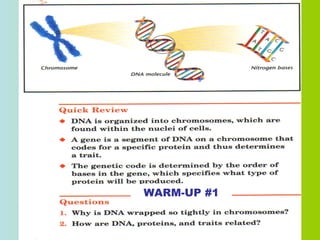
WARM-UP #1
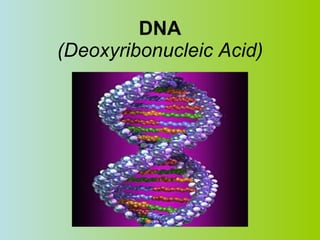
DNA (Deoxyribonucleic Acid)
Genetic material of cells… GENES – units of genetic material that  CODES FOR A SPECIFIC TRAIT Called  NUCLEIC ACIDS DNA is made up of repeating molecules called  NUCLEOTIDES
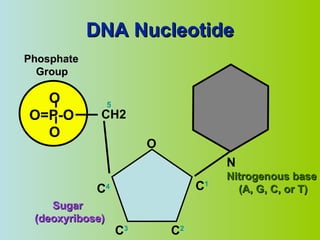
DNA Nucleotide O O=P-O O Phosphate Group N Nitrogenous base (A, G, C, or T) CH2 O C 1 C 4 C 3 C 2 5 Sugar (deoxyribose)
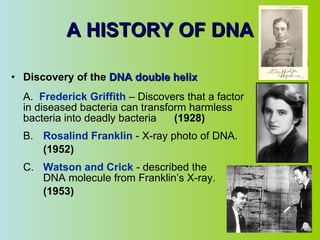
A HISTORY OF DNA Discovery of the  DNA double helix A.  Frederick Griffith  – Discovers that a factor in diseased bacteria can transform harmless bacteria into deadly bacteria   (1928) B. Rosalind Franklin   - X-ray photo of DNA. (1952) C. Watson and Crick   - described the  DNA molecule from Franklin’s X-ray. (1953)
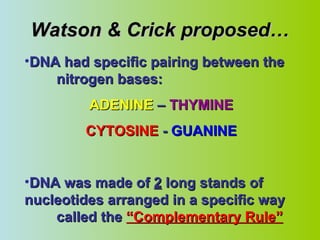
Watson & Crick proposed… DNA had specific pairing between the  nitrogen bases: ADENINE  –  THYMINE CYTOSINE  -  GUANINE DNA was made of  2  long stands of  nucleotides arranged in a specific way  called the  “Complementary Rule”
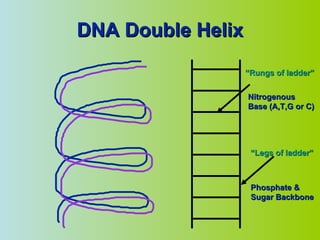
DNA Double Helix Nitrogenous Base (A,T,G or C) “ Rungs of ladder” “ Legs of ladder” Phosphate & Sugar Backbone
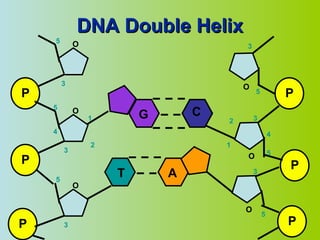
DNA Double Helix P P P O O O 1 2 3 4 5 5 3 3 5 P P P O O O 1 2 3 4 5 5 3 5 3 G C T A
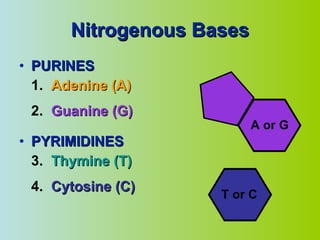
Nitrogenous Bases PURINES 1. Adenine (A) 2. Guanine (G) PYRIMIDINES 3. Thymine (T) 4. Cytosine (C) T or C A or G
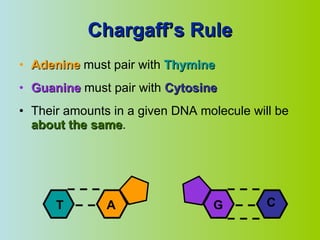
Chargaff’s Rule Adenine   must pair with  Thymine Guanine  must pair with  Cytosine Their amounts in a given DNA molecule will be  about the same . G C T A
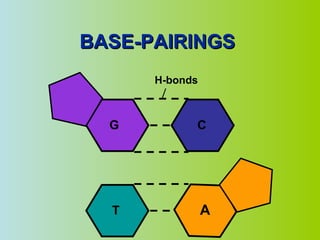
BASE-PAIRINGS C G H-bonds T A
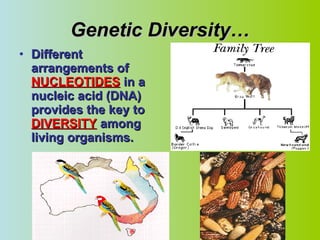
Genetic Diversity… Different arrangements of  NUCLEOTIDES  in a nucleic acid (DNA) provides the key to  DIVERSITY  among living organisms.
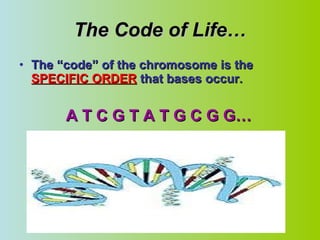
The Code of Life… The “code” of the chromosome is the  SPECIFIC ORDER  that bases occur. A T C G T A T G C G G…
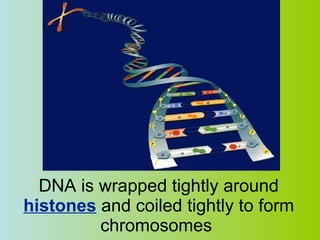
DNA is wrapped tightly around  histones  and coiled tightly to form chromosomes
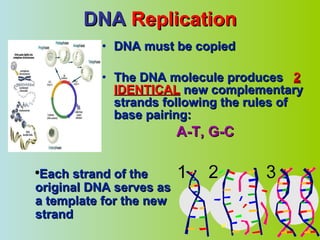
DNA  Replication DNA must be copied The DNA molecule produces  2 IDENTICAL  new complementary strands following the rules of base pairing:  A-T, G-C Each strand of the original DNA serves as a template for the new strand
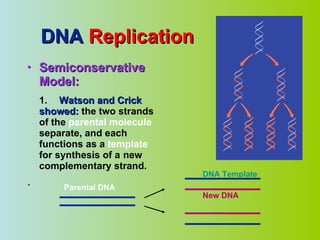
DNA  Replication Semiconservative Model: 1. Watson and Crick showed:  the two strands of the  parental molecule   separate, and each functions as a  template  for synthesis of a  new complementary strand. . Parental DNA DNA Template New DNA
1.  Why is replication necessary? 2.  When does replication occur? 3.  Describe how replication works. Use the complementary rule to   create the complementary strand:   A--- ? G--- ? C--- ? T--- ? A--- ? G--- ? A--- ? G--- ? C--- ? A--- ? G--- ? T--- ? Replication Quiz
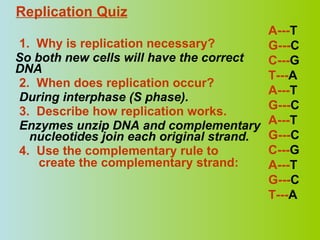
1.  Why is replication necessary? So both new cells will have the correct DNA 2.  When does replication occur? During interphase (S phase). 3.  Describe how replication works. Enzymes unzip DNA and complementary nucleotides join each original strand. 4.  Use the complementary rule to    create the complementary strand:  A--- T G--- C C--- G T--- A A--- T G--- C A--- T G--- C C--- G A--- T G--- C T--- A Replication Quiz
(1961)  Watson & Crick proposed… … DNA controlled cell function by serving as a template for  PROTEIN  structure. 3 Nucleotides = a triplet or  CODON (which code for a specific AMINO ACID) AMINO ACIDS  are the building blocks of proteins.
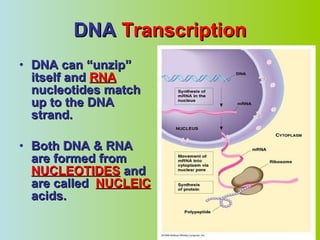
DNA  Transcription DNA can “unzip” itself and  RNA  nucleotides match up to the DNA strand. Both DNA & RNA are formed from  NUCLEOTIDES  and are called  NUCLEIC  acids.
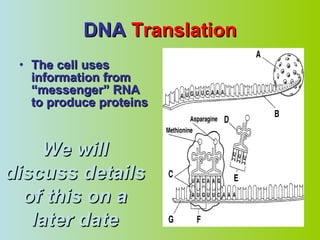
DNA  Translation The cell uses information from “messenger” RNA to produce proteins We will discuss details of this on a later date
Transcription/Translation Quiz Why is transcription necessary? Describe transcription. Why is translation necessary? Describe translation. What are the main differences between DNA and RNA. Using the chart on page 303, identify the amino acids coded for by these codons: UGGCAGUGC
1.  Why is transcription necessary? Transcription makes messenger RNA (MRNA) to carry the code for proteins out of the nucleus to the ribosomes in the cytoplasm.  2.  Describe transcription. RNA polymerase binds to DNA, separates the strands, then uses one strand as a template to assemble MRNA. 3.  Why is translation necessary? Translation assures that the right amino acids are joined together by peptides to form the correct protein.
4.  Describe translation. The cell uses information from MRNA to produce proteins. 5.  What are the main differences between DNA and RNA. DNA has deoxyribose, RNA has ribose; DNA has 2 strands, RNA has one strand; DNA has thymine, RNA has uracil. Using the chart on page 303, identify the amino acids coded for by these codons: UGGCAGUGC tryptophan-glutamine-cysteine
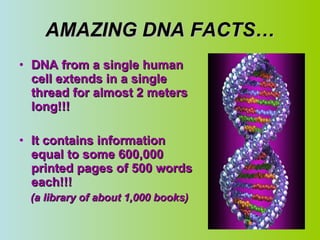
AMAZING DNA FACTS… DNA from a single human cell extends in a single thread for almost 2 meters long!!! It contains information equal to some 600,000 printed pages of 500 words each!!!  (a library of about 1,000 books)
LET’S REVIEW DNA… List the conclusions Griffith & Avery, Hershey & Chase drew from their experiments. Summarize the relationship between genes & DNA. Describe the overall structure of the DNA molecule. What are the 4 kinds of bases?

Introduction to DNA

  • 1.
  • 2.
  • 3.
    Genetic material ofcells… GENES – units of genetic material that CODES FOR A SPECIFIC TRAIT Called NUCLEIC ACIDS DNA is made up of repeating molecules called NUCLEOTIDES
  • 4.
    DNA Nucleotide OO=P-O O Phosphate Group N Nitrogenous base (A, G, C, or T) CH2 O C 1 C 4 C 3 C 2 5 Sugar (deoxyribose)
  • 5.
    A HISTORY OFDNA Discovery of the DNA double helix A. Frederick Griffith – Discovers that a factor in diseased bacteria can transform harmless bacteria into deadly bacteria (1928) B. Rosalind Franklin - X-ray photo of DNA. (1952) C. Watson and Crick - described the DNA molecule from Franklin’s X-ray. (1953)
  • 6.
    Watson & Crickproposed… DNA had specific pairing between the nitrogen bases: ADENINE – THYMINE CYTOSINE - GUANINE DNA was made of 2 long stands of nucleotides arranged in a specific way called the “Complementary Rule”
  • 7.
    DNA Double HelixNitrogenous Base (A,T,G or C) “ Rungs of ladder” “ Legs of ladder” Phosphate & Sugar Backbone
  • 8.
    DNA Double HelixP P P O O O 1 2 3 4 5 5 3 3 5 P P P O O O 1 2 3 4 5 5 3 5 3 G C T A
  • 9.
    Nitrogenous Bases PURINES1. Adenine (A) 2. Guanine (G) PYRIMIDINES 3. Thymine (T) 4. Cytosine (C) T or C A or G
  • 10.
    Chargaff’s Rule Adenine must pair with Thymine Guanine must pair with Cytosine Their amounts in a given DNA molecule will be about the same . G C T A
  • 11.
    BASE-PAIRINGS C GH-bonds T A
  • 12.
    Genetic Diversity… Differentarrangements of NUCLEOTIDES in a nucleic acid (DNA) provides the key to DIVERSITY among living organisms.
  • 13.
    The Code ofLife… The “code” of the chromosome is the SPECIFIC ORDER that bases occur. A T C G T A T G C G G…
  • 14.
    DNA is wrappedtightly around histones and coiled tightly to form chromosomes
  • 15.
    DNA ReplicationDNA must be copied The DNA molecule produces 2 IDENTICAL new complementary strands following the rules of base pairing: A-T, G-C Each strand of the original DNA serves as a template for the new strand
  • 16.
    DNA ReplicationSemiconservative Model: 1. Watson and Crick showed: the two strands of the parental molecule separate, and each functions as a template for synthesis of a new complementary strand. . Parental DNA DNA Template New DNA
  • 17.
    1. Whyis replication necessary? 2. When does replication occur? 3. Describe how replication works. Use the complementary rule to create the complementary strand: A--- ? G--- ? C--- ? T--- ? A--- ? G--- ? A--- ? G--- ? C--- ? A--- ? G--- ? T--- ? Replication Quiz
  • 18.
    1. Whyis replication necessary? So both new cells will have the correct DNA 2. When does replication occur? During interphase (S phase). 3. Describe how replication works. Enzymes unzip DNA and complementary nucleotides join each original strand. 4. Use the complementary rule to create the complementary strand: A--- T G--- C C--- G T--- A A--- T G--- C A--- T G--- C C--- G A--- T G--- C T--- A Replication Quiz
  • 19.
    (1961) Watson& Crick proposed… … DNA controlled cell function by serving as a template for PROTEIN structure. 3 Nucleotides = a triplet or CODON (which code for a specific AMINO ACID) AMINO ACIDS are the building blocks of proteins.
  • 20.
    DNA TranscriptionDNA can “unzip” itself and RNA nucleotides match up to the DNA strand. Both DNA & RNA are formed from NUCLEOTIDES and are called NUCLEIC acids.
  • 21.
    DNA TranslationThe cell uses information from “messenger” RNA to produce proteins We will discuss details of this on a later date
  • 22.
    Transcription/Translation Quiz Whyis transcription necessary? Describe transcription. Why is translation necessary? Describe translation. What are the main differences between DNA and RNA. Using the chart on page 303, identify the amino acids coded for by these codons: UGGCAGUGC
  • 23.
    1. Whyis transcription necessary? Transcription makes messenger RNA (MRNA) to carry the code for proteins out of the nucleus to the ribosomes in the cytoplasm. 2. Describe transcription. RNA polymerase binds to DNA, separates the strands, then uses one strand as a template to assemble MRNA. 3. Why is translation necessary? Translation assures that the right amino acids are joined together by peptides to form the correct protein.
  • 24.
    4. Describetranslation. The cell uses information from MRNA to produce proteins. 5. What are the main differences between DNA and RNA. DNA has deoxyribose, RNA has ribose; DNA has 2 strands, RNA has one strand; DNA has thymine, RNA has uracil. Using the chart on page 303, identify the amino acids coded for by these codons: UGGCAGUGC tryptophan-glutamine-cysteine
  • 25.
    AMAZING DNA FACTS…DNA from a single human cell extends in a single thread for almost 2 meters long!!! It contains information equal to some 600,000 printed pages of 500 words each!!! (a library of about 1,000 books)
  • 26.
    LET’S REVIEW DNA…List the conclusions Griffith & Avery, Hershey & Chase drew from their experiments. Summarize the relationship between genes & DNA. Describe the overall structure of the DNA molecule. What are the 4 kinds of bases?