Tim McPeak
Executive Risk Management Consultant
Sageworks
Date of Last Revision: 9/18/2015
Date of Last Review: 9/18/2015
• What are qualitative factors?
• Market overview
• Best practices to justify qualitative factors
• Internal and external drivers
• Future of Q factors
2
• Qualitative and environmental factors are used to reflect risk in the portfolio
not captured by the historical loss data
• Made as adjustment to historical loss experience
» Typically via direct basis point adjustments
• Opportunity to leverage your unique knowledge of portfolio
» Intended for unrecognized losses embedded in the portfolio
» Primary lever for management discretion in ALLL calculation
3
• 2006 Interagency Policy Statement on the ALLL is primary source document
• Subjective by definition
“Management should consider those current qualitative or environmental factors
that are likely to cause estimated credit losses as of the evaluation date to differ
from the group's historical loss experience.”
“These determinations are to be based on a comprehensive, well-documented and
consistently applied analysis of its loan portfolio.”
4
5
0
20
40
60
80
100
120
140
160
(Billions)
Nonaccrual
6
TotalVolumeofLoansonNon-accrualStatus
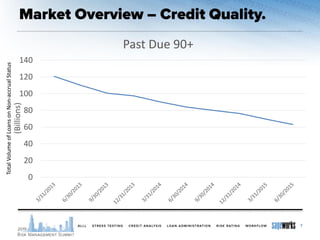
0
20
40
60
80
100
120
140
(Billions)
Past Due 90+
7
TotalVolumeofLoansonNon-accrualStatus
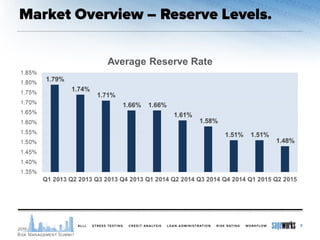
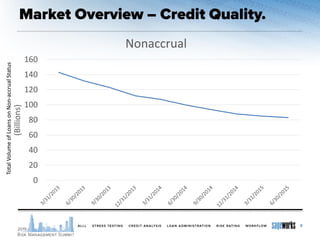
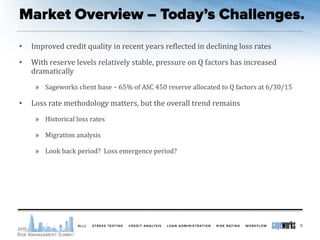
• Improved credit quality in recent years reflected in declining loss rates
• With reserve levels relatively stable, pressure on Q factors has increased
dramatically
» Sageworks client base – 65% of ASC 450 reserve allocated to Q factors at 6/30/15
• Loss rate methodology matters, but the overall trend remains
» Historical loss rates
» Migration analysis
» Look back period? Loss emergence period?
8
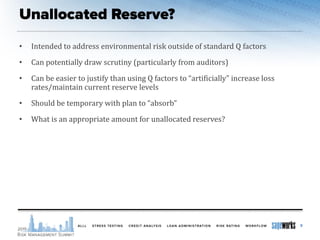
• Intended to address environmental risk outside of standard Q factors
• Can potentially draw scrutiny (particularly from auditors)
• Can be easier to justify than using Q factors to “artificially” increase loss
rates/maintain current reserve levels
• Should be temporary with plan to “absorb”
• What is an appropriate amount for unallocated reserves?
9
• Auditors vs Examiners: “Tug of War”
• Limiting subjectivity
• Justifying assumptions/consistent application
• Providing proper documentation and defense
10
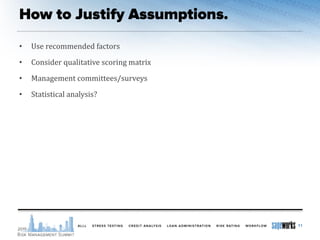
• Use recommended factors
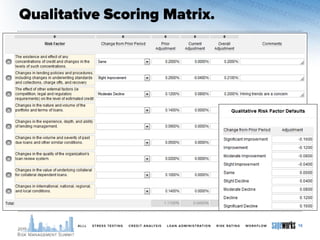
• Consider qualitative scoring matrix
• Management committees/surveys
• Statistical analysis?
11
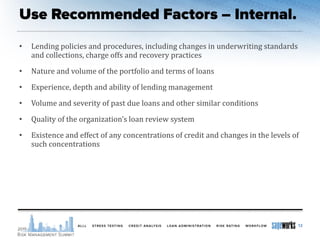
• Lending policies and procedures, including changes in underwriting standards
and collections, charge offs and recovery practices
• Nature and volume of the portfolio and terms of loans
• Experience, depth and ability of lending management
• Volume and severity of past due loans and other similar conditions
• Quality of the organization’s loan review system
• Existence and effect of any concentrations of credit and changes in the levels of
such concentrations
12
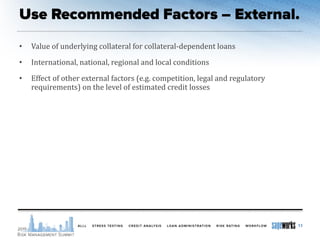
• Value of underlying collateral for collateral-dependent loans
• International, national, regional and local conditions
• Effect of other external factors (e.g. competition, legal and regulatory
requirements) on the level of estimated credit losses
13
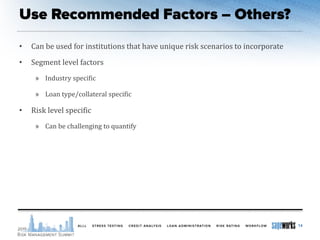
• Can be used for institutions that have unique risk scenarios to incorporate
• Segment level factors
» Industry specific
» Loan type/collateral specific
• Risk level specific
» Can be challenging to quantify
14
15
16
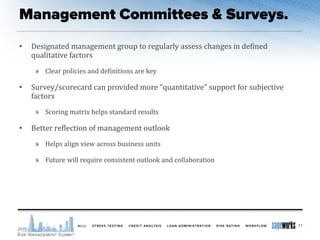
• Designated management group to regularly assess changes in defined
qualitative factors
» Clear policies and definitions are key
• Survey/scorecard can provided more “quantitative” support for subjective
factors
» Scoring matrix helps standard results
• Better reflection of management outlook
» Helps align view across business units
» Future will require consistent outlook and collaboration
17
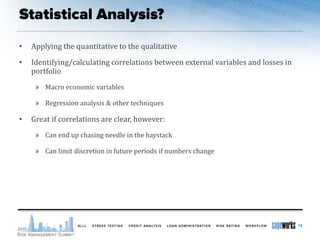
• Applying the quantitative to the qualitative
• Identifying/calculating correlations between external variables and losses in
portfolio
» Macro economic variables
» Regression analysis & other techniques
• Great if correlations are clear, however:
» Can end up chasing needle in the haystack
» Can limit discretion in future periods if numbers change
18
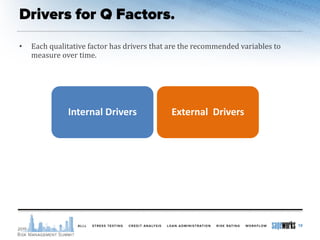
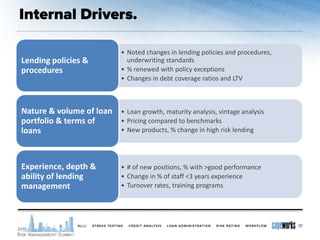
• Each qualitative factor has drivers that are the recommended variables to
measure over time.
19
Internal Drivers External Drivers
20
• Noted changes in lending policies and procedures,
underwriting standards
• % renewed with policy exceptions
• Changes in debt coverage ratios and LTV
Lending policies &
procedures
• Loan growth, maturity analysis, vintage analysis
• Pricing compared to benchmarks
• New products, % change in high risk lending
Nature & volume of loan
portfolio & terms of
loans
• # of new positions, % with >good performance
• Change in % of staff <3 years experience
• Turnover rates, training programs
Experience, depth &
ability of lending
management
21
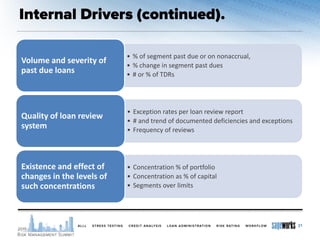
• % of segment past due or on nonaccrual,
• % change in segment past dues
• # or % of TDRs
Volume and severity of
past due loans
• Exception rates per loan review report
• # and trend of documented deficiencies and exceptions
• Frequency of reviews
Quality of loan review
system
• Concentration % of portfolio
• Concentration as % of capital
• Segments over limits
Existence and effect of
changes in the levels of
such concentrations
22
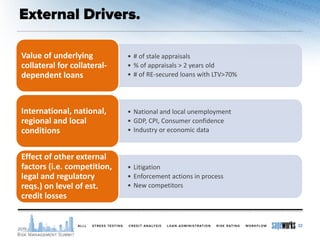
• # of stale appraisals
• % of appraisals > 2 years old
• # of RE-secured loans with LTV>70%
Value of underlying
collateral for collateral-
dependent loans
• National and local unemployment
• GDP, CPI, Consumer confidence
• Industry or economic data
International, national,
regional and local
conditions
• Litigation
• Enforcement actions in process
• New competitors
Effect of other external
factors (i.e. competition,
legal and regulatory
reqs.) on level of est.
credit losses
• Transitioning to an expected loss model
• Forward-looking adjustments
• Q factors will play an expanded role
• Basel Committee’s consultative document alludes to forecasting component of
Q factors in ECL model:
"Examples of factors that may require qualitative adjustments are the existence of
concentrations of credit risk and changes in the level of such concentrations,
increased usage of loan modifications, changes in expectations of macroeconomic
trends and conditions, and/or the effects of changes in the underwriting standards
and lending policies […].”
23
Executive Risk Management Consultant
tim.mcpeak@Sageworks.com
866.603.7029
24
• ALLL Forum for Bankers
• Commercial Credit Risk Professionals
• www.sageworksanalyst.com
• www.ALLL.com
• Whitepapers, webinars,
thought leadership

Justifying Qualitative Factors - 2015 Risk Management Summit

  • 1.
    Tim McPeak Executive RiskManagement Consultant Sageworks Date of Last Revision: 9/18/2015 Date of Last Review: 9/18/2015
  • 2.
    • What arequalitative factors? • Market overview • Best practices to justify qualitative factors • Internal and external drivers • Future of Q factors 2
  • 3.
    • Qualitative andenvironmental factors are used to reflect risk in the portfolio not captured by the historical loss data • Made as adjustment to historical loss experience » Typically via direct basis point adjustments • Opportunity to leverage your unique knowledge of portfolio » Intended for unrecognized losses embedded in the portfolio » Primary lever for management discretion in ALLL calculation 3
  • 4.
    • 2006 InteragencyPolicy Statement on the ALLL is primary source document • Subjective by definition “Management should consider those current qualitative or environmental factors that are likely to cause estimated credit losses as of the evaluation date to differ from the group's historical loss experience.” “These determinations are to be based on a comprehensive, well-documented and consistently applied analysis of its loan portfolio.” 4
  • 5.
  • 6.
  • 7.
  • 8.
    • Improved creditquality in recent years reflected in declining loss rates • With reserve levels relatively stable, pressure on Q factors has increased dramatically » Sageworks client base – 65% of ASC 450 reserve allocated to Q factors at 6/30/15 • Loss rate methodology matters, but the overall trend remains » Historical loss rates » Migration analysis » Look back period? Loss emergence period? 8
  • 9.
    • Intended toaddress environmental risk outside of standard Q factors • Can potentially draw scrutiny (particularly from auditors) • Can be easier to justify than using Q factors to “artificially” increase loss rates/maintain current reserve levels • Should be temporary with plan to “absorb” • What is an appropriate amount for unallocated reserves? 9
  • 10.
    • Auditors vsExaminers: “Tug of War” • Limiting subjectivity • Justifying assumptions/consistent application • Providing proper documentation and defense 10
  • 11.
    • Use recommendedfactors • Consider qualitative scoring matrix • Management committees/surveys • Statistical analysis? 11
  • 12.
    • Lending policiesand procedures, including changes in underwriting standards and collections, charge offs and recovery practices • Nature and volume of the portfolio and terms of loans • Experience, depth and ability of lending management • Volume and severity of past due loans and other similar conditions • Quality of the organization’s loan review system • Existence and effect of any concentrations of credit and changes in the levels of such concentrations 12
  • 13.
    • Value ofunderlying collateral for collateral-dependent loans • International, national, regional and local conditions • Effect of other external factors (e.g. competition, legal and regulatory requirements) on the level of estimated credit losses 13
  • 14.
    • Can beused for institutions that have unique risk scenarios to incorporate • Segment level factors » Industry specific » Loan type/collateral specific • Risk level specific » Can be challenging to quantify 14
  • 15.
  • 16.
  • 17.
    • Designated managementgroup to regularly assess changes in defined qualitative factors » Clear policies and definitions are key • Survey/scorecard can provided more “quantitative” support for subjective factors » Scoring matrix helps standard results • Better reflection of management outlook » Helps align view across business units » Future will require consistent outlook and collaboration 17
  • 18.
    • Applying thequantitative to the qualitative • Identifying/calculating correlations between external variables and losses in portfolio » Macro economic variables » Regression analysis & other techniques • Great if correlations are clear, however: » Can end up chasing needle in the haystack » Can limit discretion in future periods if numbers change 18
  • 19.
    • Each qualitativefactor has drivers that are the recommended variables to measure over time. 19 Internal Drivers External Drivers
  • 20.
    20 • Noted changesin lending policies and procedures, underwriting standards • % renewed with policy exceptions • Changes in debt coverage ratios and LTV Lending policies & procedures • Loan growth, maturity analysis, vintage analysis • Pricing compared to benchmarks • New products, % change in high risk lending Nature & volume of loan portfolio & terms of loans • # of new positions, % with >good performance • Change in % of staff <3 years experience • Turnover rates, training programs Experience, depth & ability of lending management
  • 21.
    21 • % ofsegment past due or on nonaccrual, • % change in segment past dues • # or % of TDRs Volume and severity of past due loans • Exception rates per loan review report • # and trend of documented deficiencies and exceptions • Frequency of reviews Quality of loan review system • Concentration % of portfolio • Concentration as % of capital • Segments over limits Existence and effect of changes in the levels of such concentrations
  • 22.
    22 • # ofstale appraisals • % of appraisals > 2 years old • # of RE-secured loans with LTV>70% Value of underlying collateral for collateral- dependent loans • National and local unemployment • GDP, CPI, Consumer confidence • Industry or economic data International, national, regional and local conditions • Litigation • Enforcement actions in process • New competitors Effect of other external factors (i.e. competition, legal and regulatory reqs.) on level of est. credit losses
  • 23.
    • Transitioning toan expected loss model • Forward-looking adjustments • Q factors will play an expanded role • Basel Committee’s consultative document alludes to forecasting component of Q factors in ECL model: "Examples of factors that may require qualitative adjustments are the existence of concentrations of credit risk and changes in the level of such concentrations, increased usage of loan modifications, changes in expectations of macroeconomic trends and conditions, and/or the effects of changes in the underwriting standards and lending policies […].” 23
  • 24.
    Executive Risk ManagementConsultant tim.mcpeak@Sageworks.com 866.603.7029 24 • ALLL Forum for Bankers • Commercial Credit Risk Professionals • www.sageworksanalyst.com • www.ALLL.com • Whitepapers, webinars, thought leadership