Just War Theory | Basics
What makes a
War “Just” ?
Just War Theory | Basics 2
What makes a War "Just"?
The phrase “Just War” is used by politicians, the media,
history teachers, and church leaders in discussions about War.
However, we do not often hear the actual criteria of Just War
Theory — or a critical evaluation of how it is applied.
We must understand the criteria that
guide both secular and religious debate about War, keeping in
mind that war means the death of hundreds to millions of
specific human beings like us. This series of slides shows
the key criteria for Just War and engages
this concept from a Christian perspective.
Just War Theory | Basics 3
Traditional
Just War
Criteria
Just War Theory | Basics 4
Early Christian approaches to war were pacifist in
nature, due to a focus on the belief that Christians were
“in, but not of” society.
With the Christianizing of the Roman Empire,
however, theologians during the fourth and fifth centuries
began to design arguments for use of force which would
eventually evolve into today’s Just War Theory.
Just War Theory | Basics 5
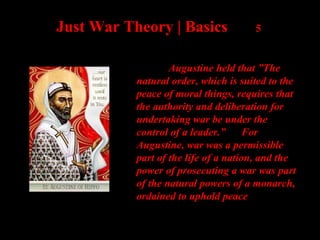
Augustine held that ”The
natural order, which is suited to the
peace of moral things, requires that
the authority and deliberation for
undertaking war be under the
control of a leader.” For
Augustine, war was a permissible
part of the life of a nation, and the
power of prosecuting a war was part
of the natural powers of a monarch,
ordained to uphold peace
Just War Theory | Basics 6
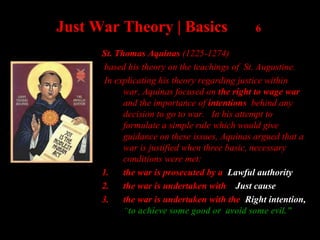
St. Thomas Aquinas (1225-1274)
based his theory on the teachings of St. Augustine.
In explicating his theory regarding justice within
war, Aquinas focused on the right to wage war
and the importance of intentions behind any
decision to go to war. In his attempt to
formulate a simple rule which would give
guidance on these issues, Aquinas argued that a
war is justified when three basic, necessary
conditions were met:
1. the war is prosecuted by a Lawful authority
2. the war is undertaken with Just cause
3. the war is undertaken with the Right intention,
“to achieve some good or avoid some evil.”
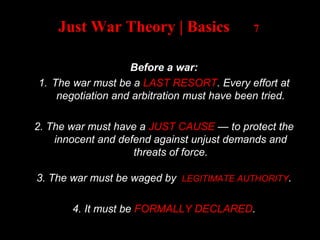
Just War Theory | Basics 7
Before a war:
1. The war must be a LAST RESORT. Every effort at
negotiation and arbitration must have been tried.
2. The war must have a JUST CAUSE — to protect the
innocent and defend against unjust demands and
threats of force.
3. The war must be waged by LEGITIMATE AUTHORITY.
4. It must be FORMALLY DECLARED.
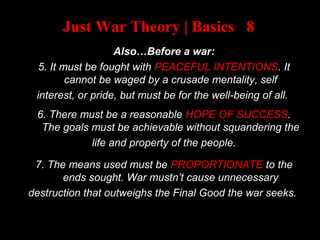
Just War Theory | Basics 8
Also…Before a war:
5. It must be fought with PEACEFUL INTENTIONS. It
cannot be waged by a crusade mentality, self
interest, or pride, but must be for the well-being of all.
6. There must be a reasonable HOPE OF SUCCESS.
The goals must be achievable without squandering the
life and property of the people.
7. The means used must be PROPORTIONATE to the
ends sought. War mustn’t cause unnecessary
destruction that outweighs the Final Good the war seeks.
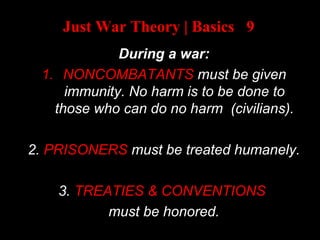
Just War Theory | Basics 9
During a war:
1. NONCOMBATANTS must be given
immunity. No harm is to be done to
those who can do no harm (civilians).
2. PRISONERS must be treated humanely.
3. TREATIES & CONVENTIONS
must be honored.
Just War Theory | Basics 10
AFTER A WAR:
1. The defeated are to be shown MERCY.
2. This includes assistance with rebuilding
what has been destroyed.
Example: Marshall Plan
[If we made full use of this principle of Just
War, the quality of our moral
deliberation on conflict would improve.]
Just War Theory | Basics 11
AFTER A WAR:
The Defeated help Victors think critically
about the tendency of any society
to justify its violence, assist us to confront all the
various effects of violence, and encourage us
to be creative about alternatives.
Example: Post Apartheid S. Africa
Just War Theory | Basics 12
Christians, Jews, and Muslims need to
re-examine these criteria in light of the
Sanctity of each human life and the ethics
of Forgiveness & Reconciliation.
Christians look to One who lived a life of love
and taught his disciples to use non-
retaliation as they struggle for justice.
This message calls us to transcend the
‘just war’ and engage alternatives like
‘just Peace’ and Christian Nonviolence.
Just War Theory | Basics 13
In the past our justifications for war
have sometimes been faulty.
One Example:
Following the Spanish-American war, the Philippines
were handed over from Spanish to USA control.
When Philippine citizens resisted, we went to war
against them from 1899-1902.
Just War Theory | Basics 14
The rhetoric at the time was that they were an
uncivilized people who would benefit from
the hand of our government and Christian
religion, and it would open up new economic
markets. To growing protest at home, the US
wiped out dozens of towns. An estimated one-
third of the population was killed. What was
once considered a justifiable war is nowadays
seen by most historians as a bloody war of self-
interest & plunder. Indeed one looks in vain for
a war that wasn’t considered ‘ just ’ by the
leading public figures of the day.
Just War Theory | Basics 15
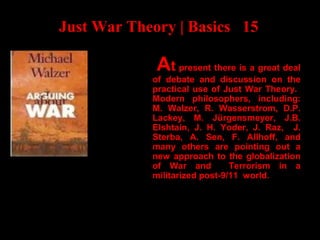
At present there is a great deal
of debate and discussion on the
practical use of Just War Theory.
Modern philosophers, including:
M. Walzer, R. Wasserstrom, D.P.
Lackey, M. Jürgensmeyer, J.B.
Elshtain, J. H. Yoder, J. Raz, J.
Sterba, A. Sen, F. Allhoff, and
many others are pointing out a
new approach to the globalization
of War and Terrorism in a
militarized post-9/11 world.
Just War Theory | Basics 16
Just War, even if it seems a decrepit
concept to some, is undergoing a long-
term reconstruction which will make it
a more useful tool for the XXIst
Century—which promises much
Conflict, just or otherwise.
David A. Bühler, Ph.D. has taught Moral Philosophy at Providence College
In Rhode Island since 1993. He holds diplomas from Harvard, Reed, and
Yale; studying at Oxford, Cambridge, Georgetown, Notre Dame, and
Wittenberg. He was a filmmaker in the 1960’s in California & Oregon and
did Light Shows for major Rock and Blues artists.
He teaches courses on Bioethics, Food Ethics, War & Violence, and the
Philosophy of Film. His full C.V. is available here:
providence.academia.edu/DavidBuehler
Just war

Just war

  • 1.
    Just War Theory| Basics What makes a War “Just” ?
  • 2.
    Just War Theory| Basics 2 What makes a War "Just"? The phrase “Just War” is used by politicians, the media, history teachers, and church leaders in discussions about War. However, we do not often hear the actual criteria of Just War Theory — or a critical evaluation of how it is applied. We must understand the criteria that guide both secular and religious debate about War, keeping in mind that war means the death of hundreds to millions of specific human beings like us. This series of slides shows the key criteria for Just War and engages this concept from a Christian perspective.
  • 3.
    Just War Theory| Basics 3 Traditional Just War Criteria
  • 4.
    Just War Theory| Basics 4 Early Christian approaches to war were pacifist in nature, due to a focus on the belief that Christians were “in, but not of” society. With the Christianizing of the Roman Empire, however, theologians during the fourth and fifth centuries began to design arguments for use of force which would eventually evolve into today’s Just War Theory.
  • 5.
    Just War Theory| Basics 5 Augustine held that ”The natural order, which is suited to the peace of moral things, requires that the authority and deliberation for undertaking war be under the control of a leader.” For Augustine, war was a permissible part of the life of a nation, and the power of prosecuting a war was part of the natural powers of a monarch, ordained to uphold peace
  • 6.
    Just War Theory| Basics 6 St. Thomas Aquinas (1225-1274) based his theory on the teachings of St. Augustine. In explicating his theory regarding justice within war, Aquinas focused on the right to wage war and the importance of intentions behind any decision to go to war. In his attempt to formulate a simple rule which would give guidance on these issues, Aquinas argued that a war is justified when three basic, necessary conditions were met: 1. the war is prosecuted by a Lawful authority 2. the war is undertaken with Just cause 3. the war is undertaken with the Right intention, “to achieve some good or avoid some evil.”
  • 7.
    Just War Theory| Basics 7 Before a war: 1. The war must be a LAST RESORT. Every effort at negotiation and arbitration must have been tried. 2. The war must have a JUST CAUSE — to protect the innocent and defend against unjust demands and threats of force. 3. The war must be waged by LEGITIMATE AUTHORITY. 4. It must be FORMALLY DECLARED.
  • 8.
    Just War Theory| Basics 8 Also…Before a war: 5. It must be fought with PEACEFUL INTENTIONS. It cannot be waged by a crusade mentality, self interest, or pride, but must be for the well-being of all. 6. There must be a reasonable HOPE OF SUCCESS. The goals must be achievable without squandering the life and property of the people. 7. The means used must be PROPORTIONATE to the ends sought. War mustn’t cause unnecessary destruction that outweighs the Final Good the war seeks.
  • 9.
    Just War Theory| Basics 9 During a war: 1. NONCOMBATANTS must be given immunity. No harm is to be done to those who can do no harm (civilians). 2. PRISONERS must be treated humanely. 3. TREATIES & CONVENTIONS must be honored.
  • 10.
    Just War Theory| Basics 10 AFTER A WAR: 1. The defeated are to be shown MERCY. 2. This includes assistance with rebuilding what has been destroyed. Example: Marshall Plan [If we made full use of this principle of Just War, the quality of our moral deliberation on conflict would improve.]
  • 11.
    Just War Theory| Basics 11 AFTER A WAR: The Defeated help Victors think critically about the tendency of any society to justify its violence, assist us to confront all the various effects of violence, and encourage us to be creative about alternatives. Example: Post Apartheid S. Africa
  • 12.
    Just War Theory| Basics 12 Christians, Jews, and Muslims need to re-examine these criteria in light of the Sanctity of each human life and the ethics of Forgiveness & Reconciliation. Christians look to One who lived a life of love and taught his disciples to use non- retaliation as they struggle for justice. This message calls us to transcend the ‘just war’ and engage alternatives like ‘just Peace’ and Christian Nonviolence.
  • 13.
    Just War Theory| Basics 13 In the past our justifications for war have sometimes been faulty. One Example: Following the Spanish-American war, the Philippines were handed over from Spanish to USA control. When Philippine citizens resisted, we went to war against them from 1899-1902.
  • 14.
    Just War Theory| Basics 14 The rhetoric at the time was that they were an uncivilized people who would benefit from the hand of our government and Christian religion, and it would open up new economic markets. To growing protest at home, the US wiped out dozens of towns. An estimated one- third of the population was killed. What was once considered a justifiable war is nowadays seen by most historians as a bloody war of self- interest & plunder. Indeed one looks in vain for a war that wasn’t considered ‘ just ’ by the leading public figures of the day.
  • 15.
    Just War Theory| Basics 15 At present there is a great deal of debate and discussion on the practical use of Just War Theory. Modern philosophers, including: M. Walzer, R. Wasserstrom, D.P. Lackey, M. Jürgensmeyer, J.B. Elshtain, J. H. Yoder, J. Raz, J. Sterba, A. Sen, F. Allhoff, and many others are pointing out a new approach to the globalization of War and Terrorism in a militarized post-9/11 world.
  • 16.
    Just War Theory| Basics 16 Just War, even if it seems a decrepit concept to some, is undergoing a long- term reconstruction which will make it a more useful tool for the XXIst Century—which promises much Conflict, just or otherwise.
  • 17.
    David A. Bühler,Ph.D. has taught Moral Philosophy at Providence College In Rhode Island since 1993. He holds diplomas from Harvard, Reed, and Yale; studying at Oxford, Cambridge, Georgetown, Notre Dame, and Wittenberg. He was a filmmaker in the 1960’s in California & Oregon and did Light Shows for major Rock and Blues artists. He teaches courses on Bioethics, Food Ethics, War & Violence, and the Philosophy of Film. His full C.V. is available here: providence.academia.edu/DavidBuehler