Suturing 101
Cecylia Witkowski
Alexandru Spulber
JUMC SSIG - Suturing Workshop 08.03.2018
1. Sutures
What is a “suture”?
A suture is any strand of material that is used to ligate blood
vessels or approximate tissues
Absorbable vs. Non-Absorbable
Sutures
Absorbable Non-Absorbable
Natural
- Surgical Cotton
- Surgical Steel
- Surgical Silk
Synthetic
- Novafil
- Prolene
- Nylon
- Polyester fiber
Natural
- Collagen
- Plain surgical gut
Synthetic
- Vicryl
- Monocryl
- PDS
Absorbable vs. Non-Absorbable
Absorbable: Sutures that are broken down
by the body through hydrolysis or enzymatic
degradation
Primarily used to help aid the healing process
without permanent implantation of foreign
tissue, such as in the biliary or urinary tract
because otherwise it will serve as a nidus
for stone formation.
Non-absorbable: Sutures that are NOT
broken down by the body and are meant for
permanent use or to be taken out at a later
date.
When used on the skin, they are always
removed.
It is best used for procedures such as vessel
repair / anastomosis, bowel repair, and
tendon repair.
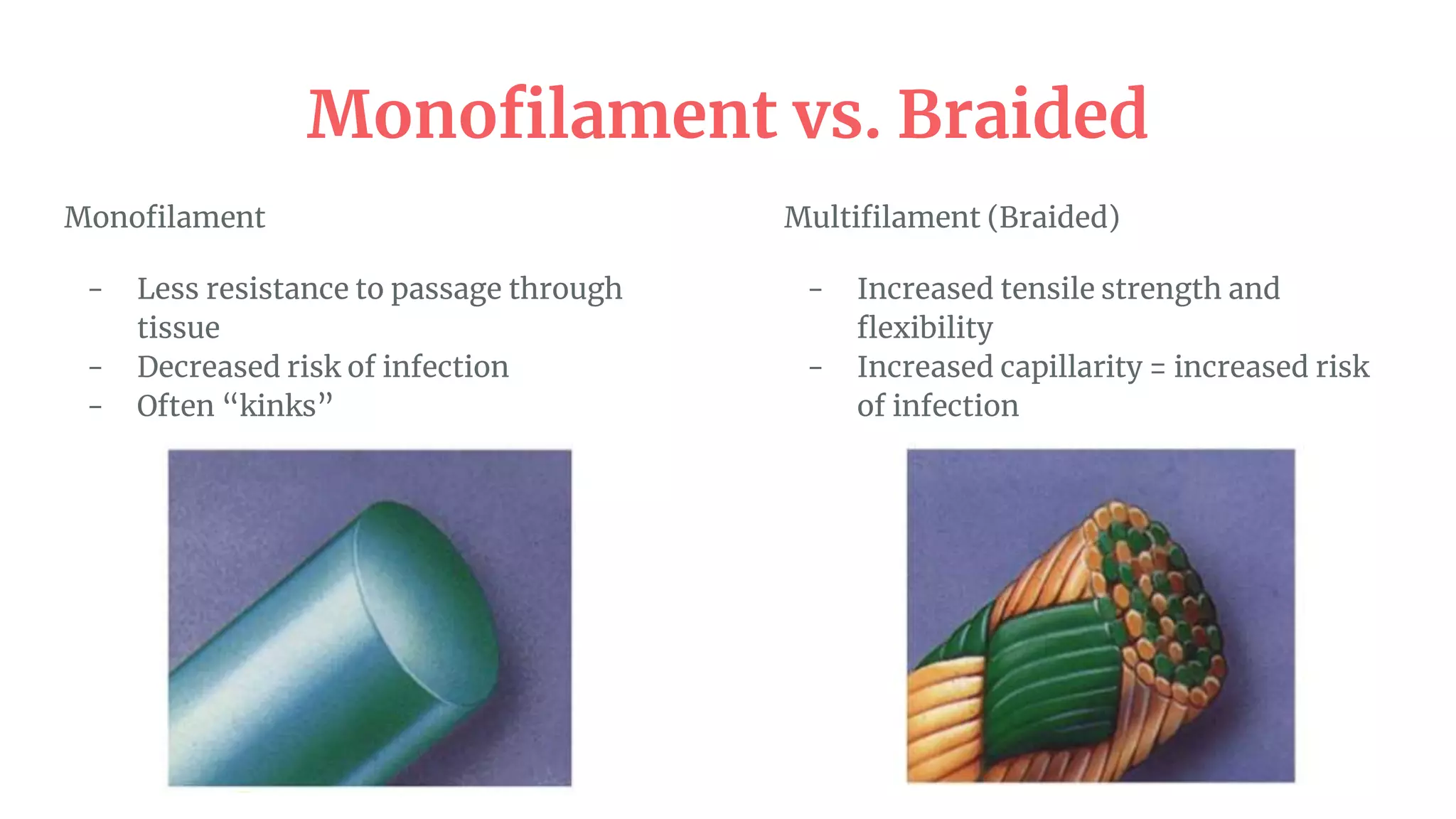
Monofilament vs. Braided
Monofilament
- Less resistance to passage through
tissue
- Decreased risk of infection
- Often “kinks”
Multifilament (Braided)
- Increased tensile strength and
flexibility
- Increased capillarity = increased risk
of infection
Tiny Tip:
Never use purple-colored Vicryl©
on skin because it can cause
purple tattooing
2. Instruments
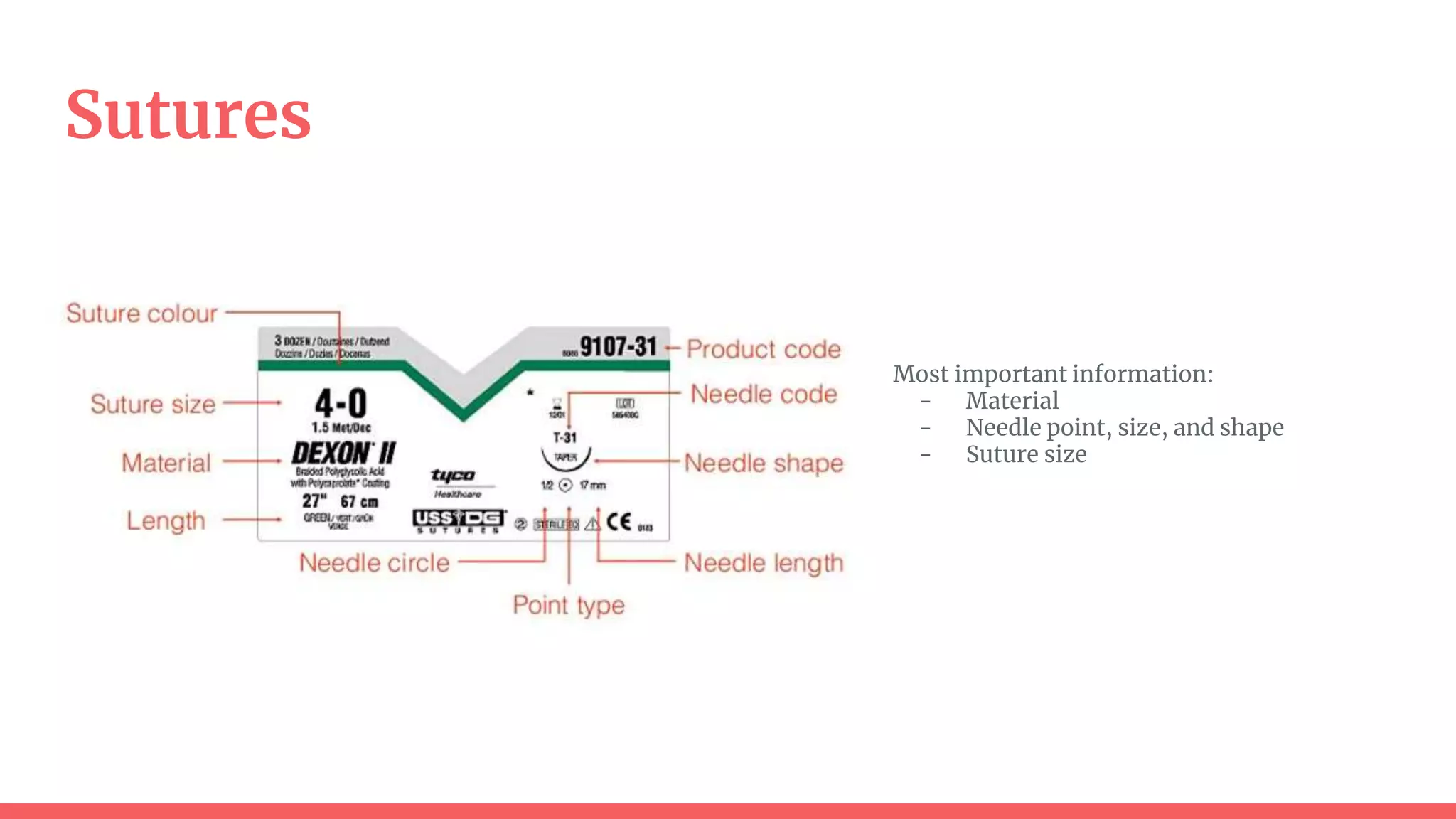
Sutures
Most important information:
- Material
- Needle point, size, and shape
- Suture size
Tiny Tip:
When removing a needle and thread
from the packaging, hold the needle
in place and pull the packaging off
the suture so as to not stick anyone
nearby with the needle
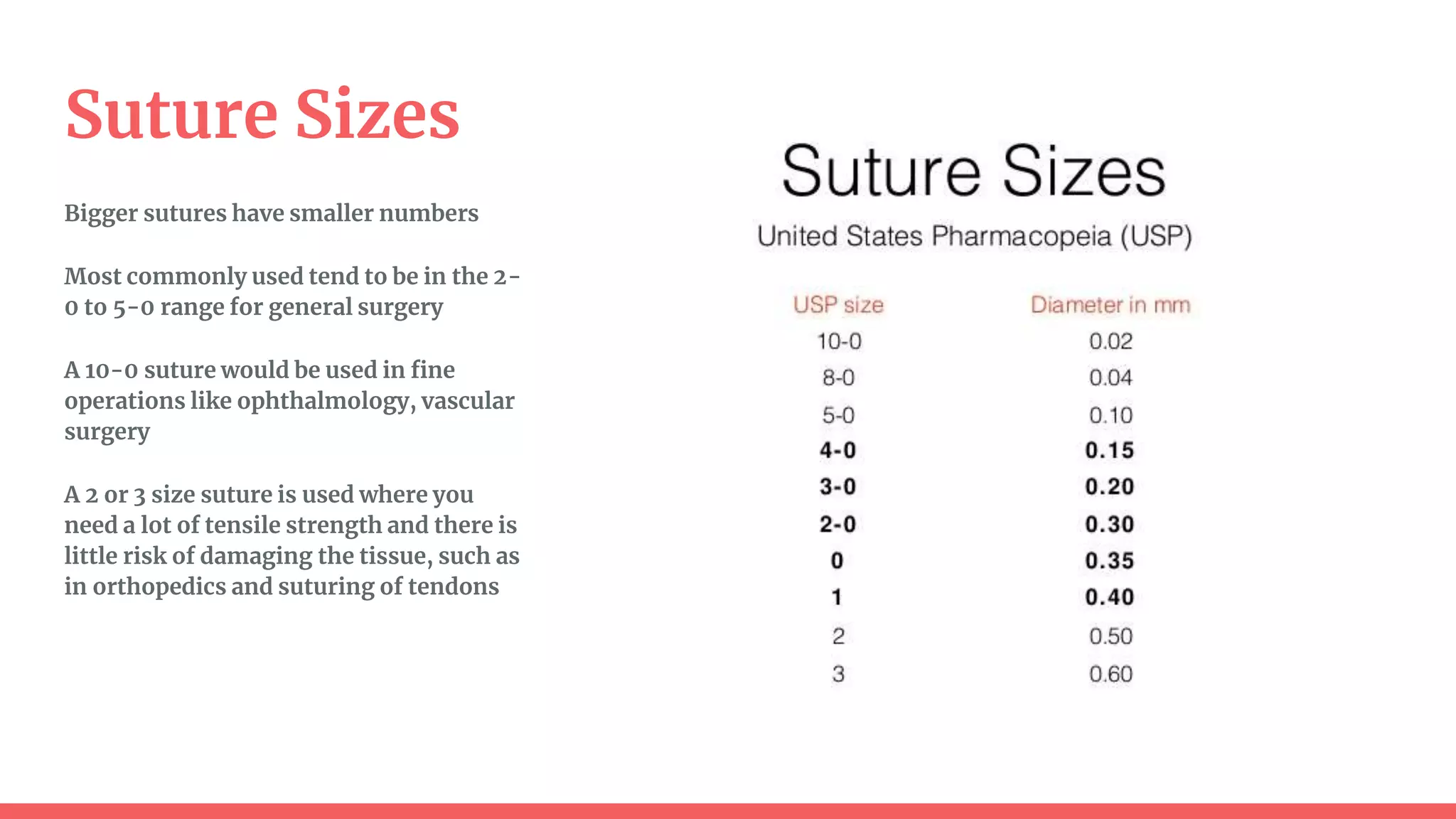
Suture Sizes
Bigger sutures have smaller numbers
Most commonly used tend to be in the 2-
0 to 5-0 range for general surgery
A 10-0 suture would be used in fine
operations like ophthalmology, vascular
surgery
A 2 or 3 size suture is used where you
need a lot of tensile strength and there is
little risk of damaging the tissue, such as
in orthopedics and suturing of tendons
Needles
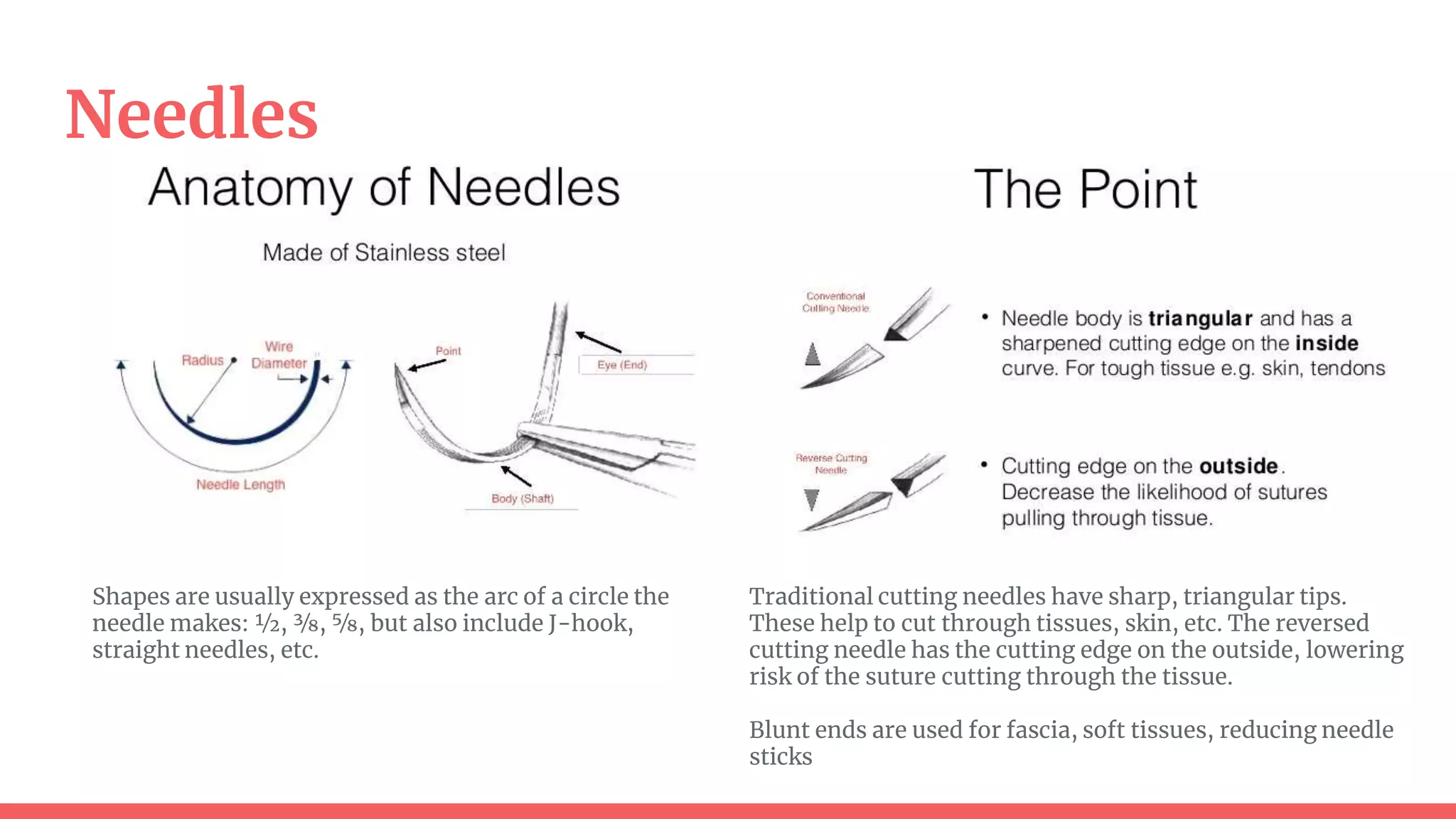
Shapes are usually expressed as the arc of a circle the
needle makes: ½, ⅜, ⅝, but also include J-hook,
straight needles, etc.
Traditional cutting needles have sharp, triangular tips.
These help to cut through tissues, skin, etc. The reversed
cutting needle has the cutting edge on the outside, lowering
risk of the suture cutting through the tissue.
Blunt ends are used for fascia, soft tissues, reducing needle
sticks
Needle-Driver (Dominant hand)
Needle driver should be held with your
thumb and ring finger (4th finger)
Index finger is at the neck of the
needle driver to help guide it
Needle should be grasped at a point
approximately ⅓ from the swedge
(many needles have are flatter in this
area to allow good grip)
Any time you grasp anything with a
needle driver (or scissor-like
instruments), you should close them
until you hear 3 clicks. Push the two
handles out of plane to unlock
Forceps (Non-dominant hand)
Anatomical forceps:
- Used for dissections
- Used to hold and demonstrate fragile anatomic structures
- Grooves improve grip without damaging tissue
Surgical forceps:
- Used to hold back resistant tissues like
skin
- Used to hold the needle during suturing
- The teeth can damage the tissue being
held, but provide more grip
Hold both the same way you would hold a pen/pencil!
3. Stitches
Tiny Tip:
Never pull your stitches and knots
too tight! You can cause ischemia of
the skin and leave an ugly scar
Most commonly used stitch!
A rather time-consuming stitch as each one
requires completion with a knot, snip the ends,
and begin anew.
It is typically used for skin / wound closure.
There are variations: keeping it “running” and
running “locked”
The bottom right image shows the “flask-shape”
configuration which is useful to promote eversion
of the skin - that is, to prevent the scar from
being sunken in once healed
Simple Interrupted
Vertical Mattress
The one that everyone needs to
know!
It’s best for deep lacerations which
is essentially all of general
surgery. It provides good edge
approximation with eversion, so
there would hopefully be less
scarring.
There are variations to actually
performing this stitch to make it
easier or have consistent depth.
Horizontal Mattress
The strongest of the sutures!
It is best used for when there are
large distances between tissues or
very calloused skin - like on the
palms of hands and soles of feet.
The disadvantage is that it doesn’t
look good initially and it's hard to
cut out.
Subcuticular
The “holy grail” of suturing
techniques!
… meaning, that it has the best
cosmetic outcome.
However, it is rather time
consuming and depends on a
number of factors: the area needs
to have good skin approximation
and low tension as the stitch itself
isn’t very strong
4. Knots
Tiny Tip:
Make sure to keep your knots to the
side of the wound. It looks nicer and
allows for proper healing
Square Knot
Learn to tie with your hands… and
instruments!
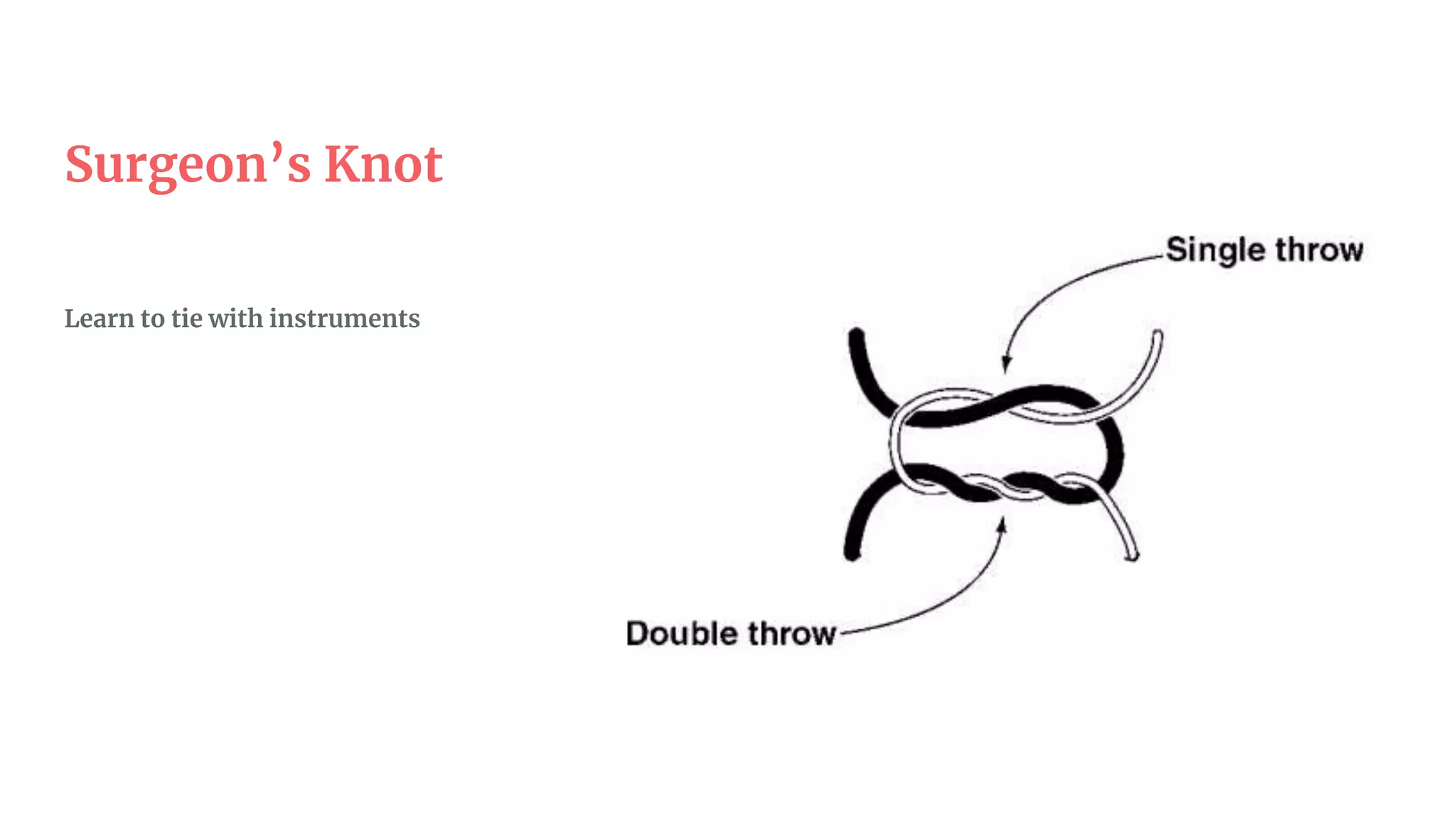
Surgeon’s Knot
Learn to tie with instruments
Useful Links
Explains everything we covered
Duke Suture Skills - really dull but covers everything in great detail
Sources
- Geeky Medics (https://geekymedics.com/suture-material/)
- Surgical recall / Recall series editor and senior editor, Lorne H. Blackbourne, M.D., F.A.C.S., Trauma, Burn, and
Critical Care Surgeon, San Antonio, Texas. – 6th edition.
- Key Surgical: Images of tools (https://www.keysurgical.com)
- Medscape: Suturing Techniques Technique
(https://emedicine.medscape.com/article/1824895-technique#showall)
Case Study
or rather, a look at the research
The Basics
Cervical Cerclage
“... a procedure that uses suture to reinforce the cervical opening, is frequently used to reduce the risk of
preterm delivery in women with a history of previous preterm birth or short cervical length.”
Based on what you’ve learned...
Which suture would you use?
Absorbable or non-absorbable?
Monofilament or braided?
Why?
Based on what you’ve learned...
Non-Absorbable: you want to remove it when it’s actually time for labour
Braided: the whole purpose of this procedure is to keep the cervix closed so having a suture
with greater tensile strength will *hopefully* achieve this
The Results
678 women
Retrospective comparison of 10 years of birth outcomes
for women receiving a cerclage based on suture material
[monofilament (n = 344) versus braided (n = 337)]
revealed higher rates of nonviable births (delivery <24
weeks or intrauterine death) in women receiving a braided
cerclage compared to those receiving a monofilament
alternative (15% versus 5%, respectively; P = 0.0001,
Fisher’s exact test), and increased rates of preterm birth
(24 to 37 weeks of gestation) in women receiving
braided cerclage (28% braided versus 17%
monofilament; P = 0.0006, Fisher’s exact test).
Why
Braided suture material is commonly used in preference to monofilament for cervical cerclage, because it is assumed that
braided suture provides a more secure cerclage that is less likely to slip or tear the cervix;
however, this assumption is not evidence-based. Here, we show that use of braided suture material is associated with an
increased risk of PTB and nonviable pregnancy, although this will need to be confirmed in a prospective randomized
study. Braided cervical cerclage induces vaginal dysbiosis, increases excretion of inflammatory
cytokines into the cervicovaginal fluid, and induces premature cervical vascular remodeling
(associated with the cervix opening before labor). In contrast, monofilament suture has minimal impact upon the vaginal
microbiome and inflammatory pathways associated with premature onset of parturition. These findings have clinical
relevance for cerclage procedures in pregnancy and wider implications for braided suture use in other surgical
procedures, particularly in potentially contaminated sites. On the basis of an about 2 million cervical cerclages per
annum, 80% of which are performed using braided suture, we estimate that a global shift to monofilament
suture use for cervical cerclage would prevent 170,000 PTBs [number needed to treat (NNT), 9.4; 95%
confidence interval (CI), 5.9 to 22.6] and 172,000 fetal losses (NNT, 9.3; 95% CI, 6.6 to 16.0) per annum worldwide.
Sources
- MedicineNet: Success of 'Cervical Stitch' May Depend on the Thread:
Study (https://www.medicinenet.com/script/main/art.asp?articlekey=197484)
- Faculty of Medicine: Cervical Cerclage Technique
(https://forum.facmedicine.com/threads/cervical-cerclage-technique.26986/)
- (http://cmapsconverted.ihmc.us/rid=1QKD2PDSJ-3K887M-
6WDP/Drugs,%20Equipment%20and%20Suture%20materials%20Final.cmap)
- Relationship between vaginal microbial dysbiosis, inflammation, and
pregnancy outcomes in cervical cerclage
BY LINDSAY M. KINDINGER, DAVID A. MACINTYRE, YUN S. LEE, JULIAN R. MARCHESI, ANN SMITH, JULIE A. K. MCDONALD,
VASSO TERZIDOU, JOANNA R. COOK, CHRISTOPH LEES, FIDAN ISRAFIL-BAYLI, YAZMIN FAIZA, PHILIP TOOZS-HOBSON,
MARK SLACK, STEFANO CACCIATORE, ELAINE HOLMES, JEREMY K. NICHOLSON, T. G. TEOH, PHILLIP R. BENNETT
SCIENCE TRANSLATIONAL MEDICINE 03 AUG 2016 : 350RA102
- Needles and Sutures: A Quick Review (https://www.slideshare.net/ShadyNafie/needles-sutures-a-quick-review)

JUMC SSIG Suturing 101

  • 1.
    Suturing 101 Cecylia Witkowski AlexandruSpulber JUMC SSIG - Suturing Workshop 08.03.2018
  • 2.
  • 3.
    What is a“suture”? A suture is any strand of material that is used to ligate blood vessels or approximate tissues
  • 4.
    Absorbable vs. Non-Absorbable Sutures AbsorbableNon-Absorbable Natural - Surgical Cotton - Surgical Steel - Surgical Silk Synthetic - Novafil - Prolene - Nylon - Polyester fiber Natural - Collagen - Plain surgical gut Synthetic - Vicryl - Monocryl - PDS
  • 5.
    Absorbable vs. Non-Absorbable Absorbable:Sutures that are broken down by the body through hydrolysis or enzymatic degradation Primarily used to help aid the healing process without permanent implantation of foreign tissue, such as in the biliary or urinary tract because otherwise it will serve as a nidus for stone formation. Non-absorbable: Sutures that are NOT broken down by the body and are meant for permanent use or to be taken out at a later date. When used on the skin, they are always removed. It is best used for procedures such as vessel repair / anastomosis, bowel repair, and tendon repair.
  • 6.
  • 7.
    Monofilament vs. Braided Monofilament -Less resistance to passage through tissue - Decreased risk of infection - Often “kinks” Multifilament (Braided) - Increased tensile strength and flexibility - Increased capillarity = increased risk of infection
  • 8.
    Tiny Tip: Never usepurple-colored Vicryl© on skin because it can cause purple tattooing
  • 9.
  • 10.
    Sutures Most important information: -Material - Needle point, size, and shape - Suture size
  • 11.
    Tiny Tip: When removinga needle and thread from the packaging, hold the needle in place and pull the packaging off the suture so as to not stick anyone nearby with the needle
  • 12.
    Suture Sizes Bigger sutureshave smaller numbers Most commonly used tend to be in the 2- 0 to 5-0 range for general surgery A 10-0 suture would be used in fine operations like ophthalmology, vascular surgery A 2 or 3 size suture is used where you need a lot of tensile strength and there is little risk of damaging the tissue, such as in orthopedics and suturing of tendons
  • 13.
    Needles Shapes are usuallyexpressed as the arc of a circle the needle makes: ½, ⅜, ⅝, but also include J-hook, straight needles, etc. Traditional cutting needles have sharp, triangular tips. These help to cut through tissues, skin, etc. The reversed cutting needle has the cutting edge on the outside, lowering risk of the suture cutting through the tissue. Blunt ends are used for fascia, soft tissues, reducing needle sticks
  • 14.
    Needle-Driver (Dominant hand) Needledriver should be held with your thumb and ring finger (4th finger) Index finger is at the neck of the needle driver to help guide it Needle should be grasped at a point approximately ⅓ from the swedge (many needles have are flatter in this area to allow good grip) Any time you grasp anything with a needle driver (or scissor-like instruments), you should close them until you hear 3 clicks. Push the two handles out of plane to unlock
  • 15.
    Forceps (Non-dominant hand) Anatomicalforceps: - Used for dissections - Used to hold and demonstrate fragile anatomic structures - Grooves improve grip without damaging tissue Surgical forceps: - Used to hold back resistant tissues like skin - Used to hold the needle during suturing - The teeth can damage the tissue being held, but provide more grip Hold both the same way you would hold a pen/pencil!
  • 16.
  • 17.
    Tiny Tip: Never pullyour stitches and knots too tight! You can cause ischemia of the skin and leave an ugly scar
  • 18.
    Most commonly usedstitch! A rather time-consuming stitch as each one requires completion with a knot, snip the ends, and begin anew. It is typically used for skin / wound closure. There are variations: keeping it “running” and running “locked” The bottom right image shows the “flask-shape” configuration which is useful to promote eversion of the skin - that is, to prevent the scar from being sunken in once healed Simple Interrupted
  • 19.
    Vertical Mattress The onethat everyone needs to know! It’s best for deep lacerations which is essentially all of general surgery. It provides good edge approximation with eversion, so there would hopefully be less scarring. There are variations to actually performing this stitch to make it easier or have consistent depth.
  • 20.
    Horizontal Mattress The strongestof the sutures! It is best used for when there are large distances between tissues or very calloused skin - like on the palms of hands and soles of feet. The disadvantage is that it doesn’t look good initially and it's hard to cut out.
  • 21.
    Subcuticular The “holy grail”of suturing techniques! … meaning, that it has the best cosmetic outcome. However, it is rather time consuming and depends on a number of factors: the area needs to have good skin approximation and low tension as the stitch itself isn’t very strong
  • 22.
  • 23.
    Tiny Tip: Make sureto keep your knots to the side of the wound. It looks nicer and allows for proper healing
  • 24.
    Square Knot Learn totie with your hands… and instruments!
  • 25.
    Surgeon’s Knot Learn totie with instruments
  • 26.
    Useful Links Explains everythingwe covered Duke Suture Skills - really dull but covers everything in great detail
  • 27.
    Sources - Geeky Medics(https://geekymedics.com/suture-material/) - Surgical recall / Recall series editor and senior editor, Lorne H. Blackbourne, M.D., F.A.C.S., Trauma, Burn, and Critical Care Surgeon, San Antonio, Texas. – 6th edition. - Key Surgical: Images of tools (https://www.keysurgical.com) - Medscape: Suturing Techniques Technique (https://emedicine.medscape.com/article/1824895-technique#showall)
  • 28.
    Case Study or rather,a look at the research
  • 29.
    The Basics Cervical Cerclage “...a procedure that uses suture to reinforce the cervical opening, is frequently used to reduce the risk of preterm delivery in women with a history of previous preterm birth or short cervical length.”
  • 31.
    Based on whatyou’ve learned... Which suture would you use? Absorbable or non-absorbable? Monofilament or braided? Why?
  • 32.
    Based on whatyou’ve learned... Non-Absorbable: you want to remove it when it’s actually time for labour Braided: the whole purpose of this procedure is to keep the cervix closed so having a suture with greater tensile strength will *hopefully* achieve this
  • 34.
    The Results 678 women Retrospectivecomparison of 10 years of birth outcomes for women receiving a cerclage based on suture material [monofilament (n = 344) versus braided (n = 337)] revealed higher rates of nonviable births (delivery <24 weeks or intrauterine death) in women receiving a braided cerclage compared to those receiving a monofilament alternative (15% versus 5%, respectively; P = 0.0001, Fisher’s exact test), and increased rates of preterm birth (24 to 37 weeks of gestation) in women receiving braided cerclage (28% braided versus 17% monofilament; P = 0.0006, Fisher’s exact test).
  • 35.
    Why Braided suture materialis commonly used in preference to monofilament for cervical cerclage, because it is assumed that braided suture provides a more secure cerclage that is less likely to slip or tear the cervix; however, this assumption is not evidence-based. Here, we show that use of braided suture material is associated with an increased risk of PTB and nonviable pregnancy, although this will need to be confirmed in a prospective randomized study. Braided cervical cerclage induces vaginal dysbiosis, increases excretion of inflammatory cytokines into the cervicovaginal fluid, and induces premature cervical vascular remodeling (associated with the cervix opening before labor). In contrast, monofilament suture has minimal impact upon the vaginal microbiome and inflammatory pathways associated with premature onset of parturition. These findings have clinical relevance for cerclage procedures in pregnancy and wider implications for braided suture use in other surgical procedures, particularly in potentially contaminated sites. On the basis of an about 2 million cervical cerclages per annum, 80% of which are performed using braided suture, we estimate that a global shift to monofilament suture use for cervical cerclage would prevent 170,000 PTBs [number needed to treat (NNT), 9.4; 95% confidence interval (CI), 5.9 to 22.6] and 172,000 fetal losses (NNT, 9.3; 95% CI, 6.6 to 16.0) per annum worldwide.
  • 36.
    Sources - MedicineNet: Successof 'Cervical Stitch' May Depend on the Thread: Study (https://www.medicinenet.com/script/main/art.asp?articlekey=197484) - Faculty of Medicine: Cervical Cerclage Technique (https://forum.facmedicine.com/threads/cervical-cerclage-technique.26986/) - (http://cmapsconverted.ihmc.us/rid=1QKD2PDSJ-3K887M- 6WDP/Drugs,%20Equipment%20and%20Suture%20materials%20Final.cmap) - Relationship between vaginal microbial dysbiosis, inflammation, and pregnancy outcomes in cervical cerclage BY LINDSAY M. KINDINGER, DAVID A. MACINTYRE, YUN S. LEE, JULIAN R. MARCHESI, ANN SMITH, JULIE A. K. MCDONALD, VASSO TERZIDOU, JOANNA R. COOK, CHRISTOPH LEES, FIDAN ISRAFIL-BAYLI, YAZMIN FAIZA, PHILIP TOOZS-HOBSON, MARK SLACK, STEFANO CACCIATORE, ELAINE HOLMES, JEREMY K. NICHOLSON, T. G. TEOH, PHILLIP R. BENNETT SCIENCE TRANSLATIONAL MEDICINE 03 AUG 2016 : 350RA102 - Needles and Sutures: A Quick Review (https://www.slideshare.net/ShadyNafie/needles-sutures-a-quick-review)

Editor's Notes

  • #3 Ask the group: what is a suture?
  • #11 A lot of info is on the suture packaging. The most important parts are: Material Needle point, size, and shape Suture size