Assessing Soil Health Metrics in the
Piedmont of North Carolina
Caitlin Caudle, Deanna Osmond, Matthew Ricker,
Joshua Heitman, Rachel Cook
North Carolina State University
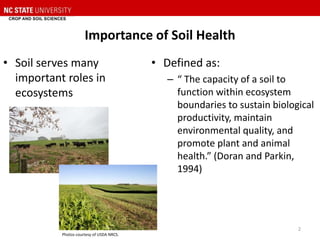
Importance of Soil Health
• Soil serves many
important roles in
ecosystems
• Defined as:
– ā€œ The capacity of a soil to
function within ecosystem
boundaries to sustain biological
productivity, maintain
environmental quality, and
promote plant and animal
health.ā€ (Doran and Parkin,
1994)
Photos courtesy of USDA NRCS.
2
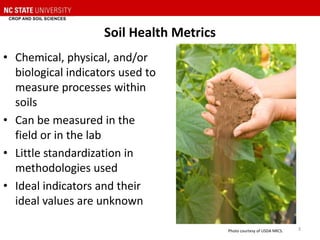
Soil Health Metrics
• Chemical, physical, and/or
biological indicators used to
measure processes within
soils
• Can be measured in the
field or in the lab
• Little standardization in
methodologies used
• Ideal indicators and their
ideal values are unknown
Photo courtesy of USDA NRCS. 3
USDA-Natural Resources Conservation Service:
Dynamic Soil Properties for Soil Health
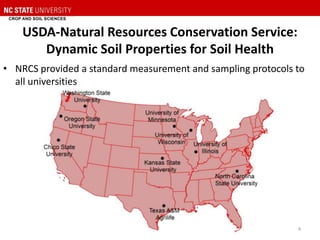
• NRCS provided a standard measurement and sampling protocols to
all universities
4
North Carolina Soil Health Objectives
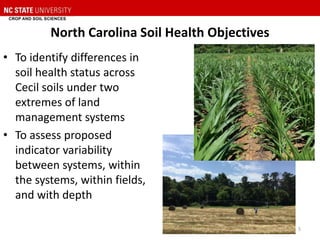
• To identify differences in
soil health status across
Cecil soils under two
extremes of land
management systems
• To assess proposed
indicator variability
between systems, within
the systems, within fields,
and with depth
5
Experimental Design
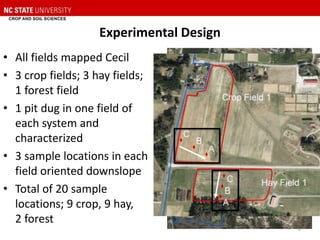
• All fields mapped Cecil
• 3 crop fields; 3 hay fields;
1 forest field
• 1 pit dug in one field of
each system and
characterized
• 3 sample locations in each
field oriented downslope
• Total of 20 sample
locations; 9 crop, 9 hay,
2 forest
6
Sampling Methods
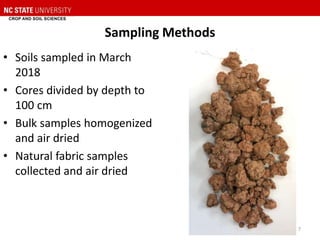
• Soils sampled in March
2018
• Cores divided by depth to
100 cm
• Bulk samples homogenized
and air dried
• Natural fabric samples
collected and air dried
7
0 – 5 cm
Bottom of A
Bt1
Bt2
5 – 10 cm
Methods
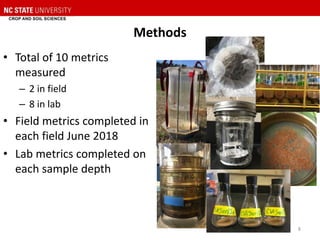
• Total of 10 metrics
measured
– 2 in field
– 8 in lab
• Field metrics completed in
each field June 2018
• Lab metrics completed on
each sample depth
8
Indicators
9
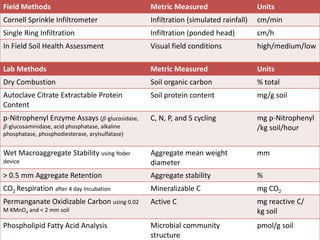
Field Methods Metric Measured Units
Cornell Sprinkle Infiltrometer Infiltration (simulated rainfall) cm/min
Single Ring Infiltration Infiltration (ponded head) cm/h
In Field Soil Health Assessment Visual field conditions high/medium/low
Lab Methods Metric Measured Units
Dry Combustion Soil organic carbon % total
Autoclave Citrate Extractable Protein
Content
Soil protein content mg/g soil
p-Nitrophenyl Enzyme Assays (š›½-glucosidase,
š›½-glucosaminidase, acid phosphatase, alkaline
phosphatase, phosphodiesterase, arylsulfatase)
C, N, P, and S cycling mg p-Nitrophenyl
/kg soil/hour
Wet Macroaggregate Stability using Yoder
device
Aggregate mean weight
diameter
mm
> 0.5 mm Aggregate Retention Aggregate stability %
CO2 Respiration after 4 day Incubation Mineralizable C mg CO2
Permanganate Oxidizable Carbon using 0.02
M KMnO4 and < 2 mm soil
Active C mg reactive C/
kg soil
Phospholipid Fatty Acid Analysis Microbial community
structure
pmol/g soil
Statistical Design
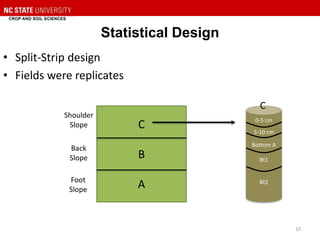
• Split-Strip design
• Fields were replicates
10
C
B
A
0-5 cm
5-10 cm
Bottom A
Bt1
Bt2
C
Shoulder
Slope
Back
Slope
Foot
Slope
Results
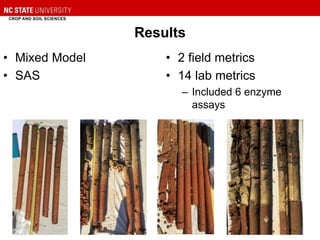
• Mixed Model
• SAS
• 2 field metrics
• 14 lab metrics
– Included 6 enzyme
assays
11
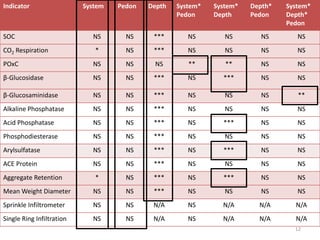
Indicator System Pedon Depth System*
Pedon
System*
Depth
Depth*
Pedon
System*
Depth*
Pedon
SOC NS NS *** NS NS NS NS
CO2 Respiration * NS *** NS NS NS NS
POxC NS NS NS ** ** NS NS
β-Glucosidase NS NS *** NS *** NS NS
β-Glucosaminidase NS NS *** NS NS NS **
Alkaline Phosphatase NS NS *** NS NS NS NS
Acid Phosphatase NS NS *** NS *** NS NS
Phosphodiesterase NS NS *** NS NS NS NS
Arylsulfatase NS NS *** NS *** NS NS
ACE Protein NS NS *** NS NS NS NS
Aggregate Retention * NS *** NS *** NS NS
Mean Weight Diameter NS NS *** NS NS NS NS
Sprinkle Infiltrometer NS NS N/A NS N/A N/A N/A
Single Ring Infiltration NS NS N/A NS N/A N/A N/A
12
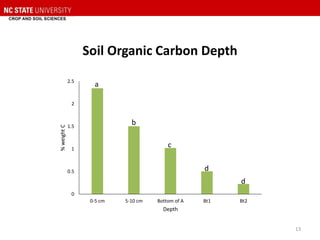
Soil Organic Carbon Depth
0
0.5
1
1.5
2
2.5
0-5 cm 5-10 cm Bottom of A Bt1 Bt2
%weightC
Depth
a
b
c
d
d
13
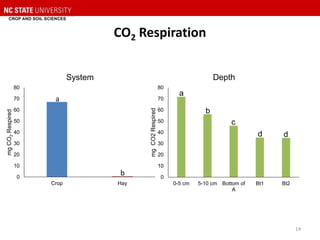
CO2 Respiration
0
10
20
30
40
50
60
70
80
Crop Hay
mgCO2Respired
System
a
b
14
0
10
20
30
40
50
60
70
80
0-5 cm 5-10 cm Bottom of
A
Bt1 Bt2
mgCO2Respired
Depth
a
b
c
d d
712
713
714
715
716
717
718
0-5 cm 5-10 cm Bottom of
A
Bt1 Bt2
mgC/kgsoil
Depth
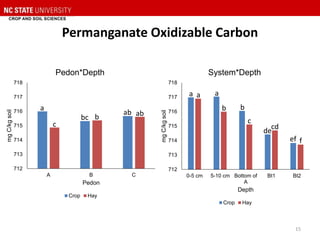
System*Depth
Crop Hay
Permanganate Oxidizable Carbon
712
713
714
715
716
717
718
A B C
mgC/kgsoil
Pedon
Pedon*Depth
Crop Hay
a
c
b
ab ab
bc
15
aa a
b b
c
de
cd
ef f
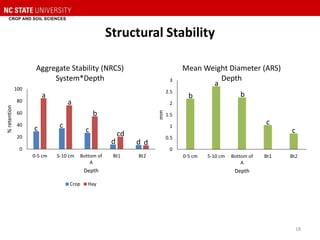
Carbon Cycling Enzymes
0
100
200
300
400
500
600
700
0-5 cm 5-10 cm Bottom of A Bt1 Bt2
ugp-nitrophenyl/gsoil/hour
Depth
B-Glucosidase System*Depth
Crop Hay
b
a
c
d
e
ef f f ff
16
Phosphorus Cycling Enzymes
0
100
200
300
400
500
600
700
0-5 cm 5-10 cm Bottom of
A
Bt1 Bt2
ugp-nitrphenyl/gsoil/hour
Depth
Alkaline Phosphatase Depth
a
b
c
17
0
50
100
150
200
250
300
350
400
0-5 cm 5-10 cm Bottom of
A
Bt1 Bt2
ugp-nitrophenyl/gsoil/hour
Depth
Acid Phosphatase System*Depth
Crop Hay
a
bc
c
d
de
e e e e
b
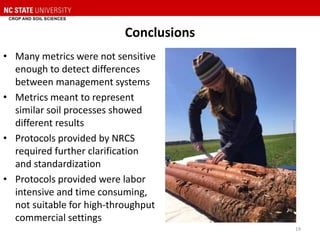
Structural Stability
0
20
40
60
80
100
0-5 cm 5-10 cm Bottom of
A
Bt1 Bt2
%retention
Depth
Aggregate Stability (NRCS)
System*Depth
Crop Hay
a
a
b
cc c cd
d d d
18
0
0.5
1
1.5
2
2.5
3
0-5 cm 5-10 cm Bottom of
A
Bt1 Bt2
mm
Depth
Mean Weight Diameter (ARS)
Depth
b
a
b
c
c
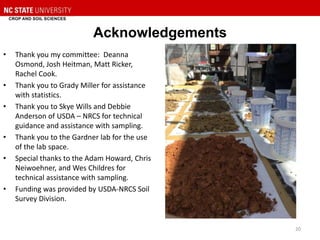
Conclusions
• Many metrics were not sensitive
enough to detect differences
between management systems
• Metrics meant to represent
similar soil processes showed
different results
• Protocols provided by NRCS
required further clarification
and standardization
• Protocols provided were labor
intensive and time consuming,
not suitable for high-throughput
commercial settings
19
Acknowledgements
• Thank you my committee: Deanna
Osmond, Josh Heitman, Matt Ricker,
Rachel Cook.
• Thank you to Grady Miller for assistance
with statistics.
• Thank you to Skye Wills and Debbie
Anderson of USDA – NRCS for technical
guidance and assistance with sampling.
• Thank you to the Gardner lab for the use
of the lab space.
• Special thanks to the Adam Howard, Chris
Neiwoehner, and Wes Childres for
technical assistance with sampling.
• Funding was provided by USDA-NRCS Soil
Survey Division.
20
Questions
21

July 30-1050-Caitlin Caudle

  • 1.
    Assessing Soil HealthMetrics in the Piedmont of North Carolina Caitlin Caudle, Deanna Osmond, Matthew Ricker, Joshua Heitman, Rachel Cook North Carolina State University
  • 2.
    Importance of SoilHealth • Soil serves many important roles in ecosystems • Defined as: – ā€œ The capacity of a soil to function within ecosystem boundaries to sustain biological productivity, maintain environmental quality, and promote plant and animal health.ā€ (Doran and Parkin, 1994) Photos courtesy of USDA NRCS. 2
  • 3.
    Soil Health Metrics •Chemical, physical, and/or biological indicators used to measure processes within soils • Can be measured in the field or in the lab • Little standardization in methodologies used • Ideal indicators and their ideal values are unknown Photo courtesy of USDA NRCS. 3
  • 4.
    USDA-Natural Resources ConservationService: Dynamic Soil Properties for Soil Health • NRCS provided a standard measurement and sampling protocols to all universities 4
  • 5.
    North Carolina SoilHealth Objectives • To identify differences in soil health status across Cecil soils under two extremes of land management systems • To assess proposed indicator variability between systems, within the systems, within fields, and with depth 5
  • 6.
    Experimental Design • Allfields mapped Cecil • 3 crop fields; 3 hay fields; 1 forest field • 1 pit dug in one field of each system and characterized • 3 sample locations in each field oriented downslope • Total of 20 sample locations; 9 crop, 9 hay, 2 forest 6
  • 7.
    Sampling Methods • Soilssampled in March 2018 • Cores divided by depth to 100 cm • Bulk samples homogenized and air dried • Natural fabric samples collected and air dried 7 0 – 5 cm Bottom of A Bt1 Bt2 5 – 10 cm
  • 8.
    Methods • Total of10 metrics measured – 2 in field – 8 in lab • Field metrics completed in each field June 2018 • Lab metrics completed on each sample depth 8
  • 9.
    Indicators 9 Field Methods MetricMeasured Units Cornell Sprinkle Infiltrometer Infiltration (simulated rainfall) cm/min Single Ring Infiltration Infiltration (ponded head) cm/h In Field Soil Health Assessment Visual field conditions high/medium/low Lab Methods Metric Measured Units Dry Combustion Soil organic carbon % total Autoclave Citrate Extractable Protein Content Soil protein content mg/g soil p-Nitrophenyl Enzyme Assays (š›½-glucosidase, š›½-glucosaminidase, acid phosphatase, alkaline phosphatase, phosphodiesterase, arylsulfatase) C, N, P, and S cycling mg p-Nitrophenyl /kg soil/hour Wet Macroaggregate Stability using Yoder device Aggregate mean weight diameter mm > 0.5 mm Aggregate Retention Aggregate stability % CO2 Respiration after 4 day Incubation Mineralizable C mg CO2 Permanganate Oxidizable Carbon using 0.02 M KMnO4 and < 2 mm soil Active C mg reactive C/ kg soil Phospholipid Fatty Acid Analysis Microbial community structure pmol/g soil
  • 10.
    Statistical Design • Split-Stripdesign • Fields were replicates 10 C B A 0-5 cm 5-10 cm Bottom A Bt1 Bt2 C Shoulder Slope Back Slope Foot Slope
  • 11.
    Results • Mixed Model •SAS • 2 field metrics • 14 lab metrics – Included 6 enzyme assays 11
  • 12.
    Indicator System PedonDepth System* Pedon System* Depth Depth* Pedon System* Depth* Pedon SOC NS NS *** NS NS NS NS CO2 Respiration * NS *** NS NS NS NS POxC NS NS NS ** ** NS NS β-Glucosidase NS NS *** NS *** NS NS β-Glucosaminidase NS NS *** NS NS NS ** Alkaline Phosphatase NS NS *** NS NS NS NS Acid Phosphatase NS NS *** NS *** NS NS Phosphodiesterase NS NS *** NS NS NS NS Arylsulfatase NS NS *** NS *** NS NS ACE Protein NS NS *** NS NS NS NS Aggregate Retention * NS *** NS *** NS NS Mean Weight Diameter NS NS *** NS NS NS NS Sprinkle Infiltrometer NS NS N/A NS N/A N/A N/A Single Ring Infiltration NS NS N/A NS N/A N/A N/A 12
  • 13.
    Soil Organic CarbonDepth 0 0.5 1 1.5 2 2.5 0-5 cm 5-10 cm Bottom of A Bt1 Bt2 %weightC Depth a b c d d 13
  • 14.
  • 15.
    712 713 714 715 716 717 718 0-5 cm 5-10cm Bottom of A Bt1 Bt2 mgC/kgsoil Depth System*Depth Crop Hay Permanganate Oxidizable Carbon 712 713 714 715 716 717 718 A B C mgC/kgsoil Pedon Pedon*Depth Crop Hay a c b ab ab bc 15 aa a b b c de cd ef f
  • 16.
    Carbon Cycling Enzymes 0 100 200 300 400 500 600 700 0-5cm 5-10 cm Bottom of A Bt1 Bt2 ugp-nitrophenyl/gsoil/hour Depth B-Glucosidase System*Depth Crop Hay b a c d e ef f f ff 16
  • 17.
    Phosphorus Cycling Enzymes 0 100 200 300 400 500 600 700 0-5cm 5-10 cm Bottom of A Bt1 Bt2 ugp-nitrphenyl/gsoil/hour Depth Alkaline Phosphatase Depth a b c 17 0 50 100 150 200 250 300 350 400 0-5 cm 5-10 cm Bottom of A Bt1 Bt2 ugp-nitrophenyl/gsoil/hour Depth Acid Phosphatase System*Depth Crop Hay a bc c d de e e e e b
  • 18.
    Structural Stability 0 20 40 60 80 100 0-5 cm5-10 cm Bottom of A Bt1 Bt2 %retention Depth Aggregate Stability (NRCS) System*Depth Crop Hay a a b cc c cd d d d 18 0 0.5 1 1.5 2 2.5 3 0-5 cm 5-10 cm Bottom of A Bt1 Bt2 mm Depth Mean Weight Diameter (ARS) Depth b a b c c
  • 19.
    Conclusions • Many metricswere not sensitive enough to detect differences between management systems • Metrics meant to represent similar soil processes showed different results • Protocols provided by NRCS required further clarification and standardization • Protocols provided were labor intensive and time consuming, not suitable for high-throughput commercial settings 19
  • 20.
    Acknowledgements • Thank youmy committee: Deanna Osmond, Josh Heitman, Matt Ricker, Rachel Cook. • Thank you to Grady Miller for assistance with statistics. • Thank you to Skye Wills and Debbie Anderson of USDA – NRCS for technical guidance and assistance with sampling. • Thank you to the Gardner lab for the use of the lab space. • Special thanks to the Adam Howard, Chris Neiwoehner, and Wes Childres for technical assistance with sampling. • Funding was provided by USDA-NRCS Soil Survey Division. 20
  • 21.

Editor's Notes

  • #3Ā Water filtration Growth medium Source of plant nutrients Habitat for organisms Have definition, but wide variety of soil types and uses make it hard to determine what an ideal or healthy soil function is
  • #4Ā Chemical physical and biological indicators are used to measure specific processes in soils By measuring the processes can measure how well a soil is functioning and theoretically measure the health In field or in lab Haney test CASH co2 example, both include it but have two different protocols Ideal indicators are unknown because the wide range of soil types and functions, making ideal indicator values unknown. Indicator values may change with soil type or management system
  • #5Ā Project is part of the science of soil health initiative NRCS provided a standard measurement and sampling protocol to each university Looking at the map, wide variety of soil type and management systems represented
  • #6Ā Cecil was chosen because it is the state soil of NC and a common soil in agricultural production in NC The two management systems were chosen because of their extreme differences and they are common management systems in the piedmont of NC
  • #7Ā NRSC personnel selected the fields All fields mapped cecil and Management history is known for each field for the past five years NRCS personnel dug the pits and characterized the soil The forest location serves as a baseline Cecil soil that has not experienced any management in five years 3 sample location in each field oriented downslope Slope positions are roughly shoulder slope, back slope, and foot slope Pedons are equidistance apart within each field based on the size of the field, where the map unit is in the field, and the slope of the field Only two forest locations because of equipment limitations
  • #8Ā Sampled in march of 2018 using a giddings probe Natural fabric samples are naturally occurring aggregates or clods that haven’t been disturbed
  • #9Ā Lab metrics completed May 2018 to June 2019
  • #10Ā Infiltration done at each sample location, field assessments done in each field Includes 8 individual protocols, but also measured 5 enzymes. Point out that we measured a variety of physical, chemical, and biological indicators that represented many different processes in the soil such as nutrient cycling, water infiltration, aggregate formation
  • #11Ā Split component is pedons within each field because they are equidistance apart and split could account for the spatial variability
  • #13Ā Show that system and pedon don’t have many significant interactions, most are in depth. But the rest are System*Depth interaction, with just two elsewhere Emphasize that the sections are for indicators measuring similar things, but they do not share any significance patterm. PLFA was not done in our lab.
  • #14Ā Shows a decrease in total SOC with depth, which is an established trend But showed no difference in the systems
  • #15Ā CO2 showed higher respiration in crop, and with the ā€œmore is betterā€ thinking would make a cropping system ā€œhealthierā€ than a hay system
  • #18Ā Alkaline phosphatase didn’t work really well on these soils, which was expected as Cecil soils are acidic