Oncotarget1www.impactjournals.com/oncotarget
www.impactjournals.com/oncotarget/ Oncotarget, Advance Publications 2015
Glioma-derived plasminogen activator inhibitor-1 (PAI-1)
regulates the recruitment of LRP1 positive mast cells
Ananya Roy1,*
, Antoine Coum2,*
, Voichita D. Marinescu3
, Jelena Põlajeva4
, Anja
Smits5,6
, Sven Nelander3
, Lene Uhrbom1
, Bengt Westermark1
, Karin Forsberg-
Nilsson3
, Fredrik Pontén3
and Elena Tchougounova1
1
Uppsala University, Department of Immunology, Genetics and Pathology, Rudbeck Laboratory, SE-751 85 Uppsala, Sweden
2
Nanoscience Centre, Department of Engineering, Cambridge University, Cambridge CB3 0FF, UK
3
Uppsala University, Department of Immunology, Genetics and Pathology, and Science for Life Laboratory, Rudbeck
Laboratory, SE-751 85 Uppsala, Sweden
4
Cancer Research Technology, LBIC, London NW1 0NH, UK
5
Uppsala University, Department of Neuroscience, Neurology, SE-751 85 Uppsala, Sweden
6
Present address: Danish Epilepsy Center, Dianalund, Denmark
*
These authors have contributed equally to this work
Correspondence to: Elena Tchougounova, email: elena.chugunova@igp.uu.se
Keywords: mast cell, glioma, PAI-1, SERPINE1, LRP1
Received: April 28, 2015	 Accepted: June 12, 2015	 Published: June 25, 2015
This is an open-access article distributed under the terms of the Creative Commons Attribution License, which permits unrestricted use,
distribution, and reproduction in any medium, provided the original author and source are credited.
ABSTRACT
Glioblastoma (GBM) is a high-grade glioma with a complex microenvironment,
including various inflammatory cells and mast cells (MCs) as one of them. Previously
we had identified glioma grade-dependent MC recruitment. In the present study we
investigated the role of plasminogen activator inhibitor 1 (PAI-1) in MC recruitment.
PAI-1, a primary regulator in the fibrinolytic cascade is capable of forming a
complex with fibrinolytic system proteins together with low-density lipoprotein
receptor-related protein 1 (LRP1). We found that neutralizing PAI-1 attenuated
infiltration of MCs. To address the potential implication of LRP1 in this process, we
used a LRP1 antagonist, receptor-associated protein (RAP), and demonstrated the
attenuation of MC migration. Moreover, a positive correlation between the number of
MCs and the level of PAI-1 in a large cohort of human glioma samples was observed.
Our study demonstrated the expression of LRP1 in human MC line LAD2 and in MCs in
human high-grade glioma. The activation of potential PAI-1/LRP1 axis with purified
PAI-1 promoted increased phosphorylation of STAT3 and subsequently exocytosis
in MCs.
These findings indicate the influence of the PAI-1/LRP1 axis on the recruitment
of MCs in glioma. The connection between high-grade glioma and MC infiltration could
contribute to patient tailored therapy and improve patient stratification in future
therapeutic trials.
INTRODUCTION
The heterogeneity of high-grade gliomas in clinical
presentation, tumor location, growth pattern, response to
therapy and consequently patient outcome continues to
pose a challenge for clinical management [1]. Currently,
the treatment of glioblastoma (GBM) involves maximal
safe surgery, followed by radiation and chemotherapy.
There are also additional experimental treatments, such
as passive and active immunotherapy, use of angiogenic
inhibitors in combination with chemotherapeutics and
gene/antibody therapy [2]. Despite such aggressive
treatment, the prognosis for high-grade gliomas remains
among the poorest, with a median survival for patients
with GBM of just over one year [3].
The disruption of the blood brain barrier (BBB) as
Oncotarget2www.impactjournals.com/oncotarget
a result of abnormal neovasculature and redundant vessel
leakiness is one of the important hallmarks of GBM [4].
Another significant hallmark of GBM is its invasiveness
into surrounding brain parenchyma. During recent years,
the impact of microenvironment in tumor development
has become increasingly acknowledged [5]. Brain tumor-
associated parenchymal cells such as vascular cells,
peripheral immune cells including microglia, myeloid
suppressor cells and T-regulatory cells play a vital role in
controlling the development of pathological conditions.
Glioma is capable of hiding signals important for immune
activation and subsequently ameliorating the environment
for immunosuppressive factors [6]. Addressing the
complexity of the unique glioma-immune cell interactions
represents a crucial aspect for the future therapy of glioma.
Mast cells (MCs) are key regulators of the tumor
microenvironment, affecting angiogenic processes,
immune modulation and tissue remodeling [7]. The role
of MCs in cancer is still controversial depending on the
type and malignancy grade of the cancer. We were first to
report that gliomas also contain MCs and we addressed the
role for different axes in chemotactic infiltration of MCs
into glioma [8, 9].
Plasminogen activator inhibitor 1 (PAI-1) or
SERPINE1, a primary regulator in the plasminogen-
plasmin system, is known as the principal inhibitor of
urokinase type plasminogen activators (uPA) and tissue
type plasminogen activators (tPA) by which it inhibits
plasminogen activation. It is also capable of forming
a complex with uPA and the uPA receptor (uPAR).
This complex can be removed from the cell surface by
binding with LRP1, followed by lysosomal degradation
of PA-PAI-1 complexes and reappearance of uPAR on
the cell surface, adjusting locomotion and the direction
of migration of cells [10]. Previous publications
demonstrated that overexpression of PAI-1 in GBM
is significantly correlated with shorter survival [11].
In addition, the PAI-1 serum level was shown to be a
predictive marker of glioma grade [12].
Here, we demonstrate that accumulation of MCs
correlates with the level of PAI-1 in glioma cells, and
also in tissue microarrays (TMAs) of a large cohort of
human high-grade glioma tissues. We show that PAI-1
neutralizing antibodies attenuated the infiltration of MCs.
Furthermore, to address the potential implication of low-
density lipoprotein receptor-related protein 1 (LRP1) in
this process, we demonstrated the expression of LRP1
in LAD2 cells but also revealed the presence of LRP1
in MCs in human high-grade glioma tissue. To properly
assess the role of LRP1 in MC migration, we used a
LRP1 antagonist, receptor-associated protein (RAP), and
demonstrated the attenuation of MC migration upon LRP1
blocking. In addition, the activation of potential PAI-1/
LRP1 axis with purified PAI-1 promoted differential
phosphorylation of a number of signaling molecules
including significant upregulation of pSTAT3, which, in
turn, mediated MC exocytosis.
In conclusion, the present investigation reveals a
potential mechanism by which the recruitment of MCs to
glioma is mediated by tumor derived PAI-1. Our findings
implicate the interaction between PAI-1 and the newly
identified MC receptor LRP1 in pSTAT3 dependent MC
exocytosis.
RESULTS
High SERPINE1/PAI 1 expression in human
glioma correlates with low survival rate
We have earlier shown [9] that glioma derived
macrophage migration inhibitory factor (MIF) is a potent
chemoattractant for MCs. Another mediator that was
highly expressed by glioma cells is PAI-1/SERPINE1.
The recent classification of GBM has been given
by The Cancer Genome Atlas (TCGA) network. Based
on gene expression patterns for signature genes, genomic
abnormalities and gene expression alterations in genes
such as EGFR, NF1 and PDGFRA/IDH1, the TCGA
GBM samples were classified in four subtypes, Proneural,
Neural, Classical and Mesenchymal [13]. In order to
assess the potential correlation between SERPINE1
signaling in human GBM we analyzed the TCGA dataset
of 518 GBM patient samples and found a significant
upregulation of SERPINE1 (data not shown). We used
the well-established markers EGFR and PTEN as positive
and negative controls for upregulated and downregulated
expression in human GBM, respectively. To assess the
correlation between SERPINE1 expression and patient
survival we analyzed the TCGA GBM dataset consisting
of 518 GBM patients for which transcriptome and survival
data is available. First, we sorted the TCGA patients by
SERPINE1 expression from high to low and performed
a Kaplan-Meier survival analysis to compare the top
25% patients (with high expression) and the bottom
25% of patients (with low expression). This analysis
showed a statistically significant difference in survival
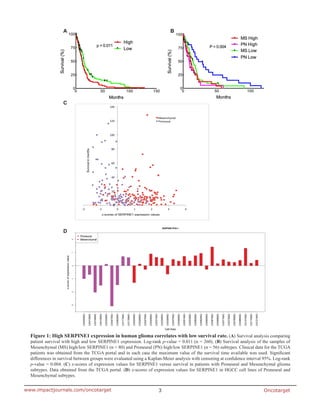
between the two groups (Figure 1A, log-rank p-value =
0.011). Further inspection of these groups showed that
83% of the patients with high SERPINE1 expression are
of Mesenchymal subtype (MS) and 29% of the patients
with low SERPINE1 values are of Proneural subtype
(PN) (Figure 1C). To investigate this further, we selected,
based on SERPINE1 expression (high or low), the top
25% and bottom 25% of patient samples within MS and
PN subgroups, respectively, and performed a survival
analysis between the resulting four groups. As shown in
Figure 1B we found a statistically significant survival
difference between the PN subgroup with low SERPINE1
expression (longer survival) and the other three (MS high/
low SERPINE1 and PN high SERPINE1 expression).
Oncotarget3www.impactjournals.com/oncotarget
Figure 1: High SERPINE1 expression in human glioma correlates with low survival rate. (A) Survival analysis comparing
patient survival with high and low SERPINE1 expression. Log-rank p-value = 0.011 (n = 260). (B) Survival analysis of the samples of
Mesenchymal (MS) high/low SERPINE1 (n = 80) and Proneural (PN) high/low SERPINE1 (n = 56) subtypes. Clinical data for the TCGA
patients was obtained from the TCGA portal and in each case the maximum value of the survival time available was used. Significant
differences in survival between groups were evaluated using a Kaplan-Meier analysis with censoring at confidence interval 95%. Log-rank
p-value = 0.004. (C) z-scores of expression values for SERPINE1 versus survival in patients with Proneural and Mesenchymal glioma
subtypes. Data obtained from the TCGA portal. (D) z-scores of expression values for SERPINE1 in HGCC cell lines of Proneural and
Mesenchymal subtypes.
Oncotarget4www.impactjournals.com/oncotarget
Patient-derived glioma cell cultures used in this
study are part of the Uppsala University Human Glioma
Cell Culture (HGCC) collection that comprises well-
characterized GBM-derived cell cultures (Xie et al 2015,
submitted). A survival analysis based on the HGCC
data was inconclusive owing to low sample numbers in
comparison to the number of patients in the TCGA dataset.
We chose cell lines from the HGCC database with high
and low SERPINE1 expression (Figure 1D) from both
Mesenchymal and Proneural subtypes to continue our
investigation.
Glioma derived PAI-1 promotes MC recruitment
Previously we demonstrated that human glioma
cells secrete a number of mediators among which MIF
promotes human MC recruitment [9]. Here we investigated
the role of another candidate, PAI-1, which is highly
secreted by glioma cells. Previous studies have shown
that overexpression of PAI-1 in GBM is significantly
correlated with shorter survival [11] and, that PAI-1 serum
level could be attributed as a predictive marker for glioma
grade [12]. Using microarray expression data and a larger
cohort of 518 patients from the TCGA, we found that there
is a statistically significant difference in survival between
patients with low versus high PAI-1 levels (Figure 1A).
Therefore, we decided to study the chemotactic capacity
of PAI-1 by attempting to block MC chemotaxis by
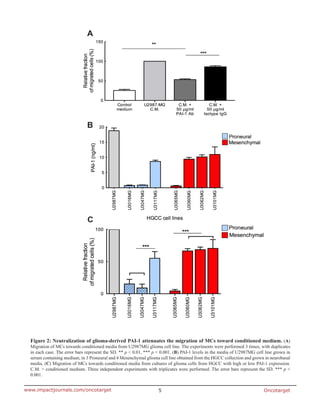
inhibiting PAI-1. As shown in Figure 2A, neutralization
of the PAI-1 in U2987MG-conditioned medium with
antibodies significantly lowered the motility of LAD2
MCs. A reduction of migration was even more pronounced
when both MIF and PAI-1 in the conditioned medium
were blocked (Supplementary Figure 1). Furthermore, the
levels of PAI-1 in patient-derived glioma cell supernatants
as compared to U2987MG were verified by using ELISA
in both Proneural (U3016MG, U3047MG, U3117MG)
and Mesenchymal (U3065MG, U3060MG, U3062MG,
U3101MG) subtypes with previously identified low
(U3016MG, U3047MG, U3065MG) and high (U3117MG,
U3101MG, U3060MG, U3062MG) mRNA level of PAI-
1 (Figure 2B). We further extended our study of LAD2
cell migration using high and low PAI-1 expressing
patient-derived glioma cell lines from the Proneural and
Mesenchymal subtypes. A direct correlation between
subtype of glioma cells, level of PAI-1 and migration of
LAD2 cells was observed, being highest in Mesenchymal
subtype with high level of PAI-1 expression and lowest
in Proneural subtype with low level of PAI-1 expression
(Figure 2C).
The extent of MC recruitment is correlated with
the level of PAI-1 in human high-grade glioma
We have previously shown that the number of MCs
in human glioma is dependent on malignancy grade. We
identified PAI-1 as a highly expressed glioma-derived
candidate [9], whose elevated expression in GBM has been
demonstrated to be associated with short survival [11]. In
addition, our in vitro data demonstrated a chemoattractant
role of PAI-1 towards MCs. Therefore we proceeded with
our studies by performing tissue analysis of the number
of infiltrating MCs and SERPINE1 expression in human
high-grade glioma TMAs.
PAI-1 is a widely expressed protein in glioma
tissues, which resulted in a strong and widespread
cytoplasmic staining when immunohistochemistry was
performed (data not shown). The extent of intense and
diffused staining made it unsuitable for quantification of
PAI-1 in the glioma TMAs. Therefore, to investigate the
potential correlation between the populations of GBM
cells expressing SERPINE1 and the presence of MCs,
we used RNA-in-situ hybridization (RNA-ISH) on high-
grade glioma TMA’s. Analysis of consecutive sections of
the TMAs revealed a correlation between the number of
infiltrating MCs and the relative staining intensity for PAI-
1 (Figure 3A). Thus negative staining was associated with
low MC numbers (0-5 MCs per TMA core) in all cases (n
= 25). The proportion of TMA cores with low numbers of
MCs was 57% (n = 32) among those with medium PAI-
1 expression. The proportion of MCs between medium
MC numbers (6-20 MC/TMA core) and high (≥21 MC/
TMA core) numbers in TMA cores with medium PAI-1
expression was calculated as 35% (n = 20) and 7% (n = 4)
respectively. The proportion of TMA cores exhibiting low
numbers of MCs was lowest with high PAI-1 expression.
These values were 29% (n = 5) for low MC numbers,
41% (n = 7) with medium and 29% (n = 5) with high MC
numbers of high PAI-1 expressing samples. Representative
positive and negative staining for MCs and PAI-1 is
illustrated in left panel of Figure 3A.
A Spearman’s correlation analysis comparing the
MC numbers and PAI-1 expression showed positive
correlation between them (Figure 3B). So we can
conclude that high PAI-1 expression in the glioma tissue
is associated with MC infiltration.
Identification of LRP1 expression in MCs in
human glioma and LAD2 cells is associated with
their recruitment towards glioma-derived PAI-1
MCs express a variety of both cell surface as well as
transmembrane receptors. However, none of the receptors
was identified to interact with PAI-1 as yet. PAI-1 can bind
to various matrix components e.g., vitronectin and LRP1,
leading to dramatic consequences on their migratory
Oncotarget5www.impactjournals.com/oncotarget
Figure 2: Neutralization of glioma-derived PAI-1 attenuates the migration of MCs toward conditioned medium. (A)
Migration of MCs towards conditioned media from U2987MG glioma cell line. The experiments were performed 3 times, with duplicates
in each case. The error bars represent the SD. ** p < 0.01, *** p < 0.001. (B) PAI-1 levels in the media of U2987MG cell line grown in
serum containing medium, in 3 Proneural and 4 Mesenchymal glioma cell line obtained from the HGCC collection and grown in neurobasal
media. (C) Migration of MCs towards conditioned media from cultures of glioma cells from HGCC with high or low PAI-1 expression.
C.M. = conditioned medium. Three independent experiments with triplicates were performed. The error bars represent the SD. *** p <
0.001.
Oncotarget6www.impactjournals.com/oncotarget
phenotype [14]. In addition, previous publications
demonstrated that PAI-1 stimulates macrophage motility
in a LRP1 dependent manner [15].
LRP1, one of the largest members of the LDLR
family is synthesized as a 600 kDa precursor protein and
processed in the trans-Golgi by a furin-like protease to
yield a 515 kDa alpha-chain and an 85 kDa beta-chain
that associates non-covalently [16]. The alpha chain
contains four ligand-binding domains (clusters I-IV).
We hypothesized that LRP1 is expressed on MCs and
mediates MC motility towards glioma derived PAI-1. We
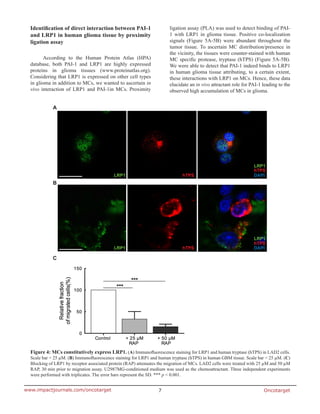
identified LRP1 expression on LAD2 cells by observing
the co-localization of LRP1 with human MC tryptase
(hTPS) (Figure 4A). Similar staining was performed on
human glioma tissue demonstrating the LRP1 expression
on MCs in vivo (Figure 4B). To confirm the constitutive
expression of LRP1 in MCs we stimulated LAD2 cells
with PAI-1 enriched medium and then performed
western blot (Supplementary Figure 2A) and RT-PCR
(Supplementary Figure 2B) on LAD2 cells. The level of
LRP1 expression was not altered and was consistent with
or without stimulation by PAI-1, confirming that LAD2
cells express LRP1 constitutively.
To validate the importance of LRP1 in mediating
MC’s migratory capacity towards glioma-derived PAI-
1, a low-density lipoprotein (LDL) receptor family
blocker, receptor associated protein (RAP) was used to
block LRP1 in LAD2 cells. RAP has been shown to bind
with high affinity to cluster III of LRP1 [17]. The results
demonstrated that migration of RAP pre-treated LAD2
cells towards PAI-1 enriched medium was significantly
reduced in a dose-dependent manner (Figure 4C), being
in line with our hypothesis that PAI-1 induces migration
of LAD2 cells in a LRP1 dependent manner.
Figure 3: The level of PAI-1 is correlated with the extent of MC recruitment. (A) Left panel: The relationship between the
number of MCs and the PAI-1 expression level, specifically the fraction of PAI-1 mRNA expression per TMA core, ** p < 0.01. Right
panel: Representative TMA cores of negative (left panels) and positive staining (middle panels) for tryptase (IHC) and PAI-1 RNA (ISH).
Selected areas from middle panels are magnified in the right panels. (B) Spearman’s rank correlation analysis between MC numbers and
PAI-1 mRNA expression level, ρ = 0.4
Oncotarget7www.impactjournals.com/oncotarget
Identification of direct interaction between PAI-1
and LRP1 in human glioma tissue by proximity
ligation assay
According to the Human Protein Atlas (HPA)
database, both PAI-1 and LRP1 are highly expressed
proteins in glioma tissues (www.proteinatlas.org).
Considering that LRP1 is expressed on other cell types
in glioma in addition to MCs, we wanted to ascertain in
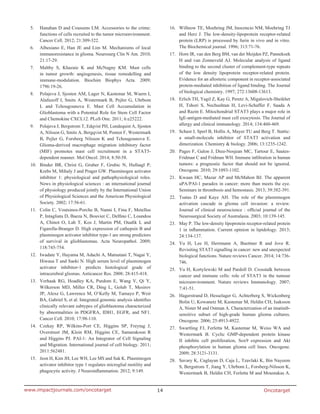
vivo interaction of LRP1 and PAI-1in MCs. Proximity
ligation assay (PLA) was used to detect binding of PAI-
1 with LRP1 in glioma tissue. Positive co-localization
signals (Figure 5A-5B) were abundant throughout the
tumor tissue. To ascertain MC distribution/presence in
the vicinity, the tissues were counter-stained with human
MC specific protease, tryptase (hTPS) (Figure 5A-5B).
We were able to detect that PAI-1 indeed binds to LRP1
in human glioma tissue attributing, to a certain extent,
these interactions with LRP1 on MCs. Hence, these data
elucidate an in vivo attractant role for PAI-1 leading to the
observed high accumulation of MCs in glioma.
Figure 4: MCs constitutively express LRP1. (A) Immunofluorescence staining for LRP1 and human tryptase (hTPS) in LAD2 cells.
Scale bar = 25 µM. (B) Immunofluorescence staining for LRP1 and human tryptase (hTPS) in human GBM tissue. Scale bar = 25 µM. (C)
Blocking of LRP1 by receptor associated protein (RAP) attenuates the migration of MCs. LAD2 cells were treated with 25 µM and 50 µM
RAP, 30 min prior to migration assay. U2987MG-conditioned medium was used as the chemoattractant. Three independent experiments
were performed with triplicates. The error bars represent the SD. *** p < 0.001.
Oncotarget8www.impactjournals.com/oncotarget
PAI-1 promotes phosphorylation of STAT3 and
regulation of exocytosis in MCs
A phosphokinase array was used to identify possible
targets downstream of signaling pathways induced by PAI-
1. Protein lysates from PAI-1 stimulated LAD2 cells were
analyzed by this array and revealed intense augmentation
of the intracellular level of phosphorylated STAT3
(pSTAT3) as compared to control medium (Figure 6A).
STAT3 has been shown to be involved in MC
functions by induction of various regulatory genes and
its phosphorylation linked to MC exocytosis [18]. To test
the potential role of STAT3 in MC exocytosis, Stattic,
a nonpeptidic small molecule STAT3 inhibitor, was
used [19]. LAD2 cells were pretreated with Stattic for 2
hours prior to stimulation by glioma-derived conditioned
medium. The calcium ionophore A23187 was used as a
positive stimulant of LAD2 cells. Western blotting verified
the significant blocking of STAT3 phosphorylation by
Stattic (Figure 6B). We also found that the level of
LRP1 in the LAD2 cells remained unaltered (Figure 6B)
after treatment with Stattic. This result further supports
the constitutive expression of LRP1 in LAD2 cells
demonstrated in Supplementary Figure 2.
The analysis of histamine release (Figure 6C) and
TNF-alpha secretion (Figure 6D) by LAD2 cells after
Stattic treatment demonstrated a significant decrease in
both assays indicating an inhibition of MC exocytosis
when STAT3 activation is hampered. Hence it is
evident that PAI-1 stimulates active migration of MCs
which, in turn, activates signaling cascades leading to
STAT3 phosphorylation and, subsequently, causes MC
degranulation in the tissue, thereby may trigger infiltration
of other immune cells, development of angiogenesis and
other modulation of the tumor microenvironment.
DISCUSSION
The dependence of cancer growth on the
reciprocal interactions between tumor cells and tumor
microenvironment is increasingly recognized. Glioma
microenvironment accommodates a diversity of cell
types and a plethora of complex interactions between
them. Inflammatory cells have been connected to tumor
Figure 5: Identification of direct interaction between PAI-1 and LRP1 in human GBM tissue by proximity ligation
assay. The interaction between LRP1 on MCs and PAI-1 in vicinity in human GBM tissue (A) 20X, (B) 40X: Representative picture of
proximity ligation assay in human GBM tissue showing the interaction between LRP1 and PAI-1 counterstained with human MC specific
tryptase (hTPS) (also indicated by arrow heads).
Oncotarget9www.impactjournals.com/oncotarget
development by mediating the inflammatory response,
which is critical for tumor formation.
Gliomas are infiltrated by a variety of immune
cells from both the innate and adaptive immune systems.
However, the correlation between these immune
infiltrates and clinical outcome is controversial, leaving
their role debatable and requiring more efforts in further
investigations [20]. Despite the fact that the prevailing
role for glioma-associated immune cells remains
protumorigenic, it cannot be excluded that the functional
plasticity of immune cells is dependent on multiple
microenvironmental cues. These cues for example can be
generated by immune cells and depend on the severity of
glioma.
In our previous studies we demonstrated recruitment
of MCs upon glioma development [8]. We also identified
several glioma-secreted factors, which appeared to be
crucial for MC recruitment [9]. One of the candidates
Figure 6: PAI-1 alters signaling networks in MCs. (A) Upper panels: the phosphorylation profiles of lysates of MCs cultured in
control medium (top left), medium containing PAI-1 (1ng/ml, top right; 10ng/ml, bottom left) or U2987MG-conditioned medium (C.M.,
bottom right). In the graph quantification of the dots of interest is plotted as integrated pixel intensities. The error bars represent the SD. **
p < 0.01. (B) Stattic can effectively inhibit STAT3 phosphorylation without changing LRP1 expression levels. Left panel: representative
picture of a western blotting of LAD2 cells showing inhibition of STAT3 phosphorylation after treatment with Stattic, and equal LRP1
expression. Middle panel: quantification of western blotting to evaluate STAT3 levels. Right panel: quantification of western blotting to
evaluate LRP1 levels. The error bars represent the SD. *** p < 0.001. Histamine levels (C) and TNF-alpha secretion (D) were measured by
using ELISAand demonstrated that inhibition of STAT3 phosphorylation by Stattic reduces MC exocytosis. Three independent experiments
were performed with triplicates. The error bars represent the SD. *** p < 0.001.
Oncotarget10www.impactjournals.com/oncotarget
identified was PAI-1. Considering previously shown direct
correlation between overexpressed PAI-1 and the survival
in GBM [11], and also its role in being potential serum
marker in the prediction of glioma grade [12], we decided
to focus our research on PAI-1.
Previous studies of the plasminogen-plasmin
system in cancer suggested the importance of this system
in facilitating tumor cell invasion by uPA-mediated
activation of plasmin and subsequent degradation of
extracellular matrix [21]. PAI-1 is the unique and specific
inhibitor of both tPA and uPA [22] and thus expected to
prevent plasmin generation. However, recent studies have
brought forward another set of functions that are distinct
from original function of uPA/PAI-1. These observations
revealed that high PAI-1 expression is an indicator of
poor prognosis in many cancers, suggesting the ambiguity
of definition of PAI-1 as tumoricidal [10]. It was also
demonstrated that there are nonproteolytic properties of
PAI-1, including interactions with integrins, inhibition
of apoptosis and promotion of tumor cell proliferation. It
indicates the importance of other factors, including PAI-
1 concentration, location, type of tumor, and presence
of receptors, and not only the impact of PAI-1 induced
proteolytic actions of plasmin.
The analysis of the TCGA GBM dataset revealed
significant upregulation of SERPINE1 (PAI-1). Kaplan-
Meier survival curves using the TCGA GBM dataset
showed a significant difference in survival between
patients with high versus low SERPINE1 expression.
Further investigation of subtype-specific expression of
SERPINE1 showed that the predominant subtype among
the patients with highest SERPINE1 expression levels is
the Mesenchymal subtype, while the Proneural subtype
is predominant among patients with lowest SERPINE1
levels. Moreover, the survival analysis between the top/
bottom 25% of patients within the Mesenchymal and
Proneural subtypes showed that patients of Proneural
subtype with low SERPINE1 levels have a statistically
significant increase in survival compared with the other
three groups. Based on these observations we hypothesized
that PAI-1 expression could initiate MC migration in a
subtype specific manner and eventually affect the role of
MC in glioma development. To test this hypothesis we
used the panel of patient-derived glioblastoma cell lines
from the HGCC biobank with transcriptome data and
assigned subtypes. The expression of SERPINE1 in this
sample set mirrors the expression in the TCGA dataset,
being highest in cell cultures of Mesenchymal subtype
and lowest in the cell cultures of Proneural subtype. This
demonstrated that given cell cultures are suitable models
for studies of SERPINE1-related mechanisms in GBM
biology.
In this study we identified PAI-1 as an important
attractant of MCs in glioma. Moreover, on the basis of
the TCGA and HGCC datasets we undertook a functional
screen of the panel of patient-derived glioma primary
cell cultures and confirmed the functional connection
between glioma subtype dependent PAI-1 expression and
MC migratory properties. LRP1 is known for its multiple
functions in endocytosis and in signal transduction that
allows it to activate inflammatory signaling pathways.
Previous publications showed that LRP1 is capable of
stimulating cytokine production by inflammatory cells
and induce cell migration [23]. We are first to identify the
LRP1 expression in MCs in both LAD2 cells and human
gliomas and show that LRP1 was critical for accumulation
of MCs towards PAI-1 expressing glioma cells. The
neutralization of PAI-1 activation significantly attenuated
MC migration. However, residual chemoattractant activity
toward MCs was present even after adding the PAI-
1 blocking antibody, suggesting the role for other MC
chemoattractants. Indeed, MC migration was hindered
even more noticeably when both MIF and PAI-1 blocking
antibodies were added, suggesting a critical role for these
chemoattractants in MC migration. Regulation of MC
recruitment to gliomas by PAI-1 is supported further
by our TMA data demonstrating a positive correlation
between the level of PAI-1 mRNA expression and the
number of intratumoral MCs.
At the same time PAI-1 promoted differential
phosphorylation of a number of signaling molecules
in MCs, including substantial enhancement of STAT3
phosphorylation and, subsequently, resulting in increased
MC exocytosis. STAT3 plays a crucial role in tumor
microenvironment. It propagates several levels of
crosstalk between tumor cells and their immunological
microenvironment. The activated STAT3 stimulates tumor
stromal immune cells, whose recruitment promotes tumor
progression [24, 25]. Our data is in line with the recent
publications demonstrating the role for activated STAT3 in
immunologically mediated MC exocytosis [18].
In conclusion, we demonstrated that glioma-derived
PAI-1, inducing recruitment of MCs also mediates MC
degranulation, releasing numerous MC mediators, which
participate in glioma fate. These findings shed new light
on the molecular basis of the interplay between glioma
cells and MCs and eventually emphasize the impact of
MCs upon glioma progression.
MATERIALS AND METHODS
Cell cultures
All cells were cultured at 37° C under 5% CO2.
U2987MG, a human glioma cell line [26], was cultured
in 10% FBS-containing MEM supplemented with 4mM
L-glutamine, 100units/ml penicillin and 0.1mg/ml
streptomycin. The U2987MG cell line was established
from a patient with high-grade glioma [26] and was
denoted as primary culture 18. This cell line have then
Oncotarget11www.impactjournals.com/oncotarget
been very well studied [27, 28] and subsequently
established as a stable glioma cell line. U3016MG,
U3047MG, U3117MG, U3065MG, U3060MG,
U3062MG and U3101MG cells were cultured on laminin
(10mg/ml) in serum-free (stem cell) conditions, to enrich
for stem-like glioma cells, as described previously [29].
The human MC line LAD2 (obtained from Prof
Dean Metcalfe at NIH/NIAID, MD, USA) was cultured
as described previously [30] in StemPro medium
supplemented with 4mM L-glutamine, 100units/ml
penicillin and 0.1mg/ml streptomycin and 100ng/ml SCF
(Invitrogen, Carlsbad, USA).
Transwell migration assays
All migration experiments were carried out in a
24-well culture plates using transwells with 5µm PET
membrane (Millipore, Billerica, MA). To evaluate the
capacity of glioma cells to recruit MCs, conditioned
media from confluent U2987MG, U3016MG, U3047MG,
U3117MG, U3065MG, U3060MG, U3062MG and
U3101MG cells were used as the chemoattractant with
unconditioned media serving as controls. LAD2 cells were
starved of SCF overnight, resuspended in control medium
(5 x 10⁴
cells/ml), then allowed to migrate through
transwells overnight and thereafter counted. Migration of
MCs toward U2987MG-conditioned medium was set to
100%. These experiments were performed in triplicates
and repeated at least 3 times.
Neutralizing experiments were performed in
triplicates as described previously [8] with PAI-1 antibody
concentration of 50µg/ml (R&D Systems, Abingdon,
UK) and MIF antibody concentration of 50µg/ml (R&D
Systems, Abingdon, UK). Control samples were incubated
under same conditions with a matching isotype nonspecific
IgG antibody (50 µg/ml; R&D Systems, Abingdon, UK).
The selection of concentration range for PAI-1 neutralizing
antibody was based on suggestion by manufacturers as
determined by its ability to neutralize recombinant human
PAI-1.
For blocking of LRP1 activity, cells were pretreated
with two different concentrations (25µM and 50µM) of
LRP1 antagonist RAP (Abcam, Cambridge, UK) for 30
min prior to migration studies.
Inhibition and stimulation assays
To examine the effect of STAT3 on MC exocytosis,
LAD2 cells were pre-treated with Stattic (Sigma Aldrich,
St Loius, USA) an inhibitor of STAT3 phosphorylation,
at a concentration of 80µM for 30 min at 37°C. The
concentration of Stattic used was chosen based on
previous publications [18] and published kinetic study
experiments [19, 31]. Following this the LAD2 cells were
stimulated with U2987MG media in a 24-well culture
plate for 4 hours. Stimulation experiment was done in
duplicates. Supernatants were collected for histamine and
TNF-α ELISA. The calcium ionophore A23187 (Sigma
Aldrich, St Loius, USA) was used as a positive control for
stimulation. Supernatant from cells that were not treated
neither with U2987MG medium or Stattic was used as
unstimulated control.
Western blot
Efficacy of Stattic (STAT3 inhibitor) inhibition
on LAD2 cells as well as presence of LRP1 on LAD2
cells was confirmed using western blotting, as described
elsewhere [29]. The primary antibodies used were directed
against pSTAT3 (1:1000, Cell Signalling Technology,
Danvers, MA), LRP1 (1: 5000, Abcam, Cambridge, UK)
and β-actin (1:1000, Sigma Aldrich, St Loius, USA).
RNA extraction, cDNA synthesis and RT-PCR
RNA was extracted from control LAD2 cells grown
in different medium as well as from LAD2 cells after
stimulation. RNA extraction was done using TRIzol® (Life
Technologies, Waltham, MA) extraction method from cell
pellets. cDNA was synthesized using the SuperScript® II
Reverse Transcriptase (Invitrogen, Carlsbad, USA), which
was then used to perform the PCR using the KAPA2G
Fast PCR Kit (Kapabiosystems, MA, USA) to demonstrate
LRP1 in LAD2 cells. The primers used for LRP1 in PCR
are as follows: 5´-ACATATAGCCTCCATCCTAATC-3´
and 5´-TTCCAATCTCCACGTTCAT-3´.
Phospho-kinase array
The human phospho-kinase array kit that allows for
simultaneous detection of the changes in relative levels of
phosphorylation of 46 kinase phosphorylation sites (R&D
Systems; Abingdon, UK) was used in accordance with
the manufacturer’s directions. In brief, LAD2 cells grown
overnight in the absence of serum were placed for 10-15
min in medium from confluent 96-h cultures of U2987MG
cells or control medium with or without PAI-1 (1ng/ml
and 10ng/ml). Lysates were prepared and applied to
membranes overnight, after which signals were detected as
described above after appropriate application of antibody
cocktails and streptavidin-HRP solutions.
Quantification and analysis of the data was done
using the ImageJ (NIH) software. Since capture antibodies
are spotted onto the nitrocellulose membrane in duplicates,
for quantification of both arrays, the pixel intensity of each
spot was calculated, integrated and corrected for back-
ground and the resulting average values from duplicate
spots plotted. Integrated pixel intensity was determined
for each spot, corrected for background and the resulting
Oncotarget12www.impactjournals.com/oncotarget
average values from duplicate spots plotted.
In vitro measurement of histamine release and
TNF-α secretion
Following stimulation of LAD2 cells with
U2987MG-conditioned medium, the histamine levels
(Oxford Biomedical Research, MI, USA) and TNF-α
levels (R&D Systems, Abingdon, UK) in the media
was measured by sandwich ELISA following the
manufacturer’s protocol. Both ELISA were done in
triplicates for each stimulation assay.
PAI-1 ELISA
PAI-1 levels in glioma cell supernatants and
medium controls were measured by ELISA according
to manufacturer’s guidelines (Human PAI-1 Quantikine
ELISA, R&D Systems, Abingdon, UK) on three replicates
of 96 hours conditioned medium.
Human tissue samples and tissue microarrays
Informed consent for the use of human brain tissue
and for access to medical records for research purposes
was obtained, and all material obtained in compliance with
the Declaration of Helsinki. The experiments involving
human tissue samples were approved both by the Ethics
Committee of Uppsala University (Application Dnr Ups
02-330 and Ups 06-084) and the Ethics Committee of
Karolinska Institutet (Application Dnr Ki 02-254) and
written informed consent was solicited prior to collection
of these samples. Human tissue samples were obtained
from Uppsala Biobank material. High-grade gliomas
had been graded based on the WHO classification by
experienced neuropathologist.
Tissue microarrays (TMAs) and slide scanning were
performed using the strategies of The Human Protein Atlas
project (www.proteinatlas.org) [32, 33]. TMAs involved
tumor tissue from high-grade gliomas (anaplastic gliomas
and glioblastomas, n = 101).
In situ hybridization
To identify the possible correlation between PAI-
1 expression in high-grade gliomas and MC numbers,
in situ hybridization (ISH) was performed to visualize
single RNA molecules (PAI-1) per cell in glioma tissue
samples. ISH was performed on high-grade glioma
TMAs using RNAscope technology (Advanced Cell
Diagnostics, Hayward, CA). The protocol described with
the RNAscope® 2.0 High Definition (HD)—BROWN
Assay kit was followed strictly throughout the experiment.
Briefly, the FFPE TMA sections were deparaffinized and
pretreated with citrate buffer and protease as instructed
by the manufacturers. The slides were then hybridized
sequentially with target probes, pre-amplifiers and
amplifiers. The detection was done by the kits enhanced
intense Diaminobenzidine (DAB) staining system
followed by counterstaining with hematoxylin. The slides
were mounted permanently.
A Hs-SERPINE1 probe (ACD-555961) was used
to demonstrate expression of SERPINE1 RNA molecules
in the glioma TMAs. Appropriate negative control probes
was used as background control. Stained slides were
scanned using the methods of The Human Protein Atlas
project at ×40 magnification (www.proteinatlas.org) [32,
33]. Quantification of the RNA expression was done using
the ImageJ software (NIH).
Immunohistochemistry and immunofluorescence
staining
Formalin-fixed, paraffin-embedded 6 µm thick
tissue sections were fixed. Thereafter, the sections were
deparaffinized (in xylene overnight, in fresh xylene for 1
h on a rocking table followed by 2 x 5 min incubations
in 100% EtOH, 95% EtOH, 80% EtOH, distilled H2O)
and subjected to pressure boiling for antigen retrieval in
antigen unmasking solution (Vector Labs, Burlingame,
CA).
Immunohistochemistry was performed using
the UltraVision LP detection System (Thermo Fisher
Scientific, Waltham, MA) in accordance with the
manufacturer’s instructions. Briefly, after antigen retrieval
the slides were washed in PBS-T (containing 0.05%
Tween (Sigma Aldrich, St Loius, USA) and incubated
with hydrogen peroxidase block. Ultra V block was
subsequently applied. Primary antibody used was anti-
human tryptase (hTPS) (1:200, Santa Cruz Biotechnology,
Santa-Cruz, USA) diluted in 5% milk in PBS-T. Primary
antibody was applied overnight at 4°C, followed by
primary antibody enhancer. Slides were incubated with
HRP polymer and the signal was visualized using freshly
prepared DAB plus chromogen and substrate mix.
Between all the steps described above, the slides were
thoroughly washed in PBS-T. After the final step, the
slides were washed in distilled H2O, counterstained with
hematoxylin and mounted using Immu-mount (Thermo
Fisher Scientific, Waltham, MA). The slides were scanned
using the methods of The Human Protein Atlas project
(www.proteinatlas.org).
For immunofluorescence staining, slides were
rinsed in PBS, blocked in 5% milk-containing PBS-Tx
(supplemented with 0.2% Triton-X 100 (Sigma Aldrich, St
Loius, USA)) for 1 hour, followed by overnight incubation
(4°C) with the primary antibody diluted in the blocking
solution. The following antibodies with the specific
dilutions were used: LRP1 (1:250, Abcam, Cambridge,
Oncotarget13www.impactjournals.com/oncotarget
UK), PAI-1 (1:200 Santa Cruz Biotechnology, Santa-Cruz,
USA), hTPS (1:250, Santa Cruz Biotechnology, Santa-
Cruz, USA). The slides were subsequently incubated with
appropriate secondary antibody for 45 min. Nuclei was
stained with DAPI (1:5000) for 15 min and mounted in
Immu-mount. All secondary antibodies used were Alexa
antibodies (Invitrogen, Carlsbad, USA). Pictures were
taken using Zeiss 510 META confocal microscope and
Zen software (version 5.0, 2008). Where applicable,
maximum intensity projection was performed on z-stack
images.
Proximity ligation assay
Proximity ligation assay (PLA) was done using
the Duolink® In Situ Red Starter Kit Mouse/Rabbit kit
(DUO92101, from Duolink Sigma, St. Louis, USA),
following the manufacturers instructions. Antibodies
identifying PAI-1 and LRP1 of human origin were
used. Briefly, mouse monoclonal PAI-1 (Santa Cruz
Biotechnology, Santa-Cruz, USA) and rabbit polyclonal
anti-LRP1 antibody (Abcam, Cambridge, UK) were
tagged with anti-mouse MINUS and anti-rabbit PLUS
probes and applied on the tissue. Following several
washing and ligation steps as per the kit instructions,
the signal was visualized using signal amplification of
red fluorescent detection agent. The tissue was then
mounted with DAPI and the coverslip sealed. The signal
was visualized and images taken as Z-stack with ZEISS
AxioImager microscope for fluorescence and ZEN Blue
software.
Bioinformatic analysis
Survival analysis was done using the TCGA GBM
data downloaded from the cBio and TCGA portals.
SERPINE1 TCGA expression data (TCGA provisional,
Affymetrix GeneChip Human Genome U133 Plus 2.0
Array, for 528 patients) [34] was downloaded from the
cBio Portal (http://www.cbioportal.org/). Clinical data for
the TCGA patients was obtained from the TCGA portal
and in each case the maximum value of the survival times
reported for a patient was used. Transcriptome data for the
HGCC collection was generated on Affymetrix GeneChip
Human Exon 1.0 ST Arrays, RMA normalized and
transformed in z-scores. HGCC cell lines were classified
based on their expression profile for known signature
genes [13] using known TCGA subtypes as reference and a
k-nearest neighbor algorithm as described elsewhere (Xie
et al. 2015, manuscript submitted). All data manipulations
were done in R [35].
Statistical analysis
Statistical analyses were done using the Graphpad
Prism software (GraphPad Sowtware 6.0d). For group-
wise comparisons the Student’s unpaired t-test was used.
For comparisons between more than two groups ANOVA
was applied. Kaplan-Meier survival analysis was used
for the TCGA and HGCC data and was performed with
censoring at confidence interval 95%. The p values for the
survival analysis are for the log-rank test.
ACKNOWLEDGMENTS
The authors wish to thank Annika Hermansson for
providing the different glioma cell lines and Marianne
Kastemar and Celia Alda Catalinas for technical
assistance. We are also grateful to Science for Life BioVis
platform in Uppsala for assistance in image analysis.
CONFLICTS OF INTEREST
The authors declare no competing financial or other
interests.
GRANT SUPPORT
This work was financed by grants from the Swedish
Research Council (Vetenskapsrådet), the Swedish Cancer
Society (Cancerfonden), the Åke Wibergs Foundation,
the Knut and Alice Wallenberg Foundation, and the
Department of Immunology, Genetics and Pathology and
Medical Faculty of Uppsala University.
REFERENCES
1.	 Wang Y and Jiang T. Understanding high grade glioma:
molecular mechanism, therapy and comprehensive
management. Cancer letters. 2013; 331:139-146.
2.	 Weller M, van den Bent M, Hopkins K, Tonn JC, Stupp
R, Falini A, Cohen-Jonathan-Moyal E, Frappaz D,
Henriksson R, Balana C, Chinot O, Ram Z, Reifenberger G,
Soffietti R, Wick W and European Association for Neuro-
Oncology Task Force on Malignant G. EANO guideline
for the diagnosis and treatment of anaplastic gliomas and
glioblastoma. The Lancet Oncology. 2014; 15:e395-403.
3.	 Stupp R, Brada M, van den Bent MJ, Tonn JC,
Pentheroudakis G and Group EGW. High-grade glioma:
ESMO Clinical Practice Guidelines for diagnosis, treatment
and follow-up. Annals of oncology : official journal of the
European Society for Medical Oncology / ESMO. 2014; 25
Suppl 3:iii93-101.
4.	 Anderson JC, McFarland BC and Gladson CL. New
molecular targets in angiogenic vessels of glioblastoma
tumours. Expert Rev Mol Med. 2008; 10:e23.
Oncotarget14www.impactjournals.com/oncotarget
5.	 Hanahan D and Coussens LM. Accessories to the crime:
functions of cells recruited to the tumor microenvironment.
Cancer Cell. 2012; 21:309-322.
6.	 Albesiano E, Han JE and Lim M. Mechanisms of local
immunoresistance in glioma. Neurosurg Clin N Am. 2010;
21:17-29.
7.	 Maltby S, Khazaie K and McNagny KM. Mast cells
in tumor growth: angiogenesis, tissue remodelling and
immune-modulation. Biochim Biophys Acta. 2009;
1796:19-26.
8.	 Polajeva J, Sjosten AM, Lager N, Kastemar M, Waern I,
Alafuzoff I, Smits A, Westermark B, Pejler G, Uhrbom
L and Tchougounova E. Mast Cell Accumulation in
Glioblastoma with a Potential Role for Stem Cell Factor
and Chemokine CXCL12. PLoS One. 2011; 6:e25222.
9.	 Polajeva J, Bergstrom T, Edqvist PH, Lundequist A, Sjosten
A, Nilsson G, Smits A, Bergqvist M, Ponten F, Westermark
B, Pejler G, Forsberg Nilsson K and Tchougounova E.
Glioma-derived macrophage migration inhibitory factor
(MIF) promotes mast cell recruitment in a STAT5-
dependent manner. Mol Oncol. 2014; 8:50-58.
10.	 Binder BR, Christ G, Gruber F, Grubic N, Hufnagl P,
Krebs M, Mihaly J and Prager GW. Plasminogen activator
inhibitor 1: physiological and pathophysiological roles.
News in physiological sciences : an international journal
of physiology produced jointly by the International Union
of Physiological Sciences and the American Physiological
Society. 2002; 17:56-61.
11.	 Colin C, Voutsinos-Porche B, Nanni I, Fina F, Metellus
P, Intagliata D, Baeza N, Bouvier C, Delfino C, Loundou
A, Chinot O, Lah T, Kos J, Martin PM, Ouafik L and
Figarella-Branger D. High expression of cathepsin B and
plasminogen activator inhibitor type-1 are strong predictors
of survival in glioblastomas. Acta Neuropathol. 2009;
118:745-754.
12.	 Iwadate Y, Hayama M, Adachi A, Matsutani T, Nagai Y,
Hiwasa T and Saeki N. High serum level of plasminogen
activator inhibitor-1 predicts histological grade of
intracerebral gliomas. Anticancer Res. 2008; 28:415-418.
13.	 Verhaak RG, Hoadley KA, Purdom E, Wang V, Qi Y,
Wilkerson MD, Miller CR, Ding L, Golub T, Mesirov
JP, Alexe G, Lawrence M, O’Kelly M, Tamayo P, Weir
BA, Gabriel S, et al. Integrated genomic analysis identifies
clinically relevant subtypes of glioblastoma characterized
by abnormalities in PDGFRA, IDH1, EGFR, and NF1.
Cancer Cell. 2010; 17:98-110.
14.	 Czekay RP, Wilkins-Port CE, Higgins SP, Freytag J,
Overstreet JM, Klein RM, Higgins CE, Samarakoon R
and Higgins PJ. PAI-1: An Integrator of Cell Signaling
and Migration. International journal of cell biology. 2011;
2011:562481.
15.	 Jeon H, Kim JH, Lee WH, Lee MS and Suk K. Plasminogen
activator inhibitor type 1 regulates microglial motility and
phagocytic activity. J Neuroinflammation. 2012; 9:149.
16.	 Willnow TE, Moehring JM, Inocencio NM, Moehring TJ
and Herz J. The low-density-lipoprotein receptor-related
protein (LRP) is processed by furin in vivo and in vitro.
The Biochemical journal. 1996; 313:71-76.
17.	 Horn IR, van den Berg BM, van der Meijden PZ, Pannekoek
H and van Zonneveld AJ. Molecular analysis of ligand
binding to the second cluster of complement-type repeats
of the low density lipoprotein receptor-related protein.
Evidence for an allosteric component in receptor-associated
protein-mediated inhibition of ligand binding. The Journal
of biological chemistry. 1997; 272:13608-13613.
18.	 Erlich TH, Yagil Z, Kay G, Peretz A, Migalovich-Sheikhet
H, Tshori S, Nechushtan H, Levi-Schaffer F, Saada A
and Razin E. Mitochondrial STAT3 plays a major role in
IgE-antigen-mediated mast cell exocytosis. The Journal of
allergy and clinical immunology. 2014; 134:460-469.
19.	 Schust J, Sperl B, Hollis A, Mayer TU and Berg T. Stattic:
a small-molecule inhibitor of STAT3 activation and
dimerization. Chemistry & biology. 2006; 13:1235-1242.
20.	 Pages F, Galon J, Dieu-Nosjean MC, Tartour E, Sautes-
Fridman C and Fridman WH. Immune infiltration in human
tumors: a prognostic factor that should not be ignored.
Oncogene. 2010; 29:1093-1102.
21.	 Kwaan HC, Mazar AP and McMahon BJ. The apparent
uPA/PAI-1 paradox in cancer: more than meets the eye.
Seminars in thrombosis and hemostasis. 2013; 39:382-391.
22.	 Tsatas D and Kaye AH. The role of the plasminogen
activation cascade in glioma cell invasion: a review.
Journal of clinical neuroscience : official journal of the
Neurosurgical Society of Australasia. 2003; 10:139-145.
23.	 May P. The low-density lipoprotein receptor-related protein
1 in inflammation. Current opinion in lipidology. 2013;
24:134-137.
24.	 Yu H, Lee H, Herrmann A, Buettner R and Jove R.
Revisiting STAT3 signalling in cancer: new and unexpected
biological functions. Nature reviews Cancer. 2014; 14:736-
746.
25.	 Yu H, Kortylewski M and Pardoll D. Crosstalk between
cancer and immune cells: role of STAT3 in the tumour
microenvironment. Nature reviews Immunology. 2007;
7:41-51.
26.	 Hagerstrand D, Hesselager G, Achterberg S, Wickenberg
Bolin U, Kowanetz M, Kastemar M, Heldin CH, Isaksson
A, Nister M and Ostman A. Characterization of an imatinib-
sensitive subset of high-grade human glioma cultures.
Oncogene. 2006; 25:4913-4922.
27.	 Swartling FJ, Ferletta M, Kastemar M, Weiss WA and
Westermark B. Cyclic GMP-dependent protein kinase
II inhibits cell proliferation, Sox9 expression and Akt
phosphorylation in human glioma cell lines. Oncogene.
2009; 28:3121-3131.
28.	 Savary K, Caglayan D, Caja L, Tzavlaki K, Bin Nayeem
S, Bergstrom T, Jiang Y, Uhrbom L, Forsberg-Nilsson K,
Westermark B, Heldin CH, Ferletta M and Moustakas A.
Oncotarget15www.impactjournals.com/oncotarget
Snail depletes the tumorigenic potential of glioblastoma.
Oncogene. 2013; 32:5409-5420.
29.	 Ferletta M, Caglayan D, Mokvist L, Jiang Y, Kastemar M,
Uhrbom L and Westermark B. Forced expression of Sox21
inhibits Sox2 and induces apoptosis in human glioma cells.
Int J Cancer. 2011; 129:45-60.
30.	 Kirshenbaum AS, Akin C, Wu Y, Rottem M, Goff JP,
Beaven MA, Rao VK and Metcalfe DD. Characterization
of novel stem cell factor responsive human mast cell lines
LAD 1 and 2 established from a patient with mast cell
sarcoma/leukemia; activation following aggregation of
FcepsilonRI or FcgammaRI. Leuk Res. 2003; 27:677-682.
31.	 McMurray JS. A new small-molecule Stat3 inhibitor.
Chemistry & biology. 2006; 13:1123-1124.
32.	Uhlen M, Fagerberg L, Hallstrom BM, Lindskog C,
Oksvold P, Mardinoglu A, Sivertsson A, Kampf C, Sjostedt
E, Asplund A, Olsson I, Edlund K, Lundberg E, Navani S,
Szigyarto CA, Odeberg J, et al. Proteomics. Tissue-based
map of the human proteome. Science. 2015; 347:1260419.
33.	 Kampf C, Olsson I, Ryberg U, Sjostedt E and Ponten F.
Production of tissue microarrays, immunohistochemistry
staining and digitalization within the human protein atlas.
Journal of visualized experiments : JoVE. 2012; .
34.	 Cancer Genome Atlas Research N. Comprehensive genomic
characterization defines human glioblastoma genes and core
pathways. Nature. 2008; 455:1061-1068.
35.	 Team RDC. (2015). R: A language and environment
for statistical computing. R Foundation for Statistical
Computing, Vienna, Austria).

4640-63316-1-PB

  • 1.
    Oncotarget1www.impactjournals.com/oncotarget www.impactjournals.com/oncotarget/ Oncotarget, AdvancePublications 2015 Glioma-derived plasminogen activator inhibitor-1 (PAI-1) regulates the recruitment of LRP1 positive mast cells Ananya Roy1,* , Antoine Coum2,* , Voichita D. Marinescu3 , Jelena Põlajeva4 , Anja Smits5,6 , Sven Nelander3 , Lene Uhrbom1 , Bengt Westermark1 , Karin Forsberg- Nilsson3 , Fredrik Pontén3 and Elena Tchougounova1 1 Uppsala University, Department of Immunology, Genetics and Pathology, Rudbeck Laboratory, SE-751 85 Uppsala, Sweden 2 Nanoscience Centre, Department of Engineering, Cambridge University, Cambridge CB3 0FF, UK 3 Uppsala University, Department of Immunology, Genetics and Pathology, and Science for Life Laboratory, Rudbeck Laboratory, SE-751 85 Uppsala, Sweden 4 Cancer Research Technology, LBIC, London NW1 0NH, UK 5 Uppsala University, Department of Neuroscience, Neurology, SE-751 85 Uppsala, Sweden 6 Present address: Danish Epilepsy Center, Dianalund, Denmark * These authors have contributed equally to this work Correspondence to: Elena Tchougounova, email: elena.chugunova@igp.uu.se Keywords: mast cell, glioma, PAI-1, SERPINE1, LRP1 Received: April 28, 2015 Accepted: June 12, 2015 Published: June 25, 2015 This is an open-access article distributed under the terms of the Creative Commons Attribution License, which permits unrestricted use, distribution, and reproduction in any medium, provided the original author and source are credited. ABSTRACT Glioblastoma (GBM) is a high-grade glioma with a complex microenvironment, including various inflammatory cells and mast cells (MCs) as one of them. Previously we had identified glioma grade-dependent MC recruitment. In the present study we investigated the role of plasminogen activator inhibitor 1 (PAI-1) in MC recruitment. PAI-1, a primary regulator in the fibrinolytic cascade is capable of forming a complex with fibrinolytic system proteins together with low-density lipoprotein receptor-related protein 1 (LRP1). We found that neutralizing PAI-1 attenuated infiltration of MCs. To address the potential implication of LRP1 in this process, we used a LRP1 antagonist, receptor-associated protein (RAP), and demonstrated the attenuation of MC migration. Moreover, a positive correlation between the number of MCs and the level of PAI-1 in a large cohort of human glioma samples was observed. Our study demonstrated the expression of LRP1 in human MC line LAD2 and in MCs in human high-grade glioma. The activation of potential PAI-1/LRP1 axis with purified PAI-1 promoted increased phosphorylation of STAT3 and subsequently exocytosis in MCs. These findings indicate the influence of the PAI-1/LRP1 axis on the recruitment of MCs in glioma. The connection between high-grade glioma and MC infiltration could contribute to patient tailored therapy and improve patient stratification in future therapeutic trials. INTRODUCTION The heterogeneity of high-grade gliomas in clinical presentation, tumor location, growth pattern, response to therapy and consequently patient outcome continues to pose a challenge for clinical management [1]. Currently, the treatment of glioblastoma (GBM) involves maximal safe surgery, followed by radiation and chemotherapy. There are also additional experimental treatments, such as passive and active immunotherapy, use of angiogenic inhibitors in combination with chemotherapeutics and gene/antibody therapy [2]. Despite such aggressive treatment, the prognosis for high-grade gliomas remains among the poorest, with a median survival for patients with GBM of just over one year [3]. The disruption of the blood brain barrier (BBB) as
  • 2.
    Oncotarget2www.impactjournals.com/oncotarget a result ofabnormal neovasculature and redundant vessel leakiness is one of the important hallmarks of GBM [4]. Another significant hallmark of GBM is its invasiveness into surrounding brain parenchyma. During recent years, the impact of microenvironment in tumor development has become increasingly acknowledged [5]. Brain tumor- associated parenchymal cells such as vascular cells, peripheral immune cells including microglia, myeloid suppressor cells and T-regulatory cells play a vital role in controlling the development of pathological conditions. Glioma is capable of hiding signals important for immune activation and subsequently ameliorating the environment for immunosuppressive factors [6]. Addressing the complexity of the unique glioma-immune cell interactions represents a crucial aspect for the future therapy of glioma. Mast cells (MCs) are key regulators of the tumor microenvironment, affecting angiogenic processes, immune modulation and tissue remodeling [7]. The role of MCs in cancer is still controversial depending on the type and malignancy grade of the cancer. We were first to report that gliomas also contain MCs and we addressed the role for different axes in chemotactic infiltration of MCs into glioma [8, 9]. Plasminogen activator inhibitor 1 (PAI-1) or SERPINE1, a primary regulator in the plasminogen- plasmin system, is known as the principal inhibitor of urokinase type plasminogen activators (uPA) and tissue type plasminogen activators (tPA) by which it inhibits plasminogen activation. It is also capable of forming a complex with uPA and the uPA receptor (uPAR). This complex can be removed from the cell surface by binding with LRP1, followed by lysosomal degradation of PA-PAI-1 complexes and reappearance of uPAR on the cell surface, adjusting locomotion and the direction of migration of cells [10]. Previous publications demonstrated that overexpression of PAI-1 in GBM is significantly correlated with shorter survival [11]. In addition, the PAI-1 serum level was shown to be a predictive marker of glioma grade [12]. Here, we demonstrate that accumulation of MCs correlates with the level of PAI-1 in glioma cells, and also in tissue microarrays (TMAs) of a large cohort of human high-grade glioma tissues. We show that PAI-1 neutralizing antibodies attenuated the infiltration of MCs. Furthermore, to address the potential implication of low- density lipoprotein receptor-related protein 1 (LRP1) in this process, we demonstrated the expression of LRP1 in LAD2 cells but also revealed the presence of LRP1 in MCs in human high-grade glioma tissue. To properly assess the role of LRP1 in MC migration, we used a LRP1 antagonist, receptor-associated protein (RAP), and demonstrated the attenuation of MC migration upon LRP1 blocking. In addition, the activation of potential PAI-1/ LRP1 axis with purified PAI-1 promoted differential phosphorylation of a number of signaling molecules including significant upregulation of pSTAT3, which, in turn, mediated MC exocytosis. In conclusion, the present investigation reveals a potential mechanism by which the recruitment of MCs to glioma is mediated by tumor derived PAI-1. Our findings implicate the interaction between PAI-1 and the newly identified MC receptor LRP1 in pSTAT3 dependent MC exocytosis. RESULTS High SERPINE1/PAI 1 expression in human glioma correlates with low survival rate We have earlier shown [9] that glioma derived macrophage migration inhibitory factor (MIF) is a potent chemoattractant for MCs. Another mediator that was highly expressed by glioma cells is PAI-1/SERPINE1. The recent classification of GBM has been given by The Cancer Genome Atlas (TCGA) network. Based on gene expression patterns for signature genes, genomic abnormalities and gene expression alterations in genes such as EGFR, NF1 and PDGFRA/IDH1, the TCGA GBM samples were classified in four subtypes, Proneural, Neural, Classical and Mesenchymal [13]. In order to assess the potential correlation between SERPINE1 signaling in human GBM we analyzed the TCGA dataset of 518 GBM patient samples and found a significant upregulation of SERPINE1 (data not shown). We used the well-established markers EGFR and PTEN as positive and negative controls for upregulated and downregulated expression in human GBM, respectively. To assess the correlation between SERPINE1 expression and patient survival we analyzed the TCGA GBM dataset consisting of 518 GBM patients for which transcriptome and survival data is available. First, we sorted the TCGA patients by SERPINE1 expression from high to low and performed a Kaplan-Meier survival analysis to compare the top 25% patients (with high expression) and the bottom 25% of patients (with low expression). This analysis showed a statistically significant difference in survival between the two groups (Figure 1A, log-rank p-value = 0.011). Further inspection of these groups showed that 83% of the patients with high SERPINE1 expression are of Mesenchymal subtype (MS) and 29% of the patients with low SERPINE1 values are of Proneural subtype (PN) (Figure 1C). To investigate this further, we selected, based on SERPINE1 expression (high or low), the top 25% and bottom 25% of patient samples within MS and PN subgroups, respectively, and performed a survival analysis between the resulting four groups. As shown in Figure 1B we found a statistically significant survival difference between the PN subgroup with low SERPINE1 expression (longer survival) and the other three (MS high/ low SERPINE1 and PN high SERPINE1 expression).
  • 3.
    Oncotarget3www.impactjournals.com/oncotarget Figure 1: HighSERPINE1 expression in human glioma correlates with low survival rate. (A) Survival analysis comparing patient survival with high and low SERPINE1 expression. Log-rank p-value = 0.011 (n = 260). (B) Survival analysis of the samples of Mesenchymal (MS) high/low SERPINE1 (n = 80) and Proneural (PN) high/low SERPINE1 (n = 56) subtypes. Clinical data for the TCGA patients was obtained from the TCGA portal and in each case the maximum value of the survival time available was used. Significant differences in survival between groups were evaluated using a Kaplan-Meier analysis with censoring at confidence interval 95%. Log-rank p-value = 0.004. (C) z-scores of expression values for SERPINE1 versus survival in patients with Proneural and Mesenchymal glioma subtypes. Data obtained from the TCGA portal. (D) z-scores of expression values for SERPINE1 in HGCC cell lines of Proneural and Mesenchymal subtypes.
  • 4.
    Oncotarget4www.impactjournals.com/oncotarget Patient-derived glioma cellcultures used in this study are part of the Uppsala University Human Glioma Cell Culture (HGCC) collection that comprises well- characterized GBM-derived cell cultures (Xie et al 2015, submitted). A survival analysis based on the HGCC data was inconclusive owing to low sample numbers in comparison to the number of patients in the TCGA dataset. We chose cell lines from the HGCC database with high and low SERPINE1 expression (Figure 1D) from both Mesenchymal and Proneural subtypes to continue our investigation. Glioma derived PAI-1 promotes MC recruitment Previously we demonstrated that human glioma cells secrete a number of mediators among which MIF promotes human MC recruitment [9]. Here we investigated the role of another candidate, PAI-1, which is highly secreted by glioma cells. Previous studies have shown that overexpression of PAI-1 in GBM is significantly correlated with shorter survival [11] and, that PAI-1 serum level could be attributed as a predictive marker for glioma grade [12]. Using microarray expression data and a larger cohort of 518 patients from the TCGA, we found that there is a statistically significant difference in survival between patients with low versus high PAI-1 levels (Figure 1A). Therefore, we decided to study the chemotactic capacity of PAI-1 by attempting to block MC chemotaxis by inhibiting PAI-1. As shown in Figure 2A, neutralization of the PAI-1 in U2987MG-conditioned medium with antibodies significantly lowered the motility of LAD2 MCs. A reduction of migration was even more pronounced when both MIF and PAI-1 in the conditioned medium were blocked (Supplementary Figure 1). Furthermore, the levels of PAI-1 in patient-derived glioma cell supernatants as compared to U2987MG were verified by using ELISA in both Proneural (U3016MG, U3047MG, U3117MG) and Mesenchymal (U3065MG, U3060MG, U3062MG, U3101MG) subtypes with previously identified low (U3016MG, U3047MG, U3065MG) and high (U3117MG, U3101MG, U3060MG, U3062MG) mRNA level of PAI- 1 (Figure 2B). We further extended our study of LAD2 cell migration using high and low PAI-1 expressing patient-derived glioma cell lines from the Proneural and Mesenchymal subtypes. A direct correlation between subtype of glioma cells, level of PAI-1 and migration of LAD2 cells was observed, being highest in Mesenchymal subtype with high level of PAI-1 expression and lowest in Proneural subtype with low level of PAI-1 expression (Figure 2C). The extent of MC recruitment is correlated with the level of PAI-1 in human high-grade glioma We have previously shown that the number of MCs in human glioma is dependent on malignancy grade. We identified PAI-1 as a highly expressed glioma-derived candidate [9], whose elevated expression in GBM has been demonstrated to be associated with short survival [11]. In addition, our in vitro data demonstrated a chemoattractant role of PAI-1 towards MCs. Therefore we proceeded with our studies by performing tissue analysis of the number of infiltrating MCs and SERPINE1 expression in human high-grade glioma TMAs. PAI-1 is a widely expressed protein in glioma tissues, which resulted in a strong and widespread cytoplasmic staining when immunohistochemistry was performed (data not shown). The extent of intense and diffused staining made it unsuitable for quantification of PAI-1 in the glioma TMAs. Therefore, to investigate the potential correlation between the populations of GBM cells expressing SERPINE1 and the presence of MCs, we used RNA-in-situ hybridization (RNA-ISH) on high- grade glioma TMA’s. Analysis of consecutive sections of the TMAs revealed a correlation between the number of infiltrating MCs and the relative staining intensity for PAI- 1 (Figure 3A). Thus negative staining was associated with low MC numbers (0-5 MCs per TMA core) in all cases (n = 25). The proportion of TMA cores with low numbers of MCs was 57% (n = 32) among those with medium PAI- 1 expression. The proportion of MCs between medium MC numbers (6-20 MC/TMA core) and high (≥21 MC/ TMA core) numbers in TMA cores with medium PAI-1 expression was calculated as 35% (n = 20) and 7% (n = 4) respectively. The proportion of TMA cores exhibiting low numbers of MCs was lowest with high PAI-1 expression. These values were 29% (n = 5) for low MC numbers, 41% (n = 7) with medium and 29% (n = 5) with high MC numbers of high PAI-1 expressing samples. Representative positive and negative staining for MCs and PAI-1 is illustrated in left panel of Figure 3A. A Spearman’s correlation analysis comparing the MC numbers and PAI-1 expression showed positive correlation between them (Figure 3B). So we can conclude that high PAI-1 expression in the glioma tissue is associated with MC infiltration. Identification of LRP1 expression in MCs in human glioma and LAD2 cells is associated with their recruitment towards glioma-derived PAI-1 MCs express a variety of both cell surface as well as transmembrane receptors. However, none of the receptors was identified to interact with PAI-1 as yet. PAI-1 can bind to various matrix components e.g., vitronectin and LRP1, leading to dramatic consequences on their migratory
  • 5.
    Oncotarget5www.impactjournals.com/oncotarget Figure 2: Neutralizationof glioma-derived PAI-1 attenuates the migration of MCs toward conditioned medium. (A) Migration of MCs towards conditioned media from U2987MG glioma cell line. The experiments were performed 3 times, with duplicates in each case. The error bars represent the SD. ** p < 0.01, *** p < 0.001. (B) PAI-1 levels in the media of U2987MG cell line grown in serum containing medium, in 3 Proneural and 4 Mesenchymal glioma cell line obtained from the HGCC collection and grown in neurobasal media. (C) Migration of MCs towards conditioned media from cultures of glioma cells from HGCC with high or low PAI-1 expression. C.M. = conditioned medium. Three independent experiments with triplicates were performed. The error bars represent the SD. *** p < 0.001.
  • 6.
    Oncotarget6www.impactjournals.com/oncotarget phenotype [14]. Inaddition, previous publications demonstrated that PAI-1 stimulates macrophage motility in a LRP1 dependent manner [15]. LRP1, one of the largest members of the LDLR family is synthesized as a 600 kDa precursor protein and processed in the trans-Golgi by a furin-like protease to yield a 515 kDa alpha-chain and an 85 kDa beta-chain that associates non-covalently [16]. The alpha chain contains four ligand-binding domains (clusters I-IV). We hypothesized that LRP1 is expressed on MCs and mediates MC motility towards glioma derived PAI-1. We identified LRP1 expression on LAD2 cells by observing the co-localization of LRP1 with human MC tryptase (hTPS) (Figure 4A). Similar staining was performed on human glioma tissue demonstrating the LRP1 expression on MCs in vivo (Figure 4B). To confirm the constitutive expression of LRP1 in MCs we stimulated LAD2 cells with PAI-1 enriched medium and then performed western blot (Supplementary Figure 2A) and RT-PCR (Supplementary Figure 2B) on LAD2 cells. The level of LRP1 expression was not altered and was consistent with or without stimulation by PAI-1, confirming that LAD2 cells express LRP1 constitutively. To validate the importance of LRP1 in mediating MC’s migratory capacity towards glioma-derived PAI- 1, a low-density lipoprotein (LDL) receptor family blocker, receptor associated protein (RAP) was used to block LRP1 in LAD2 cells. RAP has been shown to bind with high affinity to cluster III of LRP1 [17]. The results demonstrated that migration of RAP pre-treated LAD2 cells towards PAI-1 enriched medium was significantly reduced in a dose-dependent manner (Figure 4C), being in line with our hypothesis that PAI-1 induces migration of LAD2 cells in a LRP1 dependent manner. Figure 3: The level of PAI-1 is correlated with the extent of MC recruitment. (A) Left panel: The relationship between the number of MCs and the PAI-1 expression level, specifically the fraction of PAI-1 mRNA expression per TMA core, ** p < 0.01. Right panel: Representative TMA cores of negative (left panels) and positive staining (middle panels) for tryptase (IHC) and PAI-1 RNA (ISH). Selected areas from middle panels are magnified in the right panels. (B) Spearman’s rank correlation analysis between MC numbers and PAI-1 mRNA expression level, ρ = 0.4
  • 7.
    Oncotarget7www.impactjournals.com/oncotarget Identification of directinteraction between PAI-1 and LRP1 in human glioma tissue by proximity ligation assay According to the Human Protein Atlas (HPA) database, both PAI-1 and LRP1 are highly expressed proteins in glioma tissues (www.proteinatlas.org). Considering that LRP1 is expressed on other cell types in glioma in addition to MCs, we wanted to ascertain in vivo interaction of LRP1 and PAI-1in MCs. Proximity ligation assay (PLA) was used to detect binding of PAI- 1 with LRP1 in glioma tissue. Positive co-localization signals (Figure 5A-5B) were abundant throughout the tumor tissue. To ascertain MC distribution/presence in the vicinity, the tissues were counter-stained with human MC specific protease, tryptase (hTPS) (Figure 5A-5B). We were able to detect that PAI-1 indeed binds to LRP1 in human glioma tissue attributing, to a certain extent, these interactions with LRP1 on MCs. Hence, these data elucidate an in vivo attractant role for PAI-1 leading to the observed high accumulation of MCs in glioma. Figure 4: MCs constitutively express LRP1. (A) Immunofluorescence staining for LRP1 and human tryptase (hTPS) in LAD2 cells. Scale bar = 25 µM. (B) Immunofluorescence staining for LRP1 and human tryptase (hTPS) in human GBM tissue. Scale bar = 25 µM. (C) Blocking of LRP1 by receptor associated protein (RAP) attenuates the migration of MCs. LAD2 cells were treated with 25 µM and 50 µM RAP, 30 min prior to migration assay. U2987MG-conditioned medium was used as the chemoattractant. Three independent experiments were performed with triplicates. The error bars represent the SD. *** p < 0.001.
  • 8.
    Oncotarget8www.impactjournals.com/oncotarget PAI-1 promotes phosphorylationof STAT3 and regulation of exocytosis in MCs A phosphokinase array was used to identify possible targets downstream of signaling pathways induced by PAI- 1. Protein lysates from PAI-1 stimulated LAD2 cells were analyzed by this array and revealed intense augmentation of the intracellular level of phosphorylated STAT3 (pSTAT3) as compared to control medium (Figure 6A). STAT3 has been shown to be involved in MC functions by induction of various regulatory genes and its phosphorylation linked to MC exocytosis [18]. To test the potential role of STAT3 in MC exocytosis, Stattic, a nonpeptidic small molecule STAT3 inhibitor, was used [19]. LAD2 cells were pretreated with Stattic for 2 hours prior to stimulation by glioma-derived conditioned medium. The calcium ionophore A23187 was used as a positive stimulant of LAD2 cells. Western blotting verified the significant blocking of STAT3 phosphorylation by Stattic (Figure 6B). We also found that the level of LRP1 in the LAD2 cells remained unaltered (Figure 6B) after treatment with Stattic. This result further supports the constitutive expression of LRP1 in LAD2 cells demonstrated in Supplementary Figure 2. The analysis of histamine release (Figure 6C) and TNF-alpha secretion (Figure 6D) by LAD2 cells after Stattic treatment demonstrated a significant decrease in both assays indicating an inhibition of MC exocytosis when STAT3 activation is hampered. Hence it is evident that PAI-1 stimulates active migration of MCs which, in turn, activates signaling cascades leading to STAT3 phosphorylation and, subsequently, causes MC degranulation in the tissue, thereby may trigger infiltration of other immune cells, development of angiogenesis and other modulation of the tumor microenvironment. DISCUSSION The dependence of cancer growth on the reciprocal interactions between tumor cells and tumor microenvironment is increasingly recognized. Glioma microenvironment accommodates a diversity of cell types and a plethora of complex interactions between them. Inflammatory cells have been connected to tumor Figure 5: Identification of direct interaction between PAI-1 and LRP1 in human GBM tissue by proximity ligation assay. The interaction between LRP1 on MCs and PAI-1 in vicinity in human GBM tissue (A) 20X, (B) 40X: Representative picture of proximity ligation assay in human GBM tissue showing the interaction between LRP1 and PAI-1 counterstained with human MC specific tryptase (hTPS) (also indicated by arrow heads).
  • 9.
    Oncotarget9www.impactjournals.com/oncotarget development by mediatingthe inflammatory response, which is critical for tumor formation. Gliomas are infiltrated by a variety of immune cells from both the innate and adaptive immune systems. However, the correlation between these immune infiltrates and clinical outcome is controversial, leaving their role debatable and requiring more efforts in further investigations [20]. Despite the fact that the prevailing role for glioma-associated immune cells remains protumorigenic, it cannot be excluded that the functional plasticity of immune cells is dependent on multiple microenvironmental cues. These cues for example can be generated by immune cells and depend on the severity of glioma. In our previous studies we demonstrated recruitment of MCs upon glioma development [8]. We also identified several glioma-secreted factors, which appeared to be crucial for MC recruitment [9]. One of the candidates Figure 6: PAI-1 alters signaling networks in MCs. (A) Upper panels: the phosphorylation profiles of lysates of MCs cultured in control medium (top left), medium containing PAI-1 (1ng/ml, top right; 10ng/ml, bottom left) or U2987MG-conditioned medium (C.M., bottom right). In the graph quantification of the dots of interest is plotted as integrated pixel intensities. The error bars represent the SD. ** p < 0.01. (B) Stattic can effectively inhibit STAT3 phosphorylation without changing LRP1 expression levels. Left panel: representative picture of a western blotting of LAD2 cells showing inhibition of STAT3 phosphorylation after treatment with Stattic, and equal LRP1 expression. Middle panel: quantification of western blotting to evaluate STAT3 levels. Right panel: quantification of western blotting to evaluate LRP1 levels. The error bars represent the SD. *** p < 0.001. Histamine levels (C) and TNF-alpha secretion (D) were measured by using ELISAand demonstrated that inhibition of STAT3 phosphorylation by Stattic reduces MC exocytosis. Three independent experiments were performed with triplicates. The error bars represent the SD. *** p < 0.001.
  • 10.
    Oncotarget10www.impactjournals.com/oncotarget identified was PAI-1.Considering previously shown direct correlation between overexpressed PAI-1 and the survival in GBM [11], and also its role in being potential serum marker in the prediction of glioma grade [12], we decided to focus our research on PAI-1. Previous studies of the plasminogen-plasmin system in cancer suggested the importance of this system in facilitating tumor cell invasion by uPA-mediated activation of plasmin and subsequent degradation of extracellular matrix [21]. PAI-1 is the unique and specific inhibitor of both tPA and uPA [22] and thus expected to prevent plasmin generation. However, recent studies have brought forward another set of functions that are distinct from original function of uPA/PAI-1. These observations revealed that high PAI-1 expression is an indicator of poor prognosis in many cancers, suggesting the ambiguity of definition of PAI-1 as tumoricidal [10]. It was also demonstrated that there are nonproteolytic properties of PAI-1, including interactions with integrins, inhibition of apoptosis and promotion of tumor cell proliferation. It indicates the importance of other factors, including PAI- 1 concentration, location, type of tumor, and presence of receptors, and not only the impact of PAI-1 induced proteolytic actions of plasmin. The analysis of the TCGA GBM dataset revealed significant upregulation of SERPINE1 (PAI-1). Kaplan- Meier survival curves using the TCGA GBM dataset showed a significant difference in survival between patients with high versus low SERPINE1 expression. Further investigation of subtype-specific expression of SERPINE1 showed that the predominant subtype among the patients with highest SERPINE1 expression levels is the Mesenchymal subtype, while the Proneural subtype is predominant among patients with lowest SERPINE1 levels. Moreover, the survival analysis between the top/ bottom 25% of patients within the Mesenchymal and Proneural subtypes showed that patients of Proneural subtype with low SERPINE1 levels have a statistically significant increase in survival compared with the other three groups. Based on these observations we hypothesized that PAI-1 expression could initiate MC migration in a subtype specific manner and eventually affect the role of MC in glioma development. To test this hypothesis we used the panel of patient-derived glioblastoma cell lines from the HGCC biobank with transcriptome data and assigned subtypes. The expression of SERPINE1 in this sample set mirrors the expression in the TCGA dataset, being highest in cell cultures of Mesenchymal subtype and lowest in the cell cultures of Proneural subtype. This demonstrated that given cell cultures are suitable models for studies of SERPINE1-related mechanisms in GBM biology. In this study we identified PAI-1 as an important attractant of MCs in glioma. Moreover, on the basis of the TCGA and HGCC datasets we undertook a functional screen of the panel of patient-derived glioma primary cell cultures and confirmed the functional connection between glioma subtype dependent PAI-1 expression and MC migratory properties. LRP1 is known for its multiple functions in endocytosis and in signal transduction that allows it to activate inflammatory signaling pathways. Previous publications showed that LRP1 is capable of stimulating cytokine production by inflammatory cells and induce cell migration [23]. We are first to identify the LRP1 expression in MCs in both LAD2 cells and human gliomas and show that LRP1 was critical for accumulation of MCs towards PAI-1 expressing glioma cells. The neutralization of PAI-1 activation significantly attenuated MC migration. However, residual chemoattractant activity toward MCs was present even after adding the PAI- 1 blocking antibody, suggesting the role for other MC chemoattractants. Indeed, MC migration was hindered even more noticeably when both MIF and PAI-1 blocking antibodies were added, suggesting a critical role for these chemoattractants in MC migration. Regulation of MC recruitment to gliomas by PAI-1 is supported further by our TMA data demonstrating a positive correlation between the level of PAI-1 mRNA expression and the number of intratumoral MCs. At the same time PAI-1 promoted differential phosphorylation of a number of signaling molecules in MCs, including substantial enhancement of STAT3 phosphorylation and, subsequently, resulting in increased MC exocytosis. STAT3 plays a crucial role in tumor microenvironment. It propagates several levels of crosstalk between tumor cells and their immunological microenvironment. The activated STAT3 stimulates tumor stromal immune cells, whose recruitment promotes tumor progression [24, 25]. Our data is in line with the recent publications demonstrating the role for activated STAT3 in immunologically mediated MC exocytosis [18]. In conclusion, we demonstrated that glioma-derived PAI-1, inducing recruitment of MCs also mediates MC degranulation, releasing numerous MC mediators, which participate in glioma fate. These findings shed new light on the molecular basis of the interplay between glioma cells and MCs and eventually emphasize the impact of MCs upon glioma progression. MATERIALS AND METHODS Cell cultures All cells were cultured at 37° C under 5% CO2. U2987MG, a human glioma cell line [26], was cultured in 10% FBS-containing MEM supplemented with 4mM L-glutamine, 100units/ml penicillin and 0.1mg/ml streptomycin. The U2987MG cell line was established from a patient with high-grade glioma [26] and was denoted as primary culture 18. This cell line have then
  • 11.
    Oncotarget11www.impactjournals.com/oncotarget been very wellstudied [27, 28] and subsequently established as a stable glioma cell line. U3016MG, U3047MG, U3117MG, U3065MG, U3060MG, U3062MG and U3101MG cells were cultured on laminin (10mg/ml) in serum-free (stem cell) conditions, to enrich for stem-like glioma cells, as described previously [29]. The human MC line LAD2 (obtained from Prof Dean Metcalfe at NIH/NIAID, MD, USA) was cultured as described previously [30] in StemPro medium supplemented with 4mM L-glutamine, 100units/ml penicillin and 0.1mg/ml streptomycin and 100ng/ml SCF (Invitrogen, Carlsbad, USA). Transwell migration assays All migration experiments were carried out in a 24-well culture plates using transwells with 5µm PET membrane (Millipore, Billerica, MA). To evaluate the capacity of glioma cells to recruit MCs, conditioned media from confluent U2987MG, U3016MG, U3047MG, U3117MG, U3065MG, U3060MG, U3062MG and U3101MG cells were used as the chemoattractant with unconditioned media serving as controls. LAD2 cells were starved of SCF overnight, resuspended in control medium (5 x 10⁴ cells/ml), then allowed to migrate through transwells overnight and thereafter counted. Migration of MCs toward U2987MG-conditioned medium was set to 100%. These experiments were performed in triplicates and repeated at least 3 times. Neutralizing experiments were performed in triplicates as described previously [8] with PAI-1 antibody concentration of 50µg/ml (R&D Systems, Abingdon, UK) and MIF antibody concentration of 50µg/ml (R&D Systems, Abingdon, UK). Control samples were incubated under same conditions with a matching isotype nonspecific IgG antibody (50 µg/ml; R&D Systems, Abingdon, UK). The selection of concentration range for PAI-1 neutralizing antibody was based on suggestion by manufacturers as determined by its ability to neutralize recombinant human PAI-1. For blocking of LRP1 activity, cells were pretreated with two different concentrations (25µM and 50µM) of LRP1 antagonist RAP (Abcam, Cambridge, UK) for 30 min prior to migration studies. Inhibition and stimulation assays To examine the effect of STAT3 on MC exocytosis, LAD2 cells were pre-treated with Stattic (Sigma Aldrich, St Loius, USA) an inhibitor of STAT3 phosphorylation, at a concentration of 80µM for 30 min at 37°C. The concentration of Stattic used was chosen based on previous publications [18] and published kinetic study experiments [19, 31]. Following this the LAD2 cells were stimulated with U2987MG media in a 24-well culture plate for 4 hours. Stimulation experiment was done in duplicates. Supernatants were collected for histamine and TNF-α ELISA. The calcium ionophore A23187 (Sigma Aldrich, St Loius, USA) was used as a positive control for stimulation. Supernatant from cells that were not treated neither with U2987MG medium or Stattic was used as unstimulated control. Western blot Efficacy of Stattic (STAT3 inhibitor) inhibition on LAD2 cells as well as presence of LRP1 on LAD2 cells was confirmed using western blotting, as described elsewhere [29]. The primary antibodies used were directed against pSTAT3 (1:1000, Cell Signalling Technology, Danvers, MA), LRP1 (1: 5000, Abcam, Cambridge, UK) and β-actin (1:1000, Sigma Aldrich, St Loius, USA). RNA extraction, cDNA synthesis and RT-PCR RNA was extracted from control LAD2 cells grown in different medium as well as from LAD2 cells after stimulation. RNA extraction was done using TRIzol® (Life Technologies, Waltham, MA) extraction method from cell pellets. cDNA was synthesized using the SuperScript® II Reverse Transcriptase (Invitrogen, Carlsbad, USA), which was then used to perform the PCR using the KAPA2G Fast PCR Kit (Kapabiosystems, MA, USA) to demonstrate LRP1 in LAD2 cells. The primers used for LRP1 in PCR are as follows: 5´-ACATATAGCCTCCATCCTAATC-3´ and 5´-TTCCAATCTCCACGTTCAT-3´. Phospho-kinase array The human phospho-kinase array kit that allows for simultaneous detection of the changes in relative levels of phosphorylation of 46 kinase phosphorylation sites (R&D Systems; Abingdon, UK) was used in accordance with the manufacturer’s directions. In brief, LAD2 cells grown overnight in the absence of serum were placed for 10-15 min in medium from confluent 96-h cultures of U2987MG cells or control medium with or without PAI-1 (1ng/ml and 10ng/ml). Lysates were prepared and applied to membranes overnight, after which signals were detected as described above after appropriate application of antibody cocktails and streptavidin-HRP solutions. Quantification and analysis of the data was done using the ImageJ (NIH) software. Since capture antibodies are spotted onto the nitrocellulose membrane in duplicates, for quantification of both arrays, the pixel intensity of each spot was calculated, integrated and corrected for back- ground and the resulting average values from duplicate spots plotted. Integrated pixel intensity was determined for each spot, corrected for background and the resulting
  • 12.
    Oncotarget12www.impactjournals.com/oncotarget average values fromduplicate spots plotted. In vitro measurement of histamine release and TNF-α secretion Following stimulation of LAD2 cells with U2987MG-conditioned medium, the histamine levels (Oxford Biomedical Research, MI, USA) and TNF-α levels (R&D Systems, Abingdon, UK) in the media was measured by sandwich ELISA following the manufacturer’s protocol. Both ELISA were done in triplicates for each stimulation assay. PAI-1 ELISA PAI-1 levels in glioma cell supernatants and medium controls were measured by ELISA according to manufacturer’s guidelines (Human PAI-1 Quantikine ELISA, R&D Systems, Abingdon, UK) on three replicates of 96 hours conditioned medium. Human tissue samples and tissue microarrays Informed consent for the use of human brain tissue and for access to medical records for research purposes was obtained, and all material obtained in compliance with the Declaration of Helsinki. The experiments involving human tissue samples were approved both by the Ethics Committee of Uppsala University (Application Dnr Ups 02-330 and Ups 06-084) and the Ethics Committee of Karolinska Institutet (Application Dnr Ki 02-254) and written informed consent was solicited prior to collection of these samples. Human tissue samples were obtained from Uppsala Biobank material. High-grade gliomas had been graded based on the WHO classification by experienced neuropathologist. Tissue microarrays (TMAs) and slide scanning were performed using the strategies of The Human Protein Atlas project (www.proteinatlas.org) [32, 33]. TMAs involved tumor tissue from high-grade gliomas (anaplastic gliomas and glioblastomas, n = 101). In situ hybridization To identify the possible correlation between PAI- 1 expression in high-grade gliomas and MC numbers, in situ hybridization (ISH) was performed to visualize single RNA molecules (PAI-1) per cell in glioma tissue samples. ISH was performed on high-grade glioma TMAs using RNAscope technology (Advanced Cell Diagnostics, Hayward, CA). The protocol described with the RNAscope® 2.0 High Definition (HD)—BROWN Assay kit was followed strictly throughout the experiment. Briefly, the FFPE TMA sections were deparaffinized and pretreated with citrate buffer and protease as instructed by the manufacturers. The slides were then hybridized sequentially with target probes, pre-amplifiers and amplifiers. The detection was done by the kits enhanced intense Diaminobenzidine (DAB) staining system followed by counterstaining with hematoxylin. The slides were mounted permanently. A Hs-SERPINE1 probe (ACD-555961) was used to demonstrate expression of SERPINE1 RNA molecules in the glioma TMAs. Appropriate negative control probes was used as background control. Stained slides were scanned using the methods of The Human Protein Atlas project at ×40 magnification (www.proteinatlas.org) [32, 33]. Quantification of the RNA expression was done using the ImageJ software (NIH). Immunohistochemistry and immunofluorescence staining Formalin-fixed, paraffin-embedded 6 µm thick tissue sections were fixed. Thereafter, the sections were deparaffinized (in xylene overnight, in fresh xylene for 1 h on a rocking table followed by 2 x 5 min incubations in 100% EtOH, 95% EtOH, 80% EtOH, distilled H2O) and subjected to pressure boiling for antigen retrieval in antigen unmasking solution (Vector Labs, Burlingame, CA). Immunohistochemistry was performed using the UltraVision LP detection System (Thermo Fisher Scientific, Waltham, MA) in accordance with the manufacturer’s instructions. Briefly, after antigen retrieval the slides were washed in PBS-T (containing 0.05% Tween (Sigma Aldrich, St Loius, USA) and incubated with hydrogen peroxidase block. Ultra V block was subsequently applied. Primary antibody used was anti- human tryptase (hTPS) (1:200, Santa Cruz Biotechnology, Santa-Cruz, USA) diluted in 5% milk in PBS-T. Primary antibody was applied overnight at 4°C, followed by primary antibody enhancer. Slides were incubated with HRP polymer and the signal was visualized using freshly prepared DAB plus chromogen and substrate mix. Between all the steps described above, the slides were thoroughly washed in PBS-T. After the final step, the slides were washed in distilled H2O, counterstained with hematoxylin and mounted using Immu-mount (Thermo Fisher Scientific, Waltham, MA). The slides were scanned using the methods of The Human Protein Atlas project (www.proteinatlas.org). For immunofluorescence staining, slides were rinsed in PBS, blocked in 5% milk-containing PBS-Tx (supplemented with 0.2% Triton-X 100 (Sigma Aldrich, St Loius, USA)) for 1 hour, followed by overnight incubation (4°C) with the primary antibody diluted in the blocking solution. The following antibodies with the specific dilutions were used: LRP1 (1:250, Abcam, Cambridge,
  • 13.
    Oncotarget13www.impactjournals.com/oncotarget UK), PAI-1 (1:200Santa Cruz Biotechnology, Santa-Cruz, USA), hTPS (1:250, Santa Cruz Biotechnology, Santa- Cruz, USA). The slides were subsequently incubated with appropriate secondary antibody for 45 min. Nuclei was stained with DAPI (1:5000) for 15 min and mounted in Immu-mount. All secondary antibodies used were Alexa antibodies (Invitrogen, Carlsbad, USA). Pictures were taken using Zeiss 510 META confocal microscope and Zen software (version 5.0, 2008). Where applicable, maximum intensity projection was performed on z-stack images. Proximity ligation assay Proximity ligation assay (PLA) was done using the Duolink® In Situ Red Starter Kit Mouse/Rabbit kit (DUO92101, from Duolink Sigma, St. Louis, USA), following the manufacturers instructions. Antibodies identifying PAI-1 and LRP1 of human origin were used. Briefly, mouse monoclonal PAI-1 (Santa Cruz Biotechnology, Santa-Cruz, USA) and rabbit polyclonal anti-LRP1 antibody (Abcam, Cambridge, UK) were tagged with anti-mouse MINUS and anti-rabbit PLUS probes and applied on the tissue. Following several washing and ligation steps as per the kit instructions, the signal was visualized using signal amplification of red fluorescent detection agent. The tissue was then mounted with DAPI and the coverslip sealed. The signal was visualized and images taken as Z-stack with ZEISS AxioImager microscope for fluorescence and ZEN Blue software. Bioinformatic analysis Survival analysis was done using the TCGA GBM data downloaded from the cBio and TCGA portals. SERPINE1 TCGA expression data (TCGA provisional, Affymetrix GeneChip Human Genome U133 Plus 2.0 Array, for 528 patients) [34] was downloaded from the cBio Portal (http://www.cbioportal.org/). Clinical data for the TCGA patients was obtained from the TCGA portal and in each case the maximum value of the survival times reported for a patient was used. Transcriptome data for the HGCC collection was generated on Affymetrix GeneChip Human Exon 1.0 ST Arrays, RMA normalized and transformed in z-scores. HGCC cell lines were classified based on their expression profile for known signature genes [13] using known TCGA subtypes as reference and a k-nearest neighbor algorithm as described elsewhere (Xie et al. 2015, manuscript submitted). All data manipulations were done in R [35]. Statistical analysis Statistical analyses were done using the Graphpad Prism software (GraphPad Sowtware 6.0d). For group- wise comparisons the Student’s unpaired t-test was used. For comparisons between more than two groups ANOVA was applied. Kaplan-Meier survival analysis was used for the TCGA and HGCC data and was performed with censoring at confidence interval 95%. The p values for the survival analysis are for the log-rank test. ACKNOWLEDGMENTS The authors wish to thank Annika Hermansson for providing the different glioma cell lines and Marianne Kastemar and Celia Alda Catalinas for technical assistance. We are also grateful to Science for Life BioVis platform in Uppsala for assistance in image analysis. CONFLICTS OF INTEREST The authors declare no competing financial or other interests. GRANT SUPPORT This work was financed by grants from the Swedish Research Council (Vetenskapsrådet), the Swedish Cancer Society (Cancerfonden), the Åke Wibergs Foundation, the Knut and Alice Wallenberg Foundation, and the Department of Immunology, Genetics and Pathology and Medical Faculty of Uppsala University. REFERENCES 1. Wang Y and Jiang T. Understanding high grade glioma: molecular mechanism, therapy and comprehensive management. Cancer letters. 2013; 331:139-146. 2. Weller M, van den Bent M, Hopkins K, Tonn JC, Stupp R, Falini A, Cohen-Jonathan-Moyal E, Frappaz D, Henriksson R, Balana C, Chinot O, Ram Z, Reifenberger G, Soffietti R, Wick W and European Association for Neuro- Oncology Task Force on Malignant G. EANO guideline for the diagnosis and treatment of anaplastic gliomas and glioblastoma. The Lancet Oncology. 2014; 15:e395-403. 3. Stupp R, Brada M, van den Bent MJ, Tonn JC, Pentheroudakis G and Group EGW. High-grade glioma: ESMO Clinical Practice Guidelines for diagnosis, treatment and follow-up. Annals of oncology : official journal of the European Society for Medical Oncology / ESMO. 2014; 25 Suppl 3:iii93-101. 4. Anderson JC, McFarland BC and Gladson CL. New molecular targets in angiogenic vessels of glioblastoma tumours. Expert Rev Mol Med. 2008; 10:e23.
  • 14.
    Oncotarget14www.impactjournals.com/oncotarget 5. Hanahan Dand Coussens LM. Accessories to the crime: functions of cells recruited to the tumor microenvironment. Cancer Cell. 2012; 21:309-322. 6. Albesiano E, Han JE and Lim M. Mechanisms of local immunoresistance in glioma. Neurosurg Clin N Am. 2010; 21:17-29. 7. Maltby S, Khazaie K and McNagny KM. Mast cells in tumor growth: angiogenesis, tissue remodelling and immune-modulation. Biochim Biophys Acta. 2009; 1796:19-26. 8. Polajeva J, Sjosten AM, Lager N, Kastemar M, Waern I, Alafuzoff I, Smits A, Westermark B, Pejler G, Uhrbom L and Tchougounova E. Mast Cell Accumulation in Glioblastoma with a Potential Role for Stem Cell Factor and Chemokine CXCL12. PLoS One. 2011; 6:e25222. 9. Polajeva J, Bergstrom T, Edqvist PH, Lundequist A, Sjosten A, Nilsson G, Smits A, Bergqvist M, Ponten F, Westermark B, Pejler G, Forsberg Nilsson K and Tchougounova E. Glioma-derived macrophage migration inhibitory factor (MIF) promotes mast cell recruitment in a STAT5- dependent manner. Mol Oncol. 2014; 8:50-58. 10. Binder BR, Christ G, Gruber F, Grubic N, Hufnagl P, Krebs M, Mihaly J and Prager GW. Plasminogen activator inhibitor 1: physiological and pathophysiological roles. News in physiological sciences : an international journal of physiology produced jointly by the International Union of Physiological Sciences and the American Physiological Society. 2002; 17:56-61. 11. Colin C, Voutsinos-Porche B, Nanni I, Fina F, Metellus P, Intagliata D, Baeza N, Bouvier C, Delfino C, Loundou A, Chinot O, Lah T, Kos J, Martin PM, Ouafik L and Figarella-Branger D. High expression of cathepsin B and plasminogen activator inhibitor type-1 are strong predictors of survival in glioblastomas. Acta Neuropathol. 2009; 118:745-754. 12. Iwadate Y, Hayama M, Adachi A, Matsutani T, Nagai Y, Hiwasa T and Saeki N. High serum level of plasminogen activator inhibitor-1 predicts histological grade of intracerebral gliomas. Anticancer Res. 2008; 28:415-418. 13. Verhaak RG, Hoadley KA, Purdom E, Wang V, Qi Y, Wilkerson MD, Miller CR, Ding L, Golub T, Mesirov JP, Alexe G, Lawrence M, O’Kelly M, Tamayo P, Weir BA, Gabriel S, et al. Integrated genomic analysis identifies clinically relevant subtypes of glioblastoma characterized by abnormalities in PDGFRA, IDH1, EGFR, and NF1. Cancer Cell. 2010; 17:98-110. 14. Czekay RP, Wilkins-Port CE, Higgins SP, Freytag J, Overstreet JM, Klein RM, Higgins CE, Samarakoon R and Higgins PJ. PAI-1: An Integrator of Cell Signaling and Migration. International journal of cell biology. 2011; 2011:562481. 15. Jeon H, Kim JH, Lee WH, Lee MS and Suk K. Plasminogen activator inhibitor type 1 regulates microglial motility and phagocytic activity. J Neuroinflammation. 2012; 9:149. 16. Willnow TE, Moehring JM, Inocencio NM, Moehring TJ and Herz J. The low-density-lipoprotein receptor-related protein (LRP) is processed by furin in vivo and in vitro. The Biochemical journal. 1996; 313:71-76. 17. Horn IR, van den Berg BM, van der Meijden PZ, Pannekoek H and van Zonneveld AJ. Molecular analysis of ligand binding to the second cluster of complement-type repeats of the low density lipoprotein receptor-related protein. Evidence for an allosteric component in receptor-associated protein-mediated inhibition of ligand binding. The Journal of biological chemistry. 1997; 272:13608-13613. 18. Erlich TH, Yagil Z, Kay G, Peretz A, Migalovich-Sheikhet H, Tshori S, Nechushtan H, Levi-Schaffer F, Saada A and Razin E. Mitochondrial STAT3 plays a major role in IgE-antigen-mediated mast cell exocytosis. The Journal of allergy and clinical immunology. 2014; 134:460-469. 19. Schust J, Sperl B, Hollis A, Mayer TU and Berg T. Stattic: a small-molecule inhibitor of STAT3 activation and dimerization. Chemistry & biology. 2006; 13:1235-1242. 20. Pages F, Galon J, Dieu-Nosjean MC, Tartour E, Sautes- Fridman C and Fridman WH. Immune infiltration in human tumors: a prognostic factor that should not be ignored. Oncogene. 2010; 29:1093-1102. 21. Kwaan HC, Mazar AP and McMahon BJ. The apparent uPA/PAI-1 paradox in cancer: more than meets the eye. Seminars in thrombosis and hemostasis. 2013; 39:382-391. 22. Tsatas D and Kaye AH. The role of the plasminogen activation cascade in glioma cell invasion: a review. Journal of clinical neuroscience : official journal of the Neurosurgical Society of Australasia. 2003; 10:139-145. 23. May P. The low-density lipoprotein receptor-related protein 1 in inflammation. Current opinion in lipidology. 2013; 24:134-137. 24. Yu H, Lee H, Herrmann A, Buettner R and Jove R. Revisiting STAT3 signalling in cancer: new and unexpected biological functions. Nature reviews Cancer. 2014; 14:736- 746. 25. Yu H, Kortylewski M and Pardoll D. Crosstalk between cancer and immune cells: role of STAT3 in the tumour microenvironment. Nature reviews Immunology. 2007; 7:41-51. 26. Hagerstrand D, Hesselager G, Achterberg S, Wickenberg Bolin U, Kowanetz M, Kastemar M, Heldin CH, Isaksson A, Nister M and Ostman A. Characterization of an imatinib- sensitive subset of high-grade human glioma cultures. Oncogene. 2006; 25:4913-4922. 27. Swartling FJ, Ferletta M, Kastemar M, Weiss WA and Westermark B. Cyclic GMP-dependent protein kinase II inhibits cell proliferation, Sox9 expression and Akt phosphorylation in human glioma cell lines. Oncogene. 2009; 28:3121-3131. 28. Savary K, Caglayan D, Caja L, Tzavlaki K, Bin Nayeem S, Bergstrom T, Jiang Y, Uhrbom L, Forsberg-Nilsson K, Westermark B, Heldin CH, Ferletta M and Moustakas A.
  • 15.
    Oncotarget15www.impactjournals.com/oncotarget Snail depletes thetumorigenic potential of glioblastoma. Oncogene. 2013; 32:5409-5420. 29. Ferletta M, Caglayan D, Mokvist L, Jiang Y, Kastemar M, Uhrbom L and Westermark B. Forced expression of Sox21 inhibits Sox2 and induces apoptosis in human glioma cells. Int J Cancer. 2011; 129:45-60. 30. Kirshenbaum AS, Akin C, Wu Y, Rottem M, Goff JP, Beaven MA, Rao VK and Metcalfe DD. Characterization of novel stem cell factor responsive human mast cell lines LAD 1 and 2 established from a patient with mast cell sarcoma/leukemia; activation following aggregation of FcepsilonRI or FcgammaRI. Leuk Res. 2003; 27:677-682. 31. McMurray JS. A new small-molecule Stat3 inhibitor. Chemistry & biology. 2006; 13:1123-1124. 32. Uhlen M, Fagerberg L, Hallstrom BM, Lindskog C, Oksvold P, Mardinoglu A, Sivertsson A, Kampf C, Sjostedt E, Asplund A, Olsson I, Edlund K, Lundberg E, Navani S, Szigyarto CA, Odeberg J, et al. Proteomics. Tissue-based map of the human proteome. Science. 2015; 347:1260419. 33. Kampf C, Olsson I, Ryberg U, Sjostedt E and Ponten F. Production of tissue microarrays, immunohistochemistry staining and digitalization within the human protein atlas. Journal of visualized experiments : JoVE. 2012; . 34. Cancer Genome Atlas Research N. Comprehensive genomic characterization defines human glioblastoma genes and core pathways. Nature. 2008; 455:1061-1068. 35. Team RDC. (2015). R: A language and environment for statistical computing. R Foundation for Statistical Computing, Vienna, Austria).